President Trump’s Record on Health Care
Overview
Since taking office, President Trump has laid down an extensive record on health care, beginning on day one with his clearly-stated intention to repeal and replace the Affordable Care Act, and continuing through his most recent response to the COVID-19 pandemic. In addition, the Trump Administration has made or proposed many changes to health policies and programs that could have a significant impact on health coverage and health care.
President Trump’s record on health care illustrates his priorities. An incumbent president’s record is always relevant, but especially so for President Trump, who has not released more conventional campaign policy proposals. Moreover, the President’s response to the COVID-19 crisis, and its economic consequences could influence how voters view the president in terms of his character, his leadership and his ability to protect the nation – particularly given widespread and ongoing transmission of the virus in the U.S. and evidence that the U.S. has fared relatively poorly compared to peer nations.
From the start of his presidential term, President Trump took aim at the Affordable Care Act, consistent with his campaign pledge leading up to the 2016 election. He supported many efforts in Congress to repeal the law and replace it with an alternative that would have weakened protections for people with pre-existing conditions, eliminated the Medicaid expansion, and reduced premium assistance for people seeking marketplace coverage. While the ACA remains in force, President Trump’s Administration is supporting the case pending before the U.S. Supreme Court to overturn the ACA in its entirety that is scheduled for oral arguments one week after the election.
The Trump Administration has moved forward on many other health care fronts. The Administration has proposed spending reductions for both Medicaid and Medicare, along with proposals that would promote flexibility for states but limit eligibility for coverage under Medicaid (e.g., work requirements). The President has made prescription drug prices a top health policy priority and has issued several executive orders and other proposals that aim to lower drug prices; most of these proposals, however, have not been implemented, other than one change that would lower the cost of insulin for some Medicare beneficiaries with diabetes, and another that allows pharmacists to tell consumers if they could save money on their prescriptions. The Trump Administration has also moved forward with an initiative to improve price transparency in an effort to lower costs, though it is held up in the courts. President Trump has made other policy changes that have had a direct impact on reproductive rights, immigration, and on other health care issues that convey his priorities for the future.
This issue brief provides a detailed overview of the Trump Administration’s record on health care issues, including major proposals and actions on health care during his tenure in office relating to: the Administration’s response to the COVID-19 pandemic, the ACA and private insurance markets, Medicaid, Medicare, reducing prescription drug and other health care costs, sexual and reproductive health, mental health and substance use, immigration and health, long-term care, HIV/AIDS policy, and LGBTQ health. A separate resource compares President Trump’s record and proposals to those of former Vice President Biden.
Issue Brief
| Browse by topic: | |
COVID-19 Response
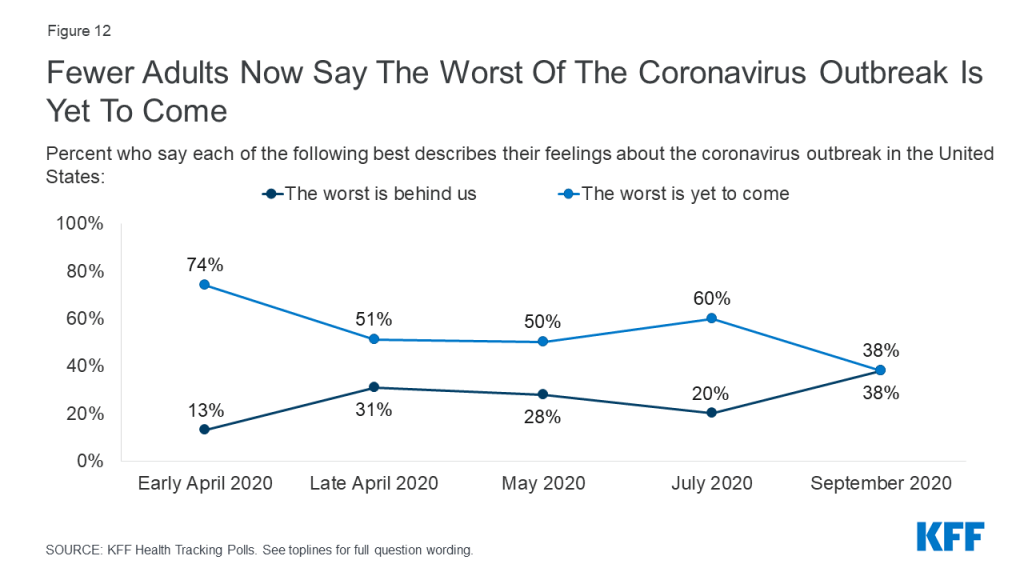
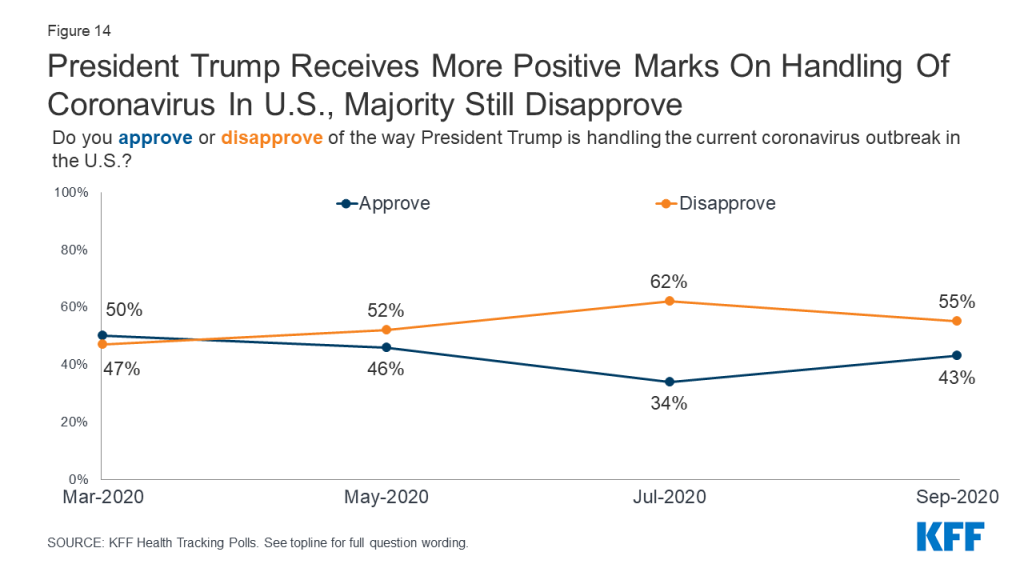
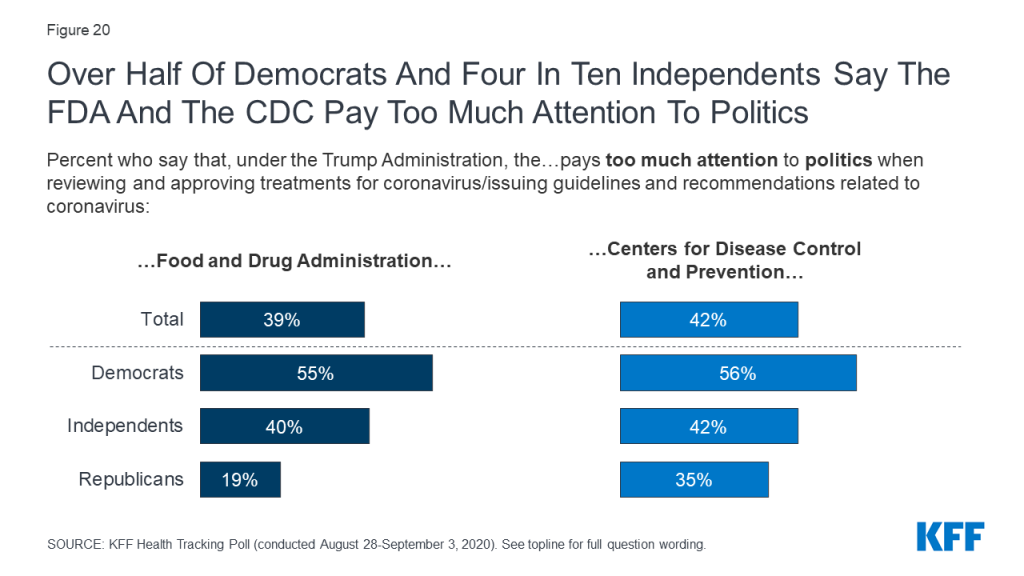
The COVID-19 pandemic, the worst health crisis facing the global community in more than a century, has taken a particular toll on the United States. Although the U.S. only represents 4% of the global population, it accounts for 23% of all COVID-19 cases and 21% of all deaths as of early September and ranks number one among high income countries as measured by cases per capita. The Trump administration has not established a coordinated, national plan to scale-up and implement public health measures to control the spread of coronavirus, instead choosing to have states assume primary responsibility for the COVID-19 response, with the federal government acting as back-up and “supplier of last resort.” The President has downplayed the threat of COVID-19, given conflicting messages and misinformation, and often been at odds with public health officials and scientific evidence. Despite this, the Administration has taken a number of actions to address the pandemic, including declaring federal emergencies to free up resources and flexibilities, signing emergency spending bills passed by Congress, providing emergency use authorization for hundreds of tests and other devices, issuing guidance documents, and announced “Operation Warp Speed”, to produce and deliver coronavirus vaccines. On the global front, the Administration has reduced U.S. engagement in addressing the pandemic, including ended funding for the World Health Organization (WHO) and announcing withdrawal from WHO membership.
| COVID-19 Response Policy Actions | ||
| Policy | Implications | |
| Declared federal emergencies |
| |
| Instituted travel bans and other immigration restrictions |
| |
| Signed emergency spending bills | Congress passed and the President signed four emergency spending bills:
| |
| Created White House Coronavirus Task Force |
| |
| Issued federal social distancing and re-opening guidance |
| |
| Signed legislation and increased resources to address the costs of prevention, testing, and contact tracing |
| |
| Signed legislation and issued waivers related to health insurance coverage |
| |
| Signed legislation and guidance related to reopening schools |
| |
| Signed legislation that includes protections for workers |
| |
| Signed legislation and issued guidance to help hospitals/ health care facilities & providers |
| |
| Announced changes to build the Strategic National Stockpile and increase critical supplies |
| |
| Signed legislation and announced efforts relating to research and development, treatment, and distribution for potential vaccines |
| |
| Initiated changes to international cooperation and global health security efforts | The Administration has scaled back the U.S. international engagement on global health, including related to COVID-19 as follows:
Two of the four emergency spending bills passed by Congress and signed by the President provide funding for the global COVID-19 response, totaling $3.2 billion. | |
Affordable Care Act – Private Health Insurance
President Trump’s record on the Affordable Care Act (ACA) marketplaces and private insurance began on his first day in office, when he issued an executive order stating, “It is the policy of my Administration to seek the prompt repeal of the Patient Protection and Affordable Care Act.” Pending such repeal, he ordered executive branch agencies to exercise all authority and discretion available to waive, defer, grant exemptions from or delay implementation of any provision that would impose a fiscal or regulatory burden on any state, individuals, families, health care providers or health insurers. A few days later, the Administration cancelled advertising and outreach activities already scheduled and paid for to promote signups during the final week of Open Enrollment in 2017; enrollment during that week declined compared to the same period in 2016. In addition to supporting Congressional repeal of the ACA and a federal lawsuit to overturn it, the Trump Administration has taken other steps to modify how it operates.
| ACA Marketplace and Private Insurance Policy Actions | |
| Policy | Implications |
| Supported ACA repeal/replace legislation |
|
| Supporting lawsuit to overturn the entire ACA |
|
| Limited Open Enrollment and eligibility for Special Enrollment Periods Reduced navigator funding and standards Promoted use of brokers and use of commercial website alternatives to healthcare.gov |
|
| Ended payments to insurers for cost sharing reduction (CSR) expenses in 2017 |
|
| Expanded short-term insurance |
|
| Changed marketplace plan standards and oversight in 2017, 2018 and reduced federal marketplace user fees |
|
| Relaxed standards for state waivers under Section 1332 of ACA |
|
| Promoted sale of coverage to self-employed and small employers through Association Health Plans |
|
| New standards for employer-sponsored health reimbursement arrangements (HRAs) |
|
| Other Proposals |
|
Medicaid
Overall, the Trump Administration has made efforts to reduce federal spending for Medicaid and limit eligibility through proposed legislation and budget proposals, new state demonstration waivers and its support of litigation to overturn the ACA.
| Medicaid Policy Actions | |
| Policy | Implications |
| Supported repeal of the Affordable Care Act (ACA) and supporting lawsuit to overturn entire law |
|
| Proposed changes in budgets that were not enacted to cap and limit federal funding for Medicaid and limit Medicaid eligibility |
|
| Invited state waivers to condition Medicaid eligibility on work requirements and to elect capped financing |
|
| Took administrative actions to change Medicaid managed care rules, increase eligibility verification requirements, and put limits on state financing mechanisms |
|
| Expanded Medicaid coverage of substance use disorder and mental health treatment in “institutions for mental disease” |
|
| Introduced and adopted changes to Medicaid pharmacy benefit |
|
| Implemented legislation and provided guidance related to Medicaid and COVID-19 |
|
Medicare
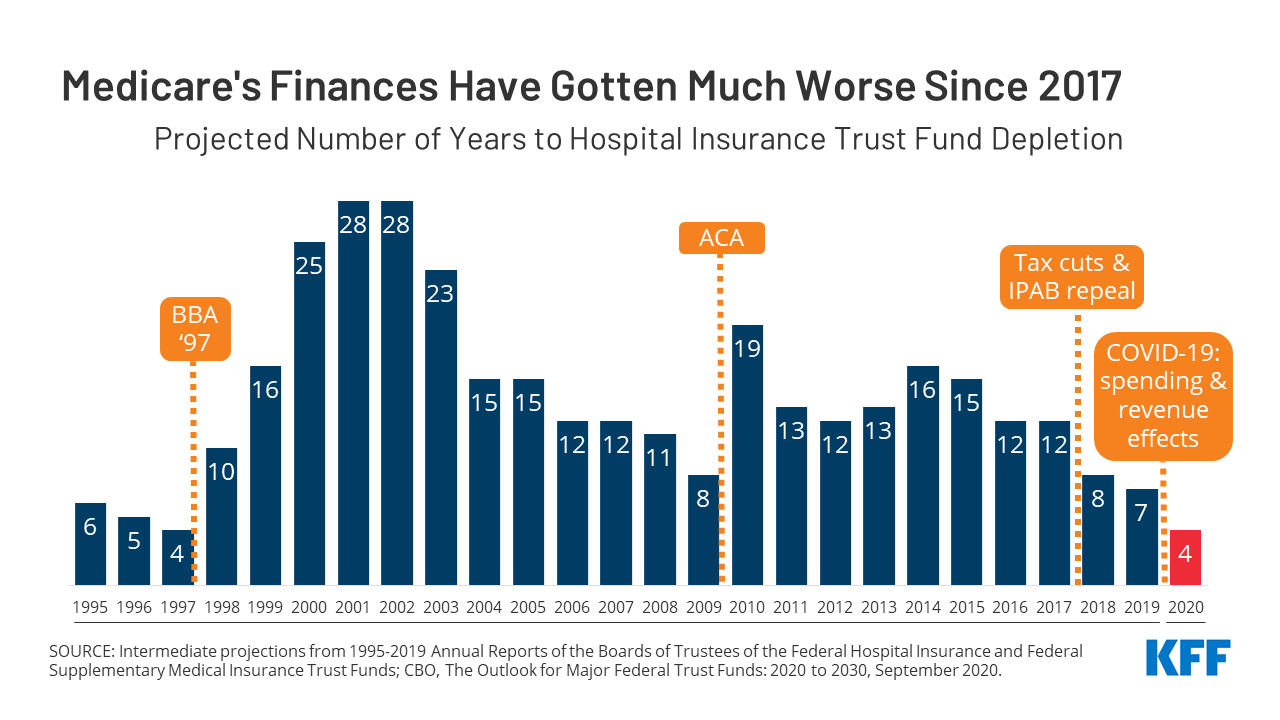
In his most recent State of the Union address, President Trump said his Administration will “protect” Medicare just as he has vowed to protect Social Security. President Trump signed into law multiple pieces of legislation that had the effect of accelerating the insolvency of the Medicare Hospital Insurance Trust Fund. The Trump Administration has proposed changes to the Medicare program, including reductions in Medicare spending through changes (or proposed changes) to provider payments, and regulatory requirements for providers and Medicare private plans (Medicare Advantage and Part D). The Administration has issued many proposals relating to Medicare prescription drug costs, most of which have not been implemented (See more in Reducing Prescription Drug and Other Health Care Costs Section).
| Medicare Policy Actions | |
| Policy | Implications |
| Supported repeal of the Affordable Care Act (ACA) and supporting lawsuit to overturn entire law |
|
| Signed legislation that directly affected Medicare spending and the solvency of the Medicare Hospital Insurance (HI) Trust Fund |
|
| Signed legislation and made other changes pertaining to Medicare and COVID-19 |
|
| Proposed changes in HHS Fiscal Year (FY) Budgets to reduce Medicare spending that were not enacted |
|
| Signed legislation and implemented Innovation Center model related to prescription drug costs |
|
| Introduced proposals related to prescription drug costs |
|
| Implemented changes to Medicare provider payments |
|
| Introduced initiatives related to Medicare provider regulatory requirements and health care data |
|
| Implemented regulatory changes related to certain Medicare Accountable Care Organizations (ACOs) |
|
| Introduced and implemented initiatives related to rural health |
|
| Introduced and implemented initiatives related to kidney care |
|
Reducing Prescription Drug and Other Health Care Costs
The Trump Administration has issued many proposals to lower prescription drug prices and spending, although most have not been adopted by the Congress or implemented by the Administration through the regulatory process, and pending proposals are unlikely to be adopted prior to the November election. President Trump signed into law legislation passed by Congress that banned “pharmacy gag” clauses and accelerated the phase out of the Medicare Part D “donut hole” and is moving forward with an Innovation Center model that will lower insulin costs for some Medicare beneficiaries (to take effect in 2021). In addition, the Trump Administration has moved forward on a hospital price transparency initiative that aims to give consumers better information to help lower costs.
| Reducing Prescription Drug and Other Health Care Costs Policy Actions | |
| Policy | Implications |
| Signed the Know the Lowest Price Act of 2018 to ban pharmacy “gag clauses” |
|
| Implemented and proposed changes to Part D benefit design |
|
| Developed Innovation Center model to lower insulin copays in Part D |
|
| Implemented legislation and released rules and proposals to change the Medicaid Drug Rebate Program |
|
| Other Medicaid prescription drug policy actions |
|
| Issued regulations and executive orders related to prescription drug costs |
|
| Implemented legislation and provided guidance related to prescription drugs and COVID-19 |
|
| Issued final regulations related to price transparency for hospitals |
|
Sexual and Reproductive Health
The Trump Administration has made efforts to reduce access to contraception by issuing regulations that allow employers to opt out of the ACA’s requirement to offer no-cost contraception in its health plans and that exclude family planning clinics that provide or refer for abortion from the Title X family planning program for low-income people. The Administration has also sought to limit access to abortion coverage and care by appointing judges opposed to abortion rights and issuing restrictive rules and regulations.
| Sexual and Reproductive Health Policy Actions | |
| Policy | Implications |
| Appointed federal judges opposed to abortion rights |
|
| Prohibited federal Title X family planning funds for clinics that provide or refer for abortion |
|
| Issued regulations that allow employers with religious or moral objections to be exempt from the ACA’s requirement to include no-cost contraceptive coverage |
|
| Issued regulations (not currently in effect) which add new billing and payment requirements for ACA Marketplace plans that include coverage for abortion |
|
| Eliminated anti-discrimination regulatory protections in health care for patients who have terminated a pregnancy and permits providers with a religious objection to refuse to provide abortion care |
|
| Rescinded 2016 guidance that had barred state Medicaid programs from excluding abortion providers without evidence of wrongdoing |
|
| Promoted and expanded access to loosely-regulated short-term plans |
|
| Sought to terminate the Teen Pregnancy Prevention Program (TPPP) and redirect funding to abstinence-until-marriage educational programs |
|
| Supports legislative efforts to ‘repeal and replace’ the ACA and is supporting a lawsuit to overturn it |
|
| Signed the Preventing Maternal Deaths Act of 2018 that supports state and local surveillance of maternal mortality |
|
| Reinstated and expanded the Mexico City Policy |
|
Mental Health and Substance Use
The Trump Administration has taken steps to address the opioid epidemic and high suicide rates among veterans. The Administration also supports overturning the ACA and increased the duration of short-term health plans, steps that would ultimately reduce coverage of mental health and substance use disorder services and limit the scope of mental health parity rules. President Trump also proposed budget reductions to the Substance Abuse and Mental Health Services Administration (SAMHSA) and Medicaid, key funders for substance use disorder services. Most recently, during the COVID-19 pandemic, President Trump signed legislation providing some additional funding to SAMHSA and to support mental health services for isolated veterans.
| Actions Affecting Mental Health and Substance Use | |
| Policy | Implications |
| Supports lawsuit to overturn the entire ACA |
|
| Increased duration of and promoted the sale of short-term health plans |
|
| Declared the opioid crisis a national public health emergency |
|
| Signed an executive order to address suicide among veterans |
|
| Proposed changes in HHS Fiscal Year Budget for behavioral health workforce development programs |
|
| Signed the CARES Act, legislation in response to the COVID-19 pandemic | The CARES Act includes several measures to address mental health and substance use disorder needs:
|
Immigration and Health
Since taking office, the Trump Administration has taken numerous actions to reshape immigration policy. These efforts have included limiting entry into the country, including restrictions for humanitarian immigrants such as refugees and asylees; enhancing interior enforcement efforts and expanding the scope of individuals targeted for removal; and discouraging legal immigrants from using public programs for which they are eligible, including Medicaid. A number of these actions have particularly significant implications for the health and well-being of immigrant families, including their children, who are primarily U.S.-born citizens.
| Immigration and Health Policy Actions | |
| Policy | Implications |
| Limited admission into the U.S. |
|
| Enhanced interior enforcement efforts |
|
| Rescinded the DACA program |
|
| Made changes to public charge test applied when determining whether to grant individuals entry into the U.S. or adjustment to legal permanent resident (LPR or “green card”) status |
|
| Required proof of health insurance coverage or sufficient resources to pay for anticipated health care needs to enter country |
|
| Collect data on citizenship status as part of 2020 Census and exclude undocumented immigrants from the Census count |
|
Long-term Care
The Trump Administration has proposed changes to Medicaid financing that would have affected the program’s ability to pay for long-term services and supports. In addition, the Administration supported repeal of the ACA which would eliminate some options for states to expand access to Medicaid home and community-based services. Prior the onset of COVID-19, the Administration proposed changes to relax certain requirements for nursing homes, and subsequently relaxed additional requirements at the onset of the pandemic while imposing new ones to prevent the spread of the virus. Since March, as the number of COVID-19 deaths in long-term care facilities increased substantially, the Trump Administration issued new guidance and waivers, established a new commission to make recommendations, required nursing facilities to report cases, deaths and shortages, distributed tests to facilities and made additional funds available to nursing facilities and assisted living facilities.
| Long-term Care Policy Actions | |
| Policy | Implications |
| Proposed changes to cap and limit federal funding for Medicaid and limit Medicaid eligibility |
|
| Supported repeal of the Affordable Care Act (ACA) and supporting lawsuit to overturn entire law |
|
| Proposed changes to nursing home regulations | |
| Provided guidance and issued waivers related to nursing homes and COVID-19 |
|
HIV/AIDS Policy
President Trump has taken steps to address the domestic HIV epidemic. In 2019, he launched a new effort, the Ending the HIV Epidemic (EHE): A Plan for America, which aims to drive down new HIV infections, especially in hard hit areas, and includes new funding for domestic HIV programs. It has helped to focus new attention and resources on HIV in the United States. At the same time, other actions of the Administration, such as ongoing attempts to overturn the ACA, which has helped to expand insurance coverage for people with HIV, and the removal of protections for LGBTQ people in health care, threaten to undermine the reach of the EHE. On the global front, the President has publicly supported PEPFAR, but called for significant budget cuts to PEPFAR and the Global Fund to Fight AIDS, Tuberculosis and Malaria each year.
| HIV/AIDS Policy Actions | |
| Policy | Implications |
| Left vacant the White House Office of AIDS Policy |
|
| Launched the “Ending the HIV Epidemic” (EHE): A Plan for America |
|
| Promoted and expanded access to short-term limited duration (STLD) plans |
|
| Eliminated anti-discrimination regulatory protections in health care for LGBTQ patients. |
|
| Implemented “Deploy or Get Out” DoD policy |
|
| CARES Act funding for the Ryan White and Housing Opportunities for People with AIDS (HOPWA) Programs. |
|
| Global HIV/PEPFAR |
|
LGBTQ Health
The Trump Administration has implemented or supported several policies that remove or reduce protections for LGBTQ people in in health care. Many of these actions have occurred against the backdrop of protections for “provider conscience.” In some cases, these policies have been halted or are still being considered by the courts.
| LGBTQ Health Policy Actions | |
| Policy | Implications |
| Eliminated anti-discrimination regulatory protections in health care for LGBTQ individuals. |
|
| Issued executive order directing federal agencies to expand religious protections. |
|
| Created new Division of Conscience and Religious Freedom in the Office of Civil Rights (OCR) at U.S. Department of Health and Human Services (HHS) and issued final regulation on “Conscience Rights in Health Care” |
|