KFF designs, conducts and analyzes original public opinion and survey research on Americans’ attitudes, knowledge, and experiences with the health care system to help amplify the public’s voice in major national debates.
Medicare, the federal health insurance program for people ages 65 and over and younger people with long-term disabilities, plays a major role in the U.S. health care system.
Medicare provides health insurance coverage for 70 million people, 20% of the U.S. population – a share which will grow larger in the coming decades. Medicare spending comprised 14% of the federal budget in 2025 and 21% of national health care spending in 2024. Given Medicare’s essential role as a source of coverage for an aging population and the importance of sustaining the program for future generations, Medicare is often part of discussions about total federal government spending, health care spending in the U.S., and the affordability of health care costs.
This brief provides key data about Medicare spending to help frame these discussions.
An aging population leads to higher enrollment in Medicare. With the aging of the U.S. population, the number of people covered by Medicare has increased over time and will increase further in the coming decades. At the same time, the Medicare population will include a growing number of people ages 80 and older.
Growth in total Medicare spending has been driven in part by an increase in the number of people enrolled in Medicare. Higher total Medicare spending has also been driven by growth in health care spending per Medicare beneficiary, which is influenced by increasing volume and use of services, new technologies, and rising prices. Rising spending on Medicare Advantage has also contributed to growth in total Medicare spending (discussed more below). Looking to the future, these factors will continue to play a role in Medicare spending growth.
Figure 2
Growth in Medicare spending per person over time has historically been on par with or lower than spending per person with private insurance, but may increase in the coming decade. Between 2010 and 2025, growth in spending per person was lower in Medicare than in private health insurance (3.1% vs. 4.3%). In contrast to private insurers, Medicare typically sets payment rates in advance for covered services, including hospitals, physicians, and other services (except prescription drugs). As a result, Medicare payments for these services are generally lower than rates paid by private insurers. For example, private payment rates for all hospital services are about double Medicare rates, on average.
Between 2025 and 2034, growth in spending per person is projected to be higher in Medicare than in private health insurance (6.0% vs. 4.9%), reflecting the aging of the population during this period, among other factors.
Figure 3
Growth in Spending Per Person Over Time Has Been Lower in Medicare Than in Private Health Insurance, But This Is Projected to Change in the Coming Decade
Source: KFF analysis of data from 2026 Annual Report of the Boards of Trustees of the Federal Hospital Insurance and Federal Supplementary Medical Insurance Trust Funds, Table V.D1—HI and SMI Average Incurred per Beneficiary Costs; Centers for Medicare & Medicaid Services, Office of the Actuary, National Health Statistics Group, National Health Expenditure Data, Table 21: Expenditures, Enrollment and Per Enrollee Estimates of Health Insurance, United States, Calendar Years 1987-2024 and National Health Expenditure Projections, Table 17: Health Insurance Enrollment and Enrollment Growth Rates.
Spending on Medicare Benefits and Medicare Advantage
Spending on physician services and on Medicare Advantage accounts for a growing share of Medicare spending. Medicare now spends more on physician and outpatient services covered under Medicare Part B, including drugs administered by physicians, than hospital services covered under Medicare Part A, or retail prescription drugs covered under Part D. This gap is expected to grow. Spending on Medicare Advantage, the private plan alternative to traditional Medicare, has also grown in recent years and is projected to continue to increase.
Figure 4
This increase in spending on Medicare Advantage in part reflects a rise in Medicare Advantage enrollment over these years. Between 2010 and 2025, the share of Medicare beneficiaries enrolled in Medicare Advantage plans more than doubled, from 25% to 54%.
Additionally, Medicare pays more to private Medicare Advantage plans for enrollees than their costs would be in traditional Medicare due to factors such as higher coding intensity and favorable selection into Medicare Advantage. These higher payments have contributed to growth in spending on Medicare Advantage and overall Medicare spending.
In 2026, payments to Medicare Advantage plans are estimated to be 114% of what traditional Medicare would have spent on the same beneficiary, on average. This amount had been decreasing after Congress made changes to how Medicare Advantage plans are paid in 2010—but it has been trending higher since 2017.
Medicare pays firms offering Medicare Advantage plans a set monthly amount per enrollee. The payment is determined through an annual process in which plans submit “bids” for how much they estimate it will cost to provide benefits covered under Medicare Parts A and B for an average beneficiary. Medicare also adjusts payment to Medicare Advantage plans based on certain factors, such as the health status of enrollees. Read KFF’s explainer to understand the details of how Medicare pays private plans.
The Medicare Hospital Insurance (Part A) Trust Fund faces solvency challenges in the near future. Higher Medicare Part A spending, driven by enrollment growth and an increase in spending per beneficiary, coupled with a shortfall in revenues needed to pay for all Part A covered benefits, is projected to deplete the reserves in the Part A Trust Fund within 7 years.
Increases in Medicare spending have led to higher Medicare premiums and deductibles for beneficiaries. Taken together the cost of Medicare Part A and B premiums and cost sharing represents roughly 18% of the average Social Security benefit in 2026, up from 14% in 2000. (Most beneficiaries do not pay a Part A premium. However, beneficiaries ages 65 and older who have paid fewer than 10 years of Medicare payroll taxes and some younger beneficiaries with disabilities are required to pay a premium for Part A coverage.) While most beneficiaries have other sources of income in addition to Social Security to help cover these expenses, there are also other out-of-pocket health care costs that beneficiaries could incur, such as premiums for prescription drug coverage and cost sharing for medications and physician visits, as well as costs for services not covered by Medicare, such as dental care and long-term services and supports.
Medicare faces spending pressures due to rising enrollment and rising health care costs. Consideration of possible changes to Medicare to sustain the program for the long run—such as changes in payments to providers and Medicare Advantage plans, changes in benefits, or additional revenues—will involve careful deliberation about the effects on federal spending, total health care spending, health care providers, and access to quality care and the affordability of health care for Medicare’s growing number of beneficiaries.
Centers for Medicare & Medicaid Services, Office of the Actuary, National Health Statistics Group, National Health Expenditure Data, Table 21 Expenditures, Enrollment and Per Enrollee Estimates of Health Insurance, United States, Calendar Years 1987-2024.
Note: This brief was originally published on July 8 and updated on August 3, 2026 to include proposed 2027 rates from all 50 states and the District of Columbia.
ACA Marketplaces insurers are proposing a median premium increase of 15% in 2027, according to KFF’s updated analysis of 276 insurers with publicly available filings across all 50 states and the District of Columbia. This is the second consecutive year of double-digit premium hikes. Last year’s median nationwide proposed rate change was 18%, and the median finalized rate change was 20%. While this proposed rate change is lower than last year, it represents the second-highest requested rate change since 2018, as premium growth had been relatively flat in this market for several years.
Based on detailed filings from 16 states and DC, rising healthcare prices—as in prior years—remain the primary driver of 2027 premium increases. Insurers cite higher costs for health services, general economic inflation, and labor shortages. They also point to factors unique to the individual market: the expiration of enhanced premium tax credits at the end of 2025 and a related increase in the risk pool’s morbidity, as contributing to rising rates for 2027.
The full analysis and other data on health costs are available on the Peterson-KFF Health System Tracker, an online information hub dedicated to monitoring and assessing the performance of the U.S. health system.
Note: Originally published on Jan. 28, 2025, this resource is updated as needed, most recently on August 3, 2026, to reflect additional developments.
Starting on the first day of his second term, President Trump began to issue numerous executive actions, several of which directly address or affect U.S. global health efforts.* This guide provides an overview of these actions, in the order in which they were issued. The “date issued” is date the action was first taken; subsequent actions are listed under “What Happens/Implications.” See an accompanying timeline of events specific to the foreign aid review and USAID dissolution.
President Trump’s Executive Actions on Global Health
PURPOSE: Initial rescissions of Executive Orders and Actions issued by President Biden.
Among these orders are several that addressed the COVID-19 pandemic and global health security, such as Executive Order 13987 (Organizing and Mobilizing the United States Government To Provide a Unified and Effective Response To Combat COVID-19 and To Provide United States Leadership on Global Health and Security), which among other things established the National Security Council Directorate on Global Health Security and Biodefense and a Senior Director position to oversee it.
What Happens Next/Implications: Given that most of the provisions in the COVID-19 and Global Health Security actions issued by President Biden are no longer current or relevant, the rescissions of these actions are likely to have minimal effect on government policies. One exception may be the elimination of the Directorate of Global Health Security and Biodefense and its Senior Director at the National Security Council, which were responsible for interagency coordination on global health security matters during the Biden Administration. The elimination of this office echoes a similar move made during the first Trump Administration to eliminate an NSC Directorate for Global Health Security, and raises questions about who and which offices at NSC (and across the government) will fill this coordination role in the new Administration. More rescissions of other Biden administration Executive Actions may be issued at a later date.
PURPOSE: To withdraw from the World Health Organization (WHO). “The United States noticed its withdrawal from the World Health Organization (WHO) in 2020 due to the organization’s mishandling of the COVID-19 pandemic that arose out of Wuhan, China, and other global health crises, its failure to adopt urgently needed reforms, and its inability to demonstrate independence from the inappropriate political influence of WHO member states. In addition, the WHO continues to demand unfairly onerous payments from the United States, far out of proportion with other countries’ assessed payments. China, with a population of 1.4 billion, has 300 percent of the population of the United States, yet contributes nearly 90 percent less to the WHO.”
ACTIONS: The United States intends to withdraw from the WHO. • The Presidential Letter to the Secretary-General of the United Nations signed on January 20, 2021, that retracted the United States’ July 6, 2020, notification of withdrawal is revoked. • Executive Order 13987 (Organizing and Mobilizing the United States Government to Provide a Unified and Effective Response to Combat COVID–19 and To Provide United States Leadership on Global Health and Security), which, among other things, called for “engaging with and strengthening the World Health Organization” is revoked. • Assistant to the President for National Security Affairs shall establish directorates and coordinating mechanisms within the National Security Council apparatus as necessary and appropriate to safeguard public health and fortify biosecurity. •The Secretary of State and Director of the Office of Management and Budget shall take actions to pause future transfer of any U.S. funds, support, or resources to WHO; recall and reassign U.S. government personnel or contractors working in any capacity with WHO; and identify credible and transparent U.S. and international partners to assume necessary activities previously undertaken by WHO. •The Director of the White House Office of Pandemic Preparedness and Response Policy shall review, rescind, and replace the 2024 U.S. Global Health Security Strategy. •The Secretary of State shall immediately inform the Secretary-General of the United Nations, any other applicable depositary, and the leadership of the WHO of the withdrawal. • While the withdrawal is in progress, Secretary of State will cease negotiations on the WHO Pandemic Agreement and the amendments to the International Health Regulations, and states that “actions taken to effectuate such agreement and amendments will have no binding force on the United States.”
What Happens Next/Implications: President Trump initiated a process to withdraw from the WHO during his first term in office, a process that takes a year to finalize, and halted funding. This time period was not met when President Biden took office and he reversed this decision and restored funding. Now, after issuance of a formal letter of withdrawal United Nations and WHO, the process will be initiated once again. Such a letter has been issued, indicating that membership will end as of January 22, 2026.Per the Executive Order, U.S. government representatives may not work with WHO. While U.S. representatives attended the Executive Board meeting in February (the U.S. previously held a seat on the Executive Board), no representatives attended the World Health Assembly in May, where world leaders adopted the Pandemic Agreement. On May 30, the White House released details on the President’s Budget Request for FY 2026, requesting eliminated funding for WHO. Further, on June 3, the administration asked Congress to rescind funds previously appropriated for fiscal years 2024 and 2025, including contributions to WHO. However, for both the FY 2026 appropriations and FY2024-25 rescissions, Congress will determine the final funding levels. As the largest donor to WHO providing approximately 16%-18% of the organization’s revenue, the absence of U.S. funding will have an impact WHO’s operations, as will the loss of U.S. technical expertise. See: KFF Fact Sheet and Quick Take
Update: The formal withdrawal of the U.S. government from the WHO became effective on January 22, 2026.
PURPOSE:To pause funding and review all U.S. foreign assistance to assess alignment with American values.
The U.S. “foreign aid industry and bureaucracy are not aligned with American interests and in many cases antithetical to American values. They serve to destabilize world peace by promoting ideas in foreign countries that are directly inverse to harmonious and stable relations internal to and among countries.”
“It is the policy of United States that no further United States foreign assistance shall be disbursed in a manner that is not fully aligned with the foreign policy of the President of the United States.”
Calls for:
• 90-day pause in U.S. foreign development assistance (new obligations or disbursements) to assess programmatic efficiencies and consistency with U.S. foreign policy. • Review of U.S. foreign assistance programs by the responsible department and agency heads under guidelines provided by the Secretary of State, in consultation with the Director of OMB. • Responsible department and agency heads, in consultation with the Director of OMB, will make determinations within 90 days of this order on whether to continue, modify, or cease each foreign assistance program based upon the review recommendations, with the concurrence of the Secretary of State. • New obligations and disbursements may resume for a program prior to the end of the 90-day period if a review is conducted, and the Secretary of State or his designee, in consultation with the Director of OMB, decide to continue the program in the same or modified form. Additionally, any other new foreign assistance programs and obligations must be approved by the Secretary of State or his designee, in consultation with the Director of OMB. • The Secretary of State may waive the pause for specific programs.
What Happens Next/Implications: Almost all global health programs are funded through foreign aid appropriations and are therefore subject to this order. The order temporarily freezes any new U.S. government spending (obligations or disbursements) through these programs, which could interrupt implementation of programs for which funds have not yet been obligated. It also calls for a 90-day review of all foreign aid programs. Key developments are as follows: • On January 24, 2025, A Notice on Implementation of the Executive Order was issued by USAID which, among other things, calls for stop-work orders to be issued for all existing foreign assistance awards (not just new obligations and disbursements). It notes that waivers have been granted for: foreign military financing for Israel and Egypt and emergency food assistance (and related expenses) and, on a temporary basis, salaries and related administrative expenses, including travel, for U.S. direct hire employees, personal services contractors, and locally employed staff. The stop-work order on existing awards halted U.S. global health (and other foreign assistance) programs that were already underway, placing key programs at risk of not being able to provide critical services, and affecting access for individuals on the ground, unless a waiver was received. • On January 28, the Secretary of State issued a blanket waiver for life-saving humanitarian assistance programs, which also lays out a process for requesting additional waivers (more information is here). This guidance also states that the waiver does not apply to “activities that involve abortions, family planning, conferences, administrative costs [unless associated with waived activities], gender or DEI ideology programs, transgender surgeries, or other non-life saving assistance.” • On February 1, PEPFAR, the global HIV/AIDS program, was granted a limited waiver enabling it to resume or continue “urgent life-saving HIV treatment services”, defined as a set of care and treatment services and prevention of mother-to-child transmission services. • On February 4, some additional services for other global health programs – tuberculosis; malaria; acute risks of maternal and child mortality, including severe acute malnutrition; and other life-threatening diseases and health conditions – deemed to be “lifesaving” were also granted a limited waiver to allow them to resume or continue. • On February 6, a lawsuit was filed by Democracy Forward and Public Citizen Litigation Group, on behalf of the American Foreign Service Association and American Federation of Government Employees, challenging the foreign aid funding freeze, the plan to put most staff on leave, and the fact that staff had already been placed on leave; on February 7, they filed a temporary restraining order (TRO). That same day, a temporary restraining order was issued by the U.S. District Court in the District of Columbia preventing the government from placing additional staff on leave or evacuating staff back to the U.S., and requiring reinstatement of all staff already placed on leave, until February 14. The court did not grant a TRO on the funding freeze, on the grounds that the plaintiffs in this case did not demonstrate that the freeze caused them irreparable harm. On February 13, the court extended the TRO through February 21 (further actions are described below, as this case was combined with another for purposes of the court’s consideration). • On February 10, a lawsuit was filed in the U.S. District Court for the District of Columbia on behalf of two U.S. organizations seeking emergency relief from the freeze on funding for foreign assistance (AVAC v. United States Department of State). • On February 11, a lawsuit was filed in the U.S. District Court for the District of Columbia on behalf of several U.S. organizations challenging the executive order and subsequent actions freezing foreign aid and dissolving USAID, and asking the court to temporarily restrain and preliminarily and permanently enjoin Defendants from implementing these actions (Global Health Council v. Trump). • On February 13, the court, in a ruling pertaining to the February 10 and February 11 lawsuits brought by numerous U.S. organizations, issued a TRO preventing the Trump administration from “suspending, pausing, or otherwise preventing the obligation or disbursement of appropriated foreign-assistance funds in connection with any contracts, grants, cooperative agreements, loans, or other federal foreign assistance award that was in existence as of January 19, 2025; or issuing, implementing, enforcing”, or “otherwise giving effect to terminations, suspensions, or stop-work orders in connection with any contracts, grants, cooperative agreements, loans, or other federal foreign assistance award that was in existence as of January 19, 2025.” • On February 14, the parties filed a joint status report proposing an expedited preliminary injunction briefing schedule. • On February 18, the government filed a required status report stating that, despite the TRO, it had the authority to cancel contracts and suspend grant awards. • This was followed by a February 19request by the February 10 plaintiffs (AVAC v. Department of State) for an emergency motion to enforce the TRO and to hold the defendants in civil contempt. • The defendants filed a required response on February 20, stating that they have not violated the TRO and should not be held in contempt, which was again opposed by the plaintiffs. Also on February 20, the February 11 plaintiffs (Global Health Council v. Trump) filed a response to the defendant’s status report with a motion to enforce the TRO. The court reaffirmed the TRO on February 20 (but did not hold the defendants in contempt), stating it was prepared to hold a hearing on the preliminary injunction motions in both cases by March 4, 2025 and that the TRO would be in place through March 10, 2025, or the date the Court resolves the preliminary injunction motions, whichever is sooner. • The plaintiffs filed an emergency order to enforce the TRO on February 24, due to continued lack of payment, and the court issued a motion to enforce on February 25. The government appealed, (asking for a stay pending appeal) but this was denied by the court. The government then appealed to the Supreme Court and was granted a stay until February 28 while the case was considered. • On March 5, the Supreme Court denied the government’s request to vacate the federal district court’s TRO, sending the order back to the district court to clarify the government’s obligations for ensuring compliance with the TRO. • On March 6, the federal district court judge ordered the government to release all payments that were due to plaintiffs as of February 13, by Monday, March 10 at 6pm, and on March 10, the federal district court judge preliminarily enjoined the government from taking certain actions related to the foreign aid freeze. • On March 10, Secretary Rubio announced that a six-week review had been completed and that 83% of programs at USAID (5,200 contracts) had been cancelled. That same day, the court preliminarily enjoined the government from enforcing actions taken to implement the foreign aid freeze (requiring it to reverse any terminations, suspensions, and stop-work orders and to pay for any work completed by February 13). The court stated that the government was “enjoined from unlawfully impounding congressionally appropriated foreign aid funds and shall make available for obligation the full amount of funds that Congress appropriated for foreign assistance programs in the Further Consolidated Appropriations Act of 2024.” • On April 1, the government filed an appeal with the U.S. Court of Appeals for the District of Columbia challenging the preliminary injunction issued on March 10. • On April 17, the administration extended the foreign aid review for another 30 days from the original deadline of April 20, 2025. •On May 2 and May 30, the White House released information on its budget request for FY 2026, proposing significant decreases, and in some cases eliminations, of funding for global health activities. However, Congress will determine the final funding levels. • On June 3, the administration asked Congress to rescind previously appropriated funds for fiscal years 2024 and 2025, including $8.3 billion in foreign assistance, of which at least $1.2 billion was designated for global health. However, Congress will need to approve any potential rescissions. • On August 13, the U.S. District Court of Appeals for the District of Columbia Circuit partially vacated the March 10 preliminary injunction in the cases GHC v. Trump and AVAC v. State Department which required the government to make congressionally appropriated foreign assistance funds available for obligation. The appeals court ruled that the plaintiffs did not have the authority to challenge the President’s impoundment of funds. Instead, the court ruled that challenges of impoundment should be brought forward by the Comptroller General. • On August 28, the U.S. District Court of Appeals for the District of Columbia Circuit amended its opinion, clarifying that while plaintiffs did not have the authority to challenge impoundment of foreign assistance funds through the Impoundment Control Act, they could seek relief through the Administrative Procedures Act. Following this amended opinion, plaintiffs in GHC v. Trump and AVAC v. State Department cases motioned for a preliminary injunction in the U.S. district court on September 1. On September 3, the U.S. district court granted the preliminary injunction, ordering defendants to obligate expiring foreign assistance funds before the end of the fiscal year on September 30. On September 4, defendants appealed this preliminary injunction and requested a stay on the preliminary injunction pending the resolution of the appeals case, from both the district court and appeals court. These requests were bothdenied on September 5. On September 8, defendants requested a stay of the preliminary injunction as it pertained to funds included in the President’s proposed rescissions package from the U.S Supreme Court. On September 9, the Chief Justice of the Supreme Court granted a partial administrative stay of the preliminary injunction, and on September 26, the court granted the partial stay, allowing the administration to rescind the $4 billion that was in rescission package. Further legal proceedings in the case are currently stayed as the parties await the outcome of a separate legal case. • On July 27, 2026, plaintiffs in the GHC v. Trump case filed a motion requesting a summary judgment which would compel defendants to, among other things, obligate remaining foreign assistance and global health funds set to expire on September 30, 2026.
The 90-day review of foreign assistance was initially supposed to go through April 19, 2025, however, has been granted a 30-day extension. No formal results of the review have been announced.
PURPOSE: To put core American interests first in foreign policy.
The foreign policy of the United States “shall champion core American interests and always put America and American citizens first.”
“As soon as practicable, the Secretary of State shall issue guidance bringing the Department of State’s policies, programs, personnel, and operations in line with an America First foreign policy, which puts America and its interests first.”
What Happens Next/Implications: The State Department is responsible for the supervision and overall strategic direction of foreign assistance programs administered by the State Department and USAID, which includes the vast majority of global health assistance. It also directly oversees PEPFAR, the global HIV/AIDS program, and many aspects of global health diplomacy for the U.S. Priorities and approaches for these and other global health programs are likely to be shaped by how the White House and State Department leadership define “America First” foreign policy and American interests, and how that definition is implemented in practice.
Update: On September 18, the State Department released the America First Global Health Strategy, its new vision for U.S. global health engagement. The strategy is built around three pillars — “making America safer, stronger, and more prosperous” — and prioritizes funding for direct service support, such as commodities and health workers, includes plans for country co-investment, and seeks to transition program management operations from U.S. leadership to country ownership. The State Department is entering into multi-year bilateral agreements with recipient countries and implementation of these new agreements will begin sometime in 2026.
PURPOSE: To define sex as an immutable binary biological classification and remove recognition of the concept of gender identity.
• The order states that “It is the policy of the United States to recognize two sexes, male and female” and directs the Executive Branch to “enforce all sex-protective laws to promote this reality”. Elements of the order that may affect global health programs are as follows: •Defines sex as “an individual’s immutable biological classification as either male or female”. States that “sex” is not a synonym for and does not include the concept of “gender identity” and that gender identity “does not provide a meaningful basis for identification and cannot be recognized as a replacement for sex.” • Directs the Secretary of Health and Human Services to provide the U.S. Government, external partners, and the public clear guidance expanding on the sex-based definitions set forth in the order within 30 days. • Directs each agency and all Federal employees to “enforce laws governing sex-based rights, protections, opportunities, and accommodations to protect men and women as biologically distinct sexes, including when interpreting or applying statutes, regulations, or guidance and in all other official agency business, documents, and communications. • Directs each agency and all Federal employees, when administering or enforcing sex-based distinctions, to use the term “sex” and not “gender” in all applicable Federal policies and documents. • Directs agencies to remove all statements, policies, regulations, forms, communications, or other internal and external messages “that promote or otherwise inculcate gender ideology”, and shall cease issuing such statements, policies, regulations, forms, communications or other messages. Directs agencies to take all necessary steps, as permitted by law, to end the Federal funding of gender ideology. • Requires that Federal funds shall not be used to promote gender ideology and directs agencies to ensure grant funds do not promote gender ideology. • Rescinds multiple executive orders issued by President Biden, including: “Preventing and Combating Discrimination on the Basis of Gender Identity or Sexual Orientation” (13988) and “Advancing Equality for Lesbian, Gay, Bisexual, Transgender, Queer, and Intersex Individuals” (14075).
What Happens Next/Implications: This order is broad, directed to all federal agencies and programs. Because PEPFAR, and some other U.S. global health programs, serve people who are members of the LGBTQ community, guidance and implementation could affect the ability of these programs to reach individuals and organizations and provide them with services. In addition, the order will likely result in the removal of existing protections based on sexual orientation and gender identity, which had been provided in agency guidance for global health and development programs. Implementation guidance has been issued and all federal agencies must comply.
Update: On January 27, 2026, citing this order (among others) the Trump administration released details of the “Promoting Human Flourishing in Foreign Assistance (PHFFA)” policy which significantly expands the Mexico City Policy (see below) to also prohibit the promotion of “gender ideology” and to apply to significantly more funding and organizations.
PURPOSE: To reinstate Mexico City Policy and direct review of programs per the Kemp-Kasten Amendment.
• Revokes President Biden’s Presidential Memorandum of January 28, 2021 for the Secretary of State, the Secretary of Defense, the Secretary of Health and Human Services, and the Administrator of the United States Agency for International Development (Protecting Women’s Health at Home and Abroad). • Reinstates President Trump’s Presidential Memorandum of January 23, 2017 for the Secretary of State, the Secretary of Health and Human Services, and the Administrator of the United States Agency for International Development (The Mexico City Policy). • Directs the Secretary of State, in coordination with the Secretary of Health and Human Services, to the extent allowable by law, to implement a plan to extend the requirements of the reinstated Memorandum to global health assistance furnished by all departments or agencies. • Directs the Secretary of State to take all necessary actions, to the extent permitted by law, to ensure that U.S. taxpayer dollars do not fund organizations or programs that support or participate in the management of a program of coercive abortion or involuntary sterilization.
What Happens Next/Implications: The Mexico City Policy is a U.S. government policy that – when in effect – has required foreign NGOs to certify that they will not “perform or actively promote abortion as a method of family planning” using funds from any source (including non-U.S. funds) as a condition of receiving U.S. global family planning assistance and, when in place under the Trump administration, most other U.S. global health assistance. First announced in 1984 by the Reagan administration, the policy has been rescinded and reinstated by subsequent administrations along party lines since, and expanded over time, including a significant expansion during the first Trump administration; it was widely expected that the President Trump would reinstate it in his second term and expand it further. The memorandum calls for the implementation of a plan to extend the requirements to global health assistance furnished by all departments or agencies; until the plan is ready, the scope of the new memorandum is unknown.
The memorandum also directs the Secretary of State to review programs under the Kemp-Kasten amendment, a provision of U.S. law that states that no U.S. funds may be made available to “any organization or program which, as determined by the [p]resident of the United States, supports or participates in the management of a program of coercive abortion or involuntary sterilization.” It has been used in the past to prevent funding from going to UNFPA. See: KFF Mexico City Policy explainer and related resources and Kemp-Kasten explainer.
Update: On January 7, 2026, the Trump administration announced that it had formally withdrawn from membership and participation in UNFPA, also citing the Executive Order on “Withdrawing the United States from and Ending Funding to Certain United Nations Organizations and Reviewing United States Support to All International Organizations.”
Update: Three interim final rules expanding and implementing the Mexico City Policy, now called the Promoting Human Flourishing in Foreign Assistance (PHFFA) Policy, were issued on January 27, 2026: – Protecting Life in Foreign Assistance – Combating Gender Ideology in Foreign Assistance – Combating Discriminatory Equity Ideology in Foreign Assistance Rules This latest expansion now includes most non-military foreign assistance and applies to U.S. NGOs, international organizations, and foreign governments, as well as foreign NGOs. In addition to abortion, it also now prohibits the promotion of “discriminatory equity ideology” and “gender ideology.”
The United States informed signatories of the Geneva Consensus Declaration of its intent to rejoin immediately. Established in 2020, the declaration, led by the United States, has the following objectives: “to secure meaningful health and development gains for women; to protect life at all stages; to defend the family as the fundamental unit of society; and to work together across the UN system to realize these values.”
What Happens Next/Implications: The Geneva Consensus Declaration, initially crafted and signed by the U.S. – along with 31 other countries at the time – was meant to enshrine certain values and principles related to women’s health and family, including a rejection of the “international right to abortion.” The Biden administration withdrew from the Consensus in 2021.
Review of and Changes to USAID, January 27, 2025 Reorganization of the Department of State, April 22, 2025
PURPOSE: To review and potentially reorganize USAID “to maximize efficiency and align operations with the national interest,” which may include the suspension or elimination of programs, projects, or activities; closing or suspending missions or posts; closing, reorganizing, downsizing, or renaming establishments, organizations, bureaus, centers, or offices; reducing the size of the workforce at such entities; and contracting out or privatizing functions or activities performed by federal employees.
What Happens Next/Implications: Related to but separate from the Executive Order on reevaluating and realigning foreign aid and on the America first policy directive to the Secretary of State, the administration has made changes to and begun a review of USAID, the U.S. government’s international development agency which oversees and/or implements most U.S. global health programs (see, The U.S. Government and Global Health). Key developments are as follows: • On January 27, senior USAID career staff were placed on leave and hundreds of other staff were let go. • On February 2, the USAID website was taken down. • On February 3, the USAID building in DC was closed, which has prevented other staff from accessing it. • The President appointed Secretary of State Rubio as Acting USAID Administrator on February 3. Secretary Rubio has said that the agency has “conflicting, overlapping, and duplicative functions that it shares with the Department of State” and that its systems and processes are not “well synthesized, integrated, or coordinated, and often result in discord in the foreign policy and foreign relations of the United States.” President Trump and other administration officials have called for dissolving the agency altogether. Formal notification of the intent to review the agency was sent by Secretary Rubio to Congress on February 3. • On February 4, a notice was posted on the USAID website stating that on February 7, all USAID direct hire personnel would be placed on administrative leave globally, with the exception of “designated personnel responsible for mission critical functions, core leadership and specially designated programs.” The notice also said that staff posted outside the United States would need to return to the U.S. within 30 days. • On February 6, a lawsuit was filed by Democracy Forward and Public Citizen Litigation Group, on behalf of the American Foreign Service Association and American Federation of Government Employees, challenging the foreign aid funding freeze, the plan to put most staff on leave, and the fact that staff had already been placed on leave; on February 7, they filed for a temporary restraining order (TRO). That same day, a temporary restraining order was issued by the U.S. District Court in the District of Columbia preventing the government from placing additional staff on leave or evacuating staff back to the U.S., and requiring reinstatement of all staff already placed on leave, until February 14. The court did not grant a TRO on the funding freeze, on the grounds that the plaintiffs in this case did not demonstrate that the freeze caused them irreparable harm. On February 13, the court extended the TRO through February 21, at which time, the court determined that further preliminary injunctive relief was not warranted and the TRO was ended, allowing the government to dismiss USAID staff. • On February 11, a lawsuit was filed in the U.S. District Court for the District of Columbia on behalf of several U.S. organizations challenging the executive order pausing foreign aid, and subsequent actions freezing foreign aid and dissolving USAID, and asking the court to temporarily restrain and preliminarily and permanently enjoin Defendants from implementing these actions. In a February 13ruling, a federal court issued a TRO preventing the Trump administration from freezing foreign aid assistance but stated that the proposed injunctions related to USAID were overbroad (in a separate case, the district court ended the TRO on dismissing USAID staff – see above). • On February 13, a lawsuit was filed in the U.S. District Court for the District of Maryland by 26 former and current employees of USAID, suing Elon Musk and DOGE for taking actions to control and dissolve the agency. On February 18, the plaintiffs filed a motion for preliminary injunction. The defendants responded on February 24 and the plaintiffs replied on February 26. On March 18, the court granted a preliminary injunction, requiring the defendants to reverse many of the actions taken to dissolve USAID, and on March 21, the defendants filed an appeal on the preliminary injunction. On March 25, the U.S. 4th Circuit Court of Appeals granted the defendants’ motion for a temporary stay on the preliminary injunction, allowing DOGE to resume its efforts to dissolve USAID, until March 27. The following day on March 28, the court granted defendants’ motion for a stay, clearing the path for DOGE to continue its work dissolving USAID. • On February 18, a lawsuit was filed in the U.S. District Court for the District of Columbia on behalf of the Personal Services Contractor Association (representing USAID personal service contractors) challenging the suspension of foreign assistance and the actions related to USAID, including “steps to dismantle USAID, cripple its operations, or transfer its functions to the State Department without Congressional authorization”. On February 19, the plaintiffs filed a motion for a temporary restraining order. On March 6, the court denied the TRO request. • On March 28, Secretary Rubio announced that the Department of State and USAID have notified Congress on their intent to “undertake a reorganization that would involve realigning certain USAID functions to the Department by July 1, 2025, and discontinuing the remaining USAID functions that do not align with Administration priorities.” Additionally, nearly all the remaining USAID staff received notice that they would be subject to a final reduction-in-force. • On April 22, Secretary Rubio announced the Department of State’s reorganization plan and new organization chart. The plan states that it would consolidate functions and remove non-statutory programs that are “misaligned with America’s core national interests.” • On April 28, a lawsuit was filed by a group of labor unions, non-profits, and local governments challenging the administration’s moves to drastically reshape several federal agencies without congressional approval (American Federation of Government Employees v. Trump). The district court issued a TRO on May 9 and preliminary injunction on May 22 ordering the administration to pause large-scale reductions in force, program eliminations, and other actions related to federal agency restructuring. An emergency motion by the government for a stay pending appeal of the district court’s preliminary injunction was denied on May 30. • On May 2 and May 30, the White House released information on its budget request for FY 2026, noting the reorganization of USAID into the Department of State. • On May 29, the Department of State notified Congress of its reorganization plans, including absorbing USAID’s continued functions. • On June 13, the district court in American Federation of Government Employees v. Trump ruled that the actions of the Department of State, including the reorganization announcement and notification to Congress, were in violation of the preliminary injunction. • On July 8, the U.S. Supreme Court granted the government’s request for a stay of the preliminary injunction pending resolution of the appeals case in American Federation of Government Employees v. Trump, allowing the government to move forward with large-scale reductions to federal agency operations and workforces, including at the State Department. • On April 20, 2026, a congressional notification was sent to Congress outlining plans for USAID to use remaining funds, including $2 billion in FY25 funding from the Global Health Programs (GHP) account, to close out the agency and terminated awards.
While initially created through Executive Order in 1961 as part of the State Department, the Foreign Affairs Reform and Restructuring Act of 1998 established it as an independent agency within the executive branch. As such, the Executive branch does not have authority to dissolve it without Congress, and Congress also requires notification first as well as consultation on any proposed changes.
Update: On July 1, 2025, USAID was dissolved (with most employees being separated from the agency; any remaining personnel were separated by September 2, 2025). Remaining functions/activities were transferred to the State Department.
PURPOSE: To review United States participation in all international intergovernmental organizations, conventions, and treaties and to withdraw from and end funding to certain United Nations (U.N.) organizations.
• The U.S. “helped found” the U.N. “after World War II to prevent future global conflicts and promote international peace and security. But some of [its] agencies and bodies have drifted from this mission and instead act contrary to the interests of the United States while attacking our allies and propagating anti-Semitism.” • States that the U.S. “will reevaluate our commitment to these institutions,” including three organizations that “deserve renewed scrutiny”: a) the U.N. Human Rights Council (UNHRC; the U.S. will not participate in and withhold its contribution to the budget of the body), b) the U.N. Educational, Scientific, and Cultural Organization (UNESCO; the U.S. will conduct a review of its membership in the body within 90 days), and c) the U.N. Relief and Works Agency for Palestine Refugees in the Near East (UNRWA; reiterates that the U.S. will not contribute to the body). • Requires that within 180 days: a) the Secretary of State, with the U.S. Ambassador to the U.N., conduct a review of all international intergovernmental organizations of which the U.S. is a member and provides any type of funding or other support, and all conventions and treaties to which the United States is a party, to determine which organizations, conventions, and treaties are contrary to the interests of the United States and whether such organizations, conventions, or treaties can be reformed; and b) the Secretary of State to report the findings of the review to the President, through the National Security Advisor, and provide recommendations as to whether the U.S. should withdraw from any such organizations, conventions, or treaties.
This Executive Order will have immediate impacts via the ordered actions related to the three U.N. organizations specified, much as the impacts of the Jan. 20, 2025, Executive Order on the World Health Organization (WHO, which initiated U.S. withdrawal from membership and halted U.S. funding) are already being seen. Beyond these, additional impacts of this Executive Order will be determined by the findings and recommendations of the international organizations and conventions review, particularly if U.S. support for or membership in some international organizations is recommended to be reduced or eliminated and if it recommends the U.S. withdraw from any international agreements.
The 180 day review of all international intergovernmental organizations goes through August 3, 2025.
Update: On January 7, 2026, the Trump administration announced that it had formally withdrawn from 66 international organizations, including United Nations entities and non-UN entities.
PURPOSE: The memorandum seeks to “stop funding Nongovernmental Organizations that undermine the national interest and administration priorities”.
The memorandum: • States: it is Administration policy “to stop funding NGOs [Nongovernmental Organizations] that undermine the national interest.” • Directs heads of executive departments and agencies to review all funding that agencies provide to NGOs and “to align future funding decisions with the interests of the United States and with the goals and priorities of my Administration, as expressed in executive action; as otherwise determined in the judgment of the heads of agencies; and on the basis of applicable authorizing statues, regulations, and terms.”
What Happens Next/Implications: This memo aligns with other Executive actions that target federal funding for global health and foreign assistance programs. Implementation of this memo could result in the Administration halting funding to global health NGOs they determine “do not align with administration priorities.” No criteria for how this determination will be made has been provided.
The majority of U.S. global health assistance is channeled through NGOs. In FY22, for example, 62% of U.S. global health funding was provided to NGOs as prime partners (45% to U.S.-based NGOs and 17% to foreign-based NGOs) and others are likely sub-recipients of U.S. assistance.* As such, this Order could have a significant impact on NGOs if it is determined that they do not align with administration policies. *Source: KFF analysis of data from www.foreignassistance.gov.
PURPOSE: To stop U.S. support for South Africa due to its “commission of rights violations in its country or its ‘undermining United States foreign policy, which poses national security threats to our Nation, our allies, our African partners, and our interests.”
“It is the policy of the United States that, as long as South Africa continues these unjust and immoral practices that harm our Nation: (a) the United States shall not provide aid or assistance to South Africa; and (b) the United States shall promote the resettlement of Afrikaner refugees escaping government-sponsored race-based discrimination, including racially discriminatory property confiscation.”
ACTIONS: • All executive departments and agencies, including USAID, shall, to the maximum extent allowed by law, halt foreign aid or assistance delivered or provided to South Africa, and shall promptly exercise all available authorities and discretion to halt such aid or assistance. • The head of each agency may permit the provision of any such foreign aid or assistance that, in the discretion of the relevant agency head, is necessary or appropriate. • The Secretary of State and the Secretary of Homeland Security shall take appropriate steps, consistent with law, to prioritize humanitarian relief, including admission and resettlement through the United States Refugee Admissions Program, for Afrikaners in South Africa. A plan shall be submitted to the President through the Assistant to the President and Homeland Security Advisor.
What Happens Next/Implications: South Africa receives a significant amount of global health assistance, particularly for HIV/AIDS, from the United States government. The executive order allows the heads of U.S. agencies to permit the provision of foreign aid or assistance under this order at their discretion. On February 10, the U.S. Embassy and Consulates in South Africa announced that PEPFAR would not be impacted by this Executive Order and could continue under the limited waiver already granted to the foreign aid funding freeze. No other exceptions have yet been announced.
The Government of South Africa has issued a statement in response to the Executive Order that, among other things, expresses concern “by what seems to be a campaign of misinformation and propaganda aimed at misrepresenting our great nation.”
Notes and Sources:
*There are several other Executive Actions issued by the President that instruct all government agencies on a variety of topics and as such broadly affect global health program operations but are not specific to global health. These include, for example, Executive Actions withdrawing from the Paris Agreement under the United Nations Framework Convention on Climate Change and ending DEI programs. These are not included in this resource.
Starting on his first day of his second term in office, President Trump and his administration have taken several executive actions that directly impact U.S. global health efforts. This timeline, which is a companion resource to components of KFF’s Overview of President Trump’s Executive Actions on Global Health, provides a detailed overview of actions, including counter-actions, related to the administration’s efforts to freeze all U.S. foreign aid, dissolve the U.S. Agency for International Development (USAID), which implements most U.S. global health programs, and reorganize the Department of State. It will be updated as needed to reflect additional developments.
U.S. Foreign Aid Freeze & Dissolution of USAID: Timeline of Events
Updated as of August 3, 2026
Source: KFF, Overview of President Trump’s Executive Actions on Global Health • Updated as of August 3, 2026.
Source: KFF, Overview of President Trump’s Executive Actions on Global Health • Updated as of August 15, 2025.
Five Key Facts About People Experiencing Homelessness
This brief, originally published on September 9, 2025, was updated with the most recently available data on July 31, 2026.
According to the most recent data available from the U.S. Department of Housing and Urban Development (HUD), nearly 746,000 people were experiencing homelessness on a single night in January 2025, an over 30% increase from 2019, but also a 3% decrease from the highest levels ever recorded in 2024. The links between homelessness and health are complex, and past KFF research found that people with prior experiences of homelessness have disproportionate physical and mental health needs and face greater socioeconomic challenges compared to those who have never experienced homelessness. People experiencing homelessness who are unsheltered also experience higher rates of chronic homelessness, chronic disease, mental illness, and substance abuse than those who are sheltered.
This data note reviews trends in homelessness and characteristics of people who are homeless using data from HUD’s Point-in-Time (PIT) count of sheltered and unsheltered people experiencing homelessness. The PIT count is generally conducted on a single night during the last ten days of January. While the PIT count is the primary nationally standardized measure to track trends in homelessness over time, these estimates likely undercount the total number of people experiencing homelessness, particularly among the unsheltered, due to challenges locating individuals who are unsheltered, local staffing capacity, and weather. The PIT count also does not include people who are staying with family or friends, referred to as “doubling up”, in other unstable housing situations, or living in permanent supportive housing.
These data capture a look at homelessness amid a number of federal policy changes aimed at clearing homeless encampments, limiting provisions for housing alternatives, and potentially resulting in institutionalization among people experiencing homelessness. President Trump signed an executive order in July 2025 on homelessness, mental health, and substance use that encouraged states to remove unhoused people from public spaces, following nationwide passage of Supreme Court-backed local laws making it easier for law enforcement to ticket, fine, or arrest people sleeping on public property. HUD proposed to shift homelessness services spending away from “Housing First” programs–which provide immediate housing without preconditions such as sobriety or mandatory mental health treatment—towards “transitional housing” programs, and require local homelessness services entities to cooperate with law enforcement to prohibit homeless encampments, but was blocked by court ruling in June 2026. Most recently, the Department of Justice (DOJ) issued an opinion in June 2026 and a notice in July 2026 challenging the longstanding interpretation of the Olmstead Supreme Court decision, signaling narrower federal enforcement of the integration mandate, which has helped spur state investment in rental assistance, supportive housing, and community services for people with disabilities. These changes could potentially result in fewer community services and increased institutionalization among people experiencing homelessness.
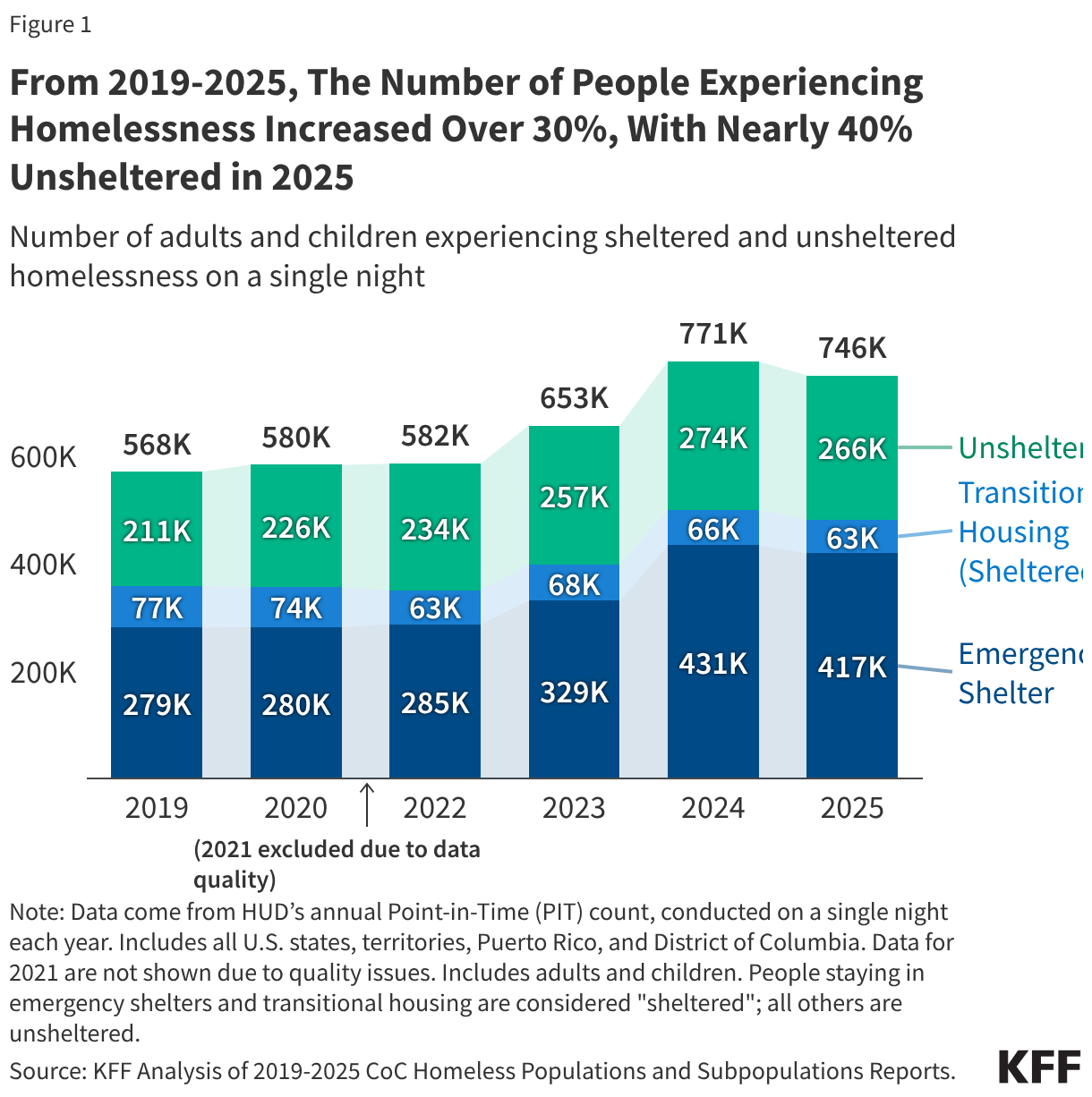
1. From 2019 to 2025, the number of people experiencing homelessness on a single night increased by over 30% to nearly 746,000 people, with nearly four in ten (36%) staying in unsheltered locations.
The HUD PIT survey counts people experiencing homelessness in both sheltered and unsheltered settings on a single night. People are counted as unsheltered if they sleep in locations not ordinarily used as a regular sleeping accommodation, such as cars, parks, abandoned buildings, or campgrounds. The remainder of people experiencing homelessness were in sheltered locations, with nearly six in ten (56%) staying in emergency shelters and nearly one in ten (8%) in transitional housing, which is temporary housing with supportive services (Figure 1).
Between 2019 and 2025, the number of people experiencing homelessness rose by 31%. This increase was primarily driven by the growth in the number of people staying in emergency shelters and experiencing unsheltered homelessness, while the number of people in transitional housing declined over the same period. According to HUD, rising housing costs and the end of the COVID-19 public health emergency in May 2023, which ended the eviction moratorium and other income and safety net programs, drove recent increases. Counts of people experiencing homelessness peaked in 2024 and then decreased 3% from 2024 to 2025, with nearly 60% of the decrease driven by a reduction in the number of people in emergency shelters.
Beyond shifts in sheltered and unsheltered homelessness, the share of people experiencing homelessness identified as “chronic homelessness”—defined by HUD as having a disability, including physical, mental, developmental, substance use-related, or HIV/AIDS-related disabilities, and experiencing long-term or repeated episodes of homelessness of at least 12 months—increased from 19% in 2019 to 23% in 2025 (from about 106,000 to 170,000). However, the share of adults experiencing homelessness who were veterans fell from 8% in 2019 to 5% in 2025 (from about 37,000 to 33,000), similar to their share of the general adult population (6%). An increase in housing assistance programs from the Department of Veterans Affairs (VA) in recent years likely drove this decrease.
From 2019-2025, The Number of People Experiencing Homelessness Increased Over 30%, With Nearly 40% Unsheltered in 2025
Number of adults and children experiencing sheltered and unsheltered homelessness on a single night
Data come from HUD’s annual Point-in-Time (PIT) count, conducted on a single night each year. Includes all U.S. states, territories, Puerto Rico, and District of Columbia. Data for 2021 are not shown due to quality issues. Includes adults and children. People staying in emergency shelters and transitional housing are considered "sheltered"; all others are unsheltered.
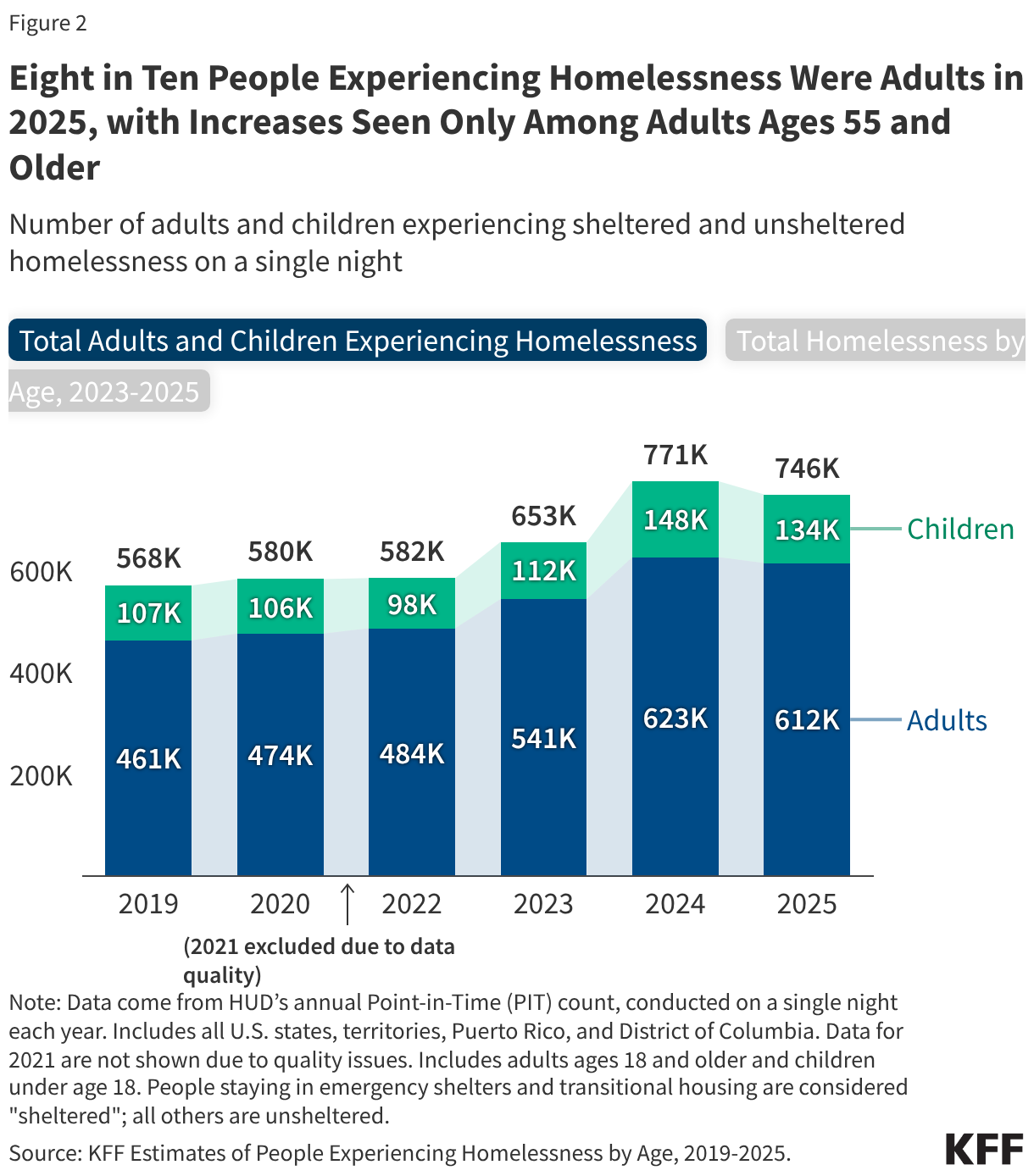
2. In 2025, over eight in ten (82%) people experiencing homelessness were adults, with decreases in the number of people experiencing homelessness seen across age groups since 2024 except among adults ages 55 and older.
On a single night in January 2025, there were about 612,000 adults and 134,000 children experiencing homelessness, with adults consistently representing about eight in ten of all people experiencing homelessness since 2019 (Figure 2). The number of children experiencing homelessness increased 25% from 2019 to 2025. However, after several years as the fastest-growing age group among people experiencing homelessness, the number of children experiencing homelessness fell 10% (from about 148,000 to 134,000) from 2024 to 2025. Most households with children experiencing homelessness are sheltered, as children made up less than one in ten (4%) unsheltered people in 2025. Housing insecurity during childhood is associated with negative health outcomes later in life, including anxiety and depression. The number of adults experiencing homelessness fell 11% among adults ages 18-24 and 2% among adults ages 25-54 from 2024 to 2025 but increased among those ages 55 and older by 2%. While long-term data for these specific age ranges are not available prior to the 2023 PIT count, research found that adults born between 1955 and 1965 have comprised a disproportionate share of single adults experiencing sheltered homelessness across several decades, suggesting that the aging of this cohort has contributed to the recent rise in adults ages 65 and older experiencing homelessness.
Eight in Ten People Experiencing Homelessness Were Adults in 2025, with Increases Seen Only Among Adults Ages 55 and Older
Number of adults and children experiencing sheltered and unsheltered homelessness on a single night
Total Adults and Children Experiencing Homelessness
Total Homelessness by Age, 2023-2025
Data come from HUD’s annual Point-in-Time (PIT) count, conducted on a single night each year. Includes all U.S. states, territories, Puerto Rico, and District of Columbia. Data for 2021 are not shown due to quality issues. Includes adults ages 18 and older and children under age 18. People staying in emergency shelters and transitional housing are considered "sheltered"; all others are unsheltered.
Eight in Ten People Experiencing Homelessness Were Adults in 2025, with Increases Seen Only Among Adults Ages 55 and Older
Number of people experiencing sheltered and unsheltered homelessness on a single night by age, 2023-2025
Total Adults and Children Experiencing Homelessness
Total Homelessness by Age, 2023-2025
Data come from HUD’s annual Point-in-Time (PIT) count, conducted on a single night each year. Includes all U.S. states, territories, Puerto Rico, and District of Columbia. Detailed age data not available prior to 2023. People staying in emergency shelters and transitional housing are considered "sheltered"; all others are unsheltered.
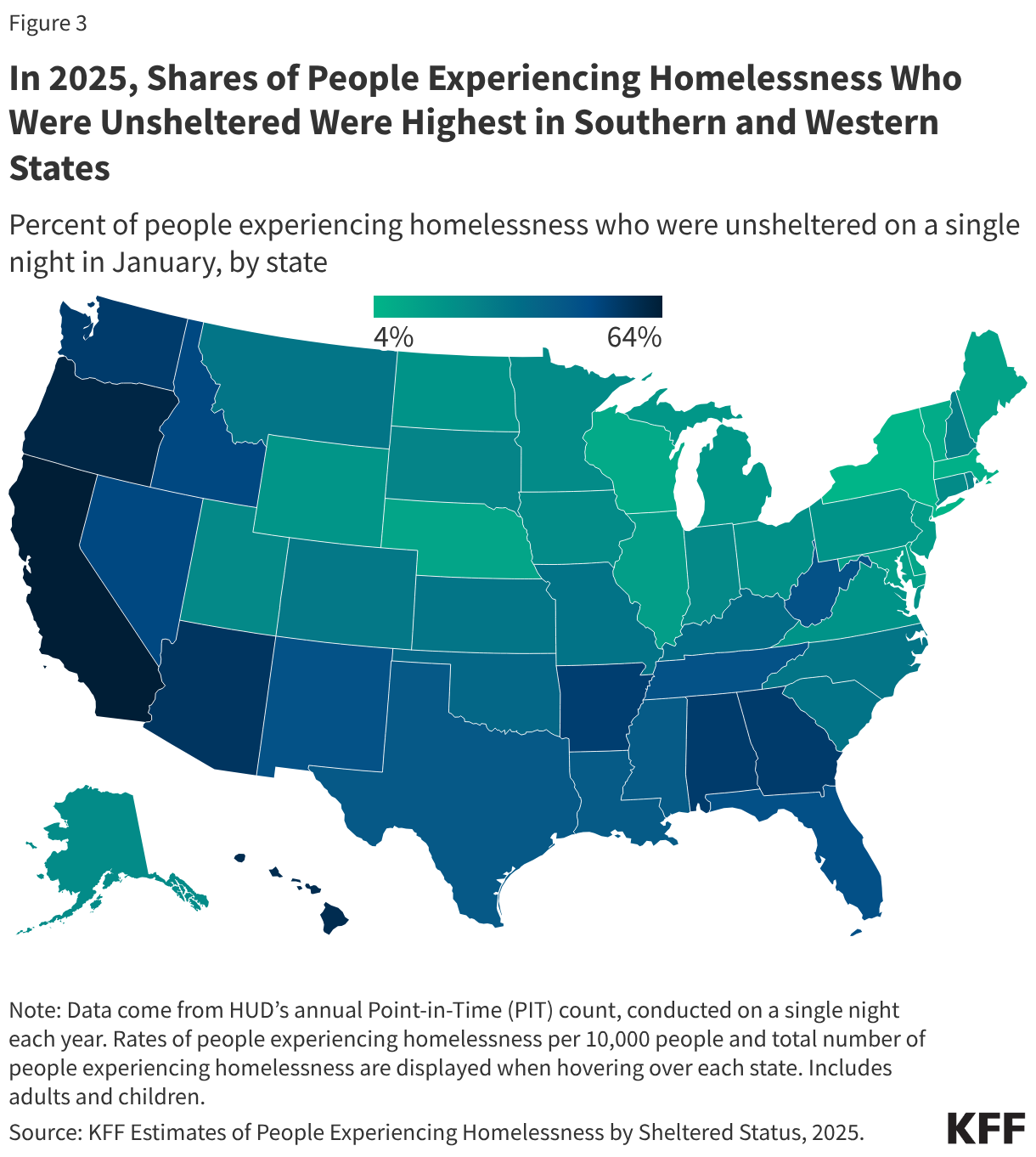
3. In 2025, Southern and Western states had higher shares of people who were experiencing homelessness who were unsheltered compared to other parts of the country.
States in the Northeast and West had higher rates of people experiencing homelessness per 10,000 people than elsewhere in the country on a single night in January 2025 (Figure 3). The share of people experiencing homelessness who were unsheltered by state were highest in Southern and Western states, including in California (64%), Oregon (61%), Arizona (56%), and Georgia (54%). In contrast, the shares of people experiencing homelessness who were unsheltered were lowest in New York (4%) and Massachusetts (6%), despite these states having relatively high rates of people experiencing homelessness per 10,000 people. These patterns may reflect a combination of local factors, including climate, housing costs, shelter capacity, right to shelter laws, and law enforcement policies that bring more people into emergency shelters or other sheltered housing.
In 2025, Shares of People Experiencing Homelessness Who Were Unsheltered Were Highest in Southern and Western States
Percent of people experiencing homelessness who were unsheltered on a single night in January, by state
Data come from HUD’s annual Point-in-Time (PIT) count, conducted on a single night each year. Rates of people experiencing homelessness per 10,000 people and total number of people experiencing homelessness are displayed when hovering over each state. Includes adults and children.
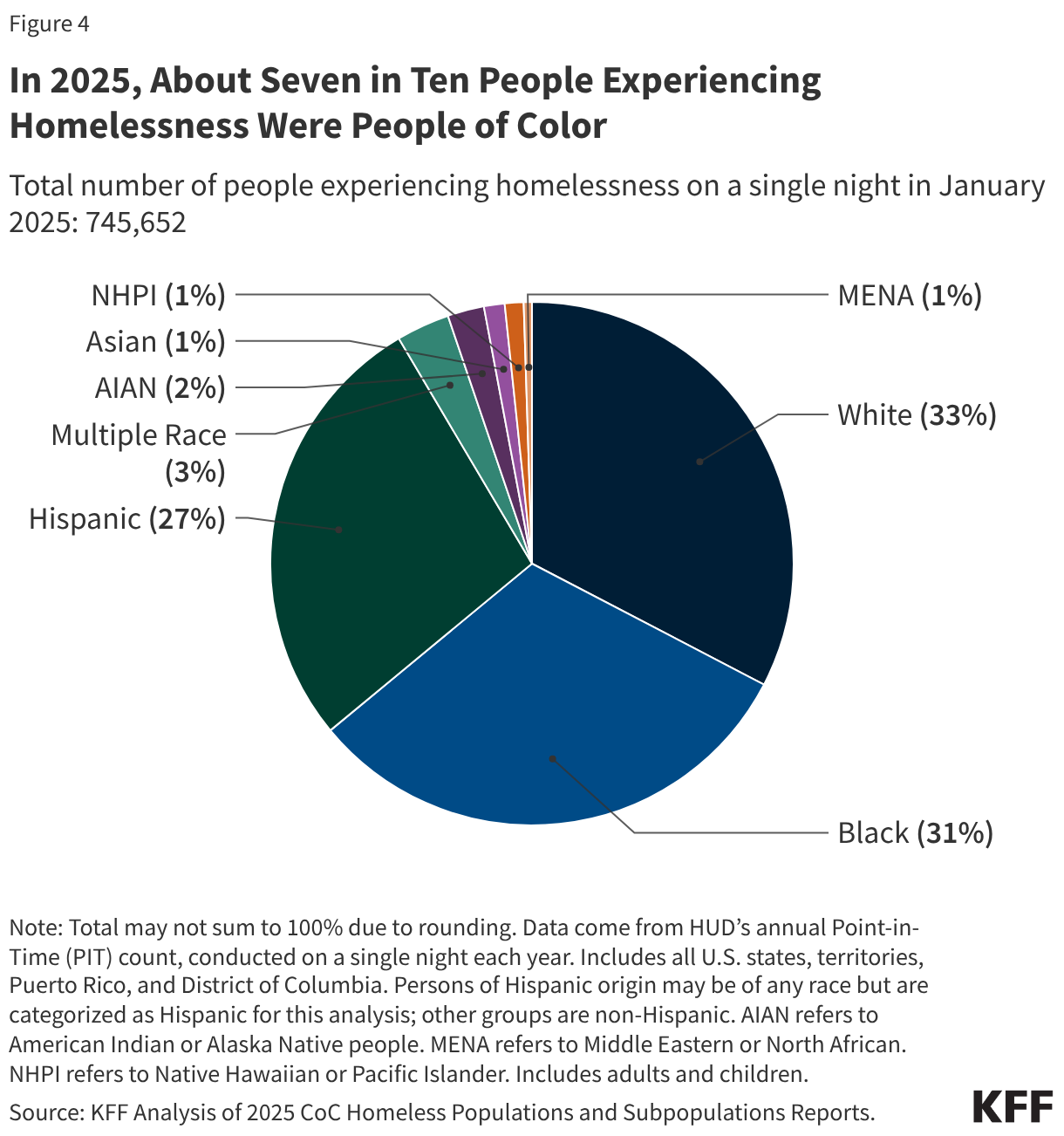
4. In 2025, about seven in ten (67%) people experiencing homelessness were people of color.
White (33%), Black (31%), and Hispanic (27%) people each accounted for about three in ten of people experiencing homelessness on a single night in January 2025, with other racial and ethnic groups making up smaller shares (less than 5%) (Figure 4). Black, Hispanic, AIAN, and NHPI people made up a disproportionate share of the people experiencing homelessness compared to their share of the total population.
In 2025, About Seven in Ten People Experiencing Homelessness Were People of Color
Total number of people experiencing homelessness on a single night in January 2025: 745,652
Total may not sum to 100% due to rounding. Data come from HUD’s annual Point-in-Time (PIT) count, conducted on a single night each year. Includes all U.S. states, territories, Puerto Rico, and District of Columbia. Persons of Hispanic origin may be of any race but are categorized as Hispanic for this analysis; other groups are non-Hispanic. AIAN refers to American Indian or Alaska Native people. MENA refers to Middle Eastern or North African. NHPI refers to Native Hawaiian or Pacific Islander. Includes adults and children.
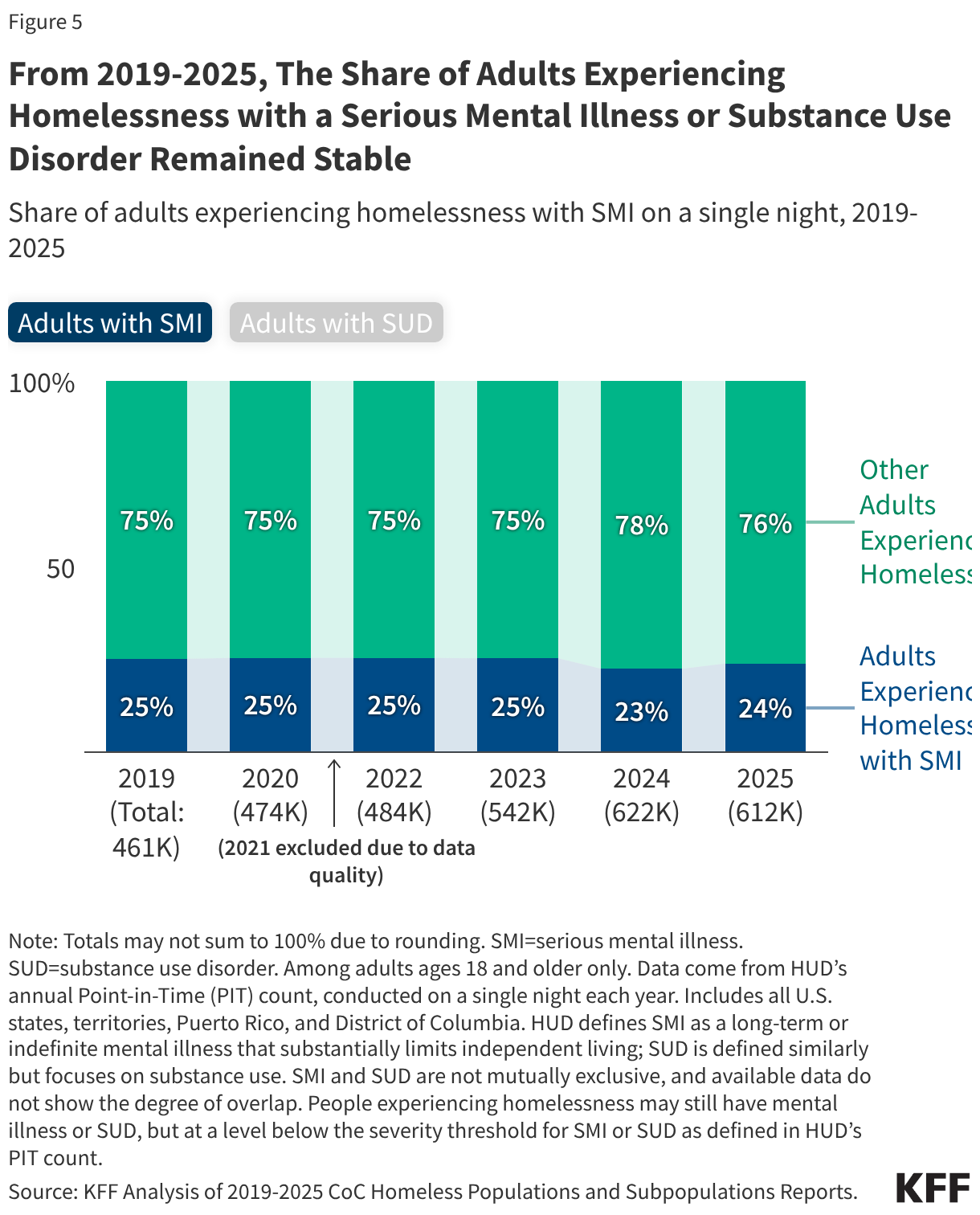
5. From 2019 to 2025, the share of adults experiencing homelessness with serious mental illness (SMI) or substance use disorder (SUD) remained stable, suggesting that rising homelessness reflects broader factors affecting both people with and without these conditions.
In 2025, about a quarter (24%, or 146,000) of adults experiencing homelessness on a single night in January met HUD’s SMI definition and nearly one in five (18%, or 112,000) had SUD according to HUD’s definition in the point-in-time count, about a 1% decrease from 2019 (Figure 5). SMI and SUD often co-occur—about one-quarter of people with SMI also have an SUD—but HUD’s publicly available data do not report the overlap of these conditions. The prevalence of SMI and SUD represents an outsized share of the population of adults experiencing homelessness as about 5-6% of adults overall have SMI according to the National Survey of Drug Use and Health (NSDUH) and 3% of adults in the general population meet NSDUH criteria for severe SUD. While homelessness among adults increased sharply from 2019 to 2025, the share of adults with SMI or SUD changed little, suggesting the increase was not concentrated among people with behavioral health conditions, and likely reflects broader pressures, such as rising housing and living costs. A Government Accountability Office (GAO) report found that a $100 increase in median rental price was linked to a 9% increase in estimated homelessness rate. Other research found increases in the number of people experiencing homelessness from 2019 to 2024 were more strongly associated with reductions in eviction moratoriums and climate-related events.
From 2019-2025, The Share of Adults Experiencing Homelessness with a Serious Mental Illness or Substance Use Disorder Remained Stable
Share of adults experiencing homelessness with SMI on a single night, 2019-2025
Adults with SMI
Adults with SUD
Totals may not sum to 100% due to rounding. SMI=serious mental illness. SUD=substance use disorder. Among adults ages 18 and older only. Data come from HUD’s annual Point-in-Time (PIT) count, conducted on a single night each year. Includes all U.S. states, territories, Puerto Rico, and District of Columbia. HUD defines SMI as a long-term or indefinite mental illness that substantially limits independent living; SUD is defined similarly but focuses on substance use. SMI and SUD are not mutually exclusive, and available data do not show the degree of overlap. People experiencing homelessness may still have mental illness or SUD, but at a level below the severity threshold for SMI or SUD as defined in HUD’s PIT count.
From 2019-2025, The Share of Adults Experiencing Homelessness with a Serious Mental Illness or Substance Use Disorder Remained Stable
Share of adults experiencing homelessness with SMI on a single night, 2019-2025
Adults with SMI
Adults with SUD
Totals may not sum to 100% due to rounding. SMI=serious mental illness. SUD=substance use disorder. Among adults ages 18 and older only. Data come from HUD’s annual Point-in-Time (PIT) count, conducted on a single night each year. Includes all U.S. states, territories, Puerto Rico, and District of Columbia. HUD defines SMI as a long-term or indefinite mental illness that substantially limits independent living; SUD is defined similarly but focuses on substance use. SMI and SUD are not mutually exclusive, and available data do not show the degree of overlap. People experiencing homelessness may still have mental illness or SUD, but at a level below the severity threshold for SMI or SUD as defined in HUD’s PIT count.
As of 2024, there were about 50 million immigrants residing in the U.S. Within this group, there were 24 million noncitizen immigrants, including lawfully present and undocumented immigrants, and 26 million naturalized citizens, who accounted for about 7% and 8% of the total population, respectively. Actions taken by the Trump administration and Congress will likely have major impacts on health and health care for immigrant families, including increasing the number of uninsured immigrants.
While undocumented immigrants have been ineligible for federally-funded health coverage programs under longstanding policy, the 2025 reconciliation law includes new eligibility restrictions for many lawfully present immigrants, including refugees and asylees, to access Medicaid and the Children’s Health Insurance Program (CHIP), subsidized Affordable Care Act (ACA) Marketplace, and Medicare coverage. The CBO estimates that 1.4 million lawfully present immigrants could lose health coverage by 2034 due to the law’s eligibility changes. Research shows that having insurance makes a difference in whether and when people access needed care. Those who are uninsured often delay or go without needed care, which can lead to worse health outcomes over the long-term that may ultimately be more complex and expensive to treat.
This brief provides data on health and health care experiences of uninsured immigrant adults based on a KFF survey of immigrant adults ages 18 and older conducted in partnership with The New York Times in Fall 2025. The data provide insight into how the projected coverage losses under the 2025 reconciliation law may impact health and health care for immigrant families as more lawfully present immigrants become uninsured. Key takeaways include the following:
Compared to those with insurance coverage, uninsured immigrant adults are more likely to not have a usual source of care and to delay or go without health care. Half of uninsured immigrant adults say that they do not have a usual source of health care other than the emergency room compared to about one in six (16%) of their insured counterparts. Further, half of uninsured immigrant adults report skipping or postponing care, twice the share of those with coverage (50% vs. 26%). Nearly one in five (18%) of all uninsured immigrant adults said their health got worse as a result of skipping or postponing health care.
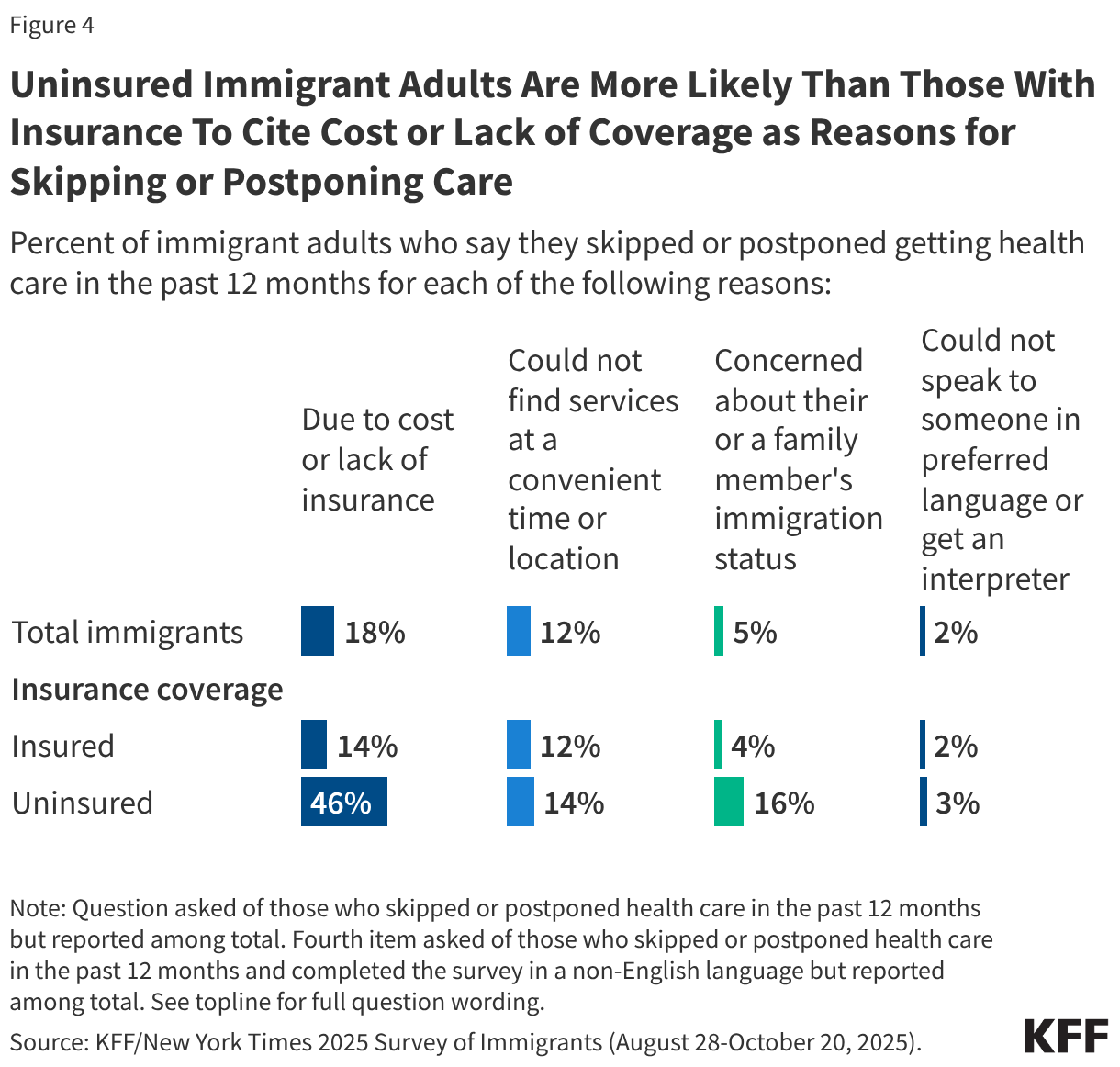
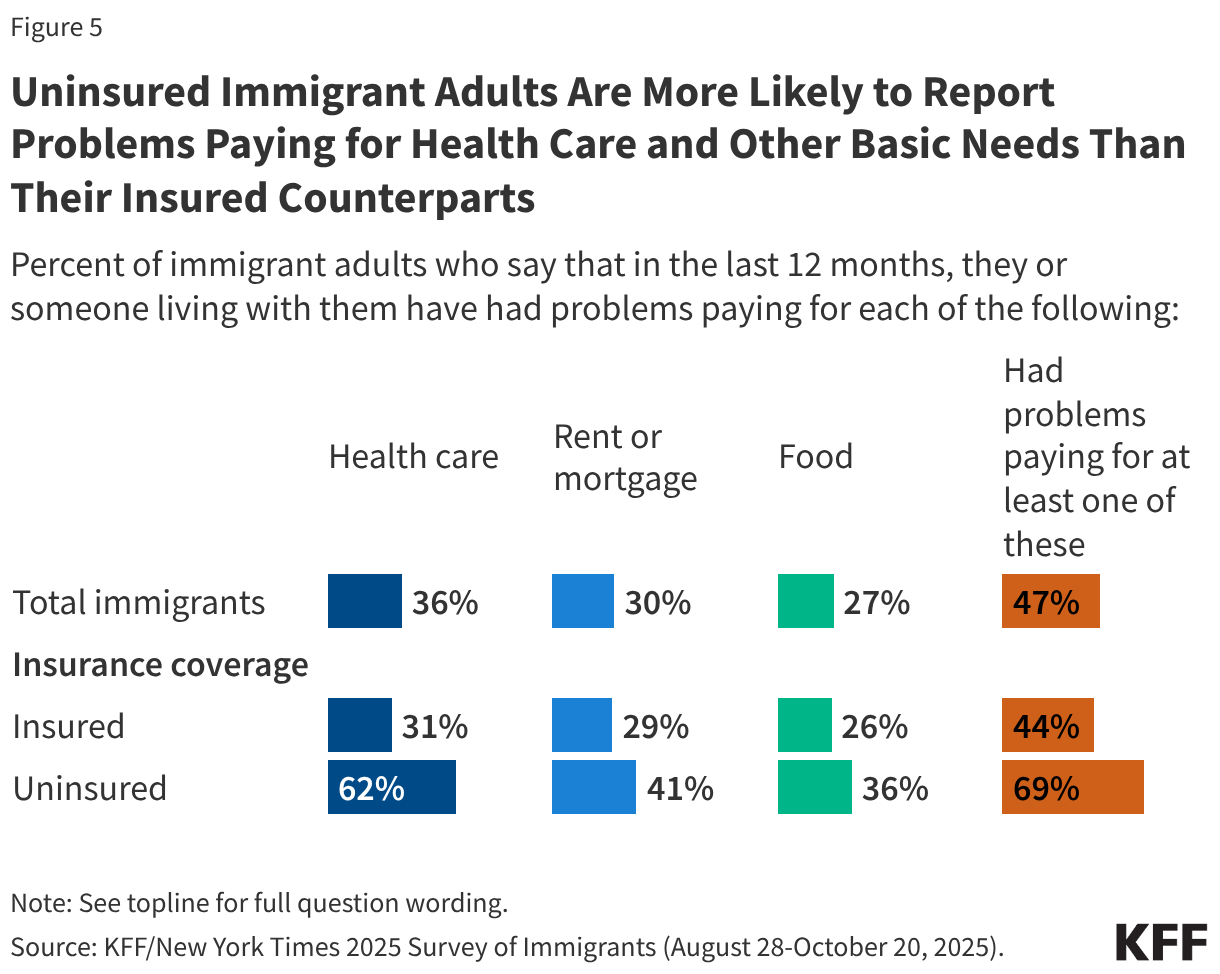
Cost or lack of coverage is the primary reason uninsured immigrant adults cite for skipping or postponing care, reflecting the role insurance plays in facilitating access to care. Almost half (46%) of uninsured immigrant adults say they delayed or went without care because of cost or lack of insurance compared to 14% of insured immigrant adults. Overall, about seven in ten (69%) uninsured immigrant adults say they have had problems paying for health care (62%), housing (41%), or food (36%) in the past 12 months. In comparison, over four in ten (44%) insured immigrant adults report problems paying for health care (31%), housing (29%), or food (26%) in the past 12 months.
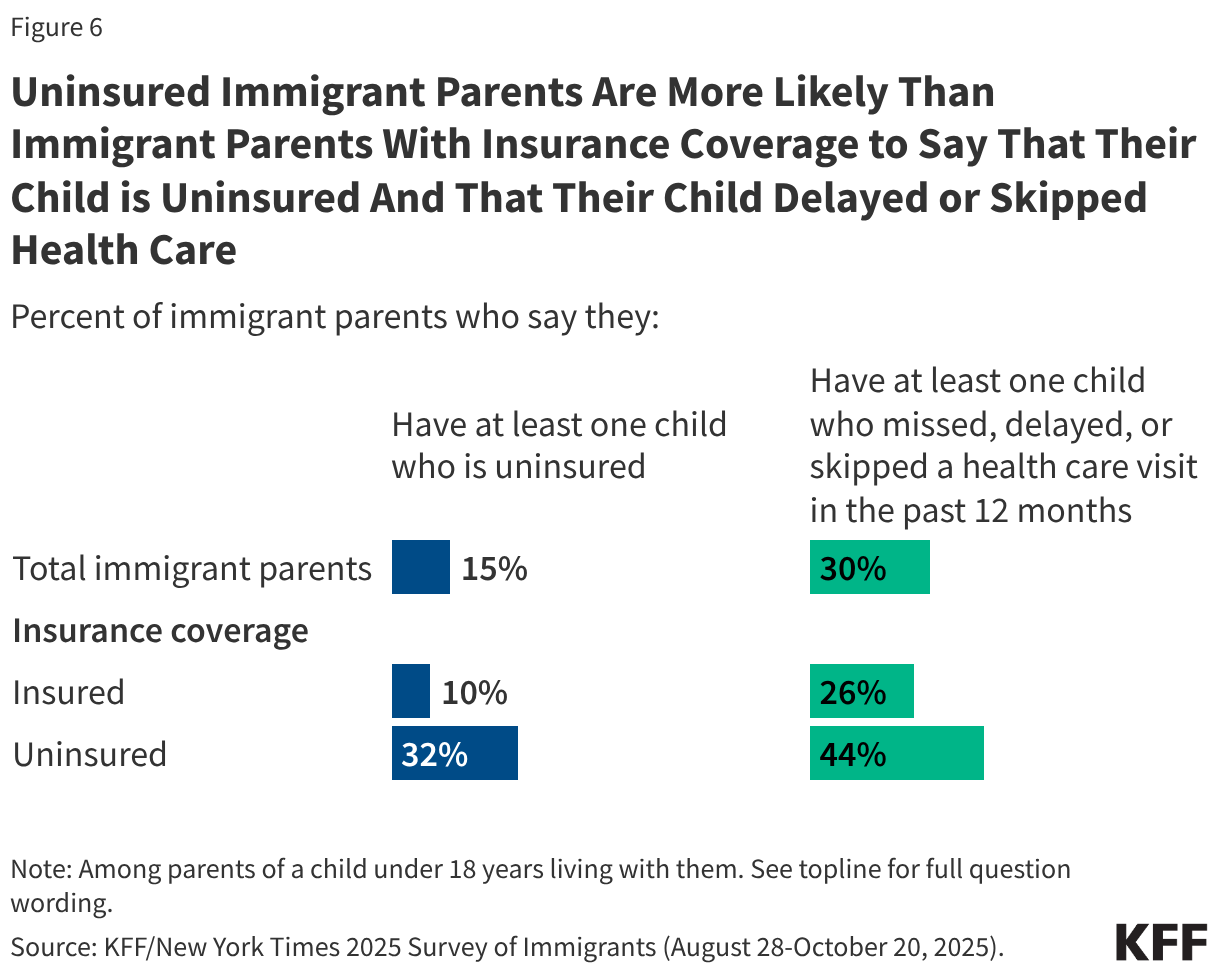
Consistent with other researchdemonstrating that parental coverage affects children’s health coverage and access to care, uninsured immigrant parents are three times as likely as those with insurance coverage (32% vs. 10%) to say they have at least one child who is uninsured. Further, over four in ten (44%) uninsured immigrant parents say any of their children delayed or skipped health care in the past 12 months compared to about a quarter (26%) of those with insurance coverage.
Findings
Characteristics of Uninsured Immigrants
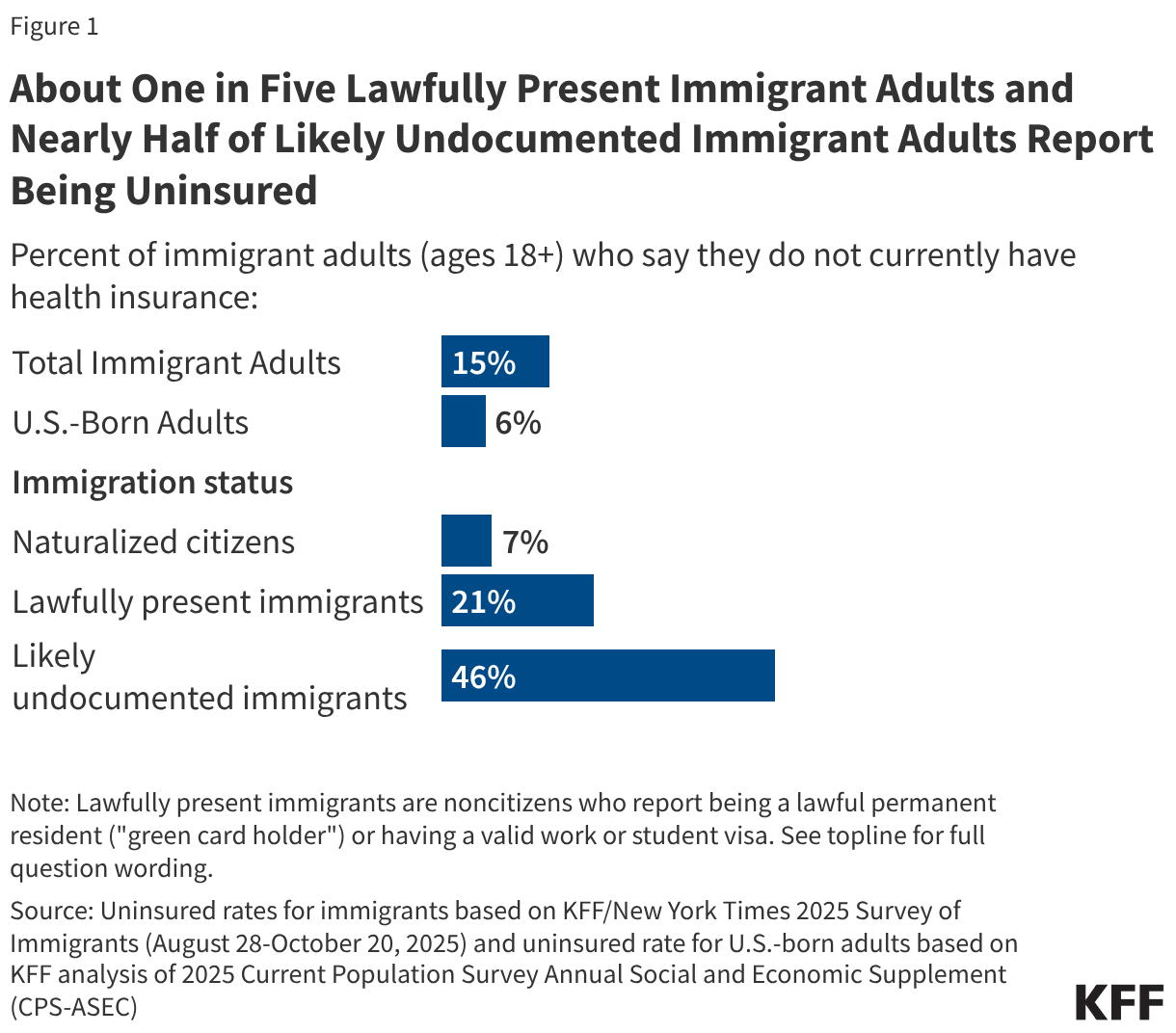
About one in seven (15%) immigrant adults age 18 and older report being uninsured as of 2025, with higher uninsured rates among those who are noncitizens, Hispanic, lower income, have limited English proficiency (LEP), or live in states with less expansive coverage. Nearly half of likely undocumented immigrant adults (46%) and one in five lawfully present immigrant adults (21%) report being uninsured compared to fewer than one in ten of their U.S.-born (6%) and naturalized citizen (7%) counterparts (Figure 1). Uninsured rates also are higher among immigrant adults who are Hispanic (27%), have lower incomes (household income of less than $40,000 per year) (23%), or have LEP (23%) compared to their White (5%), higher income (household income of $90,000 or more per year) (4%), and English proficient (10%) counterparts, likely reflecting that these groups also are more likely to be noncitizens. Further, immigrant adults who live in states that provide less expansive coverage, including not adopting the ACA Medicaid expansion to all low-income adults or any coverage expansions for immigrants, are about twice as to be uninsured compared with those living in states with more expansive policies (23% vs. 11%).
About One in Five Lawfully Present Immigrant Adults and Nearly Half of Likely Undocumented Immigrant Adults Report Being Uninsured
Percent of immigrant adults (ages 18+) who say they do not currently have health insurance:
Lawfully present immigrants are noncitizens who report being a lawful permanent resident ("green card holder") or having a valid work or student visa. See topline for full question wording.
Uninsured rates for immigrants based on KFF/New York Times 2025 Survey of Immigrants (August 28-October 20, 2025) and uninsured rate for U.S.-born adults based on KFF analysis of 2025 Current Population Survey Annual Social and Economic Supplement (CPS-ASEC)
Access to Health Care
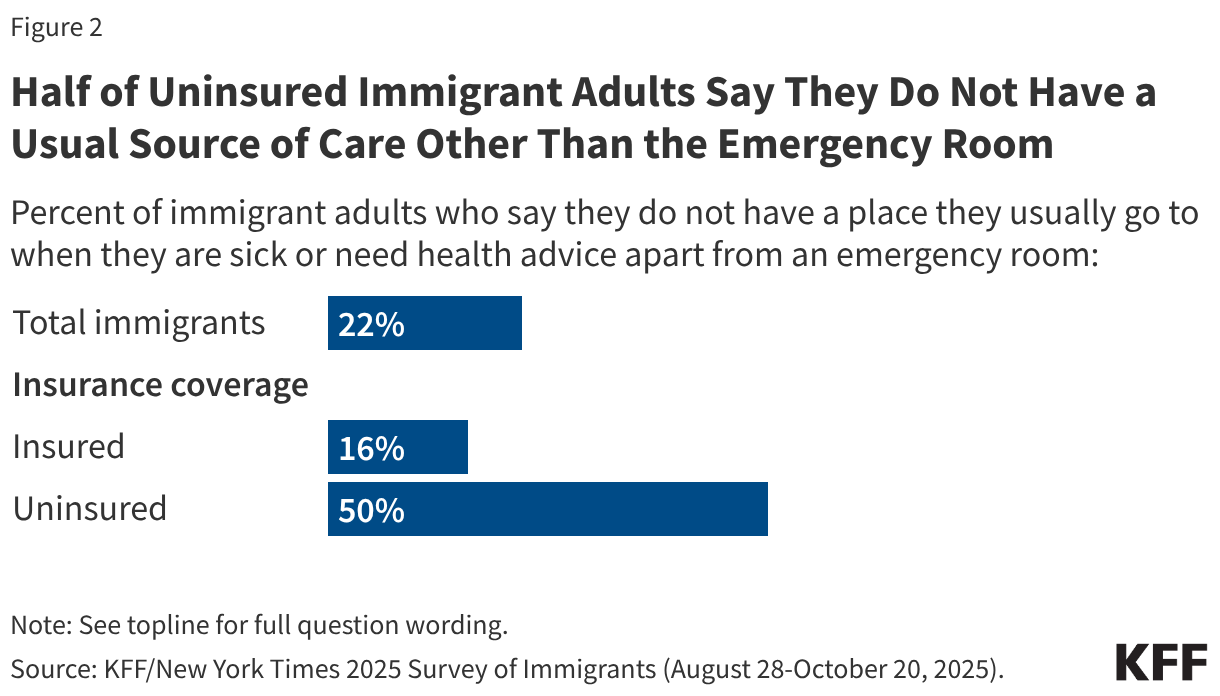
Half of uninsured immigrant adults say they do not have a usual source of care other than an emergency room (Figure 2). In comparison, about one in six (16%) insured immigrant adults say they do not have a usual source of care other than an emergency room. Research shows that having a usual source of care is associated with better access to health care even after controlling for demographic and socioeconomic characteristics.
Half of Uninsured Immigrant Adults Say They Do Not Have a Usual Source of Care Other Than the Emergency Room
Percent of immigrant adults who say they do not have a place they usually go to when they are sick or need health advice apart from an emergency room:
See topline for full question wording.
KFF/New York Times 2025 Survey of Immigrants (August 28-October 20, 2025).
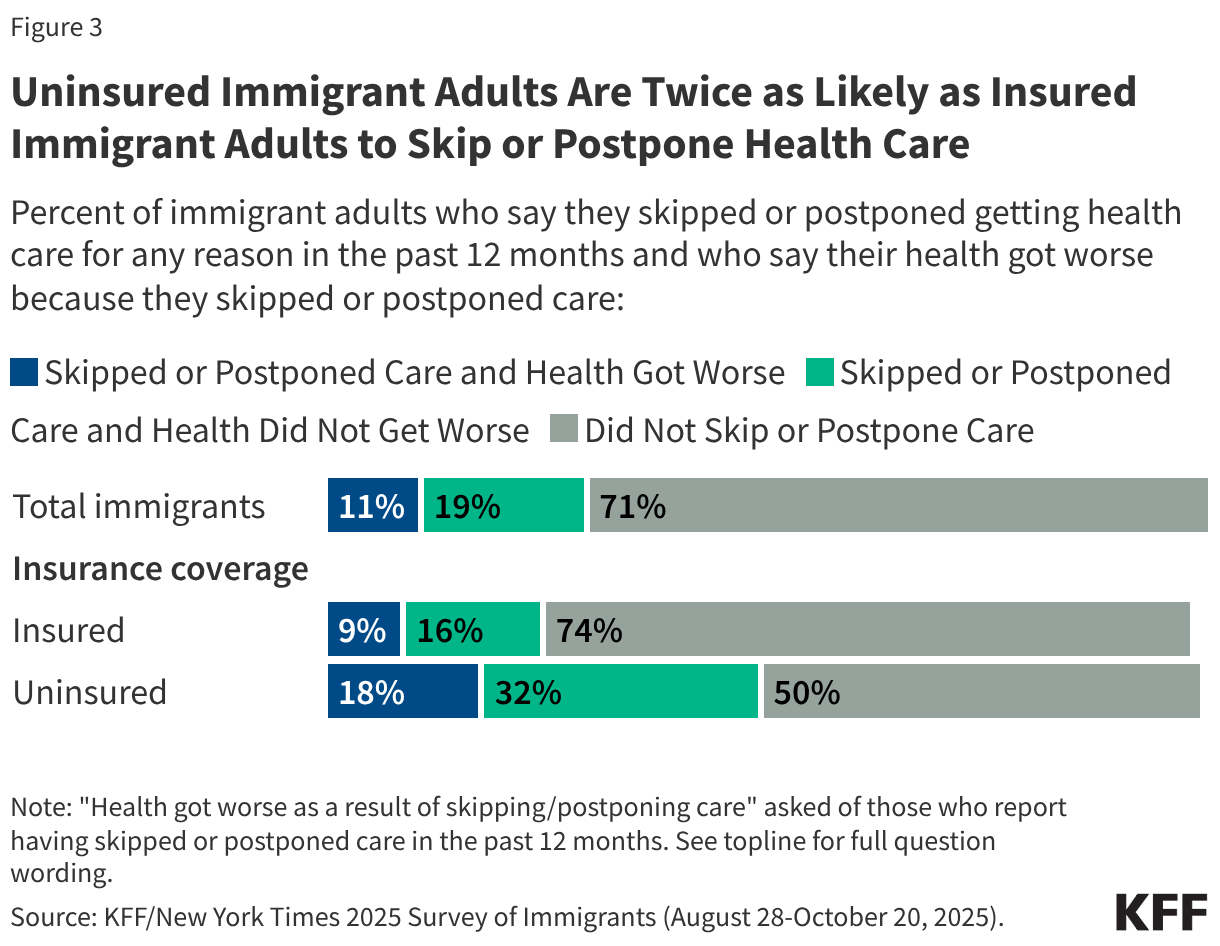
Uninsured immigrant adults are about twice as likely as those who are insured to report delaying or going without needed care (50% vs. 26%) (Figure 3). Delaying or going without needed care can contribute to health problems becoming worse and taking more time and resources to treat. Nearly one in five (18%) of uninsured immigrant adults say they skipped or postponed health care and their health got worse compared to 9% of insured immigrant adults.
Uninsured Immigrant Adults Are Twice as Likely as Insured Immigrant Adults to Skip or Postpone Health Care
Percent of immigrant adults who say they skipped or postponed getting health care for any reason in the past 12 months and who say their health got worse because they skipped or postponed care:
"Health got worse as a result of skipping/postponing care" asked of those who report having skipped or postponed care in the past 12 months. See topline for full question wording.
KFF/New York Times 2025 Survey of Immigrants (August 28-October 20, 2025).
Uninsured immigrant adults are more likely than those with insurance to cite cost or lack of coverage and immigration-related concerns as reasons for delaying or going without care. Almost half (46%) of uninsured immigrant adults say they delayed or went without care because of cost or lack of insurance compared to 14% of insured immigrant adults (Figure 4). Additionally, 16% of uninsured immigrant adults identified concerns about their or a family member’s immigration status as a reason compared to 4% of insured immigrant adults, likely reflecting that uninsured immigrants include a higher share of likely undocumented immigrants. Similar shares of uninsured (14%) and insured immigrant adults (12%) cited not being able to find services at a time or location that worked for them as a reason for delaying or going without care. Language barriers were also cited by some of those with LEP.
Uninsured Immigrant Adults Are More Likely Than Those With Insurance To Cite Cost or Lack of Coverage as Reasons for Skipping or Postponing Care
Percent of immigrant adults who say they skipped or postponed getting health care in the past 12 months for each of the following reasons:
Question asked of those who skipped or postponed health care in the past 12 months but reported among total. Fourth item asked of those who skipped or postponed health care in the past 12 months and completed the survey in a non-English language but reported among total. See topline for full question wording.
KFF/New York Times 2025 Survey of Immigrants (August 28-October 20, 2025).
Likely reflecting their lower incomes, uninsured immigrant adults report more difficulty paying for basic needs, including health care, compared to those with insurance. Six in ten uninsured immigrant adults say that it has been harder to earn a living since January 2025 (60%) and about seven in ten (69%) say they have had problems paying for basic necessities such as health care (62%), housing (41%), or food (36%) in the past 12 months (Figure 5). These shares are higher compared to those with insurance coverage, with the largest gap in difficulty paying for health care (62% vs. 31%).
Uninsured Immigrant Adults Are More Likely to Report Problems Paying for Health Care and Other Basic Needs Than Their Insured Counterparts
Percent of immigrant adults who say that in the last 12 months, they or someone living with them have had problems paying for each of the following:
See topline for full question wording.
KFF/New York Times 2025 Survey of Immigrants (August 28-October 20, 2025).
Impacts of Parental Coverage on Children’s Coverage and Access to Care
Uninsured immigrant parents are about three times as likely as insured immigrant parents (32% vs. 10%) to report at least one uninsured child as of 2025 (Figure 6). Further, over four in ten (44%) uninsured immigrant parents say any of their children delayed or skipped health care in the past 12 months compared to about a quarter (26%) of those with insurance coverage. These findings are consistent with other research showing that parental coverage impacts children’s access to health coverage and care.
Uninsured Immigrant Parents Are More Likely Than Immigrant Parents With Insurance Coverage to Say That Their Child is Uninsured And That Their Child Delayed or Skipped Health Care
Percent of immigrant parents who say they:
Among parents of a child under 18 years living with them. See topline for full question wording.
KFF/New York Times 2025 Survey of Immigrants (August 28-October 20, 2025).
The latest KFF Health Tracking Poll finds that though a majority of the public has heard of the abortion medication mifepristone, public awareness of its prevalence and longstanding safety record is limited. Six in ten adults say they have heard of mifepristone, but just one in four (26%) correctly identify abortion pills as the most common way abortions are administered in the U.S. Additionally, while about four in ten (44%) adults say abortion pills are safe when taken according to a health care provider’s instruction, one in seven (15%) say they are unsafe and four in ten (41%) are unsure of their safety.
The FDA’s re-evaluation of the safety of mifepristone is now underway, following Health and Human Services Secretary Robert F. Kennedy Jr.’s call to the federal health agency late last year. Public confidence in the FDA to make decisions based on science when reviewing the safety of mifepristone is somewhat limited as slightly more than half (54%) say they have little to no confidence at all in this regard. Partisans differ over the motivation behind the review, with a majority of Republicans saying it was mostly to protect the health and safety of women and a similar majority of Democrats saying it was to make abortion pills more difficult to access.
Majorities of the public oppose laws restricting medication abortion, though Republicans lean more in support. Two-thirds of the public – including large majorities of Democrats and independents – oppose laws that would ban mifepristone nationwide (65%) and laws that would make it a crime for health care providers to mail abortion pills to patients in states with abortion bans (64%). Republicans are notably split on the issue of banning mifepristone nationwide (52% support, 48% oppose), while a majority (57%) of Republicans support laws criminalizing health care providers mailing abortion pills to patients in states with abortion bans.
While health costs and the future of government health programs are key health issues for voters in the upcoming midterm elections, a majority of voters (57%) say it is “extremely” or “very important” for candidates to discuss abortion policy. Since the Dobbs decision, abortion policy remains a core issue for Democratic voters. Four in ten Democratic voters say abortion policy is “extremely important” for 2026 midterm candidates to talk about, compared to fewer independent (22%) and Republican (20%) voters. The Democratic Party has the advantage over the Republican Party when it comes to which political party voters trust more on the issue of abortion (39% vs. 28%, respectively), though nearly three in ten (27%) voters say they trust neither party on this issue. Among independent voters, the Democratic Party has the edge over the Republican Party (35% vs. 19%), though four in ten say they trust neither party on the issue.
Sizeable Shares of the Public Are Unaware of Mifepristone’s Prevalence and Safety
Mifepristone, commonly known as the abortion pill, is one of two drugs that are used in medication abortion, the most common abortion method in the United States. While mifepristone has been approved by the FDA for over 25 years and has a longstanding safety record, Congressional Republicans and anti-abortion groups continue to call into question the safety of the abortion pill. The latest KFF Health Tracking Poll finds six in ten (60%) adults have heard of the abortion medication mifepristone, including two-thirds (66%) of women of reproductive age (ages 18 to 49). Public awareness of mifepristone has risen sharply since the overturning of Roe v. Wade and the lawsuits and public scrutiny of the abortion pill that followed, increasing from 31% in January 2023 to about six in ten since then.
Despite increased awareness of mifepristone, the public is still largely unaware that most abortions in the U.S. are done by taking abortion pills. About one-quarter of adults (26%) correctly identify abortion pills as the most common way abortions are administered in the United States, while another quarter (26%) incorrectly say medical procedures are the most common, and nearly half (48%) say they are not sure. Democrats, independents, women of reproductive age, and adults who identify as “pro-choice” are most likely to correctly say most abortions in the U.S. are done using abortion pills. Yet, even among these groups, about half say they are not sure how most abortions in the U.S. are provided.
<span class="cf0">About One in Four Adults Correctly Say Most Abortions in the U.S. Are Done Using Abortion Pills; About Half Are Not Sure </span>
Stacked bar chart showing share of adults who believe most abortions in the United States are done using abortion pills, a medical procedure, or are unsure of the correct answer. Results shown by total, women of reproductive age, party, and view on abortion.
See topline for full question wording.
KFF Health Tracking Poll (June 25-30, 2026)
A large share of the public is unaware of the abortion medication’s longstanding safety record. Less than half (44%) of adults say abortion pills are safe when taken according to a health care provider’s instruction, about three times larger than the share who say they are unsafe (15%). Still, four in ten (41%) adults are “not sure” about the safety of abortion pills when administered according to a health care provider’s instruction.
Similar shares of adults overall say abortion pills are safe compared to last year (42% in November 2025). Among women ages 18 to 49, the group who would be most directly impacted by changes to the availability of mifepristone, about half (52%) say abortion pills are safe when taken as directed by a health care provider, a share that has increased from four in ten (41%) last November. Currently, one in five (19%) women ages 18-49 say they are not safe and three in ten are not sure of their safety.
Looking at women across racial and ethnic groups, Black women are less likely than White women to say abortion pills are safe (33% vs. 51%) and more likely than White women to say they are unsure how safe they are (51% vs. 35%). Among Hispanic women, about four in ten (42%) say abortion pills are safe, while a similar share (41%) say they are unsure.
Partisans differ in their assessment of the safety of mifepristone, with about six in ten Democrats (61%) saying medication abortion pills are “very” or “somewhat safe,” compared to about four in ten (44%) independents and three in ten Republicans. Larger shares of independents (42%) and Republicans (50%) than Democrats (30%) say they are not sure whether abortion pills are safe.
<span class="cf0">About Four in Ten Say Abortion Pills Are Safe When Taken According to a Health Care Provider’s Instruction; Fewer Say They Are Unsafe</span>
Stacked bar chart showing share of adults who believe abortion bills are very safe, somewhat safe, somewhat unsafe, very unsafe, or are unsure of the correct answer. Results shown by total, women of reproductive age, and party.
See topline for full question wording.
KFF Health Tracking Poll (June 25-30, 2026)
Public Divides Over Motives Behind FDA Review of Mifepristone and Ability to Conduct a Scientific Review
Last September, Health and Human Services Secretary Robert F. Kennedy Jr. and the FDA Commissioner at the time—Dr. Marty Makary—wrote to Republican state attorneys general in response to states’ concerns about mifepristone, announcing the FDA would conduct another review of the abortion pill’s safety. This new review has now begun and FDA officials are investigating whether the abortion pill’s current Risk Evaluation and Mitigation Strategy (REMS) is “sufficient to protect women from unstated risks” following the 2023 update that removed the in-person dispensing requirement and therefore made the drug accessible through telehealth. Depending on the safety review’s conclusions, the FDA could restrict mifepristone access, potentially limiting its availability through telehealth and mail, limiting the ability of advance practice clinicians from prescribing the medication, or removing pharmacies as authorized dispensers.
The latest KFF Health Tracking Poll finds a slim majority (54%) of the public has little to no confidence in the FDA to make decisions based on science when it comes to reviewing the abortion pill’s safety—including one in four (24%) who say they have no confidence “at all.” Fewer than half (46%) have “a lot” (10%) or “some” (36%) confidence. Among women of reproductive age, about half (52%) say they have little to no confidence, while 47% say they have at least some confidence. This limited trust is consistent with KFF’s Health Information and Trust research, which has found less than half of adults have confidence in the FDA’s ability to fulfill core responsibilities, such as making recommendations about childhood vaccine schedules and ensuring the safety and effectiveness of vaccines.
Across partisans, about half of Democrats and Republicans say they have little or no confidence (47% of Democrats; 53% of Republicans) in the FDA to make decisions based on science when evaluating the safety of mifepristone and similar shares say they have least some confidence (53% of Democrats; 47% of Republicans). Among independents, most (57%) say they have little to no confidence at all in the FDA in this regard.
A Slim Majority of Adults Has Little to No Confidence in the FDA To Make Science-Based Decisions About Mifepristone
Stacked bar chart showing share of adults who believe abortion bills are very safe, somewhat safe, somewhat unsafe, very unsafe, or are unsure of the correct answer. Results shown by total, women of reproductive age, and party.
See topline for full question wording.
KFF Health Tracking Poll (June 25-30, 2026)
When asked about the motivation behind Secretary Kennedy’s request to the FDA to review the safety of the abortion pill, the public is split, with half (51%) saying this decision was mostly to “make it more difficult to access abortion pills,” and another half (48%) saying it was mostly to “protect the health and safety of women.”
Notably, Democrats are more likely to say the reasoning behind Kennedy’s request was to “make it more difficult to access abortion pills” (71%), while Republicans are more likely to say it was to “protect the health and safety of women” (73%). Independents are split with about half saying the decision was to make abortion access more difficult (53%) and half saying it was to protect women’s safety (47%).
Women ages 18 to 49 are also divided on the motivation behind Secretary Kennedy’s request, with about half saying his call to review mifepristone was to “make it more difficult to access abortion pills” (55%) and another half saying it was to “protect the health and safety of women” (45%).
T<span class="cf0">he Public is Split on the Reasoning Behind Robert F. Kennedy Jr.’s Request To Review the Safety of the Abortion Pill</span>
Split bar chart showing share of adults who believe RFK Jr.'s call for an FDA review of mifepristone is to protect the health and safety of women versus make it more difficult to access abortion pills. Results shown by total, women of reproductive age, and party.
See topline for full question wording.
KFF Health Tracking Poll (June 25-30, 2026)
The latest KFF Health Tracking Poll finds majorities oppose laws that would place further restrictions on medication abortion. Around two-thirds of adults say they oppose banning the use of mifepristone, or medication abortion, nationwide (65%) and a similar share oppose making it a crime for health care providers to mail abortion pills to patients in states where abortion is banned (64%).
Eight in ten Democrats (81%) and two-thirds of independents (67%) say they oppose banning mifepristone entirely. However, Republicans are split in their views, with half (52%) saying they support laws that would ban the abortion pill nationwide while a similar share (48%) say they are opposed. And, while large majorities of Democrats (79%) and independents (66%) oppose laws making it a crime to mail abortion pills to patients in states with abortion bans, a majority (57%) of Republicans support such laws while 43% are opposed.
Unsurprisingly, about eight in ten adults who identify as pro-choice oppose the restrictive abortion laws asked about in this KFF Health Tracking Poll (78% banning mifepristone; 79% criminalizing the mailing of abortion pills to patients in states with abortion bans). Among those who identify as pro-life, majorities say they support these laws (57% and 61%, respectively), though sizeable shares—about four in ten—say they would oppose laws banning mifepristone nationwide (43%) and criminalizing the mailing of abortion pills to abortion-banned states (38%).
At Least Two-Thirds of Democrats, Independents, and Pro-Choice Adults Oppose Banning the Use of Mifepristone and Criminalizing the Mailing of Abortion Pills
Split bar chart showing share of adults who support versus oppose laws that ban the use of mifepristone or medication abortion nationwide and laws that make it a crime for health care providers to mail abortion pills to patients in states where abortion is banned. Results shown by total and party.
See topline for full question wording.
KFF Health Tracking Poll (June 25-30, 2026)
Voters’ Attitudes Toward Abortion in the Upcoming Midterm Elections
While health costs and the future of government health programs such as Medicare and Medicaid are the health issues taking center stage in this election, a majority of voters (57%) say it is “extremely” (27%) or “very important” (31%) for candidates to talk about abortion policy. Looking at voters by views on abortion, slightly larger shares of pro-choice voters say abortion is extremely important for 2026 midterm candidates to discuss compared to their pro-life counterparts (30% vs. 22%).
Previous election-related polling at KFF has found that, since the Dobbs decision, voters who view abortion policy as an important issue are disproportionately Democrats, and this election is no exception. Three-quarters (73%) of Democratic voters say abortion policy is important for 2026 midterm candidates to talk about, including four in ten who say it is “extremely important.” Notably, the share who say abortion policy is “extremely important” is consistent among Democratic voters, regardless of whether those voters live in states where abortion is either banned or limited (40%) or where abortion is available (39%). In contrast, fewer independent (22%) and Republican (20%) voters say abortion policy is extremely important for midterm candidates to discuss.
Among Republican and Republican-leaning independent voters who support the Make America Great Again movement, nearly one in four (23%) say abortion policy is extremely important for candidates to discuss, compared to one in ten (11%) non-MAGA-supporting Republicans and Republican-leaning independents who say the same. About two-thirds of MAGA Republicans identify as pro-life (63%), while about four in ten (44%) non-MAGA supporting Republicans identify as pro-choice.
<span class="cf0">Nearly Three in Ten Voters Say Abortion Policy is Extremely Important for Midterm Candidates to Discuss, Including Four in Ten Democratic Voters</span>
Stacked bar chart showing share of adults who believe most abortions in the United States are done using abortion pills, a medical procedure, or are unsure of the correct answer. Results shown by total, women of reproductive age, party, and view on abortion.
MAGA Republican voters includes Republicans and Republican-leaning independents who support the Make America Great Again movement and are registered to vote. See topline for full question wording.
KFF Health Tracking Poll (June 25-30, 2026)
The Democratic Party has the advantage over Republicans when it comes to which political party voters trust more on the issue of abortion (39% vs. 28%, respectively), though nearly three in ten (27%) voters say they trust neither party on this issue. Women voters ages 18 to 49 and younger voters (ages 18 to 29) are notably among the most likely to trust the Democratic Party more (46% and 52%, respectively).
Unsurprisingly, voters are largely split across partisan identification when it comes to which political party they trust more on the issue of abortion. Among independent voters, the Democratic Party has the edge over the Republican Party (35% vs. 19%), though four in ten (41%) say they trust neither party on the issue.
About Four in Ten Adults Trust the Democrats More on the Issue of Abortion; Three in Ten Trust Republicans More
Stacked bar chart showing share of adults who believe most abortions in the United States are done using abortion pills, a medical procedure, or are unsure of the correct answer. Results shown by total, women of reproductive age, party, and view on abortion.
MAGA Republican voters includes Republicans and Republican-leaning independents who support the Make America Great Again movement and are registered to vote. See topline for full question wording.
This KFF Health Tracking Poll/KFF Tracking Poll on Health Information and Trust was designed and analyzed by public opinion researchers at KFF. The survey was conducted June 25 – June 30, 2026, online and by telephone among a nationally representative sample of 1,321 U.S. adults in English (n=1,238) and in Spanish (n=83). The sample includes 1,015 adults (n=69 in Spanish) reached through the SSRS Opinion Panel either online (n=990) or over the phone (n=25). The SSRS Opinion Panel is a nationally representative probability-based panel where panel members are recruited randomly in one of two ways: (a) Through invitations mailed to respondents randomly sampled from an Address-Based Sample (ABS) provided by Marketing Systems Groups (MSG) through the U.S. Postal Service’s Computerized Delivery Sequence (CDS); (b) from a dual-frame random digit dial (RDD) sample provided by MSG. For the online panel component, invitations were sent to panel members by email followed by up to three reminder emails.
Another 306 (n=14 in Spanish) adults were reached through random digit dial telephone sample of prepaid cell phone numbers obtained through MSG. Phone numbers used for the prepaid cell phone component were randomly generated from a cell phone sampling frame with disproportionate stratification aimed at reaching Hispanic and non-Hispanic Black respondents. Stratification was based on incidence of the race/ethnicity groups within each frame. Among this prepaid cell phone component, 142 were interviewed by phone and 164 were invited to the web survey via short message service (SMS).
Respondents in the prepaid cell phone sample who were interviewed by phone received a $15 incentive via a check received by mail or an electronic gift card incentive. Respondents in the prepaid cell phone sample reached via SMS received a $10 electronic gift card incentive. SSRS Opinion Panel respondents received a $5 electronic gift card incentive (some harder-to-reach groups received a $10 electronic gift card). In order to ensure data quality, cases were removed if they failed two or more quality checks: (1) attention check questions in the online version of the questionnaire, (2) had over 30% item non-response, or (3) had a length less than one quarter of the mean length by mode. Based on this criterion, 1 case was removed.
The combined cell phone and panel samples were weighted to match the sample’s demographics to the national U.S. adult population using data from the Census Bureau’s 2025 Current Population Survey (CPS), September 2023 Volunteering and Civic Life Supplement data from the CPS, and the 2026 KFF Benchmarking Survey with ABS and prepaid cell phone samples. The demographic variables included in weighting for the general population sample are gender, age, education, race/ethnicity, region, civic engagement, frequency of internet use and political party identification. The weights account for differences in the probability of selection for each sample type (prepaid cell phone and panel). This includes adjustment for the sample design and geographic stratification of the cell phone sample, within household probability of selection, and the design of the panel-recruitment procedure.
The margin of sampling error including the design effect for the full sample is plus or minus 3 percentage points. Numbers of respondents and margins of sampling error for key subgroups are shown in the table below. For results based on other subgroups, the margin of sampling error may be higher. Sample sizes and margins of sampling error for other subgroups are available on request. Sampling error is only one of many potential sources of error and there may be other unmeasured error in this or any other public opinion poll. KFF public opinion and survey research is a charter member of the Transparency Initiative of the American Association for Public Opinion Research.
The recently proposed 2027 Medicare Hospital Outpatient Perspective Payment System (OPPS) rule from the Centers for Medicare & Medicaid Services (CMS) includes a proposal to reduce Medicare’s reimbursement for 340B drugs. The proposal would reduce reimbursement for 340B drugs from average sales price (ASP) plus 6% (what Medicare generally pays for Part B outpatient drugs administered by providers) to ASP minus 33.4%, a 37% reduction. CMS indicated that this change would better align Medicare reimbursement with hospitals’ costs of acquiring 340B drugs.
The 340B Drug Pricing Program requires drug manufacturers participating in Medicaid to sell outpatient drugs to eligible nonprofit and government providers at a substantial discount, allowing providers to earn larger profits when being reimbursed for 340B drugs. The intent of the program is to support providers, such as certain disproportionate share hospitals and federally qualified health clinics, that care for low-income and other underserved populations. Critics have raised concerns that the 340B program, which has grown substantially over time, is not well-targeted; that savings from the program are not shared with patients; and that the program incentivizes hospitals to acquire clinics and physician practices in order to extend 340B discounts to those settings, enabling them to generate more revenue. Supporters of the program say that revenues generated by the difference between Medicare (and other payer) reimbursement for 340B drugs and the discounted price help 340B providers care for underserved populations and invest in operations.
CMS based the amount of the proposed payment reduction on a cost acquisition survey of 340B drugs completed by hospitals in early 2026. This proposed change revives an earlier effort by CMS to reduce Medicare payments for 340B drugs that was implemented in 2018 under the first Trump administration, but the Supreme Court overturned that rule in 2022 because the agency had not first conducted a cost acquisition survey. If finalized, CMS’s proposed Medicare 340B payment reduction would take effect on January 1, 2027, and would have disparate effects on different types of hospitals, as described more below.
CMS’s proposed cut to 340B drug reimbursement would reduce Medicare spending on 340B drugs by an estimated $4.85 billion in 2027, while increasing spending on non-drug outpatient services by the same amount because of budget neutrality requirements. Under federal law, CMS is generally required to maintain the same amount of aggregate spending through OPPS regardless of reimbursement changes (i.e., maintain budget neutrality). Based on this requirement, CMS proposed an 8.44% across-the-board increase in payments for non-drug outpatient services covered under the OPPS, which the agency estimates will offset the impact of cuts to spending on 340B drugs in 2027.
The budget neutrality requirement means that savings from reductions in 340B payments to 340B hospitals would be redistributed to both 340B and non-340B hospitals through higher payments for non-drug outpatient services. Similarly, Medicare beneficiaries would face lower cost sharing on 340B drugs (e.g., based on 20% coinsurance applied to a lower amount) but higher cost sharing for non-drug outpatient hospital services. CMS estimates that Medicare beneficiaries who use 340B drugs would save $1.15 billion in total in 2027, but cost sharing would increase for beneficiaries who use non-drug outpatient hospital services based on Medicare’s proposed 8.44% payment increase.
Proposed cuts would reduce revenues among safety-net hospitals while increasing revenues among for-profit hospitals, among other differences. For 340B hospitals, total Medicare revenues would decrease or increase depending on how reliant they are on revenues from 340B drugs versus non-drug outpatient services, but non-340B hospitals would experience revenue increases only based on the higher payment rate for non-drug outpatient services. CMS’s proposal to reduce reimbursement for 340B drugs would exempt rural sole community hospitals (SCHs) (rural hospitals that are the only source of short-term, acute inpatient care in a region), children’s hospitals, and PPS-exempt cancer hospitals. Changes would not affect hospitals that are not reimbursed under the OPPS, including critical access hospitals (CAHs), which make up the majority of rural hospitals.
In the aggregate, some types of hospitals would lose or benefit more from these changes than others, based on estimates from CMS (Figure 1):
Safety-net hospitals would face a 5.8% net reduction of OPPS revenue under this proposal (see figure notes for definition of “safety-net hospitals”). Other types of hospitals would also see net reductions in OPPS revenue in the aggregate, including large urban hospitals (with 500 beds or more) (-5.2%), major teaching hospitals (-4.3%), government hospitals (-3.0%), and nonprofit hospitals (-0.5%). Some hospitals that would see the largest decrease in revenue likely fall into more than one of these categories (e.g., major teaching hospitals tend to be large urban hospitals).
For-profit hospitals would see a 7.4% net increase in OPPS revenues. For-profit hospitals are not eligible for the 340B program and so would only see increases in reimbursement for non-drug outpatient services. Other types of hospitals would also face net increases in Medicare OPPS reimbursement in aggregate, including rural SCHs (5.7%), small urban hospitals (with 0 to 99 beds) (4.8%), and non-teaching hospitals (3.5%).
Proposed Change in Medicare Reimbursement for 340B Drugs Would Decrease Revenues for Safety-Net Hospitals but Increase Revenues for For-Profit Hospitals
Estimated percent change in OPPS reimbursement in 2027 as a result of proposed reduction in reimbursement for 340B drugs, by type of hospital
Estimates exclude hospitals reimbursed outside of OPPS, like critical access hospitals. Safety-net hospitals are defined as those with a disproportionate share hospital (DSH) patient percentage (DPP) of 0.35 or higher, the highest category included in CMS estimates. There are <a href="https://www.medpac.gov/wp-content/uploads/2022/06/Jun22_Ch3_MedPAC_Report_to_Congress_SEC.pdf">limitations</a> of using the DPP to define safety-net status, but other definitions were not included in CMS's estimates. Small urban hospitals are those with 1-99 beds. Large urban hospitals are those with 500 or more beds. CMS did not explain how it defined urban and rural. Types of hospitals are not mutually exclusive.
Reductions in 340B payments could add to the financial challenges facing safety-net hospitals while increasing margins of for-profit hospitals. Safety-net hospitals havelower operating margins than average and so could have an especially difficult time absorbing any revenue losses from the 340B payment cut, while for-profit hospitals have muchhigher operating margins than the average hospital. Additionally, safety-net hospitals, which are particularly dependent on Medicaid revenues, are likely to be disproportionately affected by the 2025 reconciliation law, as it achieves most of its health care savings through federal Medicaid spending reductions.
The substantial growth of the 340B program in recent years has led hospitals, pharmaceutical companies, and policymakers to focus on whether and how to change the program. At the federal level, lawmakers haveproposedoptions that would preserve or narrow the scope of the program and have proposed increasing transparency around the program, such as by requiring hospitals to report 340B savings. At the state level, some states have passed laws that would preserve the ability of hospitals to use multiple contract pharmacies to dispense 340B drugs, among other things. Other states have implemented requirements for hospitals to disclose the amount of savings generated from the 340B program (as required by Minnesota) or how those savings are spent.
Some pharmaceutical companies have attempted to start providing 340B drug discounts through a rebate model, an approach that would require hospitals to purchase 340B drugs at a non-discounted price and receive post-sale rebates after submitting claims information. These efforts have been halted by the courts due to lack of authorization from HHS, the agency that administers the 340B program. In 2025, the Trump administration attempted to implement the 340B Rebate Model Pilot Program, but a court halted the pilot after a lawsuit was filed by the hospital industry. HHS has recently requested information from stakeholders on a revised rebate model pilot.
Appendix
Estimated Changes in 2027 Medicare OPPS Reimbursements Due to 340B Changes by Hospital Characteristics
Estimated percent change in OPPS reimbursement in 2027 as a result of proposed reduction in reimbursement for 340B drugs, by type of hospital
Estimates exclude hospitals reimbursed outside of OPPS, like critical access hospitals. *Other rural hospitals exclude those not paid under OPPS, such as critical access hospitals (CAHs). **DSH not available includes rehabilitation, psychiatric, and long-term care hospitals.
The 2025 reconciliation law requires 44 states to condition Medicaid eligibility for adults in the Affordable Care Act (ACA) Medicaid expansion group and enrollees in certain waiver programs, on meeting work requirements starting January 1, 2027, or sooner at state option. While the law specifies mandatory exclusions, including for individuals who are “medically frail,” the approach to determining medical frailty specified in the June 2026 interim final rule could make it difficult for some people to qualify for this exclusion. Medicaid expansion provides coverage to many adults with significant health care needs, including some with disabilities who are applying for the Supplemental Security Income Program (SSI). This coverage could be at risk for some because of the planned approach to defining medical frailty.
SSI is a means-tested federal program administered by the Social Security Administration (SSA) that pays monthly cash assistance to people with limited resources who are unable to work because of a disability and generally qualifies people to receive health coverage through Medicaid. Once approved for SSI, Medicaid enrollees would not be subject to work requirements, but the application for SSI can be a lengthy and complicated process, spanning months, if not years, during which time applicants may be at risk of uninsurance because they are unable to work. Medicaid can fill coverage gaps during the SSI application period, particularly in states that have adopted the Medicaid expansion.
This issue brief finds that the percent of new SSI enrollees ages 19 through 64 with Medicaid prior to SSI entitlement is twice as high in ACA expansion states as it is in non-expansion states, and in 2023, over 100,000 new SSI enrollees had ACA Medicaid coverage prior to their SSI entitlement. It also describes the lengthy SSA process for determining SSI eligibility, particularly assessing ability to work, and how the current approach to determining medical frailty could cause some SSI applicants to undergo concurrent assessments of their ability to work using different processes and criteria. The new documentation requirements and processes could cause some people with disabilities to lose Medicaid coverage or be denied Medicaid enrollment while they are waiting on their SSI determination.
How does Medicaid provide coverage for people during the SSI application process?
Medicaid provides coverage for many people with disabilities, including those who are applying for SSI.One in five Medicaid enrollees have a disability, including 43% of adults ages 50-64, but only one-third of these individuals receive SSI income, generally qualifying for Medicaid for that reason. The remaining people with disabilities are covered through different Medicaid eligibility pathways, including the ACA Medicaid expansion. Because of the lengthy process for obtaining an SSI determination and the fact that people who are applying for SSI are unable to work, many people applying for SSI rely on Medicaid to avoid going uninsured.
In 2023, 223,000 SSI applicants ages 19 through 64 had Medicaid while they were waiting for an SSI determination, including over 106,000 with coverage through the ACA expansion. KFF analyzed detailed Medicaid administrative data to identify people who were ages 19 through 64 and became eligible for Medicaid because of SSI during the calendar year 2023 and whether those enrollees had Medicaid coverage in the months prior to their SSI-based eligibility (see Methods). Among the 337,000 people who started SSI during the calendar year, over 200,000 had prior Medicaid coverage through a different eligibility pathway, with roughly half receiving that coverage through the ACA expansion.
In ACA expansion states, 76% of new SSI enrollees ages 19 through 64 had Medicaid coverage through a different eligibility pathway prior to their disability determination (including 42% who were covered through the Medicaid expansion) compared with only 33% in non-expansion states (Figure 1). In both expansion and non-expansion states, roughly 1 in 3 new SSI enrollees ages 19 through 64 were enrolled in non-ACA Medicaid coverage (such as coverage for parents and caretakers) prior to becoming eligible for SSI. However, in expansion states, an additional 42% of new SSI enrollees were enrolled in Medicaid through the expansion, covering over 100,000 people in 2023. New SSI enrollees who were not covered by Medicaid prior to their SSI approval were likely uninsured because of their low income and inability to work.
In Expansion States, 42% of New SSI Enrollees Were Previously Covered Through the Expansion Pathway
Share of new SSI enrollees aged 19-64 with prior Medicaid coverage in the year they first received SSI, by state Medicaid expansion status, 2023
Non-expansion states include AL, FL, GA, KS, MS, NC (Medicaid expansion started 12/1/23), SC, TN, TX, and WY. WI is excluded from this analysis. In 2023, 76,000 people were newly enrolled in SSI in non-expansion states and 255,000 enrollees were newly enrolled in SSI in expansion states.
KFF analysis of the T-MSIS Research Identifiable Files, CY 2023
How do people demonstrate eligibility for SSI?
To be eligible for SSI, people must have limited income (defined as no more than $2,073 per month in 2026), limited resources (defined as no more than $2,000 for an individual or $3,000 for a couple), and a disability that affects their ability to work for at least a year or result in death or be age 65 and older.
For applicants under age 65, demonstrating a disability is often the most complicated part of the SSI application process, involving a lengthy five-step process that starts by proving one is not gainfully employed (Figure 2). The federal government establishes verification processes that all states must use to determine applicants’ disability status, and funds state Disability Determination Services (DDS) offices to carry out these processes. The same processes are used for SSI and for Social Security Disability Insurance. Illustrating the high costs of this lengthy process, the Social Security Administration provided states with $2.6 billion in Fiscal Year (FY) 2025 to run the DDS offices. The first step requires people to demonstrate that their current earnings are below the threshold of “substantial gainful activity” (SGA, $1,690 per month in 2026).
The second step assesses whether applicants have a severe impairment, where impairment is defined based on which body system is affected. For adults, impairments are classified into the following categories with associated medical criteria: musculoskeletal disorders, special senses and speech, respiratory disorders, cardiovascular system, digestive disorders, genitourinary disorders, hematological disorders, skin disorders, endocrine disorders, congenital disorders that affect multiple body systems, neurological disorders, mental disorders, cancer, and immune system disorders.
The third step assesses whether the impairment qualifies as a disability that wouldn’t require further demonstration of an inability to work using established criteria for disabilities. Some impairments allow applicants to qualify for SSI without further demonstrating an inability to work, including blindness and several hundred specific disorders or conditions included in the “compassionate allowance program,” which quickly identifies diseases and other conditions that meet SSA’s standards for disability benefits. Examples of such conditions include Amyotrophic Lateral Sclerosis (ALS), certain cancers, and Duchenne Muscular Dystrophy. SSA reports that between 2008 and 2025, the agency approved more than 1 million people (for SSI and Social Security Disability Insurance combined) through the compassionate allowance program.
The final two steps respectively assess peoples’ ability to engage in “past relevant work” or any job in the national economy that is feasible considering the applicant’s residual functional capacity, age, education, and work experience. The SSA makes this assessment based on information provided in Form 3368 which requires people to provide personal information including their English language proficiency, current work activity, job history over the last 15 years, the claimed disability onset date, list of medical conditions, prescription list, and medical treatment history. Medical records from providers can be submitted with the application. Along with this form, the SSA will request any missing medical records and may request that the person have a consultative medical examination by an SSA medical consult. SSA also compares information about people’s jobs from the past 5 years (such as job title and pay; tasks performed; tools, machinery, and equipment used; knowledge, skills, and ability required; physical demands; and environmental conditions) with tables of rules about the requirements for jobs in the national economy.
Assessing ability to engage in any job requires information about all jobs in the economy, which can be difficult to implement in practice, and SSA is currently relying on outdated job information. SSA’s current jobs listing comes from the Department of Labor’s Dictionary of Occupational Titles which was last updated in 1991 and is not currently used by the Department of Labor. Since FY 2021, SSA has partnered with the Department of Labor to develop a survey that will be the main source of updated occupational information, but that new system has not yet been implemented. Congressional Research Services reports that between FYs 2012 and 2024, SSA spent $300 million on this project.
The application for disability benefits can be a lengthy and complicated process, spanning months, if not years, meaning hundreds of thousands of people are currently waiting for determinations. As of May 2026, the initial processing time for all disability applications was 184 days—over 6 months—and roughly 862,000 people were waiting for their initial determinations. (This number includes applications for SSI and applications for Social Security Disability Insurance, a related program that uses the same disability determination process.) Many people receive initially unfavorable decisions and choose to appeal, which can considerably lengthen the process. Having a lawyer increases the likelihood of being approved at the initial stage and, on average, can reduce the time it takes to reach a final decision by nearly one year.
How might work requirements affect Medicaid coverage for people during the SSI application process?
Starting in January 2027, individuals applying for or enrolled in coverage through the ACA expansion and in certain waiver programs will be required to work or engage in qualifying activities, such as volunteer community service, for 80 or more hours per month, attend school half-time, unless they qualify for an exemption or exclusion from the requirements. SSI applicants enrolled in the ACA expansion will be subject to these new requirements. Applicants who meet the SSI criteria do not have to meet the community engagement requirements, but there may be challenges for them in proving their eligibility for the medical frailty exclusion while they are applying for SSI.
People applying for SSI are generally unable to work, but current rules could make it challenging for them to qualify for a medical frailty exclusion. Because individuals must have earnings below the SGA level to be eligible for SSI, they are unlikely to be able to work 80 or more hours in a month. Additionally, most people with new impairments significant enough to qualify for SSI will likely also face challenges meeting the Medicaid community engagement requirements through education or volunteering. Instead, to obtain or retain Medicaid, individuals applying for SSI who are subject to the work requirements will need to qualify for an exclusion from the requirements, most likely through the medical frailty exclusion. The interim final rule implementing Medicaid work requirements issued on June 1, 2026, adopts a restrictive definition of medical frailty that requires individuals to have a physical or mental health condition that impairs their ability to meet community engagement requirements. This two-part test for medical frailty will require navigating a verification process that may lead to people losing coverage because they cannot provide the required documentation, even though they qualify for the exclusion.
Different requirements for Medicaid eligibility determinations mean SSI applicants covered through the Medicaid expansion could face two concurrent assessments of their ability to work: one for SSI and one for Medicaid. Medicaid eligibility determinations of whether an individual meets the medical frailty exclusion will need to be done on a faster timeline than SSI determinations. States are required to process Medicaid applications for individuals who qualify based on income within 45 days, and starting January 1, 2027, they must conduct renewals for individuals enrolled through the Medicaid expansion every six months instead of annually. That makes it likely that many SSI applicants will not have a disability determination before they have an assessment of their ability to work to meet the medical frailty exclusion from Medicaid work requirements. These new requirements could place additional administrative burdens on individuals who are experiencing significant physical or mental health challenges and could cause people to lose health insurance while they wait for an SSA disability determination.
In contrast to the SSI determination process, the Medicaid interim final rule is not clear on how states should determine ability to work in the context of Medicaid work requirements, which will lead states to adopt different approaches that could put coverage at risk for some SSI applicants. The rule requires states to automate, to the extent possible, verification of the Medicaid medical frailty exclusion using claims and encounter data before requesting information from the individual. However, claims data alone will often be insufficient to assess whether a condition impairs the ability to work or engage in community service, and claims data do not include information about people’s ability to engage in the activities of daily living (one measure of disability) or their overall functional status and frailty. Given the broader Medicaid definition of community engagement activities, states will need to assess people’s ability to participate in education or volunteer activities in addition to doing any work in the national economy. The lack of information about minimum acceptable practices raises questions about what standards states will use to assess ability to work, and what types of documentation will be sufficient to prove the inability to comply with the requirements. As they develop processes for verifying medical frailty, states will rely more heavily on provider determinations or other documentation and self-attestation, to the extent permitted by the rule, for individuals who cannot be automatically verified. Self-attestation will be permitted in 2027 and once for each individual in 2028. Absent clearer guidance, the approaches states develop will differ. This variability coupled with enhanced documentation requirements could cause some people with disabilities to lose Medicaid coverage or be denied Medicaid while they are waiting on their SSI determination.
This work was supported in part by Arnold Ventures. KFF maintains full editorial control over all of its policy analysis, polling, and journalism activities.
Methods
Data: Data are from the 2023 Transformed Medicaid Statistical Information System (T-MSIS) Analytic Files (TAF) Research Identifiable Files (RIF) files.
State inclusion criteria: National estimates include enrollees living in 49 states and DC and exclude residents in the U.S. territories. Non-expansion states include AL, FL, GA, KS, MS, NC (Medicaid expansion started 12/1/23), SC, TN, TX, and WY. WI is excluded from this analysis because it has an 1115 waiver that offers coverage similar to the ACA expansion. The pre-SSI Medicaid coverage rates look much more similar to those of an ACA expansion state, but the T-MSIS data do not clearly identify people enrolled in the 1115 coverage.
Identifying new SSI enrollees using Medicaid administrative data: Enrollees are classified as new SSI enrollees if their latest eligibility group in the year is SSI (having ELGBLTY_GRP_CD_LTST with value of 11-22, 37, 38, 40, or 41) but in January, they are either not enrolled in Medicaid or they are enrolled through some other pathway (ELGBLTY_GRP_CD_01 not having value of 11-22, 37, 38, 40, or 41). The analysis is limited to enrollees ages 19 through 64 who are in Medicaid only (and not CHIP) during the year.
Assessing prior Medicaid coverage in the year for new SSI enrollees: Monthly eligibility group codes (ELGBLTY_GRP_CD_01-ELGBLTY_GRP_CD_12) are used to determine the first month of SSI enrollment (first monthly eligibility group code with value of 11-22, 37, 38, 40, or 41). Then, all monthly eligibility group codes prior to the first month of SSI enrollment are used to assess prior Medicaid enrollment during the year as follows:
Prior Medicaid coverage through the expansion pathway: having at least one monthly eligibility group code indicating enrollment through the ACA expansion group (value of 72, 73, 74, or 75) before the first month of SSI enrollment.
Prior Medicaid coverage through non-expansion pathway: having at least one non-missing monthly eligibility group code and no monthly eligibility group codes indicating enrollment through the ACA expansion group (value of 72, 73, 74, or 75) before the first month of SSI enrollment.
No prior Medicaid coverage: eligibility group codes for all months before the first month of SSI enrollment are missing.
Following several years of rapid enrollment growth in the Affordable Care Act (ACA) Marketplaces that corresponded with temporary enhanced premium tax credits, enrollment fell for the first time in seven years in 2026, when those tax credits expired. The Assistant Secretary for Planning and Evaluation (ASPE) of the Department of Health and Human Services reported that enrollment declined by nearly three million people between 2025 and 2026.
Earlier federal data and analysis had focused on plan selections, or sign-ups, which decreased by about one million (5%) from last year, but plan selections do not account for enrollees who ultimately do not make their premium payments and are not covered. Effectuated enrollment is different from selection or sign-up data in that it accounts for who paid their premiums. Consumers who canceled their coverage or did not make their premium payments, resulting in termination of coverage, do not contribute to effectuated enrollment totals.
This analysis uses data from the Centers for Medicare and Medicaid Services (CMS) on effectuated enrollment in addition to Open Enrollment plan selections to examine how enrollment in the ACA Marketplaces has changed in 2026.
Key Findings
Every state except for New Mexico saw a drop in ACA Marketplace enrollment from 2025 to 2026. New Mexico is the only state to fully replace the expired federal enhanced premiums tax credits with state-funded subsidies.
State-based Marketplaces that run their own enrollment platforms, including those that partially offset the expiring federal enhanced tax credits, generally saw lower drops in enrollment (a 6% decline versus a 15% decline for states that use the federal marketplace).
The effectuation rate (the rate at which people who initially signed up for a plan kept their coverage by making their premium payments) was lower in 2026 than in recent years.
States that run their own Marketplaces, and particularly those that offered state-funded subsidies, generally saw higher-than-average effectuation rates.
February effectuated enrollment declined in 2026 to 19.2 million people (as of May 5, 2026), down from 21.8 million people in 2025, a record high enrollment (see note in Methods about 2025 total enrollment). This represents a 12% decline in enrollment year-over-year. Similarly, KFF polling indicated about one in ten 2025 Marketplace enrollees (9%) said they became uninsured for the 2026 plan year. The decline in enrollment coincides with the expiration of the enhanced premium tax credits at the end of 2025.
Effectuated Enrollment Has Dropped for the First Time Since 2019
February effectuated enrollment, 2016-2026
For 2016-2025, effectuated enrollment as of March 15 the following year; for 2026, effectuated enrollment as of May 15, 2026.
While effectuated enrollment data do not capture the reasons coverage lapsed, these significant declines in enrollment correspond with rising premium payments after the expiration of enhanced premium tax credits. Without the enhanced credits, premium payments increased substantially for most subsidized enrollees, and some middle-income enrollees who previously qualified for subsidies faced the full cost of coverage for the first time. On average, premium payments net of tax credits increased by 58% for people who signed up for 2026 coverage. A 2026 KFF follow-up survey of people who had been enrolled in ACA Marketplace coverage in 2025 found that eight in 10 enrollees who made changes to their ACA coverage or became uninsured cited cost as a reason, with 17% of returning Marketplace enrollees stating they worried about being able to pay their premiums for the entirety of 2026.
As shown in Figure 2, 2026 was the first year of widespread increases in premium payments. In prior years, including before the implementation of enhanced premium tax credits, people receiving a subsidy were largely sheltered from increases in the premiums charged by insurers. This may at least in part explain why the effectuation rate in 2026 was lower than some years preceding the enhanced premium tax credits. While the drop in enrollment from 2025 to 2026 is the largest drop since the Marketplaces opened, there are still more ACA Marketplace enrollees now than there were before the enhanced premium tax credits were passed.
Average Consumer Premium Payments Rose Substantially Between 2025 and 2026
National average monthly premiums, tax credit amounts, and individual contributions for the benchmark silver plan for a 40-year-old consumer with an income of 200% FPL, 2014-2026
2021 tax credit amounts and consumer share of premium do not take enhanced subsidies into account. The sum of the consumer share of premium and tax credit amount may differ from the actual cost of the benchmark silver premium due to rounding.
Effectuated enrollment declined in nearly every state from 2025 to 2026, though the size of the decline varied substantially. New Mexico was the only state to see an increase in effectuated enrollment, growing 14% between 2025 and 2026, coinciding with the state's premium assistance program that fully replaced the expiring federal enhanced tax credits with state-funded subsidies. Effectuated enrollment in Illinois, Connecticut, Pennsylvania, Idaho, the District of Columbia, Massachusetts, and Texas held relatively flat or fell by less than 5%. Of these states, Texas is the only state that is not a state-based Marketplace. Enrollment in Texas may have been buoyed by a state rule that mandates substantial silver loading, which can lead to more subsidized people being eligible for a bronze plan, or in some cases a gold plan, with little or no premium payment.
At the other end of the spectrum, effectuated enrollment fell by just over 32% in Ohio and Oklahoma, and by more than a quarter in Arizona (30%), South Carolina (29%), Indiana (28%), Michigan (27%), Minnesota (27%), Mississippi (26%), and Louisiana (26%). Of these states, Minnesota is unlike the others in that it offers a Basic Health Program covering low-income people who would otherwise sign up on-exchange. With a relatively higher-income group of Marketplace enrollees, Minnesota enrollees may have been disproportionately affected by the return of the subsidy cliff as enhanced tax credits expired.
A sortable table in the appendix shows the change in enrollment for each state, alongside other information about the type of Marketplace, whether state subsidies are available, and the effectuation rate.
Figure 3
ACA Marketplace Effectuated Enrollment Fell in Nearly Every State
Change in February effectuated enrollment, by state, 2025-2026
Note: Plan selections reflect end of open enrollment; effectuated enrollment for February, as of May 5, 2026.
States that run their own enrollment platforms, and particularly those that offered state-funded subsidies, generally saw a smaller drop in enrollment (or an increase, in the case of New Mexico). When weighted by enrollment in each state, those that use the HealthCare.gov platform (and do not offer state-specific subsidies) saw a decline in effectuated enrollment of 15% from 2025 to 2026. However, state-based Marketplaces experienced a 6% decline during the same period. States that offered state-funded subsidies all saw below-average declines in enrollment, or an increase in the case of New Mexico.
Figure 4
Many States with State-Based Subsidies Had Smaller Losses of Enrollment
Change in February effectuated enrollment, by state and platform, 2025-2026
Note: Minnesota, New York, Oregon, and the District of Columbia provide Basic Health Programs to low-income individuals, who do not purchase ACA Marketplace coverage. Illinois transitioned from using HealthCare.gov to a state-based Marketplace for the 2026 plan year. New Mexico is the only state that fully replaced the expired enhanced premium tax credits. Effectuated enrollment for February, as of May 5, 2026.
Of the 26 states with effectuated enrollment drops smaller than the national average, 18 were state-based Marketplaces, including all nine that offered their own state-funded subsidies. These differences across states suggest that the availability of state-level premium assistance helped cushion the effect of expiring enhanced premium tax credits on enrollees' ability to maintain coverage, though enrollment changes likely also reflect broader differences in state populations and Marketplace administration.
Figure 5
Effectuated Enrollment Fell in Nearly Every State, Even Where Sign-ups Held Steady
Change in plan selections and effectuated enrollment, by state, 2025-2026
Note: Plan selections reflect end of Open Enrollment; effectuated enrollment for February, as of May 5, 2026.
Changes in both plan selections and effectuated enrollment from 2025 to 2026 varied considerably among states. However, changes in effectuated enrollment were not always well predicted by earlier reported changes in plan selections. In most states (37), both plan selections and effectuated enrollment declined, and the gap between the two widened, meaning that drops in plan selections underpredicted the change in effectuated enrollment. This pattern was particularly pronounced in states such as South Carolina, where plan selections fell 7% but effectuated enrollment fell 29%; Michigan, where plan selections fell 6% but effectuated enrollment fell 27%; and Minnesota, where plan selections fell 8% but effectuated enrollment fell 28%.
For nine states, plan selections rose from 2025 to 2026 but effectuated enrollment fell, reflecting a declining effectuation rate. Louisiana saw the largest divergence: plan selections increased by about 1% but effectuated enrollment fell by 27%. Texas showed the largest difference by number of enrollees: about 206,000 more people signed up this year (a 5% increase in sign-ups), with effectuated enrollment ultimately falling by about 146,000 people (a 4% decrease). Connecticut, Idaho, Massachusetts, Maryland, Pennsylvania, and Rhode Island saw smaller versions of this trend, with modest increases in plan selections alongside slight declines in effectuated enrollment.
Fewer Consumers Maintain Coverage than Sign Up During Open Enrollment
February effectuation rate of Open Enrollment plan selections, 2016-2026
For 2016-2025, effectuated enrollment as of March 15, the following year; for 2026, effectuated enrollment as of May 15, 2026.
Nationwide, the February effectuation rate fell from 90% in 2025 to 83% in 2026. This means a larger share of the people who signed up for coverage during open enrollment did not maintain their coverage, perhaps because they did not pay the first month's premium, canceled after enrolling, or fell behind on payments and had their coverage terminated. Since 2019, the effectuation rate (measured past the end of the three-month grace period for February premium payment) has been above 90% but was lower in the early years of Marketplace coverage.
This year, Mississippi had the lowest effectuation rate (61%), meaning nearly two in five consumers who signed up during open enrollment did not maintain coverage past January. Similarly, South Carolina, Louisiana, Indiana, and Oklahoma also saw effectuation rates below 70% in 2026. By contrast, New Mexico, California, Nevada, Vermont, and Idaho each had effectuation rates of 95% or more.
Figure 7
Effectuation Rates Varied Widely Across States in 2026
February effectuation rate of Open Enrollment plan selections, 2026
Note: Plan selections reflect end of open enrollment; effectuated enrollment for February, as of May 5, 2026.
States that run their own Marketplaces generally maintained higher effectuation rates than states that use HealthCare.gov. The ten states with the lowest effectuation rates all use the Healthcare.gov platform, while the ten states with the highest effectuation rates are all state-based Marketplaces. These differences may reflect variation in state populations, subsidy structures, or outreach and enrollment assistance efforts. Of state-based Marketplaces, Minnesota and the District of Columbia were the only ones to see lower-than-average effectuation rates. Both markets skew relatively higher-income, as both offer Basic Health Programs that cover lower-income enrollees who would otherwise sign up on exchange.
Figure 8
Many States with State-Based Subsidies Had Higher Effectuation Rates
Effectuation rate, by state and platform, 2026
Note: Minnesota, New York, Oregon, and the District of Columbia provide Basic Health Programs to low-income individuals, who do not purchase ACA Marketplace coverage. New Mexico is the only state that fully replaced the expired enhanced premium tax credits. Effectuated enrollment for February, as of May 5, 2026.
As with smaller drops in effectuated enrollment, states that implemented state-based subsidy programs to help offset the expiration of the enhanced premium tax credits through their state-based Marketplaces saw higher effectuation rates. Of the nine states offering state-based premium subsidies, seven saw effectuation rates higher than 90%, and all saw effectuation rates higher than the U.S. average. New Mexico, which, as mentioned earlier, fully replaced the lost enhanced premium tax credits through state funds, had the highest effectuation rate among all states at 96%.
These patterns suggest that state policies designed to blunt the effect of rising premiums may be associated with higher rates of enrollees maintaining active coverage, though other factors—such as income levels, Marketplace type, and state outreach efforts—likely also play a role. All states that offered state subsidies to backfill some portion of the expired enhanced premium tax credits were above the median change in effectuated enrollment.
Appendix
Plan Selections and Effectuated Enrollment
Illinois switched from HealthCare.gov to a state-based Marketplace platform for 2026.
Open enrollment plan selections and monthly effectuated enrollment were collected from Centers for Medicare & Medicaid Services (CMS) sites. Effectuated enrollment in this current analysis refers to enrollees with any coverage in February. For 2025, effectuated enrollment is as of March 15, 2026; for 2026, as of May 5, 2026. Both of these dates are past end of the February premium payment grace period for consumers who had effectuated coverage. State-based subsidy information was obtained from state government websites; see Figure 3 for links to source data. States that operate their own exchanges but use the HealthCare.gov platform are included in the HealthCare.gov category; none of them provide state-funded premium assistance. Weighted average enrollment changes by platform type were calculated using the above described categorizations. Illinois, which switched from using HealthCare.gov in 2025 to its own state-based Marketplace platform in 2026, is counted as a state-based Marketplace for change in effectuated enrollment.
An analysis by ASPE reported the 2025 February effectuated enrollment total to be 22.1 million, but the CMS monthly effectuated enrollment data report a total of 21.8 million enrollees in February 2025. Effectuated enrollment totals may differ across data sources, potentially due to the date of measurement. This KFF analysis is based on CMS monthly effectuated enrollment data (linked above) which indicated a total of 21.8 million effectuated enrollees.