KFF designs, conducts and analyzes original public opinion and survey research on Americans’ attitudes, knowledge, and experiences with the health care system to help amplify the public’s voice in major national debates.
State and Federal Reproductive Rights and Abortion Litigation Tracker
Last updated on
The Supreme Court’s Dobbs ruling, overturning Roe v. Wade, returned the decision to restrict or protect abortion to states. In many states, abortion providers and advocates are challenging state abortion bans contending that the bans violate the state constitution or another state law. The state litigation tracker presents up-to-date information on the ongoing litigation challenging state abortion policy.
In addition, since the Dobbs decision, new questions have arisen regarding the intersection of federal and state authority when it impacts access to abortion and contraception. Litigation has been brought in federal court to resolve some of these questions. The federal litigation tracker presents up-to-date information on the litigation in federal courts that involves access to contraception and abortion.
State and Federal Reproductive Rights and Abortion Litigation Tracker
Last updated on
The Supreme Court’s Dobbs ruling, overturning Roe v. Wade, returned the decision to restrict or protect abortion to states. In many states, abortion providers and advocates are challenging state abortion bans contending that the bans violate the state constitution or another state law. The state litigation tracker presents up-to-date information on the ongoing litigation challenging state abortion policy.
In addition, since the Dobbs decision, new questions have arisen regarding the intersection of federal and state authority when it impacts access to abortion and contraception. Litigation has been brought in federal court to resolve some of these questions. The federal litigation tracker presents up-to-date information on the litigation in federal courts that involves access to contraception and abortion.
One of the immediate impacts of the 2025 Federal Budget Reconciliation Law is a provision, Section 71113, that blocks certain reproductive health care providers (who also provide abortions) from receiving federal Medicaid reimbursement for one year. The law impacts three organizations: (1) Planned Parenthood; (2) Maine Family Planning, a network of clinics in Maine, (3) and Health Imperatives, a network of specialized reproductive health clinics based in Massachusetts. Shortly after President Trump signed the law, Planned Parenthood, Maine Family Planning (legally known as the Family Planning Association of Maine), and 22 states and the District of Columbia filed separate legal challenges to prevent the implementation of Section 71113. One of the key issues in the litigation is whether Congress acted rationally to reach its policy goal of reducing the number of abortions across the country or whether they unlawfully targeted Planned Parenthood. This brief provides an overview of these legal challenges and summarizes the key positions of the plaintiffs and the defendants, Health and Human Services (HHS) and the Centers for Medicare and Medicaid Services (CMS).
Background
The 2025 Federal Budget Reconciliation Law is not the first instance of federal policy targeting funding for abortion and abortion providers. Blocking coverage of abortion under Medicaid and limiting abortion access has been a priority for abortion opponents since soon after Roe v. Wade granted individuals the right to an abortion. Since 1977, Congress has included the Hyde Amendment every year as a rider to the federal appropriations budget prohibiting federal funds for abortion except in situations where the pregnancy is the result of rape or incest, or the pregnant person’s life is at risk. Federal Medicaid dollars may only reimburse abortion providers in these very limited situations. Some states make their own funds available to pay for abortion in other circumstances for their Medicaid enrollees. Yet, despite this longstanding provision, abortion opponents at the state and federal level have advocated going further in restricting federal funding. They argue that by allowing providers that also offer abortion services to remain in the Medicaid program, federal funds that go to these providers for other services indirectly subsidize abortion services with federal Medicaid dollars. While federal policy blocks funding for abortions under most circumstances, federal law mandates the coverage of family planning services, including contraception. Unique among covered benefits, federal Medicaid law classifies family planning services and supplies as a “mandatory” benefit category that states must cover and established a 90% federal matching rate (FMAP) for the costs of services categorized as family planning, a higher proportion than for other services. States pay the remaining 10% of costs. Many abortion providers also offer family planning services to their patients.
Over the years, anti-abortion policy makers and advocates have utilized many different strategies to block Planned Parenthood from participating in Medicaid. In 2017, Congress attempted to block Medicaid reimbursement to entities (including Planned Parenthood affiliates) that provide abortions outside of the Hyde Amendment exceptions as part of efforts to repeal and replace the Affordable Care Act. That year, the House of Representatives passed a Reconciliation bill that would have blocked federal Medicaid funds to Planned Parenthood; however, the bill failed in the Senate and did not become law. In addition to federal attempts to block Planned Parenthood from Medicaid reimbursement, in the past decade at least 14 states (AL, AR, AZ, FL, IA, ID, KS, LA, MO, MS, OK, SC, TN, TX) have used state-level policies or sought federal permission to block the provider from participating in their state Medicaid programs. Though most of these provisions were blocked by court action, the Supreme Court’s June 2025 decision in a case challenging South Carolina’s exclusion of Planned Parenthood from their Medicaid program changed this precedent. In Medina v. Planned Parenthood South Atlantic the Court allowed states to exclude providers from their Medicaid programs if they provide abortions or other services the state does not condone. Since Medina, a few states (Indiana, Nebraska, Oklahoma) have taken new actions to exclude Planned Parenthood from their state Medicaid programs.
Box 1: Key Facts – Section 71113 of the 2025 Budget Reconciliation Law
Section 71113 of the 2025 Federal Budget Reconciliation Law prevents federal reimbursement to certain entities for services provided to Medicaid patients for one year from the date of enactment (July 4, 2025).
Entities including its affiliates, subsidiaries, successors, and clinics who are restricted from receiving Medicaid payments are those that as of October 1, 2025:
Are 501(c)(3) non-profit organizations;
Are considered essential community providers under the Affordable Care Act that are primarily engaged in family planning services or reproductive health services;
Provide abortions outside of the Hyde Amendment exceptions (rape, incest, or life endangerment) and;
Received more than $800,000 or more in Medicaid payments in 2023.
Who is Challenging Section 71113 of the 2025 Federal Budget Reconciliation Law?
Planned Parenthood, Maine Family Planning, and 22 states and the District of Columbia (CA, NY, CT, CO, DE, HI, IL, ME, MD, MA, MI, MN, NV, NJ, NM, NC, OR, the Governor of PA, RI, VT, WA, WI and the District of Columbia) have filed separate legal challenges claiming that Section 71113 violates the United States Constitution. Health Imperatives, which operates in Massachusetts, has not filed a lawsuit challenging this provision, but Massachusetts is one of the states challenging the law.
The plaintiffs in these lawsuits say that restricting Medicaid funding to entities under Section 71113 would harm affected organizations and lead to increased costs to states. Further, they say this provision would decrease access to millions of Medicaid enrollees who receive reproductive health care including contraception, sexually transmitted infection testing and treatment, pregnancy testing, cancer screening, and other preventive services from affected providers. Section 71113 blocks federal Medicaid funding from certain entities for one year starting the date the law was signed, July 4, 2025; however, the provision states that entities are only designated as a “prohibited entity” if they meet certain criteria on October 1, 2025.
Status of Cases Challenging Section 71113
Section 71113 is currently in effect for all three entities, and they are blocked from receiving federal Medicaid reimbursement for services provided to patients; however, throughout the course of the ongoing litigation the enforceability of Section 71113 has varied. A district court initially granted a preliminary injunction for ten Planned Parenthood affiliates that do not individually meet the criteria of Section 71113 on July 21, 2025. On July 28, 2025, the district court extended the preliminary injunction to all Planned Parenthood affiliates. On September 11, 2025, the First Circuit Court of Appeals reversed the district court ruling by pausing the preliminary injunction, therefore blocking Planned Parenthood sites across the country from receiving federal Medicaid funds for any service they provide to Medicaid enrollees while the case is ongoing. States may reimburse Planned Parenthood and other affected providers with non-federal dollars, but only a handful of states have indicated their willingness to provide this support. Maine Family Planning has also requested a preliminary injunction to block the enforcement of Section 71113, but the district court denied their request, and their appeal of that decision is pending before the First Circuit Court of Appeals.
On December 2, 2025, a district court granted a motion for a preliminary injunction blocking enforcement of Section 71113 for the 22 states and DC. However, the judge stayed her order for seven days, and HHS has appealed. The court held that text of Section 71113 does not provide clear notice to states of how a Medicaid provider is determined to be a “prohibited entity.” The court reasoned that Section 71113 does not sufficiently give states: (1) the criteria to determine whether an entity is “primarily engaged in family planning”; (2) guidance on calculating Medicaid expenditures (for the purpose of Section 71113’s $800,000 threshold) of entities in their state that are members of multistate organizations; and (3) how to identify “affiliates” when those organizations operate outside the state’s boarders. Further, the court asserted that the plaintiff states would be harmed by enforcement of Section 71113 including retroactive enforcement because the retroactive nature of the provision conflicts with states obligation to make payments on providers claim within 30 days of receipt.
Box 2: Plaintiffs Claims Regarding the Impact of the Loss of Medicaid Funds from Section 71113
Planned Parenthood
Planned Parenthood operates over 600 health centers nationwide, serving over 2 million patients per year, with more than half of those patients using Medicaid health coverage.
In 2023, more than one-third of Planned Parenthood affiliates aggregate revenue was from federal reimbursement for services provided to Medicaid patients.
74% of Planned Parenthood Member health centers are in rural areas, Health Professional Shortage Area (HPSA), or Medically Underserved Areas. Without federal Medicaid funds, many Planned Parenthood health centers may be forced to close or face service reductions.
Maine Family Planning
Maine Family Planning operates 18 clinics and a mobile health center that serves residents in 12 out of Maine’s 16 counties, providing primary care, family planning services, and abortion. In nearly all the counties where Maine Family Planning operates clinics, more than half of the population lives in a rural area, which can make health care difficult to access.
Almost half of Maine Family Planning’s patients rely on Medicaid for their health insurance. Without the ability to bill for Medicaid services, a substantial portion of these patients will no longer be able to receive covered health care including primary care and sexual and reproductive health care.
Clinics run by Maine Family Planning already face significant financial hardships, including two clinics only being able to operate one or two days per week. Without Medicaid funding, clinics will be forced to limit or eliminate certain services.
22 States and the District of Columbia
The states argue that they will be the ones to enforce Section 71113, and the enforcement of this provision will cause states to financially harm themselves. The states argue that Section 71113 will lead to increased Medicaid expenses due to delays in care that will result from the closures of Planned Parenthood clinics, or force states to divert millions of dollars in state funds from other programs to keep Planned Parenthood as a Medicaid provider.
Section 71113 will harm state health care infrastructure as Planned Parenthood clinics close or reduce hours with no alternatives available for patients, thus threatening state’s health care ecosystems.
On What Grounds are the Plaintiffs Suing the Federal Government?
The heart of the litigation is the constitutionality of Congress’ action of prohibiting payments to certain entities that provide services to Medicaid patients.
While all plaintiffs concede that Congress has the power to dictate spending guidelines for Medicaid funds, the constitutionality of Congress’ actions in enacting Section 71113, and the resulting burden on states is at the heart of this litigation. The Spending Clause in the United States Constitution grants Congress the power to, “lay and collect taxes…and provide for the common defense and general welfare of the United States,”— but this power is not unlimited. All exercises of Congress’ Spending Clause authority are subject to constitutional limitations. These limitations include the requirement that Congress must give clear notice of what actions are required in exchange for federal funds. Further, Congress cannot attach discriminatory conditions to federal funds that would violate other constitutional rights. At issue in this litigation is whether Section 71113 provides clear notice of state’s enforcement obligations, and whether the provision violates Maine Family Planning and Planned Parenthood’s constitutional rights.
First Amendment Claims
The First Amendment of the United States Constitution states that, “Congress shall make no law… abridging the freedom of speech…or the right of the people to assemble.” The First Amendment has been interpreted not only to guarantee freedom of speech, but also the right to associate with others. Planned Parenthood and the states contend that Section 71113 unconstitutionally burdens Planned Parenthood’s First Amendment right to freedom of association. The text of Section 71113 includes affiliates of an entity that meet the criteria of a prohibited entity. They argue that penalizing Planned Parenthood affiliates that do not independently meet the criteria of Section 71113 because they are associated with other Planned Parenthood affiliates that are prohibited entities, hinders the affiliates’ ability to freely associate.
Plaintiffs further allege that Section 71113 violates Planned Parenthood’s First Amendment rights because Section 71113 could be considered unconstitutional retaliation. The First Amendment prevents the government from restricting speech or retaliating against protected speech. Retaliation is an adverse action a plaintiff experiences where the motivating factor behind the action was the plaintiff’s protected speech. In their complaints, Plaintiffs, Planned Parenthood, and the states allege that the motivation for enacting Section 71113 is to stop Planned Parenthood’s advocacy for sexual and reproductive health care. The states and Planned Parenthood claim that due to the narrow criteria of abortion providers affected by Section 71113, the provision was specifically written to target Planned Parenthood and its affiliates.
Bill of Attainder Claims
In addition to the First Amendment claims, Planned Parenthood Federation of America and the states contend that Section 71113 is a violation of the US Constitution because it is an unlawful “bill of attainder.” A bill of attainder is a law that imposes a penalty without trial and circumvents due process of law. In their complaint, plaintiffs draw on the legislative history of Section 71113, and statements made by lawmakers to support their claim that Section 71113 was enacted specifically to exclude Planned Parenthood from receiving federal Medicaid funds. Planned Parenthood and the states also cite a 2017 attempt by Congress to block Medicaid payments from entities that provide abortions outside of the Hyde Amendment exceptions. During the 2017 attempt, the enacted provision would have solely excluded Planned Parenthood. Planned Parenthood argues that the text of the 2017 and 2025 provisions that block payments to prohibited entities are similar, demonstrating Congress’ intent to specifically penalize Planned Parenthood.
Fifth Amendment Claims
In all three cases, the plaintiffs allege some violation of the Fifth Amendment Equal Protection Principle. All Plaintiffs allege that Section 71113 violates the equal protection component of the Due Process Clause of the Fifth Amendment because it only applies to “prohibited entities.” The Fifth Amendment prevents arbitrary discrimination and generally requires that similarly situated entities are treated alike. If an entity believes they have been unfairly discriminated against by a government entity, they can file a claim alleging a violation of their Fifth Amendment rights. The courts will then analyze the government’s purpose for enacting the law, and whether the government has violated the entities’ guaranteed rights such as freedom of speech and equal protection under the law. Planned Parenthood and Maine Family Planning maintain they are being treated differently than other abortion providers who provide abortions outside of the Hyde Amendment exceptions. They argue that there is not a legitimate government interest in drawing this distinction, and thus the provision violates the Fifth Amendment.
Planned Parenthood also asserts a separate Fifth Amendment claim, maintaining that Section 71113 is invalid because it is vague. The Fifth Amendment Due Process Clause states that a person cannot be deprived of their life, liberty, or property without due process of law. This has been interpreted to mean that statutes that lack specificity or definiteness can be invalidated because they do not give clear warning of a prohibited action (void for vagueness). Planned Parenthood alleges that Section 71113 does not define essential terms in the statutory text, thus making it void. Planned Parenthood maintains that the words “affiliates, subsidiaries, successors, and clinics,” in the statute are undefined leaving it unclear whether Section 71113 applies to Planned Parenthood affiliates who do not independently meet the provisions criteria. In a November 21, 2025, letter to State Medicaid Directors CMS provided guidance defining the statutory term “affiliate “as “a corporation that is related to another corporation by shareholdings or other means of control; a subsidiary, parent, or sibling corporation.” In the guidance CMS defines “control” as: “the direct or indirect power to govern the management and policies of a person or entity, whether through ownership of voting securities, by contract, or otherwise; the power or authority to manage, direct or oversee.” Planned Parenthood filed a response to this guidance in the district court contending that CMS’ definition of affiliate still leaves ambiguity on who is considered an “affiliate,” because of the overbroad terms used in the CMS guidance. Therefore, Planned Parenthood continues to allege that Section 71113 is “void for vagueness.”
The Trump Administration Contends Section 71113 is Constitutional
The Trump administration maintains similar legal arguments in all the lawsuits challenging the constitutionality of Section 71113. The government contends that Section 71113 is a component of duly enacted legislation, and plaintiffs’ attempts to block implementation of this provision seek to override the intentions of Congress. The Trump administration also argues that Congress has broad discretion to tax and spend for the general welfare, which includes the ability to alter federal Medicaid expenditures. The government also states that the parameters for designating entities to be removed from Medicaid reimbursement are not arbitrary and serve a legitimate government purpose. Further, the government rejects plaintiffs’ argument that Section 71113 was enacted due to animus toward plaintiffs. Instead, the government offers the alternative explanation that Section 71113 was enacted to reduce the number of abortions performed in the United States, a legitimate government interest.
What are the Next Steps?
Currently, Section 71113 in effect, and Planned Parenthood affiliates, Maine Family Planning, and Health Imperatives are blocked from receiving federal reimbursement for services provided to Medicaid patients. The district court’s order blocking enforcement for the 22 states and DC will go into effect on December 9, 2025, unless the First Circuit Court of Appeals issues a stay of the lower court’s ruling pending the appeal. Litigation challenging Section 71113 has the potential to directly impact the over 2.1 million people who receive health care from these organizations. To continue to qualify for federal Medicaid funding it was reported that Planned Parenthood of Wisconsin responded by first stopping abortion care before the October 1st deadline and then when they resumed abortion care, they relinquished their Essential Community Provider status, to avoid meeting the criteria set forth in Section 71113. However, it is unclear whether this will be enough for them and other affiliates which do not meet the criteria of Section 71113 on their own to not land on HHS’s prohibited entity list based on CMS’ guidance released on November 21, 2025. If Section 71113 remains in effect, Planned Parenthood and Maine Family Planning may close clinics, reduce services, or be unable to serve Medicaid patients. While some states have announced plans to fill in gaps created by the loss of Medicaid funding, this is not likely enough to make up for lost federal funds. Planned Parenthood Mar Monte, Planned Parenthood North Central, Planned Parenthood Northern New England, Planned Parenthood of Greater New York, Planned Parenthood of Michigan, and Planned Parenthood Greater Northwest, have already experienced clinic closures in the face of financial uncertainty, and Maine Family Planning has announced that they will no longer offer primary care services to Medicaid enrollees at three of their 18 sites.
Even if the Plaintiffs ultimately prevail on their challenges to Section 71113, the Supreme Court’s decision in Medina v. Planned Parenthood South Atlantic, opens the door for states to block providers from their Medicaid program. Without a federal law preventing Planned Parenthood from being blocked from Medicaid, more states may choose to exclude Planned Parenthood from their state Medicaid programs. Ultimately, the constitutionality of Section 71113 may be decided by the Supreme Court; however, because Section 71113 only prohibits funding from July 4, 2025, to July 3, 2026, the year may be up before there is a final decision. Some states, such as Maine and California, have provided temporary financial support to Planned Parenthood and other affected providers to fill the gap from the loss in federal funding. Yet, many anticipate that this provision could be inserted into a similar reconciliation bill in future years. It is not clear whether states will be able to continue to provide this support if there is a future reconciliation bill blocking federal Medicaid payments to these providers, especially in the face of future fiscal challenges and competing programmatic demands.
In September, HHS Secretary Robert F. Kennedy Jr. and FDA Commissioner Marty Makary announced in a letter to Republican lawmakers that the FDA would conduct a safety review of mifepristone, the abortion pill, twenty-five years after it was first approved for use. Public awareness of the pill and its longstanding safety record is limited. About half (53%) of the public have heard of mifepristone and few (24%) are aware that it accounts for the method of most abortions in the U.S. today.
While the public is much more likely to say abortion pills are safe (42%) when taken as directed than unsafe (18%), four in ten say they are not sure about mifepristone’s safety. Results are similar among women of reproductive age (18 to 49), with about four in ten (41%) viewing the pills as safe, one in five (21%) saying they are unsafe, and 37% saying they are not sure. Notably, public perception of the pills’ safety has dropped since 2023, when 55% of the public said abortion pills were safe when taken as directed, 9% viewed them as unsafe, and 35% were not sure.
Most of the public opposes policies that would restrict access to the abortion pill. At least two-thirds of adults, including majorities of Democrats and independents, say they oppose banning the use of mifepristone nationwide (68%) or making it a crime for health care providers to mail abortion pills to patients in states where abortion is banned (65%). Republicans are split, with about half saying they support each of these laws, while MAGA supporting Republicans are slightly more likely to say they support than oppose making it a crime for health care providers to mail abortion pills to states where abortion is banned.
The tax and spending bill passed by Congress and signed into law by President Trump in July ended Medicaid payments for services other than abortions to clinics that provide abortions, such as Planned Parenthood. These non-abortion related services include preventive care, STI treatment, and contraceptives. The latest KFF Health Tracking Poll shows that most (65%) of the public oppose banning these clinics from receiving Medicaid payments, while about one-third (35%) support it. Most Democrats (83%) and independents (65%) oppose a ban, while Republicans are split with 55% supporting it and 45% opposing it. MAGA-supporters are more likely to support (58%) than oppose (42%) this policy.
Fewer than Half of the Public Are Aware of Mifepristone Prevalence and Safety
About half (53%) of the public say they have heard of mifepristone, one of the two medications used in most abortions in the U.S., including just over half (56%) of women of reproductive age (ages 18 to 49). Public awareness of mifepristone has increased over the years as it has become the focal point for lawsuits following the overturning of Roe v. Wade. However, the public is still largely unaware that most abortions in the U.S. are done by taking abortion pills. About one in four (24%) adults correctly say that most abortions in the U.S. are medication abortions, while three in ten (29%) incorrectly believe that most abortions are done procedurally, and nearly half (47%) say they are not sure.
Larger shares of women of reproductive age, Democrats, and adults who identify as “pro-choice” are aware that most abortions in the U.S. are performed using abortion pills, but about one-third or fewer of each of these groups are aware of this. In fact, at least four in ten adults across key demographic groups say they are “not sure” how most abortions in the U.S. are conducted.
The public is also largely unaware of the medication’s long-established safety record. Twenty-five years of mifepristone’s availability in the U.S. has shown the medication is safe when taken as directed by a doctor or other health care provider. However, the latest polling from KFF shows that the public is not entirely aware of this. While more than twice as many adults say the medication is “safe” (42%) than say it is “unsafe” (18%), an additional four in ten adults are not sure. The results are similar among women of reproductive age, with about four in ten saying abortion pills are safe (41%), about one in five (21%) saying they are unsafe, and nearly four in ten (37%) saying they are not sure.
Perceptions of the safety of mifepristone safety diverge by partisanship. Nearly two-thirds (63%) of Democrats say medication abortion pills are at least “somewhat” safe compared to four in ten independents and just a quarter of Republicans (26%). Larger shares of Republicans (47%) and independents (44%) compared to Democrats (26%) say that they are “not sure” whether abortion pills are safe.
While a plurality of adults view abortion pills as very or somewhat safe when taken as directed by a health care provider, this share has declined since May 2023. About four in ten (42%) now say that abortion pills are safe when taken as directed, compared to a majority (55%) two years ago. At the same time, there have been slight increases in the shares saying abortion pills are “unsafe” (18% now, up from 9% in 2023) and that they are “not sure” (40% now, up from 35% in 2023).
Similarly, among women of reproductive age, the share viewing the pills as safe decreased from 59% to 41%, while larger shares now view the pills as unsafe (from 12% in 2023 to 21% now) or say they are not sure if abortion pills are safe (from 29% to 37% now).
Perceptions of safety are somewhat higher when the public is told that the FDA has determined the medication is safe when taken as directed by a health care provider. Just over half of the public (54%) – including a similar share of women of reproductive age – say they are confident in the FDA’s determination that mifepristone is safe, while about a quarter are “not too” or “not at all confident” (27%) and one in five are unsure (19%).
Confidence in the FDA’s determination of mifepristone’s safety is largely partisan. About three-quarters (74%) of Democrats and just over half (55%) of independents are at least somewhat confident in the FDA’s determination that mifepristone is safe when taken as directed by a health care provider, compared to about one-third (35%) of Republicans. Just under half (46%) of Republicans say they are “not too” or “not at all confident” in the FDA’s determination, and about one in five say they are not sure.
Public Awareness of Recent FDA Review of Mifepristone Is Low
In late September, HHS Secretary Kennedy and FDA Commissioner Makary wrote a letter to Republican state attorneys general announcing a review of mifepristone’s safety by the FDA. They cited the need to examine alleged complications and policies related to dispensing mifepristone, a move prompted by a flawed report from an anti-abortion advocacy group questioning the pill’s safety.
Most of the public say they have heard “a little” (27%) or “nothing at all” (47%) about this move from Secretary Kennedy and the FDA. One in five adults have heard “some,” and few (6%) report hearing “a lot.” Democrats are more likely than independents or Republicans to say they have heard at least “some” about this decision, but at least two-thirds across partisans report hearing little or nothing about it.
Once they are made aware of Secretary Kennedy’s decision to have the FDA review the safety of mifepristone, the public is split in assessing its intention, with just over half saying it is mostly to make it more difficult to access abortion pills (53%), and slightly fewer saying it is mostly to protect the health and safety of women (46%). Just over half (54%) of women of reproductive age say that the review of the safety of mifepristone is mostly to make abortion pill access more difficult.
Partisans have very different assessments of the intention behind this review. Eight in ten Democrats (81%) say the move is mostly intended to make access to abortion pills more difficult, while about three in four Republicans (73%) say it is mostly to protect the safety of women. Independents are split with about half saying the move is to make access more difficult (53%), and half (46%) saying it is to protect the safety of women.
A Majority of the Public Oppose Policy Proposals Aimed at Restricting Medication Abortion Access
Overall, at least two thirds of the public oppose policies aimed at restricting or banning medication abortion asked about in this survey. This includes two-thirds of adults who oppose banning the use of medication abortion, nationwide (68%) and a similar share who oppose making it a crime for health care providers to mail abortion pills to patients in states where abortion is banned (65%).
Support for these proposals varies by partisanship, with large shares of Democrats and independents opposed and Republicans more evenly split. A slim majority of Republicans support making it a crime for health care providers to mail abortion pills to patients in states where abortion is banned (55%), while about four in ten (44%) oppose this. Among Republicans, similar shares support (52%) or oppose (46%) banning mifepristone nationwide.
Republican and Republican-leaning supporters of the Make America Great Again (MAGA) movement are also split, with half saying they support banning mifepristone nationwide (50%) and half opposing this (48%). When it comes to mailing abortion pills to patients in states where abortion is banned, MAGA-supporting Republicans are more likely to say they support (58%) criminalizing health care providers than they are to oppose this (41%).
Most of the Public Oppose the Medicaid Funding Ban on Clinics that also Provide Abortions
In July 2025, President Trump signed a spending law that ended federal Medicaid reimbursement to certain clinics for services they provide to patients if the clinics also offer abortions. Abortions, however, were and are not paid for using federal Medicaid funds other than the Hyde Amendment exceptions for pregnancies that are life threatening or result from rape or incest. The law blocks federal reimbursements for other services, including preventive care, contraceptives, and STI treatment. Some states have redirected their own funds to compensate for the loss of these federal reimbursements, and at least twenty Planned Parenthood clinics have closed since the law took effect in July 2025.
About two-thirds (65%) of the public oppose the current law banning clinics that provide abortions from receiving federal Medicaid payments for other services they provide, while about one-third (35%) support this.
Partisans are split on this, with majorities of Democrats (83%) and independents (65%) opposing banning clinics from receiving these funds, while Republicans are more divided. Just over half (55%) of Republicans say they support a law banning clinics that provide abortions from receiving Medicaid payments for other services, while 45% oppose this. MAGA-supporting Republicans and Republican-leaning independents are more likely to support this ban (58%) than oppose it (42%).
Methodology
This KFF Health Tracking Poll was designed and analyzed by public opinion researchers at KFF. The survey was conducted October 27-November 2, 2025, online and by telephone among a nationally representative sample of 1,350 U.S. adults in English (n=1,274) and in Spanish (n=76). The sample includes 1,031 adults (n=63 in Spanish) reached through the SSRS Opinion Panel either online (n=1,007) or over the phone (n=24). The SSRS Opinion Panel is a nationally representative probability-based panel where panel members are recruited randomly in one of two ways: (a) Through invitations mailed to respondents randomly sampled from an Address-Based Sample (ABS) provided by Marketing Systems Groups (MSG) through the U.S. Postal Service’s Computerized Delivery Sequence (CDS); (b) from a dual-frame random digit dial (RDD) sample provided by MSG. For the online panel component, invitations were sent to panel members by email followed by up to three reminder emails.
Another 319 (n=13 in Spanish) adults were reached through random digit dial telephone sample of prepaid cell phone numbers obtained through MSG. Phone numbers used for the prepaid cell phone component were randomly generated from a cell phone sampling frame with disproportionate stratification aimed at reaching Hispanic and non-Hispanic Black respondents. Stratification was based on incidence of the race/ethnicity groups within each frame. Among this prepaid cell phone component, 143 were interviewed by phone and 176 were invited to the web survey via short message service (SMS).
Respondents in the prepaid cell phone sample who were interviewed by phone received a $15 incentive via a check received by mail. Respondents in the prepaid cell phone sample reached via SMS received a $10 electronic gift card incentive. SSRS Opinion Panel respondents received a $5 electronic gift card incentive (some harder-to-reach groups received a $10 electronic gift card). In order to ensure data quality, cases were removed if they failed two or more quality checks: (1) attention check questions in the online version of the questionnaire, (2) had over 30% item non-response, or (3) had a length less than one quarter of the mean length by mode. Based on this criterion, one case was removed.
The combined cell phone and panel samples were weighted to match the sample’s demographics to the national U.S. adult population using data from the Census Bureau’s 2024 Current Population Survey (CPS), September 2023 Volunteering and Civic Life Supplement data from the CPS, and the 2025 KFF Benchmarking Survey with ABS and prepaid cell phone samples. The demographic variables included in weighting for the general population sample are gender, age, education, race/ethnicity, region, civic engagement, frequency of internet use and political party identification. The weights account for differences in the probability of selection for each sample type (prepaid cell phone and panel). This includes adjustment for the sample design and geographic stratification of the cell phone sample, within household probability of selection, and the design of the panel-recruitment procedure.
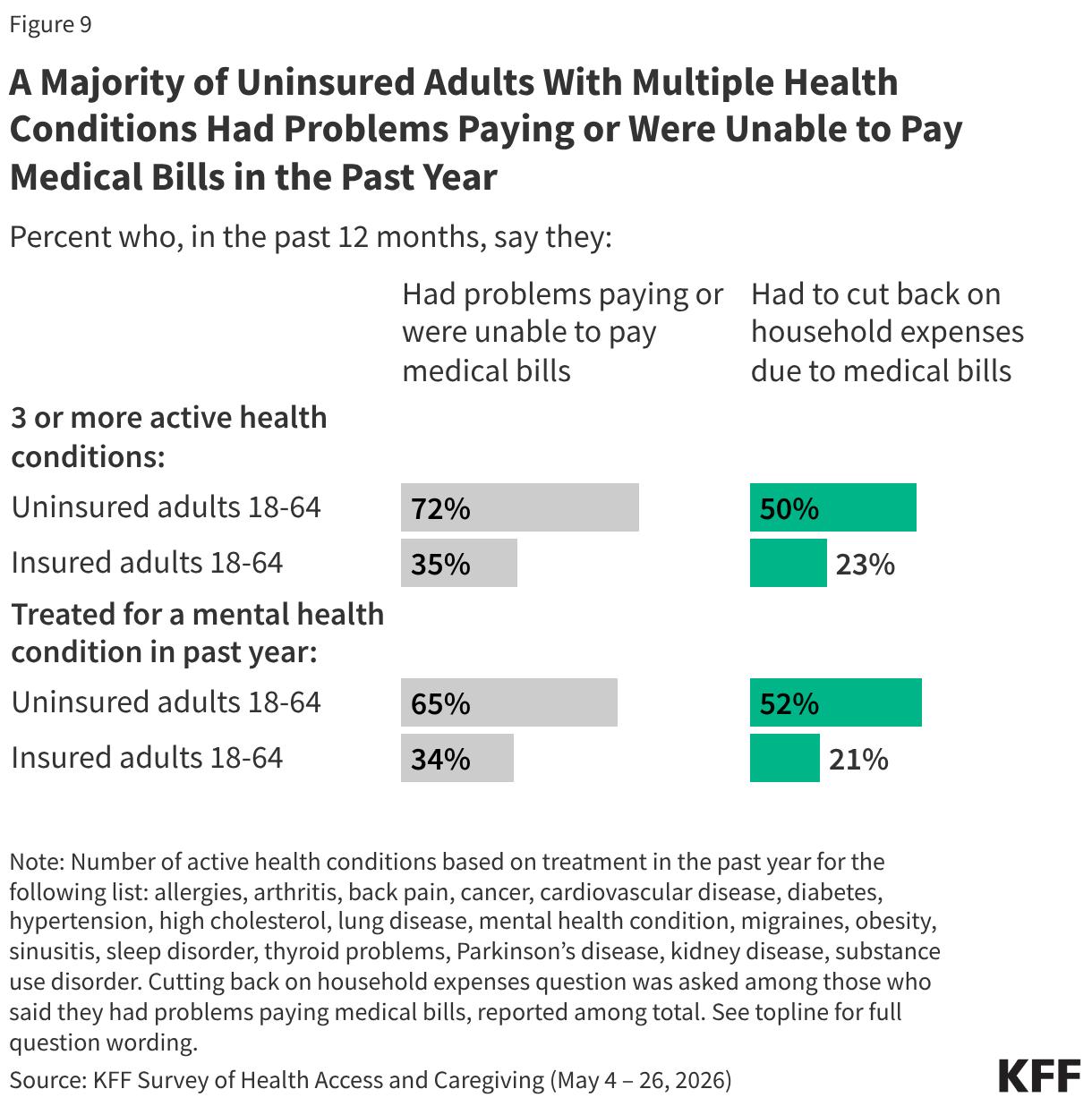
The margin of sampling error including the design effect for the full sample is plus or minus 3 percentage points. Numbers of respondents and margins of sampling error for key subgroups are shown in the table below. For results based on other subgroups, the margin of sampling error may be higher. Sample sizes and margins of sampling error for other subgroups are available on request. Sampling error is only one of many potential sources of error and there may be other unmeasured error in this or any other public opinion poll. KFF public opinion and survey research is a charter member of the Transparency Initiative of the American Association for Public Opinion Research.
Section 1115 Medicaid demonstration waivers offer states an avenue to test new approaches in Medicaid that differ from what is required by federal statute, if [in the HHS Secretary’s view] the approach is likely to “promote the objectives of the Medicaid program.”They can provide states additional flexibility in how they operate their programs, beyond the considerable flexibility that is available under current law. Waivers generally reflect priorities identified by states as well as changing priorities from one presidential administration to another. Nearly all states have at least one active Section 1115 waiver and some states have multiple 1115 waivers. See the “Key Themes Maps” tab for a discussion of recent waiver trends.
This page tracks approved and pending Section 1115 waiver provisions (including expansions and restrictions) related to eligibility, benefits, and social determinants of health and other delivery system reforms, once such waivers are posted to the state waivers list on Medicaid.gov. For more information on inclusion criteria and on each provision, as well as a list of acronyms, see the Definitions tab.
The 2025 budget reconciliation legislation requires states to condition Medicaid eligibility for adults in the ACA Medicaid expansion group on meeting work requirements starting January 1, 2027, but states have the option to implement requirements sooner using an 1115 waiver.
Prior to the passage of the federal reconciliation legislation and since the start of the second Trump administration, some states have shown renewed interest in pursuing work requirement policies through 1115 waivers. However, some states may no longer be moving forward with proposed 1115 waivers due to the passage of federal work requirements. Montana is the only state that has submitted a waiver since the passage of the 2025 budget reconciliation legislation. It is not clear how CMS will treat pending 1115 waivers that seek to implement early and deviate from federal requirements specified in the law.
The first Trump administration encouraged and approved 1115 demonstration waivers that conditioned Medicaid coverage on meeting work requirements which were subsequently rescinded by the Biden administration or withdrawn by states. Currently, Georgia is the only state with a Medicaid work requirement waiver in place following litigation over the Biden administration’s attempt to stop it.
The map below identifies approved (Georgia) and pending work requirement waivers (submitted to CMS since the start of the second Trump administration). The table below the map provides more detailed state waiver information.
For more information on Medicaid work requirements, see additional KFF resources:
An overview of the work requirement provisions in the 2025 budget reconciliation legislation, including key operational & implementation questions (2025)
A short brief highlighting five key facts about Medicaid work requirements, including what the research shows about the impact of work requirements (2025)
A detailed history of Medicaid work requirements (2022)
The table below provides more detailed state waiver information for waivers that are approved and pending at the federal level, as well as activity at the state-level once a waiver proposal has been released for state-level “public comment.” This table also lists states with legislative activity involving work requirements, once a bill has passed out of committee (typically the first step of the legislative process). Some states require state legislative action before Section 1115 waiver requests can be submitted by the state Medicaid agency to CMS for federal approval and others do not.
Key Themes Maps
Section 1115 waivers generally reflect priorities identified by states as well as changing priorities from one presidential administration to another. Key Biden administration 1115 initiatives included waivers addressing enrollee health-related social needs (HRSN), pre-release coverage for individuals who are incarcerated, and multi-year continuous eligibility for children.
In March 2025, the Trump administration rescinded HRSN guidance issued by the Biden administration. CMS indicates this does not nullify existing HRSN 1115 approvals but going forward they will consider HRSN / SDOH requests on a case-by-case basis. In April 2025, the Trump administration announced it would be phasing out federal funding for “Designated State Health Programs” (DSHP) in waivers. In July 2025, the Trump administration released guidance indicating it will not approve (new) or extend (existing) continuous eligibility waivers for children or adults. CMS also announced in July it would be phasing out initiatives to strengthen the Medicaid workforce for primary care, behavioral health, dental, and home and community based services (not depicted in maps below).
This page tracks pending and approved waivers in key areas of recent state activity and will track Trump administration action in these areas going forward. Hover over individual states to display waiver expiration dates.
Social Determinants of Health
Social determinants of health (SDOH) are the conditions in which people are born, grow, live, work and age. SDOH include but are not limited to housing, food, education, employment, healthy behaviors, transportation, and personal safety. In 2022, CMS (under the Biden administration) announced a demonstration waiver opportunity to expand the tools available to states to address enrollee “health-related social needs” (or “HRSN”) including housing instability, homelessness, and nutrition insecurity, building on CMS’s 2021 guidance. In 2023, CMS issued a detailed Medicaid and CHIP HRSN Framework accompanied by an Informational Bulletin, which were updated in 2024.
In March 2025, the Trump administration rescinded the Biden administration HRSN guidance. CMS indicates this does not nullify existing HRSN approvals but going forward they will consider HRSN / SDOH requests on a case-by-case basis.
The “HRSN Waivers” map below identifies states with approval under the Biden administration HRSN framework. The “All SDOH Waivers” map identifies SDOH-related 1115 waivers more broadly, including those that pre-date or were approved outside of the HRSN framework. For more detailed waiver information, refer to KFF’s Medicaid Waiver Tracker (“SDOH” table) and HRSN waiver watch (March 2024).
Medicaid Pre-release Coverage for Individuals Who Are Incarcerated
In April 2023, the Biden administration released guidance encouraging states to apply for a new Section 1115 demonstration opportunity to test transition-related strategies to support community reentry for people who are incarcerated. This demonstration allows states a partial waiver of the inmate exclusion policy, which prohibits Medicaid from paying for services provided during incarceration (except for inpatient services). Reentry services aim to improve care transitions and increase continuity of health coverage, reduce disruptions in care, improve health outcomes, and reduce recidivism rates. The Biden administration approved 19 state waivers to facilitate reentry for individuals who are incarcerated. The map below identifies states with approved and pending waivers to provide pre-release services to Medicaid-eligible individuals who are incarcerated. Medicaid pre-release waivers have been pursued by both Republican and Democratic governors. For more information, refer to KFF’s Medicaid Waiver Tracker (“Eligibility Changes” table) and related pre-release waiver watch (August 2024).
Multi-year Continuous Eligibility for Children
The Consolidated Appropriations Act, 2023 required all states to implement 12-month continuous eligibility for children beginning on January 1, 2024. The Biden administration approved 9 waivers that allow states to provide multi-year continuous eligibility for children (e.g., from birth to age six). Continuous eligibility has been shown to reduce Medicaid disenrollment and “churn” rates (rates of individuals temporarily losing Medicaid coverage and then re-enrolling within a short period of time).
In July 2025, the Trump administration released guidance indicating it will not approve (new) or extend (existing) continuous eligibility waivers for children or adults. The map below displays states with waiver approval to provide multi-year continuous eligibility for children. For more information, refer to KFF’s Medicaid Waiver Tracker (“Eligibility Changes” table) and related continuous eligibility waiver watch (February 2024).
In 2021, during the COVID-19 pandemic, Congress passed the American Rescue Plan Act (ARPA) which temporarily increased tax credits available for adults purchasing their own health insurance through the ACA Marketplace. These enhanced tax credits increased the financial assistance available to existing Marketplace enrollees who already qualified for financial help and extended financial assistance to some middle-income adults who were previously not eligible for premium tax credits. The tax credits were extended as part of the 2022 Inflation Reduction Act and are set to expire at the end of 2025.
If Congress does not extend the tax credits beyond 2025, premium payments will increase 114% on average for the 22 million people who currently get a tax credit. To better understand how people are navigating these cost increases during the 2026 Open Enrollment period, which began on November 1st, KFF conducted a probability-based survey of 1,350 adults who purchase coverage on the ACA Marketplaces.
This report highlights their expectations for their health insurance coverage and costs for 2026, as well as how increased health care costs may affect their coverage decisions, finances, and their political preferences in the coming elections.
Marketplace enrollees largely see health insurance as very important to their ability to access care, to their financial well-being, and to their peace of mind; however, if the enhanced premium tax credits are not extended, many of the twenty-four million adults in the U.S. who currently buy their own insurance through the ACA Marketplace may consider changes to their current coverage. When asked what they would do if the amount they pay for health insurance each month doubled, one in three enrollees (32%) say they are very likely to shop for a lower-premium plan (with higher deductibles and out-of-pocket costs) and one in four (25%) say they would be very likely to go uninsured.
Notably, with Congress potentially voting on extending the premium tax credits in December and recent discussions about a Republican health care proposal, the vast majority of enrollees (89%) expect to make a decision about the 2026 coverage by the end of the year, including many enrollees who say they have already made their decision.
Many Marketplace enrollees are already struggling with health care costs. Six in ten adults (61%) who buy their health coverage on the ACA Marketplace say it is very or somewhat difficult to afford their deductibles and out-of-pocket costs for medical care and half (51%) say it is difficult to afford the cost of health insurance premiums each month. In addition, nearly six in ten Marketplace enrollees say they would not be able to afford an annual increase of $300 in health care expenses without significantly disrupting their household finances.
The enhanced premium tax credits allow most Marketplace enrollees to pay less than the full price of their health insurance premiums, and the poll finds bipartisan support among Marketplace enrollees for Congress to extend these tax credits even as the political parties in Congress disagree about the way forward. More than eight in ten (84%) Marketplace enrollees – including nearly all Democrats and about seven in ten Republicans – say Congress should extend the tax credits. If the tax credits are allowed to expire, most enrollees who want to see the credits extended think either President Trump (41%) or Congressional Republicans (35%) deserve most of the blame.
Following the longest federal government shutdown in U.S. history, which ended without an extension of the enhanced premium tax credits, about two-thirds of Marketplace enrollees say they have either “not much” or “no confidence” in President Trump, nor in Congressional Republicans, to address health care costs for people like them. Congressional Democrats fare slightly better, but still more than half of enrollees say they lack confidence in Congressional Democrats to address this issue.
Regardless of whether Marketplace enrollees decide to continue with their current Marketplace plan, switch to a lower-premium but higher-deductible plan, or go uninsured in 2026, many will face higher health care expenses next year and many say this increased financial burden will impact how they approach the 2026 midterm election. A slight majority (54%) of enrollees who are registered to vote say if their health care expenses increase by $1,000 next year, it would have a major impact on whether they will vote in the 2026 elections and about half (52%) say it would have a major impact on which party’s candidate they will support.
Most Enrollees Are Wary About Expiring Enhanced Premium Tax Credits
Open enrollment for the ACA Marketplace began on November 1st amid a government shutdown as Congress debated extending the tax credits. The survey, conducted in the first weeks of open enrollment and as Congress passed a short-term spending bill, finds that the focus on the enhanced premium tax credits has resonated with most Marketplace enrollees. At the time the survey was fielded in mid-November, about six in ten Marketplace enrollees say they’ve heard “a lot” (27%) or “some” (32%) about the enhanced premium tax credits. However, four in ten enrollees say they have heard “a little” (22%) or “nothing at all” (19%) about the enhanced premium tax credits. In most states, open enrollment for ACA Marketplace plans ends on January 15th, 2026.
As of mid-November, a slight majority (56%) of enrollees say they have looked for, sought out, or received any information about what the cost of their health insurance will be in 2026. Enrollees in states that use the federal ACA Marketplace platform are more likely than those in states that have a state-run Marketplace to say they have looked for or received information about the cost of their health insurance for next year (62% vs. 49%).
More than half of Marketplace enrollees (54%) expect that the cost of their health insurance coverage for next year will “increase a lot more than usual.” A further one in four (26%) expects it to increase a “little more than usual,” while fewer expect their health insurance costs to “increase about the same as usual” (12%) or to “not increase at all” (8%). Enrollees with higher incomes are somewhat more likely than those with lower household incomes to expect their costs to increase “a lot more than usual.” Notably, Marketplace enrollees with an income just above 400% of the federal poverty level (FPL), who currently pay no more than 8.5% of their income in monthly insurance premiums, would have to pay full price for their insurance coverage if the enhanced premium tax credits are allowed to expire.
Half or more across partisans and geographies expect the cost of their health insurance for next year to increase “a lot more than usual,” including 60% of Democrats, 52% of Republicans, 54% of independents, 53% of enrollees living in states that have expanded Medicaid, and 56% of enrollees living in states that have not expanded Medicaid.
About nine in ten (89%) Marketplace enrollees say they will make a decision about their coverage for 2026 this year, including one in four (26%) who say they have already made a decision about their health insurance coverage for next year and 28% who planned to make a decision sometime in November. Enrollees must generally select a plan or be automatically reenrolled by December 15 for coverage to start on January 1, 2026. About a third (35%) of enrollees say they plan to make their health insurance decision in December, while one in ten (11%) say they plan to decide in early January.
Most Enrollees See Health Insurance as Very Important – Particularly Those Ages 50 and Older
Even with the current financial help provided by the enhanced premium tax credits, many Marketplace enrollees are already struggling to afford health care costs. About six in ten (61%) Marketplace enrollees say it is very difficult or somewhat difficult for them to afford out-of-pocket costs for medical care, and about half (51%) say they already have difficulty affording their health insurance premiums. Out-of-pocket costs for medical care ranks as the top household budget item that Marketplace enrollees find difficult to afford – ranking ahead of rent or mortgage, food and groceries, utilities, and housing costs.
Yet, health insurance is a clear priority for Marketplace enrollees. More than three in four say having health insurance is “very important” for their ability to get the health care they need (77%) and for their peace of mind (78%). About seven in ten (69%) say it is “very important” for their financial well-being. Notably, enrollees between the ages of 50 and 64 – a group that does not yet qualify for Medicare but may have additional age-related health care needs – are more likely than younger enrollees to say that health insurance is very important to accessing needed health care, to their financial well-being, and to their peace of mind. A majority of Marketplace enrollees, regardless of partisanship, say that health insurance is “very important” to their financial wellbeing, their peace of mind, and their ability to access health care.
Expiring Premium Tax Credits May Make Coverage Unaffordable for Most Marketplace Enrollees
Nine in ten Marketplace enrollees (90%) expect that the expiration of the enhanced premium tax credits will have an impact on the amount they pay monthly for their health insurance, including seven in ten (69%) who say it will have a “major impact.” KFF analysis has found that if the enhanced premium tax credits for adults who purchase their own insurance through the ACA Marketplace are not extended, the annual amount that enrollees pay for their premiums for 2026 will more than double on average.
The KFF 2025 Marketplace Enrollees Survey finds that this type of increase could have a significant impact on the household finances of the millions of adults who purchase their own insurance through the ACA Marketplaces. Nearly six in ten enrollees (58%) say they would not be able to afford an increase of just $300 per year in the amount they pay for insurance without significantly disrupting their household finances. Those with lower incomes are likely to see smaller dollar increases in their premium payments, yet notably seven in ten (70%) enrollees with household incomes under 200% FPL say they wouldn’t be able to afford a $300 increase in the amount they pay each year, which is the approximate increase for a low income person to keep a “silver plan” if the enhanced premium tax credits expire.
If enrollees said they could afford an annual increase of $300, they were then asked about their ability to afford larger annual increases. A further 20% of enrollees say they would be unable to afford an increase of $1,000 per year, the average projected increase, without significant financial disruption. Only one in eight Marketplace enrollees (13%) say they could afford an increase of $2,000 or more (which some people would face).
Younger adults are less likely to be able to afford any increase, including two-thirds (67%) of adults ages 18 to 29 who say they would not be able to afford a $300 annual increase without disrupting their household finances. ACA Marketplace insurers have expressed concern that the expiring tax credits will lead to younger, healthier people disproportionately dropping their coverage, and are therefore raising premiums more than they otherwise would.
About half of Marketplace enrollees (53%) say it would be “very difficult” for them to find another source of health insurance they could afford if their current coverage became unaffordable, and a further 36% say it would be “somewhat difficult.” Majorities of enrollees, regardless of their household income or age, say it would be at least somewhat difficult to find another source of health insurance coverage.
Marketplace enrollees may respond to a projected increase in premiums in different ways. If the monthly amount enrollees pay for their health insurance doubled (or increased by $50 for those who currently do not pay a premium), about a third (32%) say they would be “very likely” to look for a different Marketplace plan with a cheaper premium, but higher deductibles and co-pays. A quarter of enrollees (25%) say they would be “very likely” to go without health insurance. About one in seven (15%) say they would be “very likely” to look for a different job that provides health insurance that meets their needs and only 10% say they are “very likely” to stay with their current insurance plan if their monthly premium payments doubled.
Notably, about three in ten (28%) Marketplace enrollees from states with current Republican governors say they are “very likely” to go uninsured if the monthly amount they pay for health insurance doubles, as expected on average, if the tax credits are not extended. Among Marketplace enrollees in states that have not expanded Medicaid coverage under the ACA, where more people with incomes just above the poverty level are eligible to enroll in Marketplace coverage with premium tax credits, three in ten (31%) say they are very likely to go uninsured if faced with a doubling of their monthly health insurance premiums.
In Their Own Words: Why some current Marketplace enrollees aren’t planning on buying health insurance coverage for 2026
“Without the subsidies, my monthly premiums will increase by nearly $750 a month, or $9000 for the year. My budget is tight as it is, and there’s no way I can afford that additional hit. The only way I will be able to continue with my health insurance is if Congress restores the subsidies.” — 63-year-old man, Democrat, California
“I was paying $0 then it went up to over $600 for 2026. My husband has to continue coverage in order to avoid going blind. I’m going to drop myself off the coverage and just have insurance for him so he can continue to work and pay for the insurance.” — 60-year-old woman, Republican, Missouri
“We cannot afford it. Our premium went from being $25 with subsidy to $300 for the same plan. With everything increasing in price like groceries, we simply cannot afford it” — 39-year-old woman, Democrat, Oklahoma
“Premiums are too high for my usage, will switch to cost sharing like medishare or Samaritans” — 42-year-old woman, Republican, North Carolina
“The cost of the same plan is going to be exponentially higher than the current plan and I would have to go with a “bronze” plan in order to be able to keep my premiums somewhat reasonable.” — 54-year-old woman, Democrat, Texas
“Way too expensive. There was a $231 increase in the premium!” — 46-year-old woman, independent, Indiana
“If subsidies are not extended, I can’t afford it.” — 56-year-old man, independent, Nevada
“I cannot afford the premium increase for the incredibly bad insurance.” — 55-year-old man, Republican, Idaho
How a $1,000 Annual Increase Would Affect Marketplace Enrollees
Regardless of what they decide to do about their health insurance coverage for next year, the vast majority of current Marketplace enrollees are likely to face an increase in their overall health care expenses in 2026. Those who choose to stay with their current insurance plan may face substantial premium payment increases, those who switch to a lower-premium plan will likely face increased out-of-pocket costs through higher deductibles and co-pays, and those who go uninsured may face costly medical bills if they need care.
If faced with an annual increase of $1,000 in health care expenses, most Marketplace enrollees (67%) say they are very or somewhat likely to cut back spending on food, clothing, or basic household items in order to cover additional health care costs. More than half (54%) say they would be very or somewhat likely to try to find an extra job or work more hours to cover an increase in health care expenses. About four in ten (41%) say they would skip or delay paying other bills and about a third (34%) say they would take out a loan or increase their credit card debt for day-to-day expenses if faced with an increase of $1,000 in health care expenses.
Assessing the Political Implications of Failing To Extend the Tax Credits
On October 1st, the federal government was shut down when Democratic senators attempted to negotiate a vote for continued government funding in exchange for the extension of the enhanced premium tax credits for adults who purchase their own insurance through the ACA Marketplace. As part of a deal to end the recent federal government shutdown, Republican Congressional leaders have promised Democrats a vote on the ACA Marketplace enhanced premium tax credits in December.
More than eight in ten (84%) Marketplace enrollees say that Congress should extend the enhanced tax credits, while one in six (16%) think they should let the tax credits expire. Majorities across partisanship want to extend the enhanced premium tax credits, including nearly all Democrats (95%), about eight in ten independents (84%), and about seven in ten Republicans (72%) enrolled in Marketplace plans. About seven in ten (72%) Republicans or Republican-leaning independents who support the MAGA movement and get insurance through the Marketplaces want to extend the credits, while about three in ten (28%) want to let them expire. Majorities of Marketplace enrollees, regardless of where they live, including those living in states that haven’t expanded their Medicaid programs or living in states with Republican governors, want to see Congress extend these tax credits.
If the enhanced premium tax credits are not extended, those who want to see them extended are most likely to blame Republican leaders, including President Trump. Four in ten of those who support extending the premium tax credits say that if they are not extended, President Trump deserves most of the blame (41%, or 34% of all Marketplace enrollees) and about a third (35%, or 29% of all enrollees) say Republicans in Congress deserve most of the blame. A smaller share (23%, 19% of all enrollees) says Democrats in Congress deserve most of the blame for not extending the credits.
Unsurprisingly, partisans are most likely to say the other party deserves the blame if Congress doesn’t extend the enhanced premium tax credits. However, four in ten Republican enrollees who want to see the tax credits extended say they will either place most of the blame on President Trump (21%) or Republicans in Congress (21%). Even among the most ardent supporters of President Trump, 14% of MAGA supporters say he will deserve most of the blame if the tax credits are not extended, and an additional one in five MAGA supporters (19%) say Republicans will deserve most of the blame.
Marketplace Enrollees Are About Equally Divided Across Political Affiliation
Recent KFF analysis shows that since 2020, ACA Marketplace enrollment has seen a particularly high rate of growth in a number of southern states and enrollment has grown faster in states won by President Trump in 2024 than those won by Kamala Harris. KFF’s 2025 Marketplace Enrollees Survey finds that about four in ten Marketplace enrollees (39%) are Republicans or Republican-leaning independents, including 24% who say they are supporters of the Make America Great Again (MAGA) movement. Just over four in ten Marketplace enrollees (45%) identify as Democrats or Democratic-leaning independents, while 17% do not identify or lean toward either political party.
Overall confidence that Congress and President Trump can address the cost of health insurance is low. About two-thirds of Marketplace enrollees say they have “not too much” or no confidence in President Trump (66%) nor in Republicans in Congress (67%) to address health insurance costs for people like them. Congressional Democrats fare only slightly better. Just over half (53%) of enrollees say they have not much or no confidence in Democrats in Congress to address the cost of health insurance for people like them. About half (47%) of Marketplace enrollees express at least some confidence in Congressional Democrats to address insurance costs. About a third say the same about President Trump (34%) and Republicans in Congress (33%).
Unsurprisingly, partisans are more likely to express at least some confidence in lawmakers from their own party. For example, about three in four (73%) Democrats with Marketplace insurance say they have at least some confidence in Democrats in Congress to address the cost of insurance for people like them. On the other hand, about three-quarters of Republicans with Marketplace coverage say they have at least some confidence in Congressional Republicans (73%) and in President Trump (75%) to address the cost of health insurance. Nearly eight in ten (78%) Democrats and nearly half (48%) of independents say they have “no confidence” in President Trump to address the cost of health insurance for people like them.
Large shares of Republicans and Republican-leaning independents with Marketplace coverage who support the MAGA movement express at least some confidence in President Trump (83%) and in Republicans in Congress (77%) to address health insurance costs; yet notably, about one in four MAGA supporters (23%) do say they have “a lot” or “some” confidence in Democrats in Congress to address this issue.
Increases in Health Care Expenses May Impact How Enrollees Approach the 2026 Elections
If current Marketplace enrollees are faced with increased health care expenses next year, there may also be some notable political implications. More than a third of Marketplace enrollees (37%) say President Trump would deserve most of the blame if their personal health care expenses increased by $1,000 next year. A third (33%) say the Republicans in Congress would be most to blame, while about three in ten (29%) place most of the blame on Democrats in Congress.
Democrats with Marketplace insurance say they would largely blame Republicans in Congress (46%) or President Trump (49%) if their health care expenses increase by $1,000 next year. Among independents, more than four in ten (44%) would blame the President, while about a third (32%) would blame Congressional Republicans, and about one in four (23%) would put most of the blame on Democrats in Congress.
Though most Republicans (65%) would blame Congressional Democrats if their health care costs increased by $1,000 next year, about a third say they would blame either Republicans in Congress (20%) or President Trump (14%). Among MAGA supporters, 17% say they would blame Republicans in Congress and a further 9% would blame President Trump if their health care expenses increase by $1,000 next year.
Additionally, for some Marketplace enrollees, an increase in health care expenses may affect how they approach the 2026 midterm elections. If their overall health care expenses, including co-pays, deductibles, and premiums, increased by $1,000 next year, about half of Marketplace enrollees who are registered to vote say it would have a “major impact” on their decision to vote in the 2026 midterm elections (54%) or which party’s candidate they will vote for (52%). About one in five say an increase in their expenses would have a “minor impact” on their decision to vote (17%) or which party they vote for (17%).
Democratic voters with Marketplace coverage are much more likely to say that a $1,000 increase in their health expenses would have a major impact on the 2026 midterm elections, both in terms of turnout and candidate choice, compared with Republican and independent voters with Marketplace coverage. Seven in ten Democrats (70%) and just over half of independents (54%) say an increase in their health care expenses would have a “major impact” on their decision to vote, as do about four in ten (39%) of Republicans. In addition, about two-thirds of Democrats (65%) as well as a slight majority of independents (55%), say an increase of $1,000 in their health care expenses next year would have a “major impact” on which party’s candidate they would support, compared to about a third of Republicans (35%). Four in ten MAGA Republican enrollees who are registered to vote say that if their health care expenses increased by $1,000 next year, it would have “no impact at all” on which party’s candidate they support in the 2026 midterm elections (40%) or whether they vote (41%).
Methodology
This KFF 2025 Marketplace Enrollees Survey was designed and analyzed by public opinion researchers at KFF. The survey was conducted November 7-15, 2025, online and by telephone among a nationally representative sample of 1,350 U.S. adults ages 18-64 who are covered by a plan purchased through the Affordable Care Act Marketplace, in English (n=1,301) and in Spanish (n=49). To qualify for the survey respondents needed to indicate that they were 18-64 years old, covered by health insurance purchased directly from an insurance company, health insurance broker or a state or federal marketplace and not covered by COBRA extension of employer-based health insurance. The sample includes 972 adults (n=24 in Spanish) reached through the SSRS Opinion Panel either online (n=944) or over the phone (n=28). The SSRS Opinion Panel is a nationally representative probability-based panel where panel members are recruited randomly in one of two ways: (a) Through invitations mailed to respondents randomly sampled from an Address-Based Sample (ABS) provided by Marketing Systems Groups (MSG) through the U.S. Postal Service’s Computerized Delivery Sequence (CDS); (b) from a dual-frame random digit dial (RDD) sample provided by MSG. For the online panel component, invitations were sent to panel members by email followed by up to three reminder emails.
An additional 350 adults ages 18-64 who are currently covered by direct-purchase insurance were reached through the IPSOS Knowledge Panel online in English (n=325) and in Spanish (n=25). The IPSOS Knowledge Panel is a nationally representative probability-based panel where panel members are recruited randomly through invitations mailed to respondents randomly sampled from an Address-Based Sample (ABS) through the U.S. Postal Service’s Computerized Delivery Sequence (CDS). Another 28 adults ages 18-64 currently covered by direct-purchase insurance that were previously recruited to complete the KFF Health Tracking Polls in 2024-2025 were reached via their prepaid cell phone number. Among this prepaid cell phone component, 11 were interviewed by phone and 17 were invited to the web survey via short message service (SMS).
Respondents in the prepaid cell phone sample who were interviewed by phone received a $15 incentive via a check received by mail. Respondents in the prepaid cell phone sample reached via SMS received a $10 electronic gift card incentive. SSRS Opinion Panel respondents received a $5 electronic gift card incentive (some harder-to-reach groups received a $10 electronic gift card). Ipsos operates an incentive program that includes raffles and sweepstakes with both cash rewards and other prizes to be won. An additional incentive is usually provided for longer surveys. In order to ensure data quality, cases were removed if they failed two or more quality checks: (1) attention check questions in the online version of the questionnaire, (2) had over 30% item non-response, or (3) had a length less than one quarter of the mean length by mode. Based on this criterion, there were no cases removed.
The combined cell phone and panel samples were weighted to match the sample’s demographics to the national U.S. adult population 18-64 who are currently covered by direct-purchase insurance using data from the Census Bureau’s 2025 Current Population Survey (CPS). The demographic variables included in weighting are gender, age, education, census region, number of adults in household, and home tenure. The sample was also weighted to match the proportion of responses by individuals living in a Medicaid expansion state. Additionally, the weights account for differences in the probability of selection for each sample type (prepaid cell phone, IPSOS Knowledge Panel, and SSRS Opinion Panel). This includes adjustment for ownership of a prepaid cellphone and the design of the panel-recruitment procedure (IPSOS Knowledge Panel and SSRS Opinion Panel).
The margin of sampling error including the design effect for the full sample is plus or minus 3.3 percentage points. Numbers of respondents and margins of sampling error for key subgroups are shown in the table below. For results based on other subgroups, the margin of sampling error may be higher. Sample sizes and margins of sampling error for other subgroups are available on request. Sampling error is only one of many potential sources of error and there may be other unmeasured error in this or any other public opinion poll. KFF public opinion and survey research is a charter member of the Transparency Initiative of the American Association for Public Opinion Research.
Poll: 1 in 3 ACA Marketplace Enrollees Say They Would “Very Likely” Shop for a Cheaper Plan If Their Premium Payments Doubled; 1 in 4 Say They “Very Likely” Would Go Without Insurance
As Enhanced Credits Expire, Nearly All Enrollees Expect to Make Coverage Decisions This Year
If the amount they pay in premiums doubled, about one in three enrollees in Affordable Care Act Marketplace health plans say they would be “very likely” to look for a lower-premium Marketplace plan (with higher deductibles and co-pays) and one in four would “very likely” go without insurance next year, finds a new survey of Marketplace enrollees fielded shortly after open enrollment began in the first weeks of November.
The survey captures the views and experiences of Marketplace enrollees as they weigh their coverage options for 2026, without the enhanced ACA credits or other policy changes that the Senate could debate this month. About 22 million of the 24 million Marketplace enrollees have benefited from the expiring tax credits, and without them, their premium payments are expected to rise an average of 114%, from $888 to $1,904 annually.
Nearly six in 10 enrollees (58%) say they would not be able to afford an increase of just $300 per year in the amount they pay for insurance without significantly disrupting their household finances. An additional one in five (20%) say they would not be able to afford a $1,000 per year increase in the amount they pay for health insurance without disrupting their finances.
If their total health care costs, including premiums, deductibles and other cost-sharing, increased by $1,000 next year, most Marketplace enrollees (67%) say they would likely cut spending on daily household needs, about half (54%) say they would likely to try to find another job or work extra hours, and four in 10 (41%) say they would likely skip or delay paying other bills. A third (34%) say they would take out a loan or increase their credit card debt.
“The poll shows the range of problems Marketplace enrollees will face if the enhanced tax credits are not extended in some form, and those problems will be the poster child of the struggles Americans are having with health care costs in the midterms if Republicans and Democrats cannot resolve their differences,” KFF President and CEO Drew Altman said.
It asked Marketplace enrollees to say how likely it was that they would take each of four different potential responses if the monthly premiums they pay doubled (or increased $50 a month for those who currently don’t pay a premium).
Open enrollment for Marketplace coverage began Nov. 1 and runs through Jan. 15 in most states, though consumers must enroll in a plan by Dec. 15 if they want their coverage to begin on Jan. 1. The vast majority of enrollees (89%) expect to make a decision by the end of this year, with many saying they have already made their decision about coverage for next year.
More than half of Marketplace enrollees (54%) say they expect that the cost of their health insurance coverage for next year will “increase a lot more than usual.” An additional one in four (26%) expect it to increase a “little more than usual,” while smaller shares expect their insurance costs to “increase about the same as usual” (12%) or “not increase at all” (8%).
If their overall health care expenses, including co-pays, deductibles, and premiums, increased by $1,000 next year, about half of Marketplace enrollees say it would have a “major impact” on their decision to vote in the 2026 midterm elections (54%) or on which party’s candidate they will support (52%).
People with Marketplace insurance are more likely to say that either President Trump (37%) or Congressional Republicans (33%) would deserve most of the blame if their health care costs increased by $1,000 next year than they are to say Congressional Democrats (29%).
Democrats would overwhelmingly blame Republicans in Congress (46%) or President Trump (49%). Most Republicans (65%) would blame Congressional Democrats, though about a third say they would blame either Republicans in Congress (20%) or President Trump (14%). Among independents, more than four in 10 (44%) would blame the President, a third (32%) would blame Congressional Republicans, and about one in four (23%) would blame Congressional Democrats.
Other findings include:
Overall, about four in 10 Marketplace enrollees (39%) are Republicans or Republican-leaning independents, including about one in four (24%) who identify with President Trump’s Make America Great Again (MAGA) movement. Just over four in 10 enrollees (45%) identify as Democrats or Democratic-leaning independents, while 17% don’t identify or lean toward either party.
Even with the current levels of financial assistance, many Marketplace enrollees say it is already difficult to afford their deductibles and other out-of-pocket costs for medical care (61%) and to afford the cost of health insurance each month (51%). More enrollees say their out-of-pocket medical costs are difficult to afford than say the same about other household expenses, such as their rent or mortgage, food and groceries, utilities, and gasoline or transportation costs.
Large majorities of Marketplace enrollees, regardless of partisanship, say that having health insurance is “very important” for their peace of mind (78%), their ability to get needed health care (77%), and their financial well-being (69%). Enrollees between the ages of 50 and 64 are more likely than younger enrollees to say health insurance is very important for each of these three reasons.
A large majority (84%) of enrollees say that Congress should extend the enhanced tax credits, while one in six (16%) think they should let the tax credits expire. Of them, nearly all Democrats (95%), about eight in 10 independents (84%), and about seven in 10 Republicans (72%) and MAGA supporters (72%) favor extending the expiring tax credits.
Designed and analyzed by public opinion researchers at KFF, the 2025 Marketplace Enrollees Survey was conducted November 7-15, 2025, online and by telephone, in English and in Spanish, among a nationally representative sample of 1,350 U.S. adults ages 18-64 who purchase coverage on the ACA Marketplaces. The margin of sampling error is plus or minus 3 percentage points for the full sample. For results based on other subgroups, the margin of sampling error may be higher.
Stark racial disparities in maternal and infant health in the U.S. have persisted for decades despite continued advancements in medical care. Compared to other high-income countries, the U.S. remains the country with the highest rate of maternal deaths. The disproportionate impact of the COVID-19 pandemic on people of color brought increased attention to health disparities, including the longstanding inequities in maternal and infant health. Subsequently, the overturning of Roe v. Wade, growing barriers to abortion, cuts to staff and programs within the U.S Department of Health and Human Services (HHS), and the passage of the 2025 tax and budget law all have the potential to further widen existing disparities in maternal health.
This brief provides an overview of racial disparities for selected measures of maternal and infant health, discusses the factors that drive these disparities, and provides an overview of policy changes that may impact them. It is based on KFF analysis of publicly available data from CDC WONDER online database, the National Center for Health Statistics (NCHS) National Vital Statistics Reports, and the CDC Pregnancy Mortality Surveillance System.
While this brief focuses on racial and ethnic disparities in maternal and infant health, wide disparities also exist across other dimensions, including income, education, age, and other characteristics. For example, there is significant variation in some of these measures across states and disparities between rural and urban communities. Data and research often assume cisgender identities and may not systematically account for people who are transgender and non-binary. In some cases, the data cited in this brief use cisgender labels to align with how measures have been defined in underlying data sources. Key takeaways include:
Large racial disparities in maternal and infant health outcomes persist. Pregnancy-related mortality rates among Black women are over three times higher than the rate for White women (49.4 vs. 14.9 per 100,000). Black, American Indian or Alaska Native (AIAN), and Native Hawaiian or Pacific Islander (NHPI) women also have higher shares of preterm births, low birthweight births, or births for which they received late or no prenatal care compared to White women. Infants born to Black, AIAN, and NHPI people have markedly higher mortality rates than those born to White people.
Maternal and infant health disparities reflect broader underlying social and economic inequities that are rooted in racism and discrimination.Differences in health insurance coverage and access to care play a role in driving worse maternal and infant health outcomes for people of color. However, inequities in broader social and economic factors, including income, are primary drivers for maternal and infant health disparities. Moreover, the persistence of disparities in maternal health across income and education levels, points to the importance of addressing the roles of racism and discrimination as part of efforts to improve health and advance equity.
Recent actions by the Trump administration and Congress reflect a shift away from prioritizing maternal and infant health equity and may contribute to widening disparities. Several key programs that historically supported expanding access to care and services and efforts to address racial disparities, such as diversifying the health care workforce and enhancing data collection and reporting, now face funding cuts or elimination. Other recent federal program and budget cutbacks, including the reduction or elimination of diversity, equity, and inclusion (DEI) initiatives, may undermine efforts to improve disparities in maternal and infant health outcomes. Moreover, the 2025 tax and budget law is anticipated to lead to large coverage losses, particularly in Medicaid, which is a primary source of care for people of color. Coverage losses will likely contribute to access barriers, including for maternal care. Additionally, state variation in access to abortion in the wake of the overturning of Roe v. Wade may exacerbate existing racial disparities in maternal health.
Racial Disparities in Maternal and Infant Health
Pregnancy-Related Mortality Rates
In 2023, approximately 676 women died in the U.S. from causes related to or worsened by pregnancy. This is a decrease from 793 maternal deaths in 2022. Pregnancy-related deaths are deaths that occur within one year of pregnancy. The pregnancy-related mortality rate decreased among White and Hispanic women, will there were no significant changes for Asian or Black women. Approximately one in five (20%) deaths occur during pregnancy, nearly one quarter (23%) occur during labor or within the first week postpartum, and more than half (57%) occur one week to one year postpartum, underscoring the importance of access to health care beyond the period of pregnancy. Recent data show that more than eight out of ten (87%) pregnancy-related deaths are preventable.
As of 2023, Black people are more than three times as likely as White people to experience a pregnancy-related death (49.4 vs. 14.9 per 100,000 live births) in 2023 (Figure 1). The rate for Hispanic and Asian people is lower compared to that of White people (12.3 and 10.7 vs. 14.9 deaths per 100,000 live births). Data from 2023 were insufficient to identify mortality among AIAN and NHPI women. However, earlier data from 2021 show that AIAN and NHPI people (118.7 and 111.7 per 100,000, respectively) had the highest rates of pregnancy-related mortality across racial and ethnic groups.
Research shows that this disparity for Black women increases by age and persists across education and income levels. Data show higher pregnancy-related mortality rates among Black women who completed college education than among White women with the same educational attainment and White women with less than a high school diploma. Other research also shows that Black women are at significantly higher risk for severe maternal morbidity, including conditions such as preeclampsia, which is significantly more common than maternal death. Further, AIAN, Black, NHPI, Asian, and Hispanic women have higher rates of admission to the intensive care unit during delivery compared to White women, which is considered a marker for severe maternal morbidity.
Birth Risks and Outcomes
Black, AIAN, and NHPI women are more likely than White women to have certain birth risk factors that contribute to infant mortality and can have long-term consequences for the physical and cognitive health of children.Preterm birth (birth before 37 weeks gestation) and low birthweight (defined as a baby born less than 5.5 pounds) are some of the leading causes for infant mortality. Receiving pregnancy-related care late in a pregnancy (defined as starting in the third trimester) or not receiving any pregnancy-related care at all can also increase the risk of pregnancy complications. Black, AIAN, and NHPI women have higher shares of preterm births, low birthweight births, or births for which they received late or no prenatal care compared to White women (Figure 2). Notably, NHPI women are four times more likely than White women to begin receiving prenatal care in the third trimester or to receive no prenatal care at all (22.4% vs. 4.7%). Black women also are nearly twice as likely compared to White women to have a birth with late or no prenatal care compared to White women (10.4% vs. 4.7%).
While teen birth rates overall have declined over time, they are higher among Black, Hispanic, AIAN, and NHPI teens compared to their White counterparts (Figure 3). In contrast, the birth rate among Asian teens is lower than the rate for White teens. Many teen pregnancies are unplanned, and pregnant teens may be less likely to receive early and regular prenatal care. Teen pregnancy also is associated with increased risk of complications during pregnancy and delivery, including preterm birth. Teen pregnancy and childbirth can also have social and economic impacts on teen parents and their children, including disrupting educational completion for the parents and lower school achievement for the children. Research studies have found that increased use of contraception as well declines in teen sexual activity have helped lower the rate of teen births nationally.
Reflecting these increased risk factors, infants born to AIAN, Hispanic, Black, and NHPI women are at higher risk for mortality compared to those born to White women. Infant mortality is defined as the death of an infant within the first year of life, but most cases occur within the first month after birth. The primary causes of infant mortality are birth defects, preterm birth and low birthweight, sudden infant death syndrome, injuries, and maternal pregnancy complications. Infant mortality rates have declined over time, although the 2023 rate is unchanged from the 2022 rate (5.6 per 1,000 births, respectively). However, disparities in infant mortality have persisted and sometimes widened for over a century, particularly between Black and White infants. As of 2023, infants born to Black women are over twice as likely to die relative to those born to White women (10.9 vs. 4.5 per 1,000), and the mortality rate for infants born to AIAN and NHPI women (9.2 and 8.2 per 1,000) is nearly twice as high (Figure 4). The mortality rate for infants born to Hispanic mothers is similar to the rate for those born to White women (5.0 vs. 4.5 per 1,000), while infants born to Asian women have a lower mortality rate (3.4 per 1,000).
Data also show that fetal death or stillbirths—that is, pregnancy loss after 20-week gestation—are more common among NHPI, Black and AIAN women compared to White and Hispanic women. Moreover, causes of stillbirth vary by race and ethnicity, with higher rates of stillbirth attributed to diabetes and maternal complications among Black women compared to White women.
Based on the most recently available federally published estimates from 2018, about one in five AIAN, Asian or Pacific Islander, and Black women reported symptoms of pregnancy-related depression compared to about one in ten White women (Figure 5). Hispanic women (12%) had similar rates of depression during and after childbirth compared to their White counterparts (11%). A recent study among women in Southern California suggests that the prevalence of PPD) has grown over the past decade , driven by increases among Black and Asian and Pacific Islander women. Women of color experience increased barriers to mental health care and resources, along with racism, trauma and cultural barriers. Research suggests that perinatal mental health conditions are a leading underlying cause of pregnancy-related deaths and that individuals with perinatal depression are also at increased risk of chronic health complications such as hypertension and diabetes. Infants of mothers with depression are more likely to be hospitalized and die within the first year of life.
Factors Driving Disparities in Maternal and Infant Health
The factors driving disparities in maternal and infant health are complex and multifactorial. They include differences in health insurance coverage and access to care. However, broader social and economic factors and structural and systemic racism and discrimination also play a major role (Figure 7). In maternal and infant health specifically, the intersection of race, gender, poverty, and other social factors shapes individuals’ experiences and outcomes. Recently there has been broader recognition of the principles of reproductive justice, which emphasize the role that the social determinants of health and other factors play in reproductive health for communities of color. Notably, Hispanic women and infants fare similarly to their White counterparts on many measures of maternal and infant health despite experiencing increased access barriers and social and economic challenges typically associated with poorer health outcomes. Research suggests that this finding, sometimes referred to as the Hispanic or Latino health paradox, in part, stems from variation in outcomes among subgroups of Hispanic people by origin, nativity, and race, with better outcomes for some groups, particularly recent immigrants to the U.S. However, the findings still are not fully understood.
Disparities in maternal and infant health, in part, reflect increased barriers to care for people of color. Research shows that coverage before, during, and after pregnancy facilitates access to care that supports healthy pregnancies, as well as positive maternal and infant outcomes after childbirth. Overall, people of color are more likely to be uninsured and face other barriers to care. Medicaid helps to fill these coverage gaps during pregnancy and for children, covering more than two-thirds of births to women who are Black or AIAN. Given its significant role as a payor of maternity care for women of color, several health care professionals and state Medicaid programs have developed initiatives to improve maternal health and decrease maternal mortality and morbidity, such as broader inclusion of doulas as Medicaid providers. However, AIAN, Hispanic, and Black people are at increased risk of being uninsured prior to their pregnancy, which can affect access to care before pregnancy and timely entry to prenatal care. Beyond health coverage, people of color face other increased barriers to care, including limited access to providers and hospitals and lack of access to culturally and linguistically appropriate care.
Several areas of the country, particularly in the South, which is home to a large share of the Black population, have gaps in obstetrics providers. AIAN women also are more likely to live in communities with lower access to obstetric care. These challenges may be particularly pronounced in rural and medically underserved areas. For example, research suggests that the steep closures of hospitals and obstetric units over the past decade in rural areas has a disproportionate negative impact on Black infant health. Suggested approaches for stemming shortages include more training programs for perinatal nurses and midwives, raising Medicaid payment rates, and expansion of midwifery and birth centers services.
Research also highlights the role racism and discrimination play in driving racial disparities in maternal and infant health. Research has documented that social and economic factors, racism, and chronic stress contribute to poor maternal and infant health outcomes, including higher rates of pregnancy-related depression and preterm birth among Black women and higher rates of mortality among Black infants.In recent years, research and news reports have raised attention to the effects of provider discrimination during pregnancy and delivery. News reporting and maternal mortality case reviews have called attention to a number of maternal and infant deaths and near misses among women of color where providers did not or were slow to listen to patients. A recent report determined that discrimination, defined as treating someone differently based on the class, group, or category they belong to due to biases, stereotypes, and prejudices, contributed to 30% of pregnancy-related deaths in 2020. In one study, Black and Hispanic women reported the highest rates of mistreatment (such as shouting and scolding, ignoring or refusing requests for help during the course of their pregnancy). Even after controlling for insurance status, income, age, and severity of conditions, people of color are less likely to receive routine medical procedures and experience a lower quality of care. Another study found that Black women are more likely to receive a cesarian section compared to White women while controlling for health status, suggesting that differences in provider judgement and structural inequalities may be contributing to the disparity. A 2023 KFF survey found that about one in five (21%) Black women say they have been treated unfairly by a health care provider or staff because of their racial or ethnic background. A similar share (22%) of Black women who have been pregnant or gave birth in the past ten years say they were refused pain medication they thought they needed.
Current Policies Impacting Maternal and Infant Health Disparities
Since President Trump took office in January 2025, the Administration and Congress have made significant health policy changes. While in some cases pregnant and postpartum people have been specifically exempted or protected from changes, many changes may have significant impacts on maternal and infant health that could exacerbate existing disparities.
President Trump’s executive orders rolling back federal diversity efforts could exacerbate longstanding disparities in maternal health. As one of his first actions in office, President Trump signed executive orders revoking federal DEI related programs and actions in the federal government and among federal contractors and grantees. In implementing President Trump’s executive orders, the administration has taken significantly broader actions beyond eliminating DEI programs to include eliminating priorities, actions, information, data, and funding related to concepts of diversity or disparities among federal agencies as well as federal contractors and grantees. The broad nature of these actions risks reversing progress on health equity and may lead to widening disparities in maternal health.
Recent federal restructuring may reverse progress on maternal and infant health, particularly for communities already facing persistent disparities. On March 27, 2025, the Trump administration announced an Executive Order reorganizing HHS, which has disrupted key programs affecting maternal health. This impacts included laying off most staff in the CDC’s Division of Reproductive Health, halting community-based maternal health grants, erasing the prior White House Blueprint for Addressing the Maternal Health Crisis, and closing several federal offices that supported state and local efforts to address racial disparities in maternal care. The restructuring has also eliminated key initiatives, including the Pregnancy Risk Assessment Monitoring System (PRAMS), which for decades provided data to track maternal experiences and inform evidence-based policies, and the Safe to Sleep Campaign, a national effort to reduce sudden infant death syndrome (SIDS). These rollbacks come at a time when sleep-related infant deaths have risen nearly 12% between 2020 and 2022, with SIDS among Black infants increasing by 15% in 2020.
The 2025 tax and spending legislation makes large cutbacks in federal Medicaid spending that are expected to lead to large coverage losses, which will likely reduce access to care, including maternal care. According to the Congressional Budget Office (CBO), the law will reduce federal Medicaid spending over the next decade by an estimated $911 billion and increase the number of uninsured people by 10 million. Given the disproportionate role Medicaid plays in covering women of color, they are at increased risk for being affected by program cutbacks. In 2023, Medicaid covered 37% of AIAN 30% of Black and 26% of Hispanic reproductive age women, compared to 20% of reproductive age women overall. Moreover, among women of reproductive age enrolled in Medicaid, nearly four in ten are covered through the Medicaid expansion and could be at risk of losing coverage due to new work and eligibility requirements under the law. While the law provides exemptions from new work requirements for pregnant and postpartum women and for adults with children under age 14, many may still be at risk for losing coverage if they face challenges documenting information necessary to quality for the exemption. The requirements may also limit access to coverage before pregnancy, a particularly important time for addressing preventive care and managing chronic conditions, which are associated with healthier pregnancy outcomes.
The law also imposes a one-year ban on federal Medicaid payments to certain family planning providers, including all Planned Parenthood clinics, which could weaken resources and care that support maternal and infant health. This policy prohibits some family planning clinics that also offer abortion services from receiving any Medicaid payments for contraceptive and other preventive services. Because Medicaid covers 90% of the cost of family planning services, losing this funding would be a major financial blow. While Planned Parenthood clinics represent a small share of the reproductive health safety net overall, they serve many patients of color, provide a significant portion of contraceptive care and are often the only provider in rural or underserved areas. Excluding them from Medicaid could result in clinic closures, reduced services, and fewer reproductive care options for low-income women.
In addition, President Trump’s policies and budget proposals are threatening to dismantle the Title X family planning program, disproportionately affecting communities already facing higher barriers to care. Title X, a federal program established in 1970, provides funding to clinics that offer contraceptive services, STI testing, and cancer screenings to low-income and uninsured patients. These clinics provide care to a diverse population, with nearly a quarter (23%) of the patient population identifying as Black, more than a third (36%) as Hispanic or Latino, and about a fifth (19%) reporting limited proficiency in English. In recent years, the program has faced mounting restrictions. During President Trump’s first term, his administration implemented rules that barred clinics from participating in Title X if they offered or referred for abortion services, resulting in roughly 1,000 clinics losing Title X funding. While the Biden administration later reversed these restrictions, the second Trump administration has resumed efforts to limit the program by withholding funds from some grantees and proposing to eliminate all funding for the program. If enacted, these policies would dismantle the program, leaving many rural and underserved communities with fewer resources for affordable reproductive health care.
State abortion bans and restrictions may exacerbate poor maternal and infant health outcomes and access to care. Since the Dobbs ruling in June 2022, about half of states have banned abortion or restricted it to early in pregnancy. People of color are disproportionately affected by these bans and restrictions as they are at higher risk for pregnancy-related mortality and morbidity, are more likely to obtain abortions, and more likely to face structural barriers that make it more difficult to travel out of state for an abortion. While the number of abortions has slightly increased nationally since the ruling, ongoing and impending legal challenges, state legislative efforts, and federal executive actions could further alter the reproductive care landscape and have impacts beyond abortion counts. A recent JAMA study, for instance, found that fertility rates have increased in states with complete or 6 week abortion bans, particularly among Black and Hispanic populations compared to White populations. A concurrent study showed infant mortality rates have also risen in these states and the increases were larger among Black infants. Abortion bans are exacerbating maternity workforce shortages, as some clinicians do not want to work in areas that criminalize their practice and restrict their ability to provide evidence-based care.
As routine and seasonal vaccination rates continue to decline among children, racial disparities in vaccination rates persist. Declining vaccination rates leave children at increased risk for preventable illnesses, while disparities leave some children at greater risk relative to others. Research shows that many childhood diseases require a high level of vaccination within the population to achieve community-wide protection. As vaccination rates decline, risk for disease outbreaks increases. For example, as of November 2025, there have been 44 measles outbreaks (3 or more related cases) in the U.S. during 2025, and the number of measles cases reported for 2025 is the highest level reported in decades, a consequence of declining measles vaccination rates in many areas.
This analysis examines recent childhood vaccination rates by race and ethnicity for children’s recommended vaccines overall and for the measles, mumps, rubella (MMR) and seasonal flu vaccines specifically, based on KFF analysis of data from the Centers for Disease Control and Prevention (CDC) Morbidity and Mortality Weekly Report (MMWR) and the CDC Flu Vaccination Coverage Report (see Methods). It also discusses potential factors contributing to the ongoing disparities in vaccination rates and recent declines in levels of vaccination coverage.
Overall, the data show that children’s vaccination rates, including receipt of recommended childhood vaccinations as well as for MMR and seasonal flu vaccine specifically, have declined in recent years largely due to decreases in vaccinations among White and Asian children. At the same time, and despite the declines among White and Asian children, Black and AIAN children remain least likely to have received recommended childhood vaccinations and the MMR vaccine specifically. In contrast, for the seasonal flu vaccine, White children along with Black and AIAN children are less likely to have received the vaccination compared to their Asian and Hispanic peers.
Ongoing racial disparities in vaccination rates likely reflect a combination of factors including differences in access to care as well as varying levels of trust in vaccines.For example, the 2025 KFF/Washington Post Survey of Parents shows lower levels of confidence in the safety of some vaccines among Black parents compared to White parents. The recent declines in vaccination rates may reflect spread of vaccine misinformation, growing public skepticism about the safety and effectiveness of vaccines, and increasingly partisan views on vaccination. The KFF/Washington Post Survey of Parents shows Republican parents are nearly three times as likely to report skipping vaccinations for their children compared to parents who are Democrats. Most recently, the Centers for Disease Control and Prevention (CDC) posted information to its website indicating that “studies have not ruled out the possibility that infant vaccines cause autism” despite longstanding scientific evidence disputing this connection. Going forward, these declines could be exacerbated by changes in federal vaccine policy.
Children’s Vaccination Rates by Race and Ethnicity
Largely driven by decreases among Asian and White children, rates of receipt of recommended childhood vaccinations for children ages 24 months or younger have declined. The U.S. Advisory Committee on Immunization Practices (ACIP) has established a recommended immunization schedule for children, which outlines the vaccines they should receive from birth through age two. Examination of vaccination rates by birth cohorts, which group children by the year they were born to allow for comparisons across groups and years, shows that vaccination coverage rates among Asian and White children up to age 24 months have declined, falling from 77% among Asian children in the 2017-2018 birth cohort to 70% in the 2020-2021 birth cohort and from 74% to 69% among White children across these cohorts (Figure 1). The rate for Hispanic children rose from 66% to 69% between the 2017-2018 and 2018-2019 cohorts but then declined again to 65% among the 2020–2021 birth cohort. Rates for Black children remained relatively stable over this period. Both Hispanic and Black children continue to have lower vaccination rates than Asian and White children, with only about two-thirds of each group receiving recommended childhood vaccinations. The rate for AIAN children has increased but is still lower than other groups at 59% among the 2020-2021 birth cohort. In addition to lower routine childhood vaccination rates among children ages 24 months and younger, the rate of school vaccine exemptions increased following the COVID-19 pandemic. Recent survey data suggest that parents who had a White child were less likely to agree that school and daycare vaccination requirements are important or necessary compared to parents of children of other racial and ethnic groups.
For the MMR vaccination specifically, Asian and White children have the highest rates of receiving at least one dose by age 24 months but their rates have been declining in recent years; rates for Black and AIAN children remain lower and below the Healthy People 2030 goal of 90.8% children receiving at least one MMR dose by their second birthday. Asian children have the highest MMR vaccination rate across racial and ethnic groups, although it fell from 95% among those born in 2017-2018 to 92% among those born in 2020-2021 (Figure 2). Similarly, the rate for White children fell from 93% to 90% across these birth cohorts. Rates for other groups remained largely stable across these cohorts, but rates for Black (89%) and AIAN (88%) children born in 2020-2021 remain lower and below the Healthy People 2030 vaccination goal.
Flu vaccination rates among children ages 6 months to 17 years have fallen to their lowest level in over a decade, with a steady decline among White children since the pandemic. Prior to the COVID-19 pandemic, flu vaccination rates had been increasing, with rates highest among Asian and Hispanic children and lower levels among White, Black, and AIAN children. Vaccination rates fell among all groups moving into the 2020-2021 season following the onset of the COVID-19 pandemic. The rate for AIAN children dropped by nearly 20 percentage points and there were larger declines in vaccination rates for Black, Asian, and Hispanic children compared to their White counterparts. Rates rebounded slightly after 2020-2021 season for most groups although they remain below pre-pandemic levels and continued to decline for White children. As of the 2023-2024 flu season, Asian children (70%) had the highest flu vaccination rate, followed by Hispanic children (61%). In contrast, just over half of AIAN (54%), Black (52%), and White (52%) children received the flu vaccine (Figure 3). Preliminary data for the 2024-2025 season that are available for selected groups also show that only about half of White (46%) Black (48%), and Hispanic (53%) children received the vaccine.
Factors Affecting Vaccination Rates
Racial differences in vaccination rates may reflect a variety of factors including differences in social and economic factors that impact access to care as well as differing levels of trust in vaccines. For example, Black, Hispanic, and AIAN people fare worse compared to their White and Asian counterparts on some measures of access to care and across social and economic factors that may impact access to and use of care, including education and income. In a July 2025 KFF Health Tracking Poll, Black and Hispanic adults were among the most concerned about the availability and insurance coverage of the COVID-19 vaccine. The long legacy of the medical system’s abuse and mistreatment of people of color may also contribute to distrust of vaccines. For example, KFF/Washington Post survey data from October 2025 show that just over half (55%) of Black parents say they are confident the flu vaccines are safe for children compared to about two-thirds of White parents (64%), and Black parents are at least 10 percentage points less likely than White parents to express confidence in the safety of the Polio and MMR vaccines.
A growing partisan divide in attitudes toward childhood vaccinations may be contributing to declining vaccination rates among White children. KFF polling data show that the share of parents who say they keep their child up to date with recommended childhood vaccines like the MMR has been declining over time. For example, KFF Tracking Poll data show that the share of parents who report skipping or delaying some vaccines for their children increased between 2023 and 2025, driven largely by Republican-leaning parents. KFF/Washington Post survey data from October 2025 show that Republican parents are nearly three times as likely to report skipping vaccinations other than flu or COVID for their children compared to parents who are Democrats (22% vs. 8%). Other data show that White voters make up the nearly eight in ten of Republicans and Republican leaders.
Changing attitudes towards vaccines may reflect the spread of vaccine misinformation. Some public health leaders have noted that vaccine hesitancy related to COVID-19 may have had spillover effects on routine child immunizations. More recently, HHS Secretary Robert F. Kennedy Jr. has amplified claims about vaccines that have been rejected by scientists and public health officials. Kennedy has suggested without evidence that the number of recommended childhood vaccines has led to a rise in chronic disease in the U.S. Kennedy has also repeated false claims that vaccines, including MMR, can cause autism and that the measles vaccine causes the illness it prevents. Most recently, the CDC posted information to its website indicating that “studies have not ruled out the possibility that infant vaccines cause autism” despite longstanding scientific evidence disputing this connection. KFF/Washington Post survey shows that many parents are uncertain whether false or misleading claims about vaccines and measles are true, and the share who say these false claims are true is higher among Republican parents, particularly those who identify as supporters of the Make America Great Again (MAGA) movement.
Shifts in federal policy on vaccines may contribute to continued declines in childhood vaccinations. Since his appointment as Secretary of Health and Human Services, Robert F. Kennedy Jr. has made several changes to U.S. vaccine policy, including replacing ACIP, removing COVID-19 vaccine recommendations for healthy children and pregnant women, and cancelling funding for mRNA vaccine research. Secretary Kennedy pledged to examine and revise the recommended vaccine schedule to reduce the number of vaccines given to children and perhaps remove vaccines from the recommended schedule altogether. President Trump has echoed many of Secretary Kennedy’s criticisms of the vaccine schedule, saying that children in the U.S. receive too many vaccines and that parents should disregard current federal recommended childhood vaccine schedule and instead space out shots. In response to changes in federal policies and statements from Trump Administration officials, many states have taken steps to maintain access to vaccines and de-link state vaccine policies from federal recommendations. In contrast, other states have expanded exemptions from school vaccine requirements. This variation in state policies may result in uneven levels of vaccine protection across the country, which could leave some areas at increased risk for disease outbreaks and weaken the nation’s overall community-level protection.
Methods
Childhood Vaccination and MMR Data: This analysis uses CDC MMWR data from 2017-2020, 2018-2019, 2019-2020, and 2020-2021 to present childhood vaccination rates, including MMR. Coverage of recommended vaccinations among children under ages 24 months is measured using the combined 7-vaccine series, which includes ≥4 doses of DTaP, ≥3 doses of poliovirus vaccine, ≥1 dose of measles-containing vaccine, full series of Hib vaccine (≥3 or ≥4 doses, depending on product type), ≥3 doses of Hep B, ≥1 dose of varicella vaccine, and ≥4 doses of PCV.
The 2025 reconciliation law, once called the “One Big Beautiful Bill,” signed by President Trump on July 4, 2025, conditions Medicaid eligibility for adults in the Affordable Care Act (ACA) Medicaid expansion group and enrollees in partial expansion waiver programs (Georgia and Wisconsin) on meeting work requirements starting January 1, 2027. Currently, 41 states (including DC) have expanded their Medicaid programs under the ACA to nearly all adults with income up to 138% FPL ($21,597 for an individual in 2025).
To implement Medicaid work requirements, states will need to make important policy and operational decisions, implement needed system upgrades or changes, develop new outreach and education strategies, and hire and train staff, all within a relatively short timeframe. The information tracked here can serve as a resource to understand Medicaid work requirements and state options, gauge readiness, and track implementation of the requirements, including:
State and national data and current state policies related to Medicaid enrollment, renewal outcomes, and application processing times that can serve as a baseline for assessing the potential readiness to implement the requirements and the impact of work requirements once implemented;
A list of policy and operational questions, some of which may be informed by future federal guidance, that states will need to answer as they implement work requirements;
Updates on 1115 waivers submitted by states to implement work requirements (while waivers will no longer be needed starting January 2027, some states may pursue waivers to implement work requirements earlier than January 2027); and
A compilation of KFF issue briefs and other resources on Medicaid work requirements.
This resource will be updated to include guidance from the Centers for Medicare and Medicaid Services (CMS), information on state policy decisions as they are made, and new data when available.
Continue scrolling to learn more about the Medicaid work requirements in the 2025 reconciliation law.