KFF Election Poll Analysis

Abortion on the Ballot in 2026: Polling Insights from Voters in Four States

This dashboard provides KFF’s analysis of the role abortion played in voters’ decisions in the 2026 midterm elections, with a focus on four states with abortion-related ballot measures: Idaho, Missouri, Nevada, and Virginia. For this analysis, KFF added supplemental questions to the NORC Civic Health and Elections Project, a survey of the 2026 midterm electorate conducted nationally and in all 50 states. It examines support for each of the measures across groups, including additional questions in Missouri, where voters were asked to weigh in on a ballot measure that combined questions of abortion access with restrictions on gender-affirming care.

For KFF’s analysis of the role of health care costs and other health policy issues
in the midterms, see: Health Care in the 2026 Midterm Election

Last updated: November 4, 2026, 7:00PM ET

Table of Contents

Key Takeaways

Copy link to Key Takeaways
  • Midterm voters voted to protect access to abortion in three of the four states that had abortion-related ballot measures. Ballot measures to protect abortion rights passed in Nevada and Virginia, enshrining the constitutional right to abortion. Missouri voters rejected Amendment 3, preserving the constitutional right to abortion. Idaho was the only state where voters rejected a proposition that would have expanded access to abortion, leaving the state with some of the most restrictive abortion laws.
  • Missouri voters rejected Amendment 3, keeping in place the constitutional right to abortion voters approved in 2024. Placed on the ballot by Missouri’s Republican-led legislature, this measure asked voters to weigh in on abortion access alongside adding constitutional prohibitions on gender-affirming care for minors in the state, which are already largely banned. About six in ten voters in Missouri (58%) say they oppose repealing the right to abortion, while six in ten (62%) support prohibiting gender-affirming care for minors, the two issues at the center of this measure. However, voters were more than five times as likely to say “abortion policy” was a more important issue to them in this vote than the issue of gender-affirming care for minors (45% vs. 8%), and more than four in ten (45%) said both issues mattered equally. The rejection of this amendment keeps the constitutional right to abortion approved by voters in 2024 in place and leaves the laws prohibiting many gender-affirming treatments for minors already in place in the state for the time being.
  • About seven in ten Republicans (71%) voted in support of Missouri’s Amendment 3, while most Democrats (85%) and independents (72%) voted “no.” However, voter motivation was on the side of rejecting the amendment, as at least half of “no” voters say the measure had a major impact on their decision to vote in this election. This pattern is consistent with recent elections in which abortion motivated Democratic voters to turn out more so than Republicans.
  • In Idaho, voters rejected Proposition 1, which would have established a right to abortion in one of the states with the most restrictive bans in the country. Democratic voters in the state overwhelmingly voted to pass the measure, including a vast majority of Democratic women. However, eight in ten Republican voters, including similar shares of Republican women, rejected the measure, and women of reproductive age were split with about half voting “yes” to expand abortion access and half voting “no.” Rejecting this measure leaves Idaho with its existing near-total abortion ban.
  • In Virginia and Nevada, measures establishing a constitutional right to abortion passed with broad support across age and gender. Support extended beyond Democrats and independents, with about half of Republicans in Nevada (47%) and a third in Virginia (35%) voting “yes.” About four in ten Nevada voters (44%) who backed the Republican candidate for governor also supported the state’s abortion rights measure.

Abortion Ballot Measures

Copy link to Abortion Ballot Measures

In the 2026 election, four states voted on abortion-related ballot measures. Three of these measures would establish or protect abortion rights in Idaho, Nevada, and Virginia. In Missouri, the legislature put forward a measure to repeal the constitutional right to abortion approved by voters in 2024 and to add a constitutional prohibition on gender-affirming care for minors. Nevada voted on its measure for the second time, as the state requires constitutional amendments proposed by citizens to pass in two consecutive general elections, and the measure first passed in 2024. Voters in three of the four states voted to protect abortion access, while the measure in Idaho failed. More details about the different state ballot measures are available at this KFF brief.

Ballot measures to protect abortion rights passed in Nevada and Virginia, enshrining the constitutional right to abortion. Missouri voters rejected Amendment 3, preserving the constitutional right to abortion. Voters in Idaho rejected Proposition 1, which would have expanded access to abortion, leaving the state with some of the most restrictive abortion laws in the country.
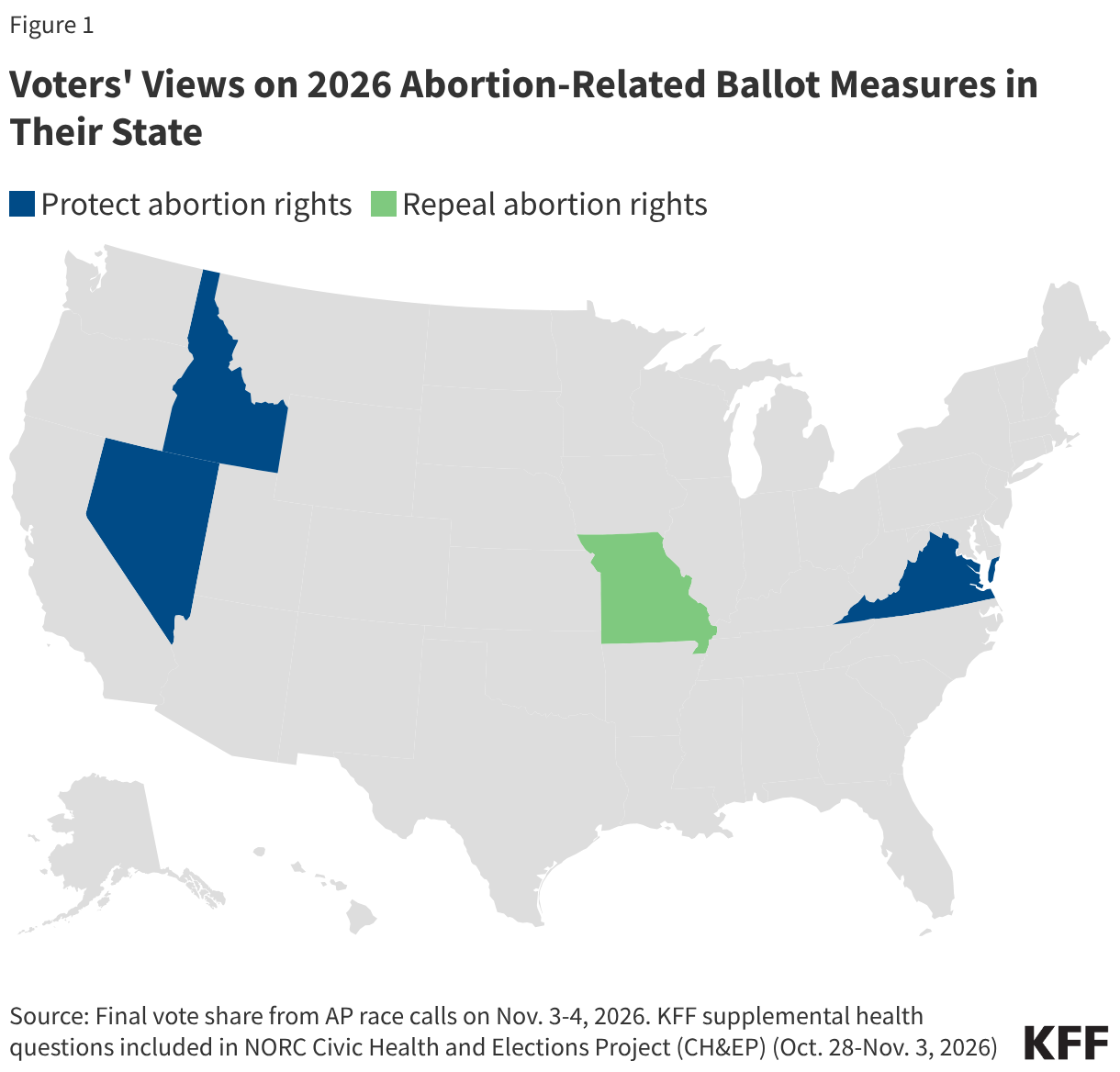
Map of the United States highlighting states with abortion-related ballot measures in their elections. Idaho, Nevada, and Virginia have ballots to protect abortion rights, while Missouri has a ballot to repeal abortion rights.

At least three in ten voters in each of these states said the abortion ballot measure in their state had a “major impact” on their decision to vote in this election. In Idaho, Missouri, and Nevada, proponents of abortion access (voting “yes” in Idaho and Nevada, and “no” in Missouri) were more likely than opponents to say the measure had a major impact on their decision to vote. In Virginia, however, those who oppose access to abortion were more likely than supporters of the measure to say it majorly impacted their decision to turn out.
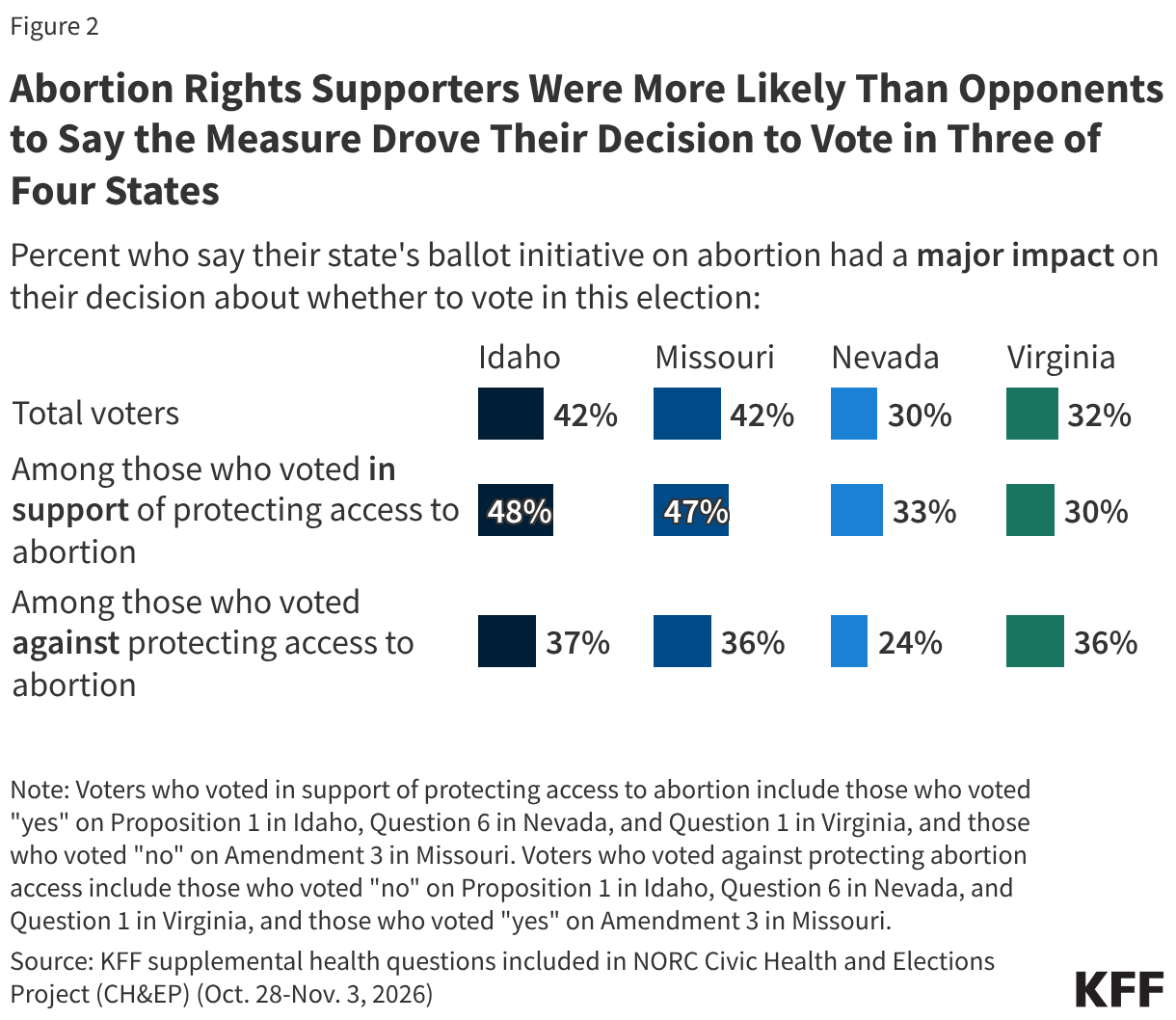
Split bar chart showing share of voters in Idaho, Missouri, Nevada, and Virginia who say their state's ballot initiative on abortion had a major impact on their decision about whether to vote in this election. Shown among total voters and among those who voted in support or against protecting access to abortion.

Missouri Amendment 3

Copy link to Missouri Amendment 3

In Missouri, voters decided whether to repeal a constitutional right to abortion they adopted just two years earlier. In 2024, Missouri voters approved Amendment 3, a citizen-initiated measure that added a right to reproductive freedom, including abortion up to fetal viability, to the state constitution. The 2026 measure – also called Amendment 3 – was placed on the ballot by the Republican-majority legislature. If it had passed, this new measure would have repealed the 2024 constitutional amendment, banning abortion except in cases of medical emergency or fetal anomaly, or in cases of rape or incest up to 12 weeks of pregnancy. The measure would also have allowed the legislature to pass new abortion regulations, including some that a court has blocked after finding they violate the 2024 constitutional amendment protecting the right to abortion.

Additionally, the amendment would have written into the state constitution a prohibition on gender-affirming care for minors, specifically for surgery and prescribing hormones or puberty blockers. Missouri currently restricts this care for minors by statute, but the hormone and drug-related restrictions of that law are set to expire in August 2027.

Missouri voters rejected Amendment 3, with 56% voting “no,” keeping in place the constitutional right to abortion voters approved in 2024. About seven in ten Republicans (71%) supported the measure, while most Democrats (85%) and independents (72%) voted “no.” Fewer than half (43%) of women of reproductive age supported the measure that would have reinstated an abortion ban in Missouri.

About four in ten Missouri voters said the measure had a major impact on their decision to vote in this election, including about half of women of reproductive age (51%) and Democratic voters (54%).

Just over half of Missouri parents (53%) voted “yes” on the amendment that would have affected health care for minors in the state, and about four in ten (43%) said the measure had a major impact on their decision to turn out. 
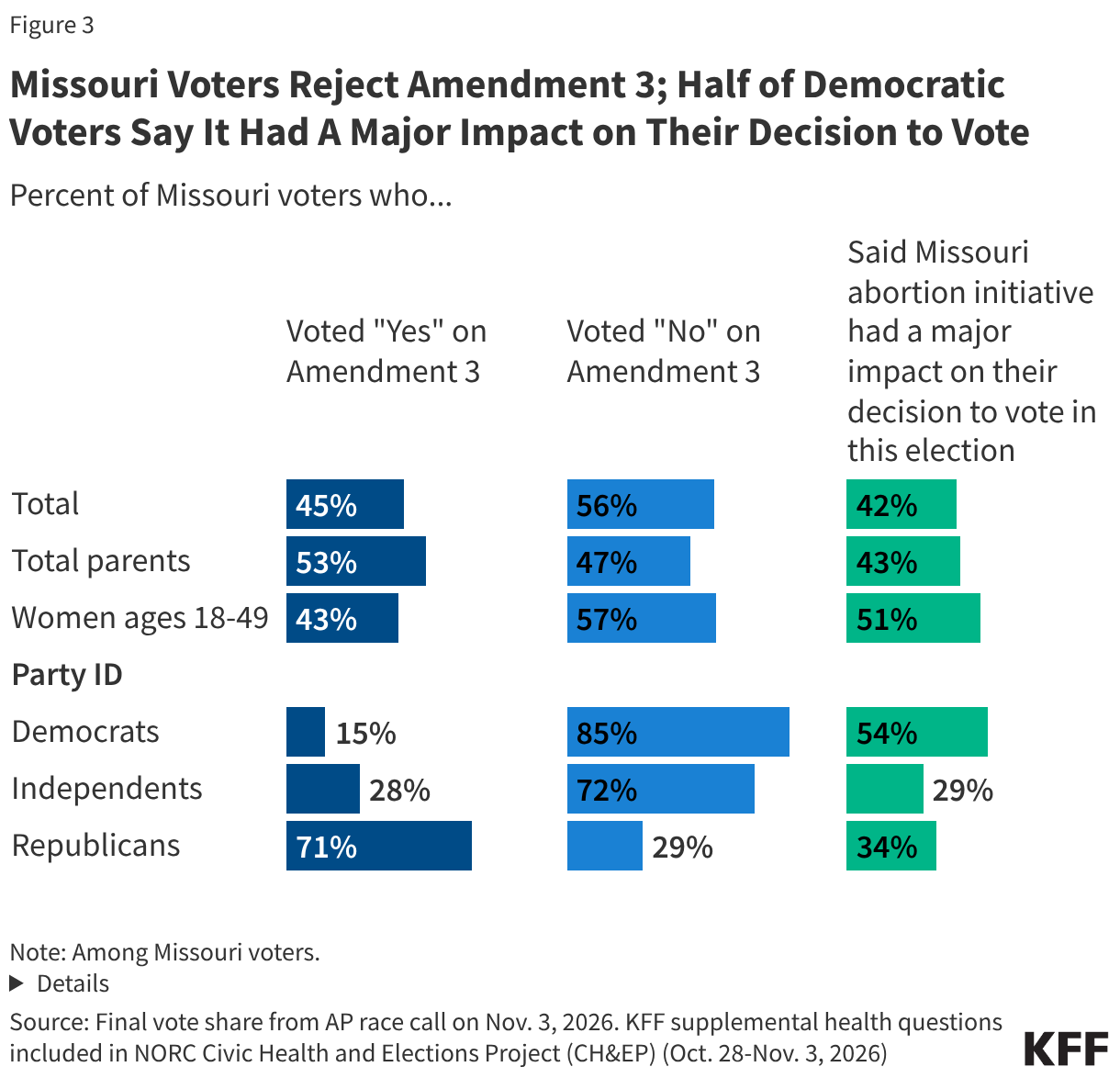
Split bar chart showing share of Missouri voters who voted "yes" or "no" on Amendment 3, as well as share of voters who said Missouri's abortion initiative had a major impact on their decision to vote in this election. Shown among total voters, parent voters, women voters ages 18-49, and by voters by party identification.

Because Amendment 3 paired the repeal of the 2024 abortion rights amendment with strengthened prohibitions on gender-affirming care for minors, described on the ballot as “gender-transition” treatment, voters had to weigh two separate issues in a single vote.

When asked which part of the amendment was more important to their vote, voters were more than five times as likely to say abortion policy (45%) was the more important issue than to say gender-affirming care for minors (8%). More than four in ten (45%) Missouri voters say both issues were equally important.

For opponents of the measure, abortion policy was a more salient issue than gender-affirming care. Six in ten (59%) voters who voted “no” on the measure said abortion policy was the more important issue to their vote. Six in ten Missouri voters who voted “yes” said both issues were equally important to their vote (60%).
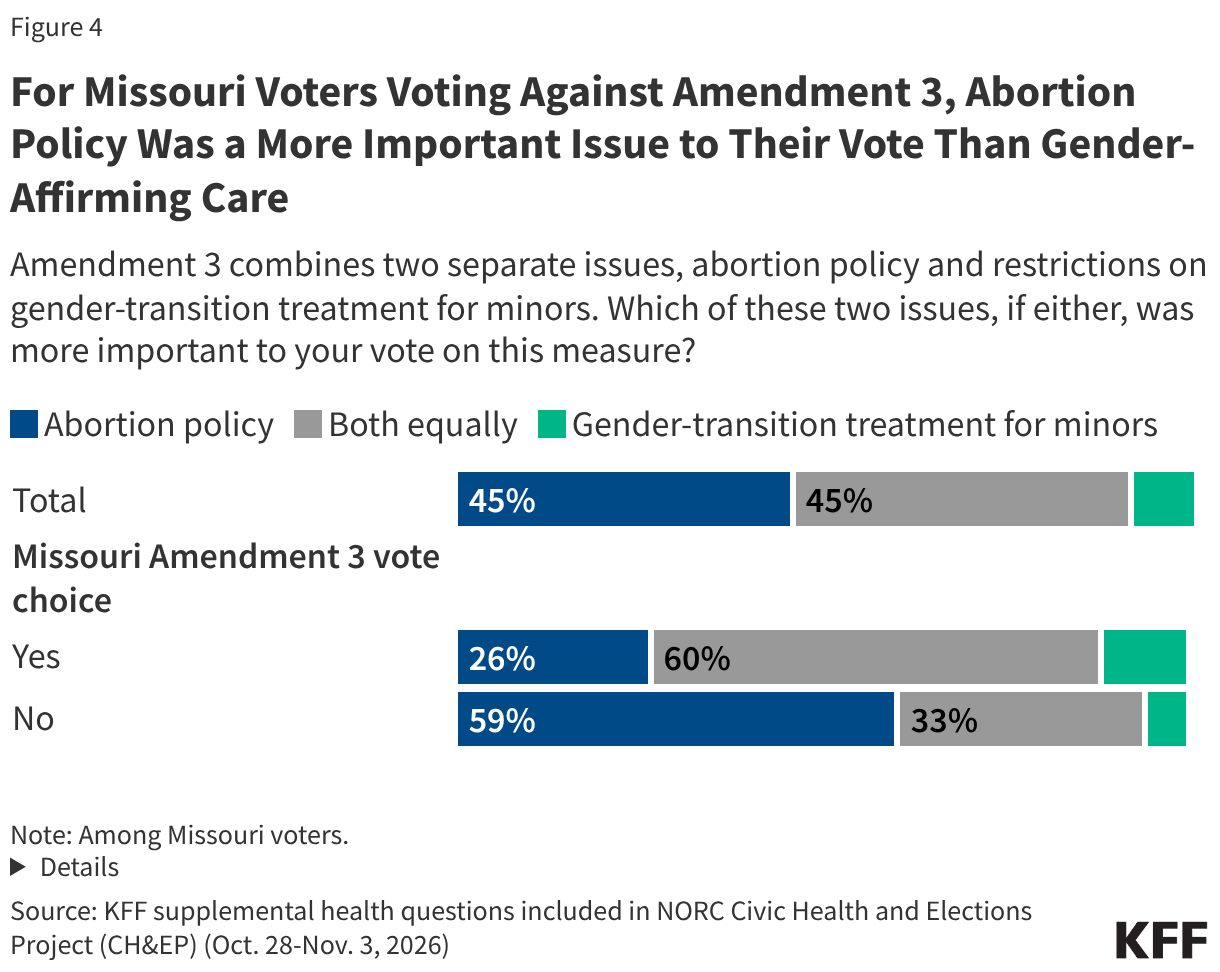
Stacked bar chart showing which of the two issues on Amendment 3 was more important to Missouri voters' vote on the measure. Shown among total voters and by vote choice on Amendment 3.

Asked about each part of Amendment 3 separately, a majority of Missouri voters (58%) oppose repealing the constitutional right to abortion passed by voters in 2024, while about six in ten (62%) support prohibiting gender-affirming care for minors, referred to by the ballot as “gender-transition” medications and procedures.

About eight in ten Missouri voters who voted “yes” on Amendment 3 support each of the provisions, while “no” voters are more divided. Few (12%) “no” voters support repealing the right to abortion, but about half (47%) support prohibiting gender-affirming care for minors.
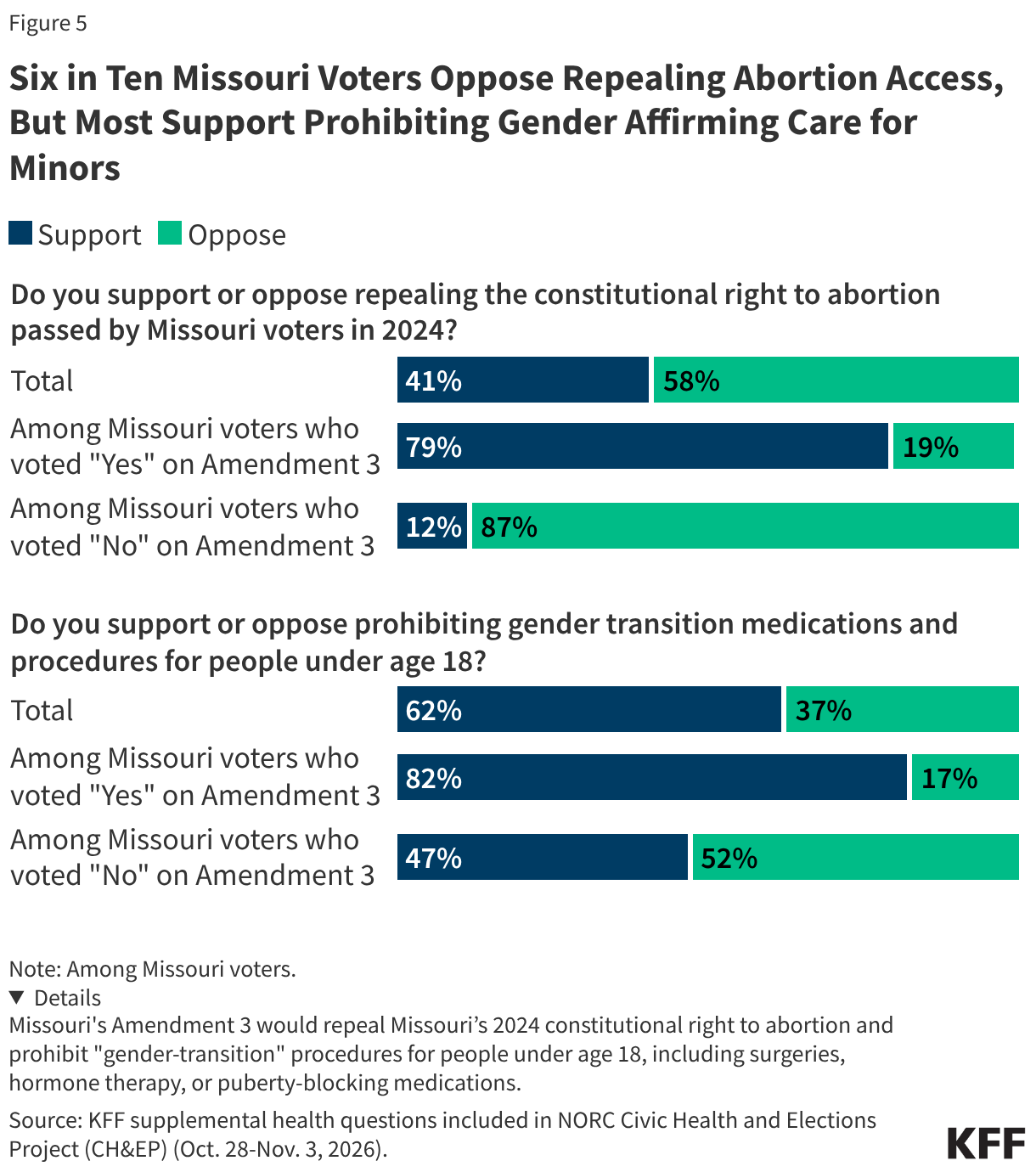
Stacked bar chart showing share of Missouri voters who support or oppose repealing the constitutional right to abortion passed by Missouri voters in 2024 and prohibiting gender transition medications and procedures for people under age 18. Results shown among total voters and by vote choice on Amendment 3.

In fact, many Missouri voters held views that did not align with both ballot measure provisions. Nearly three in ten Missouri voters (28%) oppose repealing the right to abortion but support prohibiting gender-affirming care for minors, and 7% support repealing the right to abortion, but oppose prohibiting gender-affirming care for minors. About a third (34%) of voters support both provisions of the ballot measure, and three in ten oppose both provisions.

Among voters who supported the measure, seven in ten say they support both provisions, while about one in eight only support the prohibitions on gender-affirming care, and about one in ten only support repealing the right to abortion.

Among voters who rejected the measure, roughly half (48%) oppose both provisions of the measure, while four in ten oppose repealing abortion rights but support a ban on gender affirming care for minors, indicating that their views on abortion played a stronger role in their vote choice.
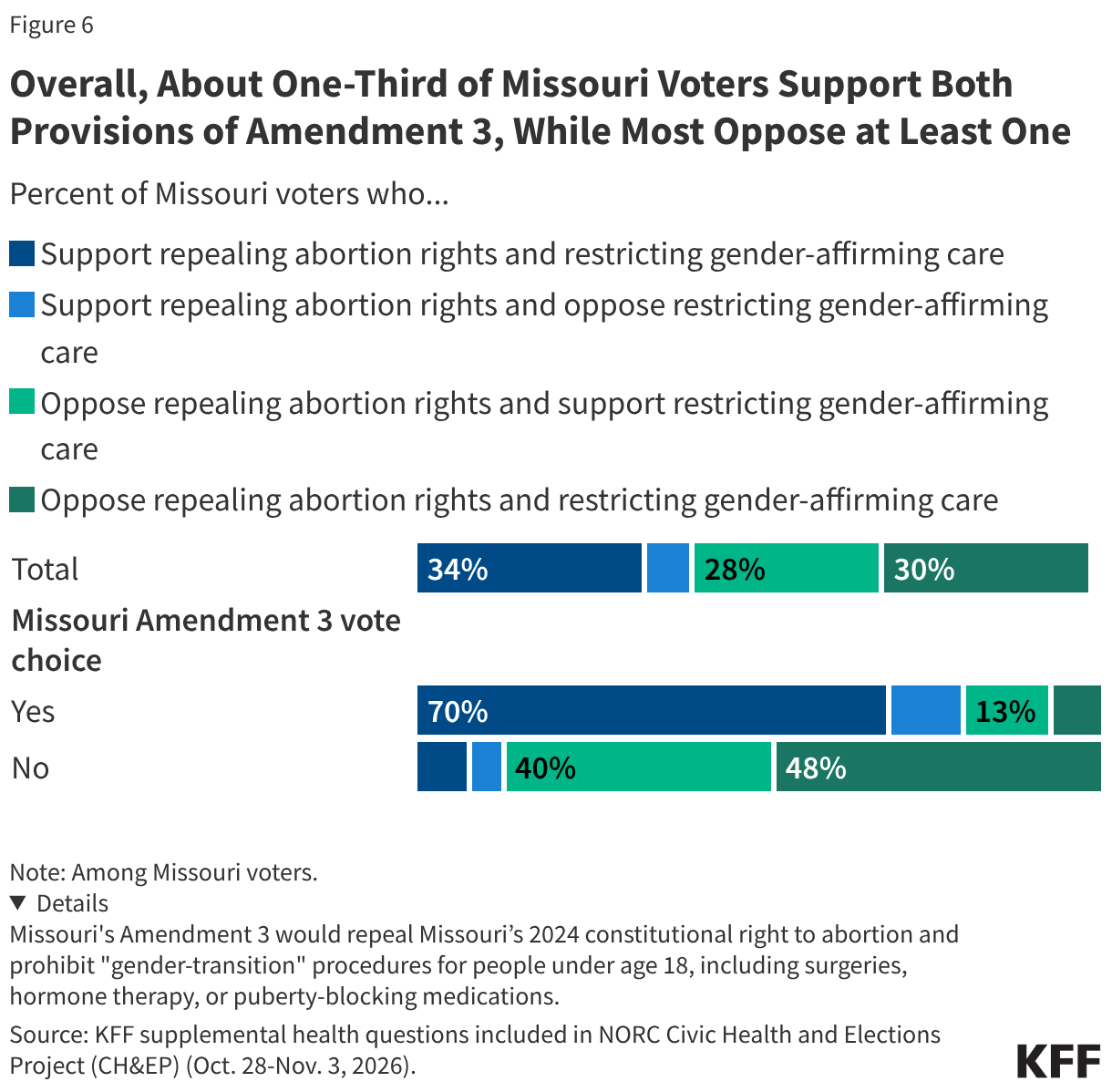
Stacked bar chart showing various views on Missouri's Amendment 3, including share of Missouri voters who support both repealing abortion rights and restricting gender affirming care, support repealing abortion rights only, support restricting gender affirming care only, or oppose both repealing abortion rights and restricting gender affirming care. Results shown among total voters and by vote choice on Amendment 3.

While most (74%) Missouri voters say it was “very” or “somewhat” easy to understand what a “yes” or “no” vote on Amendment 3 would do, about one in four say it was difficult.

About three in ten (29%) voters who voted “no” on the measure say it was difficult to understand what their vote on Amendment 3 would do, compared to about one in five (22%) who voted “yes.”
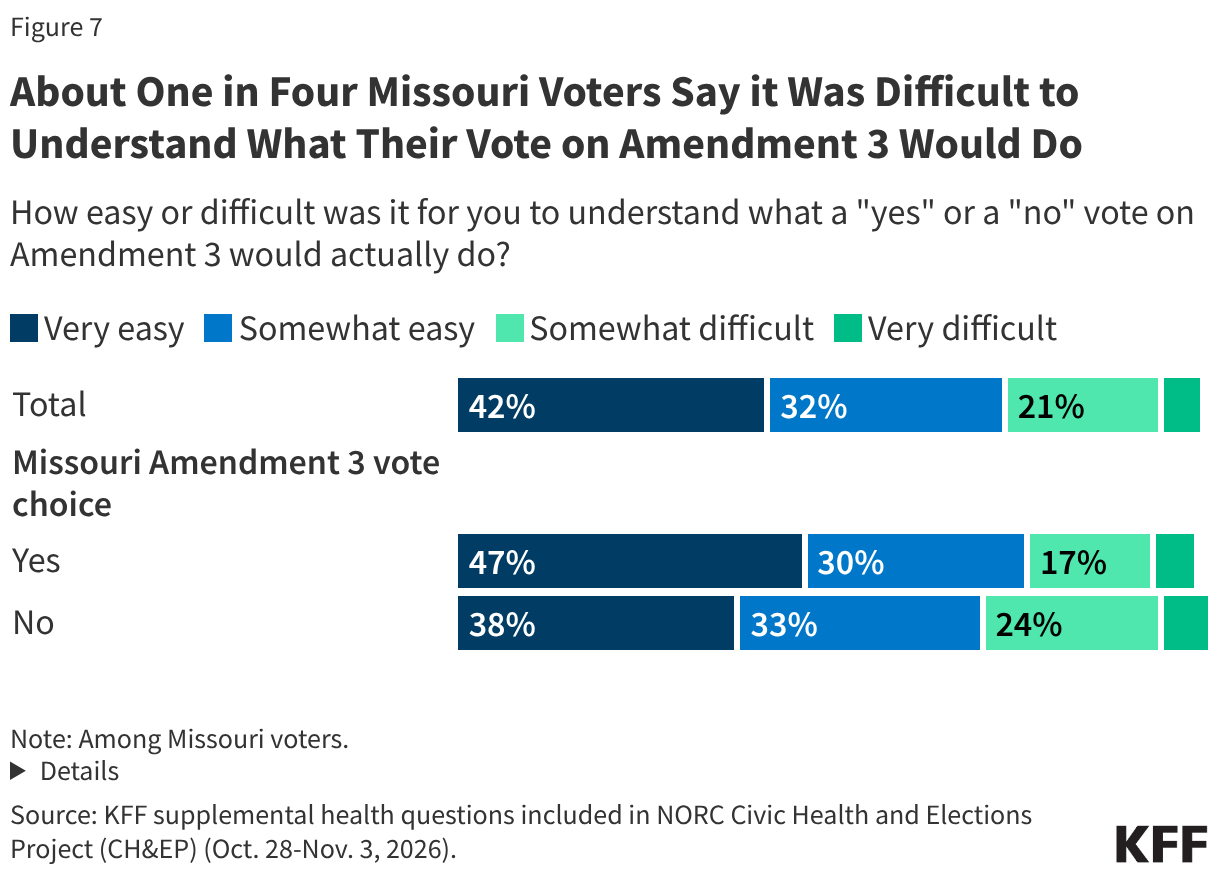
Stacked bar chart showing share of Missouri voters who said it was easy or difficult to understand what a "yes" or a "no" vote on Amendment 3 would actually do. Results shown among total voters and by vote choice on Amendment 3.

Idaho Proposition 1

Copy link to Idaho Proposition 1

Idaho, which currently has some of the most restrictive abortion laws in the U.S., voted on Proposition 1, the Reproductive Freedom and Privacy Act. This citizen-initiated statute would have established a right to reproductive freedom, including abortion before fetal viability and after viability in cases of medical emergency. The measure would also have protected reproductive freedom and privacy for contraception, fertility treatment, miscarriage care, and prenatal, pregnancy, childbirth, and postpartum care.

Voters in Idaho rejected Proposition 1, with 56% voting “no.” The measure received support from 98% of Idaho Democrats, though about eight in ten (79%) Republicans voted “no.” Women of reproductive age were more split, with about half voting to expand access to abortion in their state (47%) and about half rejecting the measure (53%).

About four in ten Idaho voters said the measure had a major impact on their decision to vote, rising to nearly six in ten women of reproductive age and about half of Democratic voters.
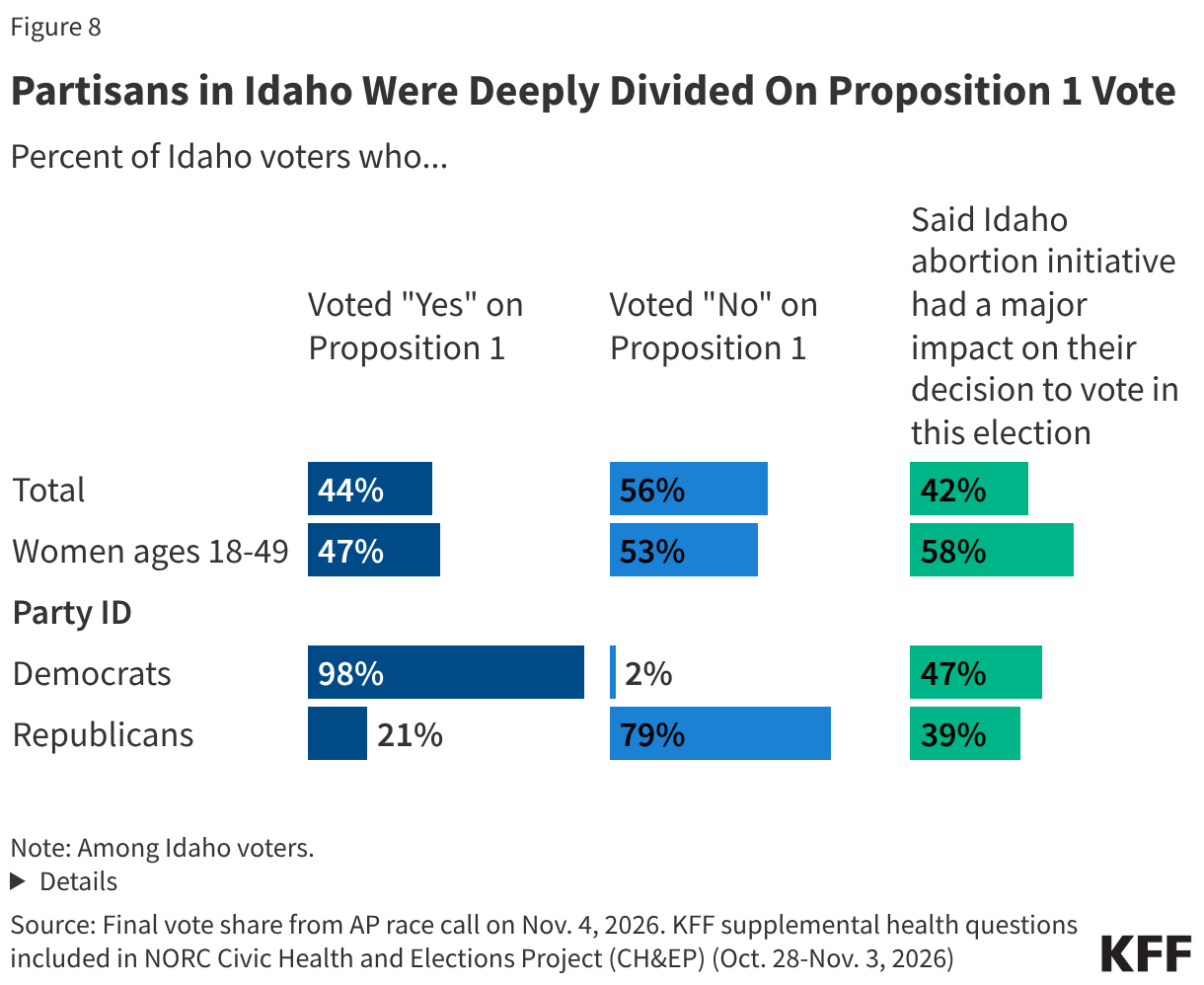
Split bar chart showing share of Idaho voters who voted "yes" or "no" on Proposition 1, as well as share of voters who said Idaho's abortion initiative had a major impact on their decision to vote in this election. Results shown among total voters, women voters ages 18-49 and by party identification of voters.

The leading candidates for governor in Idaho took opposing positions on Proposition 1. Democrat Terri Pickens said she supports the measure and would defend it if it passed. Republican Gov. Brad Little, who signed the state’s 2020 abortion ban into law, opposed the measure.

About one in five (19%) Idaho voters who voted for Gov. Little also voted “yes” on Proposition 1 to establish a right to reproductive freedom, and two in five (39%) said the initiative had a major impact on their decision to vote. Among those who voted for Pickens, the vast majority (96%) also voted “yes” on the measure, and nearly half (48%) said it had a major impact on their decision to vote.
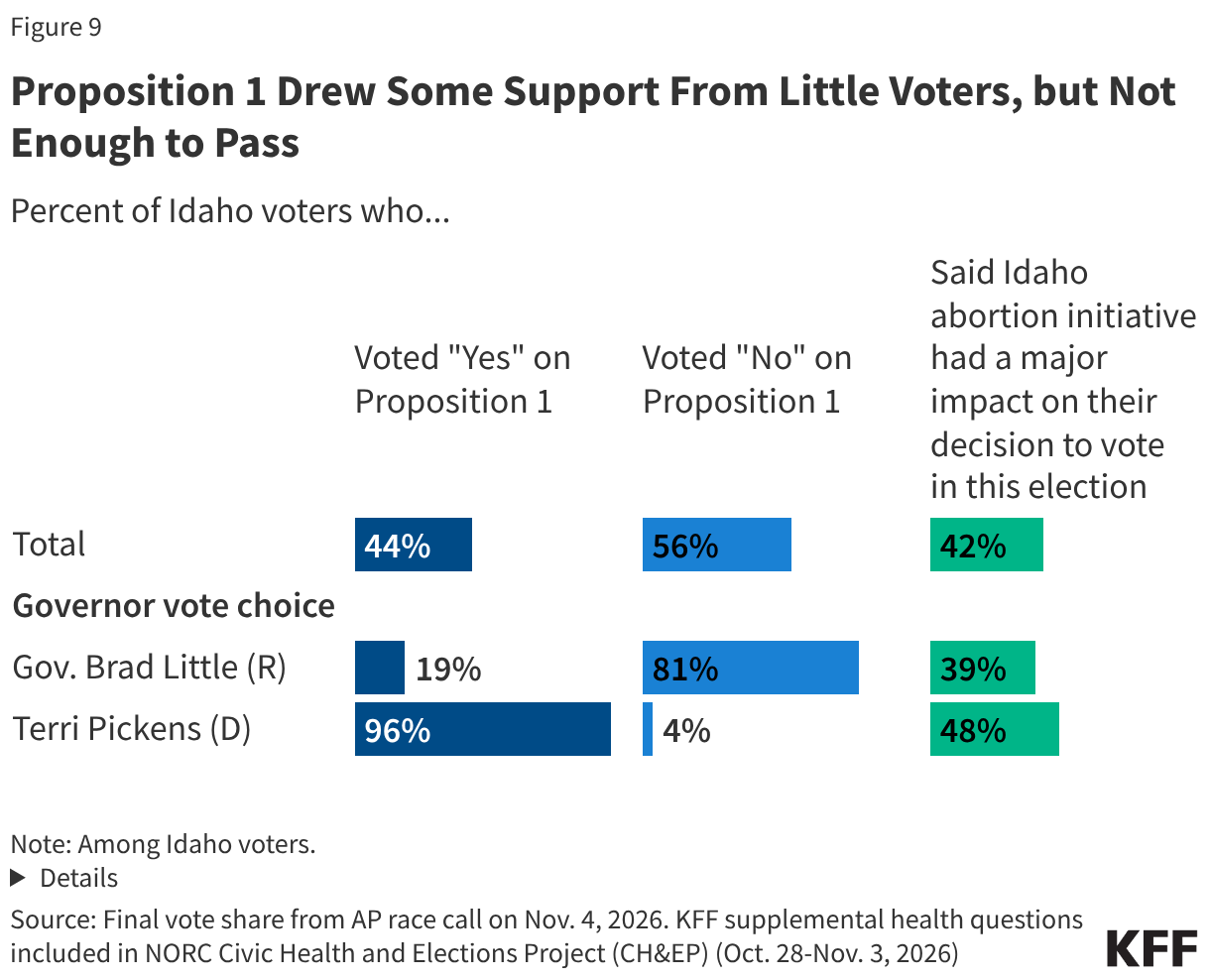
Split bar chart showing share of Idaho voters who voted "yes" or "no" on Proposition 1, as well as share of voters who said Idaho's abortion initiative had a major impact on their decision to vote in this election. Results shown among total voters and by governor vote choice of voters.

Nevada Question 6

Copy link to Nevada Question 6

Nevada voters cast a second vote on Question 6, the Right to Abortion Initiative, which added a constitutional right to abortion up to fetal viability, and after viability when the pregnant person’s life or health is at risk. Nevada requires citizen-initiated constitutional amendments to pass in two consecutive general elections. Voters first approved the measure in 2024 with 64% support.

The measure passed with broad support, with 63% of Nevada’s voters voting “yes,” including nine in ten Democrats and nearly half of Republicans. Additionally, eight in ten (83%) women of reproductive age supported the initiative.  
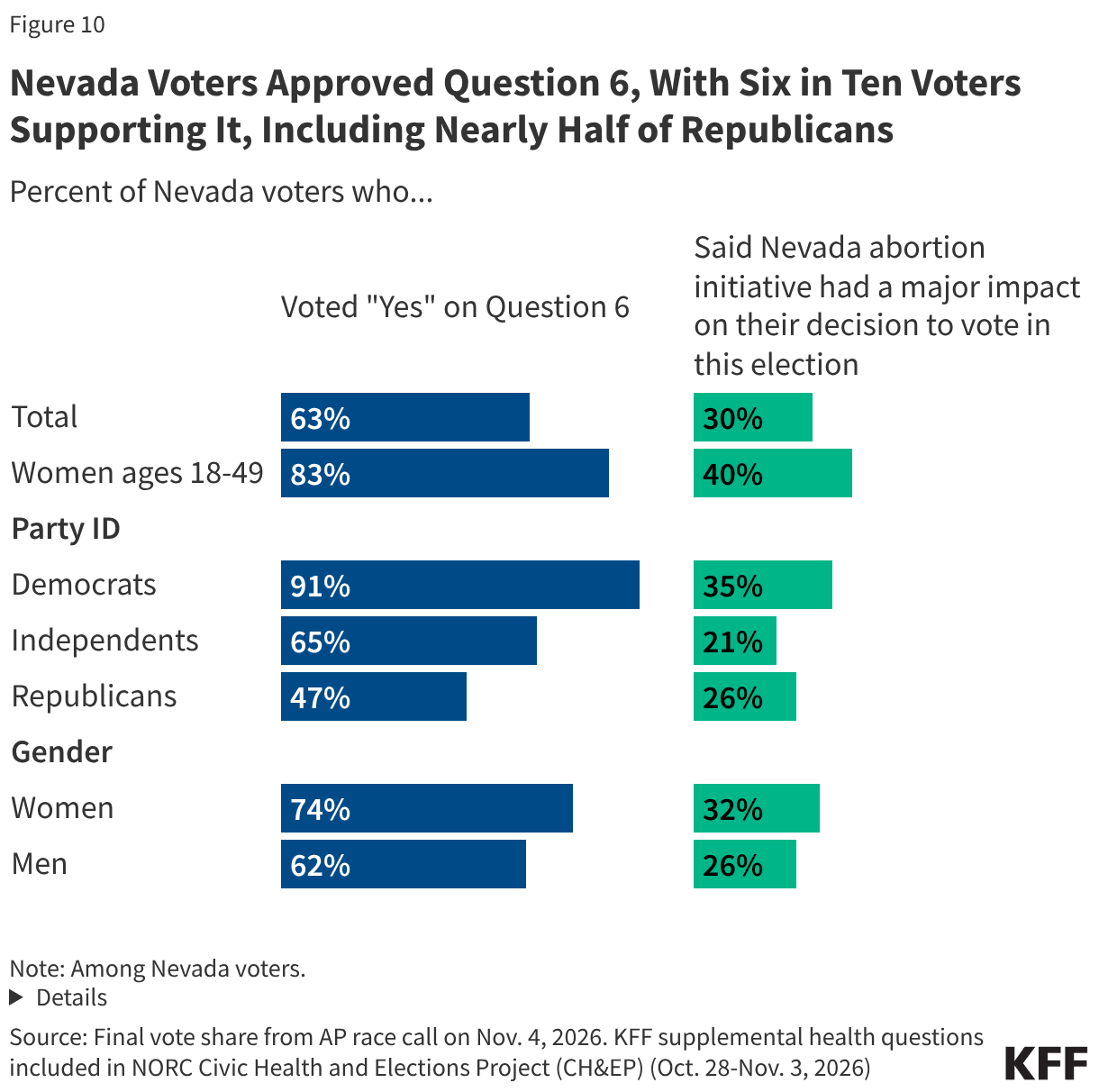
Split bar chart showing share of Nevada voters who voted "yes" or "no" on Question 6, as well as share of voters who said Nevada's abortion initiative had a major impact on their decision to vote in this election. Results shown among total voters, women voters ages 18-49, voters by party identification, and gender of voters.

Along with Question 6, Nevada voters cast ballots in a competitive governor’s race. Democratic Attorney General Aaron Ford supports Question 6, while Republican Gov. Joe Lombardo has said abortion rights should be left to voters and in 2023 signed a law protecting out-of-state patients who travel to Nevada for abortion care.

Just under half (44%) of Nevada voters who voted for Gov. Lombardo also voted “yes” on Question 6, and a quarter (26%) said the initiative had a major impact on their decision to vote. Nine in ten (91%) Nevada voters who voted for Ford also voted “yes” on the measure, and around a third (34%) said it had a major impact on their decision to vote.
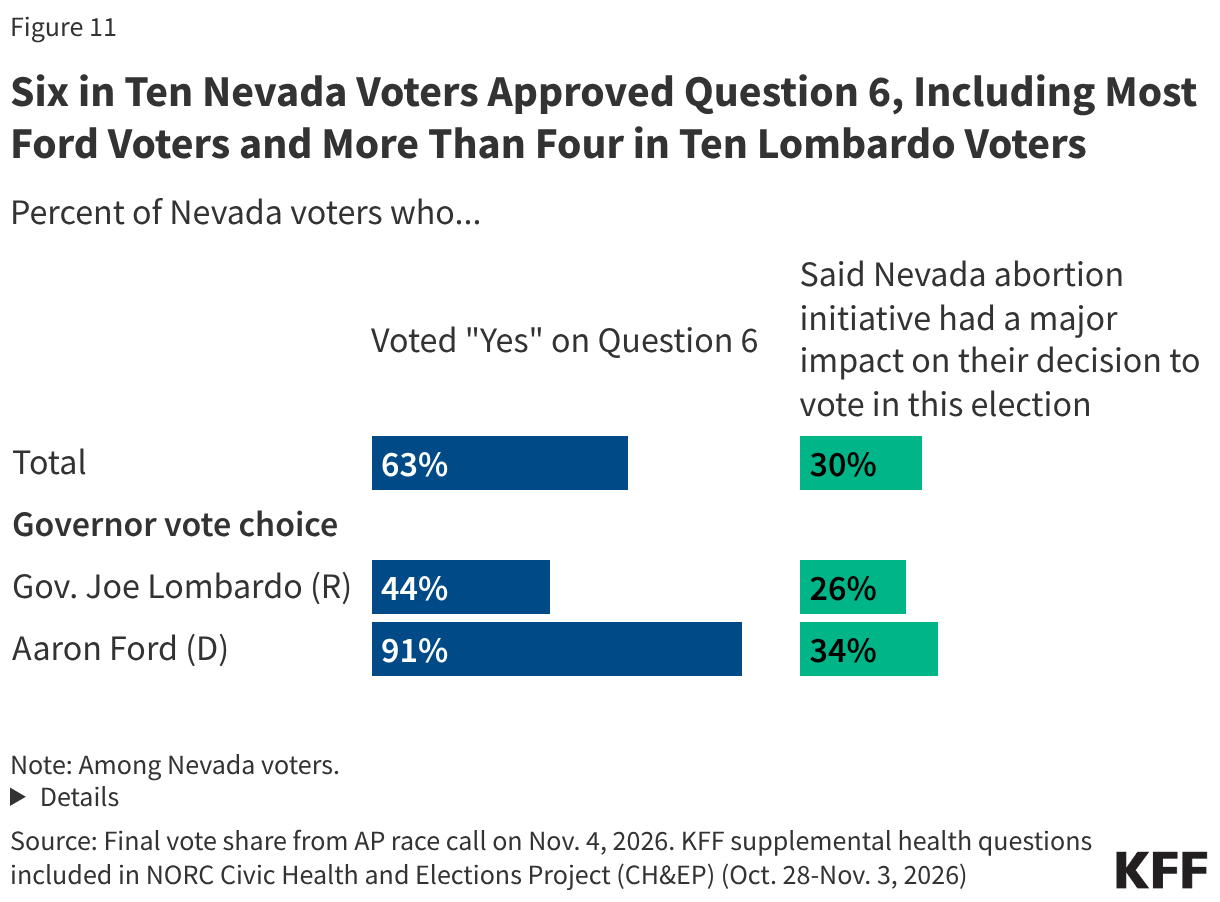
Split bar chart showing share of Nevada voters who voted "yes" or "no" on Question 6, as well as share of voters who said Nevada's abortion initiative had a major impact on their decision to vote in this election. Results shown among total voters and by governor vote choice of voters.

Virginia Question 1

Copy link to Virginia Question 1

Virginia voters voted on Question 1, a constitutional amendment placed on the ballot by the General Assembly after passing it in two consecutive sessions. The amendment enshrines the right to reproductive freedom, including decisions about prenatal care, childbirth, postpartum care, contraception, abortion, miscarriage management, and fertility care. It allows the state to regulate abortion in the third trimester, except when necessary to protect the life or health of the pregnant person or when the fetus is not viable. Virginia currently allows abortion through the second trimester.

The measure passed, with 62% of Virginia’s voters supporting it, including more than nine in ten (94%) Democrats and about a third (35%) of Republicans. Three-quarters (76%) of women of reproductive age voted in favor of protecting abortion access.
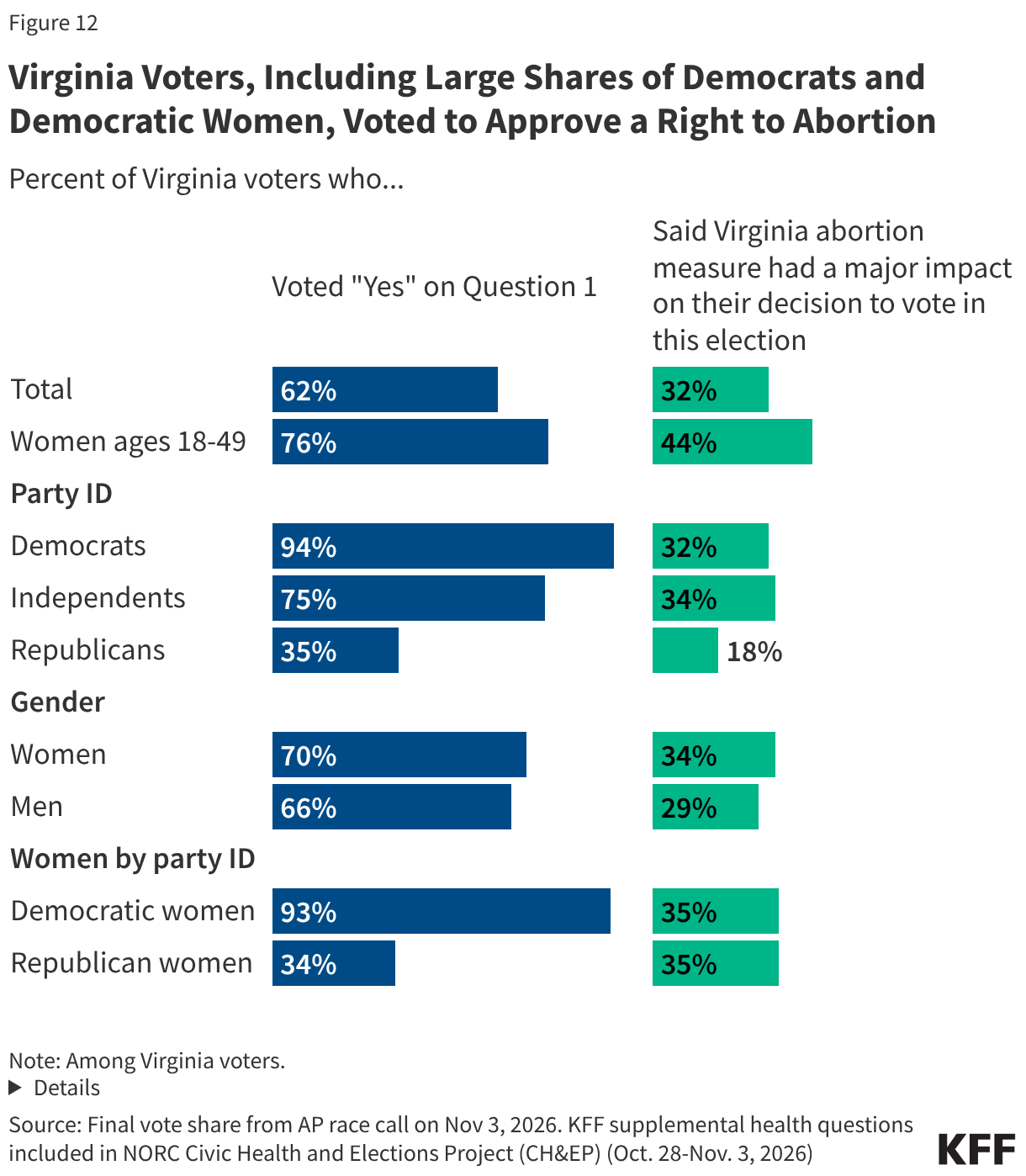
Split bar chart showing share of Virginia voters who voted "yes" or "no" on Question 1, as well as share of voters who said Virginia's abortion measure had a major impact on their decision to vote in this election. Results shown among total voters, women voters ages 18-49, voters by party identification, gender of voters, and women voters by party identification.

Along with Question 1, Virginia voters cast ballots in a U.S. Senate race, where Democratic Sen. Mark Warner sought a fourth term against Republican Bert Mizusawa.

About three in ten (31%) voters in Virginia who voted for Mizusawa also voted “yes” on Question 1, and a third (35%) said the measure had a major impact on their decision to vote. Nine in ten (92%) of those who voted for Sen. Warner also voted “yes” on the measure, and three in ten (31%) said it had a major impact on their decision to vote.
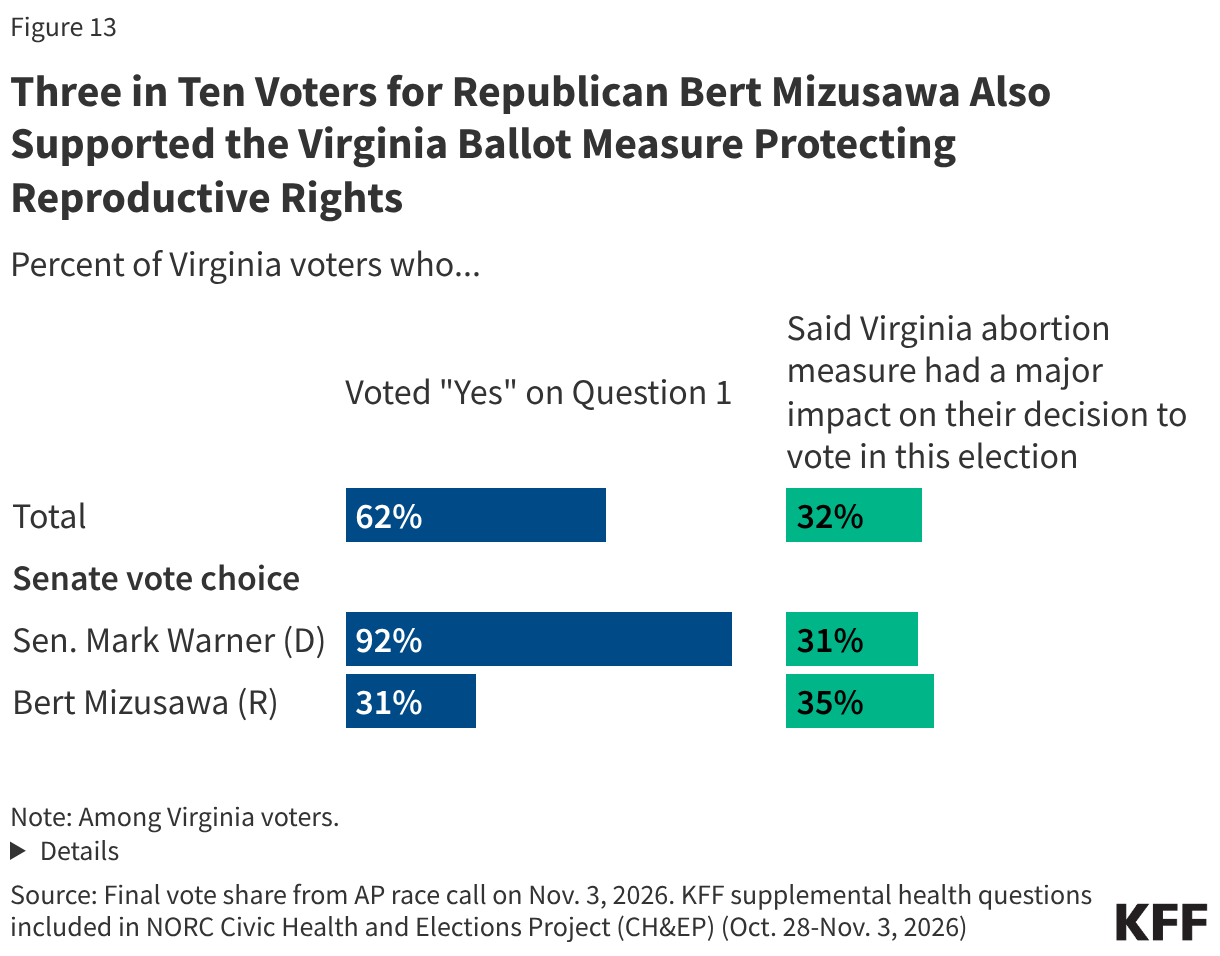
Split bar chart showing share of Virginia voters who voted "yes" or "no" on Question 1, as well as share of voters who said Virginia's abortion measure had a major impact on their decision to vote in this election. Results shown among total voters and by Senate vote choice of voters.

Methodology and additional resources

Copy link to Methodology and additional resources

The Civic Health and Elections Project (CH&EP) is a survey of about 95,000 registered voters conducted nationally and in all 50 states by NORC at the University of Chicago, beginning on Oct. 28 and concluding as polls closed on Nov. 3, 2026. CH&EP conducts interviews with a random sample of registered voters drawn from state voter files and combines them with interviews from self-identified registered voters selected using nonprobability approaches. It also includes interviews with self-identified registered voters conducted using NORC’s probability-based AmeriSpeak panel, which is designed to be representative of the U.S. population. Interviews are conducted in English and Spanish. The study is funded by a group of sponsors including KFF; NORC made all final decisions on questionnaire content.


Note: Party labels include partisan-leaning independents.


Find more details about CH&EP’s methodology, including weighting, sample sizes, and question wording, at https://civichealth.norc.org/.

For media inquiries contact KFFMedia@kff.org
Abortion on the 2026 Ballot: The Evolving Landscape of State Abortion Initiatives 

Published: Nov 4, 2026

This brief was originally published on March 17, 2026, and has been updated to reflect the status of four (Idaho, Nevada, Missouri, and Virginia) abortion-related initiatives that were on the 2026 ballot. 

During the 2026 Election, voters in Nevada and Virginia enshrined the right to abortion in their state constitutions. In Missouri, voters rejected a constitutional amendment that would have repealed the “Right to Reproductive Freedom Initiative,” passed by voters in 2024. The 2026 measure would have banned the provision of abortion, permitting only limited exceptions, and would have prohibited minors from accessing gender-affirming care. The voters in Idaho rejected the measure that would have reversed their ban on the provision of abortion by enacting a new law establishing the right to abortion until fetal viability.  

For more information on abortion-related state ballot initiatives, see our tracker on the Status of Abortion-related State Ballot Initiatives Since Dobbs. 

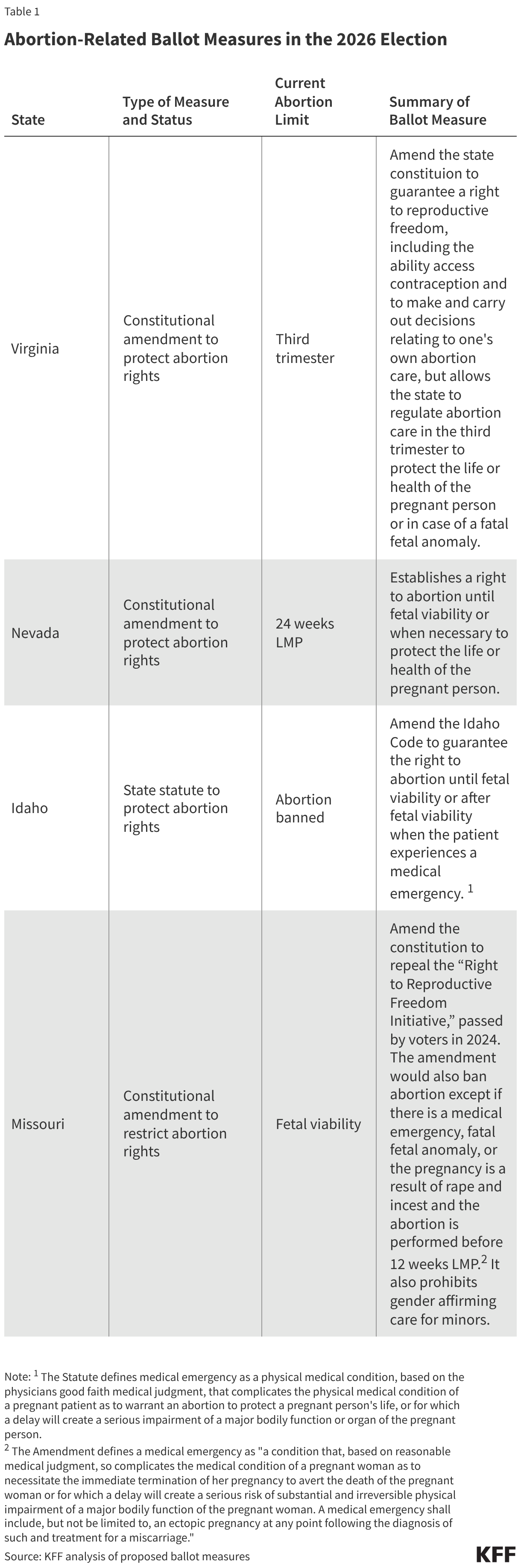
Since the Supreme Court’s 2022 Dobbs ruling, state ballot initiatives have become a powerful tool used by advocates on both sides hoping to either protect or limit abortion access in their state. Successful ballot initiatives that enact state constitutional amendments provide stronger legal authority to either protect or restrict abortion than laws enacted by the legislature or state Supreme Court rulings. Since 2022, twelve states have passed ballot initiatives, usually, but not exclusively, to protect abortion rights in their state. Once again, this November, four states (Table 1) will have abortion-related measures for their voters to consider. Abortion rights advocates in Nevada and Virginia have placed a constitutional amendment protecting the right to abortion on the November ballot. The Missouri legislature has placed an initiative on the ballot to repeal a state constitutional amendment protecting the right to abortion approved by voters in 2024. In addition, voters in Idaho will decide on a state statute that would guarantee a right to abortion until fetal viability or after fetal viability when the patient experiences a medical emergency. This issue brief reviews the abortion-related initiatives on the ballot in November 2026 and examines how these measures may impact abortion access in the state. 

Abortion-Related Ballot Measures in the 2026 Election (Table)

Ballot Initiatives Seeking to Protect Abortion Rights

Virginia

Virginia is currently the only state in the South that does not ban the provision of abortion or impose an early gestational limit, currently allowing abortion until the third trimester. Unless the litigation, described below, challenging the placement of the ballot measure succeeds, voters in Virginia will decide whether to enshrine these abortion protections into the state constitution in November. On February 6, 2026, Governor Spanberger signed a bill, placing the Right to Reproductive Freedom Amendment on the ballot, after the legislature passed it in two successive sessions, as is required by state law. However, on March 3, 2026, Charla Bansley, the District 3 Supervisor for the Bedford County Board of Supervisors, filed a lawsuit seeking to block the placement of the measure on the November ballot. Ms. Bansley alleges state election officials failed to distribute the constitutional amendment to circuit clerks in all counties, as required by state law, before certifying the abortion measure for the ballot.

On July 24, 2026, a district court judge issued an order dismissing Bansley’s lawsuit with prejudice because she failed to establish that she had standing to bring the lawsuit, and the operative law that Bansley attempted to rely on to challenge the ballot language had been repealed. On September 12, 2026, the Virginia Court of Appeals heard an appeal to Bansley’s lawsuit, challenging the ballot initiative placement on the November 2026 ballot. The Virginia Court of Appeals denied Bansley’s petition to bypass appellate review and go directly to the Virginia Supreme Court. Bansley’s opening brief is due October 19, 2026.

A separate lawsuit challenging the Right to Reproductive Freedom Amendment was filed on April 30, 2026, by two medical advocacy groups and by Meagan Kade, a member of the Bluefield town council. The Plaintiffs argue that the language of the ballot initiative does not accurately convey the legal impact of the new constitutional amendment to voters. Additionally, they make the same argument as Bansley that the amendment was not properly circulated. A hearing was held in June 2026. The case is still unresolved, and early voting for Virginia began on September 18, 2026.

The Right to Reproductive Freedom Amendment would amend the state constitution to guarantee a fundamental right to abortion until the third trimester, as well as contraception and fertility care. The Amendment would allow the Commonwealth of Virginia to regulate abortion in the third trimester; however, abortion cannot be prohibited if the pregnant person’s life or physical or mental health is at risk, or if the fetus is not viable. If passed, the Amendment will provide durable protection for abortion rights in the state’s constitution by ensuring that changes in the composition of the legislature or the courts in the Commonwealth do not impede access to abortion care.

Nevada

Nevada law requires citizen-initiated ballot initiatives amending the state’s constitution to pass in two successive general elections. Therefore, Nevadans will vote for the second time on the Reproductive Rights Amendment initially approved by voters in 2024. If passed, the Reproductive Rights Amendment will, “guarantee a right to all individuals to abortion performed or administered by a qualified health care practitioner until fetal viability or when needed to protect the life or health of the pregnant patient, without interference from the state or its political subdivisions.” 

Abortion is currently legal in Nevada until 24 weeks gestation. In 1990, voters passed as a “statute affirmation” which upheld the existing law, NRS 442.250, which legalized abortion until 24 weeks, and prohibited the state legislature from amending or repealing the law unless it was placed on the ballot. In 2019, Nevada enacted the Trust Nevada Women Act, which decriminalized medication abortion and removed informed consent laws. The Reproductive Rights Amendment would protect the individuals’ right to abortion beyond the existing law by limiting state interference. While passage of the Reproductive Rights Amendment would provide the strongest protection against efforts to limit reproductive rights by the legislature or courts, any effort to change the gestational limit for abortion in Nevada would have to be approved by a direct vote of state residents, not by the legislature. 

If the Reproductive Rights Amendment passes, abortion rights advocates are likely to bring a new challenge to Nevada’s parental notification for minors law, contending it is not permissible under the new constitutional amendment. If successful, this challenge would allow minors to consent for their own abortions. Last year, a lower court lifted a 1985 injunction blocking the notification law and reinstated the parental notification requirement. Planned Parenthood Mar Monte, the affiliate that operates the Nevada Planned Parenthood clinics, challenged the lower court's order, and the Nevada Supreme Court preliminarily enjoined the law.

Idaho

Idaho has among the most restrictive abortion laws in the nation. Abortion rights advocates are seeking to reverse these restrictions by trying to get a new law approved, the Reproductive Freedom and Privacy Act, which will change the legality of abortion in the state. Idaho is currently enforcing a total ban on the provision of abortion, with exceptions only to prevent the death of the pregnant person or in the first trimester for reported cases of rape or incest. The Reproductive Freedom and Privacy Act would create a state law giving people the right to make decisions about their own reproductive health care, including abortion up to fetal viability, and after fetal viability if the patient is experiencing a medical emergency, miscarriage care, prenatal, pregnancy, and postpartum care, contraception, and fertility treatment. However, the initiative faced considerable barriers to getting on the ballot. In Idaho, a citizen-initiated ballot initiative can only be placed on the ballot if the petitioner gathers signatures from 6% of the registered voters in the last election in 18 of the state’s 35 legislative districts and submits these signatures by May 1 of the election year. The signatures must then be verified by the county clerks and submitted to the secretary of state for certification. Idahoans United for Women and Families, a nonprofit group that advocates for comprehensive reproductive health care in the state, is organizing the 2026 ballot initiative. On July 13, 2026, the Idaho Secretary of State announced that Idahoans United for Women and Families had collected enough valid signatures for the initiative to qualify for the November 2026 ballot.

In addition to facing barriers to collecting signatures, Idahoans United has also filed multiple lawsuits against the attorney general’s office regarding the ballot language. In January 2025, the group sued the attorney general’s office, arguing that the financial impact statement and the short title of the ballot initiative contained biased language. On June 16, 2025, the Idaho Supreme Court agreed and ordered the attorney general to draft a new financial statement and short title. 

On August 27, 2026, Idahoans United for Women and Families filed another lawsuit against the Secretary of State and the Attorney General of Idaho, alleging that the drafted ballot language did not contain a clear and concise statement on the effect of a “YES” or “NO” vote. The original “NO” statement, as written by the Secretary of State and Attorney General, provided: "A NO vote would make no change to Idaho’s current law, which protects the life of the unborn while allowing abortion in reported cases of rape or incest, or when necessary to protect the life of the mother. Idahoans United alleged that the “NO” statement, as written, mischaracterized Idaho’s current abortion law, leading voters to believe that Idaho law “allow[s] abortion . . . when necessary to protect the life of the mother,” when the current law only allows abortions to prevent the death of a pregnant person, and used inaccurate and argumentative language such as “protects the life of the unborn.”

Additionally, Idahoans United argued that the “YES” statement similarly violated Idaho law because it was not a clear and concise statement that describes the legal effect of a “YES” vote. The original “YES” statement provided: “A YES vote would establish reproductive rights, including a right to abortion before a fetus's ability to survive and after a fetus's ability to survive in cases of a medical emergency, and provide liability protections for healthcare providers.” Idahoans United argued that the “YES” statement description of fetal viability could confuse voters because if the statement continued on the ballot as written, it would describe the same point in pregnancy (viability) four different ways: in the initiative text, in the short title, in the long title, and in the “YES” statement.

On September 4, 2026, the Idaho Supreme Court ordered the Secretary of State and the Attorney General to rewrite the ballot language after finding the original version failed to comply with state law by not clearly and concisely stating the effects of “YES” and “NO” votes.

Box 1: Updated Idaho Proposition One Ballot Initiative Language

On September 6, 2026, the Idaho Supreme Court approved new ballot initiative language for Proposition One, which provides that:

  • A “YES vote would support creating a right to abortion before fetal viability—defined as a fetus’ ability to survive without extraordinary medical measures—and after fetal viability in cases of medical emergency; providing protections against professional discipline and civil and criminal liability for healthcare providers; and codifying a statutory reproductive right to freedom and privacy.”
  • A “NO vote would support making no change to Idaho’s current law, which preserves the life of preborn children by prohibiting abortion, except when necessary to prevent the death of the pregnant woman, and during the first trimester in documented cases of rape or incest reported to law enforcement.”

If passed, the Reproductive Freedom and Privacy Act could expand access to abortion in Idaho. However, the Act would still face challenges after the election because Idaho allows its legislature to amend or repeal a citizen-initiated statute without restrictions. There are numerous examples where the legislature has reversed or amended the will of the electorate. In 2002, the Idaho legislature repealed citizen-initiated statutes that sought to place term-limits on elected officials. In 2019, the Idaho legislature amended a citizen-initiated statute that expanded Medicaid eligibility.

Ballot Initiatives Seeking to Curtail Abortion Rights 

Missouri 

In 2026, voters in Missouri will again be asked to decide the legal status of abortion in their state, but this time to reverse a recently approved constitutional amendment. In 2024, Missouri voters approved Amendment 3, the Right to Reproductive Freedom Amendment, which amended the state’s constitution to guarantee a right to abortion until fetal viability. Before Amendment 3 was passed, Missouri banned the provision of abortion with exceptions only to avert the death of the pregnant person or to avert a serious risk of substantial and irreversible physical impairment of a major bodily function of the pregnant person. After Amendment 3 passed, Planned Parenthood, one of the abortion providers in the state, filed a lawsuit challenging not only the state’s total abortion restriction, but also a series of regulations on facilities and clinicians providing abortions. These restrictions included a 72-hour waiting period between an initial appointment and when an abortion could be performed, and abortion specific informed consent requirements. In June 2026, the court permanently struck down some regulations on facilities and clinicians providing abortions; however, some regulations remain. The litigation is ongoing and is currently at the Missouri Supreme Court. The state's total abortion restriction had already been struck down.

State legislators who oppose abortion rights have drafted a new ballot initiative that seeks to repeal Amendment 3. The 2026 ballot initiative, also known as Amendment 3, would ban the provision of abortion except in cases of medical emergencies, fatal fetal anomalies, or pregnancies 12 weeks or less gestation that are a result of rape or incest. The initiative includes a parental or guardian consent requirement for minors except in medical emergencies and prohibits state funding of abortions in most circumstances. The ballot initiative explicitly allows the legislature to regulate abortion provision, facilities, and providers including, “requiring physicians providing abortion care to have admitting privileges at a nearby hospital; laws requiring facilities where abortions are performed or induced to be licensed and inspected for clean and safe conditions and adequate instruments to treat any emergencies arising from an abortion procedure; laws requiring physicians to perform a sufficient examination of the woman to determine the unborn child's gestational age and any preexisting medical conditions that may influence the procedure; and laws requiring ultrasounds to be performed only by physicians or licensed medical technicians.” In addition, the initiative includes a ban on gender affirming care for minors. 

The 2026 ballot initiative has faced legal scrutiny. On July 2, 2025, the ACLU of Missouri filed a lawsuit against the secretary of state, alleging that the language for the 2026 ballot initiative was intentionally misleading, contained an inaccurate summary, and is unconstitutional because it included more than one subject. The ACLU argued that the language of the ballot initiative failed to properly inform voters that a “yes” vote would lead to a repeal of reproductive rights protections that passed in 2024. The ACLU also contended that the subject of the ballot initiative is related to “reproductive health care,” but includes topics unrelated to reproductive health, including a ban on gender-affirming care for minors. On July 4, 2025, the Missouri Western District Court of Appeals ruled that the language of the 2026 ballot initiative failed to inform voters that the initiative would repeal and replace the 2024 Right to Reproductive Freedom Amendment, and certified new ballot language for the 2026 ballot initiative. The language certified by the court will appear on the November 3, 2026, ballot. This is the first time voters could decide to repeal a state constitutional amendment protecting abortion. Passage of the 2026 ballot initiative would ban the provision of abortion in Missouri and prevent minors from accessing gender affirming care. 

Some Abortion Restrictions Remain in Place After Voters Pass Constitutional Amendments

Voters in Arizona, Ohio, and Missouri passed state constitutional amendments establishing the right to abortion in recent elections. After abortion advocates challenged existing state restrictions on the provision of abortion under the new constitutional amendments, courts have blocked the pre-existing state abortion restrictions. However, legal challenges to existing abortion restrictions such as waiting periods and telemedicine restrictions, have taken longer as courts have not uniformly blocked these provisions. 

On November 5, 2024, Arizona voters passed Proposition 139, a ballot initiative that amended the state constitution to guarantee a right to abortion until fetal viability. The amendment also allows abortions after fetal viability if the physician providing the abortion determines that the abortion is necessary to protect the life or physical or mental health of the pregnant person. After this constitutional amendment became effective in December 2024, advocates filed legal challenges to block Arizona’s 15-week ban on the provision of abortion and other abortion restrictions. In March 2025, a court ruled Arizona’s 15-week ban was unconstitutional under the new amendment. In February 2026, an Arizona state court ruling blocked several abortion restrictions, including: (1) a ban on abortion based on fetal diagnoses; (2) a 24-hour waiting period and (3) a prohibition on telemedicine for abortion care due to new protections granted in the state’s constitutional amendment. However, Republican state legislators who have intervened in the lawsuit may appeal this decision. The Democratic Arizona Attorney General declined to defend the laws on behalf of the state, and therefore it is unlikely the state will appeal. 

There are, however, still abortion restrictions in effect in Arizona, including a ban on state funds for abortion (which affects Medicaid), a parental consent requirement for minors seeking abortions, and a law that bars medical professionals other than doctors from providing abortions. In February 2026, the ACLU of Arizona filed a lawsuit on behalf of advanced practice clinicians, contending the physician-only law violates the constitutional amendment protecting abortion. 

On November 7, 2023, Ohio voters passed Issue 1, a ballot initiative that amended the state constitution to guarantee every individual has the right to make their own reproductive decisions, including contraception, fertility treatment, continuing a pregnancy, miscarriage care, and abortion care. The amendment also allows the state to prohibit abortion after fetal viability; however, an abortion cannot be prohibited after viability if it is necessary to protect the life or health of the pregnant person. After the passage of Issue 1, advocates cited the new amendment in legal challenges to the state’s 6-week ban on the provision of abortion as well as the many other abortion restrictions. In October 2024, the Hamilton County Court of Common Pleas issued a permanent injunction blocking Ohio’s 6-week abortion ban from taking effect, marking the first permanent injunction based on Ohio’s Reproductive Freedom Amendment. Courts have blocked many of the other abortion restrictions as well. One provision that was challenged, but is still in effect, is a requirement for providers to document the reason for an abortion, but this provision does not impact patients’ access to abortion care. Ohio law still requires parental consent for minors seeking abortions and blocks public funding for abortions. 

As was discussed earlier, Missouri voters approved Amendment 3, the Right to Reproductive Freedom Amendment, in 2024, which guarantees a right to make and carry out decisions about all matters relating to reproductive health care, including: prenatal care, childbirth, postpartum care, birth control, abortion care, miscarriage care, and respectful birthing conditions. The amendment also allows the government to regulate abortion after fetal viability; however, it prevents the government from restricting abortion after fetal viability if the abortion is necessary to protect the life, physical or mental health of the pregnant person. After the passage of Amendment 3, a court blocked the state’s ban on the provision of abortion, as well as most of the restrictions, including a 72-hour waiting period and abortion specific informed consent requirements. However, the litigation is ongoing and is currently at the Missouri Supreme Court.  

Options for Future Citizen-Referred Ballot Measures Are Limited

Citizens are allowed to propose a constitutional amendment for the ballot in 17 states. There are only two states, Arkansas and Oklahoma, with current bans on the provision of abortion which allow for citizen-initiated constitutional amendments and have yet to vote on an abortion measure (Figure 1). There were efforts in Arkansas (where there is a near-total ban on the provision of abortion) to get an initiative on the ballot, but the Arkansas Secretary of State rejected the petition for the initiative because the signatures were not properly gathered, and thus the initiative did not make it to the ballot. The Arkansas Supreme Court upheld this decision. 

Oklahoma has a total ban on the provision of abortion, with an exception only to save the life of the pregnant person, and classifies performing an abortion as a felony. A citizen-led effort to put a state constitutional amendment that would have added an “individual right to reproductive freedom” on the ballot was withdrawn in December 2022, before signature gathering began.

In 2024, in Florida, Nebraska, and South Dakota, abortion rights amendments failed to garner sufficient votes for passage. In Nebraska, voters approved a competing measure to ban the provision of abortion after the first trimester. In South Dakota, the measure failed to pass, only garnering 41% of the votes. In Florida, the initiative received 57% approval. However, state law requires 60% approval for a constitutional amendment. As the popular vote fell just 3 percentage points short of approval, abortion rights supporters in Florida may try again in a future election to reverse the 6-week ban on the provision of abortion. 

Conversely, in states with current abortion protections without a constitutional amendment protecting abortion, only three states (Illinois, Massachusetts, Oregon) have a process for citizen-initiated constitutional amendments. However, in today’s political climate, it is unlikely that new citizen initiatives will be brought to the electorate to weaken existing abortion protections.

The Status of Abortion-related State Ballot Initiatives Since Dobbs

Last updated on November 4, 2026

Since the Supreme Court’s Dobbs decision, overturning Roe v. Wade, voters in 19 states have weighed in on ballot measures regarding abortion– some more than once. In November 2026, voters in 4 states (Idaho, Missouri, Nevada, and Virginia) weighed in on statutes and constitutional amendments affecting the legal status of abortion in their state. Voters in Virginia and Nevada affirmed the right to abortion in their state constitutions. Voters in Missouri rejected a constitutional amendment that would have repealed the “Right to Reproductive Freedom Initiative,” passed by voters in 2024, banned abortion except if there is a medical emergency, fatal fetal anomaly, or the pregnancy is a result of rape and incest (and the abortion is performed before 12 weeks LMP), and prohibited minors from accessing gender-affirming care. A measure in Idaho that would have created a statute that guaranteed the right to abortion until fetal viability, or after fetal viability when the patient experiences a medical emergency, failed.

In 2024, 10 states voted on abortion measures that sought to affirm that the state constitution protects the right to abortion. Nebraska voted on two measures: one seeking to protect abortion and the other seeking to ban abortion after the first trimester. Measures protecting abortion rights succeeded in 7 states — Arizona, Colorado, Maryland, Missouri, Montana, Nevada, and New York — and failed in 3 — Florida, Nebraska, and South Dakota. Voters passed a measure amending the Nebraska state constitution prohibiting abortions after the first trimester.  

Prior to the 2024 election, the side favoring access to abortion prevailed in every state that voted on abortion-related ballot measures. In 2022 and 2023, California, Michigan, Ohio, and Vermont voters passed measures amending the state constitution to protect the right to abortion. Measures seeking to curtail the right to abortion in Kentucky, Kansas, and Montana failed.  

There are two ways a measure may be placed on the ballot: through citizen initiative or legislative referral. 

  • Legislatively-referred  measures are introduced and approved by lawmakers before they appear on the ballot for citizens to vote on. 
  • Citizen-initiated  measures are written by citizen groups and are placed on the ballot if they receive enough signatures.  

Not all states allow for citizen-initiated ballot measures. For more background information on abortion related ballot initiatives, please see our brief Addressing Abortion Access through State Ballot Initiatives. 

For more information on confirmed and potential abortion-related ballot measures in the 2026 election, please see our brief Abortion on the 2026 Ballot: The Evolving Landscape of State Abortion Initiatives. 

Status of Abortion-Related Ballot Measures Since Dobbs, as of November 4, 2026 (Table)

A Déjà Vu Moment for Women’s Health Research

Published: Nov 3, 2026

In this column for Nature, KFF’s Alina Salganicoff reviews efforts to improve women’s health research during previous U.S. administrations that fell short of their promise and highlights the recommendations of a congressionally mandated National Academy of Sciences, Engineering and Medicine committee, which she co-chaired, aimed at improving women’s health research at the National Institutes of Health.

The Business of Health with Chip Kahn

Building AI In-House at Europe’s Largest Hospital

November 3, 2026

Listen on YouTube

About this Episode


Episode 22, AI Series: Most hospitals buy their AI. Charité – Universitätsmedizin Berlin, Europe’s largest academic medical center and ranked eighth in the world by Newsweek, is developing its own. Charité has consolidated its scattered AI projects into a single Institute for Artificial Intelligence in Medicine and switched on Clé, an in-house platform that runs across research, teaching, patient care, and administration. Its success, says Chief Executive Officer Prof. Dr. Heyo Kroemer, will depend on whether it improves care, supports staff, and makes innovation usable in everyday work. In this episode, Chip and Kroemer talk about what Charité stands to gain or lose by taking this path, and what it means to own an AI platform rather than license one.

The Host


Headshot photo of Chip Kahn wearing a navy blue suit with a red tie, red pendant on lapel, and glasses.

Sr. Visiting Fellow

Charles N. Kahn III is a senior visiting fellow at KFF. He is also a visiting senior fellow at the American Enterprise Institute and a nonresident senior scholar at the University of Southern California’s Schaeffer Center for Health Policy & Economics. He serves as co-chair of the international Future of Health collaborative.

Guest


Chief Executive Officer of Charité – Universitätsmedizin Berlin

Prof. Dr. Heyo K. Kroemer is Chief Executive Officer of Charité – Universitätsmedizin Berlin, a position he has held since September 2019.

A pharmacist and pharmacologist by training, he previously served as Chief Executive Officer of University Medical Center Göttingen and Dean of its Faculty of Medicine from 2012 to 2019. Before that, he held the Chair of General Pharmacology at the University of Greifswald, where he also served as Dean of the Faculty of Medicine and Chief Scientific Officer of University Medicine Greifswald.

Kroemer chaired the German Federal Government’s COVID-19 Expert Council from 2021 to 2023 and its Expert Council on Health and Resilience from 2024 to 2025. He is a member of the German National Academy of Sciences Leopoldina. He co-authored the Leopoldina’s 2026 policy brief on agentic artificial intelligence in health care, addressing its opportunities and the conditions required for its responsible implementation.


SERIES

This weekly podcast features insightful conversations between host Chip Kahn and his guests, who discuss the business of health care, connecting the dots between the health care business, policy, and patients.

The podcast’s first series on AI in health care illuminates how AI is changing health care, and features guests who are deploying this technology, managing its consequences, and designing policy around it.

Explaining Health Savings Accounts in the Affordable Care Act Marketplaces

Authors: Avni Gupta and Matt McGough
Published: Nov 2, 2026

This brief examines how the budget reconciliation law expanded access to HSA-eligible plans and accounts on the ACA Marketplaces and what these changes means for enrollees. Health Savings Accounts (HSAs) are tax-advantaged savings accounts that enrollees in certain high-deductible health plan (HDHPs) can use to pay for qualified medical expenses.

HSA-compatible plan options have grown substantially since the law took effect, creating both benefits and risks for consumers. For example, Marketplace enrollees could benefit from the tax advantages of contributing to an HSA—but doing so requires enrolling in a high-deductible plan and anticipating future health care costs and income.

The brief is part of the Peterson-KFF Health System Tracker, an online information hub dedicated to monitoring and assessing the performance of the U.S. health system.

Medicaid’s Transportation Benefit and the People Who Use It

Authors: Abby Wolk and Alice Burns
Published: Nov 2, 2026

Medicaid’s non-emergency medical transportation (NEMT) benefit provides transportation to care for low-income enrollees who otherwise may not have a reliable, affordable means of getting to health care appointments. NEMT also assists people with disabilities who have frequent appointments and people with limited public transit options or long travel times to health care providers, such as those in rural areas. Medicaid covers a range of transportation services under the NEMT benefit, including van rides, public transportation, buses, taxis, and ride shares. In some cases, NEMT may subsidize the costs of travel in personal vehicles by reimbursing enrollees for gas and mileage. Despite representing less than 1% of Medicaid spending, NEMT facilitates access to Medicaid services. Recent policy discussions focus on potential overuse or fraud in NEMT services, but there may also be people who need and are eligible for NEMT but are unaware of the benefit. KFF’s analysis of the 2024 National Health Interview Survey (NHIS) finds that more than 3.8 million adult Medicaid enrollees under age 65 have missed medical appointments, meetings, work, or other things needed for daily living due to lack of reliable transportation (data not shown).

Potential fraud in state Medicaid programs is garnering more attention and creating additional administrative tasks for states and providers of services deemed “high risk.” The Centers for Medicare & Medicaid Services (CMS) has classified NEMT as a high-risk service, flagging NEMT in letters to California, New York, and Minnesota, thus increasing attention on Medicaid’s NEMT benefit. In September 2026, a House Energy and Commerce Committee majority staff report identified NEMT as one of several Medicaid services with “high rates of fraud,” and noted that Colorado, Minnesota, and New York deemed providers of NEMT as “high risk” concerning program integrity. The same month, Committee Republicans introduced a package of Medicaid program integrity bills. One of those bills, the Strengthening Tools for Oversight to Prevent (STOP) Medicaid Fraud Act, would extend electronic visit verification (EVV) requirements to NEMT trips. Current EVV requirements apply to Medicaid personal care and home health, using computer/mobile systems to track and record details about services provided under Medicaid.

While additional scrutiny and oversight could limit fraudulent or inappropriate Medicaid spending, these efforts and new administrative burdens for providers could also result in fewer providers and more limited access for Medicaid enrollees who rely on the benefit. This issue brief describes the NEMT benefit structure and administration, Medicaid spending on NEMT, and the demographic and health characteristics of Medicaid enrollees who use NEMT compared with all Medicaid enrollees. Key takeaways include:

  • States are required to provide NEMT but have flexibility in how they deliver and pay for it.
  • Medicaid spending and utilization of NEMT have increased nearly every year since 2020, yet NEMT still accounts for less than 1% of total Medicaid spending.
  • Medicaid enrollees who use NEMT are more likely to qualify for Medicaid through aged or disabled pathways, to be dually-eligible for Medicare and Medicaid, and to have chronic conditions when compared with all Medicaid enrollees.

What is NEMT and how is it administered?

People who are low income or have significant disabilities may have difficulty with transportation to medical care. As a result, states are required to provide NEMT, but they have choices regarding which services to offer, the way to administer the program, and how to claim reimbursement for the federal share of costs. This section describes federal requirements governing NEMT and the flexibility available to states.

State Medicaid programs are required to provide NEMT for enrollees who otherwise may not be able to access care. Medicaid covers a range of transportation services under the NEMT benefit. The method of transportation covered by Medicaid varies depending on the enrollee’s geographic location, individual needs, and states’ policy choices. For example, enrollees in urban areas are more likely to use public transit, while those in rural areas more often rely on taxis or mileage reimbursement for personal vehicles, and enrollees with mobility limitations may need wheelchair-accessible or stretcher vans. Enrollees can use NEMT to get to any Medicaid-covered medical appointment or service, including transportation to and from pharmacies.

State Medicaid agencies have the flexibility to administer NEMT using one or a combination of three delivery methods. Federal regulations require state Medicaid programs to specify which methods they use to administer NEMT: fee-for-service (FFS), where the state pays providers directly, managed care, where the state pays a managed care organization to provide benefits, or a brokerage model, where the state pays a third party to administer the benefit. Paying providers directly allows the state the most control and may facilitate coordination with non-Medicaid state transportation services, but brokerage models may allow states to benefit from specialized expertise from brokers, and managed care models may allow states to have more predictable spending and coordinate NEMT with health care services for people enrolled in comprehensive managed care organizations (MCOs) (see Appendix). As of 2024, 19 states used the FFS delivery model, 12 states used the managed care delivery model, and 30 states used the brokerage model in some capacity.

States can choose whether to claim NEMT reimbursement as administrative expenses or as medical service expenses. Claiming NEMT as an administrative expense offers states greater flexibility in system design but, in most cases, a lower matching rate from the federal government (see Appendix). States must specify their choice in the Medicaid state plan. In 2024, the year of the most recent available Medicaid expenditure reports (known as the CMS-64), 32 states claimed NEMT as medical expenses, 3 states claimed NEMT as administrative expenses, and 16 states claimed NEMT under both categories.

How much does Medicaid spend on NEMT?

In February 2026, the Department of Health and Human Services (HHS) released a publicly available dataset with provider-level spending data. The data include the national provider identifier (NPI) for the billing and servicing providers, the Healthcare Common Procedure Coding System (HCPCS) code, the month and year, the number of enrollees seen, the count of claims, and the total amount paid for the services (FFS and MCO). An advantage of the HHS data relative to other Medicaid claims is that they include payments from MCOs to health care providers. (Other claims data have more detailed information and can be linked to specific enrollees, but do not include payments from MCOs, which cover most Medicaid enrollees.) The public data include claims and encounter records for noninstitutional services used by Medicaid enrollees. Noninstitutional services include a wide range of services such as professional and clinical services, labs and radiology, outpatient hospital services and home care. They also include professional services billed separately during inpatient stays. NEMT claims and spending were identified using HCPCS codes, which also identified the type of transportation:

  • Individual (transportation provided in a personal vehicle),
  • Taxi,
  • Public transportation,
  • Van (transportation in a shared or specialized van),
  • Airplane,
  • Non-transport ancillary services (costs associated with transportation—parking, tolls, etc.), and
  • NEMT other (trips that do not specify vehicle type or other costs—per diem billing, driver wait time, etc.).

Medicaid spending and utilization of NEMT have increased nearly every year since 2020 (Figure 1). In 2020, the COVID-19 pandemic led to major declines in the use of all health care. At the end of 2020, health services spending was down almost 3% and remained suppressed at the beginning of 2021. The pandemic, and subsequently the decrease in overall health care use, likely explains the sharp decrease in Medicaid spending and utilization of NEMT services in 2020. In nearly every year after 2020, Medicaid spending and utilization of NEMT have grown. In 2024, Medicaid spent $4.65 billion on NEMT services. While spending on NEMT has grown, NEMT is still a small share of overall Medicaid spending, accounting for less than 1% of all Medicaid spending.

Figure 1

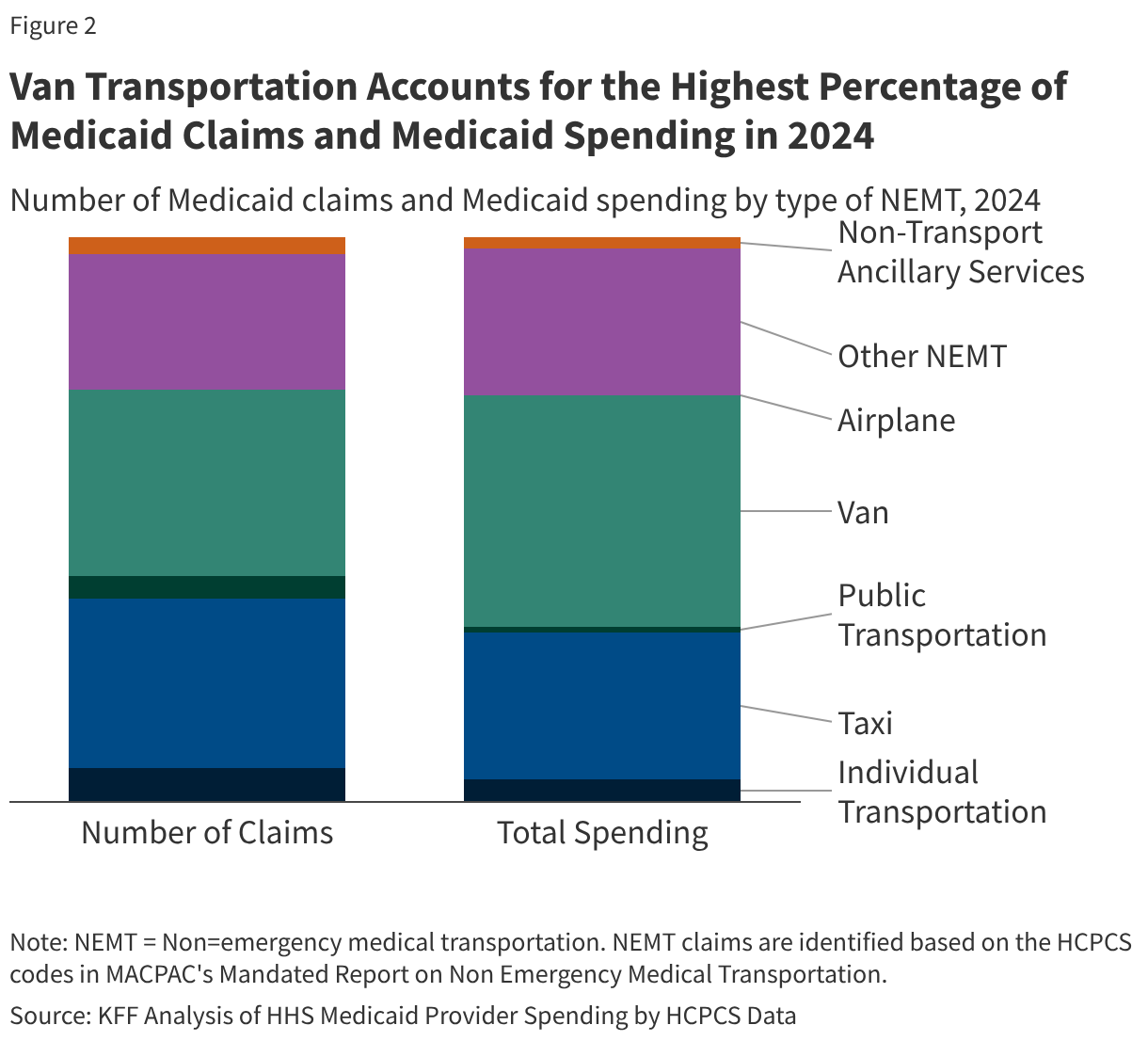
Two-thirds of Medicaid NEMT spending in the public data pays for van and taxi services (Figure 2). Van and taxi transportation account for about two-thirds of Medicaid NEMT spending (67%) and utilization (63%) in 2024. The “other” NEMT services category makes up the next largest share of Medicaid spending (26%) and utilization (24%). Services in this category include claims for NEMT case workers, patient attendants, escorts, and per diems. Combined, the remaining categories (individual transportation, public transportation, airplane, and non-transport ancillary services) account for less than 10% of Medicaid spending on NEMT and 13% of Medicaid NEMT utilization.

Van Transportation Accounts for the Highest Percentage of Medicaid Claims and Medicaid Spending in 2024 (Stacked column chart)

Who uses NEMT?

This analysis uses 2024 Medicaid claims data (the Transformed Medicaid Statistical Information System [T-MSIS] Analytic Files) to understand the characteristics of people who use Medicaid NEMT. People were identified as using NEMT if they had at least one claim with an NEMT-identified HCPCS code in the 2024 Other Services (OT) T-MSIS Research Identifiable File. The OT file captures claims for all noninstitutional services, which includes a wide range of services such as professional services (regardless of where they were provided), labs and radiology, clinical services, outpatient hospital services, and home care. People’s chronic conditions were identified as described in KFF’s earlier work on chronic conditions among adult Medicaid enrollees. The research identifiable file does not include spending from MCO encounter records, so the analysis only includes measures of utilization and omits spending estimates. Data about dual eligibility and chronic conditions exclude Oregon due to data quality issues.

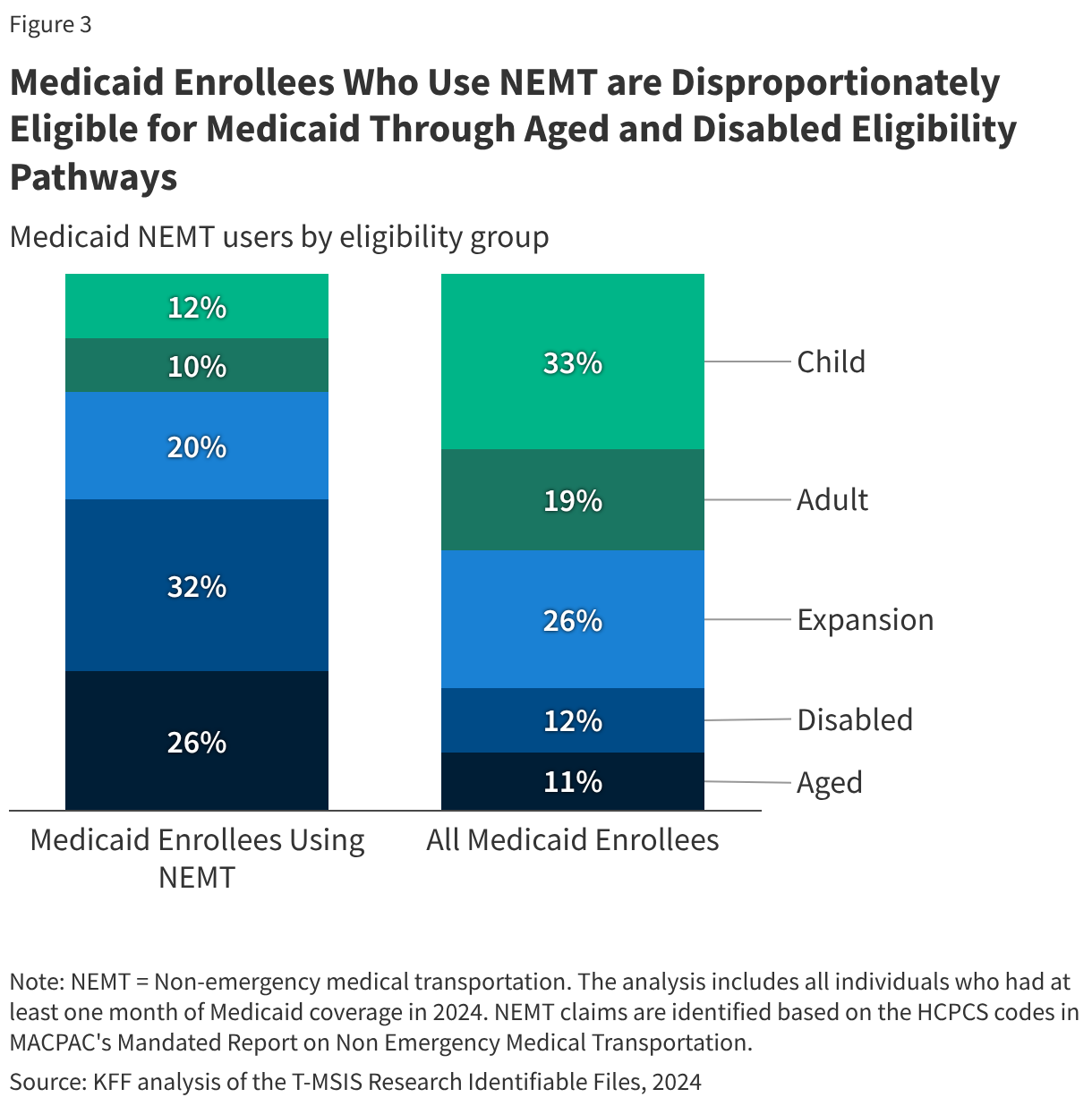
A disproportionate share of Medicaid enrollees who use NEMT qualify for Medicaid because of a disability or because they are age 65 or older compared with all Medicaid enrollees (Figure 3). More than half (58%) of the Medicaid enrollees who use NEMT are eligible for Medicaid because they are age 65 or older or have a long-term disability, compared with about one in five (23%) of all Medicaid enrollees. Conversely, children make up 33% of all Medicaid enrollees, but only 12% of Medicaid enrollees who use NEMT. Medicaid enrollees who are older or qualify for a disability use more health care than other enrollees and also may have greater need for assistance with transportation.

Medicaid Enrollees Who Use NEMT are Disproportionately Eligible for Medicaid Through Aged and Disabled Eligibility Pathways (Stacked column chart)

More than one in three (39%) NEMT users are dually eligible for Medicare and Medicaid, compared with 14% of overall Medicaid enrollees. Traditional Medicare does not typically cover NEMT benefits. Some Medicare Advantage (MA) plans offer supplemental NEMT benefits, but coverage varies by plan. For dual-eligible individuals, Medicare is the primary payer and covers medical and post-acute care, while Medicaid wraps around Medicare coverage by paying Medicare premiums and, in most cases, cost sharing. For medical appointments where Medicare is the primary payer, Medicaid can still pay for transportation to get to the appointment.

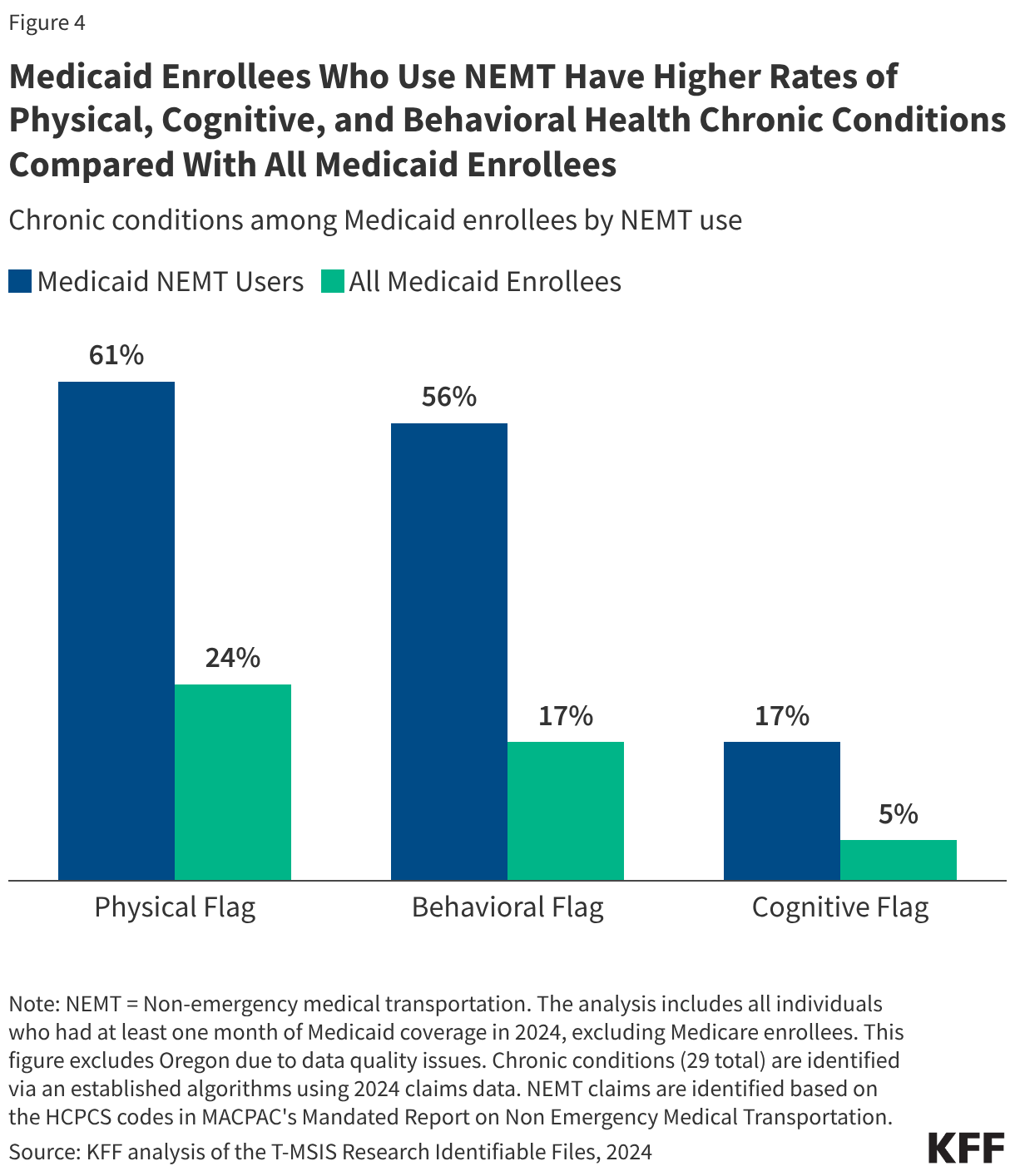
Nearly nine in ten (85%) Medicaid enrollees using NEMT have at least one chronic condition, compared with fewer than four in ten Medicaid enrollees overall (36%, Figure 4). Medicaid enrollees who use NEMT are most likely to have a physical health condition (61%), compared with 24% of all Medicaid enrollees. Rates of behavioral health conditions (56% vs. 17%) and cognitive health conditions (17% vs. 5%) are also higher among individuals using NEMT compared with all Medicaid enrollees. NEMT may provide disproportionate benefits for enrollees with certain conditions, like chronic kidney disease or intellectual and developmental disabilities. Such enrollees need regular access to care but may face additional transportation-related obstacles to accessing their ongoing services (Box 1).

Medicaid Enrollees Who Use NEMT Have Higher Rates of Physical, Cognitive, and Behavioral Health Chronic Conditions Compared With All Medicaid Enrollees (Grouped column chart)

Box 1: NEMT for Individuals with Certain Conditions

  • Chronic Kidney Disease: Seven percent of Medicaid enrollees without Medicare coverage using NEMT have chronic kidney disease compared with 1% of all Medicaid enrollees. There is currently no cure for chronic kidney disease, and as chronic kidney disease progresses, it can advance to end-stage renal disease (ESRD). ESRD may be treated through weekly dialysis appointments, often requiring regular transportation to and from dialysis centers. Individuals with ESRD who are enrolled in Medicaid may not be able to afford a car or other forms of transportation. They may also have other chronic conditions that limit their ability to drive or navigate transportation independently. In 2021, dialysis facilities were among the top four destinations for NEMT trips.
  • Intellectual and Developmental Disabilities (I/DD): Sixteen percent of Medicaid enrollees using NEMT have I/DD, compared with just 5% of all Medicaid enrollees. I/DD include various disabilities such as intellectual disabilities, autism, developmental delays, and learning disabilities. These disabilities are usually present at birth or manifest during childhood and affect the trajectory of the individual’s physical, intellectual, and/or emotional development. Individuals with I/DD may not have the ability to drive or use public transportation independently. Individuals with I/DD may also require frequent medical appointments, such as occupational therapy, behavioral therapy, and physical therapy, along with typical preventive care medical appointments. NEMT services allow individuals who are unable to drive, lack access to a car, or need specialized vehicles, such as wheelchair-accessible vans, to access necessary medical care.

This work was supported in part by Arnold Ventures. KFF maintains full editorial control over all of its policy analysis, polling, and journalism activities.

Appendix: States’ Options for Providing NEMT and Claiming Federal Reimbursement

A 2021 report to Congress by the Medicaid and CHIP Payment and Access Commission (MACPAC) summarizes each delivery model and its benefits and drawbacks:

  • Fee-for-service (FFS): Under an FFS (or in-house) model, states contract with independent transportation providers and reimburse providers for services based on payment rates set by the state. This model provides states with more control over NEMT policies and operations and can facilitate coordination with other state programs that subsidize transportation costs for low-income people (such as those offered through state departments of transportation). However, FFS NEMT delivery also carries a large administrative burden for states, including the burden of ensuring program integrity and identifying fraud and abuse.
  • Managed care: Some MCOs “carve in” NEMT as part of their coverage, alongside other Medicaid benefits. The individual managed care plans that include NEMT coverage can choose to directly manage NEMT themselves or contract with a broker. Using managed care to administer NEMT removes some administrative burden from states, provides greater predictability in spending, and can allow for better coordination with other benefits also provided under the managed care plan. However, this delivery model can increase the administrative burden for NEMT providers who must contract with multiple managed care plans rather than only with the state.
  • Brokerage: Under a brokerage model, states contract with a third party that manages their NEMT benefit. States can pay the broker on an FFS basis or using another approach such as paying a flat amount for each enrollee each month (i.e., a capitated approach). Brokerage models allow states to leverage brokers’ expertise in transportation administration and their capacity to administer the benefit. One risk of using capitated payments with brokers is that it creates an incentive for the brokers to decline trips, potentially making it harder for enrollees to access NEMT.

A Medicaid Transportation Coverage Guide from the Centers for Medicare and Medicaid Services (CMS) describes the two reimbursement methods as well as their benefits and drawbacks.

  • Administrative expenses: When states claim spending as an administrative expense, the federal government pays 50% of the total cost, which is the administrative expense federal matching rate. When states claim NEMT as an administrative expense, they are exempt from Medicaid’s requirement to provide enrollees with free choice of providers, allowing for contracts with a single provider and alternative payment models, like vouchers. Additionally, electing to claim NEMT as an administrative expense allows states to limit the amount, duration, and scope of NEMT benefits.
  • Medical service expenses: When states claim spending as a medical expense, the federal government pays the state’s regular federal matching rate (ranging from 50% to 77.32% in fiscal year 2027). Claiming NEMT as a medical service expense generally makes NEMT services subject to additional guidelines, including the free choice of provider, comparability, and statewideness requirements. The Deficit Reduction Act (DRA) of 2005 added an option for states to include NEMT brokerage programs in their Medicaid state plans where cost-effective, and to waive some of the additional guidelines, such as limiting enrollees’ free choice of provider. However, states must provide NEMT using a brokerage if they want additional flexibility, so some states may prefer to continue claiming NEMT as administrative expenses.

Medicaid/CHIP Monthly Enrollment Tracker

Published: Oct 30, 2026

Note: The data presented below are updated monthly as new Medicaid/CHIP enrollment data become available.

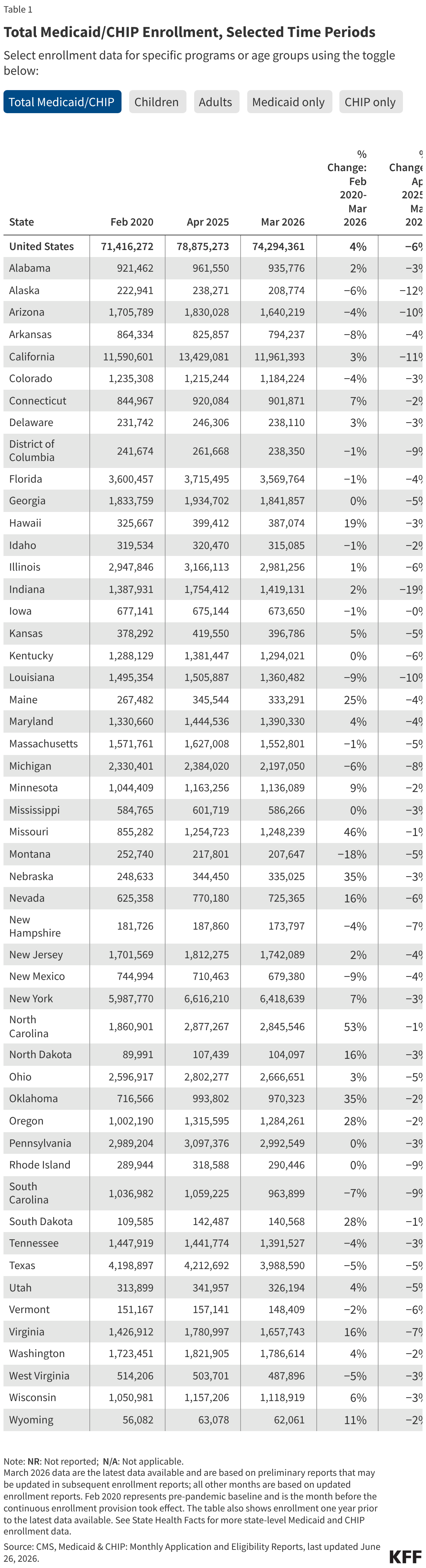
This tracker presents the most recent data on monthly Medicaid and Children’s Health Insurance Program (CHIP) enrollment reported by the Centers for Medicare & Medicaid Services (CMS) as part of the Performance Indicator Project. It includes data for Medicaid and CHIP and reports enrollment data for children and adults. The data are generally the most recent data available and are useful for reporting trends in Medicaid enrollment. However, the data only capture full-benefit enrollees, excluding those who receive limited benefits, such as those who receive family planning services only, and consequently, do not provide a full count of the total population enrolled in Medicaid. Additionally, these data cannot be used to monitor changes in enrollment by eligibility pathway, including for adults in the Medicaid expansion group.

The 2025 reconciliation law included significant changes to Medicaid, including requiring adults in the expansion group and in certain 1115 waiver programs to meet new work and reporting requirements starting January 2027. These changes are expected to reduce Medicaid enrollment over the next 10 years relative to what would have been expected under current law. Enrollment data for the full Medicaid population is available here, and for more information on how implementation of Medicaid work requirements is affecting Medicaid expansion enrollment, please see Tracking Implementation of the 2025 Reconciliation Law Medicaid Work Requirements.

The figures below show Medicaid and CHIP enrollment from February 2020 through the most current month of available data. Figures include enrollment for adults and children in Medicaid/CHIP and for Medicaid only and CHIP only. Key enrollment data and trends as of July 2026 include:

  • There were 72.9 million people enrolled in Medicaid/CHIP nationally (Figure 1). Medicaid enrollment declined by 5.1 million or 7% from July 2025 through July 2026 (Table 1).
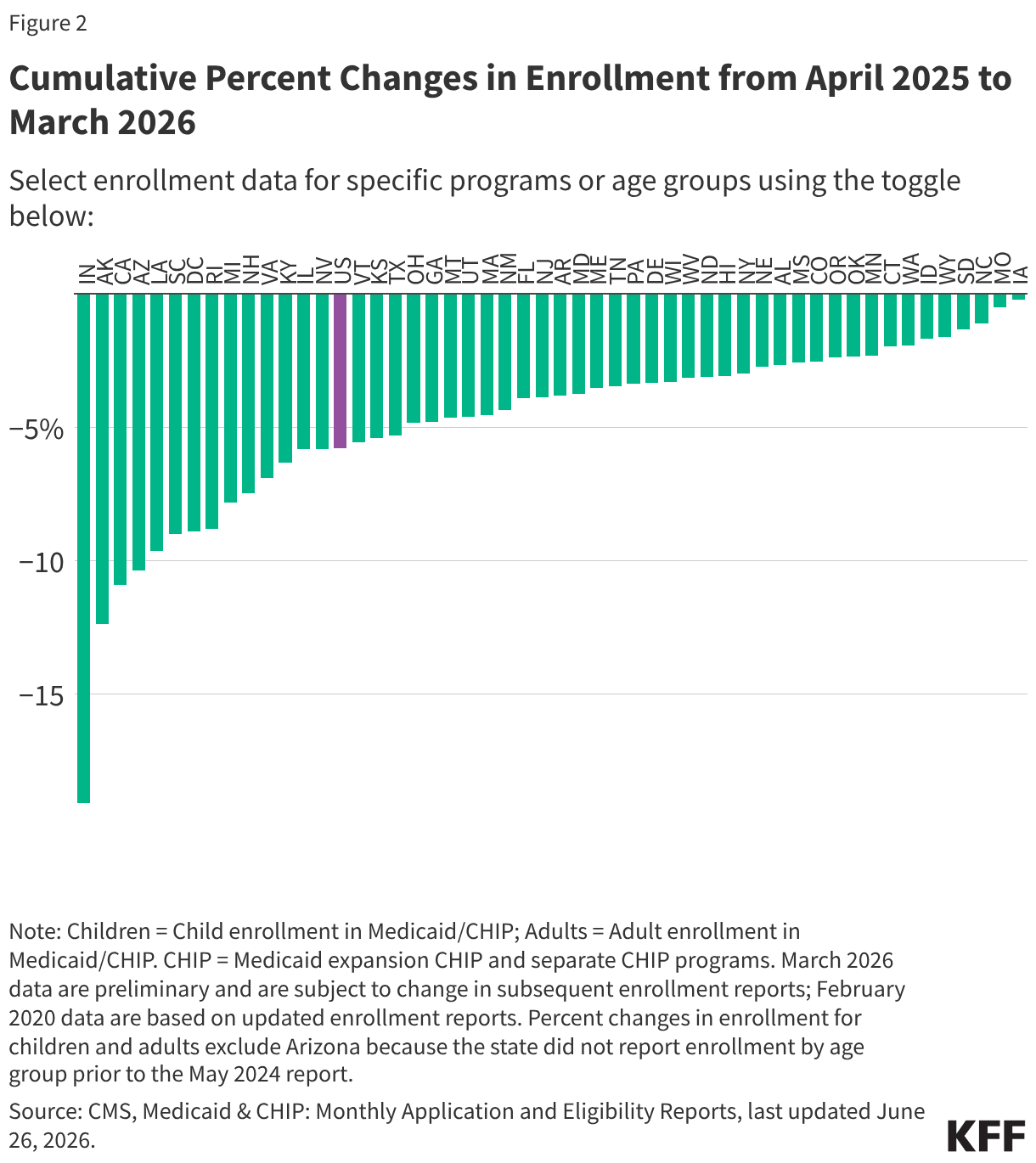
  • Total Medicaid/CHIP enrollment has decreased in 49 states and DC since July 2025. Enrollment changes since July 2025 vary from a 1% increase in Iowa to a 18% decrease in Indiana (Figure 2).
  • Child enrollment in Medicaid/CHIP has decreased in 49 states and DC from July 2025 through July 2026. Adult enrollment has decreased in all but 5 states (IA, MO, NC, OK, SD)(Figure 2).
  • There were 65.7 million people enrolled in Medicaid and 7.2 million people enrolled in CHIP (Figure 1). Since July 2025, Medicaid enrollment has decreased in 49 states and DC while CHIP enrollment has increased in 17 states (AL, CA, CT, DE, FL, HI, IL, MO, NJ, NC, ND, OK, SC, TN, VT, WA, WY).
  • Total Medicaid/CHIP enrollment was 2% higher in July 2026 compared to enrollment in February 2020, prior to the pandemic. However, in the 49 states and DC with complete enrollment data by age, the number of children enrolled in Medicaid/CHIP declined by 1,110,000 or 3% from February 2020 to July 2026 (Figure 2 and Table 1).
Figure 1
Annual Percent Change in Medicaid/CHIP Enrollment (July 2025 to July 2026) (Column Chart)
Total Medicaid/CHIP Enrollment, Selected Time Periods (Table)

Note: The data on unwinding renewal outcomes presented below were last updated on September 12, 2024; since most states have now completed the Medicaid unwinding, the information will not be updated again.

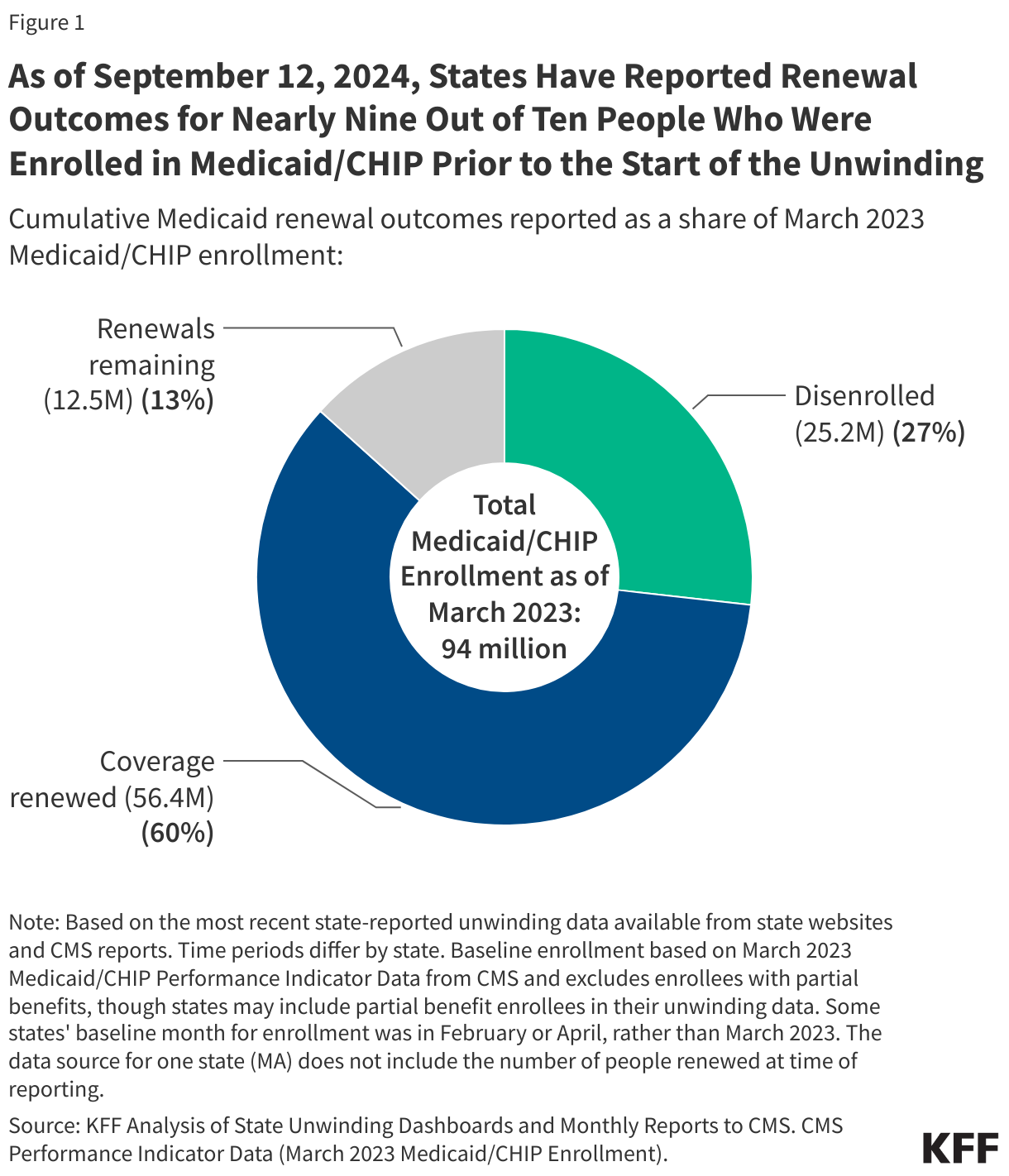
As of September 12, 2024 and with nearly complete unwinding data for most states: 

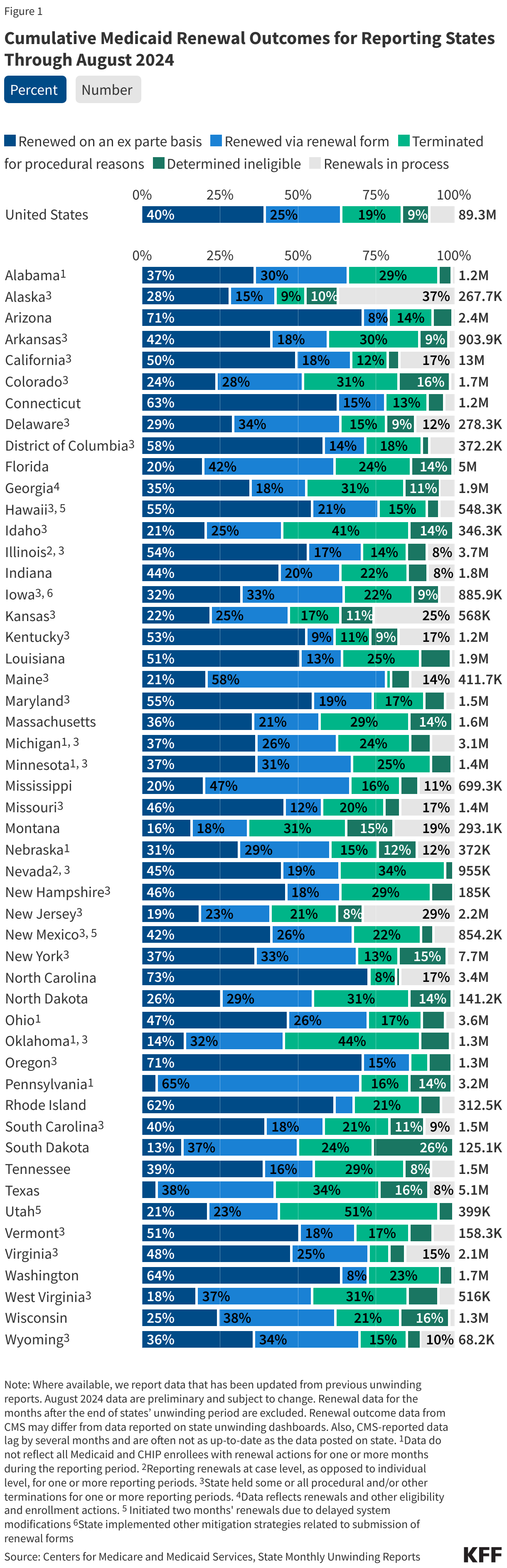
  • Over 25 million people were disenrolled (31% of completed renewals) and over 56 million people had their coverage renewed (69% of completed renewals).  
  • Disenrollment rates varied across states from 57% in Montana to 12% in North Carolina, driven by a variety of factors including differences in renewal policies and procedures as well as eligibility expansions in some states.  
  • Among those who were disenrolled, nearly seven in ten (69%) were disenrolled for paperwork or procedural reasons while three in ten (31%) were determined ineligible.  
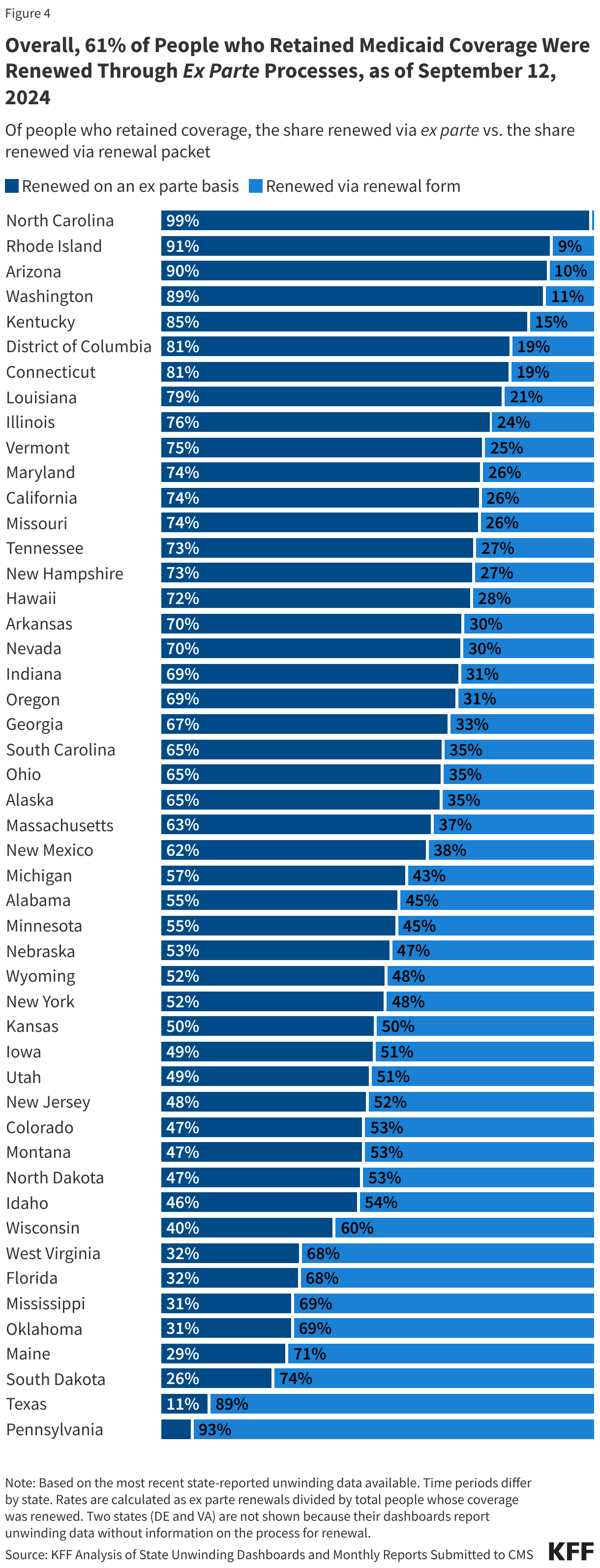
  • Among those whose coverage was renewed during the unwinding, 61% were renewed on an ex parte, or automated, basis, meaning the individual did not have to take any action to maintain coverage. 

State Data on Renewal Outcomes

The data on unwinding-related renewal outcomes presented in this section rely primarily on monthly reports that states were required to submit to the Centers for Medicare & Medicaid Services (CMS) during the unwinding period. The data also reflect updates to the monthly reports that states submit three months after the original report submission to account for the resolution of pending cases and any other changes in renewal metrics. For 13 states, data were pulled from dashboards or reports published on state websites that provide more complete information, and for a few additional states, updated monthly reports were pulled from state websites because they were more timely than what is reported on the CMS website. 

To view archived data for specific states, click on the State Data - Archived tab.


As of September 12, 2024, States Have Reported Renewal Outcomes for Nearly Nine Out of Ten People Who Were Enrolled in Medicaid/CHIP Prior to the Start of the Unwinding (Donut Chart)


Medicaid Disenrollments

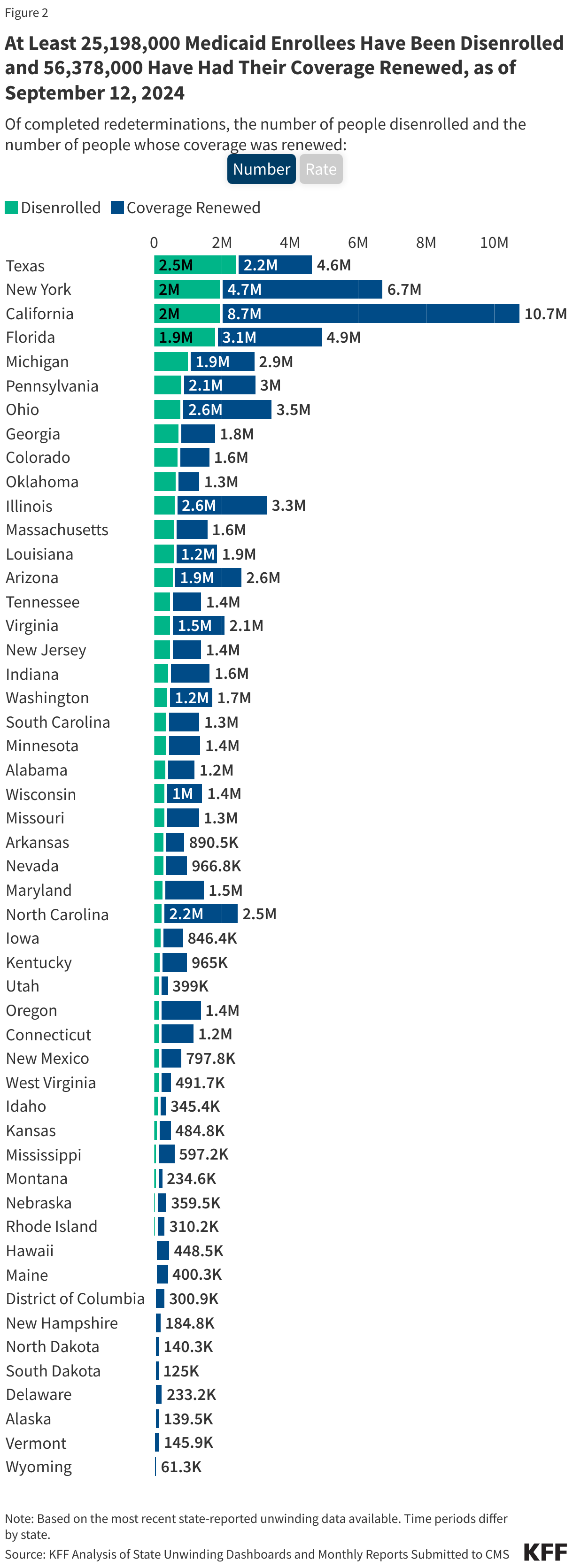
  • As of September 12, 2024, at least 25,198,000 Medicaid enrollees had been disenrolled during the unwinding of the continuous enrollment provision. Overall, 31% of people with a completed renewal were disenrolled in reporting states while 69%, or 56.4 million enrollees, had their coverage renewed.
  • There is wide variation in disenrollment rates across reporting states, ranging from 57% in Montana to 12% in North Carolina. A variety of factors contribute to these differences, including differences in renewal policies and system capacity. Some states adopted policies that promote continued coverage among those who remain eligible and/or have automated eligibility systems that can more easily and accurately process renewals while other states have adopted fewer of these policies and have more manually-driven systems. In addition, North Carolina and South Dakota adopted Medicaid expansion and other states increased eligibility levels for certain populations (e.g., children, parents, etc.) during the unwinding, which may have lowered disenrollment rates in these states.

At Least 25,198,000 Medicaid Enrollees Have Been Disenrolled and 56,378,000 Have Had Their Coverage Renewed, as of September 12, 2024 (Stacked Bars)


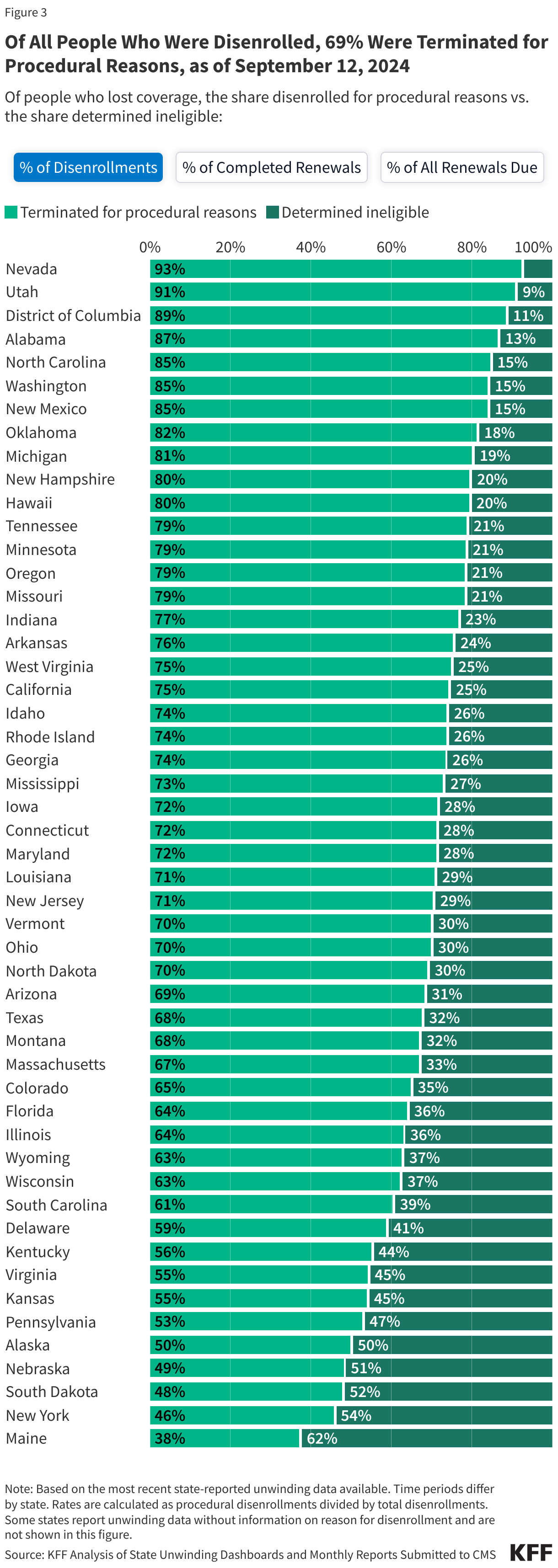
  • Across all states with available data, 69% of all people disenrolled had their coverage terminated for procedural reasons. However, these rates vary based on how they are calculated (see note below). Procedural disenrollments are cases where people are disenrolled because they did not complete the renewal process and can occur when the state has outdated contact information or because the enrollee does not understand or otherwise does not complete renewal packets within a specific timeframe. High procedural disenrollment rates are concerning because many people who are disenrolled for these paperwork reasons may still be eligible for Medicaid coverage. 

(Note: The first tab in the figure below calculates procedural disenrollment rates using total disenrollments as the denominator. The second tab shows these rates using total completed renewals, which include people whose coverage was terminated as well as those whose coverage was renewed, as the denominator. And finally, the third tab calculates the rates as a share of all renewals due, which include completed renewals and pending cases.)

Of All People Who Were Disenrolled, 69% Were Terminated for Procedural Reasons, as of September 12, 2024 (Stacked Bars)

Medicaid Renewals

  • Of the people whose coverage has been renewed as of September 12, 2024, 61% were renewed on an ex parte basis while 39% were renewed through a renewal form, though rates vary across states. Under federal rules, states are required to first try to complete administrative (or “ex parte”) renewals by verifying ongoing eligibility through available data sources, such as state wage databases, before sending a renewal form or requesting documentation from an enrollee. Ex parte renewal rates varied across states from 90% or more in Arizona, North Carolina, and Rhode Island to less than 20% in Pennsylvania and Texas. 

Overall, 61% of People who Retained Medicaid Coverage Were Renewed Through Ex Parte Processes, as of September 12, 2024 (Stacked Bars)

Federal Data on Renewal Outcomes

The data presented here are cumulative unwinding metrics published by CMS. These counts and percentages may differ from the above data, which present renewal metrics reported on state websites when state-reported data are more complete.  

Figure 1 below shows cumulative renewal data reported by CMS during states’ unwinding periods. Renewal data for the months after the end of states’ unwinding period are excluded. The data reflect updated unwinding data reported by states three months after the original monthly reports as they become available.   

Cumulative Medicaid Renewal Outcomes for Reporting States Through August 2024 (Stacked Bars)

For questions about this tracker, please contact KFFTracker@kff.org

State Unwinding Data - Archived

Note: The state data presented below were last updated on September 12, 2024; since most states have now completed the Medicaid unwinding, the information will not be updated again. 

The data presented here provide state-level data on enrollment trends and renewal outcomes during the unwinding period. Figure 1 shows total Medicaid enrollment by month starting in January 2023 and, once disenrollments resumed in a state, the cumulative percent change in Medicaid enrollment relative to the month before Medicaid disenrollments started (this baseline month will differ across states). Figure 2 shows renewal metrics for each month of a state’s unwinding period (or cumulative data for the unwinding period for some states). 

For total national Medicaid enrollment, click on the Enrollment Data tab.

Loading...

Related Resources - Archived

Resources on unwinding data

Resources on state policies and preparations for the unwinding

Resources on pre-pandemic enrollment patterns and coverage transitions

KFF’s unwinding explainer

Implementation of Immigrant Eligibility Restrictions for ACA Marketplace Subsidies Under the 2025 Reconciliation Law: Issues to Consider

Published: Oct 30, 2026

Introduction

The 2025 reconciliation law includes new eligibility restrictions for many lawfully present immigrants for federally funded health programs, including subsidized Affordable Care Act (ACA) Marketplace, Medicaid and the Children’s Health Insurance Program (CHIP), and Medicare coverage. Undocumented immigrants are already ineligible for federally funded health coverage under longstanding policy.

Beginning January 1, 2027, the 2025 reconciliation law will limit eligibility for Marketplace subsidies, including for all premium tax credits (PTCs) and cost-sharing reductions (CSRs), to lawfully present immigrants who are lawful permanent residents (LPRs or “green card” holders), Cuban and Haitian entrants, and people residing in the U.S. under Compacts of Free Association (COFA). These restrictions will eliminate eligibility for Marketplace coverage subsidies for many groups of lawfully present immigrants, including refugees and asylees without a green card and individuals on work visas, among others. The Congressional Budget Office (CBO) estimates that this provision will reduce federal spending by $91.4 billion and lead to an additional one million individuals becoming uninsured by 2035, with most of the coverage losses occurring in 2027, the year the provision takes effect. The law also eliminated access to subsidized Marketplace coverage for all lawfully present immigrants earning less than 100% of the federal poverty level (FPL) who were not eligible for Medicaid due to immigration status, including those in the five-year waiting period for coverage, beginning January 1, 2026. The CBO estimates that this provision will lead to an additional 200,000 individuals becoming uninsured and reduce federal spending by $27.3 billion over the 2026 to 2035 time period.

The Centers for Medicare and Medicaid Services (CMS) released guidance on how the federally facilitated exchange (FFE) will verify immigrant eligibility for subsidies during the 2027 plan year Marketplace Open Enrollment Period, which starts November 1, 2026. State-based exchanges (SBEs) are also required to implement the immigrant eligibility restrictions for subsidies, but outreach and immigration status verification procedures may vary from the FFE. Lawfully present immigrants who are no longer eligible for subsidies under the new restrictions can purchase Marketplace coverage at full cost. However, unsubsidized coverage will likely be unaffordable for many amid rising ACA Marketplace premiums due in part to the expiration of enhanced premium tax credits and other federal policy changes. Beyond those losing coverage due to ineligibility and cost, there may also be coverage losses among individuals who remain eligible for subsidies but have challenges understanding or responding to notices requesting information and documentation to verify their eligibility. This brief provides an overview of implementation of the immigrant eligibility changes for Marketplace subsidies and issues to consider for affected individuals and states.

Marketplace Subsidy Immigrant Eligibility Changes

Starting January 1, 2027, the 2025 reconciliation law will restrict eligibility for PTCs and income-based CSRs to LPRs or “green card” holders, Cuban and Haitian entrants, and people residing in the U.S. under COFA (Table 1). The guidance refers to these groups as “eligible noncitizens.” The law eliminates eligibility for Marketplace subsidies for many other groups of lawfully present immigrants, including refugees and asylees without a green card and individuals on work visas, among others. The law also eliminated access to Marketplace subsidies for lawfully present immigrants earning less than 100% FPL who were not eligible for Medicaid due to immigration status, including those in the five-year waiting period for Medicaid coverage, beginning January 1, 2026. Lawfully present immigrants who do not have an “eligible noncitizen” status still may purchase a qualified health plan (QHP) through the Marketplace at full cost without subsidies if otherwise eligible. However, the coverage will likely be unaffordable for many without subsidies. Prior to the 2025 reconciliation law, undocumented immigrants were already ineligible for federally funded health coverage. Deferred Action for Childhood Arrivals (DACA) recipients are also ineligible to purchase ACA Marketplace coverage under recent federal regulation changes and the 2025 reconciliation law. 

Noncitizen Status Eligibility for Subsidized ACA Marketplace Coverage (Table)

Implementation of Immigrant Eligibility Changes in the FFE

Starting with plan year 2027, the FFE will conduct eligibility determinations for current noncitizen enrollees and new applicants consistent with the new rules for Marketplace subsidies. In the 29 states that use the FFE or a state-based marketplace on the federal platform, the Open Enrollment Period for the 2027 plan year begins November 1, 2026. CMS encourages current noncitizen Marketplace enrollees to ensure their applications are updated with their most recent immigration status by the last day to enroll in or change plans. New noncitizen applicants applying for coverage through the FFE will be asked to attest to whether they have eligible noncitizen status when applying for subsidies or if they have a different lawfully present status that is not eligible for subsidies. Enrollees and applicants may need to provide updated documents or document information, such as their passport number, Permanent Resident Card, Employment Authorization Document (EAD), among others to help the FFE verify their immigration status.

The FFE will use immigration-document information and automated data matching to verify whether current noncitizen enrollees and new applicants meet the new subsidy eligibility requirements. The FFE will automatically verify immigration status through the Department of Homeland Security (DHS) Systematic Alien Verification for Entitlements (SAVE) system using existing information. Current noncitizen enrollees will continue to receive subsidies if the FFE can verify eligible noncitizen status using the information available in their enrollee profile or through a new SAVE verification, provided the enrollee remains otherwise eligible. New applicants determined to have an eligible noncitizen status will also be able to enroll in a plan with subsidies if they meet all other eligibility requirements. While CMS did not discuss potential issues with the SAVE system in this guidance, in previous guidance to states regarding immigrant eligibility restrictions in Medicaid, it noted that SAVE provides “point in time” verification and does not update prior verification responses when there is a change in immigration status or category. As such, potentially affected enrollees may have applied for and been granted adjustment to LPR status or may have another eligible status that is not reflected in SAVE.

Noncitizen enrollees and applicants who attest to having an eligible noncitizen status, but whose status cannot be automatically verified by the FFE, will receive a 95-day period to submit documentation from when the notice of the verification is sent by the FFE. Individuals may be eligible to enroll in subsidized Marketplace coverage during this time. Eligible documentation may include a Permanent Resident Card (also known as a "green card"), an EAD, or an arrival/departure record (I-94/I-94A). In addition to requesting documentation to resolve issues verifying eligible noncitizen status for subsidies, the FFE may also request additional documentation if it cannot verify that an individual is lawfully present. Enrollees will be required to repay any PTC received during the 95-day period in future tax filings if they are found to be ineligible for subsidies. Other proposed changes from the Internal Revenue Service (IRS) to implement provisions of the 2025 reconciliation law would eliminate income-based caps on such repayment amounts.

Current noncitizen Marketplace enrollees who do not take any action to update their applications by the plan selection deadline for coverage and whose eligible noncitizen status cannot be verified by the FFE will lose subsidies effective January 1, 2027. Re-enrolling consumers whom the FFE determines as no longer lawfully present will lose eligibility for Marketplace coverage entirely effective January 1, 2027. CMS does not provide any information as to whether determinations of individuals as no longer lawfully present will be used for immigration enforcement purposes.

The FFE will automatically re-enroll current enrollees who are determined lawfully present but ineligible for subsidies into a Marketplace plan without subsidies, and they will be responsible for paying the unsubsidized monthly premiums unless they cancel coverage. Enrollees can cancel their coverage through their online Marketplace account or by contacting the Marketplace Call Center. If enrollees do not cancel their plan, they will be responsible for paying the unsubsidized monthly premiums if they are auto-enrolled into a QHP without subsidies. If the enrollee does not pay the unsubsidized monthly premium, the enrollee would be subject to the grace period policy set by the plan issuer or applicable state laws, in contrast to the three-month grace period provided to those receiving subsidized coverage. Individuals who lose coverage due to nonpayment of premiums would have to wait until the next Open Enrollment Period to re-enroll in Marketplace coverage unless they qualify for a Special Enrollment Period. Individuals may also be able to appeal coverage cancellation decisions by plan issuers due to nonpayment of premiums.

The FFE updated Marketplace websites and platforms and is sending targeted notices about immigrant eligibility changes. Prior to the start of the 2027 plan year Open Enrollment Period, applications on HealthCare.gov and Enhanced Direct Enrollment partner platforms were updated to highlight that only U.S. citizens and certain lawfully present noncitizen statuses qualify for financial assistance. The FFE is sending several targeted notices to affected enrollees, including the following:

  • Current enrollees whose eligible noncitizen status cannot be verified through DHS SAVE will receive tailored Marketplace Open Enrollment Notices (MOEN) explaining that they will lose PTCs and CSRs unless they update their application and submit documentation to confirm their eligible noncitizen status.
  • Enrollees whom the FFE determines as no longer eligible for Marketplace subsidies will receive a Marketplace Eligibility Determination Notice explaining that they are ineligible for PTCs and CSRs due to their immigration status and their appeal rights.
  • Enrollees whom the FFE determines as no longer eligible for Marketplace coverage due to immigration status will receive a notice explaining that their Marketplace enrollment will end, their appeal rights, and additional options available to them. If an enrollee in a multi-member household is found no longer eligible for Marketplace coverage, the FFE will designate another eligible household member as the primary plan subscriber.

SBEs used by 22 states, including DC, may use different outreach and verification procedures compared with the FFE. CMS notes that the guidance is specific to the FFE and that noncitizen enrollees and applicants in states that operate their own exchange should follow guidance issued by their SBE. States with SBEs are required to verify eligible noncitizen status for subsidies for all noncitizen enrollees and applicants during the 2027 plan year Open Enrollment Period, though states have varying Open Enrollment timelines. CMS indicates that SBEs will have access to the same immigration status verification system (Federal Data Services Hub Verify Lawful Presence service) used by the FFE and have a direct connection to DHS SAVE, in addition to technical assistance from CMS.

Issues to Consider

Lawfully present immigrants without an eligible noncitizen status would still be eligible to purchase Marketplace coverage at full cost, but it would likely be unaffordable. Premiums have increased due in part to the expiration of enhanced PTCs and other policy changes, which have coincided with Marketplace enrollment declines, and premiums are expected to keep rising in 2027. If an enrollee loses coverage due to nonpayment of premiums, they may be responsible for any medical bills incurred during the period of nonpayment. Providers may also request that individuals pay the full cost of care out of pocket, or they may not provide care until the premiums are paid.

Some individuals who remain eligible for subsidized Marketplace coverage may still lose coverage due to challenges verifying eligibility or fear and confusion. CMS noted in previous guidance to states regarding immigrant eligibility restrictions in Medicaid that SAVE may not be accurate as it provides “point in time” verification and may not reflect that potentially affected enrollees have since applied for and been granted adjustment to an eligible noncitizen status. As such, some individuals may have an eligible noncitizen status even if it is not verified through a data match through SAVE. However, they would need to submit documentation to verify that eligibility. Individuals may have difficulty understanding new eligibility rules and whether they remain eligible for subsidies. Eligible enrollees may also face challenges submitting required documentation to verify eligible noncitizen status. Confusion and fears about enrolling in coverage may be amplified by other immigration policies like public charge and other increased federal immigration enforcement actions.

Individuals who become uninsured will be left with limited options for comprehensive coverage and care. Individuals who become uninsured may visit community health centers for free or sliding fee scale health care services, but they may have access to a limited scope of services. Some states offer fully state-funded coverage programs for immigrants regardless of status, which may be a coverage option for those losing eligibility for subsidized Marketplace coverage. However, several states have recently scaled back state-funded coverage programs for immigrants or have reached enrollment caps due to budget pressures and higher than expected demand. New Mexico is using state funds to provide coverage with premium subsidies through a state-based exchange to lawfully present noncitizens losing subsidized ACA Marketplace coverage, as well as DACA recipients.

Broader changes to Marketplace coverage may also impact immigrant families. As noted, the elimination of caps on repayment amounts means that all enrollees, including immigrant enrollees, who received excess PTCs will need to repay excess amounts without any limit. Additionally, beginning in the 2028 tax year, all individuals who are eligible for PTCs will not be able to receive them until the Exchange verifies their eligibility, including household income, health coverage status or eligibility for coverage, place of residence, family size, and immigration status. As such, individuals will no longer be able to receive PTCs while this information is being verified and can choose to pay full price for their premium while the verification is in process or pending their plan selection. This could have a disproportionate effect on immigrants and may leave families with mixed immigration status to make a difficult decision between covering some family members but not others.

States operating SBEs may face increased administrative burden to conduct outreach, reverify enrollees, and update systems and other materials to reflect new immigrant eligibility rules. State pressures may be compounded since they are implementing these changes at the same time they are implementing Medicaid immigrant eligibility restrictions as well as work requirements and more frequent eligibility redeterminations for ACA expansion adults.

Medicare Part D Premiums and Cost Sharing in 2027

The average premium for Part D stand-alone drug plans will increase substantially if current enrollees do not switch to lower-premium plans.

Published: Oct 30, 2026

As Medicare’s open enrollment period for 2027 gets underway, Medicare beneficiaries have an opportunity to examine their coverage options and make changes. For Medicare Part D prescription drug coverage, the average beneficiary has 28 Medicare Advantage prescription drug plans (MA-PDs) and 9 stand-alone prescription drug plans (PDPs) to choose from, with varying costs associated with these different options. This analysis examines premiums and cost-sharing requirements for Part D coverage in 2027 and how these costs have changed over time, based on Medicare plan landscape and benefits data from the Centers for Medicare & Medicaid Services (CMS).

Takeaways

  • The estimated average enrollment-weighted monthly premium for Medicare Part D stand-alone PDPs is projected to be $51 in 2027, a 50% increase from $34 in 2026 (based on June 2026 enrollment), assuming current enrollees keep their same plan for 2027. While CMS projected a modest $1 increase in the national average premium, from $35 to $36 (based on September 2026 enrollment), they did not explain the method used in the calculation. It’s possible CMS assumed switching to lower-cost plans, which would produce a lower enrollment-weighted average premium for 2027 than our estimate of $51, and it is likely that the actual average PDP premium for 2027 will be lower than $51 after accounting for plan choices by new enrollees and switching by current enrollees during open enrollment. If PDP enrollees who are not receiving Part D Low-Income Subsidies (LIS) keep their current plan in 2027, more than half (55% or 7.5 million) will pay premiums of less than $20 per month but nearly 30% (3.9 million) will pay at least $100 per month.
  • Monthly premiums for drug coverage are estimated to be more than 5 times higher for PDPs compared to MA-PDs in 2027 – $51 versus $9. The average monthly Part D premium is projected to increase by $17 for PDPs but by less than $2 for MA-PDs. MA-PD sponsors can use rebate dollars from Medicare payments to buy down their Part D premiums, as well as provide extra benefits, but these funds are not available to sponsors for PDPs. The MA-PD premium is also heavily weighted by zero premium plans, with nearly 8 in 10 MA-PD enrollees paying no premium for drug coverage in 2026.
  • Three-fourths of PDP enrollees without low-income subsidies (76% or 10.4 million) will pay a higher monthly premium in 2027 if they make no changes during open enrollment, compared to 56% of enrollees who faced a higher premium for their plan in 2026. This includes 4.1 million PDP enrollees without LIS who are enrolled in zero premium PDPs in 2026 and who will face higher premiums next year because no zero premium PDPs are available in 2027. Among the 10.4 million PDP enrollees facing a premium increase, 2.4 million will see their monthly premium increase by more than $50 if they stay in their same plan for 2027. By comparison, only 38,000 enrollees faced a premium increase larger than $50 per month in 2026. The Trump administration’s decision to discontinue the Part D Premium Stabilization Demonstration after 2026 ended the additional premium subsidies that were provided to PDP sponsors and the cap on the maximum allowable monthly PDP premium increase, which was set at $50 for 2026. (Monthly premiums could increase by more than $50 in 2026 for PDPs that did not participate in the demonstration.)
  • Average monthly premiums for the 8 national PDPs are projected to range from around $6 to $204 in 2027. Among national PDPs, the two lowest-premium plans are Centene’s Wellcare Value Script Rx, an enhanced PDP with an average premium of $6.50 for 2027 (up from $5.80 in 2026) and Wellcare Classic, a basic PDP with an average premium of $10.90 for 2027 (up from $8.60 in 2026). The national PDPs with the highest average monthly premiums are United’s AARP Medicare Rx Preferred ($204.50, up from $126.00 in 2026) and Humana Premier Rx Plan ($137.40, up from $119.60 in 2026).
  • Most Part D enrollees will face a deductible for drug coverage in 2027, including 85% of MA-PD enrollees (up from 80% in 2026) and virtually all PDP enrollees (99.8%, up from 96% in 2026), based on current enrollment. The average Part D deductible in 2027 will be $643 for PDP enrollees (up from $540 in 2026) and $489 for MA-PD enrollees (up from $360 in 2026). The standard Part D deductible in 2027 is $700, up from $615 in 2026.
  • Most Part D enrollees will face coinsurance rather than copayments for both preferred brands and non-preferred drugs, which can mean less predictable out-of-pocket costs. For preferred brands, most MA-PD enrollees (83%) will face median coinsurance of 20%, and virtually all PDP enrollees (99.8%) will face median coinsurance of 25%. For non-preferred drugs, 89% of MA-PD enrollees will face median coinsurance of 29% and all PDP enrollees will face median coinsurance of 35%. For 2027, the 50% of PDP enrollees enrolled in Centene’s Wellcare PDPs will face coinsurance of 15% for drugs on a new injectable drug tier. For specialty tier drugs (those that cost more than $1,080 per month), median coinsurance will be 25% for PDP enrollees and 26% for MA-PD enrollees.

Premiums

The Average Monthly Premium for Medicare Part D Stand-Alone PDPs Is Projected to Be $51 in 2027, a 50% Increase From $34 in 2026, Based on Current Enrollment

If PDP enrollees keep their current plan, the average monthly PDP premium will increase from $34 in 2026 to $51 in 2027. While CMS projected a modest $1 increase in the national average premium (from $35 to $36, based on September 2026 enrollment), they did not explain the method used in the calculation. It’s possible CMS assumed switching to lower-cost plans, which would produce a lower enrollment-weighted average premium for 2027 than our estimate of $51. After accounting for plan choices by new enrollees and switching by current enrollees during open enrollment, it is likely that the actual average PDP premium for 2027 will be lower than $51 (Figure 1).

The Average Monthly Premium for Medicare Part D Stand-Alone Prescription Drug Plans Is Projected to Be  in 2027, But Will Likely Be Lower After Plan Changes During Open Enrollment (Grouped column chart)

For comparison, at the beginning of open enrollment in October 2025, the average monthly premium for PDP coverage was estimated to increase from $37 in 2025 to $44 for 2026, based on enrollment at that time, but after accounting for changes during open enrollment, the actual weighted average premium in 2026 was $34, as existing enrollees switched to and new enrollees joined lower-premium plans.

If the 13.6 million PDP enrollees without Part D Low-Income Subsidies (LIS) in 2026 keep their current plan for 2027, more than half (55% or 7.5 million) will pay premiums of less than $20 per month, but none will pay zero monthly premium and nearly 30% (3.9 million) will pay $100 per month or more. In 2026, 30% of these enrollees are paying zero monthly premium and 20% are paying $100 per month or more (Figure 2).

If PDP Enrollees Keep Their Current Plan for 2027, More Than Half (55%) Will Pay Less Than  Per Month, While Nearly 30% Will Pay 0 or More (Split Bars)

PDP Enrollees Will Pay Higher Monthly Premiums Than MA-PD Enrollees in 2027 – an Estimated $51 versus $9, on Average

The estimated average monthly PDP premium for 2027 is more than 5 times larger than the average monthly premium for drug coverage in MA-PDs - $51 versus $9 (Figure 3). Between 2026 and 2027, the average monthly premium is increasing by $17 (50%) for PDPs and $2 (20%) for MA-PDs. MA-PD sponsors can use rebate dollars from Medicare payments to lower or eliminate their Part D premiums and offer extra benefits, but there is no equivalent rebate system for PDPs. According to MedPAC, Medicare Advantage monthly rebates per enrollee have more than doubled since 2018, from $95 to $199 in 2026, and of the $199 total monthly rebate amount in 2026, $51 was used to reduce MA-PD Part D premiums. The MA-PD premium is also heavily weighted by zero premium plans, with nearly 8 in 10 MA-PD enrollees paying no premium for drug coverage in 2026.

The Average Monthly Premium for Drug Coverage Is Substantially Higher for Medicare Part D Stand-Alone Prescription Drug Plans Compared to Medicare Advantage Drug Plans (Split Bars)

Three-Fourths of PDP Enrollees Without Low-Income Subsidies Will See an Increase in Their Monthly Premium in 2027 if They Make No Changes During Open Enrollment

Out of 13.6 million PDP enrollees without LIS in 2026, 10.4 million (76%) will pay a higher monthly premium in 2027 if they keep their current plan. This includes 4.1 million enrollees in PDPs that charge no monthly premium in 2026, who will pay higher premiums in 2027 because there are no zero premium PDPs available in 2027. Of the 10.4 million non-LIS PDP enrollees facing higher premiums for their current plan, 2.4 million will see their monthly premium increase by more than $50 if they stay in their same plan for 2027. Among the 24% (3.2 million) of non-LIS PDP enrollees facing a premium reduction, most (2.6 million) will see a decrease of $5 or less (Figure 4).

Three-Fourths (76%) of PDP Enrollees Without Low-Income Subsidies Will See An Increase In Their Monthly Premium in 2027 If They Make No Changes During Open Enrollment (Stacked Bars)

By comparison, 56% of PDP enrollees were facing a premium increase for their same plan for 2026, but less than 1% (38,000 enrollees) faced a premium increase larger than $50 per month. The Trump administration’s decision to discontinue the Part D Premium Stabilization Demonstration after 2026 ended the additional premium subsidies that were provided to PDP sponsors and the cap on the maximum allowable monthly PDP premium increase, which was set at $50 for 2026. (Monthly premiums could increase by more than $50 for PDPs that did not participate in the demonstration.)

Average Monthly Premiums for the 8 National PDPs Are Projected to Range from Around $6 to $204 in 2027

Part D premiums for 2027 vary widely across plans, as well as across regions for the same plan, as in previous years (Figure 5). Among the 8 PDPs that will be available in all 34 PDP regions in 2027, the two lowest-premium plans are Centene’s Wellcare Value Script, an enhanced PDP with an average premium of $6.50 for 2027 and Wellcare Classic, a basic PDP with an average premium of $10.90 for 2027. Both PDPs were available for zero monthly premium in many areas in 2026, but no zero premium PDPs are available in 2027. Among the most expensive national PDPs are United’s AARP Medicare Rx Preferred and Humana Premier Rx Plan, with average monthly premiums for 2027 of $204.50 and $137.40, respectively.

Average Monthly Premiums for Stand-Alone Prescription Drug Plans in 2027 Are Projected to Range from a High of 4 to a Low of Around  (Bar Chart)

Monthly premiums for several national PDPs vary widely around each plan’s average. For 6 of the 8 national PDPs, there is a difference of $90 or more across the 34 PDP regions between the plan’s lowest and highest premiums. For example, the average monthly premium for AARP Medicare Rx Preferred is $204, but ranges from $136.70 to $264.50 across regions. The monthly premium for AARP Medicare Rx Saver averages $98 but ranges from $10.30 to $235.30 across regions. And for Humana Basic Rx, the average premium is $16 but ranges across regions from $6.30 to $169.60.

Medicare Part D enrollees in national PDPs will face a range of premium changes if they keep their current plan in 2027. Enrollees in United’s AARP branded PDPs face significant premiums increases if they don’t switch plans for 2027 - $78.50 for AARP Medicare Rx Preferred (a 62% increase) and $48.10 for AARP Medicare Rx Saver (a 97% increase) (Figure 6).

Part D Enrollees in the National PDPs in 2026 Will Face a Range of Premium Changes for 2027 If They Make No Changes During Open Enrollment (Split Bars)

Deductibles and Cost Sharing

Most Part D Enrollees Will Pay a Drug Deductible in 2027, Including 85% of MA-PD Enrollees and Virtually All PDP Enrollees

The share of MA-PD enrollees in plans that charge a deductible for Part D coverage will increase from 80% in 2026 to 85% in 2027 if they do not switch plans. Nearly all stand-alone PDP enrollees (99.8%) will also be enrolled in plans that charge a deductible for drug coverage in 2027, up from 96% in 2026 (Figure 7). (Some enrollees in these plans receive low-income subsidies that cover their deductible.)

Most Part D Enrollees Will Be in Plans That Charge a Deductible for Drug Coverage in 2027, Including Virtually All Stand-Alone Drug Plan Enrollees (99.8%) and 85% of Medicare Advantage Drug Plan Enrollees (Stacked Bars)

The weighted average Part D deductible in 2027 will be $643 for PDP enrollees and $489 for MA-PD enrollees (the standard Part D deductible is increasing from $615 in 2026 to $700 in 2027). Although the average Part D deductible is higher for PDP enrollees, MA-PD enrollees are facing a larger increase in the average deductible than PDP enrollees between 2026 and 2027 – an increase of $128 (36%) for MA-PD enrollees versus $103 (19%) for PDP enrollees (Figure 8).

Average Deductibles for Part D Coverage Will Be Higher in 2027 Than in 2026 (Split Bars)

Most Part D Enrollees Will Face Coinsurance Rather Than Copayments for Preferred Brands and Non-Preferred Drugs in 2027

Part D enrollees face much higher cost-sharing amounts for brands and non-preferred drugs (which can include both brands and generics) than for drugs on a generic tier, and most Part D enrollees face coinsurance rather than copayments for drugs on formulary tiers other than generics. Coinsurance can mean less predictable out-of-pocket costs than copayments. The typical five-tier formulary design in Part D includes tiers for preferred generics, generics, preferred brands, non-preferred drugs, and specialty drugs.

Most Part D enrollees now face coinsurance for both preferred brands and non-preferred drugs, with the share of MA-PD enrollees facing coinsurance for preferred brands increasing from 54% in 2026 to 83% in 2027, and 89% of MA-PD enrollees facing coinsurance for non-preferred drugs, similar to 2026. Nearly all PDP enrollees will face coinsurance for preferred brands and non-preferred drugs in 2027, the same as in 2026.

Among all Part D plans, median standard cost sharing in 2027 for different types of drugs is (Figure 9):

  • Generics: For preferred generics, enrollees face copayments of $4 in PDPs and $0 in MA-PDs, and for other generics, copayments of $20 in PDPs and $5 in MA-PDs.
  • Preferred brands: For preferred brands, virtually all PDP enrollees face a median coinsurance of 25%; 83% of MA-PD enrollees face a coinsurance of 20% and 17% face a median copayment of $47.
  • Non-preferred drugs: For non-preferred drugs, which can include both brands and generics, all PDP enrollees face a median coinsurance of 35%; 89% of MA-PD enrollees face a median coinsurance rate of 29% and 11% of MA-PD enrollees face a median copayment of $100.
  • Specialty drugs: Median coinsurance for specialty drugs is 25% for PDP enrollees and 26% for MA-PD enrollees.
Most Medicare Part D Enrollees Will Face Coinsurance Rather Than Copayments for Preferred Brands and Non-Preferred Drugs in 2027 (Split Bars)

Part D enrollees in the PDPs that were available on a national basis in 2026 face median copayments ranging from $0 to $5 for preferred generics in 2027, while median copays for drugs on the standard generic tier will range from $1 to $20 (Figure 10). Median coinsurance ranges from 16% to 25% for preferred brands; from 30% to 50% for non-preferred drugs, and from 25% to 30% for specialty drugs. New for 2027, Centene has added an injectable drug tier with coinsurance of 15% and combined the two generics tiers into one for its Part D plans, with a copayment of $20 in its two Wellcare PDPs.

Medicare Part D Stand-Alone Drug Plan Enrollees Typically Face Coinsurance Rather Than Copayments for Drugs on Formulary Tiers Other Than Generics in 2027 (Split Bars)