States’ Use of Program Integrity Tools in Medicaid Home Care
The federal government continues to focus on addressing fraud, waste, and abuse in Medicaid, with much of the attention focused on home care services. KFF estimates that over 5 million people use Medicaid home care, which provides help with self-care activities such as bathing, dressing, and eating for older adults and people with disabilities. Home care has been an area of emphasis in new fraud initiatives because spending on home care is growing, and the services are provided in people’s homes and the community where fewer institutional processes and procedures exist. However, spending growth often reflects states’ efforts to increase the availability of home care, and there are additional safeguards against fraud in home care compared with other types of Medicaid services. While additional scrutiny and oversight may limit fraudulent or inappropriate Medicaid spending, additional efforts to combat fraud can create new administrative burdens and limit provider participation, potentially reducing access to care. Aside from waiting lists (an imperfect measure of unmet need), there are generally no metrics to examine how many people who need Medicaid home care are not receiving benefits. States are engaged in many activities aimed at addressing fraud, waste, and abuse in their Medicaid home care programs; in KFF’s 2026 survey of states’ home care programs, the majority of responding states reported that program integrity was one of the top three priorities they were concerned with.
The data come from the 24th annual KFF survey of officials administering Medicaid home care programs in all 50 states and the District of Columbia (hereafter referred to as a state). States completed the survey between April and August 2026. The survey was sent to each state official responsible for overseeing home care benefits (including home health, personal care, and waiver services for specific populations such as people with physical disabilities). All states except Florida and South Carolina responded to the 2026 survey, but response rates for certain questions were lower.
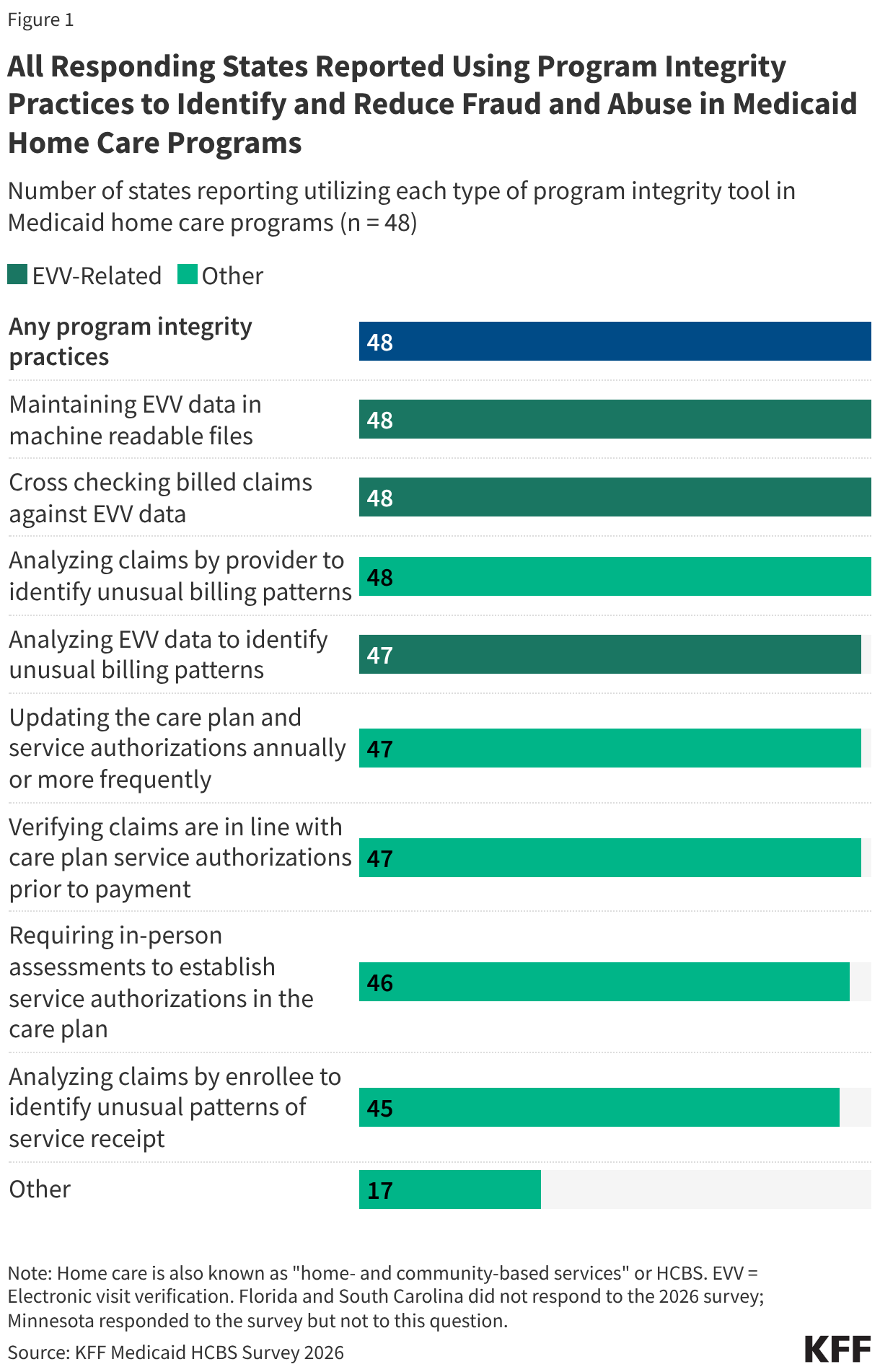
KFF’s survey finds that all responding states report using multiple program integrity practices beyond federal minimum requirements to prevent and detect fraud, with nearly all states employing a multifaceted approach. The federal government has requirements for states to identify and detect fraud in Medicaid home care; however, all responding states report using strategies that go beyond the federal requirements. KFF asked states whether they used any of eight strategies to “help identify and reduce fraud and abuse in the provision of waiver services,” and 42 states reported using all eight of the strategies that KFF asked about.
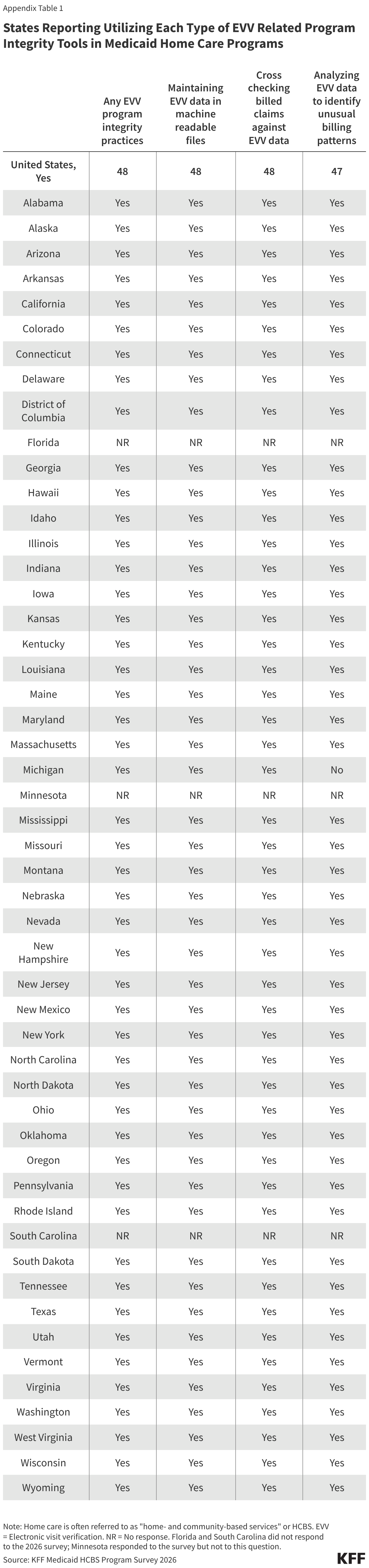
Federal law relies on electronic visit verification (EVV) as a core tool to prevent fraud in Medicaid home care, but all responding states reported using EVV practices that go beyond federal requirements (Figure 1). In 2016, Congress passed the 21st Century Cures Act, which requires states to implement electronic visit verification (EVV) for all Medicaid personal care and home health services if a visit is made to a person in the home. EVV is a computer/mobile system that tracks and records details of services. States’ EVV systems must include six data elements: the enrollee receiving the service, caregiver providing the service, type of service, location of the service delivery, date of the service, and time the service begins and ends. EVV was established to help promote fiscal integrity for Medicaid home care, and states had until 2023 to fully implement the requirements.
While the 21st Century Cures Act mandates that states implement EVV and collect six specific data elements for each visit, it does not specify how states must store EVV data or use it as part of their payment processes. States may choose to apply EVV data in additional ways to support program integrity.
KFF asked states about three potential EVV strategies that go beyond minimum federal requirements and found they were widely used:
- Maintaining EVV data in machine-readable files (48 states),
- Cross-checking billed claims against EVV data (48 states), and
- Analyzing EVV data to identify unusual billing patterns (47 states).
Some states reported adopting strategies that precondition payment on EVV submissions, such as Ohio, which requires valid EVV data as a condition of payment in its waivers for people with intellectual and developmental disabilities (I/DD) and for adults ages 65 and older and those with physical disabilities. Claims that do not have a matching EVV record will be denied, rather than paid and later audited to track down mismatched claims.
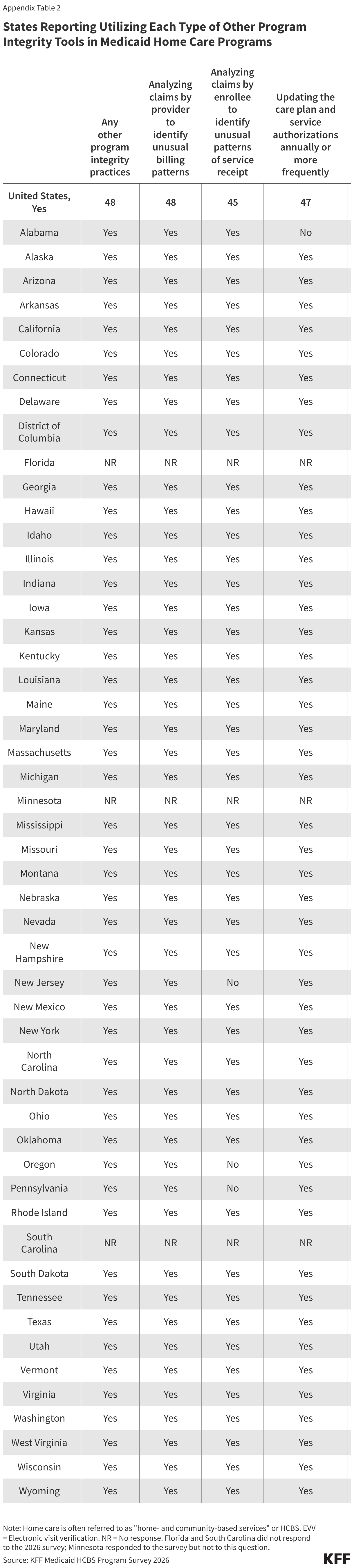
In addition to EVV, all responding states reported using at least one other type of program integrity strategy beyond what is federally required. KFF asked states whether they were using any of the following non-EVV related strategies:
- Analyzing claims by provider to identify unusual billing patterns (48 states),
- Analyzing claims by enrollee to identify unusual patterns of service receipt (45 states),
- Updating the care plan and service authorizations annually or more frequently (47 states),
- Requiring in-person assessments to establish service authorizations in the care plan (46 states), and
- Verifying claims are in line with care plan service authorizations prior to payment (47 states).
Seventeen states also reported using other program integrity strategies outside of the options KFF included, although most states did not describe those options in much detail. Some strategies mentioned focused on provider certification and enrollment requirements whereas others were focused on identifying claims that required additional review before or after payment.
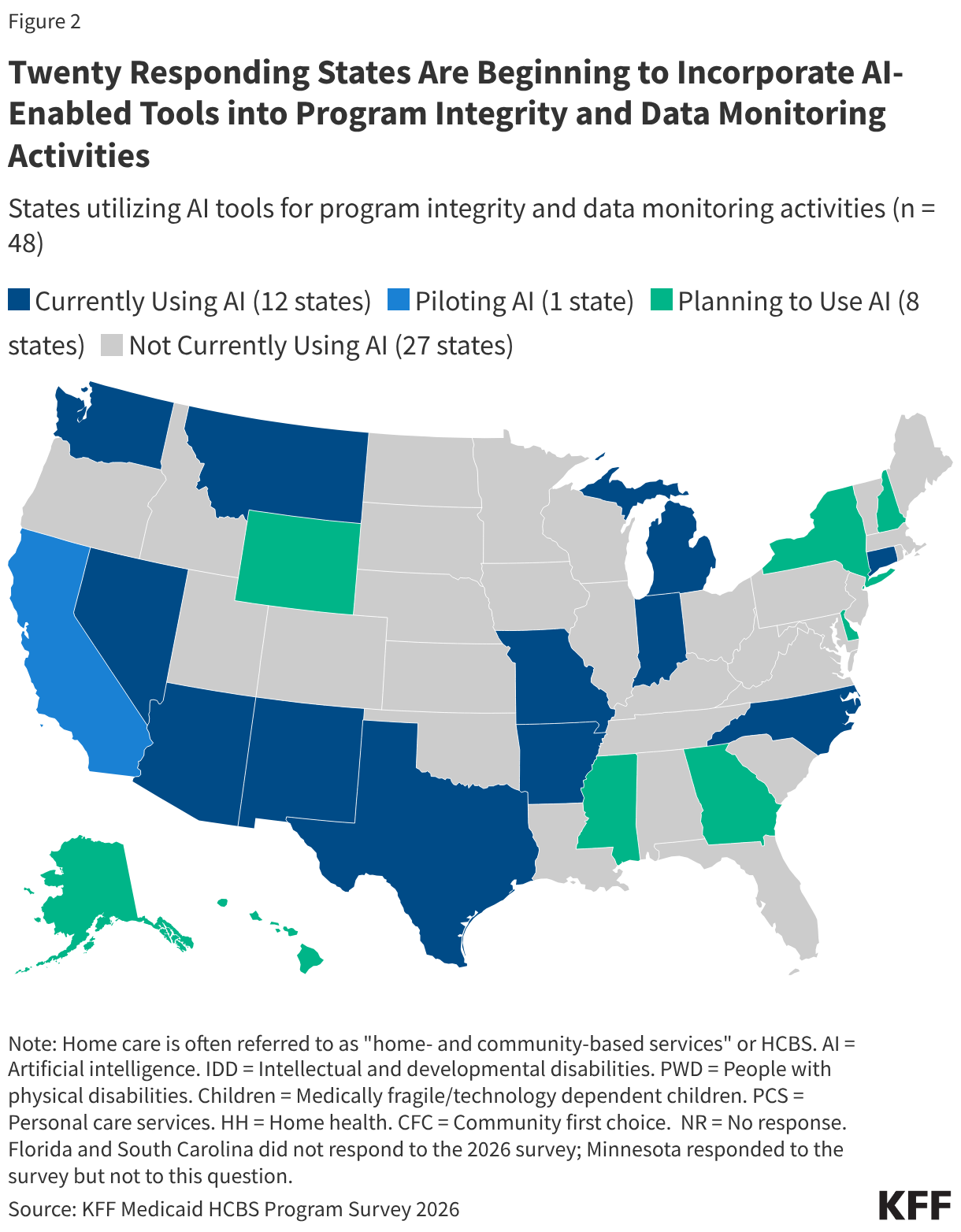
Nearly half of states are currently using or planning to incorporate artificial intelligence (AI) into program integrity and data monitoring activities (Figure 2). KFF asked states to report their current phase of AI tool use for “program integrity and data monitoring (to identify potential fraud, waste, and abuse).” States could report one of five options: currently using, piloting, planning to use, not using, or unknown. Twelve states reported currently using AI-enabled tools for program integrity and data monitoring purposes under at least one program (Arizona, Arkansas, Connecticut, Indiana, Michigan, Missouri, Montana, Nevada, New Mexico, North Carolina, Texas, and Washington). For example, North Carolina reported using AI to create algorithms that would detect fraud, waste, and abuse in its waiver for adults ages 65 and older or with physical disabilities, and Missouri reported using AI to aggregate information about critical incidents and grievances. Of the 12 states currently using AI tools, five states (Arkansas, Connecticut, Michigan, Montana, and North Carolina) also reported they are planning to incorporate AI tools under at least one additional program. One state (California) reported piloting AI-enabled tools for program integrity purposes. Eight states (Alaska, Delaware, Georgia, Hawaii, Mississippi, New Hampshire, New York, and Wyoming) reported that they are not currently using AI tools for program integrity, but that they are planning to incorporate them in the future.
The adoption of AI-enabled tools is most commonly reported under waivers for people with I/DD and adults ages 65 and older and those with physical disabilities. Over one in four states with waivers for people with I/DD and waivers for adults ages 65 and older and those with physical disabilities are currently using or are planning to incorporate AI-enabled tools for their program integrity and data monitoring activities. Seven states with waivers for adults ages 65 and older or those with physical disabilities and five states with waivers for people with I/DD are currently using AI tools for their program integrity and data monitoring activities, more than any other waiver type.
This work was supported in part by Arnold Ventures. KFF maintains full editorial control over all of its policy analysis, polling, and journalism activities.
Appendix