
Implementation of Medicaid Immigrant Eligibility Restrictions Under the 2025 Reconciliation Law: Issues to Consider
Introduction
The 2025 reconciliation law includes new eligibility restrictions for many lawfully present immigrants for federally-funded health programs, including Medicaid and the Children’s Health Insurance Program (CHIP), subsidized Affordable Care Act (ACA) Marketplace, and Medicare coverage. The eligibility restrictions for Medicaid and CHIP become effective October 1, 2026. These restrictions will eliminate eligibility for many groups of lawfully present immigrants, including refugees and asylees without a green card, among others. Under longstanding federal policy, undocumented immigrants already are ineligible for federally funded health coverage. The Congressional Budget Office (CBO) estimates that eligibility restrictions in Medicaid or CHIP will reduce federal spending by $6.2 billion and lead to an additional 100,000 individuals becoming uninsured by 2034.
The Centers for Medicare & Medicaid Services (CMS) released guidance and an implementation toolkit for states to implement the eligibility changes. Beyond those losing coverage because they are no longer eligible, there may also be coverage losses among individuals who remain eligible due to administrative barriers, particularly if they have challenges understanding or responding to notices requesting information and documentation. States will also face increased administrative burdens to implement the changes. This brief provides an overview of implementation of the immigrant eligibility changes and issues to consider for affected individuals and states.
Medicaid Immigrant Eligibility Changes
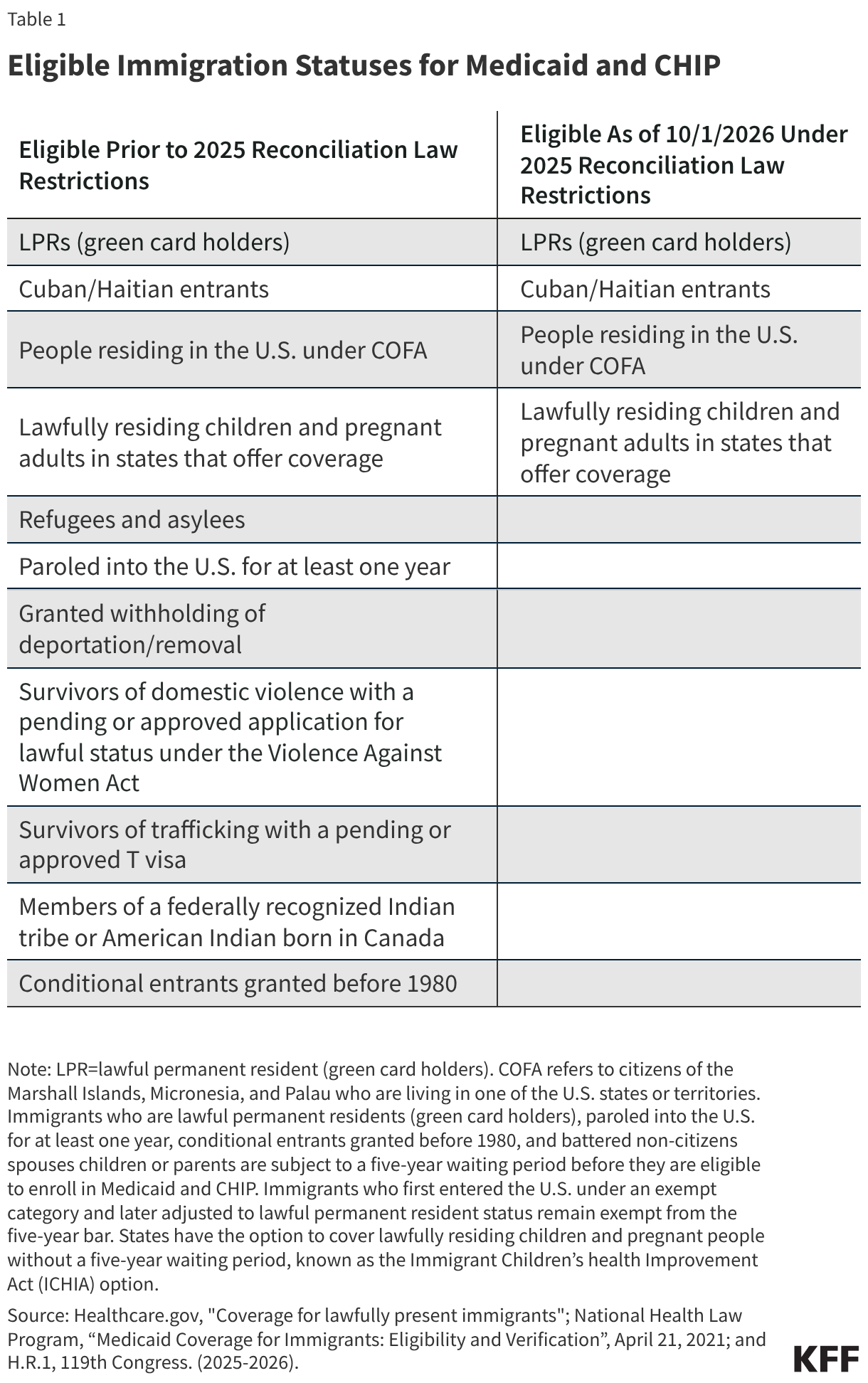
Starting October 1, 2026, the 2025 reconciliation law will restrict Medicaid and CHIP eligibility to lawful permanent residents (LPRs or “green card” holders), Cuban and Haitian entrants, people residing in the U.S. under Compacts of Free Association (COFA), and lawfully residing children and pregnant immigrants in states that cover them under the Medicaid and/or CHIP option (Table 1). The law will eliminate eligibility for many other groups of lawfully present immigrants, including refugees and asylees without a green card, among others. Prior to the 2025 reconciliation law, undocumented immigrants were already ineligible for Medicaid and CHIP. Additionally, the 1996 Personal Responsibility and Work Opportunity Reconciliation Act (PRWORA) limited Medicaid and CHIP eligibility to certain groups of lawfully present immigrants deemed to have a “qualified status” and required many of these groups to wait at least five years before they could enroll even if they met other eligibility criteria. The 2025 reconciliation law does not change the application of PRWORA. Under PRWORA, LPRs are generally subject to the five-year waiting period subject to some exceptions. Cuban and Haitian entrants and COFA migrants are exempt from the waiting period.
States will continue to have the option to provide coverage to lawfully residing children and pregnant people without a five-year wait under the Immigrant Children’s Health Improvement Act (ICHIA) option (also referred to as the CHIPRA 214 option). They will also continue to have the option to provide prenatal care and pregnancy related benefits to targeted low-income children beginning from conception to end of pregnancy (FCEP) regardless of their parent’s immigration status.
Emergency Medicaid and CHIP Health Services Initiative expenditures also are exempt from the new immigrant eligibility restrictions. Emergency Medicaid reimburses hospitals for emergency care they are obligated to provide to individuals who meet other Medicaid eligibility requirements (such as income), but who do not have an eligible immigration status, including undocumented immigrants and lawfully present immigrants who are not eligible for Medicaid or CHIP. CHIP Health Services Initiatives allow states to use a limited portion of CHIP funding to implement public health services aimed at improving the health of low-income children.
Implementation of Immigrant Eligibility Changes
States must redetermine eligibility for all “potentially affected” existing Medicaid enrollees under the new rules by October 1, 2026, and conduct new eligibility determinations consistent with the new rules beginning October 1, 2026. CMS describes potentially affected beneficiaries as those receiving full Medicaid or CHIP benefits who do not have an eligible immigration status under the new rules. CMS indicates that because states vary in the information they keep on file for enrollees, they may have differing ability to identify potentially affected enrollees. As such, some states may need to reverify eligibility for a broader group of noncitizen enrollees.
For potentially affected enrollees, states must first attempt to reverify satisfactory immigration status under the new rules through existing information and automated data matches before contacting the enrollee. States will seek to verify immigration status through the Department of Homeland Security’s (DHS) Systematic Alien Verification for Entitlements (SAVE) program and using Social Security Administration (SSA) databases. If the state verifies satisfactory immigration status, including eligibility under the option for lawfully residing immigrant children or pregnant people, the enrollee will maintain full coverage and should be notified by the state. However, CMS notes that SAVE provides “point in time” verification and does not update past SAVE verification responses when there is a change in immigration status or category. As such, potentially affected beneficiaries may have applied for and been granted adjustment of status to that of an LPR or may have another qualifying immigration status or category that is not reflected in SAVE.
If the state is unable to verify satisfactory immigration status through existing information and data matches, it must request additional information from the enrollee and give the enrollee a reasonable period of time to respond. If the enrollee responds and declares citizenship or a satisfactory immigration status but the state is still unable to verify this information through the SAVE database, the state must provide the enrollee with a 90-day reasonable opportunity period to verify status, during which the state must continue to provide coverage, which may extend beyond October 1, 2026. If the enrollee provides documentation of satisfactory immigration status which is verified with SAVE, the enrollee will retain coverage and should be notified by the state. If the enrollee provides information or documentation that indicates they do not have a satisfactory immigration status or if they do not respond within the specified timeframe, the state must consider whether the enrollee is eligible under the option to cover lawfully residing immigrant children and/or pregnant people (if the state has elected the option), if the enrollee remains eligible for Emergency Medicaid, or if the enrollee is no longer eligible for any coverage. After this determination, the state must provide advance notice, including the right to a Medicaid fair hearing or CHIP review, before terminating coverage or reducing benefits for the enrollee. For Medicaid, states must provide at least ten days advance notice, and, for CHIP, states must provide timely and adequate written notice of the proposed termination and an opportunity for review.
States must update eligibility systems and financial claiming and enrollment data reporting to be consistent with the new eligibility rules. CMS indicates that states must ensure appropriate claiming for individuals eligible only for Emergency Medicaid. It also indicates that they must ensure systems can identify and isolate costs, including administrative costs, related to state-only funded health programs for immigrants so that they do not claim federal matching funds for that coverage. CMS notes that if states cannot make changes to comply with the law, they risk losing federal financial participation (FFP) for Medicaid claims. CMS notes that states may also need to make updates to other materials including Medicaid application and renewal forms; notices to applicants and enrollees; outreach communications to applicants, enrollees, and community-based organizations; and call center scripts, automated messages, and worker guidance. CMS also notes that states should update all presumptive eligibility applications and train providers and caseworkers to correctly assess presumptive eligibility under the new rules. States use presumptive eligibility to expedite Medicaid enrollment for children and pregnant people to access care while their regular application is being processed.
Issues to Consider
Individuals no longer eligible for Medicaid under the new rules will be disenrolled from coverage and left with limited comprehensive coverage options. Individuals in Medicaid may still qualify for Emergency Medicaid but will only be covered for emergency services. Lawfully residing immigrant children and pregnant people will be able to maintain coverage in states that have adopted this option, but coverage varies by state. Subsidized ACA Marketplace coverage will also be limited to lawfully present immigrants who are LPRs, Cuban and Haitian entrants, and people residing in the U.S. under COFA beginning January 1, 2027. Other lawfully present immigrants would be eligible to purchase Marketplace coverage at full cost, but it would likely be unaffordable. Individuals who lose coverage may utilize community health centers for free or sliding-fee scale health care services, but they may have access to a limited scope of services. Some states may provide fully state-funded coverage to those losing Medicaid coverage. However, several states have recently scaled back state-funded coverage programs for immigrants or have reached enrollment caps due to budget pressures and higher than expected demand.
Individuals who remain eligible for Medicaid may experience procedural disenrollments or coverage disruptions due to fear, confusion, or challenges completing verification requirements. Individuals may have difficulty understanding new eligibility rules and whether they remain eligible. Confusion and fears about enrolling in coverage may be amplified by other immigration policies like public charge, new agreements for CMS to share Medicaid data with DHS and Immigration and Customs Enforcement (ICE), and other increased federal immigration enforcement actions. Eligible enrollees may also face challenges submitting required documentation to verify immigration status.
Adequate and accessible outreach, information, and assistance will be key for preventing potential administrative coverage losses. CMS encourages states to use robust, clear, and consistent outreach and communication strategies to help enrollees and applicants understand the upcoming Medicaid eligibility changes and prepare for redetermination and renewals. CMS also suggests that states emphasize notices are time-sensitive, such as by labeling envelopes as such. Outreach through trusted, community-based organizations can help boost awareness among those who will be affected, and community partners may be able to help individuals consider alternatives, including how to access free or low-cost care. Additionally, ensuring linguistic access to information and notices will be key for individuals with limited English proficiency.
Comprehensive information on notices provided to enrollees about Medicaid immigrant eligibility changes is not publicly available across states, but KFF analysis of notices collected from 16 states illustrates there is variation in the information they provide and their accessibility. Most of the examined notices list which groups of lawfully present immigrants remain eligible for coverage, but fewer identify the groups losing coverage. Some states, such as California and Oregon, are transitioning immigrants losing federally funded coverage to state-funded coverage so they include language about how coverage is changing versus potential disenrollment. The examined notices also vary in the information and options provided to enrollees to verify immigration status. Some provide specific lists of acceptable documentation while others request proof of status without identifying specific documentation or direct enrollees to a website or other contact to identify acceptable documentation. Most examined notices offer multiple pathways for enrollees to submit proof of immigration status, including through online accounts or websites, mail, fax, phone, or in-person, while some offer more limited options such as in-person or mail only. The examined notices also vary in the extent to which they advise enrollees about other potential coverage sources, including Emergency Medicaid, and the types of assistance they highlight for enrollees, with some highlighting assisters or legal service organizations as resources. Among the examined notices, only a few were available in another language and/or provided taglines in other languages. However, states may have additional in-language resources that they are providing directly to enrollees that were not publicly available. Reading literacy levels also varied substantially across the examined notices, from a fourth-grade level to a tenth-grade level, as assessed using the SMOG readability calculator, a formula commonly used to evaluate the readability of health-related materials.
States will face increased administrative burden to conduct outreach, reverify enrollees, and update systems and other materials to reflect new immigrant eligibility rules amid implementation of other Medicaid changes included in the 2025 reconciliation law. States are implementing the immigrant eligibility changes at the same time they are implementing Medicaid work requirements and more frequent eligibility redeterminations for ACA expansion adults. Implementing these changes on a short timeline will increase administrative burdens for states and require state budget investments. States may also make additional investments to expand outreach and to hire and train workers. Enhanced funding is available to support technology systems costs, with a 90% federal match available for design, development, and installation activities and a 75% match available for ongoing operations of CMS approved systems. However, at the same time, states are facing reductions in federal Medicaid funds due to broader changes in the reconciliation law and tightening fiscal conditions due to slowing revenue growth. With regard specifically to immigrants, the law reduces the federal Medicaid matching rate provided to states for Emergency Medicaid services provided to expansion adults who would otherwise be eligible for Medicaid except for their immigration status to the regular matching rate starting October 1, 2026.
States have limited federal guidance to implement the new eligibility rules among certain groups of noncitizens. CMS indicated that it would provide additional guidance related to eligibility changes for individuals enrolled in both Medicare and Medicaid, referred to as dual-eligible individuals, as Medicare immigrant eligibility will be restricted on a different timeline than Medicaid. However, this guidance is not yet available, creating uncertainty for states regarding how Medicaid eligibility changes may interact with Medicare enrollment and cost-sharing assistance for affected individuals. Additionally, many states will need to verify eligibility among noncitizens who are automatically enrolled in Medicaid through Supplemental Security Income (SSI) approval. SSI is a means-tested federal program administered by the SSA that pays monthly cash assistance to people who are unable to work because of a disability and generally qualifies people to receive health coverage through Medicaid, which may be their only source of coverage for long-term services and supports and disability-related services. The 2025 reconciliation law does not change immigrant eligibility rules for SSI, but some immigrants will lose their Medicaid coverage. CMS notes that guidance on the changes the SSA is making to the State Data Exchange (SDX) file to identify eligible noncitizen SSI recipients is forthcoming, but it has not yet been made available.
States may face additional uncertainties due to a lack of CMS guidance. CMS is updating the Transformed-Medicaid Statistical Information System (T-MSIS) Data Guide and plans to provide additional information on T-MSIS data reporting in forthcoming guidance. However, states do not yet have final guidance on how T-MSIS enrollment data submissions will specify enrollee immigration status. CMS also requires all states to submit updated State Plan Amendments (SPAs) with new immigrant eligibility restrictions by December 31, 2026, but has only indicated revised Medicaid and CHIP SPA templates will be forthcoming. Likewise, CMS plans to provide additional technical assistance to states about the potential impact for currently approved Section 1115 waiver demonstrations. CMS also directs states with Medicaid Managed Care programs to evaluate whether the immigrant eligibility changes require capitation rate adjustments or amended rate certifications based on guidance released in September 2025, leaving some actuarial judgments to the states. States will also need to utilize a separate and distinct contract and payment system with any managed care plan they contract with to provide state-funded health coverage services, which may be subject to CMS scrutiny.