Individual Market Enrollment Continues to Fall Through Mid-2026
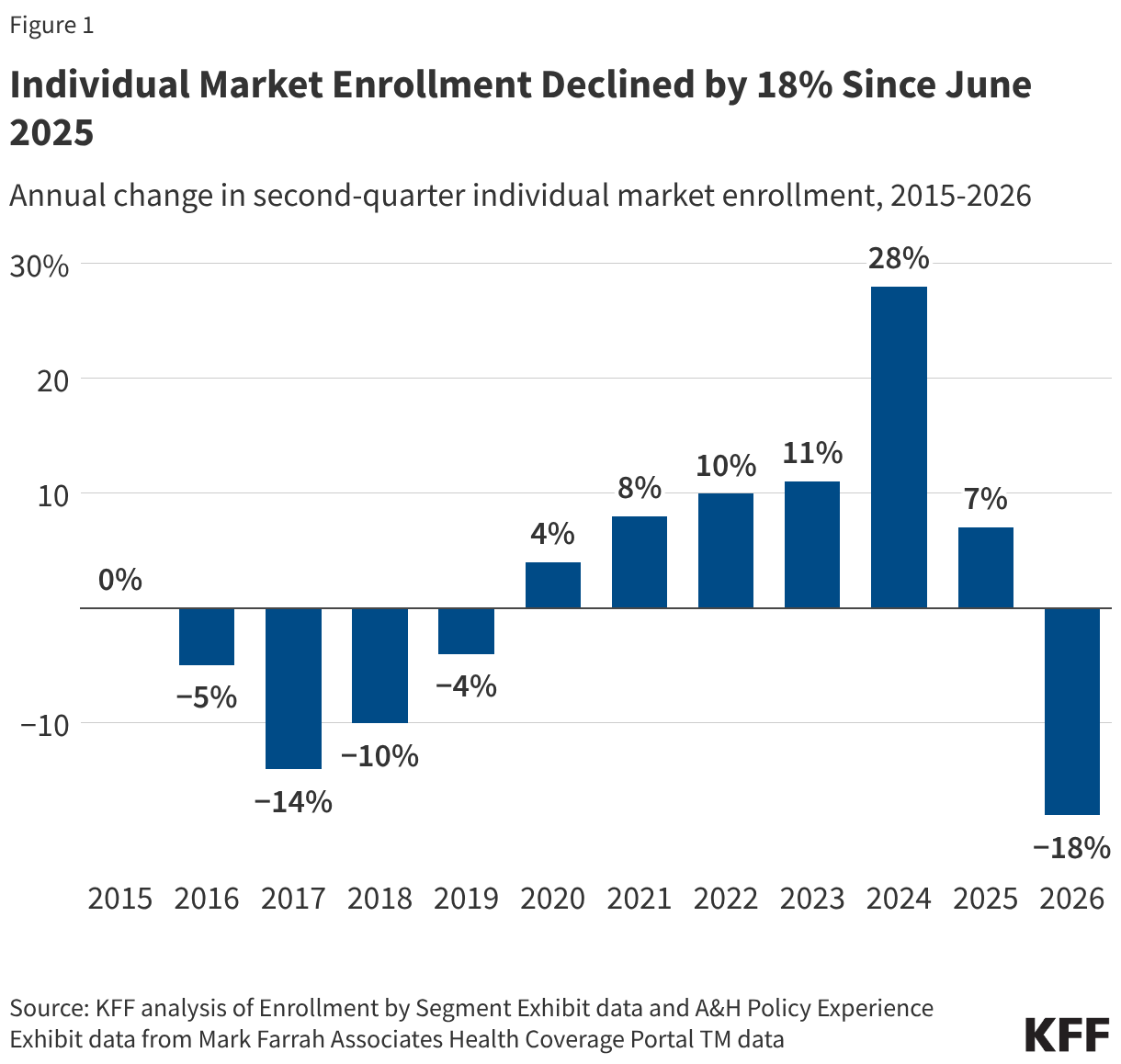
Enrollment in the individual health insurance market fell 18% between June 2025 and June 2026. The individual market is composed primarily of people with Affordable Care Act (ACA) Marketplace coverage as well as some people who buy similar coverage off-exchange. This represents an even steeper drop in enrollment than had previously been reported. Previous data on ACA Marketplace enrollment showed that effectuated enrollment fell 12% from February. Although more current data for the ACA Marketplace population are not yet available, data on the individual market—of which roughly nine in ten people are enrolled through the ACA Marketplaces—suggest enrollment continued to decline, falling 16% as of March and 18% as of June. This decrease includes both on- and off-exchange coverage. In total, we estimate that individual market enrollment has fallen by over 4.6 million people, from 25.2 million in June 2025 to 20.5 million in June 2026.
The enrollment decline coincides with the expiration of the enhanced premium tax credits and other policy changes that are expected to reduce enrollment. As of earlier this year, ACA Marketplace enrollment had fallen in every state except New Mexico, with wide variation in the size of the declines.
The decline in the individual market enrollment began during the 2026 ACA Marketplace Open Enrollment Period and continued throughout the year. Plan selections, or sign-ups, during the 2026 Open Enrollment Period fell by 1.2 million people from 2025. But plan selections may include people who do not pay their premiums and so never have coverage take effect. Returning subsidized enrollees also have a three-month grace period for nonpayment: those who do not make their premium payments are not dropped from coverage until the grace period elapses. Enrollees that did not make their January premium payment likely were not recorded as terminated until after March 31, with coverage terminated retroactively to the end of January. As a result, February ACA Marketplace effectuated enrollment (measured retrospectively after the grace period elapsed on May 15, 2026) fell by 12%, from 21.8 million to 19.2 million.
Year-over-year March enrollment in the composite individual market showed a continued decrease, falling 16%. By June, enrollment had fallen 18% compared with the same period in 2025. While these numbers include off-exchange enrollment, the bulk of individual market coverage is purchased on-exchange through ACA Marketplaces. Off-exchange coverage, purchased directly from insurers or brokers, does not provide access to financial assistance through premium tax credits but allows insurers additional flexibility in plan design.
These declines approach the Congressional Budget Office (CBO)'s projection of a roughly 25% drop in enrollment through 2026 after the expiration of the enhanced tax credits, and they are consistent with KFF polling of Marketplace enrollees. In KFF’s Follow-Up Survey of ACA Marketplace Enrollees, one in six returning enrollees (17%) said they were not confident they could afford their premiums for all of 2026, which puts them at risk of losing coverage later in the year. Among all 2025 Marketplace enrollees, 22% said they had moved to another source of coverage, and nearly one in ten (9%) said they were now uninsured.
Further enrollment declines may continue this and in upcoming plan years. The second-quarter data provide a mid-year snapshot, and enrollees who fall behind on premiums later in the year may still lose coverage. These June enrollment figures do not account for the drop in enrollment expected from the recent announcement of plan cancelations, which occurred after the end of the second quarter. While enrollment has fallen sharply this year, individual market enrollment is still higher than before the introduction of enhanced premium tax credits by over seven million from June 2019, a change of 53%.
Premiums are also expected to keep rising in 2027. Marketplace insurers have proposed a median premium increase of 15% for 2027, the second consecutive year of double-digit increases. On average, insurers raised premiums by an additional four percentage points in anticipation of further expected enrollment declines and a subsequently sicker risk pool in 2027. As some enrollees encounter higher premiums during the upcoming ACA Open Enrollment Period this fall, enrollment in the individual market may continue to shrink, and more people could become uninsured.
Methods
Data used in this analysis come from the Mark Farrah Associates Health Coverage Portal™. Data from the “Enrollment by Segment” exhibit and the “Accident & Health Policy Experience Exhibit – by Domicile” were used (accessed September 23, 2026). The dataset analyzed in this report includes plans filing the Exhibit of Premiums, Enrollment and Utilization (EPEU)—or the Supplemental Health Care Exhibit (SHCE) when EPEU is not available—with the National Association of Insurance Commissioners (NAIC) and California HMOs regulated by California’s Department of Managed Health Care. Only plans that were categorized as having a “medical” focus were included; “specialty” plans, which is composed of ancillary or supplemental benefit plans, were excluded. Enrollment from the U.S. territories was excluded. Enrollment counts were adjusted to exclude Children’s Health Insurance Program (CHIP) enrollment that may be captured as individual market enrollment for all plans with available data in the Policy Experience exhibit. Enrollment in plans that file SHCE annually at the end of the year (such as life plans that may sell health insurance in the individual market) was also adjusted by the national growth rate from the end of the preceding year to estimate second quarter enrollment. The share of total individual market enrollment derived from SHCE was 2.8% in 2025 and 1.5% in 2026. Among insurers that report quarterly, there was a 5% drop in enrollment between March and June 2026.
Mark Farrah Associates released a report that estimated enrollment fell about 17.2% year-over-year in the second quarter of 2026. The KFF analysis differs by including only plans with a medical focus in the U.S. excluding territories, adjusting for plans that file annually and for CHIP enrollment.