Women’s Experiences Accessing Health Information Online: Trusted Sources and Contraceptive Information
Findings from the 2026 KFF Women's Health Survey
Key Takeaways
The internet, social media, and artificial intelligence (AI) have all changed the way people share and research health information. All of these platforms can make health information extremely accessible but also can increase the ability of misinformation to spread rapidly. KFF has been tracking these dynamics through its extensive polling work on Health Information and Trust. The KFF Women’s Health Survey, a nationally representative survey of 4,688 women and 1,148 men ages 18 to 64 fielded between March 11, 2026 and April 14, 2026, asked people whether they have used these platforms to look for health information or advice and whether they trust the information they are receiving. This brief focuses on reproductive age (18 to 49) women (n = 3,538) and men (n = 840). It also looks at exposure to false and misleading information about contraception and assesses changes in contraceptive use in response to online information among reproductive age women.
Accessing Health Information
- The majority of reproductive age people ages 18 to 49 have looked for health information online, and large shares seek mental health information. Most reproductive age women (83%) and men (81%) have looked for health information or advice through an internet search engine in the past year, while four in ten have used an AI tool or chatbot or social media. Nearly half of women (47%) and men (42%) ages 18 to 49 have sought information on mental health. This rises to 57% of women and 54% of men ages 18 to 25 who have sought information on mental health. Almost half (46%) of women ages 36 to 49 have looked for information about menopause, and over a quarter (27%) of all men (ages 18 to 49) have sought information on testosterone.
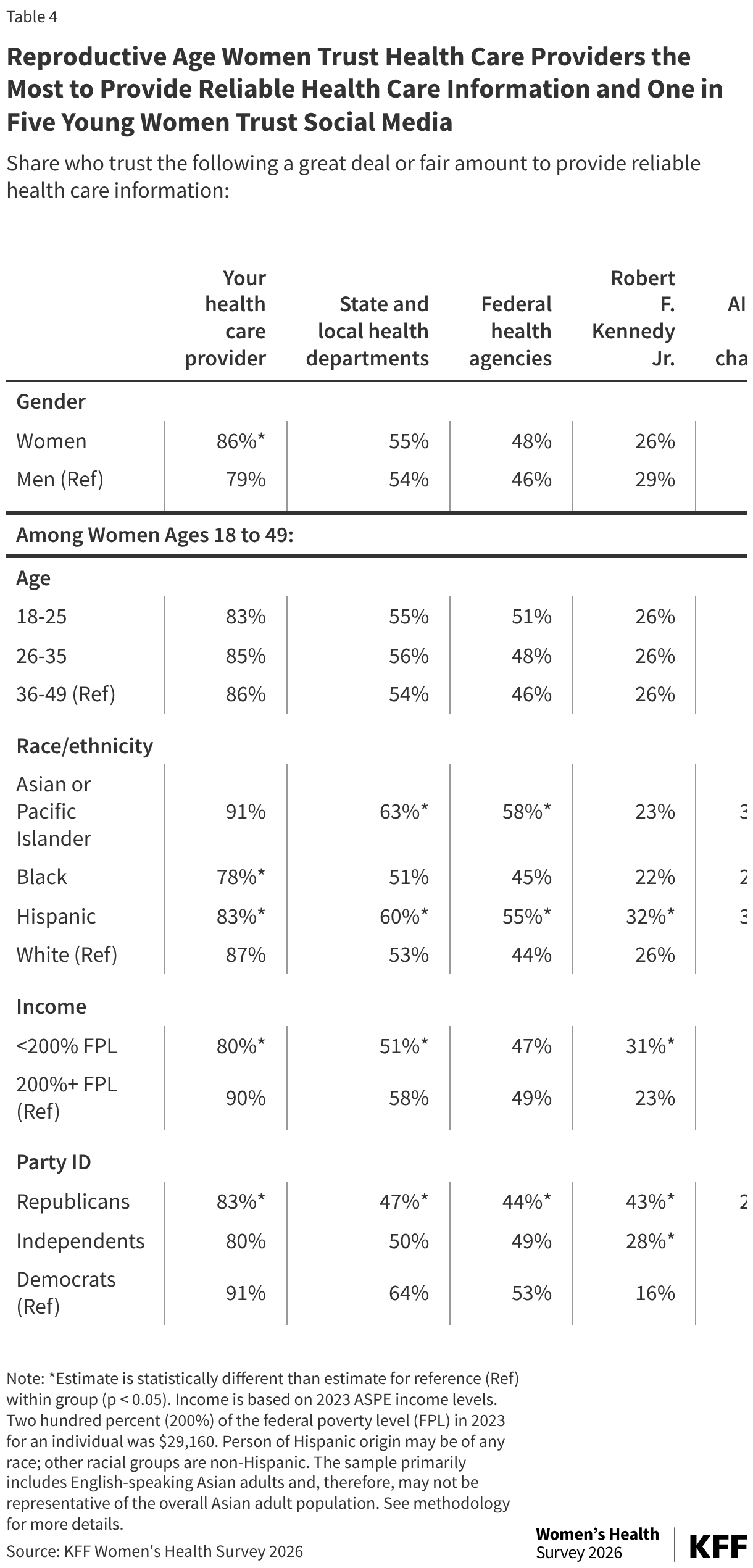
- Health care providers remain the most trusted sources for reliable health care information for reproductive-age women despite widespread use of online sources and social media. Health care providers are the most trusted source for reliable health care information among reproductive age women (86% say they trust them a great deal or a fair amount), while one in four say they trust AI tools and chatbots (25%) for reliable health information and fewer (15%) trust social media and social media influencers. About half (48%) of women trust federal health agencies for reliable health care information and 26% trust the head of Health and Human Services (HHS), Robert F. Kennedy Jr. Higher shares of Democratic women trust their health care provider, state and local health departments and Federal health agencies compared to Republican women, while higher shares of Republican women trust Robert F. Kennedy Jr. And AI tools and chatbots compared to Democratic women.
Contraception on Social Media
- Regardless of whether they sought it out, a higher share of younger women has seen or heard information about contraception on social media compared to their older counterparts. One in three (35%) women of reproductive age have seen or heard something about contraception on social media in the past 12 months, rising to 42% of younger women (ages 18 to 25).
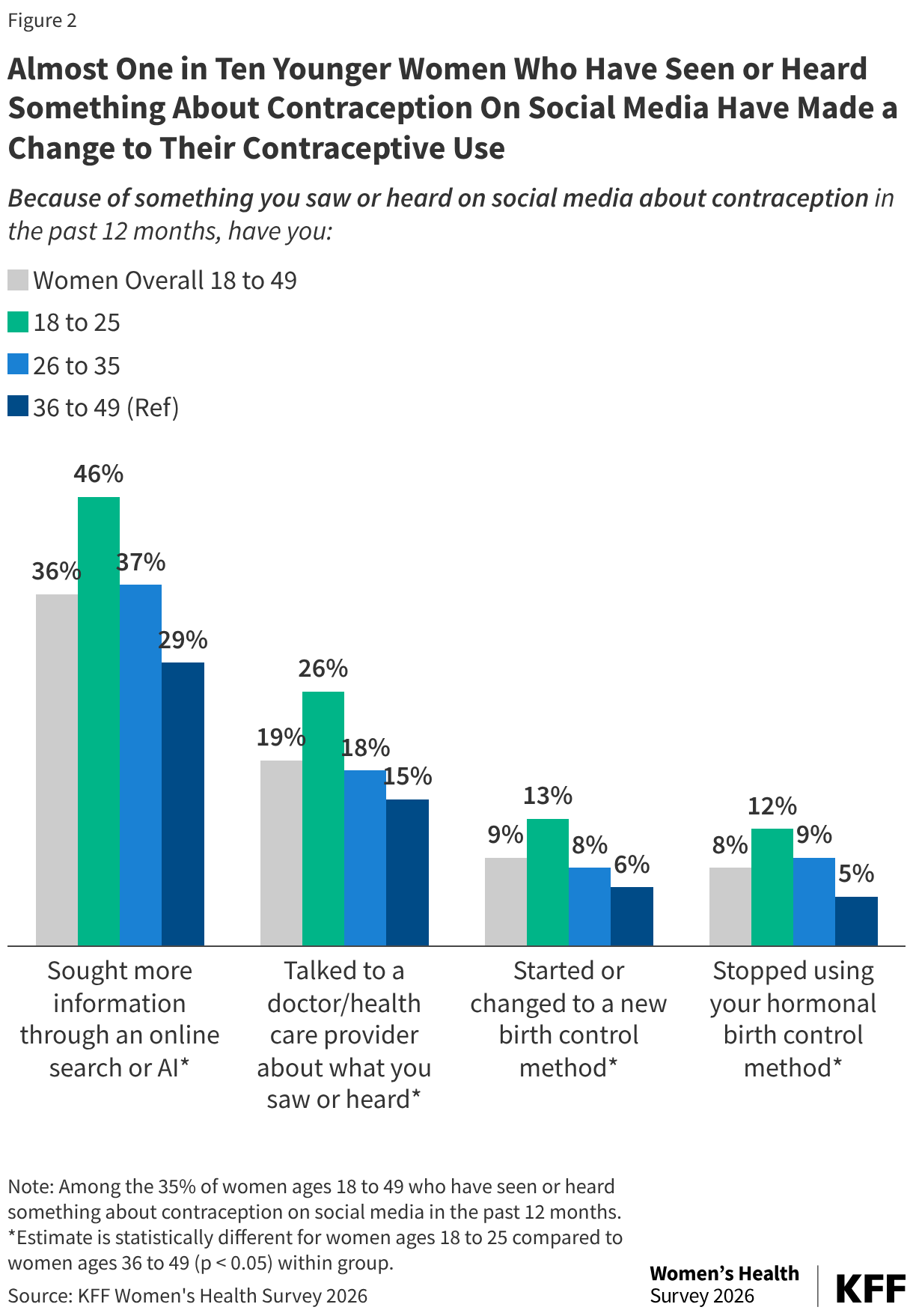
- Younger women (18 to 25) are more likely than women ages 36 to 49 to talk to their doctor, seek more information online, or change their contraceptive behavior based on something they saw on social media. Among women who saw or heard something about contraception on social media, larger shares of young women ages 18 to 25 compared to women ages 36 to 49 stopped using their hormonal birth control method (12% vs. 5%), started or changed to a new birth control method (13% vs. 6%), sought more information from a doctor or healthcare provider (26% vs. 15%), or sought more information through an online search or AI (46% vs. 29%).
Exposure to False or Misleading Statements About Contraception
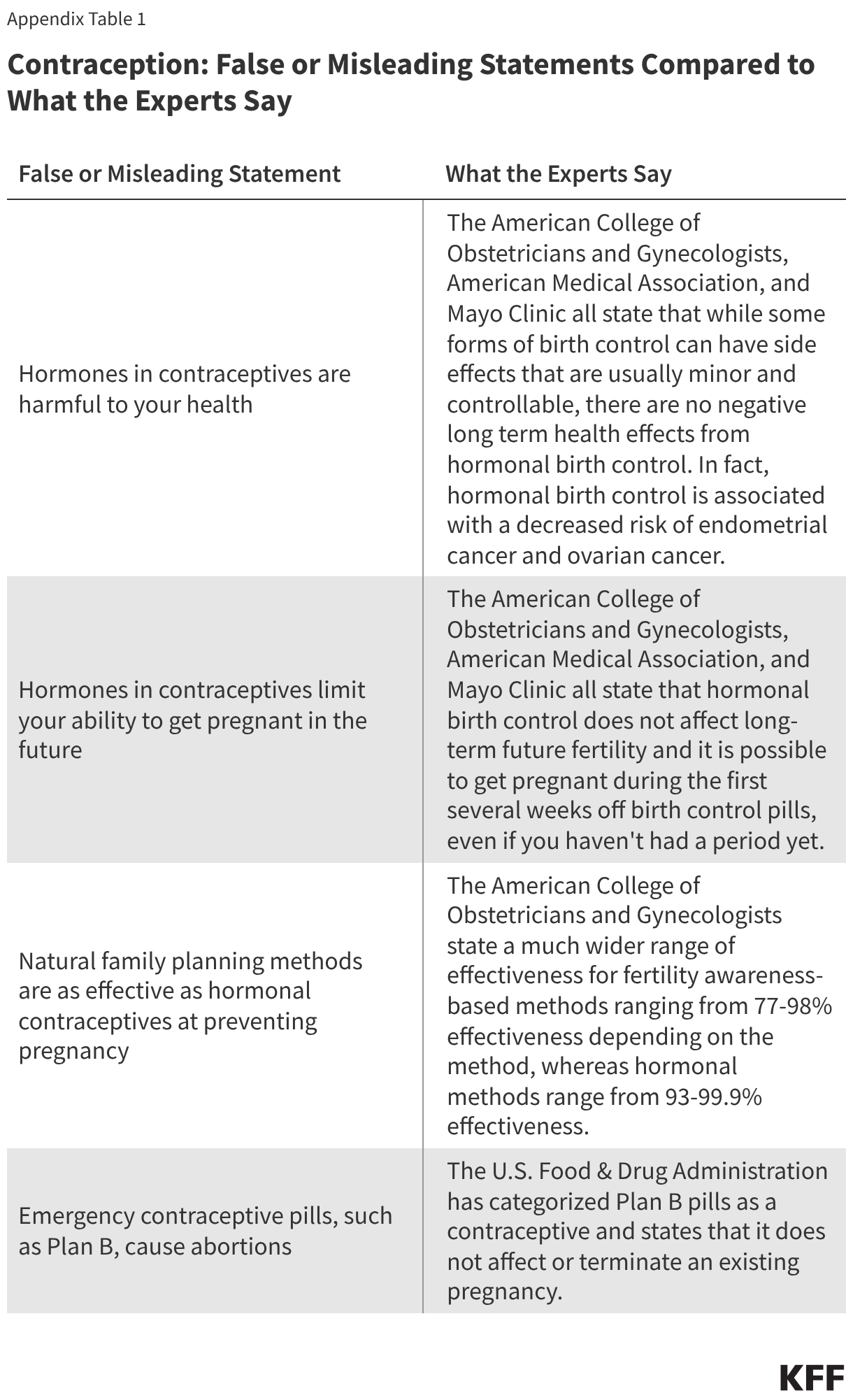
Large shares of reproductive age women report being exposed to false and misleading statements about contraception. About half (53%) of women of reproductive age say they have seen or heard the false statement that hormones in contraceptives are harmful to your health on social media or elsewhere and about four in ten (43%) have been exposed to the false claim that hormones in contraceptives limit your ability to get pregnant in the future. About one in three (32%) have heard that natural family planning methods are as effective as hormonal contraceptives at preventing pregnancy (when it is less effective) and emergency contraceptive pills, such as Plan B, cause abortions (emergency contraceptive pills do not end a pregnancy).
Findings
Accessing Health Information
The majority of reproductive age women (87%) and men (86%) have looked for health information or advice online either through an internet search engine, social media, or AI tools. Most reproductive age women (83%) and men (81%) have used internet search engines, such as Google or Bing, in the past year to look for health information or advice (Table 1). Women are more likely than men to use social media to search for health information (44% vs. 38%) but are as likely to look for health information through an AI tool or chatbot such as ChatGPT, Google Gemini, or Claude (42% for women vs. 46% for men). Nearly one in four (24%) women say they have used all three methods — internet search engines, AI tools, and social media — to search for health information (data not shown).
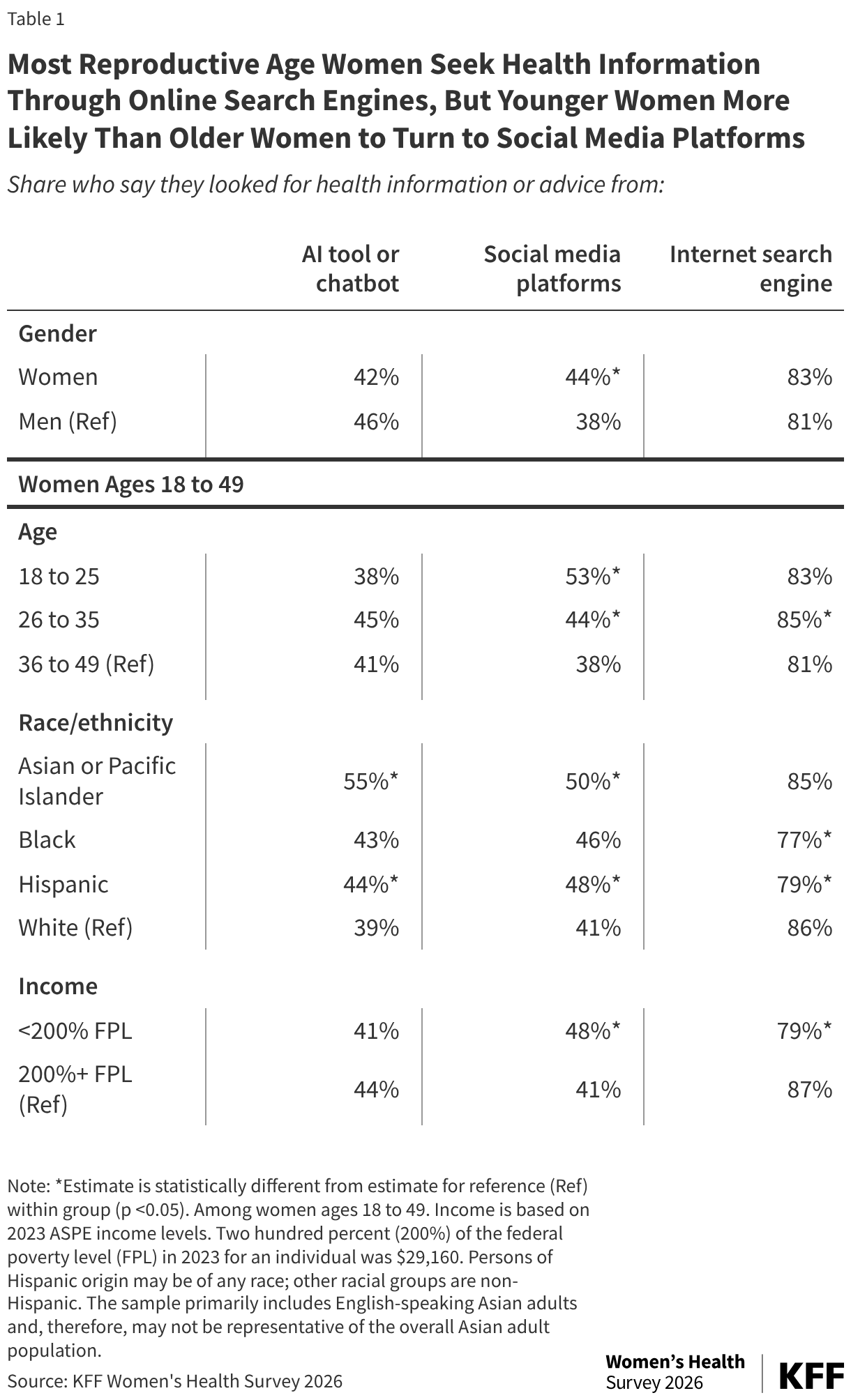
Larger shares of Asian (55%) and Hispanic (44%) women say they used AI tools or chatbots for health information in the past year compared to White women (39%). In general, smaller shares of people report using social media platforms for health information or advice. However, half of Asian (50%) and Hispanic (48%) women report looking for health information or advice on social media compared to four in ten White women (41%). Over half (53%) of women ages 18 to 25 also report using social media for health information. Larger shares of women with low incomes looked for health information on social media compared to women with higher incomes (48% vs. 41%). This aligns with previous KFF polling findings that have found younger adults and adults with lower incomes are more likely to use social medial for health information and are more likely to say they do so because they can’t afford to see a provider or don’t have a regular provider.
The survey asked whether individuals sought information about different health topics through these various platforms and nearly half of reproductive age women say they sought information about mental health (47%) (Table 2). This rose to 57% of women ages 18 to 25. A quarter of women of reproductive age (26%) sought information about menopause online, but almost half (46%) of women between the ages of 36 and 49 looked for this information online. Three in ten women of reproductive age (30%) say they looked for information about pregnancy and childbirth. However, among women who were pregnant or gave birth in the past three years, seven in ten (71%) report seeking information about pregnancy and childbirth online (data not shown in table). One in three (33%) women ages 18 to 25 sought information about contraception and one in six (18%) sought information about abortion.
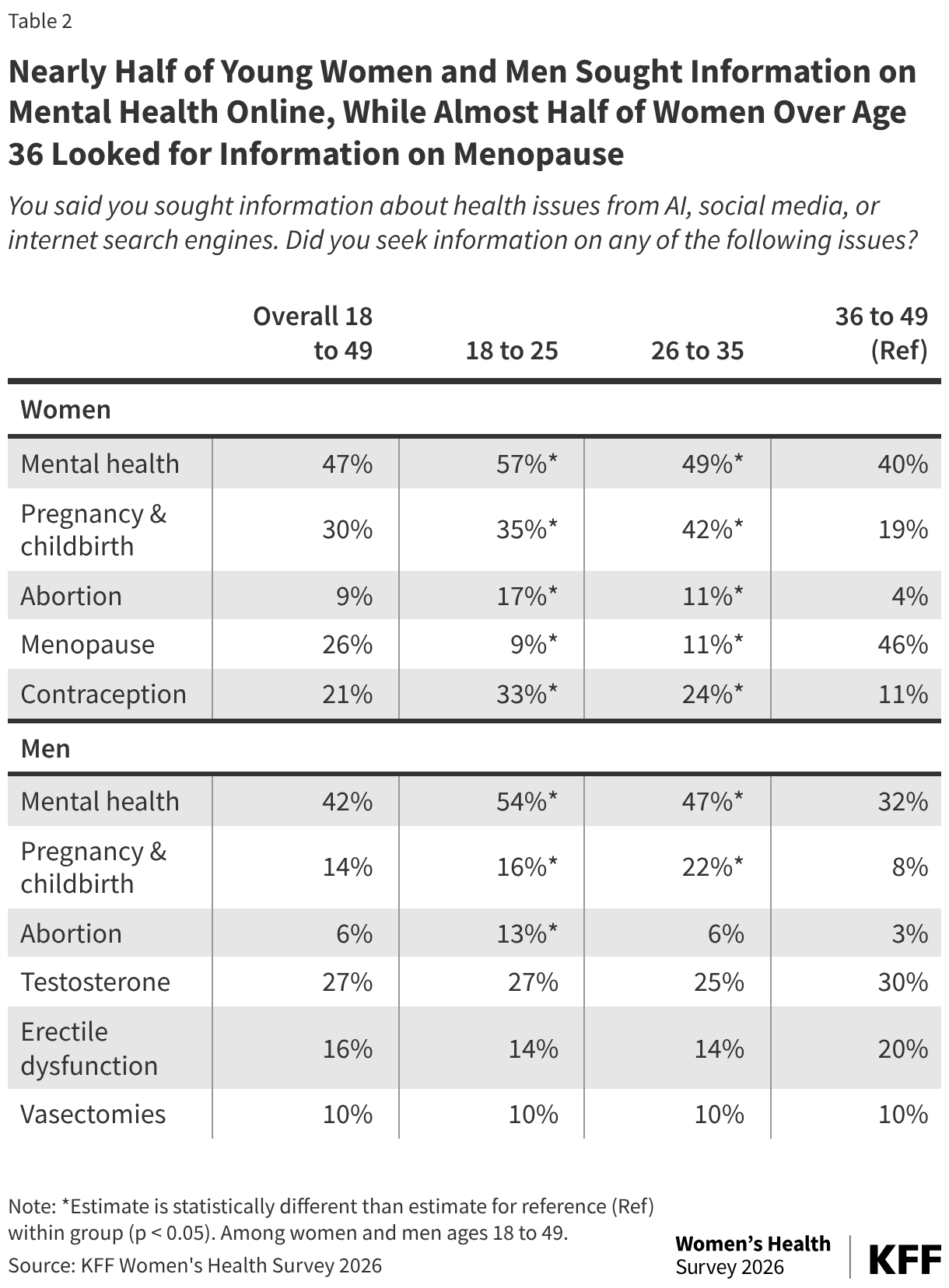
Slightly smaller shares of reproductive age men sought health information through social media (38% vs. 44%) compared to women, but similar shares looked for information via internet search engines (81% vs. 83%) and AI tools and chatbots (46% vs. 42%). Of the health topics the survey asked about, the largest share of reproductive age men sought information about mental health (42%), including over half (54%) of men ages 18 to 25 and 47% of men ages 26 to 35. Over a quarter (27%) of men looked for information about testosterone levels and 16% searched for information about erectile dysfunction. Not surprisingly, fewer men than women looked for information about pregnancy and childbirth, but nearly one in four (22%) men ages 26 to 35 did. One in ten (10%) reproductive age men sought information about vasectomies and 6% of men looked for information about abortion, although 13% of men ages 18 to 25 looked for information on abortion.
Contraception on Social Media
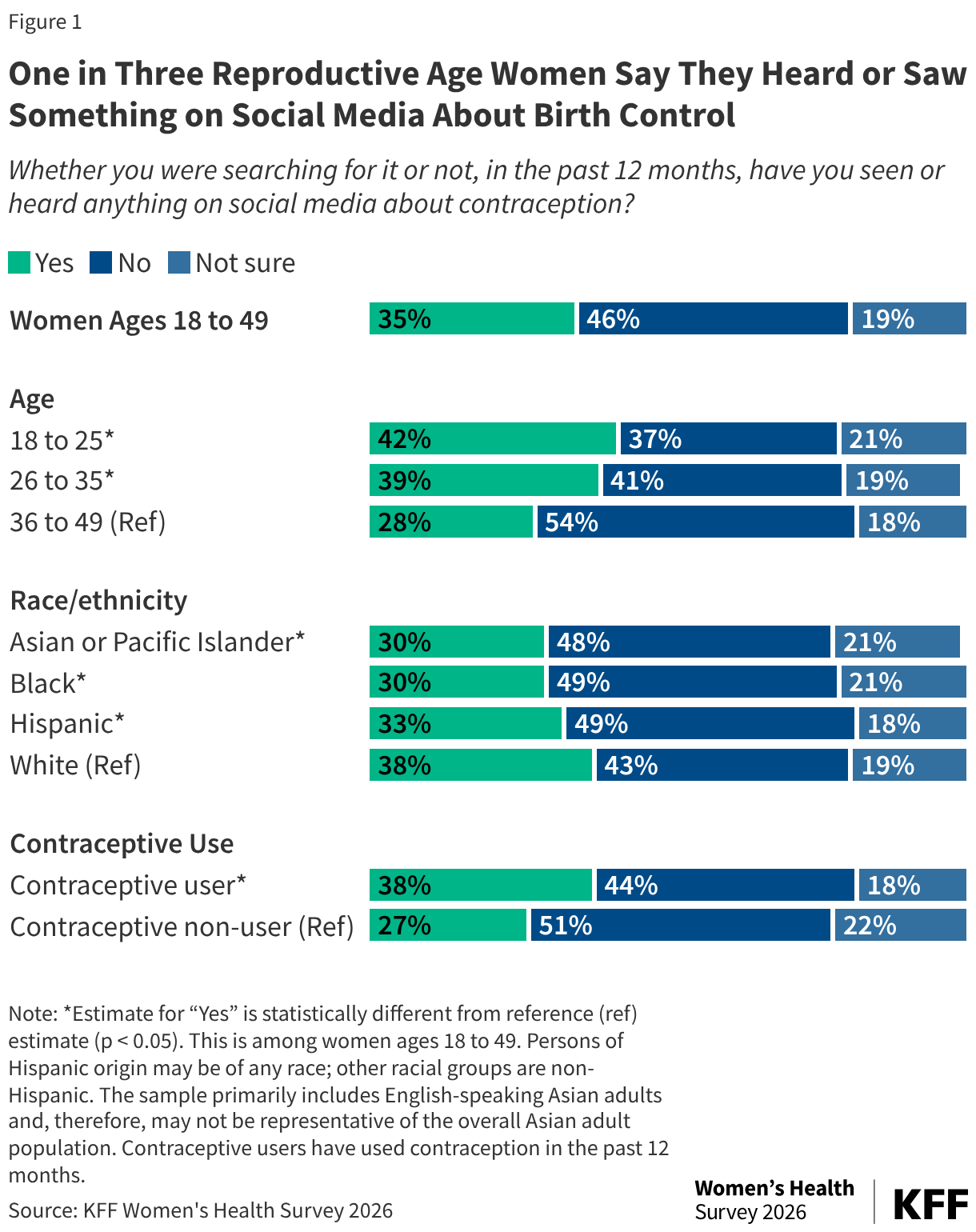
Regardless of whether they sought it out, one in three (35%) women of reproductive age have seen or heard something about contraception on social media in the past 12 months, with larger shares of younger women reporting exposure (Figure 1). Social media has become a common place for people to view information about contraception. Of those who have seen or heard something about contraception on social media, 78% report using contraception in the past 12 months with the majority using hormonal methods (62%) (data not shown). A larger share of contraceptive users report seeing information about contraception on social media compared to non-contraceptive users (38% vs. 27%).
Contraceptive information seen online can lead women to seek more information or make a change to the contraceptive practices. One in ten women who saw contraceptive information on social media said they changed their contraceptive use behavior, such as stopping their hormonal birth control (8%, 3% of all women ages 18 to 49) or starting or changing to a new birth control method (9%, 3% of all women ages 18 to 49), one in five (19%) who saw contraceptive information (7% of all women ages 18 to 49) talked to a doctor or health care provider about what they saw or heard, and a third (36%) sought more information through an online search or AI (12% of all women ages 18 to 49) (Figure 2). Larger shares of young women ages 18 to 25 compared to women ages 36 to 49 stopped using their hormonal birth control (12% vs. 5%), started or changed to a new birth control method (13% vs. 6%), sought more information from a doctor or healthcare provider (26% vs. 15%), or sought more information through an online search or AI (46% vs. 29%).
False or Misleading Statements About Contraception
Many women report seeing content on social media or elsewhere that promotes contraceptive misinformation. The survey asked whether women had seen or heard four widely spread pieces of contraceptive misinformation (Table 3). About half (53%) of women of reproductive age had seen or heard that hormones in contraceptives are harmful to your health and about four in ten (43%) had seen or heard that hormones in contraceptives limit your ability to get pregnant in the future. Women of color report lower exposure to hearing that hormones are harmful, while larger shares of young women had been exposed to this false statement.
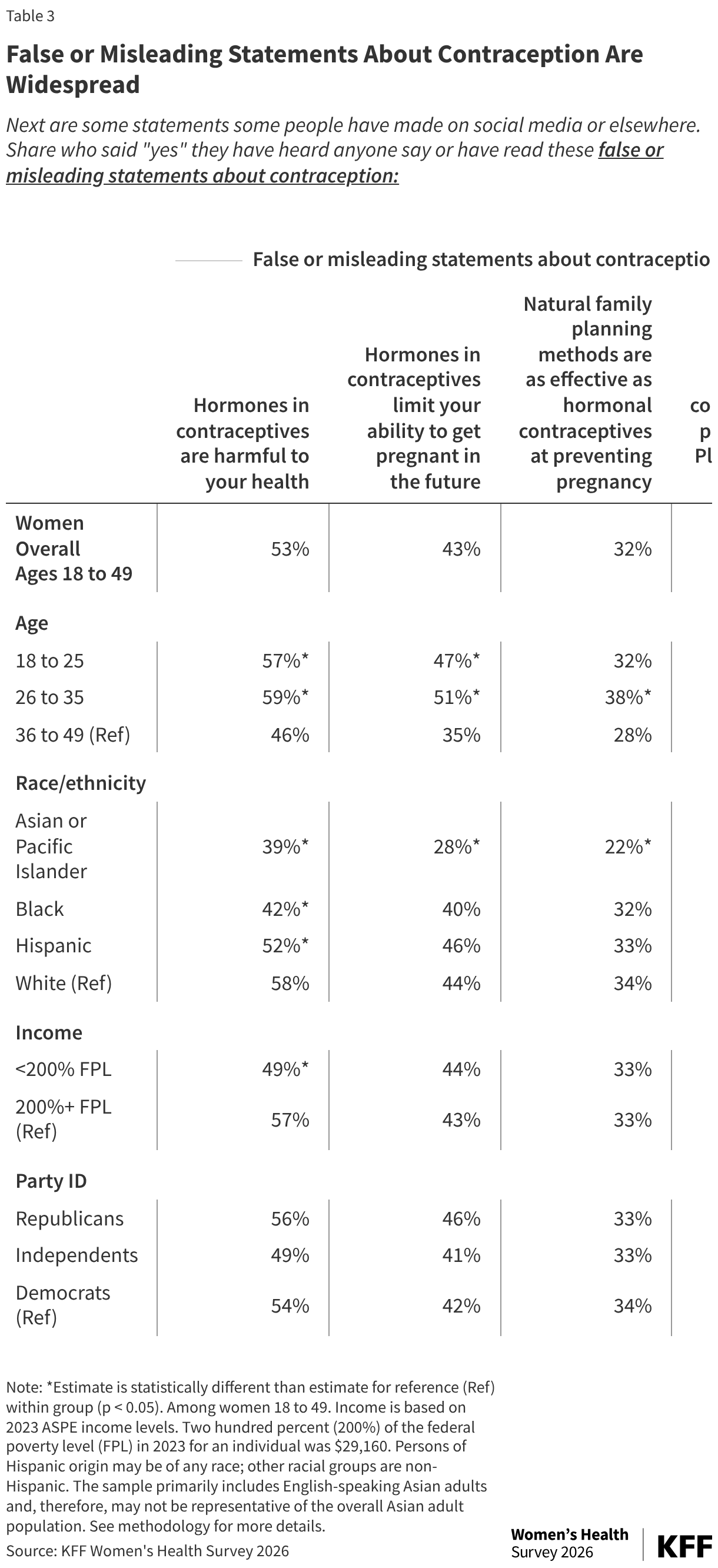
Natural family planning or fertility awareness-based methods have been promoted on social media to appeal to people who erroneously think hormones are harmful to your health or those who are seeking non-hormonal methods. One in three (32%) reproductive age women say they have seen or heard that natural family methods are as effective as hormonal contraceptives at preventing pregnancy. Natural family planning methods fall under fertility awareness-based methods, which the American College of Obstetricians & Gynecologists say are 77%-98% effective at preventing pregnancy, whereas hormonal contraceptives are 93-99.9% effective.
One in three (32%) reproductive age women have seen or heard on social media that emergency contraceptive pills, such as Plan B, cause abortions, which is also untrue. Emergency contraceptive pills cannot terminate an existing pregnancy, cannot prevent the implantation of a fertilized egg, and cannot affect a developing embryo.
Trusted Sources for Health Care Information
When asked who they trust to provide reliable health information, the majority of reproductive age women say they trust their health care provider a great deal or fair amount (86%) slightly higher than 79% of reproductive age men (Figure 3 and Table 4). While trust in health care providers is consistently highest across different groups, it declines slightly among lower income groups (Table 4). Over half (55%) of all women also say they trust state and local health departments and even higher shares of Asians (63%) and Democrats (64%) trust these sources.
The survey also finds one quarter (25%) of reproductive age women trust AI tools and chatbots a great deal or a fair amount for reliable health information, which is similar across demographic groups. A higher share of reproductive age Asian women trust AI tools or chatbots. Few women trust social media and social media influencers (15%) for reliable health care information; however, this rises to over one in five (21%) 18- to 25-year-women.
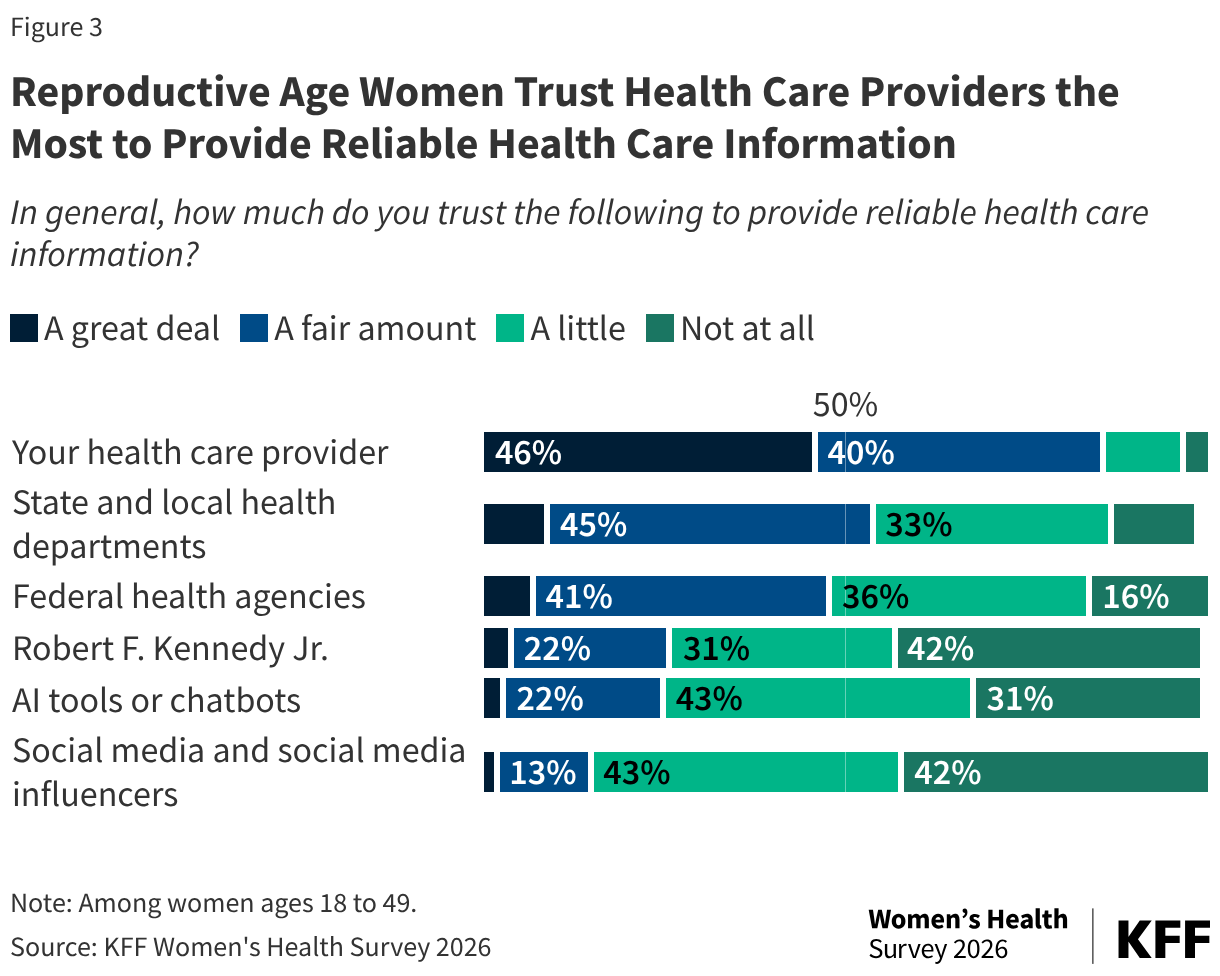
About half (48%) of women ages 18 to 49 trust federal health agencies a great deal or fair amount for reliable health care information (Figure 3). This comes after a year of significant layoffs of federal health workers and changes to federal health websites like the Centers for Disease Control and Prevention (CDC) and Health and Human Services (HHS). About a quarter (26%) of reproductive age women say they trust the head of HHS, Robert F. Kennedy Jr. to provide reliable health care information.
Appendix
Methodology
The 2026 KFF Women’s Health Survey was designed and analyzed by women’s health researchers at KFF. The survey was conducted from March 11 – April 14, 2026, online and by telephone among a nationally representative sample of 5,854 adults ages 18 to 64, including 3,538 women ages 18 to 49. Women include anyone who selected woman as their gender. Sampling, data collection, weighting, tabulation, and IRB approval by the University of Southern Maine’s Collaborative Institutional Review Board were managed by SSRS of Glenn Mills, Pennsylvania in collaboration with women’s health researchers at KFF.
Throughout the reports of findings, we refer to “women.” This includes respondents who said their gender is “woman,” and includes those who selected “woman” in addition to another gender, such as “transgender,” or “non-binary,” or another gender. We followed this approach to try to include as many people as possible but recognize that some people who need and seek abortion and other reproductive health care services may not be represented in the findings or identify as women. Some questions about sexual and reproductive health were only asked among those with a specific sex assigned at birth (i.e. male or female).
The national sample was drawn from two nationally representative probability-based panels: the SSRS Opinion Panel and the Ipsos Knowledge-Panel. The SSRS Opinion Panel is a nationally representative probability-based panel where panel members are recruited randomly in one of two ways: (a) Through invitations mailed to respondents randomly sampled from an Address-Based Sample (ABS) provided by Marketing Systems Groups (MSG) through the U.S. Postal Service’s Computerized Delivery Sequence (CDS); (b) from a dual-frame random digit dial (RDD) sample provided by MSG. For the online panel component, invitations were sent to panel members by email followed by up to five reminder emails. 5,660 panel members completed the survey online and panel members who do not use the internet were reached by phone (n=194). Another 514 respondents were reached online through the Ipsos Knowledge Panel to help reach adequate sample sizes among subgroups of interest, specifically women ages 18 to 49. This panel is recruited using ABS, based on a stratified sample from the CDS. The questionnaire was translated into Spanish, so respondents were able to complete the survey in English or Spanish.
The national sample was weighted by splitting the sample into three groups: [1] Women 18-49, [2] Women 50-64, and [3] Men 18-64 and each group was separately weighted to match known population parameters (see table below for weighting variables and sources). Weights within the three groups were then trimmed at the 4th and 96th percentiles, to ensure that individual respondents do not have too much influence on survey-derived estimates. After the weights were trimmed, the samples were combined, and the weights adjusted, so that the groups were represented in their proper proportions for a final combined, gender by age-adjusted weight.
| Dimensions | Source |
| Age | Current Population Survey 2025 |
| Education | |
| Age by Education | |
| Age by Gender | |
| Census Region | |
| Race/Ethnicity by Nativity | |
| Home Tenure | |
| Civic Engagement | 2023 CPS Volunteering and Civic Life Supplement |
| Internet Frequency | Pew Research Center’s National Public Opinion Reference Survey (NPORS 2025) |
| Population Density | Claritas Pop-Facts Premier 2026 |
| Voter Registration | CPS 2024 Voting and Registration Supplement |
The margins of sampling error for the national sample of women ages 18 to 64 and reproductive age women ages 18 to 49 are plus or minus 2 percentage points. Numbers of respondents and margins of sampling error for key subgroups are shown in the table below. For results based on other subgroups, the margin of sampling error may be higher. Sampling error is only one of many potential sources of error and there may be other unmeasured error in this survey.
| Group | N (unweighted) | M.O.S.E. |
| National Women Ages 18-49 | 3,538 | ± 2 percentage points |
| White, non-Hispanic | 1,547 | ± 3 percentage points |
| Black, non-Hispanic | 624 | ± 5 percentage points |
| Hispanic | 946 | ± 4 percentage points |
| Asian or Pacific Islander | 307 | ± 7 percentage points |
| <200% FPL | 1,308 | ± 3 percentage points |
| 200%+ FPL | 1,958 | ± 3 percentage points |
| Private | 2,131 | ± 3 percentage points |
| Medicaid | 790 | ± 4 percentage points |
| Uninsured | 457 | ± 6 percentage points |
| Democrat/Democrat leaning | 1,765 | ± 3 percentage points |
| Independent | 497 | ± 5 percentage points |
| Republican/Republican leaning | 900 | ± 4 percentage points |