
New Guidance on Public Charge Determinations Does Not Specify Key Concepts, Likely Resulting in Immigrant Families Facing Ongoing Confusion and Fear

On Tuesday, August 18, 2026, the Department of Homeland Security (DHS) released guidance for officials to make public charge determinations under new regulations that take effect on September 18, 2026. The guidance and rule direct how federal officials determine whether to deny an individual in the U.S. adjustment to lawful permanent resident (LPR) status (i.e., a “green card”) based on public charge grounds. Some groups of immigrants are exempt from public charge determinations.
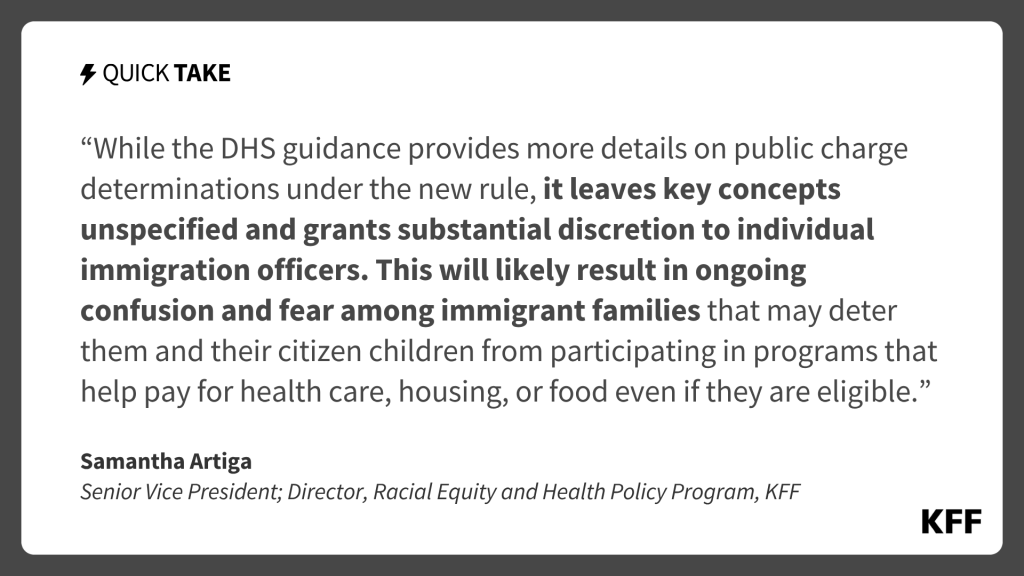
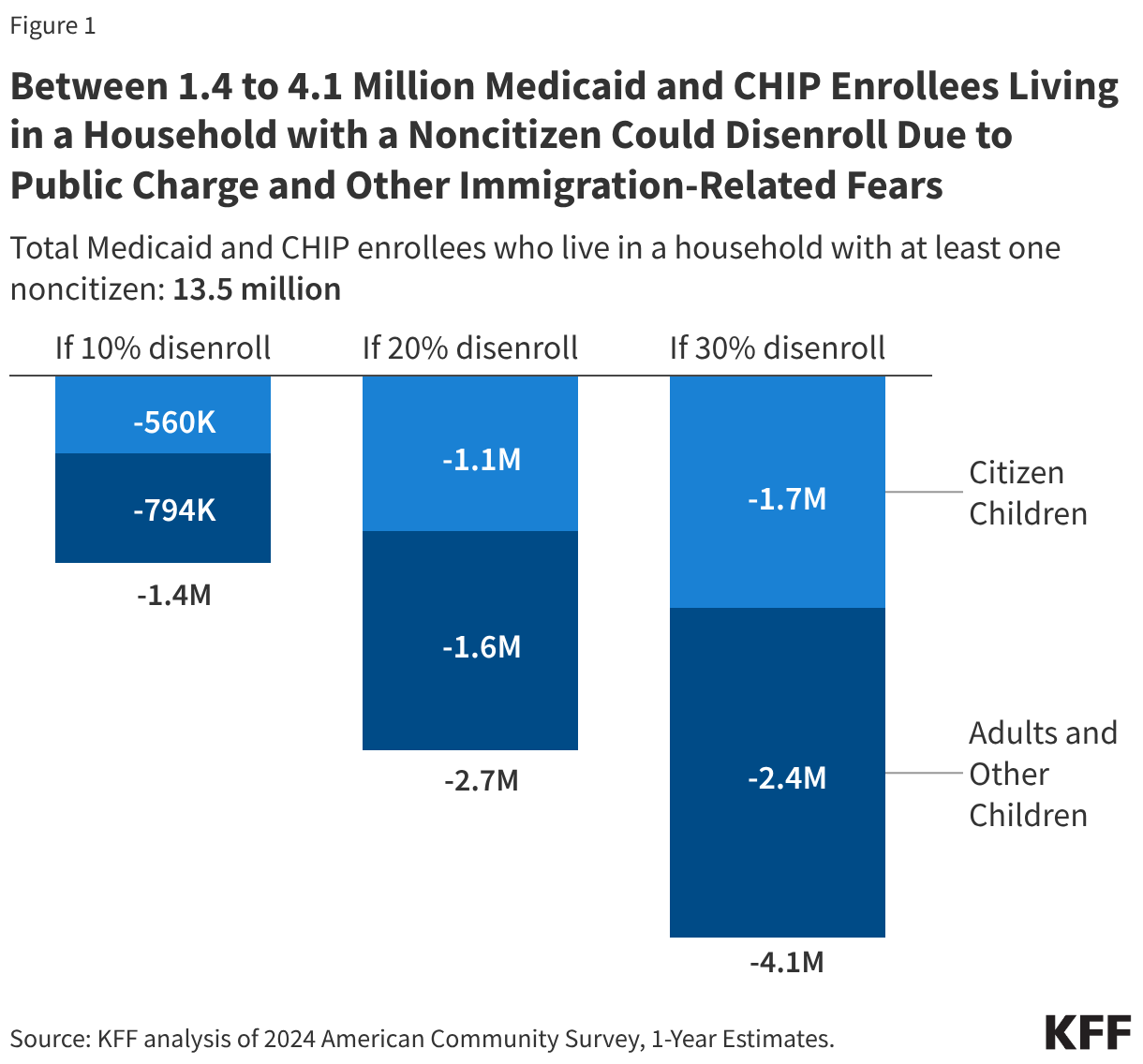
While the DHS guidance provides more details on public charge determinations under the new rule, it leaves key concepts unspecified and grants substantial discretion to individual immigration officers. This will likely result in ongoing confusion and fear among immigrant families that may deter them and their citizen children from participating in programs that help pay for health care, housing, or food even if they are eligible. KFF analysis shows that the rule and other immigration-related fears could lead to 1.4 million to 4.1 million Medicaid and CHIP enrollees who are living in a household with at least one noncitizen to disenroll, including about 560,000 to 1.7 million citizen children (Figure 1).
Prior regulations and guidance defined a public charge as someone likely to become primarily dependent on the federal government as demonstrated by the use of cash assistance programs for income maintenance or government-funded institutionalized long-term care. They excluded non-cash assistance programs, including health coverage, from public charge determinations. In contrast, the new guidance does not define public charge, instead indicating that officers should assess whether the individual is, “likely at any time to depend on means-tested public benefits.” Moreover, it does not limit or specify which means-tested benefits officers may consider.
In lieu of specifying benefits, the guidance directs officers to consider a broad array of means-tested programs, “including but not limited to cash assistance, public or assisted housing, financial aid for postsecondary education, food assistance, government-funded health coverage, or any other similar benefit for which payments or assistance are provided to an individual, household, or family eligibility unit.” It indicates these include programs funded by any federal, state, Tribal, territorial, or local government entity. It clarifies that benefits such as Social Security, Medicare, and unemployment insurance—for which eligibility is based on payments into the system—are NOT considered means-tested. While the guidance specifies that receipt of means-tested public benefits occurs when an individual (versus family members or children) is receiving the benefit, it also notes that, if an individual’s children or family members are receiving a means-tested benefit based on the individual’s income or assets being below a certain level, then the officer should consider the income or assets falling below a threshold as a factor.
The guidance reaffirms that determinations be made based on a “totality of circumstances,” meaning that any one factor, including benefit use, does not determine whether someone is a public charge. It also outlines how officers should consider statutorily required factors in making determinations, including age, health, and disability.
The rule and guidance will be applied to applications for adjustment of status postmarked or submitted on or after September 18, 2026.