
Medicaid/CHIP Monthly Enrollment Tracker
Enrollment Data
Note: The data presented below are updated monthly as new Medicaid/CHIP enrollment data become available.
This tracker presents the most recent data on monthly Medicaid and Children’s Health Insurance Program (CHIP) enrollment reported by the Centers for Medicare & Medicaid Services (CMS) as part of the Performance Indicator Project. It includes data for Medicaid and CHIP and reports enrollment data for children and adults. The data are generally the most recent data available and are useful for reporting trends in Medicaid enrollment. However, the data only capture full-benefit enrollees, excluding those who receive limited benefits, such as those who receive family planning services only, and consequently, do not provide a full count of the total population enrolled in Medicaid. Additionally, these data cannot be used to monitor changes in enrollment by eligibility pathway, including for adults in the Medicaid expansion group.
The 2025 reconciliation law included significant changes to Medicaid, including requiring adults in the expansion group and in certain 1115 waiver programs to meet new work and reporting requirements starting January 2027. These changes are expected to reduce Medicaid enrollment over the next 10 years relative to what would have been expected under current law. Enrollment data for the full Medicaid population is available here, and for more information on how implementation of Medicaid work requirements is affecting Medicaid expansion enrollment, please see Tracking Implementation of the 2025 Reconciliation Law Medicaid Work Requirements.
Medicaid/CHIP Historical Enrollment Trends
Medicaid/CHIP Current Enrollment Trends
The figures below show Medicaid and CHIP enrollment from February 2020 through the most current month of available data. Figures include enrollment for adults and children in Medicaid/CHIP and for Medicaid only and CHIP only. Key enrollment data and trends as of June 2026 include:
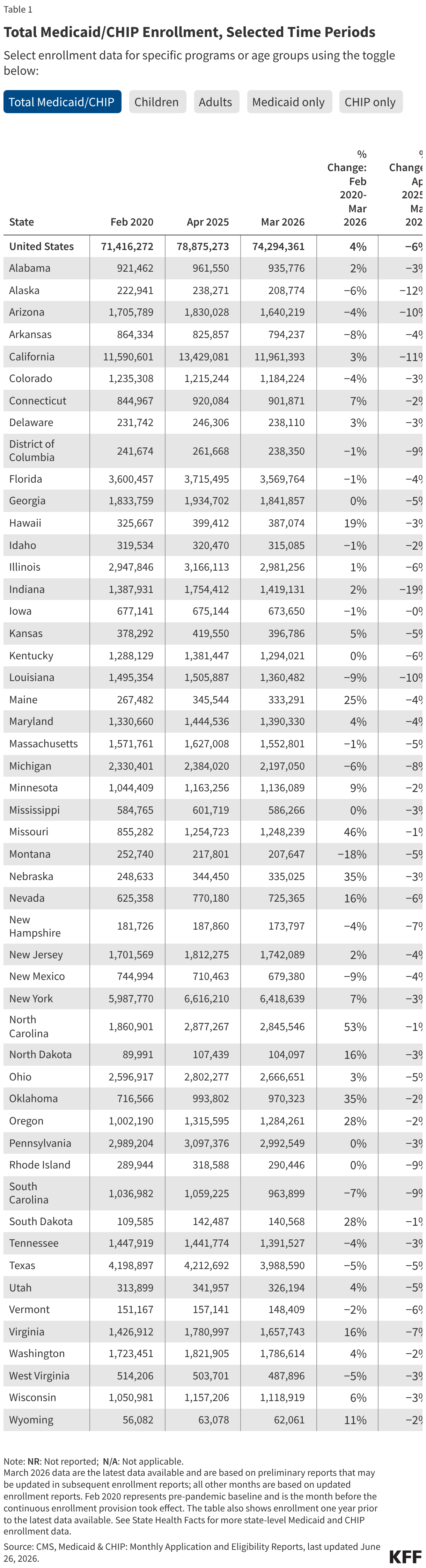
- There were 73.2 million people enrolled in Medicaid/CHIP nationally (Figure 1). Medicaid enrollment declined by 5.1 million or 6% from June 2025 through June 2026 (Table 1).
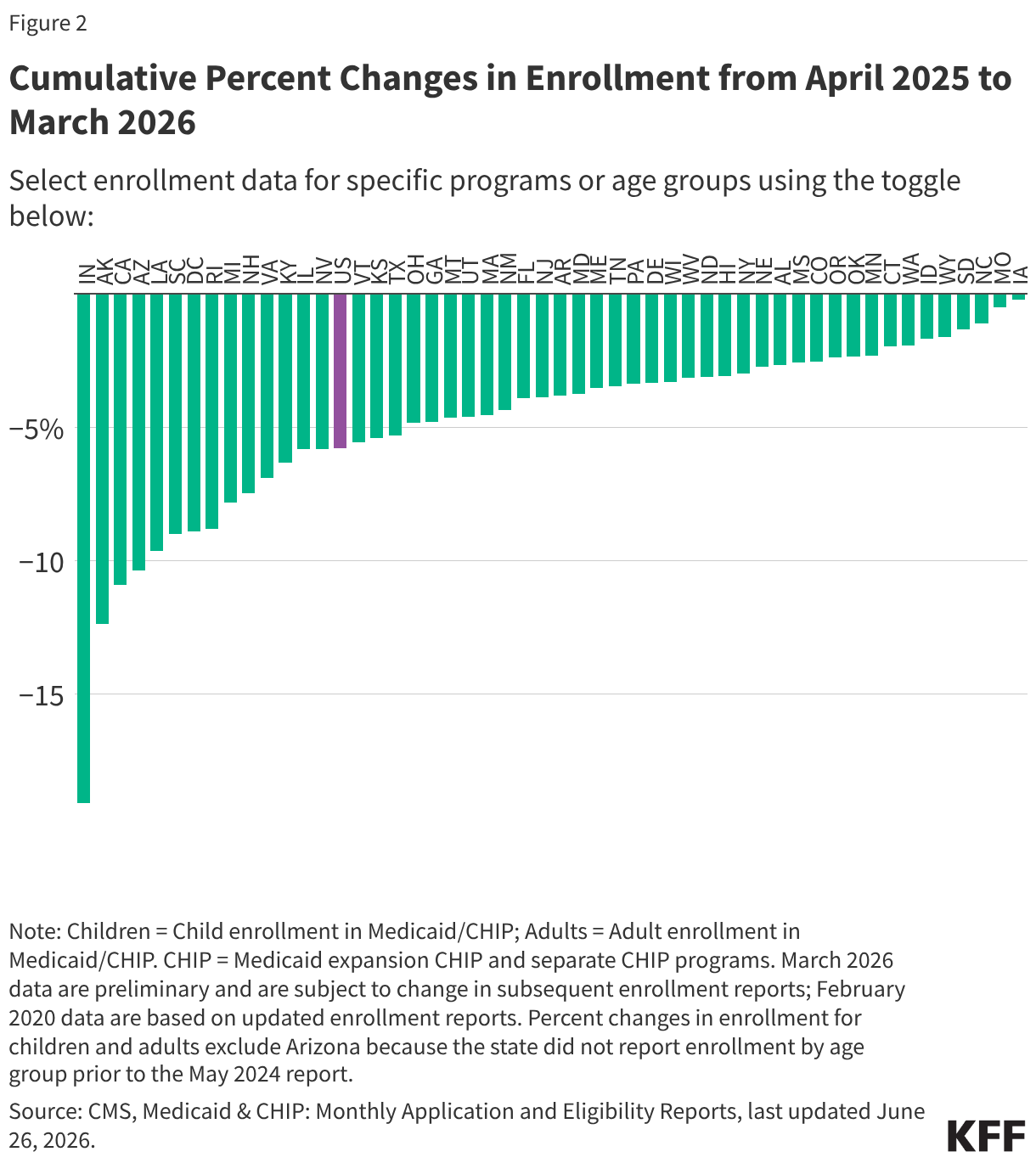
- Total Medicaid/CHIP enrollment has decreased in 49 states and DC since June 2025. Enrollment changes since June 2025 vary from a less than 1% increase in Iowa to a 19% decrease in Indiana (Figure 2).
- Child enrollment in Medicaid/CHIP has decreased in 49 states and DC from June 2025 through June 2026. Adult enrollment has decreased in all but five states (IA, MO, NC, OK, SD)(Figure 2).
- There were 66 million people enrolled in Medicaid and 7.2 million people enrolled in CHIP (Figure 1). Since June 2025, Medicaid enrollment has decreased in 49 states and DC while CHIP enrollment has increased in twenty states (AL, CA, CT, DE, FL, HI, IL, MO, NE, NJ, NM, NC, ND, OK, RI, SC, TN, VT, WA, WY).
- Total Medicaid/CHIP enrollment was 2% higher in June 2026 compared to enrollment in February 2020, prior to the pandemic. However, in the 49 states and DC with complete enrollment data by age, the number of children enrolled in Medicaid/CHIP declined by 960,000 or 3% from February 2020 to June 2026 (Figure 2 and Table 1).
Unwinding Data - Archived
Note: The data on unwinding renewal outcomes presented below were last updated on September 12, 2024; since most states have now completed the Medicaid unwinding, the information will not be updated again.
As of September 12, 2024 and with nearly complete unwinding data for most states:
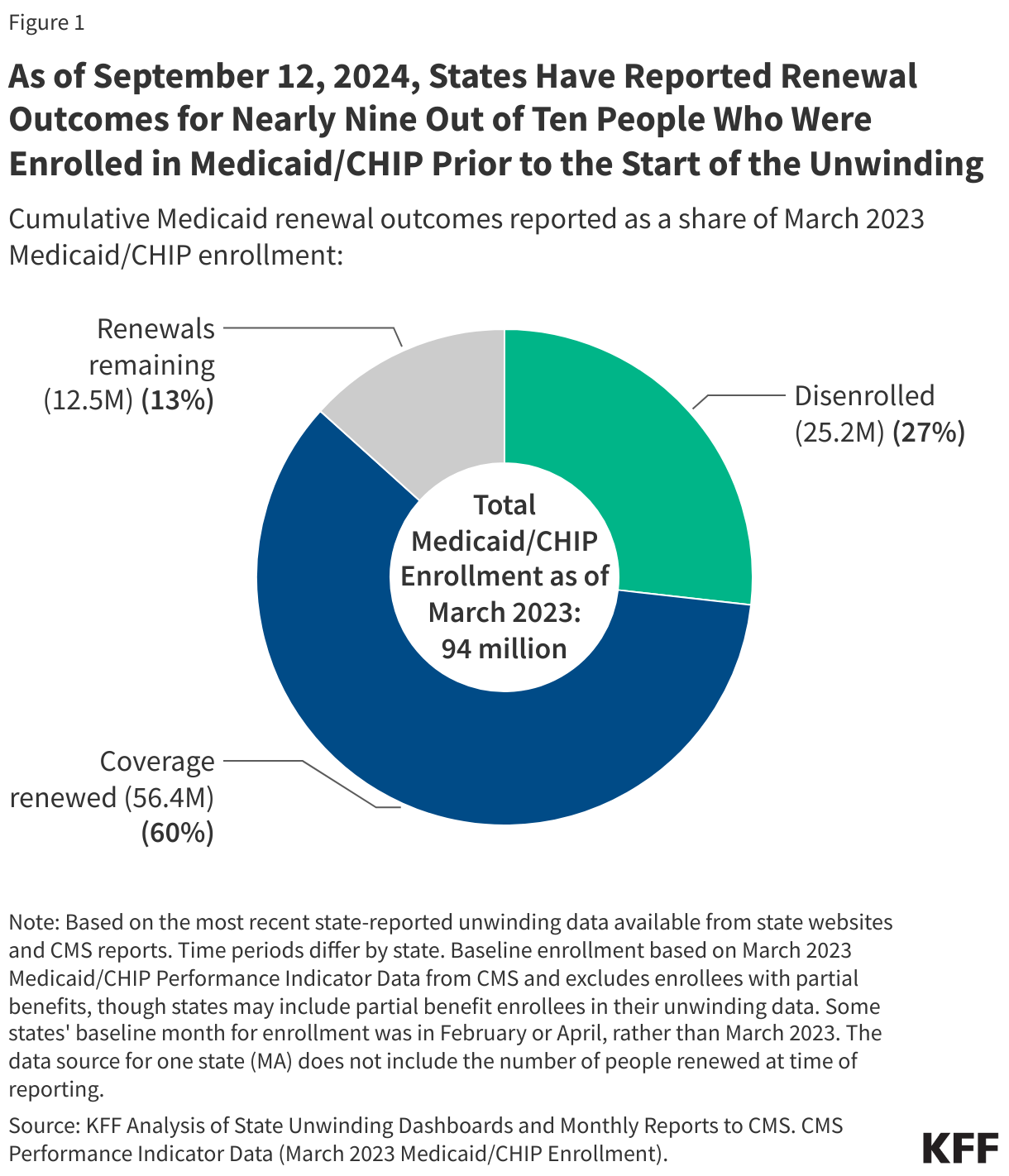
- Over 25 million people were disenrolled (31% of completed renewals) and over 56 million people had their coverage renewed (69% of completed renewals).
- Disenrollment rates varied across states from 57% in Montana to 12% in North Carolina, driven by a variety of factors including differences in renewal policies and procedures as well as eligibility expansions in some states.
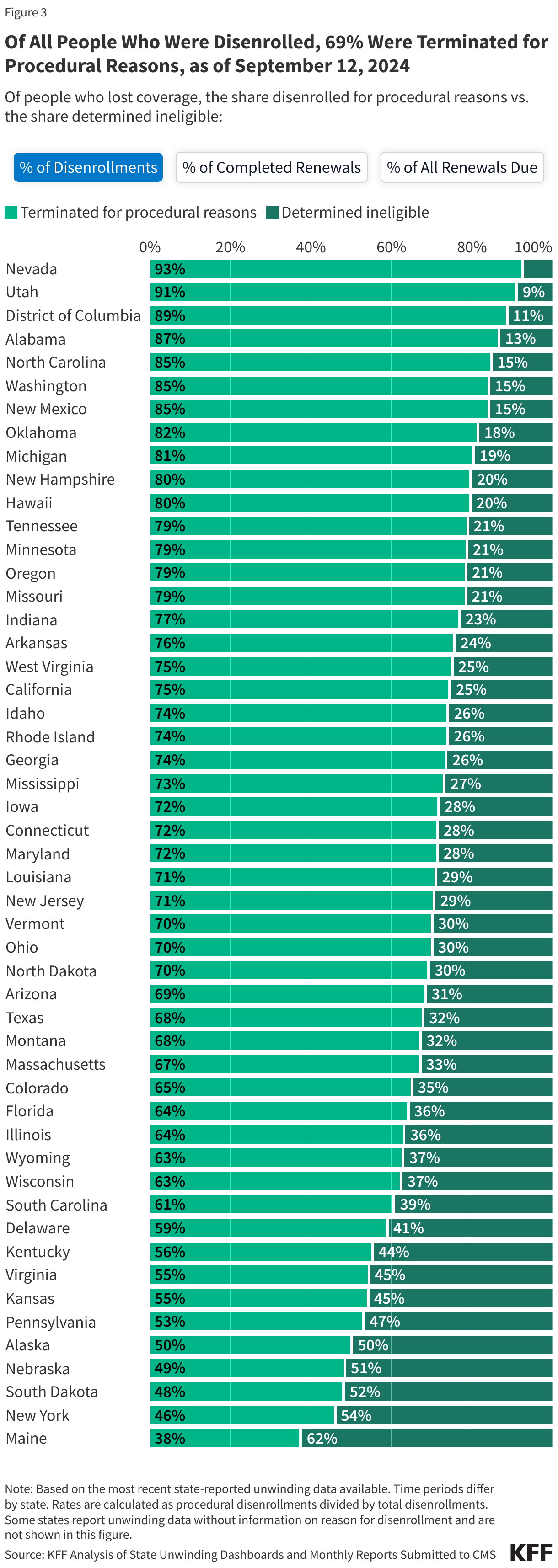
- Among those who were disenrolled, nearly seven in ten (69%) were disenrolled for paperwork or procedural reasons while three in ten (31%) were determined ineligible.
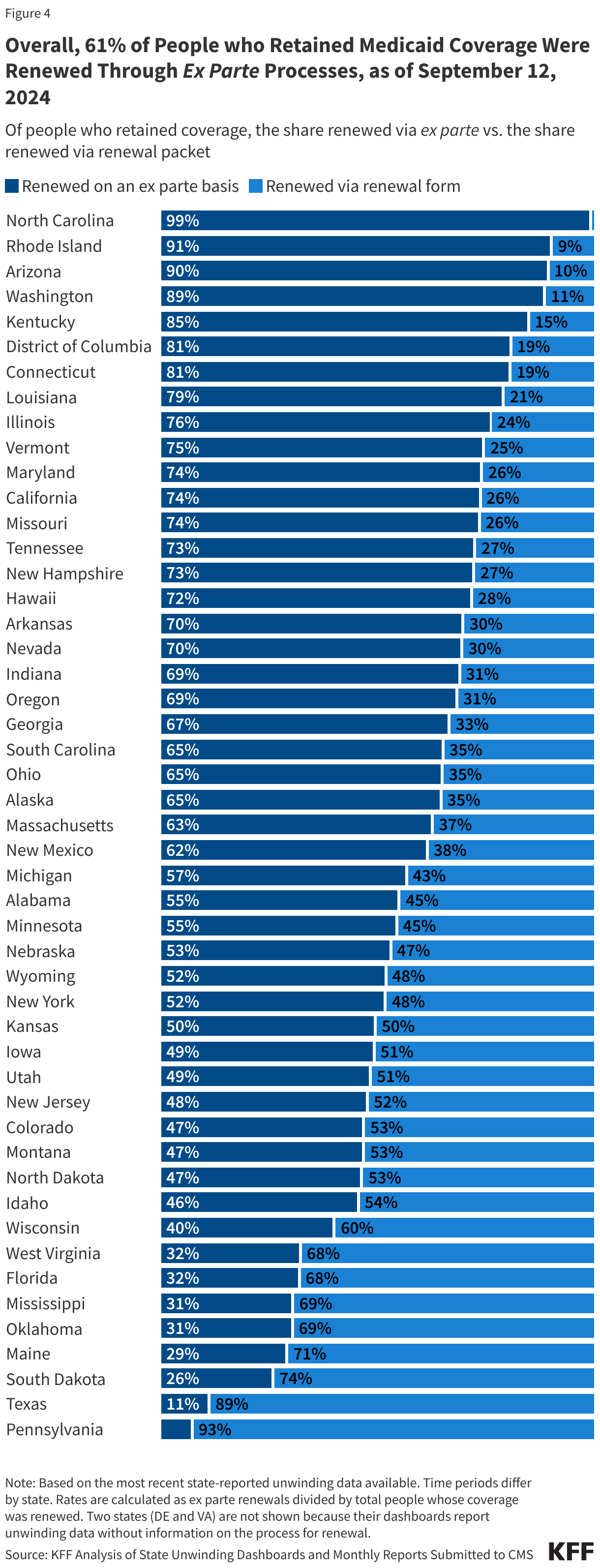
- Among those whose coverage was renewed during the unwinding, 61% were renewed on an ex parte, or automated, basis, meaning the individual did not have to take any action to maintain coverage.
State Data on Renewal Outcomes
The data on unwinding-related renewal outcomes presented in this section rely primarily on monthly reports that states were required to submit to the Centers for Medicare & Medicaid Services (CMS) during the unwinding period. The data also reflect updates to the monthly reports that states submit three months after the original report submission to account for the resolution of pending cases and any other changes in renewal metrics. For 13 states, data were pulled from dashboards or reports published on state websites that provide more complete information, and for a few additional states, updated monthly reports were pulled from state websites because they were more timely than what is reported on the CMS website.
To view archived data for specific states, click on the State Data - Archived tab.
Medicaid Disenrollments
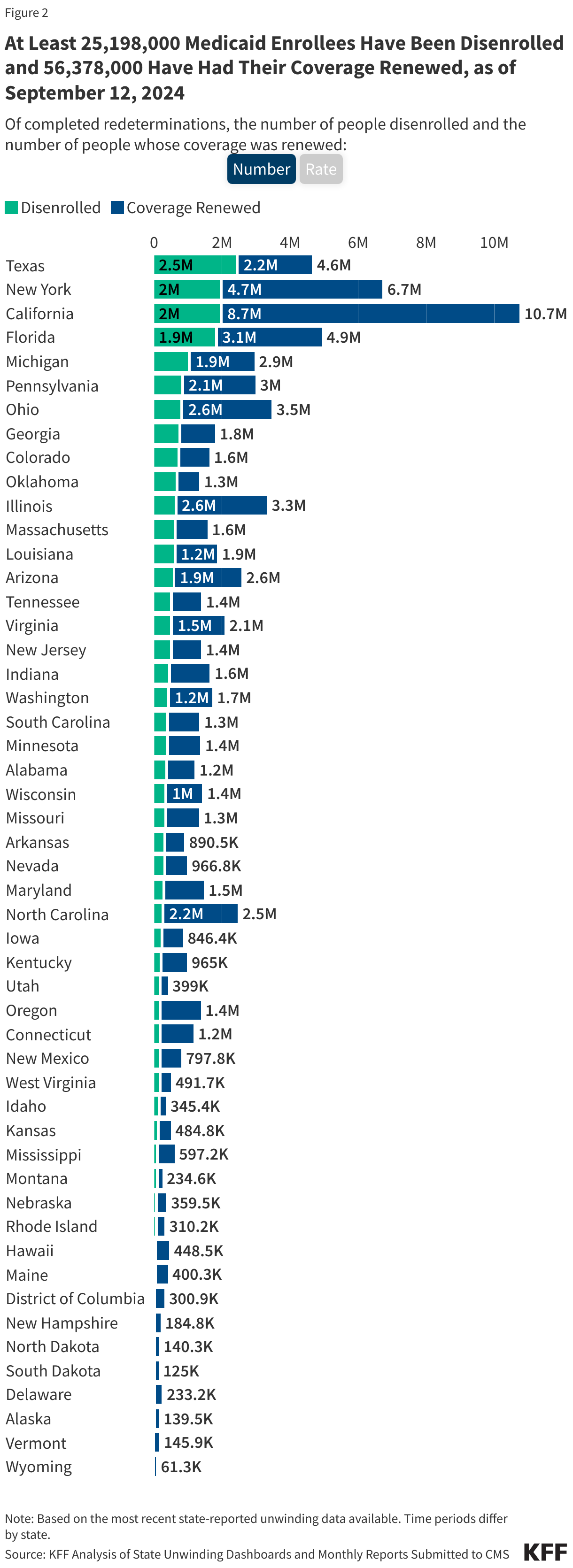
- As of September 12, 2024, at least 25,198,000 Medicaid enrollees had been disenrolled during the unwinding of the continuous enrollment provision. Overall, 31% of people with a completed renewal were disenrolled in reporting states while 69%, or 56.4 million enrollees, had their coverage renewed.
- There is wide variation in disenrollment rates across reporting states, ranging from 57% in Montana to 12% in North Carolina. A variety of factors contribute to these differences, including differences in renewal policies and system capacity. Some states adopted policies that promote continued coverage among those who remain eligible and/or have automated eligibility systems that can more easily and accurately process renewals while other states have adopted fewer of these policies and have more manually-driven systems. In addition, North Carolina and South Dakota adopted Medicaid expansion and other states increased eligibility levels for certain populations (e.g., children, parents, etc.) during the unwinding, which may have lowered disenrollment rates in these states.
- Across all states with available data, 69% of all people disenrolled had their coverage terminated for procedural reasons. However, these rates vary based on how they are calculated (see note below). Procedural disenrollments are cases where people are disenrolled because they did not complete the renewal process and can occur when the state has outdated contact information or because the enrollee does not understand or otherwise does not complete renewal packets within a specific timeframe. High procedural disenrollment rates are concerning because many people who are disenrolled for these paperwork reasons may still be eligible for Medicaid coverage.
(Note: The first tab in the figure below calculates procedural disenrollment rates using total disenrollments as the denominator. The second tab shows these rates using total completed renewals, which include people whose coverage was terminated as well as those whose coverage was renewed, as the denominator. And finally, the third tab calculates the rates as a share of all renewals due, which include completed renewals and pending cases.)
Medicaid Renewals
- Of the people whose coverage has been renewed as of September 12, 2024, 61% were renewed on an ex parte basis while 39% were renewed through a renewal form, though rates vary across states. Under federal rules, states are required to first try to complete administrative (or “ex parte”) renewals by verifying ongoing eligibility through available data sources, such as state wage databases, before sending a renewal form or requesting documentation from an enrollee. Ex parte renewal rates varied across states from 90% or more in Arizona, North Carolina, and Rhode Island to less than 20% in Pennsylvania and Texas.
Federal Data on Renewal Outcomes
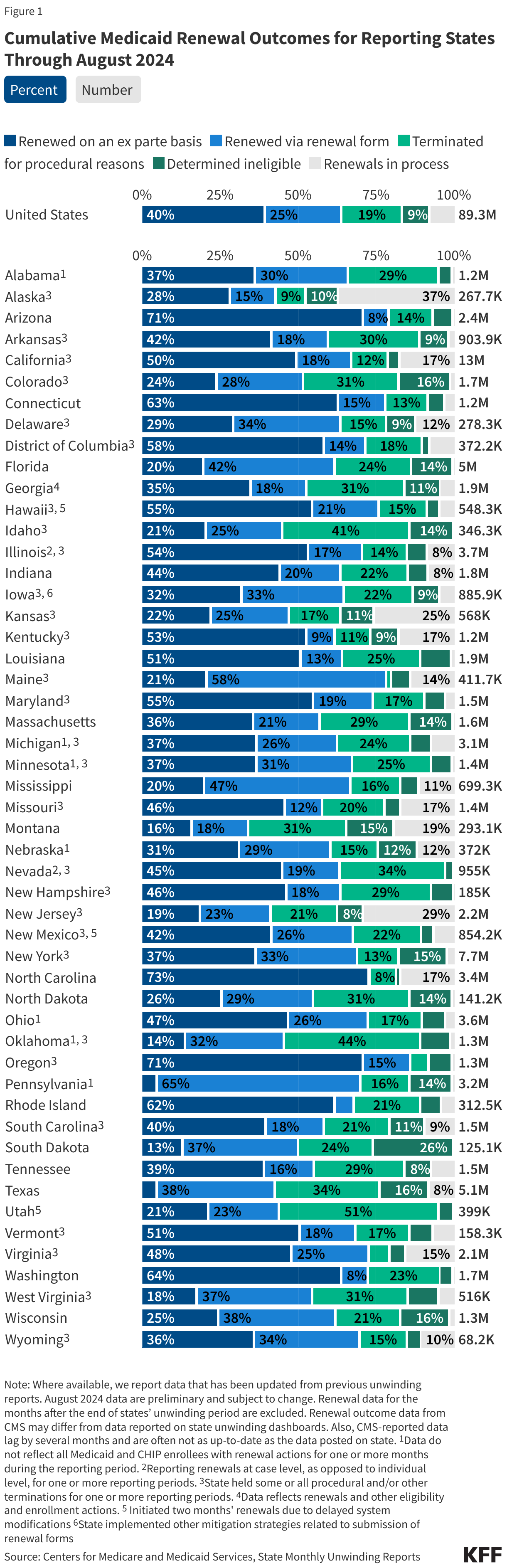
The data presented here are cumulative unwinding metrics published by CMS. These counts and percentages may differ from the above data, which present renewal metrics reported on state websites when state-reported data are more complete.
Figure 1 below shows cumulative renewal data reported by CMS during states’ unwinding periods. Renewal data for the months after the end of states’ unwinding period are excluded. The data reflect updated unwinding data reported by states three months after the original monthly reports as they become available.
For questions about this tracker, please contact KFFTracker@kff.org
State Unwinding Data - Archived
Note: The state data presented below were last updated on September 12, 2024; since most states have now completed the Medicaid unwinding, the information will not be updated again.
The data presented here provide state-level data on enrollment trends and renewal outcomes during the unwinding period. Figure 1 shows total Medicaid enrollment by month starting in January 2023 and, once disenrollments resumed in a state, the cumulative percent change in Medicaid enrollment relative to the month before Medicaid disenrollments started (this baseline month will differ across states). Figure 2 shows renewal metrics for each month of a state’s unwinding period (or cumulative data for the unwinding period for some states).
For total national Medicaid enrollment, click on the Enrollment Data tab.
Related Resources - Archived
Resources on unwinding data
- An Examination of Medicaid Renewal Outcomes and Enrollment Changes at the End of the Unwinding
- How Did Medicaid Renewal Outcomes Change During the Unwinding?
- KFF Survey of Medicaid Unwinding
- Three Questions About Medicaid Unwinding: What We Know and What to Expect
- Halfway Through the Medicaid Unwinding: What Do the Data Show?
- Unwinding of Medicaid Continuous Enrollment: Key Themes from the Field
- Navigating the Unwinding of Medicaid Continuous Enrollment: A Look at Enrollees Experiences
- Six Months into the Medicaid Unwinding: What Do the Data Show and What Questions Remain?
- What Do Medicaid Unwinding Data by Race and Ethnicity Show?
- Understanding Medicaid Ex Parte Renewals During the Unwinding
- States Obtain Special Waivers to Help Unwinding Efforts
- Understanding Medicaid Procedural Disenrollment Rates
- Do State Decisions to Prioritize Renewals for Medicaid Enrollees Who are Likely Ineligible Affect Early Disenrollment Rates?
- What Do the Early Medicaid Unwinding Data Tell Us?
- How Many People Might Lose Medicaid When States Unwind Continuous Enrollment?
Resources on state policies and preparations for the unwinding
- A Look at Medicaid and CHIP Eligibility, Enrollment, and Renewal Policies During the Unwinding of Continuous Enrollment and Beyond
- State Policy Choices Are Likely to Affect the Extent of Medicaid Enrollment Declines During the Unwinding Period
- Medicaid and CHIP Eligibility, Enrollment, and Renewal Policies as States Prepare for the Unwinding of the Pandemic-Era Continuous Enrollment Provision
- The Unwinding of Medicaid Continuous Enrollment: Knowledge and Experiences of Enrollees
- Unwinding the Continuous Enrollment Provision: Perspectives from Current Medicaid Enrollees
Resources on pre-pandemic enrollment patterns and coverage transitions
- What Happens After People Lose Medicaid Coverage?
- Medicaid Enrollment Growth: Estimates by State and Eligibility Group Show Who may be at Risk as Continuous Enrollment Ends
- Unwinding the PHE: What We Can Learn From Pre-Pandemic Enrollment Patterns
- Medicaid Enrollment Churn and Implications for Continuous Coverage Policies
- Implications of Continuous Eligibility Policies for Children’s Medicaid Enrollment Churn
- Medicaid Enrollment Patterns During the Postpartum Year