
Overview of Health Coverage and Care for Individuals with Limited English Proficiency (LEP)
Introduction
As of 2024, approximately 28.5 million people in the United States ages five and older have limited English proficiency (LEP). The federal government defines people with LEP as those who do not speak English as their primary language and who have a limited ability to read, write, speak, or understand English (also described as speaking English “less than very well”). Individuals with LEP disproportionately experience gaps in health insurance coverage and poor health outcomes, in part, due to language access barriers. Because people of color are more likely than White people to have LEP, these barriers can also exacerbate racial and ethnic disparities in health and health care.
This brief provides an overview of individuals ages five and older who have LEP and their health coverage based on KFF analysis of the 2024 American Community Survey (ACS) data. It also incorporates data on health and access to health care for adults with LEP from the 2023 KFF Survey on Racism, Discrimination, and Health. For this analysis, individuals with LEP are identified as those who are ages five or older who report speaking a language other than English at home and speaking English less than “very well.” Key takeaways include:
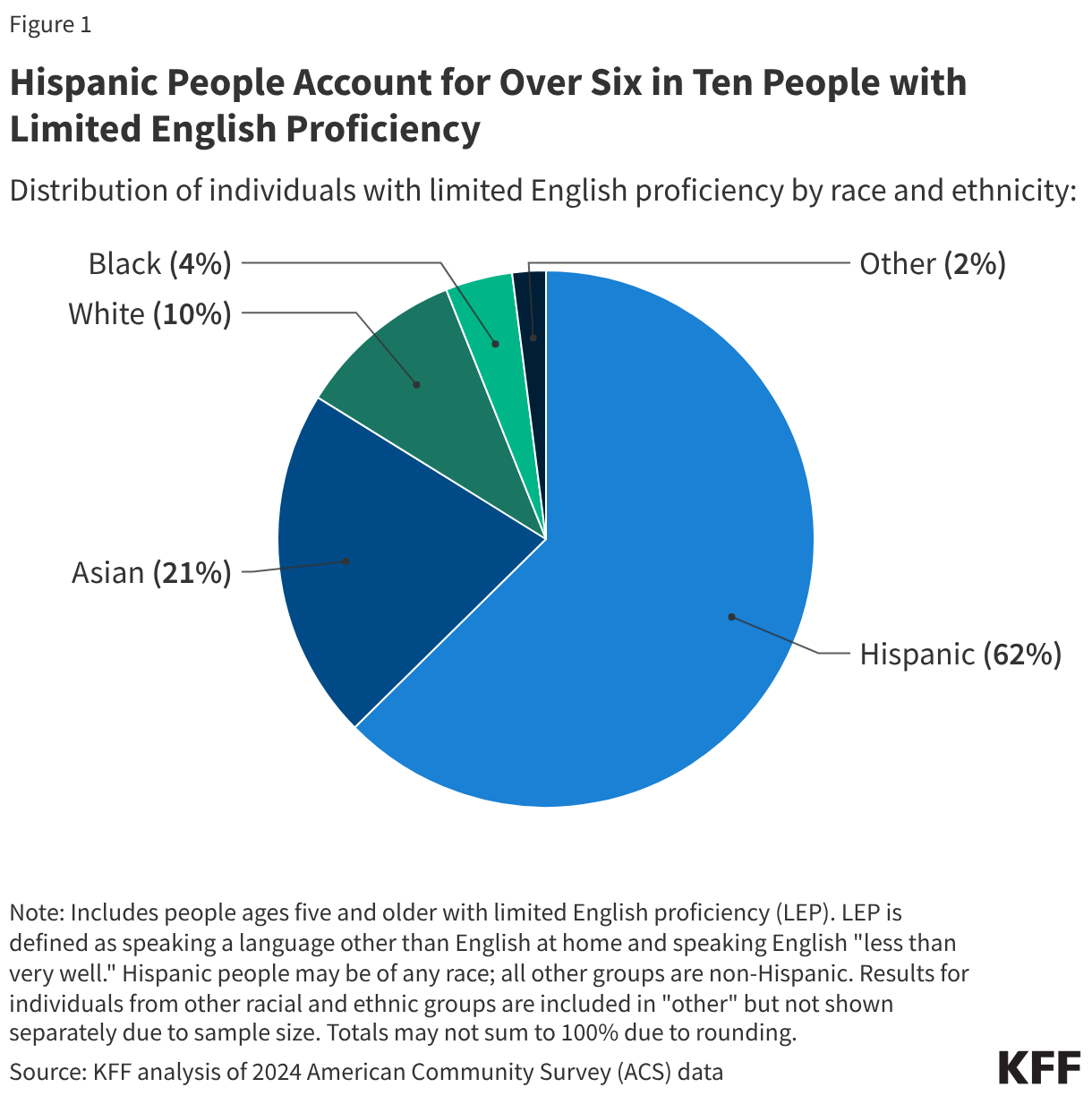
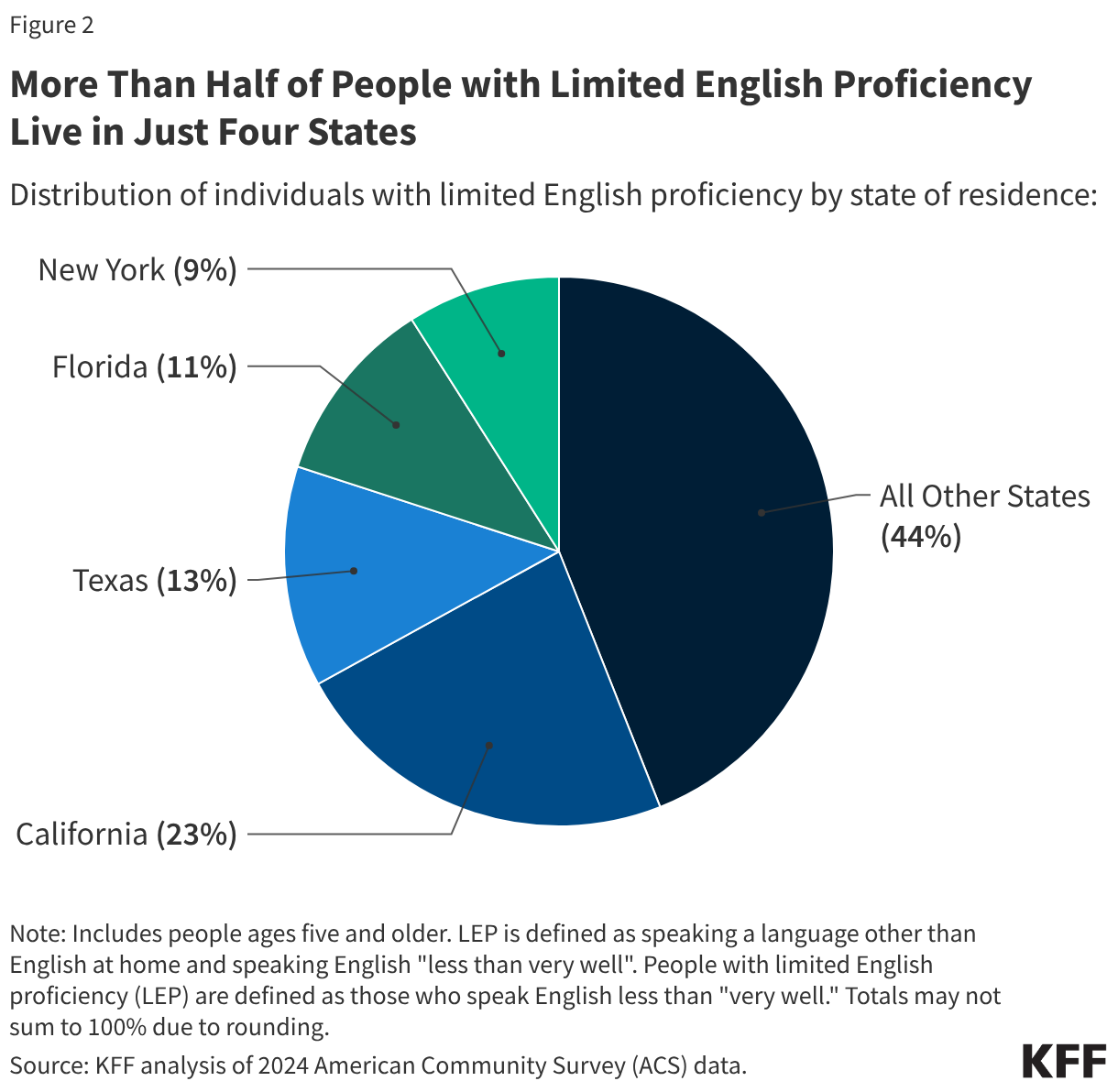
- People with LEP are a large and growing population who are disproportionately likely to be Hispanic or Asian and largely concentrated in a handful of states. The number of people ages five and older with LEP in the U.S. has grown from 25.7 million or 8% of the population as of 2021 to 28.5 million or 9% of the population as of 2024. Most individuals with LEP are Hispanic or Asian, with Hispanic people accounting for nearly two thirds (62%) of the population with LEP and Asian people accounting for about one in five (21%) of people with LEP. More than half of people with LEP live in just four states: California (23%), Texas (13%), Florida (11%), and New York (9%).
- Individuals with LEP are more than three times as likely to be uninsured as people who are English proficient (23% vs. 7%). This higher uninsured rate is driven by a lower rate of private coverage, likely reflecting that people with LEP are disproportionately employed in jobs and industries less likely to offer health coverage and may face challenges affording it when it is available. Medicaid coverage helps fill this gap in private coverage but does not fully offset the difference.
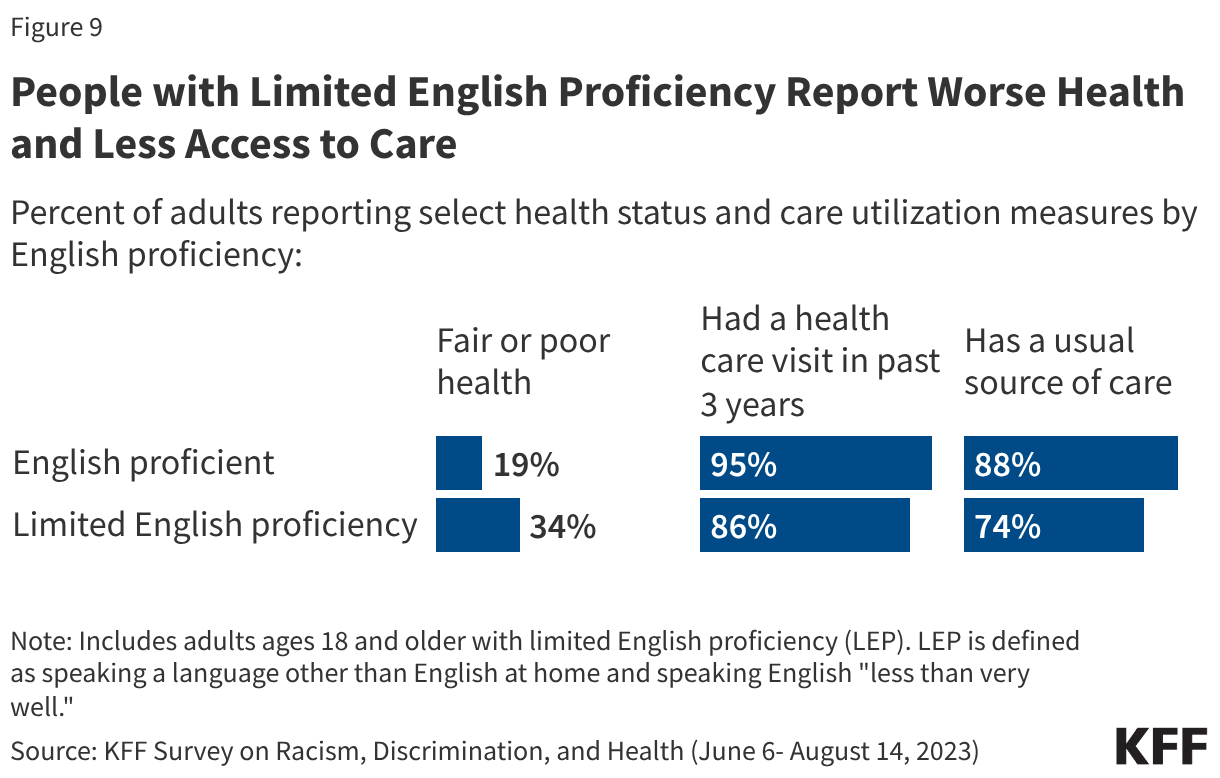
- Adults with LEP report worse access to care and health outcomes than those who are English proficient. Adults with LEP are less likely than English proficient adults to say they had a health care visit in the past three years (86% vs. 95%) and are less likely to have a usual source of care other than the emergency room (74% vs. 88%). Additionally, about a third (34%) of adults with LEP describe their physical health as “fair” or “poor” compared to about one in five (19%) English proficient adults. Language barriers can make it difficult for people with LEP to access and navigate the health care system. For example, they may face difficulty understanding eligibility rules, completing applications, scheduling appointments, filling out provider forms, communicating with medical office staff, or understanding care or medication instructions.
- Federal policy changes will likely make it harder for people with LEP to access health coverage and care. The Trump Administration designated English as the official language of the U.S., which may reduce availability of language access services. People with LEP may also face challenges navigating new Medicaid requirements under the 2025 reconciliation law, including work requirements and more frequent redeterminations, particularly if outreach and communications are not available in their language. People with LEP who are lawfully present immigrants may face compounding challenges associated with reduced eligibility for coverage under the same law and increased immigration-related fears in the current environment.Amid these challenges, key protections remain in place for people with LEP. Title VI of the Civil Rights Act and Section 1557 of the Affordable Care Act prohibit discrimination against people based on their national origin, including their ability to communicate in English, and require many health care entities, including Medicaid agencies, to provide meaningful access to people with LEP.
Overview of People With LEP
As of 2024, 28.5 million, or nearly one in ten (9%) people ages five or older living in the United States had LEP, up from 25.7 million, or 8%, in 2021. Most people with LEP are Hispanic and Spanish speaking. Hispanic people account for over six in ten (62%) people with LEP, and Asian people account for about one in five (21%), with other racial and ethnic groups accounting for smaller shares (Figure 1). Reflecting the racial and ethnic distribution of this population, Spanish is the primary language spoken among people with LEP (63%), followed by Chinese (7%), Vietnamese (3%), Tagalog (2%), and Arabic (2%).
While people with LEP live across the country, more than half (56%) live in four states: California (23%), Texas (13%), Florida (11%), and New York (9%) (Figure 2). The remaining 44% of the population is spread across the rest of the country.
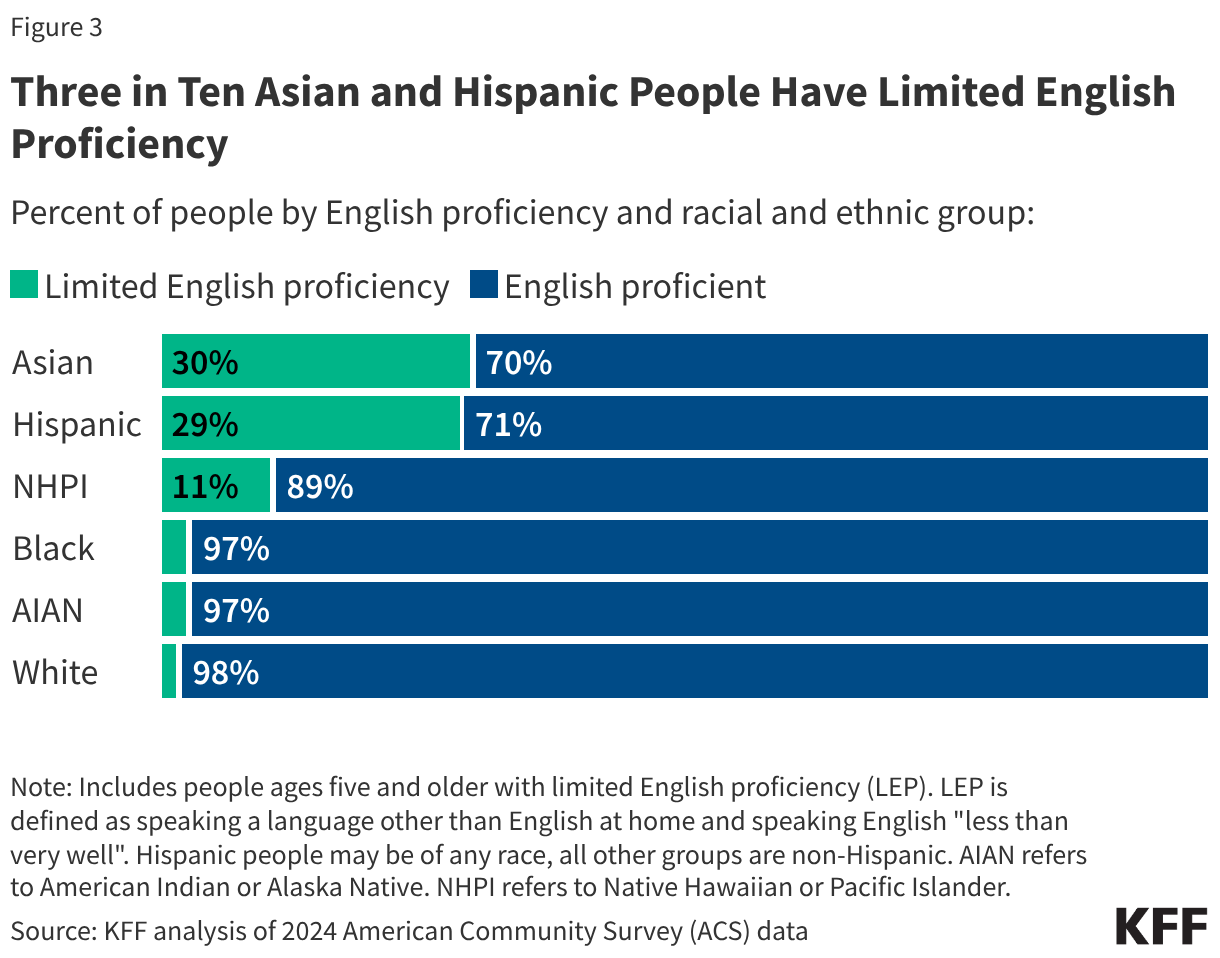
Asian and Hispanic adults have the highest rates of LEP across racial and ethnic groups. About three in ten Asian (30%) and Hispanic (29%) people have LEP, while rates are lower for Native Hawaiian or Pacific Islander (NHPI) (11%), Black (3%), American Indian or Alaska Native (AIAN) (3%), and White people (2%).
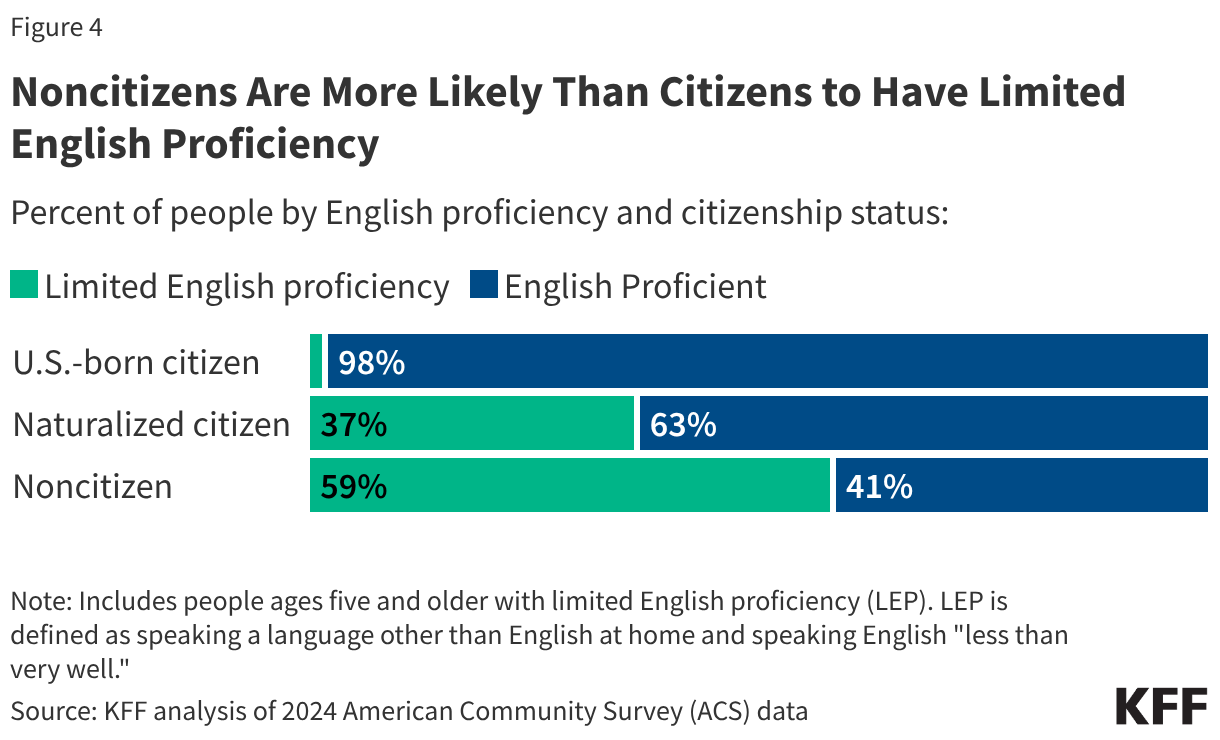
Noncitizen immigrants are more likely than citizens to report having LEP. Nearly six in ten (59%) noncitizen immigrants have LEP compared to over a third (37%) of naturalized citizens and just 2% of U.S.- born citizens (Figure 4).
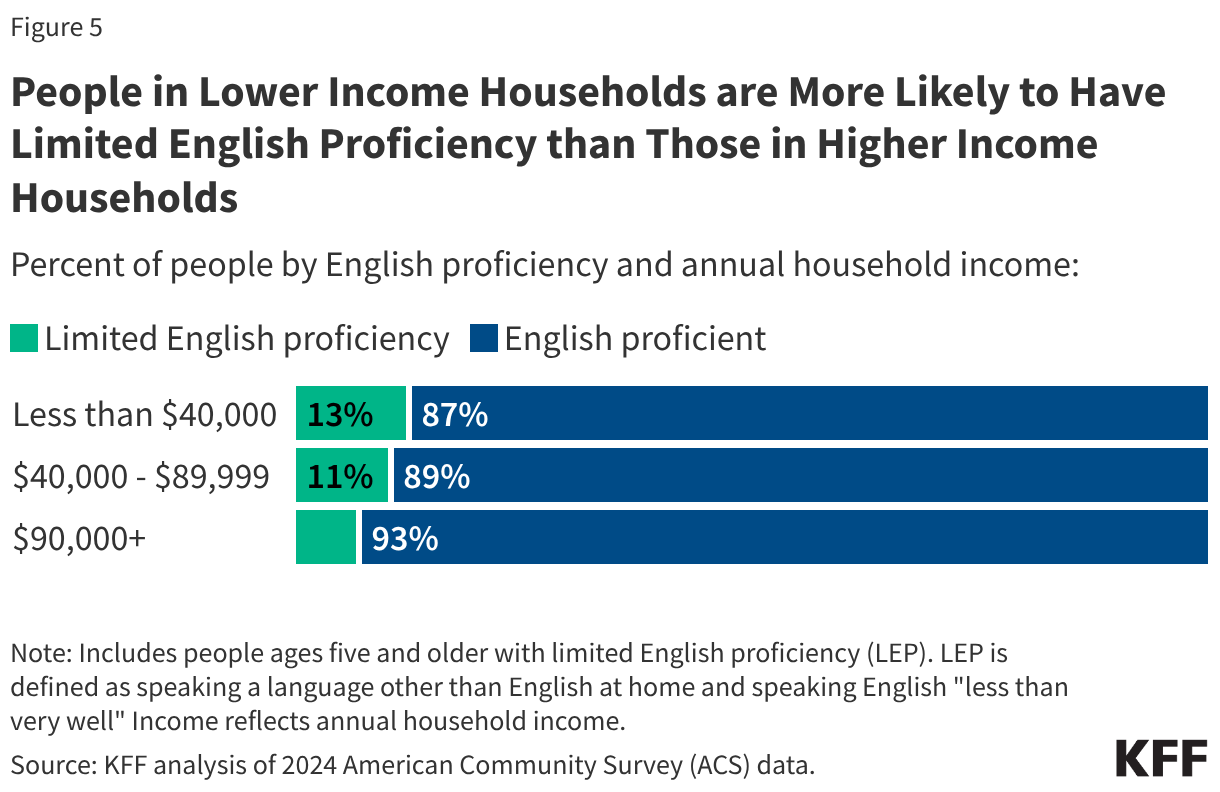
LEP is also more common among people with lower household incomes. Over one in ten (13%) of individuals in households with an annual income below $40,000 have LEP compared to 7% in households with an annual income of $90,000 or more (Figure 5).
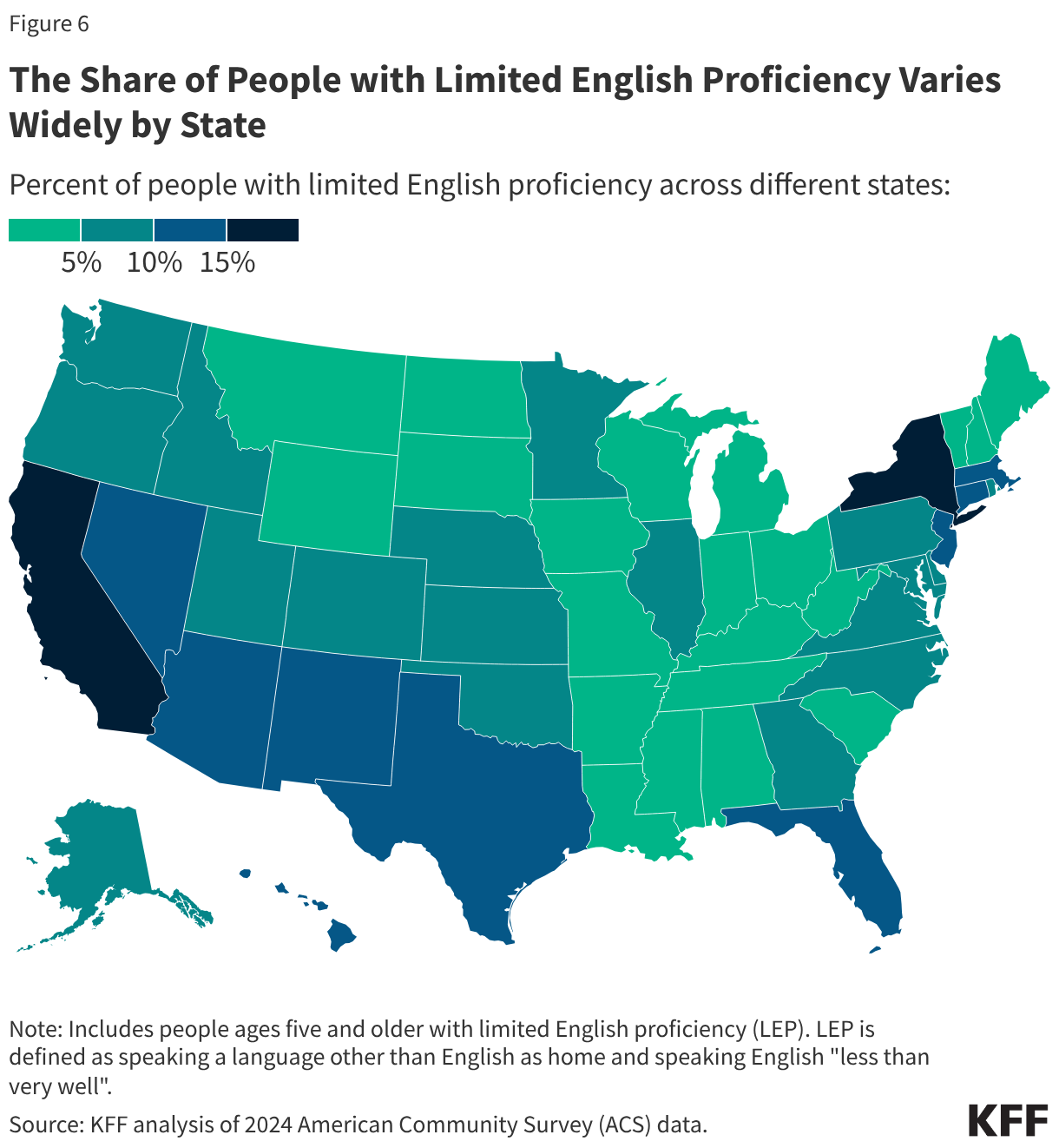
The share of people with LEP varies widely across states, from less than 1% in West Virginia to 18% in California. Other states with relatively high rates of people with LEP include New York (15%), New Jersey (14%), Florida (14%), Texas (13%), Nevada (12%), Hawaii (11%), and Massachusetts (10%) (Figure 6). This pattern likely reflects the high shares of Hispanic and Asian people and immigrants residing in those states.
Health Coverage Among People with LEP
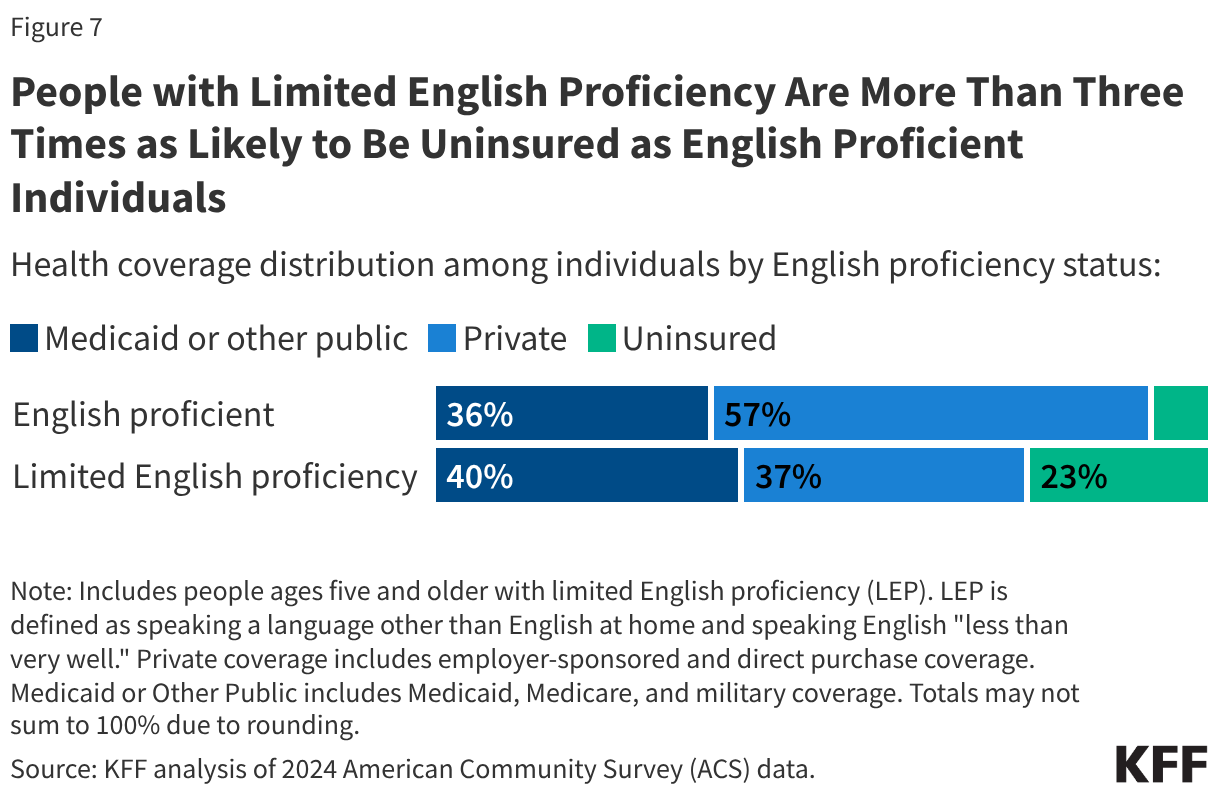
Individuals with LEP are more than three times as likely to be uninsured as English proficient individuals (23% vs. 7%). This higher uninsured rate is driven by a lower rate of private coverage. Just over a third (37%) of people with LEP have private coverage, compared to nearly six in ten (57%) English proficient individuals, a gap that likely reflects a disproportionate share of people with LEP working in lower income jobs and industries that are less likely to offer employer-sponsored coverage. While Medicaid coverage helps offset some of this gap, it does not fully close it, leaving people with LEP more likely to be uninsured than those who are English proficient (Figure 7).
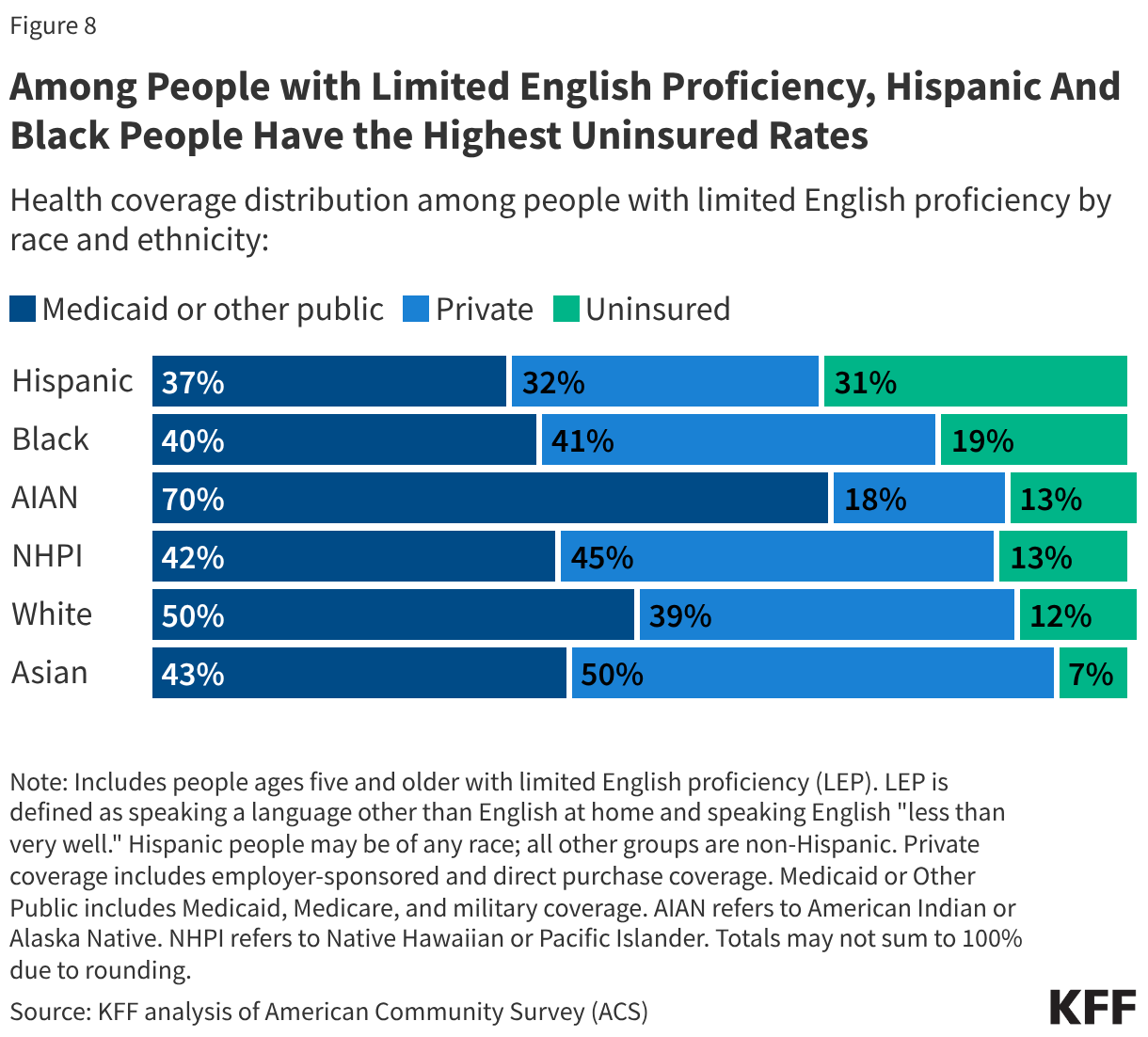
Among people with LEP, Hispanic (31%) and Black people (19%) have higher uninsured rates than their White counterparts (12%) (Figure 8). In contrast, Asian people with LEP have the highest rate of private coverage (50%) and the lowest uninsured rate (7%) across racial and ethnic groups. These racial and ethnic patterns are consistent with patterns among the broader population and likely reflect a variety of factors, including differences in access to private coverage, income, and citizenship status.
Challenges and Barriers to Care for People with LEP
Adults with LEP report more limited access to and use of care and worse health outcomes than their English proficient counterparts. KFF survey data from 2023 show that adults with LEP are less likely than those who are English proficient to have had a health care visit in the past three years (86% vs. 95%) and less likely to have a usual source of care other than the emergency room (74% vs. 88%). Additionally, over one in three (34%) of adults with LEP report their physical health as fair or poor compared to 19% of their English proficient counterparts (Figure 9).Other research also shows that people with LEP experience worse access to care and health outcomes than those who are English proficient. A 2024 review found that people with LEP are less likely to access ambulatory care, hospitalization, cancer screening, chronic care management, and general health care. Having LEP is associated with lower use of preventative health care and with health behaviors linked to chronic disease. Beyond utilization, a 2025 review of cardiovascular disease found that patients with LEP and heart failure were more likely to have higher rates of hospital readmission and emergency care than English proficient patients with heart failure. Having LEP is also associated with lower rates of cancer screening.
Language barriers can make it difficult for people with LEP to enroll in health coverage even if they are eligible. Enrolling in health coverage requires understanding plan options, eligibility rules, and application processes, which can be challenging without translation options. A 2022 KFF analysis of state Medicaid websites found that 39 of 50 states offered a translated Medicaid PDF application online, but only 13 of those states offered a translation in a language other than Spanish, leaving most people with LEP who speak other languages with no in-language option. Call centers, often a primary resource for enrollees, showed similar gaps. While 40 states offered assistance in another language, 31 only offered it in Spanish. Gaps in language access can also make it more difficult for people to stay enrolled in coverage even if they are eligible. For example, among Medicaid enrollees in Illinois, individuals with LEP were over five times more likely than English proficient enrollees to be disenrolled, with 85% reporting they needed help reading their renewal notice, and 94% saying they needed help completing the enrollment form.
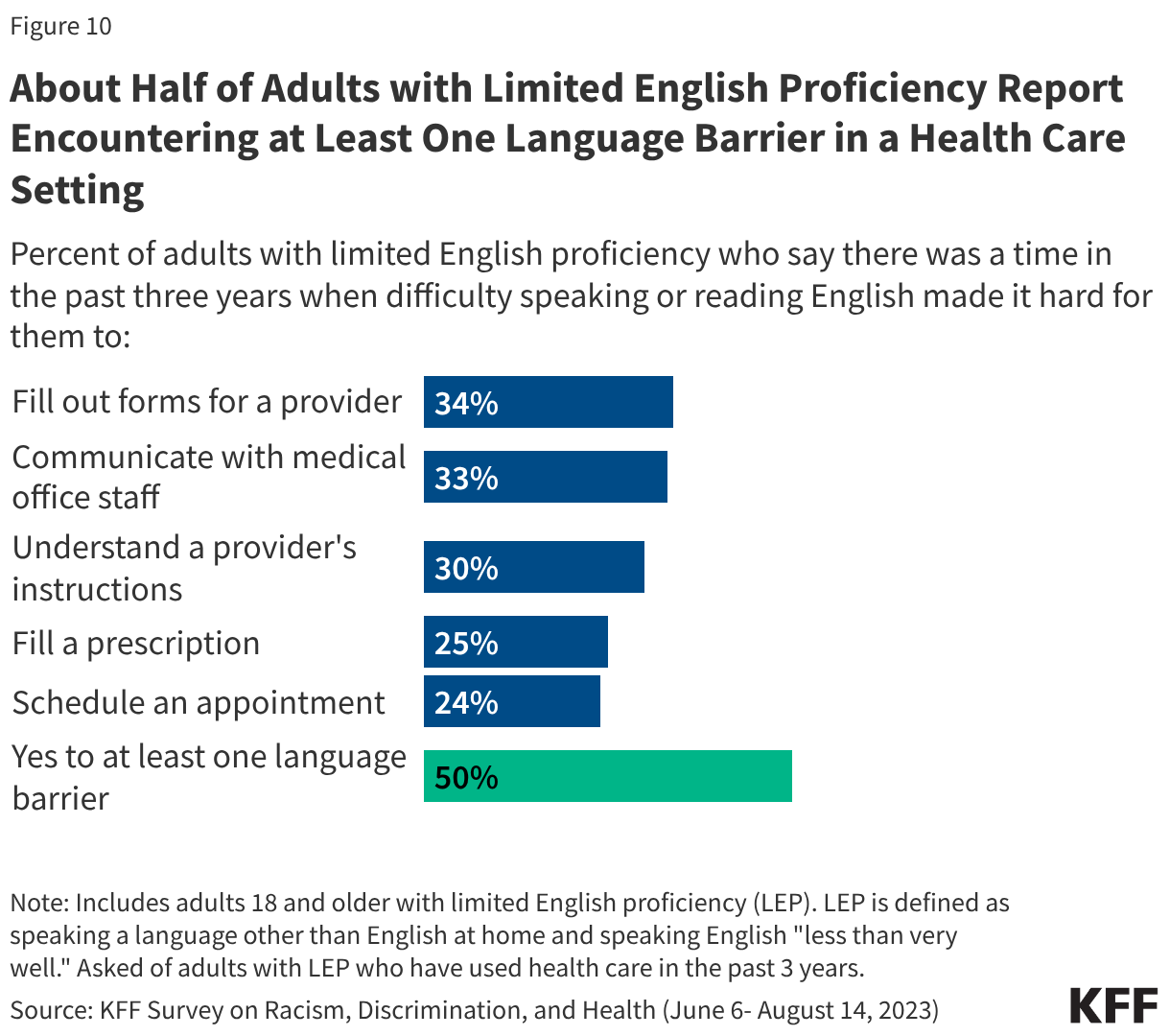
Beyond enrollment in health coverage, language barriers can create challenges to accessing care. KFF 2023 survey data show that about half (50%) of adults with LEP said they encountered at least one language barrier in a health care setting in the past three years, including difficulty filling out forms for a provider (34%), communicating with medical office staff (33%), understanding a provider’s instructions (30%), filling a prescription or understanding how to use it (27%), or scheduling a medical appointment (25%) (Figure 10). Language barriers also shape the quality of care people receive. For example, adults with LEP are less likely than English proficient adults to report that their provider explained things in a way they could understand (81% vs. 89%), spent enough time with them during visits (68% vs. 76%), and involved them in decision making about their care (63% vs. 82%).
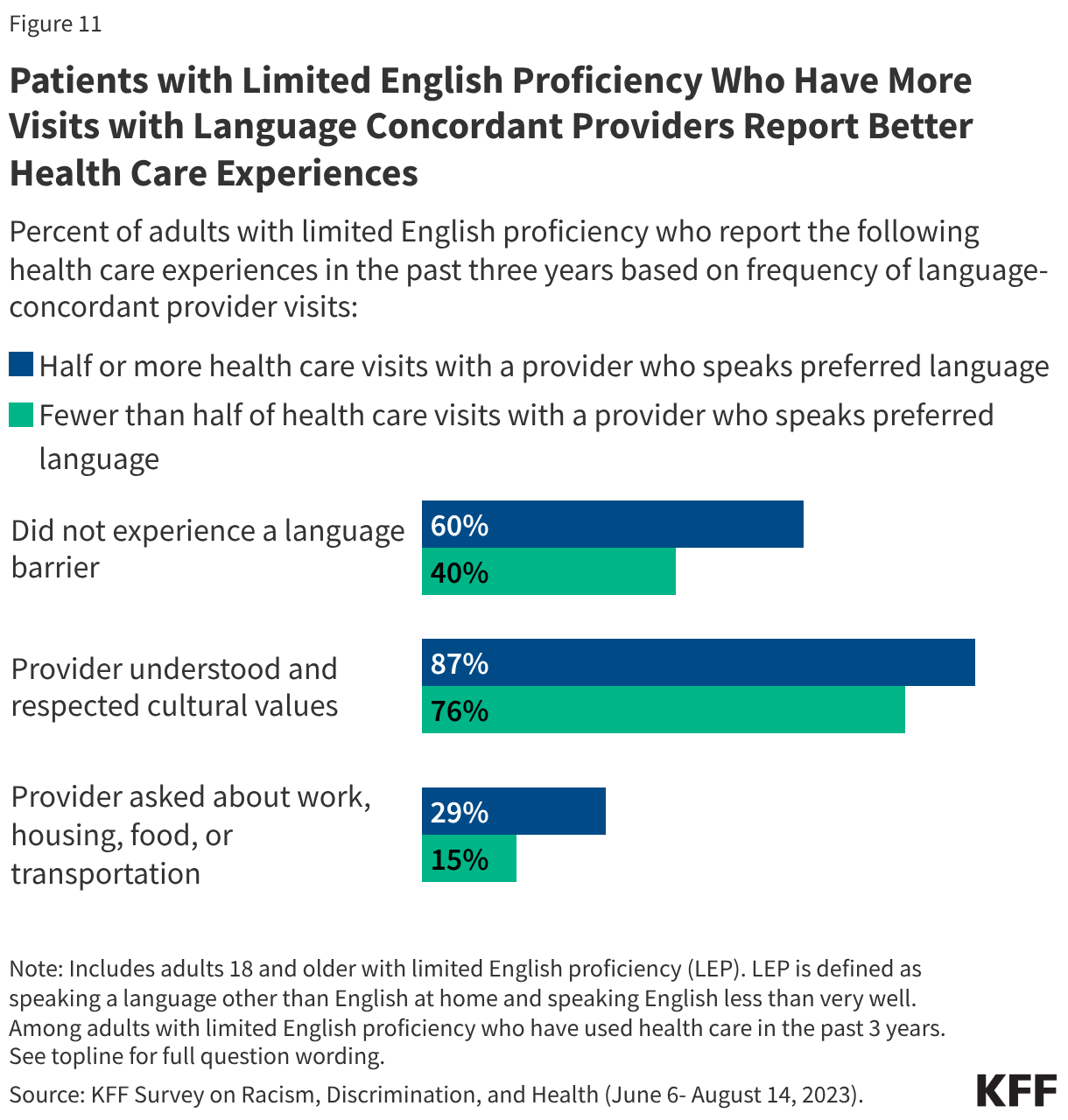
Having access to providers who speak a preferred language helps reduce barriers and improve health care experiences for people with LEP. KFF 2023 survey data show that adults with LEP who reported having at least half of their visits with a language concordant provider were less likely to experience a language barrier (40% vs. 60%). They were also more likely to report their provider understood and respected their cultural values (87% vs. 76%) and more likely to report their provider asked about their social needs, like housing, food, or transportation, than their counterparts who had fewer than half of their visits with a language concordant provider (29% vs. 15%) (Figure 11).
Federal policy changes will likely make it harder for people with LEP to access health coverage and care. The Trump Administration designated English as the official language of the U.S., which may lead to a reduction in availability in language access services. Additionally, people with LEP may face challenges navigating new Medicaid requirements that will be implemented under the 2025 reconciliation law, including work requirements and more frequent eligibility redeterminations, particularly if outreach and communications are not available in their language. People with LEP who are lawfully present immigrants may also face compounding challenges associated with reduced eligibility for coverage under the 2025 reconciliation law and increased immigration-related fears in the current environment. Amid these challenges, key protections remain in place for people with LEP. Title VI of the Civil Rights Act and Section 1557 of the Affordable Care Act prohibit discrimination against people based on their national origin, including their ability to communicate in English. Under these laws, certain entities, including Medicaid agencies and health care providers, must take reasonable steps to provide meaningful access to applicants and enrollees with LEP. However, the Trump Administration issued new regulations eliminating disparate impact, a discriminatory effect without intentional discrimination, as a basis for claims under Title VI of the Civil Rights Act, which may limit enforcement under this avenue, though Section 1557 requirements remain in place.