This Week in Coronavirus: October 9 to October 15

Published: Oct 16, 2020

Here’s our recap of the past week in the coronavirus pandemic from our tracking, policy analysis, polling, and journalism.

This week a joint project between KFF and ESPN’s The Undefeated explores the public’s views and experiences on the topics of health care, racial discrimination, and the coronavirus pandemic, with a special focus on Black adults. Half of Black adults say they would “definitely” or “probably” get a coronavirus vaccine available for free and deemed safe by scientists, compared to 61% of Hispanic adults and 65% of White adults. KFF President Drew Altman discusses how systemic racism had led to striking levels of reluctance to get a COVID-19 vaccine among Black Americans in an Axios column.

The national survey also explored the disproportionate impact of the pandemic on people of color. Half of Black adults and 57% of Hispanic adults say someone in their household lost a job, was furloughed, or had their hours or income reduced due to the pandemic, compared to 42% of White adults. Two-thirds of Black adults think the federal government would be taking stronger action to fight the pandemic if White people were getting sick and dying from the coronavirus at higher rates than people of color.


Here are the latest coronavirus stats from KFF’s tracking resources:

Global Cases and Deaths: Total cases worldwide reached 36.3 million this week – with an increase of approximately 2.4 million new confirmed cases in the past seven days. There were nearly 39,000 new confirmed deaths worldwide and the total confirmed deaths is over 1 million.

U.S. Cases and Deaths: Total confirmed cases in the U.S. surpassed 7.9 million this week. There was an approximate increase of 373,800 confirmed cases between October 9 and October 15. Approximately 4,900 confirmed deaths in the past week brought the total in the United States to approximately 217,700.

Race/Ethnicity Data: Hispanic individuals made up a higher share of cases compared to their share of the total population in 44 of 46 states reporting cases and 13 of 47 states reporting deaths. In 7 states (NH, NC, NE, OR, WA, VA, and PA), Hispanic peoples’ share of cases was more than 3 times their share of the population. COVID-19 continues to have a sharp, disproportionate impact on American Indian/Alaska Native as well as Asian people in some states.  Black individuals made up a higher share of cases/deaths compared to their share of the population in 40 of 50 states reporting cases and 34 of 48 states reporting deaths. In 6 states (MI, MO, WI, KS, and ME) the share of COVID-19 related deaths among Black people was at least two times higher than their share of the total population.

State Social Distancing Actions (includes Washington D.C.) that went into effect this week:

Extensions: AR, CO, GA, HI, IN, MN, SC, VT, WY

New Restrictions: ND

Rollbacks: CA, ME, ND, TX, WI, WV

Enhanced Face Mask Order: ME


The latest KFF COVID-19 resources:

  • KFF/The Undefeated Survey on Race and Health (Survey, News Release)
  • Black Americans are more skeptical of a coronavirus vaccine (Axios Column)
  • Health Insurer Financial Performance Amid the Coronavirus Pandemic (Issue Brief)
  • Half of Older Adults in Worse Health Have Reported Anxiety or Depression During the Coronavirus Pandemic (Chart of the Week)
  • Upcoming Webinar: How Might the Pandemic Affect Health Premiums, Utilization, and Outcomes in 2021 and Beyond? (Webinar)
  • COVID-19 Coronavirus Tracker – Updated as of October 15 (Interactive)
  • State Data and Policy Actions to Address Coronavirus (Interactive)
  • World Bank Approves $12B In Financing To Help Developing Countries Procure, Distribute Coronavirus Vaccines, Tests, Treatments; Mexico Signs With 3 Companies To Purchase Potential Vaccines (KFF Daily Global Health Policy Report)Updated: Analysis of Recent National Trends in Medicaid and CHIP Enrollment (Issue Brief)
  • Pandemic Disproportionately Impacting Poor, Most Vulnerable Populations, U.N. SG Warns Ahead Of International Day For The Eradication Of Poverty (KFF Daily Global Health Policy Report)


The latest KHN COVID-19 stories:

  • Sleepless Nights, Hair Loss and Cracked Teeth: Pandemic Stress Takes Its Toll (KHN, NPR)
  • Musicians Improvise Masks for Wind Instruments to Keep the Band Together (KHN, Gatehouse Media)
  • Most Home Health Aides ‘Can’t Afford Not to Work’ — Even When Lacking PPE (KHN, The Guardian)
  • No, the WHO Didn’t Change Its Lockdown Stance or ‘Admit’ Trump Was Right (KHN, PolitiFact)
  • Making Money Off Masks, COVID-Spawned Chain Store Aims to Become Obsolete (KHN, NY Times)
  • KHN Wins Edward R. Murrow Award (RTDNA)
  • Black Doctors Work to Make Coronavirus Testing More Equitable (KHN, NPR/WHYY)
  • COVID Crackdowns at Work Have Saved Black and Latino Lives, LA Officials Say (CHL, LAist)
  • With Senate Control at Stake, Trump and COVID Haunt Ernst’s Fight to Keep Her Seat (KHN)
  • COVID Takes Challenge of Tracking Infectious College Students to New Level (KHN, St. Louis Post-Dispatch)
  • COVID Stalks Montana Town Already Saddled With Asbestos Disease (KHN, NPR)
  • Pence Said Biden Copied Trump’s Pandemic Response Plan. Pants on Fire! (KHN, PolitiFact)
  • Easier-to-Use Coronavirus Saliva Tests Start to Catch On (KHN, Los Angeles Times)

Medicaid Covers People with Pre-Existing Conditions, Too

Authors: Rachel Garfield and Robin Rudowitz
Published: Oct 16, 2020

In recent weeks, the possible overturning of the Affordable Care Act (ACA) in court and the upcoming election have focused attention on the issue of protections for people with pre-existing conditions. Estimates of how many people have pre-existing conditions range from 54 million people with a declinable pre-existing condition—that is, a health condition that would have made them uninsurable in the pre-ACA individual insurance market—to over 100 million people with health conditions that could trigger other adverse actions such as higher premiums or coverage limitations. While the focus has been on the ACA’s private insurance protections, Medicaid also plays a significant role in covering people with pre-existing conditions.

Medicaid has always provided coverage for people with pre-existing conditions, even before the passage of the ACA. Prior to the ACA, individuals could be denied coverage in the private insurance market if they had a pre-existing condition. However, eligibility for Medicaid prior to the ACA was based on income and other categorical eligibility criteria (e.g., being parent or person with disability), not health status. If a person met these eligibility criteria, states could not deny Medicaid to that person even if he or she had a pre-existing condition. In addition, Medicaid coverage was explicitly extended over the years to several groups that do have pre-existing conditions, such as pregnancy or certain functional disabilities, for whom private insurers routinely used to deny individual insurance before the ACA. These protections were in place even before the ACA prohibited private health insurance discrimination based on health status and are part of the reason that Medicaid has historically covered many people with serious and persistent illnesses or disabilities (like HIV or serious mental illness) for whom private coverage was not available or if available, not adequate or too costly.

The expansion of Medicaid under the ACA extended Medicaid coverage to millions of adults who were previously ineligible for coverage without regard to pre-existing conditions. As of June 2019, 15 million adults were covered through the ACA eligibility pathway. If the ACA were overturned and federal matching funds were eliminated, it is likely that states would not retain eligibility for the vast majority of these people. While the majority of adult Medicaid enrollees work full or part-time, most are unlikely to have an affordable offer through their job and would face purchasing health insurance in an individual market where pre-ACA underwriting rules applied.

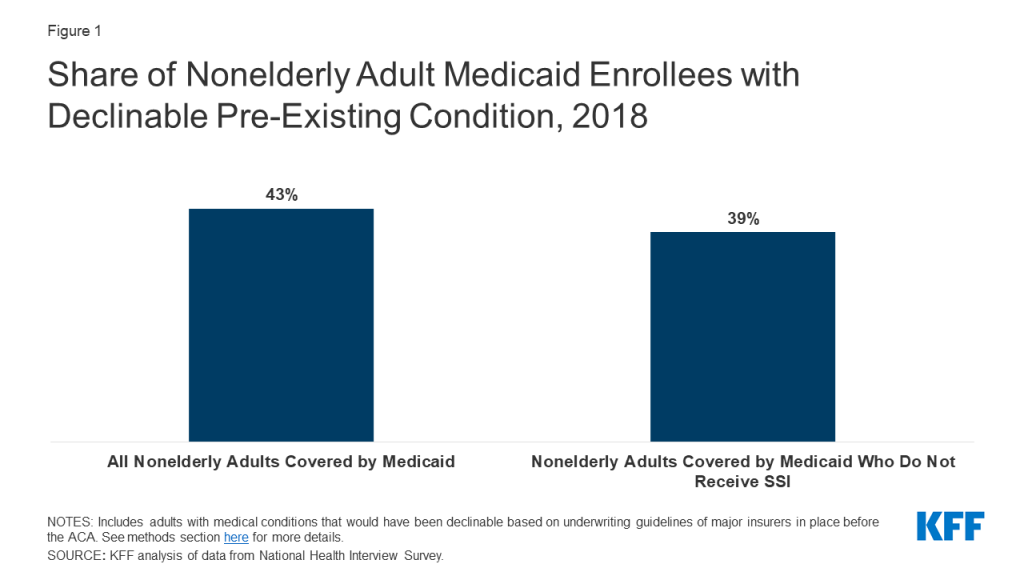
More than four in ten (43%) nonelderly adults with Medicaid had a declinable pre-existing condition in 2018 (Figure 1). Excluding the population that receives Supplemental Security Income and thus likely qualifies for Medicaid through a disability-related pathway, there are still nearly four in ten (39%) nonelderly adults with declinable pre-existing condition. Many of these adults likely gained Medicaid eligibility under the ACA expansion. If the ACA were repealed, both the Medicaid expansion and pre-existing condition protections would be overturned, leaving many of these adults likely uninsured.

Figure 1: Share of Nonelderly Adult Medicaid Enrollees with Declinable Pre-Existing Condition, 2018

More broadly than Medicaid, adults with low incomes are more likely than those with higher incomes to have a pre-existing condition. More than one in three nonelderly adults with incomes below 138% of the poverty level – the threshold for expanded Medicaid eligibility under the ACA – have a pre-existing condition that would likely have led to a coverage denial before the ACA (Figure 2). Without the Medicaid expansion, availability of subsidies in the marketplace and protections for people with pre-existing conditions, most low-income people would not have options for affordable coverage and would likely be uninsured.

Figure 2: Share of Nonelderly Adults with Declinable Pre-Existing Condition by Income, 2018​

Public Opinion on Single-Payer, National Health Plans, and Expanding Access to Medicare Coverage

Published: Oct 16, 2020

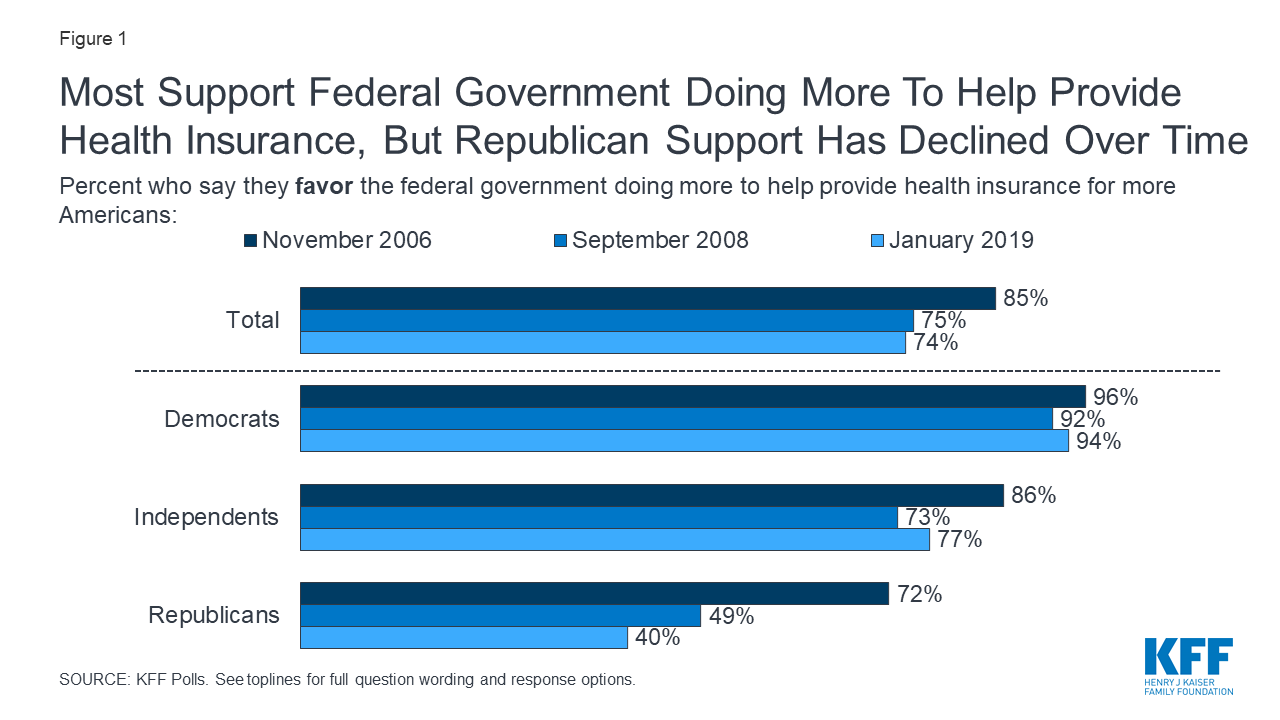
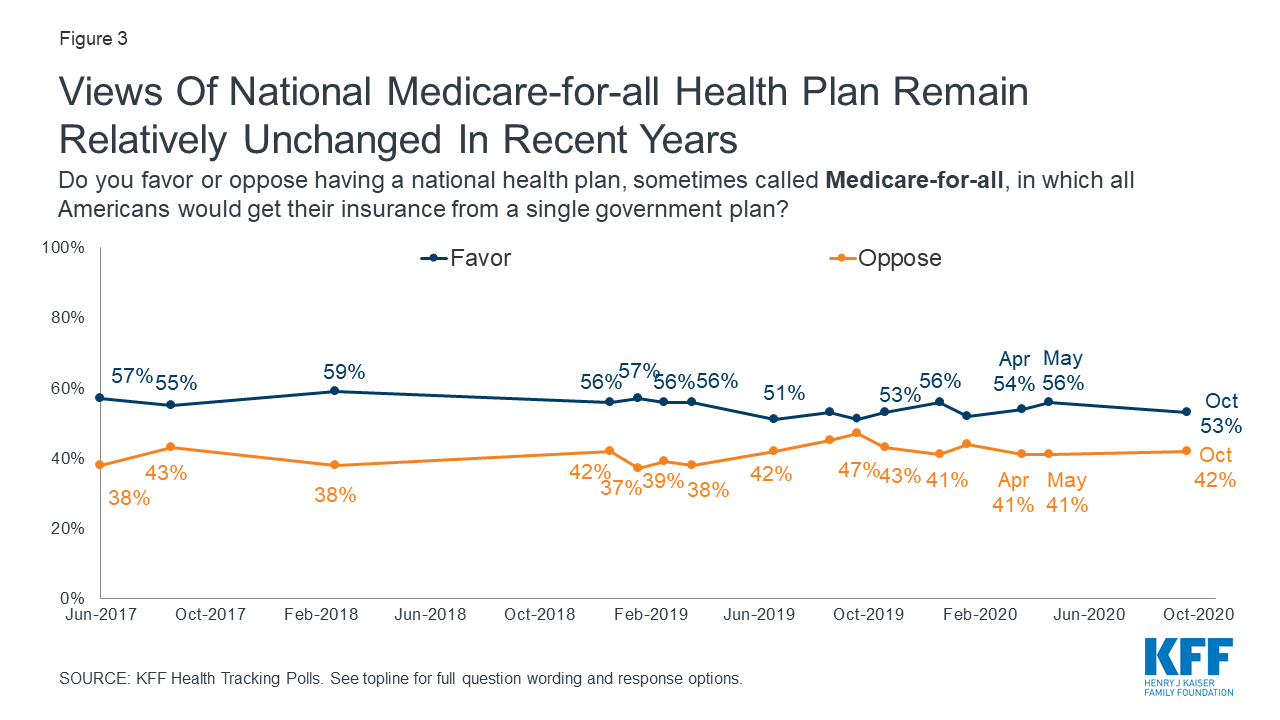
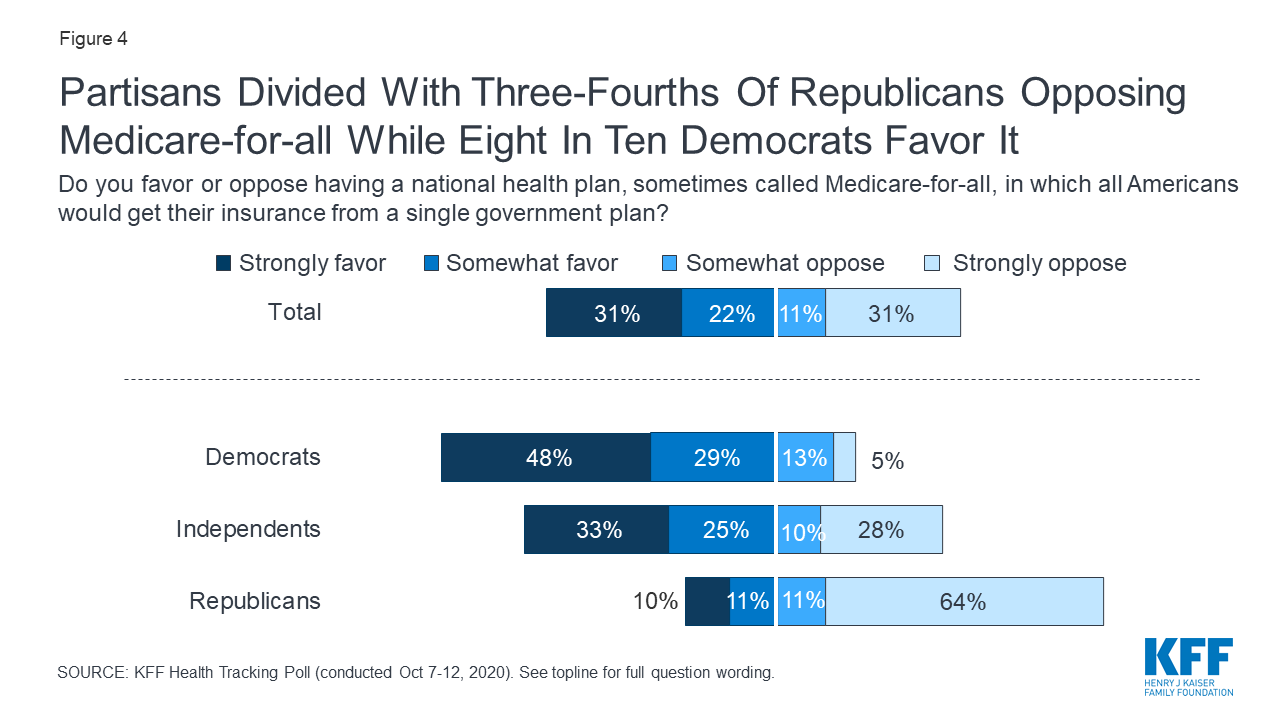
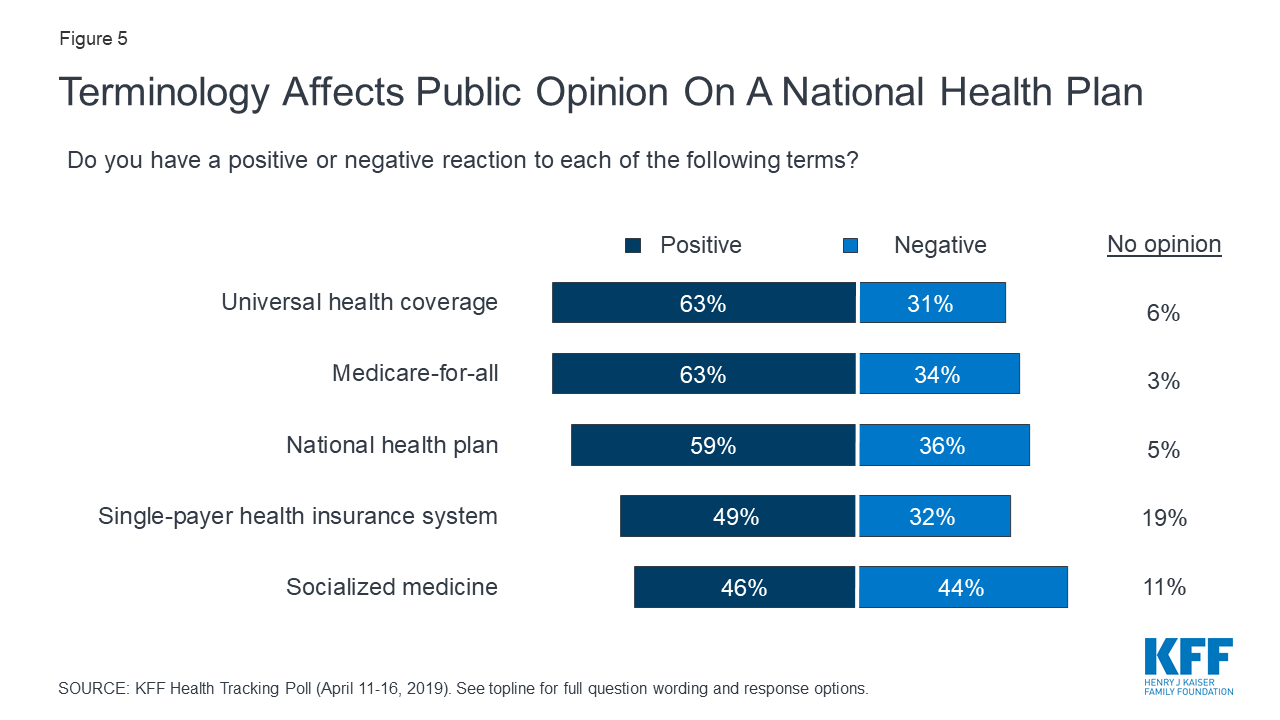
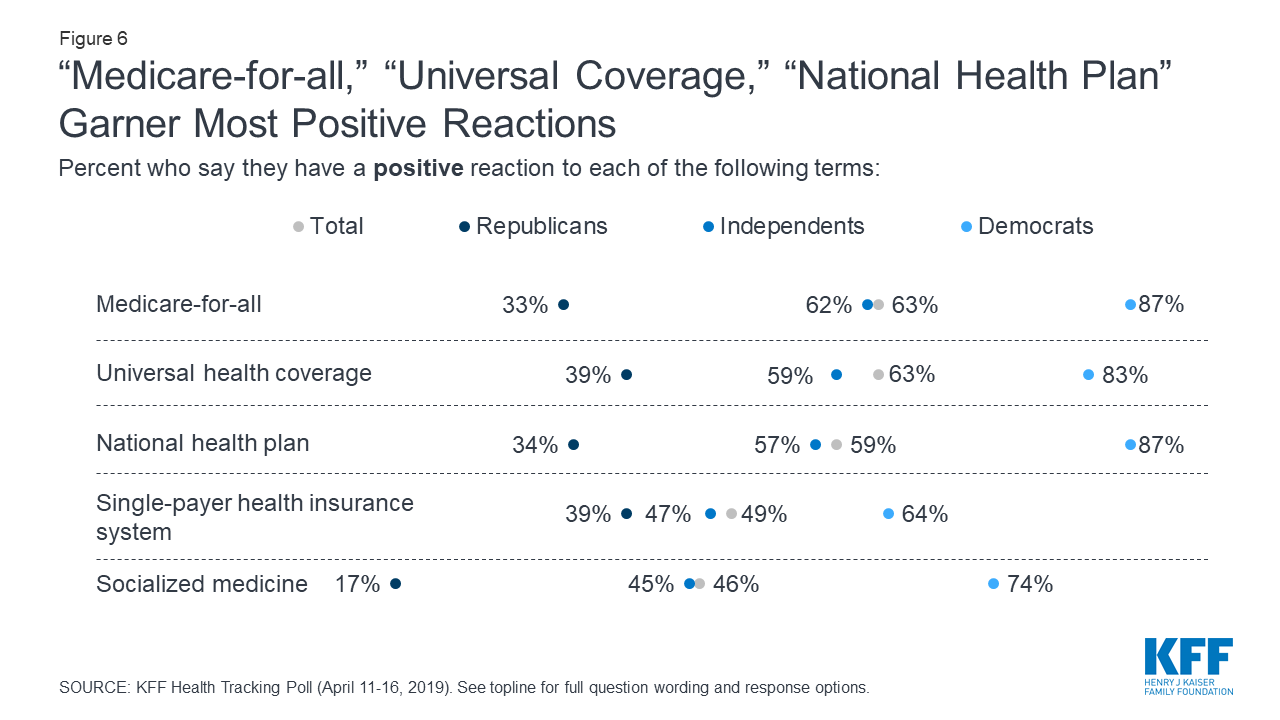
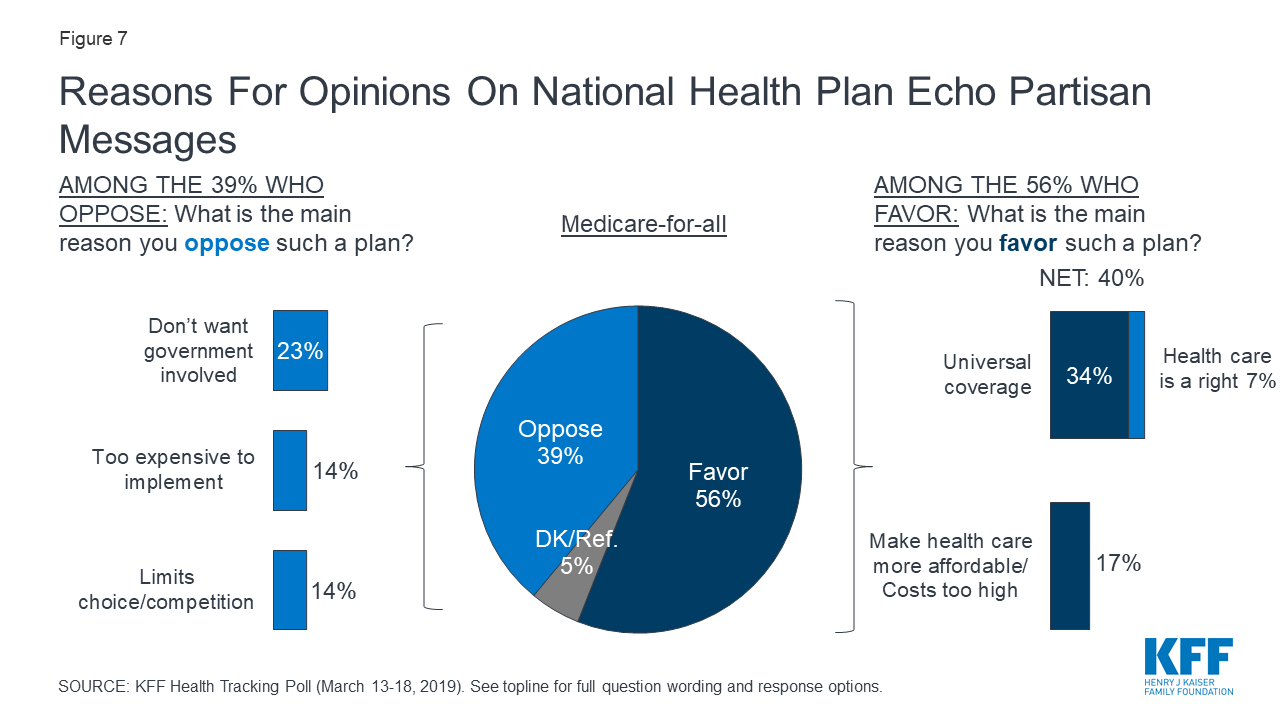
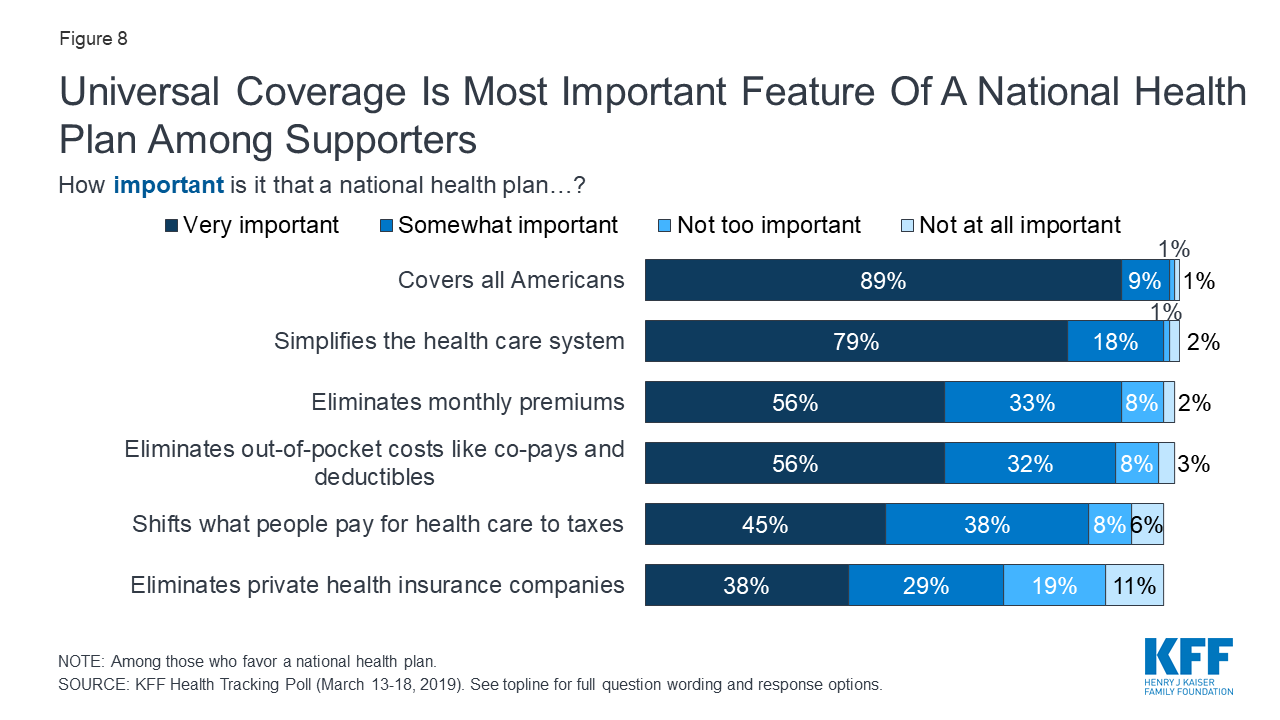
For many years, Kaiser Family Foundation has been tracking public opinion on the idea of a national health plan (including language referring to Medicare-for-all since 2017). Historically, our polls have shown support for the federal government doing more to help provide health insurance for more Americans, though support among Republicans has decreased over time (Figure 1). But this never translated into majority support for a national health plan in which all Americans would get their insurance from a single government plan until 2016 (Figure 2).  A hallmark of Senator Sanders’ primary campaign for President in 2016 was a national “Medicare-for-all” plan and since then, a slight majority of Americans say they favor such a plan (Figure 3). Overall, large shares of Democrats and independents favor a national Medicare-for-all plan while most Republicans oppose (Figure 4). Yet, how politicians discuss different proposals does affect public support (Figure 5 and Figure 6). In addition, when asked why they support or oppose a national health plan, the public echoes the dominant messages in the current political climate (Figure 7). A common theme among supporters, regardless of how we ask the question, is the desire for universal coverage (Figure 8).

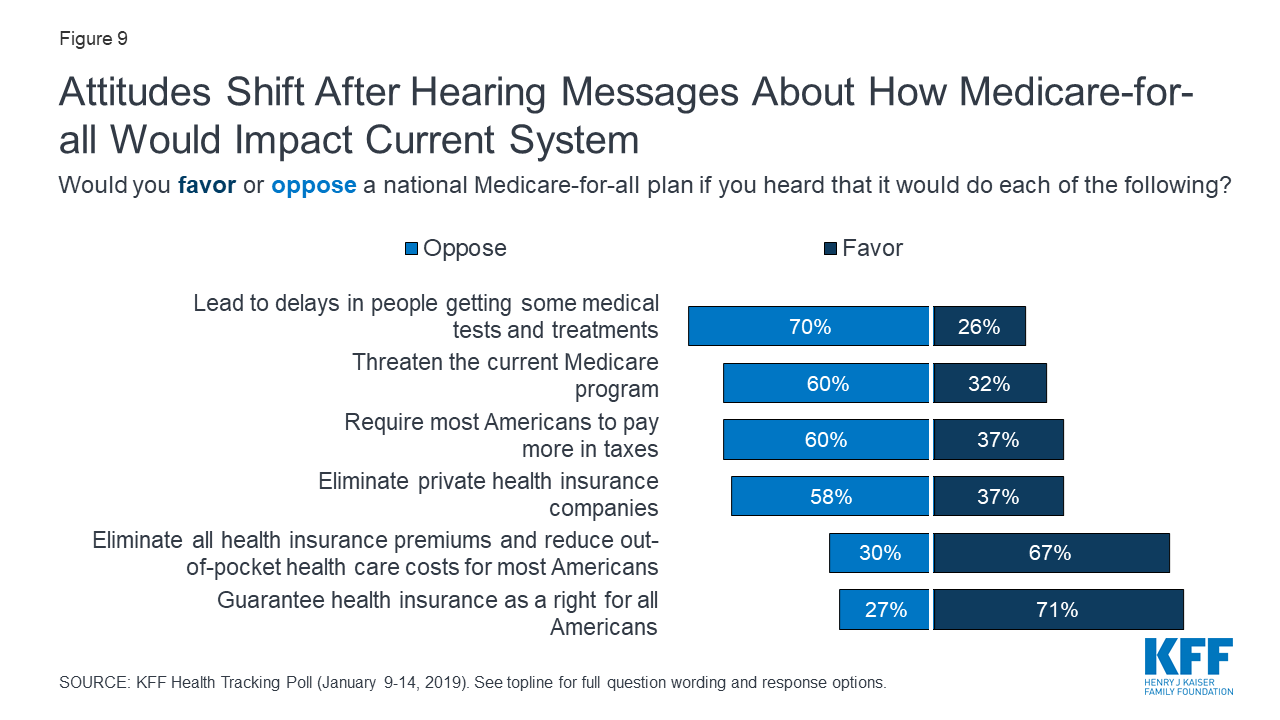
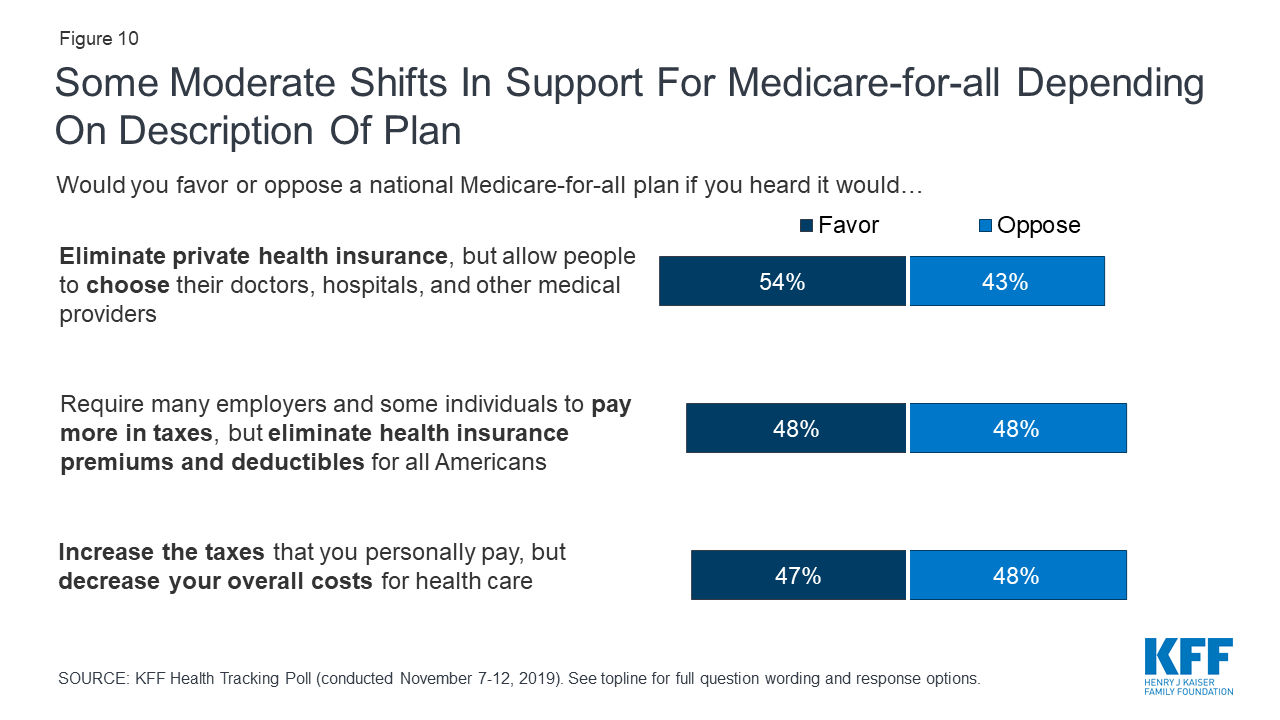
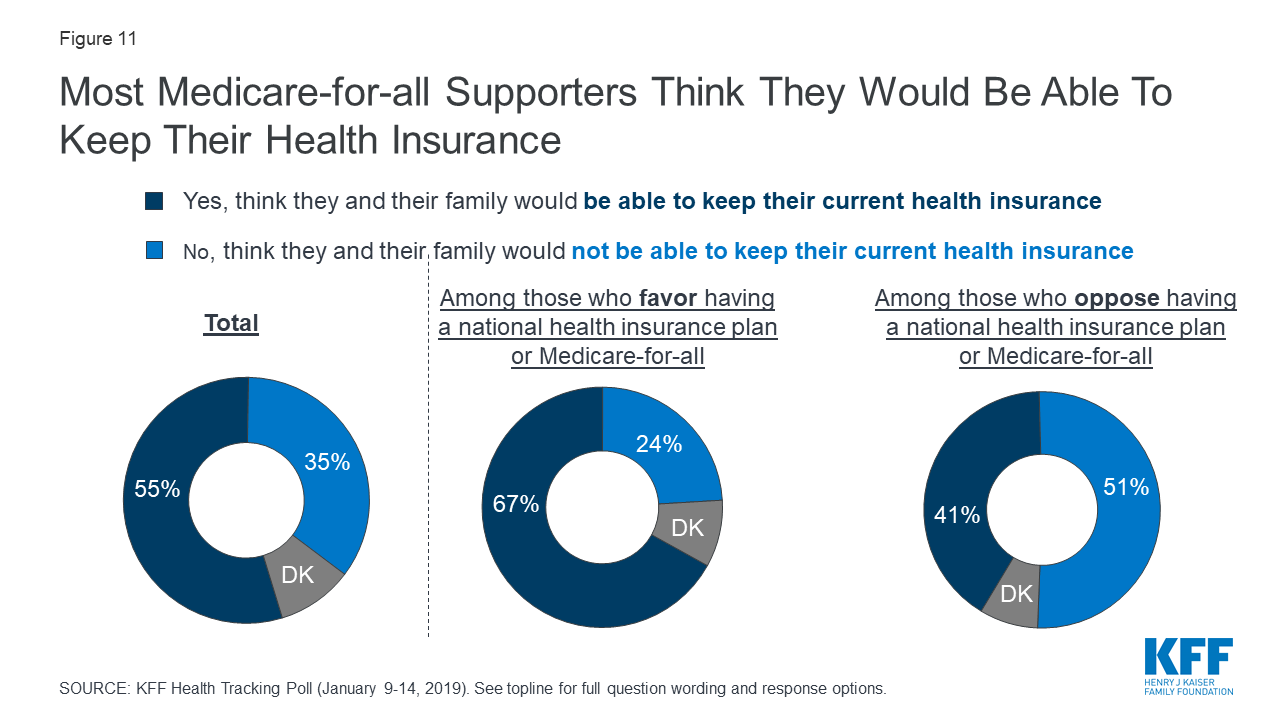
As Medicare-for-all becomes a staple in national conversations around health care and people become aware of the details of any plan or hear arguments on either side, it is unclear how attitudes towards such a proposal may shift. KFF polling finds public support for Medicare-for-all shifts significantly when people hear arguments about potential tax increases or delays in medical tests and treatment (Figure 9). KFF polling found that when such a plan is described in terms of the trade-offs (higher taxes but lower out-of-pocket costs), the public is almost equally split in their support (Figure 10).  KFF polling also shows many people falsely assume they would be able to keep their current health insurance under a single-payer plan, suggesting another potential area for decreased support especially since most supporters (67 percent) of such a proposal think they would be able to keep their current health insurance coverage (Figure 11).

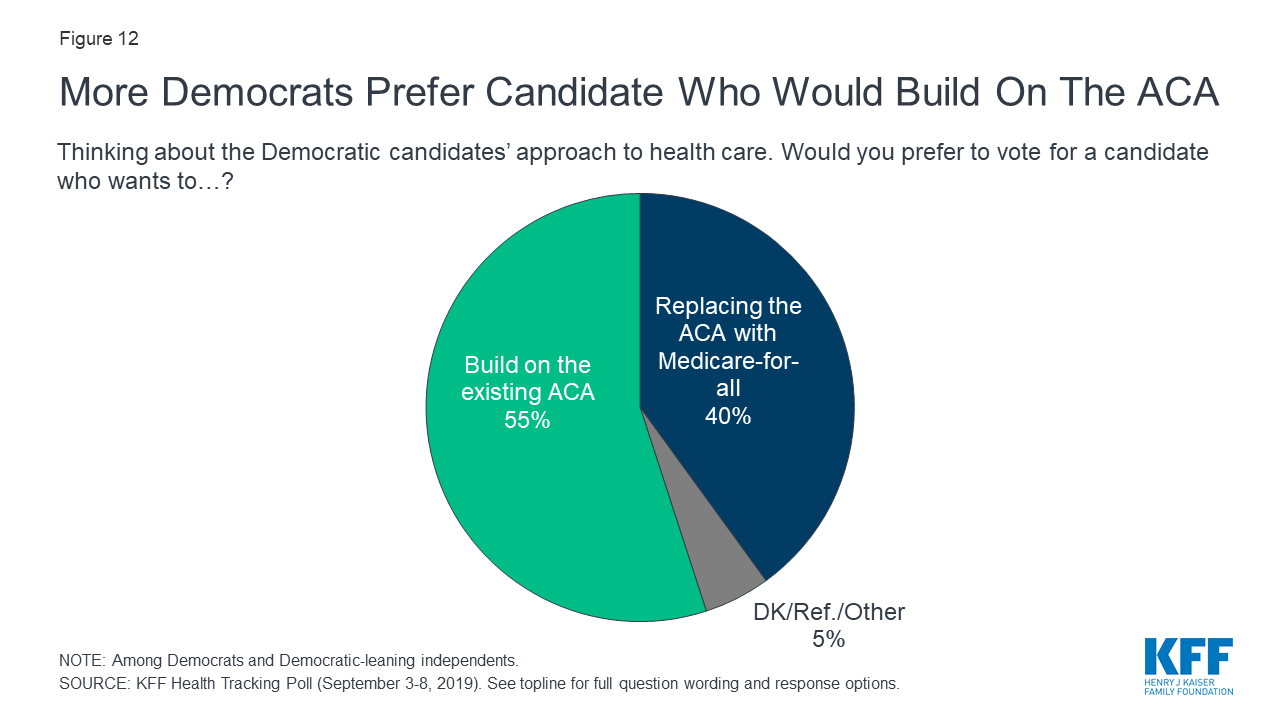
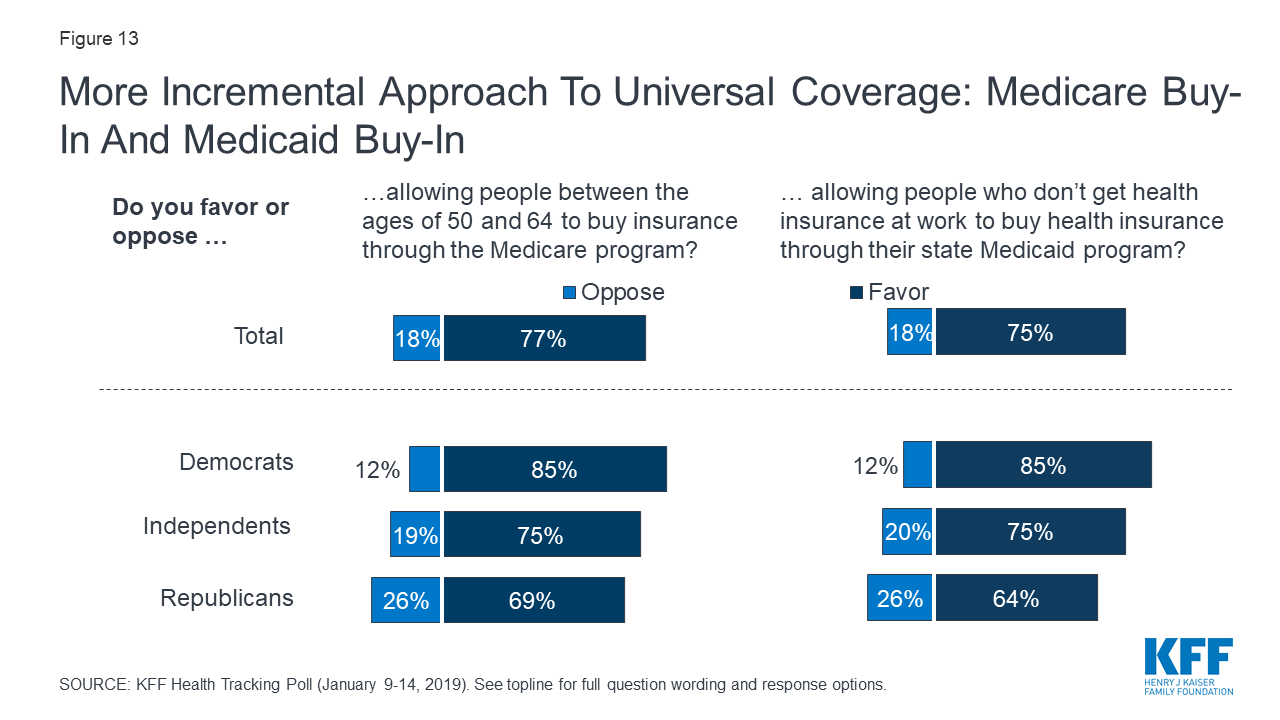
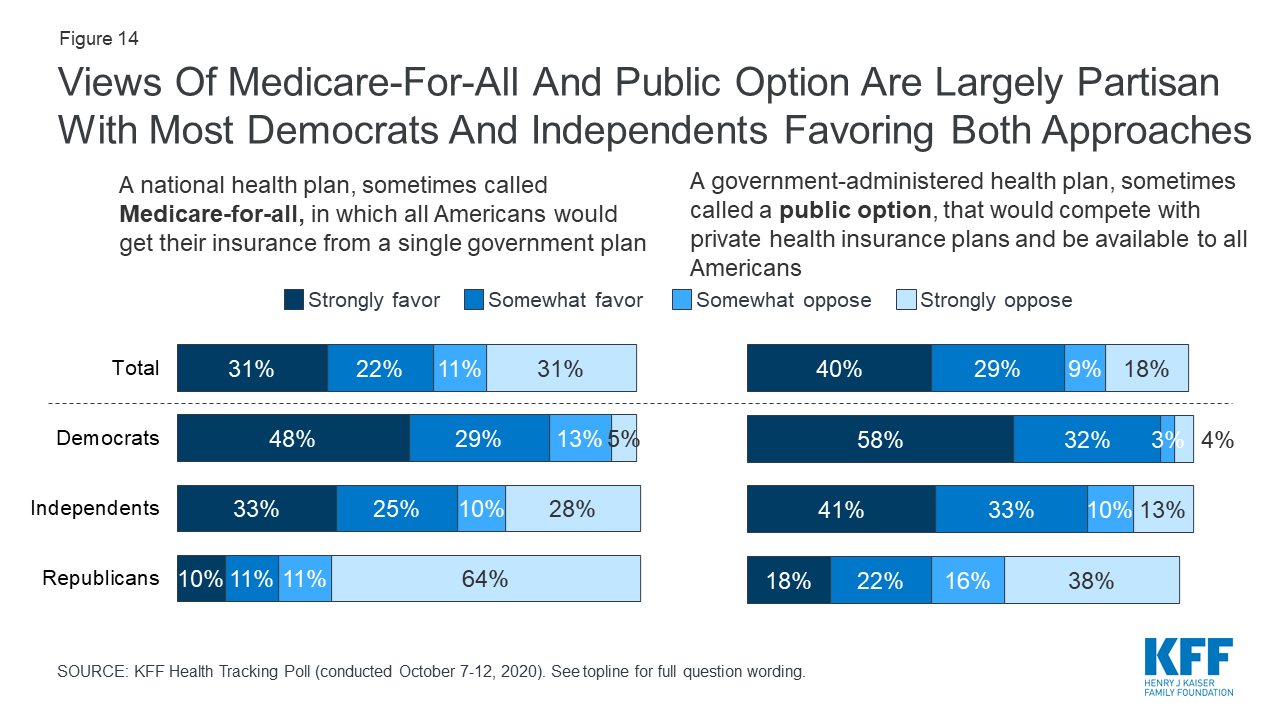
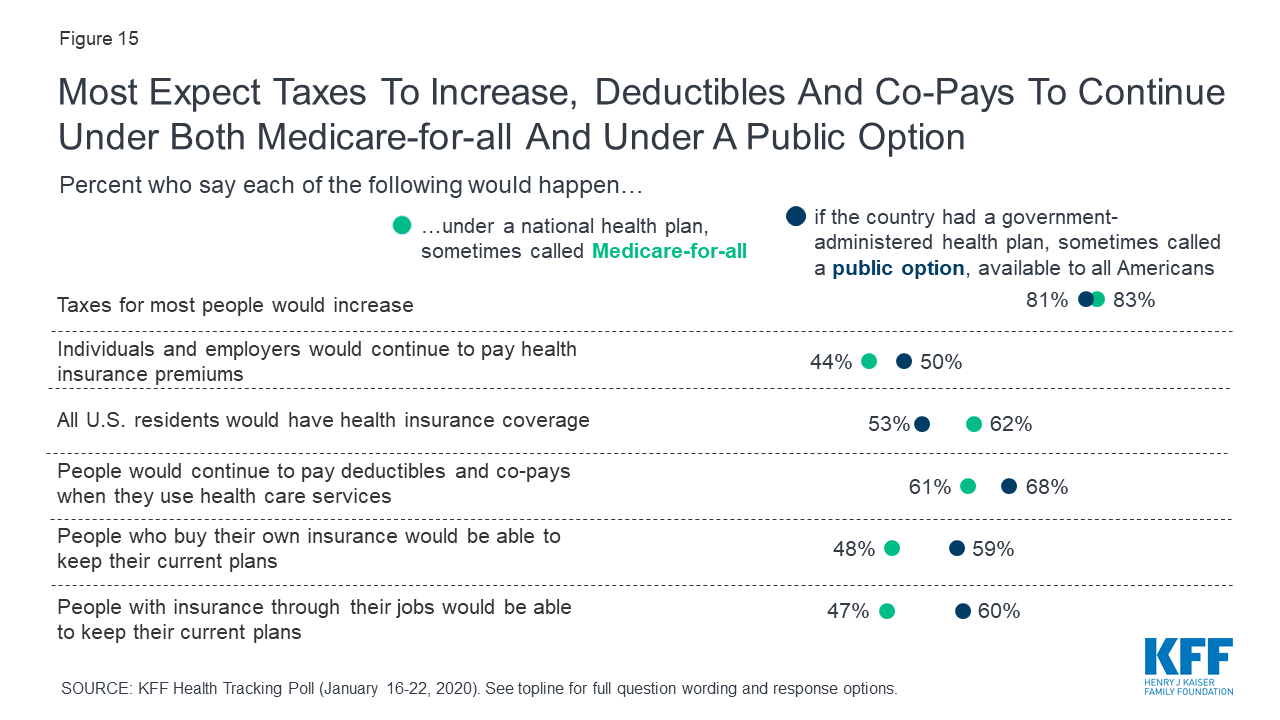
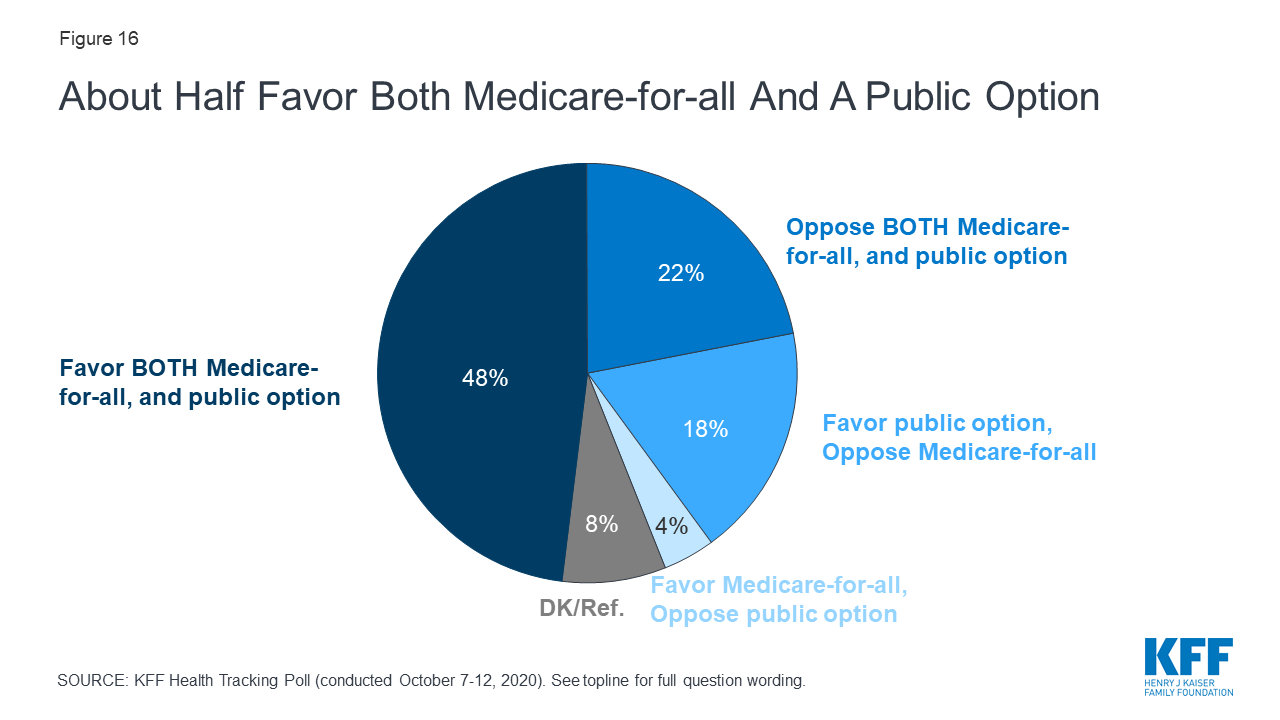
KFF polling finds more Democrats and Democratic-leaning independents would prefer voting for a candidate who wants to build on the ACA in order to expand coverage and reduce costs rather than replace the ACA with a national Medicare-for-all plan (Figure 12). Additionally, KFF polling has found broader public support for more incremental changes to expand the public health insurance program in this country including proposals that expand the role of public programs like Medicare and Medicaid (Figure 13). And while partisans are divided on a Medicare-for-all national health plan, there is robust support among Democrats, and even support among four in ten Republicans, for a government-run health plan, sometimes called a public option (Figure 14). Notably, the public does not perceive major differences in how a public option or a Medicare-for-all plan would impact taxes and personal health care costs. However, there are some differences in perceptions of how the proposals would impact those with private health insurance coverage (Figure 15). KFF polling in October 2020 finds about half of Americans support both a Medicare-for-all plan and a public option (Figure 16). So while the general idea of a national health plan (whether accomplished through an expansion of Medicare or some other way) may enjoy fairly broad support in the abstract, it remains unclear how this issue will play out in the 2020 election and beyond.

KFF Health Tracking Poll – October 2020: The Future of the ACA and Biden’s Advantage On Health Care

Published: Oct 16, 2020

Aca And Health Care

Key Findings

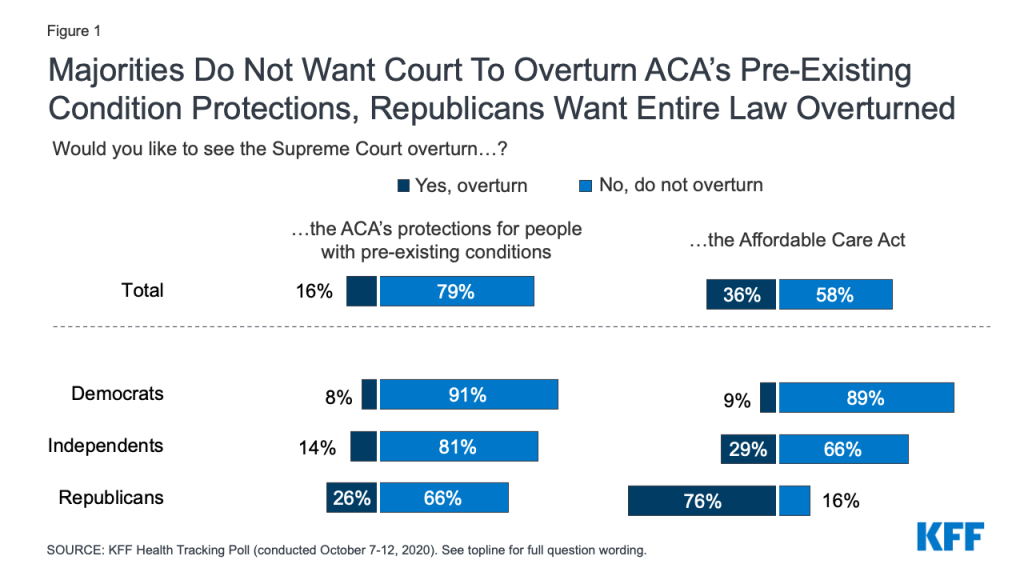
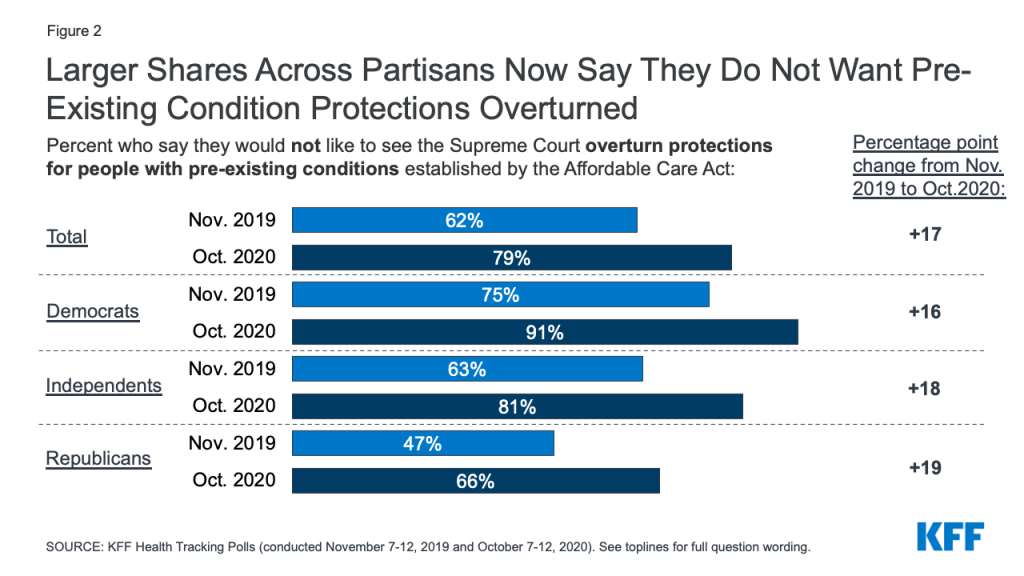
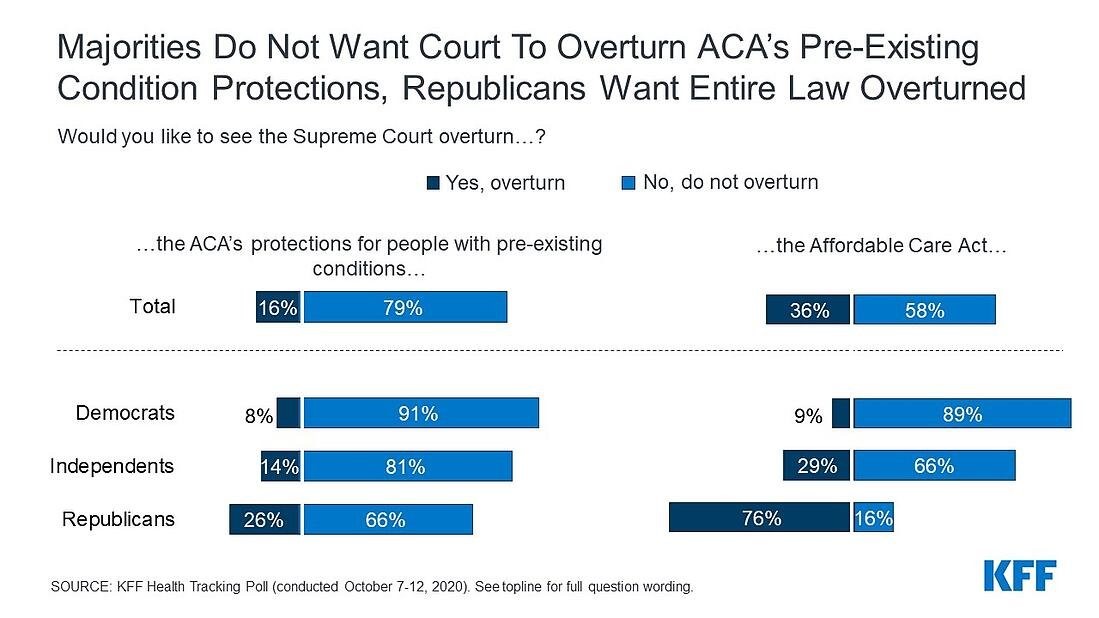
  • The confirmation hearings for Judge Barrett, President Trump’s appointment to fill the Supreme Court seat previously held by Justice Ginsburg, are underway this week and the future of the ACA’s protections for people with pre-existing conditions have been front-and-center. The latest KFF Health Tracking Poll finds a large majority of the public – including majorities of Democrats (91%), independents (81%), and Republicans (66%), now say they do not want to see the Supreme Court overturn the ACA’s pre-existing condition protections. The share who do not want to see these protections overturned has increased by double digits from one year ago for each group.
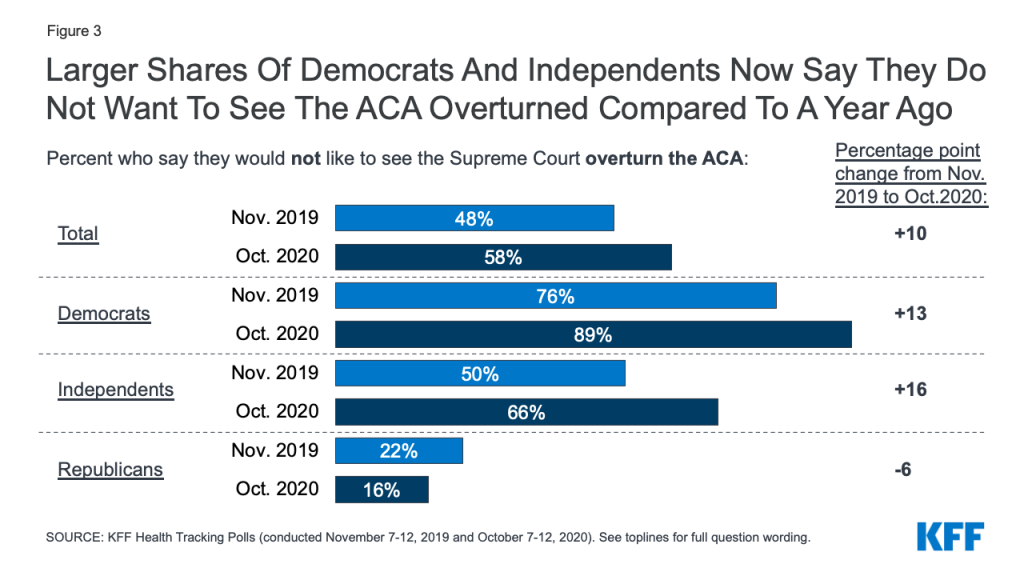
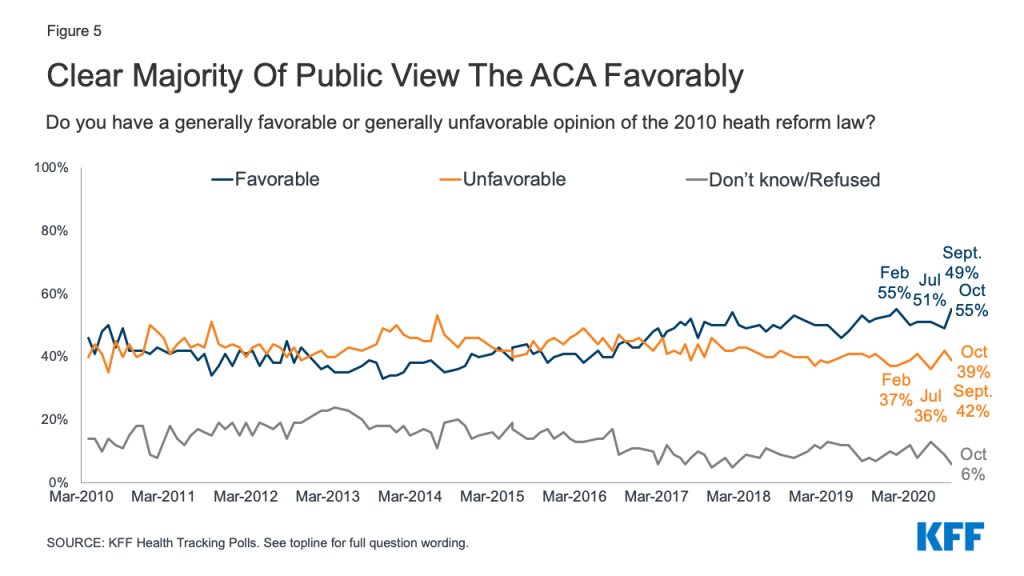
  • Six in ten adults say they do not want to see the Supreme Court overturn the entire ACA, up 10 percentage points from one year ago. This includes majorities of both Democrats (89%) and independents (66%), but three-fourths of Republicans still want to see the entire law overturned. Overall views of the Affordable Care Act are slightly more positive this month, with 55% of the public saying they view the law favorably. This ties its highest favorability measured in ten years of KFF polling (tied with February 2020).
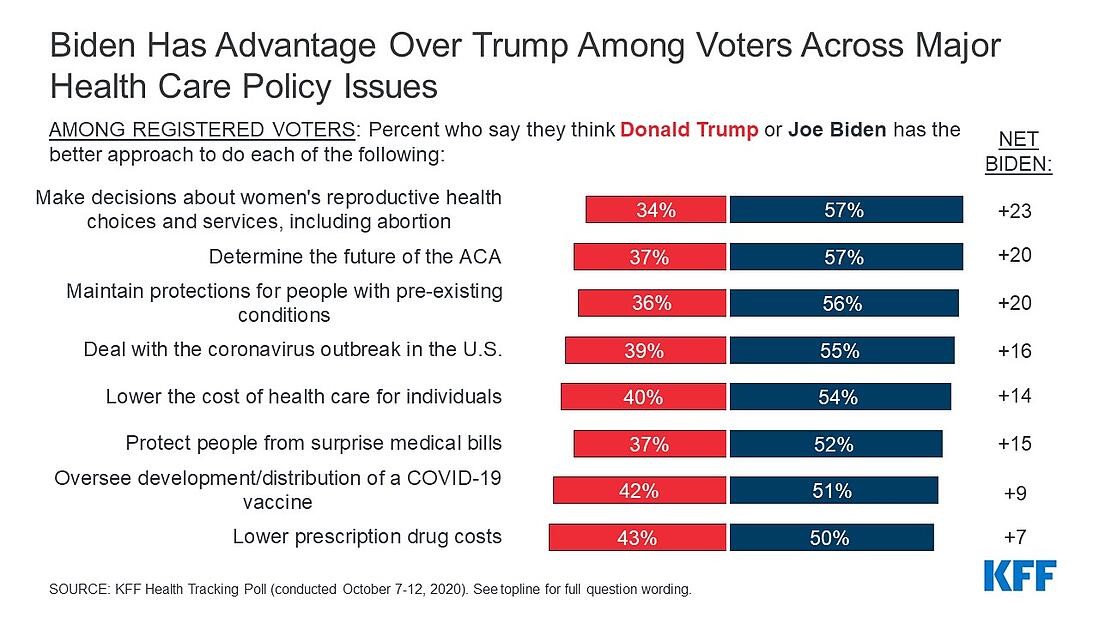
  • Vice President Biden has the advantage over President Trump on all health policy issues included in the survey including at least a 20 percentage point advantage on who voters think has the better approach (Biden or Trump) to make decisions about women’s reproductive health choices and services, including abortion, family planning, and contraception (57% v. 34%), determining the future of the ACA (57% v. 37%), and maintaining protections for people with pre-existing health conditions (56% v. 36%). He also holds an advantage on surprise medical bills, the coronavirus outbreak and distribution of a vaccine, and lowering health care costs for individuals.
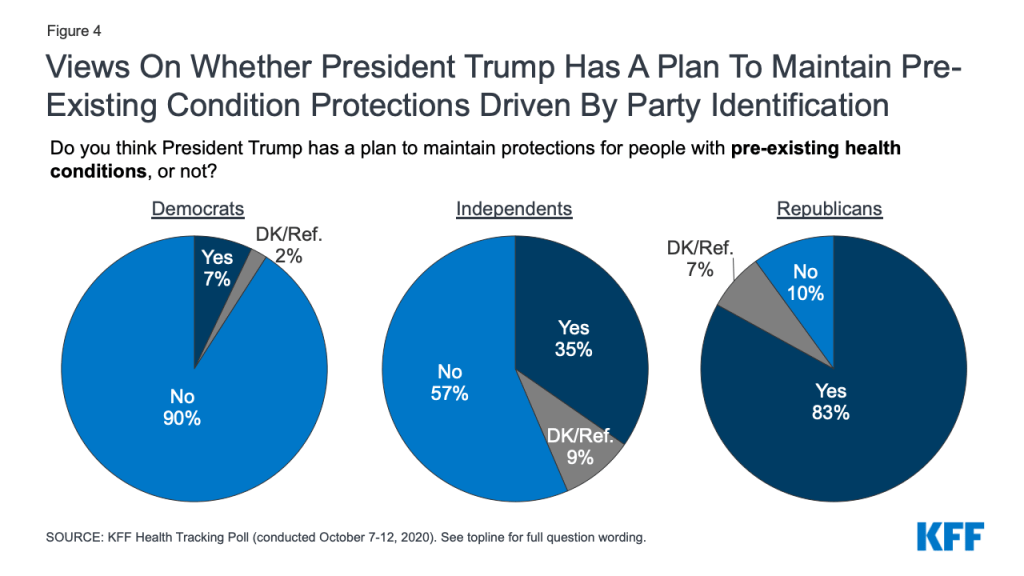
  • While both presidential candidates say they have plans to ensure pre-existing condition protections, most Democrats and independent say they do not think President Trump has a plan to maintain such protections. Slightly more than half (53%) including majorities of Democrats (90%) and independents (57%) say they “do not think President Trump has a plan to maintain protections for people with pre-existing health conditions.” On the other hand, a large majority of Republicans (85%) say President Trump “has a plan” to maintain these protections afforded by the ACA.

The Affordable Care Act and the Supreme Court

This week marked the beginning of the U.S. Senate’s confirmation hearings for President Trump’s appointment to fill the seat held by the late Justice Ruth Bader Ginsburg. One of the major focuses of the Senate Judiciary Committee’s hearings for Judge Amy Coney Barrett has been her views of the constitutionality of the 2010 Affordable Care Act (ACA). The Court is set to hear oral arguments for California v. Texas, a case backed by the Trump administration challenging the future of the law, on November 10th.

Eight in ten adults (79%) say they do not want to see the Supreme Court overturn the protections for people with pre-existing conditions established by the Affordable Care Act and a majority of U.S. adults (58%) also say they do not want to see the Supreme Court overturn the entire 2010 law. Majorities of Republicans (66%), independents (81%), and nine in ten Democrats (91%) say they do not want to see the Supreme Court overturn the pre-existing condition protections in the ACA. Nine in ten Democrats (89%) and two-thirds of independent (66%) also say they do not want to see the Supreme Court overturn the entire law while three-fourths of Republicans (76%) say they would like to see the entire law overturned.

Figure 1: Majorities Do Not Want Court To Overturn ACA’s Pre-Existing Condition Protections, Republicans Want Entire Law Overturned

The ACA’s protections for people with pre-existing medical conditions has been a dominant issue in the 2020 presidential campaign since the passing of Supreme Court Justice Ginsburg and larger shares of the public now saying they do not want to see these protections overturned (up 17 percentage points from last November). A majority of Republicans now say they do not want to see the pre-existing condition protections overturned (up 19 points from last year), and while majorities of Democrats and independents had previously said they did not want to see these protections overturned, the share among these groups has also increased (16 percentage points and 18 points, respectively).

Figure 2: Larger Shares Across Partisans Now Say They Do Not Want Pre-Existing Condition Protections Overturned

There is also a slight increase in the share who say they do not want to see the ACA overturned, up 10 percentage points from November 2019 and five percentage points from July of this year. A larger share of Democrats and independents now say they do not want to see the law overturned, compared to a year ago (up 13 percentage points and 16 points, respectively), while the share of Republicans who want to see the entire law overturned has remained relatively steady (71% in November 2019 to 76% in the latest poll).

Figure 3: Larger Shares Of Democrats And Independents Now Say They Do Not Want To See The ACA Overturned Compared To A Year Ago

While both presidential candidates say they intend to ensure pre-existing condition protections, most Democrats and independent say they do not think President Trump has a plan to maintain such protections. Slightly more than half (53%) including majorities of Democrats (90%) and independents (57%) say they “do not think President Trump has a plan to maintain protections for people with pre-existing health conditions.” On the other hand, a large majority of Republicans (85%) say President Trump “has a plan” to maintain these protections afforded by the ACA. While President Trump signed an executive order on Sept. 24th saying people with pre-existing conditions should be able to obtain health insurance at an affordable rate, the order does not guarantee coverage if the ACA is overturned.

Figure 4: Views On Whether President Trump Has A Plan To Maintain Pre-Existing Condition Protections Driven By Party Identification

About half of adults say they are worried they or someone in their family will not be able to afford health coverage (54%) or will lose coverage (51%) if the Supreme Court overturns the entire Affordable Care Act. While at least seven in ten Democrats express worry about not being able to afford coverage (76%) or losing coverage (71%) as do at least half of independents (58% and 53%, respectively), a smaller share of Republicans express similar worries with about one-fourth saying they are worried about not being able to afford coverage (23%) or losing coverage (23%) if the entire ACA is overturned.

Table 1: Worries About Losing Coverage, Not Being Able To Afford Coverage By Party Identification
Percent who say they are worried about each of the following if the entire ACA is overturned:TotalDemocratsIndependentsRepublicans
Not being able to afford coverage in the future54%76%58%23%
Losing health insurance coverage in the future51715323

About six in ten adults (59%) say they live in a household with someone with a pre-existing or chronic health condition that would have led to them being denied coverage or having to pay more prior to the passing of the ACA. Click here to see more on the pre-existing health conditions that were previously deemed as “declinable” or “uninsurable.”

Views Of The Affordable Care Act

In light of the recent attention to the Affordable Care Act, 55% of the public now hold a favorable view towards the law (up slightly from 49% last month). This matches the ACA’s highest point in favorability first measured back in February 2020, during the height of the 2020 Democratic primary and before the coronavirus outbreak largely impacted the U.S. While a majority of the public view the law favorably, four in ten (39%) continue to view law unfavorably including eight in ten Republicans (79%), as well as about one-third of independents (35%) and one in ten Democrats (9%).

Figure 5: Clear Majority Of Public View The ACA Favorably

Public Attitudes’ Towards Roe v. Wade Remain Steady

About seven in ten (69%) Americans say they do not want to see the Supreme Court to overturn the 1973 Roe v. Wade ruling that established a woman’s constitutional right to have an abortion. Nine in ten Democrats (91%) do not want to see the law overturned as do three-fourths of independent (76%). More than half of Republicans (57%) say they want to see Roe v. Wade overturned. Partisans’ attitudes towards the landmark case are unchanged from a January 2020 KFF survey examining attitudes towards and knowledge of U.S. reproductive health policy. 

The Role Of Health Care In The 2020 Election

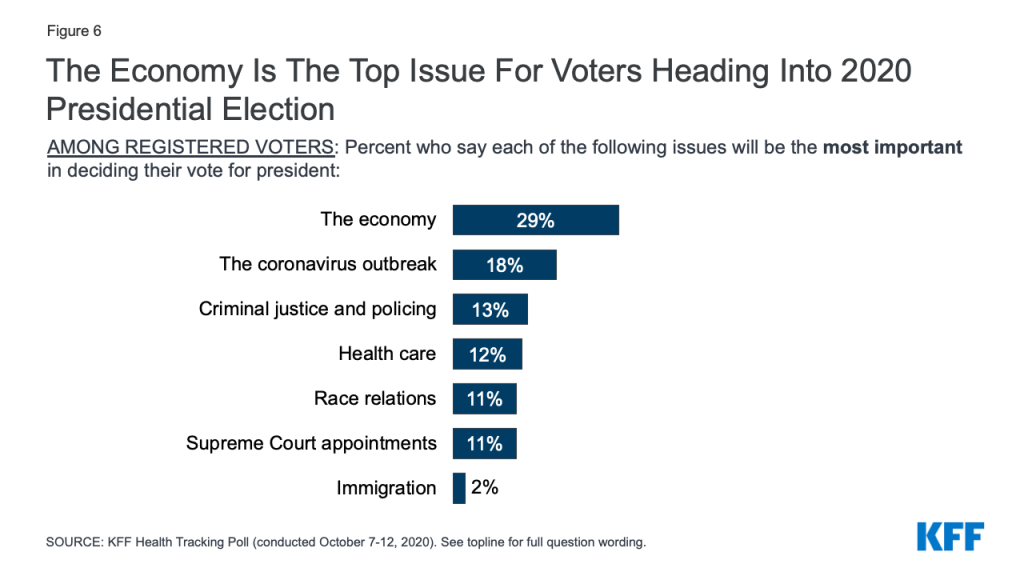
The latest KFF Health Tracking Poll, conducted one month prior to the 2020 presidential election, finds that the economy continues to hold the top issue spot for voters deciding their 2020 presidential vote choice. Three in ten (29%) voters say the economy will be the “most important issue” in deciding their vote for president. This is similar to the share of voters who say the coronavirus outbreak, a major public health issue, will be the most important issue to their vote (18%) as well as health care, more generally, (12%). About one in ten voters say issues including criminal justice and policing (13%), race relations (11%), and the appointment of a Supreme Court justice (11%) are the most important in deciding their vote this fall.

Figure 6: The Economy Is The Top Issue For Voters Heading Into 2020 Presidential Election

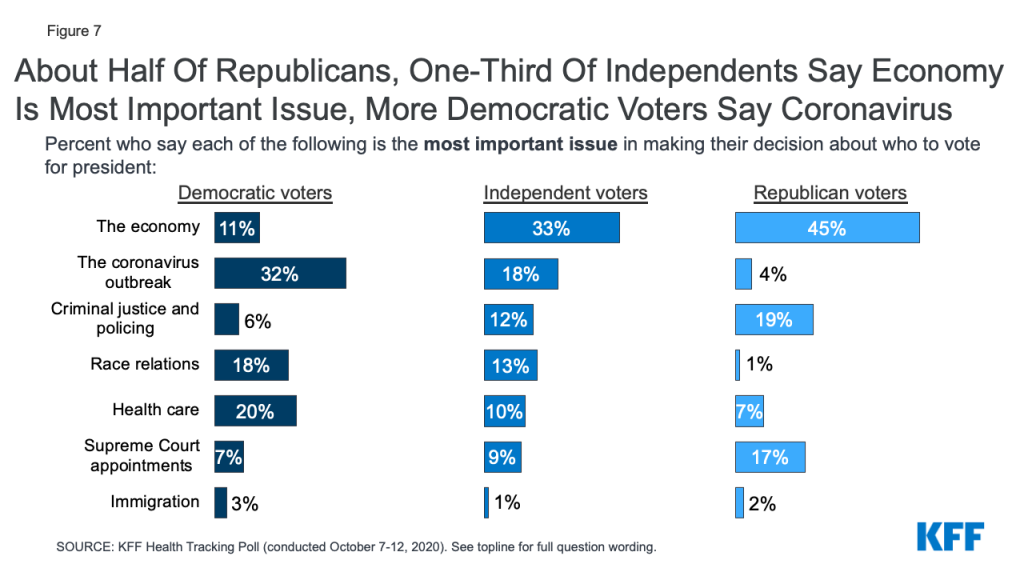
Nearly half of Republican voters (45%) choose the economy as their top issue in deciding which candidate to vote for president as do one-third of independent voters. Across the political aisle, health care is dominant for Democratic voters with one-third of Democratic voters (32%) saying the coronavirus outbreak will be the most important issue in deciding their vote and one in five Democratic voters saying the same about health care more generally.

Figure 7: About Half Of Republicans, One-Third Of Independents Say Economy Is Most Important Issue, More Democratic Voters Say Coronavirus

How Specific Health Care Priorities Drive Voters

When given a list of possible health care policy areas that may play a role in deciding their vote for president, most voters say each of these issues is important. Nearly all voters (94%) say protections for people with pre-existing conditions will be important to their vote, including three-fourths (74%) who say it is “very important.” About six in ten voters also say lowering the cost of health care for individuals (63%), determining the future of the Medicare program (62%), dealing with the health aspects of the coronavirus outbreak (60%), determining the future of reproductive health issues including abortion (60%), and lowering prescription drug costs (59%) are “very important” in deciding their vote for president this year. Majorities also say the same about expanding coverage for the uninsured (52%) and determining the future of the ACA (52%).

Figure 8: Majorities Of Voters Say Health Care Issues Are Important In Deciding 2020 Vote Choice

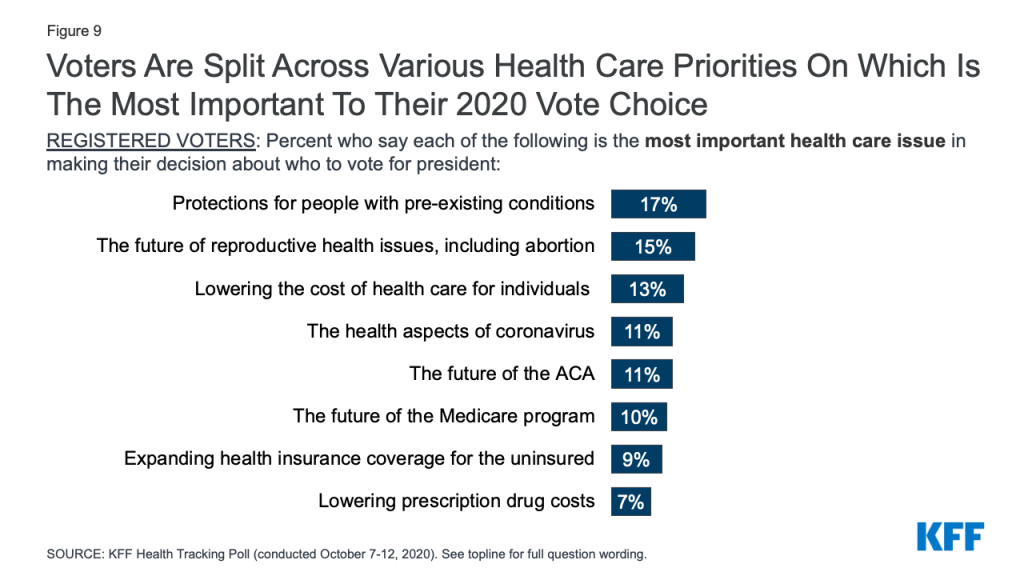
When asked to choose the most important health care issue among this list of possible issues, voters are divided across the issues. Nearly one in five voters (17%) say protections for people with pre-existing conditions is the most important health care issue in making their decision about who to vote for president, followed closely by the future of reproductive health issues including abortion (15%), and lowering the cost of health care (13%) rounding out the top three health care issues to voters.

Figure 9: Voters Are Split Across Various Health Care Priorities On Which Is The Most Important To Their 2020 Vote Choice

The health care issue that matters most to voters is largely driven by their party identification. One-fourth of Republican voters (24%) say determining the future of reproductive health issues including abortion is the health care issue most important to their 2020 vote, while one-fifth of independent voters (21%) say pre-existing condition protections is the most important health care issue to their vote. Democratic voters are divided across many health care priorities including most notably dealing with the health aspects of the coronavirus outbreak (17%), determining the future of the ACA (17%), and protections for people with pre-existing conditions (14%).

Table 2: The Role of Health Care Issues For Partisan Voters In 2020 Election
Percent who say each of the following health care issues is most important to their 2020 presidential vote:Democratic votersIndependent votersRepublican voters
Maintaining protections for people with pre-existing conditions14%21%15%
Lowering the cost of health care for individuals101314
Dealing with the health aspects of the coronavirus outbreak17115
Determining the future of reproductive health issues including abortion101324
Determining the future of the Affordable Care Act17106
Expanding health coverage for the uninsured12122
Determining the future of Medicare1189
Lowering prescription drug costs4613

Biden Has Clear Advantage On Key Health Care Issues

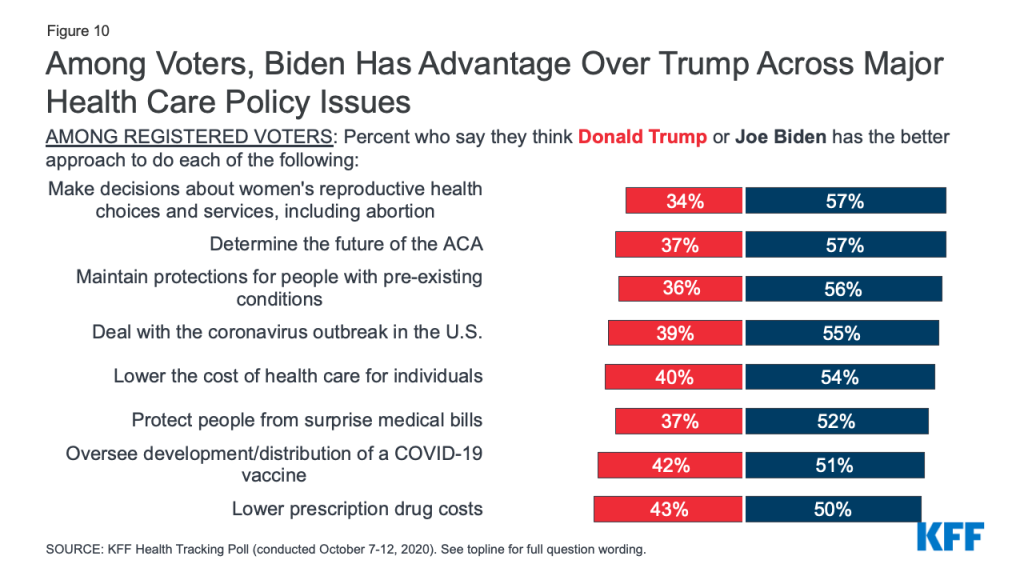
Former Vice President Biden has the edge on all health care issues over President Trump with at least half of voters saying they think Biden has the better approach to handling a series of health care issues asked about in the poll. Biden has at least a 20 percentage point advantage among voters on who they think has the better approach (Biden or Trump) to making decisions about women’s reproductive health choices and services, including abortion, family planning, and contraception (57% v. 34%), determining the future of the ACA (57% v. 37%), and maintaining protections for people with pre-existing health conditions (56% v. 36%). He also holds a double-digit advantage on several other health care policy issues including protecting people from surprise medical bills (52% v. 37%), dealing with the coronavirus outbreak (55% v. 39%), and lowering the cost of health care for individuals (54% v. 40%). Biden also does better – to a slightly lesser degree – on his approach to overseeing the development and distribution of a coronavirus vaccine (51% v. 42%) and lowering prescription drug costs (50% v. 43%).

Figure 10: Among Voters, Biden Has Advantage Over Trump Across Major Health Care Policy Issues

President Trump recently announced that 33 million Medicare beneficiaries will soon receive a discount card to help pay for the cost of prescription drugs. Voters’ assessment of which candidate has the better approach to lower prescription drug costs has shifted slightly since September, with Biden now having the advantage over President Trump on which candidate has the better approach to lowering prescription drug costs (42% v. 46% in September compared to 50% v. 43% in October).

MAjority Of Senior Voters Trust Biden On Health Care Issues

At least half voters 65 and older, say they think Biden has the better approach across all health care policy areas including key advantages over President Trump on determining the future of the ACA (57% v. 38%), surprise medical bills (53% v. 40%), maintaining pre-existing condition protections (55% v. 42%), and reproductive health policy (53% v. 41%). Biden has a smaller advantage on handling of both the coronavirus outbreak (54% v. 43%) and the distribution of a vaccine (53% v. 45%). Determining the future of Medicare is the top health care issue for senior voters with about one-fifth (22%) of voters 65 and older saying this is the most important health care issue to their vote. About one in eight senior voters say reproductive health issues (13%) and maintaining protections for people with pre-existing conditions (14%) are their top health care issues, followed closely by dealing with the many health aspects of the coronavirus (10%).

Coronavirus In The U.s.

These additional findings were released October 20.

Key Findings

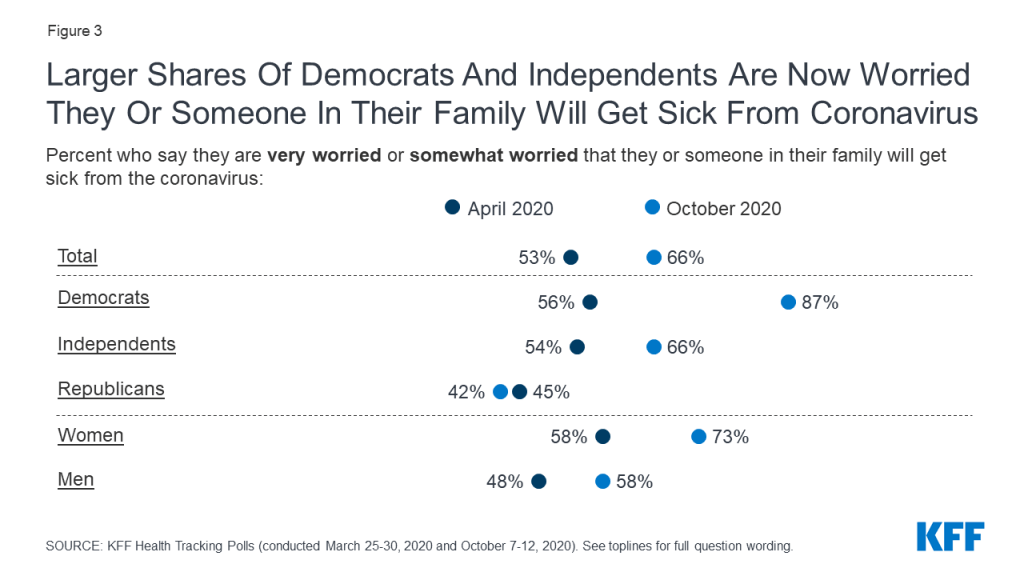
  • With more than 200,000 Americans dead from the coronavirus and with cases rising in many parts of the country, about two-thirds of adults (66%) say they are worried that they or someone in their family will get sick from coronavirus, an increase of 13 percentage points since early April. The share of Democrats who say they are worried about themselves or someone in their family getting sick from coronavirus has increased by 31 percentage points since April, while the share of Republicans expressing this worry has remained about the same.
  • Following President Trump’s coronavirus diagnosis, about three in ten adults say the President’s recent diagnosis makes them more likely to practice social distancing or to wear face masks. Most Republican voters say the President’s diagnosis does not impact their likelihood to vote for him.
  • Majorities of the public think President Trump is intervening with the FDA’s and CDC’s coronavirus related work. While most say they have at least a fair amount of trust in the FDA to ensure that an approved coronavirus vaccine is safe and effective (71%) and trust in the CDC to issue coronavirus related guidelines based on scientific evidence (72%), only about three in ten say they have a great deal of trust in these agencies.

Coronavirus Outbreak in the U.S.

The latest KFF Health Tracking Poll, conducted after President Trump contracted COVID-19 and was treated and then released from Walter Reed Army Hospital, finds in the wake of these recent events a sizeable share of the public feel negatively about the status of the coronavirus outbreak in the U.S., and are increasingly worried about themselves or someone in their family getting sick.

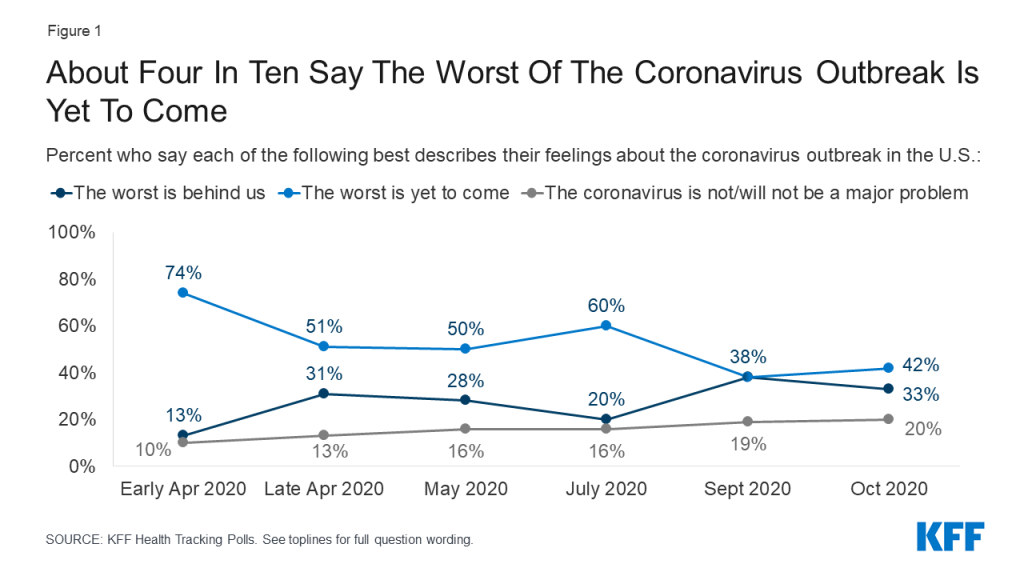
About four in ten adults (42%) think the worst of the coronavirus outbreak is yet to come, while a third of adults say the worst is behind us (33%) and one in five say they don’t think coronavirus is a major problem in the U.S. In September, equal shares said the worst of the outbreak is yet to come as said that the worst was behind us (38% each).

Among partisans, a majority of Democrats (64%) say the worst is yet to come, while most Republicans (58%) say the worst is behind us and 23% say the virus is not a major problem. Independents are more likely to say the worst of coronavirus is yet to come (46%) than to say that the worst is behind us (30%). Notably, about half of women (49%) say the worst of the outbreak is yet to come compared to about a third of men (36%) who say the same.

Figure 1: About Four In Ten Say The Worst Of The Coronavirus Outbreak Is Yet To Come

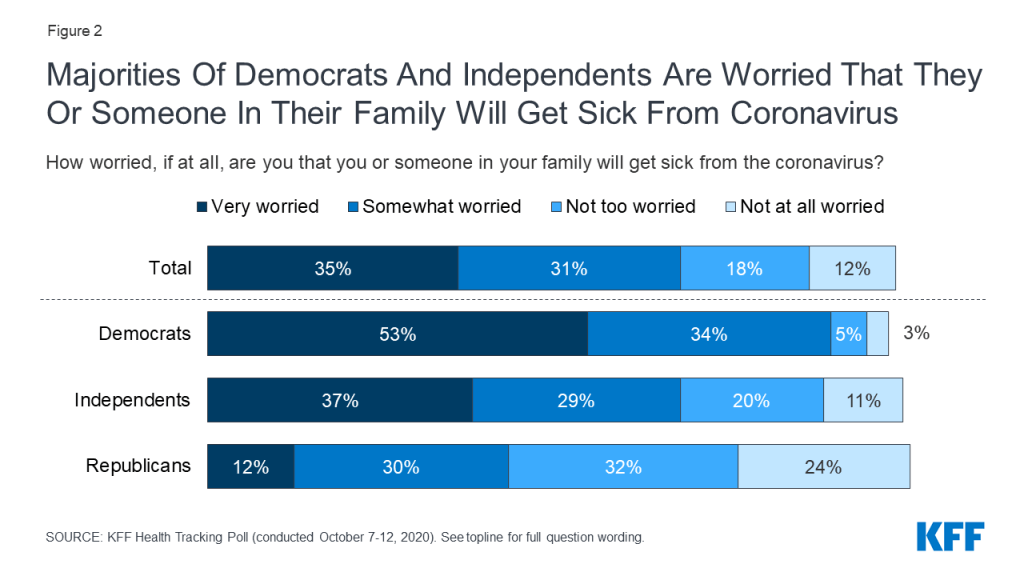
With more than seven million coronavirus cases in the U.S. and more than 200,000 death, two-thirds of adults say they are “very worried” or “somewhat worried” that they or someone in their family will get sick from coronavirus. The share of adults who say they are worried they or a family member will get sick has increased by 13 percentage points, from 53% in April. Mirroring the difference in expectations of what is yet to come in the coronavirus outbreak, women are more likely than men to say they are worried that they or a family member will get sick from coronavirus (73% vs. 58%).

Among partisans, twice as many Democrats as Republicans say they are worried that they or a family member will get sick from coronavirus (87% vs. 42%). Indeed, 53% of Democrats say they are “very worried”. Among independents, two-thirds (66%) say they are at least somewhat worried that they or a family member will get sick from coronavirus.

Figure 2: Majorities Of Democrats And Independents Are Worried That They Or Someone In Their Family Will Get Sick From Coronavirus

Since we last asked this question in the late April KFF Health Tracking Poll, the share who say they are worried about themselves or someone in their family getting sick from coronavirus has increased by 31 percentage points among Democrats and 12 percentage points among independents, while remaining about the same among Republicans.

Figure 3: Larger Shares Of Democrats And Independents Are Now Worried They Or Someone In Their Family Will Get Sick From Coronavirus

On Friday, October 1st, President Trump announced that he and the First Lady had tested positive for COVID-19. The President was moved to Walter Reed hospital for treatment and returned to the White House on Monday. Since then, more than a dozen people who had been around the President, including several White House staffers and Republican lawmakers, have recently tested positive for COVID-19.

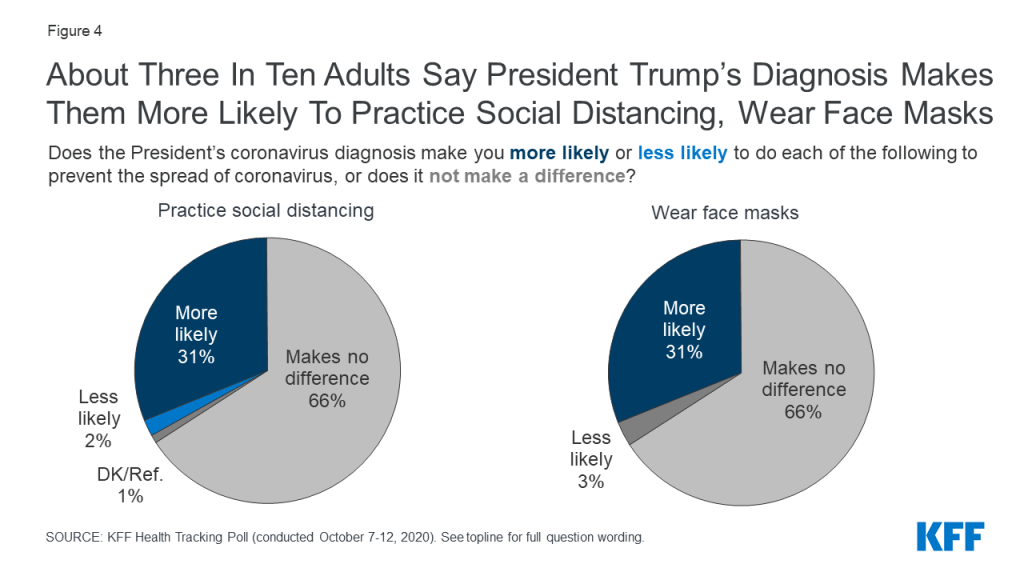
In the wake of these recent events, about three in ten adults say the President’s coronavirus diagnosis makes them “more likely” to take practice social distancing (31%) and to wear facemasks (31%) while few say it makes them “less likely” to do so.

Figure 4: About Three In Ten Adults Say President Trump’s Diagnosis Makes Them More Likely To Practice Social Distancing, Wear Face Masks

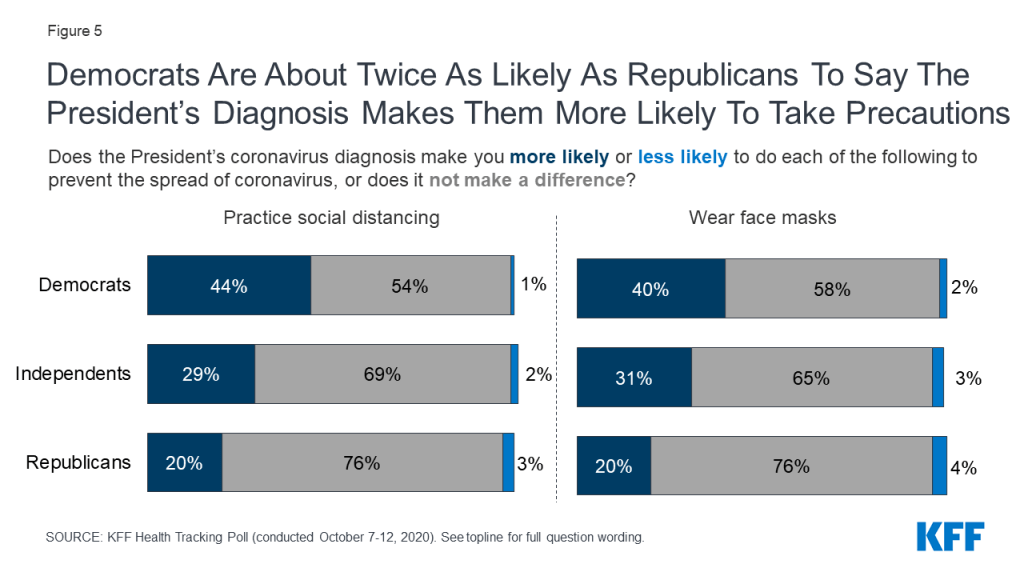
Views of social distancing and wearing face masks continue to be partisan, with about twice as many Democrats as Republicans saying President Trump’s diagnosis makes the more likely to practice social distancing (44% vs. 20%) and wear face masks (40% vs. 20%).

Figure 5: Democrats Are About Twice As Likely As Republicans To Say The President’s Diagnosis Makes Them More Likely To Take Precautions

Few Republican voters say President Trump’s recent coronavirus diagnosis changed the likelihood of them voting for President Trump next month. About nine in ten (88%) Republican voters say it did not make a difference in their vote choice.1 

Views Of the FDA and the CDC

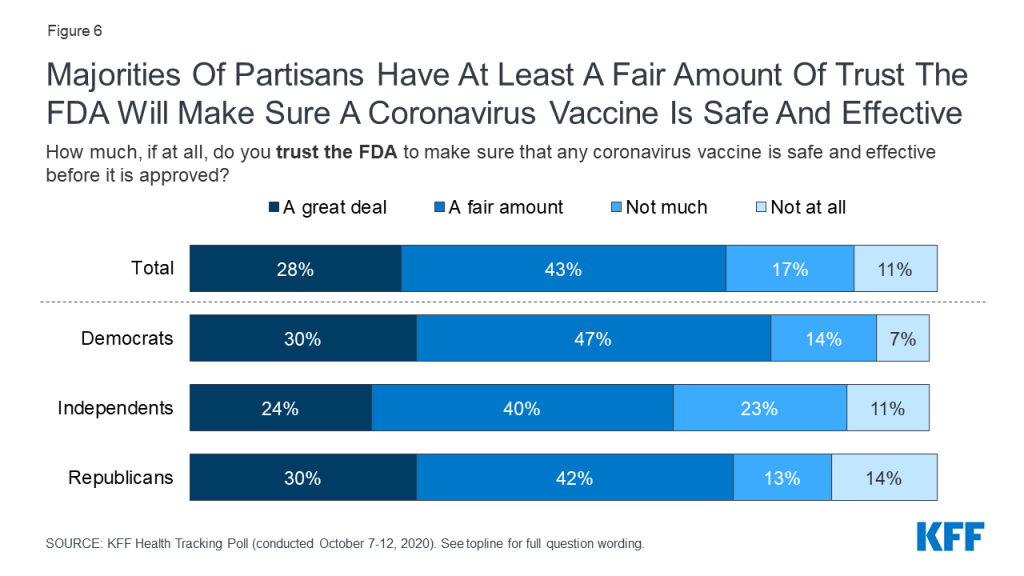
Recent reports that President Trump has tried to block recent vaccine guidelines from the U.S. Food and Drug Administration (FDA) have highlighted the role that political considerations may take in the approval of a coronavirus vaccine. Overall, the public trusts the FDA with about seven in ten adults saying they have “a great deal” or “a fair amount” of trust that the FDA will make sure that any coronavirus vaccine is safe and effective before it is approved. This includes majorities of Democrats (77%), Republicans (72%) and independents (64%).

Figure 6: Majorities Of Partisans Have At Least A Fair Amount Of Trust The FDA Will Make Sure A Coronavirus Vaccine Is Safe And Effective

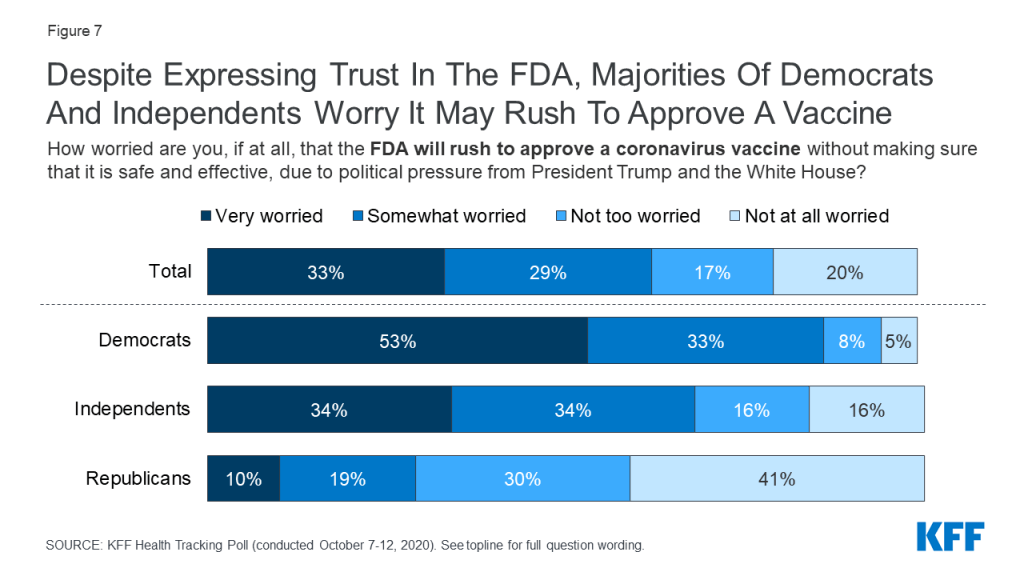
Despite this, many express worry that the FDA will rush to approve a vaccine due to political pressure from President Trump and the White House. About six in ten adults (62%) – including more than eight in ten Democrats and about three in ten Republicans – say they are worried that the FDA will rush to approve a coronavirus vaccine without making sure it is safe and effective, similar to the share who expressed this worry in our September Tracking Poll.

Figure 7: Despite Expressing Trust In The FDA, Majorities Of Democrats And Independents Worry It May Rush To Approve A Vaccine

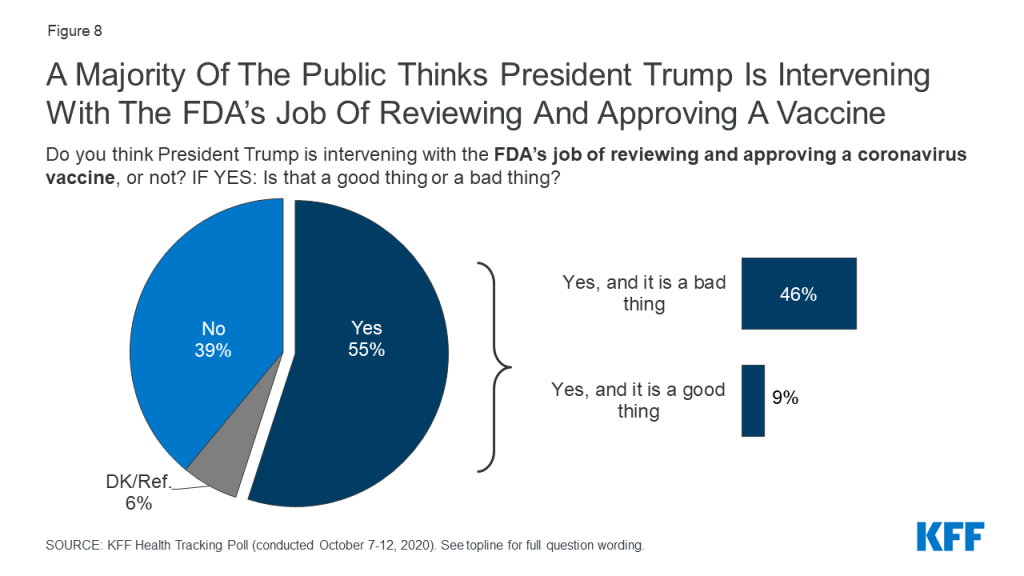
Along with expressing worry that the FDA may rush to approve a vaccine due to political pressure, a majority of the public (55%) think that President Trump is intervening with the FDA’s job of reviewing and approving a coronavirus vaccine and nearly half (46%) of all adults think his intervention is a bad thing. Few (9%) think President Trump is intervening with the FDA’s reviewing of a coronavirus vaccine and that this is a good thing.

Figure 8: A Majority Of The Public Thinks President Trump Is Intervening With The FDA’s Job Of Reviewing And Approving A Vaccine

About three in four Democrats (77%) think President Trump is intervening with the FDA’s job of reviewing and approving a coronavirus vaccine and that his intervention is a bad thing. On the other hand, about seven in ten Republicans (69%) do not think the President is intervening. Independents are more divided with about half (49%) saying the President is intervening and this is bad, while four in ten (39%) say they do not think the President is intervening with the FDA.

Table 1: View of President Trump’s intervention with the FDA by party
Do you think President Trump is intervening with the FDA’s job of reviewing and approving a coronavirus vaccine, or not?DemocratsIndependentsRepublicans
Yes, and it is a good thing4%8%18%
Yes, and it is a bad thing77499
No143969

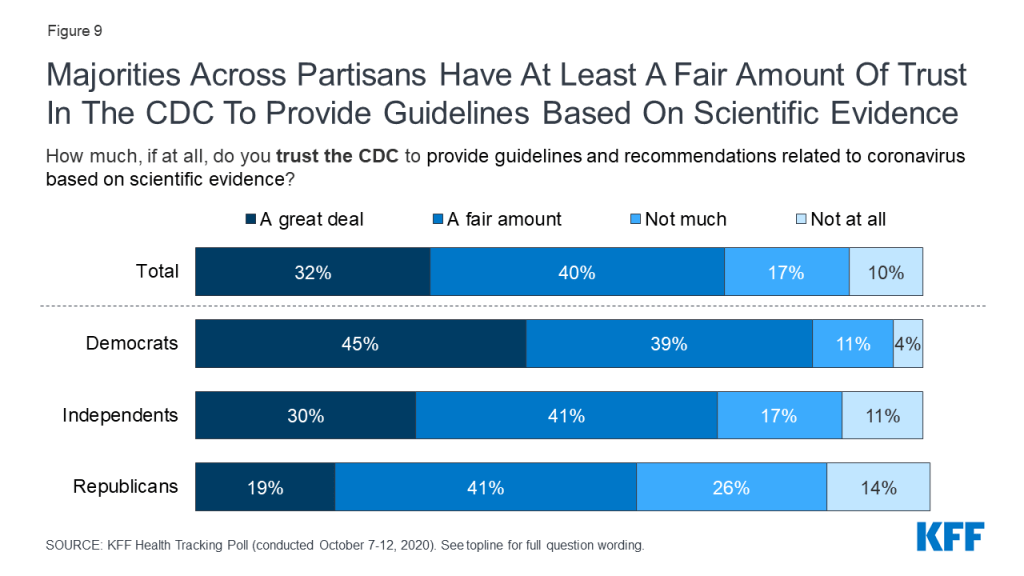
Similar to views of the FDA, the majority of the public trusts the CDC but about half believe that President Trump is intervening with this federal agency. About seven in ten adults (72%) say they have “a great deal” or “a fair amount” of trust that the CDC will issue guidelines and recommendations related to the coronavirus based on scientific evidence. Compared to trust in the FDA, trust in the CDC is somewhat more partisan though majorities of Democrats (84%), independents (72%), and Republicans (60%) say they have at least “a fair amount” of trust that the CDC will issue coronavirus recommendations based on scientific evidence.

Figure 9: Majorities Across Partisans Have At Least A Fair Amount Of Trust In The CDC To Provide Guidelines Based On Scientific Evidence

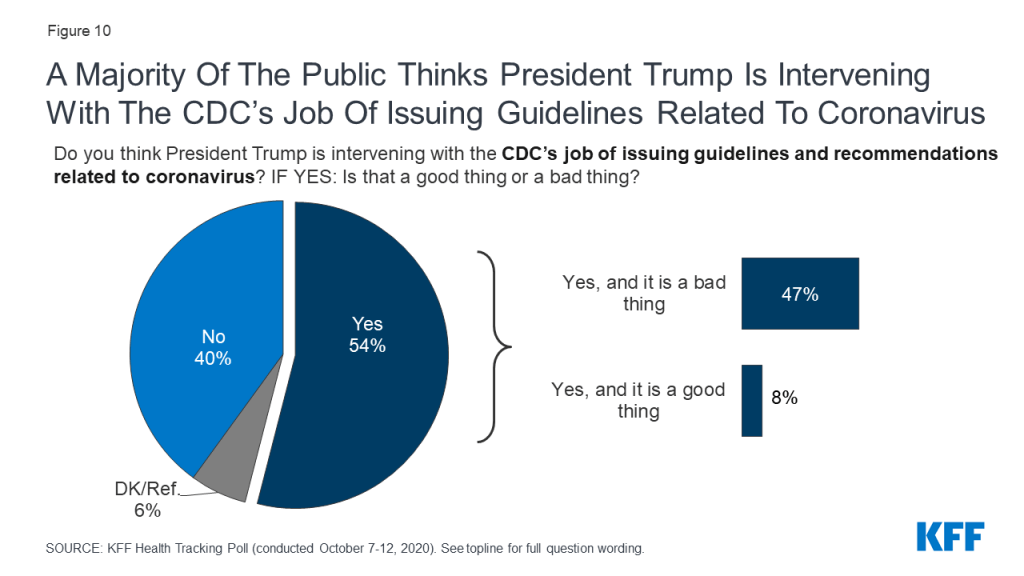
There have been recent reports that politically appointed officials in the Department of Health and Human Services have interfered with coronavirus-related CDC reports. Amidst these revelations, a majority of the public (54%) thinks President Trump is intervening with the CDC’s job of issuing guidelines and recommendations related to coronavirus. Moreover, nearly half of the public (47%) believe intervention by President Trump is a bad thing, while 8% say the President is intervening with the CDC’s job and this is a good thing.

Figure 10: A Majority Of The Public Thinks President Trump Is Intervening With The CDC’s Job Of Issuing Guidelines Related To Coronavirus

Once again, there is a stark partisan divide with about three in four Democrats (77%) saying they think President Trump is intervening with the CDC and that his intervention is a bad thing as do half (51%) of independents. On the other hand, about three in four Republicans (72%) do not think the president is intervening.

Table 2: View of President Trump’s intervention with the CDC by party
Do you think President Trump is intervening with the CDC’s job of issuing guidelines and recommendations related to coronavirus?DemocratsIndependentsRepublicans
Yes, and it is a good thing4%7%14%
Yes, and it is a bad thing775110
No143772

Methodology

This KFF Health Tracking Poll was designed and analyzed by public opinion researchers at the Kaiser Family Foundation (KFF). The survey was conducted October 7- 12, 2020, among a nationally representative random digit dial telephone sample of 1,207 adults ages 18 and older, living in the United States, including Alaska and Hawaii (note: persons without a telephone could not be included in the random selection process). The sample included 287 respondents reached by calling back respondents that had previously completed an interview on the KFF Tracking poll at least nine months ago. Computer-assisted telephone interviews conducted by landline (290) and cell phone (917, including 658 who had no landline telephone) were carried out in English and Spanish by SSRS of Glen Mills, PA. To efficiently obtain a sample of lower-income and non-White respondents, the sample also included an oversample of prepaid (pay-as-you-go) telephone numbers (25% of the cell phone sample consisted of prepaid numbers) as well as a subsample of respondents who had previously completed Spanish language interviews on the SSRS Omnibus poll (n=10). Both the random digit dial landline and cell phone samples were provided by Marketing Systems Group (MSG). For the landline sample, respondents were selected by asking for the youngest adult male or female currently at home based on a random rotation. If no one of that gender was available, interviewers asked to speak with the youngest adult of the opposite gender. For the cell phone sample, interviews were conducted with the adult who answered the phone. KFF paid for all costs associated with the survey.

The combined landline and cell phone sample was weighted to balance the sample demographics to match estimates for the national population using data from the Census Bureau’s March 2019 Supplement of the U.S. Census Population Survey (CPS) on sex, age, education, race, Hispanic origin, and region along with data from the 2010 Census on population density. The sample was also weighted to match current patterns of telephone use using data from the January- June 2019 National Health Interview Survey. The weight takes into account the fact that respondents with both a landline and cell phone have a higher probability of selection in the combined sample and also adjusts for the household size for the landline sample, and design modifications, namely, the oversampling of prepaid cell phones and likelihood of non-response for the re-contacted sample. All statistical tests of significance account for the effect of weighting.

The margin of sampling error including the design effect for the full sample is plus or minus 3 percentage points. Numbers of respondents and margins of sampling error for key subgroups are shown in the table below. For results based on other subgroups, the margin of sampling error may be higher. Sample sizes and margins of sampling error for other subgroups are available by request. Note that sampling error is only one of many potential sources of error in this or any other public opinion poll. Kaiser Family Foundation public opinion and survey research is a charter member of the Transparency Initiative of the American Association for Public Opinion Research.

GroupN (unweighted)M.O.S.E.
Total1,207± 3 percentage points
Total voters1,048± 4 percentage points
Party Identification
Democrats387± 6 percentage points
Republicans339± 6 percentage points
Independents380± 6 percentage points
Party Identification among Voters
Democratic voters354± 6 percentage points
Republican voters315± 6 percentage points
Independent voters312± 7 percentage points

Cross-tabs

Endnotes

  1. This question was asked of all registered voters who had not yet voted and who did not say they were definitely going to vote for Joe Biden. ↩︎
News Release

Tracking Poll: A Large and Growing Majority, Including Republicans, Does Not Want the Supreme Court to Overturn the ACA’s Protections for People with Pre-Existing Conditions

Voters Favor Democratic Nominee Joe Biden Over President Trump on Wide Range of Health Issues

Published: Oct 15, 2020

As the Senate considers Judge Amy Coney Barrett’s nomination to the Supreme Court, the October KFF Health Tracking Poll finds a large majority (79%) of the public do not want the Court to overturn the Affordable Care Act’s protections for people with pre-existing medical conditions, up 17 percentage points since last year when 62% held this view.

The Supreme Court is scheduled to hear arguments a week after Election Day in a challenge to the 2010 health law led by conservative states and backed by the Trump administration, making the law’s fate a flashpoint in Judge Barrett’s confirmation hearings and the 2020 election.

Majorities of Democrats (91%), independents (81%), and Republicans (66%), now say they do not want to see the Supreme Court overturn the ACA’s pre-existing condition protections. The shares have increased by double digits since last year for each group.

A narrower majority (58%) does not want the Court to overturn the entire ACA, up 10 percentage points from last year. Partisans are divided on this question, with most Republicans (76%) saying they want the Court to overturn the entire law, while most Democrats (89%) and independents (66%) do not.

One potential reason that so many Americans want to preserve those ACA provisions is that most people (59%) say they live in a family with someone who has a pre-existing or chronic health condition. About half say they are worried someone in their family will not be able to afford health coverage (54%) or would lose coverage (51%) if the ACA were overturned.

“Many Americans worry about what could happen to them if insurance companies were able to discriminate against family members with pre-existing conditions, and that’s why the issue has become a flashpoint in the election,” KFF President and CEO Drew Altman said. “Now COVID could become a pre-existing condition, potentially adding to their anxiety.”

President Trump has said that he will always protect people with pre-existing conditions and signed an executive order last month emphasizing that point, but the order does not provide a clear pathway for maintaining protections for people with pre-existing conditions if the ACA were overturned.

When asked whether President Trump has a plan to protect people with pre-existing conditions, just over half (53%) of the public says he does not – though there are big partisan differences. A large majority of Republicans (83%) say President Trump does have a plan, while most Democrats (90%) and independents (57%) say he does not.

The poll finds that 55% of the public now holds a favorable view of the ACA, up slightly from last month (49%) and matching the highest share ever recorded in 10 years of KFF polling; 39% now hold unfavorable views of the law.

On Health Care Issues, Voters Prefer Democratic Nominee Joe Biden’s Approach

The poll also probes voters’ views of the candidates on health care issues in play in the campaign, and finds that they prefer former Vice President Joe Biden’s approach to President Trump’s across a range of issues, including women’s reproductive health and abortion; the ACA; protecting people with pre-existing conditions; dealing with the coronavirus pandemic; reducing what people pay for health care; and protecting people from surprise medical bills.

Biden also holds a narrower edge on two other health issues that President Trump has championed: developing and distributing a COVID-19 vaccine (Biden 51%, Trump 42%) and lowering the cost of prescription drugs (Biden 50%, Trump 43%). This reflects a shift in voters’ views on drug costs since September, when voters were more divided on who has the better approach (Trump 46%, Biden 42%).

Other findings include:

  • The economy ranks as voters’ top issue, with 29% saying it will be the most important issue in deciding their vote for president. That roughly equals the combined share who say the coronavirus outbreak (18%) and health care overall (12%). Other top issues include criminal justice and policing (13%), race relations (11%) and Supreme Court appointments (11%). Few cite immigration (2%) as their top issue.
  • Most Americans (69%) say they do not want to see the Supreme Court overturn the 1973 Roe v. Wade decision that established a woman’s constitutional right to have an abortion. Partisans remain very divided on this issue, with most Republicans (57%) wanting to see Roe overturned and most Democrats (91%) and independents (76%) wanting to see it preserved.

Designed and analyzed by public opinion researchers at KFF, the poll was conducted from Oct. 7-12 among a nationally representative random digit dial telephone sample of 1,207 adults. Interviews were conducted in English and Spanish by landline (290) and cell phone (917). The margin of sampling error is plus or minus 3 percentage points for the full sample and 4 percentage points for voters. For results based on subgroups, the margin of sampling error may be higher.

The 2020 Presidential Election: Implications for Women’s Health

Authors: Michelle Long, Amrutha Ramaswamy, and Alina Salganicoff
Published: Oct 15, 2020

Introduction

While all elections have consequences, the outcome of the 2020 presidential election will shape many health issues of importance to women for years to come. From the ongoing COVID-19 pandemic, to the uncertain future of the Affordable Care Act, to threats to reproductive health care, the outcome of this election will have major consequences for women and the nation as a whole. The track records and the positions of the candidates on these issues offer a stark contrast to voters. This brief reviews the key issues that are likely to have a direct impact on women’s health as well as their access to coverage and care, and summarizes the presidential candidates’ stated positions and records on these issues.

President Donald Trump’s positions reflect his record during his presidency, his 2020 campaign website, and the Republican party platform, which is unchanged from 2016. Joe Biden’s positions reflect the policy agenda articulated on his 2020 campaign website, the Democratic party platform, the Unity Task Force Recommendations, and his record as a U.S. senator and as Vice President during the administration of President Barack Obama.

The Affordable Care Act

The Affordable Care Act (ACA) made many changes that have strengthened access to coverage for millions of women in the U.S. The law did away with longstanding policies that insurance plans used to discriminate against women. Today, all plans must include maternity care – which was the norm in employer plans but not in individually-purchased insurance before the ACA – and no-cost recommended preventive services including mammograms, prenatal and well woman care, and contraceptive services and supplies. Medicare beneficiaries also benefit from no-cost coverage for preventive services recommended for older women such as mammograms and bone density testing. Plans are not permitted to charge women more for coverage than men. The law also established consumer protections that guarantee people with a pre-existing health condition (including pregnancy) are not denied or charged more for individual insurance, and made coverage more accessible and affordable by expanding Medicaid and providing subsidies to many people purchasing coverage on their own in the ACA Marketplace.

The ACA’s future is uncertain, as the law’s constitutionality will once again be considered by the Supreme Court, scheduled for one week after the election. If the Supreme Court ultimately decides that all or most of the ACA must be overturned, as the Trump Administration now argues, the consequences would be complex and far-reaching.

Table 1: Comparing the Candidates on the Affordable Care Act
Donald Trump (R)Joe Biden (D)
  • Supported numerous unsuccessful Republican-led legislative efforts to ‘repeal and replace’ the ACA.
  • Signed legislation that reduced the individual mandate penalty to $0, effectively eliminating the requirement to hold qualified health coverage.
  • Is supporting a lawsuit before the Supreme Court to overturn the entire ACA, with no plan to replace it.
  • Promoted and expanded access to short-term plans which typically lack many of the protections that were included in the ACA reforms, including maternity care, mental health, or prescription drugs.
  • Cut funding for consumer outreach and enrollment assistance programs in the ACA Marketplace while redirecting some of those funds to promote short-term health plans.
  • Supports retaining and expanding upon the ACA.
  • Proposed creating a new federal public health insurance option similar to Medicare, referred to as the “public option,” and would automatically enroll uninsured adults who live in a state that has not expanded Medicaid, with no premium and full Medicaid benefits.
  • Has called for increasing financial assistance available to families through the ACA marketplaces and broadening eligibility for these subsidies.
  • Does not support a Medicare for All health care system and supports the continued role of private insurance in health care.

Reproductive Health

Reproductive health care is a core element of women’s health and has been at the center of many partisan debates, particularly with regard to abortion and contraception.1 

CONTRACEPTIONThe ACA, Medicaid policy, and the federal Title X family planning program shape women’s access to a broad range of contraceptive services. However, access to and funding for contraception has been at the center of heated political disputes.

Contraceptive Coverage. The ACA requires most individual and employer-sponsored health insurance plans to cover certain preventive services, including FDA-approved, prescribed contraception, at no cost to enrollees. Although the public largely supports this requirement, it has been controversial among some religious employers since it took effect in 2012 and has been the focus of three major Supreme Court cases.

Title X. For more than 50 years, the Title X family planning program has supported the delivery of reproductive health services, including contraception and STI testing and treatment, to millions of low-income women, men, and teens at low or no cost. Two-thirds of Title X clients are people of color. Over the past decade, federal budget reductions and freezes have resulted in significant financial cutbacks to the Title X program. In addition, some congressional leaders have questioned the need to continue to fund the program, the types of services that the program can cover, and the types of providers that qualify for reimbursement.

Table 2: Comparing the Candidates on Access to Contraception
Donald Trump (R)Joe Biden (D)
  • Issued regulations that allow nearly any employer with a religious or moral objection to be exempt from the ACA’s requirement to include no-cost contraceptive coverage.
  • Signed legislation nullifying Obama administration rule that prohibited exclusion of abortion providers in the Title X family planning program.
  • Issued regulations that disqualify any provider that offers or refers for abortion services from Title X. Since the rules have been promulgated, 26% of Title X clinics have left the network, including all Planned Parenthood clinics, and the number of people served by the program has dropped from nearly 850,000 to 3.1 million.
  • Redirected Title X family planning funds to crisis pregnancy centers, also known as pregnancy resource centers, which do not provide contraception.
  • Sought to terminate the Teen Pregnancy Prevention Program (TPPP) and redirect funding to abstinence-until-marriage educational programs which have been demonstrated to be ineffective in preventing teen pregnancy and STIs and potentially harmful.
  • Rescinded 2016 “free choice of provider” guidance that had barred state Medicaid programs from excluding abortion providers without evidence of wrongdoing
  • Approved a waiver from Texas’s Medicaid program to block Medicaid payments to Planned Parenthood and other providers affiliated with an abortion provider for non-abortion family planning services.
  • Has pledged to work to ensure people with employer-sponsored insurance have access to no-cost contraceptive coverage regardless of their employer’s beliefs, with Obama-era exemptions for houses of worship and accommodations for religious non-profits.
  • The new ‘public option’ he has envisioned would cover no-cost contraception for enrollees.
  • Would reverse the Trump administration’s Title X rule and restore funds to family planning clinics that also provide or refer for abortion.
  • Would reinstate “free choice of provider” guidance that prohibits states from excluding qualified abortion providers such as Planned Parenthood from their Medicaid programs without evidence of wrongdoing.

Abortion

Access to abortion is a hotly debated women’s health issue in any presidential election, and even more so this election with the nomination of a new Supreme Court justice. In the years since the Supreme Court ruling on Roe v. Wade legalizing abortion in all states, a number of state and federal laws have been enacted to restrict access to abortion services, including waiting periods, gestational limits, and regulating which procedures may be offered and by which types of providers.

Roe v. Wade. Several states have enacted abortion restrictions that effectively outlaw abortion, hoping the new conservative majority at the Supreme Court will reconsider the precedents set in Roe v. Wade, Planned Parenthood v. Casey, and Whole Woman’s Health v. Hellerstedt and ultimately weaken or overturn the rulings, allowing states to ban or regulate abortion without demonstrating that the benefit to women outweighs the burden. It is widely expected that the Supreme Court will review such a case in the coming term or soon after.

Hyde Amendment. Soon after the Roe v. Wade decision, the Hyde Amendment was added to federal appropriations laws to limit federal funding for abortion to only those pregnancies that are the result of rape or incest, or that pose a threat to the life of the pregnant person. The Hyde Amendment is not permanent law, but rather a “rider” to appropriations bills that has been renewed annually by Congress. The Hyde Amendment drastically limits coverage of abortion under Medicaid and other federal programs, disproportionately impacting women of color and those who are low-income and covered by Medicaid.

Table 3: Comparing the Candidates on Abortion
Donald Trump (R)Joe Biden (D)
  • Has expressed strong opposition to abortion and support for overturning Roe v. Wade.
  • Has pledged to nominate “pro-life” judges. Appointed two Supreme Court Justices since taking office, both of whom have anti-abortion records, and who most recently ruled to uphold a Louisiana hospital admitting privileges law that would have made it nearly impossible for abortion providers to keep practicing in the state.
  • Has nominated Judge Amy Coney Barrett to fill the vacancy left by the death of Justice Ruth Bader Ginsburg. Judge Barrett has gone on record criticizing the Roe v. Wade decision and opposes abortion.
  • Has pledged to make the Hyde Amendment, which prohibits federal funding for abortion except in cases of rape, incest, or life endangerment of the pregnant person, permanent law.
  • Has made many false and inflammatory statements about abortion, including falsely equating abortions that occur later in pregnancy with infanticide.
  • Signed executive order requiring that infants born prematurely or that survive an abortion receive medical care. Similar federal laws already exist.
  • Issued regulations (not currently in effect) which add new billing and payment requirements for ACA Marketplace plans that cover abortion, which may reduce the number of plans with coverage for abortion services.
  • Eliminated anti-discrimination regulatory protections in health care for patients who have terminated a pregnancy.
  • Reinstated and expanded the Mexico City Policy which prohibits U.S. global health funding assistance from going to foreign non-governmental organizations that perform or promote abortion as a method of family planning, even with their own funds.
  • Would work to codify Roe v. Wade.
  • Pledged in a 2019 Democratic presidential candidate survey on abortion to nominate federal judges who will uphold Roe v. Wade.
  • Pledged that his Justice Department will stop state laws that restrict access to abortion, including mandatory waiting periods and targeted restrictions on abortion providers (TRAP) laws.
  • Called for repeal of the Hyde Amendment from congressional appropriations bills. Proposes requiring coverage of abortion services in at least some circumstances in his public option health insurance plan.
  • Would reverse Trump administration policies that permit health care providers to discriminate against patients who have terminated a pregnancy and allows providers to refuse to provide abortion care.
  • Would rescind the Mexico City Policy, also referred to as the “global gag rule.”

Maternal Mortality

Approximately 700 women die each year in the U.S. as a result of pregnancy or delivery complications, most of which are preventable. The maternal mortality rate has risen over the past few decades, with pronounced racial and ethnic disparities and gaps in maternity care services in many rural communities.

To improve maternal health, Congress has taken up several bills that include proposals to extend Medicaid postpartum coverage from 60 days to one year, which would help connect low-income women to prenatal and postpartum care; fund clinical training on health equity and implicit bias; enhance data collection; diversify the perinatal workforce; and develop broader maternity care provider networks in rural areas.

Table 4: Comparing the Candidates on Maternal Mortality
Donald Trump (R)Joe Biden (D)
  • Signed the Preventing Maternal Deaths Act of 2018 which provides funding and new federal infrastructure to state, local, and tribal maternal mortality review committees to collect, analyze, and report data related to pregnancy-associated deaths.
  • Implemented the Maternal Opioid Misuse (MOM) model, a program that aims to improve systems of care for low-income pregnant and postpartum women struggling with opioid use disorder.
  • Released a rural health action plan that, among other goals, aims to improve access to pregnancy care in rural communities.
  • No stated positions on campaign website.
  • Supports the ACA’s Medicaid expansion, which helps connect women to care before, during, and after childbirth. Research has found that the maternal mortality ratio is lower in states that have adopted Medicaid expansion compared to non-expansion states.
  • Would automatically enroll uninsured adults who live in a state that has not expanded Medicaid into proposed public health insurance option, without premiums or cost sharing. This includes postpartum women who may be dropped from Medicaid after 60 days postpartum in non-expansion states.
  • Has pledged to address maternal mortality by adopting California’s model, which established a public-private partnership to investigate maternal deaths and has helped reduce the state’s maternal death rate by half.
  • Platform highlights the need to address the wide racial disparities in maternal mortality, particularly among black and Native American women.

Sexual Violence

1 in 3 women and 1 in 4 men in the U.S. report experiencing sexual violence involving physical contact in their lifetimes. In recent years, the issue of sexual and domestic violence has gained more recognition as a preventable health problem that disproportionately affects women’s health outcomes.

Violence Against Women Act. The most notable law that addresses sexual violence is the Violence Against Women Act (VAWA), signed in 1994. VAWA helps establish many violence prevention efforts, such as funding rape crisis centers, shelters for those who have experienced domestic violence, and other support services for survivors. VAWA expired in 2018, although some VAWA programs are still funded at their usual level. The House of Representatives passed the VAWA Reauthorization Act of 2019; however, it has stalled in the Republican-controlled Senate because of objections to a new provision that prohibits perpetrators of domestic violence from purchasing or possessing a firearm.

Title IX. Another source of partisan conflict has been the Department of Education’s changing guidance on Title IX investigations, which, as part of the federal Civil Rights Act of 1964, prohibits sexual assault and sexual harassment in education. In 2011, the Obama administration issued the Dear Colleague letter, which discouraged perpetrators from being able to personally cross-examine their accusers and lowered the evidentiary burden on the victim to match that of other student conduct cases. In 2017, the Trump administration reversed these changes.

Table 5: Comparing the Candidates on Sexual Violence
Donald Trump (R)Joe Biden (D)
  • No stated position on campaign website.
  • Rescinded Title IX Obama administration guidance aimed at protecting survivors of sexual assault on college campuses, permitting colleges to allow perpetrators to cross-examine their accusers and use a stricter standard of evidence for sexual assault cases than for all other student conduct cases (including felony assault).
  • Senator, was the original sponsor of the Violence Against Women Act (VAWA), in effect from 1994-2018. Supports reauthorizing and expanding the law, including the provision that would prohibit perpetrators of domestic violence from purchasing or possessing a firearm.
  • Has several policy proposals to address violence against women, including protecting survivors of sexual assault from housing discrimination and guaranteeing paid safe leave to survivors who need time off work to address needs associated with domestic violence, sexual assault, or stalking.
  • Would work to reinstate the 2011 Title IX protections for survivors of sexual assault on college campuses.
  • As Vice President, championed It’s On Us, a campaign to end sexual violence on college campuses.

While most U.S. workers have access to paid sick leave, few are offered paid family leave. Lower-wage and part-time workers are less likely to have access to these benefits than their counterparts. In the absence of a federal law, many states and localities have implemented their own paid leave programs.

Paid leave has gained new urgency during the coronavirus pandemic as thousands of people have fallen ill with COVID-19 or have needed to take time off of work to care for an ill family member or a child whose school or day care has closed. To reduce the risk of having to take unpaid leave in these situations, the Families First Coronavirus Response Act, passed in March 2020, provides short-term paid sick leave and longer-term, partially-paid family leave for absences related to coronavirus, through December 31, 2020. The law excludes the millions of workers at businesses with 500 or more employees.

Table 6: Comparing the Candidates on Paid Leave
Donald Trump (R)Joe Biden (D)
  • Has called for some type of national paid parental leave and has allocated funds for it in his FY 2020 budget, but has not issued any formal proposal.
  • Signaled his support for a 2019 Senate bill that would allow new parents to borrow from their future child tax credits while they took time off work, a different approach from most other paid family leave proposals. The bill has stalled.
  • Signed legislation granting federal employees up to 12 weeks of job-protected paid leave for the birth or adoption of a child.
  • Signed legislation that temporarily provides eligible workers with short-term paid sick leave and longer-term paid family leave for specified reasons related to coronavirus. Subsequently elected to exempt virtually all health care workers and emergency responders, as well as employees at firms with fewer than 50 employees, from some or all provisions of the law.
  • No stated position on campaign website.
  • Has proposed adopting the national paid family and medical leave program envisioned in the FAMILIES Act, which would guarantee workers up to 12 weeks of job-protected leave at partial pay for the birth or placement of a child or to care for family members with a serious illness.
  • Has called for passage of the Healthy Families Act, which would allow workers to accrue and use up to seven job-protected days of paid sick leave per year.
  • Supports expanding the coronavirus emergency paid sick and family leave benefits to include all workers regardless of industry, sector, or employer size, closing many of the gaps in the existing law.
  • As Senator, voted for the Family and Medical Leave Act of 1993 (FMLA), which provides eligible employees up to 12 weeks of job-protected, unpaid leave for qualified medical and family reasons.

Conclusion

There is much at stake for women in the 2020 presidential election and the candidates’ differences on women’s health are stark. President Donald Trump has not released a conventional set of campaign policy proposals, but his record in office illustrates his priorities, which include supporting efforts to repeal the ACA, prioritizing the religious beliefs of employers, including their objections to contraception, and promulgating regulations that limit access to abortion. In contrast, former Vice President Joe Biden supports retaining and strengthening the ACA and expanding access to the full range of reproductive health care, including contraception and abortion. Regardless of the outcome, the 2020 election cycle has significant ramifications for the policy agenda that will shape women’s health for years to come.

  1. Although this brief focuses on domestic policy, the outcome of the 2020 election also has implications for global reproductive health issues, particularly as they relate to the Kemp-Kasten amendment and the Mexico City Policy. ↩︎

Women’s Health on the Ballot

Author: Michelle Long
Published: Oct 15, 2020

Updated Nov 11, 2020

In addition to voting for elected officials this November, voters in three states will also cast their votes on four ballot measures that could play a significant role in shaping policies and programs that affect women’s health and well-being.

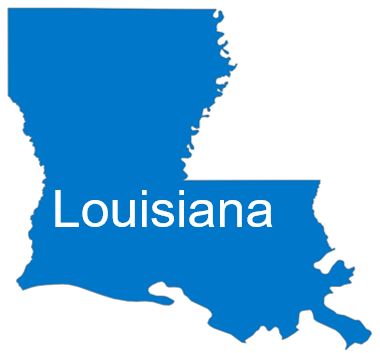
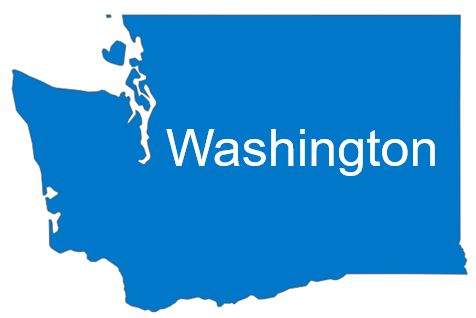
Voters in Colorado and Louisiana will vote on measures restricting access to abortion, those in Washington state will vote on whether to require sex education in public school curriculums, and voters in Colorado will decide whether the state will join 8 other states and D.C. in creating a paid family and medical leave program for its workers.

This brief summarizes each of these ballot measures and their implications.

22 Week Abortion Ban: Colorado

Name: Proposition 115 (End Late Term Abortions in Colorado)

Description: Prohibits abortion in Colorado after fetus reaches 22-weeks gestational age.

Implications:
  • Colorado does not currently have a gestational limit for abortion.
  • If passed, abortion would only be permitted beyond 22-weeks in cases of immediate, physical life endangerment of the pregnant person. Those seeking an abortion after this timeframe would have to travel to another state to obtain a legal abortion. Currently, 17 states have a similar gestational limit, which is more restrictive than the standard of viability established by Roe v. Wade.
  • Performing or attempting to perform a prohibited abortion in Colorado would be a Class 1 misdemeanor, punishable by a fine and 3-year suspension of state medical license. People on whom a prohibited abortion is performed would not be charged with a crime.
  • Outcome: Rejected

No State Constitutional Right to Abortion: Louisiana

Name: Amendment 1 (House Bill 425/Love Life Amendment)

Description: Adds language to the Louisiana state constitution clarifying that there is no right to abortion or abortion funding.

Implications:
  • If the U.S. Supreme Court were to overturn Roe v. Wade, which holds that under the U.S. Constitution, abortion may not be banned before fetal viability, regulation of abortion would be returned to the states.
  • States that do not have constitutional or statutory provisions safeguarding abortion rights could further restrict or prohibit abortion.
  • If Roe v. Wade is overturned or a future Supreme Court decision gives states more leeway to enact restrictions on abortion, this constitutional amendment would open the door to future state legislation that could block or severely restrict access to abortion in Louisiana.
  • Outcome: Approved

Sex Education in Public Schools: Washington

Name: Referendum 90 (Senate Bill 5395)

Description: Would require Washington public schools to provide comprehensive sexual health education for all students. The Washington legislature passed and the governor signed the law (SB 5395) in March 2020. Voters were asked whether to uphold or repeal the law.

Implications:
  • Washington state law does not currently require comprehensive sex education to be taught in public schools, though local school boards may choose to provide it.
  • If approved, the referendum would require public school students in Kindergarten through 12th grades to receive age-appropriate, comprehensive instruction in human development and reproduction, including affirmative consent and bystander training.
  • Would require students to be excused if requested by their parents.
  • Outcome: Approved
Name: Proposition 118

Description: Establishes a paid family and medical leave insurance program that provides up to 12 weeks of job-protected, paid leave for qualified reasons including to care for own serious health condition or that of a family member, and to care for a new child. Additional 4 weeks provided for pregnancy or childbirth complications. Funded through a payroll tax evenly split between employers and employees.

Implications:
  • It is estimated that 80% of Coloradans currently do not have access to paid family and medical leave. An estimated 2.6 million Coloradans would benefit from this program.
  • Benefit covers 90% of average weekly wage for those who earn 50% or less of the state average, and up to 50% for those that earn more than 50% of the state average.
  • Workers who elect coverage are eligible for paid leave after earning $2,500, but must have worked for the employer for at least 6 months for job protection. Covered employees would retain their employer-sponsored health insurance if they were already enrolled. Local governments may opt out of the program, but employees may still elect coverage. Employers with fewer than 10 employees would be exempt from paying the premium, though covered employees would still have access to the benefit. Self-employed individuals are also eligible.
  • Outcome: Approved

Looking Forward

Initiatives that seek to restrict access to abortion may garner renewed attention and urgency if a new conservative majority on the U.S. Supreme Court rules to permit more state regulations of abortion or to overturn Roe v. Wade, eliminating the constitutional right to abortion and allowing states to make their own policies regarding abortion access. Alternatively, this could encourage some states to seek to affirm abortion rights. Additionally, the coronavirus pandemic has put a spotlight on the importance of paid leave, and state legislative efforts or ballot initiatives creating paid sick and family leave programs are likely to continue even after the pandemic subsides.

News Release

States Expect Medicaid Enrollment and Spending to Increase by Over 8 Percent Each in FY 2021, Primarily Driven By a Slumping Economy and Federal Conditions to Maintain Eligibility to Access Enhanced Federal Medicaid Funds

States Are Taking Policy Actions to Respond to the Pandemic but Most Cite Budget Concerns as Biggest Challenge Looking Ahead

Published: Oct 14, 2020

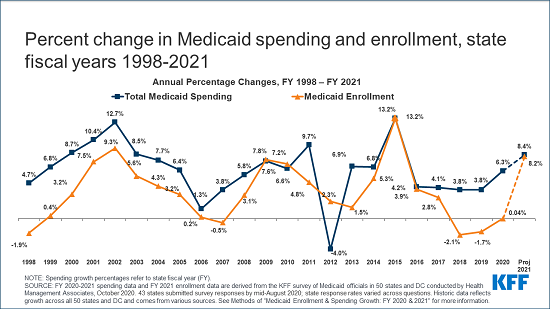
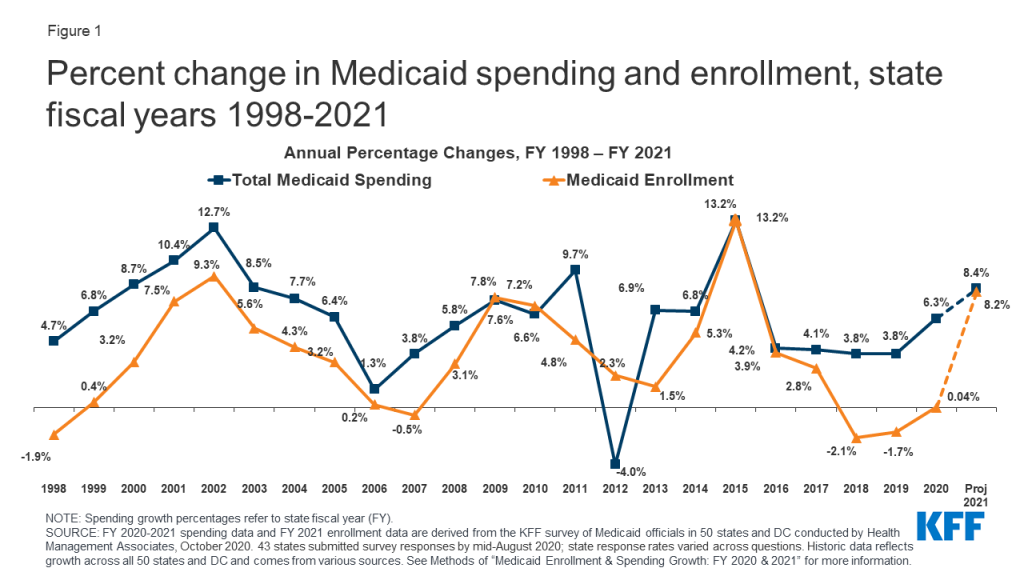
Following several years of declining or flat enrollment growth, states expect Medicaid enrollment and spending each to jump by more than 8 percent in fiscal year 2021, chiefly due to a slumping economy amid the pandemic and federal conditions to maintain coverage to access enhanced federal matching funds, according to a new KFF Medicaid budget survey.

The 20th annual survey of state Medicaid directors finds that enrollment is expected to grow by 8.2 percent and combined federal and state Medicaid spending expected to increase by 8.4 percent in the next fiscal year, reflecting a dramatic reversal in economic conditions and state fiscal outlooks. This follows total Medicaid spending growth of 6.3 percent for fiscal 2020, a year in which enrollment remained basically flat.

The findings paint a picture of a Medicaid program that state officials expect increasingly will be relied upon to provide health coverage and help soften the economic blow of the coronavirus pandemic for low-income people – all at a time when state governments’ financial capacity to provide such services is stretched thin.

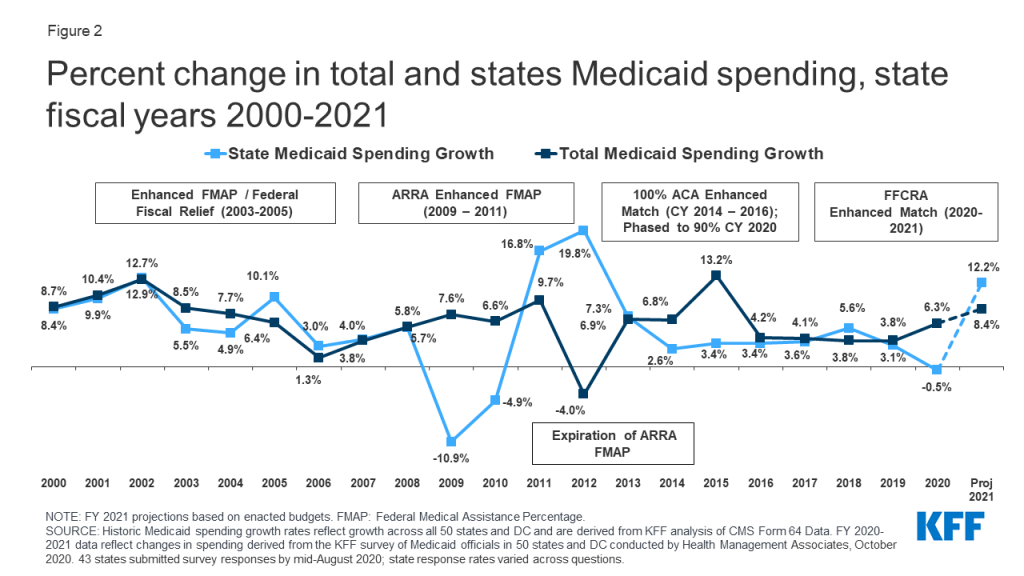
To help provide fiscal relief, Congress earlier this year authorized a 6.2 percentage point increase in the federal Medicaid match rate (FMAP) as part of the Families First Coronavirus Response Act (FFCRA). To be eligible for the funds, states cannot tighten Medicaid eligibility standards or raise premiums beyond policies in place as of January 1, 2020 and must provide continuous eligibility for enrollees through the public emergency period. The FMAP increase does not apply to the Affordable Care Act’s expansion group, for which the federal government already pays 90 percent of costs.

Nearly all states indicated that they are using the extra federal money to help pay costs related to rising Medicaid enrollment and to help close Medicaid or general budget shortfalls. About two-thirds of reporting states said the fiscal relief is also being used to mitigate provider rate and/or benefit cuts.

While expected state spending on Medicaid is crucial to state budgets, the projections in this year’s survey do not provide a clear picture because enhanced federal funding is now slated to expire at the end of March 2021 based on the recent renewal of the Public Health Emergency (PHE), later than states had generally assumed. At the time of the survey, states estimated that state Medicaid spending would decline in FY 2020 (-0.5%) and then sharply increase in FY 2021 (12.2%) with most states assuming that the enhanced matching funds would expire by December 2020.

Nearly all states report significant adverse economic and state budgetary impacts driven by the pandemic, as well as uncertainty about the future. Even with the extension of the enhanced FMAP, those funds are unlikely to fully offset state revenue declines and fully address state revenue budget shortfalls that range from 1 percent to up to 30 percent for FY 2021 according to the National Conference of State Legislatures.

State policy actions

The annual budget survey, conducted with Health Management Associates, provides an in-depth, state-specific examination of changes and initiatives taking place in Medicaid programs. This year, many involve the response to the COVID-19 pandemic. Notable findings include:

  • States are providing targeted support to providers, who are under financial strain amid decreased utilization during the pandemic. More than half of responding states indicated that one or more payment changes made in FY 2020 or FY 2021 are related in whole or in part to COVID-19. While more states at the time of the survey report targeted fee-for-service rate increases in FY 2021, a few states cut provider rates across all or nearly all provider categories and other states have indicated rate freezes or reductions were likely.
  • The majority of states also added or expanded telehealth service delivery, and many plan to extend these changes beyond the public health emergency period.
  • The pandemic has elevated the importance of addressing longstanding disparities in health and health care, with 27 states reporting the implementation, expansion, or reform of a program or initiative to address Medicaid enrollees’ social determinants of health in response to COVID-19.

Finally, while there has been attention to institutional care, the survey report finds that the long-term care workforce (for both institutional and community based long-term care) was a challenge for many responding states, and on many fronts related to the pandemic. The majority of states reported challenges with reductions in long-term services and supports (LTSS) direct care workforce supply as a result of the pandemic, access to personal protective equipment (PPE) and testing for direct care workers, and infection among direct care workers.

As states utilize their Medicaid programs to respond to the pandemic, the larger trend toward state adoption and implementation of Medicaid expansion continues. To date 38 states and Washington DC have adopted the ACA Medicaid expansion. Of these, 36 states and DC have implemented expansion coverage (including Idaho and Utah, which both implemented the expansion on January 1, 2020, and Nebraska, which implemented the expansion as of October 1, 2020). Two additional states, Missouri and Oklahoma, will implement the expansion in FY 2022 as a result of successful Medicaid expansion ballot initiatives.

The survey findings are presented in two reports:

Medicaid Enrollment & Spending Growth: FY 2020 & 2021

Authors: Robin Rudowitz, Elizabeth Hinton, Madeline Guth, and Lina Stolyar
Published: Oct 14, 2020

Issue Brief

Key Takeaways

The coronavirus pandemic has generated both a public health crisis and an economic crisis, with major implications for Medicaid, a countercyclical program. During economic downturns, more people enroll in Medicaid, increasing program spending at the same time state tax revenues may be falling. To help both support Medicaid and provide broad fiscal relief as revenues have declined precipitously, the Families First Coronavirus Response Act (FFCRA) authorized a 6.2 percentage point increase in the federal match rate (“FMAP”) (retroactive to January 1, 2020) available if states meet certain “maintenance of eligibility” (MOE) requirements. The health and economic consequences of the pandemic as well as the temporary FMAP increase were major drivers of Medicaid enrollment and spending trends as states finished state fiscal year (FY) 2020 and started FY 2021 (which for most states began on July 1).1 

This brief analyzes Medicaid enrollment and spending trends for FY 2020 and FY 2021 based on data provided by state Medicaid directors as part of the 20th annual survey of Medicaid directors in all 50 states and the District of Columbia. Overall, 43 states2  responded to the survey by mid-August 2020, although response rates for specific questions varied. The methodology used to calculate enrollment and spending growth as well as additional information about Medicaid financing can be found at the end of the brief. Key findings include the following:

  • After relatively flat enrollment growth in FY 2020 (0.04%), states responding to the survey expect Medicaid enrollment to jump in FY 2021 (8.2%) attributed to the FFCRA’s MOE requirements and to the economic downturn that started late in FY 2020.
  • Across all reporting states, states were anticipating that total Medicaid spending growth would accelerate to 8.4% in FY 2021 compared to growth of 6.3% in FY 2020. Enrollment was the primary factor identified as putting upward pressure on expenditure growth in FY 2021.
  • While expected state spending on Medicaid is crucial to state budgets, the projections in this year’s survey do not provide a clear picture because enhanced federal funding is now slated to expire at the end of March 2021 based on the recent renewal of the Public Health Emergency (PHE), later than states had generally assumed. At the time of the survey, states estimated that state Medicaid spending would decline in FY 2020 (-0.5%) and then sharply increase in FY 2021 (12.2%) with most states assuming that the enhanced matching funds would expire by December 2020.
  • Looking ahead, states are faced with many layers of uncertainty about the trajectory of the pandemic and economic downturn as well as the duration of the enhanced FMAP and the outcome of the elections in November.

Context

Medicaid (together with CHIP) provided coverage to about one in five Americans, or about 73.5 million people, as of May 2020. Total Medicaid spending was nearly $604 billion in FY 2019 with 64.4% paid by the federal government and 35.6% financed by states. Medicaid accounts for one in six dollars spent in the health care system and more than half of spending on long-term services and supports.3 

Prior to the pandemic, state fiscal conditions were strong in FY 2020. Unemployment was low, states expected revenues to grow for the 10th consecutive year, and state general fund spending was on track to grow by 5.8%. In this context, Governors had developed budget proposals for FY 2021 that included projections for continued revenue and spending growth. Governors’ budgets are generally released early in the calendar year.

The pandemic resulted in a dramatic reversal in state fiscal conditions. Early estimates indicate that states are facing large shortfalls, with some estimates showing state budget shortfalls of up to $110 billion for FY 2020 and up to $290 billion for FY 2021. Other early reports from states similarly show state revenue declines of up to 15% in FY 2020 and up to 30% for FY 2021 compared to pre-pandemic state estimates of state revenue totaling $913 billion for FY 2020 and $944 billion in FY 2021. Faced with continued uncertainty regarding ongoing revenue collections and the possibility of additional federal fiscal relief, several states adopted temporary budgets or continuing resolutions to begin FY 2021 while some other states with previously enacted FY 2021 budgets planned to convene special sessions to adjust appropriation levels.4  Unlike the federal government, states must meet balanced budget requirements. In the face of major revenue shortfalls due to the economic effects of the pandemic, states can use reserves or cut spending if additional federal support is not available. During the Great Recession, states imposed layoffs or furloughs for state workers, reduced funding for state governments, made across the board spending cuts and program cuts to education, higher education, and Medicaid. However, major cuts to state services and workforce can be harmful to state residents facing increased demands for services and can also weaken economic recovery efforts. To reduce Medicaid spending during economic downturns, states typically turn to provider rate and benefit restrictions, however, with providers facing revenue shortfalls and enrollees facing increased health risks due to the pandemic, these methods to control costs may not be as viable.

While the FMAP increase included in the FFCRA supports Medicaid and provides broad fiscal relief to states, it is unlikely to fully offset state revenue declines and fully address state budget shortfalls. In the past, federal fiscal relief provided through increases in the Medicaid FMAP—or the share of Medicaid costs paid by the federal government— during significant economic downturns has helped to both support Medicaid and provide efficient, effective, and timely fiscal relief to states. The Families First Coronavirus Response Act (FFCRA) uses this model as well by providing a temporary 6.2 percentage point increase in the Medicaid FMAP from January 1, 2020 through the end of the quarter in which the public health emergency (PHE) ends. This FMAP increase does not apply to the ACA expansion group, for which the federal government already pays 90% of costs. To be eligible for the funds, states cannot implement more restrictive Medicaid eligibility standards or higher premiums than those in place as of January 1, 2020, must provide continuous eligibility for enrollees through the end of the month of the emergency period, and cannot impose cost sharing for COVID-19 related testing and treatment services including vaccines, specialized equipment, or therapies. States access the enhanced funds by submitting claims for federal reimbursement for Medicaid expenditures.

While all states are experiencing fiscal stress tied to the pandemic, the experience varies across states. For example, while the national unemployment rate in August 2020 was 8.4% (a decline from its initial peak of 14.7% in April 2020 at the start of the pandemic), there was considerable state variation in unemployment with state rates ranging from 4.0% (Nebraska) to 13.2% (Nevada). California, Hawaii, New York, Rhode Island and Nevada reported the highest state unemployment rates, exceeding the national rate by three percentage points or more. Similarly, projected revenue shortfalls vary across states, with states reporting revenue declines ranging from 1% to 15% in FY 2020 and from 1% to 30% for FY 2021.

Key Findings

After declines in FY 2018 and 2019 followed by relatively flat enrollment growth in FY 2020, states expect Medicaid enrollment to jump in FY 2021 (Figure 1). Medicaid enrollment growth peaked in FY 2015 due to the implementation of the ACA and has tapered each year since. Enrollment declined in FY 2018 (-2.1%) and FY 2019 (-1.7%) and was relatively flat in FY 2020 (0.04%). However, for FY 2021, reporting states project a sharp increase in enrollment to 8.2%. A few states noted that the projections were completed prior to the pandemic and did not account for the economic downturn so were likely to change. Others noted uncertainty regarding when the PHE and related maintenance of effort (MOE) requirements would end, which would allow redeterminations and eligibility terminations to resume for beneficiaries who no longer meet eligibility standards (although fewer enrollees are likely to see income increase due to the economic downturn). A few states that recently adopted or implemented the Medicaid expansion anticipated larger increases in enrollment.

States largely attributed projected enrollment increases in FY 2021 to the FFCRA’s MOE requirements and to the economic downturn. All reporting states responded that the MOE was an upward or significant upward pressure on enrollment and nearly all reporting states noted that the economy was an upward or significant upward pressure on enrollment. The two factors (the MOE and the economy) are likely linked. Outside of the MOE, individuals may lose Medicaid coverage because they have a change in circumstance (such as an increase in income), because they fail to complete renewal processes or paperwork even when they remain eligible, or because they age out of a time- or age-limited eligibility category (e.g., pregnant women or former foster care youth). Due to the economic downturn, fewer enrollees are likely to see income increase, meaning they would remain eligible for Medicaid irrespective of the MOE. States anticipate that groups more sensitive to changes in economic conditions (e.g., children, parents, and other expansion adults) will grow faster than the elderly and people with disabilities; however, an aging state population was also identified as a key factor driving enrollment in almost half for reporting states. In last year’s survey, states tied declines in enrollment growth prior to the pandemic to a more robust economy, but also to process and systems changes including changes to renewal processes, upgraded eligibility systems, and enhanced data matching efforts to verify eligibility.

Figure 1: Percent change in Medicaid spending and enrollment, state fiscal years 1998-2021

Among reporting states, growth in total Medicaid spending was 6.3% in FY 2020, but is expected to jump to 8.4% in FY 2021 (Figure 1). High rates of enrollment growth, tied first to the Great Recession and later to the implementation of the ACA, were the primary drivers of total Medicaid spending growth over the last decade. Similarly, declining enrollment driven by a strong economy was the primary driver identified by states for slow total Medicaid spending growth in FY 2019. Even though enrollment growth was nearly flat in FY 2020, spending was in line with median spending growth over the last two decades. In last year’s survey, Medicaid officials indicated growth in total Medicaid expenditures for FY 2020 was largely tied to increasing costs for prescription drugs (particularly for specialty drugs), rate increases (most often for managed care organizations, hospitals, and nursing facilities), overall medical inflation, pressures from an aging state population, and a higher acuity case-mix.

For FY 2021, nearly all states expect enrollment increases to put upward pressure on total Medicaid expenditure growth, with additional upward pressure coming from spending on long-term services and supports and provider rate changes. Further, about three-quarters of states noted that utilization was a factor for Medicaid spending: slightly more than half of these states identified utilization as an upward pressure on projected spending while the remaining states indicated utilization was expected to be a downward pressure (likely due to pandemic-related utilization reductions). Overall, while many reporting states were uncertain or thought that the chance of a Medicaid budget shortfall was “50-50,” more states anticipated that a budget shortfall was “likely” or “almost certain” compared to “unlikely”; so, it is possible that current expenditure growth projections could be lower than what states actually experience.

Estimates that state Medicaid spending would decline in FY 2020 (-0.5%) and then sharply increase in FY 2021 (12.2%) were made prior to the most recent renewal of the PHE that extends the enhanced FMAP through March 2021 (Figure 2). The enhanced FMAP under FFCRA was retroactive to January 1, 2020 (halfway through most state fiscal years). The fiscal relief expires at the end of the quarter in which the Public Health Emergency (PHE) ends. On October 2, 2020 the PHE was extended from October 23, 2020 to January 21, 2021, leaving the enhanced FMAP in place through March 2021. However, states adopted budgets for FY 2021 prior to the most recent extension of the PHE, with most states anticipating that the enhanced FMAP would end by December 2020 or before. The anticipated expiration of the enhanced FMAP in 2020 along with overall increases in base Medicaid spending expected in FY 2021 resulted in a spike in projected state spending.

Figure 2: Percent change in total and states Medicaid spending, state fiscal years 2000-2021

Nearly all reporting states indicated that federal fiscal relief is being used to support costs related to increased Medicaid enrollment and to help address Medicaid or general budget shortfalls. About two-thirds of reporting states said the fiscal relief is also being used to mitigate provider rate and/or benefit cuts. The state share of Medicaid spending typically grows at a similar rate as total Medicaid spending growth, unless there is a change in the federal matching rate. During the Great Recession, state spending for Medicaid declined in FY 2009 and FY 2010 due to fiscal relief from a temporary increase in the federal match rate provided in the American Recovery and Reinvestment Act (ARRA). State spending increased sharply when that fiscal relief ended. In other economic downturns (including the Great Recession), states typically turn to provider rate and benefit restrictions to reduce Medicaid spending, however, with providers facing revenue shortfalls and enrollees facing increased health risks due to the pandemic, these methods to control costs may not be as viable.

Conclusion and Looking Ahead

States are faced with many layers of uncertainty about the trajectory of the pandemic and economic downturn. Several states had adopted temporary budgets or continuing resolutions to start FY 2021, while other states noted FY 2021 state budgets had not yet been enacted. Some states planned to convene special sessions to make budget adjustments and noted further FY 2021 budget reductions were planned or likely. Unlike the federal government, states must meet balanced budget requirements. In the face of major revenue shortfalls due to the economic effects of the pandemic, states can use reserves or cut spending if additional federal support is not available. To reduce spending during economic downturns, states typically turn to provider rate and benefit restrictions, however, with providers facing revenue shortfalls and enrollees facing increasing health risks due to the pandemic, these methods to control costs may not be as viable. For now, states cannot restrict enrollment and must provide continuous coverage for current enrollees to access the enhanced Medicaid match rate in the FFCRA.

Looking ahead, states are also unsure about the duration of the PHE and the enhanced FMAP, whether Congress will consider additional fiscal relief, and the outcome of the elections. It is unclear if the PHE will be extended beyond the January 21, 2021. States have called for and the House passed legislation to increase the amount and duration of this federal fiscal relief, but to date the Senate has not considered these provisions. In addition, the US presidential election in November could have major implications for Medicaid, with a sharp contrast in goals for Medicaid and the ACA between President Trump and former Vice President Biden. Beyond the presidential election, the outcome of state elections (both governors and the make-up of state legislatures) will be important to watch.

Methods

Methods

Definition of Medicaid Spending. Total Medicaid spending includes all payments to Medicaid providers for Medicaid-covered services provided to enrolled Medicaid beneficiaries. Medicaid spending also includes special disproportionate share hospital (DSH) payments that subsidize uncompensated hospital care for persons who are uninsured and unreimbursed costs of care for persons on Medicaid. Not included in total Medicaid spending are Medicaid administrative costs and federally mandated state “Clawback” payments to Medicare (to help finance the Medicare Part D prescription drug benefit for Medicaid beneficiaries who are also enrolled in Medicare). States are also asked to exclude costs for the Children’s Health Insurance Program (CHIP). Total Medicaid spending includes payments financed from all sources, including state funds, local contributions, and federal matching funds. Historical state Medicaid spending refers to all non-federal spending, which may include local funds and provider taxes and fees as well as state general fund dollars.

Methodology. KFF commissioned Health Management Associates (HMA) to survey Medicaid directors in all 50 states and DC to identify and track trends in Medicaid spending, enrollment, and policymaking. Given differences in the financing structure of their programs, the U.S. territories were not included in this analysis. This is the 20th annual survey, conducted at the beginning of each state fiscal year from FY 2002 through FY 2021. The KFF/HMA Medicaid survey for this report was sent to each Medicaid director in June 2020. Forty-three states provided survey responses by mid-August 2020. The eight states that did not respond by this time are Delaware, the District of Columbia, Illinois, New Mexico, New York, Ohio, Rhode Island, and Utah.

For FY 2020 and FY 2021, annual rates of growth for Medicaid spending were calculated as weighted averages across all states. For FY 2020, 42 states reported Medicaid expenditure growth rates. For FY 2021, 40 states reported projected Medicaid expenditure growth rates. Weights for spending were derived from the most recent state Medicaid expenditure data for FY 2019, based on estimates prepared for KFF by the Urban Institute using CMS Form 64 reports, adjusted for state fiscal years. These CMS-64 data were also used for historic Medicaid spending and include all 50 states and DC. For FY 2018 and 2019, spending for New York was adjusted to reflect unexplained anomalies in the state spending on the CMS-64 data.

The average annual Medicaid enrollment growth rate for FY 2021 was calculated using weights based on Medicaid and CHIP preliminary monthly enrollment data for June 2020 published by CMS. For FY 2021, 41 states reported Medicaid enrollment growth rates. The data reported for FY 2019 and FY 2020 for Medicaid spending and FY 2020 for Medicaid enrollment are weighted averages, and therefore, data reported for states with larger enrollment and spending have a greater effect on the national average.

Historical enrollment trend data for FY 1998 to FY 2013 reflects the annual percentage change from June to June of monthly enrollment data for Medicaid beneficiaries collected from all states and DC. Enrollment trend data for FY 2014 to FY 2020 reflects growth in average monthly enrollment based on KFF analysis of the Medicaid & CHIP Monthly Applications, Eligibility Determinations, and Enrollment Reports from CMS for all 50 states and DC. Note that several states have revised monthly enrollment data as far back as June 2017 to better align with reporting criteria for the CMS, Medicaid & CHIP Monthly Applications, Eligibility Determinations, and Enrollment Reports. Data for months prior to June 2017 have not been revised and may use slightly different criteria for reporting monthly enrollment and generally result in larger enrollment totals.

Appendix

Appendix

Medicaid Financing Structure. The federal government jointly funds the Medicaid program with states by matching qualifying state Medicaid expenditures. The federal match rate (known as the Federal Medical Assistance percentage, or FMAP) is calculated annually for each state using a statutory formula based on a state’s average personal income relative to the national average which results in higher FMAP rates for poorer states. The FMAP formula relies on three years of lagged personal income data, so data for federal fiscal years (FFYs) 2017 to 2019 was used to calculate FFY 2021 FMAP rates, which range from a floor of 50% (applicable to 13 states) to a high of 78% (for Mississippi). Because of the federal matching structure, Medicaid is both a state budget expenditure item and a source of federal revenue for states. In FY 2018 (the latest year of actual data), Medicaid accounted for 29.2% of total state spending, but 16.7% of state funds (general fund plus other state funds), a far second to spending on K-12 education (25.1% of state funds). Medicaid is the largest single source of federal funds for states, accounting for over half (57.9%) of all federal funds received by states (Figure 3).

Figure 3: Medicaid spending as a share of total, state, and federal funds, actual data FY 2018

Medicaid and the Economy. Medicaid is a countercyclical program. During economic downturns, more people qualify and enroll in Medicaid, increasing program spending at the same time that state tax revenues may be stagnating or falling. Prior to the current pandemic, to mitigate these budget pressures, Congress had twice passed temporary FMAP increases to help support states during economic downturns, most recently in 2009 as part of the American Recovery and Reinvestment Act (ARRA). The ARRA-enhanced FMAP rates provided states over $100 billion in additional federal funds over 11 quarters, ending in June 2011.5 

Medicaid and the ACA. Effective January 1, 2014, the ACA expanded Medicaid eligibility to millions of non-elderly adults with income at or below 138% of the federal poverty level (FPL) –$17,609 per year for an individual in 2020.6  The law also provided 100% federal funding for expansion adults through 2016, phasing down to 90% in 2020 and future years. The June 2012 Supreme Court ruling on the ACA effectively made the Medicaid expansion optional for states; as of October 2020, 39 states (including DC) had adopted the expansion, including Missouri and Oklahoma, which have adopted the expansion through ballot measures and plan to implement in state fiscal year 2022.

Endnotes

  1. State fiscal years begin on July 1 except for these states: New York on April 1; Texas on September 1; Alabama, Michigan, and District of Columbia on October 1. ↩︎
  2. The eight states that did not respond by mid-August 2020 are: Delaware, District of Columbia, Illinois, Ohio, New Mexico, New York, Rhode Island, and Utah. ↩︎
  3. U.S. Centers for Medicare & Medicaid Services (CMS). National Health Expenditure Data Fact Sheet: Table 4, National Health Expenditures by Source of Funds and Type of Expenditure: Calendar Years 2011-2018 (CMS, March 2020), https://www.cms.gov/Research-Statistics-Data-and-Systems/Statistics-Trends-and-Reports/NationalHealthExpendData/NHE-Fact-Sheet.html. ↩︎
  4. National Association of State Budget Officer, States Work to Finalize Fiscal 2021 Budgets, Budget Blog, Updated August 4, 2020, http://budgetblog.nasbo.org/budgetblogs/blogs/brian-sigritz/2020/06/26/states-work-to-finalize-fiscal-2021-budgets-update. ↩︎
  5. To be eligible for ARRA funds, states could not restrict eligibility or tighten enrollment procedures in Medicaid or CHIP. Vic Miller, Impact of the Medicaid Fiscal Relief Provisions in the American Recovery and Reinvestment Act (ARRA) (Washington, DC: Kaiser Commission on Medicaid and the Uninsured, October 2011), http://kff.org/medicaid/issue-brief/impact-of-the-medicaid-fiscal-relief-provisions/. ↩︎
  6. U.S. Department of Health & Human Services, Office of the Assistant Secretary for Planning and Evaluation. U.S. Federal Poverty Guidelines Used to Determine Financial Eligibility for Certain Federal Programs (January 2020), https://aspe.hhs.gov/poverty-guidelines ↩︎

State Medicaid Programs Respond to Meet COVID-19 Challenges: Results from a 50-State Medicaid Budget Survey for State Fiscal Years 2020 and 2021

Authors: Kathleen Gifford, Aimee Lashbrook, Sarah Barth, Elizabeth Hinton, Robin Rudowitz, Madeline Guth, and Lina Stolyar
Published: Oct 14, 2020

Executive Summary

The coronavirus pandemic has generated both a public health crisis and an economic crisis, with major implications for Medicaid, a countercyclical program. During economic downturns, more people enroll in Medicaid, increasing program spending at the same time state tax revenues may be falling. As demand increases and state revenues decline, states face difficult budget decisions to meet balanced budget requirements. To help both support Medicaid and provide broad fiscal relief, the Families First Coronavirus Response Act (FFCRA)1  authorized a 6.2 percentage point increase in the federal match rate (“FMAP”)2  (retroactive to January 1, 2020) available if states meet certain “maintenance of eligibility” (MOE) requirements.3  The fiscal relief is in place until the end of the quarter in which the Public Health Emergency (PHE) ends. The current PHE is in effect through January 21, 2021 which means the enhanced FMAP is slated to expire at the end of March 2021 unless the PHE is renewed.4 

States ended state fiscal year (FY) 2020 and adopted budgets and policies for FY 2021, which began on July 1 for most states5 , while faced with uncertainty about the pandemic, the economy, and the duration of the PHE. This report examines Medicaid policy trends with a focus on planned changes for FY 2021 based on data provided by state Medicaid directors as part of the 20th annual survey of Medicaid directors in all 50 states and the District of Columbia. Unlike previous years, the survey instrument was modified to primarily collect information about policy changes planned for FY 2021, especially policies related to responding to the pandemic. Overall, 43 states6  responded to the survey by mid-August 2020, although response rates for specific questions varied. Key findings suggest that most policy changes and issues identified for FY 2021 were related to responding to the COVID-19 PHE (Figure 1).

ES Figure 1: Most Medicaid policy changes planned for FY 2021 are focused on addressing COVID-19.

Eligibility and Enrollment

As part of the federal response to the COVID-19 pandemic, states meeting certain “maintenance of eligibility” (MOE) conditions can access enhanced federal Medicaid funding.7  In addition to meeting the MOE requirements,8  some states are utilizing Medicaid emergency authorities to adopt an array of actions to help people obtain and maintain coverage.9  While many states remained undecided, five states reported plans to continue COVID-19 related changes to eligibility and enrollment policies after the PHE ends, such as allowing self-attestation of certain eligibility criteria. States reported a variety of outreach efforts to publicize COVID-19 related eligibility and enrollment changes, and 10 states reported expanding enrollment assistance or member call center capacity during the PHE. At the time of survey submission, thirteen states had an approved State Plan Amendment (SPA) in place for the new Uninsured Coronavirus Testing group;10  however, this option that allows states to access a 100% federal match rate for coronavirus diagnostic testing expires at the end of the PHE.

Non-emergency eligibility changes were limited, except for plans to implement the Medicaid expansion. To date, 39 states (including DC) have adopted the ACA Medicaid expansion.11  Of these, 37 states have implemented expansion coverage (including Idaho and Utah, which both implemented the expansion on January 1, 2020, and Nebraska, which implemented the expansion as of October 1, 2020). Two additional states, Missouri and Oklahoma, will implement the expansion in FY 2022 as a result of successful Medicaid expansion ballot initiatives. Six states reported plans to implement more narrow eligibility expansions. Only a few states reported planned eligibility restrictions or plans to simplify enrollment processes in FY 2021.

Provider Rates and Taxes

The COVID-19 pandemic has resulted in financial strain for Medicaid providers, so unlike in prior economic downturns more states are implementing policies to provide targeted support to providers rather than rate cuts. At the time of the survey, more responding states implemented or were planning fee-for-service (FFS) rate increases relative to rate restrictions in both FY 2020 and FY 2021. More than half of responding states indicated that one or more payment changes made in FY 2020 or FY 2021 were related in whole or in part to COVID-19. Many states adopted FFS payment changes in FY 2020 and/or planned to make changes in FY 2021 to provide additional relief to providers in response to the PHE. Still, three states have cut provider rates across all or nearly all provider categories and other states have indicated rate freezes or reductions were likely. Historically, states tend to increase or impose new provider taxes during economic downturns; however, only one state reported the addition of a new provider tax in FY 2021 and few states reported making significant changes to their provider tax structure in FY 2021. Impacts of COVID-19 on provider tax collections and provider rates are still emerging.

Nearly half of states reported that federal provider relief funds were not adequate for Medicaid providers, while other states did not know at the time of the survey. The Coronavirus Aid, Relief, and Economic Security (CARES) Act and the Paycheck Protection Program and Health Care Enhancement Act provide $175 billion in provider relief funds to reimburse eligible health care providers for health care related expenses or lost revenues that are attributable to the pandemic.12  Almost half of states responding to the survey reported that relief funds under the CARES Act have not been adequate to address the negative impact of COVID-19 faced by providers serving a high share of Medicaid and low-income patients.

Delivery Systems

Since nearly seven in ten Medicaid enrollees nationwide receive comprehensive acute care services (i.e., most hospital and physician services) through capitated managed care organizations (MCOs), these plans have played a critical role in responding to the COVID-19 pandemic.13  Twelve MCO states (of 31 responding) indicated plans to make adjustments to FY 2021 MCO contracts or rates in response to both COVID-related depressed utilization and unanticipated treatment costs. Fourteen MCO states (of 32 responding) reported implementing directed payments to selected provider types in response to the COVID-19 pandemic. MCO states reported a variety of programs, initiatives, or “value-added” services newly offered by MCOs in response to the PHE. Beyond addressing pandemic-related issues, twelve states in FY 2020 and seven in FY 2021 reported notable changes in the benefits and services covered under their MCO contracts.

The pandemic has elevated the importance of addressing social determinants of health (SDOH)14  to improve health and reduce longstanding disparities in health and health care. Nearly two-thirds of responding states reported implementation, expansion, or reform of a program or initiative to address Medicaid enrollees’ SDOH in response to COVID-19 (27 states).

Long-Term Services and Supports

The majority of responding states reported concerns about the pandemic’s impact on the long-term services and supports (LTSS) direct care workforce supply as well as concerns about access to personal protective equipment (PPE), access to COVID-19 testing, and risk of COVID-19 infections for LTSS direct care workers. Medicaid is the nation’s primary payer for LTSS.15  As the pandemic continues, states have taken a number of Medicaid policy actions to address the impact on seniors and people with disabilities who rely on LTSS to meet daily self-care and independent living needs.16  States noted plans to retain a variety of LTSS policy changes adopted in response to COVID-19 after the PHE period ends, most commonly citing the continuation of HCBS telehealth expansions.

Benefits, Cost-Sharing, and Telehealth

The majority of states added or expanded telehealth access in response to the pandemic, and many states plan to extend these and/or other benefit and cost-sharing changes beyond the PHE period. The majority of responding states report currently covering a range of FFS services delivered via telehealth when the originating site is the beneficiary’s home, most of which newly added or expanded this coverage in response to the COVID-19 pandemic. Most states reported that services delivered via telehealth from the beneficiary’s home have payment parity as compared to services delivered face-to-face, and just over half of states planned to extend newly added/expanded FFS telehealth coverage beyond the PHE period, at least in part and at least for some services. Approximately one-third of responding states noted plans to extend other benefit and cost-sharing changes adopted during the PHE period (15 states); most of these are pharmacy changes. Prior to the COVID-19 pandemic, state changes to Medicaid benefits most commonly pertained to enhanced mental health and substance use disorder (SUD) services.17  Less than one-third of responding states reported plans to make benefit or cost-sharing changes that are not related to the PHE in FY 2021 (13 states).

Prescription Drugs

States continued to adopt pharmacy program cost containment strategies despite the COVID-19 emergency and other competing priorities. Managing the Medicaid prescription drug benefit and pharmacy expenditures remains a policy priority for state Medicaid programs, and state policymakers remain concerned about Medicaid prescription drug spending growth. Thirty-three responding states reported plans to newly implement or expand upon at least one initiative to contain prescription drug costs in FY 2021.

Challenges and Priorities

Nearly all states reported significant adverse economic and state budgetary impacts driven by the pandemic, as well as uncertainty about the future. In the face of the COVID-19 pandemic, states continue to encounter challenges to provide Medicaid coverage and access for a growing number of Americans, while also facing plummeting revenues and deepening state budget gaps. State Medicaid officials highlighted swift and effective state responses to the pandemic, such as the rapid expansion of telehealth, as well as ongoing efforts to advance delivery system reforms and to address health disparities and other public health challenges. In these ways, the pandemic has demonstrated how Medicaid can quickly evolve to address the nation’s most pressing health care challenges. However, the ability of states to sustain policies adopted in response to the pandemic (including through emergency authorities) may be tied to the duration of the PHE as well as the availability of additional federal fiscal relief and support. Looking ahead, great uncertainty remains regarding the future course of the pandemic, the scope and length of federal fiscal relief efforts, and what the “new normal” will be in terms of service provision and demand. Results of the November 2020 elections could also have significant implications for the direction of federal Medicaid policy in the years ahead.

Acknowledgements

Pulling together this report is a substantial effort, and the final product represents contributions from many people. The combined analytic team from KFF and Health Management Associates (HMA) would like to thank the state Medicaid directors and staff who participated in this effort. In a time of limited resources and challenging workloads, we truly appreciate the time and effort provided by these dedicated public servants to complete the survey and respond to our follow-up questions. Their work made this report possible. We also thank the leadership and staff at the National Association of Medicaid Directors (NAMD) for their collaboration on this survey. We offer special thanks to Jim McEvoy at HMA who developed and managed the survey database and whose work is invaluable to us.

Introduction

Like all other aspects of the American health landscape, the COVID-19 pandemic and subsequent public health emergency (PHE) declaration18  have dramatically impacted state Medicaid programs, requiring states to rapidly adapt to meet the changing needs of their Medicaid beneficiaries and providers. Nationwide, Medicaid provides health insurance coverage to about one in five Americans19  and accounts for nearly one-sixth of all U.S. health care expenditures.20  Prior to the pandemic, the Medicaid program had a history of constantly evolving to react to changes in federal and state policies, the economy, and other state budget and policy priorities. The current pandemic, however, has generated both a public health crisis and an economic crisis with increased unemployment, which contributes to growth in Medicaid enrollment and spending at the same time state tax revenues may be falling.

In response to the pandemic, Congress has authorized changes to Medicaid through the Families First Coronavirus Response Act (FFCRA)21  and Coronavirus Aid, Relief, and Economic Security (CARES) Act,22  including a 6.2 percentage point increase in federal Medicaid matching funds (FMAP) (retroactive to January 1, 2020) available to states that meet five “maintenance of eligibility” (MOE) conditions that ensure continued coverage for current enrollees as well as coverage of coronavirus testing and treatment.23  This fiscal relief is in place until the end of the quarter in which the PHE ends, which means it is currently slated to expire at the end of March 2021. Beginning early in the pandemic, states have adopted Medicaid policies to respond to COVID-19 through a variety of emergency authorities (Disaster-Relief State Plan Amendments (SPAs), traditional SPAs, other administrative authorities, HCBS waiver Appendix K, Section 1115 demonstration waivers, and Section 1135 waivers).24  The beginning and end dates for these actions vary by authority and many are tied to the PHE.25 

This report draws upon findings from the 20th annual budget survey of Medicaid officials in all 50 states and the District of Columbia conducted by KFF and Health Management Associates (HMA), in collaboration with the National Association of Medicaid Directors (NAMD). (Previous reports are archived here.26 ) This year’s survey instrument was modified to focus on policy changes planned for FY 2021 and policies adopted in response to the pandemic, and was sent to each state Medicaid director in June 2020. Overall, 43 states27  responded by mid-August 2020, although response rates for specific questions varied. Given differences in the financing structure of their programs, the U.S. territories were not included in this analysis. An acronym glossary and the survey instrument are included as appendices to this report.

This report highlights policy changes in place or planned for FY 2021 (which began for most states on July 1, 2020).28  Key findings, along with state-by-state tables, are included in the following sections:

Eligibility And Enrollment

As part of the federal response to the COVID-19 pandemic, states meeting certain “maintenance of eligibility” (MOE) conditions can access enhanced federal Medicaid funding. The Families First Coronavirus Response Act,29  amended by the Coronavirus Aid, Relief, and Economic Security (CARES) Act,30  authorizes a 6.2 percentage point increase in the federal Medicaid match rate (“FMAP”)31  (retroactive to January 1, 2020) through the end of the quarter in which the public health emergency ends. To qualify for the enhanced funds, states must ensure continued coverage for current enrollees and are prohibited from increasing premiums or making eligibility standards, methodologies, or procedures more restrictive than those in effect on January 1, 2020, among other requirements.32 

The MOE requirements33  contribute to enrollment increases34  by eliminating the usual enrollment churn that occurs when some individuals lose eligibility and are dis-enrolled from Medicaid each month. In the past, some eligibility churn occurred when otherwise eligible individuals lost coverage because they encountered barriers preventing them from timely documenting continued eligibility during the eligibility renewal process or when states conducted periodic data matches between renewals.35  Prior to the pandemic, these types of barriers were potentially depressing overall Medicaid enrollment levels.36 

In addition to the MOE requirements, some states are utilizing Medicaid emergency authorities to take other actions to help people obtain and maintain coverage. These include actions to expand eligibility and make it easier to apply such as allowing for self-attestation of eligibility criteria; eliminating premiums; expanding the use of presumptive eligibility; and otherwise simplifying application processes.37  The beginning and ending dates of these policies vary by authority38  and many will expire with the end of the public health emergency (PHE) declaration (currently set for January 21, 2020).39 

Survey Findings

We asked states to report any non-emergency eligibility changes planned for FY 2021, including eligibility expansions, eligibility restrictions, and changes to enrollment processes. We also asked about changes to eligibility policies made in response to the COVID-19 pandemic and, specifically, whether states planned to adopt these changes on a more permanent basis. Finally, we asked states to report on outreach efforts to publicize COVID-19 related eligibility changes and/or the availability of Medicaid coverage following the economic downturn.

Non-Emergency Eligibility Changes

Seven states reported non-emergency plans to expand eligibility in FY 2021. As of October 2020, 39 states (including DC) have adopted the ACA Medicaid expansion (Figure 1).40  Of these, 37 states to date have implemented expansion coverage to 138% FPL ($17,609 per year for an individual in 2020),41 ) including Idaho and Utah, which both implemented the expansion on January 1, 2020 (FY 2020), and Nebraska, which implemented on October 1, 2020 (FY 2021). Two additional states, Oklahoma and Missouri, will implement the expansion in FY 2022 as a result of successful Medicaid expansion ballot initiatives.

  • Nebraska implemented the expansion on October 1, 2020 (FY 2021) pursuant to a ballot measure passed in November 2018. The state is currently seeking a Section 1115 waiver to implement its expansion with program elements that differ from what is allowed under federal law.
  • Oklahoma voters approved a ballot measure on June 30, 2020 which adds Medicaid expansion to the state’s constitution and requires coverage to begin no later than July 1, 2021. The ballot measure language also prohibits the imposition of any additional burdens or restrictions on eligibility or enrollment for the expansion population. The Oklahoma Health Care Authority intended to submit the necessary State Plan Amendments (SPAs) for expansion by September 30, 2020 with an effective date of July 1, 2021 (FY 2022).42 
  • Missouri voters similarly approved a ballot measure on August 4, 2020 which adds the expansion to the state’s constitution with coverage to begin July 1, 2021 (FY 2022). Like Oklahoma’s, Missouri’s approved ballot measure prohibits the imposition of any additional burdens or restrictions on eligibility or enrollment for the expansion population.
Figure 1: Status of State Medicaid Expansion Decisions

Six states reported plans to implement the following more narrow eligibility expansions in FY 2021. These other expansions include the following:

  • Expanding coverage for parent/caretaker relatives and other low-income adults. One non-expansion state (South Carolina) has an approved Section 1115 waiver and plans to increase the income limit for parent/caretaker relative enrollees from 67% to 100% FPL and also to provide coverage with an enrollment cap for a new Targeted Adult group. Both expansions of eligibility are contingent on compliance with a work requirement. As a result of both the pandemic and litigation,43  no states are currently implementing approved work requirements.44 
  • Expanding coverage for postpartum women. Two states are expanding coverage for postpartum women beyond the 60 days provided under federal rules: Pending waiver approval, Georgia and New Jersey are extending to six months.45  (Additionally, Indiana reported plans to extend postpartum coverage to one year beginning in FY 2022.)
  • Expanding coverage for certain older adults and people with disabilities. California is expanding income eligibility for the optional aged, blind, and disabled (ABD) population from 100% to 138% FPL and also creating a new ABD income disregard in the amount of the individual’s Medicare Part B premium (which is paid by Medicaid). The new disregard in California is expected to allow individuals to retain eligibility in the ABD pathway and reduce churn between the ABD and medically needy with share of costs pathways and administrative burden. New Hampshire reported plans to implement its “Medicaid for Employed Older Adults with Disabilities” program, which will expand Medicaid buy-in coverage for working people with disabilities to include those ages 65 and older with incomes up to 250% FPL. (New Hampshire already covers working people with disabilities ages 18 to 64 up to 250% FPL.) Louisiana is expanding HCBS waiver coverage for children with significant disabilities without regard to household income and assets for children who live at home but would otherwise qualify for institutional placement in a hospital, skilled nursing facility, or intermediate care facility for individuals with intellectual disabilities.

Only two states reported a planned eligibility restriction in FY 2021 after the expiration of the PHE. Missouri reported that scheduled premium increases would go forward after the PHE ended and Montana reported plans to implement a community engagement/work requirement and premium changes for expansion adults pending CMS approval of the state’s Section 1115 waiver renewal.

Although not counted as an eligibility expansion or a restriction for purposes of this survey, Texas reported that it would implement changes (including applying modified adjusted gross income (MAGI) financial eligibility methodologies to individuals eligible for family planning-only services) to its Healthy Texas Women (HTW) Section 1115 waiver program as required under the waiver’s January 2020 approval from CMS.46  The approved HTW waiver extended eligibility for family planning services to women age 18-44 up to 200% FPL not otherwise eligible for Medicaid and allowed Texas to waive non-emergency medical transportation (NEMT); retroactive eligibility; early and periodic screening, diagnostic, and treatment (EPSDT) coverage; and freedom of choice of provider for family planning services.

Two states reported non-emergency plans to simplify enrollment processes in FY 2021. Montana reported plans to implement an auto-renewal process for non-MAGI eligibility groups and Virginia reported plans to expand ex parte auto-renewals when individuals experience changes such as reaching the end of their postpartum coverage period or attaining an age requiring evaluation in other covered groups. While Virginia did not characterize this change as the extension of an emergency authority, the state did note that the proposed changes are intended to reduce caseworker caseloads when the PHE period ends.

Eligibility Changes in Response to COVID-19

Only five states47  reported plans to continue COVID-19 emergency changes related to eligibility and enrollment policies beyond the PHE period. One state (Vermont) noted that a variety of certain emergency flexibilities would likely extend beyond the PHE period due to the time required to re-implement prior policies. A few states reported specific plans for the continuation of policies to simplify/expedite enrollment processes:

  • Massachusetts intends to continue allowing self-attestation of all eligibility criteria except for citizenship and immigration status.
  • Washington is working to adopt self-attestation of income and resources for aged, blind, and disabled (ABD) populations. Washington also reported working to adopt hospital presumptive eligibility for ABD populations and post-enrollment verification of assets for ABD populations.
  • Arizona indicated that it would continue allowing electronic signatures on eligibility documents for its long-term care program (institutional and HCBS).
  • Virginia intends to continue allowing applicants and enrollees to verbally appoint/authorize assisters, advocates, and other individuals.

Another 12 states reported that the continuation of emergency eligibility and enrollment policies remained undetermined. Indiana and Louisiana reported that more time could be needed to re-implement their prior policies; Missouri indicated that it may continue to allow self-attestation of most eligibility factors for ABD and MAGI populations; and a few states (West Virginia, Kansas, and Missouri) reported potential plans to further extend renewal timelines.48 

At the time of survey completion, thirteen states had approved State Plan Amendments (SPAs) in place for the new Uninsured Coronavirus Testing group at the time of survey submission. This new optional eligibility pathway provides 100% federal matching funds for states to cover coronavirus testing and testing-related services for uninsured individuals through the end of the PHE. 49  In addition to this option, providers can alternatively obtain reimbursement for coronavirus testing and treatment provided to uninsured individuals from additional federal funds through the Health Resources and Services Administration.50  One state (California) reported covering a significant number of persons under its Uninsured Coronavirus Testing group as of June 30, 2020 (6,390). All other states reported more modest enrollments: Colorado, Louisiana, and Minnesota reported covering between 50 and 450 individuals and Maine reported covering approximately 850 individuals. Other states that had adopted the option (including Alabama, Iowa, Montana, Nevada, New Hampshire, South Carolina, and West Virginia) reported between zero and 50 persons covered and Washington has an approved SPA for this group but did not report the number of individuals covered. Since the time of survey submission, two additional responding states (Connecticut and North Carolina) have received SPA approvals for this group.51 

States reported a variety of outreach efforts to publicize COVID-19 related eligibility and enrollment changes, and ten states reported expanding enrollment assistance or member call center capacity during the PHE. Most states reported using their websites and social media platforms to provide COVID-19 related enrollment information. Many states also cited working with provider groups and advocacy organizations to disseminate information in addition to direct mailings to members and applicants and provider notices and alerts. A few states also commented on their managed care organizations’ (MCO) outreach efforts. Additionally, ten states (California, Florida, Indiana, Kentucky, Maryland, Missouri, Nebraska, South Carolina, Texas, and Virginia) reported expanding enrollment assistance or member call center capacity. Very few states reported experiencing application processing delays due to COVID-19 at the time of survey completion.

Oregon COVID-19 Medicaid Outreach

The Oregon Health Authority (OHA) created targeted messaging for potential applicants who may have recently lost a job, had a change in hours, or had a change in unemployment benefits and also created messaging about changes in eligibility for Medicaid, including changes in income, stimulus payments, and suspending case closure. The state has and continues to disseminate this messaging through customer service talking points, fact sheets and webpages, social media, e-bulletins, and plan and provider talking points, as well as through the statewide network of community assisters. The state also plans to send a direct mailing with this information to all Medicaid households. The OHA is also fostering a partnership with Oregon’s employment agency to ensure cross-promotion of vital information about eligibility and unemployment.

Provider Rates And Taxes

The coronavirus pandemic has resulted in financial strain for Medicaid providers. In prior economic downturns, states have typically resorted to provider rate reductions as well as cuts to optional benefits, restoring those rates and benefits when economic conditions improved.52  Provider rate cuts may be harder to implement during the current downturn, however, due to the fiscal strain the pandemic has placed on many providers, particularly those serving Medicaid enrollees. While some providers are dealing with both increased utilization and costs related to COVID-19 testing and treatment, others have experienced substantial revenue losses as utilization has declined for non-urgent care. Providers that predominantly serve Medicaid enrollees and/or deliver services primarily financed by Medicaid, such as behavioral health or long-term care providers, may face disproportionate risks to their continued financial viability as their pre-pandemic operating margins were already modest due to lower Medicaid reimbursement levels relative to costs. To address the current fiscal challenges faced by providers, states have implemented various options to support providers53  directly or by directing plans to do so. 54 ,55 

The Coronavirus Aid, Relief, and Economic Security (CARES) Act and the Paycheck Protection Program and Health Care Enhancement Act provide $175 billion in provider relief funds to reimburse eligible health care providers for health care related expenses or lost revenues attributable to coronavirus.56  Specifically, funds are available for building or constructing temporary structures, leasing properties, medical supplies and equipment including personal protective equipment (PPE) and testing supplies, increased workforce and trainings, emergency operation centers, retrofitting facilities, and surge capacity. In June 2020, CMS announced the allocation of $15 billion in provider relief funds specifically for Medicaid/CHIP providers that were not funded in a prior distribution to Medicare fee-for-service providers, addressing concerns that Medicaid providers had been disadvantaged in prior distributions, both in the amount and timing of funding received.57 

States can use provider taxes and intergovernmental transfers (IGTs) to help finance the state share of Medicaid.58  Over time, states have increased their reliance on provider taxes, especially during economic downturns.59  States also have some flexibility to use funding from local governments to help finance the state share of Medicaid. All states (except Alaska) have at least one provider tax in place and many states have more than three.60  On September 14, 2020, CMS withdrew the proposed Medicaid Fiscal Accountability Regulation, providing at least some stability for states with one or more provider taxes at risk under the proposed rule.

Survey Findings

Provider Rates

This survey examines rate changes across major provider categories: inpatient hospitals, outpatient hospitals, nursing facilities, primary care physicians, specialists, obstetricians and gynecologists (OB/GYNs), dentists, and home and community-based services (HCBS) providers. States were asked to report aggregate rate changes for each provider category in their fee-for-service (FFS) programs and whether these or other payment changes (e.g., retainer payments, interim payments) were adopted in response to the COVID-19 emergency. States were also asked to describe whether provider relief funds made available under the CARES Act were adequate.

At the time of the survey, more responding states implemented or were planning FFS rate increases relative to rate restrictions in both FY 2020 and FY 2021 (Tables 1 and 2). Out of the 43 states responding to this year’s survey, 41 states reported implementing rate increases for at least one category of provider in FY 2020 and 17 states reported implementing rate restrictions in FY 2020. In FY 2021, fewer states reported at least one planned rate increase (35 states) and the number of states planning to restrict rates increased (21 states). Most of the rate restrictions are freezes in rates for inpatient hospitals and nursing facilities that are counted as restrictions. Three states (Colorado, Nevada, and Wyoming) reported rate reductions across all or nearly all provider categories. These reductions were related to the states’ budget shortfalls for FY 2021. Six of the responding states did not report payment changes planned for FY 2021 in one or more categories of providers, but two of these states identified that rate freezes or reductions were likely pending final budget negotiations.

More than half of the responding states indicated that one or more payment changes made in FY 2020 or FY 2021 are related in whole or in part to COVID-19. Twenty-four out of the 43 responding states indicated that one or more provider rate changes implemented in FY 2020 and/or FY 2021 were related to COVID-19 at least in part. COVID-19 related payment changes were most commonly associated with nursing facilities (20 states) and HCBS providers (18 states) followed by inpatient hospital services (11 states).

At the time of the survey, many states adopted FFS payment changes in FY 2020 and/or are planning to make changes in FY 2021 to provide additional relief to providers in response to the COVID-19 emergency. These changes include increasing payment rates (per diem or percentage rate increases) and providing retainer payments, directed payments, or interim payments to certain provider types. Additional payments in some states are associated with facilities, services, or patients with a COVID-19 diagnosis (California, Florida, Indiana, Louisiana, Kentucky, Massachusetts, and Michigan).

At least 16 states have instituted retainer payments for HCBS providers61  and 19 states are providing rate increases, interim payments, or add-on payments to nursing facilities and other long-term care facilities.62  A few states did not specifically update long-term care facility rates in response to COVID-19 but describe that their cost-based reimbursement systems improve payment due to inflation or COVID-19 related expenses. Other examples of COVID-19 related payment changes across state Medicaid programs include:

  • Alaska adjusted its pharmacy reimbursement methodology and professional dispensing fees to address drug shortages, social distancing and increases in prescription drug deliveries.
  • California and Louisiana are reimbursing COVID-19 related lab services at 100% of the Medicare payment rate.
  • Oklahoma waived hospital penalties related to potential preventable readmissions and is allowing additional therapeutic leave days for certain long-term care facilities.
  • Indiana and Washington increased payment rates for emergency medical service providers (EMS) and ambulance providers for transporting COVID-19 positive patients.
  • Kentucky and West Virginia increased inpatient reimbursement for Diagnosis Related Groups (DRGs) with a COVID-19 diagnosis by 20%.
  • Michigan increased the FFS rate for personal care services by $2/hour.

Almost half of states responding to the survey reported that relief funds under the CARES Act have not been adequate to address the negative impact of COVID-19 faced by providers serving a high share of Medicaid and low-income patients while others were uncertain. About half of states reported that the provider relief funds were inadequate, while the other half of states reported they did not know. In the states that did not believe funding was adequate, dental providers, long-term care facilities, HCBS providers, primary care providers, behavioral health providers, and non-emergency transportation were the most often cited provider types needing relief or additional funding. Many of these provider types are dependent on Medicaid reimbursement. States also explained that providers faced challenges in understanding whether they qualified for funding, resulting in missed opportunities for qualified providers. A few states noted that the funding methodology potentially disadvantaged Medicaid providers who did not serve a large Medicare patient population and that limiting relief to the 2% of net patient revenue may not be sufficient for some providers or to offset losses.

Provider Taxes

States were asked to report any provider tax changes in FY 2021. States were also asked to report any impacts related to COVID-19 on tax collections.

Only one state reported the addition of a new provider tax in FY 2021. Arizona added a new hospital tax on outpatient services in FY 2021 to raise additional money for its Medicaid program. However, two states (Hawaii and Wyoming) reported that they are investigating opportunities to add new provider taxes, or increase existing provider taxes, to address expected shortfalls related to COVID-19’s negative impact on the economy and available state general funds.

Few states reported making significant changes to the provider tax structure in FY 2021. Nine states reported planned increases to one or more provider taxes (Alabama, California, Colorado, Georgia, Hawaii, Idaho, Louisiana, Missouri, and New Jersey) in FY 2021, while four states reported provider tax decreases (Maryland, North Carolina, Oklahoma, and Pennsylvania). Montana reports that it is eliminating its provider tax for intermediate care facilities for individuals with intellectual disabilities (ICF-IDs) in FY 2021.

Impacts of COVID-19 on provider tax collections are still emerging. States were asked to describe any COVID-19 related impacts on provider tax collections anticipated in FY 2021. Some states anticipated no material impact, while a few states identified that the impact was yet to be determined. For states that reported a change in provider tax collections related to COVID-19, the impact was mixed and varied by the type of provider tax and the state. For example, Washington noted that the number of nursing facility bed days was on the decline, resulting in reduced revenue attributed to its Safety Net Assessment fee, while California observed an increase in nursing facility and ICF-ID provider tax collections due to corresponding rate increases for these providers. States noted that COVID-19 impacted provider tax collections in other ways, with providers in some states receiving partial refunds (Oklahoma) or deferring payments (Connecticut). Vermont reported a decrease in provider tax revenue collection and delays in payment and is working with providers to develop repayment plans. At least one state increased its hospital provider tax to generate additional revenue and protect providers from further rate cuts (Colorado).

TABLE 1: PROVIDER RATE CHANGES IN ALL 50 STATES AND DC*, FY 2020

StatesInpatient HospitalOutpatient HospitalPrimary Care PhysiciansSpecialistsOB/GYNsDentistsNursing FacilitiesHCBSAny Provider
Rate Change+++++++++
AlabamaXXXXXXX
AlaskaXXXXXXXXXX
ArizonaXXXX
ArkansasXXXXX
CaliforniaXXXXX
ColoradoXXXXXXXXX
ConnecticutXXXX
DC*
Delaware*
FloridaXXXXXX
GeorgiaXXXNRX
HawaiiXXXXXX
IdahoXXXXXX
Illinois*
IndianaXXXXX
IowaXXXX
KansasXXXXX
KentuckyXXXXXX
LouisianaXXXX
MaineXXXXXX
MarylandXXXXXXXX
MassachusettsXXXXXXXX
MichiganXXXXXXX
MinnesotaXXXXX
MississippiXXXXX
MissouriXXXXXXXXXX
MontanaXXXXXXXXX
NebraskaXXXXXXXXX
NevadaXXXXX
New HampshireXXXXXXXXX
New JerseyXXXXXXXXX
New Mexico*
New York*
North CarolinaXXXXXXXXX
North DakotaXXXXXXXXX
Ohio*
OklahomaXXXXXXXX
OregonXXXX
PennsylvaniaXXX
Rhode Island*
South CarolinaXXXXXXXX
South DakotaXXXXXXXXX
TennesseeXXX
TexasXNRNRNRNRXXX
Utah*
VermontXXXXXXXXX
VirginiaXXXXXXX
WashingtonXXXXXX
West VirginiaXXXXXXXX
WisconsinXXXXX
WyomingXXXXX
Totals29142532101711701413763314117
NOTES: “+” refers to provider rate increases and “-” refers to provider rate restrictions. OB/GYNs: Obstetricians and gynecologists. HCBS: Home and community-based services. For the purposes of this report, provider rate restrictions include cuts to rates for physicians, dentists, outpatient hospitals, and HCBS providers as well as both cuts or freezes in rates for inpatient hospitals and nursing facilities. NR: State submitted a survey, but did not report data for this provider type and/or FY. “*” indicates the state did not submit a survey by mid-August 2020 (DC, DE, IL, NM, NY, OH, RI, UT).SOURCE: KFF Survey of Medicaid Officials in 50 states and DC conducted by Health Management Associates, October 2020.

TABLE 2: PROVIDER RATE CHANGES IN ALL 50 STATES AND DC*, FY 2021

StatesInpatient HospitalOutpatient HospitalPrimary Care PhysiciansSpecialistsOB/GYNsDentistsNursing FacilitiesHCBSAny Provider
Rate Change+++++++++
AlabamaXXXXX
AlaskaXXXXXXXXX
ArizonaXXXXXXXX
ArkansasXXXXX
CaliforniaXXXXX
ColoradoXXXXXXXXXX
ConnecticutXXXX
DC*
Delaware*
FloridaXXXXX
GeorgiaXXXXNRX
HawaiiNRNRNRNRNRNRNRNR
IdahoXXXXXX
Illinois*
IndianaXXX
IowaXXXX
KansasXXXXXX
KentuckyXXXXXX
LouisianaXXX
MaineXXXXXX
MarylandXXXXXX
MassachusettsXXXXXXXXX
MichiganXXXTBDXX
MinnesotaXXXXX
MississippiXXXXX
MissouriXXX
MontanaXXXXXXXXX
NebraskaXXXXXXXXX
NevadaXXXXXXXXX
New HampshireXXXXXXXXX
New JerseyXXXXXXXXX
New Mexico*
New York*
North CarolinaXXXX
North DakotaXXXXXXXXX
Ohio*
OklahomaXXX
OregonTBDTBDTBDTBDTBDXTBDTBDX
PennsylvaniaXXX
Rhode Island*
South CarolinaXXXXXX
South DakotaXXXXXXXXX
TennesseeXXX
TexasXNRNRNRNRTBDXX
Utah*
VermontNRNRNRNRNRNRNRNR
VirginiaXXXXX
WashingtonXXXXX
West VirginiaXXXXXXXXX
WisconsinXXXXX
WyomingXXXXXXXXX
Totals20202041331231031233092233521
NOTES: “+” refers to provider rate increases and “-” refers to provider rate restrictions. OB/GYNs: Obstetricians and gynecologists. HCBS: Home and community-based services. For the purposes of this report, provider rate restrictions include cuts to rates for physicians, dentists, outpatient hospitals, and HCBS providers as well as both cuts or freezes in rates for inpatient hospitals and nursing facilities. NR: State submitted a survey, but did not report data for this provider type and/or FY. “*” indicates the state did not submit a survey by mid-August 2020 (DC, DE, IL, NM, NY, OH, RI, UT).

SOURCE: KFF Survey of Medicaid Officials in 50 states and DC conducted by Health Management Associates, October 2020.

Delivery Systems

Managed Care

Capitated managed care remains the predominant delivery system for Medicaid in most states. As of July 2019, 40 states were contracting with comprehensive risk-based managed care organizations (MCOs).63  MCOs provide comprehensive acute care (i.e., most physician and hospital services) and in some cases long-term services and supports (LTSS) to Medicaid beneficiaries. Among the 40 states with MCOs, 33 states reported that 75% or more of their Medicaid beneficiaries were enrolled in MCOs. As of July 1, 2019, 28 states were contracting with one or more limited benefit prepaid health plans (PHPs) to provide Medicaid benefits including behavioral health care, dental care, vision care, non-emergency medical transportation (NEMT), or LTSS. Twelve states reported operating a primary care case management (PCCM) program. PCCM is a managed fee-for-service (FFS) based system in which beneficiaries are enrolled with a primary care provider who is paid a small monthly fee to provide case management services in addition to primary care.

With 69% of Medicaid beneficiaries enrolled in MCOs nationally, MCOs play a critical role in responding to the COVID-19 pandemic and its fiscal implications for states.64  Given unanticipated costs related to COVID-19 testing and treatment, as well as depressed utilization affecting the financial stability of many Medicaid providers, many states are currently evaluating options to adjust current MCO payment rates and/or risk sharing mechanisms.65  CMS has outlined state options to modify managed care contracts and rates in response to COVID-19 including risk mitigation strategies, adjusting capitation rates, covering COVID-19 costs on a non-risk basis, and carving out costs related to COVID-19 from MCO contracts.66  States can also direct that managed care plans make payments to their network providers (known as “state directed payments”) using methodologies approved by CMS to further state goals and priorities, including COVID-19 response.67  States can therefore impose state directed payment requirements on MCOs to help mitigate the impacts of the PHE on providers that are experiencing decreased utilization and reimbursement while non-urgent services are suspended or patients are hesitant to seek care.

Survey Findings

On this year’s survey, states were asked to identify any acute care MCO policy changes in FY 2020 or planned for FY 2021, including changes to increase enrollment in MCOs or changes to the benefits or services carved-in or out of MCO contracts. States were also asked to describe any other managed care changes (e.g., implementing, expanding, reducing, or terminating a PCCM program or limited-benefit prepaid health plan (PHP)) made in FY 2020 or planned for FY 2021.

In response to the COVID-19 pandemic, states were also asked whether adjustments to FY 2021 MCO contracts or rates have been made or are planned in response to unanticipated COVID-19 related testing and treatment costs or depressed utilization and whether they have imposed or plan to impose new provider payment requirements on MCOs. Finally, states were asked to describe any other COVID-19 related MCO policy changes made in response to the pandemic and to identify any COVID-19 related initiatives newly offered by MCOs.

Non-Emergency Acute Care MCO Policy Changes

Reflecting nearly full MCO saturation in most MCO states, only three states reported changes to expand comprehensive managed care as a delivery system in FY 2020 or FY2021. In FY 2020, Pennsylvania implemented the third phase of Community HealthChoices (a program covering both acute care and LTSS for full benefit dual eligible beneficiaries and individuals receiving LTSS), to new geographic areas of the state, while West Virginia began mandatorily enrolling foster care youth into MCOs. In FY 2021, Nebraska reported plans to enroll all expansion adults into MCOs upon the implementation of its ACA Medicaid expansion in October 2020. North Carolina reported delays to its MCO implementation plans noting its new managed care contracts will be effective in FY 2022.

Although MCOs provide comprehensive services to beneficiaries, states may carve specific services out of MCO contracts to FFS systems or limited-benefit plans. Services frequently carved out include behavioral health, pharmacy, dental, and LTSS. However, there has been significant movement across states in recent years to carve these services in to MCOs.

Twelve states in FY 2020 and seven in FY 2021 reported notable changes in the benefits and services covered under their MCO contracts (Exhibit 1).

  • Pharmacy drugs. The most frequently reported changes were to carve in or carve out one or more pharmacy drug products (especially high cost/specialty drugs). Two states reported carve-outs of the entire pharmacy benefit (North Dakota in FY 2020 and California in FY 2021) and Missouri reported plans to carve out outpatient hospital drugs in FY 2021 (in addition to other covered outpatient drugs which were already carved out and covered on a FFS basis). (See Pharmacy Cost Containment Actions section for more information on pharmacy changes.)
  • Behavioral health services. Four states reported changes related to behavioral health services. In FY 2020, New Jersey added autism benefits; Washington carved in high intensity behavioral health benefits in three geographic regions, but also carved out out-of-state inpatient psychiatric services for children; Wisconsin added sub-acute psychiatric services as an in-lieu of benefit for the BadgerCare Plus population; and West Virginia added services authorized under its Substance Use Disorder (SUD) and Children with Serious Emotional Disorder (SED) waivers. In FY 2021, Oregon is adding care coordination for persons with severe and persistent mental illness (SPMI), children with SED, and individuals with SUD receiving medication assisted treatment (MAT).
Exhibit 1: MCO-Covered Benefit/Service Changes, FY 2020 and FY 2021 (n = 32 MCO states)
Benefit/Service Carve-insFY 2020FY 2021
Behavioral healthNJ, WA, WI, WVOR
Pharmacy drugsMD, SC
Non-emergency medical transportationNETX
Community supportsHI, ND
Other68 MO, SCNJ
Benefit/Service Carve-outsFY 2020FY 2021
Behavioral healthWA
Pharmacy drugsHI, NDCA, MD, MO, SC, TX
TransplantsAR, WA
Other 69 CANJ
Other Non-Emergency Managed Care Changes – PCCM & PHP

Four states reported making changes to their PCCM programs or limited benefit PHP programs. In FY 2020, Alabama replaced its previous PCCM program (Patient 1st) and Maternity PHP program with a new PCCM entity program (the Alabama Coordinated Health Network) that covers care coordination services for most of the traditional Medicaid population including maternity, family planning, behavioral, and physical health care coordination services. In FY 2020, Washington reported eliminating its remaining three regional behavioral health PHP contracts, which had been providing non-integrated behavioral health benefits. As a result, Washington MCOs now provide integrated physical health and behavioral health statewide. In FY 2021, Texas will expand from two to three dental MCOs and Louisiana will move from one to two. Also, Texas will eliminate its NEMT PHP while adding NEMT services to its MCO contracts.

Twelve MCO states (of 31 responding) indicated plans to make payment adjustments to FY 2021 MCO contracts or rates in response to both COVID-19 related depressed utilization and unanticipated treatment costs (Exhibit 2). Sixteen states reported plans to make payment adjustments to FY 2021 MCO contracts or rates in response to COVID-19 related depressed utilization while 14 states reported plans to make payment adjustments in response to unanticipated COVID-19 related testing and treatment costs. Many states remained undetermined about adjustments to FY 2021 MCO contracts at the time of survey completion. COVID-19 related payment adjustments could include risk corridors, capitation rate adjustments (upward or downward), carve-outs, or covering costs on a non-risk basis.70  States planning to make payment adjustments to FY 2021 MCO contracts were asked to describe the contract and/or rate adjustments planned. A majority of states described plans to implement or tighten risk corridors, often specifying two-sided risk corridors which aim to mitigate risk to both MCOs and states. In addition to adjustments planned for FY 2021 MCO contracts, several states also reported implementing retroactive risk mitigation and/or rate adjustment strategies for FY 2020 MCO contracts.71 

Exhibit 2: MCO States Reporting Adjustments to FY 2021 MCO Contracts or Rates in Response to COVID-19 (n = 31 MCO states)
 States reporting adjustments to reflect:
 Testing and treatment costsDepressed utilization
Yes14 statesAR, GA, HI, IN, KY, LA, MA, MD, MI, MS, NV, SC, TN, WV16 statesAR, GA, HI, IN, KS, KY, LA, MD, MI, MN, MS, NH, NJ, NV, SC, TN
No5 statesCA, MN, ND, OR, VA3 statesND, OR, VA

Fourteen MCO states (of 32 responding) reported implementing directed payments to selected provider types in response to the COVID-19 pandemic. Under certain circumstances, federal regulations permit states to direct MCOs to make specific provider payments (“state directed payments”).72  In response to the COVID-19 pandemic, 12 states in FY 2020 and three in FY 2021 reported implementing state directed payments (usually noted as temporary) for selected provided types (Exhibit 3). The most frequently identified provider type was for certain home and community-based services (HCBS) (8 states) followed by nursing facilities (5 states). Six of the eight states noting HCBS-related directed payments (Arizona, Florida, Iowa, Kansas, Massachusetts, and Tennessee) reported requiring MCOs to make retainer payments to allow certain HCBS providers to continue to bill for individuals when circumstances prevent these individuals from receiving these services.

Exhibit 3: MCO Directed Payments Implemented in Response to the COVID-19 Emergency, FY 2020 and FY 2021 (n = 32 MCO states)
 FY 2020FY 2021
Home and community-based servicesAZ, FL, IA KS, MA, MI, NJ, TNAZ
Nursing facilityIA, MI, TN, VAAZ
HospitalMA, WVLA
Physician, PCP, or providers of evaluation & management servicesMA, TN, VA
Behavioral healthMA, TN, WV
AmbulanceMA, WVKY
DentalTN, WV
LaboratoryMD
Other (unspecified provider types)NH, WV

MCO states reported a variety of other MCO policy changes implemented to respond to the COVID-19 pandemic. In many cases, MCO states reported that emergency authorities obtained by the states were applied to MCOs (see Introduction for more information on Medicaid emergency authorities). These include requirements to lift prior authorization requirements, waive cost sharing requirements, and relax certain provider credentialing requirements. Many MCO states also reported requiring MCOs to expand telehealth access, consistent with changes adopted for the FFS delivery system (see Benefits, Cost-Sharing, and Telehealth section for more information). Additional contract changes reported include:

  • restructuring of provider incentive arrangements or suspension of provider performance penalties;
  • changes to required MCO quality metric reporting and incentive programs;
  • relaxation of certain reporting requirements;
  • suspension of capitation withholds; and
  • adjustments to the minimum medical loss ratio (MLR) requirement from a three-year standard to a one-year standard.

Massachusetts also directed its MCOs to contract with Community Support Program providers working in emergency overnight shelters that were expanded as a result of the pandemic.73 

Tennessee: Response to COVID-19 through Managed Care

Tennessee reported many MCO policy changes in response to COVID-19, including:

Provider Support

  • Refraining from denying claims or conducting normal utilization management-level of care reviews
  • Eliminating the requirement of authorization reviews before patients would be moved from an acute level setting to the appropriate post-acute care setting
  • Suspending requests of medical records to reduce administrative burdens on hospitals
  • Suspending site of service reviews and postponing manual collection of medical records for Healthcare Effectiveness Data and Information Set (HEDIS) and in-office reviews
  • Postponing audits and recoupments related to medical claims
  • Suspending all re-credentialing requirements for providers and refraining from denying services if they were provided in an unlicensed space or non-traditional location
  • Expediting the review of requests for use of experimental drugs and devices
  • Supporting hospitals in establishing new service locations in non-traditional areas

Payment

  • Creating new COVID-19 testing and diagnosis codes
  • Accelerating claims processing to decrease interruption to cashflow
  • Paying for all COVID-19 related services performed by hospital providers who do not yet have credentialing but do have a Medicaid provider ID

MCO states reported a variety of programs, initiatives, or value-added services newly offered by MCOs in response to the COVID-19 emergency. Although federal reimbursement rules prohibit expenditures for most non-medical services, plans may use administrative savings or state funds to provide these services. “Value-added” services are extra services outside of covered contract services and do not qualify as a covered service for the purposes of capitation rate setting. The most frequently mentioned offerings and initiatives were food assistance and home delivered meals (11 states) and enhanced MCO care management and outreach efforts often targeting persons at high risk for COVID-19 infection or complications or persons testing positive for COVID-19 (8 states). Other examples include states reporting MCO provision of personal protective equipment (4 states), expanded MCO telehealth and remote supports (3 states), expanded pharmacy home deliveries (3 states), and MCO-provided gift cards for members to purchase food and other goods (2 states).74  Texas, a state with a uniform preferred drug list (PDL) across FFS and its MCOs, reported coordinating with its MCOs to identify drug shortages to enable the state to adjust its formulary and uniform PDL accordingly.

Social Determinants of Health

Social determinants of health (SDOH) are the conditions in which people are born, grow, live, work, and age that shape health.75  Addressing SDOH is important for improving health and reducing longstanding disparities in health and health care. SDOH include but are not limited to housing, food, education, employment, healthy behaviors, transportation, and personal safety. Within the health care system, there are multi-payer federal and state initiatives as well as Medicaid-specific initiatives focused on addressing social needs. Although federal Medicaid reimbursement rules prohibit expenditures for most non-medical services,76  states have been developing strategies to identify and address enrollee social needs both within and outside of managed care. Medicaid MCOs may use administrative savings or state funds to provide some of these services.77 

The pandemic has exacerbated the challenges for state Medicaid programs related to health care access and other SDOH and has shined a light on persistent health inequities and disparities due to the disparate impact of COVID-19 on people of color.78  Access to food, for example, is one area of growing need as many people have lost jobs and income and many children have lost access to school-provided meals due to school closures. At the same time, community food resources are facing higher service demands. Among Medicaid adults, 23% reported food insufficiency in the week ending July 21, 2020.79 

SURVEY FINDINGS

Nearly two-thirds of responding states reported implementation, expansion, or reform of a program or initiative to address Medicaid enrollees’ SDOH in response to COVID-19 (27 states).80  States were asked whether the COVID-19 emergency caused their state to implement, expand, or reform a program or initiative to address enrollees’ SDOH, particularly related to housing and/or food insecurity. States reported a variety of initiatives, including many initiatives which are broader than Medicaid but may help Medicaid enrollees. Sixteen states reported efforts to address food insecurity and nine states reported efforts to address housing insecurity and homelessness. Four states implemented or enhanced technology platforms and phone call-in lines that support assistance identifying community resources to address SDOH (Exhibit 4).

Exhibit 4: SDOH Programs and Initiatives Implemented in Response to COVID-19 (n = 43 states)
 # of StatesStates
Food insecurity16AK, AZ, HI, IA, IN, KS, MA, MI, MN, MT, NC, ND, NH, NJ, SC, VA
Housing insecurity and homelessness9AZ, CA, CT, HI, MA, MI, MN, NH, WA
Technology platforms or phone call-in that support identifying community resources to address SDOH4MI, NE, NC, PA
Increased SDOH survey, screenings, and assessments4KY, PA, VA, WV
Targeting social needs of people under quarantine2ME, NC

Examples of new initiatives or policies states reported related to SDOH implemented during the public health emergency (PHE) include:

  • Food Insecurity. Arizona expanded home-delivered meals to people with intellectual and developmental disabilities (I/DD). Minnesota created the Food Security Work Group, an interagency governmental structure to strategize, share information and leverage funds. This group will work to support food banks; to support and expand access to SNAP and school meals; and to increase access to food for seniors, individuals in homeless shelters, and Native American Indians.81  Montana, through the state’s Senior and Long-Term Care Division, sends frozen meals to very isolated individuals on the Northern Cheyenne and Crow reservations.
  • Housing/Homelessness. Michigan put an eviction and foreclosure ban in place through July 15, 2020 and set up an eviction diversion program for households up to 100 percent of Area Median Income (AMI)82  facing eviction after the ban expired. California implemented Project RoomKey to fund hotel and motel rooms around the state that provide non-congregate shelter options for the sick and medically vulnerable who lack stable housing.83 
  • Social Services Referrals. North Carolina fast-tracked84  the rollout of NCCARE360, the country’s first statewide technology platform connecting health care and human services. This platform makes it easier for providers, insurers, and community-based organizations to connect residents with the community resources they need during the COVID-19 pandemic. Pennsylvania added requirements to Medicaid MCO agreements that MCOs must work with community-based organizations to address key SDOH, with their reimbursement tied to moderate and high-risk value-based payment arrangements which will increase over time. Virginia’s Medicaid MCOs have created a grant program for community- and faith-based organizations to support outreach programs related to SDOH.

Managed Long-Term Services and Supports

About half of the states have a capitated managed long-term services and supports (MLTSS) program in place. As of July 1, 2019, 27 states reported having an MLTSS program.85  Two states (Alabama and Washington) reported having a managed fee-for-service MLTSS model while the remaining 25 states covered LTSS through one or more of the following types of capitated managed care arrangements: Medicaid MCO covering Medicaid acute care and LTSS; PHP covering only Medicaid LTSS; MCO arrangement for dual eligible beneficiaries covering Medicaid and Medicare acute care and Medicaid LTSS services in a single, financially aligned contract under the federal Financial Alignment Initiative (FAI).

SURVEY FINDINGS

Non-Emergency MLTSS Policy Changes

States were asked to identify MLTSS policy changes in FY 2020 or planned for FY 2021 including changes to increase enrollment in capitated MLTSS contracts or to carve benefits/services in or out of MLTSS contracts.

Six states reported changes to their MLTSS programs in FY 2020 or FY 2021 (Exhibit 5). No states reported implementation of capitated MLTSS contracts or making enrollment mandatory for an additional population for the first time in FY 2020 or in FY 2021.

  • Geographic expansions. Two states (Idaho and Pennsylvania) reported MLTSS expansion into new geographic regions in FY 2020 while one state (Massachusetts) reported geographic expansion in FY 2020 and planned geographic expansion in FY 2021. Idaho expanded IMPlus to an additional 13 counties in April 2020, while Pennsylvania completed the third phase of implementation of its MCO-based MLTSS program, Community HealthChoices, on January 1, 2020. One Care, Massachusetts’ MCO-based capitated FAI,86  expanded to an additional county in FY 2020 and proposed to fully expand to another two counties in FY 2021.
  • Benefit/service changes. Three states (Arizona, Massachusetts, and New Jersey) carved in additional benefits/services to MLTSS contracts in FY 2020 while one state (Wisconsin) carved out benefits in FY 2020. Massachusetts added services to One Care (transitional living program, high intensity residential services, enhanced residential rehabilitation services to ensure member medical, mental health, and addiction needs are addressed, and recovery coaching). Arizona integrated behavioral health services into contracts with the Arizona Department of Economic Security Division of Development Disabilities (DDD). Arizona DDD contracted with MCOs effective October 1, 2019 to offer eligible members physical and behavioral health services, children’s rehabilitative services, and limited LTSS.87  New Jersey carved in autism services and some SUD services. In FY 2020, Wisconsin carved out most prescription outpatient drugs from Family Care Partnership, its integrated Medicare-Medicaid MLTSS program serving frail elderly and people with disabilities.88 
Exhibit 5: MLTSS Policy Changes, FY 2020 and FY 2021 (n = 19 states)*
 FY 2020FY 2021
Implemented MCO contracts for the first time
Made enrollment mandatory for additional population(s)
Expanded MLTSS to new geographic region(s)ID, MA, PAMA
Carved in additional benefits/servicesAZ, MA, NJ
Carved out benefits/servicesWI
*n=19 states only include states that cover LTSS through MCO and/or PHP

Long-term Services And Supports

Medicaid is the nation’s primary payer for long-term services and supports (LTSS).89  State Medicaid programs must cover LTSS in nursing homes, while most home and community-based services (HCBS) are optional, which results in considerable differences among states in HCBS eligibility, scope of benefits, and delivery systems.90  The COVID-19 pandemic has greater implications for people who utilize LTSS, who may be at increased risk for adverse health outcomes if infected with coronavirus due to their older age, underlying health conditions, and/or residence in congregate settings. Members of the long-term care (LTC) workforce—which is predominantly female and low wage, and disproportionately Black—are also at elevated risk of coronavirus infection.91  LTC facilities have implemented many protocols to mitigate the spread of the virus, such as visitor restrictions and universal testing of residents and staff. These new measures have played an important role in reducing the number of new LTC cases and deaths in later months of the pandemic. 92  However, given the close relationship between community transmission and LTC cases and deaths, there is still enormous state-level variation in patterns of new cases and deaths in LTC facilities. Notably, LTC cases and deaths continue to rise faster in “hotspot” states than “non-hotspot” states.93  As of October 8, 2020, LTC facilities across the country had reported a total of over 500,000 cases of COVID-19 as well as nearly 85,000 deaths related to the virus.94 

As the pandemic continues, states have taken a number of Medicaid policy actions to address the impact on seniors and people with disabilities who rely on LTSS to meet daily self-care and independent living needs. These actions include expanding eligibility and streamlining enrollment, easing premium and/or cost-sharing requirements, enhancing benefits, increasing provider payment, modifying provider qualifications, and altering reporting requirements. Many of these policy changes have been adopted through temporary authorities that, according to CMS guidance,95  will expire when the COVID-19 public health emergency (PHE) declaration ends or are otherwise time-limited. Prior to that time, policymakers will need to assess whether any changes can or should be retained and transitioned to other authorities.96 

Survey Findings

To better understand the impact of COVID-19 on the LTSS direct care workforce, we asked states to indicate whether they had a variety of concerns about the pandemic’s impact on HCBS and institutional direct care workers. We also asked states about whether COVID-19 has impacted institutional/HCBS rebalancing efforts and whether it has impacted access to non-home and residential HCBS settings. Finally, we asked states to identify the top three LTSS policy changes adopted in response to COVID-19 that they plan to retain after the PHE period.

The majority of responding states reported concerns about the pandemic’s impact on the LTSS direct care workforce, with similar issues across HCBS and institutional settings (Figure 2). Specifically, states reported the following concerns:

  • More than three-quarters of states reported concerns about reductions in LTSS direct care workforce supply as a result of the pandemic. At least five states reported that the LTSS direct care workforce supply was an issue prior to COVID-19 but has become a greater issue during the pandemic; in general, LTSS direct care workforce supply was an issue for many states prior to the pandemic.97  Using HCBS Appendix K emergency authority, some states are providing overtime and the use of legally responsible relatives (such as parents or spouses) as paid caregivers to address workforce supply issues.98 
  • Nearly all states reported concerns about access to personal protective equipment (PPE) for LTSS direct care workers. A few states noted that they were prioritizing supply of PPE for workers in institutional or congregate settings.99 
  • Nearly three-quarters of states reported concerns about access to COVID-19 tests for LTSS direct care workers. Several states reported the length of COVID-19 test processing times as a particular challenge.
  • Over two-thirds of states reported concerns about COVID-19 infections among LTSS direct care workers. Several states noted that better access to PPE and testing would help mitigate concern about infections.

Some states noted some improvements since the beginning of the pandemic in workforce supply, access to PPE and testing, and ability to control infection rates, while a few states identified specific LTSS populations or geographic areas that presented particular issues or concerns. For example, a few states reported issues with workforce, testing, and infection rates specifically for the population with intellectual and developmental disabilities (I/DD). A small number of states noted that workforce issues, distribution of PPE, and testing (due to lack of transportation to testing sites) were of greater concern for rural areas.

Figure 2: State Concerns of COVID-19’s Impact on LTSS Direct Care Workforces (including HCBS and Institutional Workforces)

State responses regarding COVID-19 implications on state institutional/HCBS rebalancing efforts were mixed. Most frequently, states did not expect the pandemic to have an impact on rebalancing efforts to support more people in community-based over institutional settings. Several states, however, indicated that the pandemic would halt or delay HCBS expansion and others reported that fewer nursing facility transitions to the community would occur. Fewer states indicated that the pandemic would likely drive further rebalancing. Several states reported that the potential impact was unknown and/or was under review. Finally, a few states specifically indicated that negative fiscal and budget impacts resulting from the pandemic may delay rebalancing. When asked about access to existing HCBS services, nearly all responding states reported reduced access to non-home HCBS settings such as adult day health and day habilitation as a result of the COVID-19 pandemic, while fewer states reported reduced access to residential HCBS settings. Although residential settings were less likely to be closed or eliminated in response to the pandemic, these settings were still impacted by the pandemic including by its effects on the direct care workforce (as described above).

States noted plans to retain a variety of LTSS policy changes adopted in response to COVID-19 after the PHE period ends, most commonly citing the continuation of telehealth expansions. As many LTSS emergency policy changes were adopted through time-limited temporary authorities (some of which will expire with the end of the PHE), states may need to assess how to retain changes and transition to other authorities.100  Fourteen states reported they are still evaluating whether LTSS policy changes will be continued and three states reported that there are no plans to retain LTSS policy changes after the PHE declaration or other Medicaid emergency authority (such as HCBS waiver Appendix K) expires. The remaining states indicated plans to continue policy changes including:

  • Telehealth expansions. The majority of responding states reported plans to retain telehealth or remote provision of HCBS services (21 states), far exceeding all other types of LTSS policy changes reported. For example, a few states mentioned plans to continue allowing personal care monitoring to be delivered via telehealth. (See Benefits, Cost-Sharing, and Telehealth section for more information on state expansions of telehealth for services including HCBS.)
  • Streamlined processes for LTSS eligibility determinations and service authorizations. Six states cited continued remote delivery of assessments, reassessments, and case management (Connecticut, Minnesota, North Carolina, North Dakota, Oklahoma, and Oregon). A small number of states also mentioned continuing to allow verbal consent and electronic signatures, accepting self-attestation to verify Medicaid applications for aged, blind and disabled populations, and streamlining utilization review. (See Eligibility section for more information on changes to eligibility determination processes.)
  • Changes to provider enrollment processes. Five states reported an intent to keep changes made to LTSS provider enrollment and training processes including simplification, modified qualifications, and recruitment techniques (Florida, New Hampshire, North Dakota, Oregon, and Washington). A couple of states also mentioned an intent to retain remote provider site inspections.
  • Increased access to paid family caregiver services. Three states reported plans to continue allowing family members to provide certain services (Connecticut, Maine,101  and North Dakota).102 
  • Other LTSS policy changes. Other types of policies cited for retention by one or two states include modifications to provider payments (such as providing overtime or tying nursing facility reimbursement to quality and infection control), expansions of settings where HCBS may be delivered (such as acute hospital settings), and increased access to certain benefits (such as home delivered meals and assistive technology).

Benefits, Cost-sharing, And Telehealth

Prior to the COVID-19 pandemic, the most common state changes to Medicaid benefits were enhancements of mental health and substance use disorder (SUD) services. In recent years, the number of states reporting benefit expansions outpaced the number of states reporting benefit restrictions. For FY 2019 and FY 2020, more states reported policies to eliminate or reduce cost-sharing requirements than those that reported new or increased cost-sharing requirements.103  The COVID-19 pandemic has shifted state priorities for Medicaid benefits and cost-sharing, with states utilizing Medicaid emergency authorities to adopt new benefits, adjust existing benefits, and/or waive prior authorization requirements.104 

In particular, states have focused on expanding telehealth access for Medicaid beneficiaries to increase health care accessibility and limit risk of exposure during the pandemic.105  Prior to the pandemic, the use of telehealth in Medicaid was becoming more common and all states had some form of Medicaid coverage for services delivered via telehealth; however, the scope of this coverage varied widely across states and many included restrictions on allowable services, providers, and originating sites.106  In response to COVID-19, states have utilized Medicaid emergency authorities to expand telehealth107  as well as taken advantage of broad authority to further expand telehealth without the need for CMS approval. To guide states considering telehealth expansions, CMS released a State Medicaid & CHIP Telehealth Toolkit on April 23, 2020 which identified key areas of telehealth for state consideration, including what services can be delivered via telehealth; what kinds of sites can serve as originating sites (patient location); payment rates for services; technological modalities that can be used to deliver services; and whether Medicaid managed care organizations (MCOs) are required to cover all services that are available in fee-for-service (FFS) Medicaid.108 

Survey Findings

We asked states about non-emergency benefit and cost-sharing changes unrelated to COVID-19 planned for FY 2021. Further, to better understand the impact of COVID-19 on Medicaid benefit design and coverage policy, we asked about emergency benefit and cost-sharing changes made in response to the pandemic and, specifically, whether states planned to adopt the changes on a more permanent basis. Finally, we asked states about recent changes in FFS telehealth coverage policy and whether these changes were likely to continue past the public health emergency (PHE) period.

Non-Emergency Changes to Benefits and Cost-Sharing

Less than one-third of responding states plan to make benefit or cost-sharing changes that are not related to the COVID-19 pandemic in FY 2021 (12 states). Many states have not determined whether they will adopt any non-emergency benefit or cost-sharing changes (12 states), with at least one state noting that uncertainty regarding the length of the PHE period and its budgetary impact is a barrier to determining FY 2021 benefit and cost-sharing changes. Key reported changes for FY 2021, excluding telehealth coverage changes, include the following:

  • Seven states are adding or expanding benefits (Alaska, California, Hawaii, Idaho, Montana, Texas, and Wisconsin). Reported benefit changes include expanded home and community-based (HCBS) services as well as behavioral health (BH) and SUD services, consistent with findings in prior years.109 
  • Two states are eliminating or restricting benefits (Alaska and Wyoming). Alaska is adding prior authorization requirements for benefits that include non-preventive dental, vision, and therapies. Wyoming is removing its chiropractic benefit for all individuals, limiting some HCBS services, and reducing its adult vision and dental benefits.
  • Four states (Colorado, Idaho, Michigan, and South Dakota) will be implementing new or expanded co-payments for a variety of services, or other cost-sharing. Idaho and Michigan report that these changes will apply to the Medicaid expansion population.
  • Two states (California and Massachusetts) will be eliminating or reducing certain co-payments in FY 2021.

Benefit Changes in Response to COVID-19

Approximately one-third of responding states intend to extend other benefit and cost-sharing changes adopted during the PHE period (15 states); many of these are pharmacy changes. (See the Pharmacy Cost Containment Actions section of this report for more information on state pharmacy changes.) Similar numbers of states said they would not extend changes adopted in response to the PHE (15 states) or that they had not yet determined whether the changes would be extended (13 states). The benefit changes states were most likely to extend beyond the PHE period include covering a 90-day drug supply (five states), relaxing various documentation and other authorization or referral requirements to qualify for long-term care or HCBS (six states), and relaxing or waiving certain prior authorization requirements for some services (five states). A few states also indicated they would retain other pharmacy changes, including paying for prescription deliveries (two states), allowing pharmacists to administer medications and/or vaccines (two states), and covering additional types of medication (two states).

Telehealth Policy Changes in Response to COVID-19

Figure 3: States Reporting Existing, Expanded, or Newly Added Coverage of FFS Services Delivered via Telehealth from the Home in Response to COVID-19

The majority of responding states report covering a range of FFS services delivered via telehealth when the originating site is the beneficiary’s home; most of these states newly added or expanded this coverage in response to the COVID-19 pandemic (Figure 3). States most commonly reported adding or expanding telehealth delivery from the beneficiary’s home for occupational therapy (OT), physical therapy (PT), and speech therapy (35 states), followed by home and community-based services (HCBS) (33 states) and well/sick child visits (30 states). Several states noted they had utilized Section 1915 (c) Appendix K emergency authority to expand telehealth in their HCBS waivers.110 

Most states reported that FFS services delivered via telehealth from the beneficiary’s home have payment parity as compared to services delivered face-to-face. Payment parity for telehealth increases access for patients by incentivizing providers to offer services delivered via telehealth.111  Most states reported that reimbursement was the same for telehealth and in-person delivery of all FFS services asked about (well/sick child visits, mental health services, SUD services, prenatal care, contraceptive visits, HCBS, OT/PT/speech therapies, and dental services).

Just over half of responding states report plans to extend newly added/expanded FFS telehealth coverage when the beneficiary’s home is the originating site beyond the PHE period (Figure 4 and Table 3). Twenty-two states report that they will continue newly added/expanded telehealth coverage, at least in part and at least for some services. For most services with newly added/expanded coverage, however, the majority of states have not yet determined whether this coverage will continue beyond the PHE period. (See the Long-Term Services and Supports section for more information on state plans to retain telehealth or remote provision of long-term services and supports including HCBS after the end of the PHE).

Figure 4: States Reporting Continuation Post-PHE of Newly Added or Expanded Coverage of FFS Services Delivered via Telehealth from the Home

States also reported other policies aimed at making telehealth widely accessible in response to COVID-19. Thirty-nine out of 42 responding states expanded available telehealth modalities in response to the pandemic, with telephone (or voice-only) most frequently reported. As one state noted, this expansion is important because beneficiaries may lack access to broadband internet. States also reported covering digital platforms, such as FaceTime, Zoom, and Skype. At least two states, Florida and Virginia, began allowing remote patient monitoring as a type of newly expanded telehealth service delivery. All responding states that contract with managed care organizations (MCOs) required MCOs to implement newly adopted FFS telehealth changes; three of these states required MCOs only to implement FFS telehealth changes in part. Tennessee, a state with 100% of its beneficiaries enrolled in managed care, indicated it worked closely with its MCOs to coordinate and increase use of telehealth.112  In Minnesota, some contracted MCOs cover virtual e-visits as an “in lieu of” services.113 

TABLE 3: STATES PLANNING TO CONTINUE NEWLY ADDED OR EXPANDED COVERAGE OF FFS SERVICES DELIVERED VIA TELEHEALTH FROM THE BENEFICIARY’S HOME

Does State Plan to Continue Newly Added/Expanded Telehealth Coverage From the Home Post-PHE?
StatesWell/Sick Child VisitsMental Health ServicesSUD ServicesPrenatal Care VisitsContraceptive VisitsHCBSOT, PT, Speech TherapiesDental Services
Alabama????????
AlaskaNA????Yes, in partYes, in partNA
ArizonaCovered Pre-PHECovered Pre-PHECovered Pre-PHENANACovered Pre-PHECovered Pre-PHECovered Pre-PHE
Arkansas?????NA?NA
California?Covered Pre-PHE?Covered Pre-PHECovered Pre-PHE?Covered Pre-PHE?
ColoradoNACovered Pre-PHECovered Pre-PHECovered Pre-PHECovered Pre-PHEYesYes?
Connecticut?Covered Pre-PHECovered Pre-PHE??Yes, in part?NA
Delaware*
DC*
Florida???NA???Covered Pre-PHE
Georgia?????Covered Pre-PHE?Covered Pre-PHE
HawaiiCovered Pre-PHECovered Pre-PHECovered Pre-PHECovered Pre-PHECovered Pre-PHENA??
IdahoCovered Pre-PHECovered Pre-PHEYes, in partYes, in partYes, in partYes, in partYes, in part?
Illinois*
Indiana?Yes, in partYes, in part???Yes, in partNA
Iowa???????Yes
KansasNA??NANA??NA
Kentucky????Covered Pre-PHE?Covered Pre-PHE?
Louisiana?NANA?????
MaineCovered Pre-PHECovered Pre-PHECovered Pre-PHECovered Pre-PHECovered Pre-PHEYesCovered Pre-PHEYes
Maryland
MassachusettsYesYesYesYesYes?Yes?
MichiganYesYesYesYesYes???
Minnesota????????
Mississippi???????NA
MissouriCovered Pre-PHECovered Pre-PHECovered Pre-PHECovered Pre-PHECovered Pre-PHECovered Pre-PHEYesYes
MontanaCovered Pre-PHE??Covered Pre-PHECovered Pre-PHE?Covered Pre-PHEYes
Nebraska?Yes, in partYes, in part??NAYes, in partYes, in part
NevadaCovered Pre-PHECovered Pre-PHECovered Pre-PHECovered Pre-PHECovered Pre-PHE??Covered Pre-PHE
New HampshireYes, in partYes, in partYes, in partYes, in partYes, in partYes, in partYes, in partYes, in part
New Jersey????????
New Mexico*
New York*
North CarolinaNoYes, in partYes, in partNoYes, in partYes, in partYes, in partNo
North Dakota?????No?NA
Ohio*
OklahomaNoYes, in partYes, in partYesYesYesNoNo
OregonYes, in partYes, in partYes, in partYes, in partYes, in partYesYes, in partYes, in part
PennsylvaniaYesYes, in partYes, in partYesYes?YesYes
Rhode Island*
South Carolina?????No??
South Dakota?Covered Pre-PHECovered Pre-PHECovered Pre-PHECovered Pre-PHENAYes, in part?
Tennessee
Texas?Covered Pre-PHECovered Pre-PHECovered Pre-PHECovered Pre-PHENoNoNA
Utah*
VermontCovered Pre-PHECovered Pre-PHECovered Pre-PHECovered Pre-PHECovered Pre-PHECovered Pre-PHECovered Pre-PHECovered Pre-PHE
Virginia???????Yes
WashingtonYes, in partCovered Pre-PHECovered Pre-PHECovered Pre-PHEYes, in partCovered Pre-PHECovered Pre-PHE?
West Virginia????????
WisconsinYesYesYes, in partYesYesYes, in partYesYes, in part
WyomingCovered Pre-PHECovered Pre-PHECovered Pre-PHECovered Pre-PHECovered Pre-PHEYes, in partYes, in partNA
Yes, in all or part71011810111410
No20010322
Undetermined (?)2016171717181815
Covered Pre-PHE914121212575
NA, not covered31132409
NOTES: States were asked whether newly added/expanded FFS telehealth coverage of each service from the beneficary’s home would continue after the PHE. SUD: Substance-use disorder. HCBS: Home and community-based services. OT: Occupational therapy. PT: Physical therapy. NA: State does not cover this service delivered via telehealth from the beneficiary’s home. Covered Pre-PHE (pre-public health emergency): the state covers this service delivered via telehealth from the beneficary’s home, but this coverage was not newly added/expanded in response to the PHE. “?” indicates that the state has newly added or expanded  coverage of this service delievered via telehealth from the beneficiary’s home in response to the PHE, but has not yet determined whether to continue this coverage. “”*” indicates the state did not submit a survey by mid-August 2020 (DC, DE, IL, NM, NY, OH, RI, UT). Additionally, MD and TN submitted surveys but did not report data for this question.SOURCE: KFF Survey of Medicaid Officials in 50 states and DC conducted by Health Management Associates, October 2020

Pharmacy Cost Containment Actions

Managing the Medicaid prescription drug benefit and pharmacy expenditures remains a policy priority for state Medicaid programs, and state policymakers remain concerned about Medicaid prescription drug spending growth. Because state Medicaid programs are required to cover all drugs from manufacturers that have entered into a federal rebate agreement (in both managed care and FFS settings), states cannot limit the scope of covered drugs to control drug costs. Instead, states use an array of payment strategies and utilization controls to manage pharmacy expenditures, including preferred drug lists (PDLs), multi-state purchasing pools, and managed care pharmacy carve-outs.114  States continue to update and refine their drug utilization controls to respond to changes, especially new product offerings, in the pharmaceutical marketplace.

Survey Findings

In this year’s survey, states were asked to describe any new or expanded pharmacy program cost containment strategies planned for FY 2021. States were asked to exclude routine updates to PDLs or state maximum allowable cost programs as these utilization management strategies are employed by states regularly and are not typically considered major new policy initiatives.

Thirty-three out of 43 responding states reported newly implementing or expanding upon at least one initiative to contain costs in the area of prescription drugs in FY 2021. Pharmacy cost containment actions included implementation of new policies (23 states) as well as expansion of policies adopted in prior years (19 states). Frequently reported pharmacy cost containment strategies include expanded PDLs (11 states), new or expanded value-based purchasing arrangements that link pharmacy reimbursement to patient outcomes (11 states), and targeted reforms to address transparency or other pharmacy benefit manager (PBM) concerns (7 states).115 

Three states report adopting a uniform PDL in FY 2021 (Kentucky, Massachusetts, and Michigan) and North Carolina plans to use a uniform PDL for FFS and managed care when it implements managed care in FY 2022. In FY 2021, one state is carving the prescription drug benefit out of managed care organization (MCO) contracts (California) and three states report newly carving out certain high cost drugs (Iowa, Maryland, and South Carolina). North Dakota implemented a pharmacy carve out in FY 2020 and Nevada plans to carve out the prescription drug benefit effective in FY 2023, when MCO contracts are renewed. Both Michigan and Missouri will be partnering with other state agencies or initiatives to purchase drugs at lower costs, including Michigan’s Hepatitis C initiative aimed at reducing pharmacy and medical costs associated with the disease and working to eliminate Hepatitis C altogether.

Challenges And Priorities In Fy 2021 And Beyond Reported By Medicaid Directors And Conclusion

Most state Medicaid officials remained heavily focused on their response to the COVID-19 public health emergency (PHE), taking action to assure health care access for a growing number of Medicaid beneficiaries while working to maintain the fiscal integrity of their programs. At the same time, many states also reported plans to move forward on other high priority initiatives.

Nearly all states reported significant adverse economic and state budgetary impacts driven by the pandemic, as well as uncertainty about the future. Many states commented on dramatic declines in state revenue collections leading to significant state budget shortfalls. While the full scope and extent of the economic downturn remains unknown, nine states indicated that its negative impacts were likely to exceed those of the Great Recession and nine states reported planning for or expecting future Medicaid budget reductions. At the same time, many states commented on the increased Medicaid enrollment expected to occur as a result of the economic downturn and high unemployment rates, placing added fiscal pressure on state Medicaid programs. Most responding states reported that dealing with state Medicaid budget and fiscal concerns was one of the biggest challenges facing the states in the coming year. Many states also commented on the great fiscal uncertainties that states currently face including how long the current enhanced FMAP will remain in place and how the course of the pandemic will continue to impact state economies and unemployment rates.

Many states reported the need for ongoing or greater fiscal relief as well as the need to strengthen the provider relief program for Medicaid-dependent providers to be able to continue to address the pandemic. Most states noted that state and federal responses to the pandemic were effective, but some states also identified needs related to improving or expanding federal communication efforts and guidance, further streamlining the emergency authority process, and receiving advance notice regarding when the PHE period will end. A few states were critical of the federal response regarding public health guidance (including mask wearing), the availability of personal protective equipment, and testing (e.g., supplies, distribution, inconsistent advice, and effectiveness of the tests).

At the time states responded to this survey in late July and early August, most indicated that the worst effects of the pandemic were likely still ahead or were unknown. Several states also commented on future challenges to treat the lingering impacts of COVID-19 infections as well as the population health impacts resulting from delayed health care utilization. A few states also expressed concern regarding the longer-term impact of the COVID-19 pandemic on the Medicaid provider network and access due, for example, to business closures. States also mentioned key priorities such as restoring utilization of preventive and routine care and transitioning from emergency authorities after the PHE ends.

Nearly half of responding states indicated that delivery system and payment reforms are a key priority. Efforts to better align payment with quality and improved health outcomes remain an important focus area for many states. States are pursuing these goals in part through managed care contract changes focused on value-based payment initiatives and the social determinants of health. States also mentioned efforts to integrate physical health and behavioral health, expand Health Homes116 , reform provider reimbursement methodologies, implement substance use disorder initiatives, and develop maternal health initiatives. Ten states also reported that assessing and/or expanding telehealth was a priority. Other priorities mentioned by multiple states include: implementation or pursuit of Section 1115 demonstration waivers, waiver amendments, or waiver renewals; technology projects (e.g., Medicaid Management Information System replacements and integrated eligibility and enrollment systems); improving quality metrics and eliminating health disparities and inequities; long-term services and supports reforms; and implementing or advocating for the ACA Medicaid expansion in states that have not adopted the expansion.

Conclusion

In the face of the COVID-19 pandemic, states continue to encounter challenges to provide Medicaid coverage and access for a growing number of Americans, while also facing plummeting revenues and deepening state budget gaps. State Medicaid officials highlighted swift and effective state responses to the pandemic, such as the rapid expansion of telehealth, as well as ongoing efforts to advance delivery system reforms and to address health disparities and other public health challenges. In these ways, the pandemic has demonstrated how Medicaid can quickly evolve to address the nation’s most pressing health care challenges. However, the ability of states to sustain policies adopted in response to the pandemic (including through emergency authorities) may be tied to the length of the public health emergency (PHE) as well as the availability of additional federal fiscal relief and support. Looking ahead, great uncertainty remains regarding the future course of the pandemic, the scope and length of federal fiscal relief efforts, and what the “new normal” will be in terms of service provision and demand. Results of the November 2020 elections could also have significant implications for the direction of federal Medicaid policy in the years ahead.

Methods

KFF commissioned Health Management Associates (HMA) to survey Medicaid directors in all 50 states and the District of Columbia to identify and track trends in Medicaid spending, enrollment, and policy making. This is the 20th annual survey, each conducted at the beginning of the state fiscal year from FY 2002 through FY 2021. Additionally, eight mid-fiscal year surveys were conducted during state fiscal years 2002-2004 and 2009-2013, when a large share of states were considering mid-year Medicaid policy changes due to state budget and revenue shortfalls. Findings from previous surveys are referenced in this report when they help to highlight current trends. Archived copies of past reports are available on the following page.117 

The KFF/HMA Medicaid survey on which this report is based was conducted from June through August 2020. The survey instrument (in Appendix B) was designed to primarily document policy actions implemented or adopted for FY 2021 (which began for most states on July 1, 2020).118  The survey captures information consistent with previous surveys, particularly for eligibility, provider payment rates, benefits, long-term care, and managed care, to provide some trend information. Each year, questions are added or revised to address current issues. This year, in light of the ongoing COVID-19 pandemic, the survey was scaled back in length and scope and a number of questions were added or reframed to capture information regarding state actions taken or planned in response to the pandemic.

Medicaid directors and staff provided data for this report in response to a written survey and, in some cases, follow-up emails seeking additional information or clarifications. Unlike the surveys conducted in prior years, the project team did not conduct follow-up telephone interviews. The survey was sent to each Medicaid director in June 2020 and 43 states 119  provided responses by mid-August 2020.

The survey does not attempt to catalog all Medicaid policies in place for each state. This report highlights certain policies in place in state Medicaid programs in FY 2020 and policy changes implemented or planned for FY 2021. Experience has shown that adopted policies are sometimes delayed or not implemented for reasons related to legal, fiscal, administrative, systems, or political considerations, or due to delays in approval from CMS. Policy changes under consideration without a definite decision to implement are not included in the survey. Given differences in the financing structure of their programs, the U.S. territories were not included in this analysis.

Appendix A: Acronym Glossary

ABD – aged, blind, and disabled

ACA – Affordable Care Act

AMI – Area Median Income

BH – behavioral health

CARES – Coronavirus Aid, Relief, and Economic Security Act

CDC – The Centers for Disease Control and Prevention

CHIP – Children’s Health Insurance Program

CMS – The Centers for Medicare and Medicaid Services

DRG – Diagnosis Related Group

EMS – emergency medical services

EPSDT – Early and Periodic Screening, Diagnostic, and Treatment

FAI – Financial Alignment Initiative

FFCRA – Families First Coronavirus Response Act

FFS – fee-for-service

FMAP – Federal Medicaid Assistance Percentage

FPL – federal poverty level

FY – state fiscal year

HCBS – home and community-based services

HEDIS – Healthcare Effectiveness Data and Information Set

ICF-ID – intermediate care facility for individuals with intellectual disabilities

I/DD – intellectual and developmental disabilities

IGT – intergovernmental transfer

LTC – long-term care

LTSS – long-term services and supports

MAGI – modified adjusted gross income

MAT – medication assisted treatment

MCO – managed care organization

MLTSS – managed long-term services and supports

MLR – medical loss ratio

MOE – maintenance of eligibility

NEMT – non-emergency medical transportation

OB/GYN – obstetrician and gynecologist OT – occupational therapy

PBM – pharmacy benefit manager

PCCM – primary care case management

PCP – primary care physician

PDL – preferred drug list

PHE – public health emergency

PHP – prepaid health plan

PPE – personal protective equipment PT – physical therapy

SDOH – social determinants of health

SED – serious emotional disturbance

SNAP – Supplemental Nutrition Assistance Program

SPA – State Plan Amendment

SPMI – severe and persistent mental illness

SUD – substance use disorder

Appendix B: Survey Instrument

Endnotes

  1. Pub. L. 116-127 (March 18, 2020), https://www.congress.gov/116/plaws/publ127/PLAW-116publ127.pdf. ↩︎
  2. FMAP = Federal Medicaid Assistance Percentage ↩︎
  3. MaryBeth Musumeci, Key Questions About the New Increase in Federal Medicaid Matching Funds for COVID-19 (Washington, DC: KFF, May 4, 2020), https://modern.kff.org/coronavirus-covid-19/issue-brief/key-questions-about-the-new-increase-in-federal-medicaid-matching-funds-for-covid-19/ ↩︎
  4. US Department of Health and Human Services, Renewal of Determination That A Public Health Emergency Exists (October 2, 2020), https://www.phe.gov/emergency/news/healthactions/phe/Pages/covid19-2Oct2020.aspx ↩︎
  5. State fiscal years begin on July 1 except for these states: New York on April 1; Texas on September 1; Alabama, Michigan, and DC on October 1. ↩︎
  6. The eight states that did not respond by mid-August 2020 are: Delaware, District of Columbia, Illinois, Ohio, New Mexico, New York, Rhode Island, and Utah. ↩︎
  7. MaryBeth Musumeci, Key Questions About the New Increase in Federal Medicaid Matching Funds for COVID-19 (Washington, DC: KFF, May 4, 2020), https://modern.kff.org/coronavirus-covid-19/issue-brief/key-questions-about-the-new-increase-in-federal-medicaid-matching-funds-for-covid-19/ ↩︎
  8. Rachel Dolan, Robin Rudowitz, and Samantha Artiga, Medicaid Maintenance of Eligibility (MOE) Requirements: Issues to Watch When They End (Washington, DC: KFF, September 22, 2020), https://modern.kff.org/medicaid/issue-brief/medicaid-maintenance-of-eligibility-requirements-issues-to-watch-when-they-end/ ↩︎
  9. KFF, “Medicaid Emergency Authority Tracker: Approved State Actions to Address COVID-19,” last updated October 7, 2020, https://modern.kff.org/medicaid/issue-brief/medicaid-emergency-authority-tracker-approved-state-actions-to-address-covid-19/ ↩︎
  10. Since the time of survey submission, two additional responding states (Connecticut and North Carolina) have received SPA approvals for this group. For an updated count of states with SPA approval to cover the new Uninsured Coronavirus Testing group, see: KFF, “Medicaid Emergency Authority Tracker: Approved State Actions to Address COVID-19,” last updated October 7, 2020, https://modern.kff.org/medicaid/issue-brief/medicaid-emergency-authority-tracker-approved-state-actions-to-address-covid-19/ ↩︎
  11. KFF, “Status of State Medicaid Expansion Decisions”, last updated October 1, 2020, https://modern.kff.org/medicaid/issue-brief/status-of-state-medicaid-expansion-decisions-interactive-map/ ↩︎
  12. Karyn Schwartz, Jennifer Tolbert, Karen Pollitz, and Tricia Neuman, Update on COVID-19 Funding for Hospitals and Other Providers (Washington, DC: KFF, April 24, 2020), https://modern.kff.org/policy-watch/update-on-covid-19-funding-for-hospitals-and-other-providers/ ↩︎
  13. KFF, “Total Medicaid MCO Enrollment,” 2018, https://modern.kff.org/other/state-indicator/total-medicaid-mco-enrollment/?currentTimeframe=0&sortModel=%7B%22colId%22:%22Location%22,%22sort%22:%22asc%22%7D ↩︎
  14. Samantha Artiga and Elizabeth Hinton, Beyond Health Care: The Role of Social Determinants in Promoting Health and Health Equity (Washington, DC: KFF, May 10, 2018), https://modern.kff.org/racial-equity-and-health-policy/issue-brief/beyond-health-care-the-role-of-social-determinants-in-promoting-health-and-health-equity/ ↩︎
  15. Molly O’Malley Watts, MaryBeth Musumeci, and Priya Chidambaram, Medicaid Home and Community-Based Services Enrollment and Spending (Washington, DC: KFF, February 4, 2020), https://modern.kff.org/report-section/medicaid-home-and-community-based-services-enrollment-and-spending-issue-brief/ ↩︎
  16. MaryBeth Musumeci, Rachel Dolan, and Madeline Guth, State Actions to Sustain Medicaid Long-Term Services and Supports During COVID-19 (Washington, DC: KFF, August 26, 2020), https://modern.kff.org/medicaid/issue-brief/state-actions-to-sustain-medicaid-long-term-services-and-supports-during-covid-19/ ↩︎
  17. Kathleen Gifford et al., “Benefits and Cost-Sharing,” A View from the States: Key Medicaid Policy Changes (Washington, DC: KFF, October 18, 2019), https://modern.kff.org/report-section/a-view-from-the-states-key-medicaid-policy-changes-benefits-and-cost-sharing/ ↩︎
  18. US Department of Health and Human Services, Renewal of Determination That A Public Health Emergency Exists (October 2, 2020), https://www.phe.gov/emergency/news/healthactions/phe/Pages/covid19-2Oct2020.aspx ↩︎
  19. KFF, “Health Insurance Coverage of the Total Population,” 2018, https://modern.kff.org/other/state-indicator/total-population/?currentTimeframe=0&sortModel=%7B%22colId%22:%22Location%22,%22sort%22:%22asc%22%7D ↩︎
  20. U.S. Centers for Medicare & Medicaid Services (CMS). National Health Expenditure Data Fact Sheet: Table 4, National Health Expenditures by Source of Funds and Type of Expenditure: Calendar Years 2011-2018 (CMS, March 2020), https://www.cms.gov/Research-Statistics-Data-and-Systems/Statistics-Trends-and-Reports/NationalHealthExpendData/NHE-Fact-Sheet.html ↩︎
  21. Pub. L. 116-127 (March 18, 2020), https://www.congress.gov/116/plaws/publ127/PLAW-116publ127.pdf. ↩︎
  22. Pub. L. 116-136 (March 27, 2020), https://www.congress.gov/116/bills/hr748/BILLS-116hr748enr.pdf. ↩︎
  23. MaryBeth Musumeci, Key Questions About the New Increase in Federal Medicaid Matching Funds for COVID-19 (Washington, DC: KFF, May 4, 2020), https://modern.kff.org/coronavirus-covid-19/issue-brief/key-questions-about-the-new-increase-in-federal-medicaid-matching-funds-for-covid-19/ ↩︎
  24. KFF, “Medicaid Emergency Authority Tracker: Approved State Actions to Address COVID-19,” last updated October 7, 2020, https://modern.kff.org/medicaid/issue-brief/medicaid-emergency-authority-tracker-approved-state-actions-to-address-covid-19/ ↩︎
  25. MaryBeth Musumeci, Rachel Dolan, and Madeline Guth, Appendix to State Actions to Sustain Medicaid Long-Term Services and Supports During COVID-19 (Washington, DC: KFF, August 26, 2020), https://modern.kff.org/report-section/state-actions-to-sustain-medicaid-long-term-services-and-supports-during-covid-19-appendix/ ↩︎
  26. KFF 50-State Medicaid Budget Survey Archives (Washington, DC: KFF, October 2020), https://modern.kff.org/medicaid/report/medicaid-budget-survey-archives/. ↩︎
  27. The eight states that did not respond by mid-August 2020 are: Delaware, District of Columbia, Illinois, Ohio, New Mexico, New York, Rhode Island, and Utah. ↩︎
  28. State fiscal years begin on July 1 except for these states: New York on April 1; Texas on September 1; Alabama, Michigan, and DC on October 1. ↩︎
  29. Pub. L. 116-127 (March 18, 2020), https://www.congress.gov/116/plaws/publ127/PLAW-116publ127.pdf. ↩︎
  30. Pub. L. 116-136 (March 27, 2020), https://www.congress.gov/116/bills/hr748/BILLS-116hr748enr.pdf. ↩︎
  31. FMAP = Federal Medicaid Assistance Percentage ↩︎
  32. MaryBeth Musumeci, Key Questions About the New Increase in Federal Medicaid Matching Funds for COVID-19 (Washington, DC: KFF, May 4, 2020), https://modern.kff.org/coronavirus-covid-19/issue-brief/key-questions-about-the-new-increase-in-federal-medicaid-matching-funds-for-covid-19/ ↩︎
  33. Rachel Dolan, Robin Rudowitz, and Samantha Artiga, Medicaid Maintenance of Eligibility (MOE) Requirements (Washington, DC: KFF, September 22, 2020), https://modern.kff.org/medicaid/issue-brief/medicaid-maintenance-of-eligibility-requirements-issues-to-watch-when-they-end/ ↩︎
  34. Robin Rudowitz, Bradley Corallo, and Samantha Artiga, Analysis of Recent National Trends in Medicaid and CHIP Enrollment: Issues to Watch When They End (Washington, DC: KFF, August 24, 2020), https://modern.kff.org/coronavirus-covid-19/issue-brief/analysis-of-recent-national-trends-in-medicaid-and-chip-enrollment/ ↩︎
  35. Tricia Brooks, Lauren Roygardner, Samantha Artiga, Olivia Pham, and Rachel Dolan, Medicaid and CHIP Eligibility, Enrollment, and Cost Sharing Policies as of January 2020: Findings from a 50-State Survey (Washington, DC: KFF, March 26, 2020), https://modern.kff.org/medicaid/report/medicaid-and-chip-eligibility-enrollment-and-cost-sharing-policies-as-of-january-2020-findings-from-a-50-state-survey/ ↩︎
  36. Robin Rudowitz and Elizabeth Hinton, Early Look at Medicaid Spending and Enrollment Trends Amid COVID-19 (Washington, DC: KFF, May 15, 2020), https://modern.kff.org/coronavirus-covid-19/issue-brief/early-look-at-medicaid-spending-and-enrollment-trends-amid-covid-19/ ↩︎
  37. KFF, “Medicaid Emergency Authority Tracker: Approved State Actions to Address COVID-19,” last updated October 7, 2020, https://modern.kff.org/medicaid/issue-brief/medicaid-emergency-authority-tracker-approved-state-actions-to-address-covid-19/ ↩︎
  38. MaryBeth Musumeci, Rachel Dolan, and Madeline Guth, Appendix to State Actions to Sustain Medicaid Long-Term Services and Supports During COVID-19 (Washington, DC: KFF, August 26, 2020), https://modern.kff.org/report-section/state-actions-to-sustain-medicaid-long-term-services-and-supports-during-covid-19-appendix/ ↩︎
  39. US Department of Health and Human Services, Renewal of Determination That A Public Health Emergency Exists (October 2, 2020), https://www.phe.gov/emergency/news/healthactions/phe/Pages/covid19-2Oct2020.aspx ↩︎
  40. KFF, “Status of State Medicaid Expansion Decisions”, last updated October 1, 2020, https://modern.kff.org/medicaid/issue-brief/status-of-state-medicaid-expansion-decisions-interactive-map/ ↩︎
  41. Calculated based on the 2020 Federal Poverty Level (FPL) of $12,760 per year for an individual in 2020, in the 48 contiguous states and DC. See: U.S. Department of Health & Human Services, Office of the Assistant Secretary for Planning and Evaluation, U.S. Federal Poverty Guidelines Used to Determine Financial Eligibility for Certain Federal Programs (January 2020), https://aspe.hhs.gov/poverty-guidelines ↩︎
  42. Oklahoma Healthcare Authority, Public Notice: Medicaid Adult Expansion, July 31, 2020, http://www.okhca.org/WorkArea/linkit.aspx?LinkIdentifier=id&ItemID=24995&libID=23981 ↩︎
  43. MaryBeth Musumeci, 3 Key Questions About the Arkansas Medicaid Work and Reporting Requirements Case (Washington, DC: KFF, March 6, 2020), https://modern.kff.org/medicaid/issue-brief/3-key-questions-about-the-arkansas-medicaid-work-and-reporting-requirements-case/ ↩︎
  44. For more information on South Carolina’s and other Section 1115 waivers, including the status of work requirements, see: KFF, “Medicaid Waiver Tracker: Approved and Pending Section 1115 Waivers by State”, last updated September 1, 2020, https://modern.kff.org/medicaid/issue-brief/medicaid-waiver-tracker-approved-and-pending-section-1115-waivers-by-state/ ↩︎
  45. Georgia is extending coverage for postpartum women to 6 months and New Jersey is extending this coverage to 180 days. ↩︎
  46. Centers for Medicare and Medicaid Services, Letter to Stephanie Muth, Associate Commissioner, Medicaid/CHIP, Texas Health and Human Services Commission, from CMS Administrator, Seema Verma (January 22, 2020), https://www.medicaid.gov/Medicaid-CHIP-Program-Information/By-Topics/Waivers/1115/downloads/tx/tx-healthy-women-ca.pdf. The HTW Program provides coverage of family planning services to low-income women who are not otherwise eligible for Medicaid coverage. ↩︎
  47. New Hampshire also reported plans to continue coverage of COVID-19 diagnostic testing, testing-related services, and treatment services for the uninsured but is not counted here as authority for this coverage, created by the Families First Coronavirus Response Act, continues only through the end of the PHE period. ↩︎
  48. Additionally, Nevada noted that eligibility for the new uninsured COVID-19 group may continue for up to 90 days after the end of the PHE period to allow for prior medical requests to cover testing and diagnostic services. Per the Families First Coronavirus Response Act, authority to cover the uninsured COVID-19 testing group will not extend past the end of the PHE. ↩︎
  49. Marybeth Musumeci, Key Questions About the New Medicaid Eligibility Pathway for Uninsured Coronavirus Testing (Washington, DC: KFF, May 4, 2020), https://modern.kff.org/coronavirus-covid-19/issue-brief/key-questions-about-the-new-medicaid-eligibility-pathway-for-uninsured-coronavirus-testing/ ↩︎
  50. U.S. Department of Health & Human Services, Health Resources & Services Administration, “COVID-19 Claims Reimbursement to Health Care Providers and Facilities for Testing and Treatment of the Uninsured,” last updated May 2020, https://www.hrsa.gov/CovidUninsuredClaim ↩︎
  51. For an updated count of states with SPA approval to cover the new Uninsured Coronavirus Testing group, see: KFF, “Medicaid Emergency Authority Tracker: Approved State Actions to Address COVID-19,” last updated October 7, 2020, https://modern.kff.org/medicaid/issue-brief/medicaid-emergency-authority-tracker-approved-state-actions-to-address-covid-19/ ↩︎
  52. Laura Snyder and Robin Rudowitz, Trends in State Medicaid Programs: Looking Back and Looking Ahead (Washington, DC: KFF, June 21, 2016), https://modern.kff.org/medicaid/issue-brief/trends-in-state-medicaid-programs-looking-back-and-looking-ahead/ ↩︎
  53. MaryBeth Musumeci, Robin Rudowitz, Elizabeth Hinton, Rachel Dolan, and Olivia Pham, Options to Support Medicaid Providers in Response to COVID-19 (Washington, DC: KFF, June 17, 2020), https://modern.kff.org/coronavirus-covid-19/issue-brief/options-to-support-medicaid-providers-in-response-to-covid-19/ ↩︎
  54. Elizabeth Hinton and MaryBeth Musumeci, Medicaid Managed Care Rates and Flexibilities: State Options to Respond to COVID-19 Pandemic (Washington, DC: KFF, September 9, 2020), https://modern.kff.org/medicaid/issue-brief/medicaid-managed-care-rates-and-flexibilities-state-options-to-respond-to-covid-19-pandemic/ ↩︎
  55. CMS has described some of these options in the following two resources: Centers for Medicare and Medicaid (CMS), “COVID-19 Frequently Asked Questions (FAQs)”, last updated June 30, 2020, https://www.medicaid.gov/state-resource-center/downloads/covid-19-faqs.pdf Centers for Medicare and Medicaid (CMS), “Medicaid Managed Care Options in Responding to COVID-19,” last updated May 14, 2020, https://www.medicaid.gov/sites/default/files/Federal-Policy-Guidance/Downloads/cib051420.pdf ↩︎
  56. Karyn Schwartz, Jennifer Tolbert, Karen Pollitz, and Tricia Neuman, Update on COVID-19 Funding for Hospitals and Other Providers (Washington, DC: KFF, April 24, 2020), https://modern.kff.org/policy-watch/update-on-covid-19-funding-for-hospitals-and-other-providers/ ↩︎
  57. U.S. Department of Health & Human Services, “HHS Announces Enhanced Provider Portal, Relief Fund Payments for Safety Net Hospitals, Medicaid & CHIP Providers,” June 9, 2020, https://www.hhs.gov/about/news/2020/06/09/hhs-announces-enhanced-provider-portal-relief-fund-payments-for-safety-net-hospitals-medicaid-chip-providers.html ↩︎
  58. Robin Rudowitz, Kendal Orgera, and Elizabeth Hinton, Medicaid Financing: The Basics (Washington, DC: KFF, March 21, 2019), https://modern.kff.org/report-section/medicaid-financing-the-basics-issue-brief/ ↩︎
  59. Laura Snyder and Robin Rudowitz, Trends in State Medicaid Programs: Looking Back and Looking Ahead (Washington, DC: KFF, June 21, 2016), https://modern.kff.org/medicaid/issue-brief/trends-in-state-medicaid-programs-looking-back-and-looking-ahead/ ↩︎
  60. Kathleen Gifford et al., A View from the States: Key Medicaid Policy Changes (Washington, DC: KFF, October 18, 2019), https://modern.kff.org/medicaid/report/a-view-from-the-states-key-medicaid-policy-changes-results-from-a-50-state-medicaid-budget-survey-for-state-fiscal-years-2019-and-2020/ ↩︎
  61. These 16 states are: Arizona, California, Colorado, Florida, Georgia, Hawaii, Iowa, Kansas, Massachusetts, Montana, New Jersey, Pennsylvania, South Carolina, South Dakota, West Virginia, and Virginia. ↩︎
  62. These 19 states are: California, Colorado, Connecticut, Florida, Georgia, Indiana, Iowa, Kentucky, Louisiana, Maine, Michigan, Montana, North Carolina, Oregon, South Carolina, Texas, Virginia, West Virginia, and Wyoming. ↩︎
  63. Kathleen Gifford et al., “Delivery Systems,” A View from the States: Key Medicaid Policy Changes (Washington, DC: KFF, October 18, 2019), https://modern.kff.org/report-section/a-view-from-the-states-key-medicaid-policy-changes-delivery-systems/ ↩︎
  64. KFF, “Total Medicaid MCO Enrollment,” 2018, https://modern.kff.org/other/state-indicator/total-medicaid-mco-enrollment/?currentTimeframe=0&sortModel=%7B%22colId%22:%22Location%22,%22sort%22:%22asc%22%7D ↩︎
  65. Elizabeth Hinton and MaryBeth Musumeci, Medicaid Managed Care Rates and Flexibilities: State Options to Respond to COVID-19 Pandemic (Washington, DC: KFF, September 9, 2020), https://modern.kff.org/medicaid/issue-brief/medicaid-managed-care-rates-and-flexibilities-state-options-to-respond-to-covid-19-pandemic/ ↩︎
  66. Centers for Medicare and Medicaid (CMS), “COVID-19 Medicaid & CHIP All State Call,” April 10, 2020, https://www.cms.gov/files/zip/covid19allstatecall04102020.zip ↩︎
  67. Centers for Medicare and Medicaid (CMS), “Medicaid Managed Care Options in Responding to COVID-19,” last updated May 14, 2020, https://www.medicaid.gov/sites/default/files/Federal-Policy-Guidance/Downloads/cib051420.pdf ↩︎
  68. “Other” carve-ins reported include chiropractic, “treat-no transport” ambulance services, and diabetes prevention services (Missouri), doula services (New Jersey), and adult podiatry services (South Carolina). ↩︎
  69. “Other” carve-outs reported were lens fabrications from selected plans (California) and elective C-sections (New Jersey). ↩︎
  70. Elizabeth Hinton and MaryBeth Musumeci, Medicaid Managed Care Rates and Flexibilities: State Options to Respond to COVID-19 Pandemic (Washington, DC: KFF, September 9, 2020), https://modern.kff.org/medicaid/issue-brief/medicaid-managed-care-rates-and-flexibilities-state-options-to-respond-to-covid-19-pandemic/ ↩︎
  71. The survey did not ask states to specify whether MCO contract or rate adjustments were made to FY 2020 MCO contracts so we are unable to report this information comprehensively. ↩︎
  72. Elizabeth Hinton and MaryBeth Musumeci, Medicaid Managed Care Rates and Flexibilities: State Options to Respond to COVID-19 Pandemic (Washington, DC: KFF, September 9, 2020), https://modern.kff.org/medicaid/issue-brief/medicaid-managed-care-rates-and-flexibilities-state-options-to-respond-to-covid-19-pandemic/ ↩︎
  73. MassHealth Managed Care Entity Bulletin 36, “Community Support Program for Homeless Individuals Residing in Department of Housing and Community Development-Funded New Temporary Shelters,” July 2020, https://www.mass.gov/doc/managed-care-entity-bulletin-36-community-support-program-for-homeless-individuals-residing-0/download ↩︎
  74. The 11 MCO states that reported food assistance or home delivered meal initiatives are: Hawaii, Indiana, Kansas, Massachusetts, Michigan, Missouri, Nebraska, New Jersey, South Carolina, Virginia, and Wisconsin. The eight MCO states that reported enhanced MCO care management and outreach efforts often targeting persons at high risk for COVID-19 are: California, Colorado, Indiana, Kentucky, Missouri, Nebraska, Pennsylvania, and West Virginia. The four MCO states that reported provisions of PPE are: Arizona, Kansas, Kentucky, and Pennsylvania. The three MCO states that expanded telehealth and remote support are: Nebraska, Wisconsin, and West Virginia. The three MCO states that reported expanded pharmacy home deliveries are: Kansas, Nebraska, and West Virginia. The two MCO states that reported MCO-provided gift cards are: Kentucky and Virginia. ↩︎
  75. Samantha Artiga and Elizabeth Hinton, Beyond Health Care: The Role of Social Determinants in Promoting Health and Health Equity (Washington, DC: KFF, May 10, 2018), https://modern.kff.org/racial-equity-and-health-policy/issue-brief/beyond-health-care-the-role-of-social-determinants-in-promoting-health-and-health-equity/ ↩︎
  76. In June 2015, CMS issued an Informational Bulletin to clarify when and how Medicaid reimburses for certain housing-related activities, including individual housing transition services, individual housing and tenancy sustaining services, and state-level housing related collaborative activities. In January 2018, CMS issued a State Medicaid Director Letter providing guidance on state Section 1115 waiver proposals to condition Medicaid on meeting a work requirement. CMS explicitly stated the demonstration opportunity does not provide states with the authority to use Medicaid funding to finance employment support services. Predating this guidance, a few states implemented voluntary work referral programs. Federal Medicaid funds also cannot be used to finance work referral programs. Centers for Medicare and Medicaid (CMS), “Coverage of Housing-Related Activities and Services for Individuals with Disabilities,” June 26, 2015, https://www.medicaid.gov/federal-policy-guidance/downloads/cib-06-26-2015.pdf Centers for Medicare and Medicaid (CMS), “RE: Opportunities to Promote Work and Community Engagement Among Medicaid Beneficiaries,” January 11, 2018,, https://www.medicaid.gov/federal-policy-guidance/downloads/cib-06-26-2015.pdf ↩︎
  77. Under federal Medicaid managed care rules, Medicaid MCOs may have flexibility to pay for non-medical services through “in-lieu-of” authority and/or “value-added” services. “In-lieu-of” services are a substitute for covered services and may qualify as a covered service for the purposes of capitation rate setting. “Value-added” services are extra services outside of covered contract services and do not qualify as a covered service for the purposes of capitation rate setting. ↩︎
  78. Samantha Artiga, Bradley Corallo, and Olivia Pham, Racial Disparities in COVID-19: Key Findings from Available Data and Analysis (Washington, DC: KFF, August 17, 2020), https://modern.kff.org/racial-equity-and-health-policy/issue-brief/racial-disparities-covid-19-key-findings-available-data-analysis/ ↩︎
  79. Cornelia Hall, Samantha Artiga, Kendal Orgera, and Rachel Garfield, Food Insecurity and Health: Addressing Food Needs for Medicaid Enrollees as Part of COVID-19 Response Efforts (Washington, DC: KFF, August 14, 2020), https://modern.kff.org/report-section/food-insecurity-and-health-addressing-food-needs-for-medicaid-enrollees-as-part-of-covid-19-response-efforts-issue-brief/ ↩︎
  80. Oklahoma and Missouri responded that “yes” the COVID-19 emergency caused the state to implement, expand, or reform a program or initiative to address enrollees’ social determinants of health but did not describe specific related actions and are therefore not included in Exhibit 4, but are included in count of 27 states. ↩︎
  81. Minnesota Governor Walz directed more the 75 billion dollars in Coronavirus Relief funding toward food security. ↩︎
  82. The area median income (AMI) is the household income for the median, or middle, household in a region and is calculated annually by the Department of Housing and Urban Development for every metropolitan region in the country. See: Brian McCabe, “The Area Medium Income (AMI), Explained,” (Washington, DC: Greater Greater Washington: September 1, 2016), https://ggwash.org/view/42671/the-area-median-income-ami-explained ↩︎
  83. California Department of Social Services, “Project Roomkey: Emergency Housing for Immediate Protection Fact Sheet,” https://www.cdss.ca.gov/Portals/9/FEMA/Project-Roomkey-Fact-Sheet.pdf ↩︎
  84. North Carolina implemented NCCARE360 six months ahead of schedule. ↩︎
  85. Kathleen Gifford et al., “Long-Term Services and Supports,” A View from the States: Key Medicaid Policy Changes (Washington, DC: KFF, October 18, 2019), https://modern.kff.org/report-section/a-view-from-the-states-key-medicaid-policy-changes-long-term-services-and-supports/ ↩︎
  86. Centers for Medicare and Medicaid (CMS), “Financial Alignment Initiative (FAI),” last updated September 28, 2020, https://www.cms.gov/Medicare-Medicaid-Coordination/Medicare-and-Medicaid-Coordination/Medicare-Medicaid-Coordination-Office/FinancialAlignmentInitiative/FinancialModelstoSupportStatesEffortsinCareCoordination ↩︎
  87. Arizona Department of Economic Security, “DDD Health Plans,” website, https://des.az.gov/services/disabilities/developmental-disabilities/new-ddd-health-plans ↩︎
  88. Wisconsin Department of Health services, “Family Care Partnership Program,” last updated January 28, 2020, https://www.dhs.wisconsin.gov/familycare/fcp-index.htm ↩︎
  89. Molly O’Malley Watts, MaryBeth Musumeci, and Priya Chidambaram, Medicaid Home and Community-Based Services Enrollment and Spending (Washington, DC: KFF, February 4, 2020), https://modern.kff.org/report-section/medicaid-home-and-community-based-services-enrollment-and-spending-issue-brief/ ↩︎
  90. MaryBeth Musumeci, Molly O’Malley Watts, and Priya Chidambaram, Key State Policy Choices About Medicaid Home and Community-Based Services (Washington, DC: KFF, February 4, 2020), https://modern.kff.org/medicaid/issue-brief/key-state-policy-choices-about-medicaid-home-and-community-based-services/ ↩︎
  91. Sarah True et al., COVID-19 and Workers at Risk: Examining the Long-Term Care Workforce (Washington, DC: KFF, April 23, 2020), https://modern.kff.org/coronavirus-covid-19/issue-brief/covid-19-and-workers-at-risk-examining-the-long-term-care-workforce/ ↩︎
  92. Priya Chidambaram, Key Questions About the Impact of Coronavirus on Long-Term Care Facilities Over Time (Washington, DC: KFF, September 1, 2020), https://modern.kff.org/coronavirus-covid-19/issue-brief/key-questions-about-the-impact-of-coronavirus-on-long-term-care-facilities-over-time/ ↩︎
  93. Priya Chidambaram, Rising Cases in Long-term Care Facilities Are Cause for Concern (Washington, DC: KFF, July 21, 2020), https://modern.kff.org/coronavirus-covid-19/issue-brief/rising-cases-in-long-term-care-facilities-are-cause-for-concern/ ↩︎
  94. KFF, COVID-19: Long-Term Care Facilities from “State Data and Policy Actions to Address Coronavirus,” last updated October 8, 2020, https://modern.kff.org/coronavirus-covid-19/issue-brief/state-data-and-policy-actions-to-address-coronavirus/ ↩︎
  95. Centers for Medicare and Medicaid (CMS), “COVID-19 Frequently Asked Questions (FAQs)”, last updated June 30, 2020, https://www.medicaid.gov/state-resource-center/downloads/covid-19-faqs.pdf ↩︎
  96. MaryBeth Musumeci, Rachel Dolan, and Madeline Guth, State Actions to Sustain Medicaid Long-Term Services and Supports During COVID-19 (Washington, DC: KFF, August 26, 2020), https://modern.kff.org/medicaid/issue-brief/state-actions-to-sustain-medicaid-long-term-services-and-supports-during-covid-19/ ↩︎
  97. Kathleen Gifford et al., “Long-Term Services and Supports,” A View from the States: Key Medicaid Policy Changes (Washington, DC: KFF, October 18, 2019), https://modern.kff.org/report-section/a-view-from-the-states-key-medicaid-policy-changes-long-term-services-and-supports/ ↩︎
  98. For updated counts of states taking this action using Medicaid emergency authorities, see: KFF, “Medicaid Emergency Authority Tracker: Approved State Actions to Address COVID-19,” last updated October 7, 2020, https://modern.kff.org/medicaid/issue-brief/medicaid-emergency-authority-tracker-approved-state-actions-to-address-covid-19/ ↩︎
  99. Examples of congregate settings include assisted living facilities for seniors and group homes for individuals with disabilities. ↩︎
  100. MaryBeth Musumeci, Rachel Dolan, and Madeline Guth, State Actions to Sustain Medicaid Long-Term Services and Supports During COVID-19 (Washington, DC: KFF, August 26, 2020), https://modern.kff.org/medicaid/issue-brief/state-actions-to-sustain-medicaid-long-term-services-and-supports-during-covid-19/ ↩︎
  101. Maine reported plans to increase access to its shared living model, in which a family member can serve as a live-in paid caretaker. ↩︎
  102. A number of states allowed legally responsible relatives to be paid providers prior to the COVID-19 pandemic. For more on this and other pre-pandemic HCBS policies, see: MaryBeth Musumeci, Molly O’Malley Watts, and Priya Chidambaram, Key State Policy Choices About Medicaid Home and Community-Based Services (Washington, DC: KFF, February 4, 2020), https://modern.kff.org/medicaid/issue-brief/key-state-policy-choices-about-medicaid-home-and-community-based-services/ ↩︎
  103. Kathleen Gifford et al., “Benefits and Cost-Sharing,” A View from the States: Key Medicaid Policy Changes (Washington, DC: KFF, October 18, 2019), https://modern.kff.org/report-section/a-view-from-the-states-key-medicaid-policy-changes-benefits-and-cost-sharing/ ↩︎
  104. KFF, “Medicaid Emergency Authority Tracker: Approved State Actions to Address COVID-19,” last updated October 7, 2020, https://modern.kff.org/medicaid/issue-brief/medicaid-emergency-authority-tracker-approved-state-actions-to-address-covid-19/ ↩︎
  105. Madeline Guth and Elizabeth Hinton, State Efforts to Expand Medicaid Coverage & Access to Telehealth in Response to COVID-19 (Washington, DC: KFF, June 22, 2020), https://modern.kff.org/coronavirus-covid-19/issue-brief/state-efforts-to-expand-medicaid-coverage-access-to-telehealth-in-response-to-covid-19/ ↩︎
  106. State Telehealth Laws & Reimbursement Policies (Center for Connected Health Policy, Spring 2020), https://www.cchpca.org/sites/default/files/2020-05/CCHP_%2050_STATE_REPORT_SPRING_2020_FINAL.pdf ↩︎
  107. KFF, “Medicaid Emergency Authority Tracker: Approved State Actions to Address COVID-19,” last updated October 7, 2020, https://modern.kff.org/medicaid/issue-brief/medicaid-emergency-authority-tracker-approved-state-actions-to-address-covid-19/ ↩︎
  108. Centers for Medicare and Medicaid (CMS), “State Medicaid & CHIP Telehealth Toolkit,” last updated April 23, 2020, https://www.medicaid.gov/state-resource-center/downloads/covid-19-faqs.pdf ↩︎
  109. Kathleen Gifford et al., “Benefits and Cost-Sharing,” A View from the States: Key Medicaid Policy Changes (Washington, DC: KFF, October 18, 2019), https://modern.kff.org/report-section/a-view-from-the-states-key-medicaid-policy-changes-benefits-and-cost-sharing/ ↩︎
  110. For more information on this emergency authority, see KFF, Table: Approved Section 1915 (c) Waiver Appendix K Strategies to Address COVID-19 from “Medicaid Emergency Authority Tracker: Approved State Actions to Address COVID-19,” last updated October 7, 2020, https://modern.kff.org/medicaid/issue-brief/medicaid-emergency-authority-tracker-approved-state-actions-to-address-covid-19/ ↩︎
  111. Gabriela Weigel et al., Opportunities and Barriers for Telemedicine in the U.S. During the COVID-19 Emergency and Beyond (Washington, DC: KFF, May 11, 2020), https://modern.kff.org/womens-health-policy/issue-brief/opportunities-and-barriers-for-telemedicine-in-the-u-s-during-the-covid-19-emergency-and-beyond/ ↩︎
  112. Because 100% of Tennessee’s Medicaid beneficiaries are enrolled in managed care, the state has no fee-for-service telehealth policies and thus is not included elsewhere in this write-up of emergency telehealth policies. ↩︎
  113. For more information on how states can implement or update Medicaid managed care telehealth policies, see: Centers for Medicare and Medicaid (CMS), “COVID-19 Frequently Asked Questions (FAQs)”, question V.A.1, last updated June 30, 2020, https://www.medicaid.gov/state-resource-center/downloads/covid-19-faqs.pdf ↩︎
  114. Kathleen Gifford et al., How State Medicaid Programs are Managing Prescription Drug Costs (Washington, DC: KFF, April 29, 2020), https://modern.kff.org/report-section/how-state-medicaid-programs-are-managing-prescription-drug-costs-introduction/ ↩︎
  115. The 11 states that expanded PDLs are: Alaska, California, Colorado, Connecticut, Louisiana, Massachusetts, Missouri, Mississippi, Nebraska, New Hampshire, and Washington. The 11 states that had new or expanded value-based purchasing arrangements are: Alaska, Arizona, Colorado, Indiana, Massachusetts, Michigan, Nevada, North Carolina, Texas, Virginia, and Vermont. The seven states that had targeted reforms to address transparency and other PBM concerns are: Arizona, Kentucky, Maryland, Massachusetts, Mississippi, South Carolina, and Virginia. ↩︎
  116. Health Homes (created under Section 2703 of the ACA) target beneficiaries who have at least two chronic conditions (or one and risk of a second, or a serious and persistent mental health condition), and provide a person-centered system of care that facilitates access to and coordination of the full array of primary and acute physical health services, behavioral health care, and social and long-term services and supports. ↩︎
  117. KFF, 50-State Medicaid Budget Survey Archives, (Washington, DC: KFF, October 2020), https://modern.kff.org/medicaid/report/medicaid-budget-survey-archives/. ↩︎
  118. State fiscal years begin on July 1 except for these states: New York on April 1; Texas on September 1; Alabama, Michigan, and DC on October 1. ↩︎
  119. The eight states that did not respond by mid-August 2020 are: Delaware, District of Columbia, Illinois, Ohio, New Mexico, New York, Rhode Island, and Utah. ↩︎