A Look at the Intersection of SNAP and Medicaid as States Implement Medicaid Work Requirements

Published: Mar 4, 2026

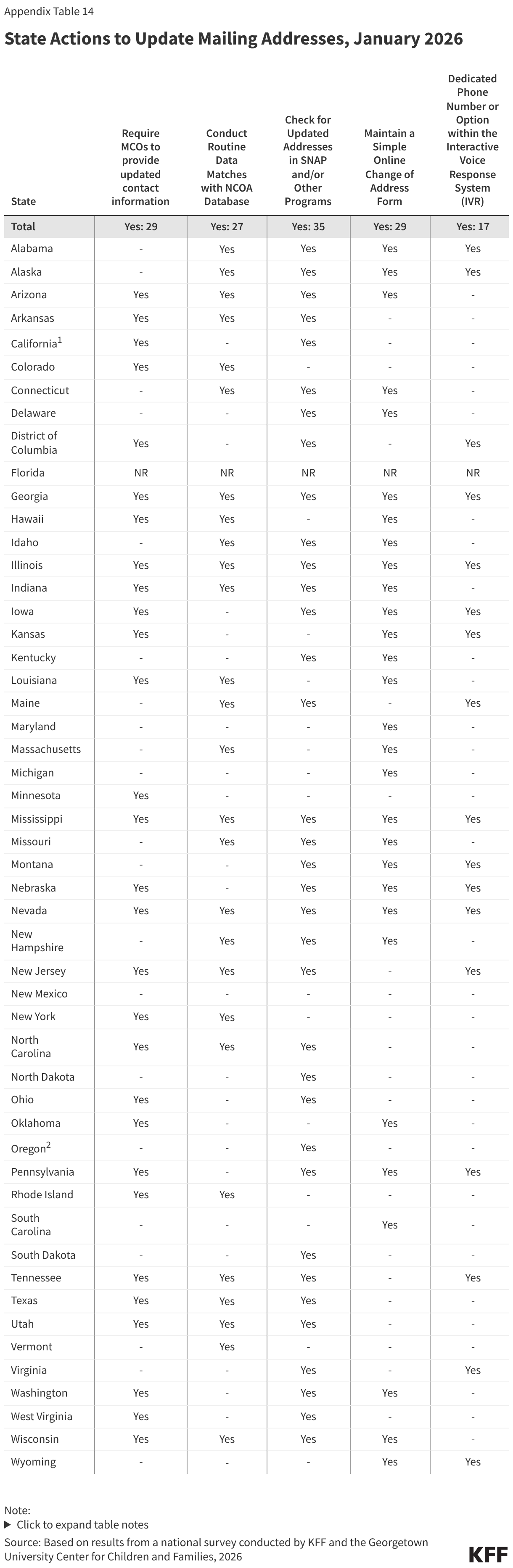
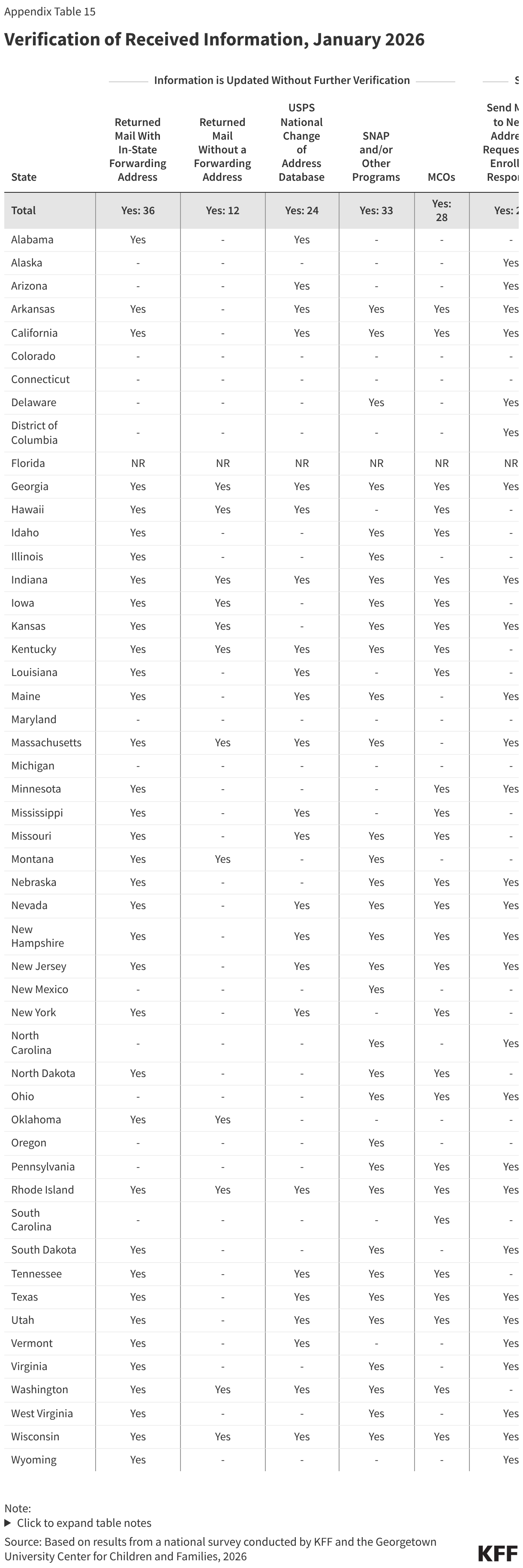
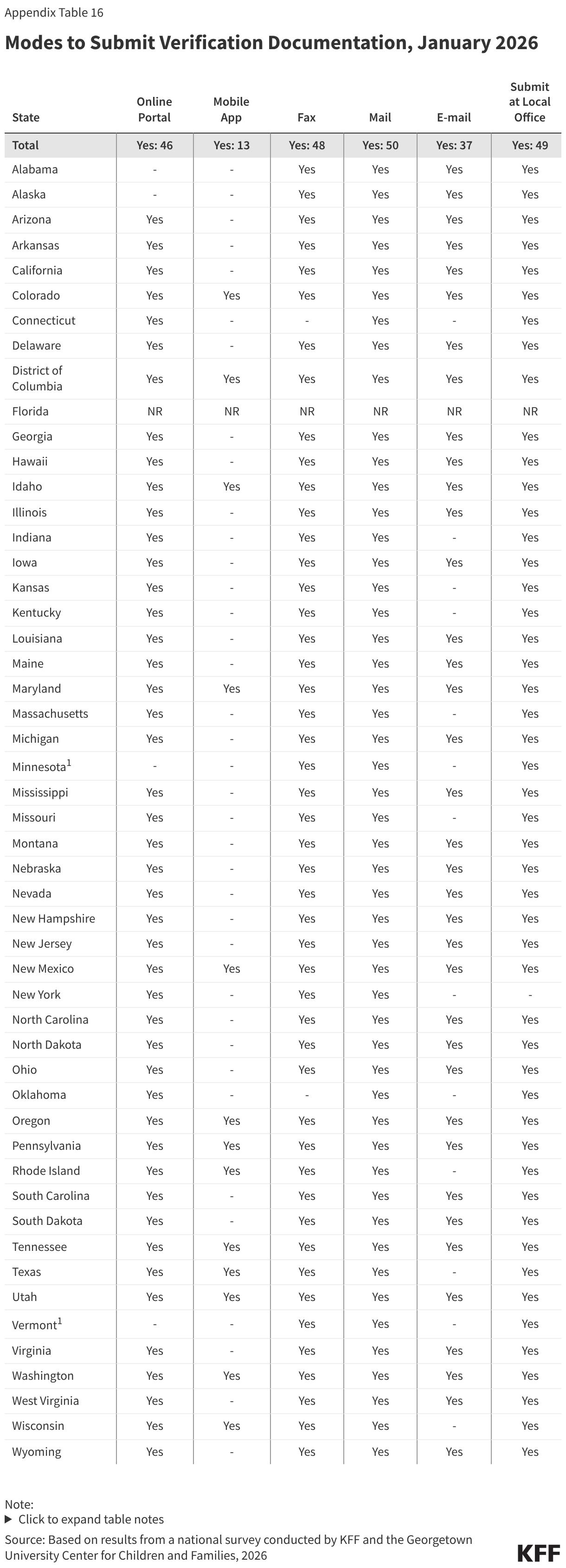
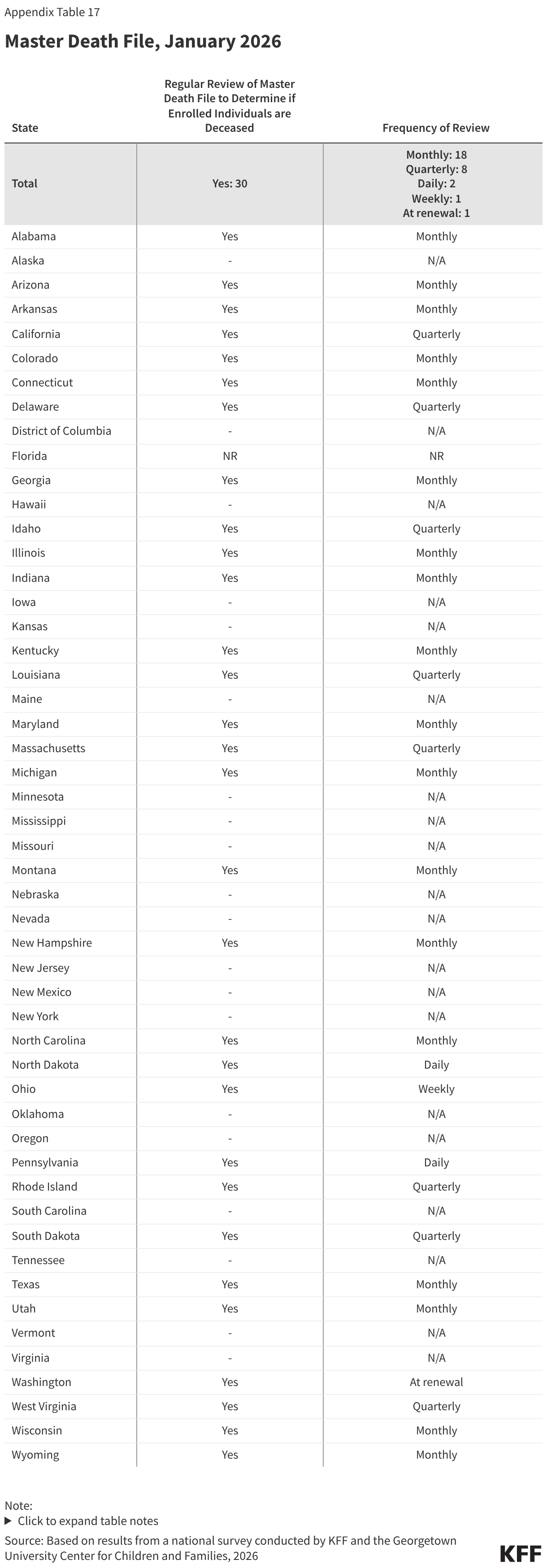
On July 4, President Trump signed the 2025 reconciliation law that makes significant changes to the Medicaid program, including new requirements for states to implement work requirements. Starting January 1, 2027, states must condition Medicaid eligibility on meeting work requirements for individuals enrolled through the Affordable Care Act (ACA) Medicaid expansion pathway and through certain state waivers. To ease the burden on individuals, the law directs states to use available information “where possible” to verify compliance with Medicaid work activities or exemption status, without requiring additional documentation from individuals.

The Supplemental Nutrition Assistance Program (SNAP), the federal aid program addressing food insecurity among low-income households, is an important source of data that can be used to identify individuals who are in compliance with or exempt from the Medicaid work requirements. Both Medicaid and SNAP target low-income households, and many individuals receive benefits through both programs; overall, most people who receive SNAP benefits are covered by Medicaid. As a result, some states have integrated eligibility systems or otherwise share data between the two programs. In addition, SNAP has long-standing work requirements for certain “able-bodied” adults without dependents, so coordination among agencies can streamline the collection of information to verify compliance with requirements in both programs. The reconciliation law introduced changes for the population subject to work requirements in SNAP that align them more closely with the new Medicaid work requirements, but differences remain between the programs.

New Medicaid work requirements and changes to SNAP work requirements are expected to impact enrollment in both programs. The Congressional Budget Office (CBO) estimates that Medicaid work requirements will increase the number of uninsured by 5.3 million over the next ten years, and that changes in who will need to meet work requirements will reduce participation in SNAP by roughly 2.4 million people in an average month over the 2025-2034 period. The changes to SNAP work requirements to align with Medicaid mean there could be overlap in the populations projected to lose SNAP and Medicaid benefits. This brief describes the intersection between Medicaid and SNAP and discusses how information from SNAP may be leveraged by states when implementing the new Medicaid work requirements.

What are Medicaid and SNAP Work Requirements?

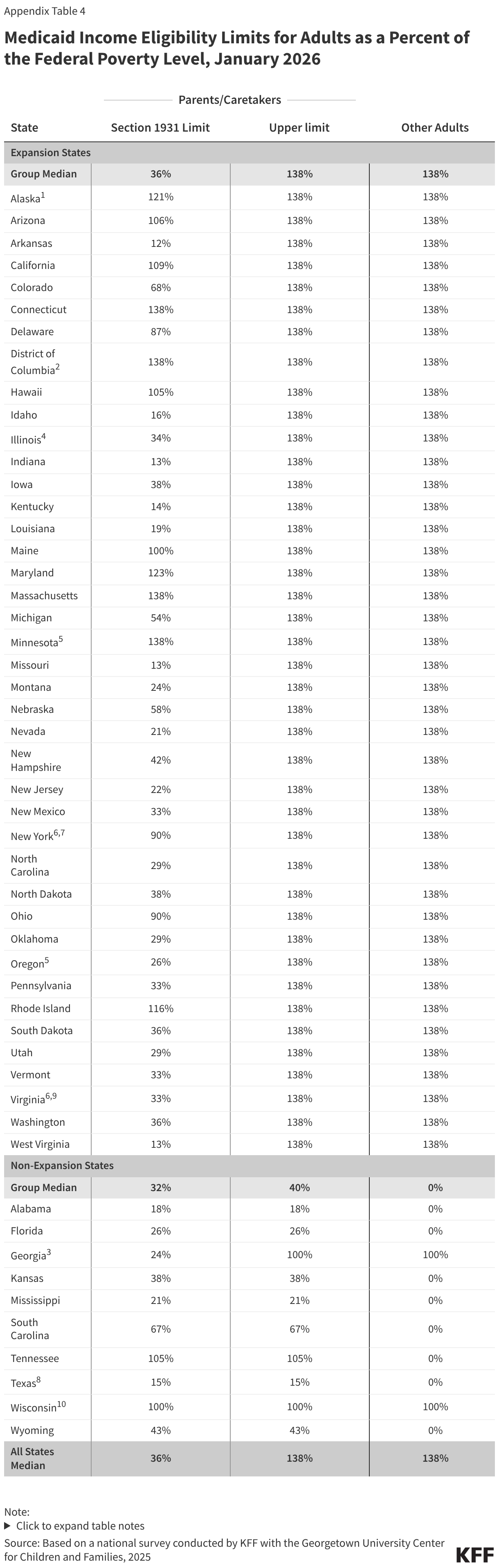
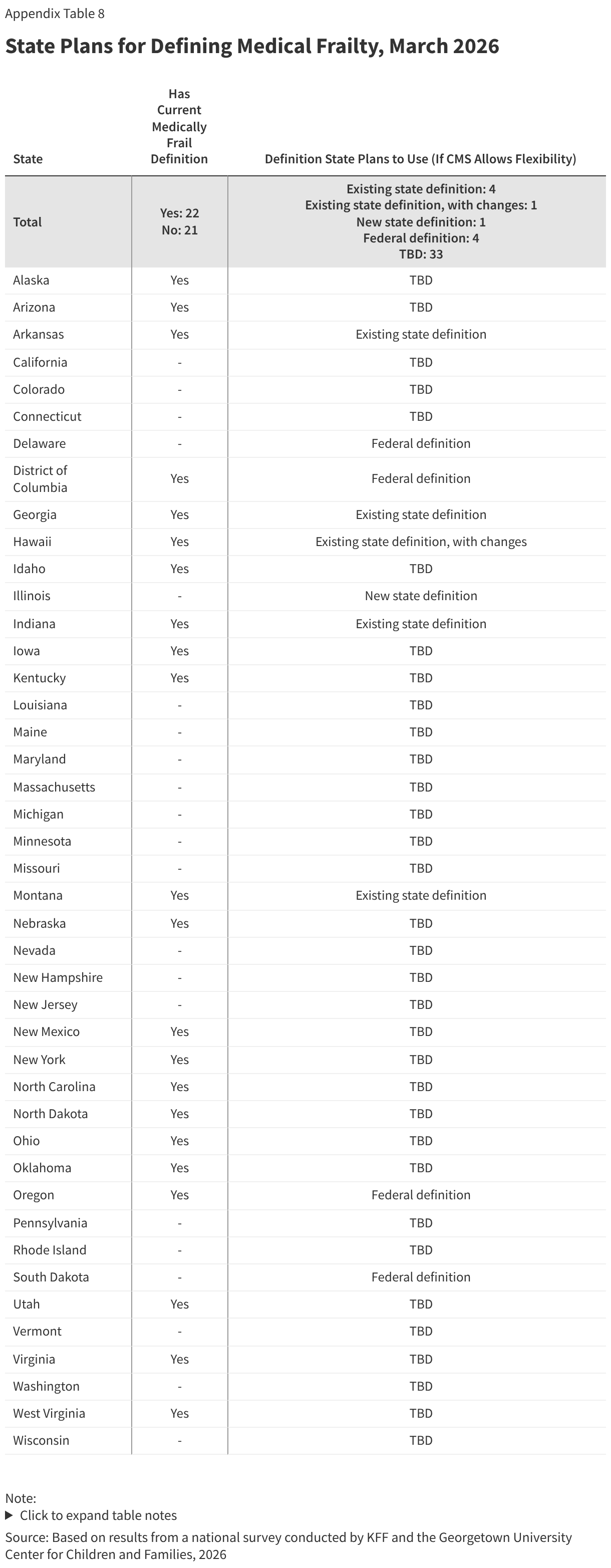
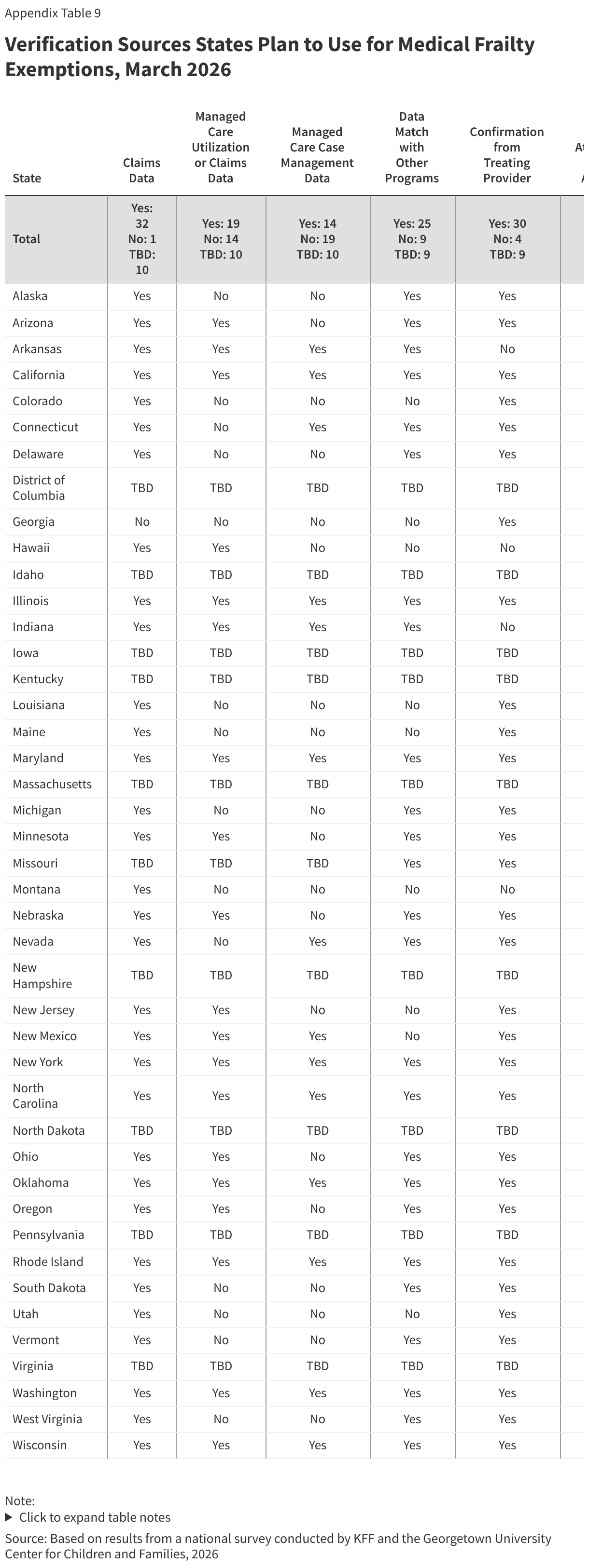
Beginning January 1, 2027, states must require expansion adults and enrollees in partial expansion waiver programs (Georgia and Wisconsin) to complete 80 hours of work or community service activities per month or meet exemption criteria to enroll in Medicaid and maintain coverage. At a minimum, states will be required to verify individuals’ work or exemption status when individuals apply for coverage and at eligibility renewal. The law specifies mandatory exemptions, including being in a household receiving SNAP and not exempt from SNAP work requirements. Other exemptions include parents and caretakers with children ages 13 and under, individuals who are “medically frail,” and individuals who are pregnant or postpartum, among others (Table 1). When a state is unable to verify compliance with the requirements or that an individual meets exemption criteria through data matching, it must issue a “notice of noncompliance” and deny the application or disenroll the individual from Medicaid coverage if the individual is unable to show compliance within 30 days.

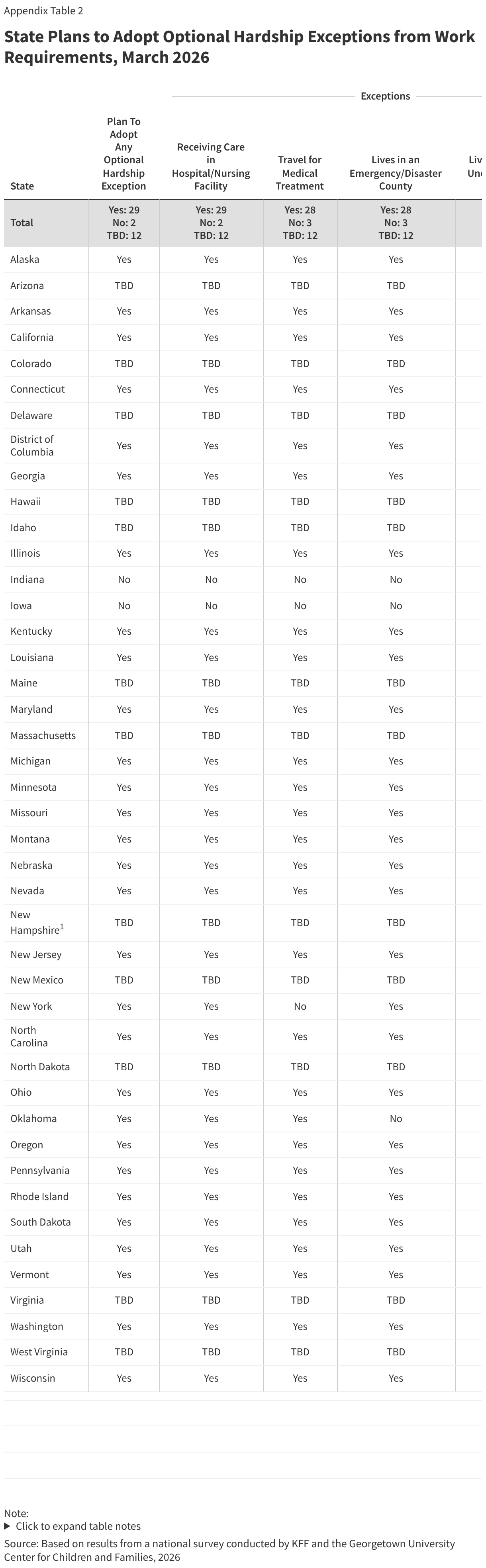
SNAP has its own work requirements and exemptions, but these do not fully align with the new Medicaid work requirements and exemptions. While most adults on SNAP must meet general work requirements, individuals who are considered “able-bodied adults without dependents” (ABAWDs) must work or participate in a work program for at least 80 hours per month or participate for an assigned number of hours in workfare to receive SNAP benefits for more than three months in a 36-month period (Table 1). The reconciliation law made changes that went into effect at the end of 2025 affecting the ABAWD population subject to this 80 hour per month work requirement, including newly subjecting adults ages 55 to 64 and parents with children ages 14 and older to these requirements, as well as removing previous exemptions for veterans, people experiencing homelessness, and young adults who aged out of foster care and who are under age 24. The law also added a new exemption for American Indian and Alaska Native People and changed the criteria for optional hardship exceptions for areas facing high unemployment. These changes make the SNAP requirements more consistent with Medicaid work requirements, although differences remain. For example, unlike SNAP, Medicaid work requirements include exemptions for individuals recently released from incarceration, as well as optional short-term hardship exceptions states can adopt for individuals with inpatient or nursing facility admissions, residents of counties with a disaster declaration, and those who have traveled outside their community for medical care (Table 1).
Medicaid and SNAP Work Requirements (Table)

What do we know about the intersection between Medicaid and SNAP?

About one in five Medicaid-covered adults who will likely be subject to the new work requirements also receive SNAP benefits (Figure 1). Similar eligibility requirements, particularly in Medicaid expansion states, account for this overlap in enrollment. In the 41 states (including DC) that have expanded their Medicaid programs, the income eligibility limit for adults is 138% of the federal poverty level (FPL), which is $22,024 for an individual in 2026 or $1,835 per month. The income eligibility limit for SNAP is 130% FPL gross monthly income ($1,696 for an individual in 2026) and 100% FPL net monthly income reflecting certain deductions ($1,305 for an individual in 2026); though definitions of income and household composition rules differ somewhat between SNAP and Medicaid. This estimate of the share of adults likely subject to Medicaid work requirements who are enrolled in both programs is likely an undercount as it excludes Medicaid adults with dependent children ages 14 and older. While nearly all SNAP participants are also enrolled in Medicaid, because SNAP participation is much lower than total Medicaid enrollment, the share of Medicaid enrollees who also receive SNAP is lower. This analysis focuses on adults who would likely qualify for an exemption from Medicaid work requirements due to being in a household receiving SNAP and not exempt from SNAP work requirements. When looking at the broader population of all Medicaid adults ages 19-64, the share receiving SNAP benefits rises to one in three individuals.
One in Five Adults Likely Subject to Medicaid Work Requirements Receive SNAP (Donut Chart)

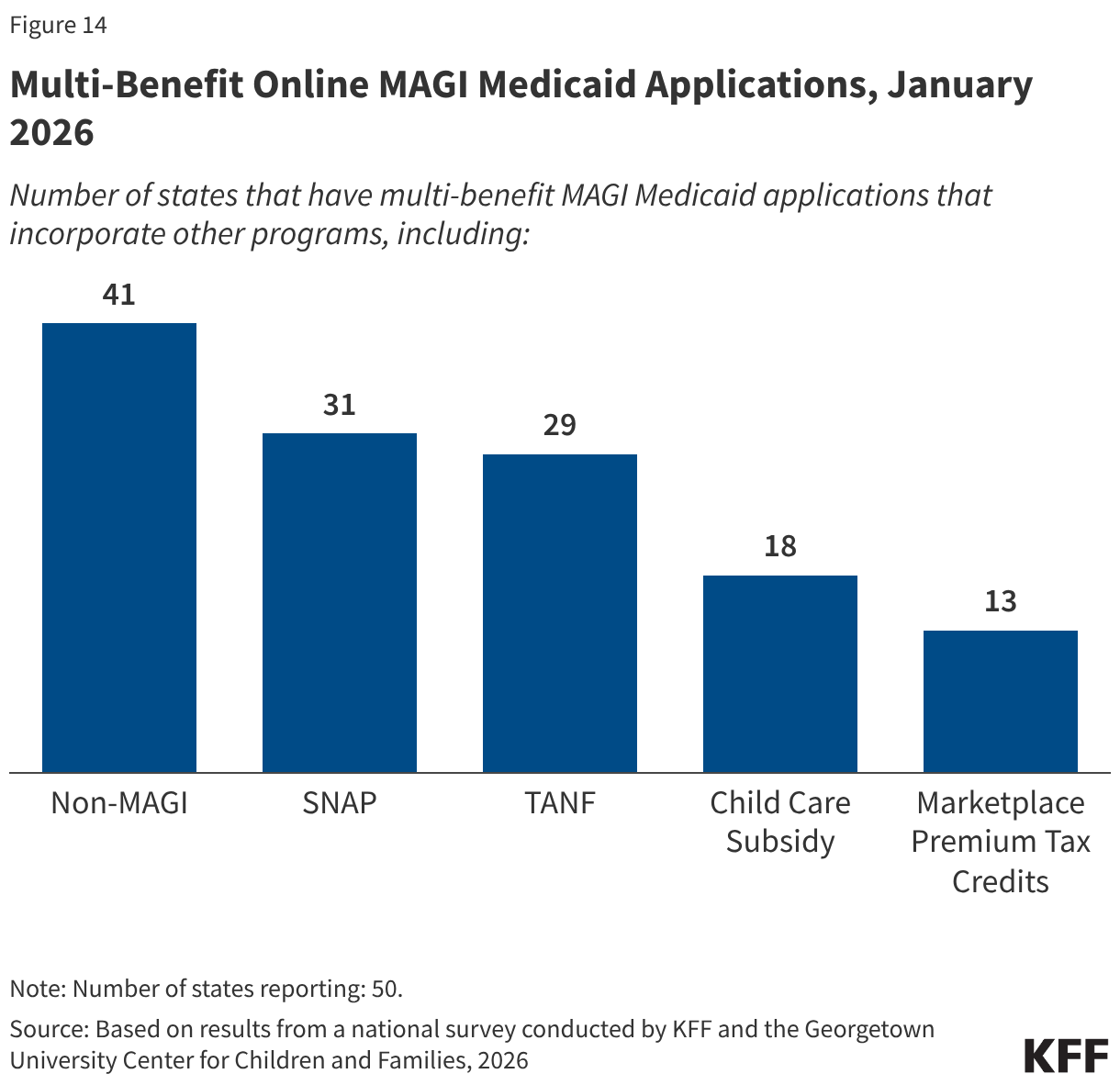
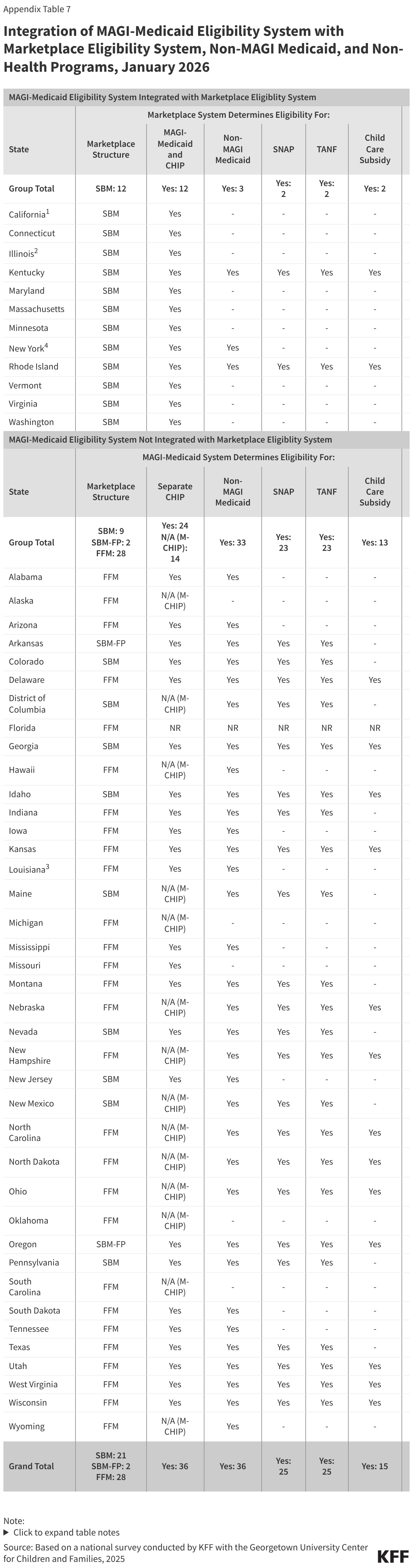
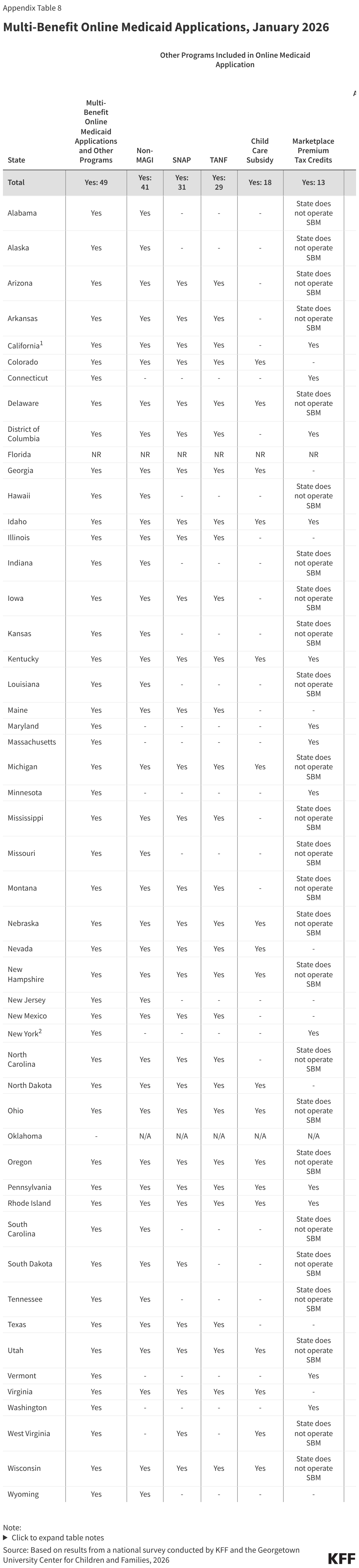
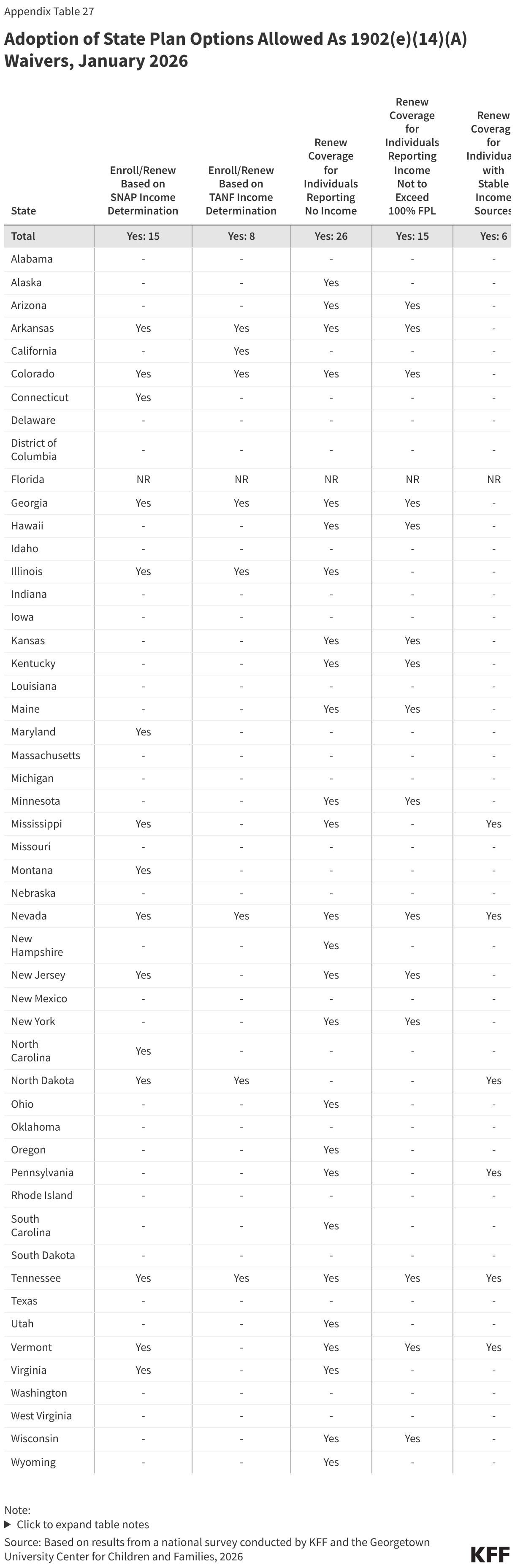
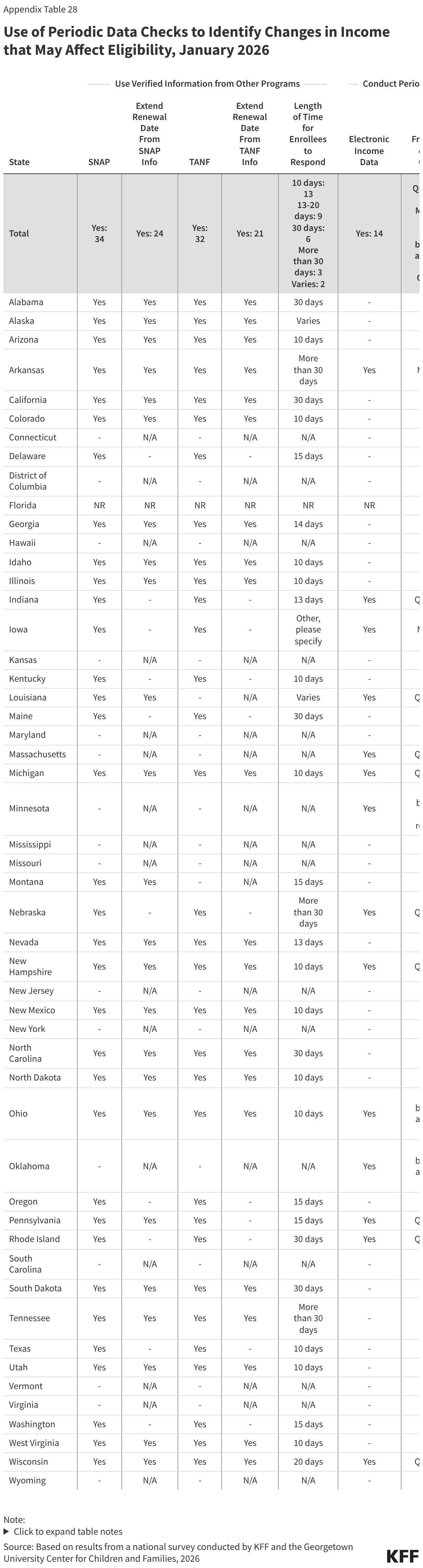
In part because of the overlap in eligibility between the two programs, many states use information from SNAP to assist with determining Medicaid eligibility. Most Medicaid programs are already facilitating coordination of enrollment processes and systems between Medicaid and SNAP. For example, 29 states affected by the new Medicaid work requirements allow individuals to apply for Medicaid and SNAP through a single online application and 24 states affected by the new Medicaid work requirements make eligibility determinations for Medicaid and SNAP through a single shared system. In addition, among states that will be subject to Medicaid work requirements, 15 enroll or renew individuals in Medicaid using SNAP income determinations, and 33 states use information from SNAP to identify and act on potential changes in eligibility between renewals, including 10 states and DC that do both, as of January 2025 (Figure 2).

Many states Use Information From SNAP to Assist with Determining Medicaid Eligibility, as of January 2025 (Choropleth map)

How can states use data from SNAP to implement Medicaid work requirements?

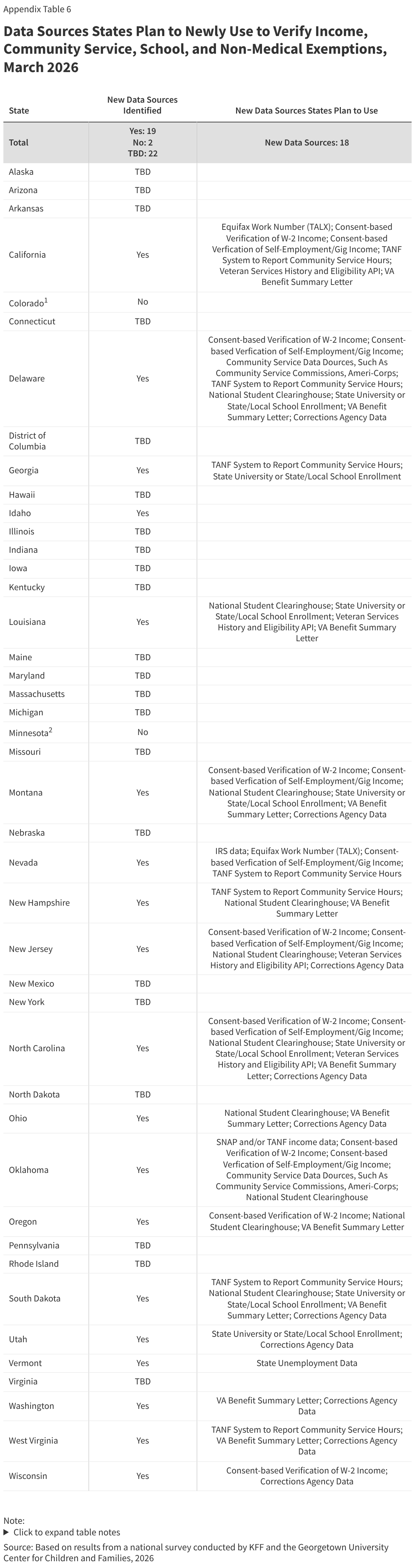
States can use information from SNAP to identify individuals who may be exempt from Medicaid work requirements and those who are meeting the requirements. States are required to use available data from reliable sources to “data match” the work or exemption status of individuals to lessen the administrative burden on both enrollees and Medicaid staff. Although CMS has not released formal guidance, it is anticipated that states will be required to access SNAP and TANF data for the purpose of determining compliance with work requirements. Successful automation to verify compliance with Medicaid work activities or exemption status can lower the risk of eligible people not being able to enroll in Medicaid or losing their coverage due to not submitting proof of work hours or exemption status. States can use information already collected by SNAP to identify individuals in a household receiving SNAP who are not exempt from SNAP work requirements, and who are, therefore, exempt from the Medicaid requirements. SNAP data can also be used to identify individuals who qualify for exemptions because they are medically frail, are participating in a drug or alcohol addiction program, or are American Indians or Alaska Natives. States can also use income information from SNAP to verify compliance with Medicaid work requirements. While some of this information on work and exemption status is likely available for current Medicaid enrollees, SNAP can be a source of data for applicants for whom Medicaid agencies do not have this information.

When Arkansas implemented work requirements in 2018, the state used SNAP data to verify exemptions and compliance with work hours. Of the 116,000 individuals subject to work requirements in February 2019, Arkansas was able to determine that 87% of enrollees were meeting or exempt from the work requirements through data matching (Figure 3). Most individuals whose status was verified using available data fell into four categories: those who were already working at least 80 hours per month (45%), those meeting or exempt from SNAP employment and training requirements (14%), those with a dependent child in the household (12%), and those identified as medically frail (9%). Most enrollees who were not data matched ultimately did not report any work activities in that month. Arkansas did not have integrated eligibility systems, but implemented a daily file exchange between its SNAP and Medicaid systems to update exemption and compliance information across programs without manual intervention. Although Arkansas’ work requirements differ from the new federal requirements in key ways, the experience shows how states can use SNAP data when implementing the new Medicaid work requirements. 

In Arkansas, 14% of Those Subject to Work Requirements Were Automatically Exempted Due to Their SNAP Status (Pie Chart)

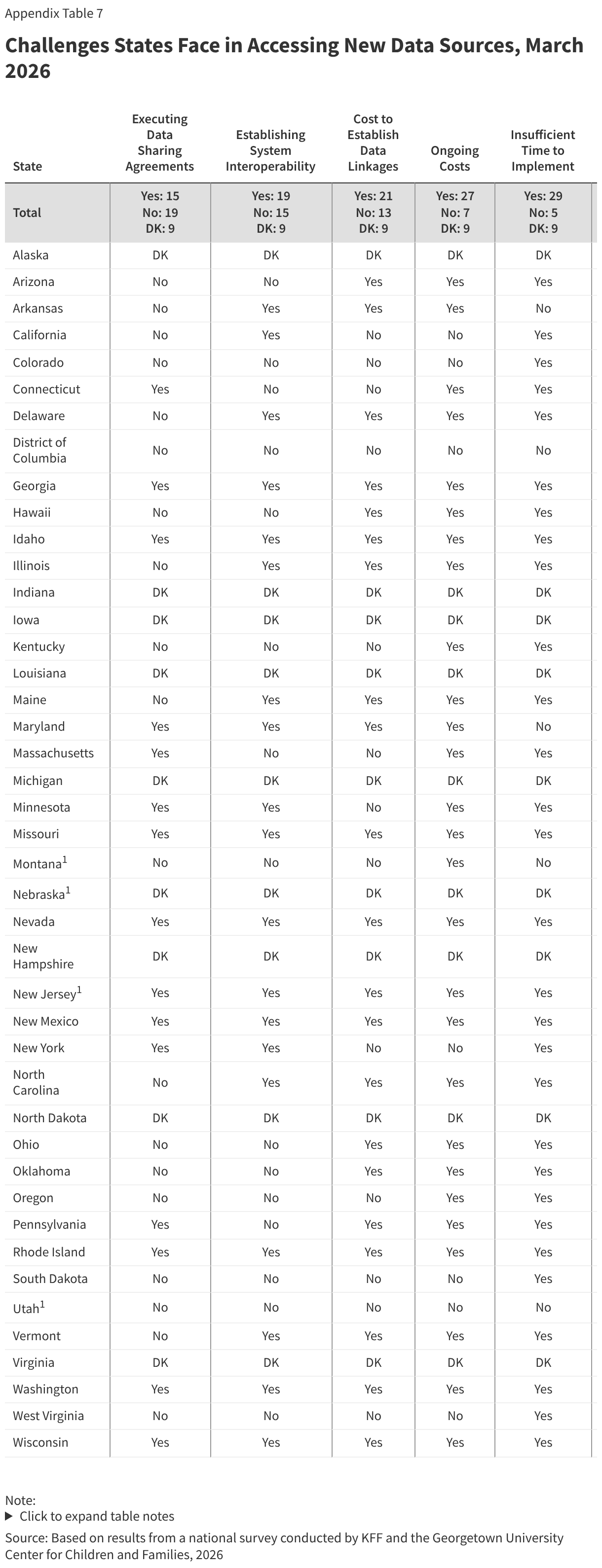
Data sharing between Medicaid and SNAP will be easier in states that have integrated eligibility systems; however, these states may also face unique issues in addition to the challenges all states will likely face when making necessary system changes for both programs. Of the many systems changes needed, states have previously reported prioritizing enhancing capabilities to collect and match data from multiple agencies and external sources to reduce the burden on applicants and enrollees for documenting their work or exemption status. However, states may face different challenges based on their current Medicaid eligibility system integration with SNAP. States that do not currently link to SNAP will need to establish an interface to share data between agencies. Some states may face difficulty establishing this linkage and may require more time to put it into place. States with integrated Medicaid and SNAP eligibility systems needed to prioritize completing work requirement changes for SNAP that went into effect at the end of 2025, which may have delayed the initiation of work on the Medicaid changes. Any delays in preparing for Medicaid work requirements could potentially increase costs. In addition, as states implement complex SNAP and Medicaid eligibility and enrollment policy changes, they will also need to prepare for changes to the payment error rate measurement (PERM) program at the same time, requiring states to make decisions on how to apply scarce state resources and mitigate budgetary consequences. Beginning in 2028, the reconciliation law requires states to pay a portion of SNAP benefit costs, depending on the state’s payment error rate, and starting October 1, 2029, HHS will be required reduce federal Medicaid financial participation to states that exceed a three percent PERM eligibility error rate threshold.

Medicaid Financing: The Basics

Published: Mar 4, 2026

Introduction

Medicaid represents nearly $1 out of every $5 spent on health care in the U.S. and is the major source of financing for states to provide health coverage and long-term care for low-income residents. Medicaid is administered by states within broad federal rules and jointly funded by states and the federal government through a federal matching program with no cap. States are facing substantial Medicaid financing changes and historic reductions in federal funding following the passage of the 2025 reconciliation law, though the timing of the changes and the impacts vary by state. In addition, administrative actions related to financing and more aggressive oversight of potential fraud by health care providers, including withholding federal Medicaid operating funds, contribute to fiscal uncertainty for states. Amid federal policy changes, states are also experiencing a more tenuous fiscal climate due to slowing revenue growth and increasing spending demands. Medicaid is often central to state budget decisions as it is simultaneously a significant spending item as well as the largest source of federal revenues for states. This issue brief examines key questions about Medicaid financing and explores the impact of recent policy changes.

How does Medicaid financing work?

Medicaid financing is shared by states and the federal government with a guarantee to states for federal matching payments with no pre-set limit. The percentage of costs paid by the federal government (known as the federal medical assistance percentage or “FMAP”) varies across states, for specific services and types of enrollees, and depending on whether the costs are for medical care or program administration. Congress has enacted legislation to temporarily increase federal matching payments during economic downturns and, most recently, during the COVID-19 pandemic, because Medicaid is a counter-cyclical program. During economic downturns, more people become eligible and enroll, but states typically face declines in revenues that make it difficult to finance the state share of funding for the program.

The FMAP for services used by people eligible through traditional Medicaid, which includes individuals who are eligible as children, low-income parents, because of disability, or because of age (65+), is determined by a formula set in statute. The formula is designed so that the federal government provides a match rate of at least 50% and provides a higher match rate for states with lower average per capita income. The resulting FMAP varies by state and ranges from 50% (the FMAP “floor”) in ten states (California, Colorado, Connecticut, Maryland, Massachusetts, New Hampshire, New Jersey, New York, Washington, and Wyoming) to 77% in Mississippi for federal fiscal year (FFY) 2027 (Figure 1).

States With Lower Per Capita Incomes Have a Higher Federal Matching Rate for Medicaid (Choropleth map)

There are special match rates for the Affordable Care Act (ACA) expansion group, administration, and other services. While the traditional FMAP applies to the vast majority of Medicaid spending, there are a few exceptions that provide higher match rates for specific services or populations, such as family planning and most notably people covered under the ACA Medicaid expansion. States that have implemented the expansion receive 90% FMAP for adults covered through the ACA Medicaid expansion. Administrative costs incurred by states are usually matched by the federal government at a 50% rate, but some functions such as eligibility and enrollment systems receive higher match rates. Medicaid administrative costs are about 4% of total Medicaid spending.

Unlike in the 50 states and D.C., annual federal funding for Medicaid in the U.S. territories is subject to a statutory cap and fixed matching rate. Once a territory exhausts its capped federal funds, it no longer receives federal financial support for its Medicaid program during that fiscal year. Over time, Congress has provided increases in federal funds for the territories broadly and in response to specific emergency events. Various pieces of legislation during the pandemic significantly increased the allotments for each of the territories and also raised the FMAP rates from the statutory level of 55% to 76% for Puerto Rico and 83% for the other territories. The 2023 Consolidated Appropriations Act extended the 76% FMAP for Puerto Rico through FFY 2027 and made the 83% match rate for other territories permanent.
To participate in Medicaid and receive federal matching dollars, states must meet core federal requirementsStates must provide certain mandatory benefits (e.g., hospital, physician, and nursing home services) to core populations (e.g., low-income pregnant women, children, people with disabilities, and people ages 65 and older) without waiting lists or enrollment caps. States may also receive federal matching funds to cover “optional” services (e.g., adult dental care and home care, also known as home- and community-based services) or “optional” groups (e.g. people with income above the limits established for core populations). States also have discretion to determine how to purchase covered services (e.g., through fee-for-service or capitated managed care arrangements) and to establish provider payment methods and rates.

Both the federal government and states are responsible for promoting program integrity. Program integrity broadly refers to the proper management and function of the Medicaid program to ensure it is providing quality and efficient care while using funds–taxpayer dollars–appropriately, with minimal waste. Program integrity efforts, historically, have worked to prevent and detect fraud, waste, and abuse; to increase program transparency and accountability; and to work on corrective action plans and recover improperly used funds. Improper payments, which are often cited when discussing program integrity, are not a measure of fraud but payments that do not meet Centers for Medicare and Medicaid Services (CMS) program requirements. CMS’s Medicaid Payment Error Rate Measurement (“PERM”) program estimated the overall Medicaid improper payment rate was about 6% in 2025. Most improper payments (77% in 2025) are due to insufficient information (or missing administrative steps), not necessarily due to payments for ineligible enrollees, providers, or services (i.e. since they may have been payable if the missing information had been on the claim and/or the state had complied with requirements).

How much does Medicaid cost and how are funds spent?

Overall, Medicaid spending totaled $919 billion in FFY 2024 with the federal government paying nearly two-thirds (65% or $594 billion) and states paying over one-third (35% or $325 billion) (Figure 2). The overall share of federal spending on Medicaid depends on states’ per capita income (lower income states receive a higher match) and whether they adopted the ACA expansion (which has a 90% match).

The Federal Government Paid for Nearly Two-Thirds of Total Medicaid Spending in FFY 2024 (Donut Chart)

Capitated payments to Medicaid managed care organizations (MCOs) accounted for half of Medicaid spending in FFY 2024 (Figure 3). Managed care and health plans accounted for the largest share (53%) of Medicaid spending, with capitated payments to comprehensive MCOs accounting for 50% of Medicaid spending in FFY 2024 and other Medicaid managed care (e.g., primary care case management (PCCM) arrangements or payments to specialty plans) accounting for another 3%. Smaller shares of total Medicaid spending in FFY 2024 were for fee-for-service acute care (22%), fee-for-service long-term care (20%), Medicaid spending for Medicare premiums on behalf of enrollees who also have Medicare (3%), and disproportionate share hospital (DSH) payments (2%).

Payments to Comprehensive MCOs Account for Half of Total National Medicaid Spending (Pie Chart)

Enrollees eligible based on disability or age (65+) comprise about one in five of all Medicaid enrollees but account for over half of total spending due to higher per person costs (Figure 4). Children account for 33% of enrollees but only 15% of spending. Adult enrollees (those made eligible under the ACA Medicaid expansion, as well as low-income parents) account for 45% of all enrollees and 34% of spending. The disproportionate spending on certain eligibility groups stems from variation in spending per enrollee across the eligibility groups, reflecting differences in health care needs and utilization. Spending per enrollee for individuals eligible based on age (65+) and disability, the two groups with the highest per enrollee costs, is approximately six times higher than spending per enrollee for children, who had the lowest spending of any eligibility group. Those eligible on the basis of age or disability tend to have higher rates of chronic conditions, more complex health care needs and are more likely to utilize long-term care than other enrollees, contributing to higher spending.

People Eligible for Medicaid Based on Disability or Age (65+) Accounted for 1 in 5 Enrollees but Over Half of All Spending in 2023 (Stacked column chart)

Total spending per full-benefit enrollee ranged from a low of $4,780 in Alabama to $12,295 in D.C. in 2023 (Figure 5). Variation in spending across the states reflects considerable flexibility for states to design and administer their own programs – including what benefits are covered and how much providers are paid — and variation in the cost of living and the health and population characteristics of state residents. Within each state, there is also substantial variation in the average costs for each eligibility group and within each eligibility group, per enrollee costs may vary significantly. Overall, Medicaid spending has experienced slower cumulative growth since 2008 compared to private insurance on a per-enrollee basis.

Medicaid Spending Per Full-Benefit Enrollee Varies Across States (Choropleth map)

Medicaid spending includes payments to providers, particularly hospitals, that include base rates as well as supplemental payments. Supplemental payments generally add on to “base” payments from fee-for-service Medicaid or from Medicaid managed care organizations, both of which don’t always cover the costs of providing services.There are various types of supplemental payments (see Box 1), and their use varies by state.

Box 1: Types of Medicaid Supplemental Payments

“Disproportionate share hospital” (DSH) payments ($15 billion in FFY 2024) pay hospitals that serve a large number of Medicaid and low-income uninsured patients to offset uncompensated care costs. Federal DSH spending is capped for each state and facility but within those limits, states have considerable discretion in determining the amount of DSH payments to each DSH hospital. The ACA called for a reduction in federal DSH allotments starting in FFY 2014 based on the assumption of reduced rates of uninsurance, but the cuts have been delayed several times and have yet to go into effect. DSH payments are intended to supplement Medicaid payment rates and to help defray the costs of care provided to people without health insurance.

States may make other non-DSH supplemental payments to providers ($39 billion in FFY 20241). Upper payment limits (UPLs) are the most common, and permit states to make up the difference between Medicaid fee-for-service payments and what Medicare would pay for comparable services. As such, the maximum payment rate for UPLs is what Medicare would pay in most cases. Other types of supplemental payments include payments for graduate medical education and those authorized under various demonstration programs. Most supplemental payments are made to hospitals, but some go to mental health facilities, nursing facilities, intermediate care facilities, physicians and other practitioners. For physician and other practitioners, UPLs are set at average commercial rates, which tend to be much higher than Medicare rates.

Subject to CMS approval, states may implement “state directed payments” that require managed care plans to make certain types of payments to health care providers (estimated to be well over $100 billion each year). State directed payments are generally aimed at bolstering provider payment rates to increase access to or quality of care. Prior to passage of the 2025 reconciliation law, the total payment made through state directed payments and base MCO payments was capped at average commercial rates for hospital services, nursing facility services, and professional services at academic medical centers.

How does Medicaid relate to federal and state budgets?

Social Security, Medicare, and Medicaid are the three main entitlement programs and accounted for 41% of all federal outlays in FFY 2024 (Figure 6). Of these three programs, Medicaid is smallest in terms of federal outlays, though it covers a larger number of people than Medicare or Social Security. Overall, federal spending on domestic and global health programs and services accounted for more than one-fourth of net federal outlays in FFY 2024, including spending on Medicare (12%), Medicaid and CHIP (8%), and other health spending (6%). (The numbers in Figure 6 come from the FFY 2025 budget request. The FFY 2026 budget request did not include full data on prior years’ spending, and the FFY 2027 budget request has not been posted as of the writing of this issue brief.)

Medicaid and CHIP Accounted for 8% of Net Federal Outlays in FFY 2024 (Donut Chart)

Medicaid is often central to state fiscal decisions as it is simultaneously a significant spending item as well as the largest source of federal revenues for states due to the federal matching structure. According to data from the National Association of State Budget Officers (NASBO), in state fiscal year (SFY) 2024, Medicaid accounted for 30% of total state spending for all items in the budget (Figure 7). Medicaid accounted for only 16% of expenditures from state funds (including state general funds and other state funds), second to K-12 education (24%). On the other hand, Medicaid accounted for 57% of all expenditures from federal funds. States have an incentive to control Medicaid spending because they pay a share of Medicaid costs, though states must reduce total Medicaid spending by more than one dollar to achieve a dollar in savings due to the federal matching structure. At the same time, research shows that federal matching dollars from Medicaid spending have positive effects for state economies. A number of studies show that states that have adopted the ACA Medicaid expansion have realized budget savings, revenue gains, overall economic growth as well as observed positive effects on the finances of hospitals and other health care providers.

Medicaid is the Largest Single Source of Federal Funds for States (Stacked column chart)

States can use a variety of methods to pay for the state share of Medicaid spending. States have flexibility in determining how to finance the state (or non-federal) share of Medicaid payments, within certain limits. In addition to state general funds appropriated directly to the Medicaid program, most states also rely on funding from health care providers and local governments generated through provider taxes and donations, intergovernmental transfers (IGTs), and certified public expenditures (CPEs). KFF’s 2025 Medicaid budget survey found that general funds accounted for a median of 70% of the non-federal share in SFY 2026 enacted budgets, while provider taxes accounted for 18% and funds from local governments or other sources accounted for 6%, though there was considerable variation across states.

All states (except Alaska) have at least one provider tax in place and many states have more than three (Figure 8). Medicaid provider taxes are defined as those for which at least 85% of the tax burden falls on health care items or services or entities that provide or pay for health care items or services. Provider taxes fall on a wide range of provider types but are most common for institutional providers including hospitals (47 states), nursing facilities (45 states), and intermediate care facilities for people with intellectual or developmental disabilities (33 states). States use provider tax revenues to fund Medicaid “base” rates as well as supplemental payments (including state directed payments); to finance eligibility expansions (including the ACA Medicaid expansion); or to more generally support the Medicaid program. Smaller sources of state share funding include IGTs, CPEs, and provider donations (see Box 2).

All States but Alaska Use Provider Taxes To Help Finance the State Share of Medicaid Spending (Choropleth map)

Box 2: State Share Funding Sources Beyond Provider Taxes

Intergovernmental transfers (IGTs) are transfers of public funds between governmental entities (such as county government or state university hospital transferring funding to the state Medicaid agency). Similar to provider taxes, IGTs may be used to finance payments for providers but also finance overall Medicaid spending.

Provider donations are voluntary contributions from health care providers or related entities to the state or local government, which are only permissible if they are “bona fide” and not related to the payments the provider receives from Medicaid. (Provider donations of up to $5,000 per year for an individual provider and up to $50,000 per year for health care organizations are presumed to be bona fide.) Similar to provider taxes and IGTs, provider donations may be used to finance various types of Medicaid spending.

Certified public expenditures (CPEs) are certifications by a governmental entity (such as a county hospital or schools) that authorized funds were spent on Medicaid expenses. Unlike other types of Medicaid financing, CPE funds are not transferred from a governmental entity to the state for use as a non-federal funding source. Instead, the government entity that provides the services certifies that it has expended the dollars on Medicaid-covered services. CMS provides states with the federal share of the total amount paid by the government entity and encourages (but does not require) states to reimburse the provider for the federal share of costs

What factors affect Medicaid spending and what is the impact of recent policy changes?

Medicaid spending is driven by multiple factors, including the number and mix of enrollees, their use of health care and long-term care, and the prices of Medicaid services. High enrollment growth rates, tied first to the Great Recession, then ACA implementation, and later the pandemic-era continuous enrollment provision, were the primary drivers of total Medicaid spending growth over the last two decades (Figure 9). However, by SFY 2026, the pandemic-era federal support and policies had ended, and states were projecting flat enrollment growth but increasing total Medicaid spending growth due to several cost pressures including provider and managed care rate increases, greater enrollee health care needs, and increasing costs for long-term care, pharmacy benefits, and behavioral health services.

Line graph of percent change in Medicaid enrollment and total spending shows Medicaid enrollment is expected to flatten, growing by 0.2%, as total spending grows by 7.9% in FY 2026.

Medicaid spending is also affected by federal policy changes like those included in the 2025 reconciliation law, which made historic reductions in federal Medicaid spending. The 2025 reconciliation law, signed by President Trump on July 4, 2025, will have a significant impact on Medicaid spending and enrollment trends. Overall, the Medicaid provisions in the new law are expected to reduce federal Medicaid spending by $911 billion (or by 14%) over a decade and increase the number of uninsured people by 7.5 million, though the impacts vary by state.

Changes to Medicaid financing in the 2025 reconciliation law, in particular, are expected to reduce federal Medicaid spending by about $400 billion over a decade. Those changes include:

  • Establishing new restrictions on states’ ability to generate Medicaid provider tax revenue, including prohibiting all states from establishing new provider taxes or from increasing existing taxes; reducing existing provider taxes for states that have adopted the ACA Medicaid expansion; and changing the requirements for states to receive waivers that implement various provider taxes.
  • Revising the payment limit for state directed payments.
  • Imposing a financial penalty for states with eligibility-related improper payment error rates greater than 3%.
  • Eliminating the temporary 5% increase in a state’s traditional FMAP for two years to incentivize states to adopt the Medicaid expansion.

Beyond the changes to Medicaid financing, states will be working to implement other major changes to Medicaid, most notably work requirements for adults eligible for Medicaid through the ACA expansion.

Other federal Medicaid financing changes beyond the 2025 reconciliation law will also have implications for Medicaid spending. These include the following.

  • CMS has an enhanced focus on addressing fraud, waste, and abuse in Medicaid that differs from prior practices by: increasing the use of deferrals (which require states to prove expenditures are allowable before CMS will pay for the federal share of spending), potentially withholding federal funding when future fraud is expected as was done recently in Minnesota (rather than the historic process of identifying fraud, working with a state on a corrective action, and then retroactively denying payment for disallowed expenditures), and publishing provider-level spending data to spur analysis of potential fraud, waste, and abuse by private individuals and organizations.
  • There will be additional regulations coming to implement requirements in the 2025 reconciliation. For example, a proposed rule is under review at the Office of Management and Budget to implement new requirements governing provider taxes.
  • CMS has indicated interest in potentially changing requirements governing how states finance the state share of Medicaid, including a recent request for information about ways CMS can “improve the prevention, identification, and resolution of fraud, waste, and abuse related to non-federal share financing sources, including intergovernmental transfers.”
  • Puerto Rico’s FMAP will revert to 55% from 76% after FFY 2027 without further legislative action.

As states respond to federal Medicaid cuts and shifting state fiscal conditions, changes to benefits, provider payment rates, and eligibility could further limit Medicaid spending. Amid federal funding cuts and policy changes, states are experiencing a more tenuous fiscal climate due to slowing revenue growth and increasing spending demands. The challenging fiscal climate across many states and the magnitude of federal Medicaid cuts will make it difficult for states to absorb or offset the reductions, and states may seek to restrict Medicaid provider reimbursement rates, benefits, or eligibility in response to reduce state Medicaid spending. Even though many provisions in the reconciliation law do not take effect immediately, a few states have already implemented Medicaid spending cuts for SFY 2026 or are proposing cuts for SFY 2027.

Endnotes

  1. This includes non-DSH other supplemental payments to inpatient and outpatient hospitals as well as other providers. Total based on FFY 2024 data downloaded from CMS (Form 64) for the following service categories: Clinic Services – Sup. Payments, Critical Access Hospitals Inpatient – Sup. Payments, Critical Access Hospitals Outpatient – Sup. Payments, Inpatient Hospital – Sup. Payments, Inpatient Hospital – GME Sup. Payments, Intermediate Care Facility – Individuals with Intellectual Disabilities (ICF/IID): Supplemental Payments, Non-Emergency Medical Transportation – Sup. Payments, Nursing Facility Services – Sup. Payments, Other Practitioners Services – Sup. Payments, Outpatient Hospital Services – Sup. Payments, and Physician & Surgical Services – Sup. Payments. Total may not match other estimates of non-DSH supplemental payments due to differences in included provider types and/or types of payments. ↩︎

The Global HIV/AIDS Epidemic

Published: Mar 3, 2026

Editorial Note: Originally published in June 2001, this resource is updated as needed to reflect the latest developments.

Key Facts

  • HIV, the virus that causes AIDS (acquired immunodeficiency syndrome), is one of the world’s most serious health and development challenges. Approximately 40.8 million people are currently living with HIV, and tens of millions of people have died of AIDS-related causes since the beginning of the epidemic.
  • Many people living with HIV or at risk for HIV infection do not have access to prevention, treatment, and care, and there is still no cure.
  • In recent decades, major global efforts, PEPFAR (the President’s Emergency Plan for AIDS Relief, the U.S. government’s global HIV initiative), and the Global Fund to Fight AIDS, Tuberculosis and Malaria (Global Fund) have been mounted to address the epidemic, and despite challenges, significant progress has been made in addressing HIV. Current global health goals are to end AIDS as a public health threat by 2030.
  • PEPFAR, in particular, has helped to change the trajectory of the HIV epidemic, and the U.S. is the single largest donor to international HIV efforts in the world, including the largest donor to the Global Fund. PEPFAR has directed over $130 billion toward HIV prevention, care, and treatment efforts since launched in 2003.
  • Since the beginning of the second Trump administration, the U.S. global health response has undergone significant change, fundamentally altering the global health landscape and U.S. global HIV efforts, including through PEPFAR.

Global Response

HIV, the virus that causes AIDS (see box), has become one of the world’s most serious health and development challenges since the first cases were reported in 1981. Approximately 91.4 million people have become infected with HIV since the start of the epidemic.1 Today, there are approximately 40.8 million people currently living with HIV, and tens of millions of people have died of AIDS-related causes since the beginning of the epidemic.2 

HIV: A virus that is transmitted through certain body fluids and weakens the immune system by destroying cells that fight disease and infection, specifically CD4 cells (often called T cells). Left untreated, HIV reduces the number of CD4 cells in the body, making it more difficult for the immune system to fight off infections and other diseases. HIV can lead to the development of AIDS, “acquired immunodeficiency syndrome,” also known as Advanced HIV Disease.3

AIDS: Advanced HIV Disease (AIDS), used to be seen as an issue of late diagnosis and treatment of HIV, and while that remains a concern, AIDS is now most common in people who have received treatment (antiretroviral therapy) but have stopped.4

Over the past two decades in particular, major global efforts have been mounted to address the epidemic, and significant progress has been made. The number of people newly infected with HIV, especially children, and the number of AIDS-related deaths have declined over the years, and the number of people with HIV receiving treatment increased to 31.6 million in 2024.5

Still, remaining challenges continue to complicate HIV control efforts. Many people living with HIV or at risk for HIV infection do not have access to prevention, treatment, and care, and there is still no cure. HIV primarily affects those in their most productive years, and it not only affects the health of individuals, but also impacts households, communities, and the development and economic growth of nations. Many of the countries hardest hit by HIV also face serious challenges due to other infectious diseases, food insecurity, and additional global health and development problems.

Latest Estimates6

  • Global prevalence among adults (the percent of people ages 15-49 who are infected) has leveled since 2001 and was 0.7% in 2024, though prevalence was higher for certain groups of people, including key populations (i.e., men who have sex with men, sex workers, people who inject drugs, transgender people, and people in prisons).
  • There were 40.8 million people living with HIV in 2024, up from 32 million in 2010, the result of continuing new infections and people living longer with HIV. Of the people living with HIV in 2024, 39.4 million were adults and 1.4 million were children under age 15.
  • Although HIV testing capacity has increased over time, enabling more people to learn their HIV status, about one in eight people with HIV (13%) are still unaware they are infected.
  • While there have been significant declines in new infections since the mid-1990s, there were still about 1.3 million new infections in 2024, or about 3,500 new infections per day. The pace of decline varies by age group, sex, race, and region, and progress is unequal within and between countries.7
  • HIV remains a leading cause of death worldwide and the leading cause of death globally among women of reproductive age.8 However, AIDS-related deaths have declined, due in part to antiretroviral treatment (ART) scale-up. 630,000 people died of AIDS in 2024, a 55% decrease from 1.4 million in 2010 and a 70% decrease from the peak of 2.1 million in 2004. Among women and girls, mortality has declined by 58% since 2010.
  • Sub-Saharan Africa,9 home to approximately two-thirds of all people living with HIV globally, is the hardest hit region in the world, followed by Asia and the Pacific. Latin America, Western and Central Europe and North America, as well as Eastern Europe and Central Asia are also heavily affected.

Affected/Vulnerable Populations

  • Most HIV infections are transmitted heterosexually, although risk factors vary. In some countries, men who have sex with men, people who inject drugs, sex workers, transgender people, and prisoners are disproportionally affected by HIV.
  • Women and girls represent over half (53%) of all people living with HIV worldwide, and HIV (along with complications related to pregnancy) is the leading cause of death among women of reproductive age.10 Gender inequalities, differential access to service, and sexual violence increase women’s vulnerability to HIV, and women, especially younger women, are biologically more susceptible to HIV. In many countries in sub-Saharan Africa, HIV incidence among adolescent girls and young women ages 15-24 is more than three times that among adolescent boys and young men.
  • Young people in particular face barriers to accessing HIV and sexual and reproductive health services, including age-appropriate comprehensive sexuality education.
  • Globally, in 2024, children accounted for 1.4 million people living with HIV; among children, there were 75,000 AIDS-related deaths and 120,000 new infections, the lowest number of new infections in children since the 1980s. Since 2010, new HIV infections among children have declined by 62%, though progress has stalled in recent years.

HIV & TB

HIV has led to a resurgence of tuberculosis (TB), particularly in Africa, and TB is a leading cause of death for people with HIV worldwide.11 In 2024, approximately 6% of new TB cases occurred in people living with HIV.12 However, between 2010 and 2024, TB deaths in people living with HIV declined substantially, largely due to the scale-up of joint HIV/TB services.13 (See the KFF fact sheet on TB.)

Prevention and Treatment14

Numerous prevention interventions exist to combat HIV, and new tools such as vaccines, are currently being researched.15

  • Effective prevention strategies include behavior change programs, condoms, HIV testing, blood supply safety, harm reduction efforts for injecting drug users, and male circumcision.
  • Additionally, recent research has shown that engagement in HIV treatment not only improves individual health outcomes but also significantly reduces the risk of transmission (referred to as “treatment as prevention” or TasP). Those with undetectable viral loads (known as being virally suppressed) have effectively no risk of transmitting HIV sexually.16
  • Pre-exposure prophylaxis (PrEP) has also been shown to be an effective HIV prevention strategy in individuals at high risk for HIV infection. In 2015, the World Health Organization (WHO) recommended PrEP as a form of prevention for high-risk individuals in combination with other prevention methods.17 Further, in 2016, the U.N. Political Declaration on HIV/AIDS stated PrEP research and development should be accelerated, and in 2022, WHO released guidelines for the use of long-acting PrEP.18 Most recently, WHO released new guidelines recommending the use of a twice-a-year, long-acting injectable PrEP.19 These products signal an expansion and diversification of HIV prevention options.
  • Experts recommend that prevention be based on “knowing your epidemic” (tailoring prevention to the local context and epidemiology), using a combination of prevention strategies, bringing programs to scale, and sustaining efforts over time. Access to prevention, however, remains unequal, and there have been renewed calls for the strengthening of prevention efforts, particularly as funding cuts from donors threaten progress on prevention.20

HIV treatment includes the use of combination antiretroviral therapy (ART) to attack the virus itself, and medications to prevent and treat the many opportunistic infections that can occur when the immune system is compromised by HIV. In light of research findings, WHO released a guideline in 2015 recommending starting HIV treatment earlier in the course of illness.21 Further, research on long-acting ART is currently underway.22

  • Combination ART, first introduced in 1996, has led to dramatic reductions in morbidity and mortality, and access has increased in recent years, rising to 31.6 million people (77% of people living with HIV) in 2024.
  • The percentage of pregnant and breastfeeding women receiving ART for the prevention of mother-to-child transmission of HIV increased to 84% in 2024, up from 49% in 2010.
  • While access to ART among children has increased, treatment gaps still remain, and children are less likely than adults to receive ART; treatment coverage in children was 55% compared to 77% among adults in 2024.
  • Approximately 73% of all people living with HIV are virally suppressed, which means they are likely healthier and less likely to transmit the virus. Viral suppression varies greatly by region, key population, age, and sex.

Global Goals

International efforts to combat HIV began in the first decade of the epidemic with the creation of the WHO’s Global Programme on AIDS in 1987. Over time, new initiatives and financing mechanisms have helped increase attention to HIV and contributed to efforts to achieve global goals; these include:

  • the Joint United Nations Programme on HIV/AIDS (UNAIDS), which was formed in 1996 to serve as the U.N. system’s coordinating body and to help galvanize worldwide attention to HIV/AIDS; and
  • the Global Fund to Fight AIDS, Tuberculosis and Malaria (Global Fund), which was established in 2001 by a U.N. General Assembly Special Session (UNGASS) on HIV/AIDS as an independent, international financing institution that provides grants to countries to address HIV, TB, and malaria (see the KFF fact sheet on the Global Fund).

The contributions of affected country governments and civil society have also been critical to the response. These and other efforts work toward achieving major global HIV/AIDS goals that have been set through:

  • the Sustainable Development Goals (SDGs). Adopted in 2015, the SDGs aim to “end the AIDS epidemic,” or end AIDS as a public health threat,23 by 2030 under SDG Goal 3, which is to “ensure healthy lives and promote well-being for all at all ages.”24
  • UNAIDS targets to end the epidemic by 2030. On World AIDS Day 2014, UNAIDS set targets aimed at ending the AIDS epidemic by 2030. To achieve this, countries are working toward reaching the interim “95-95-95” targets—95% of people living with HIV knowing their HIV status; 95% of people who know their HIV positive status on treatment; and 95% of people on treatment with suppressed viral loads—by 2025.25 These targets are successors to the earlier 90-90-90 targets for 2020, which were missed.26 Based on the 2024 data and trends (the latest data available),27 87% of people living with HIV knew their status; among those who knew their status, 89% were accessing treatment; and among those accessing treatment, 94% were virally suppressed.28 Additional interim “95-95-95” targets have also been set for 2025, which place a greater emphasis on social services and reducing stigma and discrimination to address inequalities that hinder the HIV response.29

Over the past decade, world leaders reaffirmed commitments to end AIDS by 203030 and adopted a Political Declaration with global commitments and targets for 2025 to address inequalities that impede the AIDS response.31 The next Global AIDS Strategy for the period 2026-2031 is currently under development.32

Global Resources

UNAIDS estimates that $18.7 billion was available from all sources (domestic resources, donor governments, multilaterals, and foundations) to address HIV in low- and middle-income countries in 2024. Of this, donor governments provided $8.4 billion (or 44% of total available resources) (see Figure 1).33 Other governments and organizations that contribute substantially to funding the global response include:

  • hard-hit countries, which have also provided resources to address their epidemics;
  • the Global Fund, which has approved over $29 billion for HIV efforts in more than 100 countries to date;34 and
  • the private sector, including foundations and corporations, which also plays a major role (the Gates Foundation, for one, has committed more than $3 billion in HIV grants to organizations addressing the epidemic, as well as provided additional funding to the Global Fund).35

Looking ahead, UNAIDS estimates at least $21.9 billion annually will be needed to meet global targets to end AIDS as a global public health threat by 2030.36 

HIV Funding from Donor Governments, 2002-2024

U.S. Government Efforts

The U.S. has been involved in HIV efforts since the 1980s and is the single largest donor to international HIV efforts in the world, including the largest donor to the Global Fund.37 The U.S. first provided funding to address the global HIV epidemic in 1986. U.S. efforts and funding increased slowly over time through targeted initiatives to address HIV in certain countries in Africa, South Asia, and the Caribbean, but they intensified with the 2003 launch of the President’s Emergency Plan for AIDS Relief (PEPFAR), which brought significant new attention and funding to address the global HIV epidemic, as well as TB and malaria.38 Since the beginning of the second Trump administration, however, the U.S. global health response has undergone significant shifts, disruption, and retraction, fundamentally altering the global health landscape and U.S. global HIV efforts through PEPFAR in particular.

PEPFAR

Created in 2003, PEPFAR is the U.S. government’s global effort to combat HIV. PEPFAR has historically involved multiple U.S. departments, agencies, and programs, particularly USAID and CDC, although that has changed (see below for more details). The program had also been carried out in close coordination with host country governments and other organizations, including multilateral organizations such as the Global Fund and UNAIDS and non-governmental organizations, including civil society.39 U.S. bilateral HIV activities spanned more than 50 countries in Asia, West Africa, and the Western Hemisphere, with U.S. support for multilateral efforts reaching even more countries.40 (For more information, see the KFF fact sheet on PEPFAR.)

Since its creation, PEPFAR, which includes all bilateral funding for HIV as well as U.S. contributions to the Global Fund and UNAIDS, has totaled over $130 billion.41 For FY 2026, Congress appropriated $6 billion in total funding for PEPFAR, including $4.7 billion for bilateral HIV programs, $45 million for UNAIDS, and $1.25 billion for the Global Fund, matching funding levels for FY 2025.42 (For more details on historical appropriations for U.S. global HIV/AIDS efforts, see the KFF fact sheets on the U.S. Global Health Budget: Global HIV, Including PEPFAR and the U.S. Global Health Budget: The Global Fund, as well as the KFF budget tracker.)

Currently, PEPFAR faces significant change, brought on by a re-evaluation of U.S. foreign assistance, the dissolution of USAID (the main PEPFAR implementing agency), and the cancellation of most PEPFAR awards. While U.S. policymakers had been increasingly looking at when and how to transition PEPFAR services and financing to country governments, the Trump administration has sought to narrow PEPFAR’s scope and significantly accelerate this timeline. Per a new U.S. strategy, the America First Global Health Strategy, the administration is developing bilateral agreements with countries to integrate PEPFAR programming with other global health areas and is planning to scale down funding over the next few years, with country governments required to increasingly co-finance these activities. (See the KFF fact sheet on the status of PEPFAR for more information.)

Endnotes

  1. UNAIDS, Global HIV statistics 2025 fact sheet; July 2025. ↩︎
  2. UNAIDS, 2025 Global AIDS Update: AIDS, Crisis and the Power to Transform; July 2025. UNAIDS, AIDSinfo website; accessed November 2025, available at: http://aidsinfo.unaids.org/. UNAIDS, 2025 Core epidemiology slides; July 2025. ↩︎
  3. AIDS is the last and most severe stage of HIV infection, during which the immune system is so weak that people with AIDS acquire an increasing amount of severe illnesses. CDC HIV Website, https://www.cdc.gov/hiv/about/. ↩︎
  4. UNAIDS, 2025 Global AIDS Update: AIDS, Crisis and the Power to Transform; July 2025. ↩︎
  5. UNAIDS, Global HIV statistics 2025 fact sheet; July 2025. ↩︎
  6. UNAIDS, 2025 Global AIDS Update: AIDS, Crisis and the Power to Transform; July 2025. UNAIDS, AIDSinfo website; accessed November 2025, http://aidsinfo.unaids.org/. UNAIDS, 2025 Core epidemiology slides; July 2025. UNAIDS, Global HIV statistics 2025 fact sheet; July 2025; UNAIDS, UNAIDS data 2025; July 2025. ↩︎
  7. UNAIDS, 2025 Global AIDS Update: AIDS, Crisis and the Power to Transform; July 2025. ↩︎
  8. UNAIDS, Women and HIV – A spotlight on adolescent girls and young women; March 2019. UNAIDS, We’ve got the power — Women, adolescent girls and the HIV response; March 2020. ↩︎
  9. Sub-Saharan Africa constitutes as East and Southern Africa and West and Central Africa. ↩︎
  10. UNAIDS, 2025 Global AIDS Update: AIDS, Crisis and the Power to Transform; July 2025. UNAIDS, Global HIV statistics 2025 fact sheet; July 2025. UNAIDS, UNAIDS 2021-2026 Strategy; Mar. 2021. ↩︎
  11. WHO, Tuberculosis, fact sheet, https://www.who.int/news-room/fact-sheets/detail/tuberculosis. ↩︎
  12. WHO, Global Tuberculosis Report 2025; 2025. ↩︎
  13. WHO, Global Tuberculosis Report 2025; 2025. ↩︎
  14. UNAIDS, 2025 Global AIDS Update: AIDS, Crisis and the Power to Transform; July 2025. UNAIDS, AIDSinfo website; accessed July 2025, http://aidsinfo.unaids.org/. UNAIDS, 2025 Core epidemiology slides; July 2025. UNAIDS, Global HIV statistics 2025 fact sheet; July 2025; UNAIDS, UNAIDS data 2025; July 2025. ↩︎
  15. UNAIDS, Get on the Fast Track; 2016. Global HIV Prevention Working Group, Behavior Change for HIV Prevention: (Re) Considerations for the 21st Century; Aug. 2008. WHO, WHO recommends long-acting cabotegravir for HIV prevention, July 2022. WHO, WHO recommends injectable lenacapavir for HIV prevention, July 2025. ↩︎
  16. UNAIDS, UNAIDS Explainer: Undetectable = untransmittable; July 2018. ↩︎
  17. WHO, Guideline on When to Start antiretroviral Therapy and on Pre-Exposure Prophylaxis for HIV; Sept. 2015. WHO, WHO expands recommendation on oral pre-exposure prophylaxis of HIV infection (PrEP); Nov. 2015. ↩︎
  18. United Nations, Political Declaration on HIV and AIDS: On the Fast-Track to Accelerate the Fight Against HIV and to End the AIDS Epidemic by 2030; June 8, 2016. WHO, WHO recommends long-acting cabotegravir for HIV prevention, July 2022. ↩︎
  19. WHO, WHO recommends injectable lenacapavir for HIV prevention, July 2025. ↩︎
  20. UNAIDS, 2025 Global AIDS Update: AIDS, Crisis and the Power to Transform; July 2025. United Nations, Reinvigorating the AIDS response to catalyse sustainable development and United Nations reform: Report of the Secretary-General; June 2017. ↩︎
  21. UNAIDS, Get on the Fast Track; 2016. WHO, Guideline on When to Start antiretroviral Therapy and on Pre-Exposure Prophylaxis for HIV; September 2015. WHO, Press Release: NIAID START Trial confirms that immediate treatment of HIV with antiretroviral drugs (ARVs) protects the health of people living with HIV; May 28, 2015. NIAID, Starting Antiretroviral Treatment Early Improves Outcomes for HIV-Infected Individuals; May 27, 2015. ↩︎
  22. NIH, News release: Long-acting HIV treatment demonstrates efficacy in people with challenges taking daily medicine as prescribed, February 21, 2024. ↩︎
  23. UNAIDS states that endings AIDS as a public health threat requires a 90% reduction in HIV incidence and mortality by 2030, compared to 2010. UNAIDS, Fast-Track: ending the AIDS epidemic by 2030; 2014. ↩︎
  24. United Nations, Transforming our world: the 2030 Agenda for Sustainable Development; 2015. ↩︎
  25. UNAIDS, Fast-Track: ending the AIDS epidemic by 2030; 2014. ↩︎
  26. These goals and targets were reiterated in the UNAIDS 2016-2021 Strategy, which also aligns with the SDGs. UNAIDS, Fast-Track: ending the AIDS epidemic by 2030; 2014. UNAIDS, UNAIDS 2016-2021 Strategy; Aug. 2015. ↩︎
  27. UNAIDS, 2025 Global AIDS Update: AIDS, Crisis and the Power to Transform; July 2025. See also KFF Dashboard: Progress Toward Global HIV Targets in PEPFAR Countries, September 2023. ↩︎
  28. UNAIDS, Global HIV statistics 2025 fact sheet; July 2025. ↩︎
  29. UNAIDS, Press Release: UNAIDS calls on countries to step up global action and proposes bold new HIV targets for 2025; November 26, 2020. UNAIDS, “2025 AIDS Targets,” webpage, https://aidstargets2025.unaids.org/#. UNAIDS, World AIDS Day Report 2020: Prevailing Against Pandemics by Putting People at the Centre; November 2020. ↩︎
  30. The 2016 U.N. General Assembly High-Level Meeting on Ending AIDS reaffirmed commitments made in the 2001 Declaration of Commitment on HIV/AIDS and the 2006 and 2011 political declarations on HIV/AIDS. UNAIDS, Declaration of Commitment on HIV/AIDS; 2001, https://www.unaids.org/sites/default/files/sub_landing/files/aidsdeclaration_en_0.pdf. UNAIDS, 2006 Political Declaration on HIV/AIDS; 2006, https://www.unaids.org/sites/default/files/sub_landing/files/20060615_hlm_politicaldeclaration_ares60262_en_0.pdf. UNAIDS, 2011 Political Declaration on HIV/AIDS; 2011, http://www.unaids.org/en/aboutunaids/unitednationsdeclarationsandgoals/2011highlevelmeetingonaids/. United Nations, 2016 Political Declaration on HIV and AIDS; 2016, https://www.unaids.org/sites/default/files/media_asset/2016-political-declaration-HIV-AIDS_en.pdf. UNAIDS, Press Release: Bold Commitments to Action Made at the United Nations General Assembly High-Level Meeting on Ending AIDS; June 10, 2016. UNAIDS, Reinvigorating the AIDS response to catalyse sustainable development and United Nations reform; 2017. ↩︎
  31. These commitments and targets align with the more recent UNAIDS 2021-2026 Global AIDS Strategy, which is focused on reducing inequalities. UNAIDS, Global AIDS Strategy 2021-2026 – Ending Inequalities. End AIDS.; March 2021. United Nations, Political Declaration on HIV and AIDS: Ending Inequalities and Getting on Track to End AIDS by 2030; June 2021. UNAIDS, Press release: United Nations High-Level Meeting on AIDS draws to a close with a strong political declaration and bold new targets to be met by 2025; June 2021. ↩︎
  32. UNAIDS, UNAIDS launches the development of the new Global AIDS Strategy 2026-2031, February 2025. ↩︎
  33. KFF/UNAIDS, Donor Government Funding for HIV in Low- and Middle-Income Countries in 2024; July 2025. UNAIDS, 2025 Global AIDS Update: AIDS, Crisis and the Power to Transform; July 2025. ↩︎
  34. Global Fund, The Global Fund Data Explorer, accessed November 2025, https://data.theglobalfund.org. ↩︎
  35. Gates Foundation, HIV Strategy Overview, accessed November 2025, http://www.gatesfoundation.org/What-We-Do/Global-Health/HIV#OurStrategy. ↩︎
  36. According to UNAIDS, the $21.9 billion estimate is down from the previous estimate of $29.3 billion because of cost efficiencies that were achieved across the HIV response.  UNAIDS, 2025 Global AIDS Update: AIDS, Crisis and the Power to Transform; July 2025. ↩︎
  37. KFF analysis of data from the Office of Management and Budget, Agency Congressional Budget Justifications, and Congressional Appropriations Bills. KFF/UNAIDS, Donor Government Funding for HIV in Low- and Middle-Income Countries in 2024; July 2025. ↩︎
  38. U.S. Congress, P.L. 108-25, May 27, 2003. KFF analysis of data from the Office of Management and Budget, Agency Congressional Budget Justifications, and Congressional Appropriations Bills. ↩︎
  39. KFF, The U.S. Government and Global Health, Sep. 2022. CRS, PEPFAR Reauthorization: Key Policy Debates and Changes to U.S. International HIV/AIDS, Tuberculosis, Malaria and Programs and Funding; Jan. 2009. ↩︎
  40. KFF analysis of data from congressional budget justification documents; PEPFAR, “Where We Work” webpage, https://www.state.gov/where-we-work-pepfar/; PEPFAR 2024 Country Operational Plan Guidance for all PEPFAR Countries; and CDC’s “Where We Work” webpage, https://www.cdc.gov/global-hiv-tb/php/where-we-work/. ↩︎
  41. KFF analysis of data from the Office of Management and Budget, Agency Congressional Budget Justifications, and Congressional Appropriations Bills. Totals include funding for bilateral HIV and contributions to multilateral organizations (specifically, the Global Fund and UNAIDS) through regular appropriations and emergency funding for COVID-19 in FY 2021. ↩︎
  42. Totals represent funding specified by Congress in annual appropriations bills and/or identified by agencies for the Department of State, USAID, CDC, and DoD. In addition, international HIV research activities are supported by the NIH Office of AIDS Research (OAR) through its annual appropriated budget, but these amounts are not considered part of PEPFAR. See KFF’s “Breaking Down the U.S. Global Health Budget by Program Area” for additional information. ↩︎

Analyzing Changes in Medicare Part D Enrollment for 2026

Enrollment in Part D Stand-Alone Prescription Drug Plans Increased, Mainly Due to Growth in Employer Group Plans

Published: Mar 3, 2026

For people with Medicare, the Medicare Part D outpatient prescription drug benefit is provided by private plans, either Medicare Advantage plans that offer Part D drug coverage (MA-PDs) or, for those in traditional Medicare, stand-alone prescription drug plans (PDPs). While most beneficiaries are enrolled in Medicare private plans on an individual basis, some have coverage through a group plan sponsored by an employer or union providing retiree health benefits, either group MA plans that cover Medicare Part A and B benefits, which can also include Part D coverage, or group PDPs that cover prescription drugs only.

Analysis of recently released data from the Centers for Medicare & Medicaid Services (CMS) shows that 56.1 million people are enrolled in Medicare Part D as of February 2026, including both non-group and group plan enrollment, with more than half of Part D enrollees (56%) in MA-PDs and 44% in stand-alone PDPs, reflecting higher overall enrollment in Medicare Advantage than in traditional Medicare (Figure 1).

Between February 2025 and February 2026, enrollment growth in non-group MA-PDs (including both individual plans and special needs plans, or SNPs) exceeded growth in non-group PDP enrollment, which has flattened out but still increased modestly for 2026 (1 million and 0.5 million, respectively). Reflecting the availability of lower-premium PDPs and likely also shifts in enrollment from higher-premium to lower-premium PDPs, the average monthly enrollment-weighted premium for non-group PDPs fell from $39 to $36 between February 2025 and February 2026 (premiums for employer group plans are not available).

Over the same period, enrollment in group MA-PDs declined for the first time since 2010 and enrollment in group PDPs increased by the largest amount since 2013 (-1.2 million and 1.2 million, respectively). Overall, PDP enrollment increased by 1.7 million between 2025 and 2026, mainly due to the increase in employer group PDP enrollment.
More Medicare Part D Enrollees Are in Medicare Advantage Plans Than in Stand-Alone Prescription Drug Plans, Reflecting Overall Trends in Medicare Enrollment (Stacked Bars)

A Total of 56 Million Medicare Beneficiaries Are Enrolled in Part D, Including Both MA-PDs and PDPs, as of Early 2026

As of February 2026, 56.1 million Medicare beneficiaries are enrolled in Part D plans, with more than half (56% or 31.3 million) enrolled in MA-PDs. Enrollment in MA-PDs has generally increased steadily over time, although there was a modest reduction in overall MA-PD enrollment between February 2025 and February 2026 (from 31.4 million to 31.3 million) (Figure 1). This appears to reflect a shift in enrollment among employer group plan enrollees from group MA-PD plans to group MA-only plans with separate PDPs (as discussed below; for more details on Medicare Advantage enrollment in 2026, see KFF analysis “Medicare Advantage Enrollment Grew by About 1 Million People, Mainly Due to Special Needs Plans”).

PDP enrollment now stands at 24.9 million, including beneficiaries in both non-group PDPs and employer group PDPs, or 44% of all Part D enrollees (up slightly from 42% in 2025) (Figure 1). The overall number of PDP enrollees increased for the third year in a row and is up by 1.7 million between February 2025 and February 2026, with most of the growth (1.2 million or 70%) in employer group PDPs.

Growth in Non-Group MA-PDs Continues To Outpace Growth in Non-Group PDPs

Among non-group Part D plans, enrollment in non-group MA-PDs stands at 28.6 million as of February 2026, up 1.0 million from 2025, while enrollment in non-group PDPs now stands at 18.6 million, up by 0.5 million from 2025 (Figure 2). Enrollment in non-group PDPs is lower than its peak of 20.6 million in the late 2010s but modestly higher than in 2024, when 17.9 million enrollees were in non-group PDPs. Modest growth in non-group PDP enrollment for 2026 occurred even as the overall number of PDPs fell for the third year in a row and the number of non-group PDP options for the average Medicare beneficiary dropped from 14 in 2025 to 11 in 2026. (By comparison, the average Medicare beneficiary has 32 non-group MA-PD options in 2026, excluding SNPs.)

Enrollment in Non-group Medicare Advantage Drug Plans Has Increased Steadily While Enrollment in Non-group Medicare Part D Stand-alone Prescription Drug Plans Has Flattened Out in Recent Years (Line chart)

Among Employer Group Plans, Enrollment Decreased in Group MA-PDs and Increased in Group PDPs

Among employer group Part D plans, enrollment in group MA-PDs decreased by 1.2 million between 2025 and 2026 (down from 3.9 million to 2.7 million), while group PDP enrollment increased by 1.2 million (from 5.1 million to 6.3 million) (Figure 3). This was the first year-over-year reduction in employer group MA-PD enrollment since 2010, and the largest year-over-year increase in employer group PDP enrollment since 2013. That year, employer group PDP enrollment increased by 2.2 million (from 2.1 million to 4.3 million) as a result of the ACA’s elimination of the tax deductibility of federal subsidies for retiree drug coverage and the availability of manufacturer price discounts during the coverage gap in employer group plans, which changed the financial incentives around traditional retiree drug coverage and prompted a shift to employer group PDP coverage.

Between 2025 and 2026, Enrollment in Group Medicare Advantage Drug Plans Dropped for the First Time Since 2010, While Group PDP Enrollment Increased by the Largest Amount Since 2013 (Line chart)

The decline in employer group MA-PD enrollment and concurrent growth in employer group PDP enrollment for 2026 may reflect a strategy among employer/union groups of converting retiree health benefit offerings from contracts with MA-PDs that combine both medical and prescription drug benefits to contracting separately for medical benefits from MA-only plans and prescription drug benefits from stand-alone PDPs. This strategy would enable groups to take advantage of the Part D premium stabilization demonstration and receive additional premium subsidies provided by the federal government, which are available only to PDPs that choose to participate, not MA-PDs. For employer group PDPs, participation in the demonstration in 2026 provides a $10 per member per month premium subsidy.

Humana and Centene Saw the Largest Increases in PDP Enrollment in 2026

Part D enrollees faced wide PDP premium changes and variation across plans for 2026, as in previous years, triggering shifts in PDP enrollment. Several national PDPs are charging premiums well below $10 in many regions in 2026, giving current beneficiaries, as well as people new to Medicare, options for relatively low-cost drug coverage if they want to remain in (or choose to enroll in) traditional Medicare. This is the case even as some PDPs charged premium increases of up to $50 for 2026, the maximum increase allowed for plans participating in the Part D premium stabilization demonstration. Reflecting the availability of lower-premium PDPs and likely also shifts in enrollment from higher-premium to lower-premium plans, the average monthly enrollment-weighted premium for non-group PDPs fell from $39 to $36 between February 2025 and February 2026 (premiums for employer group plans are not available).
Humana and Centene (sponsor of WellCare PDPs) gained the most PDP enrollees between February 2025 and February 2026, likely due to reducing monthly premiums for some or all of their PDPs in many regions between 2025 and 2026 and offering low or zero premium PDP options in several regions. Enrollment in Humana’s PDPs increased by 61% (1.4 million) from 2.3 million to 3.7 million, while Centene’s PDP enrollment increased by 11% (0.9 million) from 7.8 million to 8.7 million (Figure 4, “Enrollment” tab). (Humana also gained the most Medicare Advantage enrollees overall for 2026 among all Medicare Advantage plan sponsors.) Both Humana and Centene have lower average enrollment-weighted premiums across their non-group PDP offerings in 2026 than in 2025 (Figure 4, “Average premiums” tab).

Other plan sponsors experienced smaller changes in enrollment over this period. CVS Health and Health Care Service Corporation, which lost PDP enrollees between 2025 and 2026, and UnitedHealth Group, which had a modest increase in PDP enrollment, have higher enrollment-weighted average premiums across their non-group PDP offerings in 2026 than in 2025.

Humana and Centene Gained the Most PDP Enrollees Between 2025 and 2026, With Lower Average PDP Premiums in 2026 Than in 2025 (Arrow Plot)

How Do Health Expenditures Vary Across the Population?

Published: Mar 2, 2026

In a given year, a small portion of the population is responsible for a very large percentage of total health spending. This collection of charts explores the variation in health spending across the population through an analysis of 2023 Medical Expenditure Panel Survey (MEPS) data. The analysis finds that five percent of the population accounted for nearly half of all health spending, spending an average of $72,918 annually in 2023. People with health spending in the top one percent spent an average of $150,467 per year.

The analysis also examines spending variation by age, gender, race, insurance coverage status and presence of certain health conditions. Adults who have been diagnosed with a serious or chronic disease have significantly higher out-of-pocket spending.

The chart collection is part of the Peterson-KFF Health System Tracker, an online information hub dedicated to monitoring and assessing the performance of the U.S. health system.

Health and Health Care Experiences of Immigrant Parents and Their Children During the Second Trump Term

Published: Mar 2, 2026

Summary

Actions taken by the Trump administration and Congress will likely have major impacts on health and health care for immigrant families, including children. About one in four children in the U.S. has at least one immigrant parent, and the vast majority of these children are U.S. citizens. President Trump’s increased immigration enforcement activity has contributed to significant levels of fear and uncertainty among the immigrant community, which can negatively affect the health and well-being of immigrant families and make them more reluctant to access health coverage as well as health care. Longstanding research also shows that such fears can have lifelong negative impacts on the physical and mental health of children.

This brief provides data on the health and health care experiences of immigrant parents and their children in the U.S. amid the current policy environment. Immigrant parents include naturalized citizens, lawfully present immigrants, and likely undocumented immigrants who report having a child under age 18 living in the home with them. As noted, the vast majority of children with an immigrant parent are citizens (in some cases by birthright citizenship, which President Trump has sought to restrict in a case currently before the Supreme Court). This brief is based on a KFF survey conducted in partnership with The New York Times in Fall 2025, prior to the recent ramp up of public Immigration and Customs Enforcement (ICE) activity in Minneapolis and several other areas of the country. It builds on the 2023 KFF/LA Times Survey of Immigrants and two additional surveys conducted by KFF in 2024 and  2025. Separate reports from the Fall 2025 survey examine immigrants’ health care experiences overall, experiences amid increased immigration enforcement, and the political implications of immigrant voters’ views on immigration enforcement.

Key takeaways include:

  • Immigrant parents report experiencing increased economic challenges, including paying for health care. About half (52%) of immigrant parents say that it has been harder to earn a living since January 2025. Additionally, over half (55%) say they have had problems paying for health care, housing, or food in the past 12 months, with these shares increasing since 2023.
  • Immigration-related fears are negatively impacting the health of immigrant parents and their children, including citizens and lawfully present immigrants. About a quarter of immigrant parents (27%), including six in ten (60%) likely undocumented immigrant parents, say that any of their children have expressed worries or concerns about the possibility of something bad happening to someone in their family because they are an immigrant.Nearly half (47%) of immigrant parents report experiencing negative health impacts due to immigration-related worries since January 2025, and about one in five (18%) say that their child’s well-being has been impacted.
  • Immigrant parents report health care access challenges for themselves and their children. About one in five (22%) immigrant parents report being uninsured, twice the share of those without a child in the home (11%). About one in seven (15%) immigrant parents say they have a child who is uninsured, with this share rising to about a quarter (27%) among parents who are likely undocumented and to about one in five of those with lower incomes (annual household income of less than $40,000)  (22%) or limited English proficiency (LEP) (21%).
  • Three in ten (30%) immigrant parents say any of their children missed, delayed, or skipped health care in the past 12 months due to immigration-related fears (14%), not being able to find services at a convenient time or location (13%), or cost or lack of insurance (12%). This includes about six in ten (58%) likely undocumented immigrant parents as well as 23% of naturalized citizen parents and 26% of lawfully present immigrant parents who say any of their children missed, delayed, or skipped care.

Economic Challenges

About half (52%) of immigrant parents say that it has been harder to earn a living since January 2025, and over half (55%) say that they have had problems paying for health care, housing, or food in the past 12 months. These shares are higher compared to those without a child in the home, among whom 45% say it has been harder to earn a living and 42% report problems paying for health care, housing, or food. Among immigrant parents, the shares reporting problems paying for basic needs increased between 2023 and 2025, rising from 22% to 42% for health care, from 22% to 36% for rent or mortgage, and from 21% to 32% for food.

Over Half of Immigrant Parents Report Problems Paying for Health Care, Housing, or Food in the Last 12 Months (Range Plot)

About a quarter of immigrant parents (27%), including about one in five naturalized citizens (20%) and lawfully present immigrants (23%), say that any of their children have expressed worries or concerns about the possibility of something bad happening to someone in their family because they are an immigrant (Figure 2). Among likely undocumented parents, the share rises to 60%. Additionally, about four in ten Hispanic immigrant parents (39%) as well as those with household incomes of less than $40,000 per year (41%) say their children have expressed these worries or concerns.

About a Quarter of Immigrant Parents Say Their Children Have Expressed Worries About Something Bad Happening to Family Due to Immigration Status (Split Bars)

Nearly half (47%) of immigrant parents say they have experienced negative health impacts due to immigration-related worries since January 2025 (Figure 3). These negative health impacts include increased stress, anxiety, or sadness (47%); problems sleeping or eating (29%); or worsening health conditions like diabetes or high blood pressure (19%) due to immigration-related worries.Reported negative health impacts are higher among parents (47%) compared to those without a child in the home (35%).

Nearly Half of Immigrant Parents Say They Have Experienced Negative Health Impacts Due to Immigration-Related Worries Since January 2025 (Split Bars)

About one in five (18%) immigrant parents say their child’s well-being has been negatively impacted by immigration-related worries since January 2025 (Figure 4). These impacts include problems sleeping or eating (14%); changes in school performance or attendance (12%); or behavior problems (12%). Reports of impacts on children are particularly high among likely undocumented immigrant parents (46%), parents with lower incomes (30%), and immigrant parents with LEP (24%), although over one in ten naturalized citizen (12%) and lawfully present immigrant (15%) parents report their children experienced at least one negative impact.

About One in Five Immigrant Parents Report Negative Impacts on the Well-Being of Their Child Due to Immigration-Related Worries Since January 2025 (Split Bars)

Health Coverage and Access to Health Care

Immigrant parents are twice as likely to be uninsured as their counterparts without a child in the home (22% vs. 11%), and 15% of immigrant parents report having at least one uninsured child as of 2025. The share of immigrant parents who report having an uninsured child rises to about a quarter (27%) among those who are likely undocumented and about one in five of those with lower incomes (22%) or LEP (21%) (Figure 5). 

About One in Seven of Immigrant Parents Say That Their Child Is Uninsured (Bar Chart)

Three in ten (30%) immigrant parents say any of their children missed, delayed or skipped health care in the past 12 months due to immigration-related fears (14%), not being able to find services at a convenient time or location (13%), or cost or lack of insurance (12%) (Figure 6). While rates of delayed or skipped health care for children are higher among immigrant parents who are likely undocumented (58%), with 43% citing immigration concerns, about one in four naturalized citizen (23%) and lawfully present (26%) parents also say their children delayed or skipped care, with about one in ten identifying immigration concerns as a reason (8% and 10%, respectively).

Three in Ten Immigrant Parents Say That Their Child Skipped or Delayed Health Care in the Past 12 Months (Split Bars)

Further, one in five (20%) immigrant parents say they or a family member have avoided seeking medical care since January 2025 due to immigration-related concerns (Figure 7). This is twice the share of those who are not parents (9%). There have been reports of increased presence of ICE (Immigration and Customs Enforcement) at health care facilities following the Trump administration’s  reversal of previous policy that had protected against enforcement in these and other “sensitive locations” like schools and places of worship. These actions could further exacerbate fears among immigrant families and may lead to greater avoidance of medical care and other activities going forward for parents and children.

One in Five Immigrant Parents Say They or a Family Member Have Avoided Seeking Medical Care Since January 2025 Due to Immigration-Related Concerns (Bar Chart)

Constrained Budgets Lead States to Restrict HIV Drug Access Through Ryan White

Published: Mar 2, 2026

States are facing constrained budgets, putting pressure on HIV care and prevention programs, including the Ryan White HIV/AIDS Program. Ryan White, the nation’s HIV safety-net, is funded each year through discretionary federal appropriations, state dollars, and other sources. However, funding does not necessarily match the number of people who need support or the cost of services.

The largest component of Ryan White provides grants to states, including for their AIDS Drug Assistance Programs (ADAPs), which provide HIV treatment and insurance assistance for people with HIV. In the past, ADAPs have used waiting lists and other cost-containment measures when programs could not meet the needs of all those eligible, and in the early 2000s, waiting lists were common. Significant waiting lists were last cleared with an influx of emergency federal funding in 2013 and then were used occasionally for a few years. They have not been used for over a decade and, to date, have not returned. However, several states facing budget pressures have recently moved to institute other cost-containment measures, including restricting eligibility and scope of services, and some are considering waiting lists for the future.  This represents the first time such broad cost-containment measures have been taken since the waitlist era.

Ultimately, such changes could result in people with HIV losing access to care and treatment, which could worsen health outcomes (increasing morbidity and mortality) and leading to new HIV infections (four in ten new HIV transmissions are associated with someone who is aware of their HIV status but not in care).

State ADAPs Respond to Strain by Limiting Enrollment and Services Offered

Florida recently announced changes to its ADAP, which would dramatically limit eligibility and scope of assistance. Specifically, the state plans to reduce income1 eligibility for the program from 400% of the federal poverty level (FPL) to 130% FPL (for an individual, which is the equivalent of eligibility decreasing from a maximum income of $63,840 to $20,748 annually).

Additionally, the state plans to remove Biktarvy from its formulary. Biktarvy is the most widely prescribed antiretroviral (ARV) medication nationally (accounting for 52% of the U.S. ARV market) and the only single tablet regimen (STR) included among the national HIV treatment guidelines list of recommended initial treatment regimens. Some studies have shown that STRs improve adherence by reducing pill burden.

The state also plans to roll back its insurance assistance program. ADAPs can help cover insurance costs in addition to directly purchasing medications. Ending insurance assistance poses unique challenges, as insurance coverage allows individuals to meet both HIV-related and other health care needs and helps protect clients in the face of unexpected medical costs (e.g. through out-of-pocket maximums).2 With expiration of enhanced Affordable Care Act premium tax credits, out-of-pocket premiums for people in ACA plans are increasing substantially this year.

The changes in Florida have received significant push back from advocates, patients, and providers, and the state was sued for proceeding with these changes without formal rule making. (The state then issued a proposed rule which it followed with emergency rulemaking. Litigation continues seeking to block implementation).

Florida, however, is not alone. New data from the National Association of State and Territorial AIDS Directors (NASTAD) indicate that 23 states (including Washinton, D.C.) have implemented or are considering ADAP cost-containment measures.3 Eighteen (18) ADAPs, including Florida‘s, have already made or are making changes and five additional states report that they are considering introducing such measures in the future. Further, 12 of the 18 states already implementing cost-containment measures are considering additional changes for the future.

For example, in addition to Florida, Pennsylvania, Kansas, Delaware, and Rhode Island have also reduced income eligibility for their programs (though to a lesser degree). Other changes states are exploring or implementing include reducing formularies (though, so far, none as consequential as removing Biktarvy), reducing funding for medical and support services, making recertification more stringent (which can create churn and lead to program disenrollment), implementing annual client spending caps, and restricting or ending health insurance assistance.

At Least 18 ADAPs Have Taken Cost-Containment Actions, 5 More Are Considering Future Action (Choropleth map)

To date, no state has implemented a waiting list, a measure widely seen as a last resort. However, Arkansas, Louisiana, and New Jersey report considering implementing one as a future cost-containment measure.

Multiple Factors Are Exerting Budget Pressures on ADAP

There are a range of factors affecting ADAP budgets. These include, but are not limited to, the following:

Federal ADAP Funding Not Keeping Pace With Inflation

Since 1996, Congress has allocated (or “earmarked”) a set amount of funding for ADAPs during the annual appropriations process. After modest funding levels in the late 1990s, followed by significant growth in the early 2000s, ADAP inflation-adjusted appropriations have declined by 31% since 2005.4 The decline is largely attributable to more than a decade of flat funding in nominal dollars. When adjusted to 1996 dollars, the FY25 appropriation ($438.8 million) has similar purchasing power as the program’s FY1999 funding level ($434.0 million).5 In other words, in the last 20 years, ADAP funding has not kept pace with inflation, even before accounting for enrollment growth and increased costs (discussed below).

ADAP Earmark in Nominal Dollars and Adjusted for Inflation (1996 dollars) (Line chart)

In the NASTAD report ADAPs identified growing client enrollment, growing drug costs, and rising insurance costs as the top three drivers of budget concerns. These concerns are explored further below:

Increased Client Enrollment

While modern era federal ADAP funding has not kept pace with inflation, the number of ADAP clients served has increased significantly. The number of clients served increased by 56% from 2007 (the first year with available data for the full year) to 2024 (the most recent year with available data), rising from 165,3826 to 257,644 clients served. Adjusted for inflation, appropriations per client served dropped from about $3,600 in 2007 to approximately $1,700 in 2024. Additionally, the national HIV treatment guidelines have evolved to recommend HIV treatment at the time of diagnosis -as opposed to starting at signs of disease progression- which has led to more people with HIV having an indication for treatment.

Rising HIV Drug Costs

Another factor impeding the reach of ADAP dollars is the increasing cost of drugs for HIV treatment. A recent analysis found that the average wholesale price (AWP) of recommended initial antiretroviral regimes in 2012 ranged from an AWP of $24,970 to $35,160, increasing to $36,080 to $48,000 in 2018. Costs have generally increased since then. Data in the treatment guidelines show that the AWP for Biktarvy (again the number one treatment regimen for people with HIV and only STR recommended by the treatment guidelines start list) was $61,000 in 2025. The 2025 AWP for other recommended (two-pill) regimens ranged from $34,320 to $65,196. While ADAPs do not pay the full AWP because they have access to price discounts through the 340B drug pricing program and supplemental manufacturer rebates, increasing drug prices may still affect them; it is a main concern cited by ADAPs regarding cost challenges. Additionally, ADAPs ability to generate rebates (which make up a growing share of their budgets) through Medicare have diminished due to programmatic changes, including adoption of the out-of-pocket cap in Part D – by introducing the cap, ADAPs and other 340B entities, have less opportunity to generate rebates on claims because they make fewer cost-sharing payments.

Increased Insurance Premium Costs and Expiration of Enhanced Tax Credits

As mentioned above, ADAPs can also purchase health insurance for eligible clients. However, the cost of individual market coverage is on the rise, with the expiration of the enhanced premium tax credits being a particular driver and premium increases also playing a role.

ACA premium tax credits help make marketplace plans more affordable for people with low to moderate incomes. They were first enhanced as part of the American Rescue Plan Act in 2021 and extended by Congress through 2025, but have since expired due to the lack of a bipartisan Congressional agreement to continue them. The enhanced tax credits had improved insurance affordability for ADAPs purchasing coverage on behalf of clients, including for those previously eligible for the less generous ACA subsidies and, newly, for those with incomes over 400% FPL, a group for whom premium costs were limited to 8.5% of income. Without the enhanced credit those 100-400% FPL revert to the original, less generous, ACA tax credits and those over 400% FPL have lost financial assistance altogether. For enrollees keeping the same plan, expiration of the enhanced premium tax credits is estimated to more than double what subsidized enrollees previously paid annually for premiums—a 114% increase from an average of $888 in 2025 to $1,904 in 2026.

Additionally, after holding relatively steady since 2020, premiums increased steeply between 2025 and 2026, with the average premium cost for benchmark plans increasing by 26%7, with significant variation across states. Some southern states with high HIV prevalence saw especially large average increases (e.g. 33% in Florida and 35% in Texas). These premium increases occurred for a range of reasons including, but not limited to, higher health care costs, use of expensive GLP-1 drugs, the threat of tariffs, and the expiration of the enhanced premium tax credits. While the vast-majority of ADAP clients have modest incomes, these costs will be borne out most acutely for the 7% of clients served by insurance purchasing who have incomes over 400% FPL, a group who lost the enhanced tax credits that previously capped premium costs as a share of their income. ADAPs covering individuals in this higher income group face a two-fold setback – loss of enhanced tax credits and no protections against rising premiums. 

Additionally, individuals who lose ADAP insurance coverage due to cost-containment measures may find financing coverage independently more challenging due to reduced tax credit generosity and increases in premiums.

Looking Ahead

While ADAPs have sought to leverage additional state funds, drug rebates, and capture limited emergency and supplemental funding, these efforts have not remedied budget shortfalls, leading many to institute cost-containment measures. ADAPs may increasingly face budget pressures that could lead to additional such measures in the future. This could leave growing numbers of people with HIV ineligible for safety-net services, particularly if states further lower income eligibility limits or institute waiting lists. The expiration of enhanced tax credits amplifies these challenges, both increasing costs for programs and leaving those who are ineligible for ADAPs with fewer affordable alternatives. Limiting access to Ryan White services will in turn affect the ability of people with HIV to stay engaged in HIV treatment, a cornerstone of national efforts to address the HIV epidemic.

Endnotes

  1. Except for cost-sharing assistance which will remain available for those up to 400% FPL. ↩︎
  2. It is a federal requirement that insurance purchased through Ryan White be cost-effective compared to direct drug purchasing and  allows programs to generate 340B revenue.  ↩︎
  3. 44 states, including DC, responded to the survey. In addition, information on FL was publicly available. It is possible, but unknown if, the remaining states are implementing or considering cost-containment measures. ↩︎
  4. Adjusted using annualized CPI-U. ↩︎
  5. Full year CPI-U data for 2026 not yet available. ↩︎
  6. KFF and NASTAD. National ADAP Monitoring Project. 2009. https://www.kff.org/wp-content/uploads/2013/01/7861_es.pdf ↩︎
  7. The second-lowest-cost silver (benchmark) premium for a 40-year-old in each county and weighted by county plan selections. ↩︎

How Will the Loss of Enhanced Premium Tax Credits Affect Older Adults?

Published: Feb 26, 2026

With the expiration of the Affordable Care Act (ACA) Marketplace’s enhanced premium tax credits as of December 31, 2025, the average ACA enrollee who received a premium tax credit faces a doubling of their premium payments for the same plan. Older adults, who make up a large share of Marketplace enrollees, are disproportionately affected by the loss of enhanced premium tax credits. About one-third of all Marketplace enrollees (8 million people) were between ages 50 and 64 in 2023 (the most recent year of data available), constituting a sizeable portion of those purchasing Marketplace plans. The number of people with ACA Marketplace coverage generally increases with age, peaking at age 64, as the chart below shows.

Marketplace enrollees between the ages of 50 and 64 are disproportionately affected by the expiration of the enhanced premium tax credits, not just because they make up a large number of Marketplace enrollees, but also because the cost of Marketplace premiums tend to rise with age. Older ACA enrollees with annual incomes just above 400% of the federal poverty line (FPL) are expected to see the largest increases in premium payments.  Older adults also make up a relatively large share of ACA Marketplace enrollees with incomes above 400% FPL, who will no longer be eligible for any assistance with the expiration of the enhanced premium subsidies.

Distribution of Enrollees by Age in the ACA Marketplace, 2023 (Column Chart)

Why do older adults purchase ACA Marketplace plans?

People in their late 50s and early 60s rely on the ACA Marketplace for health insurance coverage for a variety of reasons. Across all ages, most Marketplace enrollees are working, but they often work in fields that frequently do not offer employer health insurance, are self-employed, or own or work at small businesses. Among direct purchase insurance enrollees in their early 60s, nearly half (45%) are working full or part time, but about a third (35%) are retired, and 21% are not working because of a disability, have caregiving responsibilities, or other reasons.

Many Adults In Their Early 60s Purchasing Their Own Health Insurance Are Working (Bar Chart)

While people in the U.S. have been retiring at later ages in recent years, on average, many people retire earlier than expected and often do so involuntarily (e.g., because they are too sick to work, can no longer do physically demanding work, or were laid off and could not find new employment). A survey by the Employee Benefit Research Institute found that most people who retire early do so for reasons beyond their control, while two in five retired early because they felt they could afford to do so.

As the number and share of employers offering retiree health benefits to pre-Medicare retirees continues to shrink, fewer people who leave the workforce before age 65 have access to retiree health benefits through their former employers. In 2025, only 27% of large firms (with 200 or more workers) that offered health benefits also provided retiree coverage to at least some employees under age 65. For older adults without access to an employer-based plan, ACA coverage may be their only insurance option until they become eligible for Medicare at age 65.   

Why have older adults been disproportionately impacted by the expiration of enhanced premium tax credits?

Across all ages, on average, premium payments for subsidized enrollees are estimated to have more than doubled in 2026 for enrollees wanting to keep the same plan, rising an average of 114%, because of the expiration of the enhanced premium tax credits. However, some enrollees could have switched to a plan with a lower premium but higher deductible to lessen their premium payment increases. Around nine in 10 ACA enrollees have annual incomes less than 400% FPL and will therefore continue to receive some tax credit without the enhanced tax credits, but at a lower level of federal financial assistance; most enrollees over age 50 will likely continue to receive tax credits.

However, older, middle- and upper-income ACA enrollees are disproportionately affected by the spike in premium payments. This is for three main reasons. First, people ages 50-64 make up about half of individual market enrollees with incomes above 400% FPL, meaning they will not be eligible for any federal financial assistance without the enhanced premium tax credits. Second, because premiums in the ACA marketplace are higher for older than younger adults, this group faces unsubsidized premiums that are up to three times higher  than for younger enrollees. In 2026, unsubsidized benchmark premiums increased by 26% on average, the largest increase in eight years, driven in part by an expectation that healthier enrollees would drop coverage as the enhanced tax credits expire. As a result, older, middle- and upper-income enrollees faced a “double whammy” of both the loss of all federal premium financial assistance and an increase in the cost of unsubsidized premiums that is larger than other age groups.

Third, many ACA enrollees in their 50s and early 60s were already signed up for one of the lowest-premium plans available to them and therefore had limited options to switch to a lower-premium plan for the 2026 plan year. Of ACA Marketplace enrollees aged 50-64 not receiving cost-sharing reductions (and therefore likely with incomes over 250% of poverty), most (64%) were already enrolled in a bronze plan, 22% were in a gold plan, and just 13% were in a silver plan for the 2023 plan year. Those in a silver or gold plan in 2025 could have switched to a bronze plan for 2026 to mitigate the increase in premium payments but would then have a deductible much higher than their previous plan.

For 2026 health coverage, the average gold plan deductible is $1,722, the average silver plan deductible (without cost-sharing assistance) is $5,304, and the average bronze plan deductible is $7,476.

How much have premium payments increased for older ACA enrollees, now that enhanced tax credits expired?

Middle-Income Adults in Their Early 60s Could Pay Thousands More Toward Their Insurance Premiums Without Enhanced Tax Credits (Stacked Bars)

On average, a 60-year-old with an income of $65,000 (just over four times the poverty level) pays $10,389 more annually ($865 per month) toward their premium now that enhanced premium tax credits have expired.

The national average annual unsubsidized premium payment for a 60-year-old in 2026 is $11,625 for the lowest-cost bronze plan, $15,914 for the benchmark silver plan, and $15,672 for the lowest-cost gold plan. (Due to “silver loading” unsubsidized silver plans are often priced similarly to gold, which is why few middle- or higher-income people, who are ineligible for cost-sharing reductions, are enrolled in silver plans).

On average, with enhanced premium tax credits, a 60-year-old spent 2% of their annual income of $65,000 on a bronze plan. However, without enhanced premium tax credits, the average bronze plan costs the same 60-year-old 18% of their annual income. Similarly, with enhanced premium tax credits, the average silver and gold plan would each cost a 60-year-old making $65,000 per year about 8.5% of their income. However, with the expiration of the enhanced premium tax credits, the average silver and gold plan would now cost nearly one-quarter (24%) of the same 60-year-old’s annual income.

Depending on location, some older enrollees could expect to pay less or more. The average annual unsubsidized 2026 premium for the lowest-cost bronze plan for a 60-year-old is highest in Wyoming ($20,005), West Virginia ($19,747), and Alaska ($17,045). By contrast, Maryland ($7,215), New York ($7,318), and Massachusetts ($8,002) have the lowest average unsubsidized bronze premiums for a 60-year-old.

Enhanced Premium Tax Credits Reduced the Financial Impact of Premiums the Most for Enrollees Nearest Subsidy Cliff (Choropleth map)

An annual income at 401% FPL represents an annual salary of $62,757 for an individual in the contiguous United States. Because the cost of living is higher in Alaska and Hawaii, 401% of federal poverty is $78,396 and $72,140 for individuals there, respectively. In 46 states and the District of Columbia, a 60-year-old at 401% of poverty will see their average annual premium payment for a benchmark silver plan at least double without enhanced tax credits.

As seen in Figure 4, in 19 states, this person would see their premium payment at least triple on average for a benchmark silver plan, consuming more than 25% of annual income. States with the highest premium payment increases due to expired enhanced tax credits for a 60-year-old at 401% of poverty purchasing a benchmark silver plan are Wyoming ($22,452 increase per year), West Virginia ($22,006), and Alaska ($19,636). The smallest increases caused by the loss of enhanced tax credits for what enrollees pay annually for the benchmark silver plan are in New York ($4,469), Massachusetts ($4,728) and New Hampshire ($4,877).

Methods

Age of ACA Marketplace enrollees was obtained using the 2023 Enrollee Data Gathering Environment (EDGE) Limited Data Set from CMS. Enrollees were restricted to those whose longest enrollment during the year was in an on-exchange individual plan. When determining whether enrollees received cost-sharing reductions, the longest enrollment during the year was considered. Employment status by age and income come from the 2025 Current Population Survey Annual Social and Economic Supplement (ASEC). Those with direct purchase insurance exclude respondents age 65 or older and are dually insured with employer-sponsored coverage, Medicaid, or Medicare. Insurance status refers to current year and employment status pertains to the full preceding year. Retired individuals may have worked for part of the year; working includes full- and part-time employment for the entire year.

This work was supported in part by The John A. Hartford Foundation. KFF maintains full editorial control over all of its policy analysis, polling, and journalism activities.

VOLUME 41

How AI Can Both Detect and Enable Fraudulent Research


Highlights

Nearly 10% of cancer research papers showed signs of being fabricated by “paper mills” that sell manuscripts at industrial scale, with the share increasing exponentially over time, according to new research. The problem may intensify as generative AI becomes more sophisticated, prompting lawmakers to demand information from federal agencies about safeguards in place.

And, persistent claims that physicians are financially incentivized to promote vaccines may be contributing to vaccine hesitancy and declining trust, even as recent analyses show doctors typically break even or lose money when administering vaccines.


AI & Emerging Technology

Machine Learning Can Help Detect “Paper Mills,” Even as Generative AI May Contribute to Rise in Fraudulent Papers

What does new research show about the prevalence of fraudulent papers?

  • As generative AI makes it easier to produce fraudulent papers, researchers are turning to AI-powered detection methods in response. A study published in BMJ developed a machine learning model to identify cancer research papers with similarities to known “paper mill” publications that write and sell manuscripts at industrial scale. When applied to millions of cancer research papers published between 1999 and 2024, the model found that nearly 10% showed signs of coming from these paper mills, sharing textual characteristics with retracted publications.
  • The number of flagged papers increased exponentially over time, rising from about 1% in the early 2000s to over 15% of annual cancer research output by the 2020s. Flagged papers were not limited to low-impact journals, with the share of these papers in high-impact journals also increasing over time to over 10% in recent years.

Lawmakers demand safeguards

The study comes as trust in medical institutions, including scientific journals, becomes increasingly politicized, with officials questioning the legitimacy of leading medical journals. House Republicans sent oversight letters in early February to five federal agencies, demanding information on safeguards to prevent falsified or fraudulent studies from influencing federal grants and research. The letters specifically raised concern about paper mills linked to the Chinese Communist Party, arguing that pressures imposed on Chinese researchers have increased demand for fabricated research. The letters note that major publishers have retracted thousands of papers linked to paper mill activity, with some forced to shut down journal subsidiaries after discovering widespread fraud.

Why this matters

The findings suggest that paper mills represent a large and growing threat to research integrity, with generative AI potentially exacerbating the problem through automated text generation. As AI tools become more sophisticated and accessible, fraudulent paper mill activity may increase, requiring ongoing development of detection methods and stronger institutional safeguards to protect research integrity. Fabricated research entering the scientific literature can misdirect research funding and erode public trust in medical research at a time when confidence in scientific institutions is already declining.


What We’re Watching

Pediatricians Do Not Receive Illegal Financial Incentives to Vaccinate, Despite Persistent Claims

Claims that pediatricians receive illegal financial incentives to vaccinate children have continued to circulate by lawmakers in February, despite federal laws that prohibit pharmaceutical companies from paying providers to administer vaccines. Last month, Texas Attorney General Ken Paxton announced a formal investigation into “unlawful financial incentives” related to childhood vaccine recommendations, alleging that doctors are paid based on the number of vaccines they administer. Similar claims have circulated on social media for months and have been echoed by federal health officials, including Robert F. Kennedy Jr., who stated last summer that doctors were being “paid to vaccinate, not to evaluate.” While quality-of-care incentive programs from insurance companies do exist, these are legal programs, not offered by vaccine manufacturers, and are based on dozens of health metrics beyond vaccines. Recent analyses have shown that pediatricians typically break even or lose money when administering vaccines, particularly when serving people who are uninsured or who rely on Medicaid.

What To Watch Out For: Despite these persistent false claims, the KFF/Washington Post Survey of Parents found that children’s pediatricians were the most trusted source of vaccine information among parents, including across partisanship. KFF will continue to monitor whether the persistence of these unfounded claims may contribute to declining confidence in providers’ recommendations.

Stacked bar chart showing percent who say they trust specific people and institutions a great deal, a fair amount, not much, or not at all to provide reliable information about vaccines.

Claims that the Keto Diet Can Cure Mental Illness Draw Attention, Despite Lack of Robust Evidence

Health and Human Services (HHS) Secretary Robert F. Kennedy Jr. claimed earlier this month that the ketogenic diet, which emphasizes higher consumption of fats and proteins while limiting carbohydrate intake, could “cure” schizophrenia. Kennedy cited research from a Harvard researcher, who has since challenged the characterization. The researcher emphasized that he has not claimed to “cure” schizophrenia or other mental illnesses and does not advise patients to try the diet without close medical supervision. Kennedy’s claims overstate preliminary research into whether the diet might help people with mental health disorders. Early research has explored whether ketogenic diets may influence biomarkers and metabolic factors associated with severe mental health conditions, but the current body of evidence does not establish the diet as a cure for schizophrenia or other mental illnesses. A 2025 American Psychiatric Association (APA) policy paper describes the approach as controversial and lacking robust, evidence-based research. Kennedy’s comments were followed by a spike in online discussion about the ketogenic diet as people reacted to his statements and similar claims. KFF’s monitoring of social media (X, Reddit, and Bluesky) found that posts, reposts, or comments that contained variations of the phrase “ketogenic diet” along with “schizophrenia” reached the highest point of the past year in early February. The response to Kennedy’s comments in public discourse included both skepticism and belief in the claim, reflecting broader uncertainty that adults might have when facing false or misleading claims.

What To Watch Out For: The spike is decreasing, but the impact of these claims might linger; when senior health officials make unfounded claims that overstate or misrepresent early research, they risk undermining public understanding of how medical evidence develops. Patients with mental health conditions who encounter these claims may be confused about whether established treatments remain appropriate and whether these unproven approaches should replace evidence-based care.

There Was a Large Spike in Mentions of Ketogenic Diets and Schizophrenia at the Start of February (Line chart)

Older Adults See More Low-Quality Health Information Online, Study Shows

A new study published in Nature Aging found that, among the study’s participants, exposure to low-credibility health content online increased with age and was not solely driven by how often users viewed health-related content. The research showed that older participants consumed less content on YouTube overall, in line with KFF’s July 2025 Tracking Poll on Health Information and Trust, which showed that about half (49%) of adults ages 65 and over reported using social media to find health information and advice at least occasionally, compared to larger shares of adults ages 18-29 (76%). Despite lower overall use, the Nature Aging study found that a higher share of what older participants viewed came from low-credibility sources. Participants who believed false or misleading health claims were also more likely to encounter low-credibility health content, indicating a link between beliefs and exposure.

What To Watch Out For: As health information increasingly moves online, understanding these age-related disparities in exposure to and belief in false claims becomes more important for designing effective public health communication strategies.

About The Health Information and Trust Initiative: the Health Information and Trust Initiative is a KFF program aimed at tracking health misinformation in the U.S., analyzing its impact on the American people, and mobilizing media to address the problem. Our goal is to be of service to everyone working on health misinformation, strengthen efforts to counter misinformation, and build trust. 


View all KFF Monitors

The Monitor is a report from KFF’s Health Information and Trust initiative that focuses on recent developments in health information. It’s free and published twice a month.

Sign up to receive KFF Monitor
email updates


Support for the Health Information and Trust initiative is provided by the Robert Wood Johnson Foundation (RWJF). The views expressed do not necessarily reflect the views of RWJF and KFF maintains full editorial control over all of its policy analysis, polling, and journalism activities. The data shared in the Monitor is sourced through media monitoring research conducted by KFF.

Overview of President Trump’s Executive Actions Impacting LGBTQ+ Health

Published: Feb 25, 2026

Editorial Note: This resource was originally published on February 24, 2025, and will be updated as needed to reflect additional developments.

Starting on the first day of his second term, President Trump began to issue numerous executive actions, several of which directly address or affect health programs, efforts, or policies to meet the health needs of LGBTQ+ people. This guide provides an overview of these actions, in the order in which they were issued. The “date issued” is date the action was first taken; subsequent actions, such as litigation efforts, are listed under “What Happens/Implications.” It is not inclusive of administrative actions that impact LGBTQ+ people that are not directly related to health and health care access, such as efforts related to participation in sport even though those actions might have an impact on well-being. In addition, within the actions examined, only provisions directly related to health and health access are described in table.

Purpose: Initial rescissions of Executive Orders and Actions issued by President Biden.

Among these orders are several that addressed LGBTQ+ equity including “Preventing and Combating Discrimination on the Basis of Gender Identity or Sexual Orientation” (Executive Order 13988) and “Advancing Equality for Lesbian, Gay, Bisexual, Transgender, Queer, and Intersex Individuals” (Executive Order 14075). The order establishing the White House Gender Policy Council (Executive Order 14020) and several Orders related to diversity, equity, and inclusion were also rescinded, as were orders related to nondiscrimination and equity in schools.

Implications: This order could lead to less oversight, reduced health programing, and fewer policies protecting LGBTQ+ people, which could negatively impact access to care and well-being. Of particular note:

• Rescinds orders that had called for LGBTQ+ people’s health equity, the national public health needs of LGBTQ+ people, LGBTQ+ data collection, and nondiscrimination protections, including in health care.

• Rescinds orders that had called for nondiscrimination protections for LGBTQ+ young people in school, which could contribute to stigma and worsened mental health.

Purpose: To define sex as an immutable binary biological classification and remove recognition of the concept of gender identity, including in sex protections and in agency operations. 

The order states that “It is the policy of the United States to recognize two sexes, male and female” and directs the Executive Branch to “enforce all sex-protective laws to promote this reality”. Elements of the order that may affect LGBTQ people’s health are as follows:

• Defines sex as “an individual’s immutable biological classification as either male or female.” States that “’sex’ is not a synonym for and does not include the concept of ‘gender identity’” and that gender identity “does not provide a meaningful basis for identification and cannot be recognized as a replacement for sex.”

• Defines male and female based on reproductive cell production. Introduces the term “gender ideology” which is defined to include  “the idea that there is a vast spectrum of genders that are disconnected from one’s sex” and “maintains that it is possible for a person to be born in the wrong sexed body.”

• Directs the Secretary of Health and Human Services (HHS) to provide the U.S. government, external partners, and the public guidance expanding on the sex-based definitions set forth in the order within 30 days.

• Directs each agency and all federal employees to “enforce laws governing sex-based rights, protections, opportunities, and accommodations to protect men and women as biologically distinct sexes,” including “when interpreting or applying statutes, regulations, or guidance and in all other official agency business, documents, and communications.”

• Directs each agency and all Federal employees, “when administering or enforcing sex-based distinctions,” to “use the term ‘sex’ and not ‘gender’ in all applicable Federal policies and documents.”

• Directs agencies to “remove all statements, policies, regulations, forms, communications, or other internal and external messages that promote or otherwise inculcate gender ideology, and shall cease issuing such statements, policies, regulations, forms, communications or other messages.”

• Directs agency forms to exclude gender identity and directs agencies to “take all necessary steps, as permitted by law, to end the Federal funding of gender ideology.”

• Requires that federal funds “not be used to promote gender ideology” and directs agencies to ensure “grant funds do not promote gender ideology.”

• Directs the Attorney General to ensure the Bureau of Prisons revises policies to prohibit federal funds from being expended “for any medical procedure, treatment, or drug for the purpose of conforming an inmate’s appearance to that of the opposite sex.”

• Rescinds multiple executive orders issued by President Biden, including: “Preventing and Combating Discrimination on the Basis of Gender Identity or Sexual Orientation” (13988), “Establishment of the White House Gender Policy Council” (14020) (which is also dissolved), and “Advancing Equality for Lesbian, Gay, Bisexual, Transgender, Queer, and Intersex Individuals” (14075).

• Also directs agencies to rescind certain guidance documents, including, “The White House Toolkit on Transgender Equality”; “The Attorney General’s Memorandum of March 26, 2021 entitled “Application of Bostock v. Clayton County to Title IX of the Education Amendments of 1972,” and range of orders related to LGBTQ+ students in schools.

Implications: This order is broad, directed to all federal agencies and programs. Because federal health programs reach LGBTQ+ people, and some are specifically designed to be inclusive of the LGBTQ+ community, or account for gender identities in addition to biological sex, this Order could widely affect program funding, guidance, and access. It has several possible implications:

The terms used in the Order include several biological and social inaccuracies which could perpetuate misinformation about LGBTQ+ people and transgender people’s health needs. It also takes steps towards ban gender care in certain area, most explicitly in prisons.

Requiring that federal funds are not used to “promote gender ideology” has caused significant confusion. Since this order was issued, there have been multiple reports of HIV programs and community health centers that have lost funding as a result of supporting programs inclusive of transgender people. In addition, there have been reports that some health care facilities paused providing youth with gender affirming care, fearing that federal funding would be withheld according to this and another Order relating to youth access to gender affirming care (see separate entry). (See court decisions below.) Withholding care could lead to negative health outcomes for those that require it.

Data collection and data presentation/distribution have been impacted. At first some data was removed from federal websites, though due to court order this appears to have been restored. If public health messaging and services related to the health needs of transgender people, or other specific populations, are unavailable, this may result in adverse health outcomes such increased disease prevalence, greater difficulty with care engagement, and poor mental health outcomes. There have been reports that gender identity questions will be removed from federal surveys which makes tracking the experiences and well-being of LGBTQ+ people more difficult.

The order directs the HHS Secretary to take action to end gender affirming care through Section 1557 of the Affordable Care Act (ACA), the law’s major nondiscrimination provision, which includes protections on the basis of sex. While the Biden administration interpreted sex protections to include sexual orientation and gender identity, it is expected that the Trump administration will seek to remove these protections, as was the approach during his first term. Despite the Executive Orders and any future guidance, courts could continue to rule that such protections exist in statute.

On March 17th the VA announced that it would phase out providing gender affirming care to comply with this Executive Order. Exceptions include Veterans already receiving hormone therapy from the VA or Veterans “receiving such care from the military as part of and upon their separation from military service” who are eligible for VA health care. The VA will not provide other gender affirming medical services.

The statement writes that historically the VA had provided a range of gender affirming services and “letters of support encouraging non-VA providers to perform sex-change surgeries on Veterans.” These services had been authorized under the now rescinded Veterans Health Administration Directive 1341(4).

There have been multiple legal challenges to this Order with some judicial actions that have paused aspects of implementation:

• On February 4, 2025 a lawsuit was filed in federal court challenging the Order on the grounds that it usurps Congressional  power, violates Sec. 1557 of the ACA, and is unconstitutional and on February 11 a temporary restraining order  and memorandum opinion was issued requiring restoration of webpages, datasets, and any other  resources needed to provide medical care, identified by the Plaintiffs.

• On February 4, 2025, a separate federal lawsuit was filed challenging this Order and the Executive Order on “Protecting Children from Chemical and Surgical Mutilation” (see separate entry), asserting they are openly discriminatory, unlawful, and unconstitutional. On February 13, a federal judge issued a temporary restraining order preventing the federal government from withholding or conditioning funding on the basis of providing this care.

• An additional suit was filed on February 19, 2025 by the National Urban League, National Fair Housing Alliance, and AIDS Foundation of Chicago challenging three Executive Orders: “Ending Radical and Wasteful DEI Programs and Preferencing”, “Defending Women From Gender Ideology Extremism and Restoring Biological Truth to the Federal Government” and the “Ending Illegal Discrimination and Restoring Merit-Based Opportunity” as usurping the power of Congress, violating the Constitution and the Administrative Procedures Act, and, seeking declaratory and injunctive relief. In their complaint, plaintiffs highlight the potential harm this Order could bring to people with HIV and LGBTQ+ communities and the programs that serve them.

• On February 20, a separate case was filed in federal court by multiple LGBTQ+ health care and service organizations, challenging the “Ending Radical and Wasteful DEI Programs and Preferencing”, “Defending Women From Gender Ideology Extremism and Restoring Biological Truth to the Federal Government” and the “Ending Illegal Discrimination and Restoring Merit-Based Opportunity” Orders claiming they usurp the power of Congress and violate the Constitution. In their complaint, plaintiffs highlight the potential harm this Order could bring to people with HIV and LGBTQ communities and the programs that serve them. On June 9th, 2026, the court issued a preliminary injunction, blocking in part key provisions in this EO and in the DEI EO including those that instruct agencies to remove and cease to issue  materials and “communications…that promote or otherwise inculcate gender ideology” and instructing agencies to “end the Federal funding of gender ideology”; prohibit federal funds from being “used to promote gender ideology,”; and direct agencies and departments to terminate DEI offices and positions, materials, initiatives, performance requirements, and grants or contracts.

• On March 12, 2025 two physician and academic plaintiffs filed a lawsuit challenging the Order and related OPM memo when their articles were removed from HHS’ Agency for Healthcare Research and Quality (AHRQ)’s Patient Safety Network (PSNet), a federal online patient-safety resource. The reason for the removal articles was for their inclusion of passing references to transgender patients. On May 23, a MA district court found the plaintiffs would likely succeed on their constitutional 1st amendment claims and granted a preliminary injunction requiring HHS to republish the censored content.

Purpose: To limit diversity, equity, inclusion, and accessibility (DEIA) activities in government and by government contractors and grantees.  
 
Directs each agency, department, or commission head to take the following actions (among others):  
• terminate, to the maximum extent allowed by law, all DEI, DEIA, and “environmental justice” offices and positions…; all “equity action plans,” “equity” actions, initiatives, or programs, “equity-related” grants or contracts… 
• provide the Director of the OMB with a list of all “federal grantees who received Federal funding to provide or advance DEI, DEIA, or “environmental justice” programs, services, or activities since January 20, 2021,” among other actions.  

Implications: As with the other DEIA related Order (see separate entry), these efforts could make reaching populations with unique health needs in culturally competent ways more challenging, including in programs related to LGBTQ+ health and HIV. It could also jeopardized programs and funding for agencies reaching these communities.
There have been multiple legal challenges to this Order:

• On February 3, a lawsuit was filed by four diverse plaintiffs challenging the constitutionality of this Order and the Order, “Ending Illegal Discrimination and Restoring Merit-Based Opportunity”.

• An additional suit was filed in federal court on February 19, 2025 by the National Urban League, National Fair Housing Alliance, and AIDS Foundation of Chicago challenging this order as well as the “Defending Women From Gender Ideology Extremism and Restoring Biological Truth to the Federal Government” and the “Ending Illegal Discrimination and Restoring Merit-Based Opportunity” ” as usurping the power of Congress, violating the Constitution and the Administrative Procedures Act, and, seeking declaratory and injunctive relief. In their complaint, plaintiffs highlight the potential harm this Order could bring to people with HIV and LGBTQ communities and the programs that serve them.

• On February 20, a separate case was filed in federal court by multiple LGBTQ+ health care and service organizations, challenging the “Ending Radical and Wasteful DEI Programs and Preferencing”, “Defending Women From Gender Ideology Extremism and Restoring Biological Truth to the Federal Government” and the “Ending Illegal Discrimination and Restoring Merit-Based Opportunity” orders claiming they usurp the power of Congress and violate the Constitution.  In their complaint, plaintiffs highlight the potential harm this Order could bring to people with HIV and LGBTQ communities and the programs that serve them. On June 9th, 2026, the court issued a preliminary injunction, blocking in part key provisions in this EO and in the “gender ideology” EO including those that instruct agencies to remove and cease to issue  materials and “communications…that promote or otherwise inculcate gender ideology” and instructing agencies to “end the Federal funding of gender ideology”; prohibit federal funds from being “used to promote gender ideology,”; and direct agencies and departments to terminate DEI offices and positions, materials, initiatives, performance requirements, and grants or contracts.

Ending Illegal Discrimination and Restoring Merit-Based Opportunity, January 21, 2025

Purpose: Order seeks to end federal “preferencing” through DEIA efforts within government and through contracting to the extent that they do not comply with the Administration’s view of civil rights law.

The order is broad and non-specific but includes the following directives:

• Orders all executive departments and agencies “to terminate all discriminatory and illegal preferences, mandates, policies, programs, activities, guidance, regulations, enforcement actions, consent orders, and requirements.  I further order all agencies to enforce our longstanding civil-rights laws and to combat illegal private-sector DEI preferences, mandates, policies, programs, and activities.”

• Orders agency heads to include in every contract or grant award “a term requiring the contractual counterparty or grant recipient to agree that its compliance in all respects with all applicable Federal anti-discrimination laws is material to the government’s payment decisions for purposes of section 3729(b)(4) of title 31, United States Code; and…A term requiring such counterparty or recipient to certify that it does not operate any programs promoting DEI that violate any applicable Federal anti-discrimination laws.”

Implications: As with the other DEIA related Order (see separate entry), these efforts could make reaching populations with unique health needs in culturally competent ways more challenging, including in programs related to LGBTQ+ health and HIV. It could also jeopardized programs and funding for agencies reaching these communities.

There have been multiple legal challenges to this Order:

• On February 3, a lawsuit was filed by four diverse plaintiffs challenging the constitutionality of this Order and the Order, “Ending Illegal Discrimination and Restoring Merit-Based Opportunity”.

• An additional suit was filed in federal court on February 19, 2025 by the National Urban League, National Fair Housing Alliance, and AIDS Foundation of Chicago challenging this order as well as the “Defending Women From Gender Ideology Extremism and Restoring Biological Truth to the Federal Government” and the “Ending Illegal Discrimination and Restoring Merit-Based Opportunity” ” as usurping the power of Congress, violating the Constitution and the Administrative Procedures Act, and, seeking declaratory and injunctive relief. In their complaint, plaintiffs highlight the potential harm this Order could bring to people with HIV and LGBTQ communities and the programs that serve them.

• On February 20, a separate case was filed in federal court by multiple LGBTQ+ health care and service organizations, challenging the “Ending Radical and Wasteful DEI Programs and Preferencing”, “Defending Women From Gender Ideology Extremism and Restoring Biological Truth to the Federal Government” and the “Ending Illegal Discrimination and Restoring Merit-Based Opportunity” orders claiming they usurp the power of Congress and violate the Constitution.  In their complaint, plaintiffs highlight the potential harm this Order could bring to people with HIV and LGBTQ communities and the programs that serve them. On June 9th, 2026, the court issued a preliminary injunction, blocking in part key provisions in this EO and in the “gender ideology” EO including those that instruct agencies to remove and cease to issue  materials and “communications…that promote or otherwise inculcate gender ideology” and instructing agencies to “end the Federal funding of gender ideology”; prohibit federal funds from being “used to promote gender ideology,”; and direct agencies and departments to terminate DEI offices and positions, materials, initiatives, performance requirements, and grants or contracts.

Purpose: Order directs agencies and programs to work towards significantly limiting access to gender affirming care for young people (defined as those under age 19) nationwide.

• Directs agencies to rescind and amend policies that rely on guidance from the World Professional Association for Transgender Health (WPATH).

• Directs the HHS Secretary to conduct and publish a review of existing literature and best practices related to gender affirming care and gender dysphoria and to “increase the quality of data to guide practices“ in this area.

• Directs executive department and agency heads “that provide research or education grants to medical institutions, including medical schools and hospitals”, “in coordination with the Director of the Office of Management and Budget” to “immediately take appropriate steps to ensure that institutions receiving Federal research or education grants end the chemical and surgical mutilation of children” (which is how the Order defines gender affirming care).

• Directs the HHS Secretary to take action to end gender affirming care for children “including [through] regulatory and sub-regulatory actions, which may involve the following laws, programs, issues, or documents:
– Medicare or Medicaid conditions of participation or conditions for coverage
– clinical-abuse or inappropriate-use assessments relevant to State Medicaid programs
– mandatory drug use reviews
– section 1557 of the Patient Protection and Affordable Care Actquality, safety, and oversight memoranda
– essential health benefits requirements; and
– the Eleventh Revision of the International Classification of Diseases and other federally funded manuals, including the Diagnostic and Statistical Manual of Mental Disorders, Fifth Edition.”

• Withdraws Biden Administration “HHS Notice and Guidance on Gender Affirming Care, Civil Rights and Patient Privacy” and directs the Secretary of HHS “in consultation with the Attorney General [to] issue new guidance protecting whistleblowers who take action related to ensuring compliance with this order.”

• Directs the Secretary of the Department of Defense to “commence a rulemaking or sub-regulatory action” restrict access to gender affirming care for children in the TRICARE program.

• Directs the Director of the Office of Personnel Management to limit access to care in coverage for federal employees’ families by requiring “provisions in the Federal Employee Health Benefits (FEHB) and Postal Service Health Benefits (PSHB) programs call letter for the 2026 Plan Year” that would require eligible carriers to exclude “coverage for pediatric transgender surgeries or hormone treatments…”

• Directs the Attorney General to review Department of Justice laws on female genital mutilation and “prioritize enforcement of protections” and “to convene States’ Attorneys General and other law enforcement officers to coordinate the enforcement of laws against female genital mutilation.”

• Directs the Attorney General to “prioritize investigations and take appropriate action to end deception of consumers, fraud, and violations of the Food, Drug, and Cosmetic Act by any entity that may be misleading the public about long-term side effects of chemical and surgical mutilation.”

• Directs the Attorney General “in consultation with the Congress” “to draft, propose, and promote legislation to enact a private right of action for children and the parents” who have received gender affirming care “which should include a lengthy statute of limitations.

• Directs the Attorney General to “prioritize investigations and take appropriate action to end child-abusive practices by so-called sanctuary States that facilitate stripping custody from parents who support the healthy development of their own children, including by considering the application of the Parental Kidnapping Prevention Act and recognized constitutional rights.”

• Directs agency heads included in this executive order to “submit a single, combined report to the Assistant to the President for Domestic Policy, detailing progress in implementing this order and a timeline for future action” within 60 Days of its issuance.

Implications: If fully implemented, the Order would broadly and extensively limit access to gender affirming care for young people, across a range of payers and providers. Access to gender affirming care is associated with improved mental health outcomes for transgender people and limiting this care with negative ones, including poorer mental health outcomes. Additional impact includes:

• The executive order includes details about sex, gender identity, gender affirming care, and transgender people that conflict with science and evidence. These inaccuracies include suggesting that large shares of youth are seeking gender affirming medical care, that regret rates among those seeking care are high, and conflating “female genital mutilation” and gender-affirming care. This has the potential to promote hostility, stigma, and discrimination, and can lead to care denials.

• It seeks to remove Federal reference to one of the standards of evidence-based care for transgender people in the US. Directing the HHS Secretary to develop new guidance without this standard, and in accordance with this and other orders, could limit agency ability to identify standards that adequately meet the needs of transgender people.

• It also seeks to condition federal research and education grants on grantees not providing young people with gender affirming care.

• There has already been some confusion with certain states and providers looking to preemptively comply with the order and another Order relating to “gender ideology” (see separate entry).

• The order lays groundwork for the Administration remove explicit protects for LGBTQ+ people in health care, including with respect to accessing gender affirming care. Specifically, the Order suggests a reinterpretation of sex protections in Section. 1557 of the Affordable Care Act void of explicit protections on the basis of sexual orientation and gender identity.

• The order leans on laws and policies unrelated to gender affirming care in an effort to limit access to those services including by erroneously conflating gender affirming care and female genital mutilation, using the FDA regulatory process to limit access, and suggesting kidnapping protections be applied to parents in certain circumstance.

On February 19, 2025, additional guidance was released relating to this order, providing new and refined definition of terms “ which directs the Department of Health and Human Services (the Department) to promulgate clear guidance to the U.S. Government, external partners, and the public, expanding on the sex-based definitions set forth in the Executive Order.”

On February 20, 2025, pursuant to this Order, HHS issued a “Recession of ‘HHS Notice and Guidance on Gender Affirming Care, Civil Rights, and Patient Privacy’ issued by the Biden Administration” which had stated the Administration “stands with transgender and gender nonconforming youth” and that medically necessary for gender affirming care for minors improves physical and mental health. It also reiterated that administration’s view that Sec. 1557 of the ACA includes protections on the basis of sexual orientation and gender identity.

There have been multiple legal challenges to this Order with some judicial actions that have paused aspects of implementation:

• On February 4, 2025, a federal lawsuit was filed challenging this Order and the Executive Order on “Defending Women From Gender Ideology Extremism and Restoring Biological Truth to The Federal Government,” asserting they are openly discriminatory, unlawful, and unconstitutional. On February 13, a federal judge issued a temporary restraining order preventing the federal government from withholding or conditioning funding on the basis of providing this care. On March 4th, the court issued a preliminary temporary injunction.

• An additional federal lawsuit was filed on February 7th challenging this executive order with a separate temporary restraining order being issued on the 14th preventing the conditioning of federal funds and also applying to a condition linking gender affirming care to female genital mutilation. The restraining order was extended through March 5th on February 26th. 

• In March a class action lawsuit was filed in federal district court challenging the Bureau of Prisons (“BOP”) implemention of the order. In June a preliminary injunction blocking BOP officials from providing hormone therapy and accommodating transgender people was granted.

On June 1, the FBI posted on social media urging the public to “report tips of any hospitals, clinics, or practitioners performing these surgical procedures on children,” despite pediatric gender affirming care being permitted in about half of states and not prohibited by the federal government.

Purpose: Order seeks to end federal “preferencing” through DEIA efforts within government and through contracting to the extent that they do not comply with the Administration’s view of civil rights law.

The order is broad and non-specific but includes the following directives:

• Orders all executive departments and agencies “to terminate all discriminatory and illegal preferences, mandates, policies, programs, activities, guidance, regulations, enforcement actions, consent orders, and requirements.  I further order all agencies to enforce our longstanding civil-rights laws and to combat illegal private-sector DEI preferences, mandates, policies, programs, and activities.”

• Orders agency heads to include in every contract or grant award “a term requiring the contractual counterparty or grant recipient to agree that its compliance in all respects with all applicable Federal anti-discrimination laws is material to the government’s payment decisions for purposes of section 3729(b)(4) of title 31, United States Code; and…A term requiring such counterparty or recipient to certify that it does not operate any programs promoting DEI that violate any applicable Federal anti-discrimination laws.”

Implications: Should the federal government proceed with conditioning federal funding for schools on whether or not they support transgender students, it could exacerbate existing mental health disparities, contribute to stigma and discrimination, and reduce school connectedness. For example, the policies detailed in the Order could prevent schools from recognizing transgender students’ identities (e.g. their names and pronouns), allow schools to withhold mental health services, to out students to (potentially unsupportive) families, and to restrict facility use and activity participation.

Purpose: The memorandum seeks to “stop funding Nongovernmental Organizations that undermine the national interest and administration priorities.”

The memorandum states:

• It is Administration policy “to stop funding [Nongovernmental Organizations] NGOs that undermine the national interest.”

• Direct heads of executive departments and agencies to review all funding that agencies provide to NGOs and “to align future funding decisions with the interests of the United States and with the goals and priorities of my Administration, as expressed in executive actions; as otherwise determined in the judgment of the heads of agencies; and on the basis of applicable authorizing statutes, regulations, and terms.”

Implications: This memo aligns with other administrative efforts to stop current and future funding from being provided to NGOs that do not align with administrative priorities and could impact funding to health organizations or programs aimed at serving transgender people or research funding inclusive of trans and gender diverse people. It could also potentially impact care for LGBTQ+ people more broadly if services aimed directly at this population are considered DEIA efforts.

DOJ Letter to the Supreme Court: United States v. Jonathan Skrmetti, Attorney, February 7, 2025

Purpose: “To notify the Court that the government’s previously stated views” on a case challenging a state’s ban on gender affirming care “no longer represents the United States’ position.”

• Notifies the Court that “following the change in Administration, the Department of Justice has reconsidered the United States’ position in” the case brought by the Biden Administration challenging Tennessee’s ban on gender affirming care for minors. The letter states, that their view is that the Tennessee law being challenged “does not deny equal protection on account of sex or any other characteristic,” which is the question before the Court.

• Despite this change in perspective, the Trump Administration encouraged the Court to resolve the questions presented without granting certiorari to the original plaintiffs.

Implications: There are 26 states with bans on gender affirming care for minors and litigation challenging these bans is ongoing. At the request of the Biden Administration, who brought the plaintiff’s case from the lower courts, the Supreme Court agreed to examine whether the Tennessee ban violates Equal Protection constitutional protections under the 14th Amendment. The case was briefed and argued prior to the administration change. Upon taking office, the Trump Administration wrote this letter to the Court stating that the Biden Administration position no longer represented that of the U.S. government but nevertheless asked the court to decide the case. The court will likely issue a decision in the case and technically, the Trump Administration letter should not have bearing on the court’s decision. The court is expected to issue a decision in the case this summer (2025).

Purpose: To alert providers to the administration’s approach to children’s access to gender affirming care and serve as notice “that CMS may begin taking steps in the future to align policy, including CMS-regulated provider requirements and agreements…” to limit such care.

The memorandum states:

• That “CMS renews its commitment to promoting evidence-based standards through health quality and safety improvement activities, and reminds hospitals and other applicable facilities and providers of the obligation to prioritize the health and safety of their patients, especially children.” It questions evidence around gender affirming care for young people and states “CMS may begin taking steps in the future to adjust its policies to reflect this…”

Implications:

• The CMS memo aligns with policies put forward in the Executive Order, “Protecting Children From Chemical and Surgical Mutilation,” related to limiting young people’s access to gender affirming care, provisions of which are subject to a nationwide preliminary injunction (described in above entry). However, this is not explicitly stated in the memo.

• On March 6th the Health Resources & Services Administration (HRSA) and Substance Abuse and Mental Health Services Administration (SAMHSA) released additional guidance stating that they would review policies, grants, and programs for consistency with the CMS memo (SAMHSA letter unavailable but described in this filing). HRSA also specifically notes the agency will review its Children’s Hospitals Graduate Medical Education (CHGME) Payment Program for consistency with the memo.

• While the memo does not specifically refer to the Executive Order, on March 7th, plaintiffs in a case challenging the order sought enforcement of the preliminary injunction claiming that the CMS memo and HRSA/SAMHSA guidance violate its terms because by “threatening to withhold federal funding, the Executive Orders coerced hospitals into immediately shutting down gender affirming medical care for people under nineteen to avoid potential loss of funds.”

• Depending on how future policy is implemented, CMS could seek to significantly limit access to gender affirming care for young people.

Purpose: Issued to proclaim April as National Child Abuse Prevention Month. Describes “the sinister threat of gender ideology” as “one of the most prevalent forms of child abuse facing our country today.”

  • Erroneously conflates youth access to gender affirming care with child abuse.
  • References other efforts (see above) aimed at “prohibiting public schools from indoctrinating our children with transgender ideology” and “taking action to cut off all taxpayer funding to any institution that engages in the sexual mutilation of our youth.”
  • Promises legal action against those perpetrating child abuse.

Implications: The proclamation includes details about gender affirming care and transgender people that conflict with science and evidence, including that children are being “indoctrinated” “with the devastating lie that they are trapped in the wrong body,” referring to gender affirming surgery (which is very rare among young people) as “sexual mutilation surgery,”  and suggesting that such care inhibits “happiness, health, and freedom,” for young people and creates “heartbreak” for parents and families.

• By erroneously conflating gender affirming care and abuse, potentially threatens those providing or facilitating access by stating, “we affirm that every perpetrator who inflicts violence on our children will be punished to the fullest extent of the law.”

Ryan White Letter to Awardees and Stakeholders Relating to Gender Affirming Care, April 7, 2025.

Purpose: Reverses a Biden Administration policy that had permitted the Ryan White HIV/AIDS Program to cover certain gender affirming care services as a part of whole person care to transgender people with HIV.

• Referring to a policy on gender affirming care from the Biden administration, the letter states that “under the previous administration, certain interpretations of RWHAP’s allowable uses…co-opted the program’s patient centered mission in favor of radical ideological agendas and policies.”

• The letter further states “that RWHAP funds shall be marshaled exclusively toward evidence-based interventions proven to combat HIV, sustain viral suppression, and improve the quality of life for those living with the disease” and reaffirms the prohibition on funding services outside the scope of outpatient care, including “surgeries and inpatient care, irrespective of setting or anesthesia”

Implications:

• Previously, Ryan White funds were permitted to be used to support gender affirming care within core medical and support service categories, including through the provision of hormones via ADAP programs. Additionally, funds could be used to “provide behavioral and mental health services to clients experiencing gender dysphoria and social and emotional stress related to transgender discrimination, stigma, and rejection.” The policy under the prior Administration prohibited surgery, as does the new one, so that does not represent a change.

• Prohibiting use of funds to support certain gender affirming care services may make care engagement more challenging for transgender Ryan White clients. In some cases, gender affirming care may have helped to connect clients with HIV services and thus improve HIV outcomes.

Purpose: HHS issued this notice “to clarify the non-enforceability of certain language that was included in the preamble to—but not the regulatory text of” the final rule on Section 504, “titled ‘Nondiscrimination on the Basis of Disability in Programs or Activities Receiving Federal Financial Assistance.’ The clarification states that language in the preamble concerning gender dysphoria, which is not in the regulatory text, does not have the force or effect of law and cannot be enforced.

Implications:

• Section 504 prohibits recipients of federal funding, including publicly-subsidized health payers and health care providers who accept Medicare or Medicaid, from discriminating against people on the basis of disability. The Biden Administration’s final rule on Sec. 504 included in the preamble that HHS would “approach gender dysphoria as it would any other disorder or condition. If a disorder or condition affects one or more body systems, or is a mental or psychological disorder, it may be considered a physical or mental impairment.”

• This new interpretation could weaken certain protections for transgender and gender non-conforming people.

Purpose: “The purpose of this letter is to ensure that state Medicaid agencies are aware of growing evidence regarding certain procedures offered to children, and to remind states of their responsibility to ensure that Medicaid payments are consistent with quality of care and that covered services are provided in a manner consistent with the best interest of recipients.”

States that “medical interventions for gender dysphoria in children have proliferated” and that “several developed countries have recently diverged from the U.S. in the way they treat gender dysphoria in children.”

CMS reminds states of the following federal Medicaid requirements:

• Program “responsibility to ensure that payments are consistent with ‘efficiency, economy, and quality of care.’”

• Requirement for states to “provide such safeguards as may be necessary to ensure covered care and services are provided in a manner consistent with the best interests of recipients.”

• Prohibition on “federal funding for coverage of services whose purpose is to permanently render an individual incapable of reproducing. Federal financial participation (FFP) is strictly limited for procedures, treatments, or operations for the purpose of rendering an individual permanently incapable of reproducing and…prohibited for such procedures performed on a person under age 21.”

• Drug utilization review (DUR) program requirements “to assure that prescribed drugs are appropriate, medically necessary, and are not likely to result in adverse results.”
– CMS encourages “states to review their DUR programs to ensure alignment with current medical evidence and federal requirements, including the evidence outlined above.
– Notes that “additional guidance on DUR approaches is forthcoming.”

Implications:

• Letter appears to encourage states to take steps to limit gender affirming care for youth within their state Medicaid programs and suggests that not doing so could put them out of compliance with federal law. It does not immediately change policy.

• Letter misrepresents certain information about gender affirming care including its frequency and the approach in international settings.

• Letter leverages a law aimed at addressing discrimination/unwanted sterilizations among people with disabilities to limit gender affirming care.

• The letter could lead to changes in state policy-making or make providers and/or employers less likely to cover services which could ultimately lead to more limited access to GAC. 

• CMS issued a press release along with the letter. The letter stated “Medicaid dollars are not to be used for gender reassignment surgeries or hormone treatments in minors.”

Purpose: An internal Department of Justice (DOJ) memorandum seeks to implement, in part, an executive order aimed at limiting minor’s access to gender affirming care (GAC) (see above).

The memo is an internal document that was leaked. It is not law but provides guidance relating to an earlier executive order aimed at limiting minor access to gender affirming care (see above). The memo reportedly:

• The internal document was leaked and is not law but provides guidance relating to an earlier executive order aimed at limiting minor access to gender affirming care.

• Puts providers “on notice” that “it is a felony to perform, attempt to perform, or conspire to perform female genital mutilation (“FGM”*) on” minors and states that the FBI “alongside federal, state, and local partners, will pursue every legitimate lead on possible FGM cases.”

• States DOJ “will investigate and hold accountable medical providers and pharmaceutical companies that mislead the public about the long-term side effects of chemical and surgical mutilations.”

• Directs “investigations of any violations of the Food, Drug, and Cosmetic Act by manufacturers and distributors engaged in misbranding by making false claims about the…use of puberty blockers, sex hormones, or any other drug” in GAC.

• Directs “investigations under the False Claims Act of false claims submitted to federal health care programs for any non-covered services related to radical gender experimentation.” Gives example of prescribing puberty blockers to a minor for GAC but reporting the service as being for early onset puberty. States Department will work with whistleblowers “with knowledge of any such violations” under The False Claims Act.

• Following prior direction “that Department employees shall not rely on”… the World Professional Association for Transgender Health (WPATH)… “guidelines, and that they should withdraw all court filings” doing so, “expressly extend[s] that direction to all Department employees.” Directs department to “purge all…policies, memoranda, and publications and court filings based on WPATH guidelines.”

• Launches “the Attorney General’s Coalition Against Child Mutilation” to “partner with state attorneys general to identify leads, share intelligence, and build cases against…” providers “…violating federal or state laws banning female genital mutilation and other, related practices…[and] support the state-level prosecution of medical professionals who violate state laws “prohibiting gender affirming care.

• Instructs Office of Legislative Affairs to draft legislation “creating a private right of action for children and the parents of children” who have had gender affirming care with “a long statute of limitations and retroactive liability” and work with Congress “to bring this bill to President Trump.”

Implications:

• The memo directs action but is not law. It seeks to implement an executive order that is, in part, currently enjoined in court.

• The memo includes inaccuracies relating to gender identity, gender affirming care, and transgender people that conflict with science and evidence. These inaccuracies include suggesting that being transgender is a harmful medical condition, that large shares of youth are seeking gender affirming medical care, that regret rates among those seeking care are high, and conflating “female genital mutilation” and gender-affirming care. This has the potential to promote hostility, stigma, and discrimination, and can lead to care denials.

• Seeks to discredit WPATH’s widely relied on standard of care guidelines which providers look to deliver best practices gender affirming care and is regularly referenced by major medical associations including the American Psychological Association.

• While nothing in the memo prohibits provision of gender affirming care, its emphasis on litigation and enforcement of existing law that do not necessarily implicate this care, could have a chilling effect on providers.

Purpose: To develop an evidence review around pediatric gender affirming medical care as commissioned by the executive order on Protecting Children From Chemical and Surgical Mutilation (see above entry).

“This Review of evidence and best practices was commissioned pursuant to Executive Order 14187, signed on January 28, 2025. It is not a clinical practice guideline, and it does not issue legislative or policy recommendations. Rather, it seeks to provide the most accurate and current information available regarding the evidence base for the treatment of gender dysphoria in this population, the state of the relevant medical field in the United States, and the ethical considerations associated with the treatments offered. The Review is intended for policymakers, clinicians, therapists, medical organizations and, importantly, patients and their families.” Among the report’s findings:

• Report concludes that the quality of evidence on the effects of gender affirming intervention is low but also that evidence on harms is “sparse.”

• Cites “significant risks” of medical transition, departing from most medical associations and widely used guidelines in the U.S.

• In addition to a focus on medical intervention (e.g. surgery, puberty blockers, and hormones) report discusses role of psychotherapy in gender affirming care, supporting the use of psychotherapeutic approaches, including an approach termed “exploratory therapy”, which can include conversion therapy. Conversion therapy is a practice that seeks to change an individual’s sexual orientation or gender identity. These practices contrast with recommendations from major medical associations, which criticize conversion efforts for their lack evidence, ineffectiveness, and because they can cause harm. Additionally, many states ban these practices for the same reasons.

Implications:

• Review could be used as support for other actions the administration seeks to take (some described here) aimed at limiting minor access to gender affirming care. Outside experts, including from the American Academy of Pediatrics, have raised concerns that the “report misrepresents the current medical consensus and fails to reflect the realities of pediatric care.”

• With respect to therapeutic practices, it could shift how some practitioners approach gender affirming care or potentially provide support to those using conversion related approaches.

• The report could also fuel misinformation in other areas, particularly around regret rates (which the report states are high when they are actually very low) and the share of young people seeking a medical transition (which the report states is large, when the share is small).

On May 28, 2025, HHS sent a letter to an unspecified group of providers, state medical boards, and health risk managers urging providers to update treatment protocol to align with the review’s findings and avoid relying on the WPATH Standards of Care (which are seen by gender affirming care providers as valuable and trusted source of guidance.) The letter points to risk but not benefits of gender affirming medical care and highlights the report’s promotion of psychotherapy as an alternative to other medical care.

Purpose: The letter from the Center for Medicare and Medicaid Services (CMS) is directed at “select hospitals” providing minors with gender affirming care services including puberty blockers, hormones, and surgeries. The aim of the letter is to collect information on the delivery of these services and their associated costs and revenue. CMS states they are collecting this data to “ensure quality standards at institutions participating in the Medicare and Medicaid programs” and because “CMS has an obligation to be a good steward of taxpayer dollar.” 

In the letter CMS asks for information on the following within 30 days:
• consent protocols for children with gender dysphoria, including when parental consent is required
• changes to clinical practice guidelines and protocols in light of the HHS Review (see above entry)
• adverse events, particularly children who later look to detransition
billing codes utilized for gender affirming care
• facility and provider-level revenue and profit margins data related to these services

Implications: If facilities or providers believe HHS is excessively engaged in oversight of their practice of this area of medicine, it could have a chilling effect on willingness to provide these treatments. Depending on what the Administration does with data collected, this effort could represent a significant step in the administration’s aim to limit GAC for minors.

The effort to collect this level of information is likely burdensome for providers, particularly within a 30-day period.

The letter appears to stoke misinformation in its suggestion that there is a lack of parental involvement or consent in the practice of gender affirming care and that regret is a serious problem in this field.

It also appears to question the validity of using federal dollars to provide this care and possibly that delivering these services to minors is a significant cost-burden to the federal government. Because just a small share of the population is transgender, and not all trans people seek medical intervention, costs are likely very low.

Purpose: To rescind a bulletin from the Biden administration that provided state Medicaid programs with guidance on implementing optional sexual orientation and gender identity (SOGI) questions on their applications for coverage.

The Trump administration bulletin states that “CMS no longer intends to collect this information from state Medicaid and Children’s Health Insurance Program (CHIP) agencies as part of Transformed Medicaid Statistical Information System (T-MSIS) data submissions.”

Implications: Collection of SOGI health data plays a role in documenting the health experiences and status of LGBTQ+ people. Data collection can reveal disparities and gaps in access, which can, in turn, inform policy making to address these challenges. Without this data, addressing these disparities is more challenging. SOGI Data collection expanded under the Biden administration and has retracted under the Trump administration.

Purpose: The rule prohibits gender affirming care services from being covered as an Essential Health Benefit (EHB) in ACA plans.
CMS changes how ACA complaint individual and small group plans cover gender affirming care services, which the rule calls “coverage for sex-trait modification.”  Beginning plan year 2026, insurers are prohibited from covering gender affirming care as an essential health benefit (EHB).

Differing from the proposed rule, which offered no definition, HHS defines “sex-trait modification” services to mean “any pharmaceutical or surgical intervention that is provided for the purpose of attempting to align an individual’s physical appearance or body with an asserted identity that differs from the individual’s sex.”
If a state mandates coverage for gender affirming care, the state would be required to defray the cost.

The preamble to the rule clarifies that CMS finds that as non-EHB services, EHB non-discrimination in the ACA do not apply.

Implications: The aim of the final rule aligns with policies expressed in Executive Orders on gender and limiting access to gender affirming care (discussed above), though the agency states the rule does not rely on these orders or their enjoined sections. The agency writes that the purpose of the rule is to ensure that health plans meet the ACA’s “typicality requirement,” that is that EHBs be “equal to the scope of benefits provided under a typical employer plan.” The preamble to the rule discusses debate among commenters about whether inclusion of these services is typical.

The rule does not mean that plans cannot cover gender affirming care services but excluding certain services from coverage as EHBs means that enrollees would not be assured the same cost-sharing and benefit design protections as for services included in the EHB package. Costs accrued for gender affirming care would not be required to count towards deductibles or out-of-pocket maximums and would not be protected from annual or lifetime limits, increasing out-of-pocket liability. Additionally, the portion of premiums attributable to specified gender affirming services would not be eligible for premium tax credits or cost-sharing reductions for low- and moderate-income enrollees.

While CMS does not believe the impact will be significant, some commenters expressed concern that the policy change, particularly its near implementation date for 2026 plan year, could create challenges for issuers, which have already been engaged in (and some completed) rate setting for 2026. They also stated that change would require plans that cover gender affirming care outside of the EHB to complete the necessary backend activities (e.g. changes to claims and utilization management programs and policies) to implement the change, activities that could be more burdensome for smaller issuers.

While HHS states that this rule does not violate various statues (e.g. ACA’s nondiscrimination provisions at Sec. 1557 or typicality requirements, ADA’s Section 505 protections, constitutional equal protections, etc.) and disagrees with those who commented on the proposed rule that HHS lacks legal authority to make these policy changes, the rule could ultimately face legal challenges on these or other grounds.

Purpose: The Federal Trade Commission (FTC) issued a request for public comment on “how consumers may have been exposed to false or unsupported claims about ‘gender-affirming care’(GAC), especially as it relates to minors, and to gauge the harms consumers may be experiencing.”

Arguing that GAC has been subject to “potential deceptive or unfair practices involved in this type of medical care,” the agency “seeks to evaluate whether consumers (in particular, minors) have been harmed by GAC and whether medical professionals or others may have violated Sections 5 and 12 of the FTC Act by failing to disclose material risks associated with GAC or making false or unsubstantiated claims about the benefits or effectiveness of GAC.”

As discussed in the RFI, this action comes on the heels of a recent workshop the agency held on the same topic and the agency now seeks comment related to:

• Experiences of individuals and families seeking GAC, including on recommendations made by providers, whether providers described risks/benefits/effectiveness, and whether providers discussed the current policy environment and debates related to GAC, among other issues.

• Whether GAC was obtained and whether individuals experienced benefits/side effects/adverse events, among other issues.

• Detail related to whether providers “made false representations regarding the benefits or effectiveness.”

• Information related to providers making “false representations regarding the benefits or effectiveness” related to GAC

Implications: This activity is likely to have a chilling effect on provider willingness to offer GAC. In addition to the workshop and RFI described above, more than 20 providers have received subpoenas from the DOJ for investigations related to GAC that “include healthcare fraud, false statements, and more.”

The RFI (and surrounding actions) also have the potential to promote misinformation around the risks and benefits of GAC and suggests that providers are using deceptive and unethical positions in delivering GAC on a significant scale, something that has not been demonstrated. Additionally, the RFI states that there is “widespread concern about the harms” related to GAC but does not acknowledge the broad clinical support GAC has as medically necessary treatment for gender dysphoria, including from major U.S. medical associations.

Purpose: The Executive Order seeks reform “the process of Federal grantmaking while ending offensive waste of tax dollars.”

The EO aims to overhaul the federal grantmaking and grant review process “to strengthen oversight and coordination of, and to streamline, agency grantmaking to address these problems, prevent them from recurring, and ensure greater accountability for use of public funds more broadly.”  One section of the EO requires agencies to “ensure that…[grants] are consistent with agency priorities and the national interest.” In addition to other actions, agencies are directed to ensure that awards are not “used to fund, promote, encourage, subsidize, or facilitate” certain themes including, “denial by the grant recipient of the sex binary in humans or the notion that sex is a chosen or mutable characteristic” and “racial preferences or other forms of racial discrimination by the grant recipient, including activities where race or intentional proxies for race will be used as a selection criterion for employment or program participation,” among others.

Implications: This approach to grantmaking could further chill research and grantmaking related to and aimed to supporting transgender and gender diverse people, including that related to health and healthcare. This could impact access to and availability of culturally competent services at the individual level and reduce research and data on transgender and gender diverse communities more broadly. Such research in turn could have been used to inform service delivery and policy making and to address health disparities.

CDC Priorities StatementSeptember 17, 2025.

Purpose: CDC updated its priorities statement on the agency’s “about” website to include discussion of gender affirming care, parental rights, and DEI (among a range of other topics) not previously included on the site.

With respect to gender affirming care, the agency refers to its “comprehensive review of the evidence and best practices for promoting the health of children and adolescents with gender dysphoria” (see above entry) and states it is  “a CDC priority to protect children from …” gender affirming care “and, to the extent allowable by applicable federal law and any relevant court orders, CDC programs will deprioritize programs that engage in these practices where permissible. CDC funds will also not support the costs of such practices where not required by the law or court order.” Further, CDC states it is an agency “priority to recognize that a person’s sex as either male or female is unchangeable and determined by objective biology, and to ensure CDC programs accurately reflect science, including the biological reality of sex.”

Another stated priority is that “CDC believes parents are the primary decision-makers in their children’s education and should have full authority over what their children are taught” and that school policies “and curricula should emphasize knowledge…without imposing ideas that may conflict with parents’ political, religious, or social beliefs.”
With respect to DEI the statement reads, “to the extent permitted by law, CDC will deprioritize diversity, equity, and inclusion (DEI) initiatives that prioritize group identity over individual merit” and that “CDC has previously invested substantially in ideologically-laden concepts like health equity—mainly on identifying and documenting worse health outcomes for minority populations.”

Implications: The new priorities statement represents are departure from the previous CDC “about” page which was much broader in its description and referenced the agency strategic plan stating that the plan “advances science and health equity and affirms the agency’s commitment to one unified vision— equitably protecting health, safety, and security.”

The new statement could potentially inform grant making and other agency activities such as reporting, recommendations/guidance, data collection, and data presentation. It may also impact CDC research ability to conduct research related to gender affirming care, transgender people, and health disparities. It also may limit the ability of grantees to use CDC resources to provide LGBTQ students with certain types of support or for the agency to provide resources to support LGBTQ youth. Targeting public health approaches to hard hit populations may be more difficult, including for conditions that disproportionately impact LGBTQ+ people, like HIV.

In its description of the HHS report findings on GAC, the CDC statement appears to go beyond what the review itself stated which was that the quality of evidence to support interventions was low and the evidence on harms was “sparse.” The CDC statement writes the review found that provision of gender affirming care to minors is “unsupported by the evidence and have an unfavorable risk/benefit profile.” Neither the report nor the CDC statement reference the well documented benefits associated with gender affirming care.

Purpose: The proposed rule wouldchange the hospital Conditions of Participation (CoPs) to prohibit most Medicare and Medicaid enrolled hospitals from providing specified gender affirming medical care for youth.

The proposal would prohibit most hospitals (i.e. those covered by section 42 CFR part 482) that accept payments from the Medicare or Medicaid programs (the majority of hospitals in the U.S.) from providing pharmaceutical and surgical services related to gender affirming care to young people under age 18. Prohibited services would include puberty blockers (which delay the onset of puberty), hormone therapy, and surgery (which is very rare among young people). While these services would be prohibited for the purposes of providing gender affirming care, the rule would permit hospitals to provide them to youth when the service is not intended to affirm a person’s gender.

The proposal does not take immediate effect. There is a 60-day comment period from the date of publication in the federal register.

Implications: The aim of the proposed rule aligns with earlier actions (e.g. the Executive Order aimed at limiting access to gender affirming care, letters from HHS to providers/states, etc. (discussed above)).

The  rule applies to facility type (not payer) and therefore, if adopted, would prohibit hospitals from offering gender affirming services to all patients under 18 years old regardless of payer, including youth with private insurance or other coverage and those paying cash, not just those covered by Medicare and Medicaid.

If finalized, the proposed rule would further limit access to gender affirming care nationwide. To the extent that academic research hospitals discontinue provision of care, this could also have implications for research being conducted in these institutions.

See KFF’s overview of this proposed rule: https://www.kff.org/lgbtq/new-trump-administration-proposals-would-further-limit-gender-affirming-care-for-young-people-by-restricting-providers-and-reducing-coverage/

Purpose: The proposed rule would prohibit the use of federal Medicaid of CHIP funds from covering pharmaceutical and surgical gender affirming services for young people (under age 18 for those covered by Medicaid and under age 19 for those covered by CHIP). Prohibited services would include puberty blockers (which delay the onset of puberty), hormone therapy, and surgery (which is very rare among young people). Federal funds would be permitted to cover the same services when the service is not intended to affirm a person’s gender. Under the proposal, states would be permitted to use state-only funds to cover the prohibited services.

The proposal does not take immediate effect. There is a 60-day comment period from the date of publication in the federal register.

Implications: The aim of the proposed rule aligns with earlier actions (e.g. the Executive Order aimed at limiting access to gender affirming care, letters from HHS to providers/states, etc. (discussed above)).
The rule applies to federal Medicaid as a payer and therefore restrict reimbursement for care regardless of provider type (e.g. hospitals, primary care providers, endocrinologists, etc.). However, it does not prohibit providers from offering these services
If finalized, the proposed rule would further limit access to gender affirming care nationwide and impact families with lower incomes the hardest. While young people with Medicaid and CHIP coverage could theoretically seek care outside of hospitals without using their insurance, the cost of doing so would likely be prohibitive.
See KFF’s overview of this proposed rule: https://www.kff.org/lgbtq/new-trump-administration-proposals-would-further-limit-gender-affirming-care-for-young-people-by-restricting-providers-and-reducing-coverage/

Purpose: The proposed rule seeks to amend federal regulations implementing Section 504 of the Rehabilitation Act of 1973, which prohibits discrimination on the basis of disability in federal and federally funded programs, as it applies to recipients of funding from the Department of Health and Human Services (HHS). It would revise a Biden Administration final rule which, in the preamble, stated that HHS would be willing to view gender dysphoria as covered by Sec. 504 “as it would any other disorder or condition. If a disorder or condition affects one or more body systems, or is a mental or psychological disorder, it may be considered a physical or mental impairment.” The proposed rule would do the opposite, and clarified that the current administration interprets statutory exclusions related to ‘‘gender identity disorders not resulting from physical impairments’’ to encompass ‘‘gender dysphoria not resulting from a physical impairment.’’

The proposal does not take immediate effect. There is a 30-day comment period from the date of publication in the federal register.

Implications: This new interpretation could weaken certain protections for transgender and gender non-conforming people.
(See related April 11, 2025 Notice above.)

Purpose: HHS Sec. Kennedy issued a declaration stating certain gender affirming care procedures are “neither safe nor effective as a treatment modality for gender dysphoria, gender incongruence, or other related disorders in minors, and therefore, fail to meet professional recognized standards of health care.” It further stated that “the Secretary ‘may’ exclude individuals or entities from participation in any Federal health care program if the Secretary determines the individual or entity has” delivered services that fail “to meet professionally recognized standards of health care.” However, HHS notes the “declaration does not constitute a determination that any individual or entity should be excluded from participation in any Federal health care program.”

Implications: The declaration was issued on the same day that proposed rules aiming to restrict youth access to gender affirming care in the Medicaid program and by hospitals participating in Medicare and Medicaid were released. (See more on the proposed rules in a separate entry below).

The declaration seeks to discredit widely used U.S. standards of care for gender affirming care (i.e. WPATH and Endocrine Society guidelines) and recommendations by major medical associations, instead relying on HHS’s evidence review relating to gender affirming care for minors (see above entry).  It seeks to develop a Secretary-defined standard that would instead find that certain gender affirming services fail to meet professional recognized standards of care and therefore provide a basis for HHS to restrict federal funding to providers offering this care. This diverges from current recommendations which support access to this care and deem it a medical necessity.

While the declaration states that it does not determine that specific individuals or entities “should be excluded from participation in any Federal health care program” and that “any such determination…[would be]…subject to further administrative and judicial review,” it represents an additional effort aimed at restricting federal funding from reimbursing for gender affirming care for minors. As with other efforts, the declaration excepts the same services used in gender affirming care for other medical purposes.

Should the declaration be further implemented, it could increase the limitations on youth access to gender affirming care. The declaration is not limited to payer (as the Medicaid proposed rule is) or to a specific facility type (as the Conditions of Participation rule is). It could apply to any provider receiving federal funds. Even if the declaration is not implemented, it could stoke additional fear among providers who may choose to continue to or newly stop offering these services out of retaliatory fear.

On December 24, 2025, a lawsuit was filed in which 20 states challenged the administration’s authority to issue the declaration, claiming it violates the Administrative Procedures Act and the Medicare and Medicaid statutes and that “the Secretary has no legal authority to substantively alter the standards of care and effectively ban, by fiat, an entire category of healthcare.” In March 2026, a federal judge ruled that HHS had overstepped its authority, offering temporary relief for the (now 21) plaintiff states.

HHS has since referred mulitple providers to the Office of Inspector General based on the declaration.

Purpose: To “inform healthcare providers, families, and policymakers about evidence-based approaches to caring for children and adolescents experiencing gender dysphoria.”

It reviews findings from the HHS review of gender affirming care for youth (see above entry) and summarizes elements of other reviews before recommending that providers refuse to provide pharmaceutical and surgical gender affirming care for young patients, prioritizing instead psychosocial assessment and care. It also recommends providers share with families the administration’s view that there is “weak evidence for medical interventions” and “substantial documented harms” in medically treating gender dysphoria in young people.

Implications: The recommendations made are not binding but add to administrative efforts to reduce access to gender affirming care for young people. They ignore widely recognized benefits associated with gender affirming care access and recommendations of dominant US medical associations and guidelines.

Purpose: To issue warning letters to retailers and manufacturers of chest binders which include marketing language about their use to help alleviate gender dysphoria. The FDA letters, issued to 12 retailers and manufacturers,  state the binders are “misbranded” and that they are medical devices that must be registered with the FDA. In a press release HHS wrote “Breast binders are Class 1 medical devices used for purposes such as assistance in recovery from cancer-related mastectomy.” 

FDA states that these companies “should take prompt action to address any violations identified in this letter. Failure to adequately address this matter may result in regulatory action being initiated by the FDA without further notice.  These actions include, but are not limited to, seizure and injunction.” FDA states “if you believe that your products are not in violation of the FD&C Act, include your reasoning and any supporting information for our consideration as part of your response.”

Implications: The FDA efforts could create financial and logistical challenges for retailers and manufactures of chest binders used by transgender and nonbinary people. These challenges could result in access challenges for consumers, such as those relating to supply and cost.

Purpose: “To establish professional guidelines for the mental health evaluation and treatment of inmates meeting the diagnostic criteria’ for Gender Dysphoria (GD) to assist their progress toward recovery, while reducing or eliminating the frequency and severity of symptoms and associated negative outcomes.” Restricts the Bureau of Prisons (BOP) from providing surgical and hormonal medical services related to gender affirming care and offering accommodations. Specifically, the guidance:

  • Prioritizes mental health care in the treatment of gender dysphoria, emphasizing assessment of comorbid psychiatric conditions, and collection of past medical records.
  • Connects guidance to the gender ideology Executive Order (described in above entry) which “prohibits the Bureau from expending federal funds for ‘any medical procedure, treatment, or drug for the purpose of conforming an inmate’s appearance to that of the opposite sex’” unless prohibited by court order. While referencing the Executive Order, it also states that the policy is being adopted independent of the Order.
  • States that treatment plans should be individualized and address all identified medical and psychiatric concerns but prohibits BOP from providing gender affirming surgeries and hormone therapy for those not currently receiving hormones.
  • Requires a “rapid discontinuation” tapering plan for those already but recently receiving hormones as a part of gender affirming care and an “appropriately paced” discontinuation plan for those who have received hormones for “extended periods.” States that for those who have had gender affirming surgeries and have been on hormones for an extended period, “it may not be appropriate…for the initial tapering plan to include cessation of hormones. But tapering plans should be reevaluated regularly.”
  • Prohibits BOP from providing (and says BOP may confiscate items related to) “social accommodation,” defined to include clothing, cosmetics, and other items like binders to help an inmate’s appearance align with their gender identity.

Implications:

  • Marks an area where federal restrictions around gender affirming care extend to adults.
  • Suggests that GD may be the result of, and addressed by, treatment of comorbid psychiatric conditions and prioritizes mental health interventions to the exclusion of other medical interventions that are widely considered best practice and not seen as interchangeable. As such, the policy could stand to negatively impact the well-being of transgender and nonbinary inmates in federal prisons seeking medically necessary gender affirming care. In addition, unwanted physical and emotional symptoms can occur because of hormone discontinuation.
  • By restricting and/or confiscating “social accommodation” this policy puts up barriers to social transition and goes beyond medical restrictions.
  • Uses the definitions section to reject the existence of transgender people’s identities stating that gender identity “does not provide a meaningful basis for identification.”
  • The Gender Ideology Executive Order is being challenged in court, parts of which are subject to preliminary injunctions. This includes a case in which a federal judge temporarily enjoined federal prisons from withholding gender affirming care from inmates as a result of the order. It is yet to be seen how the new policy will intersect with the existing injunction but the judge has ordered the administrative record for the BOP policy be filed with the court.