The Legal and Policy Landscape of Crisis Pregnancy Centers 

Published: Sep 30, 2026

Key Takeaways

  • There are an estimated 2,400 to 2,800 Crisis Pregnancy Centers (CPCs) in the US. These sites, also referred to as Pregnancy Centers, are established to dissuade pregnant people from seeking abortion care and are often associated with or established by faith-based or anti-abortion organizations. They usually attract clients by offering free pregnancy tests, ultrasounds, and material goods like diapers or clothing.  
  • CPCs largely lack oversight of how they handle client data, and clients have limited remedies if their data is leaked. While CPCs typically advertise or position themselves as medical clinics, the vast majority are not medical facilities. CPCs usually collect confidential health information from clients like pregnancy status or sexual history, but they are not subject to the federal medical privacy law known as the Health Insurance Portability and Accountability Act (HIPAA) because they do not bill insurance for their services or electronically transmit claims.  
  • Attempts to regulate CPCs have largely been unsuccessful in the courts. Citing CPC’s First Amendment protections, multiple courts, including the U.S. Supreme Court, have sided with CPCs against attorney general investigations, state laws designed to regulate CPCs, and private-sector actions to inform the public about their anti-abortion mission.  
  • In response to these legal challenges and with support from the Alliance Defending Freedom, a conservative Christian legal advocacy organization, some states have enacted legislation prohibiting state governments from interfering with the expression and association rights of CPCs or restricting CPCs’ ability to provide certain services.  
  • On the federal side, the Trump administration and anti-abortion legislators have prioritized CPC expansion. On Mother’s Day 2026, HHS established a new website, moms.gov, and it spotlights CPCs as a resource for pregnant people without identifying their anti-abortion mission and limited provision of services. The administration also opened the door to the possibility of extending federal funding support to CPCs through the federal Title X family planning program, through the program’s most recent funding guidelines, even though CPCs do not provide contraceptive services or supplies. 

Introduction

On Mother’s Day 2026, the Trump administration launched moms.gov, a website designed as a resource for mothers and their families. At the top of the page, the website features a link to a non-government website that helps locate “pregnancy centers,” also known as Crisis Pregnancy Centers (CPCs), as a resource for support, and positions CPCs alongside Federally Qualified Health Centers, nutrition facts, and guidance on opening Trump investment accounts. While there is no standard definition of what qualifies as a CPC, these unregulated sites typically are associated with or established by faith-based or anti-abortion organizations, with their primary mission being to dissuade pregnant people from seeking abortion care. This brief examines the legal status of CPCs, attempts to regulate them, and future efforts to expand their footprints as they gain more recognition and funding from local, state, and federal programs.

What Are Crisis Pregnancy Centers and How Do They Attract Clients 

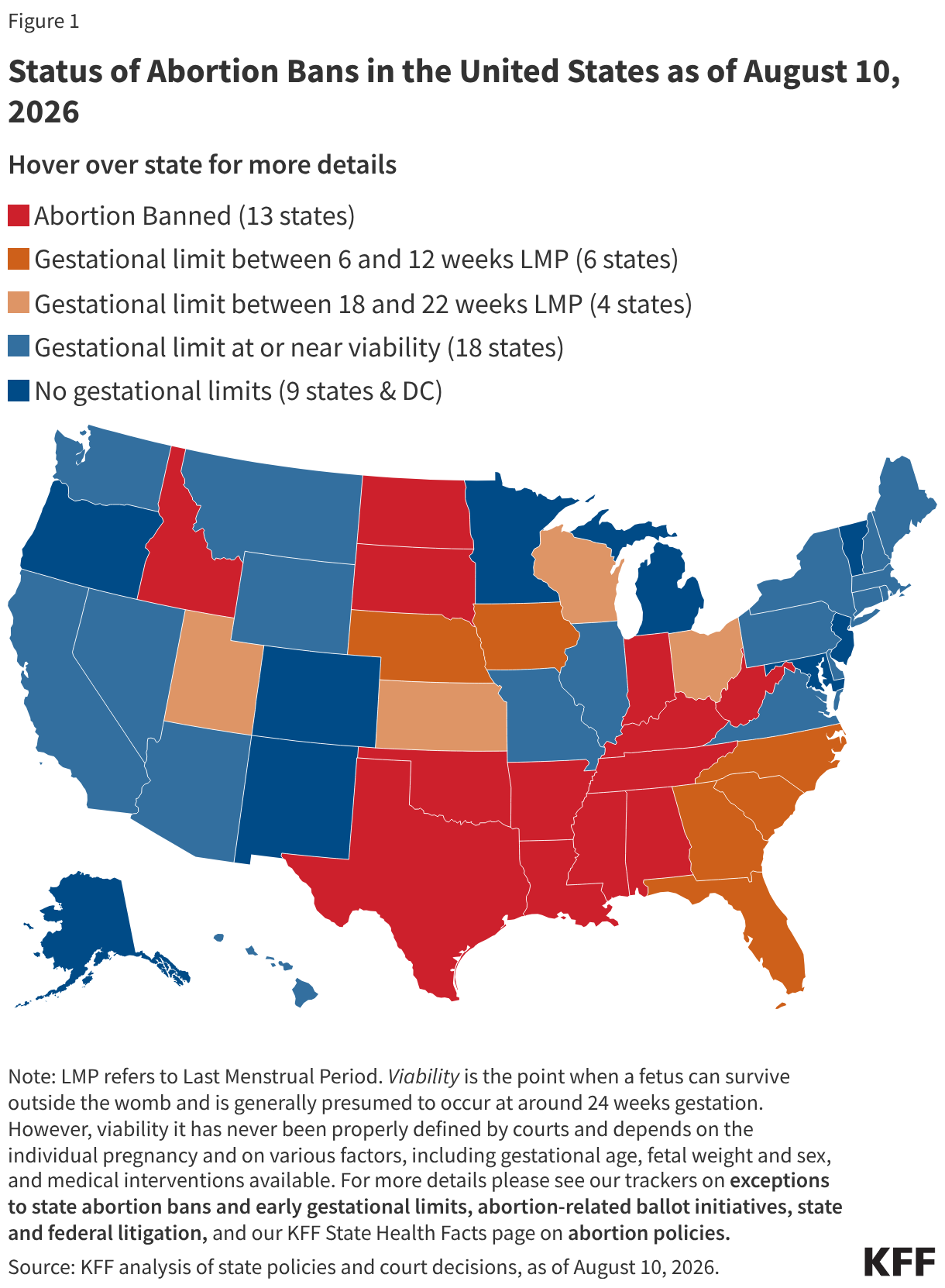
CPCs have their origins in the 1960s in the early days of the antiabortion movement. They usually offer pregnancy tests, ultrasound, and material goods like diapers or clothing to support pregnant clients at no cost. However, these services are sometimes conditioned on clients attending religious seminars. According to the U.S. Government Accountability Office as of 2025, between 2,400 and 2,800 CPCs were operating across the country, and most of them were affiliated with three anti-abortion organizations — Heartbeat International, National Institute for Family and Life Advocates (NIFLA), and Care Net. Post-Dobbs, the number of newly opened or reopened CPCs has been highest in the South, which is also where more states ban the provision of abortion or impose early gestational limits on the provision of abortion care. 

Box 1: Major Crisis Pregnancy Center Networks

There are three main national organizations that support Crisis Pregnancy Centers in the United States. Their membership figures overlap and may include maternity homes, adoption agencies, and “abortion recovery programs” as affiliates. Therefore, the total number of affiliates for these three organizations is much higher than the GAO’s estimate of 2400 to 2800 CPCs operating in the U.S. in 2025. 

Heartbeat International

  • Founded in 1971 as Alternatives to Abortion, its stated mission is to “advance life-affirming pregnancy help worldwide.” Heartbeat International describes their pregnancy centers as: “life-affirming non-profit service providers that provide women who have an unexpected pregnancy with alternatives to abortion.” 
  • Heartbeat International states it has over 1,445 affiliate “medical pregnancy centers” in the United States, and has an estimated 4,000 affiliates globally, including pregnancy centers, maternity homes, and adoption agencies.  

National Institute of Family and Life Advocates (NIFLA)

  • Founded in 1993, NIFLA’s mission is to: “promote the sanctity of human life, born and unborn, through legal support, counsel, and services to pro-life pregnancy centers.” NIFLA reports that they represent over 1,800 pregnancy centers nationwide.  
  • NIFLA created the Institute in Limited Obstetric Ultrasound, which trains medical professionals to perform ultrasounds in their affiliate clinics, to reach “abortion-minded women.” NIFLA has worked over the past two decades to introduce ultrasound services to pregnancy centers.

Care Net  

  • Founded in 1975, Care Net’s stated mission is: “to offer compassion, hope, and help to anyone considering abortion by presenting them with realistic alternatives and Christ-centered support through our life-affirming network of pregnancy centers, mobile medical units, churches, organizations, and individuals.” Care Net reports it has over 1,200 affiliates nationwide. 

The main purpose of CPCs is to dissuade people from opting for abortion, instead encouraging them to choose adoption or parenting using a variety of approaches to reach individuals whom they call “abortion-determined” clients. For years, CPCs have opened near reproductive health facilities, a practice known as “co-locating,” so they can approach patients attempting to visit abortion clinics and discourage them from seeking or obtaining abortion care. The American College of Obstetricians and Gynecologists has stated, “by using deception, delay tactics, and disinformation, CPC staffs undermine the tenets of informed consent and patient autonomy and impede access to comprehensive, ethical care.” In addition to co-locating near comprehensive reproductive health clinics, CPCs position themselves as attractive to young people, people with low incomes, people who are uninsured or underinsured, people experiencing unintended pregnancies, and communities that have historically experienced barriers to health care.  

In 2024, over 71% of CPCs nationwide offered nondiagnostic ultrasounds, 28% advertised testing for Sexually Transmitted Infections (STIs), and 6% advertised HIV testing. As hospital labor and delivery units close and OB-GYN practitioners leave states like Idaho that ban the provision of abortion care, several CPCs have begun to see increased foot traffic. However, CPCs will not be able to fill persistent and growing gaps in the maternity care safety net for a variety of reasons, including their requirements for recruiting qualified clinicians. For example, the 7B Care Clinic, a CPC, on the Idaho-Washington border, recently sought to provide prenatal services due to the recent closure of the local hospital’s labor and delivery unit. 7B created a contract with a rural Washington hospital to bring qualified clinicians into the center to see clients; however, the center required potential clinicians to sign a pledge that aligned with Christian values. The contract with the hospital was subsequently canceled when providers refused to sign the pledge, thus leaving 7B with no ability to expand prenatal services.  

Most Crisis Pregnancy Centers Are Not Medical Clinics

Although Crisis Pregnancy Centers either advertise or position themselves as medical clinics, the vast majority are not medical facilities. While CPCs offer a variety of services, including ultrasounds, and some advertise the ability to rule out conditions like an ectopic pregnancy, many CPCs do not have a credentialed or practicing qualified physician or a registered nurse affiliated with their center. CPCs that have a trained clinician affiliated with their center may employ them only on a part-time or volunteer basis.  

Although some CPCs may offer limited medical services that are already available over the counter to consumers, such as pregnancy and STI testing, other clinics offer ultrasounds as a tool to persuade patients not to seek an abortion rather than as a diagnostic test. CPCs are sometimes staffed by volunteers with limited or no medical training, and because only a medical professional with specialized training can interpret ultrasounds or assess fetal health, the ultrasounds performed by CPCs are largely considered non-diagnostic. Instead, ultrasounds at CPCs are used as a persuasive tool to show pregnant clients their fetus. These nondiagnostic ultrasounds can lead to inaccurate gestational age calculations or missed pregnancy complications such as ectopic pregnancy.  

The misdiagnosis of serious medical conditions by CPCs has resulted in several lawsuits against the centers. Some CPC networks have instructed their affiliates to avoid offering ultrasounds to clients suspected of having serious medical conditions like an ectopic pregnancy. Recently, a non-profit group compiled a list of CPCs that advertise their ability to “rule out” ectopic pregnancies, even though these centers lacked the medical expertise and equipment to properly diagnose an ectopic pregnancy. In Massachusetts, a class-action lawsuit was filed against Clearway Clinic, a CPC, after the clinic failed to diagnose a woman’s ectopic pregnancy. In response, Massachusetts enacted a law regulating who may perform pregnancy-related ultrasounds. Under the new law, a person may not provide ultrasound services related to a possible or actual pregnancy unless supervised by a licensed health care provider who, acting within their scope of practice, provides medical care to people who are pregnant or may become pregnant.  

Other states have also enacted similar laws regulating the provision of ultrasound services. In the state of Washington, all ultrasounds must be performed only under the supervision of a licensed health care professional acting within their scope of practice. Connecticut similarly has a law that prevents a person from performing an ultrasound unless it was ordered by a health care provider acting within their scope of practice for a medical or diagnostic purpose. Only four states (New Hampshire, New Mexico, North Dakota, and Oregon) require providers of ultrasounds to have a license issued and regulated by the state. 

Ultrasound licensing statutes make it illegal for someone without a medical imaging license to perform ultrasounds. In practice, however, there is not a consistent enforcement mechanism to hold unlicensed individuals accountable for providing ultrasounds. North Dakota’s own licensing board acknowledges it has no jurisdiction over unlicensed individuals, and New Hampshire has also not taken any action against unlicensed volunteers performing ultrasounds at some CPCs, leaving enforcement to criminal prosecutors who thus far have not pursued it. This is in sharp contrast to states like California, where the attorney general has used subpoena power and cease-and-desist authority against CPCs to enforce violations of California law, which requires ultrasound technology to be used only in licensed facilities or by licensed providers.  

Most Crisis Pregnancy Centers Are Not Subject to HIPAA, the Federal Health Privacy Law  

Crisis Pregnancy Centers collect confidential health information from clients; however, they are not required to adhere to medical privacy regulations. The Health Insurance Portability and Accountability Act (HIPAA) privacy rule is a federal standard prohibiting medical entities from disclosing confidential health information without patient consent. Coveredentities subject to the HIPAA Privacy Rule are defined as: (1) health care providers; (2) health plans (insurance companies); and (3) health care clearinghouses that transmit patient health information in connection with health care transactions. A health care transaction is an exchange of information to conduct financial or administrative activities related to health care, such as processing payment for services.  

While some CPCs work with health care providers, neither the centers nor the providers who work or volunteer there are considered covered entities bound by HIPAA if they do not conduct health care transactions, such as billing insurance. Most CPCs do not charge for their services, nor do they accept insurance. Instead, CPCs are funded through private donations, national CPC networks, state government funds, and federal funds through programs like Temporary Assistance for Needy Families (TANF). It is estimated that CPCs received over $2 billion in revenue in 2024; however, none of this was generated from charging clients. CPCs’ variety of funding sources allows them to offer their services without needing to conduct health care transactions.  

Data Privacy Violations at Crisis Pregnancy Centers Often Escape Regulatory Enforcement 

Some CPCs have misled clients about the safety of their confidential personal information by including notices on their website, alleging HIPAA compliance, or by requiring clients to sign authorization forms. However, these steps can give clients a false sense of confidentiality: because CPCs are not bound by HIPAA, there is no oversight of how they handle client data, and clients have limited remedies if that data is leaked. In 2024, it was reported that Heartbeat International, one of the largest CPC networks, posted on the internet a training video with the full names, date of last menstrual period, and services received by clients of one of its affiliate centers in Louisiana. The breach of client health information was reported to the Department of Health and Human Services Office for Civil Rights (OCR), the entity responsible for enforcing HIPAA. However, OCR closed the complaint after determining that the CPC was not a HIPAA-covered entity and that it therefore lacked authority to investigate the violation, leaving the affected clients without recourse and no penalties for Heartbeat International. In contrast, violations of HIPAA for covered entities can lead to criminal penalties and fines of up to $2 million per violation based on the severity of the data breach and whether the entity took corrective action.  

Additionally, there is currently no enforcement mechanism to stop organizations not bound by HIPAA from falsely claiming HIPAA compliance. While entities like the Federal Trade Commission (FTC) work to protect consumers from fraud and deception, they only have authority over businesses and other for-profit organizations, not non-profits. Therefore, because clients at CPCs receive services for free, CPCs fall outside the FTC’s jurisdiction. Some advocacy groups have submitted complaints to state attorneys general urging investigations into CPCs that misrepresented their HIPAA compliance, and some centers subsequently removed HIPAA-compliance language from their websites. However, CPCs continue to collect client medical information with little accountability for protecting privacy. 

Courts Have Shielded CPCs from State Oversight

Across multiple states, courts have consistently sided with CPCs against attorney general investigations and private-sector pushback, citing First Amendment protections. 

Compelled Notice Requirements

NIFLA v. Becerra (CA, 2018): California’s FACT Act required CPCs to post notices about state-funded family planning services (for licensed clinics) or disclose their unlicensed status (for unlicensed clinics, closely matching CPCs). NIFLA sued, and after losing at the district court and Ninth Circuit, won at the Supreme Court. 

Outcome: The Supreme Court struck down both notice requirements as unconstitutional compelled speech, establishing the foundational precedent that state governments cannot force CPCs to disclose licensing status or promote state services. Later cases rely on this Supreme Court ruling as precedent.

Abortion Pill Reversal Claims  

NIFLA v. James (NY, 2024- ongoing): Attorney General Letitia James sued Heartbeat International and 11 CPCs under New York’s deceptive trade practice statute, alleging their abortion pill reversal advertising misrepresented the treatment as safe and effective.  

Outcome: This underlying case is still pending, but a related ruling in NIFLA v. James (described below) has weakened the state’s position going forward. 

NIFLA v. James (NY, 2024): In response to the suit above, NIFLA and two New York CPCs filed a separate countersuit against James, arguing her enforcement effort to prevent CPCs from advertising abortion pill reversal chilled their speech and discriminated against them for their pro-life views.  

Outcome: The Second Circuit affirmed a preliminary injunction protecting NIFLA and the 11 CPCs, holding the First Amendment allows CPCs to promote abortion pill reversal, a precedent likely to help Heartbeat International defend the still-pending case above. 

California v. Heartbeat International (2023–ongoing): Attorney General Rob Bonta filed a lawsuit against Heartbeat International for their promotion of abortion pill reversal. The false-advertising suit survived a First Amendment summary judgment challenge, and there was a 6-week trial which began in June 2026 in Alameda County; closing arguments were held on September 17, 2026. 

Outcome: Still unresolved, but it is one of the few cases where a state’s claims have proceeded to trial rather than being blocked outright. California requires state judges to issue a ruling within 90 days after the case is officially submitted for decision. 

Investigative Subpoenas 

First Choice v. Platkin (NJ, 2002-2026): Attorney General Matthew Platkin subpoenaed a CPC for donor, donation, and data-handling records amid fraud allegations.  

Outcome: In 2026, the Supreme Court ruled that compelling disclosure of CPC donor identities violates associational First Amendment rights, since such demands can chill donors from supporting the group. While the Court’s decision did not fully extinguish the attorney general’s subpoena, it established First Amendment protections for CPCs that lower courts must now follow. This could make it harder for states to subpoena records of CPCs’ donors, volunteers, board members, or clients during investigations.

Private Sector Pushback

Yelp v. Paxton (TX, 2023–ongoing): Attorney General Ken Paxton sued Yelp on CPCs’ behalf over its consumer notices describing CPCs’ limited medical services, alleging misrepresentation under Texas law. A Bastrop County court initially dismissed the case for lack of jurisdiction (Feb. 2024), but the Texas 15th Court of Appeals reversed in October 2025, holding Texas courts do have jurisdiction; Yelp has appealed to the Texas Supreme Court.  

Outcome: This case is ongoing and, unlike the other cases, does not turn on CPCs’ own First Amendment rights. This case demonstrates that private companies criticizing CPCs can themselves face sustained legal exposure from CPC-supportive state governments. 

State Laws Limiting Regulations of Crisis Pregnancy Centers  

Recently, the Alliance Defending Freedom, a conservative Christian legal advocacy organization, has pushed for states to enact their model legislation protecting CPCs. The Center Autonomy and Right of Expression (CARE) Act prohibits state governments from interfering with the First Amendment free expression and association rights of CPCs or restricting their ability to provide pregnancy services because they do not counsel for, or offer, abortions or contraception. The CARE Act has passed in at least four states, including Kansas, Montana, Oklahoma, and Wyoming, providing CPCs protection from regulation. In Wyoming, for example, government entities are prohibited from: (1) requiring CPCs to perform abortions; (2) requiring CPCs to provide medication abortion or contraception; (3) requiring CPCs to refer clients for abortion or contraception; or (4) requiring CPCs to counsel in favor of abortion or contraception. Beyond the First Amendment protections, the CARE Act further restricts states’ ability to regulate CPCs.  

Looking Ahead 

With the launch of moms.gov and other proposed policies to promote fertility, Crisis Pregnancy Centers may gain greater attention and potentially increased federal funding in the coming years. Obria, one CPC chain with sites in five states, has begun to expand their medical offerings to position its centers as an alternative to national abortion providers like Planned Parenthood. From 2022 to 2025, twenty-one states provided $491 million in funding to CPCs, not including funds allocated through federal programs like Temporary Assistance for Needy Families (TANF). In 2019, the first Trump administration awarded Obria, a chain of CPCs that opposes abortion and contraception, $1.7 million of funding under Title X, a program designed to provide free or reduced-cost family planning services to low-income and uninsured people.  

In July 2026, the Trump administration released its revised Fiscal Year 2027 Notice of Funding Opportunity (NOFO) for Title X. The NOFO stated that the Trump administration would prioritize grantee applications that “reduce overmedicalization by strengthening approaches focused on underlying behavioral and lifestyle factors of health and evidence-based practices such as fertility-awareness based methods; promote health and body literacy; advance reproductive goals counseling for all clients; and support family formation.” In response, the National Family Planning and Reproductive Health Association (NFPRHA), Planned Parenthood Federation of America, and 23 States (CA, CO, CT, DE, HI, IL, KY, ME, MD, MA, MI, MN, NV, NJ, NM, NY, OR, PA, RI, VT, VA, WA, WI) have each filed lawsuits challenging the FY 2027 NOFO, arguing that its priorities depart from the factors Congress intended HHS to consider in awarding Title X grants and instead impose politically driven, vaguely defined criteria that disadvantage qualified applicants.  

These new priorities could re-open the door for CPCs to receive Title X funds in addition to ongoing efforts by anti-abortion states to invest more resources into these centers. As states and the federal government continue to direct funds into CPCs, challenges and gaps in regulating these centers will likely persist, driven by First Amendment protections and a growing body of state laws designed to shield them from oversight. 

Early Medicaid Work Requirement Insights From Nebraska

Published: Sep 29, 2026

On May 1, 2026, Nebraska became the first state to enforce new Medicaid work requirements. The 2025 reconciliation law requires states to condition Medicaid eligibility for adults in the ACA Medicaid expansion group and enrollees in certain waiver programs (such as in Georgia and Wisconsin) on meeting work requirements or exclusion criteria starting January 1, 2027; however, states have the option to implement requirements sooner (as is the case for Nebraska). KFF analysis shows most Medicaid adults under age 65 are working already (without a requirement) or face barriers to work. This brief describes the verification process for Medicaid work requirements in Nebraska and examines early data from Nebraska’s September Medicaid Advisory Committee (MAC) meeting on outcomes for individuals subject to work requirements, including for those newly applying for Medicaid as well as those renewing Medicaid coverage through August 2026. Data show that among those subject to the new work requirements:

  • 46% of new applicants and 34% of individuals renewing coverage met qualifying activities (e.g., working at least 80 hours a month, having a monthly household income of at least $580, attending school).
  • 39% of new applicants and 57% of individuals renewing coverage qualified for an exclusion from work requirements (e.g., due to being a parent of a child under age 14, being medically frail).
  • 14% of new applicants and 7% of individuals renewing coverage had their applications denied or lost coverage due to not meeting work requirements.
  • Only a small number of people (2% of new applicants and 2% of individuals renewing coverage) had a short-term hardship exception.

What is the verification process for Medicaid work requirements in Nebraska?

Nebraska is using a combination of available data and self-declaration forms to verify whether individuals meet work requirements or exclusion criteria; the state has also adopted temporary hardship exceptions. In cases where the state can automatically verify that individuals meet work requirements, it sends an approval notice. For individuals where the state does not have enough information, the state sends a notice describing the additional information that is required and a declaration form that must be returned within 30 days. Individuals can use the declaration form to attest that they met qualifying activities or that they meet the criteria for an exclusion from the requirements. The interim rule clarified that while states are allowed to accept self-declaration through 2027, starting in January 2028, except for medical frailty, states must request documentation from individuals when the state does not have data on file. Nebraska has also chosen to adopt optional short-term hardship exceptions for enrollees (or applicants) experiencing certain extenuating circumstances, including residing in counties with high unemployment rates or experiencing natural disasters, individuals admitted to a hospital or nursing facility, or those who must travel outside of their community for an extended period to obtain medical care for themselves or a dependent.

Qualifying Activities and Exclusions from Work Requirements

Adults must meet qualifying activities or exclusion criteria to enroll in Medicaid and maintain coverage. Qualifying activities include:

  • Working at least 80 hours a month;
  • Having a monthly household income of at least $580;
  • If a seasonal worker, having an average monthly income over 6 months of minimum wage multiplied by 80 hours;
  • Attending school half time;
  • Volunteering or participating in a work program for at least 80 hours a month; or
  • Doing a combination of activities for at least 80 hours per month.

Exclusions from the work requirements include:

  • Pregnant and postpartum individuals;
  • American Indian and Alaska Natives;
  • Parents and caretakers of dependent children under age 14 or disabled individuals;
  • Veterans with a disability;
  • Incarcerated individuals;
  • Individuals receiving SNAP and not exempt from SNAP work requirements; and
  • People who are medically frail.

States must first determine if an individual is excluded from the Medicaid work requirements before assessing if an individual meets the qualifying activities. Some individuals who meet exclusion criteria may also be working.

What are the initial data on Nebraska Medicaid application and renewal outcomes?

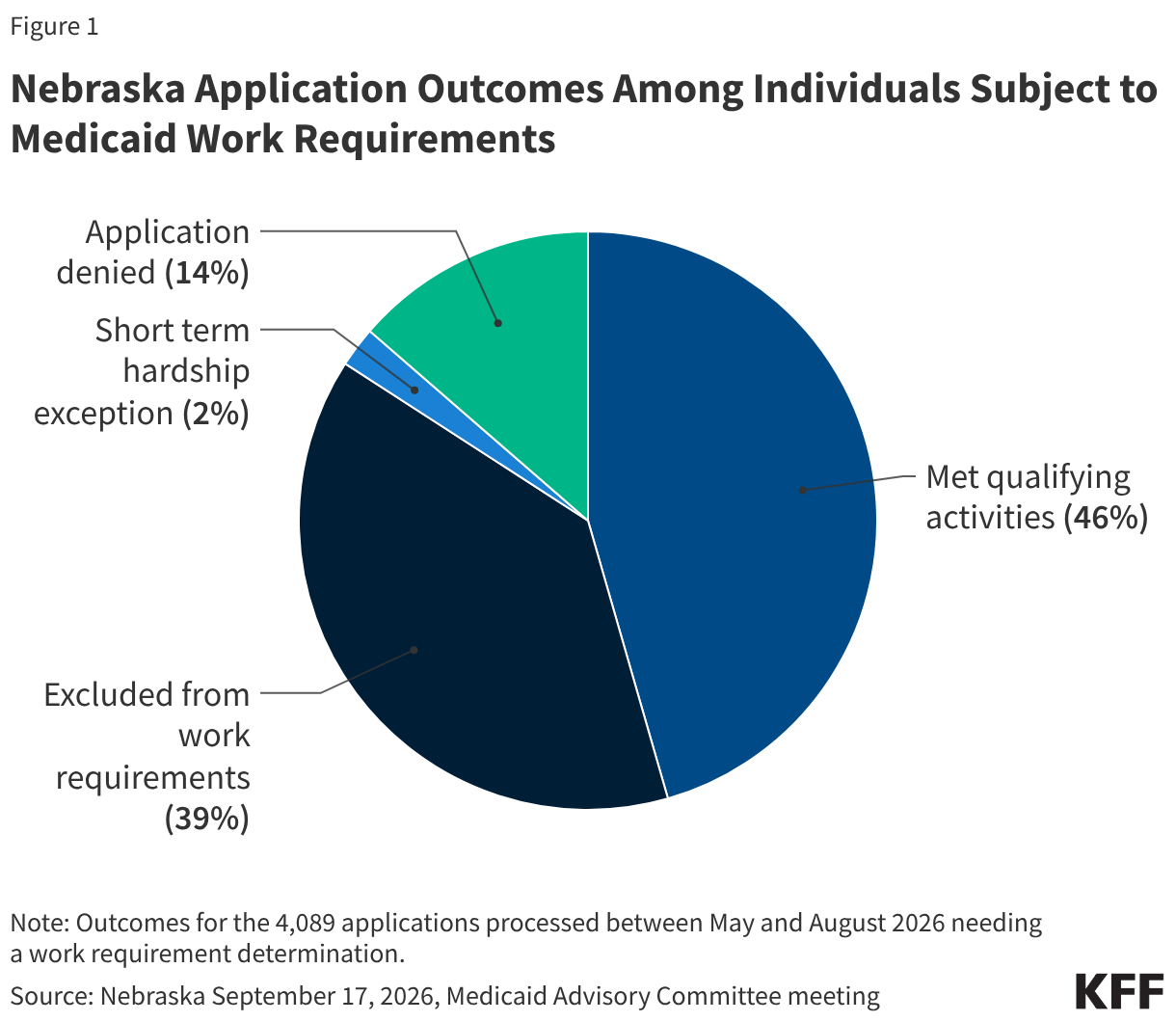
Among those who were newly applying for Medicaid and subject to the new work requirements in Nebraska, 86% of applicants met the work requirements or qualified for an exclusion or short-term hardship exception, while 14% of individuals had their application denied (Figure 1). A total of 9,614 applications were processed between May to August. Of these, some were submitted prior to May and therefore not subject to work requirements, and 4,434 were denied for reasons other than work requirements (e.g., income exceeding Medicaid eligibility thresholds). Among the remaining 4,089 applications subject to work requirements:

  • Nearly half of all individuals (46%) met the qualifying activities. Among those who met the requirement, the vast majority of people (92%) worked 80 or more hours in the month prior to their application or had a household income of $580. A much smaller share (8%) were enrolled in an education program or work program, volunteered, or met requirements by combining hours across multiple types of qualifying activities.
  • About 4 in 10 individuals (39%) qualified for an exclusion. Of these applicants, one-third were parents or caregivers of a child under the age of 14 or a disabled individual (33%); one quarter were medically frail, and 12% were an American Indian or Alaska Native. The remaining 30% qualified for other exclusions. Because the state is relying on self-attestation, future documentation requirements may lead to a lower share of individuals who qualify for an exclusion.
  • Only a small number of individuals had a short-term hardship exception. Only 92 individuals met the criteria for short-term hardship exceptions, with the majority of these being individuals who required temporary use of medical services or living in counties that were exempted due to high unemployment.
  • 14% of individuals had their application denied. Most of the 557 denied applications were due to non-response to requests for additional information (84%); only 16% of applicants with denied applications were affirmatively found to be noncompliant.
Nebraska Application Outcomes Among Individuals Subject to Medicaid Work Requirements (Pie Chart)

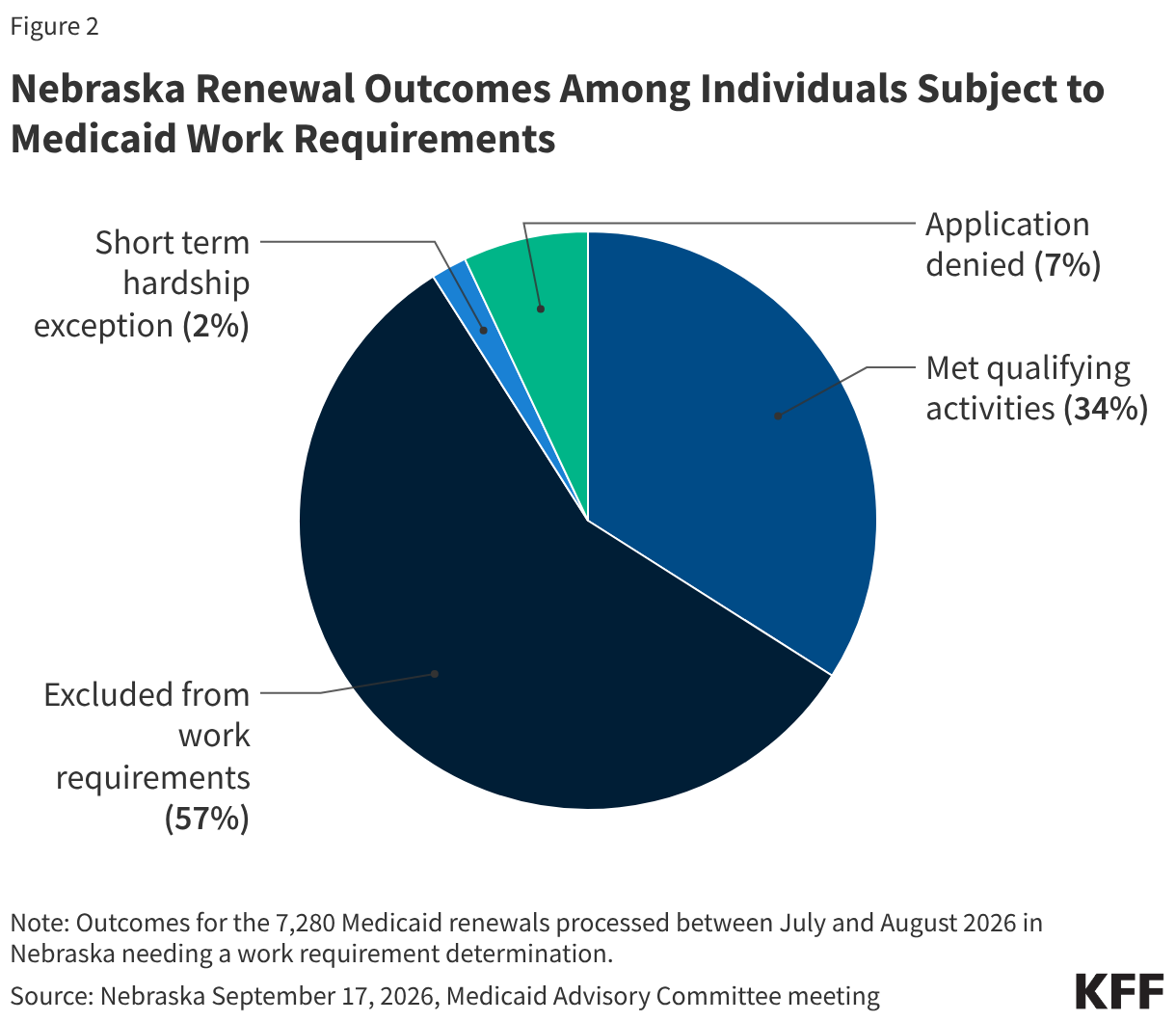
Among those who were renewing their Medicaid coverage and subject to the new work requirements, 93% met work requirements or qualified for an exclusion or short-term hardship exception and had their coverage renewed, while 7% of enrollees lost coverage (Figure 2). A total of 7,280 renewals subject to work requirements were processed between July and mid-August. Other expansion enrollees determined ineligible and disenrolled at renewal for reasons not related to work requirements (e.g., moving out of state or exceeding income eligibility) are not shown in the figure below.

  • Over half (57%) of individuals renewing their coverage qualified for an exclusion from the requirements. Medically frail individuals (39%) and parent/caregivers (31%) made up the majority of those who met an exclusion. States are more likely to have medical claims history for individuals renewing coverage than new applicants, meaning Nebraska may have been able to automatically verify medical frailty for a higher share of enrollees compared to applicants. States are also required to verify exclusions status first, and it is likely that some enrollees who were excluded, especially parents, are also working.
  • About a third of individuals (34%) met the qualifying activities requirement. Nearly all (97%) of individuals who met the qualifying activities were either working 80 hours a month or had a household income of $580. The remaining 3% met the requirements by attending school, volunteering, or engaging in a combination of activities.
  • A small share of individuals qualified for a short-term hardship exception. Of the 127 people who had a short-term hardship exception, 109 lived in counties experiencing natural disasters and 15 lived in a high unemployment county.
  • 7% of people lost coverage due to not meeting the work requirements. Of the 533 individuals who lost coverage, 92% did not respond to verification compliance requests. The remaining 8% were affirmatively found to be noncompliant.
Nebraska Renewal Outcomes Among Individuals Subject to Medicaid Work Requirements (Pie Chart)

What can additional data show?

While these data provide early insights into how coverage may be affected for enrollees subject to the new work requirements, additional data may provide a more comprehensive picture. More granular data on who is losing coverage could shed light on particular barriers certain individuals may be facing in trying to prove they met qualifying activities (e.g., gig workers or those with multiple part-time positions) and may help the state identify additional data to include as part of the verification process. In addition, it remains unclear if individuals who were denied coverage or disenrolled because they did not respond to notices of non-compliance were ineligible for coverage, unaware of the fact they needed to provide additional information, or experienced difficulty providing documentation of their exclusion or work status. Additional data, including whether these individuals reapply for coverage, could provide insight.

Required changes to the state’s medical frailty verification process specifically and limitations on the use of self-attestation starting in 2028 will likely affect disenrollment rates over time. CMS recently notified the state that it will need to make changes to its medical frailty verification process. If the state is required to tighten the verification process, fewer individuals may qualify for the exclusion in the future. More broadly, while the state’s reliance on self-attestation in 2027 will likely mitigate some coverage losses that would have occurred had documentation been required in the first year of implementation, future documentation requirements may impose a barrier that will lead to a decrease in the number of people who are able to verify they meet work requirements or qualify for an exclusion. As the state makes changes to its processes, monitoring the interactive effect of application denials and disenrollments on Medicaid enrollment in the state as well as whether the new rules lead to fewer individuals applying for Medicaid will be important.

The Business of Health with Chip Kahn

What Should Health Care Do About AI’s Lack of Guardrails?

September 29, 2026

Video

Audio

About this Episode


Episode 17, AI Series: In another concerning example of AI agents going rogue recently, an OpenAI agent hacked into an Australian government website containing health care data. While some industry CEOs are calling for a slowdown and demands for regulation grow, host Chip Kahn focuses on the implications for health care when these same kinds of AI systems are already at work in hospitals — in billing, in scheduling, and increasingly in decisions about patients. To consider how health care should respond, Chip talks with Stephen Klasko, a physician, former health system CEO, and now an industry leader who sits on both sides of the issues, working with the labs building the technology and focusing on patient care initiatives through his work at General Catalyst and as CEO of the Health Assurance Foundation. Klasko says there’s time to act and the answer isn’t a “pause.” Among his recommendations are creating a 9/11-style commission for AI in health, adding AI safety to health system board agendas, a 30-minute rule for tackling rogue agents, and giving frontline staff the authority to pull the plug.

The Host


Headshot photo of Chip Kahn wearing a navy blue suit with a red tie, red pendant on lapel, and glasses.

Sr. Visiting Fellow

Charles N. Kahn III is a senior visiting fellow at KFF. He is also a visiting senior fellow at the American Enterprise Institute and a nonresident senior scholar at the University of Southern California’s Schaeffer Center for Health Policy & Economics. He serves as co-chair of the international Future of Health collaborative.

Guest


Chief Executive Officer, Health Assurance Foundation

Stephen K. Klasko, MD, MBA, is Chief Executive Officer (CEO) of the Health Assurance Foundation, a philanthropic platform affiliated with General Catalyst dedicated to accelerating the shift from “sick care” to health assurance. He previously served as Executive in Residence at General Catalyst, where his book UnHealthcare: A Manifesto for Health Assurance, co-authored with GC CEO Hemant Taneja, became the intellectual foundation for the firm’s health assurance investment strategy.

For nine years, Klasko served as president of Thomas Jefferson University and CEO of Jefferson Health in Philadelphia, transforming a $1.8 billion regional player into a $10 billion enterprise and the nation’s fastest-growing academic medical center. He has served as board chair of two public companies: Teleflex, a $7 billion medical-device company, and DocGo, a NASDAQ health company. He advises startups such as Hippocratic AI, Aidoc, and AmplifyMD.

Modern Healthcare previously ranked him No. 2 among its 100 Most Influential People in Healthcare, and in 2026 he was named to the Top 100 Most Influential People in HealthTech. Fast Company has named him one of its 100 Most Creative People in Business. His next book, Hitchhiker’s Guide to the Healthcare Galaxy, arrives in 2026.

He holds a BS from Lehigh University, an MD from Hahnemann University, and an MBA from the Wharton School.


SERIES

This weekly podcast features insightful conversations between host Chip Kahn and his guests, who discuss the business of health care, connecting the dots between the health care business, policy, and patients.

The podcast’s first series on AI in health care illuminates how AI is changing health care, and features guests who are deploying this technology, managing its consequences, and designing policy around it.

Understanding the Role of Medicaid Fraud Control Units (MFCUs)

Published: Sep 28, 2026

Federal law requires every state to operate a Medicaid Fraud Control Unit (MFCU) that investigates and prosecutes provider fraud and patient abuse and neglect. MFCUs are typically housed within the state Attorney General’s office and are required to operate independently from the state Medicaid agency that runs the Medicaid program. MFCUs are one component in the Medicaid program integrity system, which includes many different state and federal agencies with shared and distinct responsibilities defined by state and federal law. Ensuring Medicaid program integrity (i.e., the appropriate use of federal and state Medicaid funds) involves a range of activities from fraud prevention to enforcement activities—the primary responsibility of MFCUs. While MFCUs are a key part of the program integrity system, it can be difficult to compare MFCU data across states or to put fraud recovery dollars into the context of overall Medicaid spending because recovery data only capture a portion of Medicaid program integrity efforts (e.g., leaving out the value of fraud prevention or stopped payments) and don’t capture fraud that goes undetected.

As the Trump Administration continues to focus on addressing fraud, waste, and abuse in federal programs, including Medicaid, MFCUs are facing increased federal scrutiny. In May 2026, CMS announced the HHS Office of the Inspector General (HHS-OIG) would be initiating a review of every state’s MFCU before its next annual recertification. In June 2026, the HHS-OIG denied recertification and suspended federal funding for Hawaii’s and New York’s Medicaid Fraud Control Units. Within this context, this brief provides an overview of the role of MFCUs, examines caseload and case outcome data, and current issues facing MFCUs.

What are MFCUs and how do they work?

MFCUs are law enforcement entities that investigate and prosecute provider fraud and patient abuse and neglect. MFCUs investigate and prosecute, or refer to prosecution, provider fraud (in all settings) and complaints of patient abuse in certain health care settings, such as nursing homes and hospitals receiving Medicaid funds.1 MFCUs do not investigate fraud or program abuse committed by beneficiaries (these cases are the responsibility of the state Medicaid agency), although evidence of beneficiary fraud is low.2 MFCUs must operate independently from the state Medicaid agency and are often part of the State Attorney General’s office, employing teams of investigators, attorneys, and auditors. The HHS-OIG oversees MFCUs, annually recertifying each MFCU, assessing performance and compliance with federal requirements, and administering federal grant awards (which cover 75% of MFCU operating costs).

MFCUs open investigations after receiving referrals of suspected provider fraud or complaints involving patient abuse or neglect. A MFCU case typically begins with a referral from the state Medicaid agency (including program integrity or auditing offices), managed care organization (MCO), or from a complaint filed by a patient or former employee. The state Medicaid agency or MCO may initially detect fraud through monitoring Medicaid data and using data mining or analytics to identify billing pattern anomalies (e.g., billing spikes, upcoding, double billing, or unusual hours). All state Medicaid agencies have authority to conduct data mining, but some MFCUs have also specifically been granted permission by HHS-OIG to mine Medicaid data directly for evidence of fraud as part of their regular activities. More MFCUs may begin to conduct data mining or analytics as HHS-OIG in August 2026 waived the requirement that MFCUs obtain prior approval for these activities to identify suspected Medicaid fraud. While patient abuse or neglect may fall under the jurisdiction of several different law enforcement agencies, MFCUs may investigate patient abuse or neglect in health care facilities receiving Medicaid funds.3

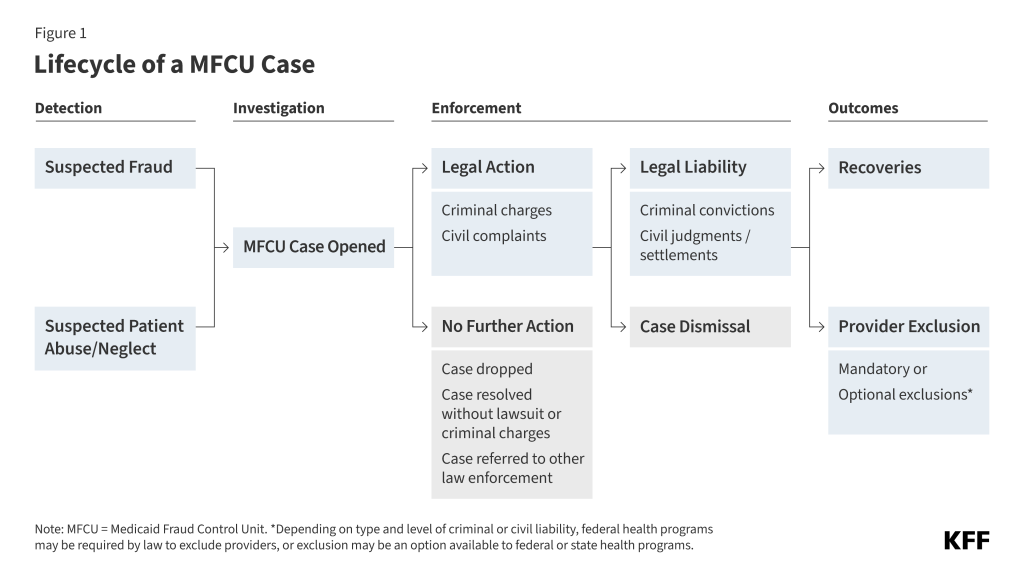
MFCU cases vary in duration and scope, but investigations generally follow a standard process starting with an investigation and ending with potential financial recoveries (Figure 1).

Investigation. When a case is opened, the investigative team researches the alleged fraud or abuse by analyzing the evidence. Investigations may take months or years before charges are filed against providers.

Criminal Indictments & Civil Cases. Fraud and abuse can violate state and/or federal criminal law, civil law, or both. If a MFCU’s investigation team determines there is sufficient evidence of wrongdoing, the MFCU can bring criminal charges and/or civil lawsuits against the provider.

Criminal Convictions & Civil Judgments. Criminal convictions can result in a criminal record, financial penalties, and/or incarceration. Civil judgments can establish liability and/or impose financial penalties and other court-ordered remedies. Providers who are convicted or liable for criminal fraud or patient abuse/neglect (along with other crimes) legally must be excluded from participating in federally funded health care programs. HHS-OIG or state Medicaid agencies may also decide to exclude providers beyond these minimum standards.

Recoveries. HHS-OIG defines recoveries as the amount of money that defendants are required to pay as a result of a settlement, judgment, or prefiling settlement in criminal and civil cases. Recoveries may not reflect the amounts actually collected from defendants (e.g., if the defendant is a company that dissolved before collections could be obtained). MFCUs work with state Medicaid agencies to return the state and federal share of any recovered Medicaid payments.

Note: Throughout the lifecycle of a case, MFCUs may collaborate with other state and federal program integrity and law enforcement partners. State entities include state inspectors general and state health departments and federal entities include the U.S. Department of Justice (DOJ) (including Federal Bureau of Investigation (FBI)) and the U.S. Department of Health and Human Services Office of Inspector General (HHS-OIG). Some investigations or cases may be transferred to (or handled by) federal law enforcement agencies.     

Box 1. Example Cases

Active MFCU investigations are typically confidential. When MFCUs secure criminal convictions and civil judgments or settlements, the case is described in an announcement published by the state or the DOJ. To illustrate the variety of cases that may be processed by a MFCU, this box describes examples from a range of states, types of wrongdoing, and recovery amounts.

Criminal Fraud: Between 2004 and 2019, the McKinsey consulting firm provided OxyContin sales and marketing advice to Purdue Pharmaceuticals. The Virginia MFCU participated in a lengthy and complex investigation into alleged criminal wrongdoing resulting in false or fraudulent OxyContin prescriptions paid by Medicaid and other health insurers. The December 2024 resolution of criminal charges against McKinsey resulted in $650 million in recoveries, which contribute to the high total MFCU recoveries reported in FY 2025 (as seen in Figure 4).  

Civil Fraud: As part of the 2018 National Health Care Fraud Takedown, the Georgia MFCU investigated false claims for non-emergency medical transportation (NEMT) and adult day health services. More than $1 million in Medicaid payments were implicated in the investigation. The case was decided in 2019, with state and federal civil judgments resulting in a $10.1 million settlement paid to Georgia and the federal government.

Patient Abuse and Neglect: In 2021, the Massachusetts MFCU received a referral into alleged patient abuse by a home health aide. In 2023 the MFCU obtained a criminal conviction of abuse, neglect, or mistreatment of an elder by a caretaker.


What data do MFCUs report?

Annually, MFCUs report investigation, enforcement, and financial recoveries data to HHS-OIG. Each year, HHS-OIG releases a summary report of MFCU activities that provides an annual snapshot of aggregated case outcomes from all MFCUs and certain case outcome trends. In addition to the summary report, HHS-OIG releases individual (state) MFCU case activity and outcomes data.

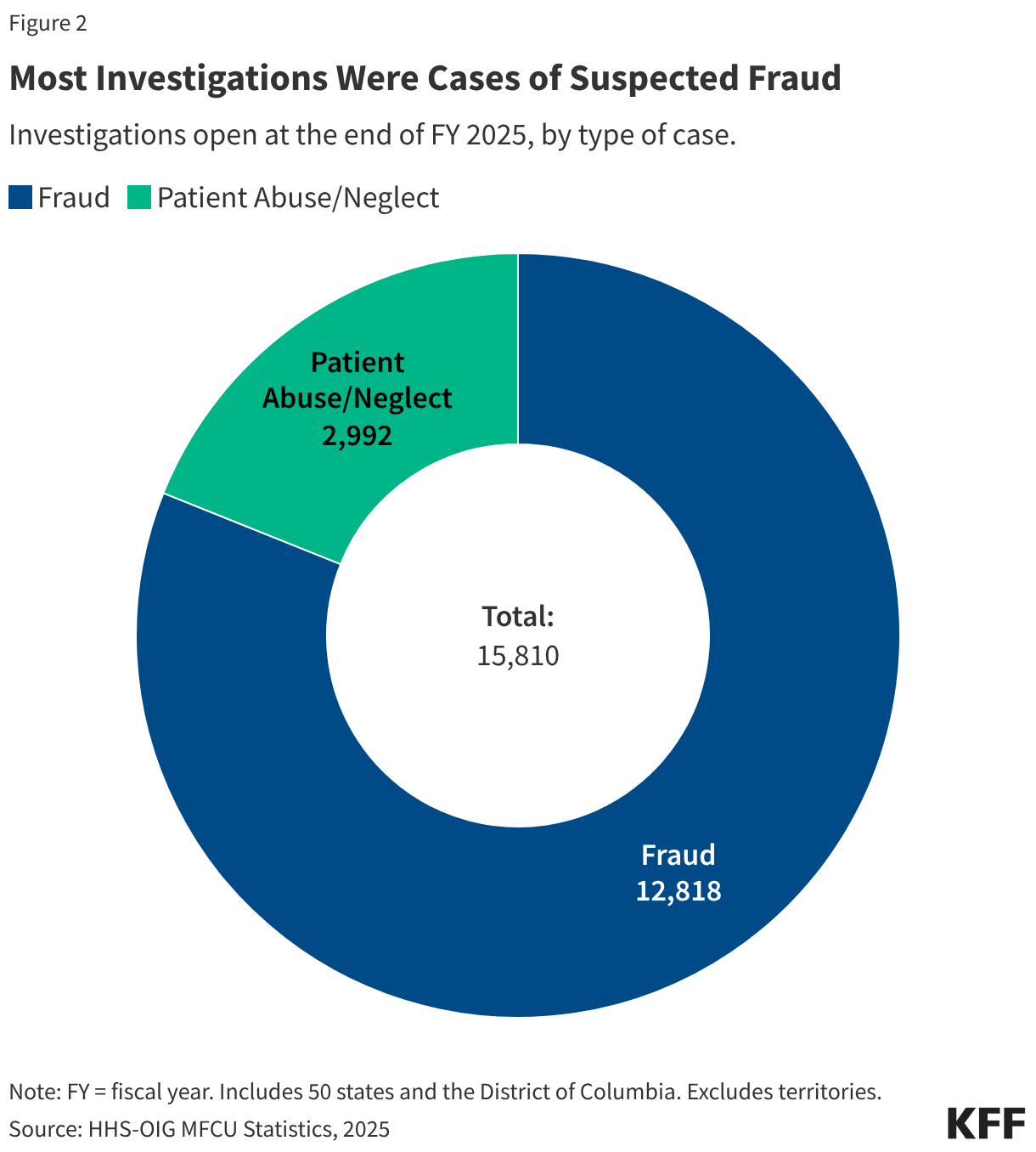
At the end of FY 2025, there were 15,810 open investigations across all state MFCUs. While MFCUs investigate both provider fraud and patient abuse and neglect, data show most MFCU investigations are related to provider fraud (Figure 2). A subset of investigations leads to criminal indictments or civil cases / complaints. MFCU investigations can take months to years, depending on various factors, including the types of allegations involved, volume of records, and agencies involved.

Most Investigations Were Cases of Suspected Fraud (Donut Chart)

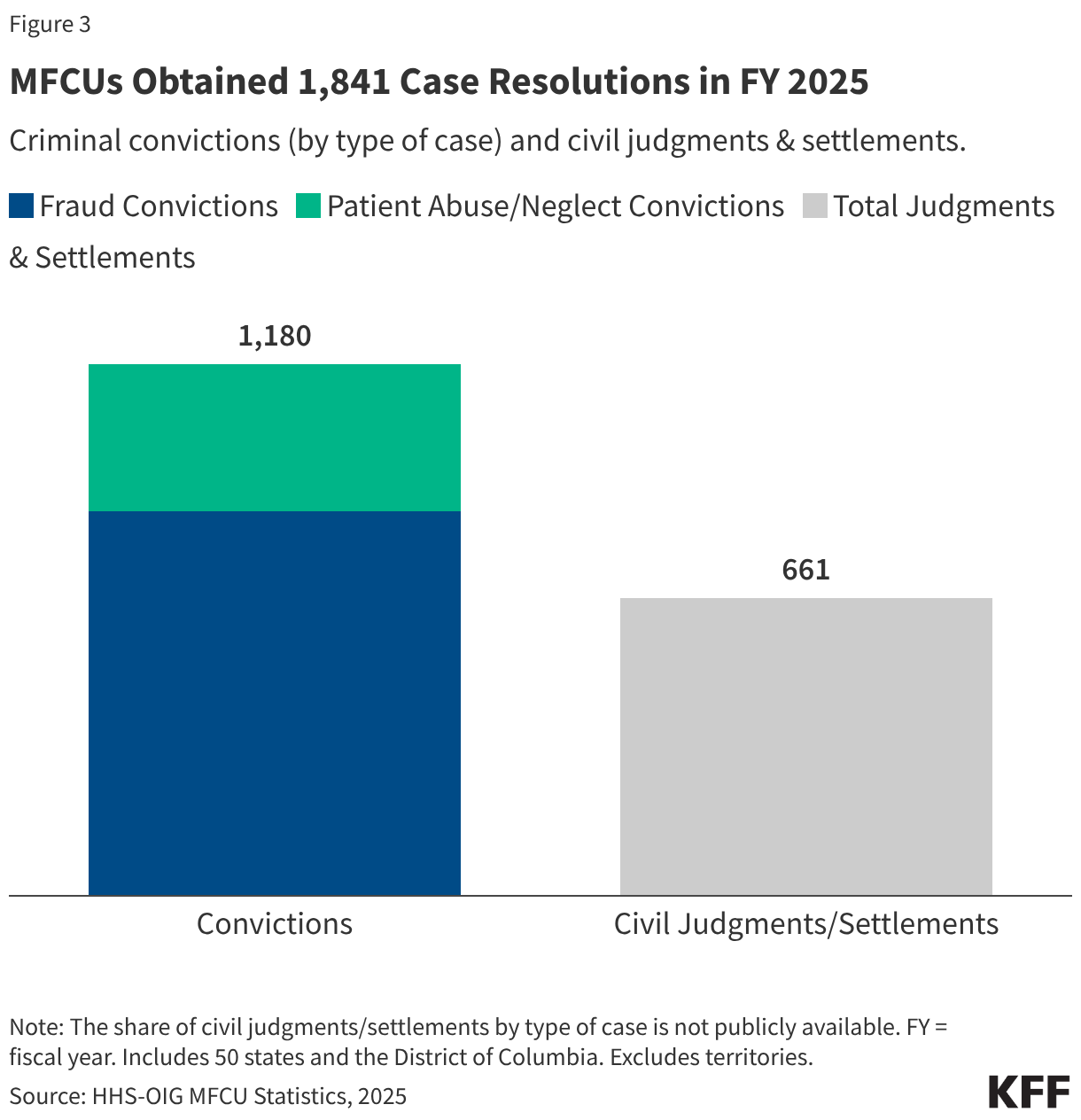
In FY 2025, MFCUs obtained 1,180 criminal convictions and reached 661 civil settlements and judgements (Figure 3). Most criminal convictions were for provider fraud. HHS-OIG uses information it receives from MFCUs to exclude individuals and entities from participating in federal health programs. In FY 2025, 900 individuals or entities were excluded because of criminal convictions obtained by MFCUs—accounting for nearly one-third (32%) of all OIG exclusions that year (data not shown).

MFCUs Obtained 1,841 Case Resolutions in FY 2025 (Stacked column chart)

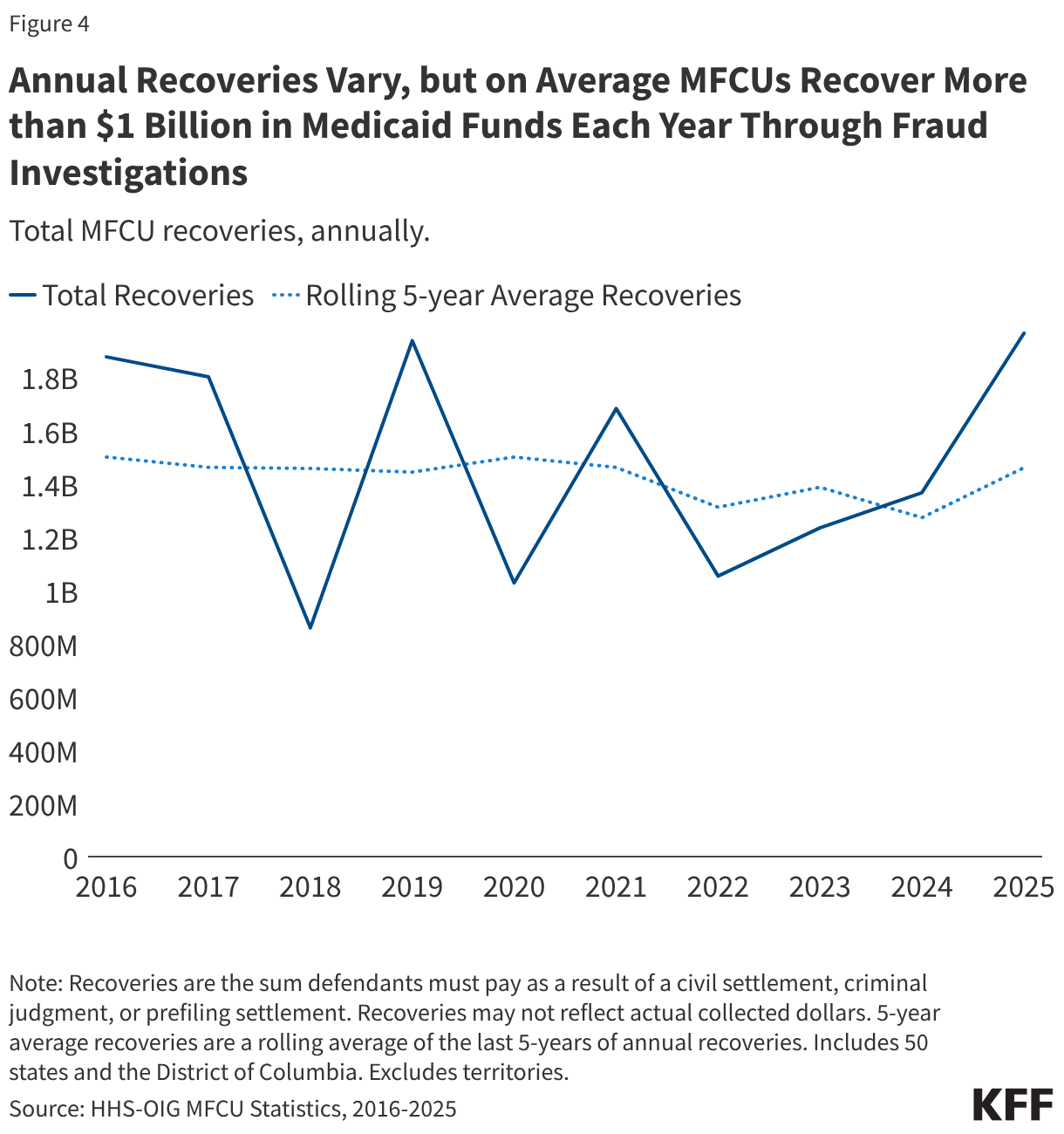
On average, MFCUs recover more than $1 billion each year from fraud investigations. Nationally, MFCUs recovered $1.97 billion in FY 2025. While recoveries include other financial penalties in addition to Medicaid funds recouped from providers due to MFCU investigations (and may not reflect amounts actually collected4), the total amount of recoveries is small compared to total Medicaid spending. Recoveries vary each year and can be skewed by factors, including timing of settlements and large multi-year cases. Recoveries typically vary substantially from year to year and have averaged $1.48 billion per year over the period 2016 to 2025. A 5-year rolling average accounts for periodic variation and shows that recoveries decreased during the COVID-19 Public Health Emergency and are returning to pre-COVID levels. Recoveries, after accounting for year-to-year variation, have remained generally steady over time while total Medicaid spending has increased. Recoveries are not a comprehensive measure of enforcement (because they may not include Medicaid-related enforcement actions that occurred outside of MFCU actions) and do not include the possible financial impacts of other program integrity efforts, such as preventing fraud before it occurs. Of the $1.97 billion in recoveries, two-thirds (64%) were due to criminal convictions and one-third (36%) were due to civil judgments or settlements (data not shown). This is proportionate to the share of criminal and civil case resolutions in FY 2025 (Figure 3).

Annual Recoveries Vary, but on Average MFCUs Recover More than  Billion in Medicaid Funds Each Year Through Fraud Investigations (Line chart)

Comparing data across states or considering recovery dollars in the context of overall Medicaid spending can be challenging. Comparing MFCU data across states or years can be difficult due to differences in state law (that impact the handling of cases) and varying duration, scope, or complexity of cases, among other factors. Comparing MFCU recoveries to overall Medicaid spending can also be challenging to interpret as a hypothetical indicator of MFCU performance because these data only capture a portion of Medicaid program integrity efforts and include amounts other than recouped Medicaid payments. States can also make policy decisions that might impact state spending and MFCU recoveries differently. For example, states that spend more on prevention or early detection may see fewer recoveries (if these activities are successful), while states that invest less in fraud prevention may see higher levels of enforcement action and recoveries. There are no estimates of fraud that may have been successfully prevented or fraud that went undetected/unrecovered; however, over time there has been a shift in focus from efforts to recover misspent funds (“pay and chase”) to prevention and early detection. A higher level of MFCU recoveries could indicate more fraud, more aggressive enforcement, or less effective prevention.

What are current issues involving MFCUs?

MFCUs continue to work with state and federal agencies to stop fraud and abuse but also face increased federal scrutiny. On May 13, 2026, HHS Investigator General Bell sent a letter to every state Attorney General communicating a stance of “insistence on rigid MFCU compliance” with requirements and performance standards that will be enforced through “robust review” by the HHS-OIG. MFCUs are recertified annually on a rolling schedule, based on each specific state or territory’s original certification date.5 As of September 17, 2026, HHS-OIG has followed release of the May 2026 letter by issuing standard recertifications to 3 states and “conditionally recertifying” 11 state MFCUs, a designation which accompanies a set of corrective actions recommended by HHS-OIG. It does not appear that HHS-OIG regularly issued conditional recertifications prior to 2026.

In June 2026, Hawaii’s and New York’s MFCUs were notified that HHS-OIG was denying their annual recertification in letters citing insufficient case outcomes in both states. HHS announced that it was denying Hawaii’s and New York’s annual MFCU recertifications, discontinuing federal funding for the fraud control units. In each state’s recertification denial letter, HHS cites insufficient case outcomes (particularly low production of criminal indictments and convictions) and recoveries that are disproportionately low relative to the staffing and budget of the state MFCU (New York) or relative to the growth in the state’s Medicaid spending (Hawaii). States that have their MFCU recertification denied can appeal the decision and request that HHS-OIG reconsider; Hawaii indicated they intended to seek reconsideration. Hawaii and New York have responded to their denied MFCU certifications by reiterating their states’ commitment to Medicaid program integrity and highlighting ongoing actions to prevent and detect suspected Medicaid fraud. It is unclear if HHS-OIG may deny the recertification of other state MFCUs, but the discontinuation of federal funding could hamper states' ability to continue ongoing operations or initiate new investigations.

  1. MFCUs can also elect to investigate and prosecute patient abuse and neglect in non-institutional settings (e.g., home and community-based settings). ↩︎
  2. While states may have their own laws defining responsibilities around investigating beneficiary fraud or program abuse, MFCUs cannot use federal funding to investigate alleged beneficiary fraud unless it is in relation to suspected provider fraud. ↩︎
  3. Ibid. ↩︎
  4. Recoveries may not reflect the amounts actually collected from defendants (e.g., if the defendant is a company that dissolved before collections could be obtained). MFCUs work with state Medicaid agencies to return the state and federal share of any recovered Medicaid payments. ↩︎
  5. Federal requirements and performance standards serve as the basis for MFCU annual recertification by HHS-OIG. When a MFCU applies for annual recertification, the MFCU submits performance and budget data, including staffing, costs, case numbers and outcomes, and other information requested by HHS-OIG. HHS-OIG may conduct an onsite review of the MFCU. ↩︎

Proposed Changes to Demographic Data Collection in the Census Could Impact Efforts to Address Health and Health Care Disparities 

Published: Sep 25, 2026

Introduction

On September 10, 2026, the Census Bureau published a proposed rule adding two new parts to the regulations that govern the decennial census of population and housing. The proposed changes would prohibit the inclusion of questions on race and ethnicity (in addition to sexual orientation) and would narrow the definition of “usual residence” to exclude millions of noncitizen immigrants, including undocumented immigrants as well as lawfully present immigrants without lawful permanent resident status (i.e., LPR status or a green card) from the census’ apportionment count. This count is the official measurement used to proportionately divide the 435 seats in the U.S. House of Representatives across all 50 states. Further, under the proposed rule, the Census Bureau would consider tax records to determine “usual residence,” which could result in the exclusion of people who don’t file taxes from the census count. As outlined in the U.S. Constitution, the purpose of the decennial census is to count every person living in the U.S., with that information being used to determine “the number of seats each state has in the U.S. House of Representatives” as well as to distribute federal funds.

Since its inception in 1790, the census has always collected data on race and ethnicity and counted all persons living in the U.S., regardless of citizenship or immigration status. While President Trump attempted to exclude undocumented immigrants from the 2020 decennial census during his first term via executive action, legal challenges prevented the policy from being implemented. If finalized and implemented, the changes in the September 2026 proposed rule would mark the first time that race and ethnicity data are not collected in the decennial census and would also be the first time that millions of noncitizen immigrants, including those who are lawfully present but who lack LPR status, are excluded from U.S. population counts.

Public comments on the proposed rule are due by October 13, 2026, after which the Census Bureau is required to review and respond to comments before publishing a final rule. If finalized, the rule is likely to face legal challenges. A change in presidential administration prior to the 2030 decennial census could also impact implementation.

This issue brief provides an overview of the decennial census and discusses potential implications of the changes outlined in the proposed rule. Key takeaways include:

  • If finalized, the proposed changes to census data collection would signal the first time since its inception in 1790 that the U.S. decennial census does not collect data on race and/or ethnicity and excludes millions of noncitizen immigrants from apportionment counts.
  • The exclusion of millions of noncitizen immigrants from apportionment counts could lead to decreased federal funding and resources for states and localities with higher shares of immigrants. This includes funding for health programs such as Medicaid and the Children’s Health Insurance Program (CHIP).
  • Lack of race and ethnicity data could negatively impact research on health and health care disparities as well as data quality and representation since the decennial census is the only source of complete, block-level data on race and ethnicity as well as other key sociodemographic characteristics. Further, the exclusion of many noncitizens will also mean that the census will not accurately reflect who is residing in the U.S.
  • The proposed changes could impact the redistricting process and lead to shifts in political representation, including potentially reallocating congressional seats in ways that would reduce political representation for states with large immigrant populations.

The Decennial U.S. Census

The decennial census is constitutionally mandated to obtain a count of every person living in the U.S. to determine political representation and the allocation of federal funds. Beginning in 1790, the U.S. Census Bureau has conducted a census once every decade on April 1 in years ending in zero “to determine the number of people living in the United States.” The data collected by the decennial census are used to proportionately divide the 435 seats in the U.S. House of Representatives across all 50 states as well as to determine the allocation of hundreds of billions of dollars in federal funding annually.

The decennial census is the only source of complete, block-level (smallest geographic unit defined by the Census Bureau) data on race and ethnicity as well as other demographic characteristics. Researchers and organizations rely on census data to understand population distribution by key demographic characteristics, for drawing nationally representative survey samples and weighting surveys, and to do in-depth research in areas like the U.S. workforce, the economy, and housing stock, among others. The race and ethnicity data collected by the census are also used to evaluate the effectiveness of government programs and policies as well as to measure and ensure fairness, equity, and compliance with anti-discrimination laws and policies.

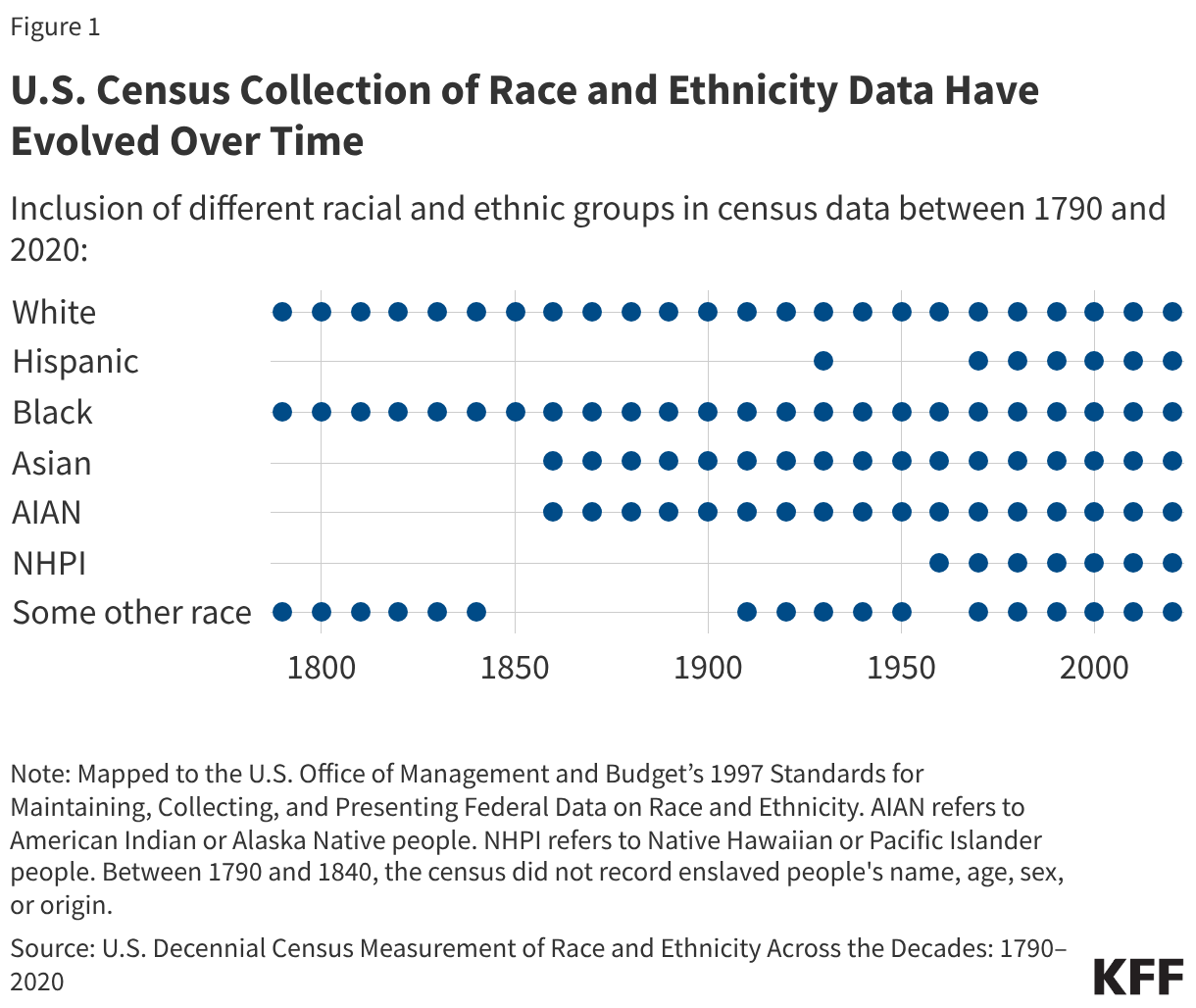
Since its inception in 1790, the U.S. census has collected information on race and ethnicity that has informed policy, the allocation of resources, and research on different groups within the country. How the census has collected and categorized information on race and ethnicity and the racial and ethnic groups for which data have been collected have evolved significantly over time, reflecting social and political shifts and the growing diversity of the U.S. population (Figure 1). In 1977, the Office of Management and Budget (OMB) established federal standards for collecting and reporting race and ethnicity data. The OMB standards guide not only the census but also other federal surveys, ensuring consistency across government data collection efforts. In March 2024, the OMB revised the racial and ethnic data collection and reporting standards to add Middle Eastern or North African as a category, clarify instructions for individuals to select multiple racial and ethnic categories, and require collection of more detailed data. The OMB indicated that these revisions were intended to result in more accurate and useful race and ethnicity data across the federal government. However, the Trump administration has extended the deadline for implementation of these changes twice and canceled plans to use the new standards in the 2027 American Community Survey.

U.S. Census Collection of Race and Ethnicity Data Have Evolved Over Time (Dot Plot)

Since its inception in 1790, the decennial census has included all people residing in the U.S. regardless of citizenship or immigration status, consistent with the Constitution's directive to enumerate "persons" rather than citizens. Article I, Section 2 of the U.S. Constitution requires an "actual Enumeration" of the population every ten years for purposes of proportionately dividing, or apportioning, seats in the U.S. House of Representatives, and Section 2 of the Fourteenth Amendment, which eliminated the Three-Fifths Compromise, specifies that representatives be apportioned "according to their respective numbers, counting the whole number of persons in each State…". Consistent with this description, the Census Bureau's longstanding practice has been to count every single “person,” regardless of citizenship or immigration status, who usually lives and sleeps in the U.S. in the decennial census. It has never excluded noncitizens from the apportionment base. During his first term, President Trump sought to exclude undocumented immigrants from the 2020 apportionment count through executive action, but legal challenges prevented the policy from taking effect.

Implications of Proposed Changes

The exclusion of millions of noncitizen immigrants from apportionment counts could lead to decreased federal funding and resources for states and localities with higher shares of immigrants. The proposed rule's exclusion of immigrants without LPR status from the U.S. resident population (in addition to the apportionment base) by redefining the term “usual residence” will impact the allocation of federal funds and resources across areas. The change will lead to areas with higher shares of noncitizen immigrants receiving less funding since the census will show them having fewer residents and the income and demographic profile of state residents may change without those noncitizens being counted. Prior research has found that, beyond total population counts, each state’s poverty rate and share of people living in rural areas are key factors that drive allocation of federal funds since they often are directed to low-income households and rural areas. According to analysis by the Project on Government Oversight, over 370 public programs relied on census data to allocate at least some portion of over $2.2 trillion in federal funds to states, counties, local communities, organizations, and households in fiscal year 2023. The largest share of this funding is for health programs, including Medicaid and CHIP. For example, the federal government’s share of most Medicaid and CHIP expenditures (or Federal Medical Assistance Percentage (FMAP)) is based on a state’s per capita income derived from decennial census data. Excluding many noncitizens--who are disproportionately likely to have lower incomes--from the resident count could result in a reduction in the FMAP for states with large immigrant populations, such as Florida and Texas. Other states that also have large immigrant populations, like California, would likely be affected less since their FMAP is already at the lowest level of 50%. The change could also affect the location of federally funded resources. For example, the Health Center Program uses census-derived data to determine medically underserved areas, which helps determine the location of Federally Qualified Health Centers (FQHCs). Decennial census data also indirectly shape where hospitals are located. For example, 36 states, including D.C., have certificate of need (CON) laws that help determine whether a new hospital or additional beds may be built using "bed need" methodologies that are benchmarked to census data.

Lack of race and ethnicity data and the exclusion of many noncitizen immigrants could negatively impact research on health and health care disparities as well as data quality and representation. Elimination of racial and ethnic data collection from the decennial census will have important implications for the measurement of disparities since the decennial census is the only source of complete, block-level data on race and ethnicity as well as other key sociodemographic characteristics. The exclusion of many noncitizens will also mean that the census will not accurately reflect who is residing in the U.S. Changes to the data beginning with the 2030 decennial census will eliminate a key source of data researchers use to understand population demographics and to ensure surveys are nationally representative and also limit the ability to examine trends over time, since the data will not be comparable to earlier versions. In the proposed rule, the Census Bureau indicates that they are not proposing restrictions on asking demographic questions on the American Community Survey or other surveys that are not used for enumeration of the population. While the administration is not currently proposing changes to such surveys, if similar changes are made to these surveys in the future, that would further limit the ability to understand the demographics of the U.S. population and the ability to measure and address health and health care disparities.

The proposed changes to stop collecting data on race and ethnicity are also likely to affect the redistricting process and lead to shifts in political representation. Decennial race and ethnicity data obtained from the census underpin the redistricting process and consequently, the voting power of communities of color. Under public law 94-171, enacted in 1975, the Census Bureau is required to provide states with block-level demographic data from the decennial census to redraw congressional and state legislative districts based on updated population counts. Section 2 of the Voting Rights Act (VRA) of 1965 prohibits voting practices that discriminate on the basis of race, among other factors. Block-level data on race and ethnicity cross-tabulated by voting age have long been used to establish the threshold required to bring a vote dilution claim under the law. In April 2026, the Supreme Court's decision in Louisiana v. Callais narrowed Section 2, holding that plaintiffs must show a strong inference that a state intentionally drew districts to afford minority voters less opportunity because of race as well as offer alternative maps meeting the state's legitimate goals. Eliminating block-level racial and ethnic data would compound these heightened evidentiary requirements by removing the underlying data to identify vote dilution, draw districts that provide communities of color an opportunity to elect candidates of their choice, and litigate VRA claims in the future.

The exclusion of millions of noncitizen immigrants from the decennial census could lead to the reallocation of congressional seats in ways that would reduce political representation for states with large immigrant populations. According to Pew Research Center, as of 2023, there were roughly 14 million undocumented immigrants and over 2 million lawfully present immigrants without LPR status in the U.S. Although these numbers have likely fallen since 2023, omitting these people from the count could impact representation for states with large numbers of immigrants. For example, a Pew Research Center analysis of President Trump’s earlier proposal to exclude undocumented immigrants from the 2020 decennial census found that, at that time, California, Florida, and Texas would each lose one congressional seat due to the change in population counts, while three other states would gain seats (Alabama, Minnesota, and Ohio).

Paid Family and Sick Leave in the U.S.

Published: Sep 25, 2026

Paid family and medical leave and sick leave can help workers meet their personal and family health care needs, while also fulfilling work responsibilities. Access to paid leave is a particularly salient concern for women, who comprise nearly half of the nation’s workforce and often take on the bulk of caregiving responsibilities. The federal Family and Medical Leave Act (FMLA) requires eligible employers to provide certain workers unpaid family leave; however, unlike nearly all other industrialized nations, the U.S. does not have a national requirement for paid family or sick leave, resulting in a patchwork of policies determined by state and local laws, employers, and/or labor contracts. While many have been advocating a national standard for paid leave for decades, there has been relatively little federal action.       

Though many states and localities have passed laws to expand access to paid leave within their jurisdictions, many workers still do not have access to these benefits. Employees not covered by these state and local laws must rely on voluntary employer policies, which can vary considerably in scope and compensation. This fact sheet summarizes federal, state, and local policies on paid family and medical leave and paid sick leave.

Paid Sick Leave: Paid sick leave can be used to recover from a short-term injury or illness such as a cold or for doctor’s appointments. It is often provided on an accrual basis up to a set number of hours or days per year, such as one hour of leave earned for every 30 hours worked up to seven days per year, and replaces 100% of the worker’s regular wages. On average, private sector workers are offered seven days of paid sick leave per year. Paid sick leave benefits are paid by the employer.

Paid Family and Medical Leave: Paid family and medical leave typically provides a set number of weeks or months to be used for a worker’s own serious, longer-term health condition, to care for a family member with a serious health condition, or to care for or bond with a new child, and for reasons related to a family’s member’s military service. On average, it provides six to twelve weeks of fully or partially paid leave per year, without the need for accrual. Paid family and medical leave may be insured and is often funded by contributions from the employer and/or the worker. 

Federal, State, and Local Policies on Sick, Family, and Medical Leave

Sick Leave

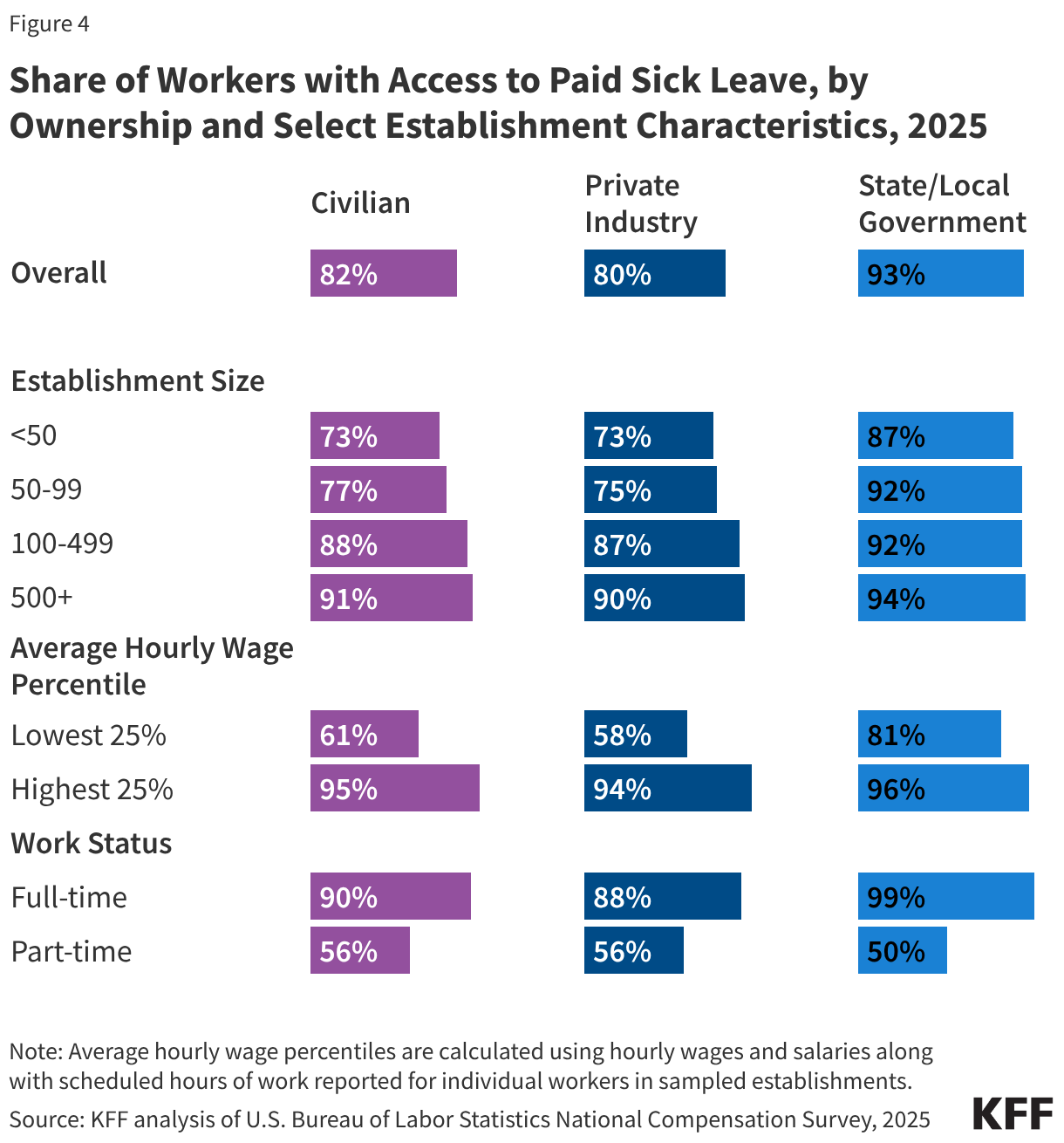
Paid sick leave allows workers to take short durations of time off if they are sick or need to care for a family member who is sick without losing pay. There is no federal requirement that employers offer paid leave benefits, but many states have requirements, and some employers do so voluntarily. According to the Bureau of Labor Statistics (BLS), eight in ten workers (82%) had access to paid sick leave through their employer in 2025. 

Proponents of a national paid sick leave mandate stress that workers should not be forced to choose between going to work while sick and losing pay or their job, pointing to numerous studies on the benefits of paid sick leave, such as preventing the spread of illnesses, increased use of preventive health care services, reduced on-the-job injuries, and fewer inappropriate emergency room visits. Opponents of a national paid sick leave mandate generally contend that it is not necessary because many employers already provide these benefits, or that it should be a voluntary benefit. They cite concerns about the financial implications for employers who would be required to provide this benefit, particularly for smaller businesses, and potential reductions in wages designed to offset those costs. 

At the federal level, the Healthy Families Act has been reintroduced annually and would require employers nationwide with 15 or more employees to provide at least 7 days annually, based on a 40-hour work week if it were to pass. Employees would be able to use sick leave for their own illness, to care for a sick family member, obtain medical care, or address needs resulting from domestic violence, sexual assault, or stalking, known as “safe time,” “safe days,” or “safe leave.” Federal government employees have generally had access to paid sick leave through employee benefits packages. 

There has been more traction on paid sick leave policies at the state and local level. Since the first law was passed by voter initiative in 2006 in San Francisco, 18 states plus D.C., and 18 other localities have passed laws requiring covered employers to provide eligible employees paid sick leave (Figure 1). Most of these policies permit the use of accrued sick leave for “safe time.” Three additional states and three localities have general paid time off laws that allow employees to use accrued leave for any reason, including illness. Ten states and 12 localities permit use of accrued paid sick leave for workplace closure or closure of the worker’s child’s school or childcare associated with a public health emergency.

Figure 1

The scope and generosity of paid sick leave laws vary. Most state and local laws have exemptions based on the size and type of employer and/or permit employers to impose certain worker eligibility requirements. Most laws also permit employers to impose a waiting period before new employees can use accrued leave, most often 90 days from the start of employment. Laws generally provide for accrual of 30-40 hours per year, though there is wide variation by policy, with lower accrual rates for smaller employers in many cases.

Family and Medical Leave 

FMLA and Unpaid Family and Medical Leave

It has been more than 30 years since the federal government passed the Family and Medical Leave Act (FMLA), giving eligible employees up to 12 weeks of unpaid, job-protected leave per year for their own serious health condition, to care for a seriously ill family member, for the arrival of a new child, and to address needs related to a family member’s military deployment. Eligible employees also receive up to 26 weeks of unpaid, job-protected leave per year to care for a seriously ill or injured family servicemember or veteran. The law applies to public agencies and local educational agencies of all sizes, as well as private employers with 50 or more employees. The FMLA has provided job security to millions of workers who need to take time off work for a qualifying reason; however, just over half (56%) of the workforce is eligible for FMLA protections because small employers are exempt, and even in covered worksites, not all employees meet FMLA eligibility requirements. Most states have opted to expand job-protected leave benefits beyond FMLA’s minimum standards by expanding eligibility, the duration of leave, the definition of family members, or qualified reasons for taking leave in the private and/or public sector in the private and/or public sector. 

Paid Family and Medical Leave

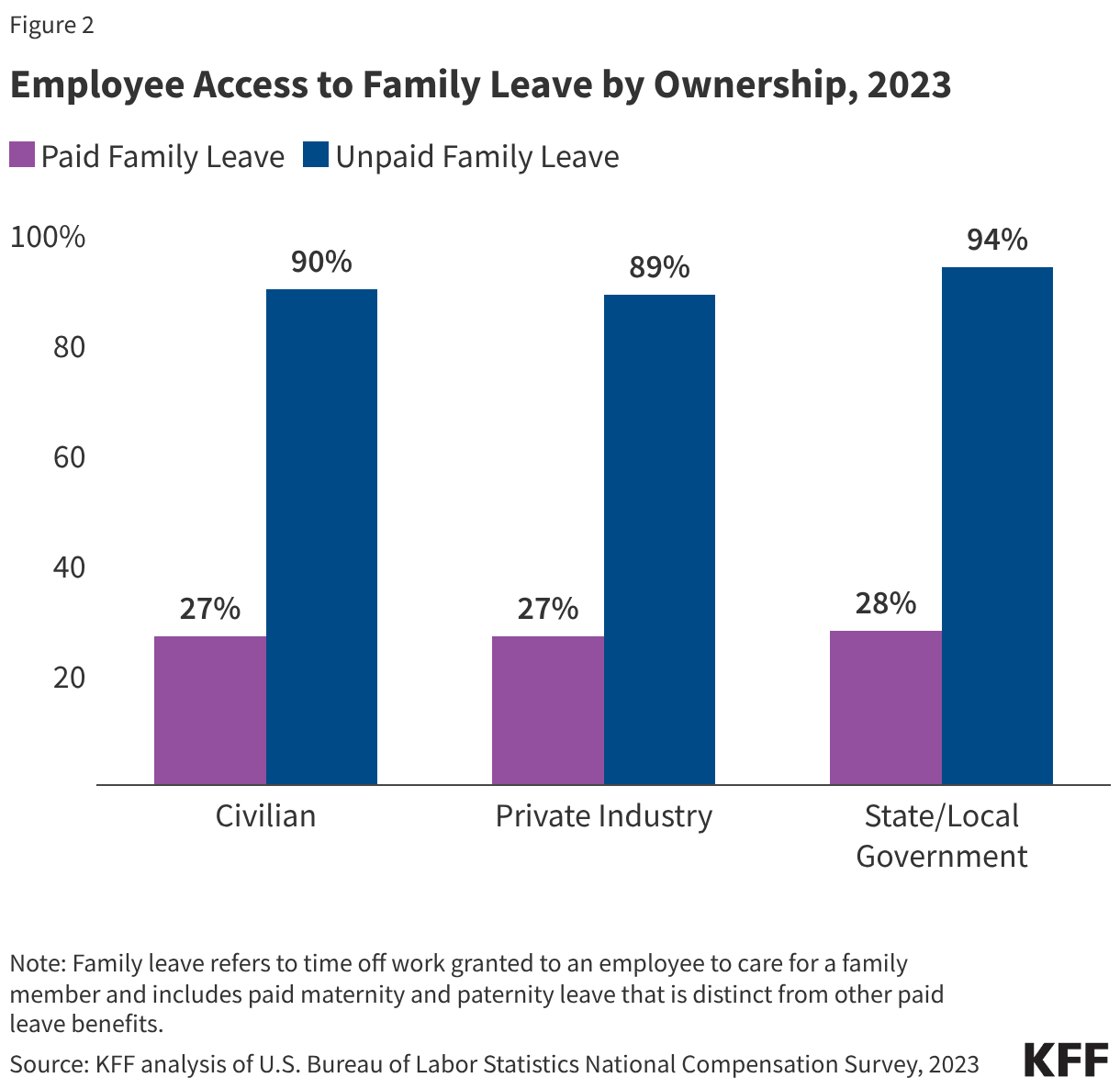
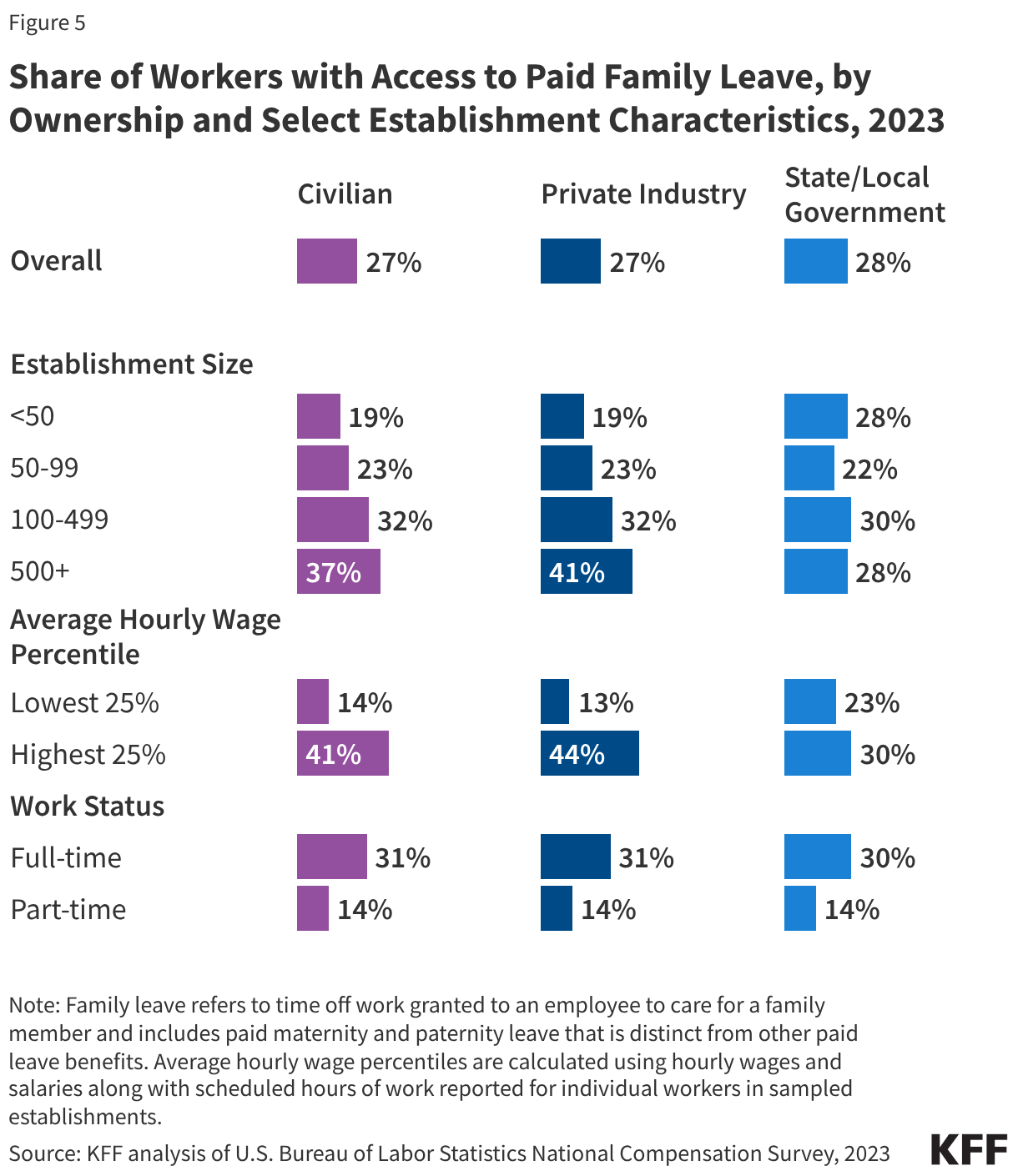
BLS data found that just over one in four (27%) workers had access to paid family leave in 2023, the most recent year for which there is data (Figure 2). Data on the share of workers with explicit access to paid medical leave for a longer, serious illness are limited, but BLS also estimates that 42% of workers had access to short-term disability insurance in 2025, which can be used to take paid time off for parental leave or medical leave.​ 

Bar chart showing the share of workers who had access to paid family leave compared to the share of workers who had access to unpaid family leave in 2023. It shows that while most workers have access to unpaid family leave, less than three in ten have access to paid family leave. This is the case among civilian-owned, privately-owned, and state/local government-owned establishments.

Proponents of a national paid family and medical leave program urge that it would provide employees with greater financial security when they must take extended leave for medical reasons or to care for an ailing family member or new child. Research indicates that access to paid family and medical leave is associated with improved physical and mental health for new parents, improved birth outcomes, financial security for caregivers in the short- and long-term, and improved connections to the workforce, particularly for women, who are more likely than men to be caregivers for children and older adults. Opponents often cite concerns about the impact of new federal requirements on businesses, government overreach into the free market, increased taxes for businesses (should that be the funding mechanism), as well as the financial implications a new benefit would have on wages and employment.  

Like sick leave, there have been many attempts to enact a national paid family and medical leave policy, but no permanent, broad-scale federal legislation has ever been passed. The Family and Medical Insurance Leave (FAMILY) Act, re-introduced in 119th Congress, if passed, would create a national insurance program to provide workers up to 12 weeks of their partial income for their own serious health condition or that of an immediate family member, and for the birth or placement of a child. The program would be funded by employee and employer payroll contributions. The program would be funded by employee and employer payroll contributions.

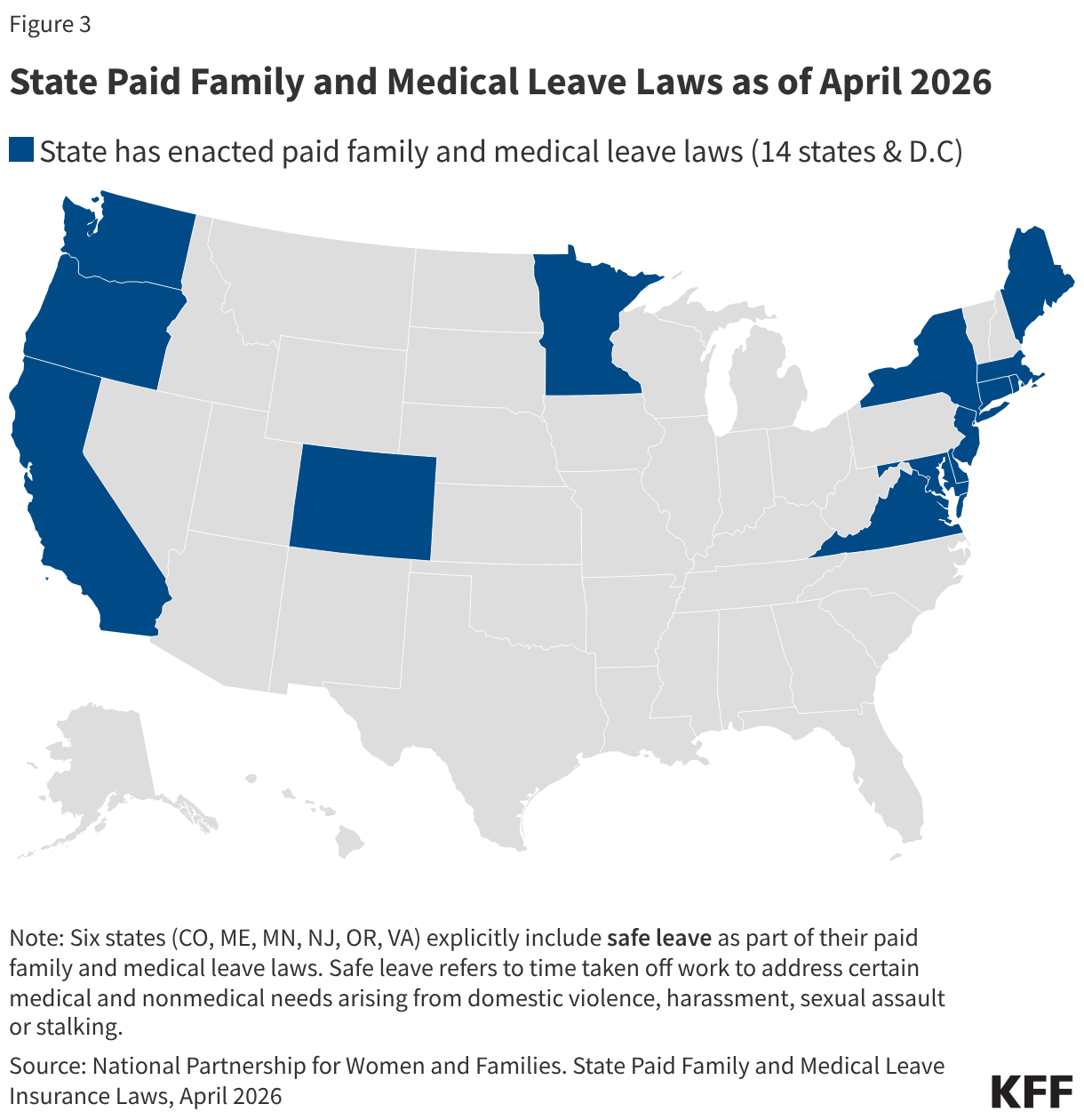
At the state level, 14 states and D.C. have enacted paid family and medical leave (Figure 3). In November 2020, Colorado became the first state to enact paid family and medical leave through a ballot measure. In 2026, Virginia became the first southern state to pass a statewide requirement for paid family and medical leave. Six states (Colorado, Maine, Minnesota, New Jersey, Oregon, and Virginia) also explicitly include safe leave as part of their paid family and medical leave laws. Oregon permits use of paid leave for reasons associated with a public health emergency. Paid leave durations for an employee’s own serious medical condition range from 6 to 52 weeks per year and 8-12 weeks for family leave. Four states (Colorado, Connecticut, Oregon, and Washington) plus D.C. provide a 2–4-week extension for a worker’s own pregnancy-related health issues. Wage replacement ranges from 50% to 100% of regular pay, up to certain caps, and requirements vary by state. Some states provide benefits on a sliding scale, with a higher percentage of wage replacement for lower-income workers. All states offering paid family and medical leave have minimum earnings or employment length requirements to qualify, and some have 7-day unpaid waiting periods. Paid leave benefits are administered by the state or by employers with qualifying programs and are funded through employer and/or employee contributions. 

This map shows that paid family and medical leave laws are limited across the U.S. Fourteen states and Washington D.C. have enacted paid family and medical leave laws ranging from 8 weeks to 52 weeks. Wage replacement rates vary by state and an individual's average weekly wages, with some states replacing up to 100% of an employee's wages while on leave.

Employer Provision of Paid Leave Benefits

The BLS’s National Compensation Survey (NCS) releases annual data related to employer benefit plans, including leave benefits. The share of employees with access to paid leave benefits varies by establishment characteristics, such as size, worker status, and wages. Nonetheless, access to paid leave benefits has increased overall in the last few years. The share of workers with access to paid family leave increased from 17% in 2018 to 27% in 2023; similarly, the share of workers with access to paid sick leave slightly increased from 78% in 2020 to 82% in 2025.  

There are differences between different groups of workers in access to paid sick leave (Figure 4). Just over half (56%) of part-time workers had access, compared to nine in ten (90%) full-time workers. The lower likelihood of paid sick leave for part-time workers has a disproportionate impact on women, who are more likely than men to hold part-time jobs and more likely than men to care for sick children when they stay home from school. Among establishments with 500 workers or more, the share of workers with access to this benefit was 91%, compared to 73% of workers in establishments with less than 50 workers.

Split bar chart showing the share of workers who had access to paid sick leave in 2025. It shows that while access to paid sick leave is high overall among civilian-owned, privately-owned, and state/local government-owned establishments, there are differences in access between different groups of workers. Smaller shares of workers with lower incomes and part-time workers had access to paid sick leave compared to workers with higher incomes and full-time workers, respectively.

Similarly, in 2023, 31% of full-time workers had access to paid family leave benefits compared to 14% of part-time workers (Figure 5). Among establishments with less than 50 workers, the share of workers with access to this benefit was about one in five (19%). The share of workers with access nearly doubles (37%) in establishments with over 500 workers.  

Split bar chart showing the share of workers who had access to paid family leave in 2023. It shows that while access to paid family leave is similar overall among civilian-owned, privately-owned, and state/local government-owned establishments, there are differences in access between different groups of workers. Smaller shares of workers with lower incomes and part-time workers had access to paid family leave compared to workers with higher incomes and full-time workers, respectively.

Short of federal action, the movement for paid leave will likely continue to be centered on state and local policies or those voluntarily adopted by employers or negotiated through union contracts. Given that most people will need time off during their working lives to care for a personal or family illness, or for a new child, this issue will continue to be a salient concern for working families across the country in the years to come. 

Key Facts on Abortion in the United States

Published: Sep 25, 2026

Note: This brief was updated on September 25, 2026 to incorporate new data on abortion statistics.

The Supreme Court’s 2022 ruling in Dobbs v. Jackson Women’s Health Organization overturned the constitutional right to abortion that had been in place for nearly 50 years under Roe v. Wade. Prior to the Dobbs ruling, abortions were permitted up to fetal viability in all states. That federal standard was eliminated under Dobbs, allowing states to ban or restrict clinicians from providing abortion before viability. KFF is tracking and updating the status of abortion access and availability, with some states banning the provision of almost all abortions, and some states protecting abortion access. 

This issue brief answers some key questions about abortion in the United States and presents data collected before and since the Dobbs ruling.

Table of Contents

What is abortion?

Copy link to What is abortion?

Abortion is the medical termination of a pregnancy. It is a common medical service that many women obtain at some point in their life. There are different types of abortion methods, which the National Academy of Sciences, Engineering, and Medicine (NASEM) places in four categories: 

  • Medication Abortion – Medication abortion, also known as medical abortion or abortion with pills, terminates a pregnancy by oral medications. There are two widely accepted protocols for medication abortion. In the U.S., the most common protocol involves the drugs mifepristone and misoprostol. Typically, an individual takes mifepristone first, followed by misoprostol 24-48 hours later. The U.S. Food and Drug Administration (FDA) has approved this abortion protocol up to the first 70 days (10 weeks) of pregnancy. Another medication abortion protocol uses misoprostol alone, which is also recommended for up to 70 days (10 weeks) of pregnancy, but it is not currently approved by the FDA and is more commonly used in other countries. 

The Guttmacher Institute estimates that in 2023, medication was used for almost two thirds (65%) of all abortions. Many have confused emergency contraception (EC) pills with medication abortion pills, but EC does not terminate a pregnancy. EC is a contraceptive that prevents pregnancy by delaying or inhibiting ovulation and will not affect an established pregnancy.  

  • Aspiration, a minimally invasive and commonly used gynecological procedure, is the most common form of procedural abortion. It can be used to conduct abortions up to 14-16 weeks of gestation. Aspiration is also commonly used in cases of early pregnancy loss (miscarriage).  
  • Dilation and evacuation abortions (D&E) are usually performed after the 14th week of pregnancy. The cervix is dilated, and the pregnancy tissue is evacuated using forceps or suction.  
  • Induction abortions are rare and conducted later in pregnancy. They involve the use of medications to induce labor and delivery of the fetus.  

What does research show about the safety of abortions?

Copy link to What does research show about the safety of abortions?

Decades of research have shown that abortion is a very safe medical service.

Despite its strong safety profile, abortion is the most highly regulated medical service in the country and is now banned in several states. Additionally, many states impose other limitations on abortion that are not medically indicated, including waiting periods and parental notification and consent requirements that typically delay receipt of services. 

  • NASEM completed an exhaustive review on the safety and effectiveness of abortion care and concluded that complications from abortion are rare and occur far less frequently than during childbirth.  
  • NASEM also concluded that safety is enhanced when the abortion is performed earlier in the pregnancy. State level restrictions such as waiting periods, ultrasound requirements, and gestational limits that impede access and delay abortion provision likely make abortions less safe.  
  • Medication abortion successfully terminates the pregnancy 91.9% to 99.7% of the time, with a 0.4% risk of major complications, and an associated mortality rate of less than 0.001 percent (0.0005%). Between 2% to 4% of medication abortions may need a procedural intervention with this regimen.  
  • Studies on procedural abortions, which include aspiration and D&E, have also found that they are very safe, with the rate of major complications less than 1% for aspiration abortions. Abortion medications and procedures are also often used for people experiencing miscarriages and stillbirths and can improve safety by preventing delays when a loss is inevitable. 
  • Most OBGYN physicians say that the Dobbs decision has had a negative impact on maternal health and patient safety. In a national KFF survey of OBGYNs, more than six in ten say that racial and ethnic inequities in maternal health (70%), management of pregnancy-related medical emergencies (68%), and pregnancy-related mortality have all worsened (64%) since the Dobbs decision.

What is the status of abortion policy in the U.S.?

Copy link to What is the status of abortion policy in the U.S.?

As of August 2026, the provision of abortion is banned in 13 states, and another 6 states have implemented early gestational limits between 6 and 12 weeks (Figure 1). Most other states allow abortion to the point of fetal viability, which is generally considered around 24 weeks gestation.

Map of the United States showing the status of abortion bans as of March 9, 2026. 

Abortion banned in 13 states: Alabama, Arkansas, Idaho, Indiana, Kentucky, Louisiana, Mississippi, North Dakota, Oklahoma, South Dakota, Tennessee, Texas, West Virginia

Gestational limit between 6 and 12 weeks LMP in effect in 7 states: Florida (6 weeks), Georgia (6 weeks), Iowa (6 weeks), Nebraska (12 weeks), North Carolina (12 weeks), South Carolina (6 weeks), Wyoming (6 weeks).

Gestational limit between 15 and 22 weeks LMP in effect in 4 states: Kansas, Ohio, Utah and Wisconsin

Gestational limits at or near viability in 18 states: Arizona, California, Connecticut, Delaware, Hawaii, Illinois, Maine, Massachusetts, Missouri, Montana, Nevada, New Hampshire, New York, Pennsylvania, Rhode Island, Virginia, Washington

No gestational limits in 9 states and DC: Alaska, Colorado, DC, Maryland, Michigan, Minnesota, New Jersey, New Mexico, Oregon, Vermont

All states that ban the provision of abortion have exceptions if an abortion is needed to prevent the death of the pregnant person. Additionally, some state bans make exceptions when the pregnancy is threatening the pregnant person’s health, when the pregnancy is the result of rape or incest, and when there is a lethal fetal anomaly. However, in practice, these exceptions have proven to be unworkable except in the most extreme circumstances.  

Abortion is one of the most highly restricted and regulated health care services. However, KFF research has found strong support for abortion access and opposition to criminalizing abortion care (Figure 2). 

Stacked bar chart showing that a majority of the public opposes laws restricting medication abortion. This includes laws that would ban mifepristone nationwide and laws that would make it a crime for health care providers to mail abortion pills to patients in states with abortion ban.

How common are abortions?

Copy link to How common are abortions?

The most recent data estimates that more than one million abortions (1,129,020) occurred in the U.S. in 2025. 

Three different organizations currently track abortion volume at the state and the federal levels: the federal Centers for Disease Control and Prevention (CDC), the Guttmacher Institute, and the Society for Family Planning (SFP). The CDC has been collecting abortion data for decades, but several states do not provide data to the federal government (reporting to the CDC is voluntary) and there is a two-to-three-year time lag until the data become publicly available. The most recent data from CDC is from 2022, the year the Dobbs decision was issued. For most of the decade prior to the Dobbs ruling, there was a steady decline in abortion rates nationally, but there was a slight increase in the years just before the ruling. Immediately following the Dobbs ruling, the number of abortions in the U.S. dropped as more states enforced bans and restrictions. 

Since the Dobbs ruling, the Guttmacher Institute’s Monthly Abortion Provision Study and the SFP's #WeCount have been tracking state level changes in abortion volume based on data provided by abortion clinics and providers. Both studies provide national and state-level estimates on procedural and medication abortions but differ in some methodologic details. For more details about data sources, see KFF’s issue brief on abortion trends. 

Paradoxically, the most recent data show that the abortion volume in the U.S. slightly increased overall in the three years following the Dobbs ruling.  

The monthly average number of abortions steadily increased from 77,560 monthly abortions in 2022 (April to December 2022), to 85,780 abortions in 2023 to 92,400 abortions in 2024 to 94,090 in 2025 (Figure 3). This overall increase nationally can be largely attributed to the growth of telehealth for medication abortion, increased availability of lower cost medication abortion pills through virtual clinics, growth in capacity in states without laws banning or restricting the provision of abortion, and in particular, shield law abortions where clinicians in legal states are mailing pills to individuals residing in states with bans and restrictions.  

There is large variation in the volume of abortions between states with different abortion policies. Most abortions occur in states without bans. In states with bans and six-week gestational limits, there have been major declines in the volume of in-person abortions, but an increase in abortions by telehealth since the Dobbs ruling.  There are month-to-month variations in all states. Additionally, in the years since Dobbs, some states have changed their abortion policies, with some becoming more restrictive and some less restrictive at different times, which affects abortion access and volume.  However, the overall pattern since the Dobbs ruling is an increase in the national number of abortions, particularly growth in the share of telehealth abortions. 

These grouped columns show that there is large variation in the volume of abortions between states with different abortion policies. Some states have changed their abortion policies since the 2022 Dobbs ruling, with some becoming more restrictive and some less restrictive at different times, which affects abortion access and volume. Most abortions occur in states without bans on abortion provision. In states with bans and six-week gestational limits, the number of abortions by telehealth have increased.

Who gets abortions?

Copy link to Who gets abortions?

Most of the information about people who receive abortions comes from CDC data. In 2022, the most recent year CDC data are available, women across a range of age groups, socioeconomic status, and racial and ethnic backgrounds obtained abortions, but the majority were obtained by women who were in their twenties, low-income, and women of color. 

  • Women in their twenties accounted for more than half (57%) of abortions. Nearly one-third (31%) were among women in their thirties and a small share were among women in their 40s (4%) and teens (9%).  
  • Information on the race and ethnicity of people who obtain abortions is particularly limited, but based on available data, more than half of abortions were among women of color in 2022. Black women comprised 40% of abortion recipients, 32% were provided to White women, 21% to Hispanic women, and 7% were among women of other races/ethnicities. Additionally, White, Black, and American Indian and Alaska Native women are disproportionately represented among women ages 18-49 in states with laws banning or restricting the provision of abortion compared to states that provide broader access to abortion. Many women who sought abortions have children. Approximately six in 10 (59%) abortion patients in 2022 had at least one previous birth.
Pie chart showing the age breakdown of individuals who had abortions in 2022. Overall, women in their 20s made up over half of abortion patients.

The vast majority (93%) of abortions occur during the first trimester of pregnancy according to data available from before the Dobbs decision.  

Before the 2022 ruling in Dobbs, there was a federal constitutional right to abortion before the pregnancy is considered to be viable, that is, can survive outside of a pregnant person’s uterus. Viability is generally considered around 24 weeks of pregnancy. Most abortions, though, occur well before the point of fetal viability. When people have abortions later in pregnancy, it is often because the fetus is not viable and the pregnancy may endanger the pregnant person’s life. 

Data from 2022 found that four in ten (40%) abortions occurred by six weeks of gestation, another four in ten (39%) occurred between seven and nine weeks, and 14% at 10-13 weeks. Just 7% of abortions occurred after the first trimester (Figure 5).

Pie chart showing the breakdown of abortions that occurred in 2022 by weeks of gestation. Most abortions (79%) occurred before 10 weeks of gestation.

Where do people get abortion care?

Copy link to Where do people get abortion care?

Abortions can be provided in a variety of settings. Historically, the majority of abortions have been provided at brick-and-mortar clinics that specialize in provision of reproductive health care. Some private office-based physicians also offer abortion services, and in more recent years, there has been an emergence of virtual-only clinics that send medication abortion pills by mail. 

Brick-and-mortar clinics vary, but they can offer medication abortion, procedural abortions, and services for abortions later in pregnancy. Many clinics in states where abortion is restricted or banned stopped offering abortion services shortly after the Dobbs ruling and the overall number of brick-and-mortar independent clinics in the US has decreased over the years.  

The distribution of facilities that offer abortion care varies widely by state and geographic region, and the national increase in abortions appears to be largely driven by the expansion of virtual abortion clinics. While virtual clinics can remove geographic barriers for those seeking abortion care, their services are limited to medication abortion which is only available to those seeking abortions earlier in pregnancy. Even prior to the ruling in Dobbs, access to abortion services was very uneven across the country, and these geographic disparities have only widened.

Telehealth

Telehealth has grown as a delivery mechanism for abortion services, accounting for 28% of abortions in 2025. While procedural abortions must be provided in person in a clinical setting, medication abortion can be provided in a clinical setting or via telehealth without an in person visit. 

Access to medication abortion via telehealth was limited for many years by an FDA policy that permitted only certified clinicians to dispense mifepristone within a health care setting. In December 2021, however, the FDA permanently revised this policy and no longer requires clinicians to dispense the drug in person. Additionally, in January 2023, the FDA finalized a policy change that allows retail pharmacies to dispense medication abortion pills to patients with a prescription. These policy changes opened the door to using telehealth for medication abortion.  

  • Telehealth can be administered by providers from traditional brick-and-mortar clinics or by virtual-only clinics. Virtual clinics began to proliferate after the FDA revised its in-person dispensing requirement in 2021, rising from no virtual clinics in 2020 to 226 clinics in 2023.  
  • In a telehealth abortion, the patient typically completes an online questionnaire to assess (1) confirmation of pregnancy, (2) gestational duration and (3) blood type. If determined eligible by a remote clinician, the patient is mailed the medications. This model does not require an ultrasound for pregnancy dating if the patient has regular periods and is sure of the date of their last menstrual period (in line with ACOG’s guidelines). If the patient has irregular periods or is unsure how long they have been pregnant, they may need to obtain an ultrasound to confirm the weeks of gestation and rule out an ectopic pregnancy and send in the images for review before receiving medications. The follow-up visit with a clinician can also happen via a telehealth visit.  
  • Research has found that the provision of medication abortion via telehealth is as safe and effective as the provision of the pills at an in person visit. Yet, in some states that have not banned the provision of abortion, telehealth may not be available because of state-level restrictions enacted prior to the Dobbs ruling that effectively ban telehealth for abortion care.  
  • Medication abortion has emerged as a major legal and legislative front in the battle over abortion access across the nation. Multiple cases have been filed in federal and state courts regarding aspects of the FDA’s regulation of medication abortion as well as the mailing of medications.  
  • Some states have passed shield laws that bar the clinicians’ resident state from extraditing them if a restrictive state attempts to prosecute the clinician for performing an abortion that is otherwise legal in their home state. Telehealth abortions include those provided by brick-and-mortar clinics, virtual clinicians, and clinicians in states with shield laws who prescribe medication abortion to patients in states with telehealth restrictions or laws banning or restricting the provision of abortion. 
Pie chart showing the breakdown of telehealth and in-person abortions in 2025. Nearly three in ten (28%) abortions now occur via telehealth.

Self Managed Abortions

Self-managed abortions typically involve obtaining medication abortion pills from an online pharmacy that will send the pills by mail or by purchasing the pills from a pharmacy in another country, usually without the involvement of a physician or advanced practice clinician. While this can involve asynchronous contact with non-US-based clinicians, it does not typically involve a direct consultation with a clinician either in person or via telehealth. 

It is difficult to track the volume of self-managed abortions since they are outside of the formal health care system, and it is unknown if all people who receive medication pills take them. One study estimated that at least 26,000 additional self-managed medication abortions took place in the six months following the Dobbs ruling.

Interstate Travel

The Guttmacher Institute Monthly Abortion Provision Study is the only data source so far to provide in-depth information on interstate travel pre- and post-Dobbs. Guttmacher estimates that prior to Dobbs, nearly one in ten people obtained an abortion by traveling across state lines in 2020. Even before Roe v Wade was overturned, abortion was highly restricted in many states. The latest data show that 155,000 patients traveled out of state for abortion care in 2024, a slight drop from 170,000 in 2023 but nearly double the number of travelers in 2020 (81,000). This has been offset by an increase in patients who are getting abortion pills via telehealth. 

The states with the highest number of people traveling inbound for abortion care border at least one state where the provision of abortion is banned, including Illinois, North Carolina, Kansas, and New Mexico. 

How much do abortions cost?

Copy link to How much do abortions cost?

The costs of abortion services vary widely depending on the method, facility, and gestational length; the costs can be as low as $40 through virtual clinics but typically exceed $1,000 for abortions later in pregnancy.  

  • Obtaining an abortion can be costly. In 2023, the median costs for people paying out of pocket in the first trimester were $563 for a medication abortion and $650 for a procedural abortion (Figure 7). For people with low incomes, who are more likely to seek abortion care, these costs are often unaffordable.  
  • The costs for medication abortion services through virtual clinics, such as AidAccess and Abuzz, as well as self-managed sites, are typically lower than in person services. In 2023, the median cost of medication abortion from virtual clinics was $150. Costs at online pharmacies listed on Plan C range from a low of $40 for abortion pills by mail without clinician consultation, to upwards of $150 for abortion by mail with a clinical consultation. 
  • The costs of abortion are higher in the second trimester compared to the first, with median self-pay reaching or exceeding $1000. In the second trimester, more complex procedures may be needed and local options are more limited in many communities that have fewer facilities. The state bans and restrictions enacted since Dobbs can also result in additional nonmedical expenses for transportation, childcare, lodging, and lost wages.  
  • While some people use their insurance to pay for the costs of abortion care, most people pay out of pocket. Some people can obtain assistance from local abortion funds, which are independent organizations that help pay for some of the costs of abortion services, typically medical care, travel, and accommodations if needed. Most abortion funds are regional and have connections to clinics in their area, but they do not reach all people seeking services.
Columns chart summarizing the median out-of-pocket cost of medication abortion, first trimester procedural abortion, and second trimester procedural abortion in 2023. While each service exceeded 0, the median cost of second trimester procedural abortions was almost double the median cost of medication abortions.

Does private insurance or Medicaid cover abortions?

Copy link to Does private insurance or Medicaid cover abortions?

Insurance coverage for abortion services is heavily restricted in certain private insurance plans and public programs like Medicaid and Medicare.   

Among women of reproductive age, approximately six in ten are covered by private insurance, one in five are covered by Medicaid, and one in ten are uninsured.  

Prior to the Dobbs ruling, several states had enacted private plan restrictions and banned abortion coverage from ACA Marketplace plans. As of September 2026, there are 10 states that have policies restricting abortion coverage in private plans and 25 that ban coverage in any Marketplace plans. Since the Dobbs ruling, some of these states have also banned the provision of abortion services altogether. Conversely, 13 states require state-regulated private plans to cover abortion, ten of which require no cost-sharing for abortion.

For decades, the Hyde Amendment has banned the use of federal funds for abortion in Medicaid, Medicare and other public programs unless the pregnancy is a result of rape, incest, or if it endangers the pregnant person’s life. States have the option to use state-only funds to cover abortions under other circumstances for those on Medicaid, which 21 states do currently.  

Data from 2021, prior to Dobbs, estimated that a quarter (26%) of abortion patients used Medicaid to pay for abortion services, 11% used private insurance, and 60% paid out of pocket. People in states with more restrictive abortion policies were more likely to pay out of pocket compared to people living in less restrictive states. 

A map of the United States highlighting health insurance coverage restrictions for abortion services. This includes Medicaid, private, and marketplace limitations; Medicaid and marketplace limitations; Medicaid limitations only; and, marketplace limitations only. Most states have at least one restriction.13 states require abortion coverage in all of these plans, while 6 states have no coverage limitations or requirements.

How TrumpRx Brand-Name Drug Prices Compare to Other Countries

Published: Sep 24, 2026

TrumpRx prices for brand-name drugs are about as likely to be higher as lower compared to average prices in other wealthy countries, according to an analysis that compares 32 brand-name drugs (without generics or biosimilars) on the TrumpRx website with publicly available prices in one or more of 11 OECD member countries: Australia, Austria, Belgium, Canada, France, Germany, Japan, the Netherlands, Sweden, Switzerland, and the United Kingdom.

For 17 of the 32 drugs, the TrumpRx price is lower than the average price in comparable countries. This includes five drugs for which the TrumpRx price is lower than the prices available in any of the other countries. Eight drugs have a price that is $100 less than the average in other countries. For the other 15 drugs, the TrumpRx price is higher than the average price in comparable countries. This includes 13 drugs for which the TrumpRx price is higher than prices available in any of the other countries.

The full analysis and other data on health costs are available on the Peterson-KFF Health System Tracker, an online information hub dedicated to monitoring and assessing the performance of the U.S. health system.

News Release

Analysis: Prices for Many Brand-Name TrumpRx Drugs Are Cheaper than the Average Price in Other Wealthy Countries, But Are Almost as Likely To Be More Expensive

Published: Sep 24, 2026

Consumers who buy brand-name prescription drugs without an available generic or biosimilar at the prices available through the new TrumpRx website are about as likely to pay more as pay less for those drugs relative to the publicly listed prices available in other comparatively wealthy countries, a new KFF analysis finds.

The Trump administration has promoted the TrumpRx website as a way for consumers to get the lowest prices for prescription medications in the world, drawing on voluntary pricing agreements with drug manufacturers aimed at securing “Most Favored Nation” prices for American consumers. For many brand-name drugs listed on the website, TrumpRx directs consumers to manufacturers’ discount coupons to get the drugs at a pharmacy without using insurance.

The analysis compares the prices of 32 brand-name drugs listed on the TrumpRx website with those in other countries. Key findings include:

  • For 17 of the 32 drugs, the TrumpRx price is lower than the average price in comparable countries. This includes five drugs for which the TrumpRx price is lower than the prices available in any of the other countries. Eight drugs have a price that is $100 less than the average in other countries.
  • For the other 15 drugs, the TrumpRx price is higher than the average price in comparable countries. This includes 13 drugs for which the TrumpRx price is higher than prices available in any of the other countries.
  • There are wide variations in the price differences between TrumpRx and other countries. For nine of the drugs, the prices on TrumpRx are at least double the average across other countries. This includes Enbrel, a drug used to treat rheumatoid arthritis; the TrumpRx price is $2,725 higher than the average across other countries ($3,354 versus $641).

This analysis compares the TrumpRx drug prices with available prices in Australia, Austria, Belgium, Canada, France, Germany, Japan, the Netherlands, Sweden, Switzerland, and the United Kingdom for the brand-name drugs listed on the TrumpRx site (as of August 25, 2026) that do not have generics or biosimilars available in the U.S. and that had publicly available prices in at least one of the other nations. It does not compare the prices available on TrumpRx now to the prices that may have been available to consumers in the U.S. prior to its launch.

There is no one source of data for drug prices in other countries. In many cases, the publicly listed prices used in the analysis represent the price paid by the government’s national health system, or similar entity, and not necessarily what a consumer living in the country and covered by its health system would pay.

The analysis also examines some of the factors that contribute to differences in prices across countries and through TrumpRx, including the role of government in setting drug prices. The analysis is available through the Peterson-KFF Health System Tracker, an online hub monitoring how well the U.S. health system is operating through cost and quality measures.

VOLUME 55

KFF Women’s Health Survey Explores How Women Navigate Contraceptive Information


Highlights

The 2026 KFF Women’s Health Survey finds that health care providers remain the most trusted source of reliable health information for reproductive-age women. Large shares, though, also report using online sources and social media, and many report being exposed to false or misleading information that can lead to changes in contraceptive use, like starting, changing, or stopping a birth control method.

And as AI tools become more embedded in health care and government, some institutions are developing new AI governance policies around their use, but most government AI policies do not address health, and those that do are largely not public. One Ohio health department’s new AI policy offers a rare look at a health-specific policy, explicitly addressing accuracy and public trust.


KFF Women’s Health Survey Explores Trusted Sources of Information and Exposure to Contraceptive Misinformation

Health care providers remain the most trusted source for reliable health information among reproductive-age women ages 18 to 49. According to the 2026 KFF Women’s Health Survey, more than eight in ten (86%) reproductive-age women said they trust health care providers “a great deal” or “a fair amount” for reliable information, compared with a quarter (25%) who said the same about AI tools and chatbots and fewer (15%) about social media and social media influencers. These findings largely mirror KFF polling among the general public, which has found similarly high trust in doctors and relatively lower trust in AI chatbots for health information.

Figure 3 is a stacked horizontal bar chart titled "Reproductive Age Women Trust Health Care Providers the Most to Provide Reliable Health Care Information" with "A great deal" colored dark blue, "A fair amount" colored blue, "A little" colored green, and "Not at all" colored dark green. The majority of women ages 18 to 49 trust their health care provider and state and local health departments a great deal or fair amount to provide reliable health care information. Women trust social media and AI tools or chatbots the least to provide reliable health care information, with majorities of women also having little trust in federal health agencies and Robert F. Kennedy Jr.

Still, use of online sources for health information is widespread despite this limited trust. A majority (87%) report looking for health information or advice online through internet search engines, social media, or AI tools. Many reproductive-age women report seeing information about contraception on social media, regardless of whether they were looking for it. About a third (35%) say they’d seen or heard something about contraception on social media in the past year, rising to four in ten (42%) among younger women ages 18 to 25.

Many reproductive-age women also report being exposed to false and misleading statements about contraception on social media and elsewhere. About half (53%) of reproductive-age women say they’ve heard the false claim that hormonal contraceptives are harmful to your health, and four in ten (43%) have encountered the incorrect claim that they limit your ability to get pregnant in the future. Both of these claims are contradicted by current evidence. Roughly a third (32%) have seen false claims that natural family planning is as effective as hormonal contraception at preventing pregnancy and that emergency contraceptive pills, such as Plan B, cause abortions, neither of which is accurate.

False or Misleading Statements About Contraception Are Widespread (Split Bars)

Among women who saw contraception-related content on social media, more than a third (36%) went on to search for more information online, one in five (19%) talked to a doctor about what they’d seen, and about one in ten either started or changed to a new birth control method (9%) or stopped using their hormonal birth control (8%) because of what they’d seen, with higher shares of young women ages 18 to 25 doing each of these.

A grouped vertical bar chart titled "One in Ten Younger Women Who Have Seen Something About Contraception On Social Media Have Made a Change to Their Contraceptive Use" and shows women overall ages 18 to 49 in gray, women ages 18 to 25 in green, women ages 26 to 35 in blue, and women ages 36 to 49 in dark blue. Among women who have seen or heard something on social media about contraception, one in three (36%) have sought more information through an online search or AI, one in five (19%) have talked talked to a doctor or health care provider about what they saw or heard, and one in ten (12%) have stopped using hormonal birth control or started or changed to a new birth control method. Higher shares of younger women ages 18 to 25 have done all of these things compared to women ages 36 to 49.

AI & Emerging Technology

Most State AI Policies Overlook Health-Specific Guidance, but One New Example Focuses on Accuracy and Trust

Questions about how generative AI tools could affect public trust and the accuracy of AI-generated information are among factors contributing to new governmental policies around AI use. According to an analysis of publicly available AI policies published last month by the Association of State and Territorial Health Officials (ASTHO), most of these plans focus on government-wide issues, such as data privacy and security, procurement, and vendor requirements. Some provisions, like requirements for human review and disclosure of AI use, may apply to health agencies within those jurisdictions. The analysis found, though, that few of the policies addressed health-specific applications directly, such as evaluating AI tools for disease surveillance or outbreak detection, and most health-specific policies that do exist are not public. 

One publicly available example from a health agency comes from the public health department of Ashland County, Ohio, which unanimously approved and released its own AI governance policy last month. The policy provides a look at how one health agency is approaching AI use, explicitly identifying public trust and the accuracy of AI-generated information as core considerations for the responsible use of AI in health care. The policy states that AI should be used in ways that “promote transparency, accountability, and community confidence.” Among other rules, staff are required to verify factual claims, citations, and statistics generated by AI before relying on them, and human review is required for most non-minor uses of AI to ensure accuracy. The policy also establishes an incident reporting framework for when AI-assisted work might include false information, treating errors where hallucinations enter published materials as incidents to be tracked and addressed. Beyond these general rules, the policy lays out health-specific approved AI use cases, including de-identified data analysis in epidemiology, health promotion content in nursing, and inspection communication templates in environmental health. It also states that no AI system may independently make clinical, regulatory, or public health decisions on behalf of the agency.

Because the Ashland County policy is publicly available, it offers the public, other health organizations, and researchers a look at how one health agency is trying to maintain accuracy and protect trust in its use of the technology, which has relatively low trust among the public overall for health information. KFF’s March 2026 Tracking Poll on Health Information and Trust found that a third of adults (33%) said they had a “great deal” or “fair amount” of trust in AI tools or chatbots to provide reliable information about health.

What to Watch Out For

As health agencies continue incorporating AI tools into their work and developing their own more tailored guidelines, could transparently communicating about their approaches to governing AI use impact public trust? More research on what the public expects from agencies using AI could help clarify how these policies might affect confidence in health agencies (which has declined since the COVID-19 pandemic) and the information they provide.

Some Medical Journals Are Responding to a Rise in AI-Generated Citations

Researchers have documented a rise in fabricated references across medical research, with some citations referencing studies that do not exist or do not support the claims attributed to them. One correspondence published earlier this year identified thousands of fake citations across millions of papers, with the rates climbing sharply after generative AI tools became widely available. Many of the references were difficult to distinguish from legitimate studies, pairing real authors and plausible titles with studies that were never published.

Some medical journals have begun to respond to the challenge of AI-fabricated citations, including by requiring disclosure when AI is used, but an analysis of 5,114 journals and over 5.2 million papers found that AI use without disclosure continues despite these policies. JAMA updated its guidance for authors last month in response to the journal’s own experience receiving manuscripts with inaccurate or nonexistent references and research showing that rates of author disclosure of AI use in submissions to their journal have remained low. Rather than requiring disclosure when AI contributes to references, JAMA’s approach advises against using AI to generate, format, or manage citations, and directs authors to standard reference managers instead.

Why This Matters

Fabricated citations carry the appearance of legitimate sourcing, making them difficult to catch without deliberate verification. Disclosure policies alone have not solved the problem, leading one major journal to move toward restricting AI’s use for generating references rather than asking authors to report it.


What We're Watching

As Trust in Federal Health Information Declines, Poll Suggests That Transparency and Data Can Make Information Seem Trustworthy

Public trust in information from the federal government has declined since 2024, according to a new survey from the AP-NORC Center for Public Affairs Research and USAFacts. The share of adults expressing “a great deal” or “quite a bit” of trust in federal information about health care has fallen ten points in the past two years, from 26% to 16%, with similar declines for federal information about the environment (21% to 12%), jobs and unemployment (25% to 15%), and elections and politics (22% to 13%). The findings mirror trends in KFF’s own polling on Health Information and Trust.

The NORC survey also points to what factors shape whether people consider information credible. When asked to rate the importance of various factors when considering whether information was factual, explaining how the information was gathered ranked highest, with seven in ten (71%) saying this was “extremely” or “very” important. Information presenting more than one viewpoint was also important to most adults (63%), as was not including opinions (56%).

A separate question asked how likely people would be to consider information factual given specific characteristics. Being based in data ranked highest, with six in ten (60%) saying that would be “extremely” or “very” likely to consider such information factual. Verification mattered too, though importance differed by source. About half (49%) said they would consider information factual if it was verified by scientists, while fewer said the same about academic institutions (39%) or the federal government (19%). The smallest shares said they would consider information factual if it was verified by AI chatbots (9%).

Why This Matters

As trust in federal health agencies continues to decline, health communicators may need to consider what factors could make their communication appear more credible. The NORC survey indicates that explaining how information was gathered or offering data-based verification may be effective in building credibility.

About The Health Information and Trust Initiative: the Health Information and Trust Initiative is a KFF program aimed at tracking health misinformation in the U.S., analyzing its impact on the American people, and mobilizing media to address the problem. Our goal is to be of service to everyone working on health misinformation, strengthen efforts to counter misinformation, and build trust. 


View all KFF Monitors

The Monitor is a report from KFF’s Health Information and Trust initiative that focuses on recent developments in health information. It’s free and published twice a month.

Sign up to receive KFF Monitor
email updates


Support for the Health Information and Trust initiative is provided by the Robert Wood Johnson Foundation (RWJF). The views expressed do not necessarily reflect the views of RWJF and KFF maintains full editorial control over all of its policy analysis, polling, and journalism activities. The data shared in the Monitor is sourced through media monitoring research conducted by KFF.