Medicaid Work Requirements: Federal Outreach Requirements and State Plans
The 2025 reconciliation law requires 44 states to condition Medicaid eligibility for adults in the Affordable Care Act (ACA) Medicaid expansion group and certain enrollees in 1115 waiver programs, including in non-expansion states (Georgia, Tennessee, and Wisconsin), on meeting work requirements starting January 1, 2027. Implementing work requirements will require complex changes to eligibility and enrollment systems and processes. States will also need to conduct targeted outreach and education to enrollees and potential applicants as well as broader outreach to providers and managed care plans to inform them of the changes. On June 1, 2026, the Centers for Medicare and Medicaid Services (CMS) issued a long-anticipated interim final rule that will guide state implementation of Medicaid work requirements, including outreach efforts.
As states begin the process of implementing new Medicaid work requirements, they may draw on lessons from their experience with “Medicaid unwinding.” During the unwinding, states conducted eligibility redeterminations for everyone on the program and disenrolled those who were no longer eligible or who did not complete the renewal process. KFF interviews with state officials, managed care plans, primary care associations, and advocacy organizations involved with the Medicaid unwinding in 2023, as well as interviews from the 23rd annual budget survey of Medicaid officials, identified successful outreach and communication strategies and partnerships to reach and educate enrollees about changes to the program.
The new requirements are complex and the implementation timelines are tight, so effective outreach, notices and communication will be challenging. These challenges were exacerbated by unexpected changes in the final rule that are likely to result in necessary changes to notices and other outreach materials. Because work requirements represent a change to eligibility requirements that apply to only some Medicaid enrollees, there will be unique challenges developing messages and strategies to explain the new requirements to those who need to meet the requirements while making clear who is not affected. In addition, states face several other challenges in conducting outreach, many of which reflect long-standing issues in Medicaid eligibility outreach processes. Describing eligibility processes in notices and outreach materials with clear, accessible language has been difficult for states. States have limited resources and workforce capacity for developing outreach materials. Call centers, an important resource to contact state Medicaid agencies with eligibility concerns, operate limited hours that may be inaccessible for many individuals. States must comply with federal rules on what work can be done through managed care organizations (MCOs).
This brief describes the outreach requirements in the law and rule, and highlights examples of outreach efforts states have shared during recent Medicaid Advisory Committee (MAC) meetings or on state websites. Some examples include outreach relating to other eligibility changes from the 2025 reconciliation law. State examples do not represent a comprehensive list of states adopting any strategy mentioned. This brief uses “work requirements” to describe the upcoming changes, though states sometimes use other language including “community engagement requirements” or “activity requirements” in their materials. Most examples were shared prior to the release of the interim final rule and may not fully reflect the rule’s requirements.
Federal Outreach and Notice Requirements
States are required to send targeted outreach notices to enrollees who may be subject to work requirements informing them of new work requirements. While the reconciliation law only requires notices to be sent to enrollees who are subject to work requirements, not including enrollees who are excluded from the requirements, (such as those who are medically frail or who are parents of children under age 14), the rule requires states to send notices to all expansion adults and all enrollees in 1115 waiver programs that are subject to the requirements. The Centers for Medicare & Medicaid Services (CMS) notes that sending notices to all expansion and all enrollees in applicable waiver programs is necessary because states will not have enough information to determine all individuals who should be excluded from the requirements and because enrollees may experience changes in circumstances that could affect whether they must comply with or are exempt from the work requirements between the time notices are sent and the requirements are implemented.
The law requires that notices explain who is subject to work requirements, how to comply with the requirements, and the consequences of noncompliance. The rule notes that because states must send notices to all expansion and applicable waiver enrollees, they will need to explain in clear language in the notice who qualifies for an exception or is a specified excluded individual and, therefore, does not need to comply with the requirements. The rule also requires that notices indicate how many months the state will look back at renewal to verify compliance. The law states that notices must be shared with enrollees in at least two different modalities including regular mail (or, if elected by the individual, in an electronic format) and in one or more additional modalities (including phone, text, online account). The rule reflects existing federal regulations that require notices to use plain language and be accessible for individuals with limited English proficiency (LEP) and individuals with disabilities.
The law requires notices to be sent three months prior to the first lookback month, meaning most states must send outreach notices in September. For states implementing work requirements on January 1, 2027 and that look back one month at application, the first lookback month is December 2026; therefore, outreach notices must be sent in September. For states that look back three months at application, outreach notices must be sent in July. In a recent KFF survey (fielded January-March 2026), most states that had made a decision (36) plan to look back one month to verify compliance at application. Two states (Idaho and Indiana) reported plans to look back three months at application, requiring them to begin sending notices in July. The rule requires states to send outreach notices to new enrollees who enroll after the initial outreach notices are sent and before the states implements the requirements.
States may send outreach notices along with an eligibility determination notice or other communications. States can utilize Medicaid MCOs to send outreach notices and must direct MCOs on which individuals must receive the notice, the frequency of when notices must be sent, and the required content of the notice.
After the initial outreach notice, states must send notices on a periodic basis. The rule lists several situations when states must send additional notices including, following application, renewal, and a change in circumstance; when a hardship exception is adopted, terminated, or expires; if the enrollees is no longer shown to be exempt from complying with work requirements; and upon request by CMS if monitoring data on work requirements indicates a problem.
In addition to sending targeted outreach notices, federal rules require states to post information about work requirements on their websites. The rule clarifies that the existing requirement for states to make program information available on their websites includes providing information about work requirements. While no other broad outreach is required, the rule encourages states to engage in additional outreach and education to raise community awareness of the new requirements.
State Outreach Plans
Beyond federal requirements, states are adopting a wide range of additional outreach strategies (Figure 2). Common strategies include additional direct enrollee communications through letters or other modalities, broad outreach through mass media and community events, and outreach to educate and engage providers, health plans, and community based organizations.
Direct Enrollee Communication
States are deliberating and making decisions about enrollee notices related to work requirements. Some states have shared draft notices with MAC members and other partners to get feedback on clarity and whether the language is clear and at an appropriate reading level. Nebraska and Montana, which have already implemented work requirements, sent notices to enrollees before the rule was published.
- Nebraska’s notice was sent in December 2025. The three-page notice shared information about Medicaid expansion, what work requirements are, when and how Nebraska Medicaid will check work requirement compliance, consequences of noncompliance, and exemptions. There is also information about the importance of reporting changes that may affect eligibility, job seeking assistance, and the Medicaid agency’s contact information. The notice does not inform enrollees of how many months the state will look back at to verify compliance, which is required under the final rule.
- Montana’s state plan amendment (SPA) to implement work requirements early required the state to send notices to affected enrollees in April 2026 and specified the content of the notices, which was similar to that of the final rule. Both the final rule and Montana’s draft SPA require that notices are sent to affected enrollees and explain work requirements, how to comply with the requirements, and the consequences of noncompliance. Unlike the rule, the Montana SPA does not explicitly require information about acceptable activities, exemptions, who is affected, and look-back periods.
- Nevada used MAC meeting time to solicit feedback on a draft notice. To keep messaging inclusive of the acceptable activities for compliance, members discussed different language that could be used in place of “work requirements” like “work and volunteer requirements” or “work, school, and volunteer requirements.”
- Pennsylvania is considering color coding notices to identify enrollees who will be newly subject to work requirements. Pennsylvania already utilizes color coding by sending renewal forms in pink envelopes. The suggestion to use color coded notices would indicate to enrollment assistors and navigators whether the enrollee they are assisting needs to meet the new requirements.
Additional Direct Enrollee Communication
Beyond required outreach notices, states also plan to send additional direct outreach to enrollees notifying them of upcoming work requirements implementation. Some communications are tailored to enrollees who will be subject to work requirements, and some will be broadly sent to all enrollees. These communications are not subject to the requirements on formal outreach notices that were outlined in the final rule.
- Montana sent a letter to all Medicaid enrollees in March with basic information about who may be subject to work requirements. The letter directed enrollees to the state’s website on work requirements and assured enrollees that they do not need to act yet, but would receive an additional letter with more information on how to comply if they were subject to work requirements. Montana also began adding messaging on work requirements to renewal reminder emails and text messages in the spring.
- In Vermont’s first MAC meeting following release of the rule, members reviewed a draft postcard that will be sent to all households with Medicaid enrollees. MAC members discussed how overly broad descriptions of affected enrollees may lead exempt expansion enrollees and enrollees eligible through other pathways to mistakenly assume that the work requirements apply to them.
- New Jersey sent letters describing all eligibility changes between April and June. From July to September, New Jersey will send additional follow-up letters specifically about work requirements
Call Centers
States are required to offer telephone assistance with Medicaid applications and renewals. For work requirements, call centers can be utilized for enrollees to ask questions about work requirements and submit information about changes in their circumstances. Currently, several state websites on work requirements share call center information. As states increase outreach with notices and other materials that list call center information, more individuals will be prompted to contact call centers. Call center staffing may need to increase to accommodate the higher volume of calls. In addition to increasing staff capacity, staff may need additional training on how to help individuals navigate work requirements and have appropriate resources to share with callers who may be subject to work requirements. Call centers typically operate Mondays through Fridays during business hours, which may limit access for individuals who cannot call during those hours.
- Nebraska and Delaware’s websites encourage enrollees to report changes in circumstances to the state’s existing Medicaid eligibility call center, with both call centers operating during business hours.
- Arkansas plans to conduct proactive calls to notify enrollees who will need to comply. The state will use the calls to inform enrollees on the changes and remind enrollees to report changes in circumstances.
Enrollee Websites and Screening Tools
Most states have launched websites to centralize information on the eligibility changes required by the reconciliation law, including work requirements, that provide an overview of the new requirements as well as timelines, FAQs, and links to community resources. The information on state websites specific to work requirements describes, in general terms, which Medicaid enrollees may be subject to work requirements and who qualifies as an excluded individual and will be exempt from the requirements. Some websites have dedicated pages on work requirements that include more detailed information. Websites mostly provide information for enrollees and new or potential applicants, but some also provide information tailored to providers or health plans. Most websites encourage enrollees to check their mail often and keep contact information up to date, along with information on how to report changes to the state Medicaid agency. Some websites have links to sign up to the state Medicaid agency’s email subscription list.
- Nebraska’s website features a 10-minute-long YouTube video overview of work requirements. While the video offers important information about work requirements in a format that some people may find more accessible, it contains some technical language that may be hard for enrollees and applicants to understand. Nebraska’s website shares other resources including links to community service and job seeking opportunities.
- Montana has a website showing the intended goals of the work requirements, key changes, and flyers on work requirements and exemptions/temporary exemptions. The website states that enrollees will receive timely notices and shares information on appeals.
Some websites currently include fairly limited information on work requirements, often as part of information on broader Medicaid changes in the law while others provide more details that may help enrollees and potential applicants navigate work requirements.
- Missouri has an “Implementation Hub” website that provides high-level summary information on all of the Medicaid and SNAP changes in the law.
- In contrast, Colorado and Idaho’s websites provide more detailed information on how to comply with the new work requirements, noting that earning at least $580 from paid work verifies compliance, who will be exempt, and when the requirements will take effect.
Since not all Medicaid enrollees will be affected by work requirements, some states are launching screening tools for enrollees to check if they will need to comply with work requirements or prove that they are exempt. New Jersey and West Virginia have created unofficial screening tools to help enrollees determine if they are subject to or exempt from work requirements.
- New Jersey’s screening tool first asks questions on exemptions. If the user’s information suggests they are unlikely to qualify for an exemption, they are prompted to enter information on their income and current qualifying activity hours.
- West Virginia’s screening tool only checks for exemption status. If a user selects an option that suggests an exemption, the tool ends and tells the user that work requirements may not apply to them. However, there are no questions on medical frailty, so the screener misses an important potential exemption.
- Other states that have launched screening tools include Louisiana and Wisconsin.
Broad Outreach
Although not required, some states plan to conduct broader outreach in the fall that will include social media posts, paid media ads, billboards and ads on public transportation, as well as road shows and in-person events. A challenge with broad outreach strategies is to be clear about which Medicaid enrollees are subject to work requirements to avoid confusion among enrollees who are not affected. Work requirements will only apply to adults ages 19-64 in the Medicaid expansion group and in certain Medicaid waiver programs. States are required to exempt many groups from work requirements, including individuals who are pregnant or postpartum, those who are medically frail, and parents /caretakers of dependent children under age 14 or individuals with disabilities. Explaining which parents will be subject to work requirements offers an example of the communication challenges states will face as they develop broad outreach messages. While many parents enrolled in Medicaid are covered through a mandatory parent eligibility pathway and do not have to meet the new requirements, some parents with children over age 13 are covered through the expansion pathway and will be subject to the new requirements (although the share of parents who will have to meet the requirements varies by state). However, because most parents do not know how they are covered, states will need to carefully craft outreach materials to explain who is subject to the new requirements without alarming and creating confusion among those parents who do not have to meet the requirements.
- New Mexico is planning a paid media campaign including radio ads, digital displays, newspaper ads, and billboards. They also plan to shoot and produce a video commercial on eligibility changes from the 2025 reconciliation law.
- Similarly, Rhode Island plans to use social media, community partner newsletters, paid media, and local media to get the word out about the Medicaid changes.
- DC plans to launch an advertising campaign, including ads on public transportation and will also conduct “on the ground” outreach by participating in health fairs and other city events.
- Montana and New Mexico have planned roadshows across the state.
Provider, Plan, and Community Based Organization Outreach
Providers, health plans, and community organizations generally have more direct interaction with enrollees than staff at a state Medicaid agency and help amplify enrollee outreach. MCO staff, providers, community-based organizations, and navigators/enrollment assisters often help communicate eligibility changes to enrollees.During the unwinding of the continuous enrollment provision, states utilized partnerships with other groups to amplify outreach to enrollees. A few states mentioned drawing on lessons learned from their unwinding experience.
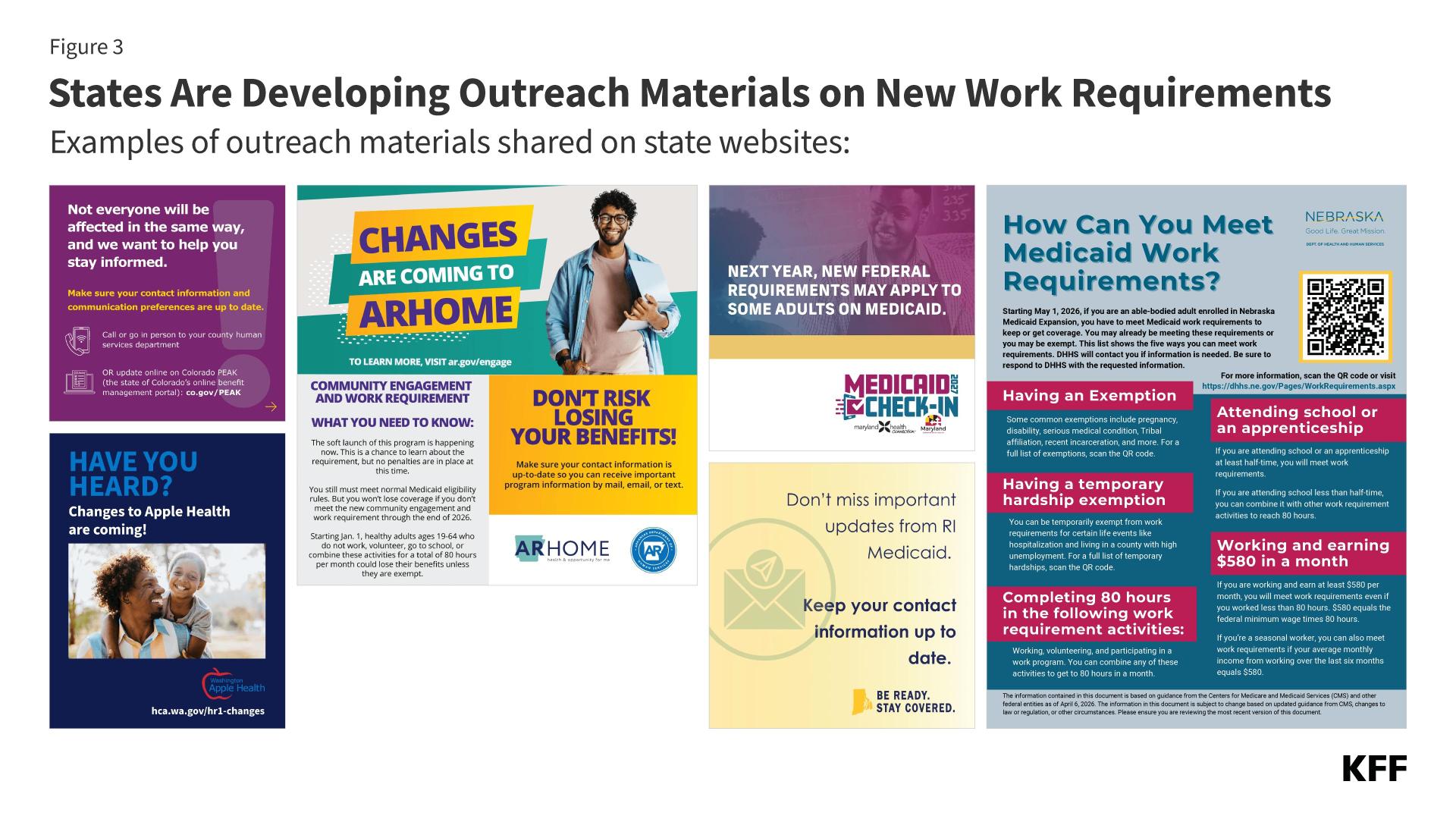
Many states are conducting webinars and developing toolkits for partners to learn more about how work requirements will be implemented, and how to help enrollees navigate the changes. At the time of MAC meetings, some webinars had already been conducted, while others were still being planned. States are also developing various resources with entities that serve Medicaid enrollees that they can share with enrollees. Resources include one-pagers, FAQs, social media graphics, flyers and posters for community spaces. For example,
- Illinois has launched a webinar series that includes different modules on eligibility changes from the 2025 reconciliation law, including modules on work requirements, exemptions from work requirements, common questions, and systems changes.
- Montana has conducted partner briefing webinars with education about work requirements, reminders of existing processes on change reporting and notices, and specific information on how community organizations and providers can assist enrollees. Montana sent a notice to providers in May inviting them to a webinar and sharing the Medicaid agency’s provider contact information.
- Maryland is conducting outreach for employers of Medicaid enrollees, highlighting that employers can play an important role in helping their employees access trusted information by directing employees to official updates and resources.
Some states have highlighted efforts to engage and collaborate with community partners and solicit feedback on implementation issues and outreach to enrollees. States have conducted workshops and working groups to gather feedback from trusted partners, particularly on what messaging works best for enrollees. For example:
- Utah convened a Community Partner Engagement Group to prepare advocates to help Utahns navigate eligibility changes. The group will develop co-branded outreach materials, synchronize messaging across agencies, and provide an escalation path for partners to resolve issues.
- Nevada is planning a public workshop to review the state’s communications plan.
The interim final rule allows states to utilize MCOs to assist with outreach and education. In particular, the rule describes how MCOs can help enrollees participate in work programs administered at American Job Centers, which count as hours for compliance with work requirements. MCOs may provide education to enrollees on how to prepare and collect documents for work program appointments and can coordinate with work programs to enable MCOs to follow up with enrollees.