
An Update on Medicaid, Title X and Planned Parenthood
Editorial Note: This brief expands and updates a prior KFF analysis on the impact of Title X and Medicaid funding on Planned Parenthood.
Planned Parenthood clinics comprise a substantial portion of the nation’s reproductive health safety net. In recent years, actions across multiple branches of government—including federal agencies, Congress, the courts, and state governments—have placed considerable financial pressure on the organization, with implications for patient access to care. This pressure has primarily focused on the two main sources of public funding for these clinics: the federal Title X family planning program and Medicaid. This brief focuses on the status of these efforts as they affect Planned Parenthood clinics since 2025.
A series of federal policy and judicial actions in 2025 significantly restricted funding streams for Planned Parenthood affiliates. In the spring of 2025, the federal Title X family planning program withheld grant payments to 144 Planned Parenthood sites in 20 states. On June 26, 2025, the Supreme Court issued its decision in Medina v. Planned Parenthood South Atlantic. The ruling allowed state Medicaid programs to disqualify Planned Parenthood clinics from their networks of participating providers. Shortly thereafter, on July 4, 2025, the One Big Beautiful Bill Act (OBBBA) was enacted, establishing a one-year prohibition on federal funding for Medicaid reimbursements to Planned Parenthood clinics for services provided to Medicaid enrollees in all states. Collectively, these policy shifts have resulted in notable funding losses and financial instability for these clinics, with implications for health care access for low-income individuals and Medicaid beneficiaries who rely on them for family planning and preventive services.
In response to federal Medicaid and Title X funding restrictions, at least eleven states have enacted legislative measures or relied on executive action to use state-only funds to mitigate financial losses for Planned Parenthood and other reproductive health safety net clinics. State strategies varied from covering full funding gaps on an ongoing basis to appropriating specific emergency grants and supplemental allocations. For instance, California has committed over $230 million in state funds and emergency grants to stabilize its extensive network of clinics, while other states like Maine, New Jersey, Oregon, Connecticut, Illinois, Massachusetts, and New Mexico have authorized targeted allocations ranging from $2 million to $8 million to offset lost federal Medicaid and delayed Title X funds. Additionally, states like Colorado, New York, and Washington have implemented statutory mechanisms or supplemental budget proposals to guarantee continued state-level reimbursement for prohibited entities with the goal of preserving patient access to family planning, contraception, cancer screenings, and Sexually Transmitted Infection (STI) services for low-income and Medicaid beneficiaries.
Eight Planned Parenthood grantees from Ohio, Northern and Southern New England, Utah, Virginia, North and South Carolina, and the Minnesota/Dakotas regions received the final year of Title X funding out of a five-year grant cycle in April of this year. However, a recently released FY27 Notice of Funding Opportunity for the next round of Title X Service Grants projects a change in programmatic priorities from contraceptive access and pregnancy prevention to fertility-awareness based methods and family formation, which could signal a shift in the types of entities funded by the Title X program. During the first Trump Administration, HHS not only revised the guidelines, they formally changed the Title X regulations so that clinics that offered abortion referrals or that had co-located abortion services were disqualified from participating in the program. Approximately one quarter of the Title X network, including over 400 Planned Parenthood clinics, across the country, stopped receiving Federal Title X support as a result of this policy. Many of the clinics later rejoined the Title X program after the Biden Administration reversed the Trump Administration regulations. While the Biden Administration regulations have not yet been rescinded by the current administration, it is still unknown whether the Trump Administration will change the Title X regulations to be similar to the first Trump Administration regulations that prohibited Title X funded clinics from having co-located abortion services and providing abortion referrals, but the new funding guidelines signal a shift in priorities.
Status of Planned Parenthood Network
The Title X program supports a network of approximately 4,000 clinics across the country to offer free or reduced cost family planning services to low-income and uninsured people. Nationally, 247 Planned Parenthood clinics in 29 states, half (50%) of Planned Parenthood clinics nationwide, currently participate in the Title X program (Figure 1). This is down slightly from the 297 Planned Parenthood clinics that participated in the program a year ago in 34 states and DC. California, Texas, and Ohio saw the biggest decreases in Planned Parenthood participation in the Title X program. Other Title X grantees also include Planned Parenthood sites in their network of clinics.
Since January 2025, 57 Planned Parenthood clinics across 20 states have closed or consolidated with other sites. It is not clear how many of these closures are due to the losses in Medicaid and Title X funding or mergers with other clinics, but these closures reflect a reduction in access points for reproductive health care.
Planned Parenthood and Medicaid
The Supreme Court’s Medina decision and the “One Big Beautiful Bill Act” that was signed into law in July 2025 both affect Planned Parenthood’s ability to serve and be reimbursed for care they provide to patients with Medicaid. It is still too soon to assess the direct impact of Medicaid and Title X actions on Planned Parenthood and the patients they serve, beyond clinic closure data. KFF has updated its previous analysis of Planned Parenthood family planning service provision, presented in an earlier brief, based on claims from the 2023 Transformed Medicaid Statistical Information System (T-MSIS) data, the newest data currently publicly available.
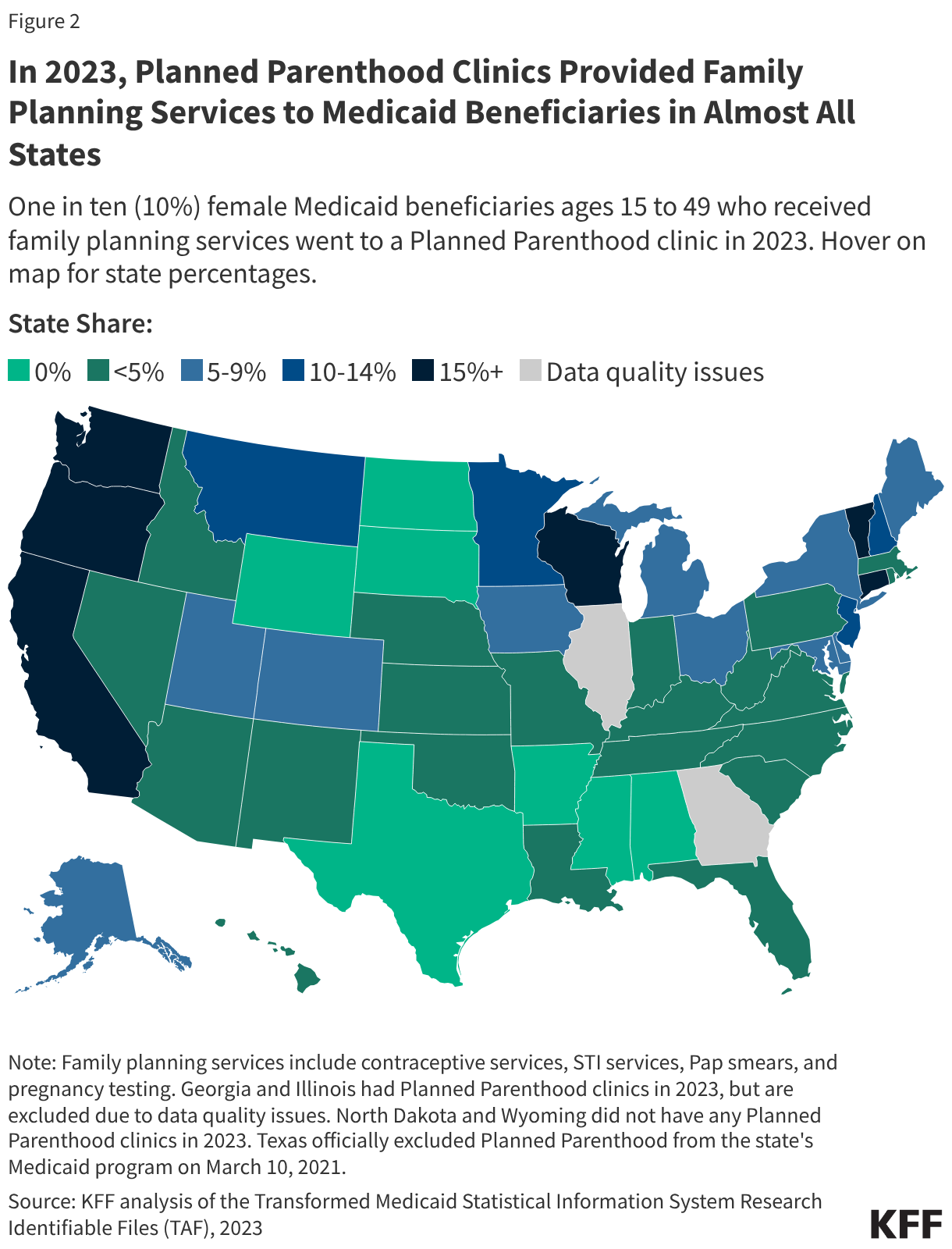
Nationally, one in ten (10%) reproductive age women covered by Medicaid who received family planning services got their care at a Planned Parenthood clinic, which is similar to the 11% in 2021 (Figure 2). All state Medicaid programs are required to cover family planning services, which include contraception, STI services, Pap smears, and pelvic and breast exams free of cost-sharing to all their beneficiaries. The share of Medicaid beneficiaries using family planning services who rely on Planned Parenthood varies considerably by state, ranging from three in ten women with Medicaid in California (29%), to no women in North Dakota and Wyoming where Planned Parenthood does not have a presence.
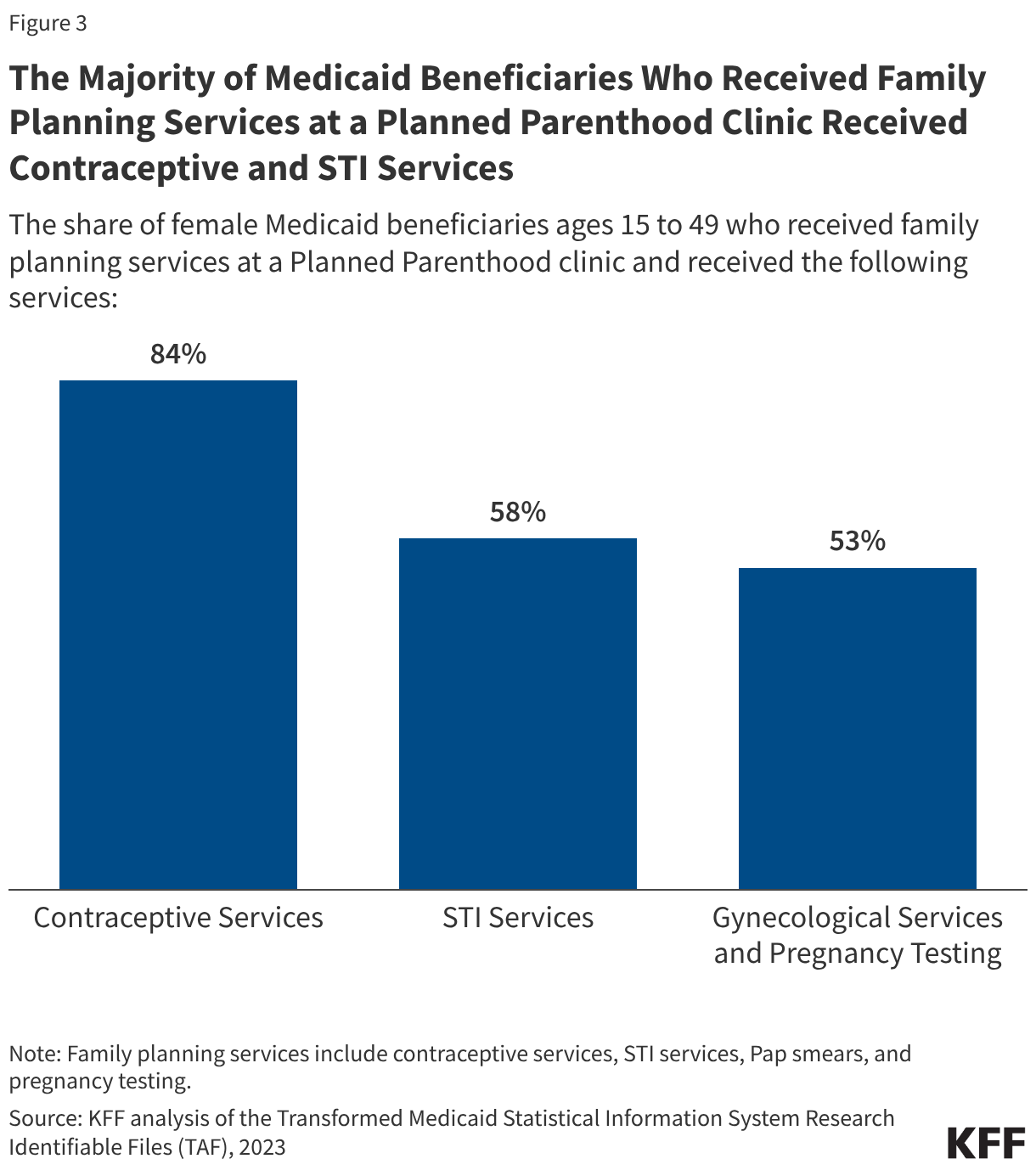
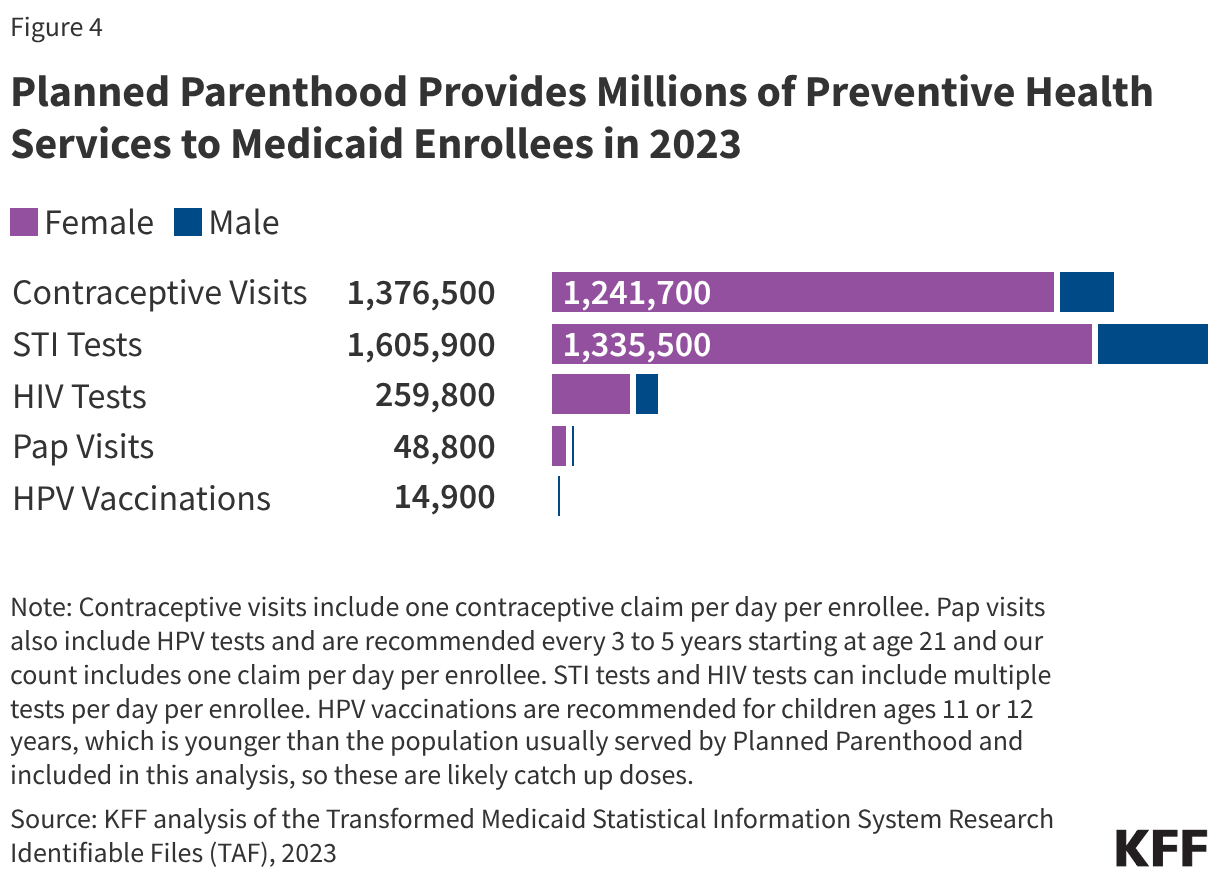
According to Planned Parenthood’s data, the majority of people go to Planned Parenthood clinics for contraceptive services, STI testing, pregnancy testing, and gynecological services. KFF analysis of national Medicaid claims finds that eight in ten female Medicaid beneficiaries ages 15 to 49 who got family planning care at a Planned Parenthood clinic in 2023 received contraceptive services and over half received STI services (Figure 3). More than half also got gynecological services like a Pap smear, HPV screening, or a pregnancy test. Many people receive multiple family planning services throughout a year, and Figure 4 shows the breadth of services provided to female and male Medicaid enrollees.
Looking Ahead
The federal Medicaid funding ban for Planned Parenthood in the OBBBA is set to expire on July 4, 2026, but there have been discussions and proposals to attempt to extend it on Capitol Hill. While both the House and Senate 2026 Budget Resolutions do not extend the 2025 funding ban, continuing the ban is potentially on the table if Congress pursues a third budget reconciliation bill. In the absence of the funding ban, it is likely that some of the states that have attempted to restrict Medicaid funding to Planned Parenthood could exclude clinics from their Medicaid programs in light of the Supreme Court’s ruling on Medina v. Planned Parenthood South Atlantic. Finally, for the second year in a row, the president’s budget for 2027 does not include funding for the Title X program. While Congress is unlikely to approve all of the president’s budget proposals, funding for Title X and Planned Parenthood could become an issue in budget deliberations.
Methods
Data: This analysis used the 2023 Release 1 T-MSIS Research Identifiable Files, specifically the other services (OT) claims files merged with the demographic-eligibility (DE) files.
Identifying Planned Parenthood Providers: To identify family planning services provided at a Planned Parenthood clinic the NPPES NPI Registry was used to search for Planned Parenthood and PPFA in the Organization Name field to create a list of Planned Parenthood organization NPIs.
Identifying Family Planning Services: Diagnosis and procedure codes in the other services header and line claims files were used to identify the following family planning services: contraceptive services, STI services, gynecological services including Pap smear and HPV testing, as well as pregnancy testing. A family planning diagnosis was required for inclusion. A list of diagnosis and procedure codes is available upon request.
State exclusion criteria: GA and IL were excluded due to data quality concerns. GA had unusable Billing Provider NPI data according to the DQATLAS. There were no Planned Parenthood providers identified in IL despite their extensive network of Planned Parenthood clinics, which leads us to believe there is an issue with the Billing Provider NPI. It appears that the Servicing Provider NPI is copied onto the Billing Provider NPI field in IL, making Billing Provider NPI unusable.