Assessing Ability to Work: How Historical SNAP Processes May Vary from Medicaid
The Supplemental Nutrition Assistance Program (SNAP), which is the primary federal aid program addressing food insecurity among low-income households, has long included work requirements as a condition for participation for certain individuals. Starting January 1, 2027, or sooner at state option, 44 states will also be required to condition Medicaid eligibility for adults in the Affordable Care Act (ACA) Medicaid expansion group and enrollees in certain waiver programs on meeting work requirements. The law specifies mandatory exclusions from these requirements, including for individuals who are “medically frail,” if they have both a qualifying condition and demonstrate that the condition impairs their ability to fulfill the work requirements. CMS recently released information on an approach states can use to verify medical frailty exclusions; however, states are not required to adopt this approach, and it remains unclear what processes states will use.
In light of the uncertainty surrounding how states will verify the Medicaid medical frailty exclusion, this issue brief describes how SNAP has handled similar administrative challenges. Similar to the Medicaid medical frailty exclusion, individuals who are deemed unable to work due to a physical or mental limitation are exempted from SNAP work requirements. Approaches to verifying ability to work vary among state SNAP agencies but may be changing in response to provisions in the reconciliation law that require states to pay a portion of SNAP benefit costs based on the state’s SNAP payment error rate. While the SNAP program can offer some insights for the Medicaid program, differences in how eligibility is determined between the programs mean Medicaid verification processes are likely to differ from SNAP processes in some key ways.
How have states historically determined ability to work for the SNAP program?
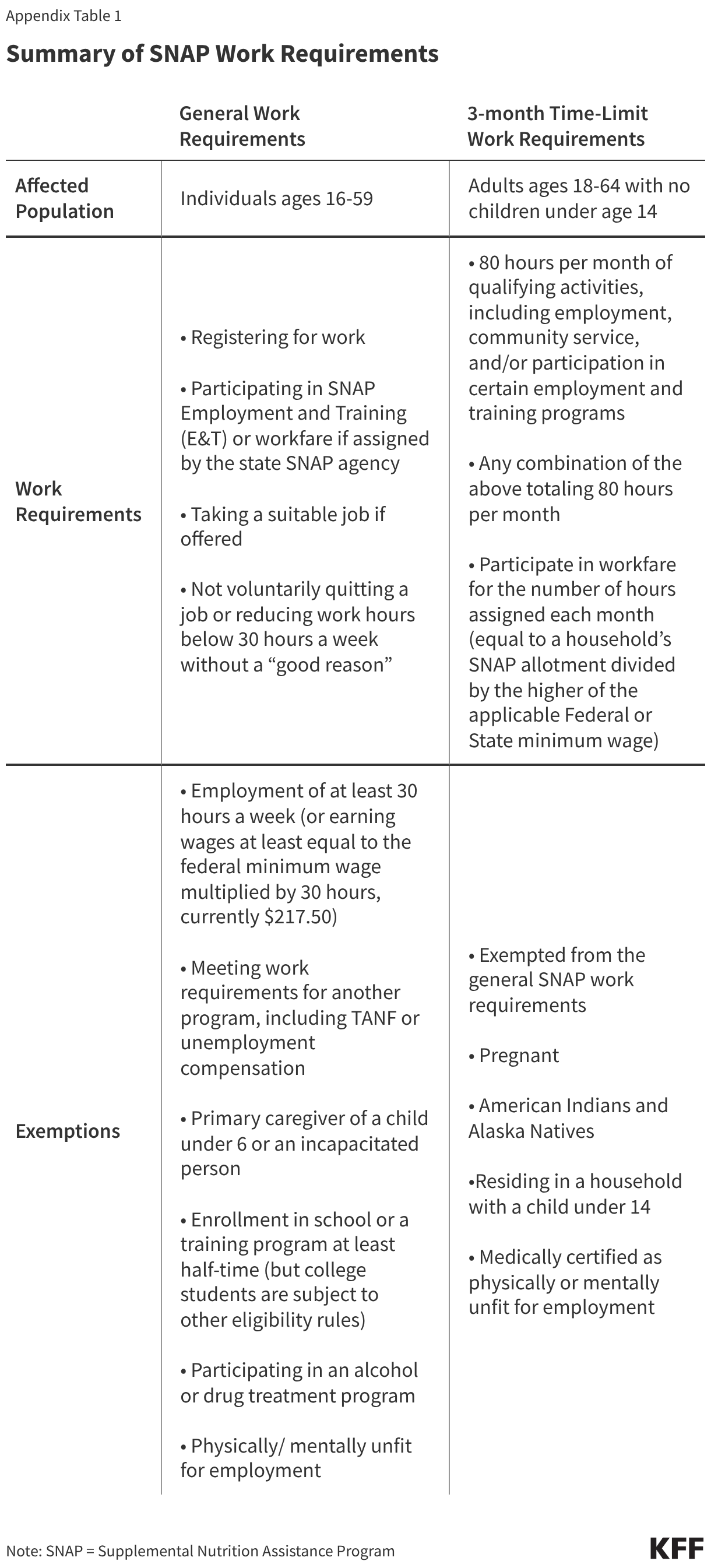
States have flexibility in how they define the exemption for individuals who are deemed “physically or mentally unfit for employment.” Most adults under age 65 on SNAP must meet general work requirements (which include registering for work, taking a suitable job if offered, participating in SNAP Employment and Training (E&T) or workfare if assigned by the state SNAP agency, and not voluntarily quitting a job or reducing work hours below 30 hours a week without a “good reason”). In addition, “time-limited” work requirements apply to certain individuals who do not qualify for an exemption, meaning they must work or participate in a work program for at least 80 hours per month or participate for an assigned number of hours in workfare to receive SNAP benefits for more than three months in a 36-month period (Appendix Table 1).
Federal regulations leave it to state agencies to define physical and mental fitness and establish procedures for verifying the SNAP general work requirement exemption. Rules on time-limited work requirements are only slightly more specific, clarifying an individual is exempt if they:
- “are receiving temporary or permanent disability benefits issued by governmental or private sources;
- are obviously mentally or physically unfit for employment as determined by the State agency; or
- if the unfitness is not obvious, provide a statement from a physician, physician’s assistant, nurse, nurse practitioner, designated representative of the physician’s office, a licensed or certified psychologist, a social worker, or any other medical personnel the State agency determines appropriate, that they are physically or mentally unfit for employment.”
Because of this discretion, definitions vary across states, and some states have more expansive definitions of “physical or mental limitations,” including, for example, people who are chronically homeless, or survivors of domestic violence when these circumstances negatively impact their physical or mental condition. States must exempt individuals for receipt of any temporary or permanent disability, including Supplemental Security Insurance (SSI), Worker’s Compensation, Veteran’s Affairs, Railroad Retirement, Developmental Disability services, or other private sources, though they may vary in how the state documents and verifies the information.
A mandatory component of the SNAP application and recertification process is a phone or in-person interview with an eligibility worker who screens enrollees for exemptions. As of 2023, most states report first screening for physical or mental limitations on the application, while some first ask about limitations in the interview conducted by an eligibility worker that is required prior to SNAP certification. Over half of state agencies also reported allowing staff discretion over the types of physical or mental limitations that could be considered for exemptions. For example, visual observations made by eligibility workers during interviews (e.g., noting an individual is using an oxygen tank) could be used as a basis for exemption determination.
When determining someone is “obviously unfit,” some states always require documentation of an individual’s physical or mental limitations, while many states accept client statements or only require verification when deemed necessary by the eligibility worker. States that do not always require documentation may specify that client statements are acceptable verification unless eligibility workers find the client’s situation unclear or questionable. An evaluation of SNAP work requirement exemption processes reported that some eligibility workers felt that requiring documentation could reduce staff burden and their personal responsibility in making determinations by increasing consistency and reducing the subjectivity of eligibility worker determinations. However, regularly requiring documentation would also likely increase the administrative burden for enrollees, providers, and eligibility workers (who need to process the documentation and sometimes request additional clarification). Individuals are reevaluated for whether they meet an exemption at recertification every six to twelve months, and the same evaluation found that information collected at recertification usually does not differ from information collected at application.
When unfitness to work is not “obvious” to eligibility workers, states must obtain a statement from a medical professional to verify exemption status, though state procedures for collecting provider attestation vary. As noted above, some states go further, requiring documentation (such as a form from a provider) for every individual seeking an exemption. The information requested from providers to document an exemption varies. For example:
- Wisconsin’s form asks providers only to attest that someone is unfit, with no requirement to provide details on the specific condition.
- Pennsylvania’s form asks providers to attest that someone is unfit and to list the condition an individual has that contributes to this determination.
- Maryland’s form asks providers to indicate whether an individual is unable to do specific activities, such as sitting, standing, or walking for extended lengths of time.
- Vermont’s form asks providers to list the condition that limits the individual’s ability to work and to provide a time estimate of how long this condition is expected to last.
States may also accept other forms of provider documentation, such as a written statement or a phone call to an eligibility worker. Providers are not usually given detailed guidance about how to assess fitness for work, so their determinations of who may qualify for an exemption likely vary.
States may choose to make changes to their SNAP verification processes in response to a new mandate from the reconciliation law that most states pay a portion of SNAP benefit costs based on their payment error rate (PER). Beginning in October 2027, the reconciliation law requires states to pay a portion of SNAP benefit costs if the state’s PER (a measure of over- and underpayments that are primarily administrative errors, not fraud) is above 6%, with the share of the costs increasing as the error rate increases up to a cap. Prior to the new requirements, state SNAP verification processes reflected different state choices for how to balance documentation requirements to promote program integrity and avoid fiscal penalties based on the state’s PER against the administrative burden additional documentation may create for individuals; states may rebalance these considerations in light of new, much larger financial costs tied to states’ PERs. For example, to avoid errors and associated penalties, Arizona recently began requiring additional documentation of information where the state previously had accepted client statements unless it was deemed questionable.
How may the Medicaid process compare to SNAP?
In contrast to the SNAP process, the Medicaid process for verifying individuals who qualify for the medical frailty exclusion will require states to use available data before requesting documentation from individuals or providers. Medicaid has access to claims data that SNAP does not. The interim final rule released in June instructs states to use claims and encounter data from the preceding 12 months to attempt to verify medical frailty status automatically before requesting information from the individual. CMS recently released additional information outlining a tiered medical frailty framework that would enable states to identify individuals as medically frail using claims data alone (tier 1), using claims data in combination with encounter or other data (tier 2), or, in cases where states have no or insufficient data on file, using an individualized manual process that requires additional documentation (tier 3). While this tiered approach will enable some individuals to be verified as medically frail using data alone, not all medical frailty determinations can be automated. Data limitations, such as lack of data on file for new applicants and recent enrollees, or providers not consistently coding conditions or not using codes identified by the state, mean that states will need additional documentation for some individuals.
Similar to SNAP, states will rely on providers to verify individuals’ ability to work and Medicaid medical frailty status, particularly in situations where claims or other data are not available. Because Medicaid does not allow interviews, eligibility workers will play a less pronounced role in the Medicaid verification process, though in states with jointly administered SNAP and Medicaid programs or with data sharing between the programs, Medicaid may be able to use some information collected through SNAP interviews and verification processes. When unable to verify medical frailty status using available data, states may need to rely on confirmation from treating providers to verify medical frailty conditions and ability to participate in community engagement activities. The interim final rule currently offers little detail on what information states need to collect from providers. Absent additional guidance, states will likely develop different forms and collect different information, similar to the variation seen in SNAP. States may also use the same form to collect information from providers for the Medicaid and SNAP exemptions; North Carolina, for example, has created a provider attestation form that can be used to determine eligibility for Medicaid or SNAP. As noted above with SNAP, relying on providers to determine whether an individual is able to work without guidance can lead to variation and inconsistency in assessments.
Starting January 2028, states’ ability to accept self-attestation in Medicaid will be more limited than is the case for SNAP. While states vary in how they use client statements in establishing unfitness for work for SNAP, federal rules require them to seek additional verification if that information is questionable; however, federal rules do not limit states’ ability to accept client statements altogether. In contrast, the Medicaid rule limits reliance on self-attestation starting in January 2028. The rule allows states to accept self-attestation throughout 2027 in cases where there is no reliable information available to the state. However, starting January 1, 2028, states may only accept self-attestation of medical frailty status one time during an individual’s enrollment period. States would then be expected to verify medical frailty using available data or require documentation or other information from individuals for future renewals, which may require a more time-consuming verification process. Prior to the publication of the interim final rule, most states had expressed interest in using self-attestation as a verification source for the medical frailty exclusion.
State Medicaid medical frailty verification policies will likely differ, and state decisions may be affected by threats of financial penalties. With limited federal guidance, states will adopt different approaches to operationalize the medical frailty exclusions. The Medicaid rule indicates that states would be considered noncompliant with the regulation if audits show frequent approval of individuals as medically frail with insufficient support that the condition impacts their ability to work. With the potential for audits, states may struggle to operationalize the medical frailty exclusion in a way that protects them from financial penalty and minimizes administrative burden, without denying coverage to individuals who should qualify for the exclusion. States are also implementing these complex Medicaid eligibility and enrollment policy changes at the same time that they need to prepare for changes to the payment error rate measurement (PERM) program that will increase financial consequences of eligibility error rates above 3%. These PERM changes may influence how states balance the need to mitigate financial risk against the administrative burden of increased documentation for all Medicaid eligibility determinations.