The Trump Administration’s Foreign Aid Review: Status of the President’s Malaria Initiative (PMI)

Published: Oct 16, 2025

Starting on the first day of his second term, President Trump issued several executive actions that have fundamentally changed foreign assistance. These included: an executive order which called for a 90-day review of foreign aid; a subsequent “stop-work order” that froze all payments and services for work already underway; the dissolution of USAID, including the reduction of most staff and contractors; and the cancellation of most foreign assistance awards. Although a waiver to allow life-saving humanitarian assistance was issued, it has been limited to certain services only and difficult for program implementers to obtain. In addition, while there have been several legal challenges to these actions, there has been limited legal remedy to date. As a result, U.S. global health programs have been disrupted and, in some cases, ended. Changes to the Department of Health and Human Services, including proposed cuts and reorganization, are also likely to affect these programs. This fact sheet is part of a series on the status of U.S. global health programs.

Background on PMI

  • The U.S. government has been involved in global malaria activities since the 1950s. In 2005, the President’s Malaria Initiative (PMI) was launched to scale up efforts to address malaria in the hardest hit African countries.
  • Malaria is a life-threatening disease spread to humans by mosquitoes. There are approximately 263 million malaria cases and 600,000 deaths each year; the majority of deaths are among children under age five.
  • PMI is credited with helping to save 11.7 million lives and prevent 2.1 billion malaria cases since 2000. Indeed, since 2006, in countries where PMI works, global efforts have supported a 29% decrease in malaria case rates and a 48% decline in deaths. The introduction of two malaria vaccines in 2021 and 2023 has increased optimism in the potential to further strengthen global malaria control.
  • U.S. malaria assistance bolsters national economies in countries and communities most heavily affected by the disease. A recent analysis found that every dollar of U.S. malaria assistance increased GDP in recipient countries nearly six-fold.
  • The FY 2025 Continuing Resolution that passed in March included level funding for PMI and other malaria activities at USAID and CDC of $805 million (as well as level funding for the Global Fund to Fight AIDS, Tuberculosis and Malaria). The U.S. has been the top donor government to malaria efforts, through PMI and contributions to the Global Fund. The administration’s FY 2026 budget request includes $424 million for malaria, a decrease of $381 million (final appropriation levels are determined by Congress).
  • Overseen by a U.S. Global Malaria Coordinator, a position created by Congress in 2008 to be appointed by the President and based at USAID (now dissolved), PMI had been an interagency initiative led by USAID in partnership with CDC, focused in 30 countries that account for 90% of the world’s malaria cases and deaths.

Current Status of PMI

The following administration actions have had a significant impact on PMI operations:

  • Funding freeze/stop-work order: The stop-work order initially froze all PMI programming and services, halting existing PMI activities, including bed net provision, residual spraying and delivery of antimalarial medicines. Because the order halted payments, many implementers had to let go of thousands of staff and end some services.
  • Limited waiver: Malaria programs received a limited waiver on February 4 allowing “life-saving services” to continue, including those that “must resume within 30 days to ensure malaria diagnosis and treatment, as well as prevention through distribution of nets and indoor residual spraying targeting highest burden areas…and lifesaving malaria medicines for pregnant women and children”. Even with the waiver, services remain disrupted and implementers faced challenges in getting permission to resume programming and difficulties in getting paid.
  • Dissolution of USAID: USAID was the main government implementing agency for malaria efforts, obligating almost all bilateral malaria assistance in FY 2023 (96%). Without USAID and most of its staff, PMI’s implementation capacity has been affected. In addition, announcements of reductions at CDC could further affect global malaria efforts.
  • Canceled awards: In early 2025 it was reported that the administration canceled 86% of all USAID awards. KFF analysis found that of the 770 global health awards identified, 157 included malaria activities, 80% of which were terminated.
  • Legal actions: In response to two lawsuits filed against the administration’s actions, a federal judge issued a preliminary injunction ordering the government to pay for work completed by February 13, 2025, although not all payments have been made and the court has not stopped the government from canceling awards. On August 13, the U.S. Court of Appeals for the D.C. Circuit overturned the district judge’s preliminary injunction, ruling that plaintiffs lacked legal standing to challenge the administration’s termination of funding. While a District Court subsequently found that the plaintiffs could seek relief through another legal avenue and granted a preliminary injunction ordering the government to obligate expiring funds, the Supreme Court ultimately ruled that the government could withhold these funds.
  • Reorganization: The administration notified Congress on March 28, 2025 of its intent to permanently dissolve USAID and move remaining USAID operations to the State Department, with remaining global health activities to be integrated into its Bureau of Global Health Security and Diplomacy (GHSD) which oversees PEPFAR. On May 29, 2025, the State Department further notified Congress of its proposed reorganization plan and programs moved in July.
  • New Global Health Strategy: In September 2025, the administration released the America First Global Health Strategy. Per the new strategy, the U.S. will:
    • Negotiate bilateral, multi-year agreements with countries receiving U.S. assistance, with implementation and monitoring plans in place by March 31, 2026. Agreements will include co-investment by countries and aim to transition the majority of countries to full self-reliance by the end of the agreement period;
    • Provide 100% of current levels of funding for malaria control commodities ([insecticide-treated bednets, malaria diagnostic tests, anti-malarial medications and malaria vaccines) and frontline healthcare workers through FY 2026 and reduced funding thereafter;
    • Rapidly reduce funding for activities other than health commodities and frontline health personnel.

Impact on PMI Services and Outcomes

  • An internal USAID memo estimated that an additional 12.5-17.9 million malaria cases and an additional 71,000-166,000 deaths could occur annually if PMI was halted permanently.
  • A rapid assessment survey of 108 WHO country offices found that of the 64 malaria-endemic countries surveyed, more than half reported moderate or severe disruptions to malaria services, including for medicines and health products, due to the U.S. foreign aid freeze and other shortages.
  • In early April 2025, almost 30% of planned insecticide treated net (ITN) distribution campaigns were off-track or at risk of being delayed due to funding shortages, and such risks continue today. Several countries also face stock-out risks for key commodities including for rapid diagnostic tests (RDTs) and artemisinin-based combination therapy (ACT). Reductions in funding also threaten investments in new and improved malaria prevention, diagnostic, and treatment interventions.
  • Such disruptions pose significant risks, particularly during peak malaria seasons across Africa where seasonal malaria campaigns are needed to protect millions of people. In a court filing challenging the funding freeze, for example, a major U.S. implementer reported that it had already had to delay the start of anti-malarial campaigns in Africa.

What to Watch

  • Leadership: A U.S. Malaria Coordinator has not yet been appointed, and it is unclear, given the dissolution of USAID, what the leadership structure will be going forward.
  • Reorganization: The dissolution of USAID and integration of any remaining USAID global health activities, including for malaria, into GHSD raises several questions, including whether additional capacities will be provided to allow for the management and implementation of PMI at the State Department.
  • Funding/Budget Request: The administration’s FY 2026 budget request includes significant reductions in funding for global health, including a $381 million reduction for malaria (final appropriation amounts will be determined by Congress). The administration also submitted its first rescission package to Congress in June, including proposed rescissions of more than $1 billion in funding for global health. Congress reduced that amount to $500 million and exempted some program areas, including malaria, from the rescission.
  • New Global Health Strategy: Over the next few months, it is expected that the administration will develop bilateral agreements with countries and plans to scale down funding, including for malaria-related activities, the details of which will significantly shape the future of the global malaria response.

The Trump Administration’s Foreign Aid Review: Status of Global Health Security/Pandemic Preparedness

Published: Oct 16, 2025

Starting on the first day of his second term, President Trump issued several executive actions that have fundamentally changed foreign assistance. These included: an executive order which called for a 90-day review of foreign aid; a subsequent “stop-work order” that froze all payments and services for work already underway; the dissolution of USAID, including the reduction of most staff and contractors; and the cancellation of most foreign assistance awards. Although a waiver to allow life-saving humanitarian assistance was issued, it has been limited to certain services only and difficult for program implementers to obtain. In addition, while there have been several legal challenges to these actions, there has been limited legal remedy to date. As a result, U.S. global health programs have been disrupted and, in some cases, ended. Changes to the Department of Health and Human Services, including proposed cuts and reorganization, are also likely to affect these programs. This fact sheet is part of a series on the status of U.S. global health programs.

Background on U.S. Global Health Security Efforts

  • The U.S. has supported global health security (GHS) and pandemic preparedness efforts for decades through funding and technical support provided to low- and middle-income countries (as well as support for multilateral efforts). This has included the development of formal GHS partnerships with other countries, starting with 17 in 2014 and rising to more than 50 in 2024, with programs focused in particular in countries at risk for emerging diseases.
  • GHS efforts are designed to help countries and regions build capacities needed to prevent avoidable outbreaks, detect infectious disease threats early, and reduce the impacts of epidemics and pandemics through rapid and effective responses.
  • Specific activities include: improving surveillance and laboratory systems, reducing the risks of animal to human disease exposures, training epidemiologists, and fostering better biosafety and biosecurity practices.
  • Multiple U.S. agencies, coordinated by the National Security Council (NSC), have been involved in these efforts including USAID (now dissolved), CDC, the Department of Defense (DoD), the State Department, HHS, and USDA. The first U.S. GHS Strategy, providing overall guidance across the government, was released by the first Trump administration. The Biden administration released an updated Strategy in 2024.
  • The FY 2025 Continuing Resolution passed in March included level funding of $993 million for GHS programs at USAID and CDC. At times, Congress has provided additional, time-limited emergency funding when outbreaks occur, such as for Ebola in 2014-2015, Zika in 2016, and COVID-19 starting in 2020. The administration’s FY 2026 budget request includes $493.2 million for GHS, a decrease of $500 million (final appropriation levels are determined by Congress).
  • U.S. investments in GHS have led to measurable increases in capacity, including improvement in 9 of 15 technical areas between 2018 and 2023 in GHS partnership countries and reductions in average outbreak response times.

Current Status of U.S. Global Health Security Programs

The following administration actions have had a significant impact on U.S. GHS programs:

  • Funding freeze/stop-work order: The stop-work order initially froze all USAID-based GHS programming and services. As a result, many GHS implementing partners let staff go and some USAID-supported GHS activities in progress were interrupted, such as funding for transport of samples and phone plans for contact tracers.
  • Limited waiver: Some GHS activities were included in a limited waiver issued by the State Department on February 4 allowing “life-saving services” to continue, including: rapid emergency response to immediate infectious disease outbreaks, focused on pathogens with pandemic potential and those that pose a national security risk to U.S. citizens (e.g., mpox and H5N1), including detection, prevention, and containment and supply of medical countermeasures. Even with the waiver, services remain disrupted and implementers faced challenges in getting permission to resume programming and difficulties in getting paid.
  • Dissolution of USAID: Earlier this year, USAID had about 50 staff supporting international outbreak response efforts, a number which dropped to six in the early weeks of the Trump administration (current levels are unknown). As a result, many GHS partners have lost points of contact and technical support, in addition to the loss of funding. Announcements of reductions at the CDC could further affect GHS capacity.
  • DoD GHS programs may also be targeted for cuts, with potentially up to 75% of staff to be let go.
  • Reorganization: The administration notified Congress on March 28, 2025 of its intent to permanently dissolve USAID and that any remaining USAID operations would be absorbed by the State Department with remaining global health activities (including GHS work) to be integrated into its Bureau of Global Health Security and Diplomacy (GHSD). On May 29, 2025, the State Department further notified Congress of its proposed reorganization plan, and programs transitioned in July.
  • GHS Strategy: The administration has withdrawn the GHS strategy, stating that it would be replaced, although no timeline has been provided. This has raised questions about coordination across the government, particularly in the event of a major threat and given the reorganization and reduction of global health programs already underway.
  • New Global Health Strategy: In September 2025, the administration released the America First Global Health Strategy. It includes “making America safer” as one of its pillars, marking the first outline of its plans for GHS going forward. Per the new strategy, the U.S. will aim to:
    • Enable detection of an outbreak with epidemic potential within seven days, through strengthened surveillance, data sharing and laboratory capacity, and will assign U.S. health staff to U.S. missions;
    • Contain outbreaks originating outside the U.S. rapidly at their source, prioritizing mobilization within 72 hours of detection, support to field epidemiological staff, essential commodities, and, if needed, travel restrictions.

Impact on GHS Services and Outcomes

  • The combination of administration actions described above has reduced capacity and may challenge communication and coordination across U.S. agencies and with partners, contributing to slower responses to emerging health threats, greater impacts, and increased risk of importation of diseases into the U.S.
  • Experts estimate that there is a 50% chance of another pandemic emerging in the next 25 years, with the risk greatest in the least prepared countries. 
  • The health impacts of poorly controlled outbreaks can be severe. An internal USAID memo reported that the risk of losing USAID GHS programs alone could result in more than 28,000 new cases of dangerous infectious diseases, such as Ebola and Marburg, every year.
  • Emerging diseases can result in major economic and social costs, even with small-scale outbreaks.
    • The SARS 2003 outbreak led to an estimated $30 billion in economic losses (over $3 million per case) from reduced commerce, travel and trade.
    • The 2014-2015 West Africa Ebola epidemic led to an estimated $53 billion in economic losses. A single Ebola patient in New York cost the city’s $4.3 million in response measures.
    • Measles outbreaks in the U.S., often initiated through importation from other countries, can lead to significant costs; a recent study from Washington state found that a 71-case measles outbreak led to societal costs of $3.4 million, or almost $50,000 per case.
  • Pandemics have even more massive economic costs, as experienced with COVID-19, which cost the U.S. alone an estimated at $16 trillion – a number four times the lost economic output from the 2008 financial crisis.

What to Watch

  • Reorganization: The dissolution of USAID and integration of remaining USAID global health activities, including GHS, into GHSD raises questions about how activities will be integrated with existing GHSD functions and whether new capacities will be needed. GHSD has historically focused on coordination and diplomatic roles rather than the in-country implementation roles that USAID and CDC led on.
  • Funding/Budget Request: The administration’s FY 2026 budget request includes significant reductions in funding for global health, including a $500 million reduction for GHS (final appropriation amounts will be determined by Congress). The administration also submitted its first rescission package to Congress, including proposed rescissions of more than $1 billion in FY 2025 funding for global health. Congress voted to amend the package, reducing that amount to $500 million and exempting some program areas from the rescission, although global health security was not listed among those program areas.
  • New Global Health Strategy: Over the next few months, it is expected that the administration will develop more specific plans for its GHS work at the State Department, including with countries, which will provide more details on the future of this work.

Medicaid and Children’s Health: 5 Issues to Watch Amid Recent Federal Changes

Published: Oct 15, 2025

The uninsured rate, supplemental poverty rate, and food insecurity for children have all increased since the expiration of pandemic-era fiscal relief, and high household costs, including health care costs, are putting pressure on family budgets. After increasing during the pandemic, overall federal spending on children as a share of the economy (or GDP) has declined and is projected to continue to decline further over the next 10 years. At the same time, over the last decade, rates of chronic conditions among children, including obesity and mental health concerns, have increased. At the same time, children’s routine vaccination rates are declining, and many states are contending with measles outbreaks. Recent federal changes (Box 1), including the recently passed reconciliation law, administrative actions by the Centers for Medicare & Medicaid Services (CMS), and other broader Trump administration changes, could have further implications for children and their health and well-being. Nearly four in 10 children in the U.S. are covered by Medicaid, making the program (and changes to the program) particularly relevant to broader children’s health trends. This issue brief explores the latest data on Medicaid and children’s health and highlights five key issues to watch as federal changes are implemented (Figure 1).

Figure 1

Medicaid and Children's Health:
5 Issues to Watch Amid Recent Federal Changes

Box 1: Major Federal Changes that Could Impact Children’s Health

2025 Federal Budget Reconciliation Law (H.R. 1): The reconciliation law, passed on July 4, 2025, includes significant health care policy changes. While many of the provisions in the new law do not directly target children, changes could have implications for children’s coverage and access to health services:

  • Coverage losses: The Congressional Budget Office (CBO) projected that H.R. 1 will increase the number of uninsured people by 10 million over the next decade (or by more than 14 million if combined with the expiration of the Affordable Care Act’s (ACA) enhanced premium tax credits).  It is unclear how many of the newly uninsured are projected to be children. However, loss of Medicaid coverage among parents (from increased renewals or work requirements) could impact children’s coverage as research has shown that increasing coverage for parents increases children’s coverage.
  • Federal spending cuts: H.R. 1 is expected to reduce federal Medicaid spending by $911 billion over the next decade, though the impact of the reductions will vary across states. In response to some financing changes, states may reduce provider rates which could have implications for access to care for enrollees including children. The new law also reduces federal Supplemental Nutrition Assistance Program (SNAP) spending by $187 billion, which could result in an estimated 1 million children with reduced or eliminated food assistance. While the reconciliation law did make modest increases to some child care tax benefits, including the Child Tax Credit, the CBO expects the reconciliation provisions, taken together, will redistribute wealth from the lowest income families to the highest incomes, largely due to Medicaid and SNAP cuts.

CMS Administrative Actions:  Among other waiver changes, CMS has restricted Medicaid waivers for multi-year continuous eligibility for Medicaid and Children’s Health Insurance Program (CHIP) children, a policy currently adopted by 12 states to eliminate gaps in coverage for children during early childhood. In addition, through both the reconciliation law and executive action, the Trump administration has limited immigrant eligibility for federal public benefits, which could reduce access to health care for immigrant children and their families.

Broader Trump Administration Changes: The Make America Healthy Again (MAHA) commission, led by HHS Secretary Robert F. Kennedy (RFK) Jr., has sought to shed light on recent trends and identify recommendations to improve children’s health. The latest MAHA strategy report includes proposals to address children’s “poor diet”, “chemical exposure”, “lack of physical activity and chronic stress”, and “overmedicalization”, though implementation details remain unclear. Secretary Kennedy has also led recent efforts to re-examine the federal childhood vaccine schedule, replace the committee that creates childhood vaccine recommendations, and restrict access to COVID-19 vaccines and mRNA vaccine research. 

The Trump Administration has also laid off staff across governmental agencies, including at the Department of Human Services (HHS) and the Department of Education (DOE), and reduced support for state and local health departments. At DOE in particular, over half of the staff has been cut, including the office responsible for special education. Grant funding for schools has also been delayed, including funds to support and expand school-based mental health services.

Lastly, tariffs implemented by the Trump Administration are expected to drive up costs for families (including health care costs).

1. Health Insurance Coverage

The uninsured rate for children has declined over time but has increased in the past two years. The uninsured rate for children has declined from 10.4% in 2008 to 6.0% in 2024 (Figure 2), largely due to policies at the state and federal level that expanded and streamlined Medicaid coverage, including the ACA Medicaid expansion. The children’s uninsured rate fell to an all-time low in 2016 (4.7%) before ticking up during the first Trump administration, when generally favorable economic conditions as well as Trump administration policy changes led to declines in Medicaid enrollment. The children’s uninsured rate declined again following the onset of the COVID-19 pandemic, but did increase slightly from 5.1% in 2022 to 5.3% in 2023 (a statistically significant increase of 0.2%), driven by a decline in Medicaid coverage as children lost coverage due to the unwinding of the Medicaid continuous enrollment provision, a pandemic-era policy. These trends continued in 2024, and recent federal changes could further reduce children’s Medicaid coverage and increase the number of children who are uninsured in the coming years.

The Uninsured Rate for Children Has Declined Over Time but Has Increased in the Past Two Years

2. Variation in Coverage Across States

The share of children covered by Medicaid varies substantially by state. Overall, Medicaid covers nearly 4 in 10 children in the U.S., but the share of children covered by Medicaid in each state varies, ranging from under 20% in Utah to over 60% in New Mexico (Figure 3). Seven states (Alabama, Kentucky, Oklahoma, Arkansas, Mississippi, Louisiana, and New Mexico) have over 45% of children enrolled in Medicaid. Medicaid also finances about 4 in 10 births nationally and over half of births in four states (Louisiana, Mississippi, New Mexico, Oklahoma). The program plays a particularly large role in rural areas, paying for nearly half of all births in rural communities and helping to shore up financing for hospitals in rural areas suffering from provider shortages. Research also shows that Medicaid enrollment in childhood can lead to better health outcomes throughout life, increase earnings in adulthood, and potentially reduce future federal spending. A number of states have expanded access to Medicaid and CHIP coverage for children since the pandemic began, but recent federal efforts could reverse this trend. The magnitude of Medicaid budget cuts stemming from the reconciliation law and the extent to which children may be impacted will vary across states, depending on state characteristics as well as how states implement and respond to various provisions.

The Share of Children Covered by Medicaid Varies Substantially by State

3. Access to Care

Uninsured children are more likely to forgo needed care than children with health insurance coverage. Research has shown that health coverage provides children with access to needed care, and survey data show uninsured children are more likely than those with private insurance or Medicaid to report going without needed care due to cost and that they had not seen a doctor in the past year (Figure 4). Medicaid’s benefit package for children, Early and Periodic Screening, Diagnostic and Treatment (EPSDT), helps meet children’s health care needs and protects them from high out-of-pocket costs. Under EPSDT, states are required to cover primary care and screening services for children well as any services “necessary… to correct or ameliorate” a child’s physical or mental health condition. This is especially important for children with special health care needs as Medicaid provides more comprehensive coverage for children than the typical private insurance plan and increases access to needed services that improve the quality of daily life, including long-term care and home care.

Some children with Medicaid still face barriers to accessing care. Administrative data have shown that only half of Medicaid enrolled children receive a well-child visit or any kind of dental service within the year. These low rates indicate Medicaid children face barriers to accessing care, including a lack of available providers in their community. Children can also experience challenges accessing behavioral health care, with 57% of children reporting difficulties obtaining mental health care in 2023. Provider rate cuts in response to recent federal changes could reduce access to care, likely contributing to even lower rates of utilization among children and exacerbating access issues for services such as behavioral health care. Other broader Trump administration changes could also have implications for access, including recent changes to vaccine recommendations as well as MAHA commission proposals to enhance prior authorization requirements to prevent “the overuse of medications in school-age children—particularly for conditions such as ADHD”.

Uninsured Children Are More Likely To Forgo Needed Care Than Children With Health Insurance Coverage

4. Access to Care in Schools

Medicaid coverage can facilitate access to care for children, including children with special education plans, in school. There are an estimated 7 million children, or 10% of all children in the U.S., who currently have special education plans. This includes children receiving special education services under a special education or early intervention plan (often an Individualized Education Plan (IEP) or Individualized Family Service Plan). Medicaid covers half of all children with special education plans, though the share varies by state ranging from 26% in New Jersey to 73% in Kentucky (Figure 5). Medicaid provides significant financing for the delivery of services in schools including reimbursement for medically necessary services that are part of a student’s special education plan, for eligible health services for students with Medicaid coverage more broadly, and for some administrative activities. Recent federal cuts are expected to squeeze school district budgets, potentially affecting school services and reducing access, including for students with special education plans.

As youth mental health concerns have grown, both the federal government and states have taken action to expand access to school-based mental health care. Schools receive support for providing mental health services in several ways, including support at the federal level through DOE and HHS, as well as through Medicaid, and nearly one in five students attending public schools in the U.S. utilize school-based mental health services. School-based mental health services can improve access to care and reduce access barriers for underserved populations, including children from low-income households and children of color. Recent cuts, including reductions in coverages as well as cuts to DOE and HHS staff, could dampen recent efforts to increase access to mental health care in schools.

Medicaid Coverage Can Facilitate Access to Care for Children, Including Children With Special Education Plans, in School

5. Family Financial Security

Children with Medicaid experience higher rates of food insecurity than children overall. Survey data show that 19% of all children in the U.S. and 30% of children covered by Medicaid live in households that experience food insecurity, meaning they are unable to access adequate food due to lack of money or other resources (Figure 6). U.S. Department of Agriculture (USDA) data also show that food insecurity among children has increased in recent years. Food insecurity is associated with multiple chronic conditionspoorer self-reported health statushigher health care utilization, and lower rates of medication adherence. Overall, 19% of children, and 41% of children with Medicaid, receive SNAP benefits. Several studies indicate that individuals who receive SNAP benefits have better health and lower rates of food insecurity than similar people who are eligible but not receiving these benefits. While the MAHA commission highlights the importance of nutrition in recent recommendations, federal SNAP cuts in the reconciliation law could worsen access to food for children.

Medicaid covers 8 in 10 children living in poverty or over 9 million of the almost 12 million children who lived in poverty in 2023 (measured using the official poverty measure; the poverty threshold for a family with two adults and one child was $24,526 in 2023). New data show that from 2023 to 2024 the official poverty rate for children declined slightly and the supplemental poverty rate, which accounts for a wider set of resources, held steady; however, the supplemental poverty rate for children remains more than double what it was in 2021 due to the expiration of pandemic-era federal support. Inflation has cooled since 2022, but household costs remain high, contributing to additional financial hardship and increased food insecurity for families. Federal cuts in the reconciliation law and other recent federal changes could worsen affordability challenges and could lead to further increases in poverty and, ultimately, poorer health outcomes.

Children With Medicaid Experience Higher Rates of Food Insecurity Than Children Overall

Examining Short-Term Limited-Duration Health Plans on the Eve of ACA Marketplace Open Enrollment

Authors: Michelle Long, Emma Lee, and Sammy Cervantes
Published: Oct 15, 2025

Editorial Note: This issue brief provides an update and additions to KFF’s similar 2018 analysis on short-term limited-duration health insurance, using a revised methodology.

Issue Brief

Short-term, limited-duration (STLD) health plans have long been sold to individuals through the “non-group” (individually-purchased) private insurance market and through industry associations. STLDs were designed for individuals who experience a temporary gap in health coverage, such as someone who is between jobs. Short-term plans are often marketed as less expensive alternatives to health insurance sold on the Affordable Care Act (ACA) Marketplace. However, STLDs provide less comprehensive coverage and have fewer consumer protections than Marketplace plans. As Open Enrollment for Marketplace plans nears, recent actions taken by Congress and the Trump administration, and the potential expiration of enhanced premium tax credits, are likely to result in millions of people losing coverage or having to pay substantially higher premiums for Marketplace coverage. At the same time, the Trump administration recently announced that it would not prioritize enforcement actions for violations of Biden-era consumer protections for short-term plans, and that it intends to undertake rulemaking, which could roll back those regulations. Taken together, these changes could lead more consumers to purchase less expensive and less comprehensive coverage, such as short-term plans, instead of a more comprehensive ACA plan this Open Enrollment season.

KFF has analyzed short-term health policies sold on the websites of nine large insurers in a major city in each of the 36 states where short-term plans are available. These insurers offer 30 distinct products, with a total of approximately 200 distinct plans. For more details, see the Methods section. This brief provides an update to and expansion of a similar 2018 KFF quantitative analysis, examining premiums, cost sharing, covered benefits, and coverage limitations of these short-term policies, and comparing their features to plans sold on the ACA Marketplace.

Key Takeaways

  • Short-term plans are sold in 36 states. Five states prohibit the sale of short-term health plans, and in nine states plus the District of Columbia, short-term plans are not outright prohibited, but none are available due to more extensive state regulations.
  • Premiums for the lowest-cost short-term plans can cost two-thirds or less than the lowest-cost unsubsidized Bronze plans sold on the ACA Marketplace in the same area. However, the vast majority of Marketplace enrollees receive premium tax credits, which can effectively result in similarly priced or even cheaper Marketplace plans, all of which provide more comprehensive coverage than the highest cost short-term plan.
  • Short-term plans tend to have lower premiums because they are medically underwritten and have pre-existing condition exclusions. For example, an individual with cancer, obesity, or who is pregnant is likely to be declined. Additionally, the lowest-cost short-term plan premium for a 40-year-old woman ranges from 6% to 19% higher than the lowest-cost premium for a man. These practices are not permitted in ACA-compliant plans.
  • Short-term plan deductibles for an individual in select U.S. cities range from $500 to $25,000 compared to $0 to $9,200 for Bronze Marketplace plans. Silver and Gold plans have lower deductibles, but also higher premiums. Unlike all ACA-compliant plans, most short-term plans do not have out-of-pocket (OOP) maximums or only apply these maximums to certain OOP expenses. The maximum benefit limits for short-term plans sold in these ten cities are as low as $100,000 per policy term. ACA-compliant plans are not allowed to have annual or lifetime dollar limits.
  • Among all the short-term products we reviewed, 40% do not cover mental health services, 40% do not cover substance abuse treatment, 48% do not cover outpatient prescription drugs, and almost all exclude coverage for adult immunizations (94%) and maternity care (98%). All ACA-compliant plans must cover these services.
  • Even when short-term plans do cover these and other benefits, limitations and exclusions almost always apply that would not be permitted under ACA-compliant plans, such as separate benefit limits, limits on the number of primary care visits the plan will cover, and limits on the number of days the plan will cover inpatient hospital care.

Background

Consumer Protections

As the name suggests, short-term health plans are not required to be renewable. Whereas federal law, since 1996, has required all other individual health insurance to be guaranteed renewable at the policyholder’s option, coverage under a short-term policy terminates at the end of the contract term. Continuing coverage beyond that term requires applying for a new policy. An individual who buys a short-term policy and then becomes seriously ill will not be able to renew coverage when the policy ends.

The ACA prohibits health insurance plans sold on the non-group market from practices such as medical underwriting, pre-existing condition exclusions, and lifetime and annual limits. ACA-compliant plans are required to provide minimum coverage standards and limit out-of-pocket cost sharing ($9,200 for an individual in 2025). Since short-term plans are not regulated as individual market insurance under federal law, these market rules do not apply to short-term plans, which, by contrast, can:

  • base premiums, without limit, on health status, gender, and age;
  • require application fees or enrollment in a special association to be eligible for coverage;
  • deny coverage for people with pre-existing conditions, or exclude coverage for those conditions;
  • exclude coverage for essential health benefits, including maternity care, prescription drugs, mental health care, and preventive care, and limit coverage in other ways;
  • impose lifetime and annual dollar limits on covered services;
  • not have an out-of-pocket maximum on patient cost sharing; and
  • exclude other ACA consumer protections, such as rate review or minimum medical loss ratios.

Short-term policies are not considered “minimum essential coverage,” the term used to describe health coverage that meets the ACA requirement that individuals have health coverage, and which determines eligibility for Special Enrollment Periods. Therefore, loss of short-term coverage does not qualify an individual for a Special Enrollment Period in the ACA Marketplace, so they would have to wait until the next Open Enrollment period to enroll in an ACA Marketplace plan.

There is no current or comprehensive data on the number of consumers enrolled in an STLD. Most available estimates are a substantial undercount because they do not account for STLDs sold through associations, which is likely the majority. The most comprehensive estimate may come from a 2020 Congressional investigation, which estimated that approximately 3 million people were enrolled in a short-term plan at some point during 2019.

Federal Laws and Regulations

Today, short-term plans are typically available for one to six months, with some issuers offering coverage for up to 12 months and one offering “three-packs” of short-term policies, enabling consumers to buy up to three years of short-term coverage at a time. The duration and renewability of STLD plans have been the subject of changing federal regulations, as shown in Table 1.

Permissible Durations of Short-term Plans Under Changing Regulations, 2016-2024

To address reports of misleading marketing and deceptive sales tactics, current federal regulations also require short-term plans to conspicuously notify consumers that short-term plans are “NOT comprehensive coverage” and to include standardized language describing STLD plans’ coverage limitations in comparison to insurance sold on HealthCare.gov.

The Trump administration’s 2018 regulation expanding the permitted duration of short-term plans was challenged in district court, with a 2019 ruling in favor of the government. The Biden administration once again imposed limits on the use of short-term plans. In August 2025, the Trump administration announced that it would no longer prioritize enforcement of Biden-era regulations on short-term plans and that it intends to undertake corresponding rulemaking. Amendments to these provisions could, again, prompt lawsuits. Meanwhile, a lawsuit challenging the 2024 regulations is working its way through the courts.

State Laws and Regulations

Short-term health plans are available in 36 states (Figure 1). Five states (CA, IL, MA, NJ, and NY) have laws prohibiting the sale of short-term health plans. In nine states plus the District of Columbia, short-term plans are not prohibited, but none are available due to more extensive state regulations that require these plans to provide more consumer protections than they do in other states (e.g., no pre-existing condition exclusions, coverage of certain benefits, shorter durations).

Availability of Short-Term Plans by State, 2025

How Short-Term Plans Compare to Bronze-Level ACA Marketplace Plans

Premiums

Due to coverage limitations and fewer consumer protections, short-term policies, unsurprisingly, typically have lower premiums than unsubsidized Bronze plans, a trend that is similar to our 2018 analysis. (Note, however, that the methodology used for this analysis differs from that used in 2018, and some of the states we reported data for in 2018 no longer have short-term plans for sale.) Our cost analysis of approximately 200 short-term plans sold by nine major insurers in the 36 states where short-term plans are available found that many of the cheapest short-term plans for a 40-year-old non-smoker were priced at two-thirds or less of the premium for the lowest-cost ACA-compliant, unsubsidized Bronze plan in the same area (Table 2). However, premiums for the highest-price short-term plans, which typically have lower cost sharing, are higher than the highest-cost Bronze plan in four of the ten cities shown in the table for males and five of the cities for females. All Bronze plans provide more comprehensive coverage than even the highest-cost short-term plans.

The vast majority (93%) of ACA Marketplace enrollees receive a premium tax credit tied to their income, reducing both the price they pay for a Marketplace plan and the price difference between the lowest cost short-term plan and the lowest cost Bronze plan. In some cases, the lowest-cost subsidized Bronze plan is cheaper than the lowest-cost short-term plan sold in the area. For example, the cheapest Bronze plan for a 40-year-old individual living in Houston, TX, who earns $45,140 per year (the median individual income in the U.S. in 2024) and receives a premium tax credit, would be 5% less for a male and 23% less for a female than the cost for the lowest-cost short-term plan. Additionally, in nine of the ten cities in Table 2, the highest-cost subsidized Bronze plan for an individual earning $45,140 per year is lower than the highest-cost short-term plan, sometimes by hundreds of dollars. Premiums for Silver plans, with the tax credit, would be higher, but also come with lower deductibles.

ACA-compliant plans are not permitted to charge women higher premiums than men. There are no equivalent federal requirements for short-term plans, and as such, short-term plans can and do charge women more than men. Among the ten major cities shown, the lowest-cost short-term plan premium for a 40-year-old woman ranges 6% to 19% higher than the lowest-cost premium for a man. ACA-compliant plans may charge higher premiums for older consumers than younger consumers, but only within specified limits. These limits do not apply to short-term plans. For example, in Phoenix, AZ, the lowest-cost Bronze plan for a 60-year-old individual is 112% higher than for a 40-year-old, whereas the lowest-cost short-term plan costs 311% more for a 60-year-old male and 228% more for a 60-year-old female.

Premium and Cost-Sharing Ranges for ACA Marketplace Bronze Plan Premiums Compared to Short-term Health Plans in Select Cities, 2025

In addition to monthly premiums, most short-term products require one-time application fees, which typically range in price from $20 to $35. Additionally, all the national insurers require enrollment in a special association to be eligible for coverage in most states (e.g., one association serves as a source of information on consumer issues and offers its members products and services in a variety of areas); three of these insurers require enrollees to pay an extra monthly fee for the association membership, ranging from $15 to $25 per month. Taken together, these fees can turn a three-month short-term policy with a $70 monthly premium into a policy that actually costs over $100/month. Plans sold on the ACA Marketplace do not charge application fees or require association memberships.

Cost Sharing

In addition to premiums, cost sharing is another consideration when comparing the affordability of short-term plans to ACA-compliant plans. An insurer may offer several plans with variable cost-sharing structures within each product type. Cost sharing does not typically vary by the enrollee’s age or sex. A deductible is the amount an enrollee has to pay out-of-pocket in the plan year (or policy term) before insurance will begin paying for most covered services. In general, health insurance plans that have lower premiums tend to have higher deductibles and vice versa.

Among the ten major cities analyzed for this part of the analysis, deductibles for Bronze Marketplace plans range from $0 (an HMO in Milwaukee, WI) to $9,200 (most cities); in 2025, no ACA-compliant plans can have a deductible exceeding this amount (Table 3). In comparison, deductibles for short-term plans in these cities range from $500 (Houston, TX) to $25,000 (all cities), nearly three times higher than the highest deductible for a Bronze plan. Some consumers enrolled in a short-term plan with a shorter duration (such as three or four months) and a higher deductible may never meet the deductible during the policy term and may end up paying for care entirely out-of-pocket.

In the individual market, plans must have an out-of-pocket (OOP) maximum on enrollee cost sharing (including deductibles, coinsurance, and copayments) for covered services provided by an in-network provider. For the 2025 plan year, the OOP max cannot be higher than $9,200 for single coverage. If an enrollee meets the OOP maximum, the plan must pay for covered services in full (meaning no enrollee cost sharing) for the remainder of the plan year. Short-term plans, on the other hand, are not required to have an OOP maximum under federal law, and many do not, meaning there is no limit to the amount an enrollee must pay out of pocket for covered services during the policy term. When a short-term plan does have an OOP maximum, sometimes the deductible and coinsurance count toward the OOP max (not copayments, cost sharing for services with a benefit limit that has been exceeded, or facility fees). In the major cities shown, OOP maximums for a Bronze Marketplace plan range from $7,100 (Portland, OR) to $9,200 (all cities). While the lowest OOP max for a short-term plan in these cities is $2,000 (most cities), short-term plans that have no OOP maximum are available in all but one city (Portland, OR). Among short-term plans that do have an OOP maximum, OOP maximums are as high as $32,500 in most cities, approximately three and a half times higher than the highest OOP maximum for a Bronze plan.

All short-term plans have a total dollar limit that they will pay for covered care during the term of the plan, or sometimes over the enrollee’s lifetime. The maximum benefit limits among the ten are as low as $100,000 per policy term. This means that if the plan spends $100,000 on covered services for an enrollee, the plan will not pay for any more covered services the enrollee receives during the policy term. This amount is lower than in 2018, when the lowest coverage limit was $250,000. ACA-compliant plans are prohibited from imposing dollar limits on how much they will pay for covered services during the plan year (unless those services are not part of the ACA’s essential health benefits).

Cost-Sharing Ranges for ACA Marketplace Bronze Plans Compared to Short-term Health Plans in Select Cities, 2025

Covered Benefits

All plans sold on the ACA-Marketplace must cover these 10 essential health benefits: hospitalization, ambulatory services, emergency services, maternity and newborn care, mental health and substance abuse treatment, prescription drugs, laboratory services, pediatric services, rehabilitative and habilitative services and devices, and preventive care (many of these preventive services must also be covered without cost sharing). In contrast, there are no federal requirements for short-term plans to cover the essential health benefits, though many short-term plans provide at least some level of coverage for some of these benefits, and some states have their own coverage requirements for certain services.

This part of the analysis examines specific benefits covered by 30 distinct short-term products from nine major insurers in the 36 states where short-term plans are available. This information is based on shopping tools and plan documents available on the insurers’ websites, including state variations when provided. Table 4 shows the percentage of short-term products by major city that cover at least some services in five benefit categories: mental health services, substance use services, prescription drugs, adult immunizations, and maternity services. Note that short-term plans that cover these benefit categories often apply limits and exclusions on these services, which are not reflected in this table, but are discussed in more detail below.

Of the short-term products reviewed, just 60% cover mental health services, 60% cover services for substance abuse treatment, 52% cover prescription drugs, 6% cover adult immunizations, and just 2% cover maternity care. In two states (AK and MD), mental health services are not covered by any short-term product, and in six other states, fewer than half cover them. There are no short-term products in Maryland that cover substance use treatment, and in six other states, fewer than half cover treatment. Two states (MD and SD) do not have any short-term products that cover prescription drugs, and in three other states, fewer than half cover them. Ten states have no short-term products that cover adult immunizations. Only two states (MT and NH) have products that cover maternity services. See the Methods section for how we defined a product as covering these benefits.

Percentage of Short-Term Health Insurance Products Covering Select Benefits, by Major City, 2025

Benefit Limitations

Even when short-term plans do cover these benefits, limitations and exclusions almost always apply that would not be permitted under ACA plans. For example, thirteen of the fourteen products that cover prescription drugs apply a maximum dollar limit on the benefit, all ranging from $1,000 to $5,000 per policy term, except for one product with a $10,000 pharmacy benefit limit. Some short-term plans that cover prescription drugs also limit the types of drugs they will cover. For example, they may not cover contraceptives or may only cover them if the primary purpose they are being prescribed for is not to prevent pregnancy. Additionally, many products that cover prescription drugs do not cover specialty drugs, and some only cover “maintenance” medications for certain chronic conditions. Short-term products that cover mental health and substance abuse treatment impose significant limits on the benefits. Examples of coverage limitations for these benefit categories include a $50 maximum benefit for outpatient visits, a 31-day maximum for inpatient care, and a benefit limit of $3,000 per policy term. Additionally, short-term products that cover treatment for substance use disorders usually do not cover illnesses or injuries resulting from being under the influence of alcohol, illegal substances, or controlled substances unless they were prescribed to that individual.

Short-term products have several other limitations on covered benefits. For example, while nearly all advertise coverage for preventive care, most services require cost sharing or dollar limits that would not be permitted in ACA-compliant plans. Other common examples of per policy term limitations and additional costs include coverage of only one office, coverage of no more than three emergency room visits, an additional $750 deductible for inpatient care, and a $15,000 benefit limit for all covered outpatient care.

All of the short-term products reviewed exclude coverage for pre-existing health conditions, and most have waiting periods for at least some services, rendering coverage of certain covered benefits less meaningful than they may seem at first glance. For example, nearly eight in ten products advertise coverage for cancer treatment, but anyone who has been diagnosed with cancer before enrolling would be denied coverage when they apply. Even if there had been no cancer diagnosis before enrolling in the plan, if the enrollee is first diagnosed with cancer while enrolled in the short-term plan, the plan could deny coverage for treatment if the symptoms should have caused an “ordinarily prudent person” to seek medical care, or the plan could terminate coverage altogether. Additionally, for many cancers, a course of treatment would take much longer than short-term coverage would last. By contrast, ACA-compliant health plans are prohibited from having pre-existing condition exclusions or dropping coverage if the enrollee gets sick. Other common health conditions that are typically considered “declinable” by short-term plans include having a history of ulcers or Crohn’s disease, diabetes, depression, heart disease, and obesity; recent pregnancy is also considered a pre-existing health condition by short-term plans.

Looking Forward

With the ACA enhanced premium tax credits slated to expire at the end of this year and new federal policies on the horizon that are expected to result in millions of people losing coverage, more individuals may consider purchasing less expensive and less comprehensive coverage, such as short-term health plans. Without federal enforcement of Biden-era consumer protections, short-term health plans already are available for longer durations, and while all short-term products we reviewed do include the consumer warning currently required, insurers could opt to exclude or modify it in future plan years. Consumers, who, as mentioned above, have been the target of aggressive and, at times, misleading marketing of short-term plans, could end up enrolled in plans that cover less than they thought and leave them on the hook for higher out-of-pocket costs than are permitted under Marketplace plans. Relatedly, the Trump administration has already taken action to expand access to catastrophic plans sold on the Marketplace, beginning with the coming Open Enrollment period. Although these plans must meet all the requirements of metal-level Marketplace plans (described above), they have much higher cost sharing.

Additionally, to the extent that healthy individuals opt for short-term plans instead of ACA-compliant plans, this adverse selection could contribute to instability in the non-group market and raise the cost of comprehensive coverage, particularly for those who are not eligible for premium tax credits. Furthermore, short-term plans are just one loosely regulated alternative to ACA plans. Other types of coverage that consumers could be steered to by marketers and insurers include fixed indemnity plans, cancer-only plans, hospital-only plans, and other types of supplemental coverage.

If the Trump administration issues regulations rolling back the 2024 regulations limiting the duration of short-term plans and requiring a standardized consumer warning on these products, which it aims to do by the end of 2026, additional lawsuits are likely. Unlike previous litigation, however, legal challenges to new regulations would not face the same standard of judicial review that upheld the 2018 Trump regulations.

Considering the significant attention focused on issues like high drug prices, the opioid epidemic, and mental health, it is notable that short-term plans often exclude or severely limit coverage for mental health, substance use, and prescription drugs. Because short-term plans provide less comprehensive coverage and fewer consumer protections than ACA-compliant plans, people who buy short-term policies in order to reduce their monthly premiums risk that if they do need medical care, they could be left with significant medical bills.

KFF acknowledges Karen Pollitz for her contributions to this analysis, including insights into the data and feedback on the draft.

Methods

In the summer and fall of 2025, we analyzed publicly-available information published on the websites of nine insurers: Allstate, United, Pivot, Everest, Select Health, Moda Health, BCBS of ID, BCBS of SC, and Medical Mutual. We believe these insurers are the primary sellers of short-term plans in the U.S, representing a wide breadth of short-term plans and products in the 36 states where short-term plans are sold. The number of insurers in each state ranges from one in Alaska, Maryland, New Hampshire, and North Dakota, to five in Ohio, South Carolina, and Texas. We used the online shopping tool for each insurer to identify the plans available in one major city of each of the 36 states and reviewed both the information in the search results and accompanying plan documents. One issuer sells a short-term product in some states that is guaranteed issue. For an equivalent comparison across all other insurers and products, this analysis does not include that product.

Each short-term product has a unique name and set of benefits and often offers multiple plans with different cost-sharing structures. The insurers in this analysis offer 30 distinct products (representing a total of approximately 200 unique plans), ranging from one product in Maryland to 23 in Ohio. The same product is often sold in multiple states, occasionally with variations in benefits by state. While we made every effort to account for state-level variations in this analysis, we only present information made available in insurers’ published plan documents and online shopping tools, which may be incomplete or may not reflect every specific state requirement, as some insurers may not make full coverage details available until after the plan has been purchased.

Premiums presented are for a 40-year-old non-smoker. Since premiums vary by gender for short-term plans, they are presented for males and females. Since ACA-compliant plans cannot base premiums on gender, only one set of premiums is presented.

For the analysis of covered benefits, products that only cover treatment for “organic” mental health conditions are not considered to cover mental health for this analysis. Products that only cover treatment for alcohol disorders are not considered to cover substance use. Products that only cover prescription drugs when administered in an inpatient setting, or that only provide a prescription drug discount card, are not considered to cover prescription drugs. A few products do not specify whether adult immunizations are covered. In these instances, we do not consider them to be covered. All products cover complications of pregnancy. Only products that also cover pregnancy care and childbirth are considered to cover maternity care.

Poll Finding

KFF/The Washington Post Survey of Parents: Polling Insights on the MAHA Movement

Published: Oct 15, 2025

Findings

At the start of his second term, President Donald Trump established the Make America Healthy Again (MAHA) Commission, chaired by Health and Human Services Secretary Robert F. Kennedy Jr., to examine the rise in chronic childhood conditions and develop federal strategies to address them. Recent MAHA Commission reports have covered issues including diet and exercise, the dangers of social media and excessive screen time, the impact of highly-processed foods, and use of prescription medications and vaccines. Findings from the KFF/Washington Post Survey of Parents shed light on the issues that parents see as top concerns for their children’s wellbeing and the attitudes and behaviors of parents who identify with the MAHA movement.

Key Takeaways

  • About four in ten (38%) parents identify as supporters of the MAHA movement, a coalition that includes between three in ten and four in ten parents across gender, age, race, and ethnicity. Alignment with the movement among parents is highly correlated with political identification, as about six in ten Republican parents (62%), rising to eight in ten MAGA Republican parents (81%), identify with the President’s health movement, compared to about one in six (17%) Democratic parents. One third of independent parents (34%) identify with the movement.
  • Many MAHA-supporting parents echo vaccine skepticism that has been amplified by HHS Secretary Kennedy. Nearly six in ten (56%) MAHA parents say they trust Kennedy to provide reliable information about vaccines, more than twice the share of non-MAHA-supporting parents who say the same (23%). While few MAHA parents say they are “anti-vaccine” (9%), a majority say they are “in the middle” when it comes to vaccines (55%), and their attitudes reflect this mix of views and behaviors. Most MAHA parents say they have kept their children up to date with recommended vaccines (75%), but at least four in ten say the CDC recommends too many vaccines for children (42%) and they are not confident in U.S. health agencies to ensure vaccine safety and effectiveness (58%).
  • There is broad agreement across parents on some of the biggest issues facing children’s health in the U.S. today, with large shares of both MAHA-supporting parents and non-MAHA parents saying the use of social media (78% and 74% respectively) and mental health challenges (68% and 69%) are either the biggest or a major threat to children’s health. Majorities of both groups also cite highly processed foods (78% and 62%) and obesity (69% and 61%) as major threats to children’s health, though the shares are somewhat larger for MAHA parents compared to non-MAHA parents. Attitudes diverge on some other issues, with larger shares of MAHA parents than non-MAHA parents citing over-prescribing of medications (61% vs. 43%), neurodevelopmental disorders (48% vs. 38%), and fluoride in water supplies (33% vs. 25%) as at least major threats to children’s health. Parents who do not support the MAHA movement are more likely than MAHA parents to cite gun violence (68% among non-MAHA parents vs. 50% among MAHA parents), pollution (56% vs. 48%), difficulty affording enough food (50% vs. 41%), and infectious diseases (45% vs. 36%) as the biggest or major threats to children’s health in the U.S. today.
  • The MAHA Commission’s policy goals related to regulating food in the U.S. have broad support, though parents are split on the question of whether to deregulate the sale of raw milk. At least eight in ten parents support increasing government regulations on dyes and chemical additives in food (85%), on highly processed food (82%), and on added sugars in food (80%). While MAHA-supporting parents are more likely than non-MAHA parents to support each of these regulation proposals, at least three in four, regardless of MAHA support, support these policy goals. About half (47%) of parents support deregulating the sale of unpasteurized milk, including much larger shares of MAHA (63%) than non-MAHA (36%) supporting parents.

Who Are MAHA Parents?

About four in ten (38%) parents say they are supporters of the MAHA movement, with support strongly tied to political identification. About six in ten (62%) Republican parents identify with the movement, rising to eight in ten (81%) among Republicans who support the Make America Great Again (MAGA) movement. About one-third (34%) of independent parents and one in six (17%) Democratic parents support the MAHA movement.

Larger shares of parents without a college degree (41%) than with a college degree (33%) support the MAHA movement, a difference that persists even when controlling for partisanship, MAGA identity, and other demographics.

About four in ten White parents (43%) say they support the MAHA movement compared to about three in ten Hispanic parents (32%) and Black parents (30%). While much media attention has been paid to so-called MAHA moms, a group of social media influencers who amplify the MAHA movement’s stance on food additives, this poll finds similar shares of mothers and fathers say they support MAHA, as do similar shares of parents across age groups.

About Four in Ten Parents Support the MAHA Movement, Including Eight in Ten MAGA Republican Parents

Trusted Information Sources for MAHA Parents

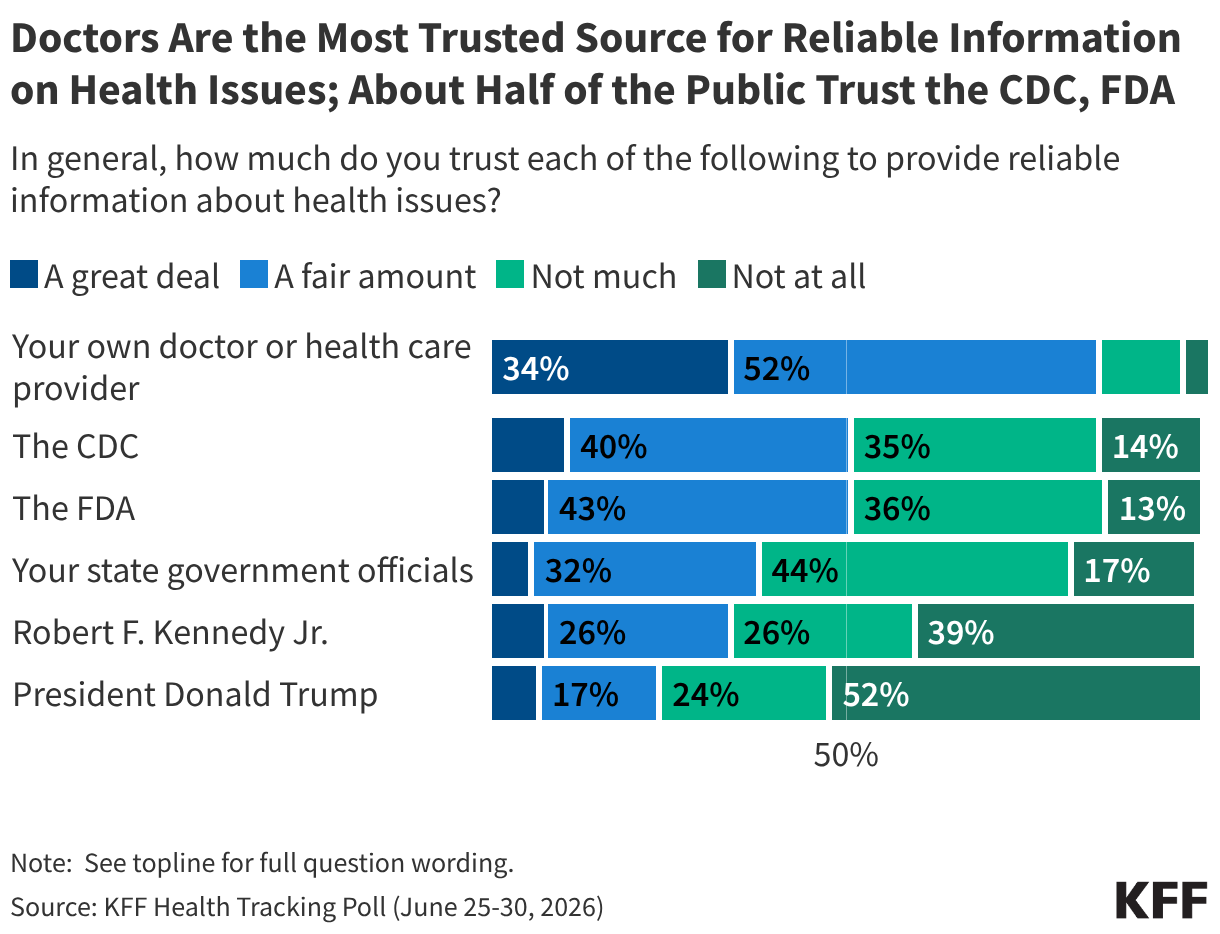
There are wide divisions when it comes to trust in some sources of vaccine information for MAHA and non-MAHA parents. Pediatricians continue to be the most trusted source of information about vaccines for parents, with about eight in ten (81%) MAHA-supporting parents and about nine in ten (88%) non-MAHA parents saying they trust their child’s pediatrician “a great deal” or “a fair amount.”

Aside from pediatricians, majorities of MAHA parents say they trust their friends and family (58%), HHS Secretary Kennedy (56%), and their local public health departments (56%) for vaccine information, making these the top sources of vaccine information for these parents after pediatricians. About half of MAHA parents report trusting the CDC (51%) or FDA (47%) for information on vaccines. One-third or fewer MAHA parents say they trust their child’s school or daycare (37%), pharmaceutical companies (22%), or health and wellness influencers (14%) “a great deal” or “a fair amount” when it comes to reliable information about vaccines.

MAHA Supporting Parents Are More Than Twice as Likely as Non-MAHA Parents to Trust Kennedy on Vaccines

Vaccine Views Among MAHA-Supporting Parents

In a section titled “The Overmedicalization of Our Kids,” the White House’s MAHA report released earlier this year states that while vaccines protect children from infectious diseases, there has not been enough research into the risks of vaccines. Vaccine skepticism is a core component of the MAHA platform.

As with parents overall, MAHA and non-MAHA parents overwhelmingly value long-standing childhood vaccines but are more divided when it comes to the COVID-19 and flu vaccines for children. About nine in ten MAHA and non-MAHA parents see the measles, mumps, and rubella (MMR) (86% and 93% respectively) and polio (85% and 91%) vaccines as important for children in their communities, including majorities who say each of these are “very important.”

MAHA parents, however, are much less likely to say the COVID-19 or flu vaccines are important for children in their communities. Parents who do not support the MAHA movement are nearly twice as likely as MAHA parents to say it is “very” or “somewhat” important for children in their community to be vaccinated for COVID-19 (52% vs. 28%) and 20 percentage points more likely to say it is important for children to be vaccinated for the flu (64% vs. 44%).

Most MAHA Parents Say it Is Important For Kids To Be Vaccinated Against Measles, Polio; Few Say the Same of the Flu or COVID-19

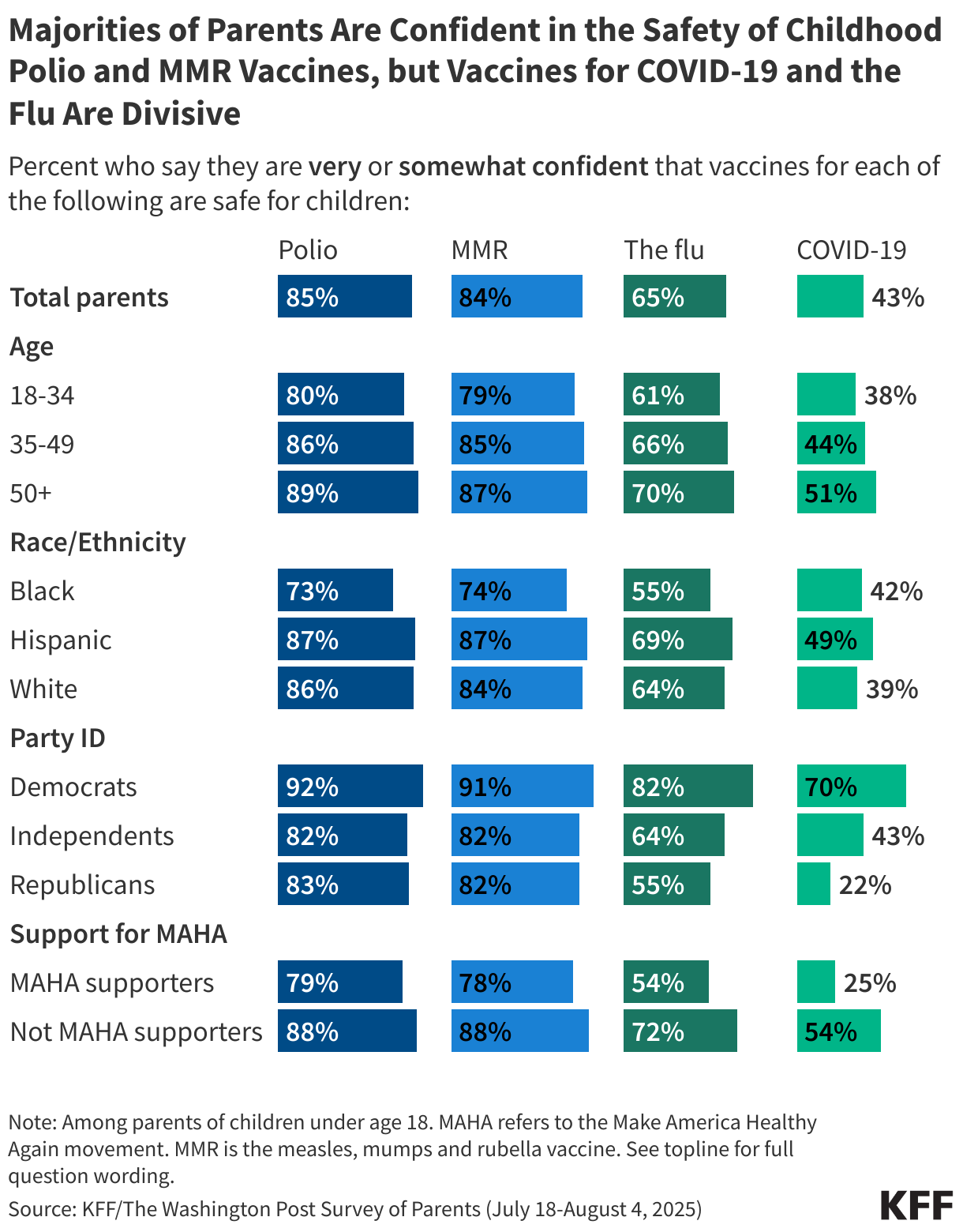
While most MAHA and non-MAHA parents report confidence in the safety of MMR and polio vaccines, MAHA parents are less likely to be “very” confident. These parents are even less confident in the safety of flu and COVID-19 vaccines for children. About three in four MAHA parents (78%) and nearly nine in ten non-MAHA-supporting parents (88%) are confident in the safety of MMR vaccines, though MAHA parents are less likely than non-MAHA parents to be “very confident” (44% vs. 60%). Similarly, about eight in ten (79%) MAHA parents and nine in ten (88%) non-MAHA parents are confident in the safety of polio vaccines, with fewer MAHA parents being “very confident” (43% vs. 60%).

When it comes to the safety of COVID-19 vaccines for children, just one in four MAHA-supporting parents are “very” (9%) or “somewhat” (16%) confident, compared to about half (54%) of non-MAHA parents. In fact, about half (53%) of MAHA parents say they are “not at all” confident in the safety of COVID-19 vaccines for children. MAHA parents are divided in their confidence in the flu vaccines for children, with about half (54%) saying they are confident. About seven in ten (72%) parents who do not support the MAHA movement are confident in the safety of the flu vaccines.

Most MAHA Parents Express Confidence in Childhood Vaccine Safety, but Fewer Than Half Are Very Confident

Parents who support the MAHA movement are more likely than parents who do not support MAHA to hold vaccine skeptical views explored in this survey, though few (9%) would call themselves anti-vaccine. About six in ten (58%) MAHA parents say they are not confident in the CDC and FDA to ensure the safety and effectiveness of vaccines approved for use in the U.S., compared to about half (47%) of non-MAHA parents.

About half (51%) of MAHA-supporting parents say children are healthier when their vaccines are spaced out and they do not get multiple shots in one visit, while about half (47%) correctly say there is no strong evidence for this. Parents who are not supporters of the MAHA movement are more likely to correctly indicate that there is no evidence for spacing vaccines (63%), while one-third (35%) say children are healthier when vaccines are spaced out.

About four in ten MAHA-supporting parents (42%) say the CDC recommends “too many” childhood vaccines, more than twice the share of non-MAHA parents who say the same (17%).

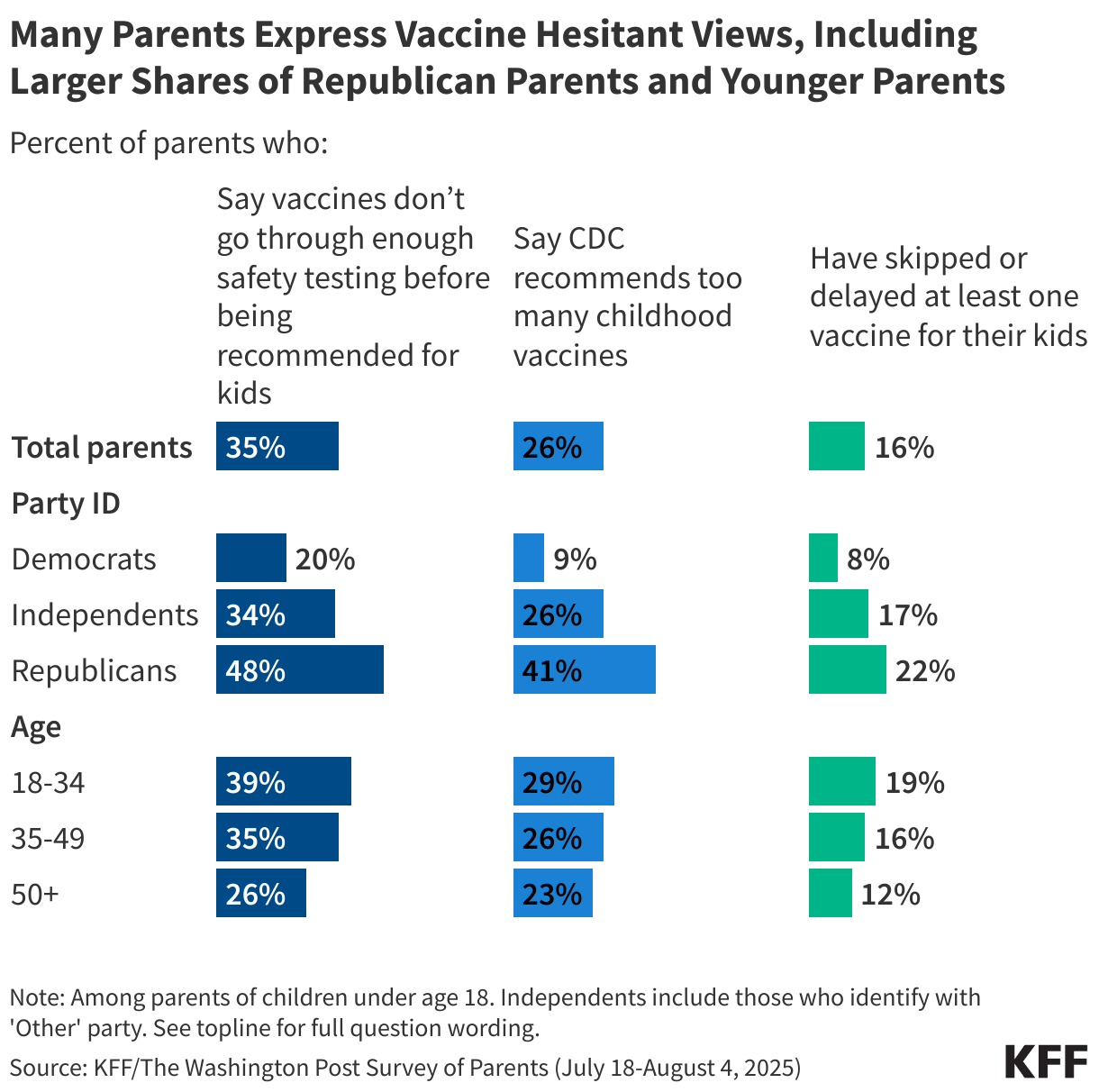
As with parents overall, a majority of MAHA-supporting parents report keeping their children up to date on childhood vaccinations aside from COVID-19 and flu (75%). However, one in four MAHA-supporting parents (24%) report skipping or delaying at least one childhood vaccine for their kids, more than twice the share of non-MAHA-supporting parents who report the same (11%).

Vaccine Attitudes Differ Between MAHA and Non-MAHA Supporting Parents

Make America Healthy Again and Vaccine Myths

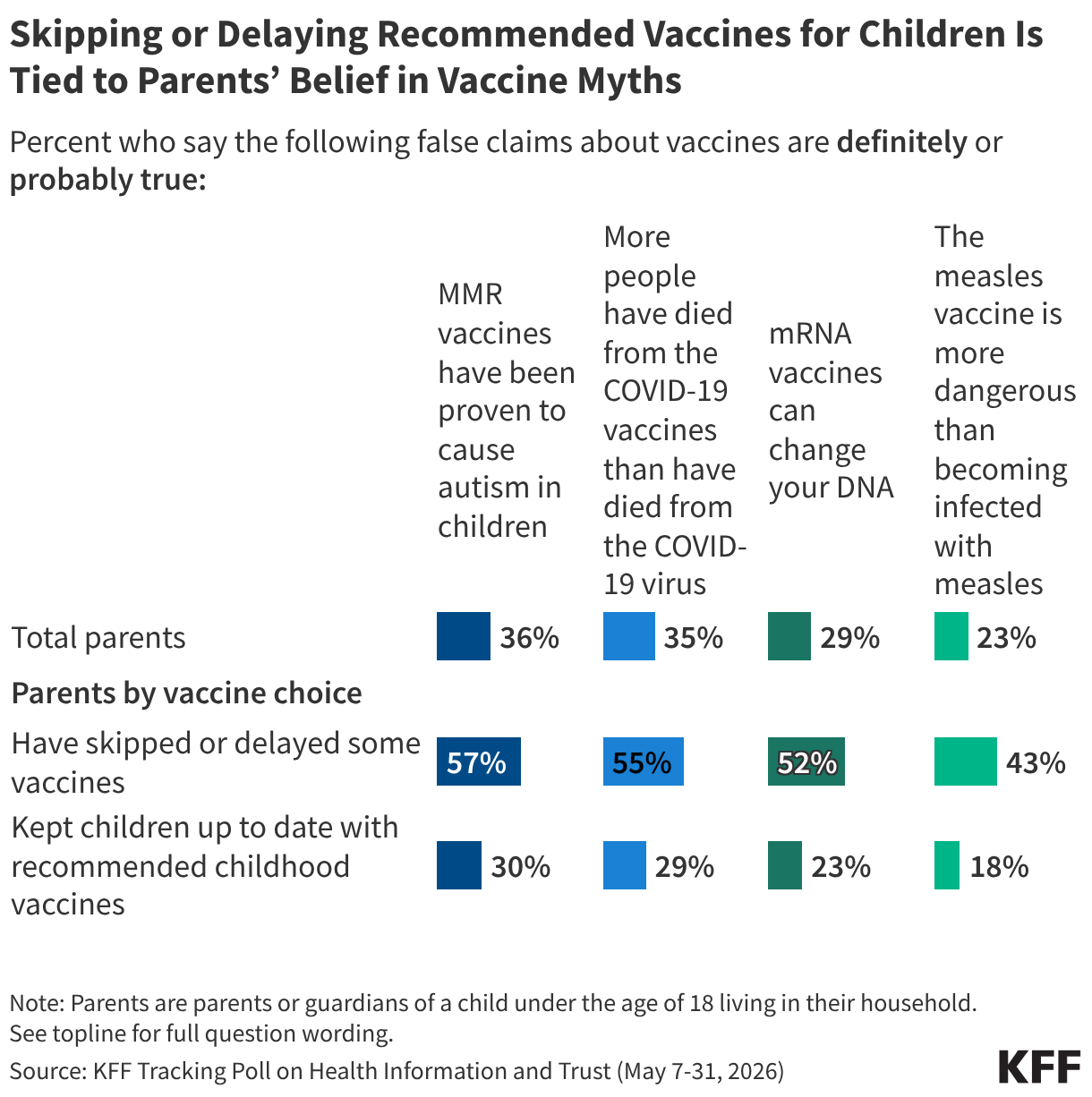
HHS Secretary Kennedy has amplified claims about vaccines that have been rejected by scientists and public health officials, adding to the confusion surrounding their safety. While small shares of parents believe these claims are true, most MAHA parents do not reject them as false, and many express uncertainty.

Though the overall shares are small, MAHA parents are more likely than non-MAHA parents to say it is true that chronic diseases are likely rising because of an increase in the number of vaccines children get (21% vs. 8%), that MMR vaccines can cause autism in children (15% vs. 6%), that the measles vaccine causes the same illness it is supposed to prevent (11% vs. 6%), and that vitamin A is an effective treatment for measles (9% vs. 4%).

About half of MAHA parents say they “do not know enough to say” whether it is true that the measles vaccine causes the illness it is meant to prevent, or that chronic diseases are likely rising because of an increase in the number of vaccines children get, two claims alluded to in the MAHA Commission report. Fewer than four in ten MAHA parents correctly say either of these claims are false (38% and 31% respectively), while a majority of non-MAHA parents identify these as false (57% and 55%).

When it comes to the false claim that MMR vaccines can cause autism in children, nearly six in ten (59%) MAHA parents say they “do not know enough to say” whether it is true, and about one in four (26%) say it is false. Non-MAHA-supporting parents are about twice as likely to correctly indicate that this claim is false (53%). There has been extensive scientific research disproving the link between autism and vaccines.

MAHA Parents Are Less Likely to Reject False Statements About Vaccines, Measles

Views of Autism Research

While there has been extensive scientific research disproving the link between autism and vaccines, there is a lack of consensus on the exact causes for the rise in autism rates in the U.S. The White House MAHA Commission is tasked with studying the root causes of autism.

Many (44%) parents overall say there has been “too little” research into the causes of autism spectrum disorder generally. One in four parents say there has been “about the right amount” of research, and a similar share (28%) say they are not sure. Few (3%) parents say there has been too much research into the topic.

When asked more specifically about the amount of research done into whether there is a link between vaccines and autism spectrum disorder, one-third say there has been “too little” research into this, and similar shares say there has been “about the right amount” (29%) or they are not sure (30%). Few (7%) parents say there has been “too much” research into whether there is a link.

About Four in Ten Parents Say There Has Been Too Little Research into the Causes of Autism

Parents who support the MAHA movement, and Republican parents (including MAGA Republican parents) are more likely than their counterparts to say there has been “too little” research into the causes of autism or whether there is a link between autism and vaccines. In fact, MAHA-supporting parents are twice as likely as non-MAHA parents to say there has been too little research into the connection between autism and vaccines (48% vs. 24%).

While about six in ten parents of children diagnosed with autism spectrum disorder say there has been “too little” research into the causes of autism spectrum disorder generally (61%), fewer – about one-third (35%) – say there has been too little research into whether there is a link between vaccines and autism spectrum disorder. About six in ten parents who have skipped or delayed vaccines for their children say there has been too little research into the causes of ASD (60%) or whether there is a link between vaccines and ASD (57%).

Six in Ten Parents of Children with Autism Say There Has Been Too Little Research into Autism Causes, Fewer Say the Same About a Vaccine and Autism Link

What Do Parents See As the Biggest Threats to Children’s Health in the U.S.?

Social media use, mental health challenges, and issues related to diet and exercise are top issues parents view as serious threats to children’s health in the U.S. At least six in ten parents overall say social media use (75%), highly processed foods (68%), mental health challenges such as chronic anxiety or depression (68%), obesity (64%), gun violence (61%), and lack of physical activity (60%) are either the “biggest” or a “major” threat to children’s health in the U.S. today. About half of parents say pollution, poor air quality, and environmental toxins (53%), over-prescribing medications (50%), and difficulty affording food (46%) are at least major threats to children’s health, while about four in ten cite neurodevelopmental disorders (42%) and infectious diseases (41%) as threats. Fewer (28%) see fluoride in local water supplies as the biggest or a major threat to children’s health.

Social Media Use, Mental Health Challenges, and Highly Processed Food Rank Among the Biggest Threats Parents See for Children

Despite partisan and demographic differences in who identifies with the MAHA movement, there are some similarities in what parents see as the biggest threats to children’s health. Social media and mental health challenges rank high for both MAHA and non-MAHA-supporting parents when it comes to assessing threats to children’s health, with about three-fourths of MAHA-supporting parents (78%) and non-MAHA-supporting parents (74%) citing social media, and about seven in ten of each group citing mental health challenges.

For issues related to nutrition and exercise, majorities of parents in both groups identify these as threats to children’s health, but MAHA parents are more likely to emphasize their level of threat. MAHA parents are more likely than parents who do not support the movement to say highly processed foods (78% among MAHA parents vs. 62% among non-MAHA parents), obesity (69% vs. 61%), and lack of physical activity (66% vs. 57%) are threats to children’s health. MAHA parents are also more likely to cite over-prescribing medications (61% vs. 43%), neurodevelopmental disorders (48% vs. 38%), and fluoride in water supplies (33% vs. 25%) as the biggest or major threats to children’s health today.

Parents who do not support the MAHA movement, largely comprised of Democratic and independent parents, are more likely to cite gun violence (68% among non-MAHA parents vs. 50% among MAHA parents), pollution (56% vs. 48%), difficulty affording enough food (50% vs. 41%), and infectious diseases (45% vs. 36%) as the biggest or major threats to children’s health in the U.S. today.

Highly Processed Foods, Use of Social Media, are Among The Biggest Threats MAHA Parents See for Children Today; Non-MAHA Parents Also Cite Gun Violence

Support for Regulating Food Additives

In the past year, Robert F. Kennedy Jr. has called for stricter regulations on the U.S. food supply, requesting the removal of synthetic dyes and ultra-processed foods, citing their negative impact on children’s health. These policy proposals are popular, with at least eight in ten parents saying they “strongly” or “somewhat” support increasing government regulations on dyes and chemical additives in food (85%), on highly processed food (82%), and on added sugars in food (80%). About one in five or fewer parents oppose each of these proposals.

Parents are more divided when it comes to removing government restrictions on the sale of unpasteurized or raw milk, with half (47%) in support and another half (52%) opposed.

Most Parents Support Increasing Government Regulations on Food Additives, Highly Processed Foods, and Sugar

About three quarters or more of Democratic parents, independent parents, Republican parents, MAHA-supporting, and non-MAHA-supporting parents support increasing government regulation on food additives, highly processed foods, and sugar. Partisans are divided on the question of raw milk de-regulation, as six in ten Republican (60%) and MAHA-supporting (63%) parents support removal of restrictions on raw milk, while majorities of non-MAHA supporters and Democrats are in opposition. For decades, the FDA has prohibited the interstate sale of raw milk, citing serious health risks posed by the consumption of unpasteurized milk. While Secretary Kennedy has previously accused the FDA of unfairly suppressing the consumption of raw milk, the MAHA Commission report released this year did not include references to raw milk or proposed changes to existing regulations.

Bipartisan Majorities of Parents Support Increasing Regulations on Food, Parents Are Split on De-Regulating Raw Milk Sales

Methodology

This KFF/The Washington Post Survey of Parents was designed and analyzed by public opinion researchers at KFF and The Washington Post. The survey was designed to reach a representative sample of parents or legal guardians of children under the age of 18 in the U.S. The survey was conducted July 18 – August 4, 2025, online among a nationally representative sample of 2,716 parents using the Ipsos KnowledgePanel in English (n=2519) and in Spanish (n=197). KnowledgePanel is a nationally representative probability-based panel where panel members are recruited randomly through invitations mailed to respondents randomly sampled from an Address-Based Sample (ABS) provided by Marketing Systems Groups (MSG) through the U.S. Postal Service’s Computerized Delivery Sequence (CDS). Invitations were sent to panel members by email followed by up to two reminder emails.

All completes were reviewed to ensure respondents were giving the survey adequate attention. Three cases were removed from the data that failed internal quality checks. Most KnowledgePanel respondents received a financial incentive equaling about $1 for their participation in this survey with some harder-to-reach groups receiving about $5 for their participation.

The survey also includes an oversample of parents of children 5 years old and younger (n=1,092) in order to reach a higher rate of responses from parents who are currently making decisions around their child’s vaccines. The full sample was weighted to match the sample’s demographics to the national U.S. parent population using data from the Census Bureau’s 2023 American Community Survey. Weighting parameters included gender, age, education, race/ethnicity, region, metro status, and language proficiency within the Hispanic sample. The sample was also weighted to the total parent population on political party identification using the 2025 KFF Benchmarking Survey.  An additional adjustment was conducted in order to provide estimates from parents living in Texas (n=276) using the 2023 ACS as well as the 2023-2024 Pew Religious Landscape Survey. Both weights take into account differences in the probability of selection, including adjustment for the sample design, within household probability of selection, and the design of the panel-recruitment procedure.

The margin of sampling error including the design effect for the total sample is plus or minus 2 percentage points and plus or minus 3 percentage points for the parents of children under the age of 6. The full Texas sample has a margin of sampling error of plus or minus 7 percentage points. Numbers of respondents and margins of sampling error for key subgroups are shown in the table below. For results based on other subgroups, the margin of sampling error may be higher. Sample sizes and margins of sampling error for other subgroups are available on request. Sampling error is only one of many potential sources of error and there may be other unmeasured error in this or any other public opinion poll. KFF and The Washington Post are charter members of the Transparency Initiative of the American Association for Public Opinion Research.

GroupN (unweighted)M.O.S.E.
Total parents2,716± 2 percentage points
   
Support for Make America Healthy Again (MAHA) movement  
MAHA-supporting parents977± 3 percentage points
Not MAHA-supporting parents1,679± 3 percentage points
   
Party ID  
Democratic parents801± 4 percentage points
Independent/Other party parents1,077± 3 percentage points
Republican parents780± 4 percentage points
MAGA Republican parents498± 5 percentage points
   
Parents by vaccine choice  
Skipped or delayed any childhood vaccines436± 5 percentage points
Kept kids up to date on all childhood vaccines2,264± 2 percentage points

Medicare Beneficiaries Have 32 Medicare Advantage Prescription Drug Plans Available, on Average, for 2026

The average number of private plans has declined slightly but remains above the number available in 2022 and prior years

Authors: Jeannie Fuglesten Biniek, Meredith Freed, Anthony Damico, and Tricia Neuman
Published: Oct 14, 2025

In anticipation of the Medicare annual open enrollment period, which runs from October 15 to December 7, the Centers for Medicare and Medicaid Services (CMS) recently released information about Medicare Advantage plans for the coming year. News articles following the release of plan information report that Medicare Advantage insurers are scaling back their offerings in response to changes in federal payments and because unexpected increases in the use of health services have led to rising costs and falling profits.

KFF’s analysis of plan offerings shows that Medicare beneficiaries will have the option of 32 Medicare Advantage prescription drug (MA-PD) plans in 2026, two fewer than the 34 options available in 2025 (excluding employer plans and special needs plans). The number of MA-PD options has grown steadily since 2010, peaking in 2024 when the average Medicare beneficiary had 36 options. Despite the decline in offerings over the last two years, the number of options available for 2026 will be higher than the number available in 2022 (31) and every year before (Figure 1).

The Number of Medicare Advantage Plans Available to the Average Medicare Beneficiary is Slightly Lower than the Past Few Years, But More Than Every Year Prior to 2023

Across all Medicare Advantage plans for individual enrollment, including those with and without prescription drug coverage, the average Medicare beneficiary has the option to choose among 39 plans in 2026, compared to 42 options in 2025. Similar to the trend for MA-PDs, the total number of Medicare Advantage plans available to the average beneficiary is higher than the average number of plans available in 2022 (38), and each year since 2010. While Medicare Advantage plans are required to cover all Medicare Part A and Part B benefits, plans decide whether to include Part D prescription drug coverage as part of the benefit package. Enrollees may pay a separate premium for Part D coverage, or plans can use the rebate portion of their payment from the federal government to cover these costs. Most Medicare Advantage enrollees are in plans that include prescription drug coverage.

The number of Medicare Advantage plans with prescription drug coverage available to the average beneficiary varies across states, as does the change in the number of plans compared to 2025 (Figure 2). In 35 states, DC and Puerto Rico, the average beneficiary has a choice of fewer plans on average in 2026 than in 2025. The states with the largest drop in the number of plans available were New Hampshire (13 fewer plans) and Minnesota (11 fewer plans). In Minnesota, UCare, the second largest Medicare Advantage insurer in the state, exited the market altogether, while UnitedHealthcare and Humana decreased their offerings, especially in more rural counties with lower enrollment. However, in 6 states (AL, HI, KS, MO, UT, and WV), the average beneficiary has access to more plans in 2026 than in 2025, on average. In the remaining 8 states, the number of plans available to the average beneficiary stayed the same. This includes Alaska, which had no plans available in 2026, as in 2025 (Alaska has historically had few or no Medicare Advantage plans available for general enrollment). Connecticut is not included in this calculation because of differences in how counties are reported across CMS enrollment and plan files.

The Average Beneficiary Has More or Fewer Plans Medicare Advantage Plans Available to Choose from in 2026 Depending on the State They Live In

While the average Medicare beneficiary will have more than 30 Medicare Advantage plans with prescription drug coverage to choose from, in certain states the number of options is substantially lower. Medicare beneficiaries will have fewer than 5 options, on average, in four states: Alaska (0), South Dakota (4), Wyoming (3), and Vermont (1). Within states, the number of plans also varies across counties (data not included). Historically, fewer Medicare Advantage plans have been offered in the most rural areas, and a larger share of Medicare beneficiaries in the most rural areas get Medicare coverage from traditional Medicare.   

The modest decrease in the average of Medicare Advantage plans means that some Medicare beneficiaries will find that their current coverage is no longer an option for next year. In most cases, these beneficiaries live in counties where they will continue to have dozens of other Medicare Advantage plan options available for 2026, as well as traditional Medicare. Some beneficiaries in plans that have exited the market will have the option to enroll in a plan offered by the same insurer, and in many cases, enrollees will be moved into a new plan offered by the same insurer automatically if the contract includes another plan of the same type (i.e., HMO or PPO) in the same county. Others will have to make an active choice about their Medicare coverage if they wish to enroll in another Medicare Advantage plan, or will be automatically covered by traditional Medicare.

Every year, Medicare Advantage plans change in ways that could be important to enrollees, including the scope and generosity of extra benefits, cost sharing for Medicare-covered benefits, rules for using covered services (such as referral requirements and prior authorization), drug formularies, and provider networks. Despite these changes, most Medicare beneficiaries report that they do not compare coverage options on an annual basis. Further, prior Medicare focus groups indicate that Medicare enrollees are often overwhelmed by the number of Medicare Advantage choices and have difficulty sorting through all plan options. With more than 30 Medicare Advantage plans with prescription drug coverage available in 2026, on average, understanding how plans differ, and why it may matter, may remain a challenge.


The Trump Administration Executive Order on Gender Continues to Reverberate

Author: Lindsey Dawson
Published: Oct 14, 2025

Much has been written about the Trump Administration’s early effort to suppress data collection, presentation, and research related to LGBTQ – and particularly transgender – people’s health. A day one executive order (and subsequent HHS guidance and an OPM memorandum) on “gender ideology” laid out the administration’s approach to sex and gender, defining sex as an immutable binary biological classification and removing recognition of gender identity. While they have each been challenged in court, together, these and other policies have underpinned the removal of a range of websites, cancellation of federal grants, and led to changes to federal survey instruments, including those related to health and well-being, actions that continue to be expanded upon.

Earlier this year, court orders required the restoration of certain webpages, datasets, and resources needed to provide medical care (and in a separate case, the government agreed to restoration of pages), yet data collection related to LGBTQ people remains limited and removal of information reportedly continues. 1 In at least some cases where it was required to restore websites, the administration plainly states it is doing so only because of its legal obligation. By way of example, a Centers for Disease Control and Prevention (CDC) page on transgender people and HIV now includes a banner stating that it has been restored per court order and that “any information on this page promoting gender ideology,” including reference to transgender people “does not reflect biological reality and therefore the Administration and this Department rejects it.” Additionally, new reporting found that more pages relating to sexual health, LGBTQ people, and other topics have been removed from the CDC site, as recently as September. These actions stand to limit understanding of LGBTQ people’s experiences and challenge the ability of stakeholders to shape responsive policy.

Also in September, the CDC updated its “about” page to include a new set of agency priorities, with a section on “gender ideology and protecting children.”  This section references the HHS guidance and states that it is an agency “priority to recognize that a person’s sex as either male or female is unchangeable and determined by objective biology, and to ensure CDC programs accurately reflect science, including the biological reality of sex.” Removing acknowledgment of transgender people from agency materials has implications for public health messaging and services related to the population’s health needs, posing challenges for a community that has elevated health risks, including for some communicable diseases, like HIV. This could lead to gaps in individual, community, and scientific knowledge and, depending on what is removed, the ability to monitor, and ultimately, respond to outbreaks or health disparities. This priority shift could also negatively influence the LGBTQ community’s trust in the agency – which has historically been important when CDC has responded to certain events, like the mpox outbreak of 2022, necessitating community collaboration. Further, if CDC, aligns funding opportunities with this priority area, it could jeopardize CDC grants going to those working to engage gender diverse communities, thereby limiting service provision. Tailoring public health approaches to communities experiencing high unmet needs or not otherwise being reached is a basic public health approach and requires acknowledging their existence and approaching needs in culturally competent ways.

Additionally, recent CDC clinical guidelines, used to inform providers about the evidence and clinical recommendations related to public health interventions, omit mention of transgender people, seemingly reflecting administrative priorities. A new twice-yearly injectable pre-exposure-prophylaxis or PrEP (HIV prevention) drug, lenacapavir, was approved in June and holds significant promise in helping to bend the curve on the HIV epidemic by addressing adherence and clinical capacity issues. However, the clinical recommendations from the CDC do not reference transgender or non-binary people, who, because they experience HIV at disproportionate rates, were specifically included in “PURPOSE 2”, one of the clinical trials that led to the drug’s FDA approval. The PURPOSE 2 trial assessed lenacapavir’s efficacy in cisgender men, transgender men and women, and non-binary people. The trials found that lenacapavir was 96%-100% effective at preventing HIV transmission and the final drug label issued by the FDA specifies that “there were no clinically significant differences in the pharmacokinetics of lenacapavir based on…gender identity”, among other variables. This marks a departure from CDC’s 2021 PrEP guideline, released prior to approval of the new drug, which included a section on PrEP and transgender people. It also represents a departure from the approach taken by the World Health Organization (WHO) in their lenacapavir guidelines, which identified gender diverse people as a key population and discusses prescribing lenacapavir to those also taking gender affirming hormone therapy. While providers may look elsewhere for detailed information (such as to the WHO or the trial data), the exclusion could impact willingness to prescribe among those less experienced with PrEP or in working with transgender patients. In addition, given that an earlier PrEP drug (emtricitabine/tenofovir alafenamide), was not approved for people engaged in “receptive vaginal sex because the effectiveness in this population has not been evaluated,” providers may be especially cautious about reviewing sex and gender based indications for new PrEP drugs. Indeed, this earlier exclusion is a key reason that led to the more inclusive – of both cisgender women and gender diverse people – trial design and ultimate broad approval of lenacapavir. This follows the removal of detailed information on proving antiretrovirals to transgender people for HIV treatment from the HHS treatment guidelines, an action that took place sometime between March and April 2025.   

As with other changes, the exclusion of transgender people from treatment and prevention recommendations likely reflects and is consistent with the administration’s stance on sex and gender with the Executive Order directing agencies to “remove all statements, policies, regulations, forms, communications, or other internal and external messages that promote or otherwise inculcate gender ideology.”   

Looking across these actions, barriers to providing complete treatment and prevention information could impact individual health (HIV is a life-long chronic condition when treated, and a deadly one when untreated), as well as public health if ongoing HIV transmission continues. It also has implications for private and public budgets with the estimated lifetime cost of HIV treatment per person in the United States now over $1 million.

  1. The Court in this case vacated the OPM Memo and the HHS Guidance, remanding them to the agencies. However, the remedy was limited to website and data restoration and “vacatur does not require the HHS defendants to undo every action taken pursuant to the OPM Memo or HHS Guidance” and the court “will not prevent the defendants from heading back to the drawing board and attempting to craft a lawful policy with similar objectives.” Other cases challenge the gender Executive Order itself. ↩︎

Designating English as the Official Language of the United States Could Impact Millions with Limited English Proficiency

Published: Oct 10, 2025

Introduction

On March 1, 2025, President Trump signed Executive Order (EO) 14224 designating English as the official language of the United States. This marks the first time in the country’s history that the U.S. has declared an official language at the federal level. Although the Order does not by itself trigger changes in services provided by agencies or organizations receiving federal funding, the policy represents a departure from previous administrations’ policies around language access for individuals with limited English proficiency (LEP). The federal government defines people with LEP as those who do not speak English as their primary language and who have a limited ability to read, write, speak, or understand English (also described as speaking English “less than very well”).

An accompanying official fact sheet released by the Trump administration outlines how EO 14224 will affect agencies and their services, including review of all services currently offered in languages other than English and phasing out of non-essential services. Prior guidance for agencies serving people with LEP has been suspended.

The Order will likely result in more limited availability of language access services for people with LEP.  Language and interpretation services are important for ensuring access to health coverage, care, and for improving health outcomes. Loss of services may further exacerbate disparities in health and health care, as people with LEP are disproportionately more likely to be Hispanic, Asian, immigrants, and to have lower incomes. Further, the new EO could also create challenges and confusion for health care and other service providers, who remain subject to other laws and regulations that still require provision of language access services.

This issue brief provides an overview of EO 14224 and its potential implications for multilingual resources, including data on the shares of individuals with LEP across different socioeconomic characteristics based on KFF analysis of 2023 American Community Survey (ACS) data.

Prior Language Access Policies

Prior laws and guidance have established requirements for language access and protection for people with LEP. Title VI of the Civil Rights Act of 1964 and Section 1557 of the Affordable Care Act (ACA) prohibit discrimination based on national origin, including discrimination based on the ability to speak English. Previously, the Department of Justice (DOJ) took the stance that Title VI of the Civil Rights Act prohibited discrimination against people with LEP, recognizing that a lack of language access represented discrimination based on national origin. In 2000, President Clinton issued EO 13166, which required all federal agencies to ensure meaningful access to services for people with LEP and established that failing to provide adequate services would be considered discrimination based on national origin. EO 14224, signed by President Trump, revokes EO 13166 and any policy guidance documents issued under it, and requires the Attorney General to provide updated guidance.

Section 1557 of the Affordable Care Act strengthened language access protections by prohibiting discrimination in health programs and other services that receive federal financial assistance. Section 1557 requires covered entities, including hospitals, clinics, insurers, and state Medicaid programs, to provide meaningful access for individuals with LEP. While Section 1557’s protections took effect when the ACA was enacted in 2010, much of its reach has been determined by implementation guidance issued across different presidential administrations. Under the Biden administration regulations issued in 2024, entities that operate health programs or activities and receive federal financial assistance must take reasonable steps to provide meaningful access to individuals with LEP who are eligible to be served or likely to be directly affected by the program or activity. The regulation specifies requirements regarding how the services must be provided, including that they be free of charge, accurate, and timely; outlines standards for interpretation and translation services; and identifies requirements for entities to provide notice of the availability of services. Section 1557 remains in effect despite the Executive Order, meaning that health care entities will continue to be required to provide language access services, even as federal agencies may scale back their language access resources.

Changes in Language Access Under the Trump Administration

EO 14224, issued by President Trump in March 2025, declares English as the official language of the U.S. and revokes prior orders requiring federal agencies to provide meaningful access to services for individuals with LEP. The Order also instructs the Attorney General to rescind all policy guidance stemming from EO 13166. As a result, in April 2025, the DOJ rescinded its 2022 LEP guidance, which directed agencies to assess and enhance their language access policies, and published a new memorandum providing implementation guidance related to the EO. The DOJ also removed LEP.gov, a website that provided resources to federal agencies and other entities receiving federal funding for developing language access plans.

Patients are still entitled to interpreter services under Title VI through qualified bilingual staff or interpreter services at no additional cost. Historically, providers have often aligned their services with the Department of Health and Human Services (HSS) outlined National Standards for Culturally Linguistically Appropriate Services (CLAS), a set of 15 voluntary guidelines designed to advance language access and cultural competence in healthcare. These standards include informing individuals of language assistance availability, ensuring the competence of individuals providing translation services, and providing written translation of key documents such as health consent and education documents. While the CLAS standards are not a binding federal regulation and therefore cannot be revoked by EO 14224, their adoption and implementation may decline as changes to federal language access policies reduce oversight, investment, and incentives for compliance.

The new memorandum recommends that federal agencies scale back the provision of language services, minimizing non-essential multilingual services, and recommends that agencies consider offering services exclusively in English. However, it does not require agency heads to amend, remove, or otherwise stop the production of documents, products, or other services prepared or offered in languages other than English. Despite these ongoing requirements, the new guidance signals that the DOJ will no longer treat a lack of multilingual services as discrimination, and that agencies are no longer required to implement wide-scale language access plans.

The EO and accompanying DOJ guidance apply only to federal government agencies and do not change existing language access requirements under laws like Title VI of the Civil Rights Act or Section 1557 of the ACA. Executive Orders cannot overturn existing statutes and regulations that go through formal revisions and public notice and comment processes. Title VI and Section 1557, which were issued by HHS, outline compliance measures that cannot unilaterally be changed by Executive Order. Entities that receive federal funding including state and local health departments, hospitals, insurance companies, clinics, and other health care providers remain legally obligated to provide meaningful language access under these laws. Under Section 1557 regulations, forms such as informed consent documents, intake forms, and discharge instructions are still required to be translated for individuals with LEP. Moreover, several states, including, New York, California, Hawaii, Maryland, and the District of Columbia, have state-level language access laws that remain in effect. However, the reduction in federal oversight, and granting agencies the ability to decide how and when to offer services in languages other than English, including at HHS and the DOJ, may create uncertainty about implementation and compliance practices, and reduce the availability of federal resources for providing language access services. Enforcement is also likely to shift since the DOJ has narrowed its interpretation of Title VI, indicating that it will no longer pursue enforcement based on disparate impact claims related to language access, instead, it will now focus on cases involving intentional discrimination. This change in enforcement could impact accountability measures and ultimately weaken protections for individuals with LEP.

Who is Likely to Be Affected by Reductions in Language Access Services?

Over 27 million people in the U.S. have LEP and may be affected by decreased access to language access services, with disproportionate impacts on Asian and Hispanic people, immigrants, and people with lower incomes. Data from the 2023 ACS show that 9% of the population ages 5 and older, or 27.3 million individuals, have LEP (defined as speaking a language other than English at home and speaking English less than very well). Asian (30%) and Hispanic people (29%), immigrants (47%), and those with incomes under $40,000 per year (13%) are disproportionately more likely to have LEP than the overall population (Figure 1). Decreased access to language assistance services comes at a time when immigrants are facing other barriers to accessing health care and other services, including increased immigration-related fears and more limited eligibility for health care coverage and other services.

Hispanic and Asian People, Immigrants, and Those With Lower Incomes are More Likely to Have Limited English Proficiency

Decreased access to language assistance services would have greater effects in some states, since there are wide variations in the shares of people with LEP across states (Figure 2). The share of people ages 5 and older with LEP ranges from less than 1% in West Virginia to 18% in California. New York (14%), New Jersey (14%), Texas (13%), and Florida (13%) also have relatively high shares of individuals with LEP, likely reflecting larger numbers of immigrants residing in those states.

The Shares of People with Limited English Proficiency Vary Across States

Language access services have important implications for health and health care. People with LEP face challenges and barriers to accessing high-quality health care. Language barriers between providers and patients can reduce the quality of care and increase the risk of adverse outcomes or medical errors. Studies have found that a lack of language assistance often delays patients’ access to timely care, leading to poor chronic disease management and resulting in worse health outcomes. Despite existing language access requirements, KFF survey data find that around half (48%) of adults with LEP have encountered at least one language barrier in a health care setting within the past three years, such as difficulty filling out forms for a health care provider (34%), communicating with office staff at a doctor’s office or clinic (33%), understanding instructions given by a doctor or health care provider (30%), filling a prescription or understanding how to use it (27%), or scheduling a medical appointment (25%) (Figure 3). Among adults with LEP, one in five reported experiencing at least one of several negative experiences with a health care provider in the past three years, including a provider ignoring a direct request or question (11%), assuming something about them without asking (8%), suggesting they were personally to blame for a health problem (8%), or refusing to prescribe needed pain medication they thought they needed (8%).

About a Half of Adults With Limited English Proficiency Say They Have Faced Language Barriers When Seeking Health Care

Reductions in requirements for federal agencies to provide language access services may create new challenges for health care and other service providers. If federal agencies reduce language access guidance and requirements, providers will have fewer translated materials to rely on, such as consent documents and health education materials. This can also create inconsistencies in the quality and accuracy of materials across the health care landscape. Community health centers (CHCs) and other safety net providers may be disproportionately impacted by the reduced availability of federal language access resources as they are disproportionately likely to serve individuals with LEP and those with lower incomes. Federal cuts have already eliminated funding for community workers who help people who speak other languages navigate and sign up for health insurance coverage. Moreover, given differences between the new guidance and other laws that remain in place, providers may have questions or confusion about when translation services are required, compliance risks, and how comprehensive services must be.

Poll Finding

KFF/The Washington Post Survey of Parents

Published: Oct 10, 2025

Overview

The Survey of Parents is the 37th in a collaborative reporting series between KFF and The Washington Post, dating back to 1995, that combines survey research with in-depth journalism. Based on interviews with more than 2,700 parents, including more than 1,000 parents with children under age 6 who have had to make decisions about vaccines in the post-COVID era, this survey explores parents’ experiences with and views about vaccines for their children.

As HHS Secretary Robert F. Kennedy Jr. questions the federal childhood vaccine schedule, debates over safety, access, and trust in public health guidance are front and center, leaving many parents confused about some of the most important decisions they’ll make for their children’s health. This poll offers a snapshot of how parents view childhood and routine vaccines, and the decisions they’re making for their children. These findings highlight where parents agree on the importance of long-standing vaccines, and where some attitudes have started to diverge in the wake of the COVID-19 pandemic.

Other KFF reports from the survey:

Polling Insights on the MAHA Movement

Exposure to and Trust in Children’s Health-Related Information Online

Explore The Washington Post’s journalism:

Poll shows who supports RFK Jr.’s ‘Make America Healthy Again’ movement, Oct. 15, 2025

In an age of vaccine skepticism, parents trust pediatricians most, Oct. 10, 2025

Why 1 in 6 U.S. parents say they skipped or delayed their kids’ vaccines, Sept. 15, 2025

RFK Jr. drives a wedge between red and blue states on vaccines, Sept. 4, 2025

Key Findings

  • Large majorities of parents have positive views of long-standing childhood vaccinations for measles, mumps, and rubella (MMR) and polio, saying these vaccines are important for children in their community to get (90% and 88%, respectively) and that they are confident they are safe for children (84% and 85%). About eight in ten parents support current state laws, saying students should be required to be vaccinated against measles and polio to attend public schools with some exceptions (81%). These views are consistent across partisan lines, with large majorities of parents who identify as Democrats, independents, and Republicans viewing MMR and polio vaccines as safe and important for children to get and supporting policies that require these vaccines in public schools.
  • Views on seasonal vaccines for flu and especially COVID-19 are more divided, with much smaller shares of parents expressing confidence that these vaccines are safe for children (65% for flu and 43% for COVID-19) and saying they are important for children in their community to get (56% and 43%, respectively). Parents’ views on COVID-19 and flu vaccines divide along partisan lines, with Democratic parents much more likely than Republican parents to hold positive views of both. Republican parents who support the Make America Great Again (MAGA) movement express the most skeptical attitudes towards vaccines for children, particularly when it comes to confidence in the safety of COVID-19 (14%) and flu (48%) vaccines.
  • In addition to partisan divisions, parents under age 35 express greater concern about vaccine safety compared with parents ages 35 and over, perhaps an indication of shifting attitudes with younger generations of parents. For example, four in ten (39%) younger parents say vaccines do not go through enough safety testing before being recommended for children compared with about one-third (35%) of parents ages 35 to 49 and one quarter (26%) of parents ages 50 and older.
  • While a large majority of parents report keeping their children up to date on vaccinations, one in six (16%) parents say they have ever skipped or delayed at least one childhood vaccine other than flu or COVID-19 immunizations. About one in five Republican parents (22%), rising to one in four MAGA Republicans (25%), report skipping or delaying any childhood vaccines, higher than the share of Democratic (8%) parents who report this. Younger parents are also somewhat more likely to report skipping or delaying vaccines than older parents, regardless of the age of their children; 19% of parents under age 35 say they have skipped or delayed at least one childhood vaccine compared with 12% of those age 50 and over. Most parents who skip or delay vaccines cite side effects and safety as their top reasons, while few cite reasons related to a child’s health condition or access to health care.
  • Before his confirmation and in his role as HHS Secretary, Robert F. Kennedy Jr. has amplified claims about vaccines that have been rejected by scientists and public health officials. He has suggested, without evidence, that the number of recommended childhood vaccines has led to a rise in chronic disease in the U.S., that MMR vaccines can cause autism, and that the measles vaccine causes the illness it prevents. More recently, Kennedy has promoted Vitamin A as an effective treatment for measles. Asked about each of these claims, many parents are uncertain what to believe. While about one in ten or fewer parents say each claim is true and between a quarter and half say each is false, substantial shares – between four in ten and two-thirds – say they don’t know enough to say. On the widely circulated claim that MMR vaccines can cause autism in children, 9% of parents believe this to be true, rising to 16% among parents who have a child with autism spectrum disorder.
  • Six in ten parents have heard little to nothing about HHS Secretary Kennedy’s recent changes that could impact vaccine policies in the U.S., while just one in ten (11%) have heard “a lot” and one-quarter (27%) have heard “some” about these changes. Awareness is higher among older parents, Democratic parents, and parents with a college degree. When asked how they expect these changes to impact vaccine policy in the U.S., parents are divided, and many are not sure whether they will have an impact on access to vaccines, safety, or the influence of pharmaceutical companies. Democratic parents are considerably more likely than Republican parents to say these changes will make access more difficult (52% vs. 7%) and will make childhood vaccines less safe (40% vs. 5%). Republican parents are more likely than Democrats to say Kennedy’s changes will decrease pharmaceutical companies’ influence on vaccine policy (32% vs. 11%) but most parents across groups expect no changes or say they’re not sure.
  • Pediatricians remain the most trusted source of vaccine information for parents. Though, as past KFF polls have found of the public as a whole, parents are divided along partisan lines in their trust of vaccine information from government agencies like their local public health department, the U.S. Centers for Disease Control and Prevention (CDC), and the U.S. Food and Drug Administration (FDA), with Democratic parents much more likely than Republican parents to trust these sources. Parents who have skipped or delayed childhood vaccines also list pediatricians as their most trusted source of vaccine information, with their friends and family, and HHS Secretary Kennedy ranking second and third. One-third or fewer of these parents report trusting their local health department, CDC, or FDA “a lot” or “a little.”

Parents’ Views of Vaccine Safety and Importance

Parents overwhelmingly value long-standing childhood vaccines but are more divided when it comes to the COVID-19 and flu vaccines for children. Across parties, large majorities of parents see the measles, mumps, and rubella (MMR) and polio vaccines as important for children in their communities and are confident in their safety, but opinions on flu vaccines and especially COVID-19 vaccines are more mixed and sharply divided along partisan lines.

About nine in ten parents say it is important for children in their community to receive vaccines for MMR (90%) and polio (88%), including about seven in ten who say each is “very important” (70% and 68% respectively). A smaller share, but still a majority (56%) of parents say it is important for children in their community to be vaccinated against the flu, while fewer than half (43%) say the same about COVID-19, including one in five who say it is “very important.”

Nine in Ten Parents Say It Is Important for Children To Be Vaccinated Against MMR and Polio, Fewer Say the Same About the Flu and COVID-19

 While large majorities of parents regardless of partisanship agree that the MMR and polio vaccines are important for children to get, parents are divided along partisan lines when assessing the importance of COVID-19 and flu shots for children in their community. Democratic parents are more than three times as likely as Republican parents to say it is “very” or “somewhat” important for children in their community to be vaccinated for COVID-19 (68% vs. 21%) and twice as likely to say it is important for children to be vaccinated for the flu (78% vs. 38%). About four in ten independent parents (43%) say the COVID-19 vaccine is important for children, and just over half (55%) say the same of the flu vaccine.

Republican parents are not a monolith, as those who support the Make America Great Again (MAGA) movement are between 9 and 16 percentage points less likely than non-MAGA Republican parents to say each of these vaccines are important for children to receive. Even still, a majority of MAGA Republican parents and non-MAGA Republican parents alike say it is important for children in their community to receive MMR and polio vaccines.
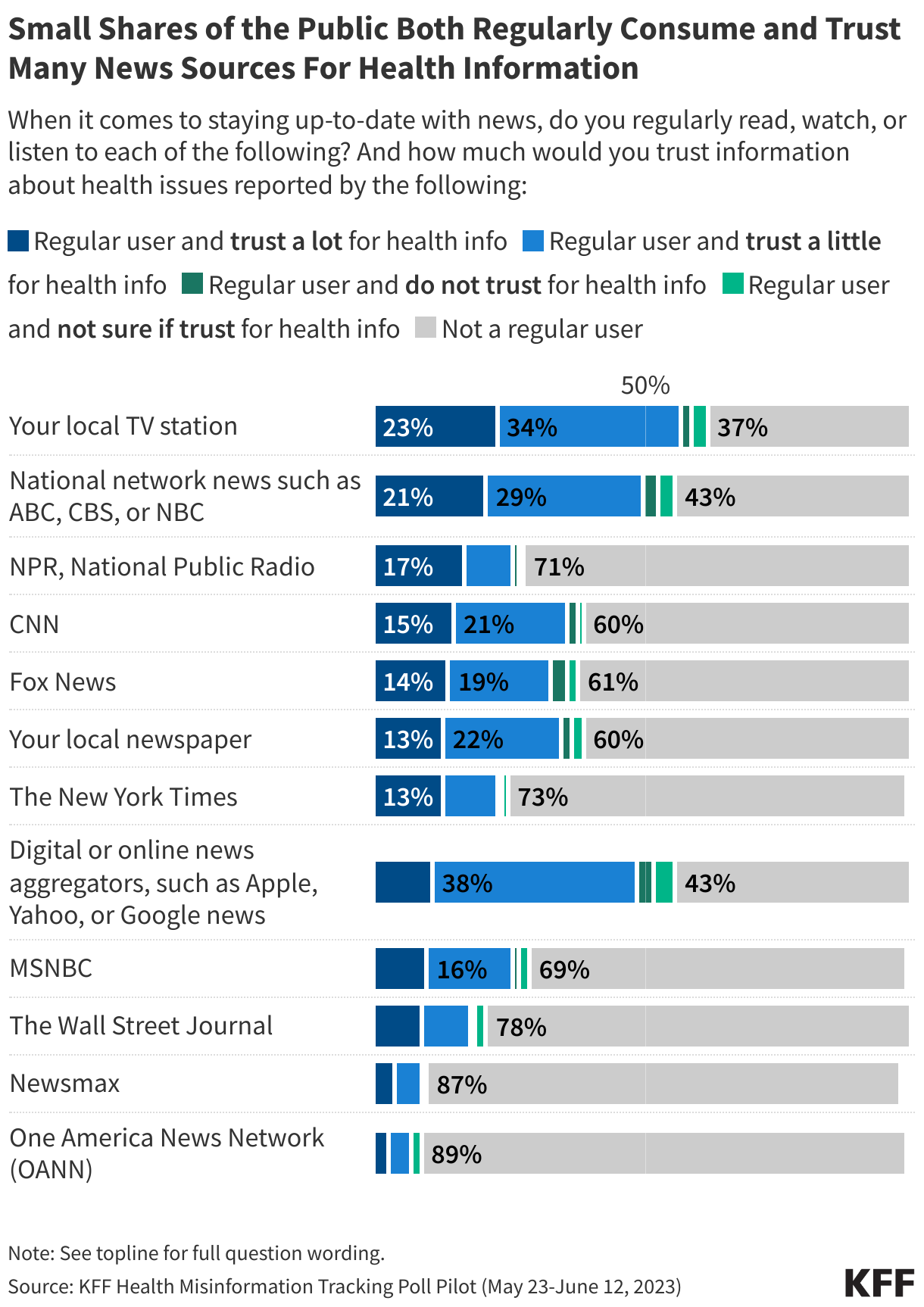
Majorities of Parents Across Partisans Say It Is Important for Children To Be Vaccinated for MMR, Polio; Partisans Are Divided on Flu, COVID-19 Vaccines

Mirroring parents’ opinions on the importance of childhood and annual vaccines, large majorities of parents express confidence in the safety of childhood vaccines for polio and MMR, while views on the safety of flu and COVID-19 vaccines are more divided.

Just over eight in ten parents say they are either “very” or “somewhat confident” that polio vaccines (85%) and MMR vaccines (84%) are safe for children, including about half who say they are “very confident” (53% and 54% respectively). A smaller majority of parents express confidence in the safety of flu vaccines (65%), including about one-third who are “very confident” (34%). About four in ten (43%) parents are confident in the safety of COVID-19 vaccines for children, including one in five who are “very confident.”

Large Majorities of Parents Are Confident MMR and Polio Vaccines Are Safe for Kids, While Fewer Say the Same About Flu and COVID-19

While majorities of parents across partisanship say they are confident in the safety of polio and MMR vaccines for children, confidence in the safety of annual flu and COVID-19 vaccines for children differs.

At least eight in ten parents across partisanship say they are least “somewhat” confident in the safety of MMR and polio vaccines for children. About eight in ten (82%) Democratic parents say they are confident in the safety of flu vaccines for children, larger than the share of Republican (55%) or independent (64%) parents who say the same. Partisans are more deeply divided on confidence in the COVID-19 vaccine. Seven in ten Democratic parents say they are confident in the safety of COVID-19 vaccines for children, more than three times the share of Republicans who say the same (70% vs. 22%). About four in ten (43%) independent parents say they are confident in the safety of the COVID-19 vaccine for children.

The public overall and parents in the U.S. have been divided along partisan lines when it comes to the COVID-19 vaccine since it became available in 2021, when Republican adults were particularly hesitant to get themselves or their children vaccinated, past KFF polling finds.

The division when it comes to the flu vaccine, however, is more prominent now since the pandemic, and may be linked to concerns about vaccines generally. While the newly reformed Advisory Committee on Immunization Practices (ACIP) under HHS Secretary Kennedy has reaffirmed the existing recommendation that anyone ages 6 months and older should receive an annual flu vaccine, the panel recommended against vaccines containing a preservative called thimerosal, which has been falsely linked to autism. This recommendation comes despite scientific evidence that these vaccines are safe. Vaccines containing thimerosal comprised less than 6% of the U.S. influenza vaccine supply in 2024.

Parents Are Divided Along Party Lines on Confidence in Flu, COVID-19 Shot Safety for Children; Large Majorities Are Confident in MMR, Polio Vaccine Safety

Black parents and parents under age 35 are less likely than other groups to say they are confident in the safety of some vaccines. For example, just over half (55%) of Black parents say they are confident the flu vaccines are safe for children compared to about two-thirds of White parents (64%) and seven in ten (69%) Hispanic parents. While majorities across racial and ethnic groups express confidence in the safety of MMR and polio vaccines, Black parents are at least 10 percentage points less likely than White parents and Hispanic parents to express confidence in the safety of each of these vaccines.

Parents under age 35 are also less likely than older parents – particularly those ages 50 and older – to say they are either “very” or “somewhat confident” that routine vaccines are safe for children. The widest gap between younger and older parents is on confidence in the safety of COVID-19 vaccines for children, with just under four in ten (38%) parents under age 35 expressing confidence compared to about half (51%) of parents ages 50 and older.

Fewer Younger Parents and Black Parents Are Confident in the Safety of Some Vaccines for Children

Parents’ Views of Vaccine Safety Testing, Schedule, and Spacing

In his role as HHS Secretary, Robert F. Kennedy Jr. has called into question the safety of vaccines, arguing that they do not go through enough safety testing, including placebo testing. The American Academy of Pediatrics (AAP) released a statement ensuring that childhood vaccines are “carefully studied, including with placebos” to ensure safety and effectiveness before they are available to the public. This poll shows that parents are divided over the question of whether vaccines go through enough safety testing before being recommended for children, with many being unsure what to believe.
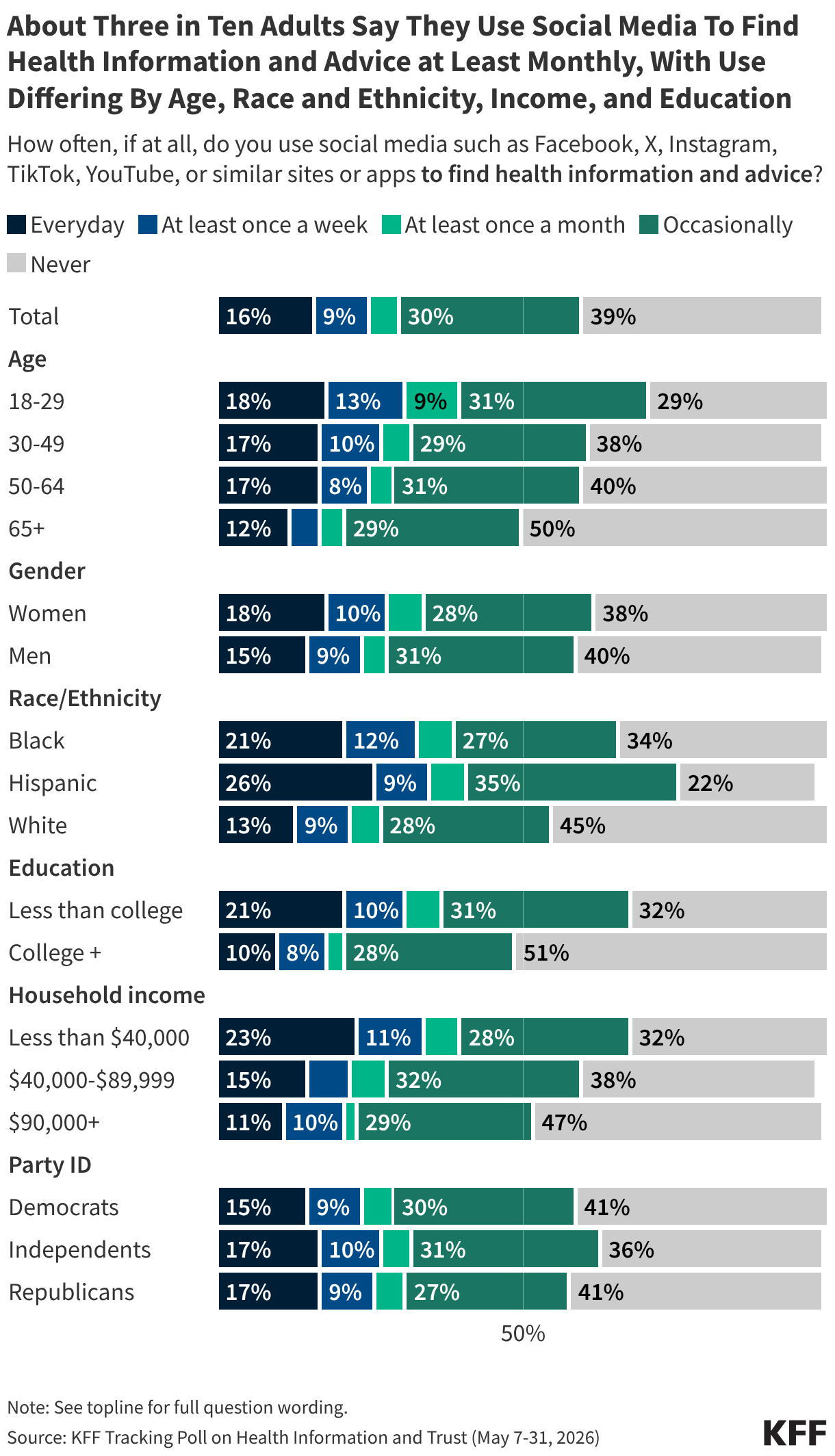
About four in ten (41%) parents say vaccines go through “the right amount” of safety testing in the U.S. before being recommended for children by federal health agencies, while about one-third (35%) say vaccines do not go through enough safety testing. An additional one in five parents express uncertainty, saying they are not sure whether vaccines are adequately safety tested. Very few parents overall (3%) say vaccines go through “too much” safety testing before being recommended for children.

Just as they differ on their confidence in safety, partisans differ on whether they think there is enough safety testing of vaccines, with about half (48%) of Republican parents saying there is not enough safety testing of vaccines before they are recommended for children, more than twice the share of Democratic (20%) parents who say the same. Republican parents are not a monolith, as those who say they support the Make America Great Again (MAGA) movement are more likely than Republicans who do not to say there is not enough testing (57% vs. 32%).
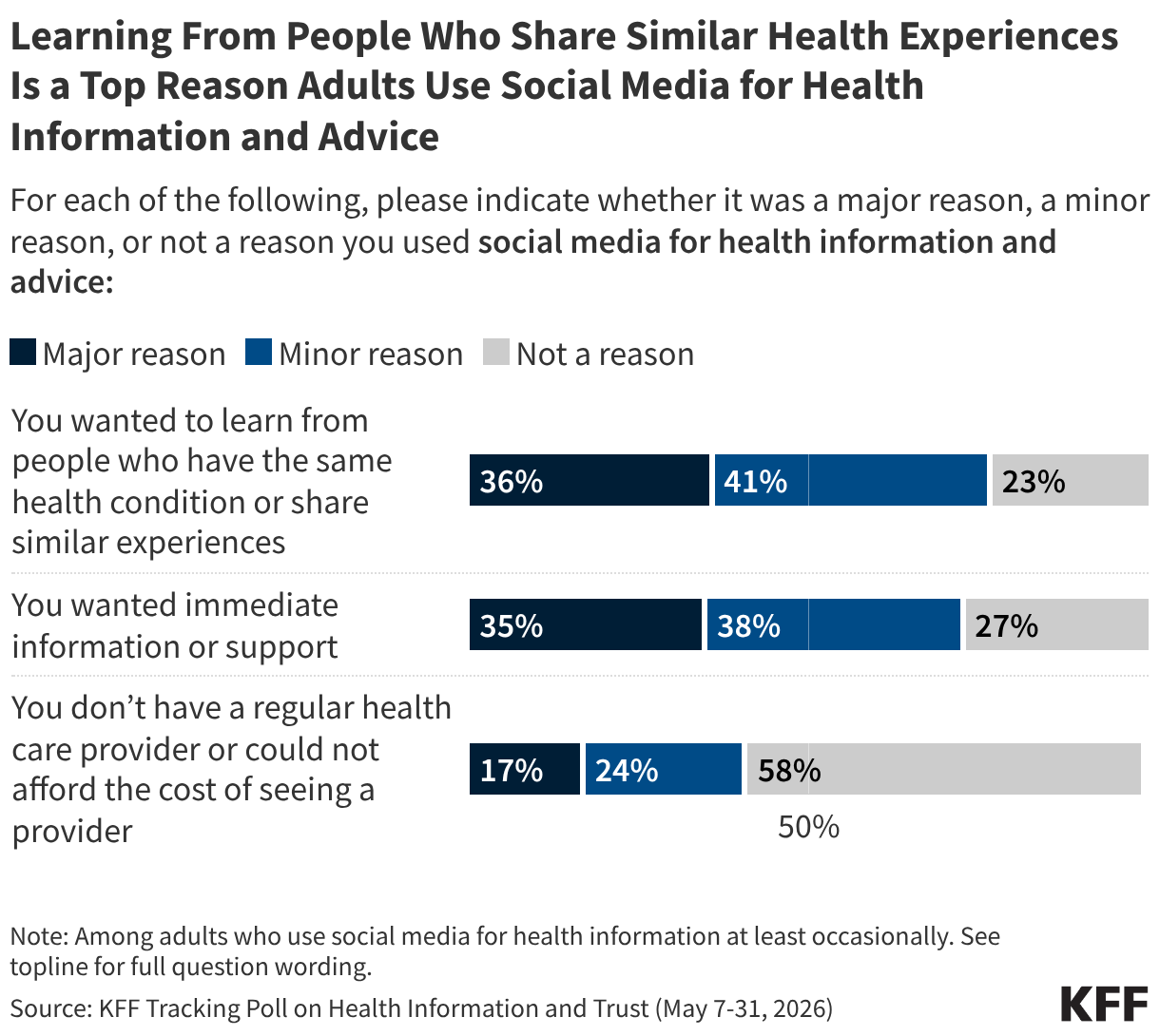
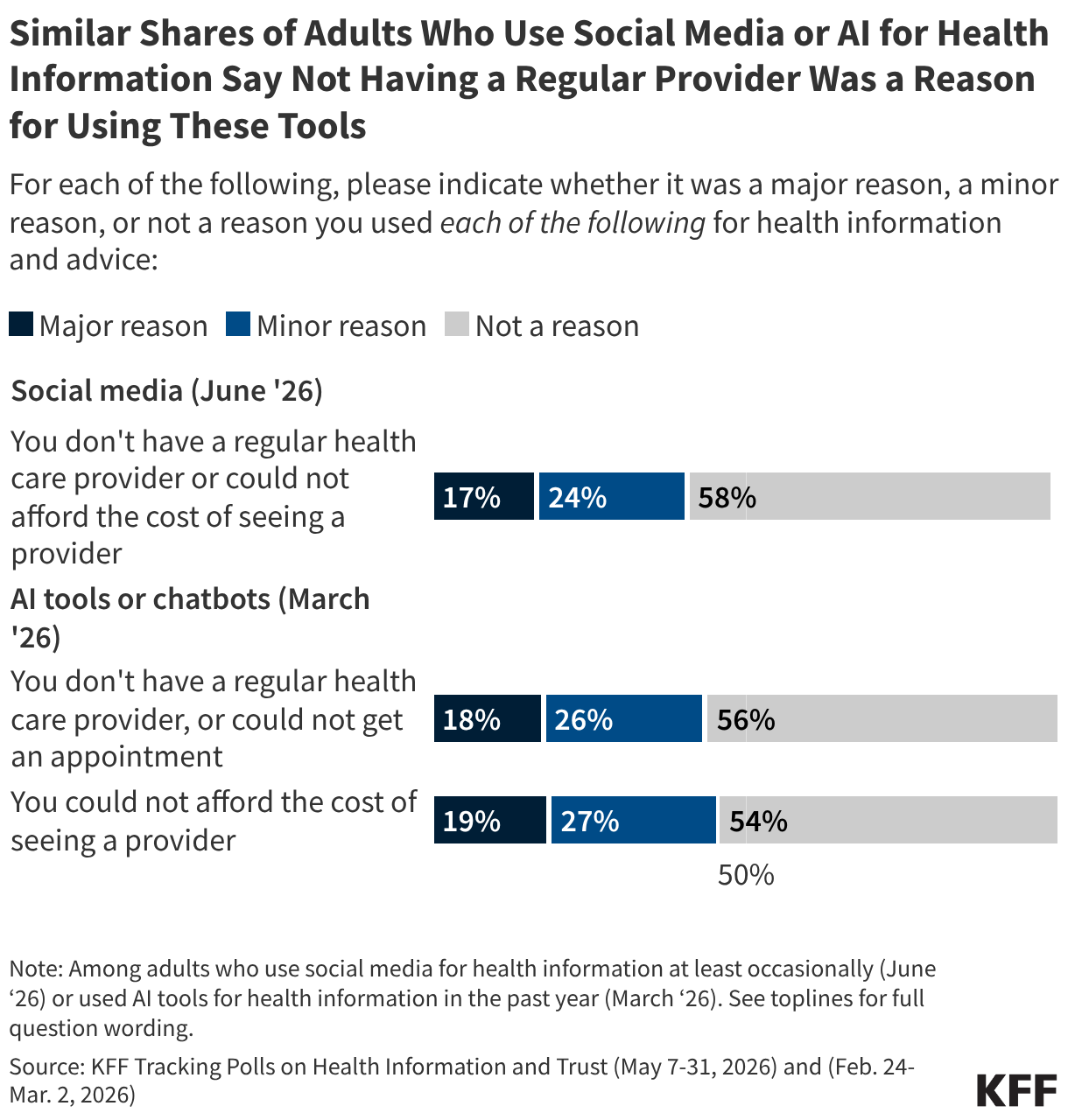
Views on the adequacy of safety testing for childhood vaccines also differ by age, with about four in ten (39%) parents under age 35 and about one-third (35%) of those ages 35 to 49 saying there is not enough safety testing compared to fewer parents ages 50 and older (26%).

Many Parents Are Unsure Whether Vaccines for Kids Go Through Enough Safety Testing; Younger and MAGA Republican Parents More Likely To Say They Do Not

Earlier this summer, Secretary Kennedy took a step towards changing vaccine policy in the U.S. by firing the President Biden-appointed ACIP and rebuilding it with the goal to review the current vaccine schedule for children. Secretary Kennedy himself and some of the members of the new committee have raised doubts about the current number of vaccines in the schedule, questioning whether the interactions between vaccines are safe for children. However, clinical studies have shown the current vaccine schedule and getting multiple doses when age appropriate to be safe.

About half (52%) of parents say the CDC currently recommends “about the right amount” of childhood vaccines, while a quarter say the CDC recommends “too many” childhood vaccines (26%). One in six parents say they are not sure (16%), and 5% say the CDC does not recommend enough vaccines for children. A larger share of Republican parents (41%) than Democratic (9%) or independent (26%) parents say the CDC recommends “too many” vaccines, rising to about half (49%) of MAGA Republicans.

A Quarter of Parents, Including About Half of MAGA Republicans, Say the CDC Recommends Too Many Childhood Vaccines

The CDC’s current childhood immunization schedule is based on how children’s immune systems respond to vaccines at particular ages as well as their likelihood of exposure to different diseases. The CDC advises that parents follow the timing of the immunization schedule, and there is no evidence that delaying or spacing out shots for children offers better protection or reduces serious effects. Parents, however, are divided on the question of whether childhood vaccines should be spaced out, with most (57%) correctly saying there is no strong evidence that spacing out vaccines or avoiding multiple shots in one visit is healthier for children, while four in ten (41%) incorrectly say that children are healthier when their vaccines are spaced out and they don’t get multiple shots in one visit.

Half of Republican parents and four in ten (42%) independent parents incorrectly say children are healthier when their vaccines are spaced out compared to about three in ten (28%) Democrats. About half (47%) of Black parents and about four in ten Hispanic (42%) and White (39%) parents hold this misconception.

About Four in Ten Parents Incorrectly Say Children Are Healthier When They Space Out Vaccines and Don't Get Multiple Shots at the Same Time

How Parents Identify Themselves When It Comes to Vaccine Views

While many parents express at least some level of concern or uncertainty about vaccine safety, very few (6%) say they consider themselves “anti-vaccine.” Similar shares of parents identify as either “pro-vaccine” (48%) or “somewhere in the middle” (45%). Six in ten Republican parents (57%), including six in ten MAGA Republicans and about half (52%) non-MAGA Republicans, say they are “somewhere in the middle” when it comes to vaccine attitudes. Most (70%) Democratic parents say they are “pro-vaccine.” White parents are more likely to be “pro-vaccine” than Black or Hispanic parents (51% v. 34% v. 43% respectively), while larger shares of Black parents (51%) and Hispanic parents (50%) say they are “somewhere in the middle.”

While anti-vaccine parents express vaccine skeptic views on other questions, and pro-vaccine parents are generally accepting and confident in vaccines, parents who identify as “somewhere in the middle” hold mixed views. For example, few “pro-vaccine” parents (17%) say childhood vaccines do not go through enough safety testing compared to much larger shares of parents who consider themselves anti-vaccine (64%) or somewhere in the middle (51%).

Across Groups, Few Parents Identify As Anti-Vaccine, With Most Saying They Are Pro-Vaccine or Somewhere in the Middle

Skipping and Delaying Childhood Vaccines: Which Parents Do It and Why?

As large shares of parents express positive attitudes towards childhood vaccines, most parents also report keeping their children up to date on childhood vaccines (83%). However, about one in six (16%) parents say they have ever skipped or delayed at least one childhood vaccine for any of their children (excluding seasonal vaccines like flu and COVID-19). Like vaccine attitudes, parents’ decisions about vaccination also differ along partisan lines. Republican parents are nearly three times as likely to report skipping vaccinations for their children compared to parents who are Democrats (22% vs. 8%). This partisan gap in parents’ reports of keeping children’s vaccinations up to date is  consistent with trends KFF polls have found since the COVID-19 pandemic led to deepening partisan divides in vaccine attitudes among all adults.

Similar to differences seen in some vaccine attitudes, younger parents are more likely than older parents to report skipping or delaying childhood vaccines. About one in five (19%) parents under age 35 report skipping or delaying vaccines for their children, regardless of the age of their child. This is larger than the shares of parents ages 35 to 49 (16%) or parents ages 50 and older (12%) who say the same.

Among White parents, religious beliefs play a role in childhood vaccine decisions. About one in five (19%) White parents overall report skipping or delaying vaccines for their children, rising to about one-third (36%) of White parents who describe themselves as “very religious.” Parents who homeschool their children are nearly four times as likely to report skipping or delaying vaccines compared to parents who have never homeschooled (46% vs. 12%).

Most Parents Report Keeping Children Up to Date on Vaccines; One in Five Young Parents, Republican Parents Report Skipping or Delaying Childhood Vaccines

About three quarters (73%) of the 6% of parents who describe themselves as “anti-vaccine” say they have skipped or delayed vaccines for their children. The vast majority (95%) of “pro-vaccine” parents have kept their children up to date with recommended vaccines. While most parents who describe themselves as “somewhere in the middle” on vaccines have kept their children up to date (78%), about one in five (22%) of these parents say they have ever skipped or delayed a childhood vaccine for their kids.

Three Quarters of Anti-Vaccine Parents Have Skipped or Delayed Vaccines for Their Kids, As Have One in Five Parents Who Are "Somewhere in the Middle" on Vaccines

When asked which specific childhood vaccines they have skipped or delayed, similar shares of parents report skipping or delaying the MMR vaccine (4% skipped, 5% delayed), DTaP (4% skipped and 5% delayed), hepatitis B (5% skipped and 4% delayed), chickenpox (4% skipped and 4% delayed), and polio (3% skipped and 4% delayed) vaccines. While just 6% of parents say they have skipped or delayed all the vaccines asked about in this poll, one in ten (10%) say they have skipped or delayed at least 2 childhood vaccines for their children, and 8% have skipped or delayed at least three. Overall, 8% of parents report delaying at least one of these vaccines, while 7% report forgoing at least one vaccine entirely.

Similar Shares of Parents Report Skipping or Delaying Different Childhood Vaccines

Parents’ reasons for skipping or delaying vaccines for their own children mirror many of the general concerns and uncertainty expressed by parents overall. About two-thirds (67%) of parents who skipped or delayed vaccines for their child say concerns about side effects were a “major reason” for their decision. About half of these parents say not trusting that vaccines are safe (53%) or not thinking all the recommended vaccines are necessary (51%) are major reasons they skipped or delayed their child’s vaccines.

About four in ten (42%) parents who skipped or delayed vaccines for their child say not wanting their child to get multiple shots at once was the major reason, followed by about one-third (34%) who say they skipped or delayed vaccines because they can keep their child healthy in other ways without vaccines. About one in ten parents who skipped or delayed vaccines say the major reason was that their child is afraid of needles (10%) or their doctor did not recommend vaccination (9%).

Few vaccine-skipping parents cite access reasons, such as not having time or not being able to get an appointment (9%) or that the cost was too high (5%). One in eight (13%) parents say a major reason they skipped or delayed vaccines for their child was that their child has a health condition, while one in eight (13%) say this was a minor reason and nearly three in four (72%) parents who skipped vaccines say a medical condition was not a reason for skipping vaccines for their child.

Half or More Parents Who Skipped or Delayed Vaccines for Their Children Cite Side Effects, Safety Concerns, or Claim Not All Vaccines Were Necessary

Half of parents who delayed or skipped vaccines for their children say their child’s health care provider was supportive of their decision (49%), while one in five say their doctor was not supportive (23%) and about one in four (27%) say they did not discuss the decision with a health care provider. Similar shares of parents across age groups and with children in different age cohorts say their doctor was supportive of their decision to delay or skip vaccines.

Half of Parents Who Skipped Vaccines For their Children Say Their Child's Doctor Was Supportive of the Decision; About One Quarter Did Not Consult a Doctor

Some parents may be self-selecting pediatricians who align with their vaccine views. One in four parents who have skipped or delayed vaccines for their children say they have ever changed or tried to change their child’s provider due to the provider’s views on vaccines. Few (3%) parents who keep their children up to date on vaccines say the same.

One in Four Parents Who Skipped or Delayed Vaccines for Their Kids Say They Tried To Change Pediatricians Due to Provider’s Vaccine Views

Few parents report feeling pressured by peers or doctors to vaccinate their children, though those who have skipped or delayed vaccines are more likely to report feeling pressure. About one in four (23%) parents overall say they have felt unfairly pressured by government health agencies to vaccinate their children, rising to about half (49%) among parents who have skipped or delayed vaccines. Smaller shares say they have felt pressure from a health care provider (16% overall, 44% among parents who skipped or delayed vaccines), their child’s school or daycare (14% overall, 32% among parents who skipped or delayed vaccines), friends or family (10% overall, 24% among parents who skipped or delayed vaccines), or other parents (10% overall, 26% among parents who skipped or delayed vaccines). Few parents who report keeping their children up to date on vaccines report feeling pressure from these sources.

At Least Four in Ten Parents Who Skipped or Delayed Vaccines Say They Felt Unfairly Pressured by a Doctor, Gov. Health Agency to Vaccinate Their Kids

The Role of Schools

At this time, all 50 states and D.C. have state laws that require children starting school to be vaccinated against MMR and polio at the federally recommended ages, though Florida has announced that the state will end all vaccine mandates, including for school children. While there is no federal law regarding childhood vaccinations, recommendations about school requirements are issued by the CDC’s Advisory Committee on Immunization Practices (ACIP). Each state has its own laws determining school vaccination requirements, including policies for exemptions. While all states allow for medical exemptions from school vaccine requirements, some states additionally allow for religious or other personal-belief exemptions.

Overall, parents largely support these policies, with about eight in ten (81%) parents saying public schools should require vaccines for measles and polio with some exceptions, while about one in five (18%) say public schools should not require measles and polio vaccines for any students. While Republican parents and independents are each more likely than Democrats to say public schools should not require these vaccines, majorities across these groups nonetheless support such requirements.

Most Parents Support Public School Vaccine Requirements for Measles and Polio, While About One in Five Say Public Schools Should Not Require These Vaccines

Eight percent of parents overall, including about one in four (27%) of those who have skipped or delayed vaccines, say they have applied for an exemption so their child could attend school or daycare without receiving required vaccines. The most common type of exemption is for personal reasons, reported by 4% of parents overall and one in five parents who have skipped or delayed any vaccinations for their children. Religious reasons for exemption are cited by 4% of parents overall, and one in six (16%) parents who have skipped or delayed vaccinations for their children. Medical exemptions are least common, reported by 3% of parents overall and one in ten (11%) parents who have skipped vaccines for their children.

About two-thirds (64%) of parents who applied say their exemption was approved, while 36% say it was denied. Among all parents, 5% say they applied for an exemption, and it was granted and 3% say they applied and were denied. In a policy statement, the American Academy of Pediatrics (AAP) “advocates for the elimination of nonmedical exemption from immunizations” citing their role in increasing the risk of measles and other vaccine preventable disease outbreaks.

One in Ten Parents Who Have Skipped or Delayed Vaccines Say They Have Applied for a Medical Exemption for Their Child To Attend School Without Vaccinations

One in five parents of children ages 6-17, including four in ten (42%) of those who have skipped or delayed vaccinations, say they have homeschooled their child for reasons other than the COVID-19 school shutdowns. Consistent with previous polling on homeschooling by The Washington Post, vaccine requirements do not appear to be the main motivation for homeschooling for most parents. Three in ten homeschool parents say school vaccine requirements were a major (14%) or minor (16%) reason for homeschooling their child, while seven in ten (69%) say school vaccine policies were not a reason. One in five parents who currently or previously homeschooled their children say they applied for a school vaccine exemption at some point.

Parents’ Views of the HPV Vaccine

Introduced in 2006, vaccines for human papillomavirus (HPV) prevention have been the source of some controversy. HPV is a sexually transmitted infection (STI) that can cause cervical cancer and other cancers. The HPV vaccines available in the U.S. have been clinically proven to be safe and effective at preventing HPV-related infections and cancers. Children can be vaccinated for HPV as young as 9 in some states, though the CDC recommends routine vaccination against HPV between ages 11 and 15. While health experts broadly recommend the vaccine for adolescents and children before an exposure to HPV, its connection to STIs has fueled debate over whether it should be given to children. About two-thirds of parents (64%) say they have heard “a lot” (22%) or “some” (41%) of the vaccine that prevents HPV, including similar shares of parents of girls and boys.

About six in ten (62%) parents of children ages 9 and older say their child has already received the HPV vaccine, or they probably or definitely will get it. This rises to about seven in ten (69%) among parents who have kept all their children up to date on other childhood vaccines. As with vaccine uptake for other childhood vaccines, Democratic parents (76%) are more likely to say their child will get or has gotten vaccinated against HPV, though half (51%) of Republican parents of eligible children say the same. About six in ten (62%) independent parents say they have gotten their child vaccinated against HPV or plan to do so. Similar shares of parents of boys and girls say they have gotten or will get their older children vaccinated.

Six in Ten Parents of Children Ages 9 and Older Say Their Child Has Already Gotten or Will Get Vaccinated Against HPV

Among parents of children under age 9 who are not yet eligible for HPV vaccination, about six in ten say they will definitely (29%) or probably (29%) get their child vaccinated against HPV, while one in five say they probably (9%) or definitely (10%) will not vaccinate their child. One in five (22%) are not sure. Larger shares of Democratic parents (79%) and parents who have not skipped any childhood vaccines for their children (66%) say they will probably or definitely get their children vaccinated against HPV when they are eligible, compared with about four in ten (42%) Republican parents and one in five (19%) of those who have skipped or delayed childhood vaccines.

Six in Ten Parents of Young Children Say They Will Probably or Definitely Get Them Vaccinated Against HPV When They Are Eligible; One in Five Are Not Sure

In Their Own Words: Why do you think you will not get your child vaccinated against HPV?

In a follow up question, parents who said they “probably” or “definitely” would not get their child vaccinated against HPV told us why that is. Many offered responses related to concerns about the HPV vaccine being associated with unsafe sexual behavior and did not see a need to give that to their children, as well as anecdotes of side effects.

“Risks outweigh the benefits. This is a disease caused by a virus you get due to unwise behavior.” – Republican parent of a teenage boy and girl, age 51, Wisconsin

“They should not be engaging in sexual activity until marriage, and they explicitly understand the risks without the vaccine, and of course, the sinful nature.” – Independent parent of a pre-teen girl, age 34, Pennsylvania

“[I] know someone who had a vaccine injury from the vaccine and because it is a newer vaccine unsure of effectiveness and risk of long-term complications.” – Republican parent of a teenage girl, age 38, Louisiana

“Children should not be having a sexual relationship and being exposed to disease.” – Republican parent of a teenage boy, age 54, Pennsylvania

“I have personally known multiple people with severely adverse health effects directly caused by that vaccine. It also sends a message to our children that we expect them to be sexually immoral. It appears to have been more of a money grab than an actually useful vaccine.” – Independent parent of a teenage boy, age 43, Florida

“I’ve seen mixed information about the vaccine not just from parents. I would like to do further research about the potential adverse effects and benefits before making a decision.” – Democratic parent of pre-teen girls, age 41, Texas

Belief in False and Misleading Claims About Measles and Vaccines

Before his confirmation and in his role as HHS Secretary, Robert F. Kennedy Jr. has amplified claims about vaccines that have been rejected by scientists and public health officials. Along with firing and reassembling the ACIP, Kennedy has said he will investigate the childhood vaccination schedule, suggesting without evidence that the number of recommended childhood vaccines has led to a rise in chronic disease in the U.S. Kennedy has also repeated false claims that vaccines, including MMR, can cause autism and that the measles vaccine causes the illness it prevents. More recently, Kennedy has promoted Vitamin A as an effective treatment for measles, despite public health experts’ warning that supplements cannot substitute for vaccination.

Relatively few parents think false or misleading claims about vaccines and measles are true, but many are uncertain, with at least four in ten saying they do not know enough to say. At the same time, the share who say these false claims are true is higher among Republican parents, particularly those who identify as supporters of the Make America Great Again (MAGA) movement.

Overall, few parents say they think it is true that chronic diseases are rising because of an increase in the number of vaccines children get (13%), that MMR vaccines can cause autism in children (9%), that the measles vaccine causes the same illness it is supposed to prevent (8%), or that vitamin A is an effective treatment for measles (6%). For each claim related to vaccines,  between four in ten and half say they are false, including that the measles vaccines cause the same illness they are supposed to prevent (49%), that chronic diseases are likely rising due to an increase in the number of childhood vaccines (45%), or that MMR vaccines can cause autism in children (42%).  Assessing the false claim that Vitamin A is an effective treatment for measles, about one in four correctly say it is false (27%), while two-thirds (66%) say they do not know enough to say.

Few Adults Say They Think False Statements About Vaccines and Measles are True, But At Least Four In Ten Express Uncertainty

Republican parents are about twice as likely as Democratic parents to believe that chronic diseases are rising because of an increase in the number of vaccines children get (18% v. 7%) and that the MMR vaccines can cause autism in children (13% v. 5%). Belief in each of the three claims related to vaccines and measles is higher among parents who are MAGA Republicans compared to non-MAGA Republicans; nonetheless, most MAGA supporters either express uncertainty or say these claims are false.

Parents who say they skipped or delayed recommended vaccines for their children are far more likely than those who have kept their children up to date to believe these myths.

MAGA Republican Parents and Parents Who Have Skipped or Delayed Children's Vaccines Are More Likely To Believe False Claims About Vaccines

The claim linking MMR vaccines to autism is one that has a long history, and previous KFF polling has found many parents are uncertain about the facts around autism and vaccines. The poll finds that parents who say their child has been diagnosed with autism spectrum disorder are more likely than those whose children have not to say it is true that MMR vaccines can cause autism in children (16% v. 9%). About one-third (37%) of parents of children diagnosed with autism say they do not know enough to answer.  

About Half of Parents of Kids Diagnosed With Autism Correctly Say it is False That MMR Vaccines Cause Autism, Nearly Four in Ten Are Unsure

Confidence in Federal Health Agencies and Changes to Vaccine Policy

Amid criticism of federal health agencies, Robert F. Kennedy Jr. was appointed HHS Secretary, and said his priority was to strengthen the agencies’ independence and base decisions on scientific evidence. Six months into his term as Secretary, parents’ confidence in federal health agencies to carry out some of their core functions is mixed.

About half (49%) of parents say they have “a lot” or “some confidence” in government health agencies like the CDC and FDA to ensure the safety and effectiveness of vaccines. Fewer than half express confidence in these agencies to make decisions based on science rather than the views of agency officials (40%) or to act independently without interference from outside interests (35%).

Half or Fewer Parents Are Confident in Federal Health Agencies To Ensure Vaccine Safety, Follow Science, or Act Independently

Republican parents are less likely than Democratic parents to express confidence in government health agencies to ensure the safety and effectiveness of vaccines (41% v. 60%), make decisions based on science rather than the views of agency officials (35% v. 48%), or to act independently without outside interference (30% v. 40%).

Even among parents who are ostensibly among the current administration’s most ardent supporters (Republicans who say they support the MAGA movement), fewer than half express at least some confidence in federal government health agencies to ensure the safety and effectiveness of vaccines, make decisions based on science, or act independently.

Parents under age 50, who are more likely to express vaccine-skeptical attitudes and to report skipping or delaying vaccines for their children, are less likely than older parents to express confidence in government health agencies to ensure vaccine safety and effectiveness and to act independently without outside interests.

Confidence in Federal Health Agencies to Ensure Vaccine Safety is Lower Among Younger Parents, MAGA Republican Parents

Since his appointment as Secretary of Health and Human Services, Robert F. Kennedy Jr. has made several changes to U.S. vaccine policy, including replacing the ACIP, removing COVID-19 vaccine recommendations for healthy children, and cancelling funding for mRNA vaccine research. This survey, fielded late July to early August 2025, finds that fewer than half of parents have heard about these changes.

About four in ten (38%) parents have heard “a lot” (11%) or “some” (27%) about recent changes Kennedy has made that could affect vaccine policies in the U.S., while about one in four (27%) have heard “a little” and one-third (34%) have heard “nothing at all.” Parents with a college degree (49%) and Democrats (49%) are more likely than their counterparts to say they have heard at least “some” about these recent changes.

A Majority of Parents Have Heard Little or Nothing About Kennedy's Changes That Could Impact Vaccine Policy in the U.S.

When it comes to expectations of the impact of these changes, parents are split along party lines. One in six parents (16%) say the changes made by Kennedy will make childhood vaccines safer, about one in five (18%) say the changes will make childhood vaccines less safe, and an additional one in five say these changes will not make a difference (22%). The largest share of parents, more than four in ten (44%), say they are not sure how these changes will impact safety.

Partisans are split, with about three in ten (29%) Republican parents, rising to nearly four in ten (38%) MAGA Republicans, saying these changes will make childhood vaccines safer, compared to 4% of Democratic parents. Four in ten Democratic parents and 5% of Republican parents say the changes will make vaccines less safe. About one in five parents across partisans say the changes will not make a difference, and at least one-third say they are not sure.

Parents Are Divided Over Whether Kennedy's Changes Will Make Childhood Vaccines Safer or Less Safe; Four in Ten Are Not Sure

Fewer than one in ten (8%) parents say that changes made by Kennedy will make it easier for parents to access vaccines for their children, about one in four (24%) say these changes will make it more difficult, and about one in four say it will not make a difference (23%). The largest share (44%) say they are not sure.

Again, partisans are split, with half of Democratic parents (52%) saying Kennedy’s changes will make it more difficult to access vaccines. Most Republican parents say Kennedy’s changes will not make a difference in access to childhood vaccines (33%) or that they are not sure (46%).

About Half of Democrats Say Kennedy’s Changes Will Make Vaccine Access Difficult; Most Republicans See No Impact or Are Unsure

Secretary Kennedy has promised radical transparency and a decrease in the pharmaceutical industry’s influence on U.S. vaccine policy, yet about half (51%) of parents are unsure whether Kennedy’s policies will achieve this decreased influence. One in five (20%) say Kennedy’s changes will decrease pharmaceutical company influence in U.S. vaccine policy, about one in ten (11%) say they will increase influence, and one in six (17%) parents say it won’t make a difference.

Half of Republicans (47%) and Democrats (50%) say they are not sure if Kennedy’s changes will increase or decrease pharmaceutical company influence in U.S. vaccine policy. One-third (32%) of Republicans expect the changes to decrease pharmaceutical company influence, while one in five Democrats say it will either increase (18%), or will not make a difference (20%).

Half of Parents Are Unsure How Kennedy's Changes Will Impact Pharmaceutical Influence in U.S. Vaccine Policy; Republicans More Likely to Say it Will Decrease

Trust in Sources of Vaccine Information

Consistent with prior KFF polling, pediatricians are the most trusted source of vaccine information among parents, with more than eight in ten (85%) saying they trust their child’s pediatrician a “great deal” or “fair amount” to provide reliable information about vaccines. Smaller majorities express trust in government sources of vaccine information, including their local public health department (64%), the CDC (59%), and the FDA (55%). Over half (56%) of parents say they trust their friends and family for reliable vaccine information, while nearly half (46%) trust their child’s school or daycare.

Fewer parents say they trust HHS Secretary Kennedy (36%) or pharmaceutical companies (31%) as sources of vaccine information. Trust in health and wellness influencers for reliable vaccine information is the lowest among these sources, with about one in seven (14%) parents expressing trust, including just 2% who say they trust health influencers “a great deal.”

Aside from pediatricians, who garner “a great deal” of trust from four in ten (43%) parents overall, other sources for vaccine information garner “a great deal” of trust from 15% of parents or fewer.

Pediatricians are the Most Trusted Source of Vaccine Information Among Parents, Far Fewer Trust Secretary Kennedy, Pharmaceutical Companies, Influencers

There are wide partisan divisions when it comes to trust in some sources of vaccine information. While large majorities across partisans trust their children’s pediatrician at least a “fair amount” for vaccine information, trust is higher among Democratic parents (93%) than Republican (85%) or independent parents (82%). Notably, about four in ten independent (39%) and Republican parents (37%) say they trust their child’s pediatrician a “great deal” for vaccine information compared to about six in ten Democratic parents (62%).

Democratic parents are more likely than both independent and Republican parents to express at least a “fair amount” of trust in government health agencies, including their local public health department, the CDC, and the FDA, as well as their children’s school or day care. Conversely, just over half of Republican parents (54%) and one-third of independent parents say they trust HHS Secretary Kennedy to provide reliable vaccine information compared to about one in five Democratic parents (18%). Fewer than one in five parents across partisans say they trust health and wellness influencers as sources of vaccine information.

Republican and Independent Parents Are Less Likely Than Democratic Parents To Trust Most Sources of Vaccine Information, but More Likely To Trust Kennedy

Pediatricians continue to be the most trusted source of information about vaccines for parents, regardless of their vaccine choices. About two-thirds (64%) of parents who report skipping or delaying at least one childhood vaccine for their children and nine in ten of those who have kept their kids up to date say they trust their child’s pediatrician “a great deal” or “a fair amount.”

Aside from pediatricians, parents who have made different vaccine choices for their children report trusting different sources for information. About half of parents who have skipped or delayed vaccines say they trust their friends and family (55%) and HHS Secretary Kennedy (47%) for vaccine information, making these the top two sources of vaccine information for these parents after pediatricians. One-third or fewer parents who have skipped or delayed childhood vaccines trust their local health department, FDA, and CDC, sources which are trusted by majorities of parents who report keeping their children up to date on vaccines.

Pediatricians, Friends and Family, and HHS Secretary Kennedy Are the Most Trusted Sources of Vaccine Info for Parents Who Skipped or Delayed Vaccines

Despite trusting a variety of information sources, few parents report difficulty understanding the vaccine schedule for their children and why they should get them vaccinated. Overall, about eight in ten parents say it is either “very” or “somewhat easy” to understand why their children should get vaccines in general (84%), when their children should get certain vaccines (83%), and which vaccines their children should get (81%). However, half or fewer parents say it is “very easy” to understand each of these, including why they should be vaccinated (52%), when they should be vaccinated (44%), and which vaccines they should get (44%).

Most Parents Say It Is Easy To Understand Why They Should Vaccinate Their Children in General, Which Vaccines They Should Get and When

Methodology

This KFF/The Washington Post Survey of Parents was designed and analyzed by public opinion researchers at KFF and The Washington Post. The survey was designed to reach a representative sample of parents or legal guardians of children under the age of 18 in the U.S. The survey was conducted July 18 – August 4, 2025, online among a nationally representative sample of 2,716 parents using the Ipsos KnowledgePanel in English (n=2519) and in Spanish (n=197). KnowledgePanel is a nationally representative probability-based panel where panel members are recruited randomly through invitations mailed to respondents randomly sampled from an Address-Based Sample (ABS) provided by Marketing Systems Groups (MSG) through the U.S. Postal Service’s Computerized Delivery Sequence (CDS). Invitations were sent to panel members by email followed by up to two reminder emails.

All completes were reviewed to ensure respondents were giving the survey adequate attention. Three cases were removed from the data that failed internal quality checks. Most KnowledgePanel respondents received a financial incentive equaling about $1 for their participation in this survey with some harder-to-reach groups receiving about $5 for their participation.

The survey also includes an oversample of parents of children 5 years old and younger (n=1,092) in order to reach a higher rate of responses from parents who are currently making decisions around their child’s vaccines. The full sample was weighted to match the sample’s demographics to the national U.S. parent population using data from the Census Bureau’s 2023 American Community Survey. Weighting parameters included gender, age, education, race/ethnicity, region, metro status, and language proficiency within the Hispanic sample. The sample was also weighted to the total parent population on political party identification using the 2025 KFF Benchmarking Survey.  An additional adjustment was conducted in order to provide estimates from parents living in Texas (n=276) using the 2023 ACS as well as the 2023-2024 Pew Religious Landscape Survey. Both weights take into account differences in the probability of selection, including adjustment for the sample design, within household probability of selection, and the design of the panel-recruitment procedure.

The margin of sampling error including the design effect for the total sample is plus or minus 2 percentage points and plus or minus 3 percentage points for the parents of children under the age of 6. The full Texas sample has a margin of sampling error of plus or minus 7 percentage points. Numbers of respondents and margins of sampling error for key subgroups are shown in the table below. For results based on other subgroups, the margin of sampling error may be higher. Sample sizes and margins of sampling error for other subgroups are available on request. Sampling error is only one of many potential sources of error and there may be other unmeasured error in this or any other public opinion poll. KFF and The Washington Post are charter members of the Transparency Initiative of the American Association for Public Opinion Research.

M.O.S.E.N (unweighted)M.O.S.E.
Total parents2,716± 2 percentage points
Texas parents276± 7 percentage points
Florida parents136± 9 percentage points
   
Party ID  
Democratic parents                                                                                           801± 4 percentage points
Independent/Other party parents1,077± 3 percentage points
Republican parents780± 4 percentage points
MAGA Republican parents498± 5 percentage points
   
Parents by vaccine choice  
Skipped or delayed any childhood vaccines436± 5 percentage points
Kept kids up to date on all childhood vaccines2,264± 2 percentage points


How Much do People with Employer Plans Spend Out-of-Pocket on Cost-Sharing?

Authors: Lynne Cotter, Kaitlyn Vu, and Matthew Rae
Published: Oct 9, 2025

Over the past decade, cost-sharing (the out-of-pocket portion of household health spending) has grown faster than both workers’ wages and general inflation for those with employer coverage. In recent years, that growth has reached a rate more similar to inflation. Since 2003, average out-of-pocket costs have increased by 37%. In 2023, a majority (66%) of people with employer coverage spent more than $100 on out-of-pocket costs.

This chart collection examines trends in employee spending on deductibles, copayments, and coinsurance from 2012 to 2023, using a sample of health benefit claims for individuals under 65 from the Merative™ MarketScan® Commercial Database.

The full analysis and other data on health costs are available on the Peterson-KFF Health System Tracker, an online information hub dedicated to monitoring and assessing the performance of the U.S. health system.