
Medicaid’s Role in Addressing the Opioid Epidemic
| Table 1: State Indicators of Medicaid’s Role in Addressing the Opioid Epidemic | ||||||
| State | Opioid Overdose Death Rate per 100,000 (2017) | Number of Opioid Overdose Deaths (2017) | Medicaid Coverage of MAT Drugs (2018) | IMD Exclusion Waiver for SUD Treatment (2019) | ||
| Prescription Opioids | Heroin | Synthetic Opioids | ||||
| United States | 14.9 | 14,495 | 15,482 | 28,466 | M – 41, B – 51,N – 51 | 21 Approved,7 Pending |
| Alabama | 9.0 | 141 | 125 | 198 | M, B, N | No |
| Alaska | 13.9 | 47 | 36 | 37 | M, B, N | Approved |
| Arizona | 13.5 | 349 | 334 | 267 | M, B, N | Pending |
| Arkansas | 6.5 | 116 | 15 | 68 | B, N | No |
| California | 5.3 | 973 | 715 | 536 | M, B, N | Approved |
| Colorado | 10.0 | 254 | 224 | 112 | M, B, N | No |
| Connecticut | 27.7 | 188 | 425 | 686 | M, B, N | No |
| Delaware | 27.8 | 64 | 121 | 178 | M, B, N | Pending |
| District of Columbia | 34.7 | 39 | 127 | 182 | M, B, N | No |
| Florida | 16.3 | 1,133 | 707 | 2,126 | M, B, N | No |
| Georgia | 9.7 | 513 | 263 | 419 | M, B, N | No |
| Hawaii | 3.4 | 33 | 10 | N/A | M, B, N | No |
| Idaho | 6.2 | 55 | 23 | 22 | B, N | No |
| Illinois | 17.2 | 494 | 1,187 | 1,251 | M, B, N | Approved |
| Indiana | 18.8 | 390 | 327 | 649 | M, B, N | Approved |
| Iowa | 6.9 | 95 | 61 | 92 | M, B, N | No |
| Kansas | 5.1 | 74 | 25 | 32 | B, N | Approved |
| Kentucky | 27.9 | 399 | 269 | 780 | B, N | Approved |
| Louisiana | 9.3 | 161 | 162 | 156 | B, N | Approved |
| Maine | 29.9 | 75 | 76 | 278 | M, B, N | No |
| Maryland | 32.2 | 524 | 522 | 1,542 | M, B, N | Approved |
| Massachusetts | 28.2 | 254 | 466 | 1,649 | M, B, N | Approved |
| Michigan | 21.2 | 510 | 783 | 1,368 | M, B, N | Pending |
| Minnesota | 7.8 | 150 | 111 | 184 | M, B, N | Pending |
| Mississippi | 6.4 | 89 | 34 | 81 | M, B, N | No |
| Missouri | 16.5 | 226 | 299 | 618 | M, B, N | No |
| Montana | 3.6 | 22 | N/A | N/A | M, B, N | No |
| Nebraska | 3.1 | 32 | N/A | 25 | B, N | Pending |
| Nevada | 13.3 | 239 | 94 | 66 | M, B, N | No |
| New Hampshire | 34.0 | 51 | 28 | 374 | M, B, N | Approved |
| New Jersey | 22.0 | 424 | 1,085 | 1,376 | M, B, N | Approved |
| New Mexico | 16.7 | 144 | 144 | 75 | M, B, N | Approved |
| New York | 16.1 | 821 | 1,356 | 2,238 | M, B, N | No |
| North Carolina | 19.8 | 573 | 537 | 1,285 | M, B, N | Approved |
| North Dakota | 4.8 | 18 | N/A | 12 | B, N | No |
| Ohio | 39.2 | 854 | 1,000 | 3,523 | M, B, N | Pending |
| Oklahoma | 10.2 | 226 | 61 | 102 | M, B, N | No |
| Oregon | 8.1 | 124 | 124 | 85 | M, B, N | No |
| Pennsylvania | 21.2 | 564 | 819 | 1,982 | M, B, N | Approved |
| Rhode Island | 26.9 | 74 | 14 | 201 | M, B, N | Approved |
| South Carolina | 15.5 | 312 | 153 | 404 | B, N | No |
| South Dakota | 4.0 | 14 | N/A | 14 | M, B, N | No |
| Tennessee | 19.3 | 592 | 311 | 590 | B, N | Pending |
| Texas | 5.1 | 535 | 569 | 348 | M, B, N | No |
| Utah | 15.5 | 290 | 147 | 92 | M, B, N | Approved |
| Vermont | 20.0 | 27 | 41 | 77 | M, B, N | Approved |
| Virginia | 14.8 | 336 | 556 | 829 | M, B, N | Approved |
| Washington | 9.6 | 250 | 306 | 143 | M, B, N | Approved |
| West Virginia | 49.6 | 279 | 244 | 618 | M, B, N | Approved |
| Wisconsin | 16.9 | 318 | 414 | 466 | M, B, N | Approved |
| Wyoming | 8.7 | 30 | N/A | 17 | B, N | No |
| NOTE: Overdose deaths by type of opioid are not mutually exclusive and should not be summed. Synthetic opioid deaths do not include deaths due to methadone. Medication-Assisted Treatment (MAT) drugs are: methadone (M), buprenorphine (B), and naltrexone (N). Naltrexone includes both oral and injectable. An IMD (Institution for Mental Disease) is an inpatient facility with over 16 beds.Sources for this table are available at: http://kff.org/infographic/medicaids-role-in-address-opioid-epidemic. | ||||||
SOURCES
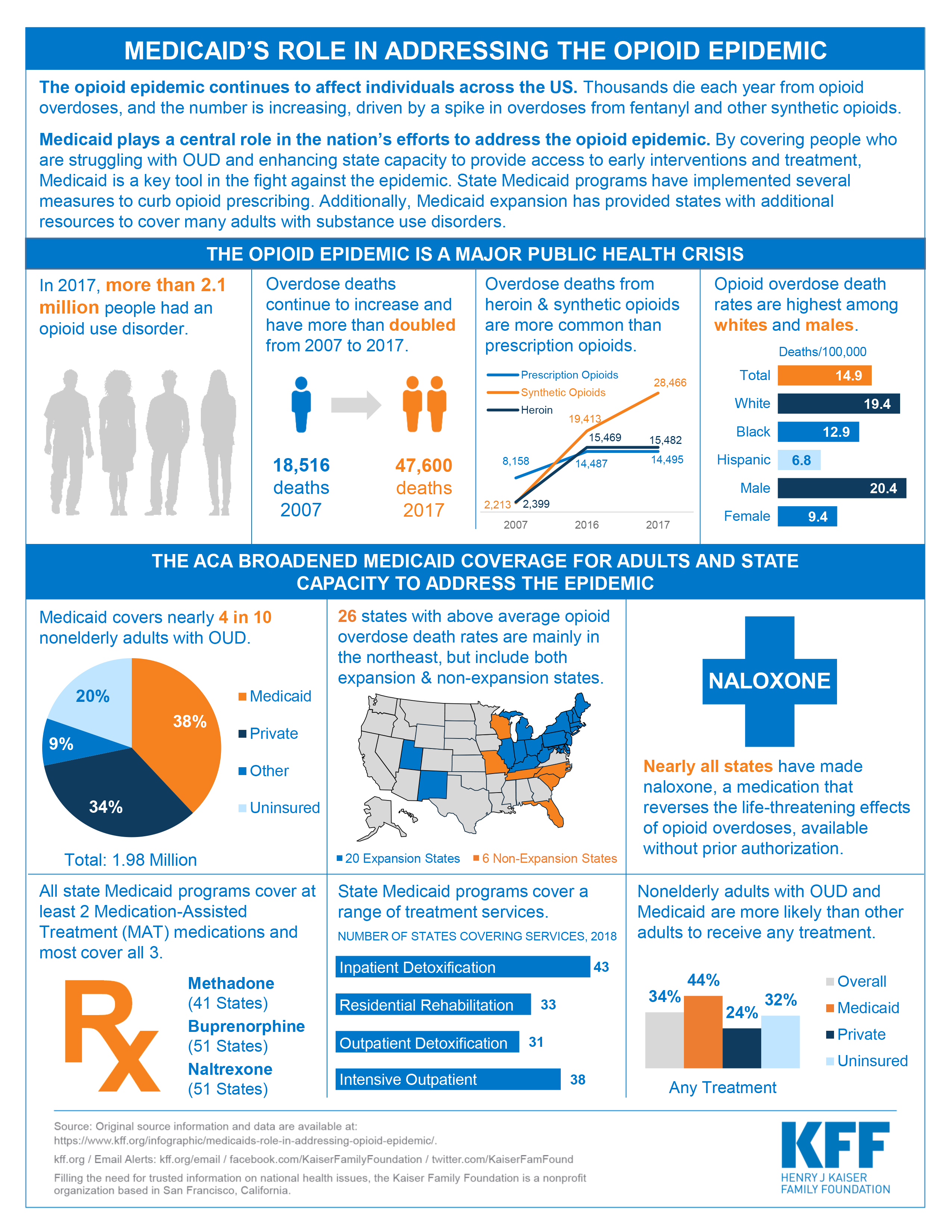
Total number of individuals with OUD in 2017: KFF analysis of the 2017 National Survey on Drug Use and Health (NSDUH). Note: the total number of individuals with OUD is for those ages 12 and older.
Overdose deaths: KFF State Health Facts, “Opioid Overdose Deaths,” accessed May 2019, https://www.kff.org/state-category/health-status/opioids/. Note: synthetic opioid estimates exclude methadone.
Insurance coverage of nonelderly adults with OUD: KFF analysis of 2017 NSDUH. Note: nonelderly adults are 18-64 years. Other includes Medicare, CHAMPUS, and any other type of health insurance.
Naloxone: KFF State Health Facts, “Medicaid Behavioral Health Services: Naloxone Available in at Least One Formulation Without Prior Authorization,” accessed May 2019, https://www.kff.org/other/state-indicator/medicaid-behavioral-health-services-naloxone-available-in-at-least-one-formulation-without-prior-authorization/.
State coverage of MAT medications: KFF State Health Facts, “Medicaid Behavioral Health Services: Substance Use Disorder (SUD) Services,” accessed May 2019, https://www.kff.org/state-category/medicaid-chip/medicaid-behavioral-health-services/substance-use-disorder-sud-services/.
- Methadone: https://www.kff.org/other/state-indicator/medicaid-behavioral-health-services-methadone-for-medication-assisted-treatment-mat/
- Buprenorphine: https://www.kff.org/other/state-indicator/medicaid-behavioral-health-services-buprenorphine-for-medication-assisted-treatment-mat/
- Naltrexone: https://www.kff.org/other/state-indicator/medicaid-behavioral-health-services-injectable-naltrexone-for-medication-assisted-treatment-mat/ & https://www.kff.org/other/state-indicator/medicaid-behavioral-health-services-oral-naltrexone-for-medication-assisted-treatment-mat/
Number of states covering treatment services: KFF State Health Facts, “Medicaid Behavioral Health Services: Substance Use Disorder (SUD) Services,” accessed May 2019, https://www.kff.org/state-category/medicaid-chip/medicaid-behavioral-health-services/substance-use-disorder-sud-services/.
- Inpatient Detoxification: https://www.kff.org/other/state-indicator/medicaid-behavioral-health-services-inpatient-detoxification/
- Residential Rehabilitation: https://www.kff.org/other/state-indicator/medicaid-behavioral-health-services-residential-rehabilitation/
- Outpatient Detoxification: https://www.kff.org/other/state-indicator/medicaid-behavioral-health-services-outpatient-detoxification/
- Intensive Outpatient: https://www.kff.org/other/state-indicator/medicaid-behavioral-health-services-intensive-outpatient-treatment-for-substance-use-disorder/
Insurance coverage and treatment: KFF analysis of 2017 NSDUH. Note: Nonelderly adults are 18 to 64 years. Any treatment includes to receiving treatment at any of the following in the past year: inpatient hospital, residential rehabilitation, outpatient rehabilitation, mental health center, and private doctors’ office.
Table 1 State Indicators of Medicaid’s Role in Addressing the Opioid Epidemic:
- Overdose deaths: KFF State Health Facts, “Opioid Overdose Deaths,” accessed May 2019, https://www.kff.org/state-category/health-status/opioids/. Note: synthetic opioid estimates exclude methadone.
- State coverage of MAT medications: KFF State Health Facts, “Medicaid Behavioral Health Services: Substance Use Disorder (SUD) Services,” accessed May 2019, https://www.kff.org/state-category/medicaid-chip/medicaid-behavioral-health-services/substance-use-disorder-sud-services/.
- IMD Exclusion Waiver: Kaiser Family Foundation, “Medicaid Waiver Tracker: Approved and Pending Section 1115 Waivers by State,” (Washington, DC: Kaiser Family Foundation, April 18, 2019), https://www.kff.org/medicaid/issue-brief/medicaid-waiver-tracker-approved-and-pending-section-1115-waivers-by-state/.