KFF designs, conducts and analyzes original public opinion and survey research on Americans’ attitudes, knowledge, and experiences with the health care system to help amplify the public’s voice in major national debates.
This report illustrates the diverse experiences of dually eligible beneficiaries – low-income seniors and younger adults with disabilities who are eligible for both Medicare and Medicaid – in obtaining medical care and non-medical, supportive services. Based on personal interviews, the profiles of 14 dually eligible beneficiaries residing in California, Florida, Massachusetts, Michigan, and Oklahoma highlight day-to-day experiences with accessing care, maintaining relationships with providers, managing prescription medications and personal finances, and relying on family and friends for additional support. Such personal stories add a human dimension to the ongoing conversations among federal and state policymakers about the importance of high quality, coordinated care for this population.
The report also includes a brief background on how dually eligible beneficiaries qualify for Medicare and Medicaid and what benefits are covered under each program as well as spending and enrollment data and a glossary of eligibility and service delivery system terms.
This brief examines how health service providers, plan administrators, and community-based organizations in Contra Costa, Kern, and Los Angeles Counties experienced the transition of Medi-Cal-only seniors and persons with disabilities (SPDs) to managed care as part of the state’s “Bridge to Reform” Medicaid waiver. Findings presented may inform similar transitions of high-need beneficiaries in other states and coverage expansions in 2014 under the Affordable Care Act. The paper was first released in conjunction with a briefing on Medicaid managed care in the era of health reform.
Nursing facility service expenditures in the U.S., primarily paid by Medicaid and Medicare, have increased over the last decade. This report examines nursing facility expenditures by cost category to assess relative spending increases in areas such as nursing services, administrative costs, and profits. The report first provides a short background on nursing facility financing, expenditures and profit margins. It then analyzes California nursing facility expenditure data by cost category from 2007 to 2010 and profit margins from 2003 to 2010 as a case study to describe nursing facility expenditure patterns. Finally, the report explores two financial policy options designed to improve nursing facility financial accountability and care quality: (1) reimbursement by cost category and (2) a standard medical loss ratio (MLR) option. The analysis of California nursing facility profits, administrative costs, and other service costs is used to illustrate the feasibility of both options. Nursing facility quality and nurse staffing issues that also may be impacted by the implementation of either of these two policy options are briefly described in the Appendix.
June 26, 2013 – VH1 is helping to bring attention to the impact of HIV/AIDS on women with a new series of public service ads slated to air during its popular Monday night programming block starting June 24. The spots are part of a new campaign from Greater Than AIDS and Grammy Award-winning artist Alicia Keys, called EMPOWERED that encourages women to lead in their everyday lives in response to HIV/AIDS.
“They say that knowledge is power. And that adage has never been truer today in the ongoing fight against HIV/AIDS awareness as National HIV Testing Day approaches on June 27,” said Tom Calderone, President, VH1. “We at VH1 are more than happy to partner with the wonderful Greater Than AIDS team and the talented and dedicated Alicia Keys this summer to amplify their EMPOWERED campaign and promote across our platforms their important messages and stories about HIV prevention and current treatments.”
Of the more than 1.1 million people living with HIV in the U.S. today, one in four is a woman. Women of color have been disproportionately affected. One in 32 Black women will contract HIV today if current trends continue.
“Women are vital in changing how we think and talk about HIV/AIDS in our relationships, our families, and our communities,” said Alicia Keys. “When we empower women to have a voice and share their stories to help educate and bring understanding we’re taking charge in the fight to make the end of AIDS a reality.”
“Media plays a powerful role in confronting the stigma that still surrounds this disease. With VH1’s support, EMPOWERED will reach millions of viewers across the country with information about HIV/AIDS and real stories of women who are both living with HIV and thriving,” said Tina Hoff, Senior Vice President and Director of the Health Communication and Media Partnerships program at the Kaiser Family Foundation.
A focal point of the EMPOWERED campaign is a conversation between Ms. Keys and five women living with HIV. Each week VH1 will feature a new spot profiling each of the EMPOWERED women and their stories, including:
Cristina, a graduate student from the San Francisco Bay Area who was born with HIV
Eva, a home health care worker living in Atlanta with her family
Jen, a wife and mother in Portland (OR) who has being living with HIV for more than 20 years
Kym, a young professional living in Texas who learned she was positive after her new husband became sick and died as a result of HIV
Stephanie, a recent college graduate from North Carolina, who appeared in an MTV special on youth and HIV last year
They each open up about their lives in the hopes of showing other women that we are all empowered in this fight.
Additional VH1 properties will extend the reach of the messages on-air and online, including airings on sister channels VH1 Soul and Palladia, Viacom Media Networks’ high-definition music channel, as well as digital placements with pre-roll video messages and banners on VH1.com.
HIV is both preventable and treatable. For those who are positive, there are highly-effective therapies today that improve health and extend life, as well as help prevent the spread of the disease. Research confirms that people living with HIV who are on regular antiretroviral treatments reduce the chances of passing the virus to sexual partners by as much as 96 percent. Furthermore, according to the CDC, condoms are highly effective in preventing the spread of STDs during sexual contact.
Yet, despite the progress of the past three decades since the first diagnosis, stigma and misconceptions continue to be significant drivers of HIV today, keeping many from taking actions – such as talking openly, using protection, getting tested or staying on treatment – that can stem the spread of the disease.
Launched in March 2013, EMPOWERED highlights the power of women – as mothers, daughters, sisters, friends, partners and people living with HIV – to change the course of this disease through everyday actions. The theme of empowerment carries throughout the cross-platform campaign, which includes TV, radio, outdoor, print and digital public service ads (PSAs), special programming and editorial, social media promotions, informational resources, community programs and more.
For more information about Greater Than AIDS and the EMPOWERED campaign, as well as to view the video of Alicia Keys conversation with women living with HIV, visit: www.greaterthan.org/empowered.
About VH1
VH1 delivers the ultimate mash-up of music, pop culture and nostalgia for adults who still want to have fun. VH1 is available in 99 million households in the U.S. VH1 also has an array of digital channels and services including VH1 Classic, VH1 Soul, VH1 Mobile and VH1.com and @VH1, the hub for all things music and pop culture. VH1 is a unit of Viacom Inc. (NASDAQ: VIA, VIAB), one of the world’s leading creators of programming and content across all media platforms. For more information, go to www.vh1press.com, VH1.com, or the VH1 Facebook page. Follow us on Twitter @VH1PR.
About Greater Than AIDS
Greater Than AIDS is a leading national public information response focused on the U.S. domestic epidemic. Launched in 2009, it is supported by a broad coalition of public and private sector partners, including: major media and other business leaders; Federal, state and local health agencies and departments; national leadership groups; AIDS service and other community organizations; and foundations, among others.
Through targeted media messages and community outreach, Greater Than AIDS works to increase knowledge, reduce stigma and promote actions to stem the spread of the disease. While national in scope, Greater Than AIDS focuses on communities most affected.
The Kaiser Family Foundation – a leader in health policy and communication – provides strategic direction and day-to-day management, as well as oversees the production of the campaigns. The Black AIDS Institute – a think tank exclusively focused on AIDS in Black America – provides leadership and expert guidance and supports community engagement. Additional financial and substantive support is provided by the Elton John AIDS Foundation, Ford Foundation and MAC AIDS, among others.
About Alicia Keys
Alicia Keys is a fourteen-time Grammy Award®-winning singer/songwriter/producer, actress, New York Times best-selling author, entrepreneur and humanitarian. Since releasing her debut album, songs in A minor, Keys has built an unparalleled repertoire of hits with over 30 million albums sold worldwide. As a philanthropist, Keys co-founded Keep a Child Alive (KCA) which provides AIDS treatment, support, nutrition and love to children and families affected by HIV/AIDS in Africa and India.
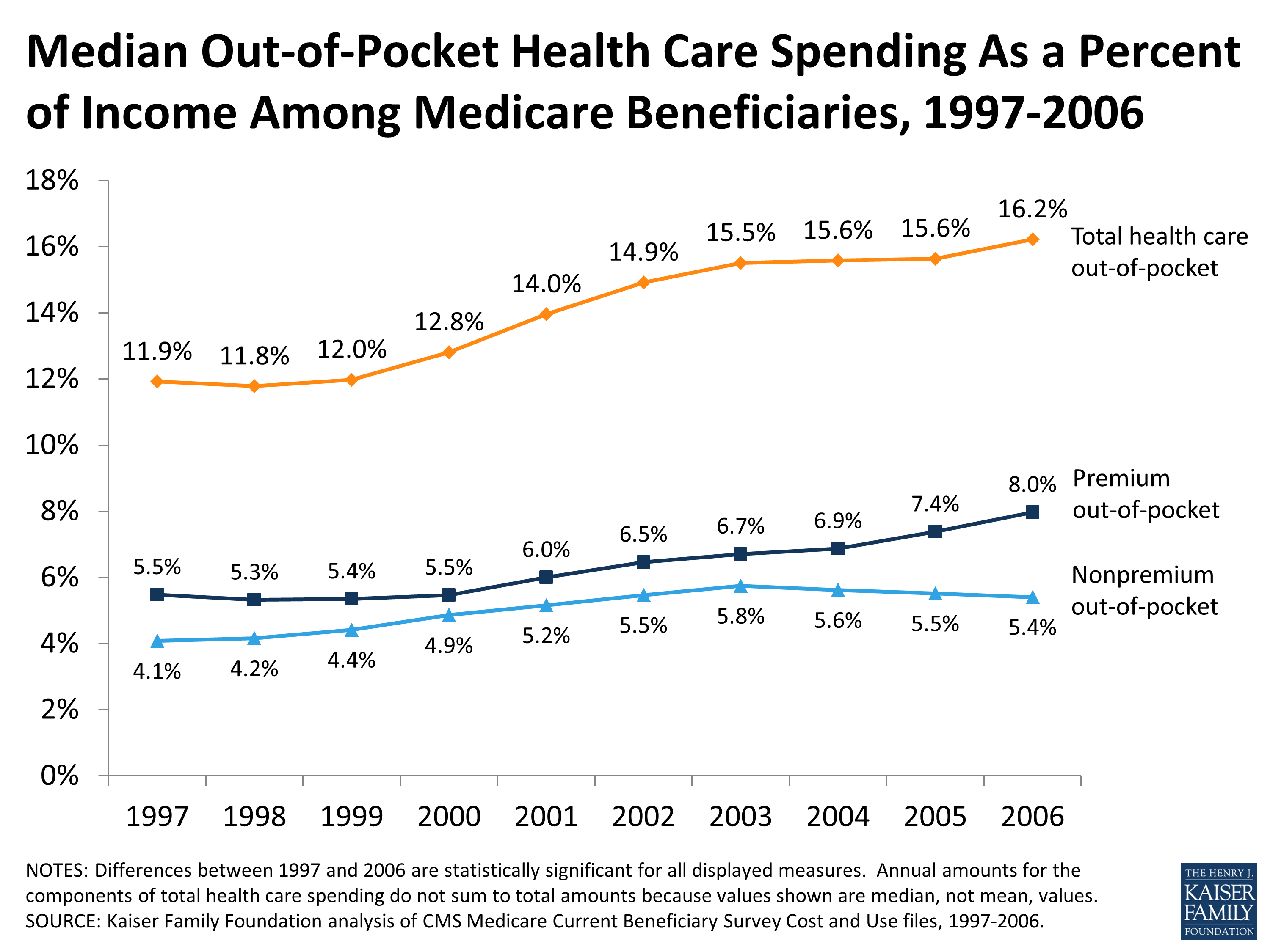
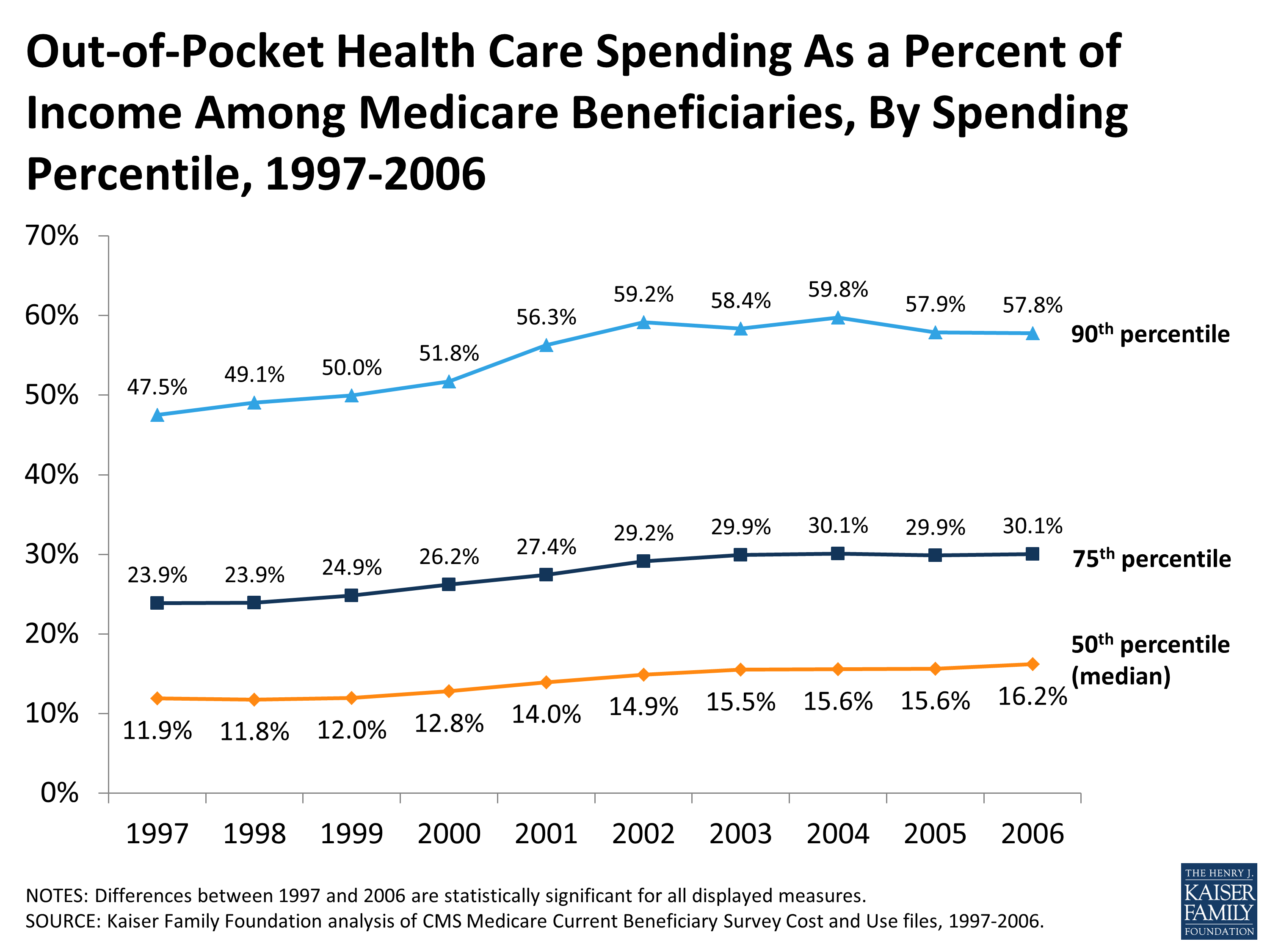
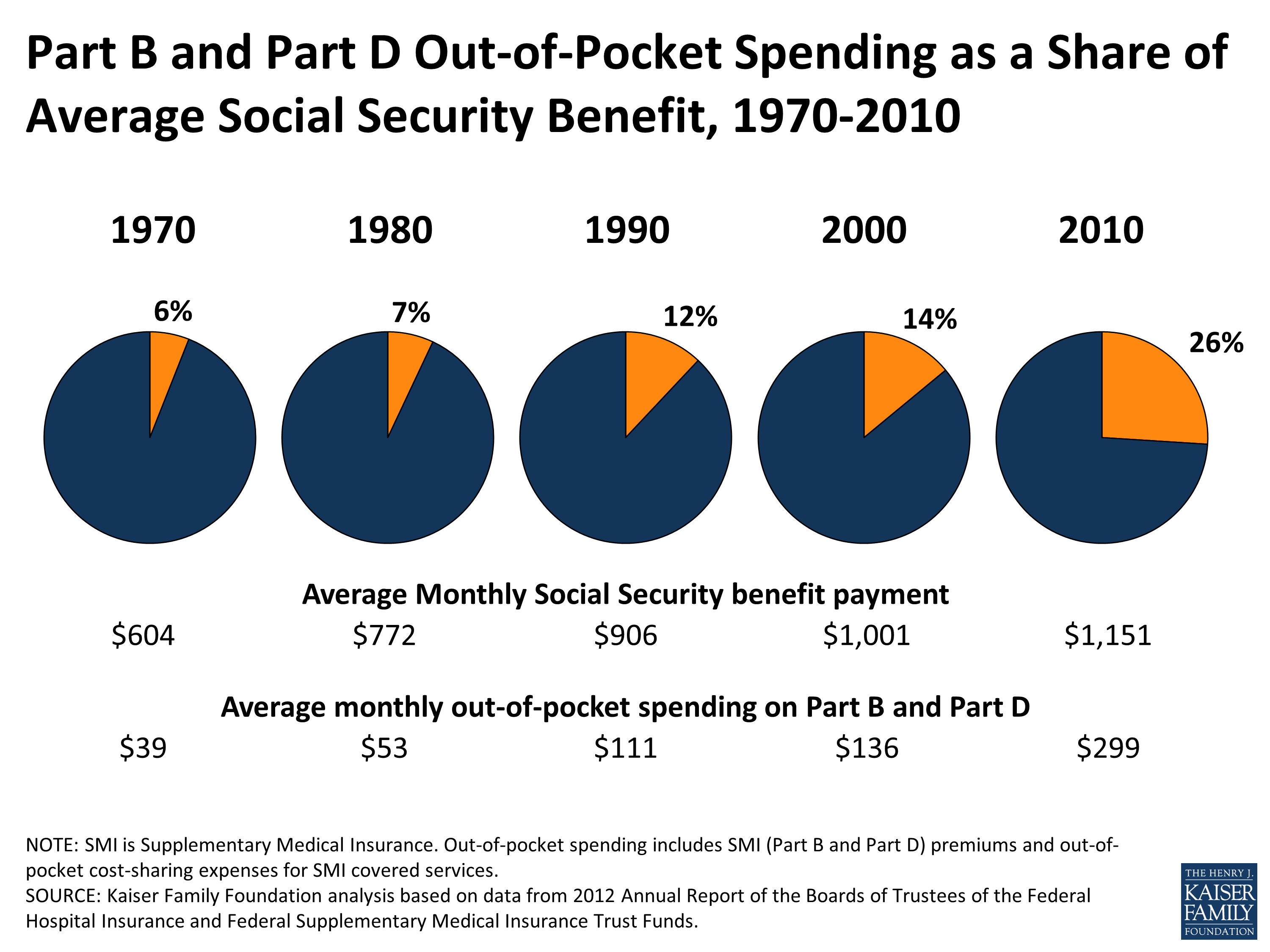
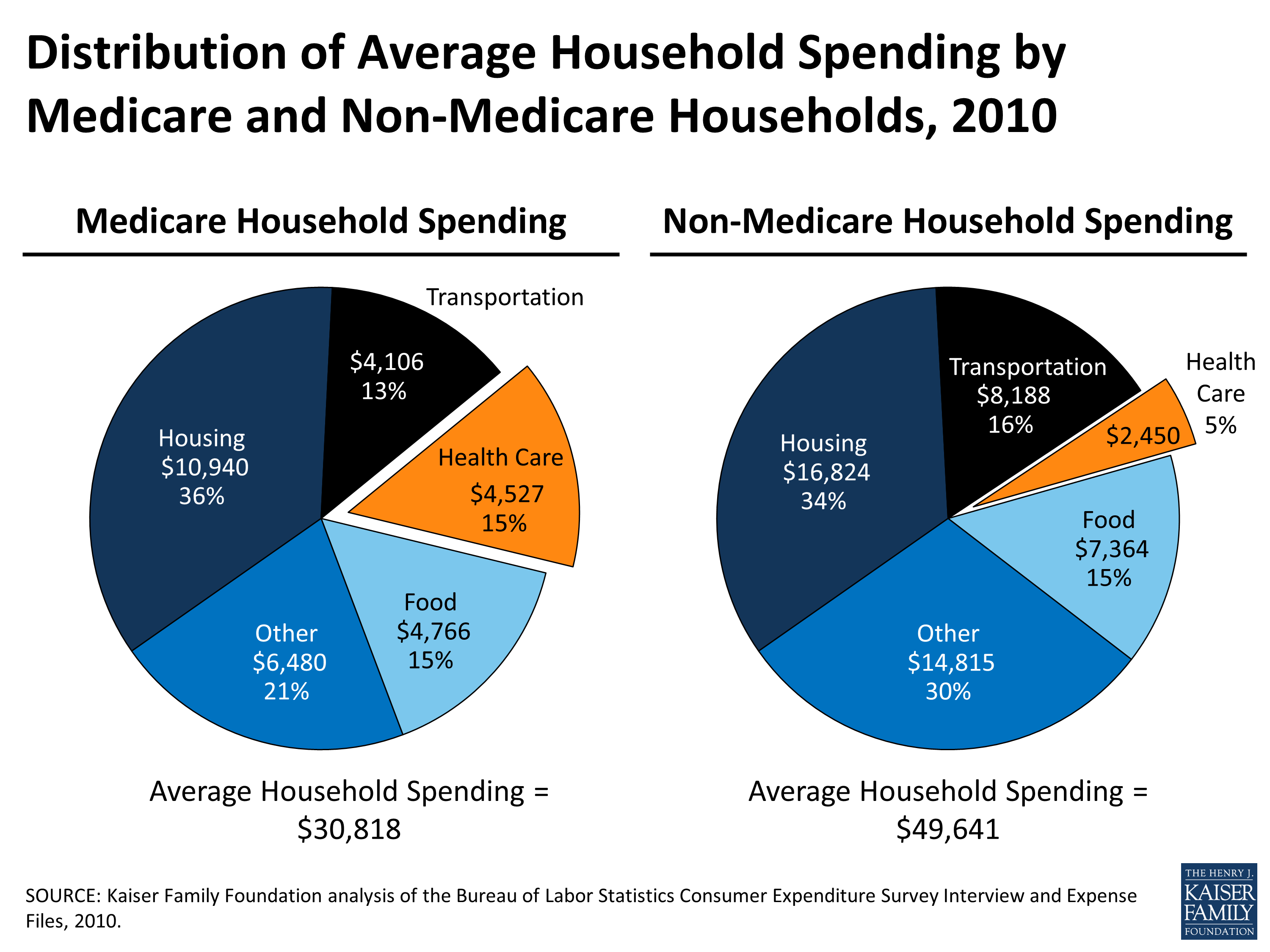
Foundation Senior Vice President Tricia Neuman testified June 26, 2013 before the House Energy and Commerce Committee Subcommittee on Health about how restructuring Medicare’s deductibles and other cost-sharing requirements could affect beneficiaries.
California is the nation’s most populous state, home to over 37 million residents. California also has the largest number of uninsured at 7.3 million people or 20% of the state’s population. This represents 15% of the total uninsured across the country. Therefore, California’s actions to expand coverage through the Medicaid expansion and health insurance marketplaces under the Affordable Care Act (ACA) have implications, not only for health coverage and access within the state, but also for national goals of reducing the number of uninsured. As California develops its infrastructure to expand coverage through the ACA, it may prove to be a model for other states. However, a number of factors combine to make California a unique health care environment.
With an eye toward 2014, this brief provides an overview of health care and health policy in California, through a discussion of the state’s demographics, budgetary environment, Section 1115 “Bridge to Reform” Medicaid Waiver, health reform implementation efforts, as well as future coverage and health care challenges and considerations.
While the United States remains the world’s largest donor to global efforts to address HIV/AIDS in low- and middle-income countries, dozens of other nations and multilateral organizations also engage in these efforts around the globe. The large number of donor organizations working on these efforts creates challenges for effectively negotiating, coordinating and delivering programs, particularly in the current era of economic austerity.
This report maps the complex network of international assistance aimed at addressing the global impact of HIV/AIDS. The analysis identifies 37 different donors, comprising 26 nations providing bi-lateral support and 11 multilateral programs, providing assistance to 143 recipient countries over a three-year period through 2011. Key findings include:
The U.S. provides almost two-thirds of all HIV/AIDS international assistance. The next largest donor, the Global Fund, provides one fifth of all assistance. Together they account for an average of 80 percent global HIV/AIDS assistance.
On average, 10 donors were present in each recipient country. Fourteen recipient countries had more than 20 donors present during the three-year period: Ethiopia, Kenya, Tanzania, Malawi, Zimbabwe, Mozambique, Rwanda, South Africa, Uganda, Vietnam, Zambia, India, Burkina Faso and Mali.
The biggest donor varies by region, with the United States providing the largest share of assistance in sub-Saharan Africa and North & Central America; the Global Fund providing the largest share in Europe, the Middle East, North Africa, South and Central Asia, South America and Far East Asia; and Australia providing the largest share in Oceania.
This report is the first in a series that will examine the donor nations and multilateral organizations involved in addressing different global health challenges in recipient countries worldwide. The reports aim at providing perspective on the geographic presence of global health donors and to enable more effective coordination and delivery of services globally and within individual recipient nations.
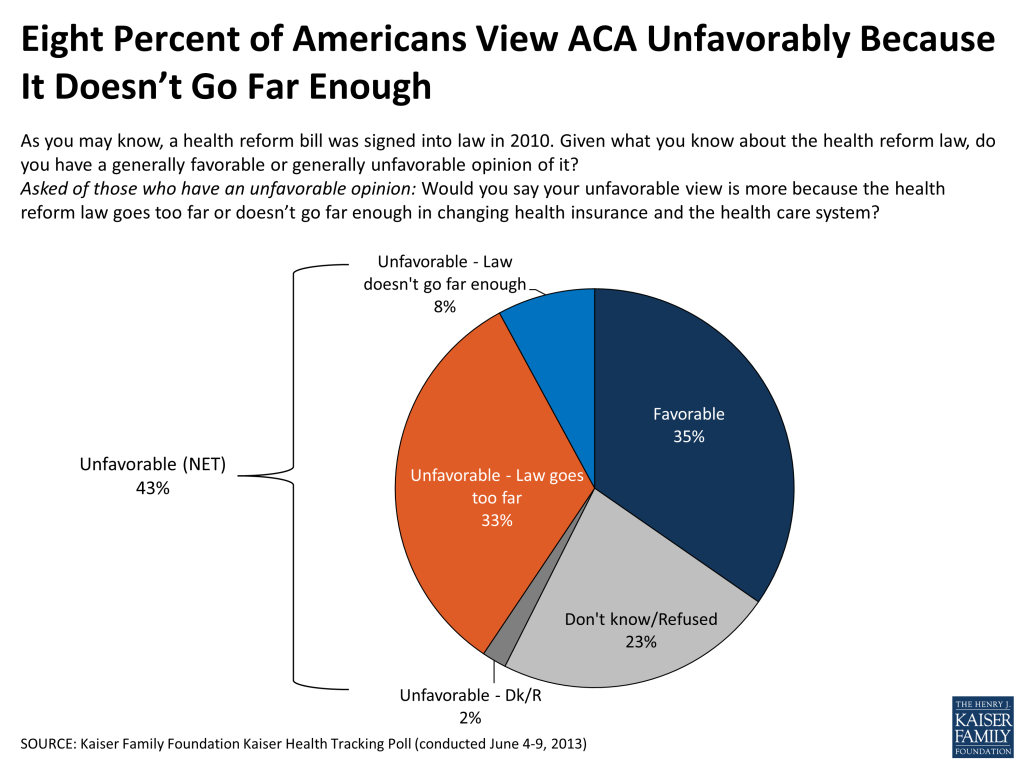
As the country gears up for implementation of the major provisions of the Affordable Care Act (ACA), this month’s Kaiser Health Tracking Poll takes a step back and examines views on health insurance more broadly among some key subgroups, including young adults, the uninsured, and those with pre-existing conditions. The poll finds that the large majority of Americans want and value health insurance. More than seven in ten young adults – a special focus of outreach and enrollment efforts – say it is very important to them personally to have insurance. Cost remains the biggest barrier for the uninsured, with four in ten citing the expense of coverage as the main reason they don’t have it. Roughly half of those under age 65 believe they or a household member has what would be considered a pre-existing condition, and a quarter of them say they have either been denied insurance or had their premium increased as a result. With the expected marketing effort for the ACA’s health exchanges still not in full swing, negative views of the law continue to outpace positive views, with 43 percent unfavorable and 35 percent favorable. However, unfavorable views are a mix of those who feel the law goes “too far” in changing the health care system (33 percent) and those who feel it “doesn’t go far enough” (8 percent). The poll also shows that differences in how the law is branded may make a difference in how it is perceived by the public. When asked how they feel about “Obamacare” rather than the “health reform law,” higher shares express both favorable (42 percent) and unfavorable (47 percent) views, and Democrats are more enthusiastic.
Young Adults Want and Value Health Insurance
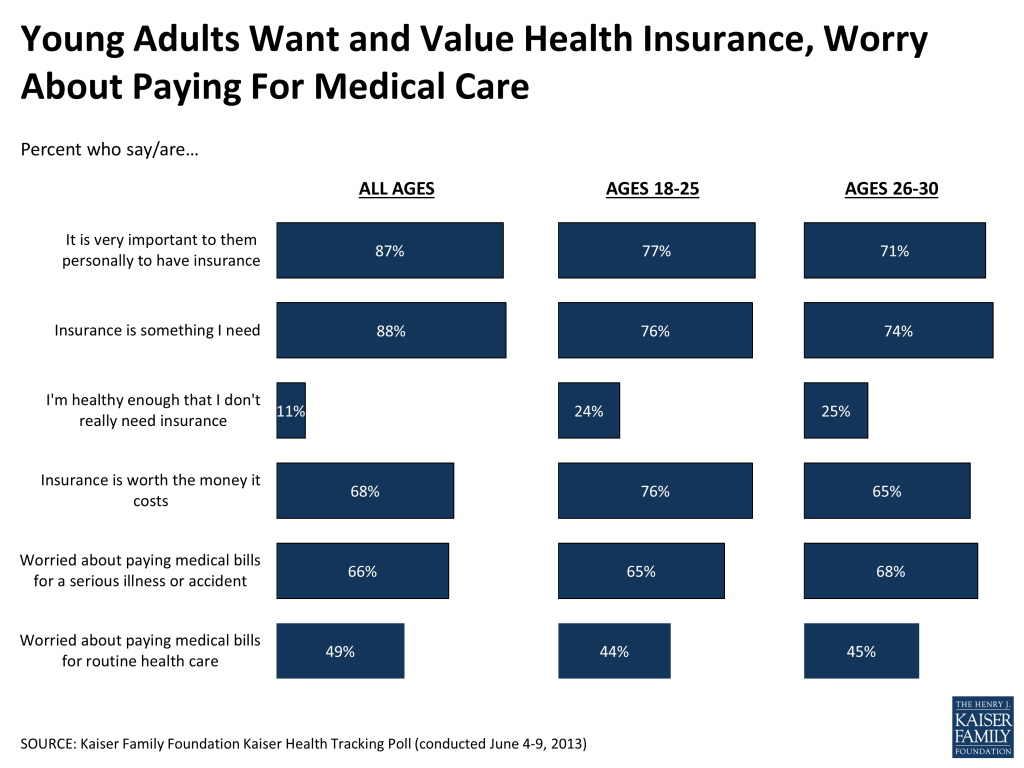
One of the major goals of the ACA is to expand coverage to more people, and the June poll finds that health insurance is something the large majority of Americans want and value. Among the public overall, 87 percent say it is “very important” to them personally to have health insurance, 88 percent describe health insurance as “something I need,” and two-thirds (68 percent) say insurance is worth the money it costs.
Even among younger adults – a group that many have speculated may be resistant to getting coverage under the ACA – more than seven in ten rate having health insurance as “very important,” and similar shares feel it is something they need and that it is worth the money. Overall, just a quarter of those ages 18-30 feel they are healthy enough to go without insurance.
Figure 1
While young adults are sometime described as viewing themselves as “young invincibles,” the poll findings indicate that many young adults worry about affording medical bills, particularly catastrophic ones. Among those ages 30 and younger, roughly two-thirds say they are worried about “not being able to pay medical bills in the event of a serious illness or accident,” while over four in ten say they worry about affording medical bills “for routine health care services.”
The Uninsured Also See Coverage as Important, But Cost is the Biggest Barrier to Getting It
It’s not just the people who have insurance that value it: A majority of those who currently lack coverage also want it. Two-thirds of the uninsured say it is “very important” to them personally to have health insurance (with another 21 percent saying it is “somewhat important”), and three-quarters (76 percent) describe health insurance as “something I need.” Overall, only one in ten of the uninsured say coverage is not important to them, and just under a quarter believe they are healthy enough that they “don’t really need health insurance.” Compared with their insured counterparts, the uninsured are somewhat less convinced that health insurance is worth the money it costs, though a slim majority (56 percent) of those without insurance believe it is worth the money.
FIGURE 2: The Uninsured See Coverage As Important And Feel It Is Something They Need
By Insurance statusAmong ages 18-64
Total public
Insured
Uninsured
How important is it to you personally to have health insurance?
Very important
87%
91%
67%
Somewhat important
9
7
21
Not too important
2
1
6
Not at all important
2
1
4
Which of the following comes closer to your view?
Health insurance is something I need
88
90
76
I’m healthy enough that I don’t really need health insurance
11
9
23
Would you say that health insurance IS or IS NOT worth the money it costs?
Worth the money
68
69
56
Not worth the money
27
27
40
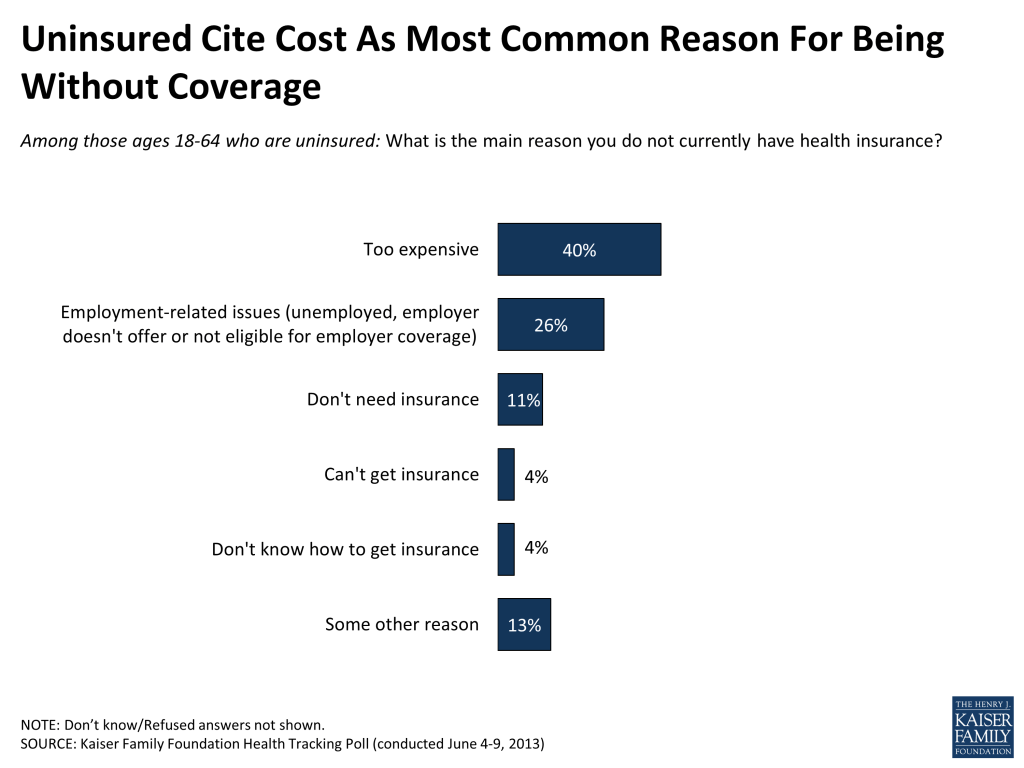
The cost of insurance remains the biggest barrier for the uninsured, most of whom (66 percent) say they have been without coverage for two years or more. When asked to cite the main reason they don’t have health insurance, four in ten of the uninsured say that coverage is too expensive, and a quarter name employment issues – either being unemployed (14 percent), not having an offer of coverage from an employer (8 percent), or not being eligible for employer coverage (4 percent). About one in ten (11 percent) say they are uninsured because they don’t think they need insurance.
Figure 3
Not surprisingly, those without coverage are about twice as likely as their insured counterparts to say they worry about affording both routine and catastrophic medical costs. Roughly half (51 percent) of the uninsured say they are “very worried” about not being able to pay medical bills for routine health services, and fully two-thirds (67 percent) are “very worried” about not being able to afford medical bills in the event of a serious illness of accident.
FIGURE 4: Uninsured Twice As Likely to Worry About Affording Routine and Catastrophic Medical Costs
By Insurance statusAmong ages 18-64
How worried are you about not being able to pay medical bills…
Total public
Insured
Uninsured
…for routine health care services
Very worried
29%
24%
51%
Somewhat worried
20
19
18
Not too worried
28
32
19
Not at all worried
22
24
12
…in the event of a serious illness or accident
Very worried
40
34
67
Somewhat worried
26
28
17
Not too worried
18
21
8
Not at all worried
15
16
9
Those with Pre-Existing Conditions Face Particular Problems
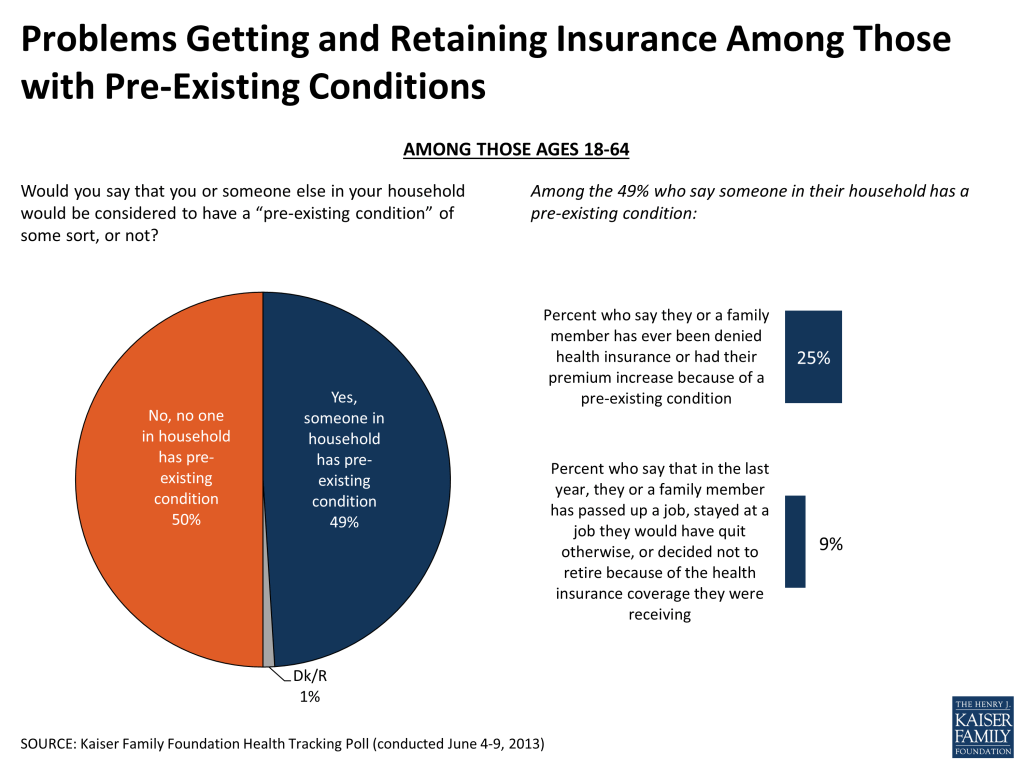
Americans with pre-existing medical conditions often face problems in getting and retaining good health insurance coverage, an issue dealt with directly by ACA in its “guaranteed issue” provision, which prohibits insurance companies from denying coverage to individuals on the basis of health status or pre-existing medical conditions beginning in 2014. The June survey finds that roughly half (49 percent) of adults under age 65 say they or someone in their household has a pre-existing condition, and many of them report problems related to getting and keeping insurance.1
One quarter (25 percent) of these individuals (14 percent of all non-elderly adults) say that they or a family member has ever been denied insurance or had their premium increased because of their pre-existing condition. Further, nearly one in ten (9 percent) of these individuals say that in the past year, they or someone in their household has passed up a job opportunity, stayed at a job they would have quit otherwise, or decided not to retire in order to maintain their health coverage.
Figure 5
Unfavorable Views of ACA Outnumber Favorable
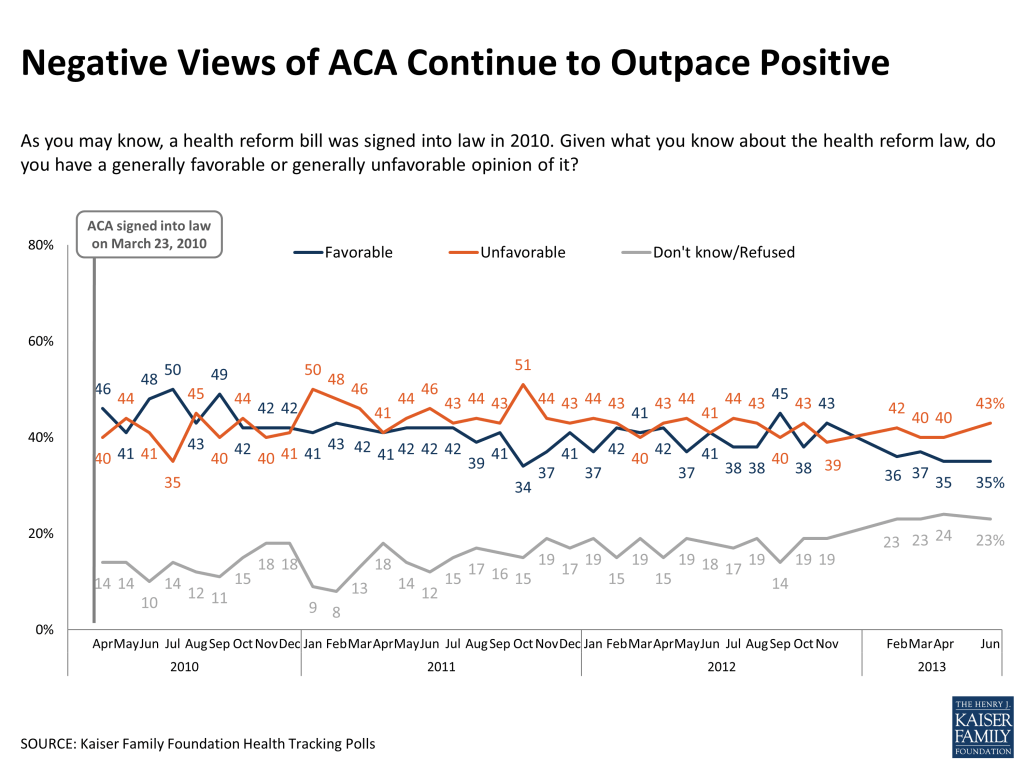
As state and federal policymakers gear up for this summer’s public awareness campaigns on the ACA, unfavorable views of the law still outnumber favorable ones, 43 percent to 35 percent, with about a quarter (23 percent) remaining undecided on the law. Views continue to diverge by partisan affiliation, with a majority of Democrats in favor of the law, a majority of Republicans opposed, and independents mirroring the public overall and titling negative.
Figure 6
However, a notable share of the law’s critics say that their unfavorable view is mainly because the law doesn’t go far enough to change the health insurance and health care system. Overall, 33 percent of the public say they have an unfavorable view of the law because it goes too far, while 8 percent say they feel unfavorable because it doesn’t go far enough.
Figure 7
Democrats View “Obamacare” More Positively Than “Health Reform Law”
Even though the term “Obamacare” was originally used mostly by the law’s critics, today labeling the law as such influences the public’s reaction in a more nuanced way. Although nearly a quarter of Americans say they don’t know their view on the “health reform law”, the public is more opinionated when asked about “Obamacare”: the share offering no opinion drops to 11 percent, and the shares expressing both favorable and unfavorable views of the law rise when this term is used. Democrats show the biggest change in favorability with the alternate question wording – 73 percent say they have a favorable opinion of “Obamacare” compared to 58 percent who say the same for the “health reform law.”
FIGURE 8: Partisan Differences In How People React to “Obamacare”
Percent saying they feel favorable/unfavorable about…
…Health Reform Law
…Obamacare
Percentage point difference
Total public
Favorable
35%
42%
+7
Unfavorable
43
47
+4
Don’t know/Refused
23
11
-12
Democrats
Favorable
58%
73%
+15
Unfavorable
17
16
-1
Don’t know/Refused
25
10
-15
Independents
Favorable
32%
33%
+1
Unfavorable
43
52
+9
Don’t know/Refused
24
14
-10
Republicans
Favorable
12%
14%
+2
Unfavorable
76
86
+10
Don’t know/Refused
11
1
-10
Most Expect No Personal Impact of Law; Uninsured and Those With Pre-Existing Conditions Seen as Most Likely to Benefit
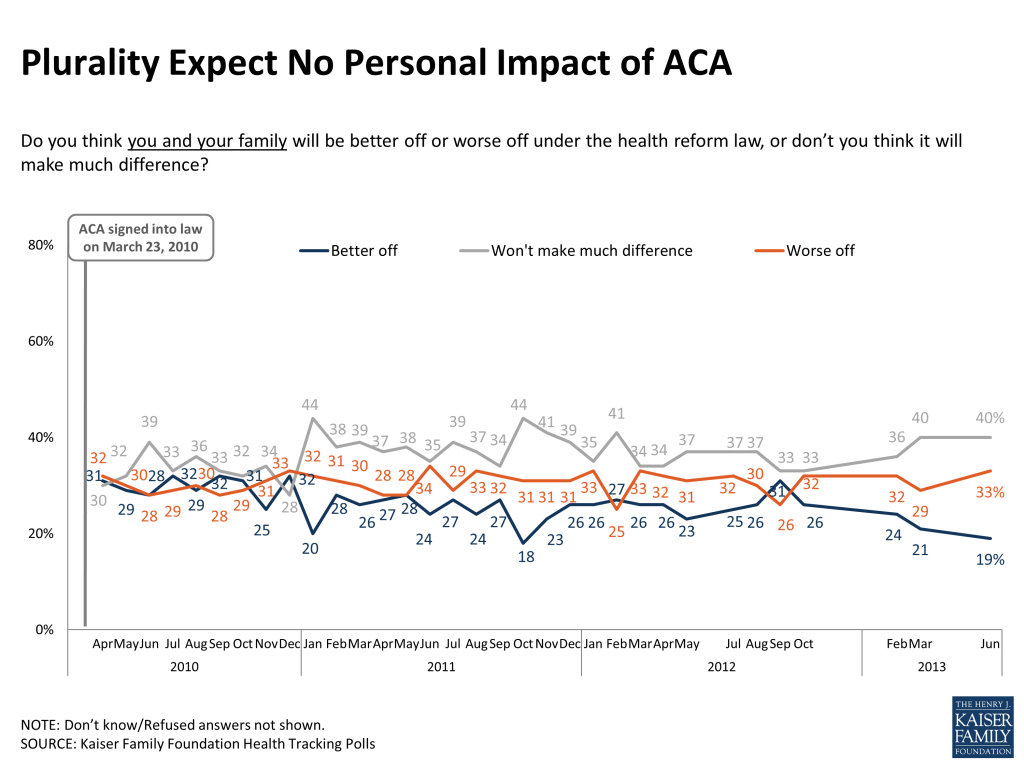
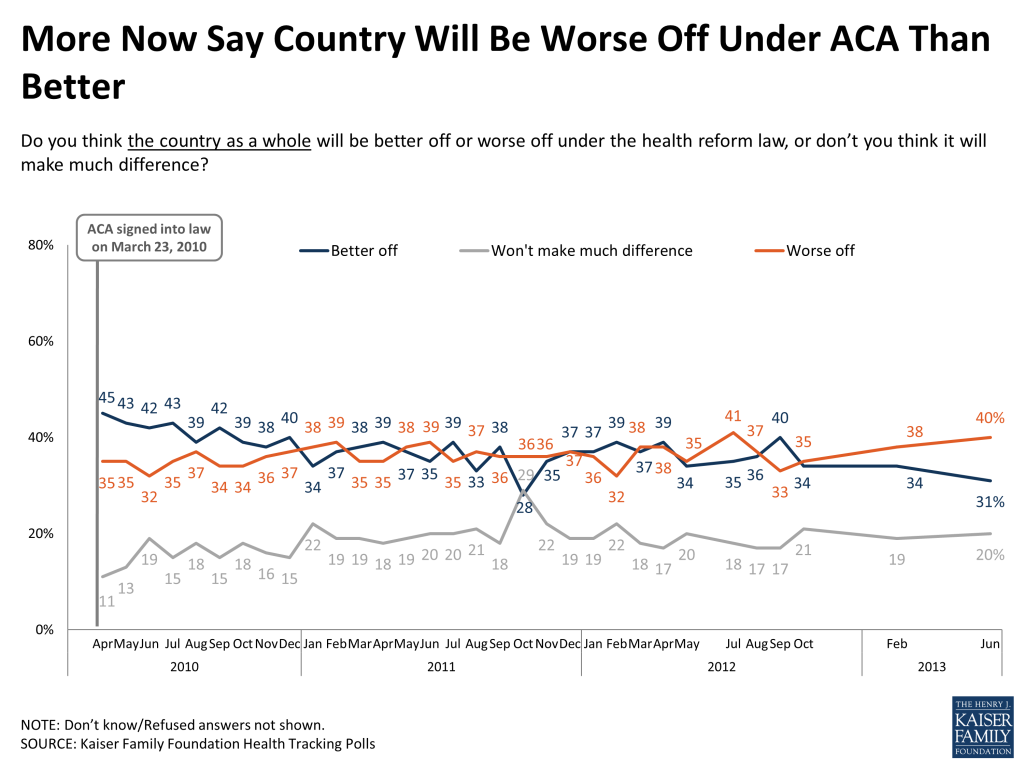
A plurality of Americans (40 percent) continues to say that the law won’t have much impact on their own families, but the gap between the share saying their family will be worse off and the share who expect to be better off has grown in recent months. Currently, a third (33 percent) expect to be worse off and 19 percent expect to be better off. Similarly, the gap between negative and positive expectations for the country as a whole has grown over the past few months, and in June, 40 percent say the country will be worse off under the law and 31 percent say it will be better (20 percent say it won’t make much difference).
Figure 9Figure 10
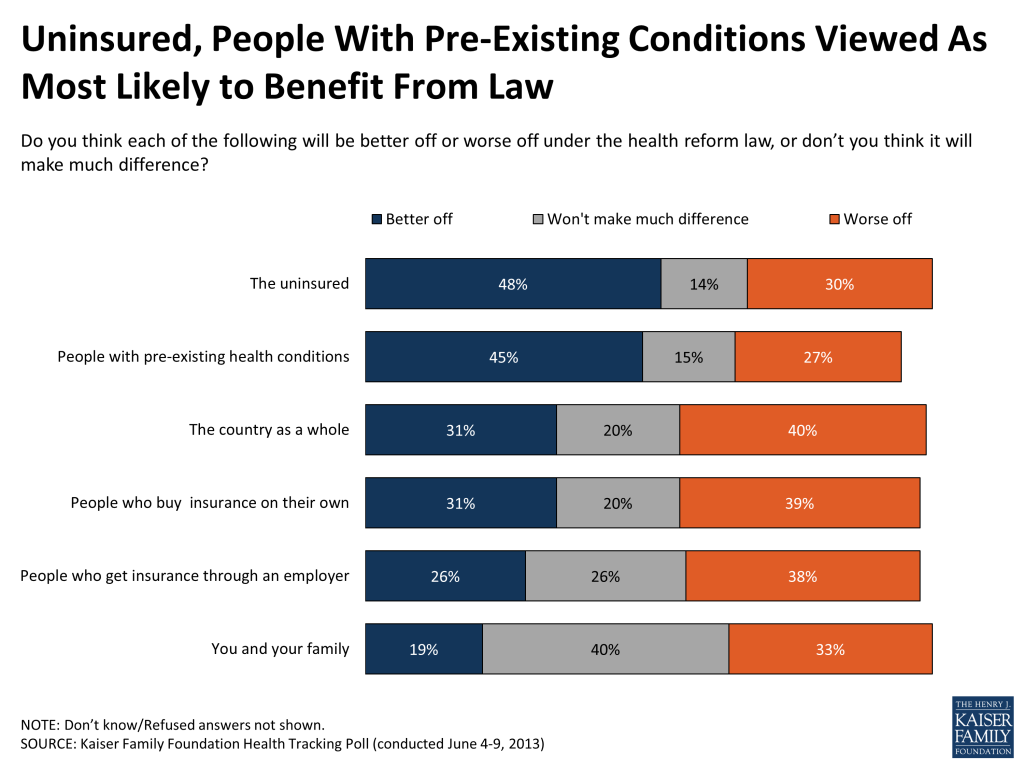
While not expecting much impact on their own families, Americans continue to see the uninsured and people with pre-existing conditions as the two groups most likely to benefit from the ACA, with nearly half saying both groups will be better off under the law (48 percent and 45 percent, respectively).
Figure 11
One in Five Have Heard About the Health Insurance Marketplaces
At this stage, when outreach efforts are just beginning in some states, and others have yet to get started, one in five (22 percent) say they’ve heard at least “some” about the health insurance exchanges. Two in ten lower-income Americans (20 percent) and 12 percent of the uninsured, two key target groups of the law, say they have heard more than a little about the health insurance marketplace so far.
FIGURE 12: So Far, Few Report Hearing About Health Insurance Exchanges
As you may know, the health care law creates health insurance exchanges or marketplaces where people who don’t get coverage through their employers can shop for insurance and compare prices and benefits. How much, if anything, have you heard about this new health insurance marketplace, [also known as (STATE EXCHANGE NAME)] in your state?
By Insurance StatusAmong ages 18-64
By Annual Household Income
Total public
Insured
Uninsured
Less than $40,000
$40,000-$89,999
$90,000 or more
A lot
8%
10%
4%
7%
7%
11%
Some
14
15
8
13
14
16
Only a little
34
33
32
31
35
35
Nothing at all
45
42
55
49
43
38
More On Views of Insurance
The survey suggests that for most people, the value of insurance lies predominantly in the peace of mind they get from knowing they will be protected against catastrophic medical costs, rather than the help they are getting with ordinary medical bills. Asked about the most important reason to have insurance, three-quarters of the public say it is “to protect against high medical bills in case of severe illness or accident,” while about a quarter (23 percent) say it is “to pay for everyday health care expenses, like check-ups and prescriptions.”
Among those with insurance, most rate their coverage as excellent (32 percent) or good (55 percent), and half say they feel financially well-protected when it comes to meeting their health care needs. Still, a substantial share (42 percent) say they worry they might have health needs their insurance won’t cover, and another 7 percent say their insurance is inadequate and they feel very worried about getting their medical expenses paid.
Those with lower incomes and those who rate their own health status as fair or poor health are more likely to say they feel at least some financial insecurity when it comes to their health needs being paid for.
FIGURE 13: Half of Those With Insurance Feel Financially Well-Protected
Which comes closest to your own view about your current health insurance coverage?
By Health Status
By Annual Household Income
Total insured
Excellent/very good/good
Fair/poor
Less than $40,000
$40,000-$89,999
$90,000 or more
My health insurance is good and I feel financially well-protected when it comes to meeting my health care needs
50
54
33
36
52
64
My health insurance is adequate, but I worry that I might have health care needs that it won’t pay for
42
40
48
50
43
33
My health insurance is inadequate, and I feel very worried about my health care needs not being paid for
7
5
18
13
5
3
A Final Note: Health Insurance and the Workplace
Employers are an important source of health insurance coverage for most Americans – and will continue to be so when the major provisions of the ACA are implemented in 2014 – so this tracking poll also takes a look at people’s attitudes toward health insurance in the workplace. For the most part, health insurance is seen by workers as an important benefit, and the public overall is evenly divided over whether they would prefer to have more comprehensive health insurance and lower wages (45 percent) or a less comprehensive health plan and higher wages (46 percent).
Most of those with employer coverage feel that their employer is doing the best they can. Among those ages 18-64 with employer-sponsored coverage, two-thirds (67 percent) say that given their employer’s financial situation, they are offering the best health insurance they can afford, while three in ten (29 percent) feel their employer could be offering something better. Six in ten (61 percent) say their employer gave them a choice of at least two different plans, including four in ten (41 percent) who were given three or more plans to choose from. Those who work for business with 100 employees or more are more likely to report having a choice of plans than those who work for smaller employers (68 percent vs. 45 percent).
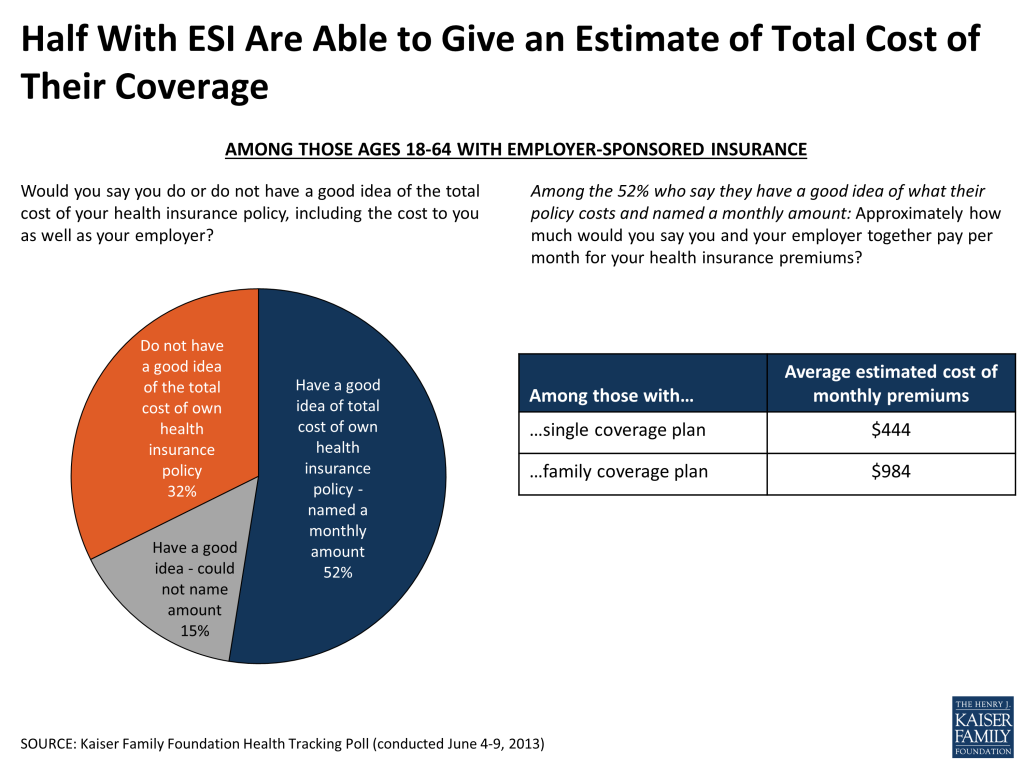
The total cost of health insurance is not always obvious to those who get coverage through an employer, and the survey finds that nearly half of those with employer-sponsored plans either say they do not have a good idea of the cost of their policy (32 percent), or were unable to estimate a dollar amount for their own plus their employer’s contribution (15 percent). However, among the 52 percent who were able to provide an estimate, the average amounts cited were not that far off from the average premium amounts measured in the Foundation’s annual survey of employers. Among those with individual coverage, the average estimate was $444 per month, not far off from the national average of $468 per month in 2012.2 For those with family coverage, the average estimate was $984, compared with an estimated average cost of $1,312 for ESI coverage for a family of four in 2012.3
Figure 14
This Kaiser Health Tracking Poll was designed and analyzed by public opinion researchers at the Kaiser Family Foundation led by Mollyann Brodie, Ph.D., including Liz Hamel and Sarah Cho. The survey was conducted June 4-9, 2013, among a nationally representative random digit dial telephone sample of 1,505 adults ages 18 and older, living in the United States, including Alaska and Hawaii (note: persons without a telephone could not be included in the random selection process). Computer-assisted telephone interviews conducted by landline (752) and cell phone (753, including 385 who had no landline telephone) were carried out in English and Spanish by Princeton Data Source under the direction of Princeton Survey Research Associates International (PSRAI). Both the landline and cell phone samples were provided by Survey Sampling International, LLC. For the landline sample, respondents were selected by asking for the youngest adult male or female currently at home based on a random rotation. If no one of that gender was available, interviewers asked to speak with the youngest adult of the opposite gender. For the cell phone sample, interviews were conducted with the person who answered the phone.
The combined landline and cell phone sample was weighted to balance the sample demographics to match estimates for the national population data from the Census Bureau’s 2011 American Community Survey (ACS) on sex, age, education, race, Hispanic origin, nativity (for Hispanics only), and region along with data from the 2010 Census on population density. The sample was also weighted to match current patterns of telephone use using data from the January-June 2012 National Health Interview Survey. The weight takes into account the fact that respondents with both a landline and cell phone have a higher probability of selection in the combined sample and also adjusts for the household size for the landline sample. All statistical tests of significance account for the effect of weighting. Weighted and unweighted values for key demographic variables are shown in the table below.
Sample Demographics
Unweighted
Weighted
Gender
Male
50.9%
48.9%
Female
49.1%
51.1%
Age
18-24
9.3%
13.3%
25-34
13.0%
17.4%
35-44
12.4%
16.9%
45-54
17.6%
18.5%
55-64
21.1%
16.6%
65+
26.6%
17.3%
Education
HS Graduate or Less
32.4%
42.8%
Some College/Assoc. Degree
27.4%
29.9%
College Grad.
40.1%
27.3%
Race/Ethnicity
White/not Hispanic
74.0%
67.1%
Black/not Hispanic
9.8%
11.5%
Hisp – US born
5.2%
7.0%
Hisp – born outside
5.1%
7.3%
Other/not Hispanic
5.9%
7.0%
Party Identification
Democrat
28.9%
30.0%
Independent
34.9%
35.2%
Republican
25.0%
22.4%
Other
7.0%
7.6%
The margin of sampling error including the design effect for the full sample is plus or minus 3 percentage points. For results based on subgroups, the margin of sampling error may be higher. Sample sizes and margin of sampling errors for other subgroups are available by request. Note that sampling error is only one of many potential sources of error in this or any other public opinion poll.
The response rate calculated based on the American Association for Public Opinion Research’s Response Rate 3 formula was 10 percent for the landline sample and 9 percent for the cell phone sample.
Endnotes
Those ages 65 and older are excluded from this analysis because of their access to Medicare. Respondents were read the following definition: “In general, the term ‘pre-existing condition’ is used by insurance companies to describe an illness or medical condition that a person had before they began looking for insurance. For example, if you were looking to buy health insurance but had a history of asthma, diabetes or high blood pressure, those would be considered pre-existing conditions, along with illnesses such as cancer. Given that definition, would you say that you or someone else in your household would be considered to have a ‘pre-existing condition’ of some sort, or not? ↩︎
Source: Kaiser Family Foundation /Health Research & Educational Trust 2012 Employer Health Benefits Survey (http://modern.kff.org/health-costs/report/employer-health-benefits-2012-annual-survey/). Note that while this is not a direct comparison, it does give a sense of whether those who say they have a good idea of the total cost of their policy are able to provide reasonably accurate amounts. ↩︎
Note that this is not an exact comparison, as survey respondents in family plans may have varying family sizes, and many may have plans that cover only one adult plus one or more children, which would be less expensive than coverage for a family of four with two adults and two children. ↩︎
An Analysis of the Share of Medicare Beneficiaries Who Would Benefit from an Annual Out-of-Pocket Maximum under Traditional Medicare Over Multiple Years
This memorandum, prepared in response to a request from Chairman Kevin Brady, Subcommittee on Health, Committee on Ways and Means, U.S. House of Representatives at a Feb. 26, 2013 hearing, analyzes some of the effects of adding a limit on out-of-pocket spending to traditional Medicare. Traditional Medicare’s current benefit structure does not provide such an out-of-pocket limit. The Kaiser Family Foundation worked with the Medicare Payment Advisory Commission (MedPAC) to provide an estimate of the share of Medicare beneficiaries in traditional Medicare who would benefit from an annual out-of-pocket maximum over multiple years.
The analysis finds that adding a $5,000 (indexed) out-of-pocket maximum to the Medicare benefit package would protect a small percentage of beneficiaries against very high levels of cost sharing in a single year (6.5%), but nearly a third of beneficiaries would reach the maximum one or more times over a 10-year period. The analysis also explores the concept of a “true” out-of-pocket maximum, which would exclude cost-sharing payments made by supplemental insurers, such as Medicaid, employer-sponsored retiree health plans and Medigap, on behalf of enrollees. In this scenario, a much smaller share of beneficiaries in traditional Medicare would reach the maximum in a single year (less than 1%) and over a 10-year period (3%).
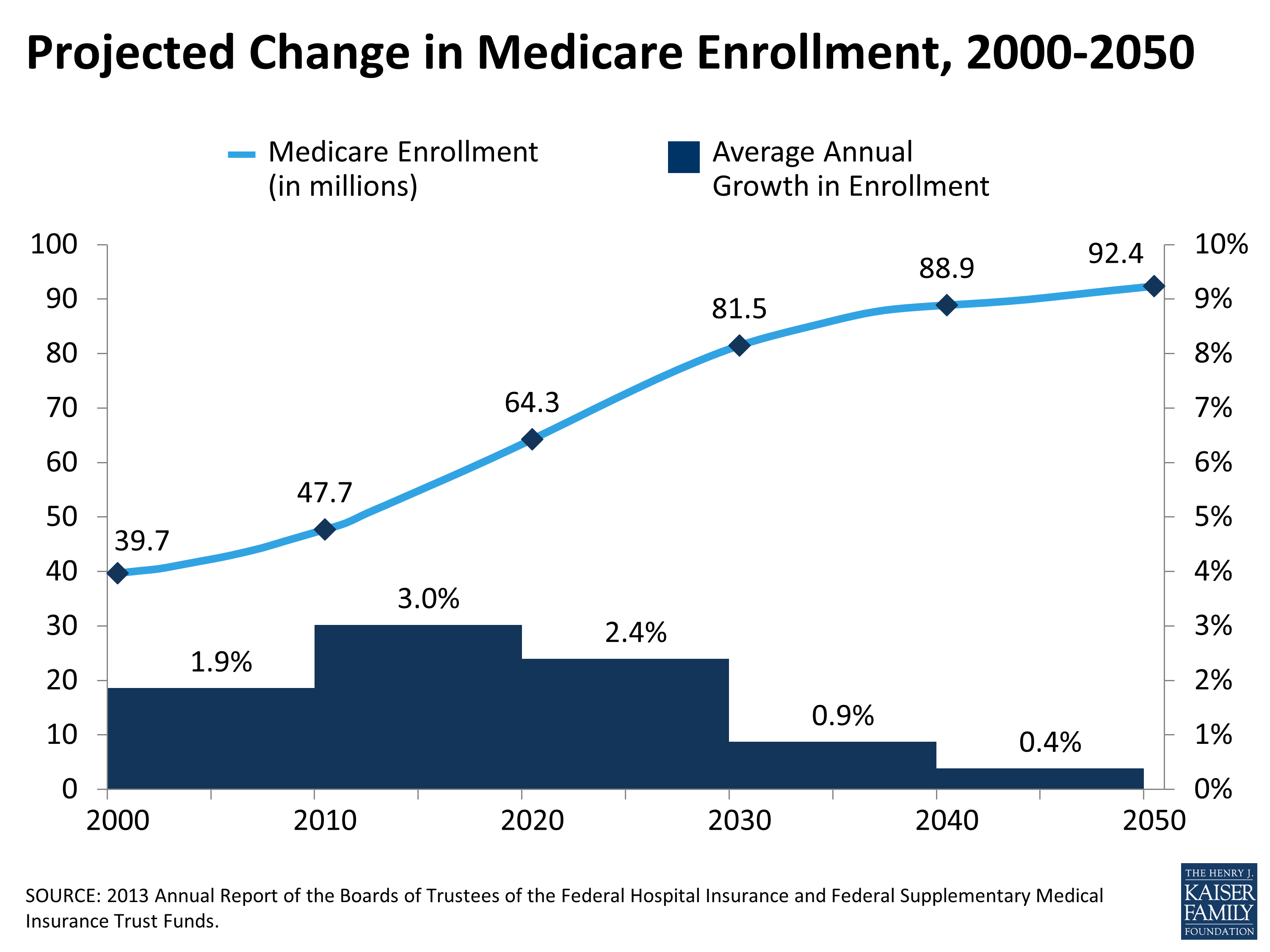
Centers for Medicare & Medicaid Services, Medicare Enrollment: Hospital Insurance and/or Supplemental Medical Insurance Programs for Total, Fee-for-Service and Managed Care Enrollees as of July 1, 2011: Selected Calendar Years 1966-2011; 2012-2013, HHS Budget in Brief, FY2014.
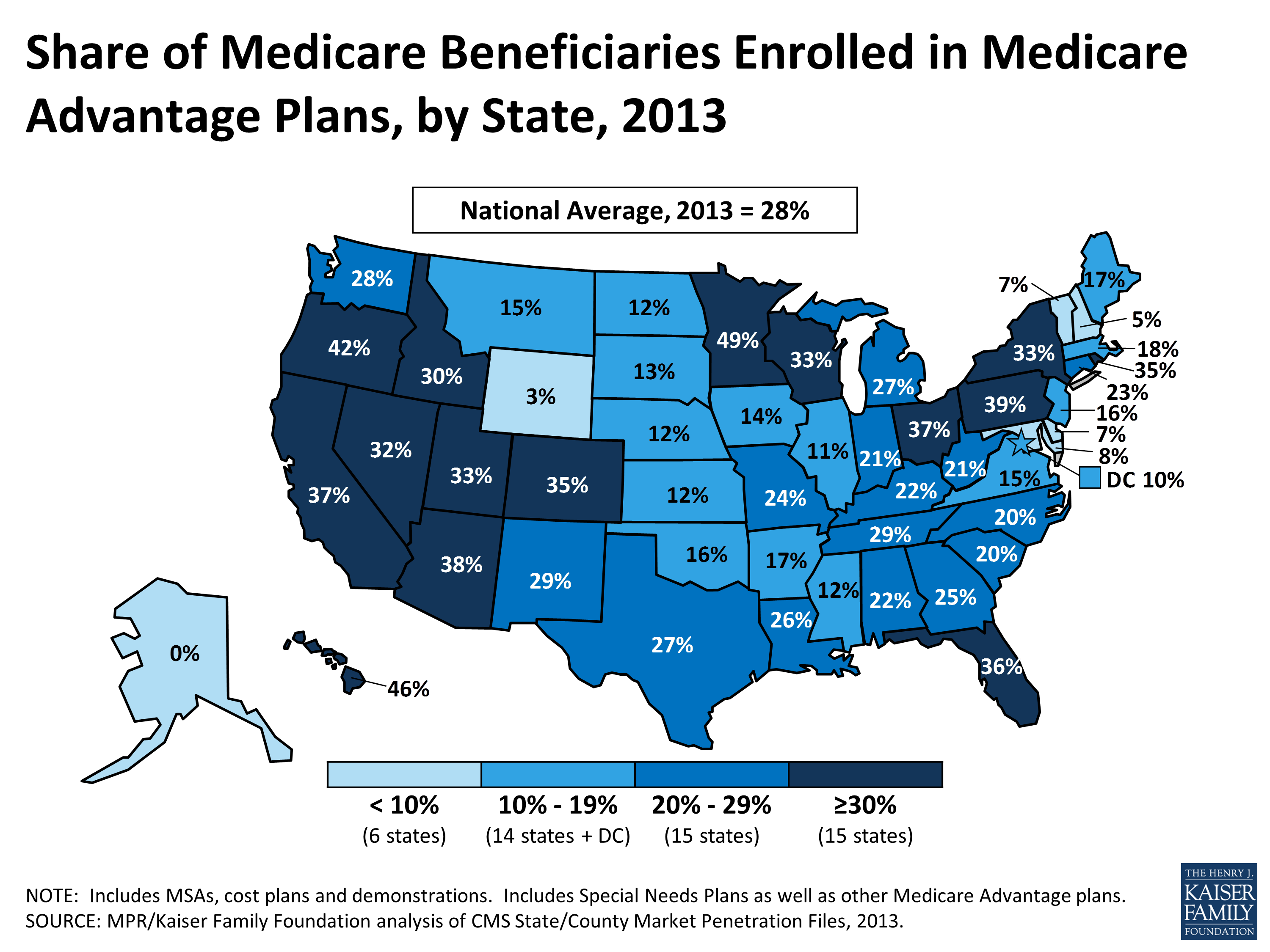
Calculation based on Kaiser Family Foundation analysis of the CMS State/County Market Penetration file, March 2012; and 2011 population estimates from the United States Census Bureau.
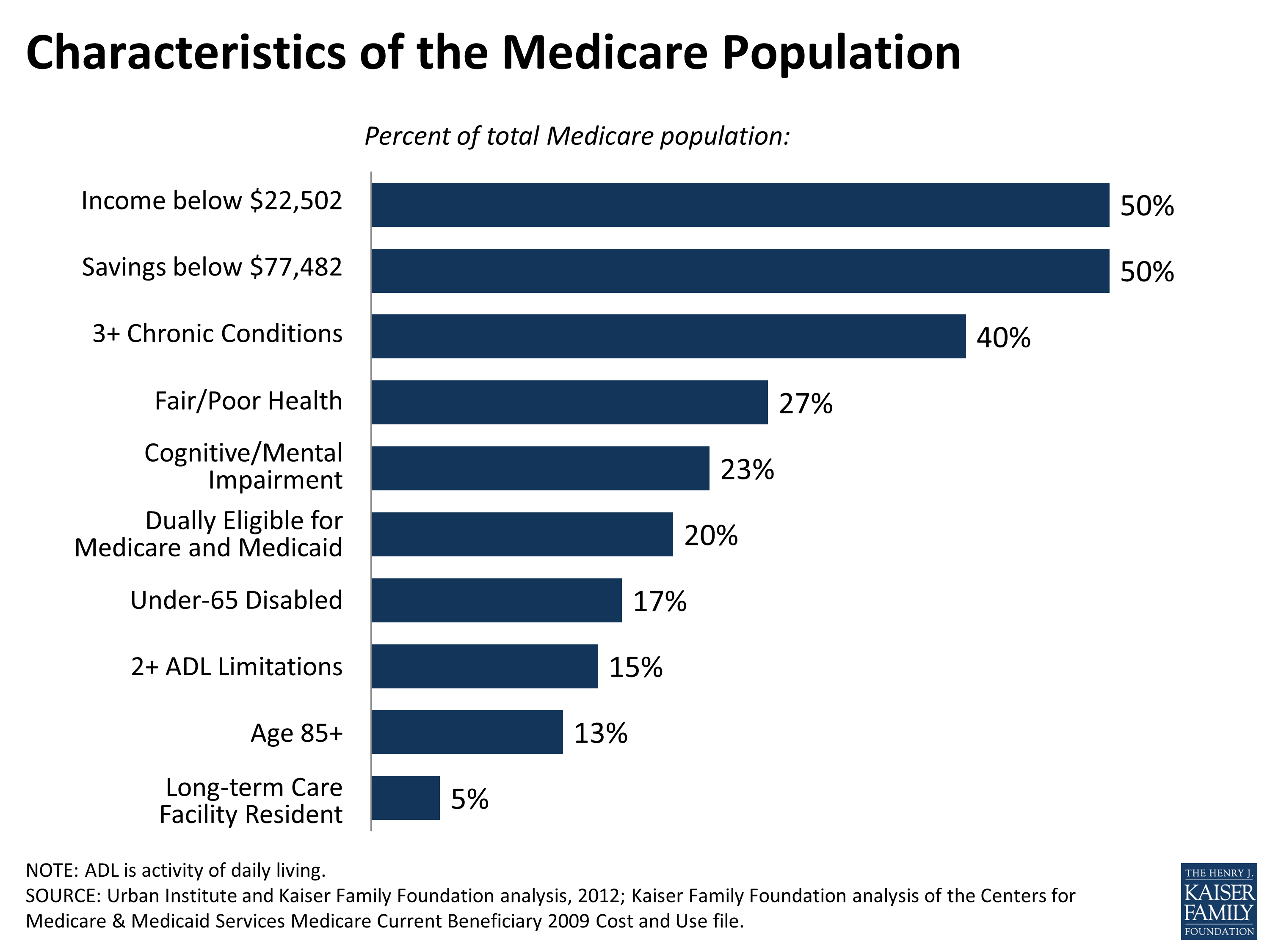
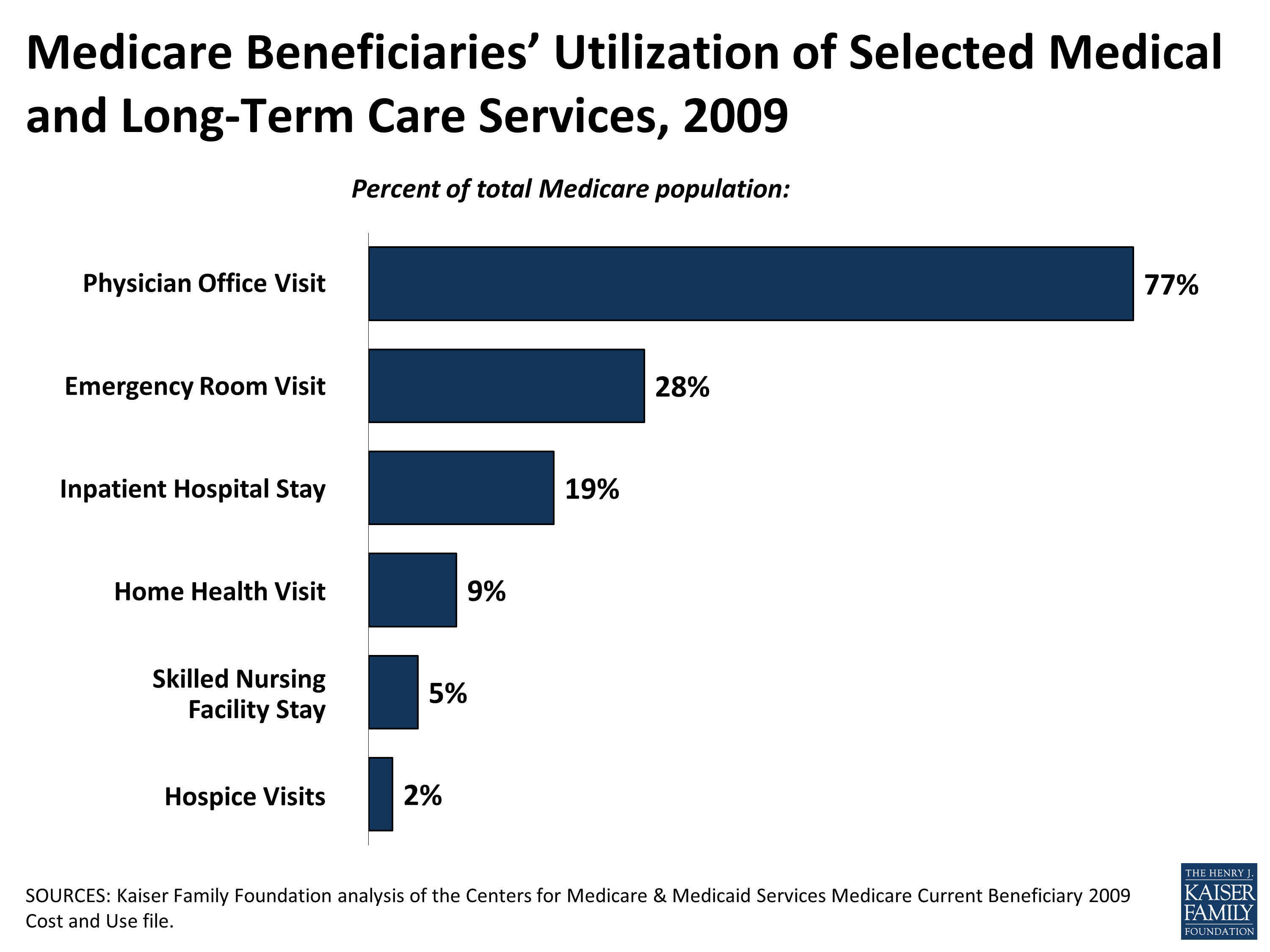
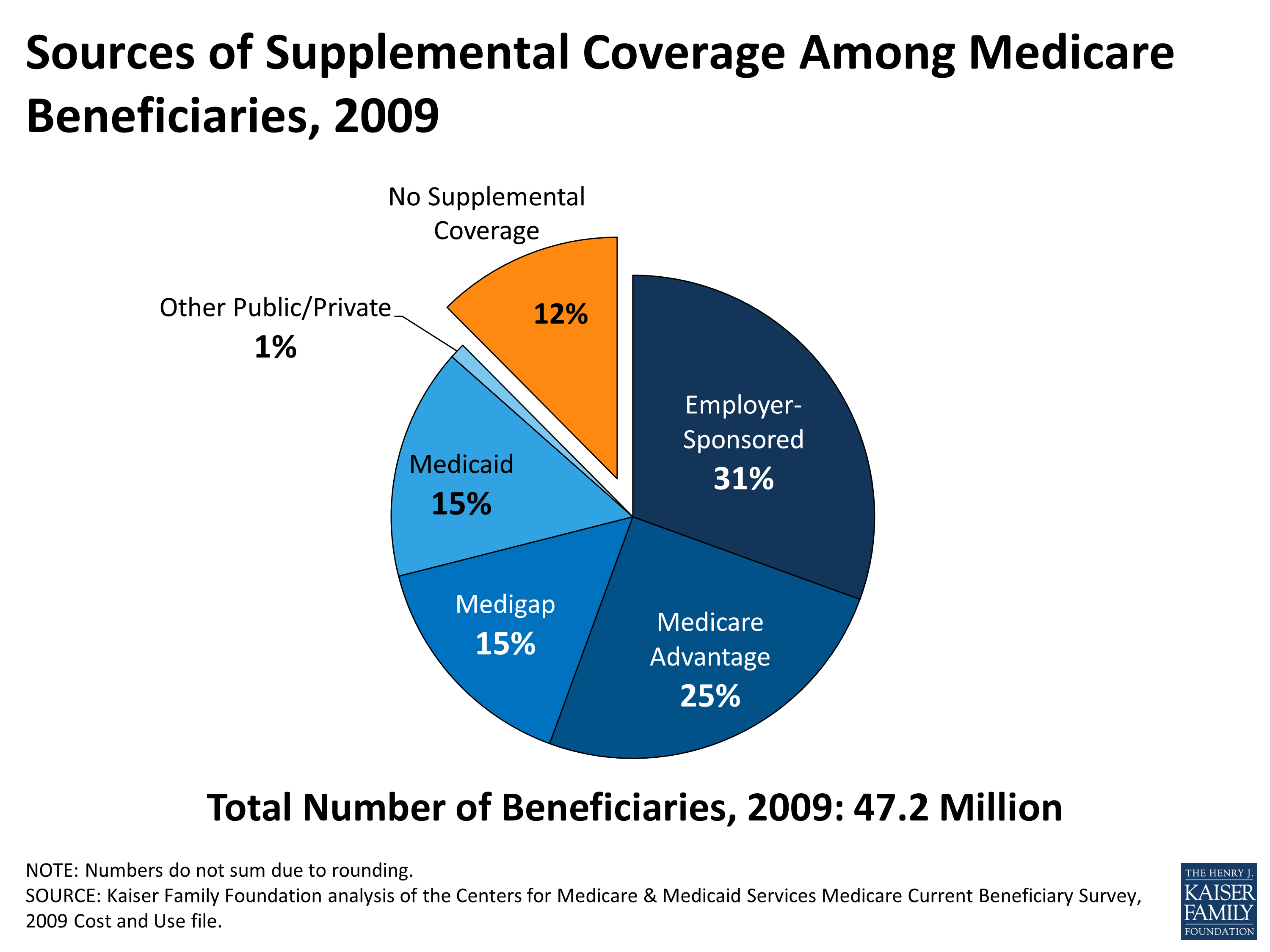
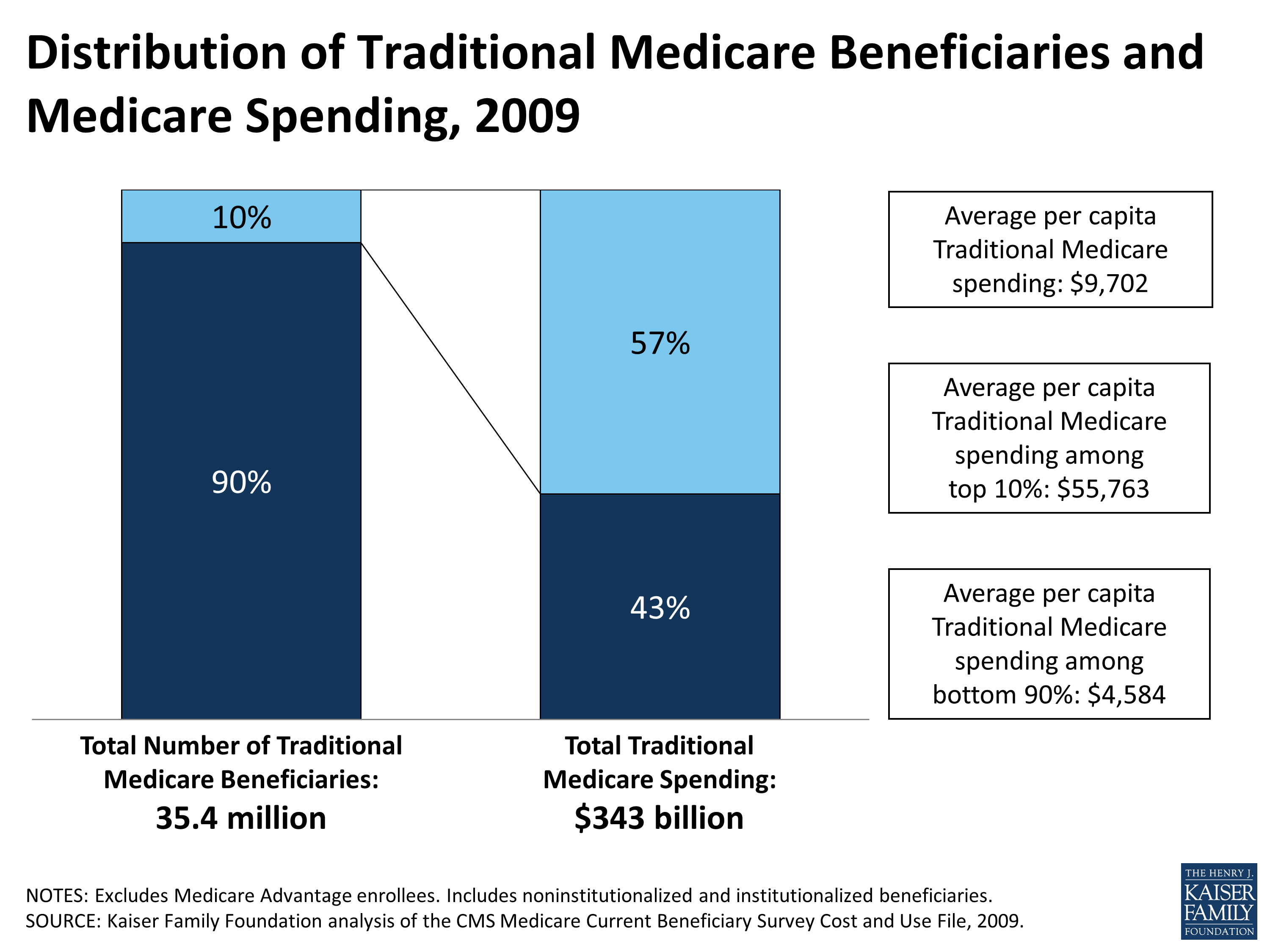
Urban Institute and Kaiser Family Foundation analysis, 2012; Kaiser Family Foundation analysis of the Centers for Medicare & Medicaid Services Medicare Current Beneficiary 2009 Cost and Use file.
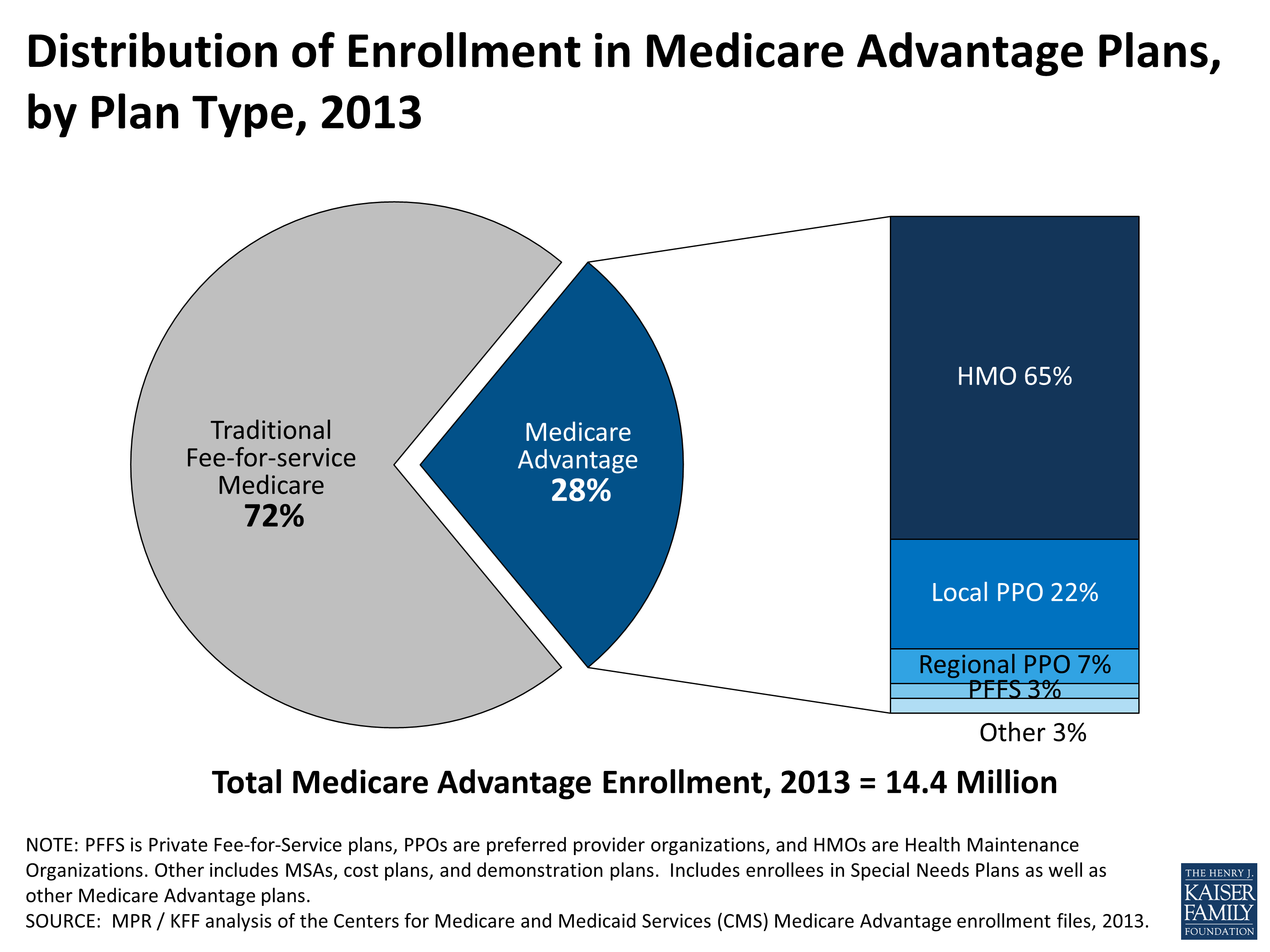
MPR/Kaiser Family Foundation analysis of CMS Medicare Advantage enrollment files, 2008-2013, and MPR, “Tracking Medicare Health and Prescription Drug Plans Monthly Report,” 2001-2007; enrollment numbers from March of the respective year, with the exception of 2006, which is from April.
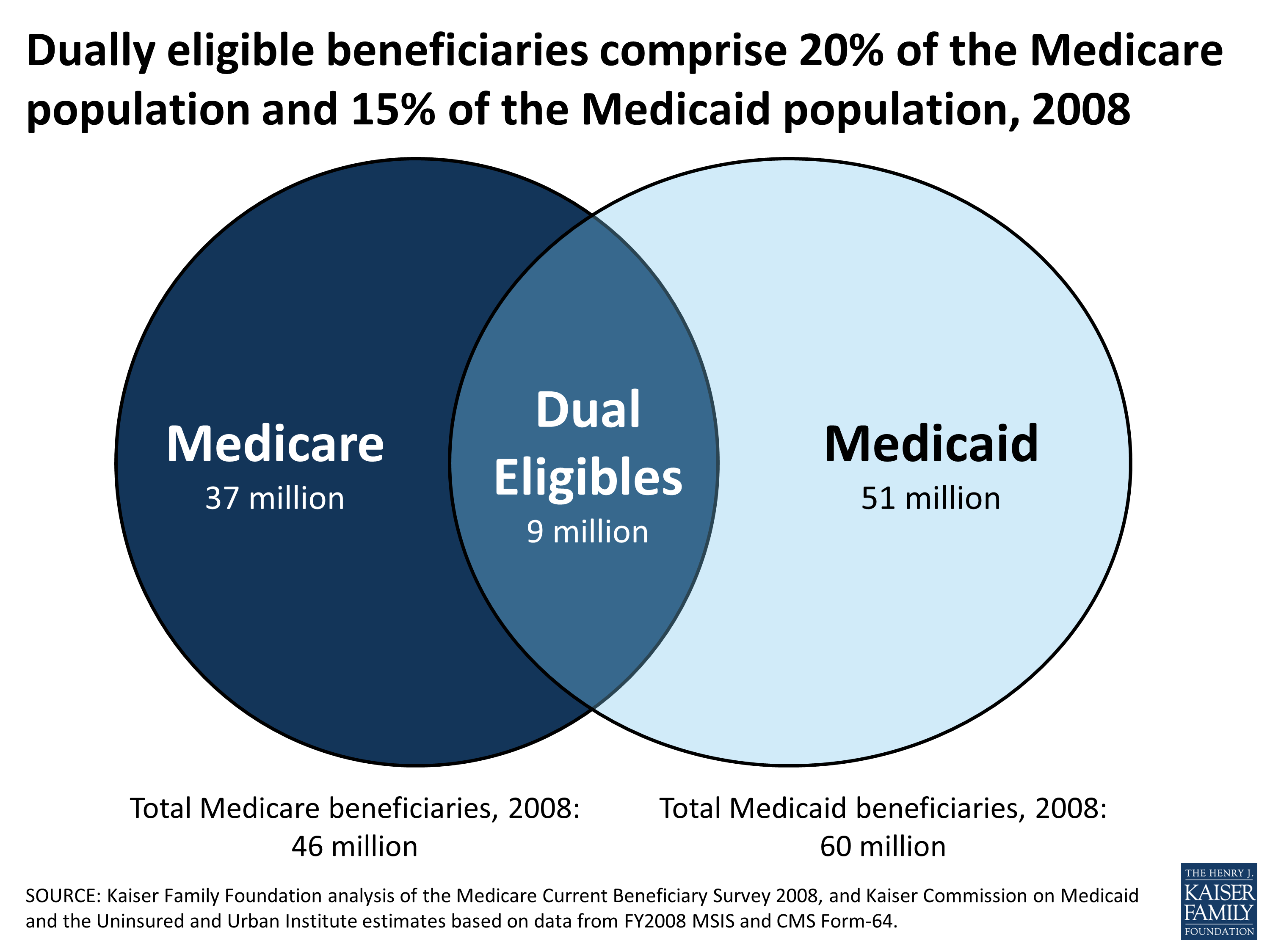
Kaiser Family Foundation analysis of the Medicare Current Beneficiary Survey 2008, and Kaiser Commission on Medicaid and the Uninsured and Urban Institute estimates based on data from FY2008 MSIS and CMS Form-64.
Kaiser Family Foundation analysis of the CMS Medicare Current Beneficiary Survey Cost and Use File, 2008, and Kaiser Commission on Medicaid and the Uninsured and Urban Institute estimates based on data from FY2008 MSIS and CMS Form-64.
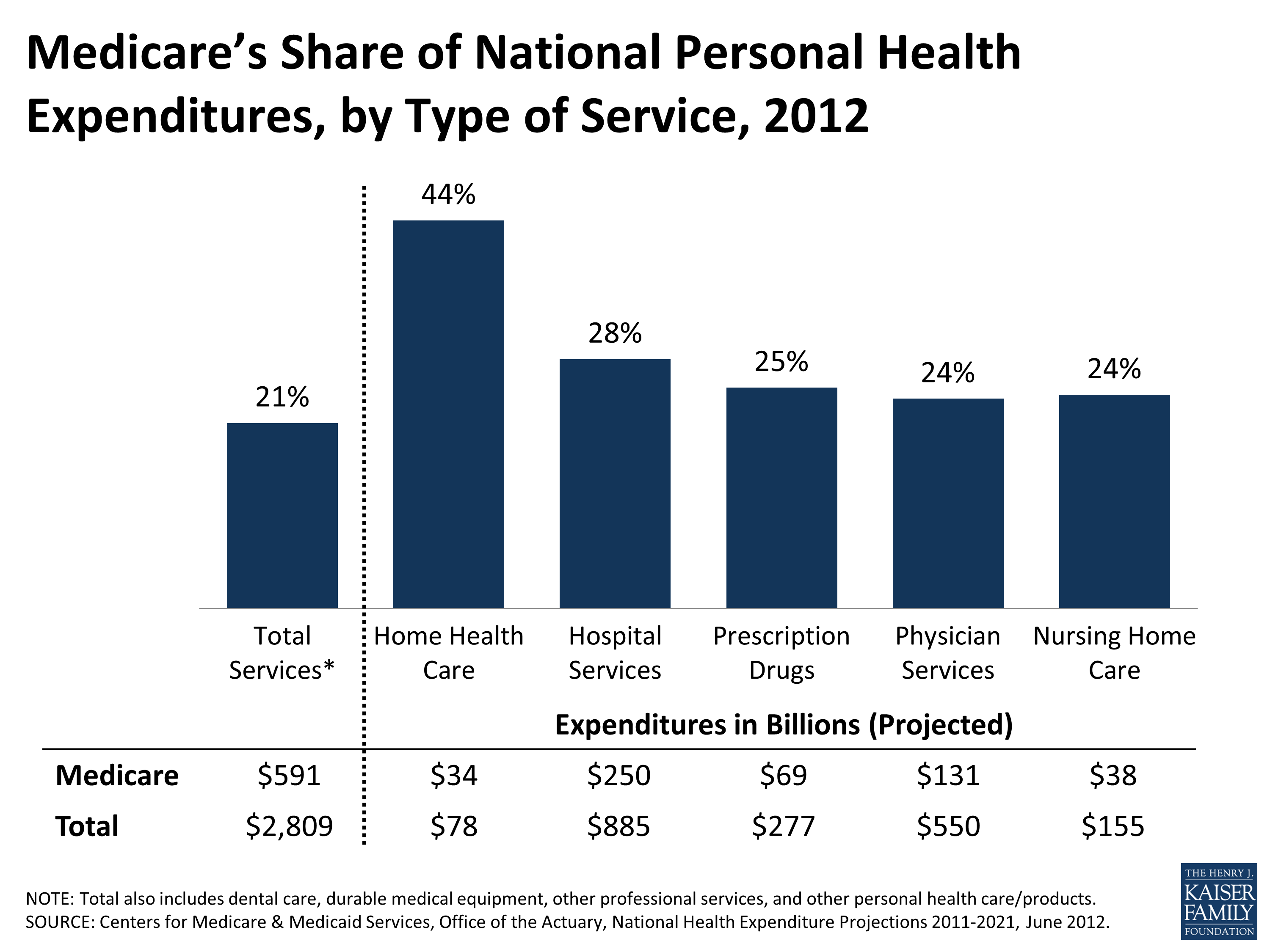
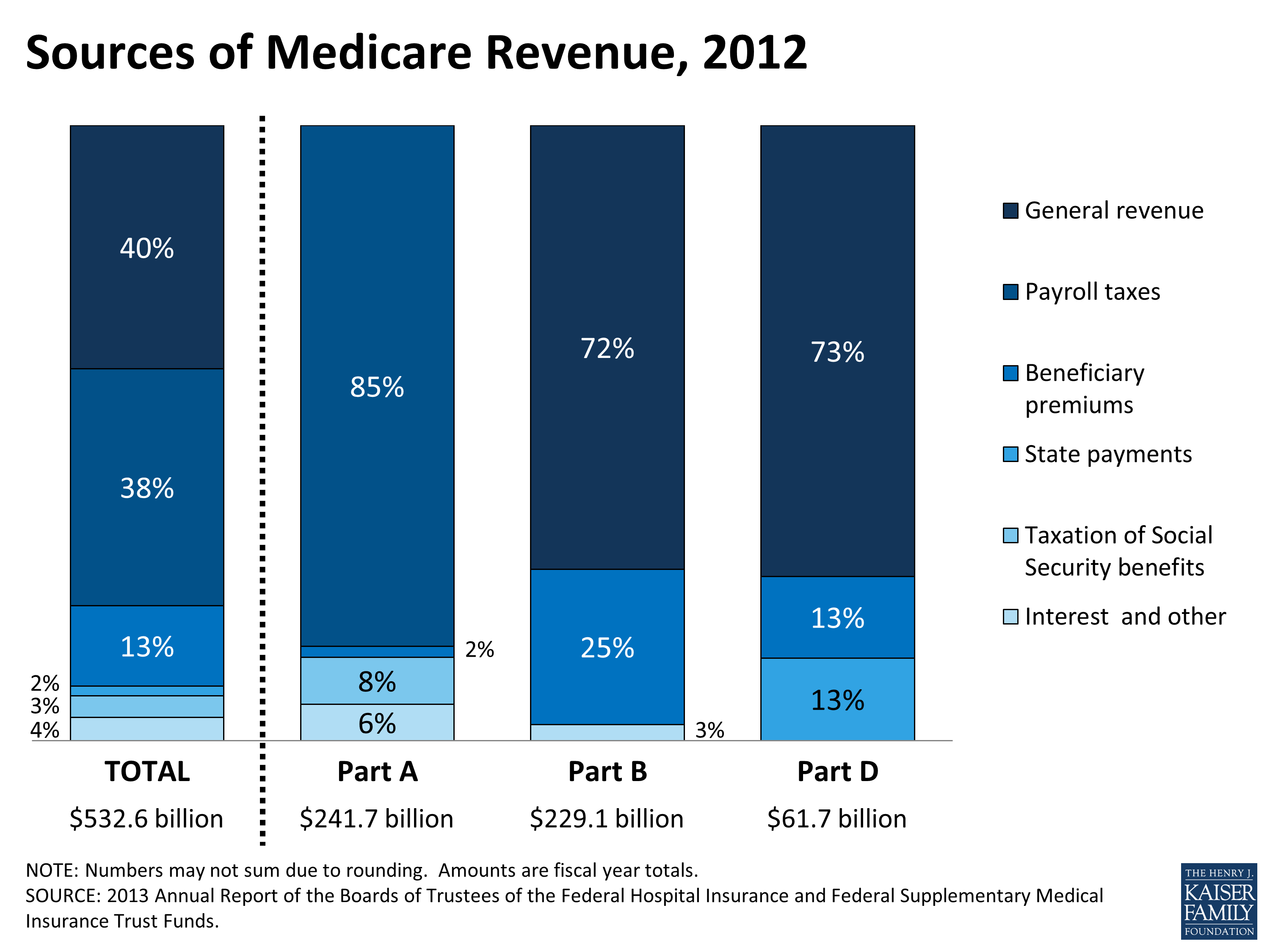
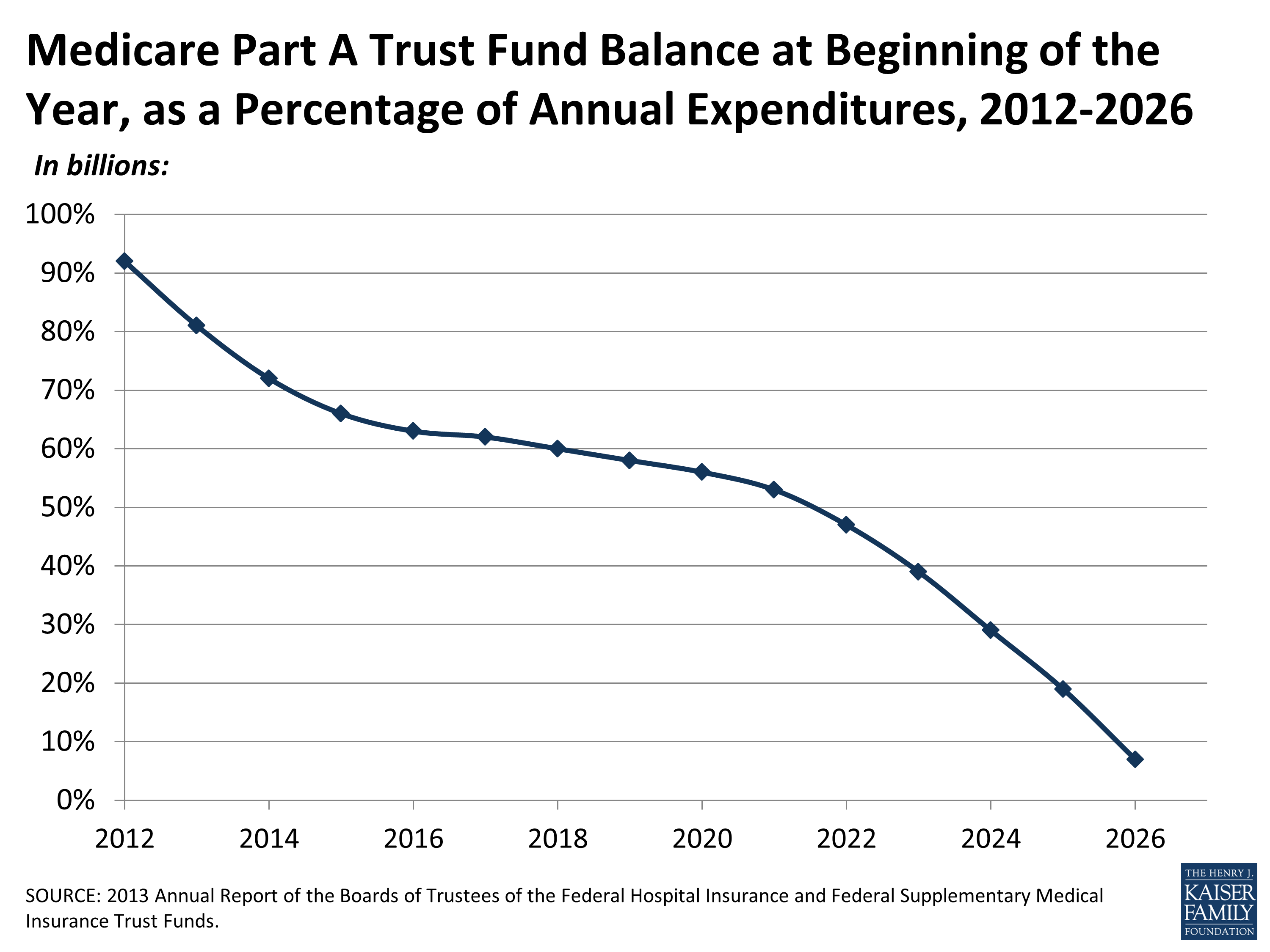
Kaiser Family Foundation analysis based on data from 2012 Annual Report of the Boards of Trustees of the Federal Hospital Insurance and Federal Supplementary Medical Insurance Trust Funds.
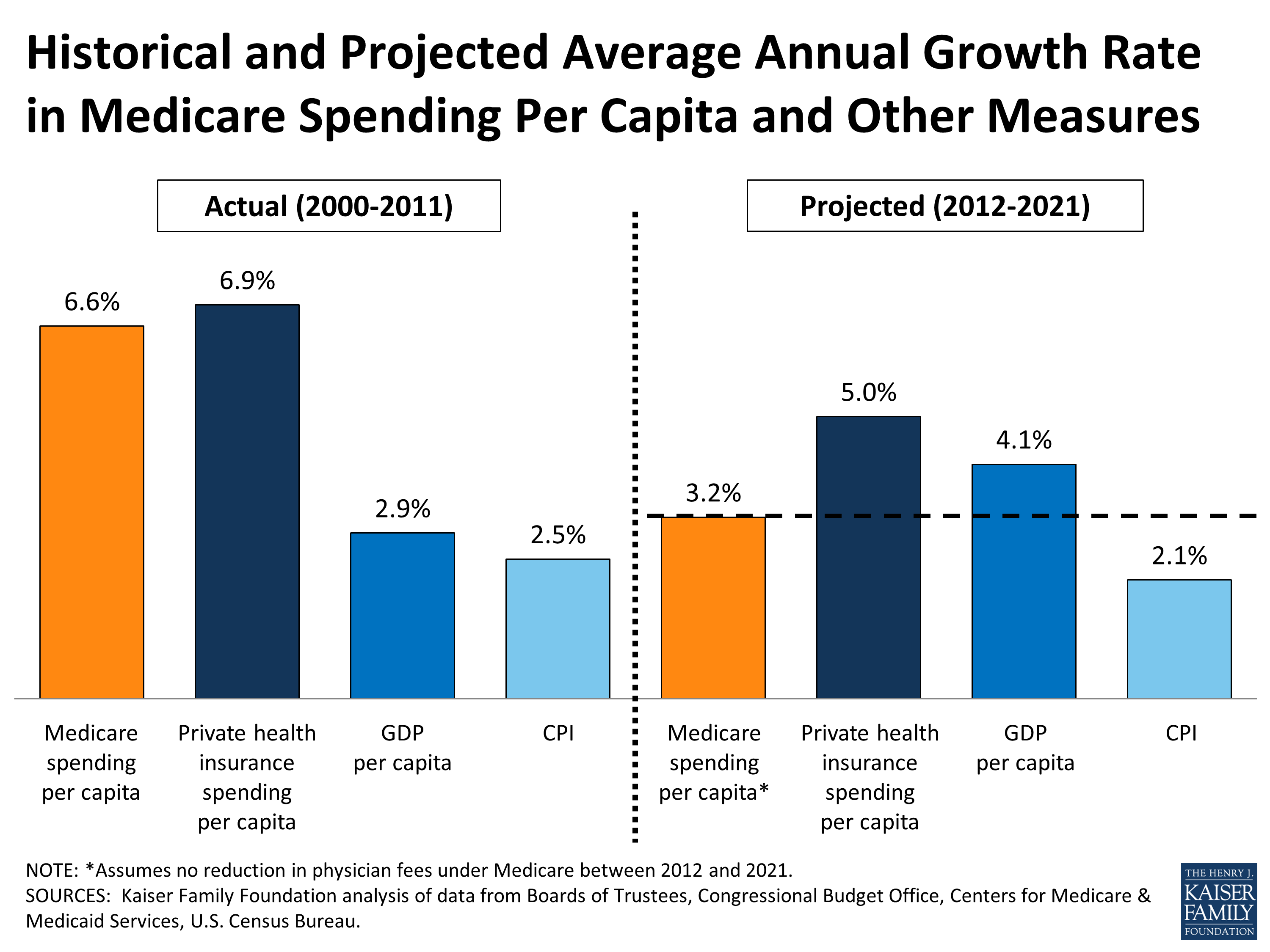
Kaiser Family Foundation analysis of data from Boards of Trustees, Congressional Budget Office, Centers for Medicare & Medicaid Services, U.S. Census Bureau.
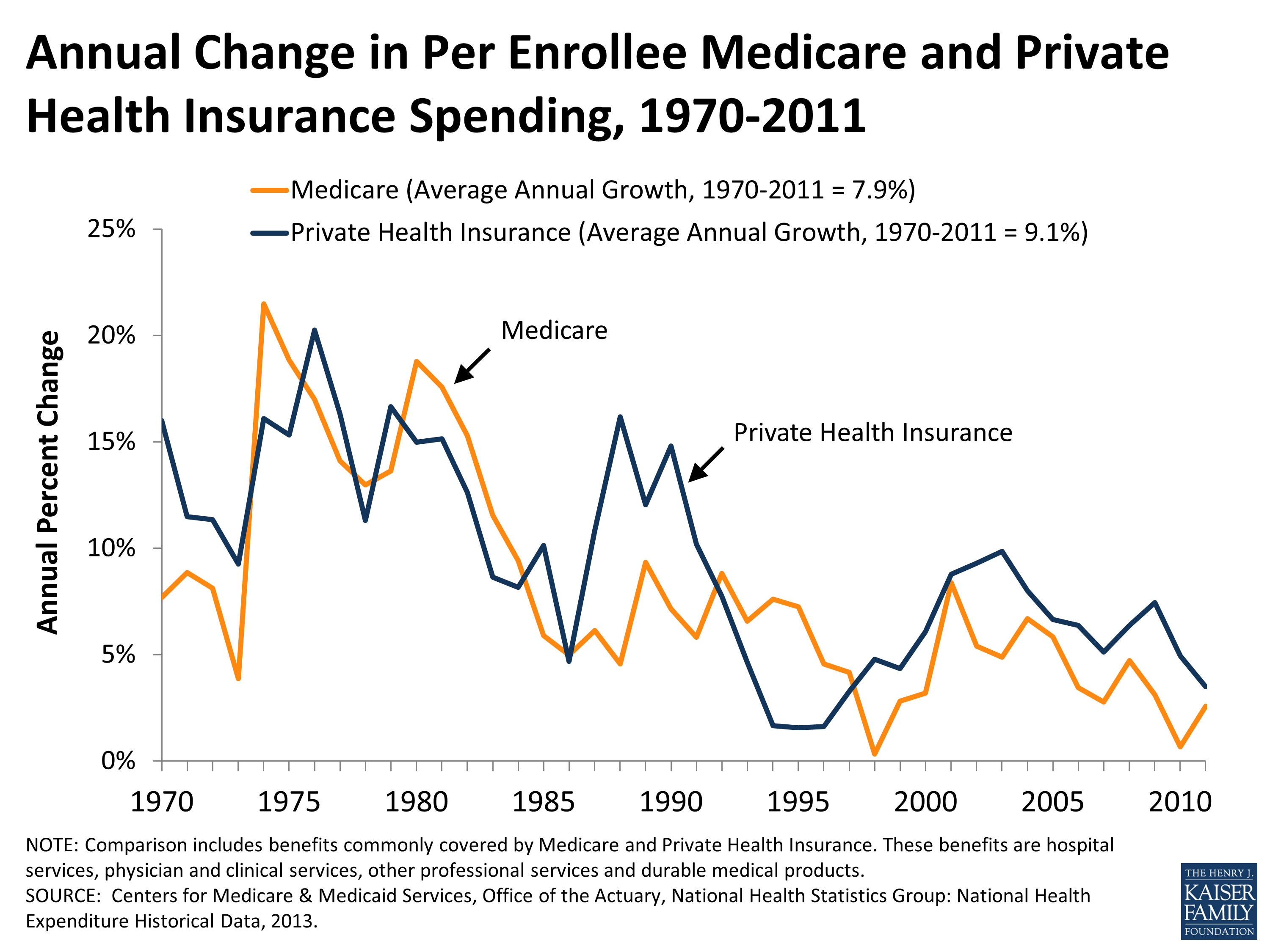
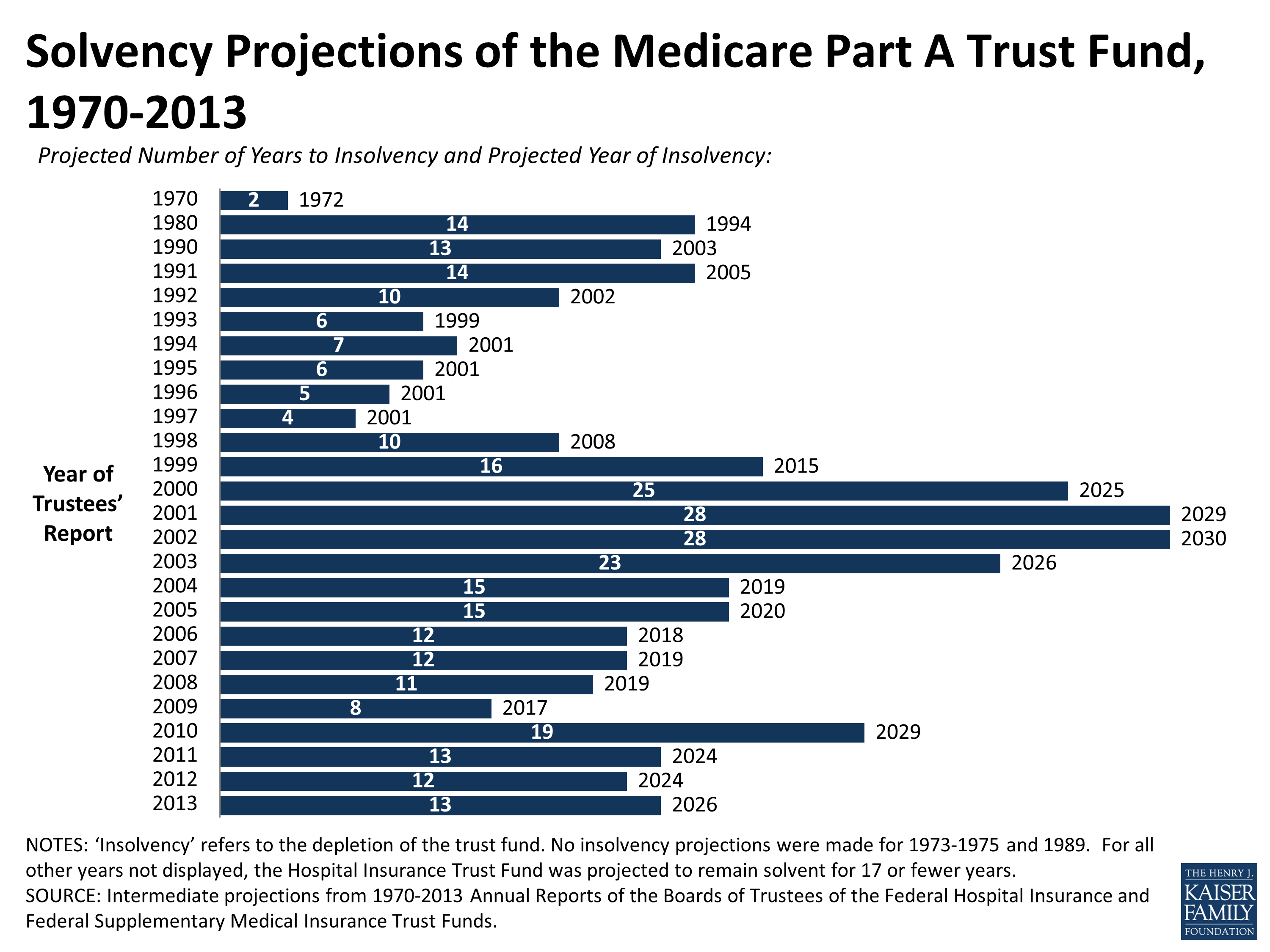
Intermediate projections from 1970-2013 Annual Reports of the Boards of Trustees of the Federal Hospital Insurance and Federal Supplementary Medical Insurance Trust Funds.