Tracking Implementation of the 2025 Reconciliation Law: Medicaid Work Requirements

Published:

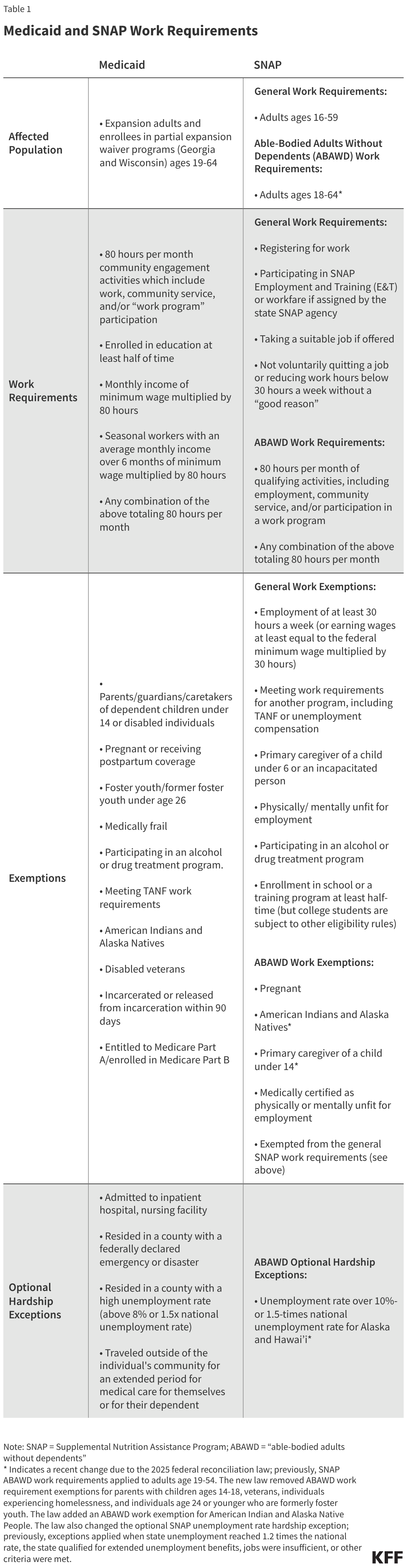
The 2025 reconciliation law, once called the “One Big Beautiful Bill,” signed by President Trump on July 4, 2025, conditions Medicaid eligibility for adults in the Affordable Care Act (ACA) Medicaid expansion group and enrollees in partial expansion waiver programs (Georgia and Wisconsin) on meeting work requirements starting January 1, 2027. Currently, 41 states (including DC) have expanded their Medicaid programs under the ACA to nearly all adults with income up to 138% FPL ($21,597 for an individual in 2025).

To implement Medicaid work requirements, states will need to make important policy and operational decisions, implement needed system upgrades or changes, develop new outreach and education strategies, and hire and train staff, all within a relatively short timeframe. The information tracked here can serve as a resource to understand Medicaid work requirements and state options, gauge readiness, and track implementation of the requirements, including:

  • State and national data and current state policies related to Medicaid enrollment, renewal outcomes, and application processing times that can serve as a baseline for assessing the potential readiness to implement the requirements and the impact of work requirements once implemented;
  • Federal guidance and a list of policy and operational questions that states will need to answer as they implement work requirements;
  • Updates on 1115 waivers submitted by states to implement work requirements (while waivers will no longer be needed starting January 2027, some states may pursue waivers to implement work requirements earlier than January 2027); and
  • A compilation of KFF issue briefs and other resources on Medicaid work requirements.

This resource will be updated to include guidance from the Centers for Medicare and Medicaid Services (CMS), information on state policy decisions as they are made, and new data when available.

Continue scrolling to learn more about the Medicaid work requirements in the 2025 reconciliation law.

Tracking Implementation of the 2025 Reconciliation Law Medicaid Work Requirements

Published:

KFF Resources on Medicaid Work Requirements

Work requirements overview:

Implementation of work requirements:

Research and analysis on Medicaid and work:

1115 work requirement waivers:

Work requirements implications and state experience:

Arkansas work requirement experience:

KFF Polling on Work Requirements:

Beyond the Data by KFF CEO Drew Altman:

Tracking Implementation of the 2025 Reconciliation Law Medicaid Work Requirements

Published:

The 2025 reconciliation law requires states to condition Medicaid eligibility for adults in the ACA Medicaid expansion group on meeting work requirements starting January 1, 2027; however, states have the option to implement requirements sooner through a state plan amendment (SPA) or through an approved 1115 waiver.

State Plan Amendments (SPAs)

Some states may choose to implement work requirements prior to the January 1, 2027 deadline through a state plan amendment. Nebraska is the first state to have announced that it will begin enforcing federal work requirements early through a state plan amendment, starting May 1, 2026.

1115 Waivers

States may also choose to implement work requirements early through an 1115 waiver. Since the start of the second Trump administration, several states have submitted waivers to implement work requirements, although some states may no longer be moving forward with proposed 1115 waivers due to the passage of federal work requirements or because they plan to implement early through a state plan amendment. While states are required to fully align with federal work requirements starting January 1, 2027, it is not clear how CMS will treat pending 1115 waivers that seek to implement early and deviate from federal requirements (specified in the law) prior to this deadline.

Currently, Georgia is the only state with a Medicaid work requirement waiver in place following litigation over the Biden administration’s attempt to stop it. CMS recently approved a temporary extension for Georgia’s waiver that added new exemptions from work requirements (see the table below for more details). Georgia’s waiver is now set to expire December 31, 2026, and the state will be required to come fully into compliance with new federal requirements starting January 1, 2027.

Early Implementation and Waiver Status

The map below identifies states that have indicated they will implement work requirements early through a state plan amendment as well as approved (Georgia) and pending work requirement waivers (submitted to CMS since the start of the second Trump administration). The table below the map provides more detailed state waiver information.

States Pursuing Work Requirement Waivers and/or Implementing Work Requirements Early
Interactive DataWrapper Embed

State and Federal Reproductive Rights and Abortion Litigation Tracker

Last updated on

The Supreme Court’s Dobbs ruling, overturning Roe v. Wade, returned the decision to restrict or protect abortion to states. In many states, abortion providers and advocates are challenging state abortion bans contending that the bans violate the state constitution or another state law. The state litigation tracker presents up-to-date information on the ongoing litigation challenging state abortion policy.

In addition, since the Dobbs decision, new questions have arisen regarding the intersection of federal and state authority when it impacts access to abortion and contraception. Litigation has been brought in federal court to resolve some of these questions. The federal litigation tracker presents up-to-date information on the litigation in federal courts that involves access to contraception and abortion.

Litigation Involving Reproductive Health and Rights in the Courts, as of January 8, 2026

Medicaid Workers and Job-Based Insurance: Who Is Offered, Eligible, and Enrolled?

Published: Mar 5, 2026

Passage of the 2025 reconciliation law, also known as the “One Big, Beautiful Bill,” in July 2025 and the inclusion of new work requirements for certain Medicaid enrollees in the law focused attention on the work status of adults enrolled in the program as well as their access to job-based insurance. Most adults who will be subject to the new Medicaid work requirements are already working. These adult workers rely on Medicaid because most work in jobs that do not offer health coverage or are not eligible for the offered coverage. While employer-sponsored insurance is the main source of coverage for working-age adults in the United States, access to job-based coverage is more limited for low-wage workers, those who work in certain industries, part-time workers, and those who work at smaller firms. Many employers— small and large— report that Medicaid provides important access to health care to their employees.

New work requirements are unlikely to increase employment (as most Medicaid adults are working or face barriers to work). Given the limited offers and eligibility for job-based coverage for low-wage workers, the new requirements are also not likely to substantially reduce reliance on Medicaid as a source of coverage for those workers. However, these requirements will likely reduce Medicaid enrollment because even some enrollees who are working will be unable to verify their work status.

Using data from the 2025 Current Population Survey Annual Social and Economic Supplement (CPS ASEC), this analysis examines the availability of job-based insurance in 2024 for adult Medicaid workers ages 19 to 64 and explores the reasons why Medicaid adults who are working are not eligible for employer coverage, and if eligible, why they do not take up the offer. The analysis excludes Medicaid adults who are self-employed, are also enrolled in Medicare, receive disability-related payments from Supplemental Security Income (SSI) or Social Security Disability Insurance (SSDI) and focuses on states that have adopted the Medicaid expansion and Wisconsin, which has adopted a partial expansion. Medicaid adults enrolled through the expansion, or partial expansion in Wisconsin, will be subject to the new work requirements. Georgia is excluded from the analysis because enrollment in the Pathways to Coverage Program is too small to be captured in the data. This analysis does not attempt to identify adults who would be subject to work requirements. It covers a broader group of Medicaid enrollees, including adults with dependent children, some of whom may be exempt.

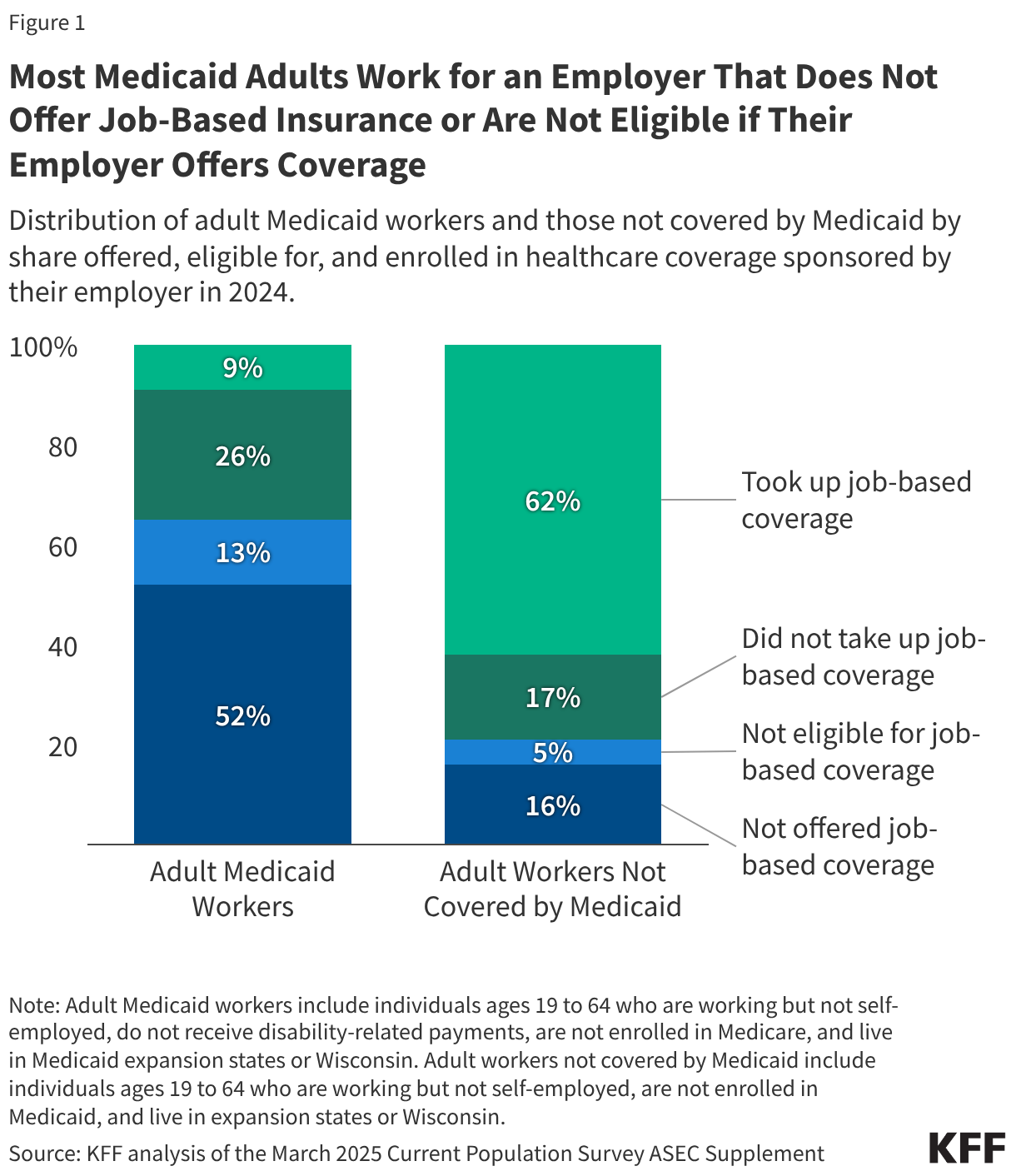
Most Medicaid adult workers work for an employer that does not offer job-based insurance or are not eligible if their employer offers coverage. For workers to enroll in job-based insurance, they need to work for an employer that offers coverage and be eligible to enroll in that coverage. Nearly two-thirds (65%) of Medicaid adult workers in expansion states and Wisconsin either work for an employer that does not offer health coverage (52%) or are not eligible for coverage that is offered by their employer (13%) (Figure 1). In contrast, about one in five (21%) adult workers who are not covered by Medicaid in the same states are not offered (16%) or eligible (5%) for coverage offered by their employer.

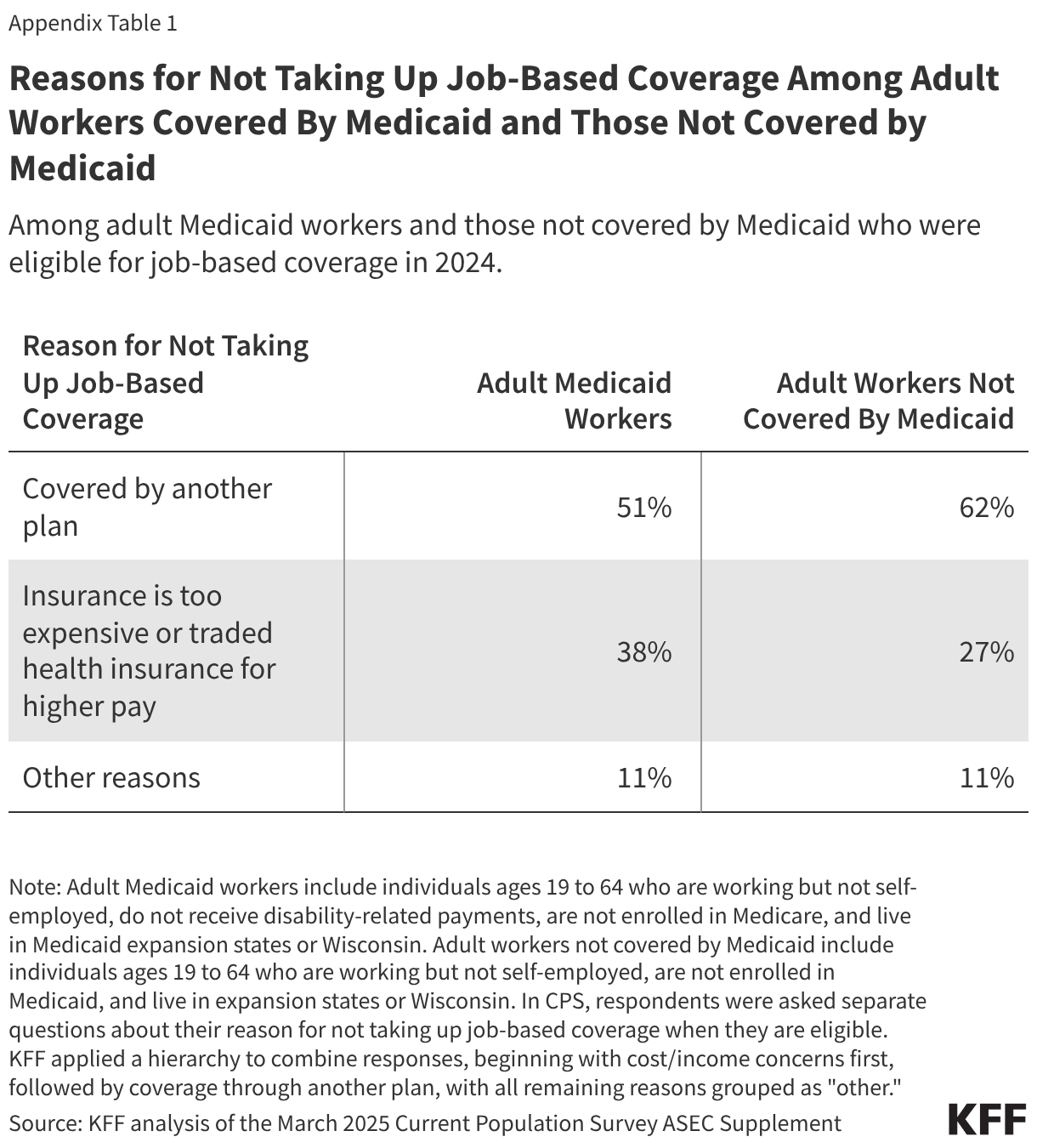
About a quarter (26%) of adult Medicaid workers decline coverage when they are eligible compared to 17% of adult workers not covered by Medicaid. Many adult workers who are eligible for job-based insurance do not take up the offer because the coverage is unaffordable (Appendix Table 1). For adult Medicaid workers who did not enroll in job-based coverage, Medicaid likely provides coverage that is more affordable, and in some cases, more comprehensive than the health insurance available through their employer.

About one in ten (9%) adult Medicaid workers take up coverage offered by their employer and are covered by both Medicaid and the employer plan. In these cases, Medicaid provides wrap-around coverage, covering premiums and cost sharing, as well as providing coverage for benefits not included in the employer plan.

Even when adult Medicaid workers in low-wage jobs have access to job-based insurance, the employee share of the costs can be unaffordable. Workers in firms with many lower-wage workers (where at least 35% earn $37,000 or less annually) have higher average contribution rates toward their premium for family and single coverage compared to workers at firms with fewer low-wage workers (31% vs 26% for family coverage and 19% vs 16% for single coverage). These higher contributions likely mean low-income families with job-based coverage spend a greater share of their income on health costs overall (premium contributions and out-of-pocket expenses) than those with higher incomes, which may contribute to decisions not to enroll in the offered coverage.

Most Medicaid Adults Work for an Employer That Does Not Offer Job-Based Insurance or Are Not Eligible if Their Employer Offers Coverage

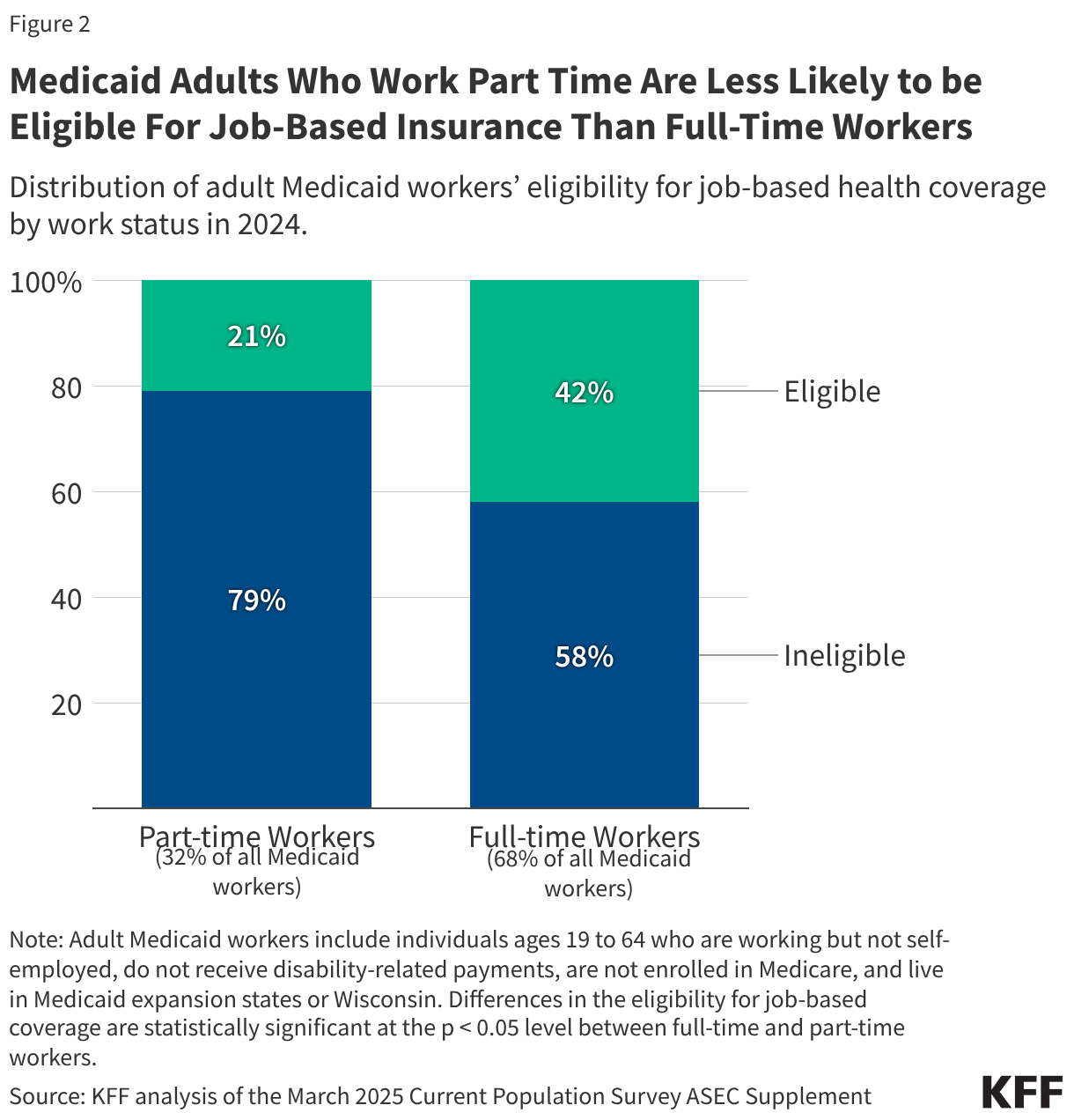
Medicaid adults who work part time are less likely to be eligible for job-based insurance than those who work full time. About one-third (32%) of adult Medicaid workers work part time, and among these part-time workers, one in five (21%) are eligible for coverage from their employer compared to 42% of those who work full time (Figure 2). Under the Affordable Care Act’s shared responsibility mandate, employers with at least 50 full-time equivalent employees are required to provide minimum essential coverage to employees, but that requirement only extends to employees who work an average of at least 30 hours per week. As a result, among firms that offer health benefits, relatively few offer benefits to part-time workers.

Medicaid Adults Who Work Part Time Are Less Likely to be Eligible For Job-Based Insurance Than Full-Time Workers

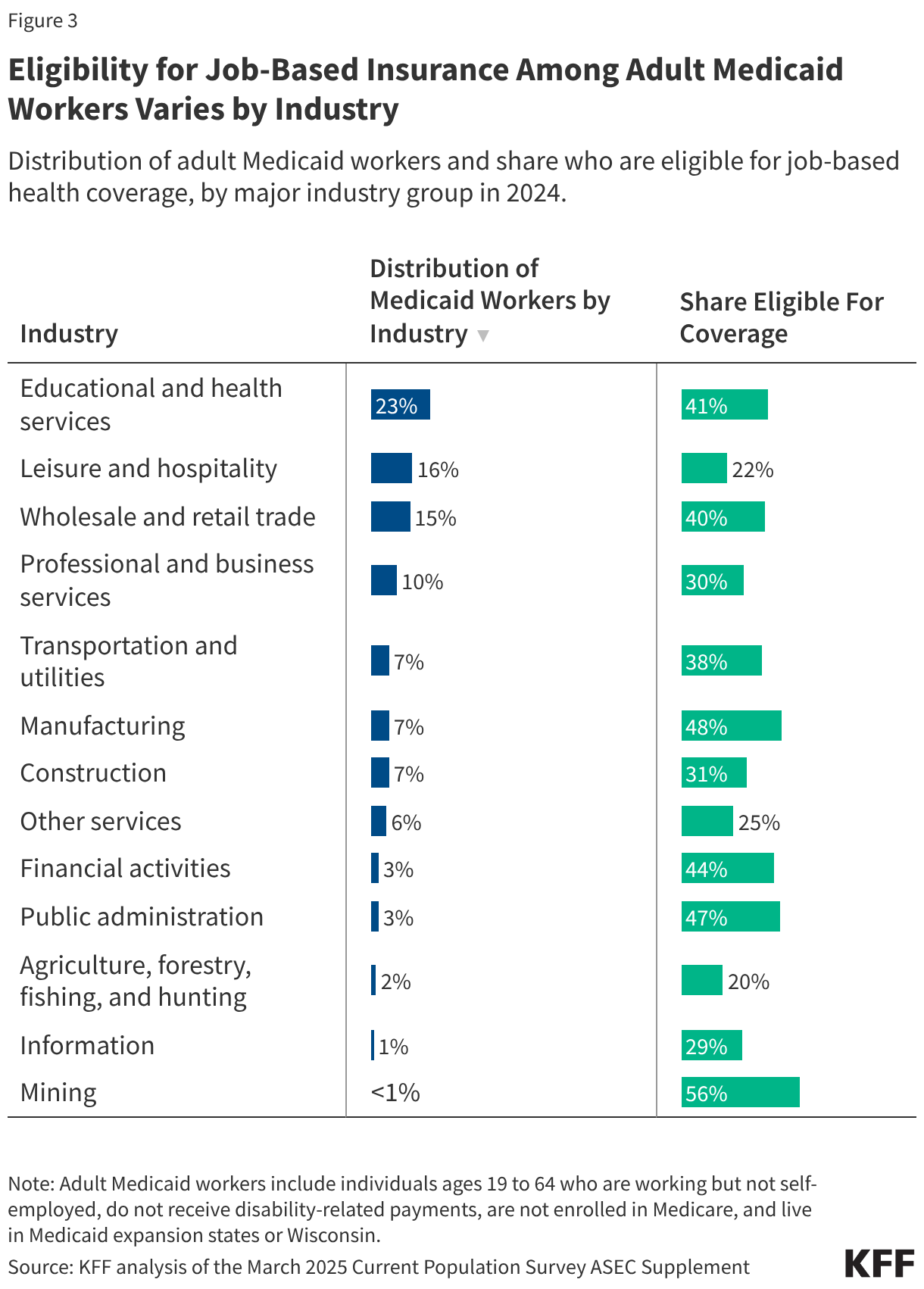
Eligibility for job-based insurance among adult Medicaid workers varies by industry. The share of adult Medicaid workers eligible for job-based insurance varies from 56% in the mining industry to 20% in the agricultural and forestry industry (Figure 3). Medicaid adults working in educational and health services industry represent nearly a quarter (23%) of adult Medicaid workers and 41% are eligible for job-based insurance. On the other hand, about one in six (16%) adult Medicaid workers have jobs in the leisure and hospitality industry where only 22% are eligible for employer-based insurance.

Eligibility for Job-Based Insurance Among Adult Medicaid Workers Varies by Industry

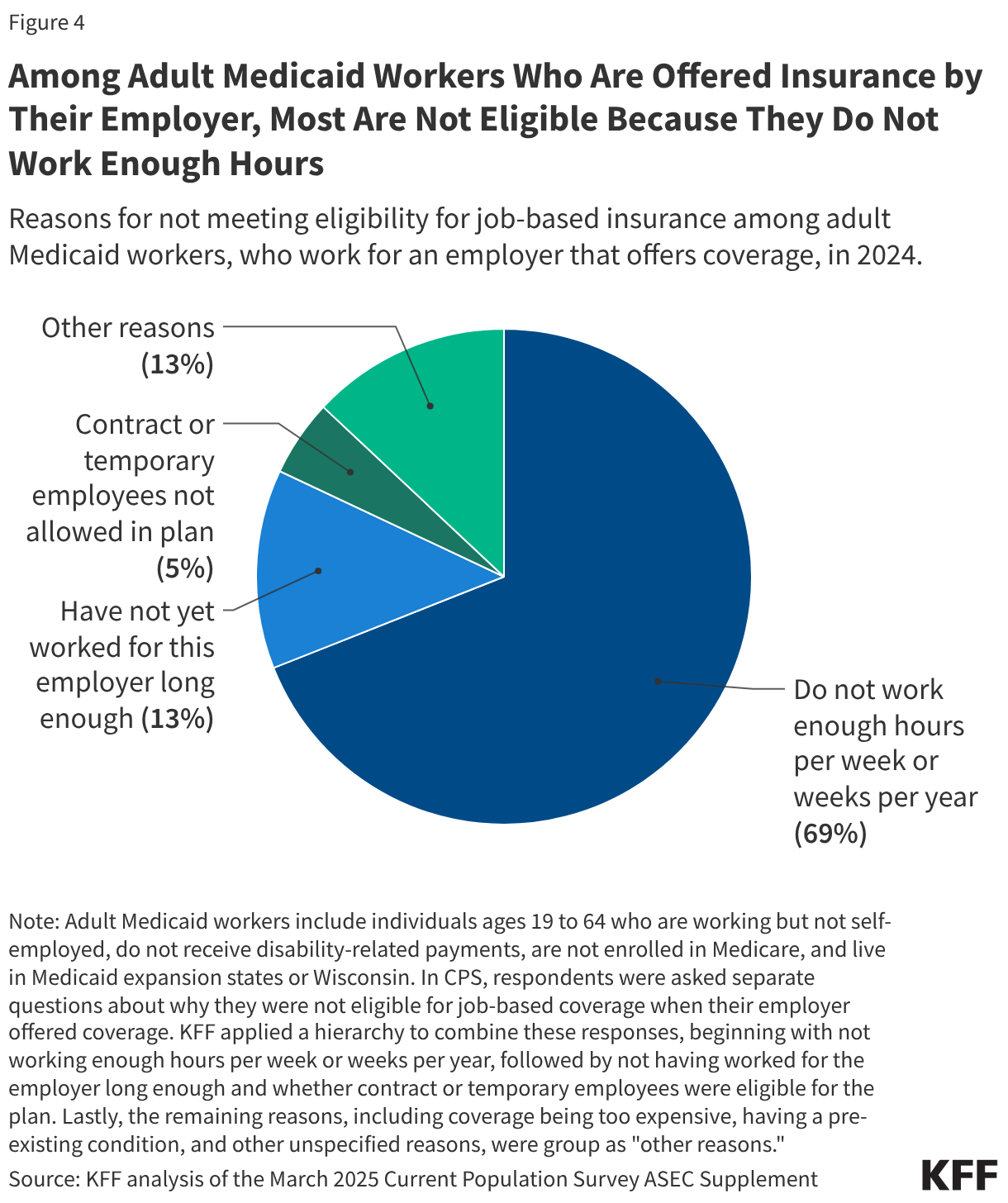
Among adult Medicaid workers who are offered insurance by their employer, most are not eligible because they do not work enough hours. About one in eight (13%) adult Medicaid workers work for an employer that offers health insurance but are not eligible (Figure 1). Nearly seven in ten (69%) of these workers reported they were not eligible because they did not work enough hours per week or weeks per year to qualify (Figure 4). About one in ten (13%) Medicaid workers were not eligible because they had not worked for the employer long enough, and another 5% said they were not eligible because contract and temporary employers were not allowed in the employer’s health plan.

Among Adult Medicaid Workers Who Are Offered Insurance by Their Employer, Most Are Not Eligible Because They Do Not Work Enough Hours
Reasons for Not Taking Up Job-Based Coverage Among Adult Workers Covered By Medicaid and Those Not Covered by Medicaid

HHS Public Health Policy Actions Under the Trump Administration 2025-2026

Published: Mar 4, 2026

Note: Originally published on Nov. 12, 2025, this resource is updated as needed, most recently on March 4, 2026, to reflect additional developments. 

Since assuming office for a second term, President Trump and officials in his administration have instituted numerous policy actions through the Department of Health and Human Services (HHS) affecting public health in the U.S. This resource lists and briefly describes key actions in the order in which they were first issued, reported or announced, with subsequent linked actions and related outcomes also included with each entry. As new policy changes occur, they will be added. 

This resource is not meant to be exhaustive of all administration actions related to public health, as many other federal policy changes – including outside of HHS – have public health implications but are not captured here.

Additional KFF resources on administrative actions related to global health, LGBTQ+ health, and mental health and substance abuse are also available.

Date

|

Action/Description

January 20, 2025Presidential Executive Orders precipitate removal of some HHS websites and health data.
– In the first days of his second term President Trump issued a number of Executive Orders (EOs), including EOs that revoked many Biden administration orders and programs, and instituted new federal guidance related to “gender ideology,” “diversity, equity, and inclusion (DEI),” and “merit-based opportunities.” These EOs have implications for public health, particularly related to the collection and presentation of data and websites by the federal government. For example, in response to the EOs, HHS began to remove thousands of websites and numerous federal databases with public health information deemed to be related to DEI, LGBTQ, reproductive health, HIV/AIDS research, health disparities, and more, and limited some data collection and analysis in these areas. A lawsuit was filed to reverse these removals, and some information has been restored over time. In September, the administration agreed to restore all previously removed health-focused websites and data to versions that had existed on January 29, 2025.
February 7, 2025NIH announces change to indirect cost rate guidance.
– As part of grants for health research, the National Institutes of Health (NIH) provides “indirect cost” funding to grant recipients, which supports administration and facilities costs at grantee institutions. On February 7, NIH announced it would apply a new 15% “standard indirect cost rate” on all grants, which would apply to any new grants and to existing grants for expenses as of February 10, 2025. This was challenged in federal court and federal judges placed holds on the policy, first through a temporary restraining order affecting 22 states on February 10, a nationwide preliminary injunction on March 5, and a permanent injunction on April 4; prior rates still apply for the time being. The administration appealed the ruling and legal proceedings continue. If implemented, a 15% indirect cost rate would be a much lower rate compared to historical NIH rates and would amount to a significant cut in funding for institutions performing NIH-sponsored health research.
February 13, 2025Robert F. Kennedy, Jr. confirmed as HHS Secretary under President Trump.
– The Senate voted 52-48, along party lines, to confirm Robert F. Kennedy, Jr. as the Secretary of Health and Human Services.
February 13, 2025President Trump issues Executive Order (EO) establishing MAHA policy agenda and MAHA Commission.
– The EO outlines the purpose and objectives of the Trump administration’s Make American Healthy Again (MAHA) efforts. Stating that the U.S. must “re-direct our national focus…toward understanding and drastically lowering chronic disease rates and ending childhood chronic disease,” it directs federal agencies to “aggressively combat” mental health disorders, obesity, diabetes, and other conditions. It also establishes the MAHA Commission to advise the President, naming Secretary Kennedy as Chair. The EO directs the Commission to submit an assessment on how to combat the “childhood chronic disease crisis” within 100 days, and a strategy to address the crisis within 180 days, setting in motion processes to develop further public health strategies and plans (discussed in other entries below). 
February 14, 2025White House, DOGE initiate “reduction in force (RIF)”, including for HHS personnel.
– The EO outlines the purpose and objectives of the Trump administration’s Make American Healthy Again (MAHA) efforts. Stating that the U.S. must “re-direct our national focus…toward understanding and drastically lowering chronic disease rates and ending childhood chronic disease,” it directs federal agencies to “aggressively combat” mental health disorders, obesity, diabetes, and other conditions. It also establishes the MAHA Commission to advise the President, naming Secretary Kennedy as Chair. The EO directs the Commission to submit an assessment on how to combat the “childhood chronic disease crisis” within 100 days, and a strategy to address the crisis within 180 days, setting in motion processes to develop further public health strategies and plans (discussed in other entries below). 
February 14, 2025President Trump issues Executive Order prohibiting federal funding to schools and universities with COVID-19 vaccine requirements.
– The EO requires HHS to work with the Department of Education to prohibit COVID-19 mandates in schools, by issuing guidelines for compliance and barring federal funds from going to any educational agency, K-12 school, or institution of higher education that requires COVID-19 vaccination to attend in-person education programs (educational vaccine mandates are set at the state level). Educational vaccine requirements are set at the state and local levels. At the time the EO was released in February, no state required K-12 students to be vaccinated against COVID-19 while 15 colleges required Covid vaccines for students. However, by March 14, 2025 all of those colleges had ended their COVID-19 vaccine requirements for students.
February 18, 2025Secretary Kennedy announces public health policy priorities during HHS welcome ceremony.
– In his first remarks to HHS staff, Secretary Kennedy announces the public health priorities for his tenure. This include investigating the childhood vaccine schedule, tackling corruption and promoting transparency, and addressing a “chronic disease epidemic” especially in children, which he says may be linked to pesticides, food additives, antidepressants, microplastics, cellphone emissions, and other factors.
February 28, 2025Secretary Kennedy issues new rule ending public comment requirement for HHS grants and contracts.
– The new rule rescinds a prior HHS policy on “Public Participation in Rule Making” (the “Richardson Waiver,” dating back to 1971) and “re-aligns the Department’s rule-making procedures with the Administrative Procedure Act.”  As a result, “matters relating to agency management or personnel or to public property, loans, grants, benefits, or contracts” are exempt from the notice and comment procedures. This removes what had been a key step in the rulemaking process requiring public notification and a comment period. For example, changes to HHS policies related to work requirements for Medicaid and NIH funding would no longer require public comments under the new rule. This could streamline implementation of HHS policy, but also reduce public visibility on changes before they take effect.  Some lawmakers and public health focused groups have asked HHS to return to the prior requirements under the Richardson Waiver. 
March 7, 2025HHS announces that CDC will conduct a study of factors contributing to the rise in autism in the U.S.
– In statements to the press, HHS officials indicate CDC will initiate a study looking at the factors that are contributing to the rise in autism diagnoses in the U.S.. To date, no new CDC study results on this topic have been released though in a related development, in September 2025 President Trump and HHS leadership announced at a press conference and through a White House Fact Sheet that they believe there is a link between acetaminophen (e.g., Tylenol) use in pregnancy to autism (further details provided below). President Trump and Secretary Kennedy both have a history of linking vaccines and autism, even though there is no evidence of such a link.
March 13, 2025Food and Drug Administration (FDA) releases guidance on 2025-2026 influenza vaccine composition.
– The FDA guidance identifies which influenza virus strains manufacturers should use as components of 2025-2026 influenza vaccines. To develop these recommendations, FDA convened meetings of federal scientific and public health experts, including from FDA, CDC, and Department of Defense, but did not consult with the FDA’s Vaccines and Related Biological Products Advisory Committee (VRBPAC) or other professional groups outside the government. FDA had canceled the scheduled VRBPAC meeting on this topic, and the lack of input from outside experts was a break from past years’ practices. In addition, in past years there was active participation and coordination between U.S. federal experts and global technical experts working under the auspices of the World Health Organization (WHO), but official communications with WHO-linked experts has been curtailed since the Trump administration announced in January 2025 that the U.S. was withdrawing its membership from the UN agency.
March 17, 2025NIH initiates termination of numerous grants for HIV prevention and treatment programs.
– The canceled NIH grants include support for researchers investigating use of PrEP, medication used pre-exposure to prevent HIV infections, and programs focused on HIV/AIDS in adolescents and young adults. Even as the first Trump administration supported HIV/AIDS prevention and treatment efforts, including through a highly visible federal effort to “end the HIV epidemic” in the U.S. by 2030, these same programs have now been targeted for cuts (further details below).   
March 17, 2025HHS removes Surgeon General warning declaring gun violence a public health crisis.
– The HHS website was changed, removing a 2024 advisory from the Surgeon General on the public health impacts of gun violence. In addition to removing the Surgeon General’s warning, the administration has rolled back a number of gun safety policies in place during the Biden administration. The White House Office of Gun Violence Prevention, established during the Biden administration was shut down in early 2025. Further, significant numbers of staff at CDC’s Injury Center, which collects data on violent deaths and injuries, and CDC’s Division of Violence Prevention have been let go as part of the Trump administration’s reduction in force efforts.
March 25, 2025HHS and CDC seek to pull back $11 billion in supplemental COVID-19 and public health funding from state and local health departments.
– In a statement, HHS says it intends to pull back $11.4 billion in supplemental funding that had been provided by Congress for state and local public health departments through CDC for pandemic response activities. Following the announcement, on April 1, a group of 23 mostly Democratic-led states sued the Trump administration over the attempt to pull back this funding.  On April 3, a federal judge placed a temporary block on the administration’s actions, and on May 16, another federal judge indefinitely blocked the administration from enacting its funding pull back for the states that are part of the lawsuit. As of late August 2025, almost 80% of the funds initially targeted for cuts by the Trump administration had been restored for the 23 states that won in court. However, funding has not been restored to the remaining states, the majority of which are Republican-led.
March 27, 2025HHS announces a major re-organization and job cuts plan.
– HHS announces plans for a major restructuring of the department, in accordance with President Trump’s February 26 EO on “Implementing the President’s ‘Department of Government Efficiency’ Workforce Optimization Initiative.” The announcement says HHS will create an Administration for a Healthy America (AHA), which would combine several existing HHS offices including the Office of the Assistant Secretary of Health (OASH, which contains the Surgeon General’s Office), the Health Research and Services Administration (HRSA), the Substance Abuse and Mental Health Services Administration (SAMSHA), the Agency for Toxic Substance and Disease Registry (ATSDR), and the National Institute for Occupational Safety and Health (NIOSH). In addition, the Administration for Strategic Preparedness and Response (ASPR) at HHS would be moved under CDC. The announcement also says HHS will reduce its workforce by eliminating 10,000 full-time positions. Combined with other reduction in force efforts, a total of 20,000 HHS workers are expected to lose their jobs.

On May 5, a coalition of 19 Democratic-led states and the District of Columbia filed a lawsuit against the mass firing of federal health workers and re-organization of HHS. On May 10, a court ordered a temporary pause on sweeping federal firings at HHS and other agencies. On July 1, a federal judge blocked mass firings at HHS, saying they are likely unlawful. However, on July 8 the Supreme Court overturned the lower court decisions, allowing the Trump administration to proceed with job cuts. As of August it is estimated that over 20,000 jobs at HHS have already been cut, meaning the administration already met its initial workforce reduction goal.

Regarding re-organization, some organizational changes have been implemented at HHS, with major cuts or closures to public health related offices such as the HHS Office of Infectious Diseases & HIV Policy, the HHS Office of Minority Health, and HRSA’s Bureau of Primary Health Care.  However, other proposals such as the formation of an Administration for a Healthy America (AHA), have not yet been implemented. Implementing AHA to the extent proposed is likely to require approval from Congress, though so far Congress has not acted on legislation codifying these proposals.
March 31, 2025HHS withholds portion of Title X family planning service grants. 
– HHS notifies one in five current grantees of the federal Title X family planning program that a portion of their funding would be temporarily withheld. This funding freeze affects all nine Planned Parenthood grantees, in addition to 7 other nonprofit grantees, and it is estimated that a total of 879 clinics (24% of all Title X clinics) in 23 states are affected. After several months, funds were reinstated to some organizations, but the Planned Parenthood grantees have still not had their funding reinstated.
April 1, 2025HHS ends federal support for the “Safe to Sleep” program, which focuses on prevention of infant deaths during sleep.
– The Trump Administration ends federal participation in Safe to Sleep, a national campaign that focused on educating parents of newborns about safer sleeping practices for infants that can prevent death. The program, supported through the NIH’s National Institute of Child Health and Human Development (NICHD) Office of Communications in recent years, had been in existence for over 30 years and had contributed to a major decline in sudden infant deaths. The NICHD office was eliminated on April 1, along with federal support for “Safe to Sleep.”
April 2, 2025HHS requires CDC to reduce contract spending by $2.9 billion as part of DOGE cost reduction efforts.
– According to reports, HHS orders CDC to reduce its contract spending by $2.9 billion by April 18.CDC contract funding has been used to support several services at the agency including security, cleaning, and computers/technology. The sudden requirement to cut this spending by approximately 35% affects CDC operations. 
April 7, 2025HHS Secretary Kennedy announces changes to fluoride policies.
– Secretary Kennedy announces a plan to implement a number of changes to federal policy related to water fluoridation, including stating that CDC will stop recommending water fluoridation as a public health intervention (though to date, HHS and CDC still recommend community water fluoridation). In addition, Kennedy says the defunct Community Preventive Services Task will be revived and reconvened, with a goal of studying and making recommendations about water fluoridation. Kennedy also called on states to ban fluoride in their drinking water. Already this year Utah and Florida have banned community water fluoridation, the first states ever to do so.
April 17, 2025FDA informs Pfizer/Moderna that mRNA COVID vaccines will require an expanded warning label about myocarditis.
– In letters sent April 17, the FDA informs Pfizer and Moderna they must alter the warning labels for their COVID-19 mRNA vaccines to include expanded risks for myocarditis and pericarditis. Previously, the warning labels for these vaccines noted risks for these conditions for those aged 18 to 24 years (Moderna) and 12 to 17 years (Pfizer). However, updated labels are required to include new language saying “the observed risk of myocarditis and pericarditis following vaccination with mRNA COVID-19 vaccines has been highest in males 12 through 24 years of age” and that “persistence of abnormal cardiac magnetic resonance imaging (CMR) findings that are a marker for myocardial injury was common.”  According to FDA, the labels must also include more information about these conditions and their health risks.  Since the letters were sent, the companies have complied with the new FDA requirements. FDA approved the updated label language on June 25.
April 22, 2025FDA and HHS announce measures to phase out use of petroleum-based food dyes.
– FDA and HHS announce a series of steps the federal government will take to remove petroleum-based synthetic dyes from the U.S. food supply. These actions include initiating a process to revoke federal authorization for two such dyes and planning phase-outs by the food industry for others. In addition, the government will support research on food additives and children’s health and authorize natural alternative coloring options. Under the current plan, the phase-outs will occur through voluntary action taken by food companies.
May 1, 2025HHS announces a $500 million investment in a “next generation universal vaccine platform.”
– HHS and NIH announce that $500 million in funding will be directed to a new effort  to develop a “universal vaccine platform for pandemic-prone viruses.” The platform uses inactivated whole viruses, and is part of a broader federal effort to develop universal vaccines called “Generation Gold Standard.” The funds for this new investment appear to be re-purposed vaccine development funds from the Biden Administration’s NextGen initiative to develop next generation COVID-19 vaccines.
May 2, 2025White House Releases FY 2026 President’s Budget Request calling for major fundings cuts at HHS.
– The White House released an outline of the administration’s budget request for FY2026 and on May 30, the White House submitted the full Budget Request for FY2026 to Congress. The request proposes steep cuts to the HHS budget, including cuts for CDC, HRSA, SAMHSA, NIH, eliminating the Hospital Preparedness Program at ASPR, and reducing funding and cutting some programs focused on HIV/AIDS research and response. The budget request also asks Congress for $500 million to support a new “Administration for a Healthy America (AHA)” and MAHA-related priorities. The President’s Budget Request is only a proposal, as it is Congress that ultimately decides how much money the federal government appropriates. So far, Congressional spending bills for FY2026 have not included cuts to HHS of the magnitude requested by the President, and Congress has not provided the requested $500 million for AHA though budget negotiations continue.   
May 5, 2025White House Executive Order restricts funding and increases oversight for “gain of function” research at HHS.
– In an EO titled “Improving the Safety and Security of Biological Research” the White House cites concerns with federally funded “gain-of-function” (GOF) research on biological agents and states the Biden administration allowed dangerous GOF research to occur without sufficient oversight. The EO directs the Secretary of HHS to coordinate with other relevant Executive branch offices to establish guidance to end federal funding of “foreign entities” where GOF is being undertaken or in countries lacking oversight of GOF research. The EO requires the relevant Executive offices to submit updated policies and guidance for all federally supported GOF-related research, and to develop a strategy for managing risks of non- federally funded GOF research. The full implications of the EO are not yet clear, as the Executive branch offices must develop and implement specific guidance and regulations. According to outside experts, potential benefits of the EO include more transparency and stricter enforcement of dangerous research, while potential risks include hindering beneficial research that is not GOF and researchers choosing to curtail beneficial research to avoid potential repercussions under evolving federal restrictions.
May 20, 2025FDA leaders announce clinical trials will be needed for approval of certain new COVID vaccine formulations.
– In a medical journal article, FDA leaders indicate that going forward, for federal approval of new or updated COVID-19 vaccines (“boosters”) for use in individuals who are not considered at higher risk (defined as persons 65 or older or those with certain health conditions), will require vaccine makers to present evidence from randomized, placebo-controlled trials that demonstrate safety and efficacy. The announced policy is a departure from prior years when FDA did not require new trial data to authorize or approve boosters, but instead allowed approvals based on immune response evidence. The new policy could hinder investments by pharmaceutical companies in developing new COVID vaccine formulations, given the greater expense and time required to conduct new, full clinical trials.
May 22, 2025MAHA Commission Report on childhood chronic disease published.
– The first official report from the MAHA Commission (established by the February 13 EO discussed above) discusses factors contributing to a “chronic disease crisis” for U.S. children and provides a “call to action”. The report highlights four main drivers of the crisis: poor diet (primarily due to consumption of ultra-processed foods), exposure to chemicals, lack of physical activity and chronic stress, and “overmedicalization (excessive use of prescription drugs, such as antidepressants). The report calls for federal agencies to “close critical research gaps and guide efforts to better combat” these issues. It also says the MAHA Commission will develop and release a strategy in August (discussed below). The report expanded on the ideas initially outlined in the February EO and provided more details on Secretary Kennedy’s priorities to address chronic disease in children. There was some criticism of the report after its publication, with experts questioning some of the evidence and conclusions and pointing out significant errors and studies cited that did not exist, which indicated that artificial intelligence was likely used to help write the report. 
May 23, 2025Administration ends NIH funding for several HIV vaccine research projects. 
– NIH notifies two grant recipients working on broadly neutralizing antibody research for HIV vaccines of the cancelation of their funding.  The canceled grants supported early-stage vaccine development research that uses a different approach than other HIV vaccine candidates. Some other HIV vaccine candidates remain in the development pipeline and clinical trials continue, but the absence of this early-stage research could jeopardize the development of additional candidates going forward.
May 27, 2025HHS Secretary Kennedy announces CDC will no longer recommend COVID vaccines for healthy pregnant women and children.
– In a video post on X, Secretary Kennedy announces “the COVID vaccine for healthy children and healthy pregnant women has been removed from the CDC recommended immunization schedule.” The announcement was a departure from the typical process for changing vaccine recommendations, which includes review and input from the Advisory Committee on Immunization Practices (ACIP) and a notification from the CDC Director. Initially, the implications of changing CDC guidance without ACIP input were unclear given that no-cost insurance coverage for vaccination is linked to ACIP and CDC recommendations. On May 30, CDC changed the language on its website for COVID-19 vaccines, removing its prior recommendation for pregnant women to be routinely vaccinated and stating that healthy children 6 months to 17 years old could be vaccinated in consultation with health care providers/parents – a recommendation known as “shared decision-making,” which would mean insurance would still have to cover such vaccinations. On July 7, a coalition of professional medical organizations filed a lawsuit against HHS over the new COVID-19 vaccine recommendations, saying the department did not follow federal procedures in making the change and also mislead the public on the issue (on January 6, 2026, a federal court confirmed these plaintiffs have standing to challenge HHS’s actions on the COVID-19 vaccine recommendations, allowing the case to proceed to arguments). On August 19, independent expert groups, including the AAP, issued their own recommendations for COVID vaccines in infants and young children in contrast with CDC’s new recommendations.  On Aug 22, ACOG issued their own recommendations for pregnant patients.
June 9, 2025HHS Secretary Kennedy announces removal of all sitting members of ACIP.  
– In a post on X and a subsequent HHS press notice, Secretary Kennedy announces that all 17 sitting members of the CDC’s Advisory Committee on Immunization Practices (ACIP) are dismissed, to be replaced with new members selected by the Secretary. Kennedy says the move is “prioritizing the restoration of public trust above any specific pro- or anti-vaccine agenda.” The HHS Secretary does have the discretion to remove and nominate ACIP members, though no previous Secretary has dismissed all ACIP members at once. In a subsequent X post on June 11, Kennedy announces the nomination of eight new members to ACIP, several of whom have been critical of COVID-19 vaccines and have expressed concerns about harms caused by vaccinations more generally. In a later press release from September 15, HHS announces five more members to be appointed to ACIP, including several with a history of criticism of COVID-19 vaccine policies. 
June 17, 2025FDA announces National Priority Vouchers for expedited regulatory review of new drugs that support “U.S. national interest.
– FDA announces a Commissioner’s National Priority Voucher (CNPV) program, which can be “redeemed by drug developers to participate in a novel priority program” that shortens regulatory review time from 10-12 months to 1-2 months. FDA says it will determine the availability of vouchers for companies that are aligned with the “national health priorities” of: addressing a health crisis in the U.S.; delivering more innovative cures for the American people; addressing unmet public health needs; and, increasing domestic drug manufacturing as a national security issue. On October 16, FDA announced the first nine CNPV recipients, and on November 6, announced six more recipients.  The impact of this new priority voucher program on speeding drug approvals and onshoring drug manufacturing capacity is as yet unclear. In addition, there are several other existing priority review processes at FDA so adding another could strain FDA staff capacity at the same time there has been significant reductions in FDA’s staff and budget.  These strains have already slowed FDA review times in general.
June 18, 2025FDA approves lenacapavir – a new HIV prevention drug.
– FDA approves Gilead Sciences’ lenacapavir, a new injectable PrEP drug that has been shown to be highly effective at preventing HIV infection, and which requires just one dose every 6 months, making it the first ever twice-a-year drug option for HIV prevention. In September, CDC issued clinical guidance for use of injectable lenacapavir as PrEP, though that guidance did not include reference to transgender people, a group intentionally included in the clinical trials and at increased risk of HIV. FDA’s approval also precipitated a review by the World Health Organization (WHO) and on October 6, WHO pre-qualified lenacapavir for prevention of HIV. WHO pre-qualification can speed regulatory approval for the drug in many low- and middle-income countries with a high burden of HIV/AIDS and can also allow for global health mechanisms like the Global Fund to Fight AIDS, Tuberculosis and Malaria to procure the drug.
June 25-26, 2025The newly reconstituted ACIP makes recommendations and policy changes related to RSV and influenza vaccines, and designates new workgroups on hepatitis B, MMRV, and the childhood immunization schedule.
– ACIP votes to recommend respiratory syncytial virus (RSV) injections for babies and RSV vaccine for people 50 and older, and a ban on the use of thimerosal in multi-dose influenza vaccine vials. ACIP also agrees to stand up three new workgroups that will review the U.S. childhood vaccination schedule, hepatitis B guidance, and combination MMRV vaccine.  Subsequently, on July 3, CDC issued new RSV guidance that mirrored ACIP recommendations. On July 23, Secretary Kennedy enacted ACIP’s recommendation on thimerosal, rescinding federal recommendations for any influenza vaccines containing thimerosal (a change that only affects a very small percentage of the overall influenza vaccine market that is comprised of multidose vials).
July 1, 2025HHS alters program requirements and withholds funding from sex education and teen pregnancy prevention programs.
– HHS notifies all Teen Pregnancy Prevention (TPP) program grantees and Personal Responsibility Education Program (PREP) grantees in 46 states and territories that their material must align with President Trump’s executive orders, including those that ban the promotion of gender inclusivity, risk losing federal funding. TPP is a national grant program that funds grantees to replicate, develop, test, and evaluate evidence-based approaches to prevent teen pregnancy, while PREP awards grants to state agencies to use evidence-based models in educating adolescents on both abstinence and contraception. In August, the Trump administration cancelled a $12.3 million PREP grant to California after state officials refused to revise curricula in compliance with the EOs. In September 2025, 16 states and D.C. sued HHS alleging that the new PREP grant conditions are unlawful, unconstitutional, and harmful to gender diverse youth. Similarly, a federal judge blocked the HHS policy changes for TPP in October 2025.
July 2, 2025CDC deactivates its emergency response for H5N1 influenza (bird flu) and limits tracking and reporting of data on bird flu infections in humans and animals.
– CDC ends its emergency response for H5N1 bird flu in the U.S., which had been active since April 4, 2024. CDC reports the change is due to a decline in animal infections and no reports of human cases since February 2025. CDC also says data on the number of people tested for H5N1 will be reported only monthly, and no further data on infection rates in animals will be reported on the CDC website. Even so, reporting from states showed the number of H5N1 cases in birds, which had declined over the summer, began to increase again in fall 2025. However, much of the federal research and response efforts for H5N1 have been closed down or significantly limited following funding and staff cuts and a prolonged government shutdown. The limited federal tracking and reporting of H5N1 infections can slow identification of outbreaks and potentially slow response times.
July 9, 2025HHS Secretary Kennedy cancels a scheduled meeting of the U.S. Preventive Services Task Force (USPSTF).
– Secretary Kennedy cancels a meeting of the USPSTF several days before it was scheduled to take place, with no reason given and no re-scheduled meeting date provided. Typically, the task force meets three times a year, though no meeting has yet occurred under Secretary Kennedy. USPSTF is responsible for reviewing and recommending preventive health services. USPSTF recommendations have implications for what services insurers must cover with no cost-sharing, under the Affordable Care Act (ACA). Such services can include screening tests, behavioral counseling, and medications that can prevent diseases and illness (other than vaccines, which are tied to ACIP recommendations). However, along with other parts of the ACA, USPSTF has faced court challenges. On June 27 (prior to Kennedy’s cancelation of the meeting), while the Supreme Court ruled the ACA requirement that insurers cover USPSTF-recommended services is indeed constitutional, it also found that the HHS Secretary has the power to add and remove USPSTF members at will, which underscores the possibility that Secretary Kennedy may choose to dismiss some or all of the existing USPSTF members and appoint new members (as Kennedy has done with ACIP), or simply not name any new members, and has the power to choose not to adopt USPSTF recommendations. In light of Kennedy’s cancellation and the Supreme Court ruling, 104 public health focused organizations called on Congress to “protect the integrity of the USPSTF” through legislative action. The subsequent USPSTF meeting was scheduled to occur in November but that was also canceled, with HHS citing the government shutdown as the reason. 
July 31, 2025FDA announces new safety label requirement for opioid pain medications.
– The FDA says will require safety labels on opioid medications so that users can better understand that risks of long-term opioid use. The updated labels should include a summary on the risk of addiction, misuse, and overdose, treatment guidance and the risk of higher doses, how to safely discontinue opioid use, drug interactions, digestive complications, and overdose reversal medications. Drug companies received notification letters and have 30 days to submit updated labels for review.
July 31, 2025HHS Secretary Kennedy swears in Susan Monarez as CDC Director.
– In a statement welcoming the newly Senate-confirmed CDC Director, Secretary Kennedy says Monarez has “unimpeachable scientific credentials” and he has “full confidence in her ability to restore the CDC’s role as the most trusted authority in public health.” However, 28 days later (on August 27) the White House removed Monarez from her position at CDC. According to Kennedy, she was removed because he lost trust in her ability to serve as CDC Director and to implement the policies of the Trump Administration. According to Monarez, she was removed because she would not provide “blanket approval” for vaccine policy changes in advance and would not fire, as requested by Kennedy, CDC employees without cause. On August 28, Secretary Kennedy announced in a letter to CDC staff that Deputy Health and Human Services Secretary Jim O’Neill would serve as acting CDC Director.
August 1, 2025Newly announced CDC policy prevents outside professional medical and public health organizations from participating in working group meetings of ACIP.
– Officials at HHS notify professional medical organizations such as the American Academy of Pediatrics (AAP), the American Medical Association (AMA), the American College of Obstetricians and Gynecologists (ACOG), and others that they will be excluded from joining ACIP working group discussions going forward. Professional groups representing medical doctors and other stakeholders in vaccine policies have long participated as non-voting members, including in ACIP working groups. Working groups are typically responsible for helping review available data about topics prior to ACIP meetings, and helping develop recommendation language for ACIP to vote on, as well as other activities in support of ACIP. While the outside groups can be present and can participate in full ACIP meetings, the new policy removes them from providing any input through working groups.
August 5, 2025HHS announces a “coordinated wind down” of $500 million in federal funding for mRNA vaccine research
– HHS announces that it will cancel and begin to wind down mRNA vaccine development activities funded through the Biomedical Advanced Research and Development Authority (BARDA). In total, HHS reports it is canceling 22 projects worth nearly $500 million because “these vaccines fail to protect effectively against upper respiratory infections like COVID and flu…Going forward, BARDA will focus on platforms with stronger safety records and transparent clinical and manufacturing data practices.”  mRNA COVID-19 vaccines are effective in preventing severe illness and death from the disease, and mRNA vaccine technology has potential applications for other infectious diseases, as well as chronic diseases like cancer. The cancellation removes the bulk of U.S. federal funding for mRNA research, leaving questions about future progress by the U.S. in this area of vaccine technology.
August 15, 2025HHS reinstates the defunct Task Force on Safer Childhood Vaccines.
– The original Task Force on Safer Childhood Vaccines, a federal panel created by Congress in 1986 “to improve the safety, quality, and oversight of vaccines” was disbanded in 1998, but HHS announces that the group will be re-instated at NIH with participation from officials at FDA, CDC, and other government agencies. The goal of the reconstituted Task Force will be “the development, promotion, and refinement of childhood vaccines that result in fewer and less serious adverse reactions than those vaccines currently on the market, and improvements in vaccine development, production, distribution, and adverse reaction reporting” to help increase federal oversight and investigation of vaccine injuries.  The Task Force will come together to develop recommendations to be submitted to Congress within two years, with updates every two years after. Reinstatement of this panel has been a goal of anti-vaccine advocates for years, including the Children’s Health Defense, the anti-vaccine organization Secretary Kennedy founded, which supported a lawsuit earlier in 2025 against Kennedy that sought to require him to reconvene the Task Force.
August 27, 2025FDA approves COVID-19 vaccines for 2025-2026, while limiting scope of approval to certain ages and risk profiles.
– FDA approves updated COVID-19 vaccines for 2025-2026, but also limited the approval to persons 65 and older and those between 18 and 64 with a health condition that puts them at higher risk for severe disease. Previously, the FDA had approved the use of vaccines for all ages (over 6 months) regardless of risk profile.
September 9, 2025MAHA Commission releases strategy to address childhood chronic disease.
– A new MAHA Commission strategy document outlines actions the federal government is taking or plans to take to address childhood chronic disease in the U.S. These include “more than 120 initiatives” that together represent “the most ambitious national effort ever to confront childhood chronic disease,” and which outline a “blueprint for the entire government” to address chronic disease. Elements of the strategy include: changing federal science and research priorities, reforming dietary guidelines, changing nutrition and food regulations through reducing additives and ultra-processed foods, and improving effort to raise public awareness about chronic disease. The strategy highlights the risks of vaccine injuries, fluoride in drinking water, among many other areas.
September 18, 2025Secretary Kennedy renews the declaration of the national opioid crisis as a public health emergency.
– In a declaration on an HHS website, Secretary Kennedy renews the declaration of the opioid crisis as a national public health emergency (PHE).  The opioid crisis was initially declared a public health emergency in 2017; renewal is required every 90 days to continue the PHE.
September 19, 2025Secretary Kennedy announces that the FDA will launch a new review of mifepristone.
– Secretary Kennedy announced that the FDA will undergo a review of the current Risk Evaluation and Mitigation Strategy (REMS) for mifepristone, due to new evidence including an April 2025 report from the Ethics and Public Policy Center (EPPC) which claims that mifepristone has a higher rate of adverse events than previously reported. This report has drawn criticism due to methodological flaws and lack of transparency regarding its data sources.
September 19, 2025ACIP makes several new recommendations related to MMRV and COVID-19 vaccines
– In its September 18-19 meeting, ACIP members vote on several new recommendations including to no longer recommend the combination MMRV (measles, mumps, rubella, and varicella) vaccine for children under the age of 4 and instead to recommend that children in this age group receive measles, mumps, and rubella (MMR) vaccine separately from the varicella vaccine (V). In addition, ACIP members vote to change what had been a universal COVID-19 vaccine recommendation (except for HHS’ recent change for healthy children and pregnant women) to “shared clinical decision-making”, including for those 65 and older, along with a recommendation for new language on risk-benefit for COVID-19 vaccinations. ACIP’s recommendations were adopted by CDC on October 6. While the separate MMR+V vaccines had been recommended as preferred by the CDC for many years, the combination MMRV provided an option for parents to reduce the number of injections their children receive. Now, insurers will no longer be required to cover this vaccine at no-cost. The new COVID-19 vaccine recommendations mean people of all age groups are now recommended to have an interaction with a health care provider (which could include a doctor, nurse, or pharmacist) to determine whether getting a COVID-19 vaccination is recommended for them. If that determination is made, insurers must cover the vaccine at no-cost, although it is possible that some consumers may face challenges in accessing providers in the first place or demonstrating that they have consulted with a medical provider seeking vaccination in some cases.    
September 22, 2025President Trump and Secretary Kennedy announce new actions to address autism spectrum disorder in the U.S.
– In a press conference and via an HHS press statement and Fact Sheet, President Trump and HHS Secretary announce several actions to address the issue of autism spectrum disorder (ASD) in the U.S. This includes FDA authorization for leucovorin, a treatment option for some children with autism, a regulatory change that will allow state Medicaid programs to newly cover leucovorin for the indication of ASD. President Trump and Secretary Kennedy also highlight what they say are risks of acetaminophen use during pregnancy and association with autism. The press release notes “HHS wants to encourage clinicians to exercise their best judgment in use of acetaminophen for fevers and pain in pregnancy by prescribing the lowest effective dose for the shortest duration when treatment is required.”  In his remarks, President Trump also implicated childhood vaccines as a potential risk factor for autism, though no new evidence was presented and that link has already been repeatedly and conclusively ruled out. In a subsequent press statement on September 22, HHS announced FDA was initiating a labeling change for leucovorin, and a safety label change for acetaminophen to include information about the “potential risks of acetaminophen so patients can make a more informed decision.” Public health groups and experts criticized the conclusions linking acetaminophen use in pregnancy and autism, and expressed doubts about leucovorin as a treatment for autism. President Trump’s remarks also precipitated a lawsuit filed on October 28 in Texas against the maker of Tylenol.
September 30, 2025FDA approves a new generic mifepristone product.
– The FDA approved Evita’s Solutions application for a generic version of mifepristone.   The approval included a reminder that the generic mifepristone is subject to the same  Risk Evaluation and Mitigation Strategy (REMS) as the brand-name.
September 30, 2025HHS awards $60 million in grants to support prevention of falls and related programs for older adults and those with disabilities.
– Secretary Kennedy announced 59 new grants totaling $60 million is being awarded to states, territories, tribes, and local organizations supporting older adults and Americans with disabilities, including programs for “preventing falls among seniors, managing chronic conditions…and funding dementia-capable programs.”
October 10, 2025Trump Administration fires thousands of HHS employees, including hundreds at CDC, during federal government shutdown.
– In the midst of a government shutdown and an ongoing federal funding impasse in Congress, the White House Office of Personnel and Management says over 4,000 federal workers are to be fired. At HHS, over a thousand workers are notified that they have lost their jobs, with most of those losses concentrated at CDC. Some of those job losses were reversed over the next few days, with HHS officials stating some notices were sent in error. Even so, as of October 14 it is estimated that about 600 CDC employees remain fired, including staff in areas such as injury prevention, health statistics, and Congressional relations. There is a question about whether such firings during a government shutdown are legal, and groups representing federal workers have filed lawsuits to halt these mass layoffs.
October 31, 2025FDA announces new restrictions on ingestible fluoride products for children.
– FDA announces new enforcement actions “to restrict the sale of unapproved ingestible fluoride products for children” and sends letters to health care professionals warning about the risks associated with these products. The actions come after FDA conducted a review and published a scientific evaluation of these products. In the announcement. FDA says it will be developing a “fluoride research agenda” and “the first national oral health strategy” for the U.S. in partnership with NIH and other HHS agencies.
November 10, 2025FDA announces a warning label change on hormone replacement therapy (HRT) products for addressing symptoms of menopause.
– In a press release, a fact sheet, and a live press event, FDA leaders announce that they will initiate the removal of broad “black box” warnings from HRT products for menopause. The FDA also announces approvals for two new drugs for menopausal symptoms. According to the FDA, women have been “under-utilizing approved therapies” since the “black box” warnings about risks associated with the drugs were placed on these products over 20 years ago. Labels will be rewritten with guidance saying that there are long-term health benefits if HRT is begun within 10 years of the onset of menopause.
November 19, 2025CDC changes language on its website to say a link between vaccines and autism cannot be ruled out.
– A CDC website providing information to the public on Autism and Vaccines, is changed to include language saying “studies have not ruled out the possibility that infant vaccines cause autism.” The new site also discusses the “state of the evidence” on common childhood vaccines and supposed links to autism. The new language is a reversal from previous CDC statements saying “vaccines do not cause autism,” and contradicts the long established scientific consensus that there is no link between vaccines and autism. The new CDC webpage language has been criticized by professional medical organizations such as the American Medical Association and the American Academy of Pediatrics, as well as autism organizations such as Autism Speaks and the Autism Science Foundation.
November 21, 2025CDC staff ordered to end all monkey research programs, potentially affecting development of prevention tools for HIV and other infectious diseases.
– According to reports, CDC staff are ordered to halt its monkey research program by the end of 2025. This program has helped develop HIV prevention tools such as pre-exposure prophylaxis (PrEP) and microbicides, as well supported prevention research for other infectious diseases.
November 28, 2025Internal FDA communication proposes stricter federal requirements for testing and approving vaccines.
– According to reports, the head of FDA’s Center for Biologics Evaluation and Research (CBER), which is responsible for regulating vaccines, issues an email to staff proposing new, stricter federal requirements for vaccine testing, evidence, and approval. The email states that in the future FDA will “demand pre-market randomized trials assessing clinical endpoints for most new products” and that FDA “will not be granting marketing authorization to vaccines in pregnant women” without this kind of evidence. Newly developed pneumonia, influenza, and COVID-19 vaccines are specifically mentioned as vaccines that would be subject to these new requirements. The rationale given for this policy change is a new analysis of vaccine safety data indicating “COVID-19 vaccines have killed American children,” though no evidence to support that statement is provided in the email.
December 5, 2025ACIP votes to end recommendation that all newborns receive hepatitis B vaccine dose at birth
On the second day of the Advisory Committee on Immunization Practices’ (ACIP) December 4-5 meeting, members vote to end a long-standing recommendation that all newborns in the U.S. receive a dose of hepatitis B vaccine. The committee now recommends parents of infants born to mothers who test negative for hepatitis B consult with their provider to help decide if and when their child should receive the first hepatitis B dose. ACIP continues to recommend that infants born to mothers who test positive for hepatitis B, or whose hepatitis B test status is unknown, receive the first hepatitis B vaccine dose at birth. A recommendation from ACIP becomes part of the official CDC immunization schedule once it is adopted by the CDC director.
December 30, 2025HHS ends certain requirements for state reporting of immunization data to the Centers for Medicare and Medicaid Services (CMS).
December 30 letter from the Centers for Medicare and Medicaid Services (CMS) informs state health officials that starting in 2026, states will no longer be required to report several measures related to immunization status to CMS. Specifically, CMS removes the following from its “Child and Adult Core Sets”: “Childhood Immunization Status”, “Immunizations for Adolescents”, “Prenatal Immunization Status: Under Age 21”; and “Prenatal Immunization Status: Age 21 and Older.” In addition, in its letter CMS informs state health officials it will “explore options to facilitate the development of new vaccine measures that capture information about whether parents and families were informed about vaccine choices, vaccine safety and side effects, and alternative vaccine schedules” and “how religious exemptions for vaccinations can be accounted for.” Data reported by states and included in the Child and Adult Core Sets are used by Medicaid and CHIP to monitor access to and quality of health care for their beneficiaries, so an absence of this data could make monitoring immunization coverage in this population more challenging.
January 5, 2026HHS announces changes to the federal childhood vaccination schedule that reduce the number of routinely recommended vaccines
Health and Human Services (HHS) issues a memo implementing major changes to the government’s recommended vaccination schedule for children. Under the new guidelines, there are vaccines for 11 diseases recommended for all children, down from 17 diseases a year ago. In addition to COVID-19 (which HHS stopped recommending for all children back in October 2025), the new schedule no longer recommends routine vaccinations for five other diseases: rotavirus, COVID-19, influenza, hepatitis A, hepatitis B, and meningococcal. These vaccines have been moved from routine recommendation to “shared clinical decision making,” a process that is “individually based and informed by a decision process between the health care provider and the patient or parent/guardian.”  The HPV vaccine remains recommended for routine vaccinations, though under the new guidelines HHS reduces the number of recommended doses of HPV drops from two or three (depending on age of initial vaccination) to one. Coverage for all of these immunizations should remain the same through public and private insurance mechanisms.
February 3, 2026BARDA opens solicitations for a $100 million prize program for development of novel antivirals targeting dengue, West Nile, and other viruses.
In a news release, HHS’ Biomedical Advanced Research and Development Authority (BARDA) announces it is opening solicitations for a share of a new $100 million SMART Antiviral prize intended to speed the development of “broad-spectrum, small-molecule antiviral therapies” targeting families of viruses that include dengue, Zika, West Nile, and Chikungunya. This first stage is designed to receive solicitations at the concept stage, with solicitations for further development stages anticipated in the future.
February 4, 2026Trump Administration instructs CDC to rescind $600 million in public health funds going to four Democratic-led states
According to reports, the Office of Management and Budget ordered CDC to cut $600 million in funding that had been earmarked for state and local public health programs in California, Colorado, Illinois, and Minnesota. Most of the funding cuts affect programs focused on HIV and STD prevention, are are to be terminated because they “do not reflect agency priorities” according to an HHS spokesperson. On February 11, affected states filed a lawsuit in federal court against these cuts, and on February 12 a federal judge issued a temporary restraining order blocking the cuts from taking effect.
February 10, 2026FDA refuses to review Moderna’s license application for its investigational mRNA-based influenza vaccine
Moderna announces it received a “Refusal to File” letter from FDA stating that the agency will not initiate a review of the company’s biological license application for its investigational mRNA-based seasonal influenza vaccine. According to FDA, the refusal is due to the company’s use of an inadequate comparison arm in its study. Moderna states the letter is “inconsistent with previous written communications” with FDA staff. On February 18, Moderna announced that FDA had reversed its decision, and will now review the application, following further discussions with the company.
February 18, 2026FDA to allow drug approvals with evidence from one clinical trial rather than two
In an opinion article published in the New England Journal of Medicine, FDA leaders announce a new FDA policy that will make the default requirement for FDA approvals to be results from one clinical trial instead of the prior requirement of two clinical trials.  The stated goal of the change is to accelerate the approval and availability of new medicines.
February 19, 2026CDC delays February ACIP meeting until March
HHS/CDC announces the ACIP meeting previously scheduled for February 25-27 will be postponed. The postponement occurs amid an ongoing federal lawsuit filed by the American Academy of Pediatrics (AAP) and other medical groups that argues the recent revisions made by HHS to the federal child immunization schedule were arbitrary and violated administrative procedures and seeks to have the ACIP panel appointed by HHS Secretary Kennedy removed and replaced and its decisions overturned. On February 26, CDC announced the ACIP meeting had been rescheduled for March 18-19.
February 23, 2026FDA launches new framework for speeding development and approval of therapies for rare diseases
FDA announces draft guidance for drug developers that seek approval for targeted, individualized therapies. The new framework outlines new approaches to regulatory review and evidence requirements on the safety and efficacy for rare diseases, given that traditional randomized clinical trials may not be feasible for these conditions.
March 4, 2026HHS Postpones Third Straight Meeting of US Preventive Services Task Force (USPTF)
USPTF, which makes recommendations on preventive health care services, has not met since March of 2026. Five of the 16 USPTF members’ terms have ended as of January 1 and have not been replaced.  

How States Verify Citizenship and Immigration Status in Medicaid

Published: Mar 4, 2026

Editorial Note

This brief was updated on March 4, 2026 to include changes related to the 2025 reconciliation law and new federal Medicaid reverification requirements.

Medicaid is the primary program providing comprehensive coverage of health and long-term care to over 81 million low-income people in the U.S. Medicaid is jointly financed by states and the federal government but administered by states within broad federal rules. In addition to meeting federal and state income and residency requirements, eligibility for coverage under Medicaid and the Children’s Health Insurance Program (CHIP) is limited to U.S. citizens and certain lawfully present immigrants. Starting October 1, 2026, the 2025 reconciliation law will further restrict lawfully present immigrant eligibility for Medicaid and CHIP. Federal Medicaid funds cannot be used to cover undocumented immigrants. Undocumented immigrants also are excluded from other federally funded health programs, including Medicare and the Affordable Care Act (ACA) Marketplaces.

On February 19, 2025, the Trump administration issued an executive order to “end taxpayer subsidization of open borders”, which includes language calling for enhanced verification systems to ensure taxpayer-funded benefits exclude unauthorized immigrants and requires federal agencies to identify sources of federal funding for undocumented immigrants. Current federal rules require states to verify an applicant’s eligible immigration status through the Department of Homeland Security (DHS) as part of the process for determining Medicaid eligibility. On August 19, 2025, the Centers for Medicaid and Medicare Services (CMS) announced a new initiative to require states to reverify whether certain individuals enrolled in Medicaid are citizens or have a satisfactory immigration status. This reverification process may increase administrative burdens for states and lead to coverage losses among eligible individuals due to administrative barriers. This brief describes federal citizenship and immigration status eligibility and eligibility verification requirements for Medicaid and the new reverification requirements.

What are Medicaid eligibility requirements for immigrants?

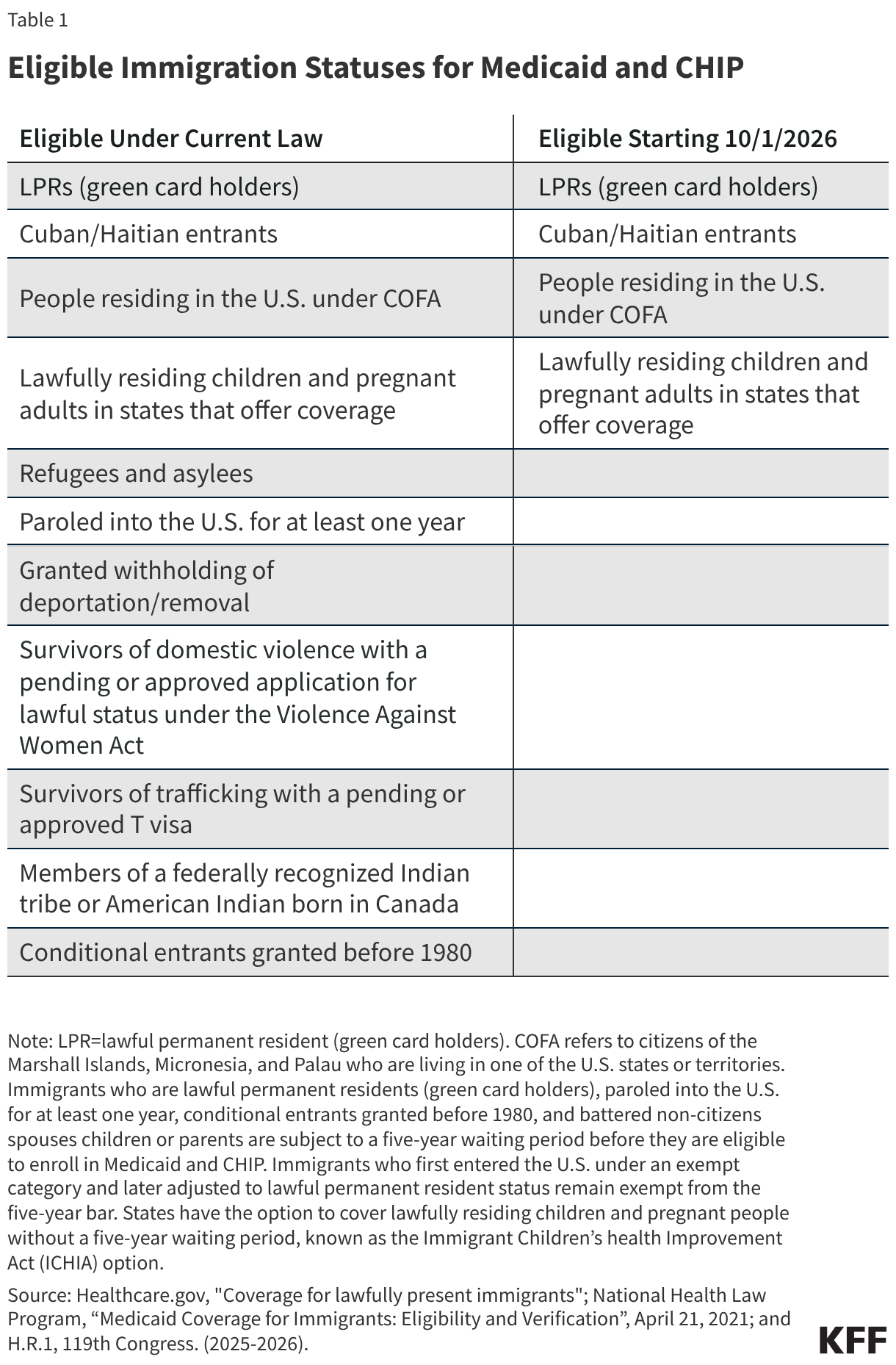
Federal rules limit Medicaid and Children’s Health Insurance Program (CHIP) eligibility to U.S. citizens and certain lawfully present immigrants; undocumented immigrants are not eligible for federally funded coverage. In general, in addition to meeting other eligibility requirements, lawfully present immigrants must have a “qualified non-citizen” status to be eligible for Medicaid or CHIP (Table 1), and many, including most lawful permanent residents or “green card” holders, must wait five years after obtaining qualified status before they may enroll. These immigrants may enroll in Marketplace coverage and receive subsidies during this five-year waiting period. Some immigrants with qualified status, such as asylees and refugees, do not have to wait five years to enroll in Medicaid and CHIP coverage. Some immigrants, such as those with temporary protected status, are lawfully present but do not have a qualified status and are not eligible for Medicaid and CHIP coverage even after a five-year wait. The Trump administration reversed Biden administration actions that had expanded ACA Marketplace coverage to Deferred Action for Childhood Arrivals (DACA) recipients, once again making them ineligible to purchase ACA Marketplace coverage effective August 25, 2025. States have the option to cover lawfully residing children and pregnant people in Medicaid or CHIP without the five-year waiting period otherwise known as the Immigrant Children’s Health Improvement Act (ICHIA) option. States can also provide prenatal care and pregnancy-related benefits to targeted low-income children beginning at conception through the CHIP From-Conception-to-End-of-Pregnancy (FCEP) option regardless of their parent’s citizenship or immigration status. Some states provide fully state-funded coverage to fill gaps in coverage for immigrants, including lawfully present immigrants and undocumented immigrants.

The 2025 reconciliation law will further restrict lawfully present immigrant eligibility for Medicaid and CHIP. Starting October 1, 2026, the 2025 reconciliation law will restrict immigrant Medicaid and CHIP eligibility to lawful permanent residents (LPRs) (i.e., “green card” holders), Cuban and Haitian entrants, people residing in the U.S. as citizens of the Freely Associated (COFA) nations of the Marshall Islands, Micronesia, and Palau residing in U.S. states and territories, and lawfully residing children and pregnant immigrants in states that cover them under the Medicaid or CHIP option (Table 1). States also will still have the option to extend prenatal and pregnancy-related benefits to targeted low-income children from conception through the end of pregnancy through the FCEP option. These restrictions will eliminate eligibility for many other groups of lawfully present immigrants, including refugees and asylees without a green card, among others.

Eligible Immigration Statuses for Medicaid and CHIP

Emergency Medicaid reimburses hospitals for emergency care provided to individuals ineligible for Medicaid due to their immigration status. Emergency Medicaid spending reimburses hospitals for emergency care they are obligated to provide to individuals who meet other Medicaid eligibility requirements (such as income) but do not have an eligible immigration status, including undocumented immigrants and lawfully present immigrants who remain ineligible for Medicaid or CHIP. Emergency services include those requiring immediate attention to prevent death, serious harm or disability, although states have some discretion to determine reimbursable services. Spending on Emergency Medicaid accounts for less than 1% of total Medicaid expenditures. Without Emergency Medicaid, the costs of emergency care would be shifted to hospitals that are required to treat individuals in emergency situations or fully to states. Starting October 1, 2026, in states that have expanded Medicaid under the ACA, the 2025 reconciliation law will limit federal matching payments for Emergency Medicaid for individuals who would otherwise be eligible for expansion coverage except for their immigration status to the state’s regular federal Medicaid match rate (which ranges from 50% to 77%) as opposed to the expansion match rate (which is 90% in all states).

How do states verify citizenship and immigration status to determine Medicaid eligibility?

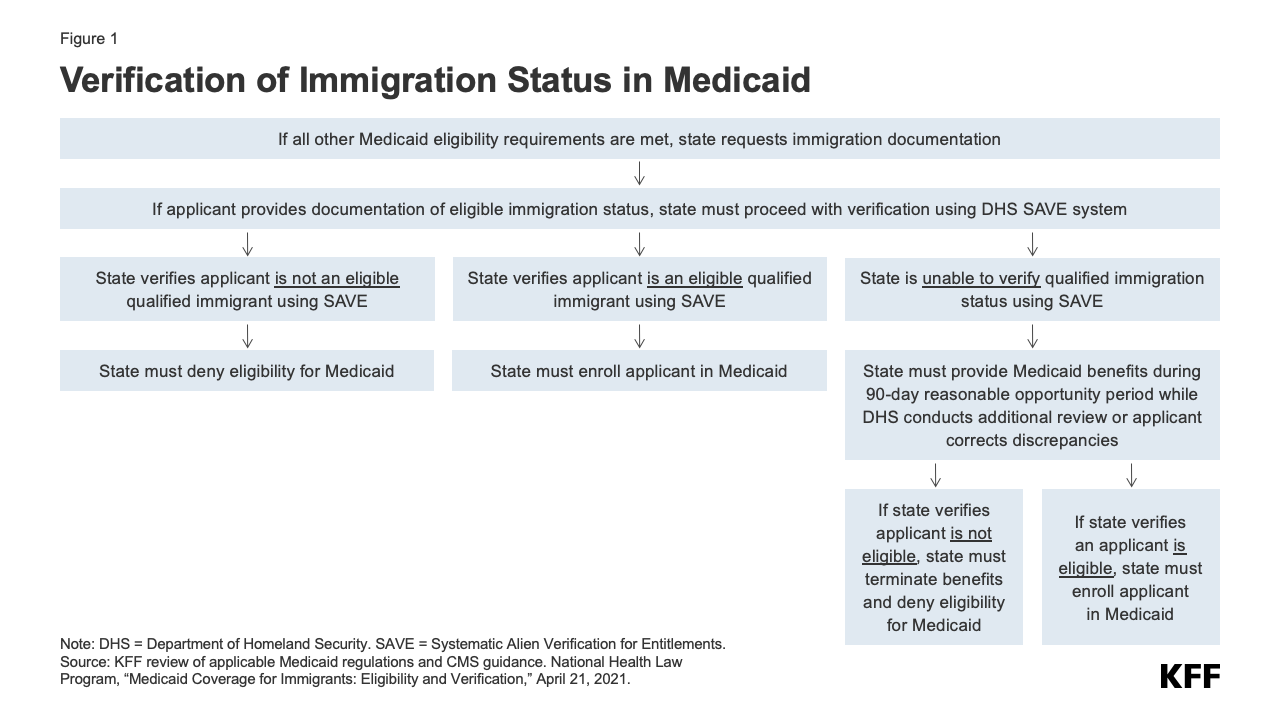
States must verify citizenship and immigration status with the Social Security Administration (SSA) and DHS to determine eligibility for Medicaid coverage at the initial application. Applicants who are U.S. citizens must provide documentation of citizenship, or states must verify the applicant’s Social Security number with the SSA. Applicants who are not U.S. citizens must provide documentation showing that they have a qualified immigration status eligible for Medicaid coverage (Figure 1). States verify immigration status through the DHS Systematic Alien Verification for Entitlements (SAVE) system, which can provide automatic real-time verification. If the system cannot provide real-time verification, the state must request an additional review and may request additional documentation of eligible immigration status from the applicant. Applicants cannot self-attest to having an eligible immigration status without documentation for the state, with the exception of qualified immigrants exempt from the five-year wait due to a military connection. Current federal rules prohibit states from requiring applicants to disclose the immigration status of non-applicants, such as household members, which is not relevant to eligibility determination, and under statute, the SAVE system cannot be used for non-criminal immigration enforcement.

States are required to provide Medicaid benefits to applicants during a “reasonable opportunity period” of 90 days while their immigration status is being verified, if they otherwise meet all eligibility criteria. The reasonable opportunity period is allowed when the SAVE system cannot verify immigration status in real time and the state needs to conduct additional review and collect additional documentation to verify the qualified immigration status. This period gives applicants the opportunity to correct information in SAVE or submit additional documentation in support of their application. States may extend the period if they need more time to complete verification or if applicants are attempting to correct issues with documentation. States are entitled to receive federal matching funds for expenditures for Medicaid services provided to individuals during the reasonable opportunity period, regardless of whether eligibility is ultimately verified. If states determine an applicant ineligible for Medicaid coverage due to their immigration status at any point during the reasonable opportunity period, they must terminate eligibility within 30 days. This may also occur if applicants do not provide additional requested documentation or correct any discrepancies in the application. Applicants have the right to dispute the state’s decision in a fair hearing process, but states are not required to provide Medicaid benefits during this time.

In some cases, states need to reverify immigration status as part of Medicaid annual redetermination of eligibility processes. States do not need to reverify immigration status for most enrollees during the annual renewal if that status is unlikely to change (e.g., the enrollee is a lawful permanent resident). However, immigrant children and pregnant people who have been lawfully residing in the U.S. for less than five years receiving coverage through the ICHIA option must have their immigration status re-verified at renewal. If, at any point during the coverage period, the state receives information about a change in an enrollee’s immigration status that might affect ongoing eligibility, the state is required to act on that change in circumstance to review eligibility and request additional documentation from the enrollee if needed. The 2025 reconciliation law will require states to conduct eligibility redeterminations at least every 6 months for Medicaid expansion adults for renewals scheduled on or after December 31, 2026.

On August 19, 2025, CMS announced a new initiative to require states to reverify whether certain individuals enrolled in Medicaid are citizens or have a satisfactory immigration status. CMS will use Transformed Medicaid Statistical Information System (T-MSIS) enrollment data to attempt to verify enrollee citizenship and immigration status in the SAVE system and send states a sample of Medicaid enrollees whose immigration status it could not verify. States are required to reverify the status of those individuals in accordance with current federal rules, including the requirement to provide a reasonable opportunity period, and disenroll individuals who do not verify a satisfactory immigration status.

These new reverification requirements may increase administrative burdens for states and may lead to coverage lapses among eligible individuals if they are unable to complete reverification-related requests from states. Under the new requirements, states will need to reverify eligible immigration status for individuals CMS identifies in the sample shared with states, which can include immigrants as well as citizens. For several reasons, the CMS process for identifying individuals in the sample may include individuals who do not need reverification, which will increase the administrative burden on states. For example, the sample may include people in the reasonable opportunity period who do not require immediate verification or those receiving Emergency Medicaid services only who do not need a qualified immigration status. In addition, the T-MSIS data used by CMS is at least 2-3 months behind that of state enrollment data, so CMS may flag enrollees that states have since verified or already removed from Medicaid. The CMS sample may also include citizens because the SAVE system may not be able to verify citizenship in certain cases if that information is not available in the databases that SAVE has access to, such as for naturalized citizens whose citizenship information may not be up-to-date with the SSA. This could result in states reverifying citizenship status for citizens even though citizenship is not typically reverified. Some individuals may lose coverage during the reverification process even if they are still eligible if they have trouble completing the process, for example, if they miss notices or face challenges submitting required documentation.

CMS will require states to share reports on eligibility redeterminations for individuals whose citizenship or satisfactory immigration status CMS was unable to verify through its data match. CMS will require each state to report back on reverifications using a standardized template on the procedures used, the outcomes of the states’ independent verification efforts, and resulting redeterminations. CMS may publish monthly, de-identified counts of individuals for whom federal verification was unsuccessful and may issue disallowances or deferrals of federal matching funds when states claim federal matching funds for services or administrative Medicaid expenditures associated with individuals for whom they could not verify a satisfactory immigration status. The new reporting requirements will increase administrative burdens for states that are already working to meet implementation requirements tied to the 2025 reconciliation law.

A Look at the Intersection of SNAP and Medicaid as States Implement Medicaid Work Requirements

Published: Mar 4, 2026

On July 4, President Trump signed the 2025 reconciliation law that makes significant changes to the Medicaid program, including new requirements for states to implement work requirements. Starting January 1, 2027, states must condition Medicaid eligibility on meeting work requirements for individuals enrolled through the Affordable Care Act (ACA) Medicaid expansion pathway and through certain state waivers. To ease the burden on individuals, the law directs states to use available information “where possible” to verify compliance with Medicaid work activities or exemption status, without requiring additional documentation from individuals.

The Supplemental Nutrition Assistance Program (SNAP), the federal aid program addressing food insecurity among low-income households, is an important source of data that can be used to identify individuals who are in compliance with or exempt from the Medicaid work requirements. Both Medicaid and SNAP target low-income households, and many individuals receive benefits through both programs; overall, most people who receive SNAP benefits are covered by Medicaid. As a result, some states have integrated eligibility systems or otherwise share data between the two programs. In addition, SNAP has long-standing work requirements for certain “able-bodied” adults without dependents, so coordination among agencies can streamline the collection of information to verify compliance with requirements in both programs. The reconciliation law introduced changes for the population subject to work requirements in SNAP that align them more closely with the new Medicaid work requirements, but differences remain between the programs.

New Medicaid work requirements and changes to SNAP work requirements are expected to impact enrollment in both programs. The Congressional Budget Office (CBO) estimates that Medicaid work requirements will increase the number of uninsured by 5.3 million over the next ten years, and that changes in who will need to meet work requirements will reduce participation in SNAP by roughly 2.4 million people in an average month over the 2025-2034 period. The changes to SNAP work requirements to align with Medicaid mean there could be overlap in the populations projected to lose SNAP and Medicaid benefits. This brief describes the intersection between Medicaid and SNAP and discusses how information from SNAP may be leveraged by states when implementing the new Medicaid work requirements.

What are Medicaid and SNAP Work Requirements?

Beginning January 1, 2027, states must require expansion adults and enrollees in partial expansion waiver programs (Georgia and Wisconsin) to complete 80 hours of work or community service activities per month or meet exemption criteria to enroll in Medicaid and maintain coverage. At a minimum, states will be required to verify individuals’ work or exemption status when individuals apply for coverage and at eligibility renewal. The law specifies mandatory exemptions, including being in a household receiving SNAP and not exempt from SNAP work requirements. Other exemptions include parents and caretakers with children ages 13 and under, individuals who are “medically frail,” and individuals who are pregnant or postpartum, among others (Table 1). When a state is unable to verify compliance with the requirements or that an individual meets exemption criteria through data matching, it must issue a “notice of noncompliance” and deny the application or disenroll the individual from Medicaid coverage if the individual is unable to show compliance within 30 days.

SNAP has its own work requirements and exemptions, but these do not fully align with the new Medicaid work requirements and exemptions. While most adults on SNAP must meet general work requirements, individuals who are considered “able-bodied adults without dependents” (ABAWDs) must work or participate in a work program for at least 80 hours per month or participate for an assigned number of hours in workfare to receive SNAP benefits for more than three months in a 36-month period (Table 1). The reconciliation law made changes that went into effect at the end of 2025 affecting the ABAWD population subject to this 80 hour per month work requirement, including newly subjecting adults ages 55 to 64 and parents with children ages 14 and older to these requirements, as well as removing previous exemptions for veterans, people experiencing homelessness, and young adults who aged out of foster care and who are under age 24. The law also added a new exemption for American Indian and Alaska Native People and changed the criteria for optional hardship exceptions for areas facing high unemployment. These changes make the SNAP requirements more consistent with Medicaid work requirements, although differences remain. For example, unlike SNAP, Medicaid work requirements include exemptions for individuals recently released from incarceration, as well as optional short-term hardship exceptions states can adopt for individuals with inpatient or nursing facility admissions, residents of counties with a disaster declaration, and those who have traveled outside their community for medical care (Table 1).

Medicaid and SNAP Work Requirements

What do we know about the intersection between Medicaid and SNAP?

About one in five Medicaid-covered adults who will likely be subject to the new work requirements also receive SNAP benefits (Figure 1). Similar eligibility requirements, particularly in Medicaid expansion states, account for this overlap in enrollment. In the 41 states (including DC) that have expanded their Medicaid programs, the income eligibility limit for adults is 138% of the federal poverty level (FPL), which is $22,024 for an individual in 2026 or $1,835 per month. The income eligibility limit for SNAP is 130% FPL gross monthly income ($1,696 for an individual in 2026) and 100% FPL net monthly income reflecting certain deductions ($1,305 for an individual in 2026); though definitions of income and household composition rules differ somewhat between SNAP and Medicaid. This estimate of the share of adults likely subject to Medicaid work requirements who are enrolled in both programs is likely an undercount as it excludes Medicaid adults with dependent children ages 14 and older. While nearly all SNAP participants are also enrolled in Medicaid, because SNAP participation is much lower than total Medicaid enrollment, the share of Medicaid enrollees who also receive SNAP is lower. This analysis focuses on adults who would likely qualify for an exemption from Medicaid work requirements due to being in a household receiving SNAP and not exempt from SNAP work requirements. When looking at the broader population of all Medicaid adults ages 19-64, the share receiving SNAP benefits rises to one in three individuals.

One in Five Adults Likely Subject to Medicaid Work Requirements Receive SNAP

In part because of the overlap in eligibility between the two programs, many states use information from SNAP to assist with determining Medicaid eligibility. Most Medicaid programs are already facilitating coordination of enrollment processes and systems between Medicaid and SNAP. For example, 29 states affected by the new Medicaid work requirements allow individuals to apply for Medicaid and SNAP through a single online application and 24 states affected by the new Medicaid work requirements make eligibility determinations for Medicaid and SNAP through a single shared system. In addition, among states that will be subject to Medicaid work requirements, 15 enroll or renew individuals in Medicaid using SNAP income determinations, and 33 states use information from SNAP to identify and act on potential changes in eligibility between renewals, including 10 states and DC that do both, as of January 2025 (Figure 2).

Many states Use Information From SNAP to Assist with Determining Medicaid Eligibility, as of January 2025

How can states use data from SNAP to implement Medicaid work requirements?

States can use information from SNAP to identify individuals who may be exempt from Medicaid work requirements and those who are meeting the requirements. States are required to use available data from reliable sources to “data match” the work or exemption status of individuals to lessen the administrative burden on both enrollees and Medicaid staff. Although CMS has not released formal guidance, it is anticipated that states will be required to access SNAP and TANF data for the purpose of determining compliance with work requirements. Successful automation to verify compliance with Medicaid work activities or exemption status can lower the risk of eligible people not being able to enroll in Medicaid or losing their coverage due to not submitting proof of work hours or exemption status. States can use information already collected by SNAP to identify individuals in a household receiving SNAP who are not exempt from SNAP work requirements, and who are, therefore, exempt from the Medicaid requirements. SNAP data can also be used to identify individuals who qualify for exemptions because they are medically frail, are participating in a drug or alcohol addiction program, or are American Indians or Alaska Natives. States can also use income information from SNAP to verify compliance with Medicaid work requirements. While some of this information on work and exemption status is likely available for current Medicaid enrollees, SNAP can be a source of data for applicants for whom Medicaid agencies do not have this information.

When Arkansas implemented work requirements in 2018, the state used SNAP data to verify exemptions and compliance with work hours. Of the 116,000 individuals subject to work requirements in February 2019, Arkansas was able to determine that 87% of enrollees were meeting or exempt from the work requirements through data matching (Figure 3). Most individuals whose status was verified using available data fell into four categories: those who were already working at least 80 hours per month (45%), those meeting or exempt from SNAP employment and training requirements (14%), those with a dependent child in the household (12%), and those identified as medically frail (9%). Most enrollees who were not data matched ultimately did not report any work activities in that month. Arkansas did not have integrated eligibility systems, but implemented a daily file exchange between its SNAP and Medicaid systems to update exemption and compliance information across programs without manual intervention. Although Arkansas’ work requirements differ from the new federal requirements in key ways, the experience shows how states can use SNAP data when implementing the new Medicaid work requirements. 

In Arkansas, 14% of Those Subject to Work Requirements Were Automatically Exempted Due to Their SNAP Status

Data sharing between Medicaid and SNAP will be easier in states that have integrated eligibility systems; however, these states may also face unique issues in addition to the challenges all states will likely face when making necessary system changes for both programs. Of the many systems changes needed, states have previously reported prioritizing enhancing capabilities to collect and match data from multiple agencies and external sources to reduce the burden on applicants and enrollees for documenting their work or exemption status. However, states may face different challenges based on their current Medicaid eligibility system integration with SNAP. States that do not currently link to SNAP will need to establish an interface to share data between agencies. Some states may face difficulty establishing this linkage and may require more time to put it into place. States with integrated Medicaid and SNAP eligibility systems needed to prioritize completing work requirement changes for SNAP that went into effect at the end of 2025, which may have delayed the initiation of work on the Medicaid changes. Any delays in preparing for Medicaid work requirements could potentially increase costs. In addition, as states implement complex SNAP and Medicaid eligibility and enrollment policy changes, they will also need to prepare for changes to the payment error rate measurement (PERM) program at the same time, requiring states to make decisions on how to apply scarce state resources and mitigate budgetary consequences. Beginning in 2028, the reconciliation law requires states to pay a portion of SNAP benefit costs, depending on the state’s payment error rate, and starting October 1, 2029, HHS will be required reduce federal Medicaid financial participation to states that exceed a three percent PERM eligibility error rate threshold.

Medicaid Financing: The Basics

Published: Mar 4, 2026

Introduction

Medicaid represents nearly $1 out of every $5 spent on health care in the U.S. and is the major source of financing for states to provide health coverage and long-term care for low-income residents. Medicaid is administered by states within broad federal rules and jointly funded by states and the federal government through a federal matching program with no cap. States are facing substantial Medicaid financing changes and historic reductions in federal funding following the passage of the 2025 reconciliation law, though the timing of the changes and the impacts vary by state. In addition, administrative actions related to financing and more aggressive oversight of potential fraud by health care providers, including withholding federal Medicaid operating funds, contribute to fiscal uncertainty for states. Amid federal policy changes, states are also experiencing a more tenuous fiscal climate due to slowing revenue growth and increasing spending demands. Medicaid is often central to state budget decisions as it is simultaneously a significant spending item as well as the largest source of federal revenues for states. This issue brief examines key questions about Medicaid financing and explores the impact of recent policy changes.

How does Medicaid financing work?

Medicaid financing is shared by states and the federal government with a guarantee to states for federal matching payments with no pre-set limit. The percentage of costs paid by the federal government (known as the federal medical assistance percentage or “FMAP”) varies across states, for specific services and types of enrollees, and depending on whether the costs are for medical care or program administration. Congress has enacted legislation to temporarily increase federal matching payments during economic downturns and, most recently, during the COVID-19 pandemic, because Medicaid is a counter-cyclical program. During economic downturns, more people become eligible and enroll, but states typically face declines in revenues that make it difficult to finance the state share of funding for the program.

The FMAP for services used by people eligible through traditional Medicaid, which includes individuals who are eligible as children, low-income parents, because of disability, or because of age (65+), is determined by a formula set in statute. The formula is designed so that the federal government provides a match rate of at least 50% and provides a higher match rate for states with lower average per capita income. The resulting FMAP varies by state and ranges from 50% (the FMAP “floor”) in ten states (California, Colorado, Connecticut, Maryland, Massachusetts, New Hampshire, New Jersey, New York, Washington, and Wyoming) to 77% in Mississippi for federal fiscal year (FFY) 2027 (Figure 1).

States With Lower Per Capita Incomes Have a Higher Federal Matching Rate for Medicaid

There are special match rates for the Affordable Care Act (ACA) expansion group, administration, and other services. While the traditional FMAP applies to the vast majority of Medicaid spending, there are a few exceptions that provide higher match rates for specific services or populations, such as family planning and most notably people covered under the ACA Medicaid expansion. States that have implemented the expansion receive 90% FMAP for adults covered through the ACA Medicaid expansion. Administrative costs incurred by states are usually matched by the federal government at a 50% rate, but some functions such as eligibility and enrollment systems receive higher match rates. Medicaid administrative costs are about 4% of total Medicaid spending.

Unlike in the 50 states and D.C., annual federal funding for Medicaid in the U.S. territories is subject to a statutory cap and fixed matching rate. Once a territory exhausts its capped federal funds, it no longer receives federal financial support for its Medicaid program during that fiscal year. Over time, Congress has provided increases in federal funds for the territories broadly and in response to specific emergency events. Various pieces of legislation during the pandemic significantly increased the allotments for each of the territories and also raised the FMAP rates from the statutory level of 55% to 76% for Puerto Rico and 83% for the other territories. The 2023 Consolidated Appropriations Act extended the 76% FMAP for Puerto Rico through FFY 2027 and made the 83% match rate for other territories permanent.

To participate in Medicaid and receive federal matching dollars, states must meet core federal requirementsStates must provide certain mandatory benefits (e.g., hospital, physician, and nursing home services) to core populations (e.g., low-income pregnant women, children, people with disabilities, and people ages 65 and older) without waiting lists or enrollment caps. States may also receive federal matching funds to cover “optional” services (e.g., adult dental care and home care, also known as home- and community-based services) or “optional” groups (e.g. people with income above the limits established for core populations). States also have discretion to determine how to purchase covered services (e.g., through fee-for-service or capitated managed care arrangements) and to establish provider payment methods and rates.

Both the federal government and states are responsible for promoting program integrity. Program integrity broadly refers to the proper management and function of the Medicaid program to ensure it is providing quality and efficient care while using funds–taxpayer dollars–appropriately, with minimal waste. Program integrity efforts, historically, have worked to prevent and detect fraud, waste, and abuse; to increase program transparency and accountability; and to work on corrective action plans and recover improperly used funds. Improper payments, which are often cited when discussing program integrity, are not a measure of fraud but payments that do not meet Centers for Medicare and Medicaid Services (CMS) program requirements. CMS’s Medicaid Payment Error Rate Measurement (“PERM”) program estimated the overall Medicaid improper payment rate was about 6% in 2025. Most improper payments (77% in 2025) are due to insufficient information (or missing administrative steps), not necessarily due to payments for ineligible enrollees, providers, or services (i.e. since they may have been payable if the missing information had been on the claim and/or the state had complied with requirements).

How much does Medicaid cost and how are funds spent?

Overall, Medicaid spending totaled $919 billion in FFY 2024 with the federal government paying nearly two-thirds (65% or $594 billion) and states paying over one-third (35% or $325 billion) (Figure 2). The overall share of federal spending on Medicaid depends on states’ per capita income (lower income states receive a higher match) and whether they adopted the ACA expansion (which has a 90% match).

The Federal Government Paid for Nearly Two-Thirds of Total Medicaid Spending in FFY 2024

Capitated payments to Medicaid managed care organizations (MCOs) accounted for half of Medicaid spending in FFY 2024 (Figure 3). Managed care and health plans accounted for the largest share (53%) of Medicaid spending, with capitated payments to comprehensive MCOs accounting for 50% of Medicaid spending in FFY 2024 and other Medicaid managed care (e.g., primary care case management (PCCM) arrangements or payments to specialty plans) accounting for another 3%. Smaller shares of total Medicaid spending in FFY 2024 were for fee-for-service acute care (22%), fee-for-service long-term care (20%), Medicaid spending for Medicare premiums on behalf of enrollees who also have Medicare (3%), and disproportionate share hospital (DSH) payments (2%).

Payments to Comprehensive MCOs Account for Half of Total National Medicaid Spending

Enrollees eligible based on disability or age (65+) comprise about one in five of all Medicaid enrollees but account for over half of total spending due to higher per person costs (Figure 4). Children account for 33% of enrollees but only 15% of spending. Adult enrollees (those made eligible under the ACA Medicaid expansion, as well as low-income parents) account for 45% of all enrollees and 34% of spending. The disproportionate spending on certain eligibility groups stems from variation in spending per enrollee across the eligibility groups, reflecting differences in health care needs and utilization. Spending per enrollee for individuals eligible based on age (65+) and disability, the two groups with the highest per enrollee costs, is approximately six times higher than spending per enrollee for children, who had the lowest spending of any eligibility group. Those eligible on the basis of age or disability tend to have higher rates of chronic conditions, more complex health care needs and are more likely to utilize long-term care than other enrollees, contributing to higher spending.

People Eligible for Medicaid Based on Disability or Age (65+) Accounted for 1 in 5 Enrollees but Over Half of All Spending in 2023

Total spending per full-benefit enrollee ranged from a low of $4,780 in Alabama to $12,295 in D.C. in 2023 (Figure 5). Variation in spending across the states reflects considerable flexibility for states to design and administer their own programs – including what benefits are covered and how much providers are paid — and variation in the cost of living and the health and population characteristics of state residents. Within each state, there is also substantial variation in the average costs for each eligibility group and within each eligibility group, per enrollee costs may vary significantly. Overall, Medicaid spending has experienced slower cumulative growth since 2008 compared to private insurance on a per-enrollee basis.

Medicaid Spending Per Full-Benefit Enrollee Varies Across States

Medicaid spending includes payments to providers, particularly hospitals, that include base rates as well as supplemental payments. Supplemental payments generally add on to “base” payments from fee-for-service Medicaid or from Medicaid managed care organizations, both of which don’t always cover the costs of providing services.There are various types of supplemental payments (see Box 1), and their use varies by state.

Box 1: Types of Medicaid Supplemental Payments

“Disproportionate share hospital” (DSH) payments ($15 billion in FFY 2024) pay hospitals that serve a large number of Medicaid and low-income uninsured patients to offset uncompensated care costs. Federal DSH spending is capped for each state and facility but within those limits, states have considerable discretion in determining the amount of DSH payments to each DSH hospital. The ACA called for a reduction in federal DSH allotments starting in FFY 2014 based on the assumption of reduced rates of uninsurance, but the cuts have been delayed several times and have yet to go into effect. DSH payments are intended to supplement Medicaid payment rates and to help defray the costs of care provided to people without health insurance.

States may make other non-DSH supplemental payments to providers ($39 billion in FFY 20241). Upper payment limits (UPLs) are the most common, and permit states to make up the difference between Medicaid fee-for-service payments and what Medicare would pay for comparable services. As such, the maximum payment rate for UPLs is what Medicare would pay in most cases. Other types of supplemental payments include payments for graduate medical education and those authorized under various demonstration programs. Most supplemental payments are made to hospitals, but some go to mental health facilities, nursing facilities, intermediate care facilities, physicians and other practitioners. For physician and other practitioners, UPLs are set at average commercial rates, which tend to be much higher than Medicare rates.

Subject to CMS approval, states may implement “state directed payments” that require managed care plans to make certain types of payments to health care providers (estimated to be well over $100 billion each year). State directed payments are generally aimed at bolstering provider payment rates to increase access to or quality of care. Prior to passage of the 2025 reconciliation law, the total payment made through state directed payments and base MCO payments was capped at average commercial rates for hospital services, nursing facility services, and professional services at academic medical centers.

How does Medicaid relate to federal and state budgets?

Social Security, Medicare, and Medicaid are the three main entitlement programs and accounted for 41% of all federal outlays in FFY 2024 (Figure 6). Of these three programs, Medicaid is smallest in terms of federal outlays, though it covers a larger number of people than Medicare or Social Security. Overall, federal spending on domestic and global health programs and services accounted for more than one-fourth of net federal outlays in FFY 2024, including spending on Medicare (12%), Medicaid and CHIP (8%), and other health spending (6%). (The numbers in Figure 6 come from the FFY 2025 budget request. The FFY 2026 budget request did not include full data on prior years’ spending, and the FFY 2027 budget request has not been posted as of the writing of this issue brief.)

Medicaid and CHIP Accounted for 8% of Net Federal Outlays in FFY 2024

Medicaid is often central to state fiscal decisions as it is simultaneously a significant spending item as well as the largest source of federal revenues for states due to the federal matching structure. According to data from the National Association of State Budget Officers (NASBO), in state fiscal year (SFY) 2024, Medicaid accounted for 30% of total state spending for all items in the budget (Figure 7). Medicaid accounted for only 16% of expenditures from state funds (including state general funds and other state funds), second to K-12 education (24%). On the other hand, Medicaid accounted for 57% of all expenditures from federal funds. States have an incentive to control Medicaid spending because they pay a share of Medicaid costs, though states must reduce total Medicaid spending by more than one dollar to achieve a dollar in savings due to the federal matching structure. At the same time, research shows that federal matching dollars from Medicaid spending have positive effects for state economies. A number of studies show that states that have adopted the ACA Medicaid expansion have realized budget savings, revenue gains, overall economic growth as well as observed positive effects on the finances of hospitals and other health care providers.

Medicaid is the Largest Single Source of Federal Funds for States

States can use a variety of methods to pay for the state share of Medicaid spending. States have flexibility in determining how to finance the state (or non-federal) share of Medicaid payments, within certain limits. In addition to state general funds appropriated directly to the Medicaid program, most states also rely on funding from health care providers and local governments generated through provider taxes and donations, intergovernmental transfers (IGTs), and certified public expenditures (CPEs). KFF’s 2025 Medicaid budget survey found that general funds accounted for a median of 70% of the non-federal share in SFY 2026 enacted budgets, while provider taxes accounted for 18% and funds from local governments or other sources accounted for 6%, though there was considerable variation across states.

All states (except Alaska) have at least one provider tax in place and many states have more than three (Figure 8). Medicaid provider taxes are defined as those for which at least 85% of the tax burden falls on health care items or services or entities that provide or pay for health care items or services. Provider taxes fall on a wide range of provider types but are most common for institutional providers including hospitals (47 states), nursing facilities (45 states), and intermediate care facilities for people with intellectual or developmental disabilities (33 states). States use provider tax revenues to fund Medicaid “base” rates as well as supplemental payments (including state directed payments); to finance eligibility expansions (including the ACA Medicaid expansion); or to more generally support the Medicaid program. Smaller sources of state share funding include IGTs, CPEs, and provider donations (see Box 2).

All States but Alaska Use Provider Taxes To Help Finance the State Share of Medicaid Spending

Box 2: State Share Funding Sources Beyond Provider Taxes

Intergovernmental transfers (IGTs) are transfers of public funds between governmental entities (such as county government or state university hospital transferring funding to the state Medicaid agency). Similar to provider taxes, IGTs may be used to finance payments for providers but also finance overall Medicaid spending.

Provider donations are voluntary contributions from health care providers or related entities to the state or local government, which are only permissible if they are “bona fide” and not related to the payments the provider receives from Medicaid. (Provider donations of up to $5,000 per year for an individual provider and up to $50,000 per year for health care organizations are presumed to be bona fide.) Similar to provider taxes and IGTs, provider donations may be used to finance various types of Medicaid spending.

Certified public expenditures (CPEs) are certifications by a governmental entity (such as a county hospital or schools) that authorized funds were spent on Medicaid expenses. Unlike other types of Medicaid financing, CPE funds are not transferred from a governmental entity to the state for use as a non-federal funding source. Instead, the government entity that provides the services certifies that it has expended the dollars on Medicaid-covered services. CMS provides states with the federal share of the total amount paid by the government entity and encourages (but does not require) states to reimburse the provider for the federal share of costs

What factors affect Medicaid spending and what is the impact of recent policy changes?

Medicaid spending is driven by multiple factors, including the number and mix of enrollees, their use of health care and long-term care, and the prices of Medicaid services. High enrollment growth rates, tied first to the Great Recession, then ACA implementation, and later the pandemic-era continuous enrollment provision, were the primary drivers of total Medicaid spending growth over the last two decades (Figure 9). However, by SFY 2026, the pandemic-era federal support and policies had ended, and states were projecting flat enrollment growth but increasing total Medicaid spending growth due to several cost pressures including provider and managed care rate increases, greater enrollee health care needs, and increasing costs for long-term care, pharmacy benefits, and behavioral health services.

Percent Change in Medicaid Spending and Enrollment, 1998-2026

Medicaid spending is also affected by federal policy changes like those included in the 2025 reconciliation law, which made historic reductions in federal Medicaid spending. The 2025 reconciliation law, signed by President Trump on July 4, 2025, will have a significant impact on Medicaid spending and enrollment trends. Overall, the Medicaid provisions in the new law are expected to reduce federal Medicaid spending by $911 billion (or by 14%) over a decade and increase the number of uninsured people by 7.5 million, though the impacts vary by state.

Changes to Medicaid financing in the 2025 reconciliation law, in particular, are expected to reduce federal Medicaid spending by about $400 billion over a decade. Those changes include:

  • Establishing new restrictions on states’ ability to generate Medicaid provider tax revenue, including prohibiting all states from establishing new provider taxes or from increasing existing taxes; reducing existing provider taxes for states that have adopted the ACA Medicaid expansion; and changing the requirements for states to receive waivers that implement various provider taxes.
  • Revising the payment limit for state directed payments.
  • Imposing a financial penalty for states with eligibility-related improper payment error rates greater than 3%.
  • Eliminating the temporary 5% increase in a state’s traditional FMAP for two years to incentivize states to adopt the Medicaid expansion.

Beyond the changes to Medicaid financing, states will be working to implement other major changes to Medicaid, most notably work requirements for adults eligible for Medicaid through the ACA expansion.

Other federal Medicaid financing changes beyond the 2025 reconciliation law will also have implications for Medicaid spending. These include the following.

  • CMS has an enhanced focus on addressing fraud, waste, and abuse in Medicaid that differs from prior practices by: increasing the use of deferrals (which require states to prove expenditures are allowable before CMS will pay for the federal share of spending), potentially withholding federal funding when future fraud is expected as was done recently in Minnesota (rather than the historic process of identifying fraud, working with a state on a corrective action, and then retroactively denying payment for disallowed expenditures), and publishing provider-level spending data to spur analysis of potential fraud, waste, and abuse by private individuals and organizations.
  • There will be additional regulations coming to implement requirements in the 2025 reconciliation. For example, a proposed rule is under review at the Office of Management and Budget to implement new requirements governing provider taxes.
  • CMS has indicated interest in potentially changing requirements governing how states finance the state share of Medicaid, including a recent request for information about ways CMS can “improve the prevention, identification, and resolution of fraud, waste, and abuse related to non-federal share financing sources, including intergovernmental transfers.”
  • Puerto Rico’s FMAP will revert to 55% from 76% after FFY 2027 without further legislative action.

As states respond to federal Medicaid cuts and shifting state fiscal conditions, changes to benefits, provider payment rates, and eligibility could further limit Medicaid spending. Amid federal funding cuts and policy changes, states are experiencing a more tenuous fiscal climate due to slowing revenue growth and increasing spending demands. The challenging fiscal climate across many states and the magnitude of federal Medicaid cuts will make it difficult for states to absorb or offset the reductions, and states may seek to restrict Medicaid provider reimbursement rates, benefits, or eligibility in response to reduce state Medicaid spending. Even though many provisions in the reconciliation law do not take effect immediately, a few states have already implemented Medicaid spending cuts for SFY 2026 or are proposing cuts for SFY 2027.

Endnotes

  1. This includes non-DSH other supplemental payments to inpatient and outpatient hospitals as well as other providers. Total based on FFY 2024 data downloaded from CMS (Form 64) for the following service categories: Clinic Services – Sup. Payments, Critical Access Hospitals Inpatient – Sup. Payments, Critical Access Hospitals Outpatient – Sup. Payments, Inpatient Hospital – Sup. Payments, Inpatient Hospital – GME Sup. Payments, Intermediate Care Facility – Individuals with Intellectual Disabilities (ICF/IID): Supplemental Payments, Non-Emergency Medical Transportation – Sup. Payments, Nursing Facility Services – Sup. Payments, Other Practitioners Services – Sup. Payments, Outpatient Hospital Services – Sup. Payments, and Physician & Surgical Services – Sup. Payments. Total may not match other estimates of non-DSH supplemental payments due to differences in included provider types and/or types of payments. ↩︎

The Global HIV/AIDS Epidemic

Published: Mar 3, 2026

Editorial Note: Originally published in June 2001, this resource is updated as needed to reflect the latest developments.

Key Facts

  • HIV, the virus that causes AIDS (acquired immunodeficiency syndrome), is one of the world’s most serious health and development challenges. Approximately 40.8 million people are currently living with HIV, and tens of millions of people have died of AIDS-related causes since the beginning of the epidemic.
  • Many people living with HIV or at risk for HIV infection do not have access to prevention, treatment, and care, and there is still no cure.
  • In recent decades, major global efforts, PEPFAR (the President’s Emergency Plan for AIDS Relief, the U.S. government’s global HIV initiative), and the Global Fund to Fight AIDS, Tuberculosis and Malaria (Global Fund) have been mounted to address the epidemic, and despite challenges, significant progress has been made in addressing HIV. Current global health goals are to end AIDS as a public health threat by 2030.
  • PEPFAR, in particular, has helped to change the trajectory of the HIV epidemic, and the U.S. is the single largest donor to international HIV efforts in the world, including the largest donor to the Global Fund. PEPFAR has directed over $130 billion toward HIV prevention, care, and treatment efforts since launched in 2003.
  • Since the beginning of the second Trump administration, the U.S. global health response has undergone significant change, fundamentally altering the global health landscape and U.S. global HIV efforts, including through PEPFAR.

Global Response

HIV, the virus that causes AIDS (see box), has become one of the world’s most serious health and development challenges since the first cases were reported in 1981. Approximately 91.4 million people have become infected with HIV since the start of the epidemic.1 Today, there are approximately 40.8 million people currently living with HIV, and tens of millions of people have died of AIDS-related causes since the beginning of the epidemic.2 

HIV: A virus that is transmitted through certain body fluids and weakens the immune system by destroying cells that fight disease and infection, specifically CD4 cells (often called T cells). Left untreated, HIV reduces the number of CD4 cells in the body, making it more difficult for the immune system to fight off infections and other diseases. HIV can lead to the development of AIDS, “acquired immunodeficiency syndrome,” also known as Advanced HIV Disease.3

AIDS: Advanced HIV Disease (AIDS), used to be seen as an issue of late diagnosis and treatment of HIV, and while that remains a concern, AIDS is now most common in people who have received treatment (antiretroviral therapy) but have stopped.4

Over the past two decades in particular, major global efforts have been mounted to address the epidemic, and significant progress has been made. The number of people newly infected with HIV, especially children, and the number of AIDS-related deaths have declined over the years, and the number of people with HIV receiving treatment increased to 31.6 million in 2024.5

Still, remaining challenges continue to complicate HIV control efforts. Many people living with HIV or at risk for HIV infection do not have access to prevention, treatment, and care, and there is still no cure. HIV primarily affects those in their most productive years, and it not only affects the health of individuals, but also impacts households, communities, and the development and economic growth of nations. Many of the countries hardest hit by HIV also face serious challenges due to other infectious diseases, food insecurity, and additional global health and development problems.

Latest Estimates6

  • Global prevalence among adults (the percent of people ages 15-49 who are infected) has leveled since 2001 and was 0.7% in 2024, though prevalence was higher for certain groups of people, including key populations (i.e., men who have sex with men, sex workers, people who inject drugs, transgender people, and people in prisons).
  • There were 40.8 million people living with HIV in 2024, up from 32 million in 2010, the result of continuing new infections and people living longer with HIV. Of the people living with HIV in 2024, 39.4 million were adults and 1.4 million were children under age 15.
  • Although HIV testing capacity has increased over time, enabling more people to learn their HIV status, about one in eight people with HIV (13%) are still unaware they are infected.
  • While there have been significant declines in new infections since the mid-1990s, there were still about 1.3 million new infections in 2024, or about 3,500 new infections per day. The pace of decline varies by age group, sex, race, and region, and progress is unequal within and between countries.7
  • HIV remains a leading cause of death worldwide and the leading cause of death globally among women of reproductive age.8 However, AIDS-related deaths have declined, due in part to antiretroviral treatment (ART) scale-up. 630,000 people died of AIDS in 2024, a 55% decrease from 1.4 million in 2010 and a 70% decrease from the peak of 2.1 million in 2004. Among women and girls, mortality has declined by 58% since 2010.
  • Sub-Saharan Africa,9 home to approximately two-thirds of all people living with HIV globally, is the hardest hit region in the world, followed by Asia and the Pacific. Latin America, Western and Central Europe and North America, as well as Eastern Europe and Central Asia are also heavily affected.

Affected/Vulnerable Populations

  • Most HIV infections are transmitted heterosexually, although risk factors vary. In some countries, men who have sex with men, people who inject drugs, sex workers, transgender people, and prisoners are disproportionally affected by HIV.
  • Women and girls represent over half (53%) of all people living with HIV worldwide, and HIV (along with complications related to pregnancy) is the leading cause of death among women of reproductive age.10 Gender inequalities, differential access to service, and sexual violence increase women’s vulnerability to HIV, and women, especially younger women, are biologically more susceptible to HIV. In many countries in sub-Saharan Africa, HIV incidence among adolescent girls and young women ages 15-24 is more than three times that among adolescent boys and young men.
  • Young people in particular face barriers to accessing HIV and sexual and reproductive health services, including age-appropriate comprehensive sexuality education.
  • Globally, in 2024, children accounted for 1.4 million people living with HIV; among children, there were 75,000 AIDS-related deaths and 120,000 new infections, the lowest number of new infections in children since the 1980s. Since 2010, new HIV infections among children have declined by 62%, though progress has stalled in recent years.

HIV & TB

HIV has led to a resurgence of tuberculosis (TB), particularly in Africa, and TB is a leading cause of death for people with HIV worldwide.11 In 2024, approximately 6% of new TB cases occurred in people living with HIV.12 However, between 2010 and 2024, TB deaths in people living with HIV declined substantially, largely due to the scale-up of joint HIV/TB services.13 (See the KFF fact sheet on TB.)

Prevention and Treatment14

Numerous prevention interventions exist to combat HIV, and new tools such as vaccines, are currently being researched.15

  • Effective prevention strategies include behavior change programs, condoms, HIV testing, blood supply safety, harm reduction efforts for injecting drug users, and male circumcision.
  • Additionally, recent research has shown that engagement in HIV treatment not only improves individual health outcomes but also significantly reduces the risk of transmission (referred to as “treatment as prevention” or TasP). Those with undetectable viral loads (known as being virally suppressed) have effectively no risk of transmitting HIV sexually.16
  • Pre-exposure prophylaxis (PrEP) has also been shown to be an effective HIV prevention strategy in individuals at high risk for HIV infection. In 2015, the World Health Organization (WHO) recommended PrEP as a form of prevention for high-risk individuals in combination with other prevention methods.17 Further, in 2016, the U.N. Political Declaration on HIV/AIDS stated PrEP research and development should be accelerated, and in 2022, WHO released guidelines for the use of long-acting PrEP.18 Most recently, WHO released new guidelines recommending the use of a twice-a-year, long-acting injectable PrEP.19 These products signal an expansion and diversification of HIV prevention options.
  • Experts recommend that prevention be based on “knowing your epidemic” (tailoring prevention to the local context and epidemiology), using a combination of prevention strategies, bringing programs to scale, and sustaining efforts over time. Access to prevention, however, remains unequal, and there have been renewed calls for the strengthening of prevention efforts, particularly as funding cuts from donors threaten progress on prevention.20

HIV treatment includes the use of combination antiretroviral therapy (ART) to attack the virus itself, and medications to prevent and treat the many opportunistic infections that can occur when the immune system is compromised by HIV. In light of research findings, WHO released a guideline in 2015 recommending starting HIV treatment earlier in the course of illness.21 Further, research on long-acting ART is currently underway.22

  • Combination ART, first introduced in 1996, has led to dramatic reductions in morbidity and mortality, and access has increased in recent years, rising to 31.6 million people (77% of people living with HIV) in 2024.
  • The percentage of pregnant and breastfeeding women receiving ART for the prevention of mother-to-child transmission of HIV increased to 84% in 2024, up from 49% in 2010.
  • While access to ART among children has increased, treatment gaps still remain, and children are less likely than adults to receive ART; treatment coverage in children was 55% compared to 77% among adults in 2024.
  • Approximately 73% of all people living with HIV are virally suppressed, which means they are likely healthier and less likely to transmit the virus. Viral suppression varies greatly by region, key population, age, and sex.

Global Goals

International efforts to combat HIV began in the first decade of the epidemic with the creation of the WHO’s Global Programme on AIDS in 1987. Over time, new initiatives and financing mechanisms have helped increase attention to HIV and contributed to efforts to achieve global goals; these include:

  • the Joint United Nations Programme on HIV/AIDS (UNAIDS), which was formed in 1996 to serve as the U.N. system’s coordinating body and to help galvanize worldwide attention to HIV/AIDS; and
  • the Global Fund to Fight AIDS, Tuberculosis and Malaria (Global Fund), which was established in 2001 by a U.N. General Assembly Special Session (UNGASS) on HIV/AIDS as an independent, international financing institution that provides grants to countries to address HIV, TB, and malaria (see the KFF fact sheet on the Global Fund).

The contributions of affected country governments and civil society have also been critical to the response. These and other efforts work toward achieving major global HIV/AIDS goals that have been set through:

  • the Sustainable Development Goals (SDGs). Adopted in 2015, the SDGs aim to “end the AIDS epidemic,” or end AIDS as a public health threat,23 by 2030 under SDG Goal 3, which is to “ensure healthy lives and promote well-being for all at all ages.”24
  • UNAIDS targets to end the epidemic by 2030. On World AIDS Day 2014, UNAIDS set targets aimed at ending the AIDS epidemic by 2030. To achieve this, countries are working toward reaching the interim “95-95-95” targets—95% of people living with HIV knowing their HIV status; 95% of people who know their HIV positive status on treatment; and 95% of people on treatment with suppressed viral loads—by 2025.25 These targets are successors to the earlier 90-90-90 targets for 2020, which were missed.26 Based on the 2024 data and trends (the latest data available),27 87% of people living with HIV knew their status; among those who knew their status, 89% were accessing treatment; and among those accessing treatment, 94% were virally suppressed.28 Additional interim “95-95-95” targets have also been set for 2025, which place a greater emphasis on social services and reducing stigma and discrimination to address inequalities that hinder the HIV response.29

Over the past decade, world leaders reaffirmed commitments to end AIDS by 203030 and adopted a Political Declaration with global commitments and targets for 2025 to address inequalities that impede the AIDS response.31 The next Global AIDS Strategy for the period 2026-2031 is currently under development.32

Global Resources

UNAIDS estimates that $18.7 billion was available from all sources (domestic resources, donor governments, multilaterals, and foundations) to address HIV in low- and middle-income countries in 2024. Of this, donor governments provided $8.4 billion (or 44% of total available resources) (see Figure 1).33 Other governments and organizations that contribute substantially to funding the global response include:

  • hard-hit countries, which have also provided resources to address their epidemics;
  • the Global Fund, which has approved over $29 billion for HIV efforts in more than 100 countries to date;34 and
  • the private sector, including foundations and corporations, which also plays a major role (the Gates Foundation, for one, has committed more than $3 billion in HIV grants to organizations addressing the epidemic, as well as provided additional funding to the Global Fund).35

Looking ahead, UNAIDS estimates at least $21.9 billion annually will be needed to meet global targets to end AIDS as a global public health threat by 2030.36 

HIV Funding from Donor Governments, 2002-2024

U.S. Government Efforts

The U.S. has been involved in HIV efforts since the 1980s and is the single largest donor to international HIV efforts in the world, including the largest donor to the Global Fund.37 The U.S. first provided funding to address the global HIV epidemic in 1986. U.S. efforts and funding increased slowly over time through targeted initiatives to address HIV in certain countries in Africa, South Asia, and the Caribbean, but they intensified with the 2003 launch of the President’s Emergency Plan for AIDS Relief (PEPFAR), which brought significant new attention and funding to address the global HIV epidemic, as well as TB and malaria.38 Since the beginning of the second Trump administration, however, the U.S. global health response has undergone significant shifts, disruption, and retraction, fundamentally altering the global health landscape and U.S. global HIV efforts through PEPFAR in particular.

PEPFAR

Created in 2003, PEPFAR is the U.S. government’s global effort to combat HIV. PEPFAR has historically involved multiple U.S. departments, agencies, and programs, particularly USAID and CDC, although that has changed (see below for more details). The program had also been carried out in close coordination with host country governments and other organizations, including multilateral organizations such as the Global Fund and UNAIDS and non-governmental organizations, including civil society.39 U.S. bilateral HIV activities spanned more than 50 countries in Asia, West Africa, and the Western Hemisphere, with U.S. support for multilateral efforts reaching even more countries.40 (For more information, see the KFF fact sheet on PEPFAR.)

Since its creation, PEPFAR, which includes all bilateral funding for HIV as well as U.S. contributions to the Global Fund and UNAIDS, has totaled over $130 billion.41 For FY 2026, Congress appropriated $6 billion in total funding for PEPFAR, including $4.7 billion for bilateral HIV programs, $45 million for UNAIDS, and $1.25 billion for the Global Fund, matching funding levels for FY 2025.42 (For more details on historical appropriations for U.S. global HIV/AIDS efforts, see the KFF fact sheets on the U.S. Global Health Budget: Global HIV, Including PEPFAR and the U.S. Global Health Budget: The Global Fund, as well as the KFF budget tracker.)

Currently, PEPFAR faces significant change, brought on by a re-evaluation of U.S. foreign assistance, the dissolution of USAID (the main PEPFAR implementing agency), and the cancellation of most PEPFAR awards. While U.S. policymakers had been increasingly looking at when and how to transition PEPFAR services and financing to country governments, the Trump administration has sought to narrow PEPFAR’s scope and significantly accelerate this timeline. Per a new U.S. strategy, the America First Global Health Strategy, the administration is developing bilateral agreements with countries to integrate PEPFAR programming with other global health areas and is planning to scale down funding over the next few years, with country governments required to increasingly co-finance these activities. (See the KFF fact sheet on the status of PEPFAR for more information.)

Endnotes
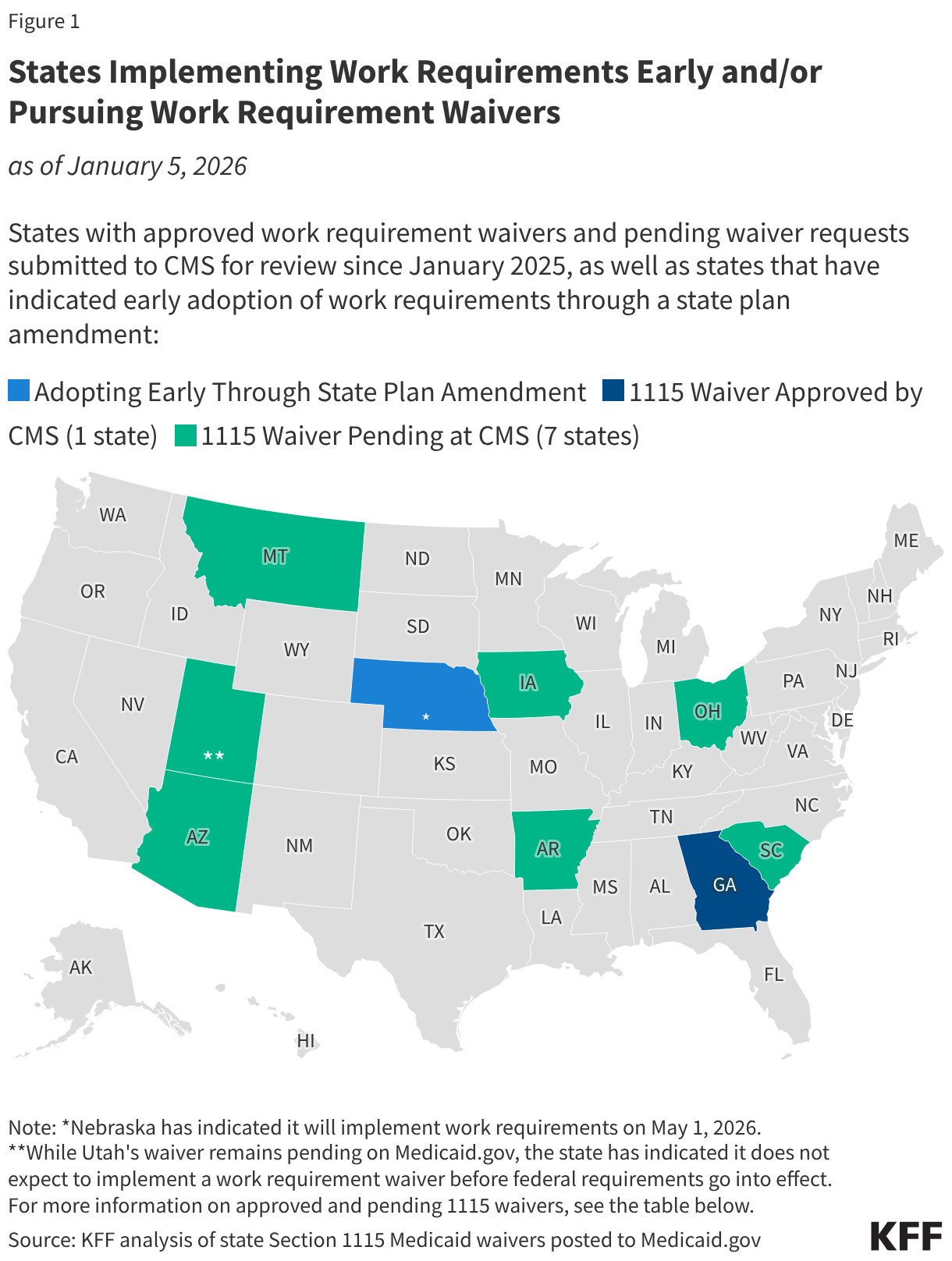
  1. UNAIDS, Global HIV statistics 2025 fact sheet; July 2025. ↩︎
  2. UNAIDS, 2025 Global AIDS Update: AIDS, Crisis and the Power to Transform; July 2025. UNAIDS, AIDSinfo website; accessed November 2025, available at: http://aidsinfo.unaids.org/. UNAIDS, 2025 Core epidemiology slides; July 2025. ↩︎
  3. AIDS is the last and most severe stage of HIV infection, during which the immune system is so weak that people with AIDS acquire an increasing amount of severe illnesses. CDC HIV Website, https://www.cdc.gov/hiv/about/. ↩︎
  4. UNAIDS, 2025 Global AIDS Update: AIDS, Crisis and the Power to Transform; July 2025. ↩︎
  5. UNAIDS, Global HIV statistics 2025 fact sheet; July 2025. ↩︎
  6. UNAIDS, 2025 Global AIDS Update: AIDS, Crisis and the Power to Transform; July 2025. UNAIDS, AIDSinfo website; accessed November 2025, http://aidsinfo.unaids.org/. UNAIDS, 2025 Core epidemiology slides; July 2025. UNAIDS, Global HIV statistics 2025 fact sheet; July 2025; UNAIDS, UNAIDS data 2025; July 2025. ↩︎
  7. UNAIDS, 2025 Global AIDS Update: AIDS, Crisis and the Power to Transform; July 2025. ↩︎
  8. UNAIDS, Women and HIV – A spotlight on adolescent girls and young women; March 2019. UNAIDS, We’ve got the power — Women, adolescent girls and the HIV response; March 2020. ↩︎
  9. Sub-Saharan Africa constitutes as East and Southern Africa and West and Central Africa. ↩︎
  10. UNAIDS, 2025 Global AIDS Update: AIDS, Crisis and the Power to Transform; July 2025. UNAIDS, Global HIV statistics 2025 fact sheet; July 2025. UNAIDS, UNAIDS 2021-2026 Strategy; Mar. 2021. ↩︎
  11. WHO, Tuberculosis, fact sheet, https://www.who.int/news-room/fact-sheets/detail/tuberculosis. ↩︎
  12. WHO, Global Tuberculosis Report 2025; 2025. ↩︎
  13. WHO, Global Tuberculosis Report 2025; 2025. ↩︎
  14. UNAIDS, 2025 Global AIDS Update: AIDS, Crisis and the Power to Transform; July 2025. UNAIDS, AIDSinfo website; accessed July 2025, http://aidsinfo.unaids.org/. UNAIDS, 2025 Core epidemiology slides; July 2025. UNAIDS, Global HIV statistics 2025 fact sheet; July 2025; UNAIDS, UNAIDS data 2025; July 2025. ↩︎
  15. UNAIDS, Get on the Fast Track; 2016. Global HIV Prevention Working Group, Behavior Change for HIV Prevention: (Re) Considerations for the 21st Century; Aug. 2008. WHO, WHO recommends long-acting cabotegravir for HIV prevention, July 2022. WHO, WHO recommends injectable lenacapavir for HIV prevention, July 2025. ↩︎
  16. UNAIDS, UNAIDS Explainer: Undetectable = untransmittable; July 2018. ↩︎
  17. WHO, Guideline on When to Start antiretroviral Therapy and on Pre-Exposure Prophylaxis for HIV; Sept. 2015. WHO, WHO expands recommendation on oral pre-exposure prophylaxis of HIV infection (PrEP); Nov. 2015. ↩︎
  18. United Nations, Political Declaration on HIV and AIDS: On the Fast-Track to Accelerate the Fight Against HIV and to End the AIDS Epidemic by 2030; June 8, 2016. WHO, WHO recommends long-acting cabotegravir for HIV prevention, July 2022. ↩︎
  19. WHO, WHO recommends injectable lenacapavir for HIV prevention, July 2025. ↩︎
  20. UNAIDS, 2025 Global AIDS Update: AIDS, Crisis and the Power to Transform; July 2025. United Nations, Reinvigorating the AIDS response to catalyse sustainable development and United Nations reform: Report of the Secretary-General; June 2017. ↩︎
  21. UNAIDS, Get on the Fast Track; 2016. WHO, Guideline on When to Start antiretroviral Therapy and on Pre-Exposure Prophylaxis for HIV; September 2015. WHO, Press Release: NIAID START Trial confirms that immediate treatment of HIV with antiretroviral drugs (ARVs) protects the health of people living with HIV; May 28, 2015. NIAID, Starting Antiretroviral Treatment Early Improves Outcomes for HIV-Infected Individuals; May 27, 2015. ↩︎
  22. NIH, News release: Long-acting HIV treatment demonstrates efficacy in people with challenges taking daily medicine as prescribed, February 21, 2024. ↩︎
  23. UNAIDS states that endings AIDS as a public health threat requires a 90% reduction in HIV incidence and mortality by 2030, compared to 2010. UNAIDS, Fast-Track: ending the AIDS epidemic by 2030; 2014. ↩︎
  24. United Nations, Transforming our world: the 2030 Agenda for Sustainable Development; 2015. ↩︎
  25. UNAIDS, Fast-Track: ending the AIDS epidemic by 2030; 2014. ↩︎
  26. These goals and targets were reiterated in the UNAIDS 2016-2021 Strategy, which also aligns with the SDGs. UNAIDS, Fast-Track: ending the AIDS epidemic by 2030; 2014. UNAIDS, UNAIDS 2016-2021 Strategy; Aug. 2015. ↩︎
  27. UNAIDS, 2025 Global AIDS Update: AIDS, Crisis and the Power to Transform; July 2025. See also KFF Dashboard: Progress Toward Global HIV Targets in PEPFAR Countries, September 2023. ↩︎
  28. UNAIDS, Global HIV statistics 2025 fact sheet; July 2025. ↩︎
  29. UNAIDS, Press Release: UNAIDS calls on countries to step up global action and proposes bold new HIV targets for 2025; November 26, 2020. UNAIDS, “2025 AIDS Targets,” webpage, https://aidstargets2025.unaids.org/#. UNAIDS, World AIDS Day Report 2020: Prevailing Against Pandemics by Putting People at the Centre; November 2020. ↩︎
  30. The 2016 U.N. General Assembly High-Level Meeting on Ending AIDS reaffirmed commitments made in the 2001 Declaration of Commitment on HIV/AIDS and the 2006 and 2011 political declarations on HIV/AIDS. UNAIDS, Declaration of Commitment on HIV/AIDS; 2001, https://www.unaids.org/sites/default/files/sub_landing/files/aidsdeclaration_en_0.pdf. UNAIDS, 2006 Political Declaration on HIV/AIDS; 2006, https://www.unaids.org/sites/default/files/sub_landing/files/20060615_hlm_politicaldeclaration_ares60262_en_0.pdf. UNAIDS, 2011 Political Declaration on HIV/AIDS; 2011, http://www.unaids.org/en/aboutunaids/unitednationsdeclarationsandgoals/2011highlevelmeetingonaids/. United Nations, 2016 Political Declaration on HIV and AIDS; 2016, https://www.unaids.org/sites/default/files/media_asset/2016-political-declaration-HIV-AIDS_en.pdf. UNAIDS, Press Release: Bold Commitments to Action Made at the United Nations General Assembly High-Level Meeting on Ending AIDS; June 10, 2016. UNAIDS, Reinvigorating the AIDS response to catalyse sustainable development and United Nations reform; 2017. ↩︎
  31. These commitments and targets align with the more recent UNAIDS 2021-2026 Global AIDS Strategy, which is focused on reducing inequalities. UNAIDS, Global AIDS Strategy 2021-2026 – Ending Inequalities. End AIDS.; March 2021. United Nations, Political Declaration on HIV and AIDS: Ending Inequalities and Getting on Track to End AIDS by 2030; June 2021. UNAIDS, Press release: United Nations High-Level Meeting on AIDS draws to a close with a strong political declaration and bold new targets to be met by 2025; June 2021. ↩︎
  32. UNAIDS, UNAIDS launches the development of the new Global AIDS Strategy 2026-2031, February 2025. ↩︎
  33. KFF/UNAIDS, Donor Government Funding for HIV in Low- and Middle-Income Countries in 2024; July 2025. UNAIDS, 2025 Global AIDS Update: AIDS, Crisis and the Power to Transform; July 2025. ↩︎
  34. Global Fund, The Global Fund Data Explorer, accessed November 2025, https://data.theglobalfund.org. ↩︎
  35. Gates Foundation, HIV Strategy Overview, accessed November 2025, http://www.gatesfoundation.org/What-We-Do/Global-Health/HIV#OurStrategy. ↩︎
  36. According to UNAIDS, the $21.9 billion estimate is down from the previous estimate of $29.3 billion because of cost efficiencies that were achieved across the HIV response.  UNAIDS, 2025 Global AIDS Update: AIDS, Crisis and the Power to Transform; July 2025. ↩︎
  37. KFF analysis of data from the Office of Management and Budget, Agency Congressional Budget Justifications, and Congressional Appropriations Bills. KFF/UNAIDS, Donor Government Funding for HIV in Low- and Middle-Income Countries in 2024; July 2025. ↩︎
  38. U.S. Congress, P.L. 108-25, May 27, 2003. KFF analysis of data from the Office of Management and Budget, Agency Congressional Budget Justifications, and Congressional Appropriations Bills. ↩︎
  39. KFF, The U.S. Government and Global Health, Sep. 2022. CRS, PEPFAR Reauthorization: Key Policy Debates and Changes to U.S. International HIV/AIDS, Tuberculosis, Malaria and Programs and Funding; Jan. 2009. ↩︎
  40. KFF analysis of data from congressional budget justification documents; PEPFAR, “Where We Work” webpage, https://www.state.gov/where-we-work-pepfar/; PEPFAR 2024 Country Operational Plan Guidance for all PEPFAR Countries; and CDC’s “Where We Work” webpage, https://www.cdc.gov/global-hiv-tb/php/where-we-work/. ↩︎
  41. KFF analysis of data from the Office of Management and Budget, Agency Congressional Budget Justifications, and Congressional Appropriations Bills. Totals include funding for bilateral HIV and contributions to multilateral organizations (specifically, the Global Fund and UNAIDS) through regular appropriations and emergency funding for COVID-19 in FY 2021. ↩︎
  42. Totals represent funding specified by Congress in annual appropriations bills and/or identified by agencies for the Department of State, USAID, CDC, and DoD. In addition, international HIV research activities are supported by the NIH Office of AIDS Research (OAR) through its annual appropriated budget, but these amounts are not considered part of PEPFAR. See KFF’s “Breaking Down the U.S. Global Health Budget by Program Area” for additional information. ↩︎