Global COVID-19 Tracker

Published: Apr 29, 2026

Editorial Note: The Policy Actions tracker will no longer be updated as the data source has ceased tracking government responses to COVID-19. For more information, please visit the Oxford Covid-19 Government Response Tracker.

Cases and Deaths

This tracker provides the cumulative number of confirmed COVID-19 cases and deaths, as well as the rate of daily COVID-19 cases and deaths by country, income, region, and globally. It will be updated weekly, as new data are released. As of March 7, 2023, all data on COVID-19 cases and deaths are drawn from the World Health Organization’s (WHO) Coronavirus (COVID-19) Dashboard. Prior to March 7, 2023, this tracker relied on data provided by the Johns Hopkins University (JHU) Coronavirus Resource Center’s COVID-19 Map, which ended on March 10, 2023. Please see the Methods tab for more detailed information on data sources and notes. To prevent slow load times, the tracker only contains data from the last 200 days. However, the full data set can be downloaded from our GitHub page. While the tracker provides the most recent data available, there is a two-week lag in the data reporting.

Note: The data in this tool were corrected on March 18, 2024, to clarify that they represent new cases and deaths over a full week rather than the average per day over a seven-day period.

Policy Actions

This tracker contains information on policy measures currently in place to address the COVID-19 pandemic. Policy categories currently being tracked include social distancing & closure measures, economic measures, and health systems measures. Policies are tracked at the country-, income-, and region-level. Please see the Methods tab for more detailed information on data sources and notes.

Social Distancing and Closure Measures

As countries continue to implement policies to prevent the transmission of SARS-CoV-2, the virus that causes COVID-19, these tables and charts show which social distancing and closure measures are currently in place by country.

Global COVID-19 Policy Actions

Economic Measures

The COVID-19 pandemic has placed an unprecedented strain on country economies. These tables and charts show which economic-related measures, namely income support and debt relief, are currently in place by country.

Global COVID-19 Policy Actions

Health Systems Measures

The COVID-19 pandemic continues to strain and disrupt global health systems. These tables and charts show which health systems measures are currently in place by country.

Global COVID-19 Policy Actions

Methods

Cases and Deaths

SOURCES

As of March 7, 2023, all data on COVID-19 cases and deaths are drawn from the World Health Organization’s (WHO) Coronavirus (COVID-19) Dashboard. Prior to March 7, 2023, this tracker relied on data provided by the Johns Hopkins University (JHU) Coronavirus Resource Center’s COVID-19 Map, which ends on March 10, 2023. Population data are obtained from the United Nations World Population Prospects using 2021 total population estimates. Income-level classifications are obtained from the latest World Bank Country and Lending Groups. Regional classifications are obtained from the World Health Organization.

Policy Actions

NOTES

Policy actions data include the measure that was in place for each indicator at the country-level as of the end of 2022. Policy actions data will no longer be updated as the data source has ceased tracking government responses to COVID-19. For more information, please visit the Oxford Covid-19 Government Response Tracker.

Social Distancing and Closure Measures

Under ‘Stay At Home Requirements’, exceptions for leaving the house may include anything from being able to leave for daily exercise, grocery shopping, and essential trips, to only being allowed to leave once a week, or one person may leave at a time, etc. Under ‘Workplace Closing’, partial closing includes instances in which a country recommends closing the workplace (or working from home); businesses are open but with significant COVID-19-related operational adjustments; or when workplaces require closing for only some, but not all, sectors or categories of workers. Under ‘School Closing’, partial closing includes instances in which a country has recommended school closures; all schools are open but with significant COVID-19-related operational adjustments; or some schools, but not all, are closed; full closing includes schools that are in session but operating virtually. Under ‘Restrictions On Gatherings’, partial restrictions include restrictions on gatherings of more than 10 people; full restrictions include restrictions on gatherings of 10 people or less. Under ‘International Travel Controls’, partial restrictions include screening and quarantine requirements for those entering the country. Values for ‘Cancel Public Events’ were not recodified.

Economic Measures

Under ‘Income Support’, narrow support includes instances in which a country’s government is replacing less than 50% of lost salary (or if a flat sum, it is less than 50% median salary); broad support includes instances in which a country’s government is replacing 50% or more of lost salary (or if a flat sum, it is greater than 50% median salary). Under ‘Debt/Contract Relief’, narrow support includes instances in which a country’s government is providing narrow relief, such as relief specific to one kind of contract.

Health Systems Measures

Under ‘Vaccine Eligibility’, partial availability includes availability for some or all of the following groups: key workers, non-elderly clinically vulnerable groups, and elderly groups, or for select broad groups/ages. Under ‘Facial Coverings’, recommend/partial requirement includes instances in which a country’s government recommends wearing facial coverings, requires facial coverings in some situations, and requires facial coverings when social distancing is not possible. 

SOURCES

Data on and descriptions of government measures related to COVID-19 provided by the Oxford Covid-19 Government Response Tracker (OxCGRT). For more detailed information on their data collection and methodology, please see their codebook and interpretation guide.

Tracking Implementation of the 2025 Reconciliation Law Medicaid Work Requirements

Updated on:

CMS Guidance and Information

Operational and Implementation Questions

Table

A Closer Look at Rural Nursing Homes

Published: Apr 29, 2026

As of July 2025, about 1.2 million people live in nursing facilities (referred to as nursing homes) and about one in five are in a nursing home in a rural area. This is similar to the share of the total U.S. population that lives in rural areas (20%) and slightly lower than the share of all adults 65 or older living in rural areas (24%). Nursing homes provide medical and personal care services for older adults and younger people with disabilities.Rural populations are older than urban populations and rural residents have a higher level of disability than their urban counterparts. The older demographic and higher rates of disability among rural populations contribute to a greater need for nursing homes and other long-term care services in rural communities. 

Medicaid is the primary payer for nursing home care in the US. The 2025 reconciliation law, signed into law on July 4th, 2025, is projected to reduce federal Medicaid spending by $911 billion over ten years, according to the Congressional Budget Office, resulting in an estimated reduction of $137 billion in federal Medicaid spending in rural areas, according to KFF analysis. The law also includes $50 billion in funding for a new “rural health transformation program”, though these funds are unlikely to offset the Medicaid cuts to rural areas and few states have included proposals for nursing homes in rural areas in their applications. The reconciliation law also delayed implementation of a Biden-era rule intended to help address long-standing concerns about staffing shortages and the quality of care in nursing homes until 2034. A Texas judge overturned key requirements from the rule in April 2025; and the Trump Administration rescinded the rule in December 2025. Some of the changes to Medicaid financing could also have implications for nursing homes.

This analysis compares the characteristics of nursing homes in rural areas with those in urban areas. This brief uses data from Nursing Home Compare, a publicly available dataset that provides a snapshot of information on quality of care in each nursing home. This analysis categorizes nursing homes as remote rural, rural adjacent to metro areas (or “other rural”), and urban based on 2024 Urban Influence Codes from the USDA. See methods for more information on how rural categories were calculated. State-level data are also available on State Health Facts, KFF’s data repository with downloadable health indicators. Key takeaways from the analysis include:

  • Over one in four (27%) Medicaid and/or Medicare certified nursing facilities (referred to as nursing homes) are in a rural area and one in five (20%) residents live in a nursing home in a rural area (Figure 1). To be certified to serve Medicare or Medicaid patients, nursing homes are inspected regularly by state survey agencies in accordance with the Centers for Medicare & Medicaid Services (CMS) guidance.
  • Between 2015 and 2025, the number of nursing homes in rural areas decreased faster than nursing homes in urban areas (Figure 2).
  • A smaller share of nursing homes in rural areas are for-profit when compared to nursing homes in urban areas (Figure 3).
  • Nursing homes in rural areas and nursing homes in urban areas have similar staffing levels and similar rates of deficiencies that cause actual harm or immediate jeopardy to residents.

Over one in four nursing homes are in a rural area and one in five residents live in a nursing home in a rural area (Figure 1). There are about 4,000 nursing homes in rural areas that are home to over 250,000 nursing home residents. These nursing homes account for about 27% of all nursing homes, with 10% in remote rural areas and 17% in rural areas adjacent to urban areas (or “other rural”). While over one-quarter of nursing homes are in rural areas, a smaller share of residents (20%) lives in these nursing homes because the average nursing home in a rural area is smaller than the average nursing home in an urban area (85 beds vs. 115 beds, data not shown). About 7% of nursing home residents live in nursing homes in remote rural areas and the other 14% live in nursing homes in other rural areas (totals do not add to 20% due to rounding). In eight states, at least half of nursing home residents live in nursing homes in rural areas (VT, WY, SD, MS, MT, IA, NE, and ND).

Over One in Four Nursing Homes Are in a Rural Area and One in Five Nursing Home Residents Live in a Nursing Home in a Rural Area (Small multiple donut chart)

Between 2015 and 2025, the number of nursing homes in rural areas declined more quickly than those in urban areas (Figure 2). Between 2015 and 2025, the total number of nursing homes in the US dropped by 6%, from 15,643 to 14,742. Half of the decline occurred in rural areas (447 out of 901 nursing homes). The number of nursing homes in remote rural areas decreased the fastest (13% decline) when compared to nursing homes in other rural areas (8% decline) or urban areas (4% decline). These declines reflect the net number of nursing homes, which accounts for closures and openings.

During this time, the number of residents declined even more quickly. There was a 19% decline in nursing home residents living in remote rural areas; a 12% decline among those living in other rural areas; and an 8% decline among those living in urban areas. It is not clear what contributed to the decline in nursing homes and residents, but Medicaid as a whole has been providing home care to more people and spending on home care has increased more quickly than spending on institutional care.

Between 2015 and 2025, The Number of Nursing Homes in Rural Areas Declined More Quickly Than Those in Urban Areas (Stacked Bars)

A smaller share of nursing homes in rural areas are for-profit than nursing homes in urban areas (Figure 3). A smaller share of nursing homes in remote rural areas are for-profit (59%) than those in other rural areas (71%) or urban areas (76%). Additionally, a larger share of nursing homes in remote rural areas are non-profit (26%) than those in other rural areas (20%) or urban areas (19%). Similarly, a larger share of nursing homes in remote rural areas are government-owned (15%) than those in other rural areas (9%) or urban areas (5%).

A Smaller Share of Nursing Homes in Rural Areas Are For-Profit Than Nursing Homes in Urban Areas (Stacked Bars)

In many other ways, nursing homes in rural areas are similar to nursing homes in urban areas.

  • Nursing homes in rural areas and nursing homes in urban areas have relatively similar payer distributions. Nursing homes in rural areas report that 66% of residents have Medicaid as their primary payer and nursing homes in urban areas report that 63% of residents have Medicaid as their primary payer. Similarly, 10% of residents in nursing homes in rural areas have Medicare as their primary payer and 15% of those living in nursing homes in urban areas have Medicare as their primary payer. (Medicare does not generally cover long-term care services but does cover up to 100 days of skilled nursing facility care following a qualifying hospital stay.) Nursing homes in rural areas report that 24% of their residents have another primary payer (such as private insurance or out-of-pocket) and nursing homes in urban areas report that 23% of residents have another primary payer.
  • Similarly, nursing homes in rural areas and nursing homes in urban areas report similar shares of nursing homes with deficiencies that cause actual harm or immediate jeopardy to residents (27% vs. 29%).
  • Staffing levels in nursing homes in rural areas and nursing homes in urban areas are similar as well: 58% of nursing homes in rural areas and 64% of nursing homes in urban areas report an average of at least 3.5 total nursing hours per resident per day. This is consistent with prior research that found that similar shares of nursing homes in rural areas (20%) and nursing homes in urban areas (18%) would have met the requirements in the now-rescinded Biden-era staffing rule intended to help address long-standing concerns about staffing shortages and the quality of care in nursing homes.

Methods

Nursing Home Compare: Nursing Home Compare is a publicly available dataset that provides a snapshot of information on quality of care and key characteristics for approximately 14,900 Medicare and/or Medicaid-certified nursing homes.The data in this analysis is from July 2025.

Defining Rurality in Nursing Home Compare: Nursing homes in urban areas are defined as those in a metropolitan area, while nursing homes in rural areas are defined as those in nonmetropolitan areas. A metropolitan area is a county or group of counties that contains at least one urban area with a population of 50,000 or more people. Nonmetropolitan areas include micropolitan areas—which are counties or groups of counties that contain at least one urban area with a population of at least 10,000 but less than 50,000—and noncore areas (areas that are neither metropolitan nor micropolitan). This brief also breaks rural areas into those that are adjacent to metropolitan areas (defined as “other rural” in this brief) and those that are not adjacent to metropolitan counties (defined as “remote rural” areas in this brief).

This analysis categorized counties and county equivalents based on 2024 Urban Influence Codes from the USDA, as follows:

Urban

  • 1: Large metro (in a metro area with at least 1 million residents)
  • 4: Small metro (in a metro area with fewer than 1 million residents)

Rural, adjacent to a metro area (“other rural”)

  • 2: Micropolitan, adjacent to a large metro area
  • 3: Noncore, adjacent to a large metro area
  • 5: Micropolitan, adjacent to a small metro area
  • 6: Noncore, adjacent to a small metro area

Rural, not adjacent to a metro area (“rural remote”)

  • 7: Micropolitan, not adjacent to a metro area
  • 8: Noncore, not adjacent to a metro area and contains a town of at least 5,000 residents
  • 9: Noncore, not adjacent to a metro area and does not contain a town of at least 5,000 residents

Deficiencies in Nursing Homes: Health care deficiencies in nursing homes are evaluated on two elements:

  1. The scope of the deficiency (such as whether the deficiency was isolated to one person or was widespread across the nursing home)
  2. The severity of the deficiency (such as whether an individual suffered actual harm or immediate jeopardy)

Deficiencies are assigned a Scope/Severity score ranging from letters A through L, with each letter corresponding to a unique combination of scope and severity. This analysis looks at only at deficiencies that cause actual harm or immediate jeopardy, which corresponds with values G through L. The Centers for Medicare and Medicaid Services defines “actual harm” as a “deficiency that results in a negative outcome that has negatively affected the resident’s ability to achieve the individual’s highest functional status. “Immediate jeopardy” is defined as a deficiency that “has caused (or is likely to cause) serious injury, harm, impairment, or death to a resident receiving care in the nursing home.” CMS’ definition of “serious” deficiencies varies slightly from the definition in this analysis. CMS excludes deficiencies with score “G” and includes deficiencies with score “F” for certain deficiencies that represent a “substandard quality of care.”

This work was supported in part by The John A. Hartford Foundation. KFF maintains full editorial control over all of its policy analysis, polling, and journalism activities.

Tracking Implementation of the 2025 Reconciliation Law: Medicaid Work Requirements

Updated on:

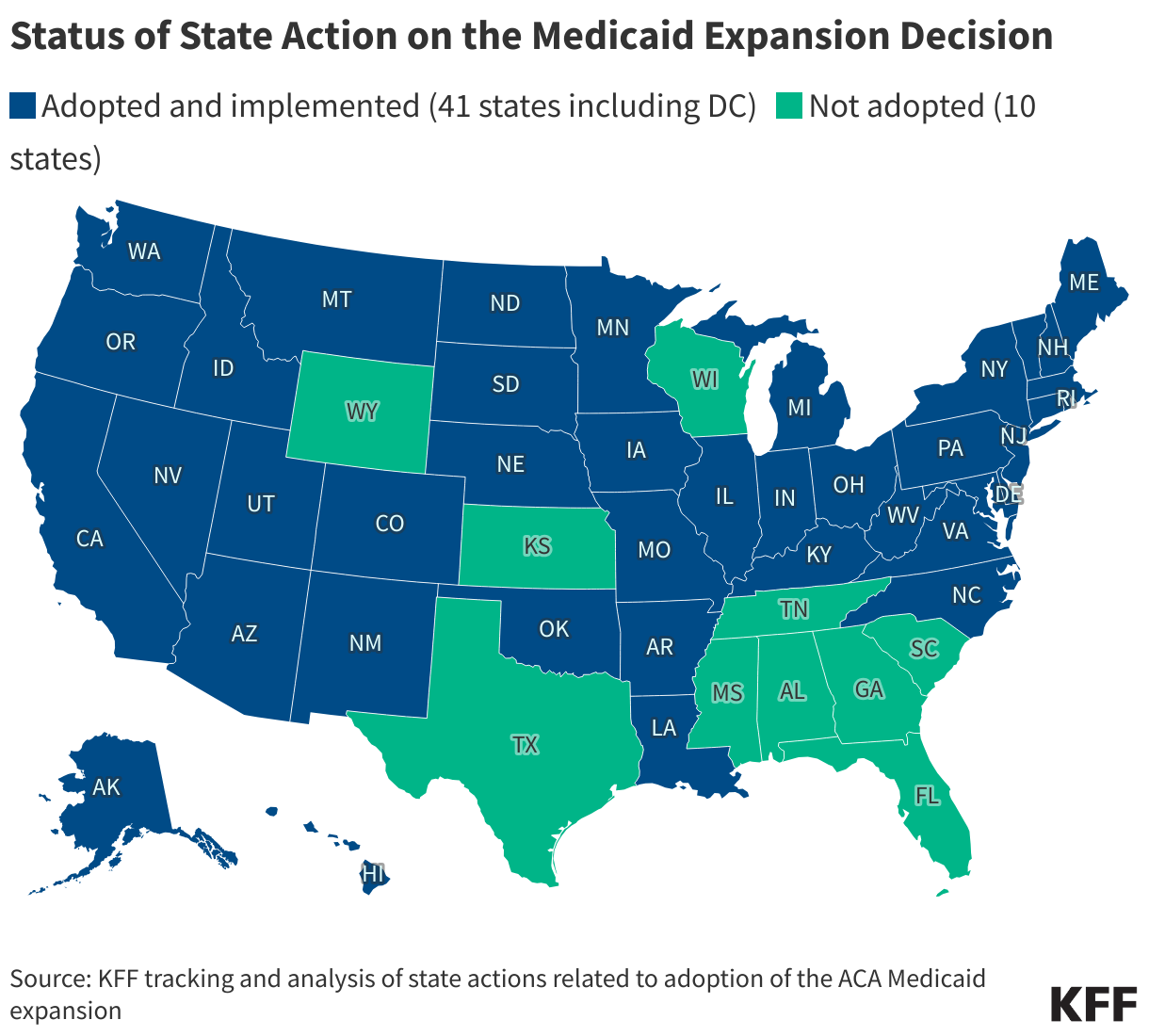
The 2025 reconciliation law, once called the “One Big Beautiful Bill,” signed by President Trump on July 4, 2025, conditions Medicaid eligibility for adults in the Affordable Care Act (ACA) Medicaid expansion group and enrollees in partial expansion waiver programs (Georgia and Wisconsin) on meeting work requirements starting January 1, 2027. Currently, 41 states (including DC) have expanded their Medicaid programs under the ACA to nearly all adults with income up to 138% FPL ($21,597 for an individual in 2025).

To implement Medicaid work requirements, states will need to make important policy and operational decisions, implement needed system upgrades or changes, develop new outreach and education strategies, and hire and train staff, all within a relatively short timeframe. The information tracked here can serve as a resource to understand Medicaid work requirements and state options, gauge readiness, and track implementation of the requirements, including:

  • NEW: State reported plans and policies related to implementing Medicaid work requirements, as well as state and national data on Medicaid enrollment, renewal outcomes, and application processing times that can serve as a baseline for assessing the potential readiness to implement the requirements and the impact of work requirements once implemented; 
  • Federal guidance and a list of policy and operational questions that states will need to answer as they implement work requirements;
  • Updates on 1115 waivers submitted by states to implement work requirements (while waivers will no longer be needed starting January 2027, some states may pursue waivers to implement work requirements earlier than January 2027); and
  • A compilation of KFF issue briefs and other resources on Medicaid work requirements.

This resource will be updated to include guidance from the Centers for Medicare and Medicaid Services (CMS), information on state policy decisions as they are made, and new data when available.

Continue scrolling to learn more about the Medicaid work requirements in the 2025 reconciliation law.

Tracking Implementation of the 2025 Reconciliation Law Medicaid Work Requirements

Updated on:

KFF Resources on Medicaid Work Requirements

Work requirements overview:

50-state survey of Medicaid eligibility and enrollment policies:

Implementation of work requirements:

Research and analysis on Medicaid and work:

1115 work requirement waivers:

Work requirements implications and state experience:

Arkansas work requirement experience:

KFF Polling on Work Requirements:

Beyond the Data by KFF CEO Drew Altman:

Tracking Implementation of the 2025 Reconciliation Law Medicaid Work Requirements

Updated on:

The 2025 reconciliation law requires states to condition Medicaid eligibility for adults in the ACA Medicaid expansion group on meeting work requirements starting January 1, 2027; however, states have the option to implement requirements sooner through a state plan amendment (SPA) or through an approved 1115 waiver.

State Plan Amendments (SPAs)

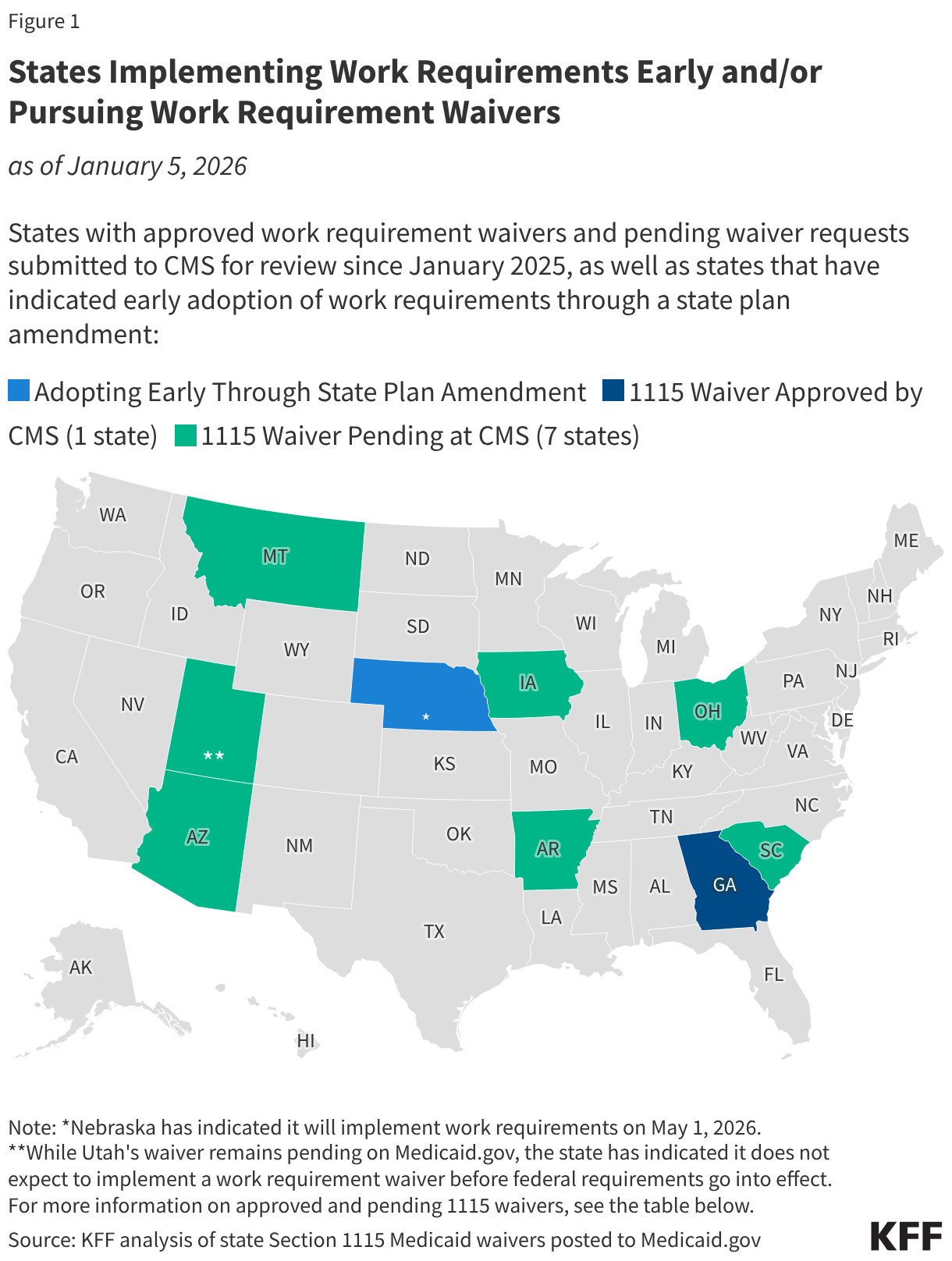
Some states may choose to implement work requirements prior to the January 1, 2027 deadline through a state plan amendment. Nebraska is the first state to have announced that it will begin enforcing federal work requirements early through a state plan amendment, starting May 1, 2026. Two other states are also planning to implement before January 2027. Montana has indicated it will begin enforcing work requirements on July 1, 2026, and Iowa will implement on December 1, 2026.

1115 Waivers

States may also choose to implement work requirements early through an 1115 waiver. Since the start of the second Trump administration, several states have submitted waivers to implement work requirements, although some states may no longer be moving forward with proposed 1115 waivers due to the passage of federal work requirements or because they plan to implement early through a state plan amendment. While states are required to fully align with federal work requirements starting January 1, 2027, it is not clear how CMS will treat pending 1115 waivers that seek to implement early and deviate from federal requirements (specified in the law) prior to this deadline.

Currently, Georgia is the only state with a Medicaid work requirement waiver in place following litigation over the Biden administration’s attempt to stop it. CMS recently approved a temporary extension for Georgia’s waiver that added new exemptions from work requirements (see the table below for more details). Georgia’s waiver is now set to expire December 31, 2026, and the state will be required to come fully into compliance with new federal requirements starting January 1, 2027.

Early Implementation and Waiver Status

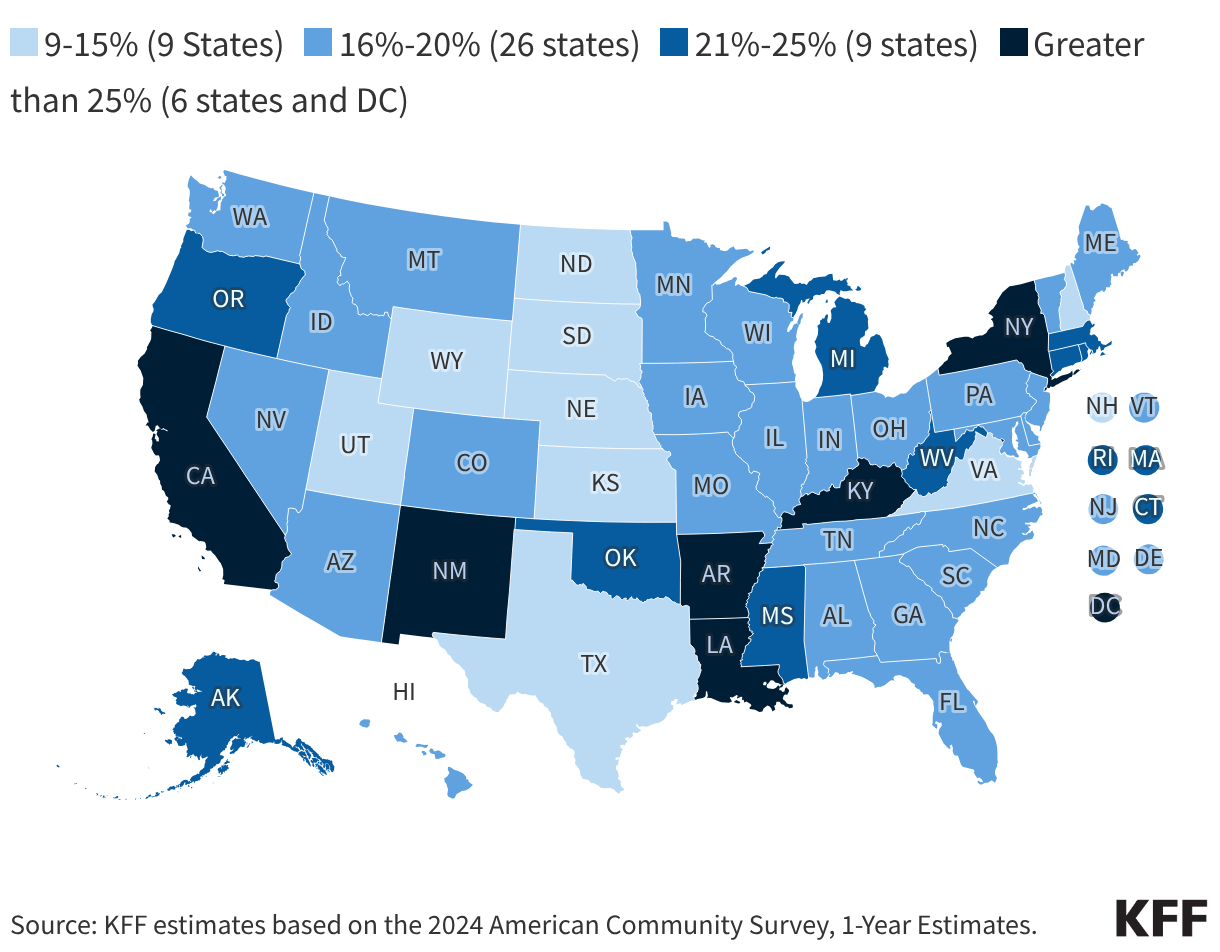
The map below identifies states that have indicated they will implement work requirements early through a state plan amendment as well as approved (Georgia) and pending work requirement waivers (submitted to CMS since the start of the second Trump administration). The table below the map provides more detailed state waiver information.

States Implementing Work Requirements Early and/or Pursuing Work Requirement Waivers (Choropleth map)
States with Work Requirement Waiver Activity (Table)
News Release

Poll: The Cost of Health Care Remains at the Top of the Public’s List of Economic Concerns, Even as Concerns About Gas Prices Climb

Majorities Say Health Costs Will Influence Their Vote and Voters Favor Democrats on the Issue, with Republicans Holding an Advantage on Addressing Fraud and Abuse

Published: Apr 29, 2026

Health care costs continue to top the public’s list of economic anxieties, even as fuel prices and economic uncertainty rose following the start of the Iran war, a new KFF Health Tracking poll finds. Nearly two-thirds (64%) of U.S. adults are worried about being able to afford health care costs, including three in ten who say they are “very worried.” The same share (64%) are worried about gasoline or other transportation costs, up from about half (52%) in January.

Underscoring these concerns, nearly half of insured adults (46%) say that lowering out-of-pocket costs is their most-wanted change to their health insurance. Additionally, majorities of voters say health care costs will have a “major impact” on their decision to vote (55%) and which party’s candidate they support (61%).

While the poll finds that voters trust Democrats more than Republicans to address both health care costs (37% vs. 26%) and prescription drug costs (33% vs. 26%), voters are more likely to trust Republicans on the issue of fraud and waste in government health care programs (34% vs. 26%)—an issue on which the Trump administration has been particularly engaged.

Poll Finding

KFF Health Tracking Poll: Health Care Costs and the Midterms

Published: Apr 29, 2026

Findings

Key Takeaways

  • Health costs continue to top the public’s list of affordability worries, even as concerns about gas prices have risen in recent weeks. Nearly two-thirds (64%) of adults are worried about being able to afford health care costs, on par with the share who now worry about gas and transportation costs (64%) and outranking other economic concerns. In January 2026, prior to the start of the U.S. conflict with Iran, gasoline and transportation costs ranked at the bottom of household financial worries. Now, gas prices share the top spot with health care costs as the biggest financial worry adults face for themselves and their families.
  • Lowering out-of-pocket costs ranks as the most important change insured adults say they would like to see from their health insurance. When given a list of possible changes that could be made to their health insurance, half (46%) of insured adults choose lowering their out-of-pocket costs as most important, more than twice the share who cite eliminating prior authorization (22%). Fewer say other possible changes such as getting more value for what they spend (13%) and having more choice in providers (12%) would be most important to them.
  • Health costs also loom large in the upcoming midterm elections. About nine in ten voters say the issue will influence their decision to vote and who to vote for in the 2026 midterm elections, with majorities saying it will have a “major impact” on both areas (55% and 61%). While majorities of voters across partisans say health care costs will impact their vote in November, the issue is more salient among Democratic and independent voters. About seven in ten Democratic voters (72%) and nearly two-thirds of independent voters (63%) say health care costs will impact which party’s candidate they would support in the election, compared to about half of Republican voters (47%) who say the same.
  • While both political parties have made recent announcements about their own plans to bring down health costs, the latest polling shows the Democrats currently have the edge among voters. Voters give the Trump administration low approval ratings on its handling of the cost of health care and are more likely to trust the Democratic Party (37%) over the Republican Party (26%) on addressing this issue. Fewer than half of voters approve of the administration’s handling of cost of health care (33%) and the cost of prescription drugs (41%).
  • The Republican Party holds an advantage on addressing fraud and waste in government health care programs, which has been a key messaging strategy during the second Trump administration. One-third of voters say they trust Republicans on this issue compared to a quarter who say they trust Democrats. Notably, on most issues asked about, sizable shares of voters say they trust neither party.

Health Care Costs Are a Top Concern for the Public and Voters

Health care costs remain a primary economic concern for the public and voters’ top health concern heading into the 2026 midterm elections. The latest KFF Health Tracking Poll finds health care costs remain at the top of the list of what the public worries about being able to afford for themselves and their family, now tied with gasoline and transportation costs amid rising fuel prices. Nearly two-thirds of the public (64%) say they are at least somewhat worried about affording health care costs including the cost of health insurance and out-of-pocket costs such as for office visits and prescription drugs. This includes three in ten adults overall (30%) and voters (30%) who say they are “very worried” about paying for health care. A similar share of adults is “very worried” about affording gas and transportation costs (29%), up from about one in six (17%) in January. This comes as the national average for gasoline has risen to over $4 per gallon, up roughly 38% since the conflict with Iran began. About one in five adults say they are “very worried” about affording food and groceries (23%), rent or mortgage (21%) or monthly utilities (21%).

Stacked bar chart showing the public's levels of worry when it comes to affording living necessities. Shown among total adults.

Even among adults with health insurance coverage, lowering health care costs is a top concern. When asked about possible changes that could be made to their health insurance, about half of insured adults say “paying less out-of-pocket for health care” (46%) is most important, more than twice the share who choose “eliminating prior authorization” (22%), an area that previous KFF polls have identified as the most significant pain point for health care consumers aside from costs. Fewer insured adults say getting more value out of their care (13%) or having more choice of which health care providers they can see (12%) are the most important changes they’d like to see.

Bar chart showing the most important priority of insured adults when it comes to possible changes that could be made to their health insurance.

Voters’ Approval of the Trump Administration and Party Preference on Health Care Issues

With about six months to go before the midterm elections, most voters disapprove of how the Trump administration is handling issues related to health care costs. One-third of voters (33%) approve of the administration’s handling of the cost of health care while two-thirds (67%) say they disapprove – including 45% who say they “strongly disapprove.” Several months after the unveiling of TrumpRx, about four in ten voters (41%) approve of the administration’s handling of prescription drug costs. Following a recent announcement by the Trump administration of increased efforts to crack down on health care fraud, about four in ten voters (42%) say they approve of the way the administration is handling fraud and waste in government health programs, while a majority (58%) say they disapprove.

Stacked bar chart showing scale of approval of the way the Trump administration is handling areas of health and health policy. Results shown among total registered voters.

Unsurprisingly, voters are split along partisan lines with the Trump administration receiving high approval ratings from Republicans overall, and most Democrats disapproving of the administration. Among independent voters, about a third say they approve of the Trump administration’s handling of fraud and waste in government health programs (33%) and its handling of the cost of prescription drugs (32%). Fewer independents (25%) say they approve of the administration’s handling of the cost of health care.

Notably, while two-thirds of Republican voters approve of the administration’s handling of health care costs (67%), there is some nuance within the Republican coalition. Among the two-thirds of Republicans and Republican-leaning voters who identify as MAGA supporters, about eight in ten (79%) approve of the administration’s handling of health care costs. However, Republican voters who do not support the MAGA movement are less approving of the administration with just over one-third (36%) of non-MAGA Republicans approving of the administration’s actions on health costs while 64% disapprove. Additionally, non-MAGA Republicans and Republican-leaning independents are much less likely than their MAGA counterparts to say they approve of the Trump administration’s handling of the cost of prescription drugs (53% vs. 90%) and their handling of fraud and waste in government health programs (58% vs. 93%).

Split bar chart showing share of adults who say they approve of the way the Trump administration is handling areas of health and health policy. Results shown by party identification and by voters who support the Make America Healthy Again (MAHA) movement.

As voters evaluate congressional candidates ahead of the midterm elections, the Democratic Party has an edge over the Republican Party when it comes to addressing the cost of health care, while the Republican Party has the edge on addressing fraud and waste in government health care programs. Democrats have a double-digit advantage over Republicans when it comes to who voters trust to address the cost of health care (37% vs. 26%) and continue to hold a narrow edge among voters when it comes to addressing the cost of prescription drugs (33% vs. 26%).

Voters are more likely to trust the Republican Party (34%) than the Democratic Party (26%) when it comes to addressing fraud and waste in government health care programs, an area the Trump administration has focused heavily on recently. About one-third (33%) say they trust neither party to handle this issue.

Stacked bar chart showing which political party, the Democrats or the Republicans, the public trusts to do a better job in areas of health and health policy. Results shown among total registered voters.

Among independent voters, the Democratic Party has a double-digit advantage over the Republican Party when it comes to addressing the cost of health care (29% vs. 16%), while the Republican Party holds the advantage when it comes to addressing fraud and waste in government health care programs (25% vs. 13%). Yet notably, at least half of independent voters say they trust neither party to address each of these issues.

Stacked bar chart showing which political party, the Democrats or the Republicans, the public trusts to do a better job in areas of health and health policy. Results shown among total independent registered voters.

In addition to ranking as a top economic concern for the public, majorities of voters say health care costs will have a “major impact” on their decision to vote (55%) and which party’s candidate they would support (61%) in the upcoming midterms. The issue of health costs is more salient for Democratic voters compared to Republicans. More than six in ten Democratic voters say the cost of health care will have a major impact on their decision to vote (64%) and which party’s candidate they support (72%). About half of Republican voters say the issue of health costs will majorly impact whether they vote (48%) and what candidate they will support (47%). About half of independent voters say the cost of health care will majorly impact their decision to vote (52%) and six in ten say this issue will majorly impact the party’s candidate they support (63%).

Stacked bar chart showing the shares of adults who say the cost of health care will have a major impact, minor impact, or no impact at all on their decision to vote or which party's candidate they would support in the 2026 midterm elections. Shown among total voters and by party identification.

Methodology

This KFF Health Tracking Poll was designed and analyzed by public opinion researchers at KFF. The survey was conducted April 14 – April 19, 2026, online and by telephone among a nationally representative sample of 1,343 U.S. adults in English (n=1,251) and in Spanish (n=92). The sample includes 1,023 adults (n=81 in Spanish) reached through the SSRS Opinion Panel either online (n=999) or over the phone (n=24). The SSRS Opinion Panel is a nationally representative probability-based panel where panel members are recruited randomly in one of two ways: (a) Through invitations mailed to respondents randomly sampled from an Address-Based Sample (ABS) provided by Marketing Systems Groups (MSG) through the U.S. Postal Service’s Computerized Delivery Sequence (CDS); (b) from a dual-frame random digit dial (RDD) sample provided by MSG. For the online panel component, invitations were sent to panel members by email followed by up to three reminder emails.

Another 320 (n=11 in Spanish) adults were reached through random digit dial telephone sample of prepaid cell phone numbers obtained through MSG. Phone numbers used for the prepaid cell phone component were randomly generated from a cell phone sampling frame with disproportionate stratification aimed at reaching Hispanic and non-Hispanic Black respondents. Stratification was based on incidence of the race/ethnicity groups within each frame. Among this prepaid cell phone component, 140 were interviewed by phone and 180 were invited to the web survey via short message service (SMS).

Respondents in the prepaid cell phone sample who were interviewed by phone received a $15 incentive via a check received by mail or an electronic gift card incentive. Respondents in the prepaid cell phone sample reached via SMS received a $10 electronic gift card incentive. SSRS Opinion Panel respondents received a $5 electronic gift card incentive (some harder-to-reach groups received a $10 electronic gift card). In order to ensure data quality, cases were removed if they failed two or more quality checks: (1) attention check questions in the online version of the questionnaire, (2) had over 30% item non-response, or (3) had a length less than one quarter of the mean length by mode. Based on this criterion, no cases were removed.

The combined cell phone and panel samples were weighted to match the sample’s demographics to the national U.S. adult population using data from the Census Bureau’s 2024 Current Population Survey (CPS), September 2023 Volunteering and Civic Life Supplement data from the CPS, and the 2025 KFF Benchmarking Survey with ABS and prepaid cell phone samples. The demographic variables included in weighting for the general population sample are gender, age, education, race/ethnicity, region, civic engagement, frequency of internet use and political party identification. The weights account for differences in the probability of selection for each sample type (prepaid cell phone and panel). This includes adjustment for the sample design and geographic stratification of the cell phone sample, within household probability of selection, and the design of the panel-recruitment procedure.

The margin of sampling error including the design effect for the full sample is plus or minus 3 percentage points. Numbers of respondents and margins of sampling error for key subgroups are shown in the table below. For results based on other subgroups, the margin of sampling error may be higher. Sample sizes and margins of sampling error for other subgroups are available on request. Sampling error is only one of many potential sources of error and there may be other unmeasured error in this or any other public opinion poll. KFF public opinion and survey research is a charter member of the Transparency Initiative of the American Association for Public Opinion Research.

GroupN (unweighted)M.O.S.E.
Total1,343± 3 percentage points
   
Registered voters1,107± 4 percentage points
   
Party ID  
Democrats420± 6 percentage points
Independents450± 6 percentage points
Republicans372± 6 percentage points


House Appropriations Committee Releases FY 2027 National Security, Department of State and Related Programs (NSRP) Appropriations Bill

Published: Apr 28, 2026

Note: This resource was originally published on April 27, 2026 and has been updated to reflect additional information.

The House Appropriations Committee released its Fiscal Year 2027 appropriations bill on April 22, 2026 and accompanying report on April 27, 2026. The bill and report include discretionary funding for U.S. global health programs at the State Department as follows:

  • Global Health Programs (GHP) account: The main account that supports global health programs totals $8.9 billion in the bill, $532 million below the FY 2026 amount ($9.4 billion) and $3.8 billion above the President’s FY 2027 budget request ($5.1 billion). The bill provides two envelopes of funding: 1) President’s Emergency Plan for AIDS Relief (PEPFAR) and Global Fund to Fight AIDS, Tuberculosis and Malaria (Global Fund), which includes funding historically provided to the State Department, and 2) other global health activities, which includes funding historically provided to USAID.
    • PEPFAR/Global Fund: The bill provides $5.53 billion to PEPFAR, which includes:
      • Bilateral HIV: The bill provides $4.28 billion for bilateral HIV programs, $350 million (-8%) below the FY 2026 enacted level ($4.63 billion).1 Bilateral HIV is the only area that decreased among those where specific amounts are provided compared to the FY 2026 enacted level (the FY 2027 President’s budget request did not provide a specific amount to bilateral HIV or other program areas, as it proposed to “eliminate disease-specific accounts.” See the KFF summary of the FY 2027 President’s budget request here).
      • Global Fund: The bill specifies that the U.S. contribution for the Global Fund “shall be” $1.25 billion, flat compared to the FY 2026 enacted level (the FY 2027 request did not specify an amount for the Global Fund).
    • Other global health activities: The bill also provides $3.35 billion for other global health activities, including HIV, TB, malaria, MCH, polio, nutrition, family planning and reproductive health (FP/RH), NTDs, and global health security through the GHP account (see the table for details). The explanatory report accompanying the bill provides specific funding amounts to all program areas except for FP/RH (see below) and global health security. After accounting for the amounts specified in the report, $957.6 million in unspecified funding remains. It is possible that this amount could be provided to FP/RH, global health security, or other activities.
      • Family Planning and Reproductive Health (FP/RH): The bill states that “not more than” $461 million “may be made available” for FP/RH. If the full $461 million is provided for FP/RH, this would represent a $114 million (-20%) decline compared to the FY 2026 enacted level of “not less than” $575 million from all bilateral accounts (the FY 2027 request eliminated funding for FP/RH).
      • Global Health Security (GHS): The bill and report did not provide a specific amount for GHS programs. It is possible that some or all of the remaining $957.6 million in unspecified GHP account funding may be provided for GHS activities. In FY 2026, $615.6 million was provided for GHS (the FY 2027 request did not provide a specific amount for GHS).
      • All other program areas: Funding for all other specified global health program areas is flat compared to the FY 2026 enacted amount (the FY 2027 request did not provide specific amounts to these program areas).
  • Eliminated funding: The bill eliminates funding for the United Nations Population Fund (UNFPA),World Health Organization (WHO), and Pan American Health Organization (PAHO) (see the KFF UNFPA Funding and Kemp-Kasten explainer here and the KFF WHO fact sheet here).
  • Policy Provisions:
    • Period of availability: All funding under the GHP account is for 3 years (until September 30, 2029), with the exception of Gavi, which is for 1 year (until September 30, 3027). Historically, funding has been available for 5 years for PEPFAR and the Global Fund funding provided to State and for 2 years for other funding.
    • Promoting Human Flourishing in Foreign Assistance (PHFFA): The bill codifies all three rules of the PHFFA policy (see the KFF Mexico City Policy explainer here).

See other budget summaries and the KFF budget tracker for details on historical annual appropriations for global health programs.

KFF Analysis of Global Health Funding in the FY 2027 House NSRP Appropriations Bill & Explanatory Statement (Table)

  1. Almost all of the decrease is from the amount ($330 million) that used to be appropriated to the U.S. Agency for International Development (USAID). ↩︎