News Release

KFF Poll: Majority of Americans Say Recent State Abortion Regulations Are Intended to Reduce Access

New KFF Poll Finds Significant Knowledge Gap About Abortion Among the Public; Despite Shifting Abortion Policy Landscape, Reproductive Health Issues Are Not a Top Priority for Democrats in 2020.

Published: Jan 22, 2020

The latest KFF poll finds most Americans (67%) think recent state-level abortion restrictions are designed to make access to abortion more difficult, rather than protect women’s health and safety. These state-level abortion restrictions have become more common in the last several years – with lawmakers arguing that these laws are intended to protect women’s health and safety.

Overall, twice as many think recent state actions are generally designed to make it more difficult for women to access abortion (67%) rather than protect the health and safety of women (32%). Three-fourths of Democrats (77%) as well as six in ten independents (61%) and Republicans (62%) say these state laws are designed to make it more difficult for women to access abortions. The poll also found the public overwhelmingly thinks that decisions about abortions should be made by women in consultation with their doctors (79%) rather than having lawmakers decide when abortions should be available and under what conditions (20%).

Despite knowing that these state actions are intended to reduce access to abortion, the poll also found that many support some of these regulations, including laws that require abortion providers to have admitting privileges at nearby hospitals (69%) and laws that prohibit abortions once cardiac activity is detected (49%).

However, opinions on many state-level abortion laws can change once people hear counter-arguments.   Support for admitting privilege requirements drops 17 percentage points to 52 percent after hearing that complications from abortions are extremely rare and women who need hospital treatment following a procedure can receive care whether or not the provider has admitting privileges. Support for fetal heartbeat laws drops 11 percentage points to 38 percent after hearing that cardiac activity is usually detectable around six weeks into pregnancy, before most women know they are pregnant.

Nearly five decades since the Supreme Court decision in Roe v. Wade, a majority (69%) of the public do not want to see the Supreme Court overturn the 1973 landmark case. While a majority of Republicans (57%) would like to see Roe overturned, larger majorities of Democrats (91%) and independents (70%) do not want it overturned.

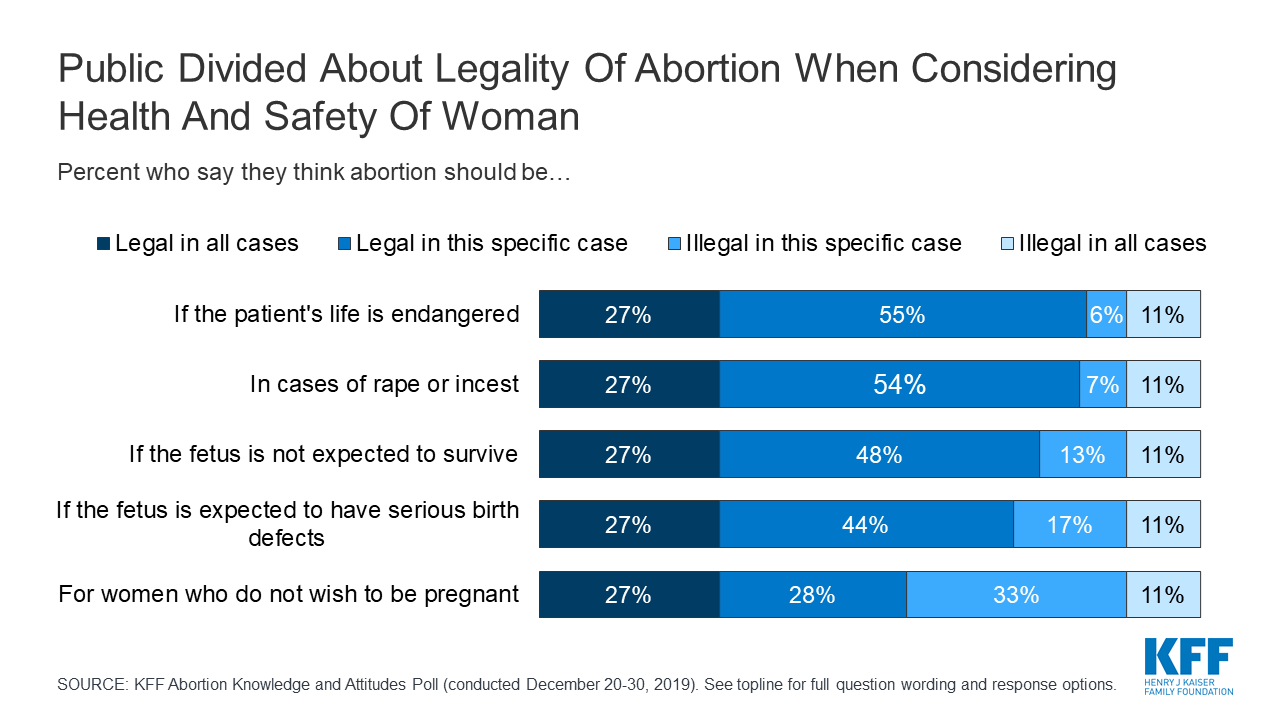
Few (11%) think abortion should be illegal in all cases, with the remainder saying abortion should be legal in all cases (27%), legal in most cases (32%), or illegal in most cases (30%). Large majorities think abortion should be legal if the patient’s life is endangered (82%), in cases of rape or incest (80%), if the fetus is not expected to survive (75%), or if the fetus is expected to have serious birth defects (71%). A smaller majority say abortion should be legal for women who do not want to be pregnant (55%).

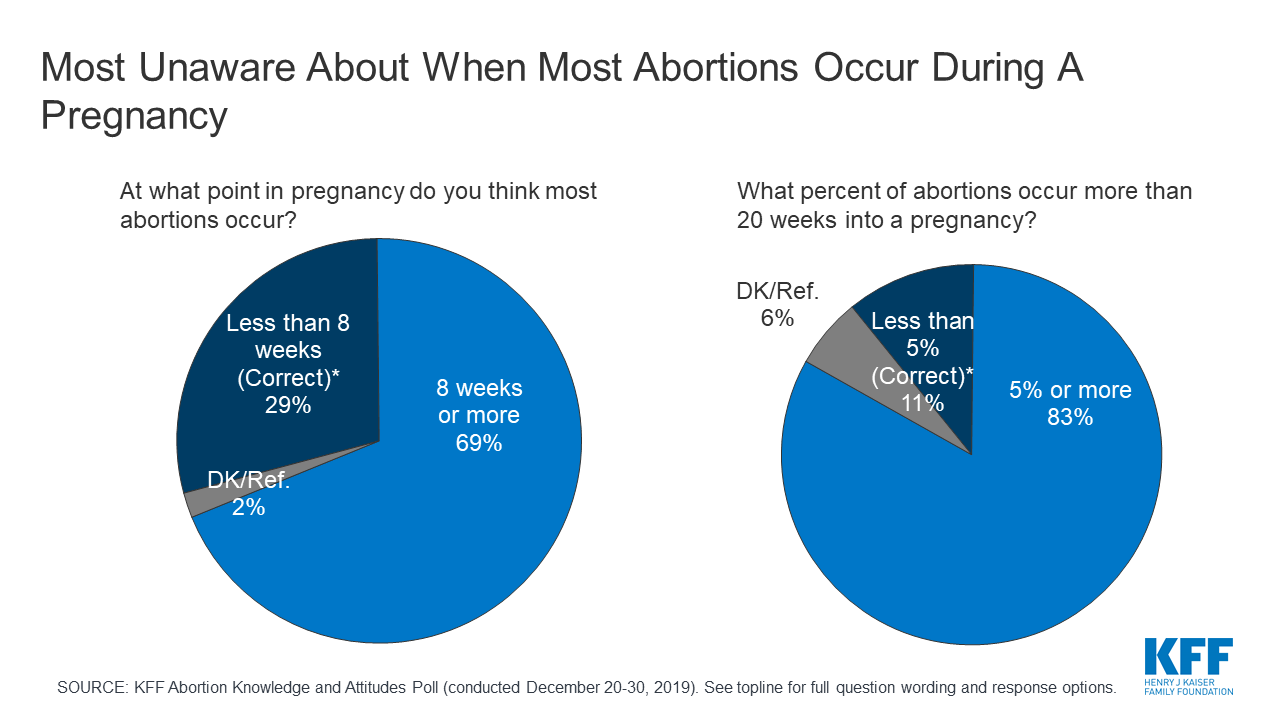
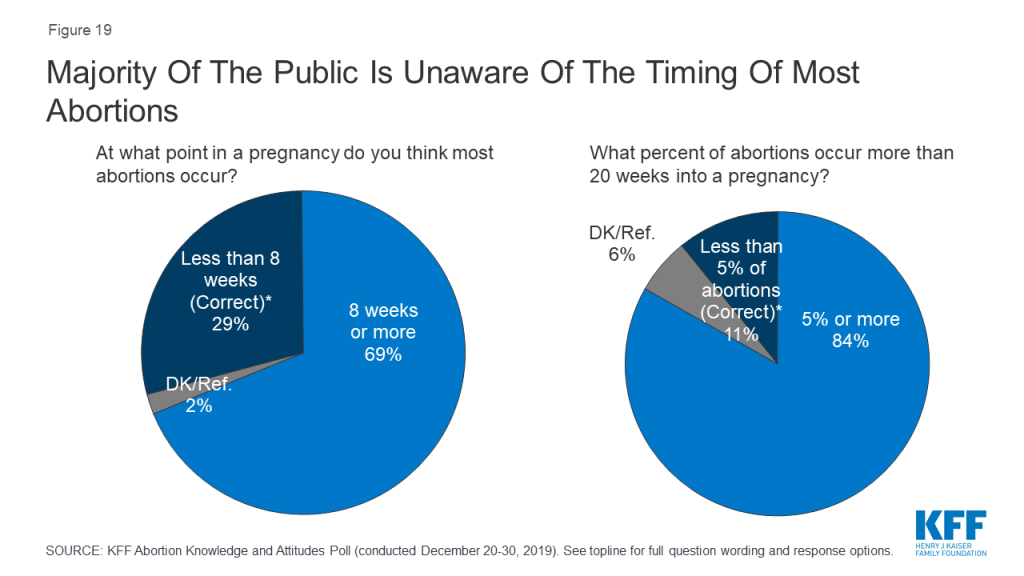
The poll also finds there are significant knowledge gaps on abortion among the public. A majority (69%) incorrectly think most abortions occur 8 weeks or later into a pregnancy and few (11%) are aware that less than 5% of abortions occur more than 20 weeks into a pregnancy.

In addition, only about one-fifth of adults (21%) and one-third of women between the ages of 18 and 49 (36%) have ever heard of Mifepristone, or a medication abortion.

Despite an increase in state-level abortion regulations and ongoing court cases regarding reproductive health care, these issues do not appear to be a priority in the 2020 election for most voters – even among Democrats. Health care generally is the top issue that Democrats want to hear discussed by the 2020 presidential candidates, with one-third calling it the most important issue. Only six percent of Democrats cite reproductive health issues, including birth control and abortion, as their chief concern.

METHODOLOGY

Designed and analyzed by public opinion researchers at KFF, the poll was conducted December 20-30, 2019 among a nationally representative probability-based sample of 1,215 adults including an oversample of 351 women, 18-49 years old. Interviews were conducted in English and Spanish online (1,100) and on the phone (115). The margin of sampling error is plus or minus 3 percentage points for the full sample and 6 percentage points for women, 18-49. See topline for margin of sampling error for other subgroups.

Poll Finding

Abortion Knowledge and Attitudes: KFF Polling and Policy Insights

Published: Jan 22, 2020

Findings

Key Findings:

KFF has a long history of providing insights into national and state-level reproductive health care policy including a series of public opinion polls examining the experiences and attitudes of the general public and the group most likely to be impacted by such policies – women between the ages of 18 and 49. In recent years, many states have passed laws restricting access to abortion and the Trump administration has made a number of changes to federal reproductive health policy, including major changes to the federal Title X family planning program.1  This polling and policy analysis includes new polling data on federal and state reproductive health policy in the U.S. as well as knowledge of abortion and its safety.

  • Nearly five decades since the 1973 Supreme Court case Roe v. Wade, a majority of the public do not want to see the Supreme Court overturn its landmark ruling, which established a woman’s constitutional right to abortion. While most Republicans (57%) would like to see Roe overturned, larger majorities of Democrats (91%) and independents (70%) do not want it overturned.
  • Most people (67%) think state regulations on abortion providers or women seeking abortions are intended to make access to abortion more difficult as opposed to protecting the health and safety of women (32%). Three-fourths of Democrats (77%) as well as six in ten independents (61%) and Republicans (62%) say these state laws are designed to make it more difficult for women to access abortions. This includes majorities of men (67%), women (67%), and women between the ages of 18 and 49 (66%).
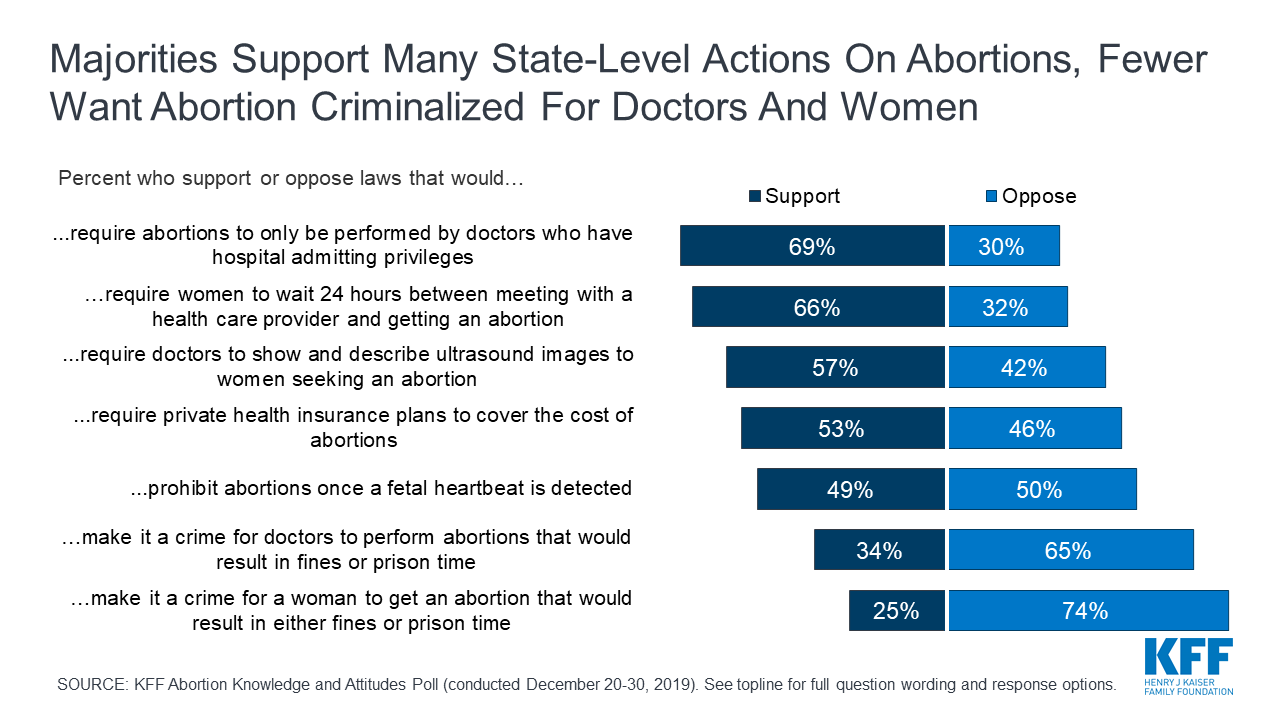
  • Few (11%) Americans think abortion should be illegal in all cases but many people also support some state-level abortion restrictions currently at the center of different lawsuits. A majority (69%) of the public support laws requiring abortions to be performed solely by doctors who have hospital admitting privileges, similar to a Louisiana law in question in a case that will be heard at the Supreme Court this term. Majorities of Americans also support laws that would require women to wait 24 hours between meeting with a health care provider and getting an abortion (66%) and doctors to show and describe ultrasound images to women seeking an abortion (57%). But majorities oppose criminalizing doctors who provide abortions (65%) or women who get abortions (74%).
  • Six in ten (63%) Americans personally know someone who has ever had an abortion (including themselves). Yet, despite this, there is significant lack of knowledge about abortion. A majority (69%) incorrectly think most abortions occur 8 weeks or later into pregnancy and about one-fifth of adults (21%) and one-third of women between the ages of 18 and 49 (36%) have ever heard of Mifepristone, or a medication abortion.
  • Reproductive health issues are not a top issue so far in the 2020 presidential election. Small shares of Democrats (6%), independents (4%), and Republicans (7%) say reproductive health issues such as birth control and abortion are the most important issue for the 2020 presidential candidates to talk about.

Access to Abortion Services and State-Level Restrictions

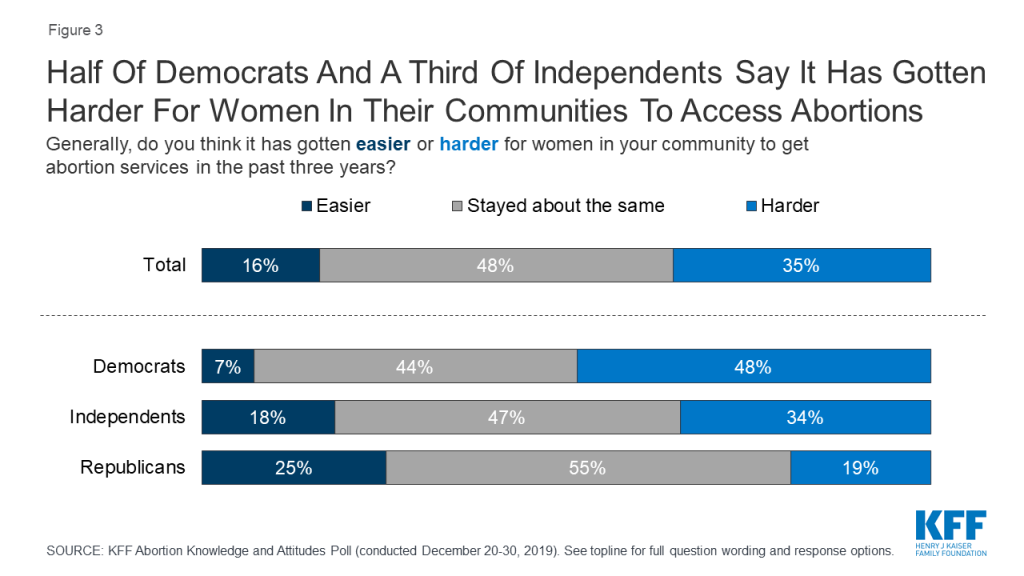
In the last several years, over 250 abortion clinics have closed across the U.S. and there are currently six states with one abortion clinic remaining: Kentucky, Mississippi, Missouri, North Dakota, South Dakota, and West Virginia. The most recent KFF poll finds about half of Democrats (48%) and one-third of independents (34%) say it has gotten “harder” for women in their community to get abortions during the last three years. On the other side of the aisle, most Republicans (55%) don’t think women’s ability to get abortion services in their community has changed under the Trump administration.

Box 1: Key Facts about Abortion in the U.S.

  • How accessible are abortion services? Access to abortion varies greatly across the U.S.  In 2014, 65% of patients traveled less than 25 miles to obtain an abortion, while 18% traveled more than 50 miles. An estimated 31% of women in rural areas travel more than 100 miles for an abortion, and only one abortion clinic remains open in 6 states (KY, MS, MO, ND, SD, WV).

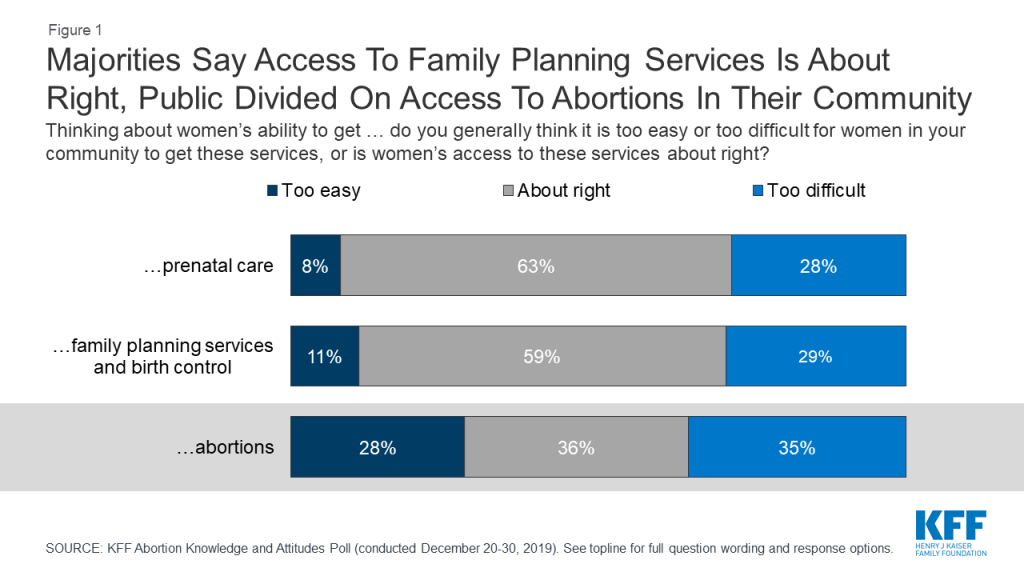
The closure of clinics that offer reproductive health services could affect more than access to abortion and also affect women’s ability to access services including prenatal care and contraception. Most say women’s ability to get prenatal care and family planning services including birth control in their communities is “about right” (63% and 59%, respectively) while about three in ten say it is too difficult for women to access these services and one in ten say it is “too easy.” Yet, the public is divided in their views of women’s ability to access abortions in their communities with similar shares saying it is “too difficult” (35%), and “about right” (36%), and a slightly smaller share saying it is “too easy” (28%).

Figure 1: Majorities Say Access To Family Planning Services Is About Right, Public Divided On Access To Abortions In Their Community

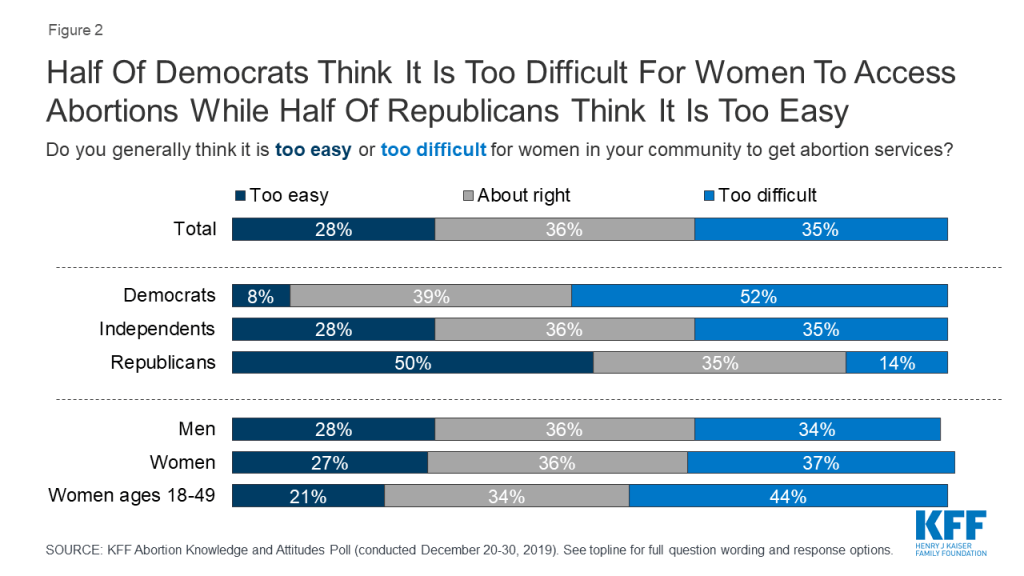
This divide is largely driven by differences among partisans. A slim majority of Democrats say it is “too difficult” for women in their community to access abortions (52%) while half of Republicans say it is “too easy” for women to get an abortion in their community. Independents are more evenly split with similar shares saying it is “too difficult” (35%) and access is “about right” for women in their community (36%). About three in ten (28%) independents say it is “too easy” for women in their community to get abortion services.

Figure 2: Half Of Democrats Think It Is Too Difficult For Women To Access Abortions While Half Of Republicans Think It Is Too Easy

More than four in ten women, 18-49, say it is “too difficult” for women in their community to get abortion services, compared to one-third (34%) who say women’s access is “about right,” and one in five (21%) who say it is “too easy.”

The share who say it is “too difficult” for women in their community to get abortion services has increased 13 percentage points since 2018, up from 22% to 35%. The increase is largely driven by Democrats with half (52%) now saying it is “too difficult” for women in their community to get abortion services (compared to 37% in 2018).

Overall, about half of the public says women’s ability in their community to get abortion services has “stayed about the same” in the past three years but there are differences across partisans. About half of Democrats (48%) say it has gotten “harder” in the past three years for women in their community to get abortion services while 55% of Republicans say women’s access to abortions in their community has “stayed about the same.” About half (47%) of independents say access has “stayed about the same” but a larger share (34%) say access has gotten “harder” rather than “easier” (18%).

Figure 3: Half Of Democrats And A Third Of Independents Say It Has Gotten Harder For Women In Their Communities To Access Abortions

State Actions Legislating Abortion Services

Over the past couple of years, many state legislatures have passed laws restricting women’s access to abortions within each state. These include a wide variety of restrictions that range from gestational age bans, prohibiting abortions for specific reasons, barring certain methods of abortion, and regulations on abortion providers.

Box 2: State Regulations on Abortion

States vary in the degree to which they regulate abortion services, including the following.

Time Limits: The Supreme Court’s decision in Roe v. Wade allows states to restrict access to abortion after “viability,” often presumed around 24 weeks gestation. However, many states seek earlier gestational limits on abortion. This includes Alabama that has banned abortion altogether and six states with “so-called” heartbeat bans, which ban abortions after there is detectable cardiac activity, around 6 weeks into a pregnancy. All of these bans are currently blocked by court action.

Waiting Periods: Twenty-seven states require waiting periods between abortion counseling and obtaining an abortion, necessitating at least two trips to the clinic. Waiting periods vary by state, from 18 to 72 hours.

Ultrasounds: About half of states (26) have various requirements surrounding pre-abortion ultrasounds. For example, 3 states require the abortion provider shows and describes ultrasound images to the patient before an abortion, while 14 states mandate the patient is given information on how to access ultrasound services.

Penalties for Abortion Providers: An array of legal and financial penalties can be imposed on providers for violating state abortion laws including  jail sentences (20 states) for abortions performed after a certain time period in the pregnancy.

Admitting Privileges: Hospital admitting privileges for abortion providers, which means that the provider could admit a patient to a hospital to get tests and treatment, are required in two states and in 8 states this law is enjoined. This means that in event of an emergent complication from an abortion, the physician can admit the patient to a hospital and continue management of their care. In practice, however, when complications from abortion arise, albeit rarely, patients typically present to emergency departments (<1% of the time) that are required by law to evaluate and treat all patients.

Insurance Coverage: The Hyde Amendment restricts federal funding for abortion, except in cases of life endangerment, rape and incest. This affects Medicaid, Medicare, and other federally funded programs. While some states prohibit coverage of abortion services in private insurance plans, some states have enacted laws that require plans to cover abortions.

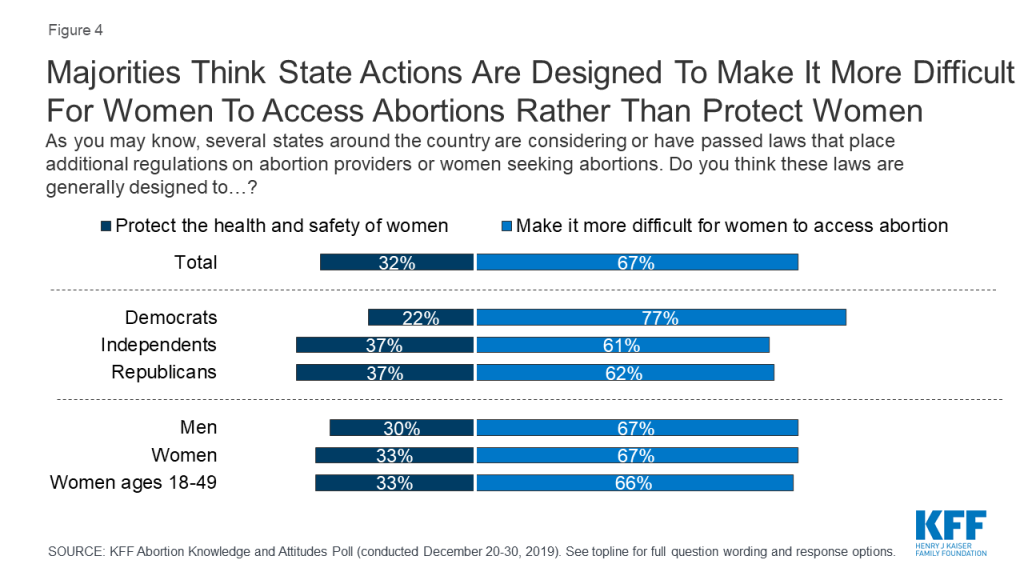
Overall, twice as many think recent state actions are generally designed to make it more difficult for women to access abortion (67%) rather than protect the health and safety of women (32%). Three-fourths of Democrats (77%) as well as six in ten independents (61%) and Republicans (62%) say these state laws are designed to make it more difficult for women to access abortions. This includes majorities of men (67%), women (67%), and women between the ages of 18 and 49 (66%).

Figure 4: Majorities Think State Actions Are Designed To Make It More Difficult For Women To Access Abortions Rather Than Protect Women

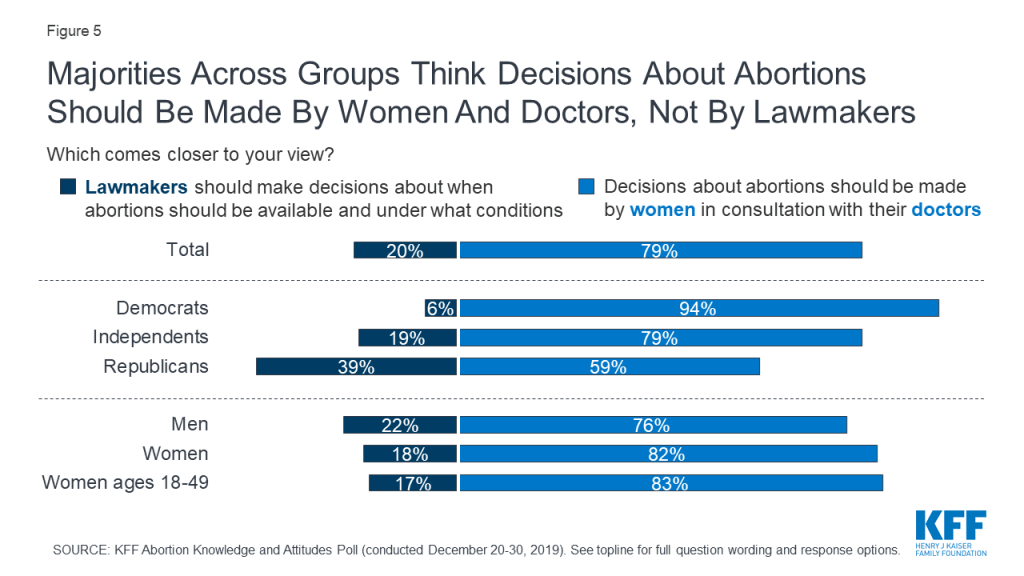
The public overwhelmingly thinks that decisions about abortions should be made by women in consultation with their doctors (79%) rather than having lawmakers decide when abortions should be available and under what conditions (20%). This includes majorities of Democrats (94%), independents (79%), and Republicans (59%), as well as eight in ten women (82%) and women of reproductive age (83%), and three-fourths of men (76%).

Figure 5: Majorities Across Groups Think Decisions About Abortions Should Be Made By Women And Doctors, Not By Lawmakers

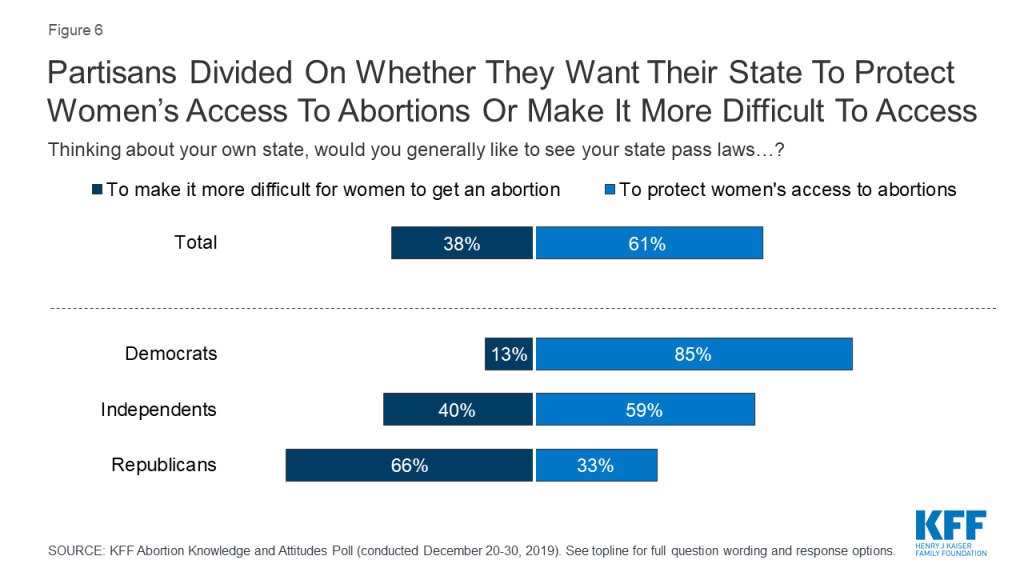
A majority of the public say they would like to see their state “pass laws to protect women’s access to abortions” (61%) while four in ten (38%) say they would like to see their state “pass laws to make it more difficult for women to get an abortion.” Attitudes towards state actions are largely partisan with two-thirds of Republicans saying they want their state to pass laws to make it more difficult to get an abortion while a majority of Democrats (85%) and independents (59%) say they want their state to pass laws to protect women’s abortion access. Seven in ten (69%) women between the ages of 18 and 49 want their state to pass laws to protect women’s access to abortions.

Figure 6: Partisans Divided On Whether They Want Their State To Protect Women’s Access To Abortions Or Make It More Difficult To Access

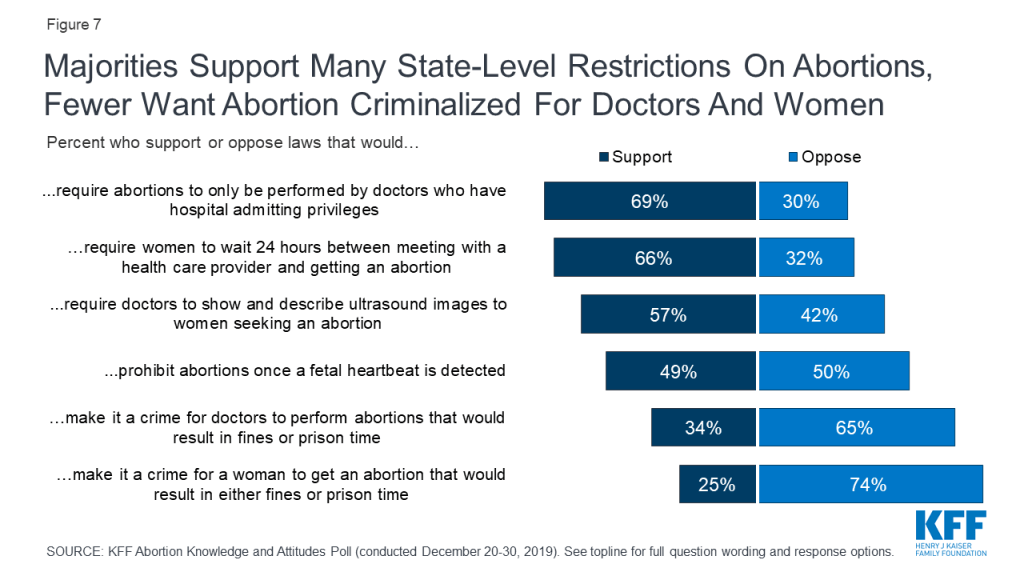
However, there is support for some state-level restrictions on women seeking abortions as well as abortion providers. Roughly seven in ten support state laws that would require abortions to only be performed by doctors who have hospital admitting privileges (69%), and a similar share (66%) support laws requiring women to wait 24 hours between meeting with a health care provider and getting an abortion. A smaller majority supports laws requiring doctors to show and describe ultrasound images to women seeking an abortion (57%). The public is divided on laws prohibiting abortions once a fetal heartbeat is detected, which is usually around 6 weeks (49% support, 50% oppose). Majorities oppose making it a crime for either doctors who perform abortions (65%) or women who get abortions (74%).

Figure 7: Majorities Support Many State-Level Restrictions On Abortions, Fewer Want Abortion Criminalized For Doctors And Women

While majorities of Democrats (56%), independents (72%), and Republicans (82%) support requiring abortions to only be performed by doctors who have hospital admitting privileges, there are partisan differences in support for other state-level actions.

A majority of Republicans support many of the state-level restrictions including a 24 hour waiting period (86%), requiring doctors to show and describe ultrasound images (83%), prohibiting abortions once there is cardiac activity (70%), and making it a crime for doctors to perform abortions that would result in fines or prison time (58%); all of these are opposed by a majority of Democrats.

Table 1: Support For Laws Restricting Access To Abortion Services Divided Across Partisans
Percent who support each of the following laws:DemocratsIndependentsRepublicans
Requiring women to wait 24 hours between meeting with a health care provider and getting an abortion50%70%86%
Requiring abortions to only be performed by doctors who have hospital admitting privileges567282
Requiring doctors to show and describe ultrasound images to women seeking an abortion346183
Making it a crime for doctors to perform abortions that would result in either fines or prison time143458
Making it a crime for a woman to get an abortion that would result in either fines or prison time102349
Prohibiting abortions once cardiac activity, known as fetal heartbeat, is detected324970

Attitudes Towards State Laws Are malleable

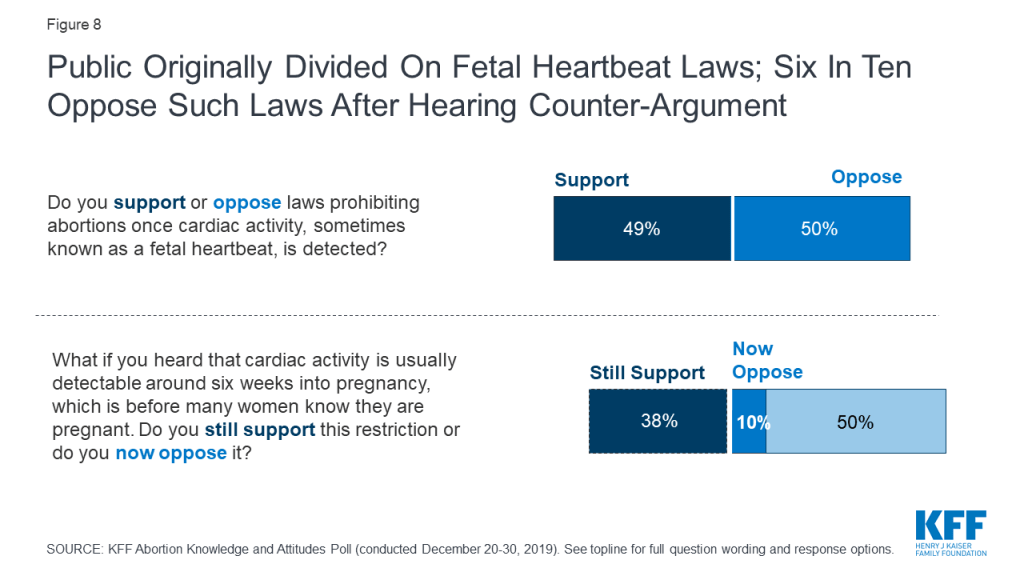
The poll finds that the public can be swayed on many of these state actions with some changing their opinions after hearing counter-arguments. For example, though about half the public initially supports laws prohibiting abortions once cardiac activity is detected, a majority (60%) say they would now oppose such laws after supporters hear that fetal activity is usually detected around six weeks into pregnancy and before many women know they are pregnant. Overall support for fetal heartbeat laws decrease to 38% after hearing counter-argument.

Figure 8: Public Originally Divided On Fetal Heartbeat Laws; Six In Ten Oppose Such Laws After Hearing Counter-Argument

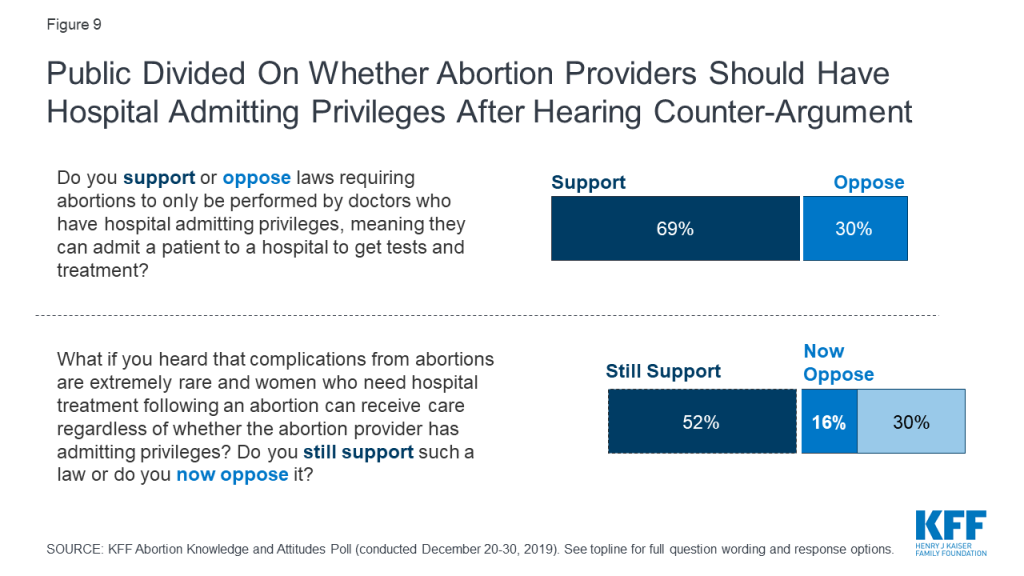
Seven in ten (69%) originally support laws requiring abortions to only be performed by doctors who have hospital admitting privileges,2  but after supporters hear the argument that complications from abortions are rare and women who need treatment would be able to receive it, regardless of whether the abortion provider has admitting privileges, support drops to about half (52%).

Figure 9: Public Divided On Whether Abortion Providers Should Have Hospital Admitting Privileges After Hearing Counter-Argument

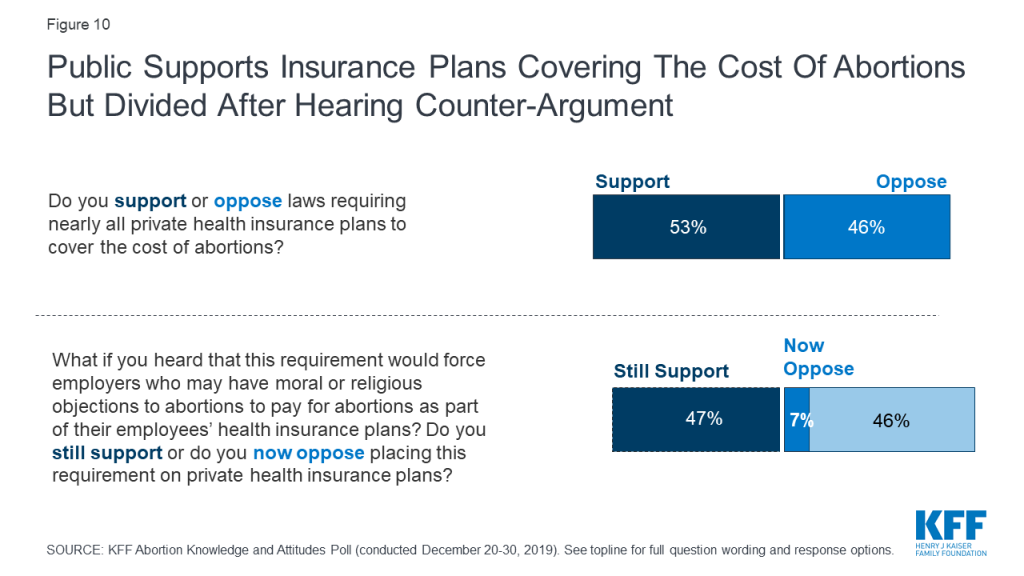
The public is also somewhat supportive of laws requiring private health insurance plans to cover the cost of abortions (53%), a policy that has been enacted in six states. This is supported by a majority of Democrats (76%), about half of independents (52%), and one-fourth of Republicans (26%).

While a small majority of the public initially support such laws, the divided is divided after hearing that this would force employers who may have moral or religious objections to pay for abortions with 52% now opposing these requirements and 47% still supporting.

Figure 10: Public Supports Insurance Plans Covering The Cost Of Abortions But Divided After Hearing Counter-Argument

National Attitudes toward Abortions Five Decades Since Roe v. Wade

It has been nearly five decades since the U.S. Supreme Court issued their landmark ruling on Roe v. Wade establishing a woman’s constitutional right to abortion services. There have been many cases since the Roe decision over the legality of abortion, and the Supreme Court is hearing another case in March 2020, June Medical Services v. Gee. This case is nearly identical to the 2016 Supreme Court case, Whole Woman’s Health v. Hellerstedt, in which the Court ruled that state requirements for physicians who provide abortions to hold hospital admitting privileges place undue burdens on women seeking abortion services and consequently violate their Constitutional rights. The Court also ruled that such requirements do not provide any medical benefits to women. Since the 2016 decision, the composition of the Supreme Court has changed, and some think the Court may overrule its recent precedent established in 2016 and Roe v. Wade could be overturned by a future case.

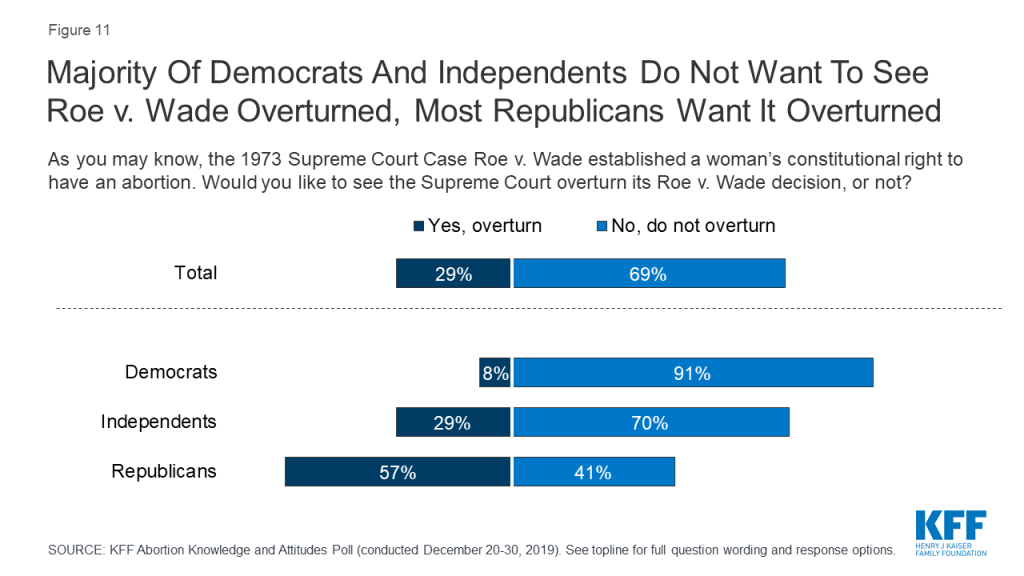
KFF polling has consistently found that a majority of the public do not want to see Roe v. Wade overturned and the latest KFF poll is no different. Seven in ten (69%) Americans say they do not want to see the Supreme Court overturn Roe v. Wade while 29% of adults say they would like to see the case overturned. Nearly six in ten (57%) Republicans want to see the law overturned while the vast majority of Democrats (91%) and seven in ten independents do not want the Supreme Court to overturn its decision.

Figure 11: Majority Of Democrats And Independents Do Not Want To See Roe v. Wade Overturned, Most Republicans Want It Overturned

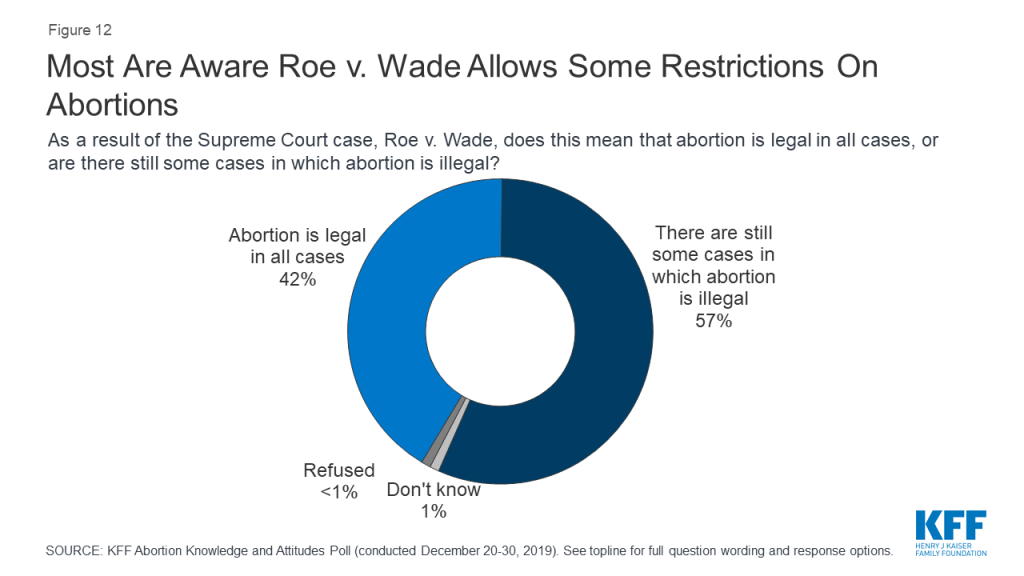
In Roe v. Wade, the Supreme Court ruled that a woman’s right to choose to have an abortion falls within their right to privacy before the fetus is viable outside the womb (typically around 24 weeks). Therefore, while states may not ban abortions before fetal viability, states may ban abortions later in pregnancy as long as the laws allow for exceptions for maternal health. A majority of the public (57%) are aware that the Roe v. Wade decision means there are still some cases in which abortion is illegal while four in ten (42%) incorrectly believe the Roe v. Wade decision means that abortion is legal in all cases. Most Democrats (58%) and independents (60%), as well as half of Republicans, are aware that there are still some cases in which abortion is illegal.

Figure 12: Most Are Aware Roe v. Wade Allows Some Restrictions On Abortions

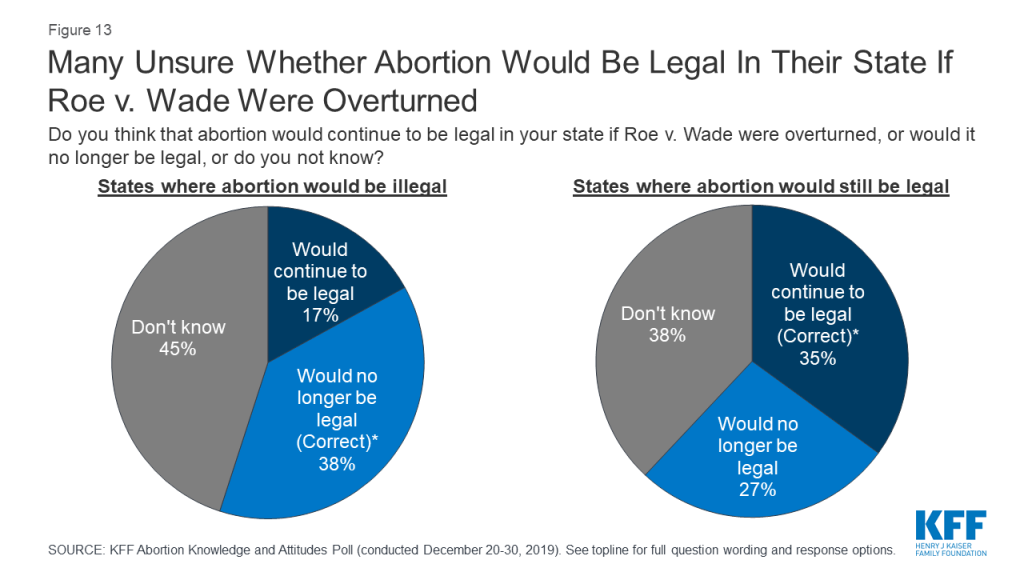
If Roe v. Wade was overturned by the Supreme Court, some states have laws that would make abortion illegal immediately. About four in ten (38%) of those living in states with such laws3  are aware that if Roe v. Wade was overturned, abortion would no longer be legal in their state. One-third (35%) of those living in states without such laws are aware that abortion would continue to be legal if the case was overturned.

Figure 13: Many Unsure Whether Abortion Would Be Legal In Their State If Roe v. Wade Were Overturned

The Public Holds Complex Views toward Abortion Policy

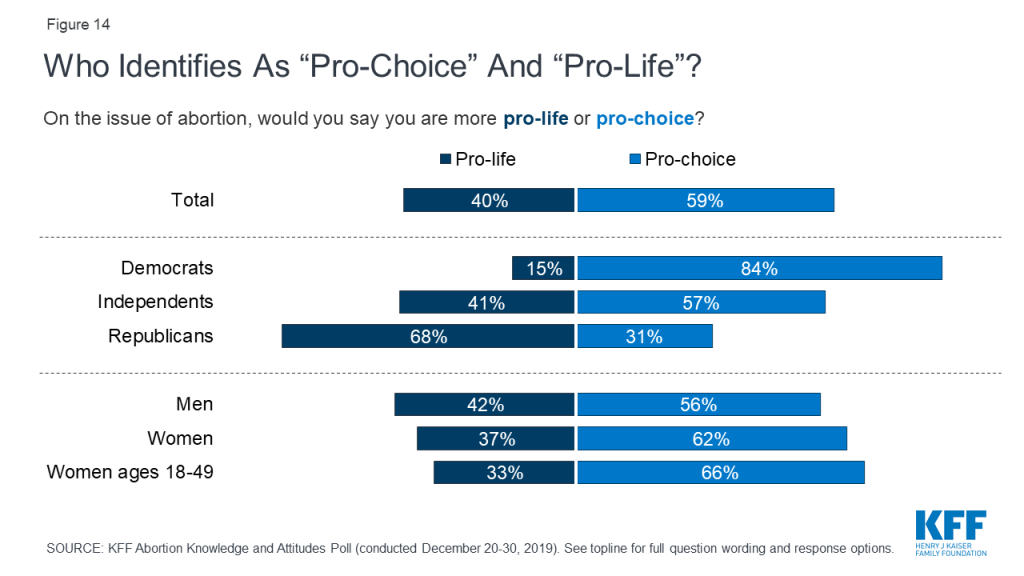
This poll also delved deeper into the public’s attitudes around abortion services beyond whether they simply want to see Roe v. Wade overturned. Overall, a majority of the public (59%) including majorities of men (56%), women (62%), women between the ages of 18 and 49 (66%), Democrats (84%), and independents (57%) say they are “pro-choice” on the issue of abortion. Two-thirds of Republicans (68%) and conservatives (68%), and seven in ten white evangelicals (72%) identify as “pro-life.”

Figure 14: Who Identifies As “Pro-Choice” And “Pro-Life”?

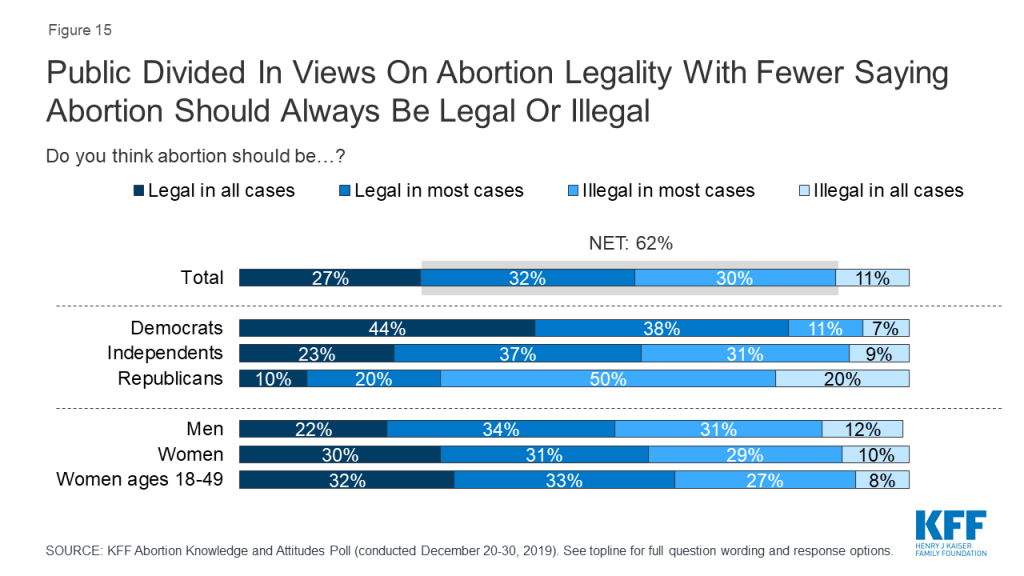
About one-fourth of the public (27%) and 32% of women between the ages of 18 and 49 say abortion should be “legal in all cases” compared to one in ten (11% of total, and 8% of women between the ages of 18 and 49) who say abortion should be “illegal in all cases.”

Figure 15: Public Divided In Views On Abortion Legality With Fewer Saying Abortion Should Always Be Legal Or Illegal

Not all those who identify as “pro-life” want to overturn Roe v Wade.

Four in ten U.S. adults identify as “pro-life” on the issue of abortion but this group does not have unanimous views on the legality of abortion services. While the majority of pro-life adults say they want to see the Supreme Court overturn Roe v. Wade, three in ten pro-life adults say they do not want to see the Supreme Court overturn Roe v. Wade (by comparison the vast majority (96%) of “pro-choice” adults don’t want Roe v. Wade overturned). These individuals also are divided on whether abortion should be legal or illegal. About one-fourth (23%) say abortion should be “illegal in all cases” compared to few (3%) who say abortion should be “legal in all cases.” A majority of pro-life individuals think abortion should be legal if the patient’s life is endangered (64%) or in cases of rape or incest (60%).

When should Abortion Be Legal or Illegal?

A majority of the public say abortion should be legal if the patient’s life is endangered (82%), in cases of rape or incest (80%), if the fetus is not expected to survive (75%), or if the fetus is expected to have serious birth defects (71%). A smaller majority say abortion should be legal for women who do not wish to be pregnant (55%).

Figure 16: Majority Say Abortion Should Be Legal During Cases Of Health And Safety Concerns But Divided On Granting Broader Access

A majority of women ages 18-49 say abortion should be legal in all of these situations. Large majorities say abortion should be legal if the patient’s life is endangered (87%), in cases of rape or incest (83%), if the fetus is not expected to survive (79%), or if the fetus is expected to have serious birth defects (77%). Six in ten (62%) women of reproductive age say abortion should be legal for women who do not wish to be pregnant.

Reproductive Health Care Issues in 2020 Election

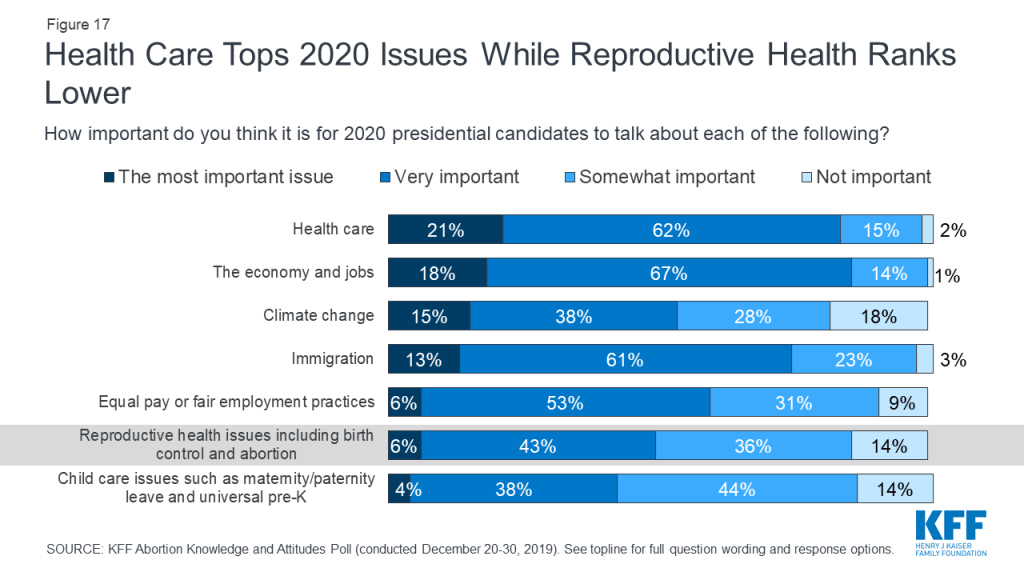
Despite the ongoing court cases and pending state actions regarding reproductive health care, these issues are not resonating with voters as top issues in the upcoming presidential election. While health care ranks among the top issues that Americans want to hear the 2020 presidential candidates talk about during the election year, smaller shares say reproductive health care is the most important issue for the candidates to discuss. About one in five (21%) say health care is “the most important issue” for 2020 presidential candidates to talk about, which is similar to the share who say the same about the economy and jobs (18%). Slightly smaller shares say climate change (15%) and immigration (13%) are the most important issues for the 2020 candidates to discuss. Yet, all of these issues rank higher among the public than equal pay or fair employment practices (6%), reproductive health issues including birth control and abortion (6%), and child care issues such as maternity or paternity leave and universal pre-K (4%).

Figure 17: Health Care Tops 2020 Issues While Reproductive Health Ranks Lower

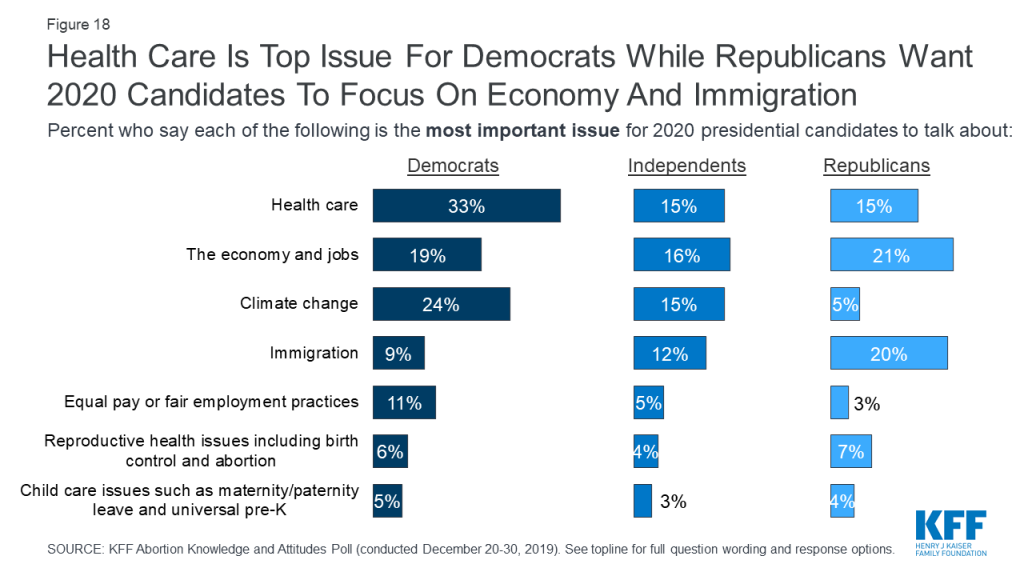
Health care is the top issue that Democrats want to hear the 2020 presidential candidates talk about with one-third saying it is “the most important issue,” while the economy and immigration rank as the top issues for Republicans (21% and 20%, respectively). Independents are more split with similar shares saying the economy and jobs (16%), health care (15%), and climate change (15%) are the most important issues for the 2020 presidential candidates to talk about. Reproductive health care issues rank low across partisans with small shares of Democrats (6%), independents (4%), and Republicans (7%) saying it is the “most important issue” for candidates to talk about.

Figure 18: Health Care Is Top Issue For Democrats While Republicans Want 2020 Candidates To Focus On Economy And Immigration

Knowledge of Abortion Services

The KFF poll also goes beyond the current abortion policy debates and examines what Americans know about abortion services and finds there are significant knowledge gaps on the prevalence and the overall safety of abortions.

Box 3: Key Facts about Abortion in the U.S.

  • How common are abortions? The number of abortions performed in the U.S. has been steadily decreasing over the last several decades, often attributed to greater affordability of contraception and increased use of highly effective long-acting reversible contraception. Still, an estimated 1 in 4 reproductive aged women (24%) will have an abortion by age 45.
  • Who has abortions? Of people who obtained abortions in 2016, 35% identified as White, 38% identified as Black and the majority were in their 20s (59%) or 30s (28%). Most already had children (59%). The majority had not obtained an abortion previously (57%).
  • When do most abortions occur? The vast majority of abortions occur early in pregnancy; most (65%) occur at ≤8 weeks gestation, while almost all (91%) are performed at ≤13 weeks gestation (also referred to as the 1st trimester). Abortions later in pregnancy, at ≥21 weeks gestation, are rare, comprising only 1.2% of all abortions.

Six in ten (63%) Americans – including 69% of all women and 71% of women between the ages of 18 and 49 – say that they personally know someone, including themselves, who has ever had an abortion. Yet, many do not know when most abortions occur. A majority (69%) incorrectly think most abortions occur 8 weeks or more into a pregnancy and few (11%) are aware that less than 5% of abortions occur more than 20 weeks into a pregnancy.

Figure 19: Majority Of The Public Is Unaware Of The Timing Of Most Abortions

There are no significant differences among men, women, and women between the ages of 18 and 49 with majorities across groups providing incorrect answers. In addition, only about one-fifth of adults (21%) and one-third of women between the ages of 18 and 49 (36%) have ever heard of Mifepristone, or a medication abortion.

Box 4: Emergency Contraception vs. Medication Abortion
Emergency contraception and medication abortion are distinct treatments, used for different reasons. Emergency contraception is used to prevent pregnancy before it has occurred, while a medication abortion terminates a pregnancy after it has already occurred. Emergency contraception does not cause an abortion.
Emergency ContraceptionMedication Abortion
PurposeTo prevent pregnancy after unprotected sexTo terminate an existing pregnancy
Medications UsedMultiple options: Levonogestrel (Plan B), Ulipristal Acetate (Ella) or copper IUDMost commonly: mifepristone (RU486, Mifeprex) followed by misoprostol (Cytotec)
How It WorksPrevents fertilization of the egg by the sperm

Levonogestrel and Ulipristal Acetate: delays or prevents ovulation (release of the egg from the ovary)

Copper IUD: makes sperm less likely to fertilize the egg

Causes uterus to expel existing pregnancy

Mifepristone: blocks progesterone, a hormone critical for continuing a pregnancy

Misoprostol: causes uterine contractions to expel the pregnancy

TimingFDA approved for use within 72 hours after intercourse for Levonogestrel and within 120 hours for Ulipristal Acetate and the copper IUDFDA approved for use up to 10 weeks gestational age

Emergency ContraceptiVE PILLS

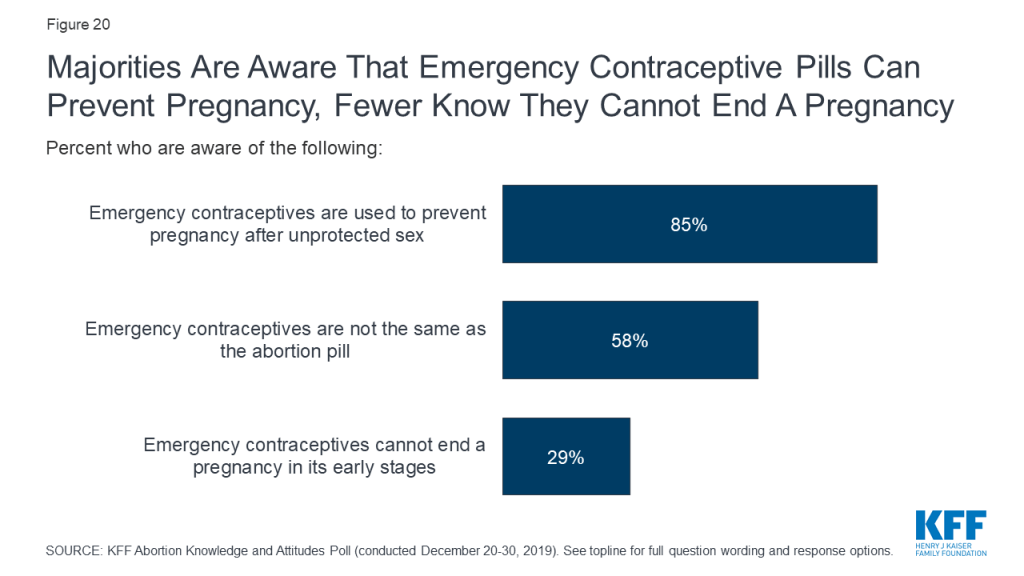
Most Americans – including the vast majority of women (95%) have heard of emergency contraceptive pills, sometimes called morning after pills or “Plan B.” In fact, the share of women who are aware of emergency contraceptives has increased slightly, up from 84% in 2003, shortly after it was approved by the FDA. Yet, there are still some knowledge gaps surrounding the effects of these pills. While most are aware that emergency contraceptive pills are not the same as the abortion pill (58%) and that they are used to prevent pregnancy after unprotected sex (85%); a substantial share (62%) incorrectly think that emergency contraceptive pills can end a pregnancy in its early stages while about three in ten (29%) are aware that emergency contraceptives cannot end a pregnancy.

Figure 20: Majorities Are Aware That Emergency Contraceptive Pills Can Prevent Pregnancy, Fewer Know They Cannot End A Pregnancy

Overall, women and men are equally knowledgeable about emergency contraceptives, but women between the ages of 18 and 49 are the most knowledgeable group. Larger shares of women 18-49 than older women (50 and older) know that emergency contraceptives are used to prevent pregnancy (95% and 77%, respectively) and are not the same as the abortion pill (73% and 46%, respectively). Still, less than half of women between the ages of 18 and 49 are aware that emergency contraceptives cannot end a pregnancy in its early stages (44%).

Table 2:  Awareness of emergency contraceptive pills differs by age among women
Percent who are aware of the following:Women, 18-49Women, 50 and older
Emergency contraceptive pills are used to prevent pregnancy after unprotected sex95%77%
Emergency contraceptives are not the same as the abortion pill7346
Emergency contraceptives cannot end a pregnancy in its early stages4417

Do Americans Think Abortions Are Safe?

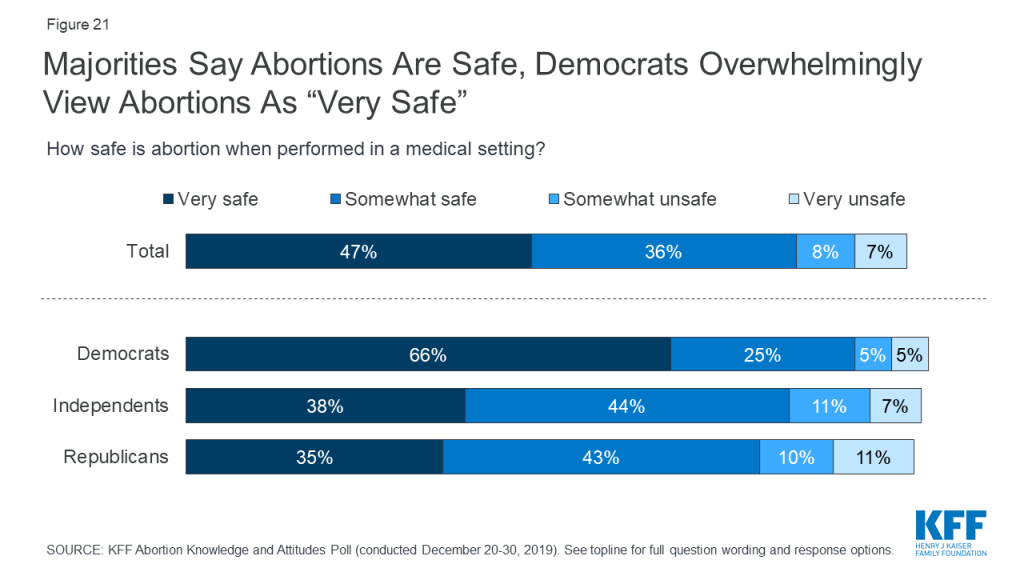
The majority (83%) of adults say abortions performed in a medical setting are either “very safe” (47%) or “somewhat safe” (36%),while one in six (16%) say abortions are either “somewhat unsafe” (8%) or “very unsafe” (7%). While majorities across partisans say abortions are safe, Democrats overwhelmingly hold this opinion with two-thirds of Democrats saying abortions are “very safe.” Majorities of men, women, and women 18-49 all say abortions are at least somewhat safe.

Figure 21: Majorities Say Abortions Are Safe, Democrats Overwhelmingly View Abortions As “Very Safe”

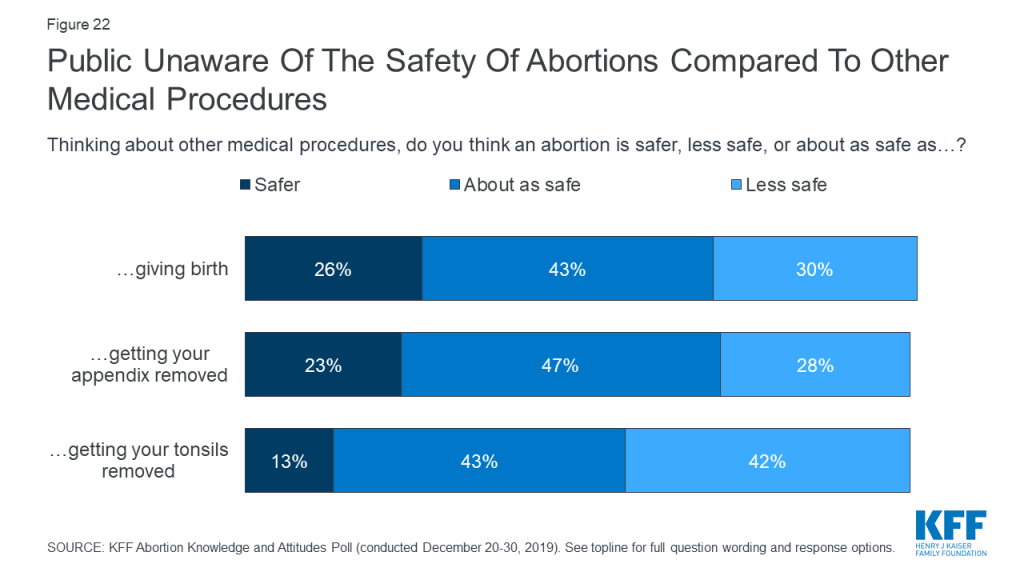
There is still some confusion on how safe abortions are in comparison to other medical procedures. Small shares are aware that abortions are safer than giving birth (26%), getting your appendix removed (23%) and getting your tonsils removed (13%).

Box 5: Abortion Safety

Obtaining an abortion is generally very safe in the U.S. Less than 1% of abortions result in subsequent emergency room treatment due to complications, which makes abortions safer than many other common procedures, such as wisdom tooth removal (7%), tonsil removal (8-9%), appendix removal (13%), and childbirth (29%).

Figure 22: Public Unaware Of The Safety Of Abortions Compared To Other Medical Procedures

Most Americans are aware of the truth behind many common myths surround abortions. Majorities say it is “false” that a women who has gotten an abortion has a higher chance of getting breast cancer (86%) or will have a harder time getting pregnant (72%).

Methodology

This Kaiser Family Foundation survey is based on interviews with a nationally representative probability-based sample of 1,215 adults ages 18 and over, living in the United States, including an oversample of women between the ages of 18-49. Interviews were administered online and by telephone from December 20-30th, 2019 in English and Spanish. KFF paid for all costs associated with this survey.

The poll was designed and analyzed by public opinion researchers at the Kaiser Family Foundation (KFF). The sample was recruited using the SSRS Opinion Panel (n=1,100) as well as a subsample of respondents who had previously completed an interview via random digit dialing (RDD) on the SSRS Omnibus (n=115). For both methods of recruitment, the sample was provided by Marketing Systems Groups (MSG) of Horsham, PA.

The SSRS Opinion Panel is a representative probability-based panel of adults ages 18 and over living in the United States, and is recruited using the SSRS Omnibus poll and through address-based sampling (ABS). To efficiently obtain a sample of Spanish language interviews as well as non-internet adults, additional interviews were conducted using computer assisted telephone interviewing (CATI) by landline (n=63) and cell phone (n=52). Non-internet adults (n=100) are those who had previously completed interviews on the SSRS Omnibus and had indicated they did not have internet access. Their status as non-internet users was confirmed at the start of their interview. To ensure the representation of Spanish-speaking respondents, 15 additional interviews were completed by CATI with respondents who had previously completed interviews in Spanish on the SSRS Omnibus, and were not part of the Opinion Panel or the Non-Internet sample.

To meet this study’s analytical goals, SSRS disproportionally invited SSRS Opinion Panel respondents who were women between the ages of 18 and 49 to participate in the study. The total sample (n=351) for this group of women, 18-49, includes 344 online panel respondents and 7 interviews conducted using RDD.

The combined web, landline, and cell phone sample was weighted to match the sample demographics to estimates for the national population. In order to take into account the oversampling of women 18 to 49 years old, men and women first were separately weighted to estimates on age, education, race, Hispanic origin, and region, using data from the Census Bureau’s 2019 Current Population Survey (CPS) data. The male and female samples were then combined and a final weighting adjustment was made including estimates for civic engagement (from the September 2017 CPS data), internet access (internet or no internet, from the 2017 American Community Survey (ACS)), and education (from the 2019 CPS data).

The margin of sampling error including the design effect for the full sample is plus or minus 3 percentage points. Numbers of respondents and margins of sampling error for key subgroups are shown in the table below. For results based on other subgroups, the margin of sampling error may be higher. Sample sizes and margins of sampling error for other subgroups are available by request. Note that sampling error is only one of many potential sources of error in this or any other public opinion poll. Kaiser Family Foundation public opinion and survey research is a charter member of the Transparency Initiative of the American Association for Public Opinion Research.

GroupN (unweighted)M.O.S.E.
Total1,215±3 percentage points
Gender
Men573±5 percentage points
Women641±5 percentage points
Women, 18-49 years old351±6 percentage points
Party Identification
Democrats425±6 percentage points
Republicans308±7 percentage points
Independents429±6 percentage points

Endnotes

  1. KFF polling on the Trump administration’s changes to the federal Title X program is available at https://modern.kff.org/womens-health-policy/poll-finding/kff-poll-public-opinion-and-knowledge-on-reproductive-health-policy/. ↩︎
  2. Hospital admitting privileges means that the provider can admit a patient to a hospital to get tests and treatments. ↩︎
  3. AL, AZ, AR, KY, LA, MI, MS, MO, NM, ND, OK, SD, TN, WV, WI are all states in which abortion would immediately become illegal if the Supreme Court overturned Roe v. Wade. ↩︎

Medicaid: What to Watch in 2020

Authors: Robin Rudowitz, Elizabeth Hinton, MaryBeth Musumeci, Samantha Artiga, and Rachel Garfield
Published: Jan 17, 2020

Medicaid, the provider of health insurance coverage for about one in five Americans and the largest payer for long-term care services in the community and nursing homes, continues to be a key part of health policy debates at the federal and state level. Key Medicaid issues to watch in 2020 include: Medicaid expansion developments; Section 1115 waiver activity; enrollment and spending trends; benefits, payment and delivery system reforms, and the implications of the 2020 elections.

Medicaid Expansion

At the start of 2020, 37 states had adopted the ACA Medicaid expansion. This total includes Idaho and Utah, which implemented the expansion on January 1, 2020, and Nebraska, where the expansion was adopted but not yet implemented. A review of over 300 studies points to positive effects of expansion on coverage, access to care, service utilization, and state budgets and economies. Millions of adults could gain Medicaid eligibility if additional states expanded their programs. Expansion activity is ongoing in a number of states that have not adopted the expansion. Initiatives are underway in Oklahoma and Missouri to put Medicaid expansion on the ballot in November 2020, while Kansas announced an agreement between the Governor and the Senate Majority Leader to adopt the Medicaid expansion in the 2020 legislative session. In addition, North Carolina came close to passing the Medicaid expansion through the state legislature during the 2019 session, but ultimately failed to do so, adjourning the session without a budget. Since the Governor continues to support expansion, the issue may come up again in 2020.

Some states are seeking waiver authority to implement a new expansion or make changes to an existing expansion. After Nebraska voters approved a Medicaid expansion ballot measure in November 2018, the state delayed implementation until October 1, 2020 to allow time for the state to seek a Section 1115 waiver to implement expansion. The waiver calls for a tiered benefit package; to access enhanced benefits, enrollees must meet certain wellness and personal responsibility requirements as well as work/community engagement requirements. Georgia submitted a waiver to the Centers for Medicare and Medicaid Services (CMS) seeking approval for a Medicaid expansion with enhanced ACA funding with coverage up to 100% of the federal poverty level (FPL) for individuals who meet work requirements. However, the state acknowledges recent CMS guidance indicating that the enhanced match rate will be available only to states that cover the entire adult expansion group (up to 138% FPL). The waiver proposal also contains other provisions that would restrict eligibility and benefits.

What to Watch:

  • Will additional states move to adopt the Medicaid expansion in 2020?
  • What strategies will states use to adopt the expansion (i.e., ballot initiative or state legislative process)?
  • What restrictions will states impose through waivers (e.g., work or wellness requirements) as part of plans to expand Medicaid?

Medicaid Waivers

Section 1115 Medicaid demonstration waivers provide states an avenue to test new approaches in Medicaid not otherwise allowed under current law, provided the demonstrations meet the objectives of the program. The focus of Section 1115 waivers has changed over time reflecting changing priorities for states and CMS. Under the Trump Administration, CMS issued guidance for state Medicaid waiver proposals that would impose work requirements on individuals as a condition of Medicaid eligibility, and several states have received approval for or are pursuing these waivers. As of January 2020, seven states had approved waivers with work requirements, ten states had pending waivers and three other states (Arkansas, Kentucky and New Hampshire) have had waivers set aside by the courts, citing the Secretary’s failure to consider the impact on Medicaid’s primary objective of providing affordable coverage. Litigation challenging waiver approvals is pending in Indiana and Michigan, and an appeal of the court decision setting aside Arkansas’s waiver approval is also pending. The Kentucky waiver that had been set aside by the courts has since been rescinded by the new Governor, and the case has now been dismissed. Michigan is the only state currently implementing a work requirement waiver. Other states with approval have not yet implemented (Ohio, South Carolina, Utah, and Wisconsin) or have put the program on hold due to pending litigation (Arizona and Indiana). Data show that the majority of adult Medicaid enrollees are working and that prior implementation of a work requirement in Arkansas resulted in coverage losses for over 18,000 people without gains in employment.

Beyond work requirements, CMS has issued guidance and has been approving waivers to allow states to use Medicaid funds to provide short-term inpatient and residential treatment for enrollees with substance use disorder (SUD) and enrollees with serious mental illness (SMI) or serious emotional disturbance (SED) in institutions “institutions for mental disease” (IMDs). As of January 2020, 27 states have approval for such waivers for SUD services, and two states have approval for SMI/SED services. Without the waivers, states have limited authority to finance these services for nonelderly adults in IMDs.

While CMS has focused on increasing flexibility for states through waivers, some waiver requests have not been approved, including allowing for the ACA enhanced match for partial expansion (in Utah, Arkansas and Massachusetts), enrollment caps for the expansion group (in Utah) and closed prescription drug formularies (in Massachusetts). Some states continue to seek approval for similar waivers. CMS has been developing guidance and will consider a waiver from Tennessee seeking a modified block grant with shared savings provisions. New guidance on block grants and the outcome of the pending Tennessee waiver will have broader implications for other states interested in similar types of waivers.

What to Watch:

  • How will the courts rule in the appeal of the Arkansas waiver related to work requirements and what will that mean for other states?
  • Will CMS issue guidance about block grant waivers and will the pending Tennessee waiver be approved? How much flexibility will states be given under these block grant waivers?

Medicaid spending and enrollment trends not only reflect policy changes at the state and federal level but also reflect changes in the economy as well as demographic changes. Over the last decade, Medicaid spending and enrollment peaked during the Great Recession (when incomes fell and more people qualified and enrolled in Medicaid and other public programs) and then again with implementation of the Affordable Care Act (ACA). Future Medicaid enrollment and spending trends will likely be affected by an inevitable economic downturn as well as the aging population.

In recent years, enrollment growth has slowed or declined in many states and declined nationally by 1.9 million from December 2017 through July 2019 as unemployment has reached historically low levels and the number of people in poverty has declined. While some enrollees leaving Medicaid may have gained other coverage, survey data show a rise in the uninsured rate between 2017 and 2018, suggesting that some individuals losing Medicaid are becoming uninsured. Some of this rise in the uninsured was among people with higher incomes, indicating that as people’s incomes rise due to the strong economy, they may not be transitioning to private coverage after losing Medicaid eligibility. A portion of Medicaid enrollment declines may reflect some states catching up on eligibility renewals after delays following implementation of new computer systems under the ACA. Experiences in some states suggest that some people who remain eligible may be losing coverage due to barriers maintaining Medicaid associated with renewal processes and periodic eligibility checks that have been encouraged by CMS as part of program integrity efforts. Other factors contributing to enrollment declines may be reduced funds to support outreach and enrollment assistance as well as the shifting immigration policy environment that may be deterring some families from enrolling themselves or their children in coverage or continuing coverage at renewal, despite being eligible.

While slower enrollment has moderated spending growth, rising costs for prescription drugs, provider rate increases, and costs for the elderly and people with disabilities (including increased utilization of long-term services and supports) are expected to put upward pressure on total Medicaid spending. In response to concern about the rising cost of new specialty prescription drugs as well as increasing costs for some generic drugs, states are continuing to adopt strategies to contain costs. Prescription drug efforts include addressing pharmacy benefit manager (PBM) spread pricing (the difference between the payment the PBM receives from the MCO and the reimbursement amount it pays to the pharmacy), negotiating additional supplemental rebates, and implementing new purchasing arrangements, including value-based contracts. Some states have more unique models, including a modified subscription model for hepatitis C drugs in Louisiana. CMS program integrity efforts including audits, heightened oversight of state claiming for enhanced federal matching funds for the ACA expansion and a new proposed rule related to supplemental payments and other state financing practices could have broader implications for Medicaid that could reduce federal spending in the program. In some cases, reduced federal spending may be tied to additional oversight to ensure states are complying with current rules, while in other cases the reductions may reflect CMS changes or proposed changes in policies.

Finally, Medicaid funding for the territories will continue to be an issue. As ACA funds and other disaster funds were set to expire Congress authorized additional funding of $5.7 billion for FY 2020 and FY 2021 (including $5.3 billion for Puerto Rico). However, the short extension and new disasters like the earthquakes in Puerto Rico mean that long-term funding is not secure and new health care needs will emerge.

What to Watch:

  • Will Medicaid enrollment continue to decline?
  • How will other CMS policy changes related to increased oversight, audits and policy changes affect Medicaid spending and enrollment?
  • How will changes in Medicaid coverage affect the number of uninsured?
  • What strategies will be successful in stemming cost increases for Medicaid prescription drugs while maintaining access to new medications?
  • How will changes in the economy and the continued aging population affect Medicaid spending and enrollment trends in the future?

Benefits, Payment and Delivery System Reforms

Managed care continues to be the dominant delivery system for Medicaid. As of July 1, 2019, among the 40 states with comprehensive risk-based managed care organizations (MCOs), 33 states reported that 75% or more of their Medicaid beneficiaries were enrolled in MCOs. States continue to expand the scope of services included in MCO contracts by carving in behavioral health and long-term care services into MCO contracts. Nearly all states have managed care quality initiatives like pay for performance or capitation withholds in place, and many states are implementing alternative provider payment models (APMs) to incentivize quality and outcomes. In addition, both within managed care (often leveraging MCO contracts) and outside of managed care, states are experimenting with ways to address social determinants of health, though there are limitations in how far states can go in using federal dollars to pay for non-medical services. States are also working with their MCO and corrections partners to coordinate care for justice-involved individuals prior to release with the goal of improving continuity of care and smoothing community transitions. Many states are also implementing initiatives to improve birth outcomes and/or reduce maternal mortality. A number of states are also implementing payment policies to promote access to rural hospitals or other rural providers.

As the need for Medicaid long-term services and supports is expected to rise as the population continues to age, states continue to expand the number of people served in home and community-based settings; however, direct care workforce and affordable housing shortages remain challenges in meeting the demands to serve the elderly and people with disabilities in community settings. Existing authority to help states provide care in the community including spousal impoverishment rules and the Money Follows the Person program were set to expire at the end of 2019 but received an extension through May 2020.

Bolstered by a strong economy, an urgency to address the opioid and SUD crisis, and new options made available through the SUPPORT Act, many states are expanding Medicaid mental health/substance use disorder benefits, including medication-assisted treatment (MAT), and are using an array of pharmacy benefit management strategies to prevent opioid related harms. Funding through the new CMMI INCKids demonstrations was recently awarded to eight states to develop new delivery system and payment models focused on prevention, early identification, and treatment of children’s physical and behavioral health needs, including SUD.

What to Watch:

  • How will states continue to use managed care to help advance quality and constrain costs? Will states increase oversight over managed care plans?
  • How will states continue to leverage Medicaid to address key issues like maternal mortality, the opioid epidemic and other social determinants of health?
  • How will states and the federal government develop capacity and meet workforce and housing challenges to meet the needs of the growing elderly population?

Implications of the 2020 Elections

Health care proved to be a dominant issue in the 2018 midterm elections and in some state elections in 2019. Once again, health care is a key issue for voters heading into the 2020 elections. Some Democratic presidential candidates support a Medicare-for-All option while others propose or endorse a “public option”. While there are differences across all of the proposals and many lack sufficient details to fully understand the effects, these plans all could fundamentally change the broader health care system and would have significant implications for Medicaid and the role of states, an issue that has not received much attention. Medicare-for-all proposals would shift responsibility for designing and implementing much of health policy from states to the federal government and would generally eliminate current variation in eligibility, enrollment and renewal processes, benefits, and payment and delivery systems that are part of the current structure of Medicaid where states have considerable flexibility to design programs. The proposals would extend coverage for certain Medicaid services such as comprehensive benefits for children and community based long-term care. Under some Medicare-for-all proposals, the federal government assumes all or a significant share state spending on Medicaid, leading to significant state savings, while other proposals call for a maintenance of effort for all or some current state Medicaid spending.

In contrast, public option proposals vary in their implications for Medicaid. Some proposals would have little effect on Medicaid while others would cover low-income adults in non-expansion states and/or allow individuals with Medicaid or private coverage to, instead, opt-in to the public option. Some proposals would allow states to move current Medicaid enrollees to the public plan and some would require states to contribute to the costs through an MOE.

All Democratic presidential candidates differ sharply from policies advanced by the Trump Administration related to the ACA and Medicaid more broadly. The Trump Administration has proposed to significantly limit federal Medicaid funds, convert Medicaid to a block grant, and repeal the ACA (which would end the authority for the Medicaid expansion and other Medicaid provisions); these policies are not supported by any Democratic candidate. In addition, litigation challenging the ACA with support from the Trump administration is ongoing, with continued uncertainty about the law’s future. On December 18, 2019, the 5th Circuit decided in Texas v. Azar to send the case back to the trial court for additional analysis on whether the individual mandate can be severed from the rest of the ACA, to determine if the entire ACA is struck down or not. In the meantime, a group of 21 states represented by Democratic state officials and led by California, and the Democratic-led House of Representatives has asked the Supreme Court for an expedited review of the case, which could result in a final decision before the 2020 election.

In addition to the presidential race, the make-up of Congress will affect the direction of federal health care policy. At the state level, there are 11 governors up for election in 2020 (four seats currently held by Democrats (DE, NC, MY and WA) and seven seats held by Republicans (MO, ND, NH, IN, UT, VT and WV)). The make-up of state legislatures also has direct implications for Medicaid policy as state law can authorize expansion, require a state to submit a demonstration waiver, set state budgets and direct other Medicaid changes. As mentioned earlier, initiatives are underway in Oklahoma and Missouri to put Medicaid expansion on the ballot in November 2020.

What to watch:

  • How prominent of a voting issue will health care be in the 2020 elections?
  • What will be the outcome of the election – at the presidential level, as well as in Congress and the states – and how will this affect Medicaid and broader health policy in 2021 and beyond?
  • How much of a role will Medicaid play in state races, particularly in non-expansion states? Will Medicaid expansion ballot initiatives pass in Oklahoma and Missouri?

The Current Ebola Outbreak and the U.S. Role: An Explainer

Published: Dec 19, 2019

Key Points

  • More than 3,300 cases, including more than 2,200 deaths, have been reported to date in the ongoing Ebola outbreak in the Democratic Republic of the Congo (DRC), making it second only to the 2014-2015 West Africa outbreak that saw nearly 29,000 cases and claimed more than 11,300 lives. The outbreak has lasted a year and a half already, having been first declared by the DRC Ministry of Health on August 1, 2018. There are ongoing concerns about cross-border spread outside the DRC.
  • Since July 2019, the outbreak has been considered a “public health emergency of international concern” (PHEIC) by WHO.
  • Although the DRC has a history of successfully containing Ebola outbreaks and responders have access to new prevention tools such as an Ebola vaccine, multiple factors have impeded the response in the affected areas this time including violence and insecurity, community mistrust of government and external responders, funding constraints, and a complex political and socioeconomic operating environment.
  • U.S. engagement has been limited compared to the 2014-2015 West Africa outbreak where the U.S. played a leading role and mobilized an unprecedented amount of funding, and personnel. In contrast, the U.S. has chosen to play a more limited role in this outbreak due partly to concerns about security, which have led the U.S. to restrict its personnel from working in the outbreak zone. Even so, the U.S. is the largest single international donor to the Ebola response effort in the DRC.
  • The U.S. Agency for International Development (USAID) and the U.S. Centers for Disease Control and Prevention (CDC), along with several other U.S. agencies, have provided technical and financial support to international response efforts in the DRC. A USAID Disaster Assistance Response Team (DART), which includes USAID and CDC staff, has been deployed to the DRC since September 2018.
  • Policy questions for the U.S. government going forward include whether it will change its approach in order to allow government personnel to engage directly in frontline response activities and how it will support the transition from emergency response to longer-term support for improving health care in the affected areas.

Current Situation

When did the outbreak begin, and what countries are affected?

The current Ebola outbreak was first declared by the DRC Ministry of Health on August 1, 2018 (see timeline of key events below). Almost all cases of Ebola in this outbreak so far have occurred in the two northeastern DRC provinces of Ituri and North Kivu, though a few cases have recently been identified in South Kivu province. This outbreak is the tenth – and by far the largest – in the DRC’s history and the second largest Ebola outbreak ever recorded after the West Africa Ebola outbreak in 2014-2015 that saw 28,616 cases, including 11,310 deaths, in the three most affected countries (Guinea, Liberia, and Sierra Leone).

Cross-border spread remains a concern. Uganda has reported several imported Ebola cases in areas bordering the DRC, with the most recent reported on August 26, 2019. WHO says there is a risk of further spread within the DRC and potentially across borders to Burundi, Rwanda, South Sudan, and Uganda, in particular. Several cases over the summer of 2019 in the large city of Goma, a regional and international transport hub that directly borders Rwanda, highlighted such concerns. Given the risks, neighboring countries have been preparing for possible cases for some time.

Timeline of Key Events in Current Ebola Outbreak
August 1, 2018: Outbreak declared by the DRC Ministry of Health
Early August 2018: First U.S. CDC staff deployed to North Kivu province to assist in response efforts
August 7-8, 2018: Genetic tests confirm outbreak; vaccination efforts begin
August-September 2018: U.S. government pulls back staff from outbreak area due to security concerns
September 21, 2018: USAID deployed a Disaster Assistance Response Team (DART) to the DRC
October 17, 2018: WHO-convened Emergency Committee recommends that “public health emergency of international concern” (PHEIC) not be declared with regard to the DRC Ebola outbreak
November 9, 2018: Ebola case count surpasses largest number from previous DRC outbreaks, making this the largest Ebola outbreak in the DRC’s history
Late November 2018: Ebola case count surpasses all but the 2014-2015 West Africa outbreak, making this the second largest Ebola outbreak ever
Late December 2018: Voting in the DRC elections postponed in certain Ebola-affected areas, sparking protests
February 24, 2019: Ebola treatment center attacked and partially burned down, leading Medicins Sans Frontieres (MSF) to suspend services at the center; another center was attacked three days later, leading MSF to suspend its activities in the area
March 30, 2019: Ebola case count in this DRC outbreak surpasses 1,000
April 12, 2019: WHO-convened Emergency Committee recommends for a second time that a PHEIC not be declared with regard to the DRC Ebola outbreak
April 15, 2019: The DRC Ministry of Health reports over 100,000 people have been vaccinated in this outbreak to date
April 19, 2019: WHO epidemiologist from Cameroon killed when a clinic was attacked in Butembo in the DRC
June 5, 2019: Ebola case count in the DRC outbreak surpasses 2,000
June 11, 2019: Uganda confirmed first imported case of Ebola, with two additional cases reported the next day
June 14, 2019: WHO-convened Emergency Committee recommends for a third time that a PHEIC not be declared with regard to the DRC Ebola outbreak
July 14, 2019: The DRC government reports first case in Goma, capital of North Kivu province and a large city of 1-2 million people bordering Rwanda
July 17, 2019: WHO-convened Emergency Committee meets for a fourth time; WHO Director-General accepts the Committee’s assessment and declares the DRC Ebola outbreak a PHEIC
August 16, 2019: First Ebola cases confirmed in South Kivu province, the third province to see cases in this outbreak.
August 29, 2019: Ebola case count in the DRC surpasses 3,000; Uganda reports a fourth imported Ebola case
October 18, 2019: WHO Emergency Committee meets again and says the DRC outbreak remains a PHEIC.
November 11-12, 2019: Merck’s Ebola vaccine (Ervebo) approved by the European Commission and pre-qualified by WHO, making it the first officially licensed vaccine for Ebola.  
November 14, 2019: Second Ebola vaccine (from Johnson & Johnson) is introduced into the Ebola response in eastern DRC, with a planned 50,000 people to be vaccinated in Goma.
November 27-28, 2019: WHO and other organizations temporarily halt operations and evacuate some staff after armed militia groups kill four people at Ebola response centers and violent protests erupt.
NOTES: WHO means World Health Organization. The DRC means the Democratic Republic of the Congo.

How many cases and deaths have there been in the DRC?

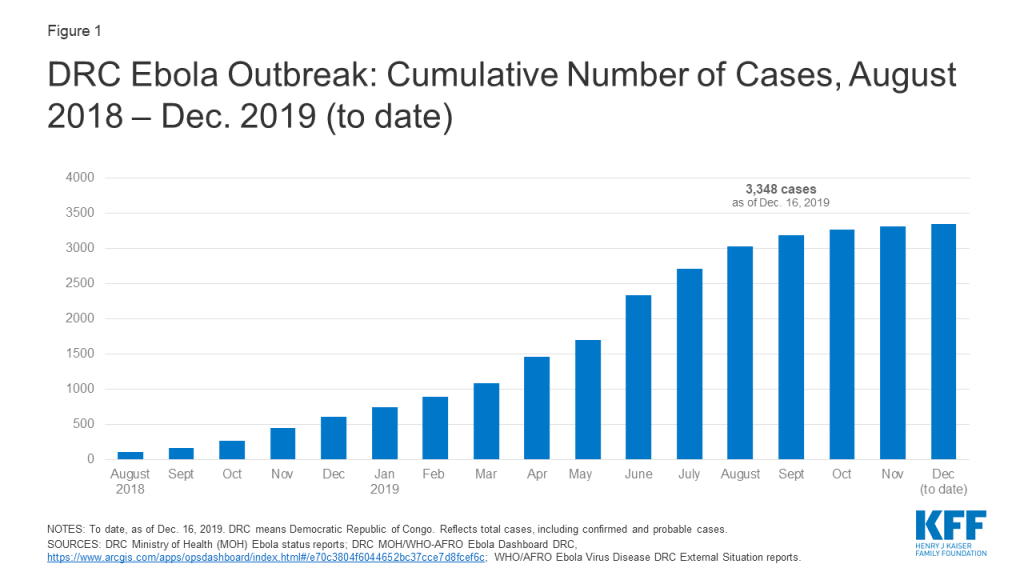
As of December 16, 2019, the DRC Ministry of Health reports the country has had 3,348 cases (see figure below), of which there were 2,210 deaths. The number of new cases reported each week has declined noticeably since the end of July 2019, indicating progress has been made in interrupting transmission. Still, cases continue to occur, and recent violence in some Ebola-affected areas has interrupted the response, sparking concerns about this potentially leading to an increase in Ebola cases. Regardless, response activities could be needed for another several months at least, and another increase in transmission remains a concern. The crude case fatality ratio for this outbreak is high, at 66%, as of December 16, 2019.

Figure 1: DRC Ebola Outbreak: Cumulative Number of Cases, August 2018 – Dec. 2019 (to date)

Health care workers (HCWs), such as nurses and doctors, caring for Ebola patients have been at particularly high risk of infection. At least 169 cases (about 5% of total cases) over the course of this outbreak have occurred among HCWs. This Ebola outbreak has also disproportionately affected children, with about 15 percent of all cases occurring among children under 5 and a higher proportion of the child cases dying from the disease compared with older age groups.

What are the key factors driving the outbreak in the DRC?

Multiple issues make responding to this Ebola outbreak more challenging than any prior outbreaks in the DRC. These include:

  • ongoing violence from armed groups that is impeding the response efforts, including violence against Ebola responders, amid long-standing conflict;
  • mistrust of the DRC government and outsiders, including Ebola responders, in affected communities;
  • disbelief in Ebola (studies find that many in the affected areas believe the Ebola outbreak is not real but rather a hoax perpetrated by the government or other outside parties);
  • a shortfall in funding for the Ebola response efforts in the DRC, despite increasing calls from the World Health Organization for donors to fill the gap; and
  • transitions in the leadership of the DRC government, including transitions in oversight of the Ebola response.

This combination of factors has made responding to this outbreak a much more difficult challenge compared with previous outbreaks in the DRC (see KFF brief).

Role of the U.S.

U.S. engagement in the current outbreak has been limited compared to its role in the 2014-2015 West Africa Ebola outbreak response, where the U.S. played a major leadership role, mobilizing an unprecedented amount of funding, other resources, and personnel to support the Ebola response. Since then, there have been improvements in the global capacity to respond to Ebola, particularly on the part of WHO, and the DRC has had significant experience in addressing prior Ebola outbreaks; both WHO and the DRC took the lead early on in the current outbreak (see KFF brief). In addition, insecurity in the affected areas of the DRC has prevented U.S. agencies from being more involved, as U.S. personnel have been mostly restricted from working directly in the hardest hit areas due to safety concerns. However, the U.S. has provided significant funding and technical assistance in the DRC and in neighboring countries, working in conjunction with national governments, United Nations (U.N.) agencies, and other organizations leading the response. In fact, the U.S. is the largest donor to the Ebola response effort in the country, having provided over $250 million since August 2018.

While the number of Ebola cases in the DRC continues to decline from a peak over the summer, major challenges remain for the U.S. and other responders, such as: completing the task of interrupting transmission even amid ongoing violence, preventing expansion of the outbreak into other geographic areas, and effectively transitioning from an emergency response to a longer-term development effort to help stabilize and build up health systems in the affected areas.

What U.S. agencies are involved in the response?

The U.S. Agency for International Development (USAID) and U.S. Centers for Disease Control and Prevention (CDC) are the two main agencies contributing to the U.S. government response. USAID’s Office of Foreign Disaster Assistance (OFDA) coordinates U.S. emergency response efforts in the DRC, and in September 2018, the agency deployed a Disaster Assistance Response Team (DART) to the DRC in response to the outbreak. USAID’s Bureau for Global Health provides operational and personnel support. Several CDC offices, including the Center for Global Health’s Division of Global Health Protection and the National Center for Emerging and Zoonotic Infectious Diseases’ Division of High-Consequence Pathogens and Pathology (NCEZID/DHCPP), provide technical and personnel support. CDC efforts in the DRC are coordinated through its Emergency Operations Center (EOC) in Atlanta, which was activated in June 2019 at its lowest level (level 3).

Other U.S. agencies engaged in Ebola efforts include the National Institutes of Health (NIH) (conducting research on drug and vaccine development, including Ebola treatment trials in the DRC); the U.S. Food and Drug Administration (FDA) (regulating drug and vaccine development); and the Department of State (coordinating the U.S. and international diplomatic response).

Are U.S. government personnel working in the outbreak areas in the DRC?

U.S. personnel have been assisting in the DRC since the outbreak was announced in August 2018, but since late August/early September 2018, no U.S. personnel have been allowed to directly engage in response activities in active transmission areas in northeastern DRC. Citing safety concerns due to ongoing violence there, U.S. officials have decided to keep CDC and other U.S. staff away from the front lines of the response. Outside experts have made calls for the U.S. to return CDC staff to affected areas to assist more directly. So far though, there is little indication that the U.S. government will deviate from its current policy, though CDC reports working with the U.S. Department of State to “pre-position CDC staff in Goma to rapidly respond to hotspots where the security situation is permissible.”

Outside of the outbreak zone, U.S. personnel continue to assist. The DART – a “team of disaster and health experts” from USAID and CDC – continues its work in the DRC in response to the outbreak. CDC reports 34 staff working the DRC. Other CDC workers have deployed to WHO headquarters and to neighboring countries, such as Uganda, to assist in keeping the virus from crossing borders and to support countries in preparedness and response activities.

How much funding has the U.S. provided?

USAID reports providing about $266 million toward the Ebola response in the DRC and surrounding countries since the outbreak began in August 2018. Of this amount, $252 million is for activities in the DRC, while $14 million is for preparedness and response activities in Burundi, Rwanda, South Sudan, and Uganda. No estimate is available for the amount that CDC has spent on its Ebola response activities, though WHO reports the CDC has provided $500 thousand in funding to its efforts. The funding for both USAID and CDC, as well as for other U.S. agencies, in the response is not new funding; rather, it has been drawn from unspent FY 2015 emergency Ebola supplemental appropriations provided by Congress at the time of the West Africa Ebola outbreak. For USAID, leftover funding in the International Disaster Assistance (IDA) account that was designated for “assistance for countries affected by, or at risk of being affected by,” Ebola is being utilized for this purpose, and for CDC, leftover funding that was designated for Ebola international preparedness and response is being utilized. CDC’s leftover funding expired at the end of FY 2019 on Sept. 30, 2019 and, per communication with CDC, was expected to have been entirely spent by that time. In recent months, Congress has stated that CDC may use existing funds in the Infectious Diseases Rapid Response Reserve Fund, which was established in FY 2019, for CDC Ebola response.

Global Response Activities

Who leads the response to the outbreak?

The DRC government, including the Ministry of Health, and agencies of the U.N. lead the outbreak response. WHO is the lead U.N. agency for the public health response; other key U.N. actors include the U.N. Office for Coordination of Humanitarian Affairs (OCHA), the U.N. Children’s Fund (UNICEF), the World Food Programme (WFP), and MONUSCO, a multinational peacekeeping force that has been assisting with security. U.N. actors are led by a U.N. Emergency Ebola Response Coordinator.

Other key actors in and supporters of the response include governments of various countries, including the U.S.; multilateral organizations, such as the World Bank and Gavi; international and national non-governmental organizations (NGOs), such as Medicins Sans Frontieres (MSF), International Medical Corps, the Alliance for International Medical Action (ALIMA), and the International Red Cross/Red Crescent; and other partners.

What is the plan for ending the outbreak in the DRC?

Current public health response efforts in the DRC are focused on interrupting chains of Ebola transmission through identifying, isolating, and caring for cases before they transmit the disease further. The goal of the response is to bring the number of cases down “to zero”. Ebola outbreaks are usually declared to be over after 42 days have passed since the last known case (equal to two incubation periods of Ebola virus disease). A national Strategic Response Plan outlines the overall strategy, objectives, and priority activities for responding to the outbreak. There have been four iterations of the plan to date, each covering a specific period of time. The current plan that focuses on the core public health “pillar” of the response covers planned activities from July through the end of December 2019. It addresses strengthening response capacities in priority areas such as: coordination, surveillance and laboratory capabilities, infection prevention and control measures, vaccination, human resources, security, and risk communication among others. Complementary humanitarian response activities are another “pillar” of the response and outlined in a broader integrated Ebola response strategy, which includes efforts addressing food assistance, employment, and economic development in Ebola-affected regions.

Has the outbreak been declared a global emergency?

On July 17, 2019, the WHO Director-General accepted the recommendation of the Emergency Committee and declared the DRC Ebola outbreak to be a “public health emergency of international concern” (PHEIC). A PHEIC is “an extraordinary event which is determined to constitute a public health risk to other States through the international spread of disease and to potentially require a coordinated international response.” In its declaration, WHO released a set of recommend actions for affected countries, neighboring countries, and all states. This was the fourth time the Emergency Committee had met to discuss a potential PHEIC declaration for Ebola in the DRC; each of the prior three times the Committee recommended not to do so.

At its most recent meeting, on October 17, 2019, the WHO Emergency Committee again recommended that the PHEIC declaration remain in place.

What has been the role of vaccination in the current outbreak?

Vaccination has been an important component of the response since it began. This outbreak marks the first time that an effective vaccine is available and being used as a core component of an Ebola response. Authorities have mostly used a “ring vaccination” approach, targeting vaccination of those who have been in contact with a case of Ebola and the contacts of those contacts, as well as other groups at potential risk of exposure such as health care workers. As of December 8, 2019, over 256,000 people have been vaccinated in the DRC since the start of the outbreak, which has likely prevented hundreds, if not thousands, of Ebola cases already. Authorities have been primarily using a vaccine manufactured by Merck, which the company has provided free of charge to WHO and the DRC for the purposes of the response. The Merck vaccine, which was being deployed on an emergency use basis under a “compassionate use” protocol, received approval from European regulators and prequalification from WHO in November 2019, making it the first officially licensed Ebola vaccine. It is not yet approved and licensed by the FDA (though it is under review and an FDA regulatory decision is expected in early 2020). Costs for vaccine distribution and management of vaccinations in the response are shared among Gavi, WHO, other donors, and the DRC government.

In addition to the vaccination efforts in the DRC, neighboring countries are also vaccinating certain people, such as health workers, in areas at risk of seeing or that have seen Ebola cases due to cross-border spread (like Uganda, with at least 5,000 people vaccinated thus far).

A second Ebola vaccine, manufactured by Johnson & Johnson, is also available. Following recommendations from WHO and other expert groups, the DRC government decided to introduce the second vaccine into some at-risk areas of the country that do not have active Ebola transmission. For example, DRC authorities began vaccinating 50,000 people in Goma with the second vaccine in November 2019, and in December 2019, the DRC and neighboring Rwanda initiated a new vaccination campaign using that vaccine to protect people in at-risk areas on their mutual border.

Is there an adequate supply of vaccine?

It appears there are enough doses of the Merck vaccine to meet the demands of the current WHO/DRC government’s ring vaccination approach. Currently there are enough vaccine doses to vaccinate 300,000 people, which is greater than the total number of people vaccinated in the outbreak over the first 17 months of the response. In addition, WHO reports that Merck will produce enough vaccine over the next 6 to 18 months to vaccinate an additional 1.3 million people. Gavi announced in December 2019 that it will support a new global stockpile of 500,000 doses of Ebola vaccine, to be made available for emergency use as needed.

There is reportedly an adequate supply of the second (Johnson & Johnson) Ebola vaccine, with enough to vaccinate approximately 2 million people.

Are treatments available for those infected with Ebola?

There are no FDA- or other approved treatments for Ebola, though several promising treatments are under development. Four experimental treatments have been studied in a clinical trial among Ebola patients in the DRC, and in August, the U.S. NIH announced that initial results of the trial indicated two of those treatments (the monoclonal antibody mAb114 and the multi-antibody “cocktail” REGN-EB3) showed the most promise. Ebola patients in the DRC enrolled in the trials are offered these two treatments as investigators further evaluate them. The treatments are still under investigation and being offered on a “compassionate use” basis only in the DRC.

What has the response cost, and how much funding has been provided?

From August 2018 through early December 2019 the amount of funding directed to response activities in the DRC included under four iterations of a national Strategic Response Plan has reached $361 million. This amount does not include additional DRC outbreak activities not captured under the plans, nor response costs in Uganda and preparedness costs in neighboring countries.

Funding amounts provided under each of the plans so far:

  • August – October 2018: DRC government data show that the first plan was fully funded, with $44.2 million made available to meet the $43.8 million requested for the August to October 2018 period the plan covered.
  • November 2018 – January 2019: U.N. data shows that the second plan was fully funded, with donors (largely the World Bank) providing $61.4 million (including some funds leftover from the first phase of the response) of the $61.3 million requested to cover the period through January 2019.
  • February – July 2019: U.N. data shows the third plan has received $109.3 million from February through July 2019, of the $147.9 million requested to cover the period through July 2019. This includes $40 million from the World Bank, with more promised, and $31.2 million from USAID.
  • July – December 2019: WHO data shows the current plan has received at least $148.3 million from August through early December 2019, of the $287.6 million requested for the public health pillar of the response through December (U.N. data tracking donor funding toward the current plan is not yet available, but WHO is reporting the funding it has received under the plan). The plan has substantially higher funding needs than prior iterations. The broader response strategy, which includes the funding requirements of the public health pillar within its funding assessment, is requesting more than $500 million for the broader DRC response through December; some donors, including the World Bank, United Kingdom, and the European Union, have already announced they will be providing additional funding for the response.

As mentioned earlier, USAID reports providing about $252 million toward the Ebola response in the DRC and about $14 million for activities in neighboring countries since the outbreak began in August 2018 (this includes funding channeled through the DRC national plans as well as funding not captured under the plans). No estimate is available for the amount that CDC has spent on its Ebola response activities, though WHO reports the CDC has provided $500 thousand in funding to its efforts. All U.S. funding for the current outbreak is drawn from existing funding sources (i.e., no new funding has been appropriated to agencies by Congress for this Ebola response, thus far).

See the KFF data note on donor funding for the response for further information.

Key Issues Going Forward

Now well into its second year, the Ebola outbreak in the DRC remains challenging for responders, despite having important tools (such as vaccines and new treatment options) on hand. This is because the underlying factors driving transmission of Ebola in the DRC remain. The security situation shows no sign of abating, and there is a fear that it can always worsen. Mistrust of public health authorities also remains a barrier to response efforts. While it is not possible to predict the trajectory of the outbreak, it could take at least a few more months to fully contain even under good circumstances, so given the complex set of challenges being faced, the outbreak could take even longer than that to be brought under control.

Addressing these longstanding challenges more effectively is the aim of the broader integrated response strategy being implemented in the DRC. This strategy, which includes the public health pillar’s current national plan and is designed to guide the response through the end of December 2019, calls for greater community engagement, support for health and development interventions beyond addressing Ebola alone, a new approach to security, and more coordination among all responders.

Finally, the major questions for the U.S. government going forward include: whether or not it will change its approach and engagement in the DRC to allow U.S. government personnel to directly engage in public health activities on the frontlines of the response, how the U.S. will contribute to finally breaking all chains of transmission, and how the U.S. will support efforts to transition from an emergency response to a longer-term strategy for supporting the health care system in the affected areas to help prevent and contain any future recurrences of Ebola or other outbreaks.

Additional Resources

  • DRC Ministry of Health – WHO AFRO Ebola in DRC dashboard
  • DRC Multisectoral Committee on Ebola Response (CMRE) daily situation reports (from Aug. 3, 2019)
  • DRC Ministry of Health daily situation reports (prior to Aug. 3, 2019)
  • WHO DRC Ebola situation reports (earlier reports)
  • WHO Ebola disease outbreak news
  • USAID DRC Crisis webpage
  • CDC Ebola Outbreak in the DRC webpage
  • KFF infographic Ebola: 5 Key Questions
  • KFF Ebola materials

Data Note: Donor Funding for the Current Ebola Response in the DRC

Published: Dec 19, 2019

Key Points

  • The ongoing Ebola outbreak in the Democratic Republic of the Congo (DRC) has required increasing amounts of external support from donors (for more information on the outbreak, see KFF’s explainer). Yet there has been limited information about donor funding to date and a lack of a centralized reporting mechanism for tracking funding.
  • This analysis provides an updated overview of donor funding for the DRC Ebola response by source. Highlights include:
    • We estimate that from August 2018, when the outbreak began, through early December 2019, approximately $734 million was provided by donors to address Ebola in the DRC.
    • More than half (57.8%) was provided by donor governments bilaterally, including the U.S., with a large share (40.1%) provided by multilateral and international organizations and a small proportion (2.2%) provided by non-profits, such as private foundations.
    • The U.S. provided the largest amount of support ($252 million), followed by the World Bank ($170 million), the United Kingdom ($78 million), the World Health Organization (WHO) Contingency Fund for Emergencies ($73 million), and the European Union ($52 million).
    • About half of funding (49%), including about a fifth of U.S. funding, was provided in direct support of the official DRC response plans, which guide national response strategy and enumerate resource needs. This could have implications for the coordination of donor efforts and whether funding is being directed to the most critical or pressing activities.
    • There is also considerable uncertainty about the future of U.S. support since it is unclear how much funding remains available for use in the response, whether the current administration will request additional funds, and whether Congress will provide such funding.

Donor Funding for the DRC Response

Based on analysis of publicly available information, we estimate that donors provided approximately $734 million in overall financial support for the DRC Ebola response from August 2018, when the outbreak began, through early December 2019 (see Table 1). We attributed funding to donor governments for Ebola when designated for this purpose, whether provided bilaterally to the DRC or earmarked for Ebola but provided to a multilateral organization or instrument. We attributed funding to a multilateral organization where that multilateral organization specifically designated general funds for this purpose. Data sources are provided in Table 1.

Table 1: Donor Funding for the Current Ebola Response in the DRC(Aug. 2018 – Dec. 11, 2019)
DonorEstimated Funding(in US$ millions)Data Source
TOTAL733.8 
Donor Governments424.0
     Australia0.4DRC/Partners SRP 3
     Canada2.2DRC/Partners SRP 3; WHO
     China3.5WHO
     Denmark4.8OCHA
     European Union52.4European Union
     France1.0OCHA
     Germany8.9WHO
     Ireland3.4OCHA; WHO
     Italy0.9   OCHA
     Japan5.1OCHA
     Luxembourg0.6WHO
     Norway3.5OCHA
     South Korea1.0WHO
     Sweden4.2WHO
     Switzerland1.4OCHA
     United Kingdom78.4U.K.; WHO
     United States252.4USAID; WHO
          Centers for Disease Control and Prevention (CDC)0.5WHO
          U.S. Agency for International Development (USAID)251.9USAID
               -Office of Foreign Disaster Assistance (OFDA)203.0USAID
               -Food for Peace (FFP)37.0USAID
               -Bureau for Global Health (GH) 12.0USAID
Multilateral and International Organizations294.0
     African Development Bank1.0WHO
     Gavi, the Vaccine Alliance26.5Gavi; WHO
     UNICEF0.3DRC/Partners SRP 2
     U.N. Central Emergency Response Fund (CERF)12.6U.N. CERF
     U.N. OCHA/DRC Humanitarian Fund10.0Humanitarian Fund
     WHO Contingency Fund for Emergencies (CFE)73.1WHO/CFE
     World Bank170.0World Bank; WHO
          Pandemic Emergency Financing Facility50.0World Bank; WHO
          International Development Association120.0World Bank; WHO
     World Food Programme (WFP)0.5DRC/Partners SRP 3
Non-Profits and Others15.9
     Gates Foundation6.0WHO
     Paul Allen Foundation0.7*WHO; KFF personal communication
     Susan T. Buffett Foundation5.0WHO
     Wellcome Trust4.2WHO
NOTES: Based on publicly-available information as of Dec. 11, 2019. * Reflects funding through Oct. 2019. May not sum to subtotal/total due to rounding. Does not include funding provided by the Democratic Republic of the Congo (DRC) government itself. OCHA amounts include commitments and paid contributions, not pledges and in-kind contributions. U.N.: United Nations. UNICEF: U.N. Children’s Fund. OCHA: Office for the Coordination of Humanitarian Affairs.

More than half (57.8%) of this funding was provided by donor governments bilaterally, including the U.S., with large share (40.1%) provided by multilateral and international organizations, such as the World Bank, and a small proportion (2.2%) provided by non-profits, such as private foundations.

The U.S. government was the largest donor, having provided $252.4 million for activities within the DRC (see Figure 1 and Box 1), followed by the World Bank ($170 million), the United Kingdom ($78.4 million), the WHO Contingency Fund for Emergencies ($73.1 million), and the European Union ($52.4 million).

Figure 1: Top 10 Donors to the Current Ebola Response in the DRC (Aug. 2018 – Dec. 11, 2019)

Box 1: Key Sources of U.S. Funding for the DRC Ebola Response

U.S. Agency for International Development (USAID)All of the USAID response funds to date have been drawn from unspent FY 2015 emergency Ebola supplemental appropriations, originally provided by Congress in December 2015. These funds, from USAID’s International Disaster Assistance (IDA) account, were designated for “assistance for countries affected by, or at risk of being affected by,” Ebola.Centers for Disease Control and Prevention (CDC)Although CDC has yet to publicly announce the amount of funding it has provided for the outbreak response in the DRC over the past year ($0.5 million is reported by WHO as having been contributed by the CDC), its Ebola response funds from Aug. 1, 2018, through Sept. 30, 2019, have been drawn from unspent FY 2015 emergency Ebola supplemental appropriations designated for Ebola international preparedness and response; according to communication with the agency, this funding was expected to be exhausted by the end of FY 2019, when it was due to expire. In recent months, Congress has stated that CDC may use existing funds in the Infectious Diseases Rapid Response Reserve Fund, which was established in FY 2019 with $50 million and could have additional funds added in FY 2020, for CDC Ebola response.

Funding for National Response Plans

The DRC government, U.N. agencies such as WHO, and other partners prepared four DRC national Strategic Response Plans (“the plans”) to guide and enumerate resource needs for the Ebola response (see Table 2). We found that about half (49%, $361 million) of donor funding for the response – including about a fifth (19%, $47.9 million) of U.S. funding – was identified as directly supporting the national plans.

Table 2: Funding Requested for the DRC Ebola Response Under National Plans(Aug. 2018 – Dec. 2019)
PeriodFunding Requested(in U.S. $ millions)Plan
Aug. – Oct. 201843.8Strategic Response Plan 1
Nov. 2018 – Jan. 201961.3Strategic Response Plan 2
Feb. – July 2019147.9Strategic Response Plan 3
July – Dec. 2019287.6Strategic Response Plan 4
NOTES: Reflects support for public health response activities; the current plan is complemented by a broader strategy that addresses additional activities related to the response. DRC: Democratic Republic of the Congo.

Donors met the funding requests in the first two plans and mostly met that of the third plan. As of early December, they have provided at least $148.3 million (via WHO) toward the fourth plan, which requests $287.6 million for public health response activities from July through December 2019.

Authorities in the DRC have also requested an additional $225.6 million for July through December 2019 under a broader strategy that includes other activities, such as economic development, to address social conditions that drive the outbreak. In support of this broader strategy, some donors have pledged more funding. The World Bank, for example, pledged up to an additional $300 million ($70 million of which has already been provided), and the United Kingdom pledged up to an additional $62.6 million, or £50 million ($9.7 million, or £8 million, of this funding has already been provided for preparedness efforts in neighboring countries, and $23.8 million of this funding has already been provided to WHO). More recently, the European Union has pledged an additional $54.7 million (€50 million) in support of the broader response.

Key Issues for the U.S. and Other Stakeholders

Maintaining a robust response to Ebola in the DRC over the next several months, and maybe even longer, will require additional donor funding. As such, there are several issues for the U.S. and other donors to consider:

  • Overall, information on donor financing is limited and fragmented. No systematic resource or tool for tracking contributions exists, a situation made more complex because the Ebola response is taking place in the context of a broad set of humanitarian crises with multiple multilateral and bilateral funding mechanisms contributing resources across a spectrum of activities (see KFF explainer). For the U.S. specifically, while some data are available, the full range of funding information has not been provided.
  • Coordination of donor funding outside official national response plans is unclear. With about half of donor funding for the response – including about a fifth of U.S. financial support – identifiable as directly supporting the official national response plans, it is not clear whether donor efforts are being coordinated effectively and funding provided for the most critical or pressing activities, including those identified under the official national response plans. With regard to the U.S. specifically, there is limited information about how U.S. funding and efforts are coordinated with U.N. and DRC-led efforts.
  • The status of U.S. funding going forward is uncertain. It is unclear how much funding remains available for use in the U.S. response, whether the current administration will request additional funds, and whether Congress will provide such funding. At USAID, it is unclear what funds remain in the leftover FY 2015 emergency Ebola funding being used for response activities. At CDC, all leftover FY 2015 emergency Ebola funding was to be spent out entirely by the end of FY 2019, but the agency may use funds from the emergency reserve fund for its Ebola activities in FY 2020 (see Box 1).

Global Health Funding in the FY 2020 Conference Agreement

Published: Dec 19, 2019

The FY 2020 appropriations conference agreement, released by Congress on December 16, 2019 and passed by both the House (12/17) and the Senate (12/19), includes funding for U.S. global health programs at the State Department, the U.S. Agency for International Development (USAID), the Centers for Disease Control and Prevention (CDC), and the National Institutes of Health (NIH). The agreement still needs to be signed by the President. Key highlights are as follows (see table for additional detail):

State Department & USAID:

  • Funding for global health programs, through the Global Health Programs (GHP) account, which represents the bulk of global health assistance, totaled $9.1 billion, an increase of $255 million above the FY 2019 enacted level, and $2.7 billion above the President’s FY 2020 request.
  • Bilateral HIV funding through the President’s Emergency Plan for AIDS Relief (PEPFAR) is $4,700 million, flat compared to the FY19 enacted level, but $1,350 million above the FY20 Request ($3,350 million).
  • The bill includes $1,560 million as the U.S. contribution to the Global Fund to Fight AIDS, Tuberculosis and Malaria (Global Fund), an increase of $210 million above the FY19 enacted level ($1,350 million) and $602 million above the FY20 Request ($958 million). The bill states that this amount is for the first installment of the sixth replenishment. In addition, the explanatory statement accompanying the bill reaffirms the U.S. share of 33% of contributions.
  • Funding for tuberculosis (TB) totals $310 million, $8 million above the FY19 enacted level, and $49 million above the FY20 Request ($261 million).
  • Funding for malaria totals $770 million, $15 million above the FY19 enacted level ($755 million), and $96 million above the FY20 Request ($674 million).
  • The bill includes $851 million for maternal and child health (MCH), an increase of $16 million above the FY19 enacted level ($835 million), and $231 million above the FY20 Request ($629 million). Specific areas under MCH include:
    • Gavi, the Vaccine Alliance funding totals $290 million, matching the FY19 enacted level, and $40 million above the FY20 Request ($250 million).
    • Polio funding through all accounts totals $61 million, $2 million above the FY19 enacted level ($59 million), and $38 million above the President’s FY 2020 Request.
    • The bill includes $139.0 million for the U.S. contribution to the United Nations Children’s Fund (UNICEF) provided through the International Organizations and Programs (IO&P) account, $1.5 million above the FY19 enacted level ($137.5 million). While the FY20 Request did not specify a funding amount for UNICEF and proposed to eliminate the IO&P account, it is possible that organizations such as UNICEF could receive funding through other accounts.
  • Funding for nutrition totals $150 million, $5 million above the FY19 enacted level ($145 million), and $71 million above the FY20 Request ($79 million).
  • Bilateral family planning and reproductive health (FP/RH) funding totals $575 million ($524 million through the GHP account and $51 million through the ESF account), matching the FY19 enacted level, and $316 million above the FY20 Request ($259 million).
  • Funding for the United Nations Population Fund (UNFPA) totals $32.5 million, matching the FY19 enacted level; the FY20 Request proposed eliminating funding for UNFPA.
  • Funding for the vulnerable children program totals $25 million, $1 million above the FY19 enacted level ($24 million); the FY20 Request proposed eliminating funding for this program.
  • Funding for neglected tropical diseases (NTDs) totals $102.5 million, matching the FY19 enacted level, and $27.5 million above the FY20 Request ($75 million).
  • Funding for global health security (GHS) totals $100 million in the bill. While this is a decrease compared to the FY19 enacted level ($138 million), $38 million of the FY19 amount was provided through a one-time transfer of unspent emergency Ebola funding. The FY20 conference agreement amount is a $10 million increase compared to the FY20 Request ($90 million).

Centers for Disease Control and Prevention (CDC): Funding for global health provided to the CDC totals $571 million, an increase of $75 million compared to the FY19 enacted level ($496 million) and $114 million above the FY20 Request ($457 million). The entire increase in CDC funding is to support global health security activities.

Fogarty International Center (FIC): Funding for the Fogarty International Center (FIC) at the National Institutes of Health (NIH) totaled $81 million, $3 million above the FY 2019 enacted level ($78 million) and $14 million above the FY20 Request.

Additional Global Health Legislation: The appropriations bill also included the “End Neglected Tropical Diseases Act” as well as the “Preventing Child Marriage in Displaced Populations Act.” Learn more about these two bills on the KFF U.S. Global Health Legislation Tracker here.

Additional Resources:

The table below compares global health funding in the FY 2020 conference agreement to the FY 2019 enacted funding amounts as outlined in the “Consolidated Appropriations Act, 2019” (P.L. 116-6; KFF summary here), the President’s FY 2020 request (KFF summary here).

Table: KFF Analysis of Global Health Funding in the FY20 Conference Agreement
Department / Agency / AreaFY19Enactedi(millions)FY20Requestii(millions)FY20Conference Agreement(millions)Difference(millions)
FY20 Conference– FY19 EnactedFY20 Conference– FY20 Request
 State & Foreign Operations (SFOPS)
HIV/AIDS$4,700.0$3,350.0$4,700.0$0(0%)$1350(40.3%)
State Department$4,370.0$3,350.0$4,370.0$0(0%)$1020(30.4%)
USAID$330.0$0.0$330.0$0(0%)$330.0(NA)
of which Microbicides$45.0$0.0$45.0$0(0%)$45.0(NA)
Global Fund$1,350.0$958.4$1,560.0$210(15.6%)$601.6(62.8%)
Tuberculosisiii$262.0
Global Health Programs (GHP) account$302.0$261.0$310.0$8(2.6%)$49(18.8%)
Economic Support Fund (ESF) accountNot specified$1.0Not specified
Malaria$755.0$674.0$770.0$15(2%)$96(14.2%)
Maternal & Child Health (MCH)ivv
GHP accountvi$835.0$619.6$851.0$16(1.9%)$231.4(37.3%)
of which Gavi$290.0$250.0$290.0$0(0%)$40(16%)
of which Poliovi$51.5$16.0$61.0$9.5(18.4%)$45(282.2%)
UNICEFvii$137.5Not specified$139.0$1.5(1.1%)
ESF accountNot specified$75.5Not specified
of which Poliovi$7.5$7.0vi
Nutritionviii$89.7
GHP account$145.0$78.5$150.0$5(3.4%)$71.5(91.1%)
ESF accountNot specified$11.2Not specified
Family Planning & Reproductive Health (FP/RH)$607.5$259.0$607.5$0(0%)$348.5(134.6%)
Bilateral FPRH$575.0$259.0$575.0$0(0%)$316(122%)
GHP account$524.0$237.0$524.0$0(0%)$287(121.1%)
ESF account$51.1$22.0$51.1$0(0%)$29.1(132%)
UNFPA$32.5$0.0$32.5$0(0%)$32.5(NA)
Vulnerable Children$24.0$0.0$25.0$1(4.2%)$25.0(NA)
Neglected Tropical Diseases (NTDs)$102.5$75.0$102.5$0(0%)$27.5(36.7%)
Global Health Security$138.0$90.0$100.0$-38(-27.5%)$10(11.1%)
GHP account$100.0$90.0$100.0$0(0%)$10(11.1%)
Ebola transfer$38.0$0.0$0.0$-38(-100%)$0.0(0%)
Emergency Reserve Fund$2.0$0.0ix
Ebola transfer$2.0$0.0$0.0$-2(-100%)$0.0(0%)
SFOPs Total (GHP account only)$8,837.5$6,343.5$9,092.5$255(2.9%)$2748.9(43.3%)
Health & Human Services (HHS)
Centers for Disease Control & Prevention (CDC) – Total Global Health$495.8$457.0$570.8$75(15.1%)$113.9(24.9%)
Global HIV/AIDS$128.4$69.5$128.4$0(0%)$58.9(84.7%)
Global Tuberculosisx$7.2$7.2$7.2$0(0%)$0(0%)
Global Immunization$226.0$206.0$226.0$0(0%)$20(9.7%)
Polio$176.0Not specified$176.0$0(0%)
Other Global Vaccines/Measles$50.0Not specified$50.0$0(0%)
Parasitic Diseases$26.0$24.5$26.0$0(0%)$1.5(6.3%)
Global Public Health Protectionxi$108.2$149.8$183.2$75(69.3%)$33.4(22.3%)
Global Disease Detection and Emergency Response$98.4Not specified$173.4$75(76.2%)
of which Global Health Security (GHS)$50.0$99.8$125.0$25.2(25.3%)
Global Public Health Capacity Development$9.8Not specified$9.8$0(0%)
National Institutes of Health (NIH) – Total Global Health$880.2$760.1Not yet known
HIV/AIDS$590.1$511.1Not yet known
Malaria$212.0$182.0Not yet known
Fogarty International Center (FIC)$78.1$67.0$80.8$2.7(3.4%)$13.8(20.5%)
Notes:
i – The FY19 Enacted includes the transfer of $40.0 million in unspent Emergency Ebola funding including: $2.0 million for the Emergency Reserve Fund and $38.0 million for “programs to accelerate the capacities of targeted countries to prevent, detect, and respond to infectious disease outbreaks.”
ii – In the FY20 Request, the administration proposed to consolidate the Development Assistance (DA), Economic Support Fund (ESF), the Assistance for Europe, Eurasia, and Central Asia (AEECA), and the Democracy Fund (DF) accounts in to one new account — the Economic Support and Development Fund (ESDF). ESF funding for the FY20 Request reflects the amounts requested by the administration for ESDF.
iii – Some tuberculosis funding is provided under the ESF account, which is not earmarked by Congress in the annual appropriations bills and determined at the agency level (e.g. in FY17, TB funding under the ESF account totaled $2.64 million).
iv – Some MCH funding is provided under the ESF account, which is not earmarked by Congress in the annual appropriations bills and determined at the agency level (e.g. in FY17, MCH funding under the ESF account totaled $56.54 million).
v – It is not possible to calculate total MCH funding in the FY20 request because UNICEF, which has historically received funding through the International Organizations and Programs (IO&P) account, was not specified in the FY20 request.
vi – The minority summary of the FY20 conference agreement states that part of the increase in MCH funding is “due to a shift of $7.5 million for polio prevention programs from the Economic Support Fund account to the Global Health Programs account.”
vii – UNICEF funding in the FY19 bill and the FY20 Conference Agreement both include an earmark of $5 million for programs addressing female genital mutilation.
viii – Some nutrition funding is provided under the ESF account, which is not earmarked by Congress in the annual appropriations bills and determined at the agency level. (e.g. in FY17, nutrition funding under the ESF account totaled $21 million).
ix – The explanatory statement accompanying the FY20 Conference Agreement states that the “agreement includes authority to reprogram $10,000,000 of Global Health Program funds to the Emergency Reserve Fund if necessary to replenish amounts used during fiscal year 2020 to respond to emerging health threats.”
x – In FY20, the administration proposed to formally transfer $7.2 million from the “HIV/AIDS, Viral Hepatitis, STI and TB Prevention” account to “Global Tuberculosis” activities under “Global Health Programs” at CDC. The FY20 conference agreement formalizes this transfer. The FY19 total has been adjusted to reflect this administrative change.
xi – In the CDC FY20 congressional justification, this funding line is titled “Global Disease Detection and Other Programs”.
Updated: December 19, 2019

10 Key Questions on Public Option Proposals

Authors: Tricia Neuman, Karen Pollitz, Jennifer Tolbert, Robin Rudowitz, and Wyatt Koma
Published: Dec 18, 2019

Several democratic presidential primary candidates and Members of Congress have proposed or endorsed a “public option” to expand health coverage and lower health care costs, giving people the choice between private insurance and a publicly-sponsored plan. The approaches of public option proposals differ from Medicare-for-all in that they expand upon, rather than replace, current sources of coverage (e.g., employer-sponsored plans, the marketplaces, Medicare, and Medicaid). Similar to Medicare-for-all, a public option could make broader use of Medicare-like provider payment rates, lowering the cost of coverage relative to private insurance. Recent polls find greater support for a public option than for Medicare-for-all.

Democratic candidates Biden, Buttigieg, Steyer, and Warren have each proposed a public option approach that aims to broaden coverage and make health care more affordable. Senator Warren describes her public option as an incremental measure before pushing for subsequent passage of separate Medicare-for-all legislation. Public option proposals vary in how many people would gain coverage, the number of people who shift from their current health plan to the public option, the potential size of the public option, the affordability of coverage, and changes in spending by the federal government and other payers. The impact on coverage and affordability would depend on factors such as eligibility criteria, the scope of covered benefits, the level of subsidies provided, and provider payment rates. See Table 1 for short descriptions of each proposal.

This issue brief presents a high-level view of key questions regarding current public option proposals supported by both presidential candidates and Members of Congress.

Background

As Congress debated the Affordable Care Act (ACA) ten years ago, some lawmakers supported a public option to address anticipated concerns about private insurer participation in new ACA marketplaces and the stability of private plan offerings, and to leverage greater competition to help lower costs and premiums in the marketplaces. The House-passed version of the ACA included a public option, offered only through the marketplace, which would cover the same benefits and be subject to the same standards as other marketplace plans. Ultimately, that provision was dropped from the final legislation when it was considered by the Senate.

Since then, some policymakers have continued to press for a public option. Congressional bills to establish a public option since 2017 have evolved and included other ACA enhancements. This year, presidential candidates have proposed public options that could be even more expansive, offering more Americans a choice between their current private-sector coverage and a public option. Some are described as a glide path or transition to Medicare-for-all.

The health insurance industry and many provider organizations have opposed a public option. Private insurers raise concerns that they would have difficulty competing on a level playing field with a public option, and ultimately would be put out of business. Hospitals and other health care providers raise concerns about the adequacy of payment rates in a public option and potential loss of revenues.

1. How would a public option differ from Medicare-for-all?

Unlike Medicare-for-all, a new public option would be offered as an option for eligible individuals rather than replacing current sources of coverage. Under most proposals, the public option would be administered by the federal government, as Medicare is today. An alternative approach would allow states to build a public option based on the Medicaid program.

Medicare-for-all proposals aim to achieve universal and cradle-to-grave coverage. In contrast, under a public option proposal, people could still be at risk for coverage lapses when life events (such as job loss or a change in income) force transitions. Some proposals try to minimize coverage gaps by providing for the automatic enrollment of the uninsured or others into the public option. The extent to which a public option would move toward universal coverage would depend in large part on how much it would increase affordability of insurance through lower payment rates to providers and increased subsidies for individuals.

2. Who would be eligible for the public option?

Eligibility for the public option varies across proposals, and some proposals would provide for auto-enrollment of certain individuals. Examples of eligibility differences include:

  • Marketplace participants only – Some proposals would offer the public option only in the marketplace; others would further limit the option to marketplace eligible individuals age 50-64.
  • Employers – Employers would also have access to the public option under some proposals. Several congressional bills would allow small employers to purchase or provide group coverage through the public option, as would the proposal by presidential candidate Buttigieg; one of these bills also opens the public option to large employers and permits employees to remain in the public option if they change jobs.
  • People who are offered employer coverage – Presidential candidates Biden, Buttigieg, Steyer, and Warren as well as a congressional proposal, known as Medicare for America, would adopt a more expansive approach that allows workers (and their dependents) who are offered job-based coverage to instead enroll in the public option and receive subsidies for their coverage. This approach differs from current law in that those with an offer of job-based coverage are generally ineligible for marketplace subsidies.1  Allowing people to get coverage through a subsidized public option, instead of their employer, could make the public option a particularly attractive alternative for low-wage workers and their families.
  • People eligible for Medicare or Medicaid – With the exception of the congressional proposal, Medicare for America, the other public option congressional proposals would not allow people eligible for the current Medicare or Medicaid programs to enroll in the public option. Medicare for America would replace Medicare and Medicaid with the new public program. Buttigieg and Warren open the public option to individuals enrolled in Medicaid, while Biden and Steyer would allow states to shift some or all of their Medicaid enrollees into the public option. In addition, Biden, Buttigieg and Steyer would automatically enroll into the public option all eligible low-income individuals living in states that have not expanded Medicaid..Warren’s proposal would enroll all children and adults with incomes below 200% of poverty who are younger than age 50 into the public option, though individuals may opt out for other coverage.2  Warren would make older adults (50-64) eligible for expanded coverage under the existing Medicare program. The Warren approach would offer an alternative to Medicaid coverage for the majority of low-income people currently eligible for Medicaid.
  • Immigrants – Most proposals would exclude undocumented immigrants from coverage. Warren would extend eligibility for marketplace subsidies to those eligible for the Deferred Action for Childhood Arrivals program, which would make them eligible for her public option, and Steyer would allow undocumented immigrants to enroll in the public option. Other proposals do not specify.

As noted above, several proposals would auto-enroll certain individuals into the public option with no premium, with an “opt out” if they prefer other coverage – an approach that would expand the size of the public program. The Medicare for America bill would auto-enroll everyone in the public option, while allowing people with access to qualified employer coverage to opt out.

3. How would benefits under a public option compare to other coverage?

Under the Biden and Buttigieg proposals and others the public option would cover essential health benefits, similar to marketplace qualified health plans (QHPs) and most employer-sponsored health plans.3  Biden’s proposal would extend the “full scope of Medicaid benefits” to enrollees with income up to 138% of poverty. Congressional proposals to create a Medicare buy-in option for older adults would give enrollees the same benefits as the current Medicare program, which differ somewhat from essential health benefits; for example, the current Medicare program does not have a limit on out-of-pocket spending.

Several proposals specify that reproductive services, including abortion, would be covered under the public option, and that the Hyde Amendment, which prohibits federal funding for abortion services in most circumstances, would be repealed.

Under Senator Warren’s proposal and the Medicare for America bill, the public option would cover a substantially broader set of benefits, including long-term services and supports (LTSS), dental benefits, and others. A public option that covers more comprehensive benefits with a broader network of providers than private plans could attract a sicker and more expensive population, which could increase the cost of the public option (and taxes required to support it) while relieving families and others of these expenses.

4. What about cost sharing and cost-sharing subsidies in the public option?

Rising deductibles and cost-sharing requirements are a growing concern for people with job-based and marketplace coverage. Over the past decade, deductibles in employer plans have risen six times faster than wages. The average deductible under silver-tier marketplace plans is $4,544 per person in 2020 (unweighted), though cost-sharing reduction (CSR) subsidies, available to people with income up to 250% of the federal poverty level (FPL), reduce silver plan deductibles for about half (52%) of marketplace enrollees.

Candidates Biden, Buttigieg, and Steyer would reduce ACA cost-sharing for those in both marketplace plans and the new public option. Their proposals would set the benchmark marketplace plan at the gold level, instead of silver, to lower deductibles and other out-of-pocket costs. Some proposals would expand eligibility for cost-sharing subsidies to those with income above 250% FPL, and up to 400% FPL in some cases.4  Proposals that let would employees elect the public option and receive subsidies instead of job-based coverage could extend cost sharing relief to some low-wage workers.

Warren takes a different approach. In addition to enhancing marketplace cost-sharing subsidies as do the other candidates, cost sharing under the public option would be even lower. Cost sharing in Warren’s public option would be set at the platinum level (which covers 90% of costs) instead of gold (which covers 80% of costs). In addition, deductibles would be eliminated for all public option enrollees, and there would be no cost sharing for enrollees with income up to 200% FPL. Co-insurance would apply for people with incomes above 200% FPL up to an out-of-pocket cap, but would phase out over time. These features would reduce out-of-pocket health care spending for many people relative to private insurance.

5. How would premiums and premium subsidies work?

How attractive the public option is to individuals will largely depend on the relative affordability of premiums in the public option. The availability and level of premium subsidies will be an important factor, particularly to individuals who are currently ineligible for marketplace subsidies due to income or because they are offered employer coverage. Other factors that could affect the premium in the public option include benefits and cost sharing, and provider payment rates. Premiums for public option enrollees could be higher (or lower) depending on the risk profile of individuals who elect coverage under the public option. If the public option experiences adverse selection, premiums could be higher than private insurance and rise over time, although in virtually all proposals, public option premiums would be capped as a percentage of income for enrollees.

Like marketplace plans, the public option premiums generally could vary by age, geography, family size, and tobacco use.

Most proposals would expand premium subsidies relative to those that are currently available to marketplace enrollees. Several would make the public option free for low-income people – those with income up to 200% FPL under Warren’s proposal, and up to 138% FPL for some or all people under proposals by Biden, Buttigieg, and Steyer. Many would also cap premium contributions for people with higher incomes. Premiums would be capped at 5% of income under Warren, 8% under Medicare for America, and 8.5% under Biden, Buttigieg, and Steyer. These caps are lower than the current 9.78% premium cap, which is only available to people with incomes up to 400% of poverty. Premiums would be eliminated over time under the Warren proposal. In addition, all of the candidate proposals and the Choose Medicare Act (Sen. Merkley/ Rep. Richmond) would enhance marketplace premium subsidies by changing the benchmark plan, on which subsidies are based, from silver level to gold level.

6. How would health care providers be affected?

The relative affordability of the public option would also depend on the level of provider payments. This is because private insurers typically pay higher prices than Medicare for covered services. For example, a Congressional Budget Office (CBO) analysis found that Medicare hospital payment rates were 47% below those of commercial insurers, on average, though with wide variation by geography and other factors.5  Medicare’s role in setting payment rates has contributed to slower growth in spending for Medicare than private insurance. Adopting Medicare rates could also reduce or eliminate the problem of surprise medical bills, as Medicare limits what providers can charge and prohibits balance billing.

However, health care providers are likely to oppose this approach, based on concerns about the adequacy of payment rates, and the impact on patient care. An ongoing question is how hospitals and other health care providers would respond to lower payment rates, and whether they would be able to achieve efficiencies without jeopardizing quality of care.

  • Use of Medicare payment rates – Several proposals would build on the Medicare provider payment system. The Warren proposal, for example, would phase down payment rates before ultimately paying 110% of Medicare rates for hospitals and Medicare rates for other providers once the Medicare-for-all program takes effect. Buttigieg would limit out-of-network payment rates for all hospitals and providers at 200% of Medicare rates, with the public option presumably paying no more than that; rural providers would receive higher payments. Some other proposals do not specify the level of provider payments under the public option, saying more generally that they would be “based on” Medicare rates..Another approach included in the Merkley/Richmond bill would allow self-funded employer plans to contract with the public option as a third party administrator (TPA). This would give employers access to the public option’s provider network and payment rates. Under this proposal, over time, the public option could move toward an all-payer-rate setting system, even while preserving private employer coverage and financing.
  • Provider participation in the public option – Proposals also vary in whether they encourage providers to participate in the public option. Under proposals by Warren and Steyer, hospitals, physicians and other health care providers who participate in the current Medicare (and Medicaid) programs would also participate in the public option. In other proposals, such as the Medicare-X Choice Act introduced by Senator Bennet, provider participation in the public option would not be linked to participation in Medicare. Others, such as Biden and Buttigieg, do not specify.Part of the appeal of the current traditional Medicare program is its broad and national provider network. If provider participation in the new public option is not tied to Medicare, this could result in a narrower provider network, which could be a concern for enrollees. Moreover, voluntary participation could undermine the government’s ability to set lower payment rates than it could if all or virtually all providers participated, as is now the case with the current Medicare program.

7. How would public option proposals affect employer-sponsored and other private coverage?

One controversial element of Medicare-for-all is that it would replace private coverage that people have today. Public option proposals would instead retain current coverage and offer an additional choice. Candidates Biden, Buttigieg, Warren and Steyer all would let people with job-based plans opt for the public option and receive subsidies for that coverage (this is also a feature of the Medicare for America bill). Warren would also offer substantially more generous benefits under the public option than most employers offer today. The relative attractiveness of the public option – e.g. due to its covered benefits or subsidies – could lead more workers to elect it over time, ultimately diminishing the role of employer coverage.

The broad availability of a public option could also lead some employers to decide to stop offering plans they sponsor today. Whether and which firms continue offering private coverage would depend on a number of factors, including how many enrollees would prefer to keep their employer plan, the average cost of covering remaining employees, and the employer’s cost of maintaining the plan relative to the cost of paying the large employer mandate penalty under the ACA. The substantial federal tax preference accorded to employer-sponsored group health benefits today could also affect decisions of firms to keep offering job-based coverage and worker decisions to participate. Unlike wages, health benefits are not subject to federal income or payroll tax.

The public option could also significantly affect non-group insurance. A public option could strengthen incentives for private insurers to compete on value and cost. A new public option could offer consumers an additional plan choice, particularly in marketplace areas served by a single insurer. On the other hand, if private insurers are unable to compete effectively, the public option could draw substantial enrollment away from them and might become the sole option in at least some areas.

8. How would public option proposals affect the current Medicare program?

All of the public option proposals would retain the current Medicare program. Although many invoke the Medicare name, such as Medicare For All Who Want It, Medicare Choice, and Medicare Part E, the new public options are intentionally structured to be separate from the current Medicare program and differ from it in many respects.

Most proposals would not allow people who are eligible for the current Medicare program to enroll in the new public option, and most leave the current program as is. Some create a firewall between the new public option and Medicare, explicitly stating that the new public option will not have any effect on premiums in the current Medicare program or finances (e.g. the Medicare Hospital Insurance Trust Fund).

Some proposals would make improvements to the current Medicare program. The Buttigieg proposal and the Merkley bill, for example, would add an out-of-pocket limit to traditional Medicare. The Higgins bill would create a new voluntary Medigap option to make cost sharing more affordable for people with Medicare. Virtually all of the proposals would address the price of prescription drugs in Medicare as they do for the public option (e.g., allow the government to negotiate lower prices). Warren’s proposal would match benefits under the current Medicare program to the public option “to the extent possible”.

In contrast to other proposals, the Warren proposal would lower the age of eligibility for Medicare to 50, but would allow people age 50-64 to go in (or out) of the Medicare program. Her proposal would automatically enroll all 50-64 year olds who are uninsured or living on incomes below 200% of poverty into the Medicare program with no premiums, deductibles or cost sharing. This approach would substantially increase the size of the current Medicare program, and could potentially affect the Medicare Hospital Insurance Trust Fund unless safeguards are put in place. At the same time, the infusion of younger adults into the current Medicare program could lead to lower per capita costs, which could result in lower Medicare premiums.

9. How would public option proposals affect Medicaid?

Proposals also differ in what happens to the Medicaid program and in how they address the coverage gap in states that have not adopted the Medicaid expansion. Many congressional proposals would retain the Medicaid program and would not permit people eligible for Medicaid to enroll in the public option; they also would not address the lack of coverage for poor adults living in states that did not expand Medicaid. In contrast, the presidential candidates’ proposals and the Medicare for America bill would have broader implications for Medicaid, and most would cover low-income adults in non-expansion states.

Candidates Biden, Buttigieg, and Steyer would auto-enroll into the public option low-income uninsured individuals living in the 14 states that did not expand Medicaid. These individuals would receive free coverage through the public option. The Buttigieg plan would allow individuals who are uninsured, have private coverage or Medicaid to opt into the public option while plans offered by Biden and Steyer would allow states to shift some or all of their Medicaid enrollees into the public option and make a maintenance of effort (MOE) payment instead, though how that MOE would work is not specified. These proposals do not specify whether the public option would cover all benefits that are currently covered by Medicaid, such as LTSS and non-emergency medical transportation, for this population.

Warren’s proposal would auto-enroll into the public option, with an opt out, a much larger group of people, including people who are currently eligible for Medicaid or in the Medicaid coverage gap. Children up to age 18 would be auto-enrolled, as would adults up to age 50 with incomes below 200% of poverty. Adults age 50-64 would be eligible for Medicare. Under this proposal, the public option and expanded Medicare program would be offered as an alternative to Medicaid and CHIP. States would also be permitted to move other Medicaid enrollees into the public option and make an MOE payment instead, thus eliminating Medicaid altogether in these states.

This proposal raises a number of important questions for the Medicaid population, particularly adults age 50-64 with long-term care needs, as well as for states. For example, while the public option would guarantee coverage vision, dental, and LTSS, these benefits would only be provided to the “greatest extent possible” under Medicare. The proposal also does not specify if low-income individuals ages 50-64 in Medicare would have access to free coverage, as would be the case for younger adults and children under the public option.

Unlike other proposals, the Medicare for America bill would explicitly eliminate the Medicaid program, moving all Medicaid enrollees into the public option. To ensure Medicaid enrollees receive the same coverage under the public option, Medicare for America would cover all benefits provided by state Medicaid programs as part of the benefit package.

One congressional bill (Schatz/Lujan) differs from the others in that it would permit states to build on the existing Medicaid infrastructure to create a Medicaid-like public option. Yet, even with this proposal, the Medicaid program would remain intact for existing Medicaid enrollees — the Medicaid buy-in would target those who are eligible for marketplace coverage, not those currently eligible for Medicaid. Although it seeks to address the coverage gap, it would do so by extending 100% federal financing for the expansion for three years for any state that newly adopts the expansion. Individuals with incomes below 138% of poverty in states that continue to refuse to adopt the expansion would remain uninsured and without an affordable coverage option.

10. What do we know about the cost of these proposals?

The Congressional Budget Office (CBO) has not estimated any of the public option bills introduced in the 116th Congress. In general, a public option can be expected to have less of an effect on federal spending and revenues than Medicare-for-all. The federal cost of a public option could be higher or lower depending on many factors, including benefits, subsidies, the number of people who enroll, and the extent to which costs shift from individuals and other payers to the public option. Federal spending could also rise due to induced demand resulting from more people with coverage, and lower cost-related barriers to care. New federal costs could be offset somewhat to the extent the public option uses lower provider payment rates. The cost of federal marketplace subsidies could also be offset to the extent that public option premiums are lower than what commercial insurers charge today, depending on the details of how subsidies are determined.

A public option could also affect costs borne by individuals, employers and states. Proposals that provide enhanced cost-sharing and premium subsidies in the public option, and make more people eligible for these subsidies, could improve affordability for millions of Americans. However, public option proposals do not go as far as Medicare-for-all proposals that eliminate premiums and cost-sharing and provide comprehensive benefits. Employers could realize savings if employees opt into the public option, subject to contribution requirements. Employers could also achieve savings if they are able to access public option provider payment rates. The fiscal impact on states would depend on the extent to which Medicaid enrollees would shift to the public option, and related MOE requirements.

Discussion

Recent polls have shown substantial support for a public option, relative to Medicare-for-all, in part because it would give individuals another “choice” rather than require all people to be covered under one program that replaces current sources of coverage. Public support for Medicare-for-all drops when people are told that it would eliminate private insurance and employer-sponsored coverage, and threaten the Medicare program. The public option is viewed as less disruptive than Medicare-for-all, even though it could replace a significant amount of private plan coverage under some proposals. In fact, support for a public option drops when people are told it could reduce payments to hospitals and doctors or lead to too much government involvement in health care.

A public option could have a modest or significant effect on health coverage and costs in the U.S., depending on how it is structured. The effect could be minimal if the public option is available to a limited subset of the population, with benefits, cost sharing and subsidies similar to marketplace coverage, and if providers can participate voluntarily with little change in their payment rates. However, a public option could have a more dramatic impact on coverage and costs if it is widely available, offers more comprehensive benefits at lower costs, extends subsidies to people now in job-based plans, and uses Medicare provider payment rates.

Ultimately, with many different proposals on the table, it is important to examine key details that could determine the impact of a public option on coverage and affordability, and the level of disruption to the current health care system.

Table 1: Public Option Proposals Introduced by Presidential Candidates
PRESIDENTIAL CANDIDATES’ PUBLIC OPTION PROPOSALS
ProposalGeneral Approach
Biden

The Biden Plan To Protect & Build On The Affordable Care Act

  • Creates a federal public option available to marketplace-eligible individuals, people with employer coverage, and low-income adults in the Medicaid coverage gap; low-income uninsured in coverage gap states automatically enrolled
  • Allows Medicaid expansion states to move expansion adults into the public option with MOE
  • Covers ACA essential health benefits; provides “full scope of Medicaid benefits” to those <138% FPL
  • Sets Gold-level plan as marketplace benchmark plan to increase premium subsidies and lower deductibles and out-of-pocket costs for all marketplace enrollees
  • Eliminates income limit on eligibility for premium tax credits and caps premium payments at 8.5% of income; no premiums <138% FPL; those with job-based coverage eligible for subsidies
  • Negotiates payments to providers; provider participation requirements not specified
Buttigieg

Medicare For All Who Want It

  • Creates a federal public option available to marketplace-eligible individuals, people with employer coverage and Medicaid; low-income uninsured in coverage gap states automatically enrolled
  • Allows employers to buy into the public option
  • Covers ACA essential health benefits
  • Sets Gold-level plan as marketplace benchmark plan to increase premium subsidies and lower deductibles and out-of-pocket costs for all marketplace enrollees
  • Eliminates income limit on eligibility for premium tax credits and caps premium payments at 8.5% of income; no premiums <138% FPL; those with job-based coverage eligible for subsidies
  • Pays rural hospitals and certain other providers higher than current Medicare rates; provider participation requirements are not specified
Steyer

Every American Has a Right to Health Care

  • Creates a federal public option available to marketplace-eligible individuals, people with employer coverage, low-income adults in the Medicaid coverage gap, and undocumented immigrants; low-income uninsured automatically enrolled in public option or Medicaid
  • Allows Medicaid expansion states to move covered adults into the public option; small employers can buy into public option
  • Sets Gold-level plan as marketplace benchmark plan to increase premium subsidies and lower deductibles and out-of-pocket costs for all marketplace enrollees
  • Caps premium payments at 8.5% of income for those above 400% FPL; no premiums <138% FPL; those with job-based coverage eligible for subsidies
  • Negotiates payments to providers; providers that participate in Medicare or Medicaid must participate in public option
Warren

My First Term Plan For Reducing Health Care Costs In America And Transitioning To Medicare For All

  • Creates a federal public option available to all children, and adults who are not otherwise eligible for Medicare; auto-enrolls all children and low-income uninsured under age 50, with opt out for other coverage allowed
  • Encourages states to move Medicaid enrollees into the public option with MOE
  • Covers essential health benefits, dental, vision, hearing, and long-term care in public option
  • Eliminates premiums and cost sharing in the public option for all children, and adults below 200% FPL. For other adults, sliding scale premiums capped at 5% of income and cost sharing scaled modestly with caps on out-of-pocket costs; no deductibles; people offered job-based coverage eligible for public option subsidies; premiums and cost sharing eliminated over time
  • Sets Gold-level plan as marketplace benchmark plan; lifts income limit for eligibility for premium subsidies and lowers cap on premium payments for all marketplace enrollees; increases eligibility for cost sharing subsidies
  • Requires Medicare providers to participate in public option; payment rates set higher than Medicare rates initially but gradually reduce to Medicare rates
  • Expands Medicare eligibility to adults 50-64; uninsured adults 50-64 are automatically enrolled in expanded Medicare with opt out for other coverage allowed and adds dental, vision, hearing and LTC to the “greatest extent possible”
CONGRESSIONAL PUBLIC OPTION PROPOSALS
ProposalGeneral Approach
Cardin

S.3, Keeping Health Insurance Affordable Act of 2019

  • Creates a federal public option available to marketplace-eligible individuals
  • Does not change marketplace subsidies
  •  Requires Medicare providers to participate in public option; Medicare payment rates used initially, with adjustments by the Secretary starting in 2023
Stabenow/ Higgins

S 470, HR 1346, Medicare at 50 Act

  • Creates a Medicare buy-in option for individuals 50 and over
  • Applies marketplace premium and cost sharing subsidies to the Medicare buy-in; cost sharing subsidies enhanced for others in Marketplace (Higgins only)
  • Covers Medicare benefits; Medicare cost sharing applies for those not eligible for subsidies
  • Pays Medicare rates for the buy-in, and providers that participate in Medicare also participate in the buy in
Schatz

S.489, State Public Option Act

  • Allows states to offer a public option based on Medicaid
  • States set premiums and cost sharing, federal matching payments for any losses; no other changes to marketplace subsidies’
  • Pays Medicare rates to primary care providers, Medicaid rate to all others; Medicaid providers and managed care organizations participate in public option
Bennet/ Delgado

S.981 / H.R.2000, Medicare-X Choice Act of 2019

  • Creates a federal public option available to marketplace-eligible individuals
  • Enhances marketplace subsidies for eligible participants
  • Requires Medicare providers to participate in public option; Medicare payment rates used; Secretary may increase payments up to 25% for rural providers
Schakowsky

H.R.2085, CHOICE Act

  • Creates a federal public option available to marketplace-eligible individuals
  • Does not change marketplace subsidies
  • Requires Medicare providers to participate in public option, with opt out; Secretary to negotiate payment rates, with current Medicare rates as default
Merkley

S.1261, Choose Medicare Act

  • Creates a federal public option available to marketplace-eligible individuals and large and small employers
  • Permits large, self-funded employer plans to hire public option as third-party administrator
  • Enhances marketplace subsidies for eligible participants
  • Requires Medicare providers to participate in public option; Secretary establishes public option provider payment rates between Medicare and commercial rates
DeLauro

H.R.2452, Medicare for America Act of 2019

  • Creates a federal public program with comprehensive benefits available to all U.S. residents with allowable opt-out for other qualified coverage
  • Eliminates premiums and cost sharing below 200% of the FPL; income-related premiums and cost sharing to 600% FPL with cap on premium payments of 8% of income
  • Covers essential health benefits, dental, vision, hearing, long-term care, all other current Medicaid-covered benefits
  • Requires Medicare and Medicaid providers to participate in public option; higher of Medicare or Medicaid payment rates used with hospitals paid 110% of applicable rate
  • Replaces marketplaces, Medicaid, individual health insurance, Medicare, and CHIP; employers can continue to offer qualified group plan coverage
NOTES: Candidate proposals are listed by order of introduction within each category. Amy Klobuchar also supports a public option, per her campaign website, but does not outline a specific proposal. Andrew Yang announced his support for giving employees the option to enroll in Medicare-for-all instead of an employer plan. Elizabeth Warren has also introduced a separate proposal for Medicare-for-all; she describes her public option plan as a transition to Medicare-for-all. Congressional proposals are listed by order of introduction within each category. For more detail on congressional bills, see Compare Medicare-for-all and Public Plan Proposals

Endnotes

  1. Under the ACA, individuals with an offer of employer-sponsored coverage can still be eligible for marketplace subsidies if the employer plan fails to meet standards of affordability or minimum value. An employer-sponsored plan is considered affordable if the worker’s premium contribution for self-only coverage does not exceed 9.78% of income. An employer-sponsored plan meets minimum value standards if it has an actuarial value of at least 60%. ↩︎
  2. In the marketplace in 2020, the federal poverty level is $12,490 for an individual and $21,330 for a family of three. ↩︎
  3. The ACA sets a benchmark for covered benefits under marketplace QHPs based on the most popular small group health insurance plan on a state, or based on similar benchmarks that states may choose, such as the largest state public employee health benefit plan. While most plans that are sponsored by larger employers are considered comprehensive, they are not required to cover the essential health benefit package applicable to QHPs. ↩︎
  4. Under the Medicare buy-in proposals, people buying Medicare would be able to use cost sharing reduction subsidies to lower deductibles and add annual-out-of-pocket limits on other cost sharing under traditional Medicare. ↩︎
  5. For additional studies on this topic, see: MedPAC, 2019; White and Whaley, 2019; Beiner and Selden, 2017. ↩︎