Note: This resource was originally published on April 27, 2026 and has been updated to reflect additional information.
The House Appropriations Committee released its Fiscal Year 2027 appropriations bill on April 22, 2026 and accompanying report on April 27, 2026. The bill and report include discretionary funding for U.S. global health programs at the State Department as follows:
- Global Health Programs (GHP) account: The main account that supports global health programs totals $8.9 billion in the bill, $532 million below the FY 2026 amount ($9.4 billion) and $3.8 billion above the President’s FY 2027 budget request ($5.1 billion). The bill provides two envelopes of funding: 1) President’s Emergency Plan for AIDS Relief (PEPFAR) and Global Fund to Fight AIDS, Tuberculosis and Malaria (Global Fund), which includes funding historically provided to the State Department, and 2) other global health activities, which includes funding historically provided to USAID.
- PEPFAR/Global Fund: The bill provides $5.53 billion to PEPFAR, which includes:
- Bilateral HIV: The bill provides $4.28 billion for bilateral HIV programs, $350 million (-8%) below the FY 2026 enacted level ($4.63 billion).1 Bilateral HIV is the only area that decreased among those where specific amounts are provided compared to the FY 2026 enacted level (the FY 2027 President’s budget request did not provide a specific amount to bilateral HIV or other program areas, as it proposed to “eliminate disease-specific accounts.” See the KFF summary of the FY 2027 President’s budget request here).
- Global Fund: The bill specifies that the U.S. contribution for the Global Fund “shall be” $1.25 billion, flat compared to the FY 2026 enacted level (the FY 2027 request did not specify an amount for the Global Fund).
- Other global health activities: The bill also provides $3.35 billion for other global health activities, including HIV, TB, malaria, MCH, polio, nutrition, family planning and reproductive health (FP/RH), NTDs, and global health security through the GHP account (see the table for details). The explanatory report accompanying the bill provides specific funding amounts to all program areas except for FP/RH (see below) and global health security. After accounting for the amounts specified in the report, $957.6 million in unspecified funding remains. It is possible that this amount could be provided to FP/RH, global health security, or other activities.
- Family Planning and Reproductive Health (FP/RH): The bill states that “not more than” $461 million “may be made available” for FP/RH. If the full $461 million is provided for FP/RH, this would represent a $114 million (-20%) decline compared to the FY 2026 enacted level of “not less than” $575 million from all bilateral accounts (the FY 2027 request eliminated funding for FP/RH).
- Global Health Security (GHS): The bill and report did not provide a specific amount for GHS programs. It is possible that some or all of the remaining $957.6 million in unspecified GHP account funding may be provided for GHS activities. In FY 2026, $615.6 million was provided for GHS (the FY 2027 request did not provide a specific amount for GHS).
- All other program areas: Funding for all other specified global health program areas is flat compared to the FY 2026 enacted amount (the FY 2027 request did not provide specific amounts to these program areas).
- Eliminated funding: The bill eliminates funding for the United Nations Population Fund (UNFPA),World Health Organization (WHO), and Pan American Health Organization (PAHO) (see the KFF UNFPA Funding and Kemp-Kasten explainer here and the KFF WHO fact sheet here).
- Policy Provisions:
- Period of availability: All funding under the GHP account is for 3 years (until September 30, 2029), with the exception of Gavi, which is for 1 year (until September 30, 3027). Historically, funding has been available for 5 years for PEPFAR and the Global Fund funding provided to State and for 2 years for other funding.
- Promoting Human Flourishing in Foreign Assistance (PHFFA): The bill codifies all three rules of the PHFFA policy (see the KFF Mexico City Policy explainer here).
See other budget summaries and the KFF budget tracker for details on historical annual appropriations for global health programs.
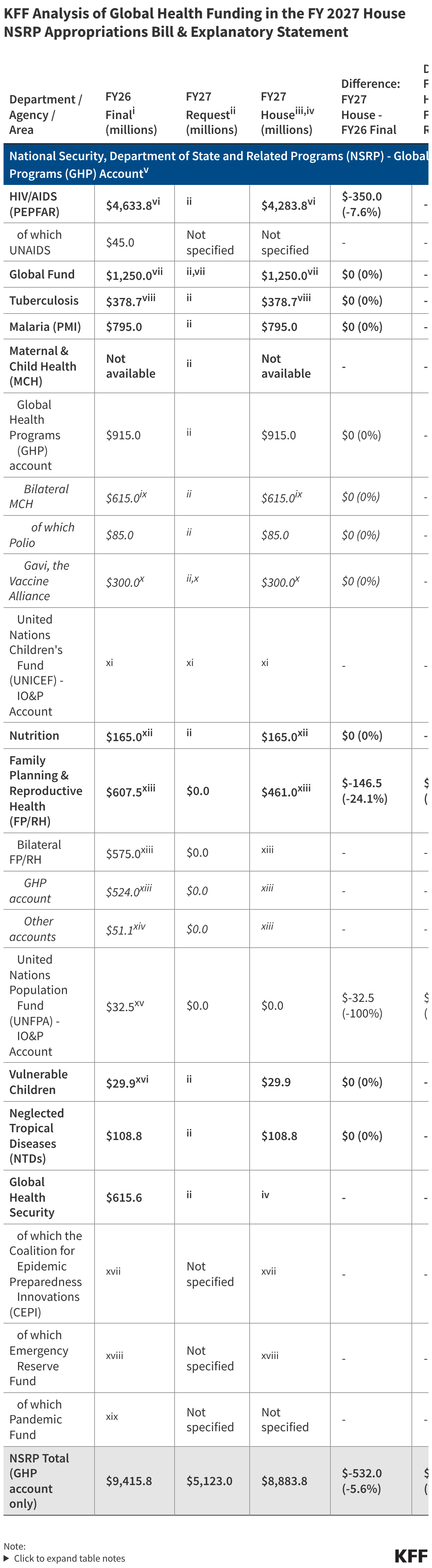
KFF Analysis of Global Health Funding in the FY 2027 House NSRP Appropriations Bill & Explanatory Statement
<details><summary>Click to expand table notes</summary>i - The FY26 conference bill states that up to $200 million of the funds appropriated by this Act through various accounts may be made available “to respond to a Public Health Emergency of International Concern.”
ii - The FY27 request proposes to “eliminate disease-specific accounts and provide the Department crucial agility to address the actual needs of each recipient country—across HIV/AIDS and other infectious diseases such as Malaria, Tuberculosis, and Polio—to strengthen global health security and protect Americans from disease.” The FY27 request also proposes “aligning all Global Health Program accounts into 3-year period of availability.” Historically, funding has been available for 5-years for HIV and 2-years for other disease areas.
iii - The FY27 House bill states that funding for the GHP account is available for a 3-year period, with the exception of Gavi, which is for a 1-year period.
iv - The FY27 House bill and accompanying explanatory statement provide $8,883.8 million to the GHP account. While the explanatory statement provides specific amounts for HIV/AIDS, Global Fund, TB, malaria, MCH, nutrition, the vulnerable children program, and NTDs, it does not provide a specific amount for global health security and “includes a limitation of not more than $461,000,000 for reproductive health and voluntary family planning programs.” After accounting for the programs directly specified in the bill, $957.58 million of unspecified funding remains.
v - Unless otherwise specified, funding amounts listed under the "National Security, Department of State and Related Programs - Global Health" heading are provided through the Global Health Programs (GHP) account.
vi - FY26 Final: The FY26 explanatory statement accompanying the FY26 conference bill includes $45 million for microbicides and $10 million for the Prevention, Treatment, and Response Initiative (Section 7058(e)). FY27 House: The explanatory statement accompanying the FY27 House bills states that the Committee “recommends continued support for microbicide development and directs the Secretary of State to coordinate with the heads of other relevant Federal research agencies and donors to expedite microbicide development and implementation.”
vii - FY26 Final: The explanatory statement accompanying the FY26 conference bill states that the agreement supports the $4.6 billion U.S. pledge to the eighth replenishment and that the $1.25 billion provided in the agreement is for the first installment of the replenishment. The explanatory statement also states that the “funds shall be contributed to the Global Fund on a quarterly basis to the fullest extent practicable” and that “sufficient unobligated balances [that] exist[ed] from prior Acts to fully fund the first installment of the eighth replenishment and to fulfill the United States pledge for the seventh replenishment” are to be provided in a “timely manner.” FY27 Request: The FY27 request does not provide a specific amount for the Global Fund but states that it commits to “leveraging $2 from other donors for every $1 from the United States” and notes that funding may not exceed 33% of the total amount contributed to the Global Fund. FY27 House: The explanatory statement accompanying the FY27 House bill states that the $1.25 billion is “for the second installment of the eighth replenishment of the Global Fund to Fight AIDS, Tuberculosis and Malaria.”
viii - The explanatory statement accompanying the FY26 conference and FY27 House bills include $14.4 million for the Global TB Drug Facility.
ix - The explanatory statement accompanying the FY26 conference and FY27 House bills include $2 million for maternal and neonatal tetanus.
x - FY26 Final: The FY26 conference bill states that funding for Gavi, the Vaccine Alliance and the Coalition for Epidemic Preparedness Innovations (CEPI) is available for one year, whereas historically these amounts were provided for a two-year period. FY27 Request: The FY27 request does not provide funding for Gavi and states that any future FY27 funding for Gavi is “contingent on the organization making necessary reforms and meeting certain benchmarks on vaccine safety.” FY27 House: The FY27 House bill does not specify an amount for Gavi but states that funds “may be made available” for one year.
xi - FY26 Final: The explanatory statement accompanying the FY26 conference bill states that “the agreement includes $339,000,000 for International Organizations and Programs. Funds under this heading should be programmed consistent with the practice of prior years.” The agreement includes funds for UNICEF “consistent with prior year levels.” FY27 Request: The FY27 request eliminates the International Organizations and Programs (IO&P) account and states, “Authorities under IO&P were requested under the America First Opportunity Fund.” FY27 House: The explanatory statement accompanying the FY27 House bill states that funds “may be made available” to UNICEF under the National Security Investment Programs (NSIP) account rather than the IO&P account.
xii - FY26 Final: The explanatory statement accompanying the FY26 conference bill includes $3 million for iodine deficiency disorder and $33 million for micronutrients (of which $22.5 million is for Vitamin A). FY27 House: The explanatory statement accompanying the FY26 conference bill includes $3 million for iodine deficiency disorder and $33 million for micronutrients.
xiii - FY26 Final: The FY26 conference bill states that “not less than $575,000,000 should be made available for family planning/reproductive health.” FY27 House: The FY27 House bill states that “not more than $461,000,000 may be made available for family planning/reproductive health.”
xiv - Other funding for bilateral family planning/reproductive health has historically been provided through the Economic Support Fund (ESF), which was eliminated in the FY26 conference bill, and has been incorporated in the National Security Investment Program (NSIP).
xv - The FY26 conference bills state that if this funding is not provided to UNFPA it “shall be transferred to the ‘Global Health Programs’ account and shall be made available for family planning, maternal, and reproductive health activities.”
xvi - The explanatory statement accompanying the FY26 conference bill includes $4.275 million for blind children.
xvii - FY26 Final: The explanatory statement accompanying the FY26 conference bill states that the agreement includes funds for a U.S. contribution to the Coalition for Epidemic Preparedness Innovations (CEPI) “consistent with the fiscal year 2024 level.” FY27 House: The explanatory statement accompanying the FY27 House bill states that the Committee supports funding for CEPI “at levels consistent with prior fiscal years.”
xviii - FY26 Final: The FY26 conference bill states that “up to $20,000,000 of the funds made available under the heading ‘Global Health Programs’ may be made available for the Emergency Reserve Fund.” FY27 House: The FY27 House bill states that “up to $50,000,000 of the funds made available under the heading ‘Global Health Programs’ may be made available for the Emergency Reserve Fund.”
xix - The explanatory statement accompanying the FY26 conference bill states that the agreement includes funds for a U.S. contribution to the Pandemic Fund “consistent with the fiscal year 2024 level.”
</details>