Women, Work, and Family During COVID-19: Findings from the KFF Women’s Health Survey

Published: Mar 22, 2021

Findings

Key Takeaways

  • One in ten women report quitting a job due to a pandemic related reason and almost half said that one of the reasons was because they felt unsafe at their workplace.
  • School closures had a substantial effect on working mothers’ ability to fulfill work obligations. One in ten working mothers with children under 18 said they quit a job due to COVID and half of this group cited school closures as one of the reasons. Three out of ten working mothers said they had to take time off because school or daycare was closed.
  • In addition to juggling new, increased home and work responsibilities, many women went without pay due to school closures. Almost half (47%) of working mothers said they took unpaid sick leave because their child’s school or daycare was closed. This rose to 65% among low-income mothers and 70% among those working part-time jobs.
  • Family caregiving responsibilities before and after the pandemic have largely fallen on women. More than one in ten women report they were caring for a family member who needed special assistance prior to the pandemic. Over one in ten women report that they have new caregiving responsibilities as a result of the pandemic.
  • Over half of mothers with school age children said that the stress and worry of the pandemic has affected their mental health, with one in five characterizing the impact as “major.” However, only 16% of mothers have sought mental health care. Given that the mental health effects are likely to persist for a long time, access to mental health care will be an important issue to watch, particularly for mothers.

Introduction

While the COVID-19 pandemic has impacted people across the US, changing the way we work, live, and access health care, gender-based disparities that existed prior to the pandemic have been magnified. Many women have been on the front lines of the COVID-19 emergency, as essential workers, mothers, and caregivers. Lack of paid leave, family caregiving responsibilities, traditional gender roles, and health concerns have placed many of the burdens of the pandemic squarely on the shoulders of women, falling particularly hard on women of color and those who are low-income. This brief provides new data from the KFF Women’s Health Survey, a nationally representative survey of 3,661 women and 1,144 men ages 18-64 (Methodology) conducted November 19, 2020 – December 17, 2020. Among several topics related to women’s health and well-being, we asked respondents about experiences during the COVID-19 pandemic. In this brief, we highlight how experiences during the COVID-19 pandemic related to work, childcare, and caregiving differ by gender and among different subpopulations of women.Nearly 1 in 10 women (8%) report quitting their job for a reason related to COVID-19. Larger shares are younger, Black or Hispanic,1  uninsured, low-income, and have less than a Bachelor’s degree (Figure 1). For example, 17% of low-income women had to quit a job for a COVID-related reason, compared to 5% with higher incomes.
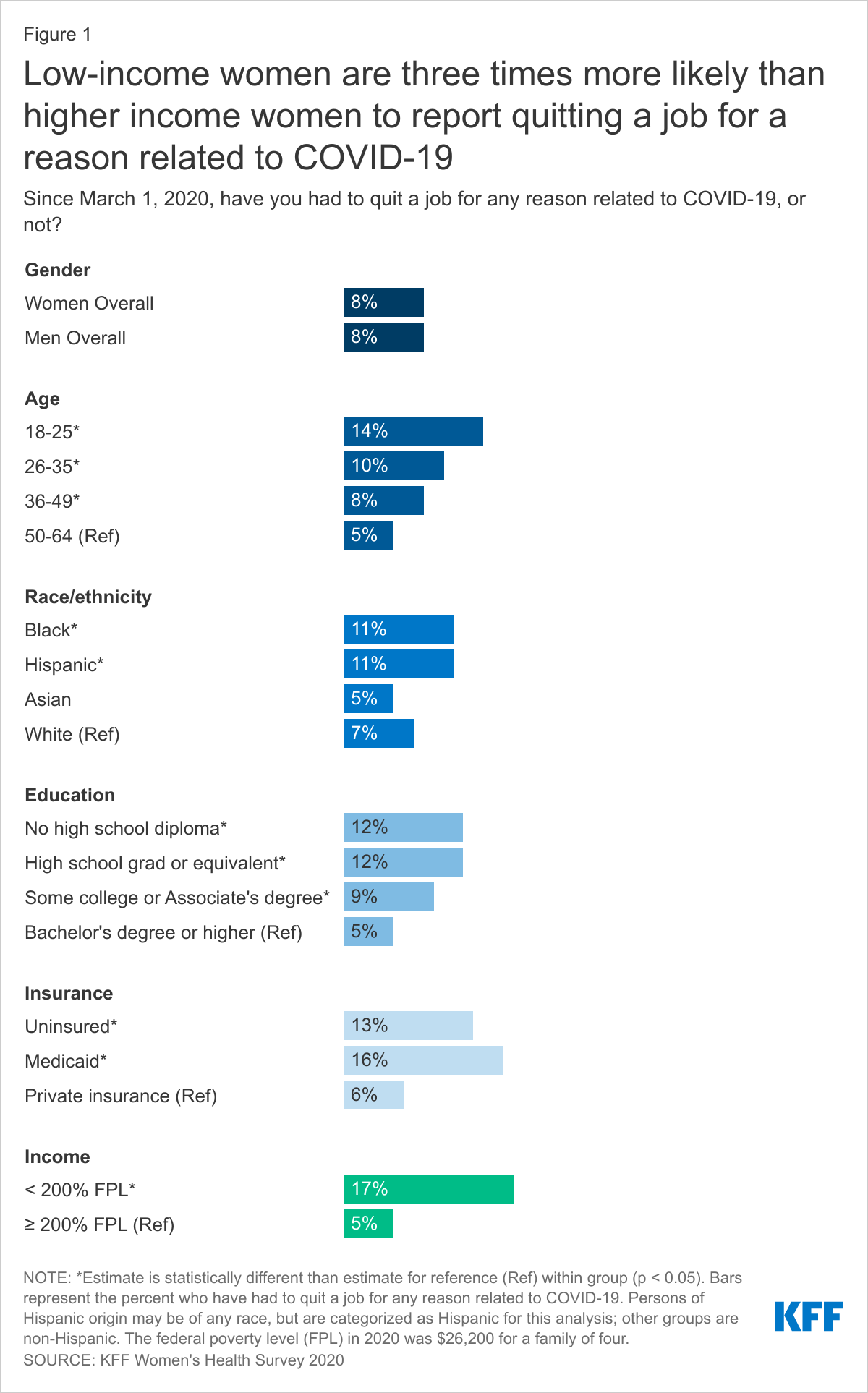
Low-income women are three times more likely than higher income women to report quitting a job for a reason related to COVID-19

Almost half of women who have quit a job for a reason related to COVID-19 (48%) say they quit because they did not feel safe at their workplace. Three in ten women (30%) quit their job due to COVID-19 because their child’s school or daycare was closed (Figure 2). A larger share of women with Medicaid compared to women with private insurance (44% vs. 20%) and a larger share of low-income women compared to women with incomes ≥ 200% of the federal poverty level (FPL)2  (37% vs. 23%) say they had to quit their job because their child’s school or daycare was closed, leaving the most disadvantaged with a loss of income. Nearly a quarter of women say they quit a job because they live with someone at elevated risk for COVID-19 complications.
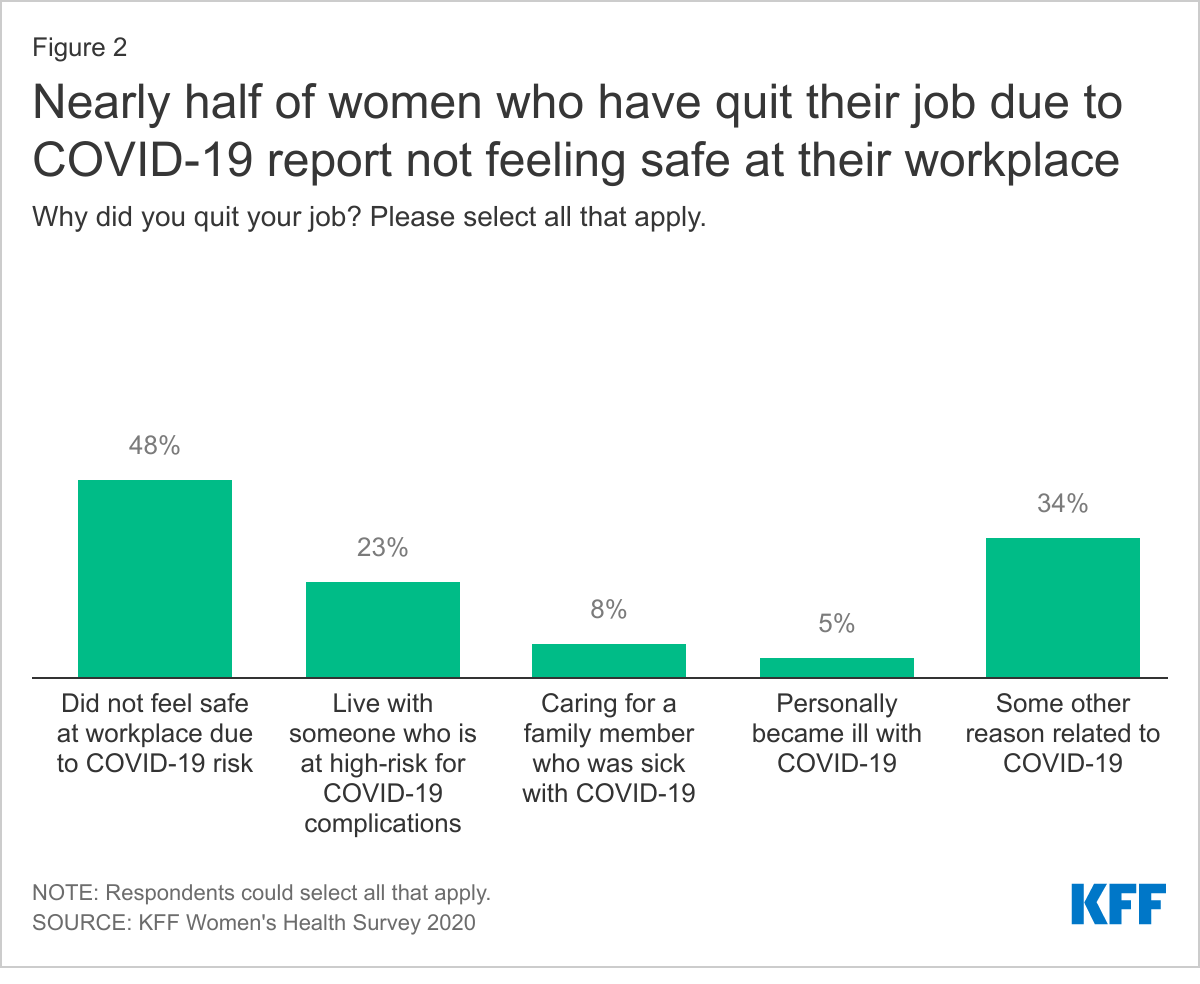
Nearly half of women who have quit their job due to COVID-19 report not feeling safe at their workplace

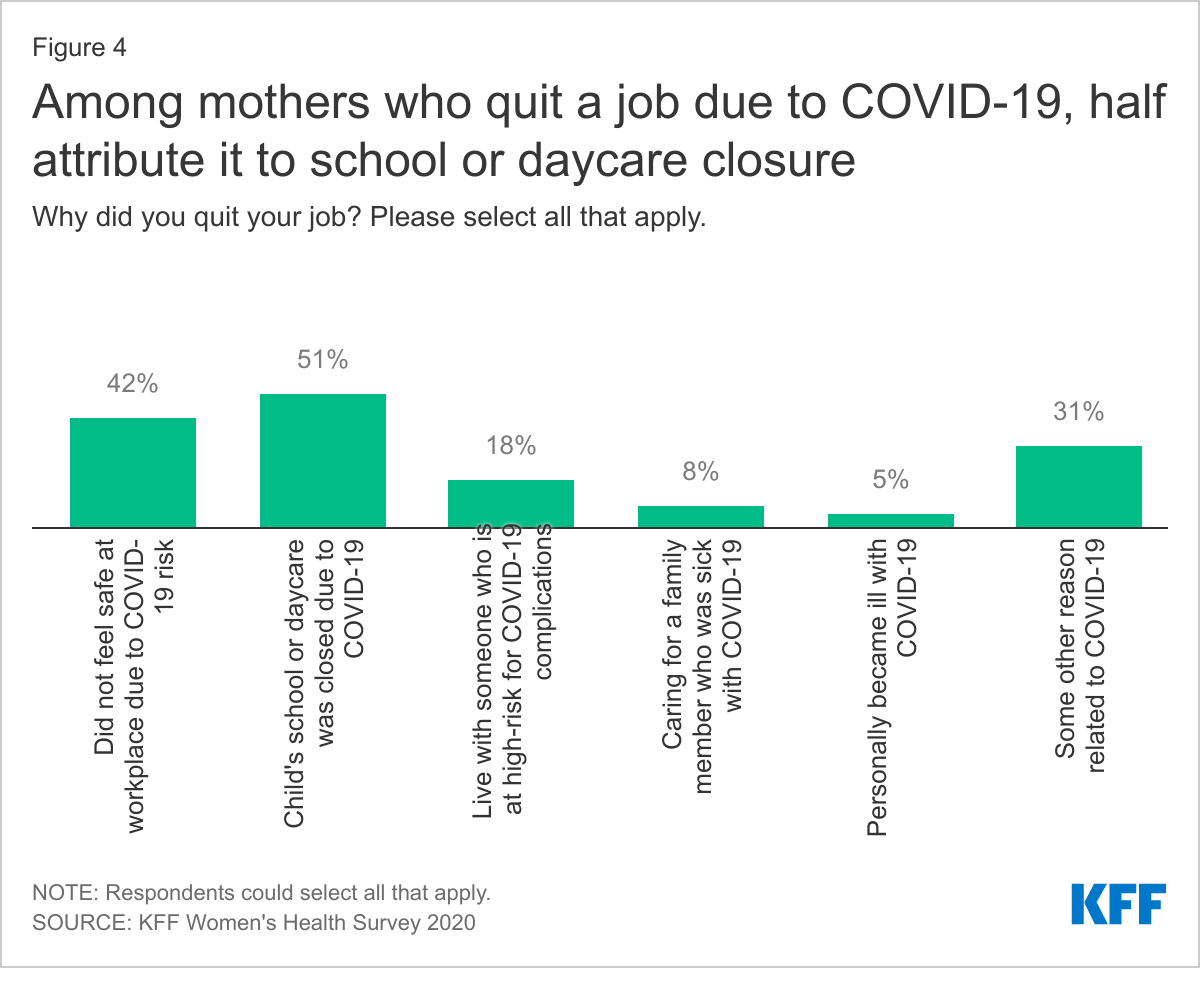
Half of mothers who quit a job because of the pandemic said one of the reasons was because their child’s school or daycare was closed. With in-person schools closed, mothers have taken on many new responsibilities, including even more childcare than usual, assisting with remote learning, and in some cases shifting to full homeschooling just to name a few. For mothers of young children who also work outside the home, they have been doing all of this while trying to maintain employment. While most mothers have been able to maintain their jobs, some with changes to their workload and schedules, it is not surprising that some have had to leave jobs as a result of school and daycare closures and the numerous new responsibilities that mothers now carry. One in ten women with young children (11%) say they quit a job due to the pandemic (Figure 3). Among this group, half (51%) said one of the reasons was because their child’s school or daycare was closed. Many mothers (42%) also said they quit because they did not feel safe at their workplace (Figure 4).

The share of women who report leaving a job is significantly higher among single mothers (17%) compared to those who are married or have partners (9%). Single mothers may face the double jeopardy of not having a partner to assist with childcare or another source of income, however. Almost one in five mothers who are not currently working (18%) report that they had to quit a job due to the pandemic, as do 7% of working mothers, suggesting that some mothers who had to quit a job during the pandemic have since found another one.
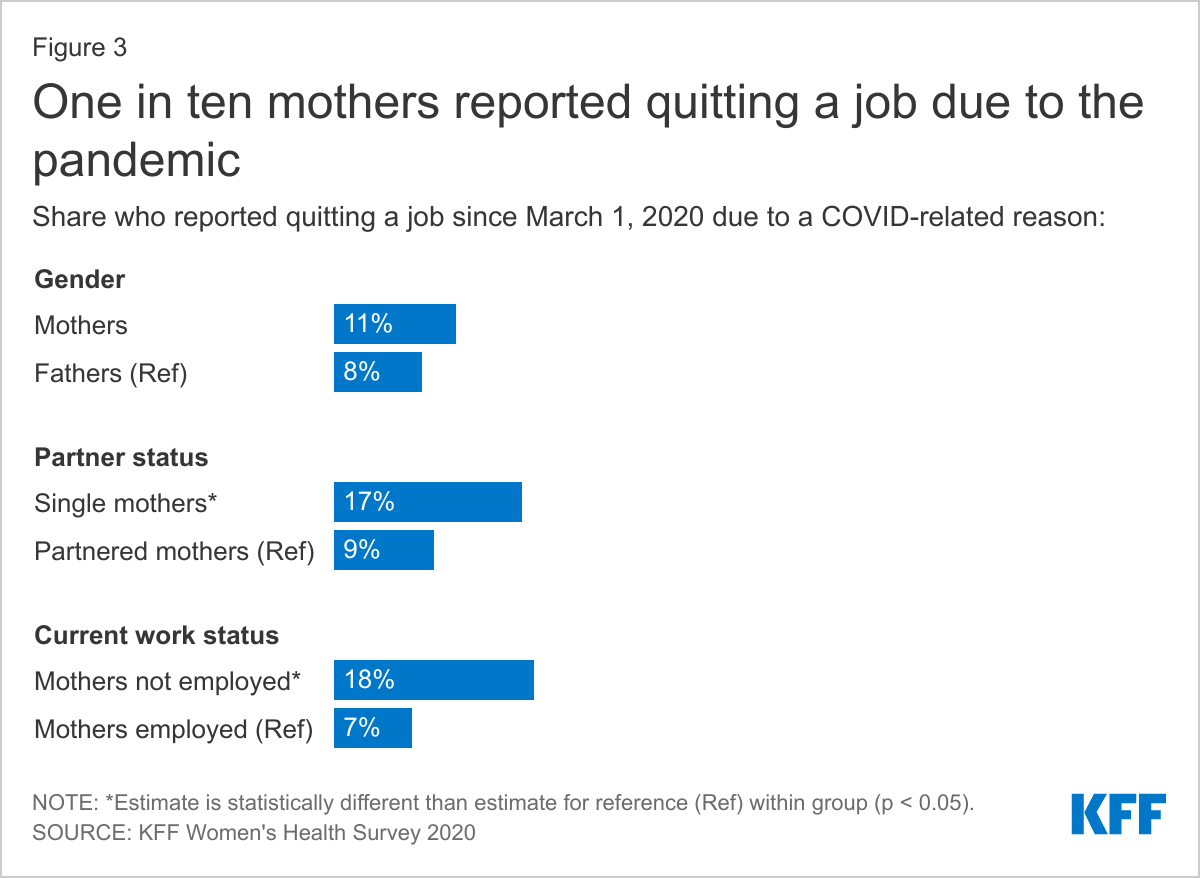
One in ten mothers reported quitting a job due to the pandemic
Among mothers who quit a job due to COVID-19, half attribute it to school or daycare closure

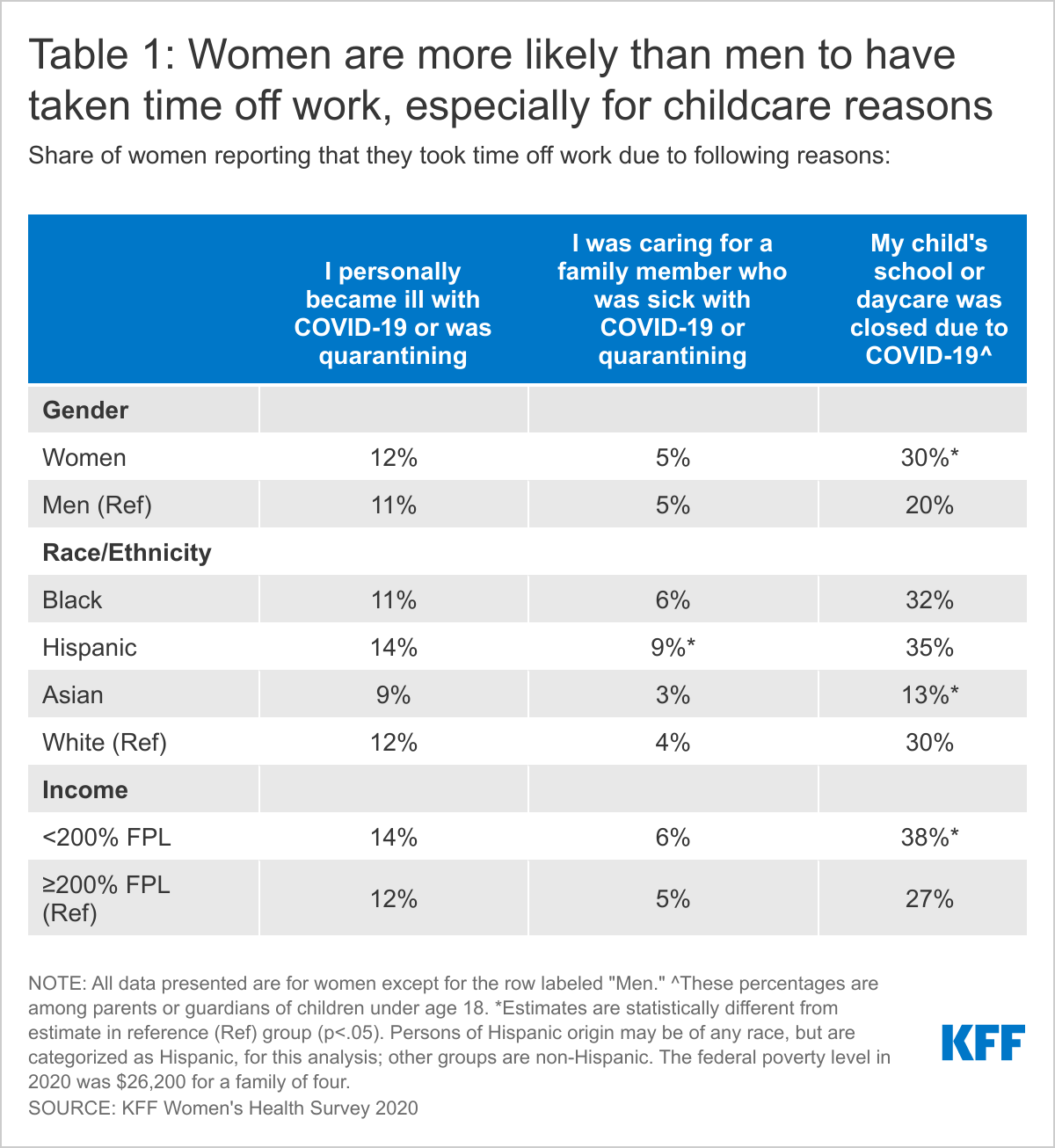
Mothers were more likely than fathers to miss work due to school and daycare closures. Many workers had to take time off due to the COVID pandemic, due to illness as well as school and daycare closures. The largest difference between women and men having to take time off work was because of school or daycare closure due to COVID-19 – this burden fell largely on women with school age children (30% vs. 20%) (Table 1). Low-income women were disproportionately affected, with almost four in ten (38%) taking time off because their child’s school or daycare was closed compared to 27% of women with incomes ≥200% FPL. Rates were similar among mothers of different racial and ethnic groups, except for Asian women, who were less likely to have taken time off because of school and daycare.
Table

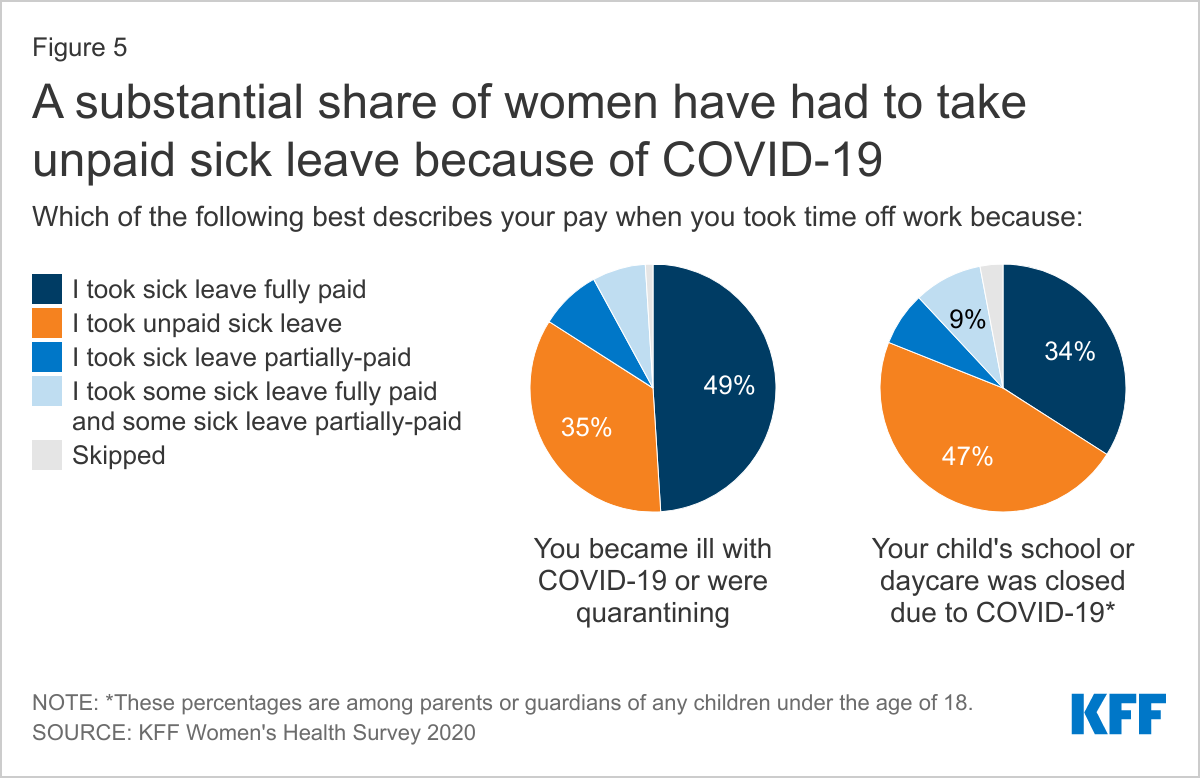
In addition to bearing the brunt of childcare and caregiving responsibilities, many women lost pay during the pandemic because they missed work due to quarantining or school closures. Over one-third of women (35%) say they took unpaid sick leave when they became ill with COVID-19 or were quarantining, and nearly half of women (46%) say they took unpaid sick leave when their child’s school or daycare was closed due to COVID-19 (Figure 5). Most employers offer some amount of paid sick leave and the federal government provided support for emergency paid sick leave to some employers in 2020, but these benefits were not available to all workers and are time limited. Many women may not have been eligible for paid sick leave or may have taken more time off than available for pay at their workplace.
A

Over two-thirds of working mothers who were low-income and nearly three in four working part-time jobs were not paid when they had to take time off because their child’s school or daycare was closed due to the pandemic. Lack of a national paid leave policy disproportionately affects women, who are more likely than men to have to take time off work for childcare reasons, and some women are particularly affected. Part-time and low-wage jobs are less likely to offer paid leave benefits, as reflected in our survey. Most women in these jobs went without pay when they took time off due to school and daycare closures last year (Figure 6).
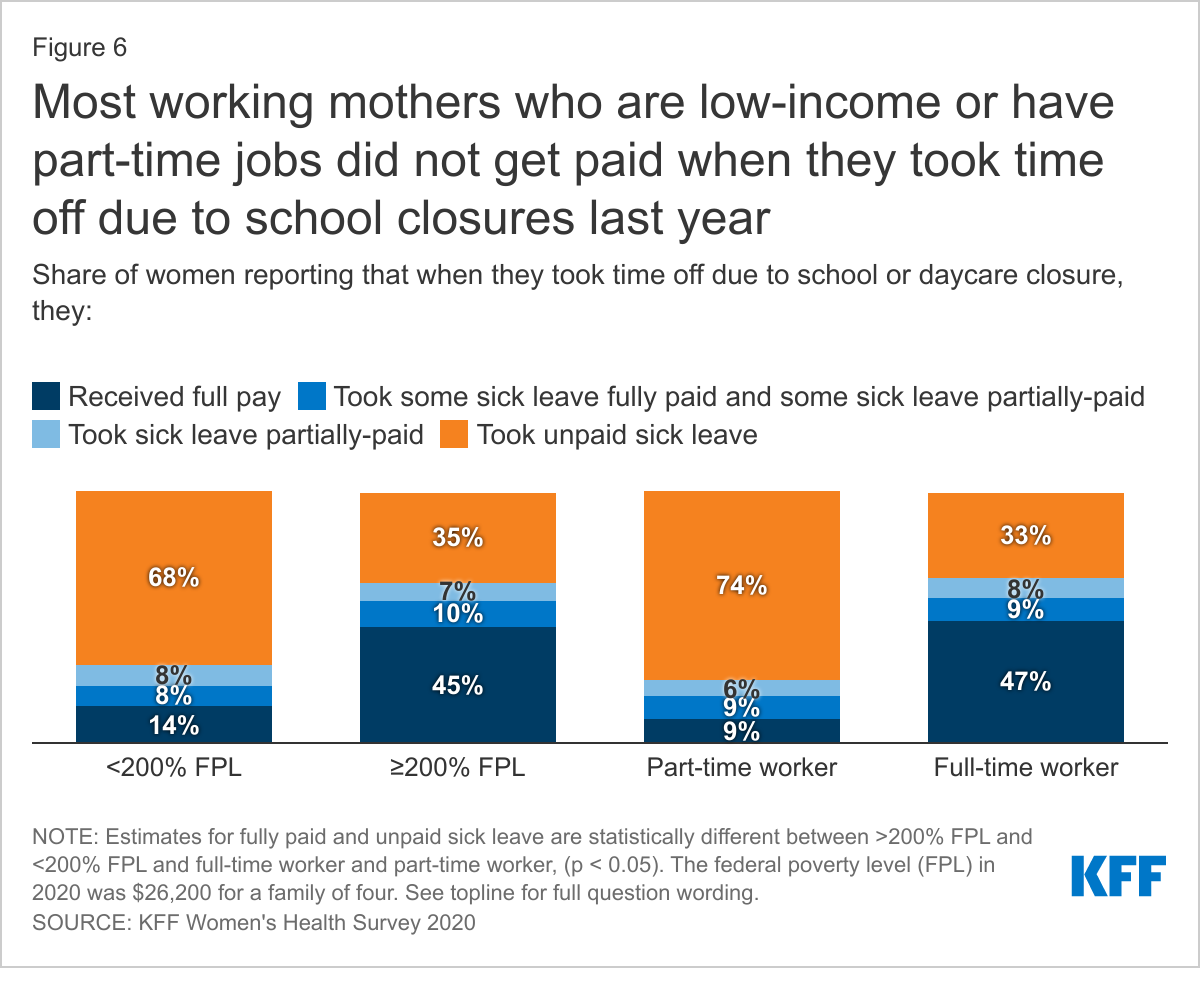
Most working mothers who are low-income or have part-time jobs did not get paid when they took time off due to school closures last year

Nearly half of employed women have worked outside their home during the pandemic. More than half of men (53%) and nearly half of women (46%) report that they are working in a location outside their home during the pandemic. At the outset of the pandemic, some companies shifted to telecommuting, but many workers do not have this option as some industries and jobs are not amenable to remote work. Working outside of the home during the pandemic is more common among women who are younger, have lower educational attainment, live in rural areas, and report lower incomes. For example, more than half of Hispanic women (53%) compared to 45% of White women, have worked outside their home. Conversely, half of Asian women workers (51%) say they are working from home (Figure 7). More than half of women residing in rural areas (58%) report working outside the home, compared to 44% of women in urban communities.
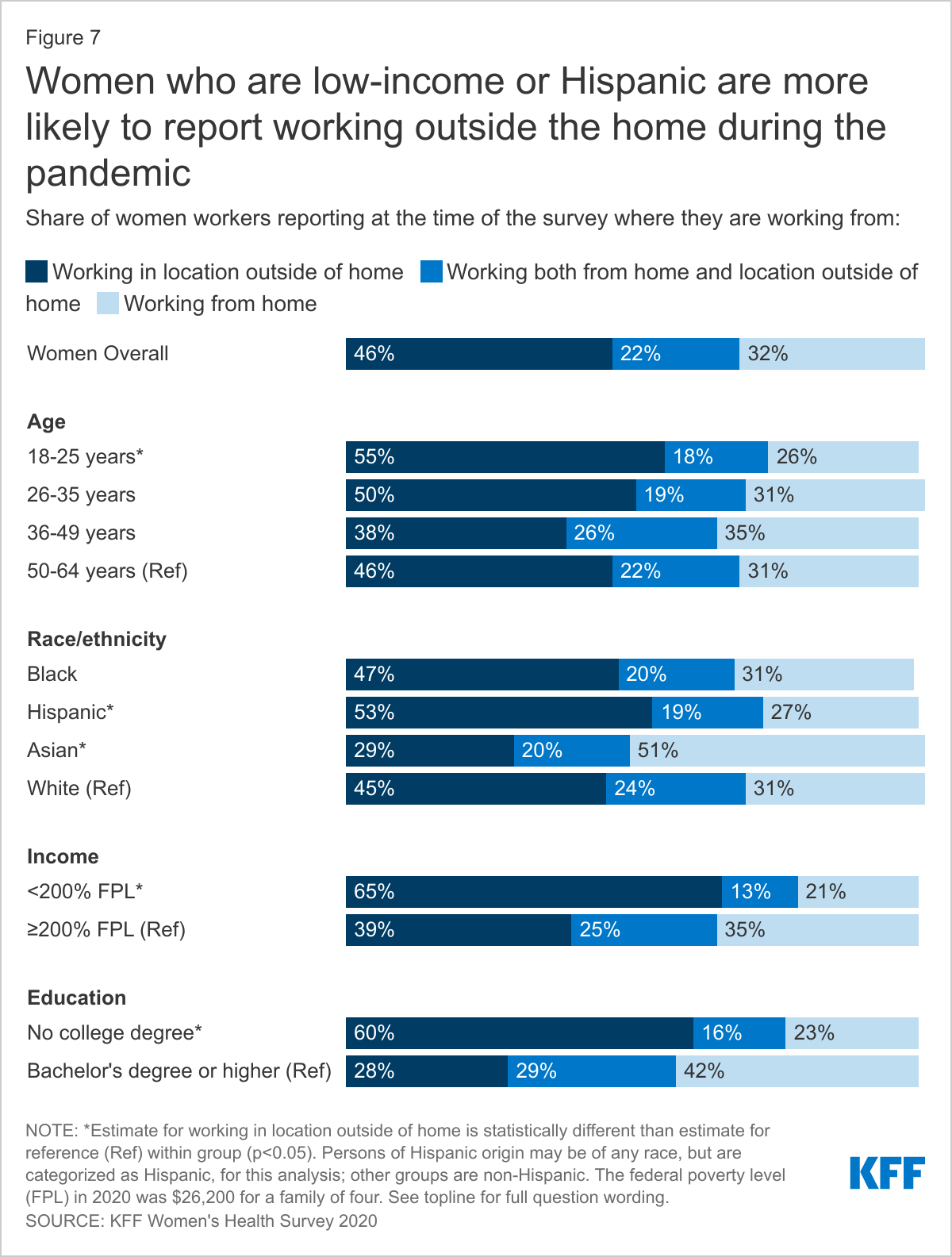
Women who are low-income or Hispanic are more likely to report working outside the home during the pandemic

Family caregiving responsibilities before and after the pandemic have largely fallen on women. More than one in ten women report they were caring for a family member who needed special assistance prior to the pandemic. Over one in ten women report that they have new caregiving responsibilities as a result of the pandemic. A higher share of women (14%) than men (9%) say they were caring for a family member who needed special assistance prior to the pandemic. This gender difference in caregiving extends to new caregiving responsibilities due to reasons related to the pandemic (12% of women vs. 8% of men) (Table 2).

One in five women ages 50-64 say they were caring for a family member who needs special assistance prior to the pandemic, higher than women in their reproductive years (11%), but similar shares (12%) in both age groups report taking on new caregiving responsibilities as a result of the pandemic.

Women who are parents of a child younger than age 18 in their household are significantly more likely than women without children under 18 to have taken on new or additional responsibilities caring for a family member because of the pandemic (16% vs. 10%). The pattern is similar among men, with 15% of men with children under age 18 reporting they have taken on new caregiving due to the pandemic, compared to 5% of men without children. However, it is worth noting that some respondents, especially parents of young children, may have interpreted new and additional responsibilities caring for a family member or relative as homeschooling. Almost one in five low-income women (19%) were caregivers before the pandemic compared to 13% of higher-income women. Low-income women (15%) are also more likely than higher-income women (11%) to have gained new caregiving responsibilities as a result of the pandemic.

Family caregiving falls heavily on some women of color too. Almost one in five Black women (18%) report caring for someone who needed special assistance prior to the pandemic, significantly higher than the 12% of White women. Eighteen percent of Hispanic women say they have had to take on new caregiving responsibilities since the pandemic started. Nearly one in ten Hispanic women workers (9%) say they have had to take time off work because they were caring for a family member quarantining from or sick with COVID-19.

For some caregivers, the pandemic compounded existing responsibilities. Among women and men who were already caring for someone with special needs prior to March 1, 2020, many said they gained additional caregiving responsibilities as a result of the pandemic (44% and 37% respectively).
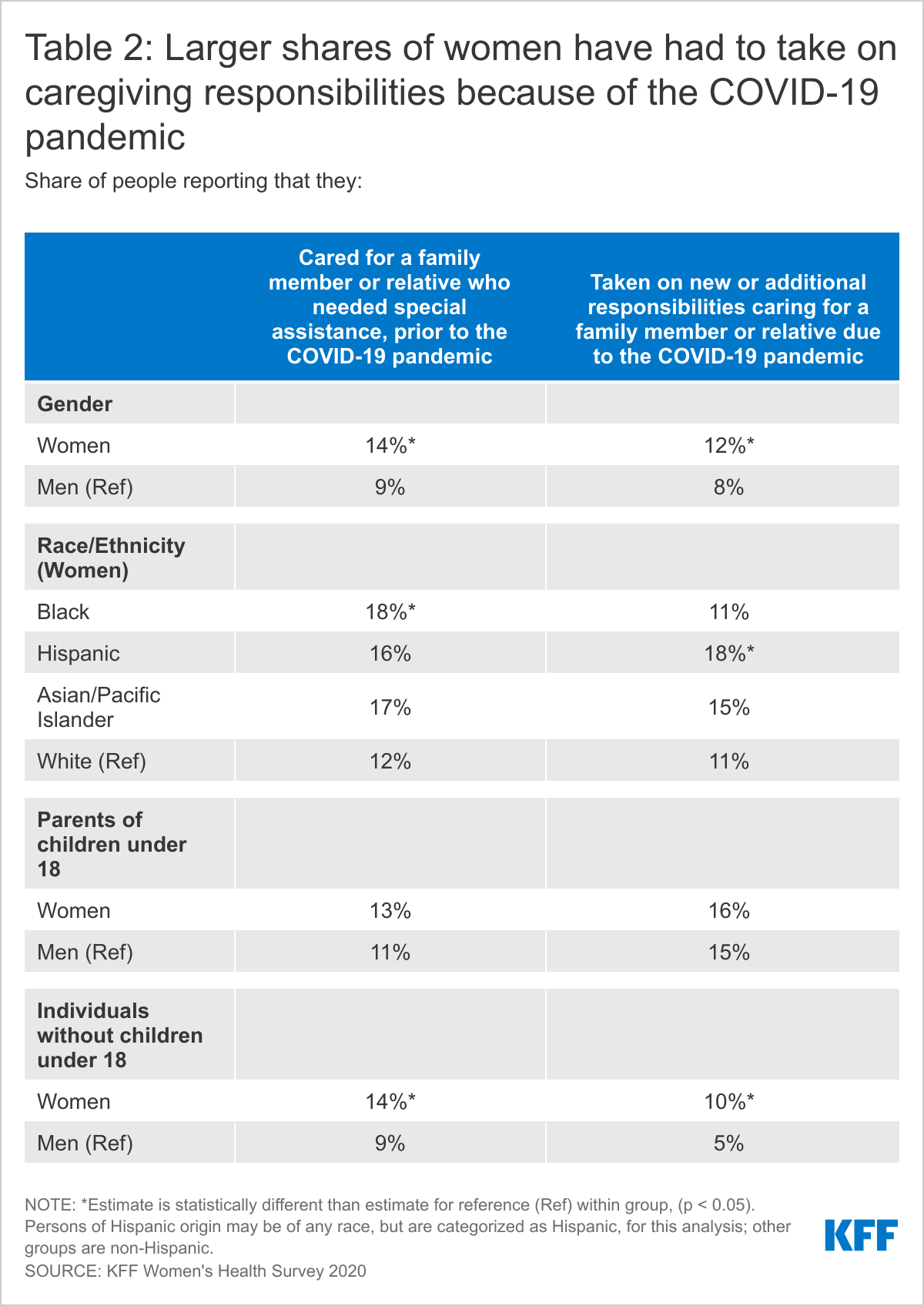
Table 2: Larger shares of women have had to take on caregiving responsibilities because of the COVID-19 pandemic

Most mothers report the pandemic has taken a toll on their mental health. A majority of mothers of children under 18 (54%) say that worry or stress related to coronavirus has affected their mental health, significantly higher than men with children under 18 (35%) (Table 3). Three in four mothers characterize the impact as major or moderate, as do 55% of fathers. More than half of mothers who are employed (56%) say that pandemic-related stress and worry have affected their mental health, as do 50% of those who are not working. However, only 16% of mothers with children under 18 have sought mental health care, with a significant difference between those who are single (21%) and partnered (14%).
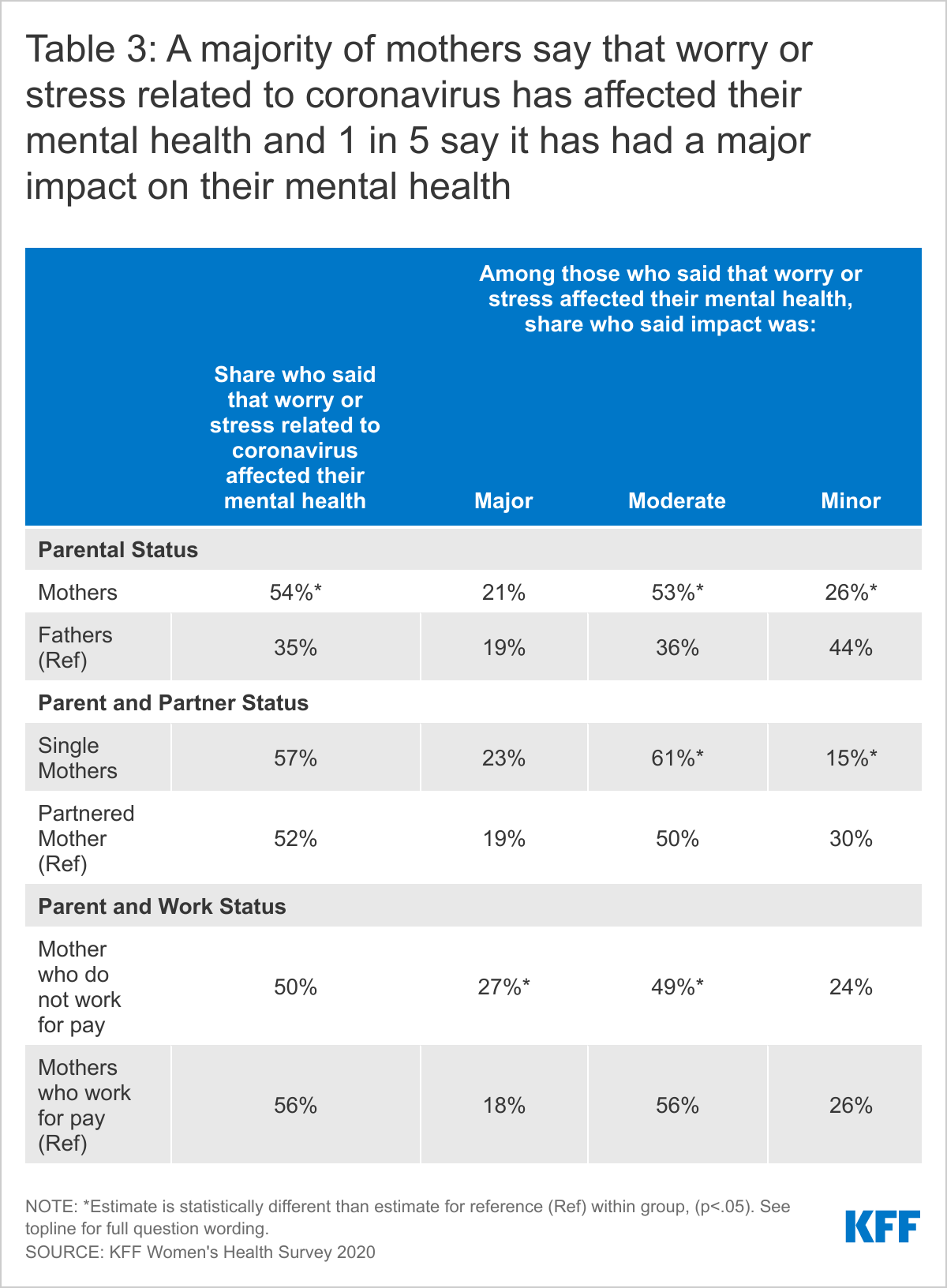
Table 3: A majority of mothers say that worry or stress related to coronavirus has affected their mental health and 1 in 5 say it has had a major impact on their mental health

Conclusion

The COVID-19 pandemic has had a disproportionate impact on women in a number of ways. While many have had to put themselves and their families at risk to work on the frontlines as essential workers, a number of women have also had to take on new homeschooling and caregiving responsibilities that have placed additional burdens on their work or resulted in their leaving the workforce entirely. Disparities that existed prior to the pandemic have been magnified and a larger share of women of color and those who are low-income have had to quit their jobs, as well as take on additional caregiving responsibilities. As the nation begins to turn a corner on the pandemic, more schools are re-opening but many remain closed or with limited hours, still placing additional childcare burdens on parents and limiting the ability of many mothers to work at the same level as pre-pandemic. Furthermore, as more businesses reopen, women’s roles in the workplace will not necessarily be restored at the same pace. Some still have additional childcare responsibilities, some may be handling COVID-related illnesses for themselves or family members as well as the major mental health toll on women and their families. Some jobs may not be available anymore, some women had to scale back their workload and lost income, and many women will have missed out on career advancement opportunities. Policies such as paid leave and the child tax credit in the newly enacted federal stimulus bill can support women in caring for their families, obtaining needed health care and balancing work and family responsibilities in this unprecedented time.

Methodology

The 2020 KFF Women’s Health Survey was designed and analyzed by researchers at the Kaiser Family Foundation (KFF) of a representative sample of 4,805 adults, ages 18-64 years old (3,661 women and 1,144 men). The survey was conducted online and telephone using AmeriSpeak®, the probability-based panel of NORC at the University of Chicago. U.S. households are recruited for participation using address-based sampling methodology and initial invitations for participation are sent by mail, telephone, and in-person interviews. Interviews for this survey were conducted between November 19 and December 17, 2020, among adults living in the United States. KFF paid for all costs associated with the survey.

The sample for this study was stratified by age, race/ethnicity, education, and gender as well as disproportionate stratification aimed at reaching uninsured women, women who identify as LGBT, and women 18-49 years old. The sampling also took into consideration differential survey completion rates by demographic groups so that the set of panel members with a completed interview for a study is a representative sample of the target population. Interviews were conducted in English and Spanish online (4,636) and via the telephone (169).

A series of data quality checks were run and cases determined to be poor-quality, as defined by surveys with a length of interview of less than 33% of the mean length of interview and with high levels of question refusal (>50%) were removed from the final data (n=96). Weighting involved multiple stages. First, the sample was weighted to match estimates for the national population from the 2020 Current Population Survey on age, gender, census division, race/ethnicity, and education. The second round of weights adjusted for the study’s sampling design. All statistical tests of significance account for the effect of weighting.

The margin of sampling error including the design effect for the full sample of women is plus or minus 2 percentage points. Numbers of respondents and margins of sampling error for key subgroups are shown in the table below. For results based on other subgroups, the margin of sampling error may be higher. Sample sizes and margins of sampling error for other subgroups are available by request. Note that sampling error is only one of many potential sources of error in this or any other public opinion poll.

GroupN (unweighted)M.O.S.E
Men Ages 18-641,144+/- 4 percentage points
Women Ages 18-643,661+/- 2 percentage points
Women Ages 18-492,695+/- 2 percentage points
White Women Ages 18-641,813+/- 3 percentage points
Black Women Ages 18-64603+/- 5 percentage points
Hispanic Women Ages 18-64801+/- 5 percentage points
Asian Women Ages 18-64246+/- 8 percentage points
LGB Women Ages 18-64392+/- 7 percentage points
Heterosexual Women Ages 18-643,239+/- 2 percentage points
Women < 200% FPL1,471+/- 3 percentage points
Women ≥200% FPL1,943+/- 3 percentage points

Endnotes

  1. People of Hispanic origin may be of any race but are categorized as Hispanic throughout this brief, while other groups are non-Hispanic. ↩︎
  2. The federal poverty level (FPL) in 2020 was $26,200 for a family ofu00a0four.u00a0 ↩︎

Women’s Experiences with Health Care During the COVID-19 Pandemic: Findings from the KFF Women’s Health Survey

Published: Mar 22, 2021

Findings

Key Takeaways

  • Women are more likely to have gone without health care during the pandemic compared to men, and women with health and economic challenges prior to the pandemic have experienced worsening health conditions as a result of skipping health care services during the pandemic. These gaps in care could translate into higher numbers of women experiencing severe health issues after the health emergency from the pandemic resolves.
  • People have been largely satisfied with their telemedicine interactions.  The share of men and women who at the time of the survey reported having a telemedicine visit during the pandemic tripled since before the pandemic. But not all have had the opportunity or access to telemedicine. Older women, women with higher educational attainment, insured women, and women living in states that have expanded Medicaid are more likely to have had a telehealth visit during the pandemic. While telemedicine played an important role during the pandemic, is it still not clear whether it will continue to be an approach that providers and health consumers will continue to utilize at high rates as the risk of exposure to the coronavirus recedes.
  • Women with private insurance and Medicaid are nearly twice as likely to have received a COVID-19 test compared to uninsured women (45% and 41% vs. 28%). Uninsured individuals may have been less likely to seek a test out of fear of cost, which could have implications for uptake of COVID-19 vaccines, even though all COVID-19 vaccines are free regardless of insurance status.
  • The pandemic has had a significant effect on people’s mental health, with 51% of women and 34% of men saying that worry or stress related to the pandemic has affected their mental health. Most say that the impact has been moderate or minor, but almost one-fifth (21% women, 17% men) say the toll has taken a major impact on their mental health. The high need for mental health care has highlighted long-standing gaps in the availability and signals that the demand will likely continue as people begin to process the trauma and loss they have experienced over the past year.

Introduction

The COVID-19 pandemic transformed the way people access health care, with care quickly moving to telehealth. However, with fear of contracting the coronavirus and state emergency declarations limiting non-essential and elective services in the early days of the pandemic, many people have gone without health care services this year. The pandemic has highlighted and aggravated long-standing inequities in healthcare availability and access. This brief provides new data from the KFF Women’s Health Survey, a nationally representative survey of 3,661 women and 1,144 men ages 18-64 (Methodologythat was conducted November 19, 2020 – December 17, 2020. Among several topics related to women’s health and well-being, we asked respondents about experiences during the COVID-19 pandemic. In this brief, we document how experiences accessing health care during the COVID-19 pandemic have differed by gender, age, race/ethnicity, insurance coverage, and income and what this could mean moving forward.

Accessing Health Care During the COVID-19 Pandemic

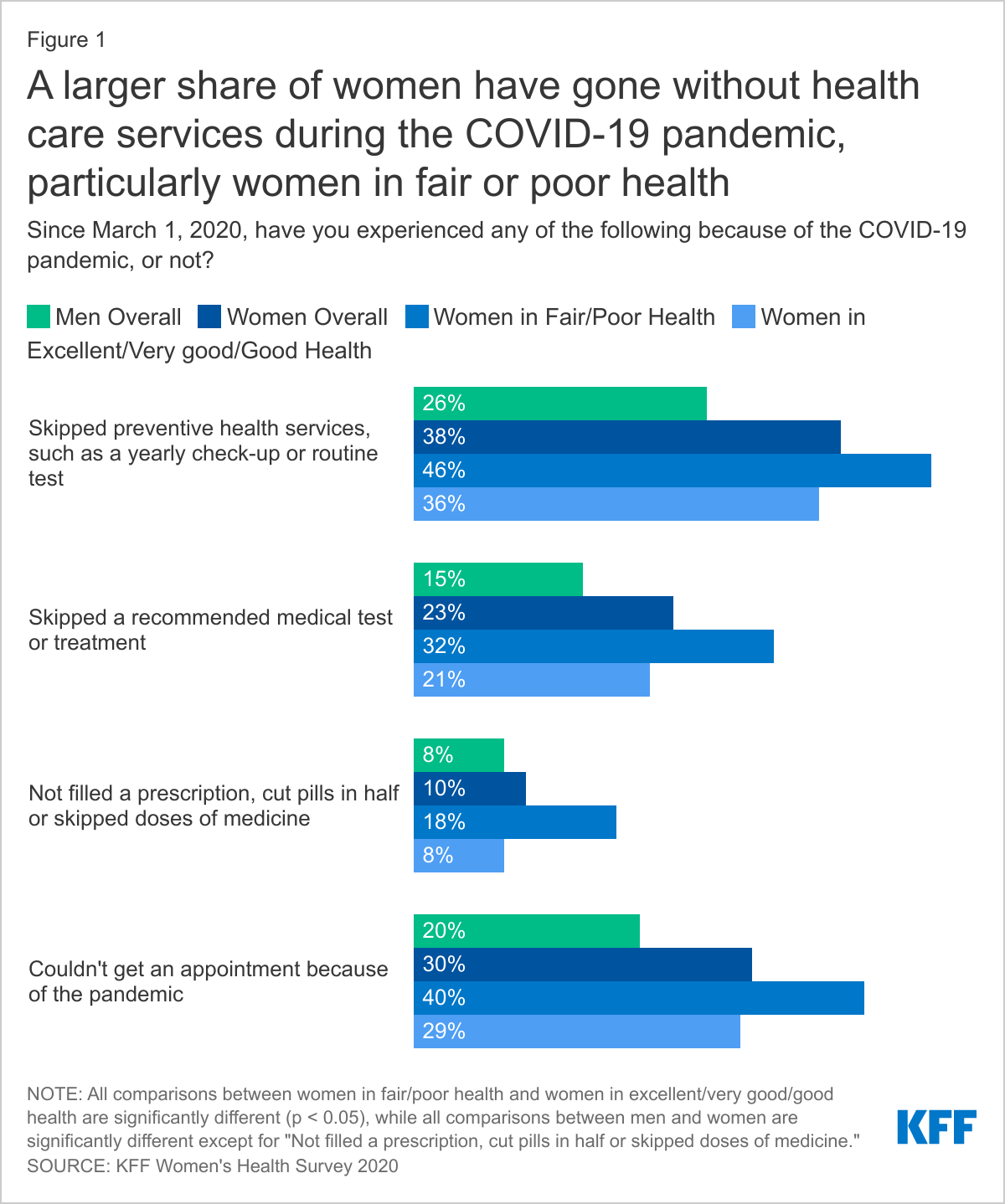
A higher share of women than men have skipped recommended preventive services in response to the pandemic. When asked about their experiences accessing health care services during the pandemic, a larger share of women than men say they have skipped preventive health services, such as a yearly check-up or routine test (38% vs. 26%) or skipped a recommended medical test or treatment (23% vs. 15%). Nearly half of women who report being in fair or poor health report skipping preventive care (46%) and nearly one-third have skipped recommended tests or treatment (32%) compared to women who reported being in good, very good, or excellent health (36% and 21%, respectively). Those in poor health may view themselves as more at risk for COVID exposure and opt to skip routine preventive care. This gap in care among those with the greatest health problems could portend an increase of the share of patients experiencing more severe health conditions resulting from care that was foregone or delayed during the pandemic.

Surprisingly, women with incomes ≥200% of the federal poverty level (FPL) are more likely to have skipped preventive health services during the pandemic compared to women with incomes <200% FPL (40% vs. 33%, respectively),1  as well as women with private insurance (39%) and Medicaid (38%) compared to uninsured women (30%). A larger share of women with private insurance (23%) and Medicaid (26%) also report skipping a recommended medical test or treatment compared to uninsured women (18%). In pre-pandemic times, the reverse was true, higher shares of women with lower incomes and who lacked insurance coverage reported skipping care. Women with more resources may be choosing to skip care because of concerns of COVID exposure.

Nearly one in five women in fair or poor health (18%) say they have either not filled a prescription, cut pills in half or skipped doses of medicine because of the COVID-19 pandemic, over twice the percentage of women in good, very good, or excellent health (8%). A higher percentage of low-income women < 200% FPL (14%), uninsured individuals (12%), and those with Medicaid (12%) also report not filling a prescription, cutting pills in half or skipping doses of medicine compared to higher income women (≥ 200% FPL) (8%) and individuals with private insurance (8%).i

More women than men report not being able to get an appointment because of the pandemic (30% vs. 20%), which could be a result of women being more likely to seek care. A larger share of women in poor or fair health (40%) compared to women in good or excellent health (29%) and low-income women (<200% FPL) (33%) compared to higher income women (≥ 200% FPL) (29%) say they were unable to get appointments. State emergency declarations limited services deemed non-essential or elective and reduced clinic hours and closures have made it particularly difficult to access care during the pandemic.

A larger share of women have gone without healthcare services during the COVID-19 pandemic, particularly women in fair or poor health

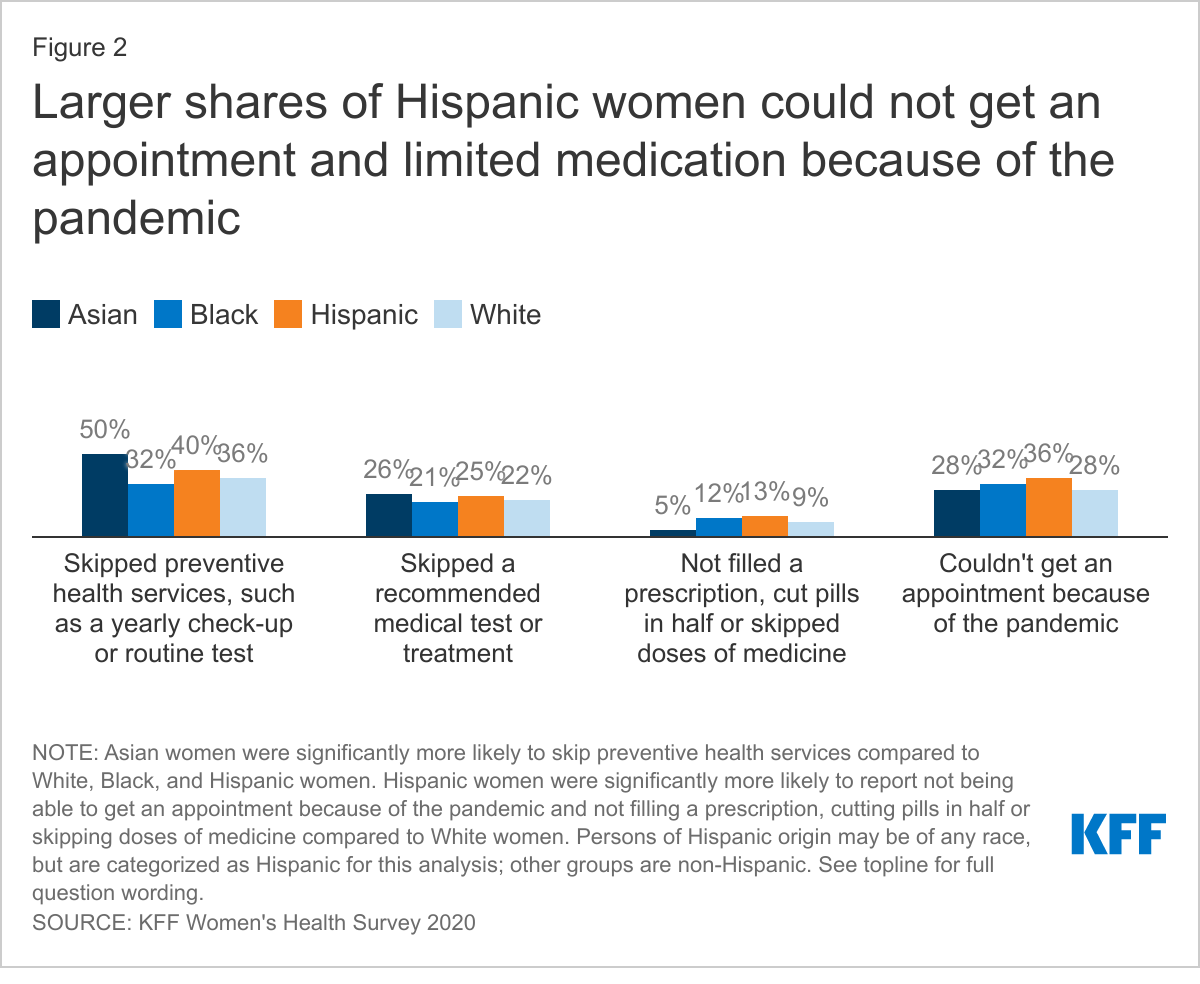
The pandemic has taken a disproportionate toll on some communities of color. Hispanic women, who have the highest rates of uninsurance, report higher rates of access barriers. Four in ten (40%) say they skipped preventive health services, 36% could not get a medical appointment, and 13% did not fill or skipped doses of prescription medicines because of the pandemic (Figure 2). Targeted outreach to this community regarding the COVID-19 vaccine will be important to ensure they have adequate access to and information about the vaccine, especially that the vaccine is free even without insurance.

Larger shares of Hispanic women could not get an appointment and limited medication because of the pandemic

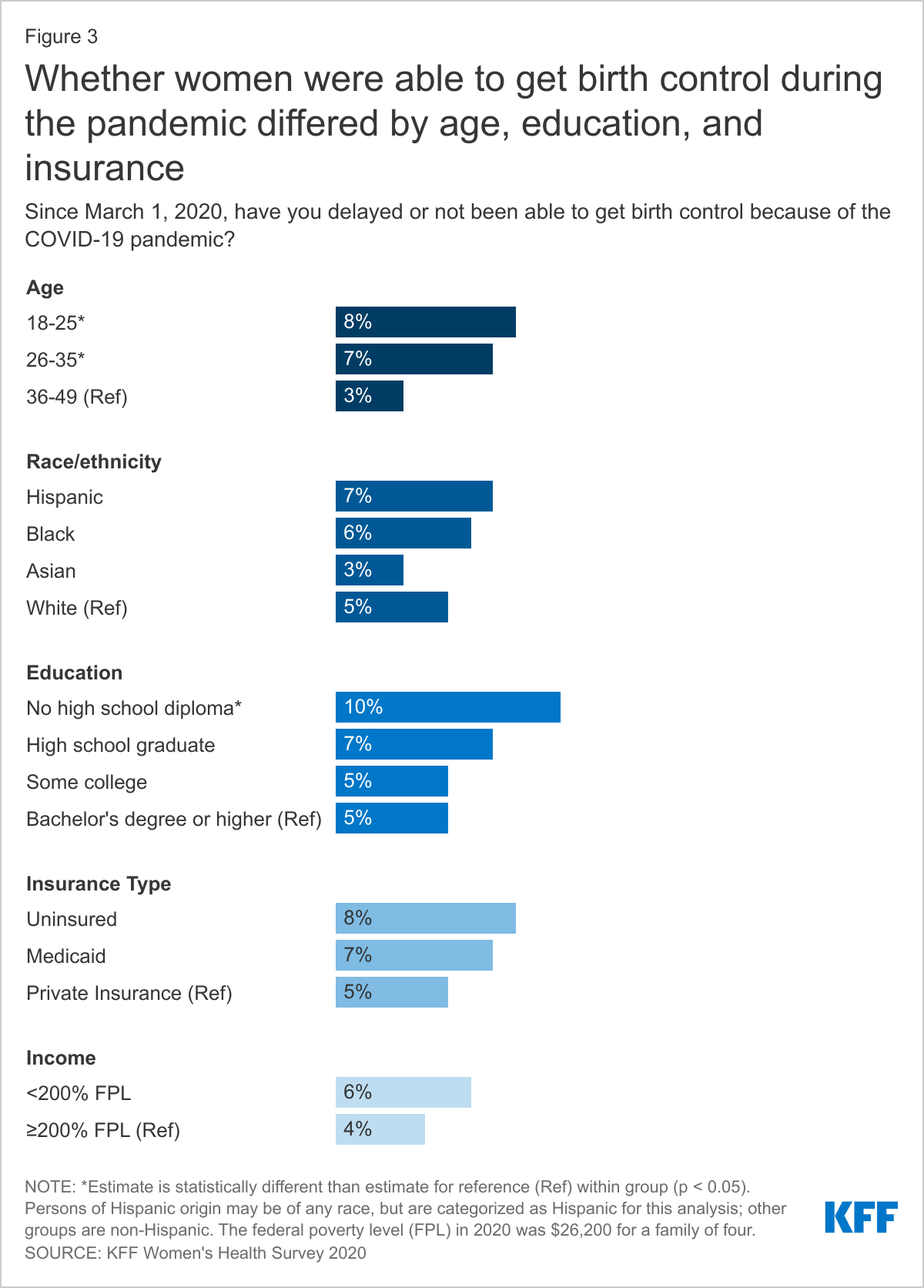
Nearly one in 10 women ages 18-25 (8%) and 7% of women ages 26-35 say they delayed or were not able to get birth control due to the COVID-19 pandemic, which is significantly higher than women ages 36-49 (3%) (Figure 3). Women without a high school diploma were more likely to report delaying or not being able to get birth control compared to women with a Bachelor’s degree or higher (10% vs. 5%). Individuals who face delays in contraceptive care could face negative health consequences, such as sexually transmitted infections or unwanted pregnancies. While many clinics developed protocols to distribute contraception to their clients by reducing the need for in-person visits through telemedicine or other distribution approaches, addressing access for younger women and those with few resources will continue to be important.

Age, education, and insurance have played a role in whether women were able to get birth control during the pandemic

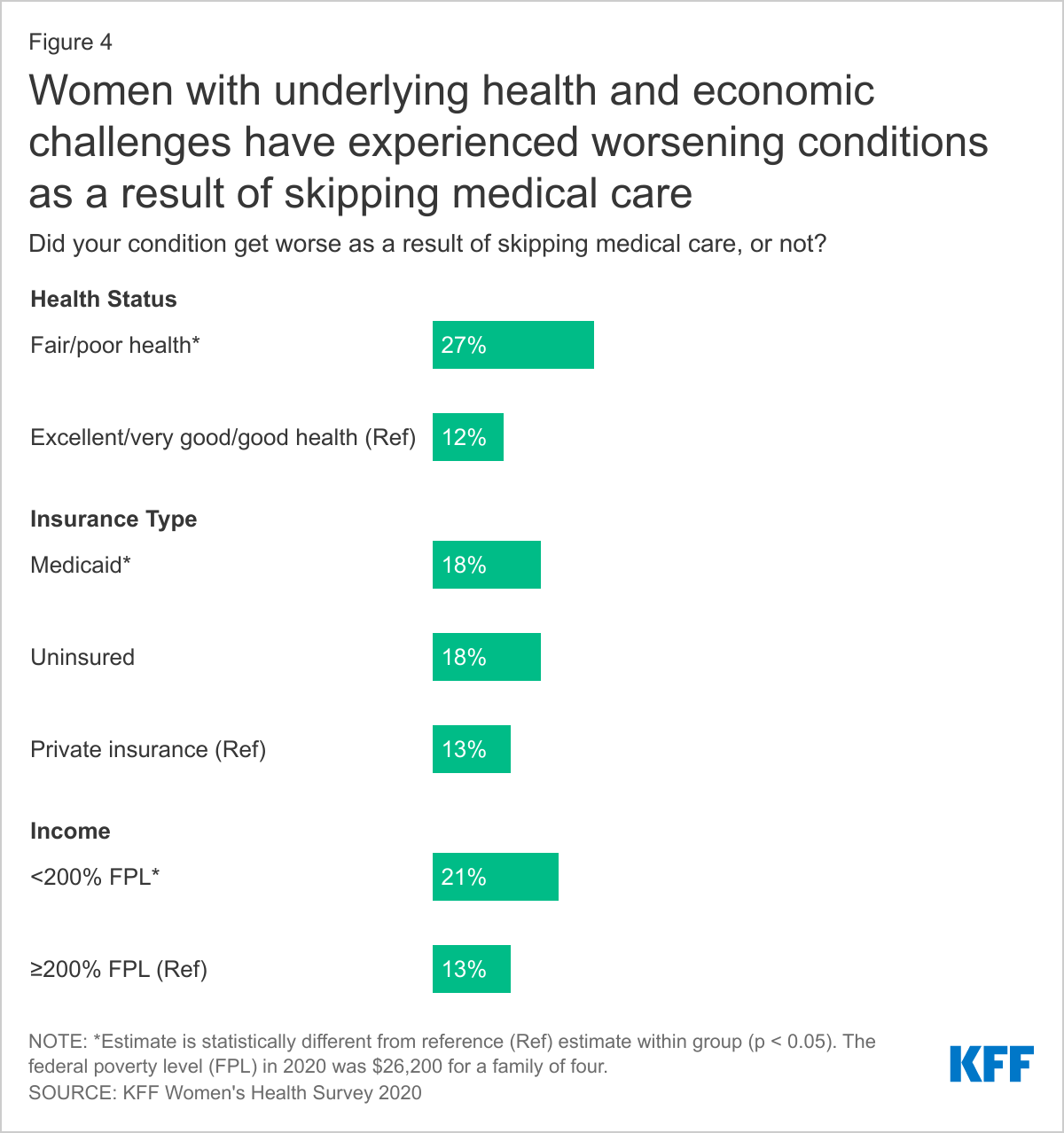
Delays in accessing health care can translate into worsening health conditions, especially for women with underlying health problems that have been exacerbated by lack of care and those who face economic challenges that have gone without care due to cost. Among those who have skipped receiving health care services, women in fair or poor health, those with Medicaid coverage, and those with low incomes are more likely than other groups of women to report that their condition has worsened as a result of skipping care (Figure 4). Providers should be prepared to respond to greater health needs among their patients who have skipped care.

Women with underlying health and economic challenges have experienced worsening conditions as a result of skipping medical care

Telehealth

The rapid expansion of telehealth visits has broadened the ways in which people have been able to access care throughout the pandemic. Our survey defines telehealth/telemedicine as an appointment with a provider conducted by telephone or video conference in place of an in-person visit. For this survey, telemedicine or telehealth does not include email, messages sent through a website, or general online health information. Please see the survey topline for full question wording.

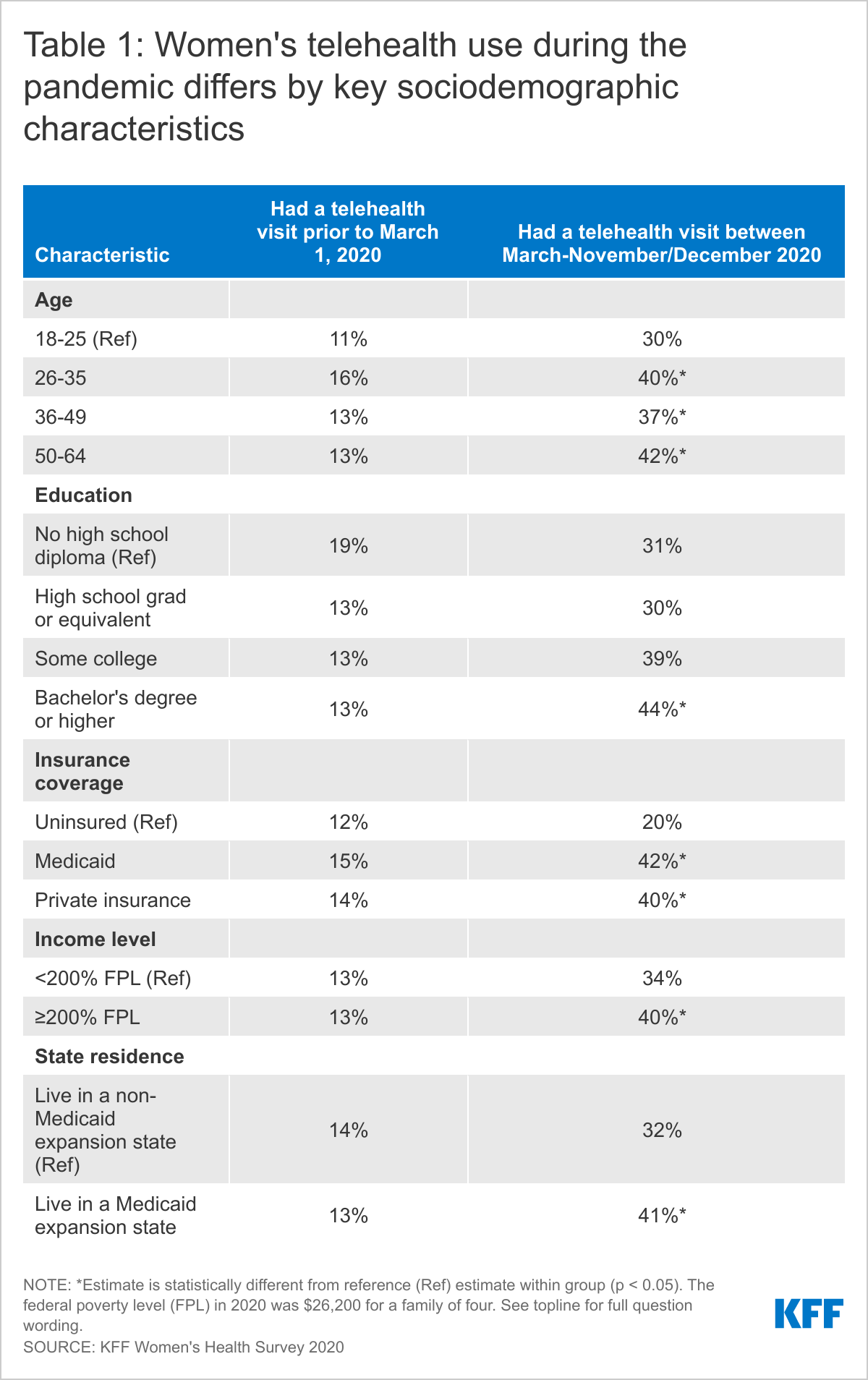
Prior to the pandemic, only about 1 in 10 men (11%) and women (13%) had received care via a telemedicine or telehealth visit. However, as of November/December when the survey was in the field approximately 1 in 3 men (32%) and women (38%) reported having a telemedicine or telehealth visit since March 1, 2020. Women over the age of 25, women with a college degree, insured women, and women living in states that have expanded Medicaid are more likely to have had a telehealth visit during the pandemic (Table 1).

Table 1: Women's telehealth use during the pandemic differs by key sociodemographic characteristics

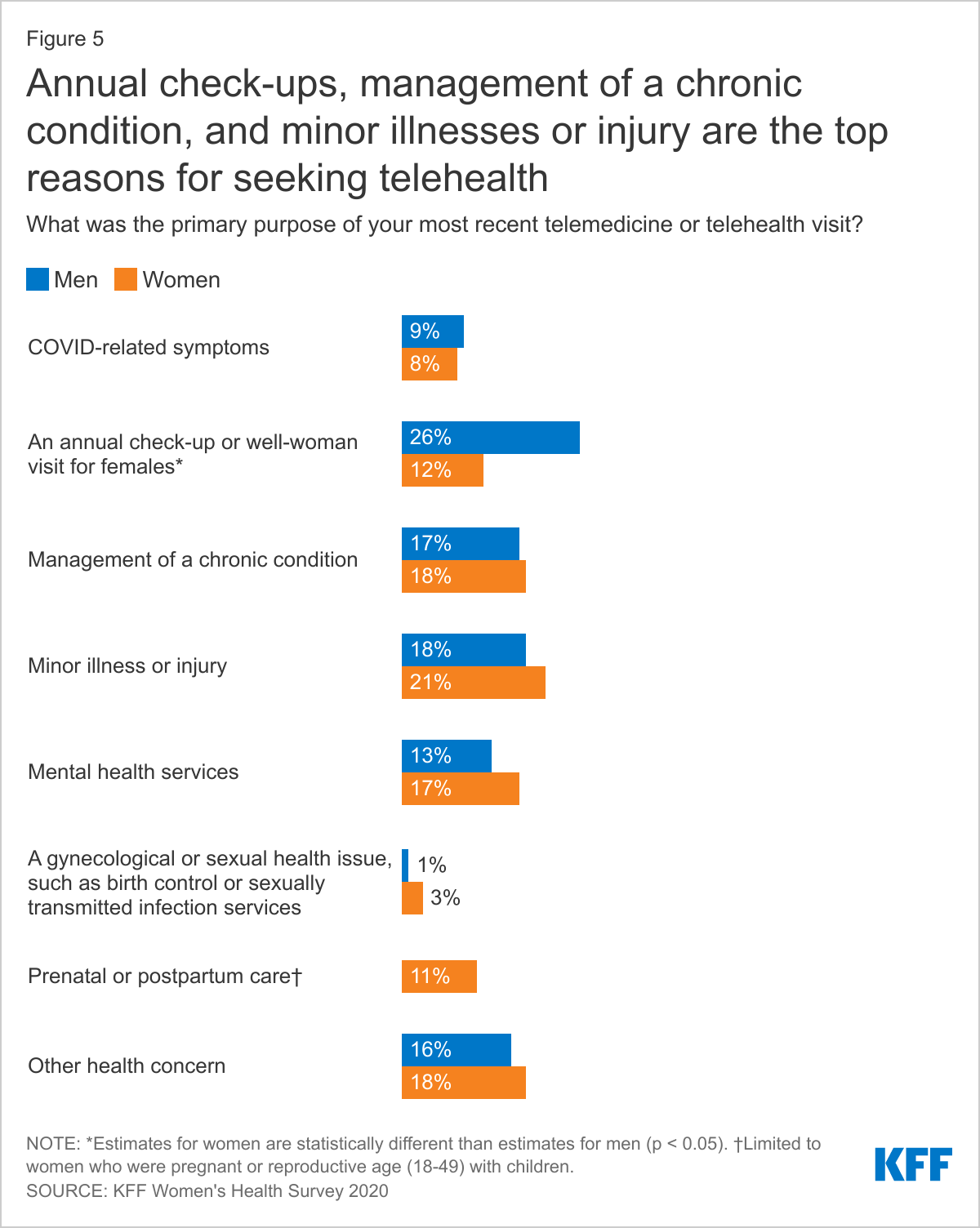
Surprisingly, COVID-related care was not a leading reason for seeking health care through telehealth. Just 8% of women and 9% of men say their most recent telehealth appointment was for COVID-related symptoms. More commonly, women report their most recent telehealth visits were to address a minor illness or injury (21%), management of a chronic condition (18%), and 17% for mental health services. While similar shares of women and men report these reasons for telehealth visits, one notable difference is that one-quarter of men (26%) say their most recent telehealth visit was for a checkup, compared to 12% of women (Figure 5).

Annual check-ups, management of a chronic condition, and minor illnesses or injury are the top reasons for seeking telehealth

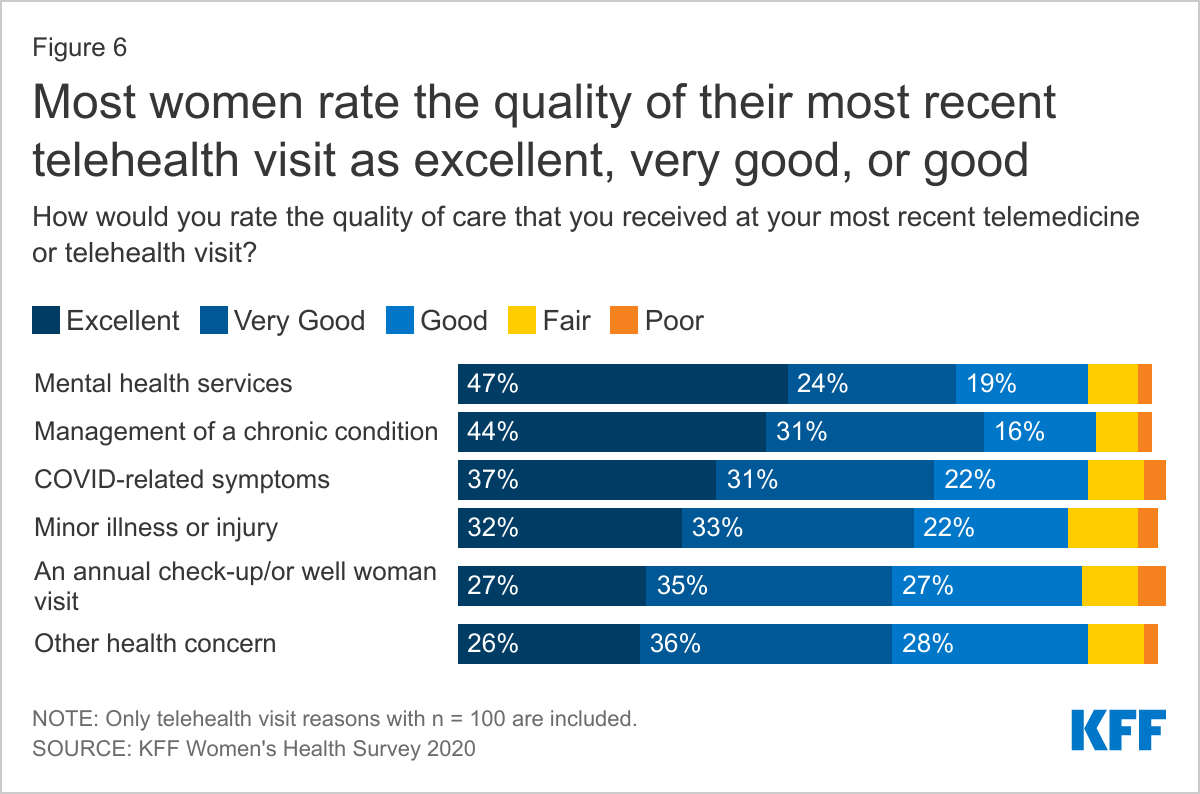
When asked to rate the care received at their most recent telemedicine or telehealth visit, most women showed high levels of satisfaction. A larger share of women rated the care they received at their most recent telemedicine or telehealth visit as excellent compared to men (35% vs. 29%). Telehealth care rated as excellent, very good, or good was more common among insured women with incomes ≥ 200% FPL compared to uninsured women with incomes < 200% FPL (91% vs. 86%) and women reporting being in excellent, very good, or good health compared to women who said their health was fair or poor (91% vs. 85%). There were no differences in ratings of telehealth quality by insurance status. Among women, telehealth mental health services received the largest share of excellent ratings and annual check-ups or well woman visits have the smallest share of excellent ratings, although ratings were still very positive with 89% of women rating their most recent telehealth annual check-up or well woman visit excellent, very good, or good (Figure 6). These data suggest most women are very satisfied with the telehealth services they have received and telehealth could continue to be a trusted approach to obtaining some types of health care services for individuals who would prefer or find it easier to access care from their home rather than traveling to a clinic or provider. However, there may be pressure from payers as the pandemic eases to once again limit telehealth due to cost concerns.

Most women rate the quality of their most recent telehealth visit as excellent, very good, or good

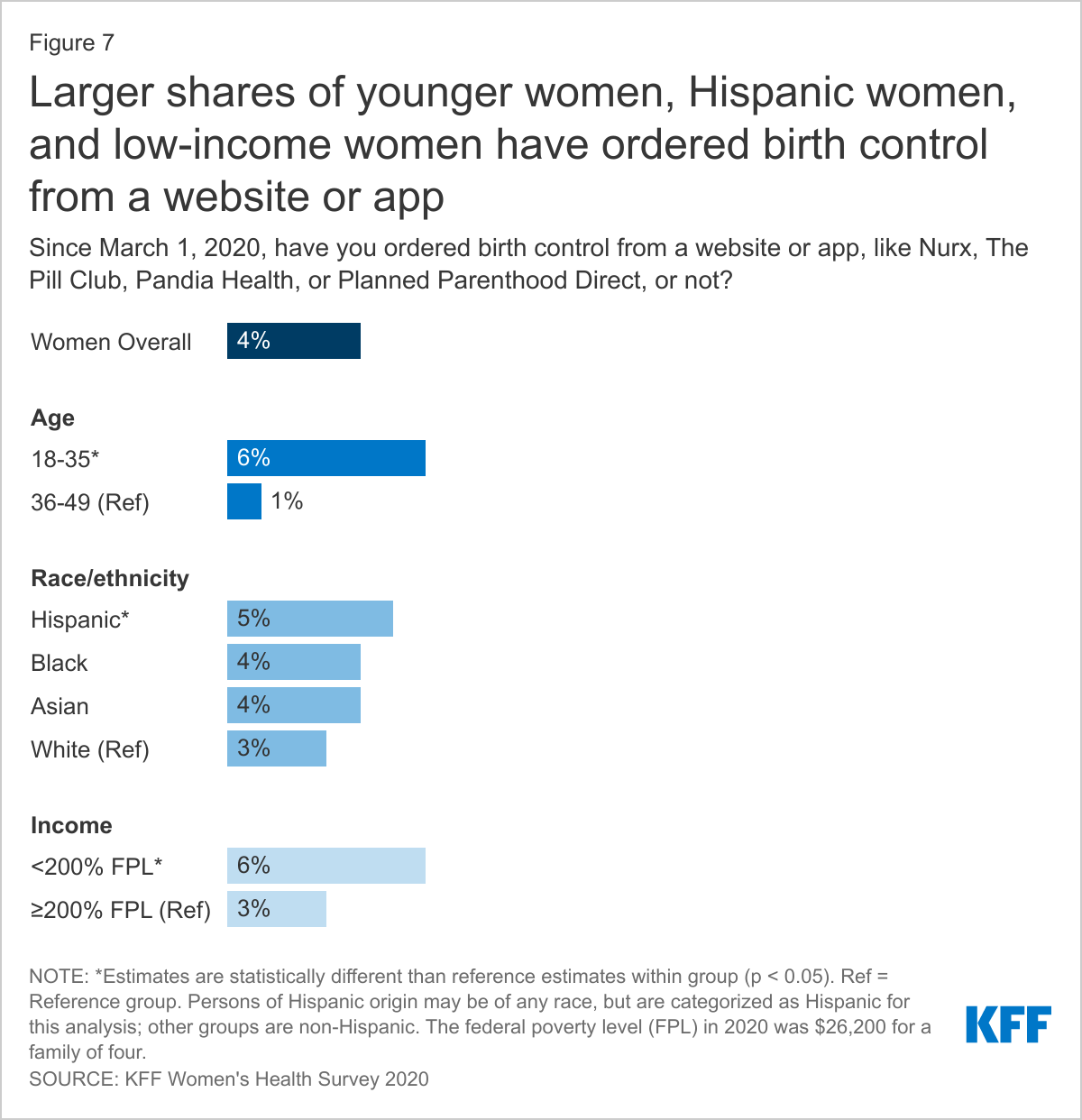
In recent years, there has been a proliferation of online companies that offer consumers access to primary care services, including sexual and reproductive health services like sexually transmitted infection testing, as well as prescriptions for everything from contraception to hair loss treatment. While these companies predate the pandemic, most are still relatively new. A small fraction of women (4%) ages 18-49 say they have ordered birth control from a website or app, like Nurx, The Pill Club, Pandia Health, or Planned Parenthood Direct. Younger women ages 18-35 (6%) in particular, are more likely to have ordered contraception from these companies compared to those ages 36-49 (1%). Some of these platforms do not accept insurance or Medicaid and may appeal to some uninsured or low-income women because of their costs. A larger share of Hispanic women (5%) compared to White women (3%) and low-income women (<200% FPL) (6%) compared to higher income women (≥ 200% FPL) (3%) have also used these online contraception platforms (Figure 7). While there is still a relatively small share of women using these online companies to obtain contraception, many of these companies have seen significant growth during the pandemic.

Larger shares of younger women, Hispanic women, and low-income women have ordered birth control from a website or app

COVID-19 Testing

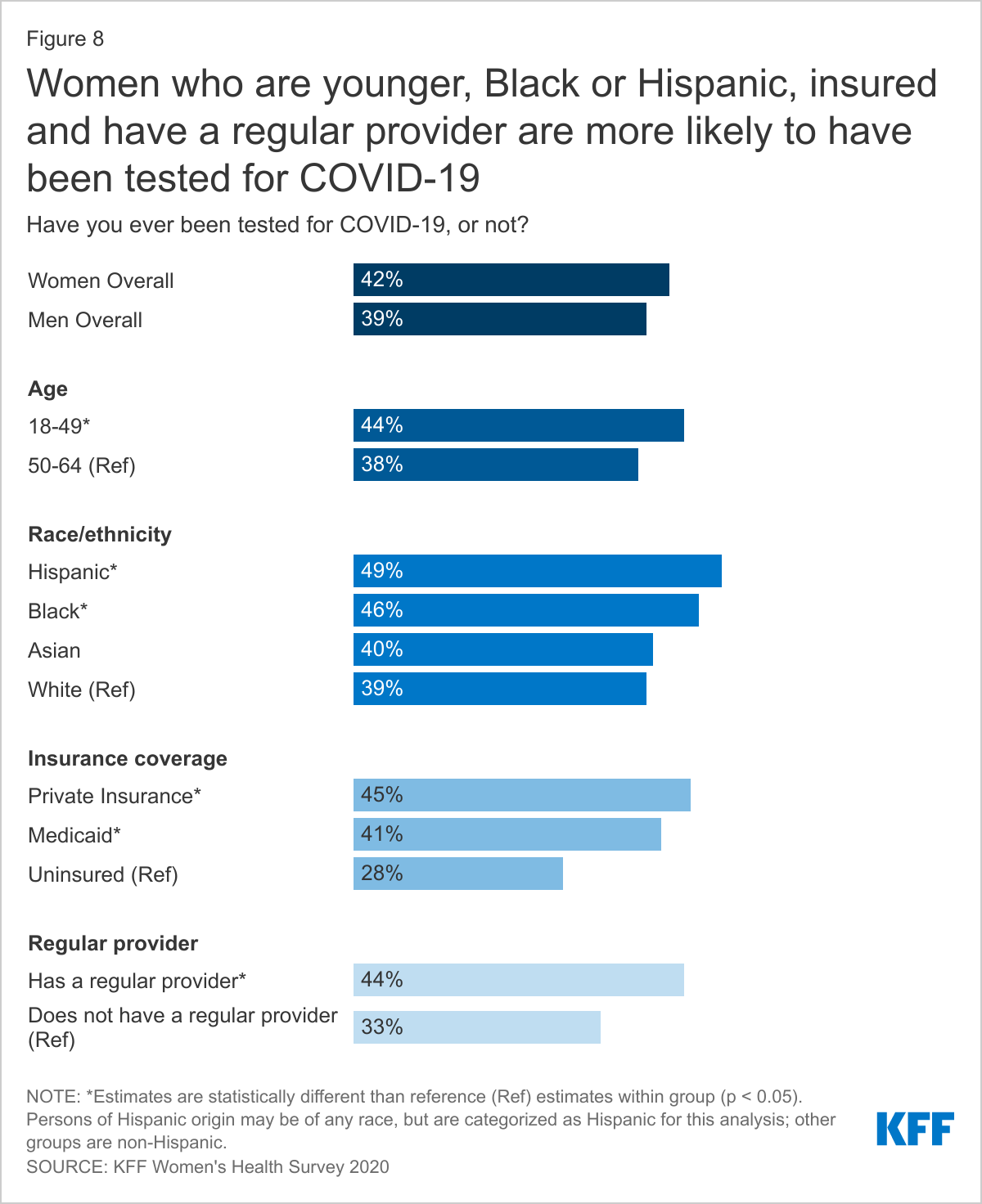
At the time that we fielded this survey in November-December 2020, four in ten women (42%) ages 18-64 had ever been tested for COVID-19 (Figure 8). Larger shares of younger women ages 18-49 (44%) had been tested compared to older women ages 50-64 (38%). Black (46%) and Hispanic (49%) women are also more likely to have been tested for COVID-19 compared to White women (39%).2  Women with private insurance and Medicaid have been nearly twice as likely to have received a COVID-19 test compared to uninsured women (45% and 41% vs. 28%), which could, in part, reflect uncertainty about or inability to afford out-of-pocket costs of COVID-19 tests without insurance. Women who reported having a regular provider are also more likely to have had a COVID-19 test compared to women who did not who do not have a regular health care provider (44% vs. 33%). Access to regular care results in more timely care and could also have implications for who is able to access COVID-19 vaccines, especially if documentation of a pre-existing condition is necessary for earlier vaccine groups.

Women who are younger, Black or Hispanic, insured and have a regular provider are more likely to have been tested for COVID-19

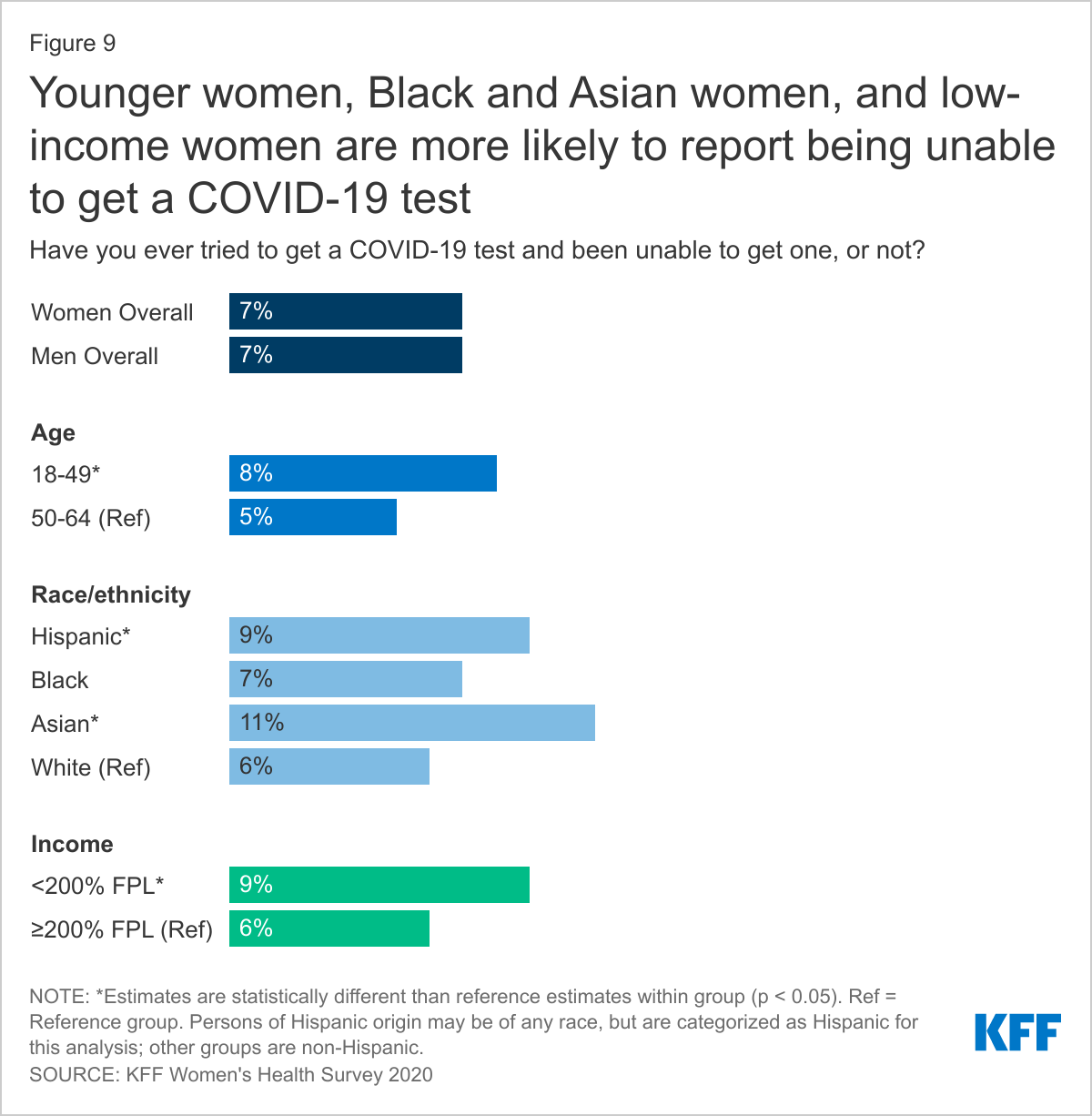
A small percentage of women reported trying to get a COVID-19 test and being unable to get one (7%) (Figure 9). While a higher share of younger women report being tested for COVID-19, they are also more likely to report not being able to get a test (8%) compared to women ages 50-64 (5%), which may reflect that younger women are more likely to be seeking tests than older women. A larger share of Asian/Pacific Islander (11%) and Hispanic (9%) women say they were unable to get a COVID-19 test compared to White (6%) women, while the share of Black women (7%) who couldn’t get a COVID test is similar to White women. A higher percentage of low-income women (< 200% FPL) (9%) report being unable to get a COVID-19 test compared to higher income (≥ 200% FPL) women (6%).

Younger women, Black and Asian women, and low-income women are more likely to report being unable to get a COVID-19 test

Impact on Mental Health

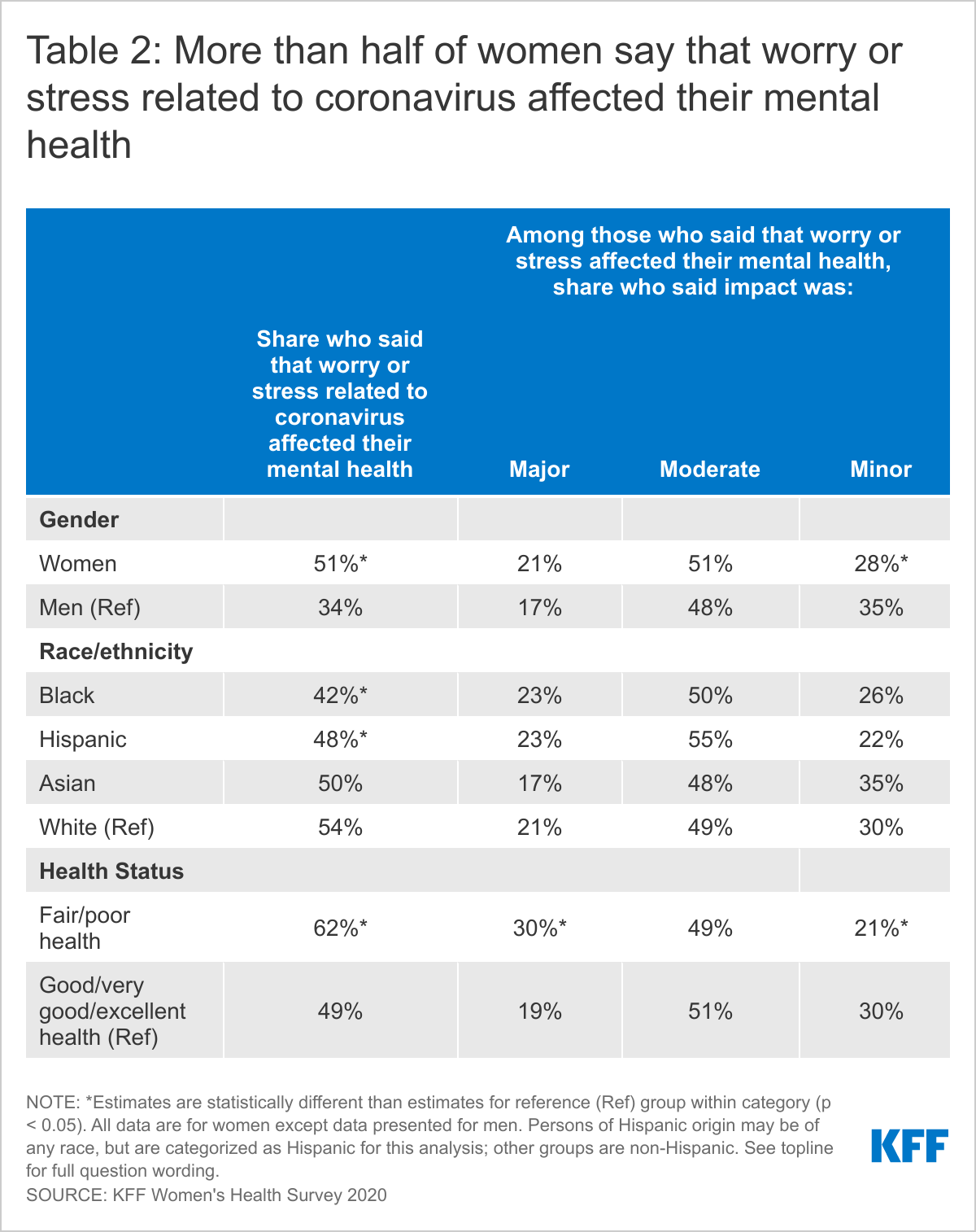
Numerous aspects of the pandemic have caused worry and stress, including concern about exposure to an infected individual, not being able to get tested, losing loved ones and jobs, working from home, and taking on additional childcare and homeschooling responsibilities. Half (51%) of women and about one-third of men (34%) say that worry or stress related to the pandemic has affected their mental health. While most (79% women, 83% men) say that the impact has been moderate or minor, almost one-fifth (21% women, 17% men) say the toll has had a major impact on their mental health (Table 2). Women who are already in fair or poor health are more likely than women in better health to say that the pandemic has had a major impact on their mental health.

Table 2: More than half of women say that worry or stress related to coronavirus affected their mental health

Despite the toll of the pandemic on women’s mental health, relatively few (15%) say they sought mental health care. While White women (54%) are most likely to say that stress from the pandemic has affected their mental health, Hispanic (19%) and Asian (19%) women are most likely to report seeking mental health care. Uninsured women (10%) are less likely to seek mental health care compared to women with Medicaid (20%) and private insurance (15%). There is likely to be a growing need for mental health care as people process the trauma and loss they have experienced over the past year.

Conclusion

The COVID-19 pandemic changed how people access and use health care, and while the availability of  options for telehealth care have grown rapidly and most people are satisfied with that care, it remains to be seen how acceptable these services will be as in person care resumes, and the requirements for payment parity are ended as the emergency measures are lifted by state and private sector payors. Many individuals are also having difficulties accessing care in this new environment or choosing not to seek care because of concerns about COVID exposure or risk. The survey finds that women have been more likely than men to forgo health care services during the pandemic, with many reporting worsening health conditions as a result. The expansion of telemedicine and virtual reproductive health care platforms have helped fill some of these gaps, but their reach is still limited, particularly for those without insurance or ready access to the internet or Wi-Fi. The burdens of the pandemic have had a negative impact on women’s mental health, though relatively few have reported seeking mental health care. Policies that promote stable insurance coverage, access to telehealth and mental health services, and the availability of safe in-person care can support women in obtaining needed health care for the remainder of the pandemic and beyond.

Methodology

The 2020 KFF Women’s Health Survey was designed and analyzed by researchers at the Kaiser Family Foundation (KFF) of a representative sample of 4,805 adults, ages 18-64 years old (3,661 women and 1,144 men). The survey was conducted online and telephone using AmeriSpeak®, the probability-based panel of NORC at the University of Chicago. U.S. households are recruited for participation using address-based sampling methodology and initial invitations for participation are sent by mail, telephone, and in-person interviews. Interviews for this survey were conducted between November 19 and December 17, 2020, among adults living in the United States. KFF paid for all costs associated with the survey.

The sample for this study was stratified by age, race/ethnicity, education, and gender as well as disproportionate stratification aimed at reaching uninsured women, women who identify as LGBT, and women 18-49 years old. The sampling also took into consideration differential survey completion rates by demographic groups so that the set of panel members with a completed interview for a study is a representative sample of the target population. Interviews were conducted in English and Spanish online (4,636) and via the telephone (169).

A series of data quality checks were run and cases determined to be poor-quality, as defined by surveys with a length of interview of less than 33% of the mean length of interview and with high levels of question refusal (>50%) were removed from the final data (n=96). Weighting involved multiple stages. First, the sample was weighted to match estimates for the national population from the 2020 Current Population Survey on age, gender, census division, race/ethnicity, and education. The second round of weights adjusted for the study’s sampling design. All statistical tests of significance account for the effect of weighting.

The margin of sampling error including the design effect for the full sample of women is plus or minus 2 percentage points. Numbers of respondents and margins of sampling error for key subgroups are shown in the table below. For results based on other subgroups, the margin of sampling error may be higher. Sample sizes and margins of sampling error for other subgroups are available by request. Note that sampling error is only one of many potential sources of error in this or any other public opinion poll.

GroupN (unweighted)M.O.S.E
Men Ages 18-641,144+/- 4 percentage points
Women Ages 18-643,661+/- 2 percentage points
Women Ages 18-492,695+/- 2 percentage points
White Women Ages 18-641,813+/- 3 percentage points
Black Women Ages 18-64603+/- 5 percentage points
Hispanic Women Ages 18-64801+/- 5 percentage points
Asian Women Ages 18-64246+/- 8 percentage points
LGB Women Ages 18-64392+/- 7 percentage points
Heterosexual Women Ages 18-643,239+/- 2 percentage points
Women < 200% FPL1,471+/- 3 percentage points
Women ≥200% FPL1,943+/- 3 percentage points

Endnotes

  1. The federal poverty level (FPL) in 2020 was $26,200 for a family of four.u00a0 ↩︎
  2. People of Hispanic origin may be of any race but are categorized as Hispanic throughout this brief, while other groups are non-Hispanic. ↩︎

Global Funding Across U.S. COVID-19 Supplemental Funding Bills

Published: Mar 19, 2021

The U.S. thus far has enacted six emergency supplemental funding bills, five of which were enacted in 2020 and one which was enacted in 2021, to address the COVID-19 pandemic:

  • the Coronavirus Preparedness and Response Supplemental Appropriations Act (P.L. 116-123) enacted on March 6, 2020;
  • the Families First Supplemental Appropriations Act (P.L. 116-127) enacted on March 18, 2020;
  • the Coronavirus Aid, Relief, and Economic Security (CARES) Act (P.L. 116-136) enacted on March 27, 2020;
  • the Paycheck Protection Program and Health Care Enhancement Act (P.L.116-139) enacted on April 24, 2020;
  • the Coronavirus Response and Relief Supplemental Appropriations Act, 2021 (P.L. 116-260) enacted on December 27, 2020; and
  • the American Rescue Plan Act of 2021 (P.L. 117-2) enacted on March 11, 2021.

While most of the funding in these bills has been for the domestic response, approximately $19 billion has been appropriated for global efforts, provided in four of the six bills – the Coronavirus Preparedness and Response Supplemental, the CARES Act, the Coronavirus Response and Relief Supplemental Appropriations Act, 2021, and the American Rescue Plan Act of 2021. The most recent bill, the American Rescue Plan Act, includes the most funding for the global response to date ($11.6 billion). The funding in these bills support the operations of U.S. agencies in other countries, including for repatriation of U.S. personnel, and funding provided directly to affected countries and international efforts. This data note tracks appropriations designated for international efforts in the emergency bills. It will be updated as needed.

Table 1 provides a list of the agencies and funding amounts specified for international efforts across each bill. Table 2 provides more details on this funding, including the expenditure period and a description of specific activities.

Table 1: Global Funding In Coronavirus Supplemental Bills – Summary Table
Agency/Department/AccountSupplemental #1:  Coronavirus Preparedness and Response Supplemental Appropriations Act (P.L. 116-123)Supplemental #2: Families First Supplemental Appropriations Act (P.L. 116-127)Supplemental #3: Coronavirus Aid, Relief, and Economic Security (CARES) Act (P.L. 116-136)Supplemental #4: Paycheck Protection Program and Health Care Enhancement Act (P.L.116-139)Supplemental #5: FY2021 Omnibus and COVID Relief and Response Act (P.L. 116-260) Supplemental #6: American Rescue Plan Act of 2021 (P.L. 117-2)Total Funding Across All  Bills
Total FundingTotal FundingTotal FundingTotal FundingTotal FundingTotal Funding
STATE/USAID$1,250,000,000 –$1,041,000,000 –$4,300,000,000$10,000,000,000$16,591,000,000
Department of State *$264,000,000 –$678,000,000 –$300,000,000$5,584,000,000$6,826,000,000
Consular and Border Security Programs – – – –$300,000,000 –$300,000,000
Diplomatic Programs$264,000,000 –$324,000,000 – –$204,000,000$792,000,000
Emergencies in the Diplomatic and Consular Services – –$4,000,000 – – –$4,000,000
Economic Support Fund (ESF)$4,300,000,000$4,300,000,000
of which HIV/AIDS – – – – –$3,750,000,000$3,750,000,000
HIV/AIDS (bilateral) – – – – –$250,000,000$250,000,000
Global Fund – – – – –$3,500,000,000$3,500,000,000
of which economic & stabilization support **$550,000,000$550,000,000
International Organizations & Programs (IO&P) – – –$580,000,000$580,000,000
Migration and Refugee Assistance – –$350,000,000 – –$500,000,000$850,000,000
USAID *$736,000,000 –$353,000,000 –$4,000,000,000$4,416,000,000$9,505,000,000
Office of Inspector General$1,000,000 – – – – –$1,000,000
Operating Expenses – –$95,000,000 – –$41,000,000$136,000,000
Global Health Programs (GHP)$435,000,000 – – –$4,000,000,000$4,435,000,000
of which Emergency Reserve Fund$200,000,000 – – – – –$200,000,000
of which Gavi, the Vaccine Alliance – – – –$4,000,000,000 –$4,000,000,000
Economic Support Fund (ESF)$4,375,000,000$4,375,000,000
of which global health$905,000,000$905,000,000
of which international disaster relief, rehabilitation, & reconstruction support$3,090,000,000$3,090,000,000
of which economic & stabilization support **$380,000,000$380,000,000
International Disaster Assistance (IDA)$300,000,000 –$258,000,000 – –$558,000,000
Other/Not Specified$250,000,000$10,000,000$260,000,000
Economic Support Fund (ESF) *$250,000,000 – – – –$250,000,000
Assistance for Europe, Eurasia and Central Asia (AEECA) * – –$10,000,000 – – –$10,000,000
Peace Corps – –$88,000,000 – – –$88,000,000
Millennium Challenge Corporation – –$2,000,000 – – –$2,000,000
Centers for Disease Control and Prevention$300,000,000 –$500,000,000 – –$750,000,000$1,550,000,000
Department of Agriculture – – – – –$800,000,000$800,000,000
Total Coronavirus Funding for the International Response$1,550,000,000 –$1,631,000,000 – $4,300,000,000$11,550,000,000$19,031,000,000
NOTES: The second and fourth supplemental bills do not include funding for international COVID-19 efforts. *The bill does not specify which agency some ESF and all AEECA funding is provided to; these accounts are jointly managed by the U.S. Department of State and USAID. **The $930,000,000 in funding provided through the Economic Support Fund (ESF) account to support economic and stabilization activities was divided between the Department of State ($550,000,000) and USAID ($380,000,000).SOURCES: KFF analysis of the “Coronavirus Preparedness and Response Supplemental Appropriations Act, 2020” (P.L. 116-123); House Appropriations H.R. 6074: Coronavirus Preparedness and Response Supplemental Appropriations Act, 2020 Title-By-Title Summary; Coronavirus Aid, Relief, and Economic Security (CARES) Act (P.L. 116-136) and Senate Appropriations Committee summary materials; FY2021 Omnibus and COVID Relief and Response Act (P.L. 116-260); American Rescue Plan Act of 2021 (P.L. 117-2).
Table 2: Global Funding In Coronavirus Supplemental Bills – Detailed Table
Agency/Department/AccountSupplemental #1:  Coronavirus Preparedness and Response Supplemental Appropriations Act (P.L. 116-123)Supplemental #3: Coronavirus Aid, Relief, and Economic Security (CARES) Act (P.L. 116-136)Supplemental #5: FY2021 Omnibus and COVID Relief and Response Act  (P.L.116-260)Supplemental #6: American Rescue Plan Act of 2021(P.L. 117-2)Total Funding Across All  Bills
Total FundingExpenditure PeriodDescriptionTotal FundingExpenditure PeriodDescriptionTotal FundingExpenditure PeriodDescriptionTotal FundingExpenditure PeriodDescription
STATE/USAID$1,250,000,000 – –$1,041,000,000 – –$4,300,000,000 – –$10,000,000,000 – –$16,591,000,000
Department of State *$264,000,000 – –$678,000,000 – –$300,000,000 – –$5,584,000,000$6,826,000,000
Consular and Border Security Programs – – – – – –$300,000,000To remain available until expendedFor an additional amount for “Consular and Border Security Programs” to prevent, prepare for, and respond to coronavirus, domestically or internationally, which shall be for offsetting losses resulting from the coronavirus pandemic of fees and surcharges collected and deposited into the account. – – –$300,000,000
Diplomatic Programs$264,000,000To remain available until September 30, 2022To prevent, prepare for, and respond to coronavirus, including for maintaining consular operations, reimbursement of evacuation expenses, and emergency preparedness.$324,000,000To remain available until September 30, 2022For an additional amount for “Diplomatic Programs” to prevent, prepare for, and respond to coronavirus, including for necessary expenses to maintain consular operations and to provide for evacuation expenses and emergency preparedness. – – –$204,000,000To remain available until September 30, 2022To carry out the authorities, functions, duties, and responsibilities in the conduct of the foreign affairs of the United States, to prevent, prepare for, and respond to coronavirus domestically or internationally, which shall include maintaining Department of State operations.$792,000,000
Emergencies in the Diplomatic and Consular Services – – –$4,000,000To remain available until expendedSection 21005. For an additional amount for the FY 2020 appropriations amount for “Emergencies in the Diplomatic and Consular Services from $1,000,000 to $5,000,000 under the Department of State, Foreign Operations, and Related Programs Appropriations Act, 2020. – – – – – –$4,000,000
Economic Support Fund (ESF) – – – – – – – – –$4,300,000,000 – –$4,300,000,000
of which HIV/AIDS$3,750,000,000To remain available until September 30, 2022$3,750,000,000 to be made available to the Department of State to support programs for the prevention, treatment, and control of HIV/AIDS in order to prevent, prepare for, and respond to coronavirus, including to mitigate the impact on such programs from coronavirus and support recovery from the impacts of the coronavirus, of which not less than $3,500,000,000 shall be for a United States contribution to the Global Fund to Fight AIDS, Tuberculosis and Malaria$3,750,000,000
HIV/AIDS (bilateral) – – – – – – – – –$250,000,000To remain available until September 30, 2022To support programs for the prevention, treatment, and control of HIV/AIDS in order to prevent, prepare for, and respond to coronavirus, including to mitigate the impact on such programs from coronavirus and support recovery from the impacts of the coronavirus.$250,000,000
Global Fund – – – – – – – – –$3,500,000,000To remain available until September 30, 2022This contribution shall not be considered a contribution for the purpose of applying such section 202(d)(4)(A)(i).$3,500,000,000
of which economic & stabilization support **$550,000,000To remain available until September 30, 2022$930,000,000 to be made available to prevent, prepare for, and respond to coronavirus, which shall include activities to address economic and stabilization requirements resulting from such virus.$550,000,000
International Organizations & Programs (IO&P) – – – – – – – – –$580,000,000To remain available until September 30, 2022To prevent, prepare for, and respond to coronavirus, which shall include support for the priorities and objectives of the United Nations Global Humanitarian Response Plan COVID-19 through voluntary contributions to international organizations and programs administered by such organizations.$580,000,000
Migration and Refugee Assistance – – –$350,000,000To remain available until expendedFor an additional amount for “Migration and Refugee Assistance” to prevent, prepare for, and respond to coronavirus  for the Department of State to contribute to pending appeals from the UN High Commissioner for Refugees, International Committee of the Red Cross, and other partners to prepare for, and respond to, coronavirus among vulnerable refugee populations abroad. – – –$500,000,000To remain available until September 30, 2022To prevent, prepare for, and respond to coronavirus. Funds appropriated shall not be made available for the costs of resettling refugeesin the United States.$850,000,000
USAID *$736,000,000 – –$353,000,000 – –$4,000,000,000 – –$4,416,000,000 – –$9,505,000,000
Office of Inspector General$1,000,000To remain available until September 30, 2022Oversight activities – – – – – – – – –$1,000,000
Operating Expenses – – –$95,000,000To remain available until September 30, 2022For an additional amount for “Operating Expenses” to prevent, prepare for, and respond to coronavirus for operational needs of USAID, including support for evacuations and ordered departures of overseas staff, surge support, increased technical support for remote functions, and other needs. – – –$41,000,000To remain available until September 30, 2022To prevent, prepare for, and respond to coronavirus domestically or internationally, and for other operations and maintenance requirements related to coronavirus.$136,000,000
Global Health Programs (GHP)$435,000,000To remain available until September 30, 2022To prevent, prepare for, and respond to coronavirus. – – –$4,000,000,000To remain available until September 30, 2022 – –$4,435,000,000
of which Emergency Reserve Fund$200,000,000To remain available until September 30, 2022 –  – – – – – – – – –$200,000,000
of which Gavi, the Vaccine Alliance – – – – – –$4,000,000,000To remain available until September 30, 2022For an additional amount for “Global Health Programs” to prevent, prepare for, and respond to coronavirus, including for vaccine procurement and delivery: Provided, That such funds shall be administered by the Administrator of the United States Agency for International Development and shall be made available as a contribution to The GAVI Alliance” – – –$4,000,000,000
Economic Support Fund (ESF)$4,375,000,000To remain available until September 30, 2022$4,375,000,000
of which global health$905,000,000To remain available until September 30, 2022$905,000,000 to be made available to the United States Agency for International Development for global health activities to prevent, prepare for, and respond to coronavirus, which shall include a contribution to a multilateral vaccine development partnership to support epidemic preparedness.$905,000,000
of which international disaster relief, rehabilitation, & reconstruction support$3,090,000,000To remain available until September 30, 2022$3,090,000,000 to be made available to the United States Agency for International Development to prevent, prepare for, and respond to coronavirus, which shall include support for international disaster relief, rehabilitation, and reconstruction, for health activities, and to meet emergency food security needs.$3,090,000,000
of which economic & stabilization support **$380,000,000To remain available until September 30, 2022$930,000,000 to be made available to prevent, prepare for, and respond to coronavirus, which shall include activities to address economic and stabilization requirements resulting from such virus.$380,000,000
International Disaster Assistance (IDA)$300,000,000To remain available until expendedTo prevent, prepare for, and respond to coronavirus.$258,000,000To remain available until expendedFor an additional amount for “International Disaster Assistance” to prevent, prepare for, and respond to coronavirus for USAID to respond to the extraordinary needs in other countries that are underequipped to respond to the pandemic. The funding will prioritize populations affected by ongoing humanitarian crises, particularly displaced people, because of their heightened vulnerability, the elevated risk of severe outbreaks in camps and informal settlements, and anticipated disproportionate mortality in these populations. – – –$558,000,000
Other/Not Specified$250,000,000$10,000,000$260,000,000
Economic Support Fund (ESF) *$250,000,000To remain available until September 30, 2022To prevent, prepare for, and respond to coronavirus, including to address related economic, security, and stabilization requirements. – – – – – –$250,000,000
Assistance for Europe, Eurasia and Central Asia (AEECA) * – – –$10,000,000FY 2020-FY 2021Section 21004. For an additional amount for the FY 2020 appropriations amount to hire and employ individuals in the United States and overseas on a limited appointment basis from $100,000,000 to $110,000,000 under the Department of State, Foreign Operations, and Related Programs Appropriations Act, 2020. – – – – – –$10,000,000
Peace Corps – – –$88,000,000To remain available until September 30, 2022For an additional amount for “Peace Corps” to prevent, prepare for, and respond to coronavirus to support evacuations of all overseas volunteers, relocation of U.S. direct hires on authorized or ordered departure, and certain benefits for returned volunteers, including health care. – – – – – –$88,000,000
Millennium Challenge Corporation – – –$2,000,000To remain available until expendedSection 21006. For an additional amount for “Millennium Challenge Corporation: increasing from $105,000,000 to $107,000,000 under the Department of State, Foreign Operations, and Related Programs Appropriations Act, 2020, to increase the amount it can spend to cover additional costs due to staff evacuations. – – – – – –$2,000,000
Centers for Disease Control and Prevention$300,000,000To remain available until September 30, 2022Global disease detection and emergency response$500,000,000To remain available until September 30, 2024For global disease detection and emergency response – – –$750,000,000To remain available until expendedTo combat SARS-CoV-2, COVID-19, and other emerging infectious diseases threats globally, including efforts related to global health security, global disease detection and response, global health protection, global immunization, and global coordination on public health.$1,550,000,000
Department of Agriculture – – – – – – – – –$800,000,000To remain available until September 30, 2022To use the Commodity Credit Corporationto acquire and make available commodities under section 406(b)of the Food for Peace Act $800,000,000
Total Coronavirus Funding for the International Response$1,550,000,000 –  –$1,631,000,000 – –$4,300,000,000 – –$11,550,000,000 – –$19,031,000,000
NOTES: The second and fourth supplemental bills do not include funding for international COVID-19 efforts and are not included in this table. *The bill does not specify which agency some ESF and all AEECA funding is provided to; these accounts are jointly managed by the U.S. Department of State and USAID. **The $930,000,000 in funding provided through the Economic Support Fund (ESF) account to support economic and stabilization activities was divided between the Department of State ($550,000,000) and USAID ($380,000,000).SOURCES: KFF analysis of the “Coronavirus Preparedness and Response Supplemental Appropriations Act, 2020” (P.L. 116-123); House Appropriations H.R. 6074: Coronavirus Preparedness and Response Supplemental Appropriations Act, 2020 Title-By-Title Summary; Coronavirus Aid, Relief, and Economic Security (CARES) Act (P.L. 116-136) and Senate Appropriations Committee summary materials; FY2021 Omnibus and COVID Relief and Response Act (P.L. 116-260); American Rescue Plan Act of 2021 (P.L. 117-2).
News Release

KFF/Post Survey of Frontline Health Care Workers Finds Nearly Half Remain Unvaccinated

35th Partnership Project Examines Frontline Workers’ Experiences and Views Amid the COVID-19 Pandemic

Published: Mar 19, 2021

As of early March, just over half (52%) of frontline health care workers say they have received at least one dose of a COVID-19 vaccine, leaving 48% who have not, a new KFF/The Washington Post national survey of health care workers finds.

Most who work in hospitals (66%) and outpatient clinics (64%) say they have received a COVID-19 vaccine, compared to half who work in doctors’ offices (52%) or in nursing homes or assisted care facilities (50%), and a quarter (26%) of home health care workers. Similarly, seven in ten (68%) of those responsible for patient diagnosis and treatment like a doctor or a nurse report receiving a COVID-19 vaccine, compared to about four in ten of those who perform administrative duties (44%) or who assist with patient care such as bathing, eating, cleaning, exercising, and housekeeping (37%).

The findings related to vaccination intentions come from a new KFF/Post partnership survey examining the experiences and attitudes of frontline health care workers during the COVID-19 pandemic and appear in The Washington Post and in a KFF report. Additional findings focused on the emotional, physical and economic toll that the pandemic has taken on frontline health care workers will appear in future stories and reports.

Among the initial findings:

  • The unvaccinated group of frontline health care workers includes some who either have their vaccination scheduled (3%) or plan to get vaccinated but haven’t scheduled it yet (15%). It also includes 3 in 10 who have either not decided whether they will get vaccinated (12%) or say they do not plan on receiving a COVID-19 vaccine (18%).
  • A large majority of unvaccinated health care workers who either have not decided if they will get vaccinated, or say they do not plan to get vaccinated, say that worries about potential side effects (82%) and the newness of the vaccine (81%) are major factors in their decision making. These are the top concerns across the different demographic groups of unvaccinated health care workers including Black health care workers, Hispanic health care workers, and White health care workers.
  • Among frontline health workers, half of Black workers, 45% of workers without a college degree, and four in ten Republican and Republican-leaning workers say they are not confident the COVID-19 vaccines available in the U.S. have been properly tested for safety and effectiveness. About 1 in 5 of each of these groups also say they will definitely not receive a COVID-19 vaccine.
  • Access to a COVID-19 vaccine from an employer is a key aspect of vaccination rates among frontline health care workers. 6 in 10 health care workers who are not self-employed say they were either offered or received a COVID-19 vaccine from their employer (including 84% of vaccinated health care workers). Reflecting the overall vaccination rates among frontline health care workers, the share of workers who were offered a COVID-19 vaccine from their employer was much lower among those working in patients’ homes (34%).

The project, the 35th KFF/The Washington Post partnership survey, includes interviews with a nationally representative sample of 1,327 frontline health care workers (direct contact with patients and their bodily fluids), representing hospitals, doctors’ offices, outpatient clinics, nursing homes and assisted care facilities, and those working in home health care. The sample includes workers who work in many, and multiple, different aspects of patient care including patient diagnosis and treatment, administrative duties, and/or assisting with patient care such as bathing, eating, cleaning, exercising, and housekeeping. The survey also included a comparison survey allowing researchers to compare the group of frontline healthcare workers to the general population, that included 971 U.S. adults not working as frontline health care workers. The margin of sampling error for the group of frontline health care workers is 3 percentage points, national comparison sample is 4 percentage points. For results based on subgroups, the margin of sampling error may be higher.


Medicaid Provisions in the American Rescue Plan Act

Author: MaryBeth Musumeci
Published: Mar 18, 2021

The American Rescue Plan Act, the COVID-19 relief package that became law on March 11, 2021, contains a number of provisions designed to increase coverage, expand benefits, and adjust federal financing for state Medicaid programs. These provisions are briefly described below and summarized in Table 1. Separate briefs summarize provisions in the new law relating to the Marketplaces and public health.

Coverage provisions

The law provides an additional temporary fiscal incentive to encourage states that have not yet adopted the Affordable Care Act (ACA) Medicaid expansion to do so. In addition to the 90% federal matching funds available under the ACA for the expansion population, states also can receive a 5 percentage point increase in their regular federal matching rate for 2 years after expansion takes effect. The additional incentive applies whenever a state newly expands Medicaid and does not expire. The new incentive is available to the 12 states that have not yet adopted the expansion as well as Missouri and Oklahoma, which are expected to implement expansion in July 2021. The increase in the regular matching rate is estimated to more than offset the increased state costs of expansion in these states for the first two years.

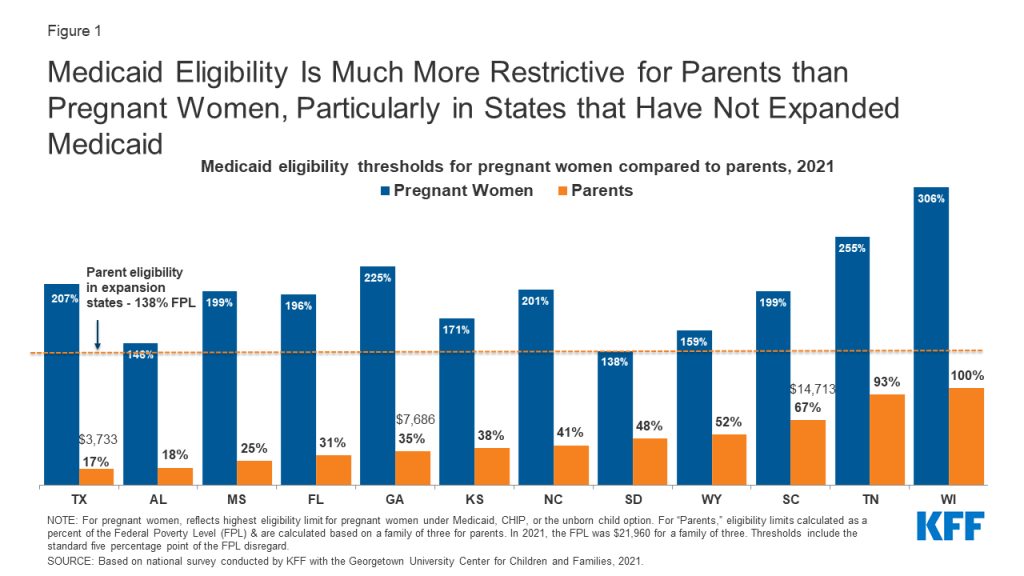
States have a new option to extend Medicaid coverage for post-partum women from the current 60 days to a full year. States that elect this option must provide full state plan benefits throughout the enrollee’s pregnancy and post-partum period and cannot limit benefits to only those that are “pregnancy related.” The new option is available to states for 5 years, beginning April 1, 2022.

Benefit provisions

The new law clarifies that COVID-19 vaccines and administration are covered without cost-sharing for Medicaid enrollees and provides 100% federal matching funds for this coverage. CMS previously had interpreted the Families First Coronavirus Response Act (FFCRA) vaccine coverage requirement to exclude certain enrollees receiving limited benefit packages. The coverage provision applies to all enrollees, except those eligible only for Medicare cost-sharing assistance (partial duals) or COBRA premium assistance, from March 11, 2021 through the last day of the 1st calendar quarter that begins at least 1 year after the COVID-19 PHE ends. The financing provision applies from April 1, 2021 through the last day of the 1st quarter that begins at least 1 year after the PHE ends.

The new law adds coverage of COVID-19 treatment services, without cost-sharing, for enrollees in the COVID-19 uninsured testing group and enrollees who receive alternative benefit plans (ABPs). This coverage includes specialized equipment and preventive therapies and treatment (if otherwise covered under Medicaid) of a condition that may seriously complicate treatment of COVID-19 for those presumed to have or diagnosed with COVID-19. The COVID-19 uninsured testing group was created by the FFCRA and is available at state option, with 100% federal matching funds, during the PHE. The benefit package for this group previously was limited to COVID-19 testing and testing-related services. Enrollees receiving ABPs include the ACA expansion group and other enrollees at state option. ABPs allow states to provide a benefit package based on a private insurance plan instead of the traditional Medicaid state plan benefit package. COVID-19 treatment services are required in ABPs from March 11, 2021 through the last day of the 1st calendar quarter that begins at least 1 year after the PHE ends. States providing COVID-19 treatment services in ABPs would receive the 90% enhanced federal matching rate for expansion adults or their regular federal matching rate plus the additional 6.2 percentage points under the FFCRA (ranging from 56% to 85% across states) for other populations.

States can receive a 10 percentage point increase in federal matching funds for Medicaid home and community-based services (HCBS) from April 1, 2021 through March 30, 2022. The new funds must supplement, not supplant, the level of state HCBS spending as of April 1, 2021, and states must  implement or expand one or more activities to enhance HCBS. HCBS help seniors and people with disabilities live independently in the community by assisting with daily self-care and household activities.

States have a new option to provide community-based mobile crisis intervention services with 85% federal matching funds for the first 3 years. The additional funds must supplement, not supplant, the level of state spending for these services in the fiscal year before the 1st quarter that a state elects this option. Services must be otherwise covered by Medicaid and provided by a multidisciplinary team to enrollees experiencing a mental health or substance use disorder crisis outside a hospital or other facility setting. These services generally do not have to be offered statewide, do not have to be comparable for all enrollees, and can restrict enrollees’ free choice of provider. The new option is available to states for 5 years, beginning April 1, 2022. The law also authorizes $15 million for state planning grants, to be awarded by the HHS Secretary as soon as practicable. 

The new law provides $250 million for state strike teams to be deployed to Medicaid-certified nursing facilities with diagnosed or suspected cases of COVID-19 among residents or staff. The strike teams will assist with clinical care, infection control, or staffing during the PHE.

Other financing provisions

The new law contains some other provisions that affect Medicaid financing. It provides 100% federal matching funds for 2 years, beginning April 1, 2021, for services received through Urban Indian health care organizations and Native Hawaiian health systems. It also eliminates the cap on the amount of rebates that manufacturers pay to Medicaid in exchange for coverage of their FDA-approved drugs on December 31, 2023, resulting in federal savings of $14.5 billion. The law also requires the HHS Secretary to recalculate states’ annual disproportionate share hospital (DSH) allotments to ensure that these payments are equal to what they would have been without the 6.2 percentage point increase in federal matching funds provided under the FFCRA.

Finally, the new law provides $8.5 billion in FY 2021 for provider relief fund payments to rural Medicaid, CHIP, and Medicare providers. These funds are available to compensate for health care related expenses and lost revenues attributable to the pandemic for rural providers who diagnose, test, or care for individuals with possible or actual COVID-19.

Table 1:  Medicaid Provisions in the American Rescue Plan, Enacted 3/11/21
TopicSectionSummary
Mandatory coverage of COVID-19 vaccines and administration and treatment under Medicaid9811Vaccine coverage:  clarifies that COVID-19 vaccines and administration are covered without cost-sharing for Medicaid enrollees, from 3/11/21 through last day of 1st calendar quarter that begins at least 1 year after public health emergency ends. Applies to all Medicaid enrollees except for those eligible only for Medicare cost-sharing (partial duals) and those eligible only for COBRA premium assistance..Provides 100% federal matching funds for COVID-19 vaccine and administration coverage from 4/1/21 through last day of first quarter beginning at least 1 year after PHE ends..Treatment coverage:  adds coverage of treatment for COVID-19, without cost-sharing, to benefit package for COVID-19 uninsured testing group (during PHE) and to alternative benefit plans (from 3/11/21 through last day of 1st calendar quarter beginning at least 1 year after PHE ends). Coverage is defined as testing and treatment for COVID-19, including specialized equipment and preventive therapies, and treatment (if otherwise covered under Medicaid) of a condition that may seriously complicate treatment of COVID-19 for those presumed to have or diagnosed with COVID-19.
State option to extend post-partum coverage to 12 months9812Creates state option to extend coverage for post-partum women to 12 months, instead of 60 days. States that elect this option must provide full state plan benefits throughout the enrollee’s pregnancy and post-partum period..Available to states from 4/1/22-3/30/27.
State option to provide community-based mobile crisis intervention services9813Creates state option to cover community-based mobile crisis intervention services with 85% federal matching funds for 1st 12 fiscal quarters, provided that additional federal funds supplement, not supplant, the level of state spending for these services in the FY before the 1st quarter that a state elects this option..States can offer services using a state plan amendment, § 1915 (b) managed care waiver, § 1915 (c) HCBS waiver, or § 1115 demonstration waiver. Services do not have to be offered statewide (except if state offered services in a region in the FY before electing this option, it must continue services in that region while receiving enhanced matching funds), do not have to be comparable for all enrollees, and can restrict enrollees’ free choice of provider..Available to states from 4/1/22-3/30/27. Also authorizes $15 million for state planning grants, to be awarded by the HHS Secretary as soon as practicable.
Temporary increase in regular FMAP for states newly adopting ACA expansion9814Increases regular federal matching rate by 5 percentage points for 8 quarters for states newly covering the ACA expansion group. States are eligible for the increase if they did not have spending for the entire ACA expansion group before 3/11/21, and must cover the entire group to receive the increase.
Extension of 100% FMAP to Urban Indian health organizations and Native Hawaiian health care systems9815Provides 100% federal matching funds for 8 fiscal quarters beginning 4/1/21 for services received through Urban Indian organizations with grants or contracts with Indian Healthcare Service, Native Hawaiian health centers, or Papa Ola Lokahi (Native Hawaiian health care system).
Sunset of limit on maximum rebate amount for single source prescription drugs and innovator multiple source drugs9816Eliminates federal rebate cap on the amount of rebates manufacturers pay to Medicaid in exchange for coverage of their FDA-approved drugs, effective 12/31/23; currently, the rebate cap is set at 100% of the average manufacturer price.
Additional support for Medicaid HCBS during COVID-19 emergency period9817Provides 10 percentage point increase in federal matching funds (capped at 95%) for HCBS from 4/1/21 through 3/31/22. States shall use increased funds to supplement, not supplant, the level of state HCBS spending as of 4/1/21, and to implement or expand one or more activities to enhance HCBS..Applies to state plan home health, personal care, PACE, primary care case management, § 1915 (i), self-directed personal assistance, Community First Choice, case management, and rehabilitative option, § 1915 (c) and § 1115 waivers, and alternative benefit plans.
Funding for state strike teams for resident and employee safety in nursing facilities9818Provides $250 million to increase capacity to respond to COVID-19 by implementing state strike teams deployed to nursing facilities with diagnosed or suspected cases of COVID-19 among residents or staff to assist with clinical care, infection control, or staffing during PHE.
Recalculate of DSH allotments9819Directs HHS Secretary to recalculate states’ annual DSH allotments to ensure that total payments that a state may make for a FY are equal to the total payments that the state could have made without receiving the 6.2 percentage point Families First Coronavirus Response Act (FFCRA) increase in federal Medicaid matching funds. Amendment is effective as if enacted in FFCRA, applies in any FY when the FFCRA increase is in effect, and ends beginning with the first FY after the PHE ends.
COVID-19 relief funds for rural providers9911Provides $8.5 billion in FY 2021 for payments to Medicaid, CHIP, and Medicare rural providers who diagnose, test, or care for individuals with possible or actual COVID-19, for health care related expenses and lost revenues attributable to COVID-19.
SOURCE:  American Rescue Plan Act, H.R. 1319. (March 11, 2021).
News Release

New Briefs Examine Recent Federal Action on Medicaid Postpartum Coverage and Title X Family Planning

Published: Mar 18, 2021

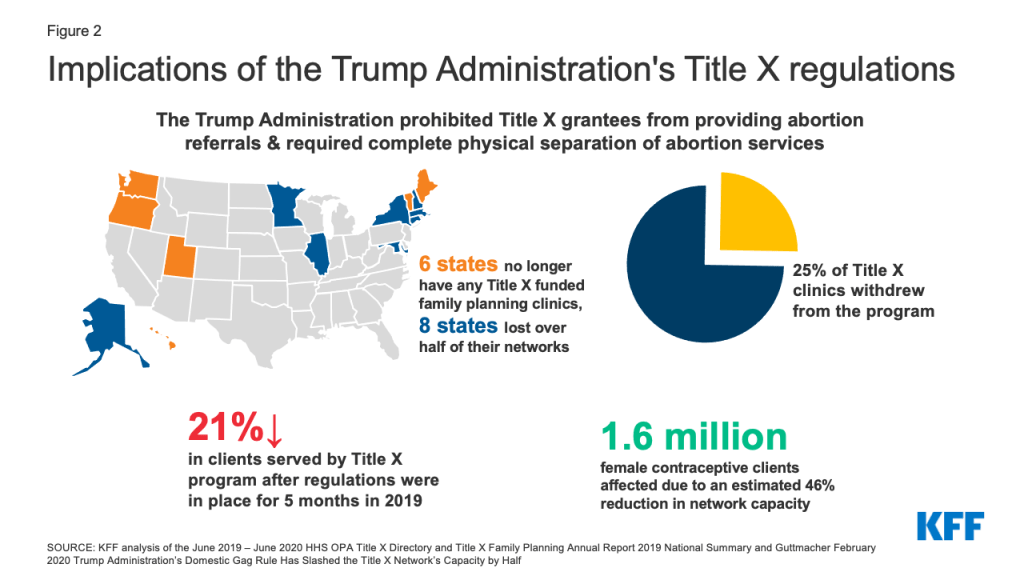
Two new KFF women’s health briefs dive deeper into key women’s health issues on the federal policy agenda: Postpartum Medicaid coverage in the American Rescue Plan of 2021 and the Title X Family Planning regulations. The Biden Administration campaigned on reversing the Trump Administration’s Title X Family Planning program regulations and improving maternal health care.

Medicaid Postpartum Extension: The American Rescue Plan Act of 2021 provides states with a new option to extend Medicaid postpartum coverage for women who have a Medicaid funded delivery from 60 days to 12 months. The Postpartum Coverage Extension in the American Rescue Plan Act of 2021 provides a deeper look at what the Act does for postpartum eligibility expansion and when it can take effect. It also covers questions going forward like what states might take this option? What does this mean for non-expansion states?

Title X: President Biden has directed the Department of Health and Human Services (HHS) to review the Trump Administration Title X Family Planning program regulations that ban abortion referrals and co-located abortion services and is likely to issue new regulations. Over 150 members of Congress have asked that the Trump-era regulations be rescinded no later than March 29. The Potential Scenarios for Issuing New Title X Regulations issue brief examines two possible scenarios and timelines for issuing new Title X regulations and distributing program funding to those grantees and sites that may seek to return to the Title X network if the abortion referral restrictions are lifted

For additional information on the current status of the Title X program and postpartum Medicaid coverage and other developments in women’s health policy, visit www.kff.org/womens-health-policy.

Potential Scenarios for Issuing New Title X Regulations

Published: Mar 18, 2021

UPDATE: HHS Announces Plans to Publish Notice of Proposed Rulemaking

On March 18, 2021, HHS announced they will publish a Notice of Proposed Rule Making (NPRM) in the Federal Register by April 15, 2021, which will be similar to the regulations in effect before the Trump Administration changed them. The NPRM will likely be open for public comment for 60 days, followed by an HHS review to consider comments, and publication of the final rule by early fall 2021.

OPA intends to release a Fiscal Year 2022 Funding Opportunity Announcement (FOA) in December 2021. This means that grantees that left the program and want to return and current grantees will apply at the same time. Applicants will likely have 60 days to prepare and submit an application, followed by 60 days of OPA review, with new funding awarded by April 1, 2022. This timeline will open the door to restore funding to grantees and the clinics they support that left the program under the Trump Administration, but they will likely be without federal Title X support for another year.

Introduction

On January 28, 2021, President Biden issued a Memorandum on Protecting Women’s Health at Home and Abroad, directing Health and Human Services (HHS) to review the Title X Family Planning program regulations issued by the Trump Administration. These rules prohibited Title X grantees from participating in the program if they provide abortion referrals or abortion services in the same physical location as well as other requirements. The Biden Memorandum calls for HHS to “consider whether to suspend, revise or rescind, or publish for notice and comment proposed rules suspending, revising, or rescinding those regulations, consistent with applicable law, including the Administrative Procedure Act.” In the short term, the Biden Administration could suspend enforcement of the Trump Administration regulations in the same way that they recently did for public charge. While this approach would permit clinic sites supported by existing grantees to once again provide abortion counseling and referrals, new regulations would be needed to make federal support available to new or previous grantees.

This issue brief reviews the process and scenarios for timelines by which the Biden Administration could address the loss of clinics triggered by the Trump regulations by issuing new regulations and awarding new grants under the updated regulations. On March 8, 2021, 162 members of Congress sent a letter to the acting secretary of HHS urging the agency to swiftly complete their review of the Trump-era regulations and to rescind that rule no later than March 29, 2021.

Since it was first promulgated by the Trump administration on June 1, 2018, the regulation has been the focus of several lawsuits. Family planning clinics, providers, and 23 State Attorneys General have challenged the Trump Administration regulations on the grounds that they violate provisions of the Affordable Care Act (ACA), the Administrative Procedures Act and Section 1554 of the ACA. On February 22nd, the Supreme Court announced it will hear the challenges. Assuming that the Biden Administration will not defend the Trump Administration regulations, a coalition of attorneys general from 19 states filed a motion to intervene  and separately the American Association of Pro-Life Obstetricians & Gynecologists, the Christian Medical and Dental Associations, and the Catholic Medical Association also filed a motion to intervene as a party to defend the Trump Administration regulations. On March 12, 2021, the plaintiffs, (including the AMA, Planned Parenthood, other family planning provider groups and attorneys general in 23 states) and the Solicitor General asked the Supreme Court to dismiss the cases. Even if the litigation over the Trump Administration regulation is ended, a final regulation that is in effect, can generally only be rescinded or altered by promulgating new regulations and we discuss two options and the timeline for doing so below.

Two Options for Promulgating New Regulations

There are two ways new regulations can be promulgated per the Administrative Procedures Act. One option is a Notice of Proposed Rule Making (NPRM). An NPRM is the standard process where the proposed rules are published in the Federal Register and then open for public comment for at least 60 days. The agency is then required to address the public comments and only then are regulations published in the Federal Register and considered final.

Another option is an interim final rule, which is published as a final rule and effective immediately but this approach provides an opportunity for the public to comment at the time the rule is published. An interim final rule is a faster process than an NPRM but can only be promulgated with “good cause” and when an agency decides it is “impracticable, unnecessary, or contrary to the public interest” to go through the longer process of proposed rulemaking.

Scenario One: Notice of proposed rule making (NPRM)

The Biden Administration could promulgate a new rule by following the process for issuing a notice of proposed rulemaking (NPRM) where the proposed rule is published in the Federal Register and then open for public comment for at least 60 days. HHS would then review the public comments, respond to them, make changes to the rule accordingly, and then publish final regulations. Regulations usually become effective 60 days after publication but the agency could make them effective sooner if it has good cause.

Under the fastest timeline, which would likely take at least five months to implement (Figure 1), the Biden Administration could publish a notice of proposed rulemaking in the federal register in March of 2021, followed by at least a 60-day public comment period. Over the next month, HHS would then review the public comments, prepare a response to them, and potentially issue a final rule as early as June 2021. At its fastest, the NPRM process would likely take at least five months, but it often can take longer. For example, the Trump Administration’s NPRM process for promulgating new Title X regulations took nine months from June 1, 2018 to March 4, 2019, and the first provisions became effective 60 days after publication on May 3, 2019.

Scenario TWO: ISsue an interim final rule

If the Biden Administration issues an interim final rule, the new regulations would become effective immediately. Because an interim final rule can only be promulgated if there is good cause to do so, however, HHS would need to determine that going through the longer process of proposed rulemaking is contrary to the public interest. The Biden Administration could cite the substantial decline in participating clinics and clients served by the program, as well as the six states that no longer have any Title X funded clinics (Figure 2). While an interim final rule might be the faster option, it increases the risk that organizational grantees and representatives of state interests that do not want to adhere to the new regulations would present a legal challenge on the grounds that they are held to follow a regulation that differs from the ones under which they applied.

Figure 2: Implications of the Trump Administration’s Title X regulations​

New Funding Opportunity Announcement

Once there are new regulations, the grantees that disburse the Title X funds to the clinic sites that are still in the Title X program can change the requirements for program participation, requiring them to offer  pregnancy options counseling that includes abortion along with prenatal care and adoption, as well as abortion referrals and allow financial separation rather than full physical separation from onsite abortion services. They could also begin to bring clinics that left the program because they felt they could not adhere to the Trump Administration regulations back into their networks. However, in the states that no longer have Title X grantees or who have lost a large share of grantees (high need areas), the Office of Population Affairs (OPA) would need to issue a funding opportunity announcement (FOA) under the new regulations to resume federal support for services to these areas. If an interim final rule is issued shortly, a new FOA could be released as early as March 2021, or as late as June 2021 if the regulations are published through the slower NPRM process. Typically, grantees are given at least 60 days to prepare and submit applications, followed by an OPA review which could take between 30 and 60 days, and OPA could therefore grant awards as early as June/July 2021 with an interim final rule or September/October 2021 with an NPRM. The new American Rescue Plan Act of 2021 included a $50 million dollar supplemental appropriation to the Title X Family Planning Program to make grants and contracts, which could be used to bring Title X grantees that have left the program back into the program through this new FOA and still keep funding levels stable for those who stayed on.

In addition to bringing grantees of high need areas back into the Title X program, OPA will also have to issue a funding opportunity announcement for renewal of all the current grantees whose three-year grant cycle ends March 31, 2022. If the agency keeps with previous funding cycles, OPA will likely release an FOA for the existing grantees this October or November. Those grantees would be given at least 60 days to respond to the FOA with applications due in January 2022 and new awards by April 1, 2022 when the funding cycle ends. It is possible that OPA would have to go through the funding opportunity cycle twice in the span of a few months to fund new/returning grantees who have been disqualified under the Trump Administration rules as well as those that have stayed in the program.

No matter how the Biden Administration implements new Title X regulations, there may be legal challenges. A coalition of 19 states have filed a motion to intervene in the cases currently at the Supreme Court claiming an interest because some have received additional funds under the Trump Administration regulations and the rules “eliminated any confusion about the States’ involvement in the provision of abortion.” If the Supreme Court dismisses the cases as requested by the parties in the case, these states may challenge the Biden Administration regulations. Religiously affiliated organizations that became grantees under the Trump Administration regulations may also challenge the Biden Administration regulations, claiming that they should qualify for a grant even if they are religiously opposed to the provision of pregnancy options counseling which includes the options of abortion and referrals to abortion services when requested.

The Trump Administration sought to expand the Title X network to include new “family planning” grantees who offer fertility awareness-based methods and prioritize abstinence, but not necessarily offer contraception to their clients. Obria Medical Group, a Catholic organization that has religious objections to contraception and abortion, applied for a Title X grant in January 2019 and was awarded a grant of over $5 million over 3 years. Obria views their services “as a form of Christian Ministry which must conform to the tenets of that faith in its treatment of the vulnerable… and that to refer for or otherwise facilitate an abortion is gravely sinful.”

When Obria applied for the Title X grant in January 2019, they assumed that the Trump Administration’s final rule would be in effect during the grant period. However, the Trump Administration final rule was initially blocked by federal courts and the prior regulations (which were in place until July 15, 2019), required nondirective pregnancy options counseling and abortion referrals.

In May 2019, Obria filed a lawsuit against HHS, requesting an injunction to stop enforcement of the requirement to provide nondirective pregnancy options counseling and abortion referrals, claiming this requirement violates their religious rights. The following month, they withdrew their lawsuit, after Health and Human Services sent them a letter effectively notifying them that they would not be required to provide abortion referrals if they have a religious objection and would still be eligible for federal Title X support.

The Biden Administration will likely have a different interpretation of the Title X statute and will require all grantees to comply with all the rules of the Title X program (including non-directive pregnancy options counseling, contraception, and abortion referral) which would effectively disqualify Obria from continued participation in the program. Therefore, Obria may file a legal challenge to regulations if they are disqualified from receiving Title X funds, and the courts will be asked to answer the legal question: Is the federal government required to provide a federal grant to an organization that has religious objections to fulfilling the requirements of the grant?

Look Forward

The federal rule-making process is not fast, nor is the funding opportunity and application process. Today, the Title X program is serving far fewer clients than before the Trump regulations took effect and there are many parts of the country that no longer have clinics that are receiving federal support. By issuing the Memorandum on Protecting Women’s Health at Home and Abroad in his first eight days of his presidency, President Biden signaled that this is a top priority for his administration, but the process for implementing new regulations and distributing new funding will take time.

Postpartum Coverage Extension in the American Rescue Plan Act of 2021

Published: Mar 18, 2021

Inside the $1.9 trillion American Rescue Plan Act of 2021 is a less noticed provision that makes a major change to Medicaid coverage for low-income pregnant and postpartum women, addressing a long-standing gap for people who have had their maternity care covered by Medicaid, especially those in states that have not expanded Medicaid as permitted by the ACA. While the Act adds new incentives for states to take up the ACA Medicaid expansion, it also now gives all states the new option to extend the postpartum coverage period under Medicaid from 60 days following pregnancy to a full year. This post explains the new policy and raises some questions that policymakers are likely to grapple with as the implementation unfolds.

What does the new policy do?

  • The American Rescue Plan Act of 2021 gives states a new option to extend Medicaid postpartum coverage from 60 days to 12 months. Currently, Medicaid covers almost half of births nationally, with eligibility levels ranging from 138% to 380% of poverty across states. States must cover pregnant women with incomes up to 138% of the federal poverty level (FPL) through 60 days postpartum (the end of the month of the 60th postpartum day). The American Rescue Plan Act allows states to extend the postpartum period to a year by filing a State Plan Amendment (SPA) to their Medicaid program.
  • Under the new law, the postpartum coverage duration can also be lengthened under the CHIP program. Currently, six states cover some low-income pregnant women through their CHIP programs. If a state takes up the new option to extend the postpartum period, this will apply to their CHIP coverage in addition to Medicaid.
  • States that elect the new option must provide full Medicaid benefits during pregnancy and the extended postpartum period. Currently, states are permitted to cover a more narrow set of pregnancy-related benefits to those who qualify under the pregnancy pathway, although most align their benefits with other Medicaid eligibility groups. States that elect this new option however would have to provide full Medicaid benefits.
  • The new option can take effect starting April 1, 2022 and would be available to states for five years. While the new option takes effect next year, currently postpartum women covered by Medicaid can remain on the program beyond 60 days because of a Maintenance of Effort requirement enacted in 2020 that lasts through the COVID public health emergency.

Questions going forward

  • Which states will take up this option? While we do not know which states will take up the option, several have shown interest in extending the postpartum coverage period beyond 60 days. Some states have applied and have waivers pending at CMS to extend postpartum coverage. This includes expansion states like Illinois and New Jersey as well as non-expansion states like Georgia (which applied for extension through 180 days postpartum). These states could now file a SPA instead of waiting for approval of their waivers. Some states may decide to change earlier proposals. For example, Missouri has submitted a waiver application to CMS that would extend postpartum coverage to a year just for substance use and mental health services. That proposal would not qualify for the new SPA option because it would not cover full benefits.
  • What will be the impact on women’s coverage in non-expansion states? Non-expansion states that take up the option could see a decrease in the share of low-income mothers who are uninsured. Medicaid income eligibility levels for parents are much lower than for pregnant people (Figure 1). Currently, in non-expansion states, some new mothers fall into the coverage gap where their incomes are too high for Medicaid parent eligibility yet too low for Marketplace subsidies (which are available only at the poverty level or above), putting them at risk for becoming uninsured.
Figure 1: Medicaid Eligibility Is Much More Restrictive for Parents than Pregnant Women, Particularly in States that Have Not Expanded Medicaid​
  • Will this option be adopted by expansion states? In states that have expanded Medicaid under the ACA, most postpartum women have a pathway to coverage – either Medicaid or subsidized private insurance through the ACA Marketplaces, but a longer postpartum period could allow for greater continuity with Medicaid providers. Studies have documented that new moms who have Medicaid funded childbirths experiencing significant churning in coverage.
  • What will be the impact on federal and state budgets? The Congressional Budget Office (CBO) estimates that by 2024, about a quarter of postpartum beneficiaries will live in states that elect the new option. CBO estimates that extended Medicaid coverage will result in almost $6.1 billion in federal spending over the first ten years. States that adopt this extension would also incur costs as the extended coverage would remain at the same federal matching level, which ranges from 56.2% to 84.51%. These estimates take into account potential shifts in private insurance enrollment, including lower ACA subsidy costs. It is not clear if the estimates account for factors such as greater access to preventive services like contraception, which could avert unintended pregnancies that would otherwise be covered by Medicaid.
  • What will be the impact on health outcomes? Part of the motivation for postpartum extension is the nation’s high rate of preventable pregnancy-related mortality and morbidity, particularly the stark disparities among Black and Native American women. There is also growing recognition that the postpartum period extends far beyond 60 days. Many of the conditions that account for a significant share of pregnancy-related mortality and morbidity, such as cardiovascular diseases, hypertension, and depression often require care over a longer-term. Providing Medicaid access to low-income mothers for a longer period also promotes continuity and access to preventive services such as contraception and intrapartum care.The role of coverage as a key element of reproductive health care access is well understood. However, maternal health is also heavily connected to a complex set of issues, particularly poverty and systemic racism that pervade the health care system.

Global COVID-19 Vaccine Access: A Snapshot of Inequality

Published: Mar 17, 2021

Ensuring widespread global access to COVID-19 vaccines, which is necessary for preventing cases and deaths and contributing to global population immunity, is a critical challenge and one that could threaten the ability to control the pandemic. Despite efforts to address vaccine access, most notably through the creation of COVAX, which aims to support the development and delivery of COVID-19 vaccines with a particular focus on assisting low- and middle-income countries, significant disparities remain. The latest data from the Duke Global Health Innovation Center Launch and Scale Speedometer, which monitors COVID-19 vaccine purchases, finds that high-income countries already own more than half of all global doses purchased, and it is estimated that there will not be enough vaccine doses to cover the world’s population until at least 2023.

To further examine the current global distribution of COVID-19 vaccine doses, we used data from the Duke Launch and Scale Speedometer to calculate the share of doses purchased by country income group compared to their share of the global adult population (focusing on adults, ages 18+, because most COVID-19 vaccines are thus far only available for the adult population). In addition, we calculated potential vaccine coverage rates – that is, the share of the adult population that could be fully vaccinated – by country income group. To do so, we reapportioned doses secured through regional agreements to their respective country recipients and added these to individual country totals where bilateral agreements were also in place. While it is not possible to allocate most COVAX doses purchased to individual countries at this time, since COVAX has yet to release its full distribution plan, we did assess how allocating  all COVAX doses to low- and middle-income countries (LMICs) would affect these distributions (see Methodology for more detail). Ultimately, we find that without redistribution of doses already purchased by high-income countries (through donations or other means) and/or increased support for manufacturing or production of additional doses, more than four in ten (41%) adults in the world will not be able to be vaccinated, even after allocating all COVAX doses to LMICs.

High-income countries, representing just a fifth of the global adult population, have purchased more than half of all vaccine doses, resulting in disparities between adult population share and doses purchased for all other country income groups. We find that although high-income countries only account for 19% of the global adult population, collectively, they have purchased more than half (54%, or 4.6 billion) of global vaccine doses purchased to date. Of the remaining doses, 33% have been purchased by LMICs, who account for 81% of the global adult population; an additional 13% have been purchased by COVAX. Looking by country income group, the largest disparity between doses purchased and population share is for lower-middle-income countries (37% of the global population vs. 12% of purchased doses, or 989 million doses), followed closely by upper-middle-income countries (37% vs. 18%, or 1.5 billion doses). The disparity for low-income countries is smaller (3% vs. 7%, or 263 million doses) (see Figure 1a).

Vaccine Doses Purchased by Income Level Compared to Share of Global Adult Population

The disparity is even more pronounced when looking at the share who could be vaccinated. While enough vaccine doses have been purchased to cover more than 80% of the adult population, high-income countries own enough doses to vaccinate more than twice their populations while LMICs can only cover one-third.

High-income countries currently have enough vaccine doses to cover more than twice their adult populations (245% see Figure 2a). Meanwhile, LMICs currently only have enough vaccine doses to reach approximately one-third of their populations, with upper-middle-income countries able to cover 39% of their adult population, low-income countries 38%, and lower-middle-income countries 27%.

Percentage of Adult Population Able to be Vaccinated with Purchased Doses by Income Level

Providing all COVAX doses to LMICs could help but would still leave vaccines out of reach for most of the global population. COVAX, which currently accounts for 13% (1.12 billion) of the total number of global doses purchased, has not yet finalized the distribution plan for its full supply, though most doses are expected to be distributed to LMICs. We looked at what would happen to global distribution, relative to population and to vaccine coverage, if all 1.12 billion COVAX doses were provided to LMICs (which is not going to be the case since some will go to high-income countries). While this would result in the share of doses purchased for LMICs increasing from 33% to 46%, it would still be well below their share of the global adult population (81%) (see Figure 1b). Moreover, even with the COVAX doses, less than half (49%) of the adult population in LMICs would be able to be vaccinated (see Figure 2b). Looking at potential global coverage rates, allocating all COVAX doses to LMICs only slightly improves the picture, increasing the percentage of adults globally that can be vaccinated from 46% to 59%. This is well below the percentage of adults globally that could be vaccinated based on the total number of doses purchased (86%) (see Figure 3).

COVID-19 Immunization Rates by COVAX Redistribution Scenario

The disparity between vaccines purchased and country income level is significant, but could be addressed in large part through redistribution of doses, as some high-income countries have said they would do. However, such a strategy is highly dependent on the as-of-yet unknown outcomes of several vaccine candidate trials or a significant increase in the manufacturing and production of already authorized vaccines. This analysis demonstrates the significant disparity in vaccine access across much of the world, at least of doses purchased to date. While high-income countries have secured enough doses for more than twice their adult population, LMICs currently have only enough doses to vaccinate just a third, or, if all COVAX doses were allocated to them, still less than a half. Although there are currently enough purchased doses to vaccinate more than 80% of the global adult population, unless these doses are redistributed, huge inequities in vaccine distribution will persist, presenting a major challenge to achieving global population immunity. Some high-income countries have indicated that they will donate their excess doses, including France, Norway, the U.K., and the U.S. government, which has said it will do so only after it has vaccinated the U.S. population. Still, even if such donations were to occur, their ability to fully address these disparities is in part dependent on the success of some vaccine candidates still in clinical trials or the ability to support the increased manufacturing of or production capacity for already successful vaccine products.

Methodology

We obtained data on COVID-19 vaccine purchases by country from the Duke Global Health Innovation Center Launch and Scale Speedometer. Country income classifications were obtained from the World Bank. Redistributing regional purchases by member country population size was used in order to account for differing income-levels of member countries. Doses secured through regional agreements (made by the African Union, European Union, and Latin America) were reapportioned to their member countries based on adult population size, based on information released about the African Union and European Union. This same method was used for Latin America, although information on how vaccines would be distributed has not been made available. For the Latin America agreement, we included all countries classified as “Latin America and the Caribbean” by the United Nations Department of Economic and Social Affairs, excluding Brazil as specified in the agreement. Territory population totals were not included in our calculations. Population data were obtained from the United Nations Department of Economic and Social Affairs. Since vaccines are currently only being authorized or approved for and provided to adults, with the exception of the Pfizer vaccine which has been approved for individuals 16 years and older, we used population estimates for those 18 years and older. Finally, to estimate potential vaccine coverage by country, we took into account the number of doses needed for full vaccination, depending on the product. For the COVAX reapportionment scenarios, we assumed that all doses currently purchased by COVAX will be allocated to LMICs, even though some of these doses will be distributed to high-income countries, to provide a hypothetical “best-case scenario” for LMICs.

New Incentive for States to Adopt the ACA Medicaid Expansion: Implications for State Spending

Authors: Robin Rudowitz, Bradley Corallo, and Rachel Garfield
Published: Mar 17, 2021

Issue Brief

As of February 2021, 12 states have not adopted the Affordable Care Act (ACA) provision to expand Medicaid to adults with incomes through 138% of poverty. Millions of people in these states remain without an affordable coverage option. Currently, the federal government covers 90% of the cost of Medicaid coverage for adults covered through the ACA expansion, a higher share than it does for other Medicaid enrollees. The American Rescue Plan Act of 2021 encourages non-expansion states to take up the expansion by providing an additional temporary fiscal incentive for states to newly implement the ACA Medicaid expansion. This brief provides illustrative estimates of the net fiscal benefit to states from these incentives relative to state costs under the expansion. We review the methods underlying these estimates in the Methods section at the end of the brief.

How does the fiscal incentive work?

Under the law, states would receive the 90% ACA match for the expansion population. Under the ACA, states currently receive a 90% federal matching rate (FMAP) for adults covered through the ACA expansion (this amount was 100% in 2014 and phased down to 90% over time). In states that have not expanded to date, adults who could be covered under expansion include about 4 million uninsured people (2.2 million with incomes under poverty in the “coverage gap” and 1.8 million currently eligible for marketplace coverage because their incomes are between 100% and 138% of poverty level). In addition, individuals with incomes 100-138% of the federal poverty level (FPL) who are currently enrolled in marketplace coverage would become eligible for Medicaid.

Under the law, states that do not have expansion in place when the bill was enacted would be eligible for a 5 percentage point increase in the state’s regular, or traditional, match rate (FMAP) for two years if they implement the expansion. The traditional FMAP applies to most services for non-expansion groups, including children, non-expansion adults, seniors, and people with disabilities. Even in states that have already adopted the expansion, the traditional Medicaid program is much larger – representing 79% of Medicaid spending overall in these states — and per enrollee costs are relatively higher than the expansion group. So, under this new incentive, states could draw down additional funds for a large share of their Medicaid population and spending if they newly expand. In addition to the 12 states that have not adopted the expansion, the increase in the match rate also applies to Missouri and Oklahoma because the bill was enacted before they implement the expansion in July 2021. Further, if states newly adopt the expansion in the near term, the new 5 percentage point increase would be in addition to the current 6.2 percentage point increase in the match rate provided under the Families First Coronavirus Response Act (FFCRA) that is tied to the Public Health Emergency (PHE). Based on a January 2021 letter from the Biden Administration to Governors, the 6.2 percentage point increase in the match will be in place at least through March 2022, halfway through federal FY 2023. While the enhanced match would be in place for two years after a state implements the Medicaid expansion, states can take advantage of this new option at any time.

What is the estimated effect on state spending?

We estimate that the increase in the traditional match rate would more than offset the increased state costs of the expansion in every state. Nationally, the increase in federal support from the 5 percentage point increase in the traditional match rate to the 12 non-expansion states could total $16.4 billion over two years if all states implemented the expansion starting in FY 2022. These new federal funds to states would be offset by new state costs tied to the 10% share of expansion. We estimate that new state costs for expansion could be $6.8 billion over two years across current non-expansion states, assuming all eligible people enroll. The result would be an estimated fiscal benefit to states of $9.6 billion over the two year period (Figure 1).1  Put another way, new federal funds under the 5 percentage point bump are more than two times larger than new state expansion costs; this ratio varies slightly across states, from more than one a half times larger in Texas to over four times larger in South Carolina (Table 1).

Figure 1: New Financial Incentive for States To Implement the Expansion Would More Than Offset New Costs

After the two years, states would continue to receive the 90% match for the expansion group and the traditional match without the 5 percentage point increase for the traditional population. These estimates do not include additional federal funds that states would draw down through the 90% federal match on expansion spending, which would continue as long as the expansion is in place. States would continue to fund the 10% share of expansion and would lose the added fiscal incentive after two years. Research shows there are often savings in other state programs related to expanding Medicaid as well as revenue increases due to the infusion of federal funds associated with the 90% match on expansion spending. In addition, states could fund these ongoing costs with funds from the temporary enhanced FMAP that exceeded the cost of expansion; however, as states generally balance their budgets annually and may use the additional funds for other purposes, applying these funds to a later year may be difficult in practice.

These are illustrative estimates and subject to uncertainty. For example, the estimate of increased federal support from the enhanced match rate could be low if traditional Medicaid enrollment grows faster than our estimates assume, which may be possible given the pandemic and economic effects. In addition, the estimates of costs for new coverage could be high as we do not model take up but rather estimate costs for all eligible people; alternatively, the estimate for expansion could be low as it is based on national survey data that typically undercounts lower income people. Even with some uncertainty in the estimates, the magnitude clearly shows that the federal support would significantly outweigh the new costs of expansion while the temporary expansion incentive is in place. These estimates are not comparable to estimates from the Congressional Budget Office (CBO) that are capturing changes in federal spending over the next 10 years and incorporating behavioral responses that assume not all states would adopt the new option. The CBO estimates account for increased federal spending and reduced costs for federal subsidies in the Marketplace for states that adopt the expansion. CBO assumes that the option could increase federal spending by a net of $16.1 billion over the 2021-2030 period.

Medicaid expansion in the remaining 12 non-expansion states has the potential to reach millions of people. A comprehensive literature review of Medicaid expansion studies shows that expansion helps to expand coverage and reduce the uninsured, improve access to and utilization of care, reduce uncompensated care costs, improve affordability of care and reduce racial and ethnic disparities in coverage. The provisions in the American Rescue Plan Act would also provide substantial fiscal incentives for states to expand, which could be attractive given recent state revenue declines. However, given that the expansion incentive would be temporary, its effect may be limited.

Table 1: Cumulative Fiscal Impact of a 5 Percentage Point Increase in FMAP, FYs 2022-2023 (In Millions of Dollars)
Increased Federal Funds from FMAP Increase on Traditional PopulationsNew State Cost Due to ACA Medicaid ExpansionNet Effect for State Spending
Total*$16,410-$6,830$9,590
Alabama740-200540
Florida3,080-1,2601,810
Georgia1,360-640710
Kansas450-210250
Mississippi690-290400
North Carolina1,700-4901,210
South Carolina790-190600
South Dakota110-5060
Tennessee1,260-360900
Texas5,020-3,0901,930
Wisconsin**1,140**1,140
Wyoming70-4030
Adopted Expansion but Not Implemented
Missouri*1,150*1,150
Oklahoma*520*520
NOTES: Figures may not sum to total due to rounding. *Total excludes OK and MO because these states were scheduled to implement the expansion in July 2021 and thus do not face new state costs under the policy change. **We do not calculate new state costs for expansion for WI because the state currently provides Medicaid eligibility to childless adults earning up to the poverty level under a state waiver, at the regular FMAP; thus, even with additional costs due to covering currently marketplace-eligible people, the state would likely see fiscal gain under expansion by moving waiver enrollees from the regular state match to the 90% expansion match.SOURCE: KFF estimates and analysis.

Methodology

Expansion Eligibility and Cost Estimates for Non-Expansion States

We calculate the number of people potentially eligible for Medicaid based on KFF 2019 estimates of the number of uninsured people who could be eligible for Medicaid if their state expanded plus estimates of people enrolled in Marketplace coverage who could become Medicaid eligible if their state expanded. We estimate Marketplace enrollees who could shift to Medicaid based on 2019 Marketplace enrollment data from the Centers for Medicare and Medicaid Services (CMS) Open Enrollment Period Files, and KFF analysis of the Census Bureau’s 2019 American Community Survey (ACS). We use Marketplace data on enrollees with income below 150% FPL, adjusted to the share with income through 138% FPL using KFF ACS estimates of income of people with nongroup coverage. To project spending on expansion adults for these states, we use our projected estimate of per enrollee costs for non-expansion adults in these states (described below) and apply the median ratio of spending per expansion enrollee to spending per non-expansion adult using data for expansion states for which we had a full year of data in FY2019.

We did not calculate additional state costs from expanding Medicaid for Missouri and Oklahoma because these states were scheduled to implement expansion in July 2021 and thus do not face new state costs due to expansion under the policy; rather, these costs are already assumed in the state Medicaid budget. Although we calculated the increased federal fiscal relief for Missouri and Oklahoma, we did not include them in the figures or nationwide estimates. We do not calculate new state costs for expansion in Wisconsin because the state currently provides Medicaid eligibility to childless adults earning up to the poverty level under a state waiver, at the regular FMAP; thus, even with additional costs due to covering currently marketplace-eligible people, the state would likely see fiscal gain under expansion by moving waiver enrollees from the regular state match to the 90% expansion match.

FY 2020 through FY 2023 Spending and Enhanced FMAP

We first estimate baseline spending without the new enhanced match rate. Our methods for baseline spending draw on those used in a previous brief on FMAP changes, updated to use more recent data sources where possible. We estimated baseline spending by using data from the 2019 Medicaid Budget Expenditure System (MBES), the Congressional Budget Office (CBO), the CMS Office of the Actuary (OACT), and the Medicaid and CHIP Payment Access Commission (MACPAC). Medicaid spending and enrollment do not include CHIP expenditures and do not include spending or enrollment changes due to economic effects from the coronavirus pandemic.

We use 2019 MBES data for baseline enrollment and spending for the expansion group and traditional Medicaid groups. For more information on how we calculate enrollment and spending from the MBES, please see our brief on expansion spending and enrollment. We distributed the enrollment and spending among traditional Medicaid groups (children, disabled, aged, and non-expansion adults) using MACPAC’s MACStats reports (Exhibits 14 and 21) based on 2018 TMSIS data. Then, we inflated enrollment from FY 2020 through FY 2023 using growth rates for each eligibility group from the OACT 2018 Actuarial Report on the Financial Outlook for Medicaid. We also inflate spending per enrollee through FY 2023 using an average of growth rates from OACT and the CBO March 2020 Baseline estimates. We averaged spending per enrollee growth from the CBO and OACT because the two estimates had substantial differences in annual growth rates for some enrollment groups, especially for 2019-2020. Finally, we multiplied enrollment and per enrollee spending estimates for each enrollment group to calculate a total spending baseline in FY 2020 and FY 2023, and then applied the FMAP adjustments to the total spending by state and eligibility group.

Endnotes

  1. Total estimates do not include new federal funds or state costs for Missouri and Oklahoma, as these states already had plans to implement the expansion starting in July 2021 and thus do not face new state costs as a result of this policy. Further, we do not include new state expansion costs for Wisconsin, which has a waiver providing eligibility to childless adults earning up to the poverty level at the regular FMAP; thus, even with additional costs due to covering currently marketplace-eligible people, the state would likely see fiscal gain under expansion by moving waiver enrollees from the regular state match to the 90% expansion match. ↩︎