News Release

KHN and Guardian US Win Batten Medal for “Lost on the Frontline”

The Year-Long Investigative Project Chronicles the Lives of More than 3,600 Health Care Workers Who Died of COVID-19

Published: Apr 5, 2021

The News Leaders Association (NLA) awarded KFF’s Kaiser Health News (KHN) and Guardian US the 2021 Batten Medal for Coverage of the Coronavirus Pandemic for their year-long “Lost on the Frontline” investigation documenting the lives of more than 3,600 health care workers in the U.S. who died of COVID-19 after contracting the disease on the job.

The project honored their lives and asked, “Did so many have to die?” by investigating the circumstances of their exposure, examining the sometimes-unnecessary risks borne by those on the front lines of care.

The Batten Medal is one of the highest honors awarded by the NLA, recognizing coverage of the pandemic that reflects the previously unthinkable challenges that newsrooms had to overcome in the face of this once-in-a-generation crisis, named in memory of James K. Batten, a reporter, editor and ultimately Knight Ridder’s chief executive officer.

The project began in April 2020 after the death of Frank Gabrin, the first emergency room doctor known to have died of COVID-19. A reporter for the KHN/Guardian project obtained text messages about Gabrin’s deep concerns about shortages of personal protective equipment as he treated a crush of COVID-19 patients in New York City and northern New Jersey. Yet in the days after his death, the ER chiefs at his hospitals offered full-throated denials of any PPE problems.

From there, the project documented the lives and COVID-related deaths of health care workers, many of whom faced daily risks that employers charged with protecting them were often quick to dismiss or deny.

As part of the project, more than 70 reporters spent nearly a year filing public records requests, cross-connecting governmental and private data sources, scouring obituaries and online posts. Frequently, relatives spoke about their deceased family members with the team for the first time.

Ultimately, the team tracked more than 3,600 deaths in an interactive database and published hundreds of in-depth profiles of those lost on the frontlines, the nation’s most-complete accounting of the pandemic’s toll on health care workers. The profiles not only feature doctors, nurses and other medical professions, but also others working at hospitals, nursing homes and other medical facilities, including aides, administrative employees, and cleaning and maintenance staff.

As the project evolved, the team of journalists published multiple investigative stories examining why workers died and assembled a clearer picture of who was hit hardest: Workers of color, younger staffers, and low-paid employees with extensive patient contact working in the shadows of American health care.

“The government wasn’t counting or investigating health care worker deaths, so journalists filled the void,” said Elisabeth Rosenthal, KHN’s editor-in-chief. “As a result, readers and families of the victims have a memorial to those lost. Equally important, we pursued accountability from all the institutions that failed to protect the safety of these workers, who were forced to put their lives on the line.”

“These workers fought the hardest and the longest on behalf of others over the last year. ‘Lost on the Frontline’ was the most expansive piece of journalism the Guardian undertook in 2020 and hopefully it will serve as a historical record that marks their service and remembers their lives,” said John Mulholland, editor of Guardian US.

About KFF and KHN

KHN (Kaiser Health News) is a national newsroom that produces in-depth journalism about health issues. Together with Policy Analysis and Polling, KHN is one of the three major operating programs at KFF (Kaiser Family Foundation). KFF is an endowed nonprofit organization providing information on health issues to the nation.

About Guardian News & Media

Guardian US is renowned for its Pulitzer Prize-winning investigation into widespread secret surveillance by the National Security Agency, and for other award-winning work, including The Paradise Papers. Guardian US has bureaus in New York, Washington, New Orleans and Oakland, California, covering the climate crisis, politics, race and immigration, gender, national security and more.

Guardian News & Media (GNM), publisher of theguardian.com, is one of the largest English-speaking newspaper websites in the world. Since launching its U.S. and Australian digital editions in 2011 and 2013, respectively, traffic from outside of the U.K. now represents over two-thirds of The Guardian’s total digital audience.

The Health Center COVID-19 Vaccination Program is Prioritizing Hard-to-Reach Communities

Authors: Bradley Corallo and Jennifer Tolbert
Published: Mar 31, 2021

As part of the Biden administration’s plans to facilitate more equitable access to vaccinations, the administration has formed a partnership with community health centers, known for providing health care to some of the hardest-to-reach populations. This partnership, called the Health Center COVID-19 Vaccination Program, directly supplies health centers with a limited number of doses to increase vaccinations among people of color, low-income communities, and other underserved populations that make up a large share of health center patients. The first phase of the program kicked off February 15, 2021 and invited 250 health centers to participate, aiming to provide them with 1 million vaccine doses over the course of 4 weeks. Currently, the program is in the process of adding 700 more health centers, phasing in participation over a period of six weeks, and, by May, the administration expects to open the program to all 1,400 health center organizations across the U.S.

As of March 22, 2021, there were 325 health centers participating in the Health Center COVID-19 Vaccination Program and they had received over 1 million vaccine doses. Based on 2019 data, 75% of all patients visiting these health centers were people of color and 92% had incomes at or below 200% of the federal poverty level. Prior KFF research has shown that health centers are vaccinating people of color at higher rates than vaccine efforts nationally, and that is especially true for health centers participating in the federal program where, according to federal officials, over 65% of the allocated doses have been administered to people of color.

The first 325 health centers to participate in the program have the capacity to reach very specific, high-need populations that may require more resource-intensive vaccination efforts. Many of the health centers participating in the early phase of the program receive designated funding to treat agricultural workers, patients experiencing homeless, and/or patients living in or near public housing. They are also larger, on average, than other health centers. Our analysis shows that these health centers served just under half of all health center patients in 2019, as well as 80% of all health center patients who are agricultural workers, 69% of all patients living in or near public housing, 62% of patients with limited English proficiency, and just over half (54%) of patients experiencing homelessness (Figure 1). Although health centers provide services to only a subset of these individuals, reaching high-need populations as well as others facing barriers to vaccinations in the greatest numbers possible will be helpful in achieving population-level immunity.

Although the Health Center COVID-19 Vaccination Program represents a small portion of vaccinations nationally to date, increased federal funding for the program will enable participating health centers to reach many more people. On March 25, 2021, the Biden administration announced $6 billion in federal funding from the American Rescue Plan would be directed to health centers to expand vaccine access. This investment, coupled with new flexibility allowing health centers to vaccinate people in ACIP’s Phase 1c priority group along with other state priority populations, will enable health centers to reach more of their patients and other higher-risk individuals in their communities. Currently, the program is onboarding 700 more health centers as part of the second phase of the program, including those serving large shares of people with low incomes and people of color, those located in rural and frontier areas, those serving tribal communities, and health centers operating mobile vans with the ability to take vaccinations out into the community. Ensuring more equitable access to the COVID-19 vaccine will be a meaningful step in mitigating the disparate impacts of the pandemic and limiting health disparities in the future.

Methods

For this analysis, we matched health centers listed on the Health Center COVID-19 Vaccine Program Participants web page with data from the 2019 Uniform Data System (UDS). We also used data from data.HRSA.gov to assist with matching health center name, city, and state information. All data presented here include federally funded health centers and look-alike organizations, which meet all Health Center Program requirements but do not receive federal grants under Section 330 of the Public Health Service Act. We accessed the list of health centers on March 23, 2021 and identified 324 participating health centers (of 950 invited health centers). More recent information from HRSA indicates that the number of participating health centers as of March 22, 2021 was 325, and so we were not able to identify one participating health center for our analysis.

News Release

Vaccine Monitor: 6 in 10 Adults Have Either Gotten a COVID-19 Vaccine or Want To “as Soon as Possible;” “Wait and See” Group Continues To Shrink

Black Adults See Biggest Jump in Enthusiasm, Up 14 Percentage Points Since February

Published: Mar 30, 2021

Among Those Who Have Not Been Vaccinated, 3 in 10 Are Unsure if They are Eligible Yet; Hispanic Adults and People with Low Incomes More Likely to Be Unsure

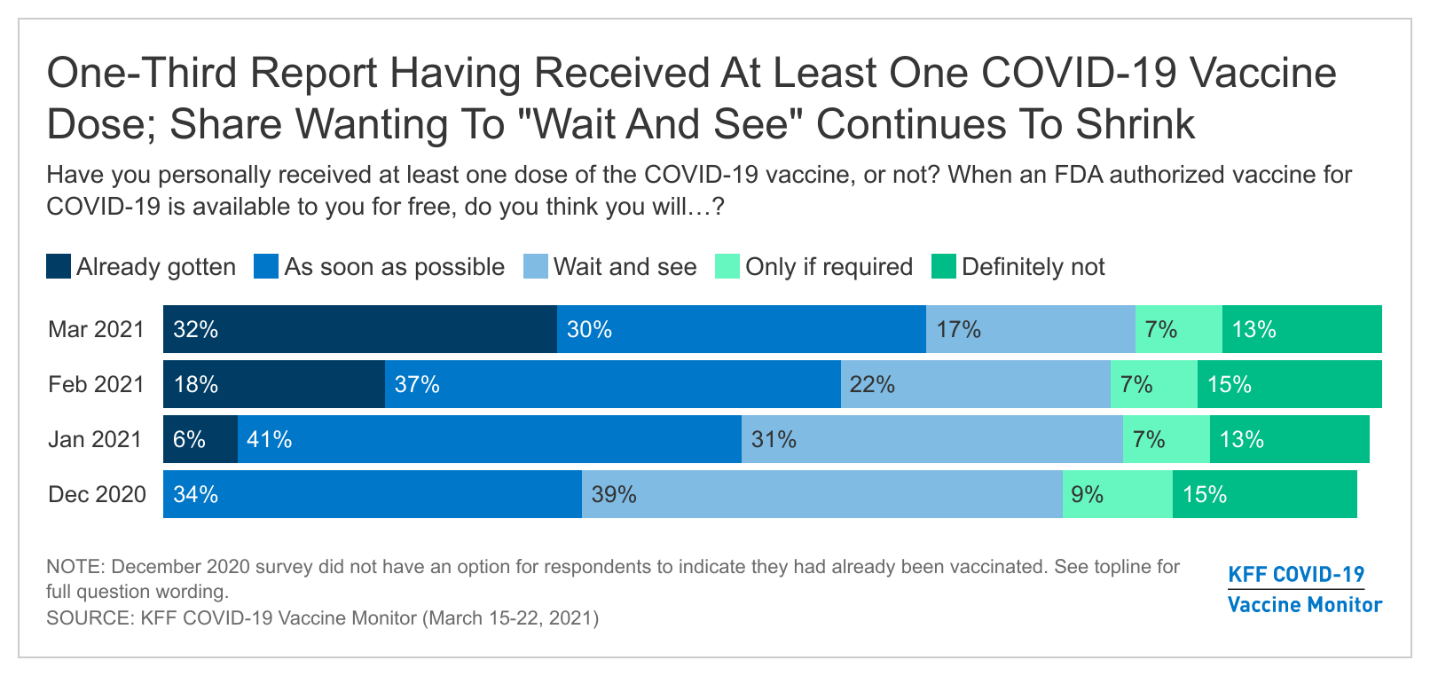
The latest KFF COVID-19 Vaccine Monitor report finds enthusiasm for getting a COVID-19 vaccine continuing to grow, with roughly 6 in 10 adults (61%) now saying they have already gotten at least one dose (32%) or want to get vaccinated as soon as they can (30%).

That’s up from a combined 55% in February and 47% in January, as more people report getting vaccinated and fewer say they want to “wait and see” how the vaccine works in others before getting it themselves (17% now, compared to 22% in February and 31% in January).

A quarter (24%) of Black adults continue to want to “wait and see” before getting vaccinated, down from a third (34%) in February, but still somewhat higher than the share of White adults (16%).

About 1 in 5 adults (20%) remain more reluctant about vaccination, either saying they would only do so if required for work, school or other activities (7%), or would definitely not get vaccinated (13%). The groups most likely to say “definitely not” to a vaccine include Republicans (29%) and White Evangelical Christians (28%)

“With more people embracing vaccination and the ‘wait and see’ group shrinking rapidly, outreach efforts increasingly can target people with more deep-seated resistance,” KFF President and CEO Drew Altman said.

Most People Now Say They Know Enough About When and Where They Can Get Vaccinated

For the first time, a majority of those who have not yet been vaccinated say they have enough information both about where (67%) and when (53%) they can get vaccinated, though the report also finds a sizeable minority that lacks key vaccine information.

Overall, 3 in 10 of those who have not been vaccinated say they don’t know if they are currently eligible to get a vaccine in their state. The share that is uncertain is highest among Hispanic adults (45%), those under age 30 (39%), with annual household incomes under $40,000 annually (37%), and those without a college degree (35%).

Among all adults who have not been vaccinated but believe they are eligible, about one-third say they tried to make an appointment to get the COVID-19 vaccine, including roughly equal shares who say they were (16%) and were not (17%) able to successfully schedule an appointment.

“As vaccine supply has increased and more people become eligible to get a shot, more people seem able to navigate the system – though key information gaps remain, particularly for those with low incomes and lower levels of education,” Executive Vice President Mollyann Brodie said.

Information and Employer Incentives Could Encourage More People to Get Vaccinated

This month’s monitor also tests various pieces of information to gauge whether they influence those who aren’t already vaccinated or hoping to get vaccinated as soon as possible. Some of the most effective are hearing that:

  • The vaccines are nearly 100% effective at preventing hospitalizations and deaths from COVID-19 (41% say this would make them more likely to get vaccinated).
  • Scientists have been working on the technology used in the new COVID-19 vaccines for 20 years (32%).
  • There is no cost to get the vaccine (27%).
  • More than 100,000 people from diverse backgrounds and ethnicities took part in the vaccine trials (26%).
  • The vast majority of doctors who have been offered the vaccine have taken it (26%).

The monitor also probes the potential for employers to promote vaccination through conveniences and financial incentives.

Among people who are employed but are not yet convinced to get a vaccine right away, a quarter (25%) say they would be more likely to do so if their employer arranged for a medical provider to administer the vaccine at work.

Nearly as many (19%) say they would be more likely to get vaccinated if their employer offered an extra $50 if they got vaccinated, and that share rises to 22% for a $200 financial incentive.

The public is almost evenly divided on whether an employer should be allowed to require certain workers to get vaccinated for COVID-19, with half (51%) saying it should and nearly as many (45%) saying it shouldn’t. This split reflects a sharp partisan divide, with most Democrats (70%) saying employer should be allowed to require vaccination, and most Republicans (71%) saying they should not.

Across the board, the information and incentives tested are most effective at persuading the “wait and see” group to get vaccinated, and to a lesser extent, the “only if required” group. Few of those who say they “definitely will not” get the vaccine say any of the incentives or messages would increase their likelihood of getting vaccinated.

Most Who Are Open to Getting Vaccinated Don’t Have a Strong Preference for a Specific Vaccine

There are now three vaccines available in the U.S. About half (46%) of those who are open to getting vaccinated do not have a preference which one they get, while about a quarter (24%) having a slight preference and a bit more (28%) having a strong one.

Among those open to getting vaccinated, similar shares say they would definitely or probably get the one-dose Johnson & Johnson vaccine (69%), and the Pfizer (70%) and Moderna (67%) two-dose vaccines.

The report suggests a one-dose vaccine appeals to a significant segment of the public. Among those who express a preference for one vaccine over another, their top reason was the ease of a one-dose vaccine (24% cited this). Other reasons include their perceptions of the vaccines’ relative effectiveness (14%), hearing good or better things about a particular vaccine vs. others (7%), and being concerned about side effects or a reaction to a particular vaccine.

Designed and analyzed by public opinion researchers at KFF, the KFF Vaccine Monitor survey was conducted from March 15-22 among a nationally representative random digit dial telephone sample of 1,862 adults, including oversamples of adults who are Black (490) or Hispanic (476). Interviews were conducted in English and Spanish by landline (356) and cell phone (1,506). The margin of sampling error is plus or minus 3 percentage points for the full sample. For results based on subgroups, the margin of sampling error may be higher. 

The KFF COVID-19 Vaccine Monitor is an ongoing research project tracking the public’s attitudes and experiences with COVID-19 vaccinations. Using a combination of surveys and qualitative research, this project tracks the dynamic nature of public opinion as vaccine development and distribution unfold, including vaccine confidence and hesitancy, trusted messengers and messages, as well as the public’s experiences with vaccination.

Poll Finding

KFF COVID-19 Vaccine Monitor: March 2021

Published: Mar 30, 2021

Findings

The KFF COVID-19 Vaccine Monitor is an ongoing research project tracking the public’s attitudes and experiences with COVID-19 vaccinations. Using a combination of surveys and qualitative research, this project tracks the dynamic nature of public opinion as vaccine development and distribution unfold, including vaccine confidence and acceptance, information needs, trusted messengers and messages, as well as the public’s experiences with vaccination.

Key Findings

  • The share of U.S. adults who report being vaccinated for COVID-19 or intending to do so as soon as possible continues to rise (currently 61%) and the share taking a “wait and see” approach continues to shrink (now 17%), while the share who say they will “definitely not” get the vaccine (13%) has remained about the same since December, according to the latest KFF COVID-19 Vaccine Monitor. Black adults saw the largest increase in vaccine enthusiasm (55% of them now say they have either gotten vaccinated or want to as soon as possible), but one-quarter of Black adults say they still want to “wait and see” how the vaccine works for others before getting vaccinated, somewhat higher than the share of White adults who say the same. About three in ten Republicans and White Evangelicals say they will “definitely not” get the vaccine, as do one in five adults living in rural areas.
  • While a growing share of adults say they now have enough information about where and when they will be able to get vaccinated, three in ten – including larger shares of Hispanic adults, young adults, and those with lower incomes – are unsure whether they’re currently eligible to receive the vaccine in their state. Among those who believe they are eligible, about one-third say they tried to make an appointment to get vaccinated and about half of this group says their attempt was unsuccessful. In a sign that the appointment process may be getting easier at least for older adults, the share of those ages 65 and over who say they tried but were unable to get an appointment declined from 16% in February to 7% this month.
  • In the latest COVID-19 Vaccine Monitor, we tested a variety of potential incentives, messages, and pieces of information that might be used to increase vaccination uptake. We find there is a role for convenient access to vaccines in medical settings; about half of those in the “wait and see” group say they would be more likely to get vaccinated if the vaccine were offered to them during a routine medical appointment. Travel and freedom of movement may be incentives for others; about four in ten in both the “wait and see” and “only if required” groups say they would be more likely to get a shot if airlines required it of passengers or if the CDC said that vaccinated people could travel freely and would not have to wear masks in most situations. Employers also have a role to play, both in facilitating access and offering incentives. About four in ten employed adults in the “wait and see” group say they would be more likely to get the vaccine if their employer arranged for on-site vaccination or offered them a $200 incentive to get vaccinated.
  • Among the pieces of information tested, the most impactful was that the vaccines are nearly 100% effective at preventing hospitalization and death from COVID-19 (two-thirds of those in the “wait and see” group said hearing this would make them more likely to get vaccinated). Other messages that were effective for at least four in ten of those in the “wait and see” group include that scientists have been working on the technology used in the new COVID-19 vaccines for 20 years, that more than 100,000 people from diverse backgrounds took part in the vaccine trials, that the vast majority of doctors who have been offered the vaccine have taken it, and that there is no cost to get the vaccine. However, while a variety of incentives, messages, and information may be helpful in swaying some in the “wait and see” and “only if required” groups to consider vaccination, none of them do much to sway those in the “definitely not” camp.
  • With the introduction of the one-dose Johnson & Johnson (J&J) vaccine to the U.S. market, we find that about half of those who are open to getting vaccinated say they do not have a preference for which vaccine they would like to get, while about three in ten say they have a strong preference and about one-quarter have a slight preference. Among those who have not been vaccinated, just over half say they would probably or definitely get each of the three available brands (Pfizer, Moderna, and J&J), though a slightly larger share of those in the “wait and see” group say they would “definitely” get the one-dose J&J vaccine (16%) than says the same about the Pfizer or Moderna two-dose versions (8% and 7%, respectively). Among those who express a preference, the most common reason offered is that they prefer a one-dose vaccine (24%), suggesting that the convenience of a one-dose vaccine may make it easier to reach certain harder-to-convince populations to get vaccinated.

As states continue to expand eligibility for COVID-19 vaccination, the latest KFF COVID-19 Vaccine Monitor reports that the share of the public that has gotten the vaccine or is eager to do so continues to grow while the share that is waiting to see how the vaccine works for others continues to shrink. About six in ten adults (61%) say they have already gotten at least one dose of the vaccine (32%) or will get it as soon as they can (30%), up 6 percentage points since February. At the same time, the share taking a “wait and see” approach declined from 22% in February to 17% this month. A small but persistent share say they will get the vaccine only if they are required to do so for work, school, or other activities (7%) or that they will “definitely not” get the vaccine (13%), similar to the shares who have given those responses since January.

Enthusiasm for getting the COVID-19 vaccine continues to grow among people across racial and ethnic backgrounds, with the largest increase this month among Black adults. Over half of Black adults (55%) now say they’ve either gotten at least one dose of the vaccine or will get it as soon as they can, up from 41% in February and approaching the shares among Hispanic adults (61%) and White adults (64%). At the same time, the share of Black and Hispanic adults who say they will “wait and see” how the vaccine works for others before getting vaccinated themselves has fallen steadily since December. However, Black adults (24%) remain somewhat more likely than White adults (16%) to say they will “wait and see” before getting vaccinated.

While enthusiasm for getting the COVID-19 vaccine continues to inch up across partisan groups, a persistent divide remains, with about eight in ten Democrats (79%), almost six in ten independents (57%), and fewer than half of Republicans (46%) saying they have either received at least one dose of the vaccine or intend to do so as soon as possible. About three in ten Republicans (29%) say they will “definitely not” get vaccinated, similar to the share who said so in February.

Looking across various demographics, the groups most likely to say they’ve either already gotten the vaccine or will get it as soon as possible are adults ages 65 and over (82%), Democrats (79%), and college graduates (73%). Young adults ages 18-29 (25%) and Black adults (24%) continue to be among the groups most likely to say they want to “wait and see” before getting a COVID-19 vaccine. About three in ten Republicans (29%) and a similar share of White adults who identify as Evangelical Christians (28%) say they will definitely not get the vaccine, as do one in five rural residents (20%) and essential workers in fields other than health care (21%).

Information Needs And Experiences With Appointments

The share of unvaccinated adults who say they have enough information about when they will be able to get the COVID-19 vaccine increased from 36% in February to 53% in March, and the share who say they know enough about where they can get a vaccine increased from 55% to 67%. Still, that leaves almost half the public feeling like they don’t have enough information about when they can get the vaccine and one third saying they don’t know enough about where they can get it.

Further, three in ten of those who have not yet been vaccinated say they are not sure if they’re currently eligible to get a COVID-19 vaccine in their state or not. This share rises to about four in ten among Hispanic adults (45%), adults under age 30 (39%), those with household incomes under $40,000 (37%), and adults without a college degree (35%).

Among adults ages 65 and over, almost two-thirds (64%) say they’ve gotten at least one dose of the vaccine (up from 44% last month) and another 7% have scheduled an appointment to get vaccinated. Just 7% say they tried but were unable to get an appointment (down from 16% last month). The share of older adults who report receiving at least a first dose of the vaccine is somewhat higher among those ages 75 and over (72%) and college graduates (77%).

Among all adults who have not been vaccinated but believe they are eligible, about one-third say they tried to get an appointment to get the COVID-19 vaccine, including 16% who say they were able to schedule an appointment and another 17% who say they tried but were unable to get an appointment.

Among all adults who tried but were unable to get an appointment, 43% say they couldn’t get an appointment because they didn’t meet eligibility requirements, one-third say there were no appointments available, and smaller shares report that the vaccine was not available (6%), the available appointment times didn’t work for their schedule (5%), or they had technical difficulties (4%).

Concerns Among Those Who Have Not Yet Been Vaccinated

Among the 37% of adults who are not yet convinced to get the vaccine right away (defined as those who say they will “wait and see” before getting vaccinated, will get the vaccine “only if required” or will “definitely not” get it), side effects continue to be the top concern, with about seven in ten (70%) saying they are very or somewhat concerned that they might experience serious side effects from the vaccine. Just over six in ten (63%) are also concerned that the effects of the vaccine might be worse than if they actually got COVID-19 and the same share are concerned that they might be required to get the vaccine even if they don’t want to. About four in ten are concerned that they might have to miss work because of vaccine side effects (45%) or that they might get COVID-19 from the vaccine (39%), while fewer are concerned that they won’t be able to get the vaccine from a place they trust (21%), or they will have difficulty traveling to a vaccination site (10%).

The potential side effects of the vaccine continue to be the top concern across racial and ethnic groups. Among those who are not convinced to get vaccinated right away, about half of Black adults (50%) and Hispanic adults (52%) are concerned they might get COVID-19 from the vaccine, higher than the share of White adults who express this concern (33%). In addition, four in ten Black adults (38%) and one-quarter of Hispanic adults (27%) are concerned they won’t be able to get the vaccine from a place they trust, and about one in five (20% of Black adults and 22% of Hispanic adults) are concerned they will have difficulty traveling to a vaccination site.


Among those who are not convinced to get vaccinated right away, a larger share of Republicans (71%) compared to independents (57%) and Democrats (53%) say they are concerned that they might be required to get the vaccine even if they don’t want to.

While many vaccine outreach efforts are currently focused on the “wait and see” group – a group that has been shrinking over time – the share of the public who say they will “definitely not” get the vaccine has been about the same size since December 2020, representing about one in seven adults (13%). Understanding this group’s concerns about the vaccine will be crucial to any effort to ultimately convince them to get vaccinated.

When asked to say in their own words the main reason why the don’t want to get vaccinated, those in the “definitely not” group cite a range of concerns. The most frequently mentioned reason is feeling that the vaccines are too new or that there is not enough information about the long-term effects (mentioned by 17%), followed by concerns that the vaccines are not effective against COVID-19 (8%), a general sense that they don’t need the vaccine (8%), and concerns about the vaccines’ ingredients (8%). The range of reasons suggests that there is not a single message that will help sway these individuals to consider getting vaccinated, but that a range of strategies and conversations will be needed to move even some of them away from their “hard no” position.

IN THEIR OWN WORDS: What is the MAIN reason why you don’t want to get the COVID-19 vaccine? (among those who say they will “definitely not” get it)

“I don’t want to be a guinea pig, they haven’t tested it yet.” – 78 year-old woman

“Because I don’t believe they did enough research on it. It takes years to come up with vaccines for other diseases, all of a sudden they come out with a vaccine within a year. They should also put out the side effects it can cause, they should let people know if you have a reaction to the flu shot, you will have reaction to the vaccine.” – 50 year-old woman

“I don’t believe it works, COVID is not dangerous as I’m not over 60.” – 22 year-old woman

“Because I don’t think it’s necessary. Don’t want to put chemicals in my body.” – 49 year-old woman

“I’m pregnant and risking putting a disease in my body.” – 28 year-old woman

“I never in my life had flu shot, and this is super flu, and I am not going to do it.” – 71 year-old man

“Since it’s overly exaggerated, I have trust issues with it.” – 20 year-old man

“Not interested. I think this whole COVID thing is blown up hubbub.” – 35 year-old man

“I already had COVID so there is not reason to get it.” – 44 year-old man

Messages, Information, And Incentives That Might Increase Vaccination Uptake

In the latest COVID-19 Vaccine Monitor, we tested a variety of potential incentives, messages, and pieces of information that might be used to increase vaccination uptake. We find that while various incentives and messages may help convince people in the “wait and see” and “only if required” groups to get vaccinated, very few of them move people in the “definitely not” group.

Travel And Routine Medical Visits

About three in ten adults who are not convinced to get the vaccine right away say they would be more likely to get the COVID-19 vaccine if airlines required passengers to be vaccinated before they could fly (31%), if the CDC said vaccinated people could travel freely and would not need to wear masks in most situations (31%), or if the vaccine was offered to them during a routine medical visit (30%).

Notably, half of adults who want to “wait and see” before getting the vaccine say they would be more likely to get it if it was offered to them at a routine medical visit (50%). Those who say they would only get the vaccine if they are required are less motivated by having the vaccine offered at a routine appointment (32%), but about four in ten of this group says they would be more likely to get vaccianted if airlines required it of passengers and if the CDC said that vaccinated people could travel freely and not wear masks in most situations (similar to the share who say so among the “wait and see” group). Among those who say they will definitely not get the vaccine, fewer than one in ten are moved by any of these potential scenarios.

Across racial and ethnic groups, about half of Hispanic adults who are not yet convinced to get the vaccine right away say they would be more likely to get vaccinated if airlines required it to fly (49%) and if the CDC said vaccinated people could travel freely and not wear masks in most situations (47%). Fewer than three in ten White adults say they would be more likely to get vaccinated when presented with any of these scenarios.

The Role Of Employers

Employers also have a role to play in incentivizing their employees to get vaccinated and offering access to the vaccine on the job.

Among those who are employed and not yet convinced to get the vaccine right away, about one-quarter (25%) say they would be more likely to get the vaccine if their employer arranged for a medical provider to come to their place of work and administer it to employees, rising to 37% among employed people in the “wait and see” category. In addition, one in five say they would be more likely to get vaccinated if their employer offered them an extra $50 to get vaccinated (19%) while an additional 3% say they would be more likely to get the vaccine if their employer offered them $200, for a total of 22%. Among employed people in the “wait and see” group, 30% say they’d be more likely to get vaccinated if their employer offered them an extra $50 and a total of 38% say the same about a financial incentive of $200.

In a separate question, about half the public (51%) says that employers should be allowed to require certain employees to get vaccinated for COVID-19, while nearly half (45%) say this should not be allowed. There is a large partisan divide on this question that reflects the divide on many questions about the pandemic, with seven in ten Democrats (70%) saying employers should be allowed to require vaccination and a similar share of Republicans (71%) saying they should not.

Messages And Information

When those who are not yet convinced to get the COVID-19 vaccine right away are presented with messages and information that might encourage vaccination, the most effective piece of information is that the vaccines are nearly 100% effective at preventing hospitalization and death from COVID-19. Two-thirds (66%) of those in the “wait and see” group and about four in ten (42%) in the “only if required” group say hearing this would make them more likely to get vaccinated. In addition, hearing that scientists have been working on the technology used in the new COVID-19 vaccines for 20 years is an effective message for many, with half (49%) of the “wait and see” and about four in ten (39%) of the “only if required” group saying this would make them more likely to consider vaccination.

Three other pieces of information were convincing for about four in ten of the “wait and see” and at least three in ten of the “only if required groups: that more than 100,000 people from diverse backgrounds took part in the vaccine trials, that the vast majority of doctors who have been offered the vaccine have taken it, and that there is no cost to get the vaccine. About a third in both groups say they’d be more likely to get vaccinated after hearing that while the long-term effects of the vaccine are unknown, the long-term effects of COVID-19 could be worse. Somewhat fewer say they would be more likely to get the vaccine after hearing that some young and healthy people have been hospitalized and died from COVID-19 and that the reason the vaccines were approved so quickly was because red tape that is usually part of the process was removed, not because corners were cut.

Few of these messages or pieces of information were effective at moving those who say they will definitely not get vaccinated, with the share of that group saying they’d be more convinced after hearing each message in the single digits.

Among those not yet convinced to get the COVID-19 vaccine right away, few (15%) say they would be more likely to get the vaccine if former President Donald Trump came out with a message strongly urging people to get vaccinated. Indeed, even among Republicans, just one in five say they would be more likely to get vaccinated if former President Trump strongly urged people to get vaccinated.

Do People Have A Preference For A Specific Vaccine?

With the FDA granting emergency use authorization to the Johnson & Johnson (J&J) COVID-19 vaccine on February 27, the U.S. now has three highly effective vaccines available to the public. All three vaccines have been rigorously studied and proven to prevent hospitalization and death from COVID-19, though they use different technologies. While the Moderna and Pfizer vaccines that have been on the market since January require two doses administered several weeks apart, the J&J vaccine is administered as a single dose.

Despite the high efficacy of all three vaccines, there has been some confusion surrounding these different technologies and the different dosages. When asked if there are differences in how well the three COVID-19 vaccines available on the U.S. market work, half (52%) of the public say they are not sure. Fourteen percent think there are major differences in how well the vaccines work, about a quarter (26%) think there are minor differences, and 8% say there are no differences. As the vaccine roll-out continues, uptake may be dependent on how well the public trusts the safety and efficacy of the different vaccines.

Among U.S. adults who are at least somewhat open to getting the vaccine—expressed by saying they either want the vaccine as soon as possible, they want to wait and see how it works for others before getting it themselves, or they will get it if required to do so for work, school, or other activities—three in ten say that they have a “strong preference” for which vaccine they get (28%), while an additional one in four (24%) say they have a “slight preference”, and 46% say they do not have a preference. Younger adults are more likely to say it doesn’t matter which vaccine they get, with nearly six in ten willing 18-29 year-olds (56%) saying they have no preference, compared to four in ten of those ages 30-49 (43%) or 50-64 (41%) and one third of those ages 65 and over (33%). Four in ten (43%) of people ages 65 and over who have not yet been vaccinated say they have a strong preference for which vaccine they would like to get and 21% say they have a slight preference.

When asked separately about each of the three FDA authorized COVID-19 vaccines, majorities of those planning or considering getting vaccinated say they would be open to getting each one. About seven in ten say they would “probably” or “definitely” get each of the three vaccines, including at least one-third who say they would “definitely get” each. About one in seven say they would definitely not get each of the vaccines.

Among those who want to wait and see how the vaccines are working for other people before getting vaccinated, a larger share says they would definitely get the J&J one-dose vaccine compared to either of the two-dose options. One in six (16%) of those in the “wait and see” group say they would “definitely get” the J&J vaccine, compared to about one in ten who say the same about the Pfizer or Moderna vaccines (8% and 7%, respectively). This analysis shows that the convenience of a one-dose vaccine may make it easier to reach certain harder-to-convince populations to get vaccinated.

Among those who say they have a preference for one vaccine over another, the main reasons are that they prefer the ease of a one-dose vaccine (24%), their perceptions of the level of effectiveness of the different vaccines (14%), they have heard good or better things about one vaccine (7%), they are concerned about side effects or a reaction to a particular vaccine (7%), the ingredients or formulation of the vaccines (6%), or they say one vaccine would be more convenient or easier to obtain than others (6%).

IN THEIR OWN WORDS: What is the MAIN reason you prefer one COVID-19 vaccine over the others?

“Johnson and Johnson is only one dose and would rather take one dose. But [I would get] whatever is available.” – 68 year-old, slight preference

“Johnson and Johnson just came out and hasn’t been out that long but the Pfizer and Moderna have been out longer.” –55 year-old, strong preference

“Moderna vaccine doesn’t seem to have the distribution needed and temperature regulation is a concern. [I am] worried it wouldn’t be at right temperature, J&J didn’t have temperature requirement.” –62 year-old, strong preference

“Right now, the concern is with the MRNA vaccines; it is very new.” –34 year-old, slight preference

“The combination of chemicals used in Pfizer and Moderna are different from the J&J vaccine, and I have not heard of complications from the J&J vaccine, J&J doesn’t require special handling.” –82 year-old, strong preference

“The more shots you have the more chance you have for an adverse reaction.” –38 year-old, slight preference

“The reputation and amount of time the experience these companies have with distributing the vaccines.”—46 year-old, slight preference

Methodology

This KFF COVID-19 Vaccine Monitor was designed and analyzed by public opinion researchers at the Kaiser Family Foundation (KFF). The survey was conducted March 15-22, 2021, among a nationally representative random digit dial telephone sample of 1,862 adults ages 18 and older (including interviews from 476 Hispanic adults and 490 non-Hispanic Black adults), living in the United States, including Alaska and Hawaii (note: persons without a telephone could not be included in the random selection process). Phone numbers used for this study were randomly generated from cell phone and landline sampling frames, with an overlapping frame design, and disproportionate stratification aimed at reaching Hispanic and non-Hispanic Black respondents. Stratification was based on incidence of the race/ethnicity subgroups within each frame. Specifically, the cell phone frame was stratified as: (1) High Hispanic: Cell phone numbers associated with rate centers from counties where at least 35% of the population is Hispanic; (2) High Black: Cell phone numbers associated with remaining rate centers from counties where at least 35% of the population is non-Hispanic Black; (3) Else: numbers from all remaining rate centers. The landline frame was stratified as: (1) High Black: landline exchanges associated with Census block groups where at least 35% of the population is Black; (2) Else: all remaining landline exchanges. The sample also included 190 respondents reached by calling back respondents that had previously completed an interview on the KFF Health Tracking Poll at least nine months ago. Another 402 interviews were completed with respondents who had previously completed an interview on the SSRS Omnibus poll (and other RDD polls) and identified as Hispanic (n = 178; including 63 in Spanish) or non-Hispanic Black (n=224). Computer-assisted telephone interviews conducted by landline (356) and cell phone (1,506, including 1,093 who had no landline telephone) were carried out in English and Spanish by SSRS of Glen Mills, PA. To efficiently obtain a sample of lower-income and non-White respondents, the sample also included an oversample of prepaid (pay-as-you-go) telephone numbers (25% of the cell phone sample consisted of prepaid numbers) Both the random digit dial landline and cell phone samples were provided by Marketing Systems Group (MSG). For the landline sample, respondents were selected by asking for the youngest adult male or female currently at home based on a random rotation. If no one of that gender was available, interviewers asked to speak with the youngest adult of the opposite gender. For the cell phone sample, interviews were conducted with the adult who answered the phone. KFF paid for all costs associated with the survey.

The combined landline and cell phone sample was weighted to balance the sample demographics to match estimates for the national population using data from the Census Bureau’s 2019 U.S. American Community Survey (ACS), on sex, age, education, race, Hispanic origin, and region, within race-groups, along with data from the 2010 Census on population density. The sample was also weighted to match current patterns of telephone use using data from the January- June 2020 National Health Interview Survey and to adjust for non-response bias, predominantly in the callback sample frames, on health insurance coverage, registered voter status, age, and reported vaccination rates (based on the non-callback RDD sample). The weight takes into account the fact that respondents with both a landline and cell phone have a higher probability of selection in the combined sample and also adjusts for the household size for the landline sample, and design modifications, namely, the oversampling of prepaid cell phones and likelihood of non-response for the re-contacted sample. All statistical tests of significance account for the effect of weighting.

The margin of sampling error including the design effect for the full sample is plus or minus 3 percentage points. Numbers of respondents and margins of sampling error for key subgroups are shown in the table below. For results based on other subgroups, the margin of sampling error may be higher. Sample sizes and margins of sampling error for other subgroups are available by request. Note that sampling error is only one of many potential sources of error in this or any other public opinion poll. Kaiser Family Foundation public opinion and survey research is a charter member of the Transparency Initiative of the American Association for Public Opinion Research.

This work was supported in part by grants from the Chan Zuckerberg Initiative DAF (an advised fund of Silicon Valley Community Foundation), the Ford Foundation, and the Molina Family Foundation. We value our funders. KFF maintains full editorial control over all of its policy analysis, polling, and journalism activities.

GroupN (unweighted)M.O.S.E.
Total1,862± 3 percentage points
COVID-19 Vaccination Status
Have gotten at least one dose of the COVID-19 vaccine754± 5 percentage points
Have not gotten the COVID-19 vaccine1,103± 4 percentage points
Race/Ethnicity
White, non-Hispanic760± 4 percentage points
Black, non-Hispanic490± 6 percentage points
Hispanic476± 6 percentage points
Party Identification
Democrats731± 5 percentage points
Republicans342± 7 percentage points
Independents523± 6 percentage points
News Release

New Analysis Indicates U.S. County Vaccination Rates Do Not Correspond to COVID-19 Impact Thus Far

Published: Mar 29, 2021

An analysis of Centers for Disease Control and Prevention (CDC) COVID-19 vaccination data from 72% of all counties in the U.S. shows that counties classified as having “low” COVID-19 community transmission (cases and positive tests) levels have an average vaccination rate greater than the rate in counties with “high” community transmission levels. Additionally, counties with the lowest COVID-19 deaths per 100,000 people have an average vaccination rate greater than the rates in counties with the highest COVID-19 deaths per 100,000 people. Vaccination rates in the analysis are defined as the percent of the relevant population within a county that has been fully vaccinated.

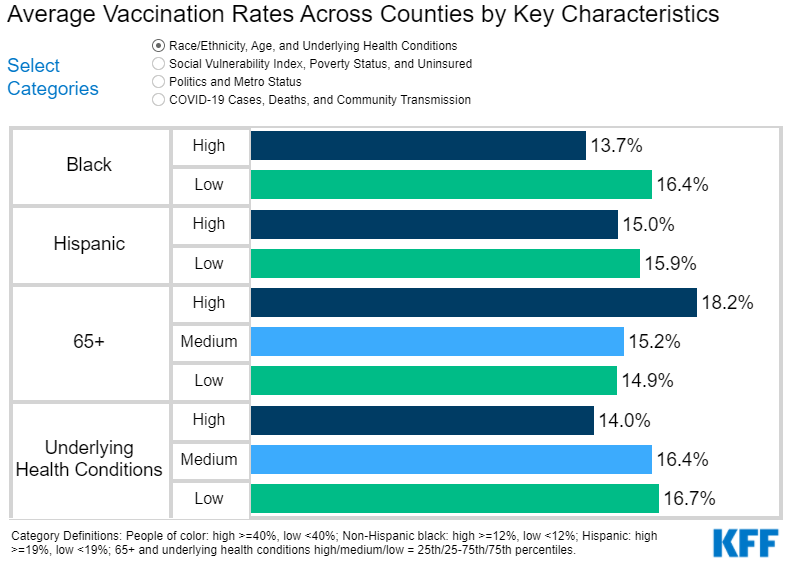
Previous analyses have shown that the pandemic has had a disproportionate impact on people of color and that Black and Hispanic people are receiving smaller shares of COVID-19 vaccinations compared to their shares of cases and deaths and to their shares of the overall population. The brief, Vaccination is Local: COVID-19 Vaccination Rates Vary by County and Key Characteristics, provides further insight into these equity issues. Counties with higher shares of Black people have a vaccination rate of 13.7% compared to 16.4% for counties with low shares of Black people. The population vaccination rate in counties with higher shares of Hispanic people is 15% versus 15.9% for counties with lower shares of Hispanic people.

The analysis also examines how county vaccination rates align with CDC prioritization recommendations and ensuing state decisions. With all states prioritizing older adults, counties with higher shares of people age 65 and older have an 18.2% vaccination rate compared to 14.9% in counties with lower shares of the population.

However, while many states are prioritizing individuals with certain high-risk medical conditions, counties with higher shares of people with certain high-risk conditions have a lower vaccination rate compared to counties with lower shares of people with these conditions (14% versus 16.7%).

Other findings from the analysis include:

  • Higher county uninsured and poverty rates are associated with lower vaccination rates.
  • Metro counties have lower vaccination rates for the total population than non-metro counties.
  • Rates are lower in counties that voted for Donald Trump compared to those that voted for Joe Biden.

How the American Rescue Plan Act Affects Subsidies for Marketplace Shoppers and People Who Are Uninsured

Authors: Matthew Rae, Cynthia Cox, Gary Claxton, Daniel McDermott, and Anthony Damico
Published: Mar 25, 2021

The Affordable Care Act (ACA) has provided subsidized health insurance on HealthCare.gov and state-run Marketplaces since 2014, with about 9 million people purchasing coverage with federal premium help. However, millions remain uninsured despite being eligible to purchase on the Marketplace. Some uninsured people have been priced out of the market because their incomes did not qualify them for a subsidy; other uninsured people have been eligible for subsidized or even free Marketplace coverage but either did not know about the financial assistance available to them or still found coverage unaffordable or unappealing due to high deductibles. Additionally, people already purchasing Marketplace or off-exchange coverage may still face affordability challenges.

The March 2021 COVID-19 relief legislation, the American Rescue Plan Act (ARPA), extends eligibility for ACA health insurance subsidies to people buying their own health coverage on the Marketplace who have incomes over 400% of poverty. The law also increases the amount of financial assistance for people at lower incomes who were already eligible under the ACA. Both provisions are temporary, lasting for two years, retroactive to January 1, 2021. A more detailed explanation of these enhanced and expanded subsidies and other coverage provisions of the ARPA can be found here, and an earlier analysis and interactive comparison of ARPA and ACA subsidies can be found here.

In this brief, we use data from the American Community Survey (ACS) to provide estimates of eligibility for and the amount of financial assistance to purchase Marketplace coverage under the ARPA among both current individual market purchasers, as well as Marketplace-eligible uninsured people.

We find that the number of people eligible for a subsidy to purchase Marketplace coverage has increased 20% from 18.1 million to 21.8 million with passage of the ARPA. We estimate that the average savings under the ARPA subsidies will be $70 per month for current individual market purchasers, ranging from an average savings of $213 (39% of current premiums after subsidies) per month for people with incomes between 400% and 600% of poverty to an average savings of $33 per month (100% of current post-subsidy premiums) for people with incomes under 150% of poverty (who will now have zero-dollar premiums for silver plans with significantly reduced out-of-pocket costs).

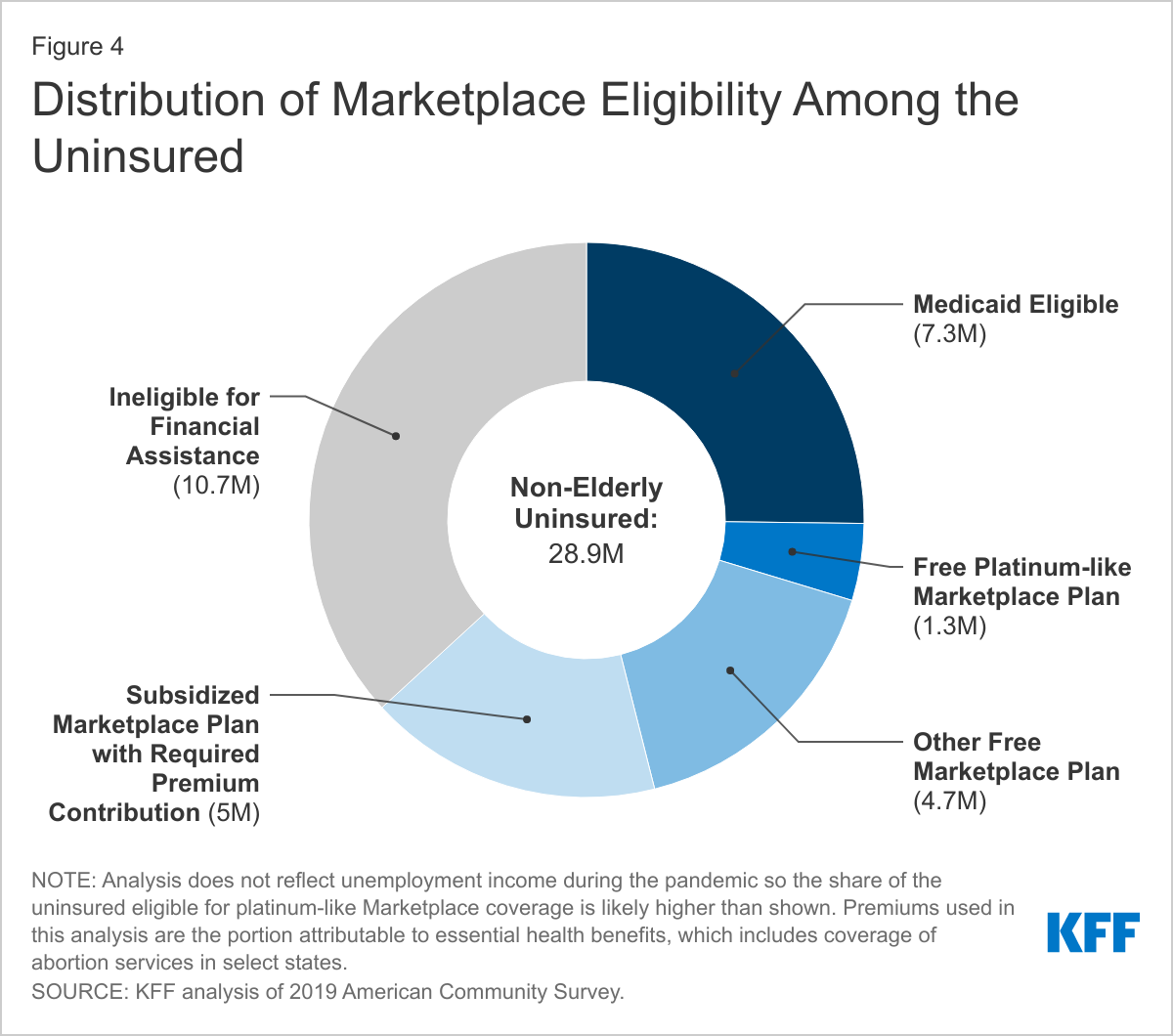
We also find that the majority of uninsured people (63%) are now eligible for financial assistance through the Marketplaces, Medicaid, or Basic Health Plans. In fact, more than 4 out of 10 uninsured people are eligible for a free or nearly free health plan through one of these programs.

Changes in Eligibility for Financial Assistance Among the Uninsured

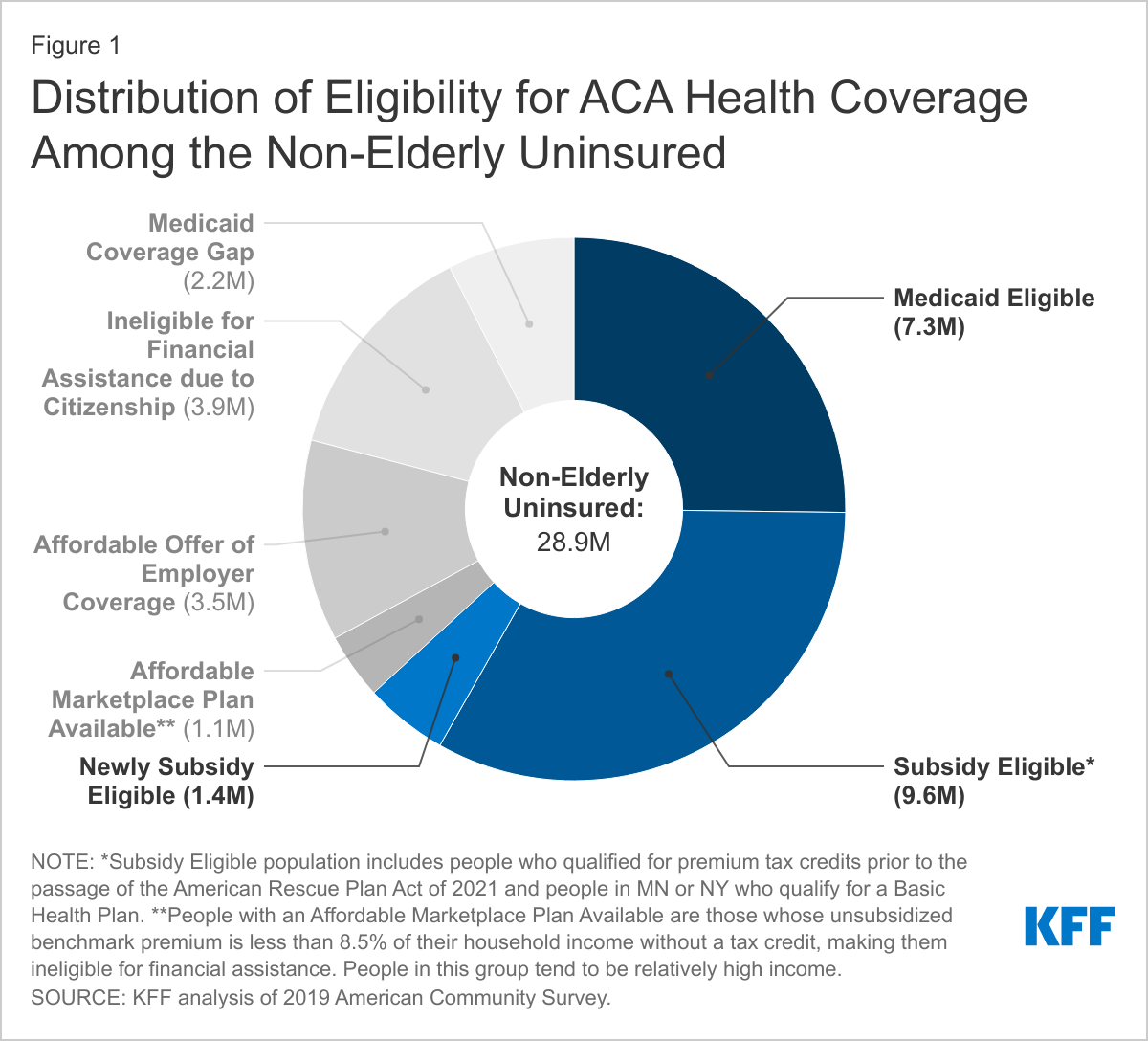
Before passage of the ARPA, it was already the case that most (57%) uninsured people in the U.S. were eligible for financial assistance for coverage under the ACA. With 1.4 million uninsured people newly eligible for subsidized Marketplace coverage under the ARPA, 63% of uninsured people in the U.S. are now eligible for financial assistance to get coverage through the Marketplaces, a Basic Health Plan,1  or Medicaid. The largest group of uninsured people remaining ineligible for financial assistance to get health coverage under the ARPA are undocumented immigrants (3.9 million people). The second largest group of uninsured people ineligible for assistance are those with offers of employer coverage that are deemed affordable under the ACA (3.5 million people). The third largest group of uninsured people ineligible for assistance are those in the Medicaid coverage gap (2.2 million people). An additional 1.1 million uninsured people have a Marketplace plan available to them that is considered affordable without a subsidy (with a benchmark premium less than 8.5% of their household income, which is the cap under the ARPA), discussed more below.

Distribution of Eligibility for ACA Health Coverage Among the Non-Elderly Uninsured

The ARPA includes financial incentives to states to encourage them to expand Medicaid to cover all people with incomes up to 138% of poverty (which 12 states have not done), but it is not certain how many if any new states will take advantage of that extra funding.

All estimates in this analysis depend on insurance coverage status and incomes, which have likely changed to some degree over the course of the pandemic. Our analysis is based on 2019 American Community Survey data, and the time lag is a limitation of the analysis. However, other analyses suggest the uninsured rate may not have changed much during the pandemic, so these estimates likely come close to reflecting current eligibility.

Changes in Marketplace Subsidy Eligibility

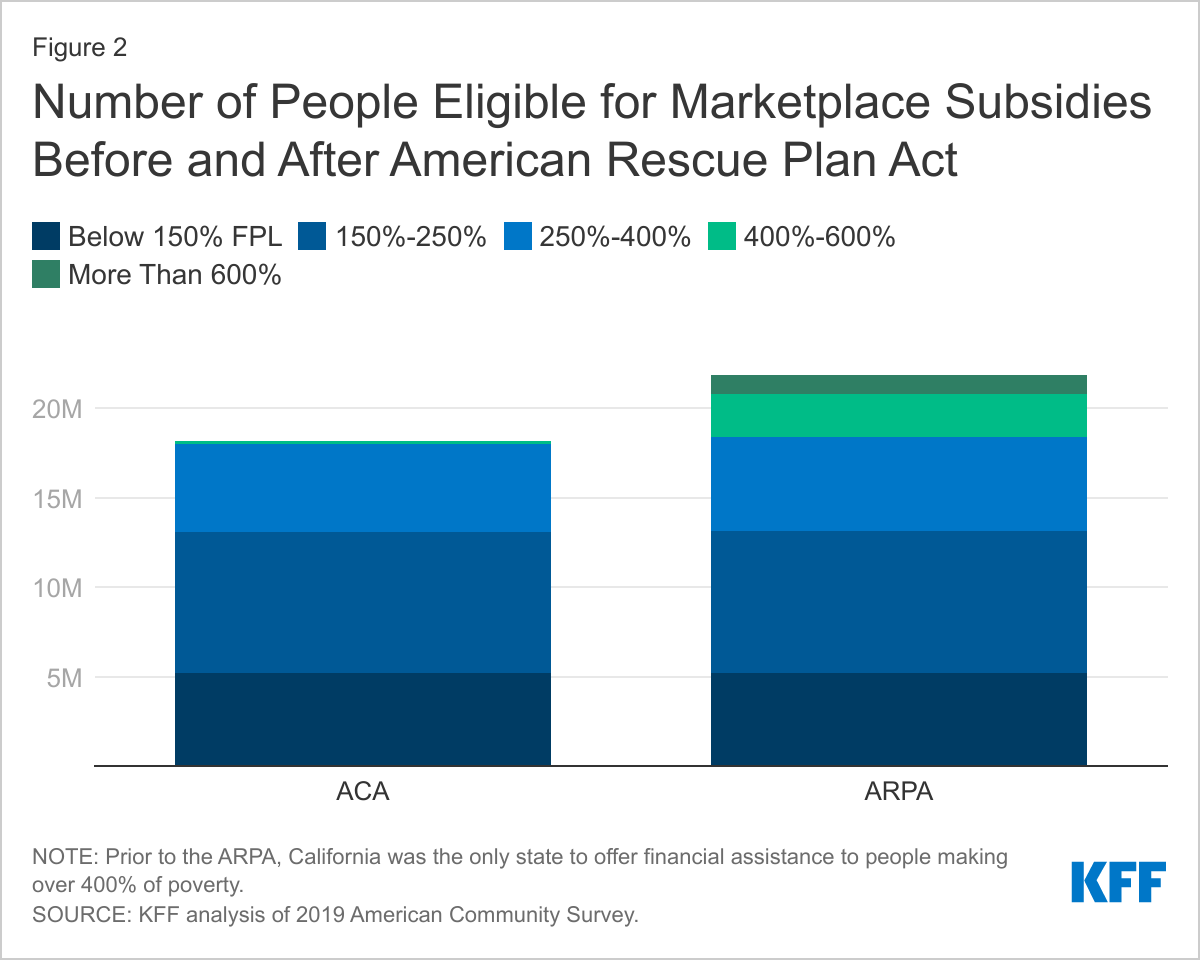
Under the ACA, before passage of the ARPA, there were an estimated 18.1 million people eligible for a Marketplace premium subsidy (including people who were insured and those who were uninsured). Because federal ACA subsidies maxed out at 400% of poverty before the passage of ARPA, nearly all of these 18.1 million people eligible for Marketplace subsidies had incomes below 400% of the poverty level, which is $51,040 for a single individual or $104,800 for a family of four. Only a very small group (less than 1%) of people eligible for ACA subsidies before the passage of the ARPA had incomes over 400% of poverty, with only the state of California offering state-funded financial assistance to some people this group.

Number of People Eligible for Marketplace Subsidies Before and After American Rescue Plan Act

We estimate that the number of people eligible for subsidized Marketplace coverage has increased 20% with the passage of the ARPA, from 18.1 million to 21.8 million people, including both insured and uninsured people. Of the people eligible for Marketplace subsidies for the next two years under the ARPA, it is still the case that most (84%) have incomes below 400% of poverty, but now 11% of people eligible for Marketplace subsidies have incomes between 400-600% of poverty (up to an income of $76,560 for a single individual or $157,200 for a family of four). Marketplace subsidies work by capping an individual’s required premium contribution toward a benchmark plan (the second-lowest-cost silver plan) at a certain percent of their income. Marketplace premiums vary by age and location and tend to be higher for older adults and those in rural areas, with unsubsidized premiums for some people in these groups rising above 20% of their income. Because of this, some people with incomes above 600% of poverty will qualify for subsidies, though this is very rare, with only about 5% of people eligible for Marketplace subsidies under the ARPA having incomes over 600% of poverty. Most (61%) people gaining subsidy eligibility under the ARPA were already insured through the individual market, though some may have been purchasing non-compliant coverage or plans with very high cost-sharing. With new subsidies, they will likely be able to afford more comprehensive coverage.

With the passage of the ARPA, we find that the vast majority (92%) of current individual market purchasers (on and off exchange) are now eligible for Marketplace subsidies, so long as off-exchange purchasers are willing to move onto exchange coverage. Plans are similar on and off exchange, but subsidies are only available for people purchasing through an exchange. We estimate that only 8% of current individual market shoppers would not receive a Marketplace subsidy under the ARPA because their incomes are too high relative to the cost of an unsubsidized benchmark plan in their area. Individual market consumers who would still not receive financial assistance under the ARPA tend to have relatively high incomes, averaging more than ten-times the poverty level ($132,600 for a single individual). As such, their benchmark silver premium is less than 8.5% of their household income, and they therefore do not receive a subsidy. If their premium were to rise in the future and cross over 8.5% of their income, they would become eligible to receive a subsidy under the ARPA.

Changes in Premium Payments after Subsidies

As shown in our earlier analysis, the ARPA lowers premiums not just for people who are newly eligible for financial assistance (those with incomes over 400% of poverty), but also for people who were already eligible for subsidies under the ACA and are now eligible for more significant financial assistance.

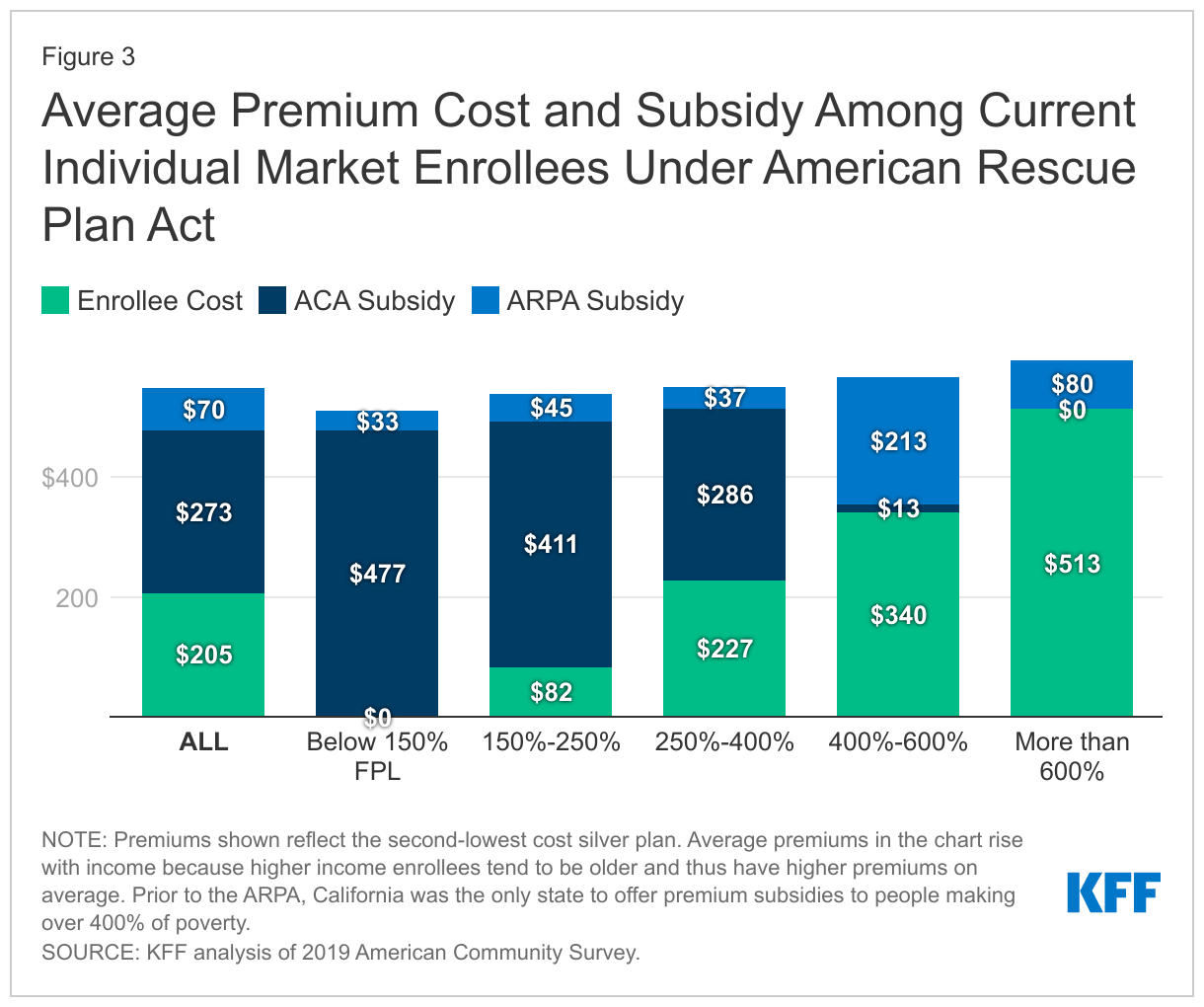
We estimate that the average savings for current individual market purchasers will be $70 per month (25% of current premiums after subsidies), ranging from an average savings of $213 per month (39% of current premiums after subsidies) for people with incomes between 400% and 600% of poverty to an average savings of $33 per month for people with incomes under 150% of poverty (who will now pay $0 for silver plans with reduced cost sharing). Households with multiple family members purchasing Marketplace coverage could see even greater savings. These estimates and the chart below include all current individual market enrollees, including the few who are still ineligible for a subsidy (and who are therefore counted as having a $0 subsidy).

Average Premium Cost and Subsidy Among Current Individual Market Enrollees Under American Rescue Plan Act

Under the ARPA, Marketplace shoppers with higher incomes will still be liable for a larger share of their premium than people with lower incomes. On average, current individual market enrollees who either stay or move onto the Marketplace will be expected to pay $205 per month for a benchmark silver plan, ranging from $0 per month for people with incomes below 150% of poverty to an average of $513 per month for people with incomes over 600% of poverty.

Uninsured people who could buy on the Marketplace would similarly see lower premiums than they would have if they shopped before the APRA went into effect. Relative to previous premium liability for uninsured people eligible to shop on the Marketplace, the ARPA reduces their monthly costs by an average of $61 (26% of current premiums after subsidies), ranging from $174 (33% of current premiums after subsidies) per month for uninsured people with incomes between 400-600% of poverty to a savings of $23 per month for uninsured people with incomes below 150% of poverty (who are now eligible for $0 premium platinum-like coverage, discussed more below).

Eligibility for Zero-Premium Coverage

Millions of potential Marketplace shoppers will become eligible for zero-premium coverage for two years under the ARPA. There are at least 5.2 million people who are now eligible for zero-premium silver plans with cost-sharing reductions (CSRs) that bring their deductibles down to an average of $177. At this income level, silver plans are modified to resemble platinum coverage. (CSRs lower otherwise applicable cost-sharing in silver plans; three levels of CSR apply to enrollees with income up to 150% FPL, between 150-200% FPL, and between 200-250% FPL.) Additionally, any enrollee receiving unemployment insurance for any part of the year 2021 is also eligible for zero-premium platinum-like coverage. Some people with incomes just above 150% of poverty may also qualify for zero-premium silver plans with slightly less cost-sharing assistance (such that their silver plan resembles a gold plan), and many people also qualify for zero-premium bronze plans, though with much higher deductibles.

We estimate that, at a minimum, about half (46%) of the remaining uninsured population is now eligible for free or nearly free coverage through Medicaid or a zero-premium Marketplace plan, before accounting for people receiving unemployment insurance (so the actual number is likely even larger).

Distribution of Marketplace Eligibility Among the Uninsured

Cost to Federal Government

The Congressional Budget Office (CBO) and Joint Committee on Taxation (JCT) project that the enhanced premium tax credits included in the ARPA would increase federal deficits by $34.2 billion over ten years (including an increase in direct federal spending of $22.0 billion and a reduction in revenues of $12.2 billion). Additionally, CBO and JCT expect the enhanced subsidies for people receiving unemployment insurance to add another $4.5 billion over the next ten years (including an increase in outlays of $2.4 billion and a decrease in revenues of $2.1 billion).

CBO projections are generally over a 10-year period. Because the enhanced subsidies only last two years, though, most of the costs would be concentrated in 2021 and 2022. However, CBO and JCT expect some new enrollees to continue purchasing subsidized Marketplace coverage for a few years, even if those enrollees are no longer receiving enhanced subsidies.

The CBO and JCT estimate that, in 2022, 1.7 million people would gain coverage through the Marketplace, 1.3 million of whom were previously uninsured. They estimate that new enrollees will account for $13.0 billion in federal costs, with the remaining going to enhanced premium tax credits for existing enrollees.

It remains to be seen whether these additional subsidies will attract significant numbers of uninsured people or off-exchange purchasers to the Marketplaces. Even with the additional subsidies, some current and new enrollees will still face affordability challenges, particularly those who do not qualify for cost-sharing reductions to lower their deductibles.

Methods

Data on population, income, and eligibility for subsidies come from KFF analysis of the Census Bureau’s 2019 American Community Survey (ACS). The ACS includes a 1% sample of the US population and allows for precise state-level estimates. The ACS asks respondents about their health insurance coverage at the time of the survey. Respondents may report having more than one type of coverage; however, individuals are sorted into only one category of insurance coverage.

This analysis does not include individuals who are over the age of 65, who are eligible for Medicaid in 2021, who are in the Medicaid Coverage Gap, or are undocumented immigrants. Under the current ACA structure, workers and their family members are ineligible for tax credits if any worker in the household is offered “affordable” health insurance through their employer. Employer coverage is considered affordable if the worker’s premium contribution for self-only amounts to less than 9.78% of household income. For the purposes of this analysis, people who are uninsured but turned down an offer of employer-coverage are categorized as “uninsured ineligible for financial assistance,” though some of them are likely to have offers of coverage that exceed 9.78% of their income, and hence would be eligible for subsidies to help purchase Marketplace plans. 

2021 Premiums come from KFF analysis of premium data from Healthcare.gov and state rating filings. Unsubsidized premiums used in this analysis are the full price of plans, rather than specifically the portion that covers essential health benefits (EHB). Since premium tax credits can only be used to cover the EHB portion of premiums, some of the individuals denoted as having access to a “free” bronze plan might actually have to pay a very small premium for non-essential health benefits if they enrolled in a bronze plan with added benefits. The ACA does not permit federal subsidies to pay for abortion coverage and requires plans to collect no less than $1.00 per month for this coverage. In CA, IL, NY, ME, OR, and WA, state law requires that that all state regulated plans include abortion coverage. Policyholders who live in these states must pay the abortion surcharge even though they may qualify for subsidies that provide the full cost of premiums if they select a bronze plan. Providence Health Plans in OR and WA have a religious exemption allowing them to exclude abortion coverage. 

  1. The ACA gives states the option to implement a Basic Health Program (BHP) that covers low-income residents through state-contracting plans outside the health insurance marketplace, rather than qualified health plans (QHPs). State Medicaid agencies participate in BHP administration; premiums and cost-sharing are lower and benefits are sometimes broader compared to Marketplace plans. To date, Minnesota and New York are the only states to have adopted a BHP. ↩︎

Moving the Needle on Prescription Drug Costs: Using the Innovation Center and Other Demonstration Authority

Published: Mar 25, 2021

Issue Brief

During the 2020 presidential campaign, President Biden supported several policies to lower prescription drug costs, including proposals to authorize the federal government to negotiate drug prices, cap out-of-pocket drug costs in Medicare Part D, and limit drug price increases to the rate of inflation. Whether or not the 117th Congress acts on these or other prescription drug proposals, the Administration has at its disposal a variety of administrative levers to address drug costs.

This brief focuses on two pathways through which the Biden Administration could use its executive authority to implement policy changes related to prescription drug costs. The first pathway would use the authority provided under the Affordable Care Act (ACA) through the Center for Medicare and Medicaid Innovation (CMMI, or Innovation Center) (established under Section 1115A of the Social Security Act). The Innovation Center is authorized to design, implement, and test new health care payment models to address concerns about rising costs, quality of care, and inefficient spending. The second pathway would use authority that was established soon after Medicare was enacted – known as Section 402 demonstration authority – to implement Medicare demonstrations to test new ways of delivering health care and paying health care providers.

We review examples of recent efforts to use these authorities to lower prescription drug costs, including the Trump Administration’s Most Favored Nation Model initiated through the Innovation Center and the Trump Administration’s proposed $200 prescription drug vouchers for Medicare Part D beneficiaries via Section 402 demonstration authority. We examine questions that have been raised regarding the use of these authorities and discuss how the Biden Administration might use them to implement prescription drug policies. In addition to these pathways, the Administration could employ other administrative tools to implement policy changes related to prescription drug costs, including through annual payment and policy rules, regulatory guidance, and waivers; those tools are not discussed further here.

Background

Since the early days of the Medicare program, the HHS Secretary has had the authority to initiate demonstrations that can lead to permanent changes in the Medicare program. The Secretary was first granted this authority under Section 402 of the Social Security Amendments of 1967, which was then modified by the Social Security Amendments of 1972. Section 402 provides broad authority to the Secretary to develop and implement demonstration projects to test new Medicare payment methodologies, and allows the Secretary to waive compliance with certain Medicare requirements relating to payment and reimbursement to conduct these demonstrations.1  In addition to demonstrations and models initiated by the Executive Branch, Congress has also mandated demonstration projects through legislation, either as part of more comprehensive legislation relating to the Medicare program or as part of appropriations legislation.

In the years leading up to the establishment of the Innovation Center, the Medicare Payment Advisory Commission (MedPAC) and other experts noted shortcomings with the demonstration process, including insufficient and declining funding, the long timeframe for research and evaluation of demonstration projects, administrative barriers including requirements under the Paperwork Reduction Act, implementation or expansion delays due to administrative and judicial review, and the condition of budget neutrality. Further, the process for scaling up successful models required Congressional action, which may delay or block their implementation. Additionally, the Centers for Medicare and Medicare Services (CMS) can be prevented from modifying or ending demonstration models based on early results (whether positive or negative) when models are specified in law.

Partly in response to these concerns, Congress established the CMS Innovation Center in the Affordable Care Act of 2010 (ACA). Congress specifically directed the Innovation Center to focus on models that could potentially lower health care spending for Medicare, Medicaid, and the Children’s Health Insurance Program (CHIP) while maintaining or enhancing the quality of care furnished under these programs. While the focus of the Innovation Center is on Medicare, Medicaid, and CHIP, Innovation Center models have also incorporated multi-payer and all-payer approaches that affect patients with private insurance to increase the potential impact of these models on the broader health system.

Through the Innovation Center, the ACA granted the HHS Secretary more tools to design, adapt, and test models that could produce savings and be more rapidly scaled. The Secretary has the ability to waive more regulations and has broader authority to expand and implement successful Innovation Center programs into Medicare, Medicaid, and CHIP, and terminate the models that fail. Further, the law allocated dedicated funding to the Innovation Center: $5 billion for fiscal year 2010, $10 billion for the years 2011 through 2019, and another $10 billion for each decade thereafter. These funds are not subject to annual appropriations and are designated for the operation of the Innovation Center, including direct support for individual models and delivery system reform initiatives, and operational expenses, including payroll expenses for full-time employees, contracts, and administrative expenses. Notably, Innovation Center models are not subject to the Paperwork Reduction Act, and there is no administrative or judicial review of the Secretary’s decisions for certain aspects of models (described in greater detail below). HHS also cannot require that an Innovation Center model initially be budget neutral.

With the passage of the ACA, the Innovation Center is the primary vehicle through which the Administration tests new models, even though Section 402 demonstration authority has existed much longer. More detailed discussion of these administrative pathways, plus examples of how they have been used to implement policy changes related to prescription drugs, is below.

Innovation Center Models

The ACA established the Innovation Center to test innovative payment and service delivery models that could lead to permanent program changes, with the goal of reducing program spending while preserving or enhancing the quality of care or improving quality of care without increasing spending. The law expanded the Secretary’s authority to waive Medicare and other program requirements in order to develop and conduct these models, and does not limit this authority to reimbursement or payment related changes. (This is in contrast to the Secretary’s waiver authority for Section 402 demonstrations, discussed more below.)

For the sole purpose of testing models, the Secretary may waive all requirements of Title XI of the Social Security Act (SSA) (General Provisions, Peer Review, and Administrative Simplification) and Title XVIII of the SSA (Medicare), three sections of Title XIX of the SSA relating to the Medicaid program, and nearly all sections of Title XIX of the SSA pertaining to the Program of All-Inclusive Care for the Elderly (PACE).2  The waiver authority for Title XI includes all sections, including fraud and abuse laws, such as the federal anti-kickback statute. The waiver authority for Title XVIII also includes all sections, including for example provisions related to Medicare eligibility, covered benefits, and payment rules, among others. However, provisions pertaining to Medicare that are not included in Title XVIII and not explicitly mentioned cannot be waived, such as the Medicare payroll tax of 1.45% on employers and employees, which is specified in the Internal Revenue Code.

Innovation Center Model Implementation and Expansion

Congress gave the Innovation Center more authority to initiate, terminate, modify, or expand models than what is allowed under Section 402 demonstration authority. As defined by statute, Innovation Center models are first implemented under Phase I, and if a model meets certain criteria, it can be expanded, including on a nationwide basis, under Phase II.

phase I

Phase I for Innovation Center models is the testing phase. The law directs the Secretary to select models for testing “where the Secretary determines that there is evidence that the model addresses a defined population for which there are deficits in care leading to poor clinical outcomes or potentially avoidable expenditures.” The law also mentions a list of possible models to be tested including but not limited to:

  • Contracting directly with groups of providers of services and suppliers to promote innovative care delivery models, such as through risk-based comprehensive payment or salary-based payment.
  • Promoting care coordination between providers of services and suppliers that transition health care providers away from fee-for-service based reimbursement and toward salary-based payment.
  • Allowing States to test and evaluate systems of all-payer payment reform for the medical care of residents of the State, including dual eligible individuals.

The ACA prohibits the Secretary from requiring budget neutrality as a condition of testing during Phase 1 of the model. However, after testing of a model has begun in Phase I, the statute authorizes the Secretary to modify the design of a model or terminate a model unless it is expected to:

  • improve quality of care without increasing spending under the applicable program (i.e., Medicare, Medicaid or CHIP);
  • reduce program spending without reducing quality of care; or
  • improve the quality of care and reduce program spending.

The statute also specifies that, following Phase I of the model, the Secretary shall conduct an evaluation of the model, which includes an analysis of the quality of care provided and changes in program spending attributed to the model.

phase ii

Phase II for Innovation Center models is the expansion phase. Under Phase II, taking into account the evaluation from Phase I, the Secretary may expand the duration and scope of a model, through rulemaking, including implementation on a nationwide basis. While not specifically required by statute, Phase I models that require mandatory participation have also typically been subject to the public rulemaking process.

In order for a model to be implemented nationwide, it must meet the following three criteria:

  1. The Secretary determines that such expansion of the model would reduce spending under the applicable program (i.e., Medicare, Medicaid or CHIP) without reducing the quality of care; or would improve the quality of care without increasing spending;
  2. The Chief Actuary of CMS certifies that such expansion would reduce (or would not result in any increase in) net program spending; and
  3. The Secretary determines that such expansion would not deny or limit the coverage or provision of benefits under the applicable program for beneficiaries.

To date, four Innovation Center models have met the statutory criteria to be certified by the Secretary for expansion. These four models are the Diabetes Prevention Program (DPP) model, the Home Health Value-Based Purchasing (HHVBP) Model, the Prior Authorization Model for Repetitive Scheduled Non-Emergent Ambulance Transport (RSNAT), and the Pioneer ACO model. These certifications enable the Secretary to expand the program to become a permanent part of Medicare, as the Secretary did for the Diabetes Prevention Program Model, which became a full preventive benefit in Medicare Part B for eligible beneficiaries (the “Medicare Diabetes Prevention Program”), effective April 2018.

In September 2020, CMS announced that the RSNAT model would be expanded nationwide, though the implementation of the expansion into new states is being delayed due to the COVID-19 pandemic. In January 2021, CMS announced its intent to expand the HHVBP model, and this expansion must be implemented through rulemaking to begin no earlier than January 1, 2022. The Secretary has not made the Pioneer ACO model a part of the full Medicare program.

In contrast to Section 402 demonstrations discussed below, the testing, evaluation and expansion of Innovation Center models are specifically exempted from the Paperwork Reduction Act, which can be time consuming and burdensome.3  Further, the statutory language notes that specific features of the model are not subject to administrative or judicial review:

  • the selection of models for testing or expansion;
  • the selection of organizations, sites, or participants to test those models selected;
  • the elements, parameters, scope, and duration of such models for testing or dissemination;
  • determinations regarding budget neutrality;
  • the termination or modification of the design and implementation of a model;
  • determinations about expansion of the duration and scope of a model.

Section 402 Demonstrations

Since the passage of the ACA, both the Obama and Trump Administrations relied more on the authority provided under the Innovation Center than on Section 402 demonstrations, with a few notable exceptions. Section 402 gives the Secretary authority to engage in demonstration projects to determine whether changes in methods of payment or reimbursement will have the effect of “increasing the efficiency and economy of health services” without affecting quality of care. Such demonstrations could include paying providers for services not otherwise covered by Medicare at the time of the demonstration or experimenting with changing the basis of provider payments.4  Section 402 allows the Secretary to waive requirements under Medicare and Medicaid, but only as long as they relate “to reimbursement or payment on the basis of reasonable cost, or (in the case of physicians) on the basis of reasonable charge.”

While budget neutrality is not specified in statute or regulation, according to CMS’ Medicare Waiver Demonstration Application, “Medicare-waiver-only demonstrations must be budget neutral. Budget neutrality means that the expected costs under the demonstration cannot be more than the expected costs were the demonstration not to occur.” Although most demonstrations have generally conformed to the administrative practice of budget neutrality, there have been exceptions, which are discussed in more detail below. Section 402 demonstrations also have typically been subject to certain types of review such as requirements under the Paperwork Reduction Act and administrative or judicial review.5  Under the Paperwork Reduction Act, agencies that plan to collect data on 10 or more individuals must submit information to the Office of Management and Budget (OMB) on proposed collection efforts as well as provide a 60-day period for public comment.6  Some Section 402 demonstrations, such as competitive bidding for clinical laboratory services and durable medical equipment, have also been subject to judicial review, a situation when the courts review various federal agencies’ actions, typically based on criteria included in the Administrative Procedure Act (APA).

Many of the demonstrations initiated by the Secretary under Section 402 and by Congress have ultimately led to permanent changes in Medicare law. For example, hospice demonstrations beginning in 1974 ultimately led to a hospice benefit becoming first authorized as part of Medicare in the Tax Equity and Fiscal Responsibility Act of 1982 (TEFRA). This benefit was originally scheduled to sunset in 1986 but then permanently added to Medicare benefits in the Consolidated Omnibus Budget Reconciliation Act of 1985. The inpatient prospective payment system (IPPS), which is how Medicare pays hospitals for acute inpatient stays, also had its origins in various demonstration projects. Starting in 1974, the Health Care Financing Administration (a precursor to CMS) engaged in various demonstrations that led to the design of a new Medicare prospective payment system, using a system of diagnosis-related groups (DRGs), which was enacted as part of the Social Security Amendments of 1983. Other demonstration projects that have been expanded program-wide include the skilled nursing facility and home health prospective payment systems; competitive bidding for durable medical equipment; and Medicare coverage for heart transplants.7 

While the funding of some demonstrations has been Congressionally earmarked, CMS has a research, evaluations, and demonstrations (RDE) budget that is appropriated annually. In FY 2020, $20.1 million was appropriated for these activities, significantly less than the funding allocated to the Innovation Center, which averages $1 billion per year. Funding appropriated to the RDE generally fluctuates from year to year, but has been declining over time, particularly after the establishment of the Innovation Center, from $57.4 million in FY 2007 to $35.6 million in FY 2010 and $20.1 million in FY 2020. The RDE section of the budget notes that “CMS leverages other funding sources, such as ACA 3021 (Innovation Center) funding, to support RDE projects wherever possible.”

How Have Innovation Center Models and Section 402 Demonstration Authority Been Used to Address Prescription Drug Costs?

Innovation Center: The Trump Administration leveraged the flexibility and authority of the Innovation Center to address prescription drugs at least three times. Two of the models are ongoing: the Part D Senior Savings model, which limits out-of-pocket costs on insulin in participating Part D plans, and the Part D Payment Modernization Model, which tests the impact of a revised Part D payment structure that creates incentives for plans, patients, and providers to choose drugs with lower list prices in order to better manage spending in the catastrophic phase. This Part D Payment Modernization Model was updated by the Trump Administration for calendar year 2022 to waive the requirement that all drugs in five of six protected classes (all protected class drugs except antiretrovirals) be included in formularies, the requirement that plans cover a minimum of two drugs in other therapeutic classes, and the requirement that sponsors take on downside risk. However, the Biden Administration recently announced that they are not moving forward with these changes. Sponsors may not modify coverage of drugs in protected classes, they must continue to cover a minimum of two drugs in other therapeutic classes, and sponsors must continue to take on two-sided risk to participate in the model. To date, only two Part D plans are participating in this model.

The third model is the Most Favored Nation model, a mandatory nationwide model designed to lower payments for the top 50 Part B drugs that contribute to high Part B spending, by aligning payment for Part B drugs more closely to what other countries pay and removing incentives for doctors to prescribe higher-priced drugs. The model was set to go into effect January 2021, but stakeholders filed lawsuits to block the model from being implemented, with one of the primary complaints being that the Administration violated the APA by not following the appropriate rulemaking process. HHS has been temporarily blocked from implementing this rule under a preliminary injunction issued by the U.S. District Court for the Northern District of California, based on its ruling that the Trump Administration failed to follow the standard notice and comment rulemaking procedures. According to the Innovation Center, the Biden Administration will not implement this rule without further rulemaking.8 

While the Obama Administration frequently used Innovation Center authority, such as for Accountable Care Organizations (ACO), bundled payment models, and in collaboration with states for all-payer ACO models such as in Vermont and Maryland, it did not do so as often relating to prescription drug costs.

In March 2016, the Obama Administration issued a proposed rule for a Part B Drug Payment Model to be implemented through the Innovation Center – although this model was ultimately withdrawn prior to implementation due to criticisms of the mandatory nature of the proposed model and opposition from patient and physician groups. The model offered alternative payment designs for Part B drugs to test whether these approaches would “strengthen the financial incentive for physicians to choose higher value drugs.” Under current law, for most Part B drugs, providers are reimbursed based on the average sales price (ASP) of a given drug plus a 6 percent add-on payment. The first phase of the model would have assigned certain providers an alternative payment approach of ASP plus 2.5 percent, plus a flat fee. The second phase of the model would have tested the application of value-based purchasing tools, in addition to the alternative ASP add-on payments. To eliminate selection bias and test whether these alternative payment approaches would change physician behavior and achieve savings, all providers and suppliers in selected geographic areas would have been required to participate.

While not solely a model pertaining to prescription drugs, the Obama Administration initiated the Medicare Advantage Value-Based Insurance Design (VBID) Model (though the model went into effect during the Trump Administration). Among the variety of payment and delivery approaches the model tests, the model provides Medicare Advantage plans with flexibilities, targeted to Medicare beneficiaries based on chronic conditions, including allowing reductions in cost-sharing for Medicare Part D covered drugs. For 2021, 19 sponsors are participating in this model.

The Obama Administration also initiated the Part D Enhanced Medication Therapy Management Model through the Innovation Center (though the model went into effect during the Trump Administration), which seeks to provide basic, stand-alone prescription drug plans with flexibility to implement innovative medication therapy management programs to optimize medication use. This model is ongoing.

Section 402: The Trump Administration proposed to use Section 402 demonstration authority relating to prescription drugs in order to send $200 prescription drug cards to Medicare Part D beneficiaries, though this proposal was not finalized. According to a draft document, the demonstration was designed to determine whether these $200 drug cards, which would help cover out-of-pocket costs for beneficiaries’ prescription drugs, would improve medication adherence, health outcomes, and improve the efficiency of Medicare payments. Questions pertaining to the design and cost of this proposed demonstration are discussed in more detail in the section below.

One of the Trump Administration’s stated rationales for using this demonstration authority for the proposed drug cards (rather than the Innovation Center) is that CMS has previously used Section 402 authority to test other changes to Part D, citing the Part D Low-Income Newly Eligible Transition Program and the Part D Reinsurance Payment Demonstration (Appendix Table 1). These demonstrations were initiated by the Bush Administration in the years after the enactment of the Medicare Modernization Act of 2003, which created the Part D program for prescription drugs, and before the Innovation Center was established. The Part D Low-Income Newly Eligible Transition Program adjusted weighting for regional benchmarks to ensure low-income Medicare beneficiaries had access to affordable plan choices and increase incentives for them to enroll in low-cost plans. The Part D Reinsurance Payment Demonstration was designed to encourage Part D sponsors to offer enhanced benefit packages by offering an alternative method for reinsurance financing, including paying organizations up-front capitated payments. While the Obama Administration did not use Section 402 demonstration authority relating to prescription drugs, it did use this authority to implement the Medicare Advantage Quality Bonus Payment demonstration, which is discussed below.

Questions Raised About the Use of Innovation Center Models and Section 402 Demonstration Authority

Over the years, the Government Accountability Office (GAO), the HHS Office of Inspector General (OIG), members of Congress, and other stakeholders have raised questions with respect to models initiated through the Innovation Center and demonstrations conducted under Section 402 authority.

Can models require mandatory participation?

Some stakeholders have questioned whether Innovation Center models are allowed to be mandatory, although the ACA does not specify that models must be voluntary. Part of the reason mandatory models have been proposed is to ensure that a sufficient number of providers participate in both the research and control groups, and minimize the risk of selection bias. In 2016, over 170 members of Congress stated in a letter to CMS that the Innovation Center was overstepping its authority by making models mandatory, mentioning the Comprehensive Care for Joint Replacement (CJR) model, and the proposed Part B Drug Payment Model discussed above, among others. The CJR model was initially mandatory for all hospitals in 67 designated areas of the country, but the Trump Administration pared back the mandatory hospital participation requirement, effective January 2018. However, in the final rule that made participation in the CJR model voluntary, CMS responded to commenters who contended that CMS lacks the authority to mandate participation in Innovation Center models, by affirming it does have this authority, stating that:

“We disagree that the Innovation Center lacks the authority to test mandatory models under section 1115A of the Act. Section 1115A of the Act authorizes the Secretary to test innovative payment and service delivery models to reduce program expenditures while preserving or enhancing the quality of care furnished to Medicare, Medicaid, and Children’s Health Insurance Program (CHIP) beneficiaries. Section 1115A of the Act does not specify that participation in models must be voluntary. Moreover, the Secretary has authority to establish regulations to carry out the administration of Medicare. Specifically, the Secretary has authority under both sections 1102 and 1871 of the Act to implement regulations as necessary to administer Medicare, including testing these Medicare payment and service delivery models.”

Are models subject to an adequate rulemaking process?

Some members of Congress have expressed concern with the rulemaking process for Innovation Center models. In a January 2019 letter to CMS, Ways and Means Chairman Richard Neal and Ranking Member Kevin Brady argued that the Innovation Center process has been historically opaque and does not use the traditional rulemaking cycle, particularly for models that are not mandatory. Further, in the 116th Congress, Representative Sewell sponsored H.R.5741, “The Strengthening Innovation in Medicare and Medicaid Act,” which seeks to address these and other concerns, such as requiring more advance public notice and opportunities for stakeholder input, limiting the scope of models to no more applicable individuals than necessary to obtain a statistically valid sample, and establishing judicial review of some aspects of models, including review of the elements, parameters, scope, and duration of such models for testing or dissemination as well as determinations about expansion of the duration and scope of a model.

Concerns over the rulemaking process were one of the main criticisms of the Trump Administration’s Most Favored Nation model, which was finalized in an interim final rule, meaning it can be effective immediately without public comment. This model was set to go into effect January 1, 2021, but stakeholders including PhRMA, BIO, and others, filed lawsuits to block the model from being implemented, with one of the primary complaints being that the Administration violated the APA by not following the appropriate rulemaking process. Generally, the APA requires agencies to publish notices of rulemaking in the Federal Register, providing at least 60 days for public comment before going into effect. The Trump Administration attempted to make a case for a “good cause” exception, which allows them to waive the notice and comment requirements under the APA, citing the “particularly acute need for affordable Medicare Part B drugs now, in the midst of the COVID-19 pandemic.” However, several U.S. district courts agreed with the reasoning in the complaints and have blocked implementation, including a preliminary injunction by the U.S. District Court for the Northern District of California based on its ruling that the Trump Administration failed to follow the standard notice and comment rulemaking procedures.9  According to the Innovation Center, this rule will not be implemented without further rulemaking.

Is the demonstration designed as an experiment, with a comparison group to test for significant outcomes?

One question that has been raised in relation to demonstrations is whether the demonstration has an adequate comparison group. This matter was recently highlighted with the Trump Administration’s proposed $200 prescription drug cards. According to the draft document, the demonstration would test the impact of lower out-of-pocket drug costs on medication adherence and discontinuation rates, as well as downstream effects on health care utilization and Medicare Part A and B spending. However, many experts have questioned the experimental design of the demonstration. Because every Medicare Part D beneficiary who does not receive the most generous level of low-income subsides would be eligible for the card, there would be no comparison group. Critics also argue that the “test” the demonstration seeks to carry out has already been well established, with many studies showing that lower cost sharing for drugs improves medication adherence.

Will the demonstration achieve savings or increase costs?

The high cost of demonstrations has also been a concern, particularly when they are not designed to achieve savings. While most demonstrations conducted under Section 402 authority are generally required to be budget neutral by OMB, this has not been true of all demonstrations. This issue was raised in regard to the Trump Administration’s proposed $200 prescription drug cards. The drug cards were intended to lower the cost of medications, which could improve medication adherence and reduce unnecessary health care utilization, ultimately lowering Medicare Part A and B spending over time. However, the draft document acknowledges that actually observing such reductions would be difficult given the short duration of the demonstration, and estimated that the cost of the demonstration would be $7.9 billion dollars without any estimate of potential savings or expectation of budget neutrality. Many stakeholders were critical of the cost of the plan, with members of Congress sending letters to HHS and GAO seeking to review the proposal’s legality, including a determination of whether the discount card would have “the effect of increasing the efficiency and economy of Medicare” – a condition of section 402 demonstrations.

Though it was not intended to address to prescription drug policy, questions about the cost a demonstration were also raised when the Obama Administration initiated the Medicare Advantage (MA) Quality Bonus Payment demonstration that was in effect from 2012 to 2014. The HHS Secretary initiated this demonstration under Section 402 authority to test an alternative method for calculating and awarding MA bonuses, rather than implementing the bonus structure set forth in the ACA. The Office of the Actuary (OACT) estimated the cost to be over $8 billion dollars.

GAO evaluated the extent to which this demonstration conformed to principles of budget neutrality, relative to other Medicare demonstrations, and recommended canceling the demonstration due in large part to its high cost. The GAO concluded that this demonstration “dwarfs all other Medicare demonstrations—both mandatory and discretionary—conducted since 1995 in its estimated budgetary impact and is larger in size and scope than many of them.”

How Could the Biden Administration Use Executive Authority to Take Action on Prescription Drug Costs?

Having narrow Democratic majorities in both the House and the Senate may give the Biden Administration somewhat more room to implement pieces of its health policy agenda through legislation. But the Biden Administration may also consider executive action, potentially relying on the Innovation Center or Section 402 demonstration authority to pursue health care changes, including changes related to prescription drugs.

Several proposals supported by President Biden during his campaign would lower drug costs for Medicare and private insurers. The Innovation Center has authority and has tested multi-payer or all-payer models that include private insurers in the past (e.g., delivering primary care or providing coordinated oncology treatments). However, it may be somewhat easier to test models that apply exclusively to Medicare in the case of prescription drugs, because the Innovation Center has less leverage outside of the Medicare program to enforce lower payments. For example, the negotiation provision under H.R. 3, the drug price legislation passed by the House of Representatives in December 2019, applied to both Medicare and private insurance, enforced by financial penalties on drug manufacturers that did not agree to participate in the negotiation process. However, an Innovation Center model would not have the same leverage to reach all private insurers, and in particular, would not be able to compel drug manufacturers to offer the lower, negotiated Medicare drug price to private insurers. The Innovation Center would need to identify a new mechanism to apply lower drug prices more broadly to private insurers.

During his campaign, President Biden supported allowing the federal government to negotiate drug prices in Medicare Part D and for other payers as well as “directing the Medicare program to target excessively priced prescription drugs that face little or no competition.” To pursue this goal in the absence of Congressional action, the Biden Administration could, for example, consider initiating a model designed to test whether the federal government could achieve savings, without adversely affecting quality, by negotiating prices under Medicare for high-priced drugs that lack competition. According to CBO’s analyses of previous drug negotiation legislative proposals, CBO expects that Medicare savings would be achieved from negotiations over high-priced drugs that lack competition, which would lead to lower beneficiary premiums and cost sharing. CBO also noted that this new authority would lower revenues for some drug manufacturers, and (depending on design details) could lead to higher drug prices in other countries and a reduction of about 8 drugs coming to market from the 2020 to 2029 period and about 30 fewer drugs over the subsequent decade, due to the loss in revenue for drug manufacturers. However, CBO did not analyze the potential effects of this foregone innovation on public health.

The Biden campaign supported a proposal to “empower the HHS Secretary to negotiate prices that are capped to a level associated with average OECD median prices.” Depending on whether or not the Biden Administration moves forward in some fashion with the Trump Administration’s Most Favored Nation Model that is currently blocked in the courts, the Administration could design a new model to test the use of international reference prices for setting prices for certain Medicare-covered drugs. If similar to the Trump Administration’s model, Medicare’s actuaries estimated $85.5 billion in savings over the course of the 7-year demonstration. However, the pharmaceutical industry and others have raised concerns about the potential for this approach to adversely affect patients’ access to medications and to lead to higher prices in other countries.

During the campaign, President Biden also supported an approach that would limit drug price increases to the rate of inflation. In the absence of legislation, the Administration could consider initiating such a model through the Innovation Center, designed to test whether limiting price increases for certain Medicare-covered drugs to the rate of inflation, such as drugs that have historically high increases year over year, reduces spending for the Medicare program. CBO analyses of similar proposals lawmakers introduced during the 116th Congress for Medicare Part B and Part D drugs indicate the potential for significant savings if drug manufacturers limited price increases to the rate of inflation or paid a rebate to the federal government. Given concerns that inflation caps could result in higher launch prices that would affect Medicare spending and have spillover effects on costs incurred by other payers, the Innovation Center would need to assess in advance of launching the new model whether this model would be expected to achieve net savings for the program (without adversely affecting quality).

This is by no means an exhaustive list of ideas to address prescription drug costs, and Innovation Center and Section 402 demonstration authority are not the only regulatory vehicles for implementing changes to prescription drug policies. Previous administrations have also implemented changes to prescription drug policies through the annual rulemaking process, such as changes to formulary requirements, as in a recent final rule that allows Medicare Part D plans to establish a second specialty tier, and proposed (but not finalized) modifications to the treatment of protected classes in Part D. While the Administration can use annual payment and policy rules to implement programmatic changes, these changes typically are not major shifts in policy as they are not allowed to waive existing Medicare payment rules and statutory requirements using these mechanisms (unlike under demonstration and Innovation Center authority).

KFF polling from December 2020 shows that there is strong bipartisan support for some of President Biden’s health care proposals, including 89% who favor allowing the federal government to negotiate with drug companies to get a lower price on medications that would apply to both Medicare and private insurance – a proposal that would require legislation, such as the bill (H.R. 3) that passed the House of Representatives in the last Congress. While addressing the COVID-19 crisis is clearly the first order of business for the Biden Administration, there will likely be continued pressure to address high prescription drug prices and rising drug costs, and some of these policies could potentially be carried out via the Innovation Center or Section 402 demonstration authority.

This work was supported in part by Arnold Ventures. We value our funders. KFF maintains full editorial control over all of its policy analysis, polling, and journalism activities.
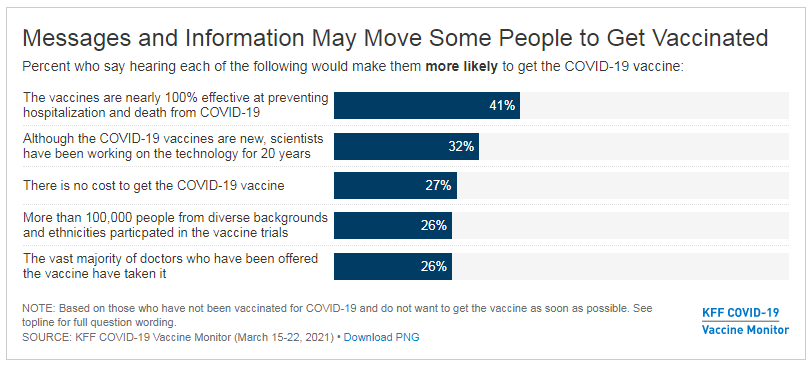
 

Appendix

Appendix Table 1: Examples of Demonstrations Related to Prescription Drugs

Demonstration Name

Year DescriptionResult
Section 402
Demonstration of Improved Quality of Care for Cancer Patients Undergoing Chemotherapy2005 (modified significantly for 2006)Asks chemotherapy patients questions about how they had responded to treatment and makes additional payment to oncologists for submitting this quality of life and patient care dataConcluded
Reimbursement of State Costs for Provision of Part D Drugs2006Reimburses States for drug costs and related administrative costs incurred during the transition period for full-benefit dually eligible beneficiaries to Medicare Part DConcluded
Medicare Part D Payment Demonstration (also known as Medicare Part D Reinsurance Demonstration)2006Provides alternative methods of receiving reinsurance for drug costs above the “catastrophic” level for Part D plans offering enhanced coverageConcluded
Medicare Demonstration to Transition Enrollment of Low-Income Subsidy (LIS) Beneficiaries2007Phase-in the enrollment weights methodology for regional benchmarks to maintain substantial availability of below-benchmark plans and minimize disruption to LIS beneficiariesConcluded
Innovation Center
Medicare Advantage Value-Based Insurance Design (VBID) Model2017Tests a variety of payment and delivery approaches, including flexibilities targeted to Medicare beneficiaries based on chronic condition, one of which is reductions in cost sharing for covered Part D drugsOngoing through 2024
Part D Enhanced Medication Therapy Management Model2017Provides basic, stand-alone prescription drug plans with flexibility to implement innovative medication therapy management programs with the goal of optimizing medication useOngoing through 2021
Part D Payment Modernization Model2020Tests the impact of a revised Part D program design and incentive alignment on overall Part D prescription drug spending and beneficiary out-of-pocket costsOngoing through 2024
Part D Senior Savings Model2021Allows Part D sponsors, through enhanced plans, to offer a Part D benefit design that limits out of-pocket costs for insulin to $35 a monthOngoing through 2025
Most Favored Nation Model2021Modifies payments for certain Part B drugs that contribute to high Part B spending to align more closely with international prices and also removes incentives for physicians to prescribe high-cost Part B drugsNot yet in effect; HHS enjoined from implementing
NOTE: This table does not include Congressionally mandated models.

Endnotes

  1. This authority also allows for demonstrations under Medicaid, though waivers have been more typically used in the Medicaid program. https://modern.kff.org/medicaid/issue-brief/the-landscape-of-medicaid-demonstration-waivers-ahead-of-the-2020-election/ ↩︎
  2. Medicaid requirements that can be waived include: that a Medicaid program must be operated statewide (Section 1902(a)(1)); that it must have a public process for determining payment rates for hospital services (1902(a)(13)); and a provision relating to prepaid payments under Medicaid managed care (1903(m)(2)(A)(iii)). The Program of All-Inclusive Care for the Elderly (PACE) is section 1934 and the Secretary can waive all provisions except subsections (b)(1)(A) and (c)(5). ↩︎
  3. The Medicare Payment and Advisory Commission, “Report to Congress – Chapter 1: Enhancing Medicare’s Ability to Innovate,” June 2010. http://www.medpac.gov/docs/default-source/reports/Jun10_Ch01.pdf?sfvrsn=0 ↩︎
  4. Ibid. ↩︎
  5. Ibid. ↩︎
  6. Government Accountability Office, “CMS Innovation: Model Implementation and Center Performance,” March 2018. https://www.gao.gov/assets/700/690875.pdf ↩︎
  7. The Medicare Payment and Advisory Commission, “Report to Congress – Chapter 1: Enhancing Medicare’s Ability to Innovate,” June 2010. http://www.medpac.gov/docs/default-source/reports/Jun10_Ch01.pdf?sfvrsn=0 ↩︎
  8. In another case, the U.S. District Court for the Southern District of New York temporarily prohibited the federal government from applying the rule to a single drug (EYLEA), manufactured by Regeneron Pharmaceuticals. ↩︎
  9. The Northern District of California case has been stayed until April 23, 2021, at which point the parties will update the court on whether to continue the stay, allow the lawsuit to proceed, or dismiss the case. In another case, the U.S. District Court for the District of Maryland entered a temporary restraining order prohibiting implementation of the rule until January 20, 2021. The parties agreed to stay the Maryland litigation until a final rule based on the interim final rule is published, provided that the federal government does not seek to have the California court’s preliminary injunction overturned on appeal. If the federal government decides to rescind the interim final rule or otherwise decides not to proceed with it, the parties must notify the court. ↩︎

COVID-19 Risks and Vaccine Access for Individuals Experiencing Homelessness: Key Issues to Consider

Authors: Olivia Pham, Robin Rudowitz, and Jennifer Tolbert
Published: Mar 24, 2021

Issue Brief

Throughout the COVID-19 pandemic, people experiencing homelessness have faced a unique set of challenges in protecting themselves and their families from the virus. People experiencing homelessness are already at higher risk for COVID-19 due to underlying health risks and other factors, while homelessness itself creates barriers to meeting social distancing guidelines and accessing testing and treatment. As with other congregate settings, shelters are at high risk for COVID-19 spread. Individuals who are unsheltered face additional risks from the cold weather and lack of access to hygiene and sanitation facilities. This brief explores issues related to risks related to COVID-19, vaccine priority in state plans, and other policy options that affect access to vaccines for people experiencing homelessness.

COVID-19 Risks for People Experiencing Homelessness

As of January 2020 (the latest comprehensive data available, but prior to the pandemic), approximately 580,000 people in the U.S. were experiencing homelessness – about 18 out of every 10,000 people on a given night (Appendix Table 1). The majority are individuals, but 30% are people in families. Nearly one in five (21%) are chronically homeless. The U.S. Department of Housing and Urban Development (HUD) considers an individual to be homeless if he or she lives in an emergency shelter, transitional housing program (including safe havens), or a place not meant for human habitation, such as a car, abandoned building, or on the streets. According to point-in-time data on homelessness from HUD, homelessness increased by 2.2% in 2020, marking the fourth year of national increases after long-term downward trends in homelessness since 2007. Data show there were higher rates of homelessness among people of color, specifically among Black or African American people, American Indian and Alaska Native people, Native Hawaiian and Pacific Islander people, and Hispanic or Latino people. For example, African Americans account for approximately 12 percent of the general population but 39 percent of people experiencing homelessness. Fifty-four percent of people experiencing homelessness are in four states (California, New York, Florida, and Texas) and over a quarter (28%) are in California alone.

Because many people who are homeless have underlying medical conditions, they may also be at higher risk for severe illness from COVID-19. Data and research show that people who are homeless have a range of health conditions ranging from physical and mental health problems to substance use conditions and tri-morbidity (co-occurring physical health, mental health, and substance use disorder challenges). These challenges present at higher rates for the unsheltered homeless populations. In particular, people experiencing homelessness are more likely to suffer from diabetes, heart disease, and HIV compared to the general population. People with these conditions face (or may face) a greater risk of developing severe illness from COVID-19 or of dying from COVID-19.

Homelessness services are often provided in congregate settings that can lead to rapid spread of infection. As of January 2020, more than six in ten (61% or 354,386) people experiencing homelessness were sheltered, meaning they used an emergency shelter, safe haven, or transitional housing program.   While similar data for 2020 are not available, data show that in 2018, 1,446,000 people experienced sheltered homelessness at some time during the year, four times the number that were counted as sheltered homeless in January 2018. Early in the pandemic, a Centers for Disease Control and Prevention (CDC) study of residents and staff members from five homeless shelters in Massachusetts, California, and Washington found that high proportions of residents and staff members had positive test results for COVID-19. Updated guidance from CDC on responding to COVID-19 for homeless populations calls for communication and coordination among community partners and identifies strategies to reduce transmission at homeless shelters, such as reconfiguring the layout to maintain social distancing among residents and staff, identifying overflow sites to reduce crowding, developing policies and locations for isolating people with COVID-19, ensuring staff who have contact with residents with COVID-19 wear personal protective equipment (PPE), and improving ventilation systems.

Unsheltered people experiencing homelessness are also at high risk from COVID-19. As of January 2020, approximately 226,000 people (or 39% of the total homeless population) were unsheltered, meaning these individuals sleep outside and in other locations not meant for human habitation. According to the CDC, while outdoor settings may allow people to increase physical distance between themselves and others, sleeping outdoors often does not provide protection from the environment, adequate access to hygiene and sanitation facilities, or connection to services and health care. CDC provides specific guidance to respond to COVID-19 for unsheltered homeless populations that includes strategies for training outreach staff on how to help prevent people from becoming sick and on how to link those with symptoms to medical care. The guidance also includes considerations for unsheltered homeless in encampments such as allowing for space between sleeping quarters or tents and working to improve sanitation.

National data related to testing, cases and deaths for those experiencing homelessness are not available. One website has compiled overall deaths from people experiencing homelessness and has added available data for 18 cities or counties reporting data on COVID-19 deaths among people experiencing homelessness. While the data are not official counts and are likely undercounts of actual deaths due to COVID-19 among this population, they provide some information specific to this population. For example, as of the end of October, the New York City Department of Homeless Services reported that 104 homeless people had died from COVID-19, including 95 sheltered individuals. While the overall counts appear to be small, analysis of the NYC data deaths for sheltered homeless per 100,000 were 75% higher than the overall rate for New York City. In Los Angeles County, as of March 8, 2021, there were 7,015 cases and 190 confirmed deaths for people experiencing homelessness out of an estimated population of 66,000. DC reported that as of March 9, 2021, there have been 521 reported positive cases of COVID-19 among people in homeless shelters and 25 individuals in the Homeless Services System have died from COVID-19. Los Angeles, Orange County, CA and Phoenix, AZ reported a surge in deaths among people experiencing homelessness in 2020; however few deaths were directly attributed to COVID-19 in these localities. The Los Angeles report showed a 25% increase in deaths from January to July 2020 compared to the same months in the prior year, but also found that a sharp increase in drug overdoses accounted for most of the increase and COVID-19 was the fifth leading cause of death among people experiencing homelessness. Some news reports indicate that the pandemic may have significantly limited access to facilities and services that may have prevented these deaths. One advocate noted that people who are homeless do not receive autopsies and another researcher noted that housing status is not listed on most death certificates or hospital records so deaths attributable to COVID-19 among people who are homeless are likely undercounted.

Data from health centers that primarily treat patients who are homeless show rates of positive tests and vaccines similar to overall health centers. Health care for the homeless (HCH) grantees are community health centers that receive funding to treat patients who are homeless. Some HCH grantees receive funding to treat only people experiencing homelessness while other HCH grantees treat both housed and unhoused patients. Cumulative data through January on COVID-19 testing and vaccinations show that HCH clinics have a similar share of individuals who test positive for COVID-19 relative to all health centers (12% compared to 13%) and a similar share of those receiving both COVID-19 vaccine doses was lower (27.7% compared to 29.5%). Additionally, the National Health Care for the Homeless Council has partnered with CDC to collect and report data from universal testing events at shelter or encampment-based service sites during the pandemic. There were 557 total testing events that participated and submitted data as of March 2021 showing a 6.1% positivity rate for clients, presumably lower than the rate at health centers because these were universal testing events.

Vaccine Prioritization, Access and Coverage Issues for Those Experiencing Homelessness

While federal guidance on COVID-19 vaccine allocation does not explicitly include people experiencing homelessness among the priority populations, it acknowledges higher transmission rates in congregate settings. In December 2020, the CDC Advisory Committee on Immunization Practices (ACIP) recommended that states prioritize certain at-risk populations for initial vaccine allocations, including health care workers and long-term care residents in phase 1a, people ages 75 and older and frontline workers in phase 1b, and people ages 65-74 and younger adults with high-risk medical conditions in phase 1c. Other ACIP guidance notes that states may choose to include people who reside in congregate living facilities, such as correctional or detention facilities and homeless shelters, along with priority groups in phases 1b and 1c due to “their shared increase risk of disease.”

About half of states include people experiencing homelessness in their state vaccination plans. Although people in congregate settings face increased risk of contracting COVID-19, only 25 states explicitly prioritize residents in homeless in shelters for COVID-19 vaccine allocation while another six states prioritize people living in congregate settings, but do not specify homeless shelters (Figure 1). Only Massachusetts and Oregon include people in homeless shelters in their phase 1a group. The remaining states include people in homeless shelters in phase 1b or 1c. Oregon also includes people experiencing homelessness (those who are unsheltered) in phase 1b and Nevada includes people experiencing homelessness, both sheltered and unsheltered, in phase 1c. With supplies of the COVID-19 vaccine still limited, states are phasing in eligibility for the vaccine, and different groups become eligible for the vaccine at different times. As of March 22, 2021, people living in homeless shelters were eligible for the vaccine in 21 states.

Figure 1: Prioritization of People Experiencing Homelessness in State Vaccination Plans

Outreach and incentives can help to encourage take-up of vaccines. As noted above, how states prioritize groups for the COVID-19 vaccine will have implications for access for people experiencing homelessness. State plans have been evolving over time and more states are including individuals in homeless shelters as a priority. In addition, CDC has stated that the newly approved, 1-dose Johnson & Johnson vaccine may be desirable for people experiencing homelessness for whom scheduling a second dose would be difficult and because the vaccine is easier to transport and store. Specific outreach strategies that account for a high prevalence of mental health issues and potential mistrust of the health care system will help to ensure access to and take-up of vaccines. Advocates for people experiencing homelessness also have said incentives such as gift cards, socks, or other basics could be used to help encourage take-up of vaccines. Massachusetts received a $25 million grant from CDC for an effort to reduce barriers to vaccination in hard-hit areas; of that amount $3 million will be used to fund organizations to administer vaccines to groups “not effectively reached by other outreach efforts,” including homeless people living on the streets or in encampments.

An initiative to provide direct allocation of COVID-19 vaccine to health centers will help reach vulnerable populations, including people experiencing homelessness. As part of an effort to increase equity in vaccine distribution, the Biden administration recently launched the Health Center COVID-19 Vaccine Program, which provides designated health centers direct allocation of COVID-19 vaccines. The initial phase of the program allocated 1 million doses to 250 health centers across the country that serve a significant number of particularly vulnerable populations, including people experiencing homelessness, Of the initial 250 health centers, more than one-third (35%) are HCH grantees. With vaccine supplies increasing, an additional 700 health centers were invited to participate in the program on March 11, 2021.

A number cities are also using mobile teams to conduct outreach and administer vaccines for people experiencing homelessness. For example, in Enid, OK, Gainesville, FL, Berkeley, CA, Louisville, KY, Honolulu, HI and Sacramento, CA mobile teams with staff from health departments, fire rescue and other public health groups are going to shelters, places where people who are homeless get food and areas where unsheltered homeless individuals live to administer vaccines. In DC, the Department of Human Services is partnering with the entity that is the main provider of medical care to the homeless to administer vaccines in homeless shelters. These efforts recognize people who are experiencing homelessness are not able to sign up with a computer for a vaccine appointment and then get to that appointment.

Medicaid can provide coverage and access to care (including COVID-19 testing and treatment) for homeless populations, particularly in states that have adopted the expansion. Broader coverage exists for people experiencing homelessness in states that have adopted the ACA Medicaid expansion. Based on data from HCH programs in 2018, the overall rate of uninsured was 34%; however, in states that adopted the expansion, the rate of uninsured patients was 23% compared to 66% in non-expansion states; however, even in expansion states the rate of uninsured at HCH programs range because all those who are eligible for Medicaid may not be enrolled. In focus groups following the implementation of the ACA, providers serving people experiencing homelessness reported that the coverage gains from expanding Medicaid enabled patients to access many services that they could not obtain while uninsured, including some life-saving or life-changing surgeries or treatments. For people experiencing homelessness who are uninsured, The American Rescue Plan provides a new state option for coverage of COVID-19 treatment services, without cost-sharing. The COVID-19 uninsured testing group was created by the FFCRA and is available at state option, with 100% federal matching funds, during the PHE, the American Rescue Plan adds COVID-19 treatment services to this group.

Medicaid can also provide some services and supports to help people experiencing or at risk of experiencing homelessness in responding to COVID-19. For example, while Medicaid cannot pay directly for housing, Medicaid can pay for community transition costs to facilitate individuals transitioning from an institutional or other congregate living arrangement (such as a homeless shelter) to a community-based living arrangement. Medicaid coverage of community transition as well as respite care may be helpful in addressing temporary housing needs for individuals during the pandemic.

States can also address the health needs of people experiencing homelessness by requesting temporary disaster relief authorities in Medicaid/CHIP. As of January 2020, 44 states have received authority through an approved 1135 waiver to allow provision of services in alternative settings, such as homeless shelters or mobile units. Authority for these waivers is tied to the duration of the national emergency and the public health emergency declarations. Additionally, Rhode Island received approval from the Centers for Medicare & Medicaid Services (CMS) for a disaster relief SPA that added an emergency case management benefit for Medicaid beneficiaries experiencing homelessness.

Looking Ahead

While issues related to health care access for people experiencing homelessness are not new, the pandemic has exacerbated many challenges faced by this population and the total numbers of people experiencing homelessness has likely increased. People experiencing homelessness, particularly those receiving services in homeless shelters, are at greater risk of severe illness or death from COVID-19; however, national data about cases and deaths for this population are not known. Looking ahead, ensuring access to and take-up of the COVID-19 vaccine will be an important step in mitigating the health effects of COVID-19 for people experiencing homelessness. The approval of the 1-dose Johnson & Johnson vaccine along with distribution to clinics serving people experiencing homelessness and targeted outreach will help to ensure access to and take-up of vaccines. Finally, as the economic effects of the pandemic continue, recent polling shows that 16% of adults report they have fallen behind on their rent or mortgage and other data show that 7% of adults have no confidence that their ability to make next month’s housing payment. To help address problems of housing insecurity and homelessness, the American Rescue Plan provides $5 billion for housing vouchers for those at high risk of becoming homeless, $5 billion for homelessness assistance and supportive services and more than $20 billion in funding for low-income renters at risk of losing housing.

Appendix

Appendix Table 1: Demographic Characteristics of People Experiencing Homelessness, 2020
Total #Share of Total Homeless Population
Total580,466
Individuals408,89170%
People in Families171,57530%
Shelter Status
Sheltered354,38661%
Unsheltered226,08039%
Age
Under 18106,36418%
Ages 18 to 2445,2438%
Over 24428,85974%
Gender
Male352,21161%
Female223,57839%
Transgender3,161<1%
Gender Non-Conforming1,460<1%
Race
White280,61248%
Black or African American228,79639%
Asian7,6381%
American Indian or Alaska Native18,9353%
Native Hawaiian or Other Pacific Islander8,7942%
Multiple Races35,6806%
Ethnicity
Non-Hispanic/Non-Latino450,10778%
Hispanic/Latino130,34822%
Subpopulations
Veterans37,2526%
Unaccompanied Youth (Under 25)34,2106%
Chronically Homeless120,32321%
SOURCE: 2020 Point in Time Estimates of Homelessness In the U.S., U.S. Department of Housing and Urban Development.

Wide Variation in How States Are Distributing COVID-19 Vaccine

Authors: Jennifer Kates, Kendal Orgera, Jennifer Tolbert, Chelsea Rice, and Emma Anderson
Published: Mar 23, 2021

On March 19, 2021, the Biden Administration reached its goal of administering 100 million doses of the COVID-19 vaccine since President Biden’s inauguration on January 20, 2021, by closing the day at 118,313,818. As of that day, over one-fifth (23.5%) of the U.S. population had received at least one dose of the vaccine.

Vaccine distribution has quickened in recent months as states have expanded eligibility to larger segments of the population, but overall there is wide variation in which populations states are prioritizing for vaccination and how they are distributing their vaccine supply. As such, vaccine roll-out has progressed at different speeds in each state across the country. The map below shows the share of the population in each state with at least one dose administered as of March 19.

As of the date the Biden Administration met its 100 million doses goal, more than one quarter of the populations in Connecticut (28.4%), New Mexico (31.1%), Alaska (29.3%), and South Dakota (28.9%) had received at least one dose of the vaccine. In comparison, 16.7% of the population in Georgia and 19.1% of the population in Alabama had received at least one dose as of March 19.

Source

Administered Vaccines as of 03/19/2021: State COVID-19 Data and Policy Actions

News Release

From Accessing Health Care to Work, Childcare, and Caregiving, the COVID-19 Pandemic Continues to Disproportionately Impact Women

Published: Mar 22, 2021

Since the start of the COVID-19 pandemic, gender-based disparities have been amplified, particularly for women of color and those who are low-income. Two new issue briefs, using data from the 2020 KFF Women’s Health Survey that took place in November and December of 2020, examine women’s experiences during COVID-19.

Women’s Experiences with Health Care:

  • Women are more likely than men to forgo health care services during the pandemic, particularly women with health and economic challenges prior to the pandemic. Subsequently, these women reported experiencing worsening health conditions.
  • When asked about COVID-19 testing, women with private insurance (45%) and Medicaid (41%) were almost twice as likely to get a COVID-19 test than uninsured women (28%), which could reflect uncertainty about out-of-pocket costs for tests.
  • The share of people who have had a telemedicine visit has tripled during the pandemic compared to before the pandemic, with most people very satisfied with their telehealth experiences, suggesting telehealth services could continue to be a trusted approach for health care following the pandemic.

Women, Work, and Family:

  • Family caregiving largely falls on women, resulting in increased responsibilities for mothers during the pandemic. One in ten women with young children quit their job because of the pandemic. Single mothers (17%) reported higher rates of quitting their job due to a child’s school or daycare closing or feeling unsafe in their workplace than those who are married or have partners (9%).
  • One in four women took time off work because of COVID-19 illness within the family or because their child’s school or daycare closed. Women were more likely than men to take time off, especially for school or daycare closures, with a disproportionate impact on low-income women. Over two-thirds of women who were low-income or part-time workers did not get any paid time off to address school or daycare closures.
  • Mothers of children under 18 are more likely than fathers to have experienced a negative impact on their mental health due to the pandemic (54% vs 35%), with one in five mothers characterizing the mental health impact as “major.” However, only 16% of mothers have sought mental health care services during the pandemic.

For additional findings, read the full briefs, Women’s Experiences with Health Care During the COVID-19 Pandemic and Women, Work, and Family During COVID-19. More results from the 2020 KFF Women’s Health Survey will be released in the coming weeks.

Methodology

The KFF Women’s Health Survey, conducted approximately every four years since 2001, provides a detailed look at a range of women’s health care experiences, including health care costs and access, use of preventive and reproductive care, and caregiving responsibilities. The 2020 KFF Women’s Health Survey surveyed a nationally representative sample of 3,661 women and 1,144 men ages 18-64 between November 19 and December 17, 2020.