Key Data on Health and Health Care for American Indian or Alaska Native People 

Published: Dec 19, 2025

Introduction

American Indian and Alaska Native (AIAN) people experience substantial and enduring disparities in health, health care, and health coverage. While the federal government has a trust responsibility to meet the health care needs of AIAN people, the Indian Health Service (IHS), the primary federal agency charged with upholding the trust responsibility has historically been underfunded and unable to meet their health care needs. AIAN people face challenges accessing health care, including geographic isolation, economic challenges, and limited access to culturally appropriate care that reflect a long history of abuse and mistreatment by the federal government. Proposed cuts to Medicaid could widen health and health care disparities for AIAN people given that Medicaid is a major source of health coverage for AIAN people and funding for IHS and Tribal providers.

AIAN people are often excluded from data and analysis due to smaller population sizes, limiting the visibility and understanding of their health outcomes and the challenges they face in accessing health services and impeding efforts to address their health care needs and reduce disparities. Moreover, aggregate data for AIAN people may mask underlying disparities among Tribes and subgroups of the AIAN population. Data availability may become even more limited going forward, due to the Trump administration’s actions to reduce racial and ethnic data collection and reporting.

To help address gaps in data and information, this brief provides an overview of AIAN people’s health and health care, including by subgroup, where data allow, and differences are statistically significant. It is based on KFF analysis of data from multiple datasets, including the 2019-2023 American Community Survey, the 2023 Behavioral Risk Factor Surveillance System, and the Centers for Disease Control and Prevention (CDC) WONDER online database, as well as the 2023 KFF Survey on Racism, Discrimination, and Health. This report also incorporates analysis from Key Data on Health and Health Care by Race and Ethnicity, which examines 64 measures of health, health care, and social and economic factors that drive health outcomes, across six racial and ethnic groups, including AIAN people. The racial and ethnic group definitions for each table may vary depending on the source of the data. Some data are limited to specific age groups as specified in the notes. Key takeaways include:

AIAN people represent a diverse population, with many identifying with more than one race or ethnicity. As of 2023, approximately 7.2 million people in the U.S. identify as AIAN alone or in combination with another racial or ethnic group. The majority of AIAN individuals identify as AIAN and at least one other race, while about a quarter (1.7 million) identify as AIAN alone. This analysis identifies people based on self-identified race and ethnicity in federal survey data. However, AIAN is also a political and legal classification. This status recognizes over 570 AIAN Tribes as sovereign nations, establishing a government-to-government relationship that dictates the federal government’s trust responsibility, including the provision of health care to AIAN people in federally recognized Tribes.

AIAN individuals experience significant health disparities compared to their White counterparts. People identified as AIAN alone have shorter life expectancies (70.1 vs 78.4 years at birth), higher rates of chronic diseases such as diabetes and asthma, and higher rates of suicide deaths and substance use disorder. About a quarter (26%) of AIAN adults report having fair or poor health status compared to 17% of White adults. Additionally, AIAN people face higher risks during pregnancy, including higher rates of preterm births and infant mortality, as well as the highest rates of pregnancy related deaths across racial and ethnic groups.

Among those under age 65, people who identify as AIAN alone are three times more likely to be uninsured (21%) compared to White people (7%). This coverage gap contributes to challenges in accessing health care. About 22% of adults under age 65 who identify as AIAN alone report not having a personal health care provider, and 43% did not have a dental visit within the past year. Medicaid provides a key source of coverage for AIAN people, helping to mitigate their coverage gaps and serving as the largest third-party payer for the IHS. Medicaid covers roughly one in three (35%) people under age 65 who identify as AIAN alone compared with 15% of their White counterparts, and over half (52%) of AIAN children versus 23% of White children.

AIAN communities face racism and discrimination and substantial social and economic challenges that impact their health outcomes and reflect historical mistreatment and policies. Across measures of discrimination in daily life and health care settings, AIAN adults report the highest frequency of experiencing certain types of discrimination compared to other racial and ethnic groups, while White adults report the lowest frequency. They have a higher poverty rate compared to White people, with about 25% living below the poverty line, and are more likely to experience food insecurity compared to their White counterparts. They also have lower educational attainment levels. Additionally, AIAN people are less likely to own homes and more likely to live in crowded housing conditions compared to White people. These social and economic challenges reflect an array of historical policies implemented by the U.S. government that disadvantaged AIAN communities.

Aggregate data for AIAN people may mask underlying disparities among subgroups since there is a wide variation in experiences and key factors that influence health among AIAN people. Experiences and outcomes vary based on their racial and ethnic composition, where they live, and their Tribal affiliation or Tribal land residency. For example, among AIAN people, uninsured rates and limited English proficiency (LEP) are highest among those who identify as AIAN and Hispanic, creating additional barriers that may impact access to and quality of care. AIAN adults living on Tribal lands are more likely to report having a usual place of care and receiving a flu vaccine (92% and 50%, respectively) compared to AIAN adults living off Tribal lands (82% and 39%, respectively), which may reflect greater proximity to IHS services.

Box 1: Notes on Data and Methods

Components of this analysis are based on data from the 2019-2023 five-year American Community Survey (ACS) and include people who identify as AIAN as defined by the U.S. Census. Except where otherwise specified, we include people who identify as AIAN alone, who are individuals who identify their race solely as AIAN and report non-Hispanic ethnicity.

As noted above, this analysis identifies people as AIAN based on self-identified race and ethnicity. However, AIAN is also a political and legal classification. This status recognizes over 570 AIAN Tribes as sovereign nations, establishing a government-to-government relationship that dictates the federal government’s trust responsibility, including the provision of health care to AIAN people in federally recognized Tribes.

Among AIAN people, data are reported by racial and ethnic subgroup, self-attested Tribal status, Tribal land residency, geographic region, and IHS region, where available, and when differences are statistically significant.

The AIAN racial and ethnic subgroups include AIAN alone, AIAN and White, AIAN and Black, AIAN and Hispanic, AIAN and Asian, and AIAN and two or more other races.

Tribal affiliation is based on whether respondents write the name of an “enrolled or principal tribe” in set aside boxes in the ACS and is only reported among individuals who identify as AIAN alone due to data limitations. In this brief, individuals who report a specific Tribe are defined as Tribally affiliated, and individuals who do not are classified as not Tribally affiliated. People who do not report a Tribe on the ACS may still be Tribally affiliated and not represented in the data.

Tribal land residential status is defined based on whether respondents’ addresses fell within AIAN legal and statistical entities for which the U.S. Census Bureau publishes data. All estimates for Tribal residential status are sourced from a 2023 National Health Statistics Report.

Geographic region is defined using the 4 regions outlined by the U.S. Census Bureau, including the Northeast, Midwest, South, and West.

IHS region is defined using state level groupings commonly used by some federal agencies and in published research. This definition divides the states into six regions: East, Northern Plains, Southern Plains, Southwest, Pacific Coast, and Alaska. While the IHS divides its services into 12 regions, the six-region definition was selected to align with the available geographies in the ACS data file.

Overview of AIAN People in the U.S.

Most AIAN people identify with more than one race and ethnicity. The number of AIAN people who identify with more than one racial or ethnic group has grown over time, likely reflecting some demographic shifts as well as changes in the design of questions used to identify race and ethnicity. As of 2023, there are roughly 7.2 million people in the U.S. who identify as AIAN alone or in combination with another racial or ethnic group. The majority of AIAN people identify as AIAN and at least one other race, while about a quarter of AIAN people identify as AIAN alone (24% or 1.7 million) (Figure 1).

AIAN People Represent a Diverse Population With Many Identifying With More Than One Race or Ethnicity (Pie Chart)

Overall, about nine in ten (89%) people who identify as AIAN alone indicate they are affiliated with a Tribe, while 11% do not identify a Tribal affiliation (Figure 2). There are over 570 federally recognized Tribes. Tribal enrollment has important implications for access to benefits, since members and descendants of members of federally recognized Tribes have broader access to certain federal programs, including the IHS (Box 2).

Most People Who Identify as AIAN Alone Indicate That They Are Affiliated with a Tribe

Box 2: Overview of the Indian Health Service

The IHS provides health care and disease prevention services to AIAN people through a network of hospitals, clinics, and health stations. In addition to medical care, the IHS provides a wide range of other services, including sanitation and public health functions. In exchange for lands and resources, the federal government provides health services through facilities that are managed directly by the IHS, by Tribes or Tribal organizations under contract or compact with the IHS, and Urban Indian Health programs (UIHP). If facilities are unable to provide needed care, the IHS and Tribes may contract for health services from private providers through the IHS Purchased/Referred Care (PRC) program. However, due to limited funding, services through PRC are often rationed based on medical need, such as emergency care for life-threatening illnesses and injuries. Recent updates to the PRC medical priorities aim to expand coverage for more preventive care services, although some recipients continue to face challenges accessing care. Urban Indian Organizations do not participate in the PRC program and do not receive PRC funding for health services beyond the scope of what they can provide.

Direct services provided through IHS and Tribally operated facilities are generally limited to members or descendants of members of federally recognized Tribes who live on or near federal reservations. Qualified AIAN people receiving services through IHS providers are not charged or billed for the cost of their services. UIHPs serve a wider group of AIAN people, including those who are not able to access IHS or Tribally operated facilities because they do not meet eligibility criteria or because they reside outside their service areas. However, funding to UIHPs is limited to 1% of the IHS budget despite the overall demographic shift of AIAN people away from reservations. To address the needs of AIAN people who live in metropolitan areas, there have been recent recommendations to fully fund UIHP services.

The IHS is a discretionary program with limited funding that relies on Congressional appropriations each fiscal year. This funding process contributes to uncertainty, operations challenges, and, in some cases, disruptions in care if Congress is delayed in passing appropriations. Although the IHS discretionary budget has increased over time, funds are not equally distributed across IHS facilities and remain insufficient to meet health care needs. As such, access to IHS services varies significantly across locations, and AIAN people who rely solely on the IHS often lack access to needed care.

Among people who identify as AIAN alone or in combination, about three in ten (31%) reside in California, Texas, or Oklahoma (Figure 3). The AIAN population is largely concentrated in the Western U.S., at least in part due to forced displacement and relocation (Box 3). The majority of AIAN people (87%) live in metropolitan areas, some live in rural areas, and only 13% reside on reservations or land trusts.

About Three in Ten AIAN People Live in California, Texas, or Oklahoma

Box 3: Historical Mistreatment of AIAN People in the U.S.

The U.S. government has a long history of systemic abuse against AIAN people, including forced historical displacement, broken political treaties, and cultural erasure. Policies like the Indian Removal Act, the establishment of the Federal Indian Boarding Schools, and the Indian Relocation Act of 1956 were aimed to assimilate AIAN people to majority culture and strip them of their Tribes, lands, languages, and their traditions. Further, a history of forced sterilization and policies that separated infants from their families has also eroded trust in health care providers and government institutions.

Health disparities persist due to a lack of data and underfunded health care systems that are rooted in historical neglect and inequities. The legacy of colonization, historical dispossession, and intergenerational trauma continues to impact AIAN communities, worsening health, economic, environmental, and social challenges that reflect ongoing structural inequities and systemic discrimination. Further, differing cultural beliefs and values about health and limited cultural understanding among non-Native providers present additional barriers to accessing health care.

Health Coverage, Access, and Use

Among people under age 65, people who identify as AIAN alone are three times more likely to be uninsured compared to White people (21% vs. 7%) (Figure 4). Among those who identify as AIAN alone, uninsured rates are higher for those who indicate that they are affiliated with a Tribe (23%) compared to those who do not indicate a Tribal affiliation (17%). This may, in part, reflect greater reliance on the IHS for health care among those affiliated with a Tribe. However, the IHS is not insurance, and people relying solely on the IHS may face gaps in care. Among people who identify as AIAN alone or in combination with another racial or ethnic group, uninsured rates are higher among those who identify as AIAN alone (21%) and AIAN and Hispanic (21%), than among those who identify as AIAN and White (11%) (Figure 5). Higher uninsured rates among AIAN people contribute to barriers to accessing and utilizing health care.

Medicaid is a major source of coverage for AIAN people, particularly AIAN children, it is one of the primary ways the federal government honors its federal trust responsibility. Among those under age 65, Medicaid covers over one in three (35%) of those who identify as AIAN alone and nearly one in four (23%) people who identify as AIAN alone or in combination with another race or ethnicity (Figure 5). Medicaid, in combination with the Children’s Health Insurance Program (CHIP), covers over half (51%) of children who identify as AIAN alone. Medicaid is also the largest third-party payer for the IHS, accounting for $1.3 billion out of the total almost $1.8 billion in third-party collections in fiscal year 2025. In contrast to IHS funds, Medicaid funds are not subject to annual appropriation limits and, since Medicaid claims are processed throughout the year, facilities receive Medicaid funding on an ongoing basis for covered services. As such, Medicaid revenues help facilities cover operational costs, including provider payments and infrastructure developments. Notably, during federal government shutdowns, some parts of the IHS that do not receive advance appropriations rely on third-party reimbursement, including Medicaid, to fund services.  

AIAN People are More Likely to be Uninsured Than White People (Stacked Bars)

Uninsured rates among AIAN people vary by where they live. About one in four people under age 65 who identify as AIAN alone and live in the IHS regions of the Southern Plains (26%), Alaska (23%), and the Northern Plains (23%) are uninsured, which is higher compared to other IHS regions (Figure 5). The higher uninsured rate in the Southern Plains region reflects a relatively low rate of Medicaid coverage compared to the national rate (22% vs. 35%), which is largely driven by the fact that two (Texas and Kansas) out of three states in the region have not implemented the Affordable Care Act (ACA) Medicaid expansion to low-income adults. In contrast, the higher uninsured rate in Alaska and the Northern Plains largely reflects a lower rate of private coverage compared to the national rate (31% and 35% vs. 44%). Among people under age 65 who identify as AIAN alone, Medicaid coverage rates are lower in states that have not adopted the ACA Medicaid expansion to low-income adults compared to expansion states (31% vs. 37%). Research finds that while health coverage improved among AIAN people post-ACA, there are stark differences in coverage regionally. In the period following the ACA, AIAN people in the Southwest, West Coast, and Alaska regions experienced the greatest increases in Medicaid and other public health coverage.

Health Coverage Varies Based on Where AIAN People Live (Stacked Bars)

AIAN adults are more likely to report not having a personal provider, not receiving dental care, and not being up to date on their flu vaccine compared to White adults, suggesting barriers to accessing care. About one in five (22%) adults who identify as AIAN alone under the age of 65 report not having a personal provider compared to 16% of White adults (Figure 6). AIAN adults are also more likely to have gone without a dental visit within the past year than White adults (43% vs. 32%) and to not be up to date on their flu vaccine (64% vs. 50%). However, they are not more likely than White adults to report going without a routine check-up in the past 12 months.

AIAN Adults Report Greater Barriers to Accessing Care Than White Adults (Bar Chart)

Among those who identify as AIAN alone or in combination, those living off Tribal lands generally report more limited health care access and use compared to those living on Tribal lands. AIAN adults who live on Tribal lands are more likely to report having a usual source of care compared to those who live off Tribal lands (92% vs. 82%). About half (50%) of AIAN adults living on Tribal lands report receiving a flu vaccine in the past 12 months compared to about four in ten (39%) AIAN people who live off Tribal lands. About one-third (34%) of AIAN people who live on Tribal lands report having at least one emergency room visit in the past 12 months compared to about a quarter (25%) of AIAN adults who live off Tribal lands. Among AIAN people who live on Tribal lands, 2% report delaying or not receiving mental health treatment due to cost, while 8% of those who live off Tribal lands report the same (Figure 7). The increased access and use of care among those living on Tribal lands may reflect increased access and proximity to IHS or Tribal Health facilities.

AIAN Adults Living on Tribal Lands Report Greater Access and Use of Some Health Services Than Those Living Off Tribal Lands (Bar Chart)

Health Outcomes

AIAN people have a shorter life expectancy at birth compared to White people (Figure 8). Since 2019, life expectancy has fallen for AIAN people, reflecting the impacts of the COVID-19 pandemic. The existing gap in life expectancy widened between people who identify as AIAN alone and White people from 7 years in 2019 (71.8 vs. 78.8 years) to 8.3 years in 2023 (70.1 years vs 78.4 years).

AIAN Individuals Have Shorter Life Expectancies Compared to Their White Counterparts (Line chart)

Adults who identify as AIAN alone report poorer health status compared to White adults. About a quarter (26%) of AIAN adults report having fair or poor health status compared to 17% of White people, and roughly one in five (22%) AIAN adults report having 14 or more mentally unhealthy days compared to 15% for White people (Figure 9).

About One in Four AIAN Adults Report Fair or Poor Health and About One in Five Report 14 or More Mentally Unhealthy Days (Bar Chart)

AIAN people fare worse than their White counterparts across multiple measures of birth risks and outcomes. People who identify as AIAN alone have higher shares of preterm births compared to their White counterparts (12% vs. 9%), low birthweight births (9% vs. 7%), and births for which they received late or no prenatal care (13% vs. 5%) (Figure 10). The birth rate among teens who identify as AIAN alone is more than two times higher than the rate for White teens (Figure 11). AIAN infants have a mortality risk that is twice as high as that of White infants (9.2 vs. 4.5 per 1,000 live births) (Figure 12).

AIAN People Fare Worse than Their White Counterparts Across Pregnancy-Related Measures (Bar Chart)
The Birth Rate Among AIAN Teens is More Than Two Times Higher Than the Rate Among White Teens (Column Chart)
AIAN Infants Have a Higher Mortality Rate Than White Infants (Column Chart)

Chronic Diseases

AIAN people have higher rates of certain conditions than their White counterparts. Adults who identify as AIAN alone are more likely to have asthma than White adults (15% vs. 10%) (Figure 13). AIAN adults also have higher rates of obesity than White adults. Among children, the prevalence of asthma was not significantly different between AIAN and White children, with 12% of AIAN children and 9% of White children reporting having asthma.

AIAN Adults Have Higher Rates of Asthma Than White Adults (Bar Chart)

AIAN people have the highest rate of diabetes across racial and ethnic groups, with 18% of adults who identify as AIAN alone reporting being told by a doctor they have diabetes compared to 11% of White adults. Researchers suggest that higher diabetes prevalence among AIAN people may be linked to historical forced relocation, changes to traditional lifestyles, and reliance on government food assistance programs. AIAN people are about two times more likely to die from diabetes compared to White people (41.5 vs. 19.8 per 100,000) (Figure 14). In contrast, AIAN adults have similar rates of heart disease to White adults (8% vs. 7%) and lower heart disease mortality rates than White people (138.3 vs. 169.1 per 100,000). However, it is important to note that race misclassification on death certificates is particularly common for AIAN people and likely leads to underestimates of AIAN mortality rates, with research showing that at least 30% of individuals who identify as AIAN alone are misclassified on their death certificates.

Overall, AIAN People are Twice as Likely to Die From Diabetes Than White People But are Less Likely to Die From Heart Disease (Bar Chart)

Rates of diabetes and heart disease mortality vary by census region among people who identify as AIAN alone. Geographically, among AIAN people, rates of death due to diabetes range from 19.6 per 100,000 in the Northeast to 54.1 per 100,000 in the Midwest. Heart disease deaths range from 69.7 per 100,000 in the Northeast to 151.2 per 100,000 in the Western U.S. (Figure 15). Regional differences in mortality could in part reflect differences in health coverage and access in each region. However, a range of other factors may contribute to regional differences, including environmental, lifestyle, and socioeconomic factors.

Rates of Deaths by Chronic Diseases Vary by Region For AIAN Adults (Split Bars)

AIAN people are more likely than White people to be diagnosed with HIV or AIDS, the most advanced stage of HIV infection. In 2022, the HIV diagnosis rate for people who identify as AIAN alone was about two times higher than the rate for White people (10.6 vs. 5.3 per 100,000). Similar patterns are observed in AIDS classification rates, the most advanced stage of HIV, reflecting barriers to treatment. People who identify as AIAN alone have higher AIDS classification rates than White people (4.1 vs. 2.3 per 100,000) (Figure 16).

AIAN People are More Likely Than White People to be Diagnosed with HIV or AIDS (Bar Chart)

Cancer

Differences in rates of cancer incidence are mixed between AIAN and White adults. People who identify as AIAN alone have lower rates of cancer incidence than White people overall, and across most leading types of cancer examined. However, AIAN people have higher incidence rates of colon and rectum cancer than White people (43.3 vs. 36.0 per 100,000) (Figure 17). Further, other data show that AIAN people have the highest rates of liver cancer incidence across racial and ethnic groups.

AIAN People Have Lower Rates of Cancer Incidence Than White People For Most Leading Types of Cancer (Bar Chart)

Cancer incidence rates among people who identify as AIAN alone vary across IHS regions. Rates of cancer incidence range from 304.4 per 100,000 in the Southwest to 635.3 per 100,000 in the Southern Plains (Figure 18). Rates of lung and bronchus, and prostate cancer are highest in the Northern Plains (105.9 and 128.8 per 100,000, respectively) and lowest in the Southwest (15.4 and 57.1 per 100,000, respectively). Alaska Native people have the highest colorectal cancer incidence and mortality rates in the world, which may in part be due to lower receipt of screening. This regional variation may reflect a variety of environmental, lifestyle, and socioeconomic factors.

Rates of Cancer Incidence Vary by Type and Across Region Among AIAN People (Split Bars)

Consistent with their lower incidence rates, AIAN people have lower rates of cancer mortality than White people for all cancers as well as across most leading cancer types (Figure 19). However, as of 2023, people who identify as AIAN alone and White people have similar rates of death due to colon and rectum cancer (13.1 and 13.0 per 100,000, respectively).

AIAN People Have Lower Rates of Overall Cancer Mortality Than White People (Bar Chart)

Suicide and Substance Use Disorder

AIAN people have the highest rates of deaths by suicide across all racial and ethnic groups. In 2023, people who identify as AIAN alone have higher rates of deaths by suicide than White people (23.8 vs. 17.6 per 100,000) (Figure 20). Additionally, AIAN adolescents have the highest rates of deaths by suicide across all racial and ethnic groups. Research finds that suicide is the second leading cause of death for high school-aged AIAN adolescents. Rates of deaths by suicide increased by 139% for AIAN adolescent females and 71% for AIAN adolescent males between 1999 and 2017, however, recent data show that these rates declined between 2021 and 2023. Studies have shown that the high rates of suicide are associated with AIAN youths’ high likelihood of having adverse childhood experiences combined with historical intergenerational trauma as a result of colonization and structural discrimination.

AIAN People Have Higher Rates of Death by Suicide Compared to Their White Counterparts (Bar Chart)

Deaths by suicide vary by region among people who identify as AIAN alone. AIAN people in the Western U.S. experience the highest rate of deaths by suicide (31.6 per 100,000), while AIAN people in the Northeast experience the lowest rate of deaths by suicide (9.6 per 100,000) (Figure 21). Deaths by suicide are higher among AIAN people than White people in all regions except the Southern U.S.

Deaths by Suicide Vary by Region Among People Who Identify as AIAN Alone (Bar Chart)

AIAN people report the highest prevalence of substance use disorder (SUD) in the past year compared with other racial and ethnic groups. AIAN people also experience the highest rates of drug overdose death, including the highest rates of opioid-related deaths in 2023. The high rates of opioid-related deaths likely reflect the low uptake of medication treatment services among AIAN people. Among those ages 12 years and older, over a quarter (27%) of people who identify as AIAN alone report experiencing substance use disorder in the past year, compared to 19% of White people (Figure 22). Similar shares of AIAN people (12%) and White people (14%) report experiencing alcohol use disorder.

About A Quarter of AIAN People Report Experiencing a Substance Use Disorder (Bar Chart)

AIAN people are about twice as likely to die from a drug overdose compared to White people (65 vs. 33.1 per 100,000) in 2023 (Figure 23). Alcohol-induced deaths are also higher among people who identify as AIAN alone in 2023 compared to White people. AIAN people have the highest rate of alcohol-induced deaths and the fastest growing rate of alcohol-induced deaths compared to other racial and ethnic groups, nearly doubling in the past 10 years. Increases in alcohol deaths among AIAN people follow worsening trends in other areas related to behavioral health, where AIAN people have both the highest and fastest-growing rates of suicide and overall drug overdose deaths.

AIAN People Have Higher Death Rates Due to Drug Overdose and Excessive Alcohol Use Compared to White People (Bar Chart)

Experiences with Racism and Discrimination

Racism is an underlying driver of health disparities. Research has shown that exposure to racism and discrimination can lead to negative mental health outcomes and certain negative impacts on physical health, including depression, anxiety, and hypertension. Across measures of discrimination in daily life and health care settings, AIAN adults report the highest frequency of experiencing certain types of discrimination compared to other racial and ethnic groups, while White adults report the lowest frequency.

AIAN adults are more likely to report certain experiences with discrimination in daily life compared with their White counterparts. Based on KFF survey data from 2023, more than a quarter of AIAN adults (28%) say that they received poorer service than other people at restaurants or stores at least a few times in the past year, higher than the share of White adults who say the same (16%) (Figure 24). Similarly, about four in ten (42%) AIAN adults say that people have acted as if they think they are not smart at least a few times in the past year, higher than the one-quarter (26%) of White adults who say the same. Further, about one in five (19%) AIAN adults say people acted as if they were afraid of them at least a few times in the past year, compared to 9% of White adults. Cumulatively, at least half of AIAN (58%) adults say they have experienced one of these forms of discrimination at least a few times in the past year compared to about four in ten (38%) White adults (Figure 24).

AIAN Adults Are More Likely Than White Adults to Report Experiences of Discrimination (Grouped column chart)

AIAN adults report having less frequent positive and respectful interactions with health care providers than White adults. KFF survey data from 2023 also show that AIAN adults (18%) are about twice as likely as White adults (8%) to say their health care providers explained things in a way they could understand just some of the time, rarely, or never in the past three years. Similarly, about one in four AIAN adults (24%) say their health care providers understood and respected their cultural beliefs just some of the time, rarely, or never, compared with about one in ten White adults (12%). They also are more likely than their White counterparts to say their providers did not frequently involve them in decision-making about their care during their visits in the past three years (Figure 25).

AIAN Adults Report Less Frequent Positive Interactions With Health Care Providers Than White Adults (Grouped column chart)

Social and Economic Factors that Influence Health

There is wide variation in the share of AIAN people reporting LEP among racial and ethnic subgroups. Among people who identify as AIAN in combination with another race or ethnicity, LEP ranges from 30% of people who identify as AIAN and Hispanic to one percent or less of AIAN and Black, and AIAN and White people (Figure 26).  Having LEP can contribute to difficulty accessing health coverage and care and negatively impact quality of care and health outcomes.

English Proficiency Varies Across AIAN Racial and Ethnic Subgroups (Stacked column chart)

AIAN people have lower educational attainment than their White counterparts, but there is significant variation among AIAN people by racial and ethnic subgroups. Among adults ages 25 and older, 16% of people who identify as AIAN alone have a bachelor’s degree or higher, compared to 39% of White people. The share with a bachelor’s degree or higher is similar among those who identify as AIAN and Hispanic (17%), but it rises to over a quarter among those who are AIAN and Black (26%), and AIAN and White (27%), and to over four in ten (42%) of those who identify as AIAN and Asian. Additionally, AIAN people living off Tribal lands are twice as likely to have a bachelor’s degree or higher compared to AIAN people who live on Tribal lands (18% vs. 9%) (Figure 27). Researchers have found that some of the educational attainment gap can be explained by a lack of culturally relevant coursework in traditional educational settings.

About One in Six AIAN People Have a Bachelor's Degree or Higher (Bar Chart)

While most people who identify as AIAN alone are in a working family, they are less likely than White people to live in a family with at least one worker (85% vs. 95%). The share living in a working family also varies among AIAN people by racial and ethnic subgroup. More than eight in ten AIAN people who identify as AIAN alone (85%) or AIAN and Black (87%) are part of a working family, while more than nine in ten people who identify as AIAN and Hispanic (95%) and as AIAN and Asian (94%) live in a working family (Figure 28).

More Than Eight in Ten AIAN People Live in a  Family With At Least One Worker (Bar Chart)

AIAN people are more likely than White people to live in a family with an income below poverty, although there is variation among racial and ethnic subgroups of AIAN people. Among AIAN people, poverty rates are lower among those who identify as AIAN and Asian (11%), and AIAN and White (14%), while they rise to about one in five among AIAN and Hispanic (18%) people and about a quarter among AIAN and Black (23%) people, and people who only identify as AIAN alone (25%) (Figure 29).

Poverty Rates Vary Among AIAN People by Racial and Ethnic Subgroup (Bar Chart)

AIAN people are nearly twice as likely to experience food insecurity compared to their White counterparts. People who identify as AIAN alone (23%) are more likely to be in a household that experienced food insecurity compared to White people (12%) (Figure 30).  Food insecurity among AIAN people is closely linked to historical federal policies that removed and relocated AIAN people and disrupted their connection to traditional lands, foods, and cultural practices.

Food Insecurity Rates Are About Twice as High Among AIAN People Compared to Their White Counterparts (Column Chart)

AIAN people are less likely to own a home than White people (62% vs. 77%). Lower rates of homeownership among AIAN people may reflect insufficient housing supply and a lack of access to affordable capital. Rates of home ownership vary among AIAN people by racial and ethnic subgroup. Nearly seven in ten AIAN and White (69%) people own a home, while about six in ten people who identify as AIAN alone (62%), and people who identify as AIAN and Asian (62%) own a home. The home ownership rate drops to about half or lower among people who identify as AIAN and Hispanic (52%) or AIAN and Black (43%) (Figure 31).

AIAN Households Have Lower Homeownership Rates Than White Households (Bar Chart)

AIAN people are more likely to live in “crowded” housing compared to White people. About 16% of people who identify as AIAN alone and one in ten (12%) people who identify as AIAN alone or in combination with another race or ethnicity report living in crowded housing, compared to 3% of White people. “Crowded housing” is defined as housing with more than one occupant per room (not counting bathrooms, porches, balconies, hallways, or unfinished basements, etc.). Among AIAN people, the share of people living in crowded housing ranges from 5% for people who identify as AIAN and White to about one in five (22%) for people who identify as AIAN and Hispanic (Figure 32). Living in multigenerational households is more common among AIAN people, and family connection is important to health and well-being, which may contribute to higher shares reporting “crowded housing” arrangements and may reflect cultural preferences or choices rather than a housing challenge.

AIAN People Are More Likely Than White People to Live in Crowded Housing (Bar Chart)

Emerging research also highlights a number of protective social factors that can support better health outcomes in AIAN communities. Strong family and community networks, access to culturally competent care, the prioritization of traditional food systems, and the preservation of language and cultural practices have all been shown to promote resilience and improve well-being. Strengthening these protective factors alongside efforts to address structural barriers can help reduce health disparities for AIAN people.

Health and Health Care for American Indian or Alaska Native People: Key Issues

Published: Dec 19, 2025

Introduction

Recent and forthcoming policy changes may have important implications for American Indian or Alaska Native (AIAN) people and could widen existing disparities in health and health care. This brief provides an overview of recent policies affecting health and health care for AIAN people and their potential impacts. It draws on data from KFF’s Key Data on Health and Health Care for American Indian or Alaska Native People and KFF analysis of recent laws and policy changes. AIAN people are identified as a racial and ethnic group. However, AIAN is also a political and legal classification. This status recognizes over 570 AIAN Tribes as sovereign nations, establishing a government-to-government relationship that dictates the federal government’s trust responsibility, including the provision of health care to AIAN people in federally recognized Tribes.  Key takeaways include the following:

  • The 2025 reconciliation law makes large cutbacks in federal Medicaid spending that could negatively impact AIAN people and communities. The Congressional Budget Office (CBO) estimates that the law will reduce federal Medicaid spending over the next decade by an estimated $911 billion and increase the number of uninsured people by 10 million due to changes to Medicaid and other programs, including the ACA Marketplace. Medicaid is the primary source of health coverage for Native communities, with over one in three (35%) AIAN individuals under age 65 enrolled in Medicaid or the Children’s Health Insurance Program (CHIP), including 52% of AIAN children. Medicaid and CHIP are also the largest source of third-party funding for the Indian Health Service (IHS) and Tribal health facilities, and one of the main ways the federal government upholds its trust responsibility. To replace reductions in federal funding, states will need to increase spending or make program reductions, which could lead to eligibility and benefit cutbacks that might reduce coverage for low-income people overall, including AIAN people, and reduce funding available to IHS and other Tribal providers. Further, although the law provides exemptions for most AIAN people from new work requirements and more frequent eligibility determinations, AIAN people may face challenges documenting their eligibility for such exemptions and may experience coverage losses.
  • Similarly, changes to the ACA Marketplace may erode coverage for AIAN people. Enhanced premium tax credits are set to expire at the end of 2025, which would make coverage unaffordable for many, including AIAN people. Estimates show that as many as 40% of AIAN people enrolled in the Marketplace with tax credits will lose their coverage if these credits expire.
  • Continued underfunding of the IHS, broad reductions in federal funding and equity initiatives, and shifts in vaccination policy and attitudes may also negatively impact health and health care access for AIAN people. Despite proposed increases, FY 2026 funding for the IHS falls short of levels estimated to fully meet health care needs and fulfill the federal trust responsibility. Further, while Executive Orders focused on eliminating Diversity, Equity, and Inclusion (DEI) initiatives largely exempt Tribes, broader federal budget cuts and rollbacks to equity initiatives may reduce resources available to Tribal communities, including for data, public health surveillance, and outreach. Recent declines in vaccination rates, rising misinformation about vaccines, and shifts in federal vaccine policy may increase the risk of preventable disease outbreaks in AIAN communities, including recent measles outbreaks in the U.S.

Health Care for AIAN People

Under treaties and laws, the U.S. has a unique trust responsibility to provide health care to AIAN people. The IHS is the primary federal agency through which the federal government fulfills its trust responsibility for members of federally recognized Tribes, who make up approximately 2.8 million AIAN people from 574 federally recognized Tribes nationwide. Members of federally recognized Tribes, as well as certain other eligible AIAN individuals, can receive IHS-funded services through a network of IHS- and Tribally-run hospitals and clinics, along with Urban Indian Organizations (UIOs). AIAN people receiving services through IHS providers are not charged or billed for the cost of their services. However, the IHS has long been underfunded and lacks the resources needed to fully meet the health care needs of AIAN people. Services available through the IHS are primarily limited to primary care, although the IHS does provide some ancillary and specialty services. When care is not available within IHS or Tribal facilities, the Purchased/Referred Care (PRC) Program may fund services from outside providers. Yet, the funding for PRC has historically been insufficient and does not extend to UIOs. As a result, access to care through the IHS varies widely by location, and AIAN individuals who rely solely on the IHS often face significant barriers to obtaining needed services.

AIAN people can access health coverage through Medicaid, CHIP, and the Affordable Care Act (ACA) Marketplace, with certain unique benefits and protections. Tribal members enrolled in these programs can continue receiving care from IHS, Tribal, or UIO providers at no cost and additionally have access to a broader network of services than those available solely through IHS since they can access care through any provider participating in Medicaid and are covered by the comprehensive Medicaid benefit package. Medicaid offers specific protections for Tribal members, including exemptions from out-of-pocket costs. For the ACA Marketplace, Tribal members eligible for premium tax credits can enroll in zero or limited cost-sharing Marketplace plans and have other specific protections. For example, AIAN individuals with incomes between 100% and 300% of the federal poverty level who enroll in zero cost-sharing plans pay no out-of-pocket costs for covered services. Additionally, AIAN Marketplace enrollees have access to a Special Enrollment Period, allowing them to enroll in or switch plans once per month, beyond the standard open enrollment window that is available for other eligible people.

Health coverage improves access to care for AIAN people and strengthens Tribal health systems. Given the limitations of IHS funding and service availability, health coverage through Medicaid and the Marketplace enhances access to care for AIAN people since they can access covered care through a broader network of providers and have coverage for a comprehensive set of benefits. In addition to improving individual access to care, Medicaid is also an important source of funding for IHS and Tribal facilities and is one of the primary ways the federal government upholds its federal trust responsibility to provide health care to AIAN people. Medicaid is the largest third-party payer for the IHS, accounting for $1.3 billion out of the total almost $1.8 billion in third-party collections in fiscal year 2025. Further, unlike other Medicaid costs, which are typically shared between the federal government and states, the federal government covers 100% of the cost for services provided to AIAN Medicaid enrollees through the IHS or Tribally operated facilities whether operated directly by the IHS or on its behalf by a Tribe. Importantly, in contrast to IHS funding, Medicaid funding is not subject to annual appropriations and is provided on a continuous, claims-based basis throughout the year. As a result, Medicaid revenues are a vital funding stream that help facilities cover operational costs, pay providers, and invest in infrastructure development.

Due to a combination of lower coverage rates, additional access barriers, and historical and ongoing discrimination, AIAN people continue to face significant disparities in health and health care. AIAN people have shorter life expectancies relative to their White counterparts (70.1 vs 78.4 years at birth), higher rates of chronic diseases such as diabetes and asthma, and higher rates of suicide deaths and substance use disorder. About a quarter (26%) of AIAN adults report having fair or poor health status compared to 17% of White adults. Additionally, AIAN people face greater risks during pregnancy, including higher rates of preterm births and infant mortality. Among those under age 65, AIAN people are three times more likely to be uninsured (21%) compared to White people (7%).

Since President Trump took office in January 2025, the Administration and Congress have made significant health policy changes. While in some cases AIAN people have been specifically exempted or protected from new requirements or cutbacks, many changes may have significant impacts on health and health care for AIAN people that could exacerbate the large disparities they already face in health and health care.

Medicaid and ACA Marketplace Changes

The 2025 reconciliation legislation makes large cutbacks in federal Medicaid spending that could negatively impact low-income people overall, including AIAN people and communities. CBO estimates that the law will reduce federal Medicaid spending over the next decade by an estimated $911 billion and increase the number of uninsured people by 10 million due to changes to Medicaid and other programs, including the ACA Marketplace. Medicaid is the primary source of health coverage for Native communities with one in three (35%) AIAN individuals under age 65 enrolled in Medicaid or the Children’s Health Insurance Program (CHIP), including 52% of AIAN children. As noted, Medicaid is also the largest source of external funding for IHS and Tribal health facilities, accounting for roughly two-thirds of their third-party revenue and providing a stable funding source to support operations. To replace reductions in federal funding, states will need to increase spending or make program reductions, which could lead to broad eligibility and benefit cutbacks that might reduce coverage for low-income people overall, including AIAN people and reduce funding available to IHS and other Tribal providers.

The law imposes an array of new requirements on Medicaid enrollees but largely exempts AIAN people from these changes. The law will require more frequent Medicaid eligibility determinations (every six months), adds a new work requirement, and imposes increased cost sharing for adults enrolled in the ACA Medicaid expansion. The law exempts AIAN people from these new requirements. However, it is unclear how state Medicaid programs will verify AIAN people’s Tribal citizenship. Some AIAN people may face challenges documenting their exemption status. While states are required to use available data to verify exemption status, some AIAN people who need to document their Tribal citizenship may face challenges to submitting documents, including long distances to post offices and limited internet access, as seen during the recent unwinding of Medicaid continuous enrollment.

While the 2025 reconciliation law exempts AIAN people from changes to Marketplace coverage, the pending expiration of enhanced Marketplace subsidies could lead to declines in coverage for AIAN people. Without renewal of the enhanced tax credits, premium payments for individuals enrolled in the Marketplace are expected to more than double on average. Estimates suggest that a substantial share of AIAN people currently enrolled in a Marketplace plan could lose coverage if the enhanced premium tax credits expire, particularly in states that have not expanded Medicaid to adults.

Funding for IHS

Congressional appropriations bills for Fiscal Year (FY) 2026 increase funding for the IHS compared to prior years but still fall far short of the funding levels to fulfill the federal trust responsibility to AIAN communities. In late July 2025, both the House and Senate Appropriations Committees passed their respective FY 2026 bills, each proposing increased funding for the IHS. The House bill allocates $8.41 billion, while the Senate bill allocates $8.1 billion, both above the FY 2025 enacted level of $6.96 billion. These increases are expected to support expanded primary care, behavioral health, and preventive services, as well as help offset inflationary pressures that threaten to erode service capacity. The House bill also includes $105.99 million for Urban Indian Health and $6.05 billion in advance appropriations for FY 2027. Following the most recent government shutdown, the deadline to pass FY 2026 appropriations bills has been extended through the end of January, during which time IHS continues to operate at FY 2025 funding levels. While these bills increase funding, they fall short of estimated needs. The Tribal Budget Formulation Work Group, led by Tribal leaders across all IHS regions, has recommended full funding at $73 billion for the IHS and $1.09 billion for Urban Indian Health to meet health care needs and fill service gaps. The group has identified several areas that would benefit from increased funding including workforce shortages, Infrastructure improvement, and targeted public health initiatives, such as mental health, substance use and opioid treatment programs, efforts to eliminate HIV and hepatitis C, and culturally tailored chronic disease management through the Special Diabetes Program for Indians.

Federal Cutbacks to Staff, Diversity Initiatives, Data, and Research

Although Tribes have largely been exempted from recent reductions in DEI initiatives, broader federal program and budget cutbacks that eliminate staff and programs focused on health equity may still undermine efforts to address longstanding disparities affecting AIAN communities. While Health and Human Services (HHS) Secretary Robert F. Kennedy Jr. has suspended layoffs at IHS, Tribal leaders caution that deep cuts at other federal health agencies are causing widespread disruption. These reductions are impacting many programs Tribal communities rely on, including public health surveillance, data systems, and community outreach efforts. Tribes report that staffing losses in key federal health agencies have led to gaps in data collection, weakened communication, and delayed implementation of essential programs. Maintaining strong health data infrastructure and partnerships with Tribal communities is key for tracking health inequities and targeting resources effectively. One notable loss is the Centers for Disease Control and Prevention’s (CDC) Healthy Tribes Program, which previously provided roughly $32.5 million annually to support culturally grounded approaches, such as community gardens and incorporation of traditional wellness practices, but has now been effectively dismantled. Broader restructuring across the HHS has also affected Indian country. Tribal representatives, including the National Indian Health Board, have expressed concerns that dismantling equity-focused initiatives threatens to reverse gains addressing disparities affecting AIAN people.

Changes in Vaccine Policy

Shifts in vaccine policy, misinformation about vaccine safety, and declines in childhood vaccination rates may lead to a rise in outbreaks of once eradicated diseases with disproportionate impacts for AIAN people. HHS Secretary Kennedy, known for his longstanding opposition to vaccines and for spreading vaccine misinformation, has recently spearheaded initiatives to review the federal childhood vaccination schedule, overhaul the membership of the Advisory Committee on Immunization Practices (ACIP), and limit both COVID-19 vaccines and mRNA vaccine research. Additionally, the Trump administration has released a report advocating for a new vaccine policy framework, which includes revisiting the childhood vaccine schedule and focusing on vaccine-related injuries. Since the COVID-19 pandemic, childhood vaccination coverage has declined nationwide. Gaps in immunization are higher in AIAN communities, increasing their susceptibility to disease resurgence. Among children born in 2020, only 57% of AIAN children were fully immunized by age two, compared to 71% of non-Hispanic White children. Additionally, roughly 76% of AIAN children have received their first MMR dose, falling short of the 95% coverage required to achieve herd immunity. AIAN adults were also 30% less likely to receive a flu shot than their non-Hispanic White counterparts during the 2023–2024 season. These declines have contributed to the most severe measles outbreak in the U.S. in more than three decades. Recent measles clusters in Tribal communities, especially in the Northern Plains and Southwest, have disrupted health care access and led to temporary clinic closures. In response, IHS, Tribal, and Urban health facilities have implemented mobile vaccination units, walk-in clinics, and multilingual public health campaigns tailored to meet local needs.

At the same time, misinformation about vaccine safety continues to circulate widely. KFF polling data shows that a majority of Americans have read or heard the false claim that the MMR vaccine causes autism in children. About one-third have heard that getting the measles vaccine is more dangerous than becoming infected with measles, and 34% believe the debunked claim that MMR vaccines cause autism. Among parents, about one in ten (9%) believe the MMR vaccine can cause autism, and roughly one in six (16%) say they have ever skipped or delayed at least one childhood vaccine for any of their children. Additionally, while formally supportive of the MMR vaccine’s effectiveness, Senator Kennedy has amplified anti-vaccine narratives including debunked claims linking the MMR vaccine to autism, creating confusion and reducing clarity on vaccine safety. Beyond the existing mistrust of the health care system due to historical trauma and abuse, some Tribal leaders warn that skepticism and mistrust of the health care system among AIAN people is increasing. Together, the increased skepticism among the public about the safety and effectiveness of measles vaccines and a decline in trust of health authorities in general, have contributed to lower vaccination rates and complicated outreach and communication efforts to combat preventable disease outbreaks.

A Snapshot of Sources of Coverage Among Medicare Beneficiaries

Most in Traditional Medicare Have Supplemental Coverage that Helps Cover Medicare Cost Sharing but More Than Three Million Don’t

Published: Dec 19, 2025

Health care affordability has been a longstanding concern in the U.S., including among older adults, many of whom have relatively low incomes and modest assets to help cover the cost of premiums and medical bills. Medicare offers important financial protection by providing health insurance coverage to 69 million people in the U.S., including adults age 65 or older and younger adults with long-term disabilities. However, Medicare-covered benefits are subject to cost-sharing requirements and exclude some commonly needed services, like dental and vision care.  Additionally, traditional Medicare does not include a cap on out-of-pocket costs.

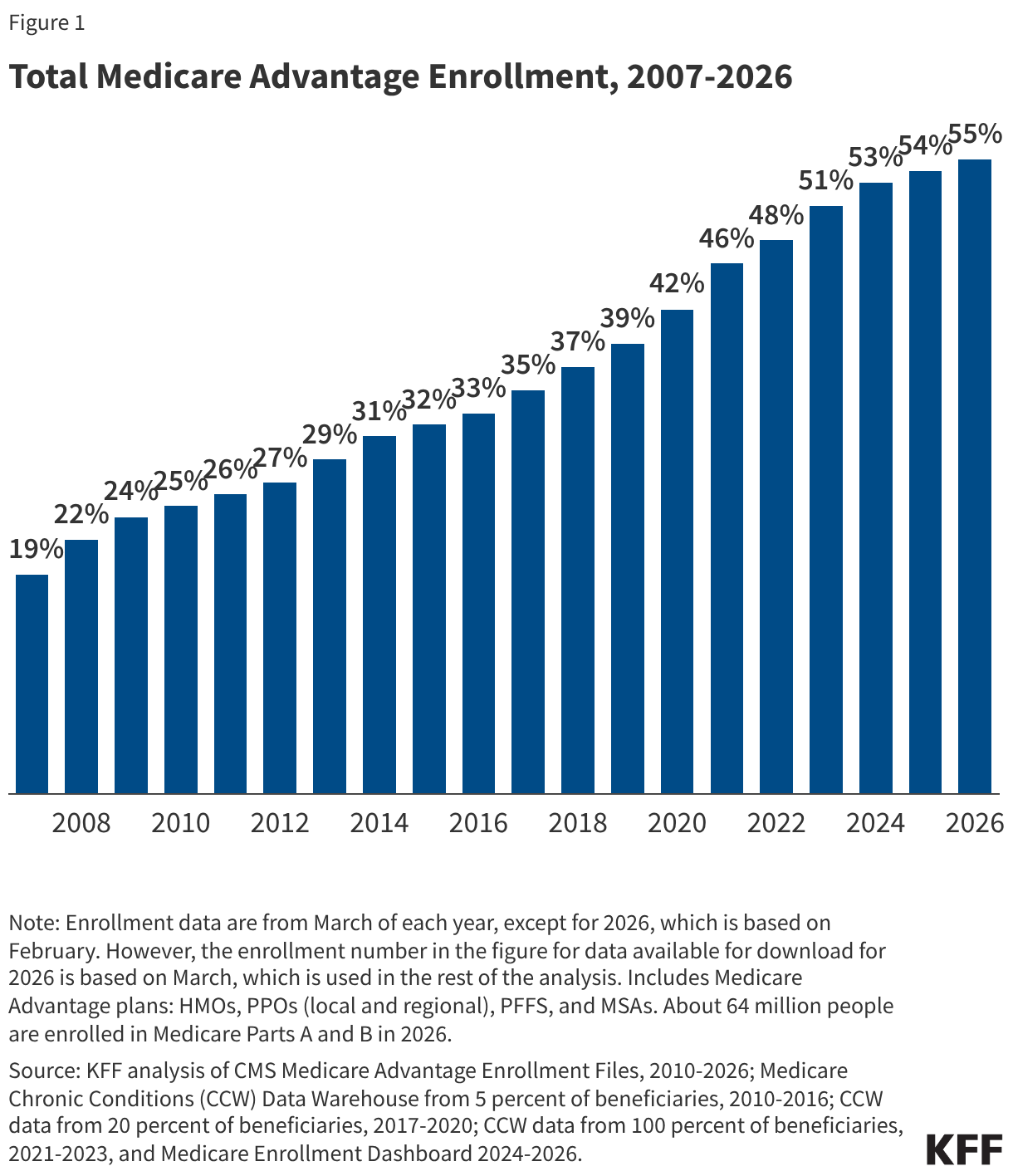
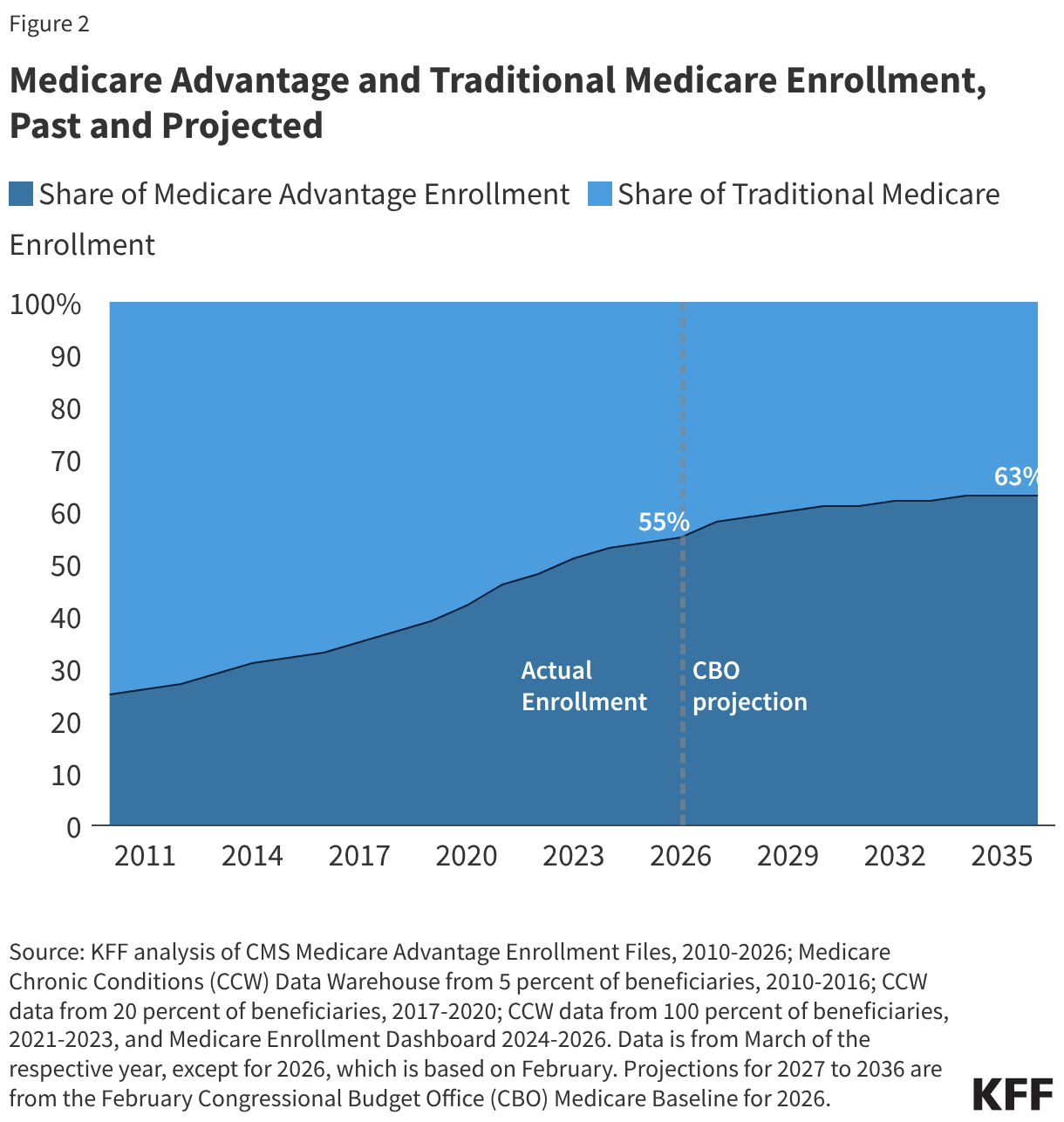
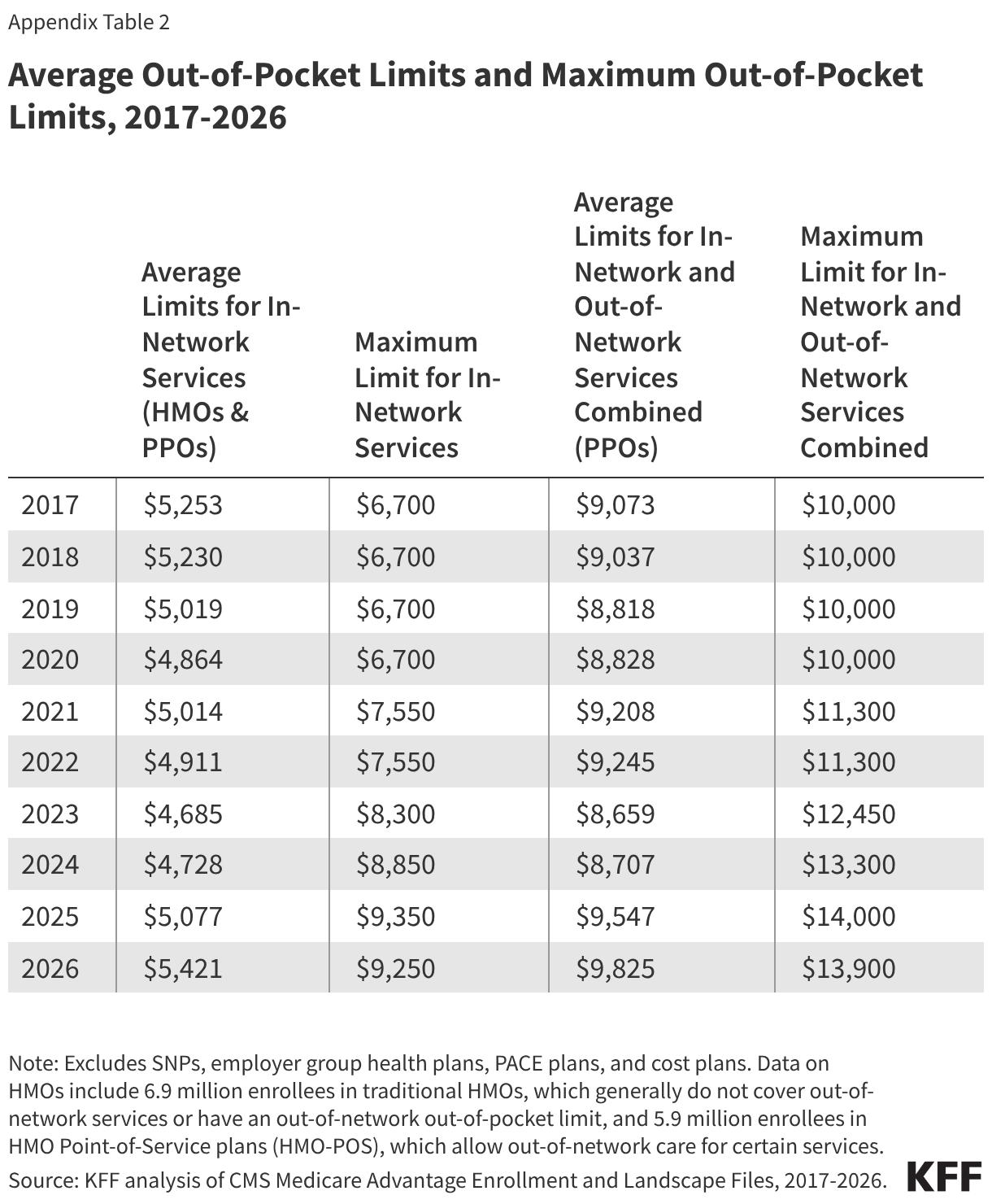
To help with cost sharing for Medicare-covered services and fill the gaps in Medicare benefits, most Medicare beneficiaries supplement traditional Medicare with additional coverage, such as Medigap, for which policyholders pay an average of $2,600 annually in premiums. More than half of people with Medicare are currently enrolled in Medicare Advantage, which offers extra benefits not available in traditional Medicare and caps annual out-of-pocket costs. Medicare beneficiaries may also have employer- or union-sponsored coverage or Medicaid coverage in addition to Medicare. But some people on Medicare lack additional coverage and face the risk of incurring high out-of-pocket costs if they need expensive medical care.

This analysis documents the different sources of coverage among people with Medicare and examines variation in beneficiary characteristics by source of coverage. The analysis draws on data from the Centers for Medicare & Medicaid Services (CMS) March 2025 Medicare Advantage enrollment files and the 2023 Medicare Current Beneficiary Survey (see Methods for details).

Key Facts

  • More than half of all people with Medicare Part A and Part B (54% or 34.1 million in 2025) are enrolled in a Medicare Advantage plan, while 46% (28.7 million) are in traditional Medicare.
  • Among traditional Medicare beneficiaries, most (87%) had additional coverage that supplements Medicare benefits in 2023, but 3.5 million beneficiaries (13%) lacked additional coverage, leaving them at risk of facing high out-of-pocket costs for medical care.
  • Overall, 14.1 million beneficiaries (23% of all Medicare beneficiaries) had employer or union sponsored coverage in 2023, either as a supplement to traditional Medicare or through group Medicare Advantage plans, another 12.2 million (20%) had Medicaid in addition to traditional Medicare or Medicare Advantage, and the same number, 12.2 million (20%) had a Medicare supplemental insurance (Medigap) policy to supplement traditional Medicare.
  • The number and share of Medicare beneficiaries with Medicaid (dual eligible individuals) were substantially higher in Medicare Advantage (68%) than traditional Medicare (32% in 2023).
  • Compared to traditional Medicare beneficiaries, Medicare Advantage enrollees were more likely to be Black or Hispanic, have incomes below $20,000 per person, and self-report fair or poor health.

More than Half of All People with Medicare Are Enrolled in Medicare Advantage

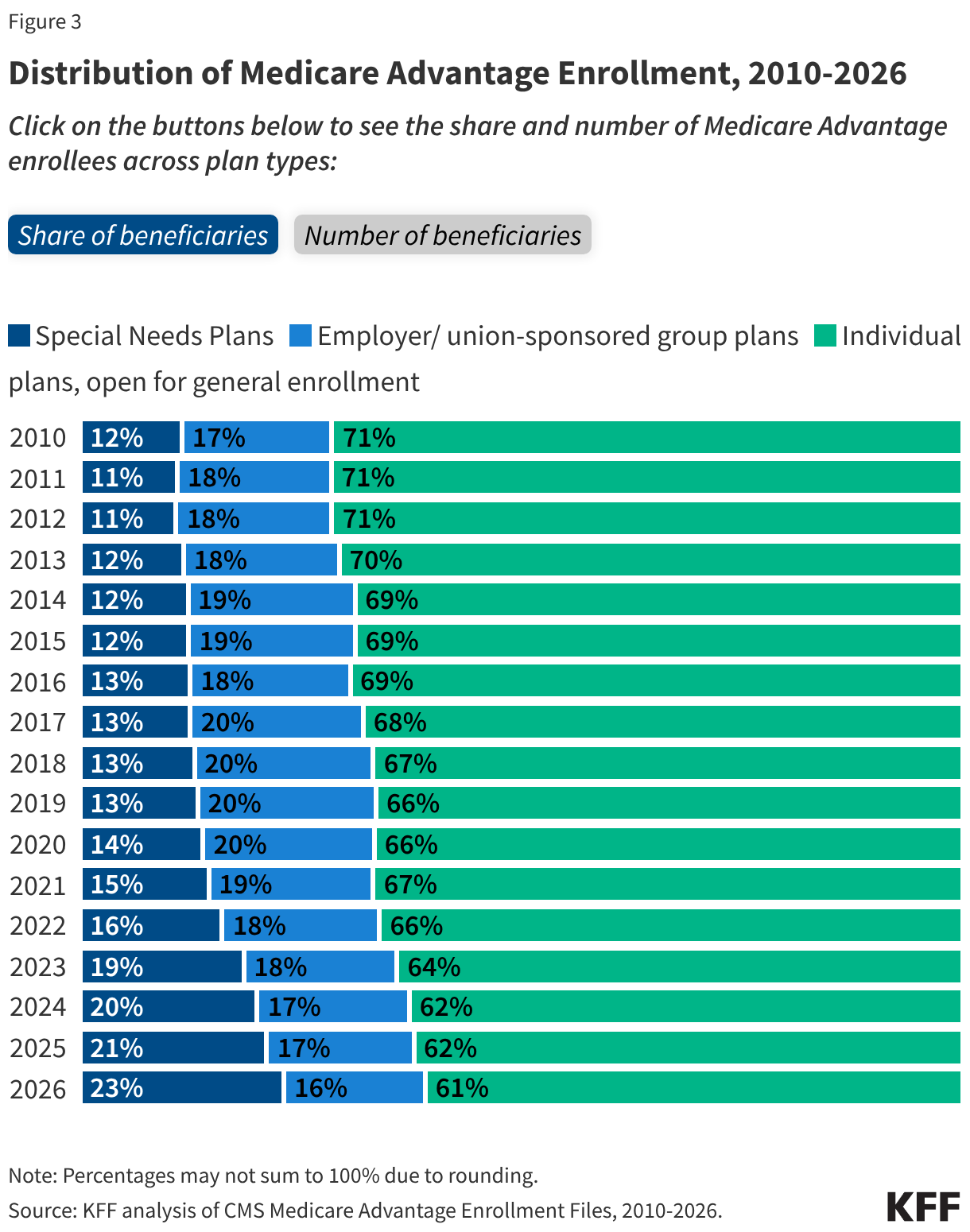
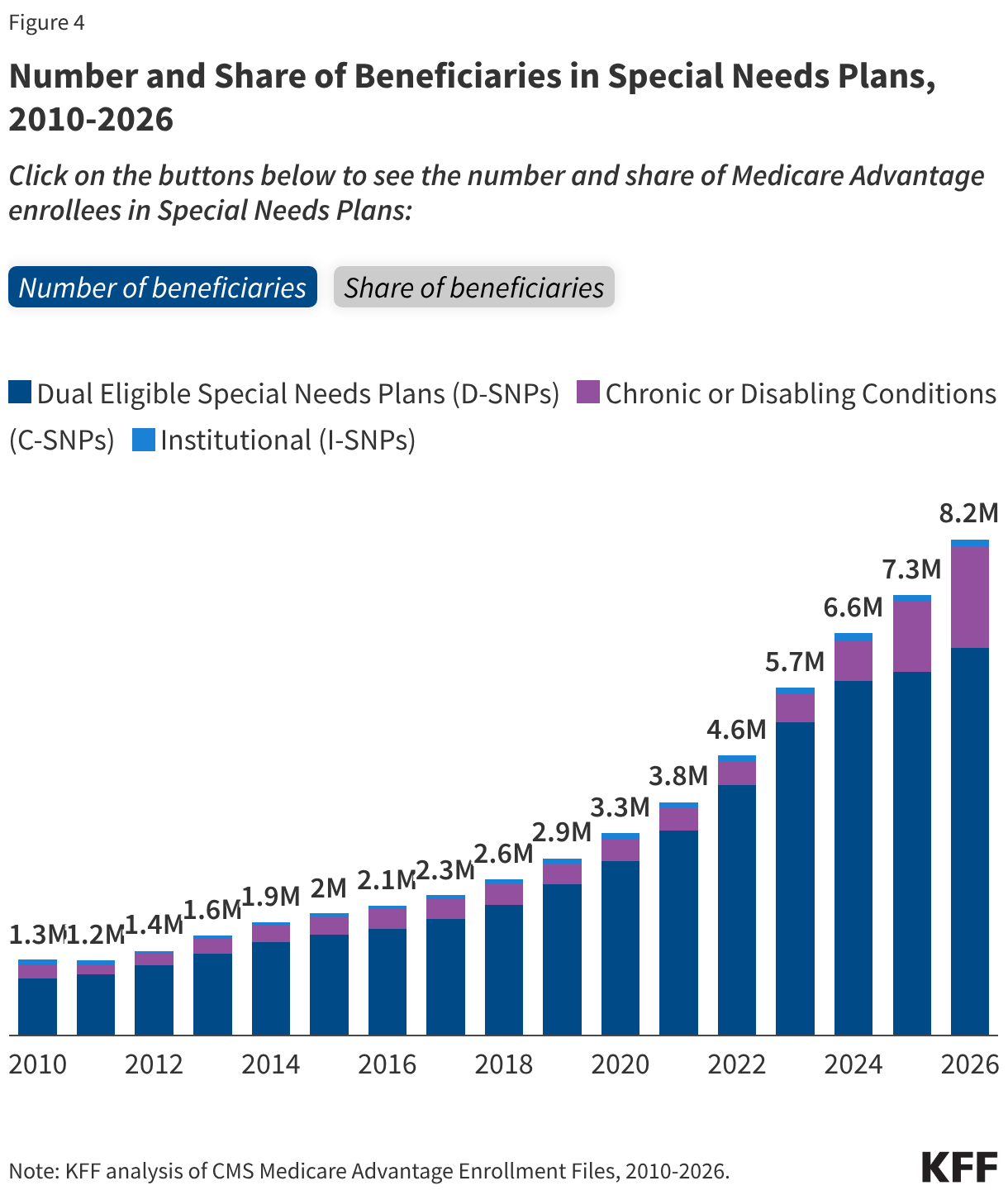
In 2025, Medicare Advantage covered more than half (54%) of Medicare beneficiaries with both Medicare Parts A and B, or 34.1 million out of about 62.8 million people. Of the total number of Medicare Advantage enrollees in 2025, most (62%) are enrolled in individual plans available to all Medicare beneficiaries. One in five (21%) are in Special Needs Plans (SNPs) and 17% are enrolled in employer- or union-sponsored group plans, where employers or unions contract with an insurer and Medicare pays the insurer a fixed amount per enrollee to provide benefits covered by Medicare. (These estimates are based on March 2025 Medicare Advantage plan enrollment data and therefore differ from those discussed below and shown in Figure 1, which are based on the 2023 Medicare Current Beneficiary Survey (MCBS)).

Compared to traditional Medicare beneficiaries, Medicare Advantage enrollees were more likely to be Black or Hispanic, have incomes below $20,000 per person, and self-report fair or poor health, based on KFF analysis of the 2023 MCBS (Figure 2, Appendix Table 1).

Medicare Advantage Enrollees Were More Likely Than Those in Traditional Medicare To Be Black or Hispanic, Low-Income, and in Poorer Health (Stacked Bars)

Most Medicare Beneficiaries in Traditional Medicare Have Additional Coverage that Supplements Medicare Benefits

In 2023, most (87%) people in traditional Medicare had some form of additional coverage, either through Medigap (43%), employer coverage (29%), Medicaid (14%), or another source (1%),based on estimates from the MCBS.But 3.5 million Medicare beneficiaries in traditional Medicare (13%) had no additional coverage. A more detailed discussion of these types of coverage and the characteristics of people with each coverage type is below.

The Characteristics of Traditional Medicare Beneficiaries Vary Widely by Source of Additional Coverage (Stacked Bars)

Nearly a Quarter of Medicare Beneficiaries Have Employer Coverage, Either through Group Medicare Advantage Plans or in Addition to Traditional Medicare

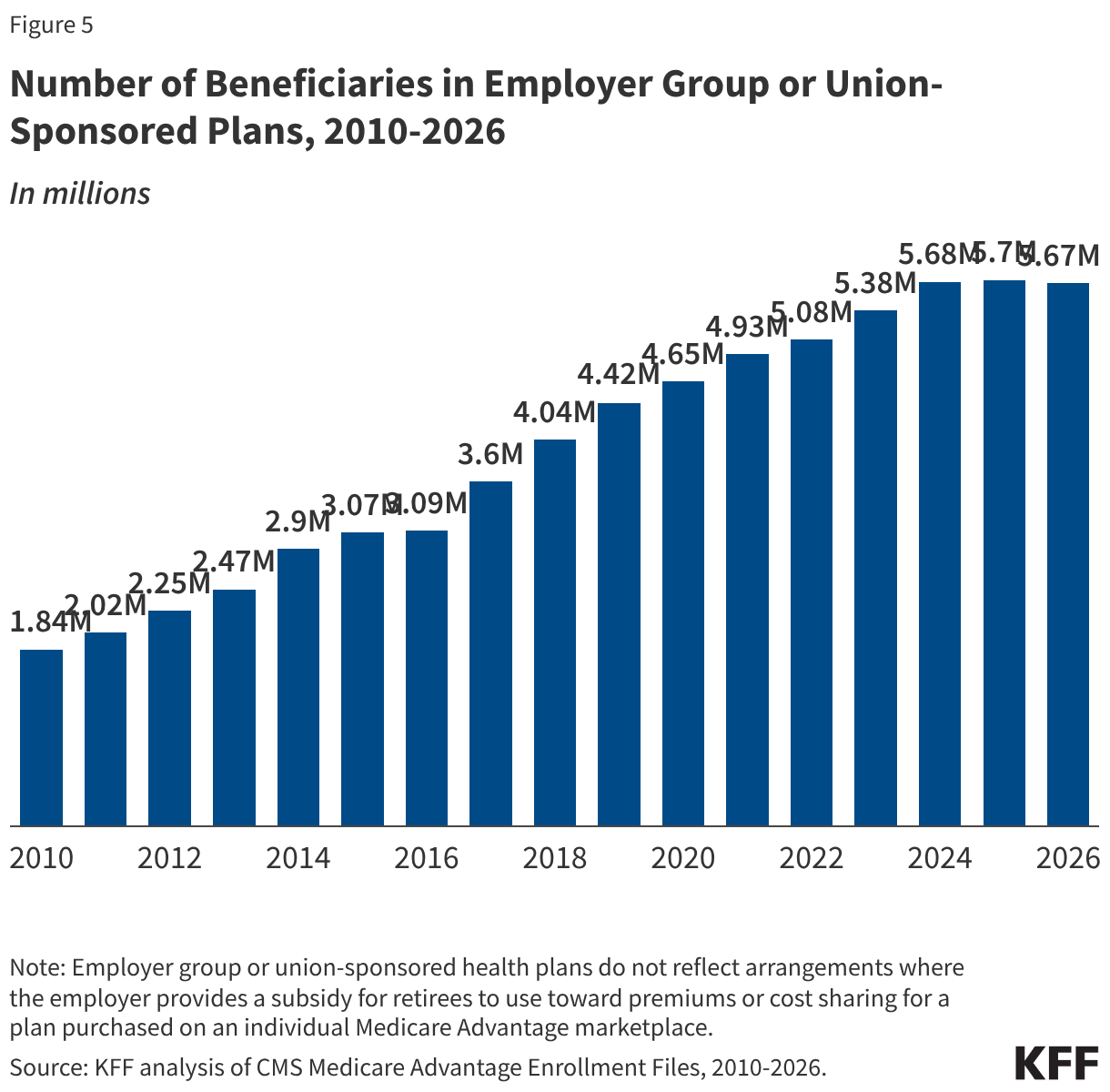
In total, 14.1 million Medicare beneficiaries – nearly a quarter (23%) of Medicare beneficiaries overall – had some form of employer or union-sponsored health insurance coverage in 2023 in addition to Medicare Part A and Part B. Of this total, 8.2 million beneficiaries had employer coverage in addition to traditional Medicare (29% of beneficiaries in traditional Medicare), while 5.9 million beneficiaries were enrolled in Medicare Advantage employer group plans. Most people with both Medicare Part A and Part B and employer- or union-sponsored coverage are retirees with Medicare as their primary source of health insurance coverage.

Compared to traditional Medicare beneficiaries overall in 2023, beneficiaries with employer or union-sponsored coverage in addition to traditional Medicare were more likely to have higher incomes ($40,000 or greater per person), a bachelor’s degree or higher, self-report excellent or good health, and were less likely to be under age 65 (Figure 3, Appendix Table 1).

Separately, in 2023, an estimated 5.8 million Medicare beneficiaries had Part A only, a group that primarily includes people who were active workers (either themselves or their spouses) and had primary coverage from an employer plan and Medicare as a secondary payer. People with Part A only cannot enroll in a Medicare Advantage plan, so people with coverage through Medicare Advantage employer group plans are likely to be retired.

Four in 10 People in Traditional Medicare Have a Medigap Supplemental Policy

Medicare supplement insurance, also known as Medigap, covered 2 in 10 (20%) Medicare beneficiaries overall, or 43% of those in traditional Medicare (12.2 million beneficiaries) in 2023. Medigap policies, sold by private insurance companies, fully or partially cover Medicare Part A and Part B cost-sharing requirements, including deductibles, copayments, and coinsurance. Medigap limits the financial exposure of Medicare beneficiaries and provides protection against catastrophic medical expenses. However, Medigap premiums can be costly and can rise with age, among other factors, depending on the state in which they are regulated.

Compared to all traditional Medicare beneficiaries in 2023, beneficiaries with Medigap were more likely to be White, have higher annual incomes (above $20,000 per person), self-report excellent, very good, or good health, and have a bachelor’s degree or higher (Figure 3, Appendix Table 1).

In contrast, a smaller share of traditional Medicare beneficiaries under age 65 have a Medigap policy than traditional Medicare beneficiaries ages 65 and older (1% versus 9%). Federal law provides a 6-month guarantee issue protection for adults ages 65 and older when they first enroll in Medicare Part B if they want to purchase a supplemental Medigap policy, but these protections do not extend to adults under the age of 65 with disabilities, and most states do not require insurers to issue Medigap policies to beneficiaries under age 65.

One in Five People with Medicare Also Have Coverage from Medicaid, with More Covered Under Medicare Advantage than Traditional Medicare

Medicaid, the federal-state program that provides health and long-term services and supports coverage to low-income people, was a source of supplemental coverage for 12.2 million Medicare beneficiaries with low incomes and modest assets in 2023, or 20% of all Medicare beneficiaries. A larger number and share of Medicare beneficiaries with Medicaid (known as dual-eligible individuals) were enrolled in a Medicare Advantage plan (8.3 million, or 68% of all dual-eligible individuals) than in traditional Medicare (4.0 million, or 32%) (Appendix Table 1). For these beneficiaries, Medicaid typically pays the Medicare Part B premium and may also pay a portion of Medicare deductibles and other cost-sharing requirements. Most dual-eligible individuals are also eligible for full Medicaid benefits, including long-term services and supports.

Compared to traditional Medicare beneficiaries overall in 2023, dual-eligible individuals were more likely to have low incomes and relatively low education levels, self-report fair or poor health, identify as Black or Hispanic, and be under the age of 65 (Figure 3, Appendix Table 1).

3.5 Million Traditional Medicare Beneficiaries Lack Supplemental Coverage

In 2023, 3.5 million Medicare beneficiaries – 6% overall –and 13% of beneficiaries in traditional Medicare – had no supplemental health insurance coverage. Traditional Medicare beneficiaries with no additional coverage are fully exposed to Medicare’s cost-sharing requirements, which would mean paying a $1,736 deductible for a hospital stay in 2026, daily copayments for extended hospital and skilled nursing facility stays, and a $283 deductible plus 20% coinsurance for physician visits and other outpatient services. (These costs are in addition to the standard Part B premium amount of $203 per month in 2026). Beneficiaries in traditional Medicare without additional coverage also face the risk of high annual out-of-pocket costs because there is no cap on out-of-pocket spending for Part A and B services in traditional Medicare, unlike in Medicare Advantage plans.

Beneficiaries in traditional Medicare without any form of additional coverage were more likely to have modest incomes (between $20,000 and $40,000 per person) compared to all traditional Medicare beneficiaries in 2023 (Figure 3, Appendix Table 1). Medicare beneficiaries with modest incomes have limited ability to afford Medigap premiums and are unlikely to qualify for Medicaid because their income and assets are not low enough to meet eligibility guidelines.

The number and share of traditional Medicare beneficiaries without any form of supplemental coverage has steadily declined in recent years. Between 2018 and 2023, the number of traditional Medicare beneficiaries without supplemental coverage declined from 5.6 million beneficiaries (10% of the total Medicare population, or 17% of those in traditional Medicare) to 3.5 million (6% of the total Medicare population, or 13% of those in traditional Medicare). This decline likely reflects the increase in Medicare Advantage enrollment over time, which has increased from 20 million in 2018 to 34 million in 2025.

Methods

For information on Medicare Advantage enrollment in 2025, this analysis draws on data from the Centers for Medicare & Medicaid Services (CMS) Medicare Advantage Enrollment files for March 2025 (See Methods of KFF, “Medicare Advantage in 2025: Enrollment Update and Key Trends” for more details). For information on sources of supplemental coverage within traditional Medicare and Medicare Advantage, this analysis draws on data from the CMS Medicare Current Beneficiary Survey (MCBS) 2023 Survey file data (the most recent year available), a nationally representative survey of Medicare beneficiaries.

Sources of coverage are determined based on the source of coverage held for the most months of Medicare enrollment in 2023. The analysis includes 60.4 million people with both Part A and B Medicare coverage in 2023 (weighted), including beneficiaries living in the community and in facilities. It excludes beneficiaries who were enrolled in Part A only (typically active workers or their spouses with employer or union sponsored coverage) or Part B only for most of their Medicare enrollment in 2023 (weighted n=5.4 million) and beneficiaries who had Medicare as a secondary payer (weighted n=1.7 million). (Because this analysis reflects coverage held for most months, it shows fewer Medicare beneficiaries with Part A-only or Part B-only coverage than the CMS Medicare enrollment dashboard, which reports 5.8 million with Part A only in 2023). The analysis also focuses only on coverage for Part A and Part B benefits, not Part D. This analysis of the MCBS accounted for the complex sampling design of the survey.

In this brief, the number and share of beneficiaries enrolled with both Medicare and Medicaid coverage (dual-eligible individuals) do not align with other KFF estimates due to differences in data sources and methods used. In other KFF publications, the number of dual-eligible individuals is estimated using a 100% CCW sample and include dual-eligible individuals with at least one month of enrollment in Medicare Part A or Part B, rather than those with coverage for most months of the year. The analysis in this brief is based on the MCBS because this data source provides a wider array of demographic and health status indicators than the CCW.

All reported differences in the text are statistically significant; results from all statistical tests are reported with p<0.05 considered statistically significant. Because estimates reported in the text and figures are rounded to the nearest whole number, some estimates may not sum to overall totals due to rounding.

Appendix

Sources of Coverage Among Medicare Beneficiaries, 2023 (Table)

VOLUME 37

ACIP Vote Drives Online Engagement About Hepatitis B Vaccine, And Posts Claim a VAERS “Cover-Up” of COVID-19 Vaccine Deaths


Highlights

Nearly two weeks after a CDC vaccine advisory panel voted to end the universal recommendation that newborns be vaccinated for hepatitis B, online conversations about childhood vaccination schedules and parental choice have continued at elevated levels, with many prominent accounts celebrating the decision as a victory for medical freedom.

Meanwhile, narratives about an FDA memo claiming COVID-19 vaccines caused 10 pediatric deaths have evolved from focusing on the unverified claims to framing the announcement as evidence of a broader government “cover-up,” as some have characterized it as vindication for those previously “silenced” for raising vaccine safety concerns.


Recent Developments

Online Conversations About Childhood Vaccination Schedule Continue Following ACIP Meeting

A medical professional puts a Band-Aid on an infant's thigh.
FotoDuets / Getty Images

What’s happening?

  • The CDC’s Advisory Committee on Immunization Practices (ACIP) voted earlier this month to end its prior recommendation that all newborns receive the hepatitis B vaccine within 24 hours of birth. The committee now recommends that parents of infants born to mothers who test negative for hepatitis B should consult with their health care provider and decide when or if their child should be vaccinated.
  • The universal birth dose of the hepatitis B vaccine has been credited with a 99 percent drop in hepatitis B infections in children and teens since the 1991 recommendation, but high-profile critics of the universal birth dose, including Department of Health and Human Services (HHS) Secretary Robert F. Kennedy Jr., have argued that vaccinating all children is unnecessary when many cases are transmitted through sexual activity or needle-sharing among adults.
  • After the vote by ACIP, President Donald Trump called for a full review of the childhood vaccination schedule, suggesting limiting the number of recommended children’s vaccinations to match that of “peer, developed countries.”

How has this contributed to online conversation?

  • KFF’s monitoring of X, Reddit, and Bluesky identified more than 50,000 posts, reposts, and comments mentioning hepatitis B on X, Reddit, and Bluesky on December 5, the day of the vote, up from a daily average of approximately 3,400 posts thus far in 2025 as of December 8. Many accounts framed the decision as a victory for parental rights or medical freedom, celebrating the move to shared clinical decision-making. Some accounts which have previously shared false information about vaccines characterized the universal birth dose as previously having been “forced” on newborns, despite ACIP’s recommendations not constituting vaccine mandates.
  • The enhanced engagement about hepatitis B has persisted beyond the initial spike on December 5, with the average number of daily posts, reposts, and comments remaining elevated at approximately 17,000 through December 12. But, the volume of posts is declining, and KFF will continue to monitor how these conversations evolve.

Who do people trust for health information in light of conflicting guidance?

Following ACIP’s vote to end the universal hepatitis B birth dose recommendation, major medical organizations including the American Medical Association (AMA) and American Academy of Pediatrics (AAP) issued statements emphasizing the importance of hepatitis B vaccination for newborns. Several Democratic governors and state health departments in Democratic-led states have also reaffirmed support for the birth dose, leaving parents with conflicting recommendations from federal and state authorities, as well as from professional medical organizations. Recent polling from the Annenberg Public Policy Center found that when the CDC and AMA issue conflicting vaccine recommendations, Americans are more likely to accept the AMA’s recommendation by a 2-to-1 margin, regardless of political affiliation. KFF polling similarly shows that larger shares of the public trust their own health care providers and physicians associations like the AMA and AAP than the CDC for reliable vaccine information. In light of conflicting recommendations, these survey findings suggest that enhanced prenatal counseling may be helpful for alleviating confusion about vaccine guidelines among parents.

Why this matters

  •  ACIP’s decision to end the universal birth dose recommendation for the hepatitis B vaccine, despite its documented effectiveness and safety record, signals a shift in how the committee weighs population-level protection against individual parental choice. Online narratives celebrated the decision as a victory for medical freedom, indicating that personal decision making may outweigh public health concerns for some parents.
  • The debate over hepatitis B vaccinations indicates further partisan divides. A recent KFF Quick Take explores findings from the KFF/Washington Post Survey of Parents, showing that very few parents report skipping or delaying the hepatitis B vaccine for their children, but Republican supporters of the Make America Great Again (MAGA) and supporters of the Make America Healthy Again (MAHA) are more likely to have done so.
  • The KFF/Washington Post poll found that similar shares report skipping or delaying other recommended childhood vaccines like MMR or chickenpox. President Trump’s call to review the full pediatric vaccine schedule suggests that concerns about the timing of hepatitis B vaccination may influence broader conversations about childhood immunization schedules that health professionals should monitor.

Claims of “Cover-Up” Emerge Following FDA Memo on Vaccine Deaths

A masked young child with dark brown hair holds a teddy bear in the background while a doctor draws liquid into a syringe in the foreground.
thianchai sitthikongsak / Getty Images

What’s happening?

  • A recent internal Food and Drug Administration (FDA) memo  claims to link at least 10 pediatric deaths to COVID-19 vaccines, based on reports from the Vaccine Adverse Event Reporting System (VAERS). The memo, which does not include children’s ages, medical histories, or other evidence, has not been published in a peer-reviewed medical journal, its claims have been criticized by 12 former FDA commissioners as well as by current FDA staff. The FDA has since announced it is expanding its investigation to examine adult deaths potentially linked to COVID-19 vaccines.
  • VAERS is a passive vaccine surveillance system, and reports of side effects can be submitted by anyone including patients, healthcare providers, or individuals without medical training. The system is intended to generate hypotheses and identify possible concerns, not establish causality. Individuals and groups opposed to vaccinations have commonly misrepresented VAERS data to cast doubt on vaccine safety by presenting unverified reports as proof of harm.

What are common online narratives?

  • Online narratives about the FDA memo have continued through December. While early discussions focused on the memo’s claims about the 10 deaths, recent conversations have framed the announcement as evidence of a broader “cover-up” of vaccine harms. The vice chair of ACIP, who has more than 1.3 million followers on X, posted that the pediatric deaths were previously identified by the CDC, but were only now being disclosed. Approximately 17% of all posts KFF identified about the FDA memo in December thus far as of December 15, used language that suggested the memo was an admission that the FDA hid vaccine deaths from the public, using terms like “cover-up,” “finally admitting,” “caught red-handed,” or claims that officials “lied” about vaccine safety.  Some also expressed feelings of “vindication” for individuals who were allegedly “silenced” or “censored” for raising concerns about COVID-19 vaccines.
  • A Substack article published in early December and shared by an account on X with more than 500,000 followers claimed that the memo may result in the FDA adding a “black-box” warning to COVID vaccines or removing them from the market.

What does the evidence say?

COVID-19 vaccines have been extensively studied in children, and multiple published, peer-reviewed studies have demonstrated no increase in mortality. The vaccines have been shown to reduce the risk of hospitalization and severe illness, and about 2,100 children have died from COVID-19 itself since the pandemic began.

Why this matters

Federal health officials framing unverified VAERS reports as evidence of vaccine-caused deaths may contribute to uncertainty among parents about the safety of COVID-19 vaccines for children. The KFF/The Washington Post Survey of Parents found that large majorities of parents had positive views of long-standing childhood vaccinations, but were more uncertain about COVID-19 vaccines. Previous KFF polling has shown that about half (52%) of adults said they did not know enough to say whether mRNA vaccines were generally safe or generally unsafe. The FDA memo may provide what appears to be official validation for these concerns, making it more difficult for health communicators to explain the limitations of VAERS and the vaccines’ established safety record.


What We Are Watching

Continued Staffing Changes Signal Ongoing Shifts in Federal Health Messaging

Recent staffing changes at federal health agencies may signal continuation of criticism around current vaccination schedules and public health recommendations. The CDC’s new principal deputy director, for example, previously ended his state’s mass vaccination campaigns and delayed outbreak notifications as Louisiana’s surgeon general, while a new chief science officer at HHS co-authored a declaration calling for an end to pandemic shutdowns and later chaired a vaccine advisory committee that made recommendations criticized by major medical organizations. The FDA also appointed a new acting director of its Center for Drug Evaluation and Research who has advocated for making it more difficult for young men to receive the COVID-19 vaccine and questioned whether the childhood vaccination schedule is scientifically justified. Health communicators should anticipate statements from federal health officials that may contradict existing guidance and potentially contribute to declining trust in government health agencies as reliable sources of vaccine information. KFF will continue to monitor how communication from these officials influences public trust in vaccines and federal health agencies.

X’s Location Transparency Feature Could Help Verify the Authenticity of Accounts That Cast Doubt on Health Information

A new feature deployed on the social media platform X in late November shows the country or region where accounts are based, designed to verify authenticity and limit the influence of bot networks and foreign “troll” accounts. Initial media reporting has focused on politically-oriented accounts, revealing that numerous high-engagement accounts that presented themselves as American were actually based overseas. The feature could prove valuable for health communicators and researchers attempting to track the origin of false health claims, and understanding where these claims originate could help public health officials and platforms develop more targeted responses.

Recent ChatGPT Updates Aim to Address Mental Health Risks, OpenAI says

OpenAI, the company that operates the popular AI chatbot ChatGPT, has introduced a number of safety updates to its default model this year after reports emerged of users experiencing mental health crises during conversations with the chatbot. The New York Times uncovered nearly 50 cases of people having mental health crises while talking with ChatGPT, with nine hospitalized and three deaths. In some cases, the chatbot’s responses validated delusional thinking or discouraged users from seeking mental health help, and the company is now facing five wrongful death lawsuits alleging that the chatbot may have encouraged users to commit suicide. The company released GPT-5 in August and deployed an October update, developed in consultation with mental health professionals, that aims to better recognize users experiencing crisis and de-escalate sensitive conversations. OpenAI says that additional features, like session break reminders, parental controls, and age verification, are designed with user safety in mind, but internal communications reported by The New York Times show that the company still prioritizes user engagement metrics. Some mental health professionals have argued that OpenAI is understating the risk to its users, noting that 5 to 15 percent of the population could be vulnerable to delusional thinking. Parents and mental health professionals should be aware of the potential for AI chatbots to reinforce harmful thoughts or provide dangerous guidance, particularly during extended conversations.

About The Health Information and Trust Initiative: the Health Information and Trust Initiative is a KFF program aimed at tracking health misinformation in the U.S., analyzing its impact on the American people, and mobilizing media to address the problem. Our goal is to be of service to everyone working on health misinformation, strengthen efforts to counter misinformation, and build trust. 


View all KFF Monitors

The Monitor is a report from KFF’s Health Information and Trust initiative that focuses on recent developments in health information. It’s free and published twice a month.

Sign up to receive KFF Monitor
email updates


Support for the Health Information and Trust initiative is provided by the Robert Wood Johnson Foundation (RWJF). The views expressed do not necessarily reflect the views of RWJF and KFF maintains full editorial control over all of its policy analysis, polling, and journalism activities. The data shared in the Monitor is sourced through media monitoring research conducted by KFF.

A Look at Nursing Facility Characteristics in 2025

Published: Dec 17, 2025

The 2025 reconciliation law could have major implications for nearly 15,000 federally certified nursing facilities and the more than 1.2 million people living in them. Nursing facilities provide medical and personal care services for older adults and people with disabilities. In 2023, Medicaid paid for 44% of long-term institutional care costs; 37% of long-term institutional care costs were paid for out-of-pocket; and the remaining 18% was covered by other public and private payers. Although provisions in the reconciliation law do not directly limit or reduce nursing facility services, changes to the Medicaid program could result in reduced payments from Medicaid for nursing facility care and may result in fewer people having Medicaid coverage of nursing facility care (see Box 1 for more on the 2025 reconciliation law.)

This data note discusses the impact of the 2025 reconciliation law on nursing facilities and examines the characteristics of nursing facilities and the people living in them with data from Nursing Home Compare, a publicly available dataset that provides a snapshot of information on quality of care in each nursing facility, and CASPER (Certification and Survey Provider Enhanced Reports), a dataset that includes detailed metrics collected by surveyors during nursing facility inspections. State-level data are also available on State Health Facts, KFF’s data repository with downloadable health indicators. Key takeaways from July 2025 data include:

  • There are 14,742 nursing facilities certified by CMS and about 1.24 million residents living in these certified nursing facilities (Figure 1).
  • Nursing facility residents receive, on average, about 3.85 hours of nursing care per day from licensed practical nurses (LPN/LVN), registered nurses (RNs), and nurse aides (Figure 2).
  • On average, nursing facilities receive 9.5 deficiencies over the course of a survey cycle (Figure 3).
  • While nearly all facilities receive at least one deficiency over the course of a survey cycle, 27% of facilities receive serious deficiencies for actual harm or jeopardy posed to a resident (Figure 3).

Box 1: Major Provisions in 2025 Reconciliation Law that Could Impact Nursing Facilities

The reconciliation law, passed on July 4, 2025, includes significant health care policy changes, including some major changes could have implications for nursing facilities.

Broader federal spending cuts: The 2025 reconciliation law is expected to reduce federal Medicaid spending by $911 billion over the next decade, which could have implications for nursing facilities. Those spending cuts are likely to leave states with difficult choices about how to respond to reduced federal support including spending on long-term care which accounts for more than one-third of all Medicaid spending. States’ options for reducing spending on nursing facility care could involve reducing payment rates or restricting eligibility so that fewer people receive services.

State-directed payments (SDPs): SDPs require managed care organizations to make certain types of payments to health care providers, generally aimed at increasing provider payment rates to increase access to or quality of care. The reconciliation law reduced the maximum payment rate in SDPs from commercial rates to Medicare rates in states that have adopted the ACA expansion and to 110% of Medicare rates in non-expansion states. As a result of these changes, states may reduce payments to nursing facilities to comply with the caps in the new law.

Moratorium on eligibility rules: The reconciliation law delays implementation of two eligibility rules that would have increased Medicaid enrollment, especially among Medicare beneficiaries (dual-eligible individuals), a group that disproportionately uses nursing facility services, until 2034. CBO estimated that delaying these rules could reduce the number of dual-eligible individuals by around 1 million.

Reduced retroactive coverage period: The law reduces the period for which states must provide Medicaid coverage for qualified medical expenses from 90 days prior to the date of application for coverage to 60 days among non-expansion enrollees. Because entering a nursing facility is often a precipitating event for people to apply for Medicaid, this change may particularly affect Medicaid payments for nursing facilities.

Staffing rule: The law delays implementation of a Biden-era rule intended to help address long-standing concerns about staffing shortages and the quality of care in nursing homes until 2034. A Texas judge overturned key requirements from the rule in May 2025; and the Trump Administration rescinded the rule in December 2025.

Freezing home equity limit: The reconciliation law reduces maximum home equity limits on the homes of Medicaid nursing facility applicants to $1 million, starting in 2028. The limits will not grow over time and thus, become more binding in future years (as of 2025, 11 states had home equity limits higher than $1 million). Once this cap takes effect, people in those states who would otherwise be eligible may no longer qualify for Medicaid long-term care. 

Immigration enforcement: The law provides additional funding to Immigration and Customs Enforcement to expand detention and deportation operations of immigrants in the U.S., raising questions about workforce shortages. Immigrants made up 21% of workers in nursing facilities in 2023.

Effective prohibition on new provider taxes or increases to existing ones: States are permitted to finance the non-federal share of Medicaid spending through healthcare-related taxes or “provider taxes” and often use those tax revenues to bolster provider payment rates. All but six states have taxes on nursing facilities. The law effectively prohibits states from enacting any new provider taxes or from increasing existing ones. Historically, states have used provider tax revenues as a mechanism to sustain Medicaid spending during budget shortfalls and to bolster payment rates, and the prohibition will reduce states’ ability to do so in the future. Recent data from a 50-state survey of state Medicaid programs show that 7 states (CO, KY, MA, MN, NJ, NC, and OK) planned to increase taxes on nursing facilities in FY 2026, though the new reconciliation law may prevent these increases from taking effect.

As of July 2025, there are 14,742 nursing facilities certified by CMS (Figure 1). The number of nursing facilities certified by CMS decreased by 6% between July 2015 and July 2025. There has generally been a steady decline during that time period. In order to receive payment under the Medicare and/or Medicaid programs, nursing facilities are required to follow certain regulations and be certified by CMS. The decreased number of nursing facilities reflects the net change in the number of certified facilities after accounting for newly-certified facilities and facilities that are no longer certified, including facilities that closed.

There are about 1.24 million residents living in certified nursing facilities (Figure 1). Since 2021, the number of nursing facility residents has gradually increased from 1.10 million to 1.24 million. However, between 2015 and 2025, the number of residents living in nursing facilities decreased by 9%, with most of that coming from a steep decline between 2020 and 2021, reflecting the effects of the COVID-19 pandemic. Prior to the pandemic, the number of residents was relatively steady, although it declined from 1.37 million in 2015 to 1.32 million in 2020. COVID-19 exacerbated the decrease in nursing facility residents—in part because nursing facility residents and staff incurred so many deaths during the pandemic.

Number of Certified Nursing Facilities and Residents, 2015-2025 (Column Chart)

Residents receive an average of 3.85 hours of nursing care per day, including 0.87 hours of LPN care, 0.68 hours of RN care, and 2.3 hours of nurse aide care (Figure 2). While staffing levels have gradually slightly increased overtime since 2022, the average hours of nursing care that nursing facility residents received declined by 7%, from 4.13 hours to 3.85 hours per resident each day, between July 2015 and July 2025. The decrease was driven by a 19% decline in registered nurse (RN) hours and a 7% decline in nurse aide hours. Licensed practical nurse (LPN) hours increased by 5% in this same time period. The 2024 rule would have required nursing facilities to meet minimum standards in staff hours for RNs and nurse aides but did not include any requirements for LPNs. A Texas judge overturned key elements of the rule in April 2025, the 2025 reconciliation law delayed all provisions of the rule until October 2034 (Box 1), and the Trump Administration rescinded the rule in December 2025. Previous KFF analysis show that just 19% of nursing facilities met the standards at the time of the rule’s passing.

The total hours of nursing care per resident decreased between 2015 and 2025, but rose briefly in 2021. The relatively higher staffing hours per resident in 2021 reflected the fact that the number of residents declined more quickly than the number of total nursing staff hours did between 2020 and 2021. In 2021, the number of staffing hours was 12% lower than in 2020 (data not shown). These lower staffing levels in the last several years align with data as of March 2024 showing that the number of workers employed at long-term care facilities continues to remain below pre-pandemic levels.

Nursing Facility Hours per Resident Day by Nurse Staff Type, 2015-2025 (Stacked column chart)

Box 2: Direct Care Staff in Nursing Facilities

Registered Nurse (RN): Registered nurses (RNs) are responsible for the overall delivery of care to the residents and assess needs of nursing facility residents. RNs are typically required to have between two and six years of education.

Licensed Practical Nurse (LPN) and Licensed Vocational Nurse (LVN): LPNs/LVNs provide care under the direction of an RN. Together, RNs and LPNs/LVNs make sure each resident’s plan of care is being followed and their needs are being met. LPNs/LVNs typically have one year of training. 

Certified Nurse Aides/Assistants (CNAs): CNAs work under the direction of a licensed nurse to assist residents with activities of daily living such as eating, bathing, dressing, assisting with walking/exercise, and using the bathroom. All CNAs must have completed a nurse aide training and competency evaluation program within 4 months of their employment. They must also pursue continuing education each year.

Nursing facilities receive an average of 9.5 deficiencies over the course of a survey cycle and 27% of facilities receive deficiencies for actual harm or jeopardy (Figure 3, Box 3). While nearly all facilities receive at least one deficiency during a survey cycle, this analysis focuses on the share with serious deficiencies since there is wide variation in the types of deficiencies a facility may receive. Both the average number of deficiencies and the share of facilities with serious deficiencies have increased over time, which could reflect increased oversight and low staffing levels that lead to staffing-related deficiencies. Between 2015 and 2025, the average count of deficiencies per nursing facility increased from 6.8 to 9.5, an increase of 40%. The increase was generally steady overtime, except for two stable periods: 1) between 2020 and 2022 and 2) between 2024 and 2025 (though 2024 and 2025 reported the highest number deficiencies during the 10-year period). The share of facilities reporting serious deficiencies between 2015 and 2025 increased from 17% to 27%, with a slight decrease between 2024 and 2025. A 2023 report on nursing home staffing by Abt Associates found that better-staffed nursing homes are typically cited for fewer deficiencies or violations of federal regulations, suggesting there may be a relationship between the increase in deficiencies and the general decrease in staffing levels over the 10-year time period.

Box 3: Deficiencies in Nursing Facilities

Nursing facilities receive deficiencies when they fail to meet the requirements necessary to receive federal funding. Deficiencies are often given for problems which may have negative effects on the health and safety of residents. Commonly cited deficiencies include a failure to provide necessary care, failure to report abuse or neglect, and violation of infection control requirements. Each of these categories has specific regulations that state surveyors review to determine whether facilities have met the standards.

Deficiencies are characterized by their level of severity: Deficiencies for “actual harm” or “immediate jeopardy” are the most severe and are grouped together under the term, “serious deficiencies.” CMS defines “actual harm” as a “deficiency that results in a negative outcome that has negatively affected the resident’s ability to achieve the individual’s highest functional status.” “Immediate jeopardy” is defined as a deficiency that “has caused (or is likely to cause) serious injury, harm, impairment, or death to a resident receiving care in the nursing facility.” These can include citations to facilities for physically abusing residents, failure to maintain safe living quarters, or failure to provide CPR or other basic life support when necessary for residents.

Average Deficiencies per Nursing Facility and Share of Nursing Facilities Receiving a Deficiency for Actual Harm or Jeopardy, 2015-2025 (Column Chart)

Medicaid is the primary payer for 63% of nursing facility residents; Medicare for 14% of residents; and the remaining 23% of residents have another primary payer (ex. out-of-pocket) (Figure 4). The share of residents by primary payer has stayed relatively stable over time. Medicare does not generally cover long-term care but does cover up to 100 days of skilled nursing facility care following a qualifying hospital stay. KFF polling shows that four in ten adults overall incorrectly believe that Medicare is the primary source of insurance coverage for low-income people who need nursing facility care. 

Distribution of Nursing Facility Residents by Primary Payer in 2025 (Donut Chart)

Nearly three-quarters (73%) of nursing facilities are for-profit, one-fifth (20%) are non-profit, and the remaining seven percent are government-owned (Figure 5). The share of facilities by ownership type has also stayed relatively stable over time but there was increasing scrutiny over the 73% of facilities that are for-profit during the prior Administration. Despite little change in the type of ownership, there have been reports of private equity firms purchasing nursing facilities and changing operations to increase profits, resulting in lower-quality care. The GAO estimates that about 5% of nursing facilities had private equity ownership in 2022.

The Biden Administration issued a final rule in November 2023 on nursing facilities (separate from the April 2024 staffing rule that was delayed by the 2025 reconciliation law and then rescinded by the Trump Administration in December 2025). The 2023 nursing facility rule requires nursing homes enrolled in Medicare or Medicaid to disclose detailed information regarding their owners, operators, and management, including:

  • Anyone who exercises any financial control over the facility;
  • Anyone who leases or subleases property to the facility, including anyone who owns 5% or more of the total value of the property; and
  • Anyone who provides administrative services, clinical consulting services, accounting or financial services, policies or procedures on operations, or cash management services for the facilities.

Facilities must also disclose whether any of the owning or managing entities are a private equity company or real estate investment trust (REIT). Facilities began self-reporting this data to CMS in early 2024 and the data is now available to the public. However, these data may be incomplete for now as fewer than 100 facilities report private equity ownership and just over 300 facilities report REIT ownership. Other research estimates those counts to be higher. 

Distribution of Nursing Facilities by Profit Status (Donut Chart)

This work was supported in part by The John A. Hartford Foundation. KFF maintains full editorial control over all of its policy analysis, polling, and journalism activities.

Recent Changes in Federal Vaccine Recommendations: What’s the Impact on Insurance Coverage?

Author: Jennifer Kates
Published: Dec 16, 2025

The Trump administration has made several recent changes to federal routine vaccination recommendations. Specifically, under the auspices of Secretary Kennedy, who has long questioned the safety and efficacy of vaccines and stated his intention to review vaccine schedules, the CDC’s Advisory Committee on Immunization Practices (ACIP) has recommended changes (including to age group, type of vaccine, and/or clinical decision-making process) to seven vaccine usage recommendations in the United States: Meningococcal; RSV for adults; RSV for children; influenza; COVID-19; Measles, Mumps, Rubella and Varicella (MMRV); and Hepatitis B. These recommendations, which have been adopted by the HHS Secretary or Acting CDC Director, have raised questions about the implications for insurance coverage, since most insurers are required to cover ACIP/CDC recommended vaccines at no-cost, either due to requirements of the Affordable Care Act or other federal statutes.

Below, we provide an overview of each of these changes and what they mean for coverage requirements. As the table indicates, of the seven recent changes, two have no implications for coverage, two removed the coverage requirement, and three expanded the requirement. When a coverage requirement is removed, an insurer could still choose to cover a vaccine at no cost. In fact, AHIP, the trade association for the health insurance industry whose members cover more than 200 million Americans, announced that health plans will continue to cover all ACIP-recommended immunizations that were recommended as of September 1, 2025 with no cost-sharing for patients through the end of 2026. When a coverage requirement is expanded, insurers (with limited exception) must cover the vaccine at no-cost. The insurance requirement extends to vaccines with “individual decision-making” (also known as “shared clinical decision-making”) recommendations as well, which are those “individually based and informed by a decision process between the health care provider and the patient or parent/guardian”.

In addition to federal requirements for coverage, states have the authority to require state-regulated health insurers (employer plans that are fully insured and individual and small-group marketplace plans) to cover vaccines beyond minimum federal requirements (and not necessarily linked to current ACIP/CDC recommendations). As of December 2025, eight states have moved to do so (and one state authorizes the state Commissioner of Insurance to do so). Still, states cannot impose coverage requirements on self-insured employer plans, which cover most (67%) people with employer coverage.

Additional changes to ACIP-recommended vaccine schedules are likely, as President Trump has issued a Presidential Memorandum calling on HHS and CDC to begin a “process to align U.S. core childhood vaccine recommendations with best practices from ‘peer, developed countries’”. Beyond their implications for insurance coverage, changes to vaccine recommendations, particularly those that narrow or limit access, are likely to have other implications, such as driving down already falling vaccine coverage rates in the United States.

Changes to Vaccine Recommendations and Insurance Coverage
VaccinePrior RecommendationNew RecommendationDate of
Change
Insurance Implications
Meningococcal MenACWY and MenB may be administered at the same visit if indicated (for certain populations).MenABCWY vaccine may be used when both MenACWY and MenB are indicated at the same visit (for certain populations).4/16/25 (ACIP)
6/25/25 (HHS)
Expands coverage requirement to include new pentavalent (5-in-1) MenABCWY vaccine for those indicated. Applies to private insurers, Medicaid, Vaccines for Children Program.
RSV for adultsRecommended for all adults, ages 75 and older and adults ages 60-74 with increased risk. Recommended for all adults, ages 75 and older and adults ages 50-74.4/16/25 (ACIP)
6/25/25 (HHS)
Expands coverage requirement to include those ages 50-59 who are at increased risk. Applies to private insurers, Medicaid, Medicare Part D.
RSV for childrenRecommended that infants aged < 8 months born during or entering their first RSV season who are not protected by maternal vaccination receive nirsevimab.Recommended that clesrovimab, a monoclonal antibody approved in 2025, be added as an option, with no preferential recommendation between nirsevimab and clesrovimab.6/25/25 (ACIP)
7/22/25 (HHS)


Expands coverage requirement to include new monoclonal antibody for infants. Applies to private insurers, Medicaid, Vaccines for Children Program.
InfluenzaSingle-dose and multi-dose influenza vaccines recommendedMulti-dose influenza vaccines with Thimerosal no longer recommended6/25/25 (ACIP)
7/22/25 (HHS)
Removes coverage requirement for multi-dose flu vaccine (which will no longer be available in the U.S. market). Applies to private insurers, Medicaid, Vaccines for Children Program. Medicare Part B required to cover by statute, not linked to ACIP/CDC*.
COVID-19Recommended for everyone, ages 6 months and olderVaccination based on individual-based decision-making (also known as shared clinical decision-making) with an emphasis that the risk-benefit of vaccination is most favorable for individuals who are at an increased risk for severe COVID-19 disease and lowest for individuals who are not at an increased risk.9/19/25 (ACIP)
Last week of September (CDC)


Coverage requirement remains unchanged (vaccines recommended through individual-based decision-making must be covered at no-cost). Applies to private insurers, Medicaid, Vaccines for Children Program. Medicare Part B required to cover by statute, not linked to ACIP/CDC.
Measles, Mumps, Rubella, VaricellaBoth the combined measles, mumps, and rubella (MMR) vaccine and combined measles, mumps, rubella, and varicella (MMRV) vaccine recommended for childrenRecommendation that Varicella vaccine be given as stand-alone vaccine (combined MMRV no longer recommended)9/19/25 (ACIP)
Last week of September (CDC)
Removes coverage requirement for combined MMRV. Applies to private insurers, Medicaid, and Vaccines for Children Program.
Hepatitis BBirth dose recommended for all infantsVaccination based on individual-based decision-making for parents deciding whether to give the hepatitis B vaccine, including the birth dose, to infants born to women who test negative for the virus. For those infants not receiving the birth dose, recommendation that initial dose be administered no earlier than two months of age. Additionally, when evaluating need for subsequent dose in children, recommended that parents should consult with health care providers to decide whether to test first.**12/5/25 (ACIP)
12/16/25 (CDC, change in birth dose recommendation adopted; review of screening recommendation still underway)
Coverage requirement remains unchanged (vaccines recommended through individual-based decision-making must be covered at no-cost). Applies to private insurers, Medicaid, Vaccines for Children Program. Medicare Part B required to cover by statute, not linked to ACIP/CDC.

Notes:
See KFF, ACIP, CDC, and Insurance Coverage of Vaccines in the United States, for coverage criteria by payer.
*While Medicare Part B is required to cover influenza vaccine by statute, not linked to ACIP/CDC, this change will result in the removal of the multi-dose vaccine from the market.
**CDC has not changed its recommendations for adult hepatitis B vaccinations, which are that adults aged 19–59 years, and adults aged 60 years and older with risk factors for hepatitis B or without identified risk factors but seeking protection, receive the vaccine if they had not been previously vaccinated. See CDC Hepatitis B Vaccine Administration.

Sources:

Key Data on Health and Health Care by Race and Ethnicity

Published: Dec 16, 2025

Executive Summary

Introduction

Copy link to Introduction

Racial and ethnic disparities in health and health care remain a persistent challenge in the United States. The COVID-19 pandemic’s uneven impact on people of color drew increased attention to inequities in health and health care, which have been documented for decades and reflect longstanding structural and systemic inequities rooted in historical and ongoing racism and discrimination. KFF’s 2023 Survey on Racism, Discrimination, and Health documents ongoing experiences with racism and discrimination, including in health care settings. While inequities in access to and use of health care contribute to disparities in health, inequities across broader social and economic factors that drive health also play a major role. Since taking office, the Trump administration has implemented policies that may erode progress addressing disparities in health and health care, including eliminating equity-related initiatives, reducing federal data collection and reporting, increasing and expanding immigration enforcement, and restricting immigrant access to coverage and health and social supports. Moreover, changes in the 2025 tax and spending law are anticipated to large coverage losses, which will likely exacerbate disparities.

Data are key for identifying disparities and the factors that drive them, developing interventions and directing resources to address them, as well as for assessing progress and establishing accountability. This analysis examines how people of color fare compared to White people across 64 measures of health, health care, and social and economic factors that drive health using the most recent data available from federal surveys and administrative sets as well as the 2023 KFF Survey on Racism, Discrimination, and Health, which provides unique nationally-representative measures of adults’ experiences with racism and discrimination, including in health care (see About the Data).

Where possible, we present data for six groups: White, Hispanic, Black, Asian, American Indian or Alaska Native (AIAN), and Native Hawaiian or Pacific Islander (NHPI). People of Hispanic origin may be of any race, but we classify them as Hispanic for this analysis. We limit other groups to people who identify as non-Hispanic. When the same or similar measures are available in multiple datasets, we use the data that allow us to disaggregate for the largest number of racial and ethnic groups. Unless otherwise noted, differences described in the text are statistically significant at the p<0.05 level.

We include data for smaller population groups wherever available. Instances in which an estimate has a 95% confidence interval width greater than 20 percentage points or 1.2 times the estimate may not be reliable and are noted in the figures. Although these small sample sizes may impact the reliability, validity, and reproducibility of data, they are important to include because they point to potential underlying disparities that are hidden without disaggregated data. For some data measures throughout this brief we refer to “women” but recognize that other individuals also give birth, including some transgender men, nonbinary, and gender-nonconforming persons.

Key Takeaways

Copy link to Key Takeaways

Hispanic, Black, and AIAN people fare worse than White people across the majority of examined measures of health and health care and social determinants of health (Figure 1). Black people fare better than White people for some cancer screening and incidence measures, although they have higher rates of cancer mortality. Despite worse measures of health coverage and access, and social and economic factors, Hispanic people fare better than White people for some health measures, including life expectancy, some chronic diseases, and most measures of cancer incidence and mortality. These findings may, in part, reflect variation in outcomes among subgroups of Hispanic people, with better outcomes for some groups, particularly recent immigrants to the U.S. Examples of some key findings include:

  • Among people under age 65, AIAN (19%) and Hispanic (18%) were more than twice as likely as their White counterparts (7%) to be uninsured as of 2023.
  • Among adults with any mental illness, Hispanic (44%), Black (39%), and Asian (33%) adults were less likely than White adults (58%) to receive mental health services as of 2024.Roughly, six in ten Hispanic (65%), AIAN (65%), and Black (58%) adults went without a flu vaccine in the 2023-2024 season, compared to less than half of White adults (51%).
  • AIAN and Black people have a shorter life expectancy (70.1 and 74.0 years, respectively) compared to White people (78.4 years) as of 2023.
  • Black (10.9 per 1,000) and AIAN (9.2 per 1,000) infants were at least two times as likely to die as White infants (4.5 per 1,000) as of 2023. Pregnancy-related mortality rates are also more than three times higher among Black women compared to White women.
  • Hispanic (24%), AIAN (23%), and Black (22%) households were roughly twice as likely to experience food insecurity as White households (12%).
Health and Health Care among People of Color Compared to White People (Stacked column chart)

Asian people in the aggregate fare the same or better compared to White people for most examined measures. However, they fare worse for some measures, including receipt of some routine care and screening services, and some social and economic measures, including home ownership, crowded housing, and experiences with racism and discrimination. They also have higher shares of people who are noncitizens or who have limited English proficiency (LEP), which could contribute to barriers to accessing health coverage and care. Moreover, the aggregate data may mask underlying disparities among subgroups of the Asian population.

Data gaps largely prevent the ability to identify and understand health disparities for NHPI people. Data are insufficient or not disaggregated for NHPI people for a number of the examined measures. Among available data, NHPI people fare worse than White people for the majority of measures. There are no significant differences for some measures, but this largely reflects the smaller sample size for NHPI people in many datasets, which limits the power to detect statistically significant differences.

These data highlight the persistence of disparities in health and health care. While these data provide insight into the status of disparities, ongoing data gaps and limitations hamper the ability to get a complete picture, particularly for smaller population groups and among subgroups of the broader racial and ethnic categories. Going forward, new policies may widen racial and ethnic disparities, while at the same time data to identify and measure them may become more limited. Addressing disparities is important not only for the groups impacted by them but for the nation’s overall health and productivity.

Racial Diversity Within the U.S. Today

Total Population by Race and Ethnicity

Copy link to Total Population by Race and Ethnicity

About four in ten people (43%) in the United States identify as people of color (Figure 2). This group includes 20% who are Hispanic, 12% who are Black, 6% who are Asian, 1% who are AIAN, less than 1% who are NHPI, and 5% who identify as another racial category, including individuals who identify as more than one race. The remaining 57% of the population are White. The share of the population who identify as people of color has grown over time, with the largest growth occurring among those who identify as Hispanic or Asian. The racial diversity of the population is expected to continue to increase, with people of color projected to account for over half of the population by 2050. Changes to how data on race and ethnicity are collected and reported may also influence measures of the diversity of the population.

Total United States Population by Race and Ethnicity, 2023 (Pie Chart)

Racial Diversity by State

Copy link to Racial Diversity by State

Certain areas of the country—particularly in the South, Southwest, and parts of the West are more racially diverse than others (Figure 3). Overall, the share of the population who are people of color ranges from 10% or fewer in Maine and West Virginia to 50% or more of the population in California, District of Columbia, Florida, Georgia, Hawaii, Maryland, Nevada, New Mexico, and Texas. Most people of color live in the South and West. More than half (59%) of the Black population resides in the South, and nearly eight in ten Hispanic people live in the West (37%) or South (39%). About three quarters (73%) of the NHPI population, almost half (49%) of the AIAN population, and 43% of the Asian population live in the Western region of the country.

People of Color as a Share of the Total Population by State, 2023 (Choropleth map)

Total Population by Age, Race, and Ethnicity

Copy link to Total Population by Age, Race, and Ethnicity

People of color are younger compared to White people. Hispanic people are the youngest racial and ethnic group, with 31% ages 18 or younger and 55% below age 35 (Figure 4). Roughly half of Black (48%), AIAN (48%), and NHPI (51%) people are below age 35, compared to 42% of Asian people and 38% of White people.

Total Population by Age, Race, and Ethnicity, 2023 (Stacked column chart)

Health Coverage, Access to, and Use of Care

Racial Disparities in Health Coverage, Access, and Use

Copy link to Racial Disparities in Health Coverage, Access, and Use

Overall, Hispanic, Black, and AIAN people fare worse compared to White people across most examined measures of health coverage, access to, and use of care (Figure 5). Experiences for Asian people are mostly similar to or better than White people across these examined measures. NHPI people fare worse than White people across some measures, but several measures lacked sufficient data for a reliable estimate for NHPI people.

Coverage, Access, and Use of Care Among People of Color Compared to White People (Stacked column chart)

Health Coverage

Copy link to Health Coverage

Despite gains in health coverage across racial and ethnic groups over time, Hispanic, Black, AIAN, and NHPI people under age 65 remain more likely to be uninsured compared to their White counterparts. After the Affordable Care Act (ACA), Medicaid and Marketplace coverage expansions took effect in 2014, all racial and ethnic groups experienced large increases in coverage. Beginning in 2017, coverage gains began reversing, and the number of uninsured people increased for three consecutive years. However, between 2019 and 2023, there were small gains in coverage across most racial and ethnic groups, with pandemic enrollment protections in Medicaid and enhanced ACA premium subsidies. Despite these gains over time, disparities in health coverage persist as of 2023. AIAN and Hispanic people under age 65 have the highest uninsured rates at 19% and 18%, respectively (Figure 6). Uninsured rates for NHPI (13%) and Black (10%) people are also higher than the rate for their White counterparts (7%). White and Asian people have the lowest uninsured rates at 7% and 6%, respectively.

Uninsured Rate Among the Under Age 65 Population by Race and Ethnicity, 2010-2023 (Line chart)

Access to and Use of Care

Copy link to Access to and Use of Care

Among those under age 65, most adults of color are more likely than White adults to report not having a usual doctor or provider and going without care. Roughly one third (36%) of Hispanic adults, one quarter (25%) of AIAN adults, and one in five of NHPI (22%) and Asian (19%) adults report not having a personal health care provider compared to 16% of White adults (Figure 7). The shares of Black adults (15%) who report not having a personal health care provider are similar to the share of their White counterparts (16%). In addition, Hispanic (23%), NHPI (19%), AIAN (18%), and Black (16%) adults are more likely than White adults (12%) to report not seeing a doctor in the past 12 months because of cost, while Asian adults (8%) are less likely than White adults to say they went without a doctor visit due to cost. Hispanic adults (30%) are more likely than White adults (26%) to say they went without a routine checkup in the past year, while Black (19%) adults are less likely to report going without a checkup. Hispanic (45%), AIAN (41%), and Black (36%) adults are more likely than White adults (32%) to report going without a visit to a dentist or dental clinic in the past year.

Having a Health Care Provider and Use of Care Among Adults Under Age 65 by Race and Ethnicity, 2024 (Split Bars)

Children of color are more likely than White children to go without a preventive dental visit, lack a usual source of care, or have no personal doctor. About one third of Hispanic (34%), Black (34%), and Asian (34%) children lack a usual source of care when sick compared to 15% of White children (Figure 8). Hispanic (39%), AIAN (39%), Black (33%), and Asian (28%) children are more likely to not have a personal doctor or nurse than White children (21%). Similarly, higher shares of Black (25%), Asian (23%), and Hispanic (22%) children went without a preventive dental visit in the past year compared to White children (18%). Data for NHPI children should be interpreted with caution due to large confidence intervals.    

Percent of Children Without a Usual Source of Care, Personal Doctor, and Who Did Not Have a Dental Visit by Race and Ethnicity, 2023 (Split Bars)

Among adults with any mental illness, Hispanic, Black, and Asian adults are less likely than White adults to report receiving mental health services. Nearly six in ten (58%) of White adults with any mental illness report receiving mental health services in the past year (Figure 9). In contrast, about four in ten Hispanic (44%) and Black (39%) adults, and a third (33%) of Asian adults with any mental illness report receiving mental health care in the past year. Data are not available for AIAN and NHPI adults.

Adults with Any Mental Illness Who Received Mental Health Services in the Past Year by Race and Ethnicity, 2024 (Column Chart)

Experiences across racial and ethnic groups are mixed regarding receipt of recommended cancer screenings (Figure 10). Black people (22%) are less likely than White people (27%) to go without a recent mammogram among women ages 40 and older. In contrast, AIAN (37%) and Hispanic (30%) people are more likely than White people (27%) to go without a mammogram. Among those recommended for colorectal cancer screening, Hispanic, Asian, AIAN, and NHPI people are more likely than White people to not be up to date on their screening. AIAN (47%), Asian (46%), Hispanic (40%), and Black (34%) people are more likely than their White counterparts (31%) to report not having a pap smear in the past three years. Increases in cancer screenings, particularly for breast, colorectal, and prostate cancers, have been identified as one of the drivers of the decline in cancer mortality over the past few decades.

Percent of Adults Who Are Not Up-To-Date With Cancer Screenings by Race and Ethnicity, 2024 (Split Bars)

Racial and ethnic differences persist in flu and childhood vaccinations (Figure 11). About two in three Hispanic (65%) and AIAN (65%) adults, and roughly six in ten (58%) Black adults did not receive a flu vaccine in the 2023-2024 season compared to about half (51%) of White adults. However, among children, White children (48%) are more likely than Hispanic (39%) and Asian (31%) children to go without the flu vaccine. Black (48%) and AIAN (46%) children have similar rates of flu vaccination to White children. In 2021-2023, AIAN (41%), Black (36%), and Hispanic (35%) children were more likely than White children (31%) to have not received all recommended childhood immunizations. The rate for Asian children (30%) was similar to the rate for White children (31%). Data are not available to assess flu and childhood vaccinations among NHPI adults and children.

Receipt of Flu and Childhood Vaccinations by Race and Ethnicity (Split Bars)

Health Status and Outcomes

Racial Disparities in Health Status and Outcomes

Copy link to Racial Disparities in Health Status and Outcomes

Black and AIAN people fare worse than White people across most examined measures of health status and outcomes (Figure 12). In contrast, Asian and Hispanic people fare better than White people for a majority of examined health measures. NHPI people fare worse than White people across some measures, but several measures lacked sufficient data for a reliable estimate for NHPI people.

Health Status and Outcomes Among People of Color Compared to White People (Stacked column chart)

Life Expectancy

Copy link to Life Expectancy

Black and AIAN people have a shorter life expectancy at birth compared to White people.  Hispanic, Black, and AIAN people experienced larger declines in life expectancy than White people between 2019 and 2021, followed by increases in 2022 and 2023 that brought them closer to pre-pandemic levels. Life expectancy at birth represents the average number of years a group of infants would live if they were to experience the age-specific death rates prevailing during a specified period. Life expectancy declined by 2.7 years between 2019 and 2021, largely reflecting an increase in excess deaths due to COVID-19, which disproportionately impacted Black, Hispanic, and AIAN people. AIAN people experienced the largest life expectancy decline of 6.6 years, followed by Hispanic and Black people (4.2 and 4.0 years, respectively), and a smaller decline of 2.4 years for White people. Asian people had the smallest decline in life expectancy of 2.1 years between 2019 and 2021. Recent data show that overall life expectancy increased across all racial and ethnic groups between 2021 and 2023, but racial disparities persist (Figure 13). Life expectancy is lowest for AIAN people at 70.1 years, followed by Black people at 74.0 years. White and Hispanic people have higher life expectancies at 78.4 and 81.3 years, respectively, while Asian people have the highest life expectancy at 85.2 years. Life expectancies are even lower for AIAN and Black males, at 66.7 and 70.3 years, respectively. Data are not available for NHPI people.

Life Expectancy at Birth in Years by Race and Ethnicity, 2019-2023 (Line chart)

Self-Reported Health Status

Copy link to Self-Reported Health Status

Hispanic, Black, and AIAN adults are more likely to report fair or poor health status than their White counterparts, while Asian adults are less likely to indicate fair or poor health. Nearly three in ten (28%) AIAN adults, about a quarter of Hispanic (26%) and NHPI (25%) adults, and about one in five (22%) Black adults report fair or poor health status, compared to 17% of White adults (Figure 14). About one in ten (12%) Asian adults report fair or poor health status.

Percent of Adults Reporting Fair or Poor Health Status by Race and Ethnicity, 2024 (Column Chart)

Birth Risks and Outcomes

Copy link to Birth Risks and Outcomes

As of 2023, Black people are more than three times as likely as White people to experience a pregnancy-related death (deaths within one year of pregnancy) (49.4 vs. 14.9 per 100,000 live births) (Figure 15). Rates were lower for Hispanic (12.3 per 100,000) and Asian (10.7 per 100,000) women. Data from 2023 were insufficient to identify mortality among AIAN and NHPI women. However, earlier data from 2021 show that AIAN and NHPI people (118.7 and 111.7 per 100,000, respectively) had the highest rates of pregnancy-related mortality across racial and ethnic groups. The Dobbs decision, eliminating the constitutional right to abortion could widen the already large disparities in maternal health as people of color may face disproportionate challenges accessing abortions due to state restrictions.

Pregnancy-Related Mortality Rate per 100,000 Births and Number of Deaths by Race and Ethnicity, 2023 (Table)

Black, AIAN, and NHPI women have higher shares of preterm births, low birthweight births, or births for which they received late or no prenatal care compared to White women (Figure 16). Additionally, Hispanic women (10%) are more likely to have births for which they received late or no prenatal care compared to White women (5%). Asian women (9%) are more likely to have low birthweight births, defined as babies born weighing less than 5 pounds 8 ounces or 2,500 grams, than White women (7%). Notably, NHPI women (22%) are more than four times as likely as White women (5%) to begin receiving prenatal care in the third trimester or to receive no prenatal care at all.

Percent of Births With Selected Risk Factors by Race and Ethnicity, 2023 (Split Bars)

Teen birth rates have declined over time, but the birth rates among Hispanic, Black, AIAN, and NHPI teens are over two times higher than the rate among White teens (Figure 17). In contrast, the birth rate for Asian teens is more than four times lower than the rate for White teens.

Birth Rate per 1,000 for Teens Ages 15-19 by Race and Ethnicity, 2023 (Column Chart)

Infants born to women of color are at higher risk for mortality compared to those born to White women. As of 2023, Black (10.9 per 1,000) and AIAN (9.2 per 1,000) infants are at least two times as likely to die as White infants (4.5 per 1,000) (Figure 18). NHPI (8.2 per 1,000) and Hispanic (5.0 per 1,000) infants also have higher death rates compared to White infants. Asian infants have the lowest mortality rate at 3.4 per 1,000 live births.

Infant Mortality Rates per 1,000 Live Births and Number of Deaths by Race and Ethnicity, 2023 (Table)

HIV and AIDS Diagnoses

Copy link to HIV and AIDS Diagnoses

Black, Hispanic, AIAN, and NHPI people are more likely than White people to be diagnosed with HIV or AIDS, the most advanced stage of HIV infection. In 2023, the HIV diagnosis rate for Black people (41.9 per 100,000) is roughly eight times higher than the rate for White people (5.2 per 100,000), and the rate for Hispanic people (25.2 per 100,000) is about five times higher than the rate for White people (Figure 19). AIAN and NHPI people (9.8 and 10.1 per 100,000, respectively) also have higher HIV diagnosis rates compared to White people. Among those diagnosed in 2023, similar patterns are present among those classified as having AIDS at the time of diagnosis, the most advanced stage of HIV, reflecting barriers to treatment. Black people (20 per 100,000) have a roughly nine times higher rate of AIDS diagnosis compared to White people (2.3 per 100,000). Hispanic (10.1 per 100,000), AIAN (3.7 per 100,000), and NHPI people (4.7 per 100,000) also have higher rates of AIDS diagnoses than White people.

HIV and AIDS Diagnosis Rate per 100,000 by Race and Ethnicity, 2023 (Split Bars)

Among people ages 13 and older living with an HIV diagnosis, viral suppression rates are lower among AIAN (65%), Hispanic (66%), NHPI (62%), and Black (64%) people compared to White (72%) and Asian (70%) people (Figure 20). Viral suppression refers to having less than 200 copies of HIV per milliliter of blood. Increasing the share of people with HIV who are virally suppressed is one of four key strategies or “pillars” of the Ending the HIV Epidemic in the U.S. initiative. Viral suppression promotes optimal health outcomes for people with HIV and also offers a preventive benefit when someone is virally suppressed, as they cannot sexually transmit HIV.

Viral Supression Rates Among People Ages 13 Years and Older Living with Diagnosed HIV Infection by Race and Ethnicity, 2023 (Column Chart)

Chronic Disease and Cancer

Copy link to Chronic Disease and Cancer

The prevalence of chronic disease varies across racial and ethnic groups and by type of disease. Diabetes rates for Black (17%), AIAN (16%), and Hispanic (13%) adults are all higher than the rate for White adults (12%). Black (6%), NHPI (5%), Hispanic (4%), and Asian (2%) people are less likely than White people (8%) to have had a heart attack or heart disease. AIAN (23%) and Black (18%) adults have higher rates of asthma compared to their White counterparts (16%), while rates for Hispanic (13%) and Asian (10%) adults are lower. Among children, Black (15%) and Hispanic (11%) children are more likely to have ever had asthma compared to White children (9%), while Asian children (7%) have a lower asthma rate (Figure 21). Data are not available for NHPI children.

Percent Reporting they Have Ever Been Told by a Doctor They Have Diabetes, Heart Attack or Heart Disease, or Asthma by Race and Ethnicity, 2024 (Split Bars)

Black, AIAN, and NHPI people are roughly twice as likely as White people to die from diabetes, and Black people are more likely than White people to die from heart disease (Figure 22). Hispanic people (26.2 per 100.000) also have a higher diabetes death rate compared to White people (19.8 per 100,000). In contrast, Asian people (16.6 per 100,000) are less likely than White people to die from diabetes. Asian (78.5 per 100,000), Hispanic (108.7 per 100,000), AIAN (138.3 per 100,000), and NHPI (157.8 per 100,000) people have lower heart disease death rates than their White counterparts (169.1 per 100,000).

Age-Adjusted Death Rates per 100,000 for Selected Diseases by Race and Ethnicity, 2023 (Split Bars)

People of color generally have lower rates of new cancer cases compared to White people, but Black people have higher incidence rates for some cancer types (Figure 23). Black people (445.4 per 100,000) have lower rates of cancer incidence compared to White people (458.6 per 100,000) for cancer overall, and most of the leading types of cancer examined. However, they have higher rates of new colon and rectum (39.8 and 37.0 per 100,000, respectively) and prostate (188.2 and 112.9 per 100,000, respectively) cancer. AIAN people (42.2 per 100,000) have a higher rate of colon and rectum cancer than White people (37.0 per 100,000). Other groups have lower cancer incidence rates than White people across all examined cancer types.

Age-Adjusted Rate of Cancer Incidence per 100,000 by Race and Ethnicity, 2022 (Split Bars)

Although Black people do not have higher cancer incidence rates than White people overall and across most types of cancer, they are more likely to die from cancer. Black people (161.8 per 100,000) have a higher cancer death rate than White people (148.6 per 100,000) for cancer overall and for most of the leading cancer types (Figure 24). In contrast, Hispanic, Asian, NHPI, and AIAN people have lower cancer mortality rates across most cancer types compared to White people. The higher mortality rate among Black people despite similar or lower rates of incidence compared to White people could reflect a combination of factors, including more limited access to care, later stage of diagnosis, more comorbidities, and lower receipt of guideline-concordant care, which are driven by broader social and economic inequities.

Age-Adjusted Rate of Cancer Mortality per 100,000 by Race and Ethnicity, 2023 (Split Bars)

Obesity

Copy link to Obesity

Obesity rates vary across race and ethnicity groups. As of 2024, Black (42%), AIAN (41%), and Hispanic (36%) adults all have higher obesity rates than White adults (32%), while Asian adults (13%) have a lower obesity rate. (Figure 25).

Obesity Rate Among Adults by Race and Ethnicity, 2024 (Column Chart)

Mental Health and Drug Overdose Deaths

Copy link to Mental Health and Drug Overdose Deaths

Overall rates of mental illness are lower for people of color compared to White people but could be underdiagnosed among people of color. About one in five Hispanic (21%) and Black (21%) adults, and 17% of Asian adults report having any mental illness compared to 25% of White adults (Figure 26). Among adolescents, Black (14%), Asian (14%), and NHPI (8%) adolescents were less likely to report having a major depressive episode in the past year compared to White adolescents (19%). Research suggests that a lack of culturally sensitive screening tools that detect mental illness, coupled with structural barriers, could contribute to underdiagnosis of mental illness among people of color.

Percent of Adults with Any Mental Illness and Percent of Adolescents Who Had A Major Depressive Episode by Race and Ethnicity, 2024 (Split Bars)

AIAN and White people have the highest rates of deaths by suicide as of 2023. People of color have been disproportionately affected by recent increases in deaths by suicide compared with their White counterparts. As of 2023, AIAN (23.8 per 100,000) and White (17.6 per 100,000) people have the highest rates of deaths by suicide compared to other racial and ethnic groups (Figure 27). Rates of deaths by suicide are about two times higher among AIAN adolescents (14.1 per 100,000) than White adolescents (7.1 per 100,000). In contrast, Black (9.1 per 100,000), Hispanic (8.2 per 100,000), and Asian (6.5 per 100,000) adolescents have lower rates of suicide deaths compared to their White peers.

Suicide Death Rate per 100,000 Population by Race and Ethnicity, 2023 (Split Bars)

Drug overdose death rates are highest among AIAN and Black people. As of 2023, AIAN people continue to have the highest rates of drug overdose deaths (65 per 100,000) compared with other racial and ethnic groups. Drug overdose death rates among Black people (48.9 per 100,000) exceed rates for White people (33.1 per 100,000), reflecting larger increases among Black people in recent years (Figure 28). Hispanic (22.8 per 100,000), NHPI (26.2 per 100,000), and Asian (5.1 per 100,000) people have lower rates of drug overdose deaths than White people (33.1 per 100,000). Data on drug overdose deaths among adolescents show that while White adolescents account for the largest share of drug overdose deaths, Black and Hispanic adolescents have experienced the fastest increase in these deaths in recent years.

Age-Adjusted Drug Overdose Deaths per 100,000 by Race and Ethnicity, 2023 (Grouped column chart)

Social and Economic Factors

Racial Disparities in Social and Economic Factors

Copy link to Racial Disparities in Social and Economic Factors

Social and economic factors like socioeconomic status, education, immigration status, language, neighborhood and physical environment, employment, and social support networks, as well as access to health care have an important influence on health. There has been extensive research and recognition that addressing social, economic, and environmental factors is important for addressing health disparities. Research also shows how racism and discrimination drive inequities across these factors and impact health and well-being. 

Black, Hispanic, and AIAN people fare worse compared to White people across most examined social and economic measures (Figure 29). Experiences for Asian people are more mixed relative to White people across these examined measures. NHPI people fare worse than White people for half of the measures, however, reliable or disaggregated data are missing for a number of measures.

Social Determinants of Health among People of Color Compared to White People (Stacked column chart)

Work Status, Family Income, and Education

Copy link to Work Status, Family Income, and Education

While most people across racial and ethnic groups live in a family with a full-time worker, disparities persist (Figure 30). AIAN (68%), Black (74%), NHPI (79%), and Hispanic (81%) people are less likely than White people (83%) to have a full-time worker in the family. In contrast, Asian people (86%) are more likely than their White counterparts (86%) to have a full-time worker in the family.

Percent of Under Age 65 Population With a Full-Time Worker in the Family by Race and Ethnicity, 2023 (Column Chart)

Despite the majority of people living in a family with a full-time worker, over one in five AIAN (25%) and Black (21%) people have family incomes below the federal poverty level, over twice the share as White people (10%). Rates of poverty were also higher among Hispanic (16%) and NHPI (15%) people (Figure 31).

Percent of Under Age 65 Population With Family Income Below Poverty by Race and Ethnicity, 2023 (Column Chart)

Black, Hispanic, AIAN, and NHPI people have lower levels of educational attainment compared to their White counterparts. Among people ages 25 and older, over two thirds (69%) of White people have completed some post-secondary education, compared to less than half (45%) of Hispanic people, just over half of AIAN (52%) and NHPI (54%) people, and about six in ten (58%) Black people (Figure 33). Asian people (75%) are more likely than White people (69%) to have completed at least some post-secondary education.

Educational Attainment by Race and Ethnicity, 2023 (Stacked column chart)

Net Worth and Homeownership

Copy link to Net Worth and Homeownership

Black and Hispanic families have less wealth than White families. Wealth can be defined using net worth, a measure of the difference between a family’s assets and liabilities. The median net worth for White households is $285,000 compared to $44,900 for Black households and $61,600 for Hispanic households (Figure 33). Asian households have the highest median net worth of $536,000. Data are not available for AIAN and NHPI people.

Family Median Net Worth by Race and Ethnicity, 2022 (Column Chart)

People of color are less likely to own a home than White people (Figure 34). Nearly eight in ten (78%) White people own a home compared to 70% of Asian people, 61% of AIAN people, 56% of Hispanic people, about half of Black people (50%), and 43% of NHPI people.

Homeownership Rates by Race and Ethnicity, 2023 (Column Chart)

Food Security, Housing Quality, and Internet Access

Copy link to Food Security, Housing Quality, and Internet Access

Hispanic, AIAN, and Black people are roughly twice as likely to experience food insecurity compared to their White counterparts (Figure 35). Asian and White people have similar rates of food insecurity (11% vs 12%, respectively).

Percent of Individuals in a Household Experiencing Food Insecurity by Race and Ethnicity, 2023 (Column Chart)

People of color are more likely to live in crowded housing than their White counterparts (Figure 36). Among White people, 3% report living in a crowded housing arrangement, defined by the American Community Survey as having more than one person per room. In contrast, almost three in ten (28%) NHPI people, roughly one in five Hispanic (18%) and AIAN (16%) people, and about one in ten Asian (12%) and Black (8%) people report living in crowded housing. However, these differences may reflect cultural preferences for multigenerational living rather than a housing challenge.

Percent of Individuals Living in Crowded Housing by Race and Ethnicity, 2023 (Column Chart)

AIAN, Black, and NHPI people are less likely to have internet access than White people (Figure 37). Higher shares of AIAN (10%) and Black (5%) people say they have no internet access compared to their White counterparts (4%). In contrast, Asian (2%) and Hispanic (3%) people are less likely to report no internet access than White people (4%).

Percent of Individuals Without Internet Access by Race and Ethnicity, 2023 (Column Chart)

Transportation

Copy link to Transportation

Black, Asian, AIAN, and Hispanic people are more likely to live in a household without access to a vehicle than White people (Figure 38). About one in eight (13%) Black people and about one in ten Asian (9%) and AIAN (9%) people live in a household without a vehicle available, followed by 7% of Hispanic people. The shares of NHPI (5%) and White (4%) people who report not having access to a vehicle in the household are similar.

Percent of Individuals Living in a Household Without Vehicle Access by Race and Ethnicity, 2023 (Column Chart)

Citizenship and English Proficiency

Copy link to Citizenship and English Proficiency

Asian, Hispanic, NHPI, and Black people include higher shares of noncitizen immigrants compared to White people. Asian and Hispanic people have the highest shares of noncitizen immigrants at 24% and 20%, respectively (Figure 39). Asian people are projected to become the largest immigrant group in the United States by 2055. Noncitizen immigrants are more likely to be uninsured than citizens and face increased barriers to accessing health care.

Percent of Total Population Who is a Noncitizen by Race and Ethnicity, 2023 (Column Chart)

Asian and Hispanic people are more likely to have LEP compared to White people. Almost one in three Asian (31%) and Hispanic (28%) people report speaking English less than very well compared to 1% of White people (1%) (Figure 40). Adults with LEP are more likely to report worse health status and increased barriers in accessing health care compared to English proficient adults.

Percent of Individuals Ages Five and Older Who Have Limited English Proficiency by Race and Ethnicity, 2023 (Column Chart)

Experiences with Racism, Discrimination, and Unfair Treatment

Copy link to Experiences with Racism, Discrimination, and Unfair Treatment

Racism is an underlying driver of health disparities, and repeated and ongoing exposure to perceived experiences of racism and discrimination can increase risks for poor health outcomes. Research has shown that exposure to racism and discrimination can lead to negative mental health outcomes and certain negative impacts on physical health, including depression, anxiety, and hypertension.

AIAN, Black, Hispanic, and Asian adults are more likely to report certain experiences with discrimination in daily life compared with their White counterparts, with the greatest frequency reported among Black and AIAN adults. A 2023 KFF survey shows that at least half of AIAN (58%), Black (54%), and Hispanic (50%) adults, and about four in ten (42%) Asian adults say they experienced at least one type of discrimination in daily life in the past year (Figure 41). These experiences include receiving poorer service than others at restaurants or stores; people acting as if they are afraid of them or as if they aren’t smart; being threatened or harassed; or being criticized for speaking a language other than English. Data are not available for NHPI adults.

Percent of People Who Report Experiences of Discrimination by Race and Ethnicity, 2023 (Split Bars)

About one in five (18%) Black adults and roughly one in eight (12%) AIAN adults, followed by roughly one in ten Hispanic (11%), and Asian (10%) adults who received health care in the past three years report being treated unfairly or with disrespect by a health care provider because of their racial or ethnic background. These shares are higher than the 3% of White adults who report this (Figure 42). Overall, roughly three in ten (29%) AIAN adults and one in four (24%) Black adults say they were treated unfairly or with disrespect by a health care provider in the past three years for any reason compared with 14% of White adults.

Percent of People Who Report Experiences of Discrimination by a Health Care Provider by Race and Ethnicity, 2023 (Split Bars)

About the Data

Data Sources

Copy link to Data Sources

This chart pack is based on the KFF Survey on Racism, Discrimination, and Health and KFF analysis of a wide range of health datasets, including the 2023 American Community Survey, the 2024 Behavioral Risk Factor Surveillance System, the 2022-2024 National Health Interview Survey, the 2024 National Survey on Drug Use and Health, and the 2022 Survey of Consumer Finances as well as from several online reports and databases including the Centers for Disease Control and Prevention (CDC) Morbidity and Mortality Weekly Report (MMWR) on vaccination coverage, the National Center for Health Statistics (NCHS) National Vital Statistics Reports, the CDC Influenza Vaccination Dashboard Flu Vaccination Coverage Webpage Report, the National Center for HIV/AIDS, Viral Hepatitis, STD, and TB Prevention (NCHHSTP) Atlas, the United States Cancer Statistics Incidence and Mortality Web-based Report, the 2023 CDC Natality Public Use File, CDC Web-based Injury Statistics Query and Reporting System (WISQARS) database, and the CDC WONDER online database.

Methodology

Copy link to Methodology

Unless otherwise noted, race/ethnicity was categorized by non-Hispanic White (White), non-Hispanic Black (Black), Hispanic, non-Hispanic American Indian or Alaska Native (AIAN), non-Hispanic Asian (Asian), and non-Hispanic Native Hawaiian or Pacific Islander (NHPI). Some datasets combine Asian and NHPI race categories limiting the ability to disaggregate data for these groups. Non-Hispanic White people were the reference group for all significance testing. All noted differences were statistically significant differences at the p<0.05. We include data for smaller population groups wherever available. Instances in which an estimate has a 95% confidence interval width greater than 20 percentage points or 1.2 times the estimate may not be reliable and are noted in the figures.

Poll Finding

KFF Health Tracking Poll: Health Care Costs in the Current Moment of Economic Anxiety

Published: Dec 11, 2025

Findings

Multiple recent polls have found that economic anxiety in the U.S. is on the rise, and decades of KFF polling show how the rising cost of health care is a key component of people’s economic concerns. New data from the KFF Health Tracking Poll provide additional insights into who is struggling most in the current economy and how the cost of health care factors into those struggles. Overall, it shows that younger adults, LGBT adults, Hispanic adults, and those with more modest incomes are some of the groups most likely to report problems earning a living and affording health care and other necessities. Large shares of those who are uninsured or purchase their own insurance also report challenges earning a living and paying for care. Those with higher incomes are not immune from the problem of health care affordability; about one in five of those with incomes of $90,000 or more say their household had problems affording health care (19%) or prescription drugs (18%) in the past year.

Many adults are struggling to earn a living, particularly those who are LGBT, younger, Hispanic, and living in lower-to-moderate income households. A little over half (53%) of U.S. adults overall say it has been harder for them and their family to earn a living since January, while just 4% say it has been easier and four in ten (43%) say their ability to earn a living hasn’t changed. The share who report difficulty earning a living is higher among certain groups, with nearly three-quarters of LGBT adults (73%), seven in ten of those with household incomes under $40,000 (70%) and those ages 18-29 (69%), and two-thirds of Hispanic adults (66%) saying it has been harder to earn a living this year. Women are also somewhat more likely to report difficulty earning a living compared to men (57% vs. 49%).

Very few across groups say it has been easier for them and their family to earn a living this year, though the share is slightly higher among those with incomes of $90,000 or more (6%) compared to those with incomes under $40,000 (2%).

Stacked bar chart showing the share of people who, since January of this year, say them and their family's ability to earn a living is easier, harder, or hasn't changed.

Uninsured adults and those with Medicaid or self-purchased insurance are more likely than those with employer coverage or Medicare to report difficulty earning a living. About seven in ten adults under age 65 who are uninsured (68%) or covered by Medicaid (72%) say it has been harder for them and their families to earn a living since January. The share is similar (68%) among those who purchase their own insurance, many of whom are self-employed or work in small businesses. By comparison, about half (49%) of those covered by an employer and just a quarter (27%) of adults ages 65 and over with Medicare coverage say it has been harder for them and their families to earn a living this year.

Stacked bar chart showing the share of people who, since January of this year, say them and their family's ability to earn a living is easier, harder, or hasn't changed.

The cost of health care and prescription drugs is an important component of the financial struggles facing individuals and families in the current economy. Nearly four in ten adults overall (37%) report that their household had problems paying for food in the past year, while three in ten (30%) said they had problems paying their rent or mortgage. Problems affording health care are also common, with about three in ten (28%) saying they had problems paying for health care, up slightly from 23% in May 2025, and about a quarter (26%) reporting problems affording prescription drugs.

Problems affording each of these necessities are more common among the same groups who are most likely to say it’s been harder for their families to earn a living since January. For example, about six in ten of those in households earning less than $40,000 a year (61%) and at least half of LGBT adults (57%), Black adults (54%), Hispanic adults (53%), and adults under age 30 (53%) say their household had problems paying for food in the past twelve months.

Four in ten LGBT adults (43%), Hispanic adults (41%) and younger adults (40%) report problems paying for health care, higher than their non-LGBT, White, and older counterparts. While problems with health care affordability are somewhat higher among those with lower and moderate incomes, people with higher incomes are not immune. About one in five adults in households earning at least $90,000 a year say they had problems affording health care (19%) or prescription drugs (18%) in the past year.

Split bar chart showing the share of people who, in the past 12 months, say they or someone living with them has had problems paying for necessities like food or health care.

Six in ten (59%) uninsured adults report problems paying for health care in the past year, as do more than four in ten (44%) of those who purchase their own coverage. Large shares of the uninsured and those who purchase their own coverage also report problems affording food (59% and 45%, respectively), housing (46% and 38%), and prescription drugs (39% and 34%). If Congress does not act before the end of this year to extend the enhanced premium tax credits for individuals who purchase coverage through the ACA Marketplace, those who purchase their own coverage are likely to face increasing financial hardship in the coming year.

Likely reflecting their lower incomes, about six in ten adults ages 18-64 with Medicaid coverage report problems paying for food (63%) and housing (57%) in the past year. Medicaid offers this population some protection from health care expenses, but still about three in ten say they had problems affording health care (29%) or prescription drugs (29%) in the past twelve months.

Split bar chart showing the share of people who, in the past 12 months, say they or someone living with them has had problems paying for necessities like food or health care.

Methodology

This KFF Health Tracking Poll was designed and analyzed by public opinion researchers at KFF. The survey was conducted October 27-November 2, 2025, online and by telephone among a nationally representative sample of 1,350 U.S. adults in English (n=1,274) and in Spanish (n=76). The sample includes 1,031 adults (n=63 in Spanish) reached through the SSRS Opinion Panel either online (n=1,007) or over the phone (n=24). The SSRS Opinion Panel is a nationally representative probability-based panel where panel members are recruited randomly in one of two ways: (a) Through invitations mailed to respondents randomly sampled from an Address-Based Sample (ABS) provided by Marketing Systems Groups (MSG) through the U.S. Postal Service’s Computerized Delivery Sequence (CDS); (b) from a dual-frame random digit dial (RDD) sample provided by MSG. For the online panel component, invitations were sent to panel members by email followed by up to three reminder emails.

Another 319 (n=13 in Spanish) adults were reached through random digit dial telephone sample of prepaid cell phone numbers obtained through MSG. Phone numbers used for the prepaid cell phone component were randomly generated from a cell phone sampling frame with disproportionate stratification aimed at reaching Hispanic and non-Hispanic Black respondents. Stratification was based on incidence of the race/ethnicity groups within each frame. Among this prepaid cell phone component, 143 were interviewed by phone and 176 were invited to the web survey via short message service (SMS).

Respondents in the prepaid cell phone sample who were interviewed by phone received a $15 incentive via a check received by mail. Respondents in the prepaid cell phone sample reached via SMS received a $10 electronic gift card incentive. SSRS Opinion Panel respondents received a $5 electronic gift card incentive (some harder-to-reach groups received a $10 electronic gift card). In order to ensure data quality, cases were removed if they failed two or more quality checks: (1) attention check questions in the online version of the questionnaire, (2) had over 30% item non-response, or (3) had a length less than one quarter of the mean length by mode. Based on this criterion, one case was removed.

The combined cell phone and panel samples were weighted to match the sample’s demographics to the national U.S. adult population using data from the Census Bureau’s 2024 Current Population Survey (CPS), September 2023 Volunteering and Civic Life Supplement data from the CPS, and the 2025 KFF Benchmarking Survey with ABS and prepaid cell phone samples. The demographic variables included in weighting for the general population sample are gender, age, education, race/ethnicity, region, civic engagement, frequency of internet use and political party identification. The weights account for differences in the probability of selection for each sample type (prepaid cell phone and panel). This includes adjustment for the sample design and geographic stratification of the cell phone sample, within household probability of selection, and the design of the panel-recruitment procedure.

The margin of sampling error including the design effect for the full sample is plus or minus 3 percentage points. Numbers of respondents and margins of sampling error for key subgroups are shown in the table below. For results based on other subgroups, the margin of sampling error may be higher. Sample sizes and margins of sampling error for other subgroups are available on request. Sampling error is only one of many potential sources of error and there may be other unmeasured error in this or any other public opinion poll. KFF public opinion and survey research is a charter member of the Transparency Initiative of the American Association for Public Opinion Research.

GroupN (unweighted)M.O.S.E.
Total1,350± 3 percentage points
   
Party ID  
Democrats424± 6 percentage points
Independents422± 6 percentage points
Republicans412± 6 percentage points
 
MAGA Republicans377± 6 percentage points
 
Adults who have ever used GLP-1 drugs239± 8 percentage points

Trump Administration Actions to Curb Data Collection Related to Sexual Orientation and Gender Identity (SOGI)

Published: Dec 11, 2025

On January 20, 2025, the first day of his second term, President Trump issued an executive order on “gender ideology” outlining how his administration would view sex and gender and incorporate these concepts into government. This executive order has had widespread implications across government and for federal grantees. One area that has been impacted is the federal government’s data collection efforts. This includes changes to questions about sexual orientation and gender identity (SOGI) in multiple federal surveys, and retreating from plans to incorporate SOGI questions in surveys of the U.S. population by the Census Bureau. While data collection on both sexual orientation and gender has been scaled back or modified, measures relating to gender identity have been more specifically targeted for deletion.

Although several national surveys and data sets have been affected by changes to SOGI data collection and availability, this brief focuses specifically on changes in three national surveys that are representative of these efforts: the National Health Interview Survey (NHIS), the Medicare Current Beneficiary Survey (MCBS), and the National Crime Victimization Survey (NCVS). These surveys are central to the federal government’s efforts to understand the health and well-being of the U.S. population overall (NHIS) and people with Medicare (MCBS) and to understand people’s experiences with criminal victimization (NCVS), and had the potential to meaningfully expand the knowledge base in these areas as they relate to the nearly 14 million U.S. adults who identify as LGBT, and particularly the over 2 million adults who identify as transgender. Limiting SOGI data collection in these and other federal surveys moving forward will present challenges for understanding and assessing the needs and experiences of the LGBTQ population in the U.S.

Overview of Surveys Examined and Adoption of SOGI Metrics

The NHIS, MCBS, and NCVS offer unique opportunities to better understand the experiences of people’s health and well-being. While not the only federal sources that have historically collected SOGI data, these three surveys represent distinct and policy-relevant opportunities for the collection and use of LGBTQ data. The NHIS has included SOGI measures that enable analyses of broad population health measures, including insurance coverage patterns and overall health status. The MCBS could offer rare insight into LGBTQ older adults—a population that is typically difficult to sample due to its relatively small size (just 1.8% of adults over 65 identify as LGBT, but this share is likely to grow larger over time). SOGI data were only recently added to MCBS. Finally, the NCVS has provided SOGI data that is particularly valuable for examining experiences of violence and discrimination, areas where disparities between LGBTQ and non-LGBTQ people have been well documented.

The National Health Interview Survey (NHIS), administered by the National Center for Health Statistics within the U.S. Centers for Disease Control and Prevention, is the largest and oldest national health survey in the U.S. and collects information on a broad range of topics including demographics, socioeconomic factors, health status, health care access, and health coverage. NHIS data provides in depth information across the population, and its size allows for comparisons across groups, including LGBT people.

Questions about sexual orientation were added to NHIS in 2013 and questions related to gender identity were added to the survey in 2022 on an experimental basis to develop a methodology. On adding a sexual orientation variable to the survey (at the time referred to as sexual identity) HHS wrote, “The objective of asking a question on sexual identity in the NHIS is to fill the tremendous gap that exists regarding knowledge of general health behaviors, health status, and health care utilization of LGBT persons.”

The Medicare Current Beneficiary Survey (MCBS), administered by the Centers for Medicare & Medicaid Services (CMS), is the government’s long-running, comprehensive, nationally representative survey of people with Medicare. The MCBS includes questions about beneficiaries’ health care use, health status, cost and payment issues, demographic and housing characteristics, experiences with care, and other domains.

Questions about sexual orientation and gender identity were added to the survey in 2023 to provide the opportunity to gain new knowledge about LGBTQ older adults and people with disabilities covered by Medicare. According to CMS at the time, “Including sexual orientation and gender identity questions on the MCBS will provide nationally representative data on topics such as the accessibility and utilization of health care services by the Lesbian, Gay, Bisexual, and Transgender (LGBT) populations and the resulting health disparities that impact this community. … In no instance have we identified another source of data that would be an effective substitute for the MCBS.” CMS also added an item asking Medicare beneficiaries about their experiences with discrimination from health care providers based on eight demographic factors, including race, language or accent, gender or gender identity, sexual orientation, age, culture or religion, disability, and medical history. This measure, according to CMS, would allow the agency “to capture the most actionable and impactful information about health care experiences that directly influence health outcomes and will provide CMS with additional measures for assessing health equity and fair treatment for underserved populations.”

The National Crime Victimization Survey (NCVS), administered by the Bureau of Justice Statistics within the U.S. Department of Justice, provides nationally representative data on criminal victimization, including frequency, characteristics, and consequences. Data are collected on both crimes reported to the police and crimes not reported. Demographic data is also collected from respondents along with experiences with the criminal justice system.

Questions about sexual orientation and gender identity were added to the survey in 2016. The NCVS included questions asking respondents about their sexual orientation, sex assigned at birth, gender identity, and a clarifying question used when there was a conflict between a respondent’s reported sex assigned at birth and gender identity.1 Two additional questions were asked among those who had been victimized about whether they believed it was due to “prejudice or bigotry” relating to gender identity or sexual orientation. In support of including these measures, DOJ wrote that they were “identified in other research as subgroups of interest to key stakeholders and, correlates to victimization. For example, sexual orientation and gender identity are recognized in the 2013 reauthorized Violence Against Women Act (VAWA). Additionally, the inclusion of these items will allow researchers to better understand the relationships between these variables and experiences with criminal victimization.”

Why Were SOGI Questions Added to Federal Surveys?

The inclusion of SOGI questions to federal surveys aligned with a range of efforts by the federal government to improve data collection related to sexual orientation and gender identity. Top of Form

The move to collect SOGI data within the federal government was recommended in a National Academies of Sciences Report: Understanding the Well-Being of LGBTQI+ Populations and received support from a number of researchers and advocates. Other activities that led to wider collection of this data include:

How SOGI Data Collected in NHIS, MCBS, and NCVS Has Been Used

NHIS

The NHIS data on gender identity and sexual orientation has been used to track insurance coverage among LGBTQ people, including by KFF. Additionally, NHIS SOGI measures have allowed researchers to explore population level disparities among sexual minorities including: examining substance use and sleep problems by sexual orientation and assessing food insecurity, mental health, and health care access, as well as experiences with intersectional disparities.

MCBS

SOGI questions were added to the MCBS in 2023 and were initially released to researchers with approved data use agreements who purchased an “early release” version of the 2023 MCBS Survey File in the fall of 2024 from CMS – about 9 months before the full year of 2023 MCBS Survey File data were made available in July 2025. As such, SOGI data collected in the MCBS have not yet been widely utilized by researchers. Additionally, KFF found that the number of Medicare beneficiaries who identified as transgender in the early release file (the only file to include this data) was too small to generate a reliable estimate. Without data on gender identity in future years, researchers will be unable to pool multiple years of data to produce a more robust sample, as is sometimes done in research with LGBTQ groups in other contexts when necessitated by limited sample sizes.

NCVS

NCVS data has been used to understand the victimization experiences of teens and adults, including LGBTQ people. NCVS has been used to provide representative estimates on transgender people’s experiences specifically. Research has examined the forms of violence experienced by gender identity and sexual orientation. Experiences of victimization among LGBT people have also been examined to assess intersecting factors such as age, race/ethnicity, and relationship to the assailant, alongside comparison to non-LGBT people.

Recent Changes to SOGI Data in Federal Surveys

The Trump administration’s January 2025 Executive Order (EO) 14168 on “gender ideology” required federal agencies to “remove all statements, policies, regulations, forms, communications, or other internal and external messages that promote or otherwise inculcate gender ideology.” With these actions, the Trump administration sought to promote a view of sex as a binary biological concept and to disavow the notion of gender identity – the internal sense and experience of being male, female, transgender, non-binary or something else. Operating under this directive, the federal government undertook an effort to remove gender-identity related content from federal surveys and modify certain content related to sexual orientation and sex in early 2025.

The federal agencies responsible for administering NHIS, MCBS, and NCVS specifically cited EO 14168 in their rationale when requesting changes from the Office of Management and Budget. The changes made to these variables in NHIS, MCBS, and NCVS are as follows (see Table 1 for full question wording, changes, and sources):  

NHIS

Modifications were made to the gender identity question but not the sexual orientation question. The specific changes include:

  • removing a question asking about the respondent’s gender identity
  • removing the follow-up question where a respondent who selected “something else” could provide a verbatim response to describe their gender identity in their own words

MCBS

Changes were made to the series of SOGI questions, including:

  • removing a question asking about the respondent’s gender identity,
  • removing a question asking respondents to report their sex assigned at birth on their original birth certificate and replacing it with a question asking the respondent to report their sex (without providing additional information on how to consider the question),
  • removing “something else” as a response option to a question about the respondent’s sexual orientation,
  • removing the follow-up question where a respondent who selected “something else” could provide a verbatim response to describe their sexual orientation in their own words, and
  • removing a question related to the respondent’s experiences with unfair or insensitive treatment from health care providers based on several demographic factors, including their sexual orientation and their gender or gender identity.

NCVS

Modifications were made to most of the gender identity questions but not the sexual orientation questions, including:

  • removing a question asking about the respondent’s gender identity,
  • removing a question asking respondents to report the sex assigned at birth on their original birth certificate,
  • removing a question seeking clarification related to gender identity (asked when sex assigned at birth and gender identity do not align),
  • temporarily pausing and then reinstating a question related to whether respondents who had been victimized believed it was due to prejudice or bigotry relating to gender identity, and
  • removing training material information on the above questions.

Implications of the Survey Changes

Deleting and modifying questions related to sexual orientation and gender identity from federal surveys will leave gaps in researchers’ ability to understand and analyze the experiences of LGBTQ people, including the challenges they face and their health problems; diminish the ability of policymakers to identify and address health discrimination and equity issues for the population; and limit the information available to health care provider trying to improve care for LGBTQ people and eliminate barriers to care. Limiting data collection related to LGBTQ people and experiences with violence and victimization may also lead to challenges with addressing unmet need in that area. As LGBTQ people face persistent disparate experiences with stigma, discrimination, and victimization, as well as health (including mental health) disparities, across the lifespan, losing access to this federal data is particularly notable.

Because transgender people make up a very small share of the U.S. population overall, it may be difficult for the private and nonprofit sectors to make up for the loss of data from large federal surveys in non-governmental nationally representative surveys, which rarely have a large enough sample size to be able to pull out the experiences of this group. National surveys, with large sample sizes, had started to fill some of that gap. The challenge is especially acute when trying to understand the experiences of a segment of the transgender community. For example, given that only a small share of older adults identifies as LGBTQ and an even smaller share identify as transgender, maintaining the gender identity variable in the MCBS would have provided an opportunity to understand the experiences of a population that would otherwise be very difficult and/or very costly to sample through traditional surveys.  

The Trump administration’s rolling back of data collection related to gender identity, and to some extent sexual orientation, marks a decline in the capacity of the federal government to measure the experiences of LGBTQ people. The full implications for data users, providers, policymakers, and communities will continue to unfold, and ongoing assessment could help clarify the effects of deleted or modified SOGI measures in federal surveys.

Changes to Sexual Orientation and Gender Identity Questions in Selected Federal Surveys in Response to the Trump Administration's January 2025 Executive Order 14168 on "Gender Ideology" (Table)


  1. Asking about both biological sex assigned at birth and gender identity provides a method for identifying people who might identify as male or female rather than as transgender, but who were assigned a different sex on their original birth certificate. This two-step approach to measuring gender identity is a recommended best practice. ↩︎

Recent Trends in Commercial Health Insurance Market Concentration

Published: Dec 11, 2025

Commercial health insurance markets remain highly concentrated across coverage types. However, the individual market, which consists mostly of the ACA Marketplaces, has attracted more insurers and witnessed greater insurer competition across a variety of measures since the implementation of the enhanced premium tax credits in 2021, according to a new Healthy System Tracker analysis.

For example, from 2020 to 2023, the average market share of the largest insurer in each state’s individual market declined from 60% to 53%, corresponding with enrollment growth in the ACA Marketplaces driven by the enhanced premium tax credits. By contrast, fully insured employer-sponsored health insurance markets have become less competitive in the past decade. The analysis presents 2013-2023 enrollment and market competition data for fully insured and individual plans both nationally and on a statewide basis.

The full analysis and other data on health costs are available on the Peterson-KFF Health System Tracker, an online information hub dedicated to monitoring and assessing the performance of the U.S. health system.