The Business of Health with Chip Kahn

Can AI Find the Cure?

October 27, 2026

Video

Audio

About this Episode


Episode 21, AI Series: Medicine has its maps: Anatomists charted the body, and the Human Genome Project gave us the code. Now, the Human Cell Atlas, a global effort involving thousands of scientists, is using AI to create comprehensive reference maps of all human cells to understand human health and diagnose, monitor and treat disease. Given the extraordinary implications for drug discovery and potential cures, Chip talks with Dr. Sarah Teichmann, co-founder of the Human Cell Atlas, chair in Stem Cell Medicine at the University of Cambridge, and a non-executive director at 10x Genomics, among other roles, about the potential of the Human Cell Atlas.

The Host


Headshot photo of Chip Kahn wearing a navy blue suit with a red tie, red pendant on lapel, and glasses.

Sr. Visiting Fellow

Charles N. Kahn III is a senior visiting fellow at KFF. He is also a visiting senior fellow at the American Enterprise Institute and a nonresident senior scholar at the University of Southern California’s Schaeffer Center for Health Policy & Economics. He serves as co-chair of the international Future of Health collaborative.

Guest


Professor of Stem Cell Medicine at the University of Cambridge and the Cambridge Stem Cell Institute, Vice President, Translational Research at GlaxoSmithKline (GSK)

Sarah Teichmann, PhD, FMedSci, FRS, completed her PhD at the MRC Laboratory of Molecular Biology in Cambridge, UK, and was a Beit Memorial Fellow at University College London. She established her research group at the MRC Laboratory of Molecular Biology in 2001, where her main discoveries included the finding that protein assembly pathways are stereotypical and conserved. In 2013, she transitioned to the Wellcome Genome Campus, where she became the first and, to date, the only faculty member appointed across both the EMBL-European Bioinformatics Institute and the Wellcome Sanger Institute. In 2016, she was appointed as the Head of the Cellular Genetics program at the Wellcome Sanger Institute and co-founded the Human Cell Atlas initiative. Starting in April 2024, she was appointed chair in Stem Cell Medicine at the University of Cambridge, within the Department of Medicine and the Cambridge Stem Cell Institute.

Additionally, Dr. Teichmann dedicates part of her time to GlaxoSmithKline, is a non-executive director of 10x Genomics, and has co-founded two startup companies. The Teichmann lab focuses on developing and applying cell atlas technologies to understand human tissue architecture, particularly examining how cellular diversity is generated in the immune system and during development.  


SERIES

This weekly podcast features insightful conversations between host Chip Kahn and his guests, who discuss the business of health care, connecting the dots between the health care business, policy, and patients.

The podcast’s first series on AI in health care illuminates how AI is changing health care, and features guests who are deploying this technology, managing its consequences, and designing policy around it.

News Release

Survey: More Than Half of Women in States with Abortion Bans Wouldn’t Know Where to Get an Abortion if They Needed One, Up Since 2024

Published: Oct 26, 2026

More than half (53%) of reproductive-age women living in states with abortion-provision bans say they would not know where to go or where to find information if they needed an abortion, up from 43% in 2024, according to a new KFF survey. Four in 10 (40%) women living in states with gestational limits between 6 and 12 weeks say the same, as do 1 in 3 (32%) reproductive-age women nationally, up from 1 in 4 (26%) in 2024.

The findings come as the greater availability of medication abortion via telehealth has transformed how many women get abortions, including women living in states with bans. While two-thirds (68%) of reproductive-age women have heard of medication abortion pills, just 18% know that people in their state can get them online, including only 8% of women in states with abortion-provision bans. Most women (71%) are unsure how they would get them or have never heard of medication abortion, and 1 in 10 (11%) say people in their state cannot get the pills online.

Four years after the Supreme Court’s Dobbs decision overturned Roe v. Wade, 1 in 8 (12%) reproductive-age women say they personally know someone, including themselves, who has had difficulty getting an abortion due to restrictions in their state, up from 8% in 2024. Traveling out of state, not knowing where to go, and not having enough money to cover the cost are the most common difficulties. A majority (59%) say they are concerned that abortion-provision bans may affect the safety of a future pregnancy for them or someone close to them, including majorities across most groups except Republican and rural women.

About the 2026 KFF Women’s Health Survey:

The 2026 KFF Women’s Health Survey was fielded March 11 to April 14, 2026, among a nationally representative sample of 3,538 women ages 18 to 49.

Women’s Experiences with Abortion, Access, and Concerns About Future Pregnancy

Findings from the 2026 KFF Women's Health Survey

Published: Oct 26, 2026

In the four years since the Dobbs decision, which overturned Roe and the federal protections for abortion in the United States, how women access abortion has dramatically changed. While 13 states have abortion provision bans and many others have early gestational age limitations, the greater availability of medication abortion via telehealth, even to women living in states with abortion provision bans, has transformed how many women obtain abortion services today.

This brief provides national estimates from the 2026 KFF Women’s Health Survey on reproductive age women’s experiences with abortion, the impact of Dobbs on abortion access and women’s concerns about future pregnancies, as well as women’s knowledge on the availability of medication abortion. The 2026 KFF Women’s Health Survey was fielded from March 11 to April 14, 2026, and was developed and analyzed by KFF staff. The findings in this brief are based on a nationally representative sample of 3,538 women ages 18 to 49.

Key Findings

  • One in eight (13%) reproductive age women report they have had an abortion at some point in their life. Somewhat larger shares of Black, Hispanic, and women with lower incomes report ever having an abortion.
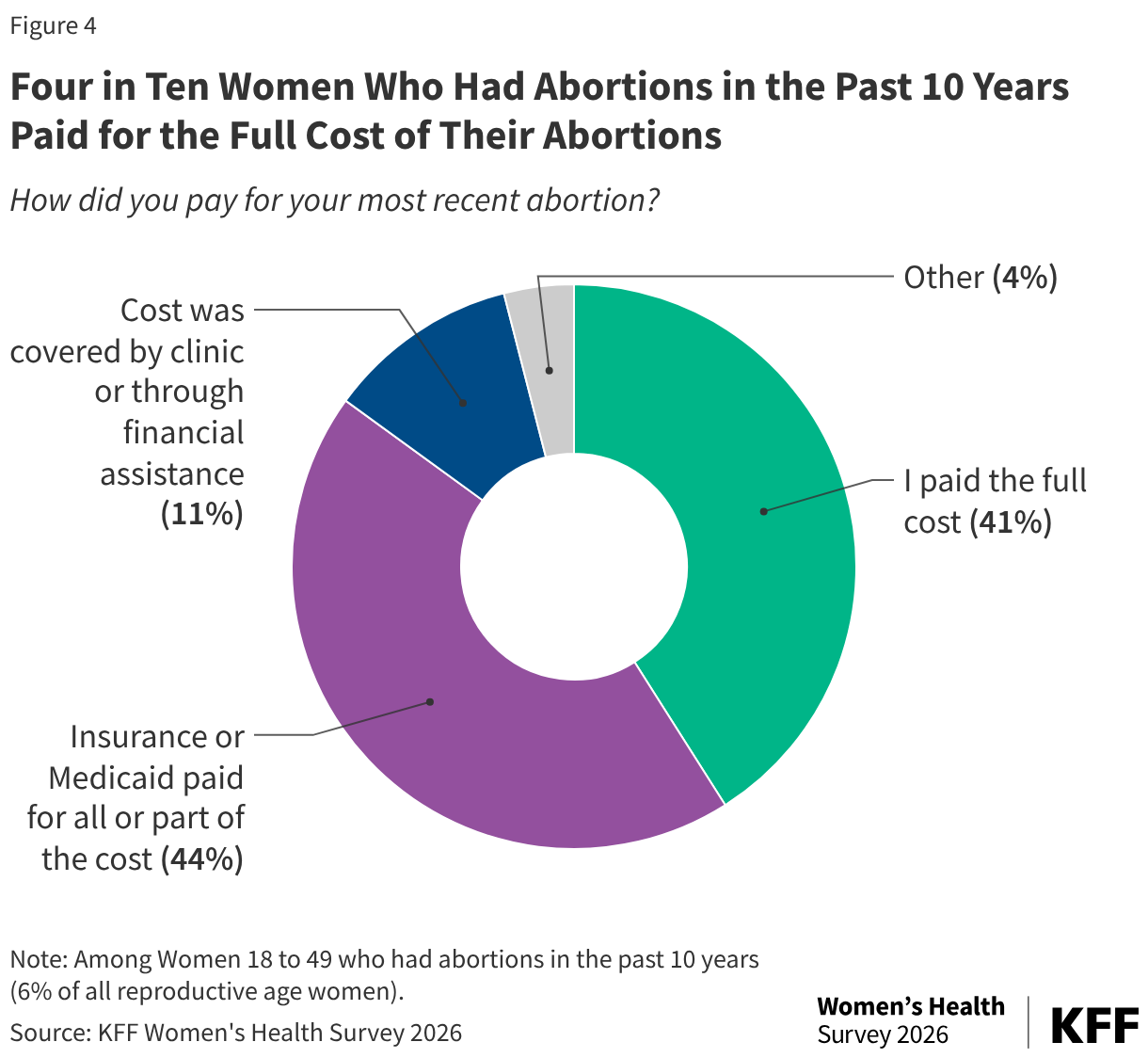
  • Among reproductive age women who have had abortions in the past 10 years, four in 10 (41%) say they paid the full cost of their most recent abortion. Another 44% say their insurance or Medicaid paid the full or part of the cost of their abortion, while 11% say the cost of the abortion was covered by the clinic or through financial assistance.
  • Nationally, one in eight (12%) reproductive age women say they personally know someone, including themselves, who has had difficulty getting an abortion since Roe was overturned in June 2022 due to restrictions in their state, a slight increase from 2024. The leading difficulties that women report are having to travel out of state, not knowing where to go, and not having money to cover the cost.
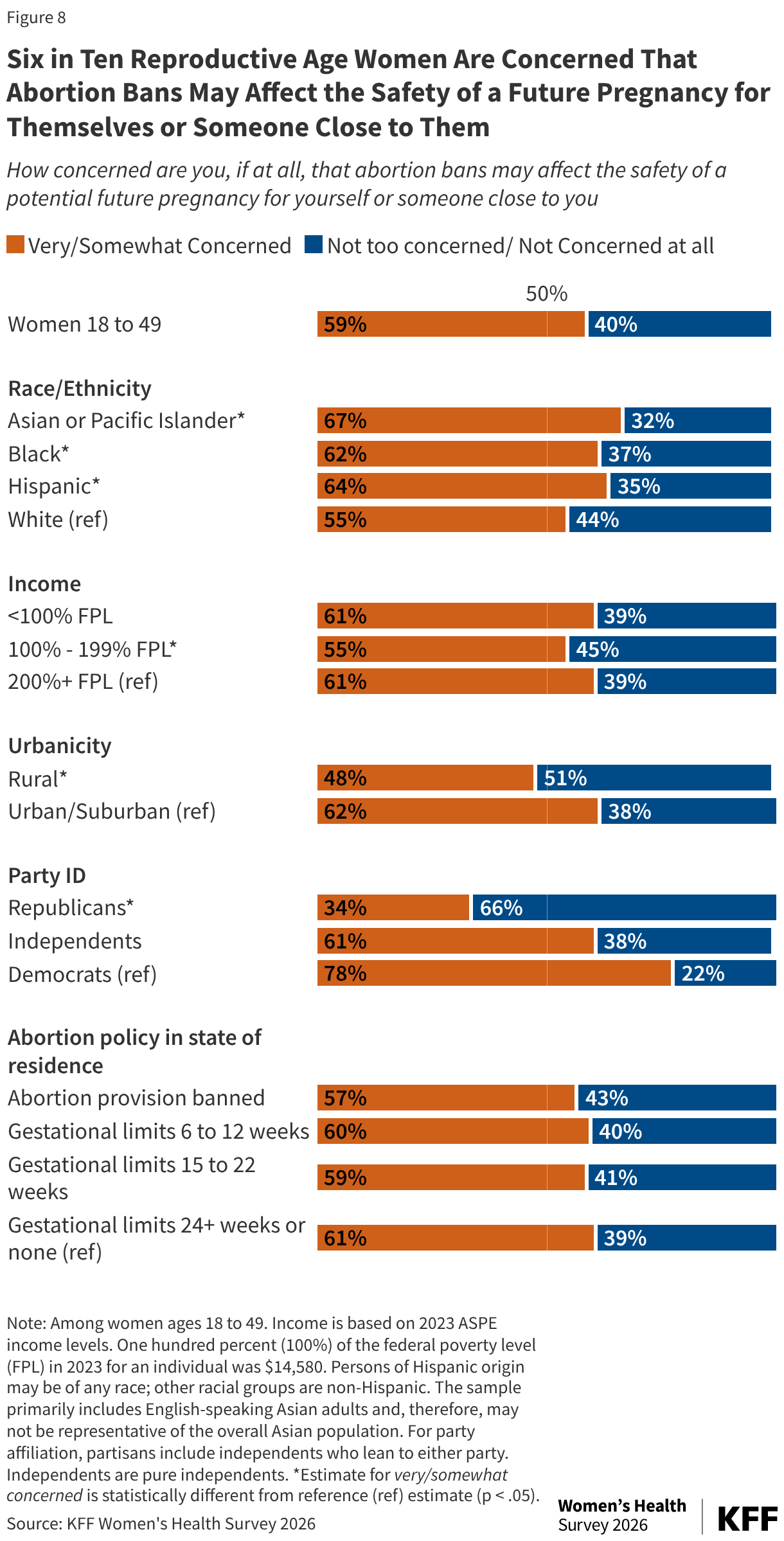
  • The majority (59%) of reproductive age women say they are very or somewhat concerned that abortion bans may affect the safety of a potential future pregnancy for them or for someone close to them. Across most subgroups, except among Republican women and rural women, majorities say they are somewhat or very concerned. Higher shares of Asian or Pacific Islander (67%), Black (62%), and Hispanic (64%) women say they are concerned about pregnancy compared to White women (55%).
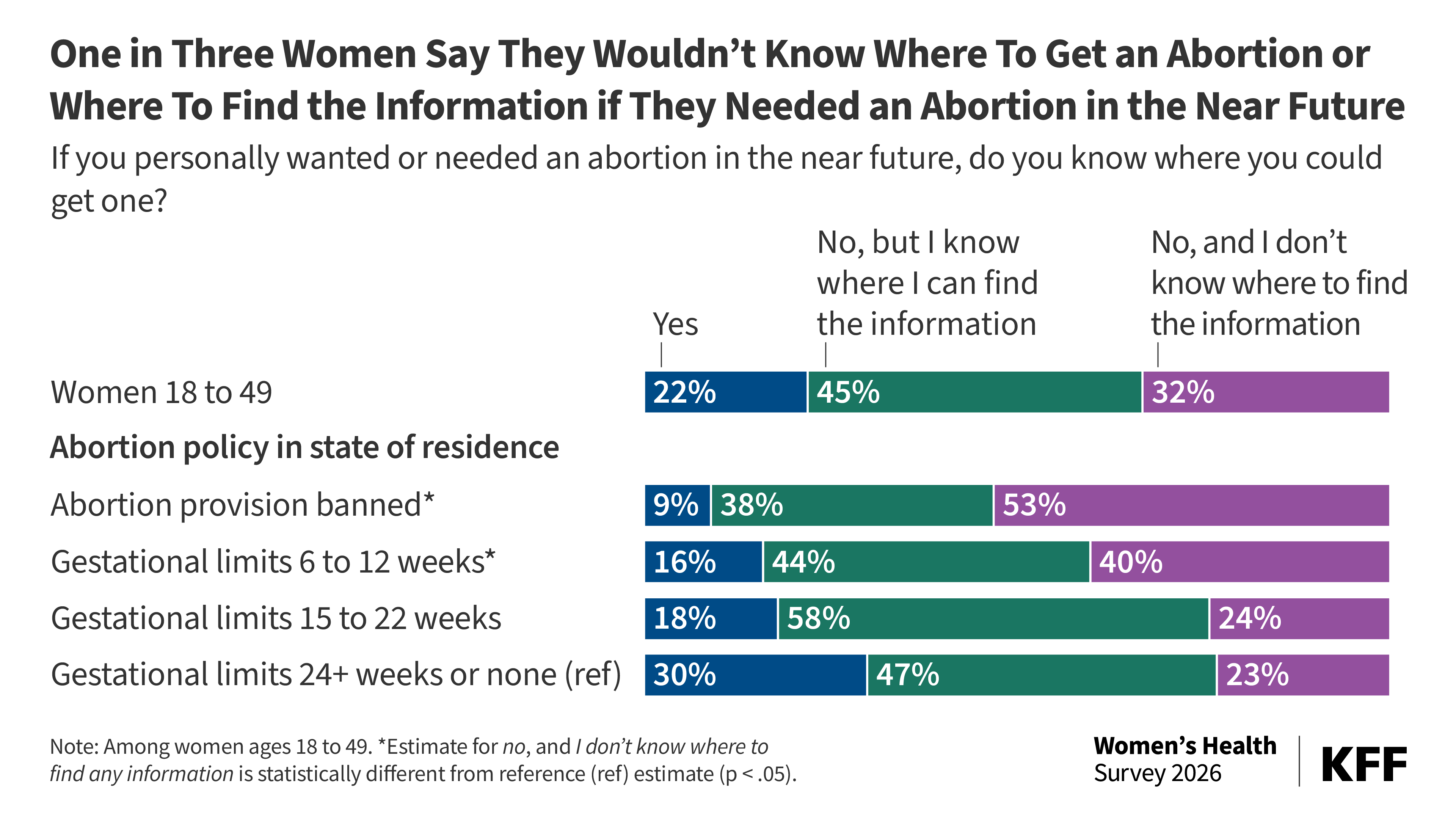
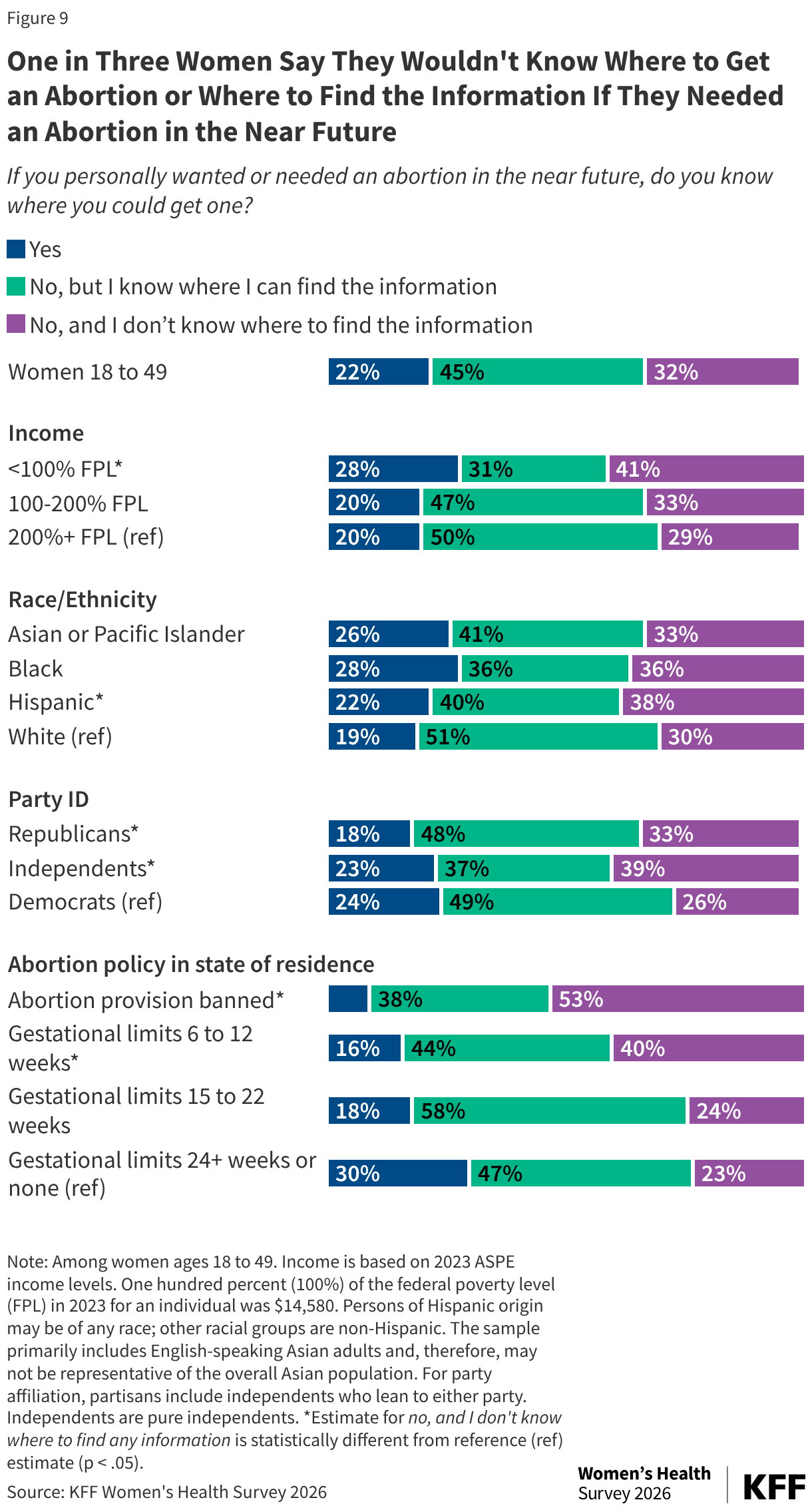
  • One in three (32%) reproductive age women, compared to one in four (26%) in 2024, say that if they needed an abortion, they would not know where to go or where to find the information. Among reproductive age women living in states with abortion provision bans, over half (53%) say they would not know where to find information, and four in ten (40%) of those living in states with gestational limits between 6 and 12 weeks report the same.
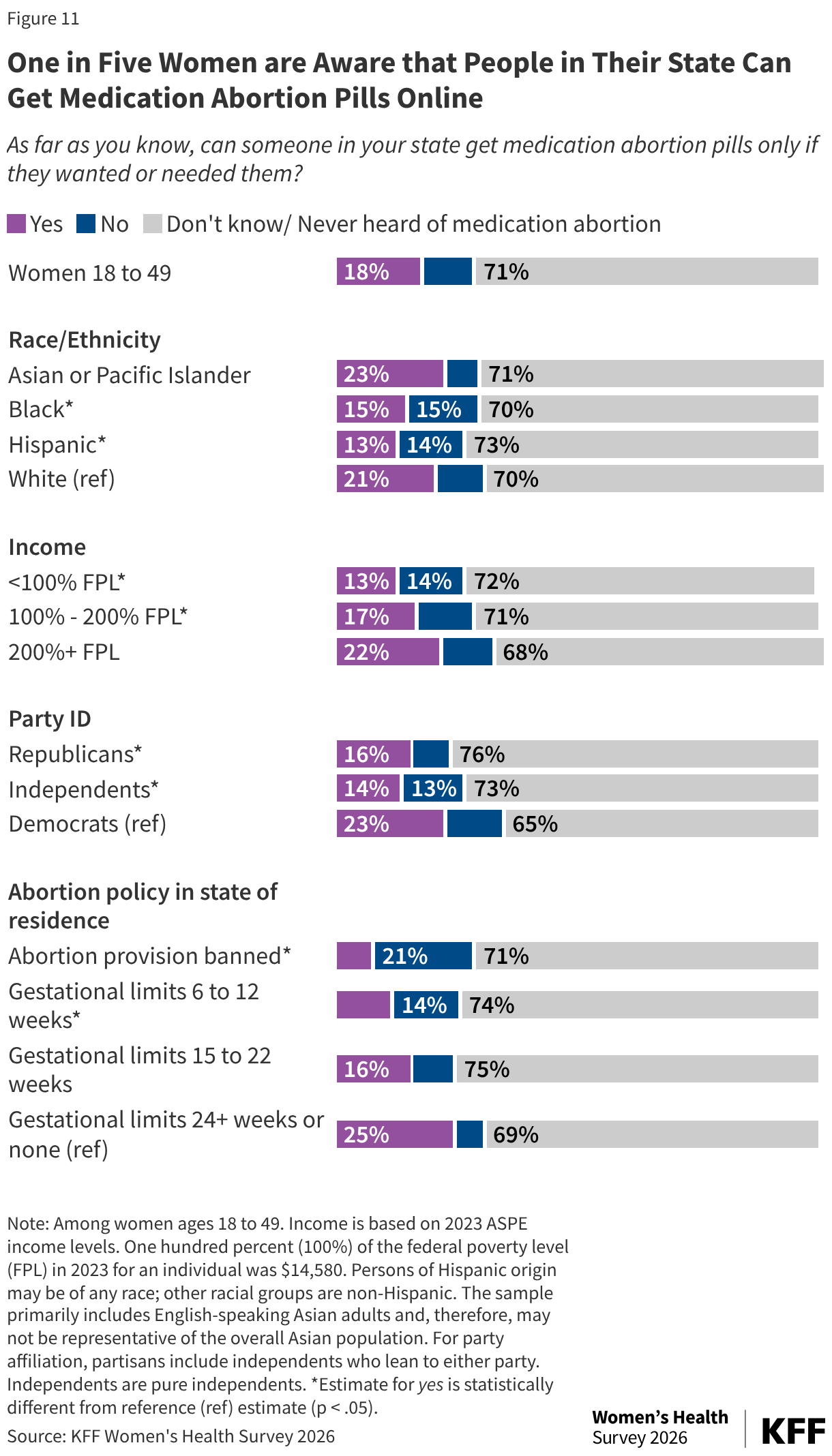
  • While two-thirds (68%) of reproductive age women have heard about medication abortion pills, only 18% are aware people in their state can get medication abortion pills online. This falls to 8% among women living in states with abortion provision bans. One in ten (11%) women say that someone in their state cannot get medication abortion pills online, and 71% say they don’t know or have never heard of medication abortion.

Women’s Experiences with Pregnancy, Miscarriage, and Abortion

Most women of reproductive age have been pregnant at some point in their lives. Sixty-four percent of women ages 18 to 49 say they are either currently pregnant (3%) or have been pregnant at some point in their lives (61%), while 36% have never been pregnant. Among women who are either currently pregnant or have ever been pregnant, 36% (24% of all reproductive age women) say they have at some point in their lives experienced a miscarriage (data not shown). While not all people who have miscarriages require medical care, some do, and almost all clinical interventions used to manage miscarriages are identical to those used in abortion care. Abortion provision bans and gestational restrictions also restrict care for people experiencing pregnancy loss and in some cases denials of care stemming from abortion restrictions have led to women experiencing health threatening situations, long term health consequences, and even death.

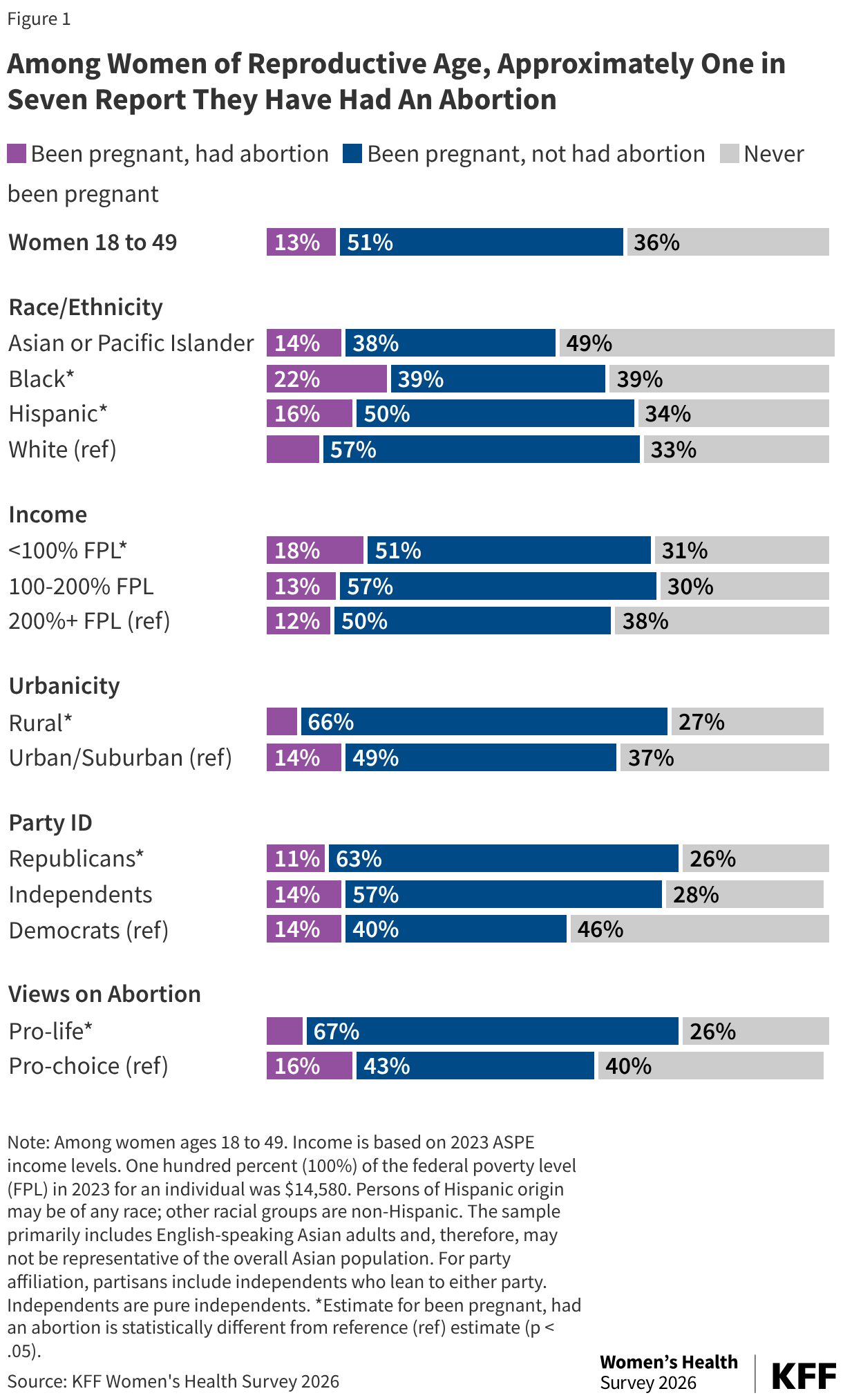
Among women of reproductive age (18 to 49), one in eight (13%) report having had an abortion at some point in their life. Larger shares of Black (22%) and Hispanic (16%) women report ever having an abortion compared to White women (10%). Among women with incomes below the federal poverty level (FPL), nearly one in five (18%) report having had an abortion, compared to one in eight (12%) women with incomes above 200% FPL (Figure 1).

Among reproductive age women living in rural areas, 6% report ever having an abortion, compared to over double (14%) the share of women living in urban/suburban areas. One in ten (11%) women who identify as Republican or Republican-leaning independents as well as one in seven (14%) Democratic and Democratic-leaning women report they have ever had an abortion. Fewer than one in 10 women (7%) who currently identify as pro-life say they have had an abortion compared to almost one in five (16%) who currently identify as pro-choice.

Among Women of Reproductive Age, Approximately One in Seven Report They Have Had An Abortion (Stacked Bars)

Three percent of reproductive aged women report that at some point in their lives, they have wanted or needed an abortion they did not get. Higher shares of Black (9%) and Hispanic (5%) women report that they have wanted or needed an abortion they did not get compared to their White counterparts (2%) (data not shown). When asked why they did not get an abortion they wanted or needed, reproductive age women report affordability challenges and access barriers. Some women say they changed their mind or couldn’t go through with the abortion and others identified religious, moral or societal pressures as the reason why they did not get the abortion.

In their own words among women who did not get an abortion that they wanted or needed: There are many reasons why someone may not get an abortion. What was the reason you did not get the abortion(s)?

“The cost. I did not have health insurance at the time and was told it would be $500+ to get an abortion. Couldn’t afford it. So I had the baby.”

“Cost, accessibility due to protesters and myself already being in a diminished mental state deterred and ultimately prevented myself from getting help.”

“I was financially not able to provide for the service to be done and I was nearing a point where I would have been too far along to have further services provided.”

“I was only 16 and couldn’t go through with it.”

“I couldn’t find a clinic to get to. I ended up doing the adoption route.”

“I wasn’t sure. My family was telling me not to get an abortion.”

“My partner was controlling and kept me from having enough money to get one.”

“Needed parental signature due to health problem and underage.”

“Not able to receive due to state regulations.”

“Not able to find resources in a timely manner”

“They are illegal in the state I live.”

“Didn’t have the money and didn’t have anywhere to go.”

“Access, guilt and judgement from OB who confirmed pregnancy.”

Women’s Abortion Experiences in the Past 10 years

The past 10 years have seen major shifts in abortion policy and access in the United States. When President Trump was first elected in 2016, he promised to appoint justices to the Supreme Court who would overturn Roe v. Wade and that came to fruition on June 24, 2022, when the Supreme Court overturned Roe.

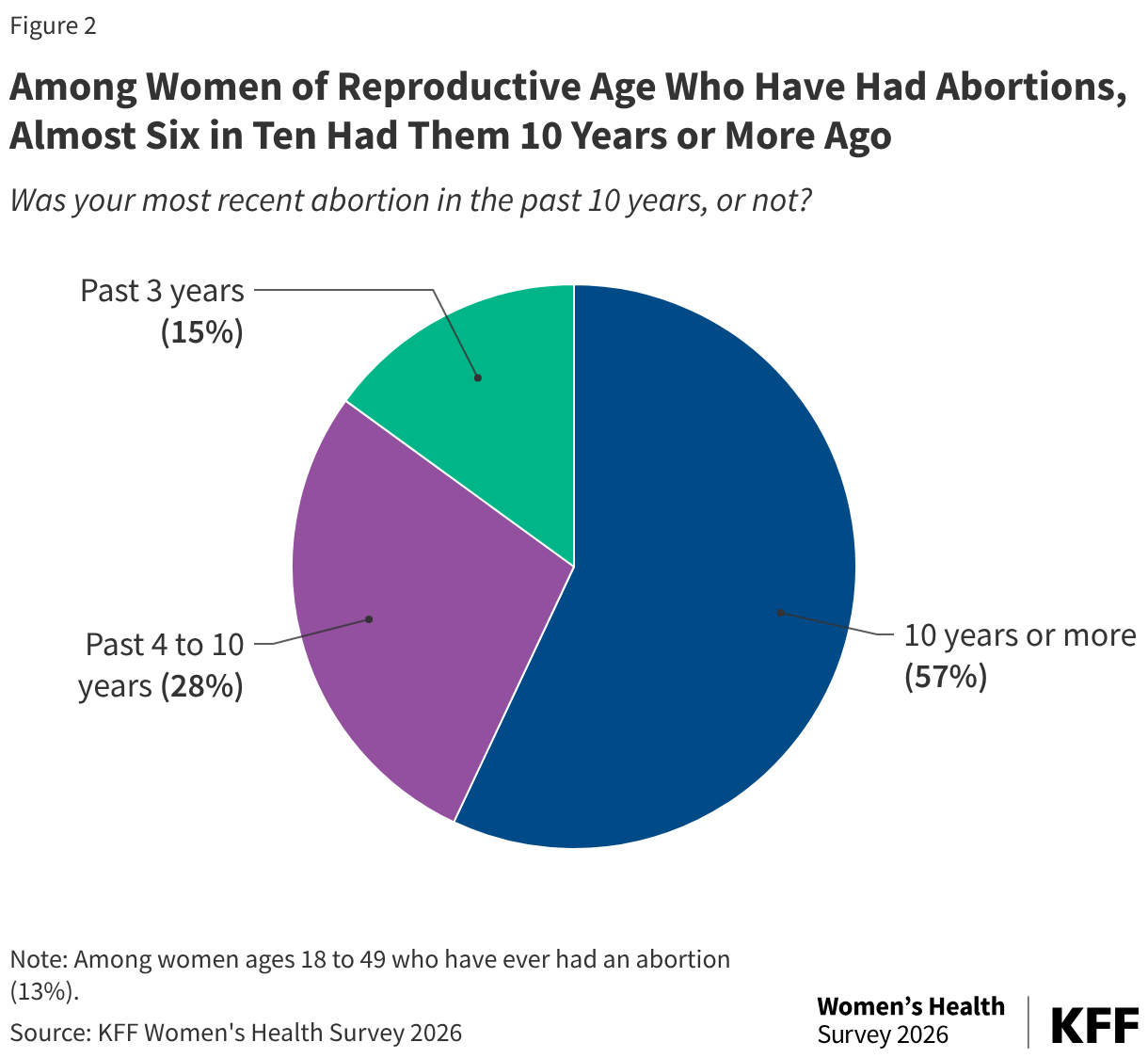
Among women ages 18 to 49 who have ever had an abortion, 15% (2% of all reproductive age women) report they had their most recent abortion in the past 3 years. Another three in ten (28%, 4% of all reproductive age women) had their abortions four to 10 years ago, while almost six in ten (57%, 7% of all reproductive age women) report their most recent abortion was more than 10 years ago (Figure 2).

Among Women of Reproductive Age Who Have Had Abortions,  Almost Six in Ten Had Them 10 Years or More Ago (Pie Chart)

State abortion laws restricting access can result in women traveling out of state to access abortions services. Many of the states where abortion provision is now banned or restricted had laws in place before Dobbs that heavily restricted abortion access and in many cases had few abortion clinics within the state, therefore many women were forced to travel to obtain abortion services. Among women 18 to 49 who have had an abortion inthe past 10 years, 13% report that they traveled out of state to obtain their most recent abortion (data not shown).

Most women who had abortions in the past 10 years had a medication abortion. Six in ten (59%) women who have had an abortion in the past 10 years report their most recent abortion was a medication abortion, while 41% had a procedural abortion (data not shown). Since mifepristone, one of the two drugs that make up the medication abortion regimen, was first approved in the year 2000, its use in the U.S. has grown steadily. In recent years, telehealth for medication abortion has broadened the availability and use of medication abortion pills across the country, including in states with abortion provision bans.

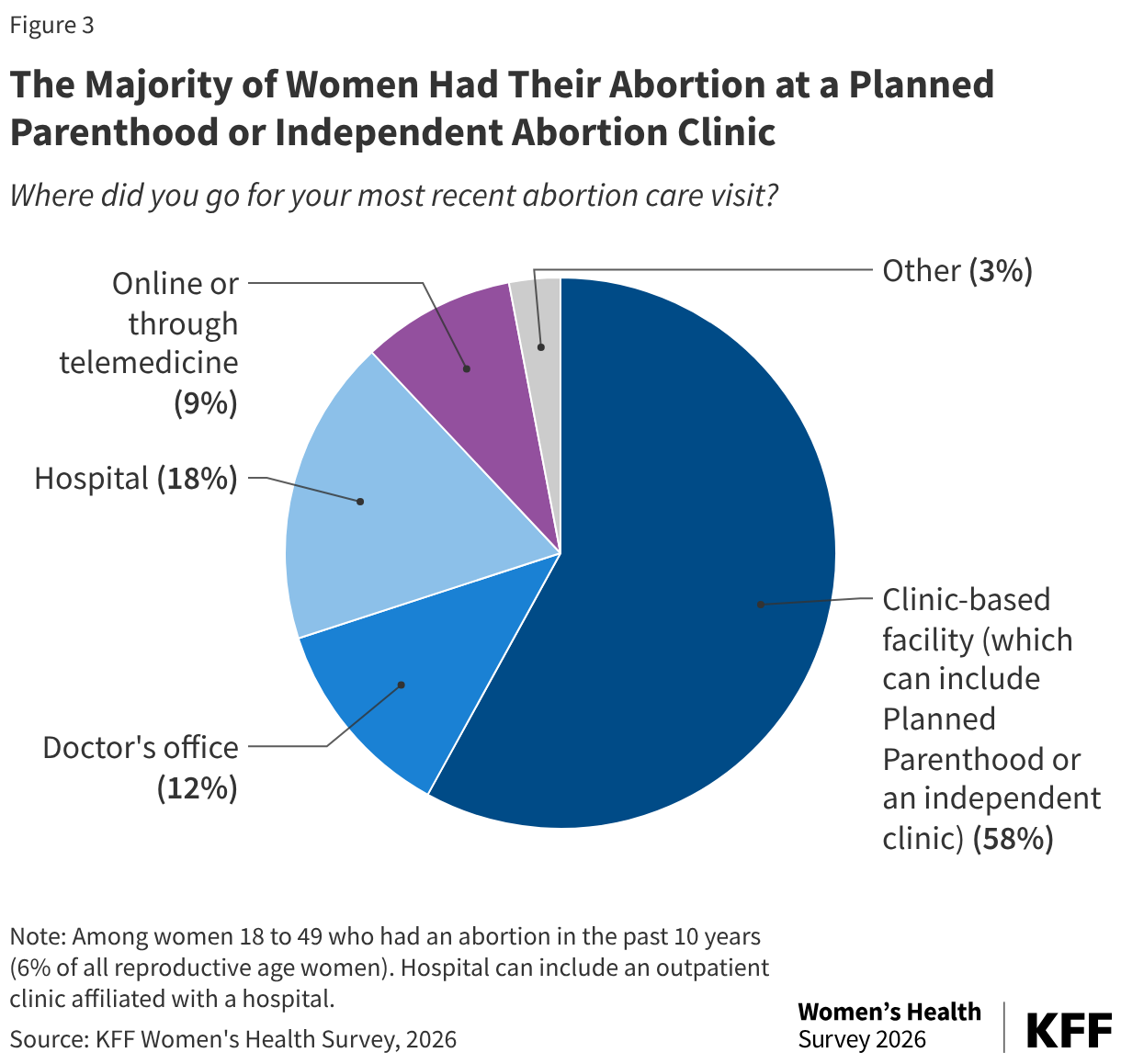
The majority of women who have had abortions in the past 10 years received in-person care at a clinic-based facility. Six in 10 (58%) reproductive age women who have had an abortion in the past 10 years – either a procedural or medication abortion -- had their most recent abortion at a clinic-based facility (which can include Planned Parenthood clinics or independent abortion clinics), one in five (18%) in a hospital (which can include an outpatient clinic affiliated with a hospital), one in 10 (12%) in a doctor’s office, while another one in 10 (9%) report they got their abortion online or through telemedicine (Figure 3). Telehealth abortion has become increasingly available after the pandemic in response to changes in FDA policy that eliminated a prior in-person dispensing requirement for mifepristone that increased the number of providers who offer this remote service.

The Majority of Women Had Their Abortion at a Planned Parenthood or Independent Abortion Clinic (Pie Chart)

Four in ten women (41%) who’ve had abortions in the past 10 years say they paid the full cost for their most recent abortion. Obtaining an abortion can be expensive and the costs vary widely depending on the method, facility, and gestational stage. The state bans and restrictions enacted since Dobbs can also result in additional nonmedical expenses for transportation, childcare, lodging, and lost wages (Figure 4).

Another 44% of women who have had an abortion in the past 10 years say that their insurance or Medicaid paid the full or part of the cost of their abortion, while 11% report that the cost of the abortion was covered by the clinic or through financial assistance. Medicaid coverage of abortion is heavily restricted by the Hyde amendment, which bans the use of federal funds for abortions unless the pregnancy is a result of rape, incest, or if it endangers the life of the pregnant person. States have the option to use their own state funds to pay for abortions for Medicaid enrollees for circumstances beyond Hyde, which 21 states currently do.

Four in Ten Women Who Had Abortions in the Past 10 Years Paid for the Full Cost of Their Abortions (Donut Chart)

Impact of the Dobbs Decision

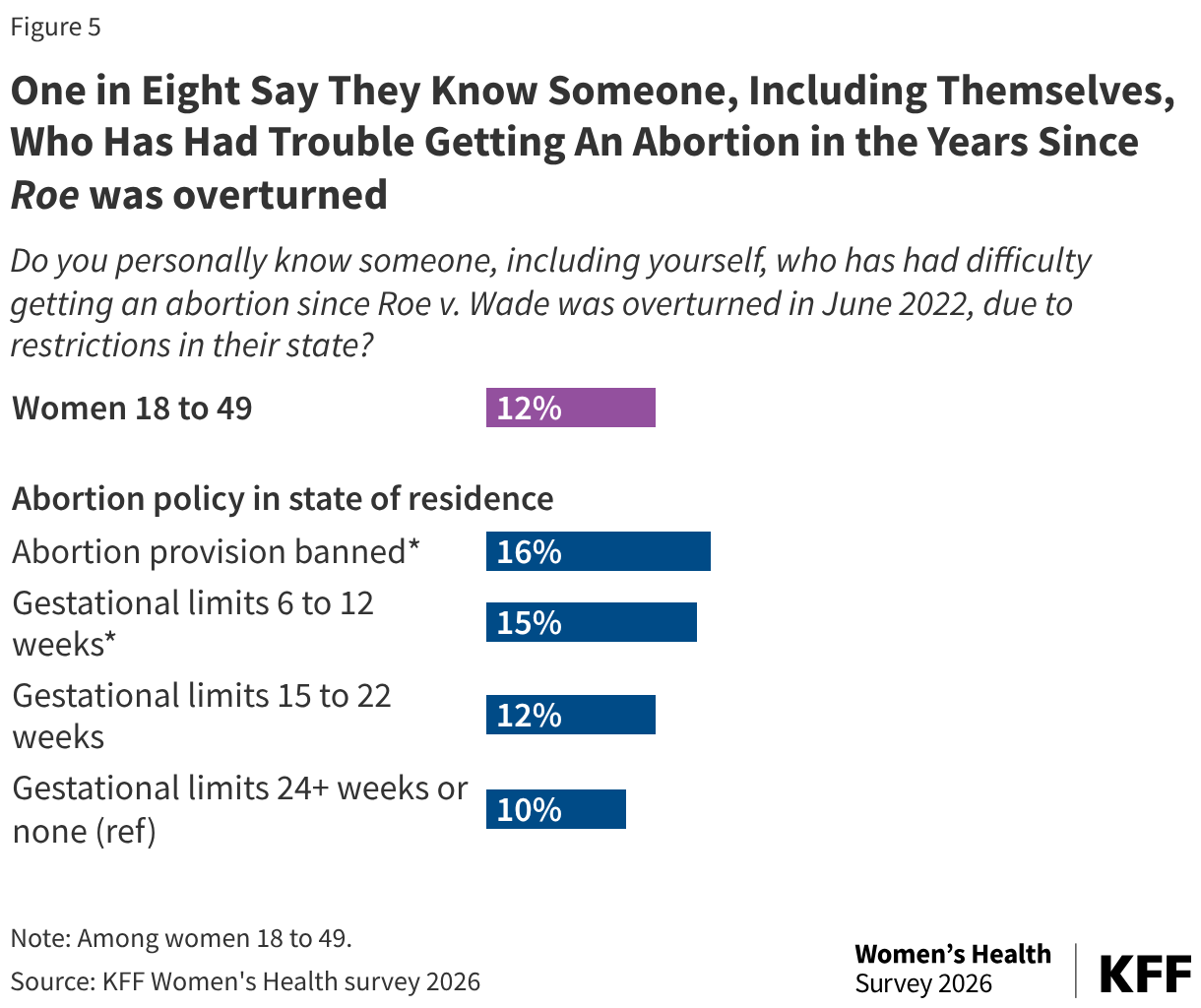
Four years after the Dobbs decision, 13 states have banned the provision of abortion, and 10 states have implemented gestational restrictions between 6 and 22 weeks LMP (last menstrual period). Nationally 12% of reproductive age women say they personally know someone, including themselves, who has had difficulty getting an abortion since Roe was overturned in June 2022 due to restrictions in their state (Figure 5). This is a slight but notable increase from 2024, when 8% of reproductive age women said they personally knew someone who had difficulties getting an abortion.

Women living in states with abortion provision bans and early gestational limits are more likely to report knowing someone who has had difficulties getting an abortion due to restrictions in their state. Sixteen percent (16%) of women living in states with abortion provision bans and 15% of women living in states with gestational limits between 6 and 12 weeks report knowing someone who has experienced difficulties compared to fewer women living in states with gestational limits at or after 24 weeks or without gestational limits (10%).

One in Eight Say They Know Someone, Including Themselves, Who Has Had Trouble Getting An Abortion in the Years Since Roe was overturned (Bar Chart)

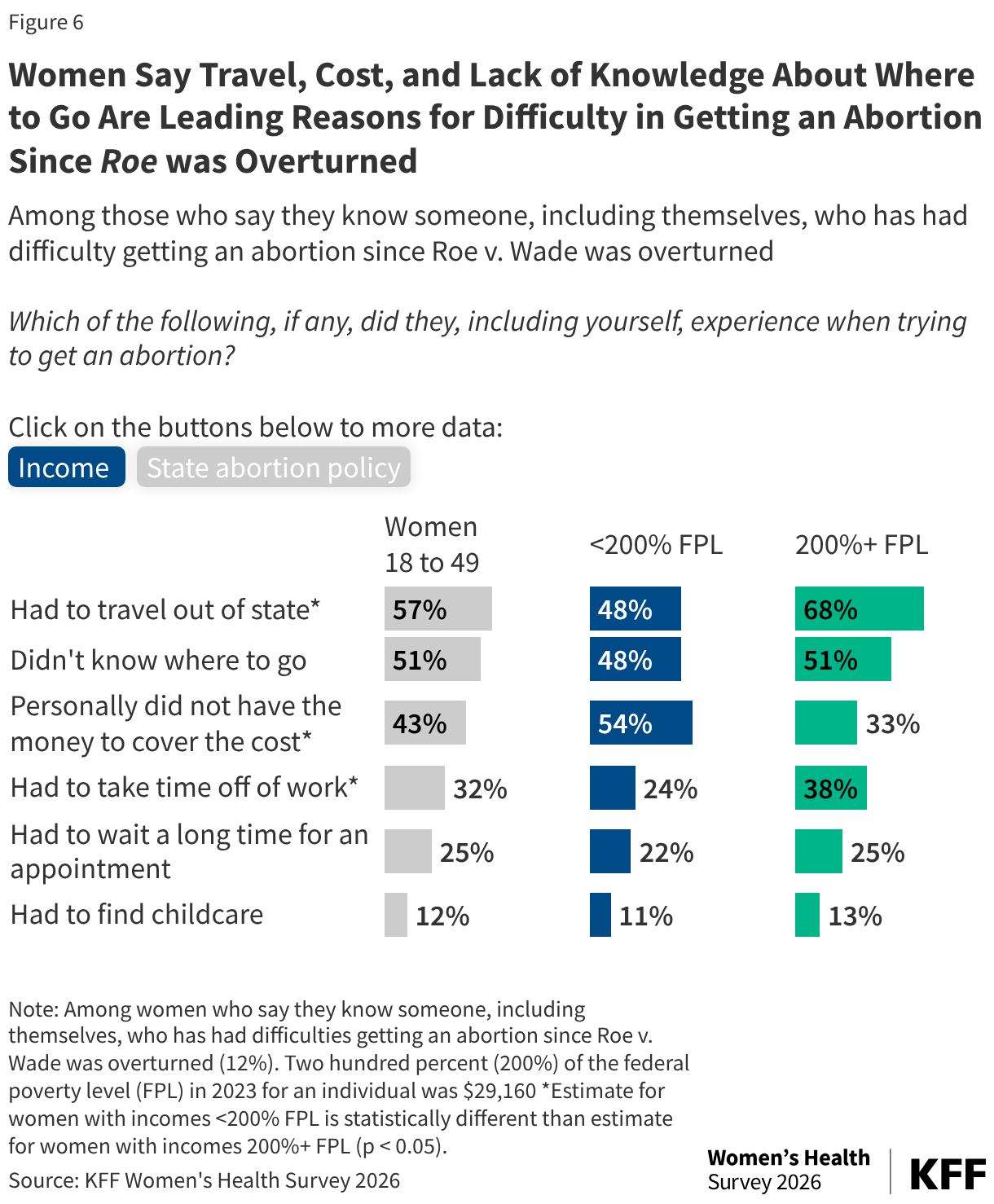
Among the 12% of women who say they know someone, including themselves, who had difficulties getting abortion care since Roe was overturned, 57% (7% of all reproductive age women) report they (or the person they know) had to travel out of state (Figure 6). Post-Dobbs research has found that interstate travel for abortion care has declined, in part because of the availability of medication abortion via telehealth. About half (51%, 6% of all reproductive age women) said the person did not know where to go when trying to get an abortion, four in ten who said they could not afford the cost (43%, 5% of all reproductive age women), and three in ten say they had to take time off work (32%, 4% of all reproductive age women).

Cost is the most common barrier reported among women with low incomes. Among women with incomes above 200% FPL, traveling out of state or having to take time off work are more commonly reported barriers (Figure 6). Women living in states with abortion provision bans (66%, 11% of women living in these states) and gestational limits between 6 and 22 weeks (65%, 9% of women living in these states) report out of state travel as an obstacle at higher rates than women living in states with gestational limits at or after 24 weeks or without gestational limits (45%, 4% of women living in these states).

Women Say Travel, Cost, and Lack of Knowledge About Where to Go Are Leading Reasons for Difficulty in Getting an Abortion Since Roe was Overturned (Split Bars)

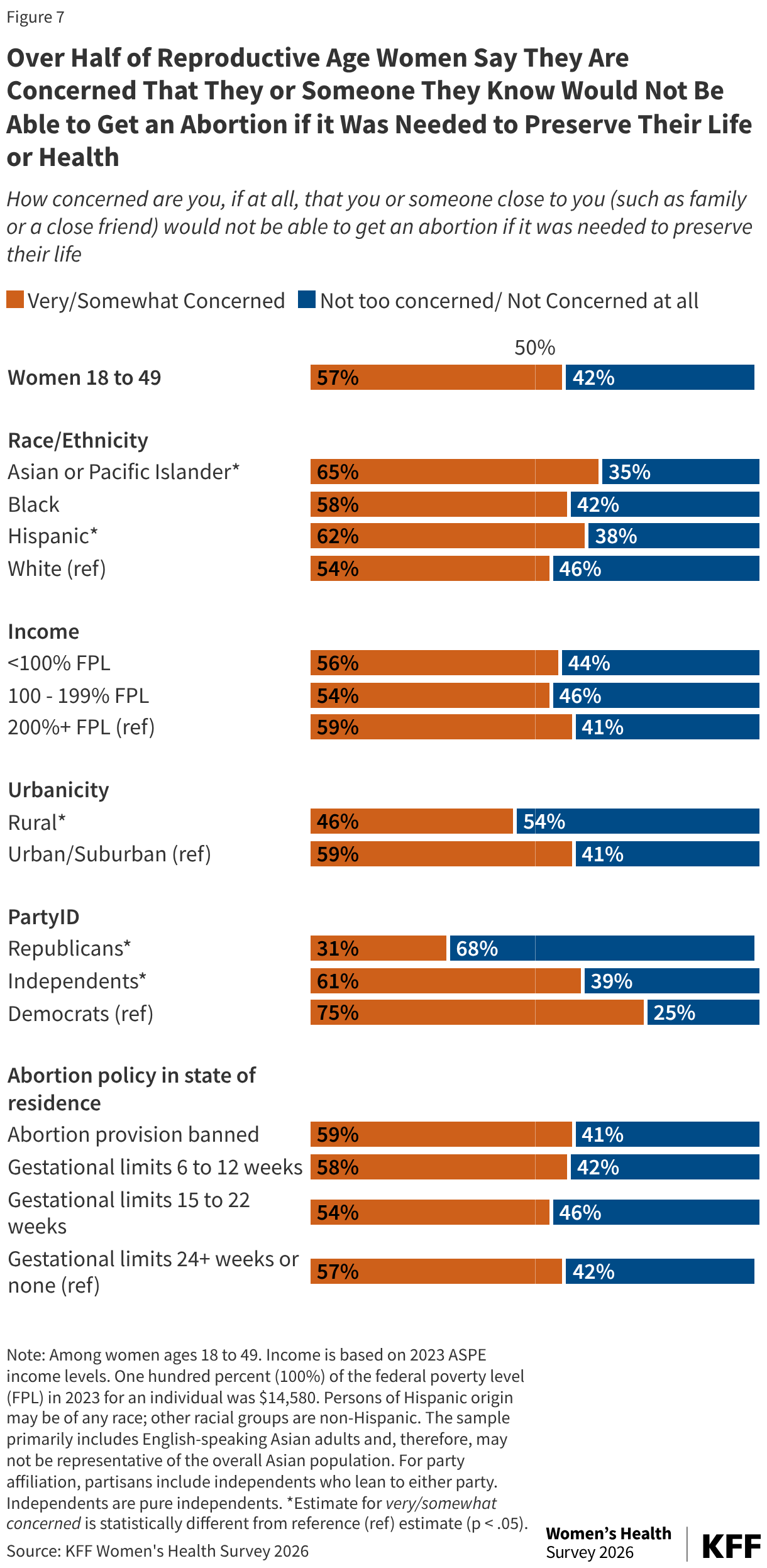
Almost six in ten (57%) reproductive age women in U.S. are concerned that they or someone close to them would not be able to get an abortion if they needed it to preserve their life or health. In the four years since the Dobbs decision, there have been many reports of women being unable to get a needed abortion to preserve their health and even some cases where women have died. A majority of reproductive age women across subgroups report that they are very or somewhat concerned about access to abortion if it was needed to preserve their life or health with notable exceptions of Republican and rural women (Figure 7). Larger shares of Asian or Pacific Islander (65%) and Hispanic (62%) women compared to White women (54%) report they are concerned. Three-quarters (75%) of Democratic women say they are concerned that they or someone close to them would not be able to get an abortion if they needed it, compared to 31% of Republican women report the same.

Over Half of Reproductive Age Women Say They Are Concerned That They or Someone They Know Would Not Be Able to Get an Abortion if it Was Needed to Preserve Their Life or Health (Stacked Bars)

Six in ten women ages 18 to 49 (59%) say they are very or somewhat concerned that abortion provision bans may affect the safety of a potential future pregnancy for them or for someone close to them. Similarly, majorities of women except for Republican women or those living in rural areas say they are somewhat or very concerned that abortion provison bans may affect the safety of a future pregnancy (Figure 8). Asian or Pacific Islander (67%), Black (62%), and Hispanic (64%) women are more likely to report they are concerned compared to White women (55%). One in three (34%) Republican women say they are concerned about the impact of abortion bans on the safety of potential pregnancies for themselves or someone close to them, compared to almost eight in 10 Democratic women (78%) and six in 10 (61%) Independent women.

Six in Ten Reproductive Age Women Are Concerned That Abortion Bans May Affect the Safety of a Future Pregnancy for Themselves or Someone Close to Them (Stacked Bars)

Awareness of Abortion Availability

One in three (32%) women of reproductive age in the U.S. report that if they needed or wanted an abortion in the near future they would not know where to go or where to find the information, an increase from 26% in 2024. In addition, nearly half (45%) say they would not know where to go but would know where to find that information. About one-fifth (22%) of women say they would know where to go for an abortion (Figure 9). Since the Dobbs decision, websites like abortionfinder.org, ineedana.com and plancpills.org provide individuals seeking abortion services with directories of abortion clinics and services that provide medication abortion via telehealth.

Over half of women (53%) living in states where abortion provision is banned and four in ten (40%) women living in states with gestational limits between 6 and 12 weeks say they wouldn’t know where to find information compared to 23% of women in states with gestational limits at or after 24 weeks or without gestational limits. Compared to 2024, a larger share of women living in states where abortion provision is banned now report that if they needed an abortion, they wouldn’t know where to go or where to find information (53% vs 43%). Women living in states with abortion bans do have options to obtain abortion services. They must travel out of state or obtain medication abortion drugs from companies that will ship pills to all states without requiring an in-person clinician visit or from clinicians practicing in states with shield-laws, which offer clinicians a measure of legal protection for sending abortion medications to patients in abortion ban states. 

One in Three  Women Say They Wouldn't Know Where to Get an Abortion or Where to Find the Information If They Needed an Abortion in the Near Future (Stacked Bars)

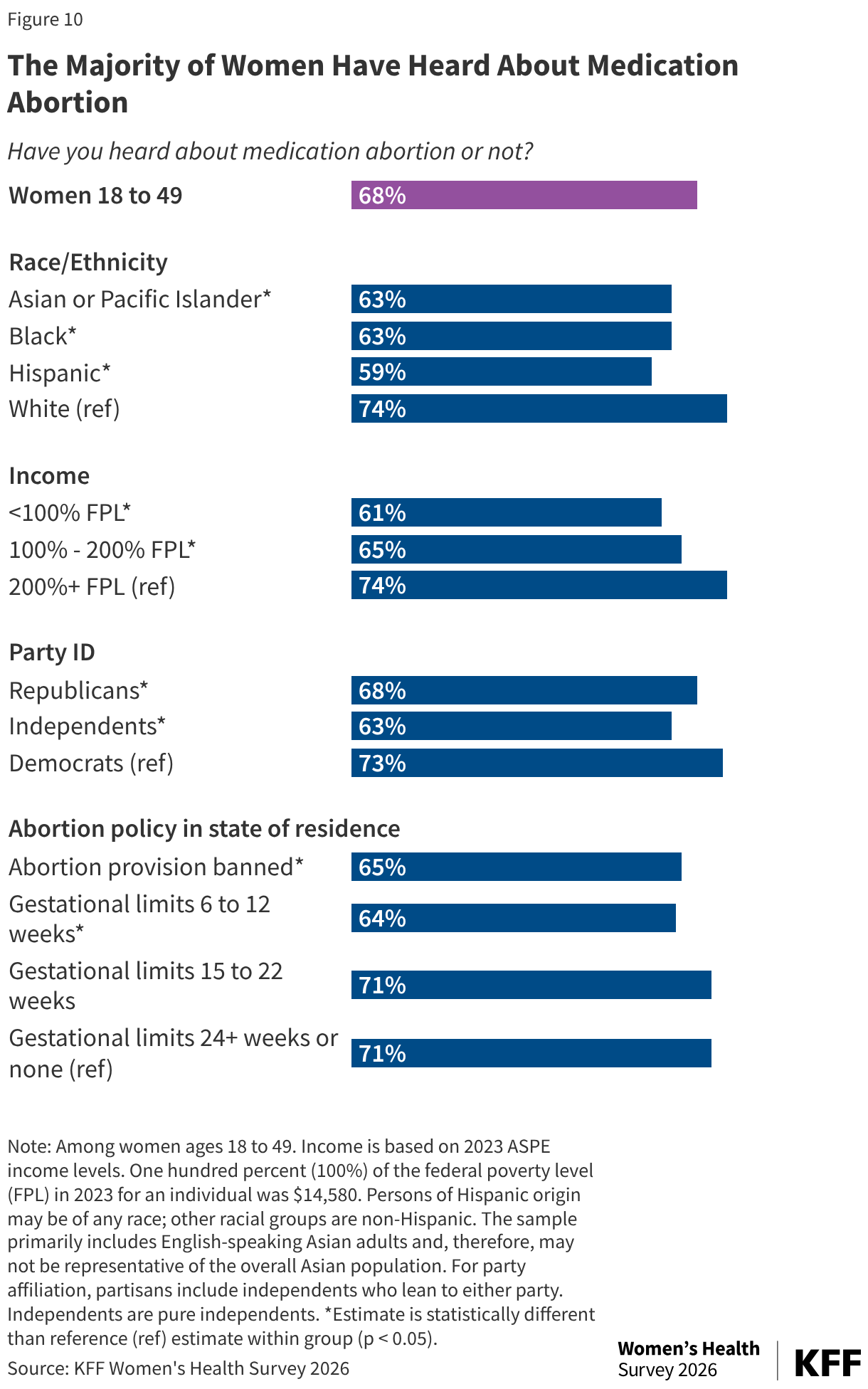
The majority (68%) of women of reproductive age say they have heard about medication abortion, the most common abortion method in the United States. While still majorities, relatively smaller shares of Asian or Pacific Islander (63%), Black (63%), and Hispanic (59%) women report having heard about medication abortion compared to White women (74%) (Figure 10). Similarly, smaller shares of women with incomes below poverty (61%) and women with incomes between 100% and 200% FPL (65%) have heard about medication abortion compared to women with higher incomes (74%). 

The Majority of Women Have Heard About Medication Abortion (Bar Chart)

Overall, one in five (18%) women of reproductive age are aware that medication abortion pills are available online. Medication abortion and its availability online has been widely covered in the news in recent years and has been the focus of multiple lawsuits, and a growing number of companies exist that will mail abortion medications to individuals in all states. Despite this, the share of women who are aware that medication abortion pills are available online has not changed from when this question was asked in 2024. Among women of reproductive age, 11% say that as far as they know, individuals in their state cannot get medication abortion pills online and about seven in ten (71%) were unsure or had never heard of medication abortion (Figure 11). Black (15%) and Hispanic (13%) women are less likely than White women (21%) to know that medication abortion pills are available online. Smaller shares of women living in states where abortion provision is banned (8%) or states with 6 to 12 week gestational limits (12%) know that people in their states can get medication abortion pills online compared to women living in states without any gestational limits or limits after 24 weeks (25%).

One in Five Women are Aware that People in Their State Can Get Medication Abortion Pills Online (Stacked Bars)

The 2026 KFF Women’s Health Survey was designed and analyzed by women’s health researchers at KFF. The survey was conducted from March 11 – April 14, 2026, online and by telephone among a nationally representative sample of 5,854 adults ages 18 to 64, including 3,538 women ages 18 to 49. Women include anyone who selected woman as their gender. Sampling, data collection, weighting, tabulation, and IRB approval by the University of Southern Maine’s Collaborative Institutional Review Board were managed by SSRS of Glenn Mills, Pennsylvania in collaboration with women’s health researchers at KFF. 

Throughout the reports of findings, we refer to “women.” This includes respondents who said their gender is “woman,” and includes those who selected “woman” in addition to another gender, such as “transgender,” or “non-binary,” or another gender. We followed this approach to try to include as many people as possible but recognize that some people who need and seek abortion and other reproductive health care services may not be represented in the findings or identify as women. Some questions about sexual and reproductive health were only asked among those with a specific sex assigned at birth (i.e. male or female).

The national sample was drawn from two nationally representative probability-based panels: the SSRS Opinion Panel and the Ipsos Knowledge-Panel. The SSRS Opinion Panel is a nationally representative probability-based panel where panel members are recruited randomly in one of two ways: (a) Through invitations mailed to respondents randomly sampled from an Address-Based Sample (ABS) provided by Marketing Systems Groups (MSG) through the U.S. Postal Service’s Computerized Delivery Sequence (CDS); (b) from a dual-frame random digit dial (RDD) sample provided by MSG. For the online panel component, invitations were sent to panel members by email followed by up to five reminder emails. 5,660 panel members completed the survey online and panel members who do not use the internet were reached by phone (n=194). Another 514 respondents were reached online through the Ipsos Knowledge Panel to help reach adequate sample sizes among subgroups of interest, specifically women ages 18 to 49. This panel is recruited using ABS, based on a stratified sample from the CDS. The questionnaire was translated into Spanish, so respondents were able to complete the survey in English or Spanish. 

The national sample was weighted by splitting the sample into three groups: [1] Women 18-49, [2] Women 50-64, and [3] Men 18-64 and each group was separately weighted to match known population parameters (see table below for weighting variables and sources). Weights within the three groups were then trimmed at the 4th and 96th percentiles, to ensure that individual respondents do not have too much influence on survey-derived estimates. After the weights were trimmed, the samples were combined, and the weights adjusted, so that the groups were represented in their proper proportions for a final combined, gender by age-adjusted weight.

Dimensions Source 
Age Current Population Survey 2025 
Education 
Age by Education 
Age by Gender 
Census Region 
Race/Ethnicity by Nativity 
Home Tenure 
Civic Engagement 2023 CPS Volunteering and Civic Life Supplement 
Internet Frequency Pew Research Center’s National Public Opinion Reference Survey (NPORS 2025) 
Population Density Claritas Pop-Facts Premier 2026 
Voter Registration CPS 2024 Voting and Registration Supplement 

The margins of sampling error for the national sample of women ages 18 to 64 and reproductive age women ages 18 to 49 are plus or minus 2 percentage points. Numbers of respondents and margins of sampling error for key subgroups are shown in the table below. For results based on other subgroups, the margin of sampling error may be higher. Sampling error is only one of many potential sources of error and there may be other unmeasured error in this survey.

Group N (unweighted) M.O.S.E. 
National Women Ages 18-49 3,538 ± 2 percentage points 
Women 18 to 49 who have had an abortion in the past 10 years219± 8 percentage points 
White, non-Hispanic 1,547 ± 3 percentage points 
Black, non-Hispanic 624 ± 5 percentage points 
Hispanic 946 ± 4 percentage points 
Asian or Pacific Islander 307 ± 7 percentage points 
<100% FPL566± 5 percentage points 
100-200% FPL 742± 4 percentage points 
200%+ FPL 1,958 ± 3 percentage points 
Rural415± 6 percentage points 
Urban/Suburban3,117± 2 percentage points 
Democrat/Democrat leaning 1,765 ± 3 percentage points 
Independent 497 ± 5 percentage points 
Republican/Republican leaning 900 ± 4 percentage points 
Pro-life1,024± 4 percentage points 
Pro-choice2,487± 2 percentage points 
Abortion provision banned817± 4 percentage points 
Gestational limits 6 to 12 weeks605± 5 percentage points 
Gestational limits 15 to 22 weeks254± 7 percentage points 
Gestational limits 24+ weeks or none1,862± 3 percentage points 

General Notes:

The sample primarily includes English-speaking Asian adults and, therefore, may not be representative of the overall Asian adult population. Despite this limitation, it is important to report the views of Asian adults on the topics in this study. As always, Asian adults’ responses are incorporated into the general population figures throughout this report.

Income is based on 2023 ASPE income levels. Two hundred percent (200%) of the federal poverty level (FPL) in 2023 for an individual was $29,160.

Overview of President Trump’s Executive Actions Impacting LGBTQ+ Health

Published: Oct 26, 2026

Editorial Note: This resource was originally published on February 24, 2025, and will be updated as needed to reflect additional developments.

Starting on the first day of his second term, President Trump began to issue numerous executive actions, several of which directly address or affect health programs, efforts, or policies to meet the health needs of LGBTQ+ people. This guide provides an overview of these actions, in the order in which they were issued. The “date issued” is date the action was first taken; subsequent actions, such as litigation efforts, are listed under “What Happens/Implications.” It is not inclusive of administrative actions that impact LGBTQ+ people that are not directly related to health and health care access, such as efforts related to participation in sport even though those actions might have an impact on well-being. In addition, within the actions examined, only provisions directly related to health and health access are described in table.

Purpose: Initial rescissions of Executive Orders and Actions issued by President Biden.

Among these orders are several that addressed LGBTQ+ equity including “Preventing and Combating Discrimination on the Basis of Gender Identity or Sexual Orientation” (Executive Order 13988) and “Advancing Equality for Lesbian, Gay, Bisexual, Transgender, Queer, and Intersex Individuals” (Executive Order 14075). The order establishing the White House Gender Policy Council (Executive Order 14020) and several Orders related to diversity, equity, and inclusion were also rescinded, as were orders related to nondiscrimination and equity in schools.

Implications: This order could lead to less oversight, reduced health programing, and fewer policies protecting LGBTQ+ people, which could negatively impact access to care and well-being. Of particular note:

• Rescinds orders that had called for LGBTQ+ people’s health equity, the national public health needs of LGBTQ+ people, LGBTQ+ data collection, and nondiscrimination protections, including in health care.

• Rescinds orders that had called for nondiscrimination protections for LGBTQ+ young people in school, which could contribute to stigma and worsened mental health.

Purpose: To define sex as an immutable binary biological classification and remove recognition of the concept of gender identity, including in sex protections and in agency operations. 

The order states that “It is the policy of the United States to recognize two sexes, male and female” and directs the Executive Branch to “enforce all sex-protective laws to promote this reality”. Elements of the order that may affect LGBTQ people’s health are as follows:

• Defines sex as “an individual’s immutable biological classification as either male or female.” States that “’sex’ is not a synonym for and does not include the concept of ‘gender identity’” and that gender identity “does not provide a meaningful basis for identification and cannot be recognized as a replacement for sex.”

• Defines male and female based on reproductive cell production. Introduces the term “gender ideology” which is defined to include  “the idea that there is a vast spectrum of genders that are disconnected from one’s sex” and “maintains that it is possible for a person to be born in the wrong sexed body.”

• Directs the Secretary of Health and Human Services (HHS) to provide the U.S. government, external partners, and the public guidance expanding on the sex-based definitions set forth in the order within 30 days.

• Directs each agency and all federal employees to “enforce laws governing sex-based rights, protections, opportunities, and accommodations to protect men and women as biologically distinct sexes,” including “when interpreting or applying statutes, regulations, or guidance and in all other official agency business, documents, and communications.”

• Directs each agency and all Federal employees, “when administering or enforcing sex-based distinctions,” to “use the term ‘sex’ and not ‘gender’ in all applicable Federal policies and documents.”

• Directs agencies to “remove all statements, policies, regulations, forms, communications, or other internal and external messages that promote or otherwise inculcate gender ideology, and shall cease issuing such statements, policies, regulations, forms, communications or other messages.”

• Directs agency forms to exclude gender identity and directs agencies to “take all necessary steps, as permitted by law, to end the Federal funding of gender ideology.”

• Requires that federal funds “not be used to promote gender ideology” and directs agencies to ensure “grant funds do not promote gender ideology.”

• Directs the Attorney General to ensure the Bureau of Prisons revises policies to prohibit federal funds from being expended “for any medical procedure, treatment, or drug for the purpose of conforming an inmate’s appearance to that of the opposite sex.”

• Rescinds multiple executive orders issued by President Biden, including: “Preventing and Combating Discrimination on the Basis of Gender Identity or Sexual Orientation” (13988), “Establishment of the White House Gender Policy Council” (14020) (which is also dissolved), and “Advancing Equality for Lesbian, Gay, Bisexual, Transgender, Queer, and Intersex Individuals” (14075).

• Also directs agencies to rescind certain guidance documents, including, “The White House Toolkit on Transgender Equality”; “The Attorney General’s Memorandum of March 26, 2021 entitled “Application of Bostock v. Clayton County to Title IX of the Education Amendments of 1972,” and range of orders related to LGBTQ+ students in schools.

Implications: This order is broad, directed to all federal agencies and programs. Because federal health programs reach LGBTQ+ people, and some are specifically designed to be inclusive of the LGBTQ+ community, or account for gender identities in addition to biological sex, this Order could widely affect program funding, guidance, and access. It has several possible implications:

The terms used in the Order include several biological and social inaccuracies which could perpetuate misinformation about LGBTQ+ people and transgender people’s health needs. It also takes steps towards ban gender care in certain area, most explicitly in prisons.

Requiring that federal funds are not used to “promote gender ideology” has caused significant confusion. Since this order was issued, there have been multiple reports of HIV programs and community health centers that have lost funding as a result of supporting programs inclusive of transgender people. In addition, there have been reports that some health care facilities paused providing youth with gender affirming care, fearing that federal funding would be withheld according to this and another Order relating to youth access to gender affirming care (see separate entry). (See court decisions below.) Withholding care could lead to negative health outcomes for those that require it.

Data collection and data presentation/distribution have been impacted. At first some data was removed from federal websites, though due to court order this appears to have been restored. If public health messaging and services related to the health needs of transgender people, or other specific populations, are unavailable, this may result in adverse health outcomes such increased disease prevalence, greater difficulty with care engagement, and poor mental health outcomes. There have been reports that gender identity questions will be removed from federal surveys which makes tracking the experiences and well-being of LGBTQ+ people more difficult.

The order directs the HHS Secretary to take action to end gender affirming care through Section 1557 of the Affordable Care Act (ACA), the law’s major nondiscrimination provision, which includes protections on the basis of sex. While the Biden administration interpreted sex protections to include sexual orientation and gender identity, it is expected that the Trump administration will seek to remove these protections, as was the approach during his first term. Despite the Executive Orders and any future guidance, courts could continue to rule that such protections exist in statute.

On March 17th the VA announced that it would phase out providing gender affirming care to comply with this Executive Order. Exceptions include Veterans already receiving hormone therapy from the VA or Veterans “receiving such care from the military as part of and upon their separation from military service” who are eligible for VA health care. The VA will not provide other gender affirming medical services.

The statement writes that historically the VA had provided a range of gender affirming services and “letters of support encouraging non-VA providers to perform sex-change surgeries on Veterans.” These services had been authorized under the now rescinded Veterans Health Administration Directive 1341(4).

There have been multiple legal challenges to this Order with some judicial actions that have paused aspects of implementation:

• On February 4, 2025 a lawsuit was filed in federal court challenging the Order on the grounds that it usurps Congressional  power, violates Sec. 1557 of the ACA, and is unconstitutional and on February 11, a temporary restraining order  and memorandum opinion was issued requiring restoration of webpages, datasets, and any other  resources needed to provide medical care, identified by the Plaintiffs. On July 3, the ordered restoration of webpages and vacated OPM and HHS policies resulting in their removals. In December 2025, the federal goverment said they had restored the webpages in a status report.

• On February 4, 2025, a separate federal lawsuit was filed challenging this Order and the Executive Order on “Protecting Children from Chemical and Surgical Mutilation” (see separate entry), asserting they are openly discriminatory, unlawful, and unconstitutional. On February 13, a federal judge issued a temporary restraining order preventing the federal government from withholding or conditioning funding on the basis of providing this care and in March were granted a preliminary injunction. In July, the federal government sought a vacatur of the preliminary injunction from the U.S. 4th Circuit Court of Appeals. Litigation continues in 2026 after the case had been placed in abeyance.

• An additional suit was filed on February 19, 2025 by the National Urban League, National Fair Housing Alliance, and AIDS Foundation of Chicago challenging three Executive Orders: “Ending Radical and Wasteful DEI Programs and Preferencing”, “Defending Women From Gender Ideology Extremism and Restoring Biological Truth to the Federal Government” and the “Ending Illegal Discrimination and Restoring Merit-Based Opportunity” as usurping the power of Congress, violating the Constitution and the Administrative Procedures Act, and, seeking declaratory and injunctive relief. In their complaint, plaintiffs highlight the potential harm this Order could bring to people with HIV and LGBTQ+ communities and the programs that serve them.

• On February 20, a separate case was filed in federal court by multiple LGBTQ+ health care and service organizations, challenging the “Ending Radical and Wasteful DEI Programs and Preferencing”, “Defending Women From Gender Ideology Extremism and Restoring Biological Truth to the Federal Government” and the “Ending Illegal Discrimination and Restoring Merit-Based Opportunity” Orders claiming they usurp the power of Congress and violate the Constitution. In their complaint, plaintiffs highlight the potential harm this Order could bring to people with HIV and LGBTQ communities and the programs that serve them. On June 9th the court issued a preliminary injunction, blocking in part key provisions in this EO and in the DEI EO including those that instruct agencies to remove and cease to issue  materials and “communications…that promote or otherwise inculcate gender ideology” and instructing agencies to “end the Federal funding of gender ideology”; prohibit federal funds from being “used to promote gender ideology,”; and direct agencies and departments to terminate DEI offices and positions, materials, initiatives, performance requirements, and grants or contracts. On August 8th, the administration appealed the preliminary injunction to the U.S. 9th Circuit Court of Appeals.

• On March 12, 2025 two physician and academic plaintiffs filed a lawsuit challenging the Order and related OPM memo when their articles were removed from HHS’ Agency for Healthcare Research and Quality (AHRQ)’s Patient Safety Network (PSNet), a federal online patient-safety resource. The reason for the removal articles was for their inclusion of passing references to transgender patients. On May 23, a MA district court found the plaintiffs would likely succeed on their constitutional 1st amendment claims and granted a preliminary injunction requiring HHS to republish the censored content. In February 2026, plaintiffs entered into an agreement with the administration that requires the preservation of their work and the work of others with no opportunity for appeal.

Purpose: To limit diversity, equity, inclusion, and accessibility (DEIA) activities in government and by government contractors and grantees.  
 
Directs each agency, department, or commission head to take the following actions (among others):  
• terminate, to the maximum extent allowed by law, all DEI, DEIA, and “environmental justice” offices and positions…; all “equity action plans,” “equity” actions, initiatives, or programs, “equity-related” grants or contracts… 
• provide the Director of the OMB with a list of all “federal grantees who received Federal funding to provide or advance DEI, DEIA, or “environmental justice” programs, services, or activities since January 20, 2021,” among other actions.  

Implications: As with the other DEIA related Order (see separate entry), these efforts could make reaching populations with unique health needs in culturally competent ways more challenging, including in programs related to LGBTQ+ health and HIV. It could also jeopardized programs and funding for agencies reaching these communities.
There have been multiple legal challenges to this Order:

• On February 3, a lawsuit was filed by four diverse plaintiffs challenging the constitutionality of this Order and the Order, “Ending Illegal Discrimination and Restoring Merit-Based Opportunity”. In June 2026, the “plaintiffs voluntarily dismiss this case without prejudice in light of specific representations made by the government to the United States Court of Appeals for the Fourth Circuit about the narrow scope of the Executive Orders challenged in this case and the decision of the Fourth Circuit accepting those representations and recognizing that narrow scope.”

• An additional suit was filed in federal court on February 19, 2025 by the National Urban League, National Fair Housing Alliance, and AIDS Foundation of Chicago challenging this order as well as the “Defending Women From Gender Ideology Extremism and Restoring Biological Truth to the Federal Government” and the “Ending Illegal Discrimination and Restoring Merit-Based Opportunity” ” as usurping the power of Congress, violating the Constitution and the Administrative Procedures Act, and, seeking declaratory and injunctive relief. In their complaint, plaintiffs highlight the potential harm this Order could bring to people with HIV and LGBTQ communities and the programs that serve them. On May 2, the court denied plaintiff’s motion for a preliminary injunction.

• On February 20, a separate case was filed in federal court by multiple LGBTQ+ health care and service organizations, challenging the “Ending Radical and Wasteful DEI Programs and Preferencing”, “Defending Women From Gender Ideology Extremism and Restoring Biological Truth to the Federal Government” and the “Ending Illegal Discrimination and Restoring Merit-Based Opportunity” orders claiming they usurp the power of Congress and violate the Constitution.  In their complaint, plaintiffs highlight the potential harm this Order could bring to people with HIV and LGBTQ communities and the programs that serve them. On June 9th, the court issued a preliminary injunction, blocking in part key provisions in this EO and in the “gender ideology” EO including those that instruct agencies to remove and cease to issue  materials and “communications…that promote or otherwise inculcate gender ideology” and instructing agencies to “end the Federal funding of gender ideology”; prohibit federal funds from being “used to promote gender ideology,”; and direct agencies and departments to terminate DEI offices and positions, materials, initiatives, performance requirements, and grants or contracts.

Purpose: Order seeks to end federal “preferencing” through DEIA efforts within government and through contracting to the extent that they do not comply with the Administration’s view of civil rights law.

The order is broad and non-specific but includes the following directives:

• Orders all executive departments and agencies “to terminate all discriminatory and illegal preferences, mandates, policies, programs, activities, guidance, regulations, enforcement actions, consent orders, and requirements.  I further order all agencies to enforce our longstanding civil-rights laws and to combat illegal private-sector DEI preferences, mandates, policies, programs, and activities.”

• Orders agency heads to include in every contract or grant award “a term requiring the contractual counterparty or grant recipient to agree that its compliance in all respects with all applicable Federal anti-discrimination laws is material to the government’s payment decisions for purposes of section 3729(b)(4) of title 31, United States Code; and…A term requiring such counterparty or recipient to certify that it does not operate any programs promoting DEI that violate any applicable Federal anti-discrimination laws.”

Implications: As with the other DEIA related Order (see separate entry), these efforts could make reaching populations with unique health needs in culturally competent ways more challenging, including in programs related to LGBTQ+ health and HIV. It could also jeopardized programs and funding for agencies reaching these communities.

There have been multiple legal challenges to this Order:

• On February 3, a lawsuit was filed by four diverse plaintiffs challenging the constitutionality of this Order and the Order, “Ending Illegal Discrimination and Restoring Merit-Based Opportunity”.

• An additional suit was filed in federal court on February 19, 2025 by the National Urban League, National Fair Housing Alliance, and AIDS Foundation of Chicago challenging this order as well as the “Defending Women From Gender Ideology Extremism and Restoring Biological Truth to the Federal Government” and the “Ending Illegal Discrimination and Restoring Merit-Based Opportunity” ” as usurping the power of Congress, violating the Constitution and the Administrative Procedures Act, and, seeking declaratory and injunctive relief. In their complaint, plaintiffs highlight the potential harm this Order could bring to people with HIV and LGBTQ communities and the programs that serve them.

• On February 20, a separate case was filed in federal court by multiple LGBTQ+ health care and service organizations, challenging the “Ending Radical and Wasteful DEI Programs and Preferencing”, “Defending Women From Gender Ideology Extremism and Restoring Biological Truth to the Federal Government” and the “Ending Illegal Discrimination and Restoring Merit-Based Opportunity” orders claiming they usurp the power of Congress and violate the Constitution.  In their complaint, plaintiffs highlight the potential harm this Order could bring to people with HIV and LGBTQ communities and the programs that serve them. On June 9th, 2026, the court issued a preliminary injunction, blocking in part key provisions in this EO and in the “gender ideology” EO including those that instruct agencies to remove and cease to issue  materials and “communications…that promote or otherwise inculcate gender ideology” and instructing agencies to “end the Federal funding of gender ideology”; prohibit federal funds from being “used to promote gender ideology,”; and direct agencies and departments to terminate DEI offices and positions, materials, initiatives, performance requirements, and grants or contracts. On August 8th, the administration appealed the preliminary injunction to the U.S. 9th Circuit Court of Appeals.

Purpose: Order directs agencies and programs to work towards significantly limiting access to gender affirming care for young people (defined as those under age 19) nationwide.

• Directs agencies to rescind and amend policies that rely on guidance from the World Professional Association for Transgender Health (WPATH).

• Directs the HHS Secretary to conduct and publish a review of existing literature and best practices related to gender affirming care and gender dysphoria and to “increase the quality of data to guide practices“ in this area.

• Directs executive department and agency heads “that provide research or education grants to medical institutions, including medical schools and hospitals”, “in coordination with the Director of the Office of Management and Budget” to “immediately take appropriate steps to ensure that institutions receiving Federal research or education grants end the chemical and surgical mutilation of children” (which is how the Order defines gender affirming care).

• Directs the HHS Secretary to take action to end gender affirming care for children “including [through] regulatory and sub-regulatory actions, which may involve the following laws, programs, issues, or documents:
– Medicare or Medicaid conditions of participation or conditions for coverage
– clinical-abuse or inappropriate-use assessments relevant to State Medicaid programs
– mandatory drug use reviews
– section 1557 of the Patient Protection and Affordable Care Actquality, safety, and oversight memoranda
– essential health benefits requirements; and
– the Eleventh Revision of the International Classification of Diseases and other federally funded manuals, including the Diagnostic and Statistical Manual of Mental Disorders, Fifth Edition.”

• Withdraws Biden Administration “HHS Notice and Guidance on Gender Affirming Care, Civil Rights and Patient Privacy” and directs the Secretary of HHS “in consultation with the Attorney General [to] issue new guidance protecting whistleblowers who take action related to ensuring compliance with this order.”

• Directs the Secretary of the Department of Defense to “commence a rulemaking or sub-regulatory action” restrict access to gender affirming care for children in the TRICARE program.

• Directs the Director of the Office of Personnel Management to limit access to care in coverage for federal employees’ families by requiring “provisions in the Federal Employee Health Benefits (FEHB) and Postal Service Health Benefits (PSHB) programs call letter for the 2026 Plan Year” that would require eligible carriers to exclude “coverage for pediatric transgender surgeries or hormone treatments…”

• Directs the Attorney General to review Department of Justice laws on female genital mutilation and “prioritize enforcement of protections” and “to convene States’ Attorneys General and other law enforcement officers to coordinate the enforcement of laws against female genital mutilation.”

• Directs the Attorney General to “prioritize investigations and take appropriate action to end deception of consumers, fraud, and violations of the Food, Drug, and Cosmetic Act by any entity that may be misleading the public about long-term side effects of chemical and surgical mutilation.”

• Directs the Attorney General “in consultation with the Congress” “to draft, propose, and promote legislation to enact a private right of action for children and the parents” who have received gender affirming care “which should include a lengthy statute of limitations.

• Directs the Attorney General to “prioritize investigations and take appropriate action to end child-abusive practices by so-called sanctuary States that facilitate stripping custody from parents who support the healthy development of their own children, including by considering the application of the Parental Kidnapping Prevention Act and recognized constitutional rights.”

• Directs agency heads included in this executive order to “submit a single, combined report to the Assistant to the President for Domestic Policy, detailing progress in implementing this order and a timeline for future action” within 60 Days of its issuance.

Implications: If fully implemented, the Order would broadly and extensively limit access to gender affirming care for young people, across a range of payers and providers. Access to gender affirming care is associated with improved mental health outcomes for transgender people and limiting this care with negative ones, including poorer mental health outcomes. Additional impact includes:

• The executive order includes details about sex, gender identity, gender affirming care, and transgender people that conflict with science and evidence. These inaccuracies include suggesting that large shares of youth are seeking gender affirming medical care, that regret rates among those seeking care are high, and conflating “female genital mutilation” and gender-affirming care. This has the potential to promote hostility, stigma, and discrimination, and can lead to care denials.

• It seeks to remove Federal reference to one of the standards of evidence-based care for transgender people in the US. Directing the HHS Secretary to develop new guidance without this standard, and in accordance with this and other orders, could limit agency ability to identify standards that adequately meet the needs of transgender people.

• It also seeks to condition federal research and education grants on grantees not providing young people with gender affirming care.

• There has already been some confusion with certain states and providers looking to preemptively comply with the order and another Order relating to “gender ideology” (see separate entry).

• The order lays groundwork for the Administration remove explicit protects for LGBTQ+ people in health care, including with respect to accessing gender affirming care. Specifically, the Order suggests a reinterpretation of sex protections in Section. 1557 of the Affordable Care Act void of explicit protections on the basis of sexual orientation and gender identity.

• The order leans on laws and policies unrelated to gender affirming care in an effort to limit access to those services including by erroneously conflating gender affirming care and female genital mutilation, using the FDA regulatory process to limit access, and suggesting kidnapping protections be applied to parents in certain circumstance.

On January 31, 2025. FEHB issued a letter to carriers stating that begining plan year 2026, carriers should not covre surgical or hormonal gender affirming care.

On February 19, 2025, additional guidance was released relating to this order, providing new and refined definition of terms “ which directs the Department of Health and Human Services (the Department) to promulgate clear guidance to the U.S. Government, external partners, and the public, expanding on the sex-based definitions set forth in the Executive Order.”

On February 20, 2025, pursuant to this Order, HHS issued a “Recession of ‘HHS Notice and Guidance on Gender Affirming Care, Civil Rights, and Patient Privacy’ issued by the Biden Administration” which had stated the Administration “stands with transgender and gender nonconforming youth” and that medically necessary for gender affirming care for minors improves physical and mental health. It also reiterated that administration’s view that Sec. 1557 of the ACA includes protections on the basis of sexual orientation and gender identity.

There have been multiple legal challenges to this Order with some judicial actions that have paused aspects of implementation:

• On February 4, 2025, a federal lawsuit was filed challenging this Order and the Executive Order on “Defending Women From Gender Ideology Extremism and Restoring Biological Truth to The Federal Government,” asserting they are openly discriminatory, unlawful, and unconstitutional. On February 13, a federal judge issued a temporary restraining order preventing the federal government from withholding or conditioning funding on the basis of providing this care. On March 4th, the court issued a preliminary temporary injunction and soon thereafter asked the court to enforce its restraining order and in July the administration saught to have the court stay the preliminary injuction which was denied in April. The administation appealed to the 4th Circuit in July 2025, after placing the case in abeyance, briefing resumed in June 2026.

• An additional federal lawsuit was filed on February 7th challenging this executive order with a separate temporary restraining order being issued on the 14th preventing the conditioning of federal funds and also applying to a condition linking gender affirming care to female genital mutilation. The restraining order was extended through March 5th on February 26th.  On February 28, the government was enjoined from enforcing or implementing Section 4 of the gender affirming care executive order (which directed OMB to “take appropriate steps to ensure that institutions receiving Federal research or education grants” end gender affirming care) and Sections 3g and 3e from the “gender ideology” order (relating to prohibiting federal agencies from recognizing gender identity and prohibiting the use of federal funds from “promot[ing] gender ideology”) “to condition or withhold federal funding based on the fact that a health care entity or health professional provides gender-affirming care within the Plaintiff States.” The government’s motion to stay the injuction in November was denied.

• In March a class action lawsuit was filed in federal district court challenging the Bureau of Prisons (“BOP”) implemention of the order. In June a preliminary injunction blocking enforcment of the executive order provision used to prohibit BOP officials from providing gender-affirming care hormonal care was granted and that was renewed in August and November (where the government was enjoined from “implementing Section 4(c) of Executive Order 14168 against any class member.” Section 4(c) prohibits the BOP from using federal funds for gender affirming care. Plaintiffs were granted a protective order in February 2026. The prelimary injuction was renewed several more times inlcuding in June 2026 when the court also responded to a February 19, 2026, BOP policy titled “Management of Inmates with Gender Dysphoria,” effectively representing a ban on
on gender-affirming care. In that order the court wrote BOP is enjoined from enforcing the new policy and must provide plaintiffs with gender affirming care available prior to the issuance of the Jan. 2025 executive order. On the same day in June, the government appealed to the D.C. Circuit Court of Appeals which issued an order that stayed the lower court ruling. However, the lower court issued a seperate injuction on another request from the plaintiffs that again blocked BOP from these actions.

On June 1, the FBI posted on social media urging the public to “report tips of any hospitals, clinics, or practitioners performing these surgical procedures on children,” despite pediatric gender affirming care being permitted in about half of states and not prohibited by the federal government.

Purpose: Order seeks to end federal “preferencing” through DEIA efforts within government and through contracting to the extent that they do not comply with the Administration’s view of civil rights law.

The order is broad and non-specific but includes the following directives:

• Orders all executive departments and agencies “to terminate all discriminatory and illegal preferences, mandates, policies, programs, activities, guidance, regulations, enforcement actions, consent orders, and requirements.  I further order all agencies to enforce our longstanding civil-rights laws and to combat illegal private-sector DEI preferences, mandates, policies, programs, and activities.”

• Orders agency heads to include in every contract or grant award “a term requiring the contractual counterparty or grant recipient to agree that its compliance in all respects with all applicable Federal anti-discrimination laws is material to the government’s payment decisions for purposes of section 3729(b)(4) of title 31, United States Code; and…A term requiring such counterparty or recipient to certify that it does not operate any programs promoting DEI that violate any applicable Federal anti-discrimination laws.”

Implications: Should the federal government proceed with conditioning federal funding for schools on whether or not they support transgender students, it could exacerbate existing mental health disparities, contribute to stigma and discrimination, and reduce school connectedness. For example, the policies detailed in the Order could prevent schools from recognizing transgender students’ identities (e.g. their names and pronouns), allow schools to withhold mental health services, to out students to (potentially unsupportive) families, and to restrict facility use and activity participation.

Purpose: The memorandum seeks to “stop funding Nongovernmental Organizations that undermine the national interest and administration priorities.”

The memorandum states:

• It is Administration policy “to stop funding [Nongovernmental Organizations] NGOs that undermine the national interest.”

• Direct heads of executive departments and agencies to review all funding that agencies provide to NGOs and “to align future funding decisions with the interests of the United States and with the goals and priorities of my Administration, as expressed in executive actions; as otherwise determined in the judgment of the heads of agencies; and on the basis of applicable authorizing statutes, regulations, and terms.”

Implications: This memo aligns with other administrative efforts to stop current and future funding from being provided to NGOs that do not align with administrative priorities and could impact funding to health organizations or programs aimed at serving transgender people or research funding inclusive of trans and gender diverse people. It could also potentially impact care for LGBTQ+ people more broadly if services aimed directly at this population are considered DEIA efforts.

DOJ Letter to the Supreme Court: United States v. Jonathan Skrmetti, Attorney, February 7, 2025

Purpose: “To notify the Court that the government’s previously stated views” on a case challenging a state’s ban on gender affirming care “no longer represents the United States’ position.”

• Notifies the Court that “following the change in Administration, the Department of Justice has reconsidered the United States’ position in” the case brought by the Biden Administration challenging Tennessee’s ban on gender affirming care for minors. The letter states, that their view is that the Tennessee law being challenged “does not deny equal protection on account of sex or any other characteristic,” which is the question before the Court.

• Despite this change in perspective, the Trump Administration encouraged the Court to resolve the questions presented without granting certiorari to the original plaintiffs.

Implications: There are 26 states with bans on gender affirming care for minors and litigation challenging these bans is ongoing. At the request of the Biden Administration, who brought the plaintiff’s case from the lower courts, the Supreme Court agreed to examine whether the Tennessee ban violates Equal Protection constitutional protections under the 14th Amendment. The case was briefed and argued prior to the administration change. Upon taking office, the Trump Administration wrote this letter to the Court stating that the Biden Administration position no longer represented that of the U.S. government but nevertheless asked the court to decide the case. The court will likely issue a decision in the case and technically, the Trump Administration letter should not have bearing on the court’s decision. The court is expected to issue a decision in the case this summer (2025).

Purpose: To alert providers to the administration’s approach to children’s access to gender affirming care and serve as notice “that CMS may begin taking steps in the future to align policy, including CMS-regulated provider requirements and agreements…” to limit such care.

The memorandum states:

• That “CMS renews its commitment to promoting evidence-based standards through health quality and safety improvement activities, and reminds hospitals and other applicable facilities and providers of the obligation to prioritize the health and safety of their patients, especially children.” It questions evidence around gender affirming care for young people and states “CMS may begin taking steps in the future to adjust its policies to reflect this…”

Implications:

• The CMS memo aligns with policies put forward in the Executive Order, “Protecting Children From Chemical and Surgical Mutilation,” related to limiting young people’s access to gender affirming care, provisions of which are subject to a nationwide preliminary injunction (described in above entry). However, this is not explicitly stated in the memo.

• On March 6th the Health Resources & Services Administration (HRSA) and Substance Abuse and Mental Health Services Administration (SAMHSA) released additional guidance stating that they would review policies, grants, and programs for consistency with the CMS memo (SAMHSA letter unavailable but described in this filing). HRSA also specifically notes the agency will review its Children’s Hospitals Graduate Medical Education (CHGME) Payment Program for consistency with the memo.

• While the memo does not specifically refer to the Executive Order, on March 7th, plaintiffs in a case challenging the order sought enforcement of the preliminary injunction claiming that the CMS memo and HRSA/SAMHSA guidance violate its terms because by “threatening to withhold federal funding, the Executive Orders coerced hospitals into immediately shutting down gender affirming medical care for people under nineteen to avoid potential loss of funds.”

• Depending on how future policy is implemented, CMS could seek to significantly limit access to gender affirming care for young people.

Purpose: Issued to proclaim April as National Child Abuse Prevention Month. Describes “the sinister threat of gender ideology” as “one of the most prevalent forms of child abuse facing our country today.”

  • Erroneously conflates youth access to gender affirming care with child abuse.
  • References other efforts (see above) aimed at “prohibiting public schools from indoctrinating our children with transgender ideology” and “taking action to cut off all taxpayer funding to any institution that engages in the sexual mutilation of our youth.”
  • Promises legal action against those perpetrating child abuse.

Implications: The proclamation includes details about gender affirming care and transgender people that conflict with science and evidence, including that children are being “indoctrinated” “with the devastating lie that they are trapped in the wrong body,” referring to gender affirming surgery (which is very rare among young people) as “sexual mutilation surgery,”  and suggesting that such care inhibits “happiness, health, and freedom,” for young people and creates “heartbreak” for parents and families.

• By erroneously conflating gender affirming care and abuse, potentially threatens those providing or facilitating access by stating, “we affirm that every perpetrator who inflicts violence on our children will be punished to the fullest extent of the law.”

Ryan White Letter to Awardees and Stakeholders Relating to Gender Affirming Care, April 7, 2025.

Purpose: Reverses a Biden Administration policy that had permitted the Ryan White HIV/AIDS Program to cover certain gender affirming care services as a part of whole person care to transgender people with HIV.

• Referring to a policy on gender affirming care from the Biden administration, the letter states that “under the previous administration, certain interpretations of RWHAP’s allowable uses…co-opted the program’s patient centered mission in favor of radical ideological agendas and policies.”

• The letter further states “that RWHAP funds shall be marshaled exclusively toward evidence-based interventions proven to combat HIV, sustain viral suppression, and improve the quality of life for those living with the disease” and reaffirms the prohibition on funding services outside the scope of outpatient care, including “surgeries and inpatient care, irrespective of setting or anesthesia”

Implications:

• Previously, Ryan White funds were permitted to be used to support gender affirming care within core medical and support service categories, including through the provision of hormones via ADAP programs. Additionally, funds could be used to “provide behavioral and mental health services to clients experiencing gender dysphoria and social and emotional stress related to transgender discrimination, stigma, and rejection.” The policy under the prior Administration prohibited surgery, as does the new one, so that does not represent a change.

• Prohibiting use of funds to support certain gender affirming care services may make care engagement more challenging for transgender Ryan White clients. In some cases, gender affirming care may have helped to connect clients with HIV services and thus improve HIV outcomes.

Purpose: HHS issued this notice “to clarify the non-enforceability of certain language that was included in the preamble to—but not the regulatory text of” the final rule on Section 504, “titled ‘Nondiscrimination on the Basis of Disability in Programs or Activities Receiving Federal Financial Assistance.’ The clarification states that language in the preamble concerning gender dysphoria, which is not in the regulatory text, does not have the force or effect of law and cannot be enforced.

Implications:

• Section 504 prohibits recipients of federal funding, including publicly-subsidized health payers and health care providers who accept Medicare or Medicaid, from discriminating against people on the basis of disability. The Biden Administration’s final rule on Sec. 504 included in the preamble that HHS would “approach gender dysphoria as it would any other disorder or condition. If a disorder or condition affects one or more body systems, or is a mental or psychological disorder, it may be considered a physical or mental impairment.”

• This new interpretation could weaken certain protections for transgender and gender non-conforming people.

Purpose: “The purpose of this letter is to ensure that state Medicaid agencies are aware of growing evidence regarding certain procedures offered to children, and to remind states of their responsibility to ensure that Medicaid payments are consistent with quality of care and that covered services are provided in a manner consistent with the best interest of recipients.”

States that “medical interventions for gender dysphoria in children have proliferated” and that “several developed countries have recently diverged from the U.S. in the way they treat gender dysphoria in children.”

CMS reminds states of the following federal Medicaid requirements:

• Program “responsibility to ensure that payments are consistent with ‘efficiency, economy, and quality of care.’”

• Requirement for states to “provide such safeguards as may be necessary to ensure covered care and services are provided in a manner consistent with the best interests of recipients.”

• Prohibition on “federal funding for coverage of services whose purpose is to permanently render an individual incapable of reproducing. Federal financial participation (FFP) is strictly limited for procedures, treatments, or operations for the purpose of rendering an individual permanently incapable of reproducing and…prohibited for such procedures performed on a person under age 21.”

• Drug utilization review (DUR) program requirements “to assure that prescribed drugs are appropriate, medically necessary, and are not likely to result in adverse results.”
– CMS encourages “states to review their DUR programs to ensure alignment with current medical evidence and federal requirements, including the evidence outlined above.
– Notes that “additional guidance on DUR approaches is forthcoming.”

Implications:

• Letter appears to encourage states to take steps to limit gender affirming care for youth within their state Medicaid programs and suggests that not doing so could put them out of compliance with federal law. It does not immediately change policy.

• Letter misrepresents certain information about gender affirming care including its frequency and the approach in international settings.

• Letter leverages a law aimed at addressing discrimination/unwanted sterilizations among people with disabilities to limit gender affirming care.

• The letter could lead to changes in state policy-making or make providers and/or employers less likely to cover services which could ultimately lead to more limited access to GAC. 

• CMS issued a press release along with the letter. The letter stated “Medicaid dollars are not to be used for gender reassignment surgeries or hormone treatments in minors.”

Purpose: An internal Department of Justice (DOJ) memorandum seeks to implement, in part, an executive order aimed at limiting minor’s access to gender affirming care (GAC) (see above).

The memo is an internal document that was leaked. It is not law but provides guidance relating to an earlier executive order aimed at limiting minor access to gender affirming care (see above). The memo reportedly:

• The internal document was leaked and is not law but provides guidance relating to an earlier executive order aimed at limiting minor access to gender affirming care.

• Puts providers “on notice” that “it is a felony to perform, attempt to perform, or conspire to perform female genital mutilation (“FGM”*) on” minors and states that the FBI “alongside federal, state, and local partners, will pursue every legitimate lead on possible FGM cases.”

• States DOJ “will investigate and hold accountable medical providers and pharmaceutical companies that mislead the public about the long-term side effects of chemical and surgical mutilations.”

• Directs “investigations of any violations of the Food, Drug, and Cosmetic Act by manufacturers and distributors engaged in misbranding by making false claims about the…use of puberty blockers, sex hormones, or any other drug” in GAC.

• Directs “investigations under the False Claims Act of false claims submitted to federal health care programs for any non-covered services related to radical gender experimentation.” Gives example of prescribing puberty blockers to a minor for GAC but reporting the service as being for early onset puberty. States Department will work with whistleblowers “with knowledge of any such violations” under The False Claims Act.

• Following prior direction “that Department employees shall not rely on”… the World Professional Association for Transgender Health (WPATH)… “guidelines, and that they should withdraw all court filings” doing so, “expressly extend[s] that direction to all Department employees.” Directs department to “purge all…policies, memoranda, and publications and court filings based on WPATH guidelines.”

• Launches “the Attorney General’s Coalition Against Child Mutilation” to “partner with state attorneys general to identify leads, share intelligence, and build cases against…” providers “…violating federal or state laws banning female genital mutilation and other, related practices…[and] support the state-level prosecution of medical professionals who violate state laws “prohibiting gender affirming care.

• Instructs Office of Legislative Affairs to draft legislation “creating a private right of action for children and the parents of children” who have had gender affirming care with “a long statute of limitations and retroactive liability” and work with Congress “to bring this bill to President Trump.”

Implications:

• The memo directs action but is not law. It seeks to implement an executive order that is, in part, currently enjoined in court.

• The memo includes inaccuracies relating to gender identity, gender affirming care, and transgender people that conflict with science and evidence. These inaccuracies include suggesting that being transgender is a harmful medical condition, that large shares of youth are seeking gender affirming medical care, that regret rates among those seeking care are high, and conflating “female genital mutilation” and gender-affirming care. This has the potential to promote hostility, stigma, and discrimination, and can lead to care denials.

• Seeks to discredit WPATH’s widely relied on standard of care guidelines which providers look to deliver best practices gender affirming care and is regularly referenced by major medical associations including the American Psychological Association.

• While nothing in the memo prohibits provision of gender affirming care, its emphasis on litigation and enforcement of existing law that do not necessarily implicate this care, could have a chilling effect on providers.

Purpose: To develop an evidence review around pediatric gender affirming medical care as commissioned by the executive order on Protecting Children From Chemical and Surgical Mutilation (see above entry).

“This Review of evidence and best practices was commissioned pursuant to Executive Order 14187, signed on January 28, 2025. It is not a clinical practice guideline, and it does not issue legislative or policy recommendations. Rather, it seeks to provide the most accurate and current information available regarding the evidence base for the treatment of gender dysphoria in this population, the state of the relevant medical field in the United States, and the ethical considerations associated with the treatments offered. The Review is intended for policymakers, clinicians, therapists, medical organizations and, importantly, patients and their families.” Among the report’s findings:

• Report concludes that the quality of evidence on the effects of gender affirming intervention is low but also that evidence on harms is “sparse.”

• Cites “significant risks” of medical transition, departing from most medical associations and widely used guidelines in the U.S.

• In addition to a focus on medical intervention (e.g. surgery, puberty blockers, and hormones) report discusses role of psychotherapy in gender affirming care, supporting the use of psychotherapeutic approaches, including an approach termed “exploratory therapy”, which can include conversion therapy. Conversion therapy is a practice that seeks to change an individual’s sexual orientation or gender identity. These practices contrast with recommendations from major medical associations, which criticize conversion efforts for their lack evidence, ineffectiveness, and because they can cause harm. Additionally, many states ban these practices for the same reasons.

Implications:

• Review could be used as support for other actions the administration seeks to take (some described here) aimed at limiting minor access to gender affirming care. Outside experts, including from the American Academy of Pediatrics, have raised concerns that the “report misrepresents the current medical consensus and fails to reflect the realities of pediatric care.”

• With respect to therapeutic practices, it could shift how some practitioners approach gender affirming care or potentially provide support to those using conversion related approaches.

• The report could also fuel misinformation in other areas, particularly around regret rates (which the report states are high when they are actually very low) and the share of young people seeking a medical transition (which the report states is large, when the share is small).

On May 28, 2025, HHS sent a letter to an unspecified group of providers, state medical boards, and health risk managers urging providers to update treatment protocol to align with the review’s findings and avoid relying on the WPATH Standards of Care (which are seen by gender affirming care providers as valuable and trusted source of guidance.) The letter points to risk but not benefits of gender affirming medical care and highlights the report’s promotion of psychotherapy as an alternative to other medical care.

Purpose: The letter from the Center for Medicare and Medicaid Services (CMS) is directed at “select hospitals” providing minors with gender affirming care services including puberty blockers, hormones, and surgeries. The aim of the letter is to collect information on the delivery of these services and their associated costs and revenue. CMS states they are collecting this data to “ensure quality standards at institutions participating in the Medicare and Medicaid programs” and because “CMS has an obligation to be a good steward of taxpayer dollar.” 

In the letter CMS asks for information on the following within 30 days:
• consent protocols for children with gender dysphoria, including when parental consent is required
• changes to clinical practice guidelines and protocols in light of the HHS Review (see above entry)
• adverse events, particularly children who later look to detransition
billing codes utilized for gender affirming care
• facility and provider-level revenue and profit margins data related to these services

Implications: If facilities or providers believe HHS is excessively engaged in oversight of their practice of this area of medicine, it could have a chilling effect on willingness to provide these treatments. Depending on what the Administration does with data collected, this effort could represent a significant step in the administration’s aim to limit GAC for minors.

The effort to collect this level of information is likely burdensome for providers, particularly within a 30-day period.

The letter appears to stoke misinformation in its suggestion that there is a lack of parental involvement or consent in the practice of gender affirming care and that regret is a serious problem in this field.

It also appears to question the validity of using federal dollars to provide this care and possibly that delivering these services to minors is a significant cost-burden to the federal government. Because just a small share of the population is transgender, and not all trans people seek medical intervention, costs are likely very low.

Purpose: To rescind a bulletin from the Biden administration that provided state Medicaid programs with guidance on implementing optional sexual orientation and gender identity (SOGI) questions on their applications for coverage.

The Trump administration bulletin states that “CMS no longer intends to collect this information from state Medicaid and Children’s Health Insurance Program (CHIP) agencies as part of Transformed Medicaid Statistical Information System (T-MSIS) data submissions.”

Implications: Collection of SOGI health data plays a role in documenting the health experiences and status of LGBTQ+ people. Data collection can reveal disparities and gaps in access, which can, in turn, inform policy making to address these challenges. Without this data, addressing these disparities is more challenging. SOGI Data collection expanded under the Biden administration and has retracted under the Trump administration.

Purpose: The rule prohibits gender affirming care services from being covered as an Essential Health Benefit (EHB) in ACA plans.
CMS changes how ACA complaint individual and small group plans cover gender affirming care services, which the rule calls “coverage for sex-trait modification.”  Beginning plan year 2026, insurers are prohibited from covering gender affirming care as an essential health benefit (EHB).

Differing from the proposed rule, which offered no definition, HHS defines “sex-trait modification” services to mean “any pharmaceutical or surgical intervention that is provided for the purpose of attempting to align an individual’s physical appearance or body with an asserted identity that differs from the individual’s sex.”
If a state mandates coverage for gender affirming care, the state would be required to defray the cost.

The preamble to the rule clarifies that CMS finds that as non-EHB services, EHB non-discrimination in the ACA do not apply.

Implications: The aim of the final rule aligns with policies expressed in Executive Orders on gender and limiting access to gender affirming care (discussed above), though the agency states the rule does not rely on these orders or their enjoined sections. The agency writes that the purpose of the rule is to ensure that health plans meet the ACA’s “typicality requirement,” that is that EHBs be “equal to the scope of benefits provided under a typical employer plan.” The preamble to the rule discusses debate among commenters about whether inclusion of these services is typical.

The rule does not mean that plans cannot cover gender affirming care services but excluding certain services from coverage as EHBs means that enrollees would not be assured the same cost-sharing and benefit design protections as for services included in the EHB package. Costs accrued for gender affirming care would not be required to count towards deductibles or out-of-pocket maximums and would not be protected from annual or lifetime limits, increasing out-of-pocket liability. Additionally, the portion of premiums attributable to specified gender affirming services would not be eligible for premium tax credits or cost-sharing reductions for low- and moderate-income enrollees.

While CMS does not believe the impact will be significant, some commenters expressed concern that the policy change, particularly its near implementation date for 2026 plan year, could create challenges for issuers, which have already been engaged in (and some completed) rate setting for 2026. They also stated that change would require plans that cover gender affirming care outside of the EHB to complete the necessary backend activities (e.g. changes to claims and utilization management programs and policies) to implement the change, activities that could be more burdensome for smaller issuers.

While HHS states that this rule does not violate various statues (e.g. ACA’s nondiscrimination provisions at Sec. 1557 or typicality requirements, ADA’s Section 505 protections, constitutional equal protections, etc.) and disagrees with those who commented on the proposed rule that HHS lacks legal authority to make these policy changes, the rule could ultimately face legal challenges on these or other grounds.

Purpose: The Department announced it issued more than 20 subpoenas to doctors and clinics providing young people with medical gender affirming care, to investigate “healthcare fraud, false statements, and more.”

Implications: Multiple providers (at least 7) and patients have sought to quash or limit the subpoenas in court, most doing so successfully, though DOJ has appealed some such orders.

In April 2026, the DOJ sought assistance from a Texas court in enforcing a subpoena of Rhode Island Hospital. This marked the first time the department asked a court to compel compliance with their administrative subpoenas relating to gender affirming care. The court sided with DOJ ordering compliance. Rhode Island Hospital appealed to the 5th Circuit and requested a stay but was denied. A Rhode Island district court was separately hearing a motion to quash by the Rhode Island Child Advocate. The hospital then asked to join that effort as an intervener which the court granted. On May 13, 2026, a Rhode Island district court quashed the subpoena and enjoined DOJ from “seeking, receiving, using, retaining, or disseminating any patient-identifying information or protected health information produced by RIH in response to Administrative Subpoena.”  (The court offered multiple explanations as to why it permitted the hospital to join and why it was issuing an order counter to that of the Texas court, including that Rhode Island Hospital was not given an opportunity to present its own position to the Texas court before it issued an order.) DOJ stated it would comply but appeal to the 1st Circuit.  Meanwhile the Texas court ordered RIH to produce the requested documents to the court for preservation to be held in camera (with DOJ having no access). Rhode Island Child Advocate asked the 1st Circuit for injunction but before that court denied the request, RIH told the Texas Court it would comply.

Separately, in May 2026, 11 families moved for a proposed class action in federal court in Maryland seeking to enjoin DOJ from enforcing subpoenas when it comes to their personal information.

The investigation further amplified the chilling effect other administrative actions (see above) have had on providers, leading some to close down their gender affirming care clinics or curtail practices.

Purpose: The 988 LGBTQ Service provided dedicated mental health crisis services to young LGBTQ people, as part of the broader 988 platform. Congress has specifically funded the service since FY 2023. Following a pilot period, the service had been operational since July 2023. Since 2025, there had been significant uncertainty about the line’s future. The administration’s FY 2026 budget request had proposed eliminating the service and on July 17, 2025 it was terminated, with the administration saying that the closure was “to focus on serving all help seekers, including those previously served through the Press 3 option (emphasis theirs).” Additionally, promotional materials for 988’s LGBTQ service were removed from a federal website in early February 2025.

Implications: While the stated purpose of terminating the dedicated service was to include it more broadly as part of general 988 service, the decision comes amid a range of other actions (see above) the administration has taken to limit health care access and protections for LGBTQ people, particularly transgender people.

Because LGBTQ people face pervasive mental health disparities, and greater unmet need for mental health services, a dedicated 988 service provided a targeted intervention for this community. The line experienced high and increasing utilization up to its termination and it is unknown if those who used the specialty service will use the general 988 service or how the main service will compare in effectiveness.

Update: On September 30, 2026, following bipartisan Congressional calls for its restoration, the administration reopened the LGBTQ service. Looking ahead, it is unclear how quickly or fully use of the service will return to pre-closure levels.

Purpose: The Federal Trade Commission (FTC) issued a request for public comment on “how consumers may have been exposed to false or unsupported claims about ‘gender-affirming care’(GAC), especially as it relates to minors, and to gauge the harms consumers may be experiencing.”

Arguing that GAC has been subject to “potential deceptive or unfair practices involved in this type of medical care,” the agency “seeks to evaluate whether consumers (in particular, minors) have been harmed by GAC and whether medical professionals or others may have violated Sections 5 and 12 of the FTC Act by failing to disclose material risks associated with GAC or making false or unsubstantiated claims about the benefits or effectiveness of GAC.”

As discussed in the RFI, this action comes on the heels of a recent workshop the agency held on the same topic and the agency now seeks comment related to:

• Experiences of individuals and families seeking GAC, including on recommendations made by providers, whether providers described risks/benefits/effectiveness, and whether providers discussed the current policy environment and debates related to GAC, among other issues.

• Whether GAC was obtained and whether individuals experienced benefits/side effects/adverse events, among other issues.

• Detail related to whether providers “made false representations regarding the benefits or effectiveness.”

• Information related to providers making “false representations regarding the benefits or effectiveness” related to GAC

Implications: This activity is likely to have a chilling effect on provider willingness to offer GAC.

The RFI (and surrounding actions) also have the potential to promote misinformation around the risks and benefits of GAC and suggests that providers are using deceptive and unethical positions in delivering GAC on a significant scale, something that has not been demonstrated. Additionally, the RFI states that there is “widespread concern about the harms” related to GAC but does not acknowledge the broad clinical support GAC has as medically necessary treatment for gender dysphoria, including from major U.S. medical associations.

Purpose: The Executive Order seeks reform “the process of Federal grantmaking while ending offensive waste of tax dollars.”

The EO aims to overhaul the federal grantmaking and grant review process “to strengthen oversight and coordination of, and to streamline, agency grantmaking to address these problems, prevent them from recurring, and ensure greater accountability for use of public funds more broadly.”  One section of the EO requires agencies to “ensure that…[grants] are consistent with agency priorities and the national interest.” In addition to other actions, agencies are directed to ensure that awards are not “used to fund, promote, encourage, subsidize, or facilitate” certain themes including, “denial by the grant recipient of the sex binary in humans or the notion that sex is a chosen or mutable characteristic” and “racial preferences or other forms of racial discrimination by the grant recipient, including activities where race or intentional proxies for race will be used as a selection criterion for employment or program participation,” among others.

Implications: This approach to grantmaking could further chill research and grantmaking related to and aimed to supporting transgender and gender diverse people, including that related to health and healthcare. This could impact access to and availability of culturally competent services at the individual level and reduce research and data on transgender and gender diverse communities more broadly. Such research in turn could have been used to inform service delivery and policy making and to address health disparities.

Purpose: Building on an earlier carrier letter laying out criteria for coverage (see Jan. 28, 2025 entry), states that for Plan Year 2026, hormonal and surgical gender affirming care will not be covered under the Federal Employees Health Benefits (FEHB) and Postal Service Health Benefits (PSHB) Programs for enrollees, regardless of age. Requires carriers to “establish an exceptions process…for enrollees who are mid-treatment.” Policy permits the same interventions for other medical indications.

Implications: Restricts adult coverage (building on previously restricted minors’ coverage) for gender affirming hormonal and surgical care under the FEHB and PSHB programs. Requires implementation of a case-by-case exceptions process for those receiving gender affirming care. This is a reversal of a 2015 policy that had prohibited carriers, as of plan year 2016, from having a “a general exclusion of services, drugs or supplies related to gender transition or sex transformations.”

CDC Priorities Statement, September 17, 2025.

Purpose: CDC updated its priorities statement on the agency’s “about” website to include discussion of gender affirming care, parental rights, and DEI (among a range of other topics) not previously included on the site.

With respect to gender affirming care, the agency refers to its “comprehensive review of the evidence and best practices for promoting the health of children and adolescents with gender dysphoria” (see above entry) and states it is  “a CDC priority to protect children from …” gender affirming care “and, to the extent allowable by applicable federal law and any relevant court orders, CDC programs will deprioritize programs that engage in these practices where permissible. CDC funds will also not support the costs of such practices where not required by the law or court order.” Further, CDC states it is an agency “priority to recognize that a person’s sex as either male or female is unchangeable and determined by objective biology, and to ensure CDC programs accurately reflect science, including the biological reality of sex.”

Another stated priority is that “CDC believes parents are the primary decision-makers in their children’s education and should have full authority over what their children are taught” and that school policies “and curricula should emphasize knowledge…without imposing ideas that may conflict with parents’ political, religious, or social beliefs.”
With respect to DEI the statement reads, “to the extent permitted by law, CDC will deprioritize diversity, equity, and inclusion (DEI) initiatives that prioritize group identity over individual merit” and that “CDC has previously invested substantially in ideologically-laden concepts like health equity—mainly on identifying and documenting worse health outcomes for minority populations.”

Implications: The new priorities statement represents are departure from the previous CDC “about” page which was much broader in its description and referenced the agency strategic plan stating that the plan “advances science and health equity and affirms the agency’s commitment to one unified vision— equitably protecting health, safety, and security.”

The new statement could potentially inform grant making and other agency activities such as reporting, recommendations/guidance, data collection, and data presentation. It may also impact CDC research ability to conduct research related to gender affirming care, transgender people, and health disparities. It also may limit the ability of grantees to use CDC resources to provide LGBTQ students with certain types of support or for the agency to provide resources to support LGBTQ youth. Targeting public health approaches to hard hit populations may be more difficult, including for conditions that disproportionately impact LGBTQ+ people, like HIV.

In its description of the HHS report findings on GAC, the CDC statement appears to go beyond what the review itself stated which was that the quality of evidence to support interventions was low and the evidence on harms was “sparse.” The CDC statement writes the review found that provision of gender affirming care to minors is “unsupported by the evidence and have an unfavorable risk/benefit profile.” Neither the report nor the CDC statement reference the well documented benefits associated with gender affirming care.

Purpose: The proposed rule wouldchange the hospital Conditions of Participation (CoPs) to prohibit most Medicare and Medicaid enrolled hospitals from providing specified gender affirming medical care for youth.

The proposal would prohibit most hospitals (i.e. those covered by section 42 CFR part 482) that accept payments from the Medicare or Medicaid programs (the majority of hospitals in the U.S.) from providing pharmaceutical and surgical services related to gender affirming care to young people under age 18. Prohibited services would include puberty blockers (which delay the onset of puberty), hormone therapy, and surgery (which is very rare among young people). While these services would be prohibited for the purposes of providing gender affirming care, the rule would permit hospitals to provide them to youth when the service is not intended to affirm a person’s gender.

The proposal does not take immediate effect. There is a 60-day comment period from the date of publication in the federal register.

Implications: The aim of the proposed rule aligns with earlier actions (e.g. the Executive Order aimed at limiting access to gender affirming care, letters from HHS to providers/states, etc. (discussed above)).

The  rule applies to facility type (not payer) and therefore, if adopted, would prohibit hospitals from offering gender affirming services to all patients under 18 years old regardless of payer, including youth with private insurance or other coverage and those paying cash, not just those covered by Medicare and Medicaid.

If finalized, the proposed rule would further limit access to gender affirming care nationwide. To the extent that academic research hospitals discontinue provision of care, this could also have implications for research being conducted in these institutions.

See KFF’s overview of this proposed rule: https://www.kff.org/lgbtq/new-trump-administration-proposals-would-further-limit-gender-affirming-care-for-young-people-by-restricting-providers-and-reducing-coverage/

Purpose: The proposed rule would prohibit the use of federal Medicaid or CHIP funds from covering pharmaceutical and surgical gender affirming services for young people (under age 18 for those covered by Medicaid and under age 19 for those covered by CHIP). Prohibited services would include puberty blockers (which delay the onset of puberty), hormone therapy, and surgery (which is very rare among young people). Federal funds would be permitted to cover the same services when the service is not intended to affirm a person’s gender. Under the proposal, states would be permitted to use state-only funds to cover the prohibited services.

The proposal does not take immediate effect. There is a 60-day comment period from the date of publication in the federal register.

Implications: The aim of the proposed rule aligns with earlier actions (e.g. the Executive Order aimed at limiting access to gender affirming care, letters from HHS to providers/states, etc. (discussed above)).
The rule applies to federal Medicaid as a payer and therefore restrict reimbursement for care regardless of provider type (e.g. hospitals, primary care providers, endocrinologists, etc.). However, it does not prohibit providers from offering these services
If finalized, the proposed rule would further limit access to gender affirming care nationwide and impact families with lower incomes the hardest. While young people with Medicaid and CHIP coverage could theoretically seek care outside of hospitals without using their insurance, the cost of doing so would likely be prohibitive.
See KFF’s overview of this proposed rule: https://www.kff.org/lgbtq/new-trump-administration-proposals-would-further-limit-gender-affirming-care-for-young-people-by-restricting-providers-and-reducing-coverage/

Purpose: The proposed rule seeks to amend federal regulations implementing Section 504 of the Rehabilitation Act of 1973, which prohibits discrimination on the basis of disability in federal and federally funded programs, as it applies to recipients of funding from the Department of Health and Human Services (HHS). It would revise a Biden Administration final rule which, in the preamble, stated that HHS would be willing to view gender dysphoria as covered by Sec. 504 “as it would any other disorder or condition. If a disorder or condition affects one or more body systems, or is a mental or psychological disorder, it may be considered a physical or mental impairment.” The proposed rule would do the opposite, and clarified that the current administration interprets statutory exclusions related to ‘‘gender identity disorders not resulting from physical impairments’’ to encompass ‘‘gender dysphoria not resulting from a physical impairment.’’

The proposal does not take immediate effect. There is a 30-day comment period from the date of publication in the federal register.

Implications: This new interpretation could weaken certain protections for transgender and gender non-conforming people.
(See related April 11, 2025 Notice above.)

Purpose: HHS Sec. Kennedy issued a declaration stating certain gender affirming care procedures are “neither safe nor effective as a treatment modality for gender dysphoria, gender incongruence, or other related disorders in minors, and therefore, fail to meet professional recognized standards of health care.” It further stated that “the Secretary ‘may’ exclude individuals or entities from participation in any Federal health care program if the Secretary determines the individual or entity has” delivered services that fail “to meet professionally recognized standards of health care.” However, HHS notes the “declaration does not constitute a determination that any individual or entity should be excluded from participation in any Federal health care program.”

Implications: The declaration was issued on the same day that proposed rules aiming to restrict youth access to gender affirming care in the Medicaid program and by hospitals participating in Medicare and Medicaid were released. (See more on the proposed rules in a separate entry below).

The declaration seeks to discredit widely used U.S. standards of care for gender affirming care (i.e. WPATH and Endocrine Society guidelines) and recommendations by major medical associations, instead relying on HHS’s evidence review relating to gender affirming care for minors (see above entry).  It seeks to develop a Secretary-defined standard that would instead find that certain gender affirming services fail to meet professional recognized standards of care and therefore provide a basis for HHS to restrict federal funding to providers offering this care. This diverges from current recommendations which support access to this care and deem it a medical necessity.

While the declaration states that it does not determine that specific individuals or entities “should be excluded from participation in any Federal health care program” and that “any such determination…[would be]…subject to further administrative and judicial review,” it represents an additional effort aimed at restricting federal funding from reimbursing for gender affirming care for minors. As with other efforts, the declaration excepts the same services used in gender affirming care for other medical purposes.

Should the declaration be further implemented, it could increase the limitations on youth access to gender affirming care. The declaration is not limited to payer (as the Medicaid proposed rule is) or to a specific facility type (as the Conditions of Participation rule is). It could apply to any provider receiving federal funds. Even if the declaration is not implemented, it could stoke additional fear among providers who may choose to continue to or newly stop offering these services out of retaliatory fear.

On December 24, 2025, a lawsuit was filed in which 20 states challenged the administration’s authority to issue the declaration, claiming it violates the Administrative Procedures Act and the Medicare and Medicaid statutes and that “the Secretary has no legal authority to substantively alter the standards of care and effectively ban, by fiat, an entire category of healthcare.” In March 2026, a federal judge issued a ruling from the bench finding that HHS had overstepped its authority, offering relief for the (now 21) plaintiff states. In April, the written order from the court was published. The court granted summary judgment in favor of the plaintiffs and vacated HHS’ declaration. The court found that “defendants lack the authority to unilaterally establish standards of care that supersede professionally recognized standards of care for provision of gender-affirming care…[and] lack the authority to exclude providers from federal healthcare programs based on their provision of gender-affirming care.”  The court further enjoined HHS from enforcing or implementing the declaration against providers in the Plaintiff States.

HHS has since referred mulitple providers to the Office of Inspector General based on the declaration.

Purpose: To “inform healthcare providers, families, and policymakers about evidence-based approaches to caring for children and adolescents experiencing gender dysphoria.”

It reviews findings from the HHS review of gender affirming care for youth (see above entry) and summarizes elements of other reviews before recommending that providers refuse to provide pharmaceutical and surgical gender affirming care for young patients, prioritizing instead psychosocial assessment and care. It also recommends providers share with families the administration’s view that there is “weak evidence for medical interventions” and “substantial documented harms” in medically treating gender dysphoria in young people.

Implications: The recommendations made are not binding but add to administrative efforts to reduce access to gender affirming care for young people. They ignore widely recognized benefits associated with gender affirming care access and recommendations of dominant US medical associations and guidelines.

Purpose: To issue warning letters to retailers and manufacturers of chest binders which include marketing language about their use to help alleviate gender dysphoria. The FDA letters, issued to 12 retailers and manufacturers,  state the binders are “misbranded” and that they are medical devices that must be registered with the FDA. In a press release HHS wrote “Breast binders are Class 1 medical devices used for purposes such as assistance in recovery from cancer-related mastectomy.” 

FDA states that these companies “should take prompt action to address any violations identified in this letter. Failure to adequately address this matter may result in regulatory action being initiated by the FDA without further notice.  These actions include, but are not limited to, seizure and injunction.” FDA states “if you believe that your products are not in violation of the FD&C Act, include your reasoning and any supporting information for our consideration as part of your response.”

Implications: The FDA efforts could create financial and logistical challenges for retailers and manufactures of chest binders used by transgender and nonbinary people. These challenges could result in access challenges for consumers, such as those relating to supply and cost.

Purpose: “To establish professional guidelines for the mental health evaluation and treatment of inmates meeting the diagnostic criteria’ for Gender Dysphoria (GD) to assist their progress toward recovery, while reducing or eliminating the frequency and severity of symptoms and associated negative outcomes.” Restricts the Bureau of Prisons (BOP) from providing surgical and hormonal medical services related to gender affirming care and offering accommodations. Specifically, the guidance:

  • Prioritizes mental health care in the treatment of gender dysphoria, emphasizing assessment of comorbid psychiatric conditions, and collection of past medical records.
  • Connects guidance to the gender ideology Executive Order (described in above entry) which “prohibits the Bureau from expending federal funds for ‘any medical procedure, treatment, or drug for the purpose of conforming an inmate’s appearance to that of the opposite sex’” unless prohibited by court order. While referencing the Executive Order, it also states that the policy is being adopted independent of the Order.
  • States that treatment plans should be individualized and address all identified medical and psychiatric concerns but prohibits BOP from providing gender affirming surgeries and hormone therapy for those not currently receiving hormones.
  • Requires a “rapid discontinuation” tapering plan for those already but recently receiving hormones as a part of gender affirming care and an “appropriately paced” discontinuation plan for those who have received hormones for “extended periods.” States that for those who have had gender affirming surgeries and have been on hormones for an extended period, “it may not be appropriate…for the initial tapering plan to include cessation of hormones. But tapering plans should be reevaluated regularly.”
  • Prohibits BOP from providing (and says BOP may confiscate items related to) “social accommodation,” defined to include clothing, cosmetics, and other items like binders to help an inmate’s appearance align with their gender identity.

Implications:

  • Marks an area where federal restrictions around gender affirming care extend to adults.
  • Suggests that GD may be the result of, and addressed by, treatment of comorbid psychiatric conditions and prioritizes mental health interventions to the exclusion of other medical interventions that are widely considered best practice and not seen as interchangeable. As such, the policy could stand to negatively impact the well-being of transgender and nonbinary inmates in federal prisons seeking medically necessary gender affirming care. In addition, unwanted physical and emotional symptoms can occur because of hormone discontinuation.
  • By restricting and/or confiscating “social accommodation” this policy puts up barriers to social transition and goes beyond medical restrictions.
  • Uses the definitions section to reject the existence of transgender people’s identities stating that gender identity “does not provide a meaningful basis for identification.”
  • The Gender Ideology Executive Order is being challenged in court, parts of which are subject to preliminary injunctions. This includes a case in which a federal judge temporarily enjoined federal prisons from withholding gender affirming care from inmates as a result of the order. It is yet to be seen how the new policy will intersect with the existing injunction but the judge has ordered the administrative record for the BOP policy be filed with the court.  

The Federal Trade Comission (FTC) issued multiple Civil Investigative Demands (CIDs) to Provider Groups, January 15, 2026.

Purpose: FTC issued three CIDs to the American Academy of Pediatrics (see Exhibit 1), Endocrine Society (see Exhibit 1), and WPATH (see Exhibit 1) to investigate whether these organizations “has made, or assisted others in making, false or unsubstantiated representations or engaged in unfair practices in connection with the marketing and advertising of Pediatric Gender Dysphoria Treatment (PGDT)—medical interventions for minors with gender dysphoria, including but not limited to pubertal suppression, hormone therapy, and surgery.”

Implications: These actions could lead to the false impression that these medical organizations are engaged in marketing practices, delivery of goods/services (and specifically “unfair” ones) related to gender affirming care. These actions could further intensify the chilling effect other administrative actions have already had on provider willingness to offer gender affirming care to minors.

Purpose: This guidance updates the terms and conditions for HRSA grants, including those for health centers and the Ryan White Program.New terms and conditions include notice that “HRSA prioritizes safeguarding children’s health and safety by: Not supporting medical interventions for gender dysphoria in minors that lack a strong evidence base [and] applying sex-based definitions grounded in biological reality…” among other items. HRSA also writes that “As a condition of this award, you must ensure that all activities funded under this award are implemented in a manner consistent with HRSA’s mission and strategic priorities.” The mission and strategic priorities statement includes that “HRSA programs will deprioritize programs that “provide gender affirming care for young people and “funds will also not support the costs of such practices where not required by law or relevant court order.” The statement also says that “it is a HRSA priority to recognize that a person’s sex as either male or female is unchangeable and determined by objective biology, and to ensure its programs accurately reflect science, including the biological reality of sex.”

Implications: These terms and conditions mark a shift from past HRSA policy that supported provision of gender affirming care in the Ryan White Program and as such could lead to access limitations. For example, in a June 2026 NOFO for the Ryan White Part C grants for HIV providers included language stating that all funded activities must align with executive orders and “shall not be used to fund, promote, encourage, subsidize, or facilitate” supporting transgender people’s gender identities.. Such language could potentially extend beyond transition related medical care prohibitions to referrals or counseling. The general terms and conditions and those in grants may also put providers in the position of having to deny care they view as best practice and medically necessary or  acknowledgment of transgender patients’ identities, so as not to jeopardize needed federal funding. This in turn could lead to disengagement with all health care, including HIV care, which would be harmful to both individual and public health.

In June 2026, 3 HIV provider associations and 2 HIV medical providers challenged the terms and conditions change (and 2 impacted NOFOs) in federal district court on constitutional and ACA grounds. https://storage.courtlistener.com/recap/gov.uscourts.mad.302017/gov.uscourts.mad.302017.1.0.pdf

Purpose: U.S. Office of Personnel Management’s (OPM) carrier letter further laying out criteria for coverage for the Federal Employees Health Benefits (FEHB) and Postal Service Health Benefits (PSHB) Programs. Builds on two earlier policies (see details on Jan. 2025 and Aug. 2025 policies above) stating that “Beginning in the 2027 Plan Year, Carriers must remove any exceptions process…for coverage of excluded services for members who are mid-treatment within a surgical and/or hormonal regimen for diagnosed gender dysphoria.” Counseling services for possible or diagnosed gender dysphoria must still be covered. Covered counseling services must be provided by a licensed mental health provider.

Implications: In 2025, the administration restricted coverage for gender affirming care for those enrolled in insurance through the FEHBP and PSHB programs but required carriers to have an exceptions process in place for those already receiving services. The new policy further restricts access by removing the exceptions process, further limiting coverage.

Purpose: On May 11, 2026, NYU Langone Hospital publicly announced that it and other health care institutions had received a grand jury subpoena from the U.S. Attorney’s office in the Northern District of Texas. Accompanying the subpoena was a demand for document production for the 2020-2026 time period.

NYU made the subpoena public on May 13, 2026. The documents requested are sweeping in nature ranging from personnel files of those associated with provision of or billing for gender affirming care, billing records and documentation policies, communications and materials with pharmaceutical companies regarding gender affirming care, the identities of and detailed medical information on patients seen for gender affirming care, communications related to off-label use of hormones, communications with WPATH, among other types of information. The subpoena requests that the produced materials be sent to the FDA Office of Criminal Investigations in the Kansas field office. Documents are requested from the hospital and a range of associated entities.

Since that time, information has become available that both Lucile Packard Children’s Hospital at Stanford (LPCH) and Mount Sinai Health System have also received grand jury subpoenas out of the N.D of Texas.

It is not known what other institutions received subpoenas and whether they received the same document request. It is also not known why the subpoena came out of the Northern District of Texas but notably, this is where the DOJ had earlier sought Rhode Island Hospital compliance with an administrative subpoena (see below and separate entry.)

Implications: A grand jury summons suggests a criminal investigation as does the direction to turn requested documents over to the FDA’s Office of Criminal Investigation. It could indicate that the government is pursuing claims under the Food Drug and Cosmetic Act, which the administration previously sought to use in efforts to enforce a subpoena in court against Rhode Island Hospital and also in the Northern District of Texas case (discussed above in separate entry). This is widely seen as an escalation in oversight compared to the previous DOJ subpoenas which were administrative in nature.

Grand jury subpoenas are likely to add to the escalating chilling effect administrative actions have had on providers of gender affirming care.

In response, patients and families have sued to protect their health information. One June 24, 2025 federal court in the S.D. of New York court granted NYU Langone patients a temporary restraining order restraining and enjoining DOJ from “seeking, receiving, using, retaining, or disseminating any identifying or sensitive health information of Plaintiffs and members of the Class through the Subpoenas at issue or substantially similar administrative or grand jury subpoenas” and restraining and enjoining NYU from “disclosing or producing any identifying or sensitive health information of Plaintiffs and members of the NYU Subclass to the DOJ Defendants in response to the Subpoena at issue or any substantially similar administrative or grand subpoenas.”

In the case of the Stanford Children’s Hospital, patient families sued Stanford Children’s to stop the institution from sharing medical private information. On July 2, 2026, a federal court in the N.D. of California ruled in favor of the creation of a provisional class of patients and enjoined DOJ “from requesting, receiving, producing, transmitting, disclosing, or otherwise obtaining any records, documents, or information that” contains provisional class members’ private health information related to gender affirming care.

Purpose: The DOJ announced a resolution with Texas Children’s Hospital (TCH) as part of its “ongoing national investigation into violations of federal law in connection with the provision of” gender affirming care. TCH “entered into agreements with the Department and the Texas Attorney General that include commitments” not to provide young people with gender affirming medical care (which is already banned in Texas) and “pay over $10 million in damages and civil penalties” related to “false billing” allegations under the “Federal Food, Drug, and Cosmetic Act, the False Claims Act, and federal fraud and conspiracy laws.” TCH also agreed to establish a clinic dedicated to providing detransition-related services.The DOJ notes “The claims resolved by the United States in the settlements are allegations only and there has been no determination of liability. Both entities have denied all allegations.”

Implications: Because Texas already prohibits the provision medical gender affirming care for young people, the settlement does not change access to services in the state. The action, however, promotes misinformation related to gender affirming care, calling it a “destructive and discredited practice.” In fact, it is recommended for the treatment of gender dysphoria by major medical groups. Additionally, the creation of a “detransition clinic” could imply that detransitioning is widespread, which it is not, and that it warrants a specialized clinical environment.

Separately, the Texas AG, Ken Paxton, issued his own press release with similar content to the one issued by DOJ. However, it additionally notes that multiple providers were terminated and had their privileges removed. The AG’s release also noted that the settlement had been reached in coordination with the DOJ. 

The terminations and revocation of privileges will likely add to the chilling effect already characterizing the treatment of hospitals and providers when it comes to these services. Notably, these actions appear to penalize providers for provision of care occurring several years ago, before it was prohibited in the state.

While the DOJ release states that TCH had not been determined to be liable and had denied all allegations, reputational damage may still occur for the health care institution and some may perceive any provision of gender affirming care as in violation of federal law. The state AG’s release made no such disclaimer.  

In a press statement that has since been removed from their website, TCH, wrote that throughout the process with the DOJ and Texas AG they have been “navigating an unconscionable campaign of mistruths and mischaracterizations related to gender affirming care.” The institution writes they have been compliant with all laws and is “settling to protect our resources from endless and costly litigation.” 

Purpose: This proposed rule was issued by the Office of Management and Budget (OMB) and dozens of other departments to revise “Guidance for Federal Financial Assistance to improve government-wide policies and requirements related to the management of grants, cooperative agreements, and other forms of assistance.” The regulation would make substantial changes to how grants and other forms of federal assistance (including that directed to states, counties, nonprofits, hospitals, researchers, tribes, educational institutions, and others) are made and managed. OMB states its aim is to “improve transparency, accountability, and oversight for Federal awards…” and ensure that “tax dollars are not wasted or misused, activities performed under Federal awards are consistent with law and policy, and recipients are held accountable when they fail to meet relevant standards.” The regulation would give less flexibility to agencies because standards would be more uniform and stricter across government and agency funding actions would be required to align with administrative priorities. Specifically, federal agencies or pass-through entities would be required to ensure to the maximum amount possible that Federal awards do not “fund, promote, encourage, subsidize, or facilitate diversity, equity, and inclusion’’ (DEI) or ‘‘diversity, equity, inclusion, and accessibility’’ (DEIA) policies, principles, or practices that violate any applicable Federal anti-discrimination laws….[,] Gender ideology” including “theories or ideologies that deny the biological reality of sex or the sex binary in humans, or endorse or advocate for the notion that sex is a chosen or mutable characteristic,” or the “’transition’ of a child under 19 years of age from one sex to another.”

At the same time, it would give political appointees within agencies a significant role in grant procedures requiring that “Federal agencies heads must designate one or more senior appointees to conduct a pre-issuance review of all discretionary awards.” The federal government would also have more flexibility to terminate awarded federal funding, for instance if a grant is not seen as aligned with administrative priorities, and the explicit ability to add new terms mid-grant cycle.

Implications: The regulationcreates a standard that centralizes more regulation authority within OMB to create rules that apply to grants across government whereas historically, individual agencies/departments had more discretion.

The regulation, if implemented, would have a direct cross-government impact on grantmaking/funding related to LGBTQ+ people and funding aimed at addressing LGBTQ+ people’s health, particularly in its prohibitions related to transgender people  and gender affirming care. Prohibitions related to DEI/DEIA may also impact LGBTQ+ people, both directly and as a matter of intersectionality. If finalized, it could mean that grantees would face barriers receiving funding for and delivering targeted services to LGBTQ+ communities, such as those related to HIV and mental health, despite these groups facing disproportionate health challenges. Ultimately, this could mean more limited-service availability for individuals, potentially leading to greater levels of health disparities. Organizations offering programs seen as violating these terms and heavily relying on federal funding may face financial sustainability challenges. Grantees could also preemptively stop offering services related to the prohibited policy areas (even when those services are not federally funded) or stop partnering with organizations offering these services out of fear of retribution. Additionally, health research funding, such as that from NIH, would be more restricted particularly when it comes to health disparities (e.g. racial and ethnic differences in disease burden or HIV among transgender people) and gender affirming care which would limit research in this area. Further, the regulation could diminish the role of peer review in favor of appointee review.

Purpose: This notice was issued to inform the public of an October 2025 a federal district court (S.D. MS)  order in Tennessee v. Kennedy vacating portions of the final regulation implementing the major nondiscrimination provisions of the ACA (Sec. 1557). The vacated provisions include those with explicit protections related to gender identity. In providing these protections the regulation had identified gender identity within Title IX’s sex nondiscrimination protections. The notice states “pursuant to the court’s order, the vacated provisions are legally void.”

Implications: The notice does not change policy in material ways.Rather, the administration uses the notice to highlight and inform the public of the court’s decision.The other provisions of the regulation implementing Section 1557 Rule remain in effect and are not impacted by the order (or the notice). The statute is also not changed by the court ruling, nor the notice, and courts can and have found the ACA’s sex nondiscrimination protections incorporate protections related to sexual orientation and gender identity based on the statutory text alone.

Purpose: The Department of State is seeking OMB approval for new information collection related to the health status of those seeking immigration related entry to the United States. The department requires assessment of the “medical condition of aliens seeking entry to the United States, including visa, refugee, asylum, and certain parole applicants.” The Department is proposing to collect a range of new types of health information from applicants including adding diagnosis of gender dysphoria to the list of psychological conditions (with the justification that this is to provide “clarifying instructions for panel physicians”). They also propose collecting new or additional information on sexually transmitted diseases, substance use disorders and substance use laboratory results, information about tattoos (“to provide indicators of public safety risk/s.”), as well as data on a range of factors including those related to lipid panels, BMI, and others.

Implications: Physician assessments are a part of immigration proceedings and aimed at identifying “applicants with health-related grounds of inadmissibility.” These examinations also assist consular officers with assessing “applicant health or potential long-term institutionalization..[and] making a rigorous public charge analysis of the applicant.” In addition to health grounds, immigration officials may deem someone inadmissible based on their perceived likelihood to become “a public charge,” among other grounds (e.g. criminal, security, etc.). In assessing whether someone is likely to be a public charge, consular officers consider a range of factors, including health status. While being transgender is not considered grounds for inadmissibility on its own, the new inclusion of gender dysphoria on the form suggests that the diagnosis (and therefore transgender identity) could be considered as a part of an applicant’s health in assessing likelihood to become a public charge. 

Purpose: HRSA plans to begin asking health centers whether they provide gender affirming care (specifically, “puberty blockers, sex hormones, or surgical procedures for the purpose of transforming their physical appearance to align with an identity that differs from their sex”) to patients under the age of 19 with any source of funding. The agency seeks comment on this change.

Implications: Collection of this data could be used to identify providers offering these services against the backdrop of broad federal efforts aimed at limiting this care, particularly when it is federally funded, changes to the HRSA grants policy, and the administration’s legal actions against providers offering this care, despite the care being legal and recommended. For example, in February 2026, that HHS announced it would refer four health centers to the HHS OIG.

In a supporting statement HRSA wrote that the data collection for this variable “is intended to capture the breadth of integrated primary care services offered by health centers” and that due to legal proceedings, “responses to this question will not be used in any funding determination decisions for health centers.”

Purpose: The FTC and four states (AK, IA, NB and TX) sued the World Professional Association for Transgender Health (WPATH), “alleging the organization has provided the means for medical providers to make false and unsubstantiated claims to parents in order to sell pediatric medical transition services.” The plaintiffs argue that WPATH has engaged in deceptive practices that violate the FTC Act and state consumer protection laws.

Implications: Since taking office, the Trump administration has sought to limit gender affirming care and taken particular issue with WPATH, seeking to discredit the organization, including its January executive order on gender affirming care and through a range of other actions (see entries throughout this tracker). Notably this suit was filed in the Northern District of Texas, which has emerged as a locus of recent administration efforts to curb this care. This lawsuit follows on an earlier FTC civil investigation demand directed at WPATH (see above and Exhibit 1 here) which WPATH challenged in court. Considering the new case, and days after its filing, FTC withdrew its CID.

The litigation could negatively impact provider or consumer trust in a medical organization’s evidence-based guidelines. Beyond gender affirming care, these actions could lead to medical associations being fearful of litigation in issuing recommendations or guidelines in the future, particularly in areas of health care that have become politicized or where evidence is growing or evolving.

Purpose: This final CMS rule prohibits federal Medicaid or CHIP funds from covering core gender-affirming services for young people (under age 18 for those covered by Medicaid and under age 19 for those covered by CHIP). Prohibited services include puberty blockers (which delay the onset of puberty), hormone therapy, and surgery (which is very rare among young people). Federal funds may be used for therapy or counseling. The most significant change from the proposed rule (discussed above) is the inclusion of a six-month tapering period for enrollees receiving hormone therapy as of the effective date of the rule (60 days after publication). The tapering period does not apply to those using puberty blockers. States may use state-only funds to cover the prohibited services. The rule permits the use of federal funds to cover the prohibited services when their indication is not to affirm a person’s gender.

Implications: The aim of the rule aligns with earlier actions seeking to limit Medicaid coverage of GAC for young people (e.g. the Executive Order aimed at limiting access to gender affirming care, letters from HHS to providers/states, etc). (Discussed above.)

The rule will likely further limit access to gender-affirming care in states where it is currently permitted. Its impact will be felt by families with lower incomes given the income limits in the Medicaid program and while young people could theoretically seek care without using their coverage, the cost of doing so would likely be prohibitive without other assistance.

The rule restricts access at the payer level (Medicaid) regardless of provider type (e.g. hospitals, primary care providers, endocrinologists, etc.) but it is not a blanket ban on this care and does not prohibit providers from offering these services.

It is not yet known which states will elect to cover these services using state-only funds.

Litigation on this rule is likely given that multiple state attorneys general voiced their opposition and willingness to fight the proposal.

See KFF’s overview of this rule: https://www.kff.org/quick-insights/new-regulation-prohibits-federal-medicaid-funds-from-covering-gender-affirming-medical-care-for-young-people/

Purpose: HHS Sec. Kennedy sent a letter to the department’s OIG to refer over 100 providers “for investigation into possible violation of federal statutes.” The letter  refers to a ”cohort of claims that exhibit potentially anomalous billing patterns, which justifies further scrutiny by the HHS OIG..” The providers were also identified in an analysis detailed in a new HHS report, “Wolves in White Coats: How Doctors and Hospitals Pushed and Profited from the Fraud of “Gender Medicine” (see separate entry).

Implications: Theeffort aligns with other administration investigative actions including DOJ and FTC litigation and investigations (see above entries).

Thelettercould lead to an investigation of providers related to billing and coding practices, if the OIG takes action. This could result in legal actions, particularly if the investigation results in subpoenas or providers challenge investigations in other ways. It could ultimately lead to cessation of provision of care either as a direct result of investigation/actions or because the providers named or other providers fear further OIG action and rollback services voluntarily.  

Purpose: Much of the report focuses on what HHS calls “fraudulent billing practices” relating to gender-affirming care.. Through various tables HHS identifies over 100 providers it believes have questionable billing claims related to gender-affirming care. Beyond the concerns it raises about billing the report content is wide ranging. It states gender-affirming care providers may offer this care as a way to generate revenue, that they do so to create a “captive patient” audience, describes Biden administration civil rights actions as efforts “to impose, unilaterally, gender ideology,” criticizes medical associations supportive of and/or providing guidance around gender affirming care, and promotes the stories of people who have detransitioned and parents who opposed access to gender-affirming care.

Implications: The billing and coding data provided in the report has already been used to support other administration actions. It is the basis of a letter HHS Sec. Kennedy sent to the OIG seeking investigations of providers (see separate entry).

The report fosters misinformation in several domains. It is unlikely that providers are offering gender affirming care for the purposes of generating revenue given the small share of transgender people in the U.S. and relatively low cost of interventions (as described in the report). The report also appears to conflate the cost of medications with revenue generated by prescribers. It suggests the Biden administration’s efforts to improve civil rights protections for LGBTQ people promoted gender affirming care. It uses select sketches of individuals who have detransitioned to promote the notion that “activists and providers have tried to force children to undergo potentially life-altering interventions” when in fact detransitioning is quite rare.

The report could be used to build a basis for further administration actions aimed at limiting gender affirming care and may also serve to intimidate named providers. 

Purpose: HHS issued this commissioned report with the stated aim of “examining the psychology behind strong support for radical gender ideology and left-wing authoritarianism.” It finds “gender ideology may function as an ideological accelerant” and leads to legitimizing violence.

Implications: This HHS commissioned report seeks to align support for transgender people generally, that is beyond support for access to medical care, with “left-wing authoritarianism” and potentially violence. Despite this aim, the report states that “violence connected to gender ideology remains largely undocumented in the academic literature.”

The survey includes use of a new tool to measure support for transgender people asking questions drawn from guidance from major medical associations. There is no mention in the report of this scale being validated. The questions sought to measure the endorsement of consensus positions not related to gender-affirming medical care. Questions generally focused on beliefs around support for transgender people’s gender identities and gender exploration. The study found that people who scored higher on this measure (i.e., those who are more likely to agree with the guidance) were also more likely to hold “racialized” “authoritarian” left-wing views, and more likely to say political violence could be justified in certain cases.

Efforts to challenge major medical association guidance may represent an aim to erode public support for these organizations and align with other actions (see above) seeking to harm the credibility of these organizations. Further, the report could be used as a basis for the administration’s continued efforts to target these organizations and/or erode support for transgender people and their access to care. The report may also align with other efforts by the administration to suggesting there is a relationship between supporting transgender people and violence.

The instrument developed does not appear to be a probability survey raising questions about representativeness of the report’s findings. The report suggests that correlated findings are casual, which is not supported by the analysis, and it does not appear to have been peer reviewed. 

Purpose: President Trump invoked Presidential authorities under the Impoundment Control Act to issue a “pocket rescission” to hold back almost $1 billion in funds already appropriated to HHS by Congress, referring to these funds as “the most harmful government spending.” This included $28 million in HHS funding described as “wasteful, duplicative, and sometimes outright harmful and blatantly ideological.” This amount included funding for multiple LGBTQ+ health research projects:

  • $467K to study how Medicaid coverage policies impact beneficiary utilization of gender-affirming hormones and surgery.
  • $130K to study how Affordable Care Act and coverage policies impact the use of gender-affirming care.
  • $98K to study the barriers to and utilization of primary care for sexual minority people of color.
  • $500K for the University of California to study health care quality and safety for transgender patients. It included a partnership with the World Professional Association for Transgender Health (WPATH) to translate research findings into a certification program.
  • $5 million for HHS’s Office of Minority Health (OMH) due to its provision of “funding based in race and sex.”A grant to advance health equity and elevate the health status of diverse populations, including Latinx, Black, Sexual Gender Diverse (SGD), refugee, and rural communities’ is included as an example.

Prior to the White House announcement, President Trump sent a special message to Congress outlining his planned approach.

Implications: This directive is generally aligned with early executive orders and other actions that have sought to define sex as biological sex assigned at birth, remove recognition of transgender people, limit access to gender affirming care, and end research related to transgender people and gender diverse communities.  

Recission of this funding would represent additional challenges for researchers’ ability to work on LGBTQ health access and coverage issues. If federal funding to do this type of analysis is not available, it continues to raise questions about the future of this field within government and academia. Limitations on research related to LGBTQ+ people’s health challenges the ability of policy makers, researchers, community groups, and clinicians to address this community’s needs or develop responsive policy in the future.

The same day as the White House made the recissions public, the Government Accountability Office (GAO) issued a memo stating that the “the rescission proposals contained in the President’s…special message to Congress do not permit the President to withhold the appropriations.” GAO wrote “However, the ICA does not allow the President to withhold budget authority through its date of expiration…The Constitution vests in Congress the power of the purse, and Congress did not cede this important power through the ICA… he period for congressional consideration will end no earlier than November 9, 2026, after the end of fiscal year 2026.”  Congress did not act to reject the recission package within the 45-day window specified in the Impoundment Control Act. There are now multiple active lawsuits challenging this action and it is yet to be seen whether courts allow the administration to proceed with the recissions or if they will intervene. 

Purpose: HHS sent six medical organizations final request letters for information about their positions on gender-affirming care for young people. The letters were sent to The Endocrine Society, American Psychiatric Association, American Psychological Association, American Medical Association, World Professional Association of Transgender Health, and the American Academy of Pediatrics.

Five of the letters refer to an earlier, Dec. 30th letter sent by HHS requesting similar information (those letters have not been made public). The letter to the American Psychiatric Association does not mention an earlier correspondence.

In most cases the current letters requested an organization’s position statement on gender-affirming care and a review of updates or revisions to past guidance or educational content, and a timeline for any forthcoming changes to the organization’s position/guidance. The letter to the American Psychiatric Association (APA) differed from the others. In addition to requesting the already referenced information, it asked APA for a statement on the “clinical diagnosis for minors struggling with their sex” and “Identification of updates, revisions, or corrections to APA’s DSM” (the tool for classifying and diagnosing mental health conditions in the United States).

The APA letter also diverges from the others sent in that HHS lays out its aim to end gender-affirming care for young people in clear terms and suggest that there could be something problematic about simply defining the term transgender on their website.

Referred to as “the latest step in the Trump Administration’s sustained effort” around gender-affirming care for young people, the letters request written responses within 10 business days and reference HHS’ report “Treatment for Pediatric Gender Dysphoria: Review of Evidence and Best Practices” (see above entry).  

Implications: It is unclear what authority HHS has in demanding responses from these organizations and what the repercussions might be if they do not respond. It could add to the chilling effect already present in the field of gender-affirming medical care.

Tracking Key Mental Health and Substance Use Policy Actions Under the Trump Administration

Published: Oct 26, 2026

In 2024, over 61 million adults in the U.S. experienced a mental illness and deaths due to suicide, gun violence, and drug overdose remained high. Additionally, the COVID-19 pandemic and necessary public health responses exacerbated an already existing mental health and substance use crises. At the same time, many people experience difficulties affording mental health treatment or finding providers. Among insured adults who described their mental health as fair or poor, 43% reported at least one time in the past year when they needed mental health services or medication but did not receive them; some groups – including communities of color, youth and young adults – experience greater barriers.

Many policy actions were initiated in response to these rising mental health and substance use concerns. During the first Trump administration, the SUPPORT Act – legislation that expanded access to opioid treatment and overdose prevention – was passed along with legislation that created the 988 crisis hotline. During the following Biden administration, federal policies focused on expanding coverage, improving access to care, implementing evidence-based treatments, and strengthening support for federal agencies, such as the Substance Abuse and Mental Health Administration (SAMHSA). Recent data shows that some opioid and mental health related indicators have stabilized or improved.

The second Trump administration, beginning in 2025, marked a change in federal mental health and substance use policy. The administration moved toward a heavier law-and-order approach and simultaneously narrowed the scope of federal leadership capacity in mental health and substance use services, while also continuing some treatment-focused initiatives (such as the SUPPORT Act reauthorization). Many of these policy directions are consistent with themes highlighted in President Trump’s campaign materials and are aligned with proposals in Project 2025.

This tracker lists and briefly describes key actions during President Trump’s second term, organized into the following four broad categories: Opioids (for example, signing the HALT Act); Mental Health (e.g., canceling school-based mental health grants); Federal Infrastructure/Data/Guidance (e.g., proposals to reduce and reorganize SAMHSA under another agency); and Gun Violence (e.g., rescinding community violence intervention grants). It will be updated as new changes occur. This tracker is not meant to be exhaustive; other state and federal policy changes may also affect mental health and substance use but are not captured here.

The tracker can be viewed in the order that each mental health or substance use policy action was implemented. Alternatively, the tracker can be filtered by category (Mental Health; Opioids/Substance Use Disorder; Federal Infrastructure/ Data/Guidance; and Gun Violence).

Table

How Does the Quality of the U.S. Health System Compare to Other Countries?

Published: Oct 23, 2026

This chart collection compares the United States and other similarly large and wealthy nations across various measures of care quality to show how the U.S. stacks up against its peers and how that has changed over time. The United States spends nearly twice as much per capita on healthcare compared to peer wealthy nations and has a lower life expectancy than peer nations.

Generally, the U.S. performs worse in long-term health outcomes measures (such as life expectancy), certain treatment outcomes (such as maternal mortality and congestive heart failure hospital admissions), some patient safety measures (such as obstetric trauma with instrument), and health system capacity (such as rate of general practitioners). The U.S. performs similarly to or better than peer nations in other measures of treatment outcomes (such as mortality rates within 30 days of acute hospital treatment) and some patient safety measures (such as post-operative complications).

The chart collection is part of the Peterson-KFF Health System Tracker, an online information hub dedicated to monitoring and assessing the performance of the U.S. health system.

Americans’ Challenges with Health Care Costs

Published: Oct 23, 2026

Editorial Note: This brief was updated on October 23, 2026, to include the latest KFF polling data. It was originally published on December 14, 2021.

For many years, KFF polling has found that the high cost of health care is a burden on U.S. families, and that health care costs factor into decisions about insurance coverage and care seeking. These costs also rank as the top financial worry for adults and their families. This data note summarizes recent KFF polling on the public’s experiences with health care costs. Main takeaways include:

  • Health care costs are among the top of the list of people’s financial worries, with about a quarter (26%) saying they are “very” worried about affording health care costs for themselves and their families. This is similar to the share who say they are “very” worried about affording gasoline and transportation costs (27%) and followed by about one in five adults say they are “very” worried about affording other household costs, such as food and groceries (21%), their monthly utilities (21%), or their rent or mortgage (19%).
  • The cost of health care can lead some to put off needed care. About three in ten (28%) adults say in the past 12 months they have skipped or postponed getting health care they needed because of the cost. Uninsured adults under age 65 (62%), young adults under age 30 (40%), Hispanic adults (34%), adults with lower incomes (32%), and women (31%) are among the most likely to report that they put off needed care in the past year because of the cost. Putting off needed health care can have health repercussions; about one in seven (15%) adults overall say their health got worse because they skipped or delayed needed care for any reason, including cost, rising to 27% among those with multiple health conditions.
  • Just under half of adults in the U.S. say it is difficult to afford health care costs and substantial shares struggle to pay medical bills, often with financial consequences. About one in five (22%) adults overall say they had problems paying or were unable to pay medical bills in the past 12 months, including one in seven (14%) who say they cut back on basic household expenses, like clothes or food in order to pay health care costs. These experiences are especially common among younger adults, women, those with lower incomes, and the uninsured. In addition, LGBTQ+ adults and those with multiple health conditions face outsized problems paying medical bills.
  • The cost of prescription drugs prevents some people from filling prescriptions. About four in ten (43%) U.S. adults say they have not taken their medication as prescribed in the past year due to costs. This includes three in ten who say they have taken an over-the-counter drug instead of getting a prescription filled (31%), a quarter (27%) who have not filled a prescription, and one in five (19%) who have cut pills in half or skipped doses of medicine because of the cost. Larger shares of lower-income, uninsured, women, Black, and Hispanic adults report taking these measures.
  • Health care debt is a burden for a large share of Americans. In 2022, about four in ten adults (41%) reported having debt due to medical or dental bills including debts owed to credit cards, collections agencies, family and friends, banks, and other lenders to pay for their health care costs, with disproportionate shares of Black and Hispanic adults, women, parents, those with low incomes, and uninsured adults saying they have health care debt.
  • Those who are covered by health insurance are not immune to the burden of health care costs. Large shares of adults with employer-sponsored insurance (ESI) and those with Marketplace coverage rate their insurance as “fair” or “poor” when it comes to their monthly premium and to out-of-pocket costs to see a doctor. In addition, three in ten insured adults ages 18-64 say report skipping or postponing care because of the cost and about a quarter say they had problems paying medical bills in the past year.

Worries and Difficulty Affording Medical Costs

For most of 2026, health care costs have remained at or near the top of the list of people’s financial worries. Leading up to the 2026 midterm elections, about six in ten adults say they are “very” (26%) or “somewhat” worried (36%) about affording health care costs for themselves and their families, including the cost of health insurance and out-of-pocket costs for things like office visits and prescription drugs. A similar share say they are “very” worried about affording gas and transportation costs (27%). About one in five adults say they are “very” worried about affording other household expenses, such as their monthly utilities (21%), food and groceries (21%), or their rent or mortgage (19%).

Notably, roughly eight in ten (82%) uninsured adults under age 65 say they are “very” or “somewhat” worried about affording the cost of health care, though a large share of insured adults under age 65 are also worried (63%). Health care costs are a top household worry across insurance types and across partisans. (Source: KFF Health Tracking Poll: October 2026)

Stacked bar chart showing the public's levels of worry when it comes to affording living necessities. Health care tops the list of the public's economic anxieties. Shown among total adults.

Echoing these worries, many U.S. adults find health care costs difficult to afford. While lower income and uninsured adults are the most likely to report this, those with health insurance and those with higher incomes are not immune to the high cost of medical care. Just under half of U.S. adults say that it is very or somewhat difficult for them to afford their health care costs (44%). Uninsured adults under age 65 are much more likely to say affording health care costs is difficult (82%) compared to those with health insurance coverage (42%). Additionally, a slight majority of Hispanic adults (55%) and half of Black adults (49%) report difficulty affording health care costs compared to about four in ten White adults (39%). Adults in households with annual incomes under $40,000 are more likely than adults in households with higher incomes to say it is difficult to afford their health care costs. (Source: KFF Health Tracking Poll: May 2025)

Mirrored bar chart showing shares who say it is easy or difficult to afford their health care costs by total, insurance status, race/ethnicity, and household income.

The cost of care can also lead some adults to skip or delay seeking services. Roughly three in ten adults (28%) say that they have skipped or postponed getting needed health care in the past 12 months because of the cost. Women, younger adults, Hispanic adults, and those with lower incomes are more likely than their counterparts to report skipping or postponing care due to cost. In addition, roughly six in ten (62%) uninsured adults say they have skipped or postponed getting the health care they needed due to cost. Having health insurance, however, does not offer full protection as three in ten adults ages 18 to 64 with insurance still report not getting health care they needed due to cost.

Single bar chart showing percent who say they have skipped or postponed getting needed health care in the past 12 months because of the cost by total, age, gender, race/ethnicity, household income, and insurance status.

Skipping care for any reason, including cost, can have notable health impacts. Roughly one in seven (15%) adults report that their health got worse because they skipped or delayed getting care for any reason. Among adults under age 65, those who are uninsured are significantly more likely than those with health coverage to say that their health worsened due to skipped or postponed care (27% vs. 17%). Four times as many adults under age 30 (24%) say their health got worse after skipping or postponing care as adults ages 65 and older (6%), most of whom have Medicare coverage. (Source: KFF Survey of Health Access and Caregiving)

Single bar chart showing the share who say their health got worse because they didn't get care or postponed their care by total, age, and insurance status.

Problems Paying Medical Bills

About one in five (22%) adults overall say they had problems paying or were unable to pay medical bills in the past 12 months, including bills for doctors, tests or labs, or medication. Larger shares of younger adults, women, Hispanic adults, Black adults, those with lower incomes, and adults under age 65 without health insurance report problems paying medical bills than their counterparts.

Problems paying bills can lead to important financial consequences, with one in seven (14%) adults saying they have had to cut back on household expenses like food, clothing, or other basic household items in order to pay for health care costs. This experience is more common among adults with lower incomes (20% of those with an income of less than $40,000 a year) and uninsured adults under age 65 (26%).

A Quarter of Adults Had Problems Paying Medical Bills, One in Seven Had To Cut Back on Household Expenses (Split Bars)

Skipping Care and Medical Bill Problems Among LGBTQ+ Adults and Those With Serious Health Conditions

KFF polling has found that some populations are more likely than others to report challenges with health care affordability. One such population is LGBTQ+ adults, who are on average younger and have lower incomes than their non-LGBTQ+ counterparts. More than four in ten (43%) LGBTQ+ adults report skipping or delaying care in the past year due to cost, compared to about a quarter (26%) of non-LGBTQ+ adults, according to the KFF Survey of Health Access and Caregiving. Another three in ten LGBTQ+ adults report that they had problems paying or an inability to pay medical bills in the past year, including two in ten (19%) who report cutting back on basic household expenses to pay for health care costs. Trans adults are especially likely to report these challenges, with over half (56%) of trans adults saying they skipped or delayed care because of the cost. Almost half (45%) of trans adults say their health got worse due to delayed or skipped care for any reason. (For a more detailed analysis, see Examining LGBTQ+ Adults’ Experiences with Health Care Costs and Access)

Bar chart showing share of adults ages 18-64 who say their health got worse because they skipped or delayed care. Reported among total adults ages 18-64, by number of active health conditions, and among adults treated for diabetes, asthma, emphysema or lung disease, cardiovascular disease, cancer, or a mental health condition.

Those with multiple and complex health conditions also face disproportionate problems with medical bills and worsened health due to skipping care. About one-third (36%) of adults ages 18-64 with three or more health conditions report they did not get the health care they needed in the past year because of the cost and a quarter (27%) say their health got worse because they skipped or delayed care for any reason, including cost. More than a third (36%) of those ages 18-64 with three or more conditions report problems paying medical bills in the past year, while around one in four (24%) say they have cut back on household expenses to pay for health care. (For a more detailed analysis, including the experiences of adults with conditions like cancer, mental health conditions, and diabetes, see: Health Care Access and Affordability for Adults with Multiple or Complex Health Conditions: A Snapshot of Patient Experiences)

Bar chart showing share of adults ages 18-64 who say their health got worse because they skipped or delayed care. Reported among total adults ages 18-64, by number of active health conditions, and among adults treated for diabetes, asthma, emphysema or lung disease, cardiovascular disease, cancer, or a mental health condition.

Prescription Drug Costs

The high cost of prescription drugs also leads some people to cut back on their medications in various ways. About three in ten adults (31%) say in the past 12 months they have taken an over-the-counter drug instead of getting a prescription filled because of cost concerns, while about a quarter (27%) say they have not filled a prescription and about one in five (19%) say they have cut pills in half or skipped doses of medicine due to cost. Overall, four in ten (43%) adults report taking at least one of these measures in the past year, continuing an upward trend from a third (33%) in 2025 and about three in ten (31%) in July 2023.

Larger shares of adults in households with lower and middle incomes report resorting to these cost-saving prescription medication solutions compared to those with higher incomes. About half of adults in households with annual incomes under $40,000 (52%) or between $40,000 and $90,000 (47%) say they have not taken their medication as prescribed due to the cost in the last year, compared to three in ten adults in households with incomes of $90,000 or more. Uninsured adults under age 65 are more likely than their counterparts to also report not taking their medicine as prescribed due to costs (58% compared to 43% of insured adults under age 65). Additionally, half of women (49%) say they have taken any of these prescription medication measures compared to about a third (36%) of men. Over half (55%) of Black adults say the same, compared to half (47%) of Hispanic adults and four in ten White adults. (Source: KFF Health Tracking Poll: March 2026)

Multiple split bars showing the percent who have taken steps to reduce the cost of care including taking an over-the-counter drug instead of getting a prescription filled, not filled a prescription for medicine, or cut pills in half or skipped doses of medicine.

Health Insurance Cost Ratings

Health insurance provides some financial protection, but premiums and out-of-pocket costs can still present a financial burden for many individuals. Overall, most insured adults rate their health insurance as “excellent” or “good” when it comes to the amount they have to pay out-of-pocket for their prescriptions (61%), the amount they have to pay out-of-pocket to see a doctor (53%), and the amount they pay monthly for insurance (54%). However, at least three in ten rate their insurance as “fair” or “poor” on each of these metrics, and affordability ratings vary depending on the type of coverage people have.

Adults who have private insurance through employer-sponsored insurance or Marketplace coverage are more likely than those with Medicare or Medicaid to rate their insurance negatively when it comes to their monthly premium, the amount they have to pay out of pocket to see a doctor, and their prescription co-pays. About one in four adults with Medicare give negative ratings to the amount they have to pay each month for insurance and to their out-of-pocket prescription costs, while about one in five give their insurance a negative rating when it comes to their out-of-pocket costs to see a doctor.

Medicaid enrollees are less likely than those with other coverage types to give their insurance negative ratings on these affordability measures (Medicaid does not charge monthly premiums in most states, and copays for covered services, where applied, are required to be nominal). (Source: KFF Survey of Consumer Experiences with Health Insurance)

Split bar chart showing shares of adults by main insurance coverage who rate specific aspects of their current health insurance as either fair or poor.

Health Care Debt and Long-Term Costs

In June 2022, KFF released an analysis of the KFF Health Care Debt Survey, a companion report to the investigative journalism project on health care debt conducted by KFF Health News and NPR, Diagnosis Debt. This project found that health care debt is a wide-reaching problem in the United States and that 41% of U.S. adults currently have some type of debt due to medical or dental bills from their own or someone else’s care, including about a quarter of adults (24%) who say they have medical or dental bills that are past due or that they are unable to pay, and one in five (21%) who have bills they are paying off over time directly to a provider. One in six (17%) report debt owed to a bank, collection agency, or other lender from loans taken out to pay for medical or dental bills, while similar shares say they have health care debt from bills they put on a credit card and are paying off over time (17%). One in ten report debt owed to a family member or friend from money they borrowed to pay off medical or dental bills.

While four in ten U.S. adults have some type of health care debt, disproportionate shares of lower income adults, the uninsured, Black and Hispanic adults, women, and parents report current debt due to medical or dental bills.

Single bar chart showing the percent who say they have different types of debt due to medical or dental bills for themselves or someone else in their care.

Many U.S. adults may be one unexpected medical bill from falling into debt. About half of U.S. adults say they would not be able to pay an unexpected medical bill that came to $500 out of pocket. This includes one in five (19%) who would not be able to pay it at all, 5% who would borrow the money from a bank, payday lender, friends or family to cover the cost, and one in five (21%) who would incur credit card debt in order to pay the bill. Women, those with lower household incomes, Black and Hispanic adults are more likely than their counterparts to say they would be unable to afford this type of bill. (Source: KFF Health Care Debt Survey: Feb.-Mar. 2022)  

Split bar chart showing how adults would handle an unexpected medical bill of 0, if they'd be able to pay the bill without going into debt, go into debt to pay the bill, or would not be able to pay the bill.

Among older adults, the costs of long-term care and support services are also a concern. Almost six in ten (57%) adults 65 and older say they are at least “somewhat anxious” about affording the cost of a nursing home or assisted living facility if they needed it, and half say they feel anxious about being able to afford support services such as paid nurses or aides. These concerns also loom large among those between the ages of 50 and 64, with more than seven in ten saying they feel anxious about affording residential care (73%) and care from paid nurses or aides (72%) if they were to need these services. See The Affordability of Long-Term Care and Support Services: Findings from a KFF Survey for a deeper dive into concerns about the affordability of nursing homes and support services.

What We Know about Trump’s $500 ACA Checks and the User Fees Funding Them

Published: Oct 23, 2026

In September 2026, President Trump announced he would send one-time $500 “refund checks” to about 1 million Americans in 30 states. According to the announcement, the checks refund unsubsidized consumers for the excess user fees collected from HealthCare.gov insurers under the Biden administration. About 5% of all Affordable Care Act (ACA) Marketplace enrollees will receive these payments—specifically, those who enrolled through HealthCare.gov in 2026 and did not receive premium tax credits. The remaining 95% of enrollees are not receiving a payment, nor are people who were enrolled in previous years but dropped their coverage.

This issue brief explains insurer user fees, how they are collected, the accumulation of a surplus over time, and how the $500 payments compare to the premium increases unsubsidized enrollees have faced.

Key findings include:

  • The $500 checks are smaller than the premium increases most of these enrollees faced when enhanced premium tax credits expired heading into 2026 and are also smaller than the average premium increases expected in 2027. Under the enhanced premium tax credits, enrollees with incomes above four times the poverty level had their premiums for a benchmark plan capped at 8.5% of income. They are now ineligible for subsidies altogether.
  • In fiscal years (FY) 2018–2020, the federal government collected more in user fee revenue than it obligated, likely contributing to a large surplus. The first Trump administration oversaw spending in each of these fiscal years, significantly cutting funding for consumer information and outreach. The first Trump administration also oversaw user fee rates in plan years (PY) 2019 and 2020, lowering the rate in 2020 but not by enough to avoid a surplus.
  • In FY 2021–2023, the trend reversed: The federal government spent more than was collected in user fees. Spending commitments in these years were largely set by the Biden administration, which significantly increased spending on consumer information and outreach activities. User fee rates simultaneously decreased from PY 2021 to 2022 under the Biden administration.
  • In FY 2024 and 2025, spending commitments more closely matched revenue from user fees. The Biden administration set user fee rates for each of the overlapping plan years and oversaw spending in FY 2024 and part of 2025.
  • For most recipients, the $500 checks likely exceed the amount the recipients indirectly paid in total user fees this year.

Determination and collection of user fees

The ACA allows Marketplaces to charge participating issuers “user fees” to fund Marketplace operations, such as eligibility determinations, enrollment processes, information technology support, consumer information and outreach, and program integrity activities. The Department of Health and Human Services (HHS) collects monthly user fees from issuers offering plans on HealthCare.gov, including (since 2017) state-based Exchanges using the federal platform (SBM-FPs). Insurers build these fees into monthly premiums, some of which are paid for by enrollees, but a large share is effectively paid by taxpayers through premium subsidies. In states that use HealthCare.gov in 2026, about 82% of premium dollars are paid by the advance premium tax credit.

HHS updates the user fee rates for states using HealthCare.gov annually based on projected operating costs, premiums, and enrollment. States that run their own ACA Marketplaces have discretion to set their own user fees. (Because the small number of state-based Exchanges that use the HealthCare.gov platform are responsible for financing their own independent operations and can levy their own state user fees, their federal user fee rates have been lower than those for most states that use HealthCare.gov and whose operations are federally funded.)

The federal government is not required to return any unused user fees to insurers, consumers, or taxpayers. No administration has done so in the past and it is not clear what legal authority exists to issue these checks. In past years, user fee revenue that exceeded spending has been carried over to subsequent years. Administrations can use the surplus to increase spending on marketplace operations, reduce it by lowering future user fees, or both. 

User fees for a given plan year are set far in advance of the plan year beginning, through a rulemaking process that includes a proposal and comment period. User fees are published in the annual Notice of Benefit and Payment Parameters, which is typically issued as a proposed rule about a year in advance and finalized about nine months before the plan year begins.

Because of this long lead time, the rules that govern user fees in the first year or two of a given presidential administration are set by the predecessor. The Obama, Biden, and first Trump administrations each issued rules at the tail end of their presidencies that would affect premiums and user fees in the second year of the incoming president’s term. However, the 2022 user fee, which was originally set by the first Trump administration, was changed by the Biden administration (discussed more below). By contrast, presidential administrations can and have made rapid changes to how much of the user fee revenue is spent out, particularly spending on consumer outreach and assistance programs.

User fee rate over time

The Federally Facilitated Marketplace (FFM) user fee has been 3.5% or less since the ACA Marketplace began in 2014, reaching a low of 1.5% in 2025 (Figure 1). 

Figure 1

During the entire Obama administration and the early part of the first Trump administration, the FFM user fee was consistently 3.5%. The first FFM user fee rate change occurred in Plan Year 2020, when the Trump administration lowered it to 3%. In a press release during the first Trump administration, the Centers for Medicare and Medicaid Services (CMS) stated that the FFM user fee rate would be lowered because of “increased operational efficiency, a more efficient approach to outreach, and investments focused on proven methods to achieve a seamless enrollment experience and high consumer satisfaction.” The Notice of Benefit and Payment Parameters for 2020, finalized in April 2019, also indicated that the lower user fee rate reflected estimates of premium increases and enrollment decreases for the 2020 benefit year. The first Trump administration kept user fees constant from 2020 to 2021.

In January 2021, shortly before leaving office, the Trump administration lowered the 2022 FFM user fee rate from 3.0% to 2.25% to reflect enrollment, premium and contract estimates for the year. However, later that year, the Biden administration changed the 2022 user fee to be 2.75% (lower than the Trump administration’s 3.0% in 2021, but higher than the Trump administration’s 2.25% in 2022) due to “new analysis of the increased contract costs and projected premiums and enrollment.”

The Biden administration held user fees steady for 2023 and subsequently lowered the user fee rate for the 2024 (2.2%) and 2025 benefit years, reaching an all-time low of 1.5%. In the 2026 payment notice finalized shortly before leaving office in January 2025, the Biden administration set two different user fee rates for 2026 depending on whether the enhanced premium tax credits were extended, reasoning that enrollment would decrease without the enhanced subsidies. If the enhanced premium tax credits were extended, the user fee rate for the FFMs would have been 2.2%. Since the enhanced premium tax credits were not extended, the user fee rate was 2.5%.

The second Trump administration initially proposed holding user fees constant at 2.5% but ultimately lowered the user fee to 1.9% for plan year 2027. The finalized 1.9% is lower than most prior years, but higher than the 2025 user fee set by the Biden administration (1.5%).

Changes in Marketplace Spending and User Fee Utilization

To analyze user fee collections and spending obligations, we review the Justification of Estimates for Appropriations Committees (see Methods for sources). In these files, CMS reports total Marketplace spending by activity (e.g., consumer information and outreach, information technology, administrative costs) and the total amount of user fee collected from issuers. CMS does not report how user fee revenue is spent across specific activities. A consistent series of actual user fee obligations in congressional justification documents is only found starting in fiscal year (FY) 2018. Three factors can contribute to changes in the total amount of user fee revenue generated: the user fee rate (percent of premium) set by an administration, changes in average premiums, and changes in the number of people with HealthCare.gov coverage. As premiums were mostly flat 2018 through 2025, changes in the total amount of user fees collected during this period largely resulted from changes to the user fee rate (shown in Figure 1) and, in 2021-2025, by rapid enrollment growth.
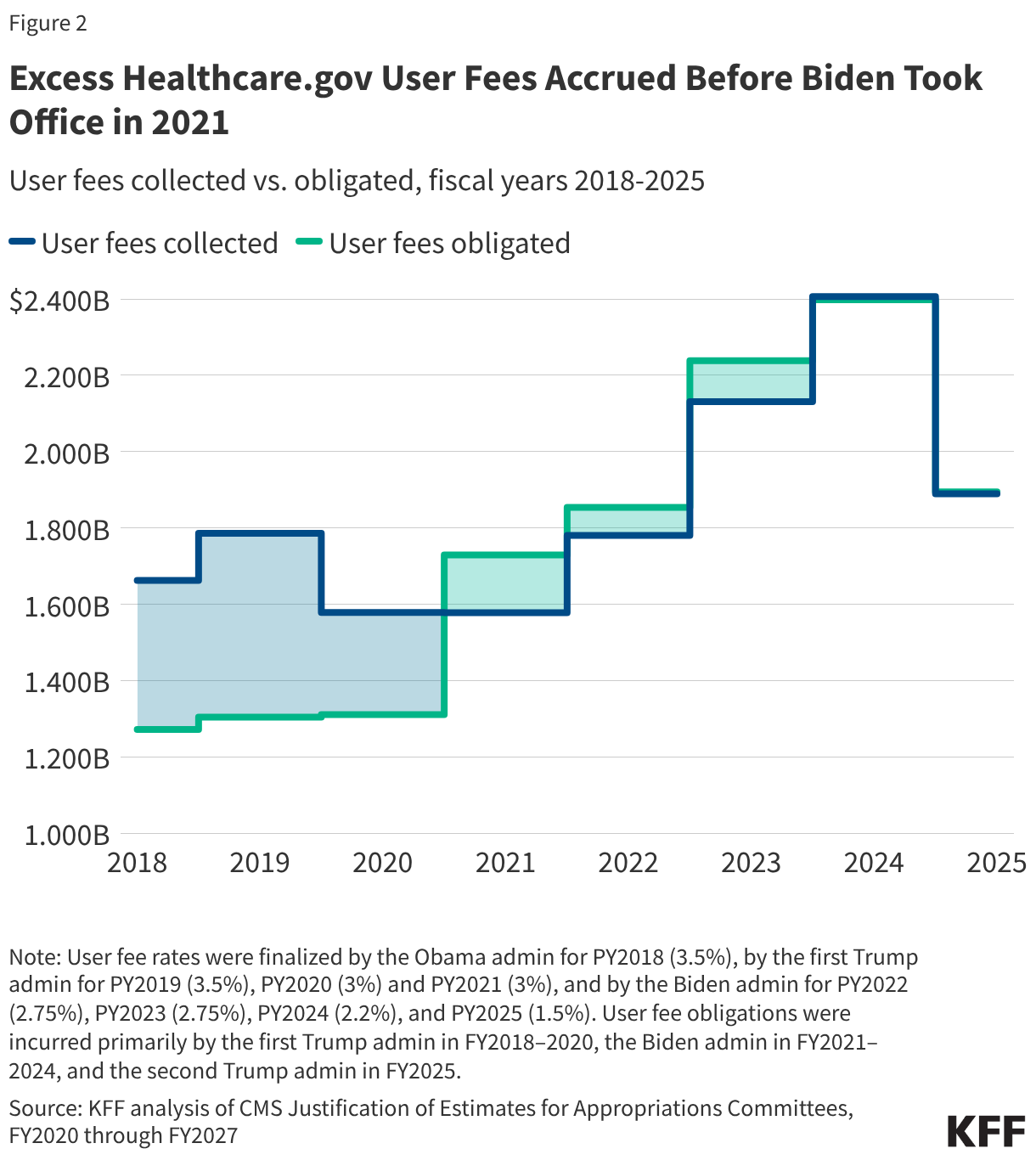
Excess Healthcare.gov User Fees Accrued Before Biden Took Office in 2021 (Line chart)

In FY 2018–2020, the federal government collected more revenue in user fees than it spent. The Trump administration oversaw spending in each of these years. The user fee rate (which determines how much was collected) was set by the Obama administration for plan years 2017 and 2018 and by the Trump administration in plan years 2019 and 2020. The Trump administration significantly reduced spending on consumer information and outreach activities, including spending on Navigators and other enrollment assisters. For example, between FY 2016 (the last full fiscal year of the Obama administration) and FY 2020 (the last full fiscal year of the first Trump administration), spending for Navigators and other enrollment assisters decreased from almost $100 million to approximately $20 million and overall spending on Consumer Information and Outreach decreased almost 40%, from approximately $806 million to $503 million between FY 2016 and FY 2020.

In FY 2021–2023, the federal government spent more user fee revenue than it collected. The Biden administration was largely responsible for spending during these years and significantly increased spending on consumer assistance and outreach. Spending on consumer information and outreach increased from $503 million in FY 2020 to $1.2 billion in FY 2023. The Trump administration set user fees in plan year 2021, while the Biden Administration set user fees in plan years 2022 and 2023. Even as the user fee rate (percent of premium) was lowered during this period, the total amount of user fee revenue collected increased due to growing enrollment spurred by the enhanced premium tax credits.

In FY 2024 and 2025, spending more closely matched user fee collections. The Biden Administration set user fees in each of the overlapping plan years and oversaw spending in FY 2024 and part of 2025. However, spending on consumer information and outreach decreased again in FY 2025, mostly during the second Trump administration, with spending on consumer information and outreach overall decreasing from $1.2 billion in 2024 to $778 million in FY 2025.

Most of the variation in total Marketplace spending comes from how much each administration spends on consumer information and outreach, including spending on outreach and Navigators and other enrollment assisters. The single largest source of funds for Exchange activities is user fees, although other sources contribute. Figure 3 show spending irrespective of source of funds.

Figure 3

Spending and user fee collections are not yet final for FY 2026. The $500 checks (whether attributed to FY 2026 or FY 2027) will have a downward effect on any surplus. The Trump administration’s budget for FY 2027 shows continuing reductions to spending for consumer information and outreach in 2027.

The $500 Payments in Context

In September 2026, the Trump administration announced that it would send one-time $500 payments to about 1 million Marketplace enrollees, billing them as a “refund” of surplus user fees collected under the Biden administration. However, the administration has provided little explanation for how the flat $500 amount was determined. Because the user fee is a fixed percentage of the gross premium, and premiums vary significantly by factors like age and location, the amount unsubsidized enrollees pay toward a user fee varies greatly from person to person.

The checks are not adjusted proportionately to the amount of user fee a recipient paid. The $500 checks will go to approximately 1 million enrollees who signed up without a tax credit for coverage in 2026 in a state using HealthCare.gov. However, the source of the funds (unspent user fees accumulated over many years) has been paid not only by the people receiving the checks, but also by the millions of HealthCare.gov enrollees who paid for at least part of their premium in this or in past years (including those who are no longer enrolled or who are enrolled in states that have transitioned to state based marketplaces), and—in large part—by taxpayers in the form of a premium tax credit to offset some or all of the premium for subsidized enrollees. It is also worth noting that some enrollees who are not receiving an advance payment of the premium tax credit in 2026 and are therefore receiving a $500 check may still receive a tax credit when they file their 2026 taxes if their income ends up below 400% of the federal poverty line (FPL).

The $500 checks likely exceed the amount of user fees most check recipients will pay this year. The average premium payment among HealthCare.gov enrollees not receiving a premium tax credit is $8,844 in 2026, which includes a $221 average user fee (based on the 2.5% 2026 user fee set by the Biden administration). How much the recipients of these checks have paid over time in user fees depends on many factors including how long they have been enrolled, the amount of their premium, and whether they were receiving premium tax credits. 

The $500 checks are likely much smaller than the increase in premium payments these enrollees experienced this year, following steep premium increases and the expiration of enhanced premium tax credits. The average annual premium among HealthCare.gov enrollees not receiving a tax credit in 2025 was $6,660, while the average annual premium among those not receiving a tax credit in 2026 was $8,844, a difference of $2,184. However, this likely understates the increase in premium payments many of the $500 check recipients faced. Some enrollees who do not qualify for a subsidy in 2026 did qualify for one in 2025 and therefore would have seen an even greater increase in the premium payments for 2026 with the loss of enhanced premium tax credits. Additionally, beyond increases in premiums, some enrollees also likely saw higher deductibles if they bought down to a lower level of coverage. 
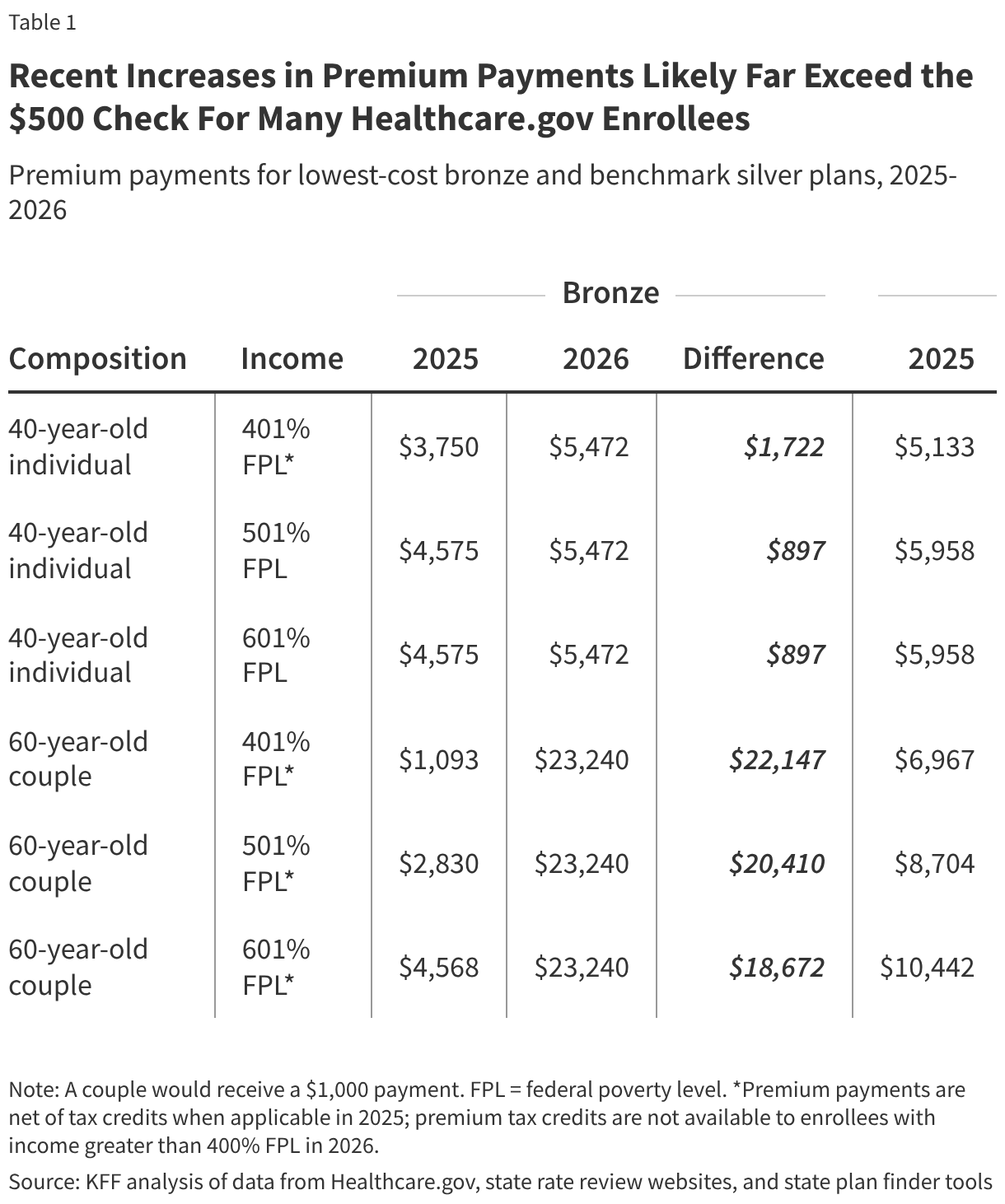
Recent Increases in Premium Payments Likely Far Exceed the 0 Check For Many Healthcare.gov Enrollees (Table)

As shown in Table 1, premium payment increases from 2025 to 2026 vary based on several factors including whether the enrollee received a premium tax credit in 2025, their income, family size, and age. At 401% FPL, the national average premium for the lowest-cost bronze plan for a 40-year-old enrollee after enhanced premium tax credits was $3,750 in 2025, compared with $5,472 in 2026, an increase of $1,722. A $500 payment would offset only 29% of this increase. These $500 payments would offset an even smaller share of premium increases for benchmark silver plans.

A large share of ACA enrollees with incomes above four times poverty are older adults and many older adults also purchase bronze plans. A 60-year-old couple would face even more substantial premium increases. With income at 401% FPL, the national average annual bronze premium for two 60-year-olds increased from $1,093 in 2025 to $23,240 in 2026. If both individuals received a $500 payment, the combined $1,000 payment would offset only about 4% of the increase in their premium payments.

Premiums for unsubsidized enrollees in HealthCare.gov states are expected to continue to increase into 2027, by more than $500 on average. The average benchmark premium in 2027 for a 40-year-old in one of the 29 states using the HealthCare.gov platform in 2026 and 2027 is projected to increase by 11% in 2027, or about $876 annually, according to CMS documents cited by the Washington Sun. Because older adults have higher premiums, this could mean the oldest HealthCare.gov enrollees without a subsidy face more than $2,000 in benchmark silver premium increases from 2026 to 2027. Premium increases for bronze plans in 2027 are not yet available, though if they increase at a similar rate, the increases would also likely be more than the $500 check for a 40-year-old. 

Methods

The share of ACA enrollees who receive a $500 payment was determined from ACA February effectuated enrollment. Although the exact number of recipients is not known, for this analysis, it is assumed to be 1 million. We expect diminishing effectuated enrollment throughout 2026, so the share may be higher than estimated.

Total user fee collected and obligated were obtained from CMS Justifications of Estimates for Appropriations Committees. User fee revenue was taken from the All-Purpose (Comparable) table. Final amounts for a fiscal year (FY) were taken from the congressional justification document two years subsequent; for example, spending in FY 2025 was taken from the FY 2027 congressional justification. For FY 2018, the revenue for Marketplace user fees was combined with the risk adjustment fees; these values were disaggregated in the CMS Program Management Amounts Available for Obligation table. The value of user fees obligated were obtained from the Federal Exchanges account narrative. Dollar amounts associated with Marketplace activities were collected from the congressional justification documents for FY 2020 and FY 2027. Each of these years had a longitudinal record of final spending by activity. CMS Justification of Estimates for Appropriations Committees are available at:

The average premium paid by consumers without advance premium tax credits (APTC) was derived from CMS Open Enrollment Public Use Files for 2025 and 2026. Average gross premium for all consumers using HealthCare.gov was decomposed to a weighted average of the gross premium for consumers with and without APTC, with the gross premium for consumers with APTC calculated from the average net premium and the average APTC. The calculated gross premium for 2025 included consumers in Illinois, which switched from using HealthCare.gov to its own platform in 2026. The state-level gross premium for consumers without APTC was also calculated and weighted by the number of consumers without APTC in all HealthCare.gov states excluding Illinois to estimate the impact of its inclusion. Excluding Illinois in the 2025 average gross premium for consumers without APTC resulted in a difference of $2,062 between average 2025 and 2026 premiums. To calculate the share of premium dollars that are paid by advance premium tax credits in 2026, the average premium after premium tax credits was divided by the average premium before tax credits for states using HealthCare.gov.

National average premiums for 2025 and 2026 are based on data from HealthCare.gov, state-based exchanges, and state plan finder tools to collect premiums. See https://www.kff.org/interactive/subsidy-calculator/ for further details.

Appendix
Federal Marketplace Spending for Fiscal Years 2013-2027 ($ in thousands) (Table)

Assessing Ability to Work: How Historical SNAP Processes May Vary from Medicaid

Published: Oct 22, 2026

The Supplemental Nutrition Assistance Program (SNAP), which is the primary federal aid program addressing food insecurity among low-income households, has long included work requirements as a condition for participation for certain individuals. Starting January 1, 2027, or sooner at state option, 44 states will also be required to condition Medicaid eligibility for adults in the Affordable Care Act (ACA) Medicaid expansion group and enrollees in certain waiver programs on meeting work requirements. The law specifies mandatory exclusions from these requirements, including for individuals who are “medically frail,” if they have both a qualifying condition and demonstrate that the condition impairs their ability to fulfill the work requirements. CMS recently released information on an approach states can use to verify medical frailty exclusions; however, states are not required to adopt this approach, and it remains unclear what processes states will use.

In light of the uncertainty surrounding how states will verify the Medicaid medical frailty exclusion, this issue brief describes how SNAP has handled similar administrative challenges. Similar to the Medicaid medical frailty exclusion, individuals who are deemed unable to work due to a physical or mental limitation are exempted from SNAP work requirements. Approaches to verifying ability to work vary among state SNAP agencies but may be changing in response to provisions in the reconciliation law that require states to pay a portion of SNAP benefit costs based on the state’s SNAP payment error rate. While the SNAP program can offer some insights for the Medicaid program, differences in how eligibility is determined between the programs mean Medicaid verification processes are likely to differ from SNAP processes in some key ways.

How have states historically determined ability to work for the SNAP program?

States have flexibility in how they define the exemption for individuals who are deemed “physically or mentally unfit for employment.” Most adults under age 65 on SNAP must meet general work requirements (which include registering for work, taking a suitable job if offered, participating in SNAP Employment and Training (E&T) or workfare if assigned by the state SNAP agency, and not voluntarily quitting a job or reducing work hours below 30 hours a week without a “good reason”). In addition, “time-limited” work requirements apply to certain individuals who do not qualify for an exemption, meaning they must work or participate in a work program for at least 80 hours per month or participate for an assigned number of hours in workfare to receive SNAP benefits for more than three months in a 36-month period (Appendix Table 1).

Federal regulations leave it to state agencies to define physical and mental fitness and establish procedures for verifying the SNAP general work requirement exemption. Rules on time-limited work requirements are only slightly more specific, clarifying an individual is exempt if they:

  • “are receiving temporary or permanent disability benefits issued by governmental or private sources;
  • are obviously mentally or physically unfit for employment as determined by the State agency; or
  • if the unfitness is not obvious, provide a statement from a physician, physician’s assistant, nurse, nurse practitioner, designated representative of the physician’s office, a licensed or certified psychologist, a social worker, or any other medical personnel the State agency determines appropriate, that they are physically or mentally unfit for employment.”

Because of this discretion, definitions vary across states, and some states have more expansive definitions of “physical or mental limitations,” including, for example, people who are chronically homeless, or survivors of domestic violence when these circumstances negatively impact their physical or mental condition. States must exempt individuals for receipt of any temporary or permanent disability, including Supplemental Security Insurance (SSI), Worker’s Compensation, Veteran’s Affairs, Railroad Retirement, Developmental Disability services, or other private sources, though they may vary in how the state documents and verifies the information.

A mandatory component of the SNAP application and recertification process is a phone or in-person interview with an eligibility worker who screens enrollees for exemptions. As of 2023, most states report first screening for physical or mental limitations on the application, while some first ask about limitations in the interview conducted by an eligibility worker that is required prior to SNAP certification. Over half of state agencies also reported allowing staff discretion over the types of physical or mental limitations that could be considered for exemptions. For example, visual observations made by eligibility workers during interviews (e.g., noting an individual is using an oxygen tank) could be used as a basis for exemption determination.

When determining someone is “obviously unfit,” some states always require documentation of an individual’s physical or mental limitations, while many states accept client statements or only require verification when deemed necessary by the eligibility worker. States that do not always require documentation may specify that client statements are acceptable verification unless eligibility workers find the client’s situation unclear or questionable. An evaluation of SNAP work requirement exemption processes reported that some eligibility workers felt that requiring documentation could reduce staff burden and their personal responsibility in making determinations by increasing consistency and reducing the subjectivity of eligibility worker determinations. However, regularly requiring documentation would also likely increase the administrative burden for enrollees, providers, and eligibility workers (who need to process the documentation and sometimes request additional clarification). Individuals are reevaluated for whether they meet an exemption at recertification every six to twelve months, and the same evaluation found that information collected at recertification usually does not differ from information collected at application.

When unfitness to work is not “obvious” to eligibility workers, states must obtain a statement from a medical professional to verify exemption status, though state procedures for collecting provider attestation vary. As noted above, some states go further, requiring documentation (such as a form from a provider) for every individual seeking an exemption. The information requested from providers to document an exemption varies. For example:

  • Wisconsin’s form asks providers only to attest that someone is unfit, with no requirement to provide details on the specific condition.
  • Pennsylvania’s form asks providers to attest that someone is unfit and to list the condition an individual has that contributes to this determination.
  • Maryland’s form asks providers to indicate whether an individual is unable to do specific activities, such as sitting, standing, or walking for extended lengths of time.
  • Vermont’s form asks providers to list the condition that limits the individual’s ability to work and to provide a time estimate of how long this condition is expected to last.

States may also accept other forms of provider documentation, such as a written statement or a phone call to an eligibility worker. Providers are not usually given detailed guidance about how to assess fitness for work, so their determinations of who may qualify for an exemption likely vary.

States may choose to make changes to their SNAP verification processes in response to a new mandate from the reconciliation law that most states pay a portion of SNAP benefit costs based on their payment error rate (PER). Beginning in October 2027, the reconciliation law requires states to pay a portion of SNAP benefit costs if the state’s PER (a measure of over- and underpayments that are primarily administrative errors, not fraud) is above 6%, with the share of the costs increasing as the error rate increases up to a cap. Prior to the new requirements, state SNAP verification processes reflected different state choices for how to balance documentation requirements to promote program integrity and avoid fiscal penalties based on the state’s PER against the administrative burden additional documentation may create for individuals; states may rebalance these considerations in light of new, much larger financial costs tied to states’ PERs. For example, to avoid errors and associated penalties, Arizona recently began requiring additional documentation of information where the state previously had accepted client statements unless it was deemed questionable.

How may the Medicaid process compare to SNAP?

In contrast to the SNAP process, the Medicaid process for verifying individuals who qualify for the medical frailty exclusion will require states to use available data before requesting documentation from individuals or providers. Medicaid has access to claims data that SNAP does not. The interim final rule released in June instructs states to use claims and encounter data from the preceding 12 months to attempt to verify medical frailty status automatically before requesting information from the individual. CMS recently released additional information outlining a tiered medical frailty framework that would enable states to identify individuals as medically frail using claims data alone (tier 1), using claims data in combination with encounter or other data (tier 2), or, in cases where states have no or insufficient data on file, using an individualized manual process that requires additional documentation (tier 3). While this tiered approach will enable some individuals to be verified as medically frail using data alone, not all medical frailty determinations can be automated. Data limitations, such as lack of data on file for new applicants and recent enrollees, or providers not consistently coding conditions or not using codes identified by the state, mean that states will need additional documentation for some individuals.

Similar to SNAP, states will rely on providers to verify individuals’ ability to work and Medicaid medical frailty status, particularly in situations where claims or other data are not available. Because Medicaid does not allow interviews, eligibility workers will play a less pronounced role in the Medicaid verification process, though in states with jointly administered SNAP and Medicaid programs or with data sharing between the programs, Medicaid may be able to use some information collected through SNAP interviews and verification processes. When unable to verify medical frailty status using available data, states may need to rely on confirmation from treating providers to verify medical frailty conditions and ability to participate in community engagement activities. The interim final rule currently offers little detail on what information states need to collect from providers. Absent additional guidance, states will likely develop different forms and collect different information, similar to the variation seen in SNAP. States may also use the same form to collect information from providers for the Medicaid and SNAP exemptions; North Carolina, for example, has created a provider attestation form that can be used to determine eligibility for Medicaid or SNAP. As noted above with SNAP, relying on providers to determine whether an individual is able to work without guidance can lead to variation and inconsistency in assessments.

Starting January 2028, states’ ability to accept self-attestation in Medicaid will be more limited than is the case for SNAP. While states vary in how they use client statements in establishing unfitness for work for SNAP, federal rules require them to seek additional verification if that information is questionable; however, federal rules do not limit states’ ability to accept client statements altogether. In contrast, the Medicaid rule limits reliance on self-attestation starting in January 2028. The rule allows states to accept self-attestation throughout 2027 in cases where there is no reliable information available to the state. However, starting January 1, 2028, states may only accept self-attestation of medical frailty status one time during an individual’s enrollment period. States would then be expected to verify medical frailty using available data or require documentation or other information from individuals for future renewals, which may require a more time-consuming verification process. Prior to the publication of the interim final rule, most states had expressed interest in using self-attestation as a verification source for the medical frailty exclusion.

State Medicaid medical frailty verification policies will likely differ, and state decisions may be affected by threats of financial penalties. With limited federal guidance, states will adopt different approaches to operationalize the medical frailty exclusions. The Medicaid rule indicates that states would be considered noncompliant with the regulation if audits show frequent approval of individuals as medically frail with insufficient support that the condition impacts their ability to work. With the potential for audits, states may struggle to operationalize the medical frailty exclusion in a way that protects them from financial penalty and minimizes administrative burden, without denying coverage to individuals who should qualify for the exclusion. States are also implementing these complex Medicaid eligibility and enrollment policy changes at the same time that they need to prepare for changes to the payment error rate measurement (PERM) program that will increase financial consequences of eligibility error rates above 3%. These PERM changes may influence how states balance the need to mitigate financial risk against the administrative burden of increased documentation for all Medicaid eligibility determinations.

Summary of SNAP Work Requirements (Table)

How Much is Health Spending Expected to Grow?

Published: Oct 22, 2026

This updated chart collection explores how health spending is expected to grow in coming years, based on National Health Expenditure (NHE) projections from federal actuaries.

Health spending is projected to reach $6.0 trillion (18.7% of the economy) in 2026, with hospitals making up the largest share of spending ($1.9 trillion). By 2034, health spending is expected to hit $9.0 trillion, making up over one-fifth of the U.S. economy. The annual percent change in health spending growth is estimated to have slowed to 6.3% in 2026, and growth is expected to slow further by 2027 (to 4.7%).

Several policy changes and changes in health utilization are expected to slow health spending growth in the coming years, including changes to Medicaid in the 2025 budget reconciliation law and the expiration of the ACA Marketplace enhanced premium tax credits in 2025. The Inflation Reduction Act’s Medicare prescription drug provisions and inflation rebates are also expected to slow Medicare prescription drug spending growth over the longer term, although higher rates of Medicare spending growth are projected in the near term.

The analysis can be found on the Peterson-KFF Health System Tracker, an information hub dedicated to monitoring and assessing the performance of the U.S. health system.