
As HHS Restores the LGBTQ 988 Suicide and Crisis Line Under Pressure From Congress, Questions Remain
988 is the federally mandated suicide and crisis line, overseen by the Substance Abuse and Mental Health Services Administration (SAMHSA). Between March 2023 and June 2025, and at the direction of Congress, 988 offered a specific service to meet the needs of LGBTQ young people. The service was ended under the Trump Administration in July 2025, at a time when utilization was increasing. It was revived over a year later, on September 30, 2026, following bipartisan Congressional calls for its restoration. The line was created to address significant mental health disparities LGBTQ people experience. For instance, LGBTQ high school students report measures of suicidality, including contemplation, planning, attempts, and injury, at higher rates than heterosexual peers. Looking ahead, it is unclear how quickly or fully use of the service will return to pre-closure levels. The service’s closure may have reduced trust among LGBTQ youth and their willingness to reach out during a crisis. Limited promotion and continued absence of LGBTQ-specific outreach materials may also make it harder for young people to know that the relaunched service is available.
The line was shutdown at a time of increasing utilization. After an initial pilot period, contacts to the LGBTQ service (calls, chats, and texts) increased 71% between July 2023 and June 2025 (the last month the service was fully available). In total, the line received over 1.5 million contacts, about 10% of all 988 contacts over the same period. Use of the service also grew in the months leading up to its closure, increasing by 17% between December 2024 to June 2025, the period following the presidential election and President Trump’s inauguration.
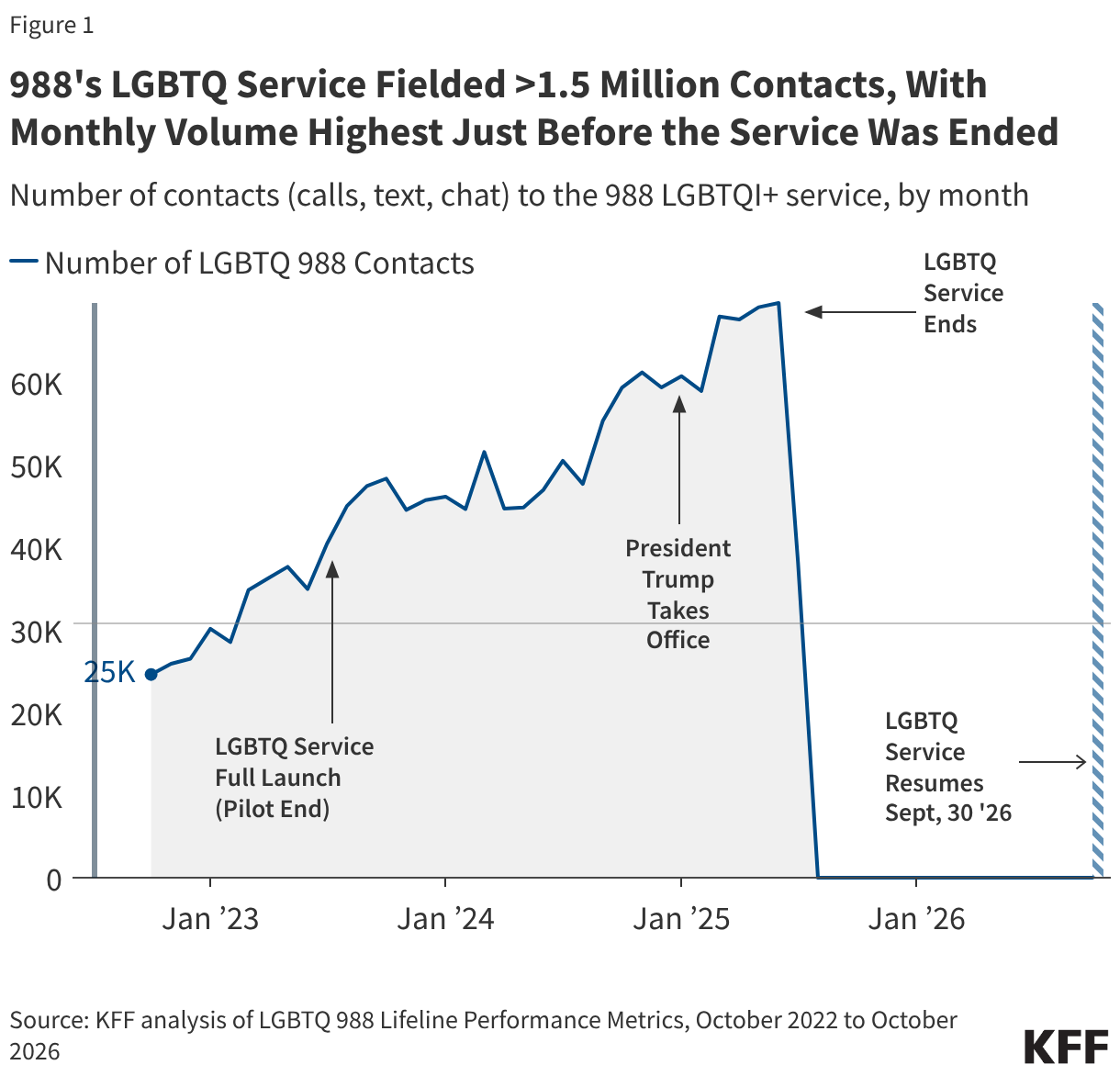
While the administration said the closure of the specialty service was “to focus on serving all help seekers, including those previously served through the Press 3 option (emphasis theirs),” the decision came amid a range of other actions the administration took to limit health care access and protections for LGBTQ people, particularly transgender people. These actions included issuance of a day one Executive Order (EO 14168) on gender in January 2025, which sought to “remove recognition of the concept of gender identity” and thus federal recognition of transgender people, among other policy changes.
In May 2025, just prior to the line’s closure, and following a presidential budget proposal that proposed eliminating funding for the LGBTQ service, bipartisan members of both chambers of Congress urged HHS to preserve the service, citing its widespread use and elevated suicide risks among LGBTQ youth. After the service closed in July 2025, members of Congress continued to call for its return through multiple letters with some bipartisan engagement.
Congress had specifically funded the service since FY 2023, when it appropriated funding “to provide specialized services for LGBTQ+ youth,” which included training for existing counselors in LGBTQ+ youth cultural competency and transfer of LGBTQ+ youth contacts to a specialty organization. Funding increased to $33.1 million in FY2024 and remained at that level through FY2026. In fact, when it came to FY2026 funding, members wrote to their appropriator colleagues with requests to continue to fund the service. There has not yet been a final FY2027 funding bill passed, and the government is currently operating under a short-term continuing resolution which includes funding for 988 and the LGBTQ line at the FY2026 level.
In a June 9th letter to Rep. Krishnamoorthi, SAMSHA, writing on behalf of Department of Sec. Kennedy, responded to Congress, writing that the agency was assessing reopening the line “while ensuring compliance with Executive Order 14168.” Nearly four months later, the specialized LGBTQ youth service was ultimately restored on September 30th, 2026. Language on the bottom of the 988 webpages emphasizes that the service was restored in response to congressional funding and direction and that its content does not necessarily reflect administration policy or views. The statement reads:
“The 988 Suicide & Crisis Lifeline LGBTQ+ youth specialized service, also known as the ‘Press 3 option,’ has been restored pursuant to funding and congressional direction. Consistent with President Trump’s Executive Orders, the views, opinions, materials, and content expressed on this site do not necessarily reflect the views, opinions, or policies of SAMHSA or the U.S. Department of Health and Human Services (HHS).”
Looking to the future, it is too soon to know how the closure affected young people’s trust in the service and their willingness to use it. It is also not clear whether LGBTQ youth, who could benefit from the service, will be able to find it. The LGBTQ specific promotional materials, first removed in February 2025, remain offline as of October 1, 2026. Promotional materials continued to be available for other populations, including Black and Latino people, people who are deaf or hard of hearing, and rural communities. In addition, as of October 1, 2026, there was no landing page for the specialized service, no prominent explanation of the restored service, and no mention of the service in the “what to expect” section that prepares people for what to expect when they call 988. Previously, the site provided information specifically about this service. Additionally, metrics on service utilization on the 988 data dashboard are now back up but could be hard find as it is referred to only as the “press 3 option,” rather than the LGBTQ line. Whether the line continues to be specifically funded by Congress may also affect the scope and visibility of the service over time.