Climate-Related Health Risks Among Workers: Who is at Increased Risk?

Published: Jun 26, 2023

Introduction

Over the past few years, a plethora of research has linked climate change to adverse health outcomes around the world. People may be exposed to climate-related health risks through a variety of pathways, including through their work. The Centers for Disease Control and Prevention (CDC) and Environmental Protection Agency (EPA) note that disproportionate exposure to adverse climate change-related conditions can exacerbate existing health and safety issues among certain workers and could potentially cause new and unanticipated harms. Risk of climate-related health impacts varies across occupations, with many of the same underlying drivers of disparities in climate vulnerability overall reflected in the occupational sector.

This analysis identifies occupations that are at increased risk of climate-related health impacts, examines the characteristics of workers in these jobs, and discusses the implications of these findings. It is based on KFF analysis of the 2022 Current Population Survey Annual Social and Economic Supplement (CPS ASEC) for nonelderly adult workers ages 19-64. Differences in demographic and socioeconomic characteristics described in the text are statistically significant at p<0.05. In sum, this analysis finds:

  • We estimate there are over 65 million nonelderly adult workers in occupations at increased risk for climate-related health risks, accounting for over four in ten of nonelderly workers. These include jobs with increased exposure to heat, decreased air quality, extreme weather, vector-borne and infectious diseases, and environmental contaminants. Some examples of at-risk jobs include agricultural and construction workers and emergency responders.
  • Among nonelderly adult workers, many people of color, noncitizen immigrants, and workers with lower educational attainment and income levels are disproportionately likely to be employed in jobs with increased climate-related risks. Nonelderly Hispanic (58%), Black (51%), and Native Hawaiian or Pacific Islander (NHOPI) (52%) workers are more likely than White workers (39%) to work in at-risk occupations. Similarly, around six in ten nonelderly noncitizen immigrant workers who work in at-risk occupations compared to about four in ten U.S.-born citizens. Nonelderly workers with lower educational attainment and incomes are more likely to work in at-risk occupations compared to their counterparts with higher educational attainment and incomes.
  • Nonelderly workers in at-risk occupations are about twice as likely as their counterparts in less at-risk occupations to lack health insurance (16% vs. 7%), These higher uninsured rates reflect lower rates of private coverage among these workers (70% vs. 85%), which is likely the result of more limited availability of employer-sponsored insurance in these types of jobs. Medicaid helps fill some of this gap in private coverage for workers in at-risk occupations, covering 14% of workers in at-risk jobs vs. 8% of those in less at-risk jobs, but does not fully offset the gap in private coverage.

These findings show that job-related climate-related health risks compound challenges and disparities faced by many historically marginalized and underserved groups. Adults of color, noncitizens, and adults with lower educational attainment and incomes are disproportionately employed in occupations with increased climate-related health risks. Moreover, workers in occupations with increased climate-related health risks are more likely to be uninsured, contributing to challenges accessing health care. Many of these same groups face other job-based challenges, including higher risk of injury and differential treatment, particularly migrant or immigrant workers, who often lack labor protections. These groups also are at increased risk for other climate related health risks and broader disparities in health and health care due to underlying structural inequities. Without mitigation strategies, health risks are expected to increase due to climate change. These data highlight the importance of addressing underlying social and economic inequities that drive disparate occupational exposures to climate-related health risks and to protect workers from these increasing risks.

Climate can negatively impact worker health through multiple pathways including extreme heat, decreased air quality, extreme weather, vector-borne and infectious diseases, and environmental contaminants. The Centers for Disease Control and Prevention (CDC) notes that the disproportionate exposure to adverse climate change-related conditions can exacerbate existing health and safety issues among certain workers and could potentially cause new and unanticipated harms. These exposures could lead to heat stress and other heat-related illnesses, occupational injuries and deaths, infections and disease, and health conditions caused by exposure to biological hazards as well as negatively impact mental health. They also may limit worker productivity and contribute to added costs associated with worker illness or injury.

Some occupations pose more climate-related health risks for workers than others. For example, outdoor workers and indoor workers who engage in heavy physical labor and are exposed to high temperatures are disproportionately likely to suffer from heat-related illnesses and deaths. Some research studies have found that agriculture, forestry, fishing, hunting, and construction workers experience the highest rates of heat-related mortality. In responding to the growing number of wildfires associated with climate change, firefighters, health care workers, and other emergency responders are disproportionately exposed to air pollutants, which are connected to allergies, respiratory illnesses, heart diseases, and other chronic and acute illnesses. Extreme weather events pose health and safety risks to rescue and recovery workers and may increase exposure to environmental contaminants and water-borne and food-borne diseases. People who work outdoors, in water and sanitation-related occupations, agriculture, with animals, or in the natural environment are particularly susceptible to the infection, transmission of, and spread of vector-borne diseases, such as Lyme disease. Agricultural workers are particularly susceptible to exposure and absorption of toxic chemicals, including pesticides, which have been associated with adverse health outcomes, including death.

To better understand who is at increased risk of climate-related health impacts through their job, we identified workers in occupation groups at increased risk and as less at-risk using data from the 2022 Current Population Survey Annual Social and Economic Supplement (CPS-ASEC). We identified occupations with increased climate-related risks based on a range of resources, including CDC’s Occupational Safety and Health and Climate Resource, EPA’s Climate Change and Health of Occupational Groups report, and George Washington University’s Hazard Zone: The Impact of Climate Change on Occupational Health (Figure 1). The classifications used in this analysis are subject to some limitations due to the breadth of occupation categories in CPS-ASEC. Each of the occupation categories in CPS includes many jobs, which may vary in terms of at-risk or less at-risk classifications and by geographic location. For this analysis, we classified an occupation category as at- or less at-risk if the majority of jobs included in it aligned with the CDC’s and other organizations’ definitions of climate vulnerable occupations.
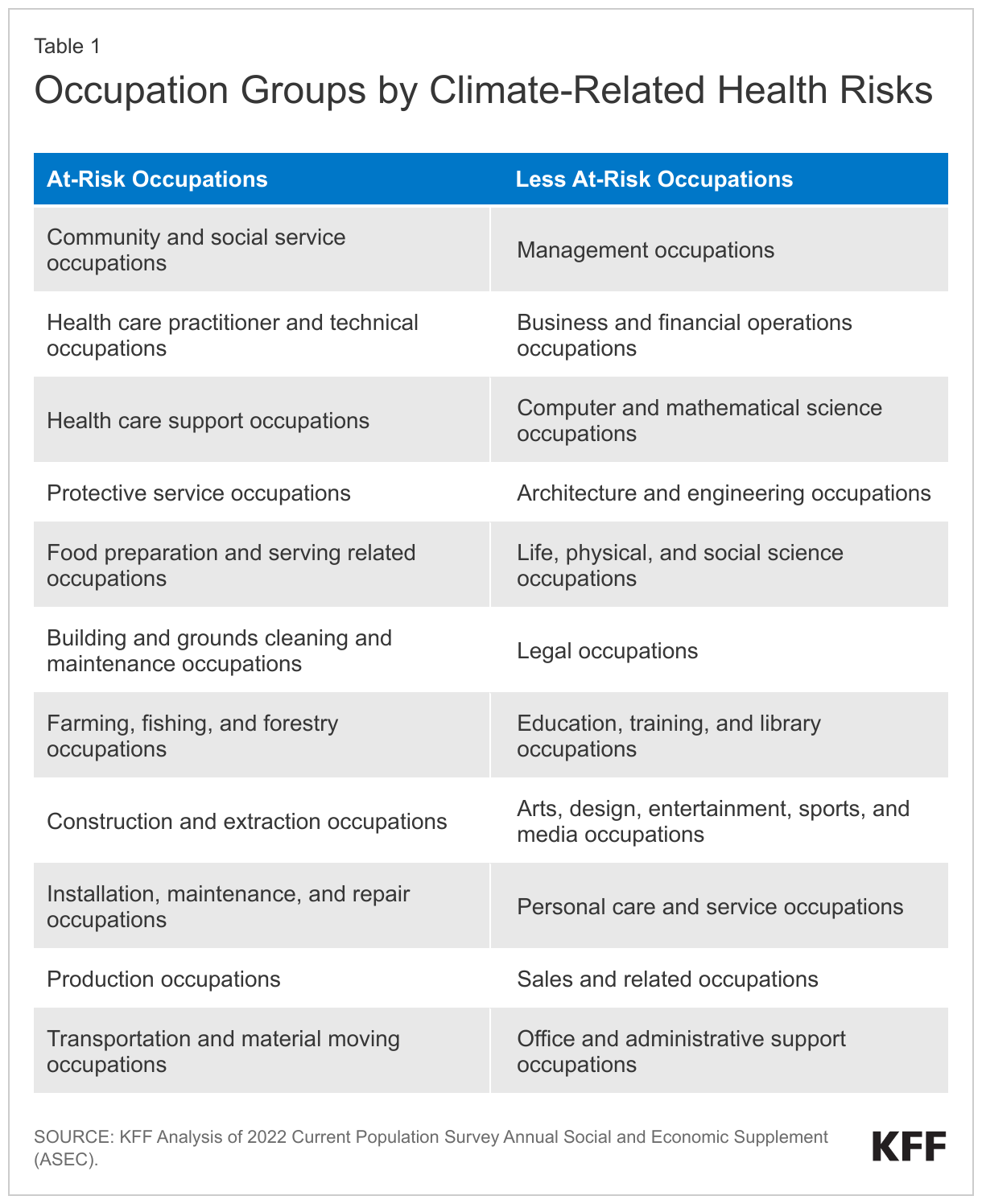
Occupation Groups by Climate-Related Health Risks

Based on the classification of occupation groups above, we find a total of 65.7 million nonelderly adult workers in occupations that are at increased risk for climate related health risks, accounting for 44% of nonelderly workers. The remaining 56% or 84.7 million nonelderly adult workers are in occupations identified as less at-risk for climate-related health risks.

Overall, among nonelderly adult workers, many people of color and noncitizen immigrants are more likely than their White and citizen counterparts to be in jobs with increased climate-related health risks (Figure 1). Over half of Hispanic (58%), Black (51%), and Native Hawaiian or Pacific Islander (NHOPI) (52%) nonelderly workers are in occupations at increased risk for climate-related health risks compared with 39% of White workers. Asian nonelderly workers (33%) are less likely than their White counterparts (39%) to be in occupations that are at increased risk. Moreover, around six in ten of noncitizen immigrant workers, including 62% of those who have been in the U.S. for five or more years and 59% of those who have been in the U.S. for less than five years, are employed in at-risk occupations compared with 41% of U.S.-born citizen workers. Naturalized citizen workers are (47%) also more likely than U.S.-born citizen workers to work in at-risk occupations, although the difference is smaller. Noncitizen Black, Hispanic, and NHOPI workers had particularly high rates of employment in at-risk occupations, with nearly eight in ten (77%) Hispanic noncitizen workers, two-thirds of Black noncitizen workers, and 80% of NHOPI noncitizen workers employed in at-risk professions.
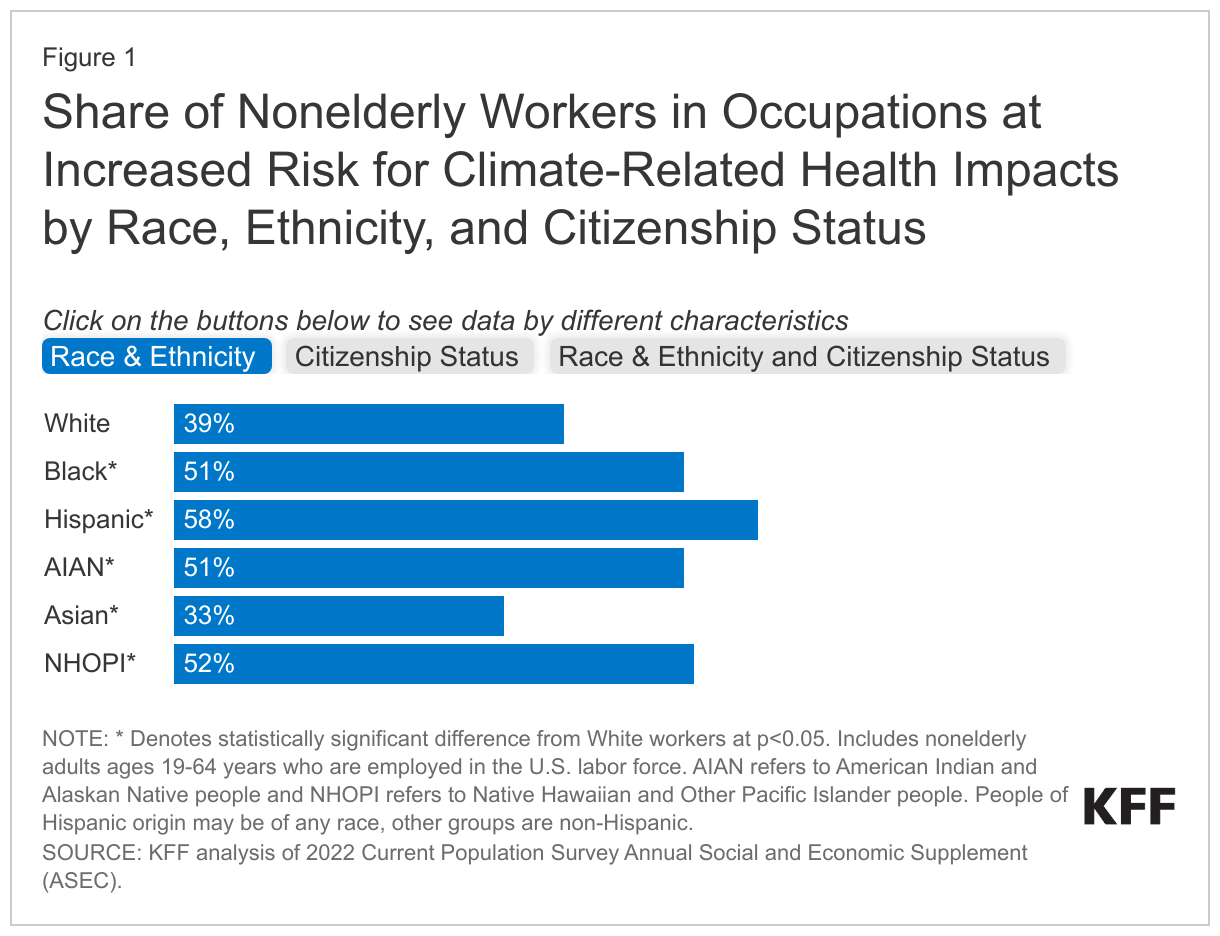
Share of Nonelderly Workers in Occupations at Increased Risk for Climate-Related Health Impacts by Race, Ethnicity, and Citizenship Status

Nonelderly workers with lower educational attainment and income levels are more likely than workers with higher levels of education and income to work in at-risk occupations (Figure 2). Nearly eight in ten (79%) nonelderly workers with less than a high school education and six in ten (61%) nonelderly workers with a high school degree work in at-risk occupations compared with less than half (48%) of nonelderly workers with some college education and just one in four (25%) of nonelderly workers with a bachelor’s degree or higher. Similar patterns are seen by income. Over six in ten low-income nonelderly workers (with incomes below 200% of the federal poverty level (FPL)) are employed in at-risk occupations, nearly twice the share of higher income workers (income at 400% FPL or higher) employed in these jobs (34%).
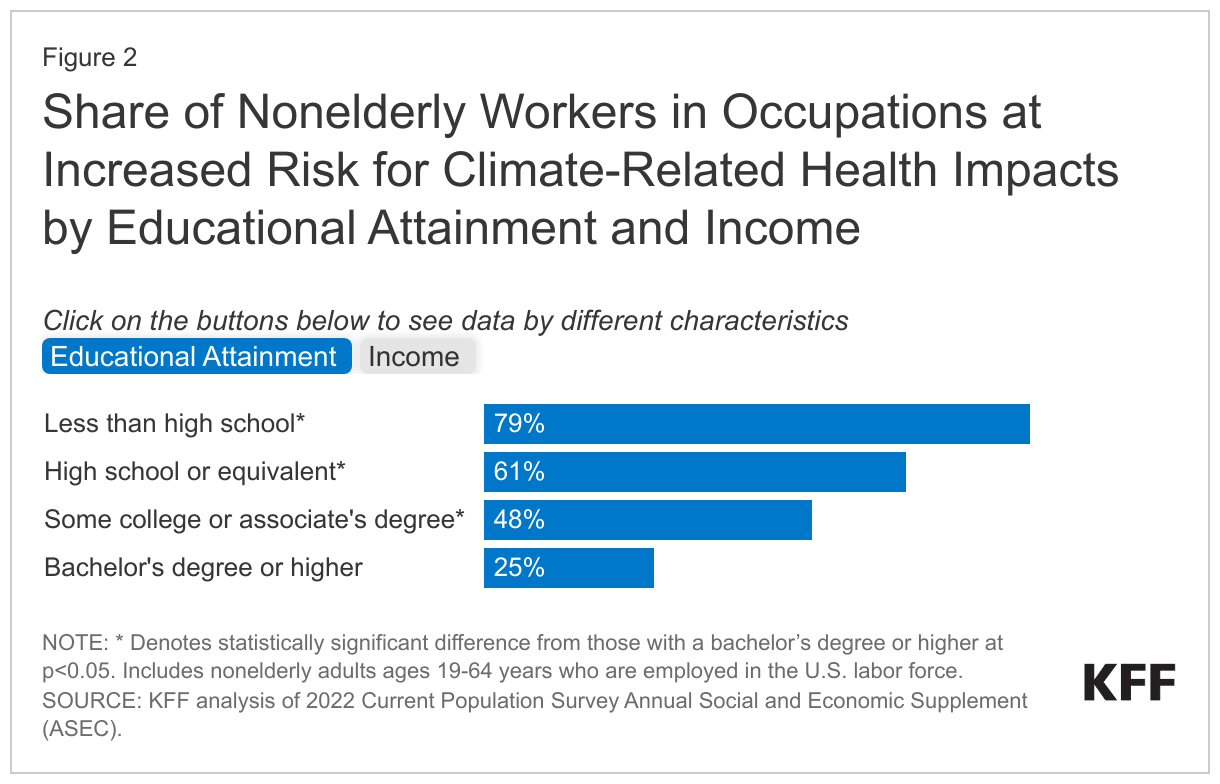
Share of Nonelderly Workers in Occupations at Increased Risk for Climate-Related Health Impacts by Educational Attainment and Income

Nonelderly workers in at-risk occupations are about twice as likely as their counterparts in less at-risk occupations to be uninsured (Figure 3). Among nonelderly workers, 16% of those in occupations with increased climate related health risks are uninsured, nearly twice the rate of workers in less at-risk occupations (7%). These higher uninsured rates reflect lower rates of private coverage among these workers (70% vs. 85%). Medicaid helps fill some of this gap in private coverage, covering 14% of workers in at-risk jobs vs. 8% of those in less at-risk jobs, but does not fully offset the gap in private coverage. These differences in health insurance coverage likely reflect that many of the occupations with increased risk offer lower wages and are in industries that are less likely to offer employer-sponsored coverage. Additionally, workers in at-risk occupations are significantly more likely to be noncitizen immigrants, who are subject to eligibility restrictions for federally-funded coverage, including prohibitions on undocumented immigrants enrolling in Medicaid or purchasing coverage through the Affordable Care Act (ACA) Marketplace.
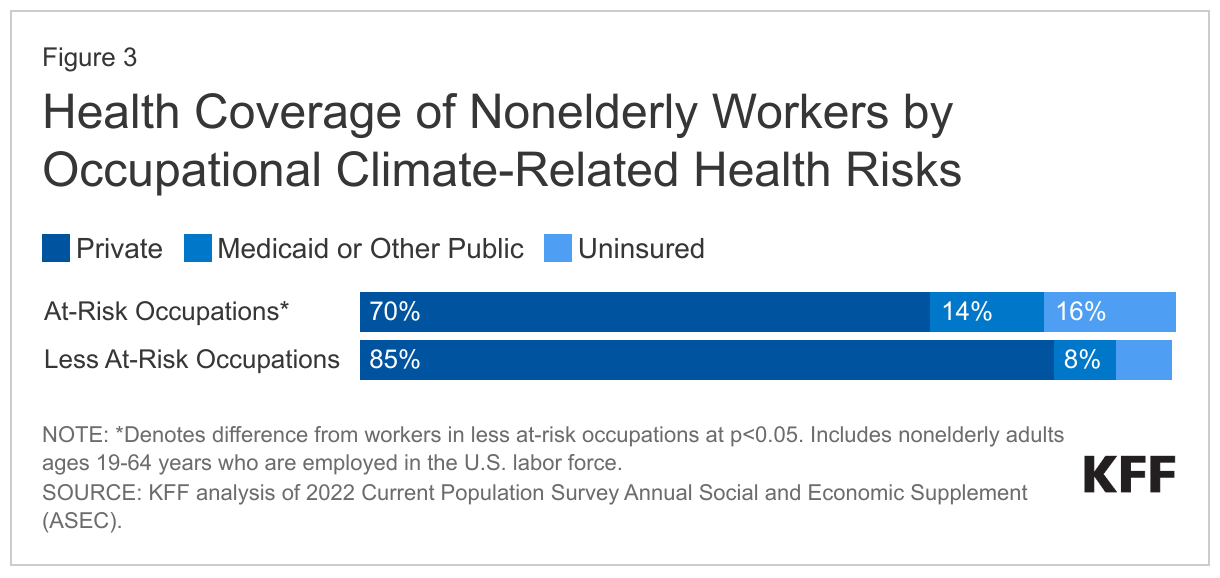
Health Coverage of Nonelderly Workers by Occupational Climate-Related Health Risks

Implications

Job-related climate-related health risks compound challenges and disparities faced by many historically marginalized and underserved groups. This analysis shows that adults of color, noncitizens, and adults with lower educational attainment and incomes are disproportionately employed in occupations with increased climate-related health risks. Moreover, workers in occupations with increased climate-related health risks are more likely to be uninsured, contributing to challenges accessing health care. Many of these same groups may face other job-based challenges, including higher risk of injury and differential treatment. Of particular note are migrant or immigrant workers who are disproportionately exposed to environmental hazards and have a greater risk of developing adverse outcomes due to their potential lack of job training, labor protections, and worker authorization/contracts, as well as their inability to access government-sponsored support. Moreover, these groups also are at increased risk for other climate related health risks and broader disparities in health and health care due to underlying structural inequities, including residential segregation and other social and economic challenges.

Occupational climate-related health risks are expected to increase due to climate change. Without any mitigation strategies, the threats associated with exposure to extreme heat, air pollutants, extreme weather, vector borne diseases, and toxic environmental chemicals and other contaminants are expected to increase due to climate change. As such, climate change will likely contribute to increases in negative health impacts among workers, including heat related illnesses and occupational injuries and illnesses. If unchecked, researchers estimate a nearly fourfold increase in extreme heat-related occupational injuries. Research has shown that, if unaddressed, the impact of climate change on workers’ health will increase loss of productivity hours and may cost the U.S. economy, in the long run. As climate change continues and the number of new vector-borne diseases is expected to increase, researchers expect that many carriers of these diseases could expand their geographical range putting more people, including outdoor workers, at risk of disease infection and transmission. Recent analysis has also found that, if unaddressed, climate change associated damages, including lost labor productivity due to heat stress, increased morbidity and mortality, and agricultural loss could cost the U.S. economy approximately $14.5 trillion over the next fifty years.

In recent years, there has been increased recognition of climate change and its impacts on health equity, including among workers, but continued action will be important for mitigating risks. The federal government has taken some steps to prioritize efforts to address climate change and its health risks for workers. In addition to Executive Orders that emphasize the need for a government-wide approach to addressing climate change and advancing environmental justice, in 2022, the Occupational Safety and Health Administration (OSHA) launched the National Emphasis Program for Outdoor and Indoor Heat-Related Hazards, an enforcement program that seeks to identify and eliminate or reduce worker exposures to occupational heat-related illnesses and injuries. This program is an expansion of the agency’s heat-related illness prevention initiative. The EPA revoked the use of certain dangerous chemicals, including the use of chlorpyrifos as a pesticide for food, reducing risks for farmworkers and their children in 2022. Some states have also taken steps to protect workers from extreme heat. Minnesota, Washington, Oregon, California, and Colorado have implemented heat standards that seek to prevent heat-related illnesses and deaths among workers. Going forward continued actions to mitigate climate-related health risks for workers as well as to address underlying social and economic inequities that drive disparate occupational exposures to climate-related health risks will be of growing importance as these risks are expected to grow due to climate change.
Privately Insured People with Depression and Anxiety Face High Out-of-Pocket Costs

Authors: Hope Schwartz, Nirmita Panchal, Gary Claxton, and Cynthia Cox
Published: Jun 23, 2023

Millions of people in the United States live with mental health diagnoses, with about one third of adults reporting symptoms of depression and/or anxiety. Among these adults, over 20% report an unmet need for counseling or therapy.

This analysis finds that privately insured adults who were treated for depression and/or anxiety in 2021 spent almost twice as much on annual out-of-pocket costs compared to enrollees who were not treated for a mental health diagnosis ($1,501 versus $863). Out-of-pocket spending and service utilization increased with depression severity.

The findings only include services that enrollees claim under their employer coverage. As a result, they likely underestimate utilization of, and spending on, mental health services.

The analysis is available through the Peterson-KFF Health System Tracker, an online information hub that monitors and assesses the performance of the U.S. health system.

News Release

What Do We Know About People with HIV Who Are Not Engaged in Regular HIV Care?  

One-in-five Adults with Diagnosed HIV were not Receiving Regular HIV Care Between 2018 and 2020

Published: Jun 22, 2023

A new KFF analysis finds that between 2018 and 2020, one-in-five (21%) adults diagnosed with HIV were out of care. Compared to adults who were receiving regular HIV care, adults who were out of care were more likely to be Black and to report challenges in their interactions with the health system, multiple and complex barriers to accessing health care services, and unmet needs for ancillary care.

Adults who were out of care were not virally suppressed and had not received recommended lab tests. 

Additional findings include: 

  • Adults with HIV who were out of care were more likely to be young and to report poorer health status than those in care. They were also more likely to be uninsured and were less likely to have a regular provider or to receive support from the Ryan White HIV/AIDS Program, the nation’s HIV safety-net program that provides outpatient HIV care, treatment, and support services to people with HIV who are underinsured and uninsured. 
  • Adults who were out of care were more likely to report barriers to receiving care because of their finances, mental health, and difficulty getting to a doctor’s office, as well as more dissatisfaction with care than those in care. They were also more likely to report unmet needs for social and support services such as food and housing insecurity.

• A fifth of adults who were out of care were not on antiretrovirals (HIV medication) compared to virtually all of adults in care. Among adults on treatment, those who were out-of-care were more likely to report missing doses.

Identifying people with HIV who are out of care, and better understanding the barriers they face, are first steps towards engaging or reengaging them in care, addressing their unmet needs, and improving their health status. Doing so effectively would improve both individual health outcomes as well as public health, aligning with the goals in the national HIV/AIDS Strategy and the federal Ending the HIV initiative.

Read “What Do We Know About People with HIV Who Are Not Engaged in Regular HIV Care?” to learn more about people with HIV who are not engaged in regular HIV care and the barriers they face.

Additionally, learn more about KFF’s Greater Than HIV, a public information initiative focused on reaching those populations most affected by HIV in the United States with the latest on testing, prevention, and treatment. A current Greater than HIV effort provides free HIV testing and counseling as part of the largest National HIV Testing Day event in the nation on June 27th.

What Do We Know About People with HIV Who Are Not Engaged In Regular HIV Care?

Published: Jun 22, 2023

Key Findings

An ongoing challenge to ending the HIV epidemic in the U.S. is reaching people with HIV who are not receiving regular HIV care and are not virally suppressed. Being engaged in HIV care, including being on antiretroviral therapy, promotes optimal individual health outcomes and viral suppression, which in turn prevents transmission of HIV to others. To date, however, robust and representative data on people with HIV who are not receiving regular HIV care have been limited, making it difficult to understand who they are and what barriers they face. This analysis aims to help fill this gap, using nationally representative data to assess the characteristics and experiences of people with HIV who are out of regular HIV care, defined as those who had less than two CD41 . or viral load tests at least 3 months apart within a 12-month period and were not virally suppressed.

Overall, we find that one-in-five (21%) adults with diagnosed HIV were out-of-care and, compared to their in-care counterparts, they were more likely to report challenges in their interactions with the health system, multiple and complex barriers to access, and unmet needs for ancillary care; they are also more likely to be members of population groups already facing longstanding health disparities. Specifically, we find that:

  • People with HIV who were out-of-care were more likely to be Black, young, and to report poorer health status than those in-care. They were also more likely to be uninsured, experience changes in their usual source of care related to insurance changes, and were less likely to have a regular provider or to receive support from the Ryan White Program. There were no statistically significant differences based on state Medicaid expansion status or census region.
  • Those out-of-care were more likely to report barriers to care engagement, including in the areas of finances, mental health, and getting to a doctor’s office, as well as more dissatisfaction with care than those in-care. They were also more likely to report unmet needs for ancillary social and support services in three domains: clinical, non-HIV medical/behavioral, and subsistence services, with more than half reporting at least one unmet need.
  • Whereas virtually all people with HIV in-care were on antiretroviral therapy, a fifth of those out-of- care were not on ARVs, and among those who were, they were more likely to report missing treatment doses. In addition, smaller shares reported being familiar with the concept of treatment as prevention (TasP) than those in-care, though there were substantial knowledge gaps for both groups.
  • Identifying people with HIV who are out-of-care, and better understanding the barriers they face, are first steps towards engaging or reengaging them in-care, addressing their unmet needs, and improving their health status. Doing so could play a role in advancing the goals in the national HIV/AIDS Strategy and the federal Ending the HIV initiative.

Introduction

An ongoing challenge to ending the HIV epidemic in the U.S. is reaching people living with HIV who are out of regular HIV care and not virally suppressed. Being engaged in HIV care, including being on antiretroviral therapy, promotes optimal individual health outcomes and viral suppression, which also prevents transmission of HIV. Indeed, an estimated 43% of HIV transmissions are estimated to result from people who were aware of their HIV status but not engaged in care. To date, however, robust and representative data on people with HIV who are not engaged in regular HIV care and the barriers they face have been limited. One exception is a nationally representative analysis that assessed barriers to care faced by people with HIV who felt they had not received enough care. The current analysis aims to add to this knowledge base, using nationally representative data from the Centers for Disease Control and Prevention’s Medical Monitoring Project (MMP). The MMP is a cross-sectional, nationally representative survey of adults with diagnosed HIV in the United States and includes data drawn from both in-depth interviews and medical record abstraction.

For this analysis, we defined people with HIV as not being in care if they (1) had less than two CD4 or viral load tests at least 3 months apart within a 12-month period and (2) did not have sustained viral suppression (see box). This definition differs from the one used by the Centers for Disease Control and Prevention which only focuses on lab testing frequency regardless of viral suppression status.2   By taking this approach, we aimed to identify the most vulnerable individuals within this group, including those who may have the greatest need for targeted engagement efforts. The analysis is limited to adults and is based on data collected between 2018 and 2020 (see Methodology for details).

Table 1: Key Terms
TermDefinition
Out-of-careReceived fewer than two CD4 or viral load tests at least 3 months apart within a 12-month period AND had any viral load test where they were virally unsuppressed in the preceding 12 months.
In-careReceived two or more CD4 or viral load tests at least 3 months apart within a 12-month period OR was virally suppressed at all tests in the preceding 12 months (regardless of lab test frequency).
Sustained viral suppressionNo unsuppressed viral load test results in the preceding 12 months

Findings

Population

Based on the definition described above, 21% of adults with diagnosed HIV were out-of-care during the 2018 to 2020 period. This group was not virally suppressed and had a suboptimal number of recommended lab tests. The remaining 79%, who serve as our comparison group (i.e. those “in-care”), include all those virally suppressed, regardless of the number of lab tests they have received, and others with regular CD4 or viral load labs.

Demographics

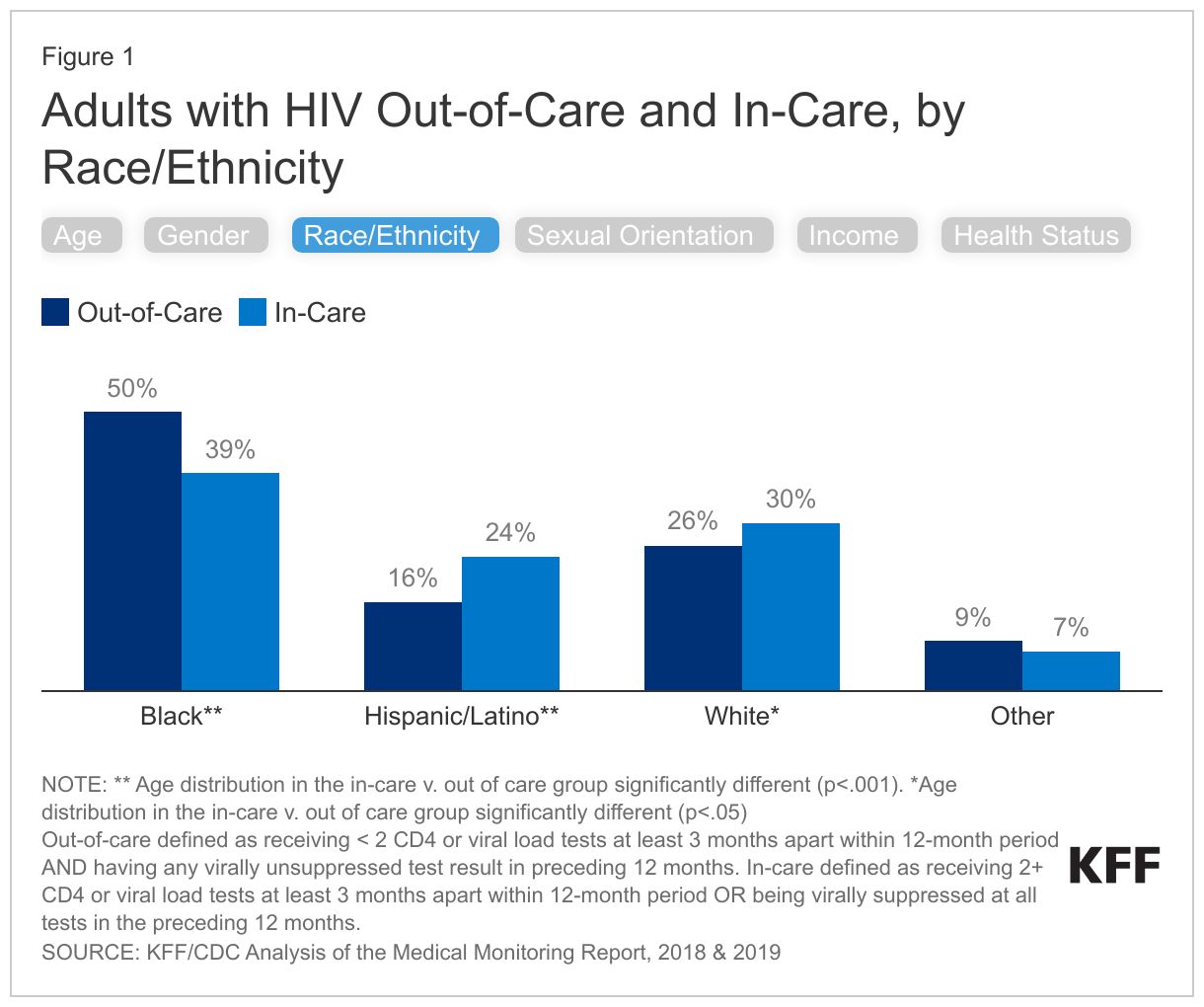
People with HIV who were out-of-care differed demographically from those in-care. They were more likely to be Black, younger, and to report poorer self-rated physical health, among other differences (see Figure 1).

  • People with HIV who were out-of-care were more likely to be Black (50% of those out of care v. 39% of those in care) and less likely to be Hispanic/Latino (16% v. 24%) or White (26% v. 30%) than those in-care.
  • They were also younger than their in-care counterparts, with greater shares between the ages of 18-29 (12% v. 8%) and 30-39 (20% v. 16%). This finding echoes other data demonstrating lower levels of care engagement among younger people in across certain measures.
  • In addition, they were more likely to report “fair or poor” health (35% v. 27%) and less likely to report “excellent or very good” health (28% v. 37%) than those in-care.
  • Finally, compared to those in-care, they were somewhat less likely to identify as gay or lesbian (37% v. 42%), have incomes above 400% FPL (9% v. 12%), or be male (72% v. 75%), but there were no other differences in other sexual orientation, poverty, or gender categories.
  • There were no statistically significant differences based on state Medicaid expansion status or census region.
Adults with HIV Out-of-Care and In-Care, by Race/Ethnicity 

Health Coverage and Ryan White Support

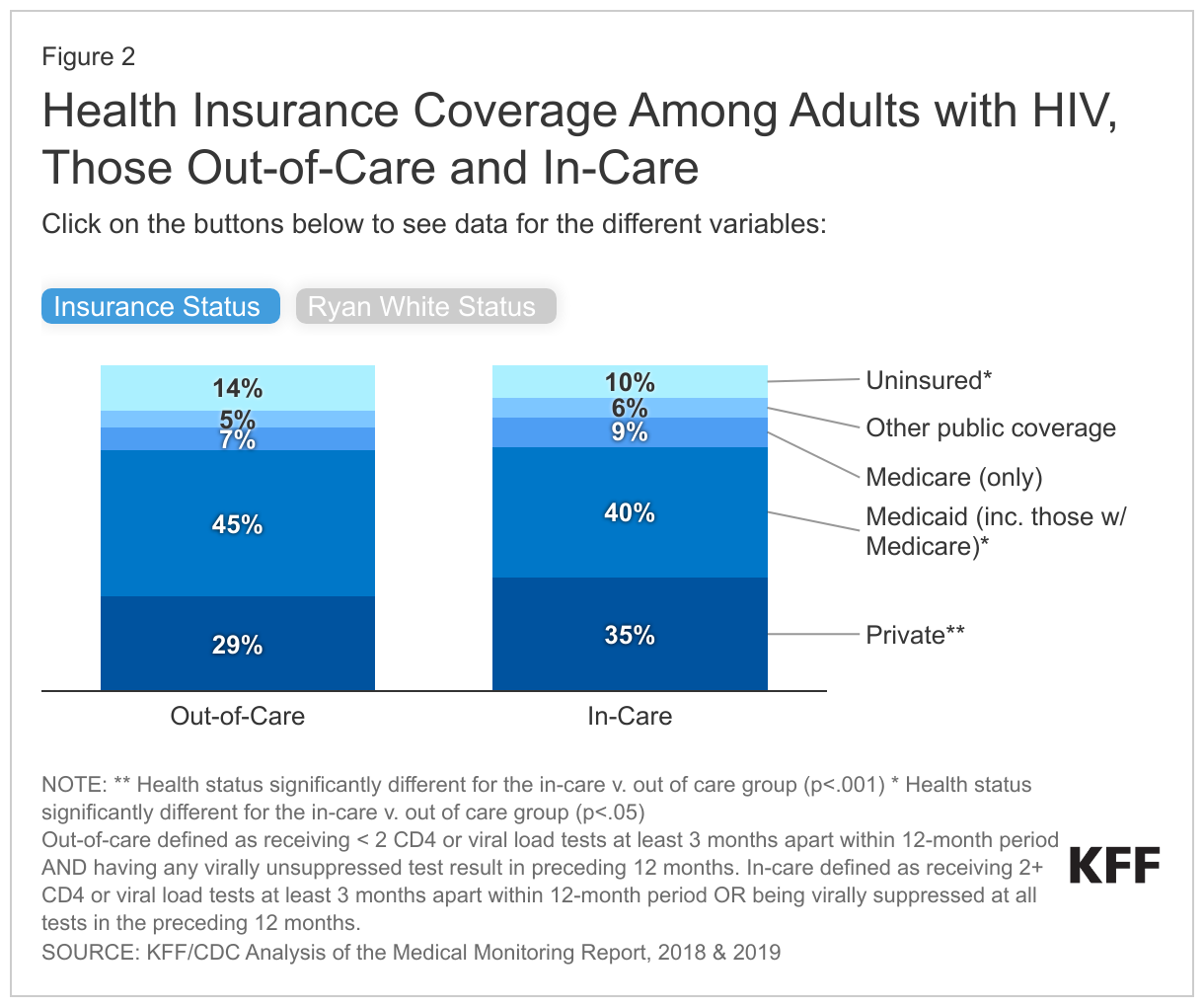
People with HIV who were out-of-care were more likely to be uninsured and less likely to have private insurance than those in-care, but also less likely to receive Ryan White support (see Figure 2).

  • People with HIV who were out-of-care were more likely to be uninsured (14% v. 10%) or have Medicaid (45% v. 40%) than those in-care, and less likely to have private coverage (29% v. 35%).
  • While both groups were similarly likely to report changes to their insurance coverage over the past 12-month period (14% v. 13%), those out-of-care were twice as likely to say this led to a change in their usual source of HIV care (40% v. 19%).
  • Finally, compared to their in-care counterparts, those who were out-of-care had significantly lower levels of support from the Ryan White HIV/AIDS Program (39% v. 50%), the nation’s HIV safety-net program that provides outpatient HIV care, treatment, and support services to people with HIV who were underinsured and uninsured.
Health Insurance Coverage Among Adults with HIV, Those Out-of-Care and In-Care

Accessing care

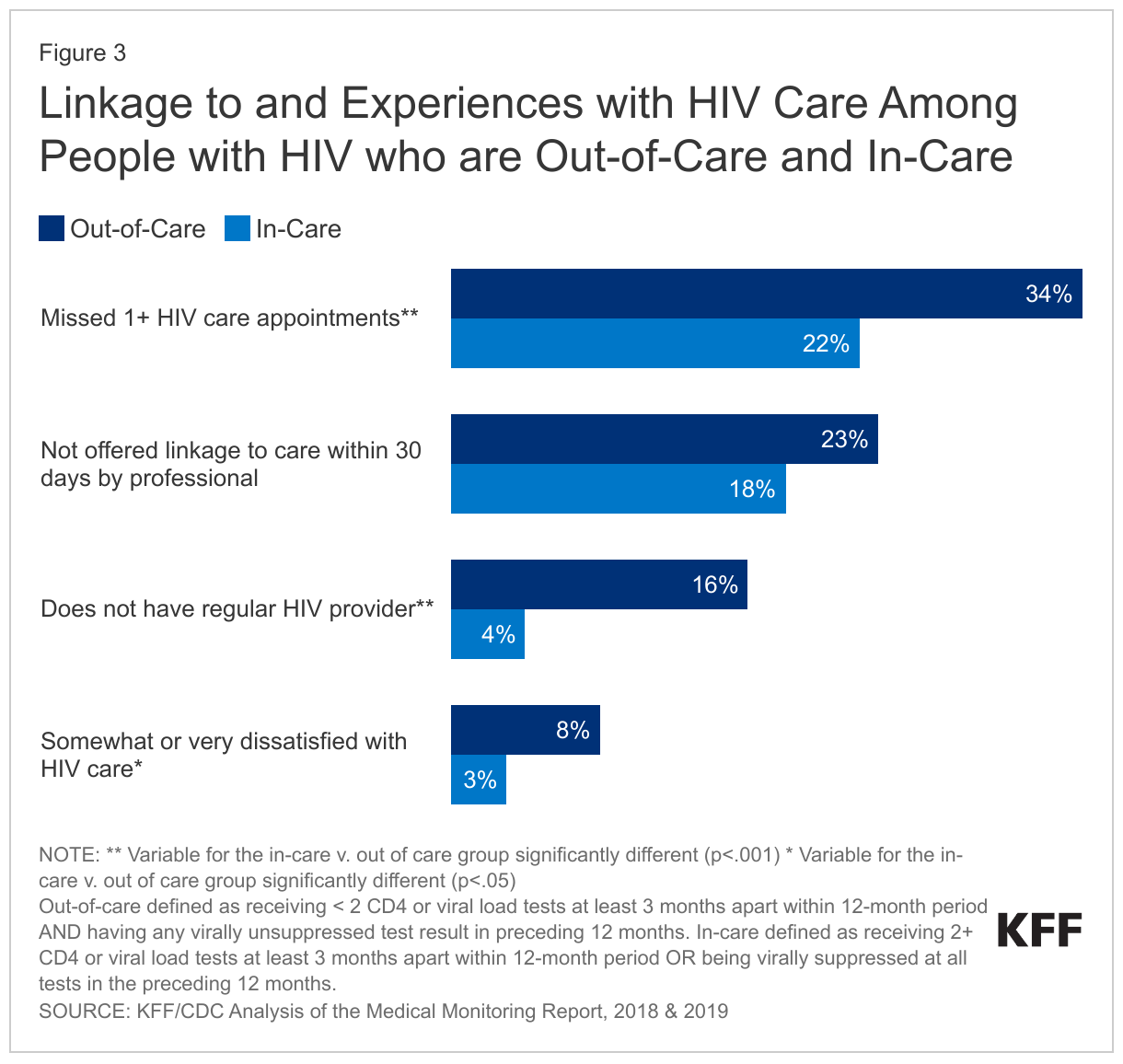
People with HIV who were out-of-care care were less likely to have a regular provider,  more likely to be dissatisfied with recent care that they had received, and more likely to have missed appointments, than those in-care.

  • While similar shares reported they were not offered assistance in finding HIV care within 30 days of diagnosis by a professional (23% v. 18%), those who were out-of-care were about four times as likely to report not having a regular HIV provider (16% v. 4%).
  • In addition, about one-third (34%) of those out-of-care reported missing one or more HIV care appointments in the 12 months prior to the interview compared to one-in-five of those in care (22%).
  • They were also more likely to report being “very or somewhat” dissatisfied with the HIV care they received over the preceding 12 months (8% v. 3%).
Linkage to and Experiences with HIV Care Among People with HIV who are Out-of-Care and In-Care

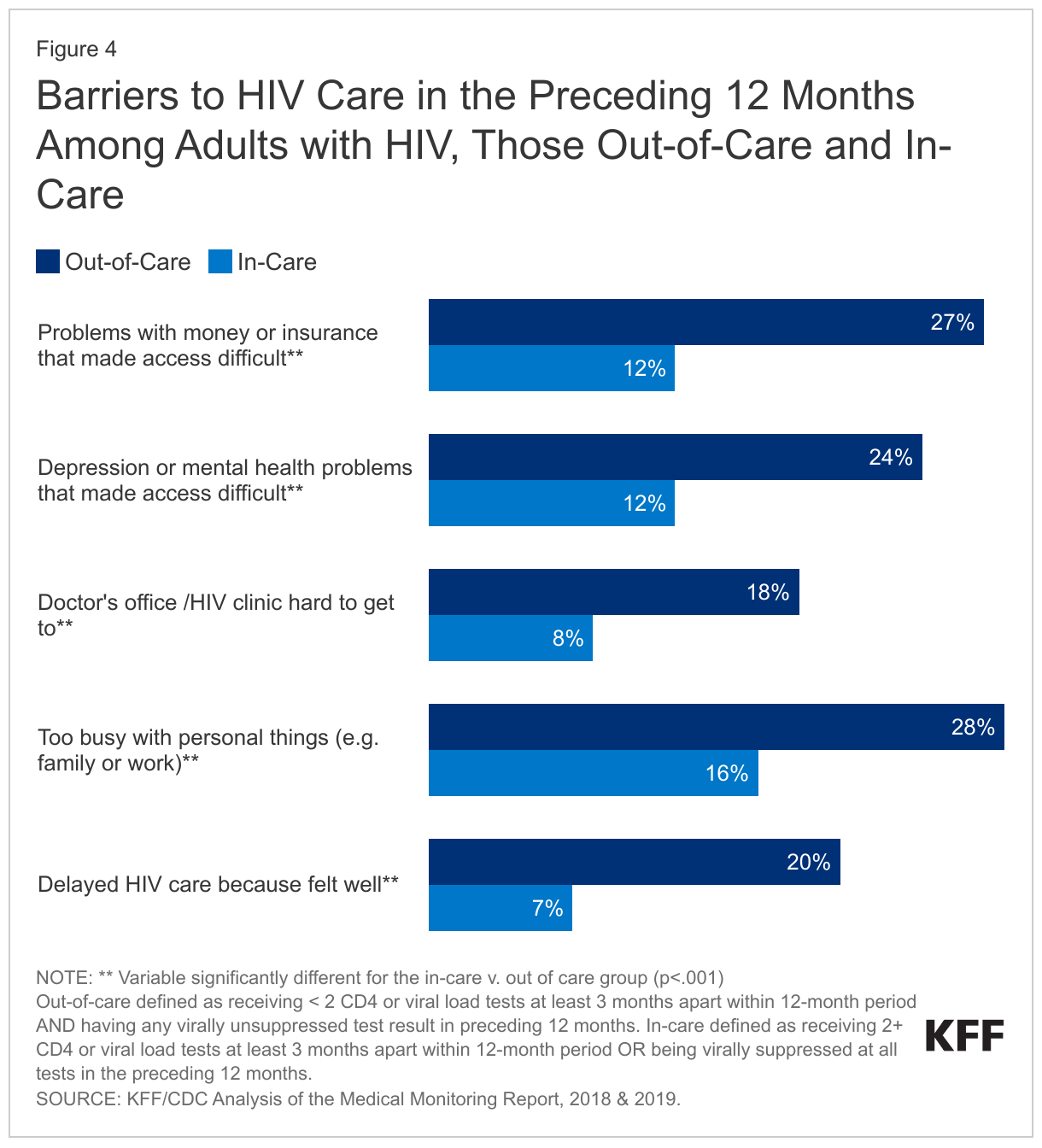
People with HIV who were out-of-care were also more likely to report certain barriers to care engagement, including in the areas of finances, mental health, and getting to a doctor’s office than those in-care.

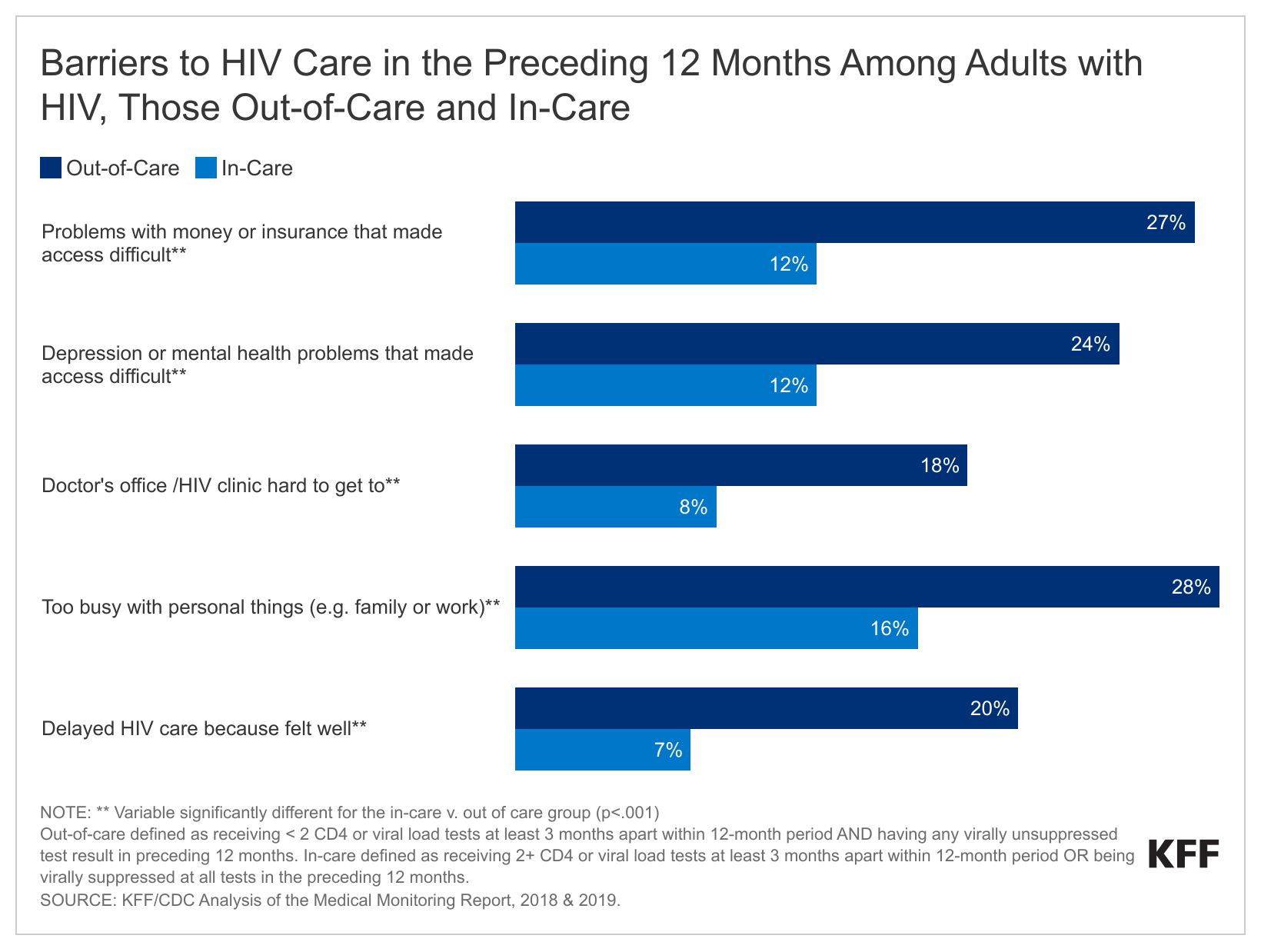
  • Over one-quarter of those reported that problems with money or insurance were barriers to HIV care, compared to just over one-in-ten of those in-care (27% v. 12%). Those out-of-care were also more likely to report facing problems paying medical bills (data not shown).
  • In addition, they were twice as likely to report that depression or other mental health problems made it difficult to get HIV care (24% v. 12%), and were more likely to say that personal issues, such as family or work, were barriers to care (28% v 16%).
  • About one-in-five (18%) reported that difficulty getting to a doctor’s office was a barrier to HIV care, more than double the share of those in care (8%).
  • While those out-of-care generally reported more barriers to access, they were also more likely to say they delayed care because they felt well, compared to their in-care counterparts (20% v. 7%).
Barriers to HIV Care in the Preceding 12 Months Among Adults with HIV, Those Out-of-Care and In-Care

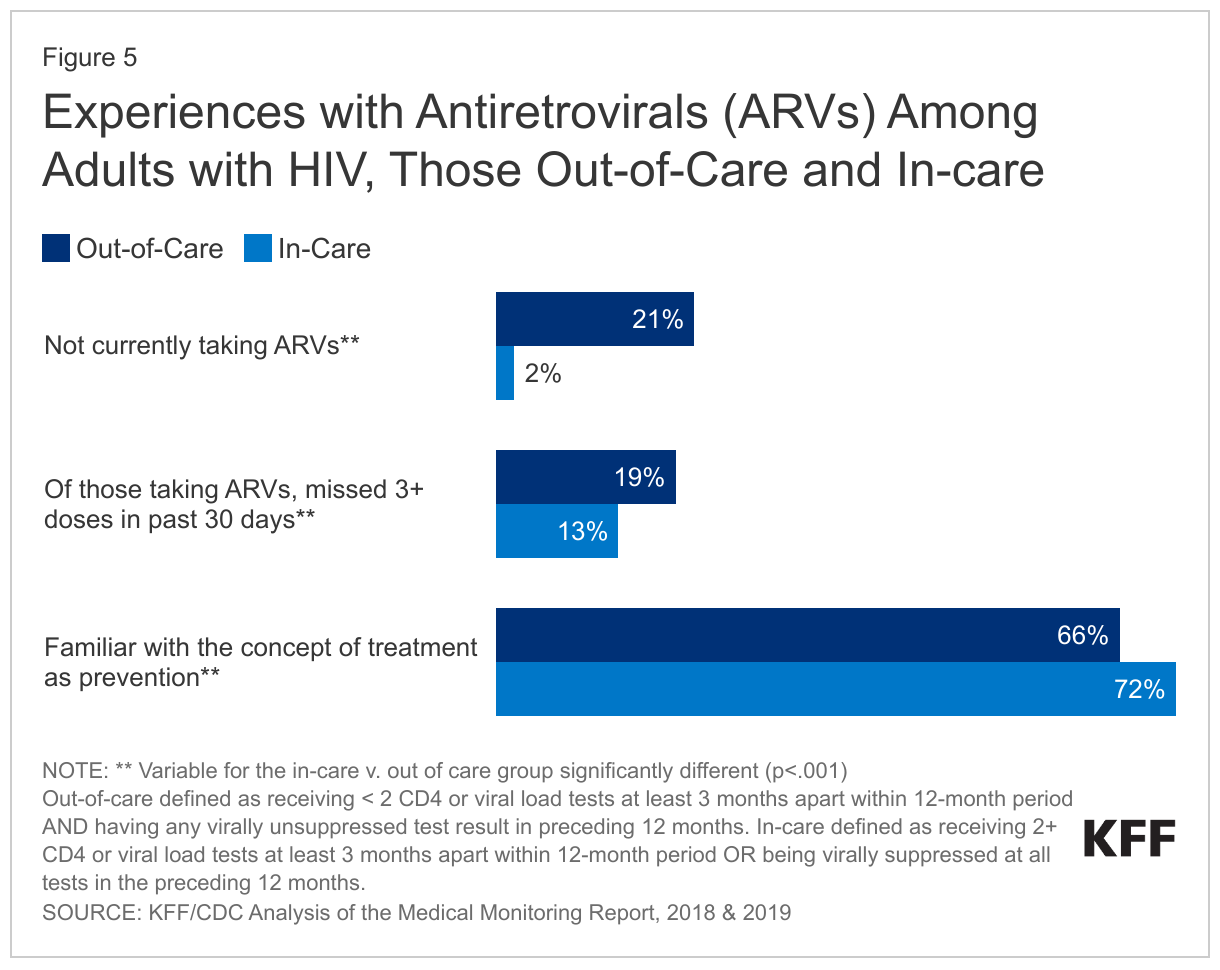
People with HIV who were out-of-care were less likely to report being on antiretroviral therapy, despite the recommendation that such treatment be started as soon as possible after diagnosis, and were more likely to report missing ARV treatment doses.

  • One-in-five (21%) of those out-of-care reported they were not currently taking ARVs compared to just 2% of those in-care.
  • In addition, of those who did report taking ARVs, 19% reported missing three or more doses in the past 30 days, compared to 13% of those in-care.
  • While 66% of those who were out-of-care were familiar with the concept of treatment as prevention (i.e. that when someone is virally suppressed due to consistent ARV use, they cannot transmit HIV), one-third were not. In contrast, nearly three-quarters (72%) of those in-care were familiar with the concept.
Experiences with Antiretrovirals (ARVs) Among Adults with HIV, Those Out-of-Care and In-care 

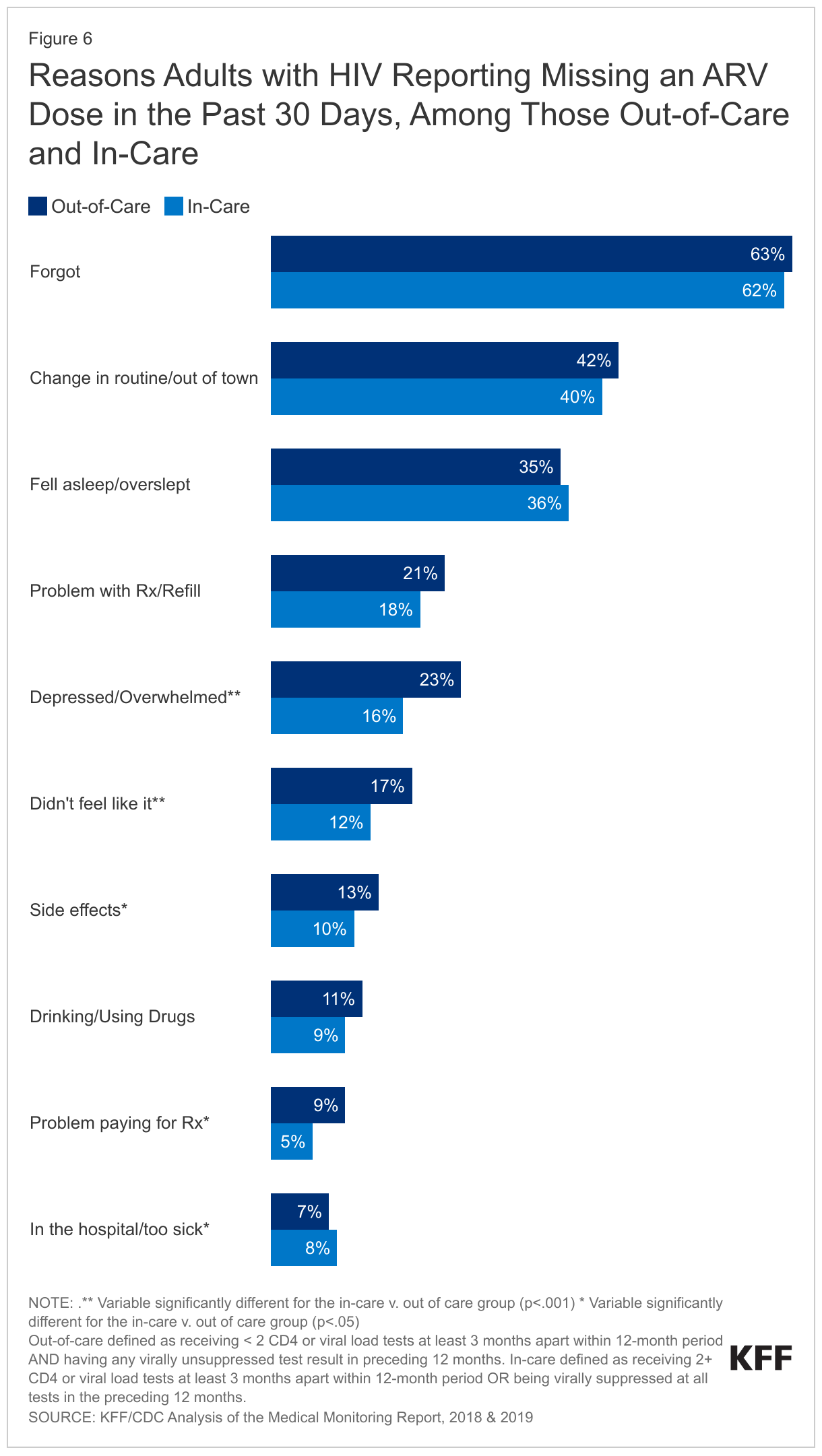
Reasons for missing ARV doses were generally similar between those in and out of care, although there were some exceptions, particularly with respect to mental health challenges.

  • For those who were out-of-care, the most common reported reason for missing an ARV dose was forgetting it (63%), followed by a change in daily routine or being out of town (42%), and being asleep (35%). Additionally, about one-in-five reported they had a problem getting a prescription or a refill (21%). Others reported that use of alcohol or drugs (11%) or being too sick or in the hospital (7%) got in the way of taking ARVs. In each case, these were similar to reports from those in-care.
  • However, those who were out-of-care were more likely to report the following reasons for not taking ARVs than those in-care: feeling depressed or overwhelmed (23% v. 16%), not feeling like taking the medications (17% v. 12%), , experiencing side effects (13% v. 10%), and having problems paying for the medication (9% v. 5%).
Reasons Adults with HIV Reporting Missing an ARV Dose in the Past 30 Days, Among Those Out-of-Care and In-Care

Unmet needs for HIV ancillary services

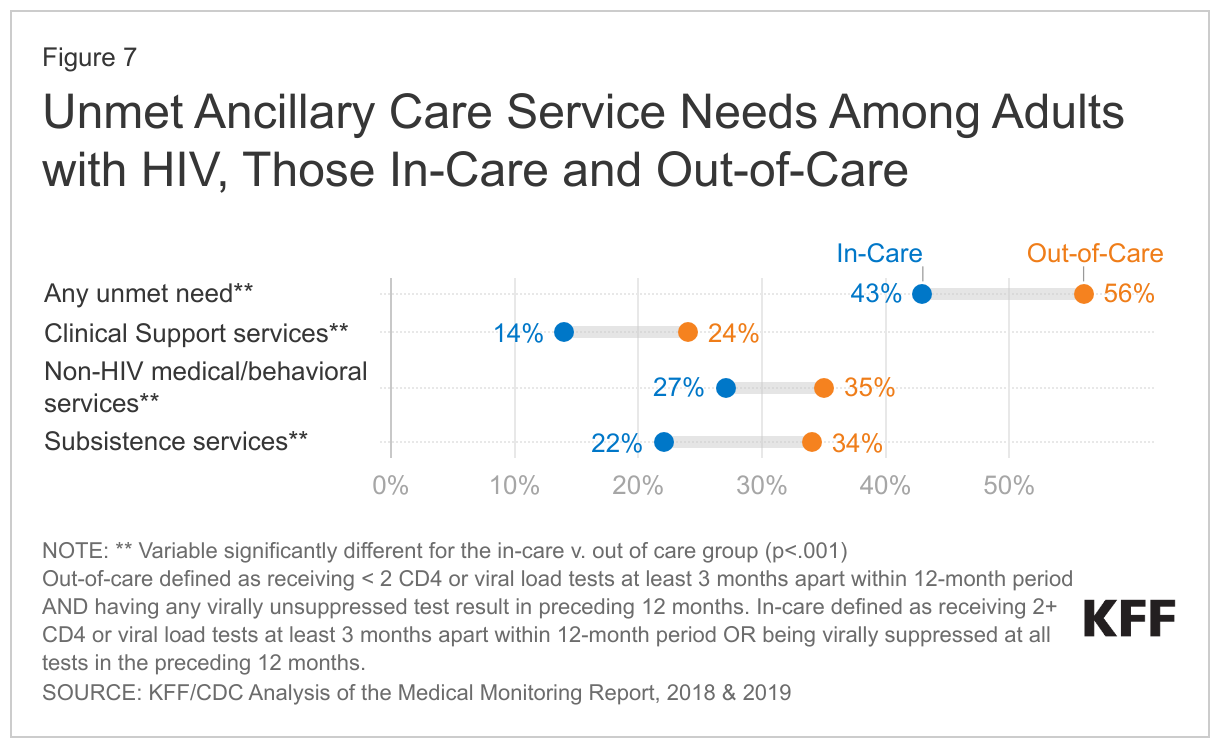
More than half (56%) of people with HIV who were out-of- care had at least one unmet ancillary care need, across three domains, compared to 43% of the in-care population. Unmet need was higher overall as well as in each domain:

  • Clinical support services, including case management, adherence counseling, medication through ADAP, peer group, patient navigation services (24% v. 14%)
  • Non-HIV medical/behavioral services, including dental care, mental health services, drug/alcohol counseling/treatment, and domestic violence services (35% v. 27%)
  • Subsistence services, including SNAP, WIC, meal or food services, transportation assistance, or shelter/housing services (34% v. 22%).
Unmet Ancillary Care Service Needs Among Adults with HIV, Those In-Care and Out-of-Care
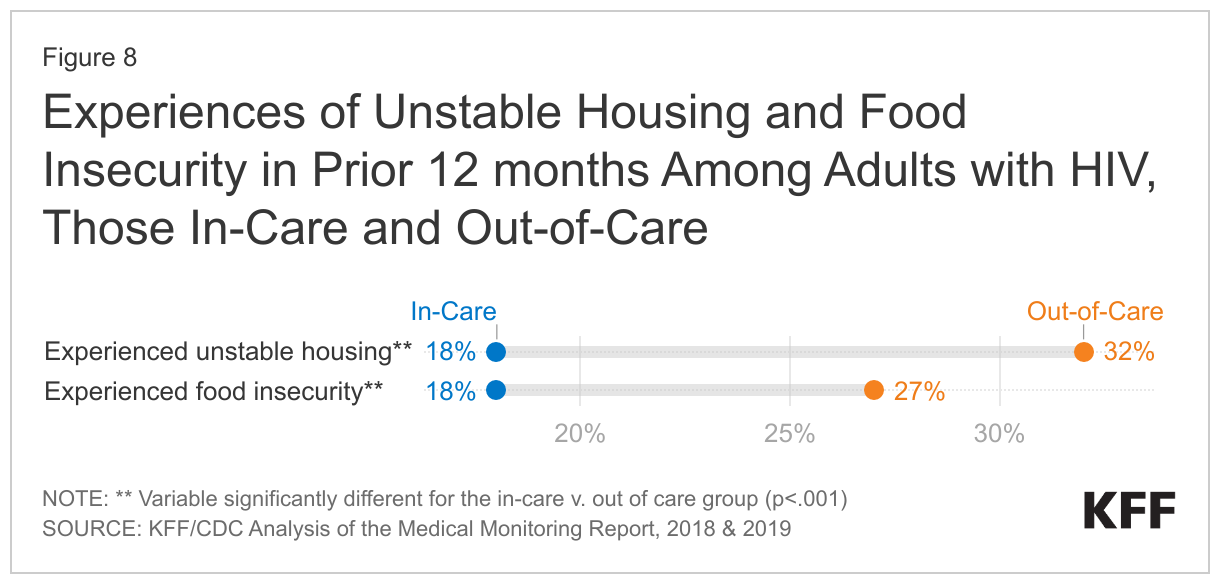
  • Specifically, people with HIV who were out-of-care had higher levels of unstable housing or homelessness (32% v. 18%) and hunger/food insecurity (27% v. 18%) over the preceding 12 months.3 
Experiences of Unstable Housing and Food Insecurity in Prior 12 months Among Adults with HIV, Those In-Care and Out-of-Care

Discussion

Identifying people with HIV who are not in HIV care is a first step towards engaging or reengaging them and addressing their unmet needs. While relevant demographic details may help to better design programs for and reach these individuals, there has been limited data available on this population. This analysis provides nationally representative data on people with HIV who are out-of-care, defined as those who were not virally suppressed and did not receive a minimum number of laboratory tests within the prior year, to better understand their demographics and experiences.  We find that in the 2018 to 2020 period, this population was disproportionally younger, uninsured, lower income, and Black. They were also much less likely to be on antiretroviral therapy and many faced overlapping and intersectional structural barriers that can further challenge HIV care engagement and prioritization, including unmet needs for basic, subsistence services such as food, housing, and financial security. That fact that those who were out-of-care were also less likely to be receiving services from the Ryan White Program is notable because the program is a potential resource for reaching this very population with engagement and retention services and in addressing at least some unmet ancillary care needs, though the program is constrained by financial limitations. Additionally, there were substantial knowledge gaps with respect to treatment as prevention, information that may help encourage care engagement when individuals learn they are able to prevent transmission of HIV to sexual partners.

Unless large shares of people with HIV are engaged in care and treatment, it will not be possible to meet most of the goals in the national HIV/AIDS Strategy and the Ending the HIV initiative (e.g. preventing new infections, reducing disparities, etc.). Progress on these efforts has been somewhat stalled in the U.S., which lags behind peer countries in terms of the national viral suppression level. Reaching and engaging people with HIV who are not engaged in care and not yet virally suppressed, will involve addressing the complex, systemic barriers they face, and which have impeded not only their health and wellbeing but the HIV response in the U.S. more broadly.

Methodology

Data on people with HIV are based on 2018 and 2019 data cycles (which cover data through part of 2020) from the Medical Monitoring Project (MMP), a Centers for Disease Control and Prevention (CDC) surveillance system which produces national and state-level representative estimates of behavioral and clinical characteristics of adults with diagnosed HIV in the United States.

MMP employs a two-stage, complex sampling design. First, jurisdictions are selected from all U.S. states, the District of Columbia, and Puerto Rico using a probability proportional to size sampling strategy based on AIDS prevalence at the end of 2002, such that areas with higher prevalence had a higher probability of selection. Next, adults (aged 18 years and older) with diagnosed HIV were sampled from selected jurisdictions from the National HIV Surveillance System (NHSS), a census of U.S. persons with diagnosed HIV. During the 2018 and 2019 MMP data cycles, data came from: California (including the separately funded jurisdictions of Los Angeles County and San Francisco), Delaware, Florida, Georgia, Illinois (including the separately funded jurisdiction of Chicago), Indiana, Michigan, Mississippi, New Jersey, New York (including the separately funded jurisdiction of New York City), North Carolina, Oregon, Pennsylvania (including the separately funded jurisdiction of Philadelphia), Puerto Rico, Texas (including the separately funded jurisdiction of Houston), Virginia, and Washington.

Data used in this analysis were collected via telephone or face-to-face interviews and medical record abstractions during the following periods:

  • 2018 data was collected between June 1, 2018–May 31, 2019
  • 2019 data was collected between June 1, 2019–May 31, 2020

The response rate was 100% at the first stage, and was 45% for each of the 2 cycles included in this analysis. Data were weighted based on known probabilities of selection at state or territory and patient levels. In addition, data were weighted to adjust for non-response using predictors of person-level response, and post-stratified to NHSS population totals by age, race/ethnicity, and sex at birth. This analysis includes information on 7,642 adults with HIV.

Of the 7,642 adults sampled, 1,215 were identified as being out-of-care (having fewer than two CD4 or viral load tests at least 3 months apart within a 12-month period) and also being virally unsuppressed (having a viral load of equal to or more than 200 copies of HIV per milliliter of blood).

Because respondents in MMP may indicate more than one type of coverage, we relied on a hierarchy to group people into mutually exclusive coverage categories as follows:

  • Private coverage overall (with breakouts for employer coverage and marketplace coverage)
  • Medicaid coverage, including those dually eligible for Medicare
  • Medicare coverage only
  • Other public coverage, including Tricare/CHAMPUS, Veteran’s Administration, or city/county coverage
  • Uninsured

Differences between groups were assessed using prevalence ratios with predicted marginal means.

It is important to note that insurance coverage data were self-reported by respondents and not verified, as was receipt of Ryan White support. In addition, by relying on a hierarchy to group individuals into coverage categories, it is possible individuals were grouped into a coverage category that was not their dominant payer over the course of a year.

Acknowledgments

The authors wish to thank Dr. Sharoda Dasgupta, Stacy Crim, Tamara Carree, and Dr. Linda Beer of the Centers for Disease Control and Prevention (CDC), who were instrumental in this work in providing access to data, guidance, and conducting statistical analysis.

  1. A CD4 test is a laboratory test that measures the number of CD4 cells (also known as T cells) in a blood sample. CD4 count is a key laboratory indicator of immune function and indicates HIV stage progression as well as response to HIV treatment. ↩︎
  2. For example, see: Centers for Disease Control and Prevention. Monitoring selected national HIV prevention and care objectives by using HIV surveillance data—United States and 6 dependent areas, 2020. HIV Surveillance Supplemental Report 2022;27(No. 3). https://www.cdc.gov/hiv/library/reports/hiv-surveillance/vol-27-no-3/index.html ↩︎
  3. People were considered to have experienced unstable housing if they reported any of the following during the preceding 12 months: moving in with others due to financial issues, moving 2 or more times, or being evicted. People were considered to have experienced homelessness if they experienced any of the following during the preceding 12 months: living on the street, in a shelter, in a single-room–occupancy hotel, or in a car. People were considered to be food insecure if they reported being hungry and not eating because they did not have enough money for food during the past 12 months  Centers for Disease Control and Prevention. Data Tables: Quality of Life and HIV Stigma— Indicators for the National HIV/AIDS Strategy, 2022–2025, CDC Medical Monitoring Project, 2017–2020 Cycles. HIV Surveillance Special Report 30. Published September 2022. https://www.cdc.gov/hiv/pdf/library/reports/surveillance/cdc-hiv-surveillance-special-report-number-30.pdf. ↩︎

A Year After Dobbs: Policies Restricting Access to Abortion in States Even Where It’s Not Banned

Authors: Mabel Felix and Laurie Sobel
Published: Jun 22, 2023

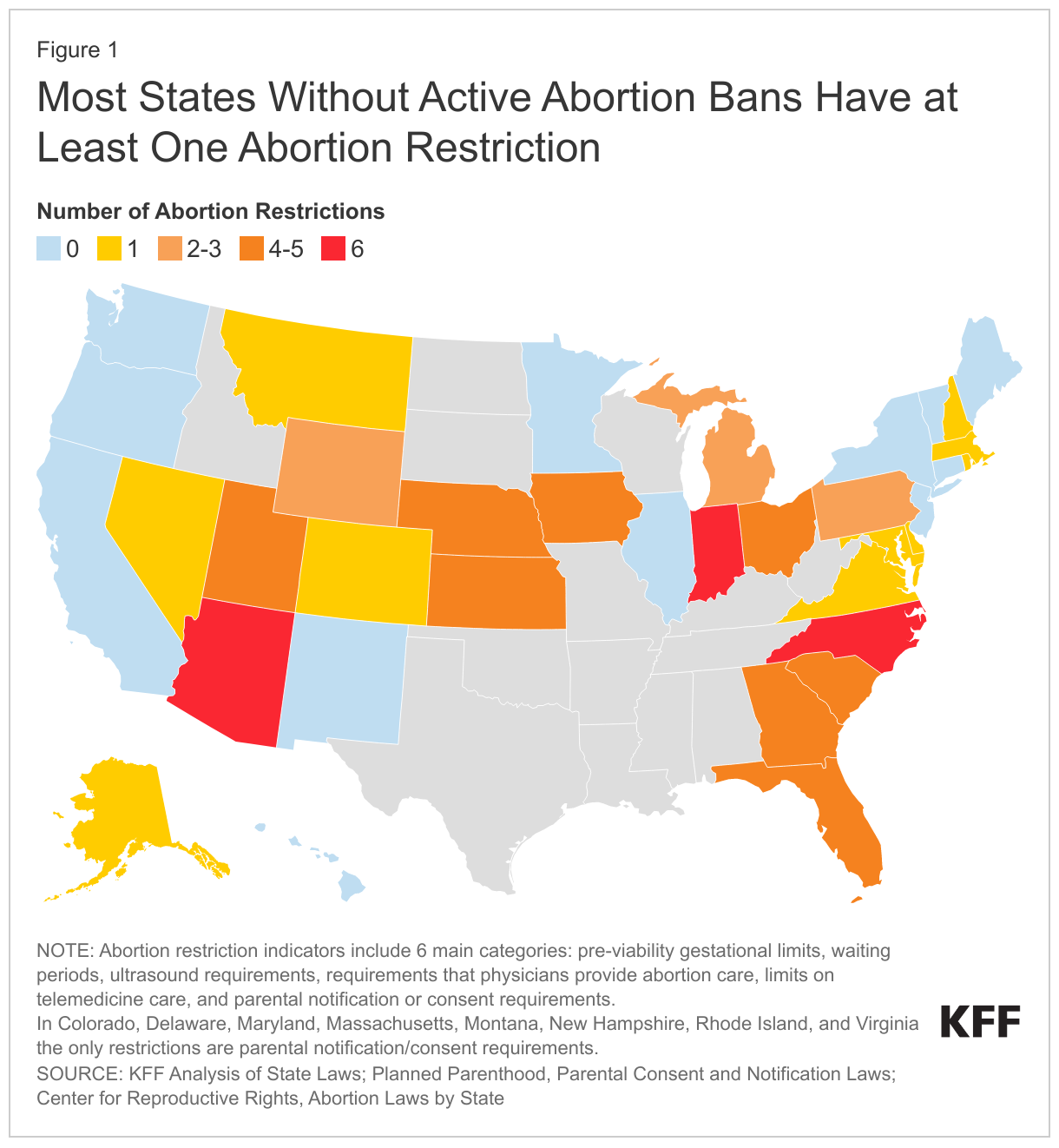
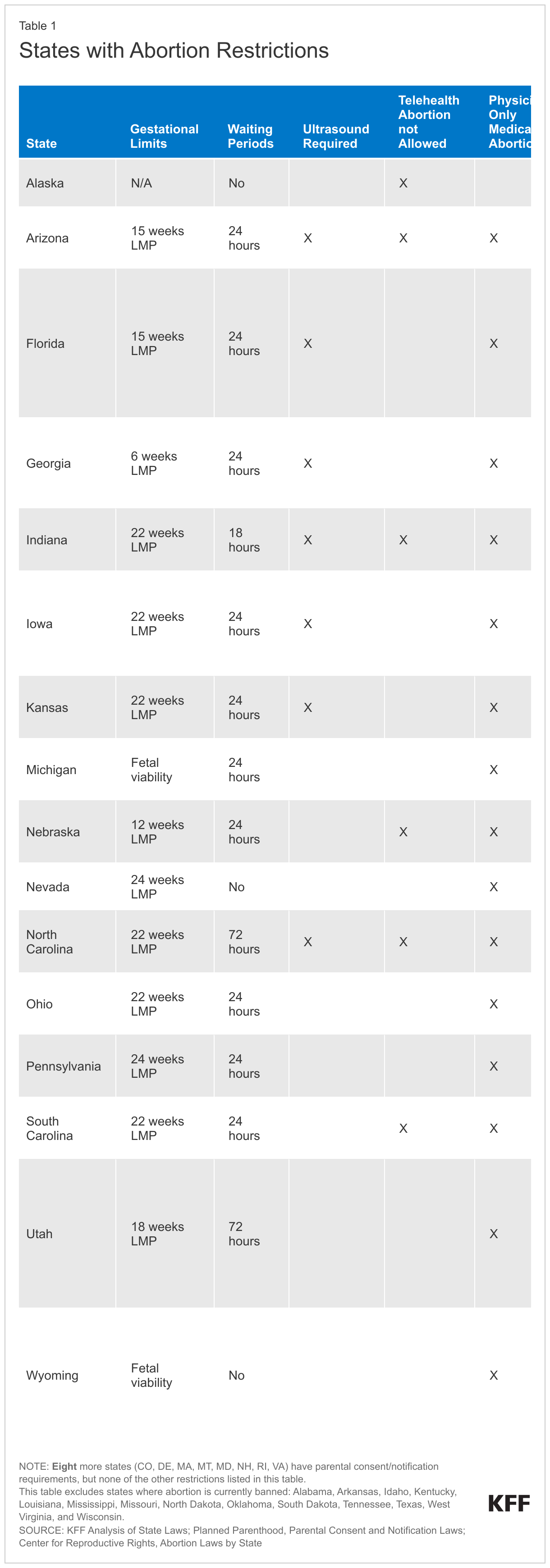
Almost one year after the Supreme Court overturned Roe v. Wade and Planned Parenthood v. Casey, abortion laws and access to abortion are uneven across the country. With both Casey and Roe no longer the legal standard, many states have banned abortion. However, the legality of abortion in a state does not tell the whole story. Many states without bans still have abortion regulations that create significant barriers to access. State abortion regulations such as gestational limits early in pregnancy, mandatory waiting periods and ultrasounds, bans on telehealth for abortion care, parental consent requirement for minors, and restricting the pool of providers to licensed physicians serve to limit access to abortions in states that have not instituted outright bans.

Most States Without Active Abortion Bans Have at Least One Abortion Restriction

Gestational Limits

Five states have gestational limits early in pregnancy. In Georgia, abortion is banned after 6 weeks from the last menstrual period (LMP), before most people know they are pregnant. A 12-week LMP ban recently passed and went into effect in Nebraska, and North Carolina has a 12-week ban slated to go in effect on July 1st, 2023. Florida and Arizona ban abortion after 15 weeks LMP. Florida’s Governor has also signed a 6 -week LMP ban which may go in effect after the Florida Supreme Court rules on whether the 15-week ban is permissible under the state constitution. Although most abortions happen before 10 weeks of pregnancy, states with gestational limits earlier in pregnancy also have other restrictions in place that constrain access to abortion by delaying it. For instance, in states where telemedicine for abortion is banned and there are waiting periods in place, a pregnant patient may no longer meet the gestational limit by the time they are able to get an appointment to get their abortion.

Seven more states have gestational limits later in pregnancy, but before viability, a point that varies from person to person and also by the medical resources that are offered in their community, but is generally estimated to be at around 24 weeks LMP. States with these gestational limits are Utah, which bans abortions after 18 weeks LMP and Indiana, Iowa, Kansas, North Carolina, Ohio, and South Carolina, which currently ban abortion after 22 weeks LMP.

Waiting Periods and Ultrasound Requirements

Seven states – Arizona, Florida, Georgia, Indiana, Iowa, Kansas, and North Carolina, all of which have pre-viability gestational limits – also require clinicians to perform ultrasounds before providing abortion care. These laws often require that the ultrasound be performed by the same clinician that will be providing the abortion care, even though there is no medical rationale for this requirement. Thirteen states have mandatory waiting periods between the initial required counseling session (at which an ultrasound may also be required) and the appointment where the pregnancy will be terminated. These waiting periods range from 24 to 72 hours in duration. All states that have ultrasound requirements also have mandatory waiting periods. In conjunction, these requirements often result in the pregnant person having to attend two separate in-person appointments with their abortion provider. In states with early gestational limits, such as Florida, which currently bans abortions after 15 weeks LMP, these requirements may push abortion care out of reach for pregnant people.

Medication Abortion Restrictions

Restrictions on Telehealth for AbortionNine states that do not ban abortions generally have laws that effectively outlaw telehealth for medication abortion. Several states have laws that explicitly ban telehealth for abortion. Others have restrictions requiring medication abortions to take place in clinics or for the prescribing clinician to be present when the pregnant person takes the first medication in the regimen, despite the elimination of the FDA in-person requirement for medication abortion. States that require an ultrasound effectively block telehealth for abortion, since the pregnant patient must have at least one in-person visit to get the ultrasound. Regardless of the mechanisms these laws employ, their results are the same: they prevent people from accessing abortion care via telehealth. This can be especially burdensome for people who live in rural areas far from an abortion clinic, people who need to arrange child care and/or need to take time off from work for appointments, and people traveling to other states to receive abortion care.

Physician-Only RequirementsMany states only authorize physicians to provide abortion care, while others allow advanced practice clinicians (such as physician assistants and some nurses) to provide abortion care that is within their scope of practice. Laws requiring licensed physicians to provide abortion care restrict the number of providers available, despite research demonstrating that medication abortion (and aspiration abortions) are just as safe when provided by an advanced practice clinician. Currently, 15 states only authorize physicians to provide medication abortions, of these, 11 have pre-viability gestational bans. This restriction limits the credentialing of the providers that are permitted to offer abortion, and ultimately impacts access for people seeking abortions within the limited gestational period abortions are not banned.

Restrictions on Minors’ Ability to Access Abortion Care

In 15 states where abortion is not completely banned, minors must obtain the consent of their parents or legal guardian to receive abortion care. Six other states require that the parents or legal guardian of the minor be notified before the minor receives abortion care. Most states with these requirements contain provisions that allow a judge to waive the consent or notification requirement. In states with consent requirements, this leaves the determination of whether or not the minor can receive an abortion up to a judge. Judges use different criteria for judicial bypass of the consent requirement, often to the detriment of the minor. For instance, judges have prevented minors from receiving an abortion, deeming them not mature enough to make such a medical decision for themselves, despite their assertions that they do not wish to continue their pregnancies.

Even in cases where a minor is able to receive judicial bypass, the process is time-consuming and can result in delays in the timing of the abortion, even when the minor is ultimately permitted to obtain an abortion. Additionally, these restrictions have their own waiting periods, for example, requiring that notice or consent be given 24-48 hours prior to the minor receiving an abortion. Even when the minor’s parents or legal guardian grant consent, these waiting periods can delay care.

New State Law that May not Have Been Permitted Under Casey

Some states have turned to restrictions that ban certain types of abortions without directly banning abortion care. For instance, after having their abortion ban blocked in court, the Utah legislature passed a law that would have banned all abortions not provided in a hospital, effectively banning all clinic-based abortions. This ban was temporarily blocked by a state court in May 2023. Similarly, after having an abortion ban blocked in court, the Wyoming legislature passed a ban on medication abortion, which is slated to go in effect July 1st, 2023. And in Montana – where the state Supreme Court recognized in a 1999 opinion that their constitution protects the right to abortion – the legislature enacted a law banning D&E procedures (the most common abortion method after 15 weeks LMP). Enforcement of this ban has also been blocked by a state court.

Conclusion

The accessibility of abortion in any given state does not rest entirely on whether or not it is banned. In many states where abortion is not fully banned, state laws nevertheless restrict access to it. These restrictions typically sharply curtail access to abortion, and in states with several restrictions in place, they can push access to abortion effectively out of reach.

States with Abortion Restrictions

A National Survey of OBGYNs’ Experiences After Dobbs

Published: Jun 21, 2023

Key Findings

Introduction

One year ago, the Supreme Court’s decision in Dobbs v. Jackson Women’s Health Organization overturned Roe v. Wade and opened the door for states to ban or severely restrict the availability of abortion care. Today, people seeking abortion in large swaths of the country must travel to other states to get abortion services or obtain medication abortion through self-managed or other means. In many states, abortion is not banned, but laws impose gestational limits and other restrictions that limit access to abortion. This has left large parts of the U.S., particularly in the South and Southeast, without meaningful abortion access. In the states where abortion remains available under most circumstances, abortion providers have had to take on additional patients traveling to their states to get an abortion. Furthermore, the situation in many states remains uncertain, with new bans being implemented that are often followed by legal challenges creating a complicated landscape to navigate for patients and clinicians, particularly those who provide services to pregnant people.

To understand the impact of the changing abortion landscape on clinical care, KFF conducted a nationally representative survey of office-based OBGYNs practicing in the United States who spend the majority of their working hours (60% or more) in direct patient care and provide sexual and reproductive health care to at least 10% of patients. The survey was fielded from March 17 to May 18, 2023, and responses were received from 569 OBGYNs. This survey examines the provision of sexual and reproductive health care provided by OBGYNs before and after the Dobbs decision, comparing the experiences of OBGYNs practicing in states where abortion is fully banned, states with gestational restrictions, and states where abortion remains available under most circumstances. All differences highlighted in the text of this report are statistically significant.

Key Findings

Abortion Access and Constraints on Care Since Dobbs
  • Since the Dobbs decision, half of OBGYNs practicing in states where abortion is banned say they have had patients in their practice who were unable to obtain an abortion they sought. This is the case for one in four (24%) office-based OBGYNs nationally.
  • Nationally, one in five office-based OBGYNs (20%) report they have personally felt constraints on their ability to provide care for miscarriages and other pregnancy-related medical emergencies since the Dobbs decision. In states where abortion is banned, this share rises to four in ten OBGYNs (40%).
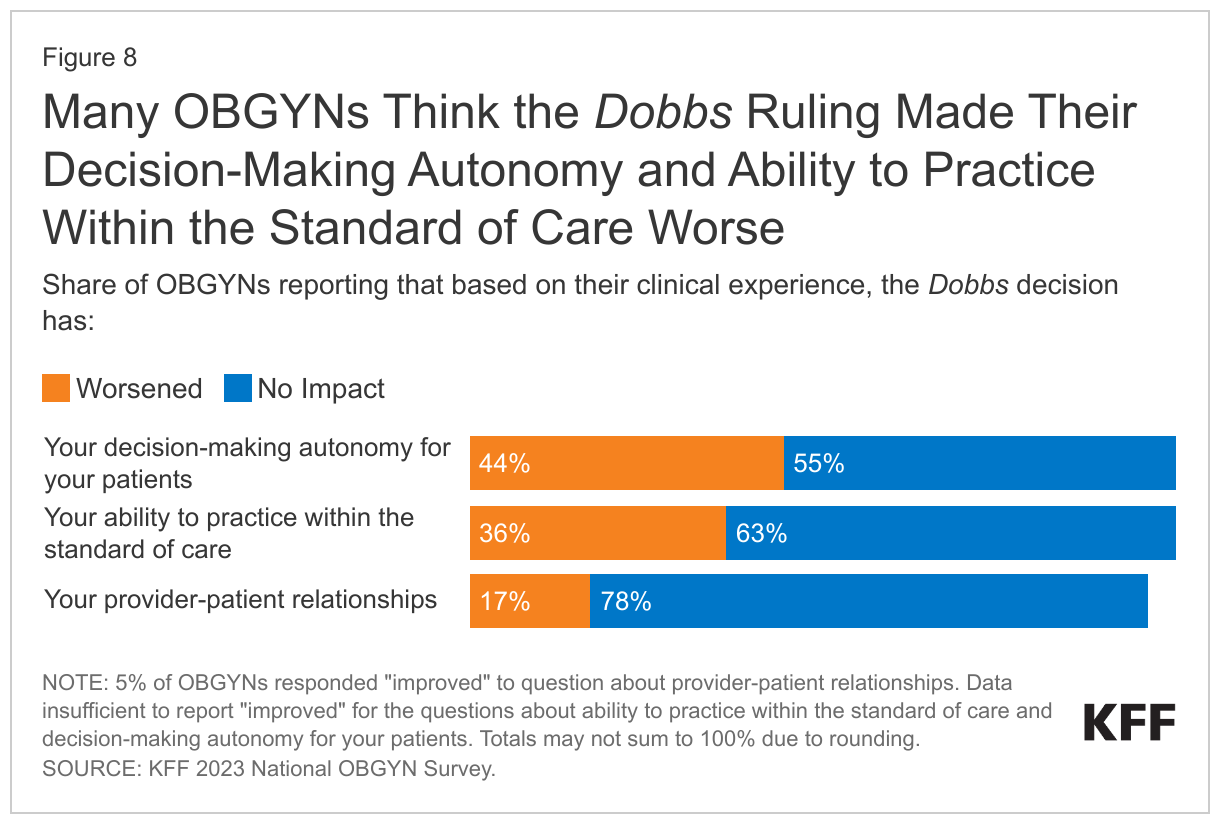
  • Four in ten OBGYNs nationally (44%), and six in ten practicing in states where abortion is banned or where there are gestational limits, say their decision-making autonomy has become worse since the Dobbs ruling. Over a third of OBGYNs nationally (36%), and half practicing in states where abortion is banned (55%) or where there are gestational limits (47%), say their ability to practice within the standard of care has become worse.
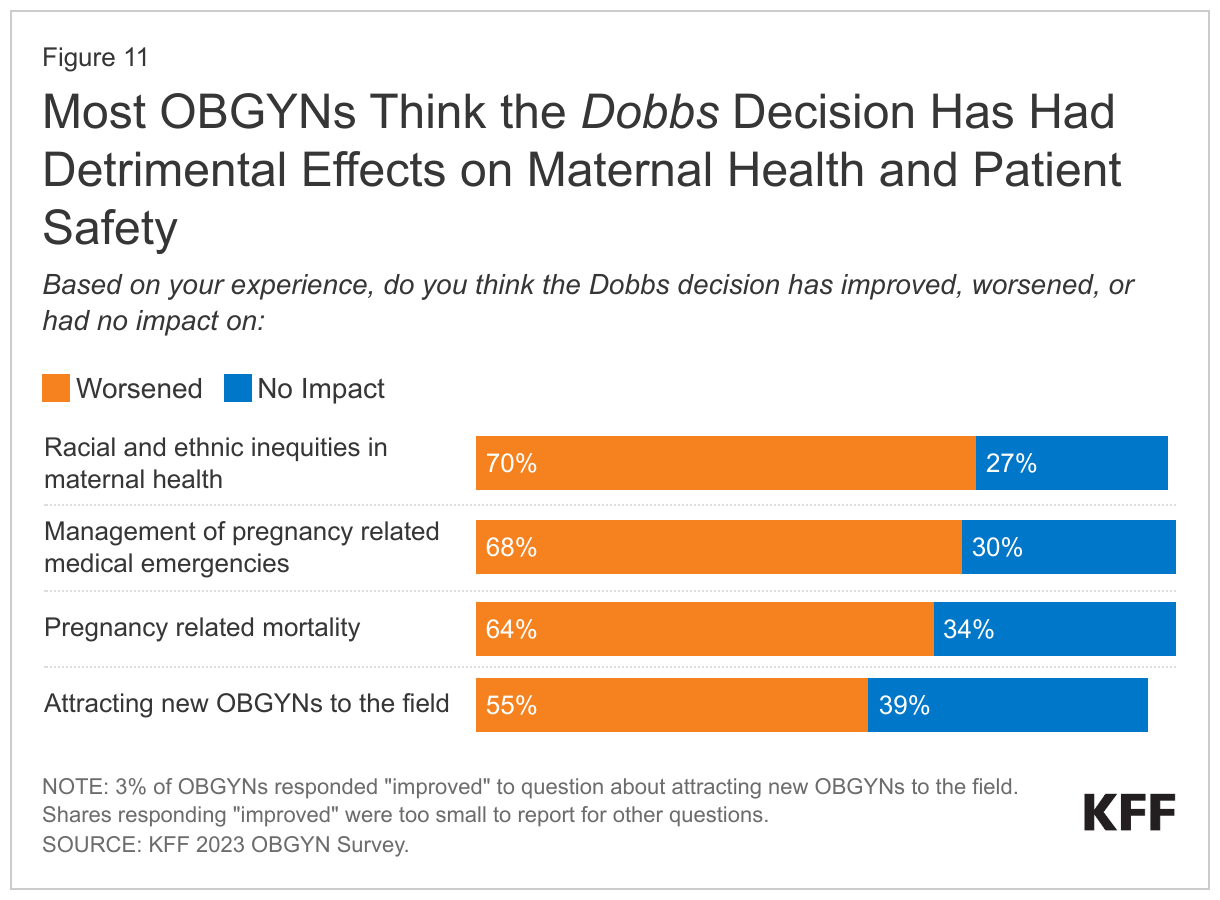
  • Most OBGYNs (68%) say the ruling has worsened their ability to manage pregnancy-related emergencies. Large shares also believe that the Dobbs decision has worsened pregnancy-related mortality (64%), racial and ethnic inequities in maternal health (70%) and the ability to attract new OBGYNs to the field (55%).
  • Two-thirds of OBGYNs nationally (68%) say they understand the circumstances under which abortion is legal in the state they practice very well. However, among OBGYNs in states where abortion is restricted by gestational limits the share is lower (45%) compared to those practicing in states where abortion is available under most circumstances (79%) or banned (68%).
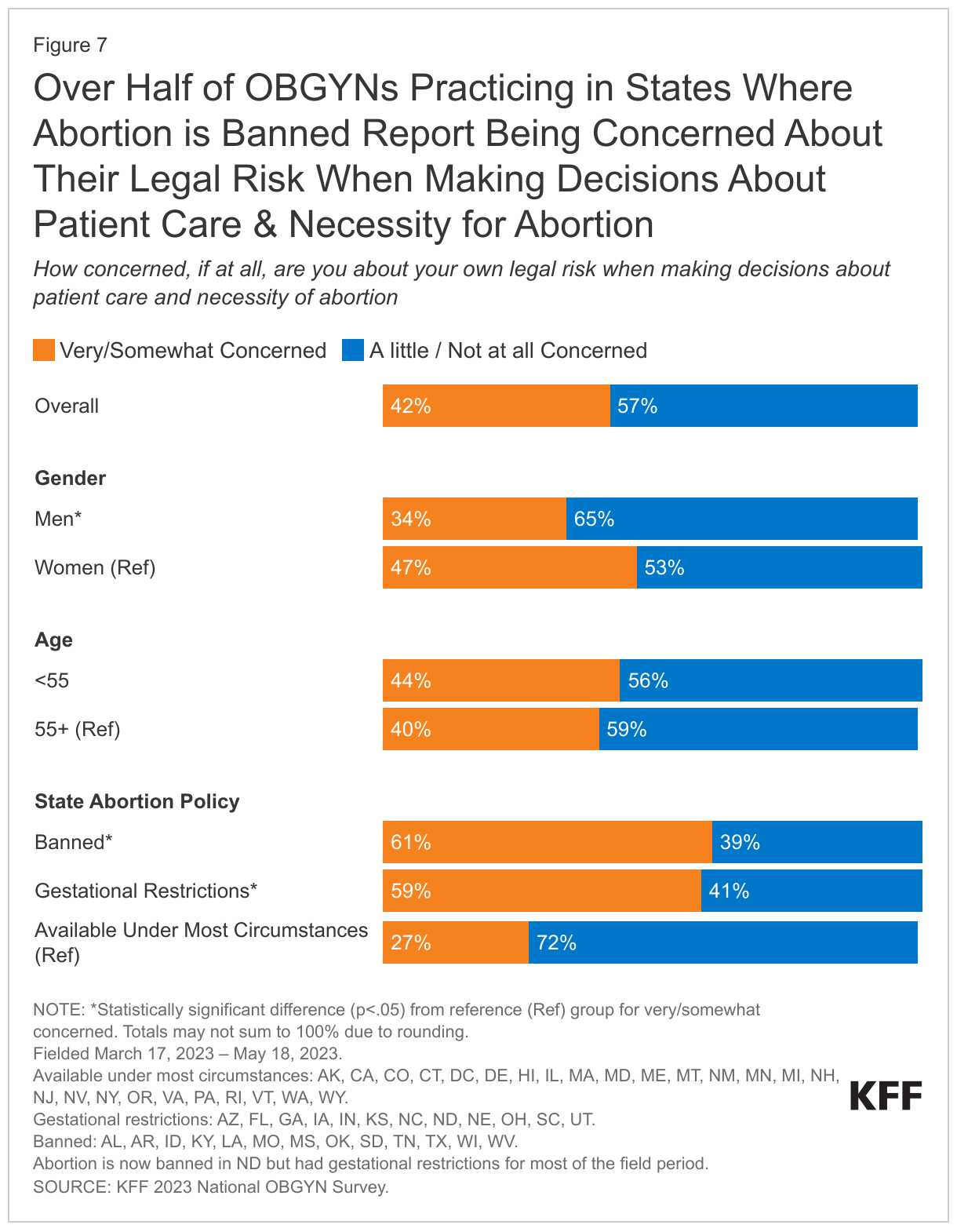
  • Over four in ten (42%) OBGYNs report that they are very or somewhat concerned about their own legal risk when making decisions about patient care and the necessity of abortion. This rises to more than half of OBGYNs practicing in states with gestational limits (59%) and abortion bans (61%).
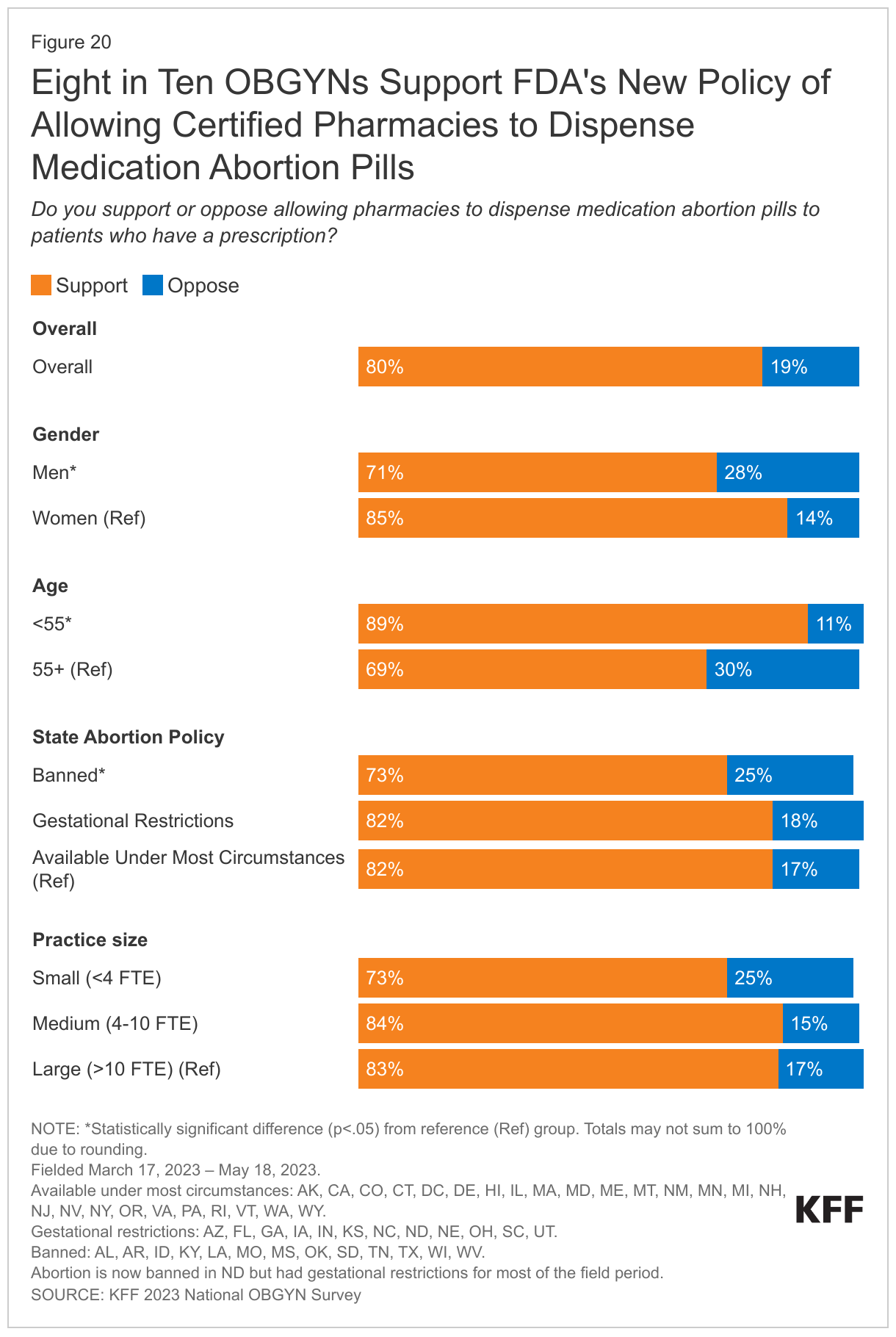
  • Eight in ten OBGYNs approve of a recent policy change from the FDA that allows certified pharmacies to dispense medication abortion pills.
Abortion Services
  • Nearly one in five (18%) officed-based OBGYNs nationally say that they are providing abortion services after the Dobbs About three in ten OBGYNs (29%) practicing in states where abortion is available under most circumstances offer abortion care, compared to just 10% in states with gestational restrictions. There were already large differences between states prior to the Supreme Court’s ruling. Many of the states that have abortion restrictions today had these or similar restrictions in place prior to the Dobbs decision.
  • Nationally, 14% of OBGYNs say they provide in-person medication abortions, but only 5% say they provide telehealth medication abortions.
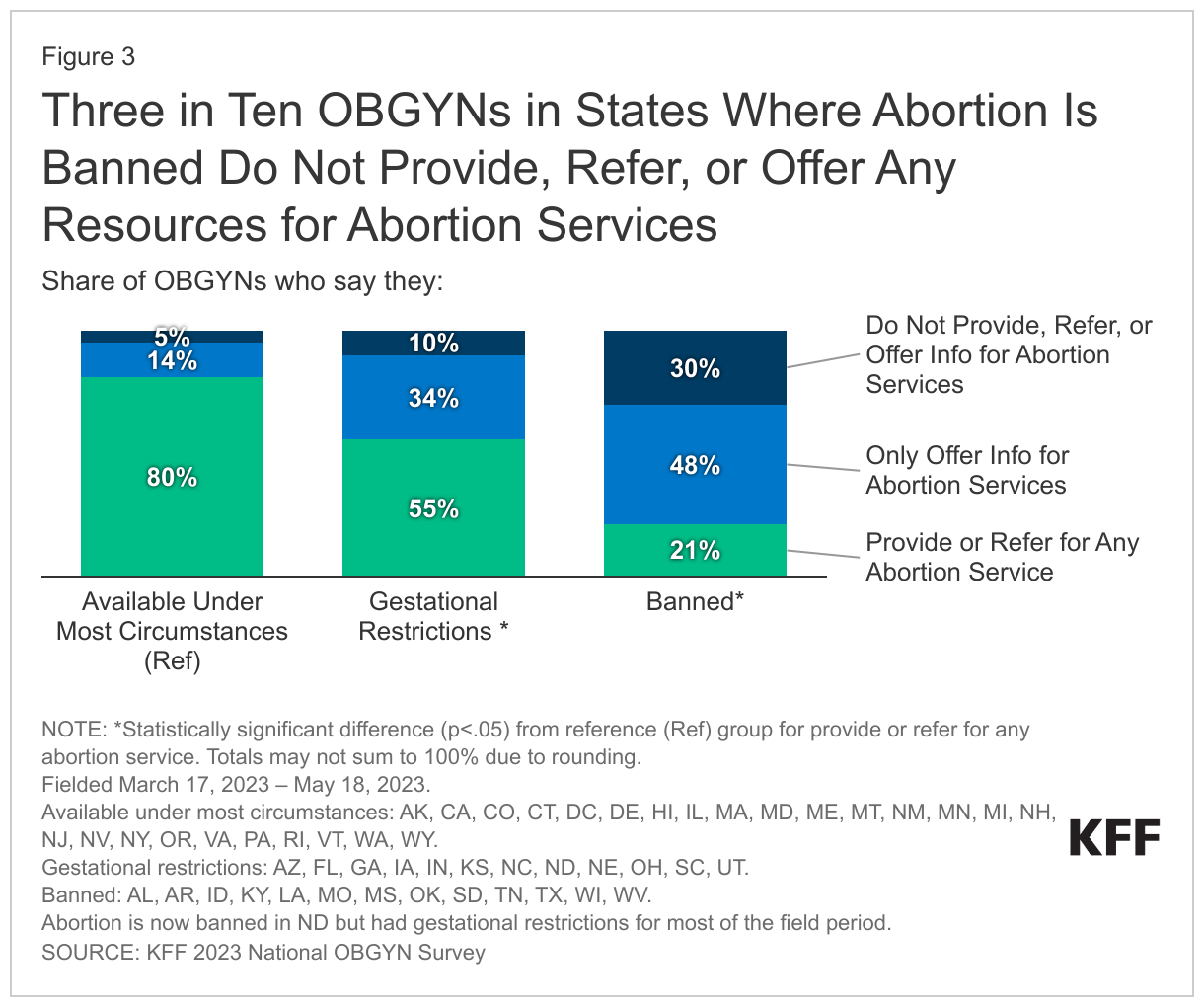
  • In states where abortion is banned, essentially no OBGYNs offer abortions, except under very limited circumstances. Additionally, nearly half (48%) of OBGYNs in these states only offer information, such as online resources, to help patients seek out abortion services on their own, but 30% do not even offer their patients referrals to another clinician or any information about abortion.
Contraception
  • More than half (55%) of OBGYNs nationally say they have seen an increase in the share of patients seeking some form of contraception since the Dobbs ruling, particularly sterilization (43%) and IUDs and implants (47%).
  • Nearly all OBGYNs offer their patients some form of contraceptive care, but only 29% make all methods of contraception available to their patients, including all three methods of emergency contraception (copper intrauterine device (IUD), ulipristal acetate/Ella, and levonorgestrel/Plan B).
  • Only one-third of OBGYNs (34%) prescribe or provide all three methods of emergency contraception and one in seven (15%) do not provide any methods of emergency contraception to their patients. A quarter of OBGYNS (25%) only prescribe or provide Plan B, which is available over the counter.
  • Availability of care via telehealth expanded greatly after the onset of the COVID-19 pandemic. Today, almost seven in ten OBGYNs (69%) nationally say they provide at least some care via telehealth.

Report

Findings

ABORTION SERVICES

Provision of Abortion by U.S. OBGYNs

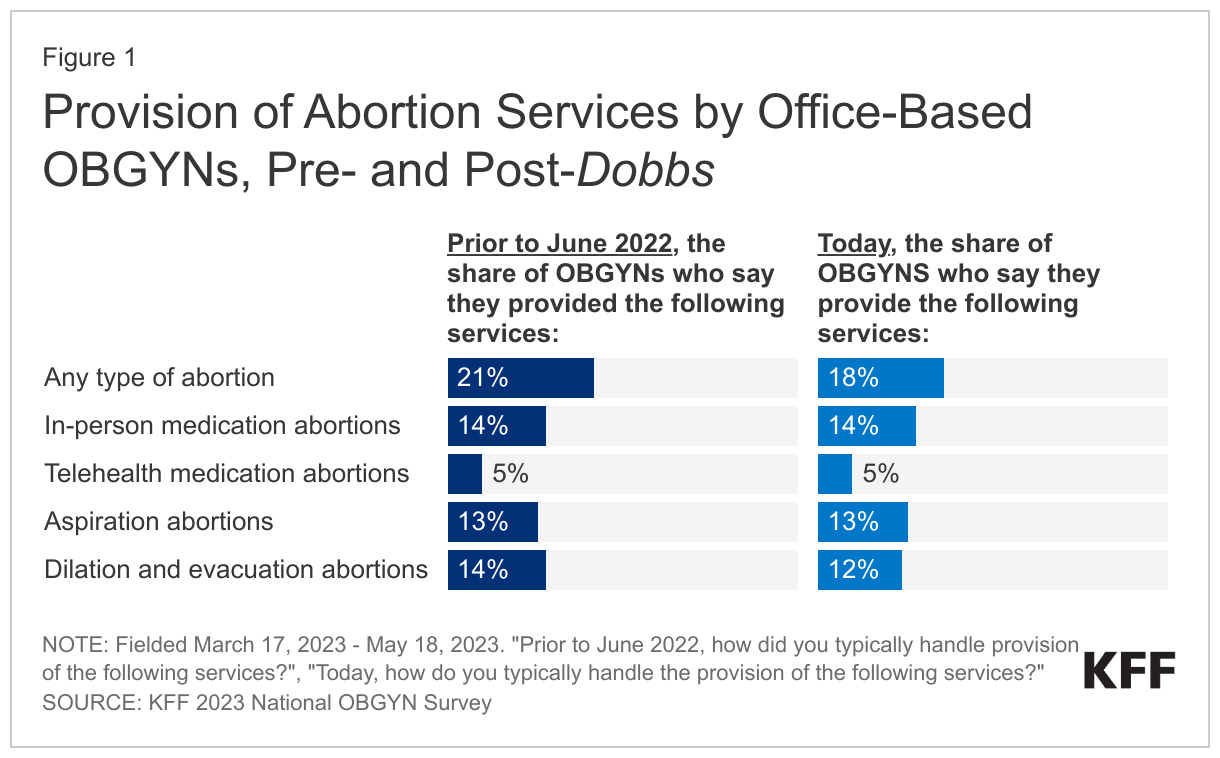
The KFF 2023 National OBGYN Survey finds one in five office-based OBGYNs (21%) say they provided any type of abortion prior to the Dobbs decision, which is statistically unchanged from the 18% that say they provide abortion services after the Dobbs decision.

Types of Abortion Services

Medication abortion, which accounts for more than half of abortions, is conducted by taking oral medications. In the U.S., the most common protocol uses two different drugs, Mifepristone and Misoprostol, which the Food and Drug Administration (FDA) has approved for use up to the first 10 weeks of pregnancy. Pills can be provided in-person or via telehealth depending on state policies.

Aspiration abortion is a minimally invasive and commonly used gynecological procedure and the most common form of procedural abortion. It can be used to conduct abortions up to 14-16 weeks of gestation.

Dilation and evacuation abortions (D&E) are usually performed after the 14th week of pregnancy.

Nationally, just over one in ten office-based OBGYNs (14%) provide in-person medication abortions, 13% provide aspiration abortions, 12% provide dilation and evacuation abortions, and only 5% provide telehealth medication abortions post-Dobbs (Figure 1).

Provision of Abortion Services by Office-Based OBGYNs, Pre- and Post-Dobbs

The survey also looks at OBGYNs in states with very different policies on abortion access. Some states have outright banned abortion since the Dobbs ruling, some have limits on abortions between 6- and 22-weeks gestation, and in some states, abortion is largely available under most circumstances. Not surprisingly, there are substantial differences in the provision of abortion services depending on state abortion policies today, and there were already large differences between states prior to the Supreme Court’s ruling.

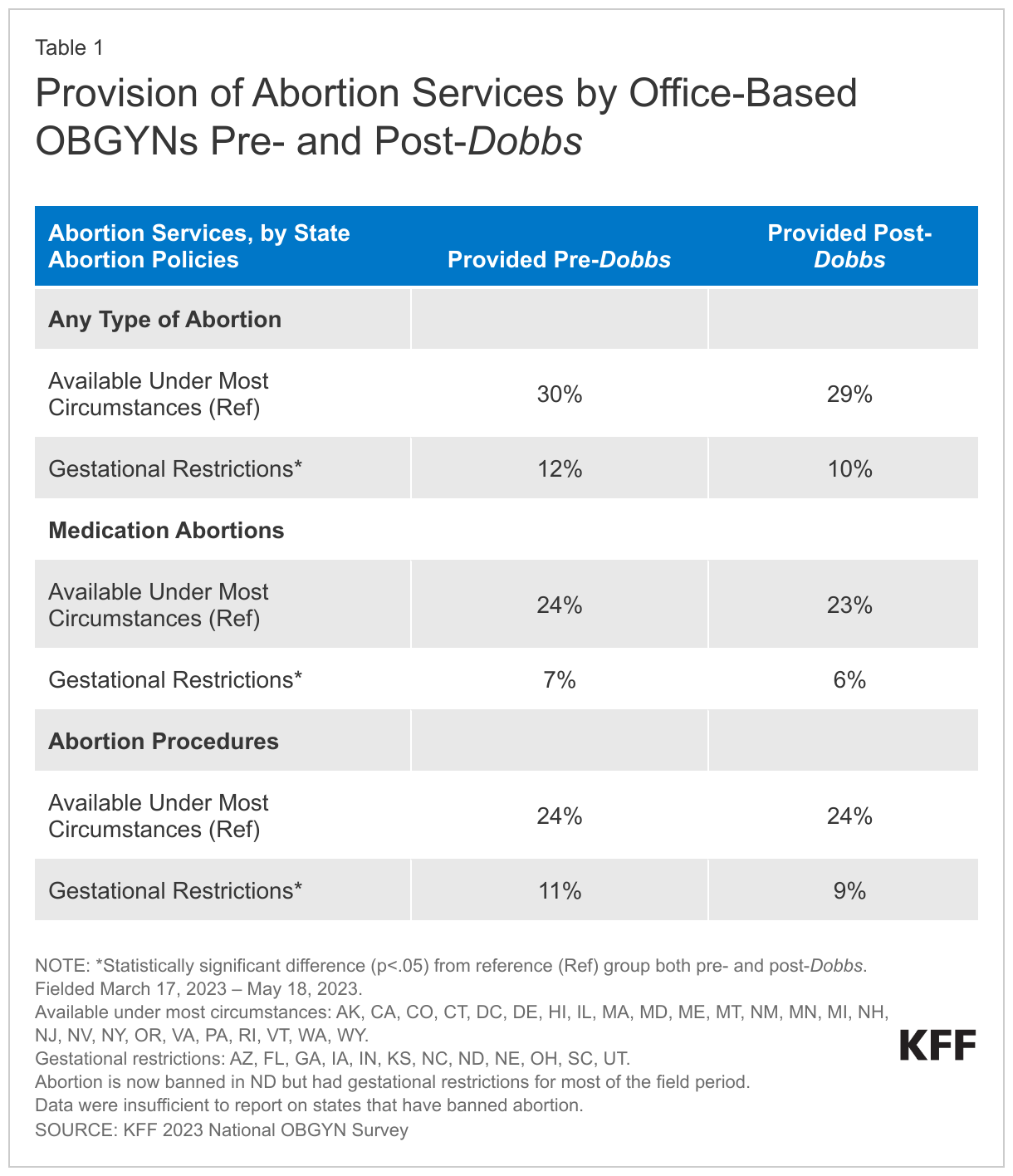
Many of the states that have gestational limits and bans now already had severe restrictions in place prior to the Dobbs ruling, which greatly limited abortion access and provision. As a result, just 12% of OBGYNs in states with gestational restrictions provided abortions before the Dobbs decision, compared to 30% in states where abortion remains available under most circumstances. The shares are similar today, with 29% of OBGYNs in states where abortion is available under most circumstances offering abortion care, compared to just 10% in states with gestational restrictions.

In states where abortion is now banned there were not sufficient shares of OBGYNs providing abortion services pre- and post-Dobbs to report. The shares of OBGYNs who perform abortions did not change substantially after the Dobbs decision in any of the state groupings (Table 1). In states with gestational limits only 6% of OBGYNs provide medication abortions and 9% provide abortion procedures. In contrast, in states where abortion is available under most circumstances, one quarter (23%) of OBGYNs say they provide medication abortions and abortion procedures (24%).

Provision of Abortion Services by Office-Based OBGYNs Pre- and Post-Dobbs

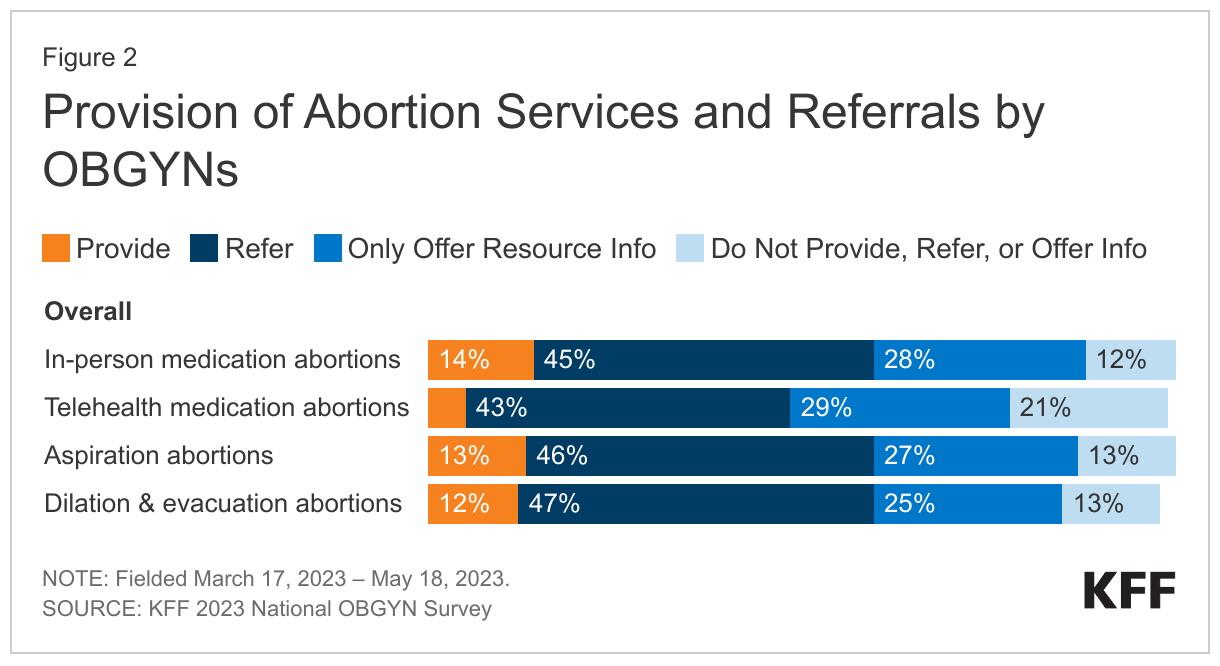
Many OBGYNs say they will refer their patients to another clinician for abortion services but don’t provide abortions themselves. Nearly three in ten OBGYNs say they do not provide nor refer their patients to abortion services, but they do share information about resources (e.g., a link to a website such as Abortion Finder or Plan C) (25-29% across different types of abortions). For most abortion procedures and in-person medication abortions, one in eight OBGYNs (12-13%) do not provide, refer, or offer information to their patients about abortion services. One in five (21%) do not provide, refer, or offer information to their patients about telehealth medication abortions (Figure 2).

Provision of Abortion Services and Referrals by OBGYNs

In addition to lack of abortion availability in states with abortion bans, many OBGYNs in these states do not refer for abortion services either. They are more likely to say that they offer informational resources about abortion (e.g., a link to Abortion Finder or Plan C) than make referrals.

We looked at the characteristics of OBGYNs who specifically provide or refer for at least one abortion service since this offers patients a more direct connection to care. There were substantial differences between physicians who provide and refer compared to those who do not, based on the abortion policy in the state in which they practice. In states with abortion bans, 30% of OBGYNs do not even offer their patients referrals to another clinician or any information (such as online resources) about abortion, leaving those seeking abortion services without services and referrals, even if those referrals would be out of state (Figure 3).

This is not surprising in light of confusion in states like Idaho and Texas regarding the legality of abortion referrals. Texas’ SB8 prohibits aiding and abetting the provision of abortions, leaving providers afraid and reluctant to make abortion referrals. In Idaho, the Attorney General issued a letter saying Idaho law prohibits providers from referring a woman across state lines to access abortion services, but then withdrew the letter after being sued by abortion providers. Just under half (44%) of OBGYNs in states with restricted gestational limits do not provide or refer for abortion services compared to 19% in states where abortion is still available in most circumstances.

Three in Ten OBGYNs in States Where Abortion Is Banned Do Not Provide, Refer, or Offer Any Resources for Abortion Services
Reasons for Not Providing Abortion Services

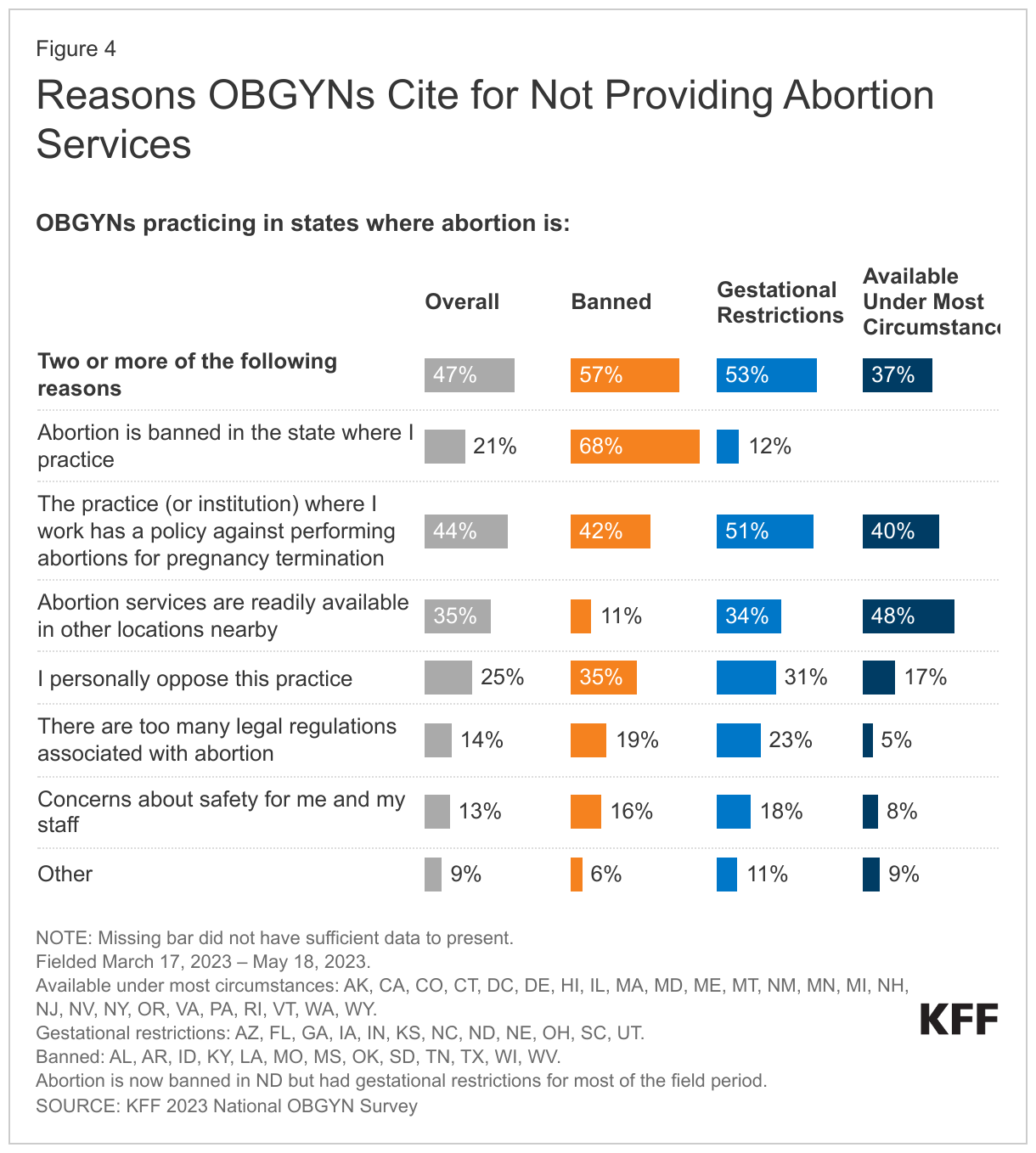
Overall, among OBGYNs who say they do not provide any type of abortion service, the top reason (44%) is that the practice or institution where they work has a policy against performing abortions for pregnancy termination (Figure 4). This share is similar across states where abortion is banned (42%) and states with gestational restrictions (51%). Not surprisingly, an abortion ban in the state where they practice is the leading reason OBGYNs in states with abortion bans cite for not providing abortions. Roughly three in ten OBGYNs who practice in states with abortion bans or restrictions who do not provide abortions say they personally oppose the practice, and one in five say there are too many legal regulations associated with abortion. Most OBGYNs that do not provide abortion services in states with bans or restrictions cite two or more reasons for not providing abortions. In states with gestational restrictions, just over a third of OBGYNs (34%) say the reason they do not provide abortion services is because abortion is readily available in other nearby locations.

Nationally, 13% OBGYNs cite safety concerns for themselves and their staff as a reason for not providing abortion services. This is higher among OBGYNs in states with bans (16%) and gestational restrictions (18%) compared to 8% in states where abortion is available under most circumstances.

Other reasons for why OBGYNs say they do not provide abortions include lack of training or religious reasons. Others say that they specialize in infertility and abortion services are not regularly desired by their patients.

Reasons OBGYNs Cite for Not Providing Abortion Services

(Back to Top)

MISCARRIAGE MANAGEMENT

Miscarriage Management among U.S. OBGYNs

Miscarriages are very common and an important aspect of many OBGYNs’ scope of practice, and sometimes involve the same procedures and medications that are used for abortions. Aspiration procedures, as well as mifepristone and misoprostol are also used to medically manage miscarriages. In early pregnancy, medical management for miscarriage with misoprostol and mifepristone allows a shorter time course than waiting for nonviable pregnancy tissue to pass on its own (expectant management) in patients without complications. Misoprostol alone can also be used for the medical management of miscarriage. Aspiration procedures are often used for individuals who are medically unstable or have an incomplete miscarriage after expectant or medical management or for patients who desire prompt resolution of their miscarriage.

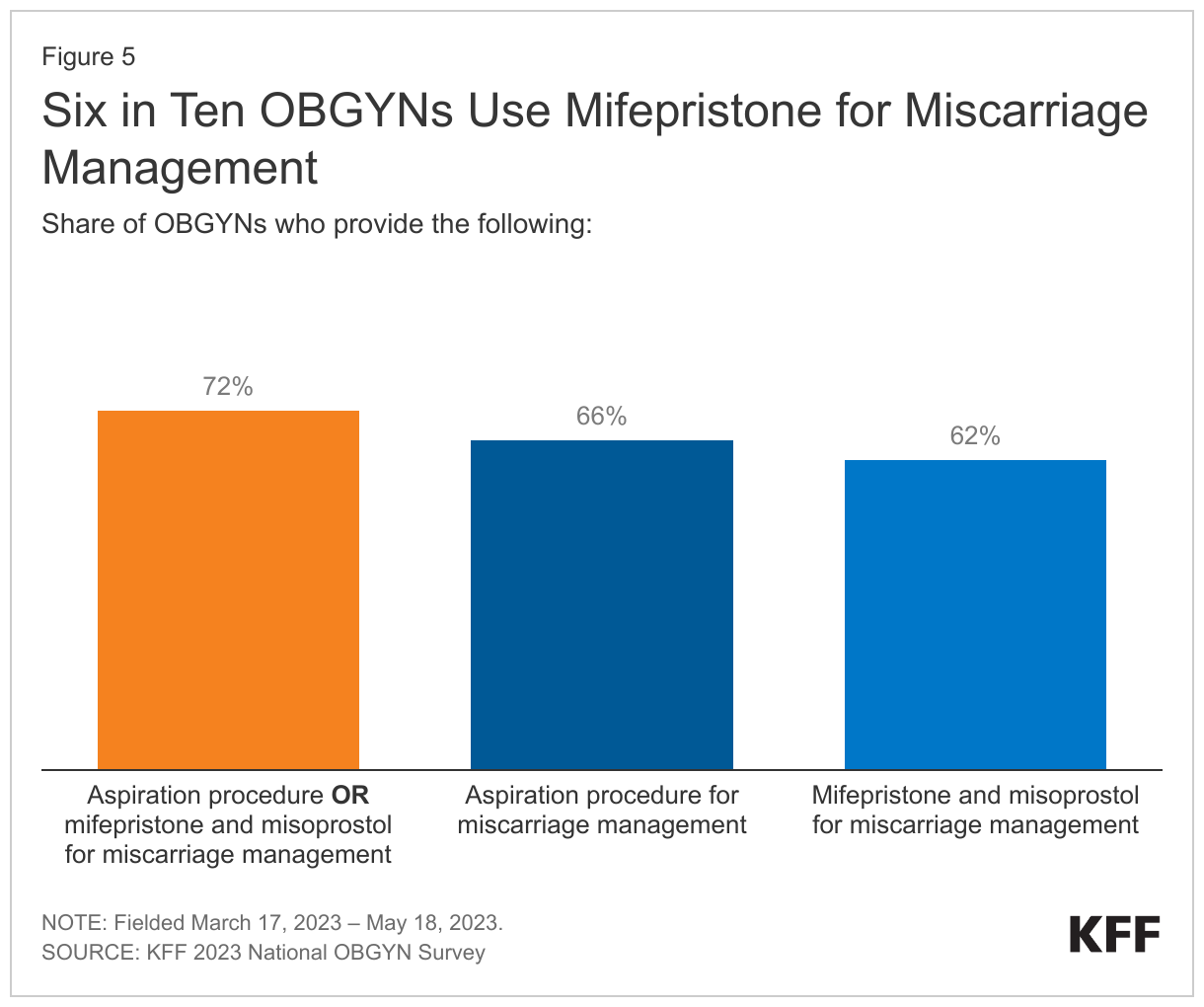
Three in four OBGYNs (72%) say they provide aspiration procedures or mifepristone and misoprostol for miscarriages, far more than those who provide abortion services (Figure 5). The shares of OBGYNs providing these services was similar pre- and post-Dobbs and there is very little variation by state abortion policy or demographic characteristics. Of note, six in ten (62%) OBGYNs use mifepristone with misoprostol for miscarriage management. However, the availability of mifepristone for miscarriage management could be greatly restricted if the current litigation challenging the FDA approval of the drug results in a reversal of the approval process.

Six in Ten OBGYNs Use Mifepristone for Miscarriage Management

(Back to Top)

UNDERSTANDING OF STATE ABORTION POLICIES AND CONCERNS ABOUT LEGAL RISK

Knowledge of State Abortion Laws

There are a wide variety of state laws and policies governing abortion access, availability, and provision, and since the Dobbs ruling, there have been numerous and often rapid changes in state policies. It is important for clinicians who provide sexual and reproductive health care to understand whether and when it is legal to offer abortion services. Even in states with abortion bans, there are limited exceptions, particularly for life-threatening medical emergencies, under which it should be legal to provide abortion services.

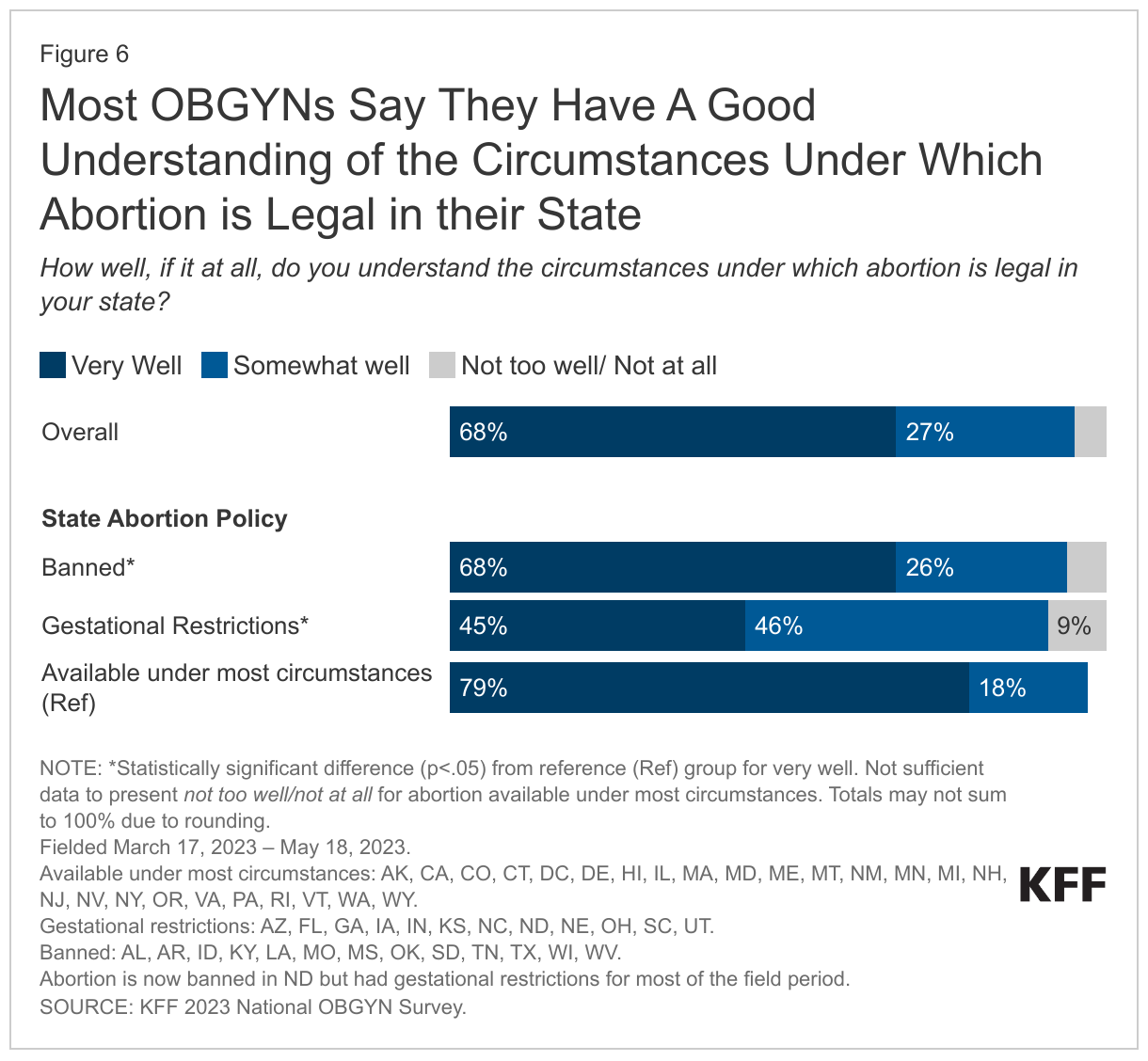
Nearly all OBGYNs (95%) say that they understand the circumstances under which abortion is legal in the state they practice—68% say they understand the circumstances very well and 27% say they understand somewhat well (Figure 6). Shares are similar across age, gender, and race/ethnicity groups. However, there is less clarity about policies among OBGYNs practicing in states with gestational restrictions where less than half say they understand the circumstances very well (45%), a lower share than those in states where abortion is banned (68%) altogether and where abortion remains available under most circumstances (79%).

Most OBGYNs Say They Have A Good Understanding of the  Circumstances Under Which Abortion is Legal in their State

Abortion bans and restrictions can carry criminal penalties for clinicians that provide abortion care. Over four in ten (42%) OBGYNs report that they are very or somewhat concerned about their own legal risk when making decisions about patient care and the necessity of abortion. This is higher among OBGYNs identifying as women (47%), compared to men (34%). A higher share of OBGYNs practicing in states where abortion is banned (61%) and in states with gestational limits (59%) are concerned about their own legal risks compared to OBGYNs in states where abortion is available (27%) (Figure 7).

Over Half of OBGYNs Practicing in States Where Abortion is Banned Report Being Concerned About Their Legal Risk When Making Decisions About Patient Care &amp;amp; Necessity for Abortion

(Back to Top)

CONSTRAINTS ON CARE AS A RESULT OF DOBBS

As OBGYNs worry about their legal risk, many report that Dobbs has affected their interactions with patients to the detriment of care (Figure 8). More than four in ten (44%) OBGYNs say their decision-making autonomy has become worse in the past year and over one-third (36%) say their ability to practice within the standard of care has deteriorated. Almost one in five (17%) OBGYNS say their provider-patient relationships have become worse since Dobbs. Overall, 16% of OBGYNs say the Dobbs decision has made all of these issues worse.

Many OBGYNs Think the Dobbs Ruling Made Their Decision-Making Autonomy and Ability to Practice Within the Standard of Care Worse

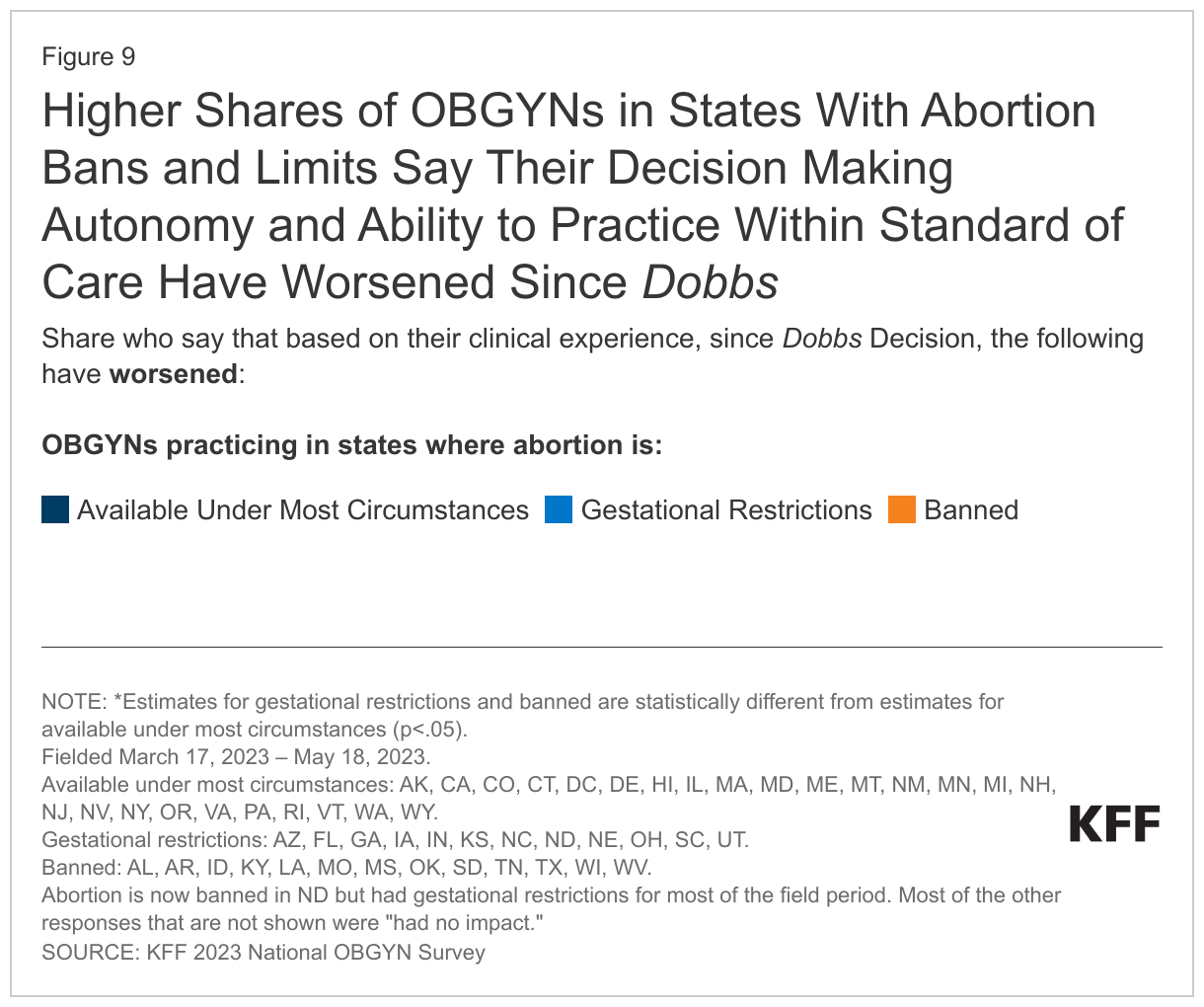
While many OBGYNs across the country have seen an impact of Dobbs on their practice, the effect on some of these measures varies widely between states (Figure 9). For example, 55% of OBGYNs in states with abortion bans and 47% in states with gestational limits say their ability to practice within the standard of care has worsened since Dobbs, much higher than 23% among OBGYNs in states where abortion is available under most circumstances. Similarly, three in ten OBGYNs in banned states (30%) and one in five in gestational limit states (20%) say their patient-provider relationships have worsened since Dobbs, compared to one in ten in states where abortion is available under most circumstances (11%).

Higher Shares of OBGYNs in States With Abortion Bans and Limits Say Their Decision Making Autonomy and Ability to Practice Within Standard of Care Have Worsened Since Dobbs

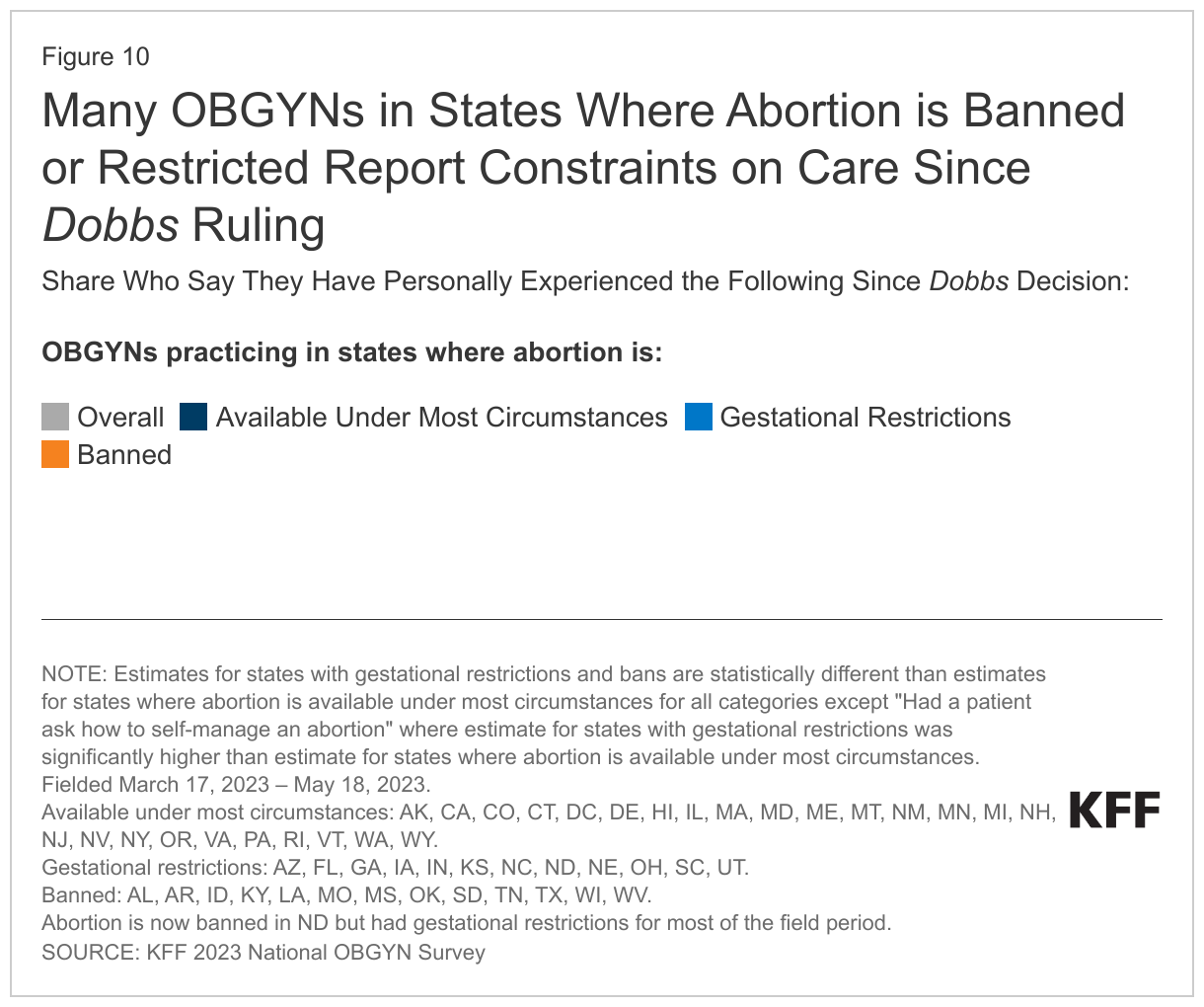
A significant portion of OBGYNs say they have personally experienced limits on their professional care since the Dobbs ruling (Figure 10). Nationally, one in five say they have been constrained in providing care for miscarriages (20%) and pregnancy-related emergencies (19%) since the Dobbs ruling. About a quarter (24%) of OBGYNs say they have had a patient who tried to obtain an abortion and could not obtain one. However, all of these are more commonly reported among OBGYNs in states where abortion is banned or limited by gestational restrictions than in states where abortion is permitted under most circumstances. About four in ten OBGYNs in states where abortion is banned say they have been constrained in providing care for miscarriages (40%) and pregnancy-related medical emergencies (37%), compared to less than one in ten OBGYNs in states where abortion remains available under most circumstances. Fewer OBGYNs say a patient has asked them about how to have an abortion on their own (14%), but the share is slightly higher in states with gestational limits (18%).

Many OBGYNs in States Where Abortion is Banned or Restricted Report Constraints on Care Since Dobbs Ruling

Many OBGYNs also say that the Dobbs decision has had a negative impact on the broader field of maternity care. Pregnancy-related mortality (death within one year of pregnancy) has been recognized as a major public health tragedy and urgent priority for action. In particular, the share is 3-4 times higher among women who are Black, Native American, and NHOPI compared to White women. Reducing the overall rate and narrowing these disparities has been the focus of several efforts among clinicians, policymakers, and the public health community. Shortages in maternity care providers, particularly in certain regions, is one of many factors that affects pregnancy-related mortality and morbidity. These survey findings raise the alarming prospect that maternal health outcomes may worsen in the post-Roe world. Seven in ten OBGYNs say that since the Dobbs decision, racial and ethnic inequities in maternal health (70%) as well as management of pregnancy-related medical emergencies (68%) have gotten worse (Figure 11). Over half think that the ability to attract new OBGYNs to the profession has worsened (55%) and 64% think the same about pregnancy-related mortality. Interestingly, these concerns are shared by OBGYNs in states with different abortion policies. More than half of all OBGYNs across all state groupings say that these problems have become worse since Dobbs. A slightly higher share of those practicing in states where abortion is available (75%) under most circumstances say racial and ethnic inequities have worsened compared to those in states where abortion is banned (63%).

Most OBGYNs Think the Dobbs Decision Has Had Detrimental Effects on Maternal Health and Patient Safety

(Back to Top)

CONTRACEPTION

Provision of Contraception

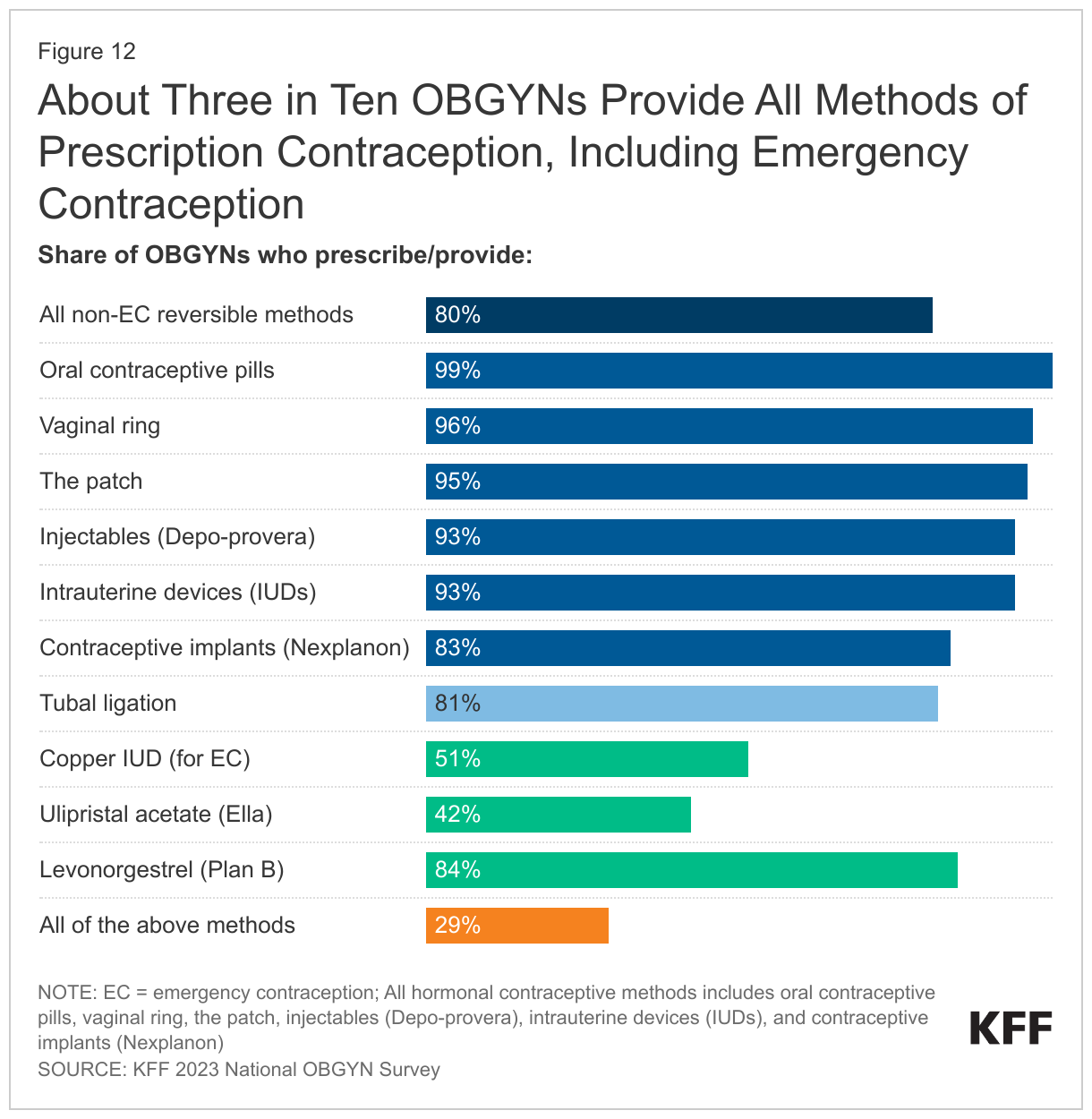
Overall, 80% of OBGYNs provide reversible contraceptive methods (other than emergency contraception) (Figure 12). Nearly all OBGYNs report that they prescribe/provide oral contraceptive pills (99%), vaginal rings (96%), the patch (95%), contraceptive injections (Depo-Provera) (93%), and intrauterine devices (IUDs) (93%). Slightly fewer provide contraceptive implants (Nexplanon) (83%). Eight in ten also provide their patients with tubal ligation procedures (81%).

About Three in Ten OBGYNs Provide All Methods of Prescription Contraception, Including Emergency Contraception

When including emergency contraception (discussed below), however, about three in ten (29%) OBGYNs reported prescribing or providing all ten of the contraceptive methods asked about, including all hormonal methods (pill, patch, ring, injection, IUD and implant), tubal ligation, and all three methods of emergency contraception (copper IUD, ulipristal acetate (Ella), and Plan B).

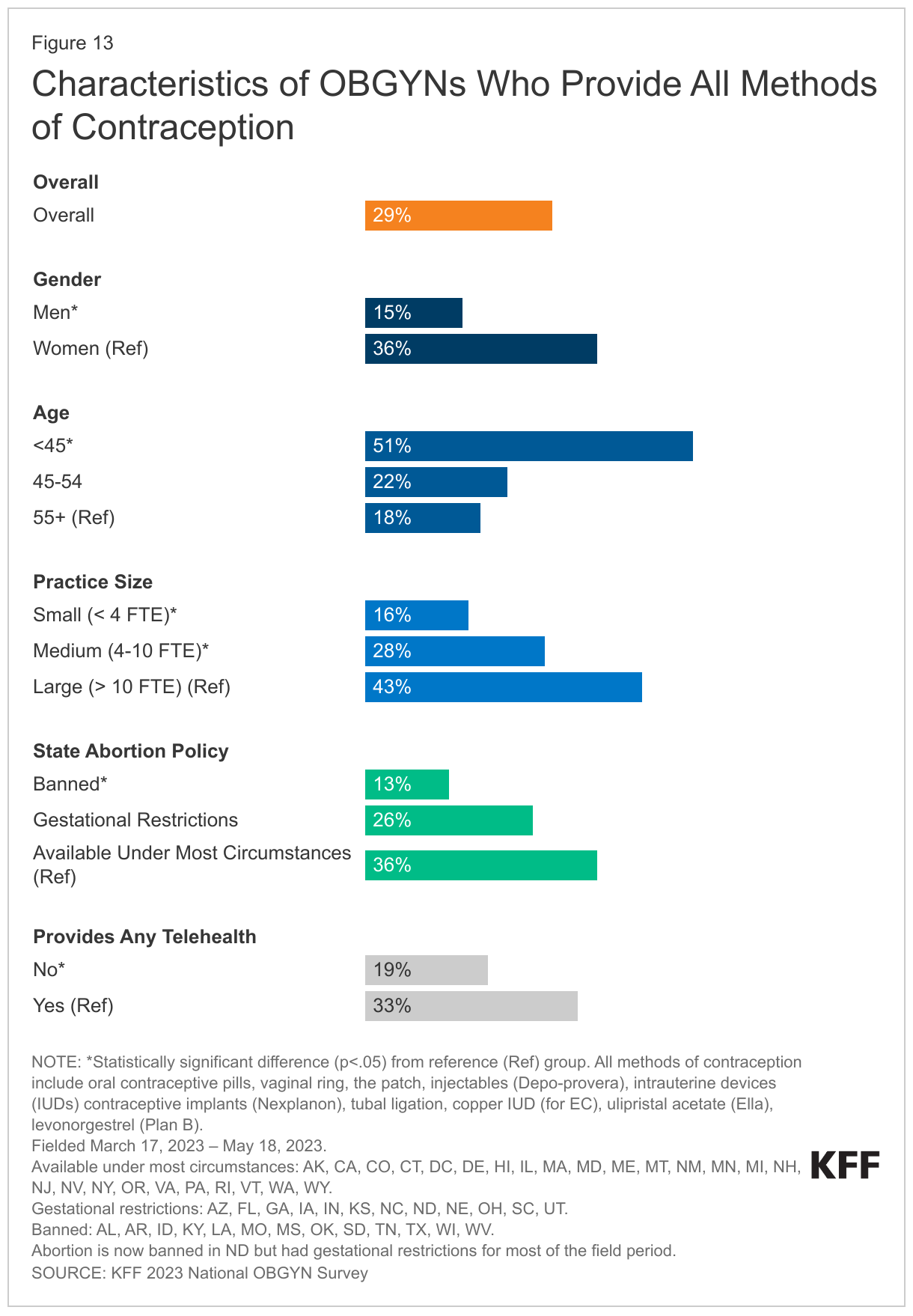
A higher share of OBGYNs who are women compared to men, younger compared to older, work in large practices compared to medium and small, and those who provide any telehealth compared to those who do not provide telehealth report providing all methods of contraception (Figure 13). Larger shares of OBGYNs practicing in states where abortion is available under most circumstances compared to states where abortion is banned say they provide all methods of contraception (36% vs. 13%).

Characteristics of OBGYNs Who Provide All Methods of Contraception
Provision of Emergency Contraception

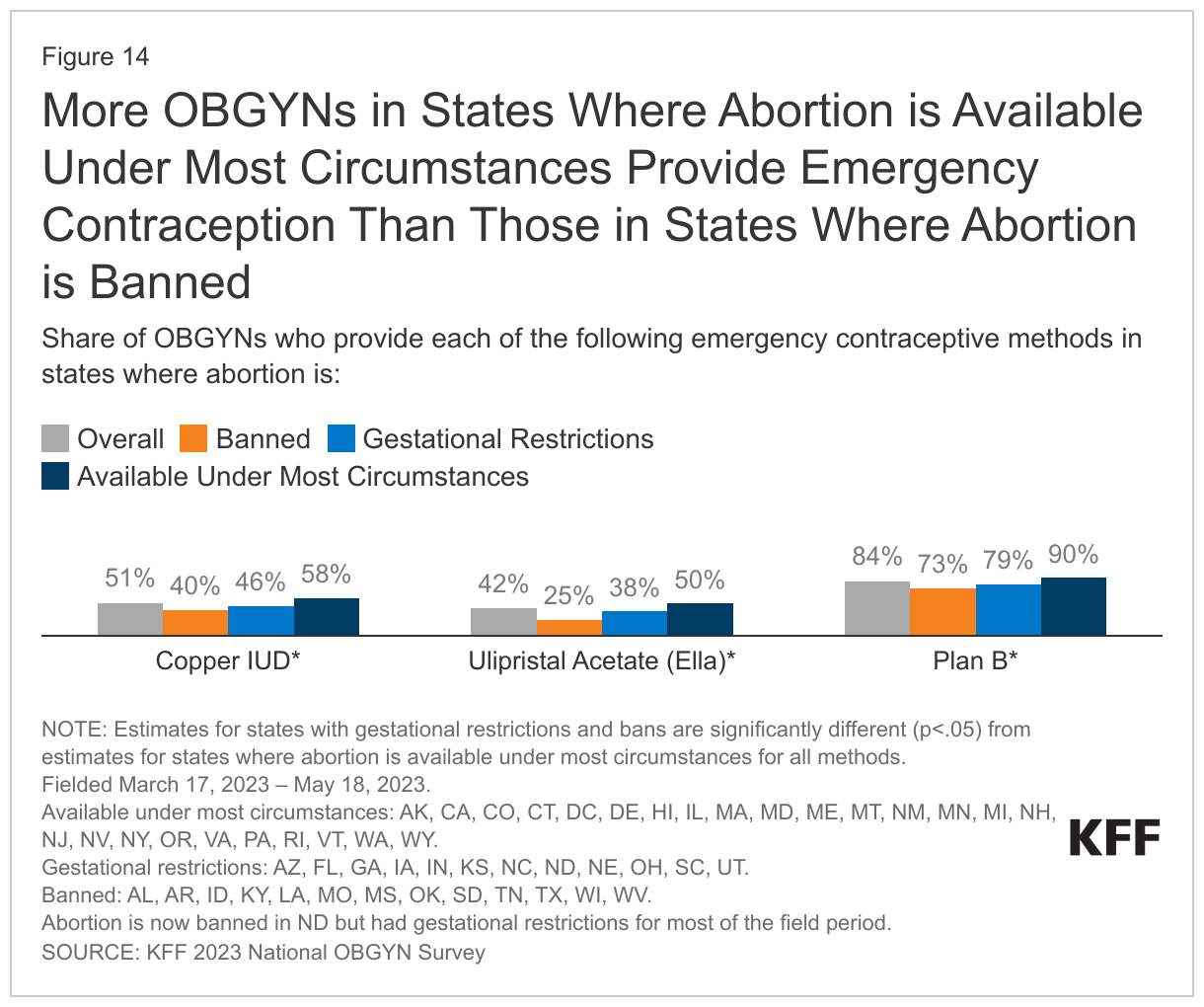
Among the three commonly used methods of emergency contraception (EC), the copper IUD and ulipristal acetate/Ella must be prescribed, and levonorgestrel/Plan B can be purchased over the counter. Just over half of OBGYNs provide copper IUDs (51%) for emergency contraception and less than half provide ulipristal acetate/Ella (42%) (Figure 14). Larger shares of OBGYNs who provide copper IUDs and ulipristal acetate/Ella for emergency contraception are women, younger, work in larger practices, and provide telehealth.

There are also notable differences in the availability of EC between states with and without abortion bans and restrictions. Notably, only a quarter (25%) of OBGYNs in states with abortion bans provide ulipristal acetate/Ella and only four in ten (40%) provide copper IUDs for emergency contraception, which is lower than in states where abortion is available under most circumstances. This means that in abortion ban states, not only is abortion unavailable, but there is also limited OBGYN provision of certain emergency contraception methods. While most OBGYNs provide levonorgestrel/Plan B, this share is also lower in states where abortion is banned (73%) compared to in states where abortion is available under most circumstances (90%). There are misconceptions, even among some OBGYNs that emergency contraception and IUDs cause abortion, which could result in their unwillingness to provide or prescribe emergency contraception.

More OBGYNs in States Where Abortion is Available Under Most Circumstances Provide Emergency Contraception Than Those in States Where Abortion is Banned

Twice as many OBGYNs provide or prescribe levonorgestrel/Plan B than ulipristal acetate/Ella, which is surprising since Plan B can be purchased over the counter, while Ella requires a prescription from a clinician. Ella is also more effective among people who are overweight or obese and has a longer window of time for use. However, in most states, Plan B must be prescribed for it to be covered by insurance. Otherwise, someone would have to pay for it out of pocket, which typically costs between $35-$49. Obtaining a prescription from a clinician can also help alleviate some other barriers to obtaining Plan B pills, such as when stores do not stock it or lock it in a case.

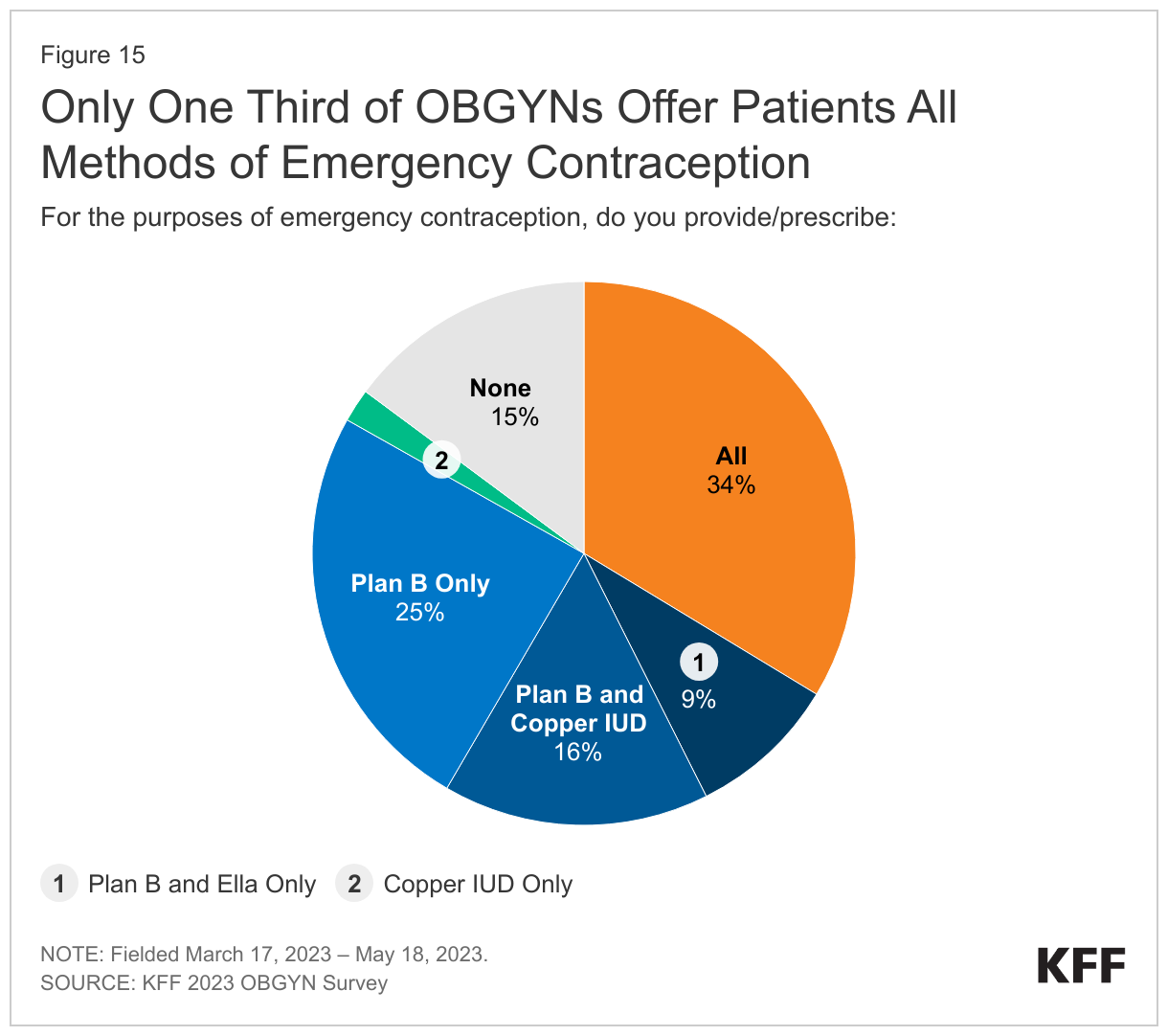
Only a third of OBGYNs (34%) prescribe or provide all three methods of emergency contraception and one in seven (15%) do not provide any methods of emergency contraception. A quarter of OBGYNS (25%) only prescribe or provide Plan B (Figure 15).

Only One Third of OBGYNs Offer Patients All Methods of Emergency Contraception

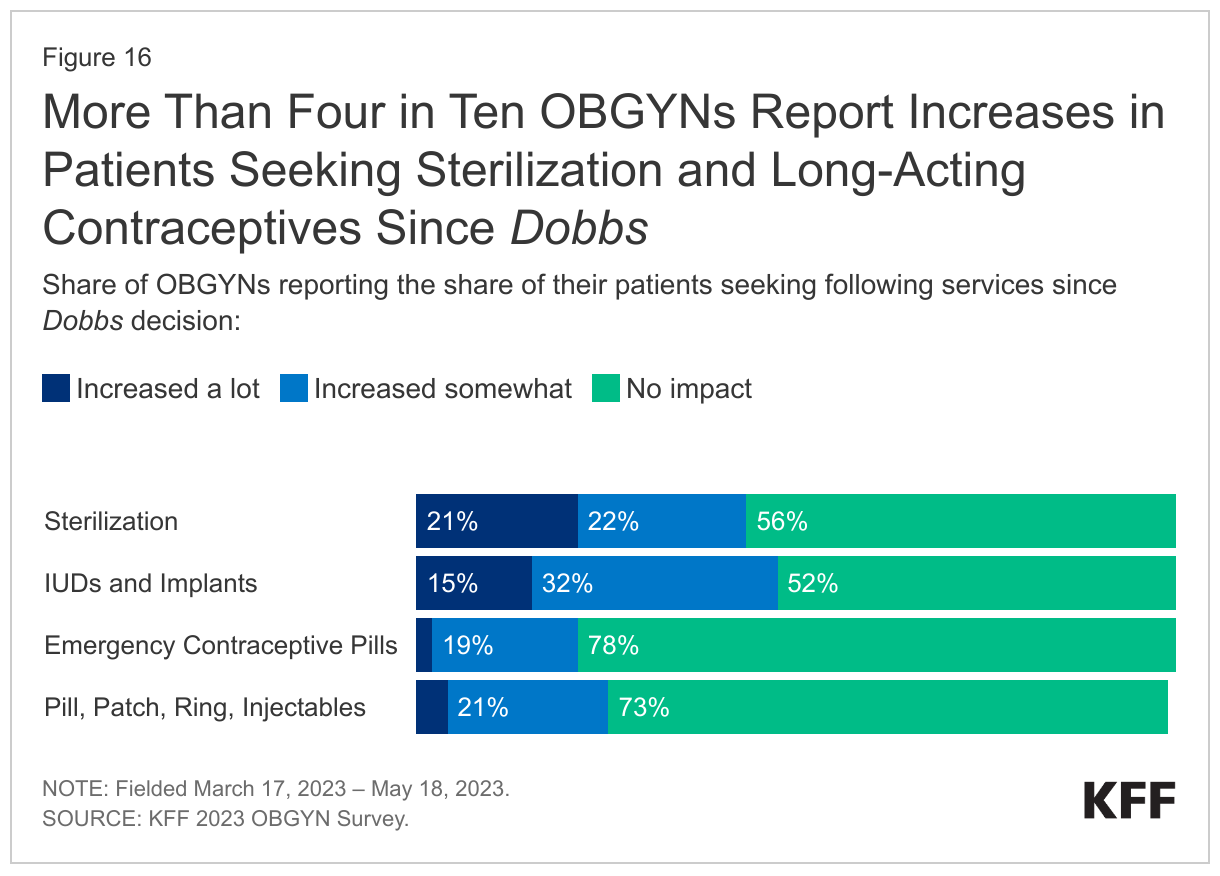
Many OBGYNs report that they have seen a rise in the share of their patients seeking contraception since the Dobbs ruling. Overall, more than half (55%) of OBGYNs say they have seen an increase in the share of patients seeking at least one form of contraception since the Dobbs ruling. In particular, a substantial share of OBGYNs report more patients are interested in sterilization and LARCs over the past year. One in five OBGYNs (21%) say that they have seen a lot of increase in the share of patients seeking sterilization and another one in five (22%) have seen some increase (Figure 16). More than one in ten (15%) say the share of patients seeking LARCs has increased a lot and another 32% say there has been some increase. Just over half (52%) though say there has been no change. OBGYNs report more modest rises in patients seeking EC pills (21% a lot or somewhat) and other hormonal methods, which include oral contraceptives, Depo injections, patch, and ring (25% a lot or somewhat). About three-quarters of OBGYNs say that there has been no change in the share of patients seeking EC (78%) or other hormonal methods (73%) since the Dobbs ruling.
More Than Four in Ten OBGYNs Report Increases in Patients Seeking Sterilization and Long-Acting Contraceptives Since Dobbs

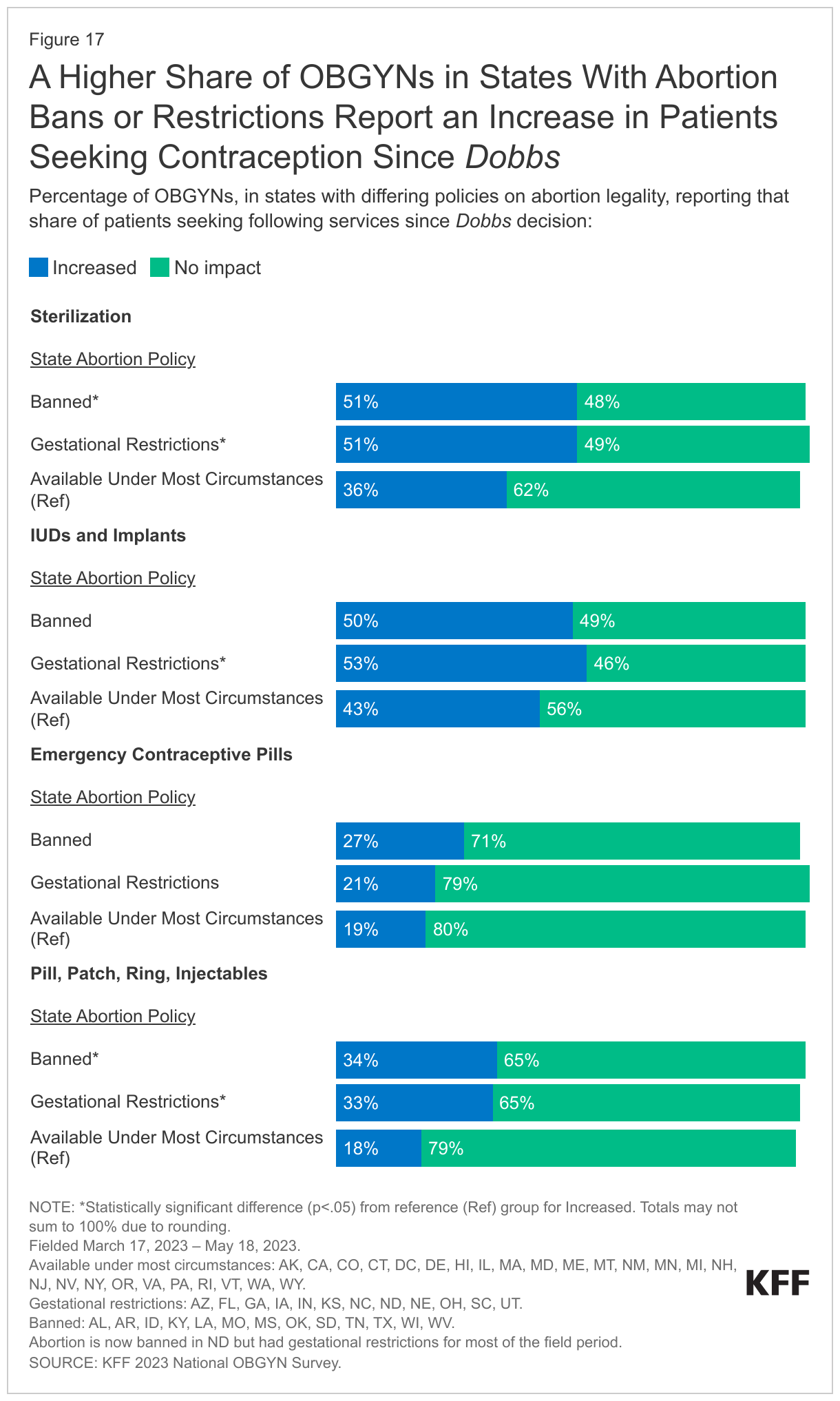
The increased interest in contraception is more pronounced in states where abortion is banned or greatly limited by gestational limits (Figure 17). For example, about half of OBGYNs in these states say the share of patients seeking sterilization has increased since Dobbs, higher than in states where abortion remains available under most circumstances. This pattern is similar for other hormonal methods too. About one-third of OBGYNs in states where abortion is banned or with gestational restrictions say they have seen an increase in patients seeking other hormonal methods, compared to 18% of OBGYNs in states where abortion is available under most circumstances.

A Higher Share of  OBGYNs in States With Abortion Bans or Restrictions Report an Increase in Patients Seeking Contraception Since Dobbs

(Back to Top)

ADDITIONAL AVENUES OF CARE

Telehealth

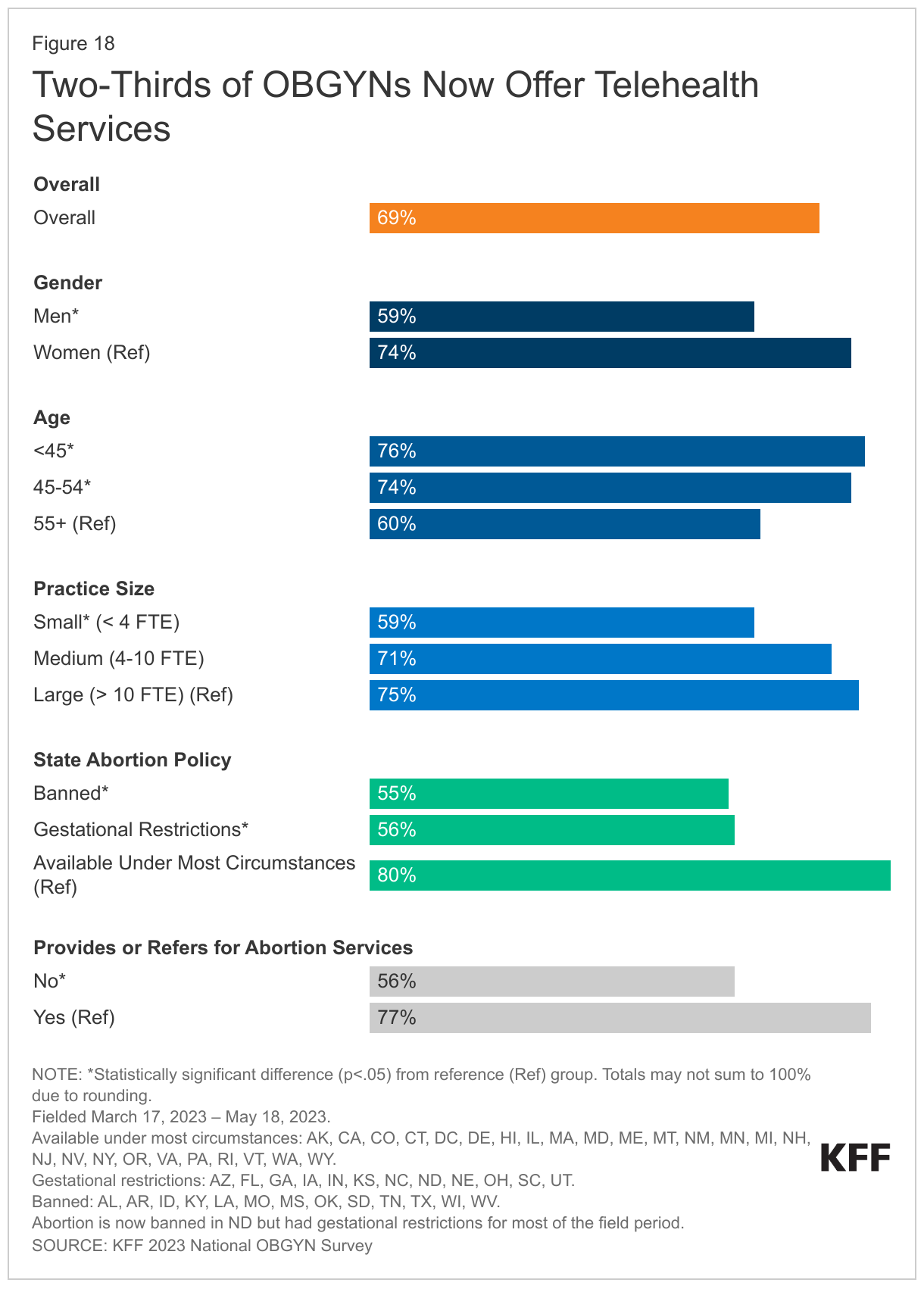
While the Dobbs decision has significantly changed the provision of health care, the COVID-19 pandemic also significantly expanded provider use of telehealth services. In 2020, the KFF National Physician Survey found that prior to March 1, 2020, just 12% of OBGYNs were using telehealth, which dramatically increased to 84% using telehealth by June 2020. In the 2023 survey we found 69% of OBGYNs were providing some services through telehealth, with about a third saying they did not (31%) provide any care via telehealth (Figure 18). Larger shares of OBGYNs who are women, younger, and provide or refer for abortion services, as well as practice in a state where abortion is available under most circumstances say they currently provide telehealth. Some patients that relied on telehealth services during the height of the pandemic may find that their provider is no longer providing telehealth services.

Two-Thirds of OBGYNs Now Offer Telehealth Services
Pharmacy Dispensing of Medication Abortion

For many years, FDA policy required that mifepristone pills could only be dispensed by a clinician who was certified to prescribe the drug at an in-person medical appointment. However, in December 2021, the FDA adopted expanded the distribution to include certified pharmacies in addition to certified clinicians. This change removed the previous requirement to dispense the medication in person and expanded the opportunity for telehealth in states that have not banned abortion. Subsequently, on January 3, 2023, the FDA approved a protocol for pharmacies, allowing those that have been certified by the manufacturers to dispense mifepristone directly to patients. However, the FDA’s initial approval of mifepristone in 2000 is currently being challenged in federal courts.

This survey asked OBGYNs if they had heard about the most recent FDA policy change allowing pharmacies to dispense medication abortion pills to patients. Two-thirds of OBGYNs (67%) report that they have heard a lot or some about the FDA’s policy change, and 33% have heard very little or nothing at all (Figure 19). Fewer OBGYNs practicing in states where abortion is banned (56%) report having heard of the policy change compared to OBGYNs practicing in states where abortion is restricted by gestational limits (67%) or is available (71%).

Most OBGYNs Have Heard About the New FDA Policy Allowing Certified Pharmacies to Dispense Medication Abortion Pills

There is broad support among OBGYNs (80%) for the FDA change that allows certified pharmacies to dispense medication abortion pills to patients while 20% are opposed (Figure 20). Notably, support is consistently high across OBGYNs in states with differing abortion policies. Eight in ten OBGYNs practicing in states where abortion is available (82%) and in states where abortion is restricted (82%) support allowing pharmacies to dispense medication abortion as do 73% of those practicing in states where abortion is banned. Larger shares of OBGYNs under the age of 55 (89%), who are women (85%), or who work in midsize (84%) support this policy compared to OBGYNs who are over the age of 55 (69%), who are men (71%) or work in smaller practices (73%).

Eight in Ten OBGYNs Support FDA's New Policy of Allowing Certified Pharmacies to Dispense Medication Abortion Pills

(Back to Top)

Looking Forward

The Supreme Court’s Dobbs decision not only affected abortion access, but it substantially changed many aspects of the provision of reproductive health care across the country. While the majority of OBGYNs do not provide abortion services, most OBGYNs do provide miscarriage management using the same procedures and medications that are used for abortions. Four in ten OBGYNs in states where abortion is illegal report constraints on their ability to manage miscarriages and pregnancy-related medical emergencies. Many also say their decision-making autonomy, the ability to practice within the standard of care, and their provider-patient relationships have been worsened by the Dobbs decision. Most are also concerned that pregnancy-related mortality and maternal health disparities have gotten worse as a result of the ruling. Some of the states with abortion bans and restrictions already had some of the poorest maternal and infant health outcomes.

The effects of the Dobbs decision on patient care are only beginning to be seen. In some states where abortion was not immediately banned, policymakers continue to pass laws to ban or seek to limit abortion services, leaving more patients without access and requiring longer travel distances for those that are not able to get abortion care where they live. These policies place additional demand on clinicians providing abortions in states where abortion is still available under most circumstances, but the share of OBGYNs that offer abortion services has not increased. Additionally, there has already been a decline in medical students applying to residencies in states where abortion is banned because they cannot receive the full spectrum of training. Over time, this could leave large parts of the country with shortages of trained OBGYNs that will affect not only abortion services but also other pregnancy-related services.

Methodology

Methods Summary

The KFF 2023 National OBGYN Survey obtained responses from a nationally representative sample of OBGYNs practicing in the United States who provide sexual and reproductive health care to patients in office-based settings. The survey was designed and analyzed by researchers at KFF, and an independent research company, SSRS, carried out the fieldwork and collaborated on questionnaire design, pretesting, sample design, and weighting. Survey responses were collected via paper and online questionnaires from March 17 to May 18, 2023 from 569 OBGYNs.

Providers were sent an up-front cash $20 incentive in the first mailing to encourage respondents to complete the survey.

The response rate for eligible OBGYNs was 29.9% and was calculated using AAPOR’s RR3. Overall, 39% of qualified OBGYNs completed the survey by web and 61% completed by mail.

The samples were weighted to match known demographics. Taking into account the design effect, the margin of sampling error for results based on total OBGYNs is +/- 5 percentage points at the 95% confidence level. Margins of sampling error for the state groupings are +/- 7% in states where abortion is available under most circumstances, +/- 7% in states with gestational limits, and +/- 7% in states where abortion is banned. Please see the attached topline for the full methodology report.

Sample Overview

We surveyed a nationally representative sample of 569 U.S. OBGYNs currently in clinical practice. Eligible physicians were board-certified OBGYNs who spend at least 60% of their time providing direct patient care and provide sexual and reproductive health care to at least 10% of their patients in an office-based setting. We compared survey responses by key physician and practice characteristics. Gender, age and race were determined by physician self-report. Practice size was determined by the number of full-time equivalent (FTE) physicians or advance practice clinicians (small <4, medium 4-10, large > 10). Sampling was conducted to ensure an adequate sample of OBGYNs in states where abortion was available under most circumstances, meaning that it is legal without pre-viability gestational limits, during the survey field period: AK, CA, CO, CT, DC, DE, HI, IL, MA, MD, ME, MI, MN, MT, NH, NJ, NM, NV, NY, OR, PA, RI, VA, VT, WA, WY; states with pre-viability gestational restrictions during the survey field period: AZ, FL, GA, IA, IN, KS, NC, ND, NE, OH, SC, UT; and states where abortion was banned during the survey field period: AL, AR, ID, KY, LA, MO, MS, OK, SD, TN, TX, WI, WV. During the field period, there was a change in policy in ND and abortion is now banned. ND remains in the gestational limits category for this analysis, as that was the status of the state’s policy for most of the field period.

Characteristics of Survey Respondents

Table 2 shows the demographics of the survey respondents. More than six in ten are women (64%), most were under the age of 55 (57%), 68% are White, 14% Asian, 6% Black, and 7% Hispanic. The majority of OBGYNs surveyed work in private office-based practices (83% in solo, group or hospital owned private practice or HMOs and  other private practices). A minority practiced in what was defined as a health center/clinic (14%). Just over four in ten (46%) OBGYNs work in medium size practices with 4-10 clinicians, and the majority practice in urban/suburban locations (90%). Half (54%) practice in states where abortion is available under most circumstances, 25% in states with pre-viability gestational restrictions, and 21% in states where abortion is banned.

Demographics of Survey Respondents
News Release

New KFF National Survey of OBGYNs Finds Dobbs Decision Has Made It Harder to Treat Miscarriages and Other Pregnancy-Related Emergencies in Affected States; In States with Bans, Half Report Patients Who Were Unable to Obtain an Abortion They Sought

Majorities of OBGYNs are Concerned About Worsening Mortality, Racial and Ethnic Inequities, and Maternal Health

Published: Jun 21, 2023

A new KFF survey of office-based OBGYNs finds widespread effects on their practices and patients since the Supreme Court’s decision in Dobbs v. Jackson Women’s Health Organization one year ago. 

In states with abortion bans, half say that they have patients who have been unable to obtain an abortion, about four in ten say that they have faced constraints on their care for miscarriages and pregnancy-related emergencies, and six in ten (61%) express concerns about legal risk when making decisions about patient care. Nearly as many OBGYNs practicing in states with gestational limits on abortion also say they faced such challenges in their practices. 

Among all OBGYNs nationally, one in four (24%) say they have had patients who could not obtain an abortion they sought. More than four in 10 (42%) OBGYNs nationally report being very or somewhat concerned about their own legal risk when making decisions about patient care and the need for an abortion.

Furthermore, large shares of OBGYNs believe that the Dobbs decision has also exacerbated pregnancy-related mortality (64%), racial and ethnic inequities in maternal health (70%), and made it harder to attract new OBGYNs to the field (55%).

The survey finds that 60% of OBGYNs in states where abortion is banned report their decision-making autonomy has worsened, and 55% say it is more difficult to practice within the standards of care, which are the norms of medical treatment. Additional findings include:

  • More than half (55%) of all OBGYNs say they have seen an increase in the share of patients seeking some form of contraception since the Dobbs ruling, particularly sterilization (43%) and IUDs and implants (47%).  
  • Nationally, 18% of office-based OBGYNs say they provide abortion services after the Dobbs decision, statistically unchanged from before Dobbs.
  • Three-in-10 (30%) OBGYNs practicing in states where abortion is banned say they do not provide, refer, or offer any resources for abortion services to their patients. Nearly half (48%) say they only offer information, such as online resources, to help patients seek out abortion services on their own.

The KFF 2023 National OBGYN Survey obtained responses from a nationally representative sample of OBGYNs practicing in the United States who provide sexual and reproductive health care to patients in office-based settings. From March 17 to May 18, 2023, survey responses were collected from 569 OBGYNs.

Read “A National Survey of OBGYNs’ Experiences After Dobbs” for details about the provision of sexual and reproductive health care provided by OBGYNs before and after the Dobbs decision.

Rise in Use of Mental Health Apps Raises New Policy Issues

Published: Jun 20, 2023

Digital behavioral health services such as mental health apps became increasingly popular especially during the pandemic, according to industry reports, when in-person health care visits were avoided to prevent the spread of COVID-19. Approximately 40% of Americans reported symptoms of depression and anxiety at the beginning of the pandemic, and there was an increased need for mental health support for consumers to address these symptoms. Additionally, industry reports found that funding of behavioral health startup companies exploded during the pandemic with $588 million invested in the first half of 2020, many funded by private equity firms.

During the PHE, many federal and state healthcare requirements were “waived” in an attempt to expand access to digital behavioral health services such as mental health apps. This Issue Brief looks at how federal PHE waivers may have expanded use of mental health apps and some of the policy issues concerning the continued use and promotion of mental health apps post-PHE.

What Are Mental Health Apps?

Mental health apps are mobile technology applications that offer clinical and non-clinical methods of offering mental health support. These vary in the scope of services they offer to consumers, from clinical services offered by a licensed behavioral health provider to treat specific conditions to services aimed at promoting general health and wellness. Users typically download an app through an app store available on smartphones and are then prompted to review and agree to an app’s privacy and technology policies prior to accessing other features on the app (e.g., intake questionnaires on symptoms and personalized treatment plans). The spectrum of available apps includes the following, with some apps including a combination of these features:

  • Medical Devices: Apps defined as computerized behavioral therapy devices subject to approval by the FDA (e.g., ReSET) offer a clinician-administered version of virtual behavioral therapy that patients can utilize outside of synchronous, live sessions with their provider. These apps can be found on smartphone devices, although they may be difficult or nearly impossible to utilize without a prescription.
  • Mental health apps that include telehealth features: Some apps such as TalkSpace and multi-service platforms such as Lyra offer therapy sessions with a licensed provider via live video or audio communications. Telehealth apps can also offer patients means to receive consultations and prescription drugs with a provider licensed to prescribe psychiatric medications. Telehealth apps might also include other general wellness features and are typically accessible through app stores on smartphone devices.
  • Mental health “wellness” products: Other apps (e.g., Happify | Get Started, PTSD Coach App) assist consumers with general wellness (e.g., stress relief) via use of journaling tools, motivational quotes, chatbot therapy, or meditation exercises, as well as offer non-medical treatments to assist consumers in managing symptoms associated with a specific mental health condition. Some of these apps may be developed by licensed providers and offer clinician-endorsed treatments, but the line between what is actual medical care and what is non-medical care is not always clear. There are a number of general wellness apps that claim to offer medical strategies to help with certain mental health disorders, but the apps themselves might not offer treatments based on evidence. One study from 2017 found that none of the most popular apps rated highly by consumers for treating anxiety related symptoms were evidence-based treatments. On the other hand, some apps contain mental health tools and practices that have been developed or supported by licensed providers. Even these apps might contain disclaimers stating that usage of the app does not replace a consumer seeking medical care from a licensed behavioral provider, which makes it difficult for a consumer to determine if they are receiving medical treatment or not via these apps.

A consumer might be introduced to a mental health app in a variety of ways including through their health insurance coverage provider or directly from their employer separate from their health insurance. Employers or health insurers, for instance, might pay a small per member per month fee to a behavioral health vendor to make an app available to their employees, allowing them to receive care or an assessment of their mental health needs. Low or no cost direct-to-consumer options are also widely available and are often marketed to younger audiences via social media.

Federal COVID Waivers Drive Change in Guidance on Mental Health Apps

During the pandemic, federal agencies suspended some policies to increase access to digital behavioral health services. This may have facilitated the use of mental health apps as a vehicle to access these services. Multiple federal COVID waivers have played a role alongside state law changes that temporarily allowed health care providers to practice across state lines (specifically, allowing a provider in one state to provide telehealth to a patient in another state). Temporary changes in Medicare and Medicaid required coverage for telehealth services. These changes may have also resulted in more utilization of telehealth delivered through mental health apps across the health system, as more providers expanded their capabilities to provide telehealth for all of their patients, regardless of whether the patient had public or private health insurance coverage. Some flexibilities for Medicare have been made permanent through federal legislation and regulation or extended past the end of the PHE on May 11, 2023, while some states have made telehealth flexibilities permanent for those with Medicaid coverage.

For the private sector, waivers focused on promoting the use of telehealth in high deductible health plans (HDHP) and offering “stand alone” telehealth may have played a role to encourage the use of telehealth delivered via mental health apps. The Coronavirus, Aid, Relief, and Economic Security Act (CARES) allowed coverage of telehealth services before the deductible is met for Health Savings Account (HSA) qualifying HDHPs. Congress extended this pre-deductible coverage of HSA telehealth services under the Consolidated Appropriations Act of 2023 until December 2024. Additionally, in FAQ guidance (Q14), the federal government allowed large employers (generally those with 50 or more employees) to offer “stand-alone” telehealth coverage to employees without having to meet certain Affordable Care Act (ACA) and Employee Retirement Income Security Act of 1974 (ERISA) legal requirements for the duration of the PHE. This was available to employees who are not eligible for benefits under their employer’s health plan and continues until the end of the employer’s current plan year (for example, until December 31, 2023 for a calendar year plan).

Other federal waivers also may have created incentives for the use of mental health apps among consumers and providers:

  • Privacy and security protections for telehealth and other remote communications. Prior to the pandemic, health care providers were required to ensure that audio-video technology utilized during telehealth sessions and any third-party apps administered by a clinician for treatment or communication purposes were HIPAA-compliant. In 2020, the US Department of Health and Human Services exercised its enforcement discretion by allowing providers to utilize audio and video technology without facing penalties for non-compliance with HIPAA’s privacy and security standards. Suspending these requirements gave providers a wider range of telecommunication tools to choose from, including use of popular apps such as Apple’s Facetime to conduct telehealth visits as well as wellness coaching.
  • FDA protocols for approving computerized behavioral therapy devices. Prior to the pandemic, the FDA required developers of these devices to meet certain requirements to show that the device was safe, effective, and comparable with other products on the market. All of these requirements were loosened during the PHE and will be reinstated in November 2023. Even before the pandemic, the FDA took a less active role in regulating general wellness devices or software that may be classified as a medical device but that the FDA determined pose a low risk to consumers. In addition, due to changes in the law in 2016, the FDA’s authority to assess patient safety risks for some of these products was limited. As a result, these products did not and will not for the foreseeable future have to abide by FDA requirements post-PHE.
  • Standards for prescribing of controlled substances via telehealth. Prior to the PHE, federal law generally required providers to have an in-person medical evaluation before a prescription for controlled substances was given. This includes, for example, certain medications used to treat Attention Deficit Hyperactivity Disorder (ADHD) such as Adderall, as well as buprenorphine used to treat opioid use disorder. Many of these standards were waived during the PHE by the Drug Enforcement Administration (DEA), an agency that is part of the U.S. Department of Justice, allowing providers to use telehealth (video or audio only mechanisms) to prescribe these medications, including through telehealth apps.

What to Watch Now That the PHE is Over

Before the PHE ended on May 11, some stakeholders and consumers expressed interest in making some waivers permanent, and efforts are underway to extend some of these waivers so that patients can continue to easily use digital behavioral health tools often employed via use of mental health apps permanently, or at least until the impact of the PHE waiver is evaluated. The end of the PHE now shifts the policy focus in digital health solutions to, in some cases, extending the COVID waiver policy in some areas, and in other areas has brought new government scrutiny on health policy concerns such as privacy and security of mental health apps and access to prescription drugs via telehealth.

Employer Plan Telehealth Flexibilities

Promoting easier access through virtual behavioral health was seen early on in the pandemic as a way to not only prevent the spread of COVID, but also address growing behavioral health care needs for those with employer coverage. There are proposals to make pre-deductible coverage of telehealth services for HDHPs used in conjunction with health savings accounts permanent. For example, the Telehealth Expansion Act, was introduced this year. Also, some members of Congress have proposed making stand-alone telehealth coverage permanent, allowing employers to make it available to all employees (including those eligible for their employer’s health plan) in the Telehealth Benefit Expansion for Workers Act, largely exempting the coverage from regulatory oversight. Going forward stakeholders will likely address ways to expand access to virtual behavioral health beyond just those with health savings accounts, and address design alternatives for employer coverage that incorporate telehealth as just one part of a broader set of tools to enhance coverage for the continuum of behavioral health care.

Access to Controlled Medications

The PHE changes gave patients easier access to psychiatric medications via prescribing through telehealth. However, more unrestricted access may have contributed to a shortage in prescription drugs such as Adderall. The percentage of stimulants prescribed via telehealth rose from less than two percent prior to the pandemic, up to 40% in 2022. Originally, the DEA proposed in two separate regulations reinstating some protocols for controlled substances, including mandating an in-person visit, in certain circumstances before a provider can give prescriptions. Although some speculate this might help resolve the shortage issue, reinstating this requirement could have potentially caused gaps in coverage for people who receive medication via telehealth platforms due to geographic restrictions, provider shortages, or other barriers that might prevent them from seeking in-person care. Just before the end of the PHE, the DEA issued a temporary rule that will allow virtual prescribing of controlled substances to continue until November 2024, giving providers and consumers time to adjust and regulators a chance to evaluate policy options.

Privacy Risks

Licensed providers and health plans who want to continue to use telehealth delivered via mental health apps after the PHE ends are expected to use telecommunication technology that meets HIPAA specifications. There is no checklist for what defines “HIPAA compliant technology”, however, HIPAA-covered entities are required to conduct a risk assessment of their telecommunication platforms and ensure that key risks are addressed. Some examples of the types of security protections they might address in their risk assessment include encryptions used to protect patients’ personal health data, login requirements, and verification processes used to ensure only verified users have access to the platform. Recent guidance gave providers an additional 90 days after the end of the PHE (August 9, 2023) to comply. Even with these HIPAA protections, there are growing concerns that mental health apps are being used to access sensitive health information that is then provided or sold to third parties for marketing purposes. HHS recently issued a Bulletin on guidelines HIPAA covered entities must follow when using online tracking technology. Additionally, HHS is currently investigating Cerebral, a mental health platform that offers online therapy and assessments, for selling patient data to third party advertisers via use of online tracking technologies.

HIPAA’s guidance and HHS’ enforcement powers only reach so far when it comes to mental health apps. Unless the entity offering a mental health app is considered a HIPAA-covered entity (typically a health provider, plan or insurer) or is a business associate of one of these entities, mental health apps do not have to follow federal HIPAA privacy, security and breach notice rules. HIPAA generally does not cover general wellness apps or even apps that are considered medical devices if they are not connected with a HIPAA-covered entity. Outside of HIPAA, app users’ data are often at the mercy of an app’s privacy policies, which could be written in convoluted language that a consumer may find difficult to understand or are not read by consumers at all.

Although non-HIPAA covered apps and telehealth vendors that misrepresent or do not abide by their privacy policies or mishandle patient data would not face penalties under HIPAA’s guidelines, they could face legal repercussions from the Federal Trade Commission (FTC), a federal agency that enforces federal laws that prohibit “unfair and deceptive” practices that affect commerce and oversee certain consumer protection laws. The FTC has recently announced new enforcement activity related to mishandling of patient data. For example, BetterHelp (a subsidiary of Teledoc), a popular mental health app, will have to pay $7.8 million in restitution as a result of allegedly selling patient data to third party advertisers without their permission and misrepresenting their privacy practices. Additionally, the FTC has proposed to update the Health Breach Notification Rule, which would require organizations that manage digital health apps and consumers’ personal records to inform consumers and the FTC when their personal data has been compromised. This proposal is controversial, as the FTC has claimed that it has authority to regulate all health apps that are not covered by HIPAA.

Congress is also weighing in on how data is used within mental health apps. Several senators have questioned leaders of major telehealth companies on their data sharing practices and some have introduced the Upholding Protections for Health and Online Location Data (UPHOLD) Privacy Act that would increase protection of personal health data stored in apps.

Looking Forward

Mental health apps, as well as other digital health solutions, have the potential to expand access to care, and for this reason certain rules and standards were waived or modified during the pandemic, which was also a time of heightened mental health needs. Coming out of the urgency of the pandemic, there is now an opportunity to evaluate the benefits and risks of these tools and consider what oversight might be appropriate. We can expect much more attention focused on the quality and clinical effectiveness of these tools, as well as who will pay for them. 

News Release

States Received Over $117 Billion in Enhanced Federal Medicaid Funding for Pausing Disenrollments During the Pandemic; Non-Expansion States Received a Disproportionate Share 

Published: Jun 16, 2023

A new KFF analysis finds that states received over $117 billion in enhanced federal Medicaid funding in exchange for pausing disenrollments during the first three years of the pandemic. The injection of federal money enabled states to spend less of their own funds on Medicaid even as enrollment rose by more than 23 million people nationally and total Medicaid spending increased by billions of dollars.

Pandemic-era enrollment protections expired in March, and in April states were permitted to resume disenrollments of people who are no longer eligible for Medicaid or who do not complete the eligibility renewal process.

As the enhanced federal funding is phased out and ultimately eliminated next year, states’ spending on Medicaid will likely increase — though the impact will vary by state. The size of the increase in state Medicaid spending will depend largely on changes in total spending growth, which in turn reflect how quickly people are disenrolled, how many new people come on to Medicaid, and how spending per person in the Medicaid program will change.
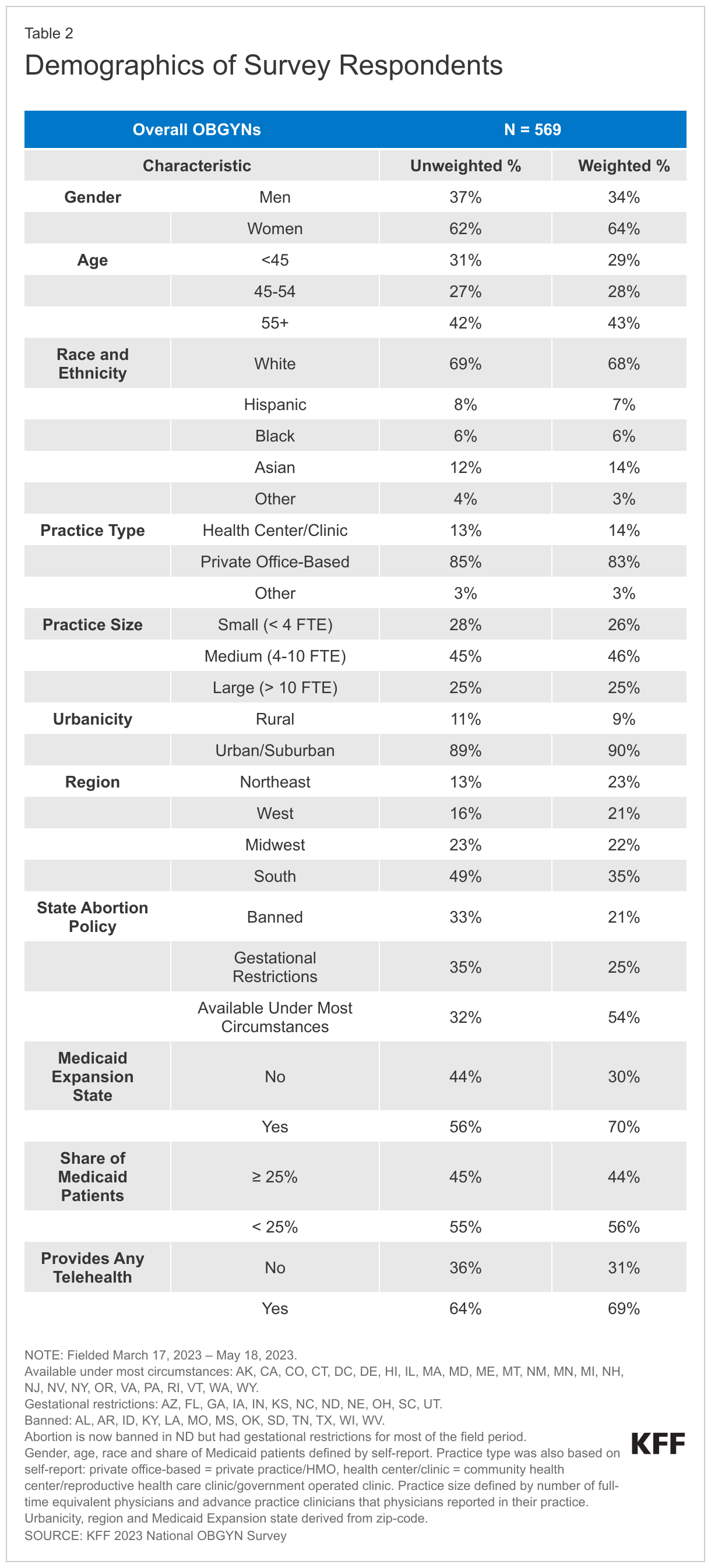
States that have not adopted Medicaid expansion under the Affordable Care Act received a disproportionately large share of the more than $117 billion in enhanced federal funds that was disbursed when enrollment protections were in effect. That’s because the extra funding came in the form of enhanced federal matching money that did not apply to spending on Medicaid enrollees who were made eligible for the program through the ACA expansion. Non-expansion states received 27 percent of the enhanced funding despite accounting for only 22 percent of all Medicaid spending, the analysis finds. The full analysis, “Fiscal Implications for Medicaid of Enhanced Federal Funding and Continuous Enrollment,” includes data showing how much each state received in enhanced federal funding from January 2020 through March 2023.

Related resources:

Medicaid Enrollment and Unwinding Tracker

How Many People Might Lose Medicaid When States Unwind Continuous Enrollment?

10 Things to Know About the Unwinding of the Medicaid Continuous Enrollment Provision

Fiscal Implications for Medicaid of Enhanced Federal Funding and Continuous Enrollment

Published: Jun 16, 2023

For a three-year period, states provided continuous enrollment in Medicaid in exchange for an increase in the percentage of Medicaid spending that is paid for by the federal government (the Federal Medical Assistance Percentage or “FMAP”). A recent KFF analysis estimated that over 23 million people gained Medicaid coverage during the continuous enrollment period. Beginning April 1, 2023, states could begin disenrolling individuals from Medicaid, but phased-down federal matching funds will be available through the end of the year if states comply with certain rules. While there remains a great deal of uncertainty as to how Medicaid enrollment will change during the unwinding, the end of the Medicaid continuous enrollment provision and enhanced FMAP are expected to have a significant impact on Medicaid enrollment and spending. This brief examines how Medicaid spending changed during the continuous enrollment period and estimates the amount of enhanced federal funding states received during the continuous enrollment period. Key findings include:

  • State spending dipped below pre-pandemic levels even as Medicaid enrollment increased by 23 million during the continuous enrollment period. With the substantial enrollment growth, total spending increased, including significant increases in federal Medicaid spending due to the enhanced FMAP.
  • We estimate states received over $117 billion from the increased FMAP during the continuous enrollment period, with enhanced federal funds comprising a larger share of total Medicaid spending in states that had not adopted Medicaid expansion through the Affordable Care Act (ACA).
  • Although the magnitude is uncertain, significant decreases in Medicaid enrollment are expected during the unwinding of the continuous enrollment provision, which will result in lower Medicaid spending. Even with lower enrollment, state spending will likely increase as the enhanced FMAP expires.
  • The phase down of the enhanced FMAP was designed to provide continued financial support to states during the unwinding process and to mitigate sharp increases in state Medicaid spending. How much state Medicaid spending increases as the enhanced FMAP phases down and is ultimately eliminated next year will depend on how many and how quickly people are disenrolled, how many new people come on to Medicaid, and how spending per person in the Medicaid program will change.
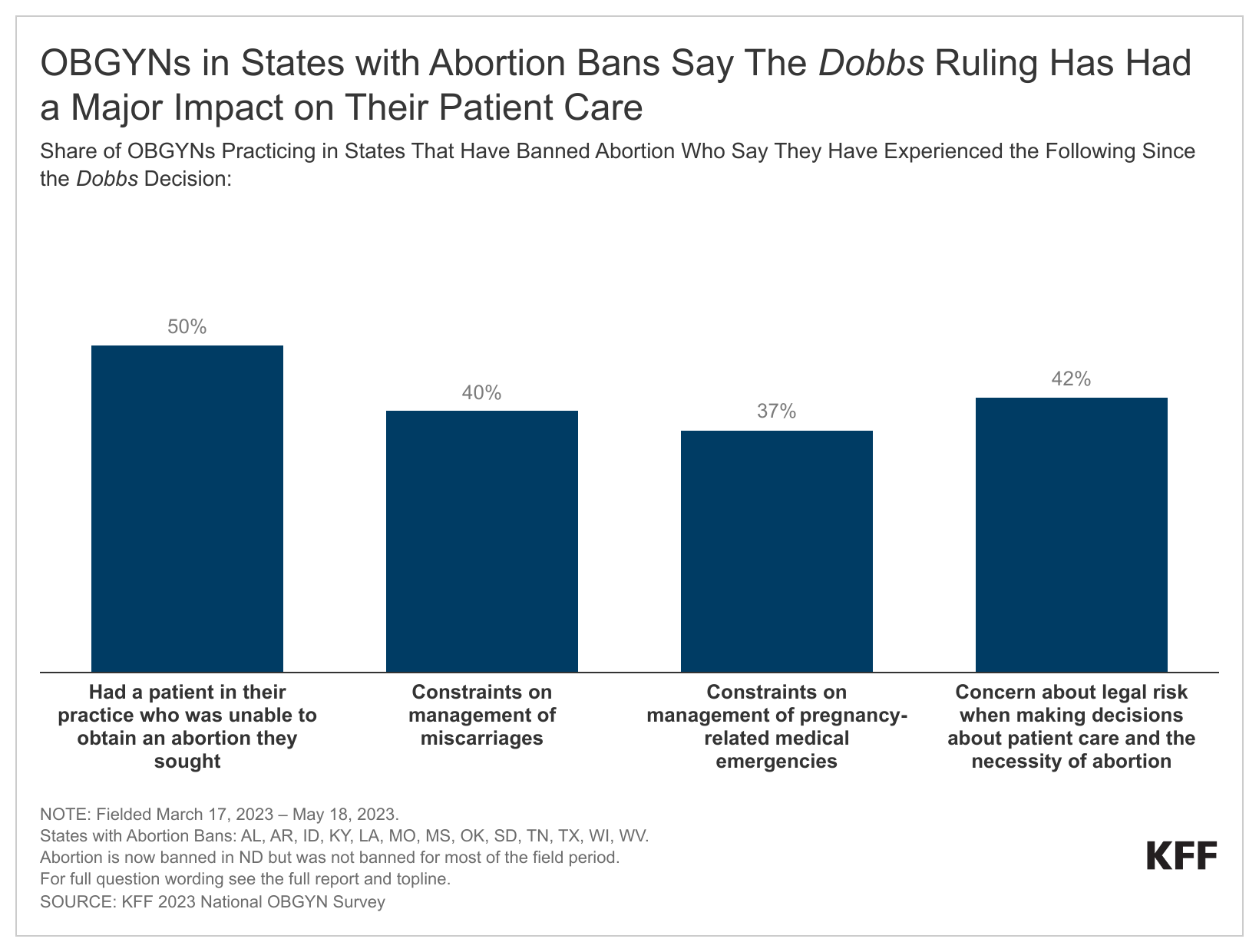
What was the purpose of the enhanced federal Medicaid match rate?

States received a 6.2 percentage point FMAP increase in exchange for keeping individuals continuously enrolled during the pandemic as authorized by the Families First Coronavirus Response Act (FFCRA). The increased FMAP was retroactive to January 1, 2020 and generally applied to Medicaid spending that would otherwise reimbursed at the state’s regular FMAP. The enhanced federal matching funds do not apply to administrative expenses or to Medicaid spending that is already subject to an increased match, including spending for ACA expansion adults (the FMAP is 90% for adults eligible through expansion). The Consolidated Appropriations Act, 2023 (CAA) delinked the continuous enrollment provision from the public health emergency (PHE), ending continuous enrollment on March 31, 2023. The CAA also phases down the enhanced federal Medicaid matching funds through December 2023, with the increased FMAP decreasing to 5 percentage points from April to June 2023, 2.5 percentage points from June to September 2023, and 1.5 percentage points from October to December 2023.

The federal funding from the enhanced FMAP was designed to support the costs of increased Medicaid enrollment and provide fiscal relief to states beyond the costs of enrollment growth. During economic downturns, enrollment in Medicaid grows, increasing state Medicaid costs while state tax revenues are declining. Congress enacted legislation to temporarily increase the federal share of Medicaid during the last two economic downturns prior to the pandemic. At the onset of the COVID-19 pandemic, states were projecting large revenue declines, but the enhanced FMAP provided new federal funding to states quickly by using an existing federal funding mechanism. Enhanced federal funding supported state Medicaid programs and helped free up state funds for other purposes including mitigating the need for widespread spending cuts on other services and filling gaps in state budget shortfalls.

How did Medicaid spending change during the pandemic?

State spending on Medicaid dipped below pre-pandemic levels even as enrollment in Medicaid increased by 23 million during the continuous enrollment period (Figure 1). The reduction in state spending reflected a sharp drop from $231 billion in 2019 to $214 billion in FY 2020, accompanied by an increase in federal spending of nearly $50 billion (from $393 billion to $444 billion). After 2020, state spending remained relatively stable while federal spending continued to increase due to the enhanced FMAP and total spending increased in conjunction with rising enrollment. State spending remained below 2019 levels in both expansion (defined as those having implemented Medicaid expansion as of 10/1/2021) and non-expansion states through the end of FY 2022. In the first six months of FY 2023—before the end of the continuous enrollment provision—we find that total and federal spending continued to increase while state spending returned to levels similar to the first two quarters of 2019. We expect spending and enrollment levels for the second half of 2023 to change, reflecting the end of the continuous enrollment period.

While Enrollment Increased During the Continuous Enrollment Period, State Medicaid Spending Remained Below FY 2019 Levels.

How much did states receive in enhanced federal funding during the continuous enrollment period?

During the continuous enrollment period, we estimate that states received over $117 billion in funding from the increased FMAP, with non-expansion states receiving a disproportionate share (Figure 2 and Appendix Table 1). Non-expansion states received 27% of the enhanced funding despite accounting for only 22% of all Medicaid spending because the enhanced FMAP does not apply to spending for people eligible through an ACA expansion. Across all states, the $117 billion in additional funding comprised an estimated 5% of total Medicaid spending and 7% of federal Medicaid spending during the continuous enrollment period (January 2020 through March 2023).

Non-Expansion States' Share of the Enhanced Federal Funding is Larger than their Share of Total Medicaid Spending Over the Period.

What might happen to Medicaid spending during the unwinding?

Although the size of the effects are quite uncertain, significant decreases in Medicaid enrollment are expected during the 14-month period in which states unwind the continuous enrollment period. KFF estimates that nationally Medicaid enrollment will decrease by 18% (17 million people) between March 2023 and May 2024 (based on a recent survey of states), but in practice, rates of enrollment decline will vary across states, depending on states’ approaches to unwinding. Early data from states shows substantial variation in disenrollment rates. While state Medicaid agencies report enrollment changes as the most significant factor driving changes in total Medicaid spending, they also note that factors such provider payment rate increases were putting upward pressure on spending. Overall, total Medicaid spending could decrease during the unwinding if the effects of enrollment losses are larger than the effects of other factors such as those.

Even with declining enrollment, state spending on Medicaid will likely increase as the enhanced FMAP expires. States are expecting the end of the enhanced FMAP to shift the state and federal spending shares, as has been the case in previous economic downturns when an enhanced FMAP expired. CBO estimates that federal spending will decrease by about 9% from FY 2023 to FY 2024. While states received substantial enhanced federal funding of $117 billion during the continuous enrollment period, they will likely see increases in state Medicaid spending as the enhanced federal matching funds expire at the end of the year.

The phase down of the enhanced FMAP was designed to provide continued financial support to states during the unwinding process and to mitigate sharp increases in state Medicaid spending. Before the CAA delinked the continuous enrollment provision and the enhanced FMAP from the PHE, the enhanced FMAP was set to expire at the end of the quarter when the PHE expired. The gradual phase-out of the FMAP through December 2023 recognizes that it will take states time to unwind the continuous enrollment provision and conduct redeterminations for all Medicaid enrollees. To be eligible for the enhanced match, states must meet certain eligibility, renewal, and reporting requirements. Recently, in a letter to CMS, Democratic lawmakers reiterated these beneficiary protections as well as CMS enforcement tools that were made available in the CAA, and CMS, in a letter to state governors, reiterated that states must comply with federal requirements to continue to draw down enhanced federal funds. The amount of the enhanced funding available to states during the unwinding will be smaller relative to the continuous-enrollment period, but it will still help mitigate the shift in funding from the federal government back to the states. As the enhanced federal funding is phased out and ultimately eliminated, the size of the increase in state Medicaid spending will depend on changes in total spending growth, which in turn will reflect how quickly people are disenrolled, how many new people come on to Medicaid, and how spending per person in the Medicaid program will change. These enrollment and spending changes will vary by state.
Appendix

Federal Funding from the Enhanced FMAP During the Continuous Enrollment Period, By State

Methods

Data: This analysis uses the Medicaid CMS-64 new adult group expenditure data collected through MBES (CMS-64 data), the 2019 T-MSIS Research Identifiable Demographic-Eligibility and Claims Files (T-MSIS data), the May 2023 Congressional Budget Office (CBO) estimates of federal Medicaid spending per enrollee, and enrollment estimates from a prior KFF analysis.

Overview of Approach: To estimate total, federal, and state Medicaid spending as well as the enhanced federal funding states received from the increased FMAP, we:

  • Use estimates of Medicaid enrollment by eligibility group during the continuous enrollment period, which are described in the prior analysis,
  • Use actual total Medicaid expenditure data from CMS-64 and the ratio of per enrollee spending by eligibility group from T-MSIS to estimate per enrollee spending by eligibility group for FY 2019 – FY 2022,
  • Estimate spending per enrollee for FY 2023 by growing the previous year’s per enrollee spending for each eligibility group based on the CBO’s projected Medicaid spending per enrollee,
  • Calculate total, federal, and state spending during the pandemic based on a state’s actual FMAP, and
  • Compare to an estimate of what state spending would have been without the FMAP increase to estimate enhanced federal funding.

Definitions and Limitations: While very similar at a national level, our estimates of the enhanced federal funding received over the period do not match those posted by the Medicaid CMS-64 FFCRA Increased FMAP Expenditure reports. There are a few reasons for this:

  • We estimate total additional federal funds for the continuous enrollment period (through March 2023), while the FFCRA expenditure reports only showed spending through June 2022 as of May 2023, when the analysis was completed.
  • Our estimates reflect an accrual basis of accounting—which means we estimate all spending states incurred each quarter. In practice, states have two years following the date a service was rendered to report their spending, so some spending so the FFRCA reports will not show complete spending until two years after the enhanced FMAP ends. If the FFCRA expenditure reports show spending when it is paid from the federal government to the states—rather than when states incurred the costs, the timing of federal payments will be different from what we have estimated.
  • Our model assumes the 6.2 percentage point FMAP increase applies to all non-administrative Medicaid spending for enrollees that are not ACA expansion enrollees. While they usually account for only a small share of overall spending, we do not make additional exclusions for the other services that are matched at a higher rate, which include family planning, services received through an Indian Health Services facility, expenditures for Medicare beneficiaries enrolled in the “Qualifying Individuals” program, and home health services that are matched at a 90% rate.

We provide more detail about each step in the process below.

1. Estimate Medicaid enrollment by eligibility group.

  • For enrollment by eligibility group through the end of the continuous enrollment period, we use estimates from a previous KFF analysis.

2. Prepare CMS-64 expenditure data and estimate spending per enrollee by eligibility group for FY 2019 - FY 2022 at the state level.

  • First, we pull quarterly data from the Medicaid CMS-64 New Adults Group Expenditure Data collected through MBES and aggregate total and federal spending by state for enrollees in the ACA expansion group and for all other Medicaid enrollees from FY 2019 – FY 2022. Spending includes all medical assistance expenditures.
  • Data for FY 2022 was only available for three of the four quarters (through June 2022). We assume those expenditures constitute 75% of FY 2022 spending to estimate expenditures for the full year.
  • We calculate spending per enrollee for each FY for the ACA expansion group and all other enrollees by dividing the group’s total spending by the enrollment in September of that year.
  • We use the 2019 T-MSIS claims data to estimate spending per enrollee for the non-expansion enrollees. We calculate the ratio of spending per enrollees for each specific eligibility group to spending per enrollee for all non-expansion enrollees. We apply these ratios to the spending per enrollee from the CMS-64 data for all non-expansion enrollees to estimate spending per enrollee for each eligibility group.
  • We scale state-level spending per enrollee by eligibility group estimates so that multiplying enrollment by spending per enrollee equals the total spending in each state from the CMS 64 in FY 2019 – FY 2022.

3. Estimate FY 2023 spending per enrollee. We only have full-year, detailed administrative expenditure data through June 2022, so we estimated expenditures for FY 2023.

  • We use the CBO’s May 2023 projections of average federal spending on benefit payments per enrollee by eligibility group and their assumed FMAPs to estimate average total spending per enrollee by eligibility group for FY 2022 and FY 2023.
  • We calculate the growth in total spending per enrollee from FY 2022 to FY 2023 by eligibility group and apply the 2023 growth rates to our 2022 estimated spending per enrollee, resulting in estimated spending per enrollee by eligibility group for 2023.
  • For states that newly expanded Medicaid, we estimated spending per enrollee for the new group by multiplying that state’s spending per enrollee for their non-expansion adults by the ratio of spending per expansion enrollee to non-expansion enrollee in all other states.

4. Calculate total, federal, and state Medicaid spending during the pandemic with the enhanced FMAP.

  • For each FY, we estimate total Medicaid spending by multiplying spending per enrollee by enrollment. We group spending into two groups: spending on ACA expansion group and spending for all other Medicaid enrollees.
  • We estimate the FMAPs as the percentage of total spending that is federal spending in the CMS-64. We assume the FY 2022 FMAP applies for the rest of the continuous enrollment period, which is the first six months of FY 2023.

5.  Estimate enhanced federal funding.

  • We estimate states’ spending without the enhanced FMAP by subtracting 6.2 percentage points from each state’s FMAP for non-expansion spending.
  • Total spending from the enhanced FMAP is estimated to be the difference between states’ actual spending and the spending we estimated without the enhanced FMAP.
  • The American Rescue Plan Act included a 5-percentage point increase in the FMAP for states to adopt an ACA Medicaid expansion. For the states using this option during the continuous enrollment period (Missouri and Oklahoma), we subtracted the enhanced federal funding from that provision from state spending when calculating spending from the continuous enrollment enhanced FMAP.