News Release

Poll: People View Prior Authorization as Greatest Burden in Navigating the Health System

Many Report Impact on their Care, Finances and Well-being

Published: Feb 2, 2026

New KFF polling explores the challenges beyond costs that people with insurance face in navigating the health care system. People cite prior authorization review as their top problem by a wide margin, with a third (32%) saying prior authorization requirements are a “major burden.”

That’s more than say the same about understanding their bill or what they owe (23% say it is a major burden), getting appointments when they need them (20%), or finding providers who accept their insurance (17%).

When asked to choose which of those four factors is “the single biggest burden,” prior authorization before accessing certain tests, treatments, or medication ranks at the top (34%). Among people with a chronic condition that requires ongoing medical treatment (about half of all insured adults), 4 in 10 (39%) say prior authorization is the single biggest burden when it comes to getting care, more than twice the share who say the same about other obstacles.

“The complexity of the health system drives patients crazy, can have real consequences, and disproportionately affects people who are sick,” KFF President and CEO Drew Altman said. “Prior authorization review is the poster child for that complexity.”

Prior authorization ranks as the single biggest burden for people with employer coverage and Medicaid, as well as those who buy their own coverage (largely through the Affordable Care Act’s Marketplaces).

During the prior authorization process, some treatments or medications recommended by a provider may be delayed and, in some instances, an insurance company may end up denying medication or treatment.

About half (47%) of insured adults – and a larger share (57%) of those with chronic conditions – say their access to a certain health care service, treatment, or medication has been denied, delayed, or altered in the past two years by their health insurer.

Among those who report such denials, delays, or alterations, about a third say it had a “major negative impact” on their mental health and emotional well-being (34%) and finances (33%), and a quarter say it had a “major negative impact” on their physical health (26%). This translates to about 1 in 5 of all adults with insurance saying that their mental or physical health, or finances, have been majorly impacted.

Designed and analyzed by public opinion researchers at KFF, this survey was conducted January 13-20, 2026, online and by telephone among a nationally representative sample of 1,426 U.S. adults in English and in Spanish. The margin of sampling error is plus or minus 3 percentage points for the full sample. For results based on other subgroups, the margin of sampling error may be higher.

Poll Finding

KFF Health Tracking Poll: Prior Authorizations Rank as Public’s Biggest Burden When Getting Health Care

Published: Feb 2, 2026

Findings

As the latest KFF Health Tracking Poll shows, affordability is the public’s biggest concern, with the cost of health care ranking as their top economic worry. However, KFF polls have demonstrated that beyond costs, insured people report a whole host of issues navigating the health care system. This report looks at which aspects of accessing care and health insurance are the biggest problem for insured adults and finds that prior authorizations – or the process of having to get insurance approval before accessing certain tests, treatments, or medications – are having an outsized impact on insured adults.

One in three insured adults in the U.S. say they find prior authorizations a “major burden” to getting health care. An additional four in ten (37%) say the process is a “minor burden,” bringing the total share of insured adults who find the process burdensome to about seven in ten (69%). This is larger than the share who say other aspects are burdensome such as understanding bills or what is owed (60%), getting needed appointments (60%), or finding providers who accept their insurance (53%).

About Seven in Ten Insured Adults Say Prior Authorization Is a Burden Including a Third Who Call It “Major”

When asked to choose which aspect of getting health care, beyond costs, is the single biggest burden, one in three insured adults (34%) choose prior authorizations, followed by getting needed appointments (19%), understanding their bill (17%), or finding providers who accept their insurance (15%). The choice of prior authorizations as the single biggest burden is even more stark among adults with a chronic condition that requires ongoing medical treatment (about half of all adults). These individuals often require more treatments and medications, resulting in more interactions with health insurance companies and health care providers. Four in ten (39%) insured adults with a chronic condition say prior authorizations are the single biggest burden when it comes to getting health care, at least twice the share who say the same about the other aspects of health care asked about.

Four in Ten Insured Adults With a Chronic Condition Say Prior Authorization Is Their Single Biggest Health Care Burden Beyond Costs

Prior authorizations are also identified as the single biggest burden for insured adults across partisans, as well as among individuals across insurance types that typically require prior authorizations such as individuals with Medicaid, people who buy their own health insurance, and people who get health insurance through an employer. Notably, about three in ten (28%) Medicaid enrollees identify finding providers who accept their insurance as the biggest burden, but small shares identify other issues as their biggest burden.1

A Third of Insured Adults Across Insurance Types and Party Say Prior Authorization Is Their Single Biggest Burden

During the prior authorization process, some treatments or medications recommended by a provider may be delayed and, in some instances, an insurance company may end up denying medication or treatment. Overall, about two-thirds of adults say delays and denials of health care services by health insurance companies are a “major problem” with an additional one in four (24%) who say they are a “minor problem.” Just one in ten adults say delays and denials of services by insurance companies are not a problem in our current health care system.  More than six in ten across Medicaid enrollees, self-purchasers, and those with employer coverage say the delays and denials of care by insurance companies are a “major problem.”

Majorities of Adults Across Coverage Types Say Delays and Denials Are a Major Problem, Including About Seven in Ten Adults Who Have a Chronic Condition

About one in three insured adults (33%) say they have had a health insurance company deny coverage for a certain health care service treatment, or medication prescribed by their doctor in the past two years. Three in ten insured adults say that a health insurance company has delayed their ability to get such services, treatments, or medications (29%) or required them to try a lower-cost drug or treatment before covering the one that was originally recommended by their provider (29%). These issues are even more common among insured adults with a chronic condition with about four in ten reporting that an insurance company has required them to try a lower-cost drug or treatment (38%), deny coverage for a certain service or medication (42%), or delayed their ability to get prescribed care (37%). Overall, nearly half (47%) of insured adults say they have had a certain service, treatment, or medication either denied or delayed in the past two years, rising to nearly six in ten (57%) among those with a chronic condition.

Nearly Half of Insured Adults Say They Have Experienced Their Health Insurance Company Denying Care, Delaying Care, or Requiring Them To Try Alternatives

Denial and delays by health insurance companies can lead to negative consequences for people’s physical, mental, and financial health. One in three of those who experienced a denial or delay say the actions required by their health insurance company had a “major negative impact” on their mental health and emotional well-being as well as on their finances (about one in six of all insured adults).  One in four (one in eight of all insured adults) say the delays or denials has a “major negative impact” on their physical health.

Many of Those Who Have Experienced Denials, Delays, or Changes in Care Due to a Prior Authorization Say It Had a Negative Impact on Them


  1. Prior authorization is more common in Medicare Advantage than Traditional Medicare. Because this analysis is unable to break out individuals with traditional Medicare versus Medicare Advantage, we do not include Medicare as a subgroup in our analysis. These individuals are included in both the total group and the group with chronic conditions.  To learn more about prior authorizations for Medicare, more available at https://www.kff.org/medicare/medicare-advantage-insurers-made-nearly-53-million-prior-authorization-determinations-in-2024/. ↩︎

Methodology

This KFF Health Tracking Poll/KFF Tracking Poll on Health Information and Trust was designed and analyzed by public opinion researchers at KFF. The survey was conducted January 13-20, 2026, online and by telephone among a nationally representative sample of 1,426 U.S. adults in English (n=1,355) and in Spanish (n=71). The sample includes 1,028 adults (n=60 in Spanish) reached through the SSRS Opinion Panel either online (n= 1,003) or over the phone (n=25). The SSRS Opinion Panel is a nationally representative probability-based panel where panel members are recruited randomly in one of two ways: (a) Through invitations mailed to respondents randomly sampled from an Address-Based Sample (ABS) provided by Marketing Systems Groups (MSG) through the U.S. Postal Service’s Computerized Delivery Sequence (CDS); (b) from a dual-frame random digit dial (RDD) sample provided by MSG. For the online panel component, invitations were sent to panel members by email followed by up to three reminder emails. 

Another 398 (n=11 in Spanish) adults were reached through random digit dial telephone sample of prepaid cell phone numbers obtained through MSG. Phone numbers used for the prepaid cell phone component were randomly generated from a cell phone sampling frame with disproportionate stratification aimed at reaching Hispanic and non-Hispanic Black respondents. Stratification was based on incidence of the race/ethnicity groups within each frame. Among this prepaid cell phone component, 149 were interviewed by phone and 249 were invited to the web survey via short message service (SMS). 

Respondents in the prepaid cell phone sample who were interviewed by phone received a $15 incentive via a check received by mail or an electronic gift card incentive. Respondents in the prepaid cell phone sample reached via SMS received a $10 electronic gift card incentive. SSRS Opinion Panel respondents received a $5 electronic gift card incentive (some harder-to-reach groups received a $10 electronic gift card). In order to ensure data quality, cases were removed if they failed two or more quality checks: (1) attention check questions in the online version of the questionnaire, (2) had over 30% item non-response, or (3) had a length less than one quarter of the mean length by mode. Based on this criterion, 2 cases was removed. 

The combined cell phone and panel samples were weighted to match the sample’s demographics to the national U.S. adult population using data from the Census Bureau’s 2025 Current Population Survey (CPS), September 2023 Volunteering and Civic Life Supplement data from the CPS, and the 2025 KFF Benchmarking Survey with ABS and prepaid cell phone samples. The demographic variables included in weighting for the general population sample are gender, age, education, race/ethnicity, region, civic engagement, frequency of internet use and political party identification. The weights account for differences in the probability of selection for each sample type (prepaid cell phone and panel). This includes adjustment for the sample design and geographic stratification of the cell phone sample, within household probability of selection, and the design of the panel-recruitment procedure. 

The margin of sampling error including the design effect for the full sample is plus or minus 3 percentage points. Numbers of respondents and margins of sampling error for key subgroups are shown in the table below. For results based on other subgroups, the margin of sampling error may be higher. Sample sizes and margins of sampling error for other subgroups are available on request. Sampling error is only one of many potential sources of error and there may be other unmeasured error in this or any other public opinion poll. KFF public opinion and survey research is a charter member of the Transparency Initiative of the American Association for Public Opinion Research. 

GroupN (unweighted)M.O.S.E.
Total1,426± 3 percentage points
 
Party ID
Democrats473± 6 percentage points
Independents483± 6 percentage points
Republicans367± 6 percentage points
  
MAGA Republicans/Rep leaners352± 6 percentage points
MAHA supporters618± 5 percentage points
Parents or guardians of children under 18 living in their household436± 6 percentage points

Recent Trends in GLP-1 Use and Spending in Medicare

Published: Jan 30, 2026

Ahead of the Trump administration’s planned expansion of Medicare coverage for GLP-1s to treat obesity through temporary models and the availability of Medicare’s negotiated price for certain GLP-1 products beginning in 2027, new data from the Centers for Medicare & Medicaid Services (CMS) shows that use and spending for these drugs under Medicare has grown substantially in recent years, reflecting their demonstrated effectiveness at treating type 2 diabetes and other conditions. Medicare currently covers GLP-1s for type 2 diabetes, cardiovascular disease, and sleep apnea, but coverage for weight loss drugs is prohibited by law, even as GLP-1s have proved to be highly effective for this purpose (and even cost-effective, according to a recent analysis).

To address this gap in coverage for GLP-1s to treat obesity, CMS is launching a model called BALANCE (Better Approaches to Lifestyle and Nutrition for Comprehensive hEalth) under which CMS will negotiate pricing and coverage rules for GLP-1s, with the aim of expanding access to these medications and lifestyle interventions to support weight loss. The model, beginning in 2026 for Medicaid and 2027 for Medicare, is voluntary for drug manufacturers, state Medicaid programs, and Medicare Part D plans.

This analysis examines CMS’s Medicare Part D claims data from 2019 to 2024 to document the increase in the number of beneficiaries being treated with GLP-1 drugs and the growth in Medicare spending and claims for GLP-1s. Expansion of coverage under Medicare of GLP-1s to treat obesity under the BALANCE model is likely to increase utilization above current levels, as Medicare begins to meet the demand for obesity drugs among beneficiaries who have been unable to access or afford these medications to date. At the same time, the availability of Medicare’s lower negotiated price for certain GLP-1 products under the Medicare Drug Price Negotiation Program (semaglutide beginning in 2027 and dulaglutide beginning in 2028) could mitigate the increase in Medicare spending that could come about from ongoing and expanded use of these medications.

Ozempic Was Used by Two Million Medicare Part D Enrollees in 2024, Up from Fewer Than 150,000 in 2019

Semaglutide, the GLP-1 drug branded as Ozempic, Rybelsus, and Wegovy, was the most used GLP-1 in 2024. Two million Part D enrollees took Ozempic, which was approved by the FDA in 2017 to treat type 2 diabetes, up from fewer than 150,000 in 2019 (Figure 1). Nearly 1 million Part D enrollees took Mounjaro, approved in 2022 for type 2 diabetes, up from 54,000 in 2022. This increase reflects a pattern of growing use of newer GLP-1s, such as Ozempic and Mounjaro, while use of older products, such as Byetta (approved in 2005), Victoza (approved in 2010), and Trulicity (approved in 2014), has declined. While most GLP-1 drugs are currently available as injections, the introduction of new oral formulations, which could be easier for patients to take, could result in additional shifts in utilization among GLP-1s.

The Number of Medicare Part D Enrollees Using Ozempic Has Increased Dramatically in Recent Years, Even as Medicare Coverage of GLP-1s for Obesity Remains Prohibited Under Current Law

Medicare Part D Gross Spending on GLP-1s Increased Five-Fold Between 2019 and 2024, But Estimated Rebates of Around 50% Mean That Net Spending is Much Lower

Gross Medicare Part D spending on GLP-1s in 2024 (not accounting for rebates) totaled $27.5 billion, a five-fold increase from 2019, reflecting an expansion in use of GLP-1s with more recent FDA approvals for type 2 diabetes. (FDA approvals of Wegovy for cardiovascular disease and Zepbound for sleep apnea occurred in 2024 and therefore these uses are likely not reflected in Part D data through 2024.) More than half of gross spending in 2024 was on semaglutide products (Ozempic, 47%; Rybelsus, 7%; Wegovy, 1%) and nearly one fourth (23%) was for Mounjaro. Gross spending overstates the true cost of these products to the Medicare program, however. According to estimates from MedPAC, negotiated rebates for diabetic therapy were equal to or greater than 50% in 2023. Assuming rebates of 50% across all GLP-1 products in 2024 would mean net spending of around $14 billion in 2024.

Medicare Part D Gross Spending on GLP-1s Increased Five-Fold Between 2019 and 2024, But Estimated Rebates of ~50% Mean That Net Spending is Much Lower

Claims for GLP-1s Increased Four-Fold Between 2019 and 2024

In accordance with an increase in both the number of Medicare Part D enrollees using GLP-1s and spending on these products, the number of claims for GLP-1s increased four-fold between 2019 and 2024, from 4.8 million to 21.8 million, with claims doubling between 2022 and 2024 alone. More than 10 million claims for Ozempic were submitted in 2024, up from 524,000 in 2019 (an 82% average annual growth rate) and another 5.1 million for Mounjaro, up from 122,000 in 2022 (average annual growth of 549%).

The Number of GLP-1 Claims in Medicare Part D Increased Four-Fold Between 2019 and 2024, With Claims Doubling Between 2022 and 2024 Alone

This work was supported in part by Arnold Ventures. KFF maintains full editorial control over all of its policy analysis, polling, and journalism activities.

A Closer Look at Nebraska, the First State Planning to Implement a Medicaid Work Requirement

Authors: Amaya Diana and Anna Mudumala
Published: Jan 30, 2026

In December, Nebraska was the first state to announce that it would be enforcing Medicaid work requirements early, starting May 1, 2026. The 2025 reconciliation law requires states to condition Medicaid eligibility for adults in the ACA Medicaid expansion group and enrollees in partial expansion waiver programs (Georgia and Wisconsin) on meeting work requirements starting January 1, 2027; however, states have the option to implement requirements sooner through a state plan amendment or through an approved 1115 waiver. Implementing work requirements will require complex changes to eligibility and enrollment systems, as well as enrollee outreach and education, staff training, and coordination with managed care plans, providers, and other stakeholders. Early reports from the state during its recent January Medicaid Advisory Committee (MAC) meeting and data from KFF’s Medicaid work requirements tracker provide initial insight into how Nebraska is preparing to implement Medicaid work requirements. Similar information from MAC meetings in other states and data on the KFF tracker can be helpful to assess how other states may implement new requirements as well. 

Most Medicaid adults in Nebraska under age 65 who will be subject to the new work requirements are working already or attending school. As of March 2025, there were about 72,000 expansion enrollees in Nebraska who could be affected by the new requirements. KFF analysis indicates that roughly 65% of Medicaid adults without dependent children in Nebraska who could be subject to work requirements work 80 or more hours per month or are attending school. In addition, many enrollees who are not working the required hours will likely qualify for exemptions from the new work requirements.

In a recent Medicaid Advisory Committee (MAC) meeting, Nebraska provided a first look into how the state is planning to implement work requirements. All states are required to have a Medicaid Advisory Committee to advise the State Medicaid agency about health and medical care services. These groups include Medicaid enrollees, advocates, and providers. In its January 15, 2026 meeting, Nebraska state officials provided early insight into key decisions related to work requirements and look-back periods, data matching, medically frail exemptions, enrollee verification, short-term hardship exceptions, and outreach (Table 1). State officials also confirmed that the state does not intend to hire or increase staffing levels to facilitate implementation of work requirements or other eligibility changes.

Nebraska Work Requirement Implementation Decisions

There remain multiple operational and implementation issues the state will need to resolve in the next four months. State officials emphasized that conversations with the federal government are ongoing, and that Centers for Medicare and Medicaid Services (CMS) staff had recently travelled to Nebraska to plan implementation with state officials. As part of the MAC meeting discussion, state officials noted areas where there is ongoing work to identify data sources to verify compliance or exemption status:

  • Volunteer activities. Officials acknowledged they had not yet determined how volunteer activities will be defined or how volunteer activities could be identified through data matching. Current guidance from CMS does not clearly outline what types of volunteer activities count towards compliance with Medicaid work requirements.
  • Education activities. Officials said the state is working on specifics for defining hours of educational activity using course credit hours. The state is also exploring data matching for educational activities, including higher education enrollment data.
  • Work verification. Data matching for work hours was not discussed during the meeting, though officials confirmed that, as required by the reconciliation law, individuals can meet the work requirement if they are working and earn the equivalent of the federal minimum wage multiplied by 80 hours in a qualifying month.
  • Number of enrollees affected. State officials could not yet provide internal estimates of how many enrollees could already be identified as in compliance with the new requirements using currently available data sources, but explained they are currently running models to see who they can identify as being in compliance or exempt from Medicaid work requirements.

KFF is tracking metrics related to Medicaid enrollment, renewal outcomes, and application processing times that can provide insight into a state’s potential readiness to implement data matching and other necessary system changes. As of September 2025, Nebraska was performing in line or better across several renewal metrics compared to the United States national average (Figure 1). Nearly nine in ten applications were processed within 30 days and eight in ten individuals going through a Medicaid eligibility redetermination had their coverage renewed. Of people who retained coverage, 88% were renewed via ex parte processes (meaning the state verifies ongoing eligibility through available data sources before sending a renewal form or requesting documentation from an enrollee), although this percentage in September 2025 was higher than the average of 69% across the prior 6 months. Among those who were disenrolled, 53% were terminated for procedural reasons (meaning an individual was disenrolled because they did not complete the renewal process). While these metrics provide insight into Nebraska’s Medicaid eligibility systems, they are not the only indicators or predictors of successful implementation of work requirements, which will also require enrollee outreach and education, staff training, and coordination with managed care plans, providers, and other stakeholders.

Nebraska Renewal Outcomes and Application Processing Times, September 2025

As states implement work requirements, ongoing monitoring can help assess how processes are working and identify areas of concern. Central to that oversight is timely data on renewal outcomes, including data on disenrollments related to work requirements. While available data (highlighted above) from CMS can be helpful, these data are not timely enough for real-time monitoring and they do not isolate outcomes for the expansion population. States can fill that gap by reporting more timely data on application and renewal outcomes that include breakouts for individuals subject to work requirements. During the MAC meeting, state officials in Nebraska communicated their intention to be transparent in reporting how many enrollees are disenrolled.

Medicaid Enrollment and Unwinding Tracker

Published: Jan 29, 2026

Enrollment Data

Note: The data presented below are updated monthly as new Medicaid/CHIP enrollment data become available.

The Medicaid Enrollment and Unwinding Tracker presents the most recent data on monthly Medicaid/CHIP enrollment reported by the Centers for Medicare & Medicaid Services (CMS) as part of the Performance Indicator Project as well as archived data on renewal outcomes reported by states during the unwinding of the Medicaid continuous enrollment provision. The unwinding data were pulled from state websites, where available, and from CMS.

Medicaid/CHIP enrollment trends generally use February 2020 as the baseline month because it was the month prior to the start of the COVID-19 pandemic and implementation of the continuous enrollment provision. During continuous enrollment, which was in place during the three years of the pandemic, states paused Medicaid disenrollments. As a result, when the continuous enrollment provision ended in March 2023, national Medicaid/CHIP enrollment had increased to a record high of 94 million enrollees. Beginning April 1, 2023, states could resume disenrolling people after conducting renewals to verify eligibility for the program, though some states delayed the start of their unwinding periods until May, June, or July 2023. Most states took 12 months to complete unwinding renewals and nearly all states completed renewals by August 2024.

The figures below show Medicaid and CHIP enrollment from February 2020 through the most current month of available data. Some figures also include enrollment for adults and children in Medicaid/CHIP. Key enrollment trends as of October 2025 include:

  • There are 76.8 million people enrolled in Medicaid/CHIP nationally (Figure 1). This represents an 19% decline from total Medicaid/CHIP enrollment in March 2023, but is still 7% higher than Medicaid/CHIP enrollment in February 2020, prior to the pandemic (Figure 2 and Table 1).
  • Several factors likely explain why national Medicaid/CHIP enrollment is higher than pre-pandemic enrollment. The pandemic may have encouraged some people who were previously eligible for Medicaid but not enrolled to newly enroll in the program. During the unwinding, many states took steps to improve their renewal processes, which reduced the number of people who were disenrolled despite remaining eligible. In addition, some states expanded eligibility for certain groups since the start of the pandemic, such as the Affordable Care Act’s (ACA) Medicaid expansion.
  • Medicaid/CHIP enrollment is higher than pre-pandemic levels in all but fourteen states (AK, AR, CO, ID, IA, LA, MI, MT, NH, NM, SC, TN, TX, and WV). Enrollment changes from pre-pandemic baseline vary from a 17% decrease in Montana to a 54% increase in North Carolina (Figure 2). Many of the states with the largest increases in enrollment expanded eligibility since the start of the pandemic. For example, five states (NE, OK, MO, SD, and NC) implemented the Medicaid expansion between October 2020 and December 2023 and Maine increased the income limit for children to qualify for Medicaid.
  • In the 49 states and DC with complete enrollment data by age, there are 35.9 million children (48%) and 39.2 million adults (52%) enrolled, a change from pre-pandemic (February 2020) enrollment patterns when children made up a slight majority (51%) of Medicaid/CHIP enrollees (Figure 1).
  • Child enrollment in Medicaid/CHIP is below pre-pandemic enrollment in 20 states, while adult enrollment is below pre-pandemic levels in 12 states (Figure 2).
  • There are 69.5 million people enrolled in Medicaid and 7.2 million people enrolled in CHIP (Figure 1). More states report Medicaid enrollment above their pre-pandemic baselines compared to the number reporting CHIP enrollment above the baseline (Figure 2).
National Enrollment in Medicaid/CHIP, February 2020 to April 2025
Cumulative Percent Changes in Enrollment from February 2020 to April 2025
Total Medicaid/CHIP Enrollment, Selected Time Periods

Unwinding Data – Archived

Note: The data on unwinding renewal outcomes presented below were last updated on September 12, 2024; since most states have now completed the Medicaid unwinding, the information will not be updated again.

As of September 12, 2024 and with nearly complete unwinding data for most states: 

  • Over 25 million people were disenrolled (31% of completed renewals) and over 56 million people had their coverage renewed (69% of completed renewals).  
  • Disenrollment rates varied across states from 57% in Montana to 12% in North Carolina, driven by a variety of factors including differences in renewal policies and procedures as well as eligibility expansions in some states.  
  • Among those who were disenrolled, nearly seven in ten (69%) were disenrolled for paperwork or procedural reasons while three in ten (31%) were determined ineligible.  
  • Among those whose coverage was renewed during the unwinding, 61% were renewed on an ex parte, or automated, basis, meaning the individual did not have to take any action to maintain coverage. 

State Data on Renewal Outcomes

The data on unwinding-related renewal outcomes presented in this section rely primarily on monthly reports that states were required to submit to the Centers for Medicare & Medicaid Services (CMS) during the unwinding period. The data also reflect updates to the monthly reports that states submit three months after the original report submission to account for the resolution of pending cases and any other changes in renewal metrics. For 13 states, data were pulled from dashboards or reports published on state websites that provide more complete information, and for a few additional states, updated monthly reports were pulled from state websites because they were more timely than what is reported on the CMS website. 

To view archived data for specific states, click on the State Data – Archived tab.


As of August 1, 2024, States Have Reported Renewal Outcomes for Over Eight in Ten People who were Enrolled in Medicaid/CHIP Prior to the Start of the Unwinding


Medicaid Disenrollments

  • As of September 12, 2024, at least 25,198,000 Medicaid enrollees had been disenrolled during the unwinding of the continuous enrollment provision. Overall, 31% of people with a completed renewal were disenrolled in reporting states while 69%, or 56.4 million enrollees, had their coverage renewed.
  • There is wide variation in disenrollment rates across reporting states, ranging from 57% in Montana to 12% in North Carolina. A variety of factors contribute to these differences, including differences in renewal policies and system capacity. Some states adopted policies that promote continued coverage among those who remain eligible and/or have automated eligibility systems that can more easily and accurately process renewals while other states have adopted fewer of these policies and have more manually-driven systems. In addition, North Carolina and South Dakota adopted Medicaid expansion and other states increased eligibility levels for certain populations (e.g., children, parents, etc.) during the unwinding, which may have lowered disenrollment rates in these states.

At least <b>24,838,000</b> Medicaid enrollees have been disenrolled with publicly available unwinding data, as of August 1, 2024


  • Across all states with available data, 69% of all people disenrolled had their coverage terminated for procedural reasons. However, these rates vary based on how they are calculated (see note below). Procedural disenrollments are cases where people are disenrolled because they did not complete the renewal process and can occur when the state has outdated contact information or because the enrollee does not understand or otherwise does not complete renewal packets within a specific timeframe. High procedural disenrollment rates are concerning because many people who are disenrolled for these paperwork reasons may still be eligible for Medicaid coverage. 

(Note: The first tab in the figure below calculates procedural disenrollment rates using total disenrollments as the denominator. The second tab shows these rates using total completed renewals, which include people whose coverage was terminated as well as those whose coverage was renewed, as the denominator. And finally, the third tab calculates the rates as a share of all renewals due, which include completed renewals and pending cases.)

Of all people who were disenrolled, 69% were terminated for procedural reasons, as of August 1, 2024

Medicaid Renewals

  • Of the people whose coverage has been renewed as of September 12, 2024, 61% were renewed on an ex parte basis while 39% were renewed through a renewal form, though rates vary across states. Under federal rules, states are required to first try to complete administrative (or “ex parte”) renewals by verifying ongoing eligibility through available data sources, such as state wage databases, before sending a renewal form or requesting documentation from an enrollee. Ex parte renewal rates varied across states from 90% or more in Arizona, North Carolina, and Rhode Island to less than 20% in Pennsylvania and Texas. 

Overall, 61% of people who retained Medicaid coverage were renewed through ex parte processes, as of August 1, 2024

Federal Data on Renewal Outcomes

The data presented here are cumulative unwinding metrics published by CMS. These counts and percentages may differ from the above data, which present renewal metrics reported on state websites when state-reported data are more complete.  

Figure 1 below shows cumulative renewal data reported by CMS during states’ unwinding periods. Renewal data for the months after the end of states’ unwinding period are excluded. The data reflect updated unwinding data reported by states three months after the original monthly reports as they become available.   

Cumulative Medicaid Renewal Outcomes for Reporting States through April 2023

For questions about this tracker, please contact KFFTracker@kff.org

State Data – Archived

Note: The state data presented below were last updated on September 12, 2024; since most states have now completed the Medicaid unwinding, the information will not be updated again. 

The data presented here provide state-level data on enrollment trends and renewal outcomes during the unwinding period. Figure 1 shows total Medicaid enrollment by month starting in January 2023 and, once disenrollments resumed in a state, the cumulative percent change in Medicaid enrollment relative to the month before Medicaid disenrollments started (this baseline month will differ across states). Figure 2 shows renewal metrics for each month of a state’s unwinding period (or cumulative data for the unwinding period for some states). 

For total national Medicaid enrollment, click on the Enrollment Data tab.

Related Resources

Resources on unwinding data

Resources on state policies and preparations for the unwinding

Resources on pre-pandemic enrollment patterns and coverage transitions

KFF’s unwinding explainer

Potential Impact of the Federal Pause on Immigrant Visas From 75 Countries on the U.S. Health Care Workforce

Published: Jan 29, 2026

As part of broader efforts to reduce immigration, the U.S. Department of State (DOS) recently announced that it will pause issuance of all immigrant visas for individuals from 75 countries. This analysis shows that workers from 69 of the 75 countries affected by the pause for which data are available make up nearly one in ten (8%) of the U.S. health care workforce. The pause will likely reduce the supply of workers and particularly health care workers in the U.S., which could exacerbate existing health care worker shortages. Shortages are likely to be compounded by other policies limiting immigration into the U.S. as well as ongoing deportation efforts. Estimates suggest the Trump administration’s policies could reduce legal immigration to the U.S. by 33% to 50% over four years.

On January 14, 2026, the DOS announced that it will pause processing of immigrant visas for individuals from 75 countries who it identified as at, “high risk for use of public benefits” and becoming a public charge. (See Methods for full list of impacted countries). This policy is part of broader efforts to expand public charge policies.The DOS indicates that the pause is being implemented to ensure “immigrants must be financially self-sufficient and not be a financial burden to Americans”. However, the DOS has not provided details about the process used to identify countries subject to the pause. Moreover, few immigrants are eligible for federal benefits due to longstanding restrictions. For example, most lawfully present immigrants have to wait five years after obtaining a “qualified” immigration status to be eligible for federal programs including Medicaid and the Supplemental Nutrition Assistance Program (SNAP).  

The pause went into effect on January 21, 2026, for nationals from the 75 countries applying for immigrant visas. Immigrant visas allow an individual to live and work in the U.S. on a permanent basis and can provide a pathway to citizenship. Examples of immigrant visas include family-based visas (when a U.S. citizen or lawful permanent resident (LPR or “green card” holder) sponsors a family member for permanent residency), certain types of employment-based  visas, as well as refugee visas (although entry of refugees to the U.S. has already largely been eliminated through executive action). Individuals applying for non-immigrant visas such as a student visa, tourist visa, or temporary work visa like H-1B are not impacted by the pause. The DOS states that, during this pause, applicants from impacted countries may submit visa applications and attend visa interviews, but that it will not issue any immigrant visas. The pause does not impact immigrants from the 75 countries who are already present in the U.S.

Foreign-born workers from 69 of the 75 countries impacted by the DOS visa pause for which data are available make up nearly one in ten (8%) of health care workers in the U.S. Based on KFF analysis of 2025 Current Population Survey data, there were 7.8 million foreign-born workers (ages 19 to 64) from 69 of the 75 countries impacted by the visa pause as of 2025, including 1.2 million health care workers. A little over half (55%) of health care workers from these countries are employed in health care support occupations such as home health aides and nursing aides, and the remaining 45% are in health care practitioner and technical occupations such as physicians, surgeons, and nurses. These workers include individuals who may have arrived on immigrant or non-immigrant visas since the data do not include information on visa type. Separate data for the remaining six countries affected by the pause (The Gambia, Kosovo, Kyrgyz Republic, Rwanda, South Sudan, and Tunisia) were not available. Among foreign-born workers from the 69 countries, those from Haiti (13%), Jamaica (10%), and Nigeria (9%) made up about one in three (32%), or the highest shares, of health care workers. Workers from 69 of the 75 countries affected by the DOS visa pause accounted for 6% of the total U.S. adult workforce and 8% of health care workers under age 65 (Figure 1). Immigrants from other countries not impacted by the pause accounted for 14% of the U.S. adult workforce and 11% of health care workers, and U.S.-born citizens accounted for the remaining eight in ten workers.

Foreign-Born Workers from 69 of the 75 Countries Impacted by the DOS Visa Pause Make Up Nearly One in Ten U.S Health Care Workers

Methods

Data source: These findings are based on KFF analysis of the 2025 Current Population Survey Annual Social and Economic Supplement (CPS-ASEC). The CPS is a nationally representative U.S. household survey sponsored jointly by the U.S. Census Bureau and the U.S. Bureau of Labor Statistics and is the “primary source of labor force statistics for the population of the United States”.

Identifying foreign-born workers from impacted countries in CPS-ASEC: Foreign-born workers are identified as those between ages 19 and 64 who report their citizenship group as either “foreign born, US cit by naturalization” or “foreign born, not a US citizen”. Those who further indicate their country of birth as being one of the 75 countries impacted by the DOS visa pause (listed below) are included in the sample of foreign-born workers from countries subject to the visa pause. Of note, CPS does not include country of birth data separately for 6 of the 75 countries impacted by the DOS visa pause, namely The Gambia, Kosovo, Kyrgyz Republic (Kyrgyztan), Rwanda, South Sudan, and Tunisia.

List of impacted countries: Afghanistan, Albania, Algeria, Antigua and Barbuda, Armenia, Azerbaijan, Bahamas, Bangladesh, Barbados, Belarus, Belize, Bhutan, Bosnia and Herzegovina, Brazil, Burma, Cambodia, Cameroon, Cape Verde, Colombia, Cote d’Ivoire, Cuba, Democratic Republic of the Congo, Dominica, Egypt, Eritrea, Ethiopia, Fiji, The Gambia, Georgia, Ghana, Grenada, Guatemala, Guinea, Haiti, Iran, Iraq, Jamaica, Jordan, Kazakhstan, Kosovo, Kuwait, Kyrgyz Republic, Laos, Lebanon, Liberia, Libya, Moldova, Mongolia, Montenegro, Morocco, Nepal, Nicaragua, Nigeria, North Macedonia, Pakistan, Republic of the Congo, Russia, Rwanda, Saint Kitts and Nevis, Saint Lucia, Saint Vincent and the Grenadines, Senegal, Sierra Leone, Somalia, South Sudan, Sudan, Syria, Tanzania, Thailand, Togo, Tunisia, Uganda, Uruguay, Uzbekistan, and Yemen(Source: DOS).

Identifying health care workers in CPS-ASEC: Health care workers are identified as those whose detailed occupation in CPS-ASEC is reported as either “healthcare practitioner and technical occupations” or “healthcare support occupations”.

Americans’ Challenges with Health Care Costs

Authors: Grace Sparks, Lunna Lopes, Alex Montero, Marley Presiado, and Liz Hamel
Published: Jan 29, 2026

Editorial Note: This brief was updated on January 29, 2026, to include the latest KFF polling data. It was originally published on December 14, 2021.

For many years, KFF polling has found that the high cost of health care is a burden on U.S. families, and that health care costs factor into decisions about insurance coverage and care seeking. These costs also rank as the top financial worry for adults and their families. This data note summarizes recent KFF polling on the public’s experiences with health care costs. Main takeaways include:

  • Just under half of U.S. adults say it is difficult to afford health care costs, and about three in ten say they or a family member in their household had problems paying for health care in the past 12 months. Hispanic adults, young adults, and the uninsured are particularly likely to report problems affording health care in the past year.
  • The cost of health care can lead some to put off needed care. About one-third (36%) of adults say that in the past 12 months they have skipped or postponed getting health care they needed because of the cost. Notably three in four (75%) uninsured adults under age 65 say they went without needed care because of the cost.
  • The cost of prescription drugs prevents some people from filling prescriptions. About one in five adults (21%) say they have not filled a prescription because of the cost while a similar share (23%) say they have instead opted for over-the-counter alternatives. About one in seven adults say they have cut pills in half or skipped doses of medicine in the last year because of the cost. A third of all adults say they have taken at least one of these cost saving measures in the past year, including larger shares of women and those with lower incomes.
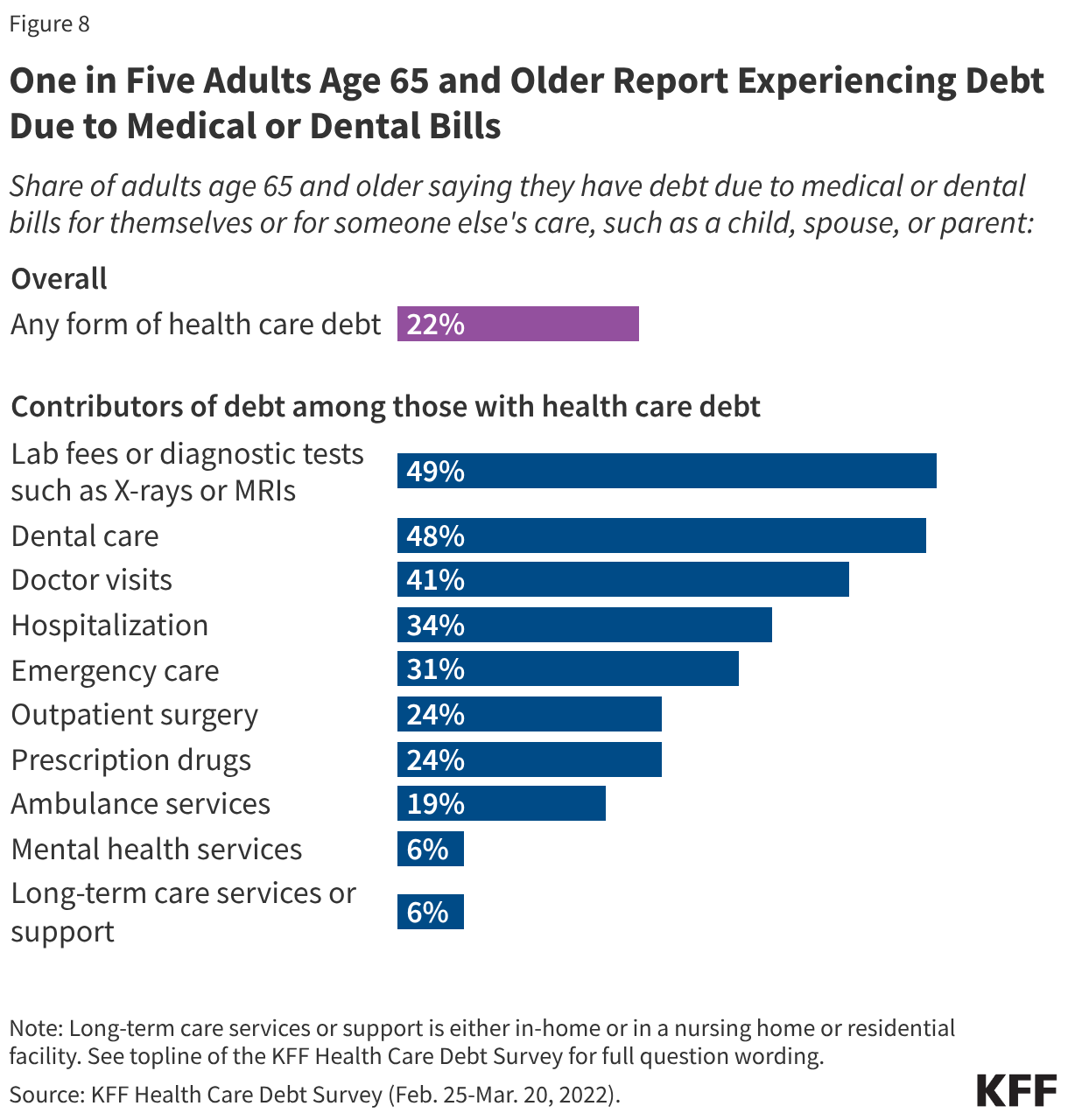
  • Health care debt is a burden for a large share of Americans. In 2022, about four in ten adults (41%) reported having debt due to medical or dental bills including debts owed to credit cards, collections agencies, family and friends, banks, and other lenders to pay for their health care costs, with disproportionate shares of Black and Hispanic adults, women, parents, those with low incomes, and uninsured adults saying they have health care debt.
  • Those who are covered by health insurance are not immune to the burden of health care costs. Almost four in ten insured adults under the age of 65 (38%) worry about affording their monthly health insurance premium and large shares of adults with employer-sponsored insurance (ESI) and those with Marketplace coverage rate their insurance as “fair” or “poor” when it comes to their monthly premium and to out-of-pocket costs to see a doctor.
  • Notable shares of adults say they are worried about affording medical costs such as the cost of health care services (including the cost of health insurance and out-of-pocket costs for things like office visits and prescription drugs). About two-thirds of adults say they are either “very worried” (32%) or “somewhat worried” (34%) about being able to afford the cost of health care for themselves and their families. The cost of health care ranks at the top of the list when it comes to things that people worry about affording, followed by food, utilities, and other household expenses.

Difficulty Affording Medical Costs

Many U.S. adults have trouble affording health care costs. While lower income and uninsured adults are the most likely to report this, those with health insurance and those with higher incomes are not immune to the high cost of medical care. Just under half of U.S. adults say that it is very or somewhat difficult for them to afford their health care costs (44%). Uninsured adults under age 65 are much more likely to say affording health care costs is difficult (82%) compared to those with health insurance coverage (42%). Additionally, a slight majority of Hispanic adults (55%) and half of Black adults (49%) report difficulty affording health care costs compared to about four in ten White adults (39%). Adults in households with annual incomes under $40,000 are more likely than adults in households with higher incomes to say it is difficult to afford their health care costs. (Source: KFF Health Tracking Poll: May 2025)

Nearly Half of Adults Say It Is Difficult To Afford Health Care Costs, Including Large Shares of the Uninsured, Black and Hispanic Adults, and Those With Lower Incomes

When asked specifically about problems paying for health care in the past year, about three in ten (28%) adults say they or a family member in their household had problems paying for care, rising to four in ten among Hispanic adults (41%) and young adults ages 18 to 29 (40%). Among those under age 65, six in ten (59%) uninsured adults report problems paying for health care in the past year, about twice the share of insured adults who say the same (30%). (Source: KFF Health Tracking Poll: November 2025)

Reports of Problems Paying for Health Care Highest Among Hispanic and Black Adults and the Uninsured

The cost of care can also lead some adults to skip or delay seeking services, with one-third (36%) of adults saying that they have skipped or postponed getting needed health care in the past 12 months because of the cost. Women are more likely than men to say they have skipped or postponed getting health care they needed because of the cost (38% vs. 32%). Adults ages 65 and older, most of whom are eligible for health care coverage through Medicare, are much less likely than younger age groups to say they have not gotten health care they needed because of cost.

Three-quarters of uninsured adults say they have skipped or postponed getting the health care they needed due to cost. Having health insurance, however, does not offer ironclad protection as about four in ten adults with insurance (37%) still report not getting health care they needed due to cost. (Source: KFF Health Tracking Poll: May 2025)

Three-Quarters of Uninsured Adults Say They Have Skipped or Postponed Getting Health Care They Needed in the Past 12 Months Due to Cost

Skipping care due to costs can have notable health impacts. Nearly two in ten adults (18%) report that their health got worse because they skipped or delayed getting care. Among adults under age 65, those who are uninsured are twice as likely as those with health coverage to say that their health worsened due to skipped or postponed care (42% vs. 20%). About four times as many adults under age 65 (23%) say their health got worse after skipping or postponing care as adults ages 65 and older (6%), most of whom have Medicare coverage. (Source: KFF Health Tracking Poll: May 2025)

Nearly Two in Ten Report Their Health Got Worse After Skipping or Postponing Care Due to Cost

A 2022 KFF report found that people who already have debt due to medical or dental care are disproportionately likely to put off or skip medical care. Half (51%) of adults currently experiencing debt due to medical or dental bills say in the past year, cost has been a probititor to getting the medical test or treatment that was recommended by a doctor. (Source: KFF Health Care Debt Survey: Feb.-Mar. 2022)

Prescription Drug Costs

The high cost of prescription drugs also leads some people to cut back on their medications in various ways. About one in four adults (23%) say in the past 12 months they have taken an over-the-counter drug instead of getting a prescription filled because of cost concerns and about one in five (21%) say they have not filled a prescription due to the cost. Additionally, about one in seven adults (15%) say that in the past 12 months they have cut pills in half or skipped doses of medicine due to cost.

One-third of the public (33%) say they have taken any of these cost saving measures in the past 12 months. Four in ten women (39%) say they have taken any of these prescription medication measures compared to one-quarter (26%) of men. Additionally, just under half of Hispanic adults (46%) say they’ve either taken an over-the-counter drug, skipped doses, or not filled prescriptions because of the cost, compared to three in ten (29%) White adults who say the same. Similarly, larger shares those with lower incomes report having taken a cost-saving measure in the last year compared to those with higher incomes (41% of those with a household income of less than $40,000 a year vs. 29% of those with an income of $40,000 or more). (Source: KFF Health Tracking Poll: May 2025)

Notably, adults with chronic conditions, who tend to have higher health care and medication needs, can often face challenges affording prescriptions. In KFF’s 2023 Survey of Consumer Experiences with Health Insurance, insured adult with a chronic condition were twice as likely as those without a chronic condition to say they had delayed or gone without prescription drugs due to the cost (18% vs. 9%).

About Two in Ten Adults Say They Have Not Filled a Prescription or Taken an Over-the-Counter Drug Instead Due to Cost

Health Insurance Cost Ratings

Health insurance provides some financial protection, but premiums and out-of-pocket costs can still present a financial burden for many individuals. Overall, most insured adults rate their health insurance as “excellent” or “good” when it comes to the amount they have to pay out-of-pocket for their prescriptions (61%), the amount they have to pay out-of-pocket to see a doctor (53%), and the amount they pay monthly for insurance (54%). However, at least three in ten rate their insurance as “fair” or “poor” on each of these metrics, and affordability ratings vary depending on the type of coverage people have.

Adults who have private insurance through employer-sponsored insurance or Marketplace coverage are more likely than those with Medicare or Medicaid to rate their insurance negatively when it comes to their monthly premium, the amount they have to pay out of pocket to see a doctor, and their prescription co-pays. About one in four adults with Medicare give negative ratings to the amount they have to pay each month for insurance and to their out-of-pocket prescription costs, while about one in five give their insurance a negative rating when it comes to their out-of-pocket costs to see a doctor.

Medicaid enrollees are less likely than those with other coverage types to give their insurance negative ratings on these affordability measures (Medicaid does not charge monthly premiums in most states, and copays for covered services, where applied, are required to be nominal). (Source: KFF Survey of Consumer Experiences with Health Insurance)

Large Shares of Adults With ESI and Marketplace Coverage Rate Their Insurance Negatively When It Comes to Premiums and Out-of-Pocket Costs

Health Care Debt

In June 2022, KFF released an analysis of the KFF Health Care Debt Survey, a companion report to the investigative journalism project on health care debt conducted by KFF Health News and NPR, Diagnosis Debt. This project found that health care debt is a wide-reaching problem in the United States and that 41% of U.S. adults currently have some type of debt due to medical or dental bills from their own or someone else’s care, including about a quarter of adults (24%) who say they have medical or dental bills that are past due or that they are unable to pay, and one in five (21%) who have bills they are paying off over time directly to a provider. One in six (17%) report debt owed to a bank, collection agency, or other lender from loans taken out to pay for medical or dental bills, while similar shares say they have health care debt from bills they put on a credit card and are paying off over time (17%). One in ten report debt owed to a family member or friend from money they borrowed to pay off medical or dental bills.

While four in ten U.S. adults have some type of health care debt, disproportionate shares of lower income adults, the uninsured, Black and Hispanic adults, women, and parents report current debt due to medical or dental bills.

Four in Ten Adults Currently Have Debt Due to Medical or Dental Bills

Vulnerabilities and Worries About Health Care and Long-Term Care Costs

At the start of 2026, health care costs are at the top of the list of people’s financial worries, with two-thirds (66%) saying they are at least somewhat worried about affording the cost of health care, including the cost of health insurance and out-of-pocket costs for things like office visits and prescription drugs for themselves and their families. This is larger than the shares who say they worry about affording food and groceries (57%), utilities (57%), housing costs (52%), and gas or other transportation expenses (52%) for their families.

Notably, about nine in ten uninsured adults under age 65 say they are worried about affording the cost of health care (88%), but a large share of insured adults are also worried (68%). Health care costs are at the top of household cost worries across insurance types and partisans. (Source: KFF Health Tracking Poll: January 2026)

Health Care Costs Are the Top Household Expense the Public Worries About

Many U.S. adults may be one unexpected medical bill from falling into debt. About half of U.S. adults say they would not be able to pay an unexpected medical bill that came to $500 out of pocket. This includes one in five (19%) who would not be able to pay it at all, 5% who would borrow the money from a bank, payday lender, friends or family to cover the cost, and one in five (21%) who would incur credit card debt in order to pay the bill. Women, those with lower household incomes, Black and Hispanic adults are more likely than their counterparts to say they would be unable to afford this type of bill. (Source: KFF Health Care Debt Survey: Feb.-Mar. 2022)

About Half of Adults Would Be Unable To Pay for an Unexpected $500 Medical Bill in Full, Including Larger Shares of Women, Those With Lower Household Incomes, Black and Hispanic Adult

Among older adults, the costs of long-term care and support services are also a concern. Almost six in ten (57%) adults 65 and older say they are at least “somewhat anxious” about affording the cost of a nursing home or assisted living facility if they needed it, and half say they feel anxious about being able to afford support services such as paid nurses or aides. These concerns also loom large among those between the ages of 50 and 64, with more than seven in ten saying they feel anxious about affording residential care (73%) and care from paid nurses or aides (72%) if they were to need these services. See The Affordability of Long-Term Care and Support Services: Findings from a KFF Survey for a deeper dive into concerns about the affordability of nursing homes and support services.

VOLUME 39

Abortion Pill Safety Decisions by FDA Were Science-Based, New JAMA Study Finds


Highlights

A new study found that Food and Drug Administration (FDA) decisions about the abortion pill mifepristone consistently followed scientific evidence, even as misleading claims about the drug’s safety continue to shape public understanding.

And Google removed some health AI summaries after a Guardian investigation reported that AI-generated summaries for search results about multiple health topics, including cancer screening, liver disease, and mental health conditions, shared false and potentially dangerous health information. While the full extent of inaccurate health information in these AI-generated summaries is unclear, patient advocacy organizations described the examples as “dangerous” and “alarming.”


What We’re Watching

Claims That the FDA Failed to Properly Evaluate Mifepristone Persist as New Study Finds Decisions Were Science-Based 

As FDA leadership initiates a new safety review of mifepristone following claims by abortion opponents that the drug was not adequately evaluated before it was granted approval, a new study published in JAMA examining more than 5,000 pages of internal FDA documents from 2011 to 2023 finds that agency decisions were consistently driven by scientific evidence, not politics. The study found that agency leaders almost always followed the recommendations of career scientists, repeatedly reviewed safety data, and reaffirmed that mifepristone is safe while making cautious changes to access. Despite this detailed analysis documenting the rigor of the FDA’s review process, the Senate’s Health, Education, Labor, and Pensions (HELP) Committee held a hearing this month framed as an inquiry into the abortion pill’s safety, with statements describing mifepristone as putting women in “serious danger.” Evidence continues to demonstrate that mifepristone is a safe medication. KFF polling shows that while twice as many adults say mifepristone is “safe” (42%) than say it is “unsafe” (18%) when taken as directed by a doctor, four in ten express uncertainty over the pill’s safety. Perception of the abortion pill’s safety has declined since 2023 among the public overall (42% view as safe now v. 55% in 2023) and among women ages 18 to 49 (41% view as safe now v. 59% in 2023).

Polling Insights:

KFF’s November 2025 Health Tracking Poll found that the public is largely divided over the intention underlying the FDA’s review of mifepristone. Just over half (53%) of adults and a similar share of women of reproductive age say that Secretary Kennedy’s decision to have the FDA review the safety of the abortion pill is mostly to “make it more difficult to access abortion pills,” while a somewhat smaller share of the public say the decision is mostly to “protect the health and safety of women” (46%).

Views on FDA’s review of mifepristone are largely shaped by partisanship, with most Democrats (81%) saying the decision is largely about curbing access to abortion pills and most Republicans (73%) saying the decision is mostly about protecting the health of women.

Slightly Larger Shares Say Secretary Kennedy’s Call for an FDA Review of Abortion Pill Aims to Restrict Access Rather Than Protect Health

U.S. Withdraws from International Health Organizations as Trust in Public Health Institutions Declines

The U.S. withdrawal from the World Health Organization took effect this month, with WHO Director-General Tedros Adhanom Ghebreyesus warning that the decision “makes the U.S. unsafe” and “makes the rest of the world unsafe” by cutting access to disease surveillance and emergency response systems. The withdrawal is part of broader U.S. disengagement from international health efforts, including the recent announcement that the U.S. is withdrawing from 31 U.N. entities such as the U.N. Population Fund, the lead U.N. agency focused on global population and reproductive health. Public opinion data suggests the decision lands amid declining and polarized public confidence in the WHO itself. According to an April 2024 poll from Pew Research, about six in ten U.S. adults believed the U.S. benefitted from its membership in the WHO, fewer than the share who said the same in 2021, including an 8 percentage point decrease in the share who say the U.S. benefitted a “great deal.” These concerns reflect institutional and diplomatic trust and intersect with broader trust challenges in health. The withdrawal occurs as the U.S. public’s trust in federal health agencies has continued to erode.  As global health partnerships change, health communicators may benefit from tracking changes in trust in health agencies to better understand where audiences turn to for health information.

Fraudulent Ads on Social Media Continue Despite Enforcement Measures 

Fraudulent advertising on social media continues to expose users to misleading and dangerous health claims, impacting how people assess and trust health information online. In early January, the Better Business Bureau (BBB) issued a “scam alert” about fraudulent ads using AI-generated videos of celebrities to promote fake weight-loss products, including unauthorized endorsements for supplements claiming to be GLP-1 medications. The BBB reported receiving more than 170 reports about one such product, with customers spending hundreds of dollars after seeing the fraudulent ads. The use of celebrity likenesses and medical terminology may increase the perceived credibility of these claims, even when the products are not legitimate treatments. The persistence of these false health advertisements is part of broader challenges platforms face in content moderation, with recent investigations finding thousands of deceptive ads remaining active despite prior enforcement. A Reuters investigation also reported that Meta allowed a high number of ads from Chinese partners, including ads for fake health supplements, prioritizing revenue while some enforcement measures were delayed or paused. As misleading health advertising continues, KFF will continue monitoring the types of health information that the public reports seeing and trusting on social media to better inform health communicators of when to intervene.


AI & Emerging Tech

Google’s AI Overviews in Search Results May Give Harmful Health Information

What’s happening?

An investigation conducted by The Guardian found that the artificial intelligence (AI)-generated summaries that appear at the top of Google search results, called “AI Overviews,” at times provided inaccurate and misleading information about health topics, potentially giving users false reassurance about serious illness. The Guardian found that the overviews wrongly advised people with pancreatic cancer to avoid high-fat foods, provided misleading information about liver blood test results, and incorrectly identified pap smears as screenings for vaginal cancer. Since the investigation was published, Google removed some AI health summaries tied to specific search queries, but similar prompts can still trigger AI-generated results and broader risks from AI-produced health information remain.

How often do people encounter and trust these overviews?

  • July 2025 polling from the Annenberg Public Policy Center found that nearly two-thirds of Americans who search for health information online had seen AI-generated responses at the top of search results, and most who see these responses consider them at least somewhat reliable, though just 8% consider them “very reliable.” Among adults who have seen AI-generated responses when searching for health information online, about three in ten said the AI responses provided them the answer they needed either “always” or “often.” At the same time, most adults who see these AI-generated responses to health inquiries said they either always or often continue searching by following links to specific websites or other resources.
  • A qualitative study published in the Journal of Medical Internet Research found that participants often skipped these overviews in favor of traditional search results, with some expressing skepticism about them because of a lack of sourcing. Even participants who read the AI-generated summaries continued scrolling to review other results rather than stopping their search, suggesting that some users are adopting a “trust but verify” approach to AI for health information.

Why this matters

The continued prevalence of AI-generated health information, which can contain misleading and harmful advice, suggests a need for both better safeguards from technology companies and clear guidance from health communicators about how to critically evaluate AI-generated health information. Even as research indicates that some users may skip these overviews or try to independently verify their contents, communicators should be aware that patients may be using these AI overviews as starting points for health research.

About The Health Information and Trust Initiative: the Health Information and Trust Initiative is a KFF program aimed at tracking health misinformation in the U.S., analyzing its impact on the American people, and mobilizing media to address the problem. Our goal is to be of service to everyone working on health misinformation, strengthen efforts to counter misinformation, and build trust. 


View all KFF Monitors

The Monitor is a report from KFF’s Health Information and Trust initiative that focuses on recent developments in health information. It’s free and published twice a month.

Sign up to receive KFF Monitor
email updates


Support for the Health Information and Trust initiative is provided by the Robert Wood Johnson Foundation (RWJF). The views expressed do not necessarily reflect the views of RWJF and KFF maintains full editorial control over all of its policy analysis, polling, and journalism activities. The data shared in the Monitor is sourced through media monitoring research conducted by KFF.

Poll Finding

KFF Health Tracking Poll: Health Care Costs, Expiring ACA Tax Credits, and the 2026 Midterms

Published: Jan 29, 2026

Findings

Key Takeaways

  • The cost of health care, including paying for health insurance and out-of-pocket expenses, tops the list of the public’s economic anxieties, rising well above other necessities. Two-thirds of the public (66%) say they worry about being able to afford health care for them and their family, ranking higher than utilities, food and groceries, housing, and gas. In addition, most adults (55%) say their health care costs have gone up in the past year, including at least one in five who say they have increased at a faster rate than food or utilities. A majority (56%) of the public say they expect health care costs for them and their families to become even less affordable in the coming year.
  • With health care costs topping the list of economic worries across partisans and key groups, voters expect the issue to play a major role in their decisions to turnout in November’s midterm elections as well as which candidates they support. Majorities across partisans say health care costs will impact their vote in November, but the issue is resonating more with Democratic voters and independent voters. More than three-quarters of Democratic voters and independent voters say health care costs will impact both their decision to vote and which party’s candidate they will vote for in the election, compared to about half of Republican voters. In fact, two-thirds of Democratic voters and more than four in ten independent voters say health care costs will have a “major impact” on their 2026 voting decisions.
  • The Democratic Party has the advantage when it comes to which party voters trust to handle most health care issues, including health care costs, on which the Democrats have a 13-point advantage over Republicans. The one exception is prescription drug prices, an issue President Trump has focused on in his second term, and on which similar shares of voters say they trust the Democratic Party (35%) and the Republican Party (30%). Among independent voters, the Democratic Party has an edge over the Republican Party on health care issues, but many independent voters also say they don’t trust either party.
  • The public’s anxiety around health care costs comes at a time when the Senate and President Trump seem unlikely to revive the ACA enhanced premium tax credits, which expired on January 1st. Most (67%) of the public say Congress did the “wrong thing” by not extending the credits, including large majorities of Democrats (89%) and independents (72%). But majorities of Republicans (63%) including MAGA supporters (64%) say Congress did the “right thing” by not extending the ACA enhanced premium tax credits. While overall popularity of the ACA and the Marketplaces is still high, given the recent debate around the ACA enhanced tax credit debates, favorability has declined among Republicans.

Health Care Costs Top Public’s Concerns During Moment of Economic Anxiety

One year into the second term of President Trump and less than ten months before the 2026 midterm elections, the public remains concerned about the top issue of the 2025 election – the economy. Eight in ten (82%) adults say their cost of living has increased in the past year, including half who say it has increased “a lot.” Very few say their cost of living has “decreased” either “a little” (4%) or “a lot” (1%) while about one in ten say their living expenses have remained stable over the past year. Many adults, regardless of partisanship, say their cost of living has increased “a lot” in the past year, including a majority of (56%) Democrats, about half (53%) independents, and four in ten (41%) Republicans. About four in ten (38%) supporters of the Make America Great Again Movement (MAGA) also say their cost of living has increased “a lot” in the past year.

About Eight in Ten Adults Say Their Cost of Living Has Increased in the Past Year

Concerns about household spending coincide with a majority (71%) of the public saying President Trump is not focusing enough on domestic affairs, such as addressing the cost of living in the U.S. The share of the public who say President Trump is not paying enough attention to domestic concerns rises to about nine in ten (89%) Democrats and three-quarters of (76%) independents. On the other hand, a majority of the public (55%) also say the Trump administration is focusing “too much” on foreign affairs, such as actions in Venezuela, Ukraine, and Gaza. Republicans and MAGA supporters are more positive about President Trump’s priorities, with many saying he is spending the “right amount” on both domestic affairs (53% and 60%), and foreign affairs (66% and 76%).

Many Say Trump Is Not Focusing Enough on Domestic Affairs Such as Addressing the Cost of Living in The U.S., Too Focused on Foreign Affairs

The latest KFF Health Tracking Poll finds health care costs top the list of what the public worries about being able to afford for themselves and their family. Two-thirds (66%) of the public say they worry about paying for health care, including the cost of health insurance and out-of-pocket costs for things like office visits and prescription drugs, ranking higher as a financial worry than other household expenses like utilities, food, and rent or mortgage – all three items on which a majority of Americans are still worried about being able to afford.  About a third of adults (32%) say they are “very worried” about affording health care expenses, while about a quarter of adults say the same about being able to afford food and groceries (24%), their rent or mortgage (23%), or utilities (22%). About a fifth of adults say they are “very worried” about affording gas and transportation costs (17%). This comes as recent reports show that health care costs are on the rise for most Americans and the Affordable Care Act (ACA) enhanced tax credits, which benefitted most people who purchased insurance through the marketplace, have expired.

Health Care Costs Are the Top Household Expense the Public Worries About

Notably, health care costs are the biggest worry compared to other household expenses for all adults, regardless of partisanship. About one third of Democrats (36%) and Independents (34%) say they are “very” worried about affording health care, as are about one in four (24%) Republicans. This includes one in four MAGA Republicans (23%) and non-MAGA Republicans (24%).

Majorities Across Partisanship Worry About Affording Health Care Costs

One reason why health care expenses may be topping the list of household worries is that most adults say their health care costs have increased in the past year, including a substantial share who say these costs have increased at a faster rate than other household expenses.

Overall, more than half (55%) of adults say their health care costs have increased in the past year. This includes about two-thirds of people with employer-based health insurance (64%) and those who purchase their own coverage (66%), as well as about half (53%) of Medicare enrollees 65 and older. Perceptions about the increase of health care costs persist across partisanship, with about half or more across partisans saying their health care costs have increased in the past year, including 58% of Democrats, 56% of independents, and 51% of Republicans, including 47% of MAGA Republicans.

Many Say Their Health Care Costs Have Increased in the Past Year

Notably, about one in five of all adults say their health care costs have increased at a faster rate than other necessities like utilities (23%) and food and groceries (21%). This includes similar shares among partisans and MAGA supporters, as well as at least one in four with employer-sponsored insurance and about a third who purchase their own insurance. Smaller shares of adults who receive health insurance through Medicaid and Medicare say their health care costs have increased at a faster rate than utilities and food and groceries, suggesting those with government coverage are more insulated from the rising cost of health care.

One in Five Adults Say Their Health Care Costs Have Increased at a Faster Rate Than Utility and Food Costs

Looking ahead to the next year, a majority (56%) of adults expect their family’s health care costs to become less affordable, while about a third (35%) expect them to stay about the same, and one in ten (9%) expect them to be more affordable. Most Democrats (62%) and independents (58%) expect health care costs to become less affordable, while Republicans, including those who identify as MAGA Republicans are split, with similar shares saying they expect them to become less affordable or expect them to say about the same. Majorities across insurance types expect their health care costs to become less affordable. This includes two-thirds of those who self-purchase (64%) or have employer-sponsored insurance (60%) and majorities of those who are uninsured (57%) or who have coverage through Medicaid (55%).

Most Expect Their Health Care Costs To Become Less Affordable in the Next Year

Democrats Have an Advantage on Health Care Issues, But No Party Has an Advantage on the Cost of Living 

With health care costs on the rise and a significant source of worry for many, a majority of voters, regardless of partisanship, say the issue will play a role in their voting decisions. The cost of health care is a particularly strong motivator for Democratic voters, of whom more than eight in ten say it will impact their decision to vote and who they will vote for, including two-thirds who say it will have a “major impact.” The cost of health care is a similarly large motivator for independents, of whom about eight in ten say it will impact their vote, including more than four in ten who say it will have a “major impact.” While Democratic and independent voters are more likely to say health care costs are a strong motivator compared to Republican voters, substantial shares of Republican voters say it will impact their decisions in November as well. Six in ten (60%) Republican voters say it will impact their decision to vote and 56% say it will impact which party’s candidate they will vote for. This includes about a fifth of Republican voters who say the cost of health care will have a “major impact.” This suggests that rising health care costs resonate with voters across the board and will be a key voting issue to watch for in this November’s elections.

Majorities of Voters Across Partisanship Say the Cost of Health Care Will Impact Their Midterm Vote

Less than ten months before the 2026 midterm elections, the Democratic Party has a strong edge over the Republican Party when it comes to health care issues, including on the cost of health care. Democrats have a double-digit advantage over the Republicans when it comes to who voters trust on determining the future of Medicaid (43% vs. 25%), addressing the future of the ACA (42% vs. 26%), determining the future of Medicare (40% vs. 26%), and addressing the cost of health care (40% vs. 27%). Voters are more divided on which party they trust to address the cost of prescription drugs, an issue that President Trump has focused on during his second term. Notably, on every health care issue asked about, at least a quarter of voters say they trust neither party to do a better job.

Among Voters, Democrats Have an Edge Over Republicans on Most Health Issues

Unsurprisingly, on each health care issue polled, Democratic voters are more likely to say they trust the Democratic Party and Republican voters are more likely to say they trust the Republican Party. Among independent voters, the Democratic Party has a clear advantage over the Republican Party on each of the health care issues; however, sizeable shares of independent voters (between about one-third and four in ten) say they trust “neither” party. When it comes to addressing the cost of prescription drugs, a larger share of independent voters say they trust “neither party” than say they trust either the Democrats or the Republicans.

Among Independent Voters, Democrats Have an Edge Over Republicans On Health Care Issues, But Many Also Say They Trust Neither Party

While the Democrats have an advantage among voters overall on health care issues, voter confidence is low when it comes to both political parties and President Trump to address the cost of living. Most voters say they have “not too much” confidence or “none” in the Republicans in Congress (64%), the Democrats in Congress (63%), and President Trump (61%), to address the cost of living for people like them. Small and similar shares of voters overall say they have “a lot” or “some” confidence in President Trump (38%), Democrats in Congress (37%), or Republicans in Congress (36%) to address the cost of living.

Voters Have Equally Low Confidence in President Trump, Democrats and Republicans to Address the Cost of Living

Amid the ACA Tax Credits Debate, Favorability of the ACA and ACA Marketplace Remains High, but Has Declined Among Republicans  

While a majority of the public continues to express a favorable view of the ACA, Republicans’ views have soured recently in the wake of the debate over extending the enhanced tax credits and Republican lawmakers’ persistent attacks on the 2010 health care law. Overall favorability of the ACA has dropped in the most recent poll, with 58% now saying they have a favorable view of the law and 41% saying they have an unfavorable view (down from 64% favorable, 35% unfavorable in September 2025). The overall decline in favorability of the ACA is driven by Republicans, of whom one in five (22%) now say they have a “very” or “somewhat” favorable view, compared to one-third (36%) who said the same in September. Views of the ACA remain positive and stable among Democrats (91%) and independents (62%), as well as among individuals who buy their own health coverage (64%).

Following ACA Tax Credit Debate, Favorability of the ACA Declines Among Republicans and MAGA Supporters

Favorable views of the ACA marketplaces where people and small businesses owners can shop for health insurance have also declined from 70% in September 2025 to 62% in the latest KFF Health Tracking Poll. Similarly to views of the ACA overall, this shift is driven by Republicans (41% now vs. 59% in September 2025 who said they view the marketplace favorably). Views of the ACA marketplaces are stable and favorable among Democrats (81%), independents (64%), and among those who self-purchase their insurance (64%).

After ACA Tax Credit Debate, Favorability of the ACA Marketplaces Declined, Driven by Republicans and MAGA Supporters

Most Say Congress Did the “Wrong Thing” Not Extending the ACA Tax Credits

The public is largely critical of Congress not extending the ACA enhanced tax credits for people who buy their own health coverage. Two-thirds of the public say Congress did the “wrong thing” by not extending the ACA enhanced tax credits, compared to one-third who say Congress did the “right thing.” Majorities of Democrats (89%), independents (72%), non-MAGA Republicans (54%), and those who purchase their insurance themselves (67%) say Congress did the “wrong thing” by not extending the tax credits. While most (63%) Republicans say Congress did the “right thing” by not extending the tax credits, a sizeable share, about four in ten (37%), say Congress did the “wrong thing.” This marks a shift in views from when debates over to extend the tax credits or not were still ongoing in November, when half of Republicans said Congress should extend the tax credits, suggesting the debates have shifted opinion among the Republican base.

Most Democrats and Independents Say Congress Did the Wrong Thing Not Extending the ACA Tax Credits; Most Republicans Say It Was the Right Thing

Among those who think the enhanced tax credits should have been extended, a group that leans more Democratic, many say most of the blame either falls on President Trump (42%, 28% of total adults) or Republicans in Congress (38%, or 26% of total adults). About one in five (19%, or 13% of total adults) say Democrats in Congress deserve the most blame. Among the four in ten Republicans who say Congress did the “wrong thing” not extending the tax credits, two-thirds (64%) blame Democrats in Congress for their expiration, rising to seven in ten (72%) MAGA-supporters.

Many Blame President Trump or Republicans for Not Extending ACA Enhanced Tax Credits; One Third Say Congress Did the Right Thing Not Extending Them

There are some indications that the expiration of the enhanced tax credits will play a role in how voters make decisions in the coming November election. Among those who self-purchase their insurance, two-thirds say it will impact their decision to vote (66%) and which party’s candidate they will vote for (67%) in the upcoming election. And although the expiring enhanced premium tax credits directly affect only those who purchase their own coverage on the ACA marketplaces, among voters overall, six in ten (62%) say their expiration will have an impact on their decision to vote, including 30% who say it will have a “major impact” and 31% who say it will have a “minor impact.” An additional four in ten (38%) voters say it will have “no impact at all” on their decision to vote. The expiration of the tax credits is a stronger motivator for Democratic voters and independent voters than for Republican voters. About eight in ten Democratic and two-thirds of independent voters say it will impact their voting behavior, compared to about four in ten Republican voters.

Most Democrats, Independents Say Expiration of ACA Tax Credits Will Impact Their Midterm Vote, Majorities of Republicans Say It Will Not

Methodology

This KFF Health Tracking Poll/KFF Tracking Poll on Health Information and Trust was designed and analyzed by public opinion researchers at KFF. The survey was conducted January 13-20, 2026, online and by telephone among a nationally representative sample of 1,426 U.S. adults in English (n=1,355) and in Spanish (n=71). The sample includes 1,028 adults (n=60 in Spanish) reached through the SSRS Opinion Panel either online (n= 1,003) or over the phone (n=25). The SSRS Opinion Panel is a nationally representative probability-based panel where panel members are recruited randomly in one of two ways: (a) Through invitations mailed to respondents randomly sampled from an Address-Based Sample (ABS) provided by Marketing Systems Groups (MSG) through the U.S. Postal Service’s Computerized Delivery Sequence (CDS); (b) from a dual-frame random digit dial (RDD) sample provided by MSG. For the online panel component, invitations were sent to panel members by email followed by up to three reminder emails.

Another 398 (n=11 in Spanish) adults were reached through random digit dial telephone sample of prepaid cell phone numbers obtained through MSG. Phone numbers used for the prepaid cell phone component were randomly generated from a cell phone sampling frame with disproportionate stratification aimed at reaching Hispanic and non-Hispanic Black respondents. Stratification was based on incidence of the race/ethnicity groups within each frame. Among this prepaid cell phone component, 149 were interviewed by phone and 249 were invited to the web survey via short message service (SMS).

Respondents in the prepaid cell phone sample who were interviewed by phone received a $15 incentive via a check received by mail or an electronic gift card incentive. Respondents in the prepaid cell phone sample reached via SMS received a $10 electronic gift card incentive. SSRS Opinion Panel respondents received a $5 electronic gift card incentive (some harder-to-reach groups received a $10 electronic gift card). In order to ensure data quality, cases were removed if they failed two or more quality checks: (1) attention check questions in the online version of the questionnaire, (2) had over 30% item non-response, or (3) had a length less than one quarter of the mean length by mode. Based on this criterion, 2 cases was removed.

The combined cell phone and panel samples were weighted to match the sample’s demographics to the national U.S. adult population using data from the Census Bureau’s 2025 Current Population Survey (CPS), September 2023 Volunteering and Civic Life Supplement data from the CPS, and the 2025 KFF Benchmarking Survey with ABS and prepaid cell phone samples. The demographic variables included in weighting for the general population sample are gender, age, education, race/ethnicity, region, civic engagement, frequency of internet use and political party identification. The weights account for differences in the probability of selection for each sample type (prepaid cell phone and panel). This includes adjustment for the sample design and geographic stratification of the cell phone sample, within household probability of selection, and the design of the panel-recruitment procedure.

The margin of sampling error including the design effect for the full sample is plus or minus 3 percentage points. Numbers of respondents and margins of sampling error for key subgroups are shown in the table below. For results based on other subgroups, the margin of sampling error may be higher. Sample sizes and margins of sampling error for other subgroups are available on request. Sampling error is only one of many potential sources of error and there may be other unmeasured error in this or any other public opinion poll. KFF public opinion and survey research is a charter member of the Transparency Initiative of the American Association for Public Opinion Research.

GroupN (unweighted)M.O.S.E.
Total1,426± 3 percentage points
Party ID  
Democrats473± 6 percentage points
Independents483± 6 percentage points
Republicans367± 6 percentage points
   
MAGA Republicans/Rep leaners352± 6 percentage points
MAHA supporters618± 5 percentage points
Parents or guardians of children under 18 living in their household436± 6 percentage points