KFF designs, conducts and analyzes original public opinion and survey research on Americans’ attitudes, knowledge, and experiences with the health care system to help amplify the public’s voice in major national debates.
Here’s our recap of the past week in the coronavirus pandemic from our tracking, policy analysis, polling, and journalism.
The United States surpassed the grim milestone of 200,000 confirmed deaths related to COVID-19 this week and is on the verge of 7 million total cases. However, a KHN article reporting on California’s death totals in the first five months of the pandemic suggests that about 5,000 “excess” deaths not attributed to COVID-19 – an unusually high number — could be partially due to an undercount of officially reported COVID-19 related deaths.
With the school year underway and localities taking varying approaches to school attendance, a new KFF brief examines not only the published studies on COVID-19 risks for children, but also broader health and economic impacts the pandemic has had on them and their families.
As the country awaits a vaccine and Americans worry about political pressure leading to premature approval of one, a KHN article examines the safety monitoring board that will be making these critical decisions.
Here are the latest coronavirus stats from KFF’s tracking resources:
Global Cases and Deaths: Total cases worldwide surpassed 32 million this week – with an increase of approximately 2 million new confirmed cases in the past seven days. There were approximately 35,700 new confirmed deaths worldwide, bringing the total to nearly 981,800 confirmed deaths.
U.S. Cases and Deaths: Total confirmed cases in the U.S. neared 7 million this week. There was an approximate increase of 303,200 confirmed cases between September 18 and September 24. Approximately 5,200 confirmed deaths in the past week brought the total in the United States to approximately 202,800.
Children’s Health and Well Being During the Coronavirus Pandemic (Issue Brief)
Medicaid Maintenance of Eligibility (MOE) Requirements: Issues to Watch When They End (Issue Brief)
Medicaid Emergency Authority Tracker: Approved State Actions to Address COVID-19 (Issue Brief)
Updated: COVID-19 Coronavirus Tracker – Updated as of September 24 (Interactive)
Updated: State Data and Policy Actions to Address Coronavirus (Interactive)
At U.N., China, Russia, U.S. Spar Over Pandemic Responses; African Nations Call For Fiscal Support; Guterres Urges Nations To Cooperate On COVID-19, Climate Change (KFF Daily Global Health Policy Report)
The debate over school openings has highlighted the implications of the coronavirus pandemic for children and their families. While experts continue to gather data on children’s risk for contracting and transmitting coronavirus, current research suggests that though children are more likely to be asymptomatic and less likely to experience severe disease than adults, they are capable of transmitting to both other children and adults. In addition to the risk of disease and illness, COVID-19 has led to changes in schooling, health services delivery, and other disruptions of normal routines that will likely affect children’s health and well-being, regardless of whether they are infected.
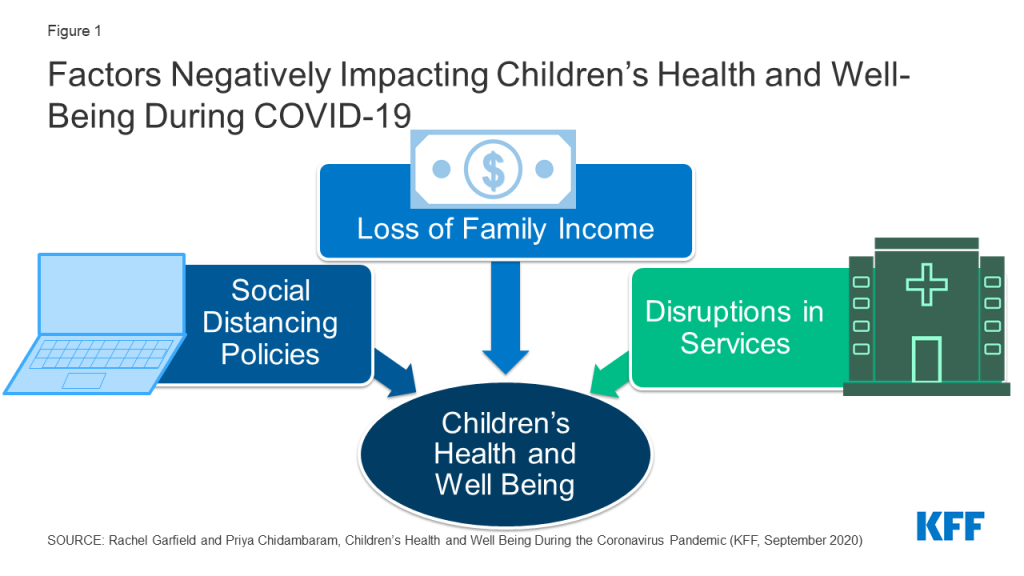
This brief examines how a range of economic and societal disruptions stemming from COVID-19 may affect the health and well-being of children and families. It draws on published literature as well as pre-pandemic data from the National Survey of Children’s Health and the National School-Based Health Care Census, recent survey data on experiences during the pandemic, data tracking the number of cases resulting from school openings, and preliminary reports based on claims data evaluating service utilization among Medicaid and CHIP child beneficiaries. It finds that school openings/closures, social distancing, loss of health coverage, and disruptions in medical care could negatively impact the health and well-being children in the US (Figure 1).1 Key findings include:
Students who attend in person school face direct risks of contracting coronavirus, with early tracking documenting nearly 12,400 cases across 3,900 schools. Risks due to school attendance may be higher for low-income children or children of color, whose families may be less likely to afford alternative schooling arrangements or private transportation to school. A July KFF poll found that parents of color were significantly more likely than White parents to say they were worried about their child contracting coronavirus due to school attendance and that their school lacked adequate resources to safely reopen.
Students who do not attend school in person also face health risks, including difficulty accessing health care services typically provided through school, social isolation, and limited physical activity. Millions of children access health services through school-based health clinics, school screening and early intervention programs, and on-site counseling, and these services may be suspended in schools that are not open for in person instruction. Children also may be missing opportunities for social connections or exercise, as three-quarters of school-age children take part in a sport, club, or other organized activity or lesson, many of which may be suspended. A quarter of children do not live in a neighborhood with access to sidewalks or walking paths, which could limit physical activity. KFF polls show high rates (67%) of parent concern for their children’s social and emotional health due to school closures.
Both students attending and not attending in-person school may face emotional or behavioral challenges due to disruptions to routines as well as increases in parent stress and family hardship. Early research has documented high rates of rates of clinginess, distraction, irritability, and fear among children, particularly younger children, as well as increases in some substance use among adolescents, and one survey found that nearly a third of parents said their child had experienced harm to their emotional or mental health. Parent stress due to childcare, schooling, lost income, or other pandemic-related pressures can negatively affect children’s emotional and mental health, harm the parent-child bond and have long-term behavioral implications, and have serious implications for children at risk of abuse or neglect. Exposure to adverse childhood experiences have documented effects of lifelong physical and mental health problems.
Children are also experiencing consequences of the economic fallout of the pandemic, with at least 20 million children living in a household in which someone lost a job. Though the large majority of children who lose access to employer-sponsored insurance due to job loss are eligible for Medicaid or CHIP, some parents may not enroll children in coverage due to challenges completing the application, lack of knowledge or understanding of eligibility, or other reasons. Many families experiencing loss of income, food insufficiency, or problems paying rent since the pandemic have children, and school closures may make it challenging for the 20 million students who receive free or reduced price lunch to access those meals.
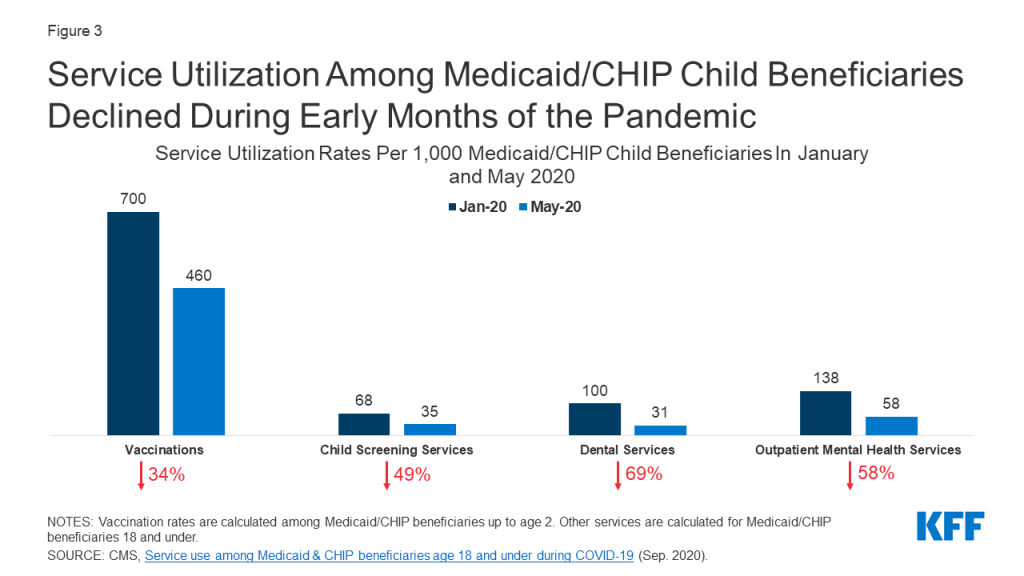
Parents may be delaying preventative and ongoing care for their children due to social distancing policies as well as concerns about exposure. Reports based on health care claims show declines in rates of vaccinations, child screenings, dental services, and outpatient mental health services among Medicaid/CHIP child beneficiaries (Figure 3). Other administrative data show declines in vaccine orders and administration, particularly among children older than 24 months. It is likely that parents may be delaying care due to concerns about contracting illness or cost concerns, and providers may have limited capacity due to changes in operations to safely treat patients. These delays in care may disproportionately impact the 13 million children with special health care needs who require ongoing care to address their complex needs.
Children’s lower risk of serious illness due to COVID-19 has led most discussion and policy debate over the pandemic to focus on adults at high risk, though the recent debate over school openings has shifted focus to children’s health and well being. Many children are currently facing substantial access barriers, emotional strain, and financial hardship that could have long-term repercussions for their lives. Policies to ensure access to needed health services, particularly behavioral health services, as well as facilitate access to social services to support families with children, can help address some of the consequences children are currently facing.
Figure 1: Factors Negatively Impacting Children’s Health and Well-Being During COVID-19
Introduction
The debate over school openings has highlighted the implications of the coronavirus pandemic for the nation’s 76 million children and their families. Experts continue to gather data on the children’s risk for contracting and transmitting coronavirus, but current research suggests that though children are more likely to be asymptomatic and less likely to experience severe disease than adults, they are capable of transmitting to both children and adults. As of September 17th, 2020, state data indicated that there were over half a million COVID-19 cases among children nationwide, accounting for just over 10% of all cases (children make up about a quarter of the population in the US); however, new cases among children in the period September 3rd through September 17th represented a 15% increase over the prior two week period. In addition, social distancing policies and the economic downturn have important implications for the health and well-being of children, particularly low-income children and children of color. These groups faced increased health, social, and economic challenges prior to the pandemic, and research shows that, like adults, minority and socioeconomically disadvantaged children have a higher risk of contracting coronavirus. This brief provides analysis of the potential implications of the COVID-19 pandemic for children’s mental and physical health, well-being, and access to and use of health care.
Health Risks due to School Openings/Closures and Social Distancing Policies
States and school districts have made varying decisions about how to conduct school in the 2020-21 academic year. As of September 23rd, only Puerto Rico and the District of Columbia had statewide school closures in effect, with five additional states having regional mandatory closures, while four states ordered in-person instruction to be available full or part time. The remaining states have left school operations decisions to localities or are using a hybrid (in-person and on-line) approach to school openings. Most states have given child care facilities, which serve younger children up to Pre-K, the option to open, sometimes with restrictions on class size or other operations.
Students who attend in person school face direct risks of contracting coronavirus, with early tracking documenting nearly 12,400 cases across 3,900 schools. A KFF review found that evidence is mixed about whether children are less likely than adults to become infected when exposed, and while disease severity is significantly less in children, a small subset become quite sick. It further found that though school openings in many other countries have not led to outbreaks among students, the US has much higher rates of community transmission and lower testing and contact tracing capacity and may fare differently. In addition, experience from other countries as well as child care centers in the US shows that school-associated outbreaks do occur, and children do transmit the virus. KFF polling data from July 2020 showed high rates of parent concern over health risks due to school re-opening, with 70% of parents of a child age 5-17 saying they were somewhat or very worried about their child getting sick from coronavirus due to school attendance; parents of color were more likely to express this concern (91% versus 55% of White parents) and also more likely to say their child’s school lacks the resources to safely reopen (82% versus 54% of White parents). As of September 22nd, The National Education Association has confirmed nearly 12,400 cases in Pre-K to high school students across the country. Given the lack of universal testing among students in school and higher likelihood of children being asymptomatic, the number of cases is likely higher than what is reported. Children who contract coronavirus may also pose a risk beyond their school community, as 3.3 million adults age 65 or older live in a household with a school-age child.
The risks of contracting coronavirus due to school may be greater for low-income or minority students due to differences in school structure and commuting patterns. Risks due to schooling and parent decisions about the school year have exposed and exacerbatedinequities in the education system. Children in lower-income families are less likely to have access to a “learning pod” that supports in-home instruction and are less likely to have adequate computing resources at home for distance learning and thus may be less likely to opt out of in-person instruction. In addition to higher risk due to in-person attendance, minority or low-income children may be at higher risk from transportation to and from school, as students from low-income households may lack alternatives to school transportation or live in neighborhoods without safe walking routes to school. Data from the 2017 National Household Travel Survey indicates that a higher share of low-income students ride a school bus compared to non-low-income students (60% vs. 45%). Furthermore, Black students travel farther than White and Hispanic students to school. Longer commute times on school busses and other forms of public transportation may put students at higher risk for contracting the virus due to the increased time spent in an enclosed and crowded space.
Students who do not attend school in person may face difficulty accessing health care services typically provided through school. School based health clinics (SBHCs) provide primary care and behavioral health services to nearly 6.3 million students across over 10,600 public schools in the US, accounting for nearly 13% of students nationwide. These clinics are primarily located in schools that serve high concentrations of low-income students and predominantly serve students in grades 6 and above. Additionally, only a small share (just over 10%) of SBHCs are telehealth clinics, with the remainder offering all or most services in person. While some SBHCs may remain open if they serve the broader community, with schools closing, many other SBHCs have likely also shut down, eliminating a source of care for students that rely on them. Outside of SBHCs, schools also provide screening, early intervention, and other health care to their students. In 2016-2018, nearly 1 in 4 students between the ages of 5 and 17 had their vision tested at school (23%), and nearly 10% of children between the ages of 3 and 17 with Autism Spectrum Disorder were first diagnosed by a school psychologist or counselor. About 200,000 students across the US between the ages of 10 and 17 reported using the nurse’s office or athletic trainer’s office as their usual source of care,2 and pre-pandemic, 58% of adolescents who used mental health services received these services in an educational setting, with higher rates among low-income, minority students.
Social distancing policies may result in reduced social connections and physical activity for children. Over three-quarters of older children between the ages of 6 and 17 take part in sports after school or on weekends, are a member of club or organization after school or on weekends, or take part in another form of organized activity or lesson, such as music, dance, language, or other arts.3 Many of these activities are likely cancelled or curtailed due to social distancing policies (even if schools open), leaving many children without social or physical engagement. Parents report high rates of concern about limited social interaction, with data from a July KFF Tracking Poll finding that 67% of parents are worried their children will fall behind socially and emotionally if schools do not reopen. Additionally, as recreational facilities remain closed, opportunities to exercise or spend time outdoors may be limited. Over 1 in 4 families do not live in a neighborhood with sidewalks or walking paths, which could limit children’s ability to spend time outdoors and maintain health.4
Both students attending and not attending in-person school may face emotional or behavioral challenges due to disruptions to routines. There have been widespread reports of the challenges that the disruptions and stress due to pandemic pose to children’s mental health or behavior. Early research reported high rates of clinginess, distraction, irritability, and fear among children, with younger children being more likely to exhibit these behaviors. In a June 2020 survey, 29% of parents reported that their child had already experienced harm to their emotional or mental health. Children with pre-existing mental or behavioral health problems may be at particularly high risk; prior to the pandemic, more than one in ten adolescents ages 12 to 17 had depression or anxiety. Pre-pandemic rates of mental illness were higher among children of color, and these children were also less likely to receive treatment for their mental or emotional problems. Substance use is also a concern, and research has found increases in solitary substance use among adolescents during the pandemic, which is associated with poorer mental health and coping. Behavioral health treatments involve frequent contact with therapists and regular follow-up that may be compromised with limited access to services or school closures during the pandemic. Research has documented long-term effects of adverse childhood experiences, including lifelong physical and mental health problems.
Increases in parent stress may also negatively affect children’s health. With long-term closures of schools and childcare centers, many parents are experiencing new challenges in childcare, homeschooling, and disruption to normal routines. Prior to the pandemic, over half (52%) of all children between the ages of 0-5 received at least 10 hours of care per week from someone other than their parent or guardian, including day care centers, preschools, or Head Start programs.5 During the pandemic, nearly all adults in households with children in school reported a disruption to normal schooling. With many sources of care unavailable, parents who are still working (either in person or via telework) are having to balance childcare or schooling with work. KFF Tracking Polls conducted following widespread shelter-in-place orders found that over half of women and just under half of men with children under the age of 18 have reported negative impacts to their mental health due to worry and stress from the coronavirus.6 Parent stress in coping with the pandemic can negatively affect children’s emotional and mental health, harm the parent-child bond and have long-term behavioral implications, and have serious implications for children at risk of abuse or neglect. A survey conducted in late March 2020 found that a majority of parents (61%) shouted, yelled or screamed at their children at least once in the past 2 weeks and 20% spanked or slapped their child at least once in the past 2 weeks. Social distancing may mean that children have less access to support systems outside members of the household.
Health Risks due to Loss of Family Income
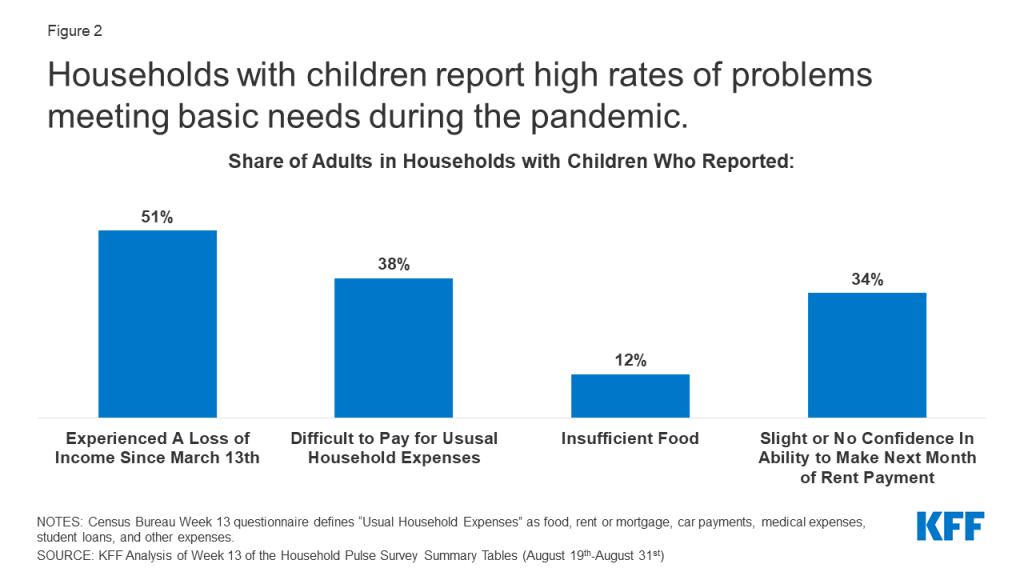
COVID-19 has led to a surge in unemployment and income declines for many families with children. Social distancing policies required to address the crisis have led many businesses to cut hours, cease operations, or close altogether. KFF estimates of job loss between March 1st and May 2nd, 2020 find that over 20 million children are in a family in which someone lost a job. Job losses have continued since that date, and a greater number of children may be in a family in which someone retained their job but has experienced some loss of income. Data from the Census Bureau’s Household Pulse Survey show that as of August 31st, just over half of adults who have children in the household experienced some loss of employment income since March 13th, 2020, a higher rate than adults without children (42%), and over 30% of adults with children expected a loss of income in the next four weeks (Figure 2).
Job loss may lead to disruptions in children’s health coverage, though most children in families losing employer-sponsored health insurance are likely eligible for coverage under the ACA. KFF analysis of job loss and potential loss of employer coverage as of early May found that millions of people who lost their job as of May 2 were at risk of losing their employer health benefits, and over 6 million people at risk of losing ESI and becoming uninsured are children. The vast majority of these children are eligible for coverage through Medicaid or CHIP, but it is unclear whether they will be enrolled in coverage. Between 2016 and 2018, over one-third of families who had a gap in insurance coverage attributed that gap to unaffordable insurance, health insurance cancellation due to overdue premiums, or a change in employer or employment status. Coverage losses among children will negatively affect their ability to access needed care.7 ,8 ,9 ,10
Loss of family income also affects parents’ ability to provide for children’s basic needs. Data from the August 19-31 Household Pulse Survey shows that 38% of adults in households with children said it was somewhat or very difficult to pay for usual household expenses during the pandemic, a higher share than among adults without children (26%) (Figure 2). The share of households with children who sometimes or often did not have sufficient food to eat increased during the pandemic, with 10% of these households reporting insufficient food prior to March 13th, as compared to 12% as of August 31st. Food insufficiency is particularly pronounced for Black (20%) and Latino (16%) households with children when compared to White (9%) households. Additionally, over one third (34%) of adults in households with children reported only slight or no confidence in their ability to make the next month of rent payment (Figure 2).
Figure 2: Households with children report high rates of problems meeting basic needs during the pandemic.
School closures may further limit low-income children’s ability to access food through free- and reduced-price school meal programs. Just over 1 in 3 students between the ages of 5 and 17 qualifies for a free or reduced cost meal.11 Given that these students often depend on school for two meals a day, school closures may limit their ability to eat regularly and access nutritious food. States and localities are working to continue school meal programs under waivers from the US Department of Agriculture that enable them to provide meals under the Summer Food Service Program or Seamless Summer Option and through new authority to expand the availability of these programs. However, research indicates that only a small share (15%) of the nearly 30 million children who received meals through the program prior to the pandemic continue to do so.
Health Risks due to Disruptions in Health and Social Services
Preliminary reports based on claims data show significant declines in service utilization among Medicaid/CHIP beneficiaries under the age of 18 between January and May 2020, which may be due to social distancing policies as well as concerns about exposure (Figure 3). Prior to the pandemic, utilization of preventive and primary care was generally high among children: In 2018, the large majority (96%) of children had a regular source of health care, nearly 90% had received a well-child visit in the past year, and only a small share (2.5%) delayed care due to cost. However, early analysis of claims data by the Center for Medicare and Medicaid Services (CMS) shows substantial declines in use of regular and preventive care. Among Medicaid and CHIP beneficiaries under the age of 2, vaccination rates dropped nearly 34% between January and May 2020. Other services, such as child screening services, dental services, and outpatient mental health services, dropped 50% or more between January and May 2020 for Medicaid and CHIP beneficiaries 18 or younger (Figure 3). Other administrative data across payers show substantial declines in vaccine orders and administration, particularly among children older than 24 months, with cumulative doses of noninfluenza vaccines ordered dropping by more than 3 million by mid-April 2020 compared to the same time in 2019. Parents may be delaying care due to concerns about contracting illness or, for those with private insurance, cost, and providers may have limited capacity due to changes in operations to safely treat patients.
Figure 3: Service Utilization Among Medicaid/CHIP Child Beneficiaries Declined During Early Months of the Pandemic
Though some data shows increases in use of telehealth services among children during the pandemic, it has not offset declines in in-person visits. A July 2020 study found that, prior to the pandemic, only 15% of pediatricians reporting using telemedicine, and many pediatric practices have had to quickly adapt to provide telehealth services during the pandemic. Medicaid, which provides health coverage for nearly 40% of children in the US, is allowing the use of telehealth for Medicaid-funded well-child visits and services, but as of July 23, only 15 states had issued telehealth guidance for child well-care and EPSDT visits and 16 states had issued guidance to providers to allow for telehealth or remote care delivery for early childhood intervention services. Preliminary reports by CMS based on Medicaid claims data shows that delivery of any services via telehealth to children increased by over 2,500% from February to April 2020, but these increases did not offset declines in in-person visits and utilization still declined substantially across many services.
Challenges accessing health services are particularly problematic for the 13 million children with special health care needs (CSHCN). Children with special health care needs require ongoing care and specialized services due to intellectual/developmental disabilities, physical disabilities, and/or mental health disabilities. These disabilities may include asthma, cerebral palsy, cystic fibrosis, diabetes, muscular dystrophy, brain injury, or epilepsy. Many of these children rely on continual care, especially those who have ongoing complications or who have recently had procedures. However, due to social distancing rules and risk of exposure in health care settings, CSHCN may forgo necessary care. Additionally, CSHCN and their families rely on home-based medical caregiving to supplement other sources of care. These include children with particularly complex care needs who may rely on nursing care to live safely at home with a tracheotomy or feeding tube. However, given staffing shortages and other complications brought on by the pandemic, home nursing and aide services may no longer be an option for many families.
The pandemic has led to many services in child welfare systems being cut back or postponed, leading to concerns of both increased child abuse and decreased reporting. Many child welfare agencies have cut back on in-person inspections of homes, which puts vulnerable children at even greater risk for abuse and neglect. Child welfare professionals also report concern that the pandemic will fuel a rise in child abuse and neglect, given the increasing stress on families and working parents. There are also concerns of decreased reporting of child abuse and neglect that may stem from social distancing policies. States including Wisconsin, Oregon, Pennsylvania, and Illinois saw reports of child abuse fall between 20% and 70% in the month of March, likely due to children being kept away from locations where there are professionals who are trained to identity and report scenarios of child abuse and neglect. The pandemic may also lead to an increased need for child welfare services, as increased financial pressures on families negatively impact parents’ relationships with their children. This additional need could remain unmet as the child welfare system struggles to handle its current caseload and families in need with the additional complications presented by COVID-19.
Looking Ahead
The coronavirus pandemic is an unprecedented event in most people’s lifetimes, leading to extraordinary high risk to health and well-being. Children’s lower risk of serious illness due to COVID-19 has led most discussion and policy debate over the pandemic to focus on adults at high risk, though the recent debate over school openings has shifted focus to children’s health and well-being. With many schools re-opening, tracking cases and serious illness among children and understanding who is at highest risk can help policymakers design education and support systems to minimize exposure, risk, and illness. In addition, many children are already facing substantial access barriers, emotional strain, and financial hardship that could have long-term repercussions for their lives. This analysis underscores the importance of pursuing safe approaches to opening schools to balance physical and emotional health. Policies to facilitate enrollment in health coverage, ensure access to health services, particularly behavioral health services, as well as facilitate access to social services to support families with children, can help address some of the consequences children are currently facing.
Endnotes
KFF analysis of 2016-2018 National Survey of Children’s Health ↩︎
KFF analysis of 2016-2018 National Survey of Children’s Health ↩︎
KFF analysis of 2016-2018 National Survey of Children’s Health ↩︎
KFF analysis of 2016-2018 National Survey of Children’s Health ↩︎
KFF analysis of 2016-2018 National Survey of Children’s Health ↩︎
Percent of women with children under the age of 18 reporting negative mental health impacts due to worry and stress from the coronavirus outbreak: 57% (KFF Health Tracking Poll conducted March 25-30, 2020), 53% (KFF Health Tracking Poll conducted May 13-18, 2020), and 59% (KFF Health Tracking Poll conducted July 14-19, 2020).Percent of men with children under the age of 18 reporting negative mental health impacts due to worry and stress from the coronavirus outbreak: 32% (KFF Health Tracking Poll conducted March 25-30, 2020), 28% (KFF Health Tracking Poll conducted May 13-18, 2020), and 49% (KFF Health Tracking Poll conducted July 14-19, 2020). ↩︎
Leighton Ku and Matthew Broaddus, Coverage of Parents Helps Children, Too (Center on Budget and Policy Priorities, October 2006), http://www.cbpp.org/cms/?fa=view&id=754. ↩︎
Health insurance and access to care improve health outcomes, including viral suppression, for people with HIV in the United States (U.S.). Our prior research documented an increase in insurance coverage among people with HIV, after implementation of the Affordable Care Act (ACA). In this update, we find that in 2018, just 1 in 10 (11%) nonelderly people with HIV were uninsured, a rate on par with that of the general population (10%).
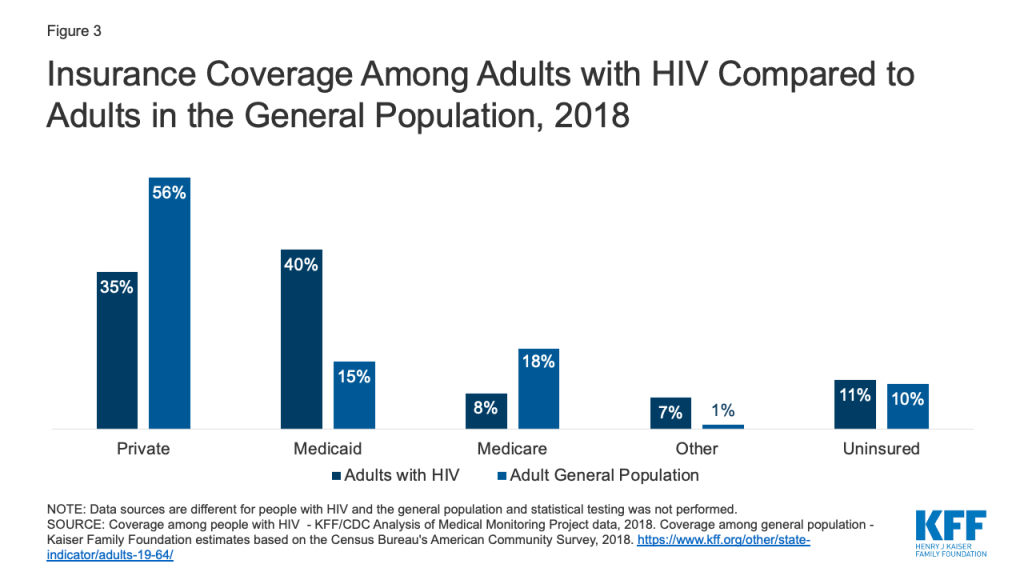
While the overall rate of uninsurance is now similar for people with HIV and the population overall, there are substantial differences in the type of coverage. Medicaid plays a much more significant role for people with HIV compared to the general population (40% v. 15%), and it is their single largest source of coverage, and people with HIV are much less likely to be covered by private insurance (35% v. 56%).
We observed coverage differences among adults with HIV by a range of demographic indicators. For example, men with HIV were almost twice as likely to have private coverage than women. Whites were also more likely to have private coverage compared to Blacks and Hispanics, who were more than three times as likely to be uninsured. We also noted differences by income, place of birth, and sexual orientation.
The Ryan White HIV/AIDS Program plays a major role in providing outpatient care and support services to people with HIV, regardless of insurance coverage. In 2018, almost half of all people with HIV (46%) relied on Ryan White, including more than eight in ten (82%) of those who are uninsured.
Finally, we find that sustained viral suppression rates varied by payer, and were higher among those with private insurance or Medicare, compared to the uninsured. Viral suppression among those with Medicaid was not significantly different from the uninsured, a finding that could reflect the equalizing role of the Ryan White Program for the uninsured and lower incomes among individuals in these coverage groups. Additionally, those with Ryan White support were significantly more likely to have sustained viral suppression compared those without, regardless of payer.
Introduction
Health insurance coverage and access to care improve health outcomes, including viral suppression, for people with HIV in the United States. Our previous work, based on analysis of nationally representative data from the Centers for Disease Control (CDC) and Prevention’s Medical Monitoring Project (MMP), demonstrated that implementation of the Affordable Care Act’s (ACA) 2014 coverage provisions increased insurance coverage among adults with HIV. In this analysis, using the same data source and building on recent work, we provide a detailed analysis of coverage in 2018, including by state Medicaid expansion status, race/ethnicity, gender, and income. For the first time, we include data on coverage among people with HIV by place of birth and sexual orientation.
Findings
Overall Coverage Findings
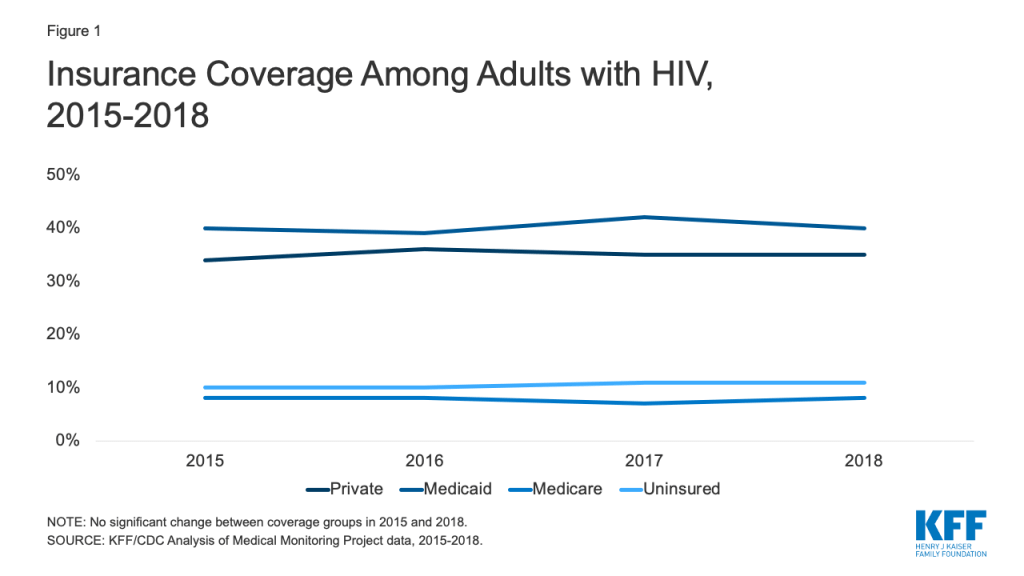
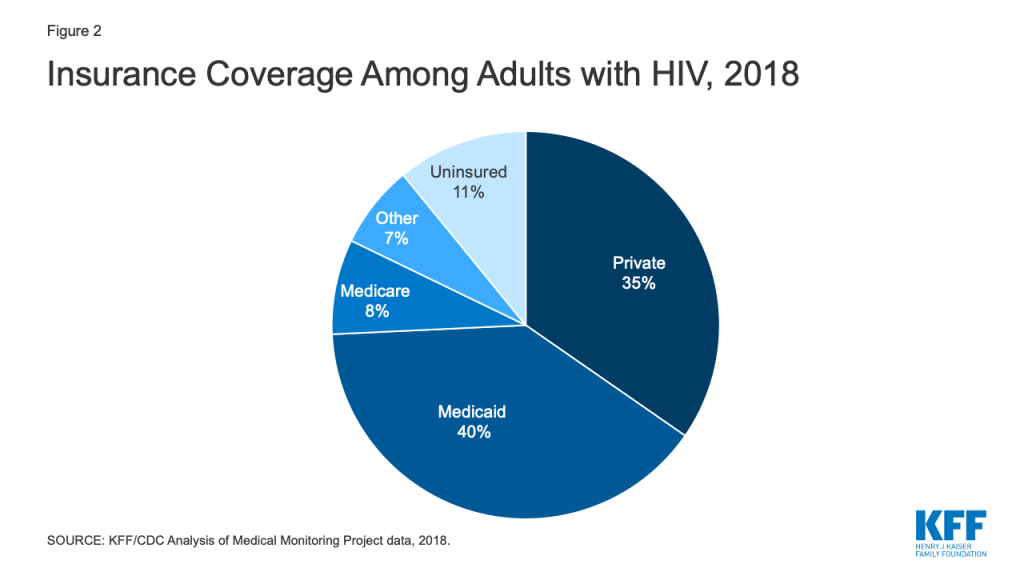
Our earlier research found that prior to the ACA’s major coverage reforms, approximately 18% of people with HIV were uninsured in 2012. While not directly comparable to the current dataset, the share of people with HIV without insurance was just 11% in 2018, suggesting a substantial decline in uninsurance rates among this population. Indeed, implementation of the ACA resulted in a significant increase in coverage and since that time, rates have remained stable (Fig. 1). 1 In 2018, Medicaid was the single largest source of insurance coverage for adults with HIV, covering 4 in 10. Private insurance was the second largest source of coverage, reaching more than one-third of the population (35%) and as noted, just 1 in 10 (11%) were uninsured (Fig. 2), on par with the general population).
Figure 1: Insurance Coverage Among Adults with HIV, 2015-2018Figure 2: Insurance Coverage Among Adults with HIV, 2018
Coverage patterns among adults with HIV differ from those of the general population (Fig. 3). Medicaid plays a much larger role (40% v. 15%) and private insurance a smaller role (35% v 56%) among those with HIV compared to the general population. In addition, people with HIV are less likely to have private coverage through an employer (26% v. 49%) and more likely to have it through the individual market, including the ACA’s marketplaces (7% v. 4%) (not shown). As noted above, uninsurance rates are comparable between the two populations (about 10%).
Figure 3: Insurance Coverage Among Adults with HIV Compared to Adults in the General Population, 2018
Coverage and Medicaid Expansion Status
Our earlier analysis found that Medicaid coverage among adults with HIV grew under the ACA and that this shift was driven by coverage gains in states that expanded their Medicaid programs. In 2018, the outsized role Medicaid plays in expansion states remains; adults with HIV in the expansion states sampled are significantly more likely to be covered by Medicaid compared to those in the sampled states that have not expanded (46% v. 30%). In addition, uninsurance rates in expansion states sampled are nearly three times lower than those in non-expansion states sampled (6% v. 20%). (Fig. 4)
Figure 4: Insurance Coverage Among Adults with HIV by State Medicaid Expansion Status, 2018
Coverage by Key Demographics
We observed coverage differences among adults with HIV by a range of demographic indicators, including, race/ethnicity, gender, income, and, for the first time, place of birth and sexual orientation.
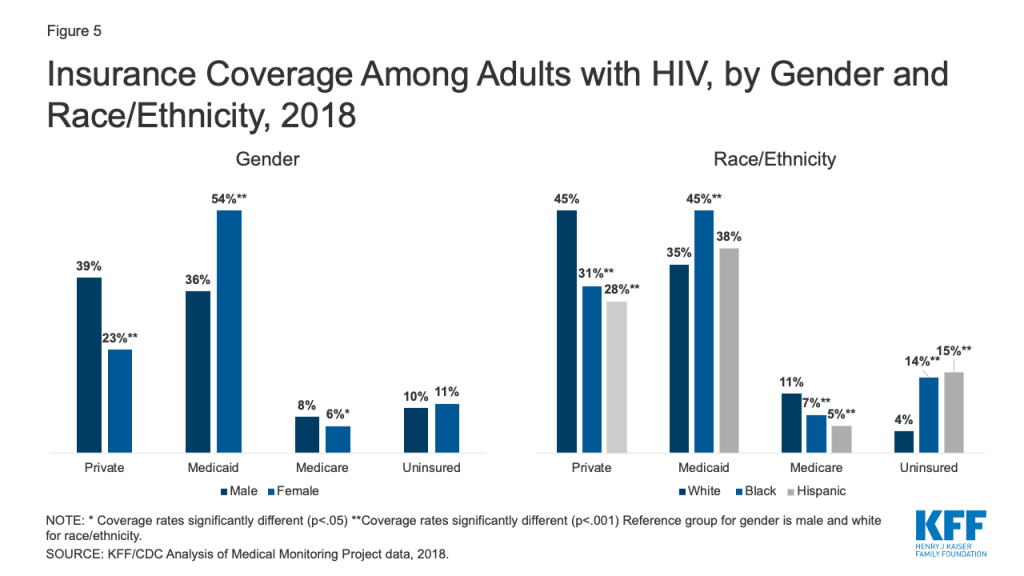
Gender: Male adults with HIV were almost twice as likely to have private coverage (39% v. 23%) and more likely to have Medicare than females (8% v. 6%), while females were more likely to have Medicaid (54% v. 36%). Women’s greater likelihood of Medicaid coverage could reflect eligibility based on lower incomes and categorical eligibility based on being pregnant, parent of a dependent child, higher rates of disability. Rates of uninsurance do not differ significantly by gender. (Fig. 5)
Race/ethnicity: White adults with HIV were more likely than Blacks and Hispanics to have private insurance (45% v. 31% and 28%, respectively) and Medicare (11% v. 7% and 5%, respectively) and less likely than Blacks to have Medicaid (35% v 45%). Notably, Blacks and Hispanics were more than three times as likely as Whites to be uninsured (14% and 15%, respectively vs. 4%). These trends reflect in part, disparities seen in coverage by race/ethnicity nationwide, including that people of color are more likely than White to live in non-expansion states, (Fig. 5)
Figure 5: Insurance Coverage Among Adults with HIV, by Gender and Race/Ethnicity, 2018
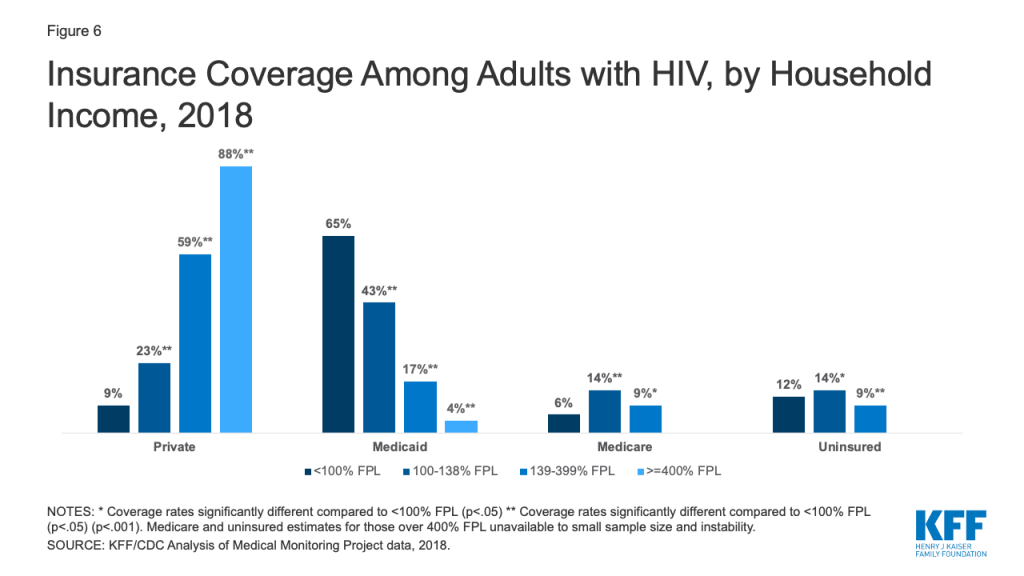
Income. Those with household incomes <100% of the federal poverty level (FPL) ($12,140 for an individual in 2018) were significantly less likely to have private coverage compared to all other income groups and most likely to have Medicaid coverage. This likely reflects the association between income and access to employment benefits and marketplace subsidies. The percentage of people with HIV with private healthcare coverage increased, and Medicaid coverage decreased, with increasing household income. (Fig. 6)
Figure 6: Insurance Coverage Among Adults with HIV, by Household Income, 2018
U.S. Born. Nine in 10 adults (86%) with HIV in the U.S. were born in country whereas 15% were born abroad.2 These individuals were significantly less likely to have the publicly funded health coverage sources, Medicaid and Medicare, than those born in the U.S (28% v. 42% and 4% v. 8%, respectively), potentially reflecting citizenship and residency requirements in public coverage. This group was also three times as likely to be uninsured compared to U.S. born counterparts (24% v. 8%). (Fig. 7)
Figure 7: Insurance Coverage Among Adults with HIV, by Place of Birth, 2018
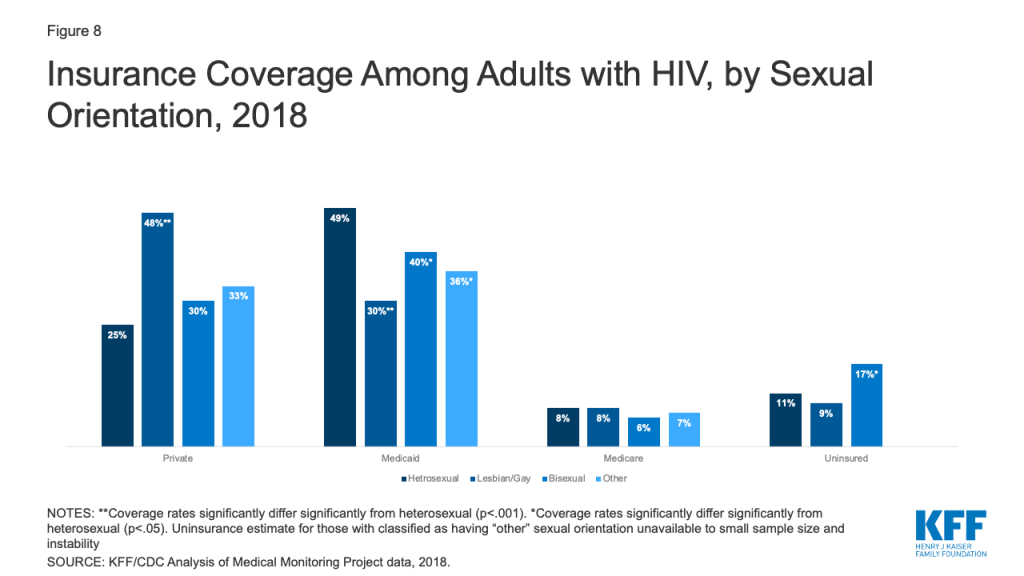
Sexual Orientation. Overall, 47% of adults with HIV identify as heterosexual and 41% as lesbian or gay. Smaller shares identify as bisexual (9%) or as “something else” (3%). Heterosexual adults with HIV, who are disproportionally Black and Latina women, were less likely than lesbian and gay adults with HIV to have private insurance coverage (25% v. 48%) and more likely to have Medicaid (49% v. 30%). Bisexual adults with HIV were less likely to have Medicaid (40% v. 49%) and more likely to be uninsured than heterosexuals (17% v. 11%). (Fig. 8)
Figure 8: Insurance Coverage Among Adults with HIV, by Sexual Orientation, 2018
Coverage and Ryan White
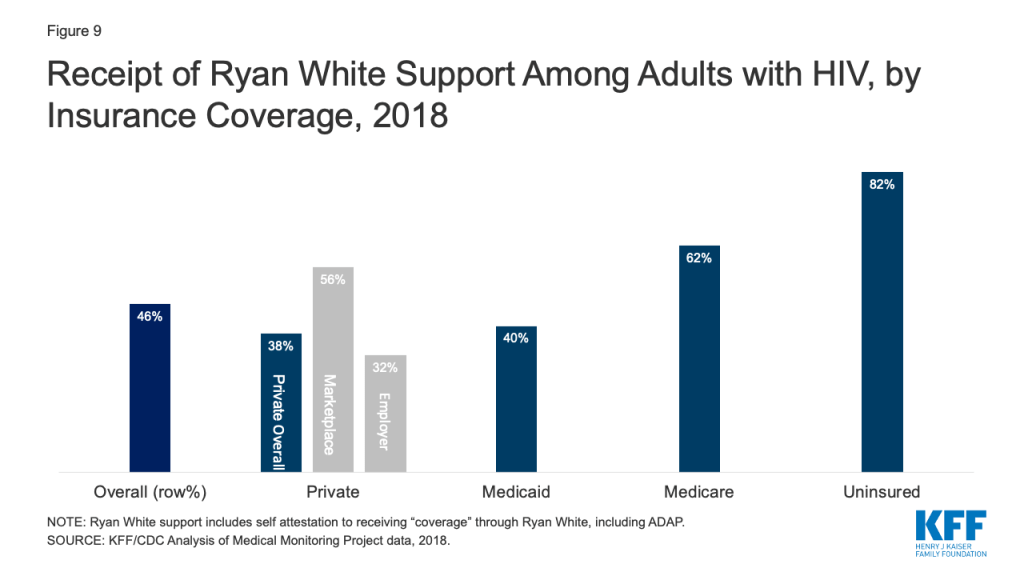
The federal Ryan White HIV/AIDS Program provides outpatient HIV care, treatment, and support services to people with HIV who are underinsured and uninsured. In 2018, nearly half (46%) of adults with HIV received support from the program. The program provides assistance to those with and without coverage but plays an especially significant role for the uninsured, 82% of whom receive program services. Those who are uninsured may receive direct medical care and prescription drugs through the program, as well as support services. Ryan White also plays a meaningful role for those with insurance coverage, addressing gaps in coverage (e.g. providing support services not included in traditional coverage) and assisting with costs associated with insurance (e.g. insurance premiums and out-of-pocket costs related to HIV medication). Sixty-two percent (62%) of those with Medicare receive Ryan White support. Among those with private insurance, almost 4 in 10 (38%) receive assistance through the program. This share was significantly higher among those with marketplace coverage (56%) compared to employer-based coverage (32%), potentially reflecting the role Ryan White plays in helping clients purchase individual insurance coverage. It could also reflect higher cost-sharing for many in individual insurance (Fig. 9).
Figure 9: Receipt of Ryan White Support Among Adults with HIV, by Insurance Coverage, 2018
Coverage and Viral Suppression
Viral suppression (defined as having an undetectable viral load at the time of last available laboratory data) is a critical health indicator, affording optimal health outcomes at the individual level and, because when an individual is virally suppressed they cannot transmit HIV, significant public health benefit. However, because viral suppression can change over time, especially depending on treatment adherence, it is particularly important to look at sustained viral suppression (defined as having an undetectable viral load over all tests in the preceding 12 months), a stronger indicator of long-term adherence antiretroviral treatment and its associated preventive benefits. In 2018, 68% of people with HIV were virally suppressed at last test and 62% had sustained viral suppression, the same share as in 2015. (Fig. 10)
Certain insurance types were positively associated with sustained viral suppression. The proportion of people with sustained viral suppression was significantly higher among those with private insurance, including those with employer-sponsored and marketplace coverage, and among those with Medicare, compared to the uninsured. Viral suppression rates among those with Medicaid were not significantly different from the uninsured, a finding that could reflect the equalizing role of the Ryan White Program for the uninsured. Lower viral suppression rates among those with Medicaid and the uninsured compared to those with other coverage types, could be accounted for by lower household income, among other, largely related, factors. (Fig. 10)
Figure 10: Sustained Viral Suppression Among Adults with HIV, by Insurance Coverage, 2018
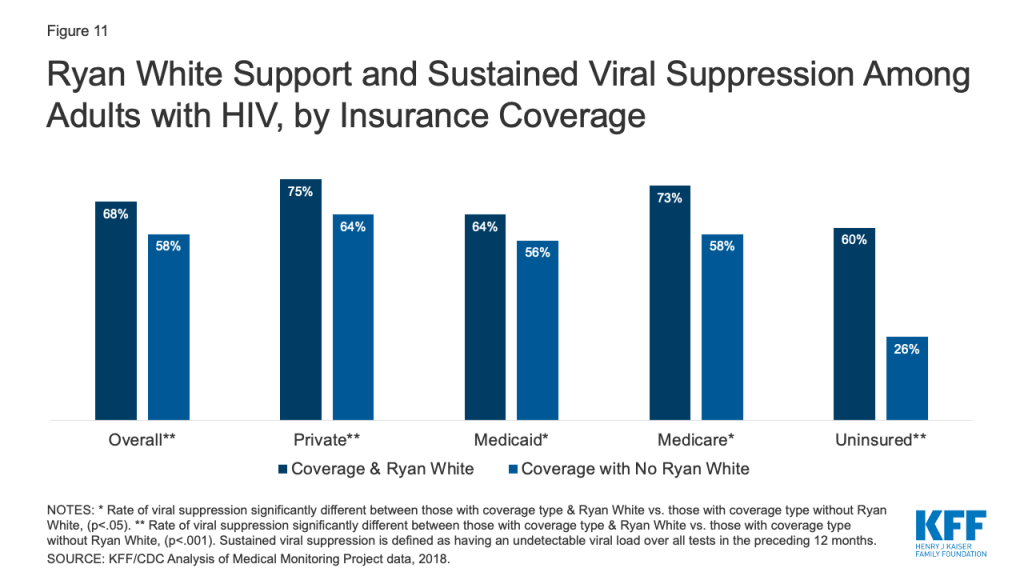
Ryan White support appears to make a significant difference in achieving sustained viral suppression. Overall, those with Ryan White support were significantly more likely to have sustained viral suppression compared to those without (68% v. 58%) and this pattern was observed across all coverage types, and was especially apparent among the uninsured (60% v 26%). (Fig. 11)
Figure 11: Ryan White Support and Sustained Viral Suppression Among Adults with HIV, by Insurance Coverage
Discussion
In 2018, the uninsurance rate among people with HIV was similar to that of the public at large. Medicaid represented the single largest source of coverage for people with HIV, particularly in Medicaid expansion states, followed closely by private insurance. We observed significant differences in coverage by gender, income, and race/ethnicity, with notable disparities related to rates of uninsurance by race/ethnicity. We also provide the first national data on adults with HIV and insurance coverage by place of birth and sexual orientation. The Ryan White Program is a significant source of care, treatment, and support for people with HIV, especially for the uninsured but also for a substantial share of those with coverage. Certain insurance sources and support from Ryan White were associated with greater rates of sustained viral suppression, a crucial indicator of optimizing the individual and public health benefits associated with antiretroviral treatment.
The ACA has made a significant difference in expanding insurance coverage for people with HIV, yet its future continues to be contested terrain. On the one hand, the Trump Administration is seeking to invalidate the law before the Supreme Court, while on the other hand, states, including states with leadership that has opposed the ACA, continue to adopt Medicaid expansion through voter led ballot initiatives; as of September 2020, 39 states (including D.C.) have adopted Medicaid expansion. In addition, health care could be a major issue in the 2020 elections with candidates President Trump and Democratic nominee Joe Biden holding deeply diverging views on the issue. Their different policy perspectives and positions stand to significantly impact coverage, and likely care outcomes, for people with HIV, as well as the success of the administration’s “Ending the HIV Epidemic” initiative.
Acknowledgments
The authors wish to thank Dr. Sharoda Dasgupta, Dr. Linda Beer, and Dr. Yunfeng Tie of the CDC, who were instrumental in this work in providing access to data, guidance, and conducting statistical analysis.
This work was supported in part by the Elton John AIDS Foundation. We value our funders. KFF maintains full editorial control over all of its policy analysis, polling, and journalism activities.
Methods
Data Sources
Coverage Data on General Population
All general population coverage data, except for marketplace coverage, is limited to adults and comes from KFF analysis of the 2018 American Community Survey (ACS).
General population marketplace coverage is an estimate based off the number of nonelderly adults with effectuated marketplace enrollment in 2018. Overall marketplace enrollment in 2018 was 9,895,197. The share estimated to be nonelderly adults was based off data on characteristics of individuals who selected a marketplace plan, whereby 9% of marketplace plan selectors were under 18. We assumed that age characteristics of those with effectuated marketplace enrollment were similar to those who had selected plans and subtracted 9% (890,568) from the effectuated enrollment total to obtain an estimated adult marketplace enrollment of 9,004,629 or 4% of the non-elderly adult ACS population (242,620,816).
Data on People with HIV
Data on people with HIV are based on 2015-2018 data from the Medical Monitoring Project (MMP), a Centers for Disease Control and Prevention (CDC) surveillance system which produces national and state-level representative estimates of behavioral and clinical characteristics of adults with diagnosed HIV in the United States.
Between 2015 and 2018, MMP employed a two-stage, complex sampling design. First, jurisdictions are selected from all U.S. states, the District of Columbia, and Puerto Rico using a probability proportional to size sampling strategy based on AIDS prevalence at the end of 2002, such that areas with higher prevalence had a higher probability of selection. Next, adults (aged 18 years and older) with diagnosed HIV were sampled from selected jurisdictions from the National HIV Surveillance System (NHSS), a census of US persons with diagnosed HIV. During 2015-2018, data come from: California (including the separately funded jurisdictions of Los Angeles County and San Francisco), Delaware, Florida, Georgia, Illinois (including the separately funded jurisdiction of Chicago), Indiana, Michigan, Mississippi, New Jersey, New York (including the separately funded jurisdiction of New York City), North Carolina, Oregon, Pennsylvania (including the separately funded jurisdiction of Philadelphia), Puerto Rico, Texas (including the separately funded jurisdiction of Houston), Virginia, and Washington.
Data used in this analysis were collected via telephone or face-to-face interviews and medical record abstractions during the following periods.
2015 data was collected between June 1, 2015 – May 31, 2016
2016 data was collected between June 1, 2016 – May 31, 2017
2017 data was collected between June 1, 2017- May 31, 2018
2018 data was collected between June 1, 2018 – May 31, 2019
In 2018, the primary year of analysis, of 9,700 sampled persons, 4,050 participated. Adjusted for eligibility, the response rate was 45%. Data were weighted based on known probabilities of selection at state or territory and patient levels. In addition, data were weighted to adjust for non-response using predictors of person-level response, and post-stratified to NHSS population totals by age, race/ethnicity, and sex at birth. Although characteristics associated with nonresponse varied among states and territories, the weighting classes for the national data were informed by sex at birth, age of most recent contact information, and the person’s frequency of receipt of care (as indicated by NHSS records). This analysis includes information on 4,050 participants who represent all adults with diagnosed HIV in the United States and Puerto Rico.
Analysis
For all respondents in MMP, we examined self-reported insurance coverage. Response options included insurance programs (Medicaid, Medicare, private insurance – employer and marketplace -, Ryan White HIV/AIDS Program – Ryan White or the AIDS Drug Assistance Program-, Veteran’s Administration, Tricare or CHAMPUS coverage, other public insurance, and other unspecified insurance). “Other specify” responses were recoded to reflect the most accurate coverage type when possible. It is important to note that respondents may not be aware of all the services they receive that are paid for by the Ryan White HIV/AIDS Program (the program provides funding directly to service organizations in many cases) and therefore, the estimates of the number of individuals who receive Ryan White HIV/AIDS Program services is likely an underestimate.
We estimated weighted percentages of individuals with the following types of health care coverage: no coverage (uninsured), private insurance (with breakouts for employer coverage and marketplace coverage), Medicaid, Medicare, and other. Because respondents in MMP may indicate more than one type of coverage, we relied on a hierarchy to group people into mutually exclusive coverage categories. Specifically, the hierarchy groups people into coverage types in the following order:
Private coverage overall (with breakouts for employer coverage and marketplace coverage)
Medicaid coverage, including those dually eligible for Medicare
Medicare coverage only
Other public coverage, including Tricare/CHAMPUS, Veteran’s Administration, or city/county coverage
In most cases, this hierarchy classified individuals according to the coverage source that served as their primary payer. People who did not report any of the sources of insurance coverage were classified as uninsured. We separately assess weighted percentages of persons receiving assistance through the Ryan White HIV/AIDS Program by health coverage type.
Statistical comparisons were made using Rao-Scott chi-square tests to account for complex survey design.
Limitations
MMP only allows for extrapolation to the national level when using the full sample. Similar extrapolation is not possible when examining coverage changes in and contrasting Medicaid expansion states and non-expansion states. The Medicaid expansion and non-expansion coverage data presented here are representative only of the subset of states sampled that fell into each group. Insurance coverage data is self-reported by respondents and not verified. By relying on a hierarchy to group individuals into coverage categories, it is possible individuals were grouped into a coverage category that was not their dominant payer over the course of a year.
Endnotes
We believe this stability in part reflects the fact that the states with greatest HIV prevalence have not changed their expansion status since 2014 (i.e. CA, NY, FL, GA, and TX). While several states have expanded since then, some did so after 2018 (the end year for the data in this report). Those that did expand between 2015 and 2018, had relatively low high HIV prevalence. In addition, we are limited by the states in the MMP sample. ↩︎
Percentages do not add to 100% due to rounding. ↩︎
With a Supreme Court Challenge Looming, Swing Voters in 3 Key Sun Belt States Give Democratic Nominee Biden a Big Advantage on the ACA’s Future and Pre-Existing Condition Protections
Suburban Voters in the 3 States (Arizona, Florida and North Carolina) are Divided in Who They Trust on Health Care Overall, but Florida Suburban Voters Give Biden the Edge on the ACA and Pre-Existing Condition Protections
The death of Supreme Court Justice Ruth Bader Ginsburg is drawing renewed attention to a pending Supreme Court challenge to the Affordable Care Act (ACA), supported by the Trump administration, that threatens to overturn the entire law, including its protections for people with pre-existing conditions.
To assess how the renewed attention to the case, which will be argued a week after Election Day, could motivate voters ahead of the presidential election, KFF and The Cook Political Report analyzed recent polling from three competitive Sun Belt states (Arizona, Florida, and North Carolina).
Fielded prior to Justice Ginsburg’s death, the polls find that Democratic nominee Joe Biden has a considerable advantage among voters on which presidential candidate they think has the better approach to determining the future of the Affordable Care Act, as well as maintaining protections for people with pre-existing health conditions.
More than half of voters in Arizona, Florida, and North Carolina say Biden has the better approach on the ACA (55% in each state) compared to four in ten voters who say President Trump (41% in AZ and NC, 40% in FL).
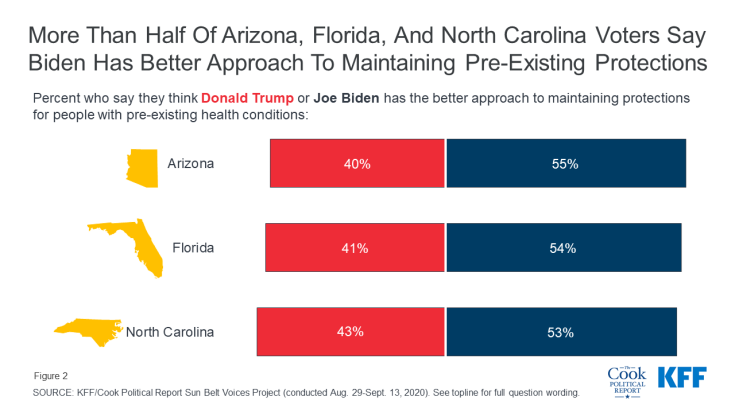
This is similar to the share who say Biden has the better approach to maintaining protections for people with pre-existing conditions (AZ: 55%, FL: 54%, NC: 53%) compared to President Trump (AZ: 40%, FL: 41%, NC: 43%).
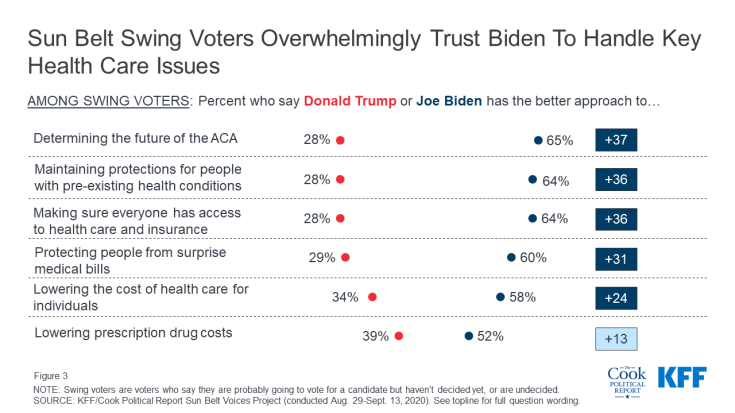
Swing voters, the crucial group of voters who are either entirely undecided or not firm in their vote choice, and for some there is a chance they may vote for the other candidate, give Biden the advantage on all key health care issues, including the ACA and maintaining pre-existing conditions.
About twice as many swing voters across the three states say Biden has the better approach on the ACA (AZ: 60%, FL: 69%, NC: 61%) than President Trump (AZ: 32%, FL: 24%, NC: 33%). Biden’s advantage also holds among swing voters across the three states on maintaining pre-existing condition protections, with more than half of swing voters saying Biden has the better approach (AZ: 60%, FL: 68%, NC: 59%). In fact, on all key health care issues asked about in the survey, Biden has the advantage among swing voters.
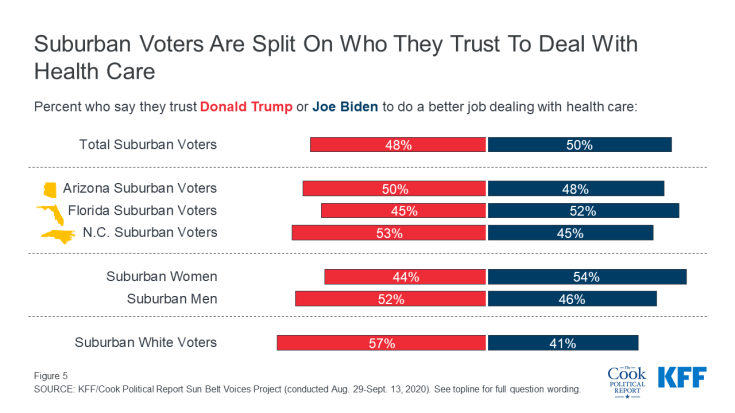
The analysis also examines the views of suburban voters in the three states on health care, and finds overall they are divided in who they trust the most on health care, with similar shares saying Biden (50%) and Trump (48%).
When it comes to the ACA’s future and maintaining pre-existing conditions protections, suburban voters across the three states give Biden a slight advantage. He holds a 10 percentage point advantage over President Trump on determining the future of the ACA (53% v. 43%) and a narrower advantage on maintaining pre-existing condition protections (52% v. 44%).
North Carolina suburban voters are more divided on which candidate has the better approach to handle some health care issues, including the future of the ACA and maintaining protections for people with pre-existing conditions, and give President Trump a clear advantage on lowering overall health care costs (55% v. 42%) and prescription drug costs (55% v. 43%).
MethodologyDesigned and analyzed by public opinion researchers at KFF in collaboration with The Cook Political Report, the poll was conducted between Aug. 29 and Sept. 13, among a representative random sample of 3,479 registered voters in three Sun Belt states (1,298 in Arizona, 1,009 in Florida, and 1,172 in North Carolina). The poll relies on an innovative probability-based methodology designed to address shortcomings with telephone-only surveys based on either voter-registration rolls or random-digit dialing. Voters were contacted via mailing address using registration-based sampling and encouraged to participate in the survey either online or by telephone, and follow-up contacts were made using outbound telephone calls. The margin of sampling error is plus or minus 4 percentage points in Florida and 3 percentage points in Arizona and North Carolina. For results based on subgroups, the margin of sampling error may be higher.
A week after the 2020 elections, the Supreme Court is scheduled to hear arguments on a legal challenge, supported by the Trump administration, that seeks to overturn the Affordable Care Act, an outcome that would have major effects throughout the health care system as the law’s provisions have affected nearly all Americans in some way.
A KFF analysis examines key provisions of the 2010 law that have changed the nation’s health care system, including what’s known about their impact on people’s access to affordable care and coverage, including state-by-state data where available. Key impacts include:
About 12 million Medicaid enrollees in 33 states and D.C. became newly eligible for the program through Medicaid expansion as of June 2019. This includes 3.7 million in California and at least half of a million each in Pennsylvania, Michigan, Illinois, Washington, Ohio and New Jersey.
As of February, 10.7 million people were enrolled in coverage through the health insurance marketplaces created under the ACA, including 9.2 million who received premium tax credits and 5.3 million who got cost-sharing reductions. In Florida, Mississippi, Alabama, Nebraska and Oklahoma, at least 95% of marketplace enrollees receive premium tax credits and/or cost-sharing subsidies.
Insurers can no longer deny coverage for pre-existing conditions, charge higher premiums based on health status or gender, revoke coverage when someone gets sick or impose annual or lifetime limits. About 54 million people have a pre-existing condition that could have resulted in them being denied coverage in the pre-ACA individual market. This includes more than a third of residents in Alabama, Arkansas, Kentucky, Louisiana, Mississippi and West Virginia.
Private insurers now must cover a wide range of preventive services at no out-of-pocket costs to consumers. This includes recommended cancer and chronic condition screenings, immunizations, and other services. Nearly 150 million people are enrolled in employer plans or through individual market insurance that must provide these free preventive services.
The law phased out the Medicare coverage gap, often called the “doughnut hole” by gradually reducing the share of total drug costs paid by Part D enrollees in the coverage gap. About 46 million Medicare beneficiaries are enrolled in Part D drug plans.
About 2.3 million young adults gained coverage due to the ACA’s provision allowing adult children to remain on their parents’ insurance plan up to age 26.
The analysis is part of KFF’s ongoing efforts to provide useful information related to the health policy issues relevant for the 2020 elections, including policy analysis, polling, and journalism. Find more on our Election 2020 resource page.
The Supreme Court will review the constitutionality of the Affordable Care Act (ACA) this November in California v. Texas (known as Texas v. U.S. in the lower courts). Late last year, a federal appeals court panel ruled that the ACA’s individual mandate is unconstitutional, since Congress has set the mandate tax penalty to zero. The case was brought by a number of Republican state officials and two individuals, who argue that the rest of the ACA is not severable from the mandate and should therefore be invalidated. The Trump administration now argues that nearly all of the ACA should be found invalid but that the courts should prohibit it from enforcing only the provisions found to harm the individual plaintiffs. It previously argued that only the ACA’s pre-existing condition protections should be overturned.1 Pending a final decision on the case, the Trump administration has continued to enforce the ACA.
The ACA’s reforms affect nearly every American in some way, and a Supreme Court decision that invalidated the ACA would have complex and far-reaching impacts throughout the health care system. While the ACA’s changes to the individual insurance market – including protections for people with pre-existing conditions and premium subsidies for low and modest income people – have been the focus of much policy debate and media coverage, the law made many other sweeping changes. These include: the expansion of Medicaid eligibility for low-income adults; required coverage of preventive services with no cost-sharing in private insurance, Medicare, and for those enrolled in the Medicaid expansion; new national initiatives to promote public health and quality of care; and a variety of tax increases to finance these changes. The number of uninsured Americans decreased by 20 million from 2010 to 2016 as the ACA went into effect, but has since increased by 2.3 million from 2016 to 2019.
The following table summarizes the major provisions of the ACA, illustrating the breadth of its changes to the health care system, and public attitudes towards those changes. If all or most of the ACA is struck down, many of these provisions could be eliminated.
Due to differences in populations and policies across states, the potential repeal of the ACA would play out differently from state to state. For example, over 50 million people had a declinable health condition in 2018, including over a third of the population in West Virginia, Arkansas and Mississippi. The appendix shows the state-by-state impacts of these key ACA provisions. A link to state-level data is included in the table below when data are available.
Medicaid eligibility is expanded to include adults with income up to 138% FPL; however, the Supreme Court ruling in 2012 essentially made Medicaid expansion optional for states.
The federal government paid 100% of the cost of the expansion initially; this share phased down to 93% in 2019 and 90% in 2020 and beyond
In June 2019, there 14.8 million Medicaid expansion enrollees in the 34 states and DC that had adopted the expansion. Of those enrollees, 12 million were newly eligible due to the ACA’s Medicaid expansion
87% say it is “very important” (57%) or “somewhat important” (29%) that the part of the law that gives states the option of expanding their Medicaid programs to cover more low-income, uninsured adults remains in place if the ACA is ruled unconstitutional (July 2019)
66% of those living in non-expansion states would like to see their state expand Medicaid (May 2020)
Subsidies for Nongroup Health Insurance
Eligible individuals who buy coverage through the Marketplace receive subsidies based on income: premium tax credits for those with income 100-400% FPL; cost-sharing subsidies for those with income 100-250% FPL
States can also elect to run a subsidized Basic Health Plan for people with income between 133%-200% FPL
As of February 2020, 9.2 million Marketplace enrollees received premium tax credits and 5.3 million received cost-sharing reductions
In 2020, there are about 0.9 million people enrolled in the Basic Health Plans in Minnesota (83,200) and New York (796,998)
85% say it is “very important” (57%) or “somewhat important” (28%) that the part of the law that provides financial help to low- and moderate-income Americans who buy their own insurance remains in place if the ACA is ruled unconstitutional (July 2019)
Dependent Coverage to 26
All non-grandfathered private group and non-group health plans must extend dependent coverage to adult children up to the age of 26
About 2.3 million young adults gained coverage as a result of this provision
78% of the public say it is “very important” (51%) or “somewhat important” (27%) that the part of the law that allows young adults to stay on their parents’ insurance plans until age 26 remains in place if the ACA is ruled unconstitutional (July 2019)
Health Insurance Marketplace
Establish new marketplaces where qualified health plans are offered to individuals
Marketplaces certify that qualified health plans meet all ACA requirements, provide subsidies to eligible individuals, operate a website to facilitate application and comparison of health plans, provide a no-wrong-door application process for individuals to determine their eligibility for financial assistance, and provide in-person consumer assistance through navigators
10.7 million individuals had effectuated coverage through the Marketplace as of the first quarter of 2020
67% of Marketplace enrollees will have a choice of three or more insurers in 2020
26 insurers are entering state Marketplaces for 2020
Individual market gross profit margins have been higher, on average, in 2017-2019 than before the ACA was implemented
82% of the public (91% of Dems, 78% of Inds, 71% of Reps) have a favorable view of creating health insurance exchanges where people and small businesses can shop for insurance (Nov 2018)
45% say that the health insurance marketplaces are working well in the nation overall, while 47% say they are not working well (November 2019)
52% say that the health insurance marketplaces in their state are working well, while 39% say they are not working well. Those in states with state-run marketplaces are more likely to say they are working well than those in states using healthcare.gov (58% vs. 48%) (November 2019)
Federal Minimum Standards for Private Health Insurance
Key Provisions
Impact
Public Opinion
Protections for Pre-existing Conditions
All non-grandfathered plans are prohibited from discriminating against individuals based on their health status
Insurers in the non-group, small group, and large group market must guarantee issue coverage
Large group, small group, and non-group health plans are prohibited from applying pre-existing condition exclusions
Insurers in the non-group and small group market may not vary premiums based on health status or gender or any other factor except:
Premiums can vary by age (by a factor of 3:1), geography, family size, and tobacco use
Rescission of coverage is prohibited in the non-group, small group, and large group market
54 million people (27% of the non-elderly population) have a pre-existing condition that would have been deniable in the pre-ACA individual market
45% of non-elderly families have at least one adult member with a pre-existing condition
Majorities say it is “very important” to them that the ACA provisions prohibiting insurance companies from denying coverage (72%) or charging sick people more (64%) remain in place if the ACA is ruled unconstitutional (July 2019)
62% overall (75% of Dems, 63% of Inds, 47% of Reps) do not want to see the Supreme Court overturn the protections for people with pre-existing conditions established by the ACA (November 2019)
57% of Americans say someone in their household has a pre-existing health condition (April 2019)
57% are “somewhat worried” (22%) or “very worried” (35%) that they or a family member will lose coverage if the Supreme Court overturns ACA’s pre-existing condition protections (January 2020)
62% are “very worried” (44%) or “somewhat worried” (18%)” that they or a family member will not be able to afford coverage in the future if the Supreme Court overturns ACA’s pre-existing condition protections (April 2019)
Preventive Services
All non-grandfathered group and non-group plans must cover preventive health services without cost sharing
Covered services include breast, colon, and cervical cancer screening, pregnancy-related services including breastfeeding equipment rental, contraception, well-child visits, adult and pediatric immunizations, and routine HIV screening. In addition, it was recently recommended that pre-exposure prophylaxis (PREP) to prevent HIV infection be included as well and if finalized, would be offered at no cost
87% of covered workers with employer-sponsored insurance (approximately 133 million people) were enrolled plans that must provide free preventive services as of 2019
12.7 million people were enrolled in individual market plans required to provide free preventive services, as of February 2019
14.8 million enrollees in Medicaid expansion states received coverage for preventive services in 2019
Prior to the ACA, 1 in 5 women reported that they postponed or went without preventive care due to cost
The share of reproductive age women with private insurance reporting that their insurance covered the full costs of their prescription contraception rose from 45% in 2013 to 75% in 2017
89% say it is “very important” (62%) or “somewhat important” (27%) that the part of the ACA that requires private health insurance companies to cover the cost for most preventive services with no cost sharing remains in place if the ACA is ruled unconstitutional (July 2019)
Essential Health Benefits
All ACA compliant health plans in the individual and small group market must cover 10 categories of essential health benefits (EHB), including hospitalization, outpatient medical care, maternity care, mental health and substance abuse treatment, prescription drugs, habilitative and rehabilitative services, and pediatric dental and vision services
In 2013, before the ACA EHB requirements took effect, 75% of non-group health plans did not cover maternity care, 45% did not cover substance use disorder treatment, and 38% did not cover mental health services
66% of the public (81% of Dems, 65% of Inds, 52% of Reps) say they want the federal government to continue to require health insurance companies to cover a certain set of benefits (June 2017)
Annual and Lifetime Limits
All group and non-group plans (including grandfathered) are prohibited from placing lifetime limits on the dollar value of coverage for essential health benefits. In addition, all non-grandfathered group and non-group plans are prohibited from placing annual dollar limits on coverage of essential health benefits
Prior to the ACA, in 2009, 59% of covered workers’ employer-sponsored health plans had a lifetime limit
62% of the public say it is “very important” that the part of the ACA that prohibits private health insurance companies from setting a dollar limit on how much they will spend on your coverage during your lifetime remains in place if the law is ruled unconstitutional (July 2019)
51% of the public say it is “very important” that the part of the ACA that prohibits private health insurance companies from setting a dollar limit on how much they will spend on your coverage each year remains in place if the law is ruled unconstitutional (July 2019)
Cap on Out-of-Pocket Cost Sharing
All non-grandfathered private health plans must limit cost sharing for essential health benefits covered in network
The annual maximum for 2020 is $8,150 for an individual; $16,300 for family coverage
Prior to the ACA, in 2009, 19% of covered workers had no limit on out-of-pocket expenses. Among those with out-of-pocket maximums, not all expenses counted toward the limit. For example, in 2009, among workers in PPOs with an out-of-pocket maximum, 85% were in plans that did not count prescription drug spending when determining if an enrollee had reached the out-of-pocket limit
Minimum Medical Loss Ratios
Require all non-grandfathered private plans to pay a minimum share of premium dollars on clinical services and quality
Insurers must provide rebates to consumers for the amount of the premium spent on clinical services and quality that is less than 85% for plans in the large group market and 80% for plans in the individual and small group markets
In total, over $5 billion in medical loss ratio rebates have been issued across the individual, small group, and large group markets, from 2012 to 2019 (based on insurer financial results from the 2011-2018 plan years)
62% of the public (68% of Dems, 64% of Inds, 54% of Reps) say they favor requiring insurance companies that spend too little money on health care services and too much on administrative costs and profits to give their customers a rebate (March 2014)
Consumer Information and Transparency
All non-grandfathered health plans must provide a brief, standardized summary of coverage written in plain language
All non-grandfathered health plans must periodically report transparency data on their operations (e.g., number of claims submitted and denied)
Transparency data collected by CMS for PY 2017 indicate that, on average, healthcare.gov issuers deny 18% of in-network claims, and that consumers rarely appeal denied claims
79% of the public have a favorable view, including 91% of Dems, 78% of Inds, 68% of Reps (August 2012)
Other Provisions Affecting Employers/Group Health Plans
Key Provisions
Impact
Public Opinion
Large Employer Mandate
Requires employers with at least 50 full time workers to provide health benefits or pay a tax penalty
Favored by a majority across parties: 69% overall have a favorable view, including 88% of Dems, 61% of Inds, 56% of Reps (November 2018)
Waiting Periods
Employers that impose waiting periods on eligibility for health benefits (e.g., for new hires) must limit such periods to no more than 90 days
Prior to the ACA, in 2009, 29% of covered workers faced a waiting period of 3 months or more
Consumer Assistance
Key Provisions
Impact
Public Opinion
State Consumer Assistance Programs
Authorize federal grants for state Consumer Assistance Programs (CAPs) to advocate for people with private coverage.
Notice of claims denials by non-grandfathered private plans must include information about state CAPs that will help consumers file appeals
CAPs were established in most states in 2010, though no appropriations for CAPs have since been enacted. Today 36 CAPs are in operation
A report on the first year of CAP operations found the programs helped 22,814 individuals successfully challenge their health plan decisions and obtained more than $18 million on behalf of consumers
Other Medicaid Provisions
Key Provisions
Impact
Public Opinion
Simplification of Enrollment Processes
States are required to simplify Medicaid and CHIP enrollment processes and coordinate enrollment with state health insurance exchanges
Prior to the ACA in 2013, 27 states had an asset test and 6 required face-to-face interviews for parents; only 36 states had an online Medicaid application and 17 states allowed individuals to apply by phone. As of January 2020, individuals can apply for Medicaid online and by telephone in all states for the first time, and all states had eliminated asset tests and face-to-face interviews
Long-term Care Services and Supports
Expands financial eligibility for 1915(i) home and community-based services (HCBS), creating a new eligibility pathway to allow people not otherwise eligible to access full Medicaid benefits, allows states to target services to specific populations, and expands the services covered
Creates a new Medicaid state plan option to cover attendant care services and supports with 6% enhanced FMAP
11 states elected the option to expand eligibility for 1915(i) HCBS services as of 2018. 81,000 individuals received services and over $641 million was spent on these services
As of 2018, 8 states elected the option to cover attendant care services. 392,700 individuals received services and $8.6 billion was spent on these services
Mental health and substance use disorder services must be included in Medicaid Alternative Benefit Packages (ABPs) provided to Medicaid expansion adults and other adults, and the services must be covered at parity with other medical benefits
14.8 million Medicaid expansion enrollees receive services through an ABP
Medicaid Eligibility for Former Foster Care Youth up to Age 26
Requires states to provide Medicaid to young adults ages 21 through 26 who were formerly in foster care.
Medicaid Drug Rebate Percentage
Increase Medicaid drug rebate percentage for most brand name drugs to 23.1% and increase Medicaid rebate for non-innovator multiple source drugs to 13%. Extend drug rebate program to Medicaid MCOs
CBO estimated federal savings of $38 billion over 10 years from the Medicaid prescription drug provisions in the ACA, including increases in the drug rebate percentage
Gradually close the Medicare Part D coverage gap (“doughnut hole”):
Phase down the beneficiary coinsurance rate for brand and generic drugs In the Medicare Part D coverage gap from 100% to 25% by 2020
Require drug manufacturers to provide a 50% discount on the price of brand-name and biologic drugs in the coverage gap
Reduce the growth rate in the catastrophic coverage threshold amount between 2014 and 2019 to provide additional protection to enrollees with high drug costs
46 million people were enrolled in Medicare Part D in 2020
In 2018, nearly 5 million Part D enrollees without low-income subsidies (LIS) had spending in the coverage gap and received manufacturer discounts averaging $1,184 on brand-name drugs
Reinstating the coverage gap would increase costs incurred by Part D enrollees who have relatively high drug spending
81% of the public (79% of seniors) has a favorable view that “the law gradually closes the Medicare prescription drug ‘doughnut hole’ or ‘coverage gap’ so people on Medicare will no longer be required to pay the full cost of their medications when they reach the gap” (Nov 2018)
Preventive Services
Eliminate cost sharing for Medicare covered preventive services. Authorize coverage of annual comprehensive risk assessment for Medicare beneficiaries
60 million people have access to free preventive services; of these, Medicaid pays Medicare cost sharing for about 9 million dual eligibles
Cost Sharing in Medicare Advantage (MA)
Prohibit MA plans from imposing higher cost-sharing requirements than traditional Medicare for chemotherapy, renal dialysis, skilled nursing care, and other services deemed appropriate by the Secretary of HHS. This prohibition was extended to most Medicare-covered services
24 million people enrolled in Medicare Advantage plans in 2020
Reduce federal payments to Medicare Advantage plans to bring payments closer to the average Medicare spending for beneficiaries in traditional Medicare
Provide quality-based bonus payments to Medicare Advantage plans
Require Medicare Advantage plans to maintain a medical loss ratio of at least 85 percent; the administration extended this requirement to all Part D plans
CBO estimated repeal of the ACA Medicare Advantage payment changes would increase Medicare spending by about $350 billion over 10 years (2016-2025)
74 percent of Medicare Advantage enrollees were in plans that were eligible for bonus payments in 2019; Bonus payments summed to $6.3 billion in 2018
Higher Medicare spending would increase Medicare premiums and deductibles for beneficiaries and accelerate the insolvency of the Medicare Hospital Insurance Trust Fund
Other Provider Payments
Reduce the rate at which Medicare payment levels to hospitals, skilled nursing facilities, hospice and home health providers, and other health care providers are updated annually
Reduce Medicare Disproportionate Share Hospital (DSH) payments that help to compensate hospitals for providing care to low-income and uninsured patients
Allow providers organized as Accountable Care Organizations (ACOs) that meet quality thresholds to share in cost savings they achieve for the Medicare Program
CBO estimated repeal of the ACA provider payment reductions would increase Medicare spending by another approximately $350 billion over 10 years (2016-2025)
Eliminating the Medicare Shared Savings Program ACOs could affect around 10 million Medicare beneficiaries who were attributed to a MSSP ACO, as of 2018
Higher Medicare spending would increase Medicare premiums and deductibles for beneficiaries and accelerate the insolvency of the Medicare Hospital Insurance Trust Fund
Freeze threshold for income-related Medicare Part B premiums for 2011 through 2019
Establish new income-related premium for Part D, with the same thresholds as the Part B income-related premium
As originally enacted in the ACA, CBO estimated $35.7 billion in savings from these provisions over 10 years
According to Medicare’s actuaries, 3.6 million people paid an income-related Part B premium and 3.0 million paid an income-related Part D premium in 2018
Beyond coverage-related provisions, the ACA made numerous other changes in federal law to safeguard individual civil rights, authorize new programs and agency activities, and finance new federal costs under the law. The Court ruling finding the ACA unconstitutional could also result in an end to these provisions. They include:
Nondiscrimination
The ACA prohibits discrimination against individuals on the basis of race, color, national origin, sex, age, or disability in certain health programs or activities, under Section 1557, which builds on long-standing and familiar Federal civil rights laws. In addition to enforcement by the Office of Civil Rights at the US Department of HHS, individuals can file a civil lawsuit to challenge a nondiscrimination violation under Section 1557.
Regulations implementing Section 1557 issued by the Obama Administration further defined these protections to include gender identity and pregnancy status. One federal district court has vacated the gender identity and pregnancy protections in the regulations, while other courts have relied on Section 1557 itself to grant relief to individuals alleging discrimination based on gender identity. In June 2020, the Trump Administration finalized changes to the regulations that eliminated protections for gender identity and sex stereotyping; adopted blanket abortion and religious freedom exemptions for health care providers; and eliminated or substantially changed provisions on health insurance benefit design; language access; notices, grievance procedures, and enforcement; and which entities are covered by Section 1557. The Administration also has eliminated explicit nondiscrimination protections related to gender identity and sexual orientation in separate regulations governing Medicaid managed care entities, state Medicaid programs, PACE organizations, group and individual health insurance issuers, marketplaces, qualified health plan issuers, and agents and brokers that assist with marketplace applications and enrollment.
Just after the Administration published the final rule, the Supreme Court ruled that sex discrimination includes sexual orientation and gender identity in the employment context. Based on that decision, two federal courts issued nationwide preliminary injunctions blocking parts of the final rule: NY and DC courts blocked provisions excluding sex stereotyping from the definition of sex discrimination, and the DC court also blocked the religious freedom exemption. The NY court is now considering whether to block other provisions of the rule, and other lawsuits are pending.
FDA Approval of Biosimilars
The ACA authorized the U.S. Food and Drug Administration (FDA) to approve generic version of biologics (biosimilars) and grant biologics manufacturers 12 years of exclusive use before generics can be developed. As of November 2019, the FDA has approved 25 biosimilar products used in the treatment of cancer, rheumatoid arthritis, and other health conditions.
Innovation Center
The law also established an Innovation Center within the Center for Medicare and Medicaid Services (CMS) to test, evaluate and expand different payment structures and methods to save costs while maintaining or improving quality of care. Payment and delivery system models supported by the Innovation Center focus on Medicare, Medicaid, and the Children’s Health Insurance Program (CHIP), for example, include care delivery for children and pregnant women affected by the opioid crisis, and models to reduce prescription drug costs.
Prevention and Public Health Fund
The ACA established the Prevention and Public Health Fund with a permanent annual appropriation to support activities related to prevention, wellness and public health activities. The law appropriated $7 billion annually through 2015 and $2 billion for each fiscal year thereafter, although Congress has since voted several times to redirect a portion of funds from the Prevention and Public Health Fund for other purposes. Fund resources support federal, state, and local programs to fight obesity, curb tobacco use, prevent the onset of chronic conditions such as diabetes and heart disease, promote immunization, detect and respond to infectious diseases and other public health threats, and other initiatives.
Nonprofit Hospitals
The ACA set new requirements for non-profit hospitals in order to retain their tax exempt status. These include a requirement to conduct a community needs assessment every 3 years and adopt a strategy to meet identified needs. Hospitals also must adopt and widely publicize financial assistance policies on the availability of free or discounted care and how to apply. In addition, hospitals must limit charges to patients who qualify for financial assistance to the amount generally billed to insured patients, and must make reasonable attempts to determine eligibility for financial assistance before undertaking extraordinary collection actions.
Breastfeeding breaks & separate rooms
Employers with 50 or more employees must now provide adequate break time for breastfeeding women and a private space that is not a bathroom for nursing and pumping.
Menu labeling
Restaurants and retail food establishments with 20 or more locations and owners of 20 or more vending machines must include nutrition information, including calories, for their standard menu items.
Revenue Provisions
Some of the revenue provisions enacted under the ACA remain in effect but presumably would end if the law were found unconstitutional. For example, the ACA included a tax on pharmaceutical manufacturers and importers (generating annual fees of $2.8 billion in 2019 and thereafter). Financing provisions also included a 10% tax on indoor tanning services, and limits on the deductibility of compensation of insurance company executives (limited to $500,000 per individual per year). Under the ACA, the Medicare payroll tax was increased for high income earners (over $200,000 by individuals, $250,000 for married couples filing jointly), and a new 3.8% tax on net investment income applied for higher income taxpayers. Initially, the ACA imposed a so-called Cadillac tax on high-value employer-sponsored health plans, a tax on health insurers, and a new medical device excise tax of 2.3%, but Congress repealed all three of these taxes in a December 2019 budget deal.
Medicaid Expansion Enrollment includes the total number of individuals who are enrolled in the ACA expansion group. This total includes 12 million individuals who are newly-eligible under the ACA pathways. State decisions about adopting the Medicaid expansion are as of August 17, 2020. More information is available at KFF’s Medicaid Expansion Tracker.
Marketplace Enrollment includes the number of individuals who had an active marketplace policy as of February 2020, and who paid their premium (thus effecutating their coverage) as of March 15, 2020.
Consumers with household incomes 100-400% of the federal poverty level may qualify for an Advance Premium Tax Credit (APTC), which helps make their coverage more affordable throughout the year by lowering their share of monthly premium costs.
CSRs are available to people who have incomes 100-250% of the federal poverty level and who enroll in a silver plan through the Marketplace.
*Coverage under Medicaid expansion became effective January 1, 2020 in Utah. Three states (Missouri, Nebraska and Oklahoma) have adopted Medicaid expansion but not yet implemented it. More details available at KFF’s Medicaid Expansion Tracker.
Sources:
Medicaid Expansion Enrollment: Kaiser Family Foundation analysis of Medicaid enrollment data collected from the Centers for Medicare and Medicaid Services (CMS) Medicaid Budget and Expenditure System (MBES).
States totals may not sum to national total due to rounding.
Employer Sponsored Insurance Enrollment includes those covered through a current or former employer or union, either as a policyholder or as a dependent.
Marketplace Enrollment includes the number of individuals who had an active marketplace policy as of February 2020, and who paid their premium (thus effecutating their coverage) as of March 15, 2020.
Medicaid Expansion Enrollment includes the total number of individuals who are enrolled in the ACA expansion group. This total includes 12 million individuals who are newly-eligible under the ACA pathways. State decisions about adopting the Medicaid expansion are as of August 17, 2020. More information is available at KFF’s Medicaid Expansion Tracker.
Cells labelled ‘Insufficient Data’ in the rebates column indicate that insurers representing more than 10% of state enrollment have not filed MLR data.
*Coverage under Medicaid expansion became effective January 1, 2020 in Utah. Three states (Missouri, Nebraska and Oklahoma) have adopted Medicaid expansion but not yet implemented it. More details available at KFF’s Medicaid Expansion Tracker.
Sources:
Prevalence of Pre-Existing Conditions: Kaiser Family Foundation analysis of data from National Health Interview Survey and the Behavioral Risk Factor Surveillance System.
Marketplace Enrollment: Early 2020 Effectuated Enrollment Snapshot, Centers for Medicaid and Medicare Services (CMS), July 23, 2020.
Medicaid Expansion Enrollment: Kaiser Family Foundation analysis of Medicaid enrollment data collected from the Centers for Medicare and Medicaid Services (CMS) Medicaid Budget and Expenditure System (MBES).
MLR: Kaiser Family Foundation analysis of rebate submissions by insurers to CMS.
Notes:
Medicaid Expansion Enrollment includes the total number of individuals who are enrolled in the ACA expansion group. This total includes 12 million individuals who are newly-eligible under the ACA pathways. State decisions about adopting the Medicaid expansion are as of August 17, 2020. More information is available at KFF’s Medicaid Expansion Tracker.
NR indicates state did not report data. Included in 1115 indicates that state was unable to report state plan services separately from Section 1115 waiver services. Blank cell indicates state does not elect option.
*Coverage under Medicaid expansion became effective January 1, 2020 in Utah. Three states (Missouri, Nebraska and Oklahoma) have adopted Medicaid expansion but not yet implemented it. More details available at KFF’s Medicaid Expansion Tracker.
**Data is from 2016.
Sources:
Medicaid Expansion Enrollment: Kaiser Family Foundation analysis of Medicaid enrollment data collected from the Centers for Medicare and Medicaid Services (CMS) Medicaid Budget and Expenditure System (MBES).
HCBS Enrollment: KFF Medicaid HCBS Program Surveys, FY 2018.
Notes:
U.S. totals exclude territories.
Sources:
Medicare Advantage Enrollment: CMS Enrollment Dashboard Data File 08-19-2020, “Hospital and Med Monthly Counts”, data for March 2020.
Part D Coverage Gap Spending: KFF analysis of 2018 Medicare prescription drug event claims for a 20 percent sample of Medicare beneficiaries from the CMS Chronic Conditions Data Warehouse.ACO Assigned Beneficiaries: KFF analysis of Medicare Shared Savings Program data from CMS, 2018.
Part B Income Related Premiums: CMS Program Statistics, Centers for Medicare & Medicaid Services, Office of Enterprise Data and Analytics, Chronic Conditions Data Warehouse, 2018.
Endnotes
A number of Democratic state AGs are defending the ACA as interveners in the case, arguing in part that Congress intended to keep the ACA in place when it set the individual mandate penalty to zero while leaving the rest of the law intact. ↩︎
Some of the coverage gap provisions were subsequently modified by the Bipartisan Budget Act of 2018. The BBA closes the Part D coverage gap in 2019 instead of 2020 by accelerating a reduction in beneficiary coinsurance from 30 percent to 25 percent in 2019; also increases the discount provided by manufacturers of brand-name drugs in the coverage gap from 50 percent to 70 percent, beginning in 2019. In 2019 and later years, Part D plans will cover the remaining 5 percent of costs in the coverage gap, which is a reduction in their share of costs (down from 25 percent). ↩︎
Some of the Medicare income-related premium provisions have been modified by subsequent laws. The Medicare Access and CHIP Reauthorization Act of 2015 (MACRA) made changes to Medicareu2019s income-related premiums by requiring beneficiaries with incomes above $133,500 ($267,000 for married couples) to pay a larger share of Part B and Part D program costs than under the original MMA and ACA provisions. Under MACRA, beginning in 2018, beneficiaries with incomes above $133,500 and up to $160,000 ($267,000-$320,000 for married couples) were required to pay 65 percent of Part B and Part D program costs, up from 50 percent prior to 2018, while beneficiaries with incomes above $160,000 and up to $214,000 ($320,000-$428,000 for married couples) were required to pay 80 percent of Part B and Part D program costs, up from 65 percent. The most recent change to Medicareu2019s income-related premiums was incorporated in the Bipartisan Budget Act of 2018 (BBA). This change will affect beneficiaries with incomes above $500,000 ($750,000 for married couples) by requiring them to pay 85 percent of program costs beginning in 2019, up from 80 percent prior to 2019. ↩︎
In this article for the American Society of Aging’s Generations Today, KFF Senior Vice President Tricia Neuman examines what President Trump and former Vice President Joe Biden are saying about key issues for Medicare beneficiaries, including drug prices and affordability, as well as what they aren’t saying about Medicare’s financing.
Black, Hispanic, and Asian patients had significantly higher rates of hospitalization and death compared to their White counterparts. Hospitalization rates for Hispanic and Black patients with COVID-19 were more than four and three times higher, respectively, compared to the rate for White patients (30.4 and 24.6 vs. 7.4 per 10,000). Death rates for both groups were over twice as high as the rate for White patients (5.6 and 5.6 vs. 2.3 per 10,000). Asian patients also faced significant disparities in these measures.
Among patients who tested positive for COVID-19, Black, Hispanic, and Asian patients remained at higher risk for hospitalization and death compared to White patients with similar sociodemographic characteristics and underlying health conditions. The higher hospitalization and death rates among patients of color, in part, reflect higher infection rates and higher rates of underlying health conditions as well as social and economic inequities and barriers to care. However, disparities persisted after controlling for COVID-19 infection, certain sociodemographic factors, and underlying health conditions, showing that differences in these underlying factors do not fully explain the disparities in hospitalization and death. This finding suggests that other factors, including racism and discrimination, are negatively affecting their health outcomes through additional avenues.
The analysis is based on Epic Health Research Network (EHRN) and KFF analysis of data for roughly 50 million patients in the Epic health record system who have interacted with the health system in the past two years and have known race and ethnicity. Findings are presented for Black, Hispanic, Asian, and White patients. Due to data limitations, we do not present findings for smaller population groups, including AIAN and NHOPI patients, or people who report multiple races.
This chart highlights KFF’s joint project with Epic Health Research Network.
Here’s our recap of the past week in the coronavirus pandemic from our tracking, policy analysis, polling, and journalism.
With U.S. coronavirus case and death cumulative totals continuing to lead the world, KFF President and CEO Drew Altman wrote a featured essay for The BMJ discussing two fundamental policy decisions made by the Trump Administration that set the U.S. on the controversial and highly criticized course it has taken on COVID-19. He writes, “The US coronavirus failure was not inevitable and does not have to be permanent. But it is historically aberrant for our federal government to follow and not lead in a national crisis, and equally unusual for our country to divide rather than unify in a time of crisis.” Additionally, KFF released an overview of President Trump’s record on health care, which features a section on his COVID-19 response.
An analysis by Epic Health Research Network and KFF of 50 million patients’ records finds disparities for people of color across the spectrum of the COVID-19 pandemic, including higher rates of infection, hospitalization and death. Further, people of color are sicker when they test positive and the disparities in hospitalization and death remain when accounting for underlying health conditions and differences in sociodemographic factors.
As public health officials and policymakers prepare for an eventual COVID-19 vaccine, a Policy Watch post examines flu vaccination rates, highlighting the lower rates among adults of color. Insights into the potential barriers and issues that should be addressed as part of a vaccination strategy are discussed.
Here are the latest coronavirus stats from KFF’s tracking resources:
Global Cases and Deaths: Total cases worldwide surpassed 30 million this week – with an increase of approximately 1.9 million new confirmed cases in the past seven days. There were approximately 35,400 new confirmed deaths worldwide, bringing the total to nearly 945,000 confirmed deaths.
U.S. Cases and Deaths: Total confirmed cases in the U.S. neared 6.7 million this week. There was an approximate increase of 278,000 confirmed cases between September 11 and September 17. Approximately 6,000 confirmed deaths in the past week brought the total in the United States to approximately 197,600.
On June 19, 2020, the Trump Administration issued final regulations implementing Section 1557 of the Affordable Care Act. Section 1557 prohibits discrimination based on race, color, national origin, sex, age, and disability in health programs and activities receiving federal financial assistance. Notably, it is the first federal civil rights law to prohibit discrimination in health care based on sex. The final rule, issued in the midst of the ongoing COVID-19 pandemic, significantly narrows the scope of a rule issued in 2016 by the Obama Administration by:
Eliminating the general prohibition on discrimination based on gender identity and sex-stereotyping and specific health insurance coverage protections for transgender individuals;
Adopting blanket abortion and religious freedom exemptions for health care providers;
Eliminating the provision preventing health insurers from varying benefits in ways that discriminate against certain groups, such as people with HIV or LGBTQ people;
Reducing protections that provide access to interpretation and translation services for individuals with limited English proficiency;
Eliminating provisions affirming the right of private individuals to challenge alleged violations of Section 1557 in court and obtain money damages (leaving the right to sue for courts to decide) and requirements for non-discrimination notices and grievance procedures;
Narrowing the regulations’ reach by only covering specific activities that receive federal funding, but not other operations, of health insurers and no longer applying the regulations to all HHS-administered programs; and
Eliminating prohibitions against discrimination based on gender identity and sexual orientation in ten other federal health care regulations outside Section 1557.
Just after the Administration published the final rule, the Supreme Court ruled that sex discrimination includes sexual orientation and gender identity in the employment context. Based on that decision, two federal courts issued nationwide preliminary injunctions blocking parts of the final rule: NY and DC courts blocked provisions excluding sex stereotyping from the definition of sex discrimination, and the DC court also blocked the religious freedom exemption. The NY court is now considering whether to block other provisions of the rule, and other lawsuits are pending.
Introduction
On June 19, 2020, the Department of Health and Human Services (HHS) finalized revised regulations implementing Section 1557 of the Affordable Care Act (ACA),1 which prohibits discrimination in health care based on race, color, national origin, sex, age, and disability in health programs and activities receiving federal financial assistance.2 The final rule (which mirrors a proposed rule issued by HHS in June of last year3 ) is a significant departure from the Obama Administration regulations issued in 2016. Specifically, the final rule eliminates nondiscrimination protections based on gender identity, as well as specific health insurance coverage protections for transgender individuals, adopts blanket abortion and religious freedom exemptions for health care providers, reduces protections for those with limited English proficiency, and limits the activities and entities covered, among other provisions. It also eliminates prohibitions on discrimination based on gender identity and sexual orientation in ten other federal regulations outside Section 1557.
The changes were scheduled to take effect on August 18, 2020, but a Supreme Court ruling in Bostock v Clayton County, Georgia,4 issued just days after the final regulation was released, found that discrimination based on sex encompasses sexual orientation and gender identity in the context of employment. Based on that decision, two federal courts have issued nationwide preliminary injunctions blocking the Administration from implementing parts of the final rule. A NY court blocked the implementation of provisions excluding sex stereotyping from the definition of sex discrimination.5 After the plaintiffs requested clarification about the scope of the preliminary injunction order, the court directed the plaintiffs to submit a list of provisions of the 2020 rule, beyond the definition of sex discrimination, that should be stayed in light of the Supreme Court’s Bostock decision for the court’s consideration.6 The DC court blocked the implementation of provisions excluding sex stereotyping from the definition of sex discrimination as well as provisions incorporating a blanket religious freedom exemption from claims of sex discrimination.7Several other legal challenges to the rule are also pending.8
This issue brief summarizes HHS’s final rule and provides a side-by-side comparison to the Obama Administration 2016 rule (Table 1). It also examines HHS’s changes to other regulations, separate from Section 1557 (Table 2). Finally, it assesses the current status of the final rule in light of the recent Supreme Court ruling and subsequent legal challenges (Table 3). Figure 1 presents a timeline of key dates in Section 1557 implementation, including the development and revision of regulations and subsequent legal challenges. A more expansive timeline is contained in Table 4.
Background and HHS’s Rationale for Changes
Section 1557 incorporates protections from existing civil rights laws. These include Title VI of the Civil Rights Act of 1964 (race, color, and national origin), Title IX of the Education Amendments of 1972 (sex), the Age Discrimination Act of 1975, and Section 504 of the Rehabilitation Act of 1973 (disability). Notably, Section 1557 is the first federal civil rights law to prohibit discrimination on the basis of sex in health care. Section 1557’s protections took effect when the ACA was enacted on March 23, 2010. Implementing regulations issued by HHS under the Obama Administration became effective on July 18, 2016.9
Figure 1: Key Dates in Section 1557 Implementation
The provisions of the 2016 rule that included gender identity and termination of pregnancy in the definition of sex discrimination were vacated by a federal trial court in Franciscan Alliance v. Azar. This case was brought in August 2016 by a group of religiously affiliated health care providers and states, led by Texas.10 In December 2016, a Texas federal district court issued a nationwide preliminary injunction preventing HHS from enforcing the challenged provisions while the case was pending. In October 2019, the court issued a final decision finding violations of the Administrative Procedures Act and the Religious Freedom Restoration Act and vacating the 2016 regulation’s inclusion of gender identity and termination of pregnancy in the definition of sex discrimination as exceeding the authority delegated to HHS by Congress. Specifically, the court found that HHS should have limited its regulatory definition of sex discrimination to a binary definition encompassing biological differences between males and females. The court also found that HHS should have incorporated Title IX’s blanket abortion and religious exemptions into its Section 1557 regulations. In January 2020, the religiously affiliated health care providers appealed to the 5th Circuit Court of Appeals, seeking to have the entire Obama Administration rule vacated. The case is now being briefed and will proceed at the same time as the various lawsuits challenging the Trump Administration’s final regulations (described below).
In contrast to the Franciscan Alliance case, other federal courts have granted relief to private individuals alleging Section 1557 discrimination claims based on gender identity. These courts relied on the text of Section 1557 as enacted in statute, not the contested regulation. For example, a federal district court permanently enjoined the Wisconsin Medicaid program’s categorical exclusion of gender affirming services from coverage, relying on the statute as enacted by Congress.11 Another federal district court case was brought on behalf of a transgender boy, who committed suicide after experiencing “extreme distress” from hospital staff repeatedly referring to him as a girl while he was admitted for psychiatric inpatient care.12 That court allowed a claim for emotional distress damages to proceed, finding that Section 1557’s statutory language prohibiting sex-based discrimination includes discrimination based on gender identity.13
In issuing its June 2020 final rule, HHS under the Trump Administration stated that its changes were needed to “address legal concerns,” relieve costs and regulatory burden, and reduce confusion, because it now views the regulations as inconsistent with or duplicative of other civil rights provisions.14 In support of its changes, HHS cited the Franciscan Alliance decision, though HHS’s changes to the regulations go beyond the issues raised in that case. In addition to gender identity and termination of pregnancy, HHS’s revised Section 1557 regulations substantially change, or in some cases entirely eliminate, existing provisions related to health insurance benefit design; language access; notices, grievance procedures, and enforcement; and which entities are covered (Table 1). Beyond the Section 1557 regulations, HHS removes prohibitions on discrimination based on gender identity and sexual orientation in ten other Medicaid, private insurance, and education program regulations (Table 2). It also adds abortion and religious exemptions to existing regulations that prohibit sex discrimination in education programs under Title IX.
Key Changes in the Trump Administration’s Final Rule
Sex Discrimination
Gender Identity
In the final rule, HHS eliminates entirely Section 1557’s regulatory definition of sex discrimination, as defined by the 2016 rule to include gender identity and sex stereotyping. The preamble notes that, while HHS “declines to replace it with a new regulatory definition. …the final rule reverts to, and relies upon, the plain meaning of the term [sex] in the statute” which in “its original and ordinary public meaning refers to the biological binary of male and female that human beings share with other mammals.”15 HHS also eliminates the definition of gender identity, which previously included gender expression and transgender status. In addition, it removes specific provisions that required covered entities to treat individuals consistent with their gender identity. Neither the 2020 final rule nor the 2016 rule recognizes discrimination on the basis of sexual orientation alone as a prohibited form of sex-based discrimination.16
Removing gender identity and sex stereotyping from the definition of prohibited sex-based discrimination could allow health care providers to refuse to serve individuals who are transgender or who do not conform to traditional sex stereotypes. For example, a health care provider could refuse to treat a patient for a cold or a broken arm based on the patient’s gender identity or refuse to accept a transgender individual in favor of a person who is not transgender when accepting new patients.17 The resulting inability to access needed health care services could exacerbate health disparities experienced by LGBTQ people, such as higher rates of depression and suicide attempts, higher risk of HIV/AIDS, higher use of tobacco and drugs, and higher risk of breast cancer.18 As noted above, two federal district courts in NY and DC have issued nationwide preliminary injunctions blocking the Administration from implementing the provisions of the final rule excluding sex stereotyping from the definition of sex discrimination, and the NY court is now considering whether additional provisions of the final rule should be stayed in light of Bostock. Because the Franciscan Alliance court previously vacated the 2016 rule’s inclusion of gender identity from the definition of sex discrimination, other federal district courts could not subsequently restore the prior regulatory provision. However, given the Supreme Court’s recent Bostock decision (discussed below), further litigation is likely to address the inclusion of gender identity as part of prohibited sex discrimination under Section 1557.
The final rule no longer explicitly prohibits covered entities from denying or limiting services that are ordinarily or exclusively available to one sex or gender when those services are sought by an individual of a different sex or gender. In contrast, the 2016 regulation prohibited differential coverage of services based on the fact that an individual’s sex assigned at birth, gender identity, or gender in a medical or health plan record differs from the one to which such services are ordinarily or exclusively available. For instance, under the previous regulation, health plans could not deny medically necessary treatment for ovarian cancer in a transgender man based on his gender identity.19 Commenters responding to the Administration’s draft rule issued in 2019 worried that the rule ”would allow or encourage providers to deny basic healthcare to individuals who identify as transgender.”20 While HHS noted that ”all people should be treated with dignity and respect, regardless of their characteristics including their gender identity, and they should be given every protection afforded by the Constitution and the laws passed by Congress,”21 the rule does not extend such protections to transgender people.
The final rule also eliminates the provision that prohibits a health plan from categorically or automatically excluding or limiting coverage for health services related to gender transition. Under the final rule, it appears an issuer could deny coverage for a hysterectomy that a provider determines is medically necessary to treat a patient’s gender dysphoria, even though hysterectomies are covered in other circumstances.22 Despite evidence to the contrary, as cited in the preamble to the Obama Administration’s 2016 rule,23 HHS now argues that there is a lack of consensus on care for transgender people and explicitly states, “a medical provider may rightly judge a hysterectomy due to the presence of malignant tumors to be different in kind from the removal of properly functioning and healthy reproductive tissue for psychological reasons, even if the instruments used are identical.”24 This is in contrast to the 2016 regulation which stated that such categorical exclusions are outdated and do not reflect current standards of care.25
Changes to Regulations Beyond Section 1557: Gender Identity and Sexual Orientation
Beyond the Section 1557 regulations, HHS also eliminates explicit nondiscrimination protections related to gender identity and sexual orientation in ten other existing regulations. HHS characterizes these changes as “limited conforming amendments.”26 These regulations include those that govern Medicaid managed care entities, state Medicaid programs, PACE organizations, group and individual health insurance issuers, Marketplaces, qualified health plan issuers, agents and brokers that assist with Marketplace applications and enrollment, and education programs that receive federal financial assistance. In the past, these regulations, some of which had been in place for several years, provided explicit protections against discrimination based on sexual orientation and gender identity. Without these protections, Medicaid managed care entities could discriminate against LGBTQ beneficiaries in policies authorizing covered services, and PACE organizations could refuse to serve someone based on their sexual orientation, for example.27
Abortion and religious exemptions
The final Section 1557 rule allows health care providers and other covered entities to invoke blanket abortion and religious objection exemptions from the regulations’ general prohibition on sex discrimination.28 The regulation incorporates provisions from Title IX that exempt covered entities from complying with the general prohibition against sex discrimination if doing so (1) involves providing or paying for abortion29 or (2) would be inconsistent with the organization’s religious tenants.30 The regulation also exempts entities from having to comply with the Section 1557 regulations if doing so would violate a specific list of existing, as well as any future, federal abortion and religious exemption laws.31 Additionally, as noted above, HHS eliminates the 2016 regulatory definition of sex-based discrimination, which had included discrimination on the basis of pregnancy, false pregnancy, termination of pregnancy, or recovery therefrom, and childbirth or related medical conditions.32 Commenters noted that the regulation might open the door to discrimination based on abortion history.33 “Commenters also identified a variety of other women’s healthcare services related to pregnancy that may be implicated, including prenatal and postpartum services, tubal ligations, and birth control (both as a contraceptive and when used to treat other medical conditions). . . [and] infertility treatments including in vitro fertilization ….”34 In its response, HHS ”decline[d] to speculate on particular hypotheticals related to the termination of pregnancy and will proceed on the specific facts and circumstances of each case that may arise.”35
This change means that people seeking abortion or other health care services that violate a provider’s religious beliefs may be denied, delayed, or discouraged from seeking necessary care, placing them at risk of serious or life-threatening results in emergencies and other circumstances where the individual’s choice of health care provider is limited.36 The Obama Administration regulation provided that covered entities did not have to comply with Section 1557’s prohibition of discrimination on the basis of sex if doing so would have violated existing federal abortion and religious exemption laws, but it did not include a blanket religious exemption.37 When the Obama Administration issued Section 1557 regulations in 2016, HHS rejected incorporating Title IX’s blanket religious exemption because Title IX is limited to educational institutions, which it concluded are significantly different from the health care context.38 While students and parents typically have a choice about whether to select a religiously affiliated educational institution, individuals’ choice of health care provider may be limited, especially in rural areas, locations where hospitals are run by religious institutions, or emergencies.39 In 2016, HHS explained that it instead would rely on the Religious Freedom Restoration Act to make individual case-by-base determinations about “whether a particular application of Section 1557 substantially burdened a covered entity’s exercise of religion, and if so, whether there were less restrictive alternatives available.”40 This meant that, under the Obama Administration regulation, there may have been some instances in which a provider’s religious beliefs would have exempted it from providing services, but other instances, based on the facts of a particular case, in which an individual was entitled to receive services despite a provider’s religious objection. As noted above, the DC federal district court issued a nationwide preliminary injunction blocking the implementation of the Trump Administration provisions incorporating a blanket religious freedom exemption from claims of sex discrimination.
Non-Discrimination in Health Coverage
In addition to the specific gender identity provisions discussed above, HHS also eliminates the entire regulation prohibiting discrimination in health insurance issuance, coverage, cost-sharing, marketing, and benefit design. Under the 2016 regulations, covered entities were prohibited from taking the following actions on the basis of race, color, national origin, sex, age, or disability:
Denying, canceling, limiting, or refusing to issue or renew a health insurance policy;
Denying or limiting coverage of a health insurance claim;
Imposing additional cost sharing or other limitations or restrictions on coverage; or
Using discriminatory marketing practices or insurance benefit designs.
Without these provisions, health plans could, for example, cover inpatient treatment for eating disorders for men but not women or cover bariatric surgery for adults except those with certain developmental disabilities.41 Other benefit designs that might be discriminatory include placing all or most prescription drugs used to treat a specific condition on a health plan’s highest cost formulary tier, applying age limits to services that have been found to be clinically effective at all ages, or requiring prior authorization or step therapy for all or most medications in drug classes such as protease inhibitors for HIV or immune suppressants regardless of medical evidence.42 Other ACA provisions regarding guaranteed issue continue to apply.
Language Access
In the final rule, HHS reduces the standards governing access to language assistance services, including oral interpretation and written translation, for individuals with limited English proficiency (LEP). Specifically, HHS replaces the requirement in the 2016 regulation for covered entities to take reasonable steps to provide meaningful access to “each individual with LEP eligible to be served or likely to be encountered”43 with a requirement to provide meaningful access to ”limited English proficient individuals” generally. Language access protections are required to prevent discrimination based on national origin. HHS notes that commenters expressed concerns that this change would weaken nondiscrimination requirements and result in some LEP individuals being unable to access health care; many commenters further indicated that lack of understanding in a medical setting could cause harm and possibly death to patients with LEP.44 In response, HHS indicated that the 2016 standard was a stringent requirement that could be interpreted to require an entity to provide language assistance services to every LEP individual with which it comes in contact. It says that by adopting this revised language, it is applying the same standard to both health and human service programs within the department and that it conforms to existing LEP guidance.45
HHS also replaces the test to determine when covered entities must provide language access services with one that removes the emphasis on the importance of the communication to the specific individual. Under the 2016 regulation, the test to determine whether an entity is in compliance with requirements to provide meaningful access to LEP individuals gave “substantial weight” to the nature and importance of the health program or activity and the communication at issue to the specific individual. Under the final rule, HHS applies a different test that balances a variety of factors to determine when language assistance services are required, including the overall number of LEP individuals eligible to be served or likely to be encountered, the frequency with which any LEP individuals come into contact with the covered program or activity, and the costs involved. HHS also eliminates the provision that allows HHS to consider whether the covered entity has an effective written language access plan when assessing compliance with requirements to provide meaningful access. In addition, HHS eliminates remote video interpreting standards and instead includes standards only for remote audio interpreting services. Some commenters expressed concerns that the revised test to assess compliance with providing meaningful access to LEP individuals places too much of an emphasis on costs and is too broad, lacks clarity, and does not ensure that translation and other language services are available under important medical circumstances, In response, HHS notes that the revised test is consistent with existing LEP guidance and intended to strike a balance between ensuring access by LEP individuals while not imposing undue burdens on small businesses, small local governments, or small nonprofits.46
HHS eliminates requirements that non-discrimination notices (discussed further below) must include the availability of language assistance services and taglines in the top 15 languages spoken by LEP individuals in the state. Some commenters stated that the removal of the notice and tagline provisions will result in LEP individuals having less knowledge of available language assistance and will be more likely to rely on informal sources of assistance through family members.47 HHS responded that the rule maintains the requirement that covered entities provide a notice of discrimination and taglines whenever necessary to ensure meaningful access, and that it is only removing the requirement that all significant communications contain taglines. It also says that this requirement caused significant unanticipated expenses and indicates it has determined that the financial burden on covered entities was not justified by the protections or benefits it provided to LEP individuals.48
Notice and Enforcement
The final rule eliminates all of the previous Section 1557 nondiscrimination notice and grievance procedure requirements. Covered entities with at least 15 employees no longer must adopt a grievance procedure or designate at least one employee to coordinate its Section 1557 responsibilities. Covered entities also no longer must provide notice of their nondiscrimination policies in significant communications (such as handbooks and outreach publications), physical locations where the entity interacts with the public, and on their website homepage. HHS notes that the regulations implementing Title VI, Title IX, the Age Act and Section 504 “already contain notice provisions” and concluded that creating a single notice standard in the Section 1557 regulation “has led to an unjustifiable burden and understandable confusion.”49
HHS projects that all of its proposed Section 1557 changes will result in approximately $2.9 billion in undiscounted cost savings over the first five years after implementation, primarily from eliminating the notice and tagline requirements.50 HHS says that its original cost projections for the notice and tagline requirements did not account for approximately $585 million in additional average annual costs over the next five years.51
Although HHS eliminated provisions that recognize the right of private individuals and entities to file lawsuits in federal court to challenge alleged violations of Section 1557, HHS states that it no longer intends to take a position about whether the statute in fact provides such a right. Instead, HHS says that “[t]o the extent that Section 1557 permits private rights of action, plaintiffs can assert claims under Section 1557 itself rather than under the Department’s Section 1557 regulation.”52 This leaves the right to sue under Section 1557 for courts to decide. For example, in the cases cited above, individuals filed lawsuits in federal court alleging that the Wisconsin Medicaid program’s categorical exclusion of gender affirming services from coverage and California hospital staff’s repeated mis-gendering of a transgender boy who was admitted for inpatient psychiatric care and subsequently committed suicide were unlawful discrimination, relying on the statute as enacted by Congress. HHS also eliminated the regulation that provides that money damages are available to compensate those injured by violations of Section 1557. Instead, HHS will rely on the enforcement provisions of the underlying civil rights statutes, Title VI, Title IX, the Age Act, or Section 504, when determining when money damages are available for a violation of Section 1557.53
Scope of Applicability
Covered Entities Receiving Federal Financial Assistance
The final rule narrows the scope of the regulations to cover only the specific programs and activities that receive federal funding, and not all operations, of health insurers that are not principally engaged in the business of providing health care. The prior rule applied Section 1557’s non-discrimination protections broadly to health programs and activities, defining them to include all operations of an entity receiving federal financial assistance that is principally engaged in the provision or administration of health-related services or health-related insurance coverage. For example, all health plans offered by an issuer that participated in a Marketplace were subject to Section 1557.54 Under the final rule, if this issuer is not principally engaged in the business of providing health care (as opposed to health insurance), only its Marketplace plans are covered and any plans it offers outside the Marketplace are not subject to Section 1557. The change also means that the regulations do not apply to short term limited duration insurance, employer-sponsored group health plans, self-insured church plans, the Federal Employees Health Benefits Program, or non-Federal governmental plans, so long as coverage is offered by an entity that is not principally engaged in the business of providing healthcare and does not receive Federal financial assistance.55 In support of this change, HHS states that the “‘business of providing . . . health care’ differs substantially from the business of providing health insurance coverage (or other health coverage) for such health care.”56 The end result is to reduce the number and type of entities required to comply with Section 1557’s non-discrimination protections. The final rule continues to apply to health care providers, such as physicians’ practices, hospitals, nursing homes, and organ procurement centers that receive federal funds such as Medicare (excluding Part B57 ) or Medicaid payments; health-related education and research programs; state Medicaid, CHIP, and public health agencies; and state-based Marketplaces.58
HHS programs and activities
HHS also applies the regulations only to health programs and activities that it administers under ACA Title I (Marketplaces), instead of all HHS-administered programs and activities. Health programs and activities conducted by HHS outside ACA Title I include other CMS programs and activities, the Health Services Research Administration (such as clinics operated by the National Health Service Corps), the Centers for Disease Control, the Indian Health Services (including IHS tribal hospitals), and the Substance Abuse and Mental Health Services Administration.59 Under the prior regulation, these programs were subject to the Section 1557 regulations.
discrimination based on association
The final rule eliminates the prohibition against discrimination based on an individual’s association or relationship with someone else based on that other person’s race, color, national origin, sex, age, or disability. These grounds for discrimination were recognized by the former Section 1557 regulations. Examples of discrimination based on association that were recognized by the prior regulations include a doctor refusing to see a white patient because the patient has a biracial child or a health plan issuer excluding a provider from its network because the provider’s patients are primarily LEP individuals.60 A hearing parent who is required by a hospital to interpret for her deaf child would no longer be able to pursue a discrimination claim based on association under the Section 1557 regulations.61
Disability Discrimination
Although HHS requested public comment on whether some of Section 1557’s disability discrimination provisions should be changed, it did not adopt many changes in this area. Specifically, HHS did not exempt entities with less than 15 employees from the requirement to provide auxiliary aids and services to ensure effective communication with people with disabilities nor did HHS create an undue hardship exemption from the provision requiring covered entities to make reasonable modifications in policies, practices, and procedures to avoid disability-based discrimination. Instead, HHS notes that the entities would not be required to comply with either of these provisions if they can demonstrate that doing so would result in a fundamental alternation of their services, programs, or activities or an undue financial or administrative burden, consistent with the ADA regulations.62 HHS also did not create additional exemptions for covered entities subject to the architectural standards applicable to public buildings, especially with regard to multi-story building elevator and TTY requirements, noting that the ”great majority” of entities already are subject to these standards.63 HHS did finalize a change to the definition of auxiliary aids and services by eliminating ”acquisition or modification of equipment and devices; and other similar services and actions” from the list of examples.64
The Supreme Court’s Bostock Decision and Legal Challenges to the Final Rule
Just after the Administration published its final rule in June 2020, the Supreme Court decided Bostock v. Clayton County, Georgia, a sex-based employment discrimination case with implications for Section 1557. In Bostock, the Court found that Title VII of the Civil Rights Act of 1964 protects employees against discrimination because of their sexual orientation or gender identity. In the preamble to the Section 1557 final rule, the Trump Administration acknowledged the Bostock decision, which was still pending at that time. Specifically, the Administration said that it “continues to expect that a holding by the U.S. Supreme Court on the meaning of ‘on the basis of sex’ under Title VII will likely have ramifications for the definition of ‘on the basis of sex’ under Title IX [as] Title VII case law has often informed Title IX case law.”65 However, HHS also noted that the “binary biological character of sex (which is ultimately grounded in genetics) takes on special importance in the health care context” and asserted that “[t]hose implications might not be fully addressed by future Title VII rulings even if courts were to deem the categories of sexual orientation or gender identity to be encompassed by the prohibition on sex discrimination in Title VII.”66 Rather than revisiting its revised Section 1557 rule in light of Bostock after the Court issued its decision, the Administration argued that Bostock’s “holding was limited to Title VII” and the case‘s “applicability to contexts outside of employment discrimination is a question for future courts to decide.”
Relying in part on Bostock, two federal district courts have issued nationwide preliminary injunctions preventing the Administration from implementing parts of the Section 1557 final rule. On August 17, 2020, the day before the final rule was to take effect, the Eastern District of New York blocked the Administration from implementing provisions excluding sex stereotyping from definition of sex discrimination in Walker v. Azar, a case brought by two transgender women of color. On September 2, 2020, the DC federal district court blocked the Administration from implementing provisions excluding sex stereotyping from the definition of sex discrimination as well as from incorporating a blanket religious exemption from sex discrimination claims in Whitman-Walker Clinic v. HHS, a case brought by health care and social service providers who serve LGBTQ people and LEP people. While the plaintiffs in both the NY and DC cases also sought to have gender identity restored to the Section 1557 rule’s definition of sex discrimination, both courts concluded that they lacked authority to do so because the Franciscan Alliance court previously vacated the inclusion of gender identity from the 2016 regulations.67 The preliminary injunctions issued by the NY and DC courts block implementation of the 2020 regulations, reverting back to the 2016 regulations, which as a result of Franciscan Alliance no longer include gender identity in the definition of sex discrimination. After the NY plaintiffs requested clarification about the scope of the preliminary injunction order, the court directed the plaintiffs to submit a list of provisions of the 2020 rule, beyond the definition of sex discrimination, that should be stayed in light of Bostock for the court’s consideration.
Given the Bostock decision, it is likely that further litigation will address whether gender identity should be restored to Section 1557’s definition of sex discrimination. As the DC court noted when issuing its preliminary injunction, the Supreme Court in Bostock “expressly assumed that ‘sex’ [in Title VII] ‘refer[red] only to biological distinctions between male and female.”68 Notably, the Supreme Court went on to conclude that “it is impossible to discriminate against a person for being homosexual or transgender without discriminating against that individual based on sex.”69 The DC acknowledged that other federal courts, both pre- and post-Bostock have concluded that sex discrimination under Title IX includes gender identity, and “Bostock, at the very least, has significant implications for the meaning of Title IX’s prohibition on sex discrimination.”70 Consequently, for purposes of deciding whether the Trump Administration’s changes to Section 1557’s regulatory definition of sex discrimination violated the Administrative Procedures Act, the DC court concluded that “it was arbitrary and capricious for HHS to eliminate the 2016 Rule’s explication of that prohibition without even acknowledging — let alone considering — the Supreme Court’s reasoning or holding” in Bostock.71
The remaining provisions of the Trump Administration’s final rule remain in effect. The DC court denied the Whitman-Walker plaintiffs’ request to apply the preliminary injunction to other parts of the final rule, including (1) the elimination of the prohibition on categorical coverage exclusions for gender-affirming care, (2) the elimination of notice and tagline requirements, (3) the restriction of the rule’s scope to apply only to HHS-administered programs and activities under ACA Title I, and not all HHS programs and activities, (4) the exclusion of certain activities of health insurance issuers not principally engaged in the business of providing health care from the final rule, and (5) provisions regarding the appropriate legal standard to be applied to Section 1557 claims.
Other cases challenging the Trump Administration’s Section 1557 final rule are pending. A transgender man and health and social service providers serving LGBTQ and LEP people filed a case in Massachusetts federal district court (Boston Alliance of Gay, Lesbian, Bisexual & Transgender Youth v. HHS), and a group of 23 states led by New York filed a case in the Southern District of New York (NY v. HHS). The plaintiffs in NY v. HHS have filed a motion for partial summary judgement, seeking to have the entire 2020 rule vacated. In another case brought by the state of Washington (WA v. HHS), the Western District of Washington denied a preliminary injunction, finding that the state did not have standing to bring a lawsuit challenging the final rule because it had not established that it was injured. Subsequently, the state voluntarily dismissed the case without prejudice. Table 3 summarizes the current litigation challenging the final rule.
Looking Ahead
The final rule, issued in the midst of the ongoing COVID-19 pandemic, substantially narrows, and in many cases entirely eliminates, the prior regulations’ existing nondiscrimination protections in meaningful ways. Section 1557 sought to standardize the protections and processes that prohibit discrimination in health care for all protected populations. Section 1557 also recognizes intersectional discrimination that affects people who belong to multiple protected classes; for example, discrimination against an African-American woman could be discrimination on the basis of both race and sex.72 While HHS maintains that it “is committed to ensuring the civil rights of all individuals who access or seek to access health programs or activities of covered entities,”73 the final rule substantially scales back non-discrimination protections.
The Supreme Court’s Bostock decision has significant implications for the final rule’s elimination of protections based on gender identity and sexual orientation, with two federal district courts blocking the Administration from implementing parts of the rule. Nationwide preliminary injunctions issued by federal district courts in NY and DC prevent the Administration from implementing provisions removing sex stereotyping from the rule’s definition of sex discrimination, and the NY court is now considering whether to expand its preliminary injunction to block additional provisions of the rule in light of Bostock. The DC court’s preliminary injunction also prevents the Administration from implementing the provision adopting a blanket religious exemption from sex discrimination claims. In another case, the state of NY is asking another NY federal district court to grant its motion for partial summary judgment, vacating the entire 2020 rule. The final outcome of these cases, other pending challenges to the Trump Administration’s final rule, and the pending Franciscan Alliance case challenging the 2016 rule will continue to shape the Section 1557 regulations.
Moreover, the final rule, while reshaping the regulatory protections, does not change the underlying statutory protections of Section 1557 as enacted by Congress. As noted above, some federal courts have recognized claims of discrimination and awarded relief under Section 1557 based on the statute itself and may continue to do so, regardless of regulatory changes. While the HHS Office for Civil Rights’ enforcement of Section 1557 is substantially narrowed under the rule, in terms of the scope of covered entities and the type of claims constituting prohibited discrimination, federal courts could continue to apply Section 1557’s statutory protections more broadly and provide relief to individuals experiencing discrimination in the health care context. Finally, regardless of the outcome of these challenges, the final rule does not prohibit states from outlawing health care discrimination on the basis of gender identity, sexual orientation, or other grounds beyond those recognized under federal law,74 as several states already have done.75
This work was supported in part by the Elton John AIDS Foundation. We value our funders. KFF maintains full editorial control over all of its policy analysis, polling, and journalism activities.
Defines sex discrimination to include discrimination on the basis of gender identity, sex stereotyping, pregnancy, false pregnancy, termination of pregnancy, or recovery therefrom, childbirth or related medical conditions.
Provides that compliance with § 1557’s prohibition of discrimination based on sex is not required if doing so would violate existing abortion and religious exemption laws. Does not include Title IX’s blanket abortion and religious exemptions applied to educational institutions.
Adds Title IX’s blanket abortion and religious exemptions and provide that any § 1557 regulatory requirement will not be imposed if it would violate, depart from, or contradict definitions, exemptions, affirmative rights, or protections provided by existing and future abortion and religious exemption laws.78
Discrimination in Health Coverage
Nondiscrimination in health-related insurance and other health-related coverage79
Prohibits covered entities from taking the following actions on the basis of race, color, national origin, sex, age, or disability:
Denying, canceling, limiting, or refusing to issue or renew a health insurance policy
Denying or limiting coverage of a health insurance claim
Imposing additional cost sharing or other limitations or restrictions on coverage
Using discriminatory marketing practices or insurance benefit designs
Permits insurers to apply medical necessity rules when determining covered benefits.
Removes entire provision.
Coverage protections for transgender individuals80
Requires that covered entities treat individuals consistent with their gender identity, except that entities are prohibited from denying or limiting health services that are ordinarily or exclusively available to individuals of one sex or gender based on the fact that the individual’s sex assigned at birth, gender identity, or gender in a medical or health insurance plan record differs from the one to which such health services are ordinarily or exclusively available.
Prohibits an insurance plan from categorically or automatically excluding or limiting coverage for all health services related to gender transition or otherwise denying or limiting coverage or denying a claim for specific health services related to gender transition if such a policy results in discrimination against the individual seeking services.
Removes entire provision.
Language Access
Meaningful access for individuals with limited English proficiency (LEP)82
Requires covered entities to take reasonable steps to provide meaningful access to each individual with LEP eligible to be served or likely to be encountered.
When assessing an entity’s compliance, OCR will take into account and give substantial weight to the nature and importance of the health program or activity and the communication at issue to the individual with LEP. OCR also will consider other relevant factors, including whether the entity has an effective written language access plan.
Requires covered entities to offer a qualified interpreter when oral interpretation is a reasonable step to provide meaningful access and to use a qualified translator when translating written content.
Requires covered entities to take reasonable steps to ensure meaningful access by LEP individuals (remove reference to each individual).
When evaluating an entity’s compliance, OCR may assess how the entity balances the number or proportion of LEP individuals eligible to be served or likely to be encountered; the frequency with which LEP individuals come in contact with the entity’s health program or activity; the nature and importance of the entity’s health program or activity; and the resources available to the entity and costs.
The entity’s individualized assessment of the above factors will determine whether language assistance services are required to provide meaningful access.
Remote interpreting services
Includes standards for video remote interpreting services.
Removes video remote interpreting standards and require only audio remote interpreting.
Requires covered entities to provide non-discrimination notices (described below) in English and include taglines in the top 15 languages spoken by individuals with LEP in the state. Notices must indicate the availability of language assistance services.
Effective communication – auxiliary aids and services85
Requires covered entities to provide appropriate auxiliary aids and services to people with impaired sensory, manual, or speaking skills, where necessary to afford an equal opportunity to benefit from the health program or activity.
Omits “acquisition or modification of equipment and devices; and other similar services and actions” from the list of examples. Does not exempt entities with less than 15 employees but notes that ADA fundamental alternative and undue burden defenses continue to apply.
Building construction and architectural standards86
Adopts the 2010 ADA Standards for Accessible Design for new construction or alternation of facilities of covered entities that receive federal funding and state-based Marketplaces.
No change. Does not adopt additional exemptions regarding multi-story building elevators and TTY standards.
Requires covered entities to make reasonable modifications in policies, practices, and procedures to avoid disability-based discrimination, unless doing so would fundamentally alter the nature of the health program or activity.
No change. Does not adopt undue hardship exemption but notes that ADA fundamental alternation and undue burden defenses continue to apply.
Notice and Enforcement
Designation of responsible employee and adoption of grievance procedures88
Requires covered entities that employ at least 15 people to adopt a grievance procedure and designate at least one employee to coordinate § 1557 responsibilities.
Required covered entities to provide notice of their nondiscrimination policies in significant communications (such as handbooks and outreach publications), physical locations where the entity interacts with the public, and on their website homepage.
The notice had to include the bases of discrimination prohibited under § 1557, the availability of free auxiliary aids and services and language assistance services, how to access those services, contact information for the employee responsible for § 1557 compliance, the entity’s grievance procedures, and OCR complaint procedures.
Included sample notice, tagline, and grievance procedure.
Small-sized publications could have included a shorter non-discrimination statement and taglines in the top 2 non-English languages spoken.
Provided that compensatory damages are available for violations of § 1557 in appropriate administrative and judicial actions brought under the regulations.
Removes entire provision. Instead, relies on enforcement provisions of Title VI, Title IX, Age Act, and Section 504.
Provided that private individuals and entities can sue in federal court to challenge alleged violations of § 1557 by entities receiving federal financial assistance and state-based Marketplaces
Removes entire provision. HHS no longer takes a position on whether Section 1557 itself provides a private right of action.
Applies § 1557 regulations to health programs and activities that receive federal financial assistance from HHS, all health programs and activities administered by HHS, and state-based Marketplaces.
Defines health programs and activities to include all operations of an entity that is principally engaged in the provision or administration of health-related services or health-related insurance coverage.
Applies § 1557 regulations to entities principally engaged in the business of providing health care that receive federal financial assistance, health programs and activities administered by HHS under Title I of the ACA (but not other HHS-administered health programs and activities), and state-based Marketplaces.
Applies § 1557 regulations to health insurance programs administered by entities that are not principally engaged in the business of providing health care only to the extent that those programs receive federal financial assistance. Would not apply to all operations of entities that are not principally engaged in the business of providing health care (as opposed to health insurance).
Prohibits discrimination against an individual known or believed to have a relationship or association with someone else based on that person’s race, color, national origin, age, disability, or sex.
Removes entire provision.
Table 2: Key Changes to Other HHS Anti-Discrimination Regulations
Prohibits Medicaid managed care entities from discriminating against individuals eligible to enroll or using any policy or practice that has the effect of discriminating on the basis of sexual orientation or gender identity.
Removes sexual orientation and gender identity as prohibited bases of discrimination.
Requires state Medicaid programs to ensure that each Medicaid managed care entity participates in state efforts to promote service delivery in a culturally competent manner to all enrollees, regardless of gender, sexual orientation or gender identity.
Replaces gender, sexual orientation or gender identity with sex.
Access and cultural conditions for state Medicaid program services97
Requires state Medicaid programs to have methods to promote access and service delivery in a culturally competent manner to all beneficiaries, regardless of gender, sexual orientation or gender identity.
Replaces gender, sexual orientation or gender identity with sex.
Program of All-Inclusive Care for the Elderly (PACE)98
Prohibits PACE organizations from discriminating against any participant in the delivery of PACE services based on sexual orientation.
Provides that each PACE participant has the right to not be discriminated against in the delivery of required PACE services based on sexual orientation.
Removes sexual orientation as prohibited basis of discrimination.
Group and Individual Health Insurance
Group and individual health insurance markets – guaranteed availability of coverage99
Prohibits health insurance issuers from employing marketing practices or benefit designs that discriminate based on gender identity and sexual orientation.
Removes sexual orientation and gender identity as prohibited bases of discrimination.
Prohibits states and Marketplaces from discriminating based on gender identity and sexual orientation when establishing Marketplace standards and functions, eligibility determinations, enrollment periods, SHOP functions, QHP certification, and health plan quality improvement.
Removes sexual orientation and gender identity as prohibited bases of discrimination.
Federally-facilitated Marketplace standards of conduct101
Prohibits agents and brokers that assist with or facilitate enrollment of individuals or applying for premium tax credits and cost sharing reductions in qualified health plans (QHPs) through a federally-facilitated Marketplace from discriminating based on gender identity and sexual orientation.
Removes sexual orientation and gender identity as prohibited bases of discrimination.
Prohibits QHP issuers from discriminating based on gender identity and sexual orientation.
Removes sexual orientation and gender identity as prohibited bases of discrimination.
Direct enrollment in a Federally-facilitated Marketplace103
Prohibits QHP issuers from marketing or conduct that discriminates based on gender identity and sexual orientation.
Removes sexual orientation and gender identity as prohibited bases of discrimination.
Sex Discrimination
Education programs or activities receiving federal financial assistance104
Not addressed in regulation. Contained in statute.
Adds provision prohibiting covered entities from being required to perform or pay for an abortion.105
Education programs or activities receiving federal financial assistance106
Prohibits recipients of federal financial assistance from discriminating against any person in the application of any rules of appearance on the basis of sex when providing any aid, benefit or service to a student.
Removes provision prohibiting discrimination based on the application of rules of appearance.
Table 3: Lawsuits Challenging the Trump Administration’s Section 1557 Final Rule, as of 9/14/20
Health care and social service providers who serve LGBTQ people and LEP people
9/2/20 court issued nationwide preliminary injunction preventing Administration from implementing (1) provisions excluding sex stereotyping from definition of sex discrimination and (2) provisions incorporating blanket religious freedom exemption from claims of sex discrimination.
The court denied plaintiffs’ motion for a preliminary injunction to block the final rule’s (1) elimination of the provision prohibiting categorical coverage exclusions for gender-affirming care, (2) elimination of notice and tagline requirements, (3) restriction of the rule’s scope to apply only to HHS-administered programs and activities under ACA Title I, and not all HHS programs and activities, (4) exclusion from the rule of certain activities of health insurance issuers not principally engaged in the business of providing health care, and (5) provisions amending the appropriate legal standard to be applied to Section 1557 claims.
After the plaintiffs requested clarification about the scope of the preliminary injunction order, the court issued a 9/8/20 order directing plaintiffs to submit a list of provisions of the 2020 rule, beyond the definition of sex discrimination, that should be stayed in light of the Supreme Court’s Bostock decision by 9/15/20, and HHS to respond by 9/22/20.
Table 4: Section 1557 and Sex Discrimination Timeline
Date
Event
Impact
March 23, 2010
ACA signed
Provides new coverage options and protections for people in the United States, including Sec. 1557 nondiscrimination protections which incorporate sex nondiscrimination protections from Title IX of the Civil Rights Act.
May 18, 2016
Final 2016 Obama Administration regulations implementing Section 1557 issued.
The 2016 implementing regulations specifically included “gender identity” and “sex-stereotyping” in its definition of “sex”, extending the ACA’s sex non-discrimination protections to transgender and gender nonconforming people.
August 23, 2016
Franciscan Alliance v. Azar filed in federal district court in Texas (Judge Reed O’Connor) challenging parts of the final regulation.
Plaintiffs, including multiple states and religious health care entities, challenge the Obama Administration’s final rule defining discrimination “on the basis of sex” to include discrimination based on “gender identity” and “termination of pregnancy.”
December 31, 2016
Texas federal district court issues preliminary injunction blocking enforcement of parts of the 1557 regulation.
Texas federal district court issued a nationwide injunction enjoining HHS from enforcing the parts of the 2016 nondiscrimination regulation pertaining to discrimination on the basis of gender identity or termination of pregnancy. (The statute, Sec. 1557, stands and injured parties can still file suit in court)
July 10, 2017
Texas federal district court grants request to remand rule back to HHS for reconsideration and stays litigation.
Following President Trump’s election and at the request of DOJ, Texas federal district court remands the rule back to HHS for reconsideration and to comply with the court’s earlier ruling. The suit is stayed while rule is remanded to the agency and preliminary injunction remains in place.
December 17, 2018
Texas federal district court allows Franciscan Alliance litigation to resume per plaintiff’s requests.
Court orders litigation to move forward, despite that Trump Administration has not yet issued proposed regulations
May 24, 2019
Trump Administration releases proposed rules relating to Section 1557 implementation.
Proposed rules would revise the Obama Administration’s regulations implementing Section 1557 including the definition of sex and in particular the inclusion of gender identity, sex-stereotyping, and termination of pregnancy. The rule proposes to remove explicit protections based on sexual orientation and gender identity in regulations outside of Section 1557. In addition, rule proposes to allow providers and other covered entities to invoke blanket abortion and religious objection exemptions from the regulations’ general prohibition on sex discrimination.
October 15, 2019
Texas federal district court vacates the parts of the 2016 rule prohibiting discrimination based on gender identity and termination of pregnancy, citing violations of the Administrative Procedure Act (APA) and the Religious Freedom Restoration Act (RFRA).
The order sets aside these sex-based protections in the 2016 rule. Injured parties are still able to address claims of discrimination based on gender identity and termination of pregnancy through litigation, relying on the statue itself.
January 21, 2020
Plaintiffs appeal the Texas federal district court decision to 5th Circuit.
Despite succeeding in having gender identity and termination of pregnancy provisions of the 2016 rule vacated, plaintiffs appealed the lower court’s decision, seeking to have the entire Obama Administration rule vacated.
June 2, 2020
5th Circuit grants appellants a stay in the Franciscan Alliance case.
Appellants requested and were granted a stay in proceedings until 21 days after the Supreme Court issues its decision in Bostock v. Clayton County, GA which could impact their case.
June 12, 2020
Trump Administration releases final rules relating to Section 1557 implementation.
Final Section 1557 implementing rules are essentially unchanged from the proposed rules as described above.
June 15, 2020
The Supreme Court issues a decision in Bostock v. Clayton County, GA finding that sex nondiscrimination protections under Title VII of the Civil Rights Act extend to gender identity and sexual orientation in the employment context.
Because Section 1557 incorporates sex discrimination protections under Title IX of the Civil Rights Act, and courts traditionally look to Title VII when interpreting Title IX, the Bostock decision raises questions about the validity and survivability of the Trump Administration’s Section 1557 rules.
June 22, 2020 – July, 20, 2020
5 lawsuits filed challenging the Trump Administration final rule:
Whitman-Walker Clinic v. HHS, No. 1:20-cv-1630 (E.D.NY)
Boston Alliance of Gay, Lesbian, Bisexual & Transgender Youth v. HHS, No. 1:20-cv-11297 (D. Mass.)
Walker v. Azar, No. 1:20-cv-2834 (D.D.C.)
NY v. HHS, No. 1:20-cv-5583 (S.D.NY)
Washington v. HHS, No. 2:20-cv-01105-JLR (W.D.Wa.)
The suits challenge the final rule on a number of grounds, including that it is contrary to the Bostock ruling.
August 17, 2020
In Walker v. Azar, citing the Bostock decision, the federal court for the Eastern District of New York, issues a preliminary injunction setting aside the changes the Trump Administration final rule made to the 2016 Obama Administration rule on the definition of “sex” and in particular protections based on “gender identity” and “sex stereotyping.”
The ruling reinstates the 2016 rule’s definition of sex but cannot undo the vacatur of the “gender identity” provisions in the Franciscan Alliance case. Therefore the ruling largely revives the 2016 rule’s sex nondiscrimination protections as they apply to “sex-stereotyping” which the court suggests, in the order, can offer gender identity protections as transgender people are “inherently gender non-conforming.”
August 11, 2020
Fifth Circuit resumes proceedings in the Franciscan Alliance appeal following the ruling in Bostock.
Given that the appellants were waiting for a Bostock decision to resume litigation, watching how litigation in this case plays out will provide critical insight into how lower courts apply the Supreme Court’s Title VII ruling to Title IX.
September 3, 2020
In Whitman-Walker Clinic v. HHS, the D.C. District Court issued a preliminary injunction
As was the case in Walker, the injunction enjoins HHS from repealing the 2016 rule’s definition of sex discrimination insofar as it includes sex stereotyping. It also enjoins HHS from enforcing its incorporation of the religious exemption contained in Title IX, including as they relate to termination of pregnancy or treatment of a transgender or gender nonconforming person.
September 8, 2020
After the plaintiffs requested clarification about the scope of the preliminary injunction order, the Walker v. Azar court directed the plaintiffs to submit a list of provisions of the 2020 rule, beyond the definition of sex discrimination, that should be stayed in light of the Supreme Court’s Bostock decision for the court’s consideration. Plaintiffs’ list is due on September 15th, and HHS’s response is due on September 22nd.
The NY court’s preliminary injunction could be expanded to encompass additional provisions of the final 2020 rule.
After HHS, under the Trump Administration, agreed with the plaintiffs that the challenged 2016 regulation was unlawful, the court allowed River City Gender Alliance and the American Civil Liberties Union of Texas to intervene in the case, concluding that HHS would not adequately represent the interests of transgender people, people who have terminated pregnancies, and people who seek reproductive healthcare. ↩︎
“Insofar as the application of any requirement under this part would violate, depart from, or contradict definitions, exemptions, affirmative rights, or protections provided by any of the statutes cited in paragraph (a) of this section [including Title IX]. . . such application shall not be required or imposed.” 45 C.F.R. § 92.6 (b). ↩︎
The Title IX abortion exemption provides that “[n]othing in this title shall be construed to require or prohibit any person, or public or private entity, to provide or pay for any benefit or service, including the use of facilities related to an abortion. . . .” 20 U.S.C. § 1688. ↩︎
The Title IX religious exemption provides that the prohibition of discrimination on the basis of sex “shall not apply to an educational institution which is controlled by a religious organization if the application of this subsection would not be consistent with the religious tenants of such organization.” 20 U.S.C. § 1681 (a)(3). ↩︎
HHS specifically references the Coats-Snowe Amendment, the Church Amendments, the Religious Freedom Restoration Act, ACA § 1553, ACA § 1303, the Weldon Amendment, and any related, successor, or similar federal laws or regulations. 45 C.F.R. § 92.6 (b). ↩︎
Cf. prior 45 C.F.R. § 92.2 (b)(2) (providing that “[i]nsofar as the application of any requirement under this part would violate applicable Federal statutory protections for religious freedom and conscience, such application shall not be required”). ↩︎
85 Fed. Reg. at 37166 (“This final rule. . . does not deny States the ability to provide protections that exceed those required by Federal civil rights laws.“). ↩︎
Former 45 C.F.R. u00a7 92.2 (b); New 45 C.F.R. u00a7 92.6. ↩︎
HHS specifically references the Coats-Snowe Amendment, the Church Amendments, the Religious Freedom Restoration Act, ACA u00a7 1553, ACA u00a7 1303, the Weldon Amendment, and any related, successor, or similar federal laws or regulations. u00a7 92.6 (b). ↩︎
HHS assumes that tagline requirements for Marketplaces, 45 C.F.R. u00a7 155.205 (c)(2)(iii)(A), and Qualified Health Plan Issuers, HHS Notice of Benefits and Payment Parameters for 2016; Final Rule, 80 Fed. Reg. 10750, 10788 (Feb. 27, 2015), also would be u201cfully repealed because they depend on, or refer to, the Final [1557] Rule for authority for the tagline requirementu201d but that other CMS tagline requirements for group health plans and health insurance issuers, navigators, non-navigator assistance personnel, Medicaid, Medicaid managed care, CHIP, CHIP managed care, hospitals qualifying for tax-exempt status, and Medicare Advantage (Part C) and Prescription Drug (Part D) plans would remain in effect. 84 Fed. Reg. at 27881. ↩︎
Former 45 C.F.R. u00a7 92.202 (b). New u00a7 92.102. ↩︎
Former 45 C.F.R. u00a7 92.203 (a). New u00a7 92.103. ↩︎
Former 45 C.F.R. u00a7 92.205. New u00a7 92.105. ↩︎
Former 45 C.F.R. u00a7 92.7. New 45 C.F.R u00a7 92.5. ↩︎
HHS assumes that tagline requirements for Marketplaces, 45 C.F.R. u00a7 155.205 (c)(2)(iii)(A), and Qualified Health Plan Issuers, HHS Notice of Benefits and Payment Parameters for 2016; Final Rule, 80 Fed. Reg. 10750, 10788 (Feb. 27, 2015), also will be u201cfully repealed because they depend on, or refer to, the 2016 [1557] Rule for authority for the taglines requirement.u201d Although these regulations have not yet been amended, HHS clarifies that covered entities do not need to independently comply with them. Instead, compliance with those other regulations is deemed if entities comply with the revised Section 1557 regulation. However, other CMS tagline requirements for group health plans and health insurance issuers, navigators, non-navigator assistance personnel, Medicaid, Medicaid managed care, CHIP, CHIP managed care, hospitals qualifying for tax-exempt status, and Medicare Advantage (Part C) and Prescription Drug (Part D) plans remain in effect. 85 Fed. Reg. at 37230-37231. ↩︎
HHS specifically references the First Amendment, Title IXu2019s religious exemptions, the Religious Freedom Restoration Act, the Coats-Snowe Amendment, ACA u00a7 1303, and appropriations riders related to abortion such as the Hyde Amendment, the Helms Amendment, and the Weldon Amendment. 45 C.F.R. u00a7 86.18 (c). ↩︎