KFF designs, conducts and analyzes original public opinion and survey research on Americans’ attitudes, knowledge, and experiences with the health care system to help amplify the public’s voice in major national debates.
As the Biden administration begins the process of negotiating prices for 10 costly drugs on behalf of Medicare and its beneficiaries as authorized in last year’s Inflation Reduction Act, KFF Executive Vice President for Health Policy Larry Levitt probes some likely arguments against it in this op-ed column in The New York Times. The column also examines the policy and political implications of the debate and pending legal challenges.
This document was updated on Sept. 8, 2023 to cite a related analysis.
Key health organizations began recognizing obesity as a disease a decade or more ago and treatment methods for the condition have ranged from behavior change counseling to bariatric surgery. A class of prescription drugs (GLP-1) that can result in substantial weight loss is emerging as a potentially revolutionary treatment for the one-third of U.S. adults who are obese* (having a body mass index of 30 or above). But, health coverage and access in the fragmented U.S. health care system is determined by many actors, and the rate of obesity in the state of residence could factor into coverage, and therefore how accessible and affordable this class of drugs is for patients.
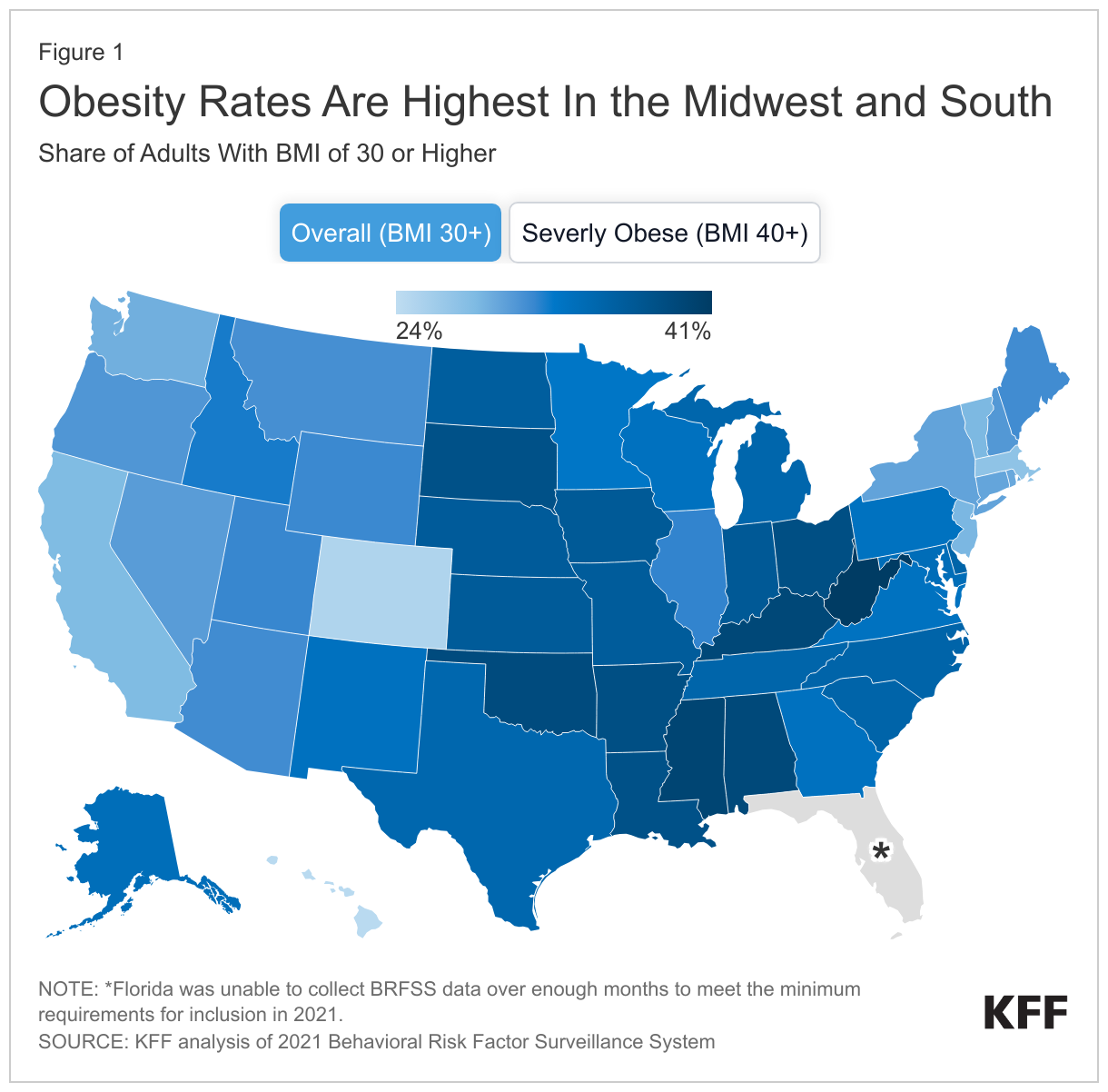
A look at KFF’s State Health Facts indicator of the distribution of adults with a body mass index (BMI) of 30 or more shows that the 20 states with the highest rates of obesity are all in the Midwest and South, as classified by the U.S. Census Bureau (Figure 1).
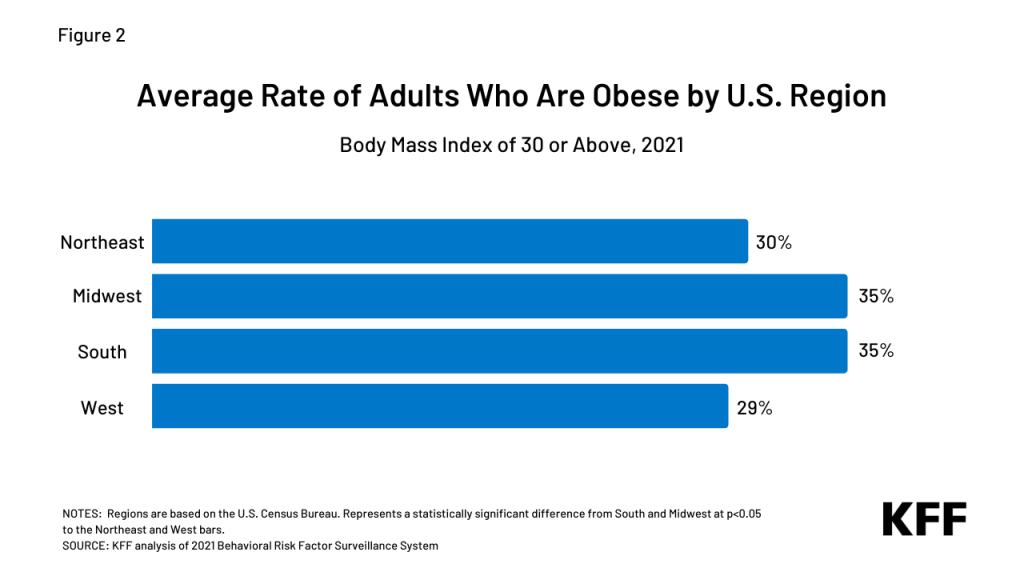
When comparing average obesity rates by region (Figure 2), adult rates in the Midwest and South are about five percentage points higher than the Northeast and six percentage points higher than the West.
Figure 2: Average Age of Adults Who are Obese by U.S. Region
The cost of treating adults who are obese with GLP-1 drugs would be substantial in the near term and could impact coverage policies. For state Medicaid programs in the Midwest and South, and employers and insurers with a significant presence in these regions, the higher rates of obesity among residents may factor into their decisions. Also a factor in access to these drugs, seven of ten states that have not adopted the Affordable Care Act’s Medicaid expansion and nearly all (97%) of the people experiencing a coverage gap due to non-expansion are in the South.
Recent reports (Business Insider, STAT, WSJ) reveal some employers previously covering GLP-1 drugs are pulling back coverage and health insurers are scrutinizing physicians’ off-label prescribing. With the prospect of a dramatic increase in costs if the class of drugs continues to gain FDA approval, coverage of the drugs could stall, drop, or be restricted, including limiting coverage eligibility to people with a higher body mass index. (Obesity is typically classified into three ranges of BMI. The American Medical Association recently clarified its policy on the role of BMI as a measure of obesity, noting historical problems and its limitations.) Other potential actions include:
Limiting off-label use,
Requiring additional treatment like behavioral therapy in conjunction with the drugs,
Prior authorization, including step-therapy to try less expensive options first, and
Higher cost-sharing.
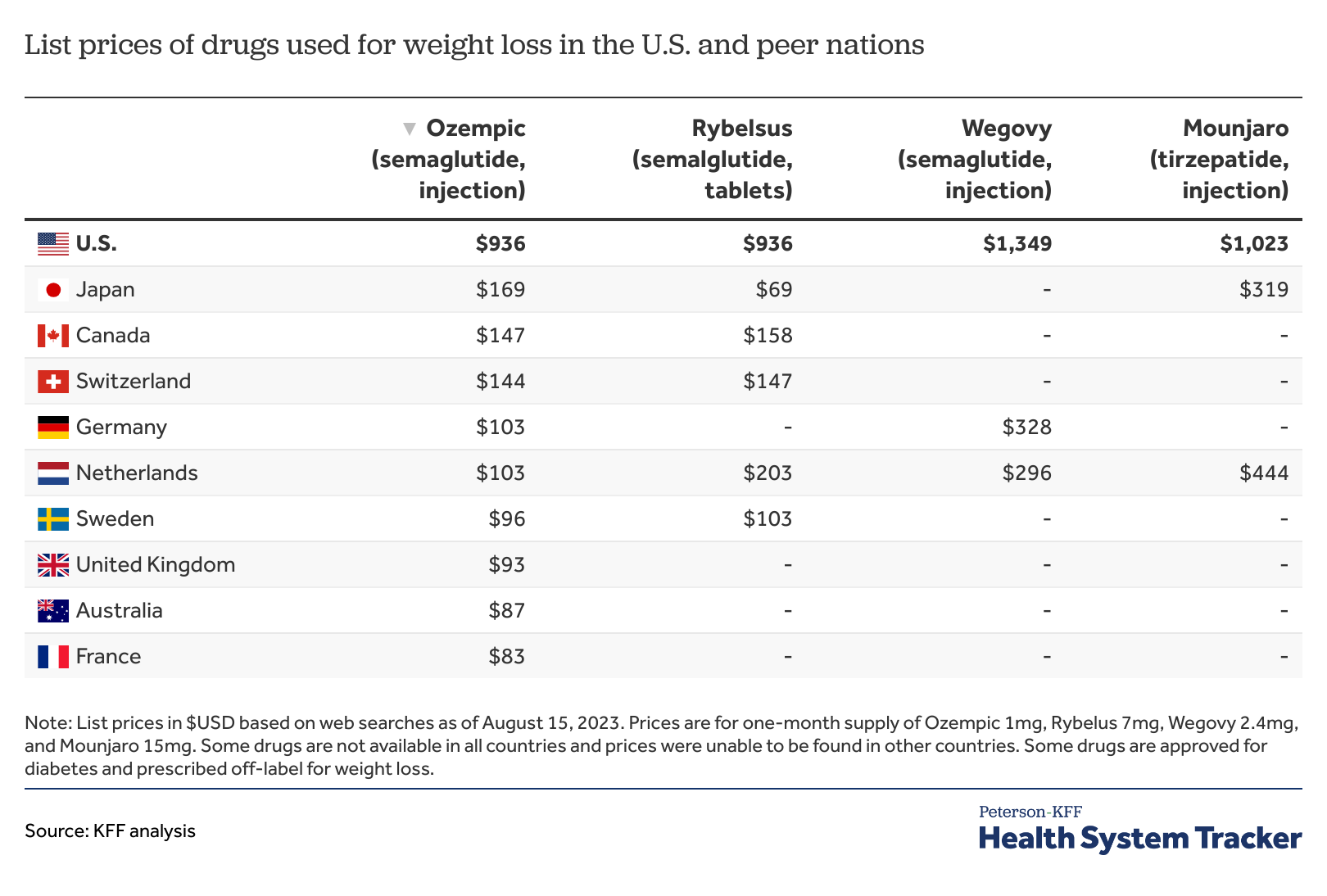
The early clinical results and potential of new prescription drugs for weight loss have caught the interest of nearly half of U.S. adults. Federal and state policymakers, employers and insurance coverage providers are in the early stages of considering these drugs’ potential costs and benefits in determining if and how to cover them in insurance plans. The long-term cost savings from a reduction in obesity and its related risks in the country could be substantial. Still, the current U.S. prices of these drugs for weight loss are high and their lifetime use may be required for continued health benefits. It is also important to note that some patients prescribed the drugs are experiencing side effects and their use’s long-term impact remains a question.
With adults in the Midwest and South having higher obesity rates, states’ coverage programs and regional employers could face higher health insurance costs – particularly in the short term – and seek ways to control the use of newer weight-loss drugs. As coverage of GLP-1 prescription drugs develops, regional trends could diverge.
*The Centers for Disease Control and Prevention’s (CDC) National Health and Nutrition Examination Survey, using clinical measurements, estimates about four in ten adults are obese. KFF estimates are based on analysis of state-level Behavioral Risk Factor Surveillance System self-reported data collected by the CDC and state health departments via phone calls.
Climate change-relatedextreme heat events have lengthened, become more frequent, and increased in intensity over the past few decades with some of the worst conditions and impacts observed in Summer 2023. Across the globe and the country there have been rising incidents of extreme heat, and air quality events. June 2023 became the hottest June on record, globally, while smoke from wildfires in Canada driven by climate change-related heat resulted in significant air pollution that affected more than 60 million people in the U.S. In August, prolonged dry conditions and high winds in Hawai’i laid the foundation for wildfires that caused massive destruction on the island of Maui and other areas of the islands, resulting in the largest loss of life due to wildfires in modern U.S. history. As temperatures continue to rise and extreme heat events that are linked to adverse health outcomes become more frequent in the U.S., people of color and other underserved communities are disproportionately affected.
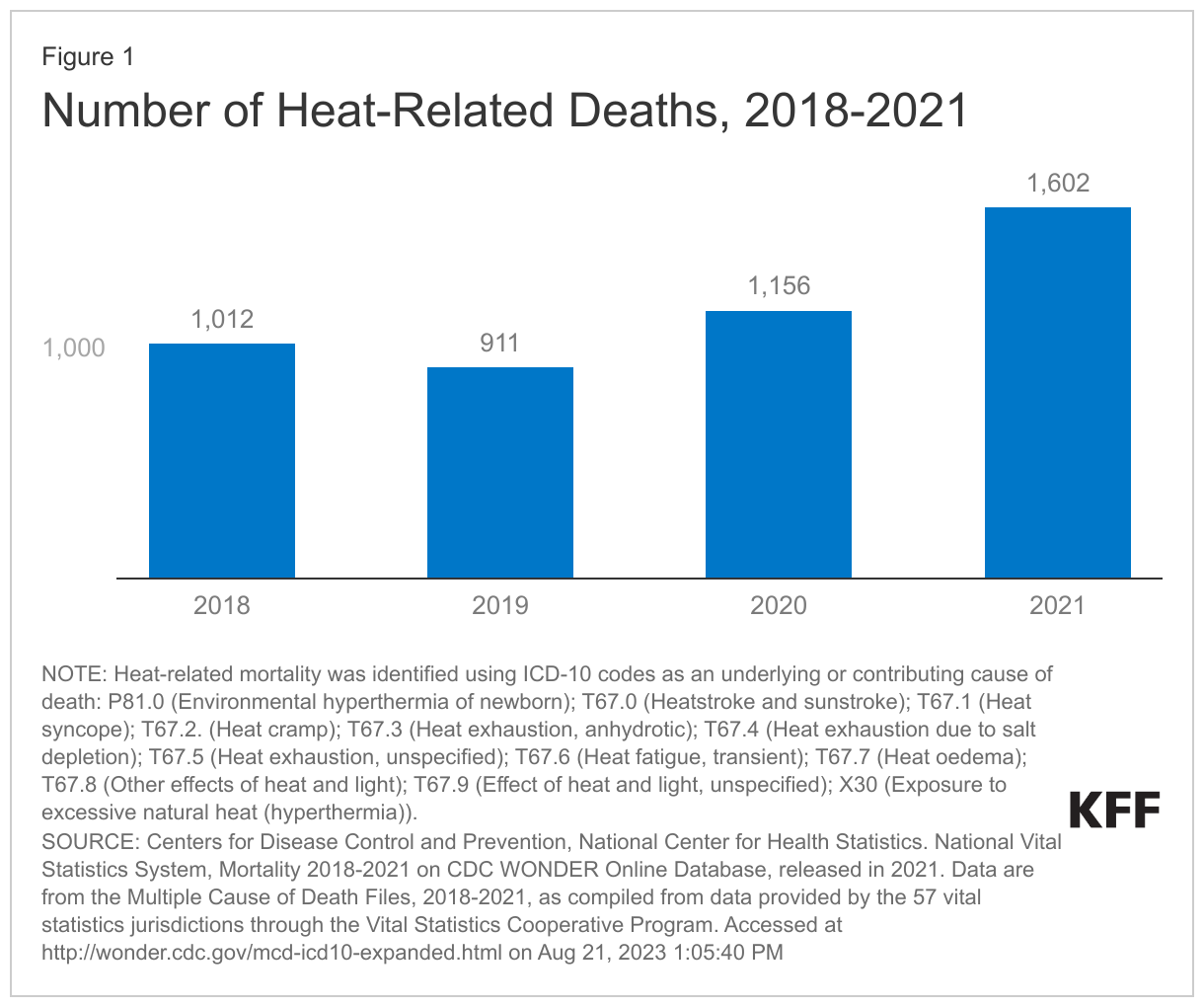
Extreme heat can have serious health impacts, including death. According to the Community Resilience Estimates (CRE) for Heat tool developed by the U.S. Census Bureau and Arizona State University, which accounts for factors such as housing quality, transportation exposure, and financial hardship, nearly a quarter of people in the U.S. are socially vulnerable if exposed to extreme heat. Extreme heat is the leading cause of weather-related deaths, killing more people in the U.S. than any other weather phenomenon. According to mortality data from the Centers for Disease Control and Prevention, between 2018 and 2021, there were a total of 4,681 heat-related deaths, with the number of deaths rising each year from 2019 onward (Figure 1). However, studies suggest that this is likely a vast undercount, and other evidence shows that extreme heat is associated with higher all-cause mortality. One estimate pegs the cost of heat events in the U.S. at approximately $1 billion in excess health care costs each year and, if unaddressed, could cost the U.S. economy approximately $14.5 trillion over the next fifty years.
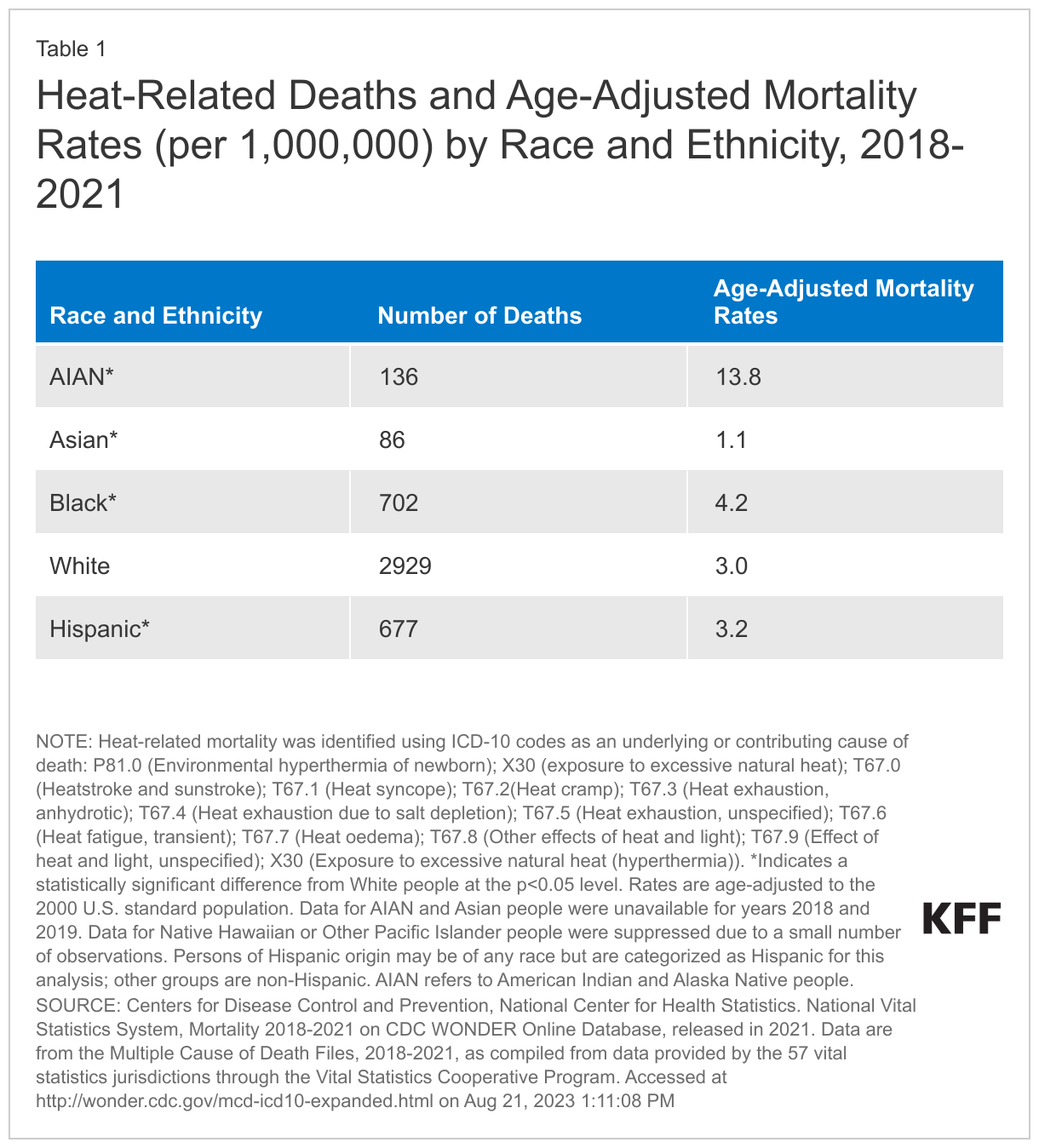
While extreme heat and other climate-related weather events have implications for everyone, they disproportionately affecthistorically marginalized groups who are at higher risk for dying from heat exposure. Recent literature shows that within the U.S., some communities of color have higher risks of heat-related mortality than White people. Consistent with trends in earlier years, between 2018-2021, AIAN people were most likely to die due to heat compared to all other racial and ethnic groups, and Black people had a higher rate of heat-related deaths compared to White people. The rate for Hispanic people was similar to that of White people, while Asian people had a lower rate of heat-related death (Table 1). Data also show that noncitizens are more likely to die from heat exposure compared with citizens.
These higher mortality risks reflect increased exposure to heat due to underlying inequities. Due to historically-codified residential segregation in the U.S. including “redlining,” on average, people of color have a higher likelihood of living in a census tract with higher summer daytime surface urban heat island intensity compared to their White counterparts. Low income communities and communities of color also suffer from tree inequity, increasing the risk of exposure to extreme heat and subsequent heat-related illnesses. Communities that live in these historically zoned areas are also more likely to have higher rates of asthma and cardiovascular illnesses and other diseases that increase their risk of poor health outcomes associated with exposure to climate change-related extreme heat and air pollution. The Southern U.S. and some areas in the Northeast and Midwest have experienced the greatest increases in the number of heat wave days in the U.S., which may have equity implications because these affected areas include higher shares of people of color, and are therefore more likely to be exposed to longer and more intense heat waves. Projections suggest that disparities in extreme heat exposure will continue to persist thirty years from now.
More limited access to air conditioning also contributes to disproportionate exposure to extreme heat and heat-related illnesses. Low-income households, which include disproportionate shares of people of color, face affordability challenges to accessing air conditioning. Lack of air conditioning increases risk of negative health outcomes including death due to heat exposure. Rising temperatures have been associated with increases in mortality among incarcerated people, a population in which people of color are overrepresented, and that sometimes has more limited access to air conditioning. The 2023 Texas heat wave highlighted the impact of lack of air conditioning in prisons. Approximately 13% of deaths in Texas prisons during warm months between 2001 and 2019 were associated with extreme heat in unairconditioned prisons. Further, as temperatures continue to rise, U.S. power grids may be unable to support the surges in energy use due to increase air conditioning and cooling infrastructure usage during heat waves and other extreme weather events.
People of color, noncitizen immigrants, and people with low incomes are more likely to work in jobs with climate-related health risks, including heat. Heat is a top cause of exertion-related occupational injuries and deaths. Workers at risk of heat stress include outdoor workers and workers in hot environments, such as construction workers, agricultural workers, factory workers, firefighters, among others. Migrant or immigrant workers make up significant proportions of farmworkers and are disproportionately exposed to environmental hazards, including heat.
The Occupational Safety and Health Administration (OSHA)and the Center for Disease Control and Prevention have heat stress prevention recommendations, but there currently are no national standards in place to protect workers from exposure to extreme heat. In 2021, OSHA issued a proposed rulemaking to protect workers from extreme heat exposure and heat stress in indoor and outdoor settings by seeking information on issues that may be considered in developing a standard. Since then, OHSA has established an enforcement initiative on heat-related hazards and created a National Advisory Committee to better understand challenges and identify and share best practices to protect workers. However, to date, a standard has not been established. As of Summer 2023, OSHA is seeking feedback from small businesses and local governments on the potential impact of a workplace heat standard on small businesses. Five states currently have occupational heat protection standards. In contrast, Texas Governor Gregg Abbott signed House Bill 2127 that limited local governments’ abilities to regulate work breaks. The law is expected to overturn local ordinances that mandate regular water breaks for workers, including construction workers who are disproportionately exposed to extreme heat
As extreme heat continues to worsen, strategies to mitigate exposure and reduce health risk will be of increasing importance. The Biden Administration has taken some steps to increase awareness and understanding of heat exposure and health risks, including launching a new heat.gov website, and plans to develop a National Heat Strategy. The newly established Office of Climate Change and Health Equity within the Department of Health and Human services aims to address the impact of climate change on health and is developing new tools to help track heat-related illnesses. Other agencies have taken steps to educate individuals and communities about how to protect themselves from extreme heat and to develop more climate-resilient communities. Ongoing efforts to address rising temperatures, reduce risks of heat exposure, and increase protections for those most at-risk for heat exposure will be important for reducing negative health impacts due to extreme heat particularly for groups who already face disparities in health.
A growing body of evidence shows that consolidation in health care provider markets has led to increases in prices without clear evidence of increases in quality. Policymakers and regulators have historically focused on consolidation within the same geographic area, but there have been a large number of mergers and acquisitions (referred to as “mergers” in this brief) between hospitals and health systems that operate in different regions (referred to as “cross-market mergers” in this brief), including several multi-billion dollar deals over just the past couple of years. Some experts have raised concerns that cross-market mergers could result in hospitals and health systems raising their prices. It is also possible that cross-market mergers could result in the elimination of service lines by some acquired hospitals, which may reduce access to care.
This issue brief explains the role and implications of cross-market mergers in hospital and health system markets and describes the approaches that government antitrust agencies have taken in reviewing these types of transactions.
What Is a Cross-Market Merger?
A “cross-market merger” entails a merger between two health care providers that operate in different geographic markets for patient care.1,2 For instance, this term could apply to the following scenarios:
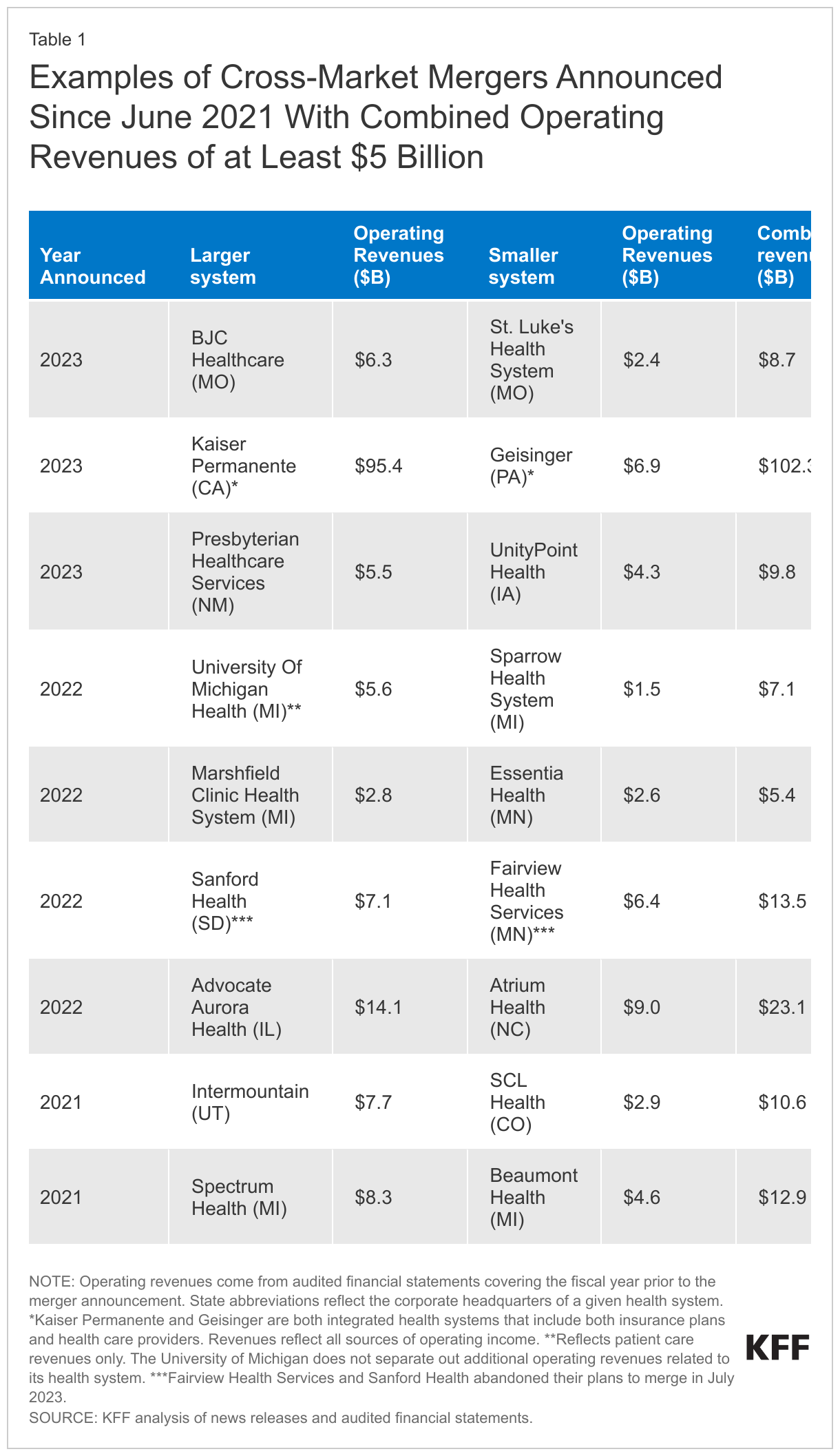
Two health systems that operate in different geographic markets merge. For example, in April 2023, Kaiser Permanente and Geisinger announced their plans to merge. These systems operate in different regions of the United States, with Kaiser Permanente operating in five states in the West (including California) and Georgia, Maryland, Virginia, and DC and Geisinger operating in Pennsylvania. In 2022, Kaiser Permanente and Geisinger earned $95 billion and $7 billion in operating revenues, respectively.3
A health system acquires an independent hospital in a geographic market where it does not operate. One example is Christus Health’s acquisition of Gerald Champion Regional Medical Center in July 2023. Christus Health is a large health system based in Texas that includes 28 hospitals, while Gerald Champion Regional Medical Center is an independent hospital in Alamogordo, New Mexico that is over 200 miles away from the nearest Christus Health facility.
Cross-market mergers can involve hospitals and health systems that are in neighboring markets as well as entities that are hundreds or even thousands of miles apart. An example of the former is the recent merger between University of Michigan Health—which is based in Ann Arbor, Michigan—and Sparrow Health System, which is based about 65 miles away in Lansing, Michigan. An example of the latter is the recently proposed merger of UnityPoint Health—which operates in the Midwest (Iowa, Illinois, and Wisconsin)—and Presbyterian Healthcare Services, which operates in New Mexico.
How Common Are Cross-Market Mergers?
Hospital and health system mergers are common, and many of these mergers involve providers in different geographic markets. For example, according to one study, about 1,500 hospitals were targeted as part of a completed merger or acquisition from 2010 through 2019 and most of these deals (55%) involved hospitals or health systems in different commuting zones. According to another study, about one in eight rural hospitals merged with an out-of-market hospital or health system from 2010 through 2018. A series of large, cross-market mergers in recent years have drawn further attention to this topic. Table 1 below provides examples of nine large, cross-market merger deals announced since June 2021, each of which entailed health systems with combined annual operating revenues of at least five billion dollars.
Cross-market mergers may be appealing to health systems that are seeking to expand for at least a couple of reasons. First, cross-market mergers have received little resistance from government antitrust agencies relative to mergers between health care providers that operate in the same market.4 Second, many health care markets are already highly concentrated, leaving fewer opportunities for health systems to expand within a given region.
What Are the Potential Implications of Cross-Market Mergers?
Cross-market mergers may benefit patients in some instances when hospitals and health systems are able to operate more efficiently as a combined entity. Even if hospitals and health systems are located in different markets, they may be able to share knowledge and best practices with each other, such as by collaborating to develop better clinical practice guidelines and sharing effective strategies and tools for managing patients’ care. Operating at a larger scale may also facilitate providers’ participation in complicated, value-based payment programs, which some health plans offer in an effort to reduce costs and improve the quality of care. Hospitals and health systems merging within and across markets can also potentially achieve efficiencies by purchasing goods and supplies in greater volume.
In some scenarios, small and struggling hospitals may seek to merge with large health systems in order to improve their finances or offer higher-quality services. For example, a large health system with deep pockets could provide a smaller hospital with resources to purchase new equipment and invest in quality improvements or provide a financial backstop and access to capital that may enable a struggling rural hospital to keep its doors open. A large, financially successful system could also share management strategies with hospitals that are losing money to help them operate more efficiently.
However, cross-market mergers may lead to higher prices. In fact, researchers have estimated that these types of deals have led to price increases ranging from 6 to 17 percent, though only a smallnumber of studies have focused on cross-market mergers.
There are at least a few reasons why cross-market mergers could lead to price increases, even though they entail hospitals and health systems that are not competing against each other in the same area. First, a combined health system with providers in, say, different areas of a state may be able to use its dominant position in one market to negotiate higher prices in another when contracting with a given health plan (e.g., a state employee plan with enrollees that reside in several markets). Second, a combined health system may compete with other health systems that also operate across the same markets. In that case, the combined health system may be hesitant to offer lower prices in one market out of concern that their competitor will retaliate by lowering prices and undercutting them in other markets. Finally, a large system that, say, acquires a small hospital may have more expertise in bargaining with insurers, which it could use to negotiate for higher prices.
Another concern that has been raised about certain types of mergers, which could also apply to some cross-market mergers, is that they may reduce access to care. For instance, a large health system that acquires a small rural hospital may be less responsive to community needs and more willing to eliminateservice lines, such as obstetric care. Relatedly, a hospital may also reduce spending on community benefits after being acquired by a health system.
How Do Government Antitrust Agencies Approach Cross-Market Mergers?
Federal and state antitrust agencies seek to promote competitive markets—often to benefit consumers—by scrutinizing mergers and other potentially anticompetitive practices. Antitrust agencies have historically focused on mergers between hospitals and health systems that operate in the same geographic market, though there are signs that they have begun to take a closer look at cross-market mergers. While federal antitrust agencies have yet to formally challenge a cross-market merger, the Federal Trade Commission (FTC) has identified these types of deals as an area of interest and has investigated at least two specific cross-market mergers (between Advocate Aurora Health and Atrium Health and between Spectrum Health and Beaumont Health).5
At the state level, the state attorney general in California has used its legal authority to imposeconditions on mergers that have been identified as cross-market deals. These conditions have included, for example, placing restrictions on price increases and requiring that the merged entities maintain certain services, such as by having a minimum number of emergency room, intensive care, and obstetrics beds. In Minnesota, the state attorney general had begun to investigate whether to challenge a proposed merger between Fairview Health Services (based in Minnesota) and Sanford Health (based in South Dakota) before the two systems abandoned their plans in July 2023.
Cross-market mergers have never been fully-litigated by a federal or state antitrust agency, and doing so in the short term may be difficult. First, only a handful of analyses have focused on cross-market mergers, limiting the ability of regulators to cite potential consequences based on empirical evidence. Second, antitrust agencies have not yet released detailed guidelines for evaluating cross-market mergers,6 nor have they tested legal strategies for challenging cross-market mergers in the courts. In contrast, when antitrust agencies challenge within-market mergers, they can rely on years of legal precedent as well as economic frameworks recognized by the courts. Finally, antitrust litigation can be complex and expensive. Without adequate funding, it may be impractical to challenge a large number of health care provider business practices that raise anticompetitive concerns, including cross-market mergers. Given these challenges, it is conceivable that cross-market mergers will continue unabated in the near future.
Discussion
Hospital and health system mergers are common, and these mergers often involve providers in different geographic markets. Cross-market mergers may have benefits in some scenarios, for example, if the providers involved share effective clinical strategies for improving patient care. However, a handful of studies indicate that cross-market mergers can lead to increases in health care prices. It is also possible that some hospitals may become less responsive to community needs after a cross-market merger. Antitrust agencies have begun to take a closer look at mergers of hospitals and health systems across different geographic regions, which may have a bearing on affordability and access to care in many regions across the country, but they have yet to fully-litigate a cross-market merger.
Some policy and regulatory options have been floated that could address some of the concerns about cross-market mergers. For example, government regulators could use their existing authority to scrutinize cross-market mergers, which antitrust agencies have begun to do. States could enact laws to give government agencies authority to require some or all types of providers to obtain prior approval from the government before merging. California has done so, and attorneys general in the state have used this authority to impose conditions on cross-market mergers to limit price hikes and require that merging entities maintain certain services. In addition, regulators could prohibit certain types of clauses in contracts between providers and insurers that may allow merged entities to leverage market power to negotiate for higher prices in one market based on their strong position in another.7
Each of these policy and regulatory options would involve tradeoffs. For example, determining whether to challenge a given cross-market merger could entail weighing the potential benefits of a merger, such as allowing a small hospital to keep its doors open, against the potential for some harm, such as higher health care prices and potentially less access to care for patients in a given market. As the number of cross-market mergers increases, these concerns and tradeoffs are likely to be on the radar of policymakers and regulators.
This work was supported in part by Arnold Ventures. KFF maintains full editorial control over all of its policy analysis, polling, and journalism activities.
This brief defines cross-market mergers based on providers being in separate geographic markets. We distinguish this from vertical mergers, which occur when there is consolidation between providers that offer different services along the same supply chain, such when a hospital acquires a physician practice. ↩︎
Regulators and researchers have long grappled with how to define the boundaries of geographic markets for health care services. As a result, a merger that is considered to cross markets by some may be identified as occurring within a single market by others. ↩︎
Kaiser Permanente and Geisinger are both integrated health systems that include both insurance plans and health care providers. Revenues reflect all sources of operating income. ↩︎
For example, in 2015, the Federal Trade Commission (FTC) initiated a legal challenge against a planned merger between two Illinois health systems—Advocate Health and Northshore University HealthSystem—arguing that the combined entity would control over half of the market for general acute care inpatient services in the North Shore area of Chicago. The two systems eventually abandoned their plans to merge. However, Advocate Health was later involved in two cross-market mergers—first with Aurora Health (based in the neighboring state of Wisconsin) to form Advocate Aurora Health and then with Atrium Health (based in North Carolina, South Carolina, Georgia, and Alabama) to form Advocate Health. The Federal Trade Commission investigated the latter merger, but the government did not seek to challenge either merger in the courts. ↩︎
The Department of Justice (DOJ) and FTC have taken additional steps that indicate that they are taking a closer at cross-market mergers. For example: (1) in September 2021, the FTC announced that they would be considering cross-market effects in their reviews of large merger deals, (2) in February 2023 and July 2023, respectively, the two agencies withdrew from their health care policy statements which, among other things, may have created a safety zone for large health systems to acquire small hospitals in other markets, and (3) in July 2023, the two agencies released a draft version of their updated guidelines for reviewing mergers that included language which might be used to challenge cross-market mergers (though this is not yet clear). ↩︎
In July 2023, the FTC and DOJ released a draft version of their updated guidelines for reviewing mergers that included language which might be used to challenge cross-market mergers (though this is not yet clear). ↩︎
This would entail banning “all-or-nothing clauses,” which require an insurer that wants to contract with a particular provider in a system to contract with all providers in that system. ↩︎
On Sept. 15, KFF released three follow-up reports examining the exposure to, and belief in, health misinformation among key groups, as well as their trust in different sources of health misinformation:
While health misinformation and disinformation long preceded the pandemic, the pervasiveness of false and inaccurate information about COVID-19 and vaccines brought into further focus the extent to which misinformation can distort public health policy debates and impact the health choices individuals make. KFF COVID-19 Vaccine Monitor surveys in 2021 and 2022 found that large shares of the public believed or were uncertain about false claims related to COVID vaccines and treatments, including myths about the vaccines’ effects on pregnancy and fertility. These surveys also highlighted the roles of traditional and social media as vehicles for spreading and/or combatting misinformation, showing a strong relationship between individuals’ trusted news sources and their propensity to believe false claims about COVID-19.
KFF has focused on providing reliable, accurate, and non-partisan information to help inform health policy in the United States. Yet, in a time where health-related misinformation is so easily accessible and disseminated, understanding the dynamics of misinformation is important to help ensure a robust and fact-based health policy environment. With this understanding, KFF is designing a new program that will identify and track the rise and prevalence of health-related misinformation in the United States, with a special focus on communities that are most adversely affected by health misinformation.
KFF is releasing our Health Misinformation Tracking Poll Pilot as part of this effort, examining the public’s media use and trust in sources of health information and measuring the reach of specific false and inaccurate claims surrounding three health-related topics: COVID-19 and vaccines, reproductive health, and gun violence. Accompanying this overview report of the pilot poll, KFF also released snapshot reports to the field, examining the implications for understanding and combatting misinformation among Black adults, Hispanic adults, and rural residents. Future surveys will explore other health topics for which misinformation has been found to be circulating.
The Misinformation Tracking Poll will work in tandem with our forthcoming Health Misinformation Monitor, a detailed report of the landscape of current health misinformation messages circulating among the public, sent directly to professionals working to combat misinformation. The Misinformation Monitor will be an integral part of KFF’s efforts to deeper analyze the dynamics of misinformation and inform a robust, fact-based health information environment, and will inform the topics we will ask about on future Health Misinformation Tracking Polls.
Key Takeaways for the Field
Health misinformation is widespread, yet the KFF Health Misinformation Tracking Poll Pilot presents a more nuanced perspective on what information people believe. Beliefs influenced by misinformation are not universally entrenched, and a significant portion of the public falls in the middle, susceptible to false claims, but not already bought in. These individuals hold tentative beliefs that lean towards or against misinformation, providing an opportunity to foster a more fact-based public understanding of health issues and informed dialogue.
While it is true that most adults have heard or read many of the false and inaccurate health claims asked about in the survey, relatively small shares of the public have both heard and believe misinformation about central health topics such as COVID-19 and vaccines, reproductive health, and firearm violence and safety. Moreover, while there are some adults who, when presented with false and inaccurate health misinformation, say they believe them to be definitely true, this is a relatively small share of the public. Most adults are uncertain about various items of health misinformation and fall in a potentially “malleable middle” who say the claims are “probably” true or “probably” false. While exposure to misinformation may not necessarily convert the public into ardently believing false health claims, it is likely adding to confusion and uncertainty about already complicated public health topics and may lead to decision paralysis when it comes to individual health care behaviors and choices. In any case, this “malleable middle” presents an opportunity for tailored interventions.
Furthermore, reinforcing accurate information may need to go hand-in-hand with combatting false health claims. When adults in the survey were asked to provide an example of COVID-19 misinformation they have read or heard, some individuals presented true claims as examples of misinformation. While the focus of some anti-misinformation efforts is on combating false claims that circulate widely, the survey reveals that there is a parallel challenge of true claims not being believed. This finding suggests allocating sufficient attention to addressing the skepticism and disbelief surrounding accurate information.
Some groups seem to be more susceptible to misinformation than others, with larger shares of Black and Hispanic adults, those with lower levels of educational attainment, and those who identify politically as Republicans or lean that way saying many of the misinformation items examined in the poll are “probably true” or “definitely true.” News sources also matter as those who say they regularly consume news from One America News Network (OANN), Newsmax, and to a smaller extent Fox News, are consistently more likely to believe most of the misinformation items asked about in the survey.
Media and other messengers can undoubtedly play a key role in efforts to address and to counter health misinformation. Local TV news and network news are among the most used news sources and also among the most likely to be trusted when it comes to health information. While many adults report frequently using social media, few say they would trust health information they may see on these platforms. Despite this, adults who frequently use social media to find health information and advice are more likely to believe that certain false statements about COVID-19 and reproductive health are definitely or probably true.
In an age of declining trust in institutions, some sources are more trusted than others and may have an important role to play in addressing misinformation. As the most trusted source of health information for the public, individual doctors may have an essential role to play in helping dispel false health claims. Additionally, while few media sources are widely trusted by the public as a source of health information, local news stations and network TV news stand out for their widespread use as a source of news and their relatively high level of trust among the public.
The following are the specific health-related claims that have been shown to be false, which were asked about in this KFF Health Misinformation Tracking Poll pilot survey. See the Appendix for more information the sources used to document each claim:
False claims about COVID-19 and vaccines:
“The COVID-19 vaccines have caused thousands of deaths in otherwise healthy people.”
“Ivermectin is an effective treatment for COVID-19.”
“The COVID-19 vaccines have been proven to cause infertility.”
“More people have died from the COVID-19 vaccines than have died from the COVID-19 virus.”
“The measles, mumps, rubella vaccines, also known as MMR, have been proven to cause autism in children.”
False claims about reproductive health:
“Using birth control like the pill or IUDs makes it harder for most women to get pregnant after they stop using them.”
“Sex education that includes information about contraception and birth control increases the likelihood that teens will be sexually active.”
False claims about gun violence:
“People who have firearms at home are less likely to be killed by a gun than people who do not have a firearm.”
“Most gun homicides in the United States are gang related.”
“Armed school police guards have been proven to prevent school shootings.”
False claim about the Affordable Care Act:
In addition to the false claims above, the survey also asked about the longstanding false claim that the Affordable Care Act established government “death panels” for people of Medicare in the question below:
“To the best of your knowledge, did the Affordable Care Act establish a government panel to make decisions about end-of-life care for people on Medicare?”
Exposure to and Belief in Health Misinformation Claims
Overall, health misinformation is widely prevalent in the U.S. with 96% of adults saying they have heard at least one of the ten items of health-related misinformation asked about in the survey. The most widespread misinformation items included in the survey were related to COVID-19 and vaccines, including that the COVID-19 vaccines have caused thousands of deaths in otherwise healthy people (65% say they have heard or read this) and that the MMR vaccines have been proven to cause autism in children (65%).
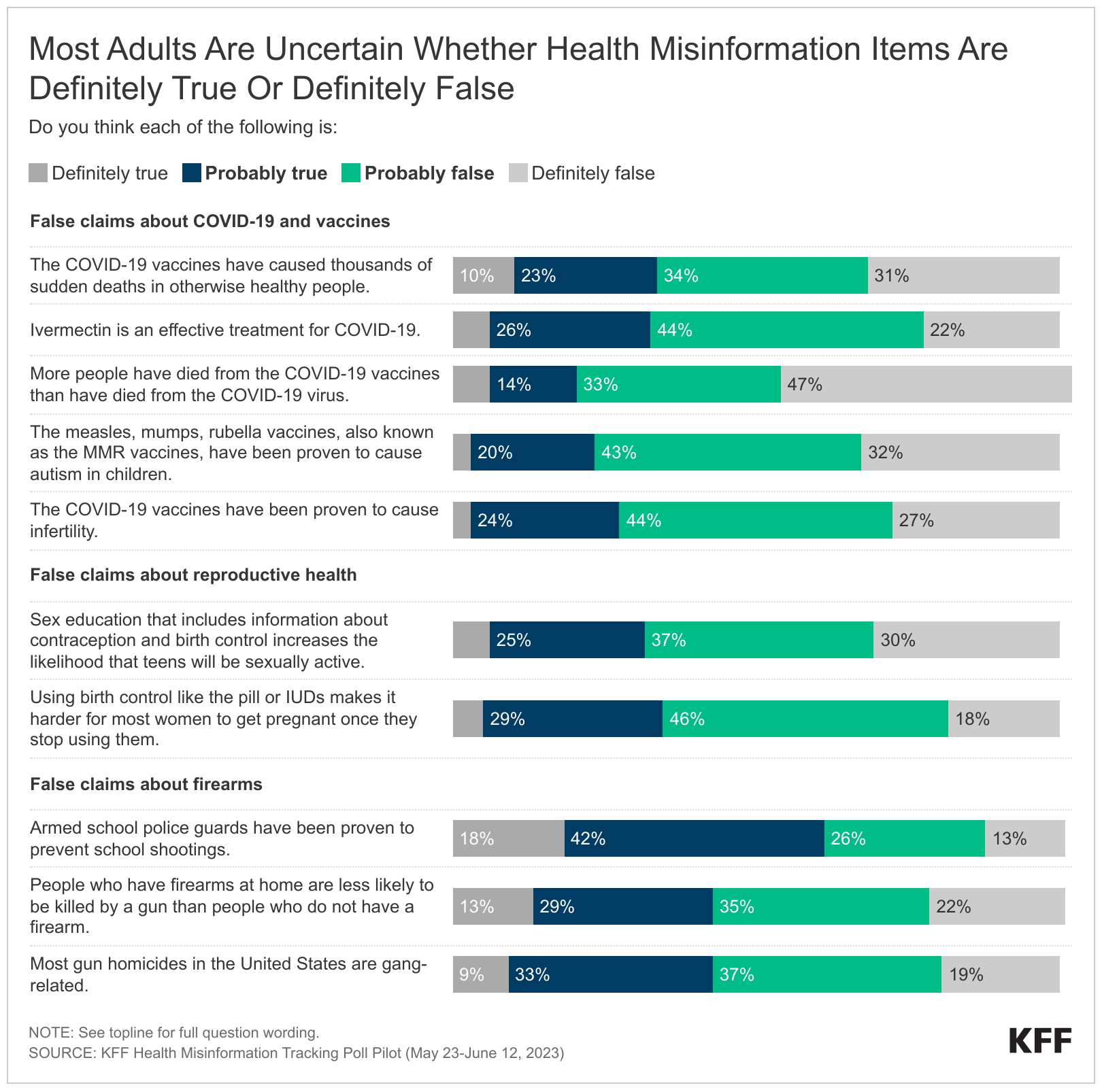
Regardless of whether they have heard or read specific items of misinformation, the survey also asked people whether they think each claim is definitely true, probably true, probably false, or definitely false. For most of the misinformation items included in the survey, between one-fifth and one-third of the public say they are “definitely” or “probably true.” While the most frequently heard claims are related to COVID-19 and vaccines, the most frequently believed claims were related to guns, including that armed school police guards have been proven to prevent school shootings (60% say this is probably or definitely true), that most gun homicides in the U.S. are gang-related (43%), and that people who have firearms at home are less likely to be killed by a gun than those who do not (42%).
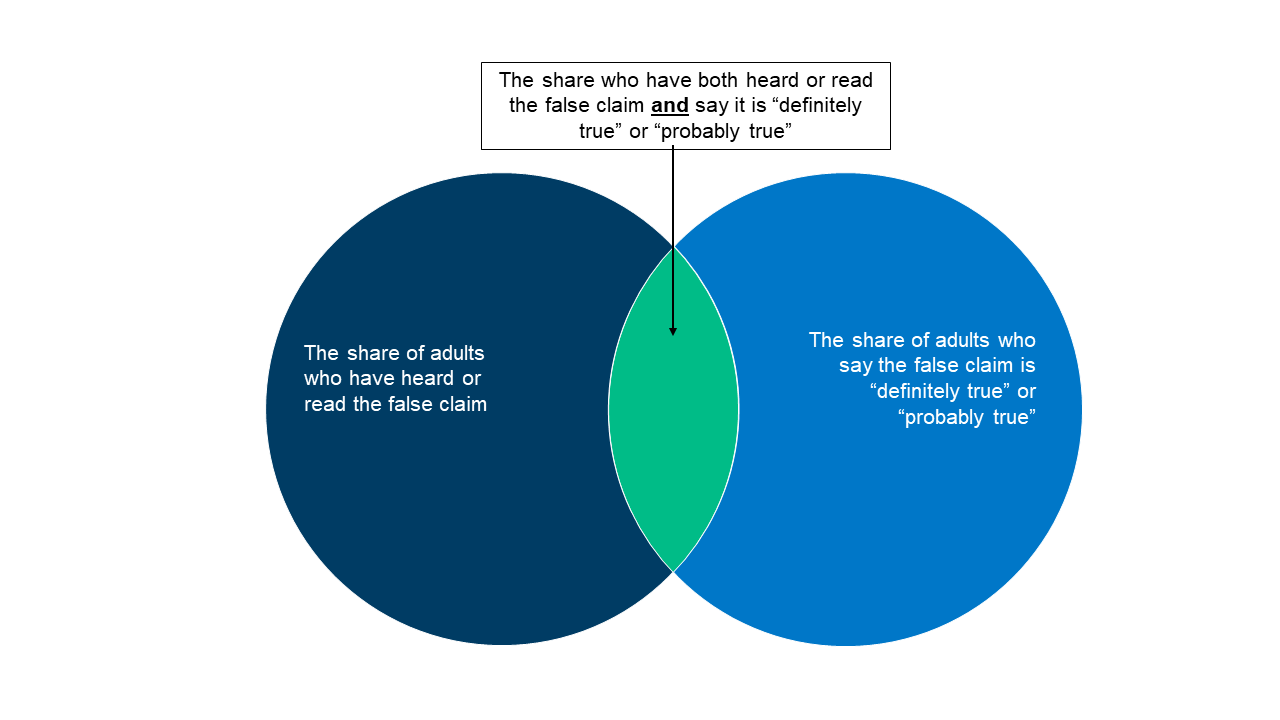
Combining these measures, the share of the public who both have heard each false claim and believe it is probably or definitely true ranges from 14% (for the claim that “more people have died from the COVID-19 vaccine than from the virus”) to 35% (“armed school police guards have been proven to prevent school shootings”).
Measures of Health Misinformation
This report examines three measures of health misinformation among the public. Adults were asked whether they had heard or read specific false health-related statements. Regardless of whether they have heard or read specific items of misinformation, all were asked whether they thought each claim was definitely true, probably true, probably false, or definitely false. We then combined these two measures in order to examine the share who have heard the false claims and believe it is definitely or probably true.
Uncertainty is high when it comes to health misinformation. While fewer than one in five adults say each of the misinformation claims examined in the survey are “definitely true,” larger shares are open to believing them, saying they are “probably true.” Many lean towards the correct answer but also express uncertainty, saying each claim is “probably false.” Fewer tend to be certain that each claim is false, with the exception of the claim that more people have died from the COVID-19 vaccines than from the virus itself, which nearly half the public (47%) recognizes as definitely false.
The range of people’s responses when presented with false claims – ranging from definitely true to definitely false – suggests different potential approaches for directing interventions among different groups. Those who say false health claims are “probably false” may benefit from having accurate information reinforced to them by trusted messengers such as their doctor or family and friends in the medical or health fields. However, those who say health-related misinformation items are “probably true” may require a different approach. While adults in each level of belief and disbelief of health misinformation present a unique opportunity for different tactics of interventions and outreach, the remainder of this report focuses on the group who say the false claims examined were “definitely true” or “probably true,” as this group represents adults who have bought in or are at the greatest risk of buying into the health misinformation items asked about in this survey.1
COVID-19 and Vaccine Misinformation
Across the five COVID-19 and vaccine related misinformation items, adults without a college degree are more likely than college graduates to say these claims are definitely or probably true. Notably, Black adults are at least ten percentage points more likely than White adults to believe some items of vaccine misinformation, including that the COVID-19 vaccines have caused thousands of sudden deaths in otherwise healthy people, and that the MMR vaccines have been proven to cause autism in children. Black (29%) and Hispanic (24%) adults are both more likely than White adults (17%) to say that the false claim that “more people have died from the COVID-19 vaccine than have died from the COVID-19 virus” is definitely or probably true. Those who identify as Republicans or lean towards the Republican Party and pure independents stand out as being more likely than Democratic leaning adults to say each of these items is probably or definitely true. Across community types, rural residents are more likely than their urban and suburban counterparts to say that some false claims related to COVID vaccines are probably or definitely true, including that the vaccines have been proven to cause infertility and that more people have died from the vaccine than from the virus.
Educational attainment appears to play a particularly important role when it comes to susceptibility to COVID-19 and vaccine misinformation. Six in ten adults with college degrees say none of the five false COVID-19 and vaccine claims are probably or definitely true, compared to less than four in ten adults without a degree. Concerningly, about one in five rural residents (19%), adults with a high school education or less (18%), Black adults (18%), Republicans (20%), and independents (18%) say four or five of the false COVID-19 and vaccine misinformation items included in the survey are probably or definitely true.
Reproductive Health Misinformation
The KFF Health Misinformation Tracking Poll asked about two misinformation items related to reproductive health and these two false claims appear to have different audiences. When asked about birth control leading to issues getting pregnant after cessation, younger adults – particularly younger women – are more likely to have heard this and to say this is probably or definitely true. However, when asked about sex education among teens leading to more sexual activity, older adults are more likely to say it is definitely or probably true. For both of these false reproductive health claims, adults without a college education, Republicans, and pure independents are more likely than their counterparts to say the claims are probably or definitely true. Black and Hispanic adults – groups who experience disparities in both health outcomes and in access to care – are more likely than White adults to say both of these false reproductive health claims are definitely or probably true.
Gun-Related Misinformation
When it comes to misinformation on gun-related violence, educational attainment again appears related to susceptibility to misinformation as those without a college degree are more likely than college graduates to say the firearm misinformation items are probably or definitely true. Notably, White (63%) and Hispanic (57%) adults are more likely than Black adults (48%) to say the claim that armed school police have been proven to prevent school shootings is definitely or probably true. Gun-related misinformation appears to be heavily politically charged, with Republicans and independents more likely than Democrats to say each of the claims regarding gun-related violence are probably or definitely true. Nearly three in four rural residents (73%) say that the claim that armed school police have been proven to prevent school shootings is definitely or probably true compared to fewer urban (56%) and suburban (58%) residents.
Gun owners are no more likely to have heard each of these items compared to those who do not own a gun, yet they are more likely to say each is definitely or probably true.
Affordable Care Act Misinformation
Some misinformation claims can have longevity and lead to longstanding public confusion and uncertainty. The KFF Health Misinformation Tracking Poll also asked about the false claim that the Affordable Care Act (ACA) established a government panel to make decisions on end-of-life care for people on Medicare. This is a long-standing myth about the ACA and previous KFF research has found that most adults could not accurately identify that the law did not set up such a panel. In the latest survey, seven in ten adults say they are not sure whether the ACA established a government panel to make end-of-life decisions for people on Medicare, and a further 8% incorrectly answer that the law did establish these panels. Just one in four adults (23%) – including three in ten Democrats – know that the ACA did not establish these so-called “death panels.” Notably, adults ages 65 and older (most of whom have Medicare coverage) are more likely than adults under the age of 30 to correctly answer that the ACA did not establish government panels for end-of-life decisions for those on Medicare.
Views of Health Misinformation and Responsibility for Combatting It
Large majorities of U.S. adults say that the spread of false and inaccurate information generally (86%) and the spread of false and inaccurate information related to health issues (74%) are major problems. This includes large shares across age, gender, education, and partisanship.
While a large majority of the public believes that false and inaccurate health information is a major problem, the COVID-19 pandemic underscored the complex nature of what the public sees as health misinformation in the United States. The current polarized political and media climate can lead to very different views of what constitutes misinformation.
The KFF Health Misinformation Tracking Poll asked adults to provide an example of COVID-19 misinformation that they have read or heard, and many examples were in direct contradiction with one another. For example, many cited things they had heard about facemasks that they perceive to be untrue. However, while some cited claims of masks not helping to curb the spread of the virus as misinformation, others cited claims that masking did help prevent the spread as a misinformation item. Similarly, adults provide contradictory claims about the COVID-19 vaccines’ safety and efficacy as examples of misinformation they have read or heard.
In Their Own Words: Can you provide an example of misinformation related to COVID-19 that you read or heard about in the media or elsewhere?
“That wearing a mask would not help prevent the spread” – 35 year-old Hispanic woman in Mississippi
“That masks stop the spread” – 52 year-old White woman in Ohio
“That masks don't need to be worn” – 72 year-old White woman in Arizona
“The use of masks reduces chances of getting COVID-19” – 26 year-old Hispanic man in Texas
“Taking the COVID shot will protect you that was all a LIE.” – 54 year-old Hispanic man in Florida
“The vaccines were ok to use” – 27 year-old Black woman in Texas
“Vaccines not being effective” – 62 year-old White woman in Massachusetts
“Vaccines do not work or are dangerous” – 75 year-old White woman in New Jersey
This lack of consensus on what constitutes health misinformation adds to the difficulty of curbing the spread of false and inaccurate health and medical claims. Nonetheless, the public sees a role for government, media, and social media companies to tackle this issue. At least two-thirds of adults say that Congress, President Biden, the U.S. news media, and social media companies are not doing enough to limit the spread of false and inaccurate health information. Despite often divided views on the role of government and media, majorities of adults across age, gender, education, and partisanship say each of these entities is not doing enough.
Trusted Sources of Information and News
With large shares of the public unable to identify many health-related misinformation items as definitely false, trusted messengers and sources have an important role to play in efforts to combat the proliferation of health misinformation. Not surprisingly, individual doctors are the most trusted source, with 93% of the public saying they have a great deal or a fair amount of trust in their own doctor to make the right recommendations on health issues.
When it comes to government agencies, most adults have at least a fair amount of trust in the FDA and CDC to make the right recommendations on health issues, though just one in four have a great deal of trust in the CDC and one in five have a great deal of trust in the FDA. Fewer say they trust the Biden Administration on health issues, and Republicans are less likely than Democrats to trust the Administration, as well as the CDC and the FDA.
Traditional News Media Use and Trust
The proliferation of media sources has led to many adults having a varied media diet. Local TV news, national network news, and digital and online news aggregators are the top news sources for U.S. adults, with over half saying they regularly read, watch, or listen to each.
There are variations in consumption of traditional news sources. Adults under age 30 are less likely than older adults to say they regularly watch local news but are more likely to use digital or online news aggregators that summarize various traditional and nontraditional news sources, such as Apple or Yahoo News. More than seven in ten Black (77%) and Hispanic (71%) adults say they regularly watch their local TV news station compared to 59% of White adults. Similarly, White adults (52%) are less likely to watch national network news regularly compared to Black (74%) and Hispanic (65%) adults. A majority of Republicans (57%) say they regularly watch Fox News to say up-to-date on current events, whereas a majority of Democrats (55%) say they watch CNN. Yet notably, more than six in ten Democrats and Republicans say they also regularly watch their local TV news channel, underscoring the wide reach of local news.
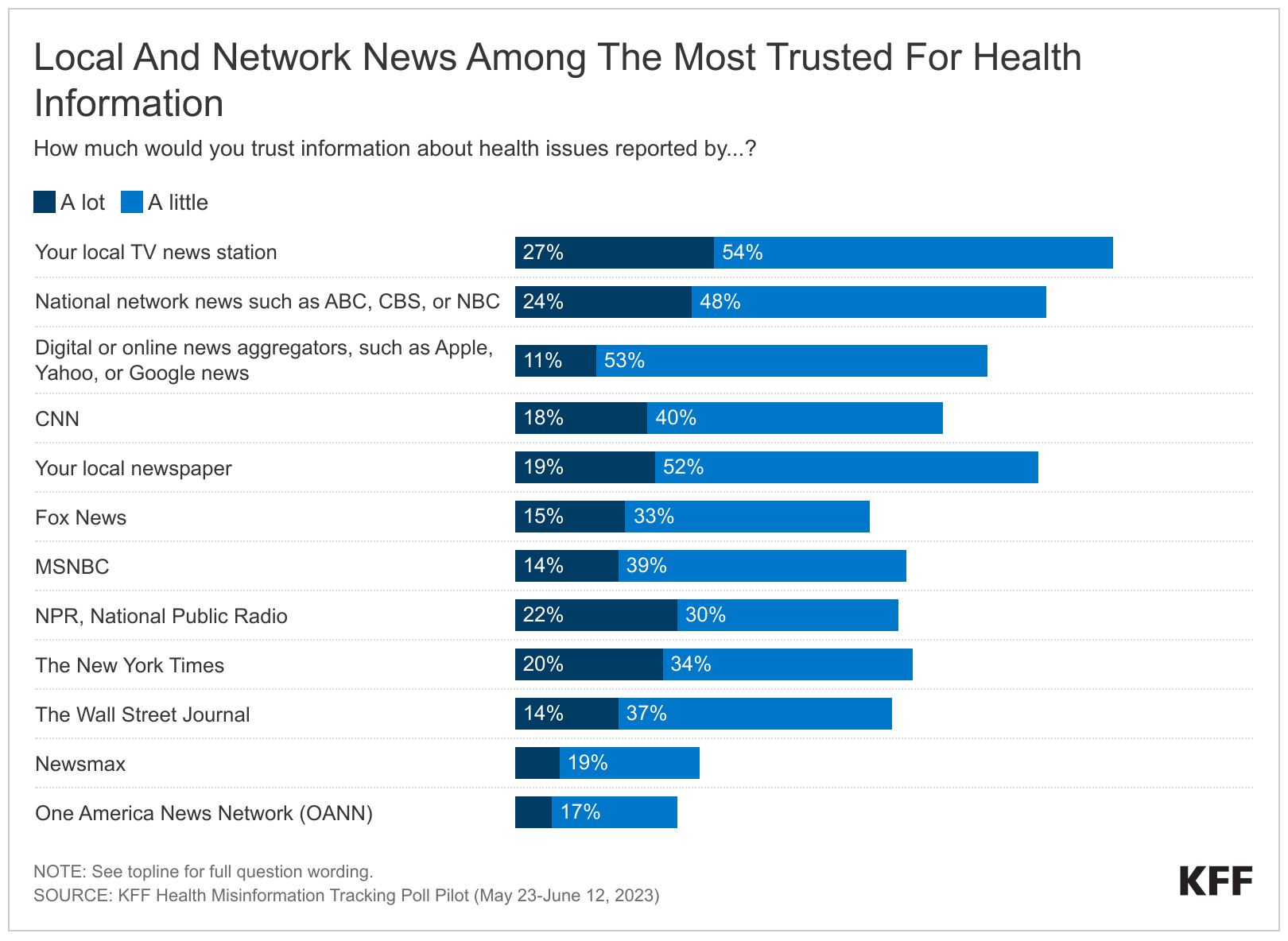
Regardless of whether they are regular viewers, the survey measured how much individuals would trust information about health issues that was reported by each of these sources. At least seven in ten U.S. adults say they would have at least “a little” trust in health information reported by their local TV news station, national network news, or their local newspaper. However, fewer than three in ten adults say they would have a lot of trust in health information reported by each of the media sources asked about in the survey.
The picture of trust in health information from various news sources looks somewhat different when looking only at those who are regular users of each source. Not surprisingly, regular users are much more likely than those who do not use each news source to say they would have a lot of trust in health information reported by that source. However, there is variation among news sources in how much their regular users trust the information they report. For example, majorities of regular users of NPR (59%) and the New York Times (52%) say they would trust health information reported on these platforms “a lot,” while a third of regular MSNBC viewers (34%) and Fox News viewers (36%) say they would place a lot of trust in health information reported there. For most other sources, the share of regular users who say they would have a lot of trust in health information they report ranges from three to four in ten.
Social Media Use and Trust
Most adults (55%) say they use social media at least once a week to keep up-to-date on news and current events, including a third (33%) who say they use it every day. About one in four (24%) say they use social media at least weekly to find health information and advice, though four in ten say they “never” do this. Larger shares of Hispanic and Black adults compared to White adults, and younger adults compared to older adults, say they regularly use social media for both news and health information. Hispanic adults are particularly likely to say they regularly use social media, with seven in ten (70%) saying they use it weekly for news and current events and half (49%) saying they use it weekly for health information and advice. While similar shares across education and income groups say they use social media for news, larger shares of those without college degrees and those living in lower-income households report using social media to find health information and advice compared to those with college degrees and higher incomes.
The most commonly used social media platforms included in the survey are YouTube and Facebook, with more than six in ten saying they use each of these platforms at least weekly. Regardless of whether they use the platforms, about half say they would have at least a little trust in information about health issues if they saw it on YouTube and four in ten say the same about Facebook. However, fewer than one in ten say they would have a lot of trust in health information seen on any of the platforms included in the survey.
Even among the those who frequently use specific social media sites, very few say they would have a lot of trust in health information if they saw it on these platforms. One in six Reddit weekly users say they would have a lot of trust in health information if they saw it on that platform, with similar shares of weekly TikTok, YouTube, and Twitter users expressing a lot of trust in health information they may see on those platforms.
Information Sources and Exposure and Belief in Health Misinformation
Similar to previous KFF surveys, this survey shows that consumption of different types of news media is correlated with belief in health misinformation. For example, when it comes to the falsehoods about COVID-19 and vaccines tested in the survey, just under half (45%) of all adults say they have both heard at least one of these falsehoods and believe it to be probably or definitely true. This share rises to about three in four among regular viewers of Newsmax, two-thirds among regular viewers of OANN, and six in ten among regular viewers of Fox News. In comparison, three in ten of those who regularly get news from NPR or the New York Times, and about four in ten who regularly get news from their local newspaper or national network news said the same.
Social media use is also correlated with being exposed and inclined to believe health misinformation. For example, a majority of those who use social media for health information and advice at least weekly say that they have heard at least one of the false COVID-19 or vaccine claims tested in the survey and think it is definitely or probably true, compared to four in ten of those who don’t use social media for health advice.
KFF also released additional analysis from the Health Misinformation Tracking Poll Pilot examining media use and trust and exposure and susceptibility to health misinformation among Black adults, Hispanic adults, and rural residents.
Support for this work was provided by the Robert Wood Johnson Foundation (RWJF). The views expressed do not necessarily reflect the views of RWJF. KFF maintains full editorial control over all of its policy analysis, polling, and journalism activities.
Methodology
This KFF Health Misinformation Tracking Poll Pilot was designed and analyzed by public opinion researchers at KFF. The survey was conducted May 23 – June 12, 2023, online and by telephone among a nationally representative sample of N=2,007 U.S. adults in English (1,881) and in Spanish (126). The sample includes 1,532 adults reached through the SSRS Opinion Panel either online or over the phone (n=78 in Spanish). The SSRS Opinion Panel is a nationally representative probability-based panel for which panel members are recruited randomly in one of two ways: (a) Through invitations mailed to respondents randomly sampled from an Address-Based Sample (ABS) provided by Marketing Systems Groups (MSG) through the U.S. Postal Service’s Computerized Delivery Sequence (CDS); (b) from a dual-frame random digit dial (RDD) sample provided by MSG. For the online panel component, invitations were sent to panel members by email followed by up to three reminder emails. 1,445 panel members completed the survey online and panel members who do not use the internet were reached by phone (87).
Another 475 (n=48 in Spanish) interviews were conducted from a random digit dial telephone sample of prepaid cell phone numbers obtained through MSG. Phone numbers used for the prepaid cell phone component were randomly generated from a cell phone sampling frame with disproportionate stratification aimed at reaching Hispanic and non-Hispanic Black respondents. Stratification was based on incidence of the race/ethnicity groups within each frame. Respondents in the prepaid phone samples received a $15 incentive by check received by mail, and panel respondents received a $5 electronic gift card incentive (some harder-to-reach groups received a $10 electronic gift card).
The online questionnaire included two questions designed to establish that respondents were paying attention. Cases that failed both attention check questions, those with over 30% item non-response, and cases with a length less than one quarter of the mean length by mode were flagged and reviewed. Cases were removed from the data if they failed two or more of these quality checks. Based on this criterion, 0 cases were removed.
The combined cell phone and panel samples were weighted to match the sample’s demographics to the national U.S. adult population using data from the Census Bureau’s 2021 Current Population Survey (CPS). Weighting parameters included sex, age, education, race/ethnicity, region, and education. The sample was weighted to match patterns of civic engagement from the September 2017 Volunteering and Civic Life Supplement data from the CPS and to match frequency of internet use from the National Public Opinion Reference Survey (NPORS) for Pew Research Center. Finally, the sample was weighted to match patterns of political party identification based on a parameter derived from recent ABS polls conducted by SSRS polls. The weights take into account differences in the probability of selection for each sample type (prepaid cell phone and panel). This includes adjustment for the sample design and geographic stratification of the cell phone sample, within household probability of selection, and the design of the panel-recruitment procedure.
The margin of sampling error including the design effect for the full sample is plus or minus 3 percentage points. Numbers of respondents and margins of sampling error for key subgroups are shown in the table below. For results based on other subgroups, the margin of sampling error may be higher. Sample sizes and margins of sampling error for other subgroups are available by request. Sampling error is only one of many potential sources of error and there may be other unmeasured error in this or any other public opinion poll. KFF public opinion and survey research is a charter member of the Transparency Initiative of the American Association for Public Opinion Research.
Support for this work was provided by the Robert Wood Johnson Foundation (RWJF). The views expressed do not necessarily reflect the views of RWJF. KFF maintains full editorial control over all of its policy analysis, polling, and journalism activities.
Group
N (unweighted)
M.O.S.E.
Total
2007
± 3 percentage points
Party ID
Democrat/Lean Democrat
968
± 5 percentage points
Republican/Lean Republican
632
± 5 percentage points
Independents
382
± 7 percentage points
Race/Ethnicity
White, non-Hispanic
866
± 4 percentage points
Black, non-Hispanic
510
± 6 percentage points
Hispanic
514
± 6 percentage points
Appendix
The KFF Health Misinformation Tracking Poll sought to examine the public’s exposure to and belief in a number of health-related misinformation claims. The statements included in the survey were selected based on public media documentation that these are claims that have been shared and spread in recent years and have been shown to be false or inaccurate. Below are some of the documented sources used to establish the existence of these misinformation claims and sources used to document their inaccuracy.
Statement
Source documenting presence in public health conversation
Source documenting falsehoods and inaccuracy of the statement
The COVID-19 vaccines have caused thousands of deaths in otherwise healthy people.
The subsequent analysis and discussion in this report largely focuses on the share of adults who say each item of health misinformation presented examined in the survey is probably or definitely true, regardless of whether they've heard it. While exposure to health misinformation is a concern, the KFF analysis presented focuses on those who are most susceptible to the health misinformation claims when they are presented and say they are probably or definitely true. ↩︎
A new KFF survey reveals the broad reach of health misinformation, with at least four in 10 people saying that they’ve heard each of 10 specific false claims about COVID-19, reproductive health, and gun violence.
Relatively small shares say that each of those false claims are “definitely true”, ranging from as few as 3% who definitively believe that COVID-19 vaccines have been proven to cause infertility to as many as 18% who definitively believe armed school guards have been proven to prevent school shootings.
Sign up for emails
Receive periodic emails when we have new information to share about our expanding work on health misinformation and trust. Sign up.
At the same time, roughly half to three-quarters of the public are uncertain whether each of the 10 false claims are true or not, describing them as either “probably true” or “probably false.” This suggests that even when people don’t believe false claims they hear, it can create uncertainty about complicated public health topics.
“Most people aren’t true believers in the lies or the facts about health issues; they are in a muddled middle,” KFF President and CEO Drew Altman said. “The public’s uncertainty leaves them vulnerable to misinformation but is also the opportunity to combat it.”
The new survey is one component of a new KFF program area aimed at identifying and monitoring health misinformation and trust in the United States, placing particular emphasis on communities that are most adversely affected by misinformation, such as people of color, immigrants and rural communities.
Alongside today’s survey findings, KFF will soon release companion survey reports highlighting the extent of health misinformation among Black and Hispanic adults, as well as rural residents. KFF will also soon release a regular “Health Misinformation Monitor,” which will document emerging health misinformation, identify its primary sources, and examine the role that social media and news outlets play in its spread. Sign up for alerts from KFF on this topic. KFF Health News is also expanding its reporting on this topic in conjunction with the new program.
“While many Americans struggle to separate health information fact from fiction, our survey shows that credible sources of information, and messengers, represent an opportunity to break through and help increase trust,” said Irving Washington, senior fellow for misinformation and trust at KFF. “We’ll continue to focus on this opportunity and what type of efforts can make a difference.”The misinformation examined in the survey includes:
Vaccines. A third (34%) of adults say the false claim that COVID-19 vaccines have caused thousands of sudden deaths in otherwise healthy people is definitely (10%) or probably (23%) true. Black adults are more likely to believe this false statement than White adults, while Republicans and independents are more likely than Democrats to do so. People with college degrees are less likely than those with a high-school education or less to say this is true.
Reproductive health. About a third of adults say the false claim that using birth control such as the pill or an IUD makes it harder for most women to get pregnant once they stop using them is “definitely” (5%) or “probably” true (29%). Adults under the age of 65, Republicans, independents, and Black and Hispanic adults are more likely to say this claim is true than their counterparts.
Gun violence. When asked about the inaccurate statement that people who have firearms at home are less likely to be killed with a gun, about four in ten (42%) say it is “definitely” (13%) or “probably” (29%) true. Gun owners are more likely than non-gun owners to say that this false claim is definitely or probably true (55% vs. 37%).
The survey also reveals how varied people’s beliefs and perceptions are about what constitutes misinformation. For example, when asked to describe specific misinformation related to COVID-19 that they’ve heard, people volunteered statements that were in direct contradiction with one another, including about the safety and effectiveness of COVID-19 vaccines and of wearing masks to prevent the virus’ spread.
Who People Trust for Health Information
The survey also gauges people’s trust in various sources of health information:
Doctors. Not surprisingly, people overwhelmingly say that they trust their own doctor’s recommendations – with 93% saying they trust their doctors at least a fair amount.
Federal agencies. About two thirds of the public say they have at least a fair amount of trust in the Centers for Disease Control (67%) and the Food and Drug Administration (65%) to make the right recommendations when it comes to health issues. Democrats are more likely than either independents or Republicans to trust the two federal agencies. About half of Republicans say they trust both the CDC (49%) and FDA (54%).
Traditional news sources. The largest shares of the public say they would have at least a little trust in health information reported by their local TV news stations (80%), national network news (72%), and their local newspaper (72%). CNN is the most trusted cable news network (58%), with smaller shares trusting MSNBC (52%), Fox News (49%), Newsmax (25%) or One American News Network (22%). Fewer than three in ten adults say they have “a lot” of trust in health information from any of these media sources.
Social media sources. About a quarter (24%) of adults say that they use social media at least weekly to find health information or advice, including larger shares of Hispanic and Black adults, and people in low-income households. Of eight specific social media sources, half (52%) would trust information about health issues they saw on YouTube at least a little. Fewer say they would trust health information if they saw it on Facebook (40%), Twitter (29%), Instagram (27%), and other platforms. Fewer than one in ten say they have a lot of trust in health information from any of these social media sources.
The survey report examines the sources to which people go to get their news and their susceptibility to misinformation. Less than half (45%) of adults say they have heard one of the five false COVID-19 and vaccine claims and believe it is definitely or probably true. That share rises to 76% of regular Newsmax viewers, and 67% of regular OANN viewers, and 61% of regular Fox News viewers.Similarly, 54% of those who use social media for health information and advice at least weekly say they have heard at least one of the false COVID-19 and vaccine claims and think it is definitely or probably true, compared to 40% of those who don’t use social media for health advice.Designed and analyzed by public opinion researchers at KFF, the KFF Health Misinformation Tracking Poll Pilot was conducted May 23-June 12, 2023, online and by telephone among a representative sample of 2,007 U.S. adults. Interviews were conducted in English and in Spanish. The margin of sampling error is plus or minus 3 percentage points for the full sample. For results based on subgroups, the margin of sampling error may be higher. Support for this work was provided by the Robert Wood Johnson Foundation (RWJF). The views expressed do not necessarily reflect the views of RWJF. KFF maintains full editorial control over all of its policy analysis, polling, and journalism activities.
Obesity in children is caused by a multitude of socioecological, environmental, and genetic factors and has increased in recent decades, with child obesity rates now three times higher than they were in the 1970s. Obesity is a risk factor for many chronic diseases and has been linked to future physical and mental health challenges and increased health care costs. Though obesity has historically been stigmatized as a result of personal choices, there have been recent actions to reduce that stigma and weight bias and increase obesity screening and treatment options. New FDA weight-loss drugs have entered the market, and the American Academy of Pediatrics (AAP) released a new set of clinical practice guidelines for evaluating and treating obesity in early 2023. While addressing obesity among children with all forms of insurance coverage is important, Medicaid is particularly relevant since it now covers half of children in the U.S., including 8 in 10 children living in poverty and over half of Black, Hispanic, and American Indian/Alaska Native children. Obesity prevalence is higher for these groups. This brief examines the share of children with obesity, how obesity screening and treatment is covered under Medicaid for children, and what recent changes may mean for Medicaid programs and enrollees in the future.
What is the share of children with obesity?
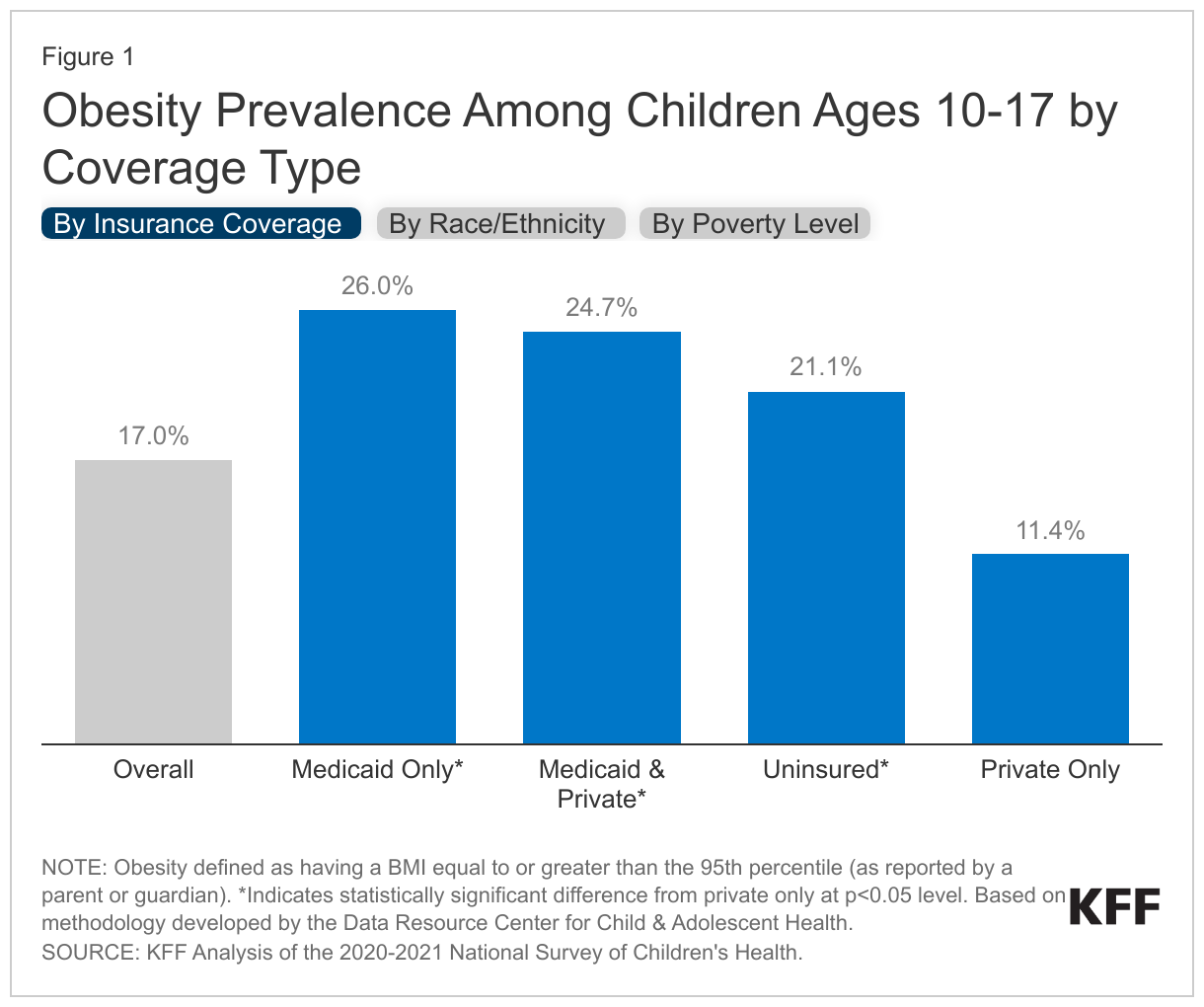
KFF analysis of federal survey data show more than one in six children have obesity, with obesity rates varying by insurance coverage type, race and ethnicity, and household income. Based on data from the 2020-2021 National Survey of Children’s Health (NSCH), 17% of children ages 10-17 in the U.S. have obesity (Figure 1). Obesity in children is typically defined as having a Body Mass Index (BMI) equal to or greater than the 95th percentile for their age and sex, although there has been recent pushback on BMI as a screening tool, and research has shown it can incorrectly classify individuals as overweight or obese, especially for people of color. Children with Medicaid are more than two times as likely to have obesity than those with private insurance: Over one-quarter (26.0%) of Medicaid children have obesity compared with 11.4% of children with private insurance alone. Obesity prevalence is also higher for Black, Hispanic, and children of other or multiple races compared with White children as well as for children with lower household incomes compared with children in the highest income households (Figure 1). These disparities in obesity reflect a variety of factors, including social and economic factors such as higher rates of food insecurity, more limited access to healthy food options, more limited time and access to opportunities for physical activity and recreation, and experiences with discrimination and stigma.
What other chronic conditions do Medicaid children with obesity have?
Children’s obesity rates in Medicaid claims data are lower than survey estimates of obesity prevalence. In 2019, 7.4% of Medicaid children ages 10-17 had an obesity diagnosis clinically identified in the Medicaid claims data (T-MSIS), suggesting that obesity in children may be undertreated. Other research has found that obesity is generally under-reported in claims data, and when it is reported, it is more likely to identify individuals with morbid obesity or comorbidities than individuals with more moderate obesity. Several factors could be contributing to low rates of reporting including the relative newness in viewing obesity as a disease, interventions being time intensive and difficult for clinicians to implement in a time limited primary care visit, or limited provider reimbursement for obesity treatment services. While there are limitations, analysis of claims data can help to identify the extent to which other chronic health conditions accompany obesity.
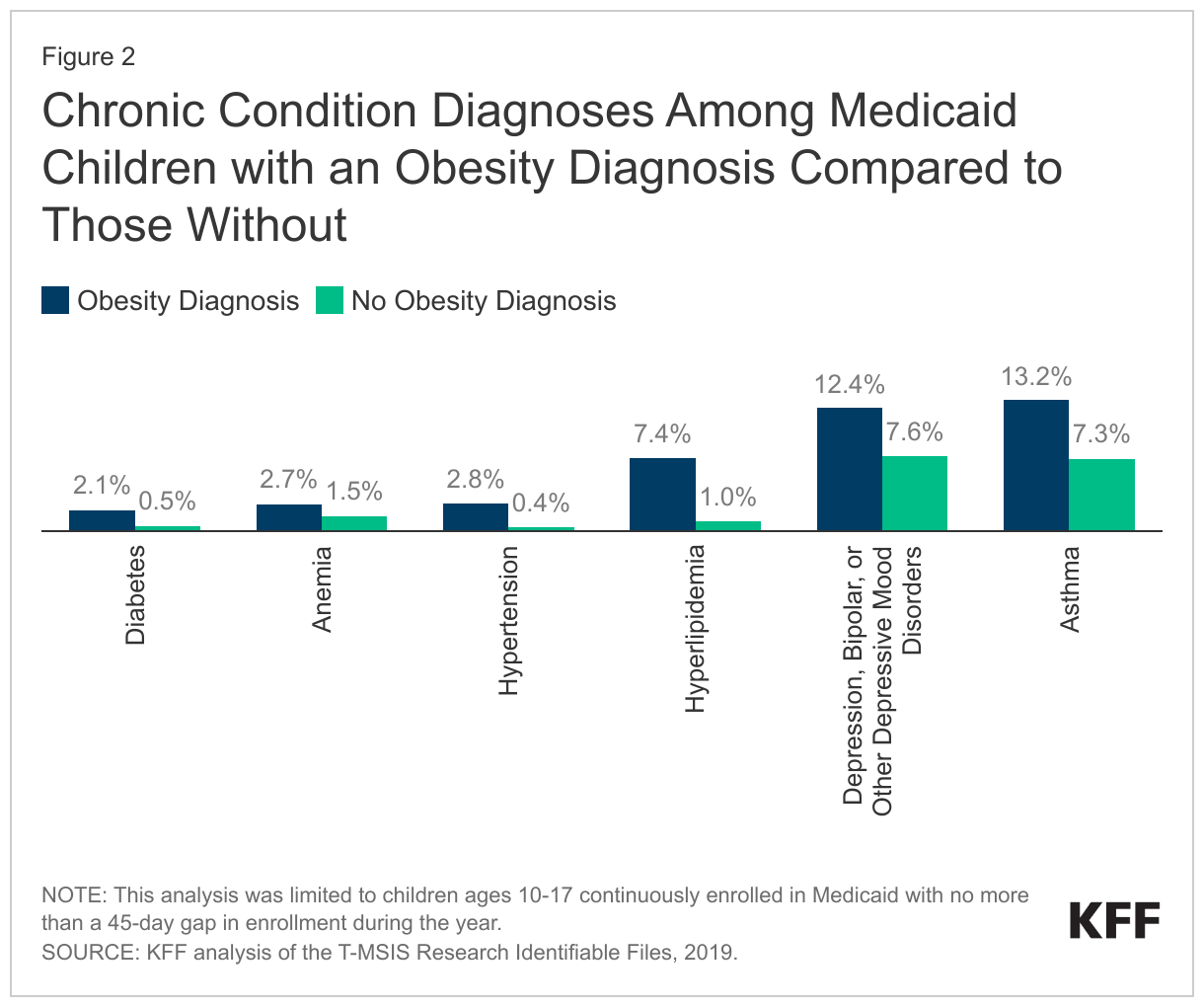
For Medicaid children ages 10-17 with an obesity diagnosis, the most common co-occurring chronic condition (across a set of 30 chronic conditions, see Methods for more information) is asthma, followed by certain mental health conditions, hyperlipidemia, anemia, hypertension, and diabetes (Figure 2). Children with obesity are also more likely to have these conditions compared with children without an obesity diagnosis. For example, 13.2% of children with an obesity diagnosis also have an asthma diagnosis compared with 7.3% of children without obesity. Similarly, 12.4% of children with an obesity diagnosis also experience mental health challenges including depression, bipolar disorder, and other depressive mood disorders compared with 7.6% of children without obesity. These findings mirror a body of research that has found a link between childhood obesity and asthma as well as various mental health challenges including depression and anxiety, lower self-esteem and increased bullying. One recent study of Medicaid expenditures also found inpatient and outpatient mental health services were a primary driver of spending among children with obesity. Overall, over one-third (35.6%) of children with an obesity diagnosis have at least one other co-occurring chronic condition (across a set of 30 chronic conditions).
What obesity treatment and services does Medicaid cover for children?
Obesity services can include screening, behavioral and nutritional counseling, anti-obesity medications, and bariatric surgery, and these services are covered for children under Medicaid’s Early and Periodic Screening, Diagnostic, and Treatment (EPSDT) program. EPSDT is a Medicaid benefit for children under 21 that provides comprehensive treatment and preventive care. Under EPSDT, states are required to cover all screening services for children as well as any services “necessary… to correct or ameliorate” a child’s physical or mental health condition. EPSDT also allows for unique state flexibility in addressing the range of other factors connected to obesity, including providing behavioral health services and addressing adverse childhood experiences (ACEs) and social determinants of health (SDOH) such as housing, finances, and safety.
While children have access to obesity treatment though EPSDT, it is less clear how states are implementing and covering these services in practice. One old study, from 2010, only found conclusive evidence from 10 states that they were covering obesity-related behavioral and nutritional counseling services. While additional states are likely to have started covering obesity-related services since then, other research has found that some Medicaid-covered children do not receive recommended EPSDT screenings and services. Data from the 2020 Child Core Set, which includes data from participating states on children in Medicaid or the Children’s Health Insurance Program (CHIP), found a median of 73% of children ages 3 to 17 with a primary care visit had evidence of BMI screening, 63% received nutrition counseling, and 59% received physical activity counseling though these rates varied across states.
What to watch looking ahead?
While data indicate a majority of Medicaid children are being screened for obesity, it is difficult to know how many children are receiving recommended services.Research also indicates there are racial disparities in access to obesity treatments. When the Child Core Set quality measures—which include measures related to obesity— become mandatory in 2024, states and health plans will have data on rates of screening and counseling for obesity. Access to such data may prompt the states and health plans to encourage more proactive screening and treatment by pediatricians. Provisions included in recent legislation to bolster Medicaid’s EPSDT benefit may also help more Medicaid-covered children receive all recommended screenings and services, including obesity screening and counseling.
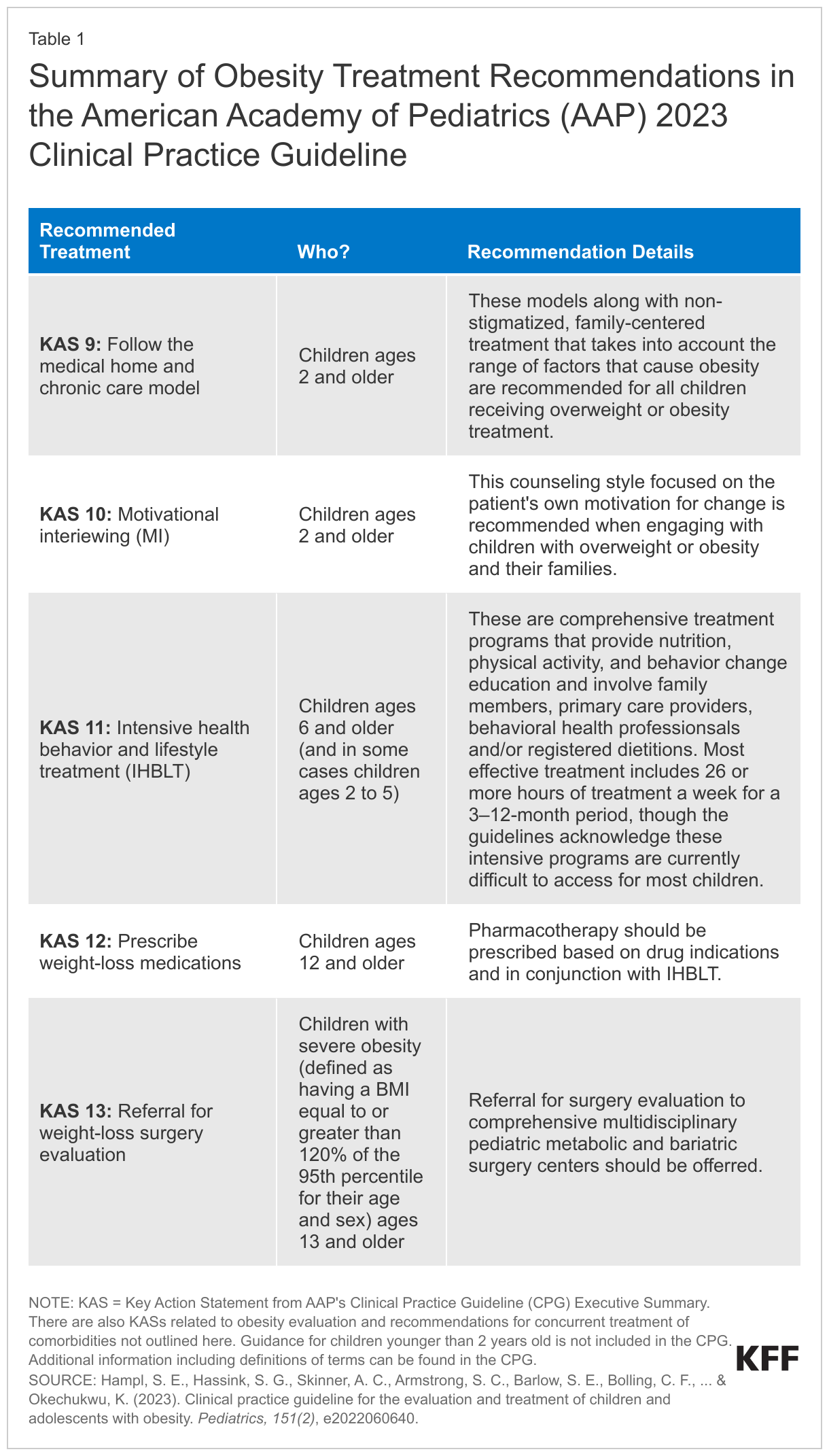
The AAP released a new set of clinical practice guidelines for evaluating and treating obesity and associated conditions in early 2023. The guidelines outline and describe evidence-based screening procedures, comorbidity evaluation and treatment for children ages 2 and older, and recommended obesity treatments (for treatment details, see Table 1). The guidelines emphasize early and intensive treatment, and note the importance of a non-stigmatized, family-centered approach that takes the range of factors that cause obesity into account. The guidelines are not mandatory, and it remains to be seen how quickly and to what extent the guidelines will be adopted by clinicians. There has been some pushback on the intensity of the new guidelines and the potential to cause eating disorders. Concerns with new medications for weight loss include some side effects and studies show people regain the weight if they stop taking the medications. Despite increasing prescribing rates of medications for adults, it is expected that providers may be slower to prescribe children anti-obesity medications .
With Medicaid now covering half of all children in the U.S., and an even larger percentage of children who are likely to be obese, changes in physicians’ practice stemming from the updated treatment recommendations could have a sizable effect on Medicaid programs and enrollees. However, the extent to which the new, more intensive treatment recommendations are considered medically necessary for children may vary by state and provider. While there is evidence that payment rates for obesity treatment, access to IHBLT, and take up of anti-obesity medications is currently limited, there could also be spending implications for Medicaid if more children begin to receive recommended obesity treatments including anti-obesity medications or bariatric surgery.
Methods
Data: This analysis used the 2019 T-MSIS Research Identifiable Files. More specifically, the analysis used the inpatient (IP), long-term care (LT), and other services (OT) claims files merged with the demographic-eligibility (DE) files from the Chronic Condition Warehouse (CCW) to include beneficiary demographic and enrollment information.
Identifying an Obesity Diagnosis: An obesity diagnosis was identified if any enrollee had any claims across the IP, LT, and OT files during the year with ICD-10 diagnosis codes within E66.0, E66.1, E66.2, E66.8, E66.9, Z68.3, Z69.4, Z68.54. This code set was based on previous KFF analysis and othersources.
Chronic Conditions: 30 chronic conditions were identified in this analysis including anemia, asthma, diabetes, depression, bipolar, or other depressive mood disorders, hypertension, and hyperlipidemia, using ICD-10 codes from the CCW Chronic Condition Algorithm. A condition was identified as present if an enrollee had any claims across the IP, LT, and OT files during the year with any of the relevant diagnosis codes listed in the CCW algorithm.
Enrollee Exclusion Criteria: This analysis was limited to children ages 10-17 continuously enrolled in Medicaid with no more than a 45-day gap in enrollment during the year. This definition of continuous enrollment was chosen to align with previous KFF analysis and CMS’ Child Set Core Measures, specifically, those around children’s preventive care, and to give people sufficient time in Medicaid to utilize services.
State Exclusion Criteria: We excluded the following states from our analysis due to concerns with the quality of their enrollment data: Florida, Kentucky, Rhode Island, and Oklahoma. Based on a previous KFF analysis, we relied on data quality assessments from the DQ Atlas to exclude states. We exclude states based on (1) Number of Enrollment Spans – % of Beneficiaries with Only One Enrollment Span in Year ≥ 99.8 (Florida, Kentucky, Rhode Island), (2) Enrollment Patterns Over Time: Number of Enrollment Spans – % Beneficiaries with 3 or More Enrollment Spans in Year ≥ 5% (Oklahoma).
At the state level, we also examined claims volume, the share of children with no health care utilization, and benchmarked the share of children with a well-child visit in 2019 to the 2019 Child Core Set measure for the percentage of children with at least 1 well-care visit with a primary care practitioner or obstetrician/gynecologist. We did not find any significant state outliers across those measures.
In addition to having the highest obesity rates, the U.S is currently facing significantly higher prices for several major drugs used for weight loss and other health needs, according to a new KFF analysis of the list prices for semaglutide and tirzepatide drugs.
Ozempic, which has been approved in the U.S. for diabetes, is more than five times as expensive in the U.S. ($936) as in Japan ($169), which has the second highest list price. Similarly, Wegovy, which has the same active ingredient and was approved for weight loss, is nearly four times as expensive in the U.S. ($1,349) as in Germany ($328.)
The chart above shows list prices available through website searches for four weekly shots or a 30-day supply. List prices are not necessarily net prices paid as manufacturers provide insurer rebates and patient coupons. Private insurers and employers in the U.S. may also be able to negotiate lower prices with drug manufacturers or get larger rebates.
Even if prices lower some, higher drug prices and higher obesity rates in the U.S. could still lead to a larger impact on overall health spending in the U.S. than in peer countries.
One-third of U.S. adults (33.6%) have obesity compared to an average of 17.1% across peer nations. KFF polling also found that about half of adults in the U.S. would be interested in taking prescription weight-loss drugs, though interest drops if not covered by insurance or after hearing they might gain weight back after end the use.
The full analysis and other data on health costs are available in the Peterson-KFF Health System Tracker, an online information hub dedicated to monitoring and assessing the performance of the U.S. health system.
A class of drugs initially approved for diabetes treatment has captured the public’s and policymakers’ attention as interest in their off-label use for weight loss rises. The weight-loss benefits of these drugs have led to their prescribed use for obesity or overweight treatment.
A new analysis compares list prices for semaglutide—including Ozempic, which has been approved in the U.S. for diabetes, and Wegovy, which has the same active ingredient and has been approved for weight loss—and tirzepatide (Mounjaro) in the U.S. and other large, wealthy OECD nations.
Semaglutide prices are higher in the U.S. than in other countries. Ozempic is more than five times as expensive in the U.S. ($936) as in Japan ($169), which has the second highest list price. Similarly, Wegovy is nearly four times as expensive in the U.S. ($1,349) as in Germany ($328.)
The U.S. has by far the highest rates of adults with obesity. A third of adults (33.6%) have obesity in the U.S. compared to an average of 17.1% across peer nations
The analysis can be found on the Peterson-KFF Health System Tracker, an information hub dedicated to monitoring and assessing the performance of the U.S. health system.
With U.S. overdose deaths hitting a new high in 2022, a majority of adults say they have felt the impact of the substance use crisis facing the country. Two-thirds say either they or a family member have been addicted to alcohol or drugs, experienced homelessness due to addiction, or experienced a drug overdose leading to an emergency room visit, hospitalization, or death.
Three in ten U.S. adults (29%) say they or someone in their family have ever been addicted to opioids, including prescription painkillers and illegal opioids like heroin. Opioid addiction impacts substantial shares across demographic groups like income and gender but is more commonly reported among rural residents and White adults. Four in ten of those living in rural areas (42%) report they or a family member have experienced opioid addiction compared to smaller shares of those living in suburban (30%) or urban (23%) areas. In addition, a larger share of White adults (33%) compared to Black adults (23%) report personal or familial experience with opioid addiction. About three in ten (28%) Hispanic adults also report they or a family member have experienced opioid addiction.
Among those who say they or a family member experienced addiction to prescription painkillers, alcohol, or any illegal drug, less than half (46%) report they or their family member got treatment for the addiction. The share is larger among White adults (51%), compared to Black adults (35%) and Hispanic adults (35%). Three in ten (29%) of those who report a personal or family issue with addiction report receiving in-patient treatment, and a quarter (26%) say they received out-patient treatment. A quarter (25%) of those who say they or a family member experienced opioid addiction, or 7% of all adults, say they or their family member were treated using medication for opioid use disorder such as buprenorphine or methadone.
Among the two-thirds who say they or a family member experienced addiction, three-quarters (76%), or 50% of all adults, say it had at least a minor impact on their relationship with their family. Most also say it impacted their mental health or their family’s financial situation. Substantial shares say these were “major” impacts, with about three in ten adults who say so when asked about their mental health (32%) and their family’s financial situation (29%) and about four in ten (42%) when asked about familial relationships.
Beyond direct experience with addiction, the poll finds many adults in the U.S. are worried about substance use. For example, half (51%) of adults are worried that someone in their family will experience substance use disorder or an addiction to drugs or alcohol and one-third (32%) are worried that someone in their family will overdose on opioids, such as prescription painkillers or illegal drugs like heroin. About four in ten adults are worried that someone in their family will unintentionally consume the drug fentanyl (39%), and these concerns loom large in rural areas. About half (48%) of those who live in rural areas compared to around four in ten of those in urban (39%) or suburban (37%) areas say they are worried that someone in their family will unintentionally consume the drug.
Recent years have brought an increase in awareness of the dangers of opioid addiction and most of those who have been prescribed an opioid painkiller in the past five years (29% of all adults) say their doctor has spoken to them about the various dangers and considerations when taking this class of drugs. This includes their doctor talking to them about possible side-effects (69%), other ways to manage their pain (60%), keeping their medications in a safe place (58%), or the possibility of dependence (57%).
When asked about several policies aimed at reducing drug overdoses, a majority support addiction treatment centers in their community (90%) or making Narcan, a medicine that can reverse an opioid overdose, freely available in places likes bars, health clinics, and fire stations (82%) – including about half who “strongly support” either policy. Fewer, but still nearly half (45%), support safe consumption sites, places where people can use illegal drugs with trained personnel in case of emergency. Majorities across partisan identification support addiction centers in their community and making Narcan publicly available, with at least three-quarters of Democrats, Republicans, and independents who support the policies. However, Republicans are less likely to support safe consumption sites, with a quarter of Republicans who say so compared to six in ten (61%) Democrats and half (49%) of independents.
The Substance Use Crisis In The U.S.
Substance use disorder and addiction issues surged during the COVID-19 pandemic, coming after more than a decade of increased use of alcohol and an opioid crisis that has been labeled by public health officials as “an epidemic.” The latest KFF Health Tracking Poll explores the public’s concern and experiences with alcohol and drug addiction and its consequences, as well as access to treatment and ways to prevent opioid use disorder (OUD) and overdoses.
Most adults in the U.S. report being affected by the addiction crisis facing the country. Two-thirds of adults say they have either personally felt they were addicted or had a family member who was addicted to alcohol or drugs. This includes being addicted to prescription painkillers, illegal drugs, or alcohol, having an overdose that required hospitalization, experiencing homelessness due to addiction, or having a family member who died from a drug overdose.
About one in eight (13%) say they have ever felt they might have been addicted to alcohol, while smaller shares say they felt they might have been addicted to prescription painkillers (5%), or illegal drugs, such as heroin, fentanyl, methamphetamine, or cocaine (4%). Small but notable shares say they have experienced homelessness because of an addiction (3%) or had a drug overdose that required an emergency room visit or hospitalization (2%).
When asked about their family members, more than half of adults (54%) say someone in their family has ever been addicted to alcohol, while about a quarter say someone in their family has been addicted to any illegal drug (27%) or has been addicted to prescription painkillers (24%). One in six say someone in their family has had a drug overdose requiring an ER visit or hospitalization (16%), and one in seven say a family member has experienced homelessness because of an addiction (14%). About one in ten (9%) adults report that someone in their family has died from a drug overdose.
Experiences with addiction and overdose are widespread, with large shares across income groups, education, race and ethnicity, age, and urbanicity all reporting some experience, though some groups report higher incidence than others. Overall, one in five adults (19%) say they have personally been addicted to drugs or alcohol, had a drug overdose requiring an ER visit or hospitalization, or experienced homelessness because of an addiction.1 The share increases to a quarter (25%) among adults with a household income of under $40,000 a year, compared to almost one in five (18%) of those with an income between $40,000 and $90,000, and one in six (16%) of those with a household income of $90,000 or more annually.
Additionally, White adults are more likely than Black adults and Hispanic adults to say someone in their family has ever experienced addiction or overdose (67% compared to 58% and 56%, respectively). This gap is mostly driven by addiction to alcohol and prescription painkillers. Six in ten White adults (60%) report someone in their family has ever been addicted to alcohol compared to half of Black adults (49%) and Hispanic adults (47%), and nearly three in ten White adults (28%) say someone in their family has been addicted to prescription painkillers compared to two in ten Black adults (18%) and Hispanic adults (20%). Appendix Figures 1 and 2 show personal and familial addiction incidence by racial and ethnic groups as well as income. These racial and ethnicity differences are consistent with KFF analysis finding substance use disorder more common among White adults.
Opioid addiction
Three in ten (29%) say they or someone in their family have been addicted to opioids, including prescription painkillers or illegal opioids such as heroin or fentanyl. The share of adults who say they or a family member have been addicted to opioids increases to four in ten (42%) adults who live in rural areas, a larger share than those in suburban (30%) and urban (23%) areas. Similar to the racial differences reported above, a third of White adults (33%) say they or a family member have been addicted to opioids, a larger share compared to Black adults (23%), with the share of Hispanic adults in between (28%). The slightly larger share of White adults who report experiences with opioid addiction is consistent with KFF analysis,2 yet recent data shows a spike in opioid deaths among people of color.
The Impact of addiction on Families
Among the two-thirds who say they or a family member experienced addiction, three-quarters (76%), or 50% of all adults, say it had at least a minor impact on their relationship with their family. Most also say it impacted their mental health (70%, or 46% of all adults), or their family’s financial situation (57%, or 38% of all adults). Substantial shares say these were “major” impacts, with about three in ten adults who say so when asked about their mental health (32%) and their family’s financial situation (29%), and about four in ten (42%) when asked about familial relationships.
The impact of addiction isn’t just driven by personal addiction. A quarter (27%) of those who have had a family member suffer from addiction, but have not personally experienced addiction themselves, say their mental health was majorly impacted as a result.
Overall, half (51%) of adults are worried that someone in their family will experience substance use disorder or an addiction to drugs or alcohol. Another four in ten are worried that someone in their family will unintentionally consume the drug fentanyl (39%), while a third (32%) are worried that someone in their family will overdose on opioids, such as prescription painkillers or illegal drugs like heroin.
Concerns about unintentionally consuming the drug fentanyl3 looms large in rural areas. About half (48%) of those who live in rural areas compared to around four in ten of those in urban (39%) or suburban (37%) areas say they are worried that someone in their family will unintentionally consume the drug.
MENTAL HEALTH AND SUBSTANCE USE
In addition to the substance use crisis, adults in the U.S. remain concerned about mental health issues for someone in their family, with new KFF analysis showing suicides at record levels. Significant shares of adults are worried about mental health issues for their families, with 58% who are “very” or “somewhat worried” that someone in their family will experience a serious mental health crisis, and a third who are worried someone in their family will attempt suicide (36%) or experience homelessness (33%). Three-quarters of Hispanic adults (75%), compared to six in ten Black adults (60%) and half of White adults (53%), say they are personally worried about someone in their family experiencing a serious mental health crisis.
Lower income populations are more likely to say they’re worried than those with higher household incomes about a family member experiencing any of the aforementioned concerns, including half (49%) of those with incomes of less than $40,000 a year who say they are worried someone in their family may experience homelessness, compared to one in four (25%) of those with incomes of more than $40,000 annually who say the same.
Treatment for Substance Use and Addiction
More than fifty years after the U.S. declared a war on drugs, evidence-based research has suggested that treatment rather than punishment may be the most impactful in addressing addiction, though White adults are more likely to report that they or their family member received treatment compared to Black adults and Hispanic adults.
Slightly less than half (46%) of those who say they or a family member experienced any addiction say the individual ever got treatment for drug addiction or substance use disorder (29% of all adults).4 White adults (51%) are more likely than Black adults (35%) and Hispanic adults (35%) to report that they or their family member received treatment for addiction or substance use disorder. The potential racial and ethnic disparities in accessing treatment, as have been highlighted by past research, may be exacerbated by the changing nature of the opioid epidemic with increasing prevalence among communities of color.
Among those who say they or someone in their family experienced addiction to prescription painkillers, illegal drugs, or alcohol, three in ten (29%) said they received in-patient treatment, and a quarter (26%) received out-patient treatment.
A quarter (25%) of those who say they or a family member experienced opioid addiction say they or their family member were treated using medication for opioid use disorder such as buprenorphine or methadone. Despite the rise in opioid deaths, KFF analysis still finds that buprenorphine is being under prescribed for patients, especially Black patients.5
Reasons for not getting treatment
Those who say they or their family member experienced addiction and didn’t receive treatment cite a variety of reasons, including not wanting help or refusing help, overcoming or stopping their addiction on their own, denial that they have an addiction, the cost or affordability associated with care, the shame or stigma, or even that a family member died before they could get help.
In Their Own Words: What is the main reason why you or your family member did not get treatment?
“We are not raised that way.” – 22 year-old Black woman, Georgia
“Brother quit on his on and been sober for 2 years, my dad was addicted to cocaine quit on his own.” – 37 year-old Hispanic man, Texas
“Lack of funding, no insurance coverage- turned away for treatment.” – 50 year-old White woman, South Carolina
“He said he could get better on his own. It hasn't happened yet.” – 28 year-old American Indian/Alaskan Native woman, Oklahoma
“They passed away before they could.” – 30 year-old White woman, Texas
“Because I was able to quit all on my own. I was just tired of being tired and losing all respect within my family, especially my daughter. It was a long road but I have been clean for 30 years and enjoying everyday of my life, with my daughter.” – 70 year-old, multiracial woman, Arizona
“Affordability and family member didn’t have health insurance.” – 31 year-old multiracial woman, Florida
Understanding the Dangers of Prescription Opioid Use
Though the opioid epidemic has shifted, doctors continue patient education about the risks of prescription opioids. In the past decade, many have examined the role of doctors in the opioid epidemic, including an American Medical Association task force formed in 2014 charged in part with reforming physician practices. Among adults (29% of total) who have been prescribed an opioid painkiller in the past five years, majorities say their doctor talked to them about the possible ramifications of the drugs. About seven in ten (69%) say their doctor talked to them about possible side-effects of the opioid painkillers when they were first prescribed. Around six in ten (60%) say they were talked to about other ways to manage their pain, say their doctors talked to them about keeping their medications in a safe place so they weren’t misused by others (58%), or say their doctors talked to them about the possibility of addiction or dependence (57%). About half (48%) of those who have been prescribed opioids in the past five years say their doctor talked to them about a plan for stopping the medication, while the other half say they did not.
Policies Aimed at Reducing Drug Overdoses
When asked about several policies aimed at reducing drug overdoses, large majorities support addiction treatment centers in their community (90%) and making Narcan, a medicine that can reverse an opioid overdose, freely available in places likes bars, health clinics, and fire stations (82%) – including about half who “strongly support” either policy. Fewer, but still nearly half (45%), support safe consumption sites, places where people can use illegal drugs with trained personnel in case of emergency.
Large majorities across partisanship support addiction centers and Narcan availability. Nine in ten (92%) Democrats and independents (94%) support addiction treatment centers in their community, as do 86% of Republicans. Another nine in ten (89%) Democrats and eight in ten (83%) independents support making Narcan available publicly, compared to three-quarters (73%) of Republicans.
Partisan differences are larger when it comes to safe consumption sites. About a fourth of Republicans (23%) support places for people to use illicit drugs where there are trained personnel in case of emergency, compared to six in ten (61%) Democrats and half (49%) of independents.
Methodology
This KFF Health Tracking Poll was designed and analyzed by public opinion researchers at KFF. The survey was conducted July 11-19, 2023, online and by telephone among a nationally representative sample of 1,327 U.S. adults in English (1,246) and in Spanish (81). The sample includes 1,043 adults reached through the SSRS Opinion Panel either online or over the phone (n=46 in Spanish). The SSRS Opinion Panel is a nationally representative probability-based panel where panel members are recruited randomly in one of two ways: (a) Through invitations mailed to respondents randomly sampled from an Address-Based Sample (ABS) provided by Marketing Systems Groups (MSG) through the U.S. Postal Service’s Computerized Delivery Sequence (CDS); (b) from a dual-frame random digit dial (RDD) sample provided by MSG. For the online panel component, invitations were sent to panel members by email followed by up to three reminder emails. 1,022 panel members completed the survey online and panel members who do not use the internet were reached by phone (21).
Another 284 (n=35 in Spanish) interviews were conducted from a random digit dial telephone sample of prepaid cell phone numbers obtained through MSG. Phone numbers used for the prepaid cell phone component were randomly generated from a cell phone sampling frame with disproportionate stratification aimed at reaching Hispanic and non-Hispanic Black respondents. Stratification was based on incidence of the race/ethnicity groups within each frame. Respondents in the phone samples received a $15 incentive via a check received by mail, and web respondents received a $5 electronic gift card incentive (some harder-to-reach groups received a $10 electronic gift card).
The online questionnaire included two questions designed to establish that respondents were paying attention. Cases that failed both attention check questions, those with over 30% item non-response, and cases with a length less than one quarter of the mean length by mode were flagged and reviewed. Cases were removed from the data if they failed two or more of these quality checks. Based on this criterion, no cases were removed.
The combined cell phone and panel samples were weighted to match the sample’s demographics to the national U.S. adult population using data from the Census Bureau’s 2022 Current Population Survey (CPS). Weighting parameters included sex, age, education, race/ethnicity, region, and education. The sample was weighted to match patterns of civic engagement from the September 2019 Volunteering and Civic Life Supplement data from the CPS and to match frequency of internet use from the National Public Opinion Reference Survey (NPORS) for Pew Research Center. Finally, the sample was weighted to match patterns of political party identification based on a parameter derived from recent ABS polls conducted by SSRS polls. The weights take into account differences in the probability of selection for each sample type (prepaid cell phone and panel). This includes adjustment for the sample design and geographic stratification of the cell phone sample, within household probability of selection, and the design of the panel-recruitment procedure.
The margin of sampling error including the design effect for the full sample is plus or minus 3 percentage points. Numbers of respondents and margins of sampling error for key subgroups are shown in the table below. For results based on other subgroups, the margin of sampling error may be higher. Sample sizes and margins of sampling error for other subgroups are available by request. Sampling error is only one of many potential sources of error and there may be other unmeasured error in this or any other public opinion poll. KFF public opinion and survey research is a charter member of the Transparency Initiative of the American Association for Public Opinion Research.
Group
N (unweighted)
M.O.S.E.
Total
1,327
± 3 percentage points
Race/Ethnicity
White, non-Hispanic
727
± 4 percentage points
Black, non-Hispanic
203
± 9 percentage points
Hispanic
276
± 8 percentage points
Health care provider told them they are overweight or obese in past five years
Yes
542
± 5 percentage points
No
784
± 4 percentage points
Appendix
Endnotes
KFF analysis of NSDUH data finds 18% have experienced mild, moderate, or severe substance use disorder, similar to the 19% of those in the poll findings who have personally experienced addiction to alcohol or drugs or experienced a drug overdose leading to an emergency room visit or hospitalization. ↩︎
The incidence measured in this poll is slightly larger than measured in government data, the KFF polling data has a few key differences. KFF polling data asks about individual use as well as family member use and measures those who have ever experienced addiction to opioids, while the KFF’s State Health Facts, which includes government data, measures opioid addiction in the past year. ↩︎
Fentanyl is recently being added to other illegally produced drugs, such as cocaine, causing fear among recreational drug users that their consumption of other drugs may carry an increased risk of death. ↩︎
The question asked in the poll asks if those who say they or a family member ever experienced any addiction ever received treatment for drug addiction or substance use disorder, indicating a higher share of those who say they received treatment than in NSDUH analysis, with 6.3% of those who experienced substance use disorder received treatment that year, according to this data. ↩︎
The use of medications, in combination with counseling and behavioral therapies are meant to provide a treatment plan for substance use disorders. In 2022, buprenorphine dispensing grew by 24% compared to pre-pandemic levels in 2019, but it remains unclear whether the progress in increasing prescriptions has reached people of color, a group that has remained under-prescribed for the opioid treatment. ↩︎