How State Policies Shape Access to Abortion Coverage

Editorial note: Updated May 21, 2026 with new updates for Pennsylvania.

State and federal efforts to limit abortion coverage began soon after the 1973 Supreme Court’s Roe v Wade decision. In 1977, the Hyde Amendment banned federal funding for abortion, with exceptions for pregnancies that endanger the life of the woman, or result from rape or incest. Some states use their own funds to cover other medically necessary abortions for their Medicaid enrollees or have been compelled to do so by the courts. The passage of the ACA in 2010 led to renewed legislative efforts to limit abortion coverage, this time in private insurance plans. The ACA maintains the Hyde Amendment’s limits, and permits states to ban abortion coverage from Marketplace plans. Since 2010, many states have enacted private plan restrictions and also banned abortion coverage from Marketplace plans, some of which are more restrictive than the Hyde limitations. A handful of states, however, have enacted laws that require private plans to cover abortion and state funds to cover abortions for Medicaid enrollees.

The interactive map below shows the increase in states with laws restricting abortion coverage for Medicaid and private insurance enrollees in 2010 compared to the present.

State Policies on Abortion Coverage for Medicaid, Private Insurance, and ACA Exchange Plan Enrollees – 2026 (Choropleth map)

On June 24, 2022, the Supreme Court overturned Roe v. Wade, eliminating the federal constitutional standard that had protected the right to abortion. States can now set their own policies to ban or protect abortion. As of January 6, 2026, 13 states have banned abortion (Alabama, Arkansas, Idaho, Indiana, Kentucky, Louisiana, North Dakota, Mississippi, Oklahoma, South Dakota, Tennessee, Texas, and West Virginia). For more details about legal status of abortion in states, please visit our Abortion in the United States Dashboard.

Medicaid Coverage Limitations (30 states & DC) - State limits Medicaid coverage of abortion to the Hyde Amendment restrictions (only allowed in the cases of rape, incest or life endangerment).

Private Insurance Coverage Limitations (10 states) - State has a law that prohibits coverage of abortions from being included in private insurance policies sold in the state (with certain exceptions). Private insurance includes individual, small group, and large group. Some states may allow abortion coverage to be purchased as a rider.

State Marketplace Coverage Limitations (25 states) - State has a law that prohibits plans sold on state Marketplaces from covering abortion (with certain exceptions).

No Coverage Limitations (6 states) - State does not limit coverage of abortion in private insurance or the state Marketplace and the state does not ban the use of state funds (non-federal) to pay for abortion for Medicaid enrollees in circumstances outside of those allowed by the Hyde Amendment.

Requires Abortion Coverage in Private and ACA Marketplace Plans and for Medicaid Enrollees (13 states) - State requires all fully-insured group plans and individual plans to include abortion coverage and state funds to cover abortion for Medicaid enrollees. Ten of these states require no cost-sharing for abortion—Illinois and Minnesota allow cost sharing if there is cost-sharing for similar services in the plan and Delaware prohibits cost-sharing for abortions up to $750.

What We Know from the Latest PEPFAR Data: Analysis of FY 2025 Quarter 4 Results

Authors: Jennifer Kates, Anna Rouw, and Allyala Nandakumar
Published: Apr 23, 2026

Since the start of the second Trump administration, the President’s Emergency Plan for AIDS Relief (PEPFAR), the U.S. global HIV/AIDS program credited with saving 26 million lives, has undergone significant changes and disruptions as part of a  broader foreign aid review. Recent changes include: a temporary stop work order and eventual limits to what services could be continued; the cancellation of numerous PEPFAR awards; and a reorganization of U.S. global health programs, including the launch of a new “America First Global Health Strategy” which is anchored to bilateral agreements with countries, a focus on frontline commodities and services, and a shift from disease-specific programming to a more integrated approach. While modeling estimates and field surveys have provided some information about the potential impact of these changes and disruptions, there has been limited data available for such assessments. PEPFAR’s flagship data platform has historically posted financial and program level results, including from PEPFAR’s Monitoring, Evaluation, and Reporting (MER) system (MER was launched more than a decade ago). However, the data platform was temporarily removed in early 2025 and, when restored, it did not include any program data from FY 2025.   

On April 17, 2026, the State Department released Fiscal Year (FY) 2025 fourth quarter (Q4) MER data (covering the July 1 to September 30, 2025 period), providing the first program-level data made available since the changes of last year. Data for quarters 1-3 were not released, which, per the State Department, is due to data reporting and implementation challenges due to the changes. To provide a snapshot of PEPFAR results after these changes, and given this limitation, this analysis compares PEPFAR’s FY 2025 Q4 results to Q4 results from the previous four fiscal years for a subset of MER indicators. By comparing the same time period for each fiscal year, this approach helps to capture seasonal or other reporting fluctuations that could occur. However, it does not allow for an assessment of disruptions or other changes that may have occurred for the full FY 2025 period.1

While these data are limited (see box on methodology and data limitations) and provide only a snapshot view, they nevertheless provide insights into understanding how PEPFAR is performing following changes by the Trump administration. Overall, the data show that for some indicators, progress  declined in FY 2025 Q4, including support for prevention services such as pre-exposure prophylaxis (PrEP) and the DREAMS program for adolescent girls and young women, both of which were significantly scaled back by the administration. Reduced access to prevention could lead to increases in new HIV infections in the future. There was also a drop in the number of people with HIV newly enrolled on antiretroviral therapy (ART), an important measure of access. At the same time, without more complete data, there is ambiguity in some of the indicators. For example, both the number of HIV tests conducted and the number testing positive for HIV fell, which could represent an actual decline in new infections or simply a decline in access to testing. Finally, there are areas where progress has been maintained or potentially improved, including the total number of people with HIV on ART, which was stable, and an increase in the number of people living with both HIV and TB who are receiving ART. Going forward, the future of transparent PEPFAR data monitoring and reporting remains uncertain, as it’s unclear whether or not these data updates will continue to be provided given the shift in the U.S. global health strategy to country governments and from disease-specific programming to a more integrated approach.  Without such data, it will be difficult to understand the implications and outcomes of these significant changes. 

Findings

PEPFAR’s Q4 treatment results over the period were mixed. While there were some stable results, particularly for the number of people receiving ART, others dropped, such as those newly enrolled on ART.

  • The number of individuals with HIV on antiretroviral therapy (ART) remained relatively stable in FY 2025 Q4 compared to FY 2024 Q4 (20.3 million2 compared to 20.4 million) and was higher than the prior fiscal years.
  • At the same time, the number newly enrolled on ART in FY 2025 Q4 was the lowest over the period, including 16% lower than FY 2024 Q4 (389.1K compared to 463.5K). This is part of a broader decline over the past five years but one of the steepest year-to-year quarter declines.
  • Similarly, the number of pregnant women testing positive for HIV and receiving ART in FY 2025 Q4 was also the lowest over the period, including a 14% decline compared to FY 2024 Q4 (189.3K compared to 220.7K).   
  • Finally, individuals on ART with documented viral load suppression (VLS) declined in FY 2025 Q4 by 7% compared to FY 2024 Q4 (14.6 million compared to 15.8 million), but was higher than the prior fiscal years.
Treatment: Individuals on ART, FY 2021 - FY 2025 (Column Chart)

HIV testing and diagnostic results were mixed in FY 2025 Q4 compared to FY 2024 Q4, although there were fluctuations over the five-year period.

  • Both the number of individuals tested for HIV and the number testing positive fell. The number of individuals tested fell by 17% in FY 2025 Q4 compared to FY 2024 Q4 (19.6 million compared to 23.7 million), though was still higher than in prior years. The number testing positive similarly fell by 15% in FY 2025 Q4 compared to FY 2024 Q4 (380.2K compared to 449.8K), continuing a downward decline and reaching the lowest number over the period.
  • Despite these drops, the number of pregnant women attending antenatal care who know their HIV status in FY 2025 Q4 was highest over the period, including a 10% increase compared to FY 2024 Q4 (3.9 million compared to 3.6 million).
  • In addition, the number of HIV-infected infants with an HIV diagnostic sample collected within the first year increased slightly in FY 2025 Q4 compared to FY 2024 Q4 (2,272 compared to 2,225) but was lower than prior years.
Testing: Individuals Tested for HIV, FY 2021 - FY 2025 (Column Chart)

Key PEPFAR prevention results saw large declines, including for PrEP.

  • The number of individuals who newly initiated PrEP declined by 41% in FY 2025 Q4 compared to FY 2024 Q4 (388K compared to 659.4K), falling to FY 2022 levels. Access to PrEP with PEPFAR support had increased steadily in recent years, before this drop.
  • Also declining significantly was the number of adolescent girls and young women (AGYW) who completed the DREAMS package of prevention services in FY 2025 Q4 compared to FY 2024 Q4 (a drop of 86%, from 1.9 million to 253.4k), its lowest level over the period and less than a quarter of those served in the prior years analyzed. DREAMS had been a major PEPFAR initiative to address the drivers of high HIV incidence rates among AGYW, including gender-based violence, gender inequality, poverty, and inadequate access to education. These broader services are no longer being prioritized by PEPFAR.
  • Similarly, the number of children and family members served by the Orphans and Vulnerable Children (OVC) program declined significantly in FY 2025 Q4 compared to FY 2024 Q4 (1.7 million compared to 6.5 million), falling to its lowest level in the last five years, and less than a quarter of those served in Q4 of 2022.
  • PEPFAR eliminated reporting on key and priority populations (those who were marginalized or faced particular barriers to HIV services, including men who have sex with men, people in prison, displaced persons or mobile communities, and others) reached with prevention and other interventions. Reporting on voluntary medical male circumcision (VMMC) was also eliminated.
Prevention: Individuals Newly on PrEP, FY 2021 - FY 2025 (Column Chart)

PEPFAR has also provided significant support to address HIV and TB co-infection, and risk of TB among those with HIV. These results were varied.

  • The number of individuals living with HIV who know their TB status slightly declined in FY 2025 Q4 compared to FY 2024 Q4 (199k compared to 208.7k) but was higher than prior years.
  • The number of individuals living with HIV and TB who are receiving ART declined considerably in FY 2025 Q4, compared to previous fiscal years, including a 33% drop compared to FY 2024 (138.9k compared to 208.1k).
  • Similarly, the number of individuals receiving ART who initiated TB prevention therapy declined in FY 2025 Q4 (467.7k compared to 823k), reaching its lowest level over the period and continuing a declining trend. The number for FY 2025 Q4 was a third of the number in FY 2021.
  • At the same time, the number of individuals receiving ART who initiated TB treatment increased in FY 2025 Q4 compared to FY 2024 Q4, to its highest level over the period.  
TB: People Living with HIV Who Know Their TB Status, FY 2021 - FY 2025 (Column Chart)

PEPFAR has, for many years, also worked to address the elevated risk of cervical cancer among women living with HIV. While screening for cervical cancer declined, the share receiving treatment for cervical cancer held steady.

  • The number of women living with HIV and receiving ART who were screened for cervical cancer declined in FY 2025 Q4 compared to FY 2024 Q4 (806.4K compared to 1.4 million), its lowest level over the period.
  • Of the women living with HIV and receiving ART and screened positive for cervical cancer, the share receiving treatment was only slightly below the prior period (89% in FY 2025 Q4 compared to 92% in FY 2024 Q4).
Cervical Cancer: Women on ART Screened for Cervical Cancer, FY 2021 - FY 2025 (Column Chart)
Select PEPFAR Indicators, FY 2021 - FY 2025 (Table)

Methods and Data Limitations

Data represent KFF and Boston University analysis of PEPFAR monitoring, evaluation and reporting (MER) datasets from the PEPFAR Panorama Spotlight for quarter 4 of fiscal years 2021-2025, with a particular focus on changes between FY 2024 and FY 2025 (all countries that reported data in FY 2024 Q4 also reported data in FY 2025 Q4). Data were accessed on April 17, 2026.   

Reporting for several indicators included in this analysis was changed from “required” to “optional” at some point for FY 2025 (current and prior reference guides for MER reporting can be found here). These indicators include:

  • Adolescent girls and young women completing DREAMS (AGYW_PREV)
  • Children and family members served by the OVC program (OVC_SERV)
  • Individuals with TB and HIV receiving ART (TB_ART)
  • Individuals on ART who initiated TB preventive therapy (TB_PREV)
  • Women on ART screened for cervical cancer (CXCA_SCRN)
  • Percentage of women on ART who screened positive for cervical cancer receiving treatment (CXCA_TX)

Because of these reporting requirement changes, declines in the data may reflect actual declines in services, or reduced reporting since participants are no longer required to track these metrics.

Jen Kates and Anna Rouw are with KFF. Allyala Nandakumar is with Boston University.


  1. One recent analysis, submitted for publication, attempts to address some of these issues by looking at reporting continuity across facilities over time. See, Honermann B, Grimsrud A, Lankiewicz E, Sherwood J, Millett G, The impact of the United States foreign aid freeze on HIV service delivery in PEPFAR-supported countries: a facility-level analysis of 2024–2025 programme data, https://www.medrxiv.org/content/10.64898/2026.04.17.26351143v1. ↩︎
  2. The number of individuals on ART in FY 2025 Q4 in the publicly available dataset is 20.3 million. The State Department’s press release about the data cites 20.6 million people. ↩︎

Are Health Insurance Companies the Reason for Our Health System’s Ills? 

Author: Larry Levitt
Published: Apr 23, 2026

In this JAMA Health Forum column, KFF’s Larry Levitt examines the criticism that health insurance companies are facing from political leaders, and explores the industry’s role in both causing and addressing some of the health systems’ biggest problems, including rising costs and prior authorization review.

VOLUME 45

Companies Expand AI Health Offerings, Even as Accuracy Questions Remain


Highlights

Five technology companies have launched dedicated consumer-facing AI health tools so far in 2026, reflecting the demand for what some users see as a convenient source of health information, even as questions about AI’s reliability remain unresolved.

A decades-old World Health Organization classification has been misrepresented online to suggest that hormonal birth control pills were recently found to cause cancer, illustrating how false and misleading health claims can spread even in the absence of outright falsehoods.


AI & Emerging Technology

More AI Companies Move into Consumer Health

Last month, three major technology companies launched or expanded availability of dedicated consumer-facing AI health applications of their large language model (LLM) chatbots, allowing users to connect medical records, lab results, and wearable data to receive personalized health guidance. The March launches of Copilot Health and Perplexity Health followed Amazon Health AI, which launched in January for One Medical members before expanding more broadly in March. OpenAI and Anthropic also announced health offerings earlier this year: ChatGPT Health, which lets consumers connect medical records and wellness apps directly to the chatbot, and Claude for Healthcare, which includes offerings for providers and payers as well as a set of personal health integrations for individual subscribers. The companies largely position these features as a complement to, rather than a replacement for, professional care.

Reliability and Accuracy

Users may think that accessing personal health data allows these tools to offer more accurate and personalized responses than generic AI searches. Even as these tools incorporate more personalization features, though, the underlying models they’re built on may still struggle with fundamental reliability challenges. A study published earlier this year in Nature Medicine found that participants using earlier models of some AI chatbots to identify relevant conditions and determine the appropriate course of action in common medical scenarios performed no better than a control group that used their own resources at home, such as online searches, without AI assistance. Researchers observed instances in which users describing the same symptoms received conflicting advice, in part because of how users phrased their questions, but also because the chatbots themselves sometimes misinterpreted prompts and gave inconsistent or incorrect responses. The study authors noted that newer models may provide higher performance on medical benchmarks but said that it remained unclear whether these improvements would translate to real-world performance gains. More recently, a study from Mount Sinai found that ChatGPT Health under-triaged more than half of medical emergencies in structured clinical testing, potentially directing patients with serious medical conditions toward routine follow-up rather than emergency care.

Subscription Models and Access

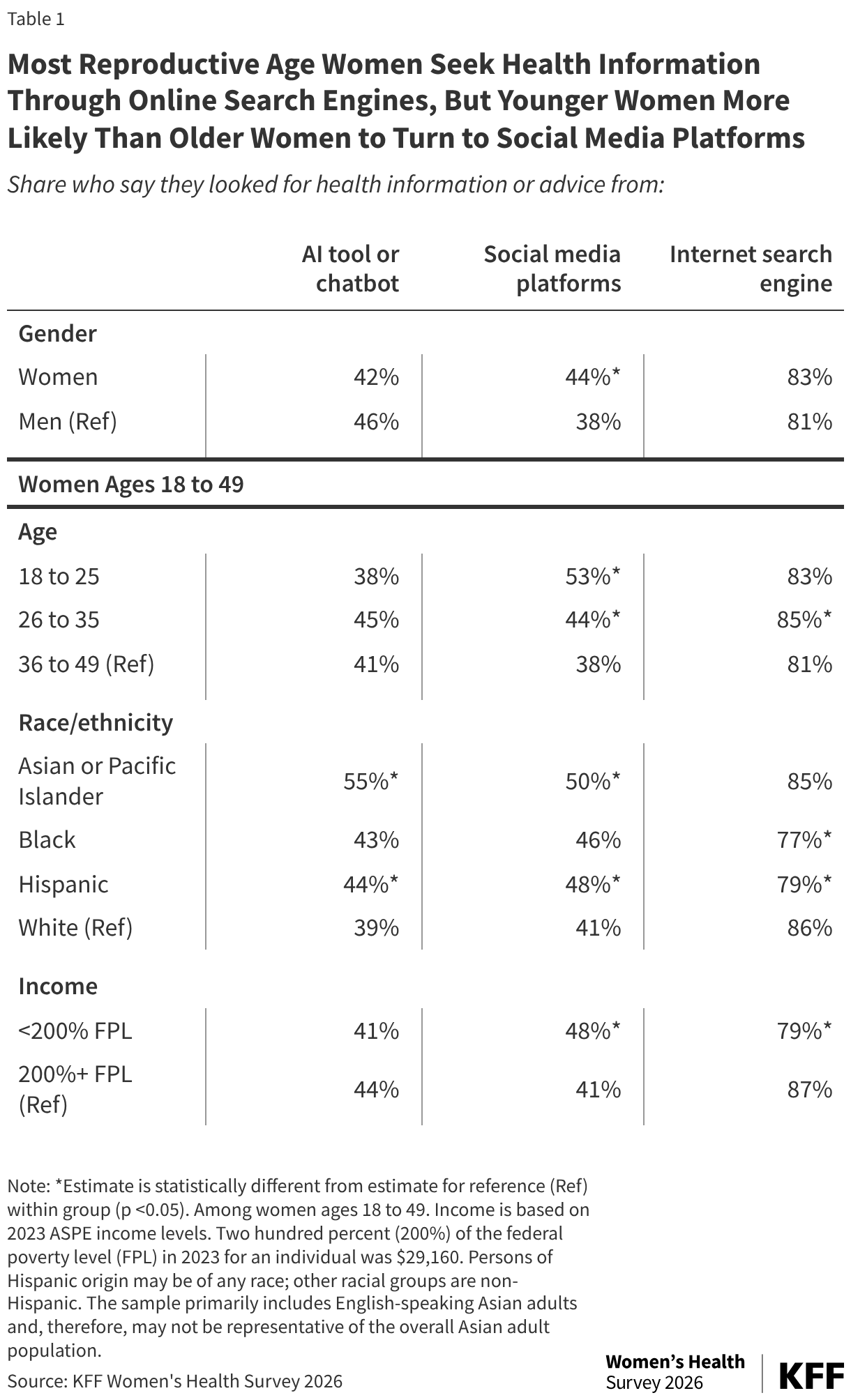
Even as reliability concerns persist, KFF’s March 2026 Tracking Poll on Health Information and Trust showed that about a third (32%) of adults have turned to AI for health information and advice, and four in ten of these users say they have uploaded personal medical information to get personalized advice. Cost and access, though, may shape who is able to rely on these tools. ChatGPT Health is currently available on all membership tiers, including the free plan, while Perplexity Health, Claude for Healthcare’s personal health integrations, and Amazon Health AI require paid subscriptions or memberships. Copilot Health is currently available for free, though Microsoft has indicated it will eventually move to a paid subscription model with pricing not yet announced.

KFF polling has shown that the cost of seeing a provider is a motivator for some turning to AI, with about one in five (19%) saying that a “major reason” for using AI for health advice was because they could not afford the cost of seeing a provider, rising to three in ten (29%) among users ages 18 to 29. The tools offering the most personalized features through direct integration with medical records are increasingly behind a paywall, potentially making them inaccessible for those who are already struggling to afford health care.

Why It Matters

As consumer-facing AI health tools expand, the gap between the personalization that these tools offer and their reliability may shape the quality of health information that people receive, while concerns about cost may further limit the utility of these tools.


What We’re Watching

AI Chatbots Spread a Fictional Disease Diagnosis, Experiment Finds

A team of researchers invented a fictional skin condition called “bixonimania” and uploaded two fake academic papers about it to a preprint server to test whether AI chatbots would treat the fabricated condition as real. Within weeks, major AI systems including Microsoft Copilot, Google Gemini, Perplexity, and ChatGPT were describing the nonexistent condition to users as if it were legitimate, in some cases advising them to see an ophthalmologist, according to a Nature news feature. The fake papers included clear signs of fabrication, with acknowledgements thanking “The Starfleet Academy” and “Professor Sideshow Bob,” along with explicit statements within the text that “this entire paper is made up.” Still, when users asked about it directly or described symptoms matching those described in the fraudulent papers, the chatbots treated the condition as real. Nature reports that the models have since been corrected and no longer reference bixonimania as a real condition.

The problem extended beyond chatbots: at least one peer-reviewed journal published a paper that cited the fake preprints as legitimate research. The paper has since been retracted, but researchers involved in the experiment say that its publication points to a broader issue in which some academics are using AI-generated references without reading the underlying papers.

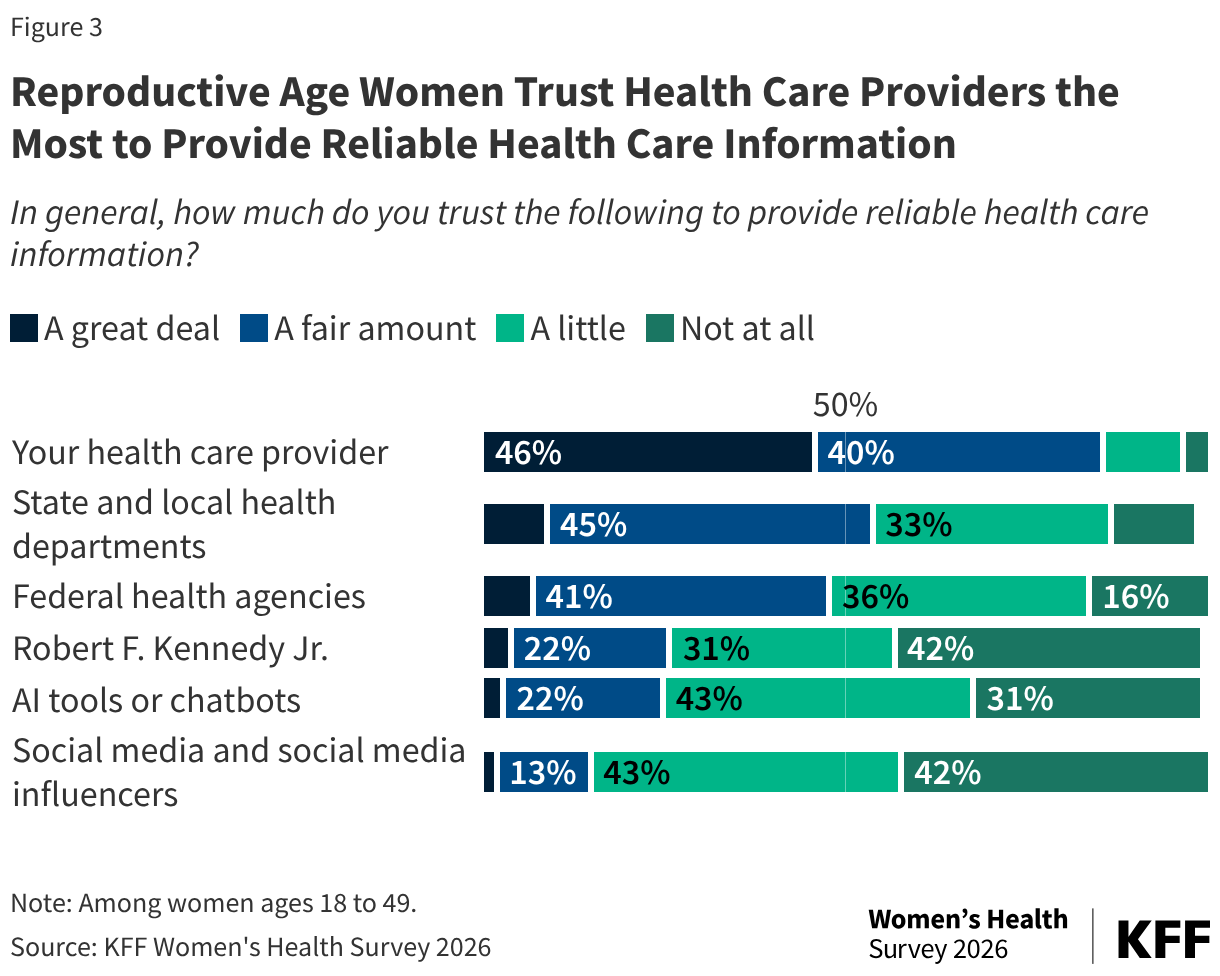
What To Watch Out For: KFF’s March Tracking Poll on Health Information and Trust found that among adults who used AI for physical health advice (29% of adults), about seven in ten (69%) expressed at least “a fair amount” of trust in these tools to provide reliable health information, though few (6%) said they trust these chatbots “a lot.” As people turn to AI chatbots for health information, how these systems decide what counts as credible health information and how this may impact trust remains an open question.

People Who Use AI and Social Media for Health Information Rate Convenience Higher Than Accuracy, and Many Say It’s Difficult to Judge Which Information to Trust, Polls Show

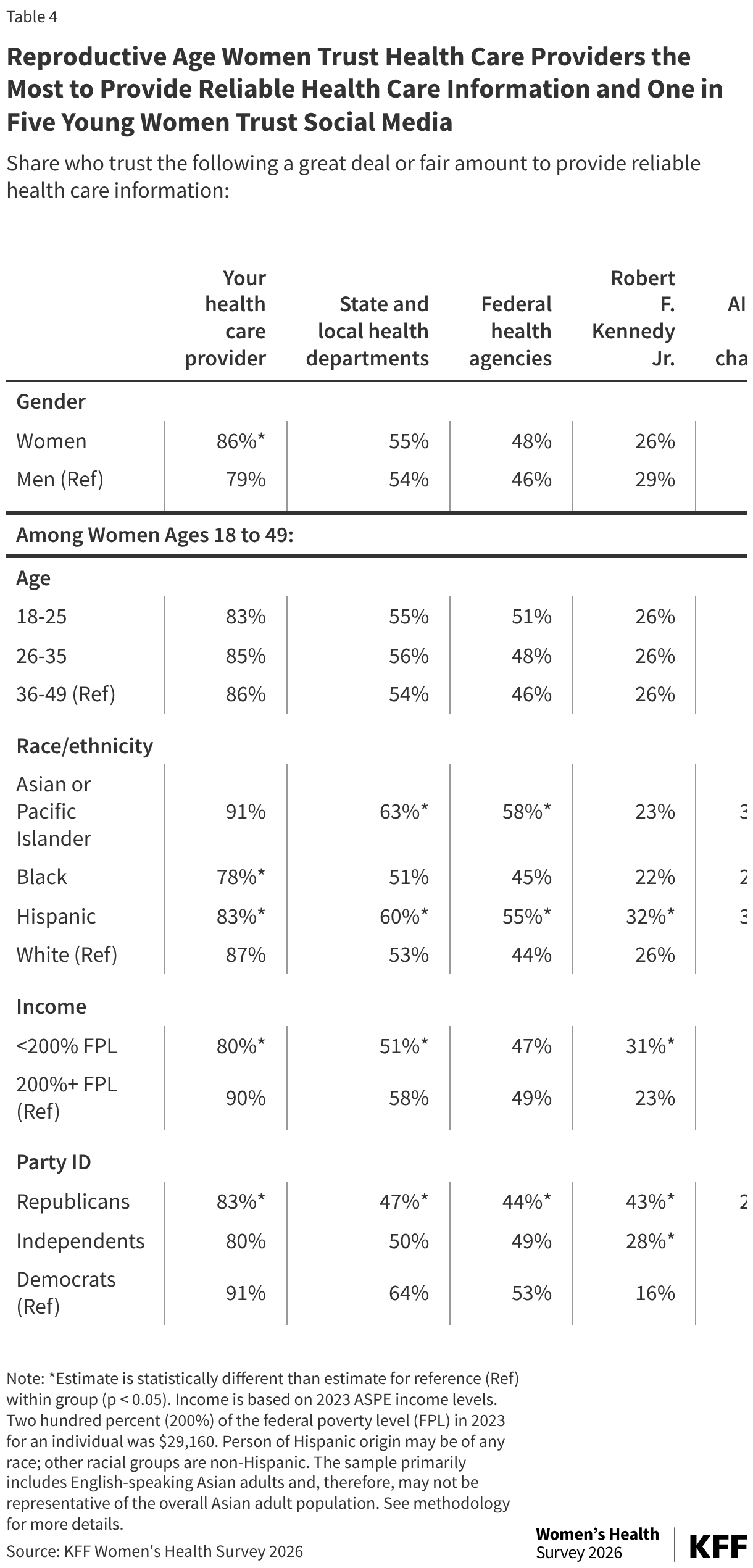
Health care providers remain the most common and trusted source of health information, according to a new Pew Research Center survey. About two-thirds (65%) of those who get health information from health care providers rate them as “extremely” or “very” accurate, more than any other source, including government health agencies, news organizations, social media, or AI. Users of both AI chatbots and social media ranked these sources higher in convenience than accuracy, pointing to a gap between why people say they use these sources and how much they trust them.

With some adults turning to social media or AI for health information, Pew’s survey also found that many adults struggle to know whether health information they come across is accurate, with half of the public saying it’s at least “somewhat difficult” to judge the accuracy of health information they see. Additionally, most adults (76%) say they hear health information that seems to conflict with other health information they have received, and when they do, just over half (54%) say it’s difficult to know which information to trust.

What To Watch Out For: The findings add context to KFF polling, which similarly finds that health care providers are the most trusted source of health information, even as trust in government health agencies has declined amid changing partisan views. As people turn to AI and social media for health information more for convenience than trust in their accuracy, their willingness to use sources they don’t fully trust may create openings for false or misleading health claims to spread. At the same time, doctors and other providers remain in a unique position as trusted health messengers among most of the public.

False Claims About Birth Control and Cancer Omit Context to Overstate Risk

A claim that the World Health Organization recently labeled birth control pills as a Group 1 carcinogen has circulated widely online, including in some social media posts viewed more than 2 million times.

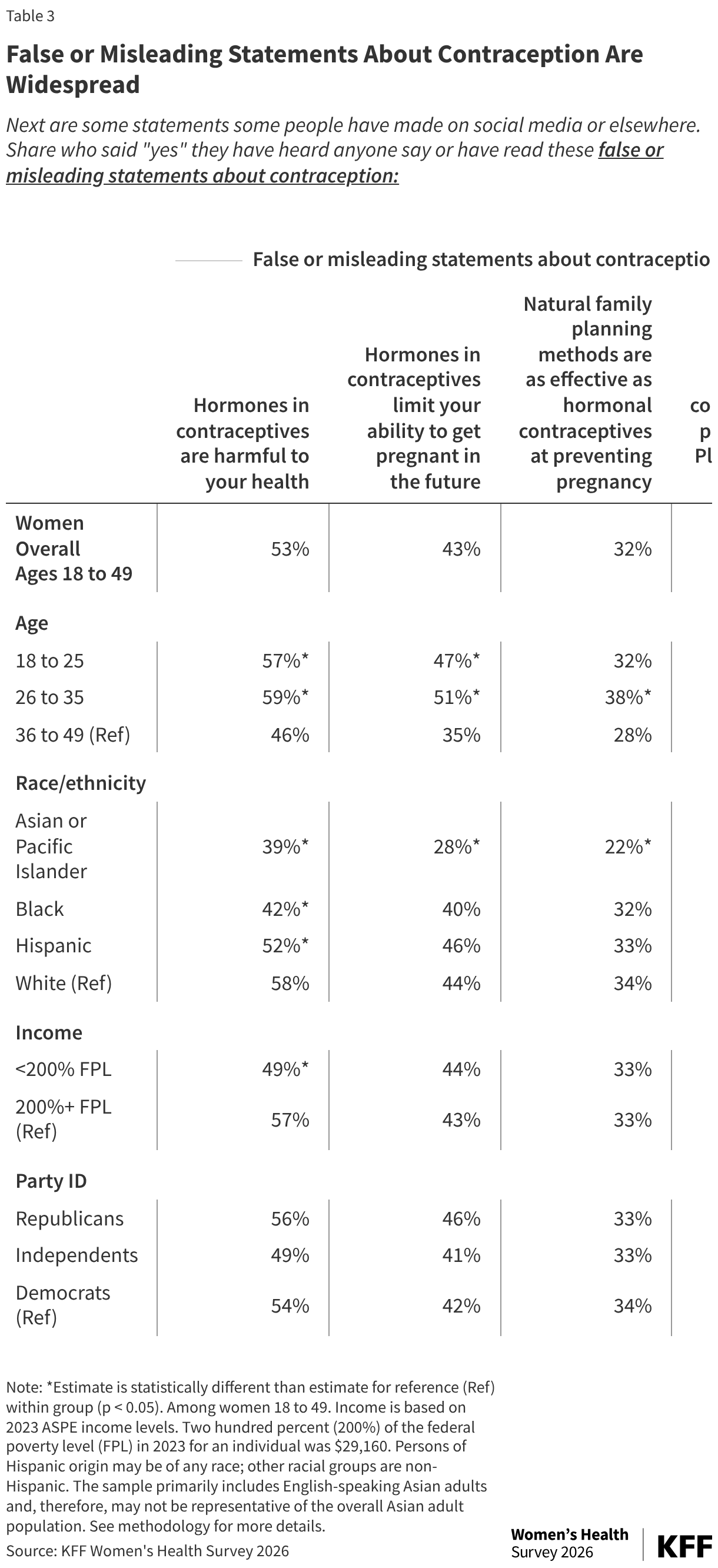
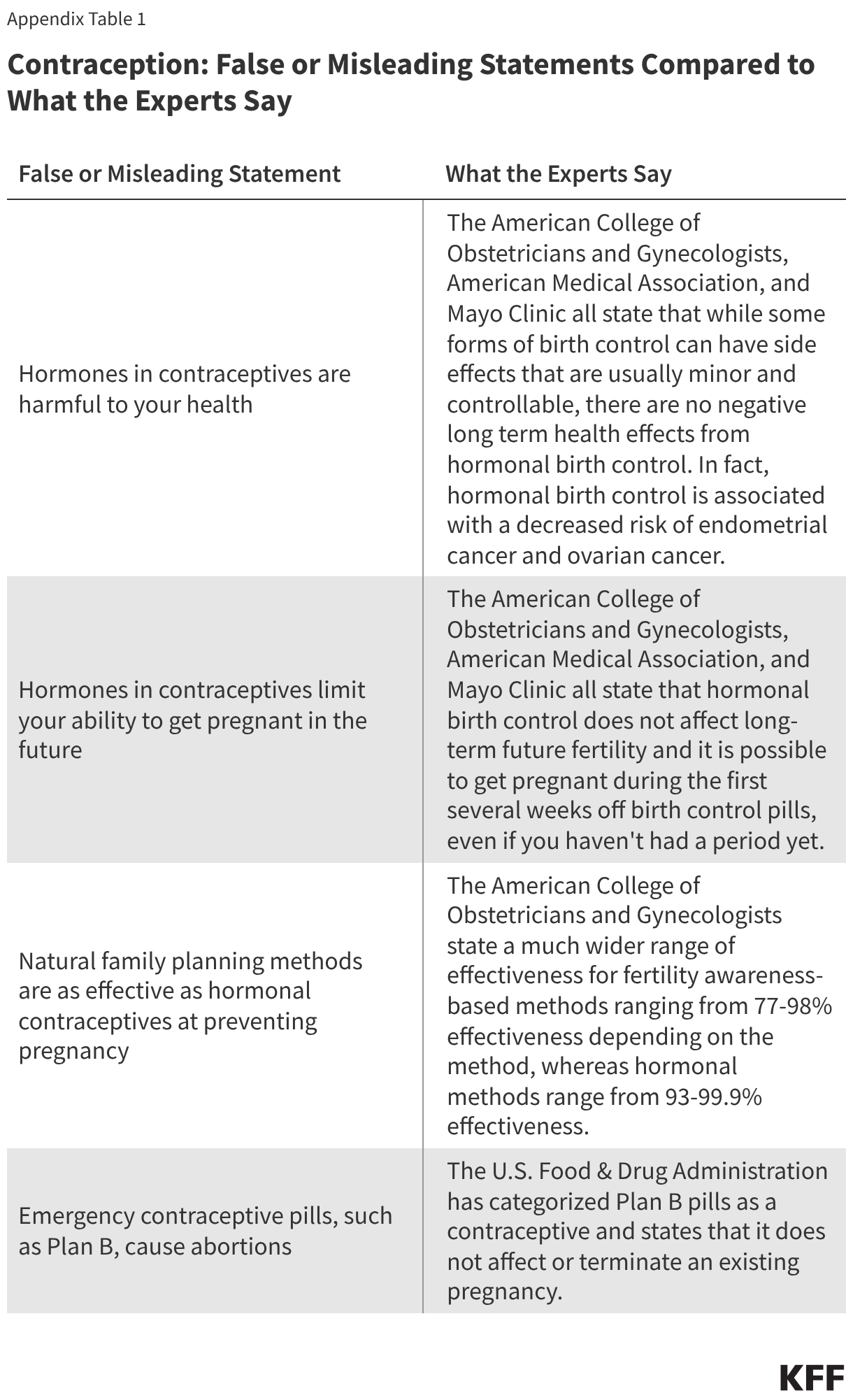
This is an example where information without context fails to provide a complete picture of the risks and benefits of contraception. While the classification is real, it is not new: oral contraceptives were placed in that category in 1999, based on evidence that they can increase the risk of certain cancers, including breast and cervical cancer. But some circulating posts omit the context of what that really means. A Group 1 classification indicates sufficient evidence of a link under some circumstances, not that cancer is a likely outcome.

A large 2025 Swedish study tracking more than 2 million women found a small, short-term rise in breast cancer diagnoses among current or recent users, though absolute risk of getting cancer remained low. KFF Health News reported that the study itself was distorted on social media, with some posts citing a 24% higher rate of breast cancer diagnoses without noting that this translated to roughly 13 extra cases per 100,000 women per year. Other research has found that hormonal contraceptives can lower risk of ovarian and endometrial cancer, a finding that was not included in the online posts. These posts illustrate how decontextualized scientific information and data omissions can function to spread misleading claims, even without containing outright falsehoods.

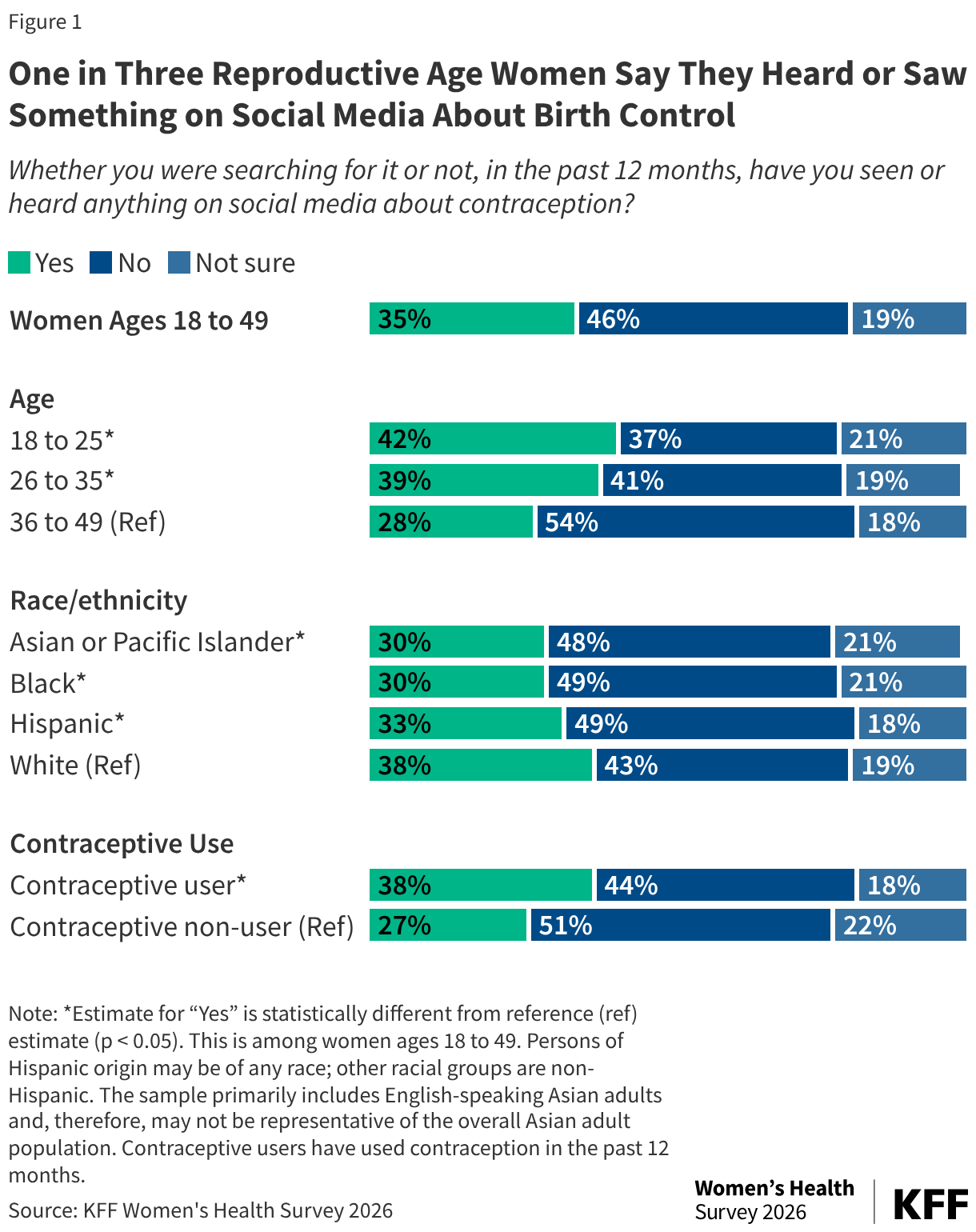
What To Watch Out For: KFF’s July 2025 Tracking Poll on Health Information and Trust found that about one in five (22%) adults reported seeing content in social media related to birth control in the past month, including higher shares of adults ages 18-29 (39%). Across platforms, though, less than half of social media users said they trusted most or some of the health information and advice they saw. CDC data show that women’s contraceptive options change throughout their reproductive lifespans, with some people opting for more long-term methods like intrauterine devices (IUDs) and implants in their later years. However, oral contraceptive pills continue to be the most commonly used method of reversible contraception in the US. Ongoing social media activity that distorts the risk of hormonal contraceptive methods may affect conversations about contraceptive safety and use, particularly among younger women.


More From KFF

About The Health Information and Trust Initiative: the Health Information and Trust Initiative is a KFF program aimed at tracking health misinformation in the U.S., analyzing its impact on the American people, and mobilizing media to address the problem. Our goal is to be of service to everyone working on health misinformation, strengthen efforts to counter misinformation, and build trust. 


View all KFF Monitors

The Monitor is a report from KFF’s Health Information and Trust initiative that focuses on recent developments in health information. It’s free and published twice a month.

Sign up to receive KFF Monitor
email updates


Support for the Health Information and Trust initiative is provided by the Robert Wood Johnson Foundation (RWJF). The views expressed do not necessarily reflect the views of RWJF and KFF maintains full editorial control over all of its policy analysis, polling, and journalism activities. The data shared in the Monitor is sourced through media monitoring research conducted by KFF.

Breaking Down the U.S. Global Health Budget by Program Area

Published: Apr 21, 2026

Overview

This fact sheet provides a historical overview of U.S. funding for global health by program area over the past decade. Funding totals are based on amounts specified by Congress in annual appropriations bills, as well as some amounts that are determined at the agency level. Since the beginning of the second Trump administration, the U.S. global health response has undergone significant change, including a restructuring of how foreign assistance is provided, elimination of the U.S. Agency for International Development (USAID), the main implementing agency for U.S. global health efforts, and cancellation of most awards to organizations implementing programs. The full impact of these changes to foreign assistance, including whether all the funding appropriated by Congress for global health will be fully spent by the administration, is not yet clear. See our Budget Tracker for more detail on historical funding, Budget Summaries for the latest on ongoing appropriations discussions, and Country-Level Funding Tracker for detail on country-specific appropriated (planned) funding, obligations, and disbursements for global health.

The U.S. Government has been the largest donor to global health in the world and its funding has included support for both disease (HIV, tuberculosis, malaria, and neglected tropical diseases) and population (maternal and child health, nutrition, and family planning and reproductive health) specific activities as well as global health security. Most U.S. funding for global health has been provided by Congress for bilateral efforts (approximately 80%). Of the multilateral share, the majority is provided to The Global Fund to Fight AIDS, Tuberculosis and Malaria (Global Fund). The U.S. investment in global health grew significantly in the early 2000s, largely due to the creation of new initiatives including the President’s Emergency Plan for AIDS Relief (PEPFAR) and the President’s Malaria Initiative (PMI), with spikes in funding in some years due to emergency supplemental funding for disease outbreaks, including Ebola and COVID-19. When this emergency funding is excluded, total support reached a peak level of $12.9 billion in FY 2023 but has declined each year since.1 In FY 2026, global health funding totaled $11.3 billion, its lowest level (through regular appropriations) since FY 2020.

Figure 1

U.S. Global Health Funding, FY 2017 - FY 2026 (Stacked column chart)

Figure 2

U.S. Global Health Funding (in millions), By Program Area, FY 2026 (Pie Chart)

Table 1

Historical Funding by Agency for Global Health, in millions (Table)

Global HIV Funding, Including PEPFAR

The U.S. first provided funding to address the global HIV epidemic in 1986. U.S. efforts and funding increased slowly over time until the launch of the U.S. President’s Emergency Plan for AIDS Relief (PEPFAR) in 2003, which initiated a period of significant increases and is the largest effort devoted to a single disease in the world. The majority of U.S. global HIV funding has been provided by Congress for PEPFAR bilateral efforts (91%) with additional funding for UNAIDS and international HIV research activities. As part of its global HIV response, the U.S., which is the largest donor to HIV efforts globally, also provides funding to the Global Fund (see below for details).2 PEPFAR funding is specified by Congress in annual appropriations bills and is largely provided to the Department of State, which is responsible, through the Bureau for Global Health Security and Diplomacy (GHSD), for coordinating all U.S. programs, activities, and funding for global HIV efforts. Other agencies that have received HIV funding under PEPFAR include the U.S. Agency for International Development (USAID) (although in FY 2026, following the dissolution of USAID, funding that was previously appropriated to USAID was provided to the State Department), Centers for Disease Control and Prevention (CDC), and Department of Defense (DoD). In addition, the National Institutes of Health (NIH) supports international HIV research activities, (not counted as part of PEPFAR). Global HIV funding through regular appropriations3 has historically accounted for the largest share of the U.S. global health budget (ranging from 42% to 50% between FY 2017 and FY 2026). In FY 2026, global HIV funding totaled $5.2 billion, of which $4.8 billion is for PEPFAR4 ($4.7 billion for bilateral HIV and $45 million for UNAIDS), and approximately $418 million is for international HIV research activities at NIH.

Figure 3

U.S. Funding for Global HIV, FY 2017 - FY 2026 (Stacked column chart)

Table 2

Historical Funding by Agency and Account for Global HIV, in millions (Table)

Tuberculosis (TB)

Since 1998, when the U.S. Agency for International Development (USAID) began a global tuberculosis (TB) control program, U.S. involvement in global TB efforts has grown and the U.S. has been the largest donor to global TB efforts in the world.5  U.S. bilateral TB funding had been provided by Congress to USAID and included U.S. contributions to the TB Drug Facility (additional U.S. support for TB activities is provided through the U.S. contribution to the Global Fund to Fight AIDS, Tuberculosis and Malaria). In FY 2026, following the dissolution of USAID, funding that was previously appropriated to USAID was provided to the State Department. Over the last decade, U.S. funding for TB has grown, reaching a peak of $406 million in FY 2023, where it remained until decreasing slightly to $390 million in FY 2026. In FY 2026, U.S. funding for TB accounted for approximately 3% of the U.S. global health budget.

Figure 4

U.S. Funding for Global Tuberculosis (TB), FY 2017 - FY 2026 (Column Chart)

Table 3

Historical Funding by Agency and Account for Global Tuberculosis (TB), in millions (Table)

Malaria/PMI

The U.S. government has been involved in global malaria activities since the 1950s and, today, is the  largest donor government to global malaria efforts in the world (in addition, the U.S. is the largest donor to the Global Fund to Fight AIDS, Tuberculosis and Malaria, which in turn is the largest overall funder of global malaria efforts).6 The U.S. response to malaria had been driven by the President’s Malaria Initiative (PMI), an interagency initiative created in 2005 to address global malaria. PMI was led by the U.S. Agency for International Development (USAID), and co-implemented with the Centers for Disease Control and Prevention (CDC), with additional activities provided by the National Institutes of Health (NIH) and Department of Defense (DoD). In addition to bilateral funding, the U.S. also supports malaria programs through its contribution to the Global Fund to Fight AIDS, Tuberculosis and Malaria. In FY 2026, following the dissolution of USAID, funding that was previously appropriated to USAID was provided to the State Department. U.S. bilateral funding for malaria increased slightly over the past decade from $963 million in FY 2017 to approximately $1 billion in FY 2026. In FY 2026, malaria accounted for 9% of the U.S. global health budget.

Figure 5

U.S. Funding for Global Malaria, FY 2017 - FY 2026 (Column Chart)

Table 4

Historical Funding by Agency and Account for Global Malaria, in millions (Table)

The Global Fund to Fight AIDS, Tuberculosis and Malaria

The Global Fund to Fight AIDS, Tuberculosis and Malaria (Global Fund) is an independent, public-private, multilateral institution which finances HIV, TB, and malaria programs in low- and middle-income countries. The Global Fund receives contributions from public and private donors and in turn provides funding to countries based on country-defined proposals. The U.S. provided the Global Fund with its founding contribution in 2001 and has since been its largest single donor (U.S. contributions to the Global Fund are counted as part of PEPFAR, although the Global Fund also supports TB and malaria efforts). The U.S. contribution to the Global Fund through regular appropriations has fluctuated over the past decade but reached its highest level to date ($2.0 billion) in FY 2023. In FY 2026, funding for the Global Fund was $1.25 billion, $750 million less than its peak level in FY 2023 and $400 million below the prior year level (FY 2025), in support of the administration’s pledge of $4.6 billion for the Global Fund’s eighth replenishment. In addition to regular appropriations, Congress provided $3.5 billion in emergency supplemental funding to the Global Fund to address the impacts of COVID-19 on HIV programs in FY 2021.

Figure 6

U.S. Funding for The Global Fund, FY 2017 - FY 2026 (Stacked column chart)

Table 5

Historical Funding by Agency and Account for the Global Fund to Fight AIDS, Tuberculosis and Malaria, in millions (Table)

Maternal & Child Health (MCH)

The U.S. has been involved in Maternal & Child Health (MCH) efforts since the 1960s (and has been a top donor to MCH activities in the world). MCH funding from Congress, which includes funding for polio and U.S. contributions to Gavi, the Vaccine Alliance (GAVI) and the United Nations Children’s Fund (UNICEF), had been appropriated to the U.S. Agency for International Development (USAID), the Centers for Disease Control and Prevention (CDC), and the State Department. In FY 2026, following the dissolution of USAID, funding that was previously appropriated to USAID was provided to the State Department. U.S. funding for MCH has been relatively flat over the past decade and totaled $1.29 billion in FY 2026, accounting for the third largest share of U.S. funding for global health (11%).

Figure 7

U.S. Funding for Global Maternal & Child Health (MCH), FY 2017 - FY 2026 (Column Chart)

Table 6

Historical Funding by Agency and Account for Global Maternal and Child Health (MCH), in millions (Table)

Nutrition

The U.S. has a long history of supporting global efforts to improve nutrition and has been the largest donor to nutrition efforts in the world. Starting in 2010, support for U.S. global nutrition activities had been appropriated through the U.S. Agency for International Development (USAID).7 In FY 2026, following the dissolution of USAID, funding that was previously provided through USAID was provided to the State Department. U.S. funding for nutrition increased from $148 million in FY 2017 to $165 million in FY 2026 and has accounted for relatively small share (approximately 1%) of the total U.S. global health budget over the period.

Figure 8

U.S. Funding for Global Nutrition, FY 2017 - FY 2026 (Column Chart)

Table 7

Historical Funding by Agency and Account for Global Nutrition, in millions (Table)

Family Planning & Reproductive Health (FP/RH)

The U.S. has been involved in Family Planning & Reproductive Health (FP/RH) efforts since the 1960s and has been the largest donor to global FP/RH in the world.8 The majority of U.S. FP/RH funding has been provided by Congress to the U.S. Agency for International Development (USAID) for bilateral activities, with additional funding provided through the State Department for a U.S. contribution to the United Nations Population Fund (UNFPA).9 In FY 2026, following the dissolution of USAID, funding that was previously appropriated to USAID was provided to the State Department. U.S. funding for FP/RH rose steadily in its first two decades10 and more recently, has remained relatively flat at just about $600 million, accounting for approximately 5-6% of the U.S. global health budget each year from FY 2017-FY 2026.11 (Unlike most other areas of global health, the Trump administration stopped all global FP/RH funding and activities in 2025, even though Congress continues to appropriate funding for this purpose).

Figure 9

U.S. Funding for International Family Planning/Reproductive Health (FP/RH), FY 2017 - FY 2026 (Column Chart)

Table 8

Historical Funding by Agency and Account for International Family Planning and Reproductive Health (FP/RH), in millions (Table)

Global Health Security

Since the 1990s, there has been growing concern about new infectious diseases that threaten human health including, in more recent years, the emergence and spread of threats such as Ebola, Zika, H1N1 influenza, COVID-19, and antibiotic resistance. U.S. global health security efforts aim to reduce the threat of emerging infectious diseases by supporting preparedness, detection, and response capabilities worldwide. Global health security funding had been provided by Congress to the U.S. Agency for International Development (USAID), the Centers for Disease Control and Prevention (CDC), and Department of Defense. In FY 2026, following the dissolution of USAID, funding that was previously appropriated to USAID was provided to the State Department. Over the past decade, funding designated by Congress for global health security through both emergency and regular appropriations has fluctuated over time, rising largely in response to outbreaks, including Ebola, Zika, and COVID-19.12 Funding for global health security as a share of the global health budget has increased over time, rising from 3% in FY 2017 to 10% in FY 2026 (after significant increases in funding during the COVID-19 pandemic, the overall amount has fallen annually over the past few years).13 In FY 2026, funding for global health security was $1.1 billion.

Figure 10

U.S. Funding for Global Health Security, FY 2017 - FY 2026 (Stacked column chart)

Table 9

Historical Funding by Agency and Account for Global Health Security, in millions (Table)

Neglected Tropical Diseases (NTDs)

NTDs are a group of parasitic, bacterial, and viral infectious diseases that primarily affect the most impoverished and vulnerable populations in the world. The U.S. Congress first designated funding to address NTDs in 2006, through the U.S. Agency for International Development (USAID).14 In FY 2026, following the dissolution of USAID, funding that was previously appropriated to USAID was provided to the State Department. Funding for NTDs has remained relatively flat over the past decade, fluctuating between $100 million and $115 million.15 Funding for NTDs accounts for a relatively small share of the U.S. global health budget (1% in FY 2026). Since NTDs efforts were not specifically mentioned in the new America First Global Health Strategy or accompanying bilateral global health agreements, it is unclear whether funding for NTDs will continue despite Congress providing the funding.

Figure 11

U.S. Funding for Global Neglected Tropical Diseases (NTDs), FY 2017 - FY 2026 (Column Chart)

Table 10

Historical Funding by Agency and Account for Neglected Tropical Diseases (NTDs), in millions (Table)

Endnotes

  1.  FY 2025 funding amounts do not take into account the $500 million in rescinded funding under the Global Health Programs account in the “Rescissions Act of 2025” (P.L. 119-28); areas that could be impacted by the rescissions include funding for family planning and reproductive health, global health security, the vulnerable children program, and neglected tropical diseases. ↩︎
  2. KFF, Donor Government Funding for HIV in Low- and Middle-Income Countries in 2024, July 2025. ↩︎
  3. In addition to regular appropriations, Congress provided $250 million in emergency supplemental funding to address the impacts of COVID-19 on U.S. bilateral HIV programs in FY 2021.   ↩︎
  4. Total PEPFAR funding in FY 2026 is $6.0 billion ($4.7 billion for bilateral HIV, $45 million for UNAIDS, and $1.25 billion for the Global Fund). ↩︎
  5. World Health Organization, Global Tuberculosis Report 2025, 2025. ↩︎
  6. World Health Organization, World Malaria Report 2025, 2025. ↩︎
  7. Totals do not include funding provided through Food for Peace (FFP) due to the unique nature of the program. ↩︎
  8. KFF, Donor Government Funding for Family Planning in 2024, November 2025. ↩︎
  9. Under current law, any U.S. funding withheld from UNFPA is to be made available to other family planning, maternal health, and reproductive health activities (see the KFF fact sheet on U.S. government international family planning and reproductive health statutory requirements and policies). ↩︎
  10. PAI. Cents and Sensibility: U.S. International Family Planning Assistance from 1965 to the Present. Accessed September 2022 at https://pai.org/cents-and-sensibility ↩︎
  11. FY 2025 funding amounts do not take into account the $500 million in rescinded funding under the Global Health Programs account in the “Rescissions Act of 2025” (P.L. 119-28); areas that could be impacted by the rescissions include funding for family planning and reproductive health, global health security, the vulnerable children program, and neglected tropical diseases. ↩︎
  12. In FY15, Congress provided $5.4 billion in emergency funding to address the Ebola outbreak, of which $909.0 million was specifically designated for global health security. In FY16, Congress provided $1.1 billion in emergency funding to address the Zika outbreak, of which $145.5 million was specifically designated for global health security. In FY18, Congress provided $100 million in unspent Emergency Ebola funding for “programs to accelerate the capabilities of targeted countries to prevent, detect, and respond to infectious disease outbreaks.” In FY19, Congress provided $38 million in unspent Emergency Ebola funding for “programs to accelerate the capacities of targeted countries to prevent, detect, and respond to infectious disease outbreaks.” In FY20, Congress provided $1.235 billion in emergency COVID-19 funding to “prevent, prepare for, and respond to coronavirus” globally, and in FY21, Congress provided $9.4 billion in emergency COVID-19 funding “to prevent, prepare for, and respond to coronavirus, including for vaccine procurement and delivery.” While none of the FY20 funding was designated for global health security, all of the FY21 funding provided through CDC ($750 million) was designated by CDC as global health security. ↩︎
  13. FY 2025 funding amounts do not take into account the $500 million in rescinded funding under the Global Health Programs account in the “Rescissions Act of 2025” (P.L. 119-28); areas that could be impacted by the rescissions include funding for family planning and reproductive health, global health security, the vulnerable children program, and neglected tropical diseases. ↩︎
  14. Additional NTD funding is used for NTD research at the Centers for Disease Control and Prevention (CDC) and National Institutes of Health (NIH), although this funding is not specified by Congress. ↩︎
  15. FY 2025 funding amounts do not take into account the $500 million in rescinded funding under the Global Health Programs account in the “Rescissions Act of 2025” (P.L. 119-28); areas that could be impacted by the rescissions include funding for family planning and reproductive health, global health security, the vulnerable children program, and neglected tropical diseases. ↩︎

Medicaid Waiver Tracker: Approved and Pending Section 1115 Waivers by State

Published: Apr 21, 2026

Tracker

Section 1115 Medicaid demonstration waivers offer states an avenue to test new approaches in Medicaid that differ from what is required by federal statute, if [in the HHS Secretary’s view] the approach is likely to “promote the objectives of the Medicaid program.” They can provide states additional flexibility in how they operate their programs, beyond the considerable flexibility that is available under current law. Waivers generally reflect priorities identified by states as well as changing priorities from one presidential administration to another. Nearly all states have at least one active Section 1115 waiver and some states have multiple 1115 waivers. See the “Key Themes Maps” tab for a discussion of recent waiver trends.

This page tracks approved and pending Section 1115 waiver provisions (including expansions and restrictions) related to eligibility, benefits, and social determinants of health and other delivery system reforms, once such waivers are posted to the state waivers list on Medicaid.gov. For more information on inclusion criteria and on each provision, as well as a list of acronyms, see the Definitions tab.

Landscape of Approved and Pending Section 1115 Waivers (Stacked Bars)


Waivers with Eligibility Changes

(back to top)

Waivers with Benefit Changes

(back to top)

Waivers with SDOH & Other DSR Changes

(back to top)

All Approved Waivers by Topic

(back to top)

Approved Section 1115 Medicaid Waivers (Table)

All Pending Waivers by Topic

(back to top)

Pending Section 1115 Medicaid Waivers (Table)

Work Requirements

See KFF's Work Requirements Tracker for additional state and national-level data related to work requirement implementation, including related KFF resources on work requirements.

The 2025 reconciliation law requires states to condition Medicaid eligibility for adults in the ACA Medicaid expansion group on meeting work requirements starting January 1, 2027; however, states have the option to implement requirements sooner through a state plan amendment (SPA) or through an approved 1115 waiver.

State Plan Amendments (SPAs)

States may choose to implement work requirements prior to the required January 1, 2027 implementation date through a state plan amendment. Nebraska is the first state to announce that it will begin enforcing federal work requirements early through a state plan amendment, starting May 1, 2026. Two other states are also planning to implement before January 2027–Montana on July 1, 2026 and Iowa on December 1, 2026. Arkansas has announced that it plans to launch a soft implementation of work requirements on July 1, 2026 but will not disenroll individuals prior to January 1, 2027.

1115 Waivers

Since the start of the second Trump administration, several states have submitted waivers to implement work requirements. However, states are unlikely to be moving forward with proposed 1115 waivers at this time due to the passage of federal work requirements. States that plan to implement federal work requirements early will do so through a state plan amendment. Currently, Georgia is the only state with a Medicaid work requirement waiver in place following litigation over the Biden administration’s attempt to stop it. Georgia’s waiver will expire December 31, 2026; the state is required to come into compliance with the new federal requirements effective January 1, 2027.

Early Implementation and Waiver Status

The map below identifies states that have indicated they will implement work requirements early through a state plan amendment as well as approved (Georgia) and pending work requirement waivers (submitted to CMS since the start of the second Trump administration). The table below the map provides more detailed state waiver information.

States Implementing Work Requirements Early and/or Pursuing Work Requirement Waivers (Choropleth map)

States with Work Requirement Waiver Activity (Table)

Key Themes Maps

Section 1115 waivers generally reflect priorities identified by states as well as changing priorities from one presidential administration to another.  Key Biden administration 1115 initiatives included waivers addressing enrollee health-related social needs (HRSN), pre-release coverage for individuals who are incarcerated, and multi-year continuous eligibility for children.

In March 2025, the Trump administration rescinded HRSN guidance issued by the Biden administration. CMS indicates this does not nullify existing HRSN 1115 approvals but going forward they will consider HRSN / SDOH requests on a case-by-case basis. In April 2025, the Trump administration announced it would be phasing out federal funding for “Designated State Health Programs” (DSHP) in waivers. In July 2025, the Trump administration released guidance indicating it will not approve (new) or extend (existing) continuous eligibility waivers for children or adults. CMS also announced in July it would be phasing out initiatives to strengthen the Medicaid workforce for primary care, behavioral health, dental, and home and community based services (not depicted in maps below).

This page tracks pending and approved waivers in key areas of recent state activity and will track Trump administration action in these areas going forward. Hover over individual states to display waiver expiration dates.

Social Determinants of Health

Social determinants of health (SDOH) are the conditions in which people are born, grow, live, work and age. SDOH include but are not limited to housing, food, education, employment, healthy behaviors, transportation, and personal safety. In 2022, CMS (under the Biden administration) announced a demonstration waiver opportunity to expand the tools available to states to address enrollee “health-related social needs” (or “HRSN”) including housing instability, homelessness, and nutrition insecurity, building on CMS’s 2021 guidance. In 2023, CMS issued a detailed Medicaid and CHIP HRSN Framework accompanied by an Informational Bulletin, which were updated in 2024.

In March 2025, the Trump administration rescinded the Biden administration HRSN guidance. CMS indicates this does not nullify existing HRSN approvals but going forward they will consider HRSN / SDOH requests on a case-by-case basis.

The “HRSN Waivers” map below identifies states with approval under the Biden administration HRSN framework. The “All SDOH Waivers” map identifies SDOH-related 1115 waivers more broadly, including those that pre-date or were approved outside of the HRSN framework. For more detailed waiver information, refer to KFF’s Medicaid Waiver Tracker (“SDOH” table) and HRSN waiver watch  (March 2024).

Section 1115 Waivers: Social Determinants of Health (SDOH) (Choropleth map)

Medicaid Pre-release Coverage for Individuals Who Are Incarcerated

In April 2023, the Biden administration released guidance encouraging states to apply for a new Section 1115 demonstration opportunity to test transition-related strategies to support community reentry for people who are incarcerated. This demonstration allows states a partial waiver of the inmate exclusion policy, which prohibits Medicaid from paying for services provided during incarceration (except for inpatient services). Reentry services aim to improve care transitions and increase continuity of health coverage, reduce disruptions in care, improve health outcomes, and reduce recidivism rates. The Biden administration approved 19 state waivers to facilitate reentry for individuals who are incarcerated. The map below identifies states with approved and pending waivers to provide pre-release services to Medicaid-eligible individuals who are incarcerated.  Medicaid pre-release waivers have been pursued by both Republican and Democratic governors. For more information, refer to KFF’s Medicaid Waiver Tracker (“Eligibility Changes” table) and related pre-release waiver watch (August 2024).

Section 1115 Waivers: Medicaid Pre-release Coverage for Individuals Who Are Incarcerated (Choropleth map)

Multi-year Continuous Eligibility for Children

The Consolidated Appropriations Act, 2023 required all states to implement 12-month continuous eligibility for children beginning on January 1, 2024. The Biden administration approved 9 waivers that allow states to provide multi-year continuous eligibility for children (e.g., from birth to age six). Continuous eligibility has been shown to reduce Medicaid disenrollment and “churn” rates (rates of individuals temporarily losing Medicaid coverage and then re-enrolling within a short period of time).

In July 2025, the Trump administration released guidance indicating it will not approve (new) or extend (existing) continuous eligibility waivers for children or adults. The map below displays states with waiver approval to provide multi-year continuous eligibility for children.  For more information, refer to KFF’s Medicaid Waiver Tracker (“Eligibility Changes” table) and related continuous eligibility waiver watch (February 2024).

Section 1115 Waivers: Multi-year Continuous Eligibility for Children (Choropleth map)

Definitions

Section 1115 Waiver Tracker: Key Definitions and Notes (Table)

Related Resources

Recent Developments

General/Overview Resource

Eligibility and Enrollment Expansions

Eligibility and Enrollment Restrictions

Work Requirements:

Other:

Benefit Expansions

Benefit Restrictions, Copays, and Healthy Behaviors

Social Determinants of Health

Delivery System Reform

The Business of Health with Chip Kahn

Why KFF Is Launching a Podcast on the Business of Health

April 21, 2026

Video

Audio

About this Episode


To kick off our new show, KFF’s Business of Health with Chip Kahn, KFF’s Drew Altman explains how KFF is continually evolving to research, analyze and lead on health policy. Chip and Drew discuss how our new podcast will break down the business side of health care, artificial intelligence, and what it all means for health care delivery and patients. 

The Host


Headshot photo of Chip Kahn wearing a navy blue suit with a red tie, red pendant on lapel, and glasses.

Sr. Visiting Fellow

Charles N. Kahn III is a senior visiting fellow at KFF. He is also a visiting senior fellow at the American Enterprise Institute and a nonresident senior scholar at the University of Southern California’s Schaeffer Center for Health Policy & Economics. He serves as co-chair of the international Future of Health collaborative.

Guest


Photo of Drew Altman

Founding President & Chief Executive Officer

Drew Altman is founding president and chief executive officer of KFF, a position he has held for more than 30 years since founding the modern day KFF organization in the 1990s. He is a leading expert on national health policy issues and an innovator in health journalism and the nonprofit field.

Transcript


Chip Kahn: Healthcare is about caring about the people who deliver it and the patients who depend on it. But to make that caring happen, to sustain it, and to meet the expectations of every patient who walks through the door, there is a business that has to work. This podcast is about that business. Welcome to KFF’s Business of Health. I’m Chip Kahn.

Americans who work in health care are driven by professionalism and mission. But professionalism and mission don’t run on good intentions alone. How care is financed, how it is delivered, how technology is deployed, how incentives are aligned. These are the forces that determine whether patients get the quality, the safety, and the outcomes they deserve. Health policy sets the rules of the road, but it is the business of health care, the decisions made every day by leaders who run systems, manage payment and allocate resources, that determines whether those rules translate into better care or not. In my view, that reality is often insufficiently understood by those who make policy and those who inform and advise the policy process. I see a gap between what the policy world knows about legislation and regulation and what it needs to know about a $5 trillion industry and how that industry operates. The intent of this podcast is to contribute to the closing of that gap, bringing those who provide the care and those who run systems, manage insurance, build technology, design, payment and allocate capital into direct conversation about the forces shaping American health care. Not theory, not commentary. The real world of health care delivery and financing.

The first series of this new podcast will begin with a subject that all of us need to understand. Artificial intelligence. Over the next several months, in an in-depth series, we will examine what AI is doing right now to, to health care, to clinical practice, to hospital operations, to clinical performance, to the patient experience and to how the industry is financed and structured. Our guests are those deploying this technology, managing its consequences and designing policy around it. From health systems leaders and clinician scientists to payer executives, technology leaders and regulators, we will cover the waterfront with those developing and contending with AI adoption in American healthcare. 

But for our very first episode, before we turn to the AI series, our inaugural guest will be Drew Altman, the president and CEO of KFF, who has led KFF for more than 30 years, creating the nation’s leading independent source of health policy research, polling and journalism. Drew is also the person who made this podcast possible. Drew Altman, welcome to KFF’s Business of Health. 

Drew Altman: Chip. Glad to be here. 

Chip Kahn: It’s great to have you. And you are the glue that makes all this work. So it’s a great way to start this podcast with you as our guest. Before we get into the business of health, why we’re doing it, what our purpose is, let’s talk about a broader context because it is KFF’s Business of Health. We’re part of KFF. So can you give us an idea of what you meant to do and what your purpose is in this organization, which is not a foundation anymore, it’s really something else. 

Drew Altman: No, we’re not a foundation. And Chip, before I answer your question, which I will answer, I want to welcome you, to our podcast. Thrilled to have you. This will add tremendously to our ability to talk about these cutting-edge issues and what’s going on in the private sector and in the marketplace and to reach new audiences. So it’s really important and welcome to you. 

Chip Kahn: Well, glad to be here. 

Drew Altman: KFF is an organization, well, we started a new organization, and I started it, quite some time ago. It’s almost embarrassing to talk about, but the basic idea was pretty simple. It was to build an organization which, through different kinds of information, heavy-duty policy analysis and research, polling and survey research, and our journalism, KFF Health News, now the largest health newsroom, in the country, could be hopefully, a trusted, independent source of information on these big controversial health care issues and a voice for people too, who sometimes don’t have a voice in, in our big healthcare debates. A little bit of a counterweight, to the money in politics that dominates health care over a long period of time. That kind of basic idea has worked out for us. And that’s it. It’s really, pretty simple. We don’t take positions, we don’t advance our own proposals. Trying to be as objective as we possibly can be through all of the research and the polling and the journalism isn’t neutral because nothing’s neutral in the shooting war now and the highly polarized environment we operate in. It’s been more than enough to make us different in the space in which we operate. And that recipe, that formula has worked out well for us over now more than three decades. 

Chip Kahn: But evidence is important and reality’s important. And I think that’s one of the things you’re trying to achieve here, is through the new service and through the research to get that information up to policymakers and the rest of the media and other opinion leaders, as well as giving an opportunity for the public to really better understand what the facts are. 

Drew Altman: You could certainly argue that facts and the institutions that provide them and the experts are on the ropes and don’t matter as much as they once did, but it’s a value for us. We believe we’re lost without them, that they really do matter. And one of the things I’ve discovered in recent years is while they may matter a little bit less, in some areas, maybe political campaigns, they really still do matter in many, for example, legislative debates where, what it costs, who’s affected, who wins and who loses. Just look at CBO scores, they really do matter. And we’ve seen our data, our facts about, for example, what, not extending ACA tax credits might or might not mean, really have a fundamental impact on discussion, and debate. And so we’re able to play a role. We have no delusions of grandeur, and we understand that we, by ourselves are not going to transform the healthcare debate in the U.S. but we think we can play, and we have played a role which is badly needed, honorable, and important, and that’s good enough for us. 

Chip Kahn: Well, and what excites me about being here is that you are a trusted outlet, because I hear people on both sides of the aisle, you know, discussing the information they get from KFF, whether it’s from the research or just.. 

Drew Altman: And we also get flack from both sides of the aisle, which is kind of my barometer. If I’m only getting flak from one side of the aisle, I get a little worried about what, we’re doing. And actually, it might surprise you which side we get the most flak from. Probably not what people would expect, but let’s just leave it at that. 

Chip Kahn: Well, what’s important is that you’re getting a lot of information out there. And that’s one of the things that attracted me in our initial discussions, was that I’ve been concerned for a long time. In all the work I’ve done over whether I worked on Capitol Hill or for the insurance industry or ultimately for hospitals, I’ve been concerned about policymakers, opinion leaders, media, particularly inside the Beltway, having a real grasp of what’s happening on the ground, to the care that Americans receive, to all those trying to provide the care. And that’s what led me to, our discussions about having this podcast developed around the business of health. How do you see it fitting in to the broader context of the organization you just described? 

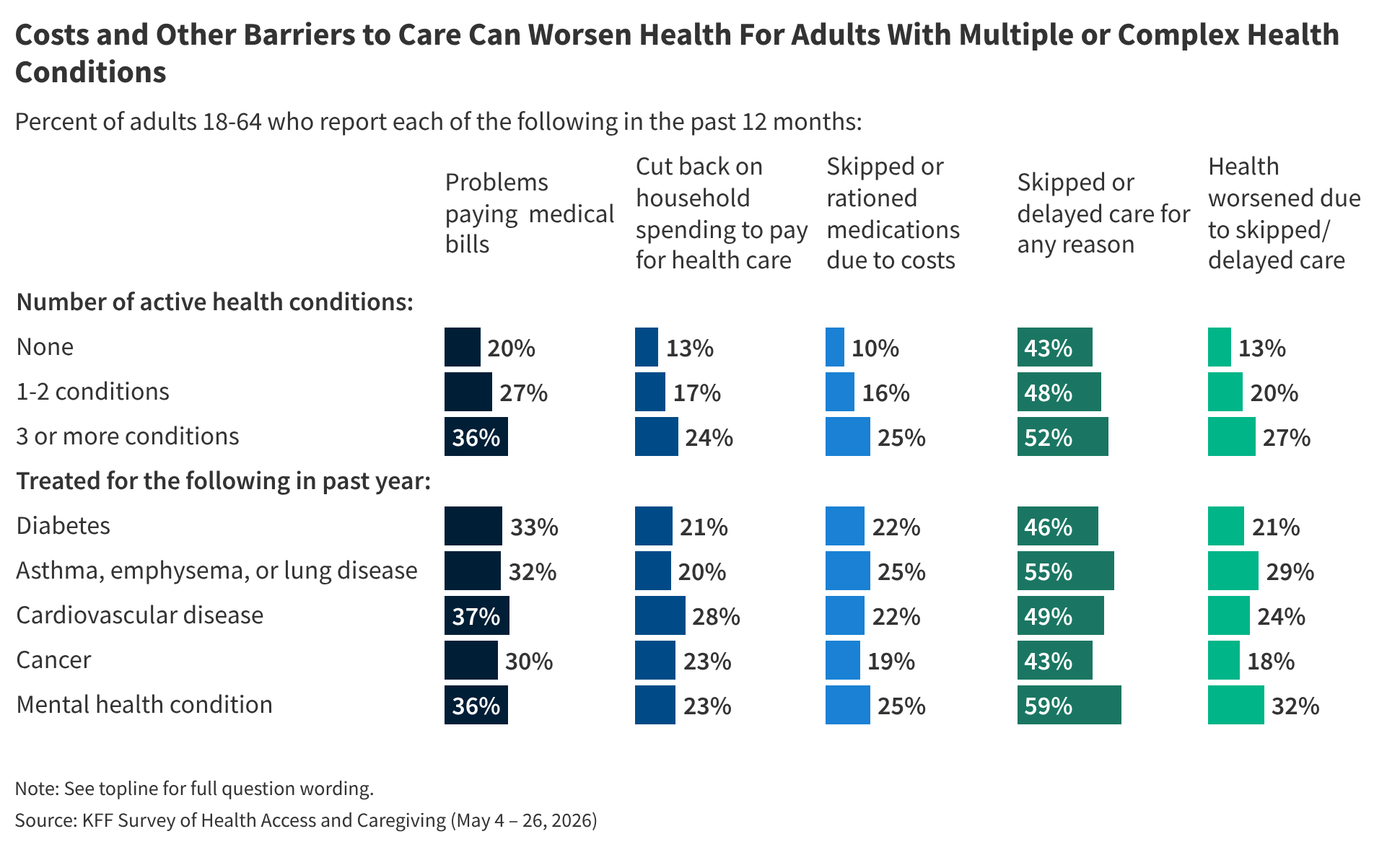
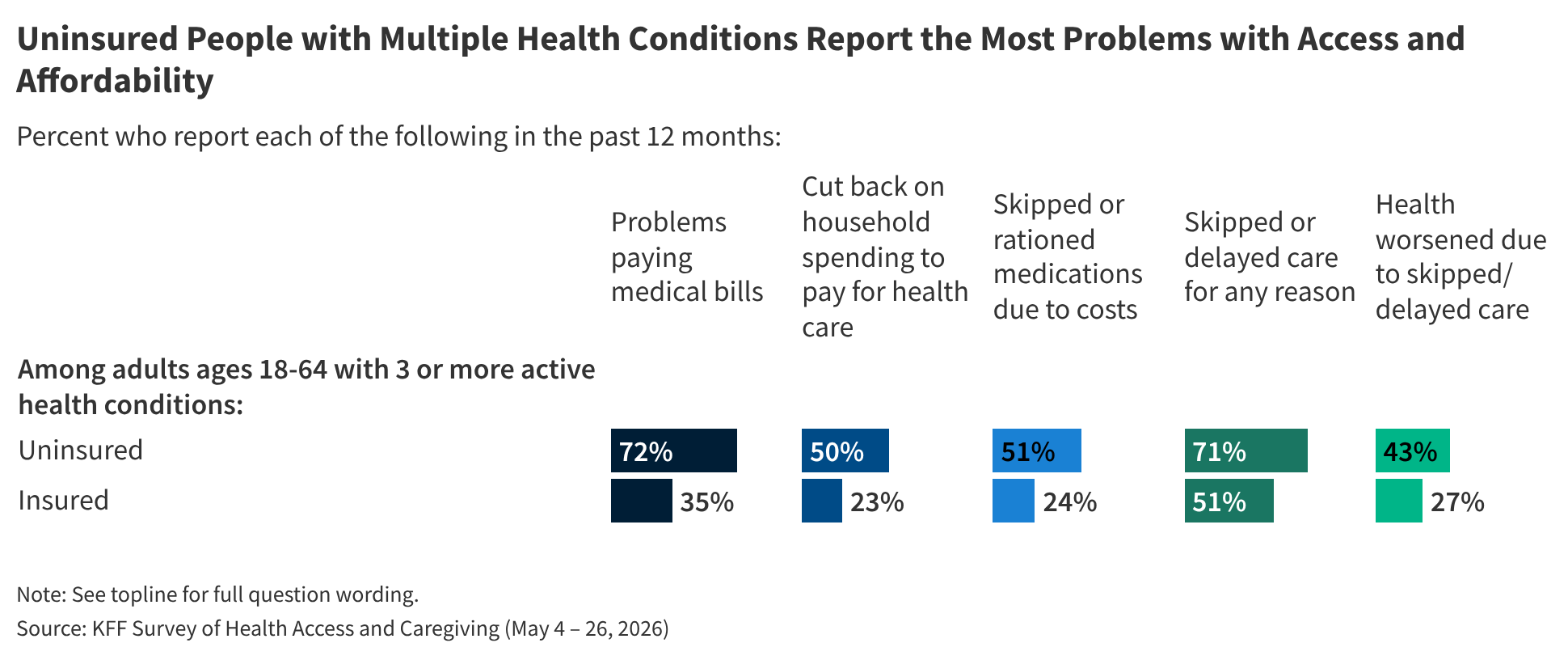
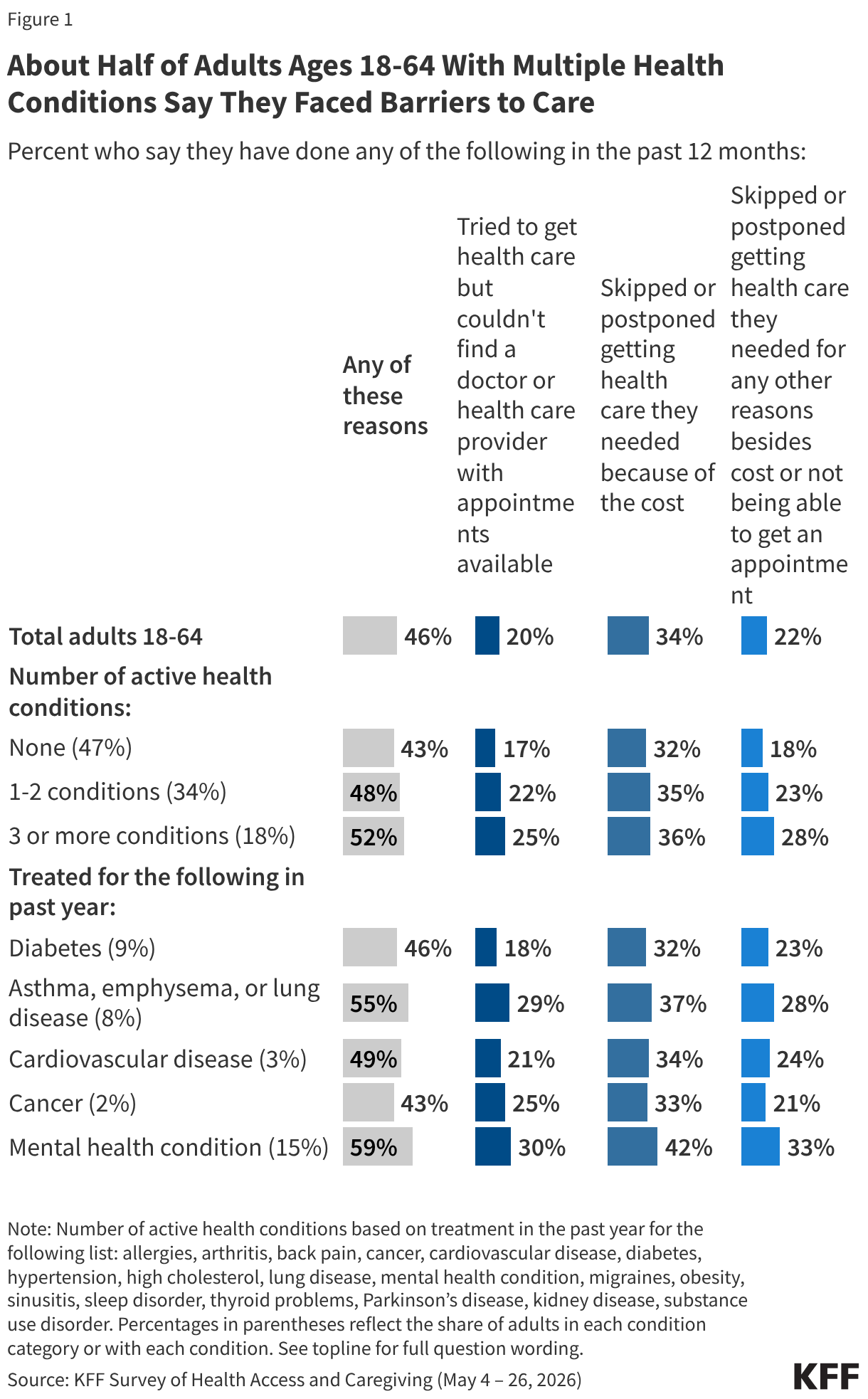
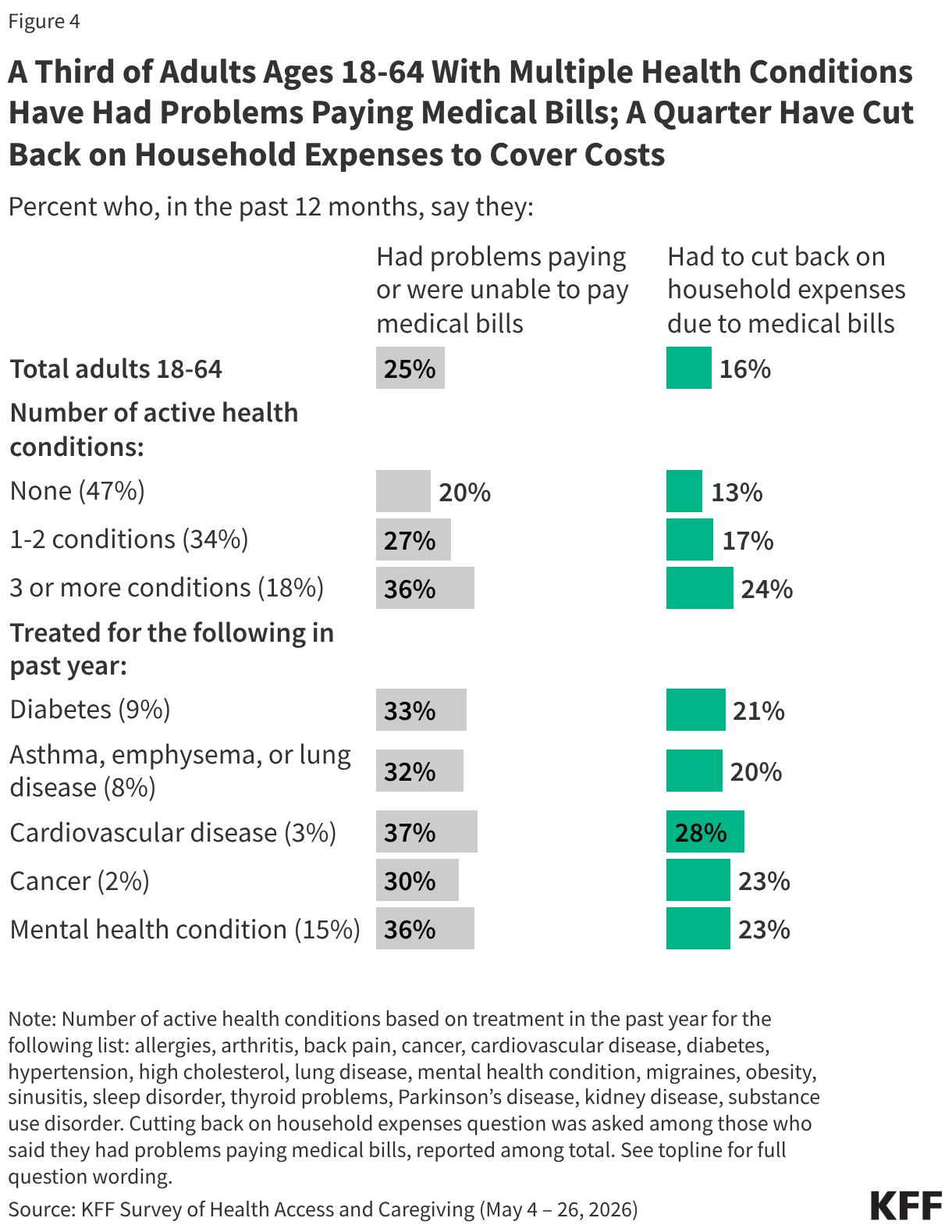
Drew Altman: Well, a couple of things. First, building on that point, in everything that we do, all of the work that we do, we center people and patients. That’s just fundamental for us. What does it mean for real people and for patients? I’m particularly concerned right now, for example, about what’s happening with the chronically ill, who are the folks who are having the hardest time paying their health care bills. I mean, by far, I think of it as we throw around the word “crisis” too much. But if there is a crisis in health care costs for people in the country, it’s really people who use the health care system a lot, who experience, that crisis. We are in everything we do, all about, what does it mean for people, and for people who become patients because they use the health care system. This podcast is especially important because well, for a couple of reasons. One is to over generalize: people in the private sector don’t understand policy very well, and people in the policy world don’t understand the marketplace and the private sector very well. So we work hard at trying to build those bridges. This podcast is part of that. But more importantly, the changes that are occurring in the private sector, take AI as an example, or private equity, or just all of the changes occurring in payment, and delivery are occurring incredibly rapidly. So many of them are impossible to capture in a definitive study or analysis or to survey the public about some of the nuances of private. We do survey them, but some of the nuances of, say, private equity or what’s happening with value hospital payment, people don’t know what that is. And so it is through a podcast like this and through you, that we’re able to bring in people who have their finger on the pulse of the changes that are happening just as they’re happening. The best experts in the country who are also on the front lines to try and help everyone understand what does this mean? What really, actually is happening. Otherwise they have to wait two, three, four years to get data, or maybe we will never get data about what’s actually, happening so that we can write the perfect policy brief. Well, we don’t have the perfect policy brief on what’s happening in the marketplace. So this really adds tremendously to our ability to be nimble and move fast, understand what’s happening. We have an analogous initiative on the policy side, which Larry Levitt moderates called The Health Wonk Shop, where we try and do something similar. But we really wanted to be able to focus on the rapidly moving changes occurring in the marketplace. 

Chip Kahn: And that care really depends on. For the title we call it business, but it really is the infrastructure that all Americans depend on for their health care, where they receive their health care, where the research is done that produces the medical miracles that’ll hopefully allow them to live longer and live healthier. all Those things are dependent on this infrastructure. And the infrastructure is facing a lot of challenges. 

And that’s why I’m glad, you and Larry came up with the idea that I should start off with AI in health care in terms of a podcast series. Because AI could be the greatest disruptor of that infrastructure, could enhance the infrastructure tremendously. But it challenges that infrastructure. We’re up against it now. Hopefully over the next 20 or so episodes, our audience is going to see the impact of this being really unprecedented. 

Drew Altman: This is a little bit, of an indelicate way to make the point, but I really agree with that and believe that a thousand years ago we were living in Philadelphia, my wife was running a children’s hospital and I was working in policy and we got annoyed with one another and she said to me, I do health care and you do bs. And there was some truth to that. And I just have a deep respect for, I, don’t even use the word provider for health professionals and health care institutions. But what it really comes down to is understanding what’s actually happening on the front lines and in institutions and to patients and to people. And really that is what I hope will be KFF’s emphasis as AI unfolds. Because I attend all, you know, the conferences too, and speak at many of them. And there’s tremendous focus. We need to focus on it, on what it means for business opportunities and what it means for research and what it means for diagnosis. And I don’t hear a lot of discussion about what it means for people and for patients, who our surveys show are distrustful of it, or may even increasingly be using AI as their doctor because they can’t get care otherwise or afford it or don’t then follow up with a doctor when they get some information from AI about what they think might be a medical problem. So these are just things we need to sort out. And I think starting with AI and with an elaborate 18 part series on AI, is just exactly the right place to start. 

Chip Kahn: Yeah, we’re going to try to cover the waterfront. I mean there are a lot of good podcasts on AI. I don’t think anybody’s done it as thoroughly as we plan. And I hope after this, it’ll provide anyone who is listening as we come out every week or binging at some point in the future. They’ll leave it really having a good understanding of the challenges. 

Drew Altman: And we’ll continue also to do our surveys of how people are and are not using AI in healthcare. We’ll also continue through another part of the organization to look at AI’s role in misinformation both spreading misinformation but also as a way to monitor it and hopefully put it all together amounting eventually to our own significant effort on AI. We are trying to figure out what is our role in AI and also how do we use it in our own work which is a different subject. 

Chip Kahn: Well Drew, I want to thank you again for this opportunity. We’re going to start in a week with launching our first series on AI and health care with Eric Larsen. I think we’re going to set a good foundation and then really do something that I hope our listening public will appreciate and will inform them in a way that almost no one else has, and just thank you. Glad to be here and look forward to working with KFF into the future. 

Drew Altman: Terrific. I hope everyone learns a lot and also has some fun. Thanks. 

AI Usage Disclosure: This transcript was created with assistance from AI tools. It was reviewed and edited by KFF Staff.


SERIES

This weekly podcast features insightful conversations between host Chip Kahn and his guests, who discuss the business of health care, connecting the dots between the health care business, policy, and patients.

The podcast’s first series on AI in health care illuminates how AI is changing health care, and features guests who are deploying this technology, managing its consequences, and designing policy around it.

How Employers Support Lower-Waged Workers’ Access to Health Insurance Options

Published: Apr 20, 2026

Health insurance makes up 8% of total employee compensation on average, and while most employees take up health insurance when it is offered, lower-wage workers are far less likely to be able to access coverage, according to an analysis on the costs, availability, and take-up of health benefits for workers with lower wages. The analysis uses survey data and information from focus groups discussions with more than 100 U.S. employers with over a quarter of a million employees.

About three in four employees are offered health insurance on average, and nearly two-thirds of those offered insurance enroll in the benefit. Workers in occupations with lower wages, such as service occupations, are much less likely to have access to health benefits at their jobs (94% of workers in higher-wage jobs vs. 44% in lower-wage jobs) and, even when they do, they are much less likely to enroll (72% vs. 49%).

The analysis of part of the Peterson-KFF Health System Tracker, an online information hub dedicated to monitoring and assessing the performance of the U.S. health system.

UNFPA Funding and Kemp-Kasten: An Explainer

Published: Apr 17, 2026

Editorial Note: Originally published in April 2017, this resource is updated as needed to reflect the latest developments.

Key Points

  • On May 8, 2025, the Trump administration invoked the “Kemp-Kasten amendment” in order to withhold FY 2025 funding for the United Nations Population Fund (UNFPA, the lead U.N. agency focused on global population and reproductive health); the same determination was made during President Trump’s first term. FY 2025 funding for UNFPA was expected to total $32.5 million in core support and potentially millions more for other project activities.
  • While under current law any U.S. funding withheld from UNFPA is to be made available for other family planning, maternal health, and reproductive health activities, Congress rescinded (permanently canceled) FY 2025 funding appropriated for UNFPA as part of a broader foreign aid rescission package requested by the President. Although Congress again appropriated $32.5 million in core support for UNFPA for FY 2026, it is expected that President Trump will again withhold the funds from the organization.
  • The Kemp-Kasten amendment is a provision of U.S. law, first enacted by Congress in 1985 and included in appropriations language annually, that states that no U.S. funds may be made available to “any organization or program which, as determined by the president of the United States, supports or participates in the management of a program of coercive abortion or involuntary sterilization.”
  • Kemp-Kasten has often been used, as determined by presidents along party lines, to withhold U.S. funding to UNFPA. While framed broadly, Kemp-Kasten was originally intended to restrict funding to UNFPA specifically, after concerns arose about China’s population control policies and UNFPA’s work in China; to date, it has only been applied to UNFPA. Evaluations by the U.S. government and others have found no evidence that UNFPA directly engages in coercive abortion or involuntary sterilization in China, and more generally, UNFPA does not promote abortion as a method of family planning or fund abortion services.
  • Kemp-Kasten has been used to withhold funding from UNFPA in 20 of the past 41 fiscal years.

What is the Kemp-Kasten Amendment?

The Kemp-Kasten amendment, first enacted in 1985, is a provision of U.S. law that states that no U.S. funds may be made available to “any organization or program which, as determined by the [p]resident of the United States, supports or participates in the management of a program of coercive abortion or involuntary sterilization.”1 It was the congressional response to a Reagan administration decision in 1984 to temporarily withhold some funding from UNFPA and to begin conditioning its funding on assurances that the agency did not engage in or provide funding for abortion or coercive family planning. This policy change was made after concerns arose about whether UNFPA supported China’s coercive population policies.2 It was announced by the Reagan administration at the 2nd International Conference on Population in 1984, in conjunction with the “Mexico City Policy.”3 The Mexico City Policy originally required foreign NGOs to certify that they would not “perform or actively promote abortion as a method of family planning” with non-U.S. funds as a condition of receiving U.S. family planning assistance; the Trump administration recently expanded this restriction to encompass more funding, more organizations, and more policy areas (see the KFF explainer on the policy).

Box 1: The Original Language Regarding UNFPA in the U.S. Policy Statement at the 2nd International Conference on Population, 1984

“With regard to the United Nations Fund for Population Activities [UNFPA], the US will insist that no part of its contribution be used for abortion. The US will also call for concrete assurances that the UNFPA is not engaged in, or does not provide funding for, abortion or coercive family planning programs; if such assurances are not forthcoming, the US will redirect the amount of its contribution to other, non-UNFPA, family planning programs.”4

What U.S. funding does Kemp-Kasten apply to?

Kemp-Kasten applies to all funds appropriated under the State and Foreign Operations appropriations act as well as any unobligated balances from prior appropriations. This includes all funding provided to the State Department and the now-dissolved USAID, which, in turn, includes the vast majority of U.S. global health funding.5

When has Kemp-Kasten been in effect?

The Kemp-Kasten amendment has been in effect for 41 years. First enacted in 1985,6 its language has been included in the State and Foreign Operations appropriations act every fiscal year since then. (Although the provision is present in current law, language similar to Kemp-Kasten was also included in President Trump’s presidential memorandum reinstating the Mexico City Policy on January 24, 2025.7) While Congress has kept the amendment in place annually, it remains up to the president to determine whether or not to invoke Kemp-Kasten as a reason to withhold funding from an organization (see below).8

Though Kemp-Kasten technically could apply to funding provided to any organization or program (including U.S. NGOs, non-U.S. NGOs, multilateral organizations, and foreign governments), the U.S. government has issued determinations about only one organization, UNFPA, thus far. The U.S. played a key role in the launch of UNFPA in 1969 and was, until 1985, the largest government donor to the agency.9 However, the U.S. has withheld funding from UNFPA due to presidential determinations that it violated Kemp-Kasten as often as it has provided funding since 1985 (in 20 of the past 41 fiscal years, to date), and in some years, funding was also withheld from UNFPA based on other provisions of the law, such as the dollar-for-dollar withholding requirement10 (see below). These determinations have been made along party lines with only one exception – the first year of President George W. Bush’s administration (see Figure 1 and Table 1).

How much funding does the U.S. provide to UNFPA?

In 2024, the U.S. was the largest donor to UNFPA, having provided 17% of all contributions. Total funding from the U.S. for UNFPA was $231.8 million – $30.5 million in core support and $201.3 million for other projects – in FY 2024 (see Box 2).11 See Figure 1 and Table 1 for historical funding data.

Box 2: Core and Non-Core Support to UNFPA

According to UNFPA, contributions to core resources allow the agency to support any activity, while contributions to non-core resources – funds earmarked for a specific purpose – may only be used for the stated project or activity.12 Governments provide contributions toward UNFPA core and non-core resources on a voluntary basis, since UNFPA does not assess a required contribution from governments.

U.S.
Funding for UNFPA, FY 1985 - FY 2025 (Bar Chart)
Kemp-Kasten and U.S. Funding for UNFPA (Core Support Only), FY 1985–FY 2027 (Table)

How is a determination about Kemp-Kasten made?

By law, it is up to the president to determine whether any organization or program should be ineligible for funding due to a violation of the Kemp-Kasten amendment (in practice, this authority has generally been delegated to the State Department). In most recent years, legislative language has also specified that this determination must be: 1) made no later than six months after the date of enactment of the law that includes the provision and 2) accompanied by the evidence and criteria used to make the determination.13

Most recently, on January 24, 2025, at the beginning of his second term, President Trump directed the Secretary of State to begin the process of making a Kemp-Kasten determination by taking “all necessary steps,” and in May 2025, the United States again invoked Kemp-Kasten to withhold funding from UNFPA. These determinations are usually made after the annual appropriations process is completed. For example, in 2017, the Trump administration’s determination was made on March 30, 2017, at the six month mark after the passage of the FY 2017 continuing resolution appropriations bill and was accompanied by a two-page justification memorandum.14

Has there ever been evidence that UNFPA supports coercive abortion or involuntary sterilizations?

To date, there has been no evidence that UNFPA supports coercive abortion or involuntary sterilizations. Several evaluations by the U.S. government (including one by an assessment team sent to China by the State Department in 2002) as well as other groups, such as the British All-Party Parliamentary Group on Population, Development, and Reproductive Health (in 2002) and the Interfaith Delegation (in 2003), have found no evidence of direct engagement by UNFPA in such activities in China or elsewhere.15 In addition, UNFPA does not promote abortion as a method of family planning or fund abortion services.16 In years when a determination has been made that UNFPA violated Kemp-Kasten, the U.S. government has stated that the determination was based on its conclusion that UNFPA support to or partnering with the Chinese government for other population and reproductive health activities was sufficient grounds for invoking the amendment to withhold funding. In the March 30, 2017, determination by the Trump administration, for example, the justification memorandum stated that: “While there is no evidence that UNFPA directly engages in coercive abortions or involuntary sterilizations in China, the agency continues to partner with the NHFPC [China’s National Health and Family Planning Commission] on family planning, and thus can be found to support, or participate in the management of China's coercive policies for purposes of the Kemp-Kasten amendment.”

What other legislative requirements apply to U.S. funding for UNFPA?

In addition to Kemp-Kasten, there are several other provisions of law that Congress has enacted in recent years to set conditions on U.S. funding for the agency.17 These provisions:

  • require UNFPA to keep U.S. funding to the agency in a separate account, not to be commingled with other funds;
  • prohibit UNFPA from funding abortion;
  • prohibit UNFPA from using any U.S. funds for their programming in China;
  • reduce the U.S. contribution to UNFPA by one dollar for every dollar that UNFPA spends on its programming in China (“dollar-for-dollar withholding”); and
  • in some years, state that not more than half of funding designated for the U.S. contribution to UNFPA is to be released before a particular date, which varies by fiscal year (this provision is not currently in effect).

What happens to funding that is withheld from UNFPA?

For several years, including FY 2025 and FY 2026, Congress has required that funding withheld from UNFPA be reallocated to U.S. global family planning, maternal, and reproductive health activities. (However, despite this requirement, the withheld FY 2025 contribution to UNFPA will not be reallocated to those purposes since shortly after the Trump administration made its Kemp-Kasten determination that year, Congress rescinded, or permanently canceled, the funding as part of a larger foreign aid rescission package requested by the President.18) The enactment of this provision first affected reallocation of FY 2002 funds.19 It is now typically included in the State and Foreign Operations appropriations act each year.20


  1. U.S. Congress, FY 2017 Consolidated Appropriations Act (P.L. 115-31), May 5, 2017; KFF, The U.S. Government and International Family Planning & Reproductive Health: Statutory Requirements and Policies, fact sheet. ↩︎
  2. Congressional Research Service (CRS), The U.N. Population Fund: Background and the U.S. Funding Debate, RL32703, July 2010; “Policy Statement of the United States of America at the United Nations International Conference on Population (Second Session), Mexico City, Mexico, August 6-14, 1984,” undated. ↩︎
  3. “Policy Statement of the United States of America at the United Nations International Conference on Population (Second Session), Mexico City, Mexico, August 6-14, 1984,” undated; United Nations Division of Economic and Social Affairs/Population Division, “United Nations Conferences on Population,” webpage, undated, http://www.un.org/en/development/desa/population/events/conference/index.shtml. ↩︎
  4. “Policy Statement of the United States of America at the United Nations International Conference on Population (Second Session), Mexico City, Mexico, August 6-14, 1984,” undated. ↩︎
  5. KFF, The U.S. Congress and Global Health: A Primer; and KFF U.S. Global Health Budget Tracker, available at: https://www.kff.org/interactive/u-s-global-health-budget-tracker/. ↩︎
  6. Via FY 1985 supplemental appropriations, per CRS, The U.N. Population Fund: Background and the U.S. Funding Debate, RL32703, July 2010. ↩︎
  7. Specifically, in this memorandum, President Trump stated, “I further direct the Secretary of State to take all necessary actions, to the extent permitted by law, to ensure that U.S. taxpayer dollars do not fund organizations or programs that support or participate in the management of a program of coercive abortion or involuntary sterilization.” ↩︎
  8. However, after UNFPA ended its program in China in 1997 but then began a new program there in 1999, this resulted in Congress withholding funding from UNFPA that year. ↩︎
  9. CRS, The U.N. Population Fund: Background and the U.S. Funding Debate, RL32703, July 2010; PAI, Why the United States Should Maintain Funding for UNFPA, May 2015. ↩︎
  10. In FY 1999, Congress prohibited UNFPA funding in response to the initiation of a new UNFPA program in China (this was unrelated to Kemp-Kasten), and in some other years when the U.S. made a contribution to UNFPA, UNFPA’s China program meant some UNFPA funding was withheld under the “dollar-for-dollar withholding” provision. ↩︎
  11. KFF analysis of data from State Department, U.S. Contributions to International Organizations: Reports to Congress, available at: https://www.state.gov/u-s-contributions-to-international-organizationshttps://bidenwhitehouse.archives.gov/briefing-room/presidential-actions/2021/01/28/memorandum-on-protecting-womens-health-at-home-and-abroad/https://www.whitehouse.gov/briefing-room/presidential-actions/2021/01/28/memorandum-on-protecting-womens-health-at-home-and-abroad/. ↩︎
  12. UNFPA, Annual Report 2013, 2014. ↩︎
  13. Typically included in annual State and Foreign Operations appropriations since FY 2008, including in FY 2017 under the terms of the continuing resolution. CRS, The U.N. Population Fund: Background and the U.S. Funding Debate, RL32703, July 2010; KFF analysis of appropriations bills. ↩︎
  14. State Department: Letter to Bob Corker, Chairman, Committee on Foreign Relations, from Joseph E Macmanus, Bureau of Legislative Affairs, State Department, dated April 3, 2017, and accompanying “Determination Regarding the ‘Kemp-Kasten Amendment,’” dated March 30, 2017, and “Memorandum of Justification for the Determination Regarding the "Kemp-Kasten Amendment,” undated. Available online (follows the article) at: https://www.buzzfeednews.com/article/jinamoore/the-us-wont-give-any-more-money-to-the-un-population-fund. ↩︎
  15. CRS, The U.N. Population Fund: Background and the U.S. Funding Debate, RL32703, July 2010. ↩︎
  16. UNFPA, “Frequently Asked Questions,” webpage, updated January 2025, http://www.unfpa.org/frequently-asked-questions#abortion. ↩︎
  17. KFF, The U.S. Government and International Family Planning & Reproductive Health: Statutory Requirements and Policies, fact sheet. ↩︎
  18. KFF analysis of Congressional Appropriations Bills. ↩︎
  19. “Although such reallocation began in practice in FY 2002, it was first authorized by Congress in legislation beginning in FY 2004 with reference to FY 2002 and FY 2003 funds,” per KFF, The U.S. Government and International Family Planning & Reproductive Health: Statutory Requirements and Policies, fact sheet. ↩︎
  20. The activities to which Congress directs reallocated funds varies by fiscal year; in FY 2003, for example, reallocated funding supported assistance to vulnerable children and victims of trafficking in persons. CRS, The U.N. Population Fund: Background and the U.S. Funding Debate, RL32703, July 2010. ↩︎

What Are the Recent Trends in Employer-Based Health Coverage?

Published: Apr 17, 2026

Employer-sponsored health insurance is the largest source of health coverage for people under 65, covering 165.6 million people in March 2025, but its reach is uneven. About four in five (80%) adult workers under age 65 work for an employer that offers health insurance to at least some employees—a share that falls to 60% for lower-paid workers. Additionally, some workers do not enroll even when coverage is offered: employer-sponsored health insurance covered only 22.5% of people under 65 with incomes below 200% of poverty—compared to 82.5% of people with incomes of at least 400% of poverty.

This analysis examines who among people under 65 have employer coverage and which workers are offered and eligible for coverage at their jobs, using the Annual Economic and Social (March) Supplements of the Current Population Survey.

The analysis of part of the Peterson-KFF Health System Tracker, an online information hub dedicated to monitoring and assessing the performance of the U.S. health system.