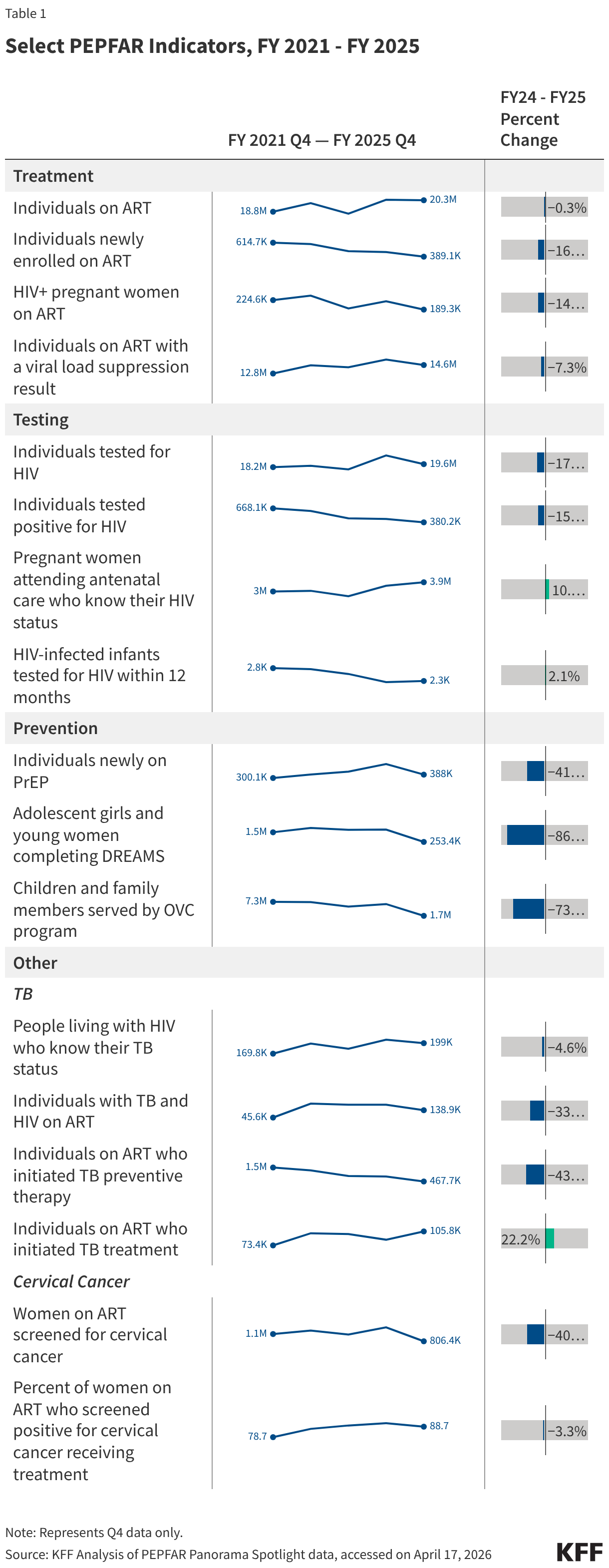
KFF Dashboard: Progress Toward Global HIV Targets in PEPFAR Countries

Published: Nov 25, 2025

Note:  This interactive includes data from before January 2025, and therefore does not reflect the potential impact of changes implemented by the Trump administration since then. For more information, see KFF’s Overview of President Trump’s Executive Actions on Global Health and The Trump Administration’s Foreign Aid Review: Status of PEPFAR.

About This Dashboard

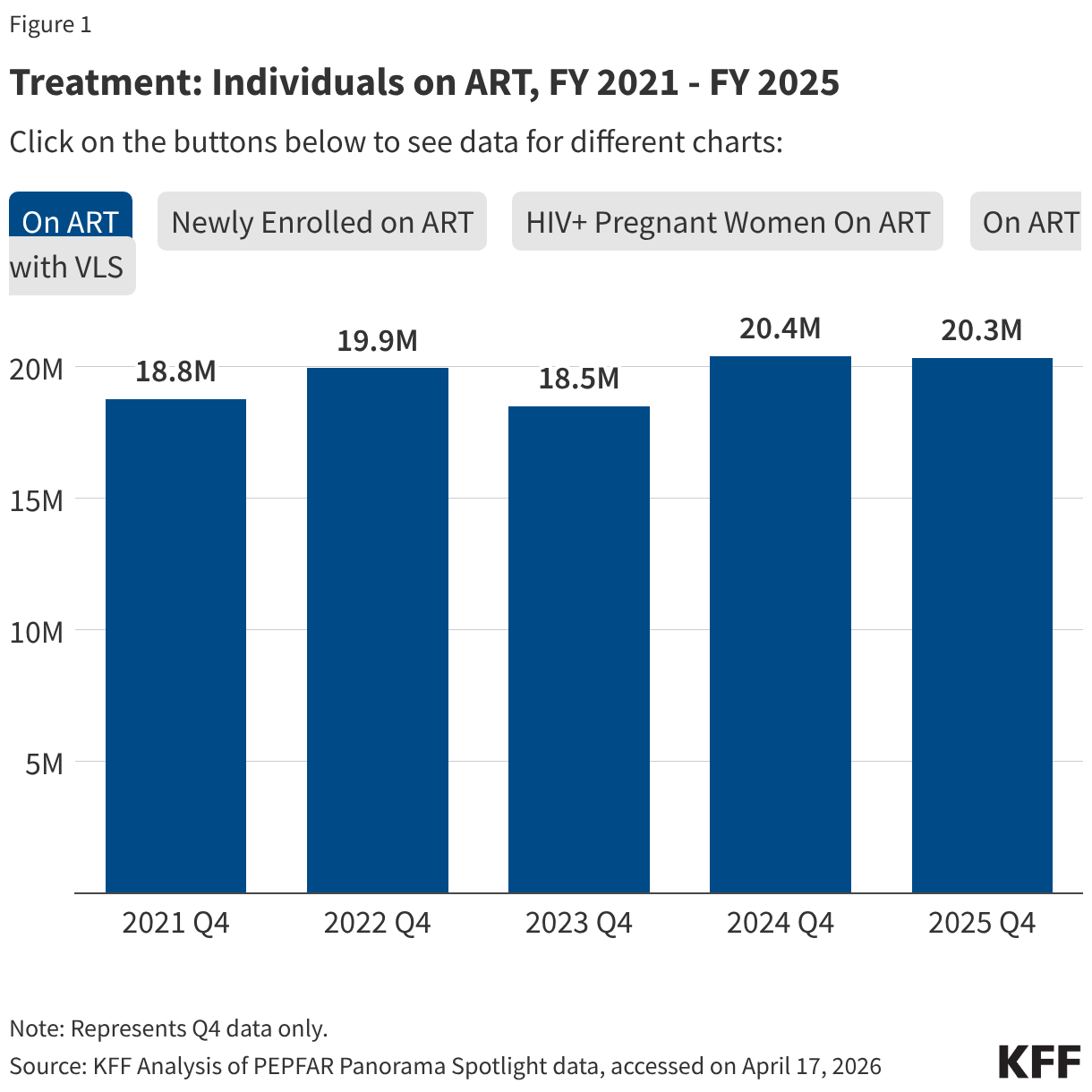
This dashboard monitors the status of PEPFAR countries’ progress toward global HIV targets from 2019-2024. It includes data for 54 countries required to develop a PEPFAR Country or Regional Operational Plan (COP/ROP) in FY 2024. To use the dashboard, click on any indicator and select a year to see country-level data for that year. Click on Trends Over Time to see the progress countries have made in recent years. Data are from UNAIDS AIDSinfo database and were last updated in July 2025. Data for the latest available year are for 2024. The data powering this dashboard are available for download here. KFF will continue to track PEPFAR country progress on these indicators and update the dashboard as new data become available.

KFF Dashboard: Progress Toward Global Malaria Targets in PMI Countries

Published: Nov 25, 2025

Note:  This interactive includes data from before January 2025, and therefore does not reflect the potential impact of changes implemented by the Trump administration since then. For more information, see KFF’s Overview of President Trump’s Executive Actions on Global Health and The Trump Administration’s Foreign Aid Review: Status of the President’s Malaria Initiative (PMI).

About this Dashboard

This dashboard monitors the status of the U.S. President’s Malaria Initiative’s (PMI) partner countries’ progress toward global malaria targets. It includes data for 30 countries, including 27 focus countries in Africa (including the three PMI partner countries – Burundi, Gambia, and Togo – that were added in 2023) and three countries in the Greater Mekong Subregion in South-East Asia.* Together, these 30 countries represent almost 90% of the global malaria burden. Data are from the WHO’s World Malaria Report 2024. The data powering this dashboard are available for download here. KFF will continue to track PMI country progress on these indicators and update the dashboard as new data become available.

Notes

*PMI countries include the following: Angola, Benin, Burkina Faso, Burma, Burundi, Cambodia, Cameroon, Côte d’lvoire, D.R. Congo, Ethiopia, Gambia, Ghana, Guinea, Kenya, Liberia, Madagascar, Malawi, Mali, Mozambique, Niger, Nigeria, Rwanda, Senegal, Sierra Leone, Tanzania, Thailand, Togo, Uganda, Zambia, and Zimbabwe. U.S. President’s Malaria Initiative (PMI), Where We Work, accessed: https:/www.pmi.gov/what-we-do/. PMI, Press release: U.S. President’s Malaria Initiative Announces Plans to Expand to New Partner Countries, accessed: https://www.pmi.gov/u-s-presidents-malaria-initiative-announces-plans-to-expand-to-new-partner-countries/.

Policy Tracker: Exceptions to State Abortion Bans and Early Gestational Limits 

Last updated on November 24, 2025

states have abortion bans or early gestational limits in effect

states have no health exception

states have no rape or incest exception 

states have no fatal fetal anomaly exception 

Abortion is currently banned in 13 states and 6 states have early gestational limits between 6 weeks and 12 weeks in effect. Nearly all of these bans include exceptions, which generally fall into four categories: to prevent the death of the pregnant person, when there is risk to the health of the pregnant person, when the pregnancy is the result of rape or incest, and when there is a lethal fetal anomaly. Some states have more than one abortion ban or restriction in place. The maps below illustrate the exceptions in each state’s most restrictive gestational limit or total ban. For details hover over each state to read the rollover.  

For more information on the status of state abortion bans, please visit our Abortion in the United States Dashboard

Exceptions to State Abortion Bans and Early Gestational Limits in Effect, as of April 1, 2024
Exceptions in Abortion Bans and Gestational Limits, as of April 15, 2024

Mapping the Uneven Burden of Rising ACA Marketplace Premium Payments due to Enhanced Tax Credit Expiration

Published: Nov 24, 2025

Editorial Note: Originally published on November 13, this brief was revised on November 24 to provide additional analysis on the effects of enhanced premium tax credit expiration for those at 701% of poverty.

The Affordable Care Act (ACA) offers premium tax credits to help make health insurance more affordable. Under original Affordable Care Act provisions, an income cap for premium tax credits was set at 400% of the federal poverty level. Above that threshold, federal financial assistance was not available, creating a “subsidy cliff.” The American Rescue Plan Act (ARPA) and later the Inflation Reduction Act (IRA) temporarily expanded eligibility for tax credits to people with incomes over 400% of poverty, in addition to providing more generous support for people at lower incomes.

Enhanced premium tax credits expire at the end of this year. Enrollees currently receiving premium tax credits at any level of income will see their federal assistance decrease or disappear if enhanced premium tax credits expire, with an average increase of 114% to what enrollees pay in premiums net of tax credits. Since premium payments are capped based on income and family size, there is little geographic variation in the resulting increases in premium payments for enrollees with incomes below 400% of poverty. Out-of-pocket premiums for people with incomes below 400% of poverty will increase by hundreds of dollars to over $1,500 per person on average.

Among those with incomes over 400% poverty who are losing the tax credit altogether, the impact will be greatest for those whose unsubsidized premiums are highest: older Marketplace enrollees and those living in higher-premium locales. Among enrollees with incomes over 400% of poverty, just over half are between ages 50 and 64, and will therefore have high unsubsidized premiums.

The maps below show how much average premium payments would increase for 2026 benchmark silver plans with the expiration of enhanced premium tax credits at four income levels above an income cap of 400% of federal poverty for a 40-year-old and 60-year-old individual, namely 401%, 501%, 601%, and 701%..

Among these four income levels, enhanced tax credits provide the most financial assistance for those at 401% of poverty, which represents an annual salary of $62,757 for an individual in the contiguous United States. Because the cost of living is higher in Alaska and Hawaii, 401% of federal poverty is $78,396 and $72,140 for individuals there, respectively. In 46 states and the District of Columbia, a 60-year-old at 401% of poverty will see their average annual premium payment for a benchmark silver plan at least double without enhanced tax credits. In 19 states, this person would see their premium payment at least triple on average for a benchmark silver plan, consuming more than 25% of annual income. States with the highest premium payment increases due to expired enhanced tax credits for a 60-year-old at 401% of poverty purchasing a benchmark silver plan are Wyoming ($22,452 increase per year), West Virginia ($22,006), and Alaska ($19,636). The smallest increases caused by the loss of enhanced tax credits for what enrollees pay annually for the benchmark silver plan are in New York ($4,469), Massachusetts ($4,728) and New Hampshire ($4,877).

At 501% of poverty ($78,407 in the contiguous U.S., $97,946 in Alaska, $90,130 in Hawaii), expiration of enhanced premium tax credits would at least double average premium payments for a benchmark silver plan in 37 states and the District of Columbia for a 60-year-old; at 601% of poverty ($94,057 in the contiguous U.S., $117,496 in Alaska, $108,120 in Hawaii), 19 states would see the average benchmark silver premium payments at least double for a 60-year-old if enhanced tax credits expire; at 701% of poverty ($109,707 in the contiguous U.S., $137,046 in Alaska, $126,110 in Hawaii), the average benchmark silver premium payment would be at least twice as high in five states without enhanced tax credits for a 60-year-old. The impact on a 40-year-old is more modest at all income levels.

Existing premium differences lead to variation in premium payments with the expiration of the enhanced premium tax credits at the congressional district level as well. For people with incomes over 400% of poverty, there will be smaller premium payment changes for 40-year-old enrollees and larger changes for 60-year-old enrollees, for whom plans are more expensive..

VOLUME 35

Fake AI-Generated Videos Perpetuate Stereotypes About SNAP Recipients, And New KFF Poll Looks at Belief in the False Claim That Undocumented Immigrants Are Eligible for ACA Coverage


Summary

This volume examines how AI-generated videos contributed to false narratives about Supplemental Nutrition Assistance Program (SNAP) recipients during the government shutdown, lending alleged visual evidence to decades-old stereotypes about beneficiaries of government assistance. It also highlights findings from KFF’s latest Health Tracking Poll on beliefs about undocumented immigrants’ eligibility for health insurance through the Affordable Care Act (ACA). Lastly, it shares updates on a film amplifying false vaccine claims, Louisiana officials’ delayed response to a whooping cough outbreak, efforts in medical education to address shame in clinical settings, and a survey revealing distrust of news media among U.S. teens.


AI & Emerging Technology

AI-Generated Videos Spread False SNAP Narratives During Government Shutdown

Noel Hendrickson / Getty Images

What’s happening?

  • Fake videos of public assistance beneficiaries created using artificial intelligence (AI) spread online during the government shutdown, receiving millions of views and potentially contributing to misconceptions about who uses SNAP and deepening longstanding harmful racial stereotypes. SNAP provides food assistance benefits to approximately 42 million Americans, according to data from the United States Department of Agriculture (USDA), with White people making up the largest share of beneficiaries, and many recipients either working or actively seeking employment. Eligibility for the program includes work requirements, and more than half of households with children that receive SNAP benefits also receive earned income. SNAP fraud is rare, and analysis has shown that more than 98% of those receiving benefits were eligible.
  • Despite this reality, these AI-generated videos gave new reach to decades-old myths that people who receive benefits from SNAP and other government assistance are taking advantage of these programs and choosing not to work. The AI-generated videos predominantly depicted Black women arguing with retail employees about their benefits, stealing from grocery stores, or boasting about receiving public assistance while unemployed. KFF’s monitoring of social media identified several examples of these videos posted throughout the shutdown that accumulated millions of views within days. Many of the videos contained indicators that the content was AI-generated, such as mismatched audio-visual sync. Major news outlets, including Fox News, have faced criticism for sharing this AI-generated content as authentic reactions to the Trump administration’s decision to withhold SNAP payments during the government shutdown. Fox News later corrected its coverage after online commenters pointed out that the videos were AI-generated.

Why this matters

News reports covering these videos linked them to the “welfare queen” stereotype that emerged in the 1980s because they falsely depict benefit recipients, particularly Black women, as abusing government assistance and avoiding work. AI can be used to give these myths new visual “evidence,” as the technology makes it easier to create seemingly authentic testimonials that confirm existing biases. In addition to perpetuating harmful racial stereotypes, this false narrative has historically been used to justify cuts to government assistance programs and promote policies that further limit access to assistance and make it more difficult for people who qualify to access support. Similar narratives are likely to emerge again during future policy debates about benefit programs.


Recent Developments

KFF’s Latest Health Tracking Poll Finds That Half of the Public Correctly Say Undocumented Immigrants Are Not Eligible for ACA Coverage, But Many Are Uncertain

Amid debates over the recent government shutdown, some Republican lawmakers claimed that Democrats’ efforts to reverse some provisions of H.R.1, the “One Big Beautiful Bill Act,” would allow undocumented immigrants to receive federally subsidized health insurance. Undocumented immigrants are not eligible to purchase coverage through the ACA marketplaces, or enroll in federally funded coverage, including Medicaid, CHIP, or Medicare.

Fielded during the government shutdown, KFF’s latest Health Tracking Poll finds that about half (47%) of the public correctly say that undocumented immigrants are not eligible to buy health coverage on the ACA marketplaces, while 14% incorrectly say undocumented immigrants are eligible for this coverage. Notable shares, however, express confusion, with about four in ten (39%) adults saying they are “not sure.”

Notably, similar shares of Republicans (57%) and Democrats (52%) correctly say undocumented immigrants are not eligible for this coverage.

About Half of Adults Correctly Say Undocumented Immigrants Are Not Eligible for ACA Coverage, Including Similar Shares of Democrats and Republicans

What We Are Watching

New Film Contributes to Misleading Vaccine Claims on Social Media

A film released in October by an advocacy group opposed to childhood vaccination that amplifies false claims about the safety of children’s vaccines was frequently cited in discussions about vaccine safety. KFF’s monitoring of social media found that the film’s title, “An Inconvenient Study,” was mentioned in over 60,000 posts, reposts, and comments across X, Reddit, and Bluesky, this year as of November 19. The film describes an unpublished study purporting to show higher rates of chronic illness among vaccinated children, suggesting that its findings were concealed from the public. Henry Ford Health System, where the study originated, has issued a cease-and-desist notice to the filmmakers, stating the research did not meet its scientific standards, and independent experts have identified methodological flaws with the study’s design. False claims about vaccine safety, like those shared in the film, may contribute to declining vaccination rates. The KFF/Washington Post Survey of Parents found that those who skipped or delayed vaccines for their children were more likely to believe vaccine myths.

Louisiana’s Delayed Response to Whooping Cough Outbreak

Louisiana is experiencing its worst outbreak of whooping cough in 35 years, with 387 cases reported as of September 20. The outbreak began in September 2024, but reporting from a partnership that includes KFF Health News and NPR showed that state health officials waited months to alert physicians or conduct public outreach. The decision to withhold outbreak information could exacerbate declining trust in state health officials. KFF polling finds that just under half of adults report having a great deal or a fair amount of trust in their state health officials to provide reliable information about vaccines.

New Efforts to Combat Shame in Healthcare Settings to Improve Trust

The provider-patient relationship can play a role in how people access and understand health information. Patients who feel shamed in clinical settings may avoid asking questions, which can limit their access to information and guidance. Recent KFF Health News reporting describes efforts in medical training to reduce the potential for patients to feel shamed. Addressing shame in clinical settings could help support people’s understanding of health information, as many people are uncertain about health information and are likely to trust their doctor. KFF’s recent Tracking Poll on Health Information and Trust shows that personal doctors continue to remain one of the most trusted sources of health guidance among the public, so how they communicate might influence whether patients feel safe discussing concerns and access accurate information.

Survey Finds Teens Hold Negative Views of News Media

A new report from the News Literacy Project found that 84% of teenagers in the U.S. expressed negative sentiment when asked to describe news media, with many believing journalists regularly engage in unethical behaviors. When asked what journalists do well, about one-third of teens offered negative feedback, saying journalists were skilled at things such as “lying and deceiving.” This widespread distrust of news media among teenagers could affect how they seek out and evaluate health information, a trend that health communicators may need to consider when developing outreach strategies.

About The Health Information and Trust Initiative: the Health Information and Trust Initiative is a KFF program aimed at tracking health misinformation in the U.S., analyzing its impact on the American people, and mobilizing media to address the problem. Our goal is to be of service to everyone working on health misinformation, strengthen efforts to counter misinformation, and build trust. 


View all KFF Monitors

The Monitor is a report from KFF’s Health Information and Trust initiative that focuses on recent developments in health information. It’s free and published twice a month.

Sign up to receive KFF Monitor
email updates


Support for the Health Information and Trust initiative is provided by the Robert Wood Johnson Foundation (RWJF). The views expressed do not necessarily reflect the views of RWJF and KFF maintains full editorial control over all of its policy analysis, polling, and journalism activities. The data shared in the Monitor is sourced through media monitoring research conducted by KFF.

The New ACA Repeal and Replace: Health Savings Accounts

Authors: Larry Levitt and Cynthia Cox
Published: Nov 21, 2025

If enhanced premium tax credits under the Affordable Care Act (ACA) are allowed to expire at the end of the year, out-of-pocket premiums for 22 million enrollees that receive premium assistance will increase by an average of 114%, or $1,016 per person.

Democrats have pushed for the enhanced tax credits to be extended, and a vote is expected on their proposal in December. There have also been some bipartisan negotiations and proposals to extend the tax credits for up to two years, with changes like a cap on who is eligible by income and efforts to address any fraudulent signups by insurance brokers.

Meanwhile, proposals have emerged from some Republicans in Congress to effectively repeal some or all of the ACA premium tax credits and replace them with contributions to Health Savings Accounts (HSAs) or something similar. President Trump posted recently:

“THE ONLY HEALTHCARE I WILL SUPPORT OR APPROVE IS SENDING THE MONEY DIRECTLY BACK TO THE PEOPLE, WITH NOTHING GOING TO THE BIG, FAT, RICH INSURANCE COMPANIES, WHO HAVE MADE $TRILLIONS, AND RIPPED OFF AMERICA LONG ENOUGH. THE PEOPLE WILL BE ALLOWED TO NEGOTIATE AND BUY THEIR OWN, MUCH BETTER, INSURANCE.”

(The current ACA premium tax credits do not, in fact, go to insurance companies. The tax credits go to people to help them pay their premiums for ACA Marketplace plans. People can either wait until they file their taxes the following year to receive a lump sum or qualify for advance tax credits based on estimated income so they do not need to wait until they file their taxes. Those advance tax credits are forwarded directly to the insurance company they choose to purchase, directly lowering the enrollee’s monthly premium payments.)

Senator Scott Proposal

The most expansive health account proposal was recently introduced by Senator Rick Scott of Florida. It would allow the enhanced premium tax credits to expire but keep the value of the ACA premium tax credits from the original law. States could submit a waiver to the federal government to replace the original ACA premium tax credits with contributions by the federal government to accounts similar to HSAs. These “Trump Health Freedom Accounts” could be used for out-of-pocket health care costs, or to pay health insurance premiums (unlike traditional HSAs).

Unlike ACA premium tax credits, which can only be used for ACA Marketplace plans, the accounts in the Scott proposal could be used for any type of health insurance plan, including short-term plans that can exclude people based on pre-existing conditions. States could also waive certain provisions of the ACA, including the requirement to cover certain benefits.

While ACA plans would still be required to cover people with pre-existing conditions under the Scott proposal, it is likely that the ACA Marketplace would collapse in states that seek a waiver under his approach. Healthy people would be able to buy less expensive coverage that does not cover pre-existing conditions, or forgo insurance altogether and use their health accounts to pay for health care directly (carrying over any unused balanced from year to year). People with expensive health conditions would only be able to get coverage in ACA Marketplace plans, leading to a premium “death spiral” for those plans. Insurers would likely leave the ACA Marketplaces.

Senator Cassidy Proposal

Senator Bill Cassidy of Louisiana has proposed a different, narrower approach. Under the Cassidy proposal, the original ACA premium tax credits and benefit rules would remain in place. The value of the enhanced premium tax credits would be converted to federal contributions to HSAs, which could be used for out-of-pocket health care costs (e.g., deductibles and copays), but not to pay premiums. HSA contributions would only be available for people who enroll in bronze level ACA plans.

The Cassidy proposal is not yet available in legislative language, so a number of questions remain about how it would work. For example, how big would the HSA contributions be? Enhanced ACA premium tax credits vary by income, age, and the level of premiums in the county of residence, and they range from hundreds of dollars to thousands of dollars per person.

Because the health accounts in the Cassidy proposal could not be used to pay premiums, out-of-pocket premiums for ACA enrollees would more than double on average once the enhanced tax credits expire at the end of the year. HSA contributions would cushion the effect of the premium increases by helping people pay for deductibles, if people can afford the premiums to continue purchasing coverage.

However, to qualify for the HSA, enrollees would need to select a bronze plan and most people today are in a silver or gold plan. Many low-income people could get a bronze plan with no monthly premium payment, even without the enhanced tax credits. But, the lowest-income enrollees get cost-sharing reductions that bring their deductibles down to about $80 only if they purchase a silver plan. Deductibles in bronze plans average $7,476 per person.

Additionally, some middle-income people would no longer qualify for a tax credit because their incomes exceed four times the poverty level, and may be priced out of even a bronze plan premium, meaning they would not benefit from the HSA contribution.

While healthier people could benefit from the Cassidy proposal by receiving HSA contributions that could be used for a variety of health care expenses and carry over from year to year, sicker people could be stuck with higher premiums or higher out-of-pocket health costs. Because the HSAs in the Cassidy proposal are contingent upon having ACA Marketplace coverage, it does not pose the same risks of insurance market instability as the Scott plan.

Although the proposals from Senators Scott and Cassidy are quite different, they would both present trade-offs, generally benefiting people who are currently healthy at the expense of people who have expensive health conditions.

Refugees and Asylees: Recent Changes in Access to Health Coverage and Other Assistance 

Published: Nov 21, 2025

Introduction

Since 1980, the U.S. has had a formal system for admitting refugees and asylees—individuals and their families who are unable to return to their country of nationality due to a well-founded fear of persecution for certain protected reasons. The right to seek asylum is rooted in international law, and the system reflects the U.S.’s longstanding inclusion of humanitarian protection as a core principle of immigration law. Refugees and asylees are generally fleeing from unsafe conditions and arrive to the U.S. with few to no resources, with many facing traumatic experiences in their countries of origin and/or during their journey to the U.S. The U.S. historically provided refugees and asylees access to assistance with food, housing, and health care upon arrival to the country as well as other time-limited services to support their transition to the U.S.

Recently, President Trump has largely eliminated the entry of refugees and asylees into the U.S., and Congress passed legislation that will restrict refugees’ and asylees’ access to assistance programs. These changes could exacerbate the health and socioeconomic challenges refugees and asylees face and negatively impact the U.S. economy given that refugees and asylees have a long-term net positive impact on the U.S. economy, meaning that they contribute more through tax revenues than they cost the government.

This issue brief provides an overview of refugees and asylees in the U.S., trends in refugee and asylee admissions using data from the Department of Homeland Security (DHS), and recent changes in eligibility for assistance programs for refugees and asylees.

Overview of Refugees and Asylees

Following the passage of the Refugee Act of 1980, the U.S. established a standardized process for admitting refugees and asylees into the country through the U.S. Refugee Admissions Program. The right to seek asylum is rooted in international law, and this system reflects the longstanding inclusion of humanitarian protection as a core principle of U.S. immigration law.  Refugees and asylees are humanitarian immigrants who are unable or unwilling to return to their country of nationality due to persecution or fear of persecution based on one of five protected grounds that include race, religion, nationality, membership in a particular social group, and/or political opinion. For example, refugees living in the U.S. include young women who had to flee their lives and livelihoods in countries like Afghanistan following the departure of the U.S. military and subsequent takeover by Taliban, a fundamentalist group that is known for banning girls and women from going to school and working. Examples of asylum seekers in the U.S. include survivors of abuse, individuals from Central America who fear persecution due to identifying as Lesbian, Gay, Bisexual, Transgender, Queer (LGBTQ), and people fleeing death threats from drug cartels in Mexico. People seeking refugee status apply for their status from outside the U.S., and those seeking asylum apply for their status from within the U.S. or when seeking admission to the U.S. at a designated port of entry.

Refuges and asylees include significant shares who are children or female who mainly come from the Middle East, Central and South America, Asia, and Central Africa. In fiscal year (FY) 2023, the last year for which government data on the characteristics of refugees are available, the U.S. admitted 60,050 refugees. Nearly half (45%) were children ages 17 years and younger while 55% were adults ages 18 and older, who were primarily under age 35. They included equal shares of females and males (50%) (Figure 1). The top countries of nationality for refugees included Democratic Republic of the Congo (30%), Syria (18%), Afghanistan (11%), Burma (10%), Guatemala (3%), and Sudan (3%). In FY 2023, the last year for which government data are available, the U.S. granted asylum to 54,350 individuals. About a quarter (26%) of those receiving affirmative asylum were children ages 17 years and younger while the remaining nearly three in four were adults ages 18 and older, who were primarily under age 35. Over four in ten (44%) were female while 55% were male.1 The leading countries of nationality for asylees included Afghanistan (27%), China (9%), Venezuela (7%), El Salvador (6%), India (5%), and Guatemala (5%). However, these data are incomplete because, as of October 2024, over 90% of asylum cases filed in FY 2023 were still pending with only 2% being granted approval due to immigration backlogs. 

Refugees and Asylees Include Significant Shares Who Are Children or Female

President Trump placed an indefinite pause on the U.S. Refugee Admissions Program in January 2025. The pause led to halts in the processing of refugee applications, cancelation of refugee travel to the U.S., and the termination of the Welcome Corps program, which allowed for private sponsorship of refugees. While a court partially blocked the pause in March 2025 for refugees who were conditionally approved as of January 20, 2025, it still remains in effect for new refugees who may only be admitted on an excepted, case-by-case basis.

Reflecting the pause on admissions, the Trump administration reduced the refugee admissions ceiling to an all-time low of 7,500 for FY 2026 (Figure 2). The previous all-time low of 18,000 was in FY 2020 under the first Trump administration. Further, the Trump administration has stated that the FY 2026 refugee admissions will “primarily be allocated” to Afrikaners, who are White individuals from South Africa, representing a departure from admission patterns for previous years.

The Trump Administration Reduced the Refugee Ceiling to An All-Time Low for Fiscal Year 2026

While there is no annual cap for asylum filings, President Trump took executive action in January 2025 to close the border to a vast majority of migrants, including asylum seekers. Building on limits to border entries established by President Biden in 2024, President Trump took executive action aimed at increasing border security that effectively closed the U.S. border for asylum seekers when he assumed office in January 2025. President Trump also rescinded a 2021 Biden administration Executive Order that was designed to aid in the “safe and orderly processing of asylum seekers.” While data on asylum grants under the second Trump administration are not yet available, there has been considerable variation in the number of individuals granted asylum over time reflecting shifting immigration policy priorities and reductions in border entry amid the COVID-19 pandemic (Figure 3). Going forward, it is likely that asylum grants will drop substantially due to the Trump administration’s border policies.

The Number of Individuals Granted Asylum in the U.S. Has Varied Over Time

Refugee and Asylee Eligibility for Health Coverage and Other Assistance

Refugees and asylees are generally fleeing from unsafe conditions and arrive to the U.S. with few to no resources, with many having faced traumatic experiences in their countries of origin and/or during their journey to the U.S. Many refugees and asylees may not be able to immediately obtain jobs due to linguistic, cultural, and other barriers and, therefore, are likely to face challenges to accessing health coverage, health care, and meeting their basic needs. Research shows that refugees have significantly higher rates of food insecurity than the general U.S. population, with some refugee groups having food insecurity rates that are six times higher than the general U.S. population. Further, research shows that refugees face challenges navigating private and public health insurance and have higher uninsured rates compared to the general U.S. population. Research also shows that culturally competent and language accessible health care services for refugees can improve communication and trust between refugees and health care providers. 

Historically, the U.S. provided refugees and asylees access to health coverage and other assistance upon arrival to the U.S., with research showing that health coverage, cash assistance, and employment are important tools for helping them gain self-sufficiency. When the Refugee Act of 1980 was passed, Congress stated that part of its purpose was to help provide “humanitarian assistance” and “transitional assistance” to those fleeing persecution in their countries of nationality. While most lawfully present immigrants (including Lawful Permanent Residents or “green card holders”) have to wait five years after obtaining a “qualified” immigration status to enroll in federal public benefits, including federally funded health coverage such as Medicaid and the Children’s Health Insurance Program (CHIP), refugees and asylees historically have not been subject to this waiting period if they met income and other state-specific eligibility requirements. Refugees and asylees also have been able to enroll in subsidized Affordable Care Act (ACA) coverage and Medicare without a waiting period if they are otherwise eligible. Further, refugees and asylees could access other income-based federal assistance programs such as the Supplemental Nutrition Assistance Program (SNAP) (i.e., food stamps), Temporary Assistance for Needy Families (TANF), and Supplemental Security Income (SSI) if they met income and other eligibility requirements.

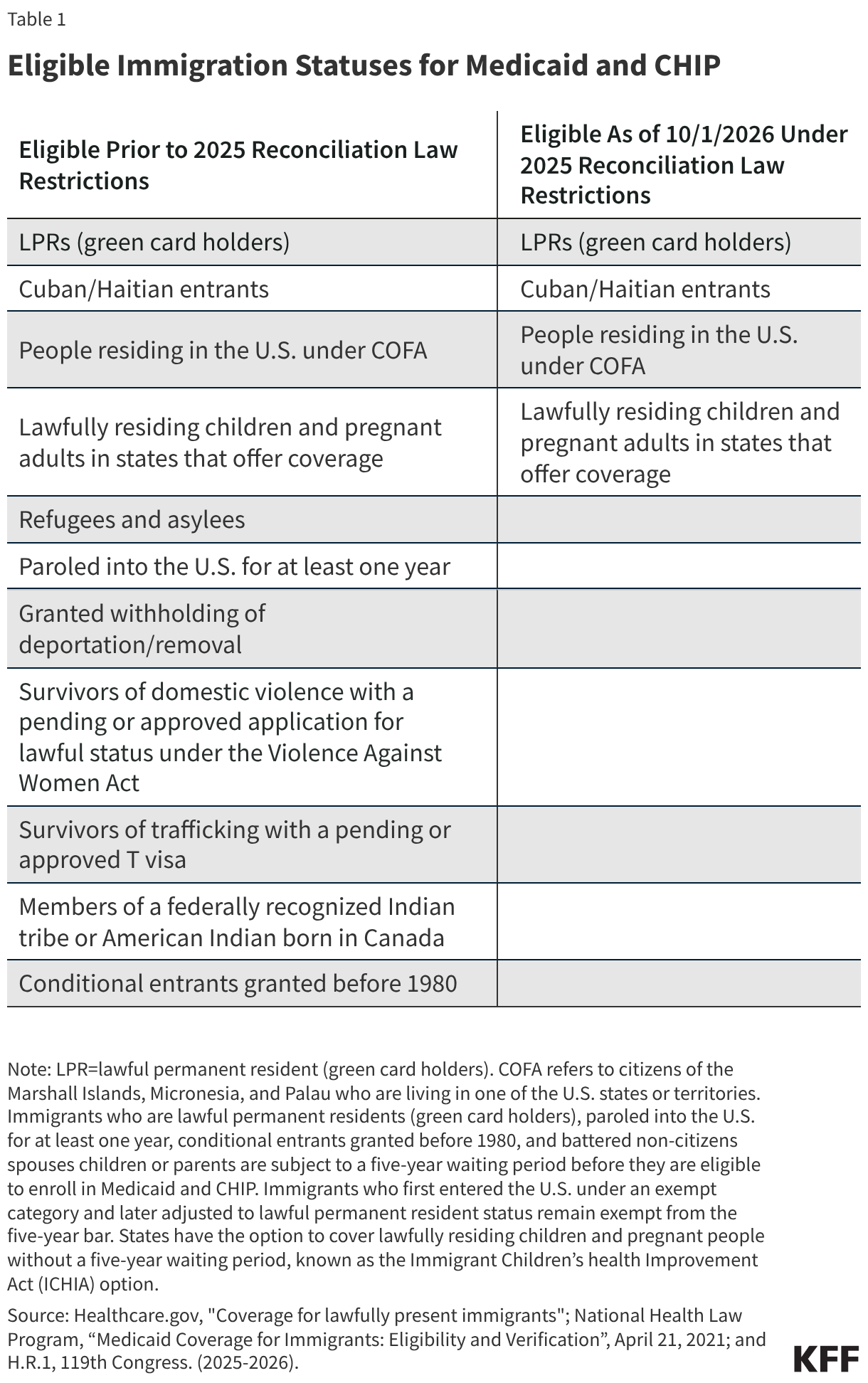
The 2025 tax and budget law, H.R.1, eliminates eligibility for health coverage and food assistance for many lawfully present immigrants, including refugees, asylees, and other humanitarian immigrants. The law restricts eligibility for Medicaid, CHIP, subsidized ACA Marketplace coverage, Medicare, and SNAP to immigrants who are Lawful Permanent Residents (LPRs or “green card” holders), certain Cuban and Haitian entrants, and citizens of the Freely Associated (COFA) nations of the Marshall Islands, Micronesia, and Palau residing in U.S. states and territories. States that have taken up an option under Medicaid and/or CHIP to cover lawfully residing children and pregnant people, who include refugees and asylees, can also maintain this coverage. Under these changes, refugees and asylees will become ineligible for these programs, except for some in states that have taken up the Medicaid and CHIP option to expand coverage for lawfully residing children and pregnant people.

Implementation dates for the eligibility restrictions vary by program. Medicaid and CHIP restrictions will take effect October 1, 2026; limits for subsidized ACA coverage will go in place January 1, 2027; Medicare coverage limits took effect July 4, 2025 (the date the law was signed), with current beneficiaries losing coverage no later than 18 months from the enactment of the legislation (January 4, 2027); and SNAP restrictions for new applicants go into effect as early as November 1, 2025, with current beneficiaries losing access at the time of their next recertification.

The U.S. also provides refugees and asylees access to certain time-limited benefits and services through the Office of Refugee Resettlement (ORR) to facilitate their transition. These include:

  • Refugee Medical Assistance (RMA): In cases where refugees and asylees are ineligible for Medicaid or CHIP, they may qualify for RMA, which had been available to refugees and asylees for up to 12 months prior to recent changes.
  • Refugee Cash Assistance (RCA): RCA provides cash assistance to refugees and asylees for basic necessities such as housing, food, and transportation. RCA had been available to refugees and asylees for up to 12 months prior to recent changes.
  • Refugee Support Services (RSS): Refugees and asylees also have access to a range of services to support employment and thereby, self-sufficiency, which include English language training, job training, childcare, and access to transportation. Access to RSS is available to refugees and asylees for up to five years.

The Trump administration has reduced access to time-limited support services that ORR provides to refugees and asylees. On March 21, 2025, the Administration for Children and Families issued a notice reducing the eligibility period for refugees and asylees to access RMA and RCA, citing budget constraints. This notice reduced access to RMA and RCA from 12 months to four months for refugees and asylees effective 45 days after the notice’s publication (i.e., May 5, 2025).

Together, these reductions are likely to exacerbate health and socioeconomic challenges faced by refugees and asylees and could also reduce their economic contributions to the U.S. Research by the Department of Health and Human Services Office of the Assistant Secretary for Planning and Evaluation (ASPE) finds that between 2005 and 2019, refugees and asylees had a net positive impact of about $124 billion on the U.S. economy, meaning that they contributed more in revenue ($581 billion) than they cost in expenditures ($457 billion) to the federal, state, and local governments. Actions to limit the assistance refugees, asylees, and other humanitarian immigrants receive when they arrive in the U.S. could create barriers to successful transition to employment and self-sufficiency and foreclose opportunities for them to make economic and workforce contributions in the future.


  1. Data on individuals granted asylum defensively in FY 2023 not available by age and sex. Affirmative asylum applies to those not in removal proceedings who apply directly to U.S. Citizenship and Immigration Services whereas defensive asylum applies to individuals already in removal proceedings. ↩︎

Survey Question Finder

KFF’s Survey Question Finder lets you to search for individual survey questions asked on all our polls since 1992. Search by keyword, date, and/or topic to find full question wording and results.

States’ Management of Medicaid Home Care Spending Ahead of H.R. 1 Effects

Authors: Maiss Mohamed, Alice Burns, and Molly O'Malley Watts
Published: Nov 20, 2025

State Findings

Over one-third of Medicaid spending pays for long-term care, with most of the spending paying for home care—also known as “home- and community-based services” or HCBS. Medicaid pays for almost 70% of all home care spending in the U.S., nearly all of which is provided through optional services. Among those optional services, states rely heavily on Medicaid “waivers” to provide home care, which allow them to manage costs using mechanisms such as capping spending or enrollment in the waiver (Box 1). States may also use waiting lists to track and manage people who want to receive but are not yet receiving home care. While waiting lists may result from caps on waiver spending or enrollment, states also used them for other administrative reasons (Box 2).

Medicaid’s significant spending on home care and the availability of mechanisms for limiting such spending could spur states to cut home care spending in response to the 2025 reconciliation law. Cutting spending on home care could result in either fewer people receiving any benefits or people receiving fewer covered services, even though the need for home care is unlikely to fall in future years. The recently passed reconciliation law is estimated to reduce federal Medicaid spending by $911 billion between 2025 and 2034, roughly a 14% reduction in federal funding for the program. During the last major reduction in federal Medicaid spending, all states reduced spending on home care by serving fewer people (40 states) or by cutting benefits or payment rates for long-term care providers (47 states).

Using data from the 23rd KFF survey of officials administering Medicaid home care programs, this issue brief describes the mechanisms states are currently using to limit Medicaid spending on home care and their plans for adopting new mechanisms in state fiscal year (FY) 2026. The survey was sent to all home care programs in all 50 states and the District of Columbia (hereafter referred to as a state), which states completed between April and July 2025. All states except Florida completed the survey, although response rates for specific questions may have been lower. States generally completed the survey prior to enactment of the reconciliation law, so changes to limit spending in FY 2026 are not attributable to the new law. Survey findings are reported by state and waiver target population, although states often offer multiple waivers for a given target population. Key takeaways include:

  • For most home care services, which are delivered through waiver programs, 44 out of the 50 responding states constrain spending through limits on either total enrollment (37 states) or on total spending (15 states, Figure 1). Most states (37) also cap waiver spending per participant for at least one waiver.
  • Most states (44) reported using mechanisms in at least one waiver to restrain spending that applies to specific services, such as limiting the amount of spending for services per participant (38 states) or limiting the quantity of personal care enrollees may receive (34 states).
  • Nearly a third of responding states (15) reported planning to adopt new strategies in FY 2026 to contain home care costs. Since most survey responses were collected before enactment of the reconciliation bill, it is not yet known how this number will change as states prepare for the forthcoming cuts to federal Medicaid spending.
  • Fewer mechanisms are available to states in managing spending for home care services provided outside of waivers, but nearly all states use prior authorization as a tool to manage that type of spending.
Nearly All States Manage Medicaid Home Care Spending with Caps on Spending or Enrollment, or by Limiting Services

Box 1: Legal Requirements and Options for Medicaid Home Care Waivers

Most Medicaid home care is provided through 1915(c) waivers, which allow states to provide home care to people who prefer to receive long-term care in their home or community rather than from an institution. The 1915(c) waiver allows states to waive several requirements of Medicaid law including that services be available statewide, and on a comparable basis to all Medicaid enrollees. States may offer a variety of unlimited services through the waiver, and states tailor the benefit packages to meet the needs of a particular target group. All services must follow an individualized plan of care. Among other requirements, 1915(c) waivers must demonstrate that the services will not cost more than institutional care would. This requirement is implemented through a cost neutrality test [see Instructions, Technical Guide and Review Criteria V3.7], that compares the per person costs of waiver services to the per person costs of providing care to similar people in an institutional setting.

States are permitted, but not required, to set limits on total enrollment or spending in a 1915(c) waiver. Enrollment limits may take several forms including the number of participants served, the number of enrollees at a given time, or the rate at which people are enrolled or disenrolled. States may also keep waiver slots available as “reserve capacity” for people to enroll on a priority basis, such as people transitioning from institutions to the community or people in crisis.

Four states also only provide home care through 1115 waivers, which offer states an avenue to test new approaches in Medicaid that differ from what is required from federal statute, if the approach is likely to “promote the objectives of the Medicaid program” in the view of the Secretary of Health and Human Services. There is no statutory requirement for waivers to be “budget neutral,” but long-standing policy and practice has required states to demonstrate budget neutrality. One way to demonstrate budget neutrality is to show that per enrollee spending over the course of the waiver does not exceed projected per enrollee spending in the absence of the waiver.

Mechanisms for Limiting Waiver Home Care Spending and Enrollment

Most states (37) manage Medicaid spending on home care by capping either total enrollment, or both total spending and enrollment (Figure 1). Most states also cap per person spending for home care waiver services. The two primary types of waivers states use to offer Medicaid home care are 1915(c) and 1115. The two waivers differ in that 1915(c) waivers are specifically used to provide Medicaid home care to people who require an institutional level of care whereas 1115 waivers can test all types of new Medicaid approaches (Box 1). Among the 50 responding states that provide home care through waivers, 15 states have caps on total waiver spending, 37 have caps on the total number of participants, and 37 have caps on spending per person (Appendix Table 1).

Box 2: Differences Between Waiver Caps and Waiting Lists

Although caps on total spending or participants may result in waiting lists when the caps result in too few waiver slots relative to the number of people who wish to receive services, in many cases, waiting lists and enrollment caps are conceptually different. In nearly all states, there are waivers that use spending or enrollment caps but don’t have waiting lists or waivers that have waiting lists without spending or enrollment caps.

States may constrain waiver spending by capping total enrollment or total spending but not have a waiting list for that waiver in the following types of situations:

  • The caps are set high enough that no people who wish to receive services are unable to do so,
  • The state allows all applicants to enroll in the waiver but limits spending by reducing the services provided, or
  • The state allocates services to people with the greatest need and refers people who are not approved for waiver services to other home care programs.

States may have waiting lists in the absence of caps on enrollment or total spending in the following types of situations:

  • People have registered to receive home care, but the state has not yet determined whether they are eligible,
  • People are determined eligible for waiver services, but they have not yet had their level of care assessed or started receiving services, or
  • People are eligible for services but not receiving them on account of provider shortages.

Use of caps on total spending, participation, or costs per participant were reported in 44 states (Figure 2). Among the 50 responding states with waivers, 44 had caps of some sort, including 15 with caps on total spending, 37 with caps on total participants and 37 with caps on spending per participant. For both 1915(c) and 1115 waivers, states are required to meet cost neutrality requirements to demonstrate that the costs per enrollee in waiver services do not exceed the per enrollee costs of institutional care (Box 1). States may meet this requirement by showing that average costs per enrollee are below the average costs of institutional care or they may establish cost limits for all participants enrolled in the waiver. States that adopt such individual cost limits [see Instructions, Technical Guide and Review Criteria V3.7] must specify the safeguards in place to address people’s needs after they have reached the individual cost limit.

Use of caps is similar for waivers that serve different target populations. Among waivers for people with intellectual or developmental disabilities (47 states) or people who are ages 65 and older or have physical disabilities (45 states), the number of states with caps on total spending (8 and 6 respectively), participation (27 and 28), and spending per participant (26 and 22) are similar. Similar trends also apply for waivers that are available in a smaller number of states (Appendix Table 2).

Less than a quarter of states (11) reported planning to adopt new mechanisms to limit waiver enrollment or spending in state FY 2026. Among states that are planning to adopt new mechanisms, caps on the number of waiver participants are most common (8 states) with few states planning to newly cap spending per waiver participant (4) or total waiver spending (1). Only two states, Maryland and Oregon, reported planning to adopt more than one mechanism (Appendix Table 4).

Nearly All States Cap Medicaid Home Care Waiver Spending or Participants

Mechanisms for Limiting the Costs of Specific Waiver Home Care Services

Most states (44) use at least one mechanism to constrain the costs of specific home care services per participant in their waivers (Figure 3). Among states with service-specific limits, caps on spending for specific services (38 states) are more common than volume-based limits such as maximum hours of personal care or number of visits (used by 34 states).

States are more likely to use spending caps for waivers that serve people with intellectual and developmental disabilities but are more likely to use volume-based limits for waivers that serve older adults and people with physical disabilities. Of the 47 states offering 1915(c) waivers serving people with intellectual and developmental disabilities, close to two-thirds of states (31) cap spending for waiver services per participant and nearly a third limit personal care hours or visits per person (15 states). For the 45 states with waivers serving people who are ages 65 and older or have physical disabilities, limits on the quantity of personal care are more common (24 states) than caps on spending for waiver services per participant (19 states). The number of states with these service caps varies for less common waivers. The maximum number of hours or visits of personal care vary by state and over a third of states determine limits through a functional assessment (19 states).

States reported capping spending on a range of different waiver services, including home and vehicle accessibility modifications and adaptive equipment and assistive technology. Home and vehicle accessibility modification limits, such as ramps and wheelchair van lifts, vary across states; Delaware and Nebraska have waivers serving people with intellectual and developmental disabilities that cap adaptations to $10,000 per participant every five years while Massachusetts waivers for the same population limit home modifications to $50,000 and vehicle modifications to $25,000 per participant in a five-year period. Some states, like Illinois, group all equipment, technology, and modifications into a combined category for spending limitations, but other states have separate caps. For example, Louisiana’s waiver serving people with intellectual and developmental disabilities caps spending on specialized medical equipment at $2,500 per year and Michigan’s waiver for people who are ages 65 and older or have physical disabilities caps spending on assistive technology at $5,000 per year.

For FY 2026, 12 states reported planning to adopt new waiver service limits to constrain costs. New caps on spending for specific types of waiver services per participant (8 states) are more common than limits on the quantity of personal care (5 states). Connecticut is the only state that reported planning to adopt both mechanisms (Appendix Table 4).

Most States Limit the Use of Medicaid Home Care Waiver Services Per Person

Use of Prior Authorization to Manage Spending on State Plan Home Care

For Medicaid home care that is provided through the state plan, states cannot use waiver-specific mechanisms for constraining costs but do generally use prior authorization. State Medicaid agencies often require enrollees to obtain approval of certain health care services or medications before the care is provided—an insurance practice commonly referred to as “prior authorization.” In Medicaid, prior authorization is used for both mandatory services, such as home health, and optional services, such as personal care, and is widely used by Medicaid managed care organizations. If the requested service is deemed not appropriate or medically necessary, the request may be denied (fully or partially), but enrollees may be able to appeal the decision through certain appeals and exemption procedures. However, the appeals process can be difficult to navigate, and individuals may be denied access to needed care while waiting for a decision. In a KFF survey conducted in July 2025, 79% of Medicaid enrollees under age 65 and 67% of those ages 65 and older found delays and denials of health care services by health insurance companies to be a major problem.

Nearly all states (47) reported using prior authorization to constrain costs on either personal care or home health services (Figure 4). Among those states, over half (26) use prior authorization for all home care services, while the remaining states (21) have this policy in place for only some services. Home health is a mandatory benefit for all states, and 40 states use prior authorization for home health. Personal care is an optional benefit offered by 33 states, and nearly all (29) use prior authorization for personal care. Common services that require prior authorization include personal care, private duty nursing, specialized equipment and technology, and home and vehicle modifications. Prior authorization is also used for home care service requests above certain thresholds (e.g. more than 40 hours per week of personal care).

States reported that prior authorization for Medicaid home care services may be conducted by various entities, including Medicaid agencies, other state entities, managed care organizations, or case managers. Across state plan services, the most common entities responsible for approving or denying services are managed care organizations (12 states), utilization management vendors (7 states), state Medicaid agencies (6 states), or other state agencies (6 states). The same entities are typically responsible for conducting prior authorization for waiver services.

States may also use prior authorization for waiver services, but it may be part of person-centered service planning requirements that apply to all 1915(c) waivers [see Instructions, Technical Guide and Review Criteria V3.7]. All services provided through a 1915(c) waiver must be specified in advance through a written service plan, also known as a plan of care. The plan is intended to provide a complete picture of how enrollees’ needs are met. The plan documents which specific waiver services will be provided to participants, including the amount, duration, and frequency of each service, and the types of providers that may furnish each service.

Nearly All States Use Prior Authorization for Medicaid Home Care State Plan Services

KFF asked states about whether they required cost sharing for home care and found that few do. Only 3 states reported requiring cost sharing for personal care offered through waivers (Georgia, Illinois, and Rhode Island) and 3 states reported requiring copayments for other waiver services (Minnesota, Oklahoma, and Rhode Island). Additionally, 3 states (Georgia, Idaho, and Maine) reported requiring copayments for home health services. No states reported adopting new copayments for state FY 2026. Starting October 1, 2028, the reconciliation law requires states to impose cost sharing of up to $35 per service on adults eligible for Medicaid through the Affordable Care Act Medicaid expansion with incomes 100-135% FPL. Nearly 400,000 Medicaid enrollees who use long-term care are eligible on account of the Medicaid expansion, and that group will be required to pay cost sharing under this requirement. It is unknown whether states will choose to apply the cost sharing requirements for home care more broadly—either on account of administrative efficiencies or as a mechanism to reduce state spending on home care in response to the historic reduction in federal Medicaid funding from the reconciliation law.

This work was supported in part by Arnold Ventures. KFF maintains full editorial control over all of its policy analysis, polling, and journalism activities. 

Appendix Tables

States Reporting Enrollment or Spending Caps on Medicaid Home Care or Tools to Limit the Use of Waiver Services
States Reporting Caps on Medicaid Home Care Waiver Spending or Enrollment for State FY 2025
States Reporting Tools to Limit the Use of Medicaid Home Care Waiver Services for State FY 2025
States Reporting Adoption of New Strategies to Contain Medicaid Home Care Waiver Costs for State FY 2026
States Reporting Prior Authorization Policies for Medicaid Home Care State Plan Services in State FY 2025

A Look at Waiting Lists for Medicaid Home- and Community-Based Services from 2016 to 2025

Authors: Alice Burns, Abby Wolk, and Molly O'Malley Watts
Published: Nov 20, 2025

Medicaid is the primary payer for long-term care (LTC) in the United States, and pays for more than two-thirds of the LTC delivered in home- and community-based settings. Most home care (also known as “home and community-based services” or HCBS) is optional for states to provide and is frequently offered through “waivers,” which allow states to cover a wide range of benefits and to choose—and limit—the number of people who receive services. KFF estimates that 5.1 million Medicaid enrollees use home care, and that about half of people are using home care through waivers. States’ ability to cap the number of people enrolled in home care waivers can result in waiting lists when the number of people seeking services exceeds the number of waiver slots available.

On July 4, President Trump signed the 2025 reconciliation law, once called the “One Big, Beautiful Bill,” that includes significant changes to the Medicaid program. The Congressional Budget Office (CBO) estimates that the new law will reduce federal Medicaid spending over a decade by $911 billion. Given the substantial share of Medicaid spending that pays for home care, and the optional nature of most home care programs, cuts to home care programs could occur as states look for ways to respond to the reductions in federal spending. If states cut home care by reducing the number of people who can receive waiver services, waiting lists could increase. Waiting lists could also increase on account of changes to immigration policy in states that use waiting lists to manage shortages of home care workers, one-in-three of whom are immigrants. The Trump Administration has made notable changes to immigration policy focused on restricting entry at the border and increasing interior enforcement efforts to support mass deportation. Those changes place increased pressure on the home care workforce, a sector that was already facing workforce shortages

This data note provides new information about waiting lists in Medicaid home care before many of the provisions in the reconciliation law go into effect. Waiting lists are an incomplete measure of unmet need (Box 1) and are not necessarily comparable across states or over time. Because of those considerations, the number of people on waiting lists could either increase or decrease in response to the federal Medicaid cuts. The data come from the 23rd KFF survey of officials administering Medicaid home care programs in all 50 states and the District of Columbia (hereafter referred to as a state), which states completed between April and July 2025. The survey was sent to each state official responsible for overseeing home care benefits (including home health, personal care, and waiver services for specific populations such as people with physical disabilities). All states except Florida responded to the 2025 survey. Survey findings are reported by state and waiver target population, although states often offer multiple waivers for a given target population. Key takeaways include:

  • Forty-one states maintain waiting lists or interest lists for people who would like to receive home care, a number that fluctuated little between 2016 and 2025.
  • In all years since 2016, there have been at least 0.5 million people on waiting lists or interest lists, with a total of over 600,000 in 2025.
  • In 2025, 12 states reported having at least one new waiting list (across 20 waivers), and 29 states reported an increase in the number of people on waiting lists or interest lists compared with only 12 states reporting a decrease.
  • Most people on waiting lists or interest lists have intellectual or developmental disabilities (I/DD) and most live in states that do not screen any people for eligibility prior to adding them to waiting lists.
  • Most people on waiting lists or interest lists are eligible for personal care provided through states’ regular Medicaid programs or for services provided through specialized state plan home care benefits.

KFF also recently updated the waiting list indicators on State Health Facts which show data by state and target population.

Box 1. Why do waiting lists provide an incomplete measure of unmet need and why is it difficult to compare waiting lists across states?

Waiting lists provide an indication of people who may need services they are not receiving, but they are an incomplete measure of unmet need for several reasons. Waiting lists reflect the populations a state chooses to serve, the services it decides to provide, the resources it commits, and the availability of workers to provide services. Waiting lists do not include people with unmet needs in the following types of circumstances:

  • States do not cover the applicable services (and therefore, have no waiting list),
  • States allow all eligible people to enroll but restrict service provision to manage total spending in the waiver, and
  • Eligible people are enrolled but providers have no excess capacity (and in some cases, the home care providers maintain their own waiting lists).

It is difficult to compare waiting lists across states because states’ approaches to managing waiting lists differ in how they prioritize and screen for eligibility. Some waiting lists include only eligible individuals while others include people for whom eligibility has not been determined. The availability of non-waiver services for people on waiting lists also varies. Although people may wait a long time to receive waiver services—32 months on average in 2025—most people are eligible for other types of home care while they wait.

Starting in 2027, states will be required to report the number of people on waiting lists as required under a final rule on access to Medicaid services, but it is unclear whether such reporting will address these data limitations on waiting lists. The data will include the number of people who are waiting to enroll in a waiver program, information on whether the people on the list have been screened for eligibility, the average amount of time people newly enrolled in the waiver over the past 12 months spent waiting to enroll, the average length of time between approval for services and service start dates, and the percent of authorized hours of care that were provided. Although the regulation does not mention interest lists, referral lists, or registries, the preamble to the rule indicates CMS’ intent for states to report all types of lists.

Despite the enhanced data states will be required to report, waiting list and waiver information will remain imperfect measures of unmet need. None of the new data will reflect how long it takes for people to receive home care provided through the Medicaid state plan, or how comprehensive services are. The new data also do not capture the number of people whose authorized services are below needed levels because of hourly or dollar caps on the amount of home care they can receive.

How Many States Have Waiting Lists for Home Care?

Between 2016 and 2025 the number of states with waiting lists has fluctuated between 37 and 41 and is currently at 41 states (Figure 1). While some Affordable Care Act (ACA) opponents have cited waiver waiting lists to argue that expanding Medicaid diverts funds from older adults and people with disabilities, research shows that ACA Medicaid expansion has led to gains in coverage for people with disabilities and chronic illnesses. Waiting lists for home care predate the ACA Medicaid expansion, which became effective in most states in 2014, and both expansion and non-expansion states have waiting lists. Waiver enrollment caps have existed since home care waiver authority was added to federal Medicaid law in the early 1980s.

The Number of States with Waiting Lists or Interest Lists for Medicaid Home Care Has Been Fairly Stable Since 2016

While the overall number of states with waiting lists did not change much from 2024 to 2025, there were more changes in waiting lists for specific types of waivers. Twelve states (across 20 waivers) reported new waiting lists, with the largest number of new waiting lists for people with intellectual or developmental disabilities (I/DD). For example, five states (Illinois, Louisiana, Missouri, Utah, and Wisconsin) reported new waiting or interest lists for waivers targeting individuals with I/DD.

Several of the new waiting lists reflect instances where states undertook efforts to increase access to care. For example, Wisconsin has a new collaborative effort with counties to identify children who are eligible for but not receiving services under the state’s waivers. This has resulted in a list of nearly 9,000 children who are deemed eligible for services but have not yet been enrolled in waivers. Indiana established a new waiver for older adults that also resulted in a new waiting list of nearly 8,000 people.

How Many People Are on Waiting Lists for Home Care?

Between 2024 and 2025, total enrollment in waiting lists and interest lists increased by 14%, and is over 600,000 in 2025 (Figure 2). Overall, there was an increase in the number of people on waiting or interest lists in 29 states and a decrease in 12 states. Most of the largest increases in waiting lists were in states that reported new waiting lists—often which represented new waivers or efforts to more proactively enroll eligible participants, as described above. Maryland reported one of the biggest decreases in waiting lists because the state increased the number of waiver slots for their program serving older adults and people with disabilities, reducing the number of people on the waiting list by over 2,000 people.

One factor that contributes to changes over time—especially the notable decline between 2018 and 2020—is that not all states screen for Medicaid eligibility prior to adding people to waiting lists and changes in this policy may result in changes in waiting list volumes. For example, between 2018 and 2020, the total number of people on waiting lists decreased by 155,000 or 19%. However, nearly half of that change came from Ohio’s implementation of a waiting list assessment of waiver eligibility, which reduced the size of the state’s waiting list by nearly 70,000 people. In 2025, most states (35) with waiting lists screen individuals for waiver eligibility among at least one waiver, but even among those states, seven do not screen for all waivers. The six states that do not screen for eligibility among any waivers (Florida, Iowa, Oklahoma, Oregon, South Carolina, and Texas) account for more than half (325,000) of all people on waiting lists.

A Disproportionate Number of People on Waiting Lists for Home Care Live in States That Don't Assess Eligibility for People Waiting

In 2025 and earlier years, a disproportionate number of people on home care waiting lists or interest lists lived in states that did not screen people on waiting lists for eligibility. One reason waiting lists provide an incomplete picture of need is that not all people on waiting lists will be eligible for services. The number of states that don’t screen for eligibility on any waiting lists ranged from six to eight states between 2022 and 2025, yet the share of individuals on waiting lists in these states ranged from 40% to 54%. Interviews about home care waiting lists found that when waiver services are provided on a first-come, first-served basis, people enrolled in waiting lists are in anticipation of future need. That study found that in some states, families would add their children to waiting lists for people with I/DD at a young age, assuming that by the time they reached the top of the waiting list, their children would have developed the immediate need for services. Many of those waivers offer comprehensive home care packages that include supported employment, supportive housing, or round-the-clock services. Among the six states that do not screen people for eligibility on any lists, three have only waiting lists, Texas has only interest lists, and two use both. (Illinois does not establish eligibility until selection but does a preliminary evaluation of eligibility prior to placing someone on the list.)

Who Is on Waiting Lists for Home Care?

Most people on waiting lists have I/DD, particularly in states that do not screen for waiver eligibility before placing someone on a waiting list. People on waiting lists for waivers serving people with I/DD (which include waivers specific to people who have autism) comprise 81% of waiting lists in states that do not screen for waiver eligibility, compared with 55% in states that do determine waiver eligibility before placing someone on a waiting list (Figure 3). People with I/DD comprise almost three-quarters (74%) of the total waiver waiting list population. Older adults and adults with physical disabilities account for nearly one-quarter (23%), while the remaining share (4%) includes children who are medically fragile or technology dependent, people with traumatic brain or spinal cord injuries, people with mental illness, and people with HIV/AIDS. People who are on home care waiting lists are generally not representative of the Medicaid population or the population that uses home care. Most people on waiting lists have I/DD, but KFF analysis shows that people with I/DD comprise fewer than half of the people served through 1915(c) waivers (the largest source of Medicaid home care spending).

Most People on Medicaid Home Care Waiting Lists or Interest Lists Have Intellectual or Developmental Disabilities

How Long Are People on Waiting Lists for Home Care?

In 2025, people on the waiting or interest lists accessed services after an average of 32 months (33 of 41 states responding), down from 40 months in 2024. People with I/DD wait 37 months on average. The average waiting period for other waiver populations ranged from 15 months for waivers targeting older adults and people with physical disabilities to 63 months for waivers that serve people with autism. People with I/DD residing in states that do not screen for eligibility wait longer for services than people with I/DD residing in states that do screen for waiver eligibility (49 months versus 32 months, on average).

Most people on waiting or interest lists are eligible to receive other types of home care while they wait. Among the 607,000 people on lists for waiver services in 2025, living arrangements are unknown for more than 445,000. Among the people whose living arrangements are known, 96% (154,000) live in the community and 4% (7,000) live in institutional settings. Although most people on waiting lists live in the community, that may not be true for all waivers. In one California waiver for older adults and people with disabilities, nearly 5,000 of the roughly 6,500 people on the waiting list are living in institutions.

While waiting for waiver services, people living in the community are likely to be eligible for other home care through Medicaid state plans. Of the over 5 million people who use home care, KFF estimates that roughly half use services provided through the Medicaid state plan, such as personal care to help with bathing or preparing meals, therapies to help people regain or acquire independent living skills, and assistive technology. States may not use waiting lists to restrict the number of people eligible to use such services and over 80% of people on home care waiting lists are eligible for personal care or other state plan services. They would not, however, have access to more specialized services such as supported employment or adult day care. People on waiting lists who receive state plan services may also have fewer hours of personal care than they would in a waiver program, or they may not have assistance with some of the activities they need help with such as bathing, dressing, preparing meals, or managing medication.