A Continuing Saga: Ending Abortion Restrictions in States with Constitutional Protections

Authors: Mabel Felix, Laurie Sobel, and Alina Salganicoff
Published: Jul 23, 2025

Since the Supreme Court overturned Roe v. Wade in June 2022, states have been able to set policy that defines abortion access across this nation. In the past three years, voters in 10 states have passed constitutional amendments to protect abortion rights. These amendments, however, do not automatically invalidate the states’ laws restricting abortion such as waiting periods, coverage bans, and ultrasound requirements. The restrictions need to be challenged in court before they can be invalidated. This process can take years, and in states with new constitutional protections, people seeking abortion care may still face access restrictions while the litigation proceeds. Additionally, in some instances, after courts have blocked restrictions, conservative state legislatures have passed laws enacting very similar restrictions, lengthening the process to block these laws, since advocates have to challenge multiple state laws or amend already-existing challenges to block the newly passed laws. This policy watch provides an update on the status of abortion restrictions in states that passed a constitutional amendment protecting abortion, or where a state court previously interpreted the state constitution as protecting abortion access.
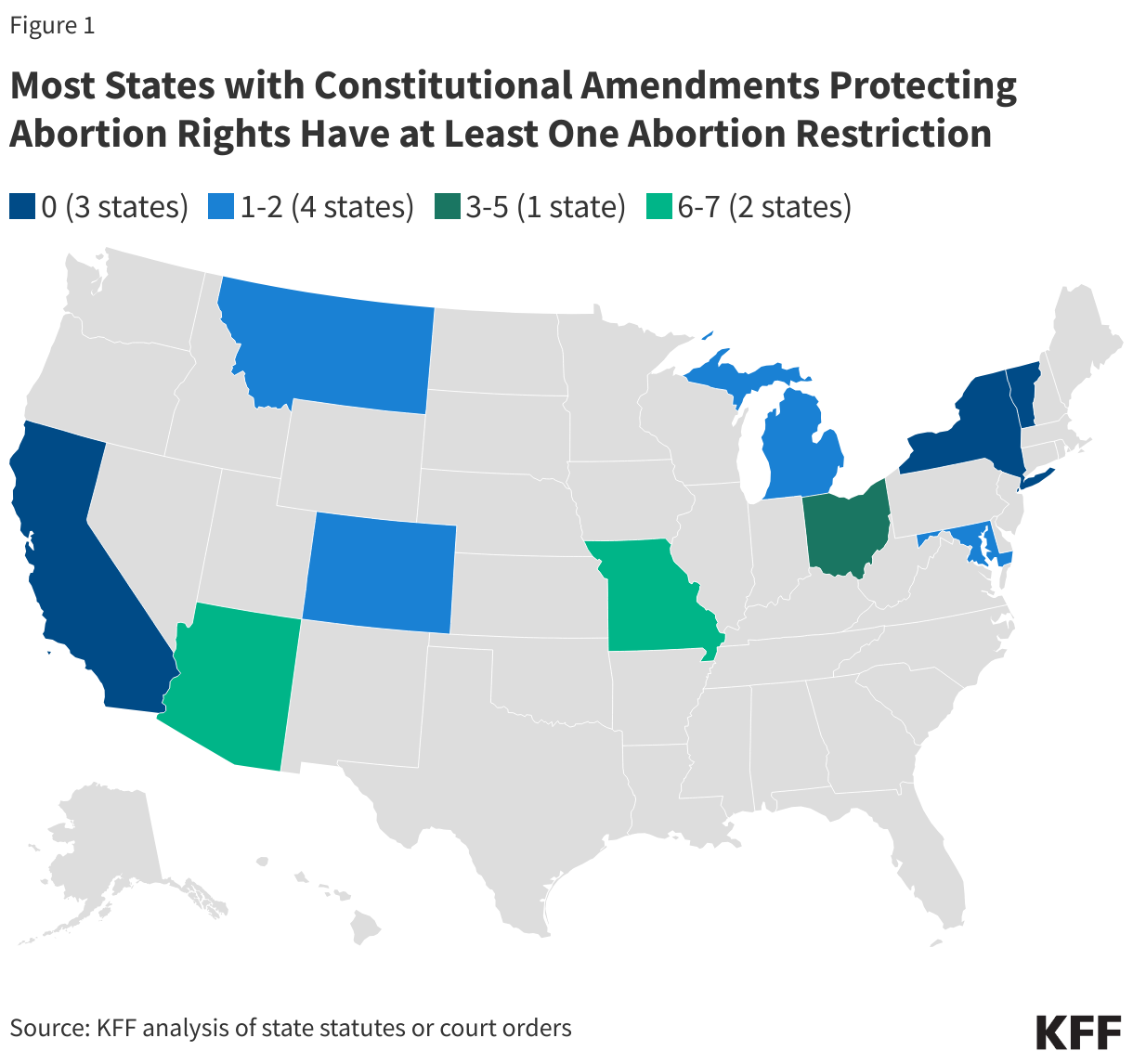
Most States with Constitutional Amendments Protecting Abortion Rights Have at Least One Abortion Restriction

Status of Litigation Based on Recent Constitutional Amendments

In four states with recently passed constitutional amendments protecting the right to abortion or a broader right to reproductive freedom — Arizona, Michigan, Missouri, and Ohio – advocates have filed lawsuits seeking to block abortion restrictions, alleging that these restrictions violate the newly passed constitutional amendments. These lawsuits test the reach of these constitutional amendments beyond pre-viability gestational limits. In Montana, another state that recently passed a constitutional amendment, abortion providers are also challenging prior abortion restrictions, but because this challenge was filed before the state’s constitutional amendment passed, they are relying on previous state supreme court precedent to make their arguments. Advocates in Alaska and Kansas, where there is no specific constitutional amendment protecting abortion, have challenged restrictions based on state supreme court cases finding abortion is protected in the state constitution.

Whether or not the restrictions that are being challenged will be permanently blocked depends on how each respective state’s supreme court interprets the state constitution’s right to abortion. The language of the constitutional amendments varies and some might provide greater protections than others (Table 9). States that rely on state supreme court precedent protecting a right to abortion—as opposed to a constitutional amendment explicitly protecting this right—may provide protections today, but future courts may overturn that precedent, much like the U.S. Supreme Court did with Roe v. Wade.

The following section provides an overview of the status of legal challenges to abortion restrictions in states with recently passed constitutional amendments or litigation that has found that the state constitution protects abortion rights.

Arizona

The Arizona constitutional amendment – passed in November 2024 – protects a fundamental right to abortion and forbids the state from enacting, adopting, or enforcing any law that “denies, restricts or interferes with that right before fetal viability unless justified by a compelling state interest that is achieved by the least restrictive means.” Currently, the gestational limit in the state is fetal viability. However, there are other restrictions that are still in effect.
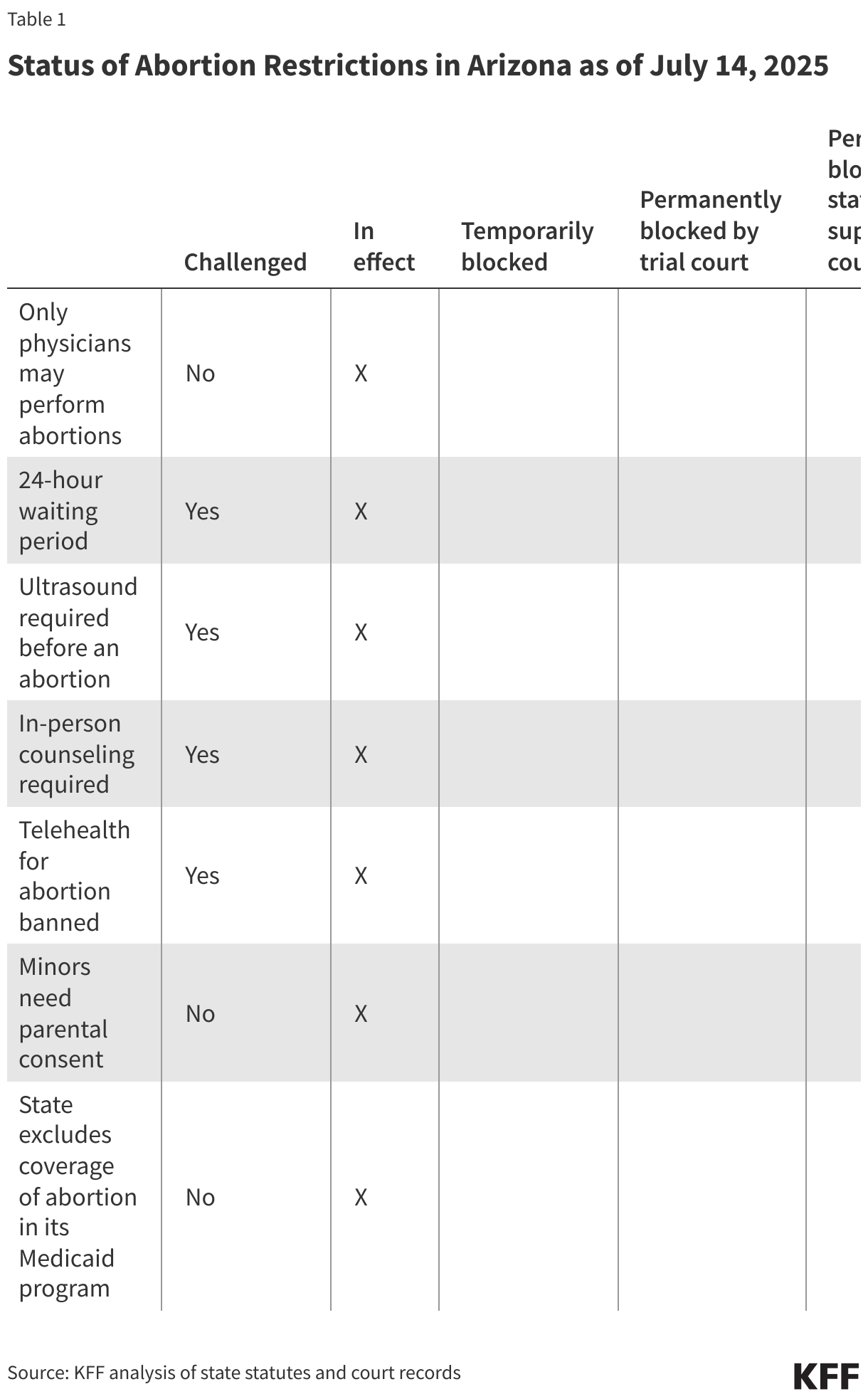
Status of Abortion Restrictions in Arizona as of July 14, 2025

Abortion rights advocates in Arizona filed a lawsuit in May 2025 challenging the in-person counseling requirement, 24-hour waiting period, ultrasound requirement, and ban on the use of telehealth for abortion care. The state court where this challenge was filed is yet to issue a ruling.

Michigan

In November 2022, voters passed a constitutional amendment in Michigan that protects a fundamental right to reproductive freedom, the right to make decisions regarding pregnancy, including the right to abortion, among others. It states that “[a]n individual’s right to reproductive freedom shall not be denied, burdened, nor infringed upon unless justified by a compelling state interest achieved by the least restrictive means.”

The state has no gestational limit on abortion, however, a state funding ban on abortion funding for Medicaid enrollees and a parental consent requirement are still in effect.
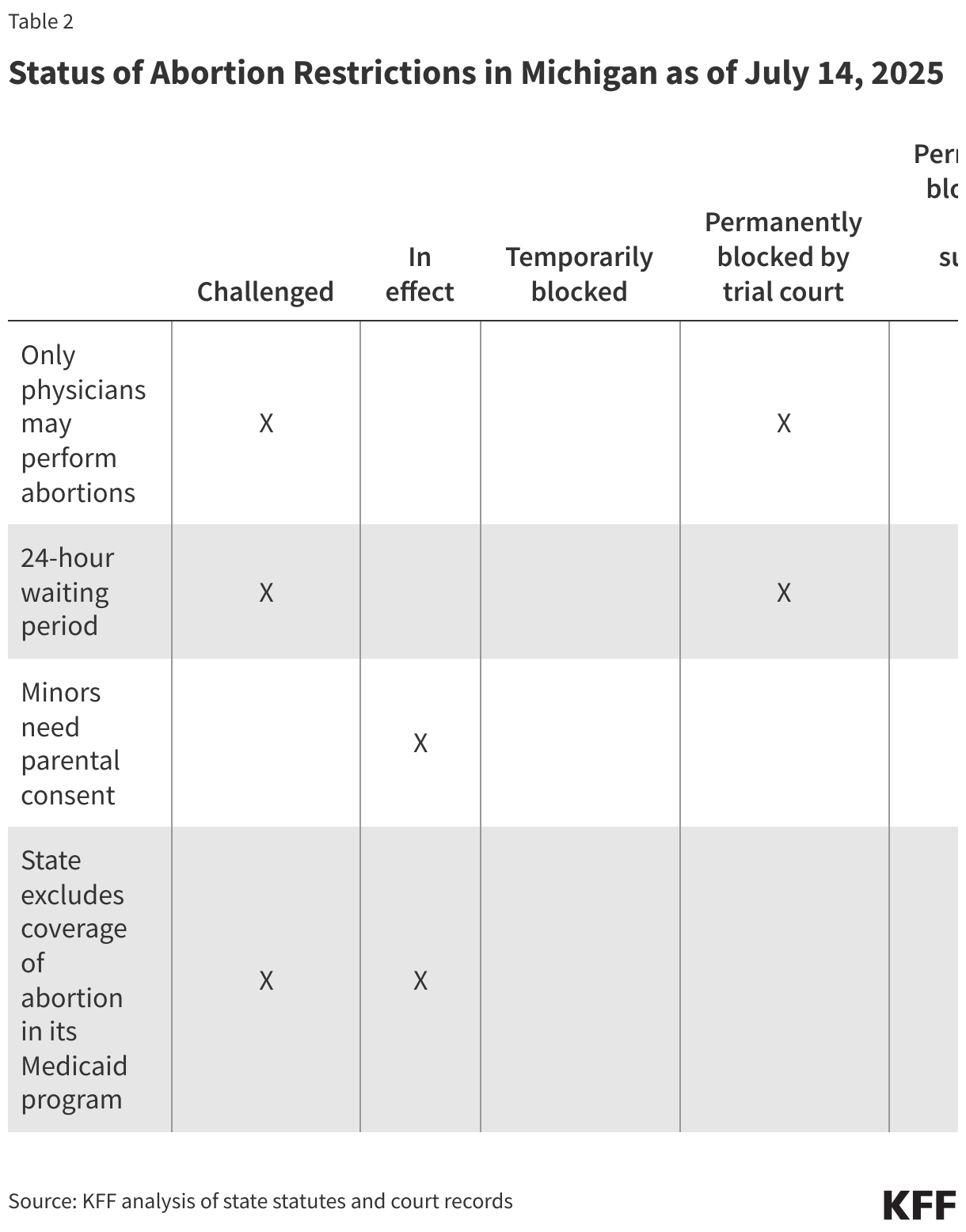
Status of Abortion Restrictions in Michigan as of July 14, 2025

In two separate lawsuits, advocates in Michigan are challenging the exclusion of abortion coverage from the state’s Medicaid program and laws requiring a 24-hour waiting period and limiting abortion provision to physicians. A trial court recently ruled that the latter two requirements are unconstitutional and blocked them permanently. However, the state’s supreme court is yet to rule on these restrictions.

Missouri

In November 2024, voters in Missouri passed a constitutional amendment protecting a fundamental right to reproductive freedom, including the right to make decisions about abortion care. The amendment states that this right “shall not be denied, interfered with, delayed, or otherwise restricted unless the Government demonstrates that such action is justified by a compelling governmental interest achieved by the least restrictive means. Any denial, interference, delay, or restriction of the right to reproductive freedom shall be presumed invalid.” Currently, the gestational limit in the state is fetal viability, but other restrictions are still in effect.

Status of Abortion Restrictions in Missouri as of July 14, 2025

Several clinics in Missouri filed a lawsuit alleging that the state’s pre-viability bans as well as many restrictions violate the state’s newly granted constitutional right to reproductive freedom. In December 2024, a Missouri state trial court sided with the clinics, and blocked the state’s pre-viability abortion bans, as well as many of the restrictions, while the litigation continues. However, in late May 2025, the Missouri Supreme Court lifted the preliminary injunction for the restrictions, and ordered the trial court to use a more strenuous test to determine if the plaintiffs meet the bar for a preliminary injunction. When restrictions went back into effect, clinics stopped providing abortion care, even though the total ban was not in effect. The case went back before the trial court, where the judge reviewed the request for a preliminary injunction using the standard set forth by the state supreme court and in response issued an order on July 3, 2025 blocking once again the state’s pre-viability ban and some restrictions, including the 72-hour waiting period. The state has appealed this order to the Missouri Supreme Court.

Ohio

The Ohio constitution was amended by voter initiative in November 2023 protecting the right to make and carry out reproductive decisions, including decisions about abortion care. Per the amendment, “[t]he State shall not, directly or indirectly, burden, penalize, prohibit, interfere with, or discriminate against… the exercise of this right, unless the State demonstrates that it is using the least restrictive means to advance the individual’s health in accordance with widely accepted and evidence-based standards of care.”

Currently, the gestational limit in the state is 22 weeks LMP (last menstrual period), however, are other restrictions are still in effect or temporarily blocked.
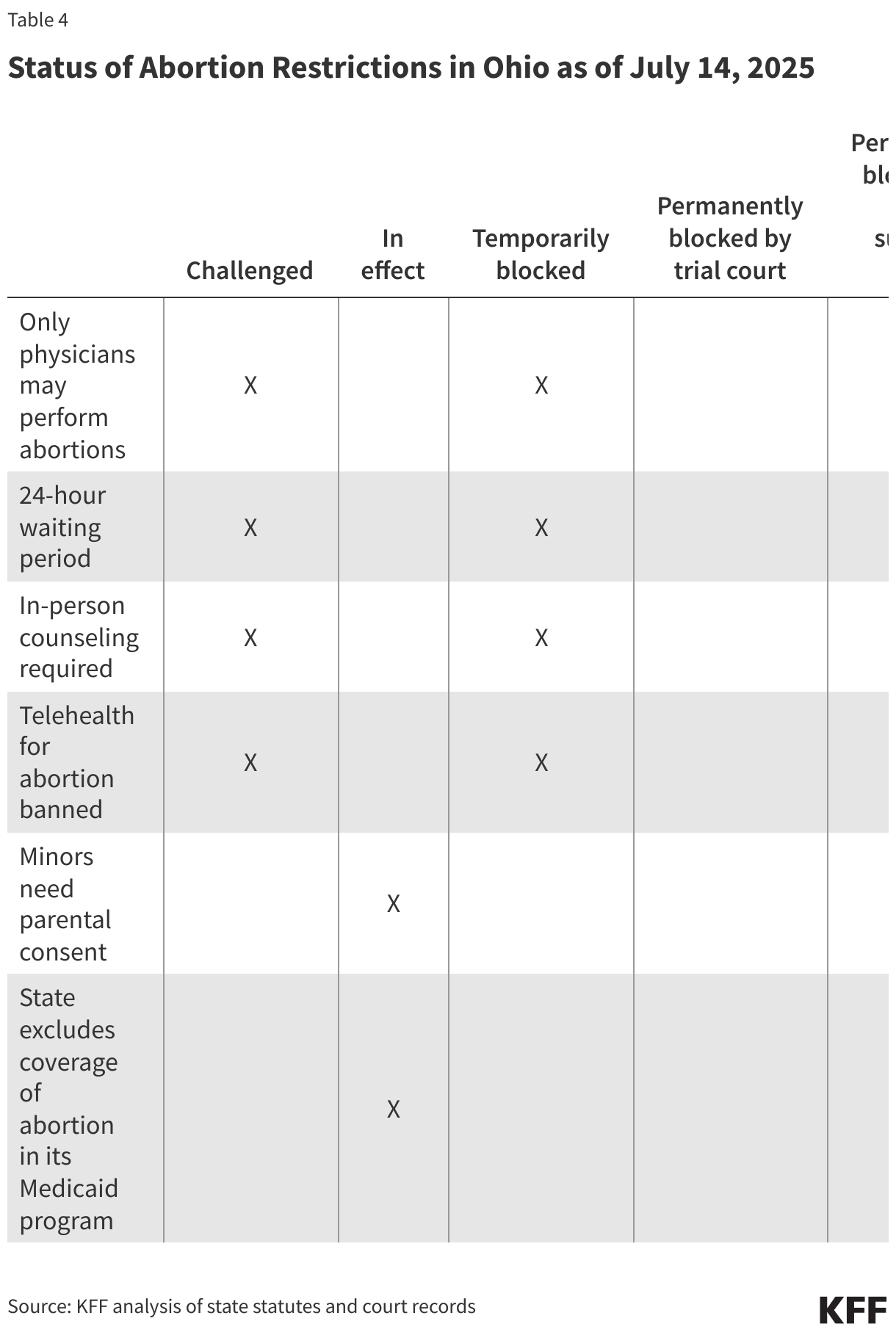
Status of Abortion Restrictions in Ohio as of July 14, 2025

In two different lawsuits, abortion providers in Ohio challenged the 24-hour waiting period, the in-person counseling appointment, the telehealth abortion ban, and a law that limits the provision of abortion care to physicians. Abortion providers used the state’s constitutional amendment as the basis for these challenges. In both of these lawsuits, the trial courts have temporarily blocked the challenged restrictions while litigation proceeds. After the constitutional amendment was passed by voters, some Ohio legislators sought to curtail judges’ ability to block these laws and interpret the constitutional amendment, but these efforts did not progress.

Status of Litigation in States with State Supreme Court Precedent Protecting the Right to Abortion

Alaska

In 1997, the Alaska Supreme Court found that the state constitutional right to privacy protects the right to abortion. The state has no gestational limit on abortion, however, other restrictions are still in effect.

Status of Abortion Restrictions in Alaska as of July 14, 2025

Advocates in Alaska are challenging a law that limits abortion provision to physicians, using previous state supreme court precedent as the basis for their challenge. This requirement was originally blocked by a preliminary injunction in 2021 and in September 2024, a state trial court ruled that the requirement violates the constitutional protection for the right to abortion.

Kansas

In 2019, the Kansas Supreme Court found that the Kansas Bill of Rights includes the right to abortion. The gestational limit in the state is 22 weeks LMP (last menstrual period), other restrictions are still in effect.

Status of Abortion Restrictions in Kansas as of July 14, 2025

In Kansas, advocates are challenging a 24-hour waiting period law that is temporarily blocked due to a court order while litigation proceeds and a law banning advanced practice registered nurses from providing medication abortion care. Advocates in Kansas have also used Kansas Supreme Court precedent to successfully challenge laws that limit the provision of abortion care to physicians and require ultrasounds before an abortion, as well as in-person dispensing of medication abortion.

Montana

In 1999, the Montana Supreme Court found that the state constitution protects the right to abortion. In 2024, the Montana Supreme Court reaffirmed this protection.

In addition, voters approved an amendment in November 2024 recognizing an individual’s right to make decisions about pregnancy, including the right to abortion. It states that “[t]his right shall not be burdened unless justified by a compelling government interest achieved by the least restrictive means.”

The gestational limit in the state is fetal viability, however, a state parental consent law is still in effect.
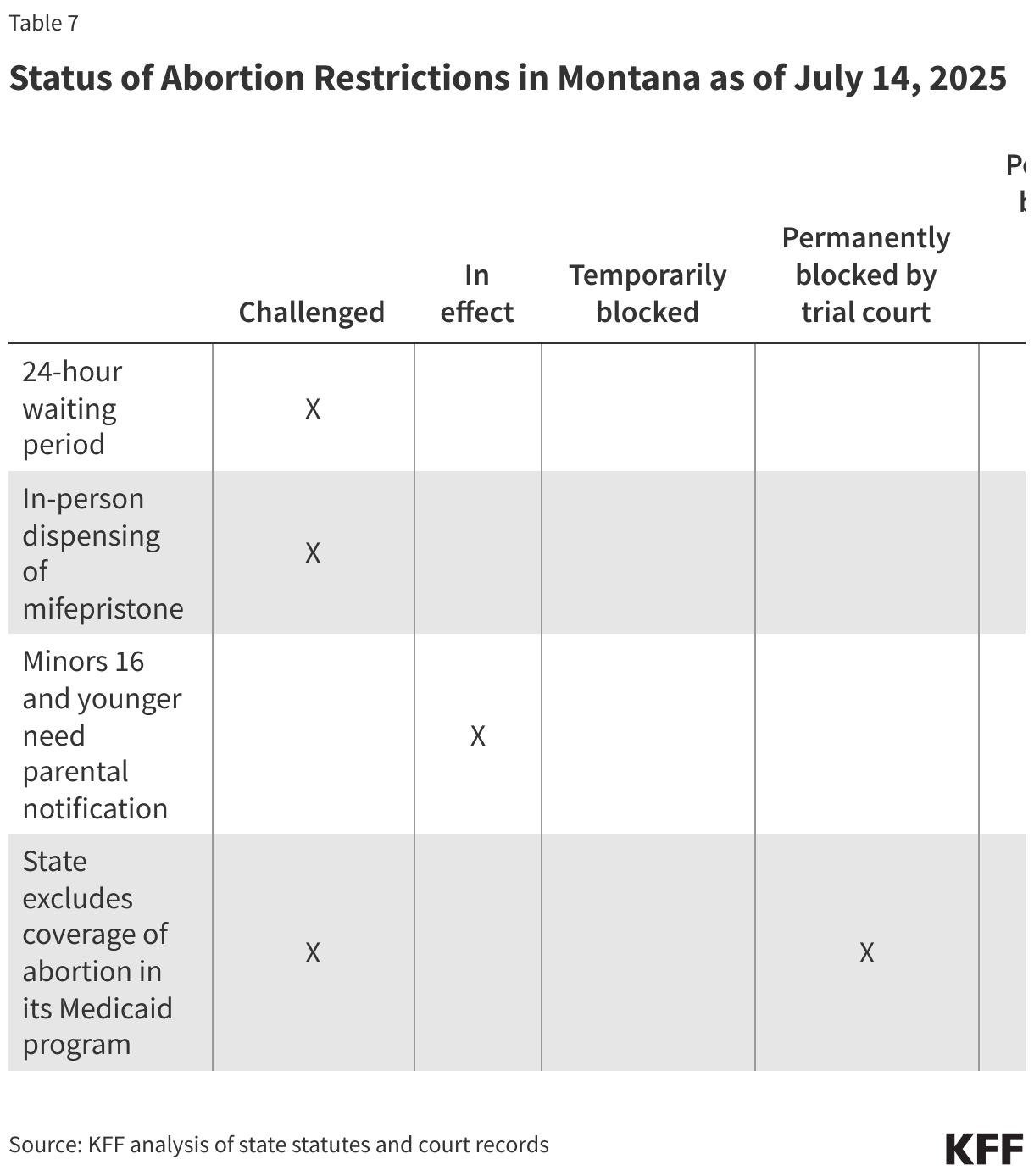
Status of Abortion Restrictions in Montana as of July 14, 2025

Abortion providers in Montana are challenging a law that excluded abortion coverage from the state’s Medicaid program, relying on previous Montana Supreme Court precedent that held that the state constitutional protection for privacy includes a protection for the right to abortion, instead of relying on the state’s newly passed constitutional amendment, since the challenge was underway before the constitutional amendment passed. In March 2025, a trial court ruled that this restriction is unconstitutional and permanently blocked it. Additionally, the Montana Supreme Court recently concluded in a different case that was also brought by abortion providers, that restrictions including an in-person dispensing requirement, a 24-hour waiting period, and a ban on telemedicine for abortion were unconstitutional. These restrictions are no longer in effect.

State Lawsuits Challenging Abortion Restrictions
Language of State Constitutional Amendments Protecting Abortion Rights

Allocating CBO’s Estimates of Federal Medicaid Spending Reductions Across the States: Enacted Reconciliation Package

Published: Jul 23, 2025

Editorial Note

Originally published on July 1 with estimates for the Senate Reconciliation Bill, this brief was revised significantly and updated on July 23 to reflect the latest CBO estimates on the impact of the enacted reconciliation package.

On July 4, President Trump signed into law a budget reconciliation package once called the “One Big, Beautiful Bill” that made major reductions in federal health care spending to offset part of the costs of extending expiring tax cuts. The Congressional Budget Office’s (CBO) latest cost estimate shows that the reconciliation package would reduce federal Medicaid spending over a decade by an estimated $911 billion (after accounting for interactions that produce overlapping reductions across different provisions of the law) and increase the number of uninsured people by 10 million. Building on prior KFF analysis of the House-passed reconciliation bill, this analysis allocates CBO’s federal spending reductions in the enacted reconciliation package across the states. The Medicaid reconciliation provisions are numerous and complicated, but the majority of federal savings stem from work requirements for the Affordable Care Act (ACA) expansion group, limiting states’ ability to raise the state share of Medicaid revenues through provider taxes, restricting state-directed payments to hospitals, nursing facilities, and other providers, and increasing barriers to enrolling in and renewing Medicaid coverage.

This analysis allocates the CBO’s estimated reduction in federal spending across states based on KFF’s state-level data and where possible, prior modeling work; and shows the federal spending reductions relative to KFF’s projections of federal spending by state under current law. KFF allocates the spending reductions provision-by-provision, pulling in a variety of data sources on which states are estimated to be most affected by each provision (see Methods). The total Medicaid spending cuts, nationally and by state, equal the sum of spending changes for each Medicaid provision ($990 billion over 10 years) less KFF’s estimate of the CBO interaction effects that are tied to Medicaid interactions ($79 billion over 10 years, see Methods). KFF did not apply the interaction effects to the estimated effects for each provision because it is unknown which provisions are driving CBO’s estimated interactions. The estimates exclude the $50 billion in funding for state grants through a Rural Health Transformation Program because it is highly uncertain how those funds will be allocated across the states.

CBO has not published updated estimates of the number of people who would lose Medicaid under the reconciliation package once called the “One Big, Beautiful Bill,” so this analysis does not include updated enrollment estimates like those included in KFF’s analysis of the House-passed reconciliation bill. CBO’s most recent estimate of Medicaid enrollment loss from an earlier version of the House reconciliation bill was 10.3 million people in 2034, which was associated with a $625 billion decrease in Medicaid spending (reflecting preliminary estimates prepared for the House Committee on Energy and Commerce). Given the Medicaid spending reductions are considerably larger in the enacted reconciliation package, more than 10.3 million people are likely to lose Medicaid.

This analysis does not predict how states will respond to federal policy changes, and anticipating how states will respond to Medicaid changes is a major source of uncertainty in CBO’s cost estimates. Instead of making state-by-state predictions, CBO generates a national figure by estimating the percent of the affected population that lives in states with different anticipated types of policy responses. For example, different states might choose to implement a work requirement with reporting requirements that are easier or harder to comply with. In estimating the costs of the legislation, CBO assumes that in aggregate, states would replace half of reduced federal funds with their own resources in response to provisions that reduce the resources available to states, such as limits on provider taxes. For provisions that reduce enrollment but don’t affect the division of costs between the federal and state governments, such as work requirements, CBO estimates that the federal and state Medicaid spending would go down. However, those assumptions reflect states’ responses as a whole and are likely to vary and may not apply in all states.

To the extent that states’ responses are far different from the overall average response, changes in federal Medicaid spending will be larger or smaller than what is shown here. States could make further Medicaid cuts, which would result in spending reductions greater than is estimated here and further reduce states’ Medicaid spending. Alternatively, states could increase their spending on Medicaid to mitigate the effects of federal cuts, which could result in spending reductions that are smaller than is estimated here. This analysis illustrates the potential variation by showing a range of spending effects in each state, varying by plus or minus 25% from the CBO estimated midpoint.

Key Take-Aways

  • After accounting for CBO’s estimated interactions, KFF estimates that the enacted reconciliation package would reduce federal Medicaid spending by $911 billion. (Without accounting for interactions, the total is $990 billion, see Methods).
  • The five biggest sources of Medicaid savings in the reconciliation package sum to $851 billion in savings, which is 86% of the gross savings (before accounting for interactions) and include:
    • Mandating that adults who are eligible for Medicaid through the ACA expansion meet work and reporting requirements ($326 billion),
    • Establishing a moratorium on new or increased provider taxes and reducing existing provider taxes in expansion states ($191 billion),
    • Revising the payment limit for state directed payments ($149 billion),
    • Increasing the frequency of eligibility redeterminations for the ACA expansion group ($63 billion).  
  • Provisions that would only apply to states that have adopted the ACA expansion account for $526 billion, over half of the total gross federal spending reductions.
  • Over three-quarters (76%) of the ten-year reductions in federal Medicaid spending in the reconciliation package would occur in the final five years of the period. While policy effects do typically compound overtime, many of the health care spending reductions are also backloaded and occur from 2030 through 2034.
  • Federal cuts to states of $911 billion over 10 years would represent 14% of federal spending on Medicaid over the period. The spending cuts vary by state; Louisiana, Illinois, Nevada, and Oregon are the most heavily affected with spending cuts of 19% or more over the period.
Federal Medicaid Cuts in the Enacted Reconciliation Package, By Year
Federal Medicaid Cuts in the Senate Reconciliation Bill, By State


Methods

Data: This analysis uses the latest data available from various data sources to illustrate the potential impact of a $911 billion cut to federal Medicaid spending across states. Data sources include:

Estimating Total Federal Funding Reductions After Interactions: CBO’s cost estimate provided the reduction in federal outlays for Medicaid provisions, which summed to $990 billion excluding interactions and the $50 in funding for state grants through a Rural Health Transformation Program. (KFF summed CBO’s estimated changes in outlays and not budget authority. The analysis does not include associated reductions in federal revenues associated with the Medicaid provisions, which reflect reduced federal income taxes stemming from a small number of people who would newly have private health insurance after losing Medicaid.)

The Medicaid provisions are part of Title VII Subtitle B, which is estimated to reduce federal outlays by $1.2 trillion before accounting for interactions and without the Rural Health Transformation Program funding. KFF assumed that 82% of the reduction in outlays due to interactions was attributable to Medicaid because the Medicaid provisions accounted for 82% of the overall reduction in outlays. The interaction reduced the effects of the Medicaid provisions by $79 billion so the total estimated reduction in Medicaid spending is $911 billion. KFF did not apply the $79 billion in estimated interaction effects by provision as the interactions would not apply to all provisions equally and the CBO cost estimate does not provide enough detail to allocate across Medicaid provisions. KFF excluded the $50 billion in funding for the Rural Health Transformation Program because it is highly uncertain how those funds will be allocated across the states.

Allocating Federal Funding Reductions Across States: This analysis allocates the ten-year federal Medicaid cut across states as follows:

  • Changes that would affect the Affordable Care Act (ACA) expansion group, including work requirements, were allocated across expansion states proportionally to federal spending on people eligible through the ACA expansion in FY 2024.
  • Wisconsin is a non-expansion state, but adults eligible for Medicaid through their waiver could be subject to the work requirements provision. KFF estimated the percentage of spending that was Wisconsin's "ACA-equivalent" by comparing the percentage of total federal spending that paid for adults ages 19-64 who were not eligible on the basis of disability in Wisconsin to that of other non-expansion states (24% and 11% respectively). KFF assumed that the "extra" spending on adults in Wisconsin comprised the state's "ACA-equivalent" spending.
  • Ending the increased share of federal spending for states that adopt the Medicaid expansion in future years is allocated across the states that had not adopted the expansion as of May 2025, proportionally to total federal spending.
  • Changing the requirements for state-directed payments was allocated in two parts. Spending reductions equivalent to those in the House-passed bill were allocated across states that have state-directed payments in place in FY 2024 (according to KFF’s budget survey or to KFF’s analysis of state-directed payments submitted to CMS), proportionally to KFF’s estimates of federal spending on managed care in FY 2023 (which are calculated using total managed care spending in FY 2023 divided by the federal percentage of Medicaid spending in FY 2023). The difference between the spending reductions in the House-passed bill and the spending reductions in the enacted reconciliation package was allocated across states identified as likely and possibly affected in a prior KFF analysis proportionally to those states’ estimated federal spending on managed care.
  • Limiting the use of Medicaid provider taxes was allocated in two parts. Spending reductions equivalent to those in the House-passed bill were allocated across states proportionally to their share of federal spending in FY 2024. The difference between the spending reductions in the House-passed bill and the spending reductions in the enacted reconciliation package was allocated proportionally to federal spending only in expansion states with hospital or managed care organization (MCO) provider taxes in excess of 3.5% of net patient revenues, as identified in a prior KFF analysis.
  • Waiving the uniform tax requirement for Medicaid provider taxes is similar to a recent proposed rule that would require changes to provider taxes in California, Massachusetts, Michigan, and New York. Thus, 50% of the CBO estimate for this provision was allocated to those states. The remainder of the CBO estimate was allocated proportionally to federal spending on managed care among states that have taxes on Medicaid managed care organizations in FY 2025.
  • Reducing the maximum home equity limit was allocated based on federal spending for Medicaid enrollees who used long-term care in 2021 (the most recent year of data) among states that have home equity limits greater than $1 million as of 2025.
  • All other provisions (including interaction effects) were allocated across states proportionally to their share of federal spending in FY 2024.

For all estimates, the federal share of spending in FY 2024 is estimated using a 90% match rate for the ACA expansion group and the FY 2024 traditional federal match rates plus a 1.5 percentage point increase for the first quarter of FY 2024 (accounting for the final phase out quarter of the pandemic-era enhanced federal match rate) for the remaining eligibility groups.

Limitations: This analysis allocates the CBO’s estimated reduction in federal spending across states based on KFF’s state-level data and where possible, prior modeling work. The most significant limitations of this approach are as follows.

1. CBO’s estimated reduction in federal spending is distributed across states based on the policies they had in place at the time of enactment and their Medicaid spending in the most recent year for which data were available (usually FY 2024). The analysis does not account for future changes in state Medicaid policy. For example, the analysis does not account for the enrollment effects in states that had not expanded the ACA as of FY 2025 but would have done so in future years.

2. The analysis does not attempt to predict state behavior and to the extent that states respond in ways that differ greatly from the expected national effects, the spending estimates may be outside of the range reported in this analysis.

Physician Workforce Diversity by Race and Ethnicity

Published: Jul 22, 2025

Introduction

Racial and ethnic disparities in health outcomes remain persistent in the United States, driven by inequitable access to and utilization of health care services and broader social and economic factors that reflect historical and ongoing racism. One factor that can mitigate these disparities is racial concordance between physicians and patients, that is, when providers and patients share the same racial or ethnic background. Research suggests that patient and provider racial concordance may be linked to increased visits for preventative care, greater treatment adherence, and lower emergency department use. One study found that greater representation of Black primary care physicians was associated with increased life expectancy and lower mortality among Black people. KFF 2023 survey data show Black, Hispanic, and Asian adults who have more health care visits with providers who share their racial and ethnic background more frequently report having positive and respectful interactions. Despite these benefits, many people of color face challenges accessing racially concordant providers. KFF survey data show that most Hispanic, Black, Asian, and American Indian and Alaska Native (AIAN) adults say that fewer than half of their health care visits in the past three years were with a provider who shared their racial or ethnic background. While data show that adults of color are more likely than White adults to prefer a provider of the same race or ethnicity, they are significantly less likely to have one and are more likely to have difficulty finding one.

Recent policy changes may exacerbate challenges to obtaining racially concordant care for those who value it most. In 2023, the U.S. Supreme Court effectively ended race-conscious admissions in higher education, overturning decades of precedent supporting affirmative action. Additionally, as one of his initial actions in office, President Trump issued executive orders eliminating federal diversity, equity, inclusion, and accessibility (DEIA) related programs and actions in the federal government and among federal contractors and grantees. These actions may reduce matriculation rates for students of color and reverse progress in diversifying the health care workforce to reflect the population it serves. For instance, research indicates that the Supreme Court’s 2023 ruling has already led to a decline in the number of Black, Hispanic, and AIAN students entering medical school. Among Black, Hispanic, AIAN, and Native Hawaiian and Pacific Islander (NHPI) medical school enrollees, there was a decline in matriculants between 2023 and 2024. Despite there being more Black and Hispanic applicants in 2024 compared to the previous year, the number of matriculants from historically underrepresented groups declined. It’s unclear how much impact the Supreme Court ruling has already had on medical school matriculation. However, the ruling has the potential to further decrease the diversity of the future physician workforce.

This brief provides an overview of the racial and ethnic composition of physicians compared to the total population at the national and state level based on KFF analysis of 2023 Association of American Medical Colleges (AAMC) Physician Workforce data and American Community Survey data. This analysis shows that Hispanic, Black, AIAN, and NHPI people were underrepresented among physicians relative to their share of the population, with the widest gap observed among Hispanic people who comprised 20% of the total population but only 7% of the total physician workforce. The pattern of underrepresentation held true across most states for Hispanic and Black people, with particularly large gaps for Hispanic people. Asian people accounted for a higher share of physicians than their share of the total population nationally and in all states; in most states, the share of White physicians was similar to or higher than their share of the total population. Data were not available for AIAN and NHPI populations in many states due to small numbers.

Racial and Ethnic Distribution of Physicians

Nationally, Hispanic, Black, AIAN, and NHPI people were underrepresented among physicians relative to their share of the population with the widest gap observed among Hispanic people. While one in five people in the U.S. population was Hispanic, they accounted for just 7% of the physician workforce (Figure 1). Similarly, 12% of the population was Black compared to 6% of the physician workforce. AIAN and NHPI individuals were also underrepresented among physicians compared to their share of the overall population. However, the absolute differences were small, as both groups make up less than one percent of the total population and the physician workforce. In contrast, White people accounted for similar shares of the total population and physician workforce, and Asian people accounted for a larger share of physicians (19%) than their share of the population (6%).

Distribution of People by Race and Ethnicity in the Total Population and Physician Workforce

Across most states, Hispanic and Black people made up a smaller share of physicians compared to their share of the total population, with particularly large gaps for Hispanic people. In 45 states and DC, Hispanic people accounted for a smaller share of providers than their share of the population, as measured by a more than one percentage point difference (Figure 2). In seven states, the difference between the share of the population and providers who are Hispanic was over 15 percentage points. These tended to be states with the highest shares of Hispanic people, including New Mexico, California, and Texas. In New Mexico, Hispanic people made up nearly half (48%) the population but accounted for 17% of providers (a difference of 31 percentage points). In California and Texas, about 40% of the population was Hispanic compared to 7% and 13% of physicians, respectively. In only five states (West Virginia, Vermont, Maine, Mississippi, and Ohio) did Hispanic people account for a similar share of the population and the physician workforce, with a difference of less than one percentage point.

The Hispanic Population Was Most Underrepresented Among Physicians in the West and Southwest

Similarly, in 35 of 50 states and DC, Black people made up a smaller share of physicians compared to their share of the population. In five states and DC, the difference between the share of the population and providers who are Black was 15 percentage points or higher, with the largest gap of 26 percentage points in DC and Mississippi (Figure 3). In DC, 17% of providers were Black compared with 43% of the population, and in Mississippi, Black people made up 11% of physicians compared with 37% of the population.

The Black Population Was Most Underrepresented Among Physicians in the Southeast

Data were insufficient for comparisons for AIAN and NHPI people in most states, but where data were available, AIAN and NHPI people were underrepresented among physicians relative to their share of the population. This pattern was most prominent in states where the majority of AIAN and NHPI people live. For example, In Alaska, AIAN people accounted for 14% of the population, seven times higher than their share of physicians (2%). Additionally, in New Mexico, AIAN people made up 9% of the population compared to 2% of providers, and in South Dakota they comprised 7% of the population compared with 1% of providers. Similarly, in Hawaii, NHPI people made up 10% of the population compared to 2% of physicians. In most remaining states, AIAN and NHPI people accounted for both a small share of the population and providers, so absolute differences in their shares were small.

Asian people accounted for a higher share of physicians than their share of the total population in all states. The largest differences were in Illinois, California, Delaware, and Texas. In Illinois, Asian people made up more than one in four physicians but accounted for only about 5% of the population (Figure 4). There were sizeable differences in the states with the highest shares of Asian people. In Hawaii, 37% of the population was Asian compared with 43% of providers, and in California, 15% of the population was Asian versus 32% of providers. The differences were smaller in other states, like Alaska, Montana, and Vermont, where Asian people accounted for a small share of both providers and the population.

The Asian Population Was Broadly Overrepresented Among Physicians in All States

In most states, the share of White physicians was similar to or higher than their share of the total population. States where White people were most underrepresented among physicians compared to their share of the population included West Virginia (67% vs. 90%), North Dakota (67% vs. 83%), and Michigan (58% vs. 73%) (Figure 5). The pattern in these states reflected higher representation of Asian people among physicians. States where White people were most overrepresented among physicians compared to their share of the population included New Mexico (56% vs. 37%), Alaska (77% vs. 58%), and Mississippi (70% vs. 55%).

The White Population Was Most Overrepresented Among Physicians in the Midwest

A similar pattern was observed across medical specialties, with Hispanic and Black individuals underrepresented in more specialties than other racial and ethnic groups. Specialties providing primary care—such as family medicine, pediatrics, and obstetrics/gynecology—tended to better reflect the racial and ethnic distribution of the population. Among all specialties, providers in nephrology and interventional cardiology had the least racial and ethnic representation compared to the national population. The Hispanic population was the most underrepresented group in more than half of the specialties analyzed (27 out of 51 specialties). The Black population was the most underrepresented group in 9 out of 51 specialties.

Methods

KFF collected U.S. Physician Workforce data from the Association of American Medical Colleges (AAMC) from the dashboard for 2023, aggregated by specialty and location. Although race/ethnicity data were provided as “alone or in combination,” categories were treated as exclusive in the analysis since a “multiracial” option was provided. Respondents with unknown race/ethnicity were proportionally distributed within each state to all other categories. Due to values being masked due to small cell sizes, only the Asian, Black, Hispanic, and White categories were used in the provider specialty analysis, where only specialties with more than 5,000 active physicians were included. For comparison to the population at large, 5-year estimates from the 2023 American Community Survey were used to determine the racial and ethnic distribution of the total population for each state, using single-response values for not Hispanic or Latino, and any response for Hispanic or Latino. To determine how well the active physician population matches the national population for each specialty, an index of dissimilarity was used, proportional to the total percentage point difference in the race/ethnicity share of providers and the country overall. To assess the robustness of this method, Kullback–Leibler divergence was calculated for each specialty, a measure of statistical distance between the race/ethnicity distribution among physicians and that of the national population. Rank order among the specialties was similar for both methods.

News Release

Victoria DeFrancesco Soto Joins KFF Board of Trustees

Published: Jul 21, 2025

San Francisco – KFF announced today that Dr. Victoria DeFrancesco Soto has joined KFF’s Board of Trustees. DeFrancesco Soto is the Dean of the Clinton School of Public Service at the University of Arkansas and previously served as Assistant Dean at the LBJ School of Public Affairs at the University of Texas at Austin. She has served as a trusted voice of political analysis for NBC News and Telemundo.

“It is my honor to serve on the KFF board,” said DeFrancesco Soto. “As an educator I am passionate about making research tangible to our day-to-day lives. KFF is a national model for translating the power of data and research into action. I am excited to roll up my sleeves and deeply engage in the impactful work of KFF.”

“Victoria’s deep knowledge of politics, policy, and media is a perfect fit for KFF, and we will benefit tremendously from her expertise and experience as we continue to expand our role as health care’s independent source of policy analysis, polling, and journalism,” said Dr. Drew Altman, President and CEO.

Dr. DeFrancesco Soto is the first Latina Dean at a presidential institution and is a fellow of the National Academy of Public Administration. She previously taught at Northwestern University and Rutgers and received her Ph.D. in political science from Duke University.

Her areas of expertise include civic engagement, women, immigration, Latinos and political psychology. Underlying all of her research interests is the applicability of high-quality, rigorous research to on-the-ground policy realities. 

KFF’s Board of Trustees is chaired by former U.S. Senator Olympia Snowe and its members have deep backgrounds in public service, academia, nonprofit organizations, health care, and the media.

Board members serve up to two, five-year terms. Additional information about KFF’s board can be found at https://www.kff.org/board-of-trustees/.

New Policy Bars Many Lawfully Present and Undocumented Immigrants from a Broad Range of Federal Health and Social Supports

Published: Jul 21, 2025

Editorial Note

This content was updated on October 23, 2025 to include changes to the policy following court orders.

On July 14, 2025, the U.S. Department of Health and Human Services (HHS) issued a notice of a policy change to update the definition of “federal public benefits” as outlined in the Personal Responsibility and Work Opportunity Reconciliation Act of 1996 (PRWORA) to add an additional 13 programs to the 31 programs considered “federal public benefits” that are restricted to individuals with a “qualified” immigration status. The notice further indicates that the updated list of federal benefits is not exhaustive, and additional programs may be added in the future. This change bars many groups of lawfully present immigrants as well as undocumented immigrants from accessing many health care, educational, and other social services and will likely have negative impacts on the health and well-being of immigrant families due to more limited access to services as well as confusion and fear about using services. It also may create new challenges and complexities for service providers. Many implementation questions remain unclear and subject to future guidance, including how verification of immigration status may occur and how the policy will be reconciled with existing conflicting statutory and regulatory requirements, which supersede the guidance. This policy change was expected to take effect immediately upon publication of the notice in the federal register on July 14, 2025, although it provided for a 30-day comment period. However, the HHS has agreed to delay implementation until September 11, 2025, following court orders. Further, on September 10, 2025, a District Court issued an injunction on the administration’s new policy, blocking the implementation of the policy as it relates to the Health Center Program and Head Start in 20 states and D.C.

Prior Policy under PRWORA

When enacted in 1996, PRWORA established federal requirements that limited eligibility for “federal public benefits” to groups who are “qualified immigrants.” The groups defined as “qualified immigrants” are more limited than groups who are considered lawfully present in the U.S. and exclude undocumented immigrants. Notably, qualified immigrants do not include people with Temporary Protected Status and people with deferred action, including Deferred Action for Childhood Arrivals recipients, among other lawfully present groups (Box 1).

Box 1: Lawfully Present Immigrants by Qualified Status

Qualified Immigrants

Other Lawfully Present Immigrants

  • Lawful permanent resident (LPR or green card holder)
  • Refugee
  • Asylee
  • Cuban/Haitian entrant
  • Paroled into the U.S. for at least one year
  • Conditional entrant granted before 1980
  • Granted withholding of deportation
  • Battered noncitizen, spouse, child, or parent
  • Victims of trafficking and their spouse, child, sibling, or parent or individuals with pending application for a victim of trafficking visa
  • Member of a federally recognized Indian tribe or American Indian born in Canada
  • Citizens of the Marshall Islands, Micronesia, and Palau who are living in one of the U.S. states or territories (referred to as Compact of Free Association or COFA migrants)
  • Granted Withholding of Deportation or Withholding of Removal, under the immigration laws or under the Convention against Torture (CAT)
  • Individual with Non-Immigrant Status, includes workers visas, student visas, U-visa, and other visas, and citizens of Micronesia, the Marshall Islands, and Palau
  • Temporary Protected Status (TPS)
  • Deferred Enforced Departure (DED)
  • Deferred Action Status
  • Lawful Temporary Resident
  • Administrative order staying removal issued by the Department of Homeland Security
  • Resident of American Samoa
  • Applicants for certain statuses
  • People with certain statuses who have employment authorization

The PROWRA legislation provided discretion to federal agencies to determine which benefits and programs are “federal public benefits,” while also identifying specific exemptions such as treatment for emergency medical conditions, certain disaster relief, immunizations, and testing and treatment for communicable diseases. It also clarified that non-profit organizations were not required to verify the immigration status of individuals receiving benefits or services. Under policy established in 1998, HHS identified 31 health and social programs considered to be “federal public benefits” restricted to “qualified immigrants,” including major health coverage programs such as Medicaid (excluding emergency Medicaid), Medicare, and the Children’s Health Insurance Program (CHIP).

Changes under the 2025 Policy

The 2025 policy expands the list of programs considered “federal public benefits” by adding 13 additional programs, including Head Start, the health center program, the Title X family planning program, among others (Box 2). The notice further indicates that the list is not exhaustive, and additional programs may be added to in the future. However, policy implementation related to the Health Center Program and Head Start is blocked in 20 states and D.C. following an injunction issued by a District Court in September 2025.

Box 2: New Programs Considered “Federal Public Benefits” Under the 2025 Policy Change

  • Certified Community Behavioral Health Clinics
  • Community Mental Health Services Block Grant
  • Community Services Block Grant (CSBG)
  • Head Start
  • Health Center Program
  • Health Workforce Programs not otherwise previously covered (including grants, loans, scholarships, payments, and loan repayments)
  • Mental Health and Substance Use Disorder Treatment, Prevention, and Recovery Support Services Programs administered by the Substance Abuse and Mental Health Services Administration
  • Projects for Assistance in Transition from Homelessness Grant Program
  • Substance Use Prevention, Treatment, and Recovery Services Block Grant
  • Title IV-E Educational and Training Voucher Program
  • Title IV-E Kinship Guardianship Assistance Program
  • Title IV-E Prevention Services Program
  • Title X Family Planning Program
  • List is not exhaustive and may be added to in the future

Source: U.S. Department of Health and Human Services (July 2025), “HHS Bans Illegal Aliens from Accessing its Taxpayer-Funded Programs”

Implications of the Policy Change

The policy change bars many lawfully present and undocumented immigrants from services that are important for their health and well-being. These programs include certain programs that are particularly important for immigrant families, such as the federal Health Center program, which funds a network of Community Health Centers (CHCs). Community health centers are a national network of over 1,300 safety-net primary care providers located in medically underserved communities and serve all patients regardless of their ability to pay, providing a range of medical, behavioral, and supportive services. Data from the 2023 KFF/LA Times Survey of Immigrants show that three in ten immigrant adults say a CHC is their usual source of care, with this share rising to about four in ten among likely undocumented immigrant adults (42%) and those with limited English proficiency (39%) (Figure 1). The policy also bars immigrants without a “qualified” immigration status from accessing federally funded mental and behavioral health services at a time when many immigrant families are experiencing heightened stress and anxiety due to immigration-related fears and financial uncertainty, as well as from Title X services, which provide comprehensive family planning services to low-income and uninsured individuals.

Three in Ten Immigrant Adults Say That  Community Health Centers are Their Usual Source of Care

Beyond health care, the policy also limits access to services that support education, including the Head Start Program. Research shows that adults with higher educational attainment tend to have longer lifespans and be healthier than their counterparts with lower educational attainment. High educational attainment also is associated with better jobs that are more likely to provide employer-sponsored health coverage and higher incomes which, in turn, improve access to health care and resources to support health.

The new policy also will affect service providers who may need to update their policies and procedures to comply with the changes. Under PRWORA, program benefit providers are prohibited from providing “federal public benefits” to people who are not citizens or qualified immigrants and are required to verify that an applicant is a qualified immigrant eligible for services. The notice confirms an existing exemption in the law that non-profit charitable organizations are not required to verify immigration status. However, many implementation questions currently remain unclear and subject to future guidance, including how verification of immigration status may occur. Moreover, the policy does not supersede existing statutory and regulatory requirements. For example, although the notice limits the health center program to “qualified immigrants,” it does not change the underlying statutory requirements for CHCs to serve patients regardless of immigration status. While federal law supersedes guidance, this conflict creates challenges for CHCs in how they will apply this guidance, and it remains to be seen how enforcement of the guidance will affect CHCs' ability to provide care. Additionally, as noted, the notice indicates that the list of programs affected by the change is not exhaustive, so additional programs may be added in the future.

The notice estimates that the policy change will result in savings from reduced use of programs by certain immigrants as well as new administrative costs. Savings are estimated to derive from excluding certain immigrants from HHS programs with a corresponding increase in benefits for U.S. citizens and qualified immigrants. There also are estimated to be new administrative costs associated with individuals being required to document their eligibility, for immigration status to be verified, and for changes in program eligibility and operating policies and procedures.

The policy change occurs against a backdrop of other policy changes restricting immigrant access to health and other programs and increased immigration enforcement activity. These changes include new restrictions established under budget reconciliation that limit Medicaid, Medicare, and subsidized Affordable Care Act (ACA) Marketplace coverage to lawful permanent residents, certain Cuban and Haitian entrants, and citizens of the Freely Associated States (COFA migrants). Together, these changes will likely have broad chilling effects on immigrant families, resulting in increased reluctance to access services and programs due to fear and confusion. More limited access to programs and services may lead to negative impacts on their health and well-being. These effects may extend across immigrant families, who often include citizen children—with one in four children in the U.S. living with at least one immigrant parent—and have broader impacts on communities, given immigrants’ role in the workforce.

News Release

Insurers’ Preliminary Rate Filings Anticipate Biggest Increases in ACA Marketplace Plan Premiums Since 2018

Scheduled Expiration of Enhanced Tax Credits and Impact of Tariffs Among Factors Pushing Premiums Higher

Published: Jul 18, 2025

Note: For updated data on proposed ACA Marketplace premiums from more than 300 insurers in all 50 states and DC, read our updated analysis.

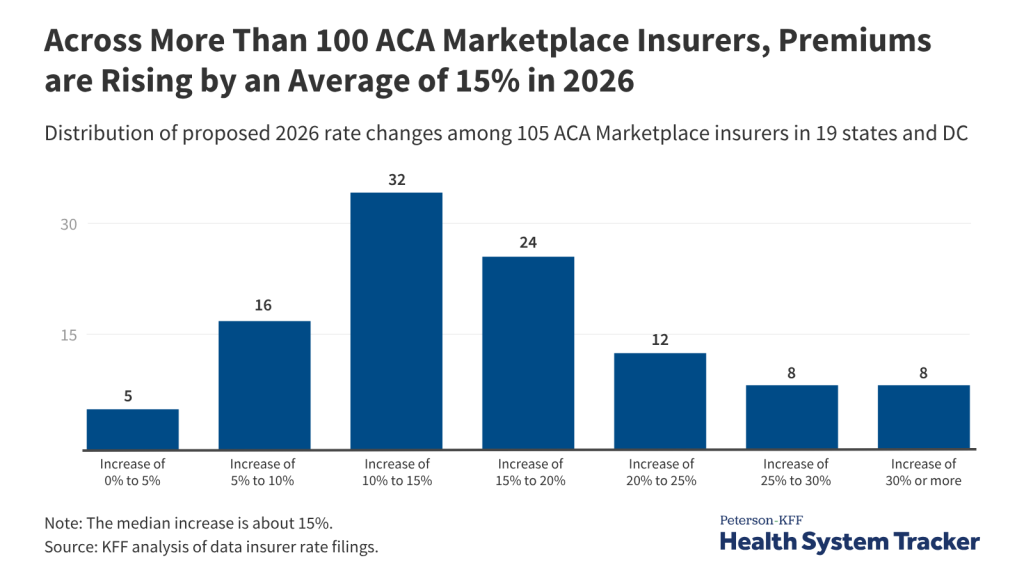
ACA Marketplace insurers are proposing a median premium increase of 15% for 2026, according to a new analysis of preliminary rate filings. Based on the early indications, individual market insurers will introduce the largest hike in premiums since 2018, the last time policy uncertainty contributed to sharp premium growth.

Across the 105 ACA Marketplace insurers in 19 states and DC that have submitted rate filings so far, most are requesting premium increases of 10% to 20% for 2026, and more than a quarter are proposing premium increases of 20% or more.

In addition to the anticipated growth in the cost of health care services, insurers have cited several policy changes that they expect to drive up rates next year, including the following:

  • The expiration of the enhanced premium tax credits at the end of this year, which have made coverage more affordable and contributed to record-high enrollment in the ACA Marketplaces, is expected to drive up out-of-pocket premium payments by more than 75% on average and cause many healthier enrollees to drop their coverage.
  • The impact of tariffs on some drugs, medical equipment, and supplies. Some insurers estimate that they could increase premiums by an average of 3% more than they otherwise would have.

Other factors could also affect premium changes, including the budget reconciliation legislation and Marketplace Integrity and Affordability rule, both of which were enacted and finalized after many of these insurers submitted their preliminary rate filings. Finalized 2026 rate changes are expected to be published in late summer.Subsidized enrollees are generally shielded from annual rate increases as their tax credits keep premium payments capped at a portion of their income.

However, with enhanced tax credits set to expire later this year if Congress takes no action to extend them, subsidized enrollees will pay more because they have less financial assistance. Middle income people with incomes above four times the poverty level would no longer be eligible for assistance and would have to shoulder the full premium.

The full analysis and other data on health costs are available on the Peterson-KFF Health System Tracker, an online information hub dedicated to monitoring and assessing the performance of the U.S. health system.

Individual Market Insurers Requesting Largest Premium Increases in More Than 5 Years

Authors: Jared Ortaliza, Matt McGough, Kaitlyn Vu, Shameek Rakshit, Imani Telesford, Lynne Cotter, Emma Wager, and Cynthia Cox
Published: Jul 18, 2025

Note: For updated data on ACA Marketplace premiums from more than 300 insurers in all 50 states and DC, read our updated analysis.

This analysis of preliminary rate filings submitted by 105 ACA Marketplace insurers in 19 states and DC finds that ACA Marketplace insurers are requesting a median premium increase of 15% for 2026, which would represent the largest hike in premiums since 2018, the last time policy uncertainty contributed to sharp premium growth.

In addition to the anticipated growth in the cost of health care services, insurers have cited several policy changes that they expect to drive up rates next year, including the expiration of the enhanced premium tax credits at the end of this year and the impact of tariffs on some drugs, medical equipment, and supplies.

The full analysis and other data on health costs are available on the Peterson-KFF Health System Tracker, an online information hub dedicated to monitoring and assessing the performance of the U.S. health system.

Impacts of Federal Actions on Extreme Heat and Health

Authors: Nambi Ndugga, Alisha Rao, Drishti Pillai, and Samantha Artiga
Published: Jul 17, 2025

Introduction

Extreme heat continues to be a pressing issue as 2024 was recognized as the hottest year ever experienced, and 2025 is slated to be one of the five warmest years on record, with experts predicting more extreme heat records over the next five years. Warm seasons have lengthened, become more frequent, and increased in intensity due to climate change. In early July 2025, communities in Texas, New Mexico, and North Carolina experienced deadly flash floods, with over 100 people dying in the Texas floods. Flash floods are primarily a summertime weather event, the combination of high humidity levels, drought, and heat create favorable conditions for torrential downpours and flash flood events. More flash floods are expected to occur in the U.S. during summer 2025 and research finds that the risk of future flash flood events will increase as the climate warms.

In recent years, there have been rising incidents of extreme heat, poor air quality, drought, and wildfire events both globally and across the country. Exposure to extreme heat poses major health risks that disproportionately affect those with limited resources. Research shows that between 1999 and 2023, the number of heat-related deaths in the U.S. increased by 117%, from 1,069 heat-related deaths in 1999 to 2,325 in 2023. Moreover, KFF analysis of data from the Centers for Disease Control and Prevention shows that American Indian or Alaska Native and Black people are at higher risk of experiencing a heat-related death compared to their White counterparts. Estimates suggest that heat events in the U.S result in approximately $1 billion in excess health care costs each year. If left unaddressed, climate change could cost the U.S. economy approximately $14.5 trillion over the next fifty years.

Prior administrations and state and local governments increased efforts to address climate change, extreme heat, and their impacts on human health in recent decades. However, more recent efforts by the Trump administration have reversed some of these prior actions. Rollbacks in federal actions to address climate change-related inequities broadly and the impacts of extreme heat specifically, may contribute to worse health outcomes, disproportionately impacting many populations that already face disparities in health, including lower income populations, people of color, and immigrants. The elimination of key offices, programs, and data tools makes it more difficult to assess and mitigate the health risks associated with environmental hazards, including extreme heat. Beyond the federal administrative actions already taken, cuts to federal funding may further erode efforts to reduce heat exposure and its health-related impacts. Some states have taken steps to mitigate exposure to extreme heat and its health impacts. However, without broader federal actions and standards, protections will vary across states. As climate change accelerates and intensifies extreme heat, the impacts of the rollbacks of environmental protections and equity initiatives will likely widen existing health disparities, reduce community resilience, and weaken the federal government’s ability to respond to extreme climate events.

This brief provides an overview of the federal and state landscape of recent policies addressing extreme heat and health equity.

Prior administrations implemented efforts to address climate change, extreme heat, and their impacts on human health in recent decades. In 1990, President George H.W. Bush implemented the Global Change Research Act of 1990, which created the U.S. Global Change Research Program (USGCRP) and required the release of the National Climate Assessment (NCA) every four years. The USGCRP has advanced climate change research over the past 35 years, and the NCA continues to report scientific research on climate change and its impacts on the U.S., helping to inform community responses to climate-related challenges. The Clinton administration implemented an Executive Order on “Federal Actions to Address Environmental Justice in Minority Populations and Low-Income Populations”, which required federal agencies to make identifying and addressing environmental justice a key part of their missions. Federal agencies were tasked with determining whether their programs had disproportionate detrimental effects on underserved populations through exposure to environmental hazards, including heat. The Executive Order also directed the creation of an Interagency Working Group on Environmental Justice to identify the disproportionate effects of environmental hazards exposure on communities of color and low income groups, and developing an environmental justice strategy. President George W. Bush’s administration was characterized by a withdrawal from leadership in federal regulation of climate change, including the U.S.’ withdrawal from the Kyoto protocol, an international agreement to lower greenhouse emissions that contribute to global warming and climate change. The Obama administration implemented the Memorandum of Understanding on Environmental Justice, highlighting the disproportionate burden of pollution and environmental hazards on communities of color and low income groups. The Obama administration also created the National Integrated Heat and Health Information System (NIHHIS), which sought to increase community preparedness for extreme heat events. NIHHIS integrated heat and health information across the federal government to support on-the-ground efforts to reduce the impacts of extreme heat on human health.

The Biden administration took additional steps to address the impacts of climate change, extreme heat, and exposure to environmental hazards on human health. These actions included the Executive Order, “Revitalizing Our Nation’s Commitment to Environmental Justice for All”, which created the Office of Environmental Justice and External Civil Rights to identify gaps in data and the cumulative impacts of environmental justice on underserved groups. The Biden administration also implemented Executive Order, “Tackling the Climate Crisis at Home and Abroad”, to elevate climate change as a national security priority. Among other actions, it established the Office of Climate Change and Health Equity (OCCHE) within the Department of Health and Human Services, which aimed to address the impact of climate change on health and developed tools to help track heat-related illnesses. Additionally, the U.S. Department of Housing and Urban Development implemented measures, including increasing utility allowances to help mitigate the effects of extreme heat in public housing.

The Biden administration also implemented policies to specifically address the impacts of extreme heat on workers. In 2022, the Occupational Safety and Health Administration (OSHA) launched the National Emphasis Program for Outdoor and Indoor Heat-Related Hazards, an enforcement program that sought to identify and eliminate or reduce worker exposures to occupational heat-related illnesses and injuries. The program was an expansion of the agency’s heat-related illness prevention initiative. In 2021, OSHA began engaging with stakeholders to develop regulations to protect workers from heat-related hazards and established a Heat Injury and Illness Prevention Work Group, which made recommendations for heat injury and illness prevention standards. In 2024, OSHA issued a proposed rule on Heat Injury and Illness Prevention in Outdoor and Indoor Work Settings. The proposed rule would require employers to have written heat injury and illness prevention plans, heat injury precautions, trainings, and evaluations. Specifically, it would require employers to provide workers with cool drinking water, shade, and more rest breaks once the heat index reached 90 degrees. The public comment period on the rule has closed, but OSHA conducted public hearings through July 2, 2025. Beyond the proposed rule, the administration launched its heat.gov website as a source of information on heat and health. Moreover in 2024, the U.S. Department of Health and Human Services released its National Heat Strategy, a plan to coordinate federal action to address extreme heat and its impacts.

On the first day of its second term, the Trump administration began implementing policies and regulations that reverse efforts to mitigate the impacts of extreme heat on health. President Trump signed Executive Order “Initial Recissions of Harmful Executive Orders and Action” and Executive Order “Ending Illegal Discrimination and Restoring Merit-Based Opportunity”, which revoked key climate change and environmental justice policies implemented by prior administrations. As part of efforts to eliminate diversity and disparities-related initiatives, the Trump administration eliminated environmental justice programs. These actions included eliminating the Low Income Home Energy Assistance Program, which helps low income Americans, many of whom are people of color, pay their energy bills and stay cool during the summer, and terminating grants from the U.S. Department of Agriculture’s urban forestry program, which sought to increase tree canopy cover in low income communities around the country, addressing tree inequity and exposure to extreme heat. The Department of Health and Human Services also eliminated OCCHE, which had developed tools to track heat-related illnesses. The Trump administration also cut more than 90% of the National Institute for Occupational Safety and Health, including the entire heat team involved in efforts to address heat-related illnesses and deaths among workers in the farming and construction industries. In April, the Centers for Disease Control and Prevention (CDC) also fired staff from its Division of Environmental Health and Science Practice (DEHSP) who sought to protect communities from exposure to heat waves, wildfires, and other environmental hazards as well as provided grants to local and state officials to create heat wave plans and build community cooling centers. However, as of June 11th, 2025, at least 150 staff from the National Center for Environmental Health and nearly all workers from the DEHSP were reinstated.

The Trump administration has also taken actions that block or weaken state level climate measures, including heat protection rules. On April 8th, President Trump issued Executive Order “Protecting American Energy from State Overreach,” which directs the Attorney General to identify and block state and local laws that address climate change, environmental, social, and governance initiatives, and environmental justice. CDC’s Climate and Health Program’s Climate-Ready States and Cities Initiative, which helped state and local health departments prepare for and respond to climate-related health outcomes was among the programs cut from CDC’s DEHSP. Thirteen jurisdictions (AR, CA, CT, FL, ME, NY, NC, OR, PR, San Francisco, VT, WI, County of Santa Clara) were recipients of grants from the program. North Carolina’s Department of Health and Human Services reports that the state’s Heat Health Alert System and Heat-Related Illness Surveillance System may be at risk due to these cuts. The alert systems help monitor and identify unhealthy heat levels and heat-related illnesses.

In recent years, many states have enacted climate change legislation related to extreme heat and its impact on human health. Some states, including Maryland, Massachusetts, New York, Vermont, and California, have introduced Climate Superfund Bills that seek to hold fossil fuel producers and refiners responsible for their impacts on climate change, strengthen infrastructure, increase community environmental resilience, and mitigate the impacts of climate change. For example, New York’s Climate Superfund Bill, the “Polluter Pays Bill” is expected to collect $75 billion over 25 years to fund infrastructure and other projects, including the building of cooling centers to help residents stay cool during heat waves. Additionally, some states, including New Jersey, New York, North Carolina, and Arizona, have released Extreme Heat Action Plans that seek to build community resilience through coordinated government action, educating the public on extreme heat, and developing heat-ready infrastructure. The plans also direct and coordinate investments in historically disadvantaged communities that are disproportionately vulnerable to extreme heat. In North Carolina, the Heat Action Toolkit includes steps for health care providers and other leaders to care for disproportionately affected communities during heat waves. Some states are also engaging in programs to mitigate the impact of extreme heat on Medicaid enrollees. As of July 2024, 13 states have used Section 1115 Medicaid waivers to facilitate access to air conditioning. Oregon was the first state to implement this program to support vulnerable residents during extreme heat events.

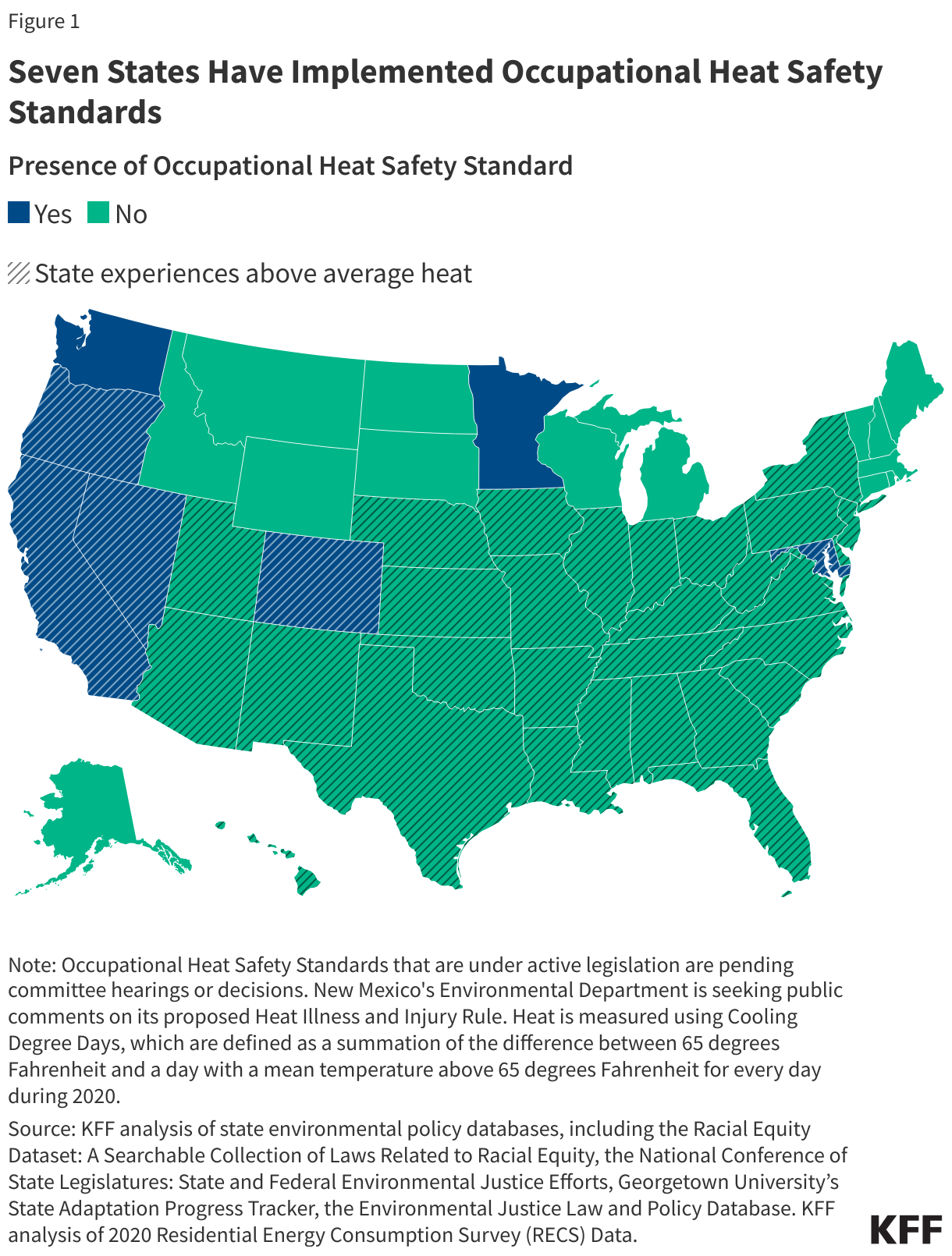
California, Colorado, Maryland, Minnesota, Nevada, Washington, and Oregon are addressing the health impacts of extreme heat on workers through comprehensive heat protection standards (Figure 1). These standards aim to protect workers who are at greater risk of heat-related illnesses. For example, California’s Heat Illness Prevention Standard mandates access to shade, cool water, and training for outdoor workers. Washington’s Outdoor Heat Exposure Rules implement specific temperature thresholds that trigger safety measures for workers. Thirteen additional states are in the process of developing their own occupational heat safety standards, including New Mexico, which has a Heat Illness and Injury Prevention Rule under public comment.

In contrast, Texas and Florida implemented legislation that limit their county- and municipal-level governments’ abilities to provide certain heat protections for outdoor workers. In 2023, Texas enacted House Bill 2127, also known as the “Death Star Bill,” which preempts local laws, including heat protection standards for outdoor workers. In 2024, Florida enacted House Bill 433, which prevents city and county governments from requiring that employers, including government contractors, provide heat protections for outdoor workers outside of those required under state or federal law. These protections include requiring water breaks and other cooling measures for outdoor workers.

Seven States Have Implemented Occupational Heat Safety Standards

Health Care Access and Financial Barriers Among LGBT People Amidst Looming Health Care Cuts

Published: Jul 17, 2025

On July 4, 2025, President Trump signed the recent reconciliation bill into law which is expected to leave millions of low- and moderate-income people uninsured as they lose access to Medicaid. Additionally, questions remain about whether Congress will preserve enhanced Affordable Care Act (ACA) premium tax credits for those with marketplace coverage, without which millions more could find premiums unaffordable, disenroll, and become uninsured. Given LGBT adults have lower incomes and higher rates of Medicaid coverage than non-LGBT adults, these changes could disproportionately impact this community. Additionally, as LGBT people experience a wide range of health disparities, cost barriers may serve to exacerbate these differences.

This brief reviews new data from the May 2025 KFF Health Tracking Poll on LGBT adult’s experiences and concerns related to health care affordability. Overall, the survey findings show that LGBT adults face more widespread problems and concerns with health care affordability compared to non-LGBT adults. While this may reflect the lower average incomes of LGBT adults, many of these concerns cut across income, with similar shares of LGBT adults reporting concerns regardless of whether they have lower- or more moderate- income.

Findings

U.S. adults face challenges affording a range of common expenses, including those related to health care. Half (51%) of LGBT adults say that in the past year, they or a family member living with them has had problems paying for food, housing, transportation, or other necessities. This compares to three in ten non-LGBT adults. Over one-third (36%) of LGBT adults say they or a family member living with them has had problems paying for health care, compared to one in five (21%) non-LGBT adults. The differences between these groups may be due in part to LGBT adults generally being younger and having lower household incomes than non-LGBT adults. However, even when looking only at those under 35 years old, LGBT adults are still more likely than non-LGBT adults to say they or a household member had problems paying for necessities (62% vs. 38%) and health care (46% vs. 24%).

More than One-Third of LGBT People Say They or a Household Member Face Problems Paying for Health Care, More Than Half Face Challenges Paying for Other Necessities

LGBT adults with household incomes under $40,000 are more likely than LGBT adults with higher incomes to say they or a household member have experienced problems paying for food, housing and other basic necessities in the past year (63% vs. 36%). Issues with health care affordability cut across income levels among LGBT adults, as 40% of lower-income LGBT adults report problems paying for health care in the past 12 months, statistically similar to the share of higher-income LGBT adults who say the same (32%).

Similar Shares of LGBT Adults Across Income Groups Say They Face Problems Paying for Health Care

Paying for health care can be a burden for individuals and families, including for LGBT adults who tend to have lower incomes. About half (52%) of LGBT adults say it is difficult for them to afford their health care costs, including about one in five (18%) who say it is very difficult. This experience is more common among LGBT adults than non-LGBT adults and is driven by those finding affordability very difficult.

About Half of LGBT Adults Face Difficulties Affording Health Care, with About One in Five Saying it is Very Difficult

These challenges with affordability can have an impact on access to and willingness to seek care. Half (51%) of LGBT adults report that they have skipped or postponed getting the health care they needed in the past year because of the cost compared to one-third (34%) of non-LGBT adults. About half of LGBT adults with incomes under $40,000 (50%) and about half of those with incomes of $40,000 or more (53%) say they have skipped getting needed health care because of the cost. Additionally, one in four (25%) LGBT adults say their health got worse because they skipped or postponed care because of the cost, compared to 18% of non-LGBT adults who say the same.

Half of LGBT Adults Report Skipping or Postponing Care Due to Cost and One in Four Say Their Health Got Worse as a Result

Similarly, costs related to prescription drugs also lead some LGBT adults to take actions to reduce their expenses in this area. About one-third (32%) have taken an over-the-counter drug instead of getting a prescription filled, a quarter (26%) have not filled a prescription because of the cost, and almost as many (23%) have cut pills in half or skipped doses. More than four in ten LGBT adults (44%) report taking at least one of these actions, compared to about a third (32%) of non-LGBT adults. Notably, similar shares of LGBT adults with incomes under $40,000 and those with incomes of $40,000 or more report taking at least one of these cost saving actions with their prescription medications (43% and 46% respectively).

More than Four in Ten LGBT Adults Report Taking Cost-Saving Actions Related to Prescription Medication Cost, Including Not Filling it and Skipping Doses

Not surprisingly, these experiences translate to worry. Over half of LGBT adults express worry about being able to afford each of the following for themselves and their family: health costs, unexpected medical bills, rent/mortgage, food, gas/transportation, and utilities. Worry about affording health costs and unexpected medical bills are among the expenses of greatest concern to LGBT adults, with about two-thirds reporting they are worried about these expenses (68% and 66%, respectively). LGBT adults are more likely than non-LGBT adults to report affordability concerns related to rent/mortgage, food, and gas/transportation and similarly likely to report such concerns related to health care costs.

Worry About Affording Health Services Costs is Widespread Among LGBT People

ACA Preventive Services Are Back at the Supreme Court: Kennedy v. Braidwood

Authors: Laurie Sobel, Alina Salganicoff, and Mabel Felix
Published: Jul 17, 2025

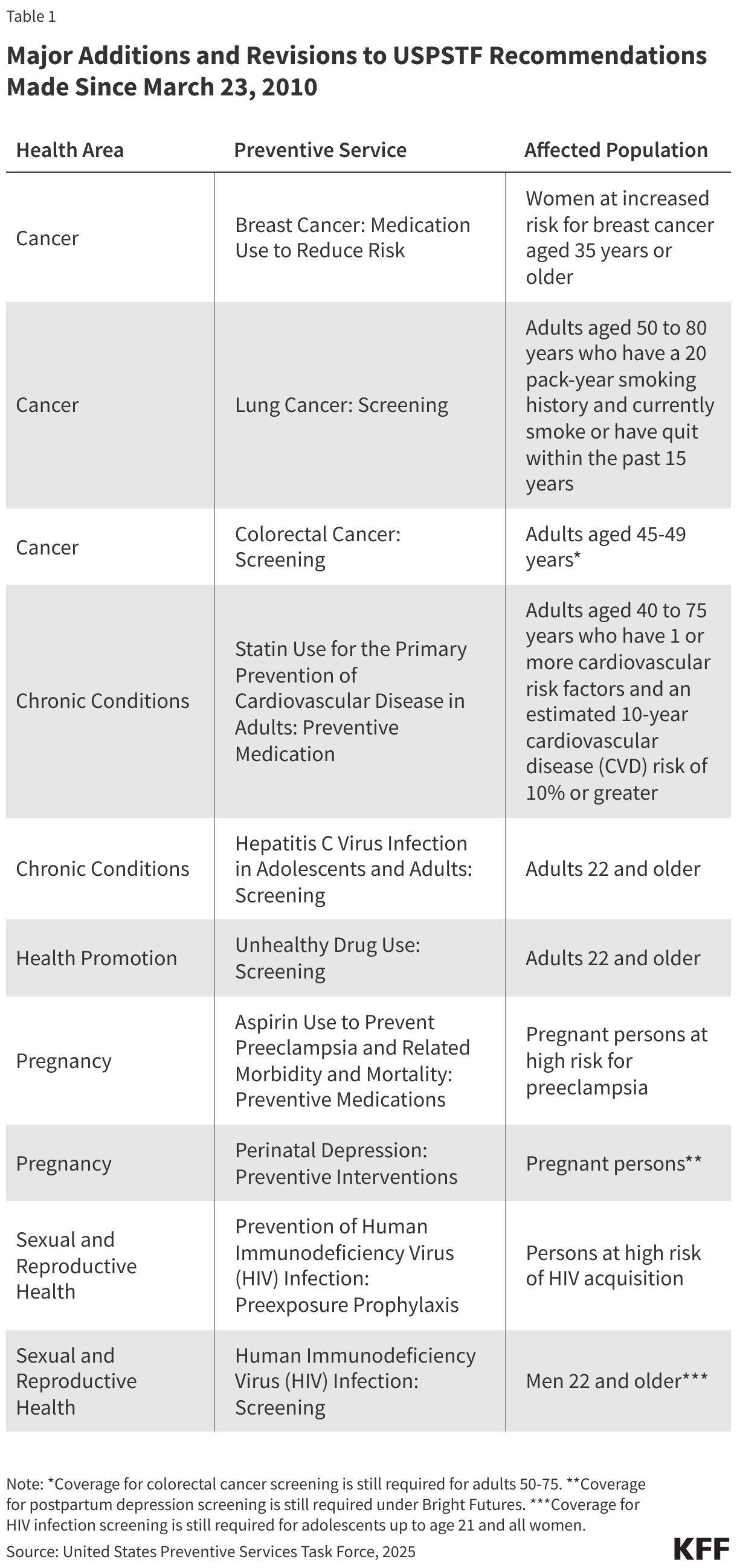
On June 27, 2025, the U.S. Supreme Court issued the opinion for Kennedy v. Braidwood Management, finding that the ACA requirement that most private insurers and Medicaid expansion programs cover preventive services recommended by the United States Preventive Services Preventive Task Force (USPSTF) with no cost-sharing is constitutional. In its decision, the Court affirmed that USPSTF members are appointed constitutionally, and the Secretary of Health and Human Services can remove USPSTF members at-will and directly review and block Task Force recommendations before they take effect.

In this case, the Supreme Court narrowly considered whether the structure of USPSTF violates the Appointments Clause, but did not review the litigants’ other claims about the Advisory Committee on Immunization Practices (ACIP), and the Health Resources and Services Administration (HRSA). The federal district court will now resume briefing on the consideration of the plaintiffs’ claim that the Secretary of Health and Human Services’ ratification of HRSA and ACIP recommendations violates the Administrative Procedure Act. For more analysis of the Court’s decision please see Kennedy v. Braidwood: The Supreme Court Upheld ACA Preventive Services but That’s Not the End of the Story.

On April 21, 2025, the Supreme Court is hearing oral arguments in Kennedy v. Braidwood Management. In this case, Braidwood Management, Christian owned businesses and six individuals in Texas, have challenged the Affordable Care Act’s (ACA) requirement to cover preventive services. The Supreme Court is narrowly considering whether the structure of the US Preventive Services Task Force (USPSTF) — an independent entity convened by the federal government that makes recommendations for preventive services that nearly all private insurances must cover without cost-sharing — violates the U.S. Constitution’s Appointments Clause. That provision states that “officers of the United States” may only be appointed by the president, subject to the advice and consent of the Senate and the litigants are claiming that the USPSTF does not have the authority to set coverage requirements. The Supreme Court is not considering the litigants’ other claims including those that the recommendations violate the Religious Freedom Restoration Act (RFRA), or their Appointment’s Clause claims about the Advisory Committee on Immunization Practices (ACIP), or the Health Resources and Services Administration (HRSA).

Even though President Trump had supported ACA repeal in his first term, his administration is  defending the lawsuit. On its face this may seem unexpected, but the outcome of the case could give the administration broader latitude to shape the recommendations issued by the entities that were originally established with the goal of providing independent analysis and review. This brief provides an overview of the most recent ACA case under review at the Supreme Court and discusses the implications of the potential rulings by the high court.

The ACA and Preventive Services

Section 2713 of the ACA requires most private health insurance plans and Medicaid expansion programs to cover a range of recommended preventive services without any patient cost-sharing. Preventive services include a range of services such as screening tests, immunizations, behavioral counseling, and medications that can prevent the development or worsening of diseases and health conditions. Preventive services that must be covered are those receiving an A or B grade by the U.S. Preventive Services Task Force (USPSTF), vaccines recommended by the Advisory Committee on Immunization Practices (ACIP), and the Health Resources and Services Administration (HRSA) recommendations issued by the Women’s Preventive Services Initiative and the Bright Futures for Children program. All of these entities review new recommendations and conduct periodic updates of existing recommendations.

What Is the Case?

In the original case, filed in 2022, the respondents claimed that the preventive services requirements for private health insurance are unconstitutional and also that the requirement to cover pre-exposure prophylaxis treatment (PrEP) (medication to prevent getting HIV from sex or injection drug use for those at risk) violates the Religious Freedom Restoration Act (RFRA). The respondents are six individuals and Christian-owned businesses. Braidwood Management, a for-profit closely held organization, owned by a trust, with Dr. Steven F. Hotze, as the sole trustee and beneficiary. Braidwood is self-insured and provides health insurance to its 70 employees. The other respondent is Kelley Orthodontics, who identify themselves as a “Christian professional association” owned by respondent, John Kelley. The respondents assert both economic harm for having to pay more money for a health plan that includes services they do not want or need, and religious harm for having to include services they object to.

In 2022, the District Court, agreeing with Braidwood’s arguments, ruled that the appointment of members to USPSTF violated the Appointments Clause and that the requirement to cover PrEP violates RFRA. However, the Court also found that the ACA’s delegation to ACIP and HRSA is not in violation of the Appointments Clause since the Secretary of HHS effectively has the authority to ratify or not the ACIP and HRSA recommendations. In 2023, the District Court issued a ruling striking down the ACA’s requirement for no cost coverage of preventive services recommended or updated by USPSTF on or after March 23, 2010. This ruling, however, was subsequently paused as the case made its way through the appeals process

In June 2024, the 5th Circuit Court of Appeals affirmed the district court’s ruling that the ACA’s requirement to cover without cost-sharing services recommended by United States Preventive Services Task Force (USPSTF) is unconstitutional. However, they ruled that a nationwide remedy was not proper and that only the plaintiffs are permitted to exclude USPSTF recommended services from their plans. The Appeals Court sent back to the district court the plaintiffs’ claim that the Secretary of Health and Human Services’ ratification of HRSA and ACIP recommendations violates the Administrative Procedure Act for further briefing and a judgment. The Supreme Court is considering only the arguments regarding whether the structure of USPSTF violates the Appointment’s Clause, not the other bodies that make preventive services recommendations, nor the religious harm included in the original case. However, a separate set of claims regarding HRSA and ACIP are still being considered by the district court and could be before the Supreme Court at a future date.

What Is the Supreme Court Considering?

The current case before the Supreme Court is reviewing the 5th Circuit Court of Appeals decision holding that appointments of individuals to the USPSTF and the recommendations made by the USPSTF after the enactment of the Affordable Care Act in 2010 (see Table 1) violate the Appointments Clause of the U.S. Constitution since they were not appointed by the President and confirmed by the Senate.

Braidwood et al. contend that the requirement for health plans to cover preventive services recommended or amended by USPSTF since the enactment of the ACA in March 2010 violates the Appointments Clause of the Constitution. They argue this is unconstitutional since the ACA does not allow the Secretary of HHS to reject the recommendations made by the Task Force or require it to make specific recommendations, meaning that USPSTF members have the capacity to unilaterally determine the preventive care that private insurers must cover and act as officers of the United States. Additionally, they contend the Secretary lacks the authority to remove USPSTF members at will. They argue that for USPSTF’s structure and recommendations to be constitutional, members would have to be appointed by the president and Senate.

The federal government argues that the HHS Secretary has constitutionally appropriate oversight over USPSTF because they may remove members at will and determine when health insurance issuers must start providing coverage for new recommendations. HHS additionally argues that if the Court holds that capacity to remove members at will is not sufficient oversight, it can remedy this by construing federal law to allow the Secretary to review USPSTF recommendations directly, which would address any remaining questions of oversight. This degree of supervision by the Secretary of HHS, the agency argues, would mean that members of the Task Force are “inferior officers,” who may be appointed or removed by the Secretary and would not require appointment by the president and Senate.

Major Additions and Revisions to USPSTF Recommendations Made Since March 23, 2010

Potential Impact on Coverage

If the Court rules in favor of Braidwood, private health insurers would no longer be required to cover, without cost sharing, preventive services recommended by USPSTF after 2010 when the ACA was enacted. Any new service that was recommended or updated by USPSTF after March 2010 (and is not also recommended by HRSA or ACIP) would no longer be required to be covered without out-of-pocket costs. For example, services and medications like statins to prevent heart disease, lung cancer screening, and PrEP to prevent HIV could be subject to copays, deductibles, or coinsurance, potentially deterring access to these services. This essentially means that the standards and recommendations that the federal government would be able to enforce would not reflect current or future standards and evidence, locking required preventive services in place as of the state of the science in 2010.

Although many of the friend of the court briefs presented to the Supreme Court for this case focus on the impact of coverage of USPSTF recommendations with no cost-sharing, a ruling in favor of the federal government does not guarantee that coverage will be required for these preventive services. As the federal government argues, HHS Secretary Robert F. Kennedy Jr. has the power to remove USPSTF members at will and to review the recommendations they issue. This means that the Trump administration could change the membership of the USPSTF in ways that may significantly alter the recommendations it issues. Additionally, in their briefs, the Trump Administration’s HHS contends the Secretary can direct that the implementation of recommendations issued by USPSTF can be delayed indefinitely and that the Secretary may have additional authority to supervise and veto Task Force recommendations. In their brief they state, “In addition to removing Task Force members at will, the Secretary may supervise and review their recommendations directly.”

The Supreme Court is expected to issue its ruling in June. Regardless of how the Court rules in this specific case, it will likely not be the final word on the ACA required coverage of preventive services recommended by USPSTF, ACIP and HRSA.