News Release

New KFF/Washington Post Climate Change Poll Examines the Knowledge and Views of American Adults and Teens

Published: Sep 13, 2019

A new KFF/Washington Post survey probes in depth what Americans know and think about climate change, their personal involvement with the issue, and their willingness to accept trade-offs to reduce its impact. A parallel survey of teens ages 13-17 explores how they view the potential effects of climate change on their generation.

The poll finds that a large majority of adults and teens believe that human activity is causing changes to the world’s climate. About half of adults believe people need to act within the next 10 years to prevent the worst effects of climate change or that it is already too late.

One in four adults say they personally have taken action to express their views on climate change, such as donating to a climate change charity, contacting a government official, or joining a protest, rally or other event.

Most adults say they would support higher taxes on the wealthy or on companies that burn fossil fuels to pay for policies aimed at reducing greenhouse gas emissions. Far fewer, however, say they would be willing to pay higher taxes at the gas pump or an extra $10 per month on their electricity bills.

Among teenagers, most say they feel that there are things they can do personally to make a difference when it comes to reducing the effects of climate change. About four in ten say they have taken action to reduce their own carbon footprint. And one in four say they personally engaged in political action on climate change – either participating in a school walkout, protest or rally, or contacting a government official about the issue.

As with adults, most teenagers see climate change as a major problem, though it does not stand out as a defining issue for their generation. About as many teens say climate change is “extremely important” to them personally as say the same about health care, gun policy and the economy.

The poll also probed support for specific policy solutions, perceptions of the urgency of the problem, frequency of discussions, and the politics of climate change. Additional findings related to the public’s knowledge and views of the major causes of climate change and the role climate change plays in severe weather events will be released in the near future.

This survey is the 34th in a series of surveys dating back to 1995 that have been conducted as a part of The Washington Post/KFF Survey Project. All surveys in the series are designed and analyzed jointly by survey researchers at KFF and The Washington Post. The survey was conducted online and by telephone July 9-Aug. 5 among a nationally representative sample of 2,293 adults ages 18 and over and 629 teens ages 13-17. The sample was drawn through the AmeriSpeak panel, the probability-based panel of NORC at the University of Chicago. Results have a margin of sampling error of plus or minus 3 percentage points for adults and plus or minus 5 percentage points for teens. A report highlighting key findings is available at kff.org. The Washington Post’s journalism drawing on the survey findings is available at washingtonpost.com.

How Will Medicare-for-all Proposals Affect Medicaid?

Authors: Jennifer Tolbert, Robin Rudowitz, and MaryBeth Musumeci
Published: Sep 12, 2019

Issue Brief

Summary

As the debate over the future direction of our health care system heats up leading into the 2020 Presidential election, several Democratic proposals to create a single, federal, universal health insurance program known as Medicare-for-all have garnered significant attention. These proposals would replace most current public and private health insurance with a new federal program that would guarantee health coverage for all or nearly all U.S. residents. However, many details about how a new public program would be implemented and financed are not yet known. While much attention has focused on the implications of ending private insurance and Medicare, the debate has largely ignored the effects on the low-income and vulnerable populations covered by Medicaid and the broader implications for states of eliminating the Medicaid program. Key changes related to Medicaid under current proposals include:

The Medicare-for-all debate has largely ignored the effects on the low-income and vulnerable populations covered by Medicaid and the broader implications for states of replacing the Medicaid program. @KFF explores those issues in this brief.

  • Medicare-for-all proposals would generally eliminate current variation in eligibility, enrollment and renewal processes, benefits, and payment and delivery systems that are part of the current structure of Medicaid where states have considerable flexibility to design programs within broad federal rules.
  • Proposals would extend coverage for certain Medicaid services important to vulnerable populations (such as comprehensive benefits for children and non-emergency medical transportation) to other populations. The proposals would continue Medicaid protections against high out-of-pocket costs.
  • One of the most fundamental changes under Medicare-for-all would be uniform coverage of community-based long-term care services for all Americans. Medicaid is the primary payer for these services today, with substantial state variation in eligibility and coverage. Under current Medicare-for-all proposals, these services would be required and explicitly prioritized over institutional services. Medicare-for-all proposals vary as to whether they would include institutional long-term care, such as nursing homes, or instead continue the current Medicaid coverage of these services, locking in state spending, variation in benefits across states, and limited access to populations beyond Medicaid.
  • Some proposals would have the federal government assume all or a significant share of the nearly $222 billion in state spending on Medicaid, leading to significant state savings, while other proposals call for a maintenance of effort for all or some current state Medicaid spending.
  • The proposals would shift responsibility for designing and implementing much of health policy from states to the federal government, in contrast to states’ role under Medicaid today.

Introduction

As the debate over the future direction of our health care system heats up leading into the 2020 Presidential election, several Democratic proposals to create a single, federal, universal health insurance program known as Medicare-for-all have garnered significant attention. These proposals would replace most current public and private health insurance with a new federal program that would guarantee health coverage for all or nearly all U.S. residents, though many details about how a new public program would be implemented and financed are not yet known. While much attention has focused on the implications of ending private insurance and Medicare, the debate has largely ignored the effects on the low-income and vulnerable populations covered by Medicaid and the broader implications for states of eliminating the Medicaid program.

Multiple Medicare-for-all proposals have been introduced in Congress and advanced by Presidential candidates. Currently, the proposals are characterized by two main approaches: proposals that create a single-payer system and eliminate other forms of coverage, including employer-sponsored insurance, Medicare and Medicaid; and proposals that eliminate the Medicare and Medicaid programs but maintain a role for private insurance. Medicare-for-all bills proposed by Rep. Pramila Jayapal (HR 1384) and Sen. Bernie Sanders (S. 1129) and endorsed by Presidential candidates Sen. Elizabeth Warren, Sen. Cory Booker, and Andrew Yang adopt the former approach. A Medicare-for-all proposal offered by Sen. Kamala Harris takes the latter approach. Each of these proposals differs in some way from the others. However, for purposes of this brief, we refer to these proposals collectively as Medicare-for-all, though we note where important differences in the proposals may have different implications for Medicaid.

Medicaid is administered by the states, and each state’s program is unique, reflecting states’ use of existing program flexibility and waiver authority to design their programs. Because of this variation, the specific implications of a shift from Medicaid to a Medicare-for-all program would vary across states. However, in all states, Medicaid plays a key role by providing affordable health coverage for vulnerable populations that includes a wide range of medical, behavioral health, and long-term care benefits. It also is the largest source of federal funds to states. This issue brief explores key ways in which a shift to Medicare-for-all could affect current Medicaid enrollees, future enrollees (such as those who may need long-term care coverage at a later time), and states, which jointly finance the Medicaid program along with the federal government. Table 1 summarizes key similarities and differences regarding eligibility, benefits, affordability, provider payment and delivery systems, and state financing in the main Medicare-for-all proposals and Medicaid.

Medicaid’s Role Today

Medicaid covers 75 million low-income adults, children, pregnant women, seniors, and people with disabilities. The Affordable Care Act (ACA) expanded Medicaid eligibility to serve as the basis of its larger set of coverage and affordability reforms. As of August 2019, 37 states including DC have adopted the ACA’s Medicaid expansion. In 2017, the Medicaid expansion group included more than 12 million newly eligible low-income adults. However, 2.5 people remain in a coverage gap, with income too high to qualify for Medicaid but too low to receive Marketplace subsidies in the 14 states that have not yet adopted the expansion. Medicaid also covers 45% of nonelderly adults with disabilities and millions more people with chronic conditions for whom private insurance, designed for a generally healthy population, is inadequate and/or unaffordable.

Medicaid covers a broad array of medical, behavioral health, and long-term care services. The Early and Periodic Screening, Diagnostic, and Treatment (EPSDT) benefit for children provides comprehensive coverage including preventive screenings, vision, dental, and hearing services, and any other medically necessary care. Federal standards outline minimum benefits for adults, such as hospital, physician, and nursing facility services. States also can cover a variety of optional benefits, such as prescription drugs and private duty nursing. Medicaid is the principal source of coverage for long-term services and supports (LTSS), including nursing home care as well as home and community-based services that enable seniors and people with disabilities to live independently. While all state Medicaid programs cover a comprehensive set of services, because states have flexibility to provide optional services for adults, there is significant variation across states.

Medicaid provides affordable coverage for its low-income enrollees. Federal standards prohibit states from charging premiums to those with incomes less than 150% of the federal poverty level (FPL), though some states impose premiums for certain adults through a Section 1115 waiver. Federal rules also limit cost-sharing to nominal amounts and entirely exempt certain groups and services from any cost sharing. Aggregate out-of-pocket costs for an individual may not exceed 5% of family income.

Medicaid provides access to a broad range of providers, including many with unique expertise in treating vulnerable and low-income populations. States set provider payment rates within broad federal guidelines, and as a result, there is significant variation across states in how provider rates are determined and in payment levels. Despite lower payment rates in Medicaid and gaps in access to some types of specialists, national data show that access to services for children and adults is comparable to private insurance and exceeds access for the uninsured. Medicaid programs contract with a broad range of providers, including many safety net clinics, hospitals, and other providers that have experience in meeting the needs of Medicaid’s vulnerable enrollees. Managed care has become the dominant Medicaid delivery system, though states have substantial flexibility in designing their delivery and payment systems.

Medicaid is financed jointly by the federal government and the states, guaranteeing federal matching payments to states with no pre-set limit. The matching structure of the program provides states with resources that automatically adjust for demographic and economic shifts, rising health care costs, and changing state priorities. This structure also enables the program to respond to public health emergencies and natural and other disasters. Examples of this response include providing a coverage safety net to people affected by the HIV/AIDS epidemic and expanding eligibility and benefits for children and pregnant women exposed to high levels of lead during the Flint water crisis. Recessions, rising costs of prescription drugs, and increasing needs for long-term care and behavioral health services are factors that put upward pressure on Medicaid spending growth. However, over time, Medicaid growth per enrollee has been lower than private health spending. Medicaid is a significant spending item in state budgets, but also the largest source of federal revenues due to the matching structure.

Implications of Medicare-for-all for Medicaid

Eligibility, Coverage, and Enrollment

Medicare-for-all programs would establish universal national health coverage for all or nearly all U.S. residents, eliminating the need for the specific eligibility pathways in the current Medicaid program. Medicare-for-all programs would establish uniform eligibility criteria across all states that are tied to U.S. residency and not based on income. Notably, Medicare-for-all would eliminate the current variability in eligibility for health coverage across states and fill in coverage gaps in states that have not adopted the ACA’s Medicaid expansion. Under Medicaid, states must cover certain populations, such as very low-income parents and children, pregnant women, and poor people with disabilities who receive federal Supplemental Security Income (SSI) benefits. States then choose from a variety of optional coverage pathways and waiver authorities to expand coverage, especially for children with significant disabilities and seniors and adults with disabilities who need long-term care. While all states currently adopt at least one of these optional expansions, Medicaid eligibility criteria differ across states. Medicare-for-all programs would eliminate the need for specialized eligibility determinations based on disability or functional status. How current Medicaid enrollees, particularly those with complex health care needs, would be transitioned to a new coverage plan, is an important policy and implementation issue in the new proposals.

Immigrants’ eligibility for coverage under Medicare-for-all is unclear, while their coverage under Medicaid today is subject to limitations. Medicare-for-all proposals grant authority to the Health and Human Services Secretary to define residency when determining eligibility for coverage, so it is not yet known how undocumented immigrants would be treated, though some proposals specifically cover legal immigrants and certain undocumented immigrants. Many Democratic candidates running for President say they support coverage for undocumented immigrants. Most legal immigrants are barred from Medicaid coverage for five years after entering the United States (except in the 35 states that have taken up the option to eliminate the five-year waiting period for Medicaid/CHIP coverage for lawfully-residing immigrant children and/or pregnant women). Undocumented immigrants are not eligible for Medicaid coverage, although state Medicaid programs reimburse providers for emergency care for individuals who are otherwise eligible for Medicaid except for their immigration status.

A process for auto-enrolling individuals into coverage under Medicare-for-all programs would replace existing application and renewal processes in Medicaid. Once established, all of the Medicare-for-all proposals call for automatically enrolling individuals in coverage at birth. Auto-enrollment would result in higher coverage rates compared to the current Medicaid program, since not everyone who is eligible for Medicaid presently is enrolled. Each state administers its own Medicaid eligibility determination system. The ACA included new policies and strategies to streamline the eligibility and enrollment process, such as greater reliance on electronic data sources instead of paper verification, in an effort to keep eligible people enrolled in coverage. Nevertheless, the need to apply for and periodically renew Medicaid coverage can sometimes result in eligible individuals churning in and out of coverage.

Benefits

Medicare-for-all programs would cover a comprehensive set of health care services for adults that would eliminate the current variability in Medicaid benefit packages across states. For example, the Medicare-for-all proposals include some benefits that are optional in Medicaid for adults and consequently not available in all states, such as dental and vision care. The Medicare-for-all benefit package also would include mental health and substance use treatment services. While all state Medicaid programs cover mental health and substance use disorder services, the scope of coverage for adults can vary. Many states rely on Medicaid to cover specialized behavioral health services, and the Medicare-for-all proposals would include some of these benefits. For example, the Sanders and Jayapal proposals include day treatment and psychosocial rehabilitation for those with chronic mental illness. Also, although prescription drug coverage is not required by the Medicaid statute, all states cover this benefit. Medicaid must cover all drugs with a rebate agreement as medically necessary, but states may apply utilization controls such as prior authorization, a preferred drug formulary, or quantity limits on drug refills or pills per prescription, and those differ across states. While Medicare-for-all proposals would establish uniform coverage for prescription drugs across states, it is unclear if coverage would be as comprehensive. Under both Medicare-for-all and Medicaid, all covered services must be determined medically necessary.

Medicare-for-all would cover certain services important to vulnerable populations that currently are covered by Medicaid but not other payers. In current Medicare-for-all proposals, these include the EPSDT benefit that provides a comprehensive set of services for children as well as non-emergency medical transportation to access medical appointments, with the Sanders and Jayapal proposals limiting this benefit to those with low incomes and/or disabilities.

One of the most fundamental changes under Medicare-for-all would be uniform coverage of community-based long-term care services; Medicaid is the primary payer for these services today, with substantial state variation in eligibility and coverage. Medicare-for-all would cover many of the community-based long-term care services covered by Medicaid today. And, unlike Medicaid, where most community-based long-term care services are optional, these services would be required, and explicitly prioritized over institutional services, under Medicare-for-all. With community-based long-term care services included in the Medicare-for-all benefit package, everyone would be eligible to receive covered services without regard to income or assets, unlike in Medicaid today. The Jayapal proposal includes functional eligibility criteria (e.g. limitation in an activity of daily living) to qualify for LTSS; today, states set Medicaid LTSS functional eligibility criteria. Unlike other Medicaid services, states are allowed to cap enrollment for many community-based long-term care services, which means that some people who meet the eligibility criteria do not receive them. Including these services in Medicare-for-all could mean that individuals currently on state Medicaid waiver waiting lists as well as others who are not financially eligible for Medicaid could have access to these services. However, it could take time to develop adequate system capacity in terms of infrastructure and workforce to accommodate such an expansion in paid LTSS. Additionally, the cost of providing a universal long-term care benefit package could result in some limitations or restrictions on these benefits as more details are known and Medicare-for-all is implemented.

Medicare-for-all proposals vary as to whether they would include institutional long-term care, such as nursing homes, or instead continue the current Medicaid coverage of these services. Under a scenario where Medicare-for-all includes institutional long-term care, all enrollees would receive these services as part of their basic benefit package as medically necessary, without regard to income or asset limits. The Jayapal proposal includes functional eligibility criteria for institutional long-term care, as it does for HCBS. The Jayapal benefit package includes a range of institutional services, which could also include institutions for mental disease (IMDs) and intermediate care facilities for those with intellectual or developmental disabilities (ICF/DD). Medicaid currently covers ICF/DD services but generally does not cover services in IMDs for individuals ages 21-64. If institutional services are carved out of Medicare-for-all and instead continue to be provided through state Medicaid programs, as under the Sanders bill, then individuals would need to continue to meet current eligibility criteria for these services, which vary across states. Under this approach, states would also be required to continue to pay their state share of costs for these services based on the current federal Medicaid matching rules. Those not eligible for Medicaid would continue to have to pay for institutional long-term care out of their own income and assets or through private long-term-care insurance, or spend-down to be eligible for Medicaid. The Sanders Medicare-for-all program would require states to maintain their existing Medicaid eligibility standards and spending on institutional long-term care services and would continue to provide states with federal matching payments for these services, locking in variation in eligibility standards across states.

Premiums and Cost Sharing

Medicare-for-all would continue the protections that Medicaid provides against high out-of-pocket costs. Medicare-for-all programs would eliminate or reduce premiums and cost sharing. The Sanders and Jayapal proposals would eliminate premiums and deductibles, and the Jayapal proposal would eliminate cost sharing, while the Sanders proposal would include minimal copayments on prescription drugs for those with incomes above 200% FPL. Under these proposals, today’s Medicaid enrollees would continue to be protected from high out-of-pocket costs. While most Medicaid enrollees do not pay premiums and have limited out of pocket expenses, any who do would likely see these costs eliminated.

Payment and Delivery Systems

Similar to Medicaid, all licensed and certified providers would be eligible to participate in Medicare-for-all programs; however, given the scope of Medicare-for-all programs, it is likely a broader array of providers will participate, expanding the choice of providers for current Medicaid enrollees. State Medicaid programs are required to contract with federally qualified health centers, and most contract with other essential community providers, and consequently, these providers are an important source of care for Medicaid enrollees. While these contracting requirements are not part of current Medicare-for-all proposals, it is expected that health centers and other essential community providers would participate to the same extent they participate in Medicaid programs today.

Medicare-for-all programs would create a national fee schedule for paying providers, eliminating variation in payment rates across states and payers in Medicaid today. While few details are available, Medicare-for-all programs would establish payment rates for hospitals, physicians, and other providers, subject to a global budget process and negotiation under some proposals. In general, states have flexibility in setting Medicaid provider payment rates, leading for variation in payment rates across states. In general, Medicaid rates paid to physicians and some other providers are lower than Medicare rates, while other providers, such as safety net hospitals, may receive higher payments through Medicaid compared to Medicare due to supplemental payments. It is unclear whether payment rates under Medicare-for-all proposals would be based on Medicare rates or set using a different methodology. In addition, federal rules require special Medicaid payment rates for some providers, such as federally qualified health centers and rural health clinics that have contributed to their participation in the program. These providers are likely to see an increase in revenue from improved coverage under Medicare-for-all programs; however, given longstanding relationships Medicaid enrollees have with safety net providers, how they fare under a new program will matter.

The reliance on fee-for-service payments under current Medicare-for-all proposals may move away from current payment and delivery models adopted by state Medicaid programs. Medicare-for-all programs would pay physicians and other providers on a fee-for-service basis, while institutional providers would be paid through a global budget arrangement under some proposals or through fee-for-service under others. Medicaid initially relied on fee-for-service payments, but in recent years, states have experimented with innovative payment designs in their Medicaid programs that seek to improve quality of care, control costs, and address social determinants of health. In addition, through their contracts with managed care organizations as well as managed fee-for-service models, states have emphasized care management for people with complex health needs. Some proposals would allow for these types of payment and delivery models, including private managed care plans, while others would not. While moving to global budgets and a national fee schedule will likely lower costs, some of the benefits of care management strategies, particularly for people with multiple or complex conditions and other vulnerable patients, may be lost.

State Responsibilities

The state role in health care financing would change substantially under a Medicare-for-all program compared to Medicaid. The state share of spending for Medicaid was $222 billion in 2017. Medicare-for-all proposals vary in how much states could save and how much funding states would be required to contribute relative to current spending. For example, under the Jayapal proposal, states could see significant savings relative to current Medicaid spending because Medicaid would be eliminated, and there would be no state financing requirements. However, under other proposals, states would remain responsible through a maintenance of effort (MOE) requirement for all or part of current state spending on Medicaid. The Sanders Medicare-for-all program would require states to maintain their existing Medicaid eligibility standards and spending on institutional long-term care services and would continue to provide states with federal matching payments for these services, locking in variation in eligibility standards and financing across states. Long-term care accounts for more than one in five dollars of Medicaid spending and in 2016, community based long-term care services accounted for 57% of all Medicaid spending on long-term care nationally, although this varies by state. The level of state savings under the Sanders proposal will vary based on current state spending on institutional long-term care services. Under the Harris proposal, states would be required to make MOE payments to the new program equal to the amounts they currently spend on Medicaid and CHIP, increased over time by inflation. Since Medicaid costs have typically increased at higher rates than inflation, states could see some savings over time, but significantly less relative to the Jayapal and Sanders proposals. It is not clear in the Harris and Sanders proposals how state spending from provider fees or taxes (a mechanism used by nearly every state to finance the state share of Medicaid) would be factored in the MOE calculation.

In addition to transferring fiscal responsibility, the proposals would shift the role of designing and implementing much of health policy from states to the federal government. Under current programs, states have significant flexibility to design and administer Medicaid and other related health programs. Medicare-for-all programs would create more uniformity in eligibility and benefits and could result in state savings, but the proposals would also limit states’ ability to leverage Medicaid funding to implement innovative payment and delivery system reforms. Without a comprehensive Medicaid program – and the substantial financing of health care that comes along with it – state policymakers would have a much more diminished role in the health care system generally. Some role for states may remain. For example, the Sanders proposal calls for a regional administrative structure that would include state directors. While the proposals may open other avenues for innovation, the state role in administering all aspects of Medicaid and running insurance departments would diminish under Medicare-for-all programs as these functions shift to federal responsibility.

Looking Ahead

Many details about how a new Medicare-for-all program replacing all or most current public and private health insurance would be implemented and financed are not yet known. As proposals continue to emerge and develop, it is important to focus on the implications related to Medicaid, the program that currently covers 75 million low-income and vulnerable Americans. As with other parts of the health care system, there will be trade-offs. Medicare-for-all proposals would generally eliminate current variation in eligibility, enrollment and renewal processes, benefits, and payment and delivery systems that are part of the current structure of Medicaid, where states now have considerable flexibility to design programs within broad federal rules. However, the transition to a new program, even one with equally comprehensive benefits and cost sharing protections, could be particularly disruptive for current Medicaid enrollees who tend to be sicker with more complex health conditions, and for whom the ability to maintain relationships with current providers will be important. A smooth transition to any new system also will be critical for current Medicaid enrollees who rely on personal care and other services to meet daily self-care needs and maintain independent community living.

More broadly, Medicare-for-all programs would extend coverage for some Medicaid services to more Americans, most notably community-based long-term services and supports. For states, the role in health care financing would change substantially under a Medicare-for-all program. Some proposals would have the federal government assume all or a significant share of the nearly $222 billion in state spending on Medicaid, leading to significant state savings. However, other proposals call for a state maintenance of effort around spending broadly or for specific services. The details about how the MOE would be implemented are not clear. In addition, the proposals would shift responsibility for much of health policy from states to the federal government. As the debate continues and additional details emerge, it will be important to continue to evaluate how Medicare-for-all proposals affect coverage, benefits, out of pocket costs and access to care for the low-income and vulnerable populations currently covered by Medicaid.

Appendix

Appendix Table 1: Key Features of Medicare-for-all Proposals Compared to Medicaid

Feature

Medicare for All(Sanders, S. 1129)

Medicare for All(Jayapal, H.R. 1384)

Medicare for All(Harris)

Medicaid

Eligibility and Enrollment

All U.S. residents, to be defined by the HHS Secretary.

Individuals to be auto-enrolled at birth.

All U.S. residents, to be defined by the HHS Secretary.

Individuals to be auto-enrolled at birth.

All US residents Individuals to be auto-enrolled at birth.

States must cover low-income parents, children, pregnant women, seniors, and people with disabilities. State options to expand coverage to all adults up to 138% FPL and to cover seniors and people with disabilities at higher income levels.

Legal immigrants generally ineligible for coverage for 5 years. Undocumented immigrants only eligible for emergency services.

Individuals must apply and periodically renew eligibility.

Covered Benefits

Medically necessary services, including hospital services, ambulatory patient services, primary and preventive services, mental health and substance abuse services, laboratory and diagnostic services, comprehensive reproductive services, pediatrics, rehabilitative and habilitative services, emergency services are covered.

States are required to continue covering any services covered through a Medicaid state plan amendment that are not included in the Medicare-for-all benefit package, and they may provide additional benefits at state expense

Medically necessary services, including hospital services, ambulatory patient services, primary and preventive services, mental health and substance abuse services, laboratory and diagnostic services, comprehensive reproductive services, pediatrics, rehabilitative and habilitative services, emergency services are covered.

States may provide additional benefits at state expense

Covers all medically necessary services, including emergency room visits, doctor visits, mental health and substance use disorder treatment, and comprehensive reproductive health services

All medically necessary services covered for children. Core set of services covered for adults, with additional services covered at state option.


Vision, dental, hearing

Covered

Covered

Covered

Covered for children; at state option for adults


EPSDT

Covered

Covered

Covered

Covered


Non-emergency transportation

Covered for people with low incomes and/or disabilities

Covered

Not addressed

Covered


Institutional long-term care

Medicaid coverage for these services would continue.

Covered, subject to functional eligibility criteria

Covered

Covered with state option to expand financial eligibility up to 300% SSI and impose asset limit, subject to functional eligibility criteria.


Community-based long-term care

Covered

Covered, subject to functional eligibility criteria

Covered

Covered primarily at state option for adults, with state option to expand financial eligibility up to 300% SSI and impose asset limit, subject to functional eligibility criteria.


Prescription drugs

Secretary to establish a formulary that discourages use of ineffective, dangerous or excessively costly drugs when better alternatives are available and promotes use of generic drugs. Off-formulary drugs are covered subject to rules established by Secretary.

Covered

Covered

All drugs with rebate agreement covered as medically necessary. State option to apply utilization controls such as prior authorization, preferred drug formulary

Premiums and Cost Sharing

None.

Limited authority for Secretary to require cost sharing for prescription drugs for those with income above 200% FPL.

None

No deductibles, and no co-payments for high quality care

State option to charge premiums to those above 150% FPL. Nominal cost-sharing, with certain services and populations exempt from all cost sharing. Cost sharing cannot exceed 5% household income.

Covered Providers

All state-licensed and certified providers who meet applicable provider standards and file a participation agreement.

All state-licensed and certified providers who meet applicable provider standards and file a participation agreement.

All Medicare providers, and possibly others eligible to participate

States establish provider licensing or other criteria. States must contract with federally qualified health centers.

Provider Payment

Secretary to establish a fee schedule in a manner consistent with the processes for determining Medicare payments and a new process for updating fees.


Payments established through global budget process and negotiations

Hospitals/facilities paid quarterly lump sum to cover operating expenses under a global budget; amount of payments determined by annual negotiation

Physicians/clinicians in general paid fee-for-service based on a fee schedule determined by the Secretary, taking into account current Medicare fee schedule, expertise of providers, information from national data/tracking program and subject to annual review

Doctors, nurses, and other providers will be paid appropriate rates

States set provider payment rates and methodology subject to general federal standards.

Delivery System

Fee-for-service; global budget for institutional providers; would allow current payment and delivery system reforms to continue

Fee-for-service; global budget for institutional providers

Private insurers permitted to offer managed care plans, but must meet strict consumer protections.

Will accelerate delivery system reforms and value-based care that rewards meaningful outcomes

Fee-for-service, managed fee-for-service, or managed care at state option.

State Role in Financing

State maintenance of effort (MOE) on spending on institutional long-term care as well as any Medicaid benefit provided through a state plan amendment that is not covered in the Medicare-for-all benefit package.

No state financing requirement


State financing MOE required, equal to current payment amounts indexed for inflation.

Jointly financed by state and federal dollars.

Poll Finding

KFF Health Tracking Poll – September 2019: Health Care Policy In Congress And On The Campaign Trail

Published: Sep 12, 2019

Findings

Key Findings:

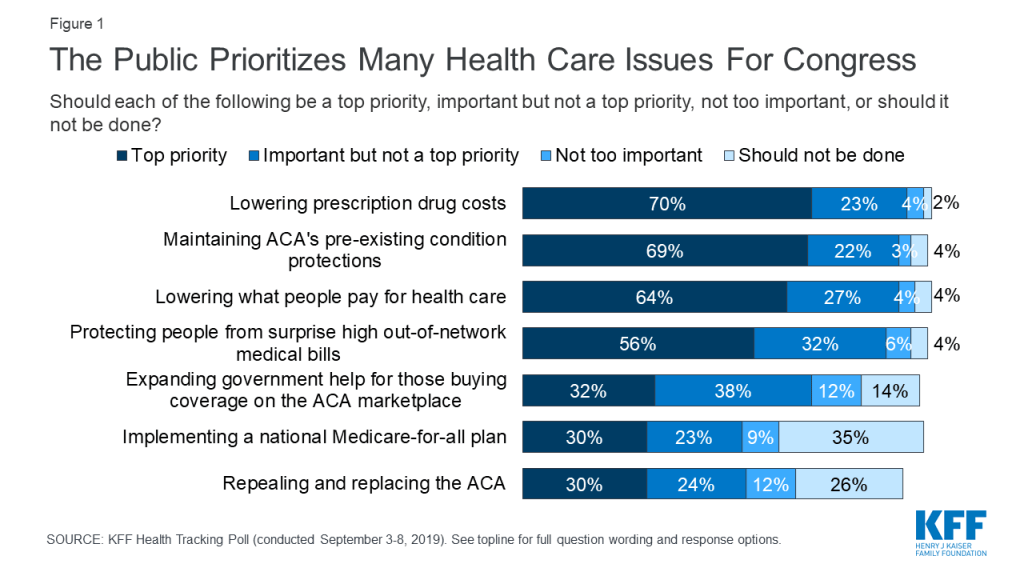
  • Congress is back in session and the public sees many health care issues as a “top priority” for Congress to work on including lowering prescription drug costs (70%), making sure the Affordable Care Act’s (ACA) protections for people with pre-existing conditions continue (69%), lowering the amount people pay for health care (64%), and protecting people from surprise medical bills (56%).
  • One of the health care issues that Congress may take on this fall is legislation aimed at dealing with “surprise medical bills.” This month’s KFF Health Tracking Poll finds nearly eight in ten (78%), including majorities of partisans, support legislation protecting patients from paying the cost of care not covered by their insurance when they receive care from a provider or hospital who is not in their network. A majority of the public (57%) continue to support this legislation even after hearing an opposing argument that this legislation would lead to doctors and hospitals being paid less.
  • Overall favorability of the ACA is slightly up this month (53%) with more than eight in ten Democrats viewing the ACA favorably (84%) – that is the largest share of Democrats with favorable views of the 2010 health reform law measured in the nine years of KFF Health Tracking Polls. The share of Democrats who hold favorable views of the ACA has increased 11 percentage points over President Trump’s term, up from 73% in February 2017.

    55% of Democrats and Democratic-leaning independents prefer a presidential candidate who wants to build on the ACA, compared to 40% who prefer a candidate who would replace it with #MedicareForAll, via @KFF poll

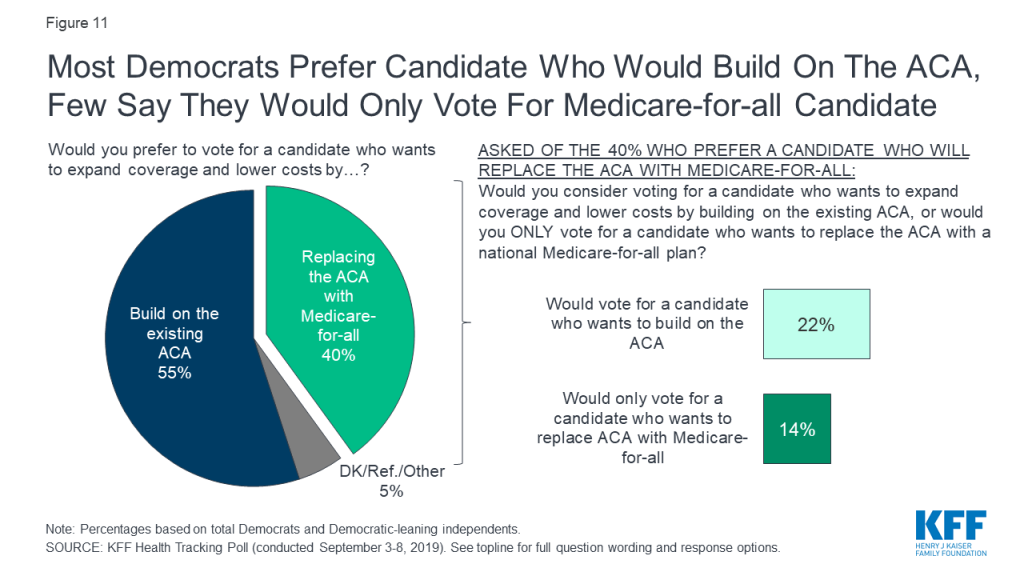
  • With ACA favorability among Democrats at an all-time high, this month’s tracking poll also finds that leading up to the 2020 presidential election, most Democrats and Democratic-leaning independents would prefer to vote for a candidate who wants to build on the existing ACA in order to expand coverage and lower costs (55%) than replace the ACA with a national Medicare-for-all plan (40%). Among those who would prefer to vote for a candidate who wants to replace the ACA with a national health plan, few (14% of all Democrats and Democratic-leaning independents) say they would only vote for a candidate who wants to replace the ACA with Medicare-for-all.
  • Nearly seven in ten (69%) of the public favor a so-called “public option” (a government-administered health plan that would compete with private health insurance plans and be available to all Americans), while about half (53%) favor “Medicare-for-all” (a national health plan in which all Americans would get their insurance from a single government plan). These remain relatively unchanged since the July KFF Health Tracking Poll.
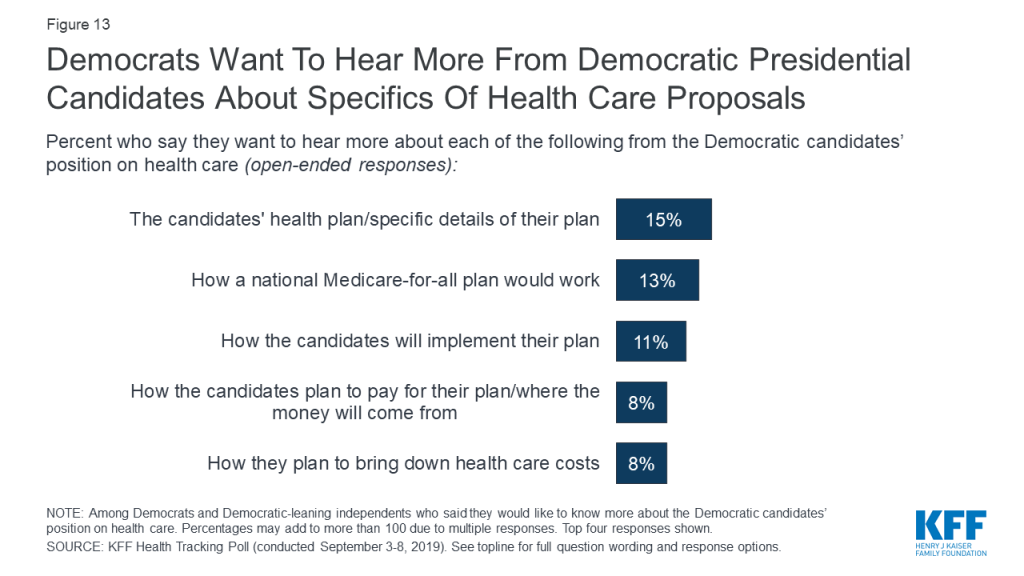
  • A week before the third round of Democratic presidential primary debates, about half (51%) of Democrats and Democratic-leaning independents say they want to know more about the Democratic candidates’ positions on health care. The health care topics they want to hear more about range from specific details about the candidates’ health plans (15%), how a national Medicare-for-all plan would work (13%), how the candidates will implement their plans (11%), how the candidates will pay for their health care plans (8%), and how the candidates plan to bring down health care costs (8%).

Health Care Priorities For Congress

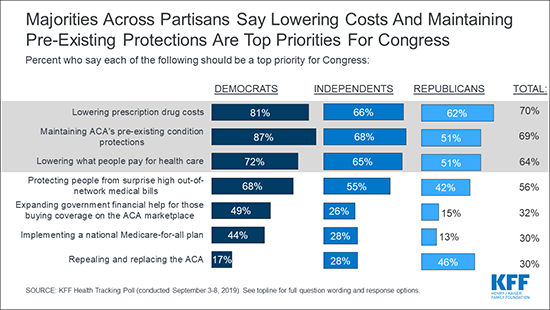
The latest KFF Health Tracking Poll finds most Americans say many health care policy items included in the survey should be at the top of a busy Congressional agenda this fall. Majorities of the public say lowering prescription drug costs (70%), making sure the Affordable Care Act’s protections for people with pre-existing conditions continue (69%), lowering the amount people pay for health care (64%), and protecting people from surprise medical bills (56%) are all “top priorities” for Congress to work on in the coming year. Fewer (32%) say expanding government financial help to those who buy their own insurance coverage on the ACA marketplaces to include more people is a “top priority,” which is similar to the share who rank the other, more partisan health care actions as top priorities. Three in ten say implementing a national Medicare-for-all plan or repealing and replacing the ACA should be top priorities for Congress.

Figure 1: The Public Prioritizes Many Health Care Issues For Congress

Drug prices, pre-existing conditions and out-of-pocket cost top the public’s list of health care priorities in this September @KFF poll. Majorities across political parties cite each as “top” priorities for Congress to address.

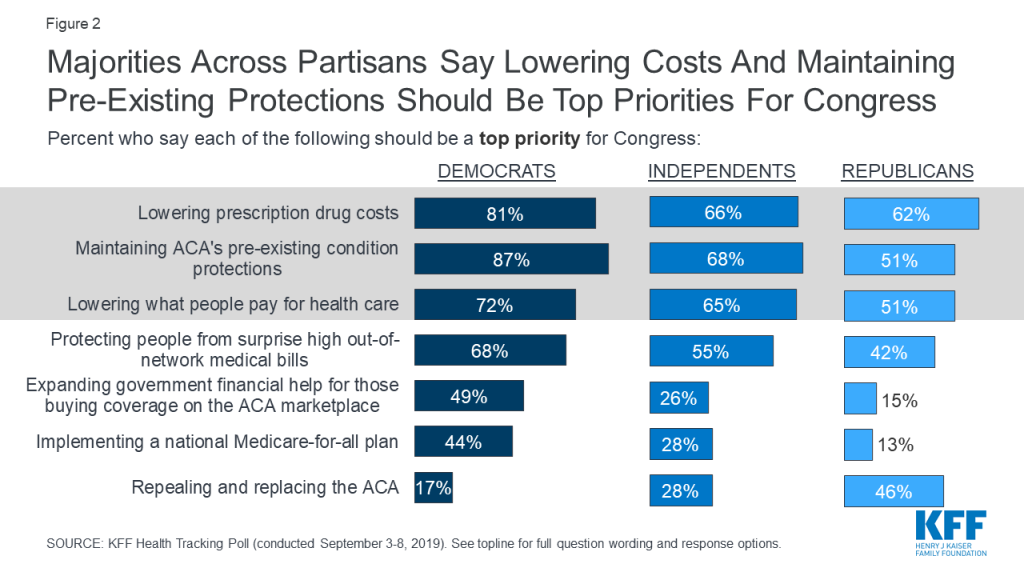
Majorities of Democrats, independents, and Republicans say lowering health care costs and maintaining the ACA’s protections for people with pre-existing conditions should be top priorities for Congress. At least seven in ten Democrats say maintaining the ACA’s pre-existing condition protections (87%), lowering prescription drug costs (81%), and lowering the amount people pay for health care (72%) are a “top priority” for Congress, as do two-thirds of independents (68%, 66%, and 65%, respectively). Fewer – but still at least half of Republicans also rank all of these a “top priority” (51%, 62%, and 51%, respectively). Republicans and Democrats disagree on the more partisan health care priorities with large shares of Democrats saying expanding financial help to those who buy their own coverage on the ACA marketplaces (49%) and implementing a national Medicare-for-all plan (44%) are top priorities for Congress, while a large share of Republicans (46%) say repealing and replacing the ACA is a top priority.

Figure 2: Majorities Across Partisans Say Lowering Costs And Maintaining Pre-Existing Protections Should Be Top Priorities For Congress

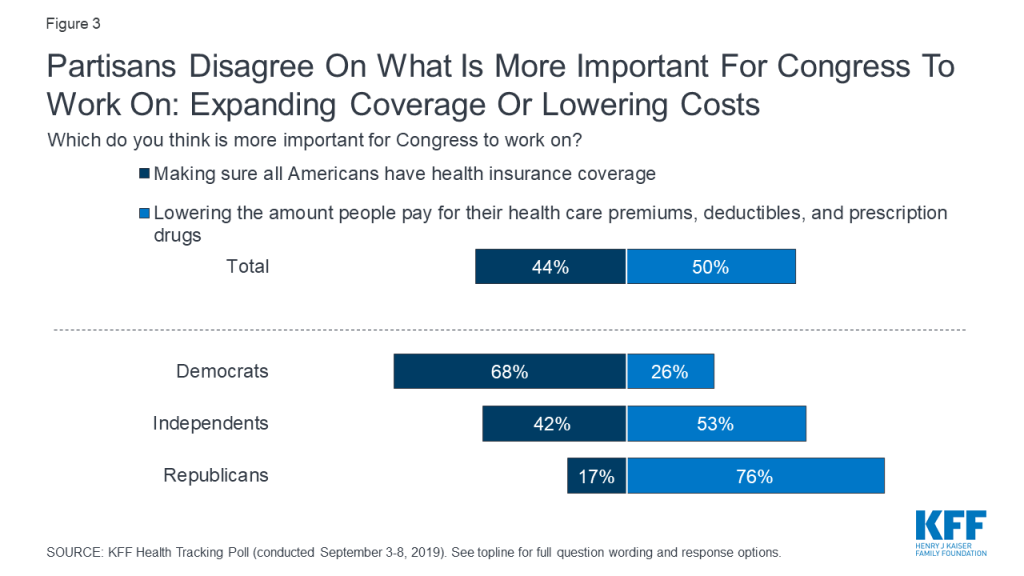
When forced to choose which is more important for Congress to work on: making sure all Americans have health insurance coverage or lowering the amount people pay for their health care premium, deductibles, and prescription drugs; the public leans slightly towards lowering costs. Half of the public say it is more important for Congress to work on lowering the amount people pay for health care while 44% say it is more important for Congress to work on expanding coverage to all Americans.

Figure 3: Partisans Disagree On What Is More Important For Congress To Work On: Expanding Coverage Or Lowering Costs

There are distinct partisan differences with majorities of Republicans (76%) saying it is more important for Congress to work on bringing down health care costs while two-thirds of Democrats (68%) choose making sure all Americans have health insurance coverage as the more important of the two health care objectives. Independents are more divided with a slightly larger share saying it is more important for Congress to work on bringing down health care costs (53%) than expanding health care coverage (42%).

Congressional Action on Surprise Medical Bills

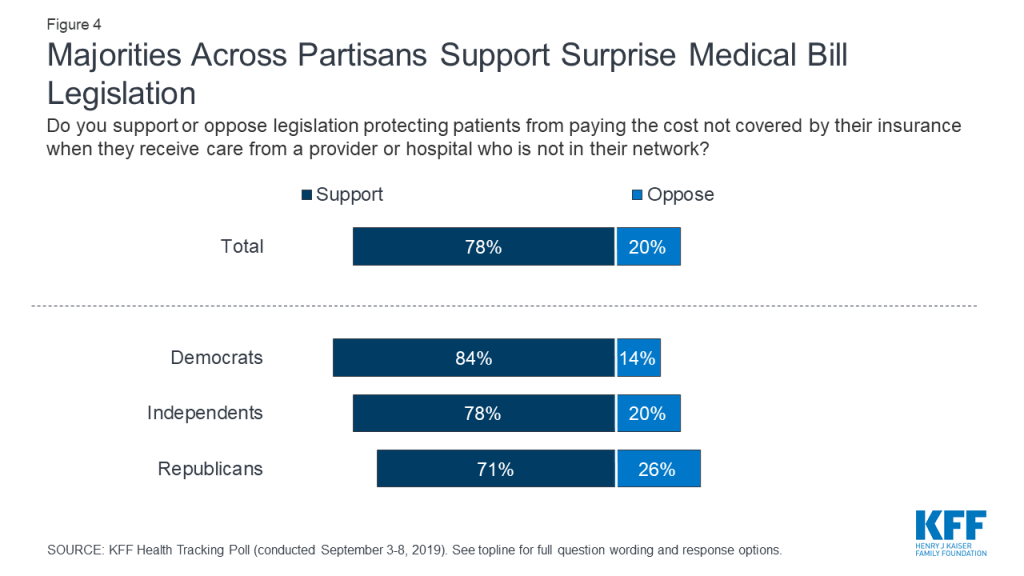
One of the health care issues that Congress may take on this fall is legislation aimed at dealing with “surprise medical bills.” The term “surprise medical bills,” describes charges from when an insured individual inadvertently receives care from an out-of-network provider either during an emergency or routine care.1  Previous KFF polling has found that majorities of the public say the federal government should take action to protect patients from having to pay these surprise medical bills. This month’s KFF Health Tracking Poll finds nearly eight in ten (78%) support legislation protecting patients from paying the cost of care not covered by their insurance when they receive care from a provider or hospital who is not in their network. This includes a majority of Democrats (84%), independents (78%), and Republicans (71%) who support this legislation.

Figure 4: Majorities Across Partisans Support Surprise Medical Bill Legislation

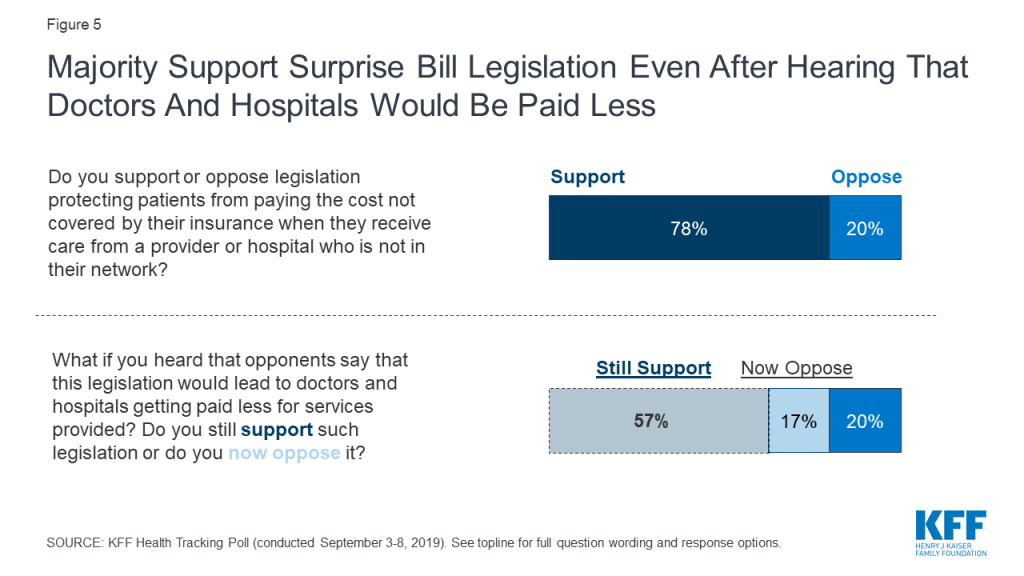
A majority of the public (57%) continue to support this legislation even after hearing opponents’ argument that this legislation would lead to doctors and hospitals being paid less. About one-fifth (17%) now oppose the legislation after hearing this counter-argument bringing total opposition to this legislation up to 37%.   

Figure 5: Majority Support Surprise Bill Legislation Even After Hearing That Doctors And Hospitals Would Be Paid Less

Proposals Aimed At Expanding Coverage

This month’s KFF Health Tracking Poll continues to track public opinion on two proposals that would expand the role of public programs in health care: a national Medicare-for-all plan and a government-administered health plan known commonly as a “public option.”

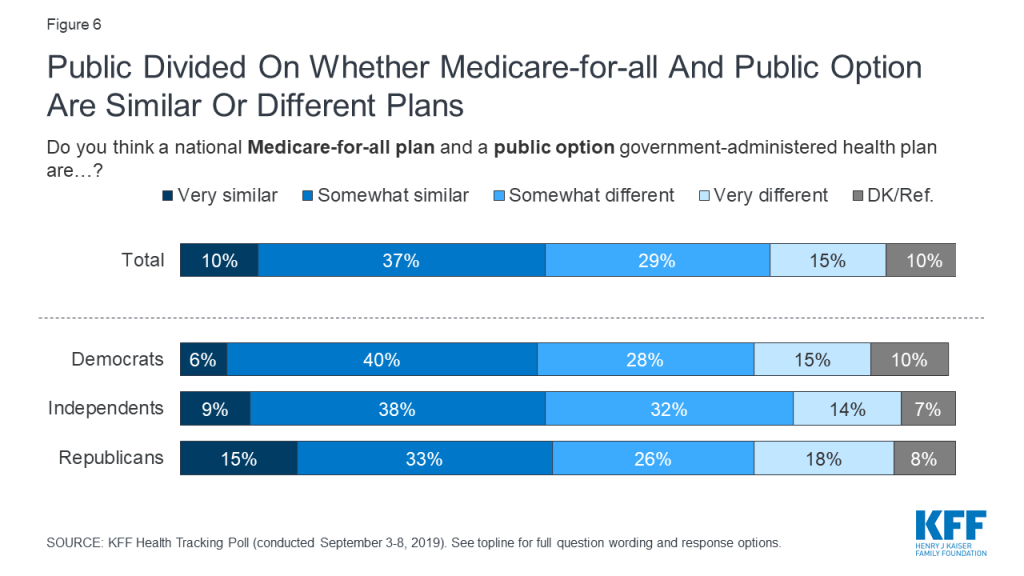
While Democratic presidential candidates are debating the merits of their various health care proposals, fewer than half of the public overall – and fewer than half of Democrats – think there are differences between a national Medicare-for-all plan that would have all Americans get their health care coverage from a single government plan and a government-administered health plan public option. About half of the public (47%) say the two proposals are either “very similar” or “somewhat similar,” while a nearly equal share (44%) say the two proposals are either “very different” or “somewhat different.” There are no partisan differences in the perceptions of the similarities of the two proposals.

Figure 6: Public Divided On Whether Medicare-for-all And Public Option Are Similar Or Different Plans

Understanding The Differences Between A National Medicare-for-all Plan And A Public Option

KFF has been tracking public opinion on proposals aimed at expanding the role of public programs in health care for over two decades. In recent years, there has been robust support among Democrats and independents, and some support among Republicans, for more incremental changes such as a public option, a Medicare buy-in proposal, or a Medicaid buy-in proposal.  Click here to see historical data on KFF polling on single-payer plans, national health plan, and other proposals aimed at expanding access to Medicare coverage. Check out this side-by-side comparison interactive to understand the differences and similarities of the various proposals.

Half (51%) of the public say they have heard at least some about a national Medicare-for-all plan, fewer have heard about the public option. Nearly two-thirds (64%) of the public say they have heard either “a little” or “nothing at all” about a government-administered health plan, sometimes called a public option.

Figure 7: Half Say They Have Heard Some About Medicare-for-all But Large Shares Say They Haven’t Heard Much About Either Proposal

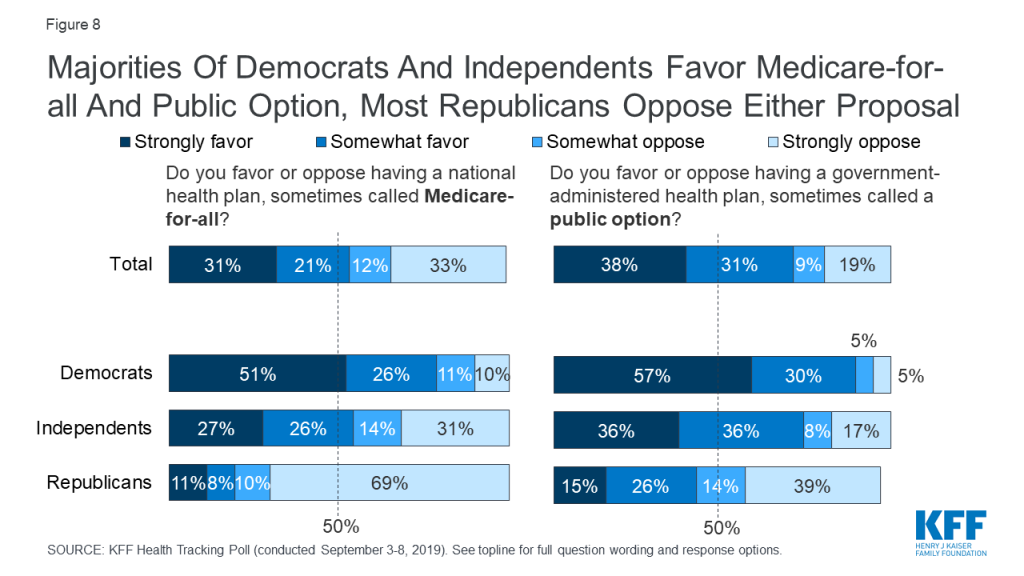
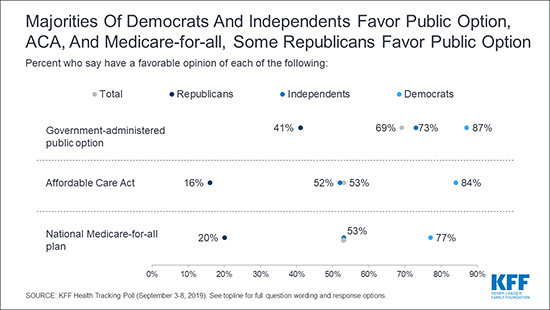
Overall, favorability of both a national Medicare-for-all plan and a government-administered health plan holds steady since July 2019. Nearly seven in ten (69%) favor having a government-administered health plan that would compete with private health insurance plans and be available to all Americans, while about half (53%) favor a national health plan in which all Americans would get their insurance from a single government plan.

Figure 8: Majorities Of Democrats And Independents Favor Medicare-for-all And Public Option, Most Republicans Oppose Either Proposal

Majorities of Democrats and independents continue to favor both of these proposals aimed at expanding coverage, while majorities of Republicans oppose – with significant shares of Republicans saying they “strongly oppose.” Seven in ten Republicans (69%) “strongly oppose” a national Medicare-for-all plan while four in ten (39%) “strongly oppose” a government-administered public option.

Are Democrats Rallying Around The Affordable Care Act?

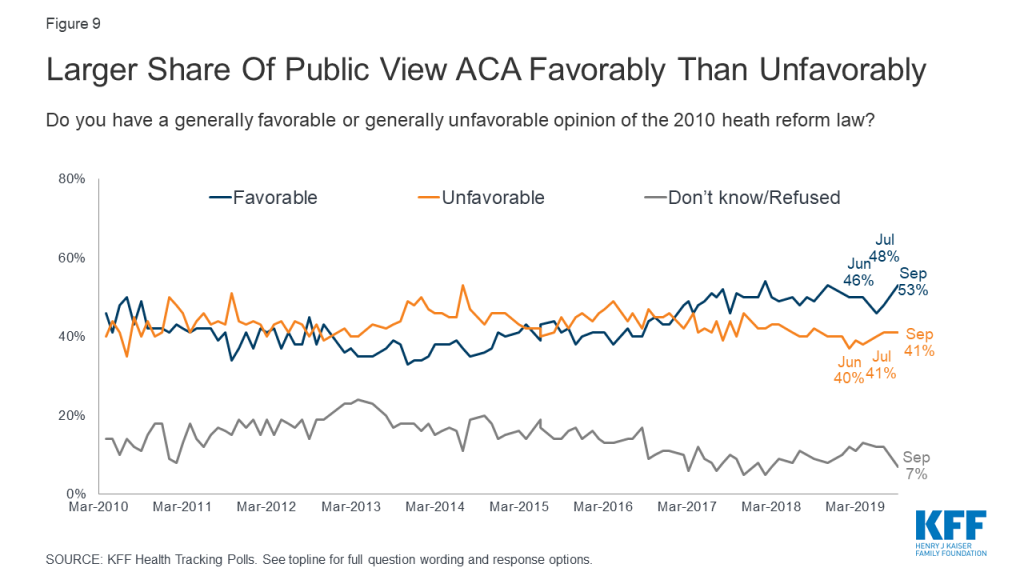
Since President Trump took office in January 2017, public opinion towards the Affordable Care Act (ACA) has slowly increased in popularity with 53% of the public now holding favorable opinions in the most recent KFF Health Tracking Poll.

Figure 9: Larger Share Of Public View ACA Favorably Than Unfavorably

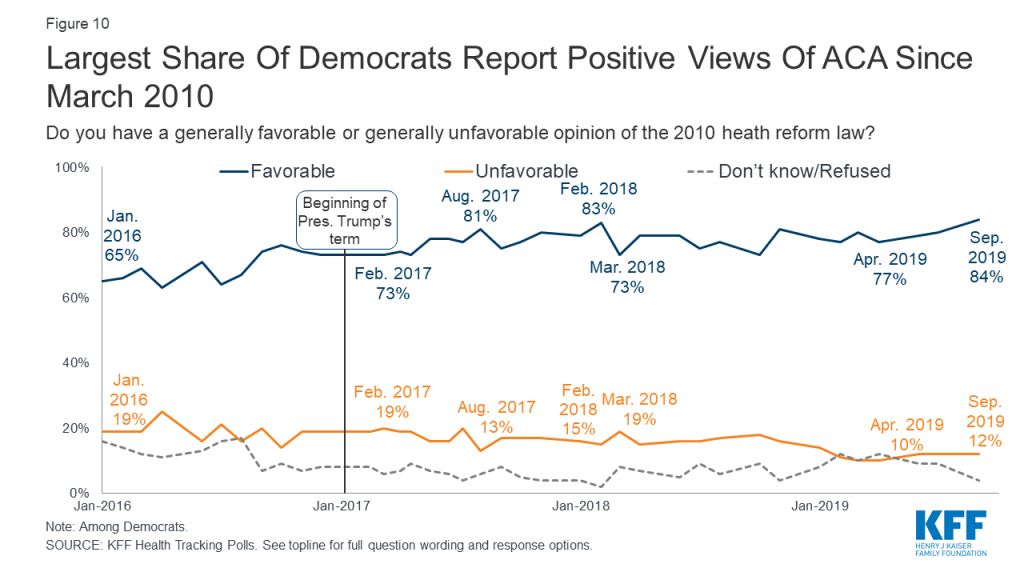
Attitudes towards President Obama’s health reform law have largely been driven by party identification with most Democrats viewing the ACA favorably (84%) while most Republicans hold unfavorable views towards the law (79%). The increase in favorability over the past several years is also largely driven by an increasing share of Democrats viewing the law favorably. The share of Democrats who hold favorable views of the ACA has increased 11 percentage points over President Trump’s term, up from 73% in February 2017. Republican views towards the ACA have stayed relatively stable over the same time period.

Figure 10: Largest Share Of Democrats Report Positive Views Of ACA Since March 2010

Leading up to the 2020 presidential election, most Democrats and Democratic-leaning independents say they would prefer to vote for a candidate who wants to build on the existing ACA in order to expand coverage and lower costs (55%) than replace the ACA with a national Medicare-for-all plan (40%). Even among those who would prefer to vote for a candidate who wants to replace the ACA with a national health plan, most (56%) say they would still vote for a candidate who wants to build on the ACA (22% of all Democrats and Democratic-leaning independents). Fewer (14% of all Democrats and Democratic-leaning independents) say they would only vote for a candidate who wants to replace the ACA with Medicare-for-all. 

Figure 11: Most Democrats Prefer Candidate Who Would Build On The ACA, Few Say They Would Only Vote For Medicare-for-all Candidate

The Democratic Presidential Primary Debates

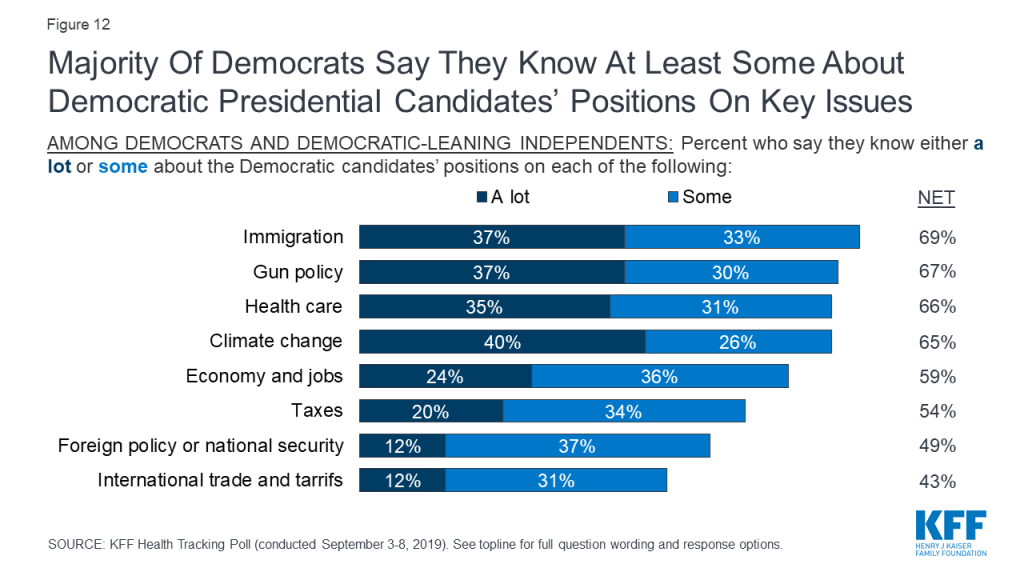
Over the past few months, KFF Health Tracking Polls have found health care leading the list of possible topics Democrats and Democratic-leaning independents want to hear the 2020 Democratic presidential candidates talk about during their upcoming primary debates. This month’s tracking poll, conducted a week prior to the third round of Democratic presidential debates, finds a majority of Democrats and Democratic-leaning independents say they know at least “some” about the Democratic candidates’ positions on most national issues including immigration (69%), gun policy (67%), health care (66%), and climate change (65%). Fewer – but still more than half – say they know at least some about the candidates’ positions on the economy and jobs (59%), and taxes (54%). Not quite half say they know at least some about the candidates’ position on foreign policy or national security (49%) or international trade and tariffs (43%).

Figure 12: Majority Of Democrats Say They Know At Least Some About Democratic Presidential Candidates’ Positions On Key Issues

About half (51%) of Democrats and Democratic-leaning independents say they want to know more about the Democratic candidates’ positions on health care. The topics they want to hear more about range from specific details about the candidates’ health plans (15%), how a national Medicare-for-all plan would work (13%), how they candidates will implement their plans (11%), how the candidates will pay for their health care plans (8%), and how the candidates plan to bring down health care costs (8%).

Figure 13: Democrats Want To Hear More From Democratic Presidential Candidates About Specifics Of Health Care Proposals

Methodology

This KFF Health Tracking Poll was designed and analyzed by public opinion researchers at the Kaiser Family Foundation (KFF). The survey was conducted September 3rd – 8th 2019, among a nationally representative random digit dial telephone sample of 1,205 adults ages 18 and older, living in the United States, including Alaska and Hawaii (note: persons without a telephone could not be included in the random selection process). The sample included 290 respondents reached by calling back respondents that had previously completed an interview on the KFF Tracking poll at least nine months ago. Computer-assisted telephone interviews conducted by landline (305) and cell phone (900, including 634 who had no landline telephone) were carried out in English and Spanish by SSRS of Glen Mills, PA. To efficiently obtain a sample of lower-income and non-White respondents, the sample also included an oversample of prepaid (pay-as-you-go) telephone numbers (25% of the cell phone sample consisted of prepaid numbers) as well as a subsample of respondents who had previously completed Spanish language interviews on the SSRS Omnibus poll (n=6). Both the random digit dial landline and cell phone samples were provided by Marketing Systems Group (MSG). For the landline sample, respondents were selected by asking for the youngest adult male or female currently at home based on a random rotation. If no one of that gender was available, interviewers asked to speak with the youngest adult of the opposite gender. For the cell phone sample, interviews were conducted with the adult who answered the phone. KFF paid for all costs associated with the survey.

The combined landline and cell phone sample was weighted to balance the sample demographics to match estimates for the national population using data from the Census Bureau’s 2017 American Community Survey (ACS) on sex, age, education, race, Hispanic origin, and region along with data from the 2010 Census on population density. The sample was also weighted to match current patterns of telephone use using data from the July-December 2018 National Health Interview Survey. The weight takes into account the fact that respondents with both a landline and cell phone have a higher probability of selection in the combined sample and also adjusts for the household size for the landline sample, and design modifications, namely, the oversampling of prepaid cell phones and likelihood of non-response for the re-contacted sample. All statistical tests of significance account for the effect of weighting.

The margin of sampling error including the design effect for the full sample is plus or minus 3 percentage points. Numbers of respondents and margins of sampling error for key subgroups are shown in the table below. For results based on other subgroups, the margin of sampling error may be higher. Sample sizes and margins of sampling error for other subgroups are available by request. Note that sampling error is only one of many potential sources of error in this or any other public opinion poll. Kaiser Family Foundation public opinion and survey research is a charter member of the Transparency Initiative of the American Association for Public Opinion Research.

Group

N (unweighted)

M.O.S.E.

Total

1,205

±3 percentage points

Registered voters

1,023

±4 percentage points


Party Identification


Democrats

353

±6 percentage points

Republicans

312

±6 percentage points

Independents

405

±6 percentage points

Democrats/Democratic-leaning independents/Independents with no leaning

644

±5 percentage points

Democrats and Democratic-leaning independents

524

±5 percentage points

Endnotes

  1. K. Pollitz (2016). Surprise Medical Bills. Kaiser Family Foundation. Available at https://modern.kff.org/private-insurance/issue-brief/surprise-medical-bills/. ↩︎
News Release

Poll: Most Democrats Prefer a Presidential Candidate Who Wants to Build on the Affordable Care Act

53% of Public View the ACA Favorably as Democratic Support for the 2010 Law Reaches All-Time High; Poll Also Finds Strong Bipartisan Support for Surprise Billing Legislation

Published: Sep 12, 2019

The latest KFF Health Tracking Poll probes Democrats’ views about the general approaches to expanding health coverage and lowering costs put forward by the candidates.

Most Democrats and Democratic-leaning independents (55%) say they prefer a candidate who would build on the Affordable Care Act to achieve those goals. Fewer (40%) prefer a candidate who would replace the ACA with a Medicare-for-all plan.

Even among those who prefer a candidate who would replace the ACA with a national Medicare-for-all plan, most say they would vote for a candidate who wants to build on the ACA (22% of all Democrats and Democratic-leaning independents). On the other hand, 14% of all Democrats and Democratic-leaning independents say they would only vote for a candidate who wants to replace the ACA with a Medicare-for-all plan.

Among the public overall, a majority (53%) now view the ACA favorably, a slight increase since July (48%) and up significantly since before President Trump took office. Among Democrats, 84% now view the 2010 law favorably – an all-time high in nine years of KFF polling. The share of Democrats who hold favorable views of the ACA has increased 11 percentage points during President Trump’s term, up from 73% in February 2017.

Opinions towards both a government-administered public option that would compete with private health insurance plans and a national Medicare-for-all plan in which all Americans would get their insurance from a single government plan hold steady this month, yet large shares express some uncertainty about the differences between the two proposals.

Nearly seven in 10 Americans (69%) favor having a government-administered public option and about half (53%) favor a Medicare-for-all plan. Most Democrats and independents favor the ACA, and the proposed public option and Medicare-for-all. Four in ten (41%) Republicans favor a government-administered public option.

The public is divided in their perceptions of the similarities between a national health plan in which all Americans would get their coverage from a single government plan and a government-administered public option that would compete with private health insurance.

About half (47%) say that the two approaches are “very” or “somewhat” similar. In spite of the debate about the approaches in Democratic presidential nominating race, Democrats are no more aware that the two approaches are different than the overall public is.

Large shares of the public say they have heard either “a little” or “nothing” about either a government-administered public option (64%) or a national Medicare-for-all plan (48%).

Out-of-Pocket Costs and Pre-Existing Conditions Are Public’s Top Health Priorities for Congress

With Congress back from its August recess, the new poll finds majorities across party lines consider action on lowering prescription drug costs (70%), maintaining the Affordable Care Act’s pre-existing condition protections (69%), and lowering the amount people pay for care (64%) as Congress’ “top” health-care priorities.

Congress is currently considering bi-partisan legislation to address surprise bills, which can occur when people with insurance inadvertently receive care from an out-of-network provider. The poll finds 78% of the public, and majorities of Democrats (84%), independents (78%), and Republicans (71%), support legislation to protect patients from paying the cost of such surprise bills.

A majority (57%) continue to support such legislation even after hearing opponents’ argument that it would lead to doctors and hospitals being paid less, though about one-fifth (17%) switch to oppose it after hearing the argument, increasing total opposition to 37%.

Designed and analyzed by public opinion researchers at KFF, the poll was conducted Sept. 3-8 among a nationally representative random digit dial telephone sample of 1,205 adults. Interviews were conducted in English and Spanish by landline (305) and cell phone (900). The margin of sampling error is plus or minus 3 percentage points for the full sample. For results based on subgroups, the margin of sampling error may be higher.

Medicaid and Health Coverage for Low-Income Women in Pregnancy and After Childbirth

Author: Usha Ranji
Published: Sep 10, 2019

Usha Ranji, Associate Director of KFF’s program on  Women’s Health Policy, testified on September 10, 2019, before the U.S. House Committee on Energy and Commerce, Subcommittee on Health as part of a hearing on Improving Maternal Health: Legislation to Advance Prevention Efforts and Access to Care. Her testimony describes the role of Medicaid coverage for pregnant and postpartum women, including differences in coverage between states, eligibility requirements, and efforts to strengthen postpartum care and coverage for women enrolled in Medicaid. 

News Release

Private Insurers Are Expected to Pay a Record of At least $1.3 Billion in Rebates to Consumers Beginning in September for Excessive Premiums Relative to Health Care Expenses

Analysis Shows Expected Rebates by State and by Insurer

Published: Sep 10, 2019

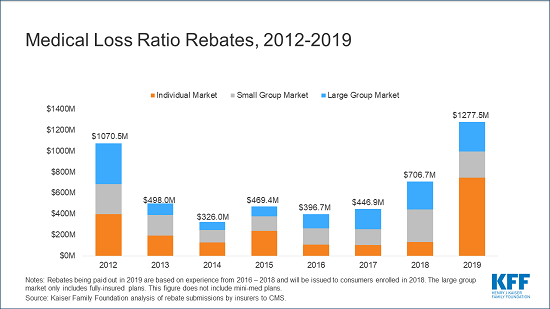
Private insurance companies are expecting to pay out a record of at least $1.3 billion in rebates to consumers this fall based on their share of premium revenues devoted to health care expenses in recent years, surpassing the previous record high of $1.1 billion in 2012, according to a new KFF analysis.

Individual market insurers are driving this record year, with expected rebate payments of at least $743.3 million, their highest ever, finds the analysis of data reported by insurers to the Centers for Medicare and Medicaid Services. Individual market insurers appear to have been exceptionally profitable in 2018, on average, which is part of the basis for this year’s rebate payments. Rebates in the small and large group insurance markets are more similar to past years, at $250 million and $284 million, respectively.

The analysis also finds that millions of dollars in rebates from previous years have gone unclaimed by consumers — $37.5 million in the individual market, $22.2 million in the small group market and $11.6 million in the large group market.  

By law, insurers must begin issuing the latest rebates to eligible consumers by September 30. They are the result of insurance companies not meeting the Affordable Care Act’s medical loss ratio threshold, which requires insurers to spend at least 80 percent of premium revenues (85% for large group plans) on health care claims or quality improvement activities.

Rebates will vary by state. The states with the largest expected rebates in total include Virginia ($149.6 million), Pennsylvania ($130 million) and Florida ($107.4 million). In an estimated 13 states insurers are expecting to pay no rebates at all.

In the individual market alone, insurers will pay out the highest rebates in Virginia ($111.3 million), followed by Arizona ($92.3 million) and Texas ($80.4 million). On a per subscriber basis, insurers will pay the highest rebates in Pennsylvania ($990 per subscriber), Virginia ($770 per subscriber) and Minnesota ($670). Virginia ranks high largely because one insurer, Sentara (also known as Optima), had the highest individual premiums in the country in 2018 and now owes especially large rebates.

Rebates also will vary by insurer. Other insurers issuing large rebates across the individual market include Centene (at least $216.9 million), HCSC ($78.5 million), Cigna ($55.9 million), and Highmark ($50.8 million). These insurers tend to have high enrollment and participate in a number of states.

Insurers may issue the rebates in the form of a check to consumers or as a credit applied to the premiums consumers must pay. For people with employer coverage, the rebate may be shared between the employer and employee.

Poll Finding

Health Apps and Information Survey

Published: Sep 10, 2019

These poll findings examine the public’s use of the internet and smartphone apps in managing and tracking their health and health care. The poll examines the numbers of U.S. adults who use the internet or smartphone apps to research symptoms, track fitness and nutrition, manage their health insurance and health care spending, and engage in other online health-related activity. Drew Altman highlighted results from the poll in his latest Axios column.

News Release

KFF Medicaid Managed Care Market Tracker Updated to Include Plan-Level Enrollment and Parent-Firm Data

Published: Sep 6, 2019

The debate about public programs like Medicaid has always been partly a debate about the role of government in health care. Yet, new data available on KFF’s Medicaid Managed Care Market Tracker illustrates the substantial role private insurers now play in the program. Thirty-nine states contract with comprehensive managed-care organizations (MCOs), many of which are privately-held companies. More than two thirds (69%) of Medicaid beneficiaries nationally now receive care through MCOs, and nearly half of those beneficiaries are covered by six for-profit insurers.

KFF’s tracker now features the latest available data about Medicaid managed care to allow comparisons across states and provide a national snapshot of the market. It includes state-level, MCO-level, and parent firm-level information related to comprehensive Medicaid MCOs across the country that can help policymakers working to ensure Medicaid beneficiaries get the care they need. It also provides data on enrollment and spending; ownership; and parent firm participation across states Medicaid programs.

Accompanying the tracker is a new KFF brief highlighting key facts about states’ use of comprehensive, risk-based managed care in Medicaid, including data and trends related to enrollment, state spending, and market share, as well as activities related to quality, value-based payments, and social determinants of health.

Data Note: A Look At Swing Voters Leading Up To The 2020 Election

Authors: Ashley Kirzinger, Audrey Kearney, Mollyann Brodie, Charlie Cook, and Amy Walter
Published: Sep 5, 2019

Findings

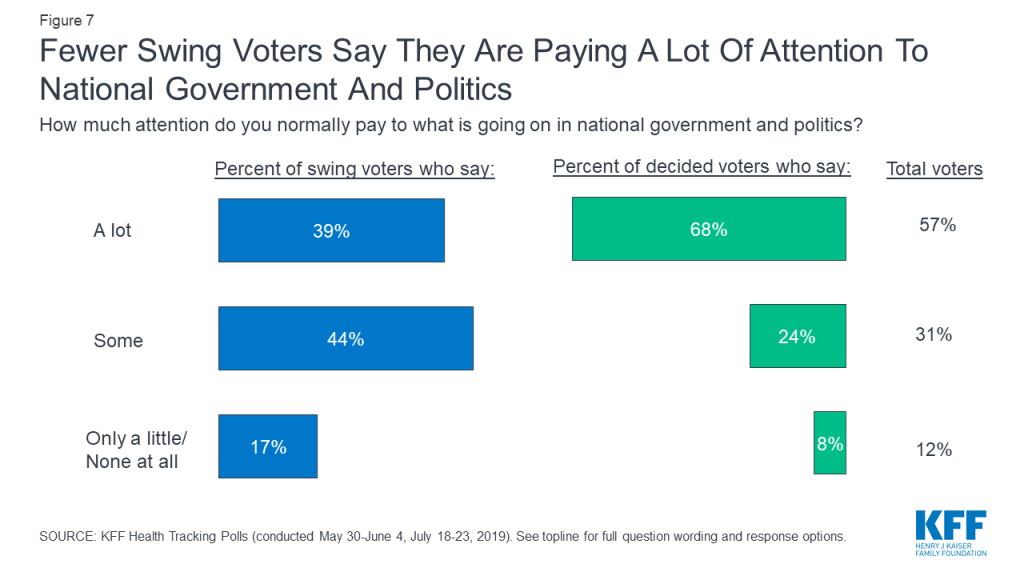
More than one year out from the general election, there are many factors that could influence voters’ decisions to either vote for President Trump or the Democratic nominee or even stay home on November 3, 2020. These factors include the characteristics of the eventual Democratic nominee, views of President Trump, and how motivated voters are feeling about the election. The latest analysis from the Kaiser Family Foundation, in collaboration with the Cook Political Report, finds that while a large share of voters are already firm about how they plan to vote in the 2020 presidential election (63%), there is a still a substantial share (30%) who say they have not made their minds up. With three in ten votes still up for grabs, this data note examines the demographics of swing voters: those who either report that they are undecided about their vote in 2020 or are leaning towards a candidate but haven’t made up their minds yet. It also explores the policy issues that could swing these voters to vote for either President Trump or the Democratic nominee.

Key Findings

Who are swing voters? They’re younger, more moderate, and less engaged on national politics. At least a quarter say they didn’t vote in ’16 or ’18. This @KFF / @CookPolitical analysis shows how the issues could affect their vote on #ElectionDay2020

  • Three in ten voters are swing voters, meaning they haven’t made up their minds about who they plan to vote for in the 2020 presidential election. While swing voters look similar to their decided counterparts on many demographics, they tend to be younger, more moderate, and less engaged on national politics. Nearly one-fourth of swing voters say they didn’t vote in the 2018 election (22%) or in the 2016 presidential election (24%).
  • It is important to note that not all “swing voters” could potentially change their vote to support the other party’s candidate. About half of swing voters (16% of all voters) are truly persuadable. These voters either say they are undecided about who they plan to vote for (8%) or say that while they are probably going to vote for either President Trump or the Democratic nominee, there is a chance they will vote for the other party’s candidate (8%). The other share of swing voters (14% of all voters) say that they are probably going to vote for either President Trump or the Democratic nominee and there is no chance they will vote for the other party’s candidate. While they say there is no chance they will vote for the other party’s candidate, they could choose to not vote at all. In other words, these folks may not change their minds to support another candidate, but if they don’t like what they see from the party they like, they could just stay home. 
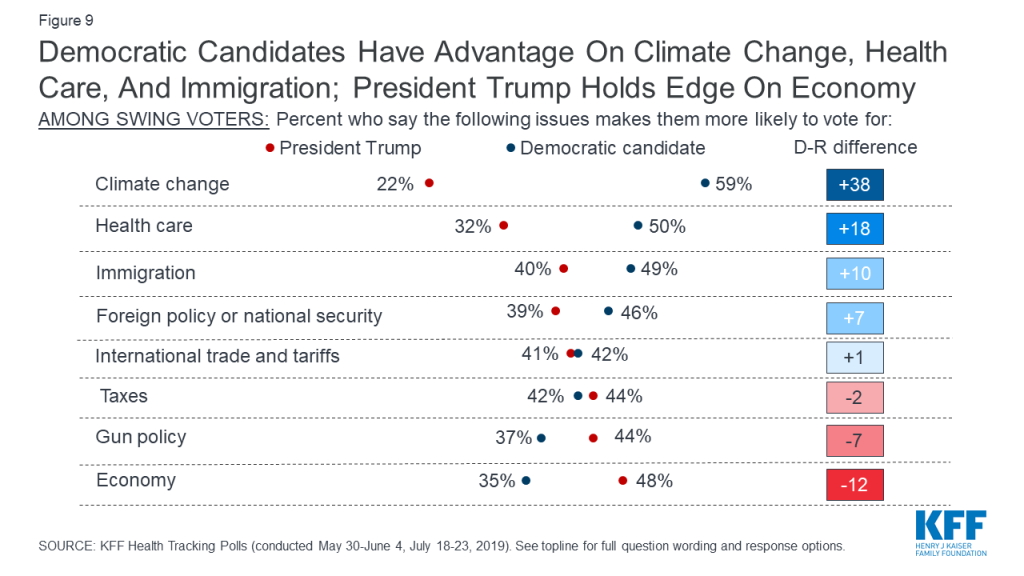
  • Many factors could influence voters’ decisions to either vote for President Trump or the Democratic nominee or even stay home on Election Day. This analysis finds issues like climate change, health care, immigration, or the economy could influence swing voters’ vote choice in 2020. Democrats may have the edge on three issues among swing voters: climate change (38 percentage point advantage), health care (18 percentage points), and immigration (10 percentage points) while President Trump, on the other hand, may have the edge on the economy (12 percentage points). As the 2020 presidential campaign continues, this data indicates that Democrats may benefit more when the focus is on climate change, health care, and immigration, while President Trump may have the advantage on the economy among this group of swing voters. Yet, it is important to note that if the economy slows down significantly, the edge that President Trump has on the economy may dissipate.
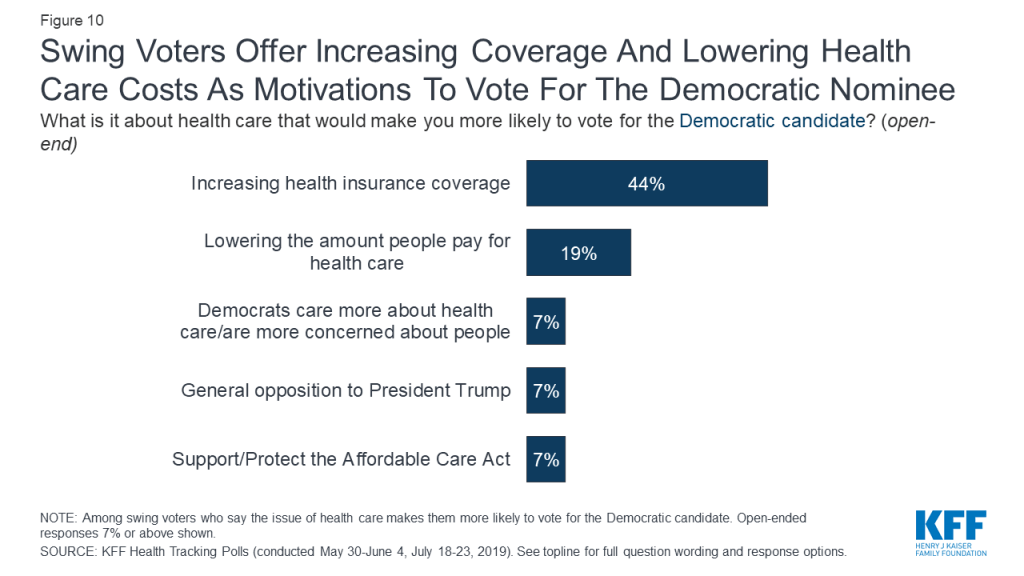
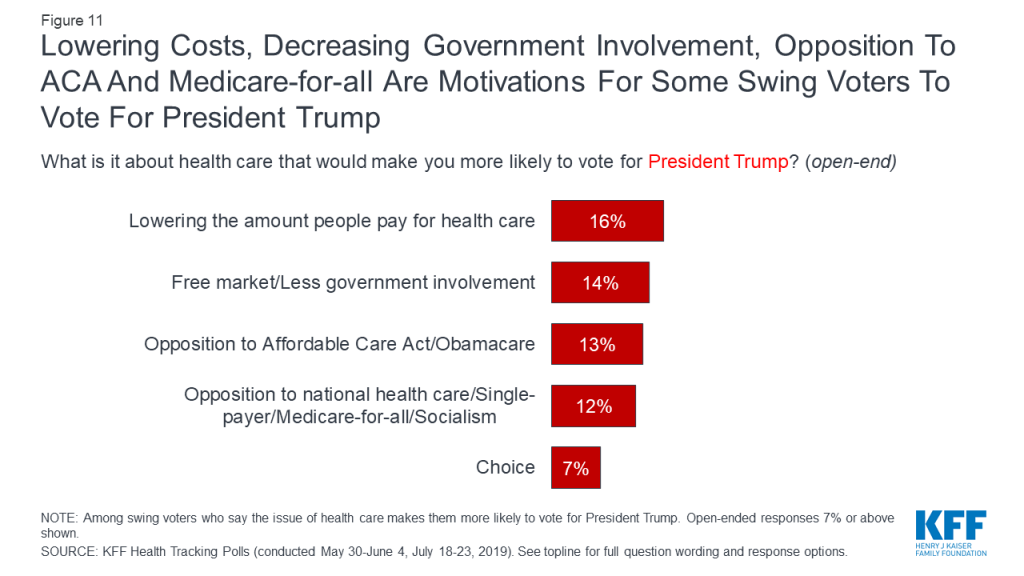
  • The issue of health care means different things to voters on different sides of the aisle. Nearly half (44%) of swing voters who prefer the Democratic nominee on health care offer responses related to increasing access to health insurance coverage as the reason why they support the Democratic nominee on this issue. Swing voters who prefer President Trump on health care do not appear to be rallying behind a single health care issue but offer varying responses. Lowering the amount people pay for health care ranks high for both sets of swing voters (19% and 16%, respectively).

Who Are The 2020 Swing Voters?

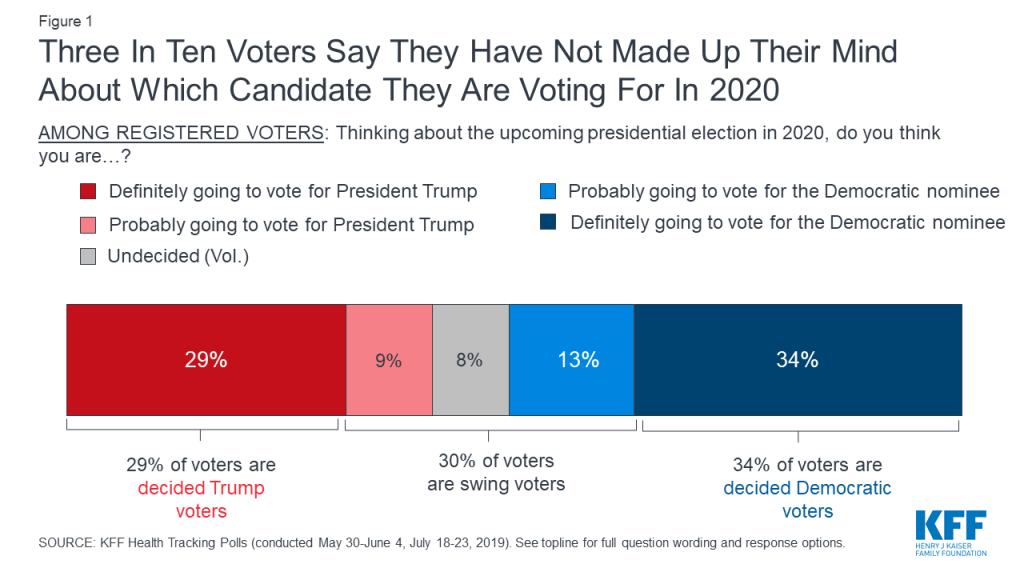
Nearly two-thirds of voters say they have already made up their minds about which candidate they plan to vote for. About one-third of voters (34%) say they are “definitely” going to vote for the Democratic nominee while three in ten (29%) say they are “definitely” going to vote for President Trump. This leaves three in ten voters as the crucial voting block known commonly as “swing voters.” This group of voters either say they are “probably” going to vote for President Trump (9%), “probably” going to vote for the Democratic nominee (13%), or say they are undecided about how they will vote (8%).

Figure 1: Three In Ten Voters Say They Have Not Made Up Their Mind About Which Candidate They Are Voting For In 2020

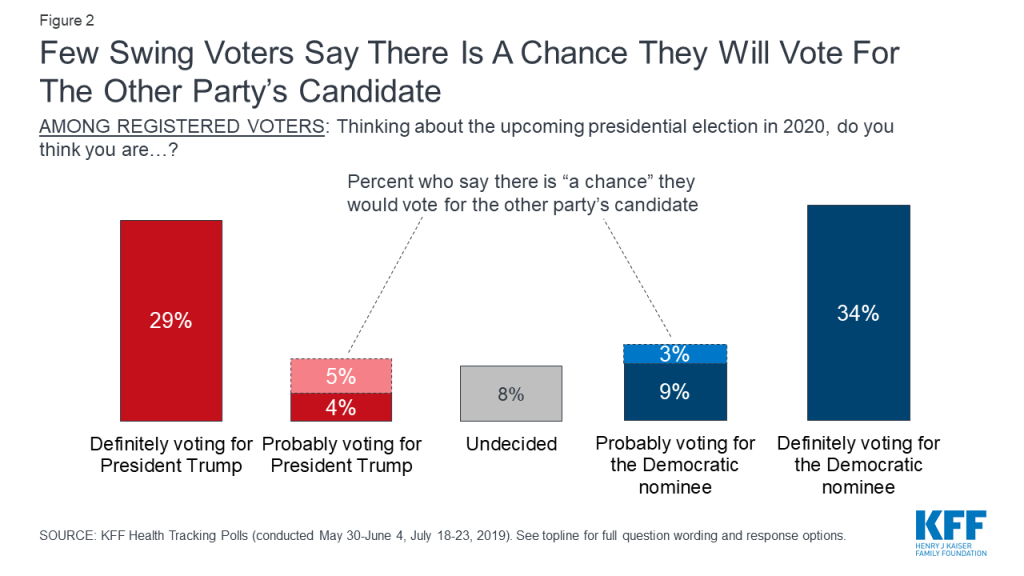
It is important to note that not all “swing voters” could potentially change their vote to support the other party’s candidate. Among voters who say they are probably going to vote for either President Trump or the Democratic nominee, few say there is “a chance” they will vote for the other party’s candidate. Among all voters, 5% say they will probably vote for President Trump but there is “a chance” they will vote for the Democratic nominee, while 3% of all voters say they will probably vote for the Democratic candidate but there is “a chance” they will vote for President Trump.

Figure 2: Few Swing Voters Say There Is A Chance They Will Vote For The Other Party’s Candidate

A vast majority of Democratic voters (85%) and most Republican voters (70%) say they aren’t going to cast a vote for the other party’s candidate. Seven in ten voters who identify as Democrats or Democratic-leaning independents say they are “definitely” going to vote for the Democratic nominee and an additional 16% say they are “probably” going to vote for the Democratic nominee and there is “no chance” they will vote for President Trump. On the other side of the aisle, six in ten Republican and Republican-leaning voters say they will “definitely” vote for President Trump with an additional 9% saying they are “probably” going to vote for President Trump and there is “no chance” they will vote for the Democratic nominee.

Table 1: Few Voters On Either Side Of Political Aisle Say There Is A Chance They Would Vote For The Other Party’s Candidate


Total voters

Democratic/ Democratic-leaning voters

Pure independent voters

Republican and Republican-leaning voters

Definitely voting for President Trump

29%

3%

11%

61%

Probably going to vote for President Trump

9

1

11

18

A chance they will vote for the Democratic nominee

   5

1

8

9

No chance they will vote for the Democratic nominee

    4

*

3

9

Probably going to vote for the Democratic nominee

13

20

11

6

A chance they will vote for President Trump

  3

4

2

3

No chance they will vote for President Trump

9

16

8

3

Definitely voting for the Democratic nominee

34

69

13

3

Undecided (Vol.)

8

4

29

7

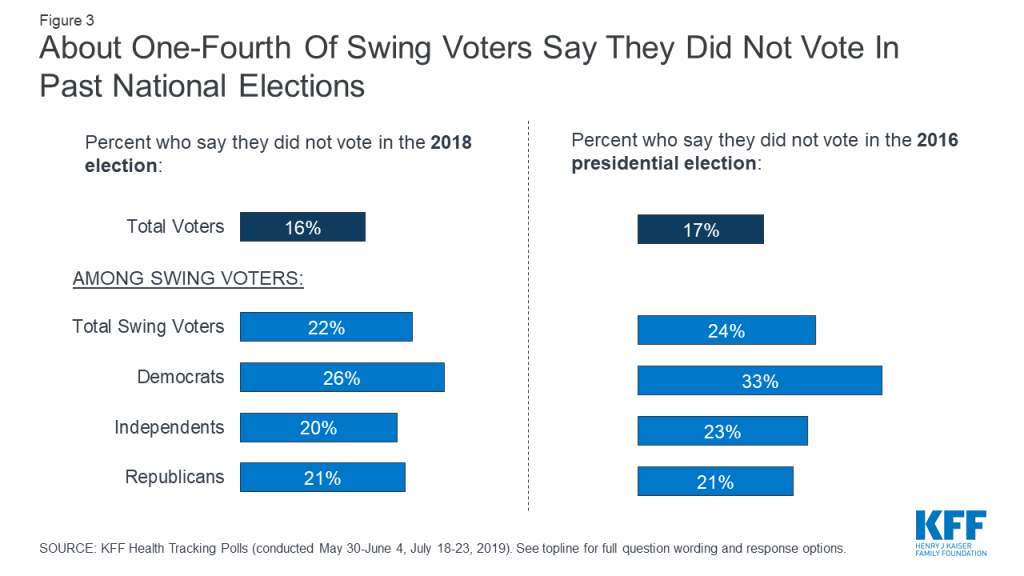
Instead of voting for the other party’s candidate, some of the voters who are leaning towards a candidate but haven’t made up their minds yet may choose to not vote in the 2020 presidential election. Nearly one-fourth of swing voters say they didn’t vote in either the 2016 presidential election (24%) or in the 2018 election (22%). A slightly larger share of Democrat swing voters (33%) say they didn’t vote in the 2016 election than both independents (23%) or Republicans (21%).

Figure 3: About One-Fourth Of Swing Voters Say They Did Not Vote In Past National Elections

Decided Voters v. Swing Voters

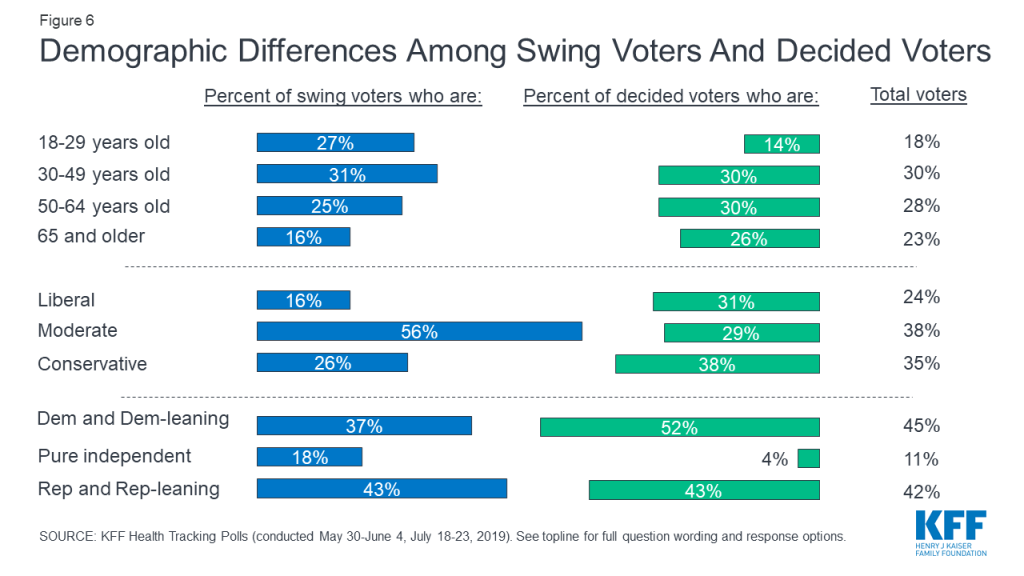
On most demographics, swing voters look very similar to their counterparts (voters who say they have already decided who they are going to vote for in the 2020 election), but they differ on three key variables: age, party identification, and ideology. To see a complete demographic profile of swing voters, see the appendices.

Age

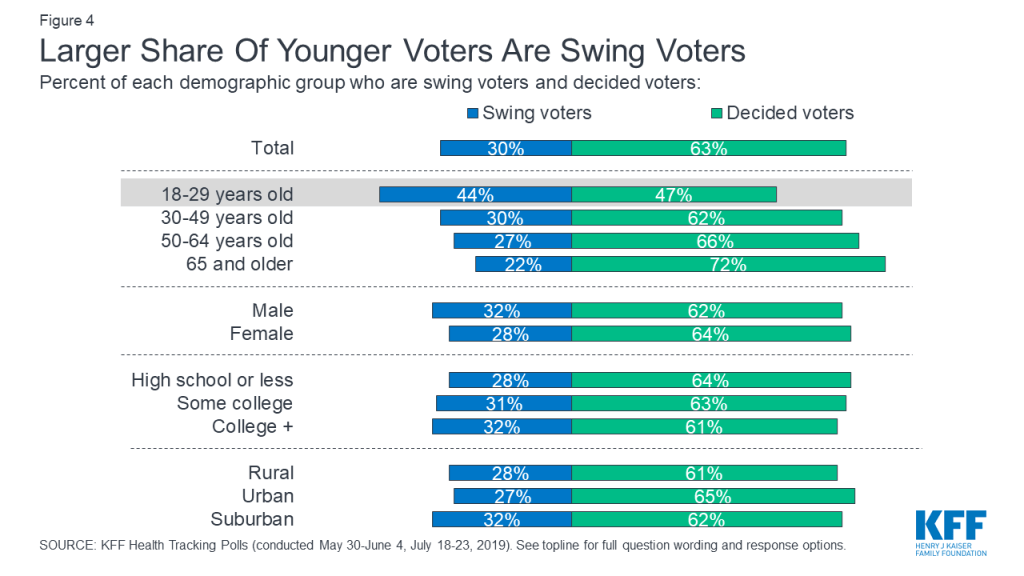
When we look at the share of demographic groups who get classified as either “swing voters” or “decide voters,” we find that about three in ten – across all socioeconomic groups such as gender, education, and urbanicity – are classified as swing voters. This is not true among the different age groups. A larger share of voters between 18 and 29 years old are “swing voters” (44%) which is nearly identical to the share of this group who are “decided voters.”

Figure 4: Larger Share Of Younger Voters Are Swing Voters

Party identification and ideology

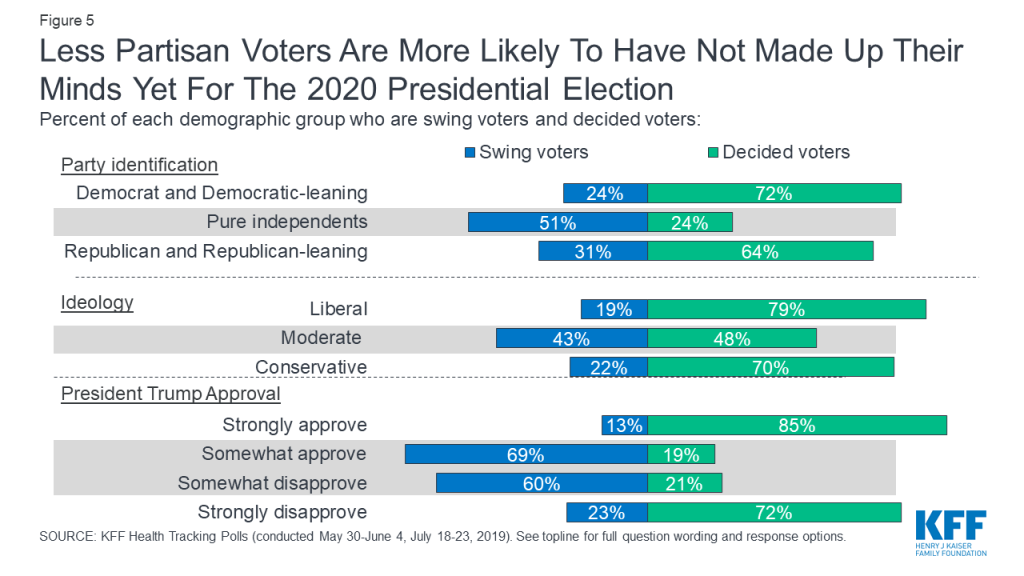
Perhaps as expected, the decided voters are the more partisan voters with strong ties to party identification and less likely to self-identify as political moderates. Half of political independents have not made up their mind about who to vote for in the 2020 presidential election compared to one-fourth (24%) of Democratic voters and 31% of Republican voters. In addition, four in ten self-identified moderates are classified as “swing voters” which is much larger than the share among those who call themselves liberal (79%) or conservative (70%).

Those with less polarized views of President Trump are also more likely to be classified as “swing voters.” Most of those who either “somewhat approve” (69%) or “somewhat disapprove” (60%) of President Trump are “swing voters,” while majorities of those who either “strongly approve” (85%) or “strongly disapprove” (72%) of President Trump have already made up their minds.

Figure 5: Less Partisan Voters Are More Likely To Have Not Made Up Their Minds Yet For The 2020 Presidential Election

Overall, swing voters tend to be younger: one-fourth are between 18 and 29 years old (27%), compared to 14% of voters who have already decided on their 2020 vote choice. More than half of swing voters (56%) say they have a moderate political ideology, compared to 29% of decided voters; and smaller shares identify as Democrats or Democratic-leaning independents (37% compared to 52%).

Figure 6: Demographic Differences Among Swing Voters And Decided Voters

Despite the relative similarities between swing voters and decided voters, they behave very differently towards politics and elections. Swing voters are much less likely to say they pay “a lot of attention” to what is going on in national government and politics and much less likely to say the outcome of the presidential election matters a lot than decided voters. On the other hand, voters who have decided they either are going to definitely vote for President Trump or the Democratic nominee are quite similar in how much attention they are currently paying and how important they view the outcome of the presidential election.

About four in ten (39%) of swing voters say they normally pay “a lot” of attention to what is going on in national government and politics compared to a majority of decided voters (68%).

Figure 7: Fewer Swing Voters Say They Are Paying A Lot Of Attention To National Government And Politics

There are no partisan differences among the decided voters with a majority of those who have decided they either are going to definitely vote for President Trump (70%) or the Democratic nominee (66%) saying they normally pay “a lot” of attention to national government and politics.

Table 2: Decided Voters, Across Partisanship, Report Paying More Attention To Government And Politics


Swing voters(30%)

Decided voters(63%)

Definitely Trump voters(29%)

Definitely Democratic voters(34%)

A lot

39%

68%

70%

66%

Some

44

24

22

26

Only a little/None at all

17

8

8

8

Similarly, swing voters are seemingly less concerned about the outcome of the presidential election. While a majority of swing voters (66%) say it “really matters who wins the 2020 presidential election,” more than one-third of swing voters say that it either “somewhat matters” (27%) or “doesn’t really matter” (7%) who wins the 2020 presidential election. The vast majority of decided voters (92%) say it “really matters who wins the 2020 presidential election.”

Figure 8: Fewer Swing Voters Say It Really Matters Who Wins The 2020 Presidential Election

Once again, there are no partisan differences among those voters who have decided their 2020 vote choice. Vast majorities of voters who have decided they either are going to definitely vote for President Trump (92%) or the Democratic nominee (93%) say it “really matters who wins” the 2020 presidential election.

Table 3: Decided Voters, Across Partisanship, More Likely To Say Presidential Election Outcome Matters


Swing voters(30%)

Decided voters(63%)

Definitely Trump voters(29%)

Definitely Democratic voters(34%)

Really matters who wins

66%

92%

92%

93%

Somewhat matters who wins

27

6

6

5

Doesn’t really matter who wins

7

2

2

2

Which Issues Could Swing The Election?

Many factors could influence voters’ decisions to either vote for President Trump or the Democratic nominee or even stay home on Election Day. These include the characteristics of the eventual Democratic nominee, views of President Trump, and how motivated voters are feeling about the election. When swing voters were asked whether a series of different issues could persuade them to vote for President Trump or the Democratic nominee, the latest analysis finds issues like climate change, health care, immigration, or the economy could influence swing voters’ vote choice in 2020.

Democrats have the edge on three issues among swing voters: climate change, health care, and immigration. The Democratic candidate has a 38 percentage point advantage on the issue of climate change with six in ten swing voters (59%) saying the issue of climate change makes them “more likely to vote for the Democratic candidate” compared to 22% who say climate change would make them more likely to vote for President Trump. Similarly, half of swing voters say the issue of health care makes them more likely to vote for the Democratic candidate compared to 32% who say health care would make them more likely to vote for President Trump; giving the Democratic nominee an 18 percentage point advantage on this issue. The Democratic candidate also as a 10 percentage point advantage on immigration (49% v. 40%). This data suggests that during the 2020 presidential race, Democrats may benefit more when the focus is on climate change, health care, and immigration – the three issues that swing voters say could influence them to vote for the Democratic presidential candidate.

President Trump, on the other hand, may have the edge on the economy. Half of swing voters say the economy makes them more likely to vote for President Trump (48%) compared to one-third of swing voters who say it makes them more likely for the Democratic nominee (35%). So if the focus of the 2020 presidential campaign is on the economy, President Trump may have the advantage among swing voters.

Figure 9: Democratic Candidates Have Advantage On Climate Change, Health Care, And Immigration; President Trump Holds Edge on Economy

For the other issues included in the survey, it is less clear whether President Trump or the Democratic candidate has an advantage. The Democratic candidate has a seven percentage point edge on foreign policy while President Trump has a seven point edge on gun policy1 ; however these slight advantages are not statistically significant. Similar shares of swing voters say they prefer President Trump or the Democratic nominee on international trade and tariffs and taxes.

Health Care as An Election Issue

When swing voters who say health care is an issue that would make them more likely to vote for Democratic candidate (50% of swing voters) are asked to say in their own words what it is about health care that could influence their vote choice, nearly half (44%) offer responses related to increasing access to health insurance coverage. This is followed by one-fifth (19%) who offer lowering the amount people pay for health care. Fewer offer responses such as: Democrats care more about health care (7%), general opposition to President Trump (7%), or support or protection of the Affordable Care Act (7%).

Figure 10: Swing Voters Offer Increasing Coverage and Lowering Health Care Costs As Motivations To Vote For The Democratic Nominee

On the other side of the ballot, when swing voters are asked to say in their own words what it is about health care that would make them more likely to vote for President Trump (32% of swing voters), they offer a variety of health care issues that could influence their vote choice. About one in six of these swing voters say lowering the amount people pay for health care (16%), free market or less government involvement (14%), opposition to the ACA (13%), or opposition to a national health plan or Medicare-for-all plan (12%) make them more likely to vote for President Trump in 2020.

Figure 11: Lowering Costs, Decreasing Government Involvement, Opposition To ACA And Medicare-for-all Are Motivations For Some Swing Voters To Vote For President Trump

Lowering the amount people pay for health care is the only health care issue that was offered by substantial shares of both swing voters who say the issue of health care makes them more likely to support President Trump (16%) and those who say it makes them more likely to vote for the Democratic nominee (19%).

Appendix

Table A.1: Socioeconomic Demographics of Swing Voters


Total voters

Swing voters(30%)

Decided voters(63%)

Definitely Trump voters(29%)

Definitely Democratic voters(34%)

Race/ethnicity


White, non-Hispanic

68%

70%

68%

83%

55%

Black, non-Hispanic

11%

9%

13%

1%

23%

Hispanic

11%

9%

12%

8%

14%

Other, non-Hispanic

7%

9%

5%

4%

6%

Gender


Male

49%

52%

48%

56%

41%

Female

51%

48%

52%

44%

59%

Age


18-29

18%

27%

14%

11%

16%

30-49

30%

31%

30%

28%

32%

50-64

28%

25%

30%

31%

29%

65+

23%

16%

26%

30%

22%

Education level


High school or less

34%

31%

34%

41%

29%

Some college

32%

33%

32%

34%

30%

College +

34%

36%

33%

25%

40%

Community type


Rural

13%

13%

13%

17%

9%

Suburban

54%

58%

53%

56%

51%

Urban

32%

29%

34%

27%

39%

Table A.2: Political Demographics of Swing Voters


Total voters

Swing voters(30%)

Decided voters(63%)

Definitely Trump voters(29%)

Definitely Democratic voters(34%)

Party Identification


Democrats and Democratic-leaning Independents

45%

37%

52%

5%

92%

         Democrat

30%

18%

39%

4%

68%

         Independent/lean Dem

15%

18%

14%

1%

24%

Pure independent

10%

17%

3%

4%

4%

         Independent lean Rep

16%

23%

12%

24%

1%

         Republican

27%

21%

32%

67%

2%

Republicans and Republican-leaning Independents

42%

43%

43%

91%

3%

Undesignated

2%

3%

1%

1%

1%

Trump Approval


Strongly approve/somewhat approve

44%

44%

45%

95%

3%

Strongly disapprove/somewhat disapprove

54%

53%

55%

5%

97%

Ideology


Liberal

24%

16%

31%

5%

52%

Moderate

38%

56%

29%

20%

37%

Conservative

35%

26%

38%

73%

10%

Methodology

This KFF Health Tracking Poll- Swing Voters was designed and analyzed by public opinion researchers at the Kaiser Family Foundation (KFF). The data from this topline is from two KFF Health Tracking Polls conducted May 30-June 4, 2019 and July 18-23, 2019, among a nationally representative random digit dial telephone sample of 2,402 adults ages 18 and older, living in the United States, including Alaska and Hawaii (note: persons without a telephone could not be included in the random selection process). To see the methodology for each poll, please visit the following: June 2019 available at https://www.kff.org/health-reform/poll-finding/kff-health-tracking-poll-june-2019/ and July 2019 available at https://www.kff.org/health-reform/poll-finding/kff-health-tracking-poll-july-2019/.

The combined landline and cell phone sample for each month was weighted to balance the sample demographics to match estimates for the national population using data from the Census Bureau’s 2017 American Community Survey (ACS) on sex, age, education, race, Hispanic origin, and region along with data from the 2010 Census on population density. The sample was also weighted to match current patterns of telephone use using data from the July-December 2018 National Health Interview Survey. The weight takes into account the fact that respondents with both a landline and cell phone have a higher probability of selection in the combined sample and also adjusts for the household size for the landline sample, and design modifications, namely, the oversampling of prepaid cell phones and likelihood of non-response for the re-contacted sample. All statistical tests of significance account for the effect of weighting.

The margin of sampling error including the design effect for the full sample of registered voters is plus or minus 3 percentage points. Numbers of respondents and margins of sampling error for key subgroups are shown in the table below. For results based on other subgroups, the margin of sampling error may be higher. Sample sizes and margins of sampling error for other subgroups are available by request. Note that sampling error is only one of many potential sources of error in this or any other public opinion poll. Kaiser Family Foundation public opinion and survey research is a charter member of the Transparency Initiative of the American Association for Public Opinion Research.

Group

N (unweighted)

M.O.S.E.

June KFF Health Tracking Poll- Registered voters

1,020

±4 percentage points

July KFF Health Tracking Poll- Registered voters

1,010

±4 percentage points

Total registered voters

2,030

±3 percentage points


Total swing voters

603

±5 percentage points

Endnotes

  1. The surveys used for this analysis were completed prior to the recent mass shootings in El Paso, TX on August 3rd, 2019 and Dayton, Ohio on August 4th, 2019. ↩︎