Medicaid Arrangements to Coordinate Medicare and Medicaid for Dual-Eligible Individuals

Authors: Maria T. Peña, Maiss Mohamed, and Alice Burns
Published: Apr 27, 2023

Issue Brief

Introduction

There are 12.5 million people enrolled in both Medicare and Medicaid, known as “dual-eligible individuals.” Administered and financed by the federal government, Medicare is the primary source of health insurance for people ages 65 and older and covers people under 65 who qualify through the Social Security Disability Insurance program. Jointly financed by the federal and state governments, Medicaid is the nation’s largest public health insurance program for low-income Americans.

Dual-eligible individuals receive their primary health insurance coverage through Medicare and receive additional assistance from their state Medicaid program. They have low incomes and very modest savings but are otherwise a heterogenous group in terms of age, physical, and mental health. Among the 12.5 million dual-eligible individuals in 2020, most (73%) were “full-benefit” dual-eligible individuals meaning they were eligible for the full range of Medicaid benefits that are not otherwise covered by Medicare, such as long-term services and supports. “Partial-benefit” dual-eligible individuals are not eligible for full Medicaid benefits, but are eligible for assistance with Medicare premiums and, in many cases, cost sharing through the Medicare Savings Programs.

Separate eligibility requirements, benefits, and rules for Medicare and Medicaid sometimes contribute to what has been described as a “fragmented and disjointed system of care for dual eligibles.” In response to those challenges, policymakers have created several coverage arrangements aimed at improving the coordination of Medicare and Medicaid (see Glossary). Those arrangements often rely on managed care plans to coordinate Medicare and Medicaid. Such coordination is especially relevant for full-benefit dual-eligible individuals who use both Medicare- and Medicaid-covered services. Coordination needs are fewer for partial-benefit dual-eligible individuals but some may exist where Medicaid pays Medicare cost sharing.

This issue brief describes how state Medicaid programs are implementing arrangements aimed at coordinating Medicare and Medicaid for dual-eligible individuals. We use data from the 22nd annual budget survey of Medicaid officials in all 50 states and the District of Columbia conducted by KFF and Health Management Associates (HMA), in collaboration with the National Association of Medicaid Directors (NAMD). The District of Columbia is counted as a state for the purposes of this report. Given differences in the financing structure of their programs, the U.S. territories were not included in this analysis. We supplement the survey findings with administrative data from the Centers for Medicare and Medicaid Services (CMS). We find that nearly all states are leveraging strategies to coordinate care for dual-eligible individuals and many states are using multiple strategies. In 2022:

  • 28 states use Medicaid managed care to cover some or all benefits for dual-eligible individuals. In Medicaid managed care, enrollees receive services through a health plan that is operated by either a private company or a local authority. States may include requirements for the plans to coordinate with Medicare. Such requirements could include paying Medicare cost sharing or providing a case manager to coordinate care. Dual-eligible individuals who are enrolled in Medicaid managed care can be enrolled in traditional Medicare or a private Medicare plan (e.g., Medicare Advantage).
  • 30 states had Programs of All-Inclusive Care for the Elderly (PACE) available. PACE is a program that provides comprehensive medical and social services to individuals who are: (1) 55 years of age or older, (2) need a nursing home level of care but are able to live safely in the community, and (3) live in a PACE organization service area. Most enrollees are dual-eligible individuals, but Medicare beneficiaries who are not eligible for Medicaid may pay a monthly premium to enroll. Although PACE is only available in limited service areas, evaluations have shown favorable outcomes for participants.
  • 9 states participated in the Financial Alignment Initiative (FAI) to coordinate care for dual-eligible individuals. The Financial Alignment Initiative is an initiative in which the Centers for Medicare and Medicaid Services (CMS) partners with states to test new models for their effectiveness in improving care for dual-eligible individuals and better aligning the financial incentives of Medicare and Medicaid. Most, but not all, the states that participated in the Initiative did so by offering Medicare and Medicaid benefits jointly in a single health plan. Such “Medicare-Medicaid Plans” have a 3-way contract between the state, federal government, and health plan. CMS recently announced its intent to end the Medicare-Medicaid plan model by the end of December 2025 and to transition those plans into D-SNPs. Evaluations of the Financial Alignment Initiative show mixed results in terms of spending, enrollment, and beneficiary experience across states.
  • 29 states leveraged their contracts with dual eligible special needs plans (D-SNPs) to require enhanced coordination between Medicaid and the D-SNP providing Medicare benefits. D-SNPs are Medicare Advantage plans that specialize in providing coverage for dual-eligible individuals. There are three types of D-SNPs:
    • Coordination-Only D-SNPs provide Medicare-covered services and are required to coordinate the delivery of benefits with the Medicaid program, contract with state Medicaid programs, and notify states when enrollees are admitted to inpatient facilities.
    • Highly Integrated D-SNPs must meet the requirements of coordination-only D-SNPs and must also have a Medicaid plan operating in the same counties as the D-SNP. The parent organization provides both Medicare and Medicaid services, but there is no requirement that people enroll in both plans.
    • Fully Integrated D-SNPs must meet the requirements of coordination-only D-SNPs and must also offer an aligned Medicaid plan that integrates the Medicare and Medicaid benefits. Medicare pays the plan for Medicare-covered services and Medicaid pays the plan for Medicaid-covered services. Currently, dual-eligible beneficiaries may enroll in the D-SNP without also enrolling in the Medicaid-plan. Similarly, there may be Medicaid enrollees with coverage through the aligned Medicaid plan who are not also enrolled in the D-SNP. Starting in 2025, enrollment in fully integrated D-SNPs will be limited to those who are enrolled in both the Medicare and Medicaid plans.

How do Coverage Arrangements for Dual-Eligible Individuals Vary Across States?

State Medicaid programs may deliver services on a fee-for-service basis in which states reimburse health care providers a fee for each service or through managed care plans, which provide Medicaid benefits to enrollees and receive a per member monthly payment for such services. States have increased their reliance on managed care delivery systems to help improve access and outcomes, enhance care management and coordination, and better control costs. For dual-eligible individuals, Medicaid managed care plans may provide coverage of services that Medicare does not cover (long-term services and supports and non-emergency transportation for example) or may pay enrollees’ required cost sharing for Medicare-covered services. Medicaid managed care plans may be “comprehensive,” which means that they cover most or all Medicaid benefits, or they may be “non-comprehensive,” which means that they only cover a specific subset of Medicaid benefits such as behavioral health or non-emergency medical transportation.

In 2022, 28 states enrolled dual-eligible individuals in comprehensive managed care and in 2020 (the most recent year for which data were available), an estimated 3 million people were enrolled (Figure 1). Enrollment in Medicaid managed care may be mandatory or voluntary for dual-eligible individuals and the enrollment process often varies within states by county or eligibility group. States with voluntary managed care enrollment may adopt “passive enrollment” in which enrollees are assigned to a managed care plan with the opportunity to opt-out or switch to another plan.

Other coverage arrangements provide Medicaid benefits through a single plan that integrates the Medicare and Medicaid benefits, although fewer dual-eligible individuals are enrolled in such programs. Those options include the Financial Alignment Initiative, which was available in 9 states, and PACE, which was available in 30 states in 2022. Total enrollment in these programs is just over 500,000.

Medicaid may also coordinate care for dual-eligible individuals by contracting with dual eligible special needs plans (D-SNPs), private Medicare Advantage plans that exclusively enroll beneficiaries with Medicaid. D-SNPs aim to better coordinate benefits and care covered under the two programs. In 2022, D-SNPs were available in 46 states and 4.1 million dual-eligible individuals were enrolled (Figure 1). D-SNPs may be paired with affiliated Medicaid managed care or managed long-term services and supports plans.
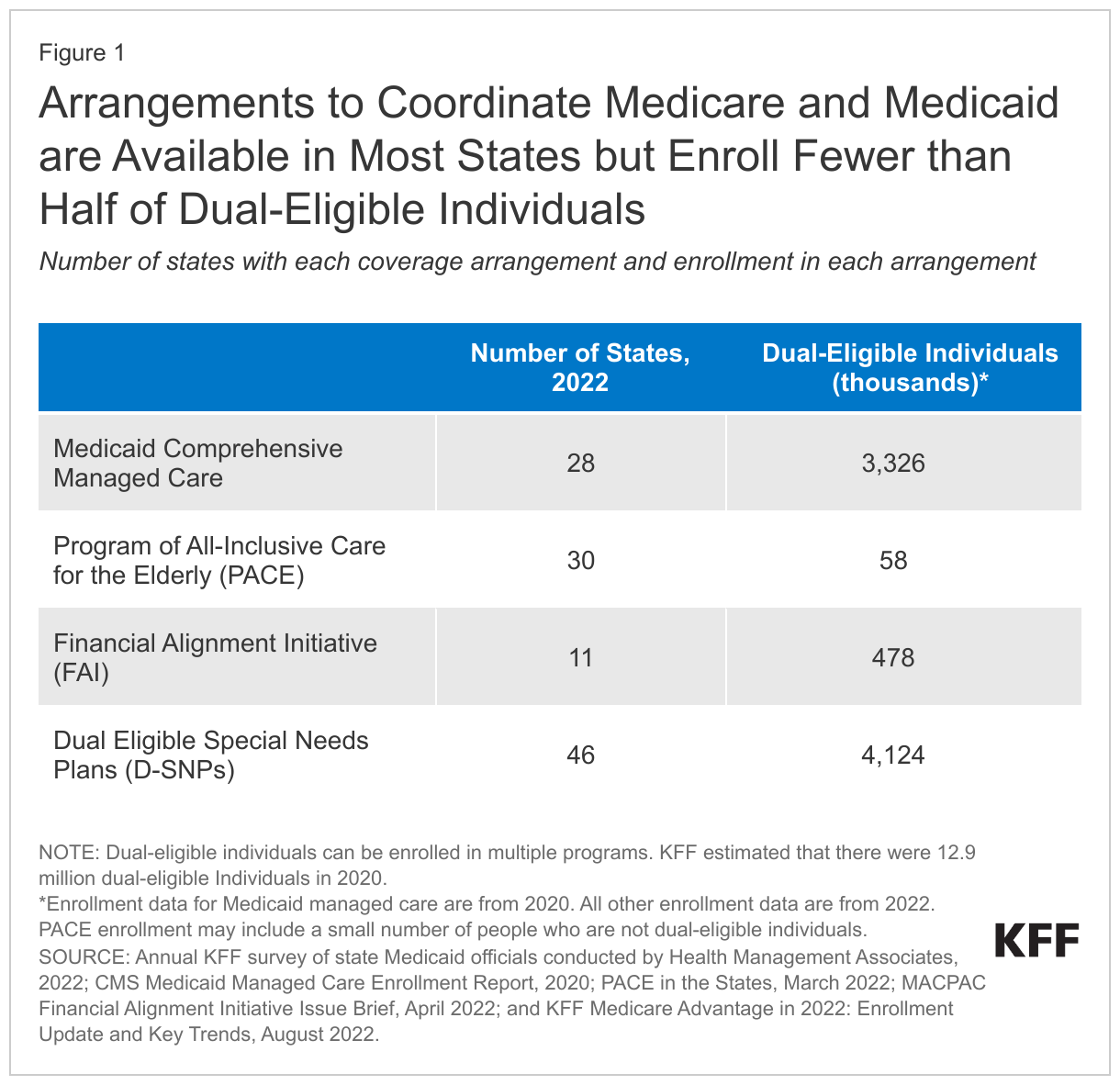
Arrangements to Coordinate Medicare and Medicaid are Available in Most States but Enroll Fewer than Half of Dual-Eligible Individuals

How are States Using Medicaid Managed Care to Coordinate Care for Dual-Eligible Individuals?

Over half of states (28) use Medicaid comprehensive managed care to deliver Medicaid benefits to dual-eligible individuals (Figure 2, Managed care tab). Among those states, 7 states only had managed care, 14 states had managed care and PACE, 2 states had managed care and a Financial Alignment Initiative, and 5 states had managed care, PACE, and a Financial Alignment Initiative (Appendix Table 1). Among the states with comprehensive Medicaid managed care and the Financial Alignment Initiative, all used private plans to implement the Financial Alignment Initiative. Although many states have more than one Medicaid coverage arrangement in place, those arrangements are often not available statewide. States may choose to make Medicaid managed care and the Financial Alignment Initiative statewide or to limit them to certain counties. PACE is only available in specific “service areas,” which are defined by counties or zip codes and agreed to by the PACE provider, the state, and CMS.

The remaining 23 states do not use comprehensive managed care to cover dual-eligible individuals but may coordinate care using other strategies (Figure 2, No managed care tab). Among states without comprehensive managed care, 7 states had PACE and 4 states had both PACE and a Financial Alignment Initiative. The remaining states did not have PACE or a Financial Alignment Initiative. Among the 7 states without comprehensive managed care that had a Financial Alignment Initiative, all but Washington used private plans to implement the Initiative. Washington uses a managed fee-for-service model where health homes receive payments from the Medicaid agency to coordinate care for dual-eligible individuals. (Health homes are organizations such as community-based organizations or managed care organizations that contract with care coordination organizations to provide comprehensive care management, care coordination, health promotion, transitional care, individual and family support, and referral to community and social support services to participants.)
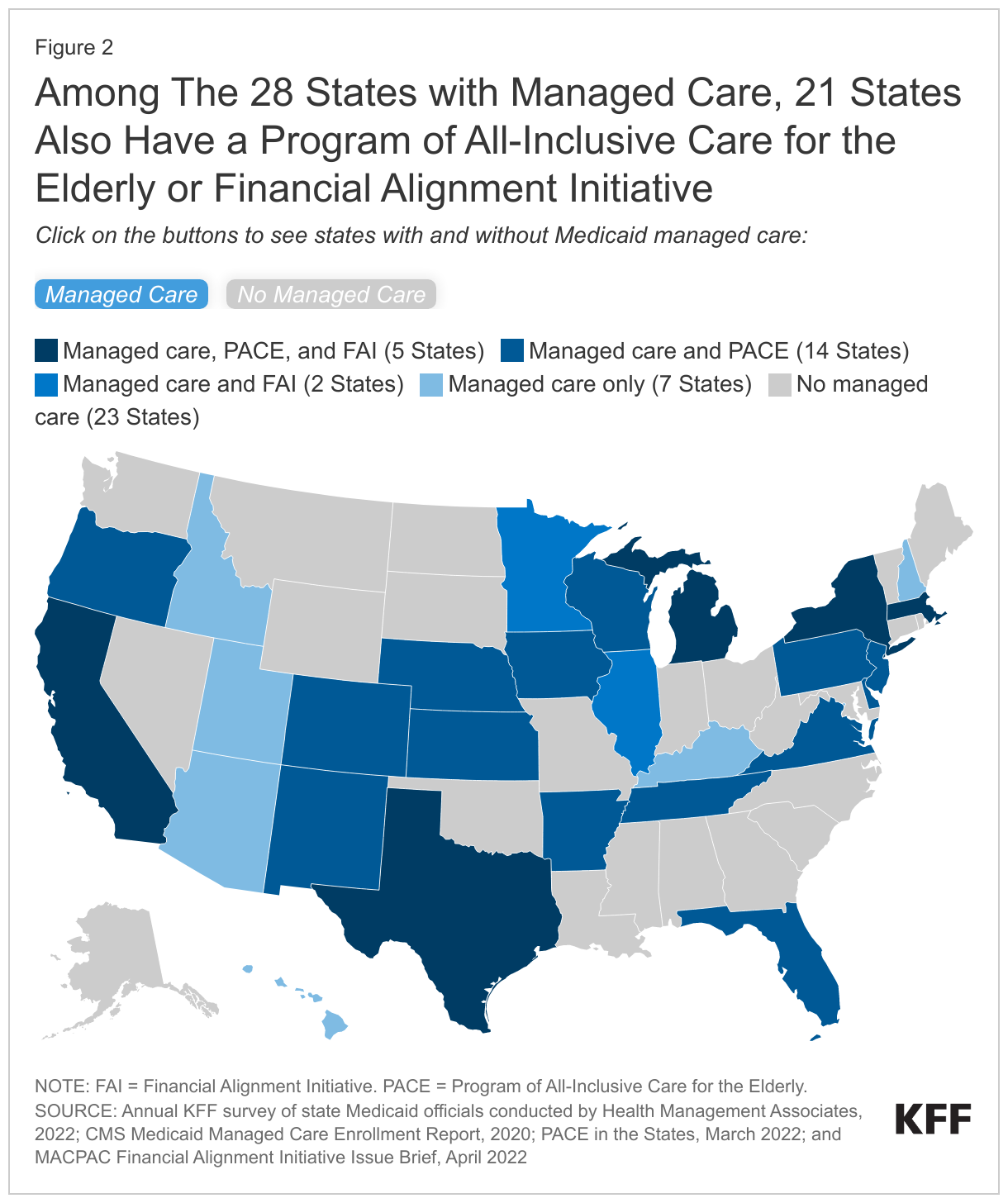
Among The 28 States with Managed Care, 21 States Also Have a Program of All-Inclusive Care for the Elderly or Financial Alignment Initiative

How are States Leveraging their Contracts with D-SNPs to Coordinate Care for Dual-Eligible Individuals?

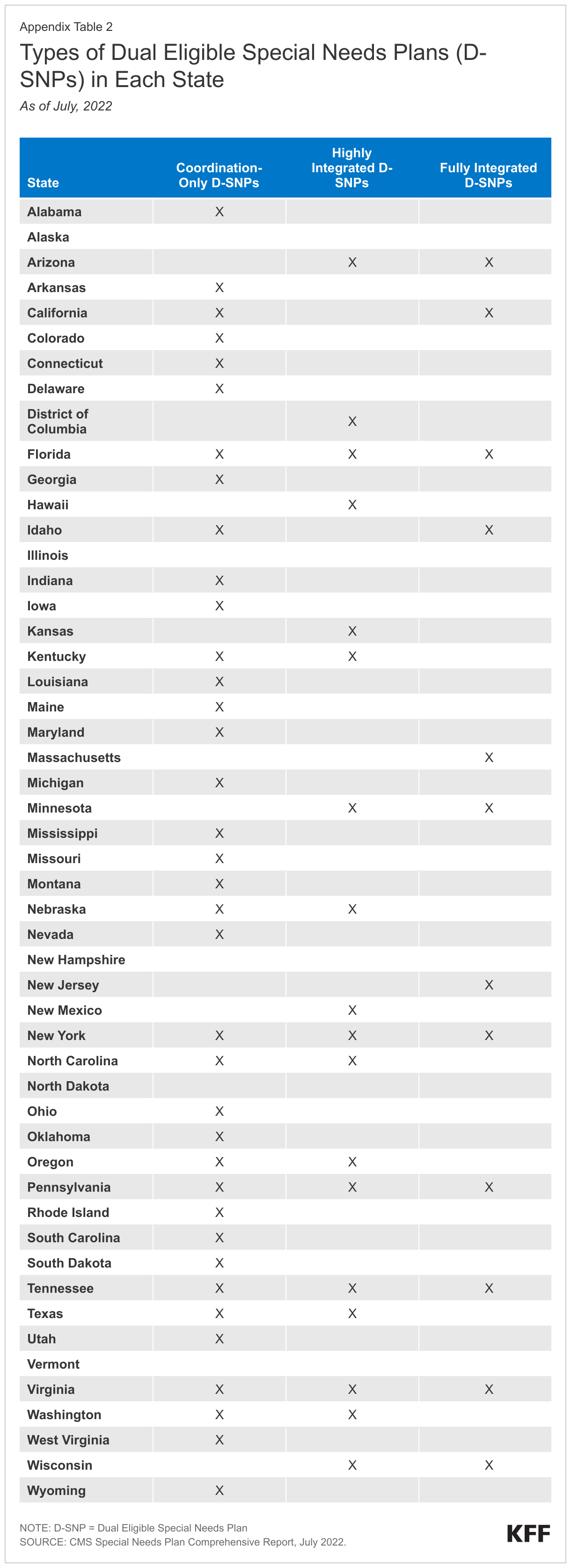
D-SNPs are available in almost all states, but D-SNPs with lower levels of federally-required integration are much more widely available than those with higher levels of integration (Figure 3). Medicare Advantage insurers that would like to offer D-SNPs must have a contract with each state in which they intend to offer coverage, in addition to having a contract with the federal government for providing Medicare-covered services. Federal regulations describe minimum contract elements, which differ across the three categories of D-SNPs and change from year-to-year. There are more required contract elements for D-SNPs with higher levels of integration. Of the 46 states offering a D-SNP (Appendix Table 2), 37 offer coordination-only D-SNPs, which have the fewest requirements for integrating Medicare and Medicaid. There are 12 states with highly integrated D-SNPs and 18 states with fully integrated D-SNPs. Roughly a third of states with D-SNPs have more than one type available (16).
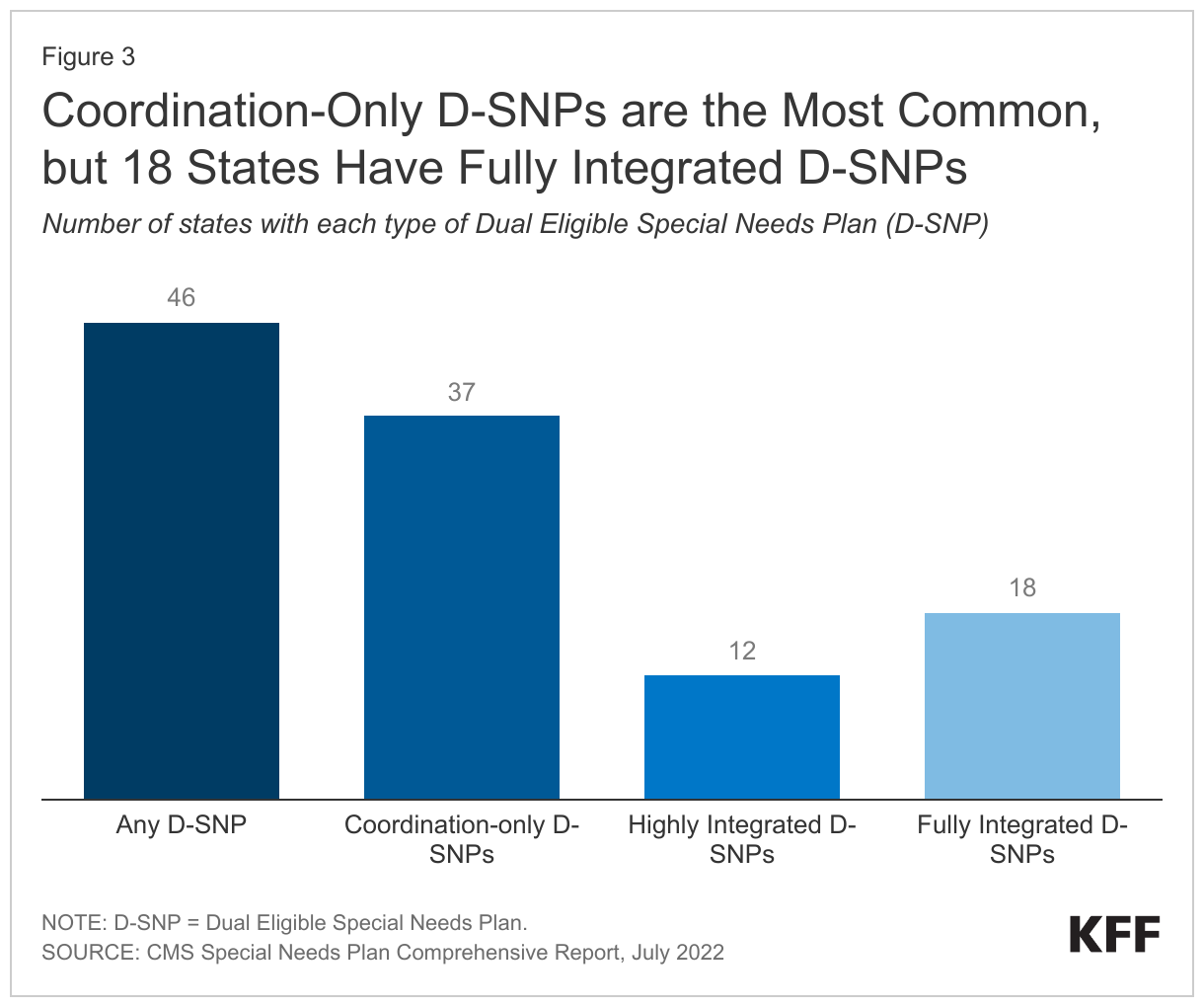
Coordination-Only D-SNPs are the Most Common, but 18 States Have Fully Integrated D-SNPs

States are able to include additional requirements for D-SNPs in their contracts to enhance the integration between Medicare and Medicaid and 29 states reported doing so (Figure 4, States with Different Types of Requirements tab). In the survey, states reported whether they included several elements in their contracts with D-SNPs that were designed to increase Medicare and Medicaid integration. For the 16 states with multiple types of D-SNPs, it is unknown whether the contract requirements apply to all D-SNPs within the state or only to the most integrated type of D-SNP. However, among the 29 states with additional requirements for D-SNPs, over half (16) do not have any contracts with fully integrated D-SNPs.
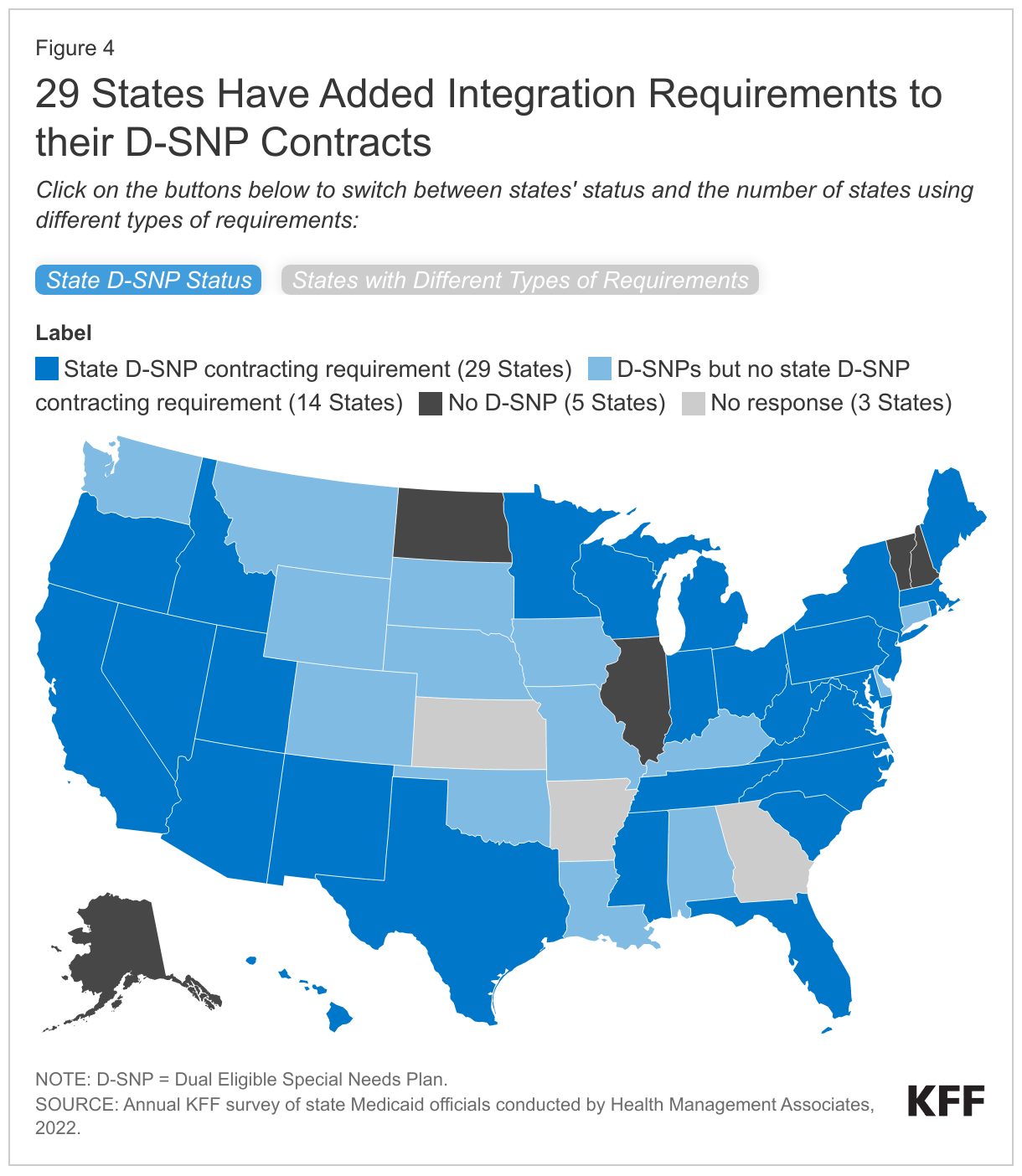
9 States Have Added Integration Requirements to their D-SNP Contracts
  • 17 states reported requirements related to coverage of supplemental benefits under either Medicare or Medicaid (Figure 4, States with Different Types of Requirements tab). As with other Medicare Advantage plans, D-SNPs may offer supplemental benefits beyond what is covered by traditional Medicare. Some of those benefits such as non-emergency medical transportation or dental care may overlap with Medicaid benefits. To avoid duplicative coverage, 9 states reported requiring the D-SNP to provide supplemental Medicare benefits that complement (rather than duplicate) the benefits dual-eligible individuals receive through Medicaid. (The benefits would be provided under the Medicare supplemental benefit package).

    Other states reported requiring D-SNPs to offer Medicaid managed care plans that included coverage of either long-term services and supports (8 states) or behavioral health services (9 states) (Medicaid pays the costs of Medicaid-covered benefits). Long-term services and supports and behavioral health are the largest components of Medicaid spending for dual-eligible individuals and are services that often require significant coordination with Medicare-covered services. Requiring D-SNPs to offer a Medicaid plan that covers those benefits ensures that the same parent organization is familiar with the major set of services used by dual-eligible individuals.

  • 15 states reported administrative integration requirements including integrating the member materials or the grievance and appeals system (13 states each). Integrated member materials provide information to dual-eligible individuals about all Medicare and Medicaid benefits and applicable cost sharing in unified documents (such as a combined summary of benefits and single enrollee handbook). Without the unified documents, dual-eligible individuals receive separate materials for Medicare and Medicaid and need to find the relevant information in both to determine what is covered under the two plans combined. Unifying the grievance and appeals system means that if enrollees want to file a complaint or request reconsideration of denied services, they can do so once for the plan, rather than doing so separately for their Medicare and Medicaid coverage.

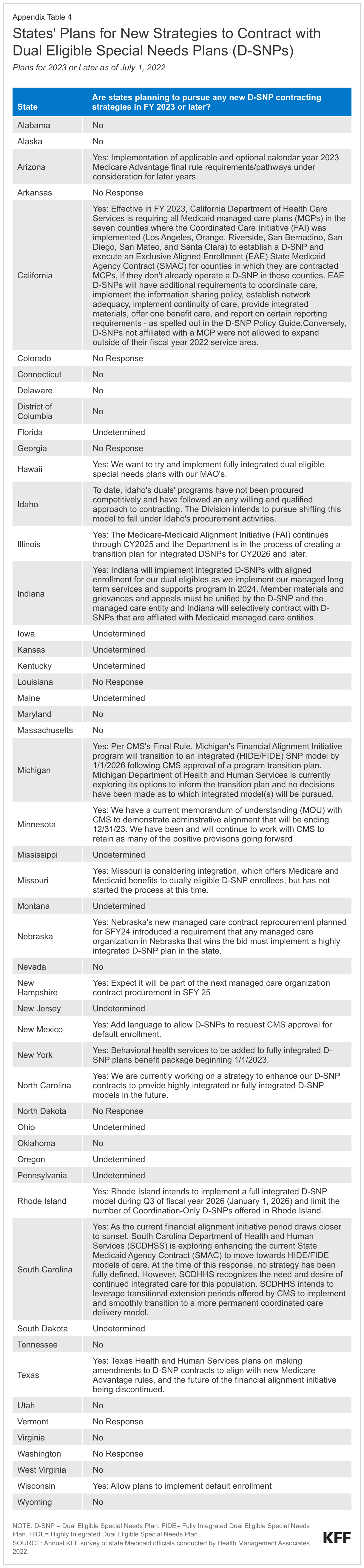
In addition, 12 states reported other types of requirements beyond those that multiple states are implementing (Appendix Table 3) and 18 states reported pursuing new strategies in FY 2023 or beyond (Appendix Table 4). Future changes include contracting with D-SNPs that have a higher level of integration than their current D-SNPs, enhancing integration requirements among existing D-SNPs, and making changes that would facilitate compliance with the final rule, Medicare Program; Contract Year 2023 Policy and Technical Changes to the Medicare Advantage and Medicare Prescription Drug Programs. That rule makes several changes to D-SNPs that will take effect between 2023 and 2025.

Looking ahead

Although coverage arrangements aimed at integrating Medicare and Medicaid are available in most states, fewer than one million dual-eligible individuals are estimated to be enrolled in either a fully-integrated D-SNP or Medicare-Medicaid Plan. Policymakers at the federal and state levels are discussing ideas to increase coordination between Medicare and Medicaid. A bipartisan group of Senators led by Bill Cassidy (R-LA) -- and including Tom Carper (D-DE), John Cornyn (R-TX), Bob Menendez (D-NJ), Tim Scott (R-SC), and Mark Warner (D-VA) – recently solicited feedback from health care providers and patient communities about improving care for dual-eligible beneficiaries.

Responses to the request for information note the problems that arise from the current Medicare and Medicaid systems, which include fragmented care and poorer health outcomes for dual-eligible individuals, higher health spending, and the incentives for health care providers and states to shift costs to the Medicare program. Several responses to the request for information—including those by the Medicare Payment and Access Commission—recommend strengthening integration requirements for D-SNPs. Those recommendations reflect the fact that there is already significant and growing enrollment in D-SNPs, whereas other types of integrated delivery systems (such as PACE) have been characterized by limited participation. However, the level of integration achieved by D-SNPs is highly varied and over half of the states with D-SNPs only have plans with the lowest level of integration. Other responses —such as one by the Medicaid and CHIP Payment and Access Commission—highlight the value of maintaining state flexibility when creating federal programs and recognizing the variation in how states are currently integrating care for dual-eligible individuals.

The tension between retaining state flexibility and ensuring that more highly integrated arrangements are available in all states is one of many challenges of developing new approaches to coordinating care. Other challenges include the heterogeneity of dual-eligible individuals, their need for varied but often quite complex or costly health and social services, and differing financing streams from which these programs are funded.

Glossary: Coverage Models for Dual-Eligible Individuals

Medicaid Managed Care covers some or all Medicaid benefits through a health plan that is operated by either a private company or a local authority. States may include requirements for the plans to coordinate with Medicare. Such requirements could include paying Medicare cost sharing or providing a case manager to coordinate care. Dual-eligible individuals who are enrolled in Medicaid managed care can be enrolled in traditional Medicare or a private Medicare plan (e.g., Medicare Advantage).

The Program of All-Inclusive Care for the Elderly (PACE) is a program that provides comprehensive medical and social services to individuals who are: (1) 55 years of age or older, (2) need a nursing home level of care but are able to live safely in the community, and (3) live in a PACE organization service area. Most enrollees are dual-eligible individuals, but Medicare beneficiaries who are not eligible for Medicaid may pay a monthly premium to enroll. Although PACE is only available in limited service areas, evaluations have shown favorable outcomes for participants.

The Financial Alignment Initiative is an initiative in which the Centers for Medicare and Medicaid Services (CMS) partners with states to test new models for their effectiveness in improving care for dual-eligible individuals and better aligning the financial incentives of Medicare and Medicaid. Most, but not all of the states that participated in the Initiative, did so by offering Medicare and Medicaid benefits jointly in a single health plan. Such “Medicare-Medicaid Plans” have a 3-way contract between the state, federal government, and health plan. CMS recently announced its intent to end the Medicare-Medicaid plan model by the end of December 2025 and to transition those plans into D-SNPs. Evaluations of the Financial Alignment Initiative show mixed results in terms of spending, enrollment, and beneficiary experience across states.

Dual Eligible Special Needs Plans (D-SNPs) are Medicare Advantage plans that specialize in providing coverage for dual-eligible individuals. There are three types of D-SNPs:

  • Coordination-Only D-SNPs provide Medicare-covered services and are required to coordinate the delivery of benefits with the Medicaid program, contract with state Medicaid programs, and notify states when enrollees are admitted to inpatient facilities.
  • Highly Integrated D-SNPs must meet the requirements of coordination-only D-SNPs and must also have a Medicaid plan operating in the same counties as the D-SNP. The parent organization provides both Medicare and Medicaid services, but there is no requirement that the same people enroll in both plans.
  • Fully Integrated D-SNPs must meet the requirements of coordination-only D-SNPs and must also offer an aligned Medicaid plan that integrates the Medicare and Medicaid benefits. Medicare pays the plan for Medicare-covered services and Medicaid pays the plan for Medicaid-covered services. Currently, dual-eligible beneficiaries may enroll in the D-SNP without also enrolling in the Medicaid-plan. Similarly, there may be Medicaid enrollees with coverage through the aligned Medicaid plan who are not also enrolled in the D-SNP. Starting in 2025, enrollment in fully integrated D-SNPs will be limited to those who are enrolled in both the Medicare and Medicaid plans.

This work was supported in part by Arnold Ventures. KFF maintains full editorial control over all of its policy analysis, polling, and journalism activities.

This brief draws on work done under contract with Health Management Associates (HMA) consultants Kathleen Gifford, Aimee Lashbrook, Mike Nardone, and Matt Wimmer.

Appendix Tables
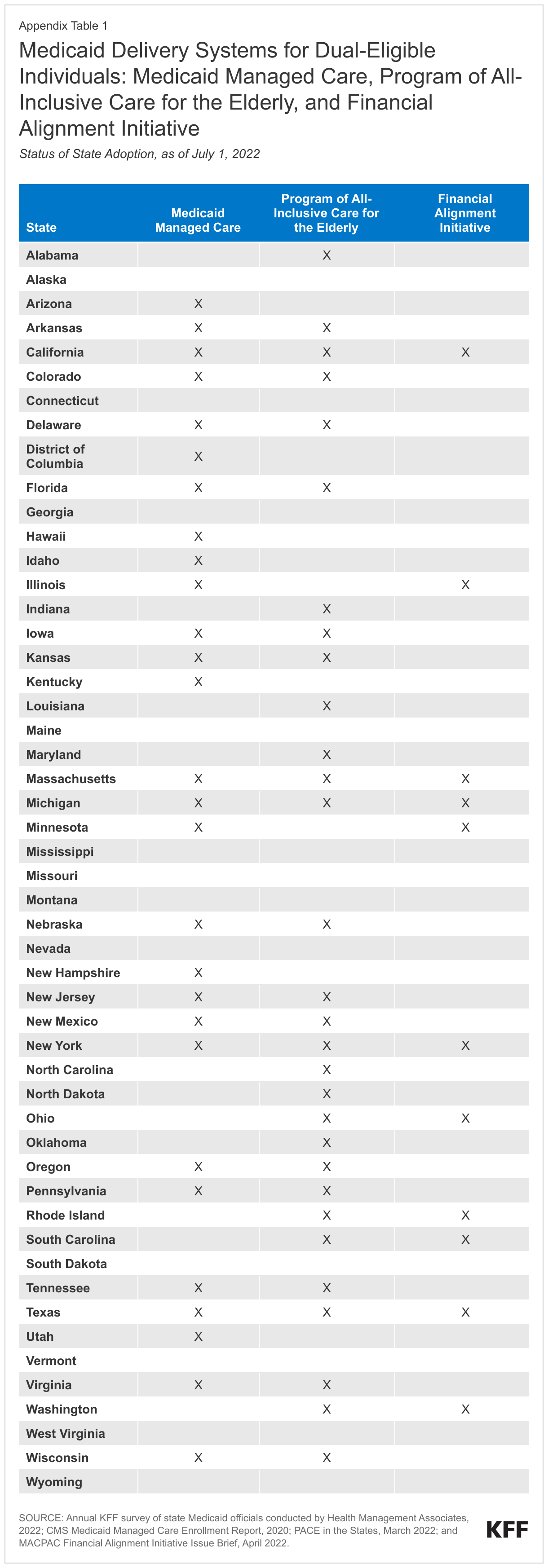
Medicaid Delivery Systems for Dual-Eligible Individuals: Medicaid Managed Care, Program of All-Inclusive Care for the Elderly, and Financial Alignment Initiative
Types of Dual-Eligible Special Needs Plans (D-SNPs) in Each State
Integration Requirements in States' Contracts with Dual-Eligible Special Needs Plans
States' Plans for New Strategies to Contract with Dual-Eligible Special Needs Plans (D-SNPs)

Presentation: The End of the Public Health Emergency Declaration for COVID-19

Published: Apr 26, 2023
  • The End of the Public Health Emergency Declaration for COVID-19 - Slide 1
  • The End of the Public Health Emergency Declaration for COVID-19 - Slide 2
  • The End of the Public Health Emergency Declaration for COVID-19 - Slide 3
  • The End of the Public Health Emergency Declaration for COVID-19 - Slide 4
  • The End of the Public Health Emergency Declaration for COVID-19 - Slide 5
  • The End of the Public Health Emergency Declaration for COVID-19 - Slide 6
  • The End of the Public Health Emergency Declaration for COVID-19 - Slide 7
  • The End of the Public Health Emergency Declaration for COVID-19 - Slide 8
  • The End of the Public Health Emergency Declaration for COVID-19 - Slide 9
  • The End of the Public Health Emergency Declaration for COVID-19 - Slide 10
  • The End of the Public Health Emergency Declaration for COVID-19 - Slide 11
  • The End of the Public Health Emergency Declaration for COVID-19 - Slide 12
  • The End of the Public Health Emergency Declaration for COVID-19 - Slide 13
  • The End of the Public Health Emergency Declaration for COVID-19 - Slide 14
  • The End of the Public Health Emergency Declaration for COVID-19 - Slide 15

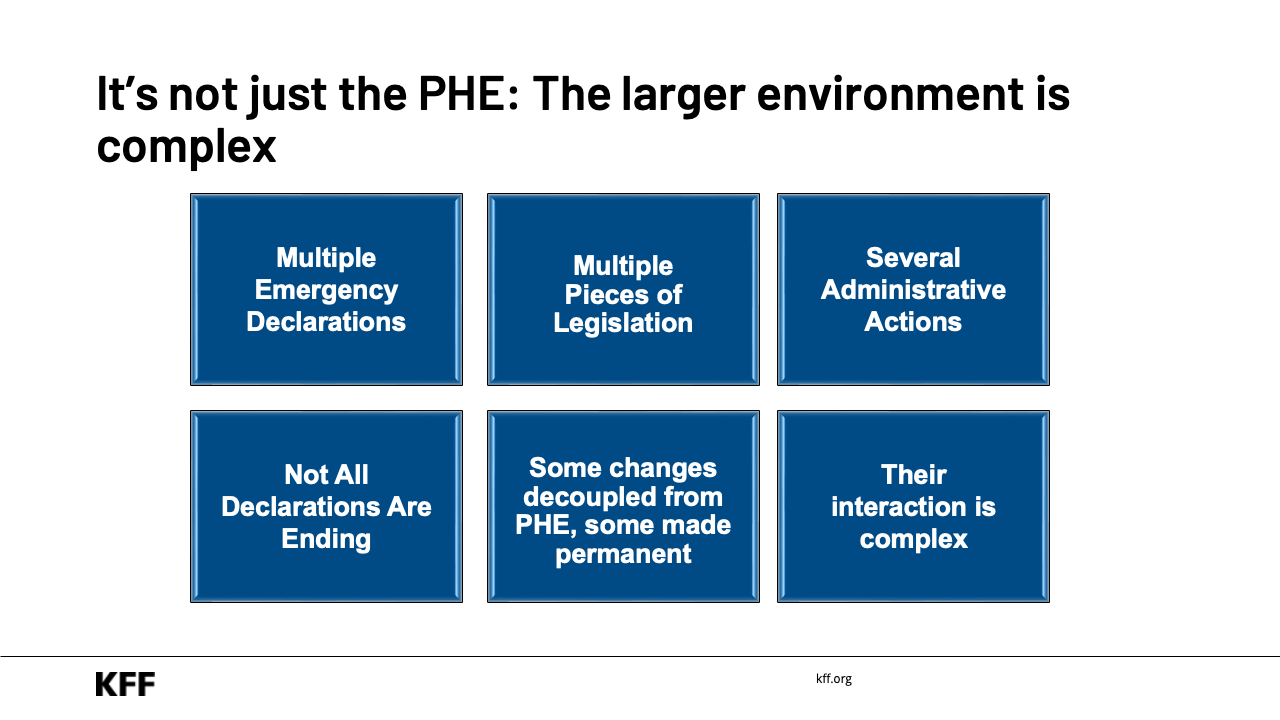
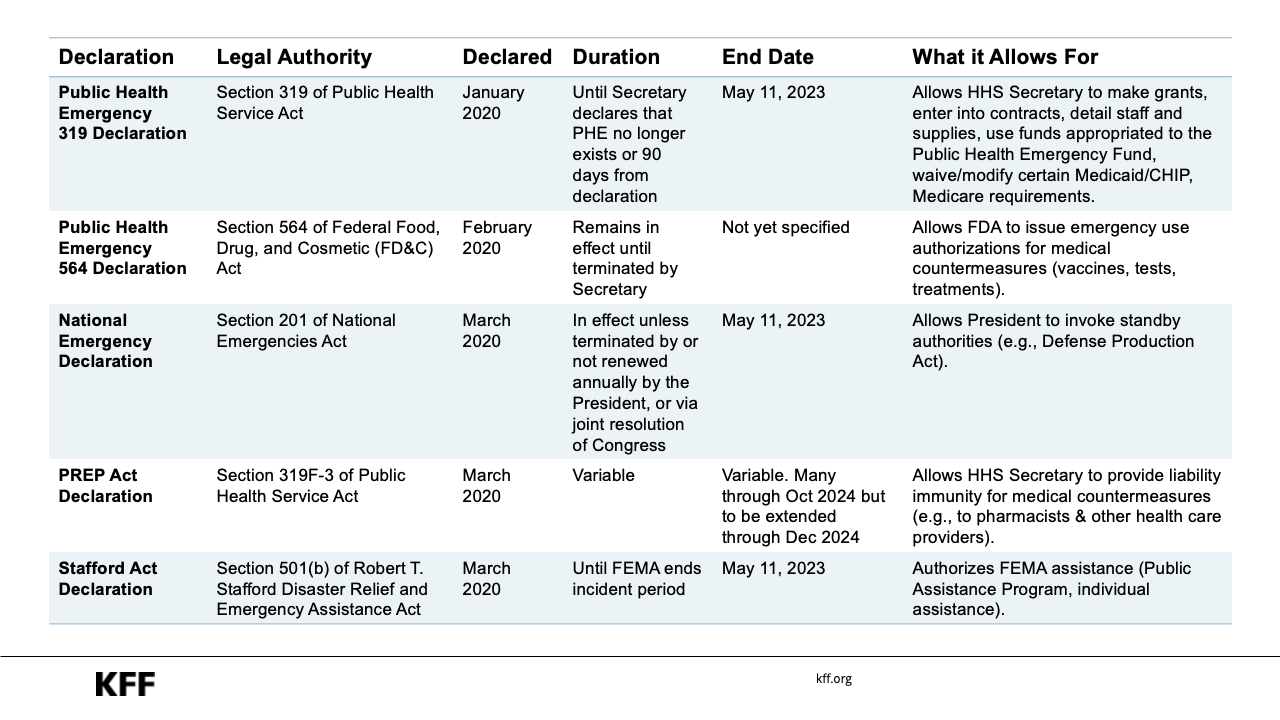
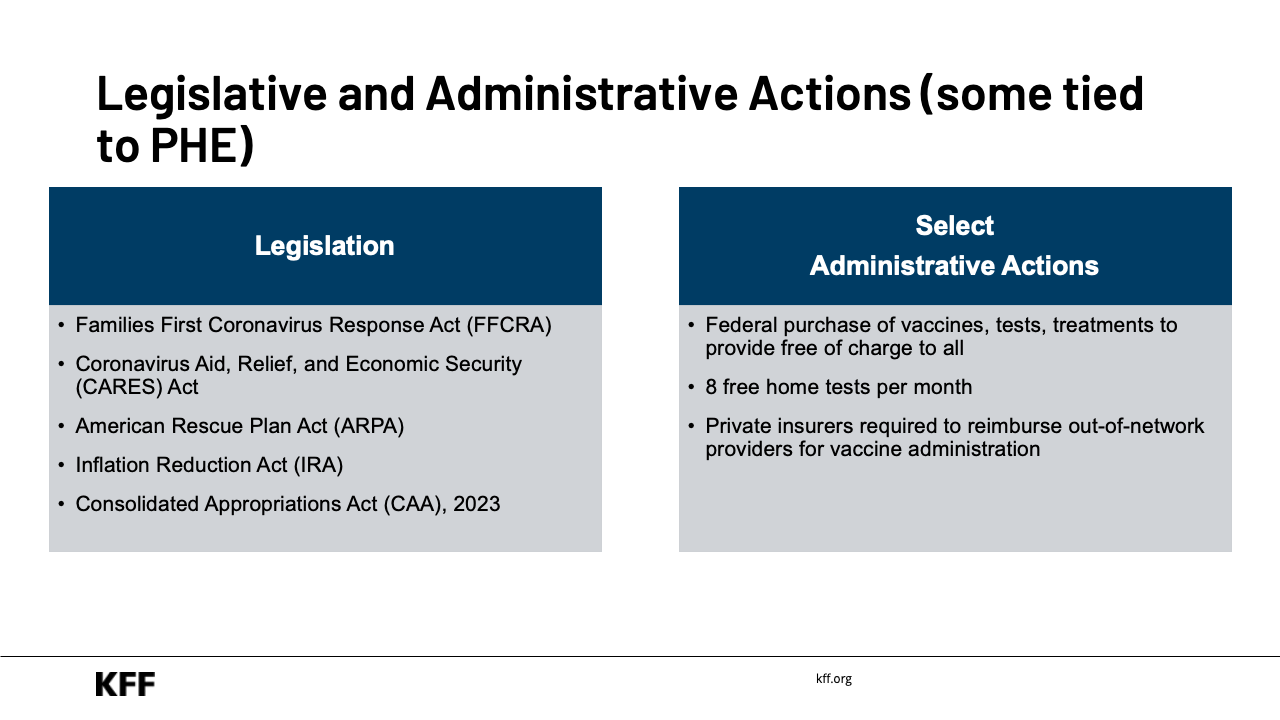
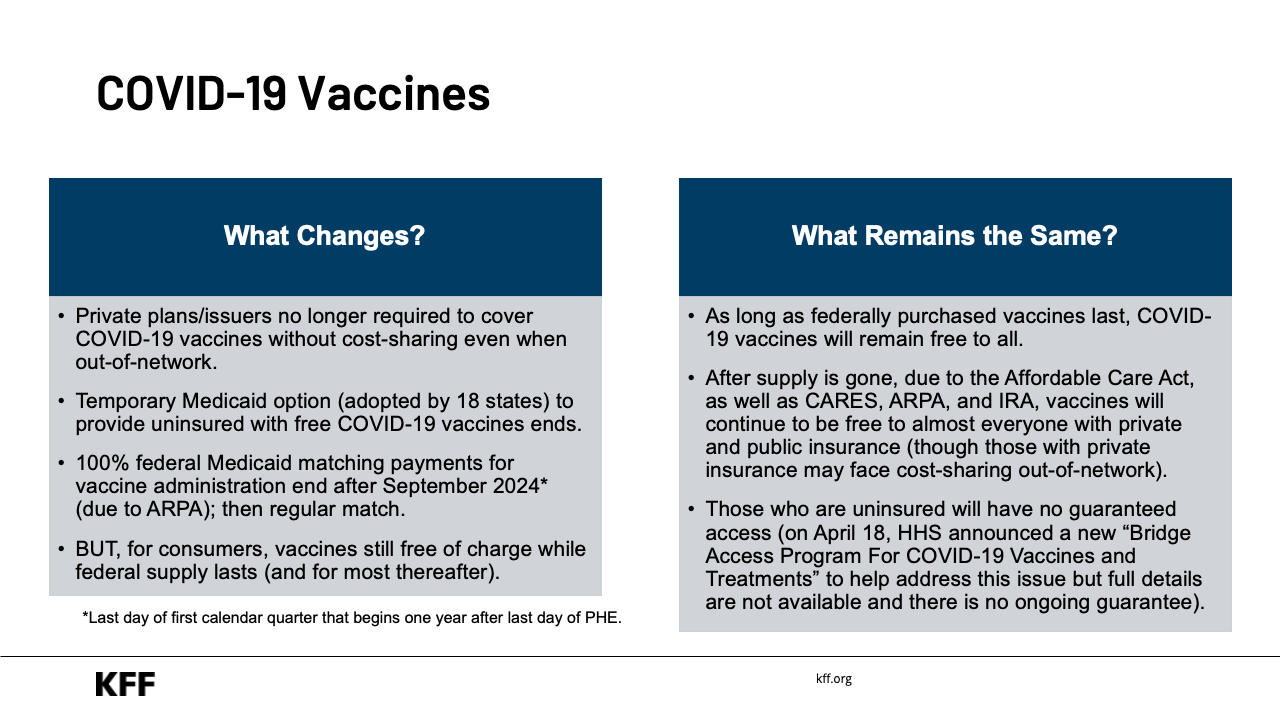
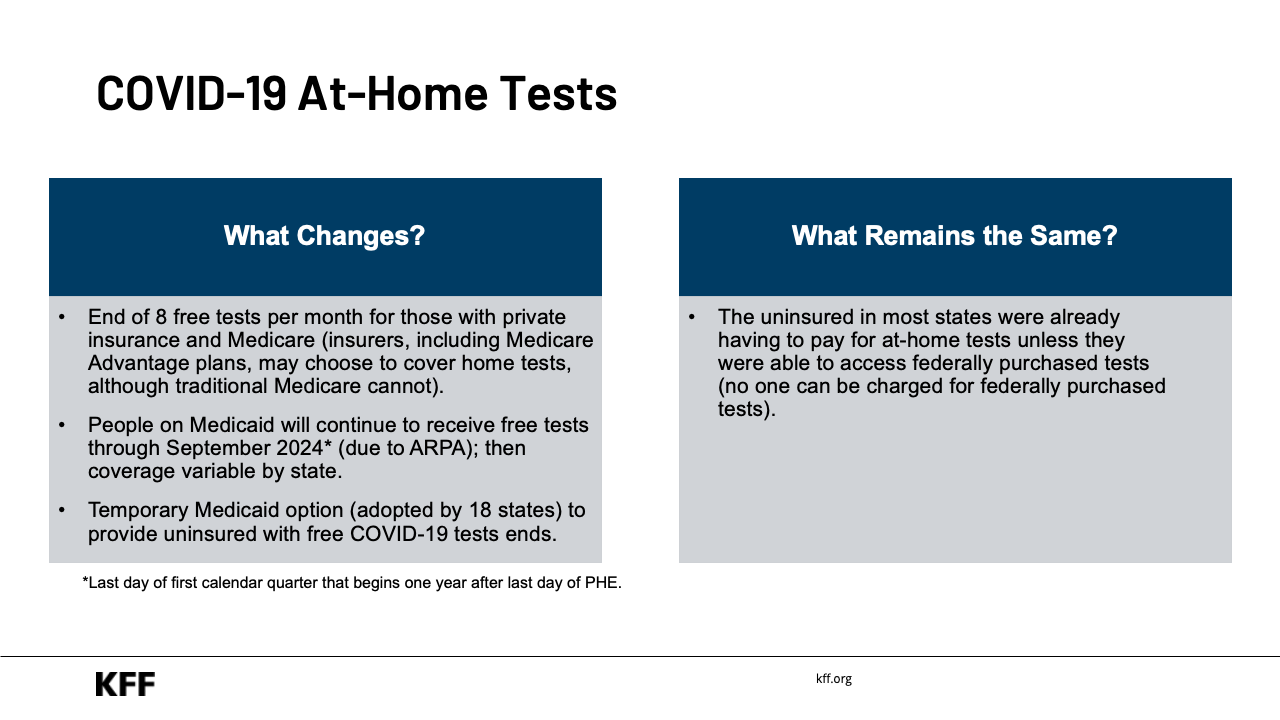
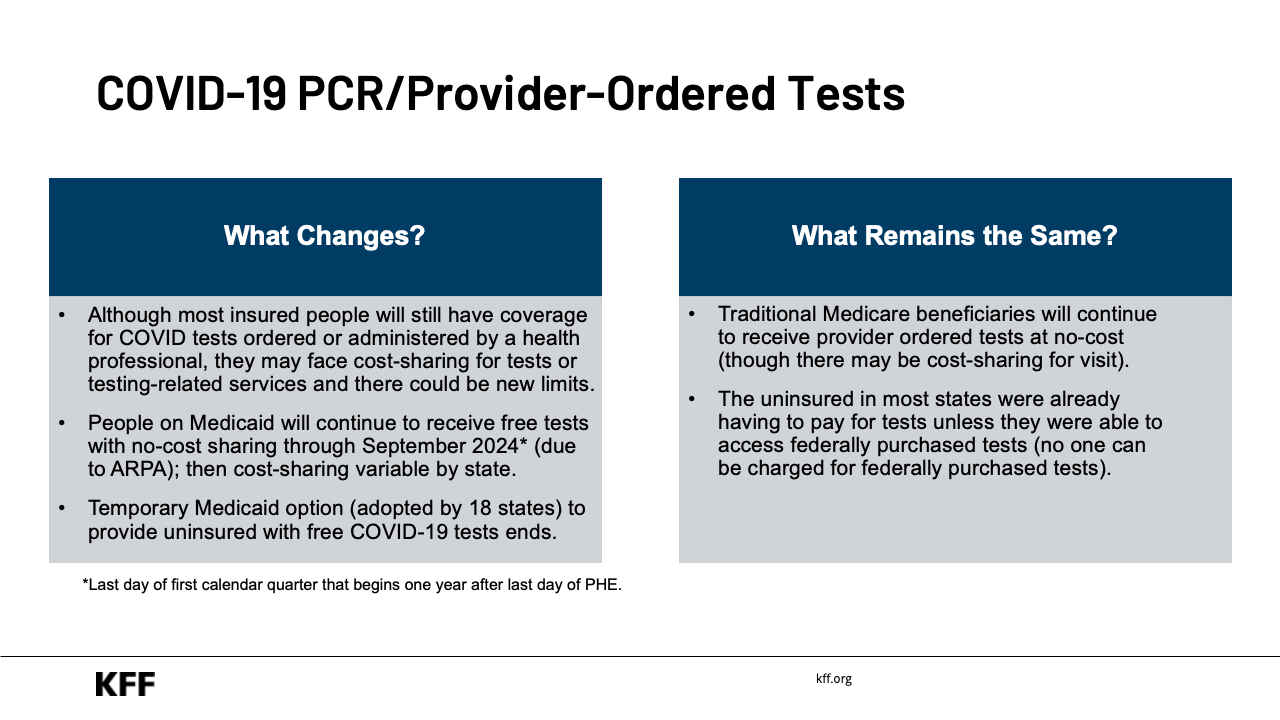
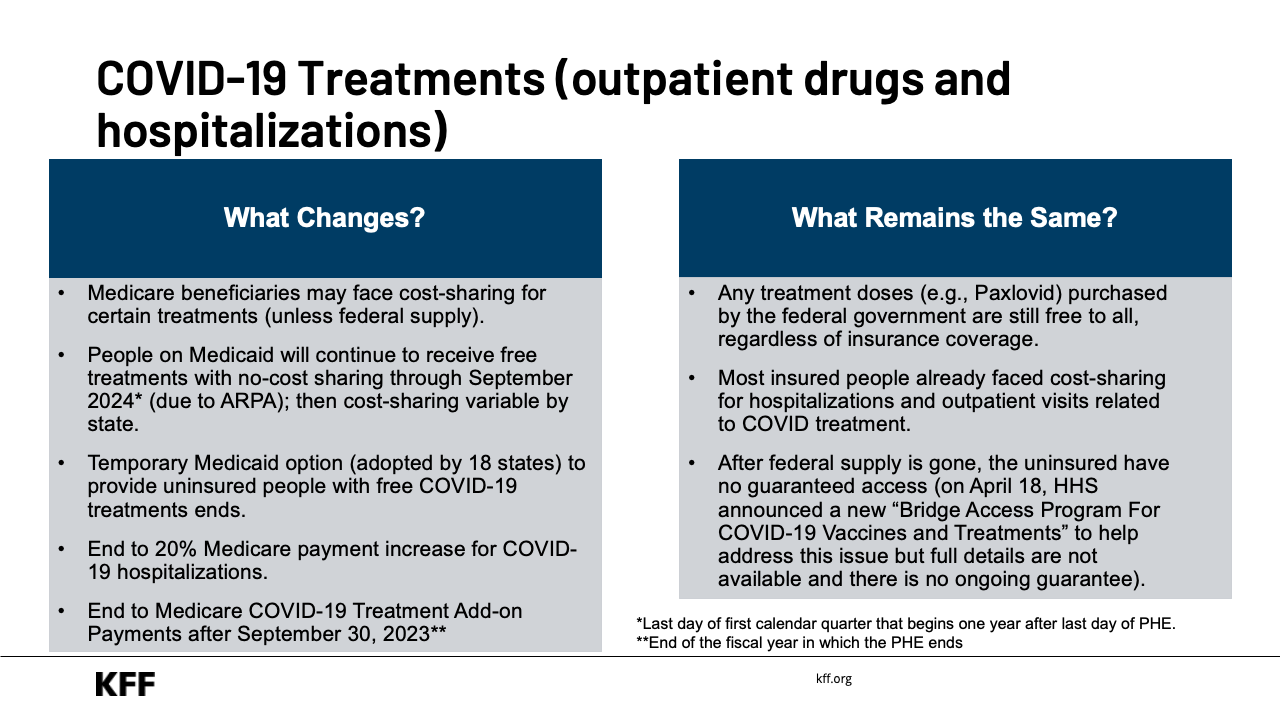
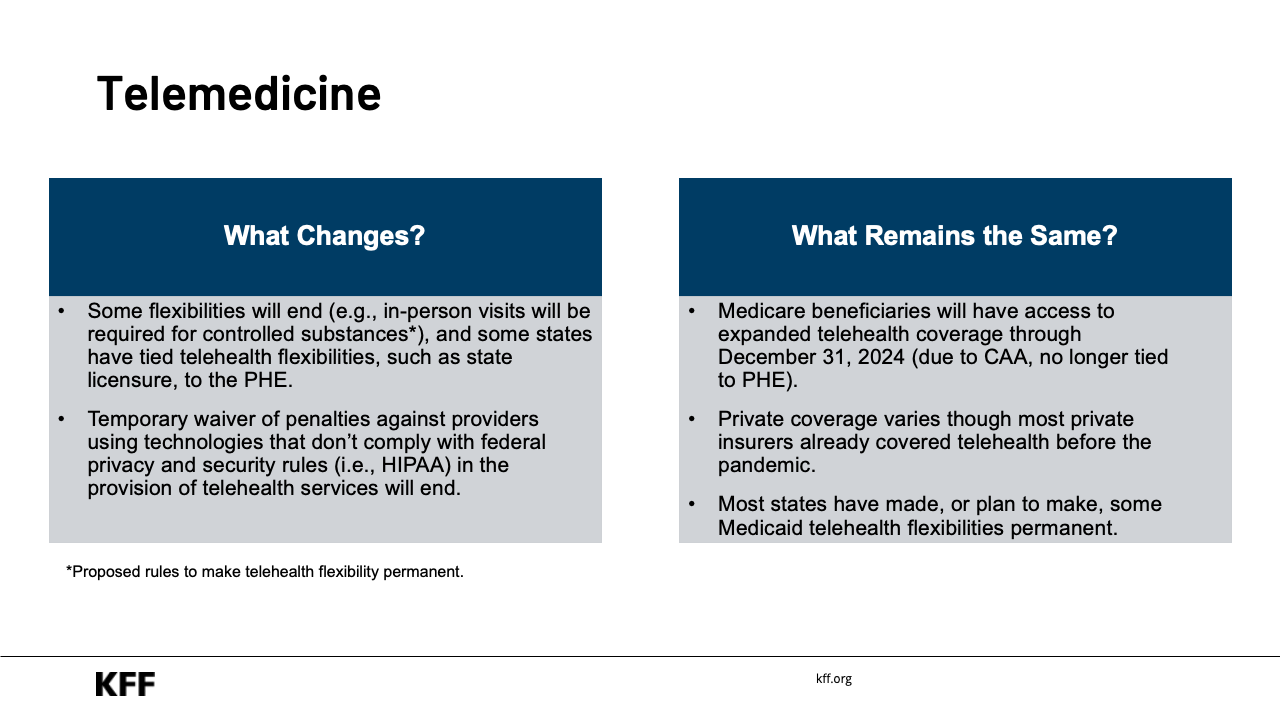
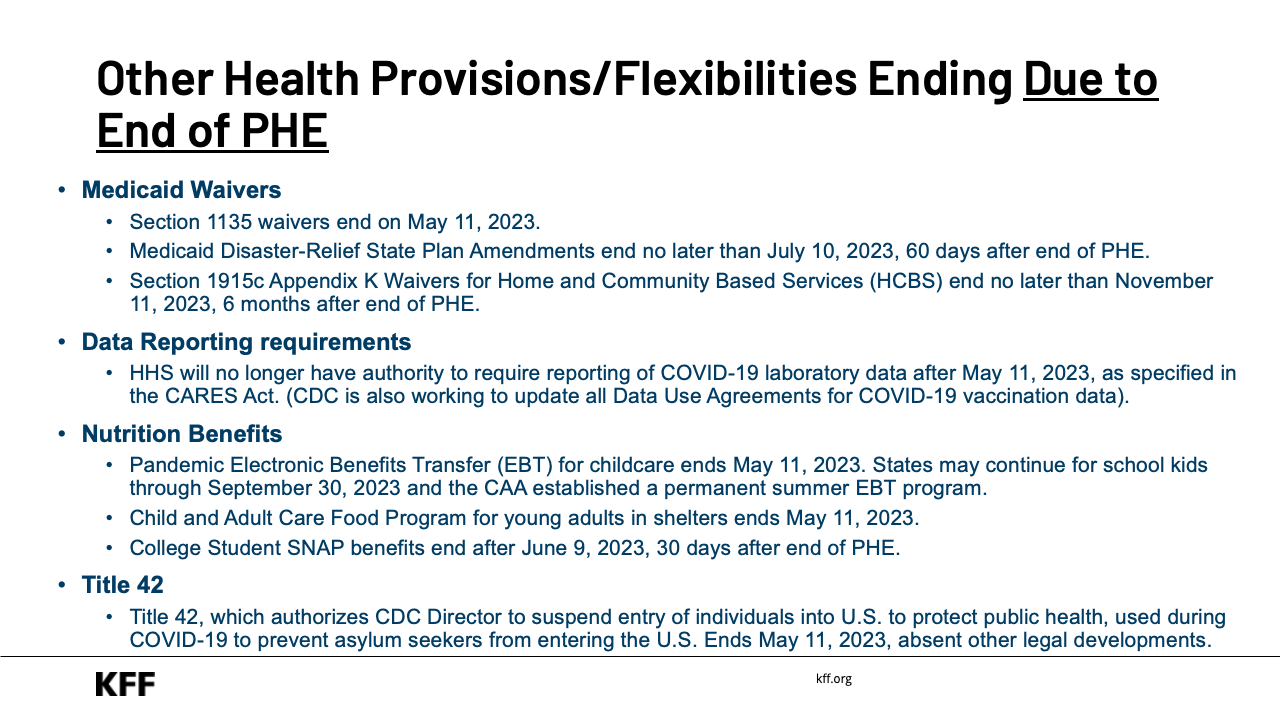
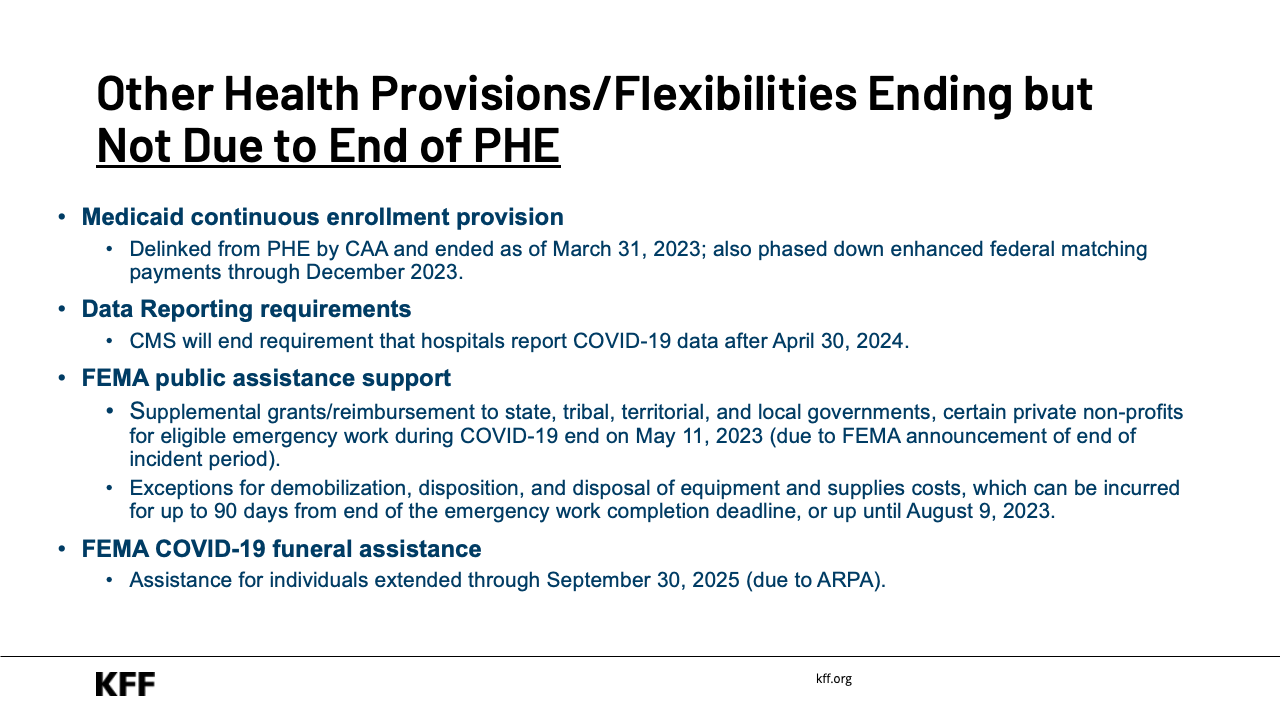
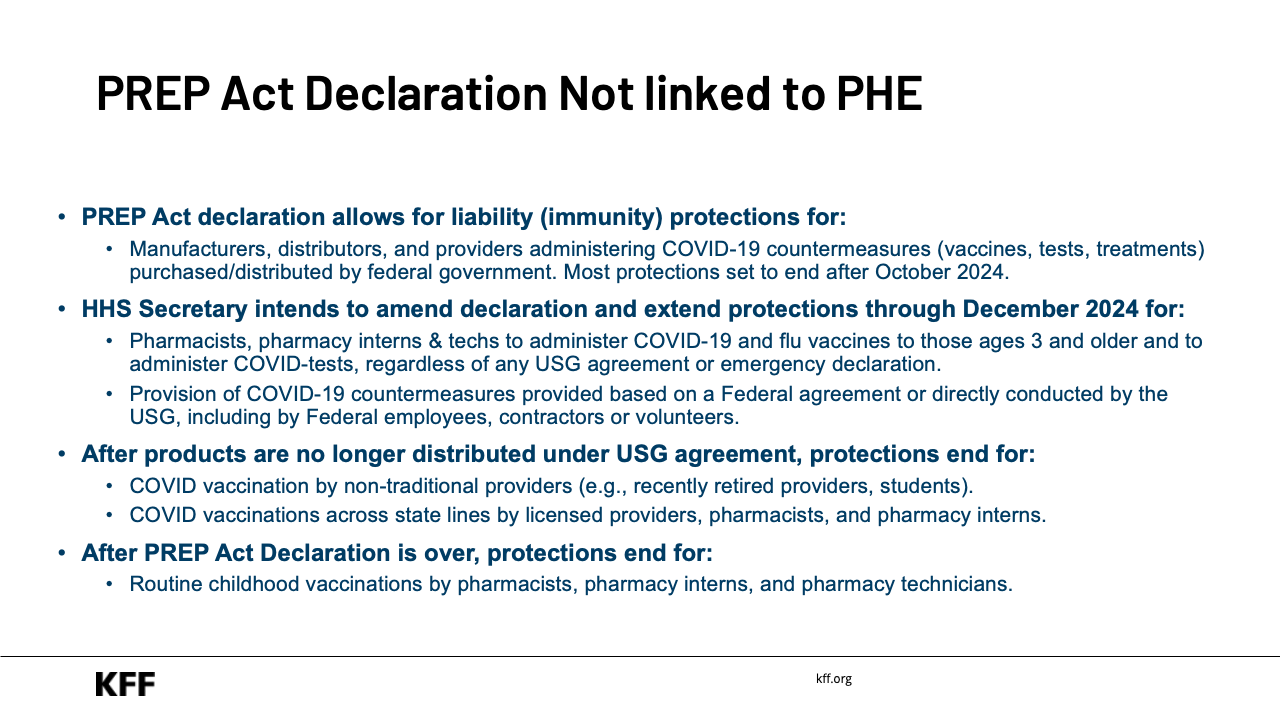
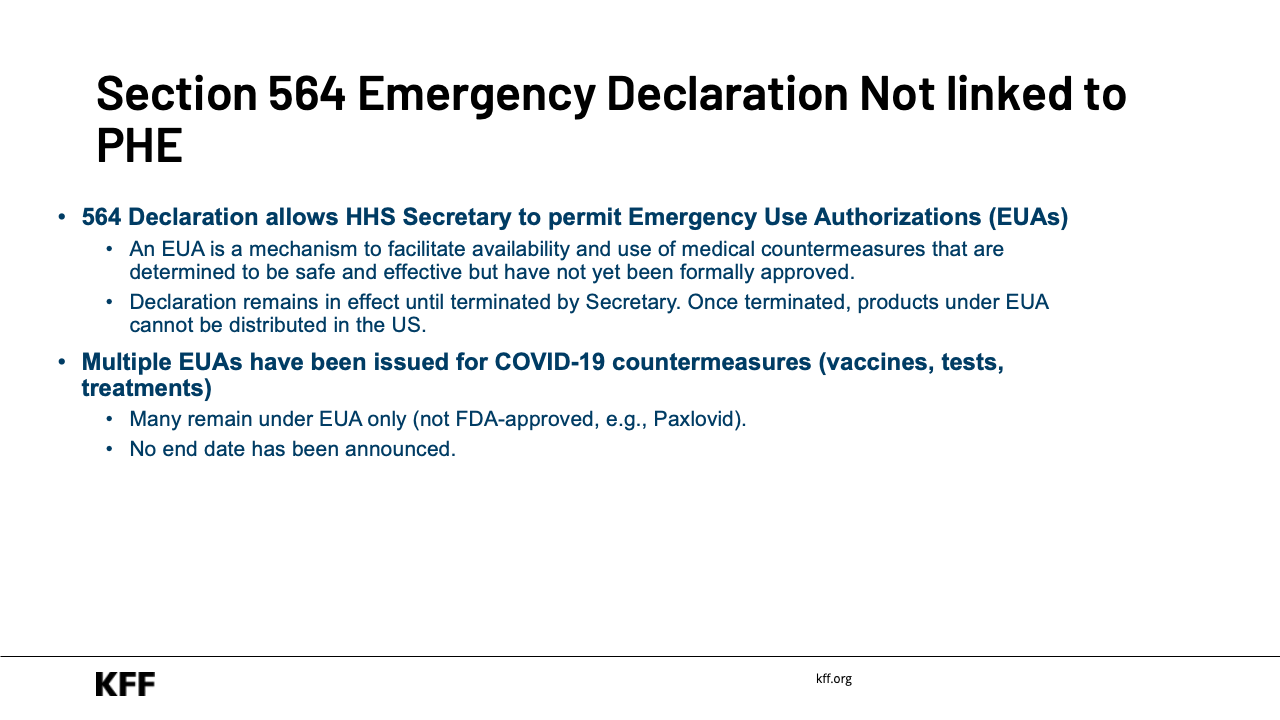
Jen Kates, Senior Vice President and Director of KFF’s Global Health & HIV Policy program presented “The End of the Public Health Emergency Declaration for COVID-19,” at the 2023 Preparedness Summit on April 24. The presentation describes key health-related flexibilities that will end because of the ending of the federal Public Health Emergency (PHE) declaration, as well as other emergency declarations and measures.

Testimony: Tax-Exempt Hospitals and the Community Benefit Standard

Published: Apr 26, 2023

Zachary Levinson, Project Director of KFF’s Program on Medicare Policy, testified before the U.S. House of Representatives’ Committee on Ways and Means on April 26, 2023 as part of a hearing on Tax-Exempt Hospitals and the Community Benefit Standard. His testimony describes the value of tax exemption for hospitals, federal oversight of community benefits, concerns about the adequacy of government requirements, proposed policy solutions, and general tradeoffs of policies that seek to strengthen requirements for tax-exempt status.

News Release

Eight to 24 Million Could Lose Medicaid Coverage by May 2024 Due to the End of Pandemic-era Enrollment Protections

State Policies Will Help Shape How Many People Are Disenrolled, Including Some Who Remain Eligible

Published: Apr 26, 2023

A new KFF analysis finds that between 8 and 24 million people across the U.S. could be disenrolled from Medicaid during the unwinding of the program’s continuous enrollment provision.

The estimates draw on data collected through KFF’s recent survey of state Medicaid and CHIP officials, conducted with the Georgetown University Center for Children and Families. The survey focused on states’ eligibility and enrollment policies, and their approaches to the unwinding of pandemic-era protections that prevented states from disenrolling people from Medicaid during the public health crisis.  It included questions about how many people states estimate will lose Medicaid coverage in the months following the expiration of those protections in March.

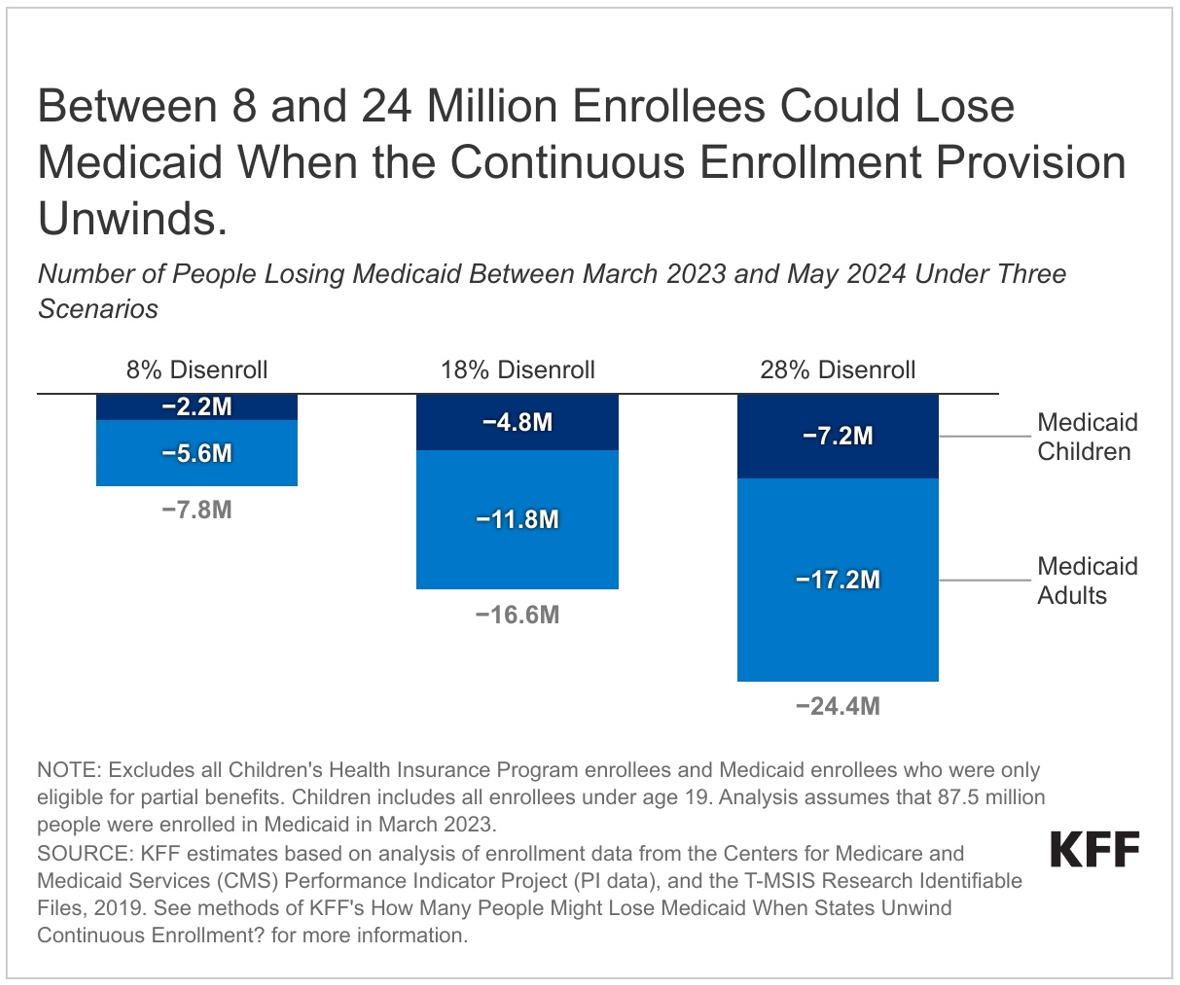
Among states that responded to the survey, the midpoint estimate was that 18 percent would be disenrolled, suggesting that total Medicaid enrollment could fall by about 17 million people nationally during the unwinding, including 5 million children and 12 million adults. The new analysis offers three illustrative scenarios for how state-level Medicaid enrollment could decline between March 2023 and May 2024, ranging from 8 percent to 28 percent of total enrollees, which is plus or minus 10 percentage points from the midpoint and similar to the varying projections reported by states. While neither the lowest nor highest rate of disenrollment is an expected national outcome, the range may be helpful in examining what the variation could be across states.

The new findings are consistent with HHS estimates that as many as 15 million people will be disenrolled during the unwinding process, including 6.8 million who will likely still be eligible. (KFF’s analysis does not estimate how much of the Medicaid coverage loss would be among people who are still eligible versus those who are no longer eligible.)

The unwinding of the continuous enrollment provision will play out differently across the states based on policy choices states have made and variation in their administrative infrastructures. Some states have adopted multiple policies that are more likely to promote continued coverage among those who remain eligible. Other states have adopted fewer of these policies, which will likely lead to a larger number of people losing Medicaid coverage, including some who remain eligible.

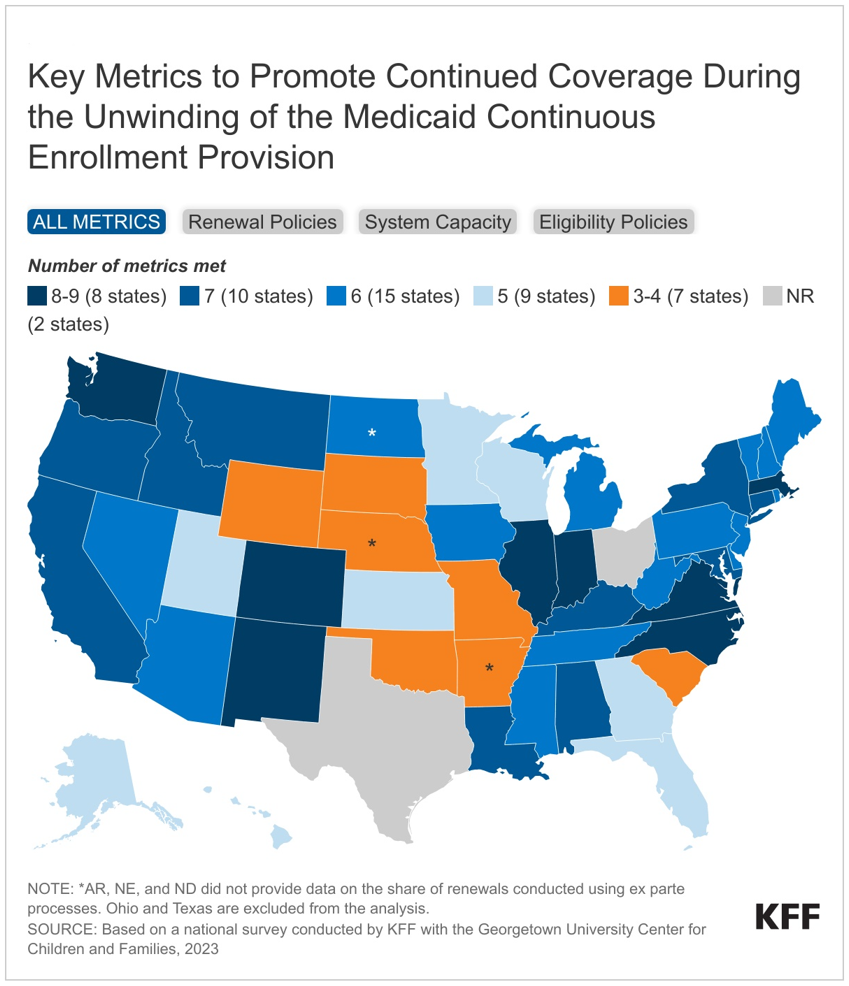
According to another new KFF analysis, eight states meet at least eight of the nine key metrics that will support continued Medicaid coverage for those who remain eligible. Seven states meet only three or four of the metrics. The nine metrics come from the same survey of state Medicaid and CHIP officials and include things such as taking 12-14 months to complete all renewals, following up with enrollees who haven’t responded to a renewal request before terminating coverage, and completing 50 percent or more of renewals using ex parte, or automated, processes.

Among the 17 million children and adults who could be disenrolled from Medicaid, it remains uncertain how many will transition to other health coverage or become uninsured. A recent KFF analysis found that nearly two-thirds of people experienced a period of uninsurance after being disenrolled from Medicaid or the Children’s Health Insurance Program (CHIP).

The two new analyses, “How Many People Might Lose Medicaid When States Unwind Continuous Enrollment?” and “State Policy Choices Are Likely to Affect the Extent of Medicaid Enrollment Declines During the Unwinding Period,” as well as other data and analyses about the Medicaid unwinding, are available at kff.org.

How Many People Might Lose Medicaid When States Unwind Continuous Enrollment?

Authors: Alice Burns, Elizabeth Williams, Bradley Corallo, and Robin Rudowitz
Published: Apr 26, 2023

Starting April 1, 2023 some states resumed disenrolling people from Medicaid after a three-year period during which states provided continuous enrollment in exchange for enhanced federal funding. Between February 2020 and March 2023, Medicaid enrollment grew by an estimated 20 million people, contributing to declines in the uninsured rate, which dropped to the lowest level on record in early 2022. As states unwind the continuous enrollment provision, we estimate, based on a recent KFF survey, that 17 million people could lose Medicaid coverage – including some who are no longer eligible and others who are still eligible but face administrative barriers to renewal. Decreases in Medicaid enrollment could reverse the recent gains in insurance coverage overall.

This analysis estimates the number of people who could lose Medicaid during the unwinding period under three possible rates of Medicaid coverage loss, and shows for each illustrative rate, state-by-state coverage reductions among Medicaid children and adults. In practice, rates of Medicaid coverage loss will vary across the states, depending on states’ approaches to the unwinding and the extent to which they engage in outreach and assistance activities to minimize disenrollment among people who are still eligible.

The analysis uses a combination of enrollment data from the Centers for Medicare and Medicaid Services (CMS) Performance Indicator Project (PI data), Medicaid claims data (T-MSIS data), and some state-specific sources (see Methods for a detailed explanation of the analysis). We exclude people enrolled in the Children’s Health Insurance program (CHIP) because it is expected that some of the people who disenroll from Medicaid will enroll in CHIP and CHIP enrollment may increase during the unwinding. (In some states, CHIP enrollment decreased during the continuous enrollment period, potentially because some people who were eligible for CHIP remained instead on Medicaid.)

Our estimates are based on the best available public data on states’ Medicaid enrollment, but predicting the future here with incomplete data is highly uncertain and the scenarios described in this data note are intended to be illustrative only. The scenarios presented here represent a range of outcomes that states predicted in the recent KFF survey, but the range reflects predictions reported across all states that responded to the question. The analysis excludes estimates of people who may newly enroll in Medicaid during the unwinding period and among those who disenroll, how many will re-enroll within a short time (e.g., “churn”). Our analysis projects the rate of disenrollment, but net changes in Medicaid enrollment—which reflect new enrollment and churn—will be smaller than the number of people who lose coverage.

How Many People Might Lose Medicaid?

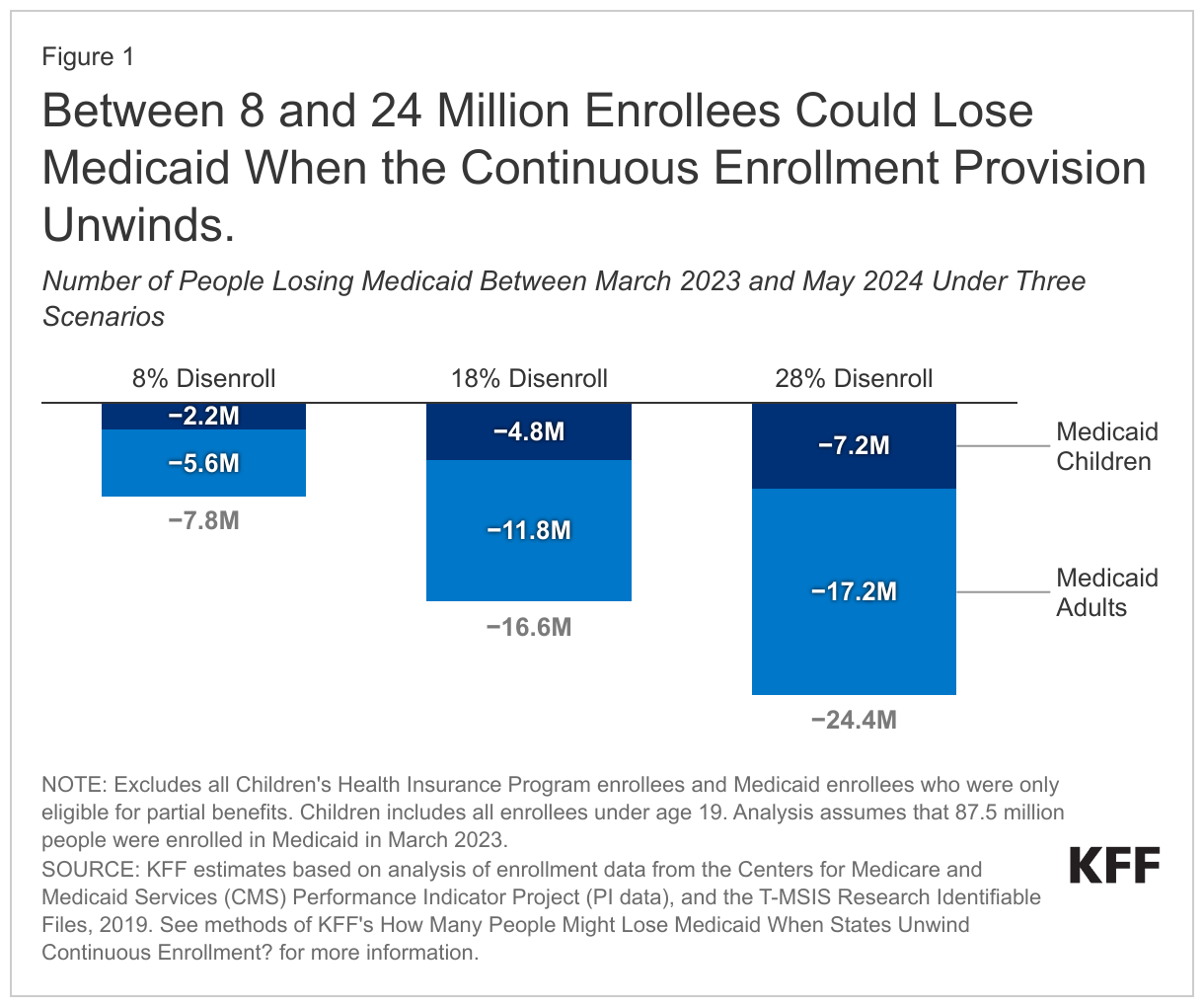
If Medicaid enrollment decreased by 18% in all states between March 2023 and May 2024, as suggested by a recent KFF survey, 17 million would lose Medicaid coverage (Figure 1). In KFF’s recent survey of states about their Medicaid eligibility policies, just over one-third of states were able to report their projected coverage losses associated with the unwinding. The midpoint of state responses was that 18% of Medicaid enrollees could be disenrolled over the course of the unwinding, responses were quite varied, ranging from 7% to 33%. We use 18% for this analysis to illustrate how much enrollment could decrease. But, recognizing the uncertainty and the expected variation across states, we present disenrollment numbers if the rate is 10 percentage points above or below the median, a range of 8% to 28% which is similar to the range coming from state responses.

An 18% decline in enrollment would translate to 17 million people losing Medicaid, of whom 5 million are children and 12 million are adults. These projected coverage losses are consistent with estimates from the Department of Health and Human Services (HHS) suggesting that as many as 15 million people will be disenrolled, including 5 million children and 10 million adults. HHS estimates that among the 15 million people who lose coverage, nearly 7 million will still be eligible. (KFF’s analysis models disenrollment but does not attempt to estimate the number of people who are still eligible.)

Between 8 and 24 Million Enrollees Could Lose Medicaid When the Continuous Enrollment Provision Unwinds

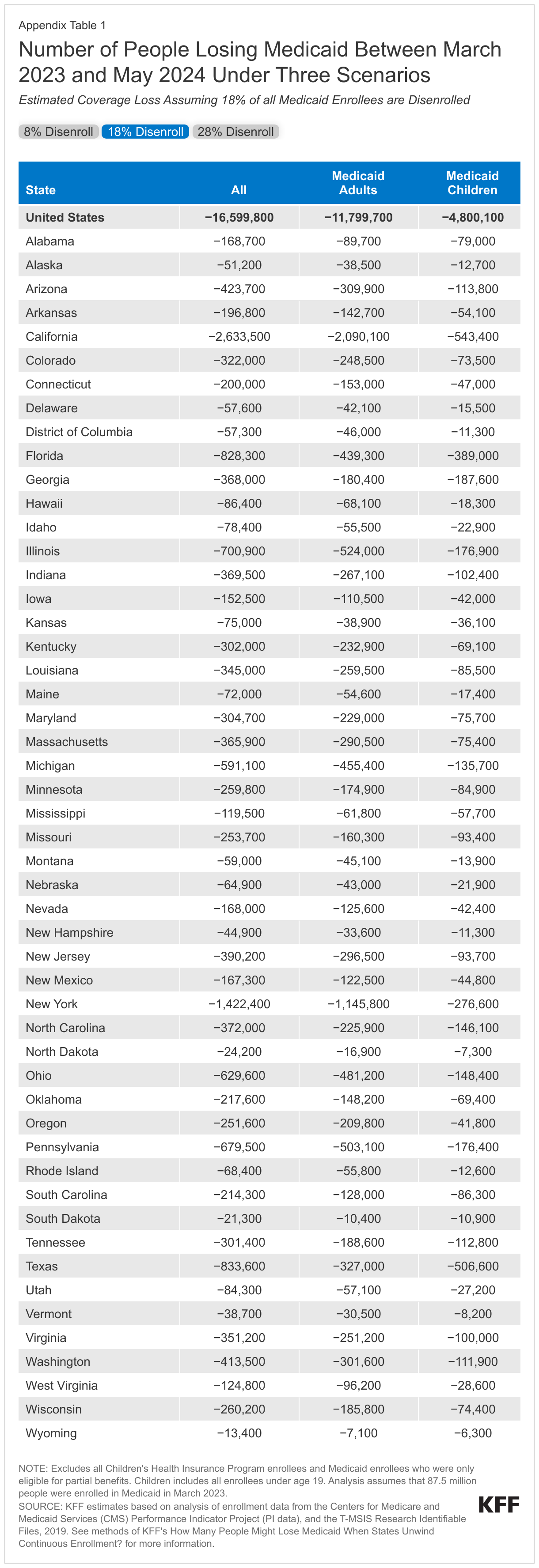
Although the midpoint of states’ estimated disenrollment rate was 18%, rates will range considerably across the states. If rates range from 8% to 28%, 8 million to 24 million people could lose Medicaid, including 2 million to 7 million children and 5 million to 17 million adults (see Appendix Table 1 for state-specific estimates). While neither the lowest nor highest rate of disenrollment is an expected national outcome, the range may be helpful in examining what the variation could be across states.

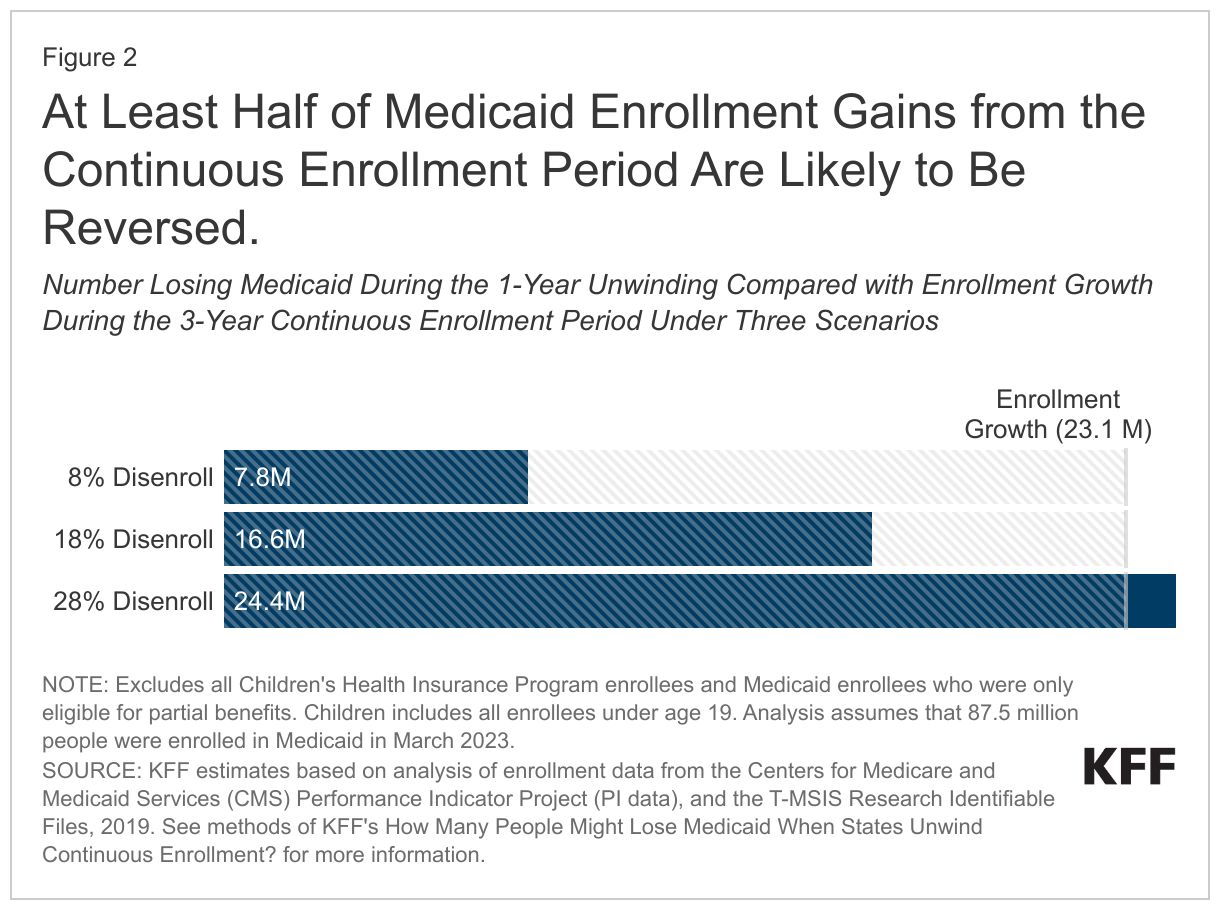
Expected disenrollments during the unwinding could reverse more than half of the Medicaid enrollment gains experienced during the continuous enrollment period (Figure 2). Comparing the number of people who could lose Medicaid with estimated enrollment growth during the continuous enrollment period, shows that the number of people losing Medicaid coverage would be nearly three-quarters of the enrollment increase under the midpoint scenario. Under this midpoint scenario, just over one-quarter of the enrollment increase during the pandemic would persist, meaning Medicaid coverage would be higher than pre-pandemic levels. The higher-range estimate of Medicaid coverage loss—which is not expected to occur in most states—suggests that in some states, Medicaid disenrollments during the 14-month unwinding period could exceed the enrollment gains from the 3-year continuous enrollment period. In some states, the number of people losing Medicaid could exceed the coverage gains because all current Medicaid enrollees will have to go through a renewal process.

At Least Half of Medicaid Enrollment Gains from the Continuous Enrollment Period Are Likely to Be Reversed

What Might Happen to the Uninsured Rate During the Unwinding?

As states resume renewals for all Medicaid enrollees, there is substantial uncertainty regarding how many people will lose Medicaid and of those, how many will transition to other coverage or become uninsured. A large share of people are covered by Medicaid, and one analysis shows that over half of children are covered by Medicaid and CHIP. Significant declines in Medicaid enrollment are likely to increase the number of uninsured, and other estimates suggest that there will be increases in the uninsured rate, in addition to increased enrollment in private health insurance and CHIP. The extent to which the uninsured rate may rise is difficult to predict based on current data sources. For example, because enrollment in Medicaid has been automatically sustained during the pandemic, it is possible that some people who are identified as enrollees with administrative data may have since transitioned to a job with employer-provided health coverage. And, federal surveys that are used to measure the uninsured rate – which rely on respondents self-reporting their health insurance status – show smaller increases in Medicaid enrollment than are observed in administrative data.

Even if people who disenroll from Medicaid are eligible for CHIP or for subsidies to purchase nearly-free private insurance through the ACA, they may not know they are eligible or transition to other coverage without a gap in coverage. Our recent analysis of coverage outcomes after disenrolling from Medicaid or CHIP found that nearly two-thirds of people experienced a period of uninsurance. Actual outcomes will vary across states depending on an array of state policy decisions. State efforts to provide outreach and enrollment assistance can help ensure that those who remain eligible for Medicaid—an unknown share of current enrollees—are able to retain coverage, and that those who are no longer eligible transition to other coverage.

Appendix Table

Number of People Losing Medicaid Between March 2023 and May 2024 Under Three Scenarios

Methods

Data: This analysis uses data from the Centers for Medicare and Medicaid Services (CMS) Performance Indicator Project Data (PI data) and the T-MSIS Research Identifiable Demographic-Eligibility (T-MSIS data). We used PI data from February 2020 through August 2022 and TMSIS data from 2019, Release 1.

Overview of Approach: We started our analysis with the enrollment projections through March 2023 as described in a prior analysis (although that analysis included CHIP and this analysis does not). To estimate the number of people who could lose coverage between March 2023 and May 2024, we:

  • Set up a placeholder where we input the assumed rate of coverage loss that would occur by the end of the unwinding period (May 2024), and
  • Calculated decreased enrollment rates among Medicaid children and adults for a given overall rate of disenrollment using information about enrollment growth during the continuous enrollment period.

Definitions and Limitations: Our estimates are intended to provide a range of disenrollment outcomes for each state’s child and adult Medicaid populations, but actual outcomes are unknown. It is expected that states will experience a wide range of outcomes and national numbers will reflect those varied experiences. Our estimates are also likely to differ from estimates of enrollment maintained by individual states. There are two primary reasons for these differences: the exclusion of some enrollees and the use of age-based eligibility for children. Specifically:

  • The PI enrollment data exclude people who are not eligible for full Medicaid coverage, such as enrollees who are only eligible for coverage of Medicare premiums, family planning services, or emergency care. Such enrollees are excluded from the enrollment totals in this analysis, resulting in lower estimates of total enrollment than in data maintained by individual states.
  • We define children as Medicaid enrollees who are grouped with children in the PI data, which are based on age rather than eligibility group.

We provide more detail about each step in the details below.

1. Placeholder for Overall Coverage Loss Rate. The rate of coverage loss is unknown. Our model is set up to show how many people could lose Medicaid by state under a range of possible outcomes. To estimate monthly disenrollments from the overall enrollment decrease, we assume that rates of coverage loss will be mostly the same across the 14-month unwinding period, but smaller in the first two and last months (April – May 2023 and April – May 2024).

2. Calculating Coverage Loss Among Children and Adults.  For a given rate of coverage loss, we calculate disenrollment among children and adults using the ratio of coverage gains for each group to the overall coverage gain. Specifically, during the continuous enrollment period, enrollment in Medicaid and CHIP grew by 27%, but enrollment Medicaid children grew by 20% and enrollment among Medicaid adults grew by 38%. We assume that during the unwinding, coverage loss will be proportionally smaller among Medicaid children and proportionally larger among Medicaid adults relative to the overall rate of coverage loss.

Our model is set up to estimate coverage losses for the adult eligibility groups, using the simulation model described in our prior analysis. There is considerably uncertainty associated with estimates for the adult eligibility groups, so we do not present those numbers in this data note. In finalizing the estimates, we focused analytic efforts on separating adult enrollees who were eligible for Medicaid through the Affordable Care Act expansion from adults eligible through another pathway. That distinction is important to understanding how the losses of Medicaid coverage might affect the amount of money states receive from the enhanced federal matching funds, which are available—but being phased down—through 2023.

News Release

During the COVID-19 Pandemic, People of Color Were More Likely to Die at Younger Ages

Published: Apr 24, 2023

The Nation Overall Also Experienced Higher Rates of Premature Deaths than Peer Countries

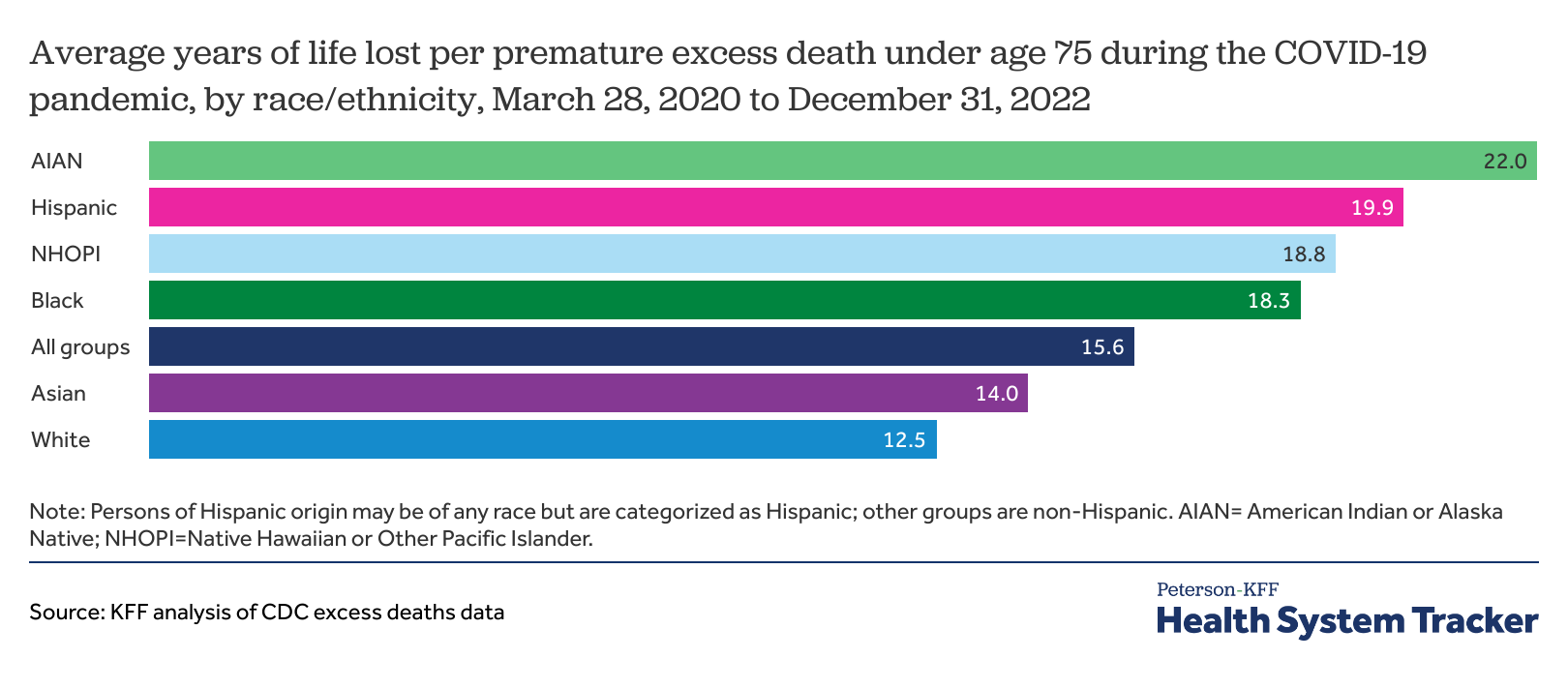
During the COVID-19 pandemic, people of color on average died at younger ages than White adults, resulting in substantial racial disparities in premature death and years of life lost, a new analysis finds.

The analysis examines the Centers for Disease Control and Prevention’s excess deaths statistics during the pandemic, which captures not only deaths caused by COVID-19 but also higher-than-expected deaths from other causes such as drug overdoses, suicide, health disease and liver disease. 

During the pandemic, all racial and ethnic groups experienced an increase in their premature mortality rate (defined as per capita deaths among people under age 75), though this rate rose more sharply among people of color than among White people. 

Expressed another way, White people who died prematurely (under age 75) during the pandemic on average lost 12.5 years of life, significantly less than the average years lost among American Indian and Alaska Native (22), Hispanic (19.9), Native Hawaiian and Other Pacific Islander (18.8), Black (18.3), and Asian (14) people.  

Collectively, the analysis estimates that people in the United States lost 14.8 million years of life due to excess deaths from March 2020 when the pandemic began through December 2022, with a disproportionately large share of those lost years affecting people of color.A separate analysis compares the rates of premature deaths in the United States with other large and wealthy peer countries through 2021 (the most recent year for which international data are available). The U.S. had the highest rate of premature death among the group of 12 nations during the two-year period. The U.S. on average had more than two times the average years of life lost per 100,000 people as the United Kingdom, the country with the next highest rate. The two analyses, “Racial Disparities in Premature Deaths During the COVID-19 Pandemic” and “Premature Mortality During COVID-19 in the U.S. and Peer Countries,” are both available through the Peterson-KFF Health System Tracker, an information hub dedicated to monitoring and assessing the performance of the U.S. health system. 

Premature Mortality During COVID-19 in the U.S. and Peer Countries

Authors: Matt McGough, Edouard Long, Krutika Amin, and Cynthia Cox
Published: Apr 24, 2023

This analysis examines changes in excess mortality and prematurity of those deaths in the U.S. and peer countries for 2020 and 2021. Using Centers for Disease Control and Prevention (CDC) weekly excess deaths data and the World Health Organization (WHO) all-cause excess death data, we compare excess mortality in the U.S. and other large and wealthy countries through 2021 and estimates the years of life lost, a measure of the prematurity of those excess deaths, during the COVID-19 pandemic. Excess deaths are the number of deaths beyond what would have been expected in a typical year and can be due directly or indirectly to COVID-19, as well as other causes.

When compared to other countries and adjusted for population size, the U.S. had the highest excess mortality rate among similarly large and wealthy countries for the period 2020-2021—the most recent data available for all these countries. In addition the U.S. also saw a higher rate of death among younger people, and thus a larger increase in premature deaths per capita than peer countries.

The analysis is available through the Peterson-KFF Health System Tracker, an online information hub that monitors and assesses the performance of the U.S. health system.

Racial Disparities in Premature Deaths During the COVID-19 Pandemic

Published: Apr 24, 2023

This analysis examines the impact of the COVID-19 pandemic by race and ethnicity through the lens of premature mortality, using the measures of premature mortality rate and years of life lost among excess deaths that occurred during the pandemic.

While the pandemic has had devastating effects across all racial and ethnic groups, we find significant racial disparities in premature death during the pandemic. Consistent with pre-pandemic trends, some communities of color faced higher premature death rates during the pandemic than their White counterparts. For all groups of color, though, the pandemic was associated with a steeper increase in the premature death rate than for White people.

The analysis is available through the Peterson-KFF Health System Tracker, an online information hub that monitors and assesses the performance of the U.S. health system.

Update on the Status of Medication Abortion and the Courts

Authors: Laurie Sobel, Alina Salganicoff, and Mabel Felix
Published: Apr 21, 2023

On June 13, 2024, the Supreme Court of the United States ruled in Alliance for Hippocratic Medicine (AHM) v. FDA that the AHM does not have standing to sue the FDA for injury. However, three state Attorneys’ Generals have intervened in this case in district court, and it is unclear how this action will shape the case when it goes back to the 5th Circuit Court of Appeals and then back to the originating federal district court.

On April 21st, the US Supreme Court blocked a lower court order that would have stopped the distribution and availability of the medication abortion drug, mifepristone, across the country. The high court’s ruling allows the current FDA rules to remain in effect, keeping mifepristone available for medication abortion where and when abortion is legal as the case proceeds through the courts. Telehealth abortions can also continue, where state law permits.

The court is responding to a ruling issued by Judge Matthew Kacsmaryk, the only judge in the US District Court for the Northern District of Texas Amarillo Division, who issued a preliminary injunction in the case, Alliance for Hippocratic Medicine v. FDA. The plaintiffs are challenging the FDA’s approval of mifepristone, one of the drugs used in medication abortion, claiming the FDA’s approval process and subsequent modifications of the conditions for dispensing mifepristone (known as REMS) as being beyond the FDA’s authority. The plaintiffs also contend that an 1873 anti-obscenity law, the Comstock Act, prohibits the mailing of any medication used for abortion (for details on the case see: Legal Challenges to the FDA Approval of Medication Abortion Pills).

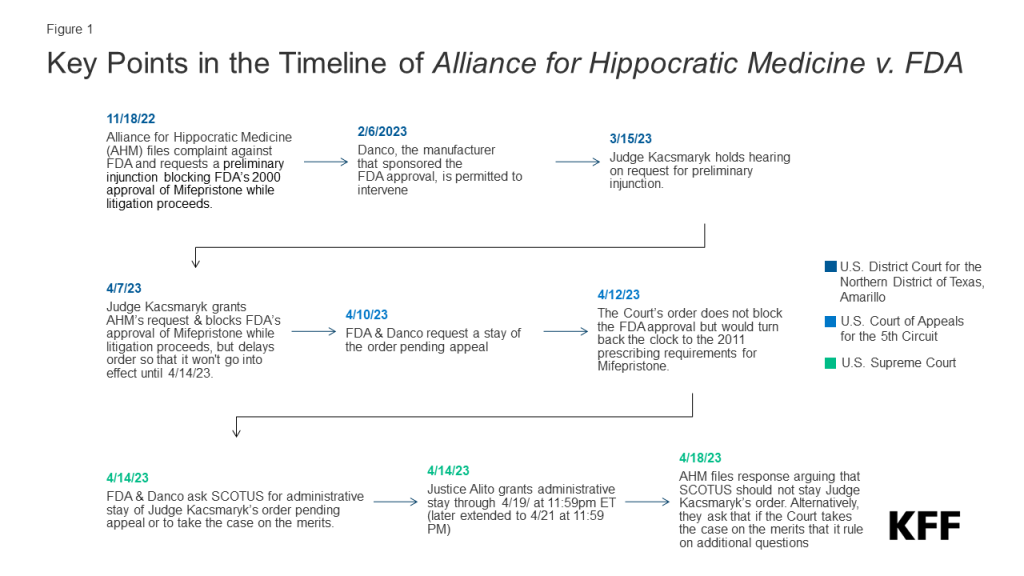
Judge Kacsmaryk’s ruling would have blocked the FDA’s approval of mifepristone, which dates back to the year 2000. The judge delayed the enforcement of his own decision for seven days to give the FDA time to seek emergency relief from the U.S. Court of Appeals for the Fifth Circuit. The FDA and Danco Laboratories LLC (a party in the litigation, and the holder of the new drug application for Mifeprex, the brand name for mifepristone) appealed to Fifth Circuit Court of Appeals requesting a stay of Judge Kacsmaryk’s order pending the appeal (Figure 1). The Fifth Circuit Court of Appeals then issued an order which stayed part of the district court’s preliminary injunction (finding that the drug’s approval could not be revoked) but blocked the implementation of the changes that the FDA had made in 2016 to modify the agency’s conditions on the provision and dispensation of the drug (REMS). This decision would have effectively required the conditions that the FDA had in place 2011 to be re-introduced, taken the generic alternative drug off the market (GenBioPro), and required a relabeling of the drug. In addition, it would have required the drug to only be dispensed in person by a doctor, blocking the current ability of abortion providers and pharmacies to mail the drug.

Figure 1 – Key Points in the Timeline of Alliance for Hippocratic Medicine v. FDA

On April 14, 2023, the FDA and Danco filed an emergency appeal with the Supreme Court, requesting either a stay of the district court’s ruling pending the appeal or for the Supreme Court to take the AHM case on an expedited basis. Later that day, Justice Alito, the justice assigned to emergency requests from the Fifth Circuit, issued an administrative stay keeping mifepristone available without any changes until April 19, 2023, which was subsequently extended to April 21, 2023.

On April 21, 2023, the Supreme Court blocked the district court’s ruling, sending the case back to the US Court of Appeals for the Fifth Circuit. Access to mifepristone will not change while this litigation continues through the final decision of the Supreme Court if their review is sought again.

It is important to recognize that this Supreme Court ruling is the not Court’s final word on the availability of mifepristone. The high court has sent this back to the Fifth Circuit to consider the appeal of the preliminary injunction (that is, the temporary block on mifepristone’s approval by Judge Kacsmaryk). The Fifth Circuit Court has scheduled an expedited hearing of the case for May 17, 2023, which will be the next step for this case. Procedurally, the Fifth Circuit is only considering the FDA and Danco’s appeal of the district court’s decision to temporarily block the FDA’s approval of mifepristone while the litigation proceeds. The district court has not yet considered the case on the merits. In the meantime, access to mifepristone will remain where abortion is permitted by state law.

Changes to Medicare Part D in 2024 and 2025 Under the Inflation Reduction Act and How Enrollees Will Benefit

Published: Apr 20, 2023

The Inflation Reduction Act of 2022 includes several provisions to lower prescription drug costs for people with Medicare and reduce drug spending by the federal government, including a number of changes to the Medicare Part D drug benefit. These changes include a cap on out-of-pocket drug spending for enrollees in Medicare Part D plans and requiring Part D plans and drug manufacturers to pay a greater share of costs for Part D enrollees with high drug costs. This brief provides an overview of the Part D benefit design and Part D enrollee cost-sharing requirements in 2023 and changes coming in 2024 and 2025.

What Does the Medicare Part D Benefit Look Like in 2023?

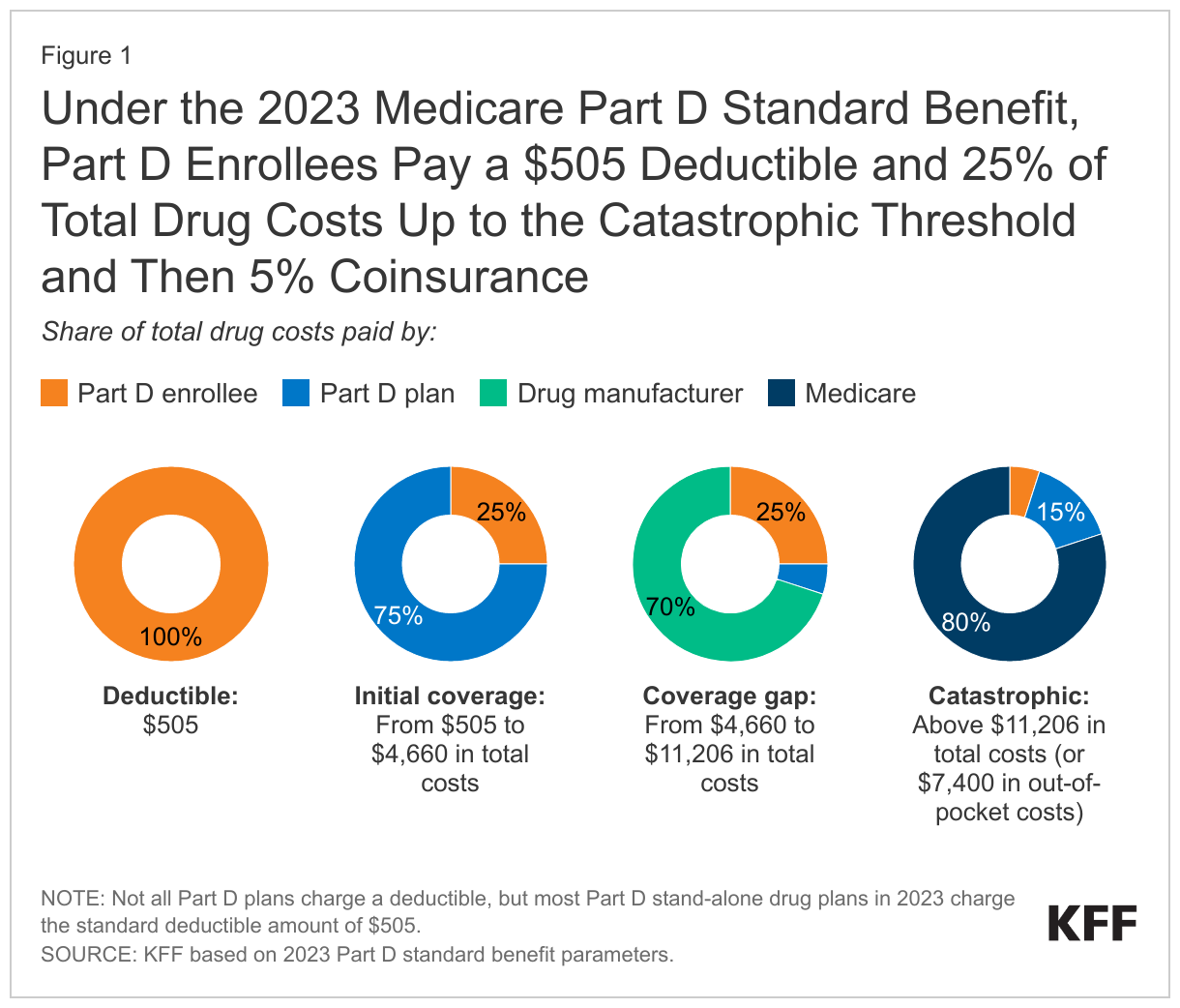
The standard design of the Medicare Part D benefit currently has four distinct phases, where the share of drug costs paid by Part D enrollees, Part D plans, drug manufacturers, and Medicare varies (Figure 1). (The Part D enrollee shares reflect costs paid by enrollees who are not receiving low-income subsidies.)

  • In the deductible phase, Part D enrollees pay 100% of their drug costs, up to $505 in 2023. Not all Part D plans charge a deductible, but many enrollees in stand-alone PDPs are in a plan that charges the standard deductible in 2023.
  • In the initial coverage phase, Part D enrollees pay 25% of total drug costs and Part D plans pay 75%, up to total drug costs of $4,660 in 2023. However, most Part D plans charge a mix of copayments and coinsurance in this phase rather than a standard 25% coinsurance rate.
  • In the coverage gap phase, Part D enrollees pay 25% of total drug costs for both brand-name and generic drugs. Part D plans pay the remaining 75% of generic drug costs and 5% of brand drug costs, and drug manufacturers provide a 70% price discount on brands (there is no manufacturer price discount on generics).
  • In the catastrophic phase, Medicare pays 80% of total drug costs (known as “reinsurance”), Part D plans pay 15%, and Part D enrollees pay 5%. Part D enrollees qualify for catastrophic coverage when the amount that they pay out of pocket plus the value of the manufacturer discount on the price of brand-name drugs in the coverage gap phase exceeds a certain threshold amount. In 2023, the catastrophic threshold is set at $7,400, and enrollees themselves will pay about $3,100 out of pocket before reaching the catastrophic phase (this estimate is based on using brand drugs only).
Under the 2023 Medicare Part D Standard Benefit, Part D Enrollees Pay a $505 Deductible and 25% of Total Drug Costs Up to the Catastrophic Threshold and Then 5% Coinsurance

How Is the Medicare Part D Benefit Changing in 2024?

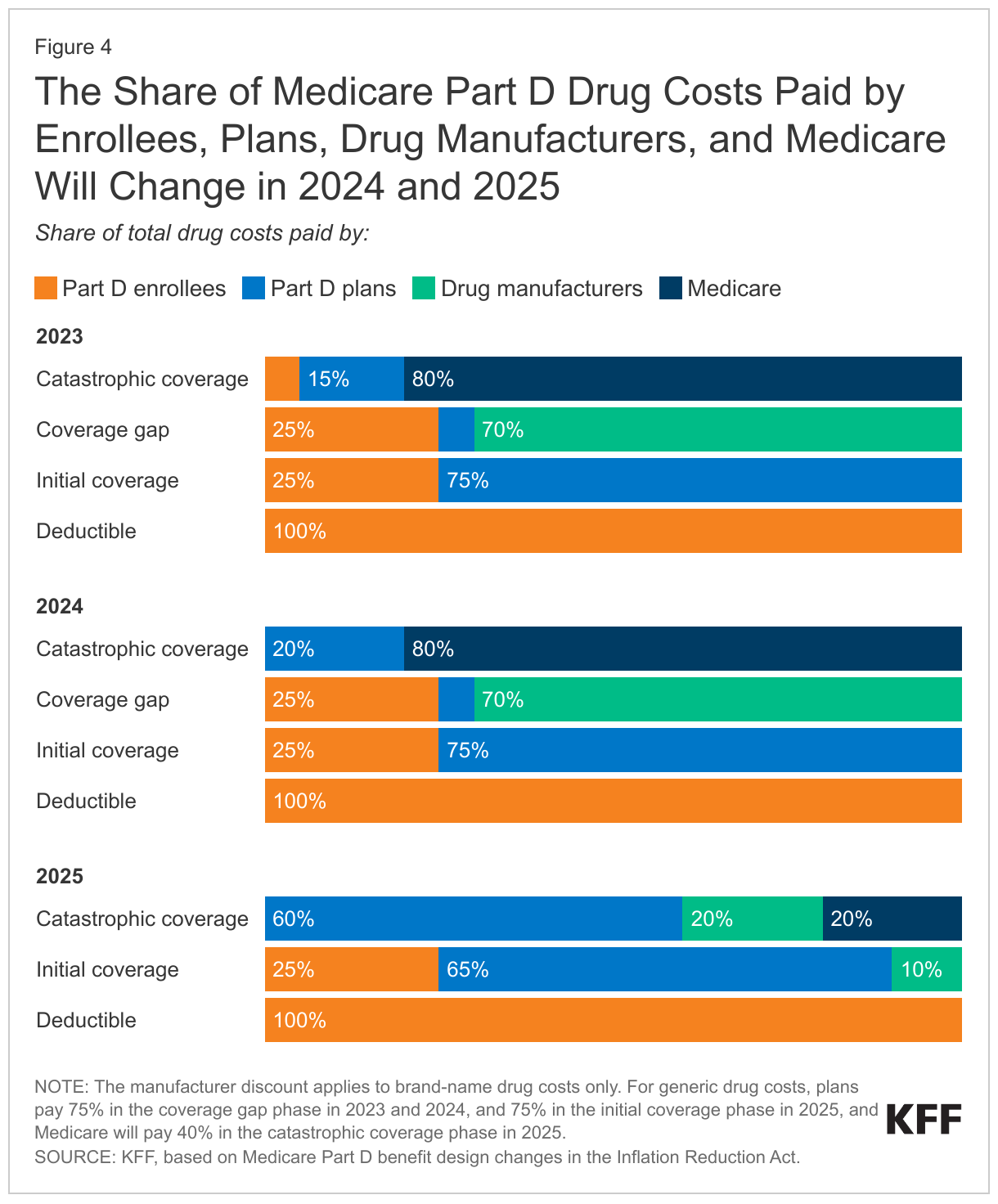
In 2024, costs in the catastrophic phase will change: the 5% coinsurance requirement for Part D enrollees will be eliminated and Part D plans will pay 20% of total drug costs in this phase instead of 15%.

The 5% coinsurance requirement for Part D enrollees in the catastrophic phase will be eliminated

In 2024, once Part D enrollees without low-income subsidies (LIS) have drug spending high enough to qualify for catastrophic coverage, they will no longer be required to pay 5% of their drug costs, which in effect means that out-of-pocket spending for Part D enrollees will be capped. In 2024, the catastrophic threshold will be set at $8,000. This amount includes what Part D enrollees spend out of pocket plus the value of the manufacturer price discount on brands in the coverage gap phase. At this amount, Part D enrollees who take only brand-name drugs in 2024 will have spent about $3,300 out of their own pockets and will then face no additional costs for their medications.

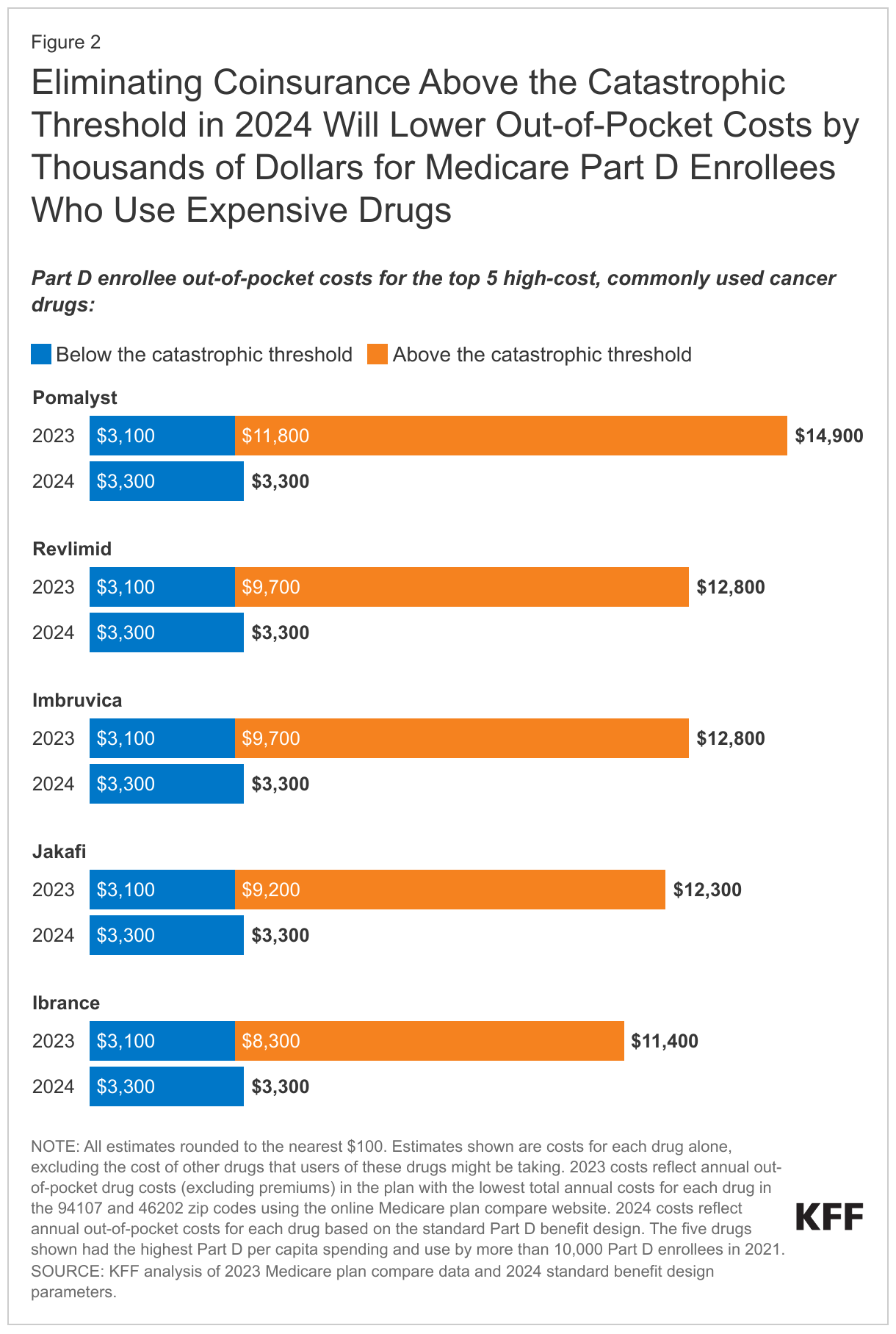
To understand the impact of this change, it helps to consider what Part D enrollees without LIS currently pay for high-cost medications. For example, for the five drugs with the highest per capita Part D expenditures in 2021 used by more than 10,000 Part D enrollees – Revlimid, Pomalyst, Imbruvica, Jakafi, and Ibrance, all cancer treatments – annual out-of-pocket costs per drug in 2023 range from over $11,000 to nearly $15,000, and out-of-pocket costs for each drug in the catastrophic phase alone range from around $8,000 to nearly $12,000 (see methods for details) (Figure 2). (These estimates exclude the cost of other drugs that users of these drugs might be taking.) Eliminating the 5% coinsurance requirement in the catastrophic phase in 2024 means that Part D enrollees without LIS who use these or other high-cost medications covered by Part D will see thousands of dollars in savings.

Eliminating Coinsurance Above the Catastrophic Threshold in 2024 Will Lower Out-of-Pocket Costs by Thousands of Dollars for Medicare Part D Enrollees Who Use Expensive Drugs

Part D plans will pay a somewhat larger share of total drug costs above the catastrophic threshold

With the elimination of the 5% coinsurance requirement for Part D enrollees in the catastrophic coverage phase, Part D plans will be required to pay 20% of total drug costs in this phase in 2024, up from 15% in 2023 and prior years.

How Is the Medicare Part D Benefit Changing in 2025?

Changes in 2025 include a new $2,000 out-of-pocket spending cap, elimination of the coverage gap phase, a higher share of drug costs paid by Part D plans in the catastrophic phase, along with a new manufacturer price discount and reduced liability for Medicare in this phase, and changes to plan costs and the manufacturer price discount in the initial coverage phase.

Out-of-pocket drug spending will be capped at $2,000

Beginning in 2025, Part D enrollees’ out-of-pocket drug costs will be capped at $2,000. This amount will be indexed to rise each year after 2025 at the rate of growth in per capita Part D costs. (This cap does not apply to out-of-pocket spending on Part B drugs.)

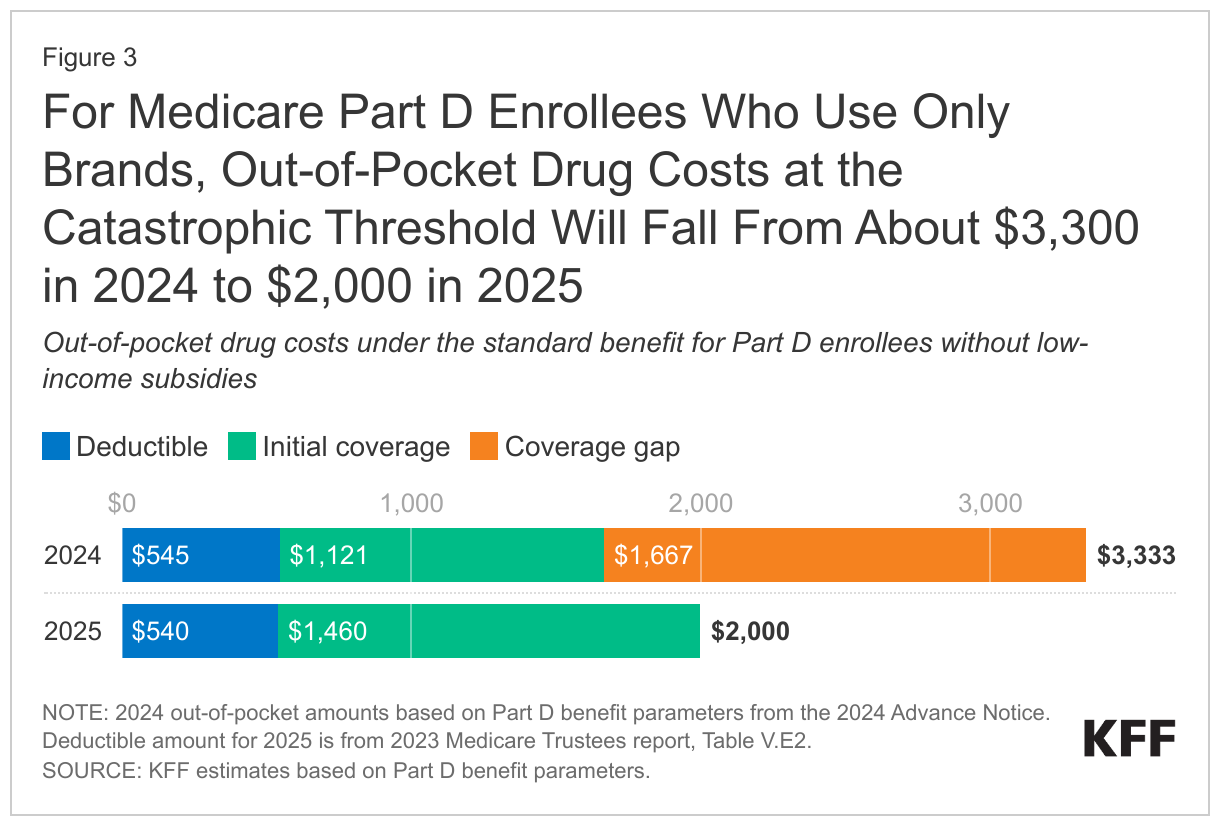
For Part D enrollees who take only brand-name drugs, annual out-of-pocket costs at the catastrophic threshold will fall from around $3,300 in 2024 to $2,000 in 2025 (Figure 3). In other words, Part D enrollees who take only brands and have drug costs high enough to reach the catastrophic threshold could see savings of about $1,300 in 2025 relative to what they will spend in 2024.

For Medicare Part D Enrollees Who Use Only Brands, Out-of-Pocket Drug Costs at the Catastrophic Threshold Will Fall From About $3,300 in 2024 to $2,000 in 2025

The coverage gap phase will be eliminated

The coverage gap phase, where Part D enrollees had faced 100% of their total drug costs under the original Part D benefit design and currently face 25% of costs for brand and generic drugs, will be eliminated in 2025. This means that Part D enrollees will no longer face a change in their cost sharing for a given drug when they move from the initial coverage phase to the coverage gap phase, which is the case in most Part D plans today, since most plans charge varying cost-sharing amounts, rather than the standard 25% coinsurance, in the initial coverage phase.

Part D plans and drug manufacturers will pay a larger share of costs for catastrophic coverage, and Medicare will pay a smaller share

Medicare’s share of total costs in the catastrophic phase (reinsurance) will decrease from 80% to 20% for brand-name drugs and from 80% to 40% for generic drugs beginning in 2025. This reduction will help address concerns about the substantial increase in Medicare’s reinsurance payments to Part D plans over time, which accounted for close to half (48%) of total Part D spending in 2022, up from 14% in 2006, based on data from the Medicare Trustees 2023 annual report. Medicare Part D plans’ share of costs will increase from 15% to 60% for both brands and generics above the cap, and drug manufacturers will be required to provide a 20% price discount on brand-name drugs (Figure 4).

The Share of Medicare Part D Drug Costs Paid by Enrollees, Plans, Drug Manufacturers, and Medicare Will Change in 2024 and 2025

Part D plans and manufacturers will face changes to their share of total drug costs paid in the initial coverage phase

Drug manufacturers will be required to provide a 10% discount on brand-name drugs in the initial coverage phase beginning in 2025, replacing the 70% price discount in the coverage gap phase under the current benefit design. Part D plans will pay 65% of brand-name drug costs.

What Other Changes Are Being Made to Part D?

  • As of 2023, the out-of-pocket cost of insulin products is limited to no more than $35 per month in all Part D plans. In addition, adult vaccines covered under Part D, such as the shingles vaccine, are covered with no cost sharing.
  • Starting in 2024, people with Medicare who have incomes up to 150% of poverty and resources at or below the limits for partial low-income subsidy benefits will be eligible for full benefits under the Part D Low-Income Subsidy (LIS) Program. The law eliminates the partial LIS benefit currently in place for individuals with incomes between 135% and 150% of poverty.
  • Also starting in 2024, the calculation of the base beneficiary premium will be adjusted, as needed, to limit increases in the base premium to no more than 6% from the prior year. (Premiums for individual Part D plan premiums and annual plan-level premium increases will continue to vary, however.)
  • Starting in 2025, Part D enrollees will have the option of spreading out their out-of-pocket costs over the year rather than face high out-of-pocket costs in any given month.

This work was supported in part by Arnold Ventures. KFF maintains full editorial control over all of its policy analysis, polling, and journalism activities.

Methods

To illustrate the impact of eliminating the 5% coinsurance requirement in 2024, we used data from the Medicare Part D Spending by Drug dataset to identify the top five drugs in 2021 with the highest per capita total Part D spending used by more than 10,000 enrollees. The five drugs—all cancer treatments—are:

  • Revlimid: 45,601 users in 2021; average total Part D spending per beneficiary = $129,242
  • Pomalyst: 12,596 users in 2021; average total Part D spending per beneficiary = $126,634
  • Imbruvica: 26,044 users in 2021; average total Part D spending per beneficiary = $120,958
  • Jakafi: 12,664 users in 2021; average total Part D spending per beneficiary = $117,748
  • Ibrance: 18,781 users in 2021; average total Part D spending per beneficiary = $100,709

We then used the online Medicare plan compare tool to identify annual out-of-pocket costs for these medications in 2023 at a large national retail pharmacy chain in zip codes 94107 (San Francisco, CA) and 46202 (Indianapolis, IN). We identified annual out-of-pocket costs for each drug in the plan that offered the lowest annual total drug costs, including premiums, based on the default drug dosage information in the plan compare tool. The annual out-of-pocket cost for each drug did not vary geographically based on these zip codes. We separated annual out-of-pocket drug costs into the portion paid below and above the catastrophic threshold. Out-of-pocket amounts shown in Figure 2 reflect costs for the drug alone, excluding Part D premiums, and do not include costs for other drugs that users of these drugs might be taking. Total annual out-of-pocket costs in 2023 may be higher in other Part D plans or at other pharmacies.

For 2024, we used the standard Part D benefit parameters to identify how much a Part D enrollee would pay in out-of-pocket costs for a brand-name drug below the catastrophic threshold. For each of these drugs, Part D enrollees would reach the catastrophic threshold in one month.