Health Coverage by Race and Ethnicity, 2010-2024

Authors: Latoya Hill, Samantha Artiga, and Anthony Damico
Published: May 4, 2026

Summary

Health coverage plays a major role in enabling people to access health care and protecting families from high medical costs. There have been longstanding racial and ethnic disparities in health coverage that contribute to disparities in health. Due to Medicaid and Affordable Care Act (ACA) cuts in the 2025 reconciliation law and the expiration of the ACA’s enhanced premium tax credits, the number of uninsured is expected to increase by more than 14 million by 2034, potentially exacerbating racial disparities in coverage. This brief examines trends in health coverage by race and ethnicity from 2010 through 2024 and discusses the implications for health disparities. It is based on KFF analysis of American Community Survey (ACS) data for people under age 65. All noted differences between groups and years described in the text are statistically significant at the p<0.05 level. Key takeaways include:

Since 2010, there have been large gains in health coverage across racial and ethnic groups but racial and ethnic disparities in coverage persisted. The largest gains occurred after implementation of the ACA coverage expansions in 2014, with increases continuing until 2016. Hispanic people under age 65 had the largest percentage point increase in coverage, with their uninsured rate falling from 32.6% in 2014 to 19.1% as of 2016. Black, Asian, and American Indian or Alaska Native (AIAN) people also had larger percentage point increases in coverage compared to White people over that period. Despite these larger gains, Hispanic, Black, AIAN, and Native Hawaiian or Pacific Islander (NHPI) people under age 65 remained more likely than their White counterparts to be uninsured as of 2016. Beginning in 2017, coverage gains began reversing, and the overall number of uninsured increased for three consecutive years, coinciding with the first Trump administration. Pandemic-era policies drove broad coverage gains and reduced uninsured rates across most racial and ethnic groups between 2019 and 2023.

In 2024, the overall uninsured rate increased for the first time since 2019 as pandemic-era continuous enrollment in Medicaid came to an end, with significant increases among Hispanic, Black, and White people under age 65. Asian, AIAN and NHPI people did not have statistically significant changes in coverage over this period. As of 2024,AIAN and Hispanic people under age 65 had the highest uninsured rates at 18.9% and 18.4%, respectively. Uninsured rates for NHPI (12.3%) and Black people (10.1%) under age 65 also were higher than the rate for their White counterparts (6.8%). Asian people had the lowest uninsured rate at 5.7%.

Coverage disparities have persisted over time and, in some cases, widened despite earlier gains under the ACA. For example, between 2010 and 2024, the uninsured rate for AIAN people grew from 2.4 to 2.8 times higher than the uninsured rate for White people, the Hispanic uninsured rate grew from 2.5 to 2.7 times higher than the rate for White people, and Black people remained 1.5 times more likely to be uninsured than White people.

Recent policy changes are projected to lead to increased coverage losses in coming years, which will likely widen racial and ethnic coverage disparities. The 2025 reconciliation law makes significant changes to Medicaid and the ACA Marketplaces, which are projected to lead to large coverage losses. It also further restricts access to health coverage for lawfully present immigrants across public health insurance programs. Additionally, the expiration of enhanced premium tax credits for ACA Marketplace enrollees has led to substantial out-of-pocket premium increases and further growth in the uninsured population. The Congressional Budget Office estimates that the combined impact of the reconciliation law with the expiration of the ACA’s enhanced premium tax credits will increase the number of uninsured by more than 14 million in 2034. Medicaid and ACA Marketplace coverage losses will likely widen racial disparities in coverage given that disproportionately large shares of Hispanic, Black, AIAN, and NHPI people are covered through these sources. Coverage losses, in turn, would likely contribute to widening disparities in health.

Trends in Uninsured Rates by Race and Ethnicity, 2010-2024

Prior to the enactment of the ACA in 2010, Hispanic, Black, Asian, AIAN, and NHPI people under age 65 were more likely to be uninsured compared to their White counterparts, with Hispanic and AIAN people at the highest risk of lacking coverage (Figure 1). Their higher uninsured rates reflected more limited access to affordable health coverage options. Although the majority of individuals have at least one full-time worker in the family across racial and ethnic groups, there are ongoing racial disparities in employment and income that result in some groups having more limited access to coverage offered by an employer or having greater difficulty affording private coverage when it is available. While Medicaid helps fill some of these gaps in private coverage, prior to the ACA, Medicaid eligibility for parents in most states was limited to those with very low incomes (often below 50% of the poverty level), and adults without dependent children—regardless of how poor—were ineligible under federal rules.

Uninsured Rate Among People Under Age 65 by Race and Ethnicity, 2010-2024 (Line chart)

Between 2010 and 2016, there were large gains in coverage across racial and ethnic groups under the ACA, but racial and ethnic disparities in coverage persisted. The ACA created new coverage options for low- and moderate-income individuals. These included provisions to extend dependent coverage in the private market up to age 26 and prevent insurers from denying people coverage or charging them more due to health status. Further, beginning in 2014, the ACA expanded Medicaid coverage to nearly all adults with incomes at or below 138% of poverty in states that adopted the expansion and made tax credits available to people with incomes up to 400% of poverty to purchase coverage through a health insurance Marketplace. Following the ACA’s enactment in 2010 through 2016, coverage increased across all racial and ethnic groups, with the largest increases occurring after implementation of the Medicaid and Marketplace coverage expansions in 2014. Hispanic people under age 65 had the largest percentage point increase in coverage, with their uninsured rate falling from 24.8% to 19.1% between 2014 and 2016. Black, Asian, and AIAN people also had larger percentage point increases in coverage compared to White people over that period. Despite these larger gains, Hispanic, Black, AIAN, and NHPI people under age 65 remained more likely than their White counterparts to be uninsured as of 2016.

Beginning in 2017, coverage gains began reversing, and the number of uninsured increased for three consecutive years. The uninsured rate for the total population under age 65 increased from 10.0% in 2016 to 10.9% in 2019. Hispanic people had the largest statistically significant increase in their uninsured rate over this period (from 19.1% to 20.0%) although the absolute change was small. There were also small but statistically significant increases in the uninsured rates among White and Black people under age 65, which rose from 7.1% to 7.8% and 10.7% to 11.4%, respectively, between 2016 and 2019. Rates for AIAN, NHPI, and Asian people under age 65 did not have a significant change. These coverage losses likely reflected policy changes made by the first Trump administration after taking office in 2017. These changes included decreased funds for outreach and enrollment assistance, guidance encouraging states to seek waivers to add new eligibility requirements for Medicaid coverage as well as to increase the frequency of eligibility verifications, and changes to public charge immigration policy that made some immigrant families more reluctant to participate in Medicaid and the Children’s Health Insurance Program (CHIP) (which were later reversed by the Biden administration).

Pandemic-era policies drove broad coverage gains and reduced uninsured rates across most racial and ethnic groups between 2019 and 2023. After rising in the years before the pandemic, uninsured rates declined between 2019 and 2023, with 3.6 million more people under age 65 gaining coverage as the uninsured rate fell from 10.9% to 9.5%. Declines occurred across most racial and ethnic groups, with the largest drop among AIAN people (21.7% to 18.7%), alongside smaller but significant declines among Hispanic (20.0% to 17.9%), Black (11.4% to 9.7%), Asian (7.2% to 5.8%), and White people (7.8% to 6.5%), while changes for NHPI people were not statistically significant. These gains were driven largely by increased Medicaid coverage, which offset declines in employer-sponsored insurance, and reflected pandemic-era policies that stabilized and expanded coverage. These policies included the Families First Coronavirus Response Act’s continuous enrollment provision for Medicaid, which required states to pause disenrollments from Medicaid during the COVID pandemic in exchange for increased federal funding to states, enhanced ACA Marketplace subsidies under the American Rescue Plan Act and Inflation Reduction Act, increased outreach and enrollment efforts, and low Marketplace attrition.

After years of decline, the overall uninsured rate among people under age 65 increased in 2024, with significant increases among Hispanic, Black, and White people. The total number of people under age 65 without health coverage increased by more than 1.3 million to 26.7 million in 2024, and the uninsured rate for the population under age 65 increased from 9.5% to 9.8%.Hispanic people experienced the largest increase in uninsured rates between 2023 and 2024 (17.9% to 18.4%), followed by Black (9.7% to 10.1%) and White people (6.5% to 6.8%).Asian, AIAN andNHPI people did not have statistically significant changes in coverage over this period.

Coverage disparities have persisted, and in some cases widened, over time even with recent gains and the large earlier gains in coverage under the ACA. For example, in 2010, the uninsured rate for AIAN people was 2.4 times higher than the uninsured rate for White people; however, in 2024, the gap had increased to 2.9 times higher than the rate for White people. Similarly, the Hispanic uninsured rate grew from 2.5 to 2.8 times higher than the rate for White people from 2010 to 2024, while Black people remained 1.5 times more likely to be uninsured than White people.

Coverage by Race and Ethnicity as of 2024

Hispanic, Black, AIAN, and NHPI people under age 65 were more likely than their White counterparts to be uninsured as of 2024(Figure 2). AIAN and Hispanic people had the highest uninsured rates at 18.9% and 18.4%, respectively, as of 2024. Uninsured rates for NHPI (12.3%) and Black people (10.1%) also were higher than the rate for their White counterparts (6.8%). Asian people had the lowest uninsured rate at 5.7%, although uninsured rates vary among subgroups of the Asian population. The higher uninsured rates among some groups are driven by lower rates of private coverage. Medicaid coverage helps to narrow these differences but does not fully offset them.

Medicaid and CHIP coverage help fill gaps in private coverage and reduce coverage disparities for children, but some disparities in children’s coverage remain (Figure 2). Medicaid and CHIP cover larger shares of children than adults, reflecting more expansive eligibility levels for children. This coverage helps fill gaps in private coverage, with over half of Hispanic, Black, AIAN, and NHPI children covered by Medicaid and CHIP. However, there remain some disparities in children’s coverage. For example, AIAN children are about three times as likely as their White counterparts to lack coverage (13.6% vs. 4.4%). Moreover, Hispanic children are more than twice as likely as White children to be uninsured (9.8% vs. 4.4%).

Health Coverage of People Under Age 65 by Race and Ethnicity, 2024 (Stacked column chart)

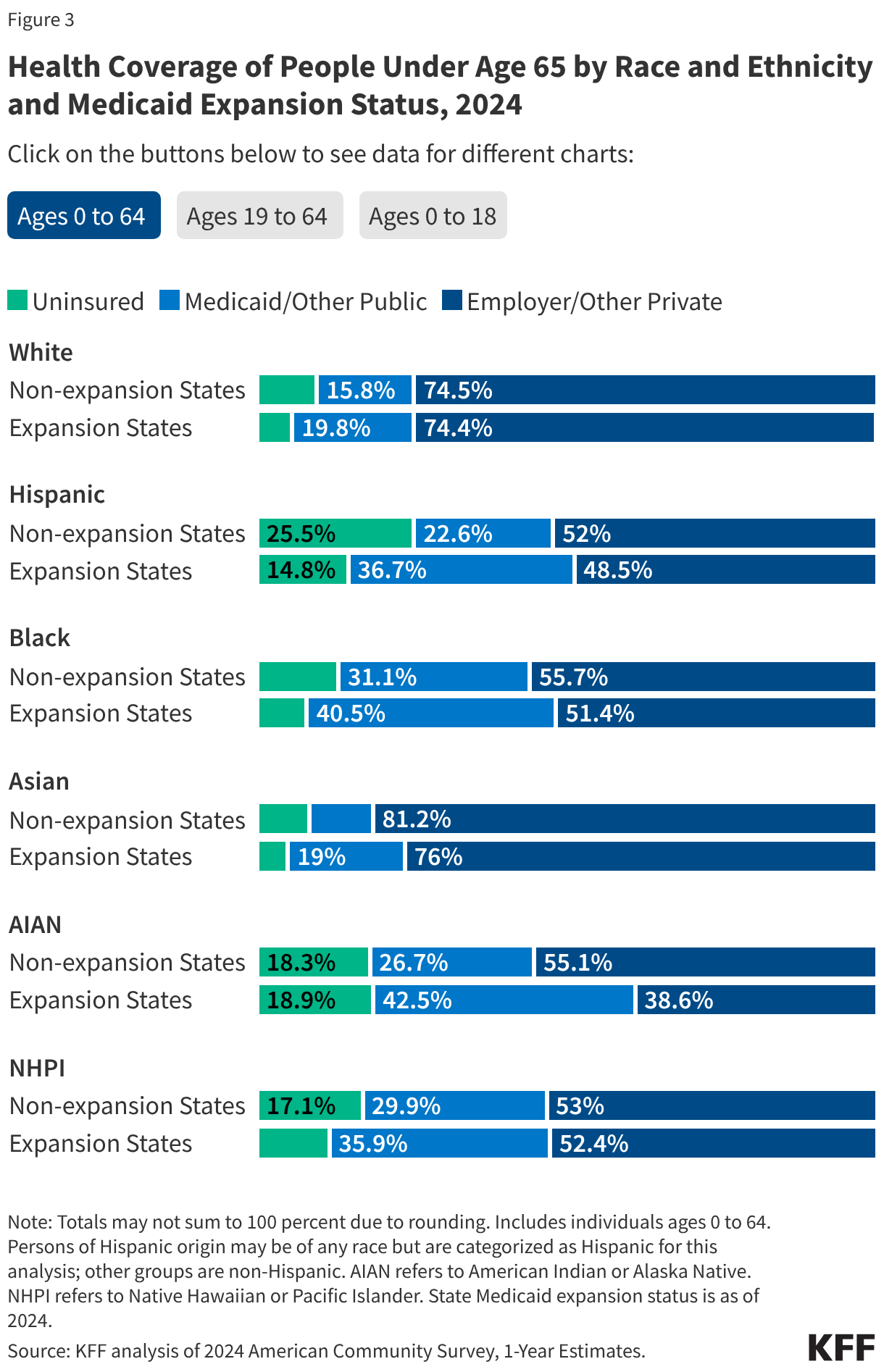
Among people under age 65, uninsured rates in states that have not expanded Medicaid are higher than rates in expansion states across most racial and ethnic groups as of 2024 (Figure 3). While uninsured rates for children are lower than for adults across groups, these differences between expansion and non-expansion states persist among children. For example, 16.0% of Hispanic children in non-expansion states are uninsured compared to 6.7% of Hispanic children in expansion states. The differences in coverage rates between Black and Hispanic people compared with White people are larger in non-expansion states compared with expansion states. However, the relative risk of being uninsured for Black, Hispanic, Asian and NHPI people compared with White people is similar in expansion and non-expansion states. For example, Hispanic people under the age of 65 years old are roughly 2.6 times as likely as their White counterparts to lack coverage in both expansion and non-expansion states. Uninsured rates for AIAN people are similar in expansion and non-expansion states.

Health Coverage of People Under Age 65 by Race and Ethnicity and Medicaid Expansion Status, 2024 (Stacked Bars)

Eligibility for Coverage Among The Uninsured as of 2024

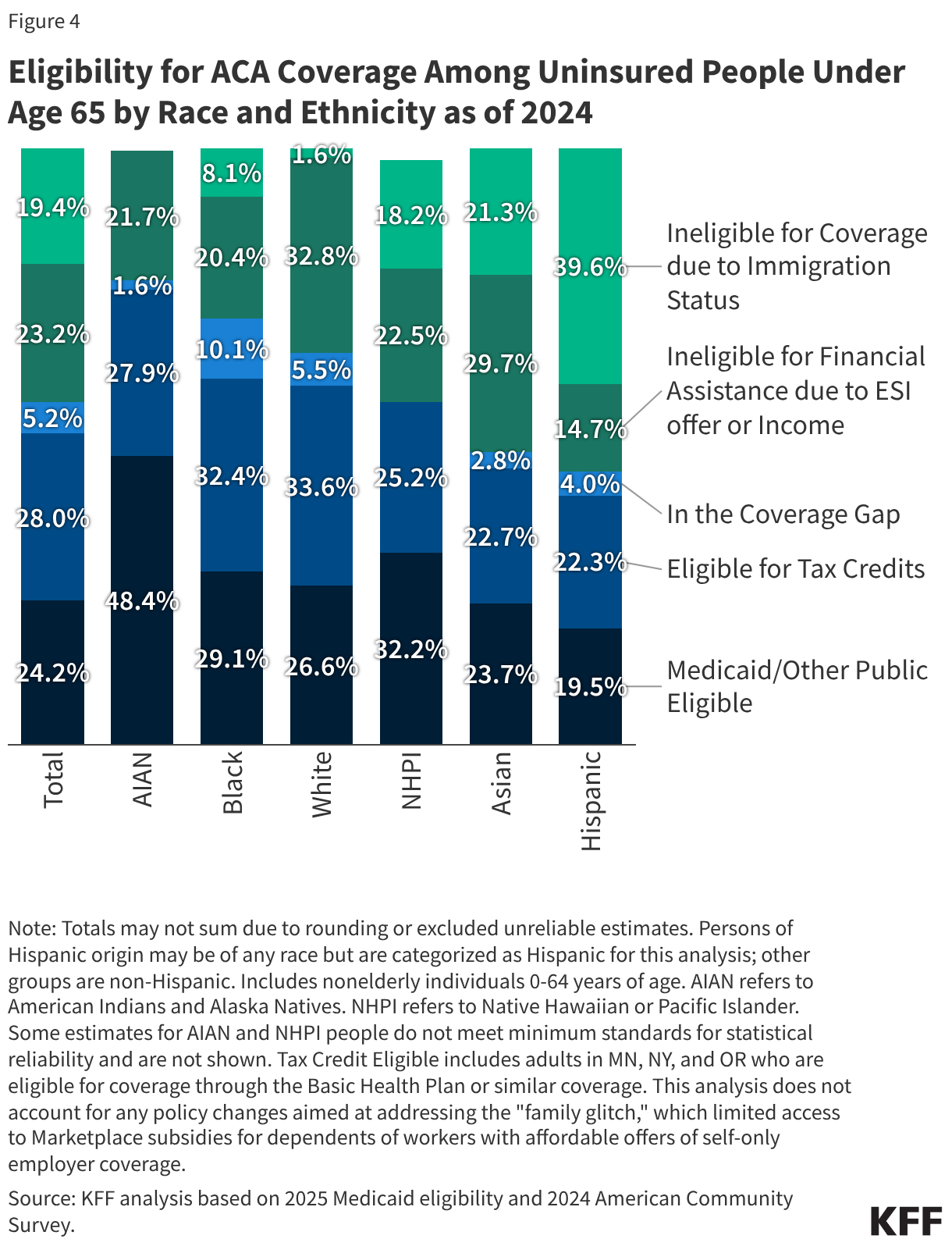
Overall, about half of uninsured people are eligible for Medicaid or Marketplace coverage, but eligibility varies across racial and ethnic groups, with smaller shares of Hispanic and Asian uninsured people eligible for assistance due to these groups having larger shares of ineligible noncitizen immigrants. Overall, over half (52.2%) of people who were uninsured in 2024 were eligible for financial assistance either through Medicaid or through subsidized Marketplace coverage, while the remaining half (47.8%) were not eligible because they fell in the Medicaid coverage gap in states that have not expanded Medicaid, had income too high to qualify for Marketplace premium tax credits, , were eligible for employer coverage, or had an ineligible immigration status. However, the share of the remaining uninsured eligible for assistance varied by race and ethnicity. For example, uninsured Black people under age 65 were more likely than their uninsured White counterparts to fall in the Medicaid coverage gap, reflecting that most of the 10 states that have not expanded Medicaid, are in the South where a higher share of the Black population resides. Uninsured Hispanic and Asian people under age 65 were also less likely than White people to be eligible for coverage options, in part, due to higher shares of noncitizens who face immigrant eligibility restrictions including eligibility restrictions for lawfully present immigrants and ineligibility for undocumented immigrants. (Figure 4).

Eligibility for ACA Coverage Among Uninsured People Under Age 65 by Race and Ethnicity as of 2024 (Stacked column chart)

The U.S. Government and Gavi, the Vaccine Alliance

Published: May 4, 2026

Editorial Note: Originally published in June 2011, this resource is updated as needed to reflect the latest developments.

Key Facts

  • Gavi, the Vaccine Alliance (Gavi) is an independent public-private partnership and multilateral funding mechanism that aims to expand global access to and use of vaccines, particularly among vulnerable children.
  • Since its launch in 2000, Gavi has provided approximately $29 billion to support immunization efforts in low- and middle-income countries, not including funding for COVAX.
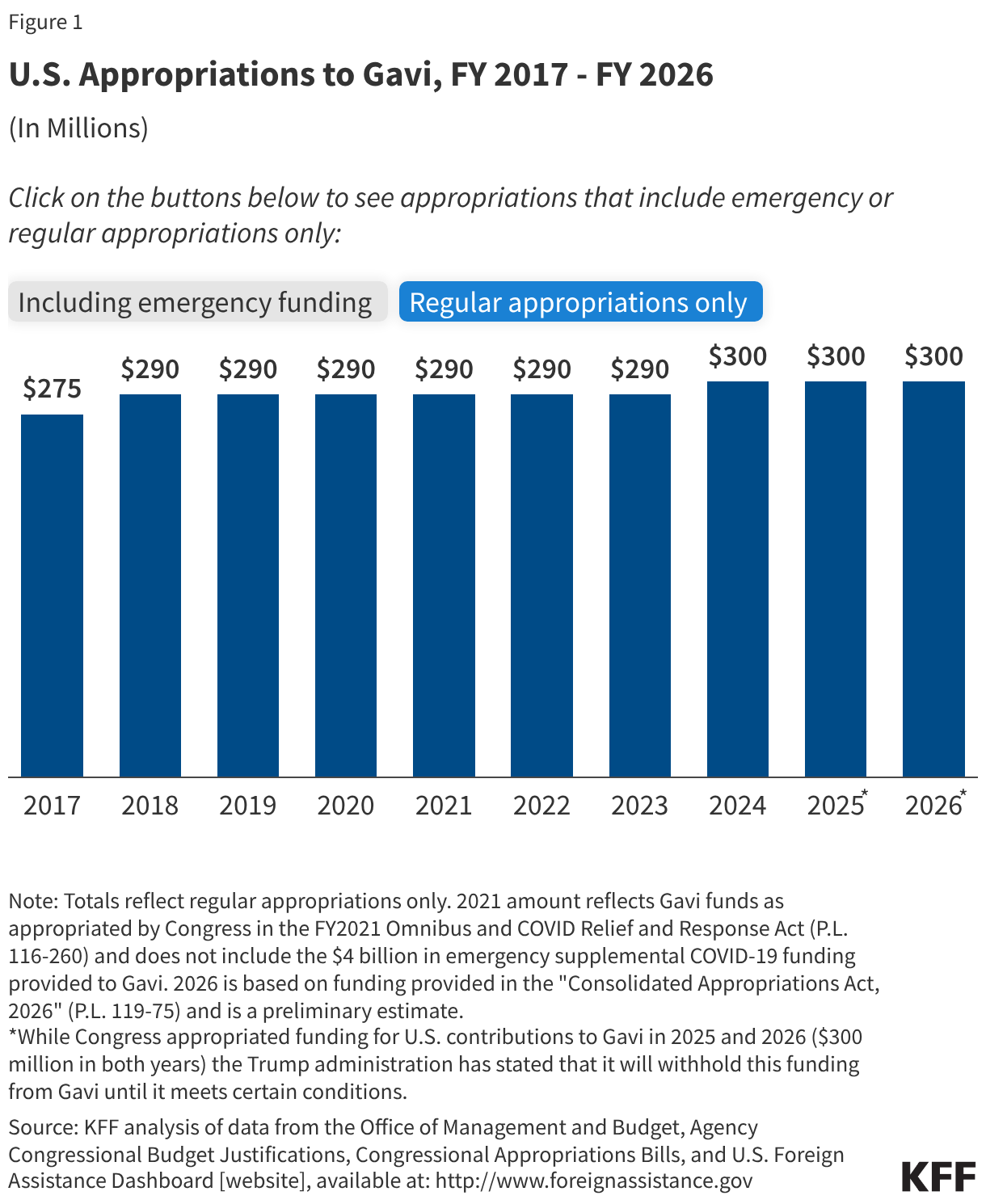
  • The U.S. government (U.S.) has supported Gavi since its creation through direct financial contributions, participation in Gavi’s governance as a member of the Board, and technical assistance; it had been its third largest contributor in recent years, providing 13% of its funding since its inception (not including funding for COVAX, the global COVID-19 pandemic vaccine response), reaching $300 million in FY 2024. In addition, the Biden administration had pledged that the U.S. would provide approximately $1.6 billion to Gavi over its 2026-2030 funding period.
  • While Congress again appropriated $300 million for Gavi in both FY 2025 and FY 2026, the Trump administration has not provided this funding to the organization, citing concerns about vaccine safety despite Gavi following globally recognized scientific standards and evidence.
  • Gavi’s latest replenishment summit secured pledges of more than $9 billion, towards a target of $11.9 billion, for the 2026-2030 period, as well as additional financing from development finance institutions and manufacturers to support country recipients. Still, the loss of U.S. funding in the context of a constrained financing environment globally presents new challenges for reaching children in low- and middle- income countries with life-saving vaccines.

Gavi Overview

Created in 1999 and formally launched in January 2000, Gavi, the Vaccine Alliance (Gavi) is an independent public-private partnership and multilateral funding mechanism that “aims to save lives and protect people’s health by increasing coverage and equitable and sustainable use of vaccines.” Gavi’s main activities include supporting low- and middle-income countries’ access to new and underused vaccines for vulnerable children through financial support, technical expertise, and market-shaping efforts, such as negotiating with manufacturers, to help lower the cost of procuring vaccines. Gavi operates in five-year funding cycles, with a revised strategy and goals for each cycle. Each five-year strategy is accompanied by a vaccine investment strategy, which determines which vaccines will be made available to countries.

Gavi’s current five-year strategy, for the 2026-2030 period, which is its sixth strategy, includes four core goals:

  1. introduce and scale-up vaccines,
  2. strengthen health systems to increase equity in immunization,
  3. improve sustainability of immunization programs, and
  4. ensure healthy markets for vaccines and related products.

The current strategy emphasizes reducing the number of ‘zero-dose’ children with the goal of reaching no zero-dose children by 2030, in alignment with Immunization Agenda 2030; prioritizing programmatic and financial sustainability of country immunization programs; supporting targeted countries that have phased out of Gavi support or have never been eligible for Gavi support to maintain immunization progress; and providing more tailored approaches for Gavi countries to reach under-vaccinated populations, such as those living in remote or conflict settings, by encouraging countries to adopt strategies that reduce potential barriers to vaccination.

In addition to Gavi’s role in routine childhood immunizations, Gavi was one of the organizations leading COVAX, a multilateral effort that supported the equitable development, procurement, and delivery of COVID-19 vaccines globally that began in 2020 and ended in 2023. Gavi’s role in COVAX was to facilitate the procurement and delivery of COVID-19 vaccines, with particular emphasis on low- and middle-income countries. Provision of COVID-19 vaccines and funding support to countries was integrated into Gavi’s regular programming from 2024-2025 (COVID-19 vaccine support has been discontinued).

Organization

Gavi’s Secretariat, with its main headquarters in Geneva and an office in Washington, D.C., carries out the day-to-day operations of the partnership. Gavi does not have program offices or staff based in recipient countries but rather relies on country health ministries and World Health Organization (WHO) regional offices to implement programs. Gavi is led by a Chief Executive Officer (CEO), currently Sania Nishtar.

The 28-member Gavi Board sets Gavi’s funding policies and strategic direction, and monitors program implementation. It includes 18 “representative” seats, nine seats for independent individuals, and one ex-officio non-voting seat for Gavi’s CEO. The 18 representative seats, as specified in Gavi’s statutes, are as follows: donor country governments (5), implementing country governments (5), the WHO, the United Nations Children’s Fund (UNICEF), the World Bank, and the Gates Foundation, and one seat each for civil society groups, the vaccine industry in industrialized countries, the vaccine industry in developing countries, and technical health/research institutes. Additionally, several Board committees guide and advise the Board and the CEO on Gavi activities under their purview. The U.S. government was represented on Gavi’s Board as the Board member for the donor country government constituency until the end of 2025. With the suspension of U.S. support, the U.S. lost eligibility to hold a seat on the Gavi Board.

Funding

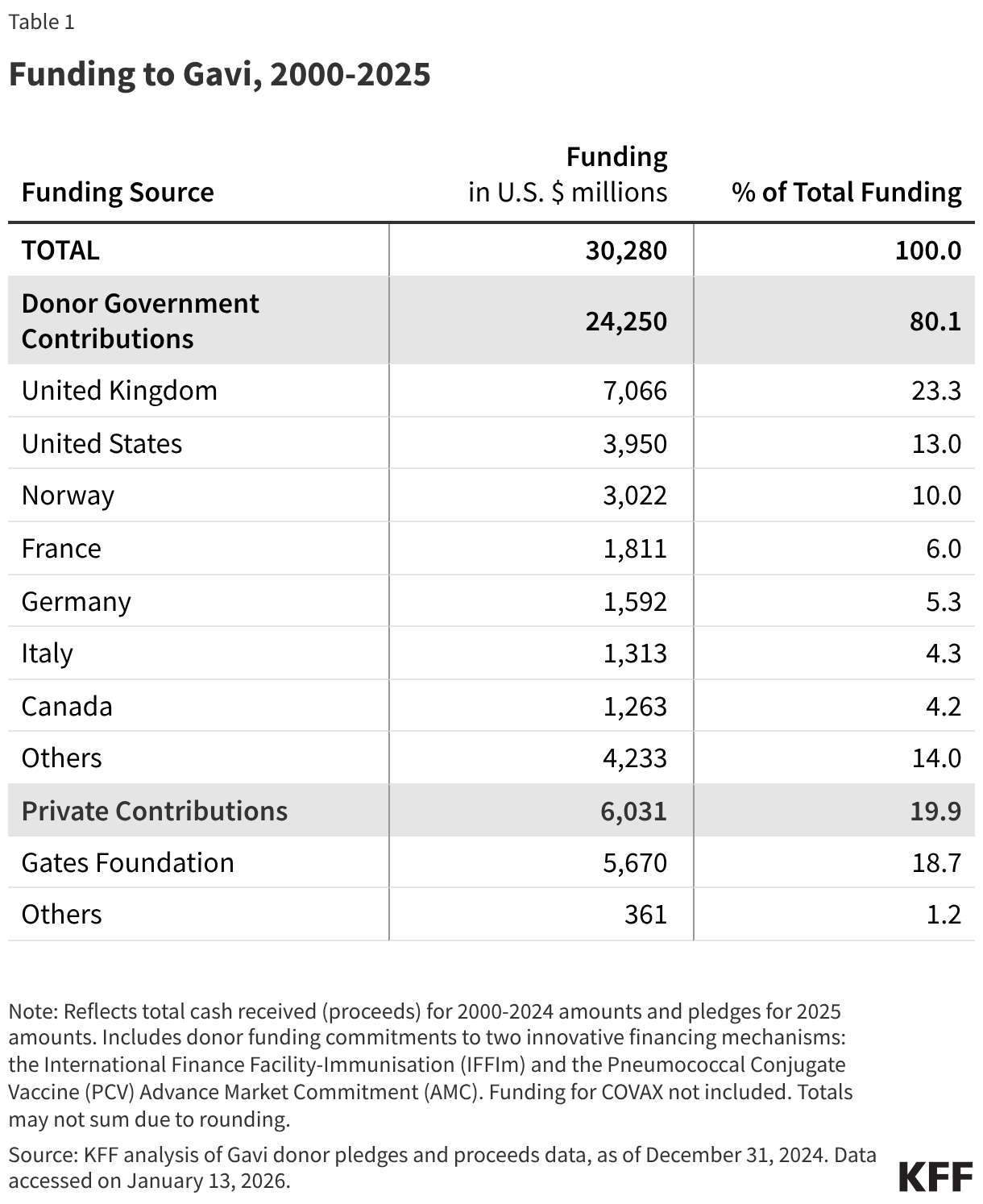
Since its 2000 launch, Gavi has received approximately $30 billion in financing, not including funding for COVAX (see Table 1).1 Approximately four-fifths (80%) of Gavi’s funding came from contributions provided by donor governments and private organizations and individuals. The top three government donors were the United Kingdom, the U.S. and Norway, while the largest private donor was the Gates Foundation.

Donors support Gavi through direct contributions as well as funding commitments to innovative financing mechanisms, the proceeds of which help support Gavi’s overall financing. These innovative financing mechanisms include the International Finance Facility-Immunisation (IFFIm) and the Pneumococcal Conjugate Vaccine (PCV) Advance Market Commitment (AMC). The IFFIm was created in 2006 and uses donor funding commitments to back the issuance of special bonds in capital markets, essentially providing “up-front” financing to Gavi. The PCV AMC began in 2010, and though it ended in 2020, it supported accelerated access to pneumococcal vaccines through up-front funding commitments from donors and continues to do so through contracts with manufacturers that extend until 2029. The U.S. does not provide support to either of these mechanisms.2 

In addition to financing Gavi’s regular activities, donors pledged additional resources to support the Gavi COVAX Advance Market Commitment (COVAX AMC), a financial mechanism within COVAX that supported low- and middle-income countries through procurement and distribution of COVID-19 vaccines; through 2024, Gavi received $12.6 billion from donor governments, private philanthropy, and innovative financing mechanisms for the COVAX AMC for vaccine procurement, delivery, and logistics.3

Funding to Gavi, 2000-2025 (Table)

Country Eligibility and Support

Eligibility

Only low- and middle-income countries with a Gross National Income (GNI) per capita below or equal to $1,8204 are eligible for Gavi support. In 2025, 54 countries were eligible for Gavi support.

Recipient countries’ governments are expected to share responsibility for funding their national immunization efforts through Gavi’s co-financing requirements (introduced in 2008), determined according to country income level and transition status. As countries develop economically, they are expected to contribute a greater share of the funding required for immunization programs. Countries classified as low-income by the World Bank are initial self-financing countries, while countries between the low-income threshold and Gavi eligibility threshold ($1,820 GNI per capita) are in preparatory transition. Initial self-financing countries are responsible for co-financing the equivalent of $0.20 per dose each year. Countries in preparatory transition gradually increase their co-financing contribution each year.5 When a country’s income rises above the GNI per capita threshold, it moves into an eight-year “accelerated transition” period of increasing domestic financing share, after which the country is expected to fully fund its own immunization programs.6 As of 2025, 19 countries have transitioned out of Gavi financial support.

Additionally, Gavi offers limited support for countries that have transitioned out of Gavi eligibility and for middle-income countries that have never been eligible for Gavi support.7 Recognizing that many formerly and never Gavi-eligible countries experience low coverage rates and have yet to make key vaccine introductions, eligible countries can apply for “catalytic” funding to support the introduction of key missing vaccines (HPV, PCV, or rotavirus) or mitigation of backsliding.8

Country Support

Gavi provides grant financing to country programs in the following two support types:

Country allocation formulas for HSIS support are based on the following metrics: number of zero-dose children, coverage of essential vaccines,10 GNI per capita, and if a country is considered fragile or conflict-affected.11 For vaccines, all countries are required to pay a share of the cost of their Gavi-supported vaccines.

Additionally, Gavi has provided country support through emergency response funding, including for Ebola vaccination during Ebola outbreaks12 and for COVID-19, allowing for up to $200 million in reprogrammed Gavi support for the COVID-19 response in Gavi-eligible countries, and other support  for the COVID-19 response including through the creation of COVAX (which helped expand access to COVID-19 vaccines in lower-income countries) and the COVID-19 Vaccine Delivery Partnership (CoVDP, which aimed to improve COVID-19 vaccine coverage in certain COVAX countries, with a particular emphasis on countries that were below 10% coverage in January 2022).13 In 2022, Gavi supported 50 outbreak response vaccination campaigns. Gavi currently funds several emergency vaccine stockpiles, allowing for rapid deployment of vaccines during outbreaks, including for cholera, Ebola, meningitis, mpox,14 and yellow fever. In 2024, Gavi deployed vaccines from these emergency stockpiles to 20 countries.15

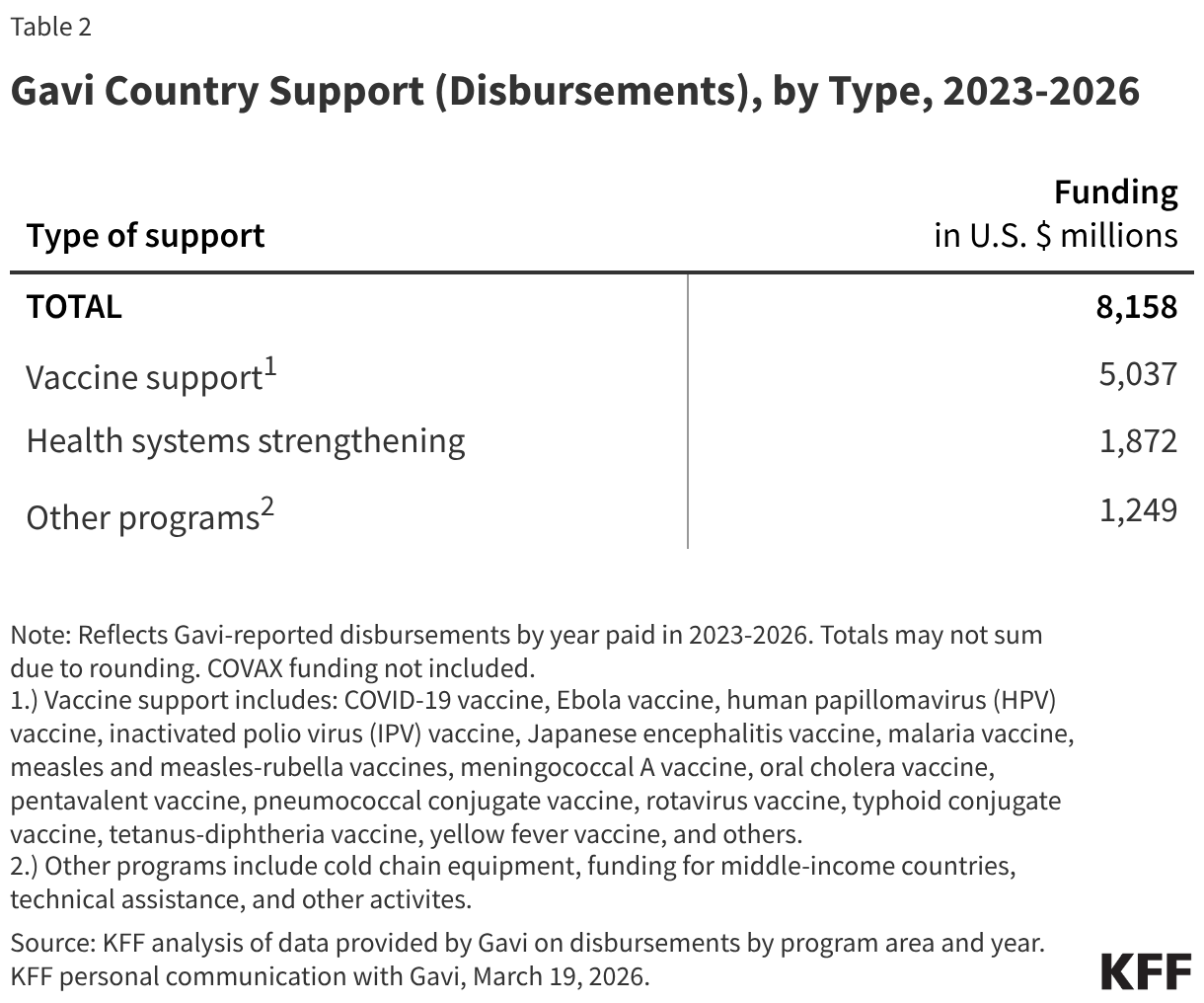
Since its launch in 2000, Gavi has provided approximately $29 billion to support country immunization programs (not including funding for COVAX).16 Over the past three years, 2023-2026, more than $8.1 billion has been disbursed, most of which has been for vaccine support (62%), followed by health systems strengthening (23%) (see Table 2).

Gavi Country Support (Disbursements), by Type, 2023-2026 (Table)

Results

Gavi reports it has helped to immunize more than 1.2 billion children in supported countries, including more than 72 million in 2024 alone, and supported 58 different vaccine introductions and preventive campaigns and 50 outbreak response campaigns in 2024. Additionally, Gavi support has helped avert more than 20.6 million deaths and contributed to more than $280 billion in economic benefits, since its launch in 2000. Additionally, according to Gavi, its support has led to improved child health and immunization indicators across its supported countries. For example, the average vaccine coverage across multiple key Gavi-supported vaccines –  including the human papillomavirus (HPV) vaccine, inactivated polio vaccine, and pentavalent vaccine (the vaccine providing protection against diphtheria, tetanus, pertussis, hepatitis B, and Hib),17 among others –  was 63% in Gavi-supported countries in 2024, up from 48% in 2019.18 Lastly, Gavi’s work has contributed to vaccine market-shaping; for example, Gavi reports that its influence has helped lower the cost of the HPV vaccine from a price per dose of $4.50 in 2015 to $2.90 in 2022.19

U.S. Engagement with Gavi

The U.S. government has supported Gavi since its creation. President Clinton made the initial U.S. pledge to the newly formed partnership in 2000, and the U.S. provided its first contribution in 2001. Prior to the second Trump administration, the U.S. supported Gavi through financial contributions, participation in Gavi’s governance, and by providing technical assistance, but the current administration has not provided funding to the organization (see below).

Additionally, the U.S. had supported other global immunization activities that complemented Gavi’s  efforts, providing bilateral (country-to-country) support for immunization through USAID (before its dissolution), CDC, and other agencies, focusing on strengthening routine immunization systems to deliver vaccines. However, the U.S. government is currently reorganizing how it supports global health programs, including immunization activities, under its “America First Global Health Strategy” which includes the development of bilateral agreements with countries. Given that Gavi was the mechanism through which the U.S. supported vaccine procurement, it is not yet clear how these agreements will support procurement going forward. See also the KFF fact sheet on the Trump administration’s foreign aid review and the proposed reorganization of U.S. global health programs.

Financial Support 

The U.S. supported Gavi with direct contributions starting in 2001, with funding reaching $300 million in FY 2024, its highest level. Additionally, in response to the COVID-19 pandemic, the U.S. provided $4 billion in FY 2021 emergency funding to Gavi for COVID-19 vaccine procurement and delivery support under COVAX, making the U.S. the largest donor to COVAX (32% of $12.6 billion received overall).20In addition to its financial support for COVAX, the U.S. donated the largest number of COVID-19 vaccines to other countries. While Congress appropriated $300 million for U.S. contributions to Gavi in FY 2025 and FY 2026 (see Figure 1), the current administration has not provided funding to Gavi after citing concerns about vaccine safety despite Gavi following globally recognized scientific standards and evidence.21 See the KFF budget tracker and the KFF fact sheet on the U.S. Global Health Budget: Maternal & Child Health (MCH) for details on historical appropriations for Gavi, and also the KFF fact sheet on the Trump administration’s foreign aid review and the status of U.S. support for Gavi.

U.S. Appropriations to Gavi, FY 2017 - FY 2026 (Stacked column chart)

Governance Activities

The U.S. had historically played a role in Gavi’s governance, including as a Board and committee member, but with the suspension of U.S. funding by the Trump administration, the U.S. is no longer eligible to hold a Board seat.  

Technical Support

The U.S. had historically provided Gavi with technical support and expertise in the design, implementation, and evaluation of its programs in the field through partnerships with several U.S. agencies. For example, Gavi’s accelerated vaccine introduction programs had been conducted with technical support from the Centers for Disease Control and Prevention (CDC) and the now-dissolved U.S Agency for International Development (USAID), along with other partners.

Endnotes

  1. This amount includes proceeds for 2000-2024 and pledges for 2025. ↩︎
  2. For further information about restrictions on U.S. support for these innovative financing mechanisms, see KFF, Innovative Financing Mechanisms for Global Health: Overview and Considerations for U.S. Government Participation, Sept. 2011. ↩︎
  3. KFF analysis of Gavi cash receipts data. Gavi, “Cash Receipts 31 December 2024,” https://www.gavi.org/news-resources/document-library/cash-receipts. ↩︎
  4. For countries to be eligible for Gavi support, their most recent GNI per capita must be at or below $1,820, or the country’s average GNI per capita over the last three years must be at or below $1,820. ↩︎
  5. Countries in the first year of the preparatory transition phase co-finance the equivalent of $0.20 per dose, the same as initial self-financing countries. For each subsequent year, countries in preparatory transition co-finance a 15% increase of the total fraction paid in the prior year. Gavi, “Co-financing policy,” https://www.gavi.org/sites/default/files/programmes-impact/our-impact/01_Gavi-Alliance-Co-financing-Policy-60.pdf. ↩︎
  6. Countries in the first year of the accelerated transition phase co-finance the equivalent of the prior year’s total fraction plus 15%, the same as countries in preparatory transition. For each year after, the amount per dose increases linearly until the country is fully financing each vaccine after the eighth year and end of Gavi support. Gavi, “Co-financing policy,” https://www.gavi.org/sites/default/files/programmes-impact/our-impact/01_Gavi-Alliance-Co-financing-Policy-60.pdf. ↩︎
  7. Countries eligible for this limited funding include those above the Gavi eligibility threshold ($1,820 GNI per capita) but below the World Bank lower-middle income threshold ($4,495 GNI per capita) or those that are eligible to borrow from the International Development Association. Gavi, “Annex D: Report to the Board, July 24-25 2025,” https://www.gavi.org/sites/default/files/%20/board/minutes/2025/24-25-july06%20-%20Annex%20D%20-%20Framework%20for%20Gavi%20Funding%20to%20Countries.pdf. ↩︎
  8. Support for backsliding mitigation is only available to former Gavi-eligible countries. Gavi, “Annex D: Report to the Board, July 24-25 2025,” https://www.gavi.org/sites/default/files/%20/board/minutes/2025/24-25-july06%20-%20Annex%20D%20-%20Framework%20for%20Gavi%20Funding%20to%20Countries.pdf. ↩︎
  9. HSIS support only available for Gavi-eligible countries. Gavi, “Annex D: Report to the Board, July 24-25 2025,” https://www.gavi.org/sites/default/files/%20/board/minutes/2025/24-25-july06%20-%20Annex%20D%20-%20Framework%20for%20Gavi%20Funding%20to%20Countries.pdf. ↩︎
  10. Includes coverage of first-dose diphtheria, tetanus, and pertussis containing vaccine (DPT1), coverage of DTP3, and coverage of second-dose measles containing vaccine (MCV2). Gavi, “Annex D: Report to the Board, July 24-25 2025,” https://www.gavi.org/sites/default/files/%20/board/minutes/2025/24-25-july06%20-%20Annex%20D%20-%20Framework%20for%20Gavi%20Funding%20to%20Countries.pdf.    ↩︎
  11. Gavi, “Annex D: Report to the Board, July 24-25 2025,” https://www.gavi.org/sites/default/files/%20/board/minutes/2025/24-25-july06%20-%20Annex%20D%20-%20Framework%20for%20Gavi%20Funding%20to%20Countries.pdf.    ↩︎
  12. Gavi, “500,000 doses of Ebola vaccine to be made available to countries for outbreak response,” webpage, https://www.gavi.org/news/media-room/500000-doses-ebola-vaccine-be-made-available-countries-outbreak-response. ↩︎
  13. CoVDP phased out its operations in June 2023 as the partnership was not set up to be a permanent structure. WHO, “COVID-19 Vaccine Delivery Partnership,” webpage, https://www.who.int/emergencies/diseases/novel-coronavirus-2019/covid-19-vaccines/covid-19-vaccine-delivery-partnership; Devex, “Exclusive: A COVID-19 initiative for vaccine delivery is winding down,” 11 January 2023, https://www.devex.com/news/exclusive-a-covid-19-initiative-for-vaccine-delivery-is-winding-down-104724. ↩︎
  14. Gavi, “Gavi 6.0 Funding Guidelines,” https://www.gavi.org/sites/default/files/support/guidelines-2026/gavi-60-funding-guidelines-annexes.pdf#page=43 ↩︎
  15. Gavi, “Vaccine stockpiles,” https://www.gavi.org/vaccineswork/vaccine-stockpiles-guide. ↩︎
  16. KFF analysis of data provided by Gavi on disbursements by program area and year. KFF personal communications with Gavi, March 19, 2026. ↩︎
  17. The vaccines included in Gavi’s breadth of protection measure include: the third dose of the pentavalent vaccine, third dose of the pneumococcal conjugate vaccine, first dose of the rubella-containing vaccine, last dose of the rotavirus vaccine, second dose of the measles-containing vaccine, yellow fever, meningococcal A, Japanese encephalitis, and last dose of the HPV vaccine. Gavi, “Gavi 2024 Annual Progress Report,” https://www.gavi.org/sites/default/files/programmes-impact/our-impact/apr/Gavi-2024-Annual-Progress-Report.pdf#page=17.    ↩︎
  18. Gavi, “Gavi 2024 Annual Progress Report,” https://www.gavi.org/sites/default/files/programmes-impact/our-impact/apr/Gavi-2024-Annual-Progress-Report.pdf#page=17. ↩︎
  19. As another example of Gavi’s market-shaping influence, Gavi and UNICEF recently announced an agreement to make R21/Matrix-M malaria vaccines more affordable for Gavi countries through the IFFIm mechanism. UNICEF, “Gavi and UNICEF announce equitable pricing deal for malaria vaccine to protect 7 million more children by end of decade,” https://www.unicef.org/press-releases/gavi-and-unicef-announce-equitable-pricing-deal-malaria-vaccine-protect-7-million. ↩︎
  20. The U.S. announced it would donate 500 million Pfizer doses to COVAX at the G7 Summit in June 2021. However, a portion of these doses were purchased using funds appropriated to Gavi ($2 billion for 300 million Pfizer doses), while the remaining 200 million doses were purchased using $1.5 billion in other emergency funds from the American Rescue Plan Act. To avoid double-counting, Gavi counts the U.S. funding that was contributed to Gavi under its COVAX funding contributions, with only 200 million of the doses – those purchased directly by the U.S. – counted as COVAX vaccine dose donations. KFF personal communication with Gavi, Nov. 12, 2021; White House, “FACT SHEET: President Biden Announces Historic Vaccine Donation: Half a Billion Pfizer Vaccines to the World’s Lowest-Income Nations,” June 10, 2021; Gavi, “COVAX AMC Donors Table,” Apr. 7, 2022, https://www.gavi.org/sites/default/files/covid/covax/COVAX-AMC-Donors-Table.pdf; Gavi, “Cash Receipts 31 December 2024,” https://www.gavi.org/news-resources/document-library/cash-receipts. ↩︎
  21. Secretary Robert F. Kennedy Jr. (@SecKennedy), https://x.com/SecKennedy/status/1937986463510982869 [X post], June 25, 2025; Gavi, “Statement,” https://www.gavi.org/news/media-room/statement-response-25-june-2025; Reuters, “Exclusive: US conditions funding to global vaccine group on dropping mercury-based preservative from shots,” https://www.reuters.com/business/healthcare-pharmaceuticals/us-conditions-funding-global-vaccine-group-dropping-mercury-based-preservative-2026-01-28/. ↩︎

Recent Changes to Temporary Protected Status Designations: Potential Impacts on Health and Health Care

Published: May 1, 2026

Introduction

The Temporary Protected Status (TPS) program was established in 1990 and allows the Secretary of Homeland Security to designate a country for TPS if there is an ongoing armed conflict, environmental disaster,  epidemic, or other conditions that may “temporarily prevent the country’s nationals from returning safely.” Eligible individuals from TPS designated countries can receive TPS, which protects them from deportation and allows them to work in the U.S. for temporary, extendable periods.

The Trump administration has carried out numerous immigration policy changes focused on increasing immigration enforcement and reducing immigration into the country, including seeking to end TPS designations for many countries. Further, under the 2025 reconciliation law, TPS holders will lose access to subsidized ACA Marketplace coverage starting January 1, 2027, and Medicare starting no later than January 4, 2027, while they already are ineligible for Medicaid and the Children’s Health Insurance Program (CHIP). This brief provides an overview of the TPS program, recent changes to TPS designations announced by the Trump administration, and potential implications of loss of TPS for individuals on health and health care. It includes KFF analysis of Congressional Research Service reports to assess changes in the number of individuals and countries with TPS designations over time and of 2024 American Community Survey (ACS) data to estimate the number of noncitizen immigrant workers likely to have TPS, who could be impacted by the elimination of TPS designations.

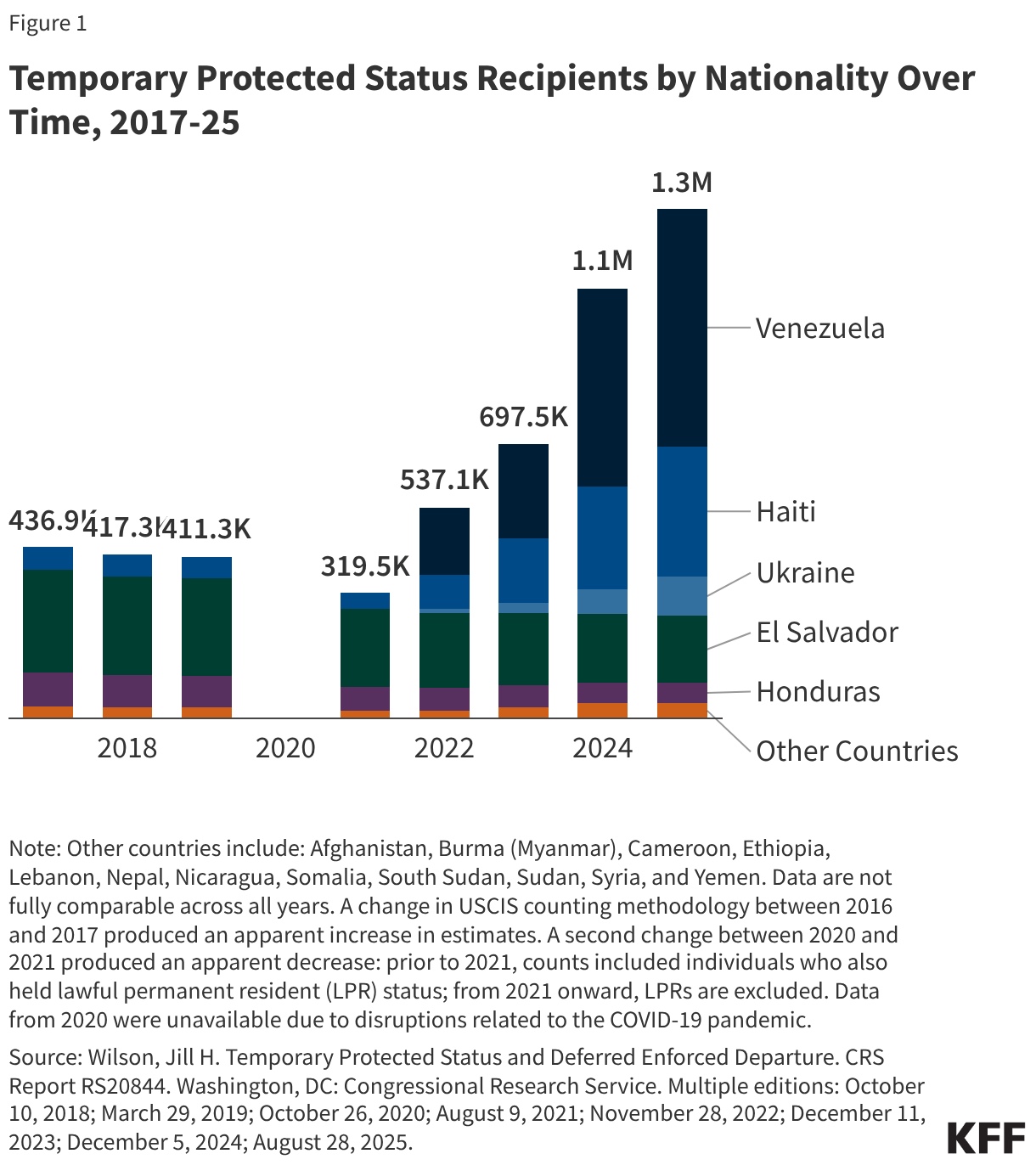
According to federal data, as of March 2025 (the latest data available), nearly 1.3 million individuals from 17 countries had TPS.  As of March 2026, the Trump administration has ended or attempted to end TPS designations for 13 of 17 countries with active TPS designations at the time he took office, which could impact over one million TPS holders. However, implementation of some of these changes is subject to ongoing litigation. Individuals who lose TPS lose their work authorization and become at risk for deportation, which may negatively impact their health and access to health coverage and care. Moreover, termination of TPS designations could negatively impact the U.S. economy and workforce by putting hundreds of thousands of immigrant workers at risk of deportation. Immigrants likely to have TPS from 16 of the 17 countries for which data are available made up about 740,000 workers ages 18 and older in the U.S. as of 2024, including about 53,000 workers in the health care industry.

Overview of the TPS Program

The TPS program was established under the Immigration Act of 1990 to allow eligible immigrants from designated countries to live and work in the U.S. The program is administered by U.S. Citizenship and Immigration Services (USCIS) within the Department of Homeland Security (DHS). DHS has the authority to designate a country for TPS for periods of 6 to 18 months and can extend these periods if conditions in the country continue to prevent its nationals from returning safely, such as due to armed conflict or environmental disasters. TPS provides immigrants with employment authorization and protection from deportation but it does not provide a pathway to citizenship. A TPS holder can only obtain permanent status by separately qualifying for another immigration status, such as lawful permanent residence through a family-based or employment-based visa petition.

As of March 2025, close to 1.3 million noncitizen immigrants from 17 countries had TPS with five countries, Venezuela, Haiti, El Salvador, Ukraine, and Honduras, accounting for approximately 97% of all recipients. The remaining 12 countries include over 39,000 individuals with TPS. The number of people with TPS has grown in recent years, from under 500,000 in 2017 to about 1.3 million in 2025, driven by new country designations, particularly for Venezuela and Ukraine, as well as redesignations for countries like Haiti that continue to face ongoing humanitarian crises (Figure 1).

Temporary Protected Status Recipients by Nationality Over Time, 2017-25 (Stacked column chart)

Recent Changes to TPS Designations

The Trump administration has ended or attempted to end TPS designations for 13 of 17 countries that had designations when he took office, which could impact about one million TPS holders, but implementation is subject to ongoing litigation (Appendix Table 1). As of March 31, 2026, termination of TPS designations for Afghanistan, Cameroon, Honduras, Nepal, Nicaragua, and certain Venezuelan TPS holders had already taken effect, impacting close to 320,000 TPS holders from these countries. Termination of TPS designation for Yemen is expected to take effect in May 2026, and termination of TPS designation as well as work authorization for remaining Venezuelan TPS holders is expected to take effect in October 2026, which could impact over 350,000 immigrants from these countries. Further, the Trump administration has taken steps to end TPS designations for Burma (Myanmar), Ethiopia, Haiti, Somalia, South Sudan, and Syria, but these terminations were on hold as of March 31, 2026, due to court challenges. If allowed to proceed, these terminations could lead to an additional 330,000 immigrants losing TPS status.

Potential Implications of Loss of TPS

Individuals who lose TPS lose their work authorization and become at risk of deportation, which may negatively impact their access to health coverage and care. The Trump administration’s attempts to end TPS designations for 13 of 17 countries put a vast majority of TPS holders at risk of losing their status and becoming subject to deportation as well as losing access to health coverage. As of 2026, TPS holders are eligible for subsidized ACA and Medicare coverage if they meet other program eligibility requirements. They are not eligible for Medicaid and CHIP. TPS holders who lose their status would become undocumented and lose access to any federally funded coverage. Under longstanding policy, undocumented immigrants are ineligible for all forms of federally funded health coverage including Medicaid, CHIP, Medicare, and coverage through the ACA Marketplace. Further, loss of TPS would result in immigrants losing their work authorization, leading to employment loss and, consequently, potential loss of access to employer-sponsored health coverage. At the same time, lost income due to job loss may make it difficult for impacted immigrants to afford health care. Based on KFF analysis of ACS data, as of 2024, over four in ten (44%) of likely TPS workers 18 and older from 16 of 17 countries with active TPS designations at the time had employer-sponsored health coverage compared to 45% of other noncitizen workers and 70% of U.S. citizen workers 18 and older.

Loss of TPS may also negatively affect people’s health by increasing their immigration-related worries and making them more reluctant to access health care. People losing TPS status become undocumented, putting them at risk for deportation and likely increasing their immigration-related worries. Data from the 2025 KFF Survey of Immigrants show that over three in four (77%) of likely undocumented immigrants say they have experienced negative health impacts due to immigration-related worries since January 2025, and about half (48%) say that they have avoided seeking medical care since January 2025 due to immigration-related concerns.

Termination of TPS designations may also have negative impacts on the U.S. workforce, which included about 740,000 likely TPS workers overall as of 2024. KFF analysis of ACS data show that, as of 2024, noncitizen immigrants likely to have TPS from 16 of the 17 countries with active designations at the time made up about 740,000 workers in the U.S., including about 53,000 health care workers. These include noncitizen immigrants ages 18 and older who were born in a country with an active TPS designation as of December 2024 and whose year of entry in the U.S. is on or before the most recent continuous residence requirement for their country as specified by USCIS (see methods for more details). Data for immigrants from South Sudan were not available separately in ACS. Among noncitizen immigrants ages 18 and older likely to have TPS from the 16 countries with data available, about three in four (74%) report being employed compared to about two-thirds (67%) of other noncitizen immigrants and about six in ten (62%) U.S. citizens ages 18 and older.

Methods

This analysis is based on KFF analysis of the 2024 American Community Survey (ACS) 1-year Public Use Microdata Sample. Individuals likely to have TPS were identified in ACS as those who report being noncitizen immigrants, were born in a country with an active TPS designation as of December 2024 for which data are available namely, Afghanistan, Burma (Myanmar), Cameroon, El Salvador, Ethiopia, Haiti, Honduras, Lebanon, Nepal, Nicaragua, Somalia, Sudan, Syria, Ukraine, Venezuela, or Yemen (country of birth data for South Sudan is not available separately in ACS); arrived in the U.S. on or before the year of the most recent continuous residence requirement for their country as specified by USCIS; do not receive Medicaid, Supplemental Nutrition Assistance Program (SNAP), or Social Security; and do not work for the U.S. government or military since TPS holders are excluded from these benefits and are generally excluded from government and military service. Workers were further identified as those ages 18 and older who report being employed and currently at work in the U.S. civilian labor force and health care workers were identified as a subset of all workers who worked in the health care industry (industry codes 7970 through 8290).

Appendix

Table 1
CountryInitial DesignationLatest DesignationStatus as of March 2026Number of TPS Holders as of March 2025
Afghanistan5/20/202211/21/2023Terminated effective 7/14/20258,105
Burma (Myanmar)5/25/20215/26/2024Terminated effective 1/26/2026, but restored subject to court order3,670
Cameroon6/7/202212/8/2023Terminated effective 8/4/20254,920
El Salvador3/9/2001 Active170,125
Ethiopia12/12/20227/13/2024Terminated effective 2/13/2026, but restored subject to court order4,540
Haiti1/21/20108/4/2024Terminated effective 2/3/2026, but restored subject to court order330,735
Honduras1/5/1999 Terminated effective 9/8/202551,225
Lebanon11/27/2024 Active140
Nepal6/24/2015 Terminated effective 8/20/20257,160
Nicaragua1/5/1999 Terminated effective 9/8/20252,910
Somalia9/16/19919/18/2024Terminated effective 3/17/2026, but restored subject to court order705
South Sudan11/3/201111/4/2023Terminated effective 1/5/2026, but restored subject to court order210
Sudan11/4/199710/20/2023Active1,790
Syria3/29/20124/1/2024Terminated effective 11/21/2025, but restored subject to court order3,860
Ukraine4/19/202210/20/2023Active101,150
Venezuela (2021 desig.)3/9/2021
 
 Terminated effective 11/7/2025, small number of individual cases on hold pending court activity252,825
Venezuela (2023 desig.)9/20/2023 Terminated effective 10/3/2025, with work authorization for some beneficiaries valid until 10/2/2026 subject to court order352,190
Yemen9/3/20159/4/2024Terminated effective 5/4/20261,380
Note: Updates are current as of March 2026. 
Sources: U.S. Citizenship and Immigration Services, “Temporary Protected Status Designated Country” (last reviewed March 31, 2026). Number of TPS holders obtained from Congressional Research Service, “Temporary Protected Status and Deferred Enforced Departure” (August 28, 2025). 

Changes to the Medicare Advantage Program Enhance Some Consumer Protections But Roll Back Others

Published: May 1, 2026

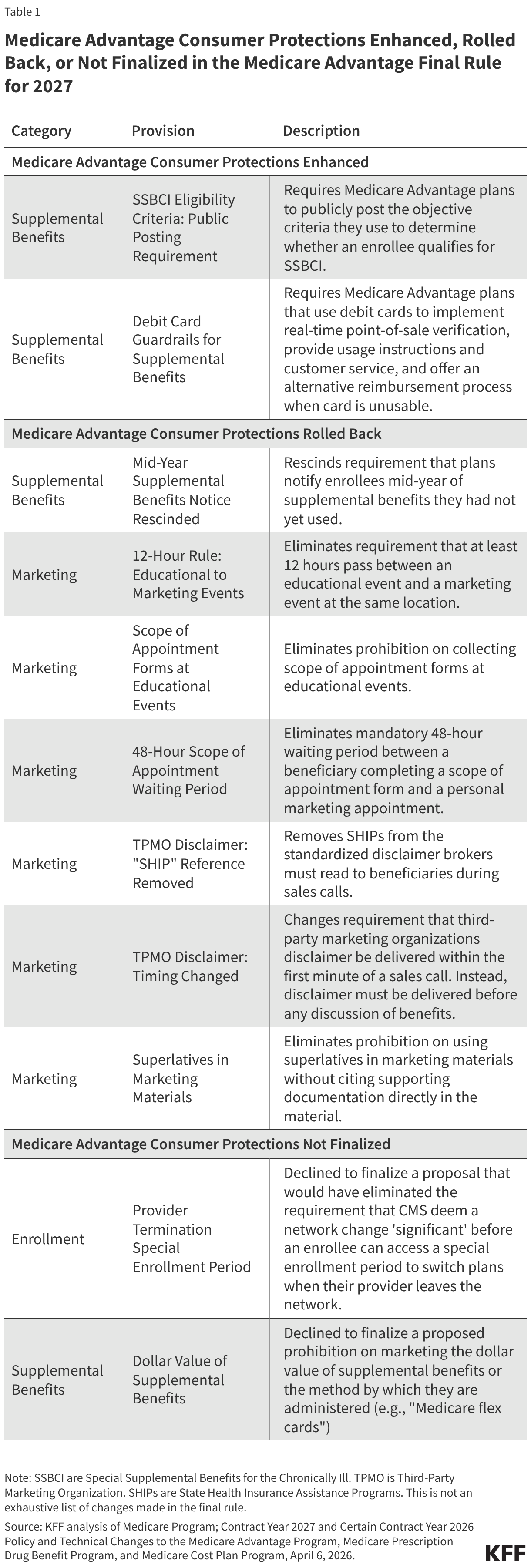
CMS recently finalized policies as part of the 2027 Medicare Advantage final rule that both enhance consumer protections and roll back changes to the Medicare Advantage program that were intended to protect consumers. These changes have gotten less attention than payment issues and changes to the star ratings system, which also affect plan payments, but could have implications for Medicare beneficiaries (See Table 1):

  • CMS will enhance some consumer protections by requiring Medicare Advantage plans to post eligibility criteria for Special Supplemental Benefits for the Chronically Ill (SSBCI), making it easier for prospective enrollees to assess their eligibility for these benefits, which include food and produce, pest control, and transportation for non-medical needs, among others. CMS also added guardrails for debit cards issued by plans to administer supplemental benefits, so enrollees can better understand how to use these cards to obtain their benefits and also to prevent the purchase of non-covered items.
  • CMS rolled back some changes to the Medicare Advantage program that were intended to protect consumers, including rescinding a requirement that plans notify enrollees of unused supplemental benefits mid-year, as well as eliminating a number of marketing requirements, such as provisions aimed at increasing the separation between marketing activities from educational events and a prohibition on the use of superlatives in marketing materials, and removes the State Health Insurance Assistance Programs (SHIPs) from the list of resources that brokers must offer to beneficiaries for further information during sales calls.
  • In addition, CMS did not finalize a proposal that would have modified a special enrollment period to make it easier for enrollees to switch coverage if one of their providers is no longer part of their Medicare Advantage’s plan network.
Medicare Advantage Consumer Protections Enhanced, Rolled Back, or Not Finalized in the Medicare Advantage Final Rule for 2027 (Table)

CMS Finalized a Few Changes to the Medicare Advantage Program That Enhance Some Consumer Protections

Improving SSBCI Eligibility Transparency. Medicare Advantage plans offer supplemental benefits to Medicare Advantage plan enrollees, such as dental, vision, and hearing, which are considered primarily health related (e.g., preventing or treating an illness). Beginning in 2020, Medicare Advantage plans have also been able to offer supplemental benefits that are not primarily health related for chronically ill beneficiaries, known as Special Supplemental Benefits for the Chronically Ill (SSBCI). These benefits include food and produce, general supports for living (i.e. assistance with housing and utilities), pest control, and transportation for non-medical needs, among others. To receive these benefits, Medicare Advantage enrollees must have one or more comorbid and medically complex chronic conditions that meet all of the following criteria:

  • is life threatening or significantly limits the overall health or function of the enrollee;
  • has a high risk of hospitalization or other adverse health outcomes; and
  • requires intensive care coordination.

Additionally, Medicare Advantage plan must determine that the benefit has a reasonable expectation of improving or maintaining the health or overall function of the chronically ill enrollee.

The final rule requires Medicare Advantage plans to post on their websites the eligibility criteria they use to determine whether an enrollee qualifies for SSBCI to increase transparency for potential enrollees, including both the criteria for meeting the “chronically ill” definition as well as the specific criteria for each benefit. Previously, plans were not required to post eligibility criteria publicly. CMS noted that in response to a prior rule, they had received many comments requesting that plans post their specific SSBCI criteria on a public-facing website. CMS expects this change will provide greater transparency for Medicare Advantage enrollees and improve their ability to assess whether they are eligible for these benefits and make an informed decision when they are deciding whether to enroll in a plan.

Moreover, CMS added regulatory language to ensure plans apply the eligibility criteria to Medicare Advantage enrollees in an objective and consistent manner. The rule clarifies that Medicare Advantage plans must verify all statutory criteria for "chronically ill" status through an objective process such as a health risk assessment or a claims review, rather than allowing self-attestation alone.

Enhancing Guardrails for Debit Cards that Administer Supplemental Benefits. Medicare Advantage plans are permitted to use debit cards to administer supplemental benefits, such as helping cover the cost of dental or vision services, the purchase of over-the-counter products, or the purchase of food and produce at participating retailers. CMS requires that Medicare Advantage plans administer these benefits in a way that ensures the debit card only be used towards plan-covered items and services. CMS noted, however, that enrollees frequently express confusion about what can be purchased with their plan debit card, and that stakeholders have raised concerns that these cards could be used to purchase items that are not covered by Medicare Advantage plans, particularly at large retailers. CMS also indicated that debit cards may be subject to fraud in the absence of stronger guardrails applied to non-covered items.

The final rule codifies existing regulations and adds requirements regarding the use of debit cards for supplemental benefits. Beginning in 2027, Medicare Advantage plans that choose to use debit cards to administer supplemental benefits must provide cards that are electronically linked to plan-covered benefits through a real-time identification mechanism that verifies eligibility at the point of sale. CMS states that real-time verification will ensure ease of access to benefits, increase transparency, and help eliminate fraud by preventing unauthorized purchases of non-covered items. Plans are also required to provide instructions to enrollees on how to use the debit card, provide customer support service to enrollees who have questions about how to use the debit card, and maintain an alternative reimbursement process for circumstances where enrollees are not able to use their debit card. CMS explained that it expects these changes will make Medicare Advantage enrollees more aware of their debit card benefits and how to use them.

The rule does not finalize a proposed change that would have prohibited marketing materials from listing the dollar value of supplemental benefits or the method by which these benefits are administered (e.g., debit cards or “Medicare flex cards”). In the proposal, CMS raised concerns with marketing tactics related to debit cards, including that some Medicare Advantage plans had been marketing the debit cards in inaccurate and misleading ways, using terms like "flex card" with an enticing dollar value attached to them, which might imply enrollees will automatically receive unrestricted spending money just by enrolling in the plan. However, CMS declined to finalize this proposal, citing concerns that this change would reduce informed decision-making before beneficiaries enroll in a plan.

CMS Also Rolled Back Changes to the Medicare Advantage Program That Were Intended to Protect Consumers

Mid-Year Supplemental Benefits Notice Rescinded. Medicare Advantage plans offer an array of supplemental benefits, but there is little data yet available to examine how frequently enrollees are using the benefits available to them. Medicare beneficiaries often highlight the availability of extra benefits as a reason they choose to enroll in Medicare Advantage plans, and CMS has also observed beneficiaries make enrollment decisions on these benefits, but that enrollees are often unaware of the benefits available to them and are not using them. The April 2024 final rule required Medicare Advantage plans to send enrollees a mid-year notice, between June 30 and July 31 of each plan year, listing any supplemental benefits the enrollee had not yet used during the first six months of the year, which was set to take effect January 1, 2026.

CMS rescinded this requirement before it took effect, citing several reasons: more recent survey data showing that 70 percent of Medicare Advantage enrollees reported using at least one supplemental benefit in the past year, which CMS suggests means beneficiaries are aware of these benefits, (though CMS notes there are still data gaps on utilization of these benefits); the administrative and financial burden on plans, particularly on smaller Medicare Advantage plans; and that this information is duplicative of information in the Annual Evidence of Coverage document that is already sent to enrollees. They also note this recission is consistent with the administration’s priorities to reduce unnecessary regulatory burdens, laid out in its Executive Order, Unleashing Prosperity Through Deregulation.

Marketing Requirements Rolled Back. CMS regulates how Medicare Advantage insurers, as well as agents, brokers, and other third parties who sell Medicare Advantage plans may communicate with beneficiaries. In recent years, CMS has documented patterns of aggressive and misleading marketing behavior, based on reports from state insurance commissioners, State Health Insurance Assistance Programs (SHIPs), and beneficiary advocacy groups, and has made a number of changes in prior rules to provide additional oversight of Medicare Advantage plan marketing. The recent final rule eliminates many of these provisions, with the stated goal of streamlining regulatory requirements for agents and brokers, and making the services offered by these groups more accessible to beneficiaries.

  • Limitations on Marketing at Educational Events Rolled Back: CMS requires that Medicare Advantage insurers, agents, and brokers clearly distinguish between educational and marketing events, and prohibits the discussion of specific plan costs or benefits at events promoted as educational. The April 2023 final rule reinforced this separation by prohibiting the collection of scope of appointment forms at educational events, requiring a 48-hour waiting period between the collection of scope of appointment forms and personal marketing appointments, and requiring a 12-hour waiting period between educational and marketing events at the same location. These provisions were intended to prevent beneficiaries from feeling pressured into attending marketing events or making coverage decisions on the spot when seeking out educational information.

    The current final rule rolls back these provisions, citing stakeholder feedback that waiting periods create unnecessary delays and may be burdensome to beneficiaries who must travel for multiple events and appointments that could otherwise take place in a single session. Agents and brokers may now collect scope of appointment forms at educational events, and may conduct a personal marketing appointment at any point afterwards, with no waiting period. Further, educational and marketing events may now be held back-to-back in the same location, provided that beneficiaries are notified of the transition and offered the opportunity to leave if they prefer. CMS noted that some commenters opposed these changes due to concern that they may leave beneficiaries more vulnerable to aggressive sales tactics and may blur the line between educational and marketing information.
  • Prohibition on Use of Superlatives in Marketing Materials Eliminated: The final rule eliminates certain requirements around the language used in marketing materials, such as a prohibition on the use of superlatives (e.g., “best” or “most”) without supporting documentation. CMS first introduced this requirement in the April 2023 final rule, citing concern that these claims may be misleading when taken out of context, and may encourage beneficiaries to enroll in a plan based on information that is misrepresented or misunderstood. The current rule revises this stance, stating that existing CMS requirements already prohibit the use of misleading or inaccurate claims in marketing materials, while the prohibition on superlatives represents an undue burden for insurers, agents, and brokers that does not meaningfully expand on these other protections.
  • Mandatory Disclaimer Requirements Modified: CMS requires that brokers and other third parties who represent multiple Medicare Advantage insurers begin all sales calls with a mandatory disclaimer stating that they do not represent every plan available in the area and providing beneficiaries with a list of resources they may reach out to for further information. CMS introduced this requirement in the May 2022 final rule to ensure that beneficiaries had access to complete, unbiased information about their coverage options, as many brokers only represent a subset of available plans and may have a financial incentive to steer beneficiaries towards some plans over others. The current final rule preserves this requirement, but allows the disclaimer to be provided later in the call as long as it is stated before any discussion of specific plan benefits, rather than in the first minute of the call as previously required.

    Notably, the rule also removes the State Health Insurance Assistance Programs (SHIPs) from the list of resources that must be included in the disclaimer, now limited to official CMS resources such as 1-800-MEDICARE and Medicare.gov. SHIPs are federally-funded, state-based programs that offer free, unbiased counseling and education to Medicare beneficiaries. This change prompted criticism from some commentors, who noted that 1-800-MEDICARE is not generally equipped to provide the same level of in-depth counseling or local information that SHIP counselors are trained to provide. However, CMS states that SHIP volunteers may not always have the expertise to help beneficiaries navigate increasingly complex Medicare Advantage options and that the standardized training and 24/7 availability of customer service representatives at 1-800-MEDICARE make it a more appropriate resource in this context, while also noting that 1-800-MEDICARE may still refer callers to their local SHIP on a case-by-case basis.

CMS Declined to Finalize a Proposal to Streamline the Medicare Advantage Special Enrollment Period for Provider Terminations

Medicare Advantage plans have networks of providers, and beneficiaries must see providers in their plan’s network or potentially pay higher cost sharing. KFF analysis has shown that Medicare Advantage enrollees have access to about half of the physicians available to traditional Medicare beneficiaries in their area, on average. Medicare beneficiaries say having access to their preferred providers is an important factor when selecting their Medicare coverage. With this in mind, the Trump administration recently launched a new provider search tool on the Medicare plan finder to help beneficiaries identify if their doctors are in a plan’s network, though it experienced issues during its initial rollout.

While Medicare beneficiaries may select plans based on access to their preferred doctors and hospitals, providers can leave Medicare Advantage networks at any time during the year, potentially disrupting coverage for plan enrollees. Currently, a special enrollment period (SEP) for Significant Change in Provider Network allows Medicare Advantage enrollees to switch plans or return to traditional Medicare when CMS determines there were "significant" changes to their plan's provider network – for example, the termination of a contract with a large hospital system. When CMS makes that determination, Medicare Advantage plans must send a separate notice to affected enrollees explaining their SEP eligibility to select different coverage, including guaranteed issue rights to purchase a Medigap policy regardless of pre-existing conditions.

CMS proposed to eliminate the significance determination, making the SEP available to any "affected enrollee" of a provider termination, defined as someone assigned to, currently receiving care from, or having received care within the past three months from a terminated provider. Rather than waiting for CMS to review and approve a significance finding, plans would include SEP eligibility information in the standard provider termination notice already sent to enrollees. Enrollees could then attest directly to the plan that they meet the affected enrollee definition and are eligible for a special enrollment period to change their Medicare coverage.

This proposal would have put the decision in the hands of Medicare beneficiaries – allowing them to decide whether a provider termination was significant enough to warrant switching coverage, rather than waiting for that determination from CMS. However, CMS declined to finalize this proposal and did not explain its rationale for its decision. CMS does note that this topic generated broad interest and may be addressed in further rulemaking.

Americans’ Challenges with Health Care Costs

Authors: Grace Sparks, Lunna Lopes, Alex Montero, Marley Presiado, and Liz Hamel
Published: Apr 30, 2026

Editorial Note: This brief was updated on April 30, 2026, to include the latest KFF polling data. It was originally published on December 14, 2021.

For many years, KFF polling has found that the high cost of health care is a burden on U.S. families, and that health care costs factor into decisions about insurance coverage and care seeking. These costs also rank as the top financial worry for adults and their families. This data note summarizes recent KFF polling on the public’s experiences with health care costs. Main takeaways include:

  • Just under half of U.S. adults say it is difficult to afford health care costs, and about three in ten say they or a family member in their household had problems paying for health care in the past 12 months. Hispanic adults, young adults, and the uninsured are particularly likely to report problems affording health care in the past year.
  • The cost of health care can lead some to put off needed care. About one-third (36%) of adults say that in the past 12 months they have skipped or postponed getting health care they needed because of the cost. Notably three in four (75%) uninsured adults under age 65 say they went without needed care because of the cost.
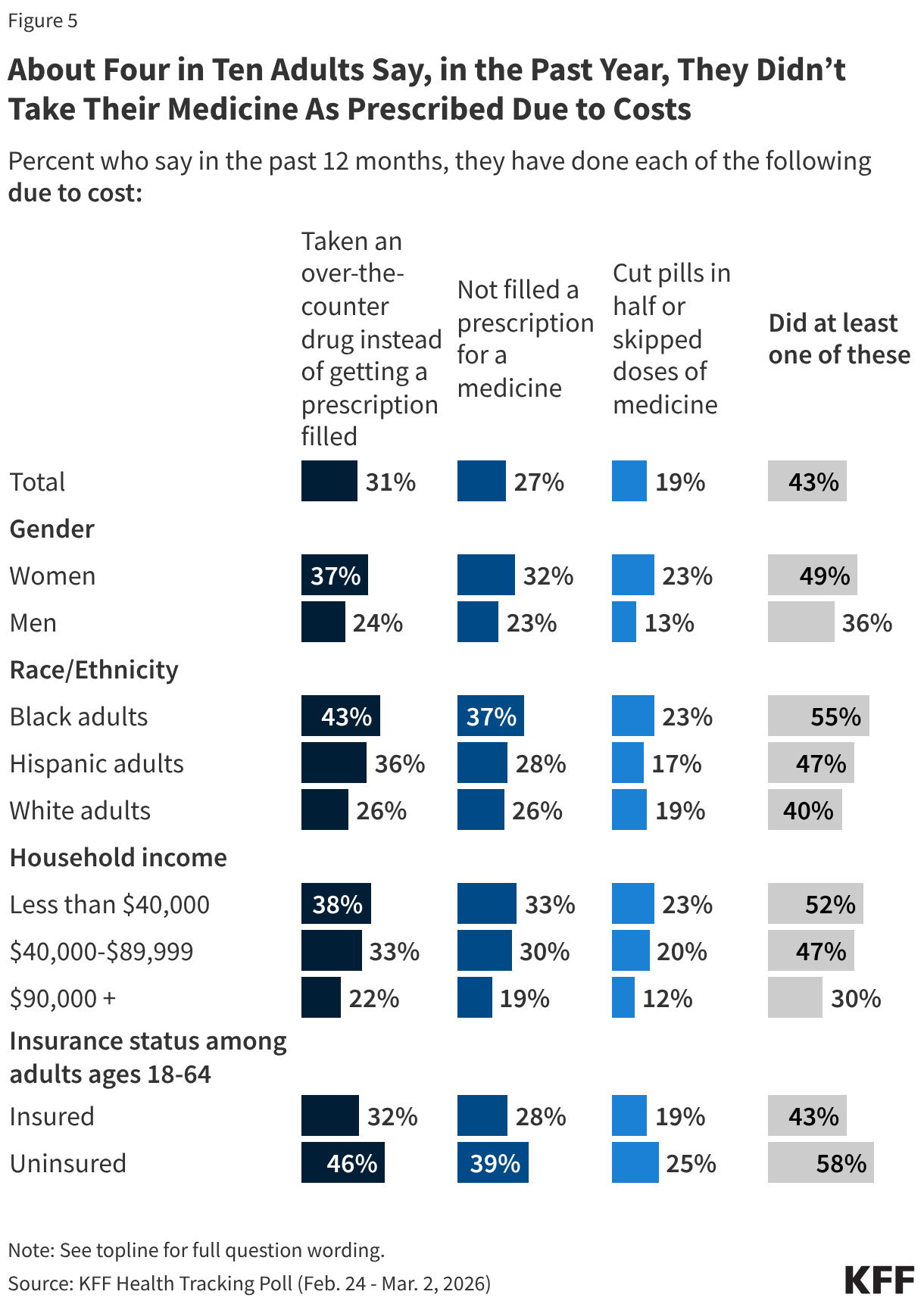
  • The cost of prescription drugs prevents some people from filling prescriptions. About four in ten (43%) U.S. adults say they have not taken their medication as prescribed in the past year due to costs. This includes three in ten who say they have taken an over-the-counter drug instead of getting a prescription filled (31%), a quarter (27%) who have not filled a prescription, and one in five (19%) who have cut pills in half or skipped doses of medicine because of the cost. Larger shares of lower-income, uninsured, women, Black, and Hispanic adults report taking these measures.
  • Health care debt is a burden for a large share of Americans. In 2022, about four in ten adults (41%) reported having debt due to medical or dental bills including debts owed to credit cards, collections agencies, family and friends, banks, and other lenders to pay for their health care costs, with disproportionate shares of Black and Hispanic adults, women, parents, those with low incomes, and uninsured adults saying they have health care debt.
  • Those who are covered by health insurance are not immune to the burden of health care costs. Almost four in ten insured adults under the age of 65 (38%) worry about affording their monthly health insurance premium and large shares of adults with employer-sponsored insurance (ESI) and those with Marketplace coverage rate their insurance as “fair” or “poor” when it comes to their monthly premium and to out-of-pocket costs to see a doctor.
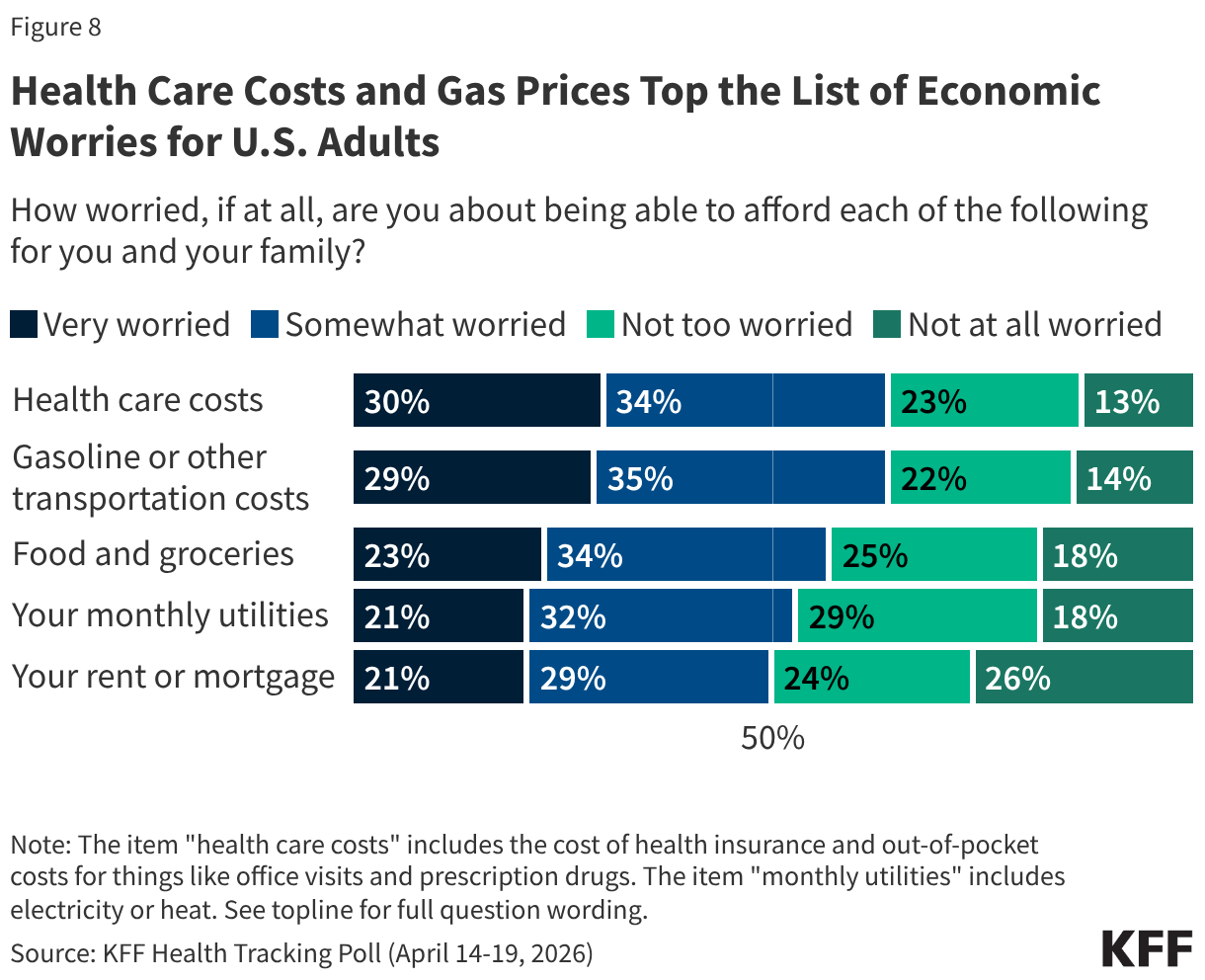
  • Notable shares of adults say they are worried about affording medical costs such as the cost of health care services (including the cost of health insurance and out-of-pocket costs for things like office visits and prescription drugs). About two-thirds of adults say they are either “very worried” (30%) or “somewhat worried” (34%) about being able to afford the cost of health care for themselves and their families.

Difficulty Affording Medical Costs

Many U.S. adults have trouble affording health care costs. While lower income and uninsured adults are the most likely to report this, those with health insurance and those with higher incomes are not immune to the high cost of medical care. Just under half of U.S. adults say that it is very or somewhat difficult for them to afford their health care costs (44%). Uninsured adults under age 65 are much more likely to say affording health care costs is difficult (82%) compared to those with health insurance coverage (42%). Additionally, a slight majority of Hispanic adults (55%) and half of Black adults (49%) report difficulty affording health care costs compared to about four in ten White adults (39%). Adults in households with annual incomes under $40,000 are more likely than adults in households with higher incomes to say it is difficult to afford their health care costs. (Source: KFF Health Tracking Poll: May 2025)

Mirrored bar chart showing shares who say it is easy or difficult to afford their health care costs by total, insurance status, race/ethnicity, and household income.

When asked specifically about problems paying for health care in the past year, about three in ten (28%) adults say they or a family member in their household had problems paying for care, rising to four in ten among Hispanic adults (41%) and young adults ages 18 to 29 (40%). Among those under age 65, six in ten (59%) uninsured adults report problems paying for health care in the past year, about twice the share of insured adults who say the same (30%). (Source: KFF Health Tracking Poll: November 2025)

Single bar showing the percent who say, in the past 12 months, they or a family member living with them had problems paying for health care by total, age, gender, race/ethnicity, household income, and insurance status.

The cost of care can also lead some adults to skip or delay seeking services, with one-third (36%) of adults saying that they have skipped or postponed getting needed health care in the past 12 months because of the cost. Women are more likely than men to say they have skipped or postponed getting health care they needed because of the cost (38% vs. 32%). Adults ages 65 and older, most of whom are eligible for health care coverage through Medicare, are much less likely than younger age groups to say they have not gotten health care they needed because of cost.

Three-quarters of uninsured adults say they have skipped or postponed getting the health care they needed due to cost. Having health insurance, however, does not offer ironclad protection as about four in ten adults with insurance (37%) still report not getting health care they needed due to cost. (Source: KFF Health Tracking Poll: May 2025)

Single bar chart showing percent who say they have skipped or postponed getting needed health care in the past 12 months because of the cost by total, age, gender, race/ethnicity, household income, and insurance status.

Skipping care due to costs can have notable health impacts. Nearly two in ten adults (18%) report that their health got worse because they skipped or delayed getting care. Among adults under age 65, those who are uninsured are twice as likely as those with health coverage to say that their health worsened due to skipped or postponed care (42% vs. 20%). About four times as many adults under age 65 (23%) say their health got worse after skipping or postponing care as adults ages 65 and older (6%), most of whom have Medicare coverage. (Source: KFF Health Tracking Poll: May 2025)

Single bar chart showing the share who say their health got worse because they didn't get care or postponed their care by total, age, and insurance status.

A 2022 KFF report found that people who already have debt due to medical or dental care are disproportionately likely to put off or skip medical care. Half (51%) of adults currently experiencing debt due to medical or dental bills say in the past year, cost has been a probititor to getting the medical test or treatment that was recommended by a doctor. (Source: KFF Health Care Debt Survey: Feb.-Mar. 2022)

Prescription Drug Costs

The high cost of prescription drugs also leads some people to cut back on their medications in various ways. About three in ten adults (31%) say in the past 12 months they have taken an over-the-counter drug instead of getting a prescription filled because of cost concerns, while about a quarter (27%) say they have not filled a prescription and about one in five (19%) say they have cut pills in half or skipped doses of medicine due to cost. Overall, four in ten (43%) adults report taking at least one of these measures in the past year, continuing an upward trend from a third (33%) in 2025 and about three in ten (31%) in July 2023.

Larger shares of adults in households with lower and middle incomes report resorting to these cost-saving prescription medication solutions compared to those with higher incomes. About half of adults in households with annual incomes under $40,000 (52%) or between $40,000 and $90,000 (47%) say they have not taken their medication as prescribed due to the cost in the last year, compared to three in ten adults in households with incomes of $90,000 or more. Uninsured adults under the age of 65 are more likely than their counterparts to also report not taking their medicine as prescribed due to costs (58% compared to 43% of insured adults under age 65). Additionally, half of women (49%) say they have taken any of these prescription medication measures compared to about a third (36%) of men. Over half (55%) of Black adults say the same, compared to half (47%) of Hispanic adults and four in ten White adults. (Source: KFF Health Tracking Poll: March 2026)

Multiple split bars showing the percent who have taken steps to reduce the cost of care including taking an over-the-counter drug instead of getting a prescription filled, not filled a prescription for medicine, or cut pills in half or skipped doses of medicine.

Health Insurance Cost Ratings

Health insurance provides some financial protection, but premiums and out-of-pocket costs can still present a financial burden for many individuals. Overall, most insured adults rate their health insurance as “excellent” or “good” when it comes to the amount they have to pay out-of-pocket for their prescriptions (61%), the amount they have to pay out-of-pocket to see a doctor (53%), and the amount they pay monthly for insurance (54%). However, at least three in ten rate their insurance as “fair” or “poor” on each of these metrics, and affordability ratings vary depending on the type of coverage people have.

Adults who have private insurance through employer-sponsored insurance or Marketplace coverage are more likely than those with Medicare or Medicaid to rate their insurance negatively when it comes to their monthly premium, the amount they have to pay out of pocket to see a doctor, and their prescription co-pays. About one in four adults with Medicare give negative ratings to the amount they have to pay each month for insurance and to their out-of-pocket prescription costs, while about one in five give their insurance a negative rating when it comes to their out-of-pocket costs to see a doctor.

Medicaid enrollees are less likely than those with other coverage types to give their insurance negative ratings on these affordability measures (Medicaid does not charge monthly premiums in most states, and copays for covered services, where applied, are required to be nominal). (Source: KFF Survey of Consumer Experiences with Health Insurance)

Split bar chart showing shares of adults by main insurance coverage who rate specific aspects of their current health insurance as either fair or poor.

Health Care Debt

In June 2022, KFF released an analysis of the KFF Health Care Debt Survey, a companion report to the investigative journalism project on health care debt conducted by KFF Health News and NPR, Diagnosis Debt. This project found that health care debt is a wide-reaching problem in the United States and that 41% of U.S. adults currently have some type of debt due to medical or dental bills from their own or someone else’s care, including about a quarter of adults (24%) who say they have medical or dental bills that are past due or that they are unable to pay, and one in five (21%) who have bills they are paying off over time directly to a provider. One in six (17%) report debt owed to a bank, collection agency, or other lender from loans taken out to pay for medical or dental bills, while similar shares say they have health care debt from bills they put on a credit card and are paying off over time (17%). One in ten report debt owed to a family member or friend from money they borrowed to pay off medical or dental bills.

While four in ten U.S. adults have some type of health care debt, disproportionate shares of lower income adults, the uninsured, Black and Hispanic adults, women, and parents report current debt due to medical or dental bills.

Single bar chart showing the percent who say they have different types of debt due to medical or dental bills for themselves or someone else in their care.

Vulnerabilities and Worries About Health Care and Long-Term Care Costs

Health care costs remain at the top of the list of people’s financial worries, with nearly two-thirds (64%) saying they are at least somewhat worried about affording the cost of health care, including the cost of health insurance and out-of-pocket costs for things like office visits and prescription drugs for themselves and their families. This includes three in ten who say they are “very worried” about affording health care. A similar share of adults is “very worried” about affording gas and transportation costs (29%), up from about one in six (17%) in January. This follows a nationwide increase in gasoline prices since the U.S. conflict with Iran began in February. About one in five adults say they are “very worried” about affording food and groceries (23%), rent or mortgage (21%) or monthly utilities (21%).

Notably, just under nine in ten (85%) uninsured adults under age 65 say they are worried about affording the cost of health care, though a large share of insured adults is also worried (64%). Health care costs are a top household worry across insurance types and across partisans. (Source: KFF Health Tracking Poll: April 2026)

Stacked bar chart showing the public's levels of worry when it comes to affording living necessities. Shown among total adults.

Many U.S. adults may be one unexpected medical bill from falling into debt. About half of U.S. adults say they would not be able to pay an unexpected medical bill that came to $500 out of pocket. This includes one in five (19%) who would not be able to pay it at all, 5% who would borrow the money from a bank, payday lender, friends or family to cover the cost, and one in five (21%) who would incur credit card debt in order to pay the bill. Women, those with lower household incomes, Black and Hispanic adults are more likely than their counterparts to say they would be unable to afford this type of bill. (Source: KFF Health Care Debt Survey: Feb.-Mar. 2022)

Split bar chart showing how adults would handle an unexpected medical bill of 0, if they'd be able to pay the bill without going into debt, go into debt to pay the bill, or would not be able to pay the bill.

Among older adults, the costs of long-term care and support services are also a concern. Almost six in ten (57%) adults 65 and older say they are at least “somewhat anxious” about affording the cost of a nursing home or assisted living facility if they needed it, and half say they feel anxious about being able to afford support services such as paid nurses or aides. These concerns also loom large among those between the ages of 50 and 64, with more than seven in ten saying they feel anxious about affording residential care (73%) and care from paid nurses or aides (72%) if they were to need these services. See The Affordability of Long-Term Care and Support Services: Findings from a KFF Survey for a deeper dive into concerns about the affordability of nursing homes and support services.

The Growing Use of Artificial Intelligence in Health Care and Implications for Disparities

Published: Apr 30, 2026

Introduction

Artificial intelligence (AI) is increasingly being integrated into health care, including but not limited to diagnosis and treatment plans, drug development, prediction of health risks and outcomes, health monitoring, and medical imaging. AI can also automate aspects of health care including data processing and administrative tasks, reimbursement decisions, patient interactions, and clinical decision-making. Additionally, individuals are increasingly using AI for health information and advice.

While there has been an increase in funding for and use of AI in health care in recent years, public opinion on AI’s role in providing accurate health information remains mixed. Further, there are concerns that AI may lead to job losses and reduce personalized human-based interactions. Moreover, AI can exacerbate health disparities if the underlying data on which models are built are biased and/or not inclusive. Alternatively, some suggest that AI may help mitigate disparities if it is carefully designed. This brief examines the implications of the growing use of AI for disparities in health and health care and discusses factors that can help reduce AI-related bias in health care.

Growing Use of AI in Health Care

AI tools are becoming increasingly integrated into various aspects of the health care system. For example, hospitals report using AI or predictive models as both administrative tools to perform tasks such as patient scheduling, billing, and medical coding, and as clinician-facing tools to predict health risks and outcomes among patients. A 2025 survey conducted across 16 states found that eight in ten (84%) health insurers report using AI or machine learning for fraud detection, utilization management, and prior authorization, among other uses. Health systems also report using AI to “limit claim denials and streamline prior authorization processes.”

The public also is increasingly using AI for health information and advice although many have limited trust in the reliability of AI tools. According to OpenAI data from 2026, more than 40 million people globally turn to ChatGPT daily for health information. The data also show that AI chatbots are becoming an important source of information for health insurance and billing advice, with users asking between 1.6 and 1.9 million questions per week regarding plan comparisons, claims, billing, and coverage. Further, a 2026 KFF survey finds that about a third (32%) of adults say they use AI chatbots for health information or advice (Figure 1). However, two-thirds (67%) of adults overall say they trust AI tools or chatbots “not too much” or “not at all” to provide reliable health information, and about three in four (77%) say the same regarding information about mental health and emotional well-being. While rates of use for and trust in AI for physical health advice are similar across racial and ethnic groups, Black and Hispanic adults are more likely than their White counterparts to report using AI for mental health advice and Black adults (29%) are somewhat more likely than White adults (20%) to say they trust AI tools or chatbots to provide reliable information about mental health and emotional well-being “a great deal” or “a fair amount.”

About One in Three Adults Report Using AI for Health Advice, With Black and Hispanic Adults Being More Likely to Use AI for Mental Health Advice (Split Bars)

Impact of AI on Disparities in Health and Health Care

As the use of AI in health care grows, research suggests that AI models can exacerbate racial and ethnic health disparities. A 2024 systematic review of 30 studies over a ten-year time period (from 2013 to 2023) that assessed instances of racial bias perpetuated by AI and machine learning algorithms in health care found a significant association between AI utilization and an exacerbation of racial disparities in health and health care outcomes. These disparities included longer waiting times for appointments, lower rates of success in predicting mental health outcomes, and underdiagnosis of health conditions, particularly for Black and Hispanic people compared to other groups. For example:

  • One study found that a machine learning algorithm used for creating patient appointment schedules led to Black patients experiencing 33% longer wait times than other patients. This was due to the model using socioeconomic indicators such as employment status, zip code, insurance type, and past no-show rates, which are correlated with race, to create appointment schedules.
  • Another study found that a widely used algorithm to guide health care decisions assigned Black patients the same level of risk as White patients even though Black patients were sicker. The algorithm used health care costs as an imperfect proxy for illness, since less money is spent on Black patients who have an equivalent level of need due to inequities in access to care. The authors suggest that addressing this disparity would significantly increase the share of Black patients receiving additional care.
  • In diagnostics, AI models may underperform on patients with darker skin because training datasets are more likely to collect data from lighter skinned patients.

In the systematic review, the authors identified four primary and interrelated causes for AI-perpetuated disparities including: biased underlying datasets, historical and systemic biases that can be encoded into AI when it is trained on these data, algorithmic design bias, and biased application and/or deployment of AI.

These AI-related racial and ethnic disparities also extend into mental health diagnosis and treatment recommendations. For example, language-based AI models underperformed on predicting depression severity for Black patients as compared to White patients since the two groups use different types of language to express depression symptoms and AI is often primarily trained on language used by White patients given that there is more data available on White patients since they make up a larger share of the population. However, researchers found that even models trained exclusively on the depression-related social media language used by Black individuals performed poorly at predicting depression severity in the group while models trained with the same social media data on White individuals performed well at predicting that group’s depression severity. The authors suggest that this could be due to other factors beyond language, such as paralinguistic features like speech rate or tone, serving as better predictors for depression severity among Black individuals. A separate study found that several AI models made inferior treatment recommendations for Black mental health patients when the patient’s race was explicitly or implicitly mentioned, likely due to biases embedded in the data on which these models are trained. An AI model used for suicide prediction also performed worse for Black patients, with researchers finding that it successfully detected 62% of suicides among White patients but only 10% among Black patients.

Research has found that the use of race in clinical algorithms may also impact the reliability of AI tools for certain groups since they are often trained on these algorithms. AI models are often trained on clinical algorithms used to predict diagnoses and treatments, which in some cases have historically used race as a factor and resulted in worse outcomes for some groups. One of the most well-known examples of this practice is the use of separate measures of kidney function (i.e., estimated glomerular filtration rates, eGFRs) for Black patients compared to non-Black patients, which resulted in many Black patients not receiving a kidney transplant. Another study found that removing the use of race from spirometry, a test used to measure lung function, would increase the number of Black people who would qualify for lung disease diagnosis and disability payments. Further, a 2019 study found that an algorithm used to predict the likelihood of safely having a Vaginal Birth after Cesarean Delivery (VBAC) incorrectly predicted a lower likelihood of success for VBAC for Black and Hispanic women than White women, which led to doctors performing more cesarian deliveries on Black and Hispanic women than White women. A growing number of organizations and health care institutions have recently moved to remove race from these algorithms. However, to the extent AI is trained on algorithms or results from algorithms that use race as a factor, AI could perpetuate these racial biases.

Research also shows that AI models may promote racial and ethnic health misinformation, leading to misdiagnosis or delayed care. A study of multiple AI chatbots found instances of the tools promoting "race-based medicine" and false claims about race such as difference in skin thickness between Black and White patients. Further, all AI chatbots included in the study incorrectly stated that Black men’s and women’s normal lung function tends to be lower than their White counterparts’, reflecting its training on the underlying race-biased algorithm to calculate lung function.

If carefully designed, AI has the potential to help address disparities. For example, AI-driven decision support tools can be used to identify and correct real-time clinician bias, particularly during high-stress periods when "cognitive load" often leads to disparities in documentation and diagnosis. By automating administrative tasks such as scheduling and billing, AI could help reduce staff burnout at safety-net hospitals, which disproportionately treat underserved groups. AI can also be used to identify the social determinants that drive health inequities through the analysis of large amounts of population data, which can then help guide interventions to address disparities. AI can also help identify disparities in health outcomes that might otherwise go unrecognized. For example, in a recent study, researchers used machine learning to identify excess deaths due to COVID-19 that were unrecognized in official mortality reports and found that these unrecognized deaths occurred disproportionately among people of color, those with lower educational attainment, and those with lower household incomes, among other factors.

Careful design and inclusive data collection; a diverse workforce; and a focus on ethical considerations, transparency, and a collaborative approach are factors that may help mitigate AI biases in health care. Identification and mitigation of biases during AI models’ development, as well as continuous monitoring and inclusion of more representative data over time, can help to address AI-related bias in health care. Further, having a diverse and representative data science workforce and training AI developers to recognize biases in algorithm development also play an important role in developing equitable AI models. Developing and enforcing ethical standards for AI in health care that inform how AI models and algorithms will be designed to help reduce bias and discrimination and establishing accountability in the creation and use of those algorithms may also help to reduce algorithmic bias. Further, collaborating with a wide range of stakeholders, such as health care workers, policymakers, community members, and ethicists when developing AI tools can offer a broader and more nuanced understanding of the impact of AI on health disparities.

Researchers and other experts have increased their focus on the creation of frameworks and coalitions to help guide equitable use of AI in health care. In 2023, the Coalition for Health AI released guidance for the implementation of AI tools that centers equity, fairness, and ethics. The guidance includes recommendations on developing a common set of principles to guide the development and use of AI tools and a coalition or advisory board to help ensure equity and facilitate trustworthiness in health-related AI. In early 2024, experts in health, medicine, technology, and policy issued a call for “ongoing dialogue and ethical commitment from all stakeholders” to ensure that AI in health care is inclusive following a series of discussions at the 2023 Responsible AI for Social and Ethical Healthcare (RAISE) international symposium. In 2024, the Council of Medical Specialty Societies and the Doris Duke Foundation created the Encoding Equity alliance, whose aims are to identify the incorrect use of race in clinical algorithms and guidelines, design “accurate and equitable decision tools”, and collect and disseminate evidence on the use of AI in health care to promote health equity.

While there has been increasing activity at the state-level to regulate AI in health care, the Trump administration has prioritized deregulation of AI, reduced or eliminated equity requirements for AI in health care, and is challenging state regulations that impose strict anti-bias requirements.  President Trump issued Executive Order (EO) 4148 in January 2025 that rescinded a number of Biden administration EOs, including those related to equitable use of AI in health care. He replaced those EOs with EO 14179, which shifts focus away from “equity” mandates and “algorithmic fairness” and towards “minimally burdensome” requirements to encourage innovation. While numerous states have recently introduced or enacted legislation related to AI in health care, the Trump administration is challenging state laws that impose strict bias audits or transparency requirements for AI via EO 14365 issued in December 2025. Under the EO, the Department of Justice created an AI Litigation Task Force in January 2026 to challenge states with AI laws found to be inconsistent with federal policy. The EO also directs the Secretary of Commerce to restrict federal grant money, specifically the Broadband Equity Access and Deployment (BEAD) Program funds, in states with “onerous” AI laws. For example, Colorado passed the “Consumer Protections for Artificial Intelligence” law in 2024, which among other things, requires health care providers and health insurers to take steps to prevent algorithmic discrimination. However, implementation of the law has been postponed due to legal challenges.


Estimating Effectiveness of Influenza and COVID-19 Vaccines: The “Test-Negative” Design

Published: Apr 30, 2026

Recent news reports indicate HHS decided to initially delay publication of, and then not publish, a CDC-led study that estimates the effectiveness of the COVID-19 vaccine over the past winter season. The study had already passed internal reviews by CDC scientific and editorial teams, and its methodology, as indicated by a reportedly leaked copy of the manuscript, is one that is widely used by researchers around the world for studying respiratory virus vaccine effectiveness. Only a few weeks prior, CDC had published a study on influenza vaccine effectiveness using the same methodological approach, and the approach has also been used by CDC in similar studies of COVID-19 vaccine effectiveness in prior years. National Institutes of Health Director and acting Director of the Centers for Disease Control and Prevention (CDC) Jay Bhattacharya wrote in an op-ed that the decision not to publish the study was due to concerns about its methodology, and that CDC was “upholding its responsibility to ensure that every piece of information it shares is rigorously validated, accurate and worthy of public trust” through additional review of the study prior to publication. To provide context for public discussion of the unpublished study, this policy brief provides an overview of the methodological approach in question – the test-negative case control design – and discusses some of its strengths and limitations in assessing vaccine effectiveness for respiratory diseases like influenza and COVID-19.

What is vaccine effectiveness and how do scientists estimate it?

CDC defines vaccine effectiveness (VE) as “how well vaccination works under real-world conditions to protect people against health outcomes such as symptomatic illness, hospitalization, and death.” This contrasts with “vaccine efficacy,” which refers to how well a vaccine works in ideal, controlled conditions such as a clinical trial. At a basic level, a VE study compares health outcomes (like illness or hospitalization) and vaccination status in different groups of people, in order to generate an estimate of the level of protection that a vaccine provides against those health outcomes. Researchers typically calculate the magnitude of the difference – the level of protection – between groups as a percentage (e.g., a vaccine can have a VE of 50% against illness if that illness was 50% less common in the vaccinated group compared to the unvaccinated group). There are several epidemiological approaches for conducting these types of studies, including “observational” approaches such as cohort studies that follow groups of vaccinated and unvaccinated people over time and measure how frequently health outcomes occur in each group, and case-control studies that identify groups of people with a particular health outcome (cases) and those without that outcome (controls) and determine the frequency of vaccination in each group. A common observational approach used to study VE for respiratory illnesses is a type of case-control study called the “test-negative” design. An “experimental” design such as a randomized controlled trial (where participants are randomized into vaccinated and unvaccinated groups and the vaccine is compared to a placebo) of an existing, FDA approved vaccine is generally considered unethical, meaning observational approaches such as the test-negative design are preferable when assessing VE for vaccines already widely used and shown to be safe and effective.   

Box 1. Defining vaccine effectiveness and test-negative design

Vaccine Effectiveness (VE): “How well vaccination works under real-world conditions to protect people against health outcomes such as symptomatic illness, hospitalization, and death.” (CDC)

“Test-negative” study design: A type of case-control study where subjects are patients who visit medical institutions, with those who test positive for a disease (e.g. influenza or COVID-19) classified as “cases” and those who test negative as “controls”. Vaccination status can then be compared between cases and controls to generate an estimate of VE. (adapted from Fukushima & Hirota 2017)

What is the test-negative study design?

In recent years the “test-negative” design has become the most prevalent approach for studying and monitoring VE of COVID-19 and influenza vaccines in “real world” situations. The test-negative design is a version of the case-control approach where researchers define a clinical outcome of interest (such as influenza-like-illness or respiratory disease symptoms), identify people seeking health care who present with these same symptoms, then test individuals for the pathogen of interest (such as influenza virus or COVID-19). Those that test positive for the pathogen are cases and those that test negative are controls, and researchers can then compare how many in each group were vaccinated. With this information at hand, researchers can determine VE, which is calculated as 1 minus the odds ratio (the odds of vaccination in cases over the odds of vaccination in controls).  For example, in a hypothetical study with 200 participants, 100 were test positive for infection (cases) and 100 were test-negative (controls). When vaccination status is checked, it is distributed across groups as shown in Table 1.

Table 1
Hypothetical Test-Negative Study Results
VaccinatedNot VaccinatedTotal
Cases (test positive)3070100
Controls (test negative)6040100
Note: These results are “unadjusted.”  In VE studies, statistical techniques are used to calculate “adjusted” odds, controlling for factors such as age, comorbidities, prior vaccination status, etc.

In this case, the odds of vaccination among cases is 30/70 = 0.43, and in controls it is 60/40 = 1.5.  The odds ratio would be 0.43/1.5 = 0.29. Therefore VE in this hypothetical study would be (1 – 0.29) x 100% = 71%, indicating that the vaccine was about 71% effective at preventing the outcome among the vaccinated compared to the unvaccinated.   

Researchers will also typically use statistical techniques to control for differences between groups in other characteristics, such as age, comorbidities, and prior infection history.  The as-yet unpublished CDC study of COVID-19 VE and the recently published study of influenza VE use the test-negative approach. It is also the approach often used to estimate VE in respiratory disease research networks for influenza and COVID-19 in the United Kingdom, Australia, Canada, and across Europe.

What are the strengths and weaknesses of this approach?

The test-negative approach, which relies on people seeking care and health facilities for identifying cases and controls, has become the dominant study design for several reasons. It is often easier to conduct a test-negative design compared to other approaches because both cases and controls are identified in the same location presenting with similar symptoms, whereas other approaches might require seeking controls from the community to match with cases. It’s oftenefficient because it uses existing surveillance and diagnostic testing infrastructure at health care facilities. The test-negative approach also reduces the likelihood of a common bias in case-control designs, which is the potential for differences in health care-seeking behavior between cases and controls. That is, vaccinated people may systematically differ from unvaccinated people in ways that affect healthcare-seeking behavior, which creates the potential for biased VE estimates when community controls are used.

However, there are also methodological issues and potential biases that can occur with test-negative designs. Care must be taken in defining and correctly identifying persons with the illness or health outcome of interest, so that consistency is maintained over time and potentially across multiple locations. It is important to identify study participants systematically according to pre-defined criteria. The quality and consistency of the tests used is very important, as some types of tests (such as rapid diagnostic tests) are less sensitive/specific compared to others (such as RT-PCR or viral culture); lower quality tests can lead to misclassification of cases vs. controls. In addition, in situations where widespread or mandatory testing is in place (for example, when all incoming patients in a facility are tested for COVID-19, as was common for a period during the pandemic), then asymptomatic individuals could be classified as cases even though they may differ in important ways from other cases that are symptomatic or have more severe disease. There are also potential concerns about how to handle prior infections and prior vaccinations because if the groups differ in a systematic way in these areas it can introduce a bias to the study. For COVID-19 studies, in particular, VE estimates unadjusted for infection history can underestimate VE. There are other potential biases that exist in test negative designs as well. Table 2 presents a summary of key strengths and weaknesses of the test-negative design for studying COVID-19 and influenza.

As with all epidemiological studies, poor study design, inconsistent implementation, and failure to take into consideration important biases and confounders can lead to misleading results. However, when well-designed and implemented with consistency and attention to detail, test-negative study designs can produce accurate estimates of vaccine effectiveness. In fact, studies have shown that effective test-negative designs can produce results highly consistent with randomized trials (the “gold-standard” of epidemiological study designs) when compared directly. The reportedly leaked manuscript of the disputed COVID-19 vaccine study indicates methods that are in line with previously published VE studies of influenza and COVID-19 vaccines, suggesting that the current controversy could be a result of increased scrutiny of COVID-19 vaccine effectiveness studies at this particular moment.

Table 2
Test-negative design for studying COVID-19 and influenza vaccine effectiveness: strengths and limitations
StrengthsPotential Limitations
Reduces biases from health-seeking behavior differences
Cases and controls are both drawn from those seeking health care and the same facilities, which reduces the risk of introducing systematic differences in characteristics/behaviors related to health care seeking behaviors.
Care must be taken to apply consistent case definitions
It is important to identify study participants systematically according to pre-defined criteria applied consistently over time and across locations.  Inconsistencies can introduce bias into the study results.
Efficiency, administrative ease, and flexibility
Typically, it is easier to implement and manage test-negative studies compared to randomized trials or case-control studies relying on community controls because they take place in existing facilities and can be merged with ongoing clinical operations. Test-negative studies can often use existing lab testing and surveillance infrastructure at health facilities to identify cases and controls, meaning researchers do not have to build this infrastructure from scratch.
Poor test quality can bias results
The quality of tests used to identify cases and controls is very important. Some types of tests (such as rapid diagnostic tests) are less sensitive/specific compared to others (such as RT-PCR or viral culture). Poorer quality tests and which can lead to misclassification of cases vs. controls.
Results validated against randomized trials
Well designed and managed test-negative VE studies have produced results consistent with randomized trial VE estimates when compared.
Prior infection status can bias results when not accounted for
Test-negative studies that do not collect information on and/or account for prior infection may produce biased results because prior infection may be associated with vaccinated vs. non-vaccinated status and also affect severity of disease/health outcomes. 
Ethical to use for already approved vaccines
Observational approaches such as the test-negative design are preferable when assessing VE for vaccines already FDA-approved and widely used, as a randomized controlled trial of an existing, approved vaccine is unethical.
Doesn’t work well in universal testing environmentsIn situations with mandatory testing (e.g., when all incoming patients in a facility are tested for COVID-19, as was common for a period during the pandemic), then asymptomatic individuals could be classified as cases though they may differ symptomatic cases.
Sources: Jackson ML, Nelson JC (2013) https://doi.org/10.1016/j.vaccine.2013.02.053, Lipsitch M, Jha A, Simonesen L (2016) https://doi.org/10.1093/ije/dyw124, Tchetgen EJT, Cowling BJ (2016) https://doi.org/10.1093/aje/kww064, Fukushima W, Hirota Y (2017) https://doi.org/10.1016/j.vaccine.2017.07.003, Sullivan SG, Chua HC et.al (2020) 10.1097/EDE.0000000000001116, Dean NE, Hogan JW, Schnitzer NE (2020) https://www.nejm.org/doi/10.1056/NEJMe2113151.

Abortion Coverage Limitations in Medicaid and Private Insurance Plans

Published: Apr 30, 2026

Editorial Note: This brief was originally published on April 30, 2026 and was updated on May 21, 2026 to reflect changes in Pennsylvania

Key Findings

  • The Dobbs decision had a major impact on abortion access across the U.S., resulting in state laws that restrict or prohibit the provision of abortion in a large swath of the nation. In addition to state laws affecting the provision of abortion, some states have addressed abortion coverage options under Medicaid or private insurance by implementing new state laws or in response to court decisions on cases that challenged funding restrictions. Since Dobbs, six states (of a total of 13 states) have implemented policies that require abortion coverage in private plans, and five states have eliminated Medicaid coverage restrictions. 
  • Among the 37 states that do not have laws prohibiting abortion, 17 states and D.C. follow the Hyde Amendment restrictions, which restrict the use of federal funds for all abortions with the exceptions of pregnancies resulting from rape or incest or endanger the life of the pregnant person. However, twenty states use state funds to pay for abortions for Medicaid enrollees beyond the Hyde Amendment restrictions, up from 16 states in 2019. Despite the expansion of abortion funding for Medicaid enrollees, over half of women of reproductive age (15-49) with Medicaid coverage live in a state that follows the Hyde Amendment restrictions (33%) or has a law banning the provision of abortion (19%).
  • Federal and states policies also shape access to coverage for abortion in private insurance plans. States are responsible for regulating fully insured individual, small, and large group plans, including Affordable Care Act (ACA) marketplace plans. Among the states that do not ban the provision of abortion, four impose Hyde-like restrictions on the circumstances under which state regulated private plans may cover abortion.
  • The ACA allows states to enact laws barring all plans participating in the state marketplace from covering abortion. As of January 2026, 25 states prohibit abortion coverage in their ACA Marketplace plans. In contrast, 13 states require all state regulated plans, including Marketplace plans, to include abortion coverage regardless of the circumstances, and the remaining 12 states and D.C. are silent on the issue.
  • A review of the 2026 Marketplace plans in the 12 states and D.C. that have no specific laws requiring or prohibiting abortion coverage finds six states have no Marketplace plans that include abortion coverage. The remaining six states and D.C. have at least one plan in the 2026 Marketplace that includes abortion coverage on the exchange.
  • Abortion coverage remains a focal point of debate in Congress and a target for investigation by the Trump administration. During the failed 2025 negotiations to extend enhanced premium tax credits, there were proposals to ban the use of federal ACA tax credits for Marketplace plans that include abortion benefits. Since then, the administration has issued guidance on the management of non-federal premium funds that ACA plans are required to collect and segregate if they offer abortion coverage and launched investigations aimed at further restricting abortion coverage within these plans.

Introduction

While the 2022 Dobbs decision overturning Roe v. Wade eliminated federal abortion protections and allowed states to ban the provision of abortion, federal and state restrictions on abortion coverage persist even in states without laws that prohibit abortion. State and federal efforts to address insurance and Medicaid coverage of abortion services began soon after the 1973 Supreme Court’s Roe v. Wade decision legalizing abortion and have continued to the present day. Since 1977, the Hyde Amendment, which bans the use of any federal funds for abortion, allowing only exceptions for pregnancies that endanger the life of the pregnant person, or that result from rape or incest, has been a major barrier to coverage of abortion services for low-income women.

Decades later, the issue of abortion coverage was at the heart of many debates in the run up to the passage of the Affordable Care Act (ACA) and subsequently led to renewed legislative efforts at the state level to limit coverage of abortions, this time in private insurance plans. Further federal restrictions on abortion coverage are still being debated in current day policy discussions. Most recently, there have been proposals to ban the use of federal ACA tax credits for Marketplace plans that include abortion as a covered benefit. This policy was recently discussed as part of the failed negotiations to extend the federal tax credits in the fall of 2025. In March 2026, the Trump Administration launched investigations to ascertain whether states that require health insurance plans to cover abortion are violating the Weldon Amendment, a federal law that that prohibits federal funds from going to state or local governments that “discriminate” against health care entities which refuse to provide, pay for, cover, or refer for abortions.

This brief reviews current federal and state policies on Medicaid and insurance coverage of abortion services in the U.S. and presents national and state estimates on the availability of abortion coverage for people enrolled in private plans, Marketplace plans, and Medicaid.

Federal and State Laws Regarding Coverage or Payment for Abortion

Over 1.1 million abortions occurred in the United States in 2025. Federal and state laws, as well as insurers’ coverage policies, shape the extent to which individuals can have coverage for abortion services under both publicly funded programs and private health insurance plans. People who seek an abortion but do not have coverage for the service have to shoulder the out-of-pocket costs of the services (though some clinics offer abortion services on a sliding scale based on income). The cost of an abortion varies depending on factors such as location, facility, timing, and type of procedure. The median cost of a medication abortion is $563, whereas the median cost of a second-trimester abortion is $1,000. Though the vast majority (~93%) of abortions are performed in the first trimester of pregnancy, the costs are challenging for people with lower incomes. Approximately 4% of abortions are performed at 16 weeks or later in the pregnancy. For people with medically complicated health situations or who need abortions later in pregnancy, the costs can be prohibitive. In some cases, individuals find they have to delay their abortion while they take time to raise funds, or they may first learn of a fetal anomaly later in pregnancy when the costs are considerably higher. Prior analysis has found that 43% of women ages 18-49 could not handle a $500 emergency expense using their savings. Across the U.S. abortion coverage restrictions disproportionately affects low-income people, who have limited ability to pay for abortion services with out-of-pocket funds.

Since 1977, federal law has banned the use of any federal funds for abortion unless the pregnancy is a result of rape, incest, or if it is determined to endanger the pregnant person’s life. This rule, also known as the Hyde Amendment, is not a permanent law; rather it has been attached annually to Congressional appropriations bills for the Department of Health and Human Services (HHS) and has been approved every year by Congress. The Hyde Amendment restricts federal abortion funding under Medicaid, Indian Health Service, Medicare, and the Children’s Health Insurance Program. Over the years, similar language has been incorporated into a range of other federal programs that provide or pay for health services for people who could become pregnant, including the military TRICARE program, the Peace Corps, the Federal Employees Health Benefits program and federal prisons. The Department of Veteran Affairs, which provides coverage for military veterans and their families, does not cover abortion nor abortion counseling for their beneficiaries, with limited exceptions for people whose life is endangered. State level policies also have a large impact on how insurance and Medicaid cover abortions, particularly since states are responsible for operating Medicaid programs and regulating insurance plans.

Medicaid

The Medicaid program, a federally and state funded program, serves millions of low-income women and is a major funder of reproductive health services nationally. Approximately two-thirds of adult women enrolled in Medicaid are in their reproductive years. As discussed earlier, the federal Hyde Amendment restricts state Medicaid programs from using federal funds to cover abortions beyond the cases of life endangerment, rape, or incest, however, a state may use its own funds to cover abortions in other circumstances. Currently, 20 states use state-only funds to pay for abortions for women on Medicaid in circumstances different from those federal limitations set in the Hyde Amendment. In the years following the Dobbs decision, four states—Colorado, Delaware, Nevada and Rhode Island—have eliminated Medicaid abortion coverage restrictions, either via a new state law or a court decision. On April 24, 2026, the Pennsylvania Commonwealth Court ruled that the state’s ban on Medicaid coverage for abortion services was unconstitutional, but following an appeal from the state’s Attorney General on May 20, 2026, the court’s decision is paused while the appeal is pending. In 17 states that do not prohibit the provision of abortion and the District of Columbia, Medicaid programs do not pay for any abortions beyond the Hyde exceptions. The 13 states that currently have laws prohibiting abortion provision also follow the Hyde restrictions. Nearly half of women with Medicaid coverage live in states that use their own funds to pay for abortion services, beyond the federal Hyde limitations (Figure 1).

Over Half of Women of Reproductive Age with Medicaid Coverage Live in a State that Follows Hyde Amendment Standards or Currently Bans the Provision of Abortion (Donut Chart)

Since the Dobbs ruling, many states have enacted laws that prohibit or highly restrict abortion and do not necessarily allow exceptions for rape or incest. As of March 2026, thirteen states have laws that ban the provision of abortion, and while all of these laws contain exceptions to safeguard the life of the pregnant person, most do not have exceptions for cases of rape or incest, and therefore, would not allow for the provision of those services to Medicaid enrollees in those states. Most Medicaid enrollees living in states where abortion provision is prohibited are not able to use their coverage in their state for an abortion that qualifies as a Hyde circumstance and those who can travel out of state will most likely not be able to find a provider able to bill their home state’s Medicaid program.

Additionally, some states have extensive reporting requirements for cases of rape and incest. A 2019 GAO study found that some states have requirements for people claiming abortion coverage under Hyde that include provider certification of rape, incest, or life endangerment; beneficiary certification of rape or incest; official documentation (such as police report or report with a public health agency) of rape or incest; prior authorization by the state Medicaid program; and prior certification of counseling for the abortion. Since 2013, Iowa has required formal approval from the Office of the Governor to secure reimbursement for any abortions covered by Medicaid.

Although Hyde abortions are not accessible in states where laws prohibit the provision of abortion, federal courts have ruled that the Medicaid statute, as modified by the Hyde Amendment, requires states to pay for abortions that fall under the Hyde Exceptions and have blocked enforcement of state statutes that prohibit coverage for these exceptions. The Hyde Amendment requires coverage in cases of rape, incest, and life endangerment. In 1998, in a letter to all the state Medicaid directors explaining a change to the Hyde Amendment, Health and Human Services stated that: “All abortions covered by the Hyde Amendment, including those abortions related to rape or incest, are medically necessary services and are required to be provided by states participating in the Medicaid program.” However, a 2022 Congressional Research Service (CRS) overview of the Hyde Amendment, published after the Dobbs decision, lists open questions, such as whether payment for travel for abortion services also falls under the scope of the Hyde Amendment and conjectures that the interplay of state abortion laws and the Amendment may be relitigated. Despite this clear guidance, and court precedent, historically the Centers for Medicare & Medicaid Services (CMS) has not taken any enforcement action against states for failing to comply with covering abortion in all of the circumstances required by Hyde.

Private Insurance

States are responsible for regulating fully insured individual, small, and large group plans issued in their state. This includes plans available through the ACA marketplace and plans purchased by some employers for their workers. State laws have jurisdiction over whether abortion coverage is included or excluded in private plans that are not self-insured (which are regulated by the federal government under ERISA). Four states (Kansas, Missouri, Nebraska, Utah) that do have laws prohibiting the provision of abortion impose restrictions on the circumstances under which insurance will cover abortions (Appendix Table 1). Six states with highly restrictive abortion laws—Idaho, Indiana, Kentucky, North Dakota, Oklahoma, and Texas—also have private insurance restrictions in place. Utah limits private insurance plans regulated by the state from covering abortion unless the abortion is necessary to save the life of the mother or avert serious risk of loss of a major bodily function, if the fetus has a defect as documented by a physician that is uniformly diagnosable and lethal, and in cases of rape or incest. Kansas, Missouri, and Nebraska only allow fully insured private plans regulated by the state to cover abortion when it is necessary to save the woman’s life, and abortions under all other circumstances are not covered.

While some states allow insurers to sell riders for abortion coverage on the private market, a KFF analysis conducted prior to the Dobbs decision found that no insurers offered abortion riders to people insured through individually purchased plans, and only one insurance company in one state offered an abortion rider in the group market. The lack of abortion riders leaves people insured by private plans in these states with no option to secure coverage for abortion services. Utah law specifically prohibits abortion coverage riders.

Just as some states proscribe insurance plans from covering abortion, other states require plans to include abortion as a covered service. Currently, 13 states require all state-regulated private health plans, including Marketplace plans, to include coverage for abortion. Ten of these states also require no cost-sharing for abortion services—Illinois and Minnesota allow cost-sharing if there is cost-sharing for similar services in the plan, and Delaware only prohibits cost-sharing for abortions over $750. California and Washington require all plans, including individual and employer plans, to treat abortion coverage and maternity coverage neutrally, meaning that all plans are required to include both maternity and abortion coverage.

ACA Marketplace Plans

All plans offered on the ACA Marketplaces must provide coverage for 10 Essential Health Benefits (EHB), including maternity care and prescription drugs. Abortion services, however, are explicitly excluded from the list of EHBs that all plans are required to offer. Under federal law, no plan is required to cover abortion and states can enact laws that bar all plans participating in the state Marketplace from covering abortions. As of January 2026, 25 states have passed laws that prohibit abortion coverage in their ACA Marketplace plans and an additional 12 states and D.C. are silent on the issue. The remaining 13 states require all ACA plans to cover abortion (Figure 2). All 13 states with laws prohibiting the provision of abortion, except for West Virginia, have laws in place that also prohibit abortion coverage. Most state laws include narrow exceptions for pregnant people whose pregnancies endanger their life or are the result of rape or incest. The ACA prohibits plans in the state Marketplaces from discriminating against any provider because of “unwillingness” to provide abortions.

In 31 States, ACA Exchange Plans Do Not Offer Plans With Abortion Coverage (Choropleth map)

In a KFF review of the 2026 Marketplace plan statement of benefits and plan brochures in the 12 states and D.C. that have no laws requiring or prohibiting abortion coverage, six states (Iowa, Michigan, New Mexico, Nevada, West Virginia, and Wyoming) do not have any Marketplace plans that include abortion coverage (Figure 3). Six states (Alaska, Connecticut, Hawaii, New Hampshire, Rhode Island, and Virginia) and D.C. have at least one plan in their 2026 ACA Marketplace that includes abortion coverage. Although Michigan repealed their state’s ban on abortion coverage in Marketplace plans in 2023, this analysis found that while many plans in the state do not cover abortion, the statement of benefits in many other plans are silent regarding coverage or exclusion of abortion services. As a combined result of the state laws and insurance company choices, individuals in 31 states currently do not have access to a qualified health plan that includes coverage for abortions.

Thirteen States Now Require Marketplace Plans to Cover Abortion Services, An Increase from 2019 (Stacked Bars)

While the reasons why issuers in states that permit abortion coverage choose to exclude abortion coverage are not known, it is possible that the complexity of the requirements specific only to abortion coverage could be a deterrent to the plans. Plans that choose to include abortion coverage are also subject to additional reporting standards and audit requirements, and must also charge a separate premium for the coverage.

Compared to 2019, the last time KFF conducted a review of abortion coverage in ACA marketplace plans, more states now require abortion coverage in their marketplace plans (4 states vs 13 states). Six states (Colorado, Delaware, Massachusetts, Minnesota, New Jersey, Vermont) have passed laws following the Dobbs decision requiring all state regulated private plans, including ACA marketplace plans, to cover abortion services. Overall, 19 states and D.C. currently have Marketplace plans that offer abortion coverage, compared to 16 states and D.C. in 2019. Many of the states that now require coverage previously had no laws requiring or prohibiting coverage but had at least one plan that offered abortion coverage in 2019, including Vermont, Maryland, and Colorado. For individuals living in one of the six states and D.C. that have no laws requiring or restricting coverage and do offer at least one plan with abortion coverage, the actual availability of coverage depends on whether there is a plan offered in their area that includes abortion services since not all plans are offered across the whole state. For example, in Virginia, Kaiser Permanente plans are the only ones that offer abortion coverage for ACA Marketplace enrollees.  

The combination of federal and state abortion provision and coverage policies has constrained options in many states. Not surprisingly, for people living in the 13 states where the provision of abortion is prohibited, regardless of their type of insurance coverage, access to abortion services within their state is extremely limited or essentially nonexistent (except for abortion medications obtained through the mail). However, in many states without these laws, abortion coverage is also limited. In four of those states, people enrolled in Medicaid, private, and Marketplace plans, have practically no abortion coverage options (Figure 4). In eight additional states, individuals who qualify for Medicaid or who are insured through their state Marketplace also do not have access to abortion coverage; in five other states and DC, people enrolled in Medicaid have extremely limited coverage. Six of these states do not offer any 2026 Marketplace plans that include abortion coverage.

State Policies on Abortion Coverage for Medicaid, Private Insurance, and ACA Exchange Plan Enrollees in 2026 (Choropleth map)

Special Rules for Billing and Payment for Marketplace Plans that Include Abortion Coverage

In the 19 states & DC that either require coverage of abortions in Marketplace plans or have no restrictions or requirements for abortion coverage but offer at least one plan that covers abortion, abortion coverage must be paid for using non-federal dollars. Plans must notify consumers of the abortion coverage as part of the Summary of Benefits and Coverage (SBC) explanation at the time of enrollment. The ACA outlines a methodology for states and insurers to follow to ensure that no federal funds are used towards coverage for abortions beyond the Hyde limitations. Any plan that covers abortions beyond Hyde limitations must estimate the actuarial value of such coverage by accounting for the cost of the abortion benefit (valued at least $1 per enrollee per month) and segregate these funds from other premium funds. This estimate cannot take into account any savings that plans may achieve as a result of the patients having abortions (such as the costs of prenatal care or delivery).

The segregated funds for abortion coverage that are sitting with the plans have grown over the last 15 years. In July 2025, Maryland allocated the funds remaining in these accounts to be used to help pay for expenses of patients who travel to Maryland for an abortion. In response to state actions and building interest to reallocate these funds to support abortion services, in December 2025, CMS issued new guidance addressing how ACA Marketplace plans use the segregated funds collected from enrollees for non-Hyde abortion coverage. The new guidance states that ACA plans only need to segregate the funds for the current coverage year. At the end of the plan year, after all claims have been paid, plans may treat the premium funds collected for the coverage of non-Hyde abortions the same as other premiums funds collected, meaning that the plans can keep the funds for other uses, not just for abortion services.

Appendix

Scope of Abortion Coverage in Medicaid and Private Plans, by State as of May 2026 (Table)

Medicaid and CHIP Eligibility, Enrollment, and Renewal Policies as States Prepare for Major Medicaid Policy Changes

Authors: Tricia Brooks, Jennifer Tolbert, Anna Mudumala, Amaya Diana, Yuliya Yafimenka, and Antony Lin
Published: Apr 30, 2026

Executive Summary

By the beginning of 2025, states had largely resumed more routine Medicaid enrollment operations following the unwinding of pandemic-era continuous enrollment provisions but with numerous reforms in place to streamline renewal processes and bolster enrollee communications. However, the passage of the 2025 reconciliation law in July 2025 introduced significant Medicaid eligibility and enrollment changes. Starting in January 2027, states that adopted the Medicaid expansion in the Affordable Care Act (ACA) along with Georgia and Wisconsin (states that expanded adult coverage through a waiver) must implement work/community engagement requirements (referred to as work requirements in this report) for the expansion or waiver populations. Expansion states must also shift to more frequent semi-annual renewal periods for expansion enrollees and impose cost-sharing on all nonexempt services on expansion enrollees with incomes between 100% and 138% of the federal poverty level (FPL). Other changes in the law affect all states, such as the elimination of eligibility for certain lawfully residing immigrants. The law also delays for 10 years enforcement of many changes included in a 2024 regulation that aimed to simplify eligibility and enrollment (Box 1). In part tied to federal Medicaid financing changes in the law, states also face more tenuous state budget conditions that could lead to further eligibility restrictions and reductions in benefits and provider rates as they seek to reduce spending on Medicaid. 

The 24th annual survey of state Medicaid and CHIP program officials conducted by KFF and the Georgetown University Center for Children and Families (CCF) provides a baseline of state Medicaid and CHIP eligibility, enrollment, and renewal policies in place as of January 2026 as they prepare to implement the changes included in the 2025 reconciliation law. Information collected through the survey highlights state policies and processes that will facilitate implementation of the requirements in the law and shows where states will need to make changes to comply with the new requirements. The survey also included questions about state decisions on implementation of work requirements. More detailed findings from those questions are included in a separate brief, An Early Look at Policy Decisions as States Get Ready to Implement Work Requirements. This report focuses on policies for children, pregnant individuals, parents, and other non-elderly adults whose eligibility is based on Modified Adjusted Gross Income (MAGI) financial eligibility rules (findings on eligibility and enrollment policies for non-MAGI populations are available in Medicaid Eligibility Levels for Older Adults and People with Disabilities (Non-MAGI) in 2026). Overall, 49 states and the District of Columbia responded to the survey (Florida did not respond). For purposes of this report, the District of Columbia is counted as a state.

Key Takeaways

  • Many parents of older children in expansion states will be subject to new work requirements starting in January 2027. While the reconciliation law does not directly impact income eligibility levels, new work requirements and more frequent 6-month renewals for parents and adult enrollees in the ACA Medicaid expansion will make it more difficult for those adults to enroll in and retain coverage. Parents covered through the mandatory Section 1931 pathway – based on cash assistance eligibility thresholds in effect in 1988 — are exempt from work requirements, but parents in the expansion group with children ages 14 and over are required to meet the requirements. The median Section 1931 eligibility level in expansion states is 36% FPL, and as a result, some parents in the expansion group (i.e., those with incomes above those thresholds) who are not identified through data matching may need to verify they are exempt, and parents of children ages 14 and older with income above that level who are enrolled through the expansion will need to comply with the work requirements. In the ten states with the lowest Section 1931 eligibility levels (25% of the poverty level or less), many parents will need to meet the requirements or qualify for an exemption. Four expansion states cover parents up to 138% FPL through the Section 1931 pathway, creating an exemption from work requirements for all parents in those states.
  • States continue to expand use of electronic communications and add features to online accounts and mobile apps—strategies that may help to maintain enrollment for individuals who remain eligible. States are increasingly using electronic communications through online accounts and text messages to send more frequent alerts and reminders to improve response rates at renewal. While just 14 states have mobile apps with enrollment features, these apps along with online accounts give enrollees more ways to manage their coverage. These strategies, already shown to ease administrative burden during the unwinding, could help expansion states assist enrollees navigate new requirements.
  • States with Medicaid eligibility systems that are integrated with SNAP and decisions to adopt options to use SNAP data to enroll or renew Medicaid coverage could reduce the administrative burden of implementing work requirements and semi-annual renewals. Half of states have MAGI Medicaid eligibility systems integrated with SNAP eligibility and 15 states use verified income data from SNAP to enroll or renew Medicaid. SNAP data, in particular, can be used to verify compliance with work requirements or exemption status. States that do not currently share program data may need to establish data linkages to implement work requirements if required by CMS. While having an integrated eligibility system facilitates data sharing across programs, the reconciliation law also included changes to SNAP, so some states with integrated systems are having to make changes for both programs simultaneously.
  • A small but growing number of states are using artificial intelligence (AI) in consumer assistance and eligibility and enrollment processes, including to perform some functions that may help with implementation of work requirements. Some states are using AI to review and extract information from uploaded documents and to enhance data matching, which could meaningfully reduce the paperwork burden that semi-annual renewals and work requirements will create. States are also using AI bots to assist enrollees in updating their contact information, saving eligibility or call center workers time in manually collecting and updating the information.
  • The reconciliation law includes new administrative requirements for updating addresses and identifying deceased enrollees. The reconciliation law requires states to regularly obtain address information from reliable sources, including mail returned with a forwarding address, the USPS National Change of Address Database (NCOA), and managed care organizations (MCOs), by January 1, 2027. Two-thirds of states already use (MCO) or NCOA data. By January 2028, states must conduct data matching at least quarterly with the SSA’s Master Death File to identify deceased enrollees. Over half of states (29) already review the Master Death File on a quarterly or more frequent basis.
  • Currently, 19 states charge nominal cost-sharing to Section 1931 parents, and 21 states charge cost sharing to ACA or waiver expansion adults, while the remaining states do not charge cost-sharing. Starting in October 2028, the reconciliation law requires states to impose cost sharing of up to $35 per service, with some exceptions, on ACA expansion adults with income 100%-138% FPL. CMS guidance is needed to clarify any flexibility that states may have in determining whether some or all non-exempt services must require cost-sharing. The limitation of $35 per service means that several states will have to lower cost-sharing on certain services, generally on inpatient hospital services, which could also implicate cost-sharing for 1931 parents or create inequity in how charges are assessed between low-income parents and ACA expansion adults.

Box 1:  Changes to Medicaid Eligibility and Enrollment Policies in the 2025 Reconciliation Law

October 2026: Restricts eligibility to Lawful Permanent Residents (“green card” holders), certain Cuban and Haitian immigrants, Compact of Free Association (COFA) migrants lawfully residing in the US, and lawfully residing children and pregnant adults in states that cover them under the ICHIA option; will eliminate eligibility for certain lawfully residing immigrants, including asylees, refugees, victims of domestic abuse or trafficking, and individuals granted entry for other humanitarian reasons.

January 2027:

  • Imposes work/community engagement requirements on all expansion adults (unless the individual qualifies for an exemption) who are enrolled through the ACA pathway in 41 states, as well as in Georgia and Wisconsin which have waivers to cover adults without dependent children.
  • Requires 6-month renewals for all expansion adults in 41 states that expanded adult coverage through the ACA pathway.
  • Requires states to update enrollee address information using reliable data sources, including the National Change of Address Database and managed care entities.
  • Requires states to review the Master Death File at least quarterly to determine if any enrolled individuals are deceased.

October 2028: Requires mandatory cost-sharing on all non-exempt services greater than $0 and up to $35 per service unless exempt.

October 2029: Requires the Secretary to establish a system to share information with states for purposes of preventing individuals from being simultaneously enrolled in two states and requires states to submit monthly enrollee SSNs and other information to the system.

Eligibility and Enrollment Rule (April 2024) Provisions Now Subject to 10-Year Delay in Enforcement

  • Prohibits in-person interviews for all applicants.
  • Requires all MAGI and non-MAGI applications and supplemental forms to be accepted online, by phone, through the mail, and in person
  • Provides all applicants with at least 15 calendar days to respond to requests for information
  • Establishes minimum 90-day reconsideration period for all individuals determined ineligible for not responding to requests for documentation at application, renewal, or when there is a change in circumstances
  • Provides minimum 30-days for individuals to respond to requests for information at renewal
  • Prohibits procedural terminations when verifying eligibility for other benefits
  • Updates contact information from reliable sources without further verification
  • Requires states make a good faith effort to confirm updated information from other sources
  • Requires alignment of renewal policies for non-MAGI populations with those for MAGI populations

Report

Eligibility Policies

The median eligibility level for children remains unchanged from prior years at 255% FPL, though the transition from separate CHIP program to a CHIP-funded Medicaid expansion among some states continued. Oregon transitioned its separate CHIP program for children to a CHIP-funded Medicaid expansion (M-CHIP). In M-CHIP states, children who are income eligible for CHIP receive all the benefits and protections associated with Medicaid; however, the child must be previously uninsured for the state to claim the enhanced federal match for CHIP. Utah also plans to convert its separate CHIP program to M-CHIP in mid-2026, which will bring the total to 23 M-CHIP states, up from 18 states 2016. Although not required to do so, 14 of 28 states with separate CHIP programs for children provide full Medicaid (EPSDT) benefits (Figure 2).
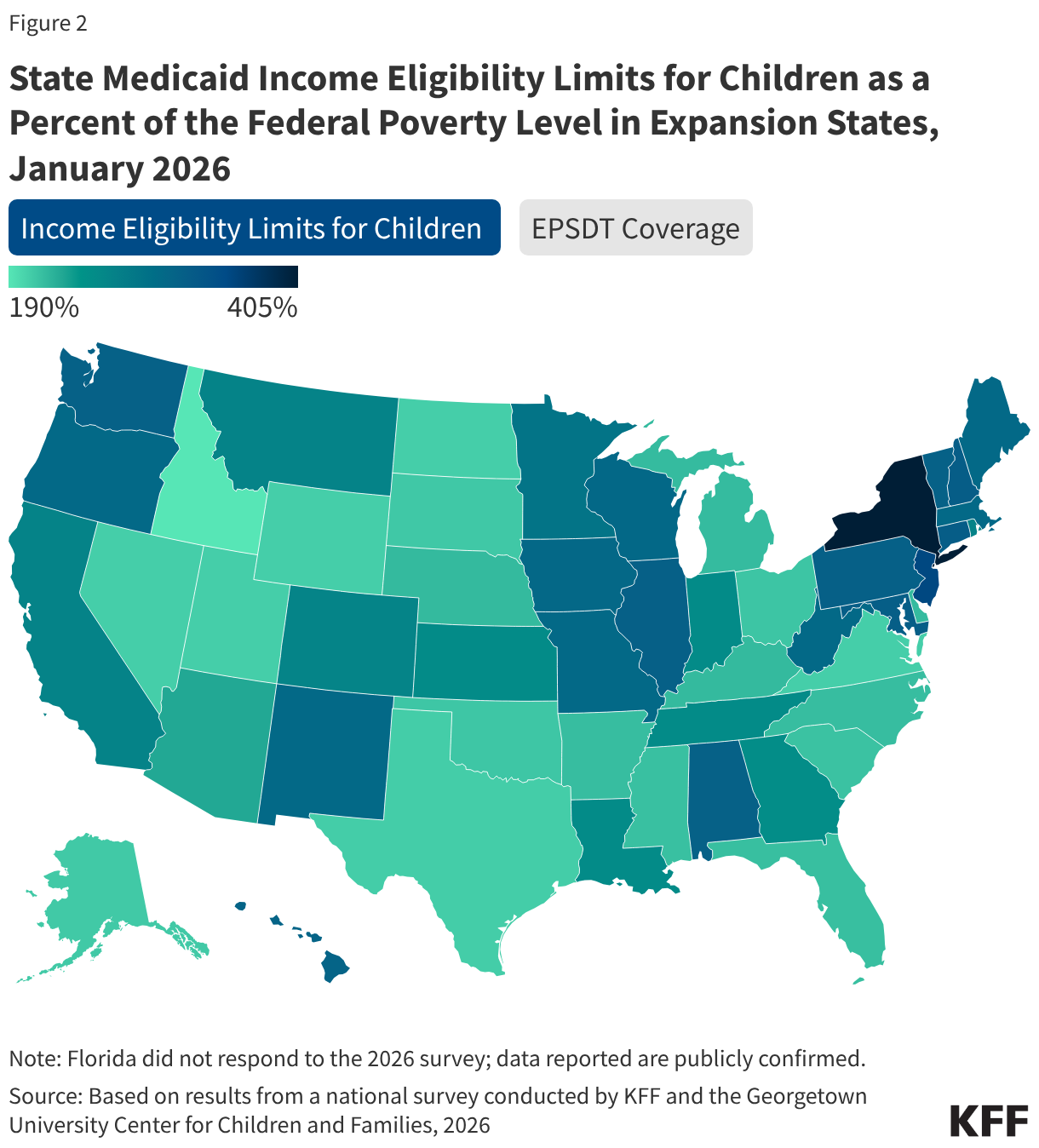
State Medicaid Income Eligibility Limits for Children as a Percent of the Federal Poverty Level in Expansion States, January 2026 (Choropleth map)

States must cover pregnancy for individuals with income up to 138% FPL, but most states (38) have an upper income limit for pregnancy coverage at or above 200% FPL. The upper income limit is the highest pregnancy income threshold among three pathways: Medicaid (all states), CHIP expansion for pregnancy (7 states), and CHIP-funded From Conception to the End of Pregnancy coverage (25 states) (Figure 3). The median eligibility level for pregnancy is unchanged at 213%. Two thirds of states (33) use federal funds through the Medicaid state plan option or a Section 1115 waiver to cover family planning services with a median income eligibility of 210% FPL.
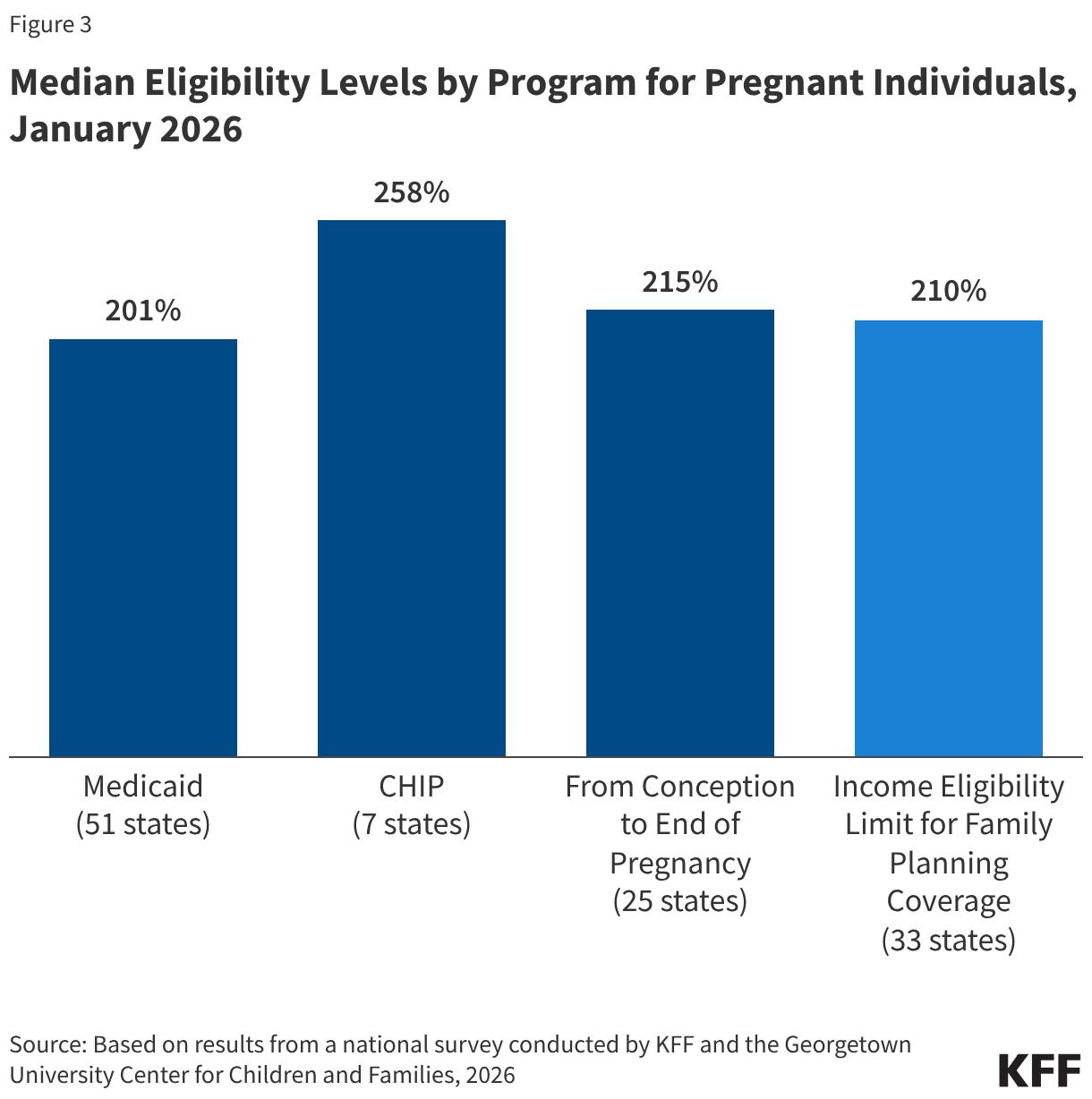
Median Eligibility Levels by Program for Pregnant Individuals, January 2026 (Column Chart)

The median income eligibility for parents in non-expansion states is 40% FPL while eligibility levels for both parents and adults without dependent children is 138% FPL in expansion states (Figure 4). Although D.C. lowered income eligibility for parents and adults, from 221% and 215% respectively to 138% FPL, it launched the DC Healthy Plan, a Basic Health Program that covers non-Medicaid residents with income between 138%-200% FPL.
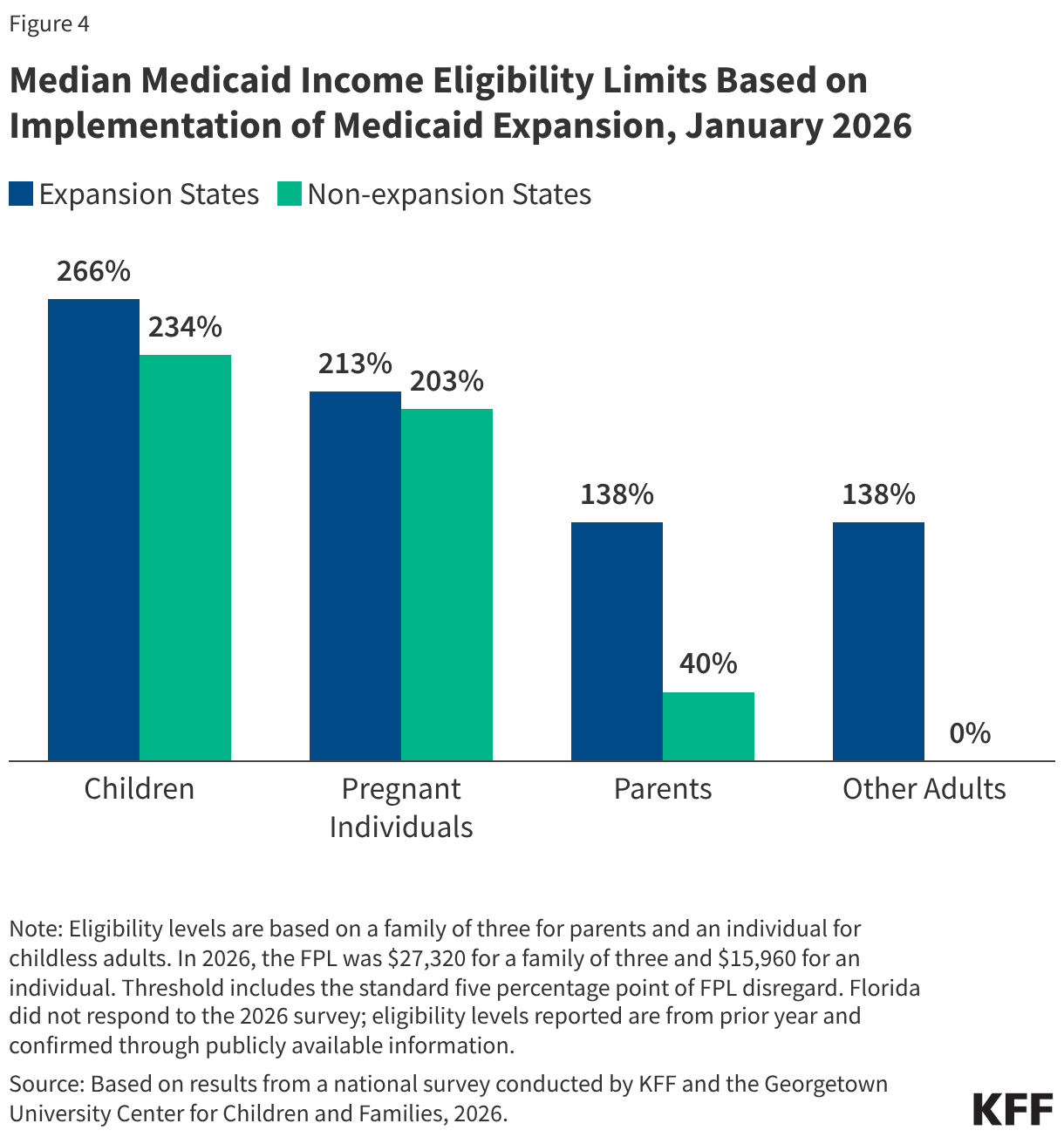
Median Medicaid Income Eligibility Limits Based on Implementation of Medicaid Expansion, January 2026 (Grouped column chart)

Many parents of older children in expansion states will be subject to new work requirements starting in January 2027. States are required to cover parents and caretakers of children under age 18 who have income at or below the eligibility standard for cash assistance that was in effect as of May 1, 1988, through the Section 1931 pathway. The ACA expanded Medicaid eligibility for parents and created a new eligibility pathway for adults without dependent children with incomes up to 138% FPL. In states that adopted the expansion, many parents with income above the state’s Section 1931 level gained coverage. Parents covered through the Medicaid expansion who have children ages 14 or older will need to comply with the new work requirements. Some parents of older children in Georgia also gained coverage through the state’s partial expansion waiver program and will be subject to new work requirements.

The median eligibility for Section 1931 parents in expansion states is 36%; however, the levels vary widely across states. Four expansion states cover parents with income up to 138% FPL through the Section 1931 pathway, thus exempting all parents in their states from work requirements (all parents are also exempt in Wisconsin), and 11 other states have Section 1931 eligibility above 100% FPL. In the ten states with the lowest Section 1931 eligibility levels (less than 25% FPL), many parents will need to meet the requirements or qualify for an exemption (Figure 5).
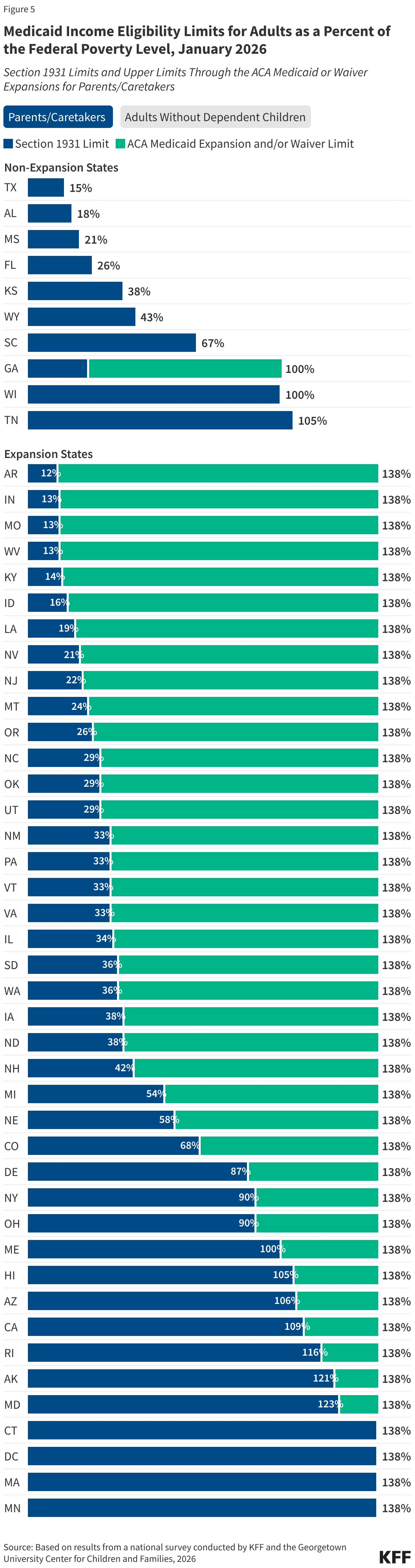
Medicaid Income Eligibility Limits for Adults as a Percent of the Federal Poverty Level, January 2026 (Stacked Bars)

Three quarters of states (38) cover lawfully residing children without a 5-year waiting period and over six in ten states (32) cover lawfully residing pregnant immigrants through Medicaid. In general, lawfully residing immigrants must have a “qualified” immigration status to be eligible for Medicaid or CHIP, and many, including most lawful permanent residents or “green card” holders, must wait five years after obtaining qualified status before they may enroll. Through the 2009 Immigrant Children’s Health Insurance Act (ICHIA), states have the option to cover lawfully residing immigrant children and pregnant immigrants without a 5-year waiting period (Figure 6). Undocumented immigrants are not eligible to enroll in Medicaid or CHIP. While the reconciliation law restricted Medicaid and CHIP eligibility for certain lawfully residing immigrants, it did not eliminate the state option to cover lawfully residing children and pregnant individuals without the 5-year waiting period.
State Adoption of ICHIA Coverage for Lawfully Residing Immigrant Children Without a 5-Year Wait and Pregnant Individuals, January 2026 (Choropleth map)

Eligibility Changes for Immigrants

States are preparing to send advance notices to lawfully residing immigrants who are losing eligibility because of restrictions in the reconciliation law. Beginning October 1, 2026, Medicaid eligibility for immigrants will be restricted to only LPRs or green card holders, certain Haitian and Cuban entrants, and COFA migrants residing in the U.S. Recent guidance clarifies that to implement these eligibility changes states will need to reverify individuals to confirm they have an eligible immigration status under the new rules. If states are unable to reverify an eligible immigration status, they will need to provide notice to individuals that they are no longer eligible and will be disenrolled. Prior to the guidance being released, more than half of states (28) said they plan to send one or more notices to inform affected immigrants of the eligibility change while 21 states have not yet established their policies regarding outreach and notices, most likely because they were waiting on formal guidance from CMS. Two states (New York and Oregon) plan to transition eligible immigrants who lose coverage to state-funded coverage. Although most states are still making decisions about the number and timing of notices, states that have made decisions report they will send between one and three notices between 30 days and more than 90 days in advance. Advance notice can help affected individuals plan for the loss of coverage and seek care for urgent or unmet needs before they become uninsured. Nearly half of states (22) plan to engage community-based organizations in conducting outreach to affected immigrant communities. Outreach through trusted, community-based organizations can help boost awareness among those who will be affected, and community partners may be able to help individuals consider alternatives, including how to access free or low-cost care.

Eligibility Policies for Incarcerated Individuals

As of January 1, 2026, states are required to suspend, rather than terminate, Medicaid eligibility for adults during incarceration. The Consolidated Appropriations Act of 2023 required states to suspend Medicaid for incarcerated adults so that coverage could be promptly reactivated if the individual requires an inpatient hospital stay of at least 24 hours while incarcerated and to facilitate resumption of coverage when the adult is released. Coverage suspension also allows states to take advantage of reentry waivers (currently approved in 19 states and pending in 9) to provide Medicaid coverage of medications, outpatient services, and mental health services prior to release.

Most states (46) receive information from the Corrections Agency to identify when an individual has been incarcerated for purposes of suspending Medicaid coverage, but the method for transferring the information varies. Half of the states (26) use two or more methods for obtaining the information, including direct data exchange between the Medicaid and Corrections Agencies (29 states), through a secure file transfer via email (19 states), through an alternative secure file transfer (20 states), or using a different form of communication between the two agencies (20 states) (Figure 7). Two states are still developing processes to share information between the agencies. States also rely on information provided directly by incarcerated individuals (35 states) or someone in their household (37 states) or by a third-party vendor (14 states). In over half the states (28), these processes remain mostly or fully manual, which increases the administrative burden for eligibility workers and can lead to delays in processing coverage suspensions.   
Methods by Which a Medicaid Agency Identifies When an Enrollee Becomes Incarcerated and Suspends Coverage, January 2026 (Pie Chart)

Over half of states (27) receive information from the Corrections agency prior to an individual being released from incarceration to reinstate coverage. In these states, the Medicaid agency is informed of the release between 90 days and a few days prior to release. The remaining states receive the information on the day of release or after release, either from the Corrections agency or from the formerly incarcerated individuals when they return to the community. Without data sharing and advance notice of release from incarceration from the Corrections agency, it may be difficult for Medicaid agencies to exempt individuals from work requirements during the three months post release as required.

Enrollment Policies

Uploading Documents

In advance of implementing work requirements, most states maximize options for individuals to submit verification documents. Once states implement work requirements, providing applicants and enrollees with multiple ways to upload documents will help minimize the number of people who are denied or lose coverage because they were unable to submit verification documentation. Documents can be submitted by mail (50 states), to a local office (49 states), by fax (48 states), through online accounts (46 states), via email (37 states), and through mobile apps in 13 of the 16 states with mobile apps (Figure 8).
Modes to Submit Verification Documentation, January 2026 (Column Chart)

Updating Contact Information

All states take multiple actions to update enrollee contact information, though some states will have to take additional steps to comply with requirements in the reconciliation law. The 2025 reconciliation law requires states to collect updated mailing addresses from reliable sources, including mail returned with a forwarding address, the USPS National Change of Address database (NCOA), and information from managed care plans. Starting January 1, 2027, states must contractually require all types of managed care organizations to transmit updated addresses for enrollees and must regularly check the NCOA. Currently, over half of states require MCO’s to provide updated contact information (29 states) or conduct routine data matches with NCOA (27 states), with 18 states using both sources (Figure 9). Two thirds of states (35) also check for updated information in SNAP or other programs, 29 states maintain a simple online change of address form, and 17 states have a dedicated phone option for reporting new contact information.
State Actions to Update Enrollee Contact Information, January 2026 (Bar Chart)

Although not required by the reconciliation law, many states accept updated contact information from reliable sources “as verified” and make a good faith effort to contact an individual when verification is needed. The 2024 eligibility and enrollment rule would have required states to accept the contact information received from reliable sources without having to conduct further verification, including confirming with the enrollee. Without requiring further verification, 36 states update addresses from returned mail with an in-state forwarding address, 28 states accept MCO-submitted changes, 24 states accept NCOA updates, 33 states use SNAP or other program information to update mailing addresses, and 12 states update returned mail without a forwarding address (Figure 10). The E&E rule would also have required states to make a good faith effort to contact an individual when mail is returned with no forwarding address or with an out-of-state address. Currently, when additional information to confirm an address is needed, 28 states send mail to the new address and 22 states send mail to the old address, requesting enrollee confirmation. States also attempt to reach the individual by phone (41 states), by email (24 states), or by text (20 states).
State Actions to Update Contact Information, January 2026 (Bar Chart)

Over half of states review the Death Master File to identify any enrollee who is deceased, as will be required by the reconciliation law. Beginning in January 2028, the reconciliation law requires all states to review the Death Master File at least quarterly to determine if an enrolled individual is deceased. States may treat the information as factual and are not required to attempt to contact the individual to confirm its accuracy. However, they are required to reinstate coverage if an error is made in disenrolling an individual who is still alive. Currently, 30 states regularly review the Master Death file, and all but one review on a quarterly basis or more frequently (Figure 11). Beginning October 1, 2029, states also will be required to submit Social Security numbers and other personal enrollment information monthly to a new federal system to check for enrollment in more than one state, as well as at application and renewal. This system will replace the requirement that states use the Public Assistance Reporting Information System (PARIS) currently used to check for duplicate enrollment.
Frequency of State Review of the Master Death File to Determine Whether Enrolled Individuals Are Deceased, January 2026 (Choropleth map)

Use of AI

Several states are using AI in ways that could be applicable to implementing work requirements. Of 22 states using AI, 15 states are using AI to support eligibility and enrollment processes. Five states say they use AI to review and extract information -- such as social security numbers or income data -- from uploaded documents, and one state is using AI to enhance data matching, both functions that can facilitate implementation of work requirements (Table 1). Other uses of AI include helping eligibility workers find policy information (7 states), transcribing case worker notes and hearings (2 states), or using bots to enroll deemed newborns or collect updated contact information (2 states).
Use of Artificial Intelligence (AI) to Support Eligibility and Enrollment Processes and Consumers, January 2026 (Table)

States are also using AI to support consumer assistance, most often through a chatbot to answer questions when individuals are viewing the website. Of the 14 states using AI to assist consumers, nearly all (13) have chatbots to answer questions on the website. A smaller number of states (5) report using AI to assist consumers during the application or renewal process. Chatbots are also used to provide updates to applicants and enrollees on the status of their case or to collect updated contact information.

Systems and Online Tools

Half of states (25) have SNAP and TANF integrated in their MAGI-Medicaid eligibility systems which may help to coordinate SNAP and Medicaid work requirements. In most cases, an individual who has met SNAP work reporting requirements can be automatically determined compliant with Medicaid work reporting requirements and adults without dependent children who are eligible for SNAP and not exempt from SNAP work requirements qualify for an exemption from the Medicaid work requirements. An integrated system makes it easier for states to share information across programs and identify individuals who meet work requirements or qualify for an exemption. Nearly three-quarters of states (36) also have integrated non-MAGI Medicaid, and 15 states have integrated child care subsidy eligibility.

Over half of states that operate their own state-based Marketplace (12 of 21 SBM states) have integrated eligibility for MAGI Medicaid and CHIP into their Marketplace eligibility system. Illinois became the 12th state to integrate Medicaid and Marketplace eligibility systems (Figure 12). The remaining nine SBM states, as well as the two SBM states that use the Federally-facilitated Marketplace (FFM), have separate systems for determining eligibility for MAGI Medicaid and CHIP. Of the 30 states that rely on the Federally-facilitated Marketplace (FFM) for marketplace eligibility functions, eight allow the FFM to determine Medicaid eligibility (determination states) while the FFM assesses eligibility in 21 states (assessment states). The FFM relies on the state’s eligibility criteria and reliable data sources to make an assessment or determination. CMS has encouraged states to use the determination option as a strategy to reduce the workload when state administrative capacity is overwhelmed. However, it is unclear whether the FFM will be able to determine compliance with or exemption from Medicaid work requirements. Upcoming CMS guidance may provide some clarification.
Integration of Marketplace and MAGI-Medicaid/CHIP Eligibility Systems in States With a State-Based Marketplace (SBM), January 2026 (Choropleth map)

The 12 SBM states with an integrated Marketplace and MAGI-Medicaid eligibility system are much less likely to have integrated non-health programs into their eligibility systems. Only Kentucky and Rhode Island have integrated SNAP, TANF, and the child care subsidy into the Marketplace/Medicaid eligibility system (Figure 13). Both states, plus New York, also have integrated eligibility for non-MAGI Medicaid.
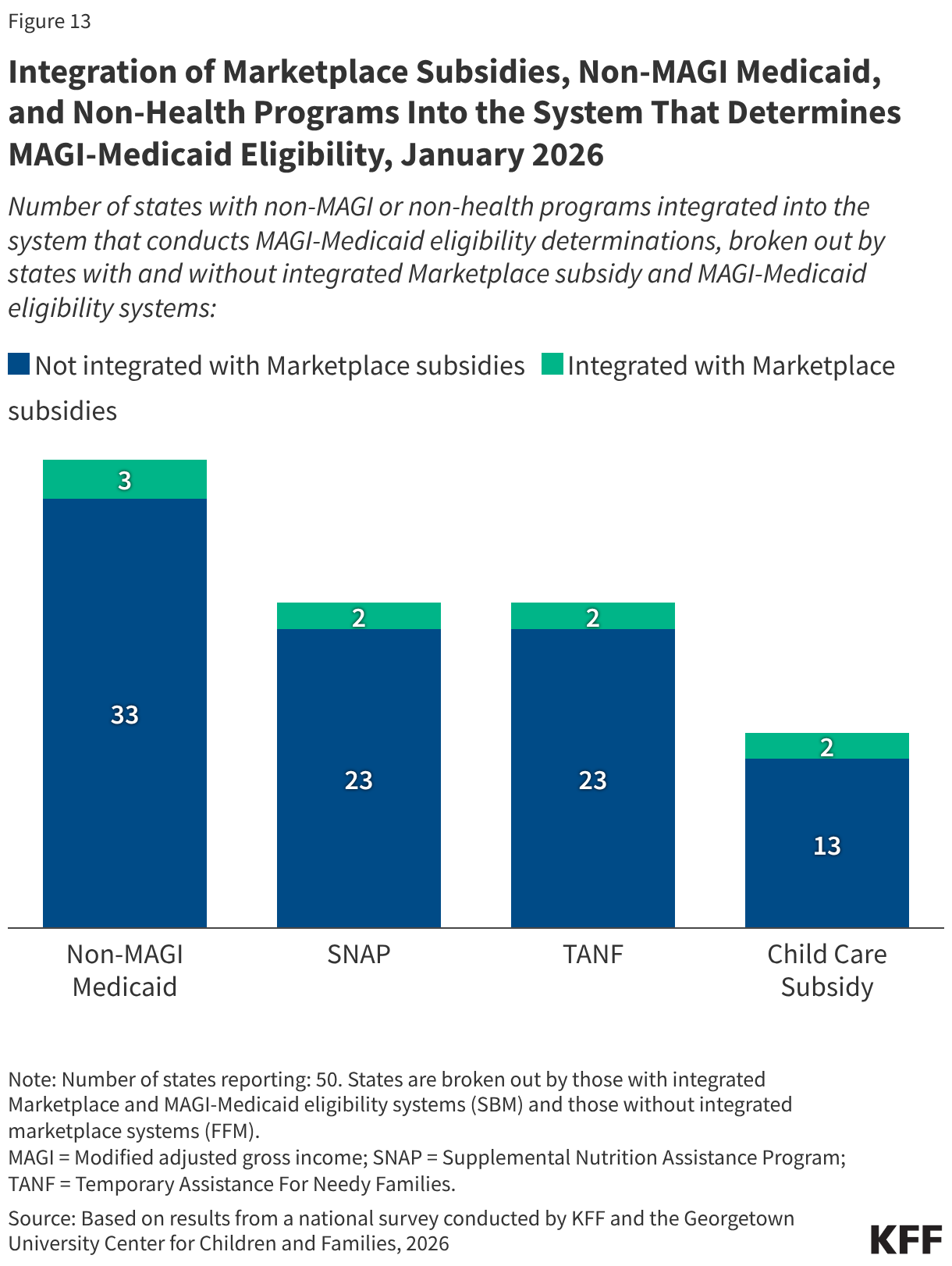
Integration of Marketplace Subsidies, Non-MAGI Medicaid, and Non-Health Programs Into the System That Determines MAGI-Medicaid Eligibility, January 2026 (Stacked column chart)

All states have an online MAGI Medicaid application, and nearly all states (49) allow individuals to apply for one or more other benefits, including SNAP or TANF, through the online application even if the state’s eligibility systems are not integrated with the other programs. Multi-benefit MAGI Medicaid applications include non-MAGI Medicaid in 41 states, SNAP in 31 states, TANF in 29 states, child care subsidy in 18 states, and premium tax credits in 13 SBM states (Figure 14). In states that do not have integrated eligibility systems, the data collected from the multi-benefit applications are transferred to the systems that process eligibility for those programs. With the more extensive use of smart phones and other mobile devices along with more limited access to computers among low-income populations, 36 states have designed their online applications to reformat for mobile devices.

Multi-Benefit Online MAGI Medicaid Applications, January 2026 (Column Chart)

Online Accounts and Mobile Apps

Almost all states now have comprehensive online accounts through which individuals apply for Medicaid and manage their personal and enrollment-related information (Figure 15). In the past ten years, the number of states with online accounts increased from 39 to 49. Initially online accounts included a limited number of features; today most states report having a variety of features, including the ability to submit an application or renewal, view notices, report changes, and upload documents. Online accounts provide applicants and enrollees with a centralized location for most of their Medicaid enrollment information, and states can more quickly and cost-effectively connect with individuals if action is needed to enroll or maintain coverage.
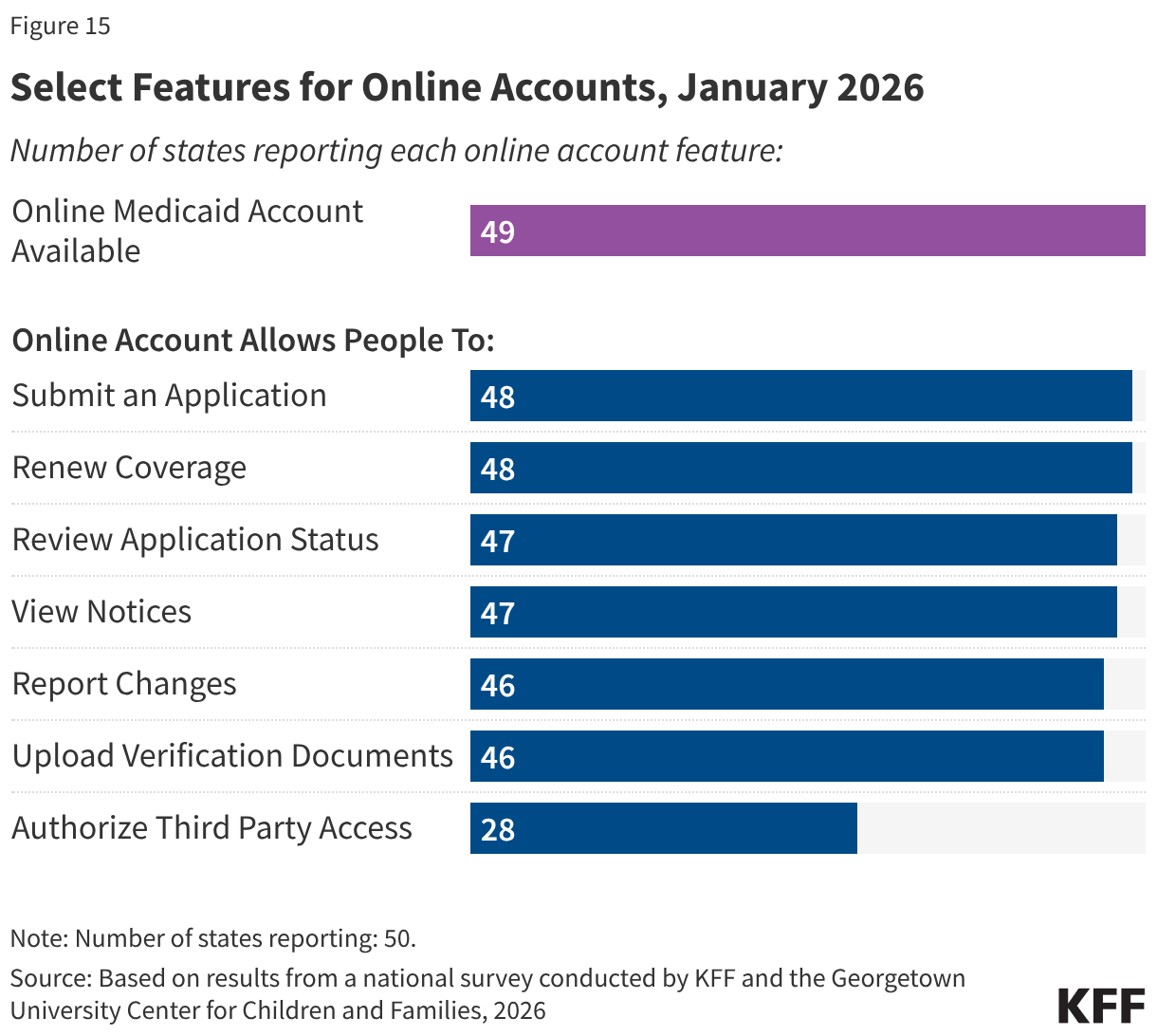
Select Features for Online Accounts, January 2026 (Bar Chart)

Sixteen states have a Medicaid mobile ‘app,’ but features in the apps are generally more limited than in online accounts. Mobile ‘apps’ are specifically designed to work well on smartphones and tablets but offer fewer features. In 13 states, the mobile ‘app’ allows enrollees to view notices and upload documents while the ability to view application status is a feature in 11 states (Figure 16). However, only half of states (8) with mobile ‘apps’ accept applications and half (8) accept renewals for Medicaid. In 2 states (Delaware and Virginia), the mobile ‘app’ helps Medicaid enrollees with non-eligibility and enrollment actions like finding providers or selecting a managed care plan.
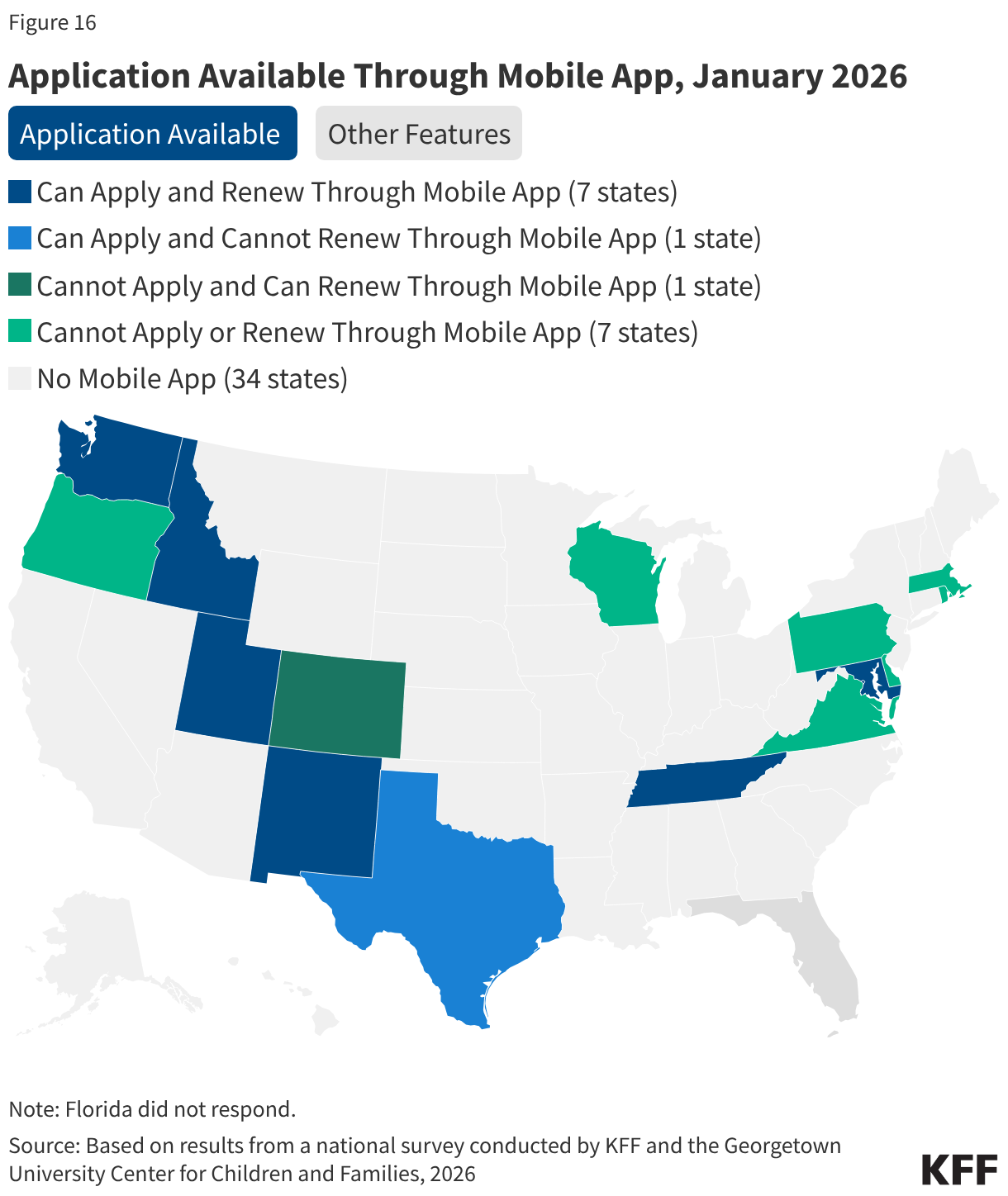
Application Available Through Mobile App, January 2026 (Choropleth map)

Online Portals for Community Assisters

Half of states (26) provide a separate web portal or protected access to the online account for entities that provide application assistance to help individuals apply for coverage (Figure 17). All states with online portals for assisters allow for the submission of the application and most (23 states) allow assisters to review the application status. In 21 states, including 19 that will be implementing work requirements, community assisters can submit renewal information and/or upload scanned or electronic documents through the portals, increasing their ability to assist consumers with providing documentation of compliance with work requirements or exemption status. About a third of states allow assisters to do other tasks such as reporting changes, viewing notices, and accessing renewal dates. States may designate the types of entities allowed to use the portal, which generally include federally qualified health centers and other health care providers, family-serving community-based organizations, MCOs, and federal or state navigators and assisters (Figure 18). Access to community assisters can extend the state’s capacity to help individuals comply with work requirements or seek an exemption.
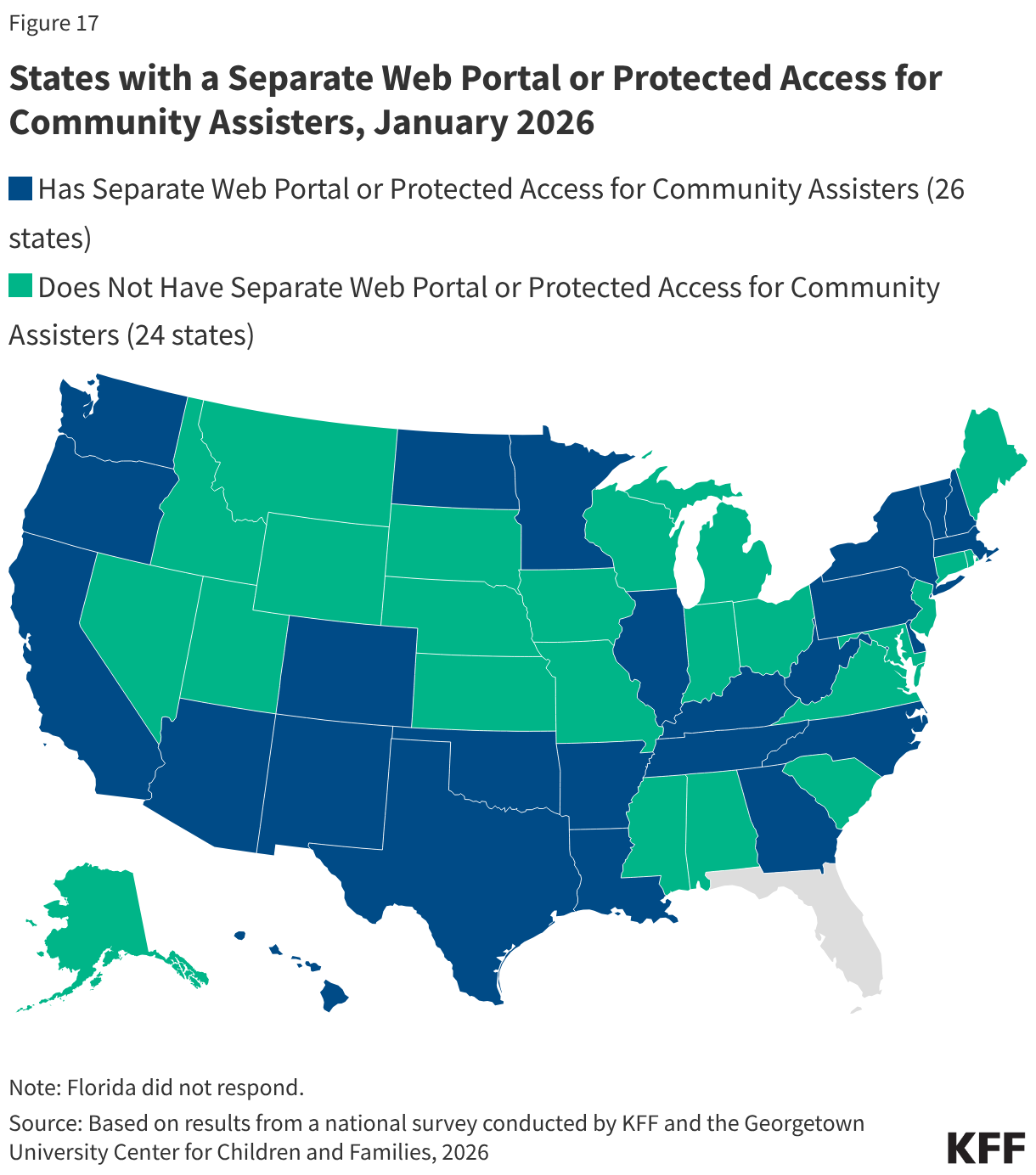
States with a Separate Web Portal or Protected Access for Community Assisters, January 2026 (Choropleth map)
Types of Organizations Authorized to Use Separate Web Portals or Protected Access, January 2026 (Bar Chart)

Renewals and Changes in Circumstances

Renewal Policies

During the unwinding significant effort was dedicated by states and CMS to increase the rate of ex parte (automated) renewals and boost communication with enrollees through multiple modes to avoid procedural disenrollments of eligible individuals. States are maintaining most of the strategies put in place during unwinding to increase retention of eligible individuals.

State adoption of certain renewal strategies allowed during the unwinding could reduce the administrative burden on expansion states as they operationalize work requirements. During the unwinding, all states took advantage of flexible 1902(e)(14)(A) waiver authority to use alternative data and methods to verify income eligibility. Several of these strategies are available to states as state plan options with two-thirds of states (33) adopting one or more of the options. Fifteen (15) states, including 13 states that will need to implement work requirements, enroll and renew individuals based on a SNAP income determination and 8 states use a TANF income determination. The sharing of SNAP program data, in particular, will facilitate implementation of work requirements. Also helpful is the option for MCOs to assist members with renewals, which 10 states have adopted (Figure 19). Although MCO’s cannot determine if an individual meets the work requirements or qualifies for a medically-related exemption, they can assist members in understanding the new requirements and provide information to states that can be used to verify the exemption status of the enrollee. Half of states adopted the option to renew individuals reporting no income if data sources show no income, and 15 states renew individuals reporting income under 100% FPL when there is no conflicting data. However, these strategies are less useful when it comes to verifying compliance with work requirements.
State Adoption of Renewal Strategies to Automatically Enroll and Renew Individuals, January 2026 (Column Chart)

States continue to expand the ways individuals can access their renewal date directly or through providers and assisters. Providing enrollees with numerous ways to confirm their renewal date reduces the likelihood that they will miss renewal notices. This access to renewal dates will be particularly useful as expansion enrollees transition to 6-month renewal periods starting in January 2027. Enrollees can directly access their renewal date in their online accounts in 44 states, mobile app in 13 of 16 states with apps, through the Medicaid call center in 48 states, or via text message from the state in 23 states (Figure 20). All states offer at least one source, and half the states provide renewal information through three or more options. Most states (42) also share renewal dates with entities that provide services or assistance to enrollees, including MCOs (39 states), FQHCs (16 states), other providers (18 states), pharmacies (12 states), and navigators and/or assisters (18 states).
Enrollee and Assister Entity Access to Renewal Date Information, January 2026 (Bar Chart)

More states are using timely and cost-effective electronic communications, adding methods of communication, and boosting capacity to communicate more frequently with enrollees. During the Medicaid unwinding states sought to increase awareness of renewals and encourage enrollees to respond to improve retention and reduce procedural disenrollments of eligible individuals. To alert enrollees to upcoming renewals, 22 states send advance notice most frequently through text messages, but also via email, regular mail, and robo-calls; 40 states send reminders to enrollees to submit renewal information; and 38 states take various actions to help individuals maintain or regain coverage after disenrollment, including by providing information about the 90-day reconsideration period during which enrollees can still submit renewal forms and documentation (27 states) and by providing MCOs with a list of members who have been procedurally disenrolled (17 states) (Figure 21). It is unclear how work requirements will intersect with the 90-day reconsideration period as states await additional guidance from CMS. 
State Actions to Communicate with Enrollees During the Renewal Process, January 2026 (Column Chart)

Automatic Case Closures at Renewal

States have implemented additional measures to flag receipt of unprocessed renewal information to avoid automatically closing a case with a pending renewal. Most states (44) have eligibility systems that automatically close a case on or shortly after the renewal date if renewal information has not been received. But automatic case closure can result in a premature disenrollment if the renewal or other documentation has been received but is unprocessed. To avoid the extra work to disenroll and reenroll individuals, states have established processes to flag receipt of renewals or documentation in the multiple modes through which renewal information can be submitted, including online accounts, email, regular mail, call centers, and in-person offices, and remove cases from automatic closure (Figure 22). The number of states that flag information from any source increased to 38 from 33 in 2025. Having a process to avoid automatic case closure when documents have been received may be particularly important as states shift from a 12-month to a 6-month renewal cycle and as they implement work requirements for expansion enrollees. During this transition, expansion enrollees who are confused by the earlier than expected renewals or by the new work requirements may be late in responding to renewal notices. It is unclear whether expansion states will have to make any changes to their automated case closure systems when they implement work requirements.
State Processes to Flag Returned Information to Avoid Automatic Case Closure, January 2026 (Bar Chart)

Changes in Circumstances

Two-thirds of states use verified information from SNAP (34 states) and TANF (32 states) to update Medicaid information on a routine basis (Figure 23). If states receive all the information from the other programs that is needed to verify ongoing eligibility for Medicaid without requesting information from the individual, the state may set a new 12-month renewal date, which 24 states do when they receive data from SNAP data and 21 states do with information from TANF. For enrollees subject to work requirements, states will likely need guidance from CMS on what data from SNAP and/or TANF they can use to verify compliance or exemption status and whether states can set a new 6-month renewal date if the information is provided between renewal periods. If, however, the data indicates the individual is no longer eligible, states may terminate coverage but must send a termination notice at least 10 days in advance of case closure to provide enrollees with time to submit documentation verifying ongoing eligibility. The E&E rule requires states to provide at least 30 days to respond to provide documentation if the data indicates the individual is no longer eligible; however, this provision is subject to the 10-year moratorium on implementation. Currently, only nine states provide at least a 30-day response period. The short timeline for returning information can result in churn and increase state and MCO administrative burden to disenroll and then re-enroll an individual.
States That Update Medicaid Information Routinely Using Verified Income Information from SNAP and TANF, January 2026 (Choropleth map)

Fourteen (14) states (all expansion states, except Wisconsin) check other income data sources periodically to identify changes in circumstances, most often on a quarterly basis (Figure 24). Only five of these states provide 30 or more days for the individual to respond if the data check indicates the individual is no longer eligible. States are not required to conduct income checks between renewals, and without more CMS guidance, it is not clear how these periodic checks could impact semi-annual renewals or compliance with work requirements.

States Conducting Periodic Income Checks, January 2026 (Choropleth map)

Premiums and Cost-Sharing

Current federal rules limit premiums and cost sharing in Medicaid and CHIP given enrollees’ limited ability to pay out of pocket costs. Under these rules, states may not charge premiums in Medicaid for enrollees with incomes less than 150% FPL without a waiver. Maximum allowable cost sharing varies by type of service and income in Medicaid. CHIP programs have more flexibility to charge premiums and cost sharing, but both Medicaid and CHIP limit total family out-of-pocket costs to no more than 5% of family income, and states are required to maintain tracking systems to cease cost-sharing once a family meets the cap.

Beginning in October 2028 states must implement mandatory cost sharing of up to $35 per service for ACA expansion adults with income between 100%-138% FPL. Certain services are exempt from cost sharing, including primary and preventive care, emergency services, family planning and pregnancy-related services, and mental health care and substance use disorder services. The law also excludes from cost sharing services received in federally-qualified health centers (FQHCs), certified community behavioral clinics, and rural health clinics. Prescription drugs are included in the mandate but the current rules limiting cost-sharing for prescription drugs remains in place. CMS guidance is needed to clarify any flexibility that states may have in determining whether some or all non-exempt services must require cost-sharing. The cap of 5% of household income still applies to total premiums and/or cost-sharing for all enrolled members of the household. The law also prohibits states from charging premiums to expansion adults subject to the new cost sharing requirements.

Cost Sharing for Parents and Expansion Adults

As of January 1, 2026, 19 states charge nominal cost-sharing to Section 1931 parents, and 21 states charge cost sharing to ACA or waiver expansion adults, while the remaining states do not charge cost-sharing (Figure 25). Cost sharing applies to all Section 1931 parents regardless of income, except in Wisconsin, which imposes cost sharing on parents with income 50% FPL or higher. Fifteen states charge cost-sharing to ACA or waiver expansion enrollees regardless of income. Three states limit cost-sharing to ACA expansion enrollees with income 100% FPL or above. Generally, charges among expansion states are well under $10 per service; however, four states charge more than $35 for any service. Alaska, Michigan, Utah, and West Virginia charge copays for a hospital inpatient stay of $50 or $75 per admission.

Cost Sharing for Parents and ACA or Waiver Expansion Adults, January 2026 (Choropleth map)

Children’s Premiums

Eighteen (18) states continue to charge premiums to children in CHIP in 2026 (Figure 26). That number is down from 30 states that charged premiums to children in CHIP and/or Medicaid in 2020. Only three states charge premiums at the lowest income of 133% FPL allowed in CHIP, while the median income at which premiums start is 163% FPL or $44,531 annually for a family of three. Alabama and Texas charge annual enrollment fees, Nevada charges quarterly premiums, and the remaining states charge monthly premiums. Six states charge a family-based premium regardless of the number of children. A dozen (12) states charge per child premiums with a maximum family premium in nine of those states. Nine states require prepayment of the first month in CHIP prior to enrollment. Once a child is enrolled, the 12-month continuous enrollment provision protects children from disenrollment following a missed premium payment.
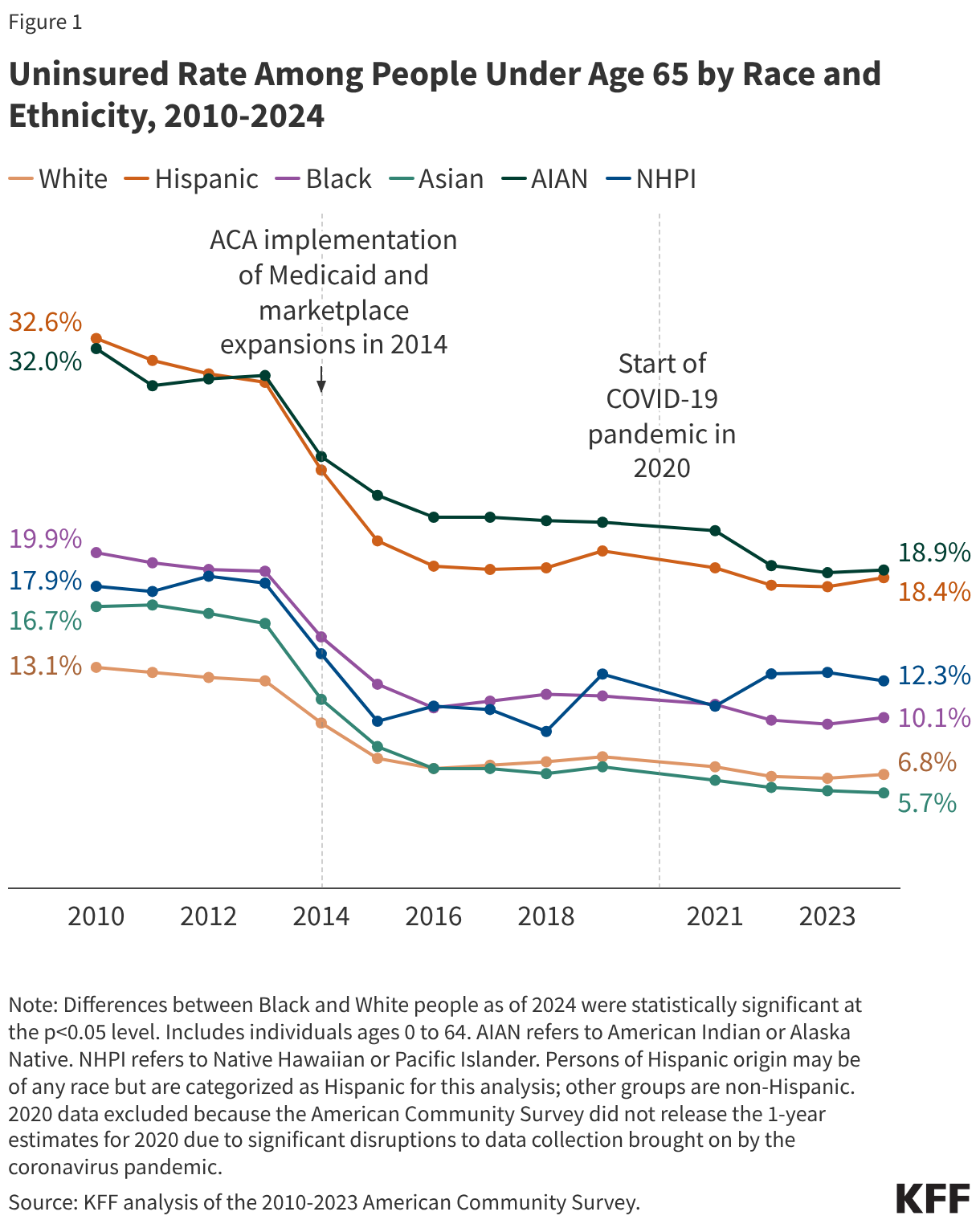
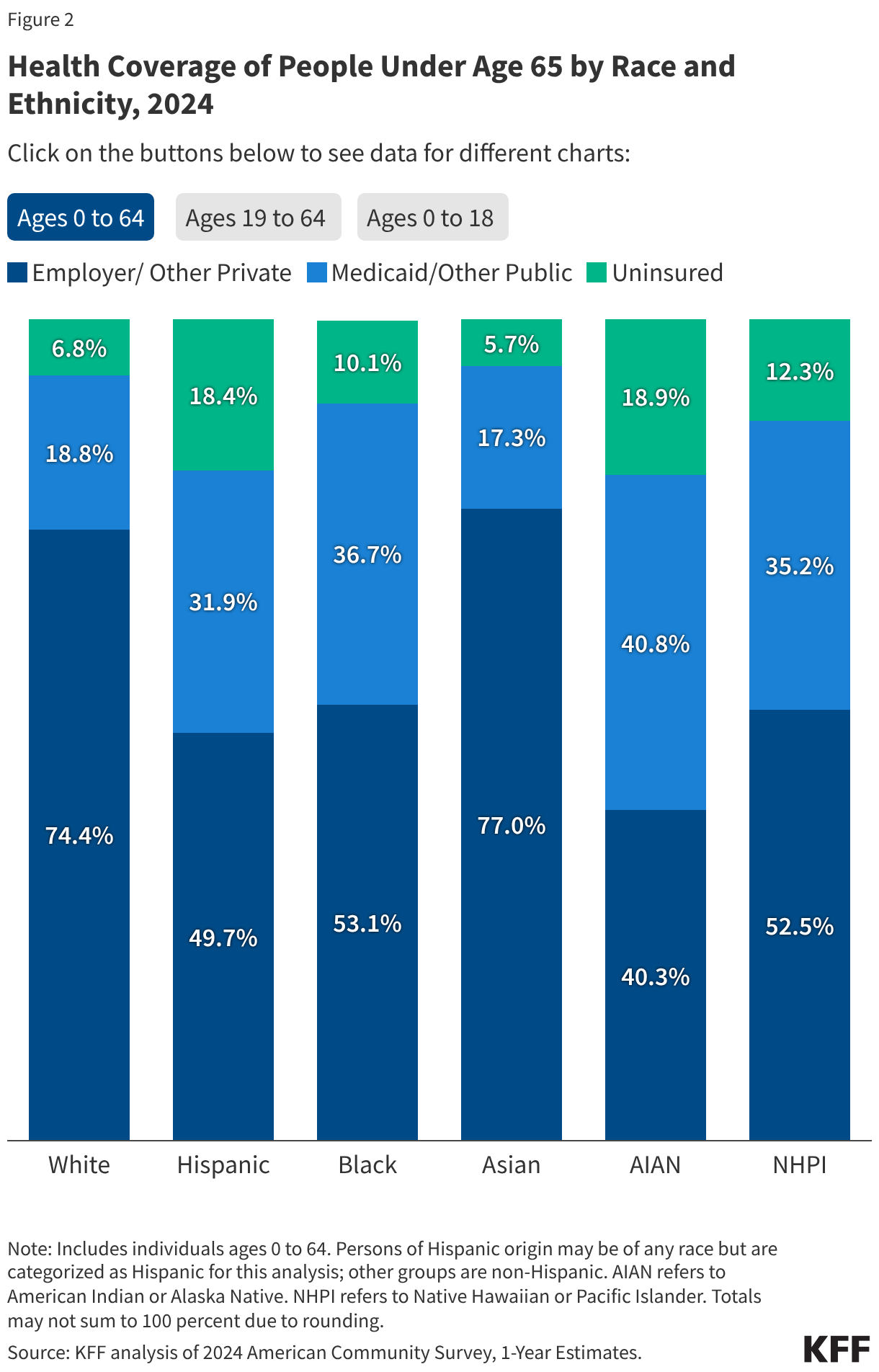
States Charging Premiums for Children in CHIP, January 2026 (Choropleth map)

Appendix Tables

Income Eligibility Limits for Children's Health Coverage as a Percent Of The Federal Poverty Level, January 2026 (Table)

(Back to top)

Medicaid and CHIP Coverage for Pregnant Individuals and Medicaid Family Planning Coverage, January 2026 (Table)

(Back to top)

State Adoption of Federal Options to Cover Immigrant Populations, January 2026 (Table)

(Back to top)

Medicaid Income Eligibility Limits for Adults as a Percent of the Federal Poverty Level, January 2026 (Table)

(Back to top)

Methods for Medicaid Agency to Identify When an Enrollee Becomes Incarcerated, January 2026 (Table)

(Back to top)

Method and Timing of Medicaid Agency Notification of Release of Incarcerated Individuals, January 2026 (Table)

(Back to top)

Integration of MAGI-Medicaid Eligibility System with Marketplace Eligibility System, Non-MAGI Medicaid, and Non-Health Programs, January 2026 (Table)

(Back to top)

Multi-Benefit Online Medicaid Applications, January 2026 (Table)

(Back to top)

Online Medicaid Accounts, January 2026 (Table)

(Back to top)

Security Features for Online Medicaid Accounts, January 2026 (Table)

(Back to top)

Viewing Notices and Submitting Renewal Information Through Online Accounts, January 2026 (Table)

(Back to top)

Medicaid Mobile App Features, January 2026 (Table)

(Back to top)

Medicaid Mobile Apps, January 2026 (Table)

(Back to top)

State Actions to Update Mailing Addresses, January 2026 (Table)

(Back to top)

Verification of Received Information, January 2026 (Table)

(Back to top)

Modes to Submit Verification Documentation, January 2026 (Table)

(Back to top)

Master Death File, January 2026 (Table)

(Back to top)

AI (Artificial Intelligence) Use to Support Consumer Assistance, 							 January 2026 (Table)

(Back to top)

AI (Artificial Intelligence) Use to Support Eligibility and Enrollment Processes, January 2026 (Table)

(Back to top)

Online Portals for Community Assisters, January 2026 (Table)

(Back to top)

Types of Organizations Authorized to Use Separate Web Portal, January 2026 (Table)

(Back to top)

Advance Notice of Renewals, January 2026 (Table)

(Back to top)

Reminders to Respond to Renewal Notice, January 2026 (Table)

(Back to top)

Access to Enrollee Renewal Dates, January 2026 (Table)

(Back to top)

State Actions to Help Individuals Maintain or Regain Coverage, January 2026 (Table)

(Back to top)

Automatic Case Closures, January 2026 (Table)

(Back to top)

Adoption of State Plan Options Allowed As 1902(e)(14)(A) Waivers, January 2026 (Table)

(Back to top)

Use of Periodic Data Checks to Identify Changes in Income that May Affect Eligibility, January 2026 (Table)

(Back to top)

Cost Sharing Requirements for Selected Services for Section 1931 Parents, January 2026 (Table)

(Back to top)

Cost Sharing Requirements for Selected Services for ACA or Waiver Expansion Adults, January 2026 (Table)

(Back to top)

Premiums and Enrollment Fees for Children, January 2026 (Table)

(Back to top)

Notification of Eligibility Changes for Certain Lawfully Present Immigrants, January 2026 (Table)

(Back to top)

News Release

Survey Offers Early Look at States’ Differing Approaches to Implementing Medicaid Work Requirements Amid Cost and Time Constraints and Uncertainty from Delayed Federal Guidance

Many States Seek Less Restrictive Policies and Automated Verification Where Possible, While Seven States Plan for More Restrictive Verification or Early Implementation

Published: Apr 30, 2026

A new KFF survey of state Medicaid officials and focus groups in eight states captures the different choices states are making about how to implement Medicaid work requirements, with seven states planning for a more restrictive approach to verifying work or exemption status or to implement work requirements early. These implementation plans are taking shape as states encounter time, cost, and other constraints as well as uncertainty about how to define and verify certain exemptions due to delayed federal guidance.
The 2025 reconciliation law requires adults in the 43 states (including DC) covered through the Affordable Care Act (ACA) Medicaid expansion and partial expansion waiver programs (Georgia and Wisconsin) to meet work requirements starting January 1, 2027.

Though planning for the implementation of work requirements continues, states have reported making several important policy choices—all of which can affect the level of burden placed on Medicaid enrollees and applicants as well as Medicaid staff capacity:

  • Additional verification: Four states (Arkansas, Idaho, Indiana, and New Hampshire) currently plan to adopt more restrictive compliance verification policies than required by law by applying longer look-back periods at application or renewal. Two of these states (Indiana and New Hampshire) will also conduct more frequent (quarterly) compliance checks.
  • Early implementation: Three states report plans to implement work requirements earlier than required by law (January 2027): Iowa, Montana, and Nebraska. Arkansas says it will launch a “soft implementation” of work requirements in 2026, with no disenrollments occurring until the official start in January 2027.
  • Automating verification: Eighteen states say they will use new data sources to further automate verification of work requirements and non-medical exemptions, including data sources to verify school attendance, community service, and exemptions for veterans and individuals recently released from incarceration, while half of states have not yet made a decision. States are also exploring ways to verify who is medically frail and exempt from work requirements, with most indicating they will use Medicaid claims data and other data sources to automate the process. Many would also like to allow “self-attestation” from enrollees and applicants. States will not be able to implement the exemption until they have a detailed federal definition of who qualifies as medically frail and whether statements that attest to medical frailty (known as “self-attestation”) will be allowed under federal rules.
  • Hardship exceptions: Twenty-nine states plan to adopt at least one of four types of hardship exception for individuals facing extenuating circumstances, including exemptions for individuals who live in high-unemployment areas or areas experiencing a natural disaster, individuals receiving care in a hospital or nursing facility, and those who must travel for medical care. Only two states (Iowa and Indiana) do not plan to adopt any hardship exceptions.

Amid these early implementation decisions and plans, states face a variety of challenges and uncertainties:

  • Resource constraints: To reduce Medicaid enrollee and administrative burden, states are required to use data from available and reliable sources to check for compliance with or exemption from work requirements. However, states say their efforts to leverage new data to automate verification processes are constrained by time, costs, staff capacity, and other limitations.
  • Federal guidance: States are waiting for federal guidance about how to define certain exemptions as well as community engagement activities and what verification methods will be accepted. In particular, states would like more federal guidance on who qualifies as medically frail and as a caregiver as well as how to define caregiving. Even as they move forward with new systems and other changes, states expressed concerns about the risks and added costs of making decisions before guidance has been finalized.

In addition to information on work requirements, KFF’s survey collected information on a wide range of eligibility, enrollment, and renewal policies, some of which may affect how states implement work requirements. Those findings are included in a related report, some of which are highlighted below:

  • Artificial intelligence: Six states (Arkansas, California, Maryland, Missouri, New Mexico, and Oklahoma) say they are using artificial intelligence (AI) to assist with implementing work requirements, while most other states are still exploring options. A small but growing number of state Medicaid programs are also using AI to support consumer assistance, most often through a chatbot to answer questions or by assisting enrollees in updating their contact information, saving eligibility or call center workers time in manually collecting and updating the information.
  • SNAP data: Fifteen states use verified income data from the Supplemental Nutrition Assistance Program (SNAP) to enroll individuals into or renew enrollees’ Medicaid coverage. SNAP data can also be used to verify compliance with work requirements or exemptions.

A companion survey from KFF provides a baseline for Medicaid eligibility, enrollment, and renewal policies for seniors and people with disabilities ahead of potential changes to the program stemming from the 2025 reconciliation law.

The 24th annual survey of state Medicaid and Children’s Health Insurance (CHIP) program officials was conducted between January and March 2026 by KFF and the Georgetown University Center for Children and Families. The Survey of Medicaid Financial Eligibility for Older Adults & People with Disabilities was conducted in March 2026 by KFF and Watts Health Policy Consulting. Overall, 49 states and the District of Columbia responded to both surveys. (Florida was the only state that did not respond).

For the latest and most comprehensive information on Medicaid work requirements, visit KFF’s interactive tracker, which includes state-level data on Medicaid enrollment and renewal outcomes as well as current state enrollment and renewal policies. KFF’s tracker also offers the latest federal guidance, key policy and operational questions, and information on current 1115 work requirements waiver requests and approvals.