Racial and Ethnic Health Inequities and Medicare

Published: Feb 16, 2021
Section:
0 / 0

Executive Summary

This chart collection draws on primary and secondary data analyses by KFF and other sources to examine the characteristics, experiences, and outcomes of the Medicare population by race and ethnicity (see Methods for details on data and analysis). It includes data from a variety of sources to describe demographics, health status and disease prevalence, health coverage, access to care and service utilization, and health outcomes, including the most current data available pertaining to disparities related to COVID-19 within the Medicare population. It also documents disparities in income and wealth among people on Medicare.

Key Takeaways

  • Life expectancy at age 65 has improved since the enactment of Medicare among all older adults but is lower for Black adults than White or Hispanic adults (18.0, 19.4, and 21.4 years, respectively) and higher for Hispanic adults than Black or White adults.
  • Overall, Black and Hispanic Medicare beneficiaries have fewer years of formal education and lower median per capita income, savings, and home equity than White beneficiaries.
  • Among Medicare beneficiaries, people of color are more likely to report being in relatively poor health, have higher prevalence rates of some chronic conditions, such as hypertension and diabetes than White beneficiaries; they are also less likely to have one or more doctor visit, but have higher rates of hospital admissions and emergency department visits than White beneficiaries.
  • While the vast majority of Medicare beneficiaries across all racial and ethnic groups have some source of supplemental coverage to help fill in Medicare’s benefit gaps and cost-sharing requirements, the share of beneficiaries with different types of coverage varies by race and ethnicity. A smaller share of Black and Hispanic Medicare beneficiaries than White beneficiaries have private supplemental coverage through Medigap or retiree health plans, while a larger share have wrap-around coverage under Medicaid; a larger share of Black and Hispanic than White beneficiaries are enrolled in Medicare Advantage plans
  • While relatively few Medicare beneficiaries overall report problems with access to care, a larger share of Black and Hispanic beneficiaries report trouble getting needed care than White beneficiaries.
  • The COVID-19 pandemic has further highlighted stark racial/ethnic health inequities among Medicare beneficiaries, with Black, Hispanic, and American Indian/Alaska Natives accounting for disproportionate rates of COVID-19 cases and hospitalizations. Among adults ages 65 and older, people of color bear disproportionate rates of COVID-19 deaths relative to older White adults.

Report: Overview

Medicare is a national health insurance program that provides coverage to more than 60 million people ages 65 years and older and younger adults with long-term disabilities, including 15 million beneficiaries who are people of color. Medicare covers a broad range of health services, including hospital and physician services, preventive services, skilled nursing facility and home health care, hospice, and prescription drugs. While Medicare has been instrumental in providing adults access to medical care, racial disparities in diagnoses, treatment, and outcomes among beneficiaries persist and have been exacerbated by the coronavirus pandemic.

Medicare has helped to mitigate racial and ethnic inequities in health care in its role as both a regulator and the largest single purchaser of personal health care in the U.S. Prior to the establishment of Medicare, half of older adults lacked health insurance. Soon after its enactment in 1965, Medicare facilitated the integration of hospitals by enforcing Title VI of the Civil Rights Act, which prohibits the distribution of federal funds to institutions that practice discrimination.1  Before then, many hospitals were segregated, and in many parts of the country, Black physicians were unable to practice in hospitals in their community.2  As Dorothy Height, an American civil and women’s rights activist, observed, “the combination of Medicare, Medicaid and the civil rights legislation changed the health care landscape forever for Black Americans and minorities of all ages. Everyone benefited from these policies.”

However, as the coronavirus pandemic has laid bare, racial and ethnic inequities in health and health care persist, including among people with Medicare. Among adults ages 65 and over, COVID-19 related mortality rates for Black and Hispanic adults are nearly double the rate for White adults. In the Medicare population, which includes both older adults and younger adults with long-term disabilities, Black, Hispanic, and American Indian and Alaska Native beneficiaries have borne a disproportionate burden of COVID-19 cases and hospitalizations.

Long before the COVID-19 pandemic, numerous studies documented health inequities among Medicare beneficiaries by race and ethnicity, even after controlling for multiple factors, such as age, sex, and comorbidities. For example, Black Medicare beneficiaries have higher hospital readmission rates than White beneficiaries even after controlling for multiple patient-level factors,3 , 4 , 5  and in some studies, these disparities persist even within the same hospital or skilled nursing facility,6 ,7  suggesting that systemic-level factors are driving forces behind these disparities. Moreover, studies have documented racial/ethnic disparities in cancer survival rates and receipt of optimal treatments.8 , 9 , 10 , 11 ,12 

Health inequities among Medicare beneficiaries are attributed to broader structural, socioeconomic, political, and environmental factors that are rooted in years of systemic racism. Socioeconomic disadvantages associated with structural racism shape health outcomes among people of color long before the age of Medicare eligibility is reached and have a cumulative effect over the course of a lifetime, contributing to ongoing or greater inequities in older ages.13 ,14 

This chart collection draws on primary and secondary data analyses by KFF and other sources to examine the characteristics, experiences, and outcomes of the Medicare population by race and ethnicity (see Methods for details on data and analysis). It includes data from a variety of sources to describe demographics, health status and disease prevalence, health coverage, access to care and service utilization, and health outcomes, including the most current data available pertaining to disparities related to COVID-19 within the Medicare population. It also documents disparities in income and wealth among people on Medicare.

While the collection of race and ethnicity data in administrative and survey data has improved over time, sample size and data collection limitations, including limitations related to completion, accuracy, and classifications of race/ethnicity data, preclude analysis of certain racial and ethnic groups consistently across data sources. Further, gaps in data reporting and collection standards, such as the reporting of COVID-19 cases and deaths in nursing homes by race and ethnicity, impede the complete identification of racial and ethnic disparities. These data limitations affect our ability to display results for a consistent set of racial and ethnic groups in this chart collection, especially for Asian, American Indian and Alaska Native, and Native Hawaiian and Other Pacific Islander beneficiaries, and beneficiaries who identify as two more races in some of our analyses. Moreover, due to these data limitations, we are unable to present more nuanced and disaggregated data that reflect the heterogeneity within different racial and ethnic groups. For example, researchers have documented differences in health outcomes within Hispanic subgroups, such as those identifying as Mexican, Cuban, Puerto Rican, Dominican, and Central/South American, that would otherwise be masked.15 ,16  Throughout this brief, individuals of Hispanic origin may be of any race, but are classified as Hispanic for the analysis; all other groups are non-Hispanic.

Report: Demographics

By 2060, People of Color Will Comprise Close to Half of the U.S Population Ages 65 and Older

The population of the United States ages 65 and older is projected to grow from 56 million in 2020 to 95 million in 2060, accounting for nearly a quarter of the nation’s total population in 2060.

The U.S population ages 65 and over is also expected to become more diverse over time. Between 2020 and 2060, White adults are projected to account for a decreasing share of adults ages 65 and older, with their population declining from 76% to 55%, while the share of adults ages 65 and older who are people of color is projected to nearly double, from 25% to 47%. Much of this increase reflects growth in the older Hispanic adult population, with the share of adults ages 65 and older who are Hispanic projected to more than double over the next four decades, from 9% in 2020 to 21% in 2060 (Figure 1).
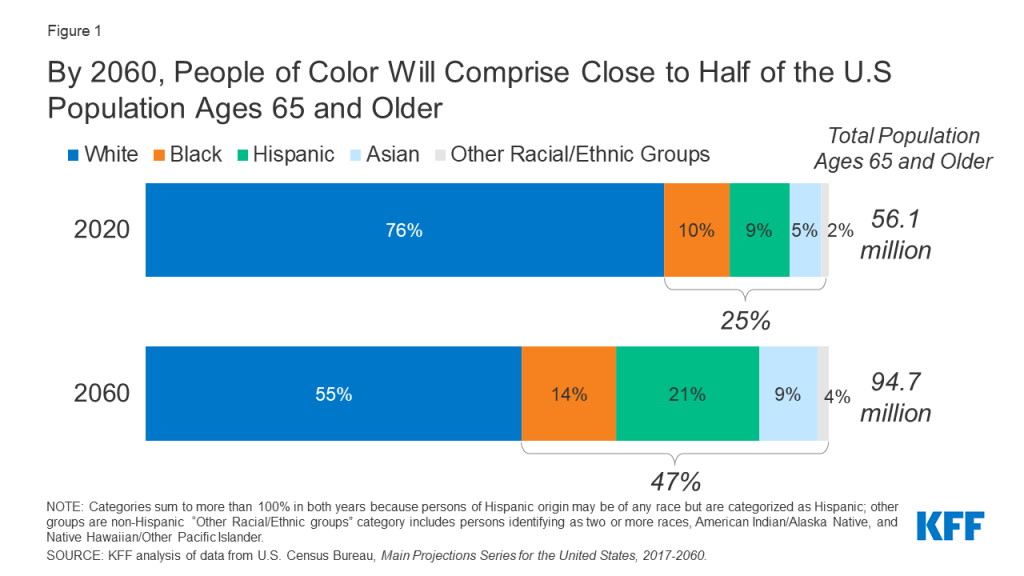
Figure 1: By 2060, People of Color Will Comprise Close to Half of the U.S Population Ages 65 and Older

The Average Number of Years of Life Remaining at Age 65 Is Substantially Lower for Black Adults Than for White or Hispanic Adults

In 2018, adults in the U.S who reached age 65 were expected to live an additional 19.5 years on average –reflecting a 5-year gain in life expectancy since 1960, prior to the enactment of Medicare.17 

However, life expectancy at age 65 is lower among Black adults (18 years) than among White adults (19.4 years) and Hispanic adults (21.4 years) (Figure 2). Among adults in all three groups, life expectancy at age 65 is higher for women than men.

Notably, Hispanic male and female adults have the highest life expectancy at age 65, despite being socioeconomically disadvantaged compared to White adults. Research has, in part, attributed this advantage (i.e., “Hispanic paradox”18 ) to lower smoking rates and other positive health behaviors among Hispanic adults relative to other groups, as well as immigration-related processes that indirectly select healthier immigrants.19   However, these findings are still not fully understood. Researchers have also projected that among Hispanic adults born in the United States, this life expectancy advantage is expected to diminish due to increasing prevalence of obesity.20 

The Majority of Medicare Beneficiaries Are White Adults, While 24% Are People of Color

In 2018, there were 60.9 million Medicare beneficiaries in total, including adults ages 65 and older and younger adults living with a long-term disability. A majority of Medicare beneficiaries are White, while 24% are people of color. This includes 10% (6 million) Black beneficiaries, 8% (5.1 million) Hispanic beneficiaries, and 6% (3.7 million) beneficiaries in other racial and ethnic groups, including Asian, Native Hawaiian or Other Pacific Islander, and American Indian or Alaska Native people as well as people identifying two or more races (Figure 3).

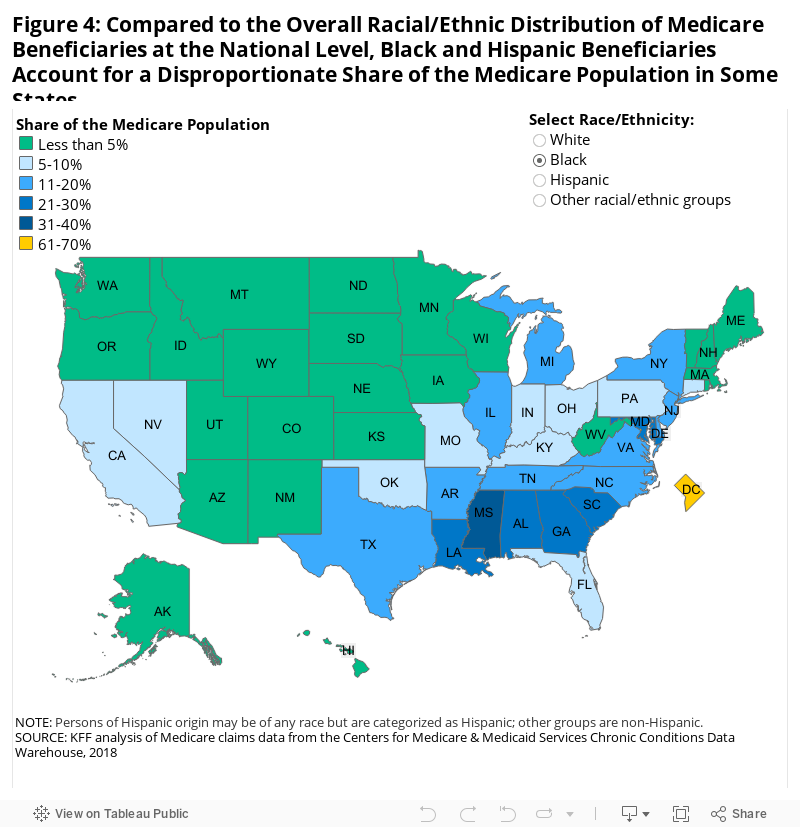
Compared to the Racial/Ethnic Distribution of Medicare Beneficiaries at the National Level, Black and Hispanic Beneficiaries Account for a Disproportionate Share of the Medicare Population in Some States

While the Medicare population in all states is predominantly White, Black and Hispanic beneficiaries account for a disproportionate share of the Medicare population in some states, relative to the racial/ethnic distribution of Medicare beneficiaries at the national level (Table 1, Figure 4). Black adults account for 11% of the Medicare population nationally, but a larger share in 14 states and the District of Columbia, and less than 5% in 22 states. Notably, the share of Black adults in the Medicare population in the District of Columbia (63%) is nearly six times higher than the national average (Table 1). Hispanic adults account for 8% of the Medicare population nationally, but a larger share in nine states, and less than 5% in 35 states and the District of Columbia. In large part, these distributions of Medicare beneficiaries by race and ethnicity reflect the variation in the racial and ethnic composition of the U.S population across states.
Compared to White Medicare Beneficiaries, Black Beneficiaries Are Less Likely to Be Married and More Likely to Live Alone

Household living arrangements of Medicare beneficiaries differ by race and ethnicity. Researchers have considered living alone as a potential predisposing factor for social isolation, which is a risk factor for poor health outcomes.21 

Compared to White beneficiaries, Black beneficiaries are more likely to live alone (54% versus 33%, respectively) (Figure 5). Conversely, smaller shares of Black and Hispanic beneficiaries are married than White beneficiaries (35%, 47%, and 54%, respectively), with Black and Hispanic beneficiaries being less likely to be living with just their spouse compared to White beneficiaries.
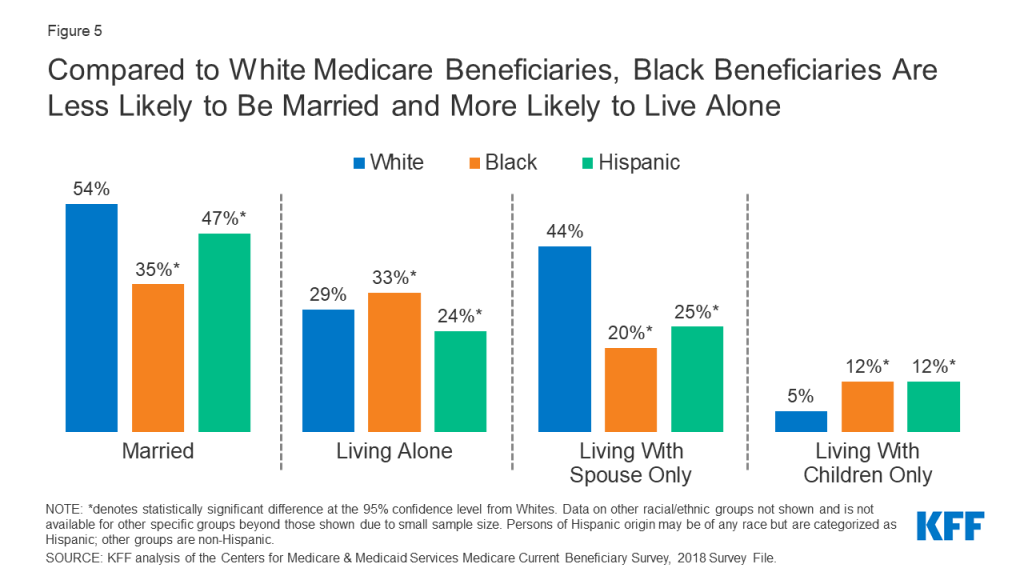
Figure 5: Compared to White Medicare Beneficiaries, Black Beneficiaries Are Less Likely to Be Married and More Likely to Live Alone

Larger Shares of Black and Hispanic Medicare Beneficiaries Are Under Age 65 and Living with a Long-Term Disability Compared to White Beneficiaries

The vast majority (86%) of Medicare beneficiaries are ages 65 and older, while 14% are under age 65 and qualify for Medicare due to a long-term disability.

Larger shares of Black (25%) and Hispanic (19%) beneficiaries are under age 65 compared to White beneficiaries (12%) (Figure 6). Beneficiaries under age 65 are more likely than older adults to have lower incomes, report fair or poor health status, and have a cognitive or mental impairment, regardless of race/ethnicity.

Figure 6: Larger Shares of Black and Hispanic Medicare Beneficiaries Are Under Age 65 and Living With a Long-Term Disability Compared to White Beneficiaries

Report: Education, Poverty, And Wealth

Black and Hispanic Medicare Beneficiaries Have Lower Educational Attainment Levels Compared to White Beneficiaries

Educational attainment, one of the key social determinants of health, varies by race and ethnicity, with Black and Hispanic beneficiaries having fewer years of education compared to White beneficiaries.

More than one quarter of Black (27%) Medicare beneficiaries and nearly one half (45%) of Hispanic beneficiaries have less than a high school education, compared to 10% of White beneficiaries (Figure 7). Conversely, a much smaller share of Black (12%) and Hispanic (13%) beneficiaries than White beneficiaries (32%) have a college degree or higher.
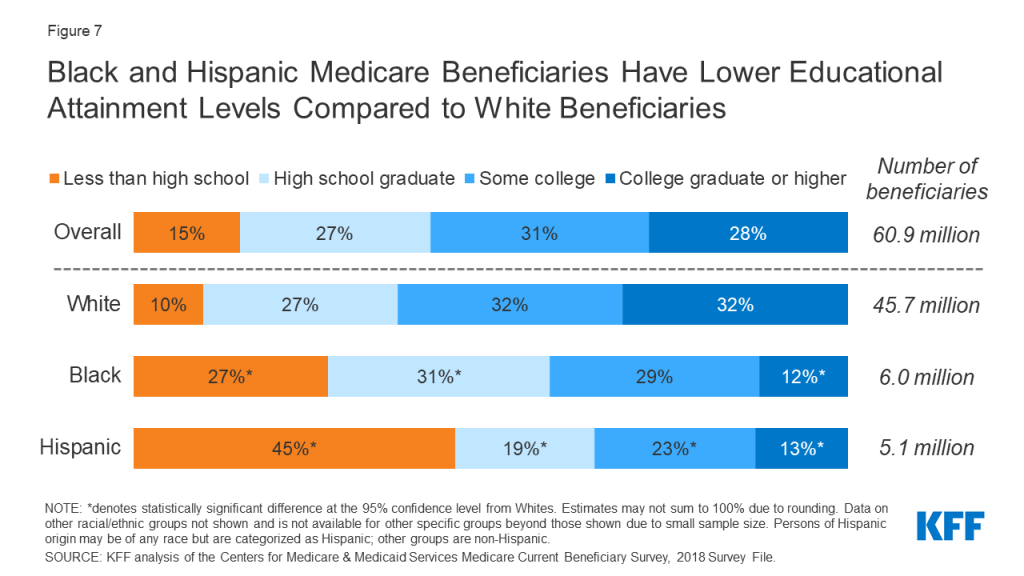
Figure 7: Black and Hispanic Medicare Beneficiaries Have Lower Educational Attainment Levels Compared to White Beneficiaries

Nearly Half of Older Hispanic and Black Adults Have Family Incomes Below 200% of the Poverty Threshold—Nearly Double the Rate Among Older White Adults

Among people ages 65 and older, Black and Hispanic adults are more likely than older White adults to have family income below poverty, based on both the official poverty measure and the Supplemental Poverty Measure (SPM).

Based on the official poverty measure, nearly half of older Black and Hispanic adults (51% and 49%, respectively) have family incomes below 200% of poverty, compared to just over one quarter (29%) of older White adults (Figure 8).
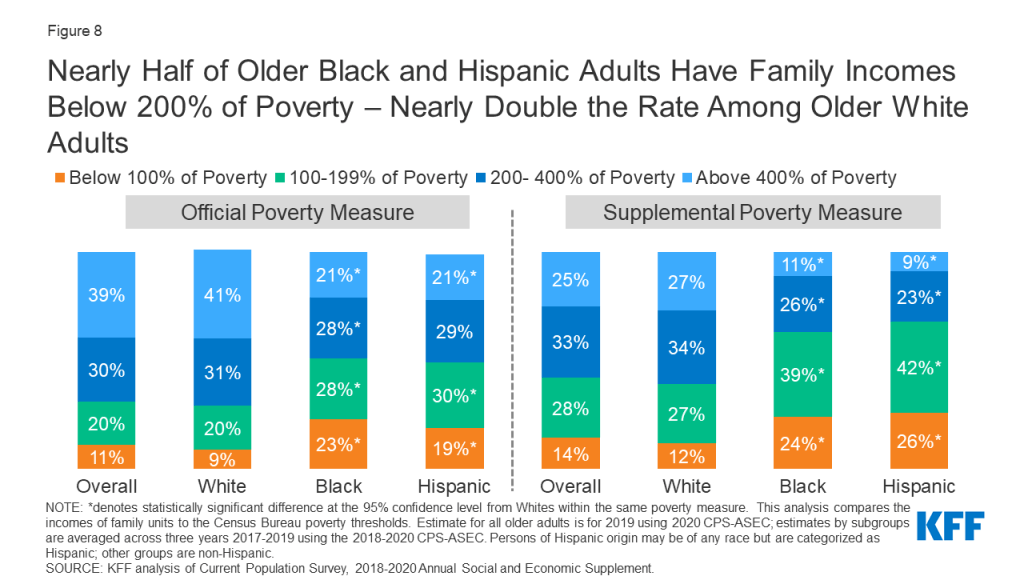
Figure 8: Nearly Half of Older Black and Hispanic Adults Have Family Incomes Below 200% of Poverty – Nearly Double the Rate Among Older White Adults

The share of Black and Hispanic adults with family income below poverty is higher based on the SPM than under the official poverty measure. The SPM differs from the official poverty measure in that it takes into account several additional financial resources, including in-kind government benefits (e.g., food stamps, housing subsidies), tax credits, out-of-pocket medical expenses, work expenses, homeownership, and geographic variation in housing costs. The SPM also deducts medical out-of-pocket expenses from financial resources, which is an especially important factor in calculating income for older adults. Based on the SPM, 63% of older Black adults and 68% of older Hispanic adults have incomes below 200% of poverty, compared to 39% of older White adults.

Median Per Capita Income, Savings, and Home Equity are Higher for White Beneficiaries Than for Black or Hispanic Beneficiaries

In 2019, half of all Medicare beneficiaries had incomes below $29,655 per person, savings below $73,819 per person, and home equity below $75,346 per person (Figure 9).

Median per capita income among White beneficiaries ($33,718) was double that of Hispanic beneficiaries ($15,611) and 1.5 times higher than median per capita income among Black beneficiaries ($23,050).

The wealth gap, based on median per capita home equity and savings, was notably wider. Median per capita savings among White beneficiaries ($117,803) was more than eight times higher than savings among Black beneficiaries ($14,523) and about twelve times higher than savings among Hispanic beneficiaries ($9,634). Median per capita home equity was more than five times higher among White beneficiaries ($95,001) than among Black beneficiaries ($18,454) or Hispanic beneficiaries ($16,494). Lower savings and home equity among people of color on Medicare than among White Medicare beneficiaries, in part, reflects fewer opportunities among Black and Hispanic adults to accumulate wealth and transfer wealth from one generation to the next.22 ,23 ,24 

A Wide Racial and Ethnic Disparity in Per Capita Savings Persists Even Among People on Medicare With a College Degree

While educational attainment has been considered by some as a pathway to improving wealth attainment, large racial and ethnic wealth gaps among Medicare beneficiaries persist even among beneficiaries who have attained the highest level of formal education.

Among beneficiaries with a college degree or higher, median per capita savings among White beneficiaries ($328,348) were four times higher than among Black beneficiaries ($82,050) and almost five times higher than among Hispanic beneficiaries ($67,777) (Figure 10). The persistence of the racial wealth gap even at the highest education level reinforces the role of other factors, including structural racism, in generating inequities in Medicare beneficiaries’ financial security.

Report: Health Status And Disease Prevalence

Larger Shares of Black and Hispanic Beneficiaries Than White Beneficiaries Report Relatively Poor Health Across Selected Health Measures

More than a third of Black and Hispanic beneficiaries (34% and 37%, respectively) report being in fair or poor health, compared to 21% of White beneficiaries (Figure 11). Black and Hispanic beneficiaries are more likely than White beneficiaries to have any limitation in activities of daily living (37%, 33%, and 27%, respectively), which is defined as difficulty performing any activities of daily living (e.g., bathing, eating). Limitations in activities of daily living are associated with increased risk of hospitalization, admission to a long-term care facility, and mortality among Medicare beneficiaries.25 ,26  Additionally, a larger share of Black (26%) and Hispanic (28%) beneficiaries than White beneficiaries (19%) have a cognitive impairment.
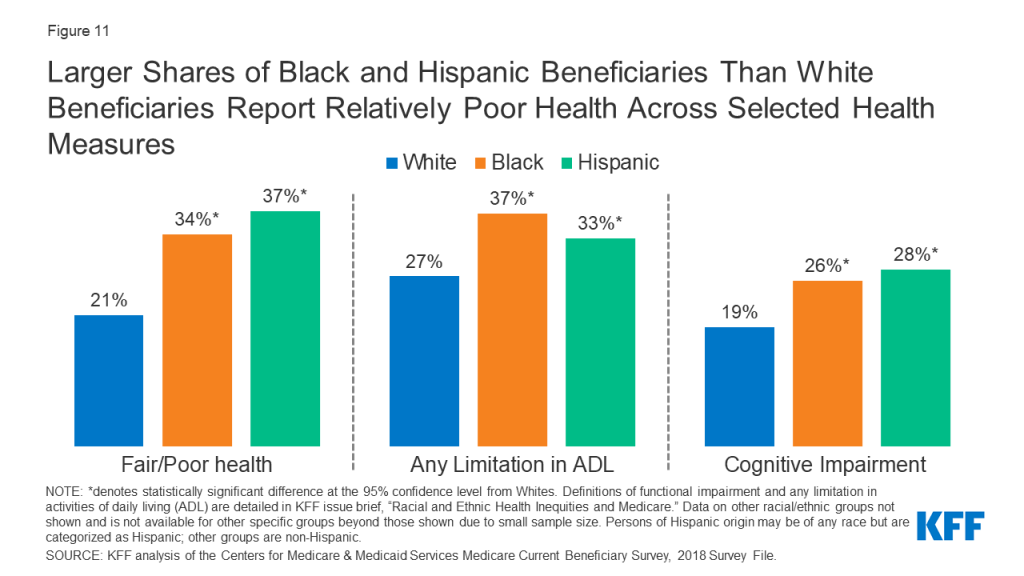
Figure 11: Larger Shares of Black and Hispanic Beneficiaries Than White Beneficiaries Report Relatively Poor Health Across Selected Health Measures

Black and Hispanic Beneficiaries have Higher Prevalence Rates of Certain Chronic Conditions Than White Beneficiaries

The prevalence of certain diseases and chronic conditions varies by race and ethnicity among Medicare beneficiaries. Hypertension is highly prevalent among all Medicare beneficiaries (63%); however, Black and Hispanic beneficiaries have higher rates of hypertension than White beneficiaries (79%, 65%, and 60%, respectively) (Figure 12, Table 3). Additionally, close to half of Black and Hispanic beneficiaries have diabetes, compared to 30% of White beneficiaries. Research has shown that among Medicare beneficiaries with diabetes, Black and Hispanic beneficiaries have the highest amputation rates.27  While the prevalence of stroke is low among all Medicare beneficiaries, the rate is higher among Black beneficiaries than White beneficiaries.
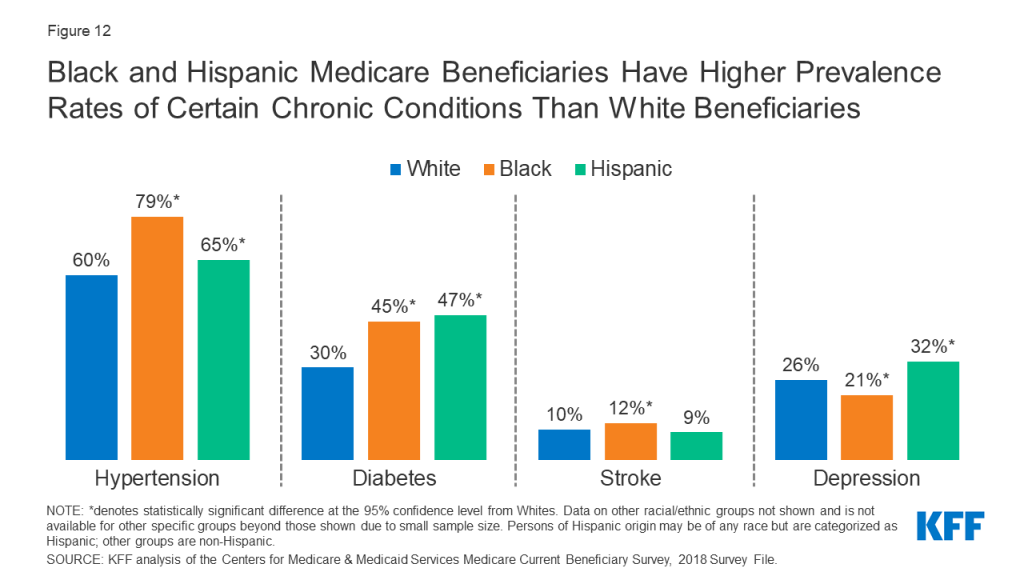
Figure 12: Black and Hispanic Medicare Beneficiaries Have Higher Prevalence Rates of Certain Chronic Conditions Than White Beneficiaries

For other conditions, Black and/or Hispanic beneficiaries have lower prevalence rates than White beneficiaries, including cancer, where prevalence rates are 15% for both Black and Hispanic beneficiaries and 19% for White beneficiaries (Table 3). While a larger share of Hispanic beneficiaries (32%) than White (26%) beneficiaries report depression, a smaller share of Black beneficiaries (21%) report depression compared to White beneficiaries. Hispanic beneficiaries have lower prevalence rates of heart disease (25%) and pulmonary disease (16%) than White beneficiaries (33% and 20%, respectively) (Table 3).

Report: Sources Of Coverage Among Medicare Beneficiaries

Black and Hispanic Medicare Beneficiaries Are Less Likely Than White Beneficiaries to Have Private Supplemental Insurance, but More Likely to Have Wrap-Around Medicaid coverage or Be Enrolled in Medicare Advantage

The vast majority of Medicare beneficiaries across all racial and ethnic groups have some source of supplemental coverage. However, sources of supplemental coverage in Medicare vary by race and ethnicity. While a quarter of White beneficiaries have Medigap, also known as Medicare Supplement Insurance, only 5% of Black beneficiaries and 7% of Hispanic beneficiaries do so (Figure 13, Table 2). Medigap helps to fill in the gaps in traditional Medicare by fully or partially covering Part A and Part B cost-sharing requirements. Black and Hispanic beneficiaries are also less likely than White beneficiaries to have employer or union-sponsored retiree health benefits to supplement Medicare.
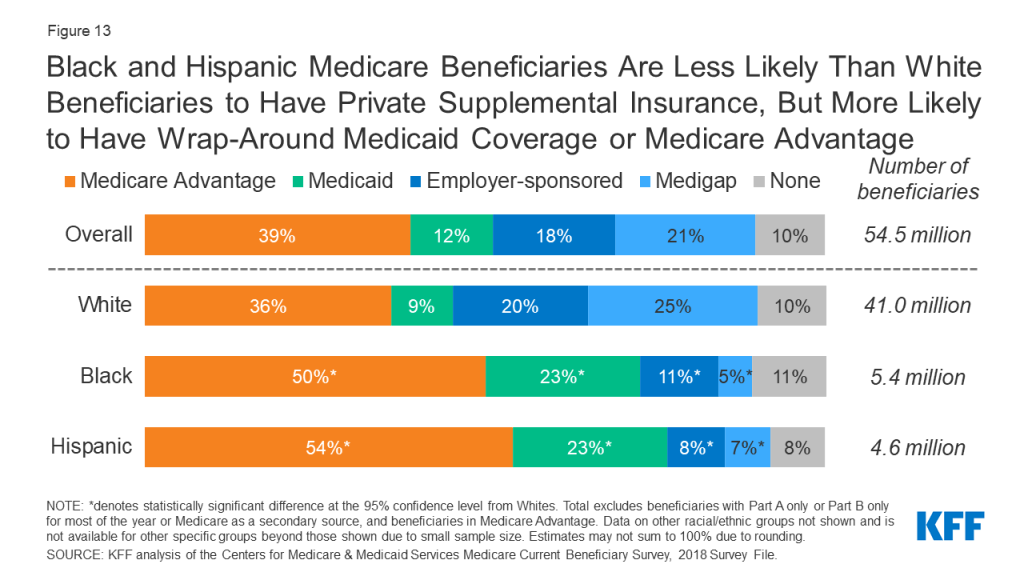
Figure 13: Black and Hispanic Medicare Beneficiaries Are Less Likely Than White Beneficiaries to Have Private Supplemental Insurance, But More Likely to Have Wrap-Around Medicaid Coverage or Medicare Advantage

Medicaid provides supplemental coverage to nearly a quarter (23%) of Black and Hispanic beneficiaries, the federal-state program that provides coverage to low-income people, compared to just 9% of White beneficiaries.  Additionally, half of Black (50%) and Hispanic (54%) beneficiaries were enrolled in a Medicare Advantage plan in 2018, as compared to just over one third of all White beneficiaries (36%).

Black and Hispanic Beneficiaries Account for a Disproportionate Share of Beneficiaries Dually Eligible for Both Medicare and Medicaid

Medicaid, the federal-state program that provides coverage to low-income people, is a source of supplemental coverage for Medicare beneficiaries with low incomes and modest assets. Most dually eligible beneficiaries receive both full Medicaid benefits, including long-term services and supports, and payment of their Medicare premiums and cost sharing. Others do not qualify for full Medicaid benefits, but Medicaid covers their Medicare premiums and/or cost sharing through the Medicare Savings Programs.

Together, Black and Hispanic beneficiaries account for 18% of the total Medicare population, but 40% of the Medicare-Medicaid dually eligible population (Figure 14). Compared to all traditional Medicare beneficiaries, dual-eligible beneficiaries are more likely to report poor/fair health status, have lower income, and qualify for Medicare due to a permanent disability.
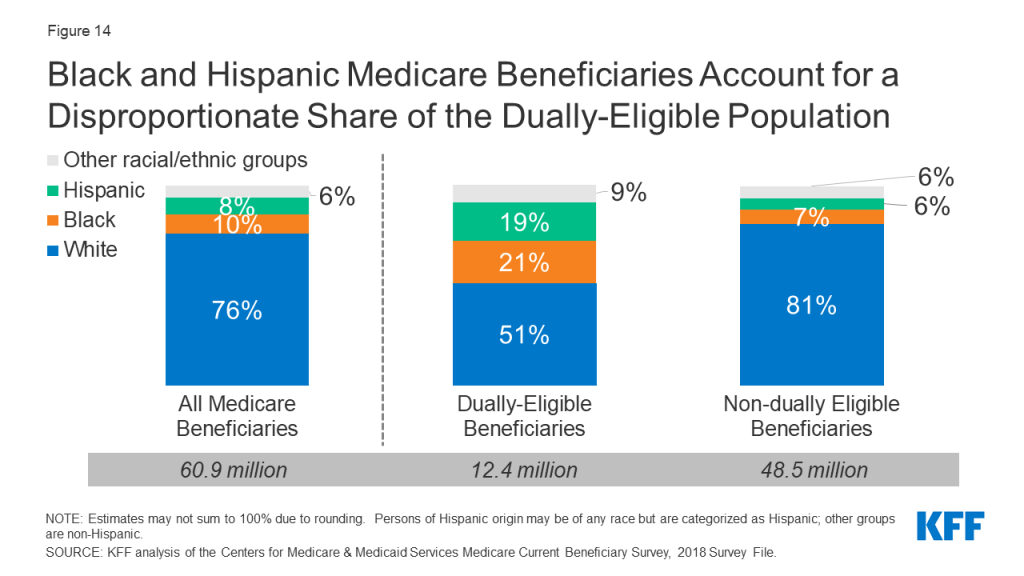
Figure 14: Black and Hispanic Medicare Beneficiaries Account for a Disproportionate Share of the Dually-Eligible Population

Black and Hispanic Medicare Beneficiaries With Part D Prescription Drug Coverage Are More Likely Than Their White Counterparts to Receive Low-Income Subsidies

The Medicare Part D program provides outpatient prescription drug coverage to Medicare beneficiaries. The majority (70%) of Medicare beneficiaries were enrolled in a Part D drug plan in 2018, with rates of Part D enrollment higher among Black (72%) and Hispanic (75%) beneficiaries than White beneficiaries (70%) (Figure 15).
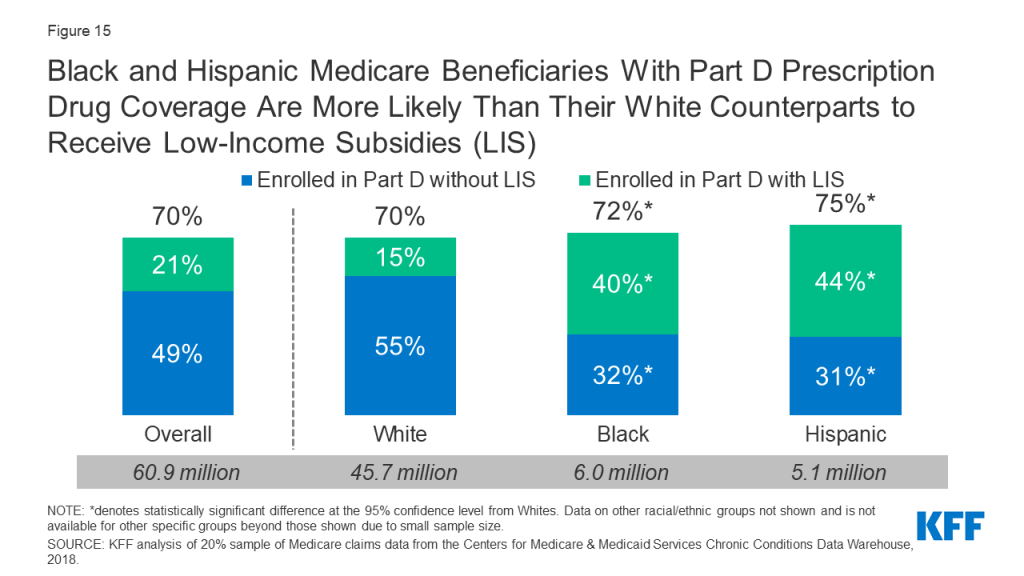
Figure 15: Black and Hispanic Medicare Beneficiaries With Part D Prescription Drug Coverage Are More Likely Than Their White Counterparts to Receive Low-Income Subsidies (LIS)

This may be partly a function of higher rates of enrollment in Medicaid among Black and Hispanic Medicare beneficiaries than among White beneficiaries, since dual-eligible beneficiaries are automatically enrolled in the Part D program and the Part D Low-Income Subsidy (LIS) program, which provides assistance with Part D premiums and cost sharing. Substantially larger shares (40% and 44%, respectively) of all Black and Hispanic beneficiaries were enrolled in Part D and received premium and cost-sharing assistance through the LIS program, compared to 15% of White beneficiaries.

Report: Access To Care And Service Utilization

While a Small Share of Medicare Beneficiaries Overall Report Access Problems, Black and Hispanic Beneficiaries are More Likely than White Beneficiaries to Report Trouble Getting Needed Care

Overall, relatively few Medicare beneficiaries report problems with access to care, with no significant differences across racial and ethnic groups in the share of beneficiaries without a usual source of care or in the share of beneficiaries delaying needed care. These findings illustrate the importance of health insurance coverage in ensuring access to care and mitigating racial and ethnic disparities in some measures of access.

However, a larger share of Black (10%) and Hispanic (11%) beneficiaries than White beneficiaries (6%) report trouble getting needed care (Figure 16). Recent analysis by the Medicare Payment Advisory Commission (MedPAC) found that in 2019, among Medicare beneficiaries ages 65 and older, people of color were more likely than White beneficiaries to report unwanted delays in getting an appointment and problems finding a new specialist. This pattern was also observed among privately insured adults ages 50-64.
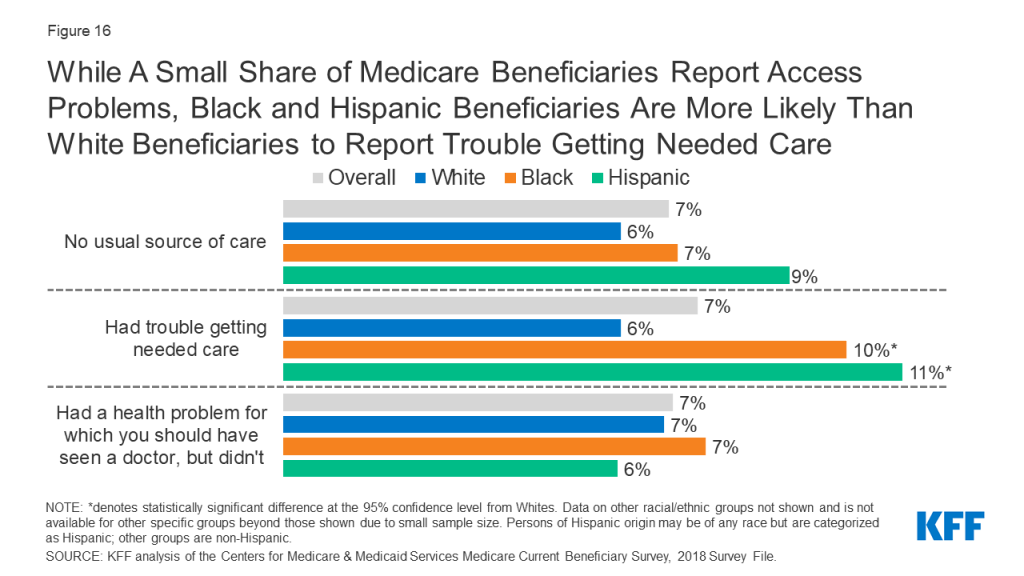
Figure 16: While A Small Share of Medicare Beneficiaries Report Access Problems, Black and Hispanic Beneficiaries Are More Likely Than White Beneficiaries to Report Trouble Getting Needed Care

A larger share of Black and Hispanic beneficiaries than White beneficiaries report problems paying medical bills (21%, 13%, and 9%, respectively) and delaying care due to cost (14%, 12%, and 10% respectively).  Among those with problems paying medical bills, a larger share of Black beneficiaries report debt to collection agencies due to medical bills than White beneficiaries (13% versus 4%, respectively) (Figure 17).

Figure 17: Black Medicare Beneficiaries Are More Likely to Report Cost-Related Barriers to Care Compared to White Beneficiaries

Among Beneficiaries in Traditional Medicare, Black and Hispanic Beneficiaries Were Less Likely Than White Beneficiaries to Report a Physician or Dental Visit in the Last Year

The majority of all beneficiaries in traditional Medicare saw at least one physician in 2018. However, the rate was lower among Black and Hispanic beneficiaries than among White beneficiaries (70% and 67%, respectively, compared to 79%). (Figure 18).
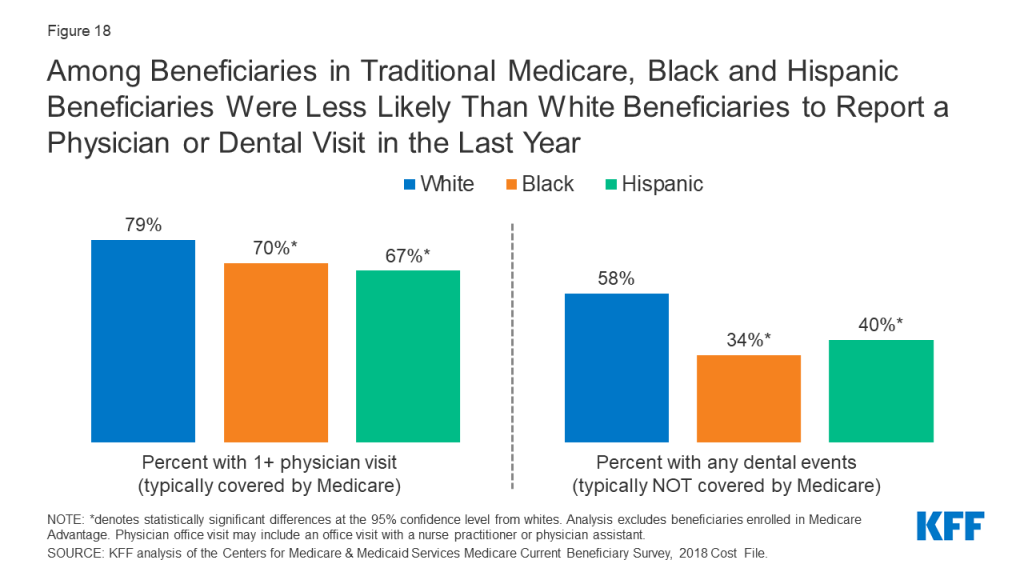
Figure 18: Among Beneficiaries in Traditional Medicare, Black and Hispanic Beneficiaries Were Less Likely Than White Beneficiaries to Report a Physician or Dental Visit in the Last Year

While traditional Medicare provides coverage for an array of medical services, it does not cover routine dental care. Consequently, in 2018, just over half (54%) of the Medicare population saw a dentist in the past year, with lower rates among Black beneficiaries (34%) and Hispanic beneficiaries (40%) than among White beneficiaries (58%) (Table 5).

Among Beneficiaries in Traditional Medicare, a Larger Share of Black Beneficiaries Had One or More Inpatient Stays and Emergency Department Visits Than White Beneficiaries

Among beneficiaries in traditional Medicare, a larger share of Black beneficiaries had an inpatient hospital stay than White beneficiaries (22% versus 15%, respectively) (Figure 19). The share of beneficiaries reporting at least two inpatient stays was also higher among Black beneficiaries (7%) than among White beneficiaries (4%) (Table 5). Racial/ethnic differences in inpatient stays (1+ days and 2+ days) did not differ significantly by self-reported health status.

Figure 19: Among Beneficiaries in Traditional Medicare, a Larger Share of Black Beneficiaries Had One or More Inpatient Stays and Emergency Department Visits Than White Beneficiaries

A larger share of Black beneficiaries had one or more emergency department (ED) visits compared to White beneficiaries (41% versus 27%, respectively). In contrast to inpatient hospital stays, racial differences in ED visit rates by self-reported health status were observed. Specifically, Black beneficiaries in fair/poor health status were more likely than White beneficiaries of similar health status to report any emergency department visit (59% versus 43%, respectively). But even among Medicare beneficiaries in relatively better health (defined as excellent, very good, or good self-reported health status), Black beneficiaries were more likely than White beneficiaries to have an emergency department visit (30% vs. 21%, respectively). Additionally, the share of Black beneficiaries with two or more ED visits (24%) was twice as large as the share among White beneficiaries (12%).

Emergency Department Visit Rates for Hypertension, Diabetes, Stroke, and Heart Failure were Higher among Black Medicare Beneficiaries than Beneficiaries in Other Racial and Ethnic Groups

Among Medicare beneficiaries diagnosed with hypertension, the rate of ED visits among Black beneficiaries (53 per 1,000 people) was at least double the rates among White and Asian beneficiaries (22 and 21 visits per 1,000 people, respectively) and nearly double the rates among Hispanic and American Indian and Alaska Native beneficiaries (Figure 20). Among beneficiaries diagnosed with diabetes, ED visit rates among Black, Hispanic, and American Indian and Alaska Native beneficiaries (22, 17, and 20 visits per 1,000 beneficiaries, respectively) were at least double the rates among White and Asian beneficiaries (8 visits per 1,000 beneficiaries). Asian and Pacific Islander beneficiaries had lower ED visit rates for hypertension, diabetes, stroke, and heart failure compared to beneficiaries in other racial and ethnic groups.

Hospital Readmission Rates are Higher among Black Medicare Beneficiaries than Beneficiaries in Other Racial and Ethnic Groups

The Hospital Readmissions Reduction Program (HRRP), which has been in place since 2012, aims to reduce avoidable hospital readmission rates and improve quality of care by imposing payment penalties on hospitals with excess readmission rates for certain health conditions. In 2018, 30-day readmission rates among Medicare beneficiaries in traditional Medicare were higher among Black beneficiaries (19%) than among White beneficiaries (14%), Hispanic beneficiaries (17%), Asian/Pacific Islander beneficiaries (14%), and American Indian/Alaska Native beneficiaries (16%) (Figure 21). Black beneficiaries had higher odds of being readmitted to a hospital than White beneficiaries, regardless of diagnosis during the first hospitalization or discharge setting.

Black and Hispanic Medicare Beneficiaries are More Likely to be Hospitalized at 1-Star Hospitals than 5-Star Hospitals

CMS’s overall hospital quality star rating summarizes hospital performance on various measures, such as rates of readmissions, healthcare-associated infections, and value of care for certain health conditions (e.g., pneumonia) into a single star rating for each hospital, which ranges from 1 star (lowest quality) to 5 stars (highest quality). In 2018, Black and Hispanic beneficiaries accounted for 28% and 11% of discharges from 1-star hospitals, respectively, but only 7% and 5% of discharges from 5-star hospitals, respectively (Figure 22).
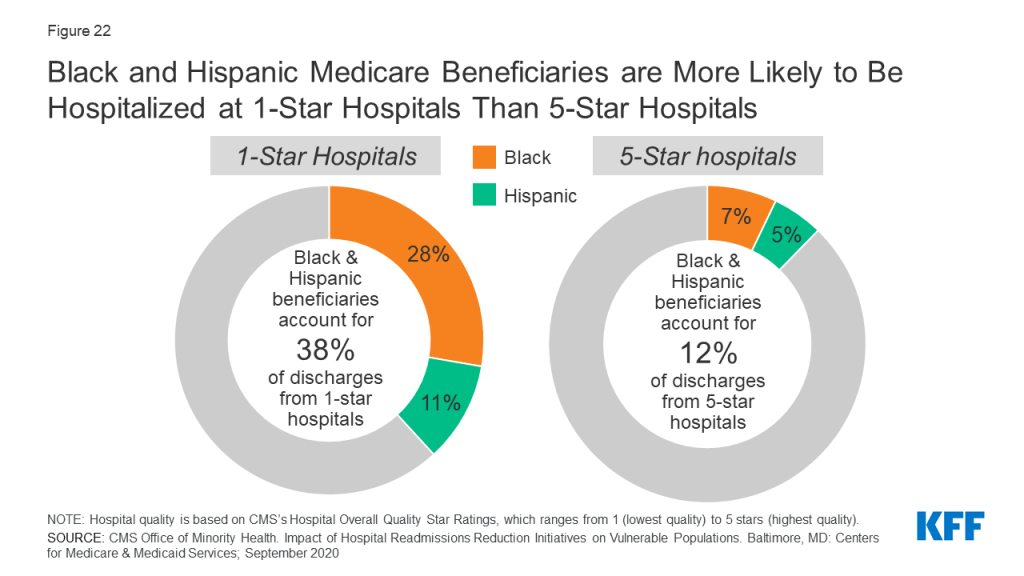
Figure 22: Black and Hispanic Medicare Beneficiaries are More Likely to Be Hospitalized at 1-Star Hospitals Than 5-Star Hospitals

Black and Hispanic Beneficiaries Report Lower Utilization Rates Than White Beneficiaries of Some Prevention Services

Medicare provides coverage for a wide range of preventive and screening services, including a “Welcome to Medicare” physical exam during the first year of Medicare enrollment, immunization for various conditions (including influenza), and screening exams for cancers.

Overall, less than a quarter (21%) of male beneficiaries ages 50 and older reported receiving a prostate cancer screening, with no statistically significant differences by race or ethnicity (Figure 23). Less than half (43%) of all female beneficiaries ages 40 and older reported receiving a mammogram in the past year, with Black and Hispanic beneficiaries being more likely than White beneficiaries to receive a mammogram in the past year (51%, 49%, 42%, respectively).
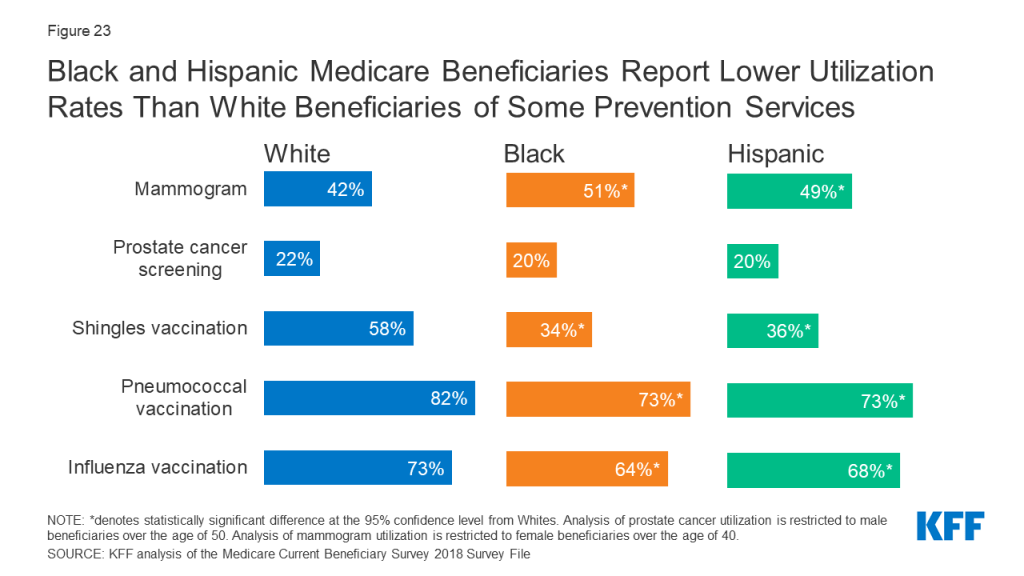
Figure 23: Black and Hispanic Medicare Beneficiaries Report Lower Utilization Rates Than White Beneficiaries of Some Prevention Services

Notable racial and ethnic disparities in immunization rates were also observed among Medicare beneficiaries. Smaller shares of Black and Hispanic beneficiaries reported receiving a flu vaccination than White beneficiaries (64%, 68%, and 73%, respectively). Research has shown that the gap in flu vaccination is even greater when it comes to receipt of high-dose influenza vaccine,28  which is specifically targeted to adults ages 65 and older. Additionally, compared to White beneficiaries, Black and Hispanic beneficiaries had lower rates of pneumococcal vaccination and shingles vaccination. Several potential factors may contribute to racial and ethnic disparities in vaccination uptake, including, but not limited to, differential access to and use of preventive health care services, concerns or misconceptions about vaccine safety, and persistent medical mistrust rooted in a history of racial discrimination and mistreatment in the health care sector.

Report: Covid-19

COVID-19 Death Rates Among Hispanic, American Indian/Alaska Native, and Black Adults Ages 65 and Older are Nearly Double the Rate Among Older White Adults

People of color have experienced disproportionate rates of COVID-19 cases, hospitalizations, and deaths. Specifically, among adults ages 65 and older, the mortality rates per 100,000 people were higher for older Hispanic adults (1,050 deaths per 100,000), older American Indian/Alaska Native adults (966 deaths per 100,000), and older Black adults (900 deaths per 100,000) than for older White adults (561 deaths per 100,000) (Figure 24).

Among Adults Ages 65 and Older, COVID-19 Represents a Larger Share of Deaths Among People of Color than White People Since January 2020

Among older Hispanic adults, COVID-19 deaths account for 25% of all causes of death—2.3 times higher than the share among older White adults (11%) (Figure 25). For older American Indian/Alaska Native, Asian, Black, and Native Hawaiian or Other Pacific Islander adults, COVID-19 deaths account for 23%, 17%, 16%, and 16% of deaths from all causes, respectively.

COVID-19 Cases Are Higher Among American Indian/Alaska, Hispanic, and Black Beneficiaries Than Among White Beneficiaries

From January 1 to November 21, 2020, COVID-19 cases among American Indian and Alaska Native, Black, and Hispanic Medicare beneficiaries (4,598, 4,343, and 4,243 cases per 100,000 respectively) were 1.7, 1.6, and 1.6 times higher, respectively, than among White beneficiaries (2, 655 cases per 100,000) (Figure 26).

COVID-19 Hospitalization Rates Are Higher Among American Indian/Alaska Native, Black, and Hispanic Beneficiaries Than Among White Beneficiaries

From January 1, 2020 to November 21, 2020, hospitalization rates for American Indian/Alaska Native, Black, and Hispanic Medicare beneficiaries were 2.9 times, 2.7 times, and 2.1 times respectively, higher than White beneficiaries (592 hospitalizations per 100,000) (Figure 27).

Analysis of patient data from health records shows that in addition to having higher rates of infections, hospitalizations, and mortality, people of color have been more likely to require more intensive level of treatment at the time of COVID-19 diagnosis, such as inpatient hospitalization or the use of oxygen and ventilation. Further, the COVID-19 pandemic has exacerbated mental health outcomes among older Hispanic adults, with older Hispanic adults reporting higher rates of depression or anxiety (33%) than older White (23%), Black (26%), and Asian (17%) adults.

The CARES Act includes a provision requiring Medicare Part B to cover a vaccine for COVID-19 at no cost to Medicare beneficiaries. However, 35% of Black adults ages 18 and older say they would definitely or probably not get a vaccine even if it was deemed safe by scientists and offered at no cost, with about half (48%) saying they are not confident that the needs of Black people are being accounted for in the COVID-19 vaccine development process. This finding reflects well-founded medical mistrust among African Americans, based on a history of racial abuse and malpractice within the medical system, as exemplified by the Tuskegee syphilis experiment, involuntary medical experimentation of Henrietta Lacks,29  and ongoing forms of medical racism, such as under prescribing of pain medications for Black people due to racial bias.

Nursing Homes with Relatively High Shares of Black or Hispanic Residents Were More Likely to Have At Least One COVID-19 Death

Older adults in long-term care facilities, such as nursing homes, have also been disproportionately impacted by the COVID-19 pandemic, with long-term facilities accounting for 7% of total cases and 40% of total deaths in the U.S. More than half of nursing homes with a high share (defined as 20% or more of residents) of Black residents (63%) and Hispanic residents (55%) reported at least one COVID-19 death, compared to 37% of nursing homes with a high share of White residents (Figure 28).
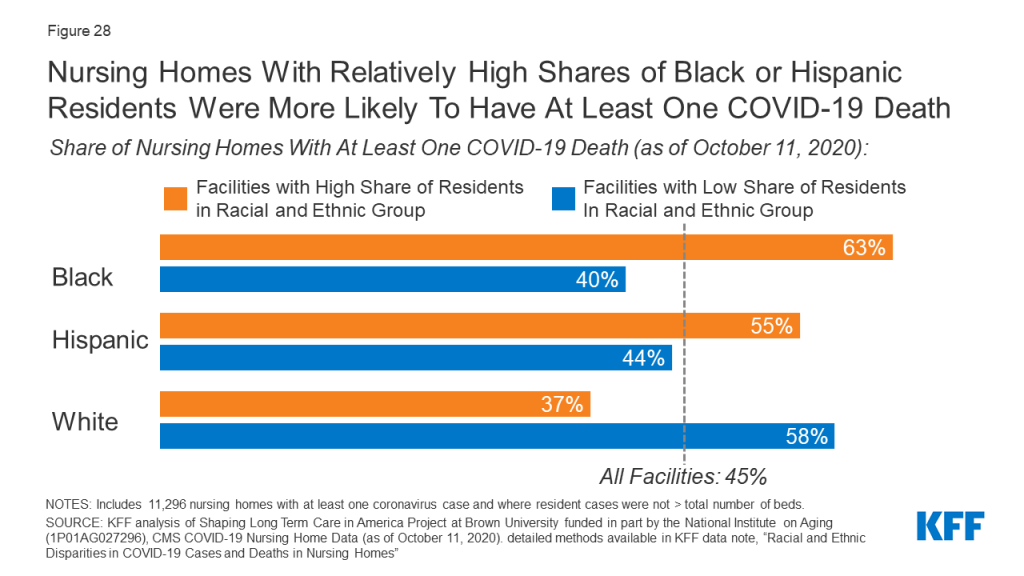
Figure 28: Nursing Homes With Relatively High Shares of Black or Hispanic Residents Were More Likely To Have At Least One COVID-19 Death

Nancy Ochieng, Juliette Cubanski, Tricia Neuman, and Samantha Artiga are with KFF. Anthony Damico is an independent consultant.

Methods

Data Sources Used in Analysis

The Centers for Medicare & Medicaid Services (CMS) 2018 Chronic Conditions Data Warehouse (CCW) was used to provide state-level estimates of the Medicare population, by race and ethnicity.

The CMS Medicare Current Beneficiary Survey (MCBS) 2018 Survey File was used to describe Medicare beneficiary characteristics, supplemental coverage, and access to care. The analysis on supplemental coverage was limited to beneficiaries enrolled in Part A and Part B for most months of the year, excluding those with Part A or Part B only and Medicare as a Secondary Payer for most months of the year. The MCBS 2018 Cost Supplement File was used to describe service utilization among Medicare beneficiaries in fee-for-service (FFS).

Analysis on Medicare Part D enrollment was based on prescription drug event claims data from a sample of Medicare beneficiaries (20% sample for 2018) from the CMS Chronic Conditions Data Warehouse (CCW).

The CMS Office of Minority Health’s Mapping Medicare Disparities Tool, which uses 2018 administrative claims data from the Chronic Conditions Warehouse, was used to describe emergency department visit rates. This data was limited to Medicare beneficiaries enrolled in FFS. Medicare Advantage enrollees were excluded from this analysis because claims data are not available for these beneficiaries.

The CMS Office of Minority Health’s report, Impact of Hospital Readmissions Reduction Initiatives on Vulnerable Populations, which uses 2016 administrative claims data from the CCW, was used to describe 30-day hospital inpatient readmissions in Medicare FFS beneficiaries.

Urban Institute’s Dynamic Simulation of Income Model (DYNASIM4) was used to describe Medicare beneficiaries’ income and assets in 2019. Detailed methodology is previously discussed here.

The 2018-2020 Current Population Survey March Annual Social and Economic Supplement (CPS ASEC) was used to provide subgroup estimates of poverty under the official and supplemental poverty measure over the period of 2017-2019. The 2020 CPS-ASEC was used to produce poverty rates for all older adults in 2019 The poverty rates presented in this analysis apply to the non-institutionalized Medicare population. The CPS ASEC poverty thresholds are different from the Health and Human Services (HHS) poverty guidelines (sometimes referred to as the “federal poverty level”). Detailed methodology is previously discussed here.

Data from the U.S Census Bureau’s 2017 National Population Projection Main Series was used for U.S population estimates among people ages 65 and over.

Elizabeth Arias and Jiaquan Xu, “United States Life Tables, 2018” National Vital Statistics Reports 69, no. 12 (November 2020) was used to describe life expectancy at age 65 by race and gender.

Data on COVID-19 cases and hospitalization rates among Medicare beneficiaries were obtained from CMS’ Preliminary Medicare COVID-19 Data Snapshot ( https://www.cms.gov/research-statistics-data-systems/preliminary-medicare-covid-19-data-snapshot).

Data on COVID-19 deaths among adults ages 65 and over were obtained from the Centers for Disease Control and Prevention, “Deaths involving coronavirus disease 2019 (COVID-19) by race and Hispanic origin group and age, by state” as of February 3, 2021 ( https://data.cdc.gov/NCHS/Deaths-involving-coronavirus-disease-2019-COVID-19/ks3g-spdg). The CDC WONDER online database was used to obtain 2019 U.S Census Bureau single-race population estimates in order to calculate death rates per 100,000 people.

Tables

Endnotes

  1. David Barton Smith, The Power to Heal: Civil Rights, Medicare, and the Struggle to Transform America’s Health Care System (Nashville: Vanderbilt University Press, 2016). ↩︎
  2. Emily A. Largent, “Public Health, Racism, and the Lasting Impact of Hospital Segregation,” Public Health Reports 133, no. 6 (2018): 715–20, https://doi.org/10.1177/0033354918795891. ↩︎
  3. Anouk Lloren et al., “Measuring Hospital-Specific Disparities by Dual Eligibility and Race to Reduce Health Inequities,” Health Services Research 54, no. February (2019): 243–54, https://doi.org/10.1111/1475-6773.13108. ↩︎
  4. Nicholas S. Downing et al., “Association of Racial and Socioeconomic Disparities With Outcomes Among Patients Hospitalized With Acute Myocardial Infarction, Heart Failure, and Pneumonia: An Analysis of Within- and Between-Hospital Variation,” JAMA Network Open 1, no. 5 (2018): e182044, https://doi.org/10.1001/jamanetworkopen.2018.2044. ↩︎
  5. Yue Li et al., “Medicare Advantage Associated With More Racial Disparity Than Traditional Medicare For Hospital Readmissions,” Health Affairs 36, no. 7 (2017): 1328–35, https://doi.org/10.1377/hlthaff.2016.1344. ↩︎
  6. Downing et al., “Association of Racial and Socioeconomic Disparities With Outcomes Among Patients Hospitalized With Acute Myocardial Infarction, Heart Failure, and Pneumonia: An Analysis of Within- and Between-Hospital Variation.” ↩︎
  7. Maricruz Rivera-hernandez et al., “Racial Disparities in Readmission Rates among Patients Discharged to Skilled Nursing Facilities,” Journal of the American Geriatrics Society 67, no. 8 (2019): 1672–79, https://doi.org/10.1111/jgs.15960.Racial. ↩︎
  8. Jolyn Taylor et al., “Disparities in Treatment and Survival among Elderly Ovarian Cancer Patients,” Gynecologic Oncology 151, no. 2 (2018): 269–94, https://doi.org/10.1016/j.ygyno.2018.08.041. ↩︎
  9. Jeffrey H. Silber et al., “Disparities in Breast Cancer Survival by Socioeconomic Status Despite Medicare and Medicaid Insurance,” Milbank Quarterly 96, no. 4 (2018): 706–54, https://doi.org/10.1111/1468-0009.12355. ↩︎
  10. Ikumi Suzuki et al., “Racial Disparities in Outcome among Head and Neck Cancer Patients in the United States: An Analysis Using SEER-Medicare Linked Database.,” Journal of Clinical Oncology 37, no. 15 (2018): 6051–6051, https://doi.org/10.1200/JCO.2019.37.15_suppl.6051. ↩︎
  11. Clara Lam et al., “Differences in Cancer Survival among White and Black Cancer Patients by Presence of Diabetes Mellitus: Estimations Based on SEER-Medicare-Linked Data Resource,” Cancer Medicine 7, no. 7 (2018): 3434–44, https://doi.org/10.1002/cam4.1554. ↩︎
  12. Sikander Ailawadhi et al., “Racial Disparities in Treatment Patterns and Outcomes among Patients with Multiple Myeloma: A SEER-Medicare Analysis,” Blood Advances 3, no. 20 (2019): 2986–94, https://doi.org/10.1182/bloodadvances.2019000308. ↩︎
  13. Arline T Geronimus, “The Weathering Hypothesis and the Health of African-American Women and Infants: Evidence and Speculations.,” Ethn Dis. 2, no. 3 (1992): 207–21. ↩︎
  14. Arline T. Geronimus et al., “‘Weathering’ and Age Patterns of Allostatic Load Scores among Blacks and Whites in the United States,” American Journal of Public Health 96, no. 5 (2006): 826–33, https://doi.org/10.2105/AJPH.2004.060749. ↩︎
  15. Dinorah Martinez Tyson et al., “Unpacking Hispanic Ethnicity—Cancer Mortality Differentials Among Hispanic Subgroups in the United States, 2004–2014,” Frontiers in Public Health 6, no. August (2018): 1–11, https://doi.org/10.3389/fpubh.2018.00219. ↩︎
  16. Fatima Rodriguez et al., “Disaggregation of Cause-Specific Cardiovascular Disease Mortality Among Hispanic Subgroups,” JAMA Cardiology 2, no. 3 (2017): 240–47, https://doi.org/10.1001/jamacardio.2016.4653. ↩︎
  17. Robert Grove and Alice Hetzel, Vital Statistics Rates in the United States: 1940-1960 (Washington, DC: U.S Government Printing Office, 1968); Elizabeth Arias, Brian L. Rostron, and Tejada-Vera Betzaida, “United States Life Tables, 2005,” National Vital Statistics Reports 58, no. 10 (2010); Jiaquan Xu et al., “Deaths: Final Data for 2007,” National Vital Statistics Reports 58, no. 19 (2010), available at https://www.cdc.gov/nchs/data/hus/2010/022.pdf. ↩︎
  18. Jennifer Van Hook, Michelle Frisco, and Carlyn Graham, “Signs of the End of the Paradox? Cohort Shifts in Smoking and Obesity and the Hispanic Life Expectancy Advantage,” Sociological Science 7 (2020): 391–414, https://doi.org/10.15195/v7.a16. ↩︎
  19. Michelle L. Frisco, Jennifer Van Hook, and Robert A. Hummer, “Would the Elimination of Obesity and Smoking Reduce U.S. Racial/Ethnic/Nativity Disparities in Total and Healthy Life Expectancy?,” SSM – Population Health 7 (2019): 100374, https://doi.org/10.1016/j.ssmph.2019.100374. ↩︎
  20. Van Hook, Frisco, and Graham, “Signs of the End of the Paradox? Cohort Shifts in Smoking and Obesity and the Hispanic Life Expectancy Advantage.” ↩︎
  21. National Academies of Sciences, Engineering, and Medicine, Social Isolation and Loneliness in Older Adults: Opportunities for the Health Care System (Washington, DC: The National Academies Press, 2020). ↩︎
  22. Alexandra Killewald and Brielle Bryan, “Falling Behind: The Role of Inter- and Intragenerational Processes in Widening Racial and Ethnic Wealth Gaps through Early and Middle Adulthood,” Social Forces 97, no. 2 (2018): 705–40. ↩︎
  23. Tyson H. Brown, “Diverging Fortunes: Racial/Ethnic Inequality in Wealth Trajectories in Middle and Late Life,” Race and Social Problems 8, no. 1 (2016): 29–41, https://doi.org/10.1007/s12552-016-9160-2. ↩︎
  24. Raj Chetty et al., “Race and Economic Opportunity in the United States: An Intergenerational Perspective” (Cambridge, MA, 2018), https://www.nber.org/system/files/working_papers/w24441/w24441.pdf. ↩︎
  25. Ling Na et al., “Activity Limitation Stages Are Associated With Risk of Hospitalization Among Medicare Beneficiaries,” PM and R 9, no. 5 (2017): 433–43, https://doi.org/10.1016/j.pmrj.2016.09.008. ↩︎
  26. Jibby E. Kurichi et al., “Predicting 3-Year Mortality and Admission to Acute-Care Hospitals, Skilled Nursing Facilities, and Long-Term Care Facilities in Medicare Beneficiaries,” Archives of Gerontology and Geriatrics 73 (2017): 248–56, https://doi.org/10.1016/j.archger.2017.08.005. ↩︎
  27. Bjoern Suckow et al., “Hemoglobin A1c Testing and Amputation Rates in Black, Hispanic, and White Medicare Patients,” Annals of Vascular Surgery 36 (2016): 208–17, https://doi.org/10.1016/j.avsg.2016.03.035. ↩︎
  28. Laura L. Hall et al., “A Map of Racial and Ethnic Disparities in Influenza Vaccine Uptake in the Medicare Fee-for-Service Program,” Advances in Therapy 37, no. 5 (2020): 2224–35, https://doi.org/10.1007/s12325-020-01324-y. ↩︎
  29. Rebecca Skloot, The Immortal Life of Henrietta Lacks (Crown Publishing Group, 2010). ↩︎
Where Do Americans Get Vaccines and How Much Does It Cost to Administer Them?

Authors: Krutika Amin, Matthew Rae, Samantha Artiga, Greg Young, and Giorlando Ramirez
Published: Feb 16, 2021

A new issue brief shows where Americans typically get flu vaccines in the U.S. and how much it costs to administer flu and other vaccines. Among the analysis’ findings: while most people get flu vaccines at a doctor’s office or retail health clinic, White people are more likely than Black, Hispanic, Asian, and American Indian or Alaska Native adults to get vaccinated through a retail pharmacy or store – a discrepancy could have implications for the COVID-19 vaccine rollout.

The issue brief is available in full on the Peterson-KFF Health System Tracker, an online information hub dedicated to monitoring and assessing the performance of the U.S. health system.

News Release

States Set Different COVID-19 Vaccination Priorities for People with High-Risk Conditions

17 States So Far Have Opened Up Eligibility to At Least Some People in This Group

Published: Feb 16, 2021

People with medical conditions that put them at higher risk of developing serious COVID-19 illness are next in line to get vaccinated in many states, though states are making very different choices about how to prioritize those within this large group, finds a KFF analysis of state policies.

The U.S. Centers for Disease Control and Prevention (CDC) estimates that there are 81 million adults nationwide with conditions that it identifies as posing an increased risk of severe illness from COVID-19 and are therefore recommended to be prioritized for vaccination. This represents a substantial portion of the nation’s population and, with vaccine supply still limited, not all eligible people will be able to get vaccinated immediately. In addition, there are likely millions of others with a second set of medical conditions that the CDC says might put people at increased risk.

Among states that have released detailed information about how they are prioritizing people with high-risk conditions, 14 include all the conditions identified by the CDC as posing an increased risk in this priority group, while most other states vary from the CDC’s priorities, either limiting the high-risk conditions included, adding other conditions considered from the possible risk factor list, or creating their own list altogether. To date, 14 states have not yet shared their list of conditions or allude more generally to “high risk conditions” without detailing them.

The analysis finds:

  • As of Feb. 15, 17 states had opened up vaccine eligibility in part or in full to people with high-risk conditions, though additional states are expected to do so over the next few weeks.
  • Almost all states that list eligible conditions or rely on the CDC’s list of increased-risk conditions include cancer, chronic kidney disease, chronic obstructive pulmonary disease, heart conditions, organ transplant, sickle cell disease, and Type 2 diabetes in their priority populations. There is less consistency for other increased-risk conditions, including obesity (29 states), pregnancy (27), and smoking (16).
  • Six states also include all the conditions that might put people at an increased risk, while others include only some in their priority group. The most common conditions included are Type 1 diabetes (22) followed by immunocompromised state (19) and pulmonary fibrosis (16).
  • Most states do not provide detail on if or how eligibility will be confirmed. For those that do, most say they will rely on an individual’s self-attestation that they have a priority condition.

“Currently, if you have a major medical condition like cancer or kidney disease or COPD, how soon you have a chance to get vaccinated clearly depends on what state you live in”, KFF President and CEO Drew Altman said.

The wide variety in state approaches to prioritizing people with high-risk medical conditions mirrors their approaches with other phases of the vaccine rollout, resulting in different prioritization and eligibility across states and posing challenges for residents hoping to learn when they may be eligible.

This Week in Coronavirus: February 5 to February 11

Published: Feb 12, 2021

Here’s our recap of the past week in the coronavirus pandemic from our tracking, policy analysis, polling, and journalism.

COVID-19 vaccine continues with signs of progress and also continuing challenges as reported by KHN. KHN also asked readers to share their experiences searching for vaccinations.

In his column, Drew Altman shows why vaccine hesitancy will naturally decrease as more and more people see their family members and friends vaccinated without adverse consequences. He writes, “As vaccine hesitancy diminishes, efforts can focus most on the groups most likely to be persistently vaccine resistant, including in the Black community and rural America.”

Vaccine Monitor reports that nearly a third of the public wants to “wait and see” how COVID-19 vaccines work before getting one, examining how this group’s views vary by party ID and race/ethnicity in ways that could influence effective messaging.

Earlier this week a report looked at the public’s response to a series of open-ended questions aimed at better understanding people’s concerns around receiving a COVID-19 vaccine — and the views of the messages and messengers that could affect their willingness to get one. It includes direct quotes from the more than 1,000 people interviewed. This and other COVID-19 Vaccine Monitor content is available via a dashboard.

A KFF analysis finds that most older adults have not yet been vaccinated against the potentially deadly virus in the states reporting this data, as vaccine supplies remain limited and most states have only recently begun to make people 65 and older eligible.

Meanwhile, a new map and tables show who is currently eligible to receive the COVID-19 vaccine in each state by the following categories:

  • Age,
  • People with High-Risk Medical Conditions,
  • People Living in Congregate Settings,
  • K-12 School Personnel,
  • Law Enforcement and Public Safety Personnel,
  • Correctional Facility Inmates and Staff,
  • Grocery and Food Service Workers,
  • and Transit Workers.

An updated KFF brief explores what’s known about the pandemic’s impact on people’s mental health and substance use and its implications for Americans’ well-being. Among the conclusions: young adults have been especially hard hit, more women than men are facing mental health challenges, people experiencing job or income losses are at higher risk for problems, essential workers face greater challenges than other workers, and communities of color are disproportionately affected.

With the Biden Administration announcing that vaccines will ship directly to community health centers, a Policy Watch post looks at issues they will need to confront in proposing to use federally qualified centers as key distribution points for the vaccine.

Here are the latest coronavirus stats from KFF’s tracking resources:

Global Cases and Deaths: Total cases worldwide stand at nearly 108 million this week – with an increase of 2.9 million new confirmed cases in the past seven days. There were approximately 85,900 new confirmed deaths worldwide, bringing the total for confirmed deaths to nearly 2.4 million.

U.S. Cases and Deaths: Total confirmed cases in the U.S. approached 27.4 million this week. There was an increase of about 712,300 confirmed cases between Feb. 4 and Feb.11. Approximately 19,500 confirmed deaths in the past week brought the total in the United States to 475,400.

The latest KFF COVID-19 resources:

  • Updated: The Implications of COVID-19 for Mental Health and Substance Use (News Release, Issue Brief)
  • At This Early Stage of the COVID-19 Vaccine Roll-Out, Most Older Adults Have Not Yet Been Vaccinated As Supply Remains Limited (News Release, Issue Brief)
  • Seeing Others Vaccinated May Be The Best Cure For Vaccine Hesitancy (Full Column, Axios Column)
  • Biden Wants to Partner with Health Centers to Promote More Equitable Access to COVID-19 Vaccines (Policy Watch)
  • KFF COVID-19 Vaccine Monitor: In Their Own Words (News Release, Report)
  • Work Among Medicaid Adults: Implications of Economic Downturn and Work Requirements (Issue Brief)
  • KFF COVID-19 Vaccine Monitor: What Do We Know About Those Who Want to “Wait and See” Before Getting a COVID-19 Vaccine? (News Release, Report)
  • Funding for Health Care Providers During the Pandemic: An Update (Policy Watch)

The latest KHN COVID-19 stories:

  • Vaccine Hesitancy vs. Vaccine Refusal: Nursing Home Staffers Say There’s a Difference (KHN, NPR)
  • Schools Walk the Tightrope Between Ideal Safety and the Reality of Covid (KHN, USA Today)
  • Why the U.S. Is Underestimating Covid Reinfection (KHN, NBC News)
  • Farmworker Camps to Urban Tent Cities: Tailoring Vaccine Info to Where It’s Most Needed (KHN, Charlotte Observer)
  • Tech Companies Mobilize to Schedule Vaccine Appointments, But Often Fall Short (CHL)
  • As Pandemic Surged, Contact Tracing Struggled; Biden Looks to Boost It (KHN, US News)
  • Pandemic-Fueled Alcohol Abuse Creates Wave of Hospitalizations for Liver Disease (KHN, LA Times)
  • Community Health Workers, Often Overlooked, Bring Trust to the Pandemic Fight (KHN)
  • After Nearly 60 Years of Marriage, This Missouri Couple Stayed Together to the End (KHN, St. Louis Post Dispatch)
  • Native Americans Use Technology to Keep Traditions, Language Alive During Pandemic (KHN, CNN)
  • Lost on the Frontline: New this week (KHN, The Guardian)
  • Scalise’s Claim That Unauthorized Immigrants Are Getting Priority for Vaccination Misses the Point (KHN)
  • Health Workers and Hospitals Grapple With Millions of Counterfeit N95 Masks (KHN, NBC)
  • Counterfeit N95 Scam Widens as Senator Demands FTC Investigation (KHN)
  • Vaccines Go Mobile to Keep Seniors From Slipping Through the Cracks (CHL)
  • Vaccine Equity Is ‘North Star,’ Feds Say, and Clinics Are Key to Fair Distribution (KHN, NPR)
  • Lack of Covid Data on People with Intellectual Disabilities ‘Comes With a Body Count’ (KHN, NPR)
News Release

Reasons Vary Why People Want to “Wait and See” Before Getting a COVID-19 Vaccine.

Published: Feb 12, 2021

Nearly a third (31%) of the public says they want to “wait and see” how a COVID-19 vaccine works for others before they would get it, representing a critical group for efforts aimed at boosting vaccinations.

The latest analysis from the KFF COVID-19 Vaccine Monitor highlights how attitudes differ by partisan identification and race and ethnicity in ways that could affect what vaccination messages are most persuasive to subgroups. For example:

  • Republicans and Republican-leaning independents in the “wait and see” group are more likely to believe that the threat posed by COVID-19 is exaggerated and that vaccination is a personal choice. Messages that focus on how getting vaccinated can protect people’s own health and the health of their families may resonate more with Republican audiences than those that emphasize the seriousness of the pandemic or the broader societal benefits.
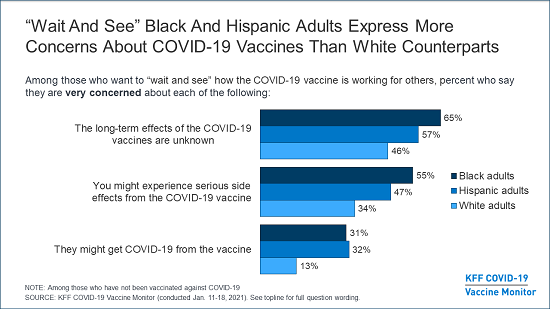
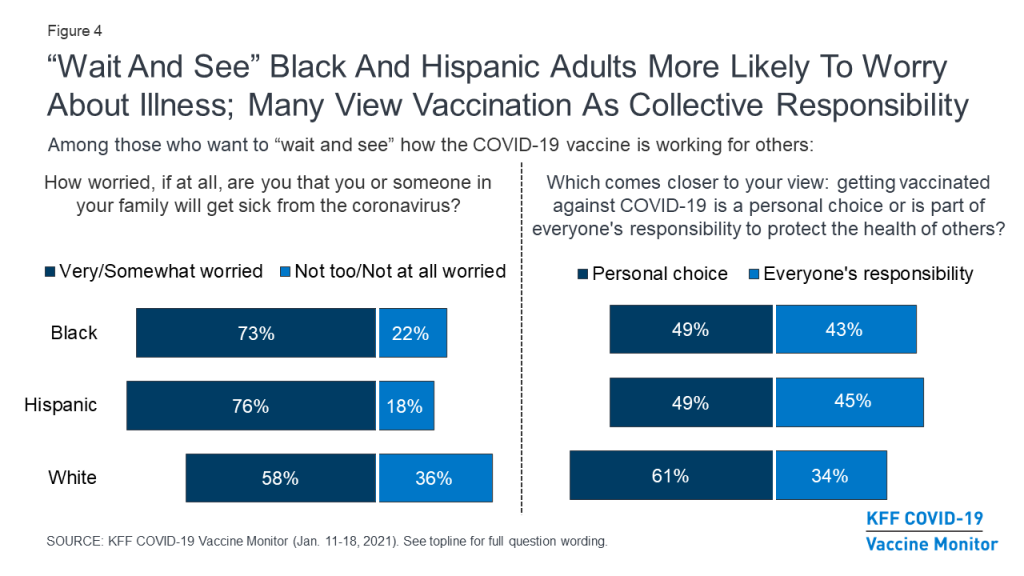
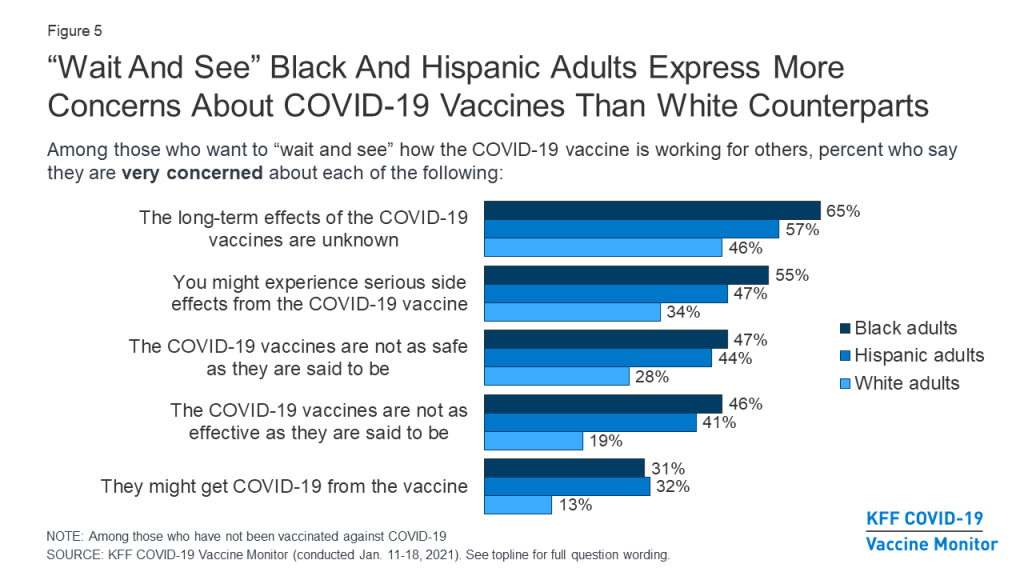
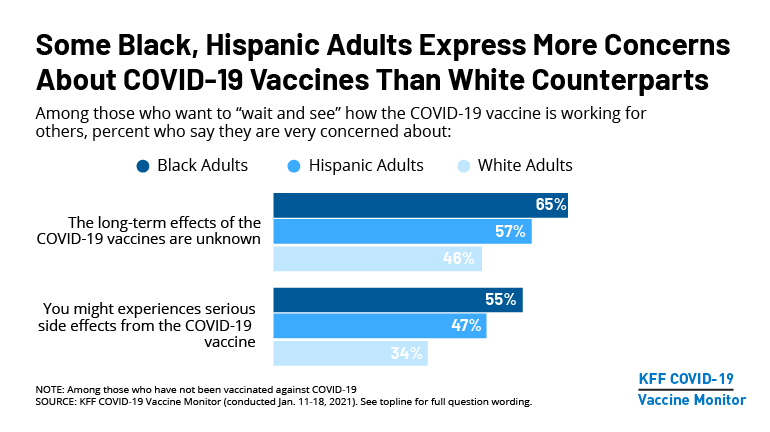
  • Black and Hispanic adults who want to “wait and see” are more likely than White adults to worry that someone in their family will get sick from COVID-19 and to express concern about serious side effects. About 3 in 10 also say they are “very concerned” that they could get COVID-19 from a vaccine, suggesting an opportunity to correct misperceptions about how the vaccine works among this group.

Available through the Monitor’s online dashboard, the new analysis also examines how different subgroups in the “wait and see” group respond to messages and information about vaccination and which sources of vaccine information they most trust.

The KFF COVID-19 Vaccine Monitor is an ongoing research project tracking the public’s attitudes and experiences with COVID-19 vaccinations. Using a combination of surveys and qualitative research, this project tracks the dynamic nature of public opinion as vaccine development and distribution unfolds, including vaccine confidence and hesitancy, trusted messengers and messages, as well as the public’s experiences with vaccination.

Poll Finding

KFF COVID-19 Vaccine Monitor: What Do We Know About Those Who Want to “Wait and See” Before Getting a COVID-19 Vaccine?

Published: Feb 12, 2021

Findings

The KFF COVID-19 Vaccine Monitor is an ongoing research project tracking the public’s attitudes and experiences with COVID-19 vaccinations. Using a combination of surveys and qualitative research, this project tracks the dynamic nature of public opinion as vaccine development and distribution unfold, including vaccine confidence and hesitancy, trusted messengers and messages, as well as the public’s experiences with vaccination.

Introduction

The latest KFF COVID-19 Vaccine Monitor reports that 31% of the public say that when an FDA-approved vaccine for COVID-19 is available to them for free, they will “wait until it has been available for a while to see how it is working for other people” before getting vaccinated themselves. This “wait and see” group is an important target for outreach and messaging, since they express some hesitancy about getting vaccinated, but will likely be much easier to convert from vaccine-hesitant to vaccine-acceptant than those who say they will “definitely not” get the vaccine or will get it “only if required” to do so. As reported in January, those in the “wait and see” category express high levels of concern about the safety and long-term effects of COVID-19 vaccines as well as a desire for more information about vaccine side effects and effectiveness. Most adults in this group (60%) do not yet know someone who’s been vaccinated for COVID-19, presenting an opportunity for them to learn more as more of their friends and family members get vaccinated.

This analysis examines the “wait and see” group in more detail, with a focus on their concerns about being vaccinated, the messages that resonate most, and the messengers they are likely to turn to for more information about COVID-19 vaccination. In particular, it looks at how attitudes within this group differ by partisanship and race/ethnicity, which should be helpful for those looking to target vaccine outreach and communication to groups like Republicans, Black adults, and Hispanic adults.

Key Takeaways: Overall

  • Thirty-one percent of the public wants to “wait and see” how the COVID-19 vaccine is working for other people before getting vaccinated themselves. While they share a similar level of vaccine hesitancy, this group is not monolithic in their attitudes and beliefs. Within the “wait and see” group, people with different partisan identities and those belonging to different racial and ethnic groups express different levels of concern about the vaccine and may respond differently to messages and information.

Key Takeaways: Republicans

  • Republicans and Republican-leaning independents (who make up just over a third of the “wait and see” group) are more likely to believe the seriousness of COVID-19 is being exaggerated in the news, and more likely to view vaccination as a personal choice. They are less likely to say they would be swayed by various messages and information that might increase their likelihood of getting vaccinated, though messages that emphasize protection from illness, the efficacy of the vaccine, and a return to normal life are most effective for this group. Taken together, these findings suggest that messages that focus on helping people make the right choice to protect their own health are more likely to resonate with Republican audiences than those that emphasize the seriousness of the pandemic or the need to get vaccinated for the collective good.

In their own words1 : From a Republican respondent asked “If there is one message or piece of information you could hear that would make you more likely to get vaccinated for COVID-19, what would it be?”

“Not sure there is anything that could be said. If it is proven effective and no side effects after a year or 2 of use I would no longer have concerns.”

  • Republicans who want to “wait and see” are less likely than others to say they will turn to the CDC or state and local health departments for information when making decisions about whether to get vaccinated for COVID-19. Individual health care providers, pharmacists, and even family and friends are more likely to be effective messengers for this group rather than official public health agencies.

In their own words: From Republican respondents asked “If there is any person who would make you more likely to get vaccinated for COVID-19 if you found out that person got vaccinated, who is that person?”

“A best friend or very close family member.”

“No not any celebrity could change my mind.  The only person that might be able to is my doctor who I trust if I can be told what is in the vaccine and how it works.”

Key Takeaways: Black and Hispanic adults

  • Concern about getting sick with COVID-19 is high among Black and Hispanic adults in the “wait and see” group, but concerns about vaccine safety, efficacy, and side effects are high as well. A majority of Black and Hispanic adults in this group are concerned they might get COVID-19 from the vaccine, suggesting an opening for information to correct misperceptions about how the vaccine works among this group.

In their own words: From Black and Hispanic respondents asked “What is the biggest concern you have, if any, about getting a COVID-19 vaccine?”

“That I have allergic reactions or severe secondary reactions that prevent me from continuing with my life.”

“Being infected after taking it.”

“Knowing COVID is so devastating to human organs, I am concerned not only about the effectiveness of the vaccine but not so the long-term effects over years in the body… especially if it is needed on an ongoing basis.”

  • Black and Hispanic adults who want to “wait and see” are generally more receptive than their White counterparts to messages and information that might increase vaccine acceptance. While the top messages for these groups are the same as for the public overall (that the vaccine is highly effective, will protect you from illness, and offers an opportunity to return to normal life), a wider range of messages may be effective with Black and Hispanic adults who initially express skepticism about the vaccine. In particular, Hispanic adults who want to “wait and see” are more responsive than their White or Black counterpart to hearing that the vaccine is available at no cost, and that a friend or family member or a health care provider they trust got vaccinated.

In their own words: From Black and Hispanic respondents asked “If there is one message or piece of information you could hear that would make you more likely to get vaccinated for COVID-19, what would it be?”

“That it is destroying the virus and not negatively affecting over 1% of those who have taken the shot.”

“Have a website or doctors explaining how exactly the vaccine is made and how it works in our body.”

“I am going to get the vaccine, I just will not be anywhere near the front of the line!”

  • While health care providers are the top source that individuals across the board say they will turn to for information about COVID-19 vaccination, large shares of Black and Hispanic adults in the “wait and see” group also say they will turn to the CDC, state and local health departments, family and friends, and pharmacists for information. And although lower on the list of overall information sources, one-third of Black adults and three in ten Hispanic adults in the “wait and see” group say they’ll turn to a religious leader for information, suggesting another possible avenue for communicating with these groups about COVID-19 vaccines.

In their own words: From Black and Hispanic respondents asked “If there is any person who would make you more likely to get vaccinated for COVID-19 if you found out that person got vaccinated, who is that person?”

“My wife. She took the vaccine yesterday and she seems fine. If she continues doing well, I would seriously considering getting the vaccine earlier.”

“It would have to be my closest family and friends. I would take it if they took the vaccine.”

Profile Of The “Wait And See” Group

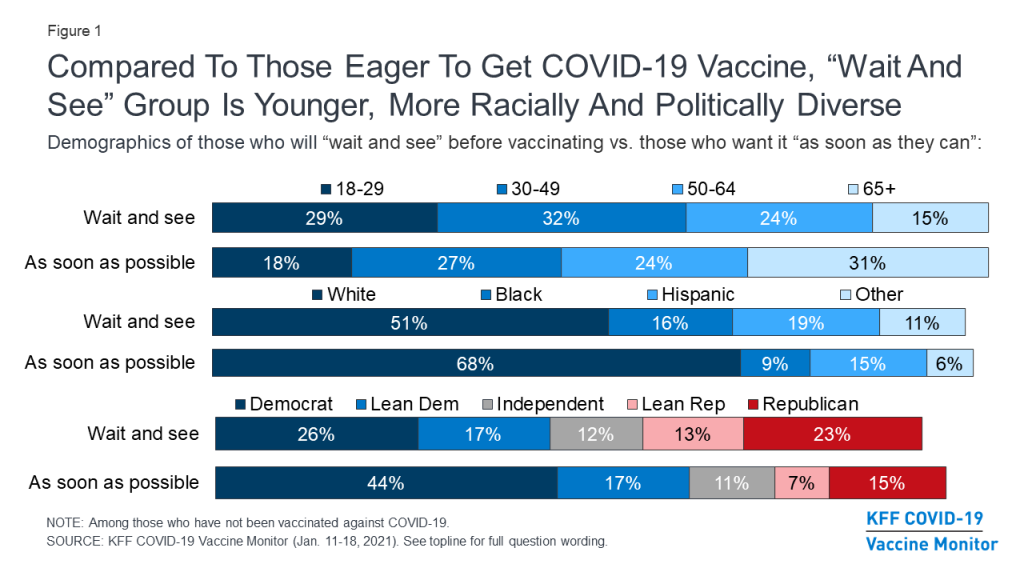
Demographically, those who want to “wait and see” are younger than other groups (29% are under age 30 and just 15% are ages 65 and over). They are a racially diverse group, with half (51%) identifying as White, 16% Black, and 19% Hispanic. They are also a politically diverse group; 42% identify as Democrats or Democratic-leaning independents, 36% identify as Republicans or Republican-leaning independents, and 14% are independents who don’t lean either way.

Figure 1: Compared To Those Eager To Get COVID-19 Vaccine, “Wait And See” Group Is Younger, More Racially And Politically Diverse

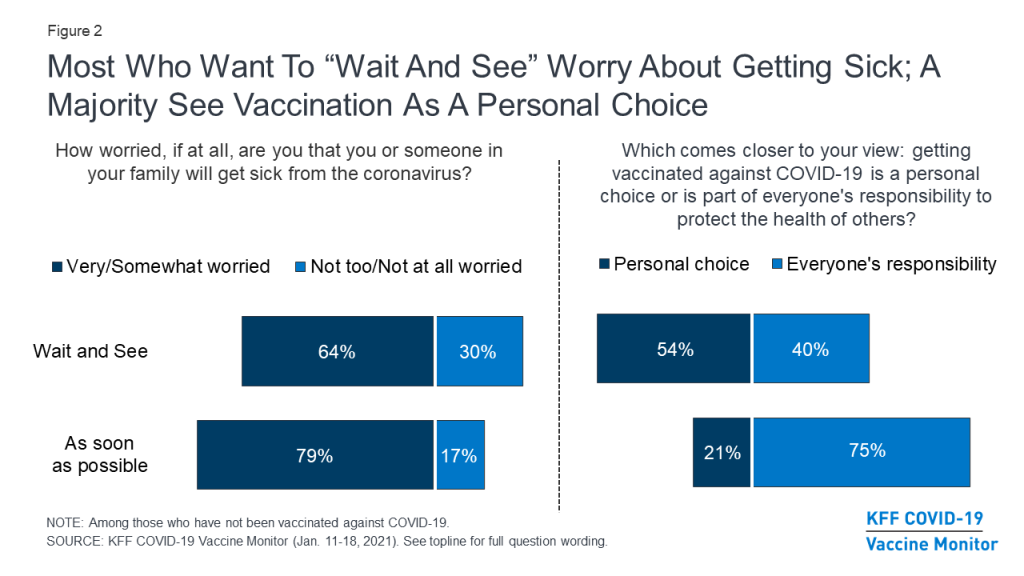
This group also holds a range of attitudes and beliefs when it comes to COVID-19 and vaccinations. About two-thirds (64%) say they are very or somewhat worried that they or a family member will get sick from the coronavirus (about the same share as among the public overall, but lower than the 79% among those who want the vaccine “as soon as possible”). Over half (54%) of those who want to wait and see say that getting vaccinated against COVID-19 is a personal choice, higher than the 21% who say so among the most vaccine-eager group, and compared to 44% who say so among the public overall.

Figure 2: Most Who Want To “Wait And See” Worry About Getting Sick; A Majority See Vaccination As A Personal Choice

Partisan Differences Within The “Wait And See” Group

Previous Vaccine Monitor reports have shown that Republicans are more likely than Democrats and independents to say they will “definitely not” get vaccinated for COVID-19. This new analysis reveals that even among those who want to “wait and see,” there are differences between Republicans and Democrats in their attitudes and concerns related to the vaccines, as well as the messages they say are likely to motivate them and the messengers they’re likely to turn to. (For this analysis, those who identify as political independents but say the lean toward either the Democratic or Republican party are included with partisans.)

Republicans and Republican-leaning independents have vastly different attitudes toward the pandemic overall compared to Democrats and Democratic-leaning independents, even within the “wait and see” group. For example, about half (51%) of Republican leaners in this group say the seriousness of coronavirus is “generally exaggerated” in the news, compared to just 17% of Democratic leaners. Republicans are also significantly less likely than Democrats in this category to say they are worried that they or someone in their family might get sick from the coronavirus (51% vs. 76%). Further, about two-thirds (67%) of Republican leaners in the “wait and see” category believe that getting vaccinated for COVID-19 is a personal choice, while most Democratic leaners in this category (52%) say it’s part of everyone’s responsibility to protect the health of others.

Table 1: Attitudes And Concerns About COVID-19 And COVID-19 Vaccinations By Party ID Among Those Who Want To “Wait And See”
Total“Wait and See”

Party ID

Democrats/ Democratic-leaning independentsRepublicans/ Republican-leaning independents
Thinking about what is said in the news, in your view is the seriousness of coronavirus…?
Generally exaggerated34%17%51%
Generally correct445036
Generally underestimated18309
How worried, if at all, are you that you or someone in your family will get sick from the coronavirus?
Worried (NET)64%76%51%
Very worried273418
Somewhat worried374233
Not worried (NET)301944
Not too worried221532
Not at all worried8412
Which comes closer to your view: getting vaccinated against COVID-19 is…?
Is a personal choice54%43%67%
Is part of everyone’s responsibility to protect the health of others405229
NOTE: Among those who say they want to “wait and see” how the vaccine is working for other people before getting vaccinated themselves

Within the “wait and see” group, levels of concern about the COVID-19 vaccines’ safety and effectiveness are similar across partisans. However, those who identify or lean Republican are much less likely than those who identify or lean Democrat to say that various messages and information would increase their likelihood of getting vaccinated for COVID-19. For example, among those who want to wait and see how the vaccine is working, half of Republicans say they would be more likely to get vaccinated if they heard that the vaccine will help protect them from getting sick from COVID-19, compared with three-quarters (76%) of Democrats. Similarly, Republicans in this category are half as likely as Democrats to say that hearing a health care provider they trust has gotten vaccinated would increase their likelihood of getting the vaccine (25% vs. 50%).

Table 2: Response To Pro-Vaccine Messages And Information By Party ID Among Those Who Want To “Wait And See”
Percent who say that hearing each of the following would make them more likely to get vaccinated:Total“Wait and See”Party ID
Democrats/ Democratic-leaning independentsRepublicans/ Republican-leaning independents
The vaccines have been shown to be highly effective in preventing illness from COVID-19  66%  74%  64%
The vaccine will help protect you from getting sick from COVID-19627650
The quickest way for life to return to normal is for most people to get vaccinated617548
Millions of people have already safely been vaccinated for COVID-19516638
We need people to get vaccinated to get the U.S. economy back on track485836
There is no cost to get the vaccine384926
A doctor or health care provider you trust has gotten the vaccine385025
A close friend or family member got vaccinated for COVID-19374624
NOTE: Among those who say they want to “wait and see” how the vaccine is working for other people before getting vaccinated themselves

Conversely, a smaller share of Republican leaners compared with Democratic leaners within the “wait and see” group say that hearing that some people experience short-term side effects like pain or fever from the COVID-19 vaccine would make them less likely to get vaccinated (38% vs. 56%).

Table 3: Response To Negative Vaccine Messages And Information By Party ID Among Those Who Want To “Wait And See”
Percent who say that hearing each of the following would make them less likely to get vaccinated:Total“Wait and See”Party ID
Democrats/ Democratic-leaning independentsRepublicans/ Republican-leaning independents
A small number of people have experienced a serious allergic reaction to the COVID-19 vaccine  60%  62%  58%
Some people were experiencing short-term side effects like pain or fever from the COVID-19 vaccine505638
You will need to continue to wear a mask and practice social distancing even after getting vaccinated312632
You had to receive two doses of the vaccine several weeks apart262824
NOTE: Among those who say they want to “wait and see” how the vaccine is working for other people before getting vaccinated themselves

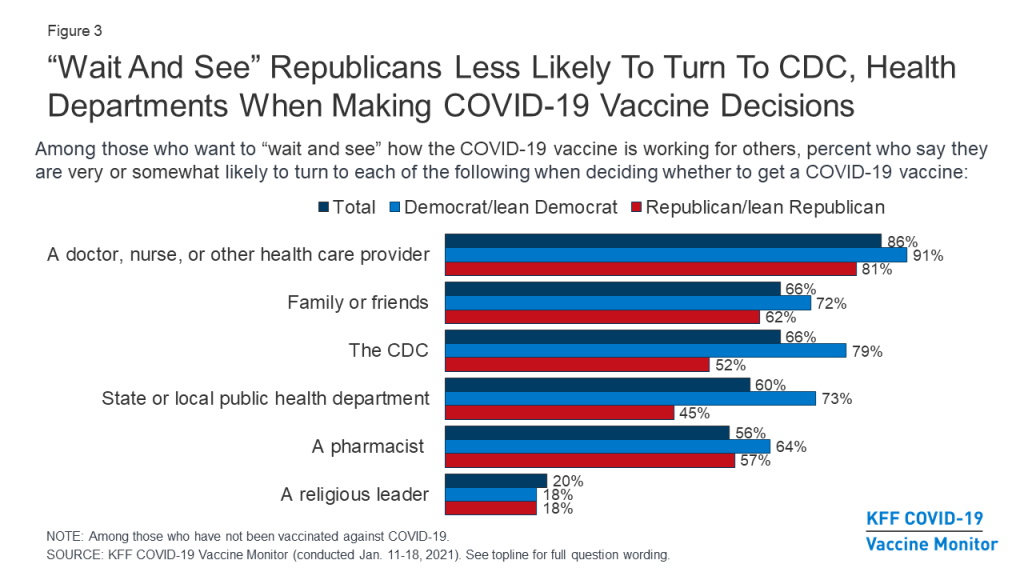
Those who want to wait and see how the COVID-19 vaccine works for others also report a somewhat different set of trusted sources for vaccine information depending on their partisan leanings. While health care providers are the source that people across partisan affiliations say they are most likely to turn to when making decisions about whether to get vaccinated, significant differences exist when it comes to some other sources. Specifically, among the “wait and see” group, those who identify as Republicans or lean that way are much less likely than those who identify or lean Democrat to say they are likely to turn to the U.S. Centers for Disease Control and Prevention (52% vs. 79%) or their state or local health department (45% vs. 73%) when making vaccine-related decisions.

Figure 3: “Wait And See” Republicans Less Likely To Turn To CDC, Health Departments When Making COVID-19 Vaccine Decisions

Differences By Race And Ethnicity Within The “Wait And See” Group

The KFF COVID-19 Vaccine Monitor has previously reported that Black and Hispanic adults are among those most likely to say they want to “wait and see” how the vaccine is working for others before getting vaccinated themselves. This analysis further reveals that Black and Hispanic adults who feel this way express somewhat different attitudes and concerns about COVID-19 vaccinations compared to their White counterparts in the “wait and see” group.

Previous KFF research has found that Black and Hispanic adults overall are less likely to trust doctors, hospitals, and the health care system compared to White adults, and that for Black adults, lower levels of trust are associated with lower levels of COVID-19 vaccine acceptance. This new COVID-19 Monitor analysis finds that Black adults in the “wait and see” category are also less trusting of the health care system in general; a majority (57%) say they trust the health care system just “some of the time” or “almost none of the time” to do what is right for them and their community, compared to 43% of White adults in this category. Hispanic adults who want to “wait and see” are more divided, with about half saying they trust the health care system “almost all” or “most” of the time (51%) and the other half saying they trust it just “some” or “almost none” of the time (49%).

Table 4: Trust Of The Health Care System By Race/Ethnicity Among Those Who Want To “Wait And See”
Percent who say they trust the health care system to do what is right for them and their community…Total“Wait and See”Race/Ethnicity
BlackHispanicWhite
Almost all/Most of the time (NET)54%43%51%55%
Almost all of the time19221719
Most of the time35203536
Some/Almost none of the time (NET)45574943
Some of the time37404038
Almost none of the time81795
NOTE: Among those who say they want to “wait and see” how the vaccine is working for other people before getting vaccinated themselves

Reflecting the disproportionate impact of the pandemic on people of color in the United States, concern about getting sick from the virus is high among Black and Hispanic adults in the “wait and see” group, with about three-quarters saying they are “very” or “somewhat” worried that they or someone in their family will get sick from coronavirus. In fact, Hispanic adults are more than twice as likely as White adults in this group to say they are “very worried” about this possibility (43% vs. 19%).

In addition to this heightened level of personal concern, more than four in ten Black adults (43%) and Hispanic adults (45%) in the “wait and see” group view getting vaccinated against COVID-19 as part of everyone’s responsibility to protect the health of others, compared to a clear majority (61%) of White adults in this group who say getting vaccinated is a “personal choice.”

Figure 4: “Wait And See” Black And Hispanic Adults More Likely To Worry About Illness; Many View Vaccination As Collective Responsibility

While Black and Hispanic adults in the “wait and see” group express higher levels of concern about getting sick from the coronavirus, they also express higher levels of concerns related to the vaccine. For example, vaccine-hesitant Black and Hispanic adults are more likely than hesitant White adults to say they are “very concerned” that they might experience serious side effects from the vaccine (55%, 47%, and 34%, respectively). Black and Hispanic adults in this group are also significantly more likely than their White counterparts to say they’re “very concerned” that the vaccines are not as safe or not as effective as they are said to be. Notably, about six in ten Hispanic adults (61%) and Black adults (59%) in the “wait and see” group say they are at least somewhat concerned that they may get COVID-19 from the vaccine (including about three in ten in each group who say they are “very” concerned), much higher than among their White counterparts.

Figure 5: “Wait And See” Black And Hispanic Adults Express More Concerns About COVID-19 Vaccines Than White Counterparts

Among those in the “wait and see” category, Black adults are somewhat more responsive than White adults to certain pro-vaccine messages and information – including messages that vaccination is the best way for things to return to normal, to get the economy back open, and that millions have already safely been vaccinated. However, Black adults are also more likely than White adults to say that hearing about side effects would make them less likely to get vaccinated.

Similarly, Hispanic adults are more responsive than White adults in the “wait and see” category towards messaging that encourage vaccinations. However, they are also more likely than their White counterparts to say that hearing about side effects and needing to get two doses of the vaccine would make them less likely to get vaccinated.

Despite these differences, it’s worth noting that the messages that resonate most with Black and Hispanic adults who are hesitant to get a COVID-19 vaccine are the same ones that appear to be most effective with the public overall – messages that emphasize that the vaccine is highly effective, offers protection from illness, and provides the quickest way for life to return to normal.

Table 5: Responses To Pro-Vaccine Messaging And Information By Race/Ethnicity Among Those Who Want To “Wait And See”
Percent who say that hearing each of the following would make them more likely to get vaccinated:Total“Wait and See”Race/Ethnicity
BlackHispanicWhite
The vaccines have been shown to be highly effective in preventing illness from COVID-19  66%  66%  74%  62%
The vaccine will help protect you from getting sick from COVID-1962648054
The quickest way for life to return to normal is for most people to get vaccinated61687953
Millions of people have already safely been vaccinated for COVID-1951586842
We need people to get vaccinated to get the U.S. economy back on track48586043
There is no cost to get the vaccine38365333
A doctor or health care provider you trust has gotten the vaccine38475430
A close friend or family member got vaccinated for COVID-1937425629
NOTE: Among those who say they want to “wait and see” how the vaccine is working for other people before getting vaccinated themselves
Table 6: Response To Negative Vaccine Messages And Information By Race/Ethnicity Among Those Who  Want To “Wait And See”
Percent who say that hearing each of the following would make them less likely to get vaccinated:Total“Wait and See”Race/Ethnicity
BlackHispanicWhite
A small number of people have experienced a serious allergic reaction to the COVID-19 vaccine60%  66%  61%  55%
Some people were experiencing short-term side effects like pain or fever from the COVID-19 vaccine50585839
You will need to continue to wear a mask and practice social distancing even after getting vaccinated31293627
You had to receive two doses of the vaccine several weeks apart26303520
NOTE: Among those who say they want to “wait and see” how the vaccine is working for other people before getting vaccinated themselves

Across racial and ethnic groups, those in the “wait and see” category are most likely to say they will turn to a doctor, nurse or other health care provider for information when deciding whether to get vaccinated for COVID-19. In fact, one-third of Black adults in this group say they have already asked a doctor or other health care professional for information about the vaccine, somewhat higher than among vaccine-hesitant White adults (18%). Hispanic adults in this group (13%) are significantly less likely than their Black counterparts to say they’ve reached out to a health care provider for more information about the vaccine. This may reflect the fact that Hispanics in the U.S. overall have lower rates of health insurance coverage and face greater barriers to accessing health care compared to other groups.

Looking at potential sources of information beyond health care providers, both Black and Hispanic adults are more likely than White adults in the “wait and see” group to say they are at least somewhat likely to turn to the CDC, their state or local public health department, or a religious leader for vaccine information. While health care workers will undoubtedly be a key source of information for those who express some hesitancy towards the COVID-19 vaccine, the CDC, public health departments, and religious leaders are also positioned to be effective messengers in promoting vaccination among Black and Hispanic communities.

Table 7: Likely Sources Of COVID-19 Vaccine Information by Race/Ethnicity Among Those Who Want To “Wait And See”
Percent who say, when deciding whether to get a COVID-19 vaccine, they are very or somewhat likely to turn to each of the following for information:Total“Wait and See”Race/Ethnicity
BlackHispanicWhite
A doctor, nurse, or other health care provider86%  90%  90%  82%
Family or friends66617365
The CDC66787656
Your state or local public health department60737747
A pharmacist56645954
A religious leader such as minister, pastor, priest, or rabbi20352814
Have you asked a doctor or other health care professional for information about the COVID-19 vaccine, or not?
Yes18%33%13%18%
No81678782
NOTE: Among those who say they want to “wait and see” how the vaccine is working for other people before getting vaccinated themselves

Methodology

This KFF COVID-19 Vaccine Monitor was designed and analyzed by public opinion researchers at the Kaiser Family Foundation (KFF). The survey was conducted January 11- 18, 2021, among a nationally representative random digit dial telephone sample of 1,563 adults ages 18 and older (including interviews from 306 Hispanic adults and 310 non-Hispanic Black adults), living in the United States, including Alaska and Hawaii (note: persons without a telephone could not be included in the random selection process). Phone numbers used for this study were randomly generated from cell phone and landline sampling frames, with an overlapping frame design, and disproportionate stratification aimed at reaching Hispanic and non-Hispanic Black respondents. Stratification was based on incidence of the race/ethnicity subgroups within each frame. Specifically, the cell phone frame was stratified as: (1) High Hispanic: Cell phone numbers associated with rate centers from counties where at least 35% of the population is Hispanic; (2) High Black: Cell phone numbers associated with remaining rate centers from counties where at least 35% of the population is non-Hispanic Black; (3) Else: numbers from all remaining rate centers. The landline frame was stratified as: (1) High Black: landline exchanges associated with Census block groups where at least 35% of the population is Black; (2) Else: all remaining landline exchanges. The sample also included 246 respondents reached by calling back respondents that had previously completed an interview on the KFF Health Tracking Poll at least nine months ago. Another 197 interviews were completed with respondents who had previously completed an interview on the SSRS Omnibus poll (and other RDD polls) and identified as Hispanic (n = 75; including 24 in Spanish) or non-Hispanic Black (n=122). Computer-assisted telephone interviews conducted by landline (287) and cell phone (1,276, including 931 who had no landline telephone) were carried out in English and Spanish by SSRS of Glen Mills, PA. To efficiently obtain a sample of lower-income and non-White respondents, the sample also included an oversample of prepaid (pay-as-you-go) telephone numbers (25% of the cell phone sample consisted of prepaid numbers) Both the random digit dial landline and cell phone samples were provided by Marketing Systems Group (MSG). For the landline sample, respondents were selected by asking for the youngest adult male or female currently at home based on a random rotation. If no one of that gender was available, interviewers asked to speak with the youngest adult of the opposite gender. For the cell phone sample, interviews were conducted with the adult who answered the phone. KFF paid for all costs associated with the survey.

The combined landline and cell phone sample was weighted to balance the sample demographics to match estimates for the national population using data from the Census Bureau’s  2019 U.S. American Community Survey (ACS), on sex, age, education, race, Hispanic origin, and region, within race-groups, along with data from the 2010 Census on population density. The sample was also weighted to match current patterns of telephone use using data from the January- June 2019 National Health Interview Survey. The weight takes into account the fact that respondents with both a landline and cell phone have a higher probability of selection in the combined sample and also adjusts for the household size for the landline sample, and design modifications, namely, the oversampling of prepaid cell phones and likelihood of non-response for the re-contacted sample. All statistical tests of significance account for the effect of weighting.

The margin of sampling error including the design effect for the full sample is plus or minus 3 percentage points. Numbers of respondents and margins of sampling error for key subgroups are shown in the table below. For results based on other subgroups, the margin of sampling error may be higher. Sample sizes and margins of sampling error for other subgroups are available by request. Note that sampling error is only one of many potential sources of error in this or any other public opinion poll. Kaiser Family Foundation public opinion and survey research is a charter member of the Transparency Initiative of the American Association for Public Opinion Research.

GroupN (unweighted)M.O.S.E.
Total1,563± 3 percentage points
Total who have not gotten a COVID-19 vaccine1,454± 3 percentage points
Total “wait and see”464±6 percentage points
Among those who want to “wait and see”:
Democrats and Democratic leaning independents208± 9 percentage points
Republicans and Republican leaning independents152± 9 percentage points
Black118± 11 percentage points
Hispanic108± 11 percentage points
White193± 8 percentage points

Endnotes

  1. Open-ended quotes from KFF COVID-19 Vaccine Monitor: In Their Own Words, responses collected Jan 14-18, 2021. See Methodology for full information. ↩︎

Medicaid Work Requirements at the U.S. Supreme Court

Author: MaryBeth Musumeci
Published: Feb 11, 2021

(This post was updated on February 19, 2021, to reflect recent CMS actions)

The Biden Administration has started the process to withdraw Medicaid work requirement waivers approved by the Trump Administration, as the March 29th Supreme Court oral argument date approaches. Before leaving office, the Trump Administration asked the Court to decide whether Medicaid work requirements are legal. A decision is expected by the end of the term in June – unless the Court agrees that the Biden Administration’s reversal makes the cases moot. The Supreme Court decided to hear the cases after the DC appeals court, in a unanimous opinion written by a judge appointed by President Reagan, affirmed that the HHS Secretary’s approval of Medicaid work requirements in Arkansas was unlawful because the Secretary failed to consider the impact on coverage. The DC appeals court subsequently ruled that its decision in the Arkansas case applied to a New Hampshire case challenging Medicaid work requirements and affirmed that the Secretary’s New Hampshire approval also was unlawful. In addition to work requirements, both cases challenge waivers of Medicaid’s 3-month retroactive coverage requirement. The Trump Administration also approved work requirement waivers in other states, but none is currently in effect, either due to litigation or the pandemic.

What Actions Has the Biden Administration Taken?

A January 28th executive order from President Biden to “protect and strengthen Medicaid” set the stage for the Biden Administration’s recent actions. The executive order directed HHS to consider whether to suspend, revise, or rescind any policies or waivers that “may reduce coverage under or otherwise undermine Medicaid” as well as policies or practices that “may present unnecessary barriers” to people attempting to access Medicaid. On February 12th, the Biden Administration sent letters notifying Arkansas, New Hampshire, and other states with approved work requirement waivers that CMS has “preliminarily determined” that work requirements do not further Medicaid program objectives. States have 30 days to provide additional information to CMS that they believe “may warrant not withdrawing” the work requirement authorities. The Biden Administration also removed from Medicaid.gov the Trump Administration guidance that invited states to apply for work requirement waivers.

In its letter to Arkansas, CMS cited data showing that over 18,000 people lost coverage while work reporting requirements were in place there. CMS noted that states cannot terminate coverage for failing to meet a work requirement while receiving the enhanced federal matching funds provided by the Families First Coronavirus Response Act in response to the public health emergency. CMS also said that the COVID-19 pandemic’s impact on enrollee health and the economy creates “serious concerns about testing policies that create a risk of a substantial loss of health care coverage in the near term.” Across states, other data show that most Medicaid adults were working prior to the coronavirus pandemic, albeit primarily in low-wage jobs in industries likely affected by the recent economic downturn. Among those not working, many face barriers such as caregiving responsibilities, illness or disability, and school attendance. Data in Arkansas revealed that issues related to disability and technology were major barriers for eligible people to maintain coverage and navigate work reporting and exemption rules.

What Happens Next in the Supreme Court?

The opening brief setting out HHS’s position in the Supreme Court cases was filed by the Trump Administration on January 19th, the day before President Biden’s Inauguration. Arkansas and New Hampshire joined the Trump Administration in urging the Supreme Court to reverse the appeals court decisions. Seventeen states, led by Indiana, filed an amicus brief in support of work requirements, and Nebraska filed a separate amicus brief making a similar argument. The answering brief setting out the arguments of the Medicaid enrollees who challenged the Arkansas and New Hampshire approvals has been filed, and amicus briefs in support of the enrollees’ position are due on February 25th. HHS’s reply brief is due shortly before the March 29th argument date. Court observers and policymakers will be closely watching the Biden Administration’s subsequent actions now that the process to withdraw work requirement waivers has begun.

The Supreme Court's Decision on Medicaid Work Requirements in AR and NH Will Have Implications for Other States with Similar Waivers.

ACA Open Enrollment Matters for Medicaid Coverage, Too

Authors: Jennifer Tolbert, Rachel Garfield, and Robin Rudowitz
Published: Feb 11, 2021

President Biden’s January 28th executive order to reopen enrollment in the federal ACA Marketplace from February 15 through May 15, combined with $50 million in federal spending on outreach and education about ACA coverage options, has the potential to reach millions of people who were uninsured prior to or have lost coverage during the pandemic. As of 2019, there were 29 million non-elderly uninsured people, and the majority (57%) were eligible for financial assistance through the ACA Marketplaces (33%) or Medicaid (25%). KFF estimates indicate that nearly nine million uninsured people could be eligible for free or subsidized Marketplace coverage during the new enrollment period. Importantly, these actions to facilitate enrollment in ACA Marketplace coverage will also likely lead eligible low-income people to enroll in Medicaid coverage.

Prior to the pandemic, 7.3 million uninsured people were eligible for Medicaid. Nearly two-thirds of these people are children (27%, or 2.0 million) or adults (38%, or 2.8 million) living in the 36 states in which the ACA Marketplace is federally-operated (FFM) or state-operated but the state uses the federal Healthcare.gov platform (SBM-FP) and will reopen for enrollment under the executive order (Figure 1). During 2020, all but one of the State-based Marketplace (SBM) states reopened Marketplace enrollment due to the pandemic. In response to the reopening of the federal Marketplace, 11 of the 15 SBM states have announced similar enrollment periods.

Figure 1: Distribution of Uninsured People Eligible for Medicaid, by Age and State Marketplace Type​

Under enrollment simplification processes established by the ACA, states must provide a single application for Medicaid, CHIP, and Marketplace coverage, thereby establishing a “no wrong door” application process for ACA coverage. This process means that the Marketplaces will screen or assess individuals’ eligibility for all health coverage programs, including Medicaid and CHIP, and individuals will be enrolled in or referred to the program for which they are eligible regardless of how they apply. Most states utilizing the FFM do not authorize the FFM to make final Medicaid eligibility determinations for most groups, but instead conduct full eligibility determinations for individuals after the FFM assesses them as eligible for Medicaid. The states that operate SBMs typically have a single integrated system through which individuals can apply for and renew Medicaid, CHIP and Marketplace coverage.

In recent Marketplace open enrollment periods, nearly a million people who applied for ACA coverage through the FFM have been assessed eligible for Medicaid, and millions more who apply through SBMs are determined eligible. During the 2020 Marketplace open enrollment period (which closed in December 2019), 836,451 people who applied for ACA coverage through the FFM, or 8% of all applicants, were assessed or determined eligible for Medicaid. The number was down slightly from the 952,049 during the 2019 open enrollment period and much lower than the 1.2 million assessed/determined eligible during the 2016 open enrollment period. Large reductions in funding for marketing, outreach, and in-person enrollment assistance have likely contributed to declines in Marketplace applications and enrollment since 2016. During the 2016 open enrollment period, the last year for which complete data on SBMs was reported, more than 4 million people who applied for coverage through the Marketplace were determined eligible for Medicaid, though that number includes some people who intended to apply for Medicaid and has likely declined in recent years as Marketplace applications and enrollment have stabilized.

Investments in outreach and advertising as well as enhanced funding for in-person assistance to support the new Marketplace enrollment period can also raise awareness of Medicaid and promote Medicaid enrollment. Findings from a consumer survey reveal most people are unaware of ACA-related coverage options, including whether their state has expanded Medicaid, and lack basic information on how to apply. And, many who do apply for Marketplace or Medicaid coverage face challenges with the application process. Expansive advertising campaigns coupled with targeted outreach strategies during the new enrollment period can educate consumers on the availability of both Marketplace and Medicaid coverage. In addition, supplemental funding for federal navigators would enable them to respond more quickly to provide in-person help to both Marketplace and Medicaid enrollees.

While much attention has been paid to the importance of expanding eligibility to the over 2 million people in the Medicaid coverage gap, who currently have no affordable coverage option, it may be possible to make gains in Medicaid coverage by reaching those who are eligible but not enrolled. Ongoing efforts to expand ACA Marketplace coverage may reach some of these individuals.

A Status Report on Prescription Drug Policies and Proposals at the Start of the Biden Administration

Published: Feb 11, 2021

In recent years, federal and state policymakers have introduced several proposals to lower prescription drug costs in an attempt to respond to the public’s ongoing concerns about high and rising drug prices. As President Biden takes the reins in Washington DC, his administration inherits a handful of final rules advanced by the Trump Administration in its final months related to Medicare, importation, and 340B pricing for insulin and epinephrine. It also seems likely that lawmakers in the new 117th Congress will push to enact some of the key drug pricing proposals related to Medicare and drug prices more generally that were voted on but not enacted into law in the previous session. In this brief, we provide a status update on these final rules and an overview of key Medicare-related drug pricing proposals supported by President Biden during the campaign that may return to the forefront of health policy discussions in the coming years.

Most Favored Nations Model

In November 2020, the Trump Administration issued an interim final rule implementing the Most Favored Nation (MFN) Model, which is designed to test an approach to lower Medicare Part B drug spending by pegging Medicare reimbursement to the lowest price paid by certain Organisation for Economic Co-operation and Development (OECD) member countries. While the model was slated to take effect on January 1, 2021, implementation has been temporarily blocked by several U.S. district courts,1  including a preliminary injunction by the U.S. District Court for the Northern District of California based on its ruling that the Trump Administration failed to follow the standard notice and comment rulemaking procedures.2 

According to CMS’s Innovation Center, which was responsible for conducting the model, in light of the preliminary injunction, the MFN model will not be implemented without further rulemaking. This puts the fate of this model in the hands of the Biden Administration, which could choose to move forward with the same policy, but with a standard notice and comment period, modify the design of the model and issue a new proposed rule, or withdraw it. Alternatively, the Biden Administration could choose to work with Congress to adopt legislation to achieve similar goals.

The Biden campaign supported a proposal to use international reference prices in helping set prices for newly-launched specialty drugs. But the Most Favored Nation Model is a different approach to using international prices, in that it would use the lowest price in other selected countries as the amount of Medicare reimbursement for selected Part B drugs nationwide. (Drugs covered by Part B of Medicare include those administered by physicians.) The pharmaceutical industry and others have raised concerns about the potential for this approach to adversely affect patients’ access to medications and to lead to higher prices in other countries. Medicare’s actuaries estimated $85.5 billion in savings from the Trump Administration’s model over its seven-year span, while noting that a portion of savings from the model would be due to reductions in utilization of up to 19% from 2023 to 2027, assuming some beneficiaries would lose access to physician-administered medications.

Removing Safe Harbor for Medicare Drug Rebates

In November 2020, the Trump Administration issued a final rule to eliminate rebates negotiated between drug manufacturers and pharmacy benefit managers (PBMs) or health plan sponsors in Medicare Part D by removing the safe harbor protection currently extended to these rebate arrangements under the federal anti-kickback statute. The rule provides a new safe harbor for discounts passed directly from manufacturers to patients at the point of sale. These provisions are intended to reduce beneficiary out-of-pocket drug spending at the point of sale, increase price transparency, and create incentives for manufacturers to lower list prices.

Removing the safe harbor protection for rebates under Part D was slated to take effect on January 1, 2022. However, a federal district court recently issued a ruling on a lawsuit filed by the PBM industry, which challenged the legality of the rebate rule. The court ruling delayed implementation until January 1, 2023, pending HHS’s review of the rebate rule, and gave the Biden Administration until April 1, 2021 to decide whether or not to defend the rebate rule in court. The Biden Administration has also issued a final rule to delay the effective date of other provisions of the rebate rule that were slated to take effect on January 29, 2021 to March 22, 2021, as part of the Administration’s overall efforts to review new or pending rules issued by the Trump Administration in its final days and weeks. The Biden Administration’s rule also cites the pending litigation and the Administration’s need to evaluate its position on the case as further cause for the 60-day delay.

If the Biden Administration wished to change or undo the rule, it could choose not to defend the rule in the pending lawsuit. The Biden Administration could also undergo new rulemaking to modify or eliminate the rebate rule. This action could be proposed as part of an agreement to settle the lawsuit. New rulemaking also would be needed if the Administration wished to proceed with the rule in some form but the current rule ultimately is blocked by a final court order.

Alternatively, the rebate rule could be blocked through Congressional action, including use of the Congressional Review Act (CRA) to overturn the rule or other legislative action to block implementation of the rule. Using the CRA means HHS could not issue substantially similar regulation in the future, unless Congress authorized it through subsequent legislation. Blocking implementation of the rule through other legislation could offer Congress the opportunity to score savings that could be used for other purposes, based on CBO’s estimate of higher Medicare spending under the rule.

There is some disagreement as to whether and to what extent eliminating rebates in Part D would have the intended effects on out-of-pocket spending and list prices, or would instead result in both higher Part D premiums and higher out-of-pocket drug spending for beneficiaries and increased spending for the federal government. When the final rule was issued, the Secretary of HHS issued a statement that the rebate rule would not increase federal spending, premiums, or out-of-pocket costs. However, both the Congressional Budget Office (CBO) and Medicare’s actuaries estimated substantially higher Medicare spending over the next 10 years as a result of banning drug rebates – up to $170 billion higher, according to CBO, and up to $196 billion higher, according to the HHS Office of the Actuary (OACT). With the loss of rebate revenue, plans are expected to raise their premiums, leading to increased premium subsidies paid by the federal government, resulting in greater overall costs for the Medicare program as well as higher drug plan premiums paid by enrollees. Banning rebates in Part D would not necessarily lead manufacturers to lower list prices, particularly since rebates in the commercial market are still allowed. At the same time, a small group of beneficiaries who use drugs with significant manufacturer rebates could see a decline in their overall out-of-pocket spending, assuming manufacturers pass on price discounts at the point of sale.

Prescription Drug Importation

In Fall 2020, the Trump Administration issued a final rule and FDA guidance for industry creating two new pathways for the safe importation of drugs from Canada and other countries. The first pathway would authorize states, territories, and Indian tribes, and in certain future circumstances wholesalers and pharmacists, to implement time-limited importation programs for importation of prescription drugs from Canada only. The second pathway outlines how manufacturers can import and market FDA-approved drugs in the U.S. that were manufactured abroad and intended to be marketed and authorized for sale in a foreign country. The importation rule was effective November 30, 2020.

President Biden supported prescription drug importation during the campaign. While several states have pursued importation plans, it is unclear how much traction these plans will have moving forward or how far any entities will move down either of the Trump Administration’s pathways for drug importation. For example, while Florida has been at the forefront of this effort at the state level, the state struggled for a time before finding a vender to help implement its program, which limits eligible importers to wholesalers or pharmacists who dispense prescription drugs on behalf of public payers, including Medicaid, the Department of Corrections, and the Department for Children and Families. Colorado also recently initiated a bidding process for venders to help implement its state importation plan, but does not expect to begin importing drugs before mid-2022. Canada has said it will block exportation of certain medicines if they expect a shortage.

Moreover, the final rule authorizing states to create importation programs is the subject of a lawsuit filed by PhRMA and other parties challenging the rule based on safety and other concerns. As of this writing, the Biden Administration’s response to this complaint is still pending. But even if the rule withstands this legal challenge, it is likely to have a narrow impact. And because biologics are excluded from drugs that can be imported, importation plans will not help people struggling with the cost of certain types of drugs – in particular, insulin, which has been the subject of recent congressional investigations and is a frequently sought after medication from abroad.

340B Pricing on Insulin and Epinephrine

In December 2020, the Trump Administration issued a final rule requiring Federally Qualified Health Centers (FQHCs) that participate in the federal 340B drug pricing program to provide qualifying low- and moderate-income health center patients with insulin and injectable epinephrine at the 340B discounted prices. Under the 340B program, drug manufacturers agree to provide outpatient drugs to participating entities at discounted prices. The final rule makes federal grants to FQHCs conditional upon passing on these discounts. The Administration’s stated rationale for this rule was to address affordability concerns for these life-saving medications among low-income patients experiencing financial hardship as a result of the COVID-19 pandemic. However, stakeholders have raised concerns that the rule itself would be administratively burdensome for FQHCs, contribute to financial instability among health centers, and not result in lower drug prices. According to HHS, the rule is expected to have “minimal economic impact.”

While this rule was scheduled to take effect on January 22, 2021, the Biden Administration has delayed implementation until March 22, 2021. This delay gives the new Administration an opportunity to assess whether to move forward with the existing rule or take steps to withdraw it.

Medicare Part D Redesign

In recent years, a growing number of policymakers have expressed concern about the current design of the Part D benefit, which has no cap on out-of-pocket spending for Medicare Part D enrollees and places the burden of financial responsibility for the majority of catastrophic coverage costs on Medicare, not plan sponsors or pharmaceutical companies. During the campaign, President Biden supported adding a cap on out-of-pocket drug costs to Part D, and in the 116th Congress, there was bipartisan support for proposals to modify the design of the Part D benefit, establish an out-of-pocket spending limit, and reallocate liability for catastrophic coverage costs among Medicare, plan sponsors, and drug manufacturers. This proposal was included in drug price legislation that passed the House of Representatives in December 2019 (H.R. 3), legislation that passed out of the Senate Finance Committee in the 116th Congress, and a Trump Administration FY2020 budget proposal.

Adding an out-of-pocket spending limit in Part D would provide substantial savings for beneficiaries who have high drug costs, and protect against exposure to high drug costs for those who may need costly medications at some point in time. A hard cap on out-of-pocket drug spending without any other changes to the Part D benefit would increase Medicare spending by shifting costs incurred by Medicare beneficiaries to Medicare (and by extension, taxpayers), but this spending could be offset by reallocating liability for catastrophic coverage costs, reducing Medicare’s share of these costs and increasing the share paid by Part D plans and/or drug manufacturers, as was recommended by MedPAC and included in both the House-passed bill and Senate Finance proposal.

Drug Price Inflation Rebates

During the campaign, President Biden supported a proposal to limit drug price increases to no more than the inflation rate. In the 116th Congress, lawmakers introduced proposals that would require drug manufacturers to pay a rebate to the federal government if their prices for drugs covered under Medicare Part B and Part D increased by more than the rate of inflation (with the potential to extend rebates to group coverage as well). This proposal was included in legislation passed by the House of Representatives (H.R. 3) and by the Senate Finance Committee, under the chairmanship of GOP Senator Chuck Grassley, though it was not brought up for a floor vote in the Republican-controlled Senate. The Trump Administration’s FY2020 budget included a related proposal that applied inflation rebates only to drugs covered under Part B. The Senate Finance Committee inflation rebate proposal was based on list prices, which do not include manufacturer rebates and discounts to plans (Wholesale Acquisition Cost), while the House proposal was based on Average Manufacturer Price, which may include some discounts to wholesalers but not rebates paid to plans and PBMs.

CBO estimated 10-year savings from the drug inflation rebate provisions amounting to $36 billion for H.R. 3 and $82 billion for the Senate Finance Committee legislation; 10-year savings would be lower under H.R. 3. because the inflation provision would not apply to drugs subject to the government negotiation process that would be established by that bill. KFF analysis indicates the potential for significant savings if drug manufactures limited price increases to the rate of inflation or paid a rebate to the federal government. Medicare beneficiaries could also benefit from such a policy because cost sharing under Part D often comes in the form of coinsurance (and always does in the case of Part B drugs), which is calculated as a percentage of the list price. The magnitude of actual changes in spending would depend on several factors, including the drugs to which the policy applies, the price measure used to compare against inflation, and the base year used for calculating rebates, as well as how drug companies respond. If drug manufacturers respond to the policy change by increasing launch prices for new drugs, some Medicare beneficiaries could face higher out-of-pocket costs for new drugs that come to market, with potential spillover effects on costs incurred by other payers as well.

Because this approach to lowering drug costs is supported by President Biden, and had some measure of bipartisan support in the previous Congress, it might have somewhat better prospects in the 117th Congress with Democrats controlling both the House and the Senate, even with narrow majorities.

Medicare Drug Price Negotiation

During his campaign, President Biden expressed support for allowing the federal government to negotiate drug prices in Medicare Part D and for other payers, which is currently prohibited under the so-called “non-interference” clause. This proposal has strong bipartisan public support and was a key feature of H.R. 3, the drug price legislation passed by the House of Representatives in December 2019. (The Senate Finance Committee did not include a similar provision in its bipartisan drug price legislation.) Under H.R. 3, the HHS Secretary would be given authority to negotiate prices for between 50 and 250 drugs without market competition, with an upper limit based on prices in a set of foreign countries. The negotiated price would apply to both Medicare and commercial payers.

CBO estimated over $450 billion in 10-year (2020-2029) savings from the Medicare drug price negotiation provision in H.R. 3., including nearly $450 billion in savings to Medicare and $12 billion for private health insurance. A separate CBO estimate of the same Medicare drug price negotiation provision included in a separate House bill in the 116th Congress (H.R. 1425, the Patient Protection and Affordable Care Enhancement Act) estimated higher 10-year savings of nearly $530 billion, mainly because the Secretary would negotiate prices for a somewhat larger set of drugs in year 2 of the negotiation program under H.R. 1425 than under the version of H.R. 3 that CBO scored (50 vs. 25 drugs).

While CBO expects that the lower drug prices resulting from allowing the federal government to negotiate drug prices would lead to lower beneficiary premiums and cost sharing, CBO also expects that this policy would lower revenues for drug manufacturers, lead to higher drug prices in other countries, and lead to a modest reduction in the number of drugs coming to market in the future, due to the loss in revenue for drug manufacturers. This proposal would require a change in the law, which could be challenging in the current legislative environment, given that drug price negotiation proposals have not garnered bipartisan support among lawmakers. Republican lawmakers historically have been opposed to this proposal, and it has also faced stiff opposition from the pharmaceutical industry.

Conclusion

Drug costs are likely to remain a significant concern for patients. A relatively narrow Democratic majority in the House and even narrower majority in the Senate could make major legislative action on this issue difficult in the upcoming Congressional session. And yet there may be room for proposals that have garnered bipartisan support, such as adding a cap on out-of-pocket spending under Part D and imposing limits on drug price increases. In addition, given concerns among some lawmakers about the rise in federal spending, lawmakers could look more favorably on proposals that lower federal Medicare spending, or potentially use these savings to fund other priorities. Support from President Biden might provide the momentum needed to get these proposals over the finish line.

Regardless of what happens in Congress, the door is open for executive action on drug prices from the Biden Administration, including the introduction of new drug pricing models through CMS’s Center for Medicare & Medicaid Innovation, though these efforts may be complicated by Trump Administration initiatives currently tied up in court. While prescription drug proposals are likely to take a back seat in the short term to addressing the COVID-19 pandemic and economic stimulus and recovery efforts, it seems reasonable to expect more executive action on drug prices, and for the Biden Administration to support whatever bipartisan legislative efforts emerge.

  1. In another case, the U.S. District Court for the Southern District of New York temporarily prohibited the federal government from applying the rule to a single drug (EYLEA), manufactured by Regeneron Pharmaceuticals. ↩︎
  2. The Northern District of California case has been stayed until April 23, 2021, at which point the parties will update the court on whether to continue the stay, allow the lawsuit to proceed, or dismiss the case. In another case, the U.S. District Court for the District of Maryland entered a temporary restraining order prohibiting implementation of the rule until January 20, 2021. The parties agreed to stay the Maryland litigation until a final rule based on the interim final rule is published, provided that the federal government does not seek to have the California court’s preliminary injunction overturned on appeal. If the federal government decides to rescind the interim final rule or otherwise decides not to proceed with it, the parties must notify the court. ↩︎
News Release

New KFF Analysis Finds 40 Out of 46 PEPFAR Countries Have Met At Least One HIV Target, Though No Countries Have Met All Progress Measures

Published: Feb 10, 2021

A new KFF analysis finds that across 46 PEPFAR countries and among six different indicators of progress, the majority (40) has met at least one target, 17 countries have met at least half of the targets, and one country has met five targets. No country has met all targets and six have not met any target.

The analysis is part of a dashboard that provides a detailed look at progress being made to address the HIV/AIDS epidemic in countries where PEPFAR operates and will be updated over time. It examines six different indicators of progress, including PEPFAR’s epidemic control target (the point at which the total number of new HIV infections falls below the total number of deaths from all causes among HIV-infected individuals), UNAIDS global “90-90-90” targets (90% of people living with HIV know their status, 90% of people who know their status are accessing treatment, and 90% of people on treatment have suppressed viral loads), and two other HIV incidence-based targets.

This dashboard pulls together the latest available country data to make it easier to assess where countries stand in their progress toward achieving global HIV/AIDS targets.

The dashboard also highlights the 13 high-burden countries targeted by PEPFAR and key trends over time. In the 13 high-burden countries targeted by PEPFAR, the analysis found that only a few have met global targets, but most countries have made improvements over time. While PEPFAR may be the largest donor government program in many countries, it does not work in isolation and numerous actors also contribute to the HIV/AIDS response.

This dashboard reflects all 46 countries’ progress prior to the COVID-19 pandemic, which could impact their progress in the fight against HIV/AIDS and PEPFAR’s response.