Tracking Key Mental Health and Substance Use Policy Actions Under the Trump Administration

Published: Apr 7, 2026

In 2024, over 61 million adults in the U.S. experienced a mental illness and deaths due to suicide, gun violence, and drug overdose remained high. Additionally, the COVID-19 pandemic and necessary public health responses exacerbated an already existing mental health and substance use crises. At the same time, many people experience difficulties affording mental health treatment or finding providers. Among insured adults who described their mental health as fair or poor, 43% reported at least one time in the past year when they needed mental health services or medication but did not receive them; some groups – including communities of color, youth and young adults – experience greater barriers.

Many policy actions were initiated in response to these rising mental health and substance use concerns. During the first Trump administration, the SUPPORT Act – legislation that expanded access to opioid treatment and overdose prevention – was passed along with legislation that created the 988 crisis hotline. During the following Biden administration, federal policies focused on expanding coverage, improving access to care, implementing evidence-based treatments, and strengthening support for federal agencies, such as the Substance Abuse and Mental Health Administration (SAMHSA). Recent data shows that some opioid and mental health related indicators have stabilized or improved.

The second Trump administration, beginning in 2025, marked a change in federal mental health and substance use policy. The administration moved toward a heavier law-and-order approach and simultaneously narrowed the scope of federal leadership capacity in mental health and substance use services, while also continuing some treatment-focused initiatives (such as the SUPPORT Act reauthorization). Many of these policy directions are consistent with themes highlighted in President Trump’s campaign materials and are aligned with proposals in Project 2025.

This tracker lists and briefly describes key actions during President Trump’s second term, organized into the following four broad categories: Opioids (for example, signing the HALT Act); Mental Health (e.g., canceling school-based mental health grants); Federal Infrastructure/Data/Guidance (e.g., proposals to reduce and reorganize SAMHSA under another agency); and Gun Violence (e.g., rescinding community violence intervention grants). It will be updated as new changes occur. This tracker is not meant to be exhaustive; other state and federal policy changes may also affect mental health and substance use but are not captured here.

The tracker can be viewed in the order that each mental health or substance use policy action was implemented. Alternatively, the tracker can be filtered by category (Mental Health; Opioids/Substance Use Disorder; Federal Infrastructure/ Data/Guidance; and Gun Violence).

Table

KFF Tracker: America First MOU Bilateral Global Health Agreements

Published: Apr 7, 2026

Editorial Note: Originally published on January 13, 2026, this resource will be updated as needed, most recently on April 7, 2026, to reflect additional developments.

On September 18, 2025, the U.S. government (USG) released its new America First Global Health Strategy, which details how the U.S. will engage in global health efforts moving forward. As part of this new strategy, the U.S. has announced that it will be establishing bilateral health cooperation agreements with countries that receive U.S. global health assistance. These agreements, or Memorandums of Understanding (MOUs), between the U.S. and partner countries represent five-year plans (for the period 2026-2030) outlining U.S. engagement in each country’s health efforts with the goal of “helping countries move toward more resilient and durable health systems.” Central to these plans is transitioning country programs from U.S. assistance to long-term country ownership, with a pledge from each partner country to increase its domestic health spending, or co-investment in health, over the next five years as the U.S. decreases its health assistance. The U.S. began signing these agreements in late 2025 and this process is ongoing. Implementation is slated for later this year.

This tracker provides an overview of the MOUs signed to date. Data are based on press releases issued by the State Department, U.S. embassies, and partner country Ministries of Health, as well as MOU documents (if publicly available). See Methods for more information. This tracker will be updated as agreements are signed and more data become available.

USG Global Health MOUs by Country (Table)
Signed USG Global Health MOUs by Country (Choropleth map)
Global Health MOU Funding by Country (Bar Chart)
USG Global Health MOU Co-Financing Share by Country (Stacked Bars)
USG Global Health MOU Program Areas by Country (Table)
Historical vs. Proposed 5-Year USG Global Health MOU Funding by Country (Grouped Bars)

Methods

This tracker provides information on U.S. MOU bilateral global health agreements to date. Information is sourced from publicly available U.S. Department of State, U.S. embassies, and partner country Ministries of Health press release statements and MOU texts, and will be updated as more information becomes available and when additional agreements are signed. Currently, MOU text, which contains the most detailed information of these sources, is publicly available for only a limited number of countries; for these countries, data were sourced directly from these MOU documents. For countries with available MOU documents, overall totals are based on the sum of annual amounts presented in the text. 

Program areas are captured using keyword searches; for global health security (GHS) specifically, country agreements were categorized as targeting GHS if they specifically mentioned GHS, or if they included descriptions of outbreak preparedness and response activities and containing health threats. Due to the limited nature of press release statements, this tracker may not comprehensively capture the global health program areas targeted in each country’s agreement.

Measles Elimination Status: What It Is and How the U.S. Could Lose It

Author: Josh Michaud
Published: Apr 7, 2026

Originally published in July 2025, this policy watch has been updated in April 2026 to reflect additional developments and updated measles trends.

Measles has been officially “eliminated” from the U.S. since 2000, which means the country had not seen very large outbreaks and had not had 12 months or more of uncontrolled domestic transmission of the virus since before that time. However, a series of measles outbreaks began in the U.S. in early 2025 that continue today: from January 2025 through the end of March 2026, U.S. states have reported over 3,800 measles cases. Several factors have contributed to the ongoing transmission of measles in the U.S. These include funding and staffing cuts for public health efforts at the federal, state, and local levels that have affected measles prevention and response efforts across the country, along with mixed messages from federal health officials such as Department of Health and Human Services (HHS) Secretary Robert F. Kennedy, Jr. regarding measles response at the same time there has been no Senate-confirmed leader at CDC for almost the whole period since these outbreaks began. Further, there is increased skepticism among the public about the safety and effectiveness of measles vaccines and a decline in trust of health authorities in general, which has contributed to lower measles vaccination rates and complicated outreach and communication efforts in addressing the current outbreak.

What does this mean for U.S. elimination status and control of the disease going forward? This policy watch provides an overview of the definition of measles elimination, including how this status is decided and declared, and its significance. Further, it assesses how the current measles outbreak may threaten elimination status and what that might mean for control of measles in the U.S.

Measles and the Measles Vaccine

Measles is one of the most contagious human viruses. When spreading in a population with no prior immunity, it is estimated that on average one measles case can result in 12- 18 other cases (this is the basic “reproduction number” of measles). While most measles infections are not severe, health complications can occur in about 30% of measles cases, and around 1 in 1,000 measles infections lead to death. There is a higher risk of severe outcomes in young children and immunocompromised individuals. Among the 1,309 confirmed measles cases so far in 2025, 164 (13%) were hospitalized and three deaths have occurred. Besides the risk of the infection itself, measles can also have long-lasting negative impacts on the immune system more broadly, especially in children, leaving people more prone to serious outcomes from other infections. Those who recover from a measles infection usually develop long-term immunity to further measles infection.

Measles vaccines have been available in the U.S. since 1963 and are safe and effective at providing protection against illness and, importantly, against infection and onward transmission of the virus. It is estimated that two doses of a measles-containing vaccine are 97% effective in preventing infection. CDC recommends children get their first measles vaccine dose between 12 and 15 months of age, and the second dose between 4 and 6 years of age, before entering school. Currently, the most common measles-containing vaccine in the U.S. is the combination measles, mumps and rubella (MMR) vaccine. Epidemiologists estimate that when >95% of a population has immunity to measles, through previous infection or vaccination, then “herd immunity” is reached and measles transmission is interrupted and large outbreaks will not occur. Therefore, at least 95% coverage with two doses of the measles vaccine is a common goal for immunization campaigns and is the current Healthy People 2030 target in the U.S. However, it is estimated that national two-dose MMR coverage in the United States is for children entering kindergarten in 2024 was 92.5%, a figure that had declined from 94.7% in 2011. In addition, this coverage varied significantly across states, ranging from 78.5% in Idaho to 98.2% in Connecticut. Just 10 states had reported coverage levels at 95% or above in 2024-2025.

National, Regional, and Global Measles Elimination Goals and Prior U.S. Certifications

The first national goal to interrupt measles transmission in the U.S. was announced in 1966, just a few years after licensure of the first measles vaccine, and CDC announced further measles elimination goals in 1978 and 1993. In 1994, the member states of the Pan American Health Organization (PAHO, the Americas regional office of the World Health Organization (WHO) that includes the U.S.) set a goal of interrupting endemic measles virus transmission in the region by the year 2000 and in 2012, member states of the WHO endorsed a Global Vaccine Action Plan that included a measles elimination goal for all six WHO regions by 2020. 

Despite setting multiple goals since 1966, the U.S. did not officially achieve measles elimination status until 2000. Verification of elimination was carried out first through internal CDC and external expert review of U.S. strategy and programs to address measles, and epidemiological data on cases and vaccinations, which were compared against predetermined benchmarks for success. In March 2000, the National Immunization Program at CDC convened an external panel of experts to review the available data, and the panel concluded that criteria for elimination had been met, and officially stated that measles had eliminated from the U.S. Subsequently, a process was undertaken to re-verify U.S. elimination status in 2011, when the CDC’s National Center for Immunization and Respiratory Diseases assembled panel of external experts to review available evidence on U.S. measles programs and epidemiology since 2000. The panel agreed that measles elimination had been maintained, issuing a final report in March 2012. The U.S. has continued to review measles elimination status over time, including through an external expert committee known as the U.S. National Sustainability Committee for the Elimination of Measles, Rubella, and Congenital Rubella Syndrome.

Given the region-wide goal set in 1994, PAHO has also reviewed and verified national measles elimination for countries of the Americas, including the U.S. In 2007, PAHO member states created an international committee to verify country-level interruption of measles transmission and called for the creation of national-level commissions to help compile and submit related documentation to PAHO for review by an expert committee. Subsequently, PAHO’s Measles and Rubella Elimination Regional Monitoring and Re-Verification Commission (MRE-RVC) has met annually to review available evidence and issue reports on the status of elimination in PAHO member states with the U.S. consistently being designated as having sustained elimination. However, at its most recent meeting (in November 2025), the MRE-RVC placed the U.S. in the category of “sustained with major concerns.”

What Does it Mean to “Eliminate” Measles?

According to the guidelines developed by the U.S. and other PAHO member states, measles elimination has been defined at a basic level as: “Interruption of endemic measles virus transmission for a period greater than or equal to 12 months, in the presence of high-quality surveillance.” By contrast, measles is considered endemic in a given area if there is continuous transmission over a 12-month period.

In their review processes, CDC and external experts have used a variety of epidemiological and programmatic indicators, such as measles cases and transmission patterns, public health measures and response capabilities, and vaccination rates to help determine if endemic measles transmission has been “interrupted” and whether surveillance is “high-quality.” For example, when experts reviewed data for re-certification of measles elimination for the U.S. in 2011, the following primary lines of evidence were used (most covering the period 2001 to 2011) and the committee decided collectively that the data supported the conclusion that endemic measles virus transmission was interrupted in the presence of high-quality surveillance:

  • There were fewer than one reported measles case per 10 million population;
  • The great majority of measles cases were imported from areas outside the U.S. and most imported cases did not lead to further spread inside the U.S. – over the study period, 40% of cases were found to be imported;
  • The number and size of measles outbreaks over that period were small: a total of 64 outbreaks (median 4 outbreaks/year), with a median outbreak size of 6 cases. Only 16 outbreaks included 10 or more cases;
  • Measles vaccination rates among children had been sustained at high levels (>95%) over the study period, with no significant differences in coverage by race/ethnicity;
  • Data from national surveys indicated that population immunity to measles was above the “herd immunity” threshold; almost all age groups had seropositivity rates for measles antibodies over >95%, and;
  • Programmatic data on laboratory testing and case investigation performance indicated that U.S. surveillance adequately and quickly identified measles cases and transmission chains.

Prior to 2025, the largest outbreak of measles since U.S. elimination was declared occurred in 2018-2019. Imported measles cases in late 2018 had started a large outbreak centered in several close-knit communities with low vaccination rates in New York City and surrounding counties. As more measles cases came to be identified, state and local officials began to implement public health measures to combat the outbreak including declaring a public health emergency, mandating vaccinations and instituting fines for parents not vaccinating their children, which led to 60,000 MMR vaccine doses administered in affected areas in a few months. Authorities also closed schools where measles transmission occurred, prohibited unvaccinated children from attending school, and engaged in extensive communication and outreach efforts. At the time, federal agencies such as CDC provided technical assistance and other support and made clear statements about the importance of measles vaccinations, with then-CDC Director Robert Redfield stating “I encourage all Americans to adhere to CDC vaccine guidelines in order to protect themselves, their families, and their communities from measles” and pointing out that “organizations had been deliberately targeting these communities with inaccurate and misleading information about vaccines.” The White House also echoed this, with President Trump stating “vaccinations are so important” and encouraging parents to vaccinate their children against measles.  These combined efforts were effective in containing the New York outbreak in under 12 months, as transmission was interrupted by August 2019.

Does the Current Outbreak Threaten U.S. Measles Elimination Status?

In 2025, the U.S. had more reported measles cases, outbreaks, affected states, and deaths than in any year since 1992, and measles outbreaks have continued to occur in 2026. The pace of reported measles cases has fluctuated from early 2025 until March 2026, but there have been continual outbreaks and more states affected over that time period. A higher percentage of cases since 2025 have been due to local transmission vs. importation compared to prior years indicating local transmission has been the primary source of reported cases. Further, U.S. MMR vaccination rates have continued their steady decline and in many locations across the country levels of vaccination are below that needed for herd immunity. Table 1 summarizes key U.S. measles outbreak indicators as reported by CDC for 2025 and year-to-date (through March) 2026.

Key U.S. Measles Outbreak Indicators, 2025 and 2026 (through March) (Table)

Compared to the elimination period of 2001 to 2011 discussed above, these metrics are notably worse. There were 64 measles outbreaks in total over ten years (2001 -2011) but in 2025 there were 48 outbreaks, and there have been 16 new outbreaks in 2026 through March. While 40% of measles cases were imported in the 2001-2011 period, in 2025 just 10% of cases were imported and just 6% in 2026 (meaning more local transmission chains). There was one measles death over ten years during the elimination period, while there three in 2025 (none have been reported in 2026 to date). Many of these 2025 and 2026 data points are also worse than those from 2019, when U.S. measles elimination status was last threatened. For example, from January to October 1, 2019 (by which time the large outbreaks centered in New York had been contained), there had been 1,249 total measles cases, and 22 total outbreaks across 17 states; 2025 far surpassed those numbers. 

Primary responsibility for public health responses to measles sits with state and local health departments. At the moment, metrics on state and local capacities and response times for measles are not available, so gauging whether U.S. surveillance remains “high-quality” is challenging. However, in 2025 and 2026, state and local public health departments have faced cuts in funding and support from the federal government compared to previous years, which may impact their ability to track and respond to measles outbreaks. In recent years, the federal government has provided over half of state and local health public health departments’ budgets. There is little evidence that states most affected by measles in 2025, such as Texas, New Mexico, and South Carolina, have taken the kinds of measures that New York officials implemented to contain outbreaks in 2019: vaccination mandates, school restrictions and fines. While federal agencies such as CDC have been providing technical assistance and funding to affected areas, HHS Secretary Robert F. Kennedy, Jr. has downplayed the risks of measles and has provided mixed messages about the importance of vaccination compared to alternative treatments for measles, and CDC has been without a permanent Director since late August 2025. In January 2026, then Deputy Director of CDC Ralph Abraham stated that the measles outbreaks experienced by the U.S. were “just the cost of doing business…we have these communities that choose to be unvaccinated. That’s their personal freedom.” More recently, acting CDC Director Jay Bhattacharya has made stronger statements of support for measles vaccinations, saying in March 2026 that “measles is preventable and vaccination remains the most effective way to protect yourself and those around you.”

Data also show that national measles vaccination levels declined over the past five years, with kindergarten and childhood measles coverage rates dipping well below the 95% goal. Measles vaccination rates for kindergarteners at the national level declined from 95.2% in 2019-2020 to 92.5% in 2024-2025 (the latest available data), and over three-quarters of states had MMR vaccination rates below the target rate of 95% in the latest data. Additional studies have found that 78% of U.S. counties reported a decline in two-dose measles vaccine coverage in children, with the average county-level measles vaccination rate falling from 93.9% in 2019 to 91.3% in 2024. In 2025, 8% of U.S. measles cases had history of MMR vaccination while 92% of cases were unvaccinated or had unknown vaccination status; in 2026 so far 93% of cases were in unvaccinated individuals. Lower MMR vaccination rates have occurred in the context of broad declines in people’s trust in health authorities and in vaccinations in general. For example, KFF polling has found that parents are frequently exposed to misinformation about measles and the MMR vaccine, and in 2025 almost 20% of adults report they believed the false claim that “getting the measles vaccine is more dangerous than become infected with measles” is probably or definitely true.

Therefore, if current trends hold through the rest of the year there would appear to be grounds for the U.S. to lose measles elimination status, using prior definitions and benchmarks.

U.S. Measles Outbreaks in a Regional and Global Context

The U.S. is not alone in facing higher numbers of measles cases since 2025. There have also been large outbreaks in Mexico (6,213 reported cases in 2025) and Canada (5,463 reported cases in 2025). In fact, in November 2025 PAHO declared that Canada no longer holds measles elimination status due to having over 12 months of continual measles transmission. Like in the U,S., these outbreaks have been concentrated in communities with low vaccination rates. According to PAHO, in the region of the Americas, a total of 14,975 cases of measles were reported in 2025 across 13 countries, with almost all of these cases coming from North America. WHO reports that through June of this year, there were a total of 276,240 measles cases globally with large outbreaks occurring in the European and Eastern Mediterranean regions, in addition to the Americas. Outside of North America, the countries with the highest numbers of measles cases between August 2025 and January 2026 were India (12,135 cases), Angola (11,941), and Indonesia (8,892). As indicated in a standing travel warning from CDC, more circulation of measles regionally and globally means a higher risk that U.S. residents traveling internationally can be exposed, which raises the risk of importing measles and sparking new domestic outbreaks.

Looking Ahead

The next steps in determining U.S. measles elimination status include an internal federal-led review of state and CDC epidemiological data. A key outstanding question is whether transmission over the past year derived from the outbreak that began in January 2025 in West Texas, or whether outbreaks have been due to unconnected importation events. If cases over the past year across different states are epidemiologically linked to those from the Texas outbreak it would indicate continual chains of transmission extending more than 12 months, jeopardizing measles elimination status. Using genetic testing of measles virus isolated from patients, scientists can determine transmission patterns. CDC is currently working with partners to perform such sequences and publish the findings. These, along with other data, will be reviewed by the external expert PAHO committee (the Measles, Rubella, and Congenital Rubella Syndrome Elimination Regional Verification Commission, MRE-RVC), which is responsible for a determination of U.S. elimination status. After initially announcing a review meeting would take place in April 2026, PAHO changed the date for the U.S. measles elimination review to November 2026, which coincides with the regularly scheduled annual MRE-RVC meeting.

The elimination of measles in the U.S. was a notable public health achievement made possible by sustained investments in prevention and response capacities, support of vaccination, and commitment to the goal of elimination. However, this status is currently at risk, as demonstrated by the many factors discussed above. Losing measles elimination status would signify that the same commitment to measles prevention and control may no longer be present in the U.S. It could signify a future where measles is endemic and continuously circulating, especially if vaccination rates continue to decline. That would bring more hospitalizations and more deaths, particularly among vulnerable children, from a very preventable disease. There could be broader implications for communities across the country, which may have to contend with more frequent decisions about whether and when to close day cares and schools in the face of transmission risks. The societal costs of measles outbreaks are high, so continuous outbreaks would place an additional burden on already weakened and depleted public health systems, and would raise questions about what the appropriate level of support and funding should be from the federal government for outbreak response at the state and local levels.

Global Health Funding in the FY 2027 President’s Budget Request

Published: Apr 6, 2026

On April 3, 2026, the administration released its Fiscal Year 2027 budget request. The budget request includes discretionary funding for U.S. global health programs at the State Department, Centers for Disease Control and Prevention (CDC), and the National Institutes of Health (NIH). The proposed budget includes significant reductions in and restructuring of global health funding, including the elimination of some programs and activities as follows:

State:

  • Global Health Programs (GHP) account: The main account that supports global health programs totals $5.1 billion in the request, $4.3 billion below the FY 2026 amount ($9.4 billion).
  • Bilateral Funding:
    • Program areas: The FY27 request proposes to “eliminate disease-specific accounts and provide the Department crucial agility to address the actual needs of each recipient country—across HIV/AIDS and other infectious diseases such as Malaria, Tuberculosis, and Polio—to strengthen global health security and protect Americans from disease.”
    • Eliminated funding: Funding for family planning and reproductive health (FP/RH) is specifically eliminated in the FY27 request. The request does not mention funding for nutrition, the vulnerable children program, or neglected tropical diseases (NTDs), so it is possible funding for these programs is also eliminated.
  • Multilateral Funding:
    • The Global Fund to Fight AIDS, Tuberculosis and Malaria (Global Fund): Does not include a specific funding amount for the Global Fund in FY 2027 but commits to “leveraging $2 from other donors for every $1 from the United States.” It also states that funds may not exceed 33% of the total amount contributed to the Global Fund.
    • Gavi, the Vaccine Alliance (Gavi): Does not provide funding for Gavi and states that any future FY 2027 funding for Gavi is “contingent on the organization making necessary reforms and meeting certain benchmarks on vaccine safety.”
    • Eliminated funding: Eliminates funding for the Pan American Health Organization (PAHO), the United Nations Population Fund (UNFPA), and the World Health Organization. Funding for the United Nations Children’s Fund (UNICEF) was not specifically mentioned in the request. UNICEF and UNFPA have historically been provided through the International Organizations and Programs (IO&P) account, and the request states that “Authorities under IO&P were requested under the America First Opportunity Fund.”
  • Policy Provisions:
    • Period of availability: Proposes “aligning all Global Health Program accounts into 3-year period of availability.” Historically, funding has been available for 5-years for HIV and 2-years for other disease areas.
    • Promoting Human Flourishing in Foreign Assistance (PHFFA): Includes language to apply the PHFFA policy to all applicable foreign assistance accounts, including the GHP account.

Centers for Disease Control and Prevention (CDC):

  • CDC’s Global Health Center: Funding for CDC’s Global Health Center totals $663.8 million, and funding for all program areas remained level with FY 2026. This amount does not include funding for Parasitic Diseases & Malaria, which is proposed to be moved to another part of CDC, Emerging Infectious Diseases, without specifying an amount. FY 2027 global health funding at CDC is flat when Parasitic Diseases & Malaria funding is removed from the FY 2026 total.
  • CDC’s role in global health: The request states that “CDC serves as the nation’s first line of defense against emerging infectious diseases, protecting American communities, U.S. businesses, and the broader economy. CDC will play a key role in implementing an America First approach to global health to replace the functions of the World Health Organization.”

National Institutes of Health (NIH):

  • NIH funding: The FY 2027 request proposes reforms to the NIH, including overall funding decreases (while the NIH budget justification has not yet been released, the HHS Budget in Brief states that the overall decrease is approximately $5 billion). The budget does propose to eliminate funding for the Fogarty International Center (FIC), which was funded at $95 million in FY 2026.

See the table below for additional detail on global health funding. See other budget summaries (including the summary on FY 2026 Labor, Health and Human Services, Education, and Related Agencies [Labor HHS] and FY 2026 National Security, Department of State and Related Programs [NSRP] global health funding) and the KFF budget tracker for details on historical annual appropriations for global health programs.

KFF Analysis of Global Health Funding in the FY 2027 President's Budget Request (Table)

Resources:

A Closer Look at California’s Plans to Implement Work Requirements While Facing Major Budget Shortfalls Amid Cuts in Federal Medicaid Funding

Published: Apr 6, 2026

The 2025 reconciliation law requires states to condition Medicaid eligibility for adults in the Affordable Care Act (ACA) Medicaid expansion group and enrollees in partial expansion waiver programs (Georgia and Wisconsin) on meeting work requirements starting January 1, 2027. Implementing work requirements will require complex changes to eligibility and enrollment systems, as well as enrollee outreach and education, staff training, and coordination with managed care plans, providers, and other stakeholders. As states are preparing to implement work requirements and other changes in the reconciliation law, many states are facing more tenuous budget situations with slowing revenue growth and broader reductions in federal funding. 

The governor projects a $3 billion budget deficit for fiscal year (FY) 2027 and is proposing changes to slow Medicaid spending and close budget gaps while anticipating reductions in federal funding primarily due to changes included in the 2025 reconciliation law. Overall, state data show that California Medicaid (Medi-Cal) provides coverage to 14.8 million enrollees as of June 2025. Under the Governor’s proposed budget, Medicaid accounts for about 40% of the state budget and 20% of General Fund spending in FY 2027 or $49 billion (an increase from $45 billion in FY 2026). This issue brief examines the current budget context in California, the governor’s recently proposed budget, the state’s Medicaid Advisory Committee (MAC) meeting, state implementation plan documents and guidance, and data from KFF’s Medicaid work requirements tracker to provide initial insight into how California — the state with by far the largest number of Medicaid enrollees — is preparing to implement Medicaid work requirements during ongoing state budget debates.

What is the budgetary context as California prepares to implement work requirements?

California is facing a more tenuous fiscal climate like in other states, which led the state to implement spending cuts in FY 2026. In the past year, revenue volatility and rising costs have led to slowing state revenue growth following a period of record-breaking revenue and expenditure growth for states after the initial pandemic-induced economic downturn. Facing budget pressures in FY 2026 due to increasing spending demands from Medicaid, employee health care, education, housing, and disaster response, California implemented measures to slow cost growth in Medicaid, most of which may be attributed to higher utilization of services per-enrollee, higher service costs, and recent state benefit expansions. The changes in FY 2026 included partially restoring the asset test for seniors and persons with disabilities, ending Medicaid coverage of GLP-1s for obesity treatment, and ending supplemental payments for dental services.

In addition to Medicaid cuts, the state also implemented restrictions to their state-funded health program for immigrant adults who would qualify for Medicaid if not for their immigration status, including pausing enrollment and benefits, implementing cost-sharing, and reducing payments to health centers for services provided to undocumented immigrants. The state increased spending in other areas to fill in losses in federal funding, such as allocating funds to replace ACA Marketplace subsidies for some enrollees after the expiration of ACA enhanced premium tax credits at the end of 2025. California received $233 million this year from the federal Rural Health Transformation Program to help offset the 2025 reconciliation law impact on rural areas, though the program is unlikely to fully cover losses over time due to cuts in the law and from other federal policy changes.

The California governor’s proposed budget projects a $3 billion structural deficit for FY 2027 that is expected to grow to $22 billion in FY 2028 due to costs outpacing revenues and changes included in the 2025 reconciliation law. The governor’s proposed budget estimates that the 2025 reconciliation law would result in costs of $1.4 billion General Fund in FY 2027, with $1.1 billion in Medicaid alone. The proposed budget anticipates cost increases despite estimated reductions in spending due to eligibility changes that are expected to reduce the number of enrollees once they go into effect in 2027 (including work requirements, more frequent redeterminations, immigrant eligibility changes, and retroactive coverage). The budget also assumes cost increases (or revenue decreases) due to financing changes related to the state’s managed care tax and the hospital quality assurance fee, which are offset by modest revenue increases in the state’s managed care behavioral health tax. Other financing changes (including changes to state directed payments) will likely have larger impacts beyond the 2027 budget window.

In addition to the required federal Medicaid changes, the governor’s proposed budget voluntarily imposes Medicaid work requirements and six-month redeterminations on certain enrollees in California’s state-funded health program for immigrants. At the local level, voters in one California county approved a ballot measure in December 2025 to raise taxes to backfill Medicaid funding gaps caused by the 2025 reconciliation law, and voters in other counties may also consider similar ballot measures later in 2026.

What do we know about how California will implement work requirements?

Most Medicaid adults in California under age 65 who will be subject to the new work requirements are already working or attending school. As of June 2025, there were about five million expansion enrollees in California who could be affected by the new requirements. KFF analysis indicates that roughly 63% of Medicaid adults without dependent children in California who could be subject to work requirements work 80 or more hours per month or are attending school. In addition, many enrollees who are not working the required hours will likely qualify for exemptions from the new work requirements. California currently estimates that the introduction of work requirements will result in up to 1.4 million individuals being disenrolled over the reconciliation law implementation period.

In initial state guidance, California provided a first look into how the state is planning to implement work requirements. Current state guidance discusses policies such as look-back periods, data matching, enrollee verification, and short-term hardship exceptions (Table 1). The guidance also provides early plans for individuals experiencing changes in circumstances and transitioning into the ACA Medicaid expansion group from groups not subject to work requirements, saying they will be subject to work requirement verification at their next renewal rather than immediately at the time of transition. There remain several areas where the state is waiting on federal guidance before clarifying policies (e.g., definitions for the “medically frail” exemption, standards for self-attestation, acceptable forms of verification, and criteria for exemptions and work activities).

California Work Requirement Implementation Decisions (Table)

In a recent Medicaid Advisory Committee (MAC) meeting, California state officials also provided early insight into the state’s outreach and communication plan. All states are required to have a Medicaid Advisory Committee to advise the State Medicaid agency about health and medical care services. These groups include Medicaid enrollees, advocates, and providers. The new law requires states to begin outreach to notify individuals (by mail and at least one additional method) of the new requirements at least three months before the start of the first compliance “look-back” period and notify individuals “periodically thereafter.” The proposed Governor’s Budget includes $4 million for navigators to assist with eligibility, enrollment, and retention. In its March MAC meeting, the state outlined some key tenets of its outreach plan:

  • Early outreach. California has already started outreach to members (e.g., text messages) and plans to continue to spread awareness by sharing flyers, social media posts, text messages, and relying on word of mouth through local partners.
  • Training and toolkits. The state plans to share toolkits and train county eligibility workers, Department of Health Care Services (DHCS) Coverage Ambassadors, navigators, health plans, doctors’ offices, clinics, community health workers, and community-based partners.
  • Maximizing reach. California will translate materials into 19 languages and work with “trusted messengers” (e.g., local groups) to help people get and retain coverage.
  • Automation and simplification. The state will aim to use existing data, when possible, to minimize extra steps for individuals and to simplify forms and renewal instructions as much as possible.

KFF is tracking metrics related to Medicaid enrollment, renewal outcomes, and application processing times that can provide insight into California’s potential readiness to implement data matching and other necessary system changes. As of December 2025, nearly nine in 10 applications in California were processed within 30 days and nearly three in four individuals going through a Medicaid redetermination had their coverage renewed. Of people who retained coverage, 73% were renewed through ex parte processes (meaning the state verifies ongoing eligibility through available data sources before sending a renewal form or requesting documentation from an enrollee). Early data match estimates shared during the recent MAC meeting list around 1.8 million individuals able to be determined exempt or compliant via an automated source based on August 2025 enrollment data, although these estimates are likely to change as the state integrates additional data sources and implements cross-system information data sharing. In its implementation plan, California acknowledges that ex parte rates have dropped back to levels from before the unwinding of COVID-era guarantees of continuous Medicaid enrollment and anticipates the work requirements to increase the manual administrative workload to support members in retaining coverage. Among those who were disenrolled, 92% were terminated for procedural reasons (a higher rate than the national average of 78%). While these metrics provide insight into California’s Medicaid eligibility systems, they are not the only indicators or predictors of successful implementation of work requirements, which will also require enrollee outreach and education, staff training, and coordination with managed care plans, providers, and other stakeholders.

California Renewal Outcomes and Application Processing Times, December 2025 (Stacked Bars)

As states implement work requirements, ongoing monitoring can help assess how processes are working and identify areas of concern. Central to that oversight is timely data on renewal outcomes, including data on disenrollments related to work requirements. While available data (highlighted above) from CMS can be helpful, these data are not timely enough for real-time monitoring and they do not isolate outcomes for the expansion population. States can fill that gap by reporting more timely data on application and renewal outcomes that include breakouts for individuals subject to work requirements. In the MAC presentation slides, California state officials communicated their intention to monitor key metrics related to the impact of work requirement implementation, including the number of individuals subject to work requirements, the number of individuals in compliance with reporting requirements, and the number of individuals who lose coverage due to procedural disenrollments.

A Preview of the Role Health Care May Play in the 2026 Election

Published: Apr 2, 2026

KFF has long examined the role of health care in U.S. elections, tracking how the issue ranks among voters’ top concerns, which political party or candidate voters’ trust, and how health care issues might motivate voter turnout. This issue brief summarizes the role health care has historically played in elections using KFF polls, exit polls, and other data to show how health care, especially the issue of health care costs, may play a role in the upcoming 2026 midterm elections.

Key Takeaways

  • Historically, health care has often been among the most important issues to voters: In most presidential and midterm election year polling since 1992, health care ranked among voters’ top concerns, with “the economy” taking the top spot in most elections. While these polls usually ask voters to choose between health care and the economy as separate issues, KFF polling has long shown how health care costs are an important factor in people’s economic concerns. On its own, health care rose to the top spot in the 2018 midterm exit poll, immediately after the failed attempt to repeal and replace the Affordable Care Act (ACA). In almost all recent elections, Democratic voters have consistently been more likely than Republican voters to say that health care is a top electoral issue.
  • Partisan advantages on health care and the economy: Historically, Democrats have held an advantage over Republicans on who voters trust to handle health care issues, while Republicans have usually been seen as stronger on the economy. Health care costs sit at the intersection of these issues, raising questions about which party voters will trust more to address the affordability of health care. Recent KFF polling data suggests that heading into the 2026 election, the Democratic Party has the advantage on health care costs, but notably, about a quarter of voters, rising to four in ten independent voters, say they trust neither party on this issue.
  • Implications for the 2026 Midterms: Looking ahead to the 2026 midterm elections, the issue of health care affordability may help candidates motivate their bases. As of March 2026, Democrats maintain an advantage over Republicans in voter trust to address the cost of health care and prescription drugs, and majorities say health care costs are important to their vote. Who voters will ultimately trust to handle the affordability of health care, and whether the issue will be enough to translate into turnout and votes, remains an open question.

Health Care Has Been Among the Top Electoral Issues, Especially Following Periods of National Debate

National exit polls from elections over the past several decades show that voters ranked health care among their top concerns, but “the economy” was the number one issue in most elections. While exit polls usually ask voters to choose between health care and the economy as separate issues, KFF polling has long shown that health care costs are a key economic concern for the public. Analysis of exit poll data also show that health care has been more top-of-mind for voters immediately following periods of national debate on health care reform, such as in elections held during President Clinton’s presidency (1992-1998) and later during President Obama’s presidency (2008-2016) and the passage of the Affordable Care Act (ACA) in 2010. In these instances, health care costs were key health care issues, with political debate centering around affordability. But in the past three decades of exit polls, health care itself has only been ranked the number one issue by voters once, during the 2018 midterms after Republican attempts to repeal and replace the ACA failed dramatically in the Senate. Since 2020, health care has remained among the top issues, with the focus in some elections on specific health care issues such as COVID-19 or abortion access.

Figure 1

Democratic Voters Are More Likely to Say Health Care Is Important to Their Vote

Notably, Democratic voters have typically been more likely than Republican voters to cite health care issues as important in pre-election KFF Health Tracking Polls. For example, in 2018, when health care was the number one issue for all voters, about one third (34%) of Democratic voters said it was important for 2018 candidates to talk about health care, compared to one in five (20%) Republicans who said the same. In more recent elections when health care issues focused on specific topics like abortion rights and COVID-19, between a quarter and half of Democratic voters picked these issues, versus about one in ten, or fewer, Republican voters.

Split bar chart showing the share of republican and democratic voters who say each health care issue is important to their vote.

Democrats Have Historically Had Advantage on Health Care, Republicans on the Economy

While “the economy” tends to almost always have the top billing in election poll issue rankings, KFF polls have consistently found that the cost of health care is an important part of people’s economic concerns. Indeed, recent KFF polls have found that health care costs are a top economic worry, with many adults saying they have difficultly affording these costs, they are burdened by health care debt, or that they delay or skip care due to high costs. Given that health care costs sit at the intersection of both health care and the economy, who do voters say they trust on this issue?

When it comes to presidential elections, KFF Health Tracking Polls and other polls have found that voters often say the Democratic candidate is better suited to handle health care, while the Republican candidate is better suited to handle the economy. In the 2012 and 2016 elections, President Obama and Secretary Clinton had more than 10-percentage point leads over Governor Romney and President Trump respectively in the share of voters who said they trusted each on health care. When it comes to the economy, President Obama had a 7-percentage point advantage over Governor Romney in 2012, but in subsequent elections, President Trump has had an advantage over each of his Democratic opponents. These leads were narrow over Secretary Clinton in 2016 and President Biden in 2020, but widened to a 15-percentage point lead over Vice President Harris in 2024.1

Figure 3

In an era of hyper-partisan politics, KFF Health Tracking Polls conducted in the lead up to elections find that most voters tend to trust their own party to handle the direction of key issues. But among voters overall and among independent voters, the Democratic party has typically had an advantage over the Republican party when it comes to health care costs. For example, in surveys conducted in election years from 2012 to 2023, the Democrats had an advantage of thirteen percentage-points or less over Republicans on lowering health care costs. But in 2023, about six in ten voters said they trust the Democrats on the affordability of health care, compared to about four in ten who said they trust the Republicans.

Figure 4

Implications for the 2026 Midterm Elections

While there are many months before the midterm elections and events such as the war in Iran may shift electoral concerns, recent KFF pre-election polls show the public remains concerned about the number one issue of the 2024 election: the economy. But recent polls also suggest that the role of health care costs among voters’ economic concerns appears to be on the rise compared to previous election cycles. In 2024 polling from AP Votecast, when voters were specifically asked about which household costs they were “very concerned” about, the cost of food and groceries took the top spot across partisans (67% of total voters), and health care costs (54% of total voters) ranked second for Democratic and independent voters.

Split bar chart showing the share of partisan voters who say they are very concerned about the cost of essentials.

In more recent KFF polling from January 2026, health care costs are now voters’ top economic concern (31% of total voters say they are “very worried”). This is the case across partisanship, with substantial shares of Democrats (33%), independents (36%) and Republicans (25%) saying they are “very worried” about being able to afford health care for themselves and their families. 

Split bar chart showing the share of partisan voters who say they are very worried about being able to afford essentials for themselves and their families.

In January of this year, about one in four voters also said they feel their health care costs are increasing faster than other household expenses, such as food and utilities, and looking ahead, a majority (58%) said they expect health care costs for them and their families to become less affordable next year. In addition, in March, a majority (59% of the public; 57% of voters) say they are worried about affording prescription drugs for themselves and their families, the largest share since KFF first polled on this question in 2018.

The rising concern about health care costs has occurred at a time when health insurance premiums and cost-sharing for employer-sponsored insurance are on the rise, with the average annual premium for family health coverage rising 6% to nearly $27,000 in 2025. At the same time, the policy debate and government shutdown over the ACA enhanced tax credits have put a spotlight on increasing health care costs for ACA marketplace enrollees.

Amid this environment, there are signs that Democrats may now be viewed as more trustworthy than they were in 2024, when President Trump (the Republican candidate) won more votes than Vice President Harris (the Democratic candidate) among voters who said they were “very concerned” about health care costs (54% vs. 44%). Now, KFF polling from March 2026 finds Democrats have an advantage over Republicans for who voters trust to address the cost of health care (40% vs. 28%) and the cost of prescription drugs (38% vs. 28%), with about one in four voters saying they trust “neither party” on these issues.

Democrats maintain an advantage on health care and prescription drug costs among independent voters as well. But notably, the share saying they trust “neither party” rises to about four in ten among independent voters, larger than the shares who say they trust either the Democrats or the Republicans. The sizeable shares of independent voters, as well as voters overall, who say they trust neither party suggests that both parties may still be able to make inroads with voters on the issue of health care affordability before the midterm elections. But it also illustrates that there might be a lack of enthusiasm for candidates on this issue and may suggest that some voters may choose to stay home if they don’t feel either party can address this core issue.

Stacked bar chart showing share of registered voters who say they trust the Democrats, Republicans, or neither party to do a better job addressing key health care issues.

While voter trust and the perceived importance of health care costs matter for the midterm election, a key factor is how strongly the issue motivates voters to turn out. The 2026 campaigns are just beginning, but health care costs seem to be motivating voters across party lines. As of January 2026,  about two-thirds of Democratic voters and just less than half of independent voters said health care costs will have a “major impact” on both their decision to vote and which party’s candidate they will support. On the other hand, about one in four Republican voters also said health care costs will have a “major impact” on their voting choices, and an additional third said it will have a “minor impact,” suggesting the issue is motivating Republicans as well.

Stacked bar chart showing the shares of adults who say the cost of health care will have a major impact, minor impact, or no impact at all on their decision to vote or which party's candidate they would support in the 2026 midterm elections. Shown among total voters and by party identification.

  1. In 2012, question wording was, “Which presidential candidate, Barack Obama or Mitt Romney, do you trust to do a better job… lowering health costs for people like you?” and “…dealing with the economy and jobs?”
     
    In 2016, question wording was, “Thinking about the candidates for president in 2016, regardless of political party or who you intend to vote for, which candidate do you trust to do a better job dealing with access and affordability of health care, Donald Trump or Hillary Clinton?” and “Regardless of which presidential candidate you support, please tell me if you think Hillary Clinton or Donald Trump would better handle each of the following issues…The Economy.”
     
    In 2020, question wording was, “Thinking about the candidates for president in 2020, regardless of political party or who you intend to vote for, which candidate do you trust to do a better job… dealing with health care, Donald Trump or Joe Biden?” and “…the economy.”
     
    In 2024, question wording was, “Regardless of who you intend to vote for in the upcoming elections, which presidential candidate do you trust to do a better job dealing with each of the following?” “The economy and inflation” and “Health care costs, including prescription drug costs.” ↩︎

Policy Tracker: Exceptions to State Abortion Bans and Early Gestational Limits 

Last updated on April 1, 2026

states have abortion bans or early gestational limits in effect

states have no health exception

states have no rape or incest exception 

states have no fatal fetal anomaly exception 

Abortion is currently banned in 13 states and 7 states have early gestational limits between 6 weeks and 12 weeks in effect. Nearly all of these bans include exceptions, which generally fall into four categories: to prevent the death of the pregnant person, when there is risk to the health of the pregnant person, when the pregnancy is the result of rape or incest, and when there is a lethal fetal anomaly. Almost all states with a health exception limit it to conditions affecting physical health, with some going further by explicitly excluding emotional or psychological conditions. Alabama is currently the only state with an abortion ban or early gestational limit in place that includes an exception for mental health within its broader health exception. Some states have more than one abortion ban or restriction in place. The maps below illustrate the exceptions in each state’s most restrictive gestational limit or total ban. For details hover over each state to read the rollover.  

For more information on the status of state abortion bans, please visit our Abortion in the United States Dashboard

Exceptions to State Abortion Bans and Early Gestational Limits in Effect, as of April 1, 2026 (Choropleth map)
Exceptions to State Abortion Bans and Gestational Limits in Effect, as of April 1, 2026 (Table)
Poll Finding

KFF Health Tracking Poll: The Public’s View of Immigration Enforcement Activities in Health Care Settings

Published: Apr 1, 2026

Findings

Soon after taking office, President Trump reversed longstanding policy that had protected against immigration enforcement in “sensitive locations” including health care facilities, schools, and places of worship. Following this recission, as well as an overall increase in enforcement activity, there have been reports of Immigration and Customs Enforcement (ICE) agents showing up at hospitals and other health care facilities. ICE presence at and around health care facilities has led to growing concerns among health care providers about the impacts on the health and safety of the community, including adults and children going without care. These actions sit against a backdrop of broad increased enforcement activity and policies restricting access to health coverage and care for immigrant families. Research shows that this environment has negative impacts on the mental and physical health of immigrant families, including the millions of U.S. citizen children living in them, as well as broader economic effects on communities.

KFF has conducted multiple surveys examining immigrants’ health and experiences amid the policy environment as part of its Surveys of Immigrants conducted since 2023. New data from the KFF Health Tracking Poll provides insights into how the general public views the Trump administration’s immigration enforcement polices in health care settings. Overall, it shows the public is split along partisan lines on the administration’s approach to immigration enforcement in health care facilities. Democrats and independents express concern over the administration’s tactics, whereas Republicans are largely not concerned. Majorities of Democrats and independents say they do not think ICE or Customs and Border Control (CBP) should be allowed to arrest or detain people in and around health care facilities, whereas a majority of Republicans say they should be allowed. On each of these measures, Republicans and Republican-leaning independents who support President Trump’s MAGA movement are much more likely to support these tactics or say they are not concerned than non-MAGA supporters.

A majority of the public say they are concerned about the Trump administration’s tactics and immigration enforcement activities in or around health care settings. This includes majorities of the public who say they are “very” or “somewhat” concerned about people who have been hospitalized after being detained by federal immigration officials not being allowed to contact their families (69%), ICE or CBP arresting or detaining people in health care settings (63%), and health care providers and officials sharing patients’ immigration status with ICE or CBP (59%).

While majorities of the public are concerned about each of these tactics, there are big differences by partisanship, with Democrats and independents more likely than Republicans, especially MAGA Republicans, to say they are concerned about these. For example, about nine in ten Democrats and three-quarters of independents say they are concerned about people who have been hospitalized after detainment not being allowed to contact their families, whereas four in ten Republicans express concern. There are larger divides by partisanship on the two other tactics asked about, with Democrats about three times as likely as Republicans to say they are concerned about ICE or CBP detaining people in or around hospitals, clinics, or other health care facilities (92% vs. 28%) and health officials, hospitals, or health care providers sharing patients’ immigration status with ICE or CBP (86% vs. 24%). For each of these immigration enforcement tactics, two-thirds or more of independents say they are “very” or “somewhat” concerned about them. There are also differences among Republicans and Republican-leaning independents who support MAGA versus those who do not support the MAGA movement, with non-MAGA supporters at least twice as likely to say they are concerned about these tactics than MAGA supporters.

Split bar chart showing percent who say they are very or somewhat concerned about immigration enforcement actions in health care settings. Results shown by total adults, party identification, and MAGA support.

A majority of the public (56%) says ICE and CBP should not be allowed to arrest and detain people in or around hospitals, doctors’ offices or health clinics where they are seeking care, while about three in ten (28%) say they should be allowed, and one in six (16%) are “not sure.” There are stark divides by partisanship on this tactic. Nearly nine in ten (86%) Democrats and about six in ten (59%) independents say immigration enforcement activity should not be allowed in or around health care facilities, whereas six in ten Republicans say it should be allowed. But again among Republicans on this question, MAGA supporters are much more likely than non-MAGA supporters to say this tactic should be allowed (71% vs. 32%), and four in ten (41%) non-MAGA Republicans say it should not be allowed.

Stacked bar chart showing whether adults believe immigration enforcement in health care settings should be allowed or not. Results by total adults, party identification, and MAGA support.

Two-thirds (65%) of adults say they are concerned that immigration enforcement activities in or around health care facilities may discourage some people from seeking needed medical care, while a third (34%) say they are not concerned. There are large differences by party identification on this topic, with about nine in ten Democrats (91%) and about seven in ten (69%) independents saying they are concerned about this, including three-quarters (76%) of Democrats who say they are “very concerned.” In contrast, most (65%) Republican say they are not concerned about this, including four in ten (41%) who say they are “not at all concerned.” However, there are stark divides by MAGA support among Republicans, with a majority of MAGA Republicans (76%) saying they are not concerned and a majority of non-MAGA Republicans (58%) saying they are concerned. Since the rescission of the “sensitive areas” policy and ramp up of ICE activity across the country, there have been reports of immigrants avoiding seeking medical care, which can lead to negative and costly health outcomes. Even prior to the recent uptick in public enforcement activity in areas such as Minneapolis and other parts of the country, the 2025 KFF/New York Times Survey of Immigrants found that many immigrants said they were avoiding seeking medical care due to concerns about drawing attention to someone’s immigration status. As of Fall 2025, 14% of immigrants overall said they have avoided seeking medical care since January 2025, rising to nearly half (48%) of likely undocumented immigrants.

Stacked bar chart showing how concerned adults are about immigration enforcement in health care settings discouraging people from seeking medical care. Results by total adults, party identification, and MAGA support.

Methodology

This KFF Health Tracking Poll/KFF Tracking Poll on Health Information and Trust was designed and analyzed by public opinion researchers at KFF. The survey was conducted February 24 – March 2, 2026, online and by telephone among a nationally representative sample of 1,343 U.S. adults in English (n=1,268) and in Spanish (n=75). The sample includes 1,019 adults (n=62 in Spanish) reached through the SSRS Opinion Panel either online (n=995) or over the phone (n=24). The SSRS Opinion Panel is a nationally representative probability-based panel where panel members are recruited randomly in one of two ways: (a) Through invitations mailed to respondents randomly sampled from an Address-Based Sample (ABS) provided by Marketing Systems Groups (MSG) through the U.S. Postal Service’s Computerized Delivery Sequence (CDS); (b) from a dual-frame random digit dial (RDD) sample provided by MSG. For the online panel component, invitations were sent to panel members by email followed by up to three reminder emails.

Another 324 (n=13 in Spanish) adults were reached through random digit dial telephone sample of prepaid cell phone numbers obtained through MSG. Phone numbers used for the prepaid cell phone component were randomly generated from a cell phone sampling frame with disproportionate stratification aimed at reaching Hispanic and non-Hispanic Black respondents. Stratification was based on incidence of the race/ethnicity groups within each frame. Among this prepaid cell phone component, 142 were interviewed by phone and 182 were invited to the web survey via short message service (SMS).

Respondents in the prepaid cell phone sample who were interviewed by phone received a $15 incentive via a check received by mail or an electronic gift card incentive. Respondents in the prepaid cell phone sample reached via SMS received a $10 electronic gift card incentive. SSRS Opinion Panel respondents received a $5 electronic gift card incentive (some harder-to-reach groups received a $10 electronic gift card). In order to ensure data quality, cases were removed if they failed two or more quality checks: (1) attention check questions in the online version of the questionnaire, (2) had over 30% item non-response, or (3) had a length less than one quarter of the mean length by mode. Based on this criterion, 1 case was removed.

The combined cell phone and panel samples were weighted to match the sample’s demographics to the national U.S. adult population using data from the Census Bureau’s 2024 Current Population Survey (CPS), September 2023 Volunteering and Civic Life Supplement data from the CPS, and the 2025 KFF Benchmarking Survey with ABS and prepaid cell phone samples. The demographic variables included in weighting for the general population sample are gender, age, education, race/ethnicity, region, civic engagement, frequency of internet use and political party identification. The weights account for differences in the probability of selection for each sample type (prepaid cell phone and panel). This includes adjustment for the sample design and geographic stratification of the cell phone sample, within household probability of selection, and the design of the panel-recruitment procedure.

The margin of sampling error including the design effect for the full sample is plus or minus 3 percentage points. Numbers of respondents and margins of sampling error for key subgroups are shown in the table below. For results based on other subgroups, the margin of sampling error may be higher. Sample sizes and margins of sampling error for other subgroups are available on request. Sampling error is only one of many potential sources of error and there may be other unmeasured error in this or any other public opinion poll. KFF public opinion and survey research is a charter member of the Transparency Initiative of the American Association for Public Opinion Research.

GroupN (unweighted)M.O.S.E.
Total1,343± 3 percentage points
   
Party ID  
Democrats449± 6 percentage points
Independents449± 6 percentage points
Republicans373± 6 percentage points
   
MAGA Republicans/Republican leaning independents334± 6 percentage points
   
Used AI for health information or advice in the past year458± 6 percentage points
Used for physical health information407± 6 percentage points
Used for mental health information234± 8 percentage points

Global COVID-19 Tracker

Published: Mar 31, 2026

Editorial Note: The Policy Actions tracker will no longer be updated as the data source has ceased tracking government responses to COVID-19. For more information, please visit the Oxford Covid-19 Government Response Tracker.

Cases and Deaths

This tracker provides the cumulative number of confirmed COVID-19 cases and deaths, as well as the rate of daily COVID-19 cases and deaths by country, income, region, and globally. It will be updated weekly, as new data are released. As of March 7, 2023, all data on COVID-19 cases and deaths are drawn from the World Health Organization’s (WHO) Coronavirus (COVID-19) Dashboard. Prior to March 7, 2023, this tracker relied on data provided by the Johns Hopkins University (JHU) Coronavirus Resource Center’s COVID-19 Map, which ended on March 10, 2023. Please see the Methods tab for more detailed information on data sources and notes. To prevent slow load times, the tracker only contains data from the last 200 days. However, the full data set can be downloaded from our GitHub page. While the tracker provides the most recent data available, there is a two-week lag in the data reporting.

Note: The data in this tool were corrected on March 18, 2024, to clarify that they represent new cases and deaths over a full week rather than the average per day over a seven-day period.

Policy Actions

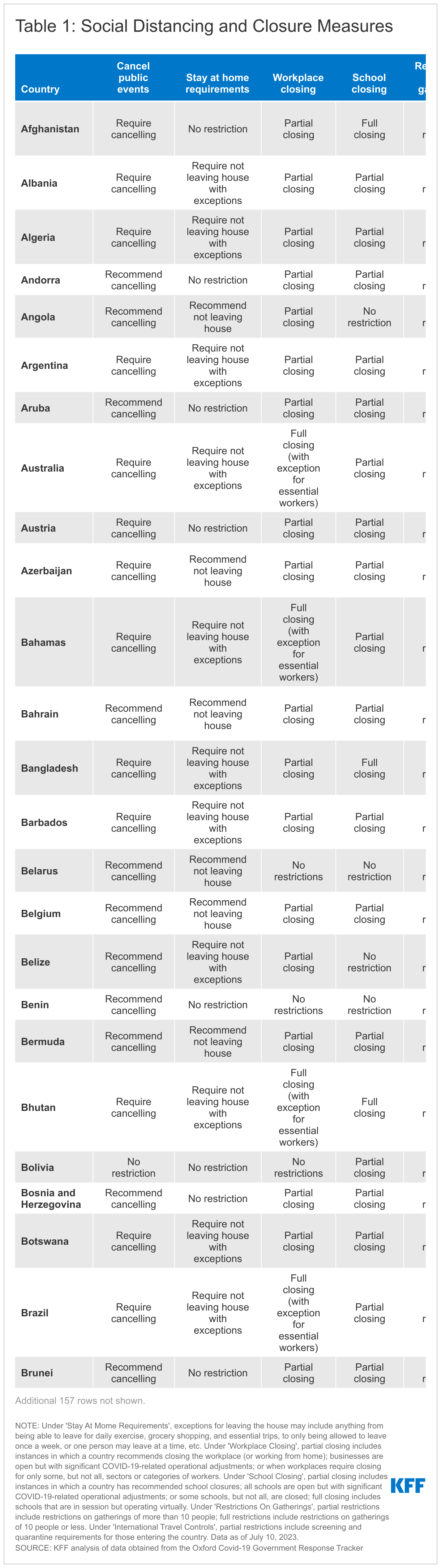
This tracker contains information on policy measures currently in place to address the COVID-19 pandemic. Policy categories currently being tracked include social distancing & closure measures, economic measures, and health systems measures. Policies are tracked at the country-, income-, and region-level. Please see the Methods tab for more detailed information on data sources and notes.

Social Distancing and Closure Measures

As countries continue to implement policies to prevent the transmission of SARS-CoV-2, the virus that causes COVID-19, these tables and charts show which social distancing and closure measures are currently in place by country.

Global COVID-19 Policy Actions

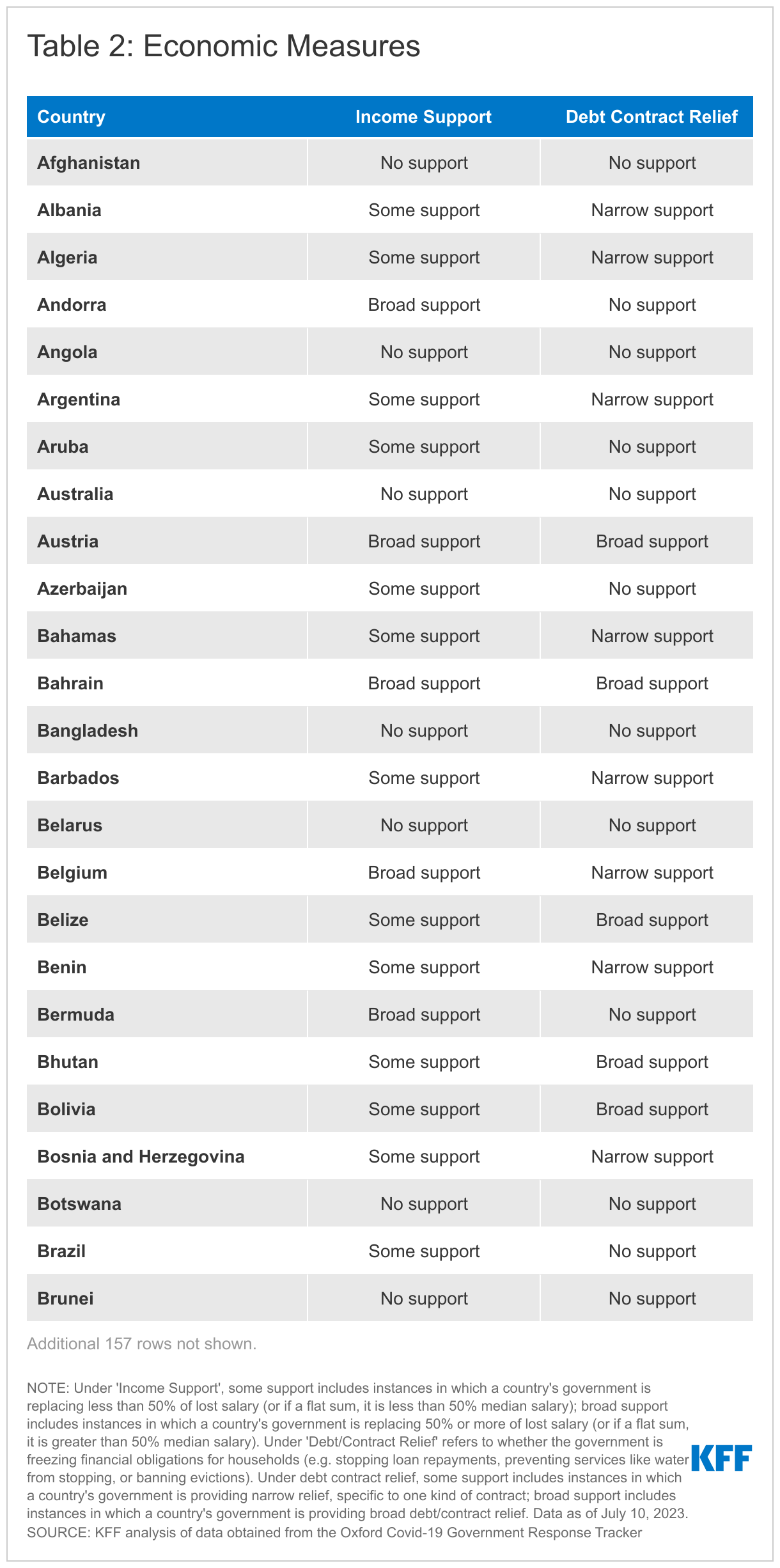
Economic Measures

The COVID-19 pandemic has placed an unprecedented strain on country economies. These tables and charts show which economic-related measures, namely income support and debt relief, are currently in place by country.

Global COVID-19 Policy Actions

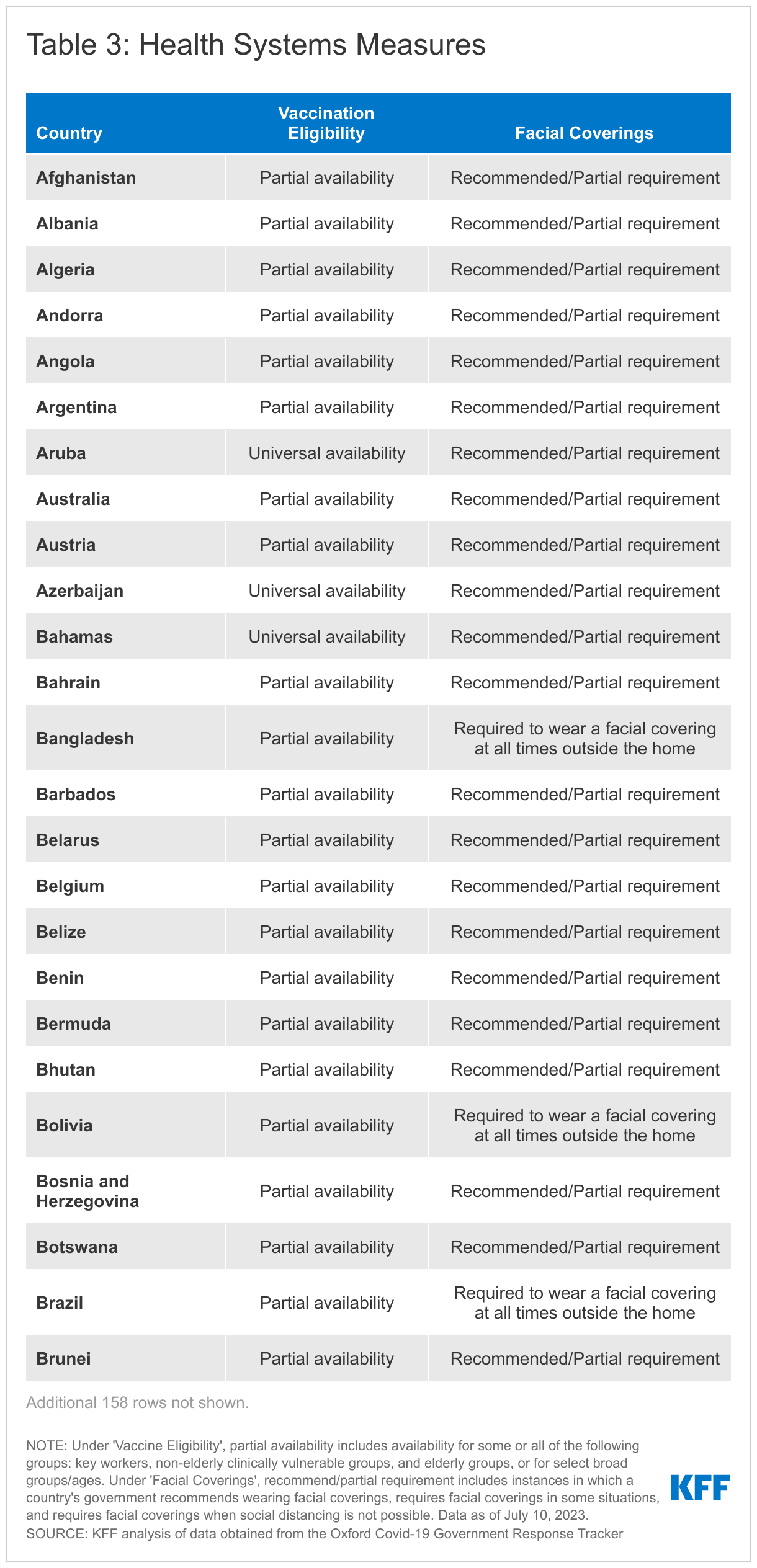
Health Systems Measures

The COVID-19 pandemic continues to strain and disrupt global health systems. These tables and charts show which health systems measures are currently in place by country.

Global COVID-19 Policy Actions

Methods

Cases and Deaths

SOURCES

As of March 7, 2023, all data on COVID-19 cases and deaths are drawn from the World Health Organization’s (WHO) Coronavirus (COVID-19) Dashboard. Prior to March 7, 2023, this tracker relied on data provided by the Johns Hopkins University (JHU) Coronavirus Resource Center’s COVID-19 Map, which ends on March 10, 2023. Population data are obtained from the United Nations World Population Prospects using 2021 total population estimates. Income-level classifications are obtained from the latest World Bank Country and Lending Groups. Regional classifications are obtained from the World Health Organization.

Policy Actions

NOTES

Policy actions data include the measure that was in place for each indicator at the country-level as of the end of 2022. Policy actions data will no longer be updated as the data source has ceased tracking government responses to COVID-19. For more information, please visit the Oxford Covid-19 Government Response Tracker.

Social Distancing and Closure Measures

Under ‘Stay At Home Requirements’, exceptions for leaving the house may include anything from being able to leave for daily exercise, grocery shopping, and essential trips, to only being allowed to leave once a week, or one person may leave at a time, etc. Under ‘Workplace Closing’, partial closing includes instances in which a country recommends closing the workplace (or working from home); businesses are open but with significant COVID-19-related operational adjustments; or when workplaces require closing for only some, but not all, sectors or categories of workers. Under ‘School Closing’, partial closing includes instances in which a country has recommended school closures; all schools are open but with significant COVID-19-related operational adjustments; or some schools, but not all, are closed; full closing includes schools that are in session but operating virtually. Under ‘Restrictions On Gatherings’, partial restrictions include restrictions on gatherings of more than 10 people; full restrictions include restrictions on gatherings of 10 people or less. Under ‘International Travel Controls’, partial restrictions include screening and quarantine requirements for those entering the country. Values for ‘Cancel Public Events’ were not recodified.

Economic Measures

Under ‘Income Support’, narrow support includes instances in which a country’s government is replacing less than 50% of lost salary (or if a flat sum, it is less than 50% median salary); broad support includes instances in which a country’s government is replacing 50% or more of lost salary (or if a flat sum, it is greater than 50% median salary). Under ‘Debt/Contract Relief’, narrow support includes instances in which a country’s government is providing narrow relief, such as relief specific to one kind of contract.

Health Systems Measures

Under ‘Vaccine Eligibility’, partial availability includes availability for some or all of the following groups: key workers, non-elderly clinically vulnerable groups, and elderly groups, or for select broad groups/ages. Under ‘Facial Coverings’, recommend/partial requirement includes instances in which a country’s government recommends wearing facial coverings, requires facial coverings in some situations, and requires facial coverings when social distancing is not possible. 

SOURCES

Data on and descriptions of government measures related to COVID-19 provided by the Oxford Covid-19 Government Response Tracker (OxCGRT). For more detailed information on their data collection and methodology, please see their codebook and interpretation guide.

Overview of President Trump’s Executive Actions on Global Health

Published: Mar 31, 2026

Note: Originally published on Jan. 28, 2025, this resource is updated as needed, most recently on March 31, 2026, to reflect additional developments. 

Starting on the first day of his second term, President Trump began to issue numerous executive actions, several of which directly address or affect U.S. global health efforts.* This guide provides an overview of these actions, in the order in which they were issued. The “date issued” is date the action was first taken; subsequent actions are listed under “What Happens/Implications.” See an accompanying timeline of events specific to the foreign aid review and USAID dissolution.

President Trump’s Executive Actions on Global Health

Initial Rescissions Of Harmful Executive Orders And Actions, January 20, 2025
PURPOSE: Initial rescissions of Executive Orders and Actions issued by President Biden.

Among these orders are several that addressed the COVID-19 pandemic and global health security, such as Executive Order 13987 (Organizing and Mobilizing the United States Government To Provide a Unified and Effective Response To Combat COVID-19 and To Provide United States Leadership on Global Health and Security),  which among other things established the National Security Council Directorate on Global Health Security and Biodefense and a Senior Director position to oversee it.
What Happens Next/Implications: Given that most of the provisions in the COVID-19 and Global Health Security actions issued by President Biden are no longer current or relevant, the rescissions of these actions are likely to have minimal effect on government policies. One exception may be the elimination of the Directorate of Global Health Security and Biodefense and its Senior Director at the National Security Council, which were responsible for interagency coordination on global health security matters during the Biden Administration. The elimination of this office echoes a similar move made during the first Trump Administration to eliminate an NSC Directorate for Global Health Security, and raises questions about who and which offices at NSC (and across the government) will fill this coordination role in the new Administration. More rescissions of other Biden administration Executive Actions may be issued at a later date.
Withdrawing The United States From The World Health Organization, January 20, 2025
PURPOSE: To withdraw from the World Health Organization (WHO).
“The United States noticed its withdrawal from the World Health Organization (WHO) in 2020 due to the organization’s mishandling of the COVID-19 pandemic that arose out of Wuhan, China, and other global health crises, its failure to adopt urgently needed reforms, and its inability to demonstrate independence from the inappropriate political influence of WHO member states.  In addition, the WHO continues to demand unfairly onerous payments from the United States, far out of proportion with other countries’ assessed payments. China, with a population of 1.4 billion, has 300 percent of the population of the United States, yet contributes nearly 90 percent less to the WHO.”

ACTIONS: The United States intends to withdraw from the WHO. 
The Presidential Letter to the Secretary-General of the United Nations signed on January 20, 2021, that retracted the United States’ July 6, 2020, notification of withdrawal is revoked.
Executive Order 13987 (Organizing and Mobilizing the United States Government to Provide a Unified and Effective Response to Combat COVID–19 and To Provide United States Leadership on Global Health and Security), which, among other things, called for “engaging with and strengthening the World Health Organization” is revoked.
Assistant to the President for National Security Affairs shall establish directorates and coordinating mechanisms within the National Security Council apparatus as necessary and appropriate to safeguard public health and fortify biosecurity.
The Secretary of State and Director of the Office of Management and Budget shall take actions to pause future transfer of any U.S. funds, support, or resources to WHO; recall and reassign U.S. government personnel or contractors working in any capacity with WHO; and identify credible and transparent U.S. and international partners to assume necessary activities previously undertaken by WHO.
The Director of the White House Office of Pandemic Preparedness and Response Policy shall review, rescind, and replace the 2024 U.S. Global Health Security Strategy.
The Secretary of State shall immediately inform the Secretary-General of the United Nations, any other applicable depositary, and the leadership of the WHO of the withdrawal.
While the withdrawal is in progress, Secretary of State will cease negotiations on the WHO Pandemic Agreement and the amendments to the International Health Regulations, and states that “actions taken to effectuate such agreement and amendments will have no binding force on the United States.”
What Happens Next/Implications: President Trump initiated a process to withdraw from the WHO during his first term in office, a process that takes a year to finalize, and halted funding. This time period was not met when President Biden took office and he reversed this decision and restored funding. Now, after issuance of a formal letter of withdrawal United Nations and WHO, the process will be initiated once again. Such a letter has been issued, indicating that membership will end as of January 22, 2026.Per the Executive Order, U.S. government representatives may not work with WHO. While U.S. representatives attended the Executive Board meeting in February (the U.S. previously held a seat on the Executive Board), no representatives attended the World Health Assembly in May, where world leaders adopted the Pandemic Agreement. On May 30, the White House released details on the President’s Budget Request for FY 2026, requesting eliminated funding for WHO. Further, on June 3, the administration asked Congress to rescind funds previously appropriated for fiscal years 2024 and 2025, including contributions to WHO. However, for both the FY 2026 appropriations and FY2024-25 rescissions, Congress will determine the final funding levels. As the largest donor to WHO providing approximately 16%-18% of the organization’s revenue, the absence of U.S. funding will have an impact WHO’s operations, as will the loss of U.S. technical expertise. See: KFF Fact Sheet and Quick Take

Update: The formal withdrawal of the U.S. government from the WHO became effective on January 22, 2026.
Reevaluating And Realigning United States Foreign Aid, January 20, 2025
PURPOSE: To pause funding and review all U.S. foreign assistance to assess alignment with American values.

The U.S. “foreign aid industry and bureaucracy are not aligned with American interests and in many cases antithetical to American values. They serve to destabilize world peace by promoting ideas in foreign countries that are directly inverse to harmonious and stable relations internal to and among countries.”

“It is the policy of United States that no further United States foreign assistance shall be disbursed in a manner that is not fully aligned with the foreign policy of the President of the United States.”

Calls for:

90-day pause in U.S. foreign development assistance (new obligations or disbursements) to assess programmatic efficiencies and consistency with U.S. foreign policy.
Review of U.S. foreign assistance programs by the responsible department and agency heads under guidelines provided by the Secretary of State, in consultation with the Director of OMB.
Responsible department and agency heads, in consultation with the Director of OMB, will make determinations within 90 days of this order on whether to continue, modify, or cease each foreign assistance program based upon the review recommendations, with the concurrence of the Secretary of State.
New obligations and disbursements may resume for a program prior to the end of the 90-day period if a review is conducted, and the Secretary of State or his designeein consultation with the Director of OMB, decide to continue the program in the same or modified form.  Additionally, any other new foreign assistance programs and obligations must be approved by the Secretary of State or his designee, in consultation with the Director of OMB.
The Secretary of State may waive the pause for specific programs.
What Happens Next/Implications: Almost all global health programs are funded through foreign aid appropriations and are therefore subject to this order. The order temporarily freezes any new U.S. government spending (obligations or disbursements) through these programs, which could interrupt implementation of programs for which funds have not yet been obligated. It also calls for a 90-day review of all foreign aid programs. Key developments are as follows:
On January 24, 2025, A Notice on Implementation of the Executive Order was issued by USAID which, among other things, calls for stop-work orders to be issued for all existing foreign assistance awards (not just new obligations and disbursements). It notes that waivers have been granted for: foreign military financing for Israel and Egypt and emergency food assistance (and related expenses) and, on a temporary basis, salaries and related administrative expenses, including travel, for U.S. direct hire employees, personal services contractors, and locally employed staff. The stop-work order on existing awards halted U.S. global health (and other foreign assistance) programs that were already underway, placing key programs at risk of not being able to provide critical services, and affecting access for individuals on the ground, unless a waiver was received.
On January 28, the Secretary of State  issued a blanket waiver for life-saving humanitarian assistance programs, which also lays out a process for requesting additional waivers (more information is here). This guidance also states that the waiver does not apply to “activities that involve abortions, family planning, conferences, administrative costs [unless associated with waived activities], gender or DEI ideology programs, transgender surgeries, or other non-life saving assistance.”
On February 1, PEPFAR, the global HIV/AIDS program, was granted a limited waiver enabling it to resume or continue “urgent life-saving HIV treatment  services”, defined as a set of care and treatment services and prevention of mother-to-child transmission services.
On February 4, some additional services for other global health programs  – tuberculosis; malaria; acute risks of maternal and child mortality, including severe acute malnutrition; and other life-threatening diseases and health conditions – deemed to be “lifesaving” were also granted a limited waiver to allow them to resume or continue.
On February 6, a lawsuit was filed by Democracy Forward and Public Citizen Litigation Group, on behalf of the American Foreign Service Association and American Federation of Government Employees, challenging the foreign aid funding freeze, the plan to put most staff on leave, and the fact that staff had already been placed on leave; on February 7, they filed a temporary restraining order (TRO). That same day, a temporary restraining order was issued by the U.S. District Court in the District of Columbia preventing the government from placing additional staff on leave or evacuating staff back to the U.S., and requiring reinstatement of all staff already placed on leave, until February 14. The court did not grant a TRO on the funding freeze, on the grounds that the plaintiffs in this case did not demonstrate that the freeze caused them irreparable harm. On February 13, the court extended the TRO through February 21 (further actions are described below, as this case was combined with another for purposes of the court’s consideration).
On February 10, a lawsuit was filed in the U.S. District Court for the District of Columbia on behalf of two U.S. organizations seeking emergency relief from the freeze on funding for foreign assistance (AVAC v. United States Department of State).
On February 11, a lawsuit was filed in the U.S. District Court for the District of Columbia on behalf of several U.S. organizations challenging the executive order and subsequent actions freezing foreign aid and dissolving USAID, and asking the court to temporarily restrain and preliminarily and permanently enjoin Defendants from implementing these actions (Global Health Council v. Trump).
On February 13, the court, in a ruling pertaining to the February 10 and February 11 lawsuits brought by numerous U.S. organizations, issued a TRO preventing the Trump administration from “suspending, pausing, or otherwise preventing the obligation or disbursement of appropriated foreign-assistance funds in connection with any contracts, grants, cooperative agreements, loans, or other federal foreign assistance award that was in existence as of January 19, 2025; or issuing, implementing, enforcing”, or “otherwise giving effect to terminations, suspensions, or stop-work orders in connection with any contracts, grants, cooperative agreements, loans, or other federal foreign assistance award that was in existence as of January 19, 2025.”
On February 14, the parties filed a joint status report proposing an expedited preliminary injunction briefing schedule.
On February 18, the government filed a required status report stating that, despite the TRO, it had the authority to cancel contracts and suspend grant awards.
This was followed by a February 19 request by the February 10 plaintiffs (AVAC v. Department of State) for an emergency motion to enforce the TRO and to hold the defendants in civil contempt.
The defendants filed a required response on February 20, stating that they have not violated the TRO and should not be held in contempt, which was again opposed by the plaintiffs. Also on February 20, the February 11 plaintiffs (Global Health Council v. Trump) filed a response to the defendant’s status report with a motion to enforce the TRO.  The court reaffirmed the TRO on February 20 (but did not hold the defendants in contempt), stating it was prepared to hold a hearing on the preliminary injunction motions in both cases by March 4, 2025 and that the TRO would be in place through March 10, 2025, or the date the Court resolves the preliminary injunction motions, whichever is sooner.
The plaintiffs filed an emergency order to enforce the TRO on February 24, due to continued lack of payment, and the court issued a motion to enforce on February 25. The government appealed, (asking for a stay pending appeal) but this was denied by the court. The government then appealed to the Supreme Court and was granted a stay until February 28 while the case was considered.
On March 5, the Supreme Court denied the government’s request to vacate the federal district court’s TRO, sending the order back to the district court to clarify the government’s obligations for ensuring compliance with the TRO.
On March 6, the federal district court judge ordered the government to release all payments that were due to plaintiffs as of February 13, by Monday, March 10 at 6pm, and on March 10, the federal district court judge preliminarily enjoined the government from taking certain actions related to the foreign aid freeze.
On March 10, Secretary Rubio announced that a six-week review had been completed and that 83% of programs at USAID (5,200 contracts) had been cancelled. That same day, the court  preliminarily enjoined the government from enforcing actions taken to implement the foreign aid freeze (requiring it to reverse any terminations, suspensions, and stop-work orders and to pay for any work completed by February 13). The court stated that the government was “enjoined from unlawfully impounding congressionally appropriated foreign aid funds and shall make available for obligation the full amount of funds that Congress appropriated for foreign assistance programs in the Further Consolidated Appropriations Act of 2024.”
On April 1, the government filed an appeal with the U.S. Court of Appeals for the District of Columbia challenging the preliminary injunction issued on March 10.
On April 17, the administration extended the foreign aid review for another 30 days from the original deadline of April 20, 2025.
On May 2 and May 30, the White House released information on its budget request for FY 2026, proposing significant decreases, and in some cases eliminations, of funding for global health activities. However, Congress will determine the final funding levels.
On June 3, the administration asked Congress to rescind previously appropriated funds for fiscal years 2024 and 2025, including $8.3 billion in foreign assistance, of which at least $1.2 billion was designated for global health. However, Congress will need to approve any potential rescissions.
• On August 13, the U.S. District Court of Appeals for the District of Columbia Circuit partially vacated the March 10 preliminary injunction in the cases GHC v. Trump and AVAC v. State Department which required the government to make congressionally appropriated foreign assistance funds available for obligation. The appeals court ruled that the plaintiffs did not have the authority to challenge the President’s impoundment of funds. Instead, the court ruled that challenges of impoundment should be brought forward by the Comptroller General.
• On August 28, the U.S. District Court of Appeals for the District of Columbia Circuit amended its opinion, clarifying that while plaintiffs did not have the authority to challenge impoundment of foreign assistance funds through the Impoundment Control Act, they could seek relief through the Administrative Procedures Act. Following this amended opinion, plaintiffs in GHC v. Trump and AVAC v. State Department cases motioned for a preliminary injunction in the U.S. district court on September 1. On September 3, the U.S. district court granted the preliminary injunction, ordering defendants to obligate expiring foreign assistance funds before the end of the fiscal year on September 30. On September 4, defendants appealed this preliminary injunction and requested a stay on the preliminary injunction pending the resolution of the appeals case, from both the district court and appeals court. These requests were both denied on September 5. On September 8, defendants requested a stay of the preliminary injunction as it pertained to funds included in the President’s proposed rescissions package from the U.S Supreme Court. On September 9, the Chief Justice of the Supreme Court granted a partial administrative stay of the preliminary injunction, and on September 26, the court granted the partial stay, allowing the administration to rescind the $4 billion that was in rescission package. Further legal proceedings in the case are currently stayed as the parties await the outcome of a separate legal case.

The 90-day review of foreign assistance was initially supposed to go through April 19, 2025, however, has been granted a 30-day extension. No formal results of the review have been announced.
America First Policy Directive To The Secretary Of State, January 20, 2025
PURPOSE: To put core American interests first in foreign policy.

The foreign policy of the United States “shall champion core American interests and always put America and American citizens first.”

“As soon as practicable, the Secretary of State shall issue guidance bringing the Department of State’s policies, programs, personnel, and operations in line with an America First foreign policy, which puts America and its interests first.”
What Happens Next/Implications: The State Department is responsible for the supervision and overall strategic direction of foreign assistance programs administered by the State Department and USAID, which includes the vast majority of global health assistance. It also directly oversees PEPFAR, the global HIV/AIDS program, and many aspects of global health diplomacy for the U.S. Priorities and approaches for these and other global health programs are likely to be shaped by how the White House and State Department leadership define “America First” foreign policy and American interests, and how that definition is implemented in practice.

Update: On September 18, the State Department released the America First Global Health Strategy, its new vision for U.S. global health engagement. The strategy is built around three pillars — “making America safer, stronger, and more prosperous” — and prioritizes funding for direct service support, such as commodities and health workers, includes plans for country co-investment, and seeks to transition program management operations from U.S. leadership to country ownership. The State Department is entering into multi-year bilateral agreements with recipient countries and implementation of these new agreements will begin sometime in 2026.
Defending Women From Gender Ideology Extremism And Restoring Biological Truth To The Federal Government, January 20, 2025
PURPOSE: To define sex as an immutable binary biological classification and remove recognition of the concept of gender identity.

• The order states that “It is the policy of the United States to recognize two sexes, male and female” and directs the Executive Branch to “enforce all sex-protective laws to promote this reality”. Elements of the order that may affect global health programs are as follows:
Defines sex as “an individual’s immutable biological classification as either male or female”.  States that “sex” is not a synonym for and does not include the concept of “gender identity” and that gender identity “does not provide a meaningful basis for identification and cannot be recognized as a replacement for sex.”
Directs the Secretary of Health and Human Services to provide the U.S. Government, external partners, and the public clear guidance expanding on the sex-based definitions set forth in the order within 30 days.
Directs each agency and all Federal employees to “enforce laws governing sex-based rights, protections, opportunities, and accommodations to protect men and women as biologically distinct sexes, including when interpreting or applying statutes, regulations, or guidance and in all other official agency business, documents, and communications.
Directs each agency and all Federal employees, when administering or enforcing sex-based distinctions, to use the term “sex” and not “gender” in all applicable Federal policies and documents.
Directs agencies to remove all statements, policies, regulations, forms, communications, or other internal and external messages “that promote or otherwise inculcate gender ideology”, and shall cease issuing such statements, policies, regulations, forms, communications or other messages. Directs agencies to take all necessary steps, as permitted by law, to end the Federal funding of gender ideology.
Requires that Federal funds shall not be used to promote gender ideology and directs agencies to ensure grant funds do not promote gender ideology.
Rescinds multiple executive orders issued by President Biden, including: “Preventing and Combating Discrimination on the Basis of Gender Identity or Sexual Orientation” (13988) and “Advancing Equality for Lesbian, Gay, Bisexual, Transgender, Queer, and Intersex Individuals” (14075).
What Happens Next/Implications: This order is broad, directed to all federal agencies and programs. Because PEPFAR, and some other U.S. global health programs, serve people who are members of the LGBTQ community, guidance and implementation could affect the ability of these programs to reach individuals and organizations and provide them with services. In addition, the order will likely result in the removal of existing protections based on sexual orientation and gender identity, which had been provided in agency guidance for global health and development programs. Implementation guidance has been issued and all federal agencies must comply.

Update: On January 27, 2026, citing this order (among others) the Trump administration released details of the “Promoting Human Flourishing in Foreign Assistance (PHFFA)” policy which significantly expands the Mexico City Policy (see below) to also prohibit the promotion of “gender ideology” and to apply to significantly more funding and organizations.
Memorandum For The Secretary Of State, The Secretary Of Defense, The Secretary Of Health And Human Services, The Administrator Of The United States Agency For International Development, January 24, 2025
PURPOSE: To reinstate Mexico City Policy and direct review of programs per the Kemp-Kasten Amendment.

• Revokes President Biden’s Presidential Memorandum of January 28, 2021 for the Secretary of State, the Secretary of Defense, the Secretary of Health and Human Services, and the Administrator of the United States Agency for International Development (Protecting Women’s Health at Home and Abroad).
Reinstates President Trump’s Presidential Memorandum of January 23, 2017 for the Secretary of State, the Secretary of Health and Human Services, and the Administrator of the United States Agency for International Development (The Mexico City Policy).
Directs the Secretary of State, in coordination with the Secretary of Health and Human Services, to the extent allowable by law, to implement a plan to extend the requirements of the reinstated Memorandum to global health assistance furnished by all departments or agencies.
Directs the Secretary of State to take all necessary actions, to the extent permitted by law, to ensure that U.S. taxpayer dollars do not fund organizations or programs that support or participate in the management of a program of coercive abortion or involuntary sterilization.
What Happens Next/Implications: The Mexico City Policy is a U.S. government policy that – when in effect – has required foreign NGOs to certify that they will not “perform or actively promote abortion as a method of family planning” using funds from any source (including non-U.S. funds) as a condition of receiving U.S. global family planning assistance and, when in place under the Trump administration, most other U.S. global health assistance. First announced in 1984 by the Reagan administration, the policy has been rescinded and reinstated by subsequent administrations along party lines since, and expanded over time, including a significant expansion during the first Trump administration; it was widely expected that the President Trump would reinstate it in his second term and expand it further. The memorandum calls for the implementation of a plan to extend the requirements to global health assistance furnished by all departments or agencies; until the plan is ready, the scope of the new memorandum is unknown.

The memorandum also directs the Secretary of State to review programs under the Kemp-Kasten amendment, a provision of U.S. law that states that no U.S. funds may be made available to “any organization or program which, as determined by the [p]resident of the United States, supports or participates in the management of a program of coercive abortion or involuntary sterilization.” It has been used in the past to prevent funding from going to UNFPA. See: KFF Mexico City Policy explainer and related resources and Kemp-Kasten explainer.

Update: On January 7, 2026, the Trump administration announced that it had formally withdrawn from membership and participation in UNFPA, also citing the Executive Order on “Withdrawing the United States from and Ending Funding to Certain United Nations Organizations and Reviewing United States Support to All International Organizations.”

Update: Three interim final rules expanding and implementing the Mexico City Policy, now called the Promoting Human Flourishing in Foreign Assistance (PHFFA) Policy, were issued on January 27, 2026:
Protecting Life in Foreign Assistance
Combating Gender Ideology in Foreign Assistance
Combating Discriminatory Equity Ideology in Foreign Assistance Rules
This latest expansion now includes most non-military foreign assistance and applies to U.S. NGOs, international organizations, and foreign governments, as well as foreign NGOs. In addition to abortion, it also now prohibits the promotion of “discriminatory equity ideology” and “gender ideology.”

Renewed Membership in the Geneva Consensus Declaration on Promoting Women’s Health and Strengthening the Family, January 24, 2025
PURPOSE: To rejoin the Geneva Consensus Declaration.

The United States informed signatories of the Geneva Consensus Declaration of its intent to rejoin immediately. Established in 2020, the declaration, led by the United States, has the following objectives: “to secure meaningful health and development gains for women; to protect life at all stages; to defend the family as the fundamental unit of society; and to work together across the UN system to realize these values.”
What Happens Next/Implications: The Geneva Consensus Declaration, initially crafted and signed by the U.S. – along with 31 other countries at the time – was meant to enshrine certain values and principles related to women’s health and family, including a rejection of the “international right to abortion.”  The Biden administration withdrew from the Consensus in 2021.
Review of and Changes to USAID, January 27, 2025
Reorganization of the Department of State, April 22, 2025
PURPOSE: To review and potentially reorganize USAID “to maximize efficiency and align operations with the national interest,” which may include the suspension or elimination of programs, projects, or activities; closing or suspending missions or posts; closing, reorganizing, downsizing, or renaming establishments, organizations, bureaus, centers, or offices; reducing the size of the workforce at such entities; and contracting out or privatizing functions or activities performed by federal employees.What Happens Next/Implications: Related to but separate from the Executive Order on reevaluating and realigning foreign aid and on the America first policy directive to the Secretary of State, the administration has made changes to and begun a review of USAID, the U.S. government’s international development agency which oversees and/or implements most U.S. global health programs (see, The U.S. Government and Global Health). Key developments are as follows:
On January 27, senior USAID career staff were placed on leave and hundreds of other staff were let go.
On February 2, the USAID website was taken down.
On February 3, the USAID building in DC was closed, which has prevented other staff from accessing it.
The President appointed Secretary of State Rubio as Acting USAID Administrator on February 3. Secretary Rubio has said that the agency has “conflicting, overlapping, and duplicative functions that it shares with the Department of State” and that its systems and processes are not “well synthesized, integrated, or coordinated, and often result in discord in the foreign policy and foreign relations of the United States.” President Trump and other administration officials have called for dissolving the agency altogether. Formal notification of the intent to review the agency was sent by Secretary Rubio to Congress on February 3.
On February 4, a notice was posted on the USAID website stating that on February 7, all USAID direct hire personnel would be placed on administrative leave globally, with the exception of “designated personnel responsible for mission­ critical functions, core leadership and specially designated programs.” The notice also said that staff posted outside the United States would need to return to the U.S. within 30 days.
On February 6, a lawsuit was filed by Democracy Forward and Public Citizen Litigation Group, on behalf of the American Foreign Service Association and American Federation of Government Employees, challenging the foreign aid funding freeze, the plan to put most staff on leave, and the fact that staff had already been placed on leave; on February 7, they filed for a temporary restraining order (TRO). That same day, a temporary restraining order was issued by the U.S. District Court in the District of Columbia preventing the government from placing additional staff on leave or evacuating staff back to the U.S., and requiring reinstatement of all staff already placed on leave, until February 14. The court did not grant a TRO on the funding freeze, on the grounds that the plaintiffs in this case did not demonstrate that the freeze caused them irreparable harm. On February 13, the court extended the TRO through February 21, at which time, the court determined that further preliminary injunctive relief was not warranted and the TRO was ended, allowing the government to dismiss USAID staff.
On February 11, a lawsuit was filed in the U.S. District Court for the District of Columbia on behalf of several U.S. organizations challenging the executive order pausing foreign aid, and subsequent actions freezing foreign aid and dissolving USAID, and asking the court to temporarily restrain and preliminarily and permanently enjoin Defendants from implementing these actions. In a February 13 ruling, a federal court issued a TRO preventing the Trump administration from freezing foreign aid assistance but stated that the proposed injunctions related to USAID were overbroad (in a separate case, the district court ended the TRO on dismissing USAID staff – see above).
On February 13, a lawsuit was filed in the U.S. District Court for the District of Maryland by 26 former and current employees of USAID, suing Elon Musk and DOGE for taking actions to control and dissolve the agency. On February 18, the plaintiffs filed a motion for preliminary injunction. The defendants responded on February 24 and the plaintiffs replied on February 26. On March 18, the court granted a preliminary injunction, requiring the defendants to reverse many of the actions taken to dissolve USAID, and on March 21, the defendants filed an appeal on the preliminary injunction. On March 25, the U.S. 4th Circuit Court of Appeals granted the defendants’ motion for a temporary stay on the preliminary injunction, allowing DOGE to resume its efforts to dissolve USAID, until March 27. The following day on March 28, the court granted defendants’ motion for a stay, clearing the path for DOGE to continue its work dissolving USAID.
On February 18, a lawsuit was filed in the U.S. District Court for the District of Columbia on behalf of the Personal Services Contractor Association (representing USAID personal service contractors) challenging the suspension of foreign assistance and the actions related to USAID, including “steps to dismantle USAID, cripple its operations, or transfer its functions to the State Department without Congressional authorization”. On February 19, the plaintiffs filed a motion for a temporary restraining order. On March 6, the court denied the TRO request.
On March 28, Secretary Rubio announced that the Department of State and USAID have notified Congress on their intent to “undertake a reorganization that would involve realigning certain USAID functions to the Department by July 1, 2025, and discontinuing the remaining USAID functions that do not align with Administration priorities.” Additionally, nearly all the remaining USAID staff received notice that they would be subject to a final reduction-in-force.
On April 22, Secretary Rubio announced the Department of State’s reorganization plan and new organization chart. The plan states that it would consolidate functions and remove non-statutory programs that are “misaligned with America’s core national interests.”
On April 28, a lawsuit was filed by a group of labor unions, non-profits, and local governments challenging the administration’s moves to drastically reshape several federal agencies without congressional approval (American Federation of Government Employees v. Trump). The district court issued a TRO on May 9 and preliminary injunction on May 22 ordering the administration to pause large-scale reductions in force, program eliminations, and other actions related to federal agency restructuring. An emergency motion by the government for a stay pending appeal of the district court’s preliminary injunction was denied on May 30.
On May 2 and May 30, the White House released information on its budget request for FY 2026, noting the reorganization of USAID into the Department of State.
On May 29, the Department of State notified Congress of its reorganization plans, including absorbing USAID’s continued functions.
On June 13, the district court in American Federation of Government Employees v. Trump ruled that the actions of the Department of State, including the reorganization announcement and notification to Congress, were in violation of the preliminary injunction.
On July 8, the U.S. Supreme Court granted the government’s request for a stay of the preliminary injunction pending resolution of the appeals case in American Federation of Government Employees v. Trump, allowing the government to move forward with large-scale reductions to federal agency operations and workforces, including at the State Department.

While initially created through Executive Order in 1961 as part of the State Department, the Foreign Affairs Reform and Restructuring Act of 1998 established it as an independent agency within the executive branch. As such, the Executive branch does not have authority to dissolve it without Congress, and Congress also requires notification first as well as consultation on any proposed changes.

Update: On July 1, 2025, USAID was dissolved (with most employees being separated from the agency; any remaining personnel were separated by September 2, 2025). Remaining functions/activities were transferred to the State Department.
Withdrawing the United States From and Ending Funding to Certain United Nations Organizations and Reviewing United States Support to All International Organizations, February 4, 2025
PURPOSE: To review United States participation in all international intergovernmental organizations, conventions, and treaties and to withdraw from and end funding to certain United Nations (U.N.) organizations.

The U.S. “helped found” the U.N. “after World War II to prevent future global conflicts and promote international peace and security.  But some of [its] agencies and bodies have drifted from this mission and instead act contrary to the interests of the United States while attacking our allies and propagating anti-Semitism.”
States that the U.S. “will reevaluate our commitment to these institutions,” including three organizations that “deserve renewed scrutiny”:
a) the U.N. Human Rights Council (UNHRC; the U.S. will not participate in and withhold its contribution to the budget of the body),
b) the U.N. Educational, Scientific, and Cultural Organization (UNESCO; the U.S. will conduct a review of its membership in the body within 90 days), and
c) the U.N. Relief and Works Agency for Palestine Refugees in the Near East (UNRWA; reiterates that the U.S. will not contribute to the body).
Requires that within 180 days:
a) the Secretary of State, with the U.S. Ambassador to the U.N., conduct a review of all international intergovernmental organizations of which the U.S. is a member and provides any type of funding or other support, and all conventions and treaties to which the United States is a party, to determine which organizations, conventions, and treaties are contrary to the interests of the United States and whether such organizations, conventions, or treaties can be reformed; and
b) the Secretary of State to report the findings of the review to the President, through the National Security Advisor, and provide recommendations as to whether the U.S. should withdraw from any such organizations, conventions, or treaties.
What Happens Next/Implications: With a long history of multilateral global health engagement, the U.S. is often the largest or one of the largest donors to multilateral health efforts (i.e., multi-country, pooled support often directed through an international organization). It provided $2.4 billion in assessed or core contributions in FY 2024 – 19% of overall U.S. global health funding – as well as more funding in voluntary or non-core contributions.

The U.S. is also a signatory or party to numerous global health-related international conventions, treaties, and agreements; these include those that played a role in the global COVID-19 response (such as the International Health Regulations). It often has participated in negotiations for new international instruments, although the Trump administration indicated in a Jan. 20, 2025, Executive Order, listed above, that the U.S. would no longer engage in the Pandemic Agreement (sometimes called the “Pandemic Treaty”) negotiations.

This Executive Order will have immediate impacts via the ordered actions related to the three U.N. organizations specified, much as the impacts of the Jan. 20, 2025, Executive Order on the World Health Organization (WHO, which initiated U.S. withdrawal from membership and halted U.S. funding) are already being seen. Beyond these, additional impacts of this Executive Order will be determined by the findings and recommendations of the international organizations and conventions review, particularly if U.S. support for or membership in some international organizations is recommended to be reduced or eliminated and if it recommends the U.S. withdraw from any international agreements.

The 180 day review of all international intergovernmental organizations goes through August 3, 2025.

Update: On January 7, 2026, the Trump administration announced that it had formally withdrawn from 66 international organizations, including United Nations entities and non-UN entities.  
Memorandum For The Heads Of Executive Departments And Agencies, February 6, 2025
PURPOSE: The memorandum seeks to “stop funding Nongovernmental Organizations that undermine the national interest and administration priorities”.

The memorandum:
States: it is Administration policy “to stop funding NGOs [Nongovernmental Organizations] that undermine the national interest.”
Directs heads of executive departments and agencies to review all funding that agencies provide to NGOs and “to align future funding decisions with the interests of the United States and with the goals and priorities of my Administration, as expressed in executive action; as otherwise determined in the judgment of the heads of agencies; and on the basis of applicable authorizing statues, regulations, and terms.”
What Happens Next/Implications: This memo aligns with other Executive actions that target federal funding for global health and foreign assistance programs. Implementation of this memo could result in the Administration halting funding to global health NGOs they determine “do not align with administration priorities.” No criteria for how this determination will be made has been provided.

The majority of U.S. global health assistance is channeled through NGOs. In FY22, for example, 62% of U.S. global health funding was provided to NGOs as prime partners (45% to U.S.-based NGOs and 17% to foreign-based NGOs) and others are likely sub-recipients of U.S. assistance.* As such, this Order could have a significant impact on NGOs if it is determined that they do not align with administration policies. *Source: KFF analysis of data from www.foreignassistance.gov.
Addressing Egregious Actions of The Republic of South Africa, February 7, 2025
PURPOSE: To stop U.S. support for South Africa due to its “commission of rights violations in its country or its ‘undermining United States foreign policy, which poses national security threats to our Nation, our allies, our African partners, and our interests.”

“It is the policy of the United States that, as long as South Africa continues these unjust and immoral practices that harm our Nation:
(a)  the United States shall not provide aid or assistance to South Africa; and
(b)  the United States shall promote the resettlement of Afrikaner refugees escaping government-sponsored race-based discrimination, including racially discriminatory property confiscation.”

ACTIONS:
All executive departments and agencies, including USAID, shall, to the maximum extent allowed by law, halt foreign aid or assistance delivered or provided to South Africa, and shall promptly exercise all available authorities and discretion to halt such aid or assistance.
The head of each agency may permit the provision of any such foreign aid or assistance that, in the discretion of the relevant agency head, is necessary or appropriate.
The Secretary of State and the Secretary of Homeland Security shall take appropriate steps, consistent with law, to prioritize humanitarian relief, including admission and resettlement through the United States Refugee Admissions Program, for Afrikaners in South Africa. A plan shall be submitted to the President through the Assistant to the President and Homeland Security Advisor.
What Happens Next/Implications: South Africa receives a significant amount of global health assistance, particularly for HIV/AIDS, from the United States government. The executive order allows the heads of U.S. agencies to permit the provision of foreign aid or assistance under this order at their discretion. On February 10, the U.S. Embassy and Consulates in South Africa announced that PEPFAR would not be impacted by this Executive Order and could continue under the limited waiver already granted to the foreign aid funding freeze. No other exceptions have yet been announced.

The Government of South Africa has issued a statement in response to the Executive Order that, among other things, expresses concern “by what seems to be a campaign of misinformation and propaganda aimed at misrepresenting our great nation.”

Notes and Sources:

*There are several other Executive Actions issued by the President that instruct all government agencies on a variety of topics and as such broadly affect global health program operations but are not specific to global health. These include, for example, Executive Actions withdrawing from the Paris Agreement under the United Nations Framework Convention on Climate Change and ending DEI programs. These are not included in this resource.

Sources: White House, https://www.whitehouse.gov/presidential-actions/; State Department, www.state.gov.