Medicaid Coverage of and Spending on GLP-1s

Published: Jan 16, 2026

GLP-1 (glucagon-like peptide-1) drugs were originally developed to help people with type 2 diabetes manage blood sugar levels but have gained widespread attention for their effectiveness as a treatment for obesity. Due to their cost, however, coverage of GLP-1s for obesity treatment in Medicaid, ACA Marketplace plans, and most large employer firms remains limited, and GLP-1 coverage in Medicare for treatment of obesity is prohibited under current law. While state Medicaid programs must cover nearly all Food and Drug Administration (FDA) approved drugs, a long-standing statutory exception allows states to choose whether to cover weight-loss drugs under Medicaid. As a result, Medicaid coverage of GLP-1 drugs for obesity treatment is optional for states, while coverage for other indications (diabetes, cardiovascular disease, and sleep apnea) is required.

The upfront costs of GLP-1s are an ongoing concern for both public and private payers, and some employers and state Medicaid programs are now restricting coverage, despite recognizing their effectiveness at treating obesity. Expanded obesity drug coverage can increase Medicaid spending and put pressure on overall state budgets, and states are now facing tighter budget conditions and longer-term fiscal uncertainty, due in part to the federal Medicaid cuts in the 2025 reconciliation law, causing state Medicaid programs to re-evaluate their obesity drug coverage. However, almost four in ten adults and a quarter of children with Medicaid have obesity, meaning expanding Medicaid coverage of these drugs could provide access to effective obesity treatments for millions. In the longer term, reduced obesity rates among Medicaid enrollees could also result in reduced Medicaid spending on chronic diseases associated with obesity, though the evidence is mixed. Any savings on health spending because of obesity drugs may take many years and may not accrue to the Medicaid program if individuals experience shifts in coverage, so states may not be factoring long-term savings into coverage decisions.

At the federal level, the Trump administration decided not to proceed with a Biden administration proposal to allow Medicare and require Medicaid to cover obesity drugs but recently launched their own obesity drug coverage initiatives to reduce costs and increase access (see Box 1). While lower prices for state Medicaid programs could help alleviate cost concerns for states and result in expanded coverage of obesity drugs, how the new lower costs compare to the net prices state Medicaid programs currently pay and how states will respond amid tightening budget conditions remain unclear. Further, the recent announcements will not impact costs for Medicaid enrollees as they already pay little or no copays for prescription drugs, and the costs of purchasing drugs directly from manufacturers through TrumpRx will likely still be prohibitive for people on Medicaid who must have a low income to qualify for the program. Unless Medicaid covers obesity medications, enrollees are unlikely to have access to them given the high out-of-pocket cost even at lower prices. 

This brief discusses the current landscape of Medicaid GLP-1 coverage and examines recent trends in Medicaid prescriptions and gross spending on GLP-1s. Key takeaways include:

  • Obesity drug coverage in Medicaid remains limited, with 13 state Medicaid programs covering GLP-1s for obesity treatment under fee-for-service (FFS) as of January 2026.
  • The number of Medicaid prescriptions and gross spending on GLP-1s have both increased substantially since 2019.
  • Increased utilization of Ozempic and Wegovy (semaglutide) as well as Mounjaro and Zepbound (tirzepatide) have contributed substantially to recent growth.

Box 1: Recent Trump Administration Obesity Drug Initiatives

In November 2025, the Trump administration announced reaching a deal with Eli Lilly and Novo Nordisk to lower the cost of their GLP-1s for Medicare, Medicaid, and those purchasing the drugs directly from the manufacturers through a new TrumpRx website. In December 2025, the administration also introduced the BALANCE (Better Approaches to Lifestyle and Nutrition for Comprehensive hEalth) model, a five year CMS Innovation Center (CMMI) model that intends to expand access to obesity drugs in Medicaid and Medicare by negotiating lower GLP-1 prices with manufacturers. The new model will include standardized coverage criteria as well as lifestyle supports and is voluntary for state Medicaid programs, Medicare Part D plans, and manufacturers. State Medicaid programs and manufacturers were requested to submit their intentions to participate by January 8, 2026, and the model is expected to begin in May 2026. For Medicare Part D, this model will be implemented in January 2027, following a separate short-term demonstration that will allow Medicare Part D enrollees to access obesity drugs beginning in July 2026.

Does Medicaid cover GLP-1s for obesity treatment?

States can decide whether to cover obesity drugs under Medicaid. Under the Medicaid Drug Rebate Program, Medicaid programs must cover nearly all of a participating manufacturer’s FDA-approved drugs for medically accepted indications. However, weight-loss drugs are included in a small group of drugs that can be excluded from coverage1 (though the statutory exception refers to agents used for “weight loss”, “obesity drugs” is used to refer to this group of medications in this analysis). As a result, coverage of GLP-1 drugs for the treatment of obesity remains optional for states, while coverage is required for drugs approved for the treatment of diabetes and, since March 2024 and December 2024, for the treatment of cardiovascular disease (Wegovy) and moderate to severe obstructive sleep apnea in adults with obesity (Zepbound), respectively (Table 1). Coverage is also required if deemed medically necessary for children under Medicaid’s Early and Periodic Screening, Diagnostic and Treatment (EPSDT) benefit.

Obesity drug coverage in Medicaid remains limited, with 13 state Medicaid programs covering GLP-1s for obesity treatment under FFS as of January 2026 (Figure 1). When covered, GLP-1s are typically subject to utilization controls such as prior authorization, which can further limit access. Notably, KFF’s 2025 Medicaid budget survey found 16 state Medicaid programs covered GLP-1s for obesity treatment as of October 2025; however, since then, four states (California, New Hampshire, Pennsylvania, and South Carolina) have eliminated coverage of GLP-1s for obesity treatment, likely reflecting recent state budget challenges and the significant costs associated with coverage. North Carolina eliminated GLP-1 coverage beginning October 2025 due to a budget stalemate in the legislature, but coverage was reinstated in December 2025, bringing the total number of states covering GLP-1s for obesity to 13 as of January 2026. A few other states are planning or considering obesity drug restrictions in state fiscal year 2026 or 2027, and state interest in expanding coverage of obesity drugs is also waning according to this year’s survey, with states continuing to report cost as the key factor contributing to obesity drug coverage decisions. The state obesity drug coverage landscape will continue to evolve as states respond to the recent announcement of the BALANCE model (see Box 1) and as states contend with budget challenges and the federal Medicaid spending cuts in the 2025 reconciliation law.
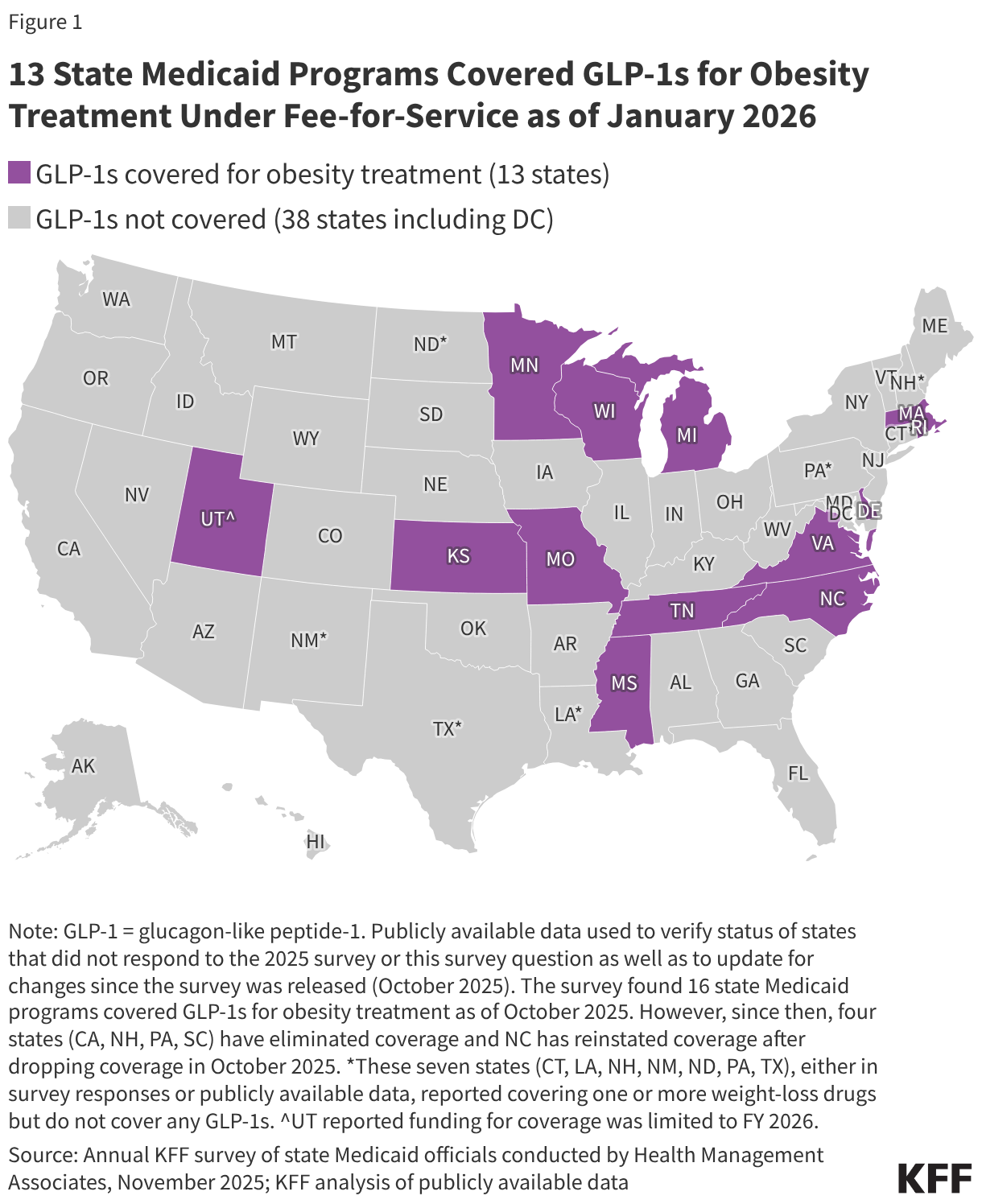
13 State Medicaid Programs Covered GLP-1s for Obesity Treatment Under Fee-for-Service as of January 2026 (Choropleth map)

How have Medicaid prescriptions and gross spending on GLP-1s changed in recent years?

The number of Medicaid prescriptions and gross spending on GLP-1s have increased substantially since 2019 (Figure 2). Not all GLP-1s are approved for obesity treatment, and this analysis includes all FDA-approved GLP-1s, including those approved for obesity (Saxenda, Weogvy, Zepbound) as well as those approved for type 2 diabetes (see Table 1). Overall, the number of GLP-1 prescriptions increased sevenfold, from about 1 million in 2019 to over 8 million in 2024. At the same time, gross spending increased ninefold, from about $1 billion in 2019 to almost $9 billion in 2024, and gross spending per GLP-1 prescription reached $1,000 in 2024. Preliminary trends through June 2025 (data not shown) show rapid growth will continue in 2025. Those prices and spending numbers do not account for rebates, and states typically receive substantial rebates on brand drugs. In response to growing criticism of the cost of their drugs, Novo Nordisk, the company that manufactures Ozempic and Wegovy, reported last year that rebates and other fees (across all payers) accounted for about 40% of the cost of the two drugs and that they expected rebates to grow. GLP-1s still account for a relatively small share of the total number of Medicaid prescriptions, accounting for about 1% of all Medicaid prescriptions in 2024 (up from about 0% in 2019). However, GLP-1s accounted for over 8% of all Medicaid prescription drug spending before rebates in 2024 (up from 1% in 2019).
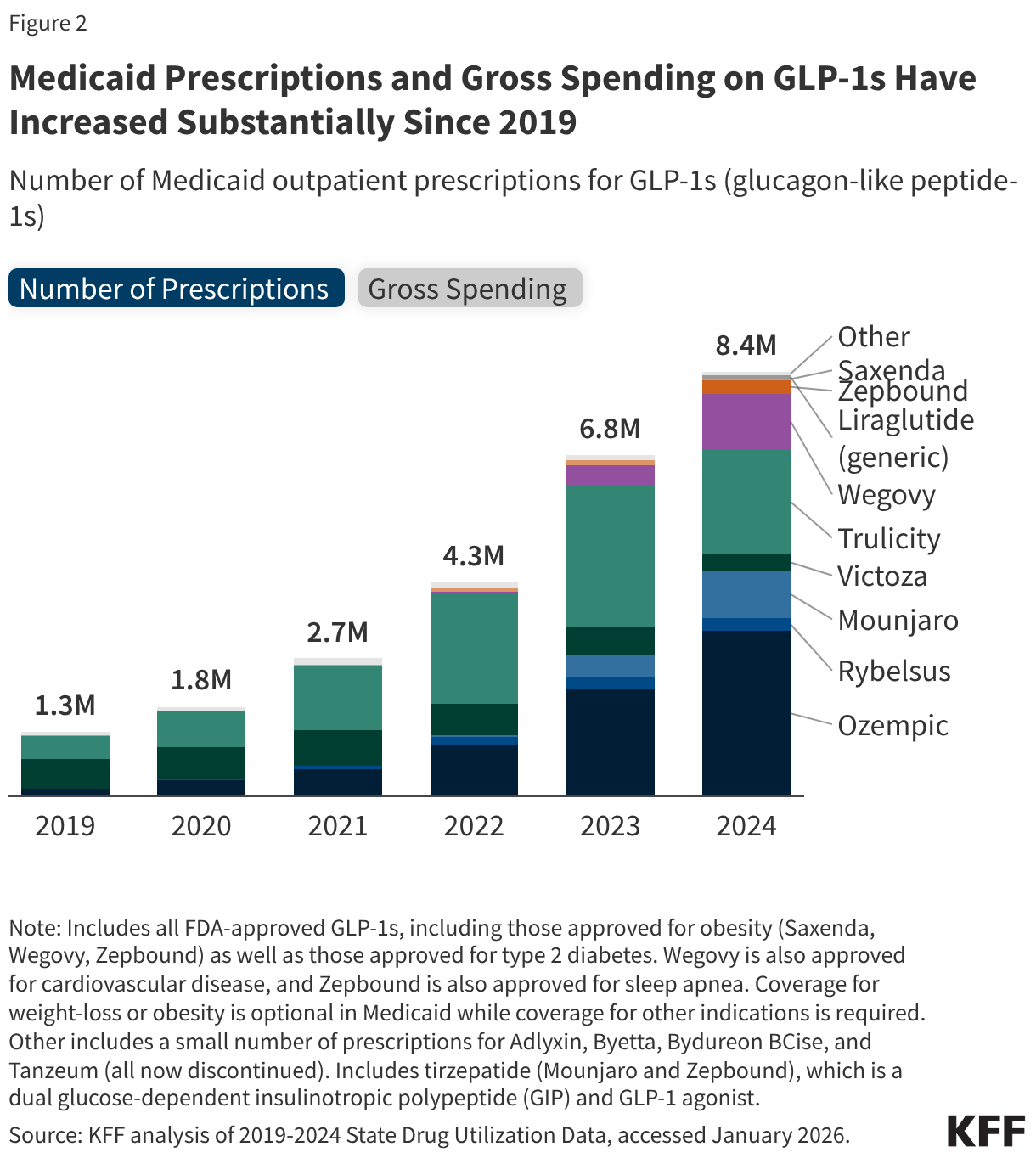
Medicaid Prescriptions and Gross Spending on GLP-1s Have Increased Substantially Since 2019 (Stacked column chart)

Specifically, increased utilization of Ozempic and Wegovy (semaglutide) as well as Mounjaro and Zepbound (tirzepatide) have contributed substantially to recent growth. Prescriptions and spending on Ozempic, approved for type 2 diabetes (not obesity) in 2017, have grown considerably over the period. By 2024, Ozempic had surpassed Trulicity, also approved for type 2 diabetes (not obesity) to make up the largest share of GLP-1 prescriptions and spending (39% in 2024). Looking from 2023 to 2024, the latest year of data available, prescriptions and gross spending for Wegovy (first approved for obesity in 2021, approved for cardiovascular disease in 2024) and Mounjaro (approved for type 2 diabetes in 2022) more than doubled, and prescriptions and gross spending for Zepbound (first approved for obesity in 2023, approved for sleep apnea in 2024) increased more than fivefold. These drugs are produced by Novo Nordisk and Eli Lilly, which both recently announced agreements with the Trump administration to lower prices. From Medicaid data publicly available, there is no way yet to disentangle how much of the growing use of GLP-1s is related to treatment for diabetes, cardiovascular disease, or sleep apnea versus obesity, or a combination.
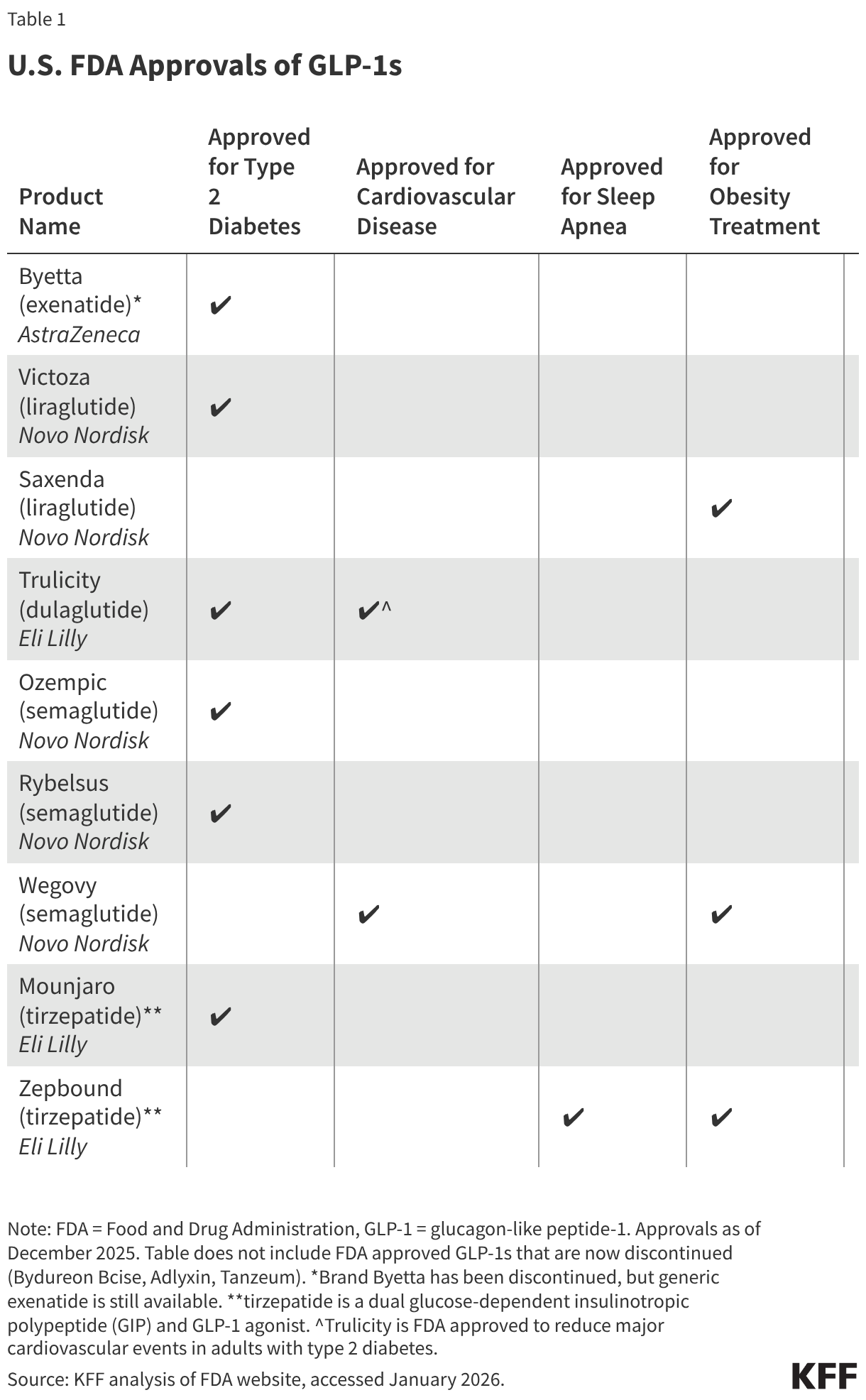
U.S. FDA Approvals of GLP-1s (Table)

Methods

Number of Prescriptions and Gross Spending Data: This analysis uses 2019 through 2024 State Drug Utilization Data (SDUD) (downloaded in January 2026). The SDUD is publicly available data provided as part of the Medicaid Drug Rebate Program (MDRP), and provides information on the number of prescriptions, Medicaid spending before rebates, and cost-sharing for rebate-eligible Medicaid outpatient drugs by NDC, quarter, managed care or fee-for-service, and state. It also provides this data summarized for the whole country. The data do not include information on the number of days supplied in each prescription. CMS has suppressed SDUD cells with fewer than 11 prescriptions, citing the Federal Privacy Act and the HIPAA Privacy Rule. This analysis used the national totals data because less data is suppressed at the national versus state level.

Identifying GLP-1s: This analysis includes all Medicaid prescriptions and gross spending for any FDA-approved GLP-1s. KFF links each drug’s NDC in the dataset to a drug class using the World Health Organization’s (WHO) Anatomical Therapeutic Chemical (ATC) classification system. GLP-1s are then identified as those classified under “A10BJ” or glucagon-like peptide-1 (GLP-1) analogues. The analysis also includes tirzepatide (Mounjaro and Zepbound), which is a dual glucose-dependent insulinotropic polypeptide (GIP) and GLP-1 agonist (and classified under “A10BX” or other blood glucose lowering drugs, excl. insulins). This method results in the inclusion of Medicaid prescriptions and gross spending for: Ozempic, Rybelsus, Mounjaro, Victoza, Trulicity, Wegovy, Zepbound, Saxenda, and generic liraglutide as well as a small number of prescriptions and spending for Adlyxin, Byetta, Bydureon BCise, and Tanzeum (now discontinued).  

Limitations: There are a few limitations to the estimates of Medicaid prescriptions and gross spending found in this analysis, including:

  • This analysis examines the number of Medicaid prescriptions in the data and does not adjust for days supplied by each prescription.
  • Gross spending and spending per prescription numbers do not account for rebates.
  • The SDUD are updated quarterly; a new quarter of data is typically released, and the prior five years of data are also updated. This means utilization and gross spending totals can vary depending on when the data is downloaded, and totals may not match other outside sources or prior KFF analysis for this reason.

  1. Drugs that may be excluded from coverage under the MDRP include drugs used for: a) anorexia, weight loss, or weight gain, b) promoting fertility, c) cosmetic purposes or hair growth, d) symptomatic relief of cough and colds, e) prescription vitamins and mineral products except prenatal vitamins and fluoride preparations , f) nonprescription drugs, g) a manufacturer’s covered outpatient drug in which tests and monitoring services have to be purchased from that manufacturer, h) sexual or erectile dysfunction unless used to treat a condition. For more information see, 42 U.S.C. § 1396r-8.  ↩︎
Potential Implications of the New Medicaid Data Sharing Agreement Between CMS and ICE  

Published: Jan 14, 2026

Introduction

The Trump Administration has taken action to share Medicaid data provided by states to the Centers for Medicare and Medicaid Services (CMS) with the Department of Homeland Security (DHS) and Immigration and Customs Enforcement (ICE) for immigration enforcement purposes. This action represents a reversal in prior policy that asserted CMS would not share such information and ICE would not use such information for immigration enforcement purposes, including assurances made to the public, applicants and enrollees, health care providers, and states that information collected to determine eligibility for health coverage programs would not be used for immigration enforcement.

This issue brief provides an overview of a new data sharing agreement for CMS to share Medicaid data with ICE and its potential implications. This sharp departure in policy to allow sharing of Medicaid enrollee data with ICE for immigration enforcement raises several key issues:

  • Data limitations may make it difficult for CMS to comply with a current court order to share data only for individuals who are not lawfully present for the 22 plaintiff states challenging the data sharing. Under pending litigation, CMS is prohibited from sharing certain information from the plaintiff states, including information for lawfully present individuals or citizens. If the data available to CMS are similar to the data researchers have access to, it is not possible to isolate immigrants who are not lawfully present in the dataset that will be shared with ICE.
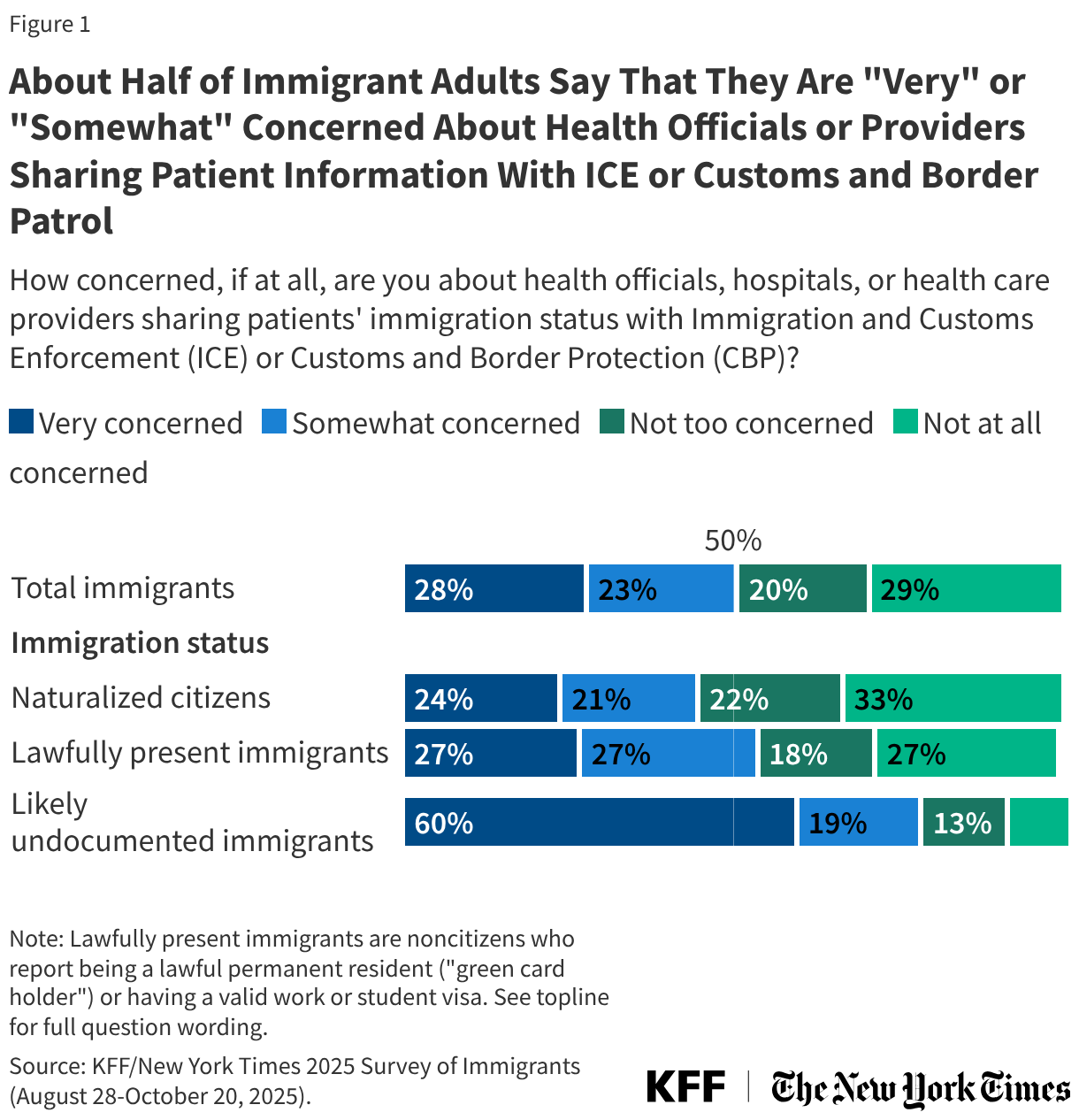
  • Going forward, the sharing of Medicaid enrollee data with ICE will likely make immigrant families, including citizen children in those families, more reluctant to access health coverage and care and other programs and services. The policy exacerbates already heightened fears among immigrant families due to increased immigration enforcement activity overall. Even prior to the public notice of the new data sharing policy, the KFF/New York Times 2025 Survey of Immigrants found that about half (51%) of immigrant adults were “very concerned” or “somewhat concerned” that health officials or health care providers may share their information with ICE or U.S. Customs and Border Protection (CBP).
  • The data sharing raises broader questions and concerns about data privacy and protections, which may extend beyond immigrant families. Individuals enrolled in Medicaid did so under prior assurances that information would not be shared for immigration enforcement purposes. Applying new policy retroactively to people who took actions under previous policy and safeguards may broadly increase concerns about privacy and safeguards of data. Health care providers, including community health centers and hospitals, may also have growing concerns about potentially being required to share patient information.

What Medicaid data do states report to CMS?

Medicaid is jointly administered by the federal government and states, and states must share certain information with CMS for program administration. State Medicaid agencies collect and maintain personal and health information for applicants and enrollees to determine eligibility and provide care. Undocumented immigrants are not eligible for Medicaid or other federally-funded coverage, but payments for emergency services may be made to hospitals on behalf of individuals who are otherwise eligible for Medicaid but for their immigration status. States include information about these payments in their reports to CMS. Some states provide health coverage to some immigrants regardless of immigration status using state-only funds. However, states are not required to submit this state-only program information to CMS. States cannot require applicants to provide citizenship or immigration status for any family or household members not applying for coverage.

Under the data sharing agreement, CMS will be sharing data from the Transformed Medicaid Statistical Information System or T-MSIS with ICE, which provides robust information on Medicaid enrollees but is significantly lagged. T-MSIS data also are made available to researchers, providing insight into what data it includes. The data available to researchers are generally almost two years old (e.g., calendar year 2024 data are available in 2026) and include demographic and eligibility files with information on age, gender, race and ethnicity, Medicaid eligibility, Medicaid enrollment, and coverage through Medicaid managed care. There are also claims files that include claims for all services covered by the states, premium payments from the states to managed care plans, and records of services used by managed care enrollees. In some cases, states provide more data to the federal government than are made available to researchers such as KFF. It is likely that CMS has access to more timely data too, but it is unknown how timely those data are and the extent to which timeliness varies across the states.

In the T-MSIS data available to researchers, there are a few types of information related to immigration status, but no indicator that allows for separate identification of immigrants who are undocumented. Specifically, T-MSIS includes the following data elements:

  • Immigration status, which indicates whether a person is one of the following:
    • “A qualified alien,” which is a specific subset of noncitizens with lawful immigration status, such as lawful permanent residents (LPRs or “green card” holders), who may be eligible for Medicaid and CHIP and certain other federal programs. Many must wait five years after obtaining qualified status before they may enroll in coverage.
    • “Lawfully present under CHIPRA 214,” which includes lawfully residing pregnant people and children in states that have taken up the option to eliminate the five-year wait to enroll in coverage for eligible immigrants with qualified status and extend coverage to lawfully present pregnant people and/or children beyond those with a qualified status.
    • “Eligible only for payment of emergency Medicaid services,” which includes individuals who would otherwise be eligible for Medicaid but for their immigration status. This group includes undocumented immigrants, noncitizen immigrants with a qualified status who are in the five-year waiting period for coverage, and lawfully present immigrants without a qualified status.
    • “A U.S. citizen or U.S. national.”
  • Whether or not the enrollee’s immigration status has been verified, and
  • The date on which the five-year waiting period for receiving Medicaid and other federally funded benefits ends.

Undocumented immigrants are included in the population that is “eligible for payment of emergency Medicaid services,” but that group also includes some groups of lawfully present immigrants, and the dataset available to researchers does not separately identify these groups within that population. Additionally, because of the data lag, immigration status may have changed for some people since the data were collected.

What actions has the Trump Administration taken to share Medicaid enrollee data?

In July 2025, CMS and ICE established an Information Exchange Agreement that enables immigration enforcement officials to access the personal data of millions of Medicaid enrollees. A news organization made the agreement public in January 2026, after it was released as part of a lawsuit several states brought against the Department of Health and Human Services and DHS. Under the agreement, CMS will provide ICE, “access to the CMS Integrated Data Repository to retrieve information concerning the identify and location of aliens in the United States.” The agreement indicates this information will allow ICE to, “receive information concerning the identity and location of aliens in the United States, such as address, telephone number, banking information (routing number, account type, account number), email address, internet protocol (IP) addresses and other information relevant to identifying and locating aliens in the United States.”  

The agreement specifies that CMS will provide direct access to the T-MSIS to a select set of ICE employees for renewable two-month periods, and that ICE employees will access the T-MSIS to receive information concerning the identification and location of aliens in the U.S. It identifies Medicaid recipients’ name, address, Medicaid identification number, social security number, date of birth, sex, phone number, locality, ethnicity and race as the data elements to be shared. The agreement does not specify whether ICE access to Medicaid data is limited to a certain subset of Medicaid enrollees, such as noncitizens. As such, the agreement could provide ICE employees access to these data for all Medicaid enrollees, regardless of their immigration status. Also, the stated purpose of the access is to identify and locate aliens in the United States, not specifically those who are undocumented.

This action represents a reversal in prior policy that asserted CMS would not share and ICE would not use health coverage eligibility information for immigration enforcement purposes. Under this prior policy, ICE, CMS, and states made assurances to the public, applicants and enrollees, and health care providers that information collected to determine eligibility for and administer health coverage programs, including Medicaid and the Affordable Care Act (ACA) Marketplace, would not be used for immigration enforcement. CMS previously stated on its website that the information regarding individuals that it collects will only be used for administration of its programs: “To protect your privacy, we’ll tell you before we collect any personal information we need to run our health care programs and only use it for that purpose.” CMS also previously stated on its website that it will not use immigration status for immigration enforcement purposes: “We won’t use any immigration status you share with us for immigration enforcement purposes.”

A preliminary injunction temporarily halted the Trump Administration’s actions to share Medicaid enrollee data with ICE in some states. In June 2025, there were reports that the Trump administration shared the personal and health data of millions of noncitizen Medicaid enrollees living in California, Illinois, Washington, and D.C. with immigration enforcement officials. Following court challenges, a preliminary injunction temporarily blocked the data sharing in the 20  plaintiff states challenging the data sharing in August 2025. The court found that while “there does not appear to be anything categorically unlawful about DHS obtaining data from agencies like HHS for immigration enforcement, that the data sharing was implemented without a “reasoned decision making process” and likely violated the Administrative Procedures Act (APA). The injunction did not govern data sharing in other states that are not involved in the lawsuit.

On November 25, 2025, CMS issued a notice outlining its plans to begin sharing Medicaid data it receives from states with DHS and ICE once the preliminary injunction is lifted. The notice specifies that ICE, “contemplates requesting from CMS available biographical, contact, and location information, though ICE reserved the right, in a specific case, to consider requesting other information on a case-by-case basis as permitted by law.”  CMS indicates that the notice makes the public aware that it intends to disclose certain information to DHS and that it will update relevant websites to reflect its authority to share information with DHS. CMS asserts that the policy change is exempt from a notice and comment period because it is a policy statement outlining actions that are consistent with federal law. ICE also issued a policy memorandum to rescind its previous policy of not using health coverage eligibility information to pursue immigration enforcement action.  

In December 2025, the court updated its ruling, allowing CMS to share a subset of information it intends to share as outlined in the CMS notice. Under the injunction, CMS may only share information with DHS and ICE that is associated with the Medicaid program (not any other health programs); pertains only to individuals who are not lawfully present in the U.S.; and is limited to citizenship and immigration status, address, phone number, date of birth, and Medicaid ID. It prohibits the sharing of any additional information, such as health information, or information related to lawfully present individuals or citizens and precludes sharing additional information that may be requested on a case-by-case basis. It also specifies that, “to the extent that such basic biographical, contact, or location information about unlawfully present aliens is not severable from other information that DHS and ICE are not entitled to obtain (e.g., information about lawful permanent residents or citizens, sensitive health records), HHS or CMS may not share it.” The injunction only applies in the 22 plaintiff states involved in the lawsuit as of December 29, 2025, meaning the data sharing can proceed as outlined in the agreement and notice in other states.

Issues to Consider

Courts will ultimately determine the legality of the data sharing policy within the context of existing data privacy and protection laws. Beyond that determination, there are also issues to consider regarding how the data sharing policy can be operationalized in ways consistent with what the courts have allowed so far and broader implications for families, health care providers, and states.

Data limitations may make it difficult for CMS to comply with the current court order to share data only for individuals who are not lawfully present for the 20 states challenging the data sharing agreement. If the T-MSIS data available to CMS are similar to the data researchers have access to, it is not possible to isolate immigrants who are not lawfully present. Existing T-MSIS data elements identify individuals eligible only for payment of emergency Medicaid services. However, any data shared with ICE using that identifier will include people who are lawfully present (those subject to the five-year waiting period and those who do not have qualified status) as well as individuals who are not lawfully present. The data may also include some individuals who may not have been lawfully present at the time their information was entered into the system, but who have since transitioned to lawfully present status. In the future, the 2025 reconciliation law’s restrictions on Medicaid eligibility for certain lawfully present immigrants (including refugees and asylees among others), which begin in October 2026, will mean that the share of lawfully present immigrants identified as eligible only for payment of emergency Medicaid services will increase.

Going forward, the sharing of health coverage data with ICE will likely make immigrant families, including citizen children in those families, more reluctant to access health coverage and care as well as other programs and services. The policy exacerbates already heightened fears among immigrant families due to increased immigration enforcement activity overall as well as other restrictive immigration policies, including changes in public charge policy and the recission of protections from immigration enforcement in sensitive locations such as health care facilities. Prior to the CMS notice of plans to share data, the KFF/New York Times 2025 Survey of Immigrants found that about half (51%) of immigrant adults were “very concerned” or “somewhat concerned” that health officials or health care providers may share their information with ICE or CBP (Figure 1).  These fears may contribute to individuals delaying or avoiding medical care. About one in seven (14%) immigrant adults, including 48% who are likely undocumented and 20% who are parents, say that they or a family member have avoided seeking medical care since January 2025 due to immigration-related concerns.

About Half of Immigrant Adults Say That They Are "Very" or "Somewhat" Concerned About Health Officials or Providers Sharing Patient Information With ICE or Customs and Border Patrol (Stacked Bars)

The new data sharing policy may increase questions and concerns about data privacy and protections, not only for immigrants but for the public more broadly. People already enrolled in Medicaid did so under prior assurances that information would not be shared for immigration enforcement purposes. Applying new policy retroactively to people who took actions under previous policy and safeguards may broadly increase concerns about privacy and safeguards of data. Health care providers, including community health centers and hospitals, may also have growing concerns about potentially being required to share patient information. Additionally, the policy raises questions about what other data could be shared in the future. This policy represents one piece of broader Trump Administration actions to share data for immigration enforcement. While being challenged in courts, the Trump administration has directed the Internal Revenue Service to share personal information of individuals for immigration enforcement purposes. The Transportation Security Administration is sharing the names of passengers with ICE to seek out and expel people under deportation orders, although ICE previously had avoided interfering with domestic travel. It is unknown whether the Trump Administration might share additional information from other programs in the future for immigration enforcement; or whether future data sharing will extend to other purposes beyond immigration enforcement.

Higher Premium Payments or Higher Deductibles: The Tradeoffs ACA Enrollees Face

Published: Jan 14, 2026

Some Affordable Care Act (ACA) Marketplace enrollees are choosing between plans that charge higher premium payments and plans with higher deductibles. Many enrollees are considering these tradeoffs following the expiration of the ACA’s enhanced premium tax credits at the end of 2025, according to a new Health System Tracker analysis.

While switching from a silver plan to a bronze plan could lower premium payments, the loss of cost-sharing reductions for deductibles and copays and the higher cost-sharing associated with a bronze plan may leave these enrollees worse off financially, depending on how much care they need.

The full analysis and other data on health costs are available on the Peterson-KFF Health System Tracker, an online information hub dedicated to monitoring and assessing the performance of the U.S. health system.

The America First Global Health Strategy and Pooled Procurement

What do we know about Existing Pooled Procurement Mechanisms?

Author: Jennifer Kates
Published: Jan 12, 2026

Editorial Note: Originally published in January 2026, this resource was updated to include additional information received.

Overview

The State Department’s recently released “America First Global Health Strategy” – the first roadmap for what comes next for U.S. global health engagement – charts a path of declining U.S. support over time as recipient countries increasingly take on financial responsibility for programs. It includes a focus on health commodities, as frontline services, stating that the U.S. will continue to support 100% of their costs in FY 2026, with declining funding thereafter as countries are required to provide progressively higher co-investment. To support this transition, the U.S. will establish or contribute to one or more pooled procurement mechanisms, marking a departure from current practice where most commodities have been provided by the U.S. through its own stand-alone, managed channels, with limited support to external pooled procurement entities. Whether the U.S. chooses to create a new pooled procurement mechanism or shift to existing ones will be a key decision point going forward. To help inform this decision, we reviewed eight global and regional pooled procurement mechanisms to identify their key characteristics, including their operational longevity, geographic reach, range of products offered, whether the U.S. already uses to mechanism, and other components.1 As this review shows, there are several existing pooled procurement platforms with significant longevity, broad geographic reach, offering a range of commodities, allowing access to countries that have transitioned off donor support, and in which the U.S. already participates to varying extents. There are also others with a narrower scope or in which the U.S. does not participate. Summary measures are provided in Table 1. Detailed information is provided in an Appendix.

Note: In most cases, these mechanisms also provide diagnostics, supplies, and devices. See Appendix for more details.

Table 1: Summary of Procurement Mechanisms
Institution/
Program
Type of InstitutionGeographic
Scope
Years OperationalHealth
Product Area
Used by U.S. Government?
Gavi, the Vaccine Alliance (Gavi)Independent, public/privateGlobal25Vaccines

Yes, indirectly

Global Drug Facility (GDF)Hosted by UN/Hybrid ModelGlobal24TBYes, directly
Global Fund to Fight AIDS, Tuberculosis and Malaria (Global Fund)Independent, public/privateGlobal18HIV, TB, Malaria

Yes, indirectly

Pan American Health Organization (PAHO) Revolving Fund and Strategic FundInter-governmental/UNRegional48Vaccines,
Medicines
No
The United Nations Children’s Fund (UNICEF) Supply DivisionInter-governmental/UNGlobal63Vaccine, Medicines

Yes, directly

The United Nations Population Fund (UNFPA) Supply DivisionInter-governmental/UNGlobal18Reproductive
health
No
African Union’s Medical Supplies Platform (AMSP)Inter-governmentalRegional5COVID-19; some other products

No

Organisation of Eastern Caribbean States Pharmaceutical Procurement Service (OECS PPS)Inter-governmentalRegional39MedicinesNo
Note: In most cases, these mechanisms also provide diagnostics, supplies, and devices. See Appendix for more details.

Introduction

The State Department’s recently released “America First Global Health Strategy” offers the first roadmap for what comes next for U.S. global health engagement, following months of significant uncertainty and disruption. The strategy focuses on a subset of U.S. global health areas – HIV, TB, malaria, polio, and global health security – and is largely anchored to time-bound, bilateral agreements that aim to move most partner countries toward full self-reliance. A key feature of the strategy is its emphasis on health commodities, noting that the U.S. spends approximately $1.3 billion per year directly on commodities for HIV, TB, malaria, and polio (with some additional funding provided to several multilateral organizations). According to the strategy, the U.S. will continue covering 100% of these commodity costs in FY 2026, with declining funding thereafter, as countries are required to provide progressively higher co-investment. To support this transition, the U.S. intends to establish or contribute to one or more pooled procurement mechanisms. Pooled procurement refers to the consolidation of demand across multiple buyers with the goal of obtaining lower prices, reduced transaction and administrative costs, streamlined quality assurance, and more predictable markets, all of which can help improve better access. It is one tool in a larger “market shaping” toolbox that may include other activities such as demand forecasting, market analysis, and technical assistance, among others.2

Shifting to pooled procurement for health commodities would mark a departure from current U.S. practice which has historically been carried out through U.S. stand-alone and managed supply chain contracts (with only some funding provided to external pooled procurement mechanisms both directly and indirectly). Until recently, this work was overseen and managed by the now-dissolved USAID. Procurement responsibilities have since moved to the State Department, which has not carried out large-scale health commodity procurement before (see Table 2 and Box 1). Whether the U.S. chooses to create a new pooled procurement mechanism or shift to existing ones will be a key decision point going forward (the recently announced partnership between the U.S., the Global Fund, and Gilead to provide Lenacapavir – a long acting medication for pre-exposure HIV prevention – to a subset of countries, in which the U.S. will support procurement for its implementing partners through the Global Fund’s platform, offers a potential new model in this area). To help inform this decision, we reviewed eight pooled procurement mechanisms operating at the global and regional levels to identify their key characteristics. For each mechanism, we examined years of operation, governance, financing models, geographic scope, product portfolios, eligibility, price transparency, annual expenditures, and other components.

Table 2: U.S. Procurement Mechanism by Health Area Before January 2025
Health AreaDirect/TargetedIndirect/General contributions
HIVGHSC-PSMGlobal Fund
TBGHSC-PSM for TPT; GDFGlobal Fund
MalariaGHSC-PSMGlobal Fund
Vaccines, including polio
vaccine
Gavi
Maternal and child health/nutritionGHSC-PSM; UNICEF


Family PlanningGHSC-PSM 
Other Public Health ThreatsGHSC-PSM; UNICEF

Gavi

Box 1: U.S. Government Health Commodity Procurement Before January 2025

The U.S. government has procured health commodities for decades, expanding both the types of commodities supported and systems for procuring them with the evolution of U.S. global health programs, including the creation of new programs such as PEPFAR and the President’s Malaria Initiative (PMI). While initially beginning with commodities for family planning in the 1960s, by 2025, the U.S. was also procuring commodities for HIV, TB, malaria, maternal and child health, outbreak response, and vaccines for a range of vaccine preventable diseases, either directly or indirectly as follows:

  1. Direct procurement through USAID’s Global Health Supply Chain Program-Procurement and Supply Management (GHSC-PSM) project, which accounted for most health commodity procurement by the U.S. government.
  2. Targeted funding to multilateral organizations specifically for commodities (e.g., via UNICEF and GDF).
  3. Indirectly through general contributions to multilateral organizations, many of which also procure commodities (e.g., Gavi, which procures vaccines, including for polio, and the Global Fund which procures HIV, TB, and malaria commodities).

In some cases, this meant multiple mechanisms were being used to purchase the same categories of commodities with U.S. funds. For example, both HIV and malaria commodities were purchased directly by the U.S. government as well as indirectly through its contributions to the Global Fund. After pausing the main global health supply chain contract at the beginning of the year (as part of a foreign aid stop-work order), the contract has been restarted to support procurement for a subset of program areas – HIV (including TB preventive treatment for people with HIV), malaria, and some maternal and child health support. Procurement of family planning commodities has been discontinued. In addition, with the dissolution of USAID, this contract is now managed by the State Department. Procurement also continues through targeted funding and general contributions to multilateral organizations, although the U.S. has halted contributions to Gavi .

Characteristics of Existing Mechanisms

The landscape of existing pooled procurement mechanisms is diverse, with variations in geographic scope, product lines, eligibility, financing, governance, and other characteristics.

  1. Years Operational/Longevity. Most pooled procurement mechanisms examined have significant longevity, having been operating for decades. Five of the eight have 20+ years of operational experience, with established systems for vendor management, quality assurance, audits and oversight, forecasting, and broader market shaping practices. UNICEF is the oldest, having operated pooled procurement for more than six decades, followed by PAHO, with close to five decades. Gavi and the Global Fund began pooled procurement in the early 2000s, at or soon after each organization was established. The OECS-PP mechanism, while small, has also been operating for years. The exception is the AU’s Medical Supplies Platform which was created in 2020 as a COVID-19 emergency response mechanism but has since expanded to include other commodities and is slated to serve as the procurement platform for the recently proposed African Pooled Procurement Mechanism (APPM).
  2. Geographic Reach. Five of the mechanisms have a global reach while the remaining three are regional. Gavi, GDF, the Global Fund, UNICEF and UNFPA are global procurement mechanisms, encompassing the countries also reached by the U.S. through its bilateral programs. These mechanisms enable countries and non-governmental organizations from all regions to procure supported products (though some have eligibility limits by income and other factors – see below). PAHO, AMSP, and OECS PP are available to their regional members.
  3. Governance/Type of Organization. Five ofthe mechanisms examined are part of inter-governmental bodies, with governance provided by member states (UNICEF, UNFPA, PAHO, AMSP, OECS PP), three of which are part of the United Nations system (UNICEF, UNFPA, and PAHO). Gavi and the Global Fund are unique in that they are independent public/private partnerships with governance by multi-stakeholder boards that include public and private sector representatives as well as civil society. The GDF, as part of the Stop TB Partnership, is a hybrid model, hosted by the UN with some UN oversight, but a multi-stakeholder board of public, private, and civil society members. The U.S. is currently part of the governance structure of all these institutions except for the AMSP and OECS PP, which are for their regional members only.
  4. Eligibility: Eligibility to access pooled procurement mechanisms varies, reflecting organizational missions, policies, membership, and other factors. The inter-governmental mechanisms primarily serve member states, either globally (UNICEF, UNFPA) or regionally (PAHO, AMSP, OECS PP). GDF is open to all countries. Gavi and the Global Fund, while global, limit eligibility to countries based on income and, in the case of the Global Fund, epidemiologic criteria, but they also make pooled procurement available to formerly eligible countries using their own or other funds. Several of these mechanisms also allow certain other designated entities (NGOs, private organizations, etc.) to use their pooled procurement system, usually on behalf of an eligible country.
  5. Product Portfolio: The product portfolios of these mechanisms range from specialized to broad. Broad portfolios, providing products for a range of health areas, are offered by UNICEF, PAHO, and the OECS PP. More specialized portfolios are offered by the Global Fund (HIV, TB, malaria), the GDF (TB), Gavi (vaccines) and UNFPA (reproductive health). AMSP intends to expand but offers a more limited portfolio currently. All provide related supplies and equipment in addition to commodities and several also offer procurement services. There has also been a move to expand the range of commodities offered over time. For example, PAHO has added commodities to address non-communicable diseases in recent years3 and wambo.org, the Global Fund’s electronic pooled procurement platform, also offers access to select catalog platforms from other organizations, making it the only pooled procurement mechanism to do so.4
  6. Financing: The mechanisms examined have different financing models for supporting procurement of commodities, ranging from being fully self-financed by countries and other purchasers to relying primarily on donor support (e.g., grants) to enable countries to access needed commodities and supplies. PAHO and the OECS PP are self-financed, with member states paying for products. Gavi and the Global Fund depend almost entirely on donor funding to enable them to procure commodities for eligible countries or entities, although they allow eligible countries and other entities to use their own funds to procure through their systems. GDF is mixed with many countries using their own funds to procure while donor funds are used on behalf of others (including for products purchased by the Global Fund through GDF’s mechanism, for example). UNICEF and UNFPA, while also relying heavily on donor funding, also allow member states and others to use their own funding to purchase commodities.
  7. Pre-Financing/Lines of Credit. UNICEF, UNFPA, PAHO, and GDF each offer pre-financing lines of credit to address liquidity and other constraints that can prevent countries from meeting pre-payment requirements to procure commodities. UNICEF’s Vaccine Independence Initiative offers a flexible credit line to bridge temporary short-term funding gaps for vaccines and other commodities, and its Middle-Income Countries’ Financing Facility (MFF), supported by Gavi, offers pre-financing for middle-income countries no longer receiving donor support. UNFPA’s Reproductive Health Bridging Fund is a revolving fund that allows for short-term, interest-free bridge financing for eligible countries to access supplies without needing to pre-pay. Similarly, PAHO’s Regional Revolving Funds (RRF) offer an interest-free line of credit to member states for commodities. GDF implemented a Flexible Procurement Fund (FPF) in 2014 to address pre-payment barriers faced by countries by bridging payments until funds are available. The Global Fund is currently assessing the possibility of implementing such a mechanism to address the pre-payment barriers that some countries may face when using their own funds to purchase commodities.5
  8. Price Negotiation/Transparency and Quality Assurance. A key feature of the pooled procurement mechanisms examined is their ability to negotiate price, due to their aggregation of demand across multiple countries/buyers, volume guarantees, and, in some cases, advance market commitments for new products (allowing the price at entry to be lower than it would otherwise). As part of this effort, all but one of the mechanisms (OECS PP) provide public reference pricing data and, in some cases, product catalogs, promoting market transparency and predictability. All also provide varying levels of quality assurance, particularly those with the greatest longevity, including supplier pre-qualification, product eligibility criteria (e.g., only products that are pre-qualified by WHO or designated regulatory authorities) and product testing and support throughout the supply chain, including after products reach countries.
  9. Inter-connectedness Across Mechanisms. While the mechanisms examined here are separate, operating with their own rules and procedures, several are interconnected. For example, most of Gavi’s vaccines are procured for Gavi by UNICEF (Gavi eligible countries in the PAHO region can procure through PAHO); the Global Fund’s TB products are procured through the GDF as are PAHO’s Drug Resistant TB (DR-TB) products; PAHO also relies on GDF negotiations and long term agreements when procurement Drug Sensitive (DS-TB) commodities. In addition, PAHO’s antiretroviral (ARV) products are procured using Global Fund negotiated prices. This inter-connectedness is done to leverage market share (e.g., PAHO using the Global Fund for ARVs); reflect geographic proximity (Gavi-eligible countries in the PAHO region); and/or due to the presence of existing mechanisms already (UNICEF procurement of vaccines pre-dated the creation of Gavi by decades and the GDF was created before the Global Fund).
  10. Expenditures & Fees. Estimated expenditures on health products vary widely across mechanisms, reflecting differences in scale—from smaller, regionally focused platforms to large global procurement operations exceeding billions annually. The largest procurement mechanisms, as measured by spending, are UNICEF ($3 billion), the Global Fund ($2.5 billion , of which 1.8 billion was through pooled procurement), and Gavi ($1.8 billion). Because of the inter-connectedness across mechanisms, however, the annual expenditure estimates cannot be totaled. For example, while UNICEF spends the most on procurement each year, the majority of this is financed by Gavi for vaccines. In addition, TB commodities purchased by the Global Fund are included in its total procurement expenditure amount as well as in the GDF total. While there are also administrative costs for participating in pooled procurement mechanisms that are important to consider, there are limited publicly available data on fee schedules (exceptions are UNICEF and PAHO6).

Looking Ahead

As this review shows, there are several existing pooled procurement platforms with significant longevity, broad geographic reach, offering a range of commodities, allowing access to countries that have transitioned off donor support, and in which the U.S. already participates to varying extents. Looking ahead, key considerations for U.S. policymakers may include:

  • Further assessing the current commodity portfolios of existing mechanisms as compared to the U.S. commodity portfolio;
  • Identifying the different ways in which the U.S. government could choose to participate in these mechanisms (e.g., purchasing directly through them for some or all commodities, funding countries to purchase through them, or some combination);
  • Examining the barriers to direct country participation in global pooled procurement mechanisms (e.g., pre-payment requirements, regulatory barriers) and ways to mitigate these barriers; and
  • Assessing the growing move to create regional pooled procurement mechanisms, particularly in Africa, and whether and how the U.S. might choose to support these efforts.

We would like to acknowledge the helpful input on earlier versions of this brief provided by Monica Jordan, Debbie Stenoien, and Allyala Nandakumar of Boston University.  


Appendix Table 1

Characteristics of Global and Regional Pooled Procurement Mechanisms for Health Commodities
A1. Institution/
Program
DescriptionYear Pooled Procurement
Operational
Geographic ScopeCommodities/Products
Offered
Eligibility
Criteria
Spending on Health Procurement*, 2024
Gavi, the Vaccine Alliance
(Gavi)
Gavi, an independent public-private partnership and multilateral funding mechanism, aims to increase access to vaccines, particularly for children, including by shaping markets for vaccines through centralized and pooled procurement and other procurement tools. UNICEF serves as the main procurement agency for Gavi, with PAHO available for procurement for eligible countries in its market. Countries receiving new vaccine support from Gavi can also choose to self-procure if certain conditions are met.2000Global  Vaccines against twenty different diseases including for routine vaccination, campaigns, and outbreak response; associated supplies (injection safety devices: auto-disable syringes, reconstitution syringes, and safety boxes); diagnostics for Yellow Fever and Cholera; cold chain equipment.
 
Gavi also finances the global vaccine stockpiles for yellow fever, meningitis, Ebola and cholera.
Low- and middle-income countries eligible for Gavi support (based on income); Small Island Developing States; Former Gavi-eligible countries, never Gavi eligible lower-middle-income countries, and additional International Development Agency (IDA)-eligible economies, to prevent backsliding and introduce key missing vaccines.
 
54 countries eligible (additional 19 formerly eligible)
$1.8 billion on vaccines, diagnostics, supplies
Global Drug Facility
(GDF)
A project of the Stop TB Partnership, the GDF aims to facilitate access to Tuberculosis medicines and diagnostics, including through pooled procurement.2001GlobalTB medicines and diagnostics and medical devices; associated supplies, including lab supplies, and technologies.
 
GDF also operates a “Strategic Rotating Stockpile” (SRS) which allows for rapid response to emergencies and reduces lead times for medicine delivery.
Governments, NGOs, and other institutions.
 
190+ countries
$350 million of which:
 
$239 (68%): Medicines
$12.1m (3%): Devices $99.7m (28%): Diagnostics
Global Fund to Fight AIDS, Tuberculosis and Malaria (Global Fund)The Global Fund is an independent public-private partnership and multilateral funding mechanism which aims to end AIDS, TB, and malaria by increasing access to health services, including by shaping markets for HIV, TB and malaria health products through centralized and pooled procurement and other procurement tools. Its first pooled procurement mechanism was created in 2007 and an online procurement platform, WAMBO, was launched in 2016. A limited amount of Global Fund procurement is also done via GDF, UNICEF, PAHO, UNDP, and national systems. 2007GlobalAntimalarial medicines;  antiretrovirals; drugs for opportunistic infections and sexually transmitted infections; HIV & malaria rapid diagnostic tests; HIV prevention commodities; long-lasting insecticidal nets; viral load & early infant diagnosis; TB medicines and diagnostics (for drug-resistant TB, all procurement is done via GDF, as is a subset of procurement for drug-sensitive TB and diagnostics products); other essential medicines; medical devices and PPE. Also provides access to other product catalogues of select UN partner organizations and competitively-selected Procurement Services Agents.Low- and middle-income countries eligible for Global Fund support (based on income and disease burden criteria), including approved implementer organizations and governments in those countries; countries that have transitioned from Global Fund support (using non-Global Fund financing).
 
135 eligible (additional 38 formerly eligible)
$2.5 billion including $1.8 billion through pooled procurement, of which:
 
$562m (32%): ITNs
$294m (17%): ARVs
$278m (16%): COVID RM
$224m (13%): RDTs
$159m (9%): Anti-malarial medicines
$151m (9%): Diagnostics/Lab
$36m (2%): Condoms/Lubricants
$33m (2%): Essential Medicines
$20 (1%): IRS
 
*Non-health products excluded
Pan American Health Organization (PAHO)
 
 
PAHO, the specialized health agency of the Inter-American System and the Regional Office for the Americas of WHO, aims to improve and protect people’s health and access, including through pooled procurement and other procurement tools. The Revolving Fund for Access to Vaccines was created in 1977 to support pooled procurement of vaccines and the Strategic Fund for Public Health Supplies was created in 1999 to support pooled procurement of medicines and medical supplies. These two funds were merged in 2023 into the Regional Revolving Funds (RFF) Special Program.1977Regional: The Americas


Vaccines and biologicals; syringes and safety boxes; cold chain equipment; Medicines; Diagnostic and medical equipment; Vector control supplies. Procurement of antiretrovirals is done through the Global Fund’s pooled procurement mechanism under an MOU.PAHO Member States
35 countries
$732 million of which:
 
$696m (95%): Vaccines & Medicines
$36m (5%): Equipment and Supplies
 
*note: freight/insurance/other goods and supplies excluded
**most spending is on vaccines


The United Nations Children’s Fund (UNICEF)UNICEF works to reach the most disadvantaged children and adolescents, including by increasing access to health services through market shaping via pooled procurement and other procurement tools.1962GlobalVaccines and biologics; medical supplies and equipment; pharmaceuticals; insecticide-treated nets; and cold chain equipment.
 
Governments (primarily LMICs), other UN agencies, NGOs, philanthropic organizations and universities.
 
190+ countries
$3 billion of which:
 
$2.5B (84%): Vaccines/biologics
$168m (6%): Supplies
$149m (5%): Pharmaceuticals
$118m (4%): Cold chain
$51m (2%): ITNs
The United Nations Population Fund (UNFPA)UNFPA is the sexual and reproductive health agency of the UN, which works to uphold the rights and choices of women, girls and young people, including by increasing access to health services. UNFPA serves as the lead agency within the UN system for the procurement of reproductive health commodities.2007GlobalReproductive health commodities, including contraceptives, medical devices, pharmaceuticals, reproductive health kits.Governments (primarily LMICs), other UN agencies, NGOs, and international organizations
 
150+ countries
$321 million of which:
 
$214m (67%): Contraceptives
$63m (20%): Dignity Kits/Inter-agency RH
$27m (8%): Medical devices $17m (5%): Pharmaceuticals
African Union’s Medical Supplies Platform (AMSP)A not-for-profit initiative and online marketplace launched by the African Union on behalf of the Africa CDC initially to respond to COVID-19, but it has since expanded, with plans to use AMSP as platform for the proposed African Pooled Procurement Mechanism (APPM)2020Regional: AfricaCOVID-19 related diagnostics, vaccines; PPE, Eyewear; other medications and vaccines.Members of the African Union
 
55 countries
Not available
Organisation of Eastern Caribbean States Pharmaceutical Procurement Service
(OECS PPS)
The OECS is the pooled procurement mechanism of the Organisation of Eastern Caribbean States, created in 1986 with an online platform launched in 2014.  1986Regional: Eastern CaribbeanEssential medicines and medical supplies OECS Members
12 countries
2024 data not available (in the 2020/2021 financial year, spending was approximately $15 million).

Appendix Table 2

Organizational Type, Governance, Financing, and Quality Assurance of Pooled Procurement Mechanisms
A2. Institution/
Program
Type of OrganizationGovernance
Model
Financing
Model
Pre-Payment/
Line of Credit Offered
Quality AssurancePublic Pricing Data
Gavi, the Vaccine Alliance (Gavi)Independent organization
public/private partnership
Multi-stakeholder governance,
public and private sector.
The U.S. is a Board member (through end 2025).
Primarily donor financed; allows for self-payYes, via financing provided to UNICEF’s Middle-Income Countries’ Financing FacilityRelies on UNICEF/PAHO quality assurance (QA); For countries that self-procure, must use WHO pre-qualified (PQ) products or comply with WHO; compliance must be assured by National Regulatory Authorities (NRAs)Yes
Global Drug Facility (GDF)Hosted by UN/Hybrid ModelMulti-stakeholder governance,
public and private sector.The U.S. is a Board member.
Mixed; many countries procure with their own funds while donor support is used for others.Yes. A Flexible Procurement Fund (FPF) is available to address pre-payment barriers.Supplier/manufacturer pre-qualification; product eligibility based on WHO PQ, Stringent Regulatory Authorities (SRAs), national regulatory bodies, expert review panel; QA before, during, after procurement.Yes
Global Fund to Fight AIDS, Tuberculosis and Malaria (Global Fund)Independent organization
public/private partnership
Multi-stakeholder governance,
public and private sector.
The U.S. is a Board member.
Primarily donor financed; allows for self-payNoSupplier/manufacturer pre-qualification; product eligibility based on WHO PQ, SRAs, national regulatory bodies, expert review panel; QA before, during, after procurement.Yes
Pan American Health Organization (PAHO)Inter-governmental organization.Part of the UN SystemMember state
governance.The U.S. is a member state.
Self-financed by member statesYes. Regional Revolving Funds (RFF) mechanism offers interest-free financing to member states. The RRF is maintained through additional amount charged per dose purchased, a portion of which goes into a capital fund and remainder supports administrative costs.Supplier/ manufacturer pre-qualification; product eligibility based on WHO PQ, WHO/PAHO standards; QA before, during, after procurementYes
The United Nations Children’s Fund (UNICEF)Inter-governmental organization;
Part of the UN System
Member state
governance.
The U.S. is a Board member.
 
Primarily donor financed; allows for self-payYes. The Vaccine Independence Initiative helps countries bridge temporary short-term funding gaps for vaccines and other commodities through flexible line of credit (funded through capital funds). The Middle-Income Countries’ Financing Facility, supported by Gavi, offers pre-financing for middle- income countries no longer receiving donor support.Supplier/manufacturer pre-qualification; product eligibility based on WHO PQ, SRAs, national regulatory bodies; QA before, during, after procurement.Yes
The United Nations Population Fund (UNFPA)Inter-governmental organization; Part of the UN SystemMember state
governance.
The U.S. was a Board member through end 2025.
Primarily donor financed; allows for self-payYes. The Reproductive Health Bridging Fund is a revolving fund that allows for short-term, interest-free bridge financing for eligible countries to access supplies without needing to pre-pay.Supplier/manufacturer pre-qualification; product eligibility based on WHO PQ, SRAs, or UNFPA; QA before, during, after procurement.Yes
African Union’s Medical Supplies Platform (AMSP)Inter-governmental
organization
Member state
governance.
Donor financedNoProducts sourced from suppliers vetted/certified by WHO, FDA, or other regulatory authority. Yes
Organisation of Eastern Caribbean States Pharmaceutical Procurement Service (OECS PPS)Inter-governmentalorganizationMember stategovernance.Self-financed by member statesNoSupplier/ manufacturer pre-qualification; OECS/Caribbean regulatory standards; QA before, during, after procurementNo

Sources

Gavi

GDF

Global Fund

PAHO

UNICEF

UNFPA

AMSP

OECS PPS


  1. Not included in this analysis are several regional mechanisms that are still in the planning stages but not yet fully  operational. In addition, we did not include nutrition-related commodities or time-limited arrangements by some of these mechanisms during the COVID-19 emergency (e.g., through COVAX). ↩︎
  2. World Bank, Improving Health Product Procurement Efficiency, 2019;  Center for Global Development, Financing Supply Chains: The Missing Link in Global Health, 2025, https://www.cgdev.org/blog/financing-supply-chains-missing-link-global-health; Center for Global Development, Aggregating Demand for Pharmaceuticals is Appealing, but Pooling Is Not a Panacea, 2019, https://www.cgdev.org/publication/aggregating-demand-pharmaceuticals-appealing-pooling-not-panacea;  Global Fund, Sourcing and Management of Health Products, https://www.theglobalfund.org/en/sourcing-management/; Global Fund, Market Shaping Strategy, https://www.theglobalfund.org/en/sourcing-management/market-shaping-strategy/; Parmaksiz K, Bal R, van de Bovenkamp H, Kok MO, “From promise to practice: a guide to developing pooled procurement mechanisms for medicines and vaccines”, J Pharm Policy Pract. 2023 Jun 14;16(1):73. ↩︎
  3. PAHO, Essential Medicines for Noncommunicable Diseases Available through the PAHO Strategic Fund, 2021, https://iris.paho.org/handle/10665.2/55092. ↩︎
  4. Global Fund, Technical Evaluation Reference Group: Thematic Evaluation of the wambo.org pilot for non-Global Fund financed orders, 2022, https://archive.theglobalfund.org/media/12667/archive_terg-wambo-pilot-evaluation_report_en.pdf; Global Fund, wambo.org Benefits for Buyers, https://www.theglobalfund.org/media/11064/psm_non-grant-program-potential-benefits_table_en.pdf. ↩︎
  5. Global Fund, Procurement and NextGen Market Shaping Update, 2025, https://archive.theglobalfund.org/media/skedqy4c/archive_bm53-05-procurement-nextgen-market-shaping_update_en.pdf.
    ↩︎
  6. UNICEF handling fees, https://www.unicef.org/supply/handling-fees; PAHO, Report on the Charge Assessed on the Procurement of Public Health Supplies For Member States, 2024, https://www.paho.org/sites/default/files/2024-08/cd61-16-e-charge-assessed-procurement.pdf ↩︎

State-Based Efforts Will Provide Limited Relief from Enhanced Tax Credit Expiration

Author: Matt McGough
Published: Jan 9, 2026

After failed Senate votes late last year and no subsequent bipartisan agreement, the enhanced premium tax credits expired as of January 1. Some states, particularly those operating State-Based Marketplaces (SBMs), have been preparing for this possibility for months and are moving to blunt the impact on consumers by implementing their own state-funded subsidies and implementing other programs aimed at stabilizing the cost of unsubsidized premiums. 

State-Specific Subsidies

SBMs have the flexibility under the Affordable Care Act to offer additional state-based subsidies on top of federal premium tax credits to further lower monthly premium payments for Marketplace enrollees. A few SBMs have enacted their own supplemental premium subsidies to maintain affordability and enrollment now that the enhanced premium tax credits have lapsed.  

New Mexico has advanced two measures that would backfill the lost enhanced premium tax credits in their entirety for all consumers in 2026. BeWell, New Mexico’s Health Insurance Marketplace, will backfill all of the lost federal tax credits for enrollees with annual incomes up to 400% FPL. Additionally, for enrollees making above 400% of poverty, New Mexico financial assistance will cap premium payments for a benchmark plan at 8.5% of their household income, mirroring the structure of the enhanced premium tax credits. 

Other states have moved to fully backfill the expired tax credits for a portion of enrollees. Maryland, for example, adopted a single-year state premium assistance program that replaces 100% of the lost federal subsidy for enrollees below 200% of the federal poverty level (FPL) ($31,300 for an individual signing up for coverage in 2026) and partial replacement of the lost enhanced tax credit for those with incomes above 200% up to 400% FPL. However, there is no additional state assistance to replace tax credits lost by people with annual incomes above 400% FPL, who are now completely ineligible for any tax credits with the reinstatement of the “subsidy cliff.” 

California is allocating funds to fully replace the premium tax credits for enrollees making up to 150% FPL and partially replace the lost credits for those with incomes between 150% and 165% FPL in 2026. With California receiving about $2 billion annually in enhanced premium tax credits, only a small share of the federal tax credits will be backfilled by these state-specific subsidies. Like in Maryland, California also does not have any additional state assistance to replace enhanced premium tax credits for people with annual incomes above 400% who have lost eligibility for any federal premium assistance since January 1. 

Some states, like Colorado and Washington, have also retooled or created state-specific subsidy programs to provide an additional flat dollar amount to enrollees. However, in many cases, these dollar amounts fall short of entirely backfilling lost federal tax credits. In Colorado, a maximum dollar amount of $80 per month for an individual enrollee (and an additional $29 for each subsequent family member) is provided to households making between 100% to 400% of poverty. This plan will backfill about 40% of the lost federal assistance. Washington is retooling their existing Cascade Care Savings program, setting new fixed dollar maximums for 2026 to provide some relief to consumers ($55 per member per month for those receiving federal tax credits and $250 per member per month for those not receiving subsidies). 

Prior to the creation and expiration of the enhanced tax credits, some SBMs already had additional state assistance in place on top of federal premium tax credits. States such as New York, Connecticut, Vermont, Massachusetts, and New Jersey all have state-specific subsidies that are not directly related to the expiration of the enhanced premium tax credits and will remain in place whether or not they are extended. Additionally, New York and Oregon operate a basic health plan or similar program that provides coverage to certain low-income residents who would otherwise be eligible for Marketplace plans, offering lower premiums and cost sharing regardless of changes to federal tax credit policy. 

Reinsurance Programs

Several states also operate Section 1332 reinsurance programs that reduce unsubsidized premiums by reimbursing insurers for a share of high-cost claims. These programs do not replace lost federal subsidies, but they help stabilize the unsubsidized premiums some consumers will face the full cost of in 2026. Specifically, these are individuals and families with annual incomes over 400% FPL who will be entirely locked out of eligibility for financial assistance with the reinstatement of the “subsidy cliff” and face some of the largest increases in premium payments. 

Maryland’s reinsurance program, in place since 2019 and extended through 2028, has lowered premiums by as much as 35% relative to what they would have been, according to state findings, and is expected to continue softening premium growth when enhanced premium tax credits expire. Colorado, New Jersey, Georgia, and Oregon operate similar programs. Colorado and New Jersey say that these programs have reduced statewide unsubsidized premiums by roughly 20% and provide even greater relief in rural rating areas. In Georgia and Oregon, their reinsurance programs have reduced the cost of unsubsidized premiums by at least 10%. 

Enrollment Assistance

On top of state-based subsidies and reinsurance programs, some states may also increase outreach to help consumers shop for lower-cost options. But navigator programs have faced repeated federal funding cuts, limiting the ability of states, particularly those without robust state-based outreach budgets, to rely on enrollment assistance as a tool for mitigating affordability challenges. 

Limited Relief

A small subset of states (and just a portion of those that operate SBMs) have moved to blunt the impact of the enhanced premium tax credits expiration on enrollees. While expanded state subsidies and reinsurance programs may soften the impact of the enhanced premium tax credit expiration for some consumers, they are unlikely to substantially alter the projected coverage losses. Collectively, these efforts from a small handful of states represent only a small fraction of the roughly $35 billion it would take to extend the enhanced premium tax credits each year, underscoring that state-level actions can mitigate, but not replace, the role of federal policy in sustaining ACA Marketplace coverage. 

The New Federal Vaccine Schedule for Children: What Changed and What Are the Implications?

Published: Jan 9, 2026

As widely expected, and following a recent Presidential memorandum, the Department of Health and Human Services (HHS) issued a memo on January 5, 2026 implementing major changes to the government’s recommended vaccination schedule for children, adding to other changes previously made in 2025. Collectively, these changes reduce the number of vaccines recommended for all children and, as such, have important implications for childhood immunizations and U.S. public health broadly, especially given the context of already declining childhood vaccination rates and ongoing outbreaks of diseases such as influenza and measles. While states, not the federal government, ultimately determine which vaccines are recommended for children and required for school entry, the federal government has significant influence over vaccine policy and access. This policy brief provides an overview and identifies several implications of these changes.

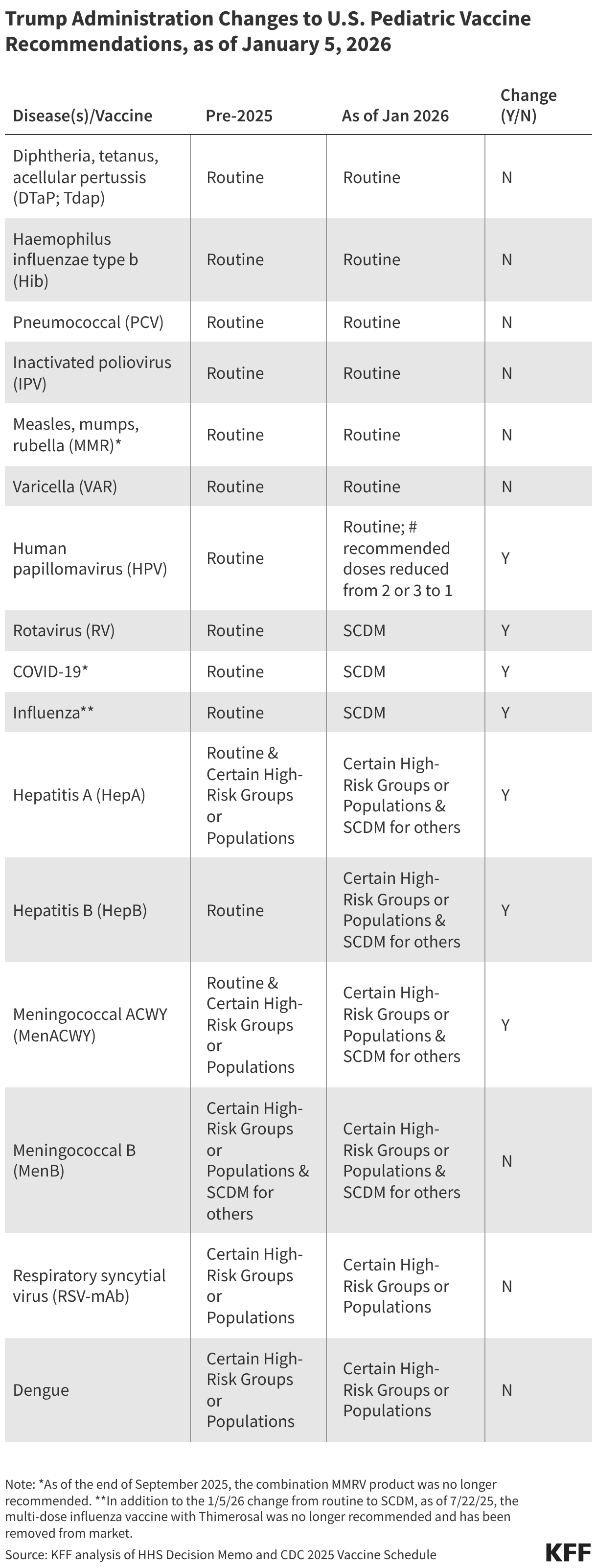
Starting in 2025, changes by HHS to routine vaccine recommendations for children have reduced the number of diseases targeted from 17 to 11 and the number of routine vaccines from 13 to 7 (see Table). Due to changes starting in October of last year, there are now six vaccines no longer recommended for routine use by all children in the United States: rotavirus, COVID-19, influenza, hepatitis A, hepatitis B, and meningococcal vaccines. Instead, some of these vaccines are now recommended for a narrower group of children, based on certain risk criteria or other specific factors, and all six have been moved from the routine category of vaccination to “shared clinical decision making” (SCDM), a process that is “individually based and informed by a decision process between the health care provider and the patient or parent/guardian.”  Beyond these changes, while HPV vaccine remains routinely recommended, HHS has reduced the number of recommended doses from two or three (depending on age of initial vaccination) to one.

Insurance coverage for childhood vaccines is not expected to change, although there is one exception. Most insurers are required to cover the Advisory Committee on Immunization Practices (ACIP)/Centers for Disease Control and Prevention (CDC) recommended vaccines at no-cost (including those recommended through SCDM), either due to requirements of the Affordable Care Act or other federal statutes and as such, these changes should not affect coverage, as also stated by HHS officials. Thus, parents wishing to vaccinate their children against diseases no longer recommended for all children but available through SCDM may still do so without having to be concerned about out- of-pocket costs. One potential exception relates to the HPV vaccine: now that the federal government recommends just one dose of HPV (instead of the previously recommended two to three doses), insurers will not be required to cover an additional dose should parents seek one (the current commercial price for one dose is more than $300). Through the end of 2026, however, health insurers have pledged to continue to cover all vaccines that were recommended in the prior childhood vaccine schedule and several states have moved to mandate free coverage by state-regulated insurers, and could choose to include additional doses.

The new schedule positions the U.S. as an outlier among peer nations in routinely recommending so few vaccines for children. One of the main reasons cited for the new schedule was that the U.S. was an outlier compared to peer countries in recommending so many routine vaccinations for children. Denmark was cited, both at a recent federal advisory committee meeting and in the HHS decision memo, as a model for the U.S. to emulate. The changes made now closely align the U.S. with Denmark (with the only difference being the varicella vaccine which is recommended by the U.S. but not Denmark). No other country among the 20 peer nations that HHS compares the U.S. to in its decision memo recommends vaccines against as few diseases as Denmark, which makes that country, and now the U.S. also, an outlier in this group. For comparison, Australia, Austria, Germany, Greece, Ireland, Italy, Japan, New Zealand, Spain, and the United Kingdom all recommend vaccinating children against 14 or more diseases. More broadly, each country has its own process and unique set of circumstances when it comes to determining vaccine recommendations, and each has developed their childhood vaccination schedule after years of reviewing and weighing available evidence in light of many factors, such as differences in health delivery systems, insurance coverage, public health system capacity, and national priorities. To date no high-income country has made its vaccination decisions based only on what a “peer” country does.

The process used to make these changes marks a departure from the past and further changes are signaled ahead. Historically, any major changes to federal vaccine recommendations were developed through an established, deliberative process that included internal government review with experts from the Center for Disease Control and Prevention (CDC) and other agencies, as well as consideration and public debate via meetings of the Advisory Committee of Immunization Practices (ACIP), the external expert advisory group to CDC. Recent changes made under HHS Secretary Kennedy, however, have circumvented this process, and instead changes have been announced without much internal or external consultation, and without prior public notice. This occurred with Secretary Kennedy’s announcement on social media that HHS was narrowing its COVID-19 recommendations, and now with an announcement of a new childhood vaccine schedule that was not reviewed by CDC experts nor given a public hearing through ACIP.  The White House and HHS have also stated they are examining other aspects of vaccine policy including examining whether the measles, mumps, rubella combination vaccine should be divided into separate shots, how vaccines are tested and safety is monitored, and whether liability protections for manufacturers should be reexamined, which could mean further changes to policy may be forthcoming without a standard review processes.

While HHS cites decreased vaccine uptake and declining trust as additional reasons for changing pediatric vaccine recommendations, it is unclear if these changes will address these issues and they could have the opposite effect. By narrowing the groups recommended to receive certain vaccines, the federal government’s changes could lead parents and providers to choose to vaccinate less often than they have previously. Taking a cue from the new federal vaccine schedule, some states may also loosen vaccine requirements for school attendance, which could also result in lower vaccination coverage. In addition, moving vaccines from a routine, universal recommendation to a shared clinical decision-making (SCDM) recommendation can add an additional step or introduce other barriers to vaccine access, further depressing vaccination rates. With six vaccines newly placed in the SCDM category, such barriers could lead to more missed opportunities for vaccinations. In addition, even though federal health officials state that the new schedule is designed to create more public trust in vaccines, it’s not clear how it may affect trust and it could very well do the opposite. Most parents in the U.S. do not believe there are too many recommended vaccines, though MAGA Republican and MAHA parents – a minority of parents overall – are more likely to agree that the government should recommend fewer vaccines. Many states and expert groups are already making vaccine recommendations that differ from those of the federal government, and the new schedule is likely to exacerbate the conflicting messages that parents and providers hear about vaccines. For now, parents and providers will have to navigate a landscape of conflicting messages and recommendations about vaccines, which sows confusion and ultimately makes it harder for people to know what to do. 

There will be differential impacts of these changes across the country. Ultimately, it is state and local jurisdictions that hold primary responsibility for determining key childhood vaccine policies, including which vaccines are recommended for routine use and which are required for school attendance. In light of changing federal guidelines that in many cases have narrowed vaccine recommendations, manystates have taken steps to de-link state policies and recommendations from those coming from the federal government, particularly Democratic-led states. For example, KFF analysis finds that 24 states no longer use HHS/CDC as a source for vaccine recommendations (up from just 13 in September 2025) and instead turn to state level or external expert groups such as AAP for guidance; a smaller number mandate free insurance coverage by state-regulated insurers for their own set of recommended vaccines. The divergence between federal policy and the states is likely to grow after the latest changes to federal recommendations, which means vaccine coverage and access could increasingly vary according to where one lives. More limited access in some states could, in turn, lead to decreased vaccine coverage and increased incidence of vaccine preventable diseases.

Tracking how the new vaccine schedule impacts vaccination rates in the U.S. may be challenging due to other HHS policies. It remains to be seen how these new recommendations play out in terms of vaccination rates, but recent Trump administration policies may make tracking these changes more challenging. For example, CDC and other federal staffing and funding going to state and local public health efforts across the U.S. has been cut, jeopardizing data collection and analysis. Further, the Trump administration in December announced that, starting in 2026, states will no longer be required to report several measures related to immunization status to HHS as part of their Medicaid and CHIP reporting requirements. Given that nearly four in 10 children in the U.S. are covered by Medicaid, visibility on their vaccine status will be reduced going forward.

Trump Administration Changes to U.S. Pediatric Vaccine Recommendations, as of January 5, 2026 (Table)


Trump Administration Drops Medicaid Vaccine Reporting Requirements

Published: Jan 9, 2026

In a letter to state health officials last month, the Centers for Medicare & Medicaid Services (CMS) announced the removal of immunization measures from the Child Core Set and Adult Core Set. These “Core Sets” measure health care performance annually, with the goal of improving the health of Medicaid and Children’s Health Insurance Program (CHIP) enrollees. Dropping Medicaid vaccine reporting requirements may make it more challenging to monitor vaccination trends and the impact of recent vaccine policy changes. This policy watch describes the recent Trump administration changes to Medicaid vaccine reporting requirements and explores what impact this change may have on state Medicaid programs and enrollees.

The “Core Sets” are a set of quality measures designed to measure and improve health care quality and access. The Core Set of Children’s Health Care Quality Measures for Medicaid and CHIP, or the “Child Core Set”, includes quality measures that capture various aspects of children’s health such as behavior health care, preventive care, maternal health, acute and chronic conditions, oral health care, and experience of care as well as vaccination status. The Child Core Set was developed in 2009, voluntary annual state reporting began in 2010, and reporting became mandatory in 2024. There is also a separate set of quality measures for adult enrollees, the “Adult Core Set”. The Adult Core Set was developed in 2012, voluntary annual state reporting began in 2014, and the behavioral health measures became mandatory for states to report in 2024. To enforce compliance with mandatory measures, CMS has the authority to withhold federal Medicaid payments, though states can request a one-year exemption if they are unable to report for a specific population and measure. The Core Set data are made publicly available and are designed to measure health care access and quality for Medicaid/CHIP enrollees, allowing states to monitor health care quality, identify improvement opportunities, and address health disparities.

The Trump administration recently removed four immunization measures from the Core Sets, making them voluntary for states to report. CMS’s December 2025 letter to state health officials made all of the immunization-related measures in the Child Core Set and one of two immunization-related measures in the Adult Core Set “voluntary utilization measures” for 2026 and 2027 (see Table 1). The letter also states that federal Medicaid payments are not tied to performance on the immunization quality measures and encourages states not to use the immunization measures in any payment arrangements (for example, incentives for managed care plans). Two other measures for 2027 were retired (Medical Assistance with Smoking and Tobacco Use Cessation, MSC-AD, and the Asthma Medication Ratio, AMR-CH and AMR-AD), though CMS notes that they will explore adding other tobacco use and asthma measures in the future.

A Recent Trump Administration Change Removed Four Immunization Measures From the Core Sets (Table)

The recent Core Set changes did not follow the typical process for updates. To advance and improve the quality measures, CMS is required by federal law to update the Core Sets, ensuring the measures “reflect the testing, validation, and consensus process for the development of pediatric quality measures”. As finalized in federal regulation under the Biden Administration in 2023, the development of the Core Sets each year begins with a workgroup of Medicaid/CHIP stakeholders and quality measure experts who review the Core Sets and make recommendations for changes through the annual review and selection process. The workgroup’s recommendations are then published for public comment and submitted to CMS, who ultimately releases the final Core Sets based on the recommendations. CMS’s recent decision to remove the immunization measures did not follow this process, though the letter notes the Secretary has the “discretion to make changes to the Core Sets that he deems best to improve and strengthen the Core Sets” under federal law.

While seemingly a small, technical change, the removal of vaccine reporting in Medicaid and CHIP may make it more difficult to monitor and understand vaccination trends for a large share of children in the U.S. State-level data from the 2024 Child Core Set for the now removed immunization measures show variation in vaccination rates across states and vaccination type (Figure 1) and trends across the 2022-2024 Core Sets show declines in vaccination rates for some vaccines. These data can help state Medicaid programs understand vaccination trends, compare their state to others, inform state Medicaid policy, and improve rates to reach longstanding vaccination rate goals. Nearly four in 10 children in the U.S. are covered by Medicaid, making even small changes to the program relevant to broader children’s health trends. 

There is Variation in Vaccination Rates Across States and Vaccination Type (Dot Plot)

It remains unclear how many states will continue to report the voluntary immunization measures and what will happen to these measures in future years. Prior to mandatory reporting, the number of states reporting the Child Core Set measures increased over time, with voluntary responses to CIS-CH and IMA-CH (show in Figure 1) reaching 46 to 48 responding states by 2023 depending on the vaccine. Given the infrastructure is already in place to report, states may continue to voluntarily report the immunization measures. However, CMS has indicated they will be considering options for new immunization measures to replace the now voluntary measures. They plan to engage stakeholders, including states, quality measure experts, providers as well as vaccine registry managers and electronic health record vendors, to develop measures that capture “whether parents and families were informed about vaccine choices, vaccine safety and side effects, and alternative vaccine schedules” and to explore whether data can account for “person and family preferences related to vaccines” and religious exemptions for vaccinations. Without the Child Core Set immunization measures, at this time it may still be possible to monitor Medicaid/CHIP children's vaccination trends through other data sources, such as the National Immunization Survey or individual state collected data, but these data are not easily accessible and may not be comparable across states. 

Dropping vaccine reporting requirements could also make it more challenging to monitor recent declines in childhood vaccinations rates and the impact of vaccine policy changes. Children’s routine and seasonal vaccination rates have declined in recent years, due in part to rising vaccine hesitancy fueled by vaccine misinformation, increasingly partisan views on vaccine requirements, and a decline in trust of health authorities. In addition, the Administration recently announced significant changes to the children’s vaccination schedule, reducing the number of diseases targeted from 17 to 11 and the number of routine vaccines from 13 to 7. Changes to the vaccine schedule at the federal level (and confusion about the changes) coupled with other public health policy actions under the Trump administration could further drive down vaccination rates among children and increase incidence of vaccine preventable diseases. Limited vaccination status data means reduced visibility into vaccination trends and what impact recent policy changes may have.

How Unaffordable is Health Care?

Author: Larry Levitt
Published: Jan 8, 2026

In his latest JAMA Forum column, KFF’s Larry Levitt explores how unaffordable health care is in the U.S. in the context of the debate over extending enhanced Affordable Care Act premium tax credits and an upcoming election where affordability will likely be front and center.

This accompanying three-part video series from KFF helps people understand the rising cost of health care in the U.S., from the macro level to the issues facing everyday Americans.

Medicaid Home Care (HCBS) in 2025

Authors: Maiss Mohamed, Alice Burns, and Molly O'Malley Watts
Published: Jan 5, 2026

Many older adults and people with disabilities require assistance with self-care such as bathing, dressing, and eating. Help with such services is known as “long-term care” and may be provided in institutional settings such as nursing facilities or in people’s homes and the community, including assisted living facilities. Four-in-ten adults incorrectly believe that Medicare is the primary source of coverage for low-income people who need nursing or home care, but Medicaid is the primary payer—covering nearly two-thirds of all home care spending in the United States in 2023.

The 2025 reconciliation law is estimated to reduce federal Medicaid spending by $911 billion (roughly 14%) over a decade and may have broad implications for home care, including for the workforce, support for family caregivers, and states’ coverage of services. Over half of Medicaid spending finances care for people ages 65 and older and those with disabilities, the enrollees most likely to use home care and related services, and reductions of this magnitude will leave states with difficult choices to raise new revenues or reduce Medicaid spending. The reconciliation law also established a new type of 1915(c) home care waiver for people who do not need an institutional level of care. Take-up of the new waivers is expected to be low given the cuts to federal Medicaid spending and requirements for states to demonstrate that new waivers will not increase the average amount of time that people wait for existing waiver services. This issue brief provides an overview of what Medicaid home care (also known as “home- and community-based services” or HCBS) is, who is covered, and what services were available in 2025. Over 5 million people receive Medicaid covered home care services annually.

This brief is one of several describing data from the 23rd KFF survey of officials administering Medicaid home care programs in all 50 states and the District of Columbia (hereafter referred to as a state), which states completed between April and July 2025. Other issue briefs from the survey describe the number of people on waiting lists for home care, how states manage home care spending, how home care programs support family caregivers, and payment rates for home care providers. The survey was sent to each state official responsible for overseeing home care benefits (including home health, personal care, and waiver services for specific populations such as people with physical disabilities). All states except Florida responded to the 2025 survey, but response rates for certain questions were lower. Where possible, KFF supplemented survey data with previously reported or publicly available data to provide information for the states that did not respond. Survey findings are reported by state and waiver target population, although states often offer multiple waivers for a given target population. States generally completed the survey prior to enactment of the reconciliation law. Key takeaways include:

  • Nursing facility care is a required Medicaid benefit, but states can choose whether to provide most home care services. A key component of home care is personal care, which helps people who need assistance with self-care (such as bathing and dressing) and household activities (such as taking medications and preparing meals).
  • Medicaid home care can be offered through either the Medicaid state plan or as part of a specialized waiver. All states offer Medicaid home care through waivers, most commonly 1915(c) waivers (47 states).
  • Home care is also offered through 1115 waivers (15 states), personal care offered as a state plan benefit (33 states), or the Community First Choice option, which is also a state plan benefit (10 states, Figure 1).
  • Most states provide Medicaid home care through waivers that offer benefits specifically targeted to people with intellectual or developmental disabilities (48) and people ages 65 and older or who have physical disabilities (46). For such waivers, most states offer multiple waivers for each population: Among states with intellectual or developmental disability waivers, only 16 offer one program, while 18 offer three or more; and among states with waivers serving people ages 65 and older or who have physical disabilities, 24 offer only one program and 10 offer three or more.
  • Waivers’ coverage of different home care services, such as day services, supported employment, and home-based services, vary by the target populations they serve.
All States Offer Medicaid Home Care Through Optional Waiver and State Plan Programs (Bar Chart)

What programs do states use to provide Medicaid home care?

Unlike institutional long-term care, nearly all home care is optional for states to provide under Medicaid. States are required to offer cover home health—which consists of part-time nursing services; home health aide services; and medical supplies, equipment, and appliances suitable for use in the home—but all other home care services are provided at the discretion of the states. States use various federal legal “authorities,” also known as programs, to offer home care, which are generally categorized as being part of the Medicaid state plan or part of a waiver. If services are provided through a state plan, they must be offered to all eligible individuals. In contrast, services provided under waivers, such as 1115s or 1915(c)s, may be restricted to specific groups based on geographic region, income, or type of disability. Waivers may include a wider range of service types than can be provided under state plans, but states may limit the number of people receiving waiver services. When the number of people seeking services exceeds the number of waiver slots available, states may use waiting lists to manage participation in the waiver.

All states have at least one home care program and many states have multiple programs. Home care is most frequently offered through 1915(c) waivers (47 states) and the personal care state plan benefit (33 states), and less frequently offered through 1115 waivers (15 states) or the Community First Choice option (10 states, Figure 1). KFF estimates that 5.1 million people used Medicaid home care in 2023 compared with only 1.4 million people who used institutional long-term care.

All states offer people assistance with self-care and household activities under the personal care benefit, but they use different programs to do so. The primary home care benefit is personal care, which provides people with assistance with the activities of daily living (such as eating and dressing) and the instrumental activities of daily living (such as preparing meals and managing medication). States most commonly cover personal care through waivers (48 states), followed by the state plan (33 states).

How are people eligible for Medicaid home care?

Most people who are eligible for Medicaid home care qualify on the basis of having a disability or being ages 65 and older. Medicaid eligibility pathways in which eligibility is based on old age or disability are known as “non-MAGI” pathways because they do not use the Modified Adjusted Gross Income (MAGI) financial methodology that applies to children, pregnant individuals, parents, and other non-elderly adults with low incomes. In addition to considering income and age or disability status, non-MAGI eligibility pathways usually require people to demonstrate that they have limited savings and other financial resources (e.g., assets). Because nearly all non-MAGI pathways are optional, eligibility levels vary substantially across states.

Most states allow people with somewhat higher incomes to qualify for Medicaid home care, but income is capped at 300% of the supplemental security income limit ($2,901 per month in 2025) and assets are usually limited to $2,000 per person. Medicaid enrollees who use long-term care must also meet requirements related to their functional needs which are generally measured in terms of the ability to perform activities of daily living such as eating and bathing. Over half of people who use Medicaid home care are also enrolled in Medicare; such people are also known as dual-eligible individuals

In 2025, states operated over 300 different programs for Medicaid home care, many of which targeted a specific population. Most programs (259) were operated through 1915(c) waivers with 15 operated through 1115 waivers. The most common waiver programs target people with intellectual or developmental disabilities (48 states) and people who are ages 65 and older or have physical disabilities (46 states). States are likely to offer multiple waiver programs for the most common target populations, but states with less common waivers, such as those serving people with traumatic brain or spinal cord injuries or mental health conditions, typically only offer one program per target population.

Each year, some states’ waiver programs change, but in general, the trend has been towards offering more waivers. In 2025, only one state, Oregon, had new waivers and no states eliminated waivers. In Oregon, there is a new 1115 waiver for people who are ages 65 and older or have physical disabilities that provides in-home support services and support for family caregivers and a new 1915(c) waiver that allows parents of minor children with disabilities to be paid for providing attendant care to their child.

States Vary in the Number of Waiver Programs Offered for Different Target Populations (Stacked Bars)

What services does Medicaid home care cover?

Besides personal care, Medicaid home care covers an array of services to help people with the activities of daily living and the instrumental activities of daily living. KFF asked states about what services they provide through Medicaid home care programs using the Centers for Medicare and Medicaid Services’ list of services, which are categorized in a comprehensive taxonomy. The taxonomy was developed to provide common language for describing home- and community-based services across waivers and state plans. Those services vary widely, including adult day care, supported employment, round-the-clock care, services to support unpaid family or friends who are caregivers, home-delivered meals, and non-medical transportation (Table 1).

All responding states (50) cover supported employment, day services, home-based services, and equipment, technology, and modifications in any home care program (Appendix Table 3). States often also offer other additional services for specific populations that are uniquely tailored to the needs of waiver recipients. Examples of such services reported in the 2025 survey include:

  • Illness support, group counseling, and bereavement counseling in a waiver for children who are medically frail or technology dependent (Colorado);
  • Discovery and career planning, additional residential supports, and community navigators in a waiver for people with intellectual or developmental disabilities (Hawaii);
  • Dental services, permanent supportive housing, and prevocational/community career planning in a waiver for people with intellectual or developmental disabilities (Louisiana);
  • Other speech, hearing, language, occupational, and physical therapies in a waiver for people who are ages 65 and older or have physical disabilities (Texas).

Among the categories defined by the Centers for Medicare & Medicaid Services, the least-frequently covered service was rent and food expenses for a live-in caregiver. For the most common services, there is little change in the number of states offering each type of service in a given year. (The numbers reported for most services are higher in 2025 but in many cases, that reflects a higher state response rate in 2025 than in 2024.)

CMS Definitions of Medicaid Home Care Services (Table)

States use waivers that target specific populations to offer tailored benefits, and covered services differ among different types of waivers (Figure 3, Appendix Table 4). Some services, such as equipment, technology and modifications, home-based services, and day services, are covered by most states and in most waiver programs. However, other services are much more targeted to specific populations. Comparing services among the most commonly-offered waivers (those serving people with intellectual or developmental disabilities and people who are ages 65 and older or have physical disabilities), shows some services are widely covered by one type of waiver but not the other. For example, 47 states cover supported employment for people with intellectual or developmental disabilities, but only 15 cover the service for people who are ages 65 and older or have physical disabilities, a population less likely to be working. Alternatively, home-delivered meals are covered by 41 states under waivers serving people who are ages 65 and older or have physical disabilities, but only under 10 states’ waivers serving people with intellectual or developmental disabilities. By enabling states to cover, at times, different services per target population, waivers allow states to customize services to the needs of the specific populations they serve.

Within waivers, states may change the benefit offerings from year to year, highlighting the flexibility that home care waivers offer to states in managing program benefits and spending. Focusing on the most common waivers and benefits, some notable changes between 2024 and 2025 include the following. (Due to variation in the number of states responding to KFF’s survey and changes in the number of waivers offered between 2024 and 2025, comparing the number of states or waivers offering each type of service could be misleading. However, looking at changes in covered services within a specific waiver can illuminate the flexibility available to states.)

  • Oregon began offering coverage of equipment, technology, and modifications for waivers serving people who are ages 65 and older or have physical disabilities, and Idaho now covers case management services for waivers serving the same population.
  • D.C. and South Dakota started offering coverage of non-medical transportation for waivers serving people with intellectual or developmental disabilities, but Illinois and Kentucky no longer cover this service for those waivers.
  • Michigan, Nevada, and Washington began covering day services for waivers serving people with intellectual or developmental disabilities, and Idaho started offering this benefit for waivers serving people who are ages 65 and older or have physical disabilities.
States' Coverage of Medicaid Home Care Services Vary by Target Population (Grouped column chart)

How do states use managed care to provide home care?

All but 11 states use managed care to provide at least some home care (Figure 4). In managed care, states pay managed care plans a set fee—often called a capitation payment—for each person enrolled and the managed care plans are responsible for providing all services to enrollees. Use of managed care to provide home care has been growing over time, with states using managed care to make their Medicaid spending more predictable and to help coordinate the services enrollees use.

All but 11 States Provide Some Medicaid Home Care Through Managed Care Plans (Choropleth map)

Managed care is more commonly used for home health benefits provided through the state plan or 1115 waivers than for 1915(c) waivers (Figure 5, Appendix Table 5). Among the 15 states with 1115 waivers, 10 use managed care plans to provide at least some home care; and over two-thirds of states use managed care plans to provide at least some home health through the state plan. Fewer than half of states use managed care plans to provide some personal care through the state plan. For 1915(c) waivers, over half of states (26) use managed care plans, 4 more states than in 2024, but managed care was much less common for waivers serving people with intellectual or developmental disabilities—of the 47 out of 51 responding states with such waivers, only 8 provided any of the benefits through managed care.

All States Provide Optional Medicaid Home Care, Many Using Managed Care (Stacked Bars)

This work was supported in part by Arnold Ventures. KFF maintains full editorial control over all of its policy analysis, polling, and journalism activities.

States Offering Medicaid Home Care Through Various Federal Programs

States Offering Medicaid Home Care Through Various Federal Programs (Table)

States Offer Medicaid Home Care for Several Target Populations

States Offer Medicaid Home Care for Several Target Populations (Table)

States Reporting Coverage of Each Medicaid Home Care Service Under Any Program

States Reporting Coverage of Each Medicaid Home Care Service Under Any Program (Table)

States' Coverage of Medicaid Home Care Services Vary by Target Population

States' Coverage of Medicaid Home Care Services Vary by Target Population (Table)

All States Provide Optional Medicaid Home Care, Many Using Managed Care

All States Provide Optional Medicaid Home Care, Many Using Managed Care (Table)

Medicaid’s Home Care Support for Family Caregivers in 2025

Authors: Alice Burns, Abby Wolk, and Molly O'Malley Watts
Published: Jan 5, 2026

KFF estimates that 5.1 million Medicaid enrollees use home care, which provides medical and supportive services to help people with the activities of daily living (such as eating and bathing) and the instrumental activities of daily living (such as preparing meals and managing medications). Medicare generally does not cover home care (also known as home- and community-based services or HCBS), and Medicaid paid for two-thirds of home care spending in the United States in 2023.

In Medicaid home care, many people “self-direct” their services, giving them greater autonomy over the types of services provided and who they are provided by; and in some cases, allowing payments to family caregivers. Payments for caregiving can help mitigate the financial struggles family caregivers experience when they are forced to reduce their hours of work or quit their jobs on account of their caregiving duties. KFF focus groups of caregivers found that family caregivers often reported struggling to make ends meet and having to reduce the hours they are working other jobs due to the demands of caregiving. Self-directed services can also help address shortages of paid home care workers, which can be one of the factors placing additional strain on family caregivers. Beyond paying for their caregiving, Medicaid supports family caregivers with services such as training, support groups, and respite care (which is paid care that allows family caregivers to take a break from their normal responsibilities).   

The 2025 reconciliation law, passed on July 4, includes significant changes to the Medicaid program that are estimated to reduce federal Medicaid spending by $911 billion over the next decade. Given the substantial share of Medicaid spending that pays for home care, and the optional nature of most home care programs, cuts to home care programs could occur as states respond to the reductions in federal spending.

Such changes could affect Medicaid supports to family caregivers, all of which are optional for states to provide. A reduction in the availability of those supports could exacerbate challenges for people who need home care and are unable to find other sources of care due to workforce shortages, which may be amplified by the Trump Administration’s intensified immigration enforcement and restrictive policies, since nearly one-in-three home care workers are immigrants. For family caregivers, many may need to continue to provide care without payments and other Medicaid changes could affect access to health coverage. According to AARP’s 2025 Caregiving in the US report, there are over 8 million family caregivers for whom Medicaid is their source of health insurance (13% of 63 million total family caregivers).  

Amidst this background, this issue brief describes the availability of self-directed services and supports for family caregivers in Medicaid home care in 2025, before most provisions in the reconciliation law take effect. The data come from the 23rd KFF survey of officials administering Medicaid home care programs in all 50 states and the District of Columbia (hereafter referred to as a state), which states completed between April and July 2025. The survey was sent to each state official responsible for overseeing home care benefits (including home health, personal care, and waiver services for specific populations such as people with physical disabilities). All states except Florida responded to the 2025 survey, but response rates for certain questions were lower. Survey findings are reported by state and waiver target population, although states often offer multiple waivers for a given target population. Key findings include:

  • All reporting states except Alaska allow Medicaid enrollees to self-direct their home care in at least some circumstances, and among those states, all allow enrollees to select, train, and dismiss their caregivers.
  • All responding states pay family caregivers under some circumstances and provide family caregivers with other types of support, including respite care (Figure 1, Appendix Table 1)
  • Family supports are most widely available for caregivers of people with intellectual or developmental disabilities (I/DD).
All Responding States Pay Family Caregivers Under Some Circumstances (Stacked Bars)

How Many States Allow Medicaid Enrollees to Self-Direct Their Home Care?

Nearly all states allow Medicaid enrollees to self-direct their home care in some circumstances (Figure 2, Appendix Table 2). Self-direction came out of the “consumer-directed” movement for personal care services that started with demonstration programs in 19 states funded through grants from the Robert Wood Johnson Foundation. Today, states may give people the option to self-direct home care through a wide variety of optional home care programs. States most frequently allow self-direction in waivers that serve people with intellectual or developmental disabilities, followed by people who are ages 65 and older or have physical disabilities. Among the 50 states responding to KFF’s survey, Alaska is the only state that reported not permitting self-direction under any of the home care programs. 

Nearly All States Allow Individuals to Self-Direct Home Care Under at Least One Program (Stacked Bars)

Among states that authorize self-direction, all states allow enrollees to select, dismiss, and train workers (Figure 3). The ability to select, train, and dismiss workers is referred to as “employer authority” because it allows Medicaid enrollees (with the help of their designated representatives when appropriate) to decide who will be caring for them. All states with self-directed services programs provide employer authority to enrollees. Most states also allow enrollees to establish payment rates for their caregivers (41) and to determine how much Medicaid funding is spent among the various authorized services (39).

All States with Self-Directed Home Care Programs Allow Enrollees to Select Their Caregivers (Bar Chart)

How Many States Pay Family Caregivers and Through Which Home Care Programs?

All responding states pay family caregivers through one or more Medicaid home care programs (Figure 1, Appendix Table 1). Family caregivers can generally be paid to provide personal care, which may be offered through several different types of Medicaid home care programs. Personal care may be provided through waivers such as the 1115 or 1915(c) programs, through the Medicaid state plan, or a combination of both. Waiver services tend to encompass a wider range of benefits than the state plan benefit, but waivers are usually restricted to specific groups of Medicaid enrollees based on geographic region, income, or type of disability; and are often only available to a limited number of people, resulting in waiting lists. 

All responding states allow payments to family and friends through one or more waiver programs, but fewer states allow payments to legally responsible relatives. Forty-four states allow payments to legally responsible relatives through waiver programs. Payments to legally responsible relatives are less common than those to other family and friends because of additional legal requirements that pertain to payments to legally responsible relatives (Box 1). Payments to family caregivers are less common through the state plan—allowed by 24 states for other family and friends and by 6 states for legally responsible relatives. States pay family caregivers through the state plan less frequently because fewer states offer personal care through the state plan and because the legal requirements governing state plan services are more restrictive than those governing waiver services. 

While all responding states allow payments to family caregivers, it is unknown what percentage of waiver participants are receiving paid care. KFF asked states, “What percentage of waiver recipients are receiving paid care from their legally responsible relatives/family members who are not legally responsible relatives?” Over two-thirds of states were unable to report the percentage of waiver recipients receiving paid care from either legally responsible relatives or other family members/friends. It is also unknown how often people with paid family caregivers also receive other paid care.

Box 1: What are the legal requirements for paying family caregivers?

Medicaid laws have more complicated requirements for states to pay legally responsible relatives than is the case for other types of family and friend caregivers. The specific legal requirements for paying family caregivers are complicated and differ across home care programs: 

• For personal care offered through the state plan using section 1905 authority, there is a federal prohibition on paying for services provided by spouses and parents of minor children (which comprise most but not all legally responsible relatives). Other family and friends may be paid if they meet applicable provider qualifications, there are strict controls on the payments, and the provision of care is justified (which can be done when there is a lack of other qualified providers in the area). 

• For home care offered through waiver programs, the requirements governing payments to family and friends are like those governing personal care through section 1905 authority. A key difference is that states may pay legally responsible relatives when the services being provided are “extraordinary care,” which is defined as care that exceeds the range of activities a legally responsible relative would ordinarily perform and is necessary to health, welfare, and avoiding institutionalization. 

• For personal care offered through the state plan using one of the section 1915 authorities, states may pay legally responsible relatives using criteria like those of the waiver programs. However, some of those authorities designate a family member to be the recipient’s legal representative and may prohibit payments to legal representatives.  

Payments for family caregivers are most common under waivers for people with intellectual or developmental disabilities (Figure 4, Appendix Table 3). Among the 47 states that responded to the survey and have waivers for people with intellectual or developmental disabilities, all 47 allow payments to family caregivers. There are fewer states with other types of waivers, and not all the other waivers allow payments to family caregivers. Among the 45 responding states with waivers for older adults and people with physical disabilities, 43 pay family caregivers, and among the 21 states with waivers for people with traumatic brain or spinal cord injuries, 19 do.

Among Waivers and Programs, States Are Most Likely to Pay Family Caregivers for People with Intellectual or Developmental Disabilities (Stacked Bars)

In most cases, family caregivers receive hourly wages like those of other employees, but 11 states have adopted programs known as structured family caregiving, in which family members are paid a per diem rate (Appendix Table 4). Structured family caregiving is a Medicaid benefit that supports unpaid caregivers of people who use Medicaid home care through waiver programs. In the structured program, Medicaid pays provider agencies a daily stipend for participants. The agency is responsible for directing a care coordinator or social worker and a nurse to oversee the family caregiver, answer health-related questions, and provide emotional support; conducting home visits about once per month; and passing a fixed percentage of the stipend (usually 50% - 65%) on to the family caregiver. Among the handful of payment rates reported in an overview of the program by the American Council on Aging, payments to family members are around $40 to $70 per day. States reported structured family caregiving programs in the following home care waivers:

  • Older adults and people with disabilities in 9 states (Connecticut, Georgia, Indiana, Louisiana, North Carolina, North Dakota, Ohio, Rhode Island, and South Dakota),
  • People with intellectual or developmental disabilities in 2 states (Indiana and New Hampshire), 
  • Medically fragile children in North Carolina,
  • People with traumatic brain and/or spinal cord injuries in Indiana and
  • People with Alzheimer’s and related disorders in Missouri. 

Although KFF’s survey only includes home care waivers, according to the American Council on Aging, two states offered structured family caregiving as a standalone program: Massachusetts offers it as a state plan benefit through a program for adults in foster care, and Nevada has a standalone waiver to provide the benefit for caregivers of people with Alzheimer’s and related dementias.

What Other Types of Support Does Medicaid Home Care Provide for Family Caregivers?

All responding states provide support for family caregivers—who may be paid or unpaid—and most offer more than one type of support (Figure 5, Appendix Table 5). All responding states reported covering respite care, which provides short-term relief for caregivers, allowing them to rest, travel, attend appointments, or spend time with other family and friends. Other commonly covered benefits include caregiver training (37 states), and counseling or support groups (26 states).

All Responding States Provide Supports for Family Caregivers Through Medicaid Home Care (Grouped column chart)

Respite care may be provided anywhere from a few hours to several weeks at a time. Medicare only covers respite care for people who are receiving hospice care, which is only available for people who are terminally ill and electing to receive comfort care instead of curative care for their illness. That makes Medicaid’s respite care the primary source of coverage for caregivers of people with Medicare and Medicaid. Respite care is offered most frequently under waivers for people with intellectual or developmental disabilities (44 states) and older adults and people with disabilities (44 states).

Daily respite care is offered by the most states (43), followed by institutional respite care (40 states, Figure 6, Appendix Table 6). Daily respite care is available under waivers for people with intellectual or developmental disabilities in 34 states and available in 32 states within waivers for people who are ages 65 and older or have physical disabilities. Twenty-two states provide institutional respite care within waivers for people who are ages 65 and older or have physical disabilities and within waivers for people with intellectual or developmental disabilities. Weekly respite care is the least frequently offered (24 states total), and over half of states (32) report offering other types such as hourly, monthly, or annual.

Among Waivers and Programs, States Are Most Likely to Offer Daily Respite Care (Grouped column chart)

This work was supported in part by Arnold Ventures. KFF maintains full editorial control over all of its policy analysis, polling, and journalism activities.

States' Policies to Allow Medicaid Home Care Payments to Spouses, Parents of Minor Children, and Other Legally Responsible Relatives for Caregiving

States' Policies to Allow Medicaid Home Care Payments to Spouses, Parents of Minor Children, and Other Legally Responsible Relatives for Caregiving (Table)

States' Policies to Allow Individuals to Self-Direct Medicaid Home Care by Waiver/Program

States' Policies to Allow Individuals to Self-Direct Medicaid Home Care by Waiver/Program (Table)

States' Policies to Allow Medicaid Home Care Payments to Spouses, Parents of Minor Children, and Other Legally Responsible Relatives as well as Family and Friends for Caregiving

States' Policies to Allow Medicaid Home Care Payments to Spouses, Parents of Minor Children, and Other Legally Responsible Relatives as well as Family and Friends for Caregiving (Table)

States Offering the Structured Family Caregiver Program, Which Supports Unpaid Caregivers of Persons Who Are Using Medicaid Home Care, and Waivers the Program Is Offered Under

States Offering the Structured Family Caregiver Program, Which Supports Unpaid Caregivers of Persons Who Are Using Medicaid Home Care, and Waivers the Program Is Offered Under (Table)

States’ Policies for Offering Different Types of Family Caregiving Supports

States’ Policies for Offering Different Types of Family Caregiving Supports (Table)

Types of Respite Care Offered by State and Home Care Program: Daily, Weekly, Institutional, and Other

Types of Respite Care Offered by State and Home Care Program: Daily, Weekly, Institutional, and Other (Table)