
Tennessee Plans to Share Data on Children with Disabilities with Immigration Authorities
According to recent news reports, the families of about 400 children with disabilities who are enrolled in Tennessee’s Children’s Special Services (CSS) program received notices from the state health department in early June stating that if their child continued to remain enrolled in CSS beyond June 30, 2026, their information would be reported to a central state immigration enforcement agency. However, following a lawsuit filed by physicians in the state, a judge issued a temporary restraining order on June 24, 2026, to prevent this data sharing from taking place. Tennessee is one of at least six states that have taken actions as of June 2026 to require state agencies to report applicants or recipients of Medicaid and/or other public benefits whose immigration status could not be verified and/or who were verified to not have lawful presence with immigration enforcement authorities. Under longstanding federal law, Medicaid and other federally funded health coverage are already limited to lawfully present immigrants.
In Tennessee, the legislation requires every state governmental entity, local governmental entity, and local health department to verify that each applicant who is 18 years of age or older and applies for a federal, state, or local public benefit is a United States citizen or lawfully present immigrant. It also requires these entities to report all identifying information for individuals who are not lawfully present and who receive federal, state, or local public benefits to the state’s centralized immigration enforcement division and makes it a criminal offense for an employee or official to intentionally fail to report an individual who is not lawfully present.
Tennessee has interpreted this law to include its CSS program, although Tennessee Representative Steve Cohen wrote a letter to Governor Bill Lee indicating that the law reads as limited to applicants who are at least 18 years old. Tennessee’s CSS program provides care coordination and payment assistance for certain services to people under age 21 whose family income is at or below 225% of the federal poverty level and who have a physical disability, such as cerebral palsy, cystic fibroses, sickle cell anemia or other serious medical conditions without immigrant eligibility restrictions. A recent report indicates more than 4,600 children in Tennessee are enrolled in CSS.
Health care providers and advocates in the state have warned that this data sharing will likely lead families to stop participating in the program, which could lead to disruptions in care that have life threatening consequences. Reporting requirements could also have “chilling effects” that lead to disenrollment and forgone enrollment among a broader group of families than those subject to the new reporting requirements due to confusion and fear.
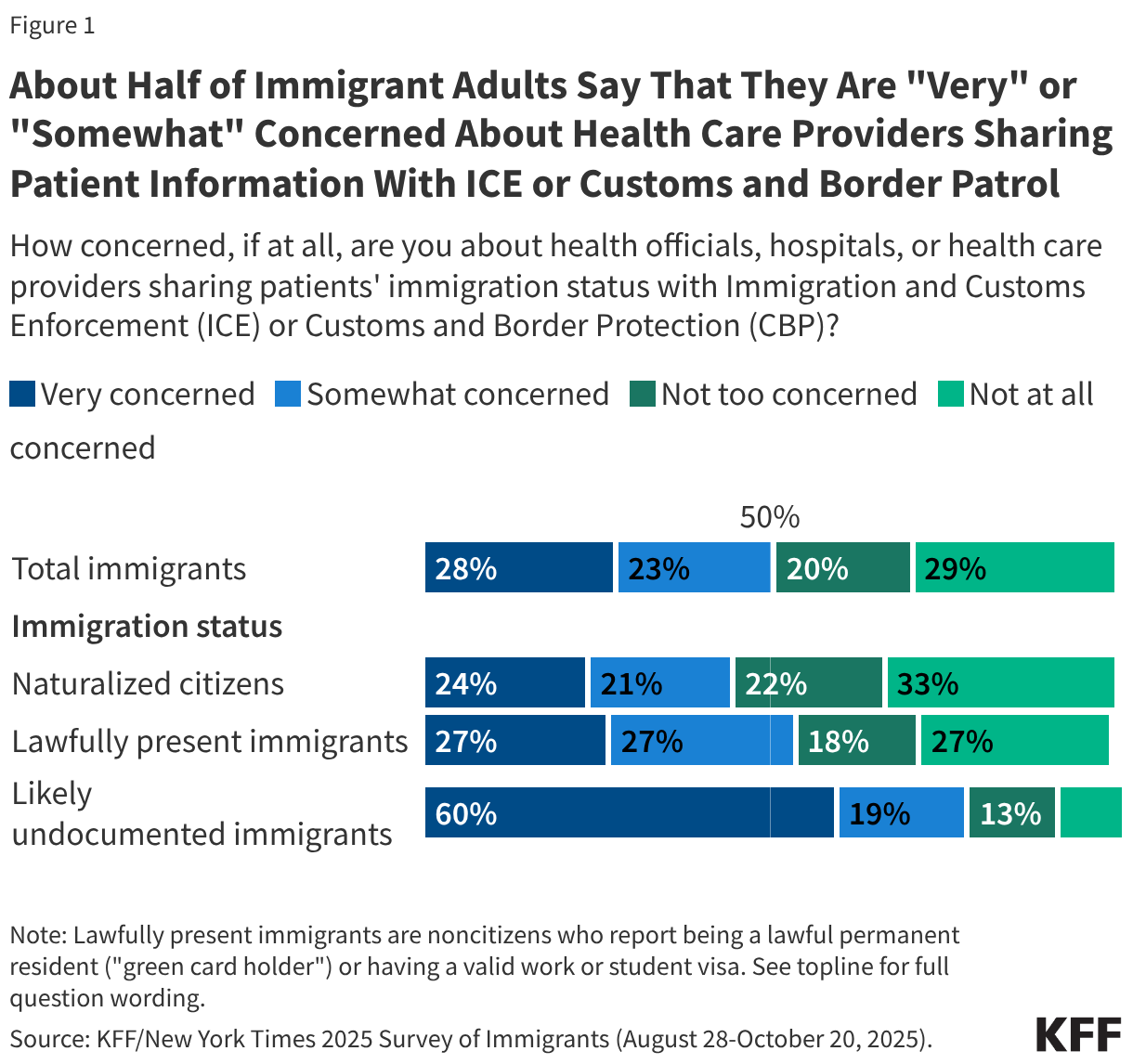
A 2025 national KFF survey shows that the share of immigrant adults who said they avoided applying for a government program that helps pay for food, housing, or health care in the past 12 months because they did not want to draw attention to their or a family member’s immigration status rose from 8% to 12% between 2023 and 2025. Further, 11% of immigrant adults say they have stopped participating in such a program since January 2025 because of immigration-related worries, including about four in ten (42%) of those who are likely undocumented and about one in six (17%) parents. Moreover, about half (51%) of immigrant adults overall and about eight in ten (78%) of those who are likely undocumented said they are “somewhat” or “very” concerned about health officials or providers sharing patient information with immigration enforcement officials (Figure 1). These data were collected prior to recent state-level actions to share data on immigrant families with immigration enforcement officials.
Beyond the data sharing actions in Tennessee and several other states, in July 2025, the Centers for Medicare and Medicaid Services (CMS) and U.S. Immigration and Customs Enforcement (ICE) established an Information Exchange Agreement that enables immigration enforcement officials to access the personal data of millions of Medicaid enrollees to help identify and locate “aliens in the United States.” This data sharing represents a reversal in prior policy that asserted CMS would not share such information and ICE would not use such information for immigration enforcement purposes, with assurances made to the public, applicants and enrollees, health care providers, and states that information collected to determine eligibility for health coverage programs would not be used for immigration enforcement. The administration also has directed the Internal Revenue Service to share personal information of individuals for immigration enforcement purposes, although these actions are facing court challenges.