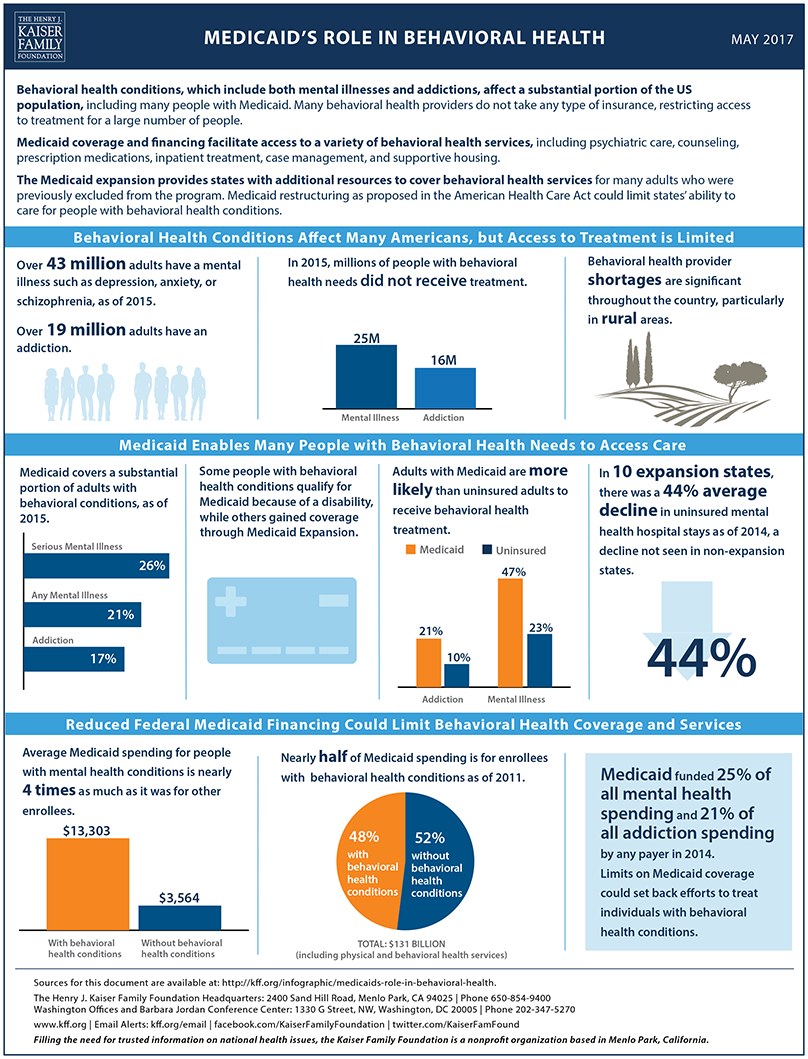
Medicaid’s Role in Behavioral Health

Published: May 5, 2017


References

Center for Behavioral Health Statistics and Quality, 2015 National Survey on Drug Use and Health: Detailed Tables (Rockville, MD: Substance Abuse and Mental Health Services Administration, September 2016), https://www.samhsa.gov/data/sites/default/files/NSDUH-DetTabs-2015/NSDUH-DetTabs-2015/NSDUH-DetTabs-2015.pdf

Kaiser Family Foundation analysis of 2015 National Survey on Drug Use and Health

Michael A. Hoge, et al., “Mental Health and Addiction Workforce Development: Federal Leadership is Needed to Address the Growing Crisis,” Health Affairs 32, no 11. (2013):2005-2012

Mark Olfson, “Building the Mental Health Workforce Capacity Needed to Treat Adults with Serious Mental Illnesses,” Health Affairs (Millwood) 35, 6(2016):983-990.

Medicaid and CHIP Payment and Access Commission (MACPAC), Report to Congress on Medicaid and CHIP (Washington, DC: MACPAC, June 2015), https://www.macpac.gov/wp-content/uploads/2015/06/June-2015-Report-to-Congress-on-Medicaid-and-CHIP.pdf

Robin Rudowitz and Rachel Garfield, New Analysis Shows States with Medicaid Expansion Experienced Declines in Uninsured Hospital Stays (Washington, DC: Kaiser Family Foundation, September 2015), https://files.kff.org/attachment/issue-brief-new-analysis-shows-states-with-medicaid-expansion-experienced-declines-in-uninsured-hospital-discharges

Rural Health Research & Policy Centers, Supply and Distribution of the Behavioral Health Workforce in Rural America (Seattle, WA: Rural Health Research & Policy Centers, September 2016), http://depts.washington.edu/fammed/rhrc/wp-content/uploads/sites/4/2016/09/RHRC_DB160_Larson.pdf

Tami L. Mark, et al., “Insurance Financing Increased for Mental Health Conditions But Not For Substance Use Disorders, 1986-2014,” Health Affairs (Millwood) 35, 6(2016):958-965.

What is at Stake in ACA Repeal and Replace for People with HIV?

Published: May 5, 2017

As debate continues surrounding repealing and replacing or transforming aspects of the Affordable Care Act (ACA), and as one such proposal has passed the U.S House of Representatives, questions remain about the potential impact of such changes on high needs populations, including people with HIV. Prior to the ACA, many people with HIV faced significant barriers to accessing health coverage despite national treatment guidelines recommending starting antiretroviral therapy at time of diagnosis.1   Several of the ACA’s key provisions addressed these barriers (see Table 1) and recent analysis demonstrates that the ACA significantly increased insurance coverage for people with HIV.2 

Table 1. Key ACA Provisions Expanding Access and Eliminating Barriers to Coverage for People with HIV
Expanding Access
Creation of Marketplaces for purchasing private coverage (Including subsidies for those 100-400% FPL)
Medicaid expansion with eligibility based on income and residency alone (Effectively, state option. 32 states including DC expanded as of May 2017)
Eliminating Barriers
Prohibition of pre-existing conditions exclusions
End to rate setting based on health status
Elimination of annual and lifetime benefits limits
Creation of a benefits floor, including prescription drug coverage

This brief explores the potential implications of different ACA repeal scenarios and related administrative actions on people with HIV. In particular, it looks at the main policy areas under consideration that stand to affect people with HIV the most: (1) the future of the ACA’s Medicaid expansion; (2) changes to the traditional Medicaid program; and (3) the pathway forward for private market reforms, including the ACA’s health insurance marketplaces. (For a detailed overview of the major policy proposals that have been introduced to date, including the amended American Health Care Act (AHCA), see Kaiser Family Foundation’s interactive ACA replacement plan comparison tool).3 

Changes to Medicaid Would Likely Have the Biggest Impact on People with HIV

Medicaid is the single largest source of coverage for people with HIV in the U.S. and its role for those with HIV has significantly expanded under the ACA. Indeed, the Medicaid expansion provision is arguably the aspect of the law that has had the most far reaching effects on people with HIV, driving a nationwide increase in access to insurance.4  Proposals that have been put forward, including the amended AHCA which has now passed the House, have sought to change both the Medicaid expansion and the traditional Medicaid program.

The Medicaid Expansion. Prior to the ACA, under federal law, individuals could not qualify for Medicaid based on income alone.5  Enrollees had to be both low income and fall into another category, known as “categorical eligibility,” such as disability, pregnancy, or being parents. This excluded most low-income childless adults from coverage and created a particular “catch-22” for many low-income people with HIV who could not qualify for Medicaid until they were already quite sick and disabled, often as a result of developing AIDS, despite the availability of recommended medications that could prevent such disease progression.6  The ACA fundamentally changed this, requiring states to expand their Medicaid programs to cover individuals below 138% FPL based on income and residency status alone; although a June 2012 US Supreme Court decision effectively made the expansion a state option. To date 32 states (including D.C.) have expanded their programs (where an estimated 62% of people with HIV live).7  As part of the expansion, the federal government offered states a historically generous federal match to cover this new population, with 100% federal funding for the first few years, gradually decreasing to 90% in 2020 and beyond.8  A recent analysis found that increased Medicaid coverage in expansion states drove a nationwide increase in coverage for people with HIV in 2014, the first year after the Medicaid expansion went into effect.9 

As part of the repeal and replace debate, the Medicaid expansion has been a major focus because of the impact unraveling this source of coverage would have on the 32 states that have expanded and the millions enrolled through this pathway. The AHCA would retain the expansion but use the (less generous) traditional state match for new enrollees starting in 2020 and for existing enrollees without continuous coverage. A less generous match could mean states would be less willing to cover the new adult population in the years to come and in fact several states already have triggers in place to rescind coverage for the current group if the federal match declines to certain levels. It would also provide a disincentive for other states to expand in the future.

The Traditional Medicaid Program. Proposals to transform the current open-ended nature of federal matching funds to states for the traditional Medicaid program have also been part of the debate. Proposals, including converting the program to a block grant or per capita cap would fundamentally change the financing and structure of the program and shift costs to states.10  The AHCA proposes a per capita cap approach as a way to limit federal spending and increase state flexibility. However, such an approach could impact access for people with HIV. Under restructured and constrained financing, states would probably respond by reducing services or eligibility to accommodate a loss in federal dollars. Beneficiaries may see increased cost-sharing and providers, reductions in reimbursement rates. As these programs could be structured in a multitude of ways, it will be important to watch how proposals might impact access to coverage for people with HIV in terms of eligibility, benefits, cost-sharing, beneficiary protections, and enrollment requirements. These proposals to change per beneficiary spending would apply to the HIV disability population in traditional Medicaid as well as the newly eligible expansion population.

Administrative Actions. Apart from repealing the expansion or fundamentally changing the financing and structure of the Medicaid program through legislation, the administration can permit broader flexibility for states through the use of 1115 Medicaid waivers which allow states to experiment with new approaches that can result in significant changes. On March 14, 2017, Health and Human Services (HHS) Secretary Price and Centers for Medicaid and Medicare Services (CMS) Administrator Seema Verma sent a letter to governors outlining the administration’s approach to Medicaid policy. It highlighted the flexibility the administration intends to provide to states with respect to state plan amendments and 1115 waivers. It specifically notes the potential for waivers to include higher beneficiary cost-sharing and adopt alternative benefit designs with features such as health savings accounts and work requirements, all provisions that could impact access to care and treatment for people with HIV.11 

Lessons from HistoryPeople with HIV have previously faced capitated health financing with respect to ADAP (the prescription drug component of the federal Ryan White Program). Through the program, states receive capped federal grants distributed by formula. For much of ADAP’s history, demand outpaced funding and the states instituted waiting lists. At their height, over 9,000 people with HIV were on waiting lists. Steps were taken to address the emergency (including culling formularies, changing eligibility, infusion of emergency funding, and receiving higher rebates from drug companies), but this experience demonstrated how block grant health financing is not necessarily sustainable or reliable and poses critical public health challenges in the infectious disease context.

Proposed Changes to the Individual Insurance Market Also Stand to Affect People with HIV

The ACA made significant changes to the private insurance market, removing many barriers to access and introducing new benefits and non-discrimination standards. Current legislative proposals and administration actions that seek to modify aspects of the law could scale back some of these changes.

Pre-existing condition protections and rate setting. Prior to the ACA, it was nearly impossible for people with HIV to access private coverage through the individual market. In most states, issuers were permitted to take health status and history into account when deciding whether to issue an individual policy, including under what terms, and in determining premium cost.12  Most with HIV were considered “uninsurable” and either denied individual market coverage outright or, when offered, rates were typically unaffordable and/or policies included sweeping exclusions.13  Under the ACA, individuals are guaranteed access to health insurance through the individual market regardless of health, rates cannot be set based on health status, and lifetime and annual limits are prohibited. Retaining this provision had been a central feature of the original AHCA but doing so is difficult without the individual mandate. The AHCA’s approach is to require a surcharge for those without continuous coverage. The amended version of AHCA passed by the House would significantly erode this protection, permitting states to use a waiver to charge people with pre-existing conditions higher premiums and to sell policies without the Essential Health Benefits (EHBs – more discussion on EHBs below).14   Such changes could mean that access to coverage may again be more limited for those with HIV and other pre-existing conditions.

Financial Assistance. One of the key provisions in the ACA is the creation of health insurance marketplaces which offer a centralized way for consumers to purchase insurance coverage and financial assistance for those with incomes between 100-400% of the Federal Poverty Level (FPL). This includes Advanced Premium Tax Credits (APTCs), which make the cost of premiums more affordable and cost-sharing reductions (CSRs) which limit out-of-pocket expenses for the subset with incomes between 100-250% FPL.  People with HIV are significantly more likely to be low-income and thus these subsidies will have been particularly important for this population.15  Without access to APTCs and CSRs, which nearly 10 million enrollees have, many would not be able to afford insurance coverage, including those with HIV.16 

The replacement policies that have been put forward would repeal or change the way financial assistance in the private market is provided. The AHCA would do away with cost-sharing reductions and offer a flat tax credit to be used towards premiums that vary by age but not by income; meaning those with the lowest incomes might have faced the greatest difficulty in affording coverage. Also, the credits would not vary by region (based on a benchmark plan) as they do under the ACA so those living in areas with very high premiums might face greater difficulty affording coverage.

Benefits Provisions. Prior to the ACA, there was no standardized federal benefit package in the private market. Under the ACA, individual and small group insurance policies must cover a suite of 10 “essential health benefits,” including prescription drugs (see full list in note); 17  while whole health and comprehensive care is critical for people with HIV, access to antiretroviral treatment is the most fundamental benefit. Allowing states to obtain waivers of the EHB requirement, as is currently being discussed, would potentially limit coverage for HIV care and treatment. Even if the EHBs are retained, how those benefits are defined could be changed through rulemaking and redefining of EHBs could reduce access to care and treatment for people with HIV.

Administrative Actions. The administration can also reverse past and create new regulations through the rulemaking process or make and modify policy by issuing sub-regulatory guidance. Changes to rule making can impact how the ACA is implemented including through benefit design, cost-sharing, oversight, beneficiary protections, and market stability. For instance, HHS released a final Market Stabilization rule in April of 2017 that will change continuity of coverage requirements, shorten the open enrollment period, tighten special enrollment periods, loosen Actuarial Value (plan generosity) requirements, and pullback on network adequacy and essential community provider requirements and regulatory oversight.18  Loosening of the network and essential community provider networks in particular could be limiting for people with HIV as it may mean fewer Ryan White and infectious disease providers in plan networks.

Alongside the Market Stabilization rule discussed above, HHS released guidance on plan certification for 2018 and beyond.19  Building on an Executive Order, CMS detailed its plans to defer certain plan regulatory and oversight functions to states using the federal marketplace related to licensing, good standing, network adequacy (as also addressed in the final rule), and in some cases formulary review.20  It is unclear how this shift towards state oversight will affect such access.

Lastly, starting in 2017 states are permitted to submit 1332 waivers requests, which like 1115 waivers allow states to experiment with coverage requirements and delivery but are specific to private health insurance and the marketplaces (rather than Medicaid). On March 13, 2017, Secretary Price sent a letter to the governors encouraging the use of 1332 waivers. Such waivers provide states with greater flexibility to shape their private markets including plan structure and marketplaces as insurance purchasing centers.

The Ryan White HIV/AIDS Program Will Likely Become Even More Important for People with HIV

The Ryan White HIV/AIDS Program is the federal health safety-net program providing primary HIV medical care, treatment, and support services for uninsured and underinsured people with the disease. Prior to the ACA, Ryan White supported about half of all people diagnosed with HIV and most already had some form of coverage (72% in 2013). Since the implementation of the major ACA reforms, the number of Ryan White clients has increased slightly and the share with coverage has also increased, suggesting that the program continues to play an important role in the lives of people with HIV regardless of insurance status.21 

For those who gained coverage in the private market or through Medicaid under the ACA, Ryan White has been able to fill in the gaps in coverage and provide critical support services not typically covered by traditional payers, such as case management, transportation, and extended provider visits. In addition, in 2015 nearly 30,000 people with HIV receive insurance purchasing assistance through the Ryan White Program, an activity that has increased under the ACA as people with HIV had greater and more affordable access to the private market.22 ,23   For those who did not gain new coverage – largely because they live in a state that has not expanded Medicaid – Ryan White continues to provide their primary HIV care and treatment.

Under an ACA repeal, coverage gains that have occurred as a result of the law through the Marketplaces and Medicaid expansion could be lost. It is likely that individuals who lose coverage would return to Ryan White to meet their full HIV care and treatment needs, but it is unclear whether the program would be able to absorb clients into traditional HIV care and treatment with existing resources and without resorting to waitlists (see Text Box: Lessons from History). Additionally, Ryan White is not an insurance program and covers only HIV related care so those who have gained insurance coverage and transition back to Ryan White exclusively would face losing access to coverage for other health conditions and emergency services. While the program would still be permitted to assist clients with the cost of insurance, the ability of Ryan White to do so as commonly as it does today without the ACA’s subsidies and rate setting protections is in question since by statute such arrangements must be cost-effective for the program.24 

In addition to the impact changes to the ACA would have on the program, the federal budget process also plays a critical role in the future of Ryan White. While the Trump Administration’s “budget blueprint” or so-called “skinny budget” calls Ryan White out as a priority safety net provider, it also proposes an 18% cut for HHS overall. It is yet to be seen whether the full budget (expected in May) will preserve current levels of funding or propose cuts to the program and ultimately, how Congress will finalize FY18 appropriations. If cuts are realized, the Ryan White Program may not be able to sustain existing levels of service provision, especially if more individuals seek assistance from a program with less funding.
  1. Department of Health and Human Services. Panel on Antiretroviral Guidelines for Adults and Adolescents. Guidelines for the use of antiretroviral agents in HIV-1-infected adults and adolescents. 2016. Available at https://aidsinfo.nih.gov/contentfiles/lvguidelines/adultandadolescentgl.pdf ↩︎
  2. Kates, J. and Dawson, L. Kaiser Family Foundation. Insurance Coverage Changes for People with HIV Under the ACA. February 2017. https://modern.kff.org/hivaids/issue-brief/insurance-coverage-changes-for-people-with-hiv-under-the-aca/ ↩︎
  3. Kaiser Family Foundation. Compare Proposals to Replace The Affordable Care Act. 2017. https://modern.kff.org/interactive/proposals-to-replace-the-affordable-care-act/ ↩︎
  4. Kates, J. and Dawson, L. Kaiser Family Foundation. Insurance Coverage Changes for People with HIV Under the ACA. February 2017. https://modern.kff.org/hivaids/issue-brief/insurance-coverage-changes-for-people-with-hiv-under-the-aca/ ↩︎
  5. Some states used a waiver to create an eligibility pathway with their own funds to cover this population. ↩︎
  6. Department of Health and Human Services. Panel on Antiretroviral Guidelines for Adults and Adolescents. Guidelines for the use of antiretroviral agents in HIV-1-infected adults and adolescents. 2016. Available at https://aidsinfo.nih.gov/contentfiles/lvguidelines/adultandadolescentgl.pdf ↩︎
  7. KFF analysis of data from CDC Atlas (HIV Prevalence, 2014)  and Kaiser Family Foundation. State Health Facts. Status of State Action on the Medicaid Expansion Decision. https://modern.kff.org/health-reform/state-indicator/state-activity-around-expanding-medicaid-under-the-affordable-care-act/?currentTimeframe=0&sortModel=%7B%22colId%22:%22Location%22,%22sort%22:%22asc%22%7D ↩︎
  8. In the traditional Medicaid program, the highest match a state receives is Mississippi’s at 75.65% and the Median (including DC) match is Oklahoma’s at 58.57%. ↩︎
  9. Kates, J. and Dawson, L. Kaiser Family Foundation. Insurance Coverage Changes for People with HIV Under the ACA. February 2017. https://modern.kff.org/hivaids/issue-brief/insurance-coverage-changes-for-people-with-hiv-under-the-aca/ ↩︎
  10. For more information, on block grants and per capita caps see: – Robin Rudowitz. Kaiser Family Foundation. 5 Key Questions: Medicaid Block Grants & Per Capita Caps. 2017. https://modern.kff.org/medicaid/issue-brief/5-key-questions-medicaid-block-grants-per-capita-caps/ ↩︎
  11. Price, Thomas E. (Sec. HHS) and Verma, Seema (Administrator CMS). Letter to Governors. March 14, 2017. Available at: https://www.hhs.gov/sites/default/files/sec-price-admin-verma-ltr.pdf ↩︎
  12. For a detailed look at pre-ACA insurance practices related to eligibility and rate setting see: Claxton, G., Levitt, L., and Pollitz, K. Pre-ACA Market Practices Provide Lessons for ACA Replacement Approaches. 2017. https://modern.kff.org/health-costs/issue-brief/pre-aca-market-practices-provide-lessons-for-aca-replacement-approaches/ ↩︎
  13. Pollitz, Karen. Sorian, Richard, and Thomas, Kathy. Kaiser Family Foundation. How accessible is Individual Health Insurance for consumers in less-than-perfect health? How accessible is Individual Health Insurance for consumers in less-than-perfect health?. June 2001. https://modern.kff.org/health-costs/report/how-accessible-is-individual-health-insurance-for-2/ ↩︎
  14. MacArthur amendment to the AHCA. Available: http://www.politico.com/f/?id=0000015b-a790-d120-addb-f7dc0ec90000 ↩︎
  15. Centers for Disease Control and Prevention. Behavioral and Clinical Characteristics of Persons Receiving Medical Care for HIV Infection—Medical Monitoring Project, United States, 2013 Cycle (June 2013–May 2014). HIV Surveillance Special Report 16. http://www.cdc.gov/hiv/library/ reports/surveillance/#panel2. January 2016. https://www.cdc.gov/hiv/pdf/library/reports/surveillance/cdc-hiv-hssr-mmp-2013.pdf ↩︎
  16. Marketplace Enrollees Receiving Financial Assistance as a Share of the Subsidy-Eligible Population. https://modern.kff.org/health-reform/state-indicator/marketplace-enrollees-eligible-for-financial-assistance-as-a-share-of-subsidy-eligible-population/?currentTimeframe=0 ↩︎
  17. The Essential Health Benefits package includes: While the benefits are not defined specifically, except with respect to certain preventative services, impacted plans must cover services related to the following categories: ambulatory services, emergency services, hospitalization, maternity and newborn care, mental health and substance use services (on par with other health services), prescription drugs, rehabilitative and habilitative services, laboratory services, preventive and wellness services, and pediatric services. ↩︎
  18. 82 Fed. Reg. 18346-18382 (April 18, 2017), available at   https://www.federalregister.gov/documents/2017/04/18/2017-07712/patient-protection-and-affordable-care-act-market-stabilization. ↩︎
  19. Department of Health and Human Services. Centers for Medicare and Medicaid Services. Guidance to States on Review of Qualified Health Plan Standards in Federally-facilitated Marketplaces for the Plan Years 2018 and Later. April 13, 2017. https://www.cms.gov/CCIIO/Resources/Regulations-and-Guidance/Downloads/QHP-Certifcation-Reviews-Guidance-41317.pdf ↩︎
  20. President Donald J. Trump. The White House. Executive Order Minimizing the Economic Burden of the Patient Protection and Affordable Care Act Pending Repeal. January 20, 2017. https://www.whitehouse.gov/the-press-office/2017/01/2/executive-order-minimizing-economic-burden-patient-protection-and ↩︎
  21. Kates, J. and Dawson, L. Kaiser Family Foundation. Insurance Coverage Changes for People with HIV Under the ACA. February 2017. https://modern.kff.org/hivaids/issue-brief/insurance-coverage-changes-for-people-with-hiv-under-the-aca/ ↩︎
  22. National Alliance of State & Territorial AIDS Directors (NASTAD). National ADAP Monitoring Project: 2016 Annual Report. 2016. https://www.nastad.org/sites/default/files/2016-National-ADAP-Monitoring-Project-Annual-Report.pdf ↩︎
  23. Dawson, L. and Kates, J. Kaiser Family Foundation. The Ryan White Program and Insurance Purchasing in the ACA Era: An Early Look at Five States. 2015. https://modern.kff.org/hivaids/issue-brief/the-ryan-white-program-and-insurance-purchasing-in-the-aca-era/ ↩︎
  24. Compared to the cost of directly purchasing medications. ↩︎

Changes in Insurance Coverage in Rural Areas under the ACA: A Focus on Medicaid Expansion States

Published: May 4, 2017

As shown in a recent brief, people in rural areas face particular challenges in health insurance and access, including limited access to employer-sponsored coverage and low incomes. Following implementation of the Affordable Care Act (ACA) Medicaid expansion in 2014, there were increases in insurance coverage for people in states that expanded their programs, including those in rural areas. Nationwide, nearly two million people in rural areas in Medicaid expansion states gained insurance coverage between 2013 and 2015. These coverage gains in rural areas occurred in expansion states across the political spectrum.

Figure 1: The uninsured rate fell in rural areas of states that implemented the ACA Medicaid expansion.
Table 1: Health Coverage among the Rural Nonelderly Population in Medicaid Expansion States, 2013-2015
Expansion StateRural Uninsured Rate, 2013Rural Uninsured Rate, 2015Percent Change in Rural Uninsured Rate, 2013-2015Change in Number of Rural Uninsured, 2013-2015
Median16%9%-44%-1,900,400
Alaska*22%19%-16%-13,600
Arizona22%15%-32%-68,500
Arkansas20%11%-44%-111,000
California21%11%-45%-111,400
Colorado21%12%-40%-73,000
Hawaii13%5%-63%-17,600
Illinois12%6%-52%-103,800
Indiana*16%11%-30%-85,300
Iowa11%6%-46%-68,700
Kentucky19%8%-59%-202,200
Louisiana*20%16%-22%-61,800
Maryland14%6%-56%-17,400
Massachusetts5%4%-30%-1,200
Michigan*15%8%-46%-125,100
Minnesota10%5%-49%-81,800
Montana*20%14%-30%-48,700
Nevada22%11%-50%-25,100
New Hampshire*15%11%-28%-12,200
New Mexico23%13%-43%-121,400
New York11%7%-40%-81,200
North Dakota12%9%-21%-12,700
Ohio14%8%-39%-106,100
Oregon19%9%-51%-102,500
Pennsylvania*13%8%-32%-52,000
Vermont9%6%-37%-12,700
Washington21%10%-54%-108,800
West Virginia17%7%-61%-74,400
NOTES: Includes nonelderly individuals ages 0-64. Totals may not sum due to rounding.Excludes CT, DE, DC, NJ, and RI because they do not contain rural areas according to this analysis. See https://www.kff.org/medicaid/issue-brief/the-role-of-medicaid-in-rural-america/ for more details.* AK, IN, LA, MI, MT, NH, and PA adopted Medicaid expansion after January 1, 2014; thus, data does not reflect full coverage gains due to the expansion.SOURCE: Kaiser Family Foundation analysis of 2013 and 2015 American Community Survey 1-Year Estimates.

What Is the Scope of the Mexico City Policy: Assessing Abortion Laws in Countries That Receive U.S. Global Health Assistance

Published: May 3, 2017

Key Facts

  • On January 23, 2017, President Trump reinstated and expanded the Mexico City Policy requiring foreign NGOs to certify that they will not “perform or actively promote abortion as a method of family planning,” using any funds (including non-U.S. funds), as a condition for receiving U.S. government global health assistance. The U.S. government issued initial guidance related to U.S. global family planning assistance on March 2, and further guidance on other U.S. global health assistance is expected soon.
  • This data note assesses how the Mexico City Policy affects the provision of legal abortion services in U.S. assisted countries.
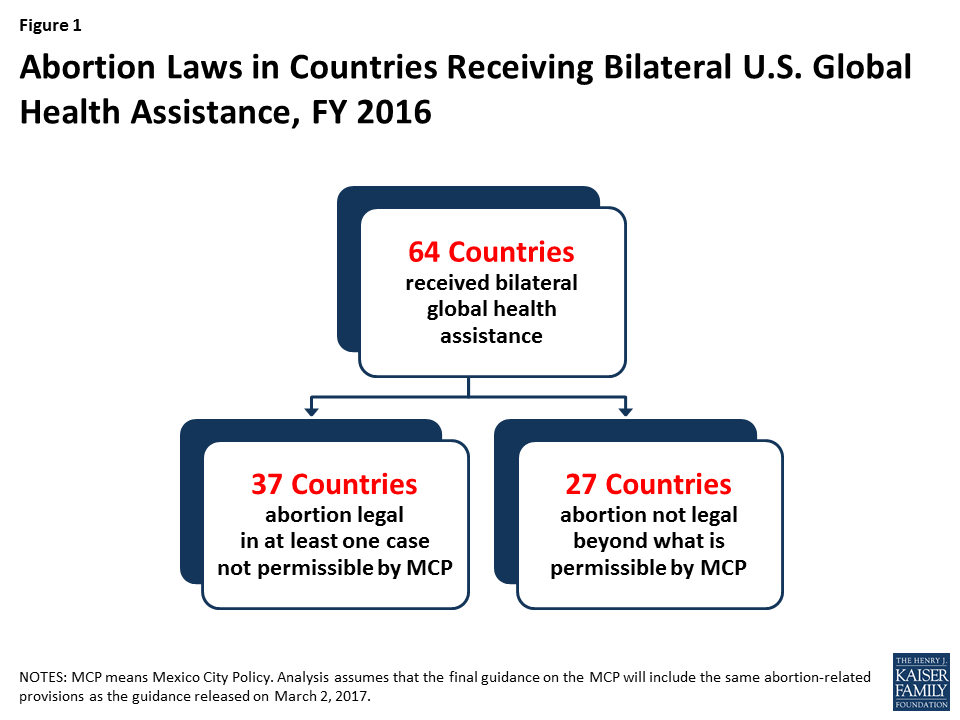
  • It finds that the majority of countries that received U.S. bilateral global health assistance in FY 2016 (37 of 64), allow for legal abortion in at least one case not permissible by the MCP. These countries accounted for 53% of bilateral global health assistance. In all other countries, abortion is not legal beyond what is permissible by the MCP, although other activities are prohibited by the policy.
  • While foreign NGO recipients of U.S. global health assistance will be required to certify that they are in compliance with the MCP regardless of where they work, where countries’ laws allow for abortion in cases not permitted by the MCP, they will be prohibited from providing legal services with non-U.S. funds as a condition of receiving U.S. assistance.

Introduction

On January 23, 2017, President Trump reinstated and expanded the Mexico City Policy (MCP).1  The MCP, first instituted by President Reagan in 1984 and rescinded and reinstated by Presidents along party lines since, requires foreign NGOs to certify that they will not “perform or actively promote abortion as a method of family planning,” using non-U.S. funds (including private funding), as a condition for receiving U.S. government global family planning assistance and, as expanded by President Trump, “global health assistance furnished by all departments or agencies”2  (see KFF explainer and Table 1). On March 2, the U.S. government took the first step in implementing the reinstated policy by issuing guidance on its application to family planning assistance;3  further guidance on other U.S. global health assistance is expected soon. This analysis assumes that the final guidance will include the same abortion-related provisions as the guidance released on March 2. One metric for gauging impact of the MCP is assessing the abortion laws in countries that receive bilateral U.S. global health assistance. This data note provides an assessment of the legal landscape to identify how the MCP affects the provision of legal abortion services by foreign NGOs.

The Mexico City Policy requires foreign NGOs to certify, as a condition of receiving U.S. global health assistance, that they will not “perform or actively promote abortion as a method of family planning” with any funds, including non-U.S. funds. The following definitions apply:5  ABORTION IS A METHOD OF FAMILY PLANNING WHEN used for the purpose of spacing births (including, for example, abortion to preserve a woman’s physical or mental health). TO PERFORM ABORTION means to operate a facility where abortions are performed as a method of family planning. TO ACTIVELY PROMOTE ABORTION means for an organization to commit resources to increase the availability or use of abortion as a method of family planning by:

  • operating a family planning counseling service that provides advice and information regarding the benefits and availability of abortion as a method of family planning;
  • providing advice that abortion is an available option in the event that other methods of family planning are not used or are not successful or encouraging women to consider abortion;
  • lobbying a foreign government to legalize (or continue legality of) or make available abortion as a method of family planning; and
  • conducting a public information campaign regarding the benefits and/or availability of abortion as a method of family planning.

Excluded from these definitions are the following EXCEPTIONS (allowable activities):

  • abortion in cases where the pregnancy either poses a risk to a woman’s life or is the result of incest or rape;[endnote 215568-12]
  • treatment of injuries or illnesses caused by legal or illegal abortions (e.g., post-abortion care); and
  • responding to a question regarding where a safe, legal abortion may be obtained if the question is specifically asked by a woman who is already pregnant, she clearly states that she has already decided to have a legal abortion, and the family planning counselor reasonably believes that the ethics of the medical profession in the country requires a response regarding where it may be obtained safely.

Analysis

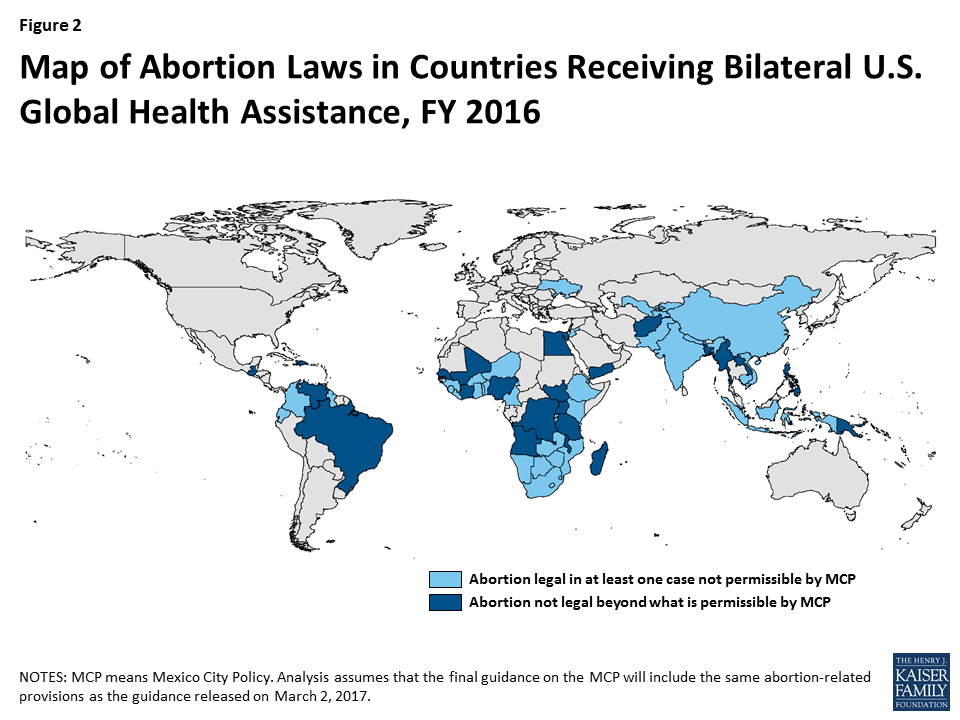
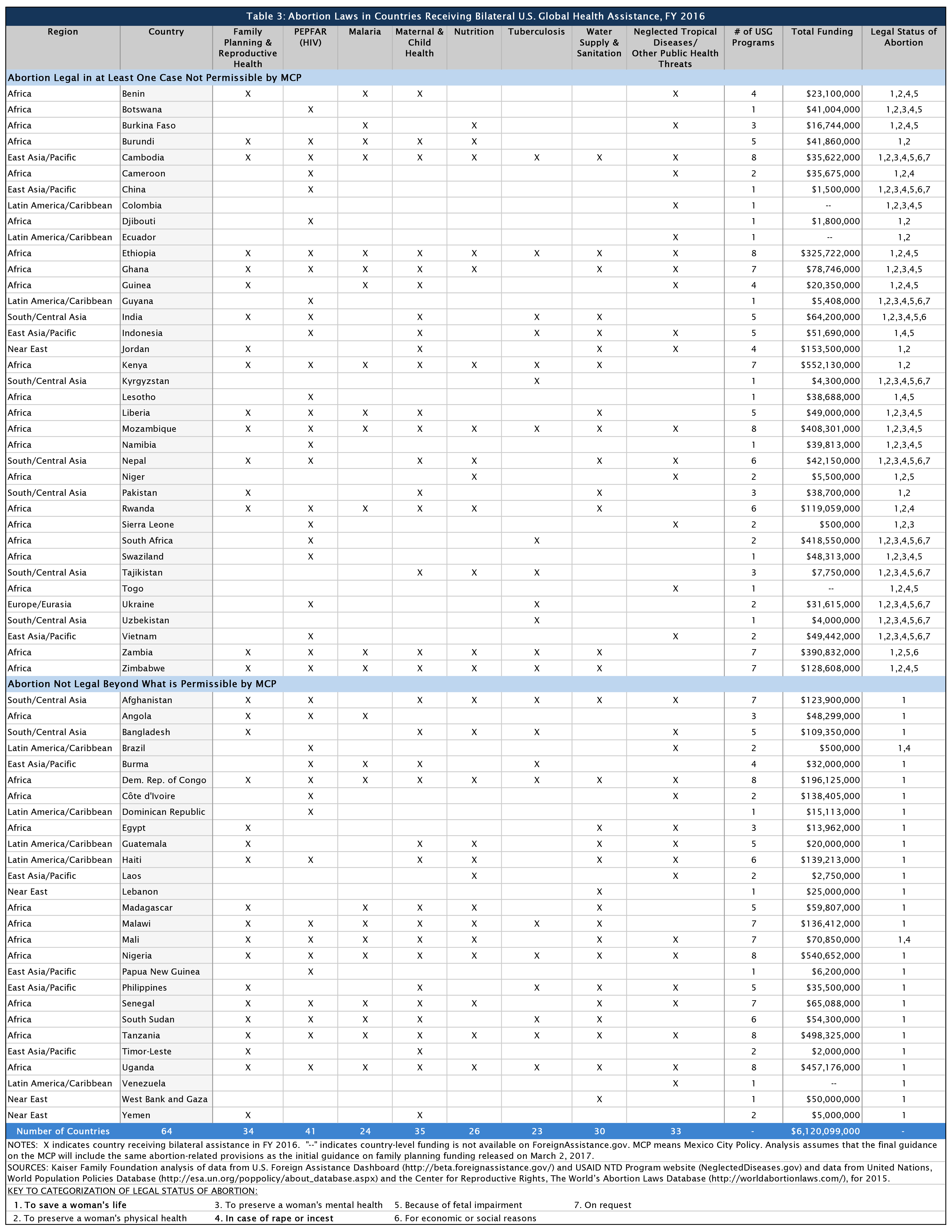
To assess how the MCP would likely affect the provision of legal abortion services in U.S.-assisted countries, we first identified all countries that received bilateral U.S. global health assistance in FY 2016.6  We then looked at the abortion laws in these countries.7  Specifically, we assessed whether abortion was legal in any of the following circumstances: threats to a woman’s life; to preserve a woman’s health; to preserve a woman’s mental health; in the case of rape or incest; because of fetal impairment; for economic or social reasons; and/or on request. We next categorized countries into two groups based on their abortion laws: (1) those that allow for legal abortion in at least one case not permissible under the Mexico City Policy and (2) those that do not allow for legal abortion in any case other than the MCP exceptions (or in fewer cases than the exceptions). We include analysis by the eight major global health program areas supported by the U.S. government: family planning and reproductive health (FP/RH), PEPFAR (HIV), malaria, maternal and child health (MCH), nutrition, tuberculosis (TB), water supply/sanitation, and neglected tropical diseases (NTDs)/other public health threats. The results are as follows (see Figures 1 & 2):

  • In FY16, the U.S. provided bilateral global health assistance to 64 countries. More than half (34) were countries in Africa. The next largest region was East Asia and the Pacific (9). Funding for PEPFAR was directed to the greatest number of countries (41), followed by MCH (35) and FP/RH (34). Together, bilateral global health assistance in these 64 countries totaled just over $6.1 billion in FY16.8 
  • Among these 64 countries, 37 allow for legal abortion in at least one case not permissible under the MCP.9  Most (22) were in Africa; the next largest region was South/Central Asia (6). In nearly all of these countries (35), abortion is legal to preserve a woman’s physical health. In 28 countries, abortion is legal in the case of fetal impairment. PEPFAR reached the greatest number of countries (25) in this group, followed by MCH (18), NTDs/other public health threats (17), and FP/RH (16) (see Tables 2 & 3). Together, these 37 countries accounted for 53% of bilateral global health assistance in FY16.
  • In 27 countries, abortion is not legal in any case beyond the MCP exceptions. Almost half of these countries were in Africa (12), followed by Latin America/Caribbean (5) and East Asia and the Pacific (5). Most of these countries (25) have abortion laws that are more restrictive than the MCP, allowing abortion only to save a woman’s life; only 2 also allow abortion in the cases of rape or incest. FP/RH reached the greatest number of countries (18) in this group, followed by MCH (17), PEPFAR (16), water supply/sanitation (16), and NTDs/other public health threats (16) (see Tables 2 & 3). Together, these 27 countries accounted for 47% of U.S. bilateral global health assistance in FY16.
  • The MCP affects these two groups of countries differently. Where a country’s laws allow for abortion in cases not permissible under the MCP, foreign NGOs would be prohibited from providing legal services with non-U.S. funds as a condition of receiving U.S. global health assistance. Where a country’s laws do not allow for abortion beyond what is permissible by the MCP, the policy would not curtail legal abortion services, although it would still prohibit other activities, such as providing counseling about abortion as a method of family planning (see Table 1). In all cases, foreign NGO recipients of U.S. global health assistance will be required to certify that they are in compliance with the MCP.10  In addition, any U.S. NGO recipient of global health assistance who in turn provides a sub-award to a foreign NGO will be required to ensure that the foreign NGO certified its compliance with MCP.
Figure 1: Abortion Laws in Countries Receiving Bilateral U.S. Global Health Assistance, FY 2016
Figure 2: Map of Abortion Laws in Countries Receiving Bilateral U.S. Global Health Assistance, FY 2016
Table 2: Abortion Laws in Countries Receiving Bilateral U.S. Global Health Assistance, by Program Area, FY 201611 
Program AreaAbortion Legal in at Least One Case Not Permissible by MCP (# of Countries)Abortion Not Legal Beyond What Is Permissible by MCP (# of Countries)
FP/RH1618
PEPFAR (HIV)2516
Malaria1311
MCH1817
Nutrition1313
TB1310
Water Supply & Sanitation1416
NTDs/Other Public Health Threats1716
NOTES: MCP means Mexico City Policy. FP/RH means family planning/reproductive health. MCH means maternal and child health. TB means tuberculosis. NTDs means neglected tropical diseases. Analysis assumes that the final guidance on the MCP will include the same abortion-related provisions as the guidance released on March 2, 2017.

Table 3: PDF

  1. White House, “The Mexico City Policy,” Memorandum for the Secretary of State, the Secretary of Health and Human Services, the Administrator of the Agency for International Development, Jan. 23, 2017, https://www.whitehouse.gov/the-press-office/2017/01/23/presidential-memorandum-regarding-mexico-city-policy. ↩︎
  2. “Policy Statement of the United States of America at the United Nations International Conference on Population (Second Session), Mexico City, Mexico, August 6-14, 1984,” undated; Bill Clinton Administration, “Subject: AID Family Planning Grants/Mexico City Policy,” Memorandum for the Acting Administrator of the Agency for International Development, January 22, 1993, National Archives and Records Administration’s Clinton Presidential Materials Project, https://clinton6.nara.gov/1993/01/1993-01-22-aid-family-planning-grants-mexico-city-policy.html; FY 2000 Consolidated Appropriations Act, P.L. 106-113; George W. Bush Administration, “Subject: Restoration of the Mexico City Policy,” Memorandum for the Administrator of the United States Agency for International Development, January 22, 2001, Bush Administration White House Archives, https://georgewbush-whitehouse.archives.gov/news/releases/20010123-5.html; “Subject: Restoration of the Mexico City Policy,” Memorandum for the Administrator of the United States Agency for International Development, March 28, 2001, Federal Register, https://www.federalregister.gov/documents/2001/03/29/01-8011/restoration-of-the-mexico-city-policy; George W. Bush Administration, “Subject: Assistance for Voluntary Population Planning,” Memorandum for the Secretary of State, August 29, 2003, Bush Administration White House Archives, http://georgewbush-whitehouse.archives.gov/news/releases/2003/08/20030829-3.html; Barack Obama Administration, “Mexico City Policy and Assistance for Voluntary Population Planning,” Memorandum for the Secretary of State, the Administrator of the United States Agency for International Development, January 23, 2009, https://www.whitehouse.gov/the-press-office/mexico-city-policy-and-assistance-voluntary-population-planning; White House, “The Mexico City Policy,” Memorandum for the Secretary of State, the Secretary of Health and Human Services, the Administrator of the Agency for International Development, Jan. 23, 2017, https://www.whitehouse.gov/the-press-office/2017/01/23/presidential-memorandum-regarding-mexico-city-policy. ↩︎
  3. USAID, “Standard Provisions for U.S. Nongovernmental Organizations: A Mandatory Reference for ADS Chapter 303,” ADS Reference 303maa, partial revision March 2, 2017, https://www.usaid.gov/ads/policy/300/303maa; USAID, “Standard Provisions for Non-U.S. Nongovernmental Organizations: A Mandatory Reference for ADS Chapter 303,” ADS Reference 303mab, partial revision March 2, 2017, https://www.usaid.gov/ads/policy/300/303mab. ↩︎
  4. USAID, “Standard Provisions for U.S. Nongovernmental Organizations: A Mandatory Reference for ADS Chapter 303,” ADS Reference 303maa, partial revision March 2, 2017, https://www.usaid.gov/ads/policy/300/303maa; USAID, “Standard Provisions for Non-U.S. Nongovernmental Organizations: A Mandatory Reference for ADS Chapter 303,” ADS Reference 303mab, partial revision March 2, 2017, https://www.usaid.gov/ads/policy/300/303mab. ↩︎
  5. Assumes that the final guidance on the MCP will include the same abortion-related provisions as the guidance released on March 2. ↩︎
  6. Kaiser Family Foundation analysis of data from the U.S. Foreign Assistance Dashboard (http://beta.foreignassistance.gov/) and USAID NTD Program website (NeglectedDiseases.gov). The U.S. Foreign Assistance Dashboard includes global health funding provided to countries by USAID and the Department of State only, but not funding provided by the CDC. Our analysis includes all bilateral global health assistance provided to countries but not assistance designated as regional or worldwide, which may in turn be provided to countries but is not identifiable by country (estimated to be approximately $1.1 billion in FY16). It also does not include global health assistance provided to multilateral institutions, such as the Global Fund to Fight AIDS, Tuberculosis and Malaria, GAVI, and others, which totaled approximately $2 billion in FY16, and are expected to be exempt from MCP requirements. ↩︎
  7. Kaiser Family Foundation analysis of data from the United Nations, World Population Policies Database (http://esa.un.org/poppolicy/about_database.aspx), and the Center for Reproductive Rights, The World’s Abortion Laws Database (http://worldabortionlaws.com/), for 2015. ↩︎
  8. FY16 funding amount does not include $100 million that was provided for NTDs, which is not identifiable by country. ↩︎
  9. These 37 countries include 9 countries that, while allowing for legal abortion in at least one case not permitted by the MCP, do not allow abortion in all MCP excepted cases (e.g., allow abortion to preserve a woman’s physical health but not in the cases of rape or incest). ↩︎
  10. While all foreign NGOs will be required to certify that they are in compliance with the MCP, not all foreign NGOs provide services that are prohibited by the MCP. Such an assessment was beyond the scope of this analysis. ↩︎
  11. Kaiser Family Foundation analysis of data from the U.S. Foreign Assistance Dashboard (http://beta.foreignassistance.gov/) and USAID NTD Program website (NeglectedDiseases.gov) and data from the United Nations, World Population Policies Database (http://esa.un.org/poppolicy/about_database.aspx), and the Center for Reproductive Rights, The World’s Abortion Laws Database (http://worldabortionlaws.com/), for 2015. ↩︎
News Release

Brief Examines Per Enrollee Medicaid Spending for Seniors and People with Disabilities, Which Varies Greatly By State

Published: May 2, 2017

Medicaid coverage of acute and long-term care for more than 6 million low-income seniors and 10 million nonelderly people with disabilities accounts for nearly two-thirds of overall Medicaid spending, although such enrollees represent less than a quarter of people on Medicaid.  Much of Medicaid’s spending on seniors and people with disabilities also depends on state decisions about whom to cover and which services to pay for, which is a big reason why Medicaid spending per enrollee for these populations varies greatly from state to state.

A new issue brief from the Kaiser Family Foundation documents that variation and explains how the American Health Care Act’s proposed caps on per enrollee Medicaid spending could lock-in these spending differences. The brief also notes that because most age and disability-related Medicaid coverage pathways, as well as many services such as community-based long-term care, are provided at state option, states could potentially cut back on them if faced with federal Medicaid funding reductions over time.

.

Congress Releases FY17 Omnibus

Published: May 1, 2017

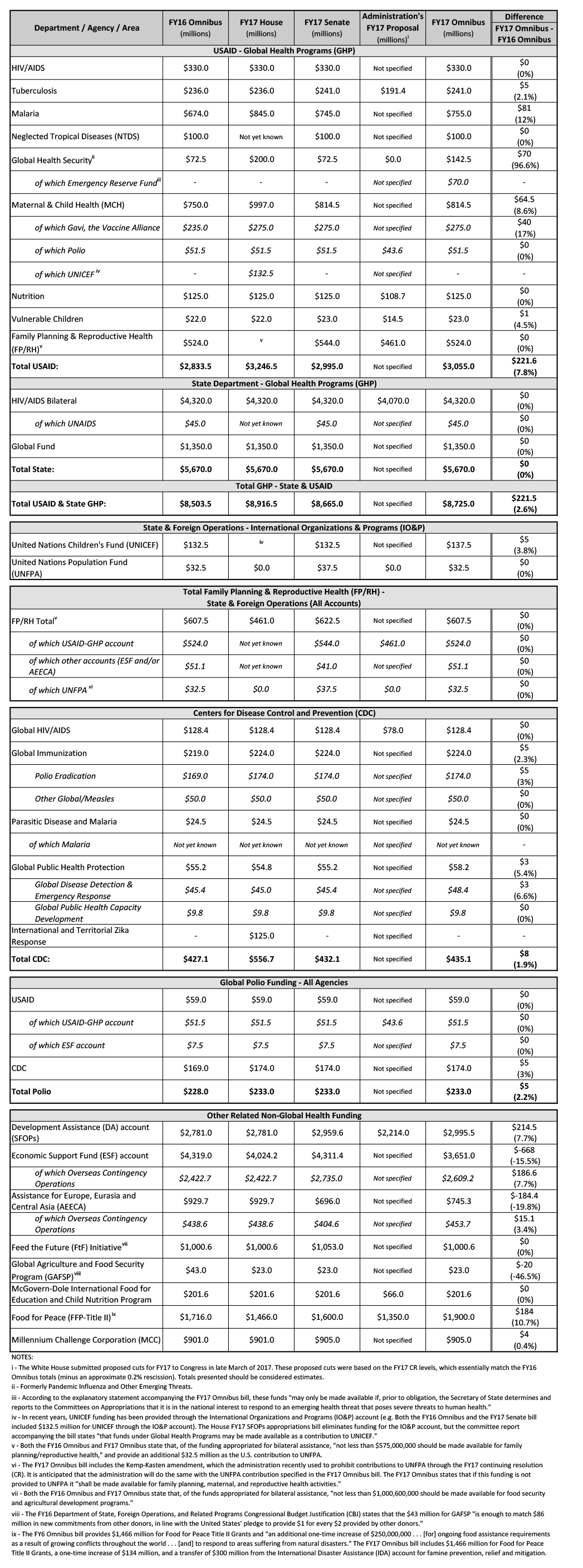
On May 1, 2017, Congress released the FY 2017 Omnibus bill (and explanatory statements), which provides funding for the U.S. government through the rest of the fiscal year including for U.S. global health programs at the U.S. Agency for International Development (USAID), the Department of State, and the Centers for Disease Control and Prevention (CDC). Total known* funding for U.S. global health programs in the FY 2017 Omnibus is $9.4 billion, which is approximately $235 million (2.6%) higher than the FY 2016 enacted level. The tables below compare U.S. global health funding in the FY 2017 Omnibus to the FY 2016 enacted levels, the House and Senate FY17 appropriations bills, and proposed cuts submitted by the Administration to Congress in March 2017.

Funding for tuberculosis, malaria, maternal & child health (MCH), vulnerable children, and global health security increased compared to FY 2016. The entire global health security increase is for an “Emergency Reserve Fund” to respond to emerging threats, while a majority of the increase in MCH funding was for an increased contribution to Gavi, the Vaccine Alliance. Funding for all other global health programs (HIV, neglected tropical diseases, nutrition, and family planning & reproductive health) remained flat compared to FY 2016 levels.

*Some funding amounts (e.g. NIH funding for international HIV research) are determined at the agency level, and were not earmarked by Congress in the Omnibus bill.

State Variation in Medicaid Per Enrollee Spending for Seniors and People with Disabilities

Authors: MaryBeth Musumeci and Katherine Young
Published: May 1, 2017

Issue Brief

Proposals to fundamentally restructure Medicaid financing and substantially reduce federal funds under a per capita cap, such as the House GOP’s American Health Care Act, have important implications for the over 6 million seniors and 10 million nonelderly adults and children with disabilities who rely on the program for necessary medical and long-term care.  Medicaid’s current financing structure guarantees federal matching funds as state spending increases.  As a result of the options available under current law, there is substantial variation among state Medicaid programs in the eligibility pathways and covered services for seniors and people with disabilities.  This in turn contributes to differences among states in spending per enrollee for these populations.

A per capita cap would limit the amount of federal Medicaid funding that states could receive per enrollee.  Such a change could lock in historic variation in spending among states and limit states’ ability to respond to circumstances that increase health care spending, such as public health emergencies like the opioid epidemic, Flint water crisis, or HIV, natural disasters like Hurricane Katrina, or new medical advances like Hepatitis C drugs.

This issue brief explains the variation in Medicaid spending per enrollee for seniors, nonelderly adults with disabilities, and children with disabilities compared to other populations as well as variation in per enrollee spending for these populations among states.  It also provides a snapshot of state choices about optional eligibility pathways and covered services important to many seniors and people with disabilities.

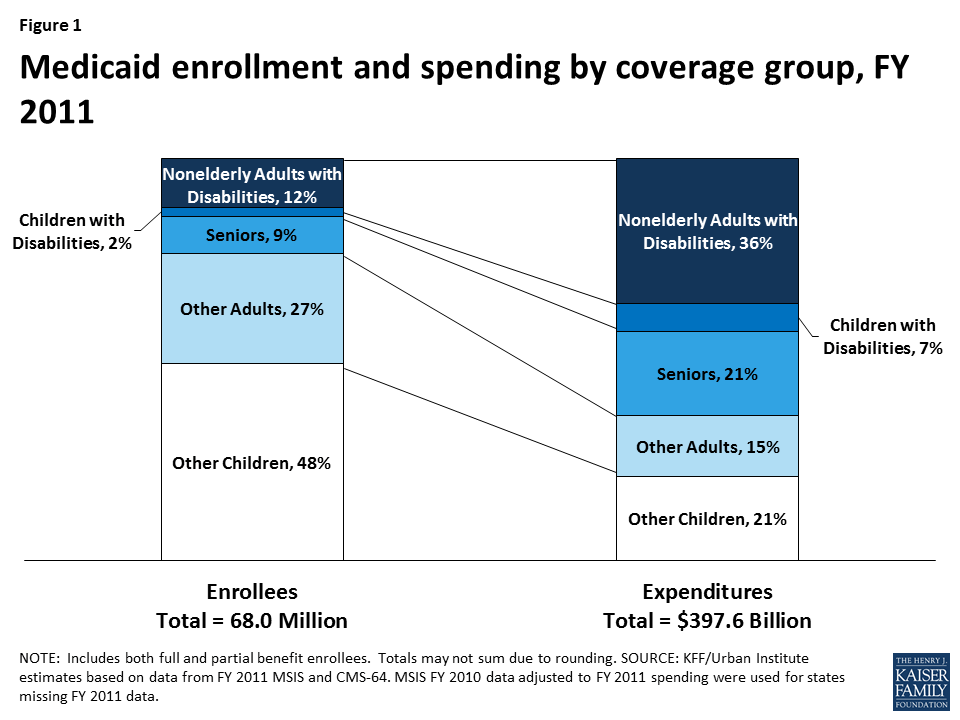
Seniors and people with disabilities together account for 23% of Medicaid enrollment but 64% of program spending as of FY 2011 (Figure 1).  Children with disabilities and nonelderly adults with disabilities each account for a share of program spending that is about three times greater than their share of program enrollment (2% vs. 7%, and 12% vs. 36%), while the share of program spending devoted to seniors is more than double their share of enrollment (9% vs. 21%).  These discrepancies are due to the greater health and long-term care needs of these populations, resulting in more intensive service use, compared to adults and children who come into the program based solely on their low incomes.

Figure 1: Medicaid enrollment and spending by coverage group, FY 2011

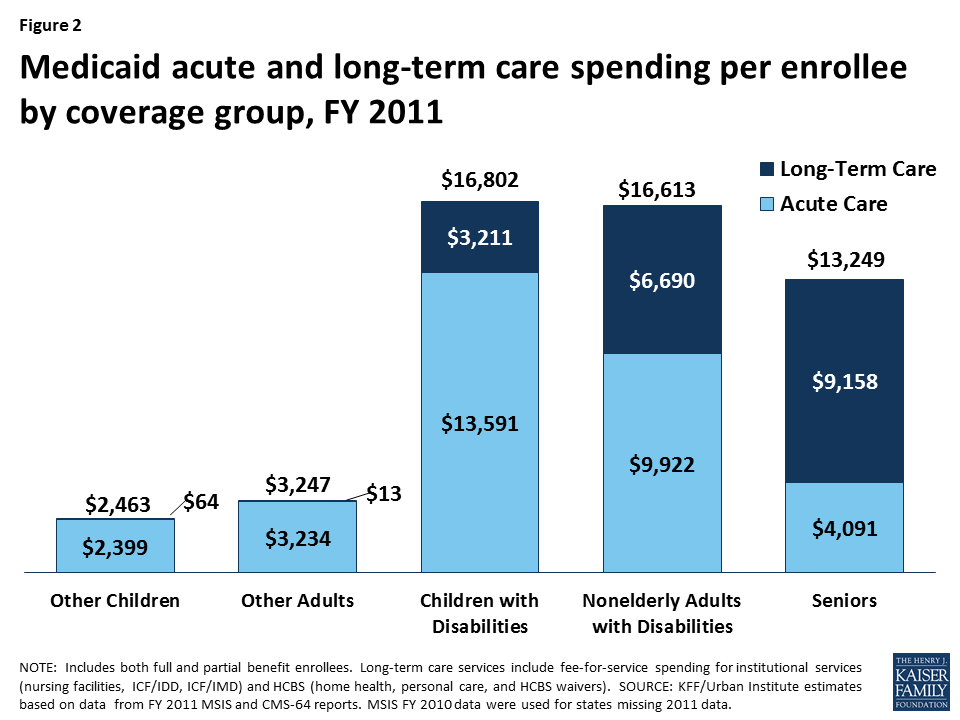
Medicaid spending per enrollee is substantially higher for seniors and people with disabilities compared to those without disabilities (Figure 2).  Per enrollee spending for children with disabilities totaled $16,802 in FY 2011, nearly seven times higher than for other children ($2,463).  In addition, per enrollee spending for nonelderly adults with disabilities is over five times higher ($16,613), and per enrollee spending for seniors is four times higher ($13,249), than per enrollee spending for other adults ($3,247).  Some of these differences are due to seniors and people with disabilities’ greater use of long-term care services compared to those without disabilities.  Some children and adults whose Medicaid eligibility is based solely on their low incomes do have disabilities and use long-term care services.  However, seniors and people with disabilities also have higher spending per enrollee for acute care services compared to those without disabilities.  Medicaid acute care spending per enrollee is nearly six times higher for children with disabilities ($13,591) compared to other children ($2,399) and over three times higher for nonelderly adults with disabilities ($9,922) compared to other nonelderly adults ($3,234).

Figure 2: Medicaid acute and long-term care spending per enrollee by coverage group, FY 2011

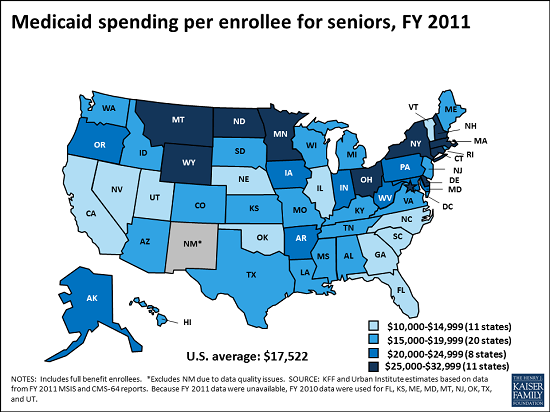
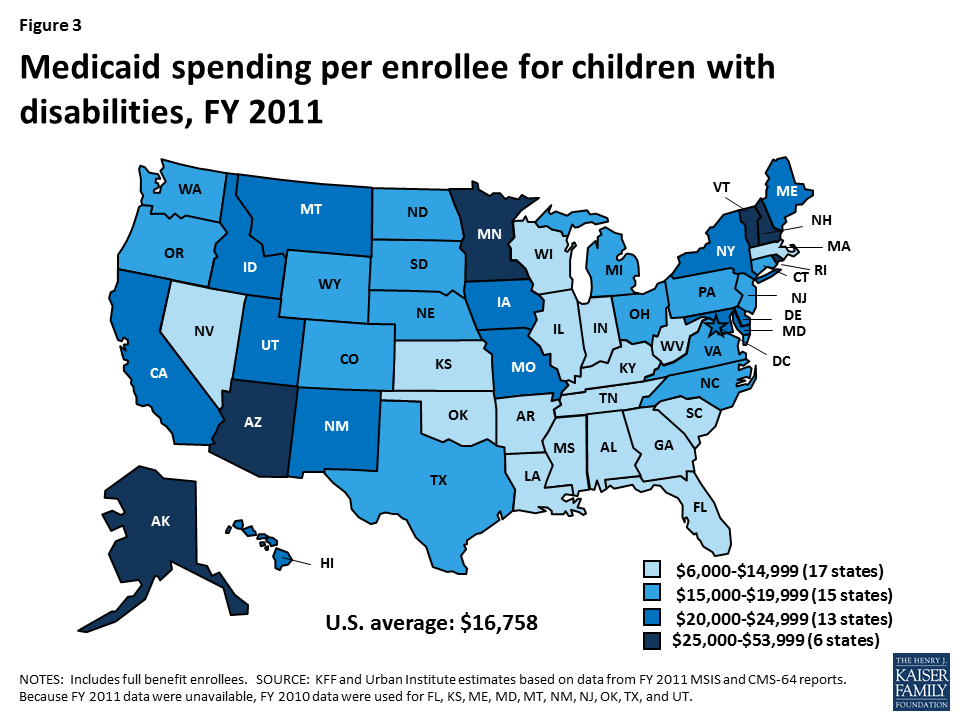
Per enrollee spending for seniors and people with disabilities varies substantially by state.  Per enrollee spending for children with disabilities ranges from $6,945 in Tennessee to $53,557 in New Hampshire (Table 1).  Seventeen states spend less than $15,000 per enrollee for children with disabilities, while six states spend $25,000 or more (Figure 3).  Per enrollee spending for nonelderly adults with disabilities ranges from $9,903 in Alabama to $37,132 in New York (Table 1).  Ten states spend less than $15,000 per enrollee for nonelderly adults with disabilities while seven states spend $25,000 or more (Figure 4).  Per enrollee spending for seniors ranges from $10,518 in North Carolina to $32,199 in Wyoming (Table 1).  Eleven states spend less than $15,000 per enrollee for seniors, while another 11 states spend $25,000 or more (Figure 5). The variation in per enrollee spending by state is due to state choices about eligibility and services, as many age and disability-related coverage pathways and most home and community-based long-term care services are offered at state option.

Figure 3: Medicaid spending per enrollee for children with disabilities, FY 2011
Figure 4: Medicaid spending per enrollee for nonelderly adults with disabilities, FY 2011
Figure 5: Medicaid spending per enrollee for seniors, FY 2011

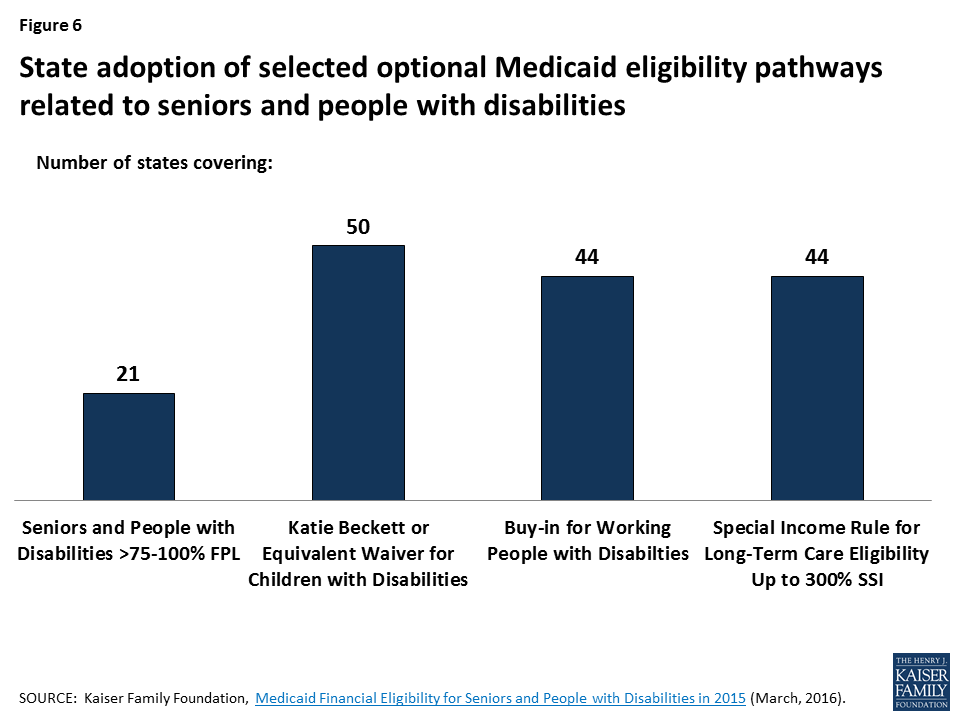
Many age and disability-related coverage pathways are offered at state option (Figure 6 and Table 1), contributing to the variation among states in per enrollee spending for seniors and people with disabilities.  Mandatory Medicaid eligibility for seniors and people with disabilities generally is limited to those receiving Supplemental Security Income (SSI) benefits (equivalent to 74% FPL, or $8,820 per year for an individual, in 2017).1   However, all states have expanded eligibility for seniors and people with disabilities by offering optional coverage pathways.  As of 2015, 21 states have increased eligibility for seniors and individuals with disabilities above the SSI level up to a federal maximum of 100% FPL ($12,060 per year for an individual in 2017). Nearly all states offer an eligibility pathway for children with significant disabilities living at home without regard to parental income who would be Medicaid-eligible if institutionalized.  Forty-four states allow working individuals with disabilities with income above eligibility limits to buy into Medicaid.  Forty-four states allowed people in need of nursing facility care to qualify for Medicaid with income up to 300% of SSI ($26,460 per year for an individual in 2017), and nearly all of these states use the same expanded financial eligibility standard for people receiving long-term care in the community.

Figure 6: State adoption of selected optional Medicaid eligibility pathways related to seniors and people with disabilities

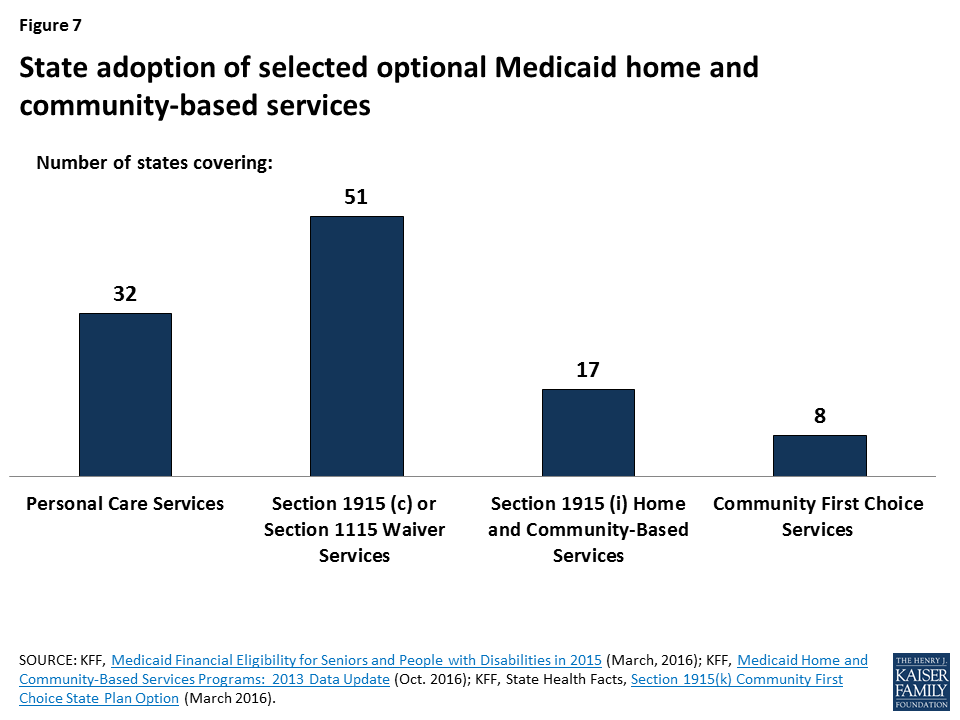
Variation among states in spending per enrollee for seniors and people with disabilities also is influenced by different state choices about Medicaid-covered services, as most home and community-based long-term care services are offered at state option (Figure 7 and Table 1). Federal minimum long-term care benefits include nursing facility services and home health services for those who qualify for nursing facility services.  Beyond federal minimum requirements, all states offer some home and community-based services targeted to particular populations through optional Section 1915 (c) or equivalent Section 1115 waivers.  Seventeen states offer targeted HCBS to those at risk of future institutional care through the Section 1915 (i) state plan option as of 2015.  In addition, 32 states offer personal care services as of 2013, and eight states offer Community First Choice attendant care services and supports as of 2016.

Figure 7: State adoption of selected optional Medicaid home and community-based services

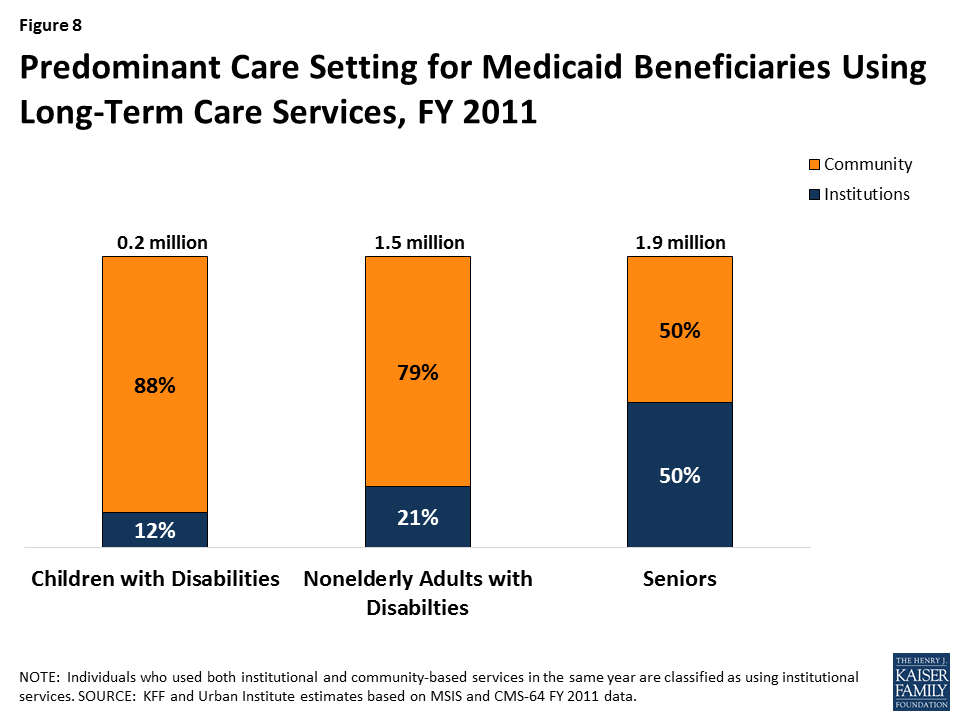
The share of Medicaid enrollees receiving community-based, as opposed to institutional, long-term care services varies by population (Figure 8).  Most children with disabilities (88%) and nonelderly adults with disabilities (79%) receiving Medicaid long-term care services reside in the community, with the remainder in institutions.  Equal shares of seniors receiving Medicaid long-term care services reside in the community and in institutions.

Figure 8: Predominant Care Setting for Medicaid Beneficiaries Using Long-Term Care Services, FY 2011

Looking Ahead

Seniors and people with disabilities account for a minority (23%) of Medicaid program enrollment but a majority (64%) of spending.  This is due to their greater health and long-term care needs and more intensive services use compared to adults and children whose eligibility is not based on old age or disability.  Medicaid per enrollee spending for both acute and long-term care services is substantially higher for seniors and people with disabilities compared to nonelderly adults and children without disabilities.  Many of these services, especially long-term care in the community and nursing homes, are generally unavailable through private insurance and too costly to afford out-of-pocket.

Medicaid spending per enrollee for seniors and people with disabilities also varies substantially across states and reflects the fact that many eligibility pathways and services relevant to seniors and people with disabilities are optional.  Medicaid’s financing structure, which allows federal spending to increase as state spending increases, accommodates state policy choices about optional populations and services.  Current program financing also ensures that federal spending will be available as state spending increases due to new drug therapies or other medical advances yet to be developed that could offer important new treatments for seniors and people with disabilities and to help states meet their obligation to serve people in the community instead of institutions under the Americans with Disabilities Act and the Supreme Court’s Olmstead decision.

Changing federal Medicaid financing to a per capita capped allotment beginning in FY 2020, and repealing the Medicaid expansion as proposed in the American Health Care Act, would result in an estimated $839 billion reduction in federal Medicaid spending from 2017 to 2026, according to the Congressional Budget Office (CBO). The CBO decreased its initial estimate of $880 billion less in federal Medicaid spending over the 10-year period, which amounts to a reduction of about 25% by 2026, compared to current law, by an additional $41 billion to account for the effects of the House manager’s policy amendment.  The amendment would increase states’ annual per capita allotments for enrollees in the elderly and blind/disabled categories by medical-CPI plus one percentage point beginning in FY 2020, while the allotments for children, expansion adults, and other adults would increase by medical-CPI.  The CBO projects that Medicaid spending per enrollee will grow at a faster average annual rate than medical-CPI (4.4% vs. 3.7%) between 2017-2026. However, the inflationary factor to adjust state spending from the FY 2016 base year to FY 2019 when determining initial per capita cap funding levels remains at medical-CPI for all groups; the additional percentage point for the elderly and blind/disabled groups is not included in that calculation.

A per capita cap could lock in historical state differences in the scope of coverage and spending for seniors and people with disabilities.  Tying Medicaid spending levels to a base year under a per capita cap also does not account for future spending increases due to new drug therapies or other medical advances yet to be developed and which could offer important new treatments for seniors and people with disabilities.  Finally, seniors and people with disabilities may be especially affected by a per capita cap as most age and disability-related coverage pathways and many important services, such as community-based long-term care, are provided at state option, making them subject to potential cuts if states are faced with federal funding reductions.

Appendix

Table 1:  State Variation in Medicaid Per Enrollee Spending, Eligibility, and Services for Seniors and People with Disabilities
StateSpending Per Enrollee, FY 2011Optional Eligibility Pathways, 2015Optional HCBS
Children with DisabilitiesNonelderly Adults with DisabilitiesSeniors100% FPLKatie Beckett or equiv. waiverWork Dis. Buy InLTC Special Income RulePers. Care Serv., 2013Sec. 1915 (i), 2015CFC, 2016
Alabama$11,020$9,903$18,473XX
Alaska$32,734$28,151$24,288XXXX
Arizona$32,303$19,300$16,145XXXX
Arkansas$14,317$13,894$20,484XXXXX
California$24,909$19,268$12,019XXXXXX
Colorado$17,834$20,045$18,478XXXX
Connecticut$17,273$31,039$30,560XXXXX
Delaware$20,091$24,136$27,666XXXXX
DC$21,952$29,948$27,336XXXXXX
Florida$13,373$15,584$14,253XXXXX
Georgia$7,829$11,475$14,142XXX
Hawaii$21,472$16,574$18,439XX
Idaho$23,073$21,426$15,558XXXXXX
Illinois$12,534$16,941$11,431XXX
Indiana$14,827$20,151$21,269XXXXX
Iowa$21,263$20,036$21,163XXXX
Kansas$14,282$17,875$18,328XXXX
Kentucky$12,442$12,954$15,757XXX
Louisiana$11,264$16,235$15,491XXXXX
Maine$22,424$16,270$19,881XXXXX
Maryland$20,678$24,415$23,491XXXXXX
Massachusetts$10,351$19,146$27,205XXXXX
Michigan$16,994$14,784$17,599XXXXXX
Minnesota$25,425$27,159$25,030XXXXX
Mississippi$11,963$13,260$18,592XXXX
Missouri$20,759$17,370$17,020XXX
Montana$21,203$15,549$26,704XXXXXX
Nebraska$17,451$17,449$14,997XXX
Nevada$12,391$16,762$13,226XXXXX
New Hampshire$53,557$21,313$26,794XXXXX
New Jersey$18,759$20,217$19,160XXXXX
New Mexico$21,966$17,661N/AXXXX
New York$20,082$37,132$28,336XXXXX
North Carolina$17,971$14,403$10,518XXXX
North Dakota$18,360$29,813$31,155XXX
Ohio$15,499$22,768$27,494XXXX
Oklahoma$14,460$15,117$12,315XXXX
Oregon$18,737$18,180$24,253XXXXXX
Pennsylvania$16,634$16,372$21,372XXXX
Rhode Island$30,043$19,588$16,998XXXXX
South Carolina$13,366$12,707$12,256XXX
South Dakota$16,689$19,816$16,374XXXX
Tennessee$6,945$16,044$15,745XX
Texas$18,261$17,503$14,739XXXX
Utah$21,683$19,391$11,763XXXXX
Vermont$42,030$13,967$14,258XXXX
Virginia$15,418$19,681$16,367XXXX
Washington$17,152$16,072$16,183XXXXX
West Virginia$14,045$12,867$23,243XXXX
Wisconsin$9,950$18,130$16,344XXXXX
Wyoming$18,684$26,830$32,199XXX
United States$16,758$18,912$17,52221 states50 states44 states44 states32 states17 states8 states
NOTES: Spending per enrollee includes full benefit enrollees. All spending per enrollee categories exclude those in ME enrolled only in Q4 and seniors excludes NM due to data quality issues.

SOURCE: KFF & Urban Institute estimates based on data from FY 2011 MSIS & CMS-64 reports. Because FY 2011 data were unavailable, FY 2010 data were used for FL, KS, ME, MD, MT, NM, NJ, OK, TX, & UT. KFF, Medicaid Financial Eligibility for Seniors and People with Disabilities in 2015 (March, 2016). KFF, Medicaid Home and Community-Based Services Programs:  2013 Data Update (Oct. 2016). KFF, Medicaid Section 1115 Managed Long-Term Services and Supports Waivers:  A Survey of Enrollment, Spending, and Program Policies (Jan. 2017). KFF, State Health Facts, Section 1915(k) Community First Choice State Plan Option (March 2016).


Endnotes

  1. As of 2015, 10 states elect the u00a7 209(b) option to use disability or financial eligibility standards that are more restrictive than the federal SSI rules, so long as the stateu2019s rules are not more restrictive than those in effect in January 1972. Section 209(b) states must allow SSI beneficiaries to establish Medicaid eligibility through a spend-down by deducting unreimbursed out-of-pocket medical expenses from their countable income. Section 209(b) states also must provide Medicaid to children who receive SSI and who meet the stateu2019s financial eligibility rules for the AFDC program as of July 16, 1996.u00a0 In addition to covering SSI beneficiaries, states also must offer Medicare Savings Programs through which low-income Medicare beneficiaries with incomes generally below 135% FPL (or about $16,000 per year for an individual in 2016) receive Medicaid assistance with some or all of their Medicare premiums, deductibles, and other cost-sharing requirements (these u201cpartial dual eligibleu201d beneficiaries do not receive Medicaid benefits). ↩︎

Thank you for participating in the 2017 Employer Health Benefits Survey

Published: May 1, 2017

The 2017 survey fielding period has closed. For questions regarding the Employer Health Benefits Survey, please email Kaiser-HRET@kff.org.

KFF_HRET.jpg


We kindly request your input in a national survey of employers and the health benefits they may offer. This survey, conducted annually since 1999 by two non-partisan research organizations, the Kaiser Family Foundation (KFF) and the Health Research & Educational Trust (HRET), is the basis of a major report about employer health benefits. The survey is able to provide critical information on health benefits to employers and policy-makers because firms like yours participate in telephone interviews scheduled in the coming months. Given the many ongoing changes in health insurance, your participation is all the more important to accurately capture what is happening in employer health benefits. The information you provide will be kept strictly confidential and will not be reported or released in any way that allows identification of respondents.

Your firm was randomly selected to participate from a list of all employers in the United States. Even if your firm does not offer health benefits, we are still interested in your responses and encourage you to complete the survey. In the next few months, you will receive a phone call from National Research (NR), the professional survey research firm conducting the telephone interviews. They will ask to speak to the individual who is most knowledgeable about your firm’s health benefit plans; if you are not the person who will be answering the questions, please pass this letter to that person. If your firm offers health benefits, you will be asked questions about any health plans offered, including HMO, PPO, POS, and high-deductible health plans that are linked with a savings account, such as health savings accounts (HSAs) or health reimbursement arrangements (HRAs). The Checklist tab outlines the specific topics our interviewers will ask about. Having copies of the plan documents at hand will be very helpful.

You should have also received a copy of the summary of findings from the 2016 study in the mail. The full report is available at kff.org/health-costs/report/2016-employer-health-benefits-survey. You can use the report to determine whether firms similar to yours offer coverage, how much it costs, and how much workers pay for premiums and for using health care services. The KFF/HRET study has been a widely respected source of information for 18 years, including major press coverage in outlets such as The New York Times, The Washington Post, The Wall Street Journal, and The Los Angeles Times.

The Kaiser Family Foundation provides independent, non-partisan research on health policy issues, and is not affiliated in any way with the Kaiser Permanente health plan. HRET is a not-for-profit organization involved in researching health policy and management issues. More information on each organization is available online at www.kff.org and www.hret.org.

We look forward to speaking with you. If you have any questions in the meantime, please feel free to contact the project manager, Heidi Whitmore, at Kaiser-HRET@kff.org or (763) 478-6725.

2017 Employer Health Benefits Survey Topics

This checklist outlines some specific topics that will be asked in regards to your firm nationwide; not just at your location. If a question is not applicable to your firm, it will not be asked.

Questions for All Firms:

?Total number of employees at your location & the total number of employees nationwide.
? The number of full-time equivalents. FTEs are the average number of all employees working full-time (30 or more hours per week). For help determining how many FTEs your firm has, please visit www.healthcare.gov/shop-calculators-fte/.
?The percentage of full-time employees making $24,000 or less per year; percentage making $60,000 or more per year; percentage of all employees working full-time (30 or more hours per week); percentage of all employees age 26 and under and 50 and over.

Questions Only for Firms That Offer Health Benefits:

?Number of employees eligible for and covered by health benefits nationwide. Number or percent of employees enrolled in each plan type (HMO, PPO, POS & high-deductible with either an HRA or HSA).
?Types of wellness programs offered; the use and structure of incentives to encourage participation; maximum dollar amount of incentives for participating in the wellness programs.
?Whether the firm’s plans include health risk assessments and/or biometric screening; the structure of incentives (for firms with 200 or more employees); maximum dollar amount of incentives for meeting biometric outcomes.
?Whether the largest plan uses tiered provider networks, telemedicine, retail clinics, a nurse hotline, and/or has a narrow network.
?Whether benefits are available to part-time workers, temporary workers, domestic partners, spouses and dependent children.
?If the firm offers retiree health benefits, who is covered and how those benefits are administered. (For firms with 200 or more employees)

Questions about your largest plan in each of the plan types you have (HMO, PPO, POS, and/or high-deductible health plans with a savings option (such as an HRA or HSA):

?If the firm has plans that are self-insured, whether the firm has purchased stop loss or catastrophic coverage, and if so, the level at which it begins to pay for benefits.
?Whether the plan or plans are grandfathered under the Affordable Care Act.
?General annual deductibles for single and family coverage, and if physician office visits or prescription drugs are covered before the deductible is met.
?Co-payments, coinsurance, and/or any separate deductibles for primary care office visits, specialty care office visits, emergency room visits, hospital admissions, and/or outpatient surgery.
?Out-of-pocket limits for single coverage.
?Monthly premium or COBRA costs for single and family coverage, including the employee’s contribution and the firm’s contribution.
?Prescription drug benefit design, such as tiered drug plans, drug co-payments, and/or coinsurance, including those for specialty drugs.
?Dollar amounts the firm contributes to an HRA (health reimbursement arrangement) and/or HSA (health savings account).

Frequently Asked Questions (FAQs)

What is the survey about?

The purpose of this annual survey is to provide a detailed look at trends in employer-sponsored health coverage including premiums, employee contributions, cost-sharing provisions, and employer opinions.

Who uses the survey information?

The survey provides critical information on health benefits to benefits managers, policy makers, and journalists, including major press coverage in outlets such as The New York Times, The Washington Post, The Wall Street Journal, and The Los Angeles Times. Employers often rely on the survey results to understand the cost of insurance in their industry or region.

Can the survey be completed online?

Unfortunately not; the survey can only be completed via phone. Interviewers working on the survey are highly trained and are there to help respondents complete the survey as quickly and easily as possible.

How do I participate?

National Research, a professional research firm, will call your firm to conduct the survey beginning in January. They will ask to speak to the individual who is most knowledgeable about your firm’s health benefit plans.

How should I prepare for the survey?

Please review the mailing that was sent to your firm in January. It contains the letter inviting you to participate as well as a checklist outlining some specific topics that will be asked about your firm. It is also helpful to have copies of the plan documents at hand during the survey.

The checklist says you will ask about wellness programs, but our firm does not have one. What should I do?

If a question is not applicable to your firm, it will not be asked.

What if there is a question I cannot answer?

If there is a question you cannot or would rather not answer, the interviewer will skip it.

My firm does not offer health benefits. Should I still participate?

Yes. Even if your firm does not offer health benefits, we are still interested in your responses and encourage you to complete the survey.

Who can I contact if I have questions about participating in the survey?

Please contact the project manager, Heidi Whitmore, at Kaiser-HRET@kff.org or (763) 478-6725.

Will anyone contact me as a result of participating in the survey?

No; your firm’s information will not be shared with outside parties and nobody will contact you as a result of this survey. All information is reported in a way which protects respondents’ identities.

Will my firm’s information be used for sales or marketing purposes?

No; your firm’s information and identity will be held strictly confidential, will not be used for sales or marketing, and will not be shared with outside parties.

Are you trying to sell me health insurance or any other product?

No; we are not selling anything. We are conducting a survey about job-based health benefits for the Kaiser Family Foundation, a nonprofit health care research institute.

Is the Kaiser Family Foundation part of Kaiser Permanente?

No; the Kaiser Family Foundation is not affiliated with Kaiser Permanente or any insurance company. The Foundation is a non-partisan health care research institute independent of provider or political interests. The Kaiser Family Foundation strives to provide trusted information on a range of health policy issues.

How can I see the final results of the survey?

The survey report will be available online in the fall at ehbs.kff.org. As a small token of our appreciation, a printed copy will be mailed to your firm (unless you elect not to receive a copy) at the end of the year.

Where can I find more details about the survey design and methods you use to analyze the data?

Please see our methods section to learn how we design our survey sample, define key terms and categories, analyze the data, and more.

Where can I find results from previous years’ surveys?

Employer Health Benefits Surveys dating back to 1998 are available here.

The Employer Health Benefits Survey is the benchmark survey for understanding the rapidly changing health insurance market. For nearly two decades newspapers across the country have relied on the survey in their reporting. Over the last several years hundreds of papers have covered the survey. It is important for the experience of employers like yours to be represented in their coverage.


ehbs-2016-headlines-combined
News Release

Poll: Majorities of Democrats, Republicans and Independents Support Actions to Lower Drug Costs, Including Allowing Americans to Buy Drugs from Canada

Most Say Importing Canadian Drugs Would Lower Costs Without Affecting Quality, Though Some Have Concerns About Unsafe Drugs and Disincentives for Research and Development

Published: May 1, 2017

When asked about a series of health care priorities facing President Trump and Congress, six in 10 Americans (60%) identify lowering the cost of prescription drugs as a “top priority” for President Trump and Congress – including majorities of Democrats, independents, and Republicans.

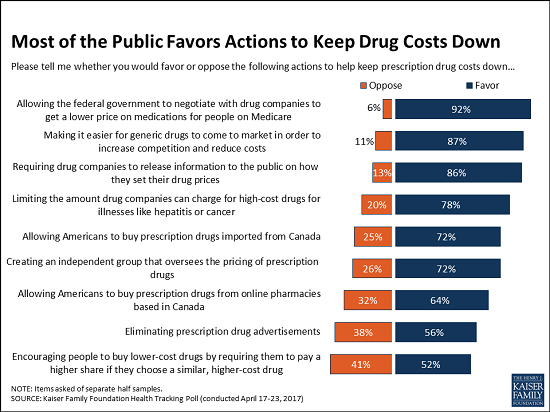
The latest Kaiser Health Tracking Survey examines the public’s views on potential policies to address drug costs – and finds majority support for nine different potential actions.  This includes overwhelming support for allowing the federal government to negotiate with drug companies to get a lower price on medications for people on Medicare (92%), making it easier for generic drugs to come to market (87%), and requiring drug companies to release information to the public on how they set drug prices (86%). Other proposals with significant majority support include allowing Americans to buy prescription drugs imported from Canada (72%) or from online pharmacies based in Canada (64%).

A majority of Republicans, Democrats, and independents favor eight of the nine specific policies.  The lone exception is encouraging people to buy lower-cost drugs by requiring them to pay a higher share if they choose a similar, higher-cost drug – favored by majorities of Republicans (57%) and independents (60%) but a smaller share of Democrats (40%).

The poll also probes more deeply into the public’s views of how allowing Americans to import drugs from Canada or purchase drugs through online Canadian pharmacies would impact costs, quality and safety. Most think that each of these policy changes would make medicines more affordable without sacrificing safety or quality (76% say this about imported drugs; 68% say so about online pharmacy sales). Fewer say either change would expose Americans to unsafe medicines from other countries (35% and 39%, respectively) or lead U.S. drug companies to do less research and development (29% and 33%, respectively).

The findings come from the late April Kaiser Health Tracking Poll, designed and analyzed by public opinion researchers at the Kaiser Family Foundation and conducted from April 17- April 23 among a nationally representative random digit dial telephone sample of 1,171 adults. Interviews were conducted in English and Spanish by landline (421) and cell phone (750). The margin of sampling error is plus or minus 3 percentage points for the full sample. For results based on subgroups, the margin of sampling error may be higher.

News Release

Medicaid Family Planning and Maternity Care Services: The Current Landscape

Published: Apr 27, 2017

As the Trump Administration and Congress weigh major changes to Medicaid and programs that fund reproductive health care, new analyses from the Kaiser Family Foundation highlight the current state of coverage and challenges for family planning, pregnancy, and perinatal services in the Medicaid program that provides coverage for millions of low-income women across the nation.

  • The inclusion of maternity care as an essential health benefit has been the focus of a recent policy debate over the future of the Affordable Care Act. For nearly half of births in the U.S., Medicaid picks up the tab. A new survey of state-level maternity care policies under Medicaid finds that all surveyed states covered prenatal visits, but benefits such as genetic counseling, parenting and newborn education services, and home visits were not covered in some states. Similarly, all states included hospitalization benefits, but not all paid for deliveries in birth centers or at home.
  • Over half of states have established limited scope family planning programs under Medicaid. A case study analysis of Medicaid family planning programs in six states (AL, CA, CN, IL, MO, and VA) conducted in the summer of 2016 uncovered opportunities to improve enrollment in family planning programs; identified the importance of these programs for women who have difficulty affording premiums; and documented challenges faced by family planning clinics under Medicaid. Some ACA Medicaid expansion states are reconsidering the need for a separate family planning program under Medicaid, but most have maintained them.
  • Three quarters of reproductive age women on Medicaid are enrolled in managed care arrangements. A new analysis explores the experiences and perspectives of leaders of Medicaid Managed Care Organizations (MCOs) and finds that MCOs rely heavily on safety net clinics including community health centers and family planning clinics such as Planned Parenthood to provide in-network family planning services to their members. MCO leaders identified churning in enrollment, the high costs of stocking IUDs and implants, and global hospital payment methodologies for maternity care as potential barriers to certain family planning services.

Medicaid Family Planning Programs:  Case Studies of Six States After ACA Implementation, prepared by Manatt Health and the Kaiser Family Foundation; Medicaid Coverage of Pregnancy and Perinatal Benefits: Results from a State Survey, prepared by Health Management Associates and Kaiser; and Medicaid Managed Care and the Provision of Family Planning Services, prepared by Kaiser and the Institute for Medicaid Innovation, are available on kff.org.