Medicaid Maintenance of Eligibility (MOE) Requirements: Issues to Watch

Authors: Rachel Dolan, MaryBeth Musumeci, Jennifer Tolbert, and Robin Rudowitz
Published: Dec 17, 2020

Issue Brief

Key Takeaways

To help support states and promote stability of coverage amidst the COVID-19 pandemic, the Families First Coronavirus Response Act (FFCRA) provides a 6.2 percentage point increase in the federal share of certain Medicaid spending with requirements to meet certain maintenance of eligibility (MOE) requirements that include ensuring continuous coverage for current enrollees. Under a new Interim Final Rule (IFR), The Centers for Medicare and Medicaid Services (CMS) has reinterpreted the MOE to allow states to decrease benefits, increase cost-sharing, and in some cases, terminate enrollment for people considered not “validly enrolled” or change eligibility groups while still receiving increased federal matching funds. The MOE requirements are tied to the Public Health Emergency (PHE) period, but specific requirements expire at different times. This brief provides an overview of these MOE requirements, examines what happens when the MOE expires, and discusses key issues to consider looking ahead. Key findings include the following:

  • Under the IFR, as of November 2, 2020, states are now allowed to increase cost-sharing and eliminate optional benefits and still be in compliance with MOE requirements. In addition, states are required to transition most enrollees determined ineligible for their current coverage to different coverage pathways for which they are eligible if such a transition is in the same tier of coverage (though it may cover fewer benefits or have higher patient cost-sharing).
  • CMS has also released an informational bulletin for states affirming current eligibility renewal and redetermination rules but has not yet provided additional guidance on policies for the end of the PHE. Clear guidance with sufficient lead time will be key for helping states establish policies and processes to clear renewal backlogs when the MOE requirements end.
  • The change in Presidential administration will have implications for MOE requirements, states and beneficiaries. The new Biden Administration will face decisions around continuing to extend the PHE, revising the current MOE rules and about guidance for renewals post PHE. The incoming administration could also work with Congress to pass legislation to extend the amount and duration of the fiscal relief and MOE.

What are the MOE requirements for states?

The FFCRA provides a 6.2 percentage point increase in the federal share of Medicaid spending with requirements to maintain eligibility. The increase does not apply to Affordable Care Act (ACA) Medicaid expansion adults, for whom states continue to receive a 90% federal matching rate. The Federal Medical Assistance Percentage (FMAP) increase was retroactive to January 1, 2020, and is in place until the end of the quarter in which the PHE ends.

The law requires states to meet certain MOE requirements as a condition of receiving the enhanced funding. States must apply Medicaid eligibility standards, methodologies, and procedures that are no more restrictive than those in effect on January 1, 2020. States cannot increase Medicaid premiums above those in effect on January 1, 2020.1 ,2 ,3  States must cover coronavirus testing and COVID-19 treatment services, including vaccines, without cost-sharing. States cannot increase political subdivisions’ contributions to the non-federal share of Medicaid costs beyond what was required on March 1, 2020.4 

The MOE requirements also provide continuous coverage for current enrollees. Specifically, states must provide continuous eligibility through the end of the month in which the PHE ends for those enrolled as of March 18, 2020, or at any time thereafter during the PHE period. In guidance to states through FAQs, CMS originally interpreted the MOE to allow states to act on changes in circumstances to move individuals into eligibility categories that provide additional benefits but prohibited states from moving individuals into eligibility categories with fewer benefits.5  The original guidance further prohibited states from increasing cost-sharing or restricting benefits.

CMS released an IFR updating (and in some instances reversing) its interpretation of the MOE continuous coverage requirements effective November 2, 2020.6  While most enrollees may not be disenrolled until the end of the month in which the PHE ends, this rule reverses prior guidance and requires states to follow regular program rules on changes in circumstances by moving beneficiaries to an eligibility category with coverage within the same “tier” or into a category with more comprehensive coverage (but not to a lower tier of coverage) if they are determined ineligible for their current coverage.7  This could result in some changes in benefit packages or cost-sharing which were not permitted under the original guidance.8  The rule defines three “tiers” of coverage: minimum essential coverage (MEC);9  coverage that is not MEC but includes COVID-19 testing and treatment services, and more limited benefit packages that do not include COVID-19 testing and treatment (e.g., family planning). If an enrollee is determined no longer eligible for Medicaid under any eligibility pathway, states must maintain the same coverage through the end of the month in which the PHE ends. 10  States also cannot disenroll individuals for procedural reasons such as failure to respond to notices requesting additional information. Table 1 provides selected examples of eligibility, benefits, and cost-sharing changes under the interim final rule.

Table 1: Selected Examples of Medicaid Eligibility Changes Under the FMAP MOE
CircumstancesUnder Old CMS FAQUnder Interim Final Rule as of 11/2/20
Child turns 19Remain enrolled in low-income child groupIf eligible, move to adult group, even if different benefit package and/or higher cost-sharing (must provide Early Periodic Screening Diagnosis and Treatment (EPSDT) until age 21).

If ineligible for another full-benefit group, remain in low-income child group.

Young adult turns 21Continue providing EPSDTStop providing EPSDT
ACA expansion adult turns 65Remain enrolled in expansion group. Add Medicare Savings Program (MSP) group if eligible for Medicare cost-sharing assistanceTerminate expansion group enrollment and enroll in another full-benefit Medicaid group if eligible. Also enroll in MSP group if eligible.

If ineligible for another full-benefit Medicaid group or MSP, continue expansion group enrollment (even if receiving Medicare).

Woman reaches end of 60 day post-partum periodRemain enrolled in pregnant woman groupIf eligible for another full benefit group, such as ACA expansion, and benefit package for new group is the same or more generous than pregnant woman benefit package, move to new group.

If pregnant women benefit package is not MEC but does include COVID testing and treatment, and person is ineligible for any full benefit group, remain enrolled in pregnant woman group.

Nursing home resident has increased incomeDo not increase patient liability (cost-sharing)Increase patient liability (cost-sharing)
Person receiving LTSS moves from community to nursing homeDo not decrease personal needs allowance (do not increase cost-sharing)Decrease personal needs allowance (resulting in increased cost-sharing)
Child or pregnant woman loses qualifying immigration status in states that opt to waive 5-year barMove from full benefit group to emergency Medicaid onlySame outcome as under prior guidance.
Person loses eligibility for family planning group or another limited benefit package that is not MEC and does not cover COVID testing and treatmentRemain enrolled in limited benefit package unless eligible for a full benefit groupRemain enrolled in limited benefit group, unless eligible for group with MEC or COVID testing and treatment (do not move to another limited benefit package group).
Person fails to respond to state request for additional information (such as follow up to quarterly wage data check)Remain enrolled in current group (do not terminate eligibility on a procedural basis).Same outcome as under prior guidance.
SOURCES: 42 C.F.R. § 433.400; 85 Fed. Reg. 71142-71205 (Nov. 6, 2020); CMS All State Calls (Oct. 29, Nov. 5, Nov. 17, and Nov. 24, 2020); CMS, Families First Coronavirus Response Act, Coronavirus Aid, Relief, and Economic Security Act Frequently Asked Questions, (posted 4/13/20); CMS, Families First Coronavirus Response Act – Increased FMAP FAQs, (updated 4/13/2020).

The rule allows states to terminate Medicaid coverage during the PHE for those not “validly enrolled.” CMS describes the rule as a presumption that most people are “validly enrolled” with limited exceptions11  but also allows states to terminate coverage for individuals not “validly enrolled,” defined as those who have been convicted of fraud or have a formal finding of abuse that is material to the eligibility determination or by agency error. These rules apply to all initial eligibility determinations as well as to redeterminations and renewals that were completed prior to March 18, 2020. The rule also confirms that individuals determined presumptively eligible but who have not yet received a final eligibility determination are not “validly enrolled.” Prior to terminating coverage of anyone not “validly enrolled,” states must follow regular Medicaid rules, including reviewing all other potential bases of eligibility and providing advance notice and the opportunity for a fair hearing. States are also allowed to terminate coverage for those who are no longer residents under limited circumstances12  as well as anyone who is deceased.

The IFR reverses earlier guidance by allowing states to make benefit and cost-sharing changes and continue to receive the FMAP bump. States may eliminate optional benefits as well as change the scope of benefits, such as service authorization criteria. States may also establish or increase cost-sharing and increase the patient liability amount for those receiving long-term services and supports (LTSS) under post-eligibility treatment of income rules.

By drawing down the enhanced federal funds, states are indicating to CMS that they will comply with the MOE conditions.13  CMS will not require a separate demonstration of compliance from states but will allow states to passively attest by drawing down the funds. If CMS later determines that the state does not satisfy all of the conditions, the state must return the enhanced funds.14  CMS has stated it is not aware of any states not taking enhanced federal funds.15 

Beyond the MOE requirements, states can streamline eligibility and enrollment processes to help connect people to coverage more quickly, and many are doing so through emergency authorities. Nearly all (47) states are making changes to streamline eligibility and/or enrollment through State Plan Amendments (SPAs) or other administrative authority beyond what is required to access the enhanced federal funding. States can make changes through a regular SPA or Disaster-Relief SPA as well as other authorities. States have flexibility to expand eligibility or modify eligibility rules, eliminate or waive premiums, and streamline application and enrollment processes. Specific actions states are taking include expanding Medicaid coverage to optional groups, allowing increased used of self-attestation to expedite enrollment, eliminating premiums, as well as expanded use of presumptive eligibility.

What happens when MOE requirements end?

The MOE requirements are tied to the COVID-19 PHE period, but specific requirements expire at different times (Appendix Table 1). The PHE ends when the Secretary declares that the emergency no longer exists, or after 90 days, whichever happens first, although the Secretary can renew the PHE declaration for subsequent periods.16  The most recent declaration extended the PHE until January 20, 2021. The Department of Health and Human Services (HHS) has not specified if the PHE will be renewed again, but if not already extended, the incoming Biden Administration is expected to extend the PHE in response to increasing coronavirus cases across the country. The requirement for states to provide continuous eligibility to enrollees expires the last day of the month in which the PHE ends (“continuous eligibility period”). The other four MOE requirements and the enhanced FMAP funding last through the end of the quarter in which the PHE ends (“MOE period”). State policy changes to streamline eligibility and enrollment through Disaster-Relief SPAs will also expire at the end of the PHE. As such, states may consider whether to continue those changes through regular SPA authority or revert to pre-pandemic policies. Changes that states have made to verification processes through a verification plan disaster addendum, such as accepting self-attestation for eligibility criteria, are also tied to the emergency period, but the exact end date varies based on state option.

After the end of the PHE, states must resume renewals and redeterminations in accordance with current Medicaid rules. These rules differ somewhat for enrollees whose eligibility is based on modified adjusted gross income (MAGI groups, including pregnant women, low-income parents, and low-income children) and non-MAGI enrollees (groups where eligibility is based on old age or disability).

  • States must first conduct an ex parte (passive) renewal based on available data sources. If a passive renewal is unsuccessful, states must send a prepopulated form that requests any needed information to MAGI enrollees while states can choose to send a prepopulated form to non-MAGI enrollees.
  • If eligibility is terminated due to failure to timely respond to a renewal request, states must provide a 90 day reconsideration window where individuals in MAGI groups can provide the necessary information to re-establish eligibility without completing a new application; the 90-day reconsideration period is optional for non-MAGI groups. 17 
  • For MAGI populations, states may only renew eligibility once every 12 months unless the state receives information from the beneficiary or through data sources indicating a change in circumstances that may affect eligibility. Eligibility for non-MAGI groups must be renewed at least once every 12 months, and more frequently at state option.
  • All enrollees must report changes in circumstances that may affect eligibility in a timely manner, and states must promptly address any changes by redetermining eligibility.18  Federal rules also generally require states to use current income and determine eligibility on “all bases” before determining an enrollee ineligible.19  States must provide beneficiaries with advance written notice of the termination at least 10 days in advance and inform the individual of their right to a fair hearing.20 

CMS issued an informational bulletin on December 4, 2020, that reiterates these current renewal and redetermination rules for states but does not address processes at the end of the PHE. CMS is encouraging states to conduct renewals and redeterminations to the extent possible during the PHE and plans to issue more specific guidance later about the end of the PHE.21  This guidance could include more specific instructions to states about policies and processes for addressing redetermination and renewal backlogs that may have accumulated during the PHE, when data matches for income must be conducted, when to determine current income (for example, when states must conduct another updated eligibility determination to check for subsequent changes in circumstances for individuals who maintained eligibility only due to the MOE), and what notices will be required when the PHE ends. Prior to the PHE, CMS had encouraged states to enhance verification processes and conduct periodic data checks, which may have contributed to enrollment declines.

What are the key questions looking ahead?

How will states implement requirements and options in the new IFR? It is unclear how many individuals will be transitioned to alternative eligibility pathways within the same coverage tier, how enrollees will be notified of such a change, and how administratively challenging such transitions will be for states. The recent CMS bulletin also affirms current rules that if an individual is determined eligible following a change in circumstances, states can start a new 12-month renewal period if all other eligibility criteria can be verified. While few states have used this option, more states may use this option to help stagger renewals following the end of the PHE. In addition, it will be important to watch if states restrict benefits or increase cost-sharing, particularly as Governors develop budgets for the upcoming fiscal year and states continue to face economic pressures and reduced revenues.

Will the PHE be extended and for how long? The current PHE declaration expires on January 20, 2021, and it is expected it will be extended either by the current Administration or under by the Biden Administration for at least another 90 days. If the PHE is not extended, continuous coverage requirements will end on January 31, 2021, and the enhanced FMAP and other MOE requirements will expire on March 31, 2021. State eligibility and enrollment flexibilities through Disaster-Relief SPAs during the PHE will also expire. Providing more transparency or clarity on how long the PHE is likely to remain in place will be helpful to states as they prepare for when continuous coverage and other MOE requirements end.

Will CMS issue additional guidance to help states manage backlogs and establish redetermination policies and processes when the MOE requirements expire? States will have a backlog of renewals and redeterminations for individuals whose renewal date fell during the continuous eligibility period when MOE requirements end. The Medicaid and CHIP Payment Advisory Commission (MACPAC) sent a letter to HHS requesting that states be provided with at least 90 days’ notice prior to the end of the PHE to plan for the end of enhanced federal match rate. The letter also requests clear guidance for states for returning to normal in a “manner that best protects and minimizes disruption for Medicaid beneficiaries, providers, plans, and states.” Although federal rules specify certain requirements related to renewals and periodic eligibility verifications, states will be looking for additional guidance from CMS about rules related to processing renewals and redeterminations when the PHE ends. For example, when the ACA went into effect and states faced an influx of enrollment and new MAGI rules, CMS provided states the option to delay renewals.22 ,23 

Are there things states can do to prepare for the end of the PHE? States can alleviate potential backlogs at the end of the PHE by continuing to process ex parte renewals and extend eligibility for an additional 12 months or start new 12-month coverage periods following a change in circumstance. To streamline these determinations, states may use electronic data from other benefit programs, such as SNAP, to verify income.24  States can also proactively work to update addresses through the U.S. Postal Service National Change of Address Database as well as work with managed care plans to update address information and minimize disruptions for enrollees after the PHE ends. As of January 2020, only ten states reported proactively updating addresses.25  In addition, states may encourage the use of online accounts to maintain up to date enrollee information, allow enrollees to view notices online and to reduce administrative workload.26 

Will there be changes to the amount and duration of the fiscal relief and MOE requirements?

President-elect Biden has indicated support for further increasing the FMAP and may try to work with Congress to enact legislation, though Republican leaders have generally been opposed to substantial increases in state and local assistance during the pandemic and economic crisis. The Health and Economic Recovery Omnibus Emergency Solutions (HEROES) Act passed by the House in May and then updated and passed again in October would increase the enhanced FMAP to 14% effective through September 2021 to support states as the COVID-19 pandemic continues. Congress could also consider alternative options to target the relief to states experiencing higher enrollment increases. However, it remains unclear if Congress will provide additional relief through the FMAP or if they will revisit the MOE requirements as part of another coronavirus relief package.

Appendix

Appendix Table 1: Key Dates
Policy/FlexibilityDescriptionStart DateEnd Date
Enhanced Federal Medicaid Assistance Percentage (FMAP)A temporary 6.2 percentage point increase in the regular federal matching rate. To receive the enhanced match states must comply with maintenance of eligibility requirements.January 1, 2020End of the quarter in which the PHE ends
Continuous Coverage RequirementRequires states to provide continuous eligibility for those enrolled prior to or during the emergency, regardless of changes in circumstances, unless the individual requests termination or ceases to be a resident.March 18, 2020End of the month in which the PHE ends
Other Maintenance of Eligibility (MOE) ProvisionsStates cannot implement more restrictive eligibility policies or procedures and states cannot increase Medicaid premiums. States also must cover coronavirus testing and COVID-19 treatment without cost-sharing. States also cannot increase political subdivisions’ contributions to the non-federal share of Medicaid costs.January 1, 2020 and March 1, 2020 (for political subdivision contributions)End of the quarter in which the PHE ends
Disaster-Relief SPAAllows states to make temporary changes to address eligibility, enrollment, premiums, cost-sharing, benefits, payments, and other policies differing from their approved state plan during the COVID-19 emergency. States may not make changes that restrict or limit payment, services, or eligibility or otherwise burden beneficiaries and providers.January 1, 2020 (using Section 1135 waiver authority) or later date elected by stateEnd of public health emergency or earlier date elected by state
Traditional SPAAllows states to amend their Medicaid state plans, which govern program elements such as coverage groups, covered services, provider reimbursement methodologies, and administrative activities.1st day of quarter in which SPA is submitted to CMS or later date elected by stateContinues until subsequently amended or terminated
Section 1115 Demonstration WaiverAllows states to operate  Medicaid programs without regard to specific statutory or regulatory provisions to furnish medical assistance in a manner intended to protect, to the greatest extent possible, the health, safety, and welfare of individuals and providers who may be affected by COVID-19.March 1, 2020 or later date elected by state and approved by CMS60 days after public health emergency ends or earlier date approved by CMS

Endnotes

  1. CMS, Families First Coronavirus Response Act, Coronavirus Aid, Relief, and Economic Security Act Frequently Asked Questions, question 23, https://www.medicaid.gov/state-resource-center/downloads/covid-19-section-6008-CARES-faqs.pdf. ↩︎
  2. Except that a state could receive the enhanced funds from March 18 through April 17, 2020 if a premium in effect during that period was higher than those in effect on January 1, 2020. This provided a 30-day grace period for states to restore premiums to the amount required on January 1, 2020. CMS, Families First Coronavirus Response Act, Coronavirus Aid, Relief, and Economic Security Act Frequently Asked Questions, question 23, https://www.medicaid.gov/state-resource-center/downloads/covid-19-section-6008-CARES-faqs.pdf. ↩︎
  3. States also cannot collect any premiums that were due but unpaid during the continuous eligibility period after the MOE ends. CMS, Families First Coronavirus Response Act, Coronavirus Aid, Relief, and Economic Security Act Frequently Asked Questions, question 24, https://www.medicaid.gov/state-resource-center/downloads/covid-19-section-6008-CARES-faqs.pdf. ↩︎
  4. CMS, Families First Coronavirus Response Act – Increased FMAP FAQs, question B.1 https://www.medicaid.gov/state-resource-center/downloads/covid-19-section-6008-faqs.pdf. ↩︎
  5. CMS, Families First Coronavirus Response Act – Increased FMAP FAQs, question B.12 https://www.medicaid.gov/state-resource-center/downloads/covid-19-section-6008-faqs.pdf. ↩︎
  6. Additional Policy and Regulatory Revisions in Response to the COVID-19 Public Health Emergency, 85 Fed. Reg. 71142 (Nov. 6, 2020), https://www.federalregister.gov/documents/2020/11/06/2020-24332/additional-policy-and-regulatory-revisions-in-response-to-the-covid-19-public-health-emergency. ↩︎
  7. CMS, All-State Call, (October 29, 2020), https://www.cms.gov/files/audio/covid19allstatecall10292020.mp3. ↩︎
  8. This applies only to cost-sharing, such as copayments; states may still not increase or impose new premiums throughout the duration of the MOE period as required by the separate MOE provision at Families First Coronavirus Response Act, Section 6008 (b)(2). ↩︎
  9. “Minimum essential coverage” (MEC) describes the health insurance that individuals must maintain to comply with the ACA’s individual mandate. IRS regulations and CMS guidance provide that most Medicaid benefit packages generally qualify as MEC and specify when certain limited benefit packages, such as family planning services, tuberculosis services and pregnancy-related services, do not qualify as MEC. CMS, State Health Official Letter: Minimum Essential Coverage, (November 7, 2014), https://www.medicaid.gov/federal-policy-guidance/downloads/sho-14-002.pdf. ↩︎
  10. The rule separately provides that states that opt to cover lawfully present children and pregnant women who otherwise would be subject to the 5-year bar must move those enrollees to emergency Medicaid if they no longer meet lawfully present criteria. ↩︎
  11. CMS, All-State Call, (November 24, 2020), https://www.cms.gov/files/audio/covid19allstatecall11242020.mp3. ↩︎
  12. This provision applies only when there is a Public Assistance Reporting Information System (PARIS) data match showing potential residency in another state, the individual does not respond to a state request for information to verify residency, and the state takes “all reasonably available measures to attempt to verify residency.” Additional Policy and Regulatory Revisions in Response to the COVID-19 Public Health Emergency, 85 Fed. Reg. 71142 (Nov. 6, 2020), https://www.federalregister.gov/documents/2020/11/06/2020-24332/additional-policy-and-regulatory-revisions-in-response-to-the-covid-19-public-health-emergency; CMS, All-State Call, (December 1, 2020), https://www.cms.gov/files/audio/covid19allstatecall12012020.mp3. ↩︎
  13. CMS, Families First Coronavirus Response Act – Increased FMAP FAQs, question D.3, https://www.medicaid.gov/state-resource-center/downloads/covid-19-section-6008-faqs.pdf. ↩︎
  14. Id. at question D.1. ↩︎
  15. Additional Policy and Regulatory Revisions in Response to the COVID-19 Public Health Emergency, 85 Fed. Reg. 71142 (Nov. 6, 2020), https://www.federalregister.gov/documents/2020/11/06/2020-24332/additional-policy-and-regulatory-revisions-in-response-to-the-covid-19-public-health-emergency. ↩︎
  16. 42 U.S.C. § 247d (a). ↩︎
  17. Most states have opted to send prepopulated renewal forms and/or offer reconsideration periods for non-MAGI populations. KFF, Medicaid Financial Eligibility for Seniors and People with Disabilities: Findings from a 50-State Survey, (June 2019), https://modern.kff.org/report-section/medicaid-financial-eligibility-for-seniors-and-people-with-disabilities-findings-from-a-50-state-survey-issue-brief/. ↩︎
  18. 42 CFR § 435.916 (a)-(f). ↩︎
  19. 42 CFR § 435.916 (f). ↩︎
  20. See 42 C.F.R. § § 435.917, 431.206–431.214, 431.220 (a). ↩︎
  21. CMS, All-State Call, (December 1, 2020), https://www.cms.gov/files/audio/covid19allstatecall12012020.mp3. ↩︎
  22. CMS, Facilitating Medicaid and CHIP Enrollment and Renewal in 2014 (May 17, 2013), https://www.hhs.gov/guidance/sites/default/files/hhs-guidance-documents/SHO-13-003_0.pdf. ↩︎
  23. CMS, Answers to Frequently Asked Questions: Telephonic Applications, Medicaid and CHIP Eligibility Policy and 75/25 Federal Matching Rate (August 9, 2013), https://www.medicaid.gov/federal-policy-guidance/downloads/faq-08-09-2013.pdf. ↩︎
  24. 42 C.F.R. § 435.948. ↩︎
  25. KFF, Medicaid and CHIP Eligibility, Enrollment, and Cost Sharing Policies as of January 2020: Findings from a 50-State Survey, (March 2020), https://modern.kff.org/report-section/medicaid-and-chip-eligibility-enrollment-and-cost-sharing-policies-as-of-january-2020-findings-from-a-50-state-survey-enrollment-and-renewal-processes/. ↩︎
  26. Id. ↩︎
Delivering HIV Care and Prevention in the COVID Era: A National Survey of Ryan White Providers

Published: Dec 16, 2020

Key Findings

The COVID-19 pandemic has posed significant challenges for health systems and access to care in the United States, including for people with HIV and the systems that serve them. To better understand pandemic’s impact on HIV, we surveyed the nation’s directly funded Ryan White providers. Ryan White, the federal HIV safety net program, serves over half of those in the country diagnosed with the disease, providing outpatient HIV care and support services. Our key findings are as follows:

  • Respondents described an immediate pivot to new ways of providing HIV care and prevention during the early months of the pandemic.
    • Nearly all are now offering telehealth services (99%), up from 22% in the past, and are conducting about half of patient visits virtually, on average. However, the “digital divide” means telehealth services are not an option for all patients.
    • Most (89%) are offering multi-month prescriptions for antiretrovirals (ARVs), and half reported that this practice has increased due to COVID-19.
    • Seven in ten (70%) are conducting onsite COVID-19 testing.
  • Nearly one-third (30%) reported an increase in new clients and nearly 40% of respondents saw a change in payer mix, primarily an increase in clients who were uninsured, followed by private coverage losses, and then increases in clients with Medicaid.
  • Respondents report that clients face significant stress and uncertainty amidst the pandemic, noting declines in mental health, job loss, and decreased access to support services, among other challenges.
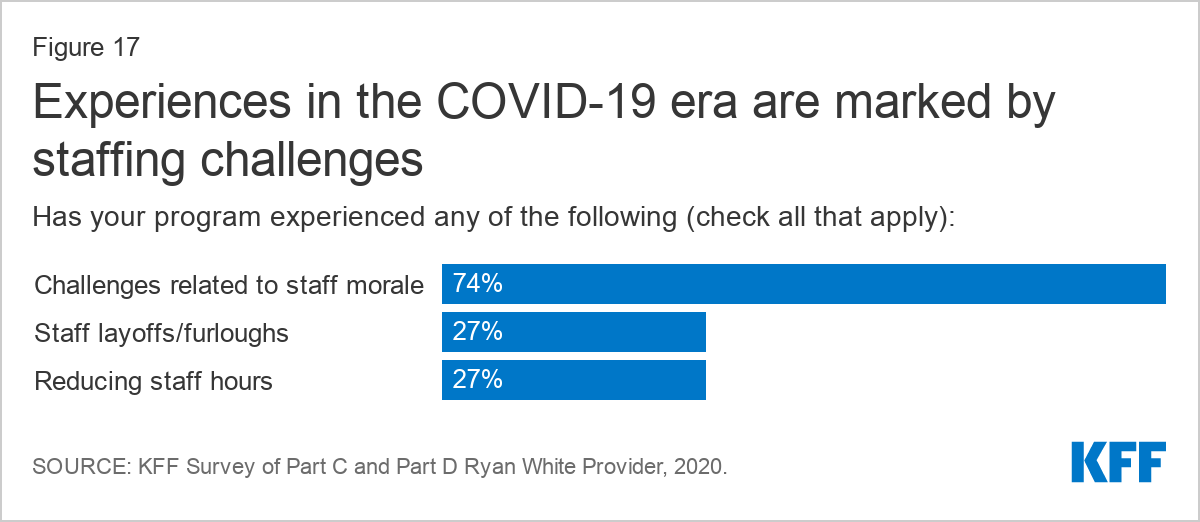
  • Respondents also experienced significant challenges related to staffing. More than one-quarter (27%) reported staff layoffs or furloughs and the same share reduced staff hours. Moreover, staff morale was a challenge reported by three-quarters (74%) of respondents.
  • Operating challenges were common, including for the 28% who shut down all or most of their HIV prevention services in response to the pandemic. Other challenges included difficulty connecting with service partners and increased costs.
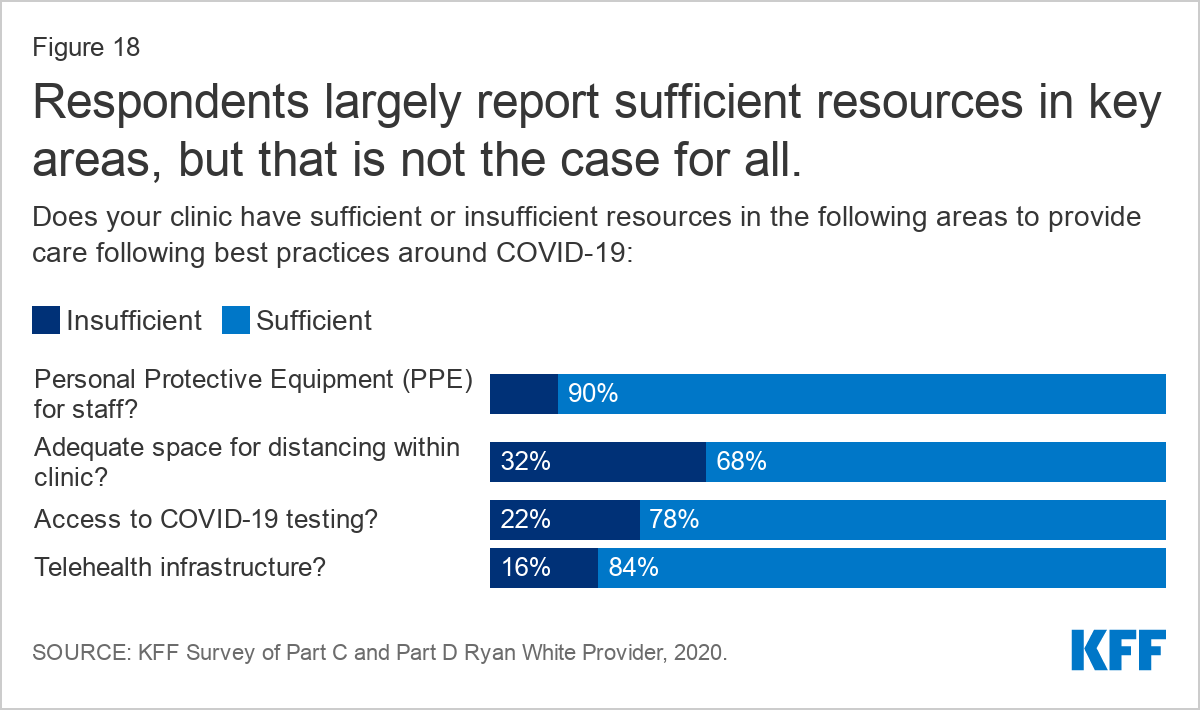
  • Following COVID-era public health guidelines remains a challenge for some who experience inadequate clinical space for social distancing (32%), insufficient access to COVID-19 testing (22%)and insufficient PPE (10%).
  • However, despite these historic challenges, respondents largely report adjusting to a “new normal” and significant resiliency in adapting to new ways of providing care.

Issue Brief

Introduction

The COVID-19 pandemic has posed significant challenges for health systems and access to care in the United States, including for people with HIV and the systems that serve them. While it does not appear that people with well controlled HIV are at greater risk for more severe complications associated with COVID-19, 4 in 10 people with HIV in the U.S. do not have sustained viral suppression and CDC suggests that those with a low CD4 count or not on antiretroviral treatment could be at higher risk. In addition, many of the individuals invested in the nation’s HIV response – especially those with an expertise in infectious disease – have shifted at least some of their attention away from HIV to focus on the pandemic.

To better understand how COVID-19 has affected the HIV service delivery environment and people with HIV, we surveyed the nation’s Ryan White-funded providers. The Ryan White HIV/AIDS Program is the largest federal program designed specifically for people with HIV in the U.S., serving over half of those in the country diagnosed with the disease. It provides outpatient care and support services to individuals and families affected by HIV, functioning as the “payer of last resort” by filling the gaps for those who have no other source of coverage or face coverage limits or cost barriers. Funding is provided to states, cities, and providers throughout the country. In addition, recognizing the new stresses the pandemic might mean for Ryan White and people with HIV, Congress appropriated $90 million in emergency supplemental funding for the program through the CARES Act.

Methods

Between August 18, 2020 and September 4, 2020 we surveyed directly funded Ryan White HIV/AIDS Program medical provider grantees (i.e. those funded through Part C or Part D). We identified all Part C and Part D grantees funded in FY2020 using publicly available grantee data. In total we identified 390 unduplicated grantees. The named contact for each grantee organization was sent a confidential survey using Survey Monkey containing closed and open-ended questions. We received 161 responses and 8 bounce backs, representing a 42% response rate. Raw survey data was downloaded and analyzed using Excel. Open-ended qualitative responses were analyzed using an inductive framing approach.

While all respondents received Ryan White funding to provide HIV care and treatment, many also received funding from other sources, including to conduct HIV prevention activities. Survey questions and responses are not limited to activities carried out using Ryan White funding.

Respondent Characteristics

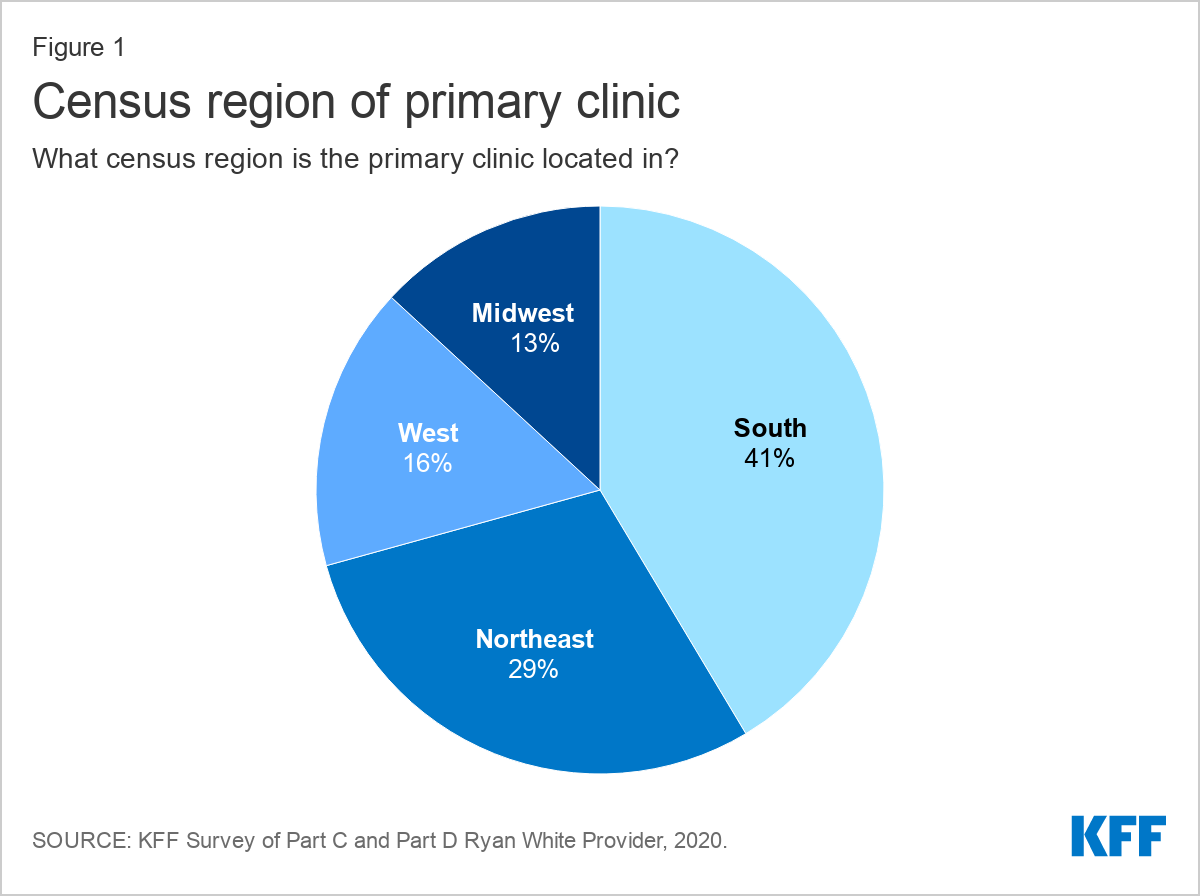
Respondent organizations were located in 38 states, Washington, D.C., and Puerto Rico. A plurality of respondents (41%) were based in the Southern U.S, followed by the Northeast (29%), the West (16%), and the Midwest (13%).

Census region of primary clinic

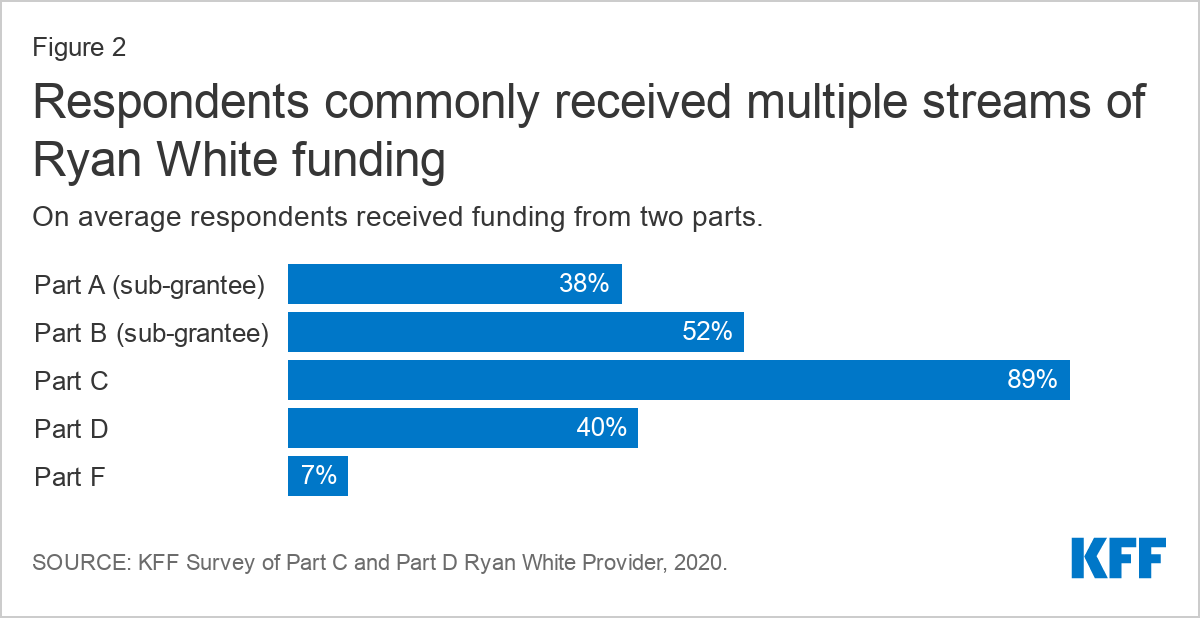
Respondents reported receiving funding from a range of Ryan White Program parts, with many reporting funding from multiple streams (two on average). The most common funding stream was from Part C (89%, funding for community-based organizations providing outpatient HIV health and support services), followed by Part B as a sub grantee (52%, funding directed to states). Forty percent (40%) were Part D grantees (funding for community based ambulatory programs focusing on family-centered care and support services for women, infants, children, and youth with HIV). Smaller shares received funding from Part A as a sub-grantee (38%, funding directed to hard hit urban areas) and Part F (7%, funding for dental care).

Respondents commonly received multiple streams of Ryan White funding

Findings

Changes to Services

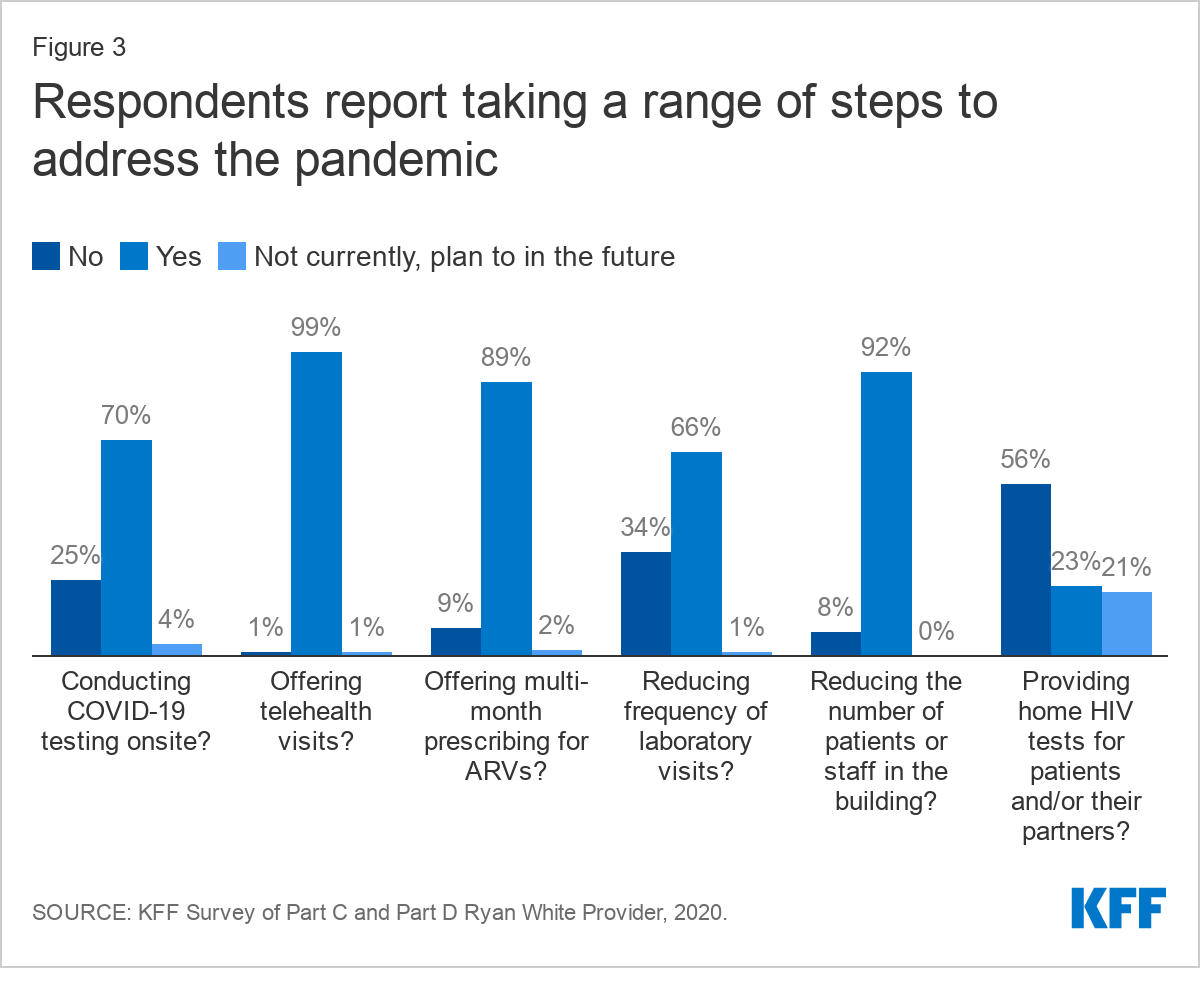
Providers reported significant program changes made in response to the COVID-19 pandemic and described an immediate pivot to new ways of providing HIV care and prevention. Nearly all reported offering telehealth services (99%) and reducing the number of staff or patients in the building at one time (92%). Most reported offering multi-month prescriptions for antiretrovirals (ARVs) (89%), conducting onsite COVID-19 testing (70%), and reducing frequency of laboratory visits (66%). Over half (56%) reported providing clients with home HIV tests, with an additional 21% planning to offer home HIV tests in the future. Respondents described tinkering with new offerings and service closures to find the right balance for their clinic and patient population.

“We have less onsite primary care visits but increased telehealth visits. Decreased support groups onsite, but increased teletherapy with individual clients. We have adjusted with workarounds to keep our clients engaged, frequent wellness checks, and supplied with resources, including COVID supplies.” --Part A, B, C, and D grantee, Midwest

Respondents report taking a range of steps to address the pandemic.

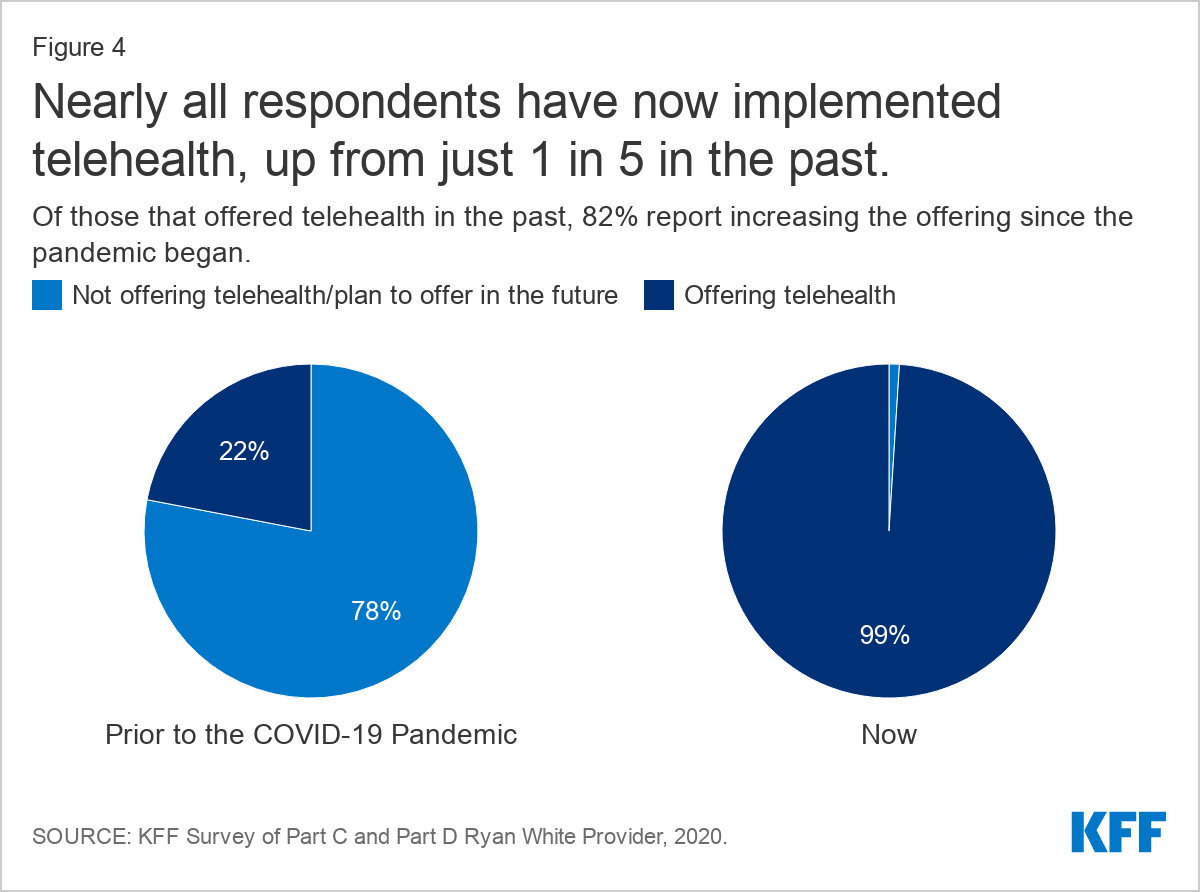
Virtually all providers reported now using telehealth, compared to 22% who did so before COVID-19. Leveraging telehealth was one of the most common COVID-era changes made by providers, with virtually all (99%) saying they offer this service. Of those that did offer telehealth in the past, most (82%) reported expanding telehealth due to COVID-19. Respondents described that this was easier for those who had pre-existing telehealth infrastructure before the pandemic, while some who lacked this prior experience struggled with implementation.

“The transition to Telehealth and use of other virtual platforms that worked effectively and were HIPAA complaint, was a challenge. There were significant delays in even getting the needed equipment due to backorders…” --Part A, B, and C grantee, West

Just 1% of respondents have not yet implemented telehealth, up from 1 in 5 in the past.

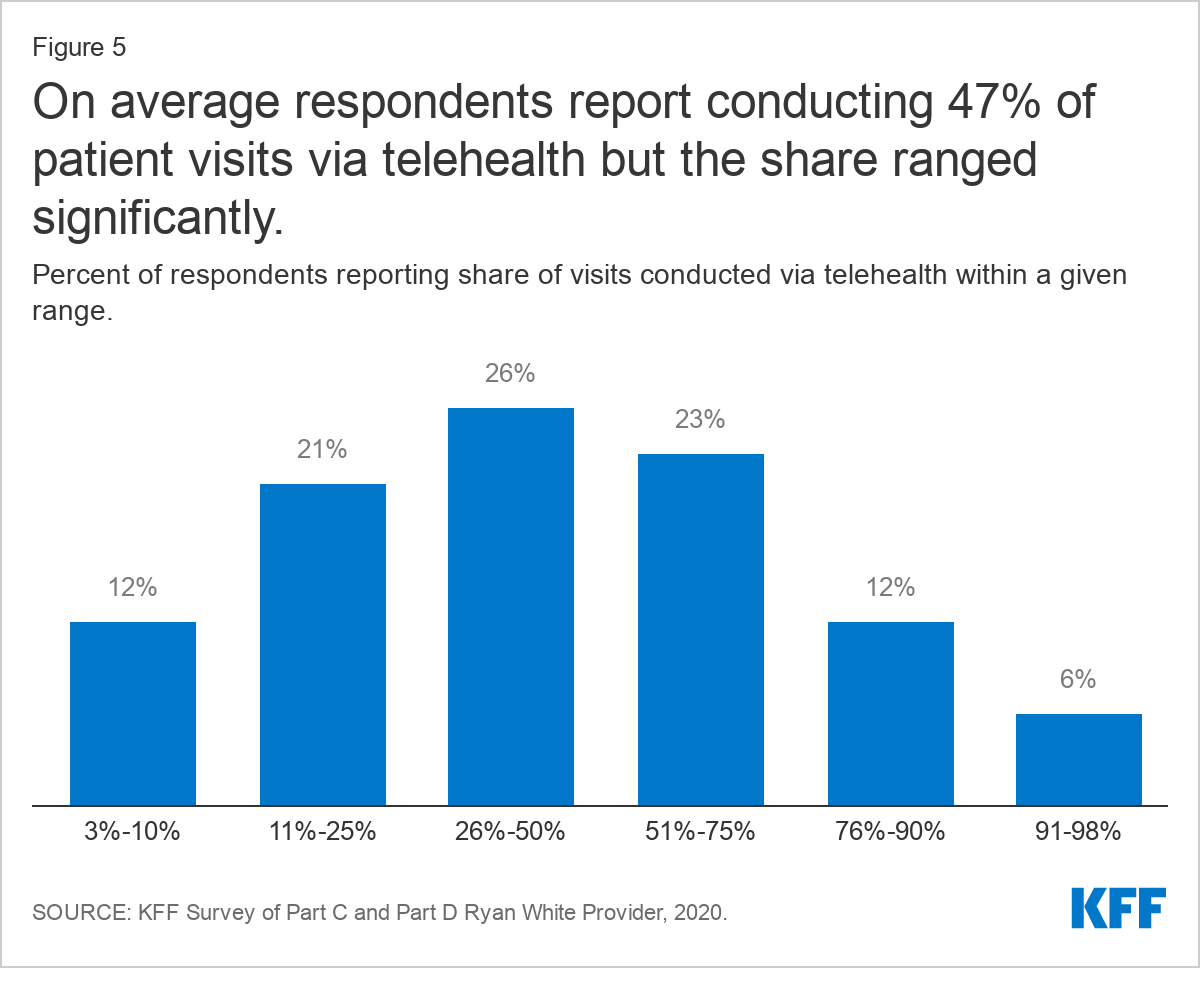
On average, providers now report conducting about half (47%) of patient visits through telehealth (including via video and phone) but that share varied significantly. Forty-one percent (41%) of respondents report using telehealth more than 50% of the time and 6% report using it more than 90% of the time. Six percent (6%) of respondents reported using telehealth more lightly, for less than 10% of visits. In addition to infrastructure challenges, some who reported less frequent use of telehealth were limited by institutional policy. As one provider said, “our larger health care system has been unable (because of security issues) to let us do video visits, only telephone. I believe video would greatly improve these interactions.”

On average respondents report conducting 47% of patient visits via telehealth but the share ranged significantly.

Respondents generally expressed that integrating telehealth services more widely into their practices was an important step forward, not just in providing care during the pandemic, but that they would retain the practice in the long term. Many explained that they were able to connect with historically hard to reach populations and others said they were able to stretch scarce provider time further. Some stated that retention in care had improved and “no shows” declined as a result. They described learning how to make telehealth work best for their patients and saw it as a critical tool for maintaining care during the pandemic.

"I think that telemedicine has been an invaluable tool that has enabled us to stay in contact with patients during this uncertain time and while it is efficient and convenient, we still need to work doubly hard to connect and relate to our patients. We need to project through our screens the compassion and concern we have for them, to continually reassure them, and ensure that they continue to receive quality care regardless of how it is delivered. Patients have been responsive to telehealth as evidenced by show rates over the past 4+ months which is a good indicator that retention in care and viral suppression can be maintained and/or improved." --Part B, C, and D grantee, South

However, many also discussed the “digital divide, noting telehealth only worked well for certain patient populations, with respondents largely agreeing on who was best and worst served (see Table 1).

“Telehealth is working for our practice. We do face barriers with connection problems, and older patients that are not technically knowledgeable…We also have patients that are not on unlimited plans. Telehealth has helped our bottom line. We are able to reach some patients, younger group, that otherwise are not easy to reach.” --Part C grantee, South


Table 1: Respondents Generally Agreed on Which Groups Most Benefited from/Struggled with Telehealth
Most BenefitedMost Struggled
Younger populations/tech savvy individualsOlder populations/less tech savvy individuals
Those in rural areas with limited transportation (with tech access)Those without internet/computer/smartphone access, those with limited phone data, including those in rural areas without broadband & cell infrastructure
Those with childcare responsibilitiesUnstably housed individuals
Medically uncomplicated and stable individualsMedically complex and vulnerable individuals
Some historically harder to reach patientsThose who lack privacy to make calls
Those penalized for taking time off at workThose in need of translation services
Established patientsNew patients

Some reported taking steps to address technology gaps, including offering technical support, and by providing clients with phones, phone cards, data plans, internet access, and mobile hotspots. In addition, some described offering telehealth or technology training for staff and patients, sometimes focusing on a specific population, such as seniors. In many cases, respondents used supplemental Ryan White Funding provided through the CARES Act (see Box 1) to cover these costs.

Box 1: Respondent’s Reported Use of CARES Act Funding

Areas bolded denote the most common responses, mentioned by multiple respondents. (Alphabetical Order)

COVID-19 best practices consulting, infection control review, COVID-19 educational materials for patients

COVID-19 testing

Emergency financial assistance

Housing/rental assistance, isolation lodging, utilities for clients, clinic rent

Infrastructure changes (e.g. to support telehealth, to provide for social distancing)

Marketing/outreach of HIV care and COVID-19 testing

Medical supplies for clinic and for clients (e.g. BP cuff, thermometer, pulse ox machines)

Medical transportation, new vehicle for patient and meal transport

Nutrition assistance: stocking clinic food pantry, groceries, grocery cards, meal delivery

PPE, sanitation supplies/services, Plexiglas, partitions, and air purifiers

Premium assistance and medications (OTC medications, ARVs)

Staff salaries for existing staff/prevent layoffs and salaries to support new staff: E.g. Home health care providers (medical assistant), case management/medical case management, full and part-time physicians and nurses (including to assist with overflow from infectious diseases physicians occupied by COVID-19 response), telehealth coordinators, medical triage staff for COVID-19 screening, mental/behavioral health and social service support staff, peer advocate, community healthcare workers, COVID-19 nurse staffed to work with HIV positive clients.

Supplies and care packages for clients (in some cases mailed to clients): E.g. masks, sanitizer, coloring books/pens, gas cards, clothing, gift cards for basic supplies (e.g. food, cleaning supplies, personal hygiene products etc.)

Telehealth infrastructure: E.g. tablets, computers, phones, phone cards, phone service/mobile hot spots for clients, licenses (e.g. for Doxy.me and Zoom), webcams, microphones, and computers.

Note: The Coronavirus Aid, Relief, and Economic Security, or CARES, Act was the third major legislative initiative to address the COVID-19 Pandemic. Additional information available here.

Providers noted that while telehealth is well suited for certain types of visits, it is inadequate for others. Generally, providers explained it worked well for routine visits or follow-up care, and prescription drug refills. Some thought it was also working well for behavioral health/social work, though others thought social service visits worked better in person. One stated “Telehealth has been especially important for maintaining mental health services.”

"Telehealth is working well for medical follow up, case management and eligibility appointments for individuals who are stable and virally suppressed..." --Part A, B, and C grantee, West

As time has gone on and it has become clear that there will not be an immediate end to the pandemic, some respondents expressed concern about patients being without in-person visits or laboratory services in the long term. They believed conducting all services via telehealth as a stopgap measure was reasonable at first, but several respondents described now wanting to bring patients back onsite for at least some in person care, for both clinical and reimbursement reasons. Some also worried that reliance on telehealth in the long term could increase patient isolation. Others worried providers “would miss things” by not seeing patients in-person for extend periods of time.

"…While initially medical care visits were easily provided through telehealth, there is more concern amongst providers, as the time drags on. They are concerned about actually having the opportunity to examine patients and also to monitor labs..." --Part B, C, and D grantee, South

"Telehealth is very helpful. No-show rates decreased. Only challenge is to bring in those pts with co-morbidities who have not been seen face-to-face for over 6 months now. Providers want them to come in at least once, then continue telehealth. Pts with comorbidities need to be closely monitored." --Part A and C grantee, Northeast

Just a few respondents had a more pessimistic view of telehealth overall and were unable to get past seeing it as inferior way to practice medicine. They believed that telehealth didn’t allow them to gather critical health information or, in one case, that the technology actually got in the way of the visit.

"Telehealth is good reassurance for patients, but it has not been very helpful in terms of HIV primary care -- we cannot get vital signs and monitor BP, we don't have labs, and we cannot as easily connect pts to in-clinic resources. It feels "better than nothing" but doesn't feel like the highest quality of care…" --Part C grantee, Northeast

While some described being able to leverage telehealth to conduct more visits and generate additional revenue, most described reimbursement challenges. A primary issue hinged on the fact that payers would reimburse for video but not telephonic visits, while many patients preferred or only had technology to support phone calls. One provider noted that they could bill for their time but not collect facility fees with telehealth visits.

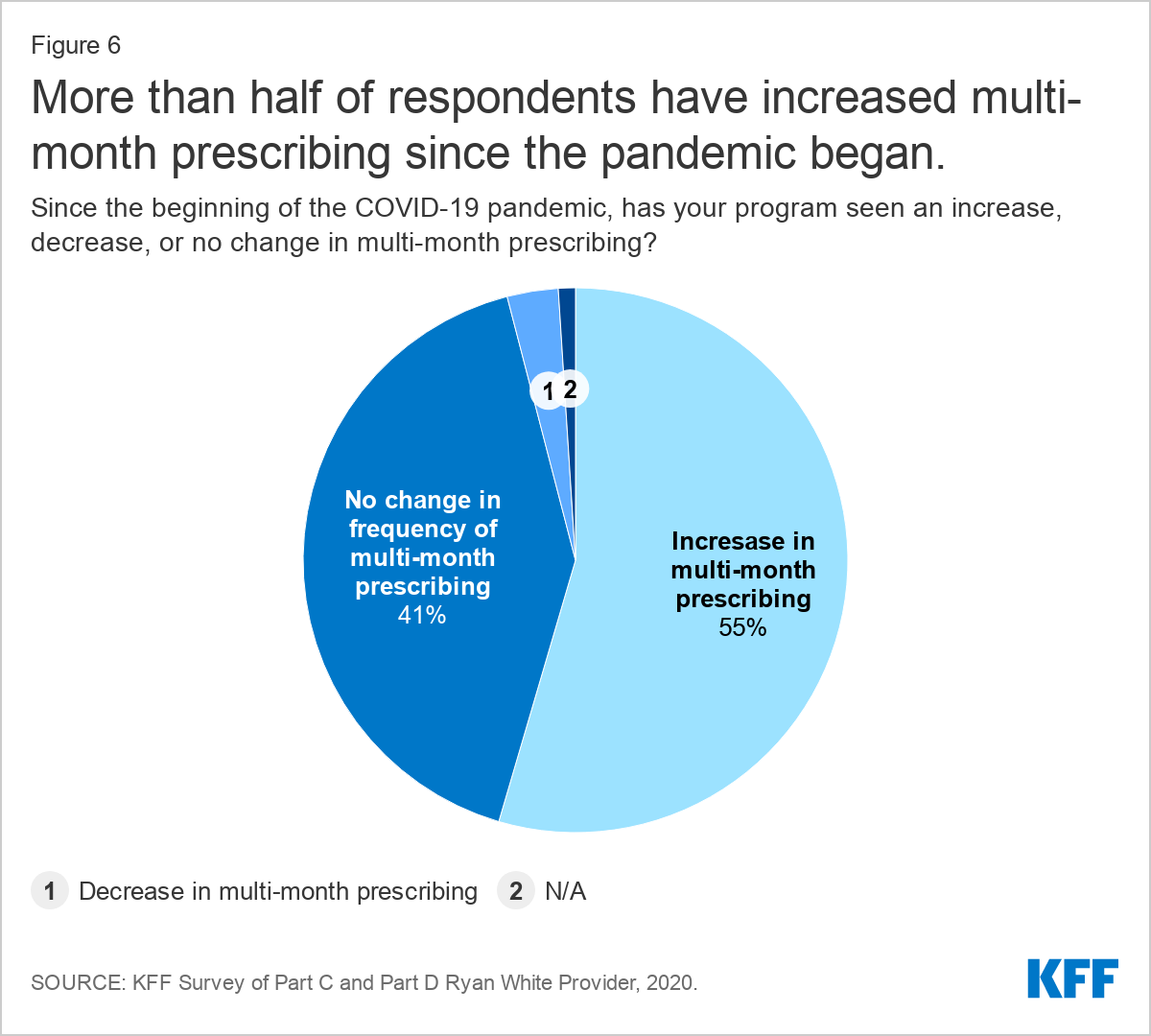
Multi-month dispensing of HIV medications was offered by nine in ten (89%) respondents, with many saying they have increased this practice. More than half (54%) say that the practice has increased since the pandemic began, though a large share (41%) report no change.

More than half of respondents have increased multi-month prescribing since the pandemic began.

In addition to multi-month prescribing, respondents also reported offering new options to facilitate access to medications. Some are now offering home delivery of medications, often by clinic staff such as case workers, and others are more heavily using mail order prescription delivery services.  

Changes to Patient Population

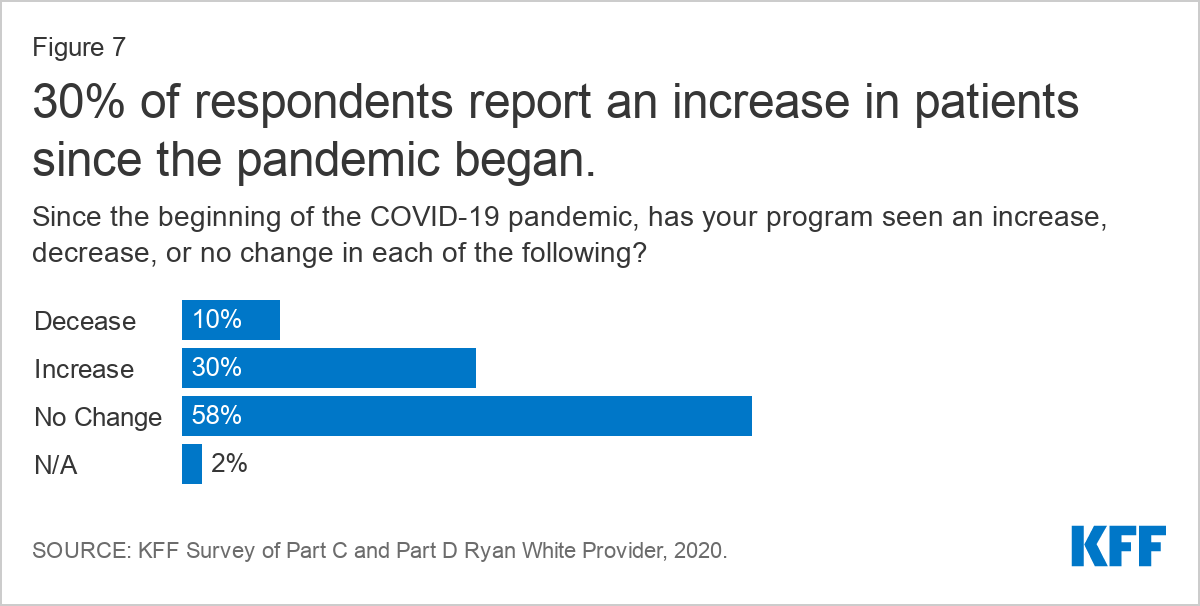
Nearly one-third of respondents (30%) reported an increase in new patients since the pandemic began. Some respondents believed they were seeing more clients because engagement and retention in care was easier for certain individuals through new telehealth offerings, though it may also be due to increasing need and coverage losses.

30% of respondents report an increase in patients since the pandemic began.

Two respondents noted that some HIV positive clients who had previously fallen out of care, reengaged with the health system in the wake of the pandemic, fearful of what becoming infected with COVID-19 might mean for them.

"We've seen an increase in patients who had been out of care returning to care over COVID fears…" --Part A and D grantee, South

"…Because we were a COVID testing site early on we did see an increase in patients that had fallen out of their HIV care coming to the COVID testing and asking also about getting back into HIV care, because they were concerned about being vulnerable to COVID." --Part A and C grantee, South

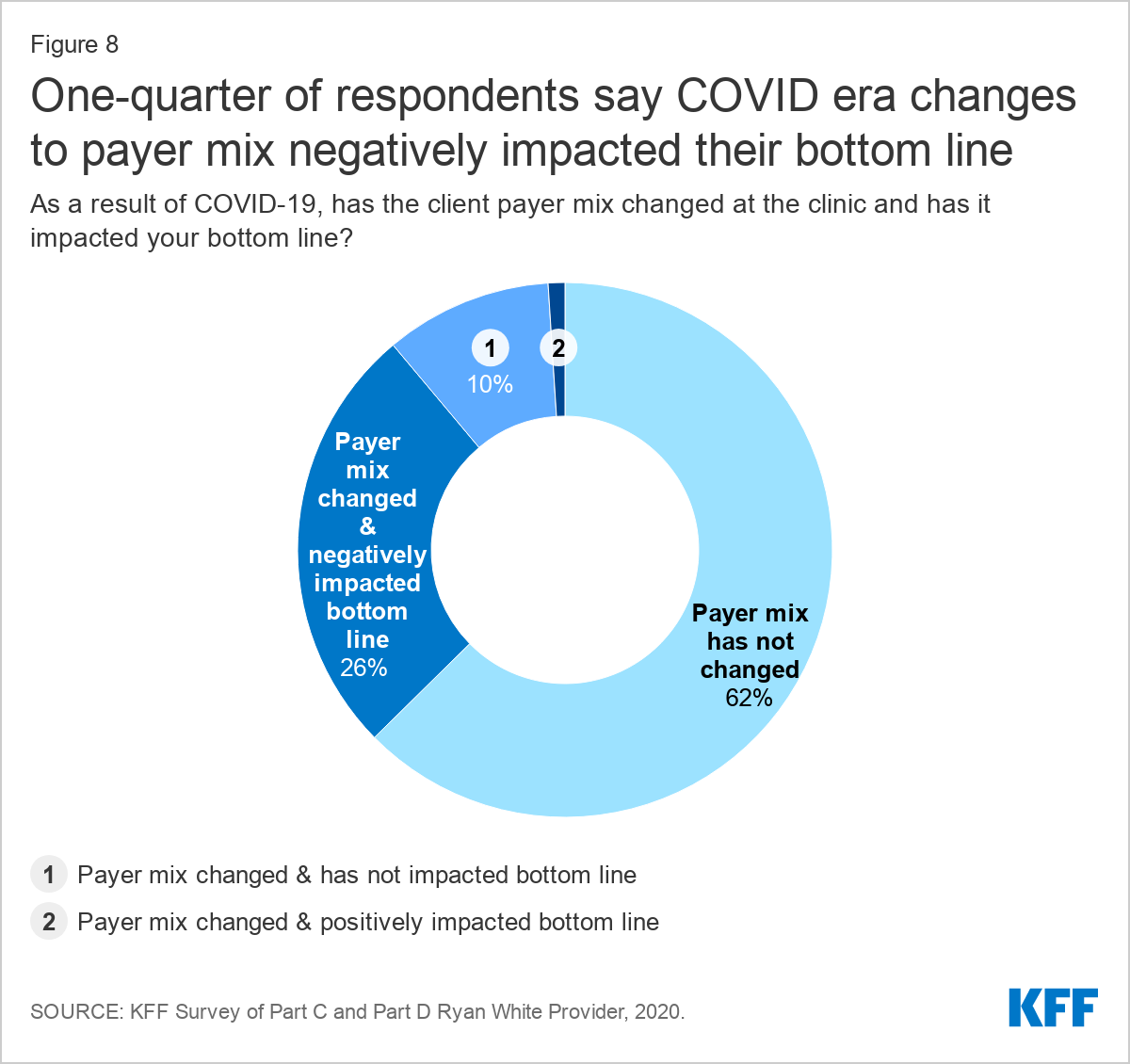
Nearly 40% of respondents reported changes to their payer mix. Respondents were asked whether their clinic saw a change in overall payer mix as a result of the pandemic, that is, have clients gained or lost insurance coverage. Payer mix can impact clinic bottom line and certain care experiences. While most (62%) reported that they have not seen a change in payer mix, nearly 40% have seen a shift, with more than one quarter (26%) saying the change has negatively impacted their bottom line. One in ten said that payer mix has changed, but it has not impacted bottom line. Only 1% of respondents reported a payer mix change with a positive bottom line impact.

One-quarter of respondents say COVID era changes to payer mix negatively impacted their bottom line

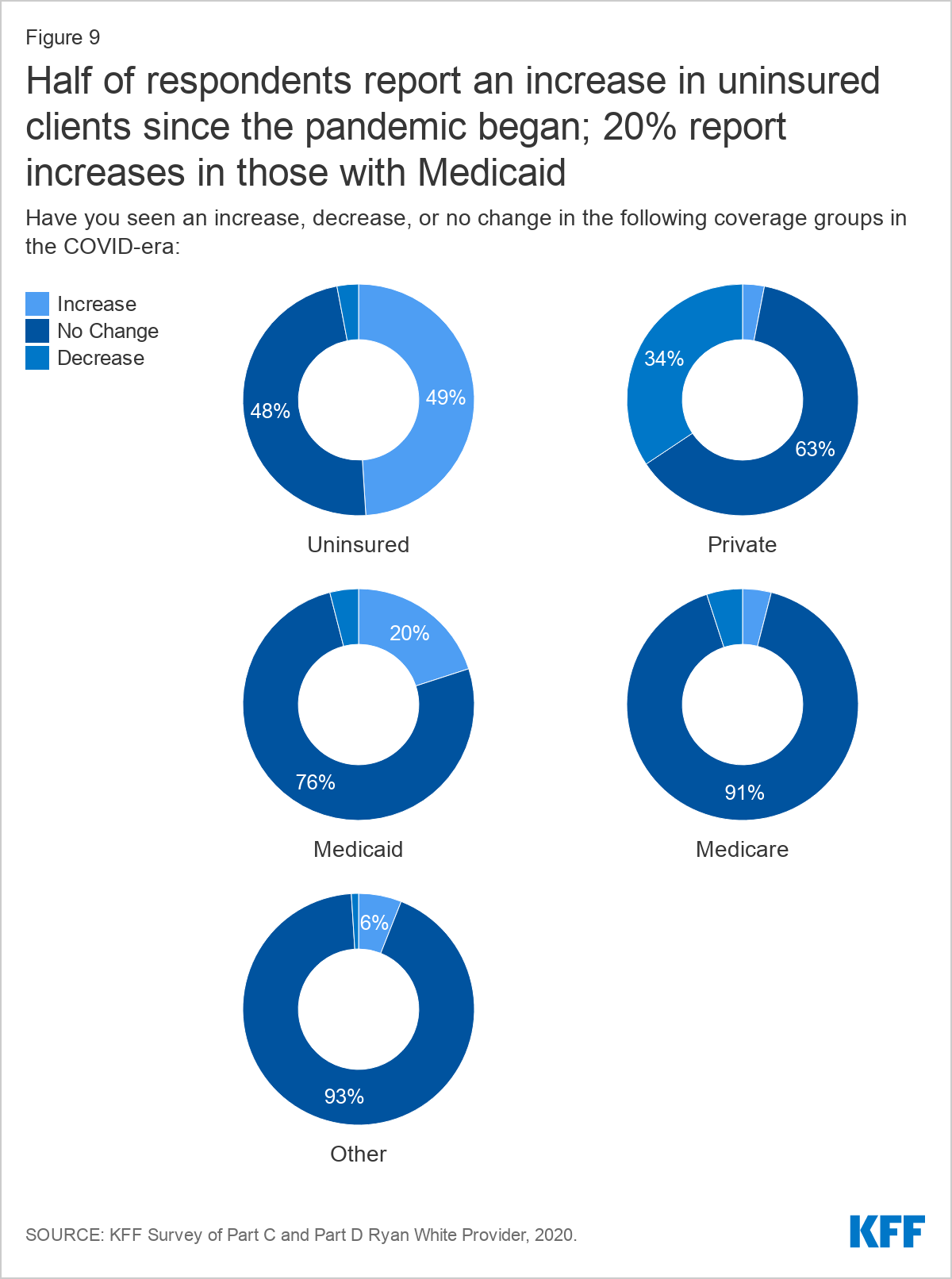
When asked about specific changes experienced under the pandemic, respondents reported even higher rates of coverage changes. About half of respondents (49%) reported an increase in uninsured patients, one-third (34%) reported decreases in clients with private coverage, and 20% reported increases in clients with Medicaid coverage. Fluctuations in Medicare and other coverage were smaller.

Half of respondents report an increase in uninsured clients since the pandemic began; 20% report increases in those with Medicaid

There were differences in client coverage changes reported by respondents in Medicaid expansion states compared to those in non-expansion states (or in states that had not yet implemented expansion). While large shares of respondents reported increases in uninsured clients across the board, this was somewhat less common among respondents in Medicaid expansion states compared to those in states that had not expanded their programs (45% v 55%). This could be attributed to increases in Medicaid coverage and less of decline in private coverage among clients in expansion state. Twenty-eight percent (28%) of respondents in expansion states reported increases in clients with Medicaid coverage, while just 9% of those in non-expansion states reported Medicaid increases. Twenty-nine percent (29%) of those in expansion states and 43% of those in non-expansion states reported declines in clients with private coverage.

Table 2: Share of Respondents Reporting Coverage Changes in The COVID Era, by Medicaid Expansion Status
 UninsuredPrivateMedicaidMedicareOther
Exp.Non-Exp.Exp.Non-Exp.Exp.Non-Exp.Exp.Non-Exp.Exp.Non-Exp.
Increase45%55%2%5%28%9%4%3%7%5%
Decrease3%3%29%43%2%7%3%7%0%3%
No Change52%41%69%52%70%84%92%90%93%92%

Impact on Clients

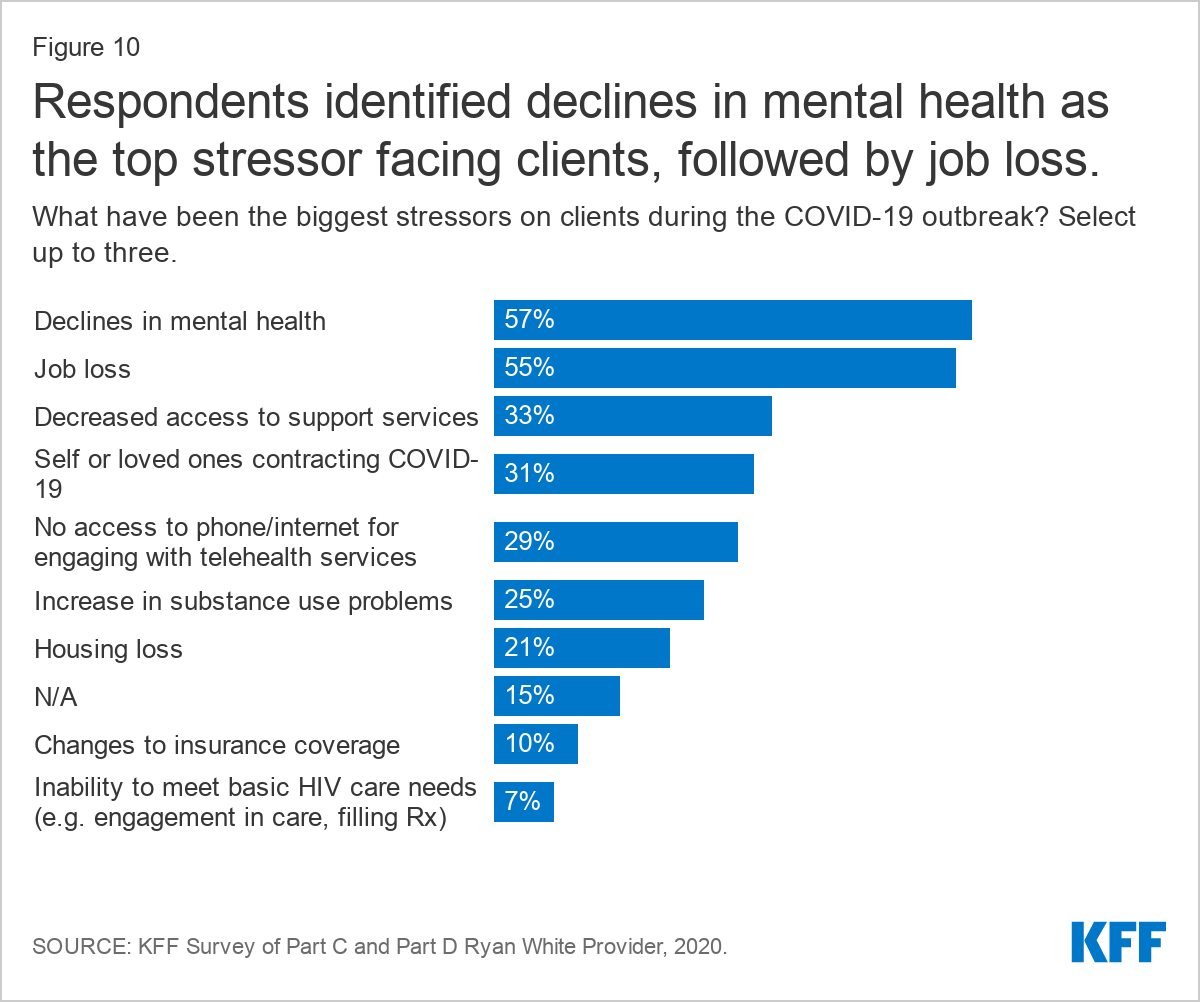
Respondents reported that clients faced significant stress and uncertainty amidst the pandemic and noted that these experiences translated to increased social service needs. Respondents were asked to select the three most significant stressors impacting their clients from a list. The top stressor, identified by 57% of respondents, was declines in client mental health, followed by job loss (55%) and decreased access to support services (33%). Also ranked highly were lack of access to technology to support telehealth encounters (29%) and increases in substance use problems (25%). Housing loss was a top stressor identified by one in five respondents (21%). Smaller shares pointed to insurance loss (10%) and inability to meet HIV care needs (7%). Those who selected “other” (15%) most commonly expanded their answer to identify fear, isolation, and stress related to the pandemic as the biggest challenges facing their clients, including for those working in high risk settings. Other stressors for patients included food insecurity and inability to safely use transportation. Some were also concerned about patients who were afraid to return to care due to possible COVID exposure, including those who are immunocompromised.

"For many of our HIV+ patients, engaging with staff and medical providers is the only actual in person engagement that they have.  In the era of COVID, many clients have expressed increased feeling of isolation, anxiety and/or depression."--Part A, B and C grantee, West

"A number of our patients work (as nutrition aides and CNAs) in local nursing homes heavily impacted by the pandemic.  Others work at grocery stores, restaurants and in other "essential worker" roles.  The stress of reporting to work in an environment with increased potential for COVID exposure has been a big stressor." --Part B and C grantee, Northeast

"Immunocompromised patients are afraid to come in and be exposed to COVID-19. We have offered COVID testing as part of their appointment and they seem to feel safer knowing people are testing as they come to their appointments."--Part C grantee, West

Respondents identified declines in mental health as the top stressor  facing clients, followed by job loss.

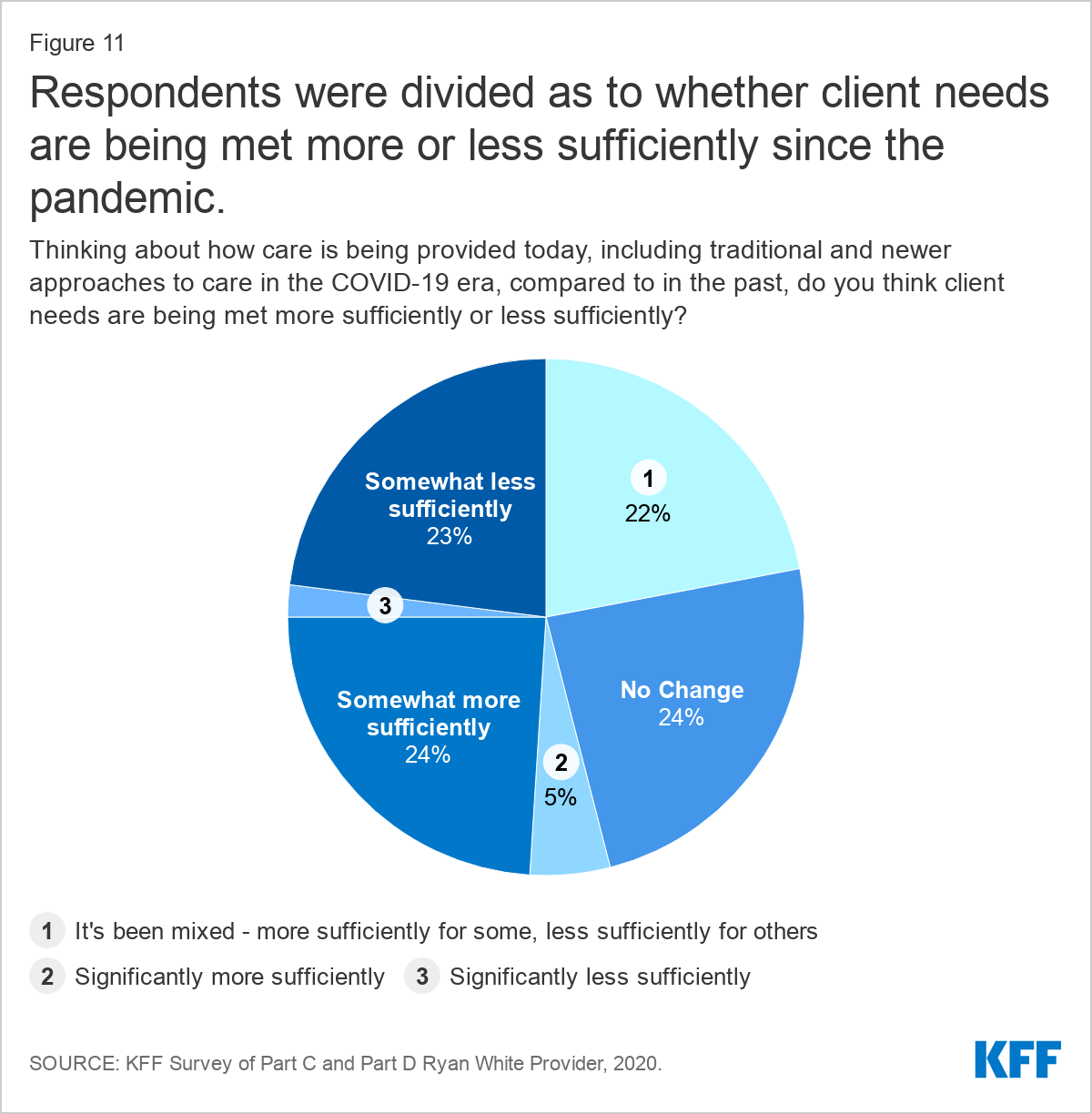
Respondents described that some patients and staff adjusted smoothly to the changes brought on by the COVID-19 pandemic while others had a more challenging time. When asked to consider how well clients’ needs were being met compared to pre-COVID times, nearly equal shares, said that needs were being met somewhat more sufficiently (24%), somewhat less sufficiently (23%), that there had been no change (24%), or that the experience had been mixed ( 22%). In a separate question, respondents elaborated, that those patients better engaged in care in the COVID-era compared to the past were largely individuals who adapted well to telehealth services. Those who most struggled were patients with increased social service needs or those who did not adapt easily to telehealth.

"We transitioned to virtual care for all services during late March/early April, then returned to full on-site services in May…In terms of HIV care, our capacity is similar but patients have higher needs due to the financial and behavioral stresses of the COVID pandemic. In addition, layoffs affecting clinical staff have impacted the clinical workflow." --Part A and C grantee, Northeast

Respondents were divided as to whether client needs are being met more or less sufficiently since the pandemic.

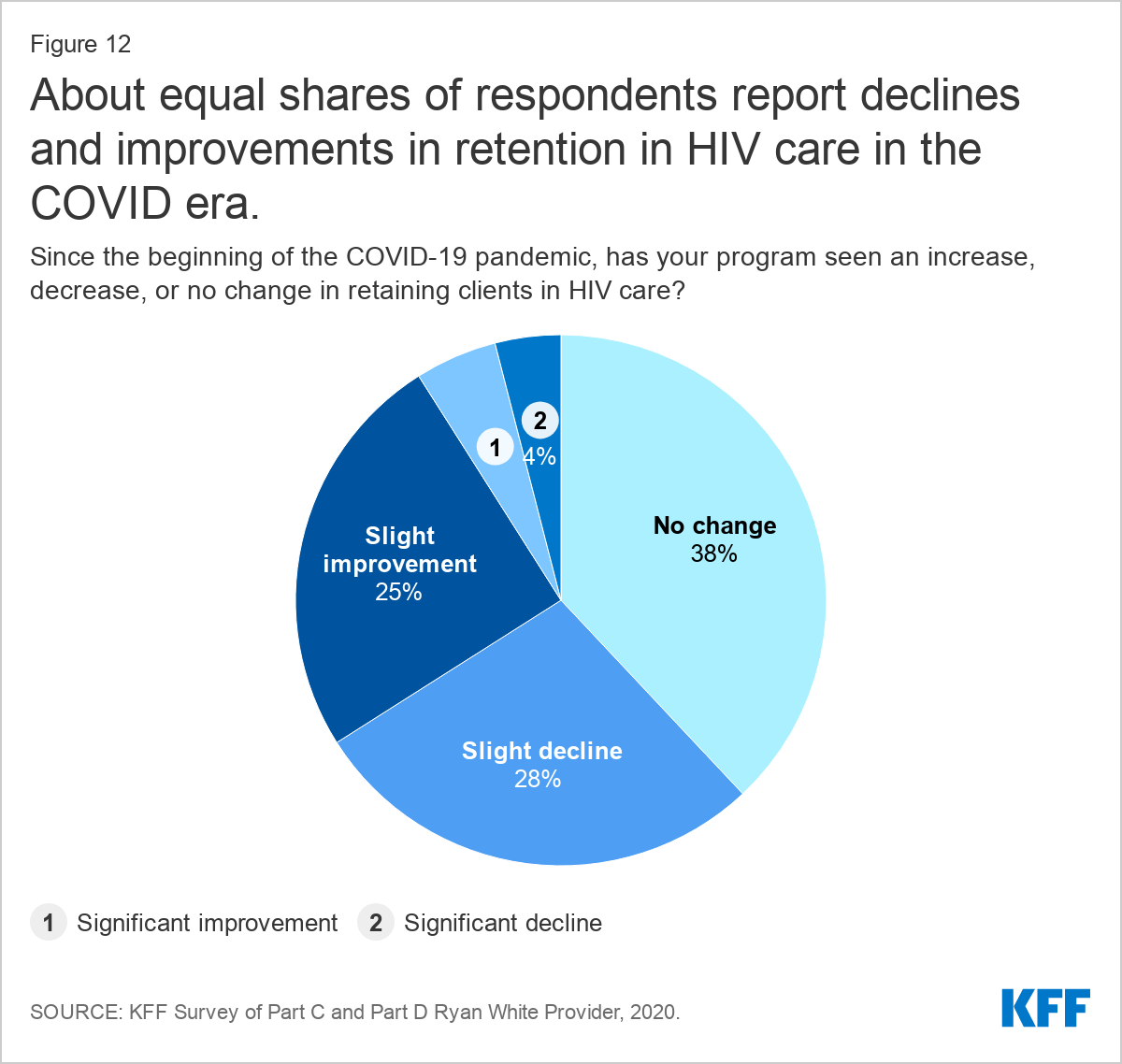
Respondents were similarly split as to how retention in HIV care during the pandemic compared to experiences in the past. A plurality reported no change in retention in care (38%) and similar shares reported a slight improvement (25%) or slight decline (28%). Improvements in retention were sometimes attributed to leveraging telehealth while some attributed drops in retention to more limited access to social support groups and in person services.

About equal shares of respondents report declines and improvements in retention in HIV care in the COVID era.

Operating Challenges

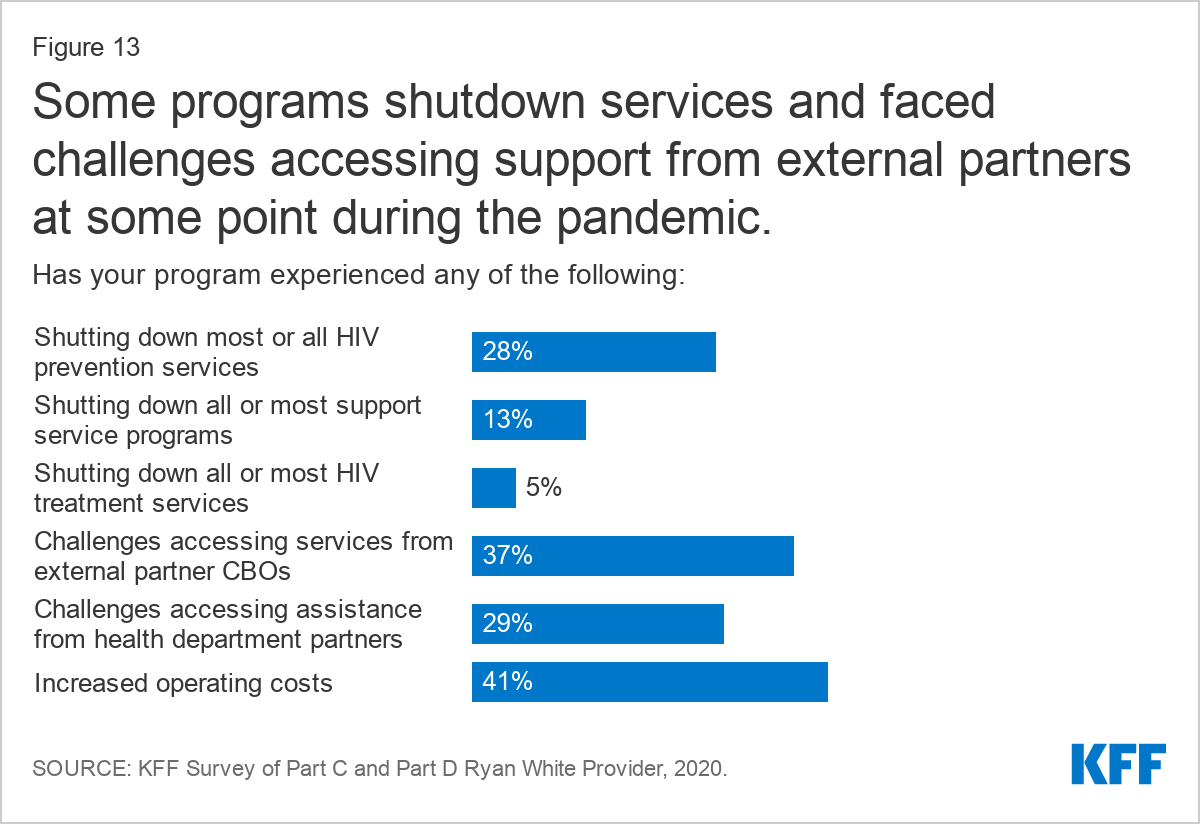
Despite the steps respondents report taking to maintain care and prevention opportunities during the pandemic, operating challenges were common. For instance, four in ten respondents (41%) reported that they were facing increased operating costs.

Additionally, more than one-quarter (28%) report shutting down all or most of their HIV prevention services at some point in response to the pandemic. Smaller shares shuttered HIV care services at some point during the pandemic (5%). More than one in ten (13%) shut down all or most support services at some point.

Some programs shutdown services and faced challenges accessing support from external partners at some point during the pandemic.

Large shares of respondents also reported difficulty connecting with service partners. Challenges accessing services from community-based organizations were reported by 37% of respondents and 29% reported challenges accessing assistance from health department partners.

While some providers reduced HIV services or ran into barriers with access to partner organizations, others offered creative approaches to continuing these activities, such as opening a testing hotline and outfitting a van for parking lot HIV testing. (See Box 2: Best Practices Identified by Respondents.)

Box 2: Respondent Identified Best Practices in the COVID-era

Telehealth

  • Providing training
  • Getting staff buy-in
  • Getting technology to patients
  • Offer drive through appointments to help clients set up their phones for telehealth

Clinical

  • Scheduling labs in advance to reduce waiting
  • Provision of home HIV (and STI) testing
  • Staff delivery of prescription medication (e.g. case managers, patient navigators)
  • Imbedding nurse practitioner in call center
  • On call weekend coverage for mental health services and medical case management
  • Purchased medical van (with CARES Act funding) to bring care to patients
  • Increase flexibility of where patients can get labs drawn
  • Operating a testing hotline
  • Outfitting van for parking lot HIV testing
  • Social services
  • Extensive case management to maintain contact
  • Use of taxi vouchers/Uber/Lyft for appointments
  • Use of “psycho-educational” Zoom groups to address social isolation
  • Case managers picked up food bank packages and provide contactless delivery to clients

Administrative

  • Administrative staff working from home

Other

  • Coordination between patient care navigators and local health department linkage to care program to help reconnect unstably housed populations

"We have continued to provide HIV testing at our site but have not been able to go to partner agencies to provide testing.  With less testing encounters, our opportunity to educate on PrEP reduced. We quickly implemented telehealth services for medical care and behavioral health."     --Part A, B, and C grantee, South

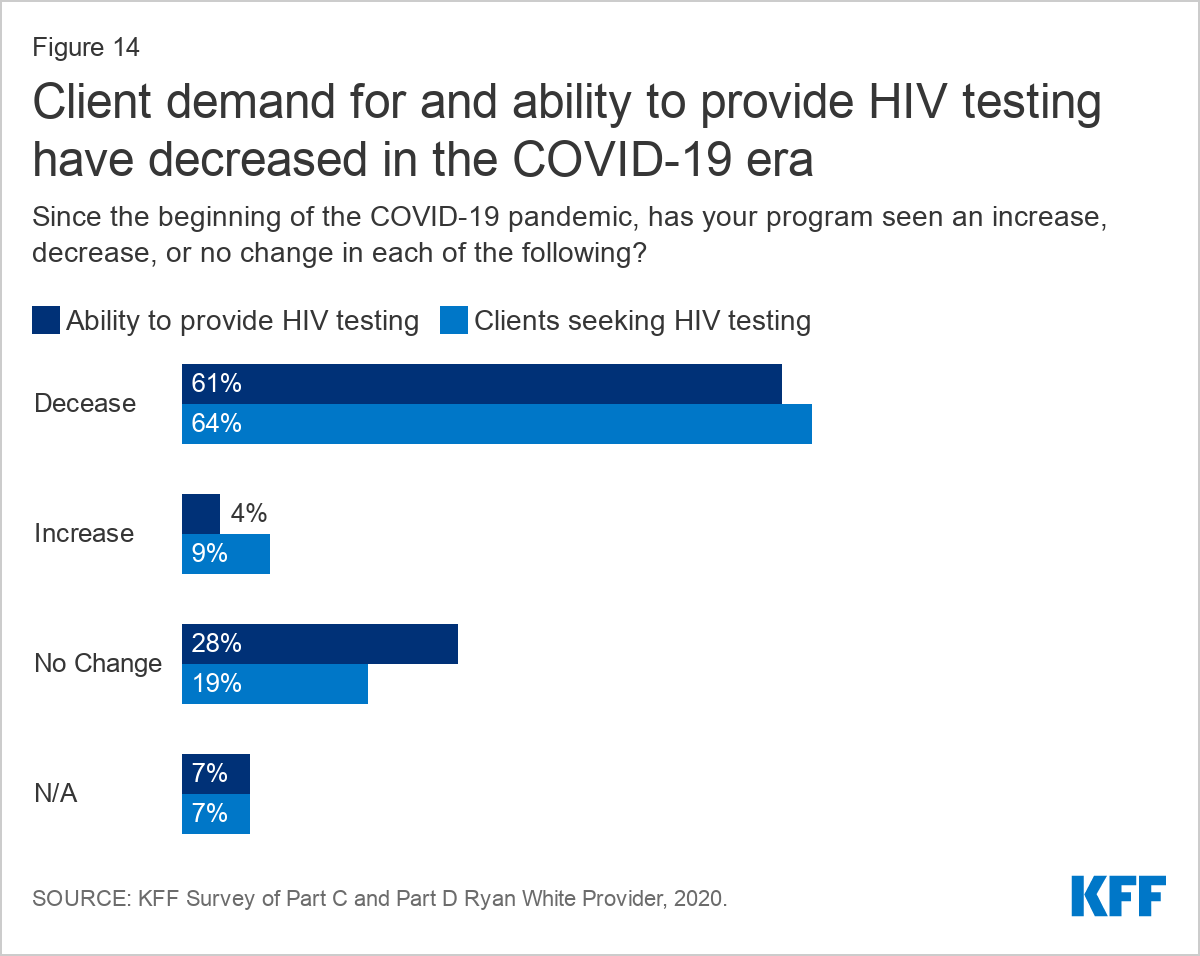
Most respondents (61%) reported a decreased ability to provide HIV testing during the pandemic and a similar share (64%) reported decreased demand. Smaller shares reported increased capacity (4%) and increased demand (9%). Some worried this drop off in HIV testing would lead to a “surge” of potentially late diagnoses later on. Others expressed concern that decreased HIV testing would impact grant deliverables and future funding.

"We saw a decrease in new [HIV] diagnoses and transfers into care…[W]e are concerned about potentially higher #'s of undiagnosed cases or new patients who haven't yet engaged with us due to COVID19 and worry about a 'surge' of diagnoses later in the year with potentially delayed diagnosis." --Part A, B, and C grantee, South

Client demand for and ability to provide HIV testing have decreased in the COVID-19 era

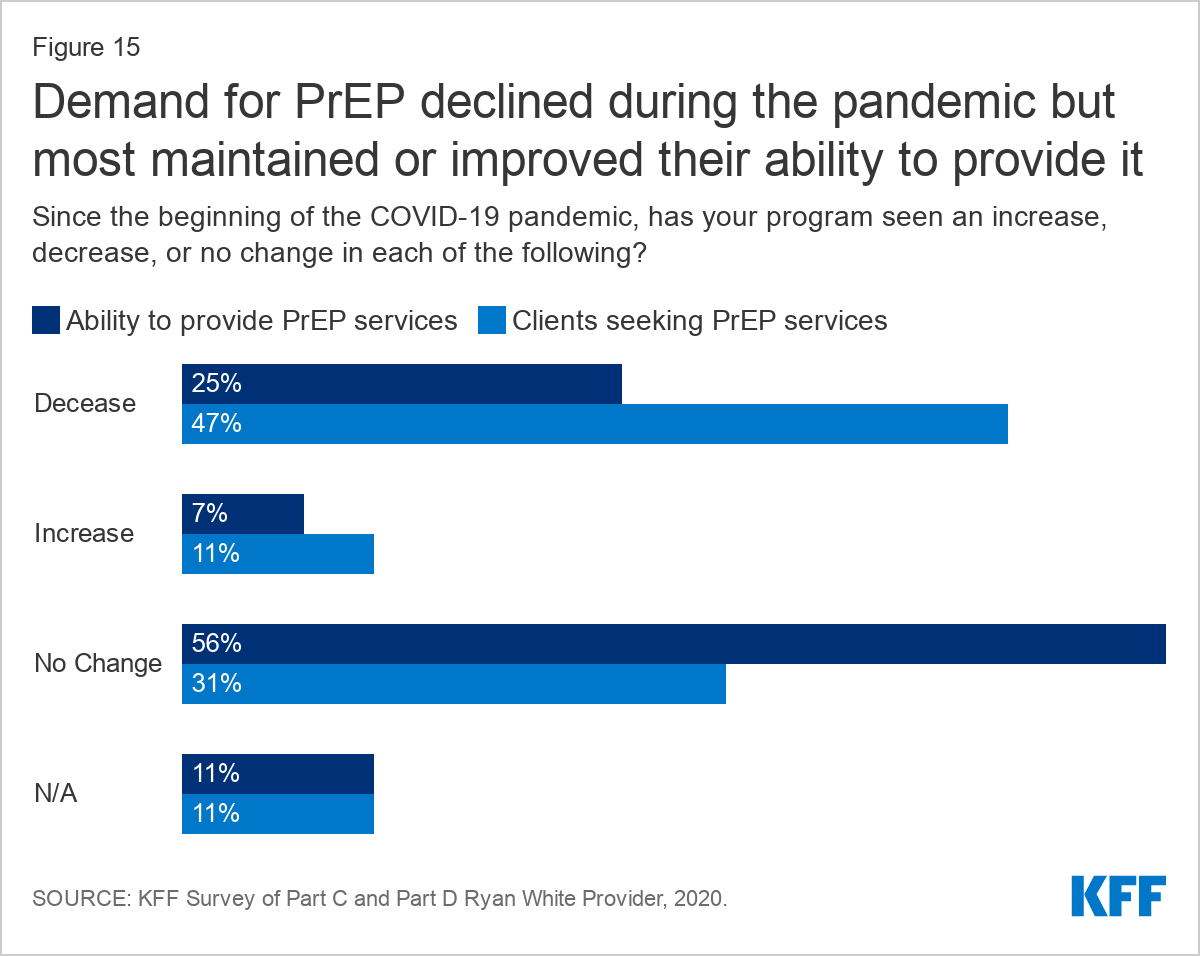
Some respondents (25%) reported a decline in their ability to offer PrEP, as well as declines in clients seeking these services (47%). Most (56%) had seen no change in their ability to offer PrEP and a smaller share saw an increased capacity (7%). One in ten (11%) reported an increase in demand for PrEP services.

Demand for PrEP declined during the pandemic but most maintained or improved their ability to provide it

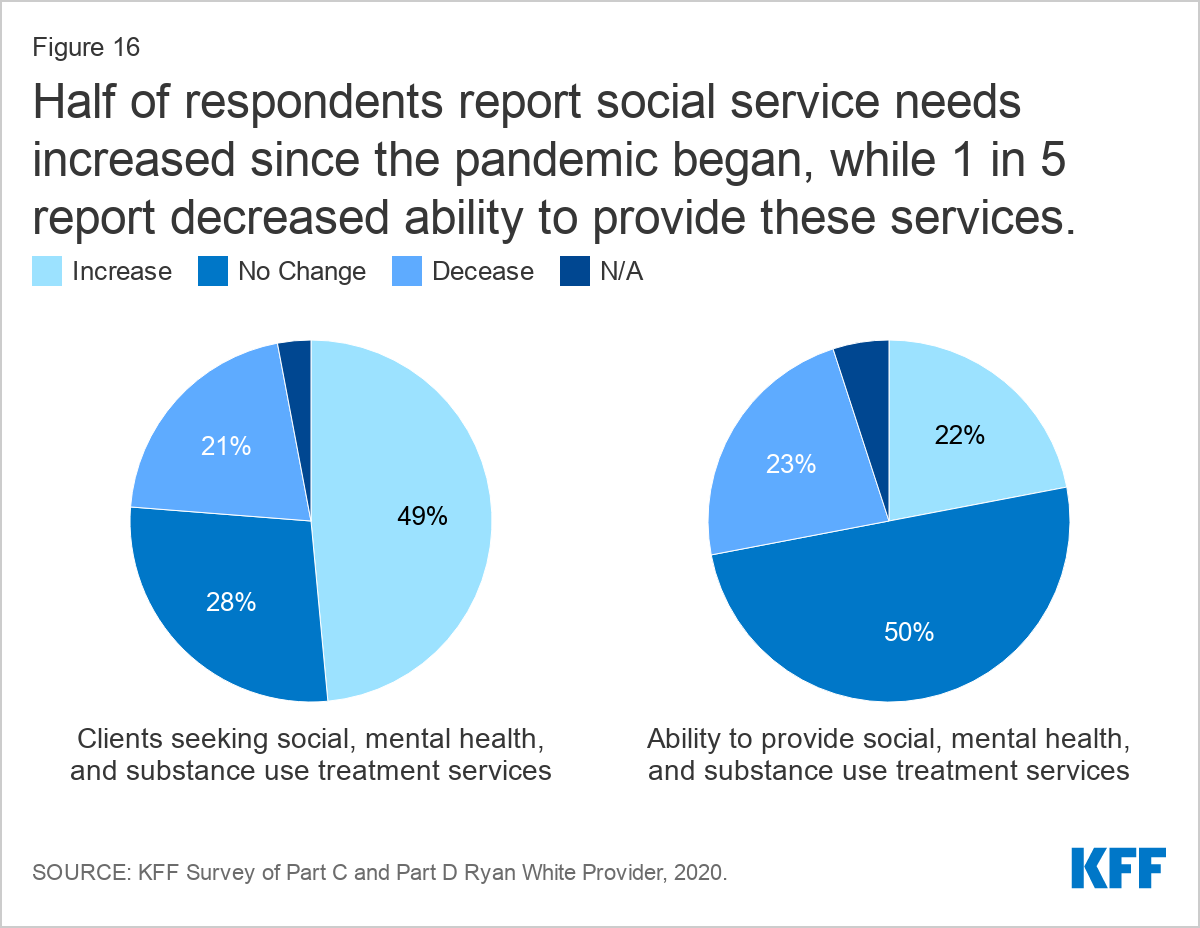
Meeting social service needs was a challenge for some at a time when many saw increased need among clients. Half of respondents (49%) reported increased social, mental health, and substance use service needs during the pandemic. While half retained or increased their ability to provide these support services, nearly one-quarter (23%) reported this capacity had declined. 

Half of respondents social service needs since the pandemic began; 1 in 5 report decreased ability to provide these services.

Staffing challenges were common among respondents. Possibly related to service closures, over one-quarter (27%) of respondents reported staff layoffs or furloughs and the same share reported reducing staff hours. Respondents also described that infection control efforts lead to increased workload, in some cases making meeting grant demands challenging. Likewise, closure of certain activities, such as HIV testing, also presented barriers for meeting grant deliverables for some.

Experiences in the COVID-19 era are marked by staffing challenges

Moreover, staff morale was a challenge reported by three-quarters (74%) of respondents. Respondents described substantial trauma, fear, and strain related to working in healthcare during the COVID-19 pandemic, with one respondent reporting that at least half of their staff had contracted the infection and had significant trauma. Some reported staff had resigned due to fear of COVID-19. In addition to the stress of providing health services during the pandemic, staff also struggled personally as they balanced home and family responsibilities. Many staff faced strain related to increased workload due to staffing limitations, infection control work, and as their peers were diverted to aid with COVID response. Additionally, divisions between staff who were able to work from home and staff required to be on site were reported by some.

"Our organization was hit hard by covid and the refrigerated trailers holding dead bodies were parked outside our clinic. Many staff still struggle with the trauma of working through the pandemic and knowing seeing so many people die. At least half the staff contracted covid and about 1/4 had someone die from covid." --Part C and D grantee, Northeast

"Reduced volume of billable visits with same levels of staffing and increased workload on infection control, PPE, etc. has been a significant financial and morale strain." --Part C grantee, Midwest

"Staff is very stressed out and feeling isolated despite attempts to stay connected with regular zoom calls.  Difficult to sustain enthusiasm for projects or services." --Part C and D grantee, West

"COVID has taken a very significant emotional toll on our HIV staff.  Many love their jobs because of the support they are able to offer our clients.  Having face to face session severely limited has made them feel that their jobs are much less rewarding, which just adds to the rest of the personal and professional stress they are dealing with.    Even though we are healthcare providers, well trained in universal precautions, when a staff member of client was actually diagnosed with COVID, there was a great deal of anxiety and even some panic regarding staff risk of infection." --Part A, B, and C grantee, West

"Staff morale is down. People have personal challenges with kids, parents, etc. Many staff have contracted COVID or been exposed to it."  --Part A and C grantee, South

"Reduced volume of billable visits with same levels of staffing and increased workload on infection control, PPE, etc. has been a significant financial and morale strain." --Part C grantee, Midwest

While most respondents report sufficient resources in key areas to maintain COVID-era public health practices and safe work and clinical environments, critical gaps remained for many.

Respondents largely report sufficient resources in key areas, but that is not the case for all

The most common gap, identified by one-third (32%) of respondents, was inadequate space for social distancing within the clinic. Respondents elaborated that lack of space was particularly concerning for staff sand patient safety. Potentially related to office crowding, 16% reported insufficient telehealth infrastructure.

"Lack of physical space to coordinate new services (COVID) and social distancing.  Staff are sitting on top of each other and the waiting room is jammed with both healthy and sick people. Staff morale!!"  --Part B and C grantee, Midwest

One in five (22%) reported insufficient access to COVID-19 testingIn some cases this appears to have meant lack of access to testing altogether but other respondents expressed that while they had access to COVID-19 testing, long result delays meant that testing access was inadequate.

One in ten (10%) respondents reported insufficient PPE for staff six months into the pandemic, including difficulty accessing items like N-95 masks and sanitizer. Others noted that while they have sufficient PPE now, they were very low resourced early on and worry the supplies could be hard come by again. As one respondent said the “future is hard to predict.” In some cases, respondents associated insufficient resources to operate safely with low staff morale.

"PPE supplies remain a moving target. We currently have enough, that may change. But the available supply for purchase is slowing catching up with demand…"  --Part A and C grantee, South

"All of the items listed above are sufficient today. However, as we continue with COVID-19 in the months to come, these items like PPE, telehealth equipment, etc. might be insufficient."  --Part A, B and C grantee, West

Many respondents who were able to adapt to follow public health guidelines, reported using CARES Act funding to do so. For example, respondents purchased telehealth equipment for themselves and clients, purchased masks and sanitation supplies, and modified their clinical spaces (see Box 1 for a detail on how respondents used CARES Act funding).

Discussion

The majority of Ryan White grantee respondents reported a quick pivot to new ways of providing HIV care and prevention in the COVID-era. They rapidly made significant changes to their operations, in some cases shutting services down all together but more commonly, introducing new offerings such as telehealth and multi-month prescribing. Some faced challenges when these changes were first implemented, including being unsure of how much of operations to shut down, struggling through technology learning curves, and dealing with staffing difficulties but many described eventually finding their footing and reopening to some degree within a “new normal.” Many respondents saw the supplemental Ryan White CARES Act funding as critical to their ability to adjust to new service and staffing needs and some worried about its continued availability as the pandemic wears on. However, some continued to struggle, including at least one respondent who has yet to reopen for any in person visits.

"Our ability to provide services was impacted significantly in March during the initial phases of transition to telehealth. Since then, our outreach, retention in care, and viral suppression rates have recovered to pre-pandemic levels due to extensive outreach efforts on the part of our staff and the successful implementation of telehealth." --Part C and D grantee, Northeast

"Initially, we struggled to make sure services continued to be available.  Now we the changes and innovations we have made will make a lasting positive impact on our Program and services." --Part B and C grantee, Northeast

Most found that the new ways of providing care, worked very well for certain patients, including in retaining some previously hard to reach patients in care, and many foresee continuing such practices in the long-term. However, respondents also worried that some patients were being left behind and were concerned that as the pandemic wears on, medicine practiced exclusively virtually will cause problems. Respondents were especially eager to get patients back in for laboratory testing.

Additionally, many faced a shifting payer mix, struggled with engaging with community partners, and some continued to lack basic COVID era necessities, such as PPE. Patient and staff well-being was a top concern for most respondents. Both groups were dealing with significant stress and trauma. Respondents were very mixed in how well they believed they were able to meet client needs and retain them in care during the pandemic. However, despite the clear strain the pandemic has taking on clinical staff, most report resiliency and are figuring out how to best operate during an extraordinary time.

"While it has been challenging at times, it has definitely highlighted the resiliency of our clients and our staff!"  --Part A, B and C grantee, South

This work was supported in part by the Elton John AIDS Foundation. We value our funders. KFF maintains full editorial control over all of its policy analysis, polling, and journalism activities.

News Release

How are States Prioritizing Who Will Get the COVID-19 Vaccine First?

Published: Dec 16, 2020

The first Americans were vaccinated today as COVID-19 vaccines are being distributed across the country. A new KFF review of states’ releases and statements about their vaccination priorities finds that most states are following the Centers for Disease Control and Prevention’s (CDC) Advisory Committee on Immunization Practices recommendations for the highest priority group (health care workers and long-term care residents), with some choosing to start with one of the populations in the first weeks as they await more supply.

The review does find a handful of states have decided to include additional populations, like law enforcement, prisoners and those who are homeless in the initial priority group. More than 20 states are further segmenting the priority group of health care workers and long-term care residents based on criteria such as risk of exposure and underlying health conditions.

Most states are still developing plans for their later priorities, for which tough decisions will have to be made between essential workers, seniors, and those with high-risk medical conditions, given what is expected to be ongoing limitations in vaccine supply. But several states already differ from what the CDC is likely to recommend according to the review.

Read the full Policy Watch, How are States Prioritizing Who Will Get the COVID-19 Vaccine First?, for all the findings. You can also read an earlier assessment of state’s distribution plans and a new KFF analysis of national and state estimates of health care workers and long-term care residents expected to be in the priority vaccination group.

Health Insurer Financial Performance Through September 2020

Authors: Daniel McDermott, Lina Stolyar, Cynthia Cox, Robin Rudowitz, Rachel Garfield, Jeannie Fuglesten Biniek, and Tricia Neuman
Published: Dec 16, 2020

Issue Brief

The pandemic and resulting economic crisis have upended any expectations about what health spending, utilization, and the subsequent financial performance of insurers might have looked like this year. The unprecedented decrease in health care spending and utilization in the spring led to rising margins and profits for many insurers. In the summer and fall of this year, spending and service utilization rebounded as patients returned for routine and elective care, adding to costs associated with testing and treating patients with COVID-19. Job losses and economic instability have driven increased enrollment in Medicaid broadly and increases in Medicaid managed care but seemingly modest changes in enrollment in the group and individual markets thus far.

In this brief, we analyze third quarter data from 2018 to 2020 to examine how insurance markets performed financially through the end of September, as the pandemic continued and health care utilization climbed back towards previous levels. We use financial data reported by insurance companies to the National Association of Insurance Commissioners (NAIC) and compiled by Mark Farrah Associates to look at average medical loss ratios and gross margins in the Medicare Advantage, Medicaid managed care, individual (non-group), and fully-insured group (employer) health insurance markets through the third quarter of each year. Third quarter data is year-to-date from January 1 – September 30. A more detailed description of each market is included in the Appendix.

By the end of September, average margins across these four markets remained relatively high (and loss ratios relatively low or flat) compared to the same point in recent years. These findings suggest that many insurers have remained profitable even as both COVID-related and non-COVID care increased in the third quarter of 2020. The results for the individual and group markets continue to indicate that commercial insurers are going to owe substantial rebates to consumers again next year under the Affordable Care Act’s (ACA) Medical Loss Ratio provision. For Medicaid, application of risk sharing arrangements that many states have in place may ultimately reduce overall margins calculated in the quarterly data.

Gross Margins

One way to assess insurer financial performance is to examine average gross margins per member per month, or the average amount by which premium income exceeds claims costs per enrollee in a given month. Gross margins are an indicator of financial performance, but positive margins do not necessarily translate into profitability since they do not account for administrative expenses. However, a sharp increase in margins from one year to the next, without a commensurate increase in administrative costs, would indicate that these health insurance markets have become more profitable during the pandemic.

Insurers are still required to cover the full cost of coronavirus testing and many have continued to voluntarily waive out-of-pocket costs for coronavirus treatment. Still, insurers have seen their claims costs fall and margins increase relative to 2019.

At the end of the third quarter of 2020, average gross margins among individual market and fully-insured group market plans were 21% and 24% higher, respectively, than at the same point last year. Gross margins among Medicare Advantage plans were 35% higher through the third quarter compared to 2019. (Gross margins per member per month for Medicare Advantage plans tend to be higher than for other health insurance markets mainly because Medicare covers an older, sicker population with higher average costs).

Average gross margins for managed care organizations (MCOs) in the Medicaid market were more than twice as high through the third quarter of 2020 as they were through the third quarter of 2019 (a 109% increase). However, compared to the other markets, margins in the Medicaid MCO market are lower because while rates must be actuarially sound, payment rates in Medicaid tend to be lower than other markets. States typically use a variety of mechanisms to adjust plan risk, incentivize performance and ensure payments are not too high or too low, including various options to modify their capitation rates or use risk sharing mechanisms. CMS has provided guidance about options to adjust payments for MCOs during the pandemic, since states and plans could not have reasonably predicted the changes in utilization and spending that have occurred. Many of these adjustments that states can make may occur retrospectively and may not be reflected in the quarterly data.

Medical Loss Ratios

Another way to assess insurer financial performance is to look at medical loss ratios, or the percent of premium income that insurers pay out in the form of medical claims. Generally, lower medical loss ratios mean that insurers have more income remaining after paying medical costs to use for administrative costs or keep as profits. Each health insurance market has different administrative needs and costs, so low loss ratios in one market do not necessarily mean that market is more profitable than another market. However, in a given market, if administrative costs hold mostly constant from one year to the next, a drop in medical loss ratios would imply that plans are becoming more profitable.

Medical loss ratios are used in state and federal insurance regulation in a variety of ways. In the commercial insurance (individual and group) markets, insurers must issue rebates to individuals and businesses if their loss ratios fail to reach minimum standards set by the ACA. Medicare Advantage insurers are required to report loss ratios at the contract level; they are also required to issue rebates to the federal government if their MLRs fall short of required levels and are subject to additional penalties if they fail to meet loss ratio requirements for multiple consecutive years in a row. For Medicaid MCOs, CMS requires states to develop capitation rates for Medicaid to achieve an MLR of at least 85%. There is no federal requirement for Medicaid plans to pay remittances if they fail to meet their MLR threshold, but a majority of states that contract with MCOs do require remittances always or in some cases.

The medical loss ratios shown in this issue brief differ from the definition of MLR in the ACA and CMS Medicaid managed care final rule, which makes some adjustments for quality improvement and taxes, and do not account for reinsurance, risk corridors, or risk adjustment payments. The chart below shows simple medical loss ratios, or the share of premium income that insurers pay out in claims, without any modifications (Figure 2). Average loss ratios in the Medicare Advantage market decreased four percentage points through the first nine months of 2020 relative to the same period in 2019, and average loss ratios in the Medicaid managed care market decreased by an average of seven percentage points, but still on average met the 85% minimum even without accounting for potential adjustments. Group market loss ratios decreased by an average of three percentage points compared to the same point last year.

Average individual market loss ratios also decreased four percentage points in 2020 compared to the third quarter of last year. Loss ratios in the individual market were already quite low and insurers in the market recently issued record-large rebates to consumers based on their experience in 2017, 2018, and 2019.

Discussion

Just as we found in our mid-year analysis, it still appears that health insurers in most markets have become more profitable during the pandemic, though we can’t measure profits directly without administrative cost data. Across all four markets we examined, average gross margins are higher and medical loss ratios are lower than they were at this point last year.

The return of elective and routine care this fall, coupled with the continued costs of testing and treating patients with COVID-19, contributed to slightly higher loss ratios in the Medicare Advantage and group markets in the third quarter compared to the second quarter this year, but increases in claims costs from June through September did not offset the sharp drop earlier in the year. Average medical loss ratios among individual market plans remained more stable this past quarter and are still well below the 80% threshold established by the ACA. Loss ratios in the Medicaid MCO market are lower this year; however, margins in the Medicaid MCO market are low relative to the other markets, and data do not reflect implementation of existing or newly imposed risk sharing mechanisms.

It remains to be seen whether spending and use will change substantially in late 2020. Insurers may see their claims costs fall again this winter as the pandemic worsens and more enrollees delay care due to social distancing restrictions or general fear of contracting the virus. Record numbers of COVID-19 tests and hospitalizations will likely increase claims costs for some insurers though. Insurers are still generally required to cover the entire cost of COVID-19 testing, and many have extended their waivers on cost-sharing for COVID-19 treatment through the end of the year. (The impact of COVID-19 hospitalizations on Medicaid MCO finances will vary by state, since states have multiple options to address the cost of COVID-19 treatment for beneficiaries).

Medicare Advantage insurers that fall short of required loss ratio requirements for multiple years face additional penalties, including the possibility of being terminated. Some Medicare Advantage insurers may take this opportunity to start offering more benefits than they currently do, which are popular and attract enrollees. For Medicaid MCOs, given all the options that states have to modify payments and risk agreements during the pandemic, it is unlikely that these plans will be left with unexpected surpluses or fail to reach their state’s MLR threshold this year.

ACA medical loss ratio rebates in 2021 likely will be exceptionally large across commercial markets. Rebates to consumers are calculated using a three-year average of medical loss ratios, meaning that 2021 rebates will be based on insurer performance in 2018, 2019, and 2020. Individual market insurers were quite profitable in 2018 and 2019, so even if insurers have very high claims costs in the last three months of 2020, these insurers will likely owe large rebates to consumers. Group market insurers may also owe larger rebates to employers and employees than plans have in typical years, as loss ratios are still lower than previous year.

Methods

We analyzed insurer-reported financial data from Health Coverage Portal TM, a market database maintained by Mark Farrah Associates, which includes information from the National Association of Insurance Commissioners (NAIC). We used the “Exhibit of Premiums, Enrollment, and Utilization” report for this analysis. The dataset analyzed in this report does not include NAIC plans licensed as life insurance or California HMOs regulated by California’s Department of Managed Health Care. Additionally, for Medicaid, there are four states (Arizona, California, New York, and Oregon) that have different reporting practices and therefore consistently only have partial NAIC data available.

We excluded plans that filed negative enrollment, premiums, or claims, or reported more than 1,000 hospital inpatient days per 1,000 enrollees. We only included plans that were categorized as having a “medical” focus in our analysis and exclude “specialty” plans which are categorized as “ancillary or supplemental benefit plans.” We corrected for plans that did not file “member months” in the annual statement but did file current year membership by imputing these values.

The group market in this analysis only includes fully insured plans.1  Premiums to Medicare Advantage plans do not include payments for Medicare Part D benefits. NAIC defines “Medicaid” as “business where the reporting entity charges a premium and agrees to cover the full medical costs of Medicaid subscribers.” This explicitly excludes Administrative Service Only (ASO) plans. We only use “medical” focused plans to help exclude any specialty plans; however, prepaid ambulatory health plans (PAHPs), prepaid inpatient health plans (PIHPs), or Programs of All-Inclusive Care for the Elderly (PACE) plans may be included in the analysis due to NAIC’s definition of Medicaid. We compared the NAIC plans from the second quarter of 2018 to the plans in the Center for Medicare and Medicaid Services’ Medicaid Managed Care Enrollment Report and removed three plans from our analysis that did not offer comprehensive Medicaid acute services. However, CMS enrollment data is not available for 2019 or 2020, so we were not able to compare for the other years.

Gross margins were calculated by subtracting the sum of total incurred claims from the sum of unadjusted health premiums earned and dividing by the total number of members in each market. Therefore, calculations represent trends in each market, not for individual plans. Premiums for Medicare Advantage plans primarily consist of federal payments made to plans for Medicare-covered benefits and include any additional amounts plans may choose to charge their enrollees. Premiums for the individual market were not adjusted to account for rebates required to be remitted to enrollees. Premiums for Medicaid do not reflect contractual adjustments related to risk corridors or other risk-sharing adjustments.

To calculate medical loss ratios, we divided the market-wide sum of total incurred claims by the sum of all unadjusted health premiums earned. Medical loss ratios in this analysis are simple loss ratios and do not adjust for quality improvement expenses, taxes, or risk program payments. For example, the 2016 CMS managed care final rule (CMS-2390-F) allows managed care plans to adjust their medical loss ratio calculations to account for quality improvement expenditures and the removal of estimated Medicaid taxes, licensing, and regulatory fee from the revenues when submitting data to CMS. It should be noted that other organizations and agencies use claims and premiums reported in the “Statement of Revenues & Expenses” for their medical loss ratio calculations.

Appendix

Individual Market. The individual market, which accounted for more than 13 million people in 2019, includes coverage purchased by individuals and families through the Affordable Care Act’s exchanges (Marketplaces) as well as coverage purchased directly off-exchange, which includes both plans complying with the ACA’s rules and non-compliant coverage. (e.g., grandfathered policies purchased before the ACA went into effect and some short-term plans). The federal government provides subsidies for low-income people in the Marketplace and includes measures, such as risk adjustment, to help limit the financial liability of insurers. Insurers in the individual market receive premium payments from enrollees, plus any federal subsidies for people in the Marketplaces.

Group Market. The fully-insured group market serves employers and their employees that are enrolled in fully-insured health plans. This market includes both small and large group plans, but excludes employer-sponsored insurance plans that are completely or partially self-funded, which account for 61% of all workers with employer-sponsored insurance. Roughly 30 million people were enrolled in fully-insured group market plans in 2019. Plans typically receive premium payments from both employers and their employees. While both average claims and average premiums for enrollees in the group market have increased, the market has been relatively stable for insurers over the past decade.

Medicaid Managed Care. The Medicaid Managed Care market includes managed care organizations (MCOs) that contract with state Medicaid programs to deliver Medicaid services to enrollees. More than two-thirds (around 54 million people) of all Medicaid beneficiaries nationally receive most or all of their care from risk-based MCOs. There is significant variation across states with regards to services that are covered by MCOs.

KFF defines comprehensive MCOs as those that provide comprehensive Medicaid acute care services and, in some cases, long-term services and supports as well. This excludes prepaid ambulatory health plans (PAHPs), prepaid inpatient health plans (PIHPs), and Programs of All-Inclusive Care for the Elderly (PACE). However, NAIC defines “Medicaid” as “business where the reporting entity charges a premium and agrees to cover the full medical costs of Medicaid subscribers” and only explicitly excludes Administrative Service Only (ASO) plans from their reporting. While we only use “medical” focus plans to help exclude any specialty plans, PAHPs, PIHPs and PACE plans may not be excluded due to NAIC’s definition of Medicaid. Additionally, for Medicaid, there are four states (Arizona, California, New York, and Oregon) that have different reporting practices and therefore consistently only have partial NAIC data available.

Mark Farrah Associates Health Coverage Portal TM includes data from fully capitated risk-based MCOs as well as non-comprehensive Primary Care Case Management (PCCM) plans and some specialty plans. PCCM plans have lower capitated payments than comprehensive MCO agreements because a primary care physician is paid a smaller flat fee for case management and care coordination responsibilities, but the remainder of services an enrollee receives are delivered on a Fee-For-Service agreement.

Medicare Advantage. The Medicare Advantage market provides Medicare-covered benefits through private plans to more than 24 million Medicare beneficiaries in 2020, with enrollment projected to increase to nearly half of all Medicare beneficiaries by the end of the decade. The federal government makes risk-adjusted payments (higher payments for sicker enrollees and lower payments for healthier enrollees) to plans (averaging $11,545 per enrollee in 2019) to cover the cost of benefits covered under Medicare Parts A and B, with additional payments for costs associated for prescription drug coverage. Some plans charge enrollees an additional premium. The majority of Medicare Advantage plans offer supplemental benefits, such as dental, vision and hearing.

Endnotes

  1. 61% of workers with employer-sponsored insurance are enrolled in a plan that is completely or partially self-funded. The group market in this analysis only includes fully-insured group plans.   ↩︎
How Might Internet Connectivity Affect Health Care Access?

Published: Dec 15, 2020

A new chart collection looks at how internet access may affect health care in the U.S., as more providers turn to telemedicine during the pandemic. An estimated 25 million Americans – about 8% of the population – lack access to internet at home. Hispanic and Black Americans, seniors, rural residents, and those living in poverty are more likely than other groups to lack internet access.

The chart collection is available on the Peterson-KFF Health System Tracker, an online information hub dedicated to monitoring and assessing the performance of the U.S. health system.

News Release

KFF Launches New COVID-19 Vaccine Monitor to Track the Public’s Confidence in the Vaccine and Experiences for the Duration of the Pandemic

First Survey Finds Enthusiasm for Getting Vaccinated Varies Across the Public; Most Fall into “As Soon As Possible” and “Wait and See” Categories, While Some Say “Only if Required” and “Definitely Not”

Published: Dec 15, 2020

Republicans and Black Americans are More Likely to Be Hesitant but Even Among These Groups Reasons Vary

KFF has launched a new COVID-19 Vaccine Monitor to dive deeply into the public’s views about the vaccine and experiences getting it for as long as the pandemic lasts.

First results released today show that Americans’ enthusiasm for getting a COVID-19 vaccination varies substantially across groups, with Republicans and Black Americans among those most hesitant.

Overall, 71% of the public says they definitely or probably would get a vaccine, up from 63% in September. Still about a quarter (27%) of the public is vaccine hesitant, saying they probably (12%) or definitely (15%) would not get a COVID-19 vaccination even if it were available for free and deemed safe by scientists.

Hesitancy remains highest among Republicans (42%), those ages 30-49 (36%), rural residents (35%), and Black adults (35%), a group that has been disproportionately affected by the pandemic.

Some Black adults are hesitant for reasons that could change with more information. For example: 71% of those who say they won’t get vaccinated say a major reason is that they are worried about possible side effects (which are expected to be mild) and half (50%) say they worry they could get COVID-19 from the vaccine. But nearly as many hesitant Black adults (47%) say they are hesitant to get the COVID-19 vaccine because they don’t trust vaccines in general.

Among another large group of the hesitant – Republicans – top reasons for not getting vaccinated may be tougher to change, including believing the dangers of COVID-19 have been exaggerated (57% of hesitant Republicans cite this as a major reason), and that they don’t trust the government to ensure a vaccine is safe and effective (56%). Nearly as many (54%) also worry about possible side effects.

“Many who are hesitant are in wait-and-see mode, and their concerns include worries about side effects and whether the vaccine can cause COVID-19, which may dissipate as people get more information and see the vaccine introduced successfully among people they know,” KFF President and CEO Drew Altman said.

The initial Monitor survey identifies four broad categories of enthusiasm for getting a vaccination that pose different messaging challenges:

  • A third of the public (34%) are in the most enthusiastic “as soon as possible” group, who want to get vaccinated as soon as they can. This group is disproportionately made up of Democrats, seniors, white adults, and people with college degrees. Some in this group may become frustrated if they are not among the priority groups receiving early vaccinations.
  • The “wait and see” group is the largest, comprising 39% of the public, and generally want to see how vaccinations work for other people before getting it themselves. This group looks like the public at large, and their willingness to get vaccinated may depend on what they learn during its initial rollout, including news reports about its effectiveness, safety and side effects.
  • The “only if required” group is the smallest, representing 9% of the public, and say they would only get vaccinated if required for work, school or other activities. Most (61%) of this group are essential workers who work outside their homes during the pandemic, a category considered high risk for exposure.
  • The most resistant group, representing 15% of the public, says they would “definitely not” get vaccinated, even if it were deemed safe and available for free. This group is disproportionately made up of Republicans and of people with no more than a high-school level education.

“Many Americans who are hesitant are simply reserving judgment before they are ready to get vaccinated. However, nearly one in four Republicans don’t want to get vaccinated because they don’t believe COVID poses a serious threat,” KFF Executive Vice President Mollyann Brodie said. “It will be a real challenge to undo COVID denialism among this slice of President Trump’s political base.”

Those who are more hesitant to get vaccinated for COVID-19 are also more likely to harbor misconceptions about the pandemic and related public health measures, which may make them less receptive to public health messages generally, including those about the importance of vaccinations.

For example, two-thirds (68%) of the “definitely not” group and more than a third (37%) of the “only if required” group incorrectly believe that wearing a face mask does not protect the wearer from coronavirus. Similarly, more than half (54%) of the “definitely not” group and about three in ten (29%) of the “only if required” group believe that wearing a face mask is harmful to one’s health.

Personal Health Care Providers are the Public’s Most Trusted Sources for Vaccine Information

As with many health topics, the poll finds people’s personal health care providers are at the top of the list as a trusted source of vaccine information, ahead of any national, state, or local messengers.

More than eight in ten (85%) say they trust their own doctor or health care provider to provide reliable information on a COVID-19 vaccine, while about seven in ten also trust national messengers like the U.S. Centers for Disease Control and Prevention (73%), the Food and Drug Administration (70%), and Director of the National Institute of Allergy and Infectious Diseases, Dr. Anthony Fauci (68%), as well as their local public health department (70%).

Somewhat fewer, but still a majority, put at least a fair amount of trust in their state government officials (58%), President-elect Joe Biden (57%), and pharmaceutical companies (53%), while about a third (34%) say they trust President Trump.

Trust in personal doctors is high among all racial and ethnic groups and across partisan groups. When it comes to government sources of information, however, a much larger share of Democrats than Republicans say they trust such sources to provide reliable information about a COVID-19 vaccine, with independents generally falling in the middle.

The survey suggests the race to develop a vaccine is helping to improve the public’s views of pharmaceutical companies. Most (58%) of the public say that drug companies working on a COVID-19 vaccine are equally interested in the public good and making a profit. That contrasts sharply with the public’s view in July that found the majority of the public (76%) say drug makers generally care mostly about profits.

Designed and analyzed by public opinion researchers at KFF, the survey was conducted from Nov. 30-Dec. 8 among a nationally representative random digit dial telephone sample of 1,676 adults, including oversamples of adults who are Black (390) or Hispanic (298). Interviews were conducted in English and Spanish by landline (391) and cell phone (1,285). The margin of sampling error is plus or minus 3 percentage points for the full sample. For results based on subgroups, the margin of sampling error may be higher.

The KFF COVID-19 Vaccine Monitor is an ongoing research project tracking the public’s attitudes and experiences with COVID-19 vaccinations. Using a combination of surveys and focus groups, this project will track the dynamic nature of public reactions as vaccine development unfolds, including vaccine confidence and hesitancy, trusted messengers and messages, as well as the public’s experiences with vaccination as distribution begins.

KFF COVID-19 Vaccine Monitor: December 2020

Authors: Liz Hamel, Ashley Kirzinger, Cailey Muñana, and Mollyann Brodie
Published: Dec 15, 2020

Findings

The KFF COVID-19 Vaccine Monitor is an ongoing research project tracking the public’s attitudes and experiences with COVID-19 vaccinations. Using a combination of surveys and focus groups, this project will track the dynamic nature of public opinion as vaccine development unfolds, including vaccine confidence and hesitancy, trusted messengers and messages, as well as the public’s experiences with vaccination as distribution begins.

Key Findings

  • With the launch of the KFF COVID-19 Vaccine Monitor, a new KFF survey finds an increase in the share of the public saying they would definitely or probably get a vaccine for COVID-19 if it was determined to be safe by scientists and available for free to everyone who wanted it. This share now stands at 71%, up from 63% in a September survey conducted in partnership with ESPN’s The Undefeated. Following on the heels of the presidential election and promising news about several COVID-19 vaccine candidates, the new survey finds an increase in the share who say they would get vaccinated across racial and ethnic groups, and among both Democrats and Republicans (willingness to get vaccinated among independents has not changed).
  • About a quarter (27%) of the public remains vaccine hesitant, saying they probably or definitely would not get a COVID-19 vaccine even if it were available for free and deemed safe by scientists. Vaccine hesitancy is highest among Republicans (42%), those ages 30-49 (36%), and rural residents (35%). Importantly, 35% of Black adults (a group that has borne a disproportionate burden of the pandemic) say they definitely or probably would not get vaccinated, as do one third of those who say they have been deemed essential workers (33%) and three in ten (29%) of those who work in a health care delivery setting .
  • Among those who are hesitant to get a COVID-19 vaccine, the main reasons are worries about possible side effects (59% cite this as a major reason), lack of trust in the government to ensure the vaccines’ safety and effectiveness (55%), concerns that the vaccine is too new (53%), and concerns over the role of politics in the development process (51%). About half of Black adults who say they probably or definitely won’t get vaccinated cite as major reasons that they don’t trust vaccines in general (47%) or that they are worried they may get COVID-19 from the vaccine (50%), suggesting that messages combatting particular types of misinformation may be especially important for increasing vaccine confidence among this group.
  • A large majority (71%) of the public believes a vaccine will be widely available for anyone who wants it in the U.S. by the summer of 2021. This includes about three in ten who believe it will be available sooner, either by the end of 2020 or early in 2021. Despite promising news about vaccines by both Pfizer/BioNTech and Moderna, expectations may need to be tempered for this group, given the small number of initial doses available and the hurdles to producing and distributing enough vaccine doses to cover everyone in the United States.
  • A critical question that has already begun to face policymakers is how to prioritize different groups and ensure equitable distribution of the vaccine. On this question, the public’s confidence has increased markedly over the past several months, particularly among Black Americans. Two-thirds of the public now say they are at least somewhat confident that when a COVID-19 vaccine becomes available, it will be distributed in a way that is fair, up from about half (52%) in September. Among Black Americans, the share has nearly doubled, from 32% to 62%. Still, concerns remain about whether the needs of people of color are being accounted for in the vaccine development process. About half (48%) of Black adults say they are not confident that the development of a COVID-19 vaccine is taking the needs of Black people into account, and over a third (36%) of Hispanic adults say the same about the needs of Hispanic people.
  • Understanding who the public trusts for reliable vaccine information will be critical for any COVID-19 vaccination outreach effort. The survey finds that, as with many health topics, people’s personal health care providers are the most trusted source for information on COVID-19 vaccines, with 85% saying they trust their own doctor or health care provider at least a fair amount for reliable vaccine information. Some local, state, and national messengers – including the CDC, FDA, Dr. Anthony Fauci, and state and local health officials – are trusted by majorities of the public as well, but trust in these government-affiliated sources divides somewhat on partisan lines, with Democrats tending to express higher levels of trust than Republicans.
  • The KFF COVID-19 Vaccine Monitor is also tracking the public’s enthusiasm for getting vaccinated and identified four groups of individuals that may require different communication strategies when it comes to a COVID-19 vaccine. These include: the “as soon as possible” group (34% of the public) who say that when a vaccine is approved and widely available, they will get it as soon as they can; the “wait and see” group (39%) who say that they will wait to see how the vaccine is working for other people before getting vaccinated themselves; the “only if required” group (9%) who say they will only get vaccinated if it is required for work, school, or other activities; and the “definitely not” group (15%) who say they definitely would not get a vaccine, even if it was free and determined to be safe by scientists. This last group is likely to be the hardest to convince, given that they have low trust in public health messengers, very low rates of flu vaccination, and high rates of believing misinformation about other public health measures, like mask-wearing.

Share Of Public Willing To Get Vaccinated For COVID-19 Has Increased

The KFF COVID-19 Vaccine Monitor finds that the share of the public saying they would definitely or probably get a vaccine for COVID-19 if it was determined to be safe by scientists and available for free to everyone who wanted it has increased modestly since September, following the results of the presidential election and promising news about several COVID-19 vaccine candidates. In the new survey, seven in ten (71%) say they would definitely (41%) or probably (30%) get such a vaccine, while about a quarter (27%) say they would probably (12%) or definitely (15%) not get it. The share saying they would definitely or probably get vaccinated is up 8 percentage points from a KFF survey conducted in September in partnership with ESPN’s The Undefeated (from 63% to 71%), while the share saying they would definitely or probably not get vaccinated is down 7 percentage points (from 34% to 27%).

Figure 1: Share Saying They Would Get A COVID-19 Vaccine If It Were Free And Deemed Safe By Scientists Has Increased Since September

Looking across racial and ethnic groups, there has been an increase in vaccine willingness among Black, Hispanic, and White adults alike. The change is perhaps most dramatic among Black adults, among whom willingness to get vaccinated increased from 50% in September to 62% in December. While Black adults were about evenly split in September on whether or not they would get a COVID-19 vaccine that was free and determined to be safe by scientists, they are now almost twice as likely to say they would get vaccinated as to say they would not (62% vs. 35%).

Figure 2: Willingness To Get COVID-19 Vaccine Has Increased Across Racial/Ethnic Groups

While a large partisan gap remains, willingness to get vaccinated for COVID-19 has increased for both Democrats (from 77% in September to 86% in December) and Republicans (from 47% to 56%), but has remained the same among independents (67%).

Figure 3: Willingness To Get COVID-19 Vaccine Has Increased For Democrats And Republicans, Held Steady For Independents

One-Quarter Remain Hesitant To Get A COVID-19 Vaccine, Including Four In Ten Republicans

About a quarter (27%) of the public remains vaccine hesitant, saying they probably or definitely would not get a COVID-19 vaccine even if it were available for free and deemed safe by scientists. Vaccine hesitancy is highest among Republicans (42%), those ages 30-49 (36%), and rural residents (35%). Importantly, 35% of Black adults (a group that has borne a disproportionate burden of the pandemic) say they definitely or probably would not get vaccinated, as do one-third of those who say they have been deemed essential workers and three in ten (29%) of those who work in a health care delivery setting.

Figure 4: Which Groups Are Most Likely To Be COVID-19 Vaccine Hesitant?

Different Groups Have Different Reasons For COVID-19 Vaccine Hesitancy

Among those who are hesitant to get a COVID-19 vaccine, the main reasons are worries about possible side effects (59% cite this as a major reason), lack of trust in the government to ensure the vaccines’ safety and effectiveness (55%), concerns that the vaccine is too new (53%), and concerns over the role of politics in the development process (51%). About four in ten cite as reasons that the risks of COVID-19 are being exaggerated (43%) or they don’t trust vaccines in general (37%), while about a third say they don’t trust the health care system (35%), and smaller shares say they are worried they may get COVID-19 from the vaccine (27%) or they don’t think they’re at risk of getting sick from the virus (20%).

Among the vaccine hesitant, members of different racial groups have somewhat different reasons for not wanting to get vaccinated. For example, Black adults who are vaccine hesitant are more likely than White adults to cite concerns about side effects (71% vs. 56%) and the newness of the vaccine (71% vs. 48%) as major reasons for not wanting to get vaccinated. Importantly, about half of Black adults who say they probably or definitely won’t get vaccinated cite as major reasons that they are worried they may get COVID-19 from the vaccine (50%) or that they don’t trust vaccines in general (47%), suggesting that messages combatting particular types of misinformation may be especially important for increasing vaccine confidence among this group.

Reasons for vaccine hesitancy also differ somewhat by partisan identification. Among Republicans who say they won’t get vaccinated, a top reason is that they think the risks of COVID-19 are being exaggerated, named as a major reason by 57% of Republicans who are vaccine hesitant (24% of all Republicans).

Table 1: Reasons For Vaccine Hesitancy By Party Identification, Age, and Race/Ethnicity
AMONG THOSE WHO WOULD DEFINITELY NOT OR PROBABLY NOT GET VACCINATED: Percent who say each of the following is a major reason why:TotalParty IDAgeRace/Ethnicity
IndependentRepublican18-4950+BlackWhite
Worried about possible side effects59%59%54%58%63%71%56%
Do not trust the government to make sure the vaccine is safe and effective55525655535854
Vaccine is too new and want to wait and see how it works for other people53544157467148
Politics has played too much of a role in the vaccine development process51465347595449
The risks of COVID-19 are being exaggerated43405740513349
Don’t trust vaccines in general37433137384736
Do not trust the health care system35343632422836
Worried that they may get COVID-19 from the vaccine27301826265021
Don’t think they are at risk of getting sick from COVID-1920182318262019
NOTE: Sample size too small to report separately among Democrats and Hispanics who say they definitely or probably won’t get vaccinated. See Appendix A for tables based on total.

COVID-19 Vaccine Confidence And Expectations

A large majority (71%) of the public believes a vaccine will be widely available for anyone who wants it in the U.S. by the summer of 2021. This includes about three in ten who believe it will be available sooner, either by the end of 2020 or early in 2021. About a quarter (26%) of the public is more skeptical, expecting that a vaccine won’t be widely available until the end of 2021 or sometime in 2022.

Figure 5: Large Majority Believe A COVID-19 Vaccine Will Be Widely Available By Next Summer

A critical question that has already begun to face policymakers is how to prioritize different groups and ensure equitable distribution of the vaccine. On this question, the public’s confidence has increased markedly over the past several months, particularly among Black Americans. Two-thirds of the public now say they are at least somewhat confident that when a COVID-19 vaccine becomes available, it will be distributed in a way that is fair, up from about half (52%) in September (before the presidential election and positive news about several vaccine candidates). Among Black Americans, the share has nearly doubled, from 32% to 62%.

Figure 6: Confidence That COVID-19 Vaccine Will Be Fairly Distributed Has Increased Since September, Particularly Among Black Adults

Similarly, a larger share of the public now compared to September say they are very or somewhat confident that when a COVID-19 vaccine becomes available, it will have been properly tested for safety and effectiveness (70%, up from 55% in September). Again, the increase was most pronounced among Black Americans (67%, up from 39%).

Figure 7: Confidence In COVID-19 Vaccine Testing Has Increased Since September, Particularly Among Black Adults

Still, concerns remain about whether the needs of people of color are being accounted for in the vaccine development process. About half (48%) of Black adults say they are not confident that the development of a COVID-19 vaccine is taking the needs of Black people into account (down from 65% in September), and over a third (36%) of Hispanic adults say the same about the needs of Hispanic people.

Figure 8: Many Black And Hispanic Adults Lack Confidence That Vaccine Development Process Is Taking Their Needs Into Account

Other COVID-19 Vaccine Attitudes

The KFF COVID-19 Vaccine Monitor is also tracking other attitudes related to vaccination and examining the relationship of these attitudes to vaccine hesitancy. One question that has implications for vaccine messaging is whether people think getting vaccinated is more a matter of individual freedom or one of collective responsibility. The latest survey finds the public evenly divided, with about half (49%) saying that getting vaccinated against COVID-19 is “a personal choice” and the other half (49%) saying it is “part of everyone’s responsibility to protect the health of others.” Partisans diverge on this question, with seven in ten Democrats saying getting vaccinated part of everyone’s responsibility to protect public health, and a similar share of Republicans (71%) saying it is a personal choice. As will be shown below, these attitudes are related to people’s personal plans to get a COVID-19 vaccine when one becomes available.

Figure 9: Public Is Split, Largely By Party, On Whether Getting COVID-19 Vaccine Is Personal Choice Or Collective Responsibility

With the name “Operation Warp Speed” given to the U.S. COVID-19 vaccine development effort, there were early concerns that the public would lack trust in a vaccine they might view as being rushed to market. In fact, KFF polling in September and October found that many U.S. adults were concerned that the FDA would rush to approve a vaccine under political pressure from the Trump White House. The latest survey, however, finds that about two-thirds of the public (64%) – including similar shares of Democrats, Republicans, and independents – feel that the development and testing of the vaccine is moving at about the right speed, while small shares say it is moving too quickly (22%) or too slowly (12%).

Figure 10: Despite Early Concerns, Most Now Feel The COVID-19 Development Process Is Moving At The Right Speed

The financial motivations of pharmaceutical companies have also been raised as a potential barrier to gaining the public’s trust in a COVID-19 vaccine. The survey suggests that the public’s typically harsh views of these companies’ profit motives may be somewhat softened in light of the pandemic. A KFF survey earlier this year that asked about “drug companies” in general found that three-quarters (76%) of the public thought these companies were mostly interested in making a profit, while smaller shares said they were mainly interested in working for the good of the public (4%) or about equally motivated by both profits and the public good (18%). The December survey asked more specifically about “pharmaceutical companies working on a COVID-19 vaccine” and found that most (58%) said these companies were equally interested in working for the public good and making a profit, while the share who saw profit as their main motivation was much smaller (32%).

Figure 11: Most See Pharmaceutical Companies Working On COVID-19 Vaccine As Balancing Profit With Public Good

Profiles Of The Public By Vaccine Enthusiasm Levels

The KFF COVID-19 Vaccine Monitor also gauged the public’s enthusiasm for getting vaccinated and identified four groups of individuals that may require different communications strategies when it comes to a COVID-19 vaccine. (See Appendix B for more details about the demographics of each of these groups.)

About a third of the public (34%) belong to the “as soon as possible” group who say that when a vaccine is approved and widely available, they will get it as soon as they can. This group is disproportionately made up of Democrats (43% vs. 32% of the public overall), adults ages 65 and over (33% vs. 21%), White adults (71% vs. 61%), those with college degrees (39% vs. 31%), and those who have a serious health condition or live with someone who does (52% vs. 46%). Given their eagerness to get vaccinated, some people in this group may be frustrated with the pace of vaccine distribution if they do not fall into one of the priority groups for early vaccination. Messages emphasizing the reasons why different groups are prioritized may be important for this group.

About four in ten (39%) of the public belong to the “wait and see” group. These individuals are a mix of those who say they definitely or probably will get vaccinated and those who say they probably will not – but all say that when a vaccine becomes widely available, they will wait until it has been available for a while to see how it is working for other people before getting vaccinated themselves. This group looks a lot like the general public, but it somewhat overrepresents young adults ages 18-29 (28% vs. 21% of the general population) and Black adults (16% vs. 12%). Ultimate willingness to get vaccinated among this group will depend a lot on news coverage of events that unfold during the early rollout of the vaccine with priority populations. What they hear and learn about side effects, efficacy, and access to the vaccine will be important in shaping their ultimate decisions about whether and when to get vaccinated. This group is also likely to be the most dynamic during the early stages of rollout, potentially shifting their responses between “probably will” and “probably won’t” get vaccinated as the narrative around the COVID-19 vaccine changes.

The smallest group – representing 9% of the public – says they will only get vaccinated if it is required for work, school, or other activities. This group is somewhat younger than the general population (74% are under age 50, compared with 54% of all adults). Importantly, about six in ten within this group (61%) say they have been classified as an essential worker, meaning they are required to work outside their home during the pandemic. Though small, the fact that such a large share of this group is in a category at high risk for coronavirus exposure makes them an important group for increasing vaccine confidence.

Finally, 15% of the public falls into the group that is most resistant, those who say they definitely would not get a COVID-19 vaccine, even if it were deemed safe by scientists and available for free. This group is disproportionately made up of Republicans (41% vs. 25% of the general public) and those with no additional schooling beyond high school (53% vs. 38%). It also somewhat overrepresents people ages 30-49 (46% vs. 33%). This group is the most skeptical, and may be the hardest to reach with pro-vaccine messaging.

Figure 12: Profile Of Groups By Vaccine Enthusiasm

Looked at another way, the share of the public that falls into each of these groups differs by partisanship and racial and ethnic background. For example, about half of Black adults (52%) fall into the “wait and see” group, compared to about four in ten Hispanic adults (43%) and just over a third of White adults (36%). By contrast, White adults (40%) are more likely than Black adults (20%) or Hispanic adults (26%) to be in the “as soon as possible” group.

Looking across partisan groups, nearly half of Democrats (47%) are in the “as soon as possible” category, compared to about three in ten independents (30%) and Republicans (28%). And while majorities across partisan groups are in one of the first two categories, a quarter of Republicans and 17% of independents say they definitely won’t get the vaccine, much higher than the share among Democrats (5%).

Table 2: COVID-19 Vaccine Enthusiasm By Party Identification And Race/Ethnicity
Percent who say, when a vaccine for COVID-19 is approved by the FDA and widely available to anyone who wants it, they will:TotalParty IDRace/Ethnicity
Dem.Ind.Rep.BlackHispanicWhite
Get the vaccine as soon as they can   34%   47%   30%   28%   20%   26%   40%
Wait until it has been available for a while to see how it is working for other people39413833524336
Only get the vaccine if they are required to do so for work, school, or other activities95111010117
Definitely not get the vaccine1551725151815
Don’t know/Refused3244323

Besides differing in their demographics, these groups also differ in many of their attitudes and behaviors. For example, the vast majority (93%) of those who say they definitely won’t get vaccinated and two-thirds (66%) of those who say they’ll only get vaccinated if required to do so for work or school view getting vaccinated for COVID-19 as a personal choice, compared to about half (47%) of the “wait and see” group and just a quarter (23%) of the “as soon as possible” group. The more hesitant groups are also much more likely than the more enthusiastic groups to say that the seriousness of COVID-19 is generally exaggerated in the news. Conversely, about eight in ten in both the “as soon as possible” (80%) and “wait and see” groups (77%) say they are very or somewhat worried that they or someone in their family will get sick with COVID-19, compared to about six in ten in the “only if required” group (57%) and just a quarter (27%) of the “definitely not” group.

Figure 13: Attitudes And Behaviors By Vaccine Enthusiasm

Behaviors around non-coronavirus vaccines and other protective measures also differ among these groups. For example, about eight in ten in the more vaccine-accepting groups say they wear a face mask every time they leave the house and might be in contact with other people, compared with about six in ten in the “only if required” group and fewer than half (45%) in the “definitely not” group. There is also a linear relationship between vaccine enthusiasm and the share who say they normally get a flu vaccine each year, ranging from 80% in the “as soon as possible” group to just 14% in the “definitely not” group.

Importantly, the survey also suggests those who are more hesitant to get vaccinated for COVID-19 are also more likely to harbor misconceptions about other important public health measures. For example, about two-thirds (68%) of those who say they definitely won’t get vaccinated and nearly four in ten (37%)  of those who say they’ll only get it if required believe that wearing a face mask does not help protect the wearer from coronavirus. Similarly, over half (54%) of the “definitely not” group and three in ten (29%) of the “only if required” group believe that wearing a face mask is harmful to one’s health. Given that the basic public health messaging about the benefits of mask-wearing has not broken through for many of these individuals, novel strategies may be necessary to connect with them with during vaccination outreach efforts.

Figure 14: Misconceptions About Masks By Vaccine Enthusiasm

Trusted Messengers

As vaccination efforts continue to roll out, the KFF COVID-19 Vaccine Monitor will be tracking which messengers are the most trusted sources of vaccine information for the public. The latest survey finds that, as with many health topics, people’s personal health care providers are at the top of the list, ahead of any national, state, or local messengers. More than eight in ten (85%) say they trust their own doctor or health care provider “a great deal” or “a fair amount” to provide reliable information on a COVID-19 vaccine. About seven in ten also trust national messengers like the U.S. CDC (73%), FDA (70%), and Dr. Anthony Fauci (68%), as well as their local public health department (70%). Somewhat fewer, but still a majority, put at least a fair amount of trust in their state government officials (58%), president-elect Joe Biden (57%), and pharmaceutical companies (53%), while just 34% say they trust President Trump.

Figure 15: Personal Health Care Providers Are Most Trusted Source Of Information On COVID-19 Vaccine

Trust in personal doctors for vaccine information is universally high across partisan identification and race/ethnicity. However, when it comes to government-affiliated sources of information such as the CDC and even local public health departments, a much larger share of Democrats compared with Republicans say they trust each to provide reliable information about a COVID-19 vaccine, with independents generally falling in the middle. Predictably, trust in President-elect Biden and President Trump falls sharply along partisan lines.

Table 3: Trust In Sources Of COVID-19 Vaccine Information By Party Identification And Race/Ethnicity
Percent who say they trust each of the following a great deal or a fair amount to provide reliable information about a COVID-19 vaccine:TotalParty IDRace/Ethnicity
Dem.Ind.Rep.BlackHispanicWhite
Their own doctor or health care provider   85%   93%   84%   81%   85%   75%   87%
The U.S. Centers for Disease Control and Prevention, or CDC73887057787173
The U.S. Food and Drug Administration, or FDA70816762746671
Their local public health department70876756796570
Dr. Anthony Fauci, the director of the National Institute of Allergy and Infectious Diseases68906747776268
Their state government officials58775347655360
President-elect Joe Biden57935223765854
Pharmaceutical companies53674845585054
President Trump3473078122641

Trusted messengers also differ among the different profile groups according to vaccine enthusiasm. The easiest group to convince – those who say they’ll get the vaccine as soon as they can – place a high level of trust in each type of messenger asked about, with the exception of President Trump. The “wait and see” and “only if required” groups both place the highest level of trust in their own health care providers, but majorities of both of these groups also say they trust a variety of national and local messengers including the CDC, FDA, Dr. Anthony Fauci, and their local public health departments. The “only if required” group is somewhat more divided politically, with about four in ten (43%) saying they trust President-elect Biden at least a fair amount for reliable vaccine information and a similar share (46%) saying they trust President Trump.

The group that says they definitely will not get vaccinated may be the hardest to reach with any traditional public health messengers. Very few say they place much trust in most of the messengers asked about at the national, state, or local level. Only two messengers are trusted by at least half the people in this group: their own doctor or health care provider (59%) and President Trump (56%), suggesting that individual health care practitioners will be one of the only avenues for reaching this group with accurate and timely vaccine information.

Table 4: Trust In Sources of COVID-19 Vaccine Information By COVID-19 Vaccine Enthusiasm
Percent who say they trust each of the following a great deal or a fair amount to provide reliable information about a COVID-19 vaccine:TotalGet it as soon as you canWait and seeGet it only if requiredDefinitely will not get
Their own doctor or health care provider   85%   96%   87%   82%   59%
The U.S. Centers for Disease Control and Prevention, or CDC7389786826
The U.S. Food and Drug Administration, or FDA7086756626
Their local public health department7084766728
Dr. Anthony Fauci, the director of the National Institute of Allergy and Infectious Diseases6887736416
Their state government officials5872615722
President-elect Joe Biden5777624314
Pharmaceutical companies5370534620
President Trump3426284656

Appendices

Appendix A. Shares Who Say They Are Vaccine Hesitant And Reasons Why, By Party Identification, Age, and Race/Ethnicity
TotalParty IDAgeRace/Ethnicity
DemsIndsReps18-4950+BlackWhiteHisp.
Percent who say they would definitely or probably not get vaccinated for COVID-19:27%12%31%42%33%21%35%26%26%
Percent say they would probably or not get vaccinated and each of the following is a major reason why (based on total):
Worried about possible side effects16%10%18%23%19%13%25%14%15%
Do not trust the government to make sure the vaccine is safe and effective15816231811211413
Vaccine is too new and want to wait and see how it works for other people151017171910251316
Politics has played too much of a role in the vaccine development process14714221512191312
The risks of COVID-19 are being exaggerated1231324131112139
Don’t trust vaccines in general10513131281799
Do not trust the health care system10511151191097
Worried that they may get COVID-19 from the vaccine7598851766
Don’t think they are at risk of getting sick from COVID-196261065757
Appendix B. Demographic Profiles Of Vaccine Enthusiasm Groups
“As soon as possible”“Wait and see”“Only if required”“Definitely won’t get it”Percent of total public
Percent of total   34%   39%   9%   15%   100%
Gender
Male   49%   46%   53%   53%   49%
Female5153474751
Party ID
Democrats   43%   33%   18%   11%   32%
Independents2730383430
Republicans2022284125
Age
18-29   13%   28%   28%   18%   21%
30-492630474633
50-642823212325
65+331951121
Race/Ethnicity
White, Non-Hispanic   71%    56%   47%   58%   61%
Black, Non-Hispanic716141212
Hispanic1218201916
Other871679
Essential worker status
Employed and essential worker   30%   34%   61%   44%   37%
Employed and not essential worker2120111418
Not employed (includes those who are retired or students)4945274244
Health care worker in household
Health care worker in household   13%   16%   21%   16%   16%
Respondent is a health care worker561436
Other household member is a health care worker796118
Respondent and another household member are health care workers10121
No health care worker in household8684798484
Serious health condition in household
Someone in household has a serious health condition   52%   48%   33%   34%   46%
No one in household has serious health condition4750676553
Community Type
Urban   38%   35%   33%   35%   36%
Suburban5153534951
Rural1112141612
Education
High school or less   30%   41%   31%   53%   38%
Some college3030382830
College+3929311931
Household income
<$40K   33%   37%   31%   35%   35%
$40K-<$90K2732272628
$90K+3321362928
Don’t know/Refused796109

Methodology

This KFF COVID-19 Vaccine Monitor survey was designed and analyzed by public opinion researchers at the Kaiser Family Foundation (KFF). The survey was conducted November 30- December 8, 2020, among a nationally representative random digit dial telephone sample of 1,676 adults ages 18 and older (including interviews from 298 Hispanic adults and 390 non-Hispanic Black adults), living in the United States, including Alaska and Hawaii (note: persons without a telephone could not be included in the random selection process). Phone numbers used for this study were randomly generated from cell phone and landline sampling frames, with an overlapping frame design, and disproportionate stratification aimed at reaching Hispanic and non-Hispanic Black respondents. The sample also includes interviews completed with respondents who had previously completed an interview on the KFF Tracking Poll (n =267) or an interview on the SSRS Omnibus poll (and other RDD polls) and identified as Hispanic (n = 80; including 14 in Spanish) or non-Hispanic Black (n=179). Computer-assisted telephone interviews conducted by landline (391) and cell phone (1,285, including 947 who had no landline telephone) were carried out in English and Spanish by SSRS of Glen Mills, PA. To efficiently obtain a sample of lower-income and non-White respondents, the sample also included an oversample of prepaid (pay-as-you-go) telephone numbers (25% of the cell phone sample consisted of prepaid numbers) Both the random digit dial landline and cell phone samples were provided by Marketing Systems Group (MSG). For the landline sample, respondents were selected by asking for the youngest adult male or female currently at home based on a random rotation. If no one of that gender was available, interviewers asked to speak with the youngest adult of the opposite gender. For the cell phone sample, interviews were conducted with the adult who answered the phone. KFF paid for all costs associated with the survey.

The combined landline and cell phone sample was weighted to balance the sample demographics to match estimates for the national population using data from the Census Bureau’s  2019 U.S. American Community Survey (ACS), on sex, age, education, race, Hispanic origin, and region, within race-groups, along with data from the 2010 Census on population density. The sample was also weighted to match current patterns of telephone use using data from the January- June 2019 National Health Interview Survey. The weight takes into account the fact that respondents with both a landline and cell phone have a higher probability of selection in the combined sample and also adjusts for the household size for the landline sample, and design modifications, namely, the oversampling of prepaid cell phones and likelihood of non-response for the re-contacted sample. All statistical tests of significance account for the effect of weighting.

The margin of sampling error including the design effect for the full sample is plus or minus 3 percentage points. Numbers of respondents and margins of sampling error for key subgroups are shown in the table below. For results based on other subgroups, the margin of sampling error may be higher. Sample sizes and margins of sampling error for other subgroups are available by request. Note that sampling error is only one of many potential sources of error in this or any other public opinion poll. Kaiser Family Foundation public opinion and survey research is a charter member of the Transparency Initiative of the American Association for Public Opinion Research.

GroupN (unweighted)M.O.S.E.
Total1,676± 3 percentage points
Race/Ethnicity
White, non-Hispanic842± 4 percentage points
Black, non-Hispanic390± 7 percentage points
Hispanic298± 7 percentage points
Party Identification
Democrat617± 5 percentage points
Republican382± 6 percentage points
Independent478± 5 percentage points
Vaccine Uptake
Definitely/probably would get vaccine1,213± 4 percentage points
Definitely/probably would not get vaccine427± 6 percentage points

Cross-tabs

Coronavirus Puts a Spotlight on Paid Leave Policies

Published: Dec 14, 2020

Introduction

The Centers for Disease Control and Prevention (CDC) and other public health officials recommend that people who are sick with COVID-19 should stay home and that employers should consider implementing a telecommuting program when possible. Benefits such as sick leave and family leave can help employees follow these guidelines. However, the U.S. does not have national standards on paid family or sick leave. Our current system is a patchwork of policies that are determined by employers, state and local laws, or negotiated through labor contracts. Offer rates vary between employers, the reasons for needing leave, and the employment status of their workers. The lack of a national policy means some employees are forced to take unpaid leave, or come to work when they are ill. The lack of paid leave disproportionately impacts certain populations, including low-income persons, who are less likely to have access to these benefits, and could have public health consequences if people cannot afford to take time off. Lack of paid leave also has a large impact on women, who take on the bulk of health care responsibilities for their family members and may have to miss work as a result.

While there have been previous congressional efforts to create a uniform national floor for paid leave, this issue has gained new urgency with efforts to stem the spread of COVID-19. Since the outbreak began in the U.S., the President has signed into law the Families First Coronavirus Response Act as well as the C.A.R.E.S. Act. These laws include the following emergency short-term paid sick leave benefits and longer-term paid family leave policies.

  • Employers with fewer than 500 employees and all public employers are required to provide up to two weeks of fully-paid sick leave (up to $5,110) for immediate use to workers unable to work due to their own quarantine or symptoms of coronavirus, and up to two-thirds of regular pay for two weeks (up to $2,000) for employees who are unable to work in order to care for someone in quarantine or whose child’s school or daycare is closed because of coronavirus.
  • Separately, employers with fewer than 500 employees and all public employers are required to provide paid family leave to workers who are unable to work because their child’s school or daycare has closed due to coronavirus in the amount of two-thirds of their regular pay (up to $10,000) for up to 12 weeks, after a 10-day unpaid waiting period.
  • The emergency paid family leave benefit only applies to employees covered by Title II of the Family and Medical Leave Act (FMLA); therefore, most federal employees are not eligible.
  • Neither emergency paid leave provision applies to employees of private businesses with 500 or more employees.
  • Health care workers, emergency responders, and certain federal employees in the Executive Branch may also be excluded from receiving these benefits.
  • Workers employed by a business with fewer than 50 employees may also be excluded from receiving these benefits if their reason for missing work is due to their child’s school or daycare closure.
  • Participating employers will receive advanceable quarterly tax credits to cover the costs of providing the new leave benefits.
  • All provisions take effect 15 days after enactment (April 1, 2020), do not provide for retroactive benefits, and expire December 31, 2020.

Access to paid sick leave benefits varies greatly between employees, employers, and regions.

Sick leave benefits typically allow employees to miss work without losing pay when they or a family member has a short-term illness. There is no federal requirement that employers offer employees paid sick leave, but some employees, including federal government employees, have generally had access to paid sick leave through employee benefits packages.

Thirteen states plus D.C. and 22 cities and counties1  have passed laws requiring that eligible employees get paid time off to care for themselves or sick family members. Another two states (ME and NV) require employers to provide general paid time off for workers to use as needed, including for sick leave (Figure 1). These state and local laws, however, do not apply to all workers in these locations; small employers are sometimes exempt, and part-time workers and those who have worked for their employers for a short duration may not be eligible for these benefits. Additionally, the duration, accrual rates, and circumstances under which paid sick leave may be taken vary by policy and state. Eight states’ and 11 localities’ requirements explicitly apply to public health emergencies, such as closure of a business or child’s school to protect public health.

In response to coronavirus, on March 17, 2020, New York state implemented a temporary emergency paid sick leave law for workers who are subject to coronavirus-related quarantine (or to care for their children subject to quarantine). Since then, another four states, plus D.C., and 14 localities2  have passed their own emergency paid sick leave laws, many aimed at closing the gaps in the federal FFCRA legislation.

Figure 1: State and Local Paid Sick Leave Laws, 2020​


Research suggests that paid sick leave can help stem the spread of illness by reducing presenteeism (going to work ill) in the workplace and the chance of sending sick children to school or daycare. Sick workers are more likely to stay home when they do not lose pay. Parents with paid sick leave benefits may be less likely to send sick children to school than parents without these benefits.

How many workers have paid sick leave?

According to the Bureau of Labor Statistics, three in four (75%) of workers in private industry have access to at least some paid sick leave, as do approximately nine in ten (91%) state and local government workers.

However, there are wide disparities in access to paid sick leave (Table 1). Among private industry workers, rates of paid sick leave rise with wages, with about half (49%) of workers in the lowest wage quartile ($13.25/hour on average) having this benefit, compared to 92% in the highest quartile. Less than half of part-time workers (45%) in private industry have paid sick leave, compared to 86% of full-time employees. The lower likelihood of paid sick leave for part-time workers has a disproportionate impact on women, who are more likely than men to hold part-time jobs. Workers in certain industries are more likely to have paid sick leave than in others. Union workers (88%) and workers are larger employers (88%) are more likely than non-union workers (74%) and workers at smaller employers (66%) to offer paid sick leave to their workers. Access to paid sick leave also varies by worker occupation. For example, 95% of workers in management, business, and financial occupations have paid sick leave, compared to 57% of workers in construction, extraction, farming, fishing, and forestry occupations.

Among workers in private industry who have paid leave benefits, the average duration is seven days; however, one-quarter (25%) of workers have fewer than five days. For state and local government workers, the average is 11 days, and 9% have fewer than five days.

Table 1. Share of Private Industry and Government Workers with Access to Paid Sick Leave, 2020
Private IndustryState/Local Govt.
All Workers75%91%
Full-Time86%99%
Part-Time45%46%
Union88%98%
Non-Union74%86%
Average Wage:
Lowest 25%49%79%
Second 25%80%96%
Third 25%87%97%
Highest 25%92%96%
Employer Size:
<50 workers66%86%
50-99 workers74%93%
100-499 workers82%90%
500+ workers88%93%
Worker Occupations:
Management, business, and financial95%
Teachers93%
Service59%85%
Sales and related65%
Office and administrative support84%93%
Construction, extraction, farming, fishing, and forestry57%
Installation, maintenance, and repair79%
Production, transportation, and material moving72%90%

NOTE: Dash indicates no workers in this category or data did not meet publication criteria. Ninety-four percent of registered nurses in the civilian workforce (private industry and state and local government) have access to paid sick leave.

SOURCE: U.S. Bureau of Labor Statistics, National Compensation Survey, March 2020. Table 6. Selected paid leave benefits: Access.

Most workers do not have paid family and medical leave benefits.

Should the coronavirus require employees to stay home from work for longer periods, some may turn to family and medical leave benefits, which typically can be used for longer-term illnesses. This is particularly important for COVID-19, given that some infected persons could be quarantined for as long as 14 days.

There is no federal requirement for employers to provide paid family and medical leave. The Family and Medical Leave Act (FMLA) requires eligible employers to provide 12 weeks of unpaid family leave to care for seriously ill family members, and job protection when employees return to work. Employees can use family leave to care for children or other relatives, including aging parents, who are at heightened risk for coronavirus. Women are the primary caregivers for the nation’s older population, comprising roughly two-thirds of informal caregivers, and many work outside the home.

The FMLA protections apply to 60% of the workforce, as the law only applies to employers with at least 50 employees, and not all employees within covered worksites are eligible. This means that in addition to losing pay when they take medical leave, many workers’ jobs may not be protected by the FMLA.

Currently, nine states and D.C. have enacted paid family leave laws, with partial wage replacement up to a designated cap (Figure 2). Duration of leave varies by state, but most provide for 6 to 12 weeks, and all allow leave for the care of seriously ill children, spouses, partners, parents, and in some cases to all blood relatives. Some of these state policies use disability benefits systems to provide the wage replacement.

Figure 2: State Paid Family and Medical Leave Laws, 2020​

How many workers have paid family and medical leave?

Despite strong public support and the growing interest in paid family and medical leave at the local level, only 20% of private industry workers and 26% of state and local government workers have access to it, with wide variation around worker and employer characteristics (Table 2). As with access to paid sick leave, full-time workers, higher-wage earners, workers at larger employers, and management/professional occupations are more likely to have access to paid family leave than their counterparts.

Table 2. Share of Private Industry and Government Workers with Access to Paid Family Leave, 2020
Private IndustryState/Local Govt.
All Workers20%26%
Full-Time24%28%
Part-Time8%12%
Union18%28%
Non-Union20%23%
Average Wage:
           Lowest 25%8%21%
           Second 25%19%26%
           Third 25%23%25%
           Highest 25%33%29%
Employer Size:
           1-49 workers13%26%
50-99 workers19%19%
           100-499 workers22%29%
500+ workers31%24%
Worker Occupations:
Management, professional, and related33%27%
Teachers28%
Service12%23%
Sales and office21%24%
Natural resources, construction, and maintenance13%27%
Production, transportation, and material moving11%22%

NOTE: Dash indicates no workers in this category or data did not meet publication criteria. Thirty-six percent of registered nurses in the civilian workforce (private industry and state and local government) have access to paid sick leave.

SOURCE: U.S. Bureau of Labor Statistics, National Compensation Survey, March 2020. Excel dataset.

Few low-wage workers have worked at home.

The CDC has also encouraged employers to consider greater use of telecommuting as part of the push for social distancing during the pandemic. However, not all employers or job positions are amenable to telecommuting. Just a quarter (25%) of workers worked at home in 2017-2018. The rate of telecommuting varies greatly between industries, with almost half of workers in financial activities and professional services (47%) having worked at home, compared to less than a tenth of workers in leisure and hospitality industries (7%). Within industries, there can be variation by position. Half (51%) of those in management positions have worked at home, compared to 7% in maintenance and repair positions. The share is also lower among workers with lower wages as well as Hispanic workers (Figure 3).

Figure 3: Race and Wage Disparities in Working at Home​

Among workers with children, mothers are usually the ones to stay home when children are sick. Most do not get paid during this time.

The limits on paid leave benefits are also of importance to parents who work outside the home, as some schools across the country have closed and many others are considering it in response to COVID-19. Women comprise nearly half of the nation’s workforce and are usually the ones to care for children when they are sick and cannot attend school or daycare. Four in ten (40%) mothers working outside the home say they must take time off work and stay home when their children are sick, compared to 10% of fathers working outside the home (Figure 4). However, more than half (56%) of the working mothers who must miss work when their children are sick forgo their wages when they take time off (Figure 5).

Figure 4: Among Parents in the Workplace, Mothers More Likely than Fathers to Stay Home with Sick Children​
Figure 5: Many Working Mothers Are Not Paid When They Take Time Off to Care for Sick Children​

Having to miss work to care for a sick child has a disproportionate impact on workers who are low-income or in part-time jobs, as they are less likely than their counterparts to have paid sick leave or family leave benefits (Table 3). Furthermore, mothers in part-time jobs are more likely to report they have to miss work when their child is sick (51%) compared to about a third (36%) of their full-time counterparts. Low-income mothers who must miss work when their child is sick are also far more likely to lose pay (73%) compared to higher-income mothers (47%).

Table 3. Paid Leave Among Working Mothers, 2017
Does your employer offer you:When your child is sick do you:
Paid sick leavePaid family leaveHave to miss workLose pay when you miss work
Mothers <200% FPL56%*40%*43%73%*
Mothers ≥200% FPL70%54%38%47%
Mothers Full-Time Employment76%58%36%49%
Mothers Part-Time Employment34%*22%*51%*n/a
NOTES: Among women ages 18-64 who have children under 18. The Federal Poverty Level (FPL) was $20,420 for a family of three in 2017. Some estimates are “n/a” because point estimates do not meet the minimum standards for statistical reliability.*Statistically significant difference from >200% FPL or Full Time (p<.05).SOURCE: KFF, 2017 Kaiser Women’s Health Survey.

Should children become sick with COVID-19, lack of paid leave will also have a disproportionate impact on the nation’s mothers, who, more often than fathers, report being the primary person to take children for doctor’s appointments (77% mothers, 24% fathers) or obtain any recommended follow up care (77% mothers, 19% fathers) (Figure 6). Women also comprise the majority of caregivers for aging and sick parents.

Figure 6: Mothers Considerably More Likely Than Fathers to Manage Children’s Health Care​

Conclusion

The COVID-19 pandemic is shining a spotlight on gaps in employer leave benefits and the risk of employees losing pay if they stay home because they are sick or to care for others. Some employers have changed policies in light of this situation and are now offering more workers paid leave, which may encourage employees to stay home if they are sick and reduce risks to public health. Some employers say that they do not have the means to offer paid leave to their employees. While this pandemic adds new urgency to this issue, it is important to recognize that nearly all workers will need to take time off at some point during the course of their careers either for their own health or to care for a family member. However, those who earn the lowest wages are the least likely to have this important benefit. These individuals had a gap in benefits before the COVID-19 pandemic, and unless long term action is taken, will likely continue to lack paid leave after the urgency of the pandemic is behind us.

  1. Bernalillo Co., NM, has a paid sick leave law that is not included here because it only applies to employers in unincorporated parts of the county; most employers are located in Albuquerque. ↩︎
  2. San Mateo and Sonoma Counties (CA) have temporary emergency paid sick leave laws that are not included here because they only apply to certain employers in unincorporated parts of the county. ↩︎
As Open Enrollment Closes, Millions of Uninsured Americans are Still Eligible for Free ACA Health Insurance

Authors: Daniel McDermott, Krutika Amin, and Hanna Dingel
Published: Dec 14, 2020

Recent KFF analysis suggests that the overall uninsured rate may not have changed that substantially during the pandemic. On one hand, this is good news since early estimates predicted a drastic increase in the uninsured rate given the scale of employment losses. On the other hand, if the uninsured rate has indeed held steady, it would mean there are still tens of millions of people without health coverage during the pandemic. Many of these uninsured people are eligible for financial assistance under the Affordable Care Act (ACA), but they may have just hours left to sign up for coverage before the ACA Open Enrollment window closes at midnight December 15.

As the chart below shows, most of the uninsured in a typical year are eligible for financial help to buy coverage, and of those, most are eligible for a free or nearly free plan. Before the pandemic, about one in four uninsured people were eligible for Medicaid and another third were eligible for financial assistance on the Marketplaces, meaning, in total, 57% of the uninsured could get financial help to access coverage. In fact, most of those eligible for help can get free (or nearly free) insurance coverage. The 24% of uninsured people who are eligible for Medicaid (6.7 million people) generally would pay no premium to sign up, and another 16% of the uninsured (4.5 million people) are eligible for a Bronze plan with a $0 premium.

More than a month into the current Marketplace Open Enrollment period for 2021, signups in federal exchange states appear strong, but the vast majority of signups are from returning enrollees. We still are not seeing a surge of signups from new enrollees relative to past years, but many people who are uninsured may be surprised at what they find if they look at their options.

The federal Open Enrollment period runs through midnight December 15, but it extends into January in most states that operate their own health insurance exchanges. There is no deadline to sign up for Medicaid. If you have questions about signing up for coverage, please see our FAQ page.


Source

Millions of Uninsured Americans are Eligible for Free ACA Health Insurance

How are States Prioritizing Who Will Get the COVID-19 Vaccine First?

Published: Dec 14, 2020

Introduction

On December 11, the Food and Drug Administration (FDA) issued the first emergency use authorization (EUA) for a COVID-19 vaccine – the Pfizer-BioNTech vaccine – followed by the Centers for Disease Control and Prevention (CDC)’s recommendation for use, clearing the way for delivery and administration of the vaccine throughout the country. Initially, supply will be very limited, meaning states have to make difficult decisions about who should get the first allocations.

To help guide these decisions, the CDC’s Advisory Committee on Immunization Practices (ACIP) released an interim recommendation on December 1 for the highest priority group (“Phase 1a”) to include health care workers (HCWs) and long-term care (LTC) residents; we estimate that this populations together represents about 17.6 million people.  ACIP also provided further guidance regarding sub-prioritization within these groups. While ACIP has yet to finalize recommendations on subsequent prioritization (expected soon), according to presentations and materials provided in recent ACIP meetings, the committee is likely to recommend that (non-health care) essential workers be the next priority group (“Phase 1b”), followed by persons age 65 and older and those with conditions that place them at high risk for severe illness from COVID-19 (“Phase 1c”).  These groups are much larger, which will likely make the next stages of prioritization much more difficult given that supply will still be limited (according to ACIP, there are an estimated 87 million essential workers, 53+ million seniors and more than 100 million individuals with high-risk medical conditions).

States look to and often follow ACIP guidance, but the federal recommendations are not binding and some states may choose to depart from the prioritization sequence outlined by ACIP, which could mean that initial access will depend on where people live. To see where states stand on prioritization, we collected and reviewed all statements and releases from state officials that reference the criteria they will use to prioritize vaccines during Phase 1, as defined by ACIP (these prioritization criteria build on and add detail to states’ initial vaccine distribution plans, which we already examined here). We did not assess how individual facilities (such as hospitals) will allocate vaccines once they arrive at their doors.

Findings

All states have released updated prioritization criteria for Phase 1, primarily in response to ACIP deliberations and guidance. Some had planned emergency meetings in anticipation of the FDA’s announcement and ACIP’s follow-on recommendation. Importantly, most indicate that these criteria could change depending on supply, vaccine characteristics, and other factors.

Most states are following ACIP’s Phase 1a recommendation.

  • 45 states are following ACIP’s interim Phase 1a recommendation to prioritize HCWs and LTC residents. Some states will start vaccinating both of these groups together, while others will start with one of these groups first as they await more supply to start vaccinating the other. Still, even with these state criteria, decisions about how to allocate limited initial vaccines to HCWs and LTC residents will mostly be left to facilities.
  • 7 states depart from ACIP’s Phase 1a recommendation in some way. For example, the District of Columbia and Utah include HCWs in Phase 1a but LTC residents in Phase 1b.  In addition to HCWs and LTC residents, Nevada, New Hampshire, and Wyoming also include law enforcement in Phase 1a (per ACIP’s proposed framework, they are in 1b). Massachusetts also includes people incarcerated in prisons and those living in homeless shelters in Phase 1a (neither is explicitly mentioned in ACIP’s Phase 1 framework).
  • More than 20 states also provide further sub-prioritization rankings or criteria within HCW and/or LTC resident groupings. For example, Alabama segments HCWs into “very-high”, “high”, and “medium” risk. Idaho provides specific rankings within each group. Texas groups Phase 1a into “first” and “second” tier.

The majority of states are still developing criteria for subsequent Phase 1 prioritization, but there are already some differences from ACIP’s preliminary framework.

  • 30 states indicate that they are still developing more specific criteria for these next phases.
  • Of the 21 with criteria, 8 follow ACIP for Phase 1b and 5 follow ACIP for 1c.
  • The main differences lie in where states place people ages 65 and older and those with high risk medical conditions, relative to essential workers. For example, Alabama, Delaware, Florida, Maryland, North Carolina, and Tennessee each prioritize those 65+ and/or those with high risk medical conditions over non-health essential workers; North Carolina and Tennessee prioritize those with high risk medical conditions over those ages 65 and older.
  • In addition, some include other congregate settings (not indicated in ACIP’s framework). Alabama, Nebraska, Nevada, North Carolina and Oklahoma explicitly include those living in homeless shelters and prisons in Phases 1b or c. Delaware and Tennessee explicitly include people incarcerated in prisons in 1c.

Discussion

Our review finds that almost all states hew to ACIP regarding initial allocations of a COVID-19 vaccine (Phase 1a) and have looked specifically at ACIP for decision-making.  Beyond that, a good number of states are still developing criteria for Phases 1b-c.  Given that ACIP has yet to issue recommendations for these phases, states may be waiting for further guidance. However, based on ACIP’s preliminary framework, there are some differences between state priorities and where ACIP is likely to land, primarily related to the prioritization of seniors and/or those with high risk medical conditions relative to non-health essential workers. Moreover, these later prioritization decisions are likely to be more difficult given the large numbers of people in these groups and continued limits on vaccine supply.

Table 1: Sources for State Prioritization Criteria
StateSources
Alabamahttps://www.alabamapublichealth.gov/covid19/assets/adph-covid19-vaccination-allocation-plan.pdf
Alaskahttp://dhss.alaska.gov/dph/Epi/id/Pages/COVID-19/VaccineInfo.aspx#who; https://www.ashnha.com/wp-content/uploads/2020/12/Alaska-Allocation-Committee-Summary-12-3-20.pdf
Arizonahttps://azgovernor.gov/governor/news/2020/12/primer-arizona-receiving-383000-vaccine-doses-end-december; https://apnews.com/article/travel-arizona-thanksgiving-holidays-coronavirus-pandemic-d7a965eb92d84be297074ce85f224069; https://www.azdhs.gov/preparedness/epidemiology-disease-control/infectious-disease-epidemiology/index.php#novel-coronavirus-faqs
Arkansashttps://www.healthy.arkansas.gov/programs-services/topics/covid-19-vaccination-plan; https://www.healthy.arkansas.gov/programs-services/topics/covid-19-vaccination-plan#:~:text=The%20initial%20recipients%20in%20Arkansas,vaccines%20may%20also%20be%20authorized
Californiahttps://www.cdph.ca.gov/Programs/CID/DCDC/Pages/COVID-19/CDPH-Allocation-Guidelines-for-COVID-19-Vaccine-During-Phase-1A-Recommendations.aspx 
Coloradohttps://covid19.colorado.gov/vaccine  
Connecticuthttps://portal.ct.gov/Coronavirus/COVID-19-Vaccinations 
Delawarehttps://coronavirus.delaware.gov/wp-content/uploads/sites/177/2020/12/COVID-19-Vaccination-Playbook-DE-V10-120920_final.pdf; https://coronavirus.delaware.gov/vaccine/vaccine-information-for-the-general-public/
District of Columbiahttps://mayor.dc.gov/sites/default/files/dc/sites/coronavirus/release_content/attachments/Situational-Update-Presentation-12-10-20.pdf
Floridahttps://www.flgov.com/2020/12/10/governor-ron-desantis-provides-update-on-covid-19-vaccine-distribution-plan-2/
Georgiahttps://dph.georgia.gov/covid-vaccine
Hawaiihttps://www.hawaiinewsnow.com/2020/12/10/watch-gov-ige-unveil-states-covid-vaccination-plan/
Idahohttps://coronavirus.idaho.gov/wp-content/uploads/2020/12/CVAC-Prioritization-for-HCP-and-Essential-Workers.pdf  
Illinoishttps://www.dph.illinois.gov/covid19/vaccination-plan
Indianahttps://www.coronavirus.in.gov/vaccine/index.htm
Iowahttps://idph.iowa.gov/News/ArtMID/646/ArticleID/158385/Pfizer-COVID-19-Vaccine-Receives-Emergency-Use-Authorization
Kansashttps://www.coronavirus.kdheks.gov/DocumentCenter/View/1664/COVID-19-Vaccine-Updates-1292020-
Kentuckyhttps://govstatus.egov.com/ky-covid-vaccine
Louisianahttps://ldh.la.gov/index.cfm/page/4042; https://www.wdsu.com/article/who-gets-the-covid-19-vaccine-first-in-louisiana/34921329#
Mainehttps://www.seacoastonline.com/story/news/local/2020/12/05/covid-vaccine-maine-new-hampshire-distribution-plans/3826828001/
Marylandhttps://governor.maryland.gov/2020/12/08/state-of-maryland-to-focus-on-health-care-workers-long-term-care-facilities-first-responders-in-initial-covid-19-vaccine-allocation/; https://governor.maryland.gov/wp-content/uploads/2020/12/December-8-Slides.pdf
Massachusettshttps://www.mass.gov/info-details/covid-19-vaccine-frequently-asked-questions#who-will-get-vaccine-first?-  
Michiganhttps://www.michigan.gov/documents/coronavirus/MI_COVID-19_Vaccination_Prioritization_Guidance_710349_7.pdf
Minnesotahttps://www.health.state.mn.us/diseases/coronavirus/vaccine.html#who (general) 
Mississippihttps://www.sunherald.com/news/coronavirus/article247696885.html
Missouri https://covidvaccine.mo.gov/residents/#availability; https://www.kmov.com/news/covid-19-vaccine-timeline-missouri-expects-first-vaccinations-to-begin-next-week/article_00ab8cc8-3bef-11eb-a2fe-ffffcd1815cd.html
Montanahttps://dphhs.mt.gov/aboutus/news/2020/bullockanouncesfirstroundcovid-19vaccineplan  
Nebraskahttp://dhhs.ne.gov/Pages/COVID-19-Vaccine-Information.aspx; See 12/7 plan
Nevadahttps://nvhealthresponse.nv.gov/wp-content/uploads/2020/12/NEVADA-COVID-19-VACCINE-PLAYBOOK-VERSION-2.0.pdf  
New Hampshirehttps://www.dhhs.nh.gov/dphs/cdcs/covid19/documents/phase-1a-technical-assistance.pdf  
New Jerseyhttps://www.nj.gov/health/cd/documents/topics/NCOV/Priority_Groups_English.pdf; https://www.northjersey.com/story/news/coronavirus/2020/12/11/covid-vaccine-where-get-nj-who-gets-first-more-faqs/3886922001/; https://www.nj.com/coronavirus/2020/12/nj-will-give-first-doses-of-covid-19-vaccine-tuesday-morning-in-newark-murphy-says.html
New Mexicohttps://www.santafenewmexican.com/news/coronavirus/new-mexico-could-receive-first-shipment-of-covid-19-vaccine-tuesday/article_fdf5e79c-3b05-11eb-a8d2-d3005d4eb76c.html
New Yorkhttps://www.governor.ny.gov/news/governor-cuomo-updates-new-yorkers-states-vaccination-distribution-plan
North Carolinahttps://covid19.ncdhhs.gov/vaccines; https://files.nc.gov/covid/documents/COVID-19-Vaccine-Update.pdf
North Dakotahttps://www.health.nd.gov/covid-19-vaccine-priority-groups
Ohiohttps://coronavirus.ohio.gov/static/vaccine/general_fact_sheet.pdf; https://governor.ohio.gov/wps/portal/gov/governor/media/news-and-media/covid10-update-12042020
Oklahoma https://oklahoma.gov/content/dam/ok/en/covid19/documents/vaccine/COVID-19%20Vaccine%20Priority%20Population%20Framework%20for%20Oklahoma%20-%2012-8-20.pdf  
Oregonhttps://govstatus.egov.com/or-oha-covid-vaccine; https://www.kptv.com/news/state-health-advisors-lay-out-oregons-covid-19-vaccination-plan/article_abac6714-3bae-11eb-a921-4352fc359b5c.html
Pennsylvaniahttps://www.health.pa.gov/topics/disease/coronavirus/Vaccine/Pages/Vaccine.aspx
Rhode Islandhttps://www.ri.gov/press/view/40004
South Carolinahttps://scdhec.gov/sites/default/files/Library/CR-012873.pdf
South Dakotahttps://doh.sd.gov/COVID/Vaccine/; https://scdhec.gov/sites/default/files/media/document/COVID-19%20Vaccine%20Plan%20Updated%20120720_0.pdf
Tennesseehttps://www.tn.gov/content/dam/tn/health/documents/cedep/novel-coronavirus/COVID-19_Vaccination_Plan.pdf; https://www.tn.gov/health/cedep/ncov/covid-19-vaccine-information.html
Texashttps://www.dshs.state.tx.us/immunize/covid19/COVID_Vaccine_Principles_HCW_Definition.pdf
Utahhttps://coronavirus.utah.gov/what-you-need-to-know-about-the-covid-19-vaccine-right-now/; https://coronavirus.utah.gov/vaccine/
Vermonthttps://www.necn.com/news/local/vt-gov-scott-to-provide-coronavirus-update-10/2368459/
Virginiahttps://www.vdh.virginia.gov/blog/2020/12/07/virginias-covid-19-vaccination-priorities-announced/  
Washingtonhttps://www.doh.wa.gov/Portals/1/Documents/1600/coronavirus/VaccineAllocationPhase1A.pdf
West Virginiahttps://governor.wv.gov/News/press-releases/2020/Pages/COVID-19-UPDATE-Gov.-Justice-provides-new-details-on-phases-of-vaccine-allocation-plan.aspx
Wisconsinhttps://publicmeetings.wi.gov/download-attachment/5c02a854-fcc9-4e29-819f-29fa6985ba56
Wyominghttps://health.wyo.gov/wp-content/uploads/2020/12/Phase-1a-COVID-19-Vaccination-Priorities-121120.pdf