Looking to the Future: Implications of the SCOTUS Ruling on Mifepristone

Published: Jun 13, 2024

SCOTUS has ruled on the Alliance for Hippocratic Medicine v. FDA, a case that had the potential to severely restrict access to mifepristone, one of the pills used in the medication abortion regimen across the nation. The verdict was unanimous. The defendants lacked standing to sue the FDA for injury.

So, what does this mean for access to medication abortion pills? The status quo is unchanged. The ruling preserves abortion access to mifepristone. Today, over 6 in 10 abortions are medication abortions, and according to data from #WeCount, a national study that is tracking use of abortion services after Dobbs, many of those pills are going to women who live in states where abortion is banned. One in five abortions are provided to pregnant people through telemedicine. This newer approach to distribution is a result of the changes in the FDA’s protocol regarding how mifepristone can be prescribed and dispensed and by whom. Telemedicine visits and mailing the pills are still approved, and advance practice clinicians and doctors can distribute if they are certified. Many states without abortion bans also restrict access to telemedicine by requiring in-person visits for abortions or mandating that all abortion patients receive an ultrasound.

In addition to the abortion issues, there was potential for this case to set a precedent for doctors to challenge FDA decisions and the Court to overrule an FDA action that was based on years of experience and research. In fact, the Court did not even get to this issue and decided that there was no evidence of harm to the plaintiffs and sent it back to the lower court. This lawsuit not only got the attention of those focused on abortion, but also the pharmaceutical industry, which was troubled about what this case could mean for the other drugs that have long been approved but could be caught in the crosshairs of today’s culture wars.

While this decision preserves the status quo, there will be other efforts to limit access to medication abortion, which has been a major avenue of abortion access for those who live in one of the 14 states where abortion is completely banned.

A few things to keep in mind:

  • While SCOTUS has said that these anti-abortion doctors and organizations lack standing, there are other cases that are still trying to ban or limit access to mifepristone, notably including anti-abortion state Attorneys’ General who have intervened in this case. It’s not clear how this action will shape the case when it goes back to the 5th Circuit Court of Appeals and then back to the originating federal court, presided over by anti-abortion conservative Judge Kacsmaryk in Amarillo, Texas.
  • A new Louisiana law that has classified mifepristone (and misoprostol) as Class IV controlled substances which will even further restrict access to these drugs. Louisiana already has a complete abortion ban. Look for other anti-abortion states to start copying this law.
  • On the abortion rights side, there is a pending case filed by the state AGs, led by Washington state. It’s the mirror image of the anti-abortion state claims. They are claiming that the FDA does not need to place any restrictions on how mifepristone can be dispensed, and that the medication should be available without the current restrictions. Some anti-abortion states sought to intervene in this case, but the district court denied their request. The 9th Circuit Court of Appeals heard their appeal of this motion in March and will likely rule soon.
  • Finally, potentially looming on the horizon is whether the Comstock Act , an 1873 anti-vice law that has not been enforced in many years, will be resurrected. Enforcing the Comstock Act has been raised as priority issue by a coalition of conservative anti-abortion groups seeking to advise Trump on priorities for his next administration should he win the election. Democrats are exploring options to repeal the law.

Access to mifepristone is a significant resource for abortion access and is going to be a central focus to efforts to both protect and limit abortion access.

While the Court has ruled, the case for mifepristone access is not closed.

VOLUME 1

Raw Milk Myths, Vaccine Falsehoods, and Reproductive Health Narratives

This is Irving Washington and Hagere Yilma. We direct KFF’s Health Misinformation and Trust Initiative and on behalf of all of our colleagues across KFF who work on misinformation and trust we are pleased to bring you this edition of our bi-weekly Monitor. 

Welcome to the first edition of the Health Misinformation Monitor, a key component of KFF’s Misinformation and Trust Initiative which is aimed at tracking health misinformation in the U.S, analyzing its impact on the American people, and mobilizing media to address the problem. The Monitor will provide everyone working on health misinformation and trust with a short report, every two weeks, summarizing the latest developments and research on health misinformation. Of course it’s free of charge, as is all KFF information. We will track health misinformation policy, news, online narratives, and public opinion on health misinformation and trust in the United States. Look for our report on the second and fourth Thursdays of each month.


Summary

This first edition of the Health Misinformation Monitor explores misinformation about raw milk amid bird flu outbreaks on dairy farms, false vaccine narratives that continue to spread, and legal challenges against abortion pill reversal claims. Additionally, a growing number of states have required public schools to show fetal development videos that some have called biased and inaccurate. This Monitor report also provides a snapshot of new KFF misinformation polling on TikTok and discusses the early challenges faced by The World Health Organization’s new AI tool SARAH in providing accurate answers to health questions.


Recent Developments

Social Media Influencers Promoted Raw Milk as Bird Flu is Found on Dairy Farms

Social media influencers have been promoting raw milk despite FDA warnings about its health risks as bird flu has appeared in dairy cows. One report from CBS News shows how these influencers and celebrities make claims that raw milk has more health benefits than pasteurized milk, which has been refuted by public health officials. In response to growing demand for raw milk and some outbreaks of H5N1 bird flu on dairy farms, the FDA and CDC have strengthened their warnings that raw milk can harbor dangerous germs and urging people to consume only pasteurized products

Addressing Vaccine Misinformation Amid Measles and Continuing COVID-19 Challenges

Measles cases in the United States have significantly increased in 2024, with unvaccinated individuals accounting for 80% of this year’s cases. KFF Health News reported on how misinformation from various public figures has influenced parents to avoid vaccinating their children. Vaccine misinformation has downplayed the severity of diseases and questioned the necessity and safety of vaccines, despite extensive scientific evidence establishing their efficacy and safety. Skeptics’ claims, including those that vaccines are unnecessary or harmful, contradict well-documented research and have led to dangerous public health consequences.

New COVID-19 variants, known as FLiRT, part of the omicron family, have emerged as the dominant strain in the U.S. In one recent example of an effort to address vaccine misinformation, the Kentucky Lantern consulted with the CDC, the FDA, and other sources to debunk several false or misleading claims made by some lawmakers that the vaccine leads to serious health issues like sudden cardiac events and miscarriages. Their story shared information from the CDC and FDA that emphasized that vaccines are safe and effective.

Legal Challenges Against Abortion Pill Reversal Claims

According to CBS, Heartbeat International, along with other anti-abortion groups, is being sued by New York and California attorneys general for alleged false advertising and fraud by promoting “abortion pill reversal” as a safe and effective method to halt medical abortions. Heartbeat International is countersuing, citing First Amendment rights and asserting the safety and efficacy of abortion pill reversal.


Emerging Misinformation Narratives

Potentially Misleading Fetal Development Video, Baby Olivia, Mandated in Several Public-School Curricula

A growing number of states have passed or are considering bills that require public schools to show “Baby Olivia,” a video on fetal development made by the anti-abortion group Live Action. According to The Guardian, at least 10 states have introduced bills this year requiring “Baby Olivia”, or a similar video, following North Dakota’s lead last year. Live Action claims that the video is scientifically credible, but, according to the Associated Press, the American College of Obstetricians and Gynecologists warned in an email that the video spreads misinformation and manipulates viewers’ emotions rather than providing evidence-based, scientific information. The Guardian also noted that the medical experts mentioned by Live Action are part of alleged anti-abortion or anti-LGBTQ+ groups.

The “Baby Olivia” video appeared online in August 2021 when the group Live Action published a three-minute video about fetal development titled, “A Never Before Seen Look at Human Life in the Womb – Baby Olivia”, on its website. Live Action then shared the video on Facebook. Nearly all of the 298 comments on the initial post were in support of the video, and some promoted false claims about abortion such as, “Mom’s don’t realize their babies are butchered and sold for body parts”

Conversations about the Baby Olivia video have been driven by the group’s own social media posts—primarily on Facebook. Since 2021, Live Action has reshared the video on Facebook during upticks in local and national conversation about abortion—in November 2021, after Tennessee upheld its 48-hour abortion waiting period (149 comments); in June 2022, when Roe v. Wade was overturned (4,700 comments); in November 2022, just after midterm elections (444 comments); and in March 2024, when Kentucky, West Virginia, and Iowa advanced bills that would require the Baby Olivia video to be shown in schools (87 comments).

The majority of comments on Live Action’s Facebook posts about the Baby Olivia video have expressed support for the video, but comments expressing concerns about the video spiked each time bills requiring the video to be shown in schools were introduced or passed. Still, the overall number of posts about the video was small in the context of the number of daily Facebook posts and overall media use in the U.S., reaching a high of 4,700. Additional social media engagement and general news media coverage may have created a larger echo chamber for the video.

Social media users commenting on Live Action’s Facebook posts debated whether or not an embryo is an “unborn baby” and whether or not abortion is murder. Some social media users applauded the video for what they believed to be its accuracy with comments like, “Biology at its finest” and “Development happens so quickly. It’s amazing how much is going on so early in development.” Others acknowledged the video’s false claims with comments like, “That is not the right timeline give me a break.” Some supporters of the video wrote that Baby Olivia should be shown to people who are seeking abortions and that the video should be “mandatory viewing” in schools. As more states consider legislation related to the Baby Olivia video, further spikes in engagement and conversation may occur. What appears interesting, and a subject for ongoing research, however, is that the overall “noise” surrounding the Baby Olivia video appears to be much greater than the actual volume of conversation about it on social media which has been modest.

Health Discussions to Watch

Abortion Pill Regulation: In May, Louisiana legislators passed, and the governor signed, a bill that categorizes abortion pills (both mifepristone and misoprostol) as controlled dangerous substances, initiating online conversation about abortion pills across multiple social media platforms. A KFF Fact Sheet explains that Mifepristone was approved by the FDA in 2000 and is already tightly regulated by the FDA and has not been classified by the FDA and Federal Drug Enforcement Agency as a controlled substance at risk for addition or abuse. Misoprostol is commonly used for other gynecologic and obstetric procedures. As of May 28, the bill was mentioned 7,800 times on X and in news articles with 38,800 engagements (e.g., likes, comments, shares). This story was also mentioned 256 times on Facebook, where it garnered 19,000 engagements. Most social media posts about the bill expressed criticism.

Gender-Affirming Health Care: A recent viral social media post from psychologist and author Jordan Peterson falsely claimed that gender-affirming health care causes children to die by suicide. As of May 28, there were 154 social media posts about Peterson’s claim across all platforms, and they garnered 10,800 total engagements. Some social media users questioned the safety and effectiveness of gender-affirming health care, while others pointed out that gender-affirming health care leads to better mental health outcomes.

Opioid Settlement Funds: On a recent episode of the late-night television show Last Week Tonight, host John Oliver said that opioid settlement funds should be used to support harm reduction programs, prompting online conversation about harm reduction across multiple social media platforms and in news articles. As of May 28, the YouTube video of this episode was viewed more than 2.3 million times and received 4,603 comments. There were 341 social media posts about Oliver’s segment on X, Facebook, and Instagram, attracting 3.9 million total engagements. Some social media users expressed support for harm reduction, while others claimed, “There is no opioid crisis.”


Polling Spotlight

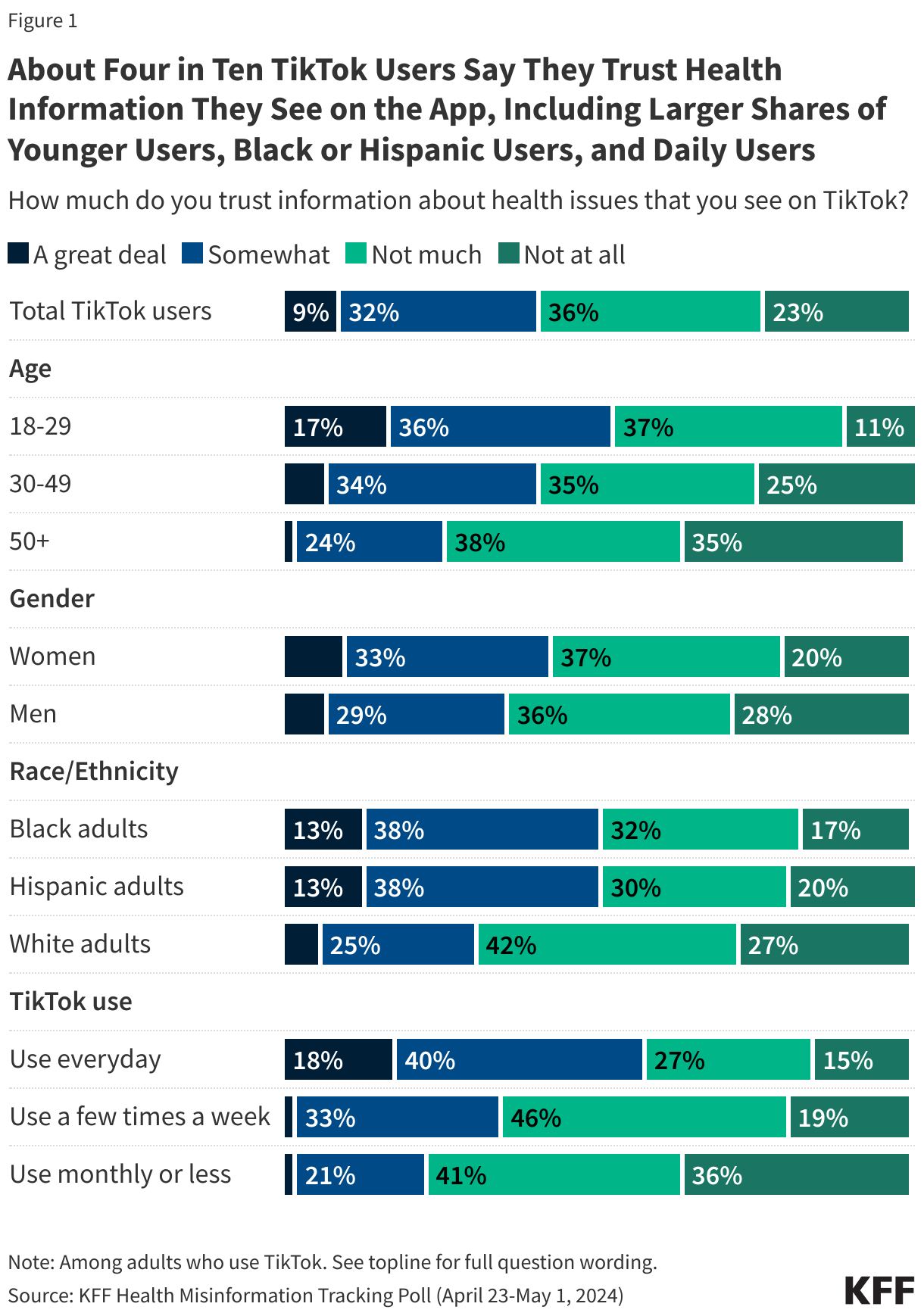
A new KFF Health Misinformation Tracking Poll, as part of our Misinformation and Trust Initiative, explores how often people encounter health information on TikTok, how much they trust it, and whether it impacts their behavior. Fewer than half of TikTok users trust health information on the app, while four in ten say they trust such information “a great deal” (9%) or “somewhat” (32%; Figure 1). Younger users, particularly those aged 18-29, show higher trust levels, with 53% saying they trust health information at least somewhat, including 17% who trust it a great deal. Black and Hispanic TikTok users are somewhat more likely than White adults who use TikTok to say they trust health information on the app. Among daily TikTok users, who are predominantly younger adults, 58% trust health information on the platform at least somewhat.

About Four in Ten TikTok Users Say They Trust Health Information They See on the App, Including Larger Shares of Younger Users, Black or Hispanic Users, and Daily Users

The poll also investigated how often people saw health information about various topics on the platform and found that a majority of users report seeing health-related content on the app, most commonly information about mental health (66%) and weight loss (66%). About a third (36%) of TikTok users report seeing information about abortion on the platform. Younger users, particularly those aged 18 to 29, are more likely to encounter this content, with 59% having seen abortion-related information.

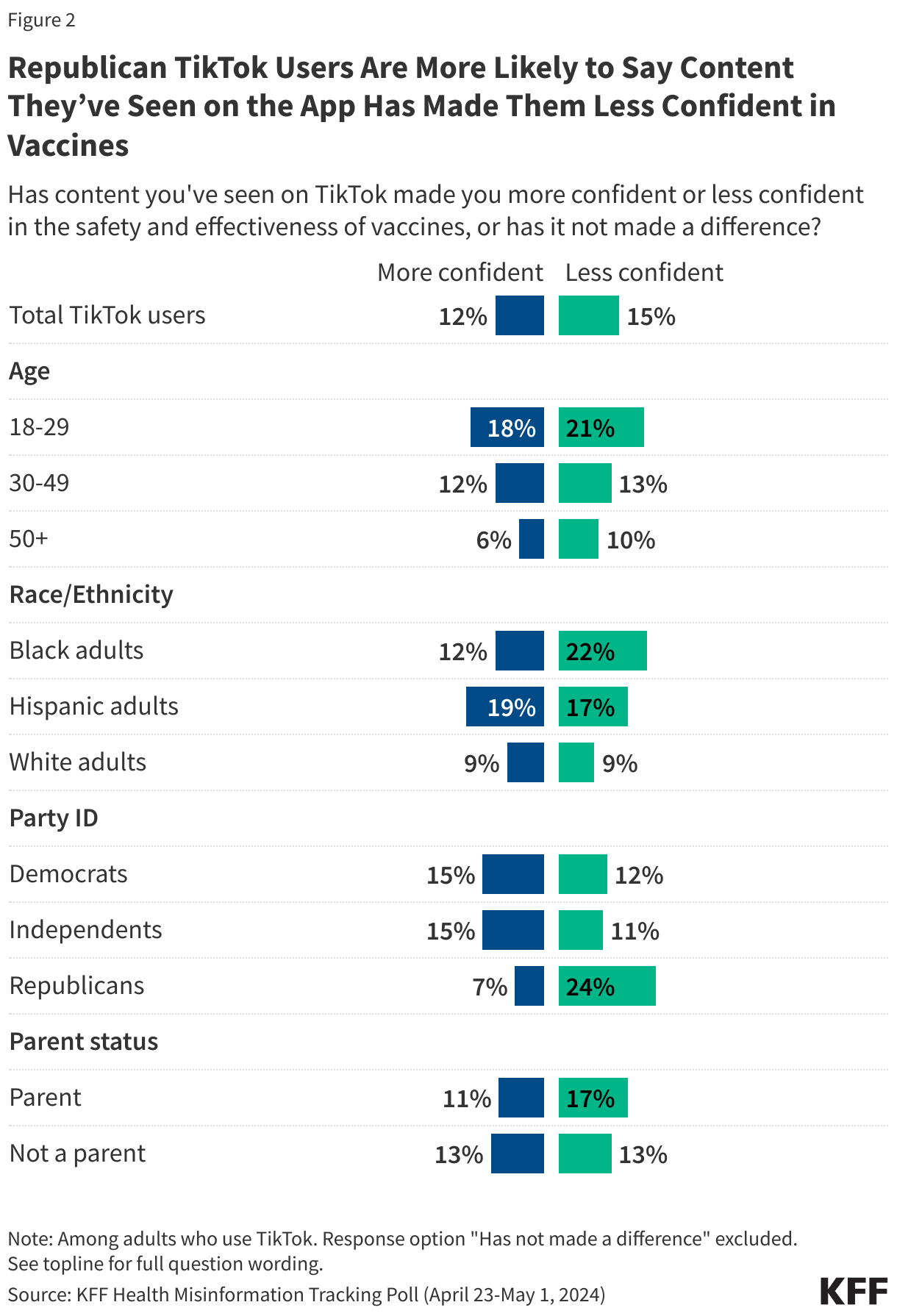
Approximately 42% of TikTok users say they have seen information or advice about vaccines on the platform. Most users report that the content they’ve encountered hasn’t affected their confidence in vaccine safety and effectiveness, with about 15% saying it made them less confident and 12% saying it made them more confident (Figure 2). Among parents who use TikTok, 17% report feeling less confident in vaccines due to content on the app, compared to similar shares (11%) who feel more confident. Previous KFF polling has found that about a quarter of parents believe false information about measles vaccines. Notably, Republican users on TikTok are more likely to say content on the app has decreased their confidence in vaccines, with 24% of Republicans saying TikTok content has led them to feel less confident compared to 7% say it has made them feel more confident.

Republican TikTok Users Are More Likely to Say Content They’ve Seen on the App Has Made Them Less Confident in Vaccines

Research Updates

Study Explores Challenges in Reducing Resistance to Vaccine Messaging

In this Monitor, we report on a study published in the journal Health Communication that explored ways to reduce “reactance”, or feeling like your personal freedom is threatened, when given vaccine-related communication. The researchers tested if the practice of “inoculation” or warning people about feeling reactance before a message promoting a fake vaccine would reduce reactance. They found that the warning didn’t reduce resistance or change minds about vaccines; sometimes it even caused more resistance in some of the participants. The study ultimately found that people who are naturally more resistant (high-reactant) were less willing to get vaccinated, especially when the message threatened their freedom a lot. But those less resistant (low-reactant) were more open to vaccines, especially with a high-threat message.

Source: Karlsson, L. C., Mäki, K. O., Holford, D., Fasce, A., Schmid, P., Lewandowsky, S., & Soveri, A. (2024). Testing psychological inoculation to reduce reactance to vaccine-related communication. Health Communication, 1-9.

Perceptions of Fact-Checking Labels Vary by Political Affiliation

study published in the Harvard Misinformation Review looked at how people view fact-checking labels, like those you might see on social media posts. They found that labels from professional fact checkers were seen as the most effective, followed by labels from news media. Labels by algorithms and users were seen as less effective. Republicans tended to trust these labels less than Democrats did. People who trust news media and have positive views of social media tend to see these labels as more effective. Also, if people had seen these labels before, they were more likely to trust them, especially if they trusted news media or had positive views of social media.

Source: Jia, C. & Lee, T. (2024). Journalistic interventions matter: Understanding how Americans perceive fact-checking labels. Harvard Kennedy School (HKS) Misinformation Review. https://doi.org/10.37016/mr-2020-138


AI & Emerging Technology

Features and Challenges of WHO’s New AI Tool

While not directly spreading misinformation, the World Health Organization’s new AI tool, SARAH, has faced challenges providing accurate health information, highlighting the potential for AI-generated content to contribute to the spread of misinformation inadvertently. SARAH is designed to provide health information through a human-like avatar that operates 24/7 in multiple languages to educate users on various health topics. However, according to Bloomberg, SARAH has outdated medical data and occasionally provides wrong or made-up answers, due to its reliance on ChatGPT 3.5. (deleted because unclear what this means). Despite these limitations, SARAH is seen as a first step towards using AI to enhance public health education. WHO seeks input to improve SARAH’s accuracy and utility, especially in emergency health situations. WHO also emphasizes that AI chatbots like SARAH are not substitutes for professional medical advice.

About The Health Information and Trust Initiative: the Health Information and Trust Initiative is a KFF program aimed at tracking health misinformation in the U.S., analyzing its impact on the American people, and mobilizing media to address the problem. Our goal is to be of service to everyone working on health misinformation, strengthen efforts to counter misinformation, and build trust. 


View all KFF Monitors

The Monitor is a report from KFF’s Health Information and Trust initiative that focuses on recent developments in health information. It’s free and published twice a month.

Sign up to receive KFF Monitor
email updates


Support for the Health Information and Trust initiative is provided by the Robert Wood Johnson Foundation (RWJF). The views expressed do not necessarily reflect the views of RWJF and KFF maintains full editorial control over all of its policy analysis, polling, and journalism activities. The Public Good Projects (PGP) provides media monitoring data KFF uses in producing the Monitor.


Poll Finding

KFF Health Misinformation Tracking Poll: Health and Election Issues on TikTok

Authors: Alex Montero, Grace Sparks, Marley Presiado, and Liz Hamel
Published: Jun 13, 2024

With the rise of social media use and growing concerns about health misinformation that accelerated during the COVID-19 pandemic, there has been increased attention to the role that various social media platforms play in the dissemination of health information, both accurate and inaccurate. Previous KFF polling has found that while few adults say they put a lot of trust in health information they come across on social media, those who use social media more frequently for health advice are more likely to believe false statements about issue like COVID-19 vaccines, reproductive health, and gun safety. This new KFF Health Misinformation Tracking Poll focuses on health and election-related information on the popular social media app TikTok in light of recent developments related to the platform.

In late April, President Joe Biden signed into a law a bill that would ban TikTok in the U.S. if its Chinese-owned parent company does not sell the platform within a year. The bill passed both chambers of Congress with bipartisan support, with many lawmakers, including President Biden, largely citing national security risks. At the same time, some media reports have documented the spread of various different types of health misinformation on the app, including misinformation related to prescription birth control.

Key Findings

  • Most adults who use TikTok report seeing health-related content on the app, with the largest shares saying they’ve seen content about mental health (66%) and weight loss (66%). Younger users are particularly likely to report being exposed to health information on TikTok, with large shares of users ages 18-29 reporting seeing advice or information about several different health topics on the app, including mental health (91%), weight loss (79%), while many other younger users report seeing advice or information about abortion (59%), and birth control (52%).
  • While about four in ten TikTok users say they trust information about health issues they see on the app, just one in eight say they have ever talked to a doctor (13%) or sought mental health treatment (12%) at least in part because of something they saw on TikTok. Larger shares of younger users ages 18-29 say they trust health information on TikTok (53%), and younger users are also more likely than older users to say they followed up with a doctor (19%) or sought mental health treatment (26%) due to content they’ve seen on the app.
  • Most TikTok users say the content they’ve seen on the app has not affected their confidence in science and scientists, birth control, or vaccines. Overall, about one in seven users say content on TikTok has made them “less confident” (15%) in the safety and effectiveness of vaccines and a similar share (12%) say it has made them “more confident.” Among Republican TikTok users, however, a larger share say content on the app has made them “less confident” in vaccines (24%) rather than “more confident” (7%).
  • When it comes to TikTok content centered on election issues, most users report either not seeing content related to these issues or seeing content that is a mix of different opinions on these topics. For the most part, TikTok users who identify as Democrats and Republicans report seeing a somewhat different mix of political content on the platform. On the issue of abortion, however, TikTok users across the political spectrum are much more likely to say the content they see on the app is mostly pro-choice or supportive or abortion rights rather than anti-abortion or supportive of abortion restrictions. Even among Republican TikTok users, the share who say they mostly see pro-choice content on the app is roughly three times the share who say they mostly see anti-abortion content (17% v. 5%).

TikTok Use and Exposure to Health Information

Just under half of adults say they use the social media app TikTok, including at least six in ten younger adults, Black adults, and Hispanic adults. About four in ten (44%) adults say they use TikTok, including larger shares of younger adults ages 18-29 (66%) and ages 30-49 (54%) and fewer adults ages 50 and older (27%). The app is more popular among people of color with about six in ten Hispanic adults (63%) and Black adults (62%) saying they use TikTok compared to about one-third of White adults (34%). Women are more likely than men to use say they use TikTok (47% v. 40%).

Similar shares – or at least four in ten – Democrats, independents and Republicans report using TikTok. About one in five adults (18%) report using the app every day, including nearly four in ten adults ages 18 to 29 (37%) and a similar share of Hispanic adults (36%).
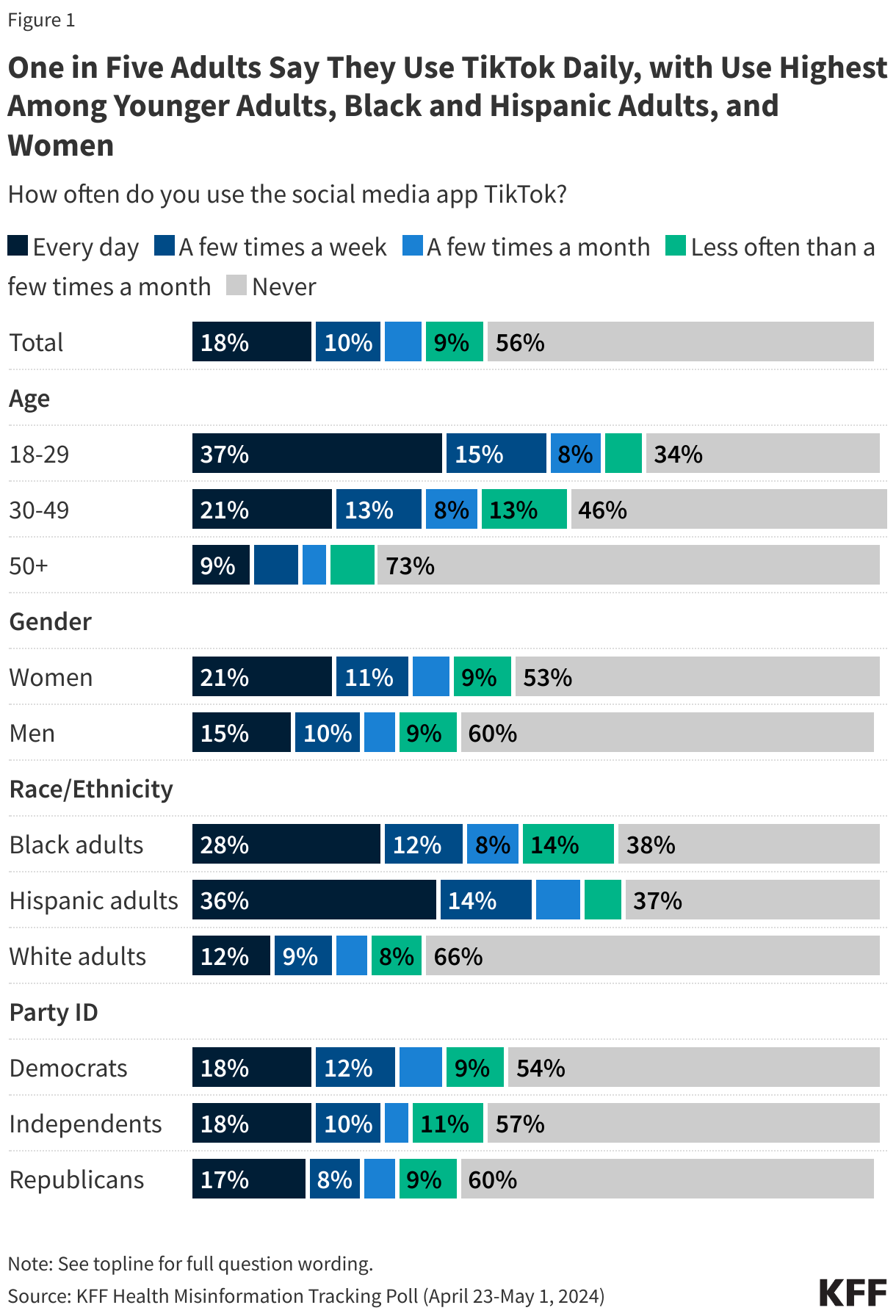
Stacked bar chart showing how often U.S. adults use the social media app tik tok, by age, gender, race/ethnicity and party ID

Most TikTok users report seeing health-related content on the app, including a majority who say they’ve seen information or advice about mental health (66%) or weight loss (66%). About four in ten TikTok users say they’ve seen information or advice about vaccines (42%) on the platform, while about a third say the same about abortion (36%), prescription drugs (34%), and birth control (34%). Younger TikTok users are more likely than older users to say they’ve seen some of these topics on TikTok, with larger shares of users ages 18 to 29 saying they’ve seen information or advice about mental health (91%), weight loss (79%), abortion (59%), or birth control (52%). Women are more likely than men who use TikTok to say they have seen information or advice about mental health (71% v. 61%) or birth control (41% v. 25%) on the app. About half of women of reproductive age – or those ages 18 to 49 – report seeing information or advice on TikTok about prescription birth control on (54%) or abortion (48%). Democrats (35%) and independents (41%) who use TikTok are more likely than Republican users (23%) to report seeing information or advice about birth control on the app; however, similar shares across partisans report seeing information about most of these other subjects.

Perhaps not surprisingly, there is a relationship between frequency of TikTok use and the amount of health-related content people report seeing on the app. Adults who use TikTok “every day” are more likely than those who use the app monthly or less often to say they’ve seen information or advice about each of the health-related topics included in the survey. Notably, larger shares of younger adults and women report using the app every day compared to older adults and men, respectively, which may at least partially explain why these groups report seeing more health-related content on the app.
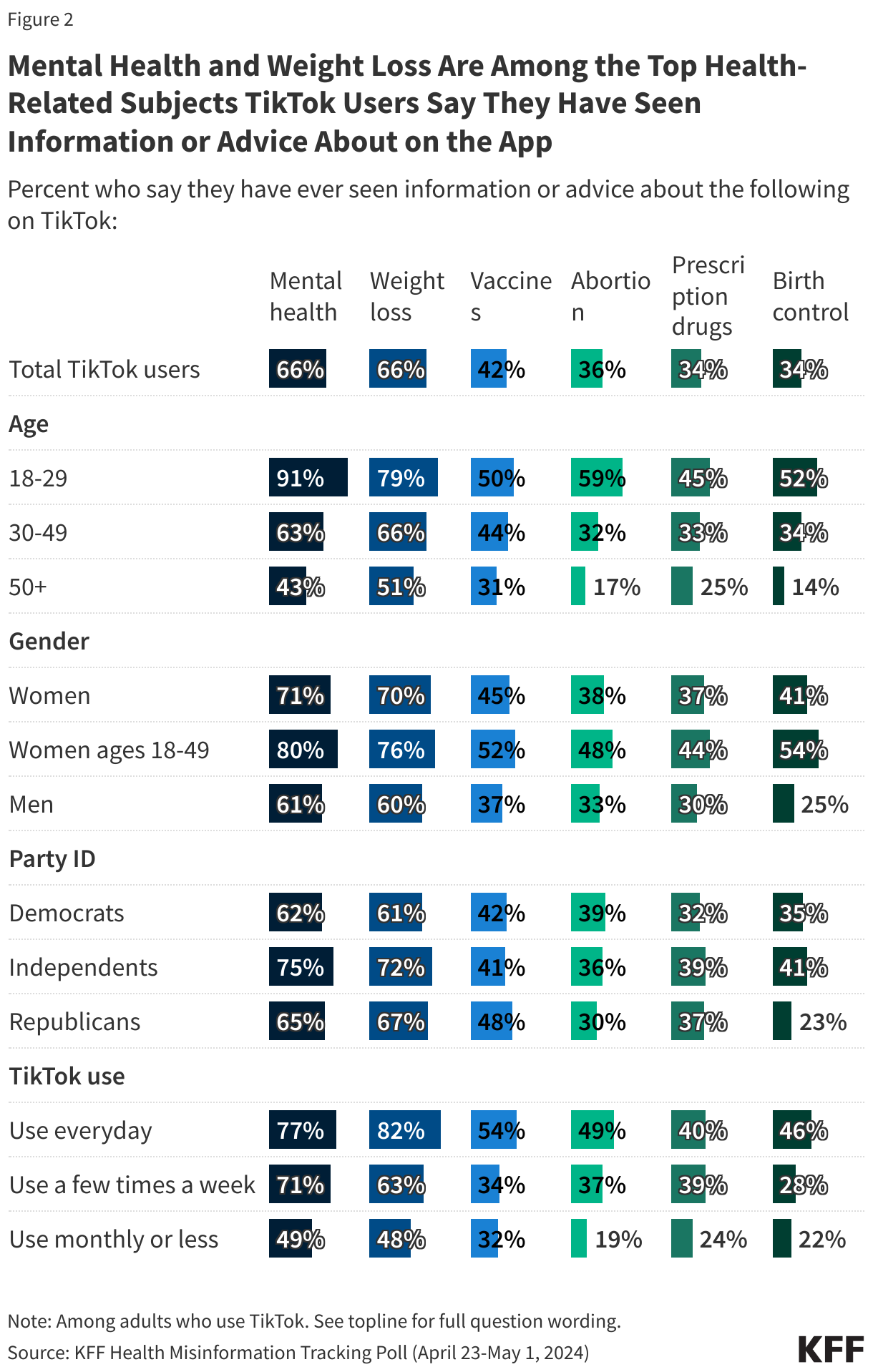
Split bar chart showing shares of U.S. adults who say they have seen information about mental health, weight loss, vaccines, abortion, prescription drugs, and birth control by age, gender, Party ID and frequency of TikTok use

Trust and Conversations about Health Information on TikTok

Fewer than half of TikTok users say they trust information about health issues that they see on the app, but younger users, Black adults, and Hispanic adults report higher levels of trust. Overall, four in ten TikTok users say they trust information they see about health issues on TikTok at least “somewhat,” including 9% who say they trust such information a “great deal.” Most users say they trust health information on TikTok “not much” (36%) or “not at all” (23%).

TikTok users between the ages of 18-29 are more likely than older adults to say they trust health information on TikTok, with about half (53%) of these younger adults saying they trust information about health issues on the app at least somewhat – including one in six (17%) who say they trust health information on TikTok “a great deal” – compared to smaller shares of older TikTok users. Similar shares of women and men who use TikTok say they trust information about health issues that they see on the app.

Among those who report using TikTok every day (18% of all adults), six in ten (58%) say they trust information about health issues they see on the app at least “somewhat.” Adults who use the app less frequently are less likely than daily users to report trusting health information they see on TikTok. Notably, daily TikTok users are disproportionately made up of younger adults ages 18 to 29.
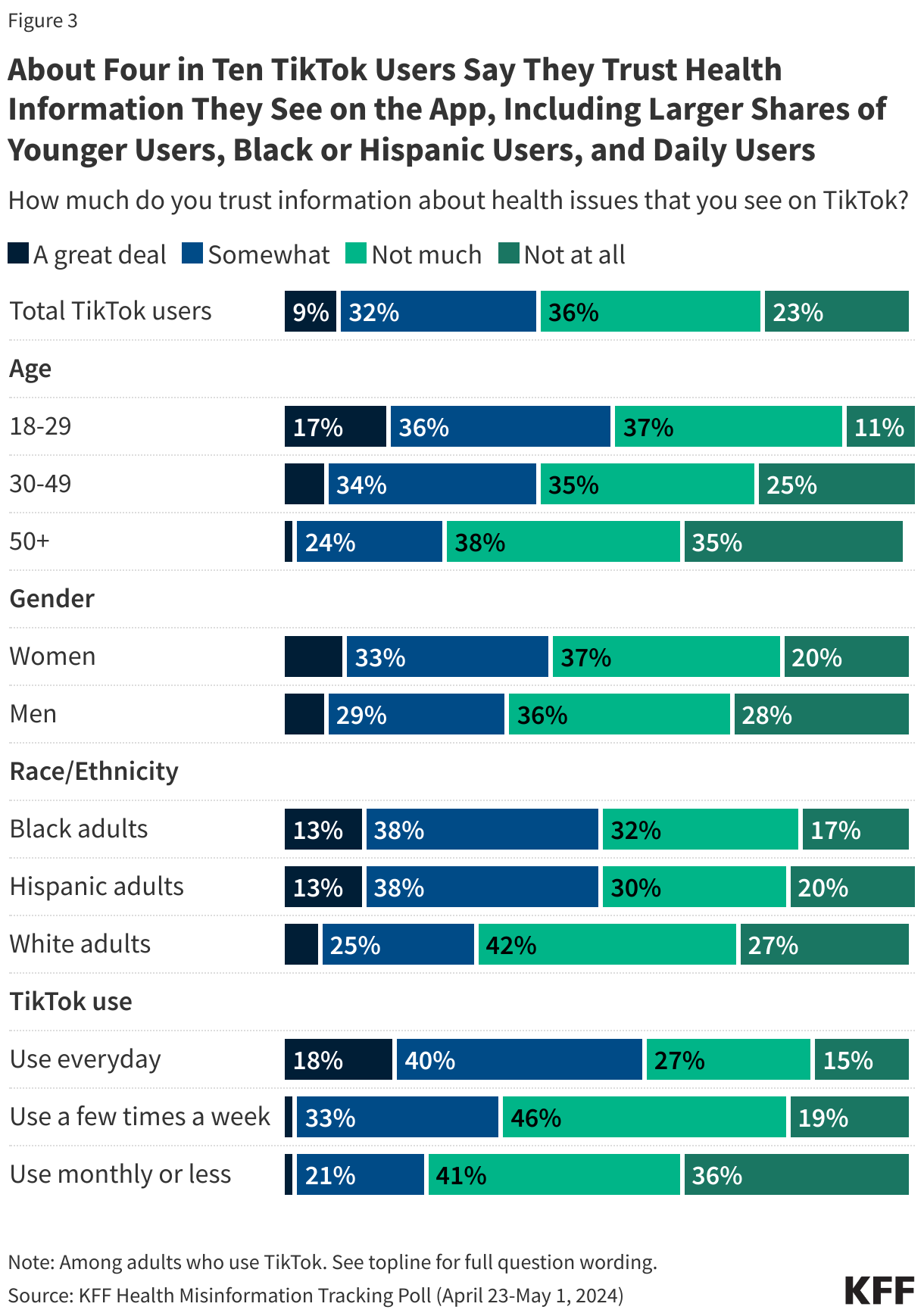
Stacked bar chart showing how much U.S. adult tik tok users trust health information they see on TikTok by age, gender, race/ethnicity, and frequency of tiktok use

Few TikTok users overall and across demographics say they’ve talked to a doctor or sought mental health treatment because of something they saw on the app, but younger users and women are more likely than older users and men to report doing so. About one in eight adults who use TikTok say they have ever talked to a doctor or other health care provider at least in part because of something they saw on TikTok (13%) or decided to seek mental health treatment at least in part because of something they saw on the app (12%). Younger users are more likely than older adults to report either of these, with a quarter (26%) of TikTok users between the ages of 18 and 29 saying they decided to seek mental health treatment and one in five (19%) saying they talked to a doctor or health care provider because of something they saw on the app. Among TikTok users, women are about twice as likely as men to say they talked to a doctor or health care provider (17% v. 7%) or decided to seek mental health treatment due to something they saw on the app (15% v. 8%). The share who report talking to a doctor or seeking mental health treatment at least partly because of something they saw on TikTok rises to about one in five among those who use TikTok every day (20% and 18%, respectively). Nonetheless, most of these daily users say they have not followed up with a doctor or sought mental mental health treatment due to content they’ve seen on the app.
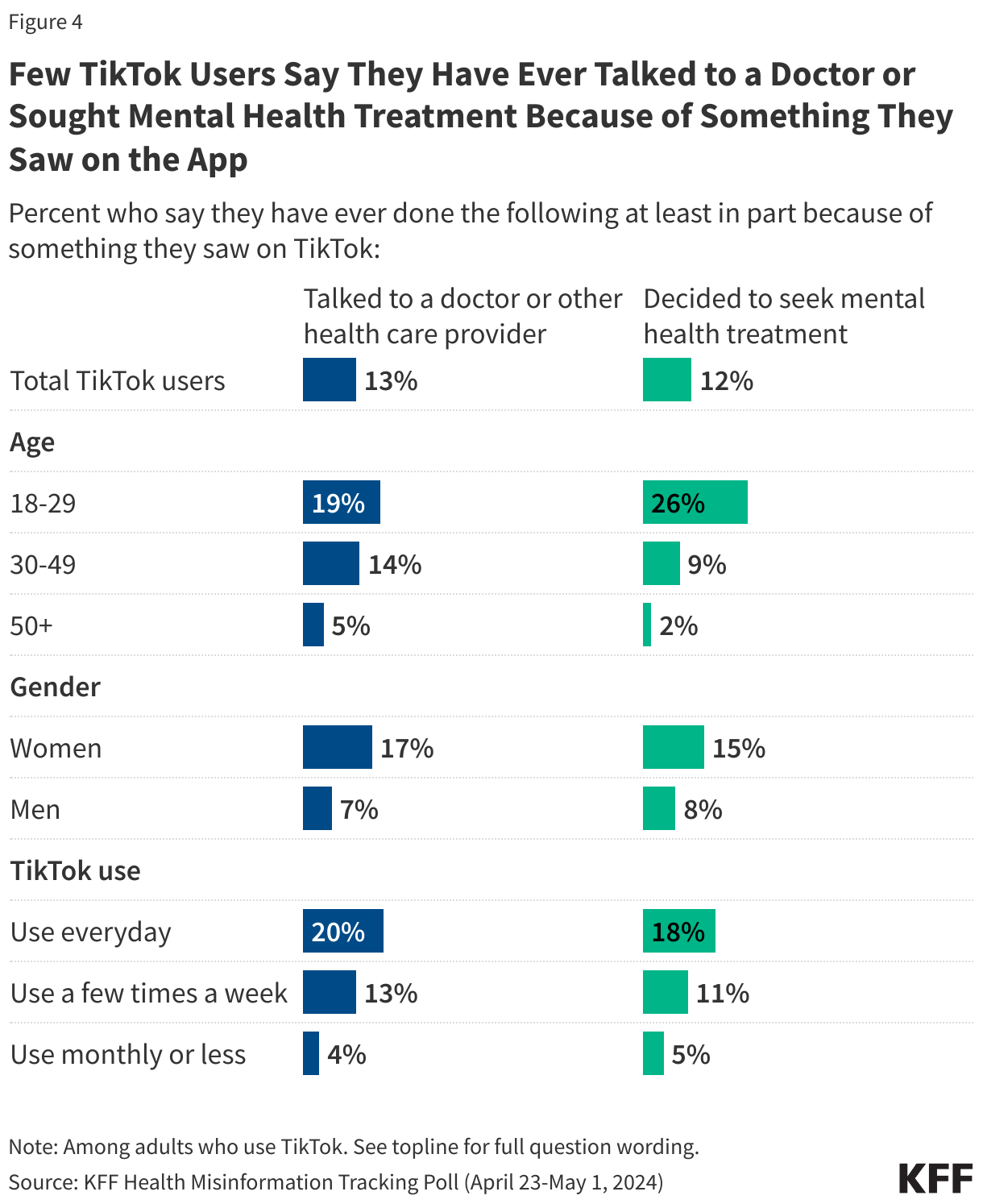
Split bar chart showing shares of U.S. adult tiktok users who say they have either talked to a doctor or other health care provider or decided to seek mental health treatment based on information they saw on tiktok by age, gender, and frequency of tiktok use

While most TikTok users say content they’ve seen on the app has not affected their confidence in science and scientists, prescription birth control, or the safety and effectiveness of vaccines, users are more likely to say content on the app has made them more confident in science and scientists rather than less confident. At least seven in ten TikTok users say information they’ve seen on the app has not affected their confidence in the safety of prescription birth control (76%), the safety and effectiveness of vaccines (73%), or science and scientists (70%).

When it comes to trust in science and scientists, TikTok users are nearly three times as likely to say content they’ve seen on the app has made them more confident in science and scientists rather than less confident (22% vs. 8%). By contrast, when it comes to confidence in prescription birth control and the safety and effectiveness of vaccines similar shares of TikTok users say content they’ve seen on the app has made them more confident as less confident (12% each for birth control, 12% and 15% for vaccines). Similar shares of women and men – including women of reproductive age under the age of 50 -- who use TikTok say content on the app has made them either more or less confident in prescription birth control, with about three in four saying it has not made a difference.
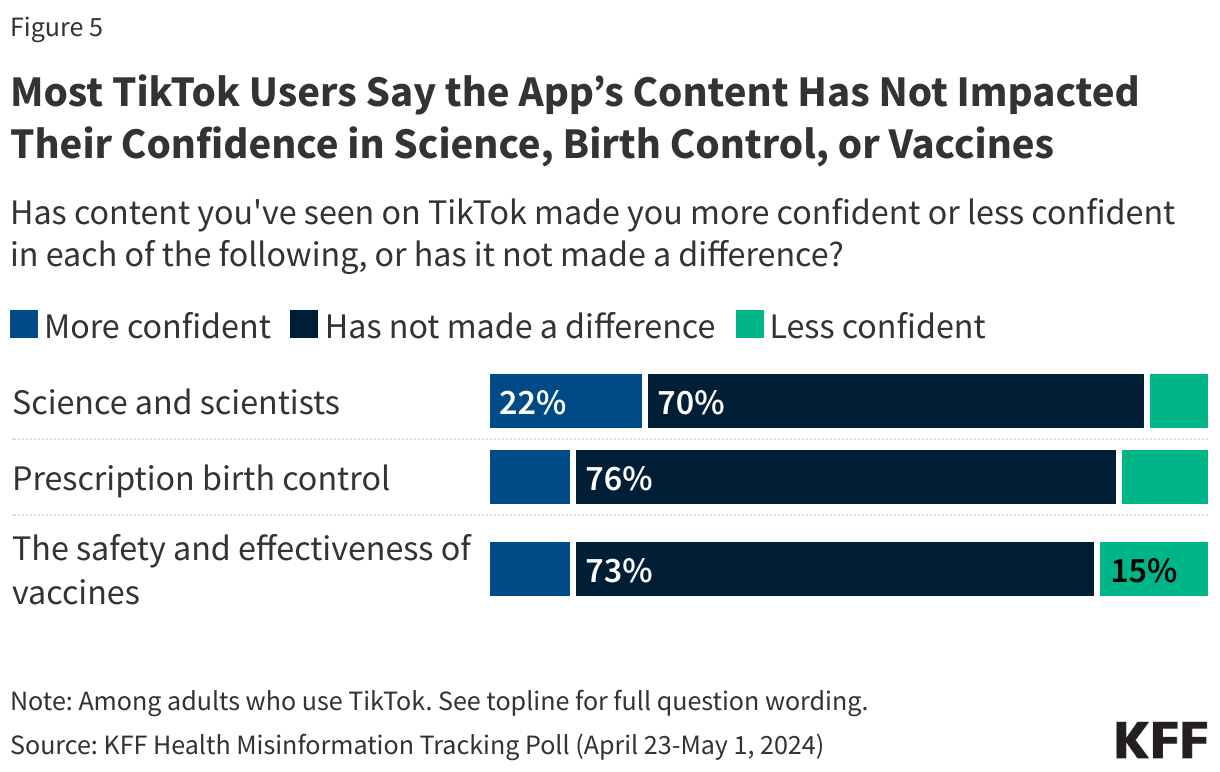
Stacked bar chart showing shares of U.S. adult tiktok users who say content they seen on tiktok has impacted their trust in science and scientists, prescription birth control, and the safety and effectiveness of vaccines.

Most TikTok users across demographics say content on the app has not affected their confidence in the safety and effectiveness of vaccines, however Republicans are more likely to say TikTok content has made them less confident in vaccines rather than more confident. Overall, about one in seven users say content on TikTok has made them “less confident” (15%) in the safety and effectiveness of vaccines and a similar share (12%) say it has made them “more confident.” For most groups across age, partisanship, race and ethnicity, the shares saying TikTok content increased their confidence in vaccines is similar to the share who say it decreased their confidence.

However, one group breaks with this pattern: Republican TikTok users are about three times as likely to say content on the app has made them “less confident” in the safety and effectiveness of vaccines rather than “more confident” (24% v. 7%).

Vaccine misinformation may affect parents’ confidence in vaccinating their young children, and recent KFF polling has shown that about a quarter of parents report believing false information about measles vaccines. Just under one in five (17%) parents who use TikTok say content they’ve seen on the app has made them “less confident” in the safety and effectiveness of vaccines while a similar share of parents say it has made them “more confident” (11%). However, most parents who use TikTok say the content they’ve seen on the app hasn’t affected their confidence in the safety and effectiveness of vaccines.

Split bar chart showing shares of U.S. adult tiktok users who say cintent they've seen on tiktok has made them more or less confident in the safety and effectiveness of vaccines by age, race/ethnicity, party ID and parental status

Election Issues on TikTok

As the 2024 presidential election approaches, TikTok users may be exposed to election-related topics and one-sided political discourse, particularly as growing shares of U.S. adults report regularly getting their news from the app. However, like other social media platforms, the content users see on their TikTok feeds may vary from person-to-person, as it is curated by the app’s proprietary algorithm.

When it comes to TikTok content centered on some key election issues, including the presidential candidates, abortion, guns, and immigration, most users report either not seeing content related to these issues or seeing content that is a mix of different opinions on these topics. For the most part, TikTok users who identify as Democrats and Republicans report seeing a somewhat different mix of political content, particularly when it comes to presidential candidates, but these patterns are not universal across the topics included in the survey.

It’s important to note that this survey measures self-report views of TikTok content, which may not necessarily match up with other studies that look at actual content in users’ video feeds.

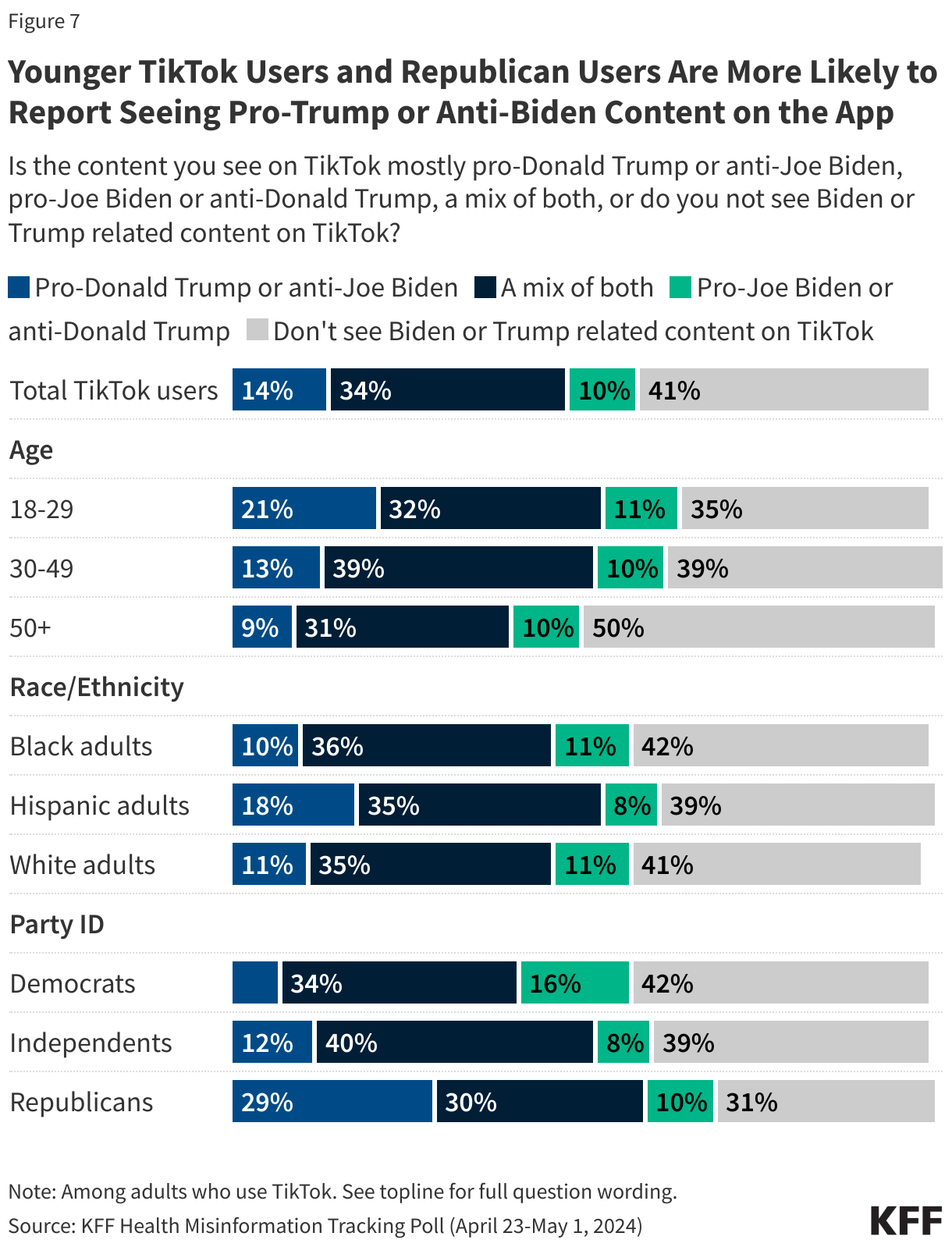
Overall, few TikTok users report mostly seeing one-sided content related to the presidential candidates, but slightly larger shares say the content they see on the app is mostly pro-Donald Trump or anti-Joe Biden rather than mostly pro-Biden or anti-Trump, with even larger tilts toward pro-Trump or anti-Biden content among Republican users and young adults. The shares of TikTok users who say the content they see on the app is mostly Pro-Donald Trump or anti-Joe Biden (14%) is slightly higher than the share who say the content they see is mostly pro-Joe Biden or anti-Donald Trump (10%), with one in three (34%) saying the content they see is a mix of both viewpoints, and four in ten saying they don’t see content related to either Trump or Biden on TikTok.

Perhaps not surprisingly, Republican TikTok users are about three times as likely to say the content they see is mostly pro-Trump/anti-Biden rather than pro-Biden/anti-Trump (29% v. 10%), while Democrats are about twice as likely to say the content they see mostly favors Biden rather than Trump (16% vs. 7%).

Notably, TikTok users ages 18 to 29 and Hispanic TikTok users are about twice as likely to say most of the content they see is pro-Trump or anti-Biden rather than pro-Biden or anti-Trump (21% vs. 11% for young users and 18% vs. 8% for Hispanic adults).

Stacked bar chart showing shares of U.S. adult tik tok users who say the content they see on TikTok mostly pro-Donald Trump or anti-Joe Biden, pro-Joe Biden or anti-Donald Trump, a mix of both, or they do not see Biden or Trump related content on TikTok by age, race/ethnicity, and party ID.

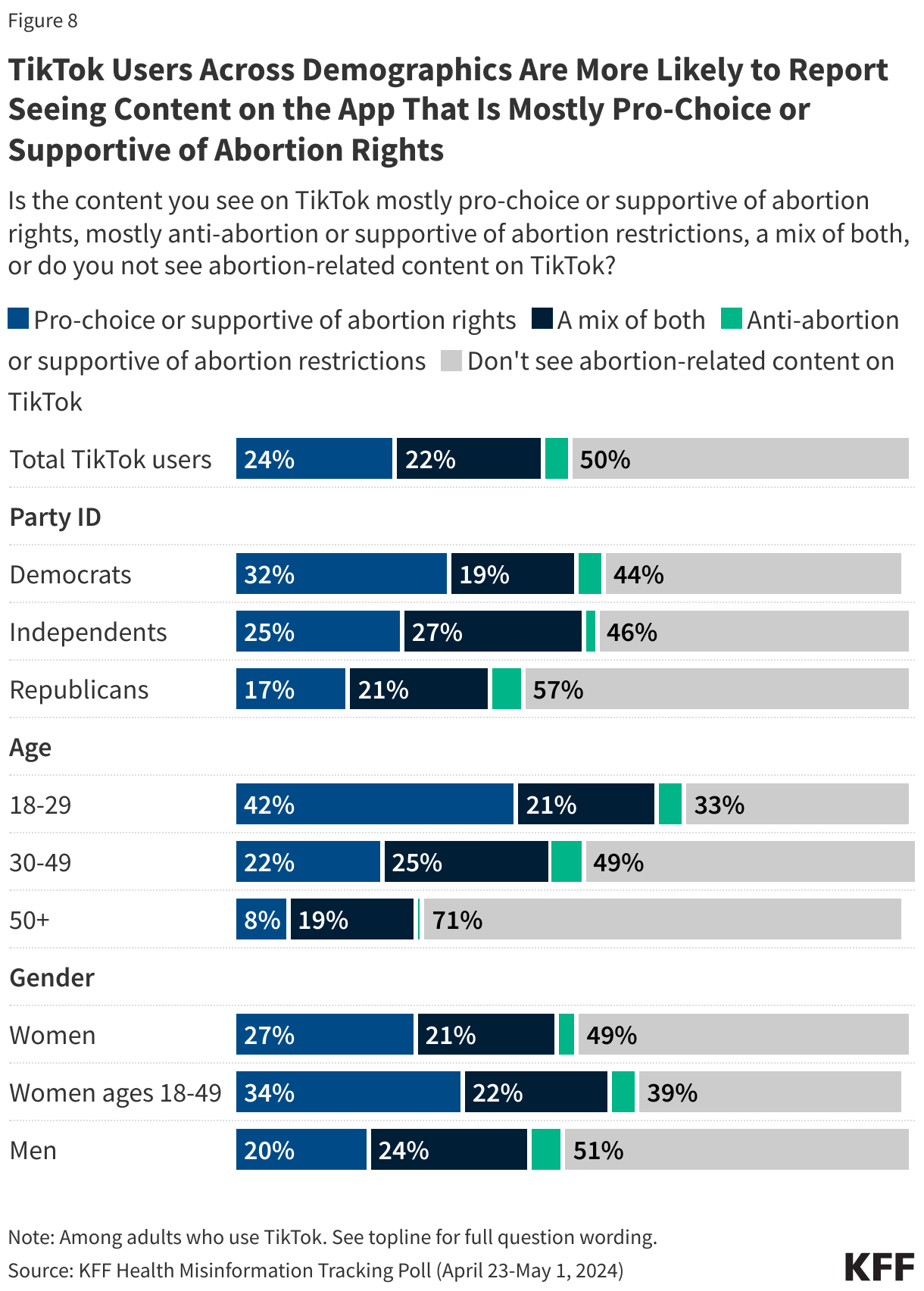
Across partisanship and other demographics, the share of TikTok users who say the content they see on the app is mostly pro-choice or supportive of abortion rights (24%) is far larger than the share who say the content they see is mostly anti-abortion or supportive of abortion restrictions (4%). The share of TikTok users who say they mostly see pro-choice content rises to four in ten (42%) among those ages 18 to 29 – larger than the shares who say the same among those ages 30 to 49 (22%) and 50 and older (8%). These younger users are also more likely than older adults to report seeing any abortion-related content on TikTok.

Few users across partisan groups (including just 5% of Republicans) report seeing mostly anti-abortion content on TikTok, though Democrats who use TikTok are more likely than Republican users to say the content they see is mostly pro-choice of supportive of abortion rights (32% v. 17%).

Overall, men and women who use TikTok are each much more likely to report seeing mostly pro-choice content than to say they see mostly anti-abortion content. While about three in four (27%) women who use TikTok say the content they see is mostly pro-choice, this rises to about one-third (34%) among women ages 18 to 49.

Despite these differences, most users – including at least half across partisanship, age, and gender – say the content they see related to abortion on TikTok is either a mix of both pro and anti-abortion viewpoints (22%) or they don’t see this content related to abortion at all (50%).

Stacked bar chart showing shares of U.S. adult tik tok users who say the content they see on TikTok is mostly pro-choice or supportive of abortion rights, mostly anti-abortion or supportive of abortion restrictions, a mix of both, or they do not see abortion-related content on TikTok by party ID, Age, and Gender

Most TikTok users who report seeing gun-related content on the app say they see a mix of viewpoints, but Democrats and younger users are more likely to report seeing mostly anti-gun content. One quarter of TikTok users say they see a mix of gun-related viewpoints on the app, while about one in ten each say they mostly see pro-gun content (8%) or anti-gun content (10%) and over half (57%) report not seeing gun-related content on TikTok.

Democrats who use TikTok are about twice as likely to say they mostly see anti-gun content as opposed to pro-gun content on the app (16% v. 7%). Younger TikTok users ages 18 to 29 are about twice as likely to say they mostly see anti-gun content than pro-gun content (18% v. 9%), while other age groups report seeing either viewpoint in similar shares.

Among all TikTok users, and across these demographic groups, most users say the content they see is either a mix of both pro and anti-gun or say they do not see gun-related content on the app.
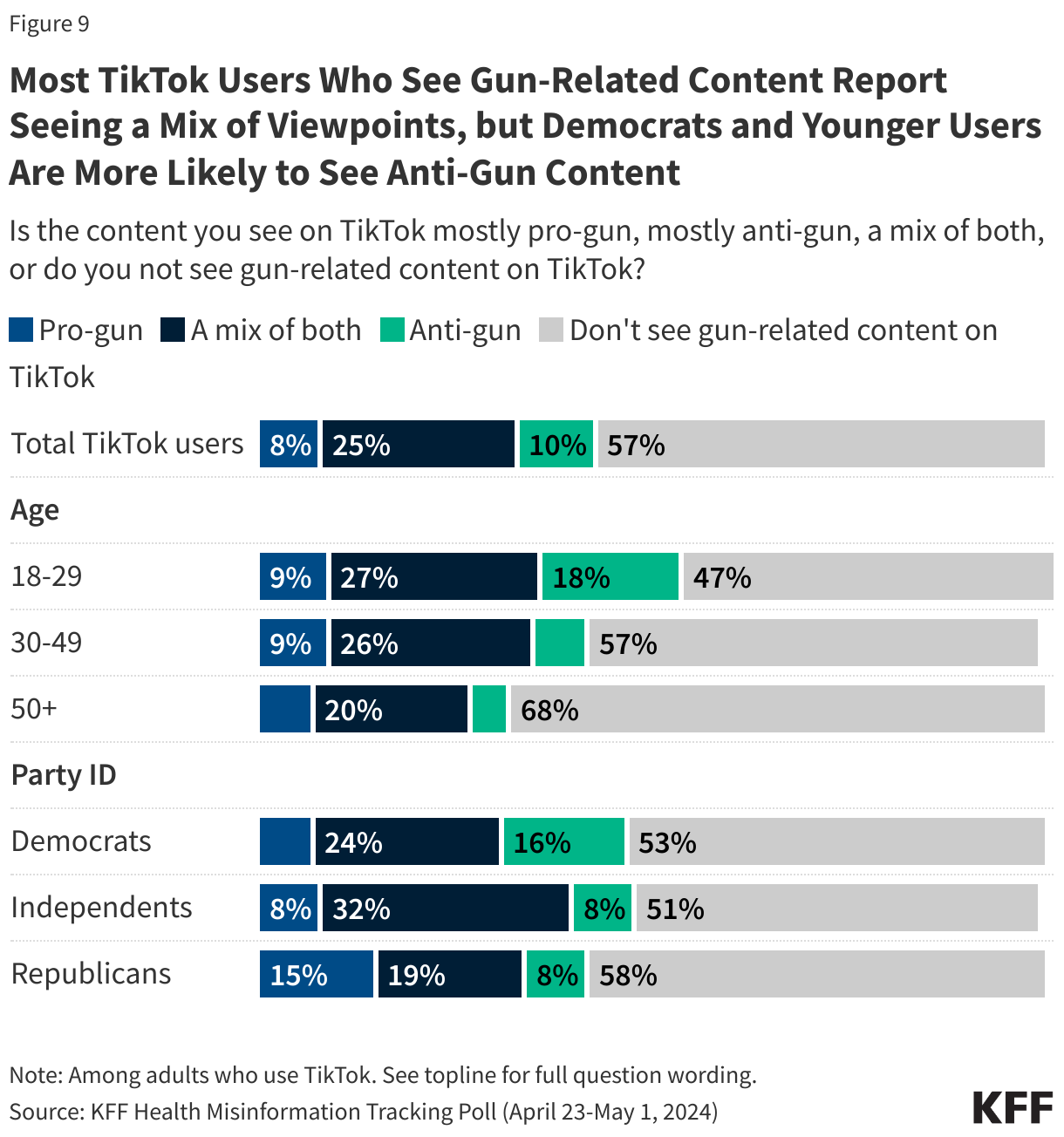
Stacked bar chart showing shares of U.S. adult tik tok users who say the content they see on TikTok is mostly pro-gun, mostly anti-gun, a mix of both, or they do not see gun-related content on TikTok by party ID, and age

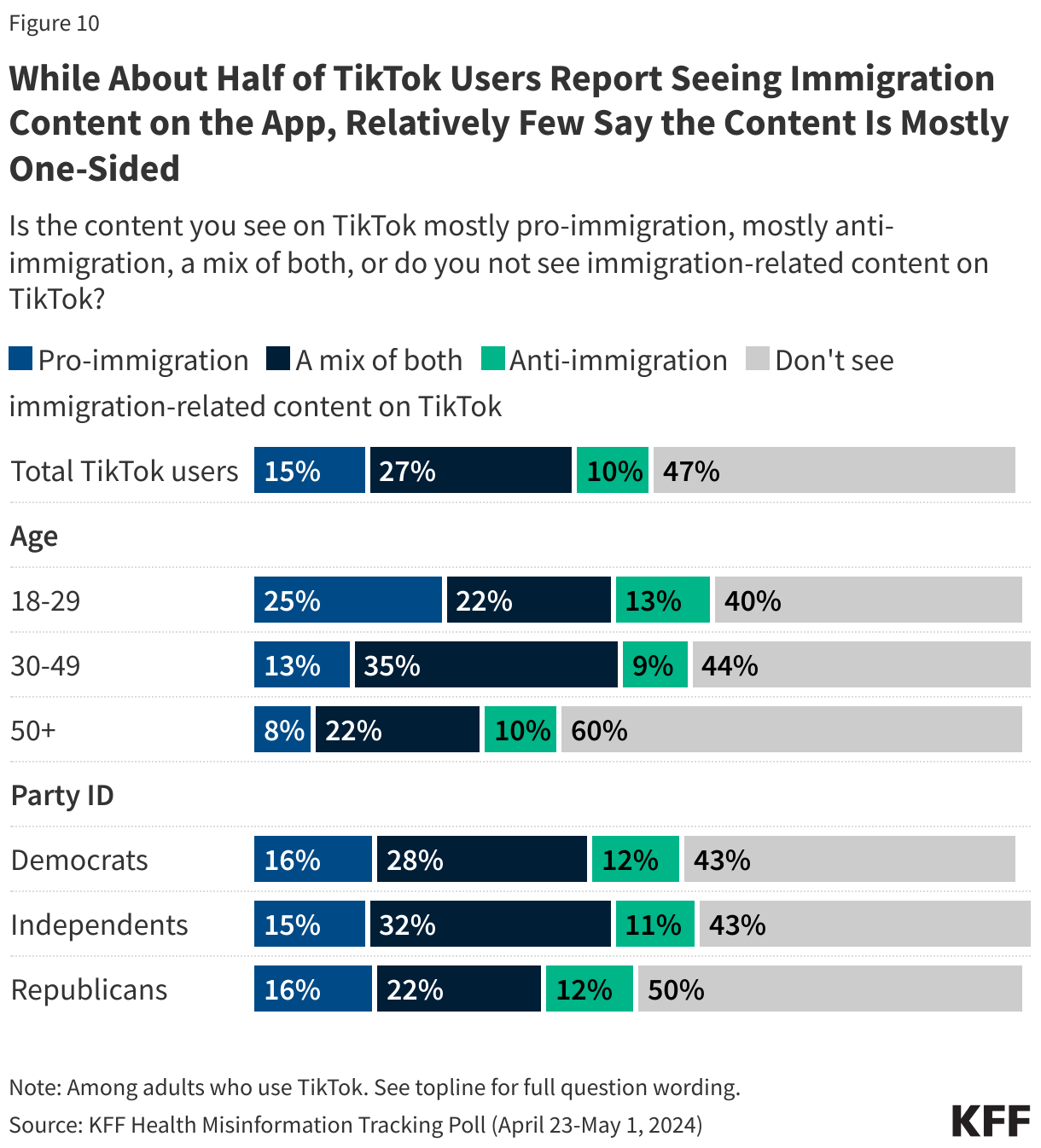
TikTok users report seeing a mix of immigration-related content on the app, with no clear differences by partisanship. For immigration-related content, somewhat larger shares of TikTok users say the content they see is mostly pro-immigration (15%) compared to those who say they mostly see anti-immigration content (10%). Most users, however, say the content they see is either a mix of both pro and anti-immigration viewpoints (27%) or they don’t see this content on TikTok (47%). Despite often bitter partisan debates over the country’s approach to immigration policy (an issue that has ranked high among voters’ top issues ahead the 2024 election) among Democrats, independents and Republicans who use TikTok, similar shares say the content they see on the app is either mostly pro-immigration or anti-immigration, with at least one in five across these groups saying they see a mix of viewpoints.

Younger TikTok users ages 18 to 29 are about twice as likely to say the content they see on the app is mostly pro-immigration rather than anti-immigration (25% v. 13%), but among older age groups, similar shares report seeing either mostly pro-immigration content or mostly anti- immigration content.

Stacked bar chart showing shares of U.S. tik tok users who say the content they see on TikTok is mostly pro-immigration, mostly anti-immigration, a mix of both, or they do not see immigration-related content on TikTok by age and Party ID

This KFF Health Tracking Poll/Health Misinformation Tracking Poll was designed and analyzed by public opinion researchers at KFF. The survey was conducted April 23-May 1, 2024, online and by telephone among a nationally representative sample of 1,479 U.S. adults in English (1,396) and in Spanish (83). The sample includes 1,201 adults (n=65 in Spanish) reached through the SSRS Opinion Panel either online (n=1,176) or over the phone (n=25). The SSRS Opinion Panel is a nationally representative probability-based panel where panel members are recruited randomly in one of two ways: (a) Through invitations mailed to respondents randomly sampled from an Address-Based Sample (ABS) provided by Marketing Systems Groups (MSG) through the U.S. Postal Service’s Computerized Delivery Sequence (CDS); (b) from a dual-frame random digit dial (RDD) sample provided by MSG. For the online panel component, invitations were sent to panel members by email followed by up to three reminder emails.

Another 278 (n=18 in Spanish) interviews were conducted from a random digit dial telephone sample of prepaid cell phone numbers obtained through MSG. Phone numbers used for the prepaid cell phone component were randomly generated from a cell phone sampling frame with disproportionate stratification aimed at reaching Hispanic and non-Hispanic Black respondents. Stratification was based on incidence of the race/ethnicity groups within each frame.

Respondents in the phone samples received a $15 incentive via a check received by mail, and web respondents received a $5 electronic gift card incentive (some harder-to-reach groups received a $10 electronic gift card). In order to ensure data quality, cases were removed if they failed two or more quality checks: (1) attention check questions in the online version of the questionnaire, (2) had over 30% item non-response, or (3) had a length less than one quarter of the mean length by mode. Based on this criterion, two cases were removed.

The combined cell phone and panel samples were weighted to match the sample’s demographics to the national U.S. adult population using data from the Census Bureau’s 2023 Current Population Survey (CPS), September 2021 Volunteering and Civic Life Supplement data from the CPS, and the 2023 KFF Benchmarking survey with ABS and prepaid cell phone samples. The demographic variables included in weighting for the general population sample are sex, age, education, race/ethnicity, region, civic engagement, frequency of internet use, political party identification by race/ethnicity, and education. The sample of registered voters was weighted separately to match the U.S. registered voter population using parameters above plus recalled vote in the 2020 presidential election by county quintiles grouped by Trump vote share. Both weights account for differences in the probability of selection for each sample type (prepaid cell phone and panel). This includes adjustment for the sample design and geographic stratification of the cell phone sample, within household probability of selection, and the design of the panel-recruitment procedure.

The margin of sampling error including the design effect for the full sample is plus or minus 3 percentage points and is plus or minus 4 percentage points for registered voters. Numbers of respondents and margins of sampling error for key subgroups are shown in the table below. For results based on other subgroups, the margin of sampling error may be higher. Sample sizes and margins of sampling error for other subgroups are available by request. Sampling error is only one of many potential sources of error and there may be other unmeasured error in this or any other public opinion poll. KFF public opinion and survey research is a charter member of the Transparency Initiative of the American Association for Public Opinion Research.

GroupN (unweighted)M.O.S.E.
Total1,479± 3 percentage points
Total registered voters1,243± 4 percentage points
Republican registered voters372± 7 percentage points
Democratic registered voters417± 6 percentage points
Independent registered voters323± 7 percentage points
 
Have ever used GLP-1 drugs
Yes189± 9 percentage points
No1,288± 4 percentage points
TikTok use
TikTok users677± 5 percentage points


House Appropriations Committee Approves the FY 2025 State and Foreign Operations (SFOPs) Appropriations Bill

Published: Jun 12, 2024

The House Committee on Appropriations approved the FY 2025 State, Foreign Operations, and Related Programs (SFOPs) appropriations bill and accompanying report on June 12, 2024. The SFOPs bill includes funding for U.S. global health programs at the State Department and the U.S. Agency for International Development (USAID). Funding for these programs, through the Global Health Programs (GHP) account, which represents the bulk of global health assistance, totaled $9.3 billion, a decrease of $1.3 billion (-12%) below the FY 2024 enacted level and $559 million (-6%) below President Biden’s FY 2025 request. As compared to FY 2024 enacted levels, funding for the Global Fund to Fight AIDS, Tuberculosis and Malaria (Global Fund) and family planning and reproductive health (FP/RH) declined (the Global Fund decrease is related to a funding match requirement that limits the amount the U.S. can contribute — a cap of 33% of total contributions to the Global Fund for all other donors), while all other areas either remained flat or increased slightly; funding for global health security was not specified.[i]  The bill does not include funding for the United Nations Population Fund (UNFPA), World Health Organization (WHO), or Pan American Health Organization (PAHO). The bill also eliminates funding for the International Organizations & Programs (IO&P) account, which has historically been the source of U.S. contributions to the United Nations Children’s Fund (UNICEF).[ii]

Policy provisions in the bill include:

  • the Helms amendment, a standard provision that is regularly included in appropriations bills (see the KFF fact sheet here),
  • an expanded Mexico City Policy (Protecting Life in Global Health Assistance) that was put in place by President Trump and rescinded by President Biden (see the KFF explainer here),
  • a provision stating that support for multilateral organizations through the Contributions to International Organizations (CIO) account must comply with statutory prohibitions and requirements related to abortion,
  • a provision stating that if the President/Executive Branch agrees to the pandemic treaty at the World Health Assembly without first submitting it to the Senate and receiving Senate approval, no funding for global health security may be obligated (see the KFF brief on the Pandemic Treaty here),
  • a provision for the Secretary of State to submit a report to the Committee on Appropriations within 90 days of the Act detailing the origins of COVID-19,
  • and a restriction on provision of funding to any domestic or international NGO that provides gender-affirming care.

See other budget summaries and the KFF budget tracker for details on historical annual appropriations for global health programs.

KFF Analysis of Global Health Funding in the FY25 House State, Foreign Operations, and Related Programs (SFOPs) Appropriations Bill

[i] The explanatory statement accompanying the House FY25 SFOPs appropriations bill does not provide specific funding amounts for FP/RH or global health security (GHS) under the GHP account. After the funding amounts specified for all other areas (e.g., HIV, TB, MCH, etc.) are removed, $864.71 million remains under the GHP account at USAID, which is funding that could be used for FP/RH and GHS (or other areas as determined by the Administration). Since the House FY25 bill text states that “of the funds appropriated by this Act, not more than $461,000,000 may be made available for family planning/reproductive health” without specifying an account, it is possible the Administration could fund all or a portion of this amount through the GHP account with the remainder directed to GHS (or other areas as determined by the Administration). If the Administration funds the full $461 million through the GHP account, this could represent a significant decrease to GHS funding; if the Administration funds the full $461 million through non-GHP accounts, this could represent an increase to GHS funding.[ii] It is possible that funding for UNICEF may be provided through another account.

The Facts About the $35 Insulin Copay Cap in Medicare

Published: Jun 12, 2024

Compare the records and policy positions of President Trump and Vice President Harris on drug costs and other health issues. 

In a recent post on his social media platform, Donald Trump claimed credit for lowering insulin copayments to $35 for “millions of Americans,” stating – inaccurately – that President Biden had “nothing to do with it.” This brief walks through the facts about actions taken under both the Trump and Biden Administrations related to capping insulin copayments for people with Medicare and explains the differences between their approaches.

What did the Trump Administration do?

In 2020, the Trump Administration established a voluntary, time-limited model under the Center for Medicare and Medicaid Innovation known as the Part D Senior Savings Model. Under this model, participating Medicare Part D prescription drug plans covered at least one of each dosage form and type of insulin product at no more than $35 per month. The model was in effect from 2021 through 2023, and less than half of all Part D plans chose to participate in each year.

What did the Biden Administration do?

In 2022, President Biden signed into law the Inflation Reduction Act, which included a provision that requires all Part D plans to charge no more than $35 per month for all covered insulin products, and also limits cost sharing for insulin covered under Part B to $35 per month. Deductibles no longer apply to insulins under Part D or Part B. These provisions took effect in 2023 (January 1 for Part D; July 1 for Part B).

What are the key differences between these approaches?

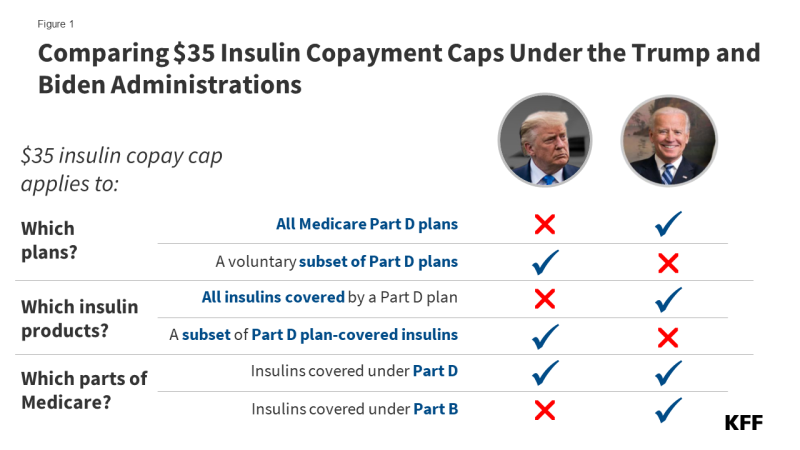
There are three key differences between these approaches (Figure 1):

This text chart is Comparing $35 Insulin Copayment Caps Under the Trump and Biden Administrations
  • Applies to all Part D plans? The Trump Administration’s model relied on voluntary Part D plan participation, while the Biden Administration copay cap applies under all Part D plans. In 2022, a total of 2,159 Part D plans participated in the Trump Administration’s model, including both stand-alone prescription drug plans and Medicare Advantage drug plans, which is 38% of all Part D plans that year. Under the Inflation Reduction Act, the $35 copay cap is available in all 6,000 Part D plans available in 2024.
  • Applies to all covered insulins in Part D? Under the Trump Administration’s model, participating plans were not required to cover all insulin products at the $35 monthly copayment amount, just one of each dosage form (vial, pen) and insulin type (rapid-acting, short-acting, intermediate-acting, and long-acting). Under the Biden Administration, the $35 copay cap in Part D extends to all insulin products that a Part D plan covers.
  • Part D and Part B? The Trump Administration’s model applied only to insulin covered under Part D. The Biden Administration copay cap applies to insulins covered under both Part D and Part B.

While Trump claimed that he extended lower insulin pricing to “millions of Americans,” CMS estimates that around 800,000 insulin users had access to $35 insulin copays under the Part D Senior Savings Model in 2022. In contrast, the $35 copay cap under President Biden’s Inflation Reduction Act provision is available to all insulin users enrolled in all Medicare Part D plans – an estimated 3.3 million in 2020, based on KFF estimates – as well as those who take insulins covered under Part B.

The Trump Administration’s $35 insulin copay model had a more limited reach than the insulin copay cap now in place under the Inflation Reduction Act that President Biden signed into law, because the model was voluntary and because Part D plans could select which of their covered insulin products they wanted to make available at the $35 monthly copay. Under the insulin copay cap that took effect under the Inflation Reduction Act, insulin users in all Part D plans pay no more than $35 per month for any insulin product covered by their Part D plan.

What the November election could mean for people who need insulin

President Biden has proposed to extend the $35 monthly cap on insulin out-of-pocket costs to people with commercial insurance. The Biden Administration and Senate Democrats included a similar provision in the Inflation Reduction Act, but that provision was stripped from the final legislation after the vast majority of Republicans voted to remove it. According to KFF analysis, more than 1 in 4 insulin users in the individual and small group markets and about 1 in 5 insulin users with large employer coverage paid, on average, more than $35 per month out-of-pocket for insulin in 2018.

The House Republican Study Committee proposed a full repeal of the Inflation Reduction Act in its FY2025 budget proposal. While it is unclear whether Trump supports repealing this law in its entirety, doing so would eliminate the $35 insulin copay cap for millions of insulin users with Medicare and leave in its place only voluntary efforts offered by the three major insulin manufacturers, which apply to many people irrespective of their health coverage.

News Release

Costly GLP-1 Drugs are Rarely Covered for Weight Loss by Marketplace Plans

For Drugs Used to Treat Diabetes, Plans Almost Always Require Prior Authorization or Other Utilization Management

Published: Jun 12, 2024

Affordable Care Act (ACA) Marketplace plans rarely cover GLP-1 drugs approved solely for obesity treatment, according to a new KFF analysis of 2024 federal plan data. Wegovy, a drug that is approved for weight loss, is covered by just 1% of Marketplace prescription drug plans, compared to 82% of Marketplace prescription drug plans for Ozempic, which contains the same active ingredient as Wegovy (semaglutide) but is approved only for diabetes.

When GLP-1 drugs are covered for diabetes treatment, almost all plans use at least one utilization management strategy to control costs, such as prior authorization or quantity limits. Of the few Marketplace plans that cover GLP-1 drugs approved for obesity, all require prior authorization.

Utilization management tools are intended to balance cost control and access but may still pose barriers for people with a medical necessity to take these drugs. While insurers receive rebates to offset some of their costs, the list prices of GLP-1 drugs are about $1,000 per month, and growing demand for these medications could put upward pressure on premiums.

This analysis examines publicly available formularies of plans available on the federally facilitated ACA Marketplaces in 2024 and does not include states that run their own Marketplaces, where coverage patterns may differ. The ACA Marketplaces represent a small share of people with private health insurance, as most people with private coverage have plans sponsored by their employers. While information on employer plan formularies is not publicly available, these plans may be more likely to cover drugs for weight loss than ACA Marketplace plans given the desire to attract workers, though they may employ similar utilization management strategies.

Insurer Strategies to Control Costs Associated with Weight Loss Drugs

Authors: Justin Lo and Cynthia Cox
Published: Jun 12, 2024

Affordable Care Act (ACA) Marketplace plans rarely cover GLP-1 drugs approved solely for obesity treatment, according to a an analysis of 2024 federal plan data. Wegovy, a drug that is approved for weight loss, is covered by just 1% of Marketplace prescription drug plans, compared to 82% of Marketplace prescription drug plans for Ozempic, which contains the same active ingredient as Wegovy (semaglutide) but is approved only for diabetes.

This analysis examines publicly available formularies of plans available on the federally facilitated ACA Marketplaces in 2024 and does not include states that run their own Marketplaces, where coverage patterns may differ. The ACA Marketplaces represent a small share of people with private health insurance, as most people with private coverage have plans sponsored by their employers.

The full chart collection and other data on health costs are available on the Peterson-KFF Health System Tracker, an online information hub dedicated to monitoring and assessing the performance of the U.S. health system.

News Release

Walgreens and KFF’s Greater Than HIV Join with Community Partners to Offer Free HIV and STD Testing at Record Number of Stores on June 27

The Collaboration Is The Largest National HIV Testing Day Event in the Nation

Published: Jun 11, 2024

DEERFIELD, Ill. & SAN FRANCISCO, June 11, 2024 – Walgreens and Greater Than HIV, a public information initiative of KFF, are teaming up with health departments and community organizations to offer free rapid HIV testing in more than 550 Walgreens stores on June 27 in the largest coordinated National HIV Testing Day event.

Additionally, to address the rising rates of other sexually transmitted diseases (STDs), free rapid syphilis and/or hepatitis C testing will also be offered by partners this year in many locations.

“This unique public-private partnership brings free rapid HIV and STD testing directly to communities in a familiar setting and connects individuals to trusted local prevention and treatment service providers in their area,” said Tina Hoff, senior vice president, KFF.

A list of participating Walgreens stores and hours when free HIV and STD testing will be offered is available here; no appointment needed. Testing is provided by local partners, in a private area of the store or mobile unit, with results available in 20 minutes or less. Counselors can also answer questions about HIV and STDs and provide the latest on prevention and treatment options, including referrals for PrEP (pre-exposure prophylaxis), FDA-approved medications that are highly effective in preventing HIV, and other needed care.

“This program is instrumental in reaching people in community settings, making HIV prevention and treatment options more equitable, accessible and convenient,” said Rick Gates, chief pharmacy officer, Walgreens. “In addition to providing services to help prevent and treat HIV for more than 40 years, Walgreens invests in training its pharmacy team members to address the specific challenges faced by people living with HIV – including confidential medication counseling, information on prevention options and how to apply for financial assistance programs.”

Major HIV rapid test manufacturers including Abbott Laboratories, BioLytical Laboratories, ChemBio Diagnostics, and OraSure Technologies donated tests to support this year’s effort. Additionally, ChemBio Diagnostics and Diagnostics Direct donated rapid syphilis tests.

Since 2011, KFF’s Greater Than HIV and Walgreens National HIV Community Partnership has provided more than 82,000 free HIV tests through the in-store NHTD program, including over 15,000 self-tests distributed during the height of the COVID-19 pandemic. This is the 14th year of the partnership and marks the highest level of participation – both in terms of testing partners and stores – in the program’s history.

About Walgreens

Walgreens (www.walgreens.com) is included in the U.S. Retail Pharmacy and U.S. Healthcare segments of Walgreens Boots Alliance, Inc. (Nasdaq: WBA), an integrated healthcare, pharmacy and retail leader. True to its purpose of “more joyful lives through better health,” Walgreens has a more than 120-year heritage of caring for communities and providing trusted pharmacy services, and today is playing a greater role as an independent partner of choice offering healthcare services that improve care, lower costs, and help patients. Operating nearly 9,000 retail locations across the U.S. and Puerto Rico, Walgreens is proud to serve nearly 9 million customers and patients daily. The company’s pharmacists are playing a more critical role in healthcare than ever before, providing a wide range of pharmacy and healthcare services, including those that drive equitable access to care for some of the nation’s most underserved populations. Walgreens offers customers and patients a true omnichannel experience, with fully integrated physical and digital platforms designed to deliver high-quality products and healthcare services. Within the U.S. Healthcare segment, Walgreens portfolio also includes businesses in primary care, multi-specialty, post-acute care, urgent care, specialty pharmacy services, population health and provider enablement.

About KFFKFF is the independent source for health policy research, polling, and journalism. Its mission is to serve as a nonpartisan source of information for policymakers, the media, the health policy community, and the public.  

KFF’s Greater Than HIV initiative is a leading public information response focused on HIV in the U.S. Through localized Greater Than HIV campaigns, KFF works with health departments and community partners to reach those most affected and in need with the latest on testing, prevention and treatment. This public-private partnership model helps extend the reach of limited resources in high need areas.

A Review of Exceptions in State Abortion Bans: Implications for the Provision of Abortion Services

Authors: Mabel Felix, Laurie Sobel, and Alina Salganicoff
Published: Jun 6, 2024

Note: Originally published in May 2023, this brief has been updated and expanded to address ongoing litigation in many states that is underway to challenge exceptions laws.

Key Takeaways

Abortion is currently banned in 14 states and many other states have attempted to ban or severely restrict access to abortion. All of these bans have an exception to prevent the death of the pregnant person and some bans include other exceptions that fall into three categories: when there is risk to the health of the pregnant person, when the pregnancy is the result of rape or incest, and when there is a lethal fetal anomaly.

  • In practice, health and life exceptions to bans have often proven to be unworkable, except in the most extreme circumstances, and have sometimes prevented physicians from practicing evidence-based medicine.
  • Abortion bans and restrictions have led physicians to delay providing miscarriage management care. Many states allow for the removal of a dead fetus or embryo, but pregnant people who are actively miscarrying may be denied care if there is still detectable fetal cardiac activity or until the miscarriage puts the life of the pregnant person in jeopardy.
  • Mental health exceptions are rare despite the fact that 20% of pregnancy-related deaths are attributable to mental health conditions.
  • Law enforcement involvement is often required to document rape and incest, which often prevents survivors from accessing abortion care. Furthermore, survivors in states where abortion care is restricted can have difficulty finding an abortion provider.
  • In many states there is more than one abortion ban in the books, and in some of those states, the exception provisions in the bans are often at odds with each other. These multiple bans and varying exceptions create confusion among patients and providers.

Introduction

Since the Supreme Court’s Dobbs decision overturned Roe v. Wade, state abortion bans and the exceptions they contain – or lack – have garnered significant attention. The Supreme Court is considering a case this term about whether the Emergency Medical Treatment and Active Labor Act (EMTALA), a federal law requiring hospitals to provide stabilizing treatment to patients who present to their emergency rooms, preempts state abortion laws and requires hospitals to provide abortion care when it is necessary to stabilize a patient, even when the abortion does not qualify foris not including in an exception to the state’s abortion ban. Discussions about exceptions to state abortion bans often obscure the reality that many of these exceptions can be unworkable in practice. There are reports of people being unable to obtain abortions, despite the fact that their pregnancies fall into these broad exception categories. While there is no accurate estimate of the number of people seeking abortion care in circumstances that qualify for an exception in states than ban abortion, the number of people who have received abortion care post-Dobbs in states that have banned abortion is very low.  Many of the exceptions included in these bans use definitions that are vague, narrow, and non-clinical, and effectively remove the ability of health care providers to best manage the care of pregnant people, instead leaving that decision to the state or the clinician’s home institution. Further complicating matters, several states have multiple bans in effect, often with contradicting definitions, requirements, exceptions, and standards, creating ambiguity for clinicians and their patients. This brief analyzes the exceptions to abortion bans and discusses how their purported aims to provide life-saving care may not be achieved in practice.

What kinds of exceptions do abortion bans contain?

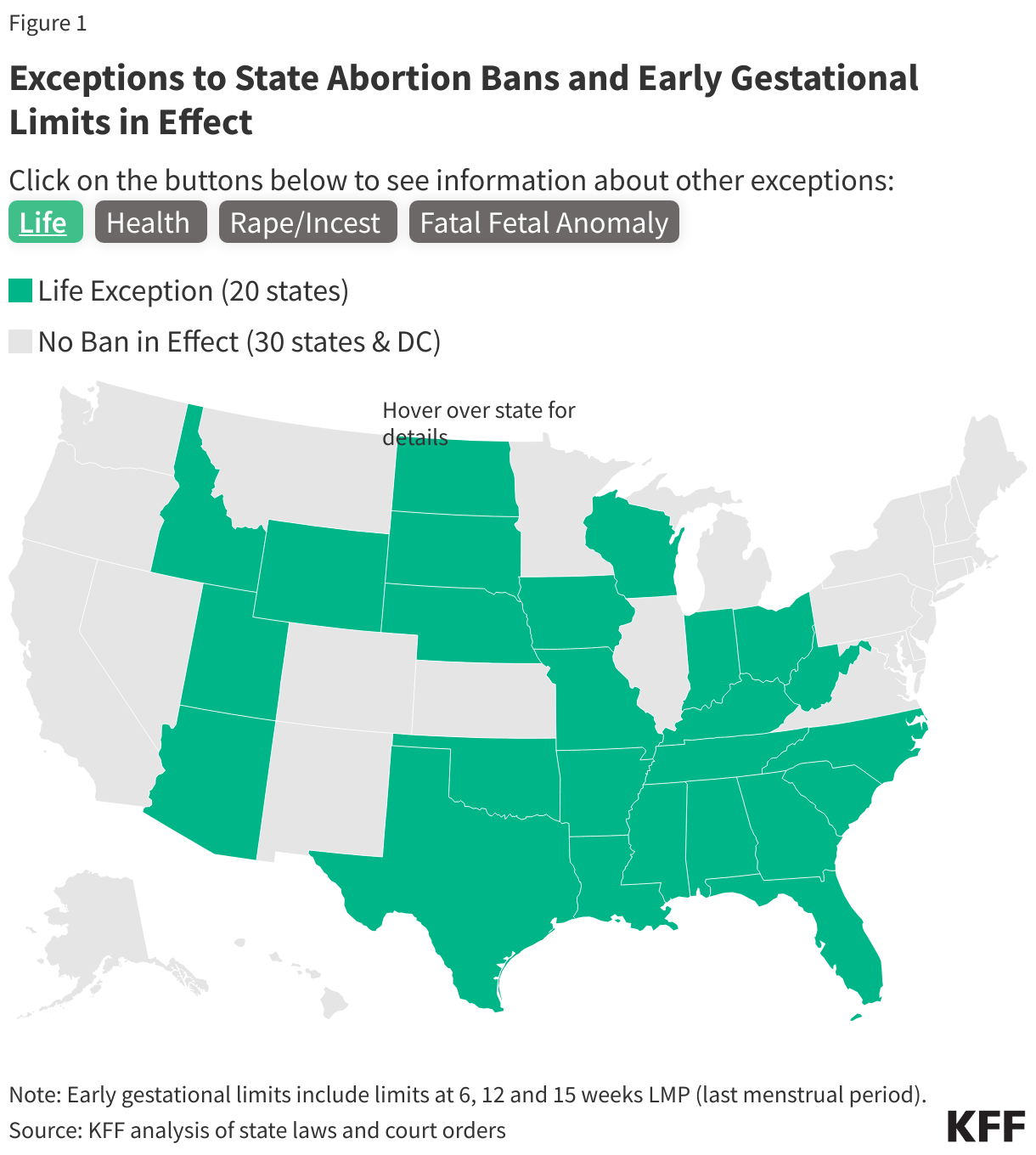
Exceptions to state abortion bans generally fall into four general categories: to prevent the death of the pregnant person, to preserve the health of the pregnant person, when the pregnancy is the result of rape or incest, and when the embryo or fetus has lethal anomalies incompatible with life.

States with Abortion Bans and Restrictions with Exceptions for Life

To prevent the death of the pregnant person

All state abortion bans currently in effect contain exceptions to “prevent the death” or “preserve the life” of the pregnant person. As explained in further detail in the section below, these exceptions may create difficulties for physicians, as it is unclear how much risk of death or how close to death a pregnant patient may need to be for the exception to apply and the determination is not up to the physician treating the pregnant patient.

When there is risk to the health of the pregnant person

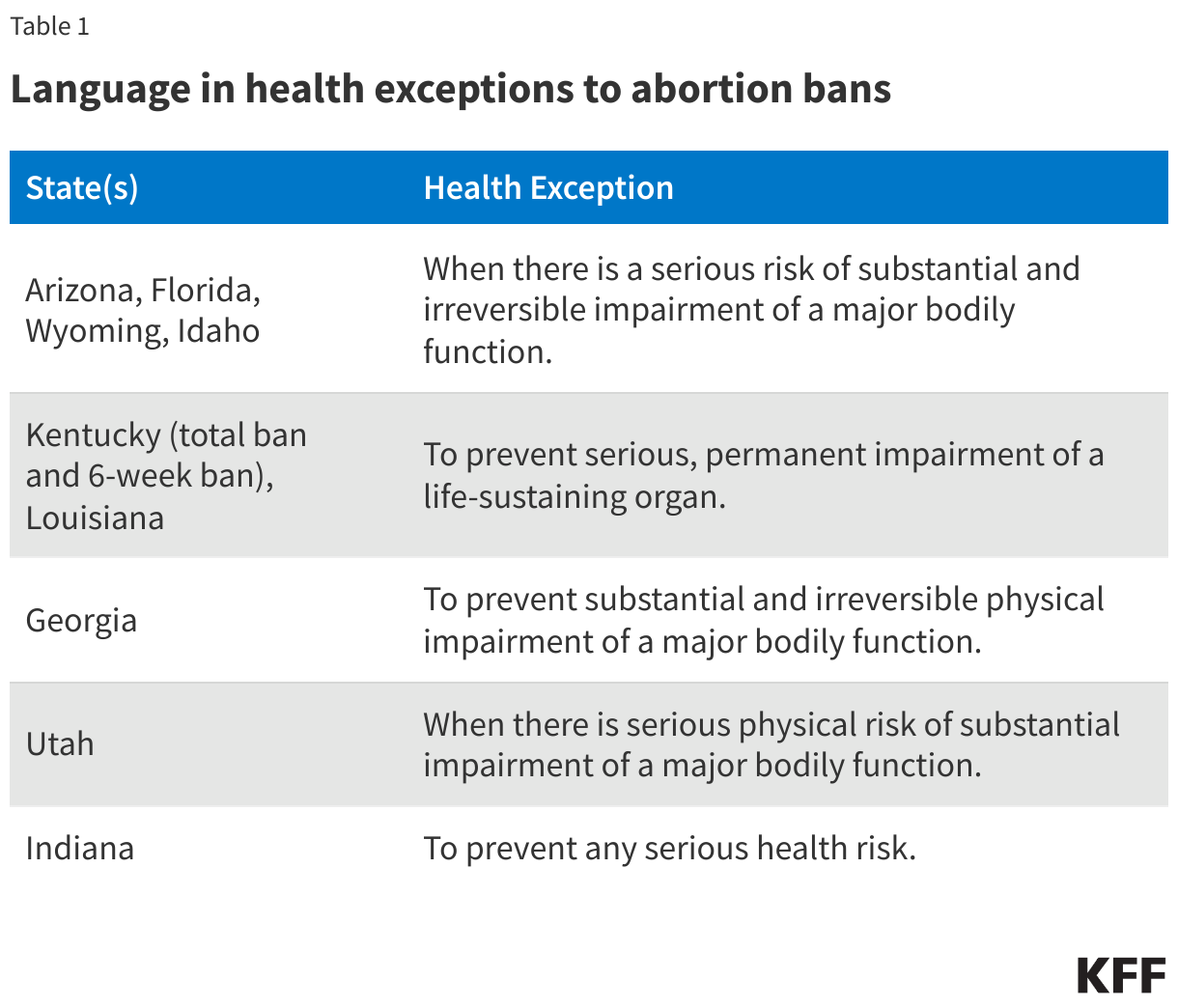
Many state bans currently in effect – with the exception of bans in Arkansas, Idaho, Mississippi, Oklahoma, South Dakotan, and Texas – contain some form of health exception. Exceptions to preserve the health of the pregnant person can vary (sometimes significantly) from state to state (Table 1).

Language in health exceptions to abortion bans

Most states with bans that contain a health exception permit abortion care when there is a serious risk of substantial and irreversible impairment of a major bodily function. These exceptions are limited by the lack of specific clinical definitions of the conditions qualifying for the exception. Only the Arizona 15-week LMP (last menstrual period) limit explicitly defines the bodily functions that may be considered “major.”  The other states that use this language in their bans do not define what constitutes a “major bodily function,” nor what constitutes a “substantial impairment” to a major bodily function. This vague language puts physicians providing care to pregnant people in a difficult situation should their patients need an abortion to treat a condition jeopardizing their health and can leave the determination of whether an abortion can be legally provided to lawyers for the institution in which the clinician practices. For instance, in South Carolina where the 6-week LMP abortion limit has a health exception, the law lists a couple of conditions that may fall under this exception, such as severe pre-eclampsia and uterine rupture, but with no further detail. Using this language as guidance, it would be difficult for physicians to know if a significant health issue would fall under the exception. The difficulties presented by the simultaneous vagueness and narrowness of the exceptions are exacerbated by the lack of deference given to clinicians’ medical judgment under these bans.

However, even if the terms in the exceptions were defined more clearly, they would still exclude many health conditions pregnant people face. In Georgia, for example, providers challenging the ban note that the exceptions do not permit abortion care when it is needed to prevent: “(1) substantial but reversible physical impairment of a major bodily function, (2) less than ‘substantial’ but irreversible physical impairment of a major bodily function, or (3) substantial and irreversible physical impairment of a bodily function that is not ‘major.’” A medical condition may still be a significant health event, yet not qualify under the exceptions, even if their limits were more clearly defined.

MENTAL HEALTH

Mental health conditions account for over 20% of pregnancy-related deaths in the US, yet almost all states with health exceptions limit them to conditions affecting physical health, with some going further and explicitly precluding emotional or psychological health conditions. Alabama, the only state that includes mental health concerns in its health exception, requires a psychiatrist to diagnose the pregnant person with a “serious mental illness” and document it is likely the person will engage in behavior that could result in their death or the death of the fetus that due to their mental health condition. The law does not define “serious mental illness” and does not allow physicians to determine what serious mental illnesses qualify for the exception. In addition, abortion bans and restrictions in Georgia, Florida, Idaho, Iowa, Kentucky, Louisiana, Nebraska, North Carolina, North Dakota, South Carolina, Tennessee, West Virginia, and Wyoming explicitly exclude mental/emotional health. Several other states (Texas, Oklahoma, Mississippi, the remaining Kentucky ban, and one of Arkansas' total bans) limit their life and/or health exceptions to physical conditions, without explicitly calling out mental/emotional health exceptions.

ECTOPIC PREGNANCIES AND MISCARRIAGES

Some states’ abortion laws specify that care for ectopic pregnancies and pregnancy loss is not criminalized in its statutes. Most states with these provisions in their bans allow for the removal of a dead fetus or embryo, but not for miscarriage care, generally. This means that pregnant people who are actively miscarrying may be denied care if there is still detectable fetal cardiac activity. There have already been reports of such situations in Texas and Louisiana. In Louisiana, for example, a pregnant woman went to the hospital after experiencing sharp pain and bleeding. She was informed her fetus had likely stopped growing a few weeks prior, as its size did not correspond to the length of her pregnancy, and that it had very faint cardiac activity. Despite the pain and the blood loss she was experiencing, she could not receive the regimen of mifepristone and misoprostol commonly prescribed to pregnant patients who are miscarrying to ensure that the pregnancy is safely expelled from the body completely in a timely manner, thereby decreasing the risk of sepsis and infection. Instead, she had to wait for the miscarriage to progress without medical intervention, which would have expedited the process and reduced her medical risk. In states where the abortion bans do not clarify that miscarriage care is not criminalized – even when there is still detectable cardiac activity – pregnant people may not be able to receive care to manage their pregnancy loss unless and until it becomes a medical emergency.

GREATER RISK TO THE HEALTH OF PREGNANT PEOPLE

In deciding whether or not to provide abortion care to preserve the health of a pregnant patient, physicians now face the risk of a jury or the state disagreeing with their judgment about the gravity of the health risk the pregnant person was experiencing, and as a result, face prison time, monetary fines, and loss of professional license. Before the Supreme Court’s decision in Dobbs, the decision to have an abortion pre-viability when facing a health risk was made by the pregnant person in consultation with medical professionals in consideration of the needs and overall health history of the pregnant patient. In states with abortion bans, when deciding whether or not to provide abortion care to preserve the health of a pregnant patient, physicians now face the risk of prosecution, prison time, monetary fines, and loss of professional license.

In state court challenges against the bans, providers have argued that the vagueness of the bans is unconstitutional, since it places them in a situation where it is unclear how they might follow the law. As a result, physicians may be more reluctant to provide abortion care when pregnant patients present with serious medical conditions and may deny abortion care to pregnant people with conditions that threaten their health until their condition deteriorates and the narrow exceptions inarguably apply. This delay in care, however, creates greater and avoidable risks to the health of the pregnant person. Additionally, many conditions that threaten the health of pregnant people are not included in all or most health exceptions.

The difficulties these bans and their unclear exceptions create may additionally deter physicians from practicing medicine in states that ban abortion. There have already been reports of physicians expressing reluctance or refusing to relocate to these states, as well as physicians leaving these states due to their restrictive laws and fewer medical school graduates applying for residencies in these states. A substantial portion of these states’ residents already live in maternity deserts – areas where there are no obstetric providers or birth centers – and studies have shown that maternal mortality rates are higher in states that restrict abortion. Physicians being deterred from practicing in states with restrictive abortion laws may exacerbate these disparities in access to obstetric care and health outcomes.

Zurawski v. State of Texas

Five women who were denied abortion care in Texas ­- despite facing dangerous pregnancy complications - and two OB-GYNs filed a lawsuit in Texas state court asking the court to clarify the scope of the medical emergency exceptions in the state’s three abortion bans. Plaintiffs specifically asked the court to clarify that:

  • Physician judgment should be granted deference in measuring the risk the pregnant person is facing,
  • Impairment of a “major bodily function” includes harm to fertility and the reproductive system,
  • Acute risk does not have to be already present or imminent for the exceptions to apply, and
  • Health exceptions apply in situations where treatment for a condition is unsafe during pregnancy and for fetal conditions and diagnoses that can increase the risk to a pregnant person’s health.

Plaintiffs argued the misapplication of the health exceptions violates state constitutional guarantees to fundamental and equal rights. In August 2023, a County District Court judge issued an order blocking enforcement of Texas’ ban in situations where, in a physician’s good faith judgment, an abortion is needed due to an emergent medical situation. An appeal from the state to the Texas Supreme Court automatically blocked the lower court’s order. On May 31, 2024, the Texas Supreme Court issued its decision in this case, stating that the state’s abortion ban only contains exceptions when, in a physician’s reasonable medical judgment, there is a life-threatening physical condition.

THE EMERGENCY MEDICAL TREATMENT AND ACTIVE LABOR ACT (EMTALA)

Enacted in 1986, the Emergency Medical Treatment and Active Labor Act (EMTALA) requires Medicare-enrolled hospitals to perform an appropriate medical screening examination to any patient who presents to their dedicated emergency department. If a patient is identified as having an emergency medical condition, the hospital must provide stabilizing treatment within the hospital’s capability or transfer the patient to another medical facility.

As states were starting to implement abortion bans after the Dobbs decision, in July 2022, the Department of Health and Human Services (HHS) issued guidance regarding the enforcement of EMTALA that clarifies hospitals and physicians have obligations to provide stabilizing care, including abortion in medically appropriate circumstances, when a patient presenting at an emergency department is experiencing an emergency medical condition.

After HHS issued this guidance, two lawsuits were filed. HHS sued the State of Idaho to block enforcement of Idaho’s abortion ban to the extent it conflicts with EMTALA, and the State of Texas sued to block enforcement of the HHS guidance in Texas. The Supreme Court is considering the case from Idaho and a decision is pending.

At stake in this case is whether EMTALA preempts state abortion laws and requires hospitals to provide abortion care when it is necessary to stabilize a patient’s condition, even when this abortion care violates state law. While all state abortion bans have an exception for pregnancies that jeopardize the life of a pregnant person, some do not have an exception that would allow an abortion to preserve the health of the pregnant person. Even in states with health exceptions, the exception might be very narrow and not well defined, leaving significant gaps in emergency medical care for pregnant people. EMTALA, however, requires hospitals to provide stabilizing care to patients with emergency medical conditions, including conditions that may harm their health. According to the HHS guidance issued in the wake of the Dobbs decision, EMTALA requires hospitals to provide abortion care to pregnant patients with emergency medical conditions when abortion is necessary to stabilize the patient’s condition. However, Idaho contends that EMTALA does not require hospitals to provide treatment that violates state law. The Court’s decision in this case could impact access to abortion in emergency situations across the country and potentially lay the foundation for future challenges involving state laws granting fetal personhood.

Exception vs. Affirmative Defense

Some state abortion bans lack exceptions but identify situations that may be used as an affirmative defense in court – among these are Tennessee's 6-week LMP ban, Kentucky’s 15-week ban (but not the state’s earlier gestational bans), Texas' total bans, and all of Missouri’s bans.  An “affirmative defense” allows someone charged with a crime to show in court that their conduct was permissible even though the action itself is illegal. An affirmative defense does not make it legal to provide abortion care in the situations delineated in the law and means that a clinician who provided abortion care is open to prosecution – regardless of the reason they provided an abortion – and would bear the burden of proof to demonstrate that they provided care according to the conditions delineated as possible affirmative defenses in the abortion ban. Bans that rely on an affirmative defense leave physicians more vulnerable to criminal prosecution and they make it even riskier for physicians to provide abortion care in situations where the life or health of the pregnant person is at risk.

Sexual Assault Exceptions

A few of the state abortion bans contain exceptions for pregnancies resulting from rape or incest, generally requiring that the sexual assault be reported to law enforcement. Some states allow for a Child Protective Services (CPS) report in lieu of a law enforcement report for minors who are survivors of sexual assault or incest.

It is well documented that survivors are often afraid to report sexual violence to the police due to fear of retaliation and the belief that law enforcement would not or could not do anything to help. It is estimated that only 21% of sexual assaults are reported to law enforcement. Even for survivors who do report to law enforcement, state abortion bans do not make clear exactly what information needs to be given to a provider to make it clear that the abortion would be legal in that state. Reporting requirements place barriers in the way of survivors seeking abortion care in these states.

Among the few sexual assault exceptions, some have specific gestational limits. For instance, the total ban currently in effect in West Virginia contains an exception for cases of rape or incest, but it is limited to 8 weeks from the last menstrual period (LMP) for adults and 14 weeks LMP for minors.

Although sexual assault exceptions are intended to protect survivors, experts agree that they rarely work. There is anecdotal evidence of survivors in states with rape exceptions and who have compiled the necessary documentation, but still not being able to access abortion because they couldn’t find any abortion providers in their state.

Hyde Amendment

The Hyde Amendment is a policy that restricts the use of federal funds to cover abortion, except in cases of rape or incest, or when the life of the pregnant person is endangered (Hyde Exceptions). The policy is not a permanent law, but rather has been attached as a temporary “rider” to the Congressional appropriations bill for the Department of Health and Human Services (HHS) and has been renewed annually by Congress. In the past, federal courts have interpreted the Hyde provisions to require states to pay for abortions that fall into the Hyde Exceptions and have blocked enforcement of state statutes that prohibit coverage for these cases. However, the enforceability of these requirements has been unclear since the Supreme Court’s decision in Dobbs. Although all bans currently in effect contain exceptions to safeguard the life of the pregnant person, most states with abortion bans do not have exceptions for cases of rape or incest, and therefore, would not allow for the provision or coverage of those services to Medicaid recipients, contrary to previous court orders. To date, no court or federal agency has issued orders or guidance on states’ obligation to provide coverage for Hyde Exceptions when their bans prohibit the provision of abortion in cases of rape or incest.

Lethal Fetal Anomaly Exceptions

Bans in several states contain exceptions for lethal fetal anomalies, usually limited to those anomalies that would result in the death of the baby at birth or soon after. As with health exceptions, lethal fetal anomaly exceptions are poorly defined and limited in statutes. The only state with this kind of exception that has a comprehensive list of conditions that fall under this category is Louisiana, but since the state has multiple abortion bans in effect (one of which does not include exceptions for fatal fetal anomalies), the applicability of this exception is still unclear. Other states, like Indiana, provide some general criteria, such as how long after birth the baby can be expected to live for a pregnancy to fall under the fetal anomaly. Any condition that would result in a life expectancy shorter than three months fits under the exception. The religious freedom lawsuit against the state’s ban – Anonymous Plaintiffs v. Medical Licensing Board of Indiana -- specifically challenges the narrow limits of the exception, arguing that other common conditions, such as Tay-Sachs disease would result in the death very early in childhood.

What happens in states with more than one abortion ban in effect?

In many states there is more than one abortion ban in the books, and in some of those states, the exception provisions in the bans are at odds with each other. In Louisiana, two bans and a 15-week LMP limit are in effect, but only one of the total bans and the 15-week limit have the same exceptions; the remaining total ban does not. One of the total criminal bans in the state has exceptions to prevent the death or substantial risk of death, of the pregnant person and to prevent “serious, permanent impairment of a life-sustaining organ”. The state’s other total ban and the 15-week limit have exceptions for these same cases and additionally in cases of fatal fetal anomalies, and clarify that the bans’ prohibitions do not apply for ectopic pregnancies and miscarriages. The conflicting exceptions in the bans result in a situation where the only real exceptions in the state are for cases where an abortion is necessary to prevent the death of the pregnant person or to prevent serious, permanent impairment of a life-sustaining organ. Providing abortion care under any other exception in the states’ other total ban or 15-week limit would open physicians to criminal penalties and loss of license.

Mississippi is another state with multiple bans in effect that contain contradicting exceptions. The state’s total ban only has exceptions for cases when an abortion is necessary to preserve the life of the pregnant person or when the pregnancy was caused by rape (there is no exception for incest in the state). However, the state’s 15-week LMP ban contains exceptions for fatal fetal abnormalities and serious risk of substantial and irreversible impairment of a major bodily function, along with a life exception. In situations where there is more than one ban in effect, it might seem that the easiest way to follow the law would be to adhere to the abortion ban with the strictest gestational limit. This would not suffice in Mississippi, however, since the total ban contains an exception for pregnancies caused by rape, but the state’s 15-week LMP ban does not contain such an exception. Therefore, following any one of the state’s abortion bans would not remove the legal risk of providing abortion care in the state. Instead, providers must assess how the abortion bans and their exceptions work in conjunction.

Conclusion

Although a lot of attention has been devoted to debates about exceptions in abortion bans, many of these exceptions are not workable in practice. Outside of testimony from providers, it is difficult to assess how many people who qualify for abortion care under the exceptions are actually able to do so, since states underreport or do not report this information. However, it is apparent these bans create barriers to accessing abortion care, even in situations where the exceptions they outline should apply. Most importantly, these bans place the health and lives of pregnant people at risk by potentially preventing physicians from providing medically appropriate care. The Supreme Court’s decision in Idaho v. United States will determine whether EMTALA preempts state laws and requires hospitals to provide abortion care to stabilize pregnant patients when “necessary to assure that no material deterioration of the condition is likely to occur.” If the Court rules in favor of Idaho, the inability to provide evidence-based care may additionally make physicians reluctant to practice medicine in restrictive states, amplifying already-existing discrepancies in ability to access obstetric care and adverse maternal and fetal outcomes.

Abortion Bans and Exceptions

How ACA Marketplace Premiums Changed by County in 2024

Authors: Jared Ortaliza, Justin Lo, Matt McGough, and Cynthia Cox
Published: Jun 6, 2024

Premiums for ACA Marketplace benchmark silver plans grew by about 5% in 2024, on average before taking into account subsidies. Meanwhile, premiums for the lowest cost unsubsidized bronze plans grew by about 6%, on average, in 2024.

Change in the Average Premium by Metal Level Before Tax Credit, 2023-2024 for a 40-year-old

However, premium changes vary by location and by metal level, with premiums decreasing in some cases. As most enrollees receive premium subsidies on the ACA Marketplaces, the net premium amount an exchange enrollee pays depends on their income and the difference in the cost between the benchmark plan (second-lowest-cost silver plan) and the premium for the plan they choose.

The map below illustrates changes in premiums for the lowest-cost bronze, silver, and gold plans by county, with and without subsidies. For data at the state-level, see our Health Insurance Marketplace tables.

2024 ACA Premium and Subsidy Changes

In 2024, 9 in 10 marketplace enrollees received premium tax credit subsidies and therefore will not necessarily pay a higher premium, even if the unsubsidized premiums in their county are rising. To account for premium increases, federal spending to finance subsidies will also increase. With the enhanced financial assistance for ACA Marketplace coverage provided by the Inflation Reduction Act, subsidized enrollees with incomes at or below 150% of poverty ($21,870 for an individual and $45,000 for a family of 4) can get a free ($0 premium) or nearly free silver plan with a very low deductible if they sign up for the lowest or second-lowest cost silver plan. Relative to the original ACA subsidies, the Inflation Reduction Act also reduced payments for middle-income enrollees and removed the upper income limit on subsidy eligibility.

Methods

We analyzed Marketplace premium data for 2023 and 2024 to determine lowest-cost premiums by metal level and benchmark premiums, as well as calculate tax credits and net premiums after tax credits for the scenarios presented. Federal Marketplace files are available through HealthCare.gov. Premiums for state-based marketplaces are from a review of insurer rate filings, state plan finders, or data provided directly by state exchanges or insurance departments. Premiums for California and Massachusetts were collected at the zip code level; premiums for Colorado, Connecticut, Maine, Minnesota, New Jersey, Nevada, New York, Virginia and Washington were collected at the county level; and premiums for Maryland and Pennsylvania were collected at the county or zip level depending on whether premiums are uniform throughout the county. For the remaining states running their own exchanges, premiums presented in this analysis were collected at the rating area level.

Because ACA subsidies only cover the “essential health benefits” (EHB) portion of the premium, enrollees with incomes between 100% to 150% of poverty may have to pay a nominal amount (e.g., $1 per month) for health coverage in counties where the lowest-cost silver plan and the second-lowest-cost silver plan include non-EHB benefits (for example, dental or vision coverage for adults or non-Hyde abortion coverage). In this analysis, we do not adjust for the non-EHB portion of premiums because that is not possible in all states with available data. Therefore, net premiums after subsidies may differ in some counties.

Calculation of the 2024 national average premium by metal level was weighted by county using 2023 plan selections obtained from the 2023 Marketplace Open Enrollment Period (OEP) County-Level Public Use File provided by CMS. In states running their own exchanges, we gathered county-level plan selection data where possible or we estimated county-level plan selections by determining the share of plan selections by county for a given state in a prior year and applying this to the total state plan selection value from the CMS 2023 OEP State-Level Public Use File.