The House Committee on Appropriations approved the FY 2026 National Security, Department of State, and Related Programs (NSRP) appropriations bill and accompanying report on July 23, 2025. The NSRP bill includes funding for U.S. global health programs at the State Department through the Global Health Programs (GHP) account, which represents the bulk of global health assistance. Global health funding in the bill totaled $9.5 billion, a decrease of $512 million (-5%) below the FY 2025 enacted level and $5.7 billion (151%) above President Trump’s FY 2026 request.[i] As compared to FY 2025 enacted levels, funding through the GHP account for the Global Fund to Fight AIDS, Tuberculosis and Malaria (Global Fund) and family planning and reproductive health (FP/RH) declined, while all other areas either remained flat or increased slightly; funding for global health security was not specified.[ii] The bill does not specify funding for the Health Reserve Fund, Global Health Workforce Initiative, or the Pan American Health Organization (PAHO), and explicitly prohibits funding for the United Nations Population Fund (UNFPA) and World Health Organization (WHO).[iii] The bill also eliminates funding for the International Organizations & Programs (IO&P) account, which has historically been the source of U.S. contributions to the United Nations Children’s Fund (UNICEF).[iv]
Policy provisions in the bill include:
- the Helms amendment, a standard provision that is regularly included in appropriations bills (see the KFF fact sheet here),
- an expanded Mexico City Policy (Protecting Life in Global Health Assistance) that was put in place by President Trump and rescinded by President Biden (see the KFF explainer here),
- a provision stating that support for multilateral organizations through the Contributions to International Organizations (CIO) account must comply with statutory prohibitions and requirements related to abortion, and
- a requirement that the Secretary of State submit a strategy detailing transition plans in PEPFAR-supported programs towards country-led efforts.
See the table below for additional details on global health funding (downloadable table here). See other budget summaries and the KFF budget tracker for details on historical annual appropriations for global health programs.
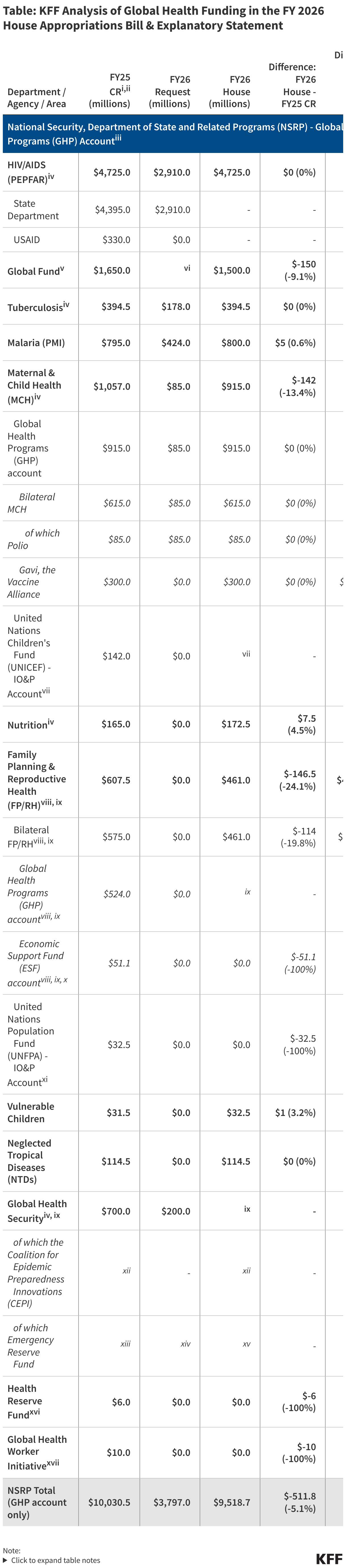
Table: KFF Analysis of Global Health Funding in the FY 2026 House Appropriations Bill & Explanatory Statement
<details><summary>Click to expand table notes</summary>i - Funding for FY25 was provided in a full-year Continuing Resolution (CR), which maintained FY24 levels. All FY25 amounts and associated notes are based on those specified in relevant FY24 appropriations bills.
ii - The FY24 final bill text for "State, Foreign Operations, and Related Programs" (SFOPs) states that up to $200 million of the funds appropriated by this Act through various accounts "may be made available to combat such infectious disease of public health emergency."
iii - Unless otherwise specified, funding amounts listed under the "National Security, Department of State and Related Programs - Global Health" heading are provided through the Global Health Programs (GHP) account.
iv - In previous fiscal years, some HIV, tuberculosis, MCH, nutrition, and global health security funding has been provided under the ESF and AEECA accounts, which is not earmarked by Congress in the annual appropriations bills and is determined at the agency level. Global health funding amounts from these accounts are not yet known for either FY24 or FY25. In addition, the FY26 Request and House bill propose to eliminate these accounts.
v - The explanatory statement accompanying the FY24 final bill states that this funding is “for the second installment of the seventh replenishment of the Global Fund to Fight AIDS, Tuberculosis, and Malaria, which is a reduction compared to the prior fiscal year as a result of other donor contributions.”
vi - The FY26 request does not include a specific funding amount for the Global Fund, but states that funding can be provided through either the GHP account or the newly created “America First Opportunity Fund” (A1OF) and that the amount provided cannot exceed 20% of total contributions during the 8th Replenishment for a total of $2.4 billion over the three year period.
vii - The FY26 request eliminated the International Organizations & Programs (IO&P) account. In prior fiscal years, funding for UNICEF and UNFPA was provided through the IO&P account. The FY26 House explanatory report accompanying the bill states that a contribution to UNICEF may be made using funding provided to the newly established National Security Investment Programs account.
viii - The FY24 final bill states that "not less than $575,000,000 should be made available for family planning/reproductive health." The FY26 House bill states that “of the funds appropriated by this Act, not more than $461,000,000 may be made available for family planning/reproductive health,” but does not indicate the accounts that may be used for this funding."
ix - The explanatory statement accompanying the House FY26 NSRP appropriations bill does not provide specific funding amounts for FPRH or GHS under the GHP account. After the funding amounts specified for all other areas (e.g., HIV, TB, MCH, etc.) are removed, $864.71 million remains under the GHP account, which is funding that could be used for FPRH and GHS (or other areas as determined by the Administration).
x - The FY26 Request and House bill both propose to eliminate the ESF account.
xi - The FY24 final bill states that if this funding is not provided to UNFPA it “shall be transferred to the ‘Global Health Programs’ account and shall be made available for family planning, maternal, and reproductive health activities.”
xii - The explanatory statement accompanying the FY24 final appropriations bill states that the agreement includes “up to $100,000,000 for a contribution to the Coalition for Epidemic Preparedness Innovations (CEPI).” The report accompanying the House FY26 bill states that the “Committee supports funding for the Coalition for Epidemic Preparedness Innovations, at levels consistent with prior fiscal years.”
xiii - The FY24 final bill states that “up to $70,000,000 of the funds made available under the heading ‘Global Health Programs’ may be made available for the Emergency Reserve Fund” without specifying whether this funding would come from GHS amounts or potentially other areas.
xiv - The FY26 Request states that funding from the GHP account may be provided to the “Emergency Reserve Fund” without specifying an amount.
xv - The FY26 House bill states that “up to $50,000,000 of the funds made available under the heading ‘Global Health Programs’ may be made available for the Emergency Reserve Fund” without specifying whether this funding would come from GHS amounts or potentially other areas.
xvi - The explanatory statement accompanying the FY24 final bill states that “of the funds made available for ‘Other Public Health Threats’ … the agreement includes up to $6,000,000 for the Health Reserve Fund.”
xvii - The explanatory statement accompanying the FY24 final bill states that “of the funds made available for ‘Other Public Health Threats’… the agreement includes not less than $10,000,000 to support the global health workforce.”</details>
[i] Funding for FY25 was provided in a full-year Continuing Resolution (CR), which maintained FY24 levels. All FY25 amounts and associated notes are based on those specified in relevant FY24 appropriations bills.
[ii] The report accompanying the House FY26 NSRP appropriations bill does not provide specific funding amounts for family planning and reproductive health (FP/RH) or global health security (GHS) under the GHP account. After the funding amounts specified for all other areas (e.g., HIV, TB, MCH, etc.) are removed, $864.71 million remains under the GHP account, which is funding that could be used for FP/RH and GHS (or other areas as determined by the Administration). Since the House FY26 bill text states that “of the funds appropriated by this Act, not more than $461,000,000 may be made available for family planning/reproductive health” without specifying an account, it is possible the Administration could fund all or a portion of this amount through the GHP account with the remainder directed to GHS (or other areas as determined by the Administration). If the Administration funds the full $461 million through the GHP account, this could represent a significant decrease to GHS funding; if the Administration funds the full $461 million through non-GHP accounts, this could represent an increase to GHS funding.
[iii] The report accompanying the House FY26 NSRP bill states that U.S. funding for PAHO is dependent on meeting specific requirements detailed in the report.
[iv] The report accompanying the House FY26 NSRP bill states that a contribution to UNICEF may be made using funding provided to the newly established National Security Investment Programs account.