KFF designs, conducts and analyzes original public opinion and survey research on Americans’ attitudes, knowledge, and experiences with the health care system to help amplify the public’s voice in major national debates.
The Average Marketplace Deductible Grew by About $1,000 Per Person in 2026, With More Enrollees Shifting to Higher-Deductible Plans as Enhanced Tax Credits Expired
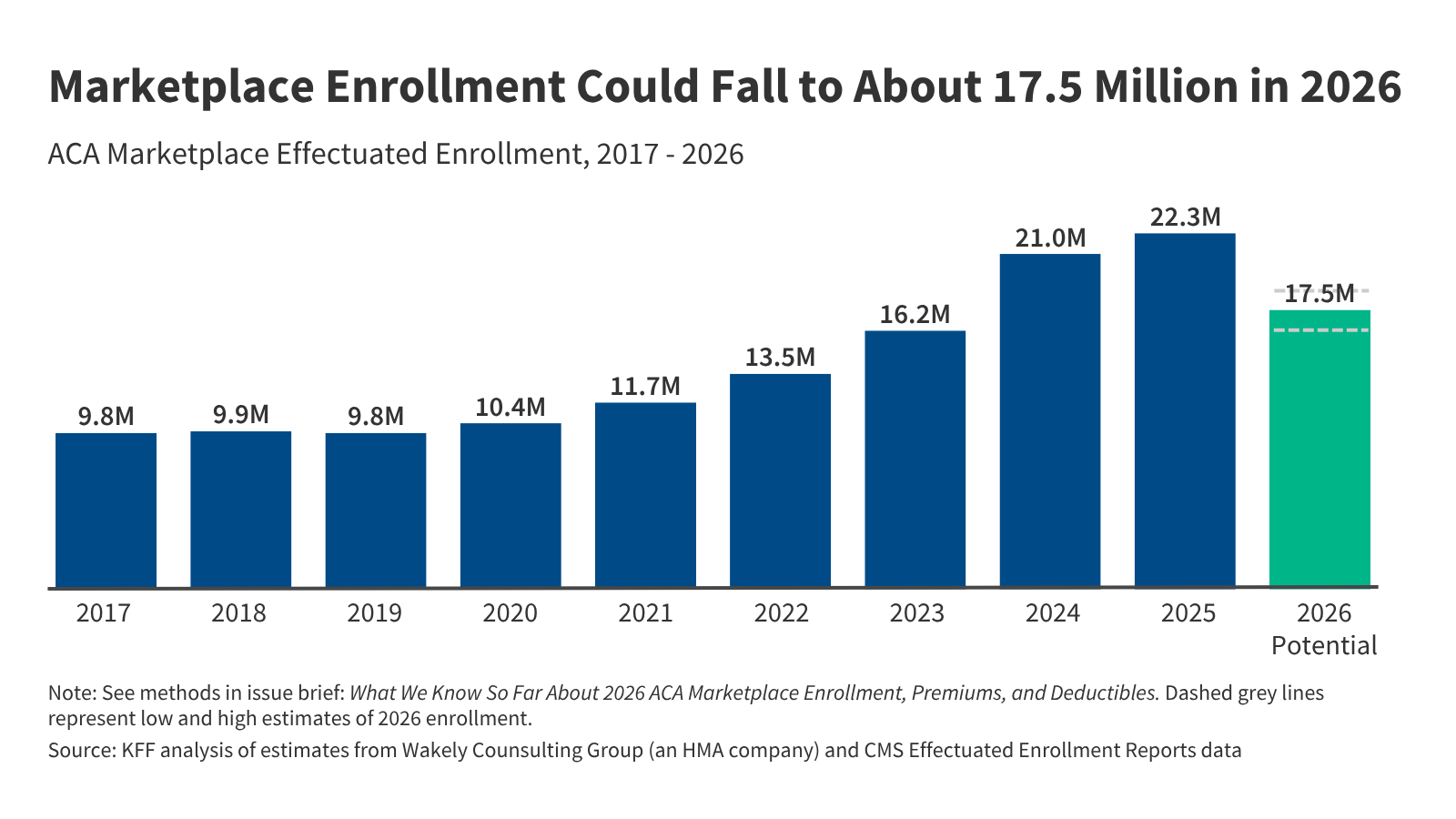
Marketplace Enrollment Could Fall to About 17.5 Million in 2026
The average Affordable Care Act (ACA) Marketplace deductible experienced the steepest increase in history—growing by 37% or over $1,000, from $2,759 in 2025 to $3,786 in 2026 as enhanced premium tax credits expired, according to a new KFF analysis.
After the enhanced tax credits ended, many Marketplace shoppers shifted toward lower-premium, higher-deductible plans. Between 2025 and 2026, sign-ups for bronze plans jumped from 30% to 40% of total plan selections—growing from 7.3 million to 9.2 million people.
Meanwhile, sign-ups for silver Marketplace plans, which have higher premiums and lower cost-sharing, hit the lowest levels in the program’s history. Silver plan sign-ups fell from 57% to a record-low 43%, dropping from 13.7 million to 9.8 million people. The share of Marketplace enrollees who signed up for cost-sharing reduction (CSR) silver plans—which reduce out-of-pocket costs for deductibles, copayments, and coinsurance for lower income enrollees—also fell to the lowest level on record: 37%.
While higher deductible plans have lower premiums, they also result in bigger out-of-pocket bills for patients, straining household budgets and leading to potential medical debt and poorer access to care. Most Marketplace enrollees (67%) said they would likely cut spending on basic household needs if their annual health costs increased by $1,000, according to a KFF survey conducted last November, before the enhanced credits expired.
How Much Marketplace Enrollment Could Fall Marketplace enrollment could ultimately decline by 21.5% or nearly five million people this year, falling from 22.3 million people in 2025 to about 17.5 million in 2026, according to KFF analysis of estimates from Wakely Consulting Group on premium payments as well as federal data.
About 23 million people signed up for Marketplace plans during the 2026 Open Enrollment Period—over a million fewer than in 2025 and the sharpest single-year drop in raw numbers since the ACA Marketplaces launched—and more enrollment declines are likely this year due to higher out-of-pocket premiums with the enhanced tax credits expired.
A significant number of Marketplace enrollees are expected to lose their coverage mid-year because they fail to make premium payments, which have increased by an average of 58% from $113 to $178. Accounting for this drop from unpaid premiums as well as mid-year attrition and other factors, Wakely estimates that average effectuated enrollment in the individual market could decline by 17% to 26% between 2025 and 2026.
Who Dropped Marketplace Coverage and Where Middle-income individuals represent a disproportionately larger share of those who dropped ACA Marketplace coverage during the 2026 Open Enrollment Period. When the ACA’s enhanced subsidies expired, the “subsidy cliff” reemerged, causing many middle-income people to drop their coverage because they earned too much to qualify for standard subsidies but too little to afford unsubsidized premiums.
People with incomes over this subsidy cliff (400% or more of the federal poverty level, or $62,600 for a single person in 2026) made up just 7% of 2025 Marketplace enrollment but nearly half (48%) of the decline in plan selections from 2025 to 2026.
Most states experienced major drops in ACA sign-ups. Marketplace sign-ups fell in 41 states, with the largest drops seen in North Carolina (22%), Ohio (20%), West Virginia (17%), and Indiana, Delaware, and Arizona (all 16%). Many of these states saw rapid Marketplace enrollment growth under the enhanced subsidies, suggesting that higher out-of-pocket premium contributions following their expiration may have led some Marketplace enrollees to drop their coverage.
State-based exchanges, many of which have their own supplemental premium subsidy programs and more robust outreach efforts, tended to retain higher shares of enrollees than states with federally facilitated exchanges.
Episode 4, AI Series: What does AI mean for patients in bed and doctors at the bedside? Host Chip Kahn and guest Dr. Robert Wachter, Chair of the Department of Medicine at the University of California, San Francisco, discuss whether AI will produce a different kind of doctor in the future — a “clinician curator rather than a clinician-diagnostician.” The answer could define the future of medicine and the doctor-patient relationship.
Charles N. Kahn III is a senior visiting fellow at KFF. He is also a visiting senior fellow at the American Enterprise Institute and a nonresident senior scholar at the University of Southern California’s Schaeffer Center for Health Policy & Economics. He serves as co-chair of the international Future of Health collaborative.
Professor and Chair of the Department of Medicine at the University of California, San Francisco (UCSF)
Robert Wachter, MD is Professor and Chair of the Department of Medicine at UCSF. He is past-president of the Society of Hospital Medicine, past-chair of the American Board of Internal Medicine, and an elected member of the National Academy of Medicine. In 2004, he received the John M. Eisenberg Award, the nation’s top honor in patient safety. Modern Healthcare magazine has ranked him as one of the 50 most influential physician-executives in the U.S. more than a dozen times; he was #1 on the list in 2015. He is the author of the books “The Digital Doctor,” a New York Times bestseller, “A Giant Leap: How AI is Transforming Healthcare and What That Means for Our Future.”
AI Usage Disclosure: This transcript was created with assistance from AI tools. It was reviewed and edited by KFF Staff.
Chip Kahn: In our first three episodes, we covered the strategic landscape, the question of whether AI represents a true paradigm shift in healthcare and a real application at the frontline with Aidoc. This conversation steps back from technology to ask what all of it means for the patient in the bed, and the physician at the bedside. Our guest is Bob Wachter. He has spent 30 years thinking about what happens at the point of care. He chairs the Department of Medicine at UCSF, coined the term “hospitalist,” and is considered the founder of the fastest growing specialty in modern medicine. His 2015 book, “The Digital Doctor” was the definitive account of medicine’s first digital wave. A story of hope, hype, and harm that resonates directly with the AI moment we’re in today. His new book, “A Giant Leap,” built on more than 100 interviews, tackles what he calls the central question in health care today. Will AI be another digital disappointment or a genuine transformation? His argument is that AI does not need to be perfect. It only needs to be better than a system already failing patients. But the book also confronts the risks that don’t make the headlines. Not just the hallucinations and bias, but the problem of deploying a technology whose fundamental weakness is broad judgment in a profession whose fundamental requirement is broad judgment. At the end of the day, this is all about the patient. But the question that will run underneath the entire conversation is whether AI is leading us towards a different kind of doctor altogether—a clinician curator rather than a clinician diagnostician. The answer could be defining for the future of medicine and the physician-patient relationship. Much will be gained and much could be lost. Bob Wachter, welcome to KFF’s Business of Health.
Bob Wachter: Thank you, Chip. It’s great to see you. Great to be here.
Chip Kahn: So great to have you here. Let’s get started.
In our conversation about AI and health care, you as well as being at UCSF and having a role there as a teacher, but you are a practitioner, too. How is it different now with the advent of AI, when you walk into a patient’s room at the hospital or when you walk into an examining room for a patient visit?
Bob Wachter: Yeah, well, it’s not true everywhere. I’ll tell you at UCSF when I’m on the wards, because I’m a hospitalist, I will now, if the patient has an extensive history, I’ll now pull out my phone and with the patient’s permission, use an AI scribe, a tool that didn’t exist three years ago, and it will document my note. And I will be looking the patient in the eye and paying full attention to them and the patients notice that. I will click a little button on my EHR and ask it to do a summarization of the patient’s past record. That’s relevant because one out of five patients has a past record longer than Moby Dick. And the idea that I’m going to be able to get through that in two minutes is a joke. It’s impossible. I may ask it to draft the discharge summary, which is very useful if the patient’s been in the hospital for a month. And in many cases, I will pull out my phone and paying attention to HIPAA, I will say to mostly a tool called Open Evidence, which, is sort of GPT for doctors, but sometimes just a GPT or Gemini. I’m an 82-year-old patient with CLL who comes in with a fever and a white count and shortness of breath and has a creatinine of 1.7. What do you think is going on? Something you could not do with any tool that you had until a few years ago. And in some ways I think about it as you know, the term we use sometimes is a curbside consult, that I’ve got a question that I could use a specialist, but I don’t need a full specialist consult where I used to hope that I’d run into my friendly infectious disease doctor in the hallway. And now I will use AI for that purpose. And I don’t think I’m that atypical. I think, you know, UCSF may be a little ahead of the curve, but because we’re in San Francisco, but I think these are kind of relatively typical uses, which is remarkable for a field that tends to be pretty sluggish in adopting these kinds of technologies. All you have to do is look at how long it took for us to adopt electronic health records to get a sense of that.
Chip Kahn: You also run a Department of Medicine with hundreds of physicians and trainees. How are you preparing the next generation to practice alongside AI? And what and how are they learning differently than you learned back when you were in medical school?
Bob Wachter: Yeah, I start out with one sort of uber point, which is I don’t think any organization as great as UCSF is in the crust and teaching and research and clinical care or any individual practitioner will be great in five years if they’re not great at implementing AI effectively. That doesn’t mean doing it blindly, that doesn’t mean stupidly, doesn’t mean being agnostic or ignorant of potential negative consequences. But I think these tools are so potentially game changing that, I start out with the point that in some ways I heard from Gianrico Farruggia, the CEO of the Mayo Clinic, when I interviewed him for the book, and I said, you have the best brand in healthcare, you must be worried about making a misstep with this. And he said to me, I think the risks of going too slow are far greater than the risk of going too fast. That’s my belief and that I’m trying to kind of inculcate that culture. Practically what that means is two or three years ago I launched a division in my department of clinical informatics and digital transformation, we call it DoC-IT to focus on the research and education. Our health system has a Chief Health AI Officer, a job we didn’t know we needed two years ago. In my department I have a head of AI for medical education who’s helping to educate people about how these tools work. We basically say we’re looking at every process that we have and asking how can AI make it better or safer or more productive? And in terms of medical education, I think in some ways that’s the trickiest question. We’re certainly training our students and residents on what tools to use, how to spot a hallucination, how to be a copilot with these tools. I think the hardest question is, are there things that we used to teach that we can take off the curriculum? And by that we’re usually talking about the knowledge of medicine. All of the time I spent learning the differential diagnosis of 100 different syndromes, or the interpretation of certain lab tests or whatever, do we take those off the curriculum? Because the AI can now do those things. And I think the answer is no for the time being because I think when an expert uses these tools, they use them in a certain way. They know the right questions to ask, they know the follow-up questions. They know when the AI gives them an answer and they say really? Are you sure about that? And then the AI says oh, you’re right, that’s the wrong answer. They also know when the AI gives them an output and says, here’s the differential diagnosis, here are the possible diagnoses, I can look at it and say number one and two, that’s pretty smart. I hadn’t thought of that. Number three. No, that’s crazy. I’m going to ignore that. If we stop training young physicians in physicianship and learning how to make a diagnosis and have judgment and diagnostic reasoning, essentially we’ll turn them back into laypeople and I think that these tools are not ready for lay people to use effectively. So that’s the hardest question. I think we’ve gained consensus on one thing to take off the curriculum. It’s something called the Krebs cycle. We all learn quite painfully in med school. This organic chemistry pathway that we never learned, we never use again. But beyond that, I think the risk of what’s called never skilling, not deskilling, but never skilling, is too high. So, we’re being very careful about taking off sort of foundational medical knowledge out of the curriculum.
Chip Kahn: I’ll come back to medical education in a bit, but before we do that, let’s go to the period pre AI. You had another book, “The Digital Doctor.” You discussed there that the issues around electronic health record dissemination, that on the one hand improved safety, but on the other hand, from everything I heard from those I worked for over the many years, caused tremendous workflow problems. And really you put a system on top of a very fragmented clinical set of encounters and then it had great expectations for it. What were the kinds of problems there? And does AI fix any of those problems?
Bob Wachter: I think it does. The book I wrote 10 years ago, “The Digital Doctor,” was really about health care going from paper to digital. And the main character in the book is the Electronic Health Record. I had high hopes for it. I’d been studying patient safety for a decade, and it just felt like if we could just computerize, get rid of doctors’ handwriting and get decision support that helps suggest the right diagnosis or the right treatment. And then the EHR came in and obviously we were late to the dance. Every other industry had computerized a decade earlier or two decades earlier. And we only did it after being essentially bribed by the federal government with the High Tech Act to pay us money to implement an EHR, which no other industry needed that. But I still thought this is going to be great and make care better and safer and improve efficiency and convenience. And it did some of those things. But also massive number of unanticipated consequences. Patients noticed their doctors weren’t looking them in the eye anymore because they were so busy filling out forms and checklists. We opened up a patient portal. The patients had access to all their information but gave them absolutely no help in interpreting any of it. So the patient would see in their portal that their magnesium is low and their EKG is abnormal and they’d say, what does that mean? And they’d have absolutely no help. And the only help we gave them was a little button at the bottom of the screen that said, click here if you want to send a message to your doctor. So patients being normal human beings, click there. And all of a sudden the doctor had 100 emails to answer after a long day in clinic. So, lots of stuff that we didn’t anticipate. I think some of the lessons are that, that these tools change the nature of the work and the workflow. And there’s a long history in technology of what’s called the productivity paradox, where we think the technology is going to magically make things better, and it doesn’t unless you actually change the system around it. And I think, particularly for a system like an EHR, which is so ubiquitous, changes every workflow, every arrangement. We also didn’t recognize that the tools weren’t very good, and that was part of the problem. But I think in some ways they’re unfairly tagged with being the entire problem. The bigger part of the problem was all of a sudden, now there was a mechanism by which the insurance companies, the quality measurers, the malpractice attorneys, could now make the doctor do something because they could look over your shoulder in real time. Doctors A, weren’t used to that, but B, what that led to is a huge amount of additional paperwork, and box checking and all that kind of stuff. At the end of “The Digital Doctor,” I have a chapter, I think it was 27, about where this goes in the future. It’s actually a very optimistic chapter embedded in a very grumpy book. And I had people say to me, like, who was your ghostwriter? And I said, no. I could see how this could work out. My mistake was believing that the EHR was the solution. And what I came to learn was that the EHR was the foundation. That we needed to digitize our information. We needed to get interoperability at least partly right so the information can move around. But it wasn’t the answer. The answer is now what are the tools and changes in process and maybe training and people. But what are the things that take all that digital information and turn it into a system that works better and is more convenient and safer and maybe lower cost? And, you know, that’s sort of the history of every other industry. You had to digitize the information before you could have Airbnb or before you could have Waymo or before you could have Netflix or any of those things didn’t flow directly, or Uber didn’t flow directly from digitization. They were things that were built on top of a digital system. So that was my hope. And really the first time, and I think it was not, there was no payoff on that hope for the first five to seven years of the EHR. Cause the EHR provided remarkably little help and decision support. The first time I used ChatGPT on November 30, 2022, a little light bulb went off and I said, this is it. This is the tool, the type of tool that if we get it right, will not only solve the problems from the EHR, but allow us to do things that we couldn’t do, allow us to scale the knowledge of specialists, allow us to look the patient in the eye again when we’re talking to them, because the AI can take our conversation and turn it into a properly formatted note, allow us to keep up with the literature, whereas I can’t possibly keep up with the latest literature because there are a thousand new articles a month. All of those things, I think AI has the capacity to do that. Whether it does it effectively is partly dependent on how good the tools are. But a lot of it now depends on us and how good we are in change management and changing our processes and our training. And in some ways the book is less about the technology and more about our system and how what happens when this technology enters our system and how do we take advantage of it.
Chip Kahn: You know, over that period when EHRs were introduced in hospitals and high tech was implemented, it was a period at the same time that there were issues around Medicare payment and just the whole bureaucracy of medical practice that I think was causing tremendous dissonance among physicians. And they looked at the EHR that you’re describing and the implementation of it as just another burden, not a workflow assistant. So you think from at least your immediate experience, that AI is going to be more of a collaborator than another burden.
Bob Wachter: I mean, it always can go off the rails and there’s a long history in medicine of getting this stuff wrong. But yeah, I think so. I think that the capabilities of these tools that we never had before, to be able to read an unstructured note, to be able to provide, you know, subspecialty level knowledge and insight and do it in plain English. I can ask a question of it in a way that I couldn’t ask any prior digital tool. Eventually those tools won’t be something I’m using on my phone, but will be embedded in my workflow in the electronic health record, will be in the back office world, will be able to sort of figure out what does the insurance company need for the payment, knows the rules of this patient’s insurance versus that patient’s insurance so that we don’t have to have 1,000 people in the billing department, can help coordinate the care of a patient with cancer, can sort of anticipate things that you’re at risk for and maybe provide guidance directly to patients so that they can do prevention better. Maybe take all the information from cameras in your home or stuff coming off your wristwatch or your ring and make some sense of it and manage it in a way that a human system can’t possibly do. I think all those things are possible. Whether we get it right enough to actually deliver on that, whether it lowers healthcare costs, which may be the dominant issue in our healthcare system. Maybe I think the early evidence on that one is actually not very positive because every side is using it to sort of create a better bill and get a better payment. And, you know, ultimately that may depend on how the decision support works, which is really complex question. For a lot of medicine, there’s no right answer. You know, here’s two therapies for a patient with cancer. One costs 20,000 bucks. One costs 200,000 bucks. The one for 200,000 bucks improves life expectancy by six months. But one out of 100 people is cured. Does the system recommend it or not? That’s not a technical question. That is an ethics value incentive question. But to the degree that the AI is going to be providing decision support that’s more robust and to some extent more determinative of what I do, a lot of the action here is going to be, who’s the wizard of Oz behind the curtain, figuring out what dial we turn to give an answer to that question. I think those are really complex questions and I think they can go in a lot of different directions depending on culture, history, payments, incentives, battles between providers and insurance companies. All those sort of things, I think are going to play out in new ways, as is the relationship between patients and providers now that patients have tools that really to some extent dissolve some of the asymmetry of knowledge that they typically had between them and providers. So a lot of things can go wrong, but I think the capacity for a lot of things to go better than they do now is there in this technology and just did not exist before we had this technology, at our fingertips.
Chip Kahn: You know, in reading your new book, “A Giant Leap,” I had this feeling that even though we have a general public that’s very risk averse or is not risk tolerant in terms of new technology, that you make an argument that AI doesn’t need to be perfect. It just needs to be better than a system that already fails or doesn’t work for patients. And even though we can say that, it is new. So the question is, what’s the tolerance level here? And, what’s your view when you say not perfect? How far can we go and have it become the new reality, and the new presence?
Bob Wachter: One of the things that, when I started writing the book, you know, my editor and my wife, who’s a very accomplished author, said, you know, you’re going to have to try to figure out, how do you write something that’s not out of date five minutes after it comes out in a field that’s moving this fast? And really pushed me to think, like, what are the big picture issues that we’re going to confront here? I think you’ve captured one of the biggest. I use Biden’s old line in the book: Don’t compare him to the Almighty. Compare me to the alternative. It may not be perfect, but it still might be a lot better than status quo. The status quo is like, try to find a primary care doctor in San Francisco. It’s nearly impossible. Try, to find a mental health professional in San Francisco. And if you do, try to find one who’s less than 300 bucks an hour, nearly impossible. That’s the status quo. You have a new diagnosis of cancer, and you’re just overwhelmed by this system that between oncologists and the infusion center and the insurance company and all, like, how do I make sense of it? That’s the status quo. I think we should try to be comparing it to that as opposed to some mythical state of perfection. But that said, it’s natural to hold technology up to a higher standard. I use the example of Waymo a lot in the book because A, I live in San Francisco, so I take a Waymo about once a week. If you told me 10 years ago that I’d be comfortable getting the backseat of a driverless car and taking a nap, I would have said, are you crazy? And yet there is incontrovertible data now that it’s safer than a car with a driver. And yet. And there’s now been over 100 million miles of Waymo without a fatality. It’s staggering. And yet, three or four months ago, you probably know this, a Waymo ran over a little cat in San Francisco. It made front page news. You know, how many Ubers have driven over cats? How many regular drivers driven over cats, you know, probably thousands. So it’s a natural tendency. What it says to me is asking people in society to make apples to apples comparisons is a big ask. It’s hard to do, and maybe the wrong ask because it’s a natural tendency to be a little more concerned, partly because the technology can scale errors very effectively. What it means, I think, is we need to start out with use cases where we get quick wins and build trust. And I think that’s happening. for example, I think it was important that UCSF start with using AI to draft a note from my chart rather than start out recommending what treatment I give for a patient with cancer. Because if the latter is wrong, we can kill somebody. And if we kill somebody, that’s going to be a front-page story and that’s the end of AI. Whereas if we start out with chart summarization, drafting a note, writing a prior auth, maybe suggesting diagnoses, but not embedding it in the electronic health record yet, but kind of doing it offline almost the way I’d use a textbook, I think that’s smart because I think you’re building up a reservoir of trust because inevitably at some point it’s going to kill somebody, it’s going to get something wrong, it’s going to kill somebody. That has to happen. And I think if we reach a point where there’s so much trust built up and we’ve made the convincing case that we’re monitoring these systems, and yes, there was a fatality, but in exactly the same situation in the old system, there would have been 10 fatalities. I think that is what you need to resist the inevitable pushback. I guess the final thing I’d say is if doctors or nurses thought their jobs would be threatened, then some of the pushback will be framed in the language of patient safety, but actually be about “I’m, worried about my job.” I think one of the happy coincidences for healthcare is, I think for the foreseeable future, I don’t think there are any nurses or doctors losing their jobs. I think that the unmet needs are so vast that even if this massively improves productivity, I don’t think it’s going to reach the stage where you can just let it run by itself and it’s taking care of patients, maybe treating your cholesterol, possibly, maybe, you know, vaccinations, possibly. But, most of medicine, I think, is still going to need a lot of doctors and a lot of nurses. Will there be job costs? Yeah, I think in the billing department, I think in the call center. But I think in terms of the clinicians who would be the ones to push back and make you scared that this might kill you. The example of radiology is the most salient here. You know, we can’t hire enough radiologists at UCSF in the center of AI, our radiologists are begging for AI to help them because their volume of scans is undoable without it. So even in the field that I think is most vulnerable to job replacement among physician fields, you know, most of our radiologists, pathologists, are saying we need the help because otherwise our job’s not doable. And certainly people in primary care are saying that. So I think there are a lot of kind of happy coincidences, but you’re absolutely right, we have to sort of create enough reservoir of trust that when something goes wrong, the answer is, yes, I know, but it’s still substantially better than the existing system.
Chip Kahn: Sort of to follow along there, your book covers, drafting notes, fielding patient questions, recommending treatments, interpreting images and guiding surgeries.
If you had to rank those, where is AI sort of most mature. Where is it hyped? And is there a gap, in terms of the reality of clinical care in any of those areas?
Bob Wachter: Well, the reality is on the what I call singles versus home runs, the reality is today at UCSF and probably in hundreds of healthcare, organizations around the country, it’s already drafting notes, it’s already creating the bill to send to the insurance company, company, it’s already contacting patients in a better way than what we had before that. It’s time for your mammogram. In many institutions, it’s doing the first read of your mammogram. Demonstrably better than systems that rely purely on radiologists, which is sort of data that’s come out in the last year or two. So I think there, not hype at all. And I think the real issue is diffusion. I think it really is ready for prime time. As you move toward, you know, surgery in more procedural fields. I think it’s helping kind of at the margin to, you know, think about AI-enabled colonoscopy better than just plain old colonoscopy in identifying precancerous lesions. Surgery, I think, is still pretty early. Some of these tools in robotic surgery can point to, you should cut here and don’t cut there. That kind of guidance, I think is potentially effective. Certainly, we’re nowhere near AI autonomous. You know, the Waymo of surgery. You know, we are many, many years away from that. Where I think there’s probably some overhype, I don’t study this, personally, but what I hear is in the drug development world, you know, AI is going to figure out the cure for cancer and the cure for Alzheimer’s. I think that’s mostly hype today. Will it sort of guide you to potentially effective compounds sooner? Maybe. But the process of drug development, testing of drugs, clinical trials, regulatory process is such that if it shaves some time off that you still have not created a cure for cancer anytime soon. I’d say the areas I worry about the most are in direct consumer-facing AI, where I don’t think it’s hyped because I think the tools are capable of things that are really pretty magical. But the studies that are coming out showing what happens when a patient uses GPT or Gemini for medical advice, it gets it wrong a lot. And it’s not really the fault of the tools because if I was using it, it would get it right a lot. It is a, kind of failure to recognize that for a layperson who does not have expert knowledge to use these tools, they don’t know the right information to put in. They don’t know how to interpret the results. And that’s not the fault of the patients, obviously. They know what they know. But it does say that the tools that we’re going to build to be patient-facing AI tools have to be different than the, than generic, chatbot that you use today. They have to act much more doctorish. First of all, they have to know enough about your past information. And so either they get embedded in the electronic health record or now you can load in a lot of your information into GPT or Claude. You’re going to have to decide if you trust those companies because they don’t operate under HIPAA. So you’d have to trust them with your data. But let’s say you do. So that’s part of the problem. They need to know that. But I think the bigger problem is patients don’t know what the right information to put in is. If I wake up with a headache, how do I frame that? And then if you said to a doctor, I have a headache, the doctor’s going to say, tell me more about it. What part of your head? Are you a headache person? Does your neck hurt? Does the bright light hurt your eyes? But the patient facing AI in the future has to act much more like that to ask those questions and not give an answer until you’ve had all those iterations. That’s what would happen when you saw your doctor. But some of the AI tools now will just say, okay, it sounds like you have a headache and take some Tylenol and turn out the lights. I think the tools built for patient-facing medical information are going to have to be a next generation. Does that mean you shouldn’t use them? I think probably they’re better than Google. They’re better than calling your cousin the veterinarian. But, you know, I probably use two of them. I probably put my information into GPT and also Gemini and see if it gives me the same answer. Sort of an AI second opinion. But I think the next generation of AI tools for patients, I think it’s being a little overhyped now because I think they’re not giving the right answer often enough to be completely trustworthy. And some patients are trusting them completely and not going to see the doctor when they really should.
Chip Kahn: And you’re describing the mitigation to some extent. But I understand that there are indications now from some research and discussions in social media that these machines are more empathetic than physicians. Clearly on the mental health side, on the behavioral health side, all kinds of stories about people telling the AI, things about their life they would never tell the psychiatrist or the psychologist they were seeking therapy from.
Do you sense that? And I guess you would almost label that as a problem right now, as much, as something that AI can cope with?
Bob Wachter: Yeah. I mean, I think there’s two different issues there. One is empathy. One is sort of the degree to which you trust the tool to handle information that you might be reluctant to tell another human.
In my book, I try to take a sort of neutral attitude about the doctor-patient relationship, which is hard for me because I feel like I learned a lot in medical school and residency. I’ve been practicing for 35 years. I feel like there’s something I’ve learned that has utility. And yet whenever I hear somebody say, well, the doctor-patient relationship is sacred, it’s like, I don’t think so. I think it adds value. I think that I don’t want a bot to tell me I have cancer. Or to tell me I need chemotherapy or need surgery. I think that there probably is a lot of utility to it. But sort of saying it’s sacred is a conversation ender that’s designed to say, we don’t need any empirical data about this. It’s carved into a stone somewhere that there must be a doctor who is the source of your medical information. It’s hard for me to not accept that, you know, it hurts my ego. I have a daughter and son-in-law who are doctors. There are a lot of reasons why I think I have a bias that the human adds real value. I think it probably is true in a lot of circumstances. But I think we have to test that empirically. And even if it’s equal, you know, patients, particularly younger patients, may prefer getting their care in a more transactional way. You know, do they want to go to the office and sit there and wait for half an hour to see the doctor for 15 minutes and have to pay a big copay? They may prefer some of the care that they can get from AI. So I think we have to approach this as an open question, one of many, many open questions here about when do patients really need to see a doctor, when do they really not see a doctor? I think what that’s going to cause us to do is dissect out not can an AI replace a primary care doctor, but what are the things that a primary care doctor does? Almost task by task. and what things can be done by this tool safely, more conveniently, probably less expensively, and what things are not like that. Now we’ve asked versions of that question before. I’m old enough to remember the day where it’s like a nurse practitioner doing this thing, are you kidding me? Or a PA? How could that work? And then we said, well, there aren’t enough primary care docs. We need some other person who’s lesser trained and probably couldn’t handle some complex problems, but is less expensive, more available. And now most of us are fine with that. It’s not without some tension there. But I think this is a version of that same kind of question. Where I think that lands is for mental health care, I think tens of millions of people are finding they are getting value from chatting with a chatbot at a cost of on average $20 a month. Try to find a psychologist or psychiatrist in San Francisco and if you do, it’s $300 an hour. And then every now and then they go off the rails and tell a kid to kill themselves. And that’s awful. And that can never happen. The regulations need to happen there, probably lawsuits need to happen there. So getting the balance right is important. But I just think going in and saying this thing is sacred or has to be a doctor, you know, as I say, I get in the back of a Waymo and I prefer it over a car with a driver. I generally do my, you know, my travel, I do using digital tools. And yet every now and then, when I was going to Vietnam a year or two ago, I needed a travel agent. My tax needs are complex enough and I can afford to see an accountant. But if I couldn’t, I’d be comfortable using a digital tool. I think there are a lot of things that we used to think that’s fundamentally a human task where the technology now has asked us, has challenged us on this. I think medicine’s going to provide that in spades. And I do think there are going to be, yes, the AI can fake empathy really well. It has no empathy, obviously. So the differentiator of I want to be dealing with an empathic thing that gives me an answer that, that feels like it knows me, and isn’t making judgments. I don’t think the humans have a slam dunk advantage over the AI the way I would have thought three years ago and the way I would have thought three years ago, because it did. There was no AI tool that could do that, that could mimic empathy. But today I think we have to have an open mind about what is the right role of each of these things. But at the end of the day, I still want to see a doctor for complex chronic issues, for things that have a high emotional valence. but that may be because I’m an old guy.
Chip Kahn: So clearly from our discussion, you’re on the augmentation side rather than the replacement side, at least from the get go. And then you’ll wait and see, dependingon what it is.
Bob Wachter: But also, I think, task by task. So, as you know, an AI company was just given permission a month or two ago in Utah to refill meds on its own without a physician looking over its shoulder. It’s a discrete set of less dangerous meds. There’s an escalation pathway. If the patient says, I’ve had a reaction to the medicine, it boots you off to a doctor. But I think that’s great. I think we gotta test that. No patient wants to see a doctor for a refill. No doctor wants to see a patient generally for a refill. So I think that it’s almost a case-by-case thing. And I think we’ve gotta be careful here. But yeah, I think to make the job of primary care doable, I think we’re going to have to say there are certain things that you can see an AI for your cholesterol management or to decide whether you need to be on Wegovy or Zepbound. I don’t see that as being something that you absolutely need a physician to do.
Chip Kahn: So, moving to the risk area, there’s a lot of discussion about hallucinations. And frankly, at least from my view, that’s a technical issue. And over time, they’ll be reduced.
Bob Wachter: It already is substantially better than it was three years ago.
Chip Kahn: But what are other risks that may be less obvious and really serious? And, in a sense, you know, what keeps you up at night in terms of those kinds of risks?
Bob Wachter: Deep fakes and security risks are probably the main things that keep me up at night. So, you know, the same deep fake, I started the book sitting with the CEO of the Mayo Clinic, which showed me a Mayo deep fake of a Mayo physician talking to a patient beautifully, empathically. And then behind this doctor walked in the real doctor, who waved to the camera awkwardly. And so the idea of using this technology to scale the expertise of a UCSF doctor, a Mayo doctor, is thrilling. You know, think about rural areas that have no access to that kind of thing. On the same hand, the exact same technology can, you could take what I’m saying to you and have me say, you shouldn’t get vaccinated against anything because they’ll kill you. So that scares the hell out of me. How we deal with misinformation and disinformation in an era where now the technology can make anybody, even the most trustworthy person, look like they’re saying anything. And it’s, completely undetectable. I don’t know how we get ourselves out of that box. The more AI is doing not just decision support, but particularly assets acting autonomously. That’s built into your pacemaker, your defibrillator, or your insulin delivery system. The idea that someone can hack into that and change the algorithm is potentially fatal. I mean, there are lots of things that, yeah, it gets more powerful. You know, we’re seeing versions of this in warfare. As it gets more powerful, it’s exciting in many ways and really scary in other ways. Those are the things that scare me the most. Hallucinations, less so, because I think it’s just gotten better and better. The tools are better and more trustworthy. I worried a lot about explainability in the early days. I think it turns out to be, to a large extent, a nothing burger, as I tell people. I can’t explain to you how Tylenol works or anesthesia works, but I know they work, and I use them. I think for physicians, explainability turns out to be less important than empirical evidence of trustworthiness. I think the thing where I do worry about explainability is researchers trying to get to the root cause of why this cancer is growing on this schema therapy do need to understand mechanisms. So I think we may need different AI for different purposes. Bias. Yeah, I worry about it a little bit, but not really any more than I worry about bias in our current system. In some ways, the bias of AI is just parroting the bias of humans. And I think probably the AI is easier to fix than the humans are. So I’d say really, security and deep fakes and misinformation are the two that keep me up the most at night.
Chip Kahn: So along those lines, even a vigilant clinician really can’t be responsible for the reliability of the AI. There’s got to be some other safety model that assures that because the physician’s not a technician, the physician’s using a tool. And if the tool as you’re describing turns out to be not trustworthy, what do we need to have in place so the physician can be confident and obviously the patient can be confident?
Bob Wachter: Yeah, I mean, we have a chicken and hen house problem, which is probably the only way we are going to do that is with AI monitoring AI. We’re going to have to have systems that not only have mechanisms to decide is this thing trustworthy enough to bring into a health system, where I’m reasonably confident that I look at a system like mine, we’ve got a very robust governance process before we turn on an AI tool. We have a lot of incentives to get it right. We don’t want to get sued. Our brand is important. We have a moral and ethical obligation to do the right thing by our patients. And that means that we’re relatively conservative about, you know, we’re only going to bring a tool in if we’re sure it works. And yet there have been a lot of cases where the AI seemed to work on day one. But over time, maybe the patient population changed, maybe the literature changed about what the right thing to do. So you have to figure out a mechanism to monitor how it’s working over time. That’s got to involve AI. And the reason I say that is, you know, I chaired our patient safety committee for a long time. We would implement all these fixes after there was a bad error. You know, how often did we go back and look a year later to see whether the fix was still working? The answer is not very often. And I think if you rely on the human system, you know, we’re going to have hundreds of AI tools doing stuff. And to say, you know, we’re going to have to have the human, the quality department is enough to go out and look at 100 charts of patients, measure how it’s doing. I think that’s not going to be feasible. So I think you’re going to have AI monitoring AI and, you know, hopefully we’ll set it up right, to be sure that it’s useful. But, you know, and this gets to the issue of how we regulate it. I think there are enough built in guardrails, you know, an AI embedded in a machine that is, a currently regulated machine, a defibrillator or respirator clearly has to be approved by a, respected, whether it’s the FDA or somebody else system that is designed to say this thing is safe and effective. And also probably some new standards for health systems to say, what are you doing as a system to be sure all of your tools are safe and effective? Because there’s just no way the FDA has the capacity to look at a thousand different tools that you might be using. So some of it is going to be, what are the standards for the scrutiny of a system, to adopt best practices to do that. I think the thing I worry about more than the tools that UCSF is deciding to bring in to use, because I think also, you know, physicians or nurses will also have some sense that the thing’s not operating correctly. Not perfect sense, and I wouldn’t completely rely on it. But the thing I worry about more is patient facing use, where a patient has no real ability to tell whether the thing is giving them correct information or crazy information. And there I think we’re going to need some regulatory framework that’s better than the patient just kind of hoping that this tool works correctly. There’s a lot of mischief that can happen there. It’s not just that the tools may be wrong, it may be that there are conflicts of interest embedded in the tool. The tool’s giving you an answer because the drug company or the device company paid some money to somebody. That’s a risk in health care organizations too, that we’re going to have to figure out how to monitor. So there are a lot of things that can go wrong here. I’m more worried on the patient facing side than I am on the health care organization facing side.
Chip Kahn: We also, when we look at AI, see systems that can do straightforward things or respond to clear questions or take data and do amazing magic. But at the same time, at least right now, before we get to some later generations, they don’t have judgment or necessarily context if they’re not given the context in the prompt. How do we deal with that? What criteria do we use in terms of using these tools when they lack that, in terms of protecting the patients in ways you just described?
Bob Wachter: Well, first of all, some of them, I think it’s probably directionally correct that we’re going to have to monitor and maybe assess and regulate these tools sort of the way we do physicians. You know, can it pass the appropriate test to demonstrate that you have both the skills and judgment to make the right calls? So, the problem is we’re not all that great at doing that for physicians either. It’s not like we have a perfect, and I say this as a former chair of the American Board of Internal Medicine, it’s not like we have a perfect system for assessing is your doctor any good. But in some ways, I think the system has to resemble that more than just a pure technological assessment of its performance in a laboratory. It’s got to be sort of more in the real world, kinds of cases and circumstances. I think the, you know, I have a chapter in the book on regulation, thought really hard about this. You know, how do we get the balance right? And I came out with the really brilliant conclusion that this is a hard problem, we’re going to have to be very creative. Meaning, I have no idea. I mean, I think this is really, this is really a tough one. And the problem on the regulation side and the assessment side is I don’t think we even have the right models to think about this. In other words, to say, oh, we have an organization that regulates stuff that we do in medicine that could hurt people, for safety and effectiveness, called the FDA. I would be fine with the FDA regulating a new tool embedded in a CAT scanner or a ventilator, but to regulate decision support tools or predictive analytics that tell me this patient has a risk of a fall or being hospitalized or developing Alzheimer’s in 10 years, I think the FDA is a square peg and a round hole problem. I don’t think it’s the right even way to begin thinking about it. And if we were a more mature society, we’d be having really hard conversation, not just in health care, but in everything about how do we get the Goldilocks problem right of, you know, we don’t want to slow this down because it’s potentially incredibly useful and because of geopolitical considerations. On the other hand, we don’t want to go too fast and get it wrong and hurt people. And we would be thinking, almost starting with a blank piece of paper, you know, what does the regulatory structure look like? How much of it happens at the level of how we regulate the doctor who’s using it, how we regulate the health system that’s bringing in, how we regulate the AI company that’s selling something directly to patients. There are so many parties here, the drug companies, all that kind of stuff. I don’t think we’re even beginning to have that conversation, which is upsetting because you know we’re going to end up in the wrong place.
Chip Kahn: Let’s turn to education. And you made the argument that there are some things you can drop off, organic chemistry or whatever it was, but that basically, the students at the medical undergraduate level still have to have the basics of understanding the science. But what happens in residency when trainees are reasoning clinically alongside an AI that reasons faster than they do? How do you make sure they actually learn to think and they learn how to collaborate with this thing?
Bob Wachter: Yeah, in point of fact, I think much of that will happen kind of organically as they use these tools and play with them. I think our job as educators is partly structural and partly, almost moral. I mean, we really are trying to inculcate the message that if you become over reliant on these tools, you will get stupider. They may make the argument that the tools are smarter than I am and therefore I’m learning from them. There’s probably some of that going on. And in the same way, it’s analogous to a lot of other fields of endeavor. It’s one thing to write a draft of your Substack on your own and then put it into Claude and say, can you help me make it better or critique this? It’s another to say, Claude, can you write this for me? And I think one probably makes you better, one probably makes you worse. And so part of this is inculcating with our trainees. You come up with the diagnosis first, say what you think is going on, and then put it into open evidence and say, what do you think? Did I miss anything?
00:45:00
Bob Wachter: Is there anything that might kill the patient that I didn’t think of? I think that’s very healthy. So that’s sort of almost moral and appealing to their own sense of trying to be as good as they can be. The second though I think is probably structural. We have now on our committees, that make a judgment about bringing AI in for various use cases, we now have someone to represent the education world. Because I think that prior to about a year ago, the group of people who did that were clinical leaders who said, well, the scribe or the AI chart summarizer, it’s good enough, we’re going to turn the switch on. And there was no one there to look at that issue through an education lens and say, yes, that’s probably fine, but for medical students, we don’t want that turned on yet. We want them writing their own note for a year or until they pass some level of competency assessment and then they can turn it on. It’s a little tricky to withhold from our trainees what we think is the state-of-the-art tools to make care better. But I think as we balance these things, you know, because there we’re not talking about deskilling, we’re talking about never skilling. And you know, to do that, some of it is going to be sort of moral imperative, but some of it is going to be sort of how we think about the tools. And it may be that we use them differentially in our trainees. And then on the other hand, there’s a lot of stuff that the tools can give to trainees that we couldn’t do before. So how can I tell if my trainee does a good job talking to a patient during a patient interview? Do I sit there and sit and watch them for 20 minutes? I don’t have the time to do that. I often would judge how they worked with the patient by how they presented the case to me. It’s like asking someone to do a piano concerto and come out and tell me how it sounded. Whereas now I can have AI listen to their conversation with a patient and critique them and give that data to me as well. So there’s the capacity to give coaching and feedback in new ways that actually will improve their performance. There’s the capacity to look at how their caseload is and say, you know, I’ve seen a ton of patients with heart failure, but you haven’t seen a patient with lupus. We need to put you through some simulated case with lupus to be sure you’re good at that. There’s all sorts of wonderful things that can happen in education, but I do worry a lot about never skilling and deskilling. And I think we have to be super intentional about that.
Chip Kahn: So along these lines, what will the physician of 2035 or 2040 look like? Will it be a clinician curator, rather than a clinician, diagnostician?
Bob Wachter: Well, I think the correct answer to anybody asking about 2040 is I have no idea. We hope we’ll be there. That’s the first point. Right, exactly. But, you know, and I have a daughter and son in law who are pulmonary fellows. So I’m, you know, I’m thinking a lot about what does this look like 20 years from now. I think there are so many moving pieces here, it’s almost impossible to project. I think the direction of trade is relatively clear that I think there will still be physicians, I think they will still have important roles. I think the level of complexity that they will be operating in will be substantially higher. Meaning the easier stuff will be taken off their plate and will be done primarily by AI. And therefore the stuff that they’re doing are the cases that are particularly complex and certainly with the assistance of AI. And what that means is they are more orchestra conductor, they’re more sort of pulling things together, pulling together the right team of people to make the right decisions and do the right things in complex patients. But you know what this looks like that far out. You know, I think your X rays will be, and your pathology slides will be read by AI, maybe with one person overseeing the whole process. I think there will be still humans in the loop for high-stakes decisions. Starting chemo, you need to go to the OR, you need to go to the ICU, but the AI probably being able to express its degree of certainty. So in some ways signaling to you that here’s what I recommend, and here’s what the AI saying. Here’s what I recommend in green because it’s sure that in the last hundred patients, this was the path where they did the best. And otherwise signaling to you, here’s what I recommend, but I’m less sure. And then it comes to you in yellow to signal to you that as a human, pay a lot of attention to this one, because I’m not sure. But you know, beyond that, I have no idea. I think it’s just going to be so hard just thinking about what the last three years have looked at. ChatGPT got rolled out on November 30, 2022. And my mind was blown that day. And what I call, or sometimes has been called AI vertigo. I’ve had moments like that about every six months where, oh my God, I can’t believe it. You know, in the early days, okay, it can pass a test, but it can’t reason. And then there were reasoning models that could explain how it came to an answer. Okay, but you know, it can’t solve a complicated case. Okay, it can. Okay, you know, at least we have empathy. Well, it’s actually at least as good, maybe better than we are in empathy. And that’s over three years. So I think it’s hazardous to try to predict anything beyond maybe five to seven years.
Chip Kahn: So considering all that, you frame the book as a story about human choices. Who is making those choices right now? And do we have the right people at the table to make the kind of choices that are implied by the discussion we’ve had over the last many minutes?
Bob Wachter: I’m worried about that because I do think there’s a lot of value judgments built into some of that, particularly as decision support gets more robust. And probably not for a while will it become agentic, meaning it’s operating on its own. Except for the very simple things of vaccine, yes or no, statin, yes or no. But as the decision support becomes more robust and we trust it more, there’s just a lot of values underlying what those recommendations are. So you’re going to want to have experienced clinicians in the room as you decide how to tweak the dials, to decide what the answers it suggests are. You may want to have some ethicists in the room as you sort of grapple with that. I’m a little worried that a lot of this is being determined by the technology companies themselves and particularly as they go direct to patients. I think democratization of care is a good thing generally. But you now have in the hands of people that are primarily running for-profit businesses, decisions about tools that are, you know, they will say are not playing doctor, but really to some extent are, to the degree the patients are trusting them with their medical data and trusting them to make help make decisions for them. So, you know, that said, I was on Google Health’s advisory board in 2007, and this is Google, you know, they can do anything. They have unlimited money and undelivered expertise. I remember Eric Schmidt coming into the room and dissolving our board. He said, this is too hard a problem for us. But there’s a long history of tech companies coming into health care saying, we know how to fix you because we fix financial technology or entertainment or travel. I think they’re smarter now. I think there are very few of the companies trying to do things in medicine that don’t have a lot of medical advisors or nurse advisors sitting at the table making those decisions. I think health care delivery organizations are less naive and less likely to fall for the hype and the PowerPoint slides. So I think in many cases we do have the right people in the room. But this is also happening in an era where the financialization of health care and the role of private equity has become bigger. I worry that these tools are going to be driven to achieve the best financial outcomes, not necessarily the best health care outcomes. So all of that is partly who’s in the room and partly what the incentive systems are and how these things get paid for. There’s a huge amount of complexity embedded in the system, and these tools fix some of it, but they don’t fix some of the fundamental problems of how we pay for health care. And are you paying for doing more stuff or billing better, or are you actually paying for better care and better health outcomes? This is not a magic bullet for those things, and in some ways it could make them worse if it gets embedded in the system in ways that have the wrong values.
Chip Kahn: You discuss that, in the book, those are the issues you raised: Cost, payment, dysfunction, inequality, we talked a bit about, treatment over prevention bias in American healthcare generally. Do you think AI can really help us and find a pathway on these issues? Or is it a tool that will help clinical care, increase understanding of disease, and the such? But at the end of the day, these problems are still going to be around and be bigger than any kind of technology.
Bob Wachter: I think I’d lean toward the latter. I mean, I think that to the degree that the system gets help by sort of getting rid of a lot of the friction, people spending hours and hours writing prior auths and sticking them in fax machines just like wild silliness. The time I spend documenting the note, as opposed to actually looking the patient in the eye and paying attention, keeping up with the literature and suggesting the best treatment for a given disease or the best workup for a given disease and the most cost effective. I think those are things that are all tractable problems that AI can deal with. I also think it would be really hazardous to bet against each of the stakeholders in the system using these tools to their maximum economic advantage. And I will put physicians on that list. I will put academic health systems like my own on that list. Insurance companies, pharma companies, the government. You know, it would violate the rules of both politics and human nature to say powerful tools that can be used to deliver an ROI to our organization, if that ROI does not make healthcare better, safer, less expensive, and more convenient, but simply makes my organization more profitable. I think it’s hazardous to bet against the organizations using AI for that purpose. It feels like that would violate everything I know about how humans and how organizations operate. So if you’re going to fix that, you’ve got to fix the payment system and the way organizations are incented. and I don’t see anything about AI that just automatically does that. So that’s upsetting. And I think we’re seeing a little bit of evidence for that now that as organizations adopt AI, it does not look like the cost of care are going down. It looks like the cost of care going up because we’re all using it to create a better bill. And to the extent that we’re being paid more for a better bill, we’re going to be paid more for a better bill. And you sort of can’t blame the organizations for doing that. That’s the incentive system they’re operating under. So, and this may be the thing that causes us to scrap the whole thing, but we’ve both been around long enough to remember where health care costs are unsustainable because they’re 13% of GDP. And obviously that was wrong because they’re 20 now. So it’s a bad idea to bet against this thing just going on and on and on, kind of on the same path. And I don’t think there’s anything about AI that naturally just makes that better.
Chip Kahn: Actually, the unsustainable word was used prior to me coming to Washington in 1979. The Nixon administration said it was unsustainable.
Bob Wachter: Obviously that was wrong because we more than sustained it.
Chip Kahn: So just to close out, you’ve predicted AI would usher in something of a golden age in health care, and maybe we’ve covered this. But to sort of conclude what has to be true for that prediction, to come to fruition.
Bob Wachter: I think the current conditions are good enough for that. I think the tools in some way, so obviously can help with some of the bureaucratic burden of just the paperwork and all that can clearly help by providing me as a generalist with subspecialty level knowledge, with a tool that’s at this moment, free. You know, it’s an advertising model. And is that a golden age? That might be a slight overstatement, but I think it clearly, without a whole lot of tweaking of the system writ large today, makes my job easier, better, makes me a little bit smarter than I was, should make care more convenient for patients, more accessible, easier to navigate the system, allow them to get answers to questions that they couldn’t get answers to before. So as long as we don’t completely screw it up, I think that improving the system for the clinicians and for patients, it’s not quite inevitable, nothing’s exactly like that, but feels like it’s almost a slam dunk. These larger system problems, the things that could go off the rails, include if it does start doing a lot of job replacement, which you could argue needs to happen if we’re going to lower health care costs, there’ll be massive pushback. And I suspect in the next few years, most of the labor actions in the United States will be about AI and jobs. If we hit 15% unemployment in the U.S. there’ll be a revolution. So there’s a lot of sort of moving parts here that you might say to make care better and safer, the AI coming in to replace certain human activities, if that starts hitting jobs, particularly in the most politically powerful parts of the health care economy, there’ll be enough pushback to slow that down in ways that might not be healthy for patients or healthy for the system, but are kind of inevitable in the political environment. So a lot of things that can go wrong here. But I think in the next few years, what I’ve seen in the trajectory of the last three years, and I look at what I can do and what patients can do, the tools they have themselves, clearly in my mind is better than what they had three or four years ago. And I don’t see any good reason that that’ll slow down over the next several years.
Chip Kahn: Bob, this was a great discussion today, and I just want to express my appreciation. I think our audience will have a better sense of what’s happening now and what the future has in store, or at least what we need to think about, when we look at AI and health care.
Bob Wachter: Great. Thank you, Chip. It was a great pleasure talking with you.
This weekly podcast features insightful conversations between host Chip Kahn and his guests, who discuss the business of health care, connecting the dots between the health care business, policy, and patients.
The podcast’s first series on AI in health care illuminates how AI is changing health care, and features guests who are deploying this technology, managing its consequences, and designing policy around it.
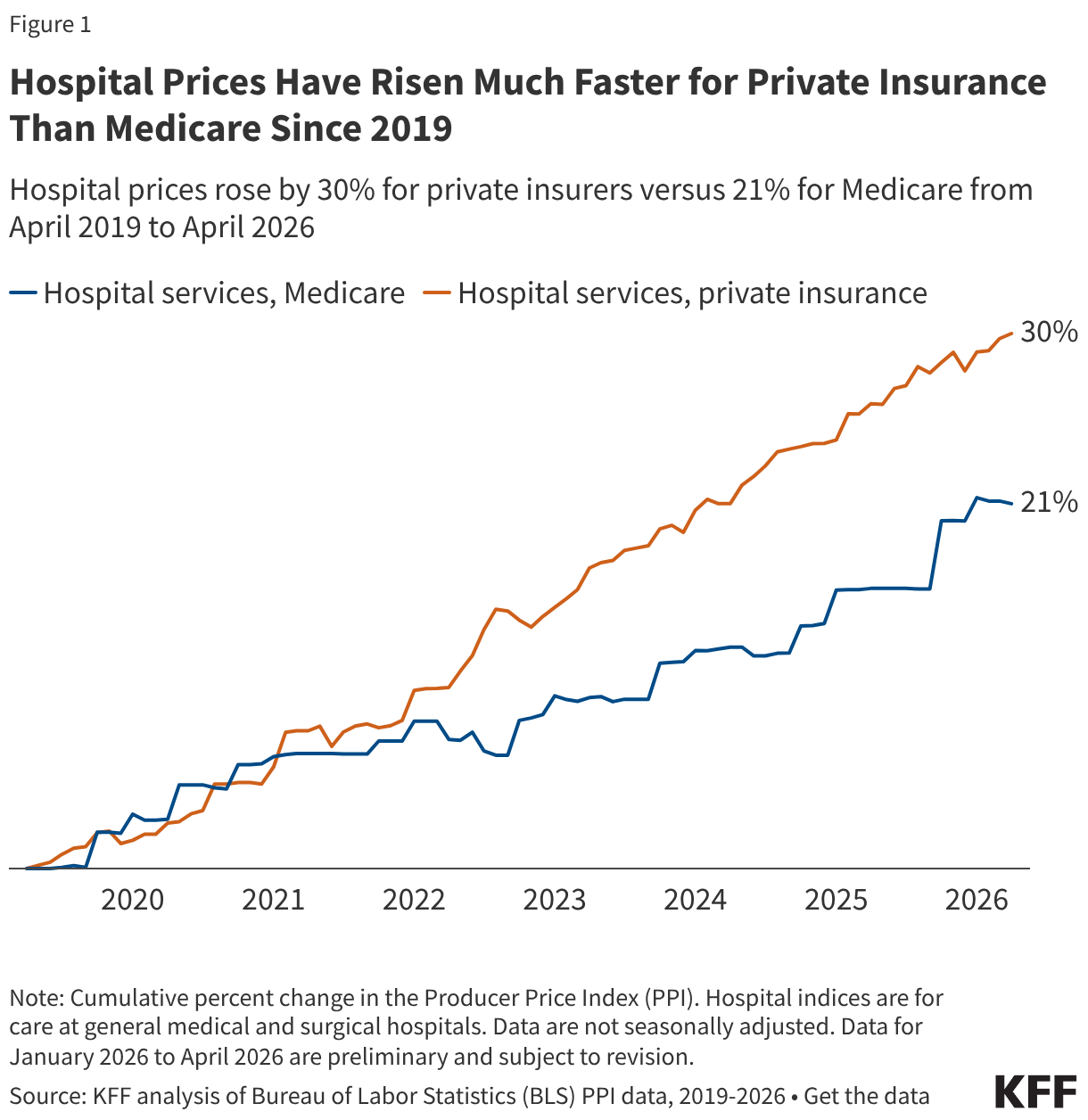
Hospital Prices Have Risen Much Faster for Private Insurance Than Medicare Since 2019
Health care costs are a top concern for the public, and there is widespread interest among lawmakers in making health care more affordable. Attention has increasingly focused on hospitals, which represent nearly one third of total health care spending and accounted for 40% of spending growth from 2022 to 2024. Hospital spending reflects both the prices paid for services and the volume and intensity of care delivered, and trends in both factors have implications for affordability and spending growth. The prices paid by private insurers are higher than Medicare rates on average—e.g., nearly double traditional Medicare rates for hospital services when averaging across studies, according to a prior KFF review—and vary across regions and across hospitals and payers within regions. These high prices affect households through higher premiums and cost sharing obligations and reduced wages for those with employer-sponsored health coverage.
There has been some discussion at both the national and state level about policies that could rein in hospital prices. One set of policies aims to do so by promoting competition and reducing consolidation in provider markets. A substantial body of evidence shows that hospital market consolidation has contributed to higher prices, with unclear effects on the quality of services provided. Another set of policies would rein in prices more directly, such as by capping the prices that providers can charge. For example, Indiana recently enacted a law that will eventually cap private insurance prices for the state’s nonprofit hospitals, and Oregon has capped hospital prices at 200 percent of traditional Medicare rates for its state employee plan since 2019.
To inform policy discussions related to hospital prices and price regulation, this brief describes the growth of prices paid by private insurers for hospital care relative to increases in Medicare payment rates from April 2019 through April 2026, using data from the Bureau of Labor Statistics (BLS) Producer Price Index (PPI). The analysis begins in 2019 to fully capture changes in prices during the pandemic. See Methods for more detail.
Hospital Prices Have Risen Much Faster for Private Insurance Than Medicare Since 2019
Private insurance prices for hospital care rose 30% from April 2019 to April 2026 compared to a 21% increase in Medicare rates (Figure 1). Put differently, private insurance prices grew 47% more quickly than Medicare rates over this 7-year period. Private insurance prices grew at a similar pace as Medicare rates from April 2019 to April 2020, but grew more quickly than Medicare rates each year from April 2020 to April 2025, before increasing less quickly than Medicare rates from April 2025 to April 2026. These patterns are broadly consistent with prior research that finds faster price growth for private insurance than Medicare over time, with some variation across time periods. Private plans pay much higher rates than Medicare for hospital services according to priorresearch, and this analysis suggests that the gap has increased over time.
Private insurance prices for hospital care are the result of negotiations between hospitals and insurers. Increases in private prices over time can reflect changes in the cost of providing care and in the bargaining power of hospitals relative to insurers, among other factors. Hospital markets have become increasingly consolidated, with one or two health systems controlling at least 75% of the market for inpatient hospital care in the large majority of metropolitan areas (83%) in 2024, according to KFF analysis, contributing to higher prices. Large increases in labor and supply expenses during the pandemic have likely pushed providers to negotiate for higher prices (economy-wide inflation jumped in March and April 2021 before reaching a peak in June 2022). However, contracts between hospitals and insurers are only periodically renegotiated, and often last for multiple years, meaning there may be a lag before any effects of higher input costs are fully reflected in higher prices.
In contrast, traditional Medicare hospital prices are updated annually by the Centers for Medicare and Medicaid Services (CMS), primarily through the Inpatient and Outpatient Prospective Payment Systems (IPPS and OPPS). These changes are based on factors and methods described in law and regulation. Medicare IPPS and OPPS updates are based partially on estimates of increases in hospital services input costs, which are affected by overall inflation. There is some evidence that rates paid by Medicare Advantage plans for hospital services (incorporated with other private Medicare plans in the Medicare but not private insurance PPI) are generally close to rates paid by traditional Medicare. Increases in prices paid by Medicare Advantage insurers have likely been aligned with changes in traditional Medicare rates over time.
One factor that slowed Medicare growth is that the program underestimated inflation in recent periods when prospectively setting rates (e.g., inflation in 2022 was much higher than expected when hospital rates were set for that year), according to the hospitalindustry and others. Nonetheless, CMS has noted that its forecasts have tended to be close to actual inflation on average when looking over longer periods for the IPPS hospital market basket (see Methods for more detail).
Various other factors may have restrained Medicare price growth during the study period, such as the productivity adjustments enacted under the Affordable Care Act, which reduce the growth in traditional Medicare rates over time under the assumption that hospitals are becoming more efficient at delivering care. As another example, sequestration, which is an automatic reduction in Medicare payments required under budget rules, was temporarily suspended during the pandemic beginning in May 2020 but gradually reintroduced in April and July 2022, likely contributing to the increase and decrease in the Medicare PPI during those periods.
Methods
This brief used the Producer Price Index (PPI) to evaluate hospital prices and overall inflation over the seven year period from April 2019 to April 2026 (the most recent month available). The PPI measures prices from the perspective of producers of a good or service, such as hospitals. The PPI was used over other comparable measures like the Consumer Price Index (CPI) because it breaks out hospital price growth by payers, such as Medicare and private insurance. The PPI for private insurance excludes private Medicaid and Medicare plans. The PPI for Medicare includes both traditional Medicare and private Medicare plans, including Medicare Advantage, which accounted for 54% of the eligible Medicare population in 2025.
Hospital price growth overall (i.e., across all payers) as measured by the PPI grew much less quickly than hospital price growth as measured by the CPI during this period. Differences between the PPI and CPI reflect both conceptual and methodological differences. For example, the CPI—which measures prices from the perspective of consumers—excludes Medicare Part A, Medicaid, and certain other payers from its price measurements.
This analysis examines hospital PPI data classified by industry, in this case, the hospital industry. The PPI also produces series classified by a specific commodity, such as a product or service. This brief uses industry classifications because they provide an overall measure of hospital prices by payer, while the commodity classifications are separated into inpatient and outpatient price measures and only distinguish private insurers from other non-Medicare, non-Medicaid payers for the former.
Most of the increases in the Medicare hospital PPI occur in October and January over time. That likely reflects, at least in large part, the timing of when traditional Medicare updates inpatient and outpatient reimbursement for hospitals, respectively.
CMS noted in its FY2026 IPPS rule that its forecasts for the IPPS hospital market basket have tended to be close to actual inflation on average when looking over longer periods. This basket is used for both IPPS operating and OPPS payment updates (though it is unclear if CMS’s comment above was also including OPPS payments, which are updated on a different schedule). During the 2026 rulemaking process, CMS received comments, including from the hospital industry, recommending an increase in IPPS operating and OPPS payment rates to account for prior errors in forecasting, though CMS did not do so, citing various reasons. CMS does make certain adjustments for forecasting errors for IPPS capital payments (as it has proposed to do in FY2027), which account for a relatively small share of hospital payments.
The 2025 reconciliation law will—for the first time—require adults who are enrolled in Medicaid though the Affordable Care Act (ACA) expansion, along with those in partial expansion waiver programs in Georgia and Wisconsin, to meet work requirements or qualify for an exemption as a condition of eligibility starting in January 2027 in most states.
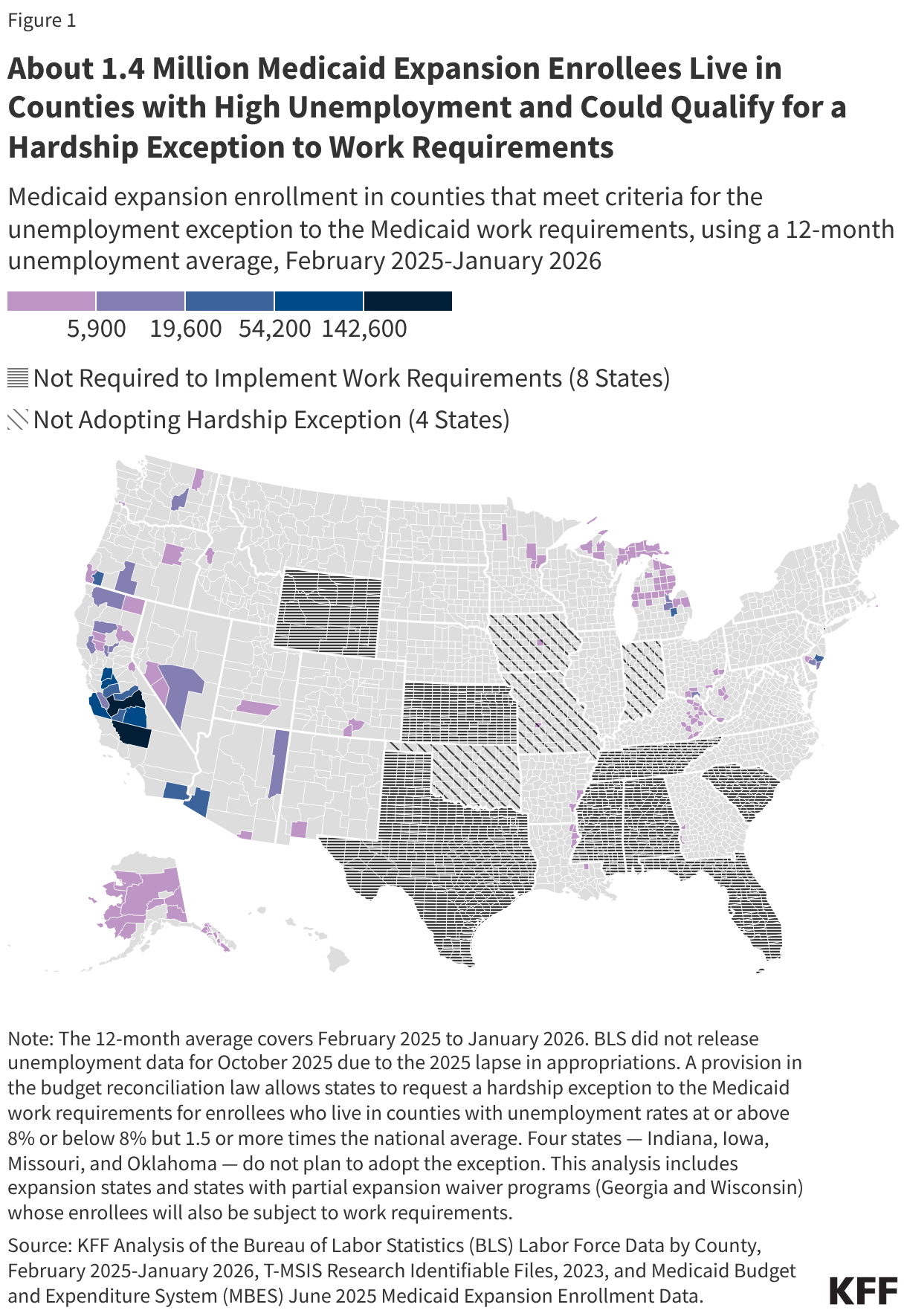
States may adopt an optional hardship exception to Medicaid work requirements for individuals living in counties with unemployment rates at or above 8%, or at least 1.5 times the national average unemployment rate. A recent KFF survey found that most states plan to adopt this exception, which will exempt both Medicaid applicants and enrollees in counties with unemployment rates that meet the specified thresholds. However, four states, Indiana, Iowa, Missouri, and Oklahoma, do not plan to adopt the exception.
An update to a previous KFF analysis of county unemployment rates, using 12-month average unemployment rates from February 2025 through January 2026, and county-level Medicaid expansion enrollment estimates that:
1.4 million expansion enrollees, or 7.5% of expansion enrollees, live in counties that meet the high unemployment threshold and may qualify for the hardship exception in the 27 states that plan to adopt the exception and in the 12 states that had not made a decision on adoption at the time of the KFF survey.
Among the states that are planning to adopt or may adopt the exception, 133 counties in 22 states meet the high unemployment thresholds, representing 7% of counties in expansion states and states with partial expansion waiver programs. No counties meet the thresholds in 16 states, and DC does not meet the thresholds.
Nine in ten expansion enrollees who are in counties that meet the high unemployment criteria and could be exempt from the work requirements live in five states—California, New York, Michigan, New Jersey, and Oregon.
Among the states that do not plan to adopt the hardship exception, two counties in Iowa and Missouri meet the high unemployment thresholds, and approximately 3,300 expansion enrollees in those counties may have qualified for the high unemployment hardship exception if the states had decided to adopt the exception. In Indiana and Oklahoma, there are no counties that meet the thresholds.
Nebraska began enforcing work requirements on May 1, 2026, the first state to implement the new requirements. Although the state indicated it would adopt the high unemployment hardship exception, no counties in the state currently meet the thresholds.
States are waiting for federal guidance on how to implement this hardship exception, including what data will be used to identify counties that meet the thresholds and what additional information states must submit. This analysis uses the most recent available county-level unemployment data from Bureau of Labor Statistics (BLS) and is consistent with the methods used to determine whether any counties qualify for the high unemployment exemption waiver from SNAP work requirements. However, the guidance, which CMS is expected to release in early June, may require a different method.
KFF’s interactive Medicaid work requirements tracker includes new county-level unemployment data by state, showing which counties meet the high unemployment thresholds and how many expansion enrollees in those counties may be exempt from work requirements.
The President’s Emergency Plan for AIDS Relief (PEPFAR) has been and continues to be subject to a range of Congressional reporting requirements. These include enduring (ongoing) requirements as well as time-bound requirements, through both PEPFAR’s authorizations as well as appropriations legislation in some years.
This document provides a list of reporting requirements identified in PEPFAR’s authorizing legislation over time as well as other key legislation. Table 1 includes current requirements and requests. Table 2 includes past requirements and requests that are no longer in effect. While this document lists most such requirements, it may not be exhaustive.1
There are other requirements [such as those that are not specific to PEPFAR established under the Foreign Aid Transparency and Accountability Act (FATAA) of 2016, for example, which includes more general reporting requirements; and some in appropriations legislation, along with accompanying congressional reports and explanatory statements, over the more than 20 years of PEPFAR] that are not included in this analysis. ↩︎
Note: The map in this brief will be updated regularly to include new federal actions about potential Medicaid fraud and new state responses. The brief was last updated on May 15, 2026.
The current administration is placing a new emphasis on potential fraud in Medicaid with its Comprehensive Regulations to Uncover Suspicious Healthcare (CRUSH) initiative. The Centers for Medicare and Medicaid Services (CMS’) started the new initiative in Medicaid focusing on Minnesota and three other states with Democratic governors (California, Maine, and New York) while the House Committee on Energy and Commerce sent requests for information to 11 states. CMS has historically partnered with states to identify and resolve issues of fraud, waste, and abuse, and denied the federal share of Medicaid spending when fraud has been identified by an audit, investigation, or reported by the state. However, CMS has recently announced a new approach to fraud that will rely more heavily on options to prevent spending federal funds in cases of potential fraud, which could have broad implications for states and enrollees. This issue brief explains the new approach. Key findings include:
CMS’ historic practice has relied on disallowing federal Medicaid payments when fraud is identified (typically through an audit), a process that may take several years to implement.
CMS’ new approach to potential fraud involves potentially pausing or withholding federal Medicaid payments when fraud is suspected (Figure 1). This approach differs from prior approaches because, if implemented, it could have more immediate consequences, place a much larger share of federal spending at risk (including spending that pays for services uninvolved in fraud), and proactively shift the burden of proof to states to obtain federal funds.
While all approaches aim to limit future fraudulent payments using tools such as corrective action plans, the new approach to federal Medicaid spending when fraud is suspected creates uncertainty for state budgets and could have implications for Medicaid enrollees and providers who are not involved in fraud.
What is a disallowance?
The federal and state governments share responsibility for financing Medicaid, and states draw on federal funds to pay health care providers and health plans for providing health care to enrollees. The federal government makes quarterly grant awards to states to cover the federal share of Medicaid spending. Awards reflect states’ estimated expenditures for the upcoming quarter and adjustments from prior quarters’ expenses. Adjustments reflect various considerations such as:
Instances where states’ estimated expenditures are higher or lower than actual expenditures
Changes to accounting practices or federal matching rates
Reductions in payment resulting from claims where fraud has been identified
Publicly-available data on Medicaid expenditures show the total amount of adjustments each year, reflecting the net impact of all various factors, and do not specifically identify adjustments due to disallowances and deferrals.
Historically, CMS has used disallowances to deny federal matching funds for state Medicaid expenditures that have already occurred and are later determined to be not allowable. There is limited information available about the frequency and scope of Medicaid disallowances, but an older report by the Government Accountability Office (GAO) suggests that they were not infrequent between 2014 and 2017.Upon receiving a disallowance notice, states may request that CMS reconsider the decision and provide additional information to CMS to demonstrate that the expenditures were allowable or accept the disallowance and resolve it directly with CMS. In all cases, once CMS has issued a disallowance, “the state has the burden of documenting the allowability” of the expenditures to overturn the disallowance. When states request a reconsideration, CMS has 60 days to decide, although this timeline may take longer if CMS requests additional information from the state.
States may appeal the disallowance decisions to a Departmental Appeals Board, but the state still has the burden of proof for documenting the allowability of expenditures and the process may take years to resolve. States are not required to request a reconsideration before appealing the disallowance. More information is publicly available for cases where states do appeal the decisions than for cases where they settle or request a reconsideration. In such cases, data about the decisions of the Department Appeals Board are available online through the Department’s website. Between 2020 and 2025, the Departmental Appeals Board has issued 12 Medicaid disallowance rulings (with 6 rulings being an appeal of a prior case). In all 6 new rulings, there were on average 15 years between the oldest year of disputed expenditures and the final ruling, highlighting how long it takes to resolve these cases (see Figure 2 for an example from Texas). All cases were decided in favor of CMS, but that may reflect the fact that CMS has historically used disallowances only in cases where fraud is well-established.
The amount of disputed disallowances where the Departmental Appeals Board issued a ruling between 2020 and 2025 ranged from less than $500,000 to almost $200 million, but these amounts reflect differences in the number of years and scope of services within the disallowed claims. Some of the largest disallowances to be upheld involve disproportionate share hospital (DSH) payments.
The largest disallowance ruling between 2020 and 2025 was $195.7 million in a case involving Michigan’s DSH payments between 2001-2009. In that instance, CMS in 2018 determined that the state had made DSH payments to a small number of hospitals that were ineligible to receive them. The Departmental Appeals Board ruling was in 2024.
The second largest disallowance ruling between 2020 and 2025 was for more than $97 million in a case where Florida made DSH payments between 2006-2013 in excess of the limits established for specific hospitals (CMS first issued this disallowance in 2016 and the Departmental Appeals Board ruling was in 2021).
Figure 2
What is a deferral?
With deferrals, CMS pauses payment for state Medicaid expenditures that have already ocurred and requires the state to provide additional information demonstrating that expenditures are “allowable.” Deferrals are usually initiated by the federal government and may be used to pause federal funding while the state and federal governments work out the details of a disallowance, and in cases where fraud, waste, or abuse has been identified and the state and federal governments are gauging the extent of the issue. In the past, deferrals were used as temporary measures that pause funding until CMS either reimburses the expenditures or issues a disallowance. Deferral notices must specify the reason for the deferral and include a request for all documents and materials that CMS believes are necessary to determine whether the expenses are allowable. After the notice is sent, the loss of federal funds occurs immediately.
After receiving a deferral notice from CMS, states have 60 days to provide all requested documents and materials unless they request an additional 60-day extension. CMS usually begins document review within 30 days but may request different formats or additional materials from the state. States have 15 days to submit additional materials and if they do not meet that deadline, CMS disallows the expenses. Once all documents are available, CMS has 90 days to review and determine whether expenditures are allowable. If CMS determines expenditures are not allowable, the disallowance process begins, offering the state the opportunity to request a reconsideration and appeal to the Departmental Appeals Board.
Deferrals are receiving new attention after the administration announced that it would temporarily defer $259 million in federal Medicaid payments to Minnesota for expenditures incurred in quarter 4 of in fiscal year (FY) 2025, an unprecedentedly large amount. In the announcement, CMS noted that it may continue to defer federal payments for either additional quarters in 2025 or future quarters in 2026, and that similar announcements for other states would likely be coming soon. As of March 25, 2026, 4 additional states have received formal letters from CMS requesting information about program integrity, and 11 states have received formal letters from the House Committee on Energy and Commerce (Figure 3).
What is a withhold?
In January 2026, CMS notified Minnesota that pending the outcome of a hearing, it would begin withholding $515 million in quarterly federal Medicaid payments moving forward, a process that has seldom been used in prior years. Withholding funds has been referred to as the “compliance process” because it is only permissible in cases where the state is failing to comply with Medicaid law. Prior use of withholding has been limited. When CMS has considered withholding as a compliance tool in the past, it announced withholdings that were at most between 1 and 10 percent of the federal share of Medicaid spending for specific services (in most cases, the administrative costs states incurred to implement their Medicaid programs). Prior CMS communication notifying states of possible withholdings appear to have been used when states incorrectly restrictedeligibility or benefits, thus failing to comply with minimum requirements regarding access to coverage or eligibility. Minnesota’s case is different because of the scope of the proposed withholding and because the proposed withholding would be to address potential future fraud, rather than state policies that restrict Medicaid eligibility or benefits. The announced level of withholding would have represented nearly 20% of the federal share of Minnesota’s spending on an annual basis.
To withhold federal Medicaid funds, CMS must first provide states with the opportunity for an administrative hearing, and withholding generally ends when CMS is satisfied with states’ resolution of the issue. Withholdings may reflect issues with states’ Medicaid approved plans or with states’ implementation of the plans. Because CMS has authority to approve states’ plans, most issues arise regarding implementation of the plan and are resolved using a corrective action plan. Corrective action plans may also be used to address other types of issues in Medicaid (such as payment error rates or eligibility re-determinations). In general, the plans include a narrative of steps states are planning to take to address issues related to proper implementation of the Medicaid program. On January 13, 2026, Minnesota requested a hearing about the withholding and on January 30, 2026, Minnesota submitted a revised corrective action plan to CMS. On March 20, 2026, CMS accepted Minnesota's revised corrective action plan. Successful completion of the corrective actions outlined in the plan will resolve the threat of withholding.
What are the implications of new reliance on deferrals and withholds?
The new approach to federal Medicaid spending when fraud is suspected creates uncertainty for state budgets, particularly given the magnitude of federal funding at stake and the time it takes to resolve administrative disputes. Unlike the federal government, states must generally operate balanced budgets, which is one reason states are able to draw down matching funds to finance ongoing expenditures. If withholding is implemented, the loss of federal funds could make it difficult for states to maintain current programs while details of the cases are being sorted out. More extensive use of deferrals could have similar, but more immediate, destabilizing effects on states’ budgets because they reduce the amount of federal funds available to states for several months, and the state has no option to request reconsideration or appeal until a disallowance is issued. Increasing the use of deferrals so that it applies to entire categories of services where fraud is suspected but not established would also place a new administrative burden on states to demonstrate the allowability of expenditures. Other approaches to addressing suspected fraud, waste, and abuse remain available to CMS. The National Association of Medicaid Directors (NAMD) has suggested the following actions to help states to address fraud waste, and abuse in Medicaid:
Help states identify federal materials about best practices such as recommendations and provider enrollment self-assessments;
Create rapid methods to share information about provider disqualifications between Medicare, the Veterans' Health Administration, and Medicaid;
Respond more quickly to fraud reports from state attorneys general and the Medicaid Fraud Control Units;
Strengthen procedural pathways for states and CMS to work collaboratively on Corrective Action Plans to enhance adherence to provider requirements while maintaining access to Medicaid benefits;
Conducting additional analysis of Medicaid data through the Center for Program Integrity;
Strengthening federal data sources and their interoperability; and
Providing technical assistance to state officials and staff.
New uncertainty about the availability of federal funding could have implications for Medicaid enrollees and providers who are not involved in fraud. If states have inadequate funding to maintain existing Medicaid services, they may face difficult decisions regarding how to limit Medicaid spending. In general, states can reduce Medicaid spending by decreasing payment rates for providers, covering fewer services, or enrolling fewer people. Such actions could affect enrollees and providers who are not using or providing services in which fraud is suspected. There will also be additional disruptions for providers who lawfully provide Medicaid services where fraud is suspected because of new administrative burdens associated with increased audits, delayed payments, and other administrative practices.
CMS’ new approach to addressing cases of suspected fraud may exacerbate administrative and financial challenges states face as they implement the 2025 reconciliation law. The 2025 reconciliation law made historic reductions in federal funding for Medicaid and created new administrative requirements for states, particularly those that must implement work requirements for enrollees eligible for Medicaid through the Affordable Care Act Medicaid expansion. As states work to implement those changes and adjust to changes in federal financing, the new approach to fraud creates additional administrative requirements and potential new reductions in federal funding. Combined, these changes may have more significant implications for states’ ability to maintain existing levels of Medicaid payment rates, coverage, and eligibility.
The American Association of Public Opinion Research (AAPOR) last night recognized KFF’s Mollyann Brodie, Ph.D., with the AAPOR Award for Distinguished Achievement for her outstanding leadership and contributions to the field of public opinion research over three decades.
The award honors Dr. Brodie, a KFF executive vice president and executive director of KFF’s Public Opinion and Survey Research, for leading KFF’s polling team as it has built a body of work “that has become the nation’s definitive source for public opinion on health — earning the confidence of policymakers, journalists, and the public alike.”
The association notes Dr. Brodie’s role in developing the KFF Health Tracking Poll, which has documented the arc of the public’s opinions on and experiences with the Affordable Care Act and provided a record of how sweeping legislation affects ordinary Americans, and the KFF COVID-19 Vaccine Monitor, which became a critical resource for understanding the public’s views, access, uptake, and concerns about emerging vaccines. “In each case, her vision produced research that went beyond poll numbers to tell the broader story of how Americans experienced major changes in health and health care,” AAPOR noted in its award citation.
AAPOR also praised Dr. Brodie’s commitment to inclusion for women and other underrepresented groups, both in her work at KFF and as a leader within the association. The association notes her role in developing methodologically innovative surveys of working-class Americans, transgender adults, Hurricane Katrina evacuees, and rural communities — populations whose voices too rarely get elevated in other nationally representative polls.
In addition, KFF’s Surveys of Immigrants received the 2026 AAPOR Inclusive Voices Award, which recognizes work examining complex challenges related to underrepresented populations.
The multi-year initiative, including surveys conducted in partnership with The New York Times and The Los Angeles Times, is the only large-scale, nationally representative probability-based survey of immigrants in the United States in decades. Through innovative multi-frame, multilingual, and multi-mode methods, the surveys succeeded in amplifying the voices of groups often excluded from survey research, such as undocumented immigrants and those with limited English proficiency.
“We started our polling program when we started KFF in the early 1990s, but it made the jump to light speed after Molly arrived. These awards recognize her expertise and vision, and how effective we’ve been in coordinating our polling under Molly’s leadership with our equally tremendous capacity in policy research and journalism,” said Dr. Drew Altman, Founding President and CEO, KFF.
At KFF, Dr. Brodie works closely with Senior Vice President and Director of Public Opinion and Survey Research Liz Hamel, Director of Survey Methodology Dr. Ashley Kirzinger, and Dr. Altman, in addition to the policy research team led by Executive Vice President Larry Levitt, and journalists at KFF Health News. She also helped develop KFF’s polling partnerships with major news organizations, including The New York Times and The Washington Post. Dr. Brodie and Mr. Levitt are the executive team who work with Dr. Altman to oversee all of KFF’s program directions, finances, and operations.
The awards were presented last night at AAPOR’s 81st annual conference in Los Angeles.
For decades, the federal government has overseen two key vaccine injury compensation programs: the National Vaccine Injury Compensation Program (VICP) and the Countermeasures Injury Compensation Program (CICP). The VICP and CICP are designed to help maintain vaccine access while also recognizing that vaccine injuries can occur and those affected by such injuries should be compensated. However, over time, the demands on, and challenges faced by, these programs have grown. Recently, they have become targets of criticism from members of the Trump administration, including the Secretary of Health and Human Services (HHS) Robert F. Kennedy Jr. ,who said (without evidence) in 2025 that VICP had “devolved into a morass of inefficiency, favoritism, and outright corruption” and that he would lead an effort to overhaul it. Some lawmakers and external groups have called to replace or end these programs while others have suggested keeping them intact but adopting policy changes that could help modernize them and make them more effective. Some have raised concerns that making drastic changes to vaccine injury compensation programs could undermine the U.S. vaccine market and, more generally, confidence in vaccines.
To provide background and context on this topic, this brief summarizes the history and rationale for these programs and their key elements, analyzes publicly available information on claims and compensation under the programs, and discusses key policy issues they currently face. The programs, while both having been created as alternatives to civil courts, vary significantly in their structures, processed, vaccines covered, and compensation rates and amounts, among other factors.
Origins and Rationales for VICP and CICP
VICP and CICP were both created as alternative pathways to civil courts to allow individuals to seek compensation for vaccine-related injuries and address vaccine safety while also addressing concerns about vaccine supply in the U.S. Prior to the existence of these programs, there were times when vaccine manufacturers faced a large volume of lawsuits linked to rising public concerns about vaccine safety, which threatened to drive vaccine makers from the market and led them to raise their prices, affecting access to vaccines.
VICP, created by Congress in 1986, was designed as a legal pathway separate from traditional civil courts through which individuals can seek compensation for potential vaccine injuries directly from the federal government. VICP was created by Congress following a wave of public concern regarding vaccine safety in the late 1970s and 1980s that was fueled, in part, by sensationalizedtelevision programs on the topic of vaccine injuries in children. There had been a surge in lawsuits in the civil court system filed against health care practitioners and vaccine makers. Facing rising legal costs, some vaccine manufacturers chose to exit the vaccine market and those that remained raised their prices, which threatened the market for childhood vaccines in the U.S. In response, Congress passed the 1986 National Childhood Vaccine Injury Act (NCVIA) that, among other things, established the VICP. It was intended to help stabilize the vaccine market, preserve public confidence in immunization, while also providing a less adversarial and more streamlined pathway for families to submit claims and receive compensation payments for vaccine injuries compared to civil litigation. The act created the process by which vaccines could be added to VICP coverage and created the VICP trust fund, which funded the program using excise taxes placed by Congress on each of the vaccines covered under VICP. Congress has made several statutory changes and additions to VICP since 1988, including the 1993 Omnibus Budget Reconciliation Act that allowed for rapid inclusion of new U.S. Centers for Disease Control and Prevention or CDC-recommended vaccines into VICP once Congress enacted the excise tax on that vaccine, and the 21st Century Cures Act from 2016 that added vaccines recommended for pregnant women to VICP and explicitly included injuries to children in utero as eligible for VICP compensation.
CICP was created by Congress in 2005 to allow individuals to seek compensation for injuries that may have occurred from use of medical countermeasures (such as vaccines) during a public health emergency (as distinct from routine use addressed under VICP). It was established as part of the Public Readiness and Emergency Preparedness (PREP) Act, at a time of heightened national security concerns following the September 11, 2001 attacks, anthrax mailings, and the threat of an influenza pandemic. The PREP Act was meant to address concerns that in a public health emergency, such as a bioterrorist attack or a naturally occurring outbreak, private companies might be reluctant to develop and manufacture vaccines, drugs, and other medical countermeasures because of liability risks they could face from use of those products during an emergency. As part of a broader strategy incentivizing rapid development and deployment of countermeasures, the PREP Act offered immunity from liability to manufacturers and distributors of these products, and created the CICP as the federal compensation mechanism for injuries that may occur through use of these products.
Vaccines and Injuries Covered, and Processes for Review and Compensation
While both VICP and CICP are designed to be more efficient and streamlined mechanisms compared to civil courts for vaccine injury compensation cases, they are distinct in terms of which vaccines are covered and how claims are submitted, reviewed, and adjudicated (see Table 1 for a comparison of key characteristics of these programs).
VICP
There are currently 16 vaccine types covered under the VICP program. By statute, VICP covers FDA approved vaccines used in the U.S. that are 1) recommended by the CDC for “routine administration” to children or pregnant women, 2) subject by Congress to the VICP excise tax, and, 3) added to the official VICP vaccine injury table by the Secretary of HHS. When first passed in 1986, VICP covered 6 vaccines, a number that has grown to 16 existing vaccines, including the components of common childhood vaccines such as DPT, MMR, and polio as well as child and adult vaccines such as seasonal influenza. The VICP also covers “any new vaccine” recommended by CDC, subject to an excise tax and issued a notice of coverage by the Secretary of HHS.
The vaccine injury table is a key VICP document listing vaccine types and injuries compensable by VICP. The table lists and explains injuries presumed to be caused by vaccines and the time periods in which the first symptom of these injuries must occur after receiving the vaccine. The current table lists 14 compensable injuries across the 16 vaccine types, with most injuries associated with one or a few vaccine types only. For example, “chronic arthritis” is listed as a potential injury associated only with rubella-containing vaccines, and “vaccine-strain polio infection” is only associated with oral polio vaccine. Others are associated with multiple vaccine types, such as “shoulder injury” and “vasovagal syncope” (i.e. a drop in blood pressure and heart rate), which are each listed for 15 vaccine types.
VICP claims are submitted to HHS and the U.S. Court of Federal Claims and reviewed through a judicial process overseen by the Office of Special Masters. An individual (or legal representative) must first file a petition with the U.S. Court of Federal Claims “Office of Special Masters” which handles VICP cases. “Special Masters” are specialized officers of the court who function similarly to a judge. Upon receipt, each claim is assigned to one of eight Special Masters and initially reviewed by specialized HHS staff for compliance with VICP submission requirements. Documentation to support an injury claim must be provided, and typically only injuries listed on the vaccine injury table are eligible for compensation. For injuries not on the table, a petitioner must prove, through medical documentation and/or expert opinion, that the vaccine in fact caused the alleged injury. VICP typically pays petitioners’ legal fees, even if the claim is eventually unsuccessful.
Special Masters issue a ruling on compensation based on a “preponderance of evidence” standard. VICP is designed as a no-fault system, meaning petitioners do not need to prove negligence on the part of vaccine makers or health care practitioners. With sufficient documentation of an injury matching a condition and fitting the timetable listed on the vaccine injury table, it is usually presumed that the vaccine caused the injury. In some cases, additional information is needed such as expert testimony or medical research findings to support injury claims, and evaluating evidence may require hearings with witnesses.
Petitioners can accept or reject a compensation decision, with the option for appeal. If a ruling is made in favor of a petitioner, the Special Master determines the level of compensation, which a petitioner can accept or reject. If the claim is denied, the petitioner can seek review by a judge of the Court of Federal Claims and potentially appeal further to the U.S. Court of Appeals. If the claimant moves through all appeals and is still denied compensation, then they may have the right to subsequently file a suit in civil court (with some limitations).
The Secretary of HHS can modify the VICP vaccine injury table, though changes must abide by a statutory process including external expert review and a public comment period. The Secretary of HHS has the explicit authority to modify the vaccine table, though any changes are subject to a process outlined in statute (42 U.S.C. § 300aa-14) and federal regulations (Code of Federal Regulations (CFR) Part 100), including referred to an external expert advisory body known as the Advisory Commission on Childhood Vaccines (ACCV), which has at least 90 days to review suggested changes. In addition, HHS must follow Administrative Procedures Act (APA) guidelines, including publishing a Notice of Proposed Rulemaking (NPRM) in the Federal Register and a 180-day public comment period. Adding a new vaccine to the vaccine injury table requires that new vaccine to be recommended for routine use by CDC, and for Congress to apply an excise tax on that vaccine, before HHS can publish a notice of coverage and submit related changes to the vaccine injury table.
The VICP vaccine injury table has rarely been updated; its last major revision was in 2017. At that time, “Shoulder Injury Related to Vaccine Administration, or SIRVA was added. HHS proposed adding this to the Table, submitted it to ACCV for input, and in 2015 published the related NPRM. In 2017 HHS issued the final ruling after reviewing and responding to public comments, as required under APA.
CICP
CICP covers countermeasures used in federally declared public health emergencies, which has included COVID-19 vaccines, as well as vaccines for pandemic influenza, smallpox, and mpox. By statute, covered countermeasures are those that the Secretary of HHS specifically lists in the declarations issued under the PREP Act for each health emergency. Currently, there are 10 such declarations in effect covering countermeasures against health emergencies, including Anthrax, Ebola, Marburg, pandemic influenza, mpox, and COVID-19.
CICP claims are reviewed through an administrative process by HHS staff, rather than a judicial process. Individuals submit a request to the Health Resources and Services Administration (HRSA) within HHS, which administers CICP. Filings must include sufficient medical records and other documentation linking the countermeasure and the individual’s claimed injury. In contrast to VICP, there no judges or hearings under CICP. Instead, claims are reviewed internally by HHS medical and legal staff. CICP does not pay petitioners’ legal fees.
CICP does not have a single “injury table” reference for covered countermeasures, with claims typically requiring individualized, case-by case review. Some declared health emergencies – including smallpox and pandemic influenza – have a specified countermeasure injury table, but most do not (COVID-19 countermeasures, for example, do not have an injury table). Therefore, most claims require individualized scientific review and case-by-case considerations. To receive compensation, a petitioner must show “serious physical injury was sustained as the result of the use of a covered countermeasure,” which is a higher evidentiary standard compared to VICP.
CICP decisions leave little room for appeal. HRSA issues a written determination on whether the injury is eligible for compensation under CICP and, if found eligible, how much compensation is awarded. If found ineligible, a petitioner can request reconsideration, but further review is still handled internally, with no process for formal legal appeal. In most cases, individuals who have pursued compensation through CICP cannot go on to pursue lawsuits in civil court against manufacturers or providers for covered countermeasures.
The HHS Secretary has broad authority to make changes to countermeasures and injuries covered under CICP. The PREP Act provides the HHS Secretary more discretion and imposes fewer regulatory requirements on the process to make changes to injuries covered by CICP, compared to VICP. The Secretary can determine which countermeasures are covered and which injuries are presumed to be compensable under the CICP, and there is no statutory requirements for advisory committees or public comment periods for changes to these policies.
Historical Data on Petitions and Compensation Decisions
The number of petitions submitted to VICP and CICP has varied over time, and both programs have seen large increases in petitions in certain years driven by different factors, such as a surge in CICP claims related to COVID-9 vaccines starting in 2021 (COVID-19 claims comprise most CICP petitions at this point). Overall, VICP provides compensation for a much greater share of its petitions compared to CICP (48% compared to less than 1% for COVID-19 vaccine petitions), largely reflecting the differences between the programs. Still, given the large number of vaccines administered in the U.S., very few petitions or claims in either program are found to be compensable relative to vaccines received (1.89 VICP compensable petitions per million vaccine doses and 0.14 compensable CICP claims per million COVID-19 vaccine doses).
VICP
From FY 1988 through FY 2025, VICP received a total of 28,673 petitions. The annual number of petitions has varied over time, including notable surges in some years (see Figure 1). Surges occurred in FY 1990 and FY 1991 (1,492 and 2,718 VICP petitions were filed, respectively) due to a large increase in claims stemming from parental concerns about injuries caused by DPT vaccines. There was also a surge a decade later, primarily reflecting a wave of public concern about MMR vaccine after reports (later found to be false) that the vaccine could be linked to autism.1 Since FY 2014, there has been a general increase in the number of petitions filed, with the average number growing from 466/year during the FY 2005-FY 2014 period to 1,238/year during FY 2015-FY 2025. This increase may be linked to policy changes that expanded the scope of the vaccine injury table, such as the inclusion of “Shoulder Injury Related to Vaccine Injury (SIRVA),” which was formally added in 2017.
25,026 VICP petitions (87% of all 28,673 petitions received) have been adjudicated through FY2025, with 12,019 (48%) found to be compensable and 13,007 (52%) dismissed. As shown in Figure 2, the share of compensable injuries has generally increased in recent years compared to earlier periods of the program, with 77% of petitions found compensable between FY 2016-FY 2025 compared to 28% of petitions in the prior 10-year period (FY2006-FY2015). This again may be partially attributed to increasing scope of the vaccine injury table. The notable spike in claims dismissed in FY 2011-FY 2012 was a result of the resolution of the Omnibus Autism Proceedings allowing a backlog of claims related to autism as a vaccine injury to be processed and dismissed when the program found no credible evidence that vaccines were the cause of autism.2
The number of VICP claims and compensation adjudications represents a tiny fraction of the number of vaccines distributed in the U.S. According to HRSA and CDC data, from January 1, 2006 to December 31, 2024 there were 5.65 billion doses of VICP-covered vaccines distributed in the U.S.. During this same period, there were 14,409 VICP petitions filed, or 2.6 VICP petitions per million doses distributed. Of these, 10,633, or 1.89 petitions per million doses, were found to be compensable.
CICP
Between FY 2010 and FY 2026 (through March 1, 2026) CICP received a total of 14,733 claimsfor covered countermeasures. CICP reports it has reached a decision on 7,423 (50%) of those claims, finding 135 (1.8%) were eligible for compensation. The remainder are still being processed.
The majority of CICP petitions received were related to COVID-19 vaccines (10,981 or 75% of all petitions filed). CICP has reached a decision on 6,827 (62%) of these. Overall, 95 (0.9%) of COVID-19 vaccine claims been found eligible for compensation through CICP. With over 670 million doses COVID-19 vaccines administered in the U.S. between December 2020 and May 2023, that translates into approximately 16 petitions filed per million doses administered, and 0.14 compensation-eligible claims per million doses.
Relatively few non-COVID-19 vaccine countermeasure claims have been filed through CICP. For example, CICP reports 29 compensation payments were made related to the 2009 H1N1 vaccine (after approximately 90 million doses were administered in the U.S., translating to about 0.3 compensation payments per million doses administered). One CICP compensation payment was reported related to the smallpox vaccine, though CICP reports that 8 petitions related to the mpox vaccine and 2 additional claims related to the smallpox vaccine have been filed and are still being processed.
Publicly available information about CICP claims and compensation is limited compared to VICP. In contrast to VICP, CICP does not report petitions received or claims processed by year and does not publicly release details on the rationale for compensation decisions.
Funding and Expenditures
These two programs have different funding sources, with VICP funded through a trust fund holding revenues collected from the excise taxes and CICP funded through the annually-appropriated funds provided to HHS/HRSA. Compensation award amounts through VICP, while variable, have averaged between $500,000 and $1 million for most of the program with some recent declines.. In contrast, most awards (75%) through CICP are for amounts under $10,000, though there have been a few very large individual payments exceeding $1 million.
VICP
VICP is funded through revenues collected from an excise tax placed by Congress on every dose of each vaccine covered under VICP produced in the U.S.. The excise tax is paid into a Vaccine Injury Compensation Trust Fund overseen by the U.S. Treasury. The Trust Fund also generates revenue from investing its assets. Treasury uses Trust Fund resources to make payments and transfers to government agencies responsible for administering VICP including the Department of Justice, the U.S. Court of Appeals, and HHS/HRSA.
Over time, the VICP trust fund has grown as its annual revenues typically exceed expenses. The U.S. Treasury reports that as of September 30, 2025 the VICP trust fund held $4.66 billion. In FY 2025, $363 million was added to the trust fund (including $131 million from excise taxes, $169 million from interest on investments, and $63 million in refunds from current and prior year authority). VICP expenses totaled $314 million in FY 2025, which were primarily for compensation payments but also administrative and other costs.
12,409 VICP compensation payments have been awarded between FY1989 and FY2025 totaling $4.89 billion (see Figure 3). Since the early 2010s, the average amount of compensation has generally declined, and has remained below $500,000 since FY 2015, likely a reflection of the expansion of the vaccine injury table to include milder injuries such as SIRVA (which entail comparatively lower payments relaive to other injuries).
CICP
There is no specific tax or dedicated funding source for CICP compensation payments, as there is for VICP. CICP funding comes from annual Congressional appropriations to HRSA rather than an excise tax. Through the PREP Act Congress created a “Covered Countermeasures Process Fund (CCPF)” to be administered by HRSA for CICP purposes, though little information is available on how much funding – if any – is currently held in the CCPF. At times Congress has provided emergency appropriations (such as the CARES Act during the COVID-19 response) that allowed, but did not require, HHS to direct funds to the CCPF.
Several large single payments comprise the majority of all compensation provided by CICP since 2010. There is only limited information about CICP expenditures, which includes the number and amounts of CICP compensation payments that have been made since FY2010. According to this data, CICP has paid compensation for 81 claims totaling more than $13 million. Most of the this total comes from a few very large single compensation payment amounts – for example there are reported payments of $5.9 million (related to thrombotic thrombocytopenia syndrome injury linked to COVID-19 vaccination), $2.3 million, and $1.8 million (the latter two related to Guillain-Barre Syndrome injury linked to 2009 H1N1 pandemic influenza vaccines). Of the 81 claims that received compensation, 11 (14%) were for amounts over $100,000, 10 (12%) were for amounts between $10,000 and $100,000, and 60 (74%) were for amounts under $10,000.
There are significant caseload, backlog, and capacity constraints in both programs. As noted above, there has been a growing number of petitions filed for each these programs over the last few years. However, the staffing and resources allocated to the programs have not matched this growth. For example, the VICP is limited by statute to eight special masters, with each now facing a larger caseload. The CICP has faced a surge of claims related to COVID-19 vaccines since 2021. The growing burden of claims and limited set of resources has contributed to long case review times and delays in issuing decisions and settlements.
The question of how best to address COVID-19 vaccine injuries has been an ongoing issue, particularly now that the COVID-19 public health emergency has ended. Under current law, COVID-19 vaccines are still covered under the CICP through the end of 2029. However, because CICP was created to address smaller scale deployments of medical countermeasures during a health emergency, rather than national-level responses to pandemics that extend over years, it has faced limitations in taking on COVID-19 vaccine injuries. Available compensation is generally lower compared to VICP, and the standard of proof for non-table injuries is higher. Even though the deployment of COVID-19 vaccines began as an emergency countermeasure during a national health emergency, these vaccines have become integrated into routine vaccinations and are recommended by CDC for broad segments of the U.S. population. For that reason, some health policy experts, lawyers, and politicians have advocated for including COVID-19 vaccines under VICP rather than CICP.
Politicization of vaccines and strains on scientific credibility threaten confidence in and stability of these programs. As views about vaccines have become more politicized, vaccine injury compensation programs have become a frequent target of partisan criticism. There is a striking partisan divide on the benefits and risks of COVID-19 vaccines, for example, with Republicans seeing those vaccines as causing more harm and arguing for more injury compensation as a result, compared to Democrats. This has also played out in actions taken by the Trump administration, such as seeking to narrow recommendations for several childhood vaccines and calling into question vaccine safety. On VICP, the Secretary of HHS Kennedy has argued that the program is too restrictive and the number and scope of vaccine injuries covered should be expanded to include conditions such as autism, though there is no credible evidence that vaccination causes autism, and the VICP itself reviewed available evidence on autism and vaccines during the Omnibus Autism Proceedings in the early 2000s and found no scientific evidence to support the link. Secretary Kennedy has also said that VICP has become a “morass of inefficiency, favoritism, and outright corruption.” Advocates linked to Secretary Kennedy have argued for expanding the VICP injury table to cover as many as 300 additional conditions they claim are injuries linked to vaccines. Others have raised concerns that adding injuries without sufficient scientific evidence to do so threatens the credibility of these programs and could even lead to insolvency if the scope of covered “injuries” expands to highly prevalent conditions like autism.
Updating legislation and regulations on compensation payment rules and related policies is politically challenging. A frequent criticism of these programs is that compensation payments were set when the programs were first created and have not been updated over time to reflect new developments and are not indexed to inflation. VICP, for example, has the same $250,000 cap on compensation for injuries or death that was in place when the program was established in 1988. However, making changes to these rules would require that Congress amend the underlying legislation, and doing so has proven politically challenging (changes were last made in 2016 through the “21st Century Cures Act”). There have been multiple legislative proposals introduced to update and modernize the vaccine injury compensation systems legislation but none has advanced. For example, the Vaccine Injury Compensation Modernization Act (H.R. 5142), which was last introduced in 2022-2023, proposed changes such as: increasing the number and tenure of special masters, requiring a formal plan to eliminate backlog, moving COVID-19 vaccines from CICP to VICP, increasing compensation caps and indexing payments to inflation, and increasing transparency and reporting requirements. Another proposal, recognizing that CICP has been inundated with claims for COVID-19 vaccines even though the program was designed with a smaller scale in mind, would replace that program with a “pandemic injury compensation system” that would be pre-funded, scalable, and automatically activated during a public health emergency. However, these bills have not advanced.
Endnotes
Due to the increased public concern about a potential vaccination-autism link and the large number of related claims filed, VICP established a special program in 2002 called the Omnibus Autism Proceeding, which evaluated several hypotheses for vaccine-autism links, ultimately finding that there was no causal relationship. No scientific evidence has shown autism to be linked to childhood vaccines, therefore autism is not included as an injury in the VICP vaccine injury table. ↩︎
Due to the increased public concern about a potential vaccination-autism link and the large number of related claims filed, VICP established a special program in 2002 called the Omnibus Autism Proceeding, which evaluated several hypotheses for vaccine-autism links, ultimately finding that there was no causal relationship. No scientific evidence has shown autism to be linked to childhood vaccines, therefore autism is not included as an injury in the VICP vaccine injury table. ↩︎
This analysis, originally published on June 17, 2025, was updated to note that changes to the final legislation that became law reduced the number of low-income Medicare beneficiaries who would be affected. CBO did not provide a detailed analysis of the impact, but based on available information the number is likely somewhat lower.
On May 22, the House passed a reconciliation bill, the One Big Beautiful Bill Act, which would partially pay to extend expiring tax cuts by cutting Medicaid. The Congressional Budget Office (CBO) estimates that the bill would reduce federal Medicaid spending by $793 billion over ten years and 10.3 million fewer people would be enrolled in Medicaid in 2034, including 1.3 million people with Medicare, otherwise known as “dual-eligible individuals”. The loss of Medicaid coverage for Medicare beneficiaries stems from delaying implementation of two rules that aimed to streamline the enrollment process and make it easier for people to maintain Medicaid coverage by reducing administrative barriers. Dual-eligible individuals would be disproportionately impacted by these provisions, comprising nearly 60% of the 2.3 million Medicaid enrollees who are estimated to lose coverage as a result of delaying these rules under the House reconciliation bill (Figure 1). Instead of placing a moratorium on implementation of the rules, the recently released Senate reconciliation language would prohibit nearly all of the provisions in the rules from ever being implemented.
Dual-eligible individuals have low incomes and modest savings. The 1.3 million people that would no longer have Medicaid if the eligibility and enrollment rules were not implemented would retain their primary health insurance coverage under Medicare, but lose Medicaid coverage of Medicare premiums, and in most cases, cost sharing, which are provided through Medicare Savings Programs (MSPs) administered by state Medicaid programs. Many would also lose coverage of Medicaid benefits that supplement their Medicare coverage, such as long-term care, dental services, and non-emergency medical transportation.
The loss of Medicaid coverage for Medicare beneficiaries stems from provisions in the House bill that would delay implementation of two Biden administration rules until 2035. The two rules that would be delayed under the House reconciliation bill were intended to make it easier for people to enroll in and maintain Medicaid coverage by minimizing administrative burden in the following ways.
One rule aimed to reduce barriers to enrollment in the Medicare Savings Programs (MSPs), under which Medicaid pays Medicare premiums, and in most cases, cost sharing for low-income Medicare beneficiaries. Among other changes, the rule would automatically enroll Medicare beneficiaries with Supplemental Security Income (SSI) into the MSPs and would more closely align the MSP application to the application for Medicare’s Part D prescription drug Low-Income Subsidy (LIS).
The second rule would more broadly streamline application, enrollment, and renewal processes in Medicaid. Among the changes most relevant for dual-eligible individuals are new requirements for states to assist applicants with procuring appropriate documentation to validate income and assets, a requirement to renew Medicaid coverage only once per year, and a prohibition on requiring in-person interviews as part of the application process
CBO estimates that delaying these two rules would reduce federal spending by $167 billion over 10 years, making this the second largest source of cuts to federal Medicaid spending in the bill. Illustrating why administrative burdens may make it hard for dual-eligible individuals to maintain Medicaid, prior KFF research finds that among people who newly become eligible for both Medicare and Medicaid, 28% lose Medicaid coverage within the first year despite living on fixed incomes.
Although states have already implemented some of the rules’ provisions (Table 1), if the rules are delayed, it is expected that further implementation will cease and states may resume some practices that were prohibited under the rules. For example, 38 states report sending pre-populated renewal forms to Medicaid enrollees who qualify because they are ages 65 and older or have a disability, a practice they may discontinue if the rules are delayed. Alternatively, it’s possible that some states will reinstate requirements for applicants to submit paper documentation or report for in-person interviews. In a few cases, states will be required to reinstate application requirements or be prohibited from using more streamlined application processes.
Losing Medicaid coverage would substantially increase out-of-pocket costs for low-income Medicare beneficiaries. Because Medicare beneficiaries who qualify for Medicaid typically have very low incomes and little to no savings, the loss of Medicaid payment for the costs of Medicare’s premiums and cost sharing could make their Medicare coverage unaffordable. For example, the first rule would automatically enroll low-income Medicare beneficiaries who receive Supplemental Security Income (SSI) into a MSP. Without the MSP, such people must pay 20% of the $967 SSI monthly benefits for the $185 Medicare Part B monthly premium in 2025. (In order to qualify for SSI, individuals must have low incomes, limited assets, and either be over age 64 or have a qualifying disability.) This same individual would have additional out-of-pocket costs if they went to the doctor or were admitted to the hospital. Those additional out-of-pocket costs could discourage low-income beneficiaries from using health care and is the reason for CBO’s estimate that delaying implementation of the rules would reduce Medicare spending by $11 billion over 10 years.
Additionally, some of the 1.3 million Medicare beneficiaries expected to lose Medicaid under the House reconciliation bill may also lose subsidies that help pay for prescription drug premiums and cost sharing. Medicare beneficiaries with Medicaid are automatically enrolled in the Medicare Part D Low-Income Subsidy (LIS), which provides assistance with Part D prescription drug premiums and cost sharing. Illustrating the connection between Medicaid enrollment and LIS coverage, between December 2024 and January 2025, the number of LIS recipients decreased by 1 million, following Medicaid disenrollments that stemmed from the unwinding of the Medicaid continuous enrollment provision. Before the decline, LIS enrollment had been slowly but steadily growing over time.
This work was supported in part by Arnold Ventures. KFF maintains full editorial control over all of its policy analysis, polling, and journalism activities.
Medicaid is the primary program providing comprehensive coverage of health care to about 80 million low-income people in the U.S. Medicaid is an insurance program, not a population health system. It can only fund services for eligible individuals. The public health system in the U.S. is decentralized, with most authorities and programs delegated to the state and local levels. State and local public health agencies are responsible for protecting community health through surveillance, disease prevention, and policy development and enforcement. Local health departments frequently focus on service delivery (immunizations, screenings, maternal health, environmental health) and community outreach to address local health needs. Public health serves entire communities, not just insured individuals.
Medicaid agencies and state/local public health agencies work to advance the health of their communities, often with similar priorities serving common populations. However, there is often a lack of strong and sustained partnerships between Medicaid and public health agencies. Strengthening collaboration between Medicaid and public health could improve safety net services, help coordinate and leverage resources and financing, improve intervention targeting and outreach, and reduce system fragmentation.
To improve understanding of Medicaid and Public Health agency partnerships, the 25th annual Medicaid budget survey, conducted by KFF and Health Management Associates (HMA) in collaboration with the National Association of Medicaid Directors (NAMD), asked state Medicaid directors about new or enhanced initiatives involving public health implemented in FY 2025 or planned for FY 2026 across the following domains. (The survey did not capture the full scope of established Medicaid and Public Health agency partnerships across states, including initiatives implemented or expanded before FY 2025 – FY 2026, nor all activity within these domains as states select which efforts to report.)
More than three quarters of responding states1 reported at least one new or expanded initiative implemented in FY 2025 or planned for FY 2026 (see Appendix), with maternal and child health and behavioral health emerging as areas of focus for newly implemented or expanded Medicaid and Public Health initiatives. Initiatives frequently fell into common areas, including data sharing, rural-focused initiatives, initiatives to improve access, and workforce initiatives.
Findings
States were asked to report only new or expanded Medicaid and Public Health initiatives implemented in FY 2025 or planned for FY 2026 under specific domains. Therefore, initiatives summarized and reported here do not represent a comprehensive look at all initiatives currently in place across states. State counts are not identified in the sections below, as open-ended questions often lead to underreporting. See Appendix for additional (high-level) state-by-state detail.
To track common themes across domains, state responses have been summarized (at a high-level) under the following subheadings, as applicable: “data sharing,” “rural,” “workforce,” “access,” and “other.” State examples are included in text boxes under each domain. While the survey asked about workforce initiatives separately, “workforce” also emerged as a theme applicable to other domains. These initiatives are only summarized once (e.g., do not appear under the separate “workforce” domain if they also fell under another domain).
Maternal & Child Health
Conception through early childhood represents an important period for intervention to promote long-term health and other outcomes. More than one in four Medicaid/CHIP enrollees is a female in their reproductive years. Medicaid is the primary payer for about 41% of all births and provides coverage for 37% of all children in the U.S. Public health agencies often oversee maternal and child health surveillance, prevention, and early childhood initiatives to improve outcomes and reduce gaps in health outcomes and access.
States reported new or expanded maternal and child health initiatives in the following areas:
Data sharing. States reported cross-agency data sharing initiatives to strengthen maternal and child health surveillance.
Rural. States reported collaborative efforts to address rural maternal health needs, as individuals in rural areas face access challenges (lack of local obstetric services) and geographic barriers.
Workforce. Statesmentioned collaborating with public health agencies to certify and support community health workers (CHW), including doulas and other perinatal providers.
Access.
Transforming Maternal Health Model. States reported collaborating with public health agencies on implementing CMS’s Transforming Maternal Health Model (TMaH), identifying collaboration as important to developing strategies to direct resources / interventions to high-need communities. CMS’s TMaH model supports state Medicaid agencies in implementing evidence-based strategies to expand access to maternal care, integrate behavioral health and social determinants of health, and ensure care continuity in the postpartum period.2
Coverage expansions. States pointed to expansion of Medicaid coverage of maternal and child health services, such as doula and lactation services. Some described partnering with public health agencies to inform coverage expansions through shared data and collaborative program design.
MH/SUD expansions. States highlighted initiatives to integrate and/or expand mental health (MH) and/or substance use disorder (SUD) services for pregnant and parenting populations, including home visiting services for pregnant and postpartum individuals.
Other.
Interagency workgroups. States described leveraging interagency workgroups and committees to facilitate coordination and to advance maternal and child health priorities, including improving outcomes and addressing complex factors (e.g., social needs) that a single agency can’t solve alone.
Box 1: State Examples of Maternal and Infant Health Initiatives
Data Sharing:
The OklahomaMedicaid Birth Certificate Linkage Project is supported by an interagency agreement between the Oklahoma Health Care Authority (the state agency that administers the Medicaid program) and the Oklahoma State Department of Health. The project links vital records (birth certificate) data to Medicaid data to provide a more complete picture of pregnancy and birth outcomes of Medicaid enrollees.
Rural:
As part of a two-year HRSA-funded Maternity Care Deserts Policy Academy run by the National Academy for State Health Policy (NASHP), Kentucky Medicaid is working with the state’s Department of Public Health to identify maternity care deserts in the state and to develop solutions to connect pregnant individuals to care. (Maternity care deserts are places with no hospitals or birth centers offering obstetric care and no obstetric providers.) The Kentucky Perinatal Quality Collaborative and other state organizations are also involved.
Workforce:
Massachusetts reported providing training and technical assistance to MassHealth (Medicaid) providers to support maternal health initiatives, including efforts to strengthen care coordination and outreach and to support implementation of state maternal health legislation (enacted in 2024) that aims to expand access to midwifery, birth centers, doulas, and postpartum home visiting services.
Access:
California’s Department of Health Care Services was awarded $17 million in federal funding to implement CMS’s Transforming Maternal Health Model in five counties in the Central Valley. The model will provide funding to transform three key areas: access to care, infrastructure, and workforce; quality improvement and safety; and whole person care delivery (i.e., customized care to meet an individual’s unique needs). The Department of Health Care Services will work with managed care plans, providers, community-based organizations, and other partners to implement the model and to ensure alignment with the state’s Birthing Care Pathway initiative, a broader statewide effort to improve maternity care and outcomes.
To improve maternal health outcomes, Illinoisadded doula and lactation support services (without requiring physician referral) to its Medicaid coverage. The Department of Public Health supported the coverage expansion, highlighting differences in maternal health outcomes by race and ethnicity in the state.
Louisiana reported the state Department of Health launched Project M.O.M. (Maternal Overdose Mortality) in May 2025. Project M.O.M. aims to reduce pregnancy-associated opioid overdose deaths through early identification and treatment of substance use disorder during pregnancy. The project will convene hospital and community partners and aims to align managed care plans and health care providers to improve access to care and treatment coordination.
Montana Medicaid is partnering with state public health to implement targeted case management and evidence-based home visiting for pregnant and postpartum individuals and parents of children ages 0-5 who meet high-risk criteria, including mental health/SUD criteria.
Other:
Arizona reported that its Medicaid agency will continue to strengthen its relationship with the state Department of Health Services through ongoing participation in health-focused workgroups and committees, including the Maternal Mortality Review Committee, Congenital Syphilis Collaborative, Perinatal and Infant Health Committee, Home Visiting Workgroup, among other groups and committees.
Children/Youth Mental Health
Early childhood and adolescence are important developmental periods that can influence long-term health. In recent years, there have been growing concerns about children’s mental health and well-being. Medicaid provides health coverage for 37% of children in the U.S. and plays a significant role in funding school-based behavioral health services. Nearly one in five students attending public schools in the U.S. use school-based mental health services, underscoring how schools serve as an important access point for youth mental health treatment. Public health agencies may be involved in assessing the status of statewide and community early childhood mental health, developing policy and programming for youth and caregivers, encouraging participation in mental health programs, and partnering to maintain school-based behavioral health services.
States reported new or expanded children/youth mental health initiatives in the following areas:
Workforce. States reported working with public health agencies to connect PCPs to psychiatrist consultations, including initiatives specifically targeting rural areas.
Access. Statesreported collaborating with public health agencies on maintaining and increasing access to school-based services, which offer a convenient setting for delivering health services to students (overcoming transportation and other barriers), including mental health services.
Box 2: State Examples of Children/Youth Health Initiatives
Workforce:
Kentucky’s Medicaid agency reported working with the Kentucky Department of Public Health on “KY MARK,” an initiative that helps PCPs better manage children’s mental health issues by partnering with University systems to connect primary care providers to child psychiatrists. The program aims to help PCPs develop the skills to treat/manage mental and behavioral health needs.
Access:
Massachusetts’ Medicaid agency reported working with the state Department of Health on implementing school-based services and on conducting outreach. The Department of Health operates school-based health centers that provide comprehensive primary care and behavioral health services. The state’s Medicaid program covers these services for Medicaid eligible youth.
New Hampshire reported cross-agency work to strengthen the system of care for children with behavioral health needs, aiming to create a comprehensive, coordinated network of behavioral health services and supports for children and families.
Opioid Use Disorder (OUD)
Opioids were involved in over 79,000 deaths in 2023. The opioid epidemic’s impact remains widespread, with nearly three in ten adults (29%) reporting in a 2023 KFF poll that they or a family member experienced an opioid addiction. Medicaid is the primary source of coverage for adults with opioid use disorder (OUD), covering nearly half of all adults with OUD, over two-thirds of those receiving outpatient OUD treatment, and more than half of those receiving medication-based treatment. Public health departments have worked to reduce opioid overdoses through harm reduction strategies (e.g., naloxone distribution, fentanyl test strip distribution, syringe services) and data surveillance. The Centers for Disease Control (CDC) funds state and local health departments for drug overdose surveillance through its Overdose Data to Action (OD2A) program.
States reported new or expanded OUD initiatives in the following areas:
Data sharing. States reported engaging public health partners in strategic planning and data sharing initiatives (e.g., matching Medicaid records with OUD data) to understand state and local OUD impacts and prevent future OUD deaths.
Access. States reported initiatives focused on addressing opioid use disorder among pregnant and parenting populations. These initiatives have been captured and discussed under the “Maternal & Child Health” domain above.
Box 3: State Examples of Opioid Use Disorder Initiatives
Data Sharing:
Arizona reported data sharing with the public health agency’s drug overdose fatality review committee that works across state agencies to determine how system changes may help prevent overdose deaths.
DC reported matching and sharing Medicaid records with OUD death data to engage public health partners in strategic planning.
Lead Screening
Exposure to lead can seriously harm a child’s health, including damage to the brain and nervous system, which may lead to slow growth and development, learning and behavior problems, and hearing and speech problems. The federal government has estimated that more than half of children with elevated blood lead levels are eligible for Medicaid. Federal law requires that all children enrolled in Medicaid receive blood lead screening tests at age 12 months and 24 months. In addition, children between 36 and 72 months with no record of a previous blood lead screening test must receive one. While Medicaid cannot be used to abate or for remediation of environmental damage, states are required to provide medically necessary diagnostic and treatment services for children identified with elevated blood lead levels. Medicaid programs can leverage public health expertise in outreach, education, surveillance, and data analysis, strengthening identification of populations at risk of lead exposure and expanding the reach and effectiveness of Medicaid services.
States reported new or expanded lead screening initiatives in the following areas:
Data sharing. States described maintaining data-sharing agreements with public health agencies to monitor lead screening rates, close care gaps, and better coordinate interventions.
Other. States reported working with public health agencies to develop lead screening guidance for providers and/or managed care plans.
Box 4: State Examples of Lead Screening Initiatives
Data Sharing:
Maine‘s Medicaid and public health agencies share blood lead level testing data and coordinate technical assistance and communications to PCPs to increase blood lead testing rates. The Medicaid agency incorporated blood lead testing into an alternative payment model for primary care services (called Primary Care Plus) that emphasizes primary care quality and incentivizes providers to improve testing, screenings, and immunizations, including blood lead testing for children enrolled in Medicaid.
Other:
Arizona reported that its Medicaid agency works closely with the state Department of Health’s elevated blood lead level program to increase screening rates, identify children with elevated blood lead levels, and provide information to managed care plans for follow-up testing and treatment.
DC reported its Healthy Homes Program and Childhood Lead Poisoning Prevention Program moved from its Department of Energy & Environment to the DC Department of Health, streamlining efforts in risk mitigation from lead poisoning, asthma, and pest infestation, providing comprehensive home assessments and case management in one place, ensuring a closer link between environmental housing factors and direct public health intervention.
Wisconsin reported that public health staff are routinely included in Medicaid agency meetings with managed care plans to help identify potential quality improvement activities, including activities related to lead screening and environmental intervention.
Infectious Disease
Infectious diseases threaten public health, causing morbidity, mortality, and economic disruption. Recent outbreaks of vaccine-preventable and emerging diseases highlight the need for coordinated prevention, surveillance, and response efforts. States are required to provide comprehensive preventive care to children through the EPSDT benefit. States are required by (federal) law to cover certain preventive services for adults eligible under the ACA’s Medicaid expansion. Medicaid plays a key role in disease prevention by facilitating access to vaccines for children, adolescents, and adults. CMS and the Centers for Disease Control and Prevention (CDC) jointly run the Vaccines for Children program, which provides vaccines to Medicaid and CHIP-enrolled youth. State and local public health agencies lead disease surveillance, outbreak response, and vaccine administration. They provide guidance, education, and outreach to high-risk populations, coordinating with Medicaid to ensure prevention efforts reach eligible individuals
States reported new or expanded infectious disease initiatives in the following areas:
Data sharing. States reported collaborating with state public health agencies on disease-specific efforts (e.g., sharing and analyzing HIV data to guide outbreak response and enhance access to care) as well as broader data sharing initiatives with public health agencies to improve coordination and population health monitoring.
Workforce. States reported collaborative initiatives, including training and service coordination, to strengthen the local response capacity of public health teams and clinical providers.
Access. States highlighted cross-agency efforts aimed at maintaining vaccine access and aligning coverage policy with public health recommendations.
Box 5: State Examples of Infectious Disease Initiatives
Data Sharing:
DC’s Medicaid agency shared data with DC Health to support continuity of care for individuals with HIV following implementation of Medicaid eligibility policy changes effective January 1, 2026 that resulted in coverage changes for certain adults.
The North Carolina Division of Public Health’s Immunization Registry is collaborating with the state’s Health Information Exchange (HealthConnex) to draw patient immunization data into the registry. This integration allows providers to access a consolidated record of immunizations administered across the state, regardless of where the vaccines were given.
Workforce:
Maine’s Medicaid agency reported working closely with the Public Health agency on HIV outbreak response to coordinate services and training for local response teams and providers.
Workforce
Health care provider shortages can reduce access to care and lead to poor health outcomes. Provider shortages are a particular challenge in low-income and rural communities. Community health workers (CHWs), doulas, and other community-linked providers, often play a role in bridging gaps in care, connecting individuals to services, and addressing health related social needs. Medicaid provides coverage for eligible enrollees by reimbursing providers directly for services or paying managed care plans to deliver services. Public health agencies provide significant safety net clinical care, operating at the state and local level and often bridging gaps in care for underserved populations, including the uninsured.
States reported new or expanded workforce initiatives in the following areas:
Rural. States reported collaboration on workforce initiatives spurred by the introduction of the Rural Health Transformation Program, introduced by the 2025 reconciliation law. This program (also referred to as the “Rural Health Fund”) provides $50 billion in funding for state grants that can be used to support rural areas in a variety of ways, including to pay for health care services, expand the rural health workforce, promote care interventions, and provide technical assistance with system transformation. However, over time reductions in funding to Medicaid (due to reconciliation law) are likely to exceed funding from the Rural Health Fund.
Other.
Provider certification or initiatives to attract and retain providers. States reported working with public health agencies on initiatives to attract and retain (e.g., through loan repayment, training, and certification programs) providers and on provider certification initiatives.
Multi-agency committees. States reported participating in multi-agency workforce committees that include public health agency staff.
Box 6: State Examples of Workforce Initiatives
Rural:
Illinois specifically mentioned cross-agency collaboration at the Rural Health Fund application stage, while other states (including New Hampshire and Wyoming) described future and anticipated collaboration on workforce recruitment funded by the Rural Health Fund.
Other:
Indiana mentioned its state Health Workforce Council which brings together state agencies (including the Department of Health and Medicaid agency), legislators, health care experts, and industry leaders to coordinate health workforce-related policies, programs, and initiatives.
Massachusetts’ Medicaid agency reported partnering with the state Department of Public Health on the implementation and monitoring of the HRSA-funded Massachusetts Loan Repayment Program for health care professionals.
Nevada’s Medicaid agency reported continued collaboration with the state’s Division of Public and Behavioral Health to support the development of training and certification for enrolled Medicaid providers delivering behavioral health services.
The findings from this brief are drawn from the 25th annual budget survey of Medicaid officials conducted by KFF and Health Management Associates (HMA), in collaboration with the National Association of Medicaid Directors (NAMD). Cory Caldwell is a Senior Policy Analyst at NAMD.
Appendix
Endnotes
Florida, Kansas, and Mississippi did not respond to the 2025 survey. ↩︎
Fifteen states have been selected to participate and are eligible to receive up to $17 million in funding to support implementation and technical assistance activities. ↩︎