Assessing PEPFAR’s Economic and Educational Spillover Effects: An Update

Authors: William Crown, Jennifer Kates, Deborah Stenoien, and Allyala Nandakumar
Published: May 20, 2026

Summary

This analysis updates earlier work that assessed whether PEPFAR, the U.S. global HIV/AIDS program credited with saving 26 million lives, had impacts beyond health (a companion update looks at broader health spillover effects). Specifically, the earlier analysis found that PEPFAR investments were associated with a significant increase in the GDP per capita growth rate and reductions in the shares of girls and boys who were out of school between 2004 and 2018, positive spillover effects that suggest the program has had a greater impact beyond health alone; this was the case even though PEPFAR funding has been relatively flat for more than a decade. The current analysis updates these estimates through 2022 both to capture additional years of data as well as the potential impact of the COVID-19 pandemic, which severely affected the global economy and resulted in widespread school closures. It similarly finds that PEPFAR was associated with continued improvement in these non-health indicators. These findings suggest that more recent changes to the PEPFAR program by the Trump administration, including significantly scaling back funding and services with plans to further do so in the coming years, could not only have negative impacts on the HIV response, but dampen improvements beyond health.

Introduction

PEPFAR, the U.S. global HIV/AIDS program credited with saving 26 million lives, is the largest commitment by any nation to address a single disease. In many countries, PEPFAR funding had accounted for the biggest share of external health investment, often surpassing domestic HIV spending. Numerous studies have documented PEPFAR’s impact on improving HIV outcomes, including reductions in new HIV infections and HIV-related deaths, reversing the epidemic’s impact in sub-Saharan Africa.1 In addition, a growing body of research has also found that PEPFAR investments are associated with improvements in other health areas, such as maternal and child health and outbreak response.2 Research has also examined the relationship between PEPFAR and non-health benefits, such as to the economy and educational sectors. For example, the prior analysis found that PEPFAR was associated with a significant increase in the GDP per capita growth rate and reductions in the shares of girls and boys who were out of school between 2004 and 2018. The reasons for this impact are multifaceted and although PEPFAR is a health program, its investments have led to significant reductions in mortality and greater life expectancy, which are generally associated with economic growth and other benefits. External aid also acts as an economic stimulus in countries.3
 
The current analysis, done by researchers at KFF and Boston University, updates earlier work to assess whether the spillover effects found between 2004 and 2018 persisted through 2022, to capture additional years of data as well as the potential impact of the COVID-19 pandemic, which severely disrupted the global economy and resulted in widespread school closures.  Specifically, the analysis uses a difference-in-difference, quasi-experimental design to analyze the change in the GDP per capita growth rate and the  shares of girls and boys of primary school age who were out of school in PEPFAR countries and a comparison group of low- and middle-income countries between 2004 and 2022. Several model specifications were tested. The final model specification controls for numerous baseline variables that could also be expected to influence these outcomes, which helps to make the non-PEPFAR group more comparable to the PEPFAR group. Still, despite the strengths of the difference-in-difference model design, it is possible that there may be other, unobservable ways in which comparison countries differed from PEPFAR countries, which could account for the results (see Methodology for more details).

Findings

PEPFAR was associated with a significantly higher GDP per capita growth rate during the 2004 to 2022 period.

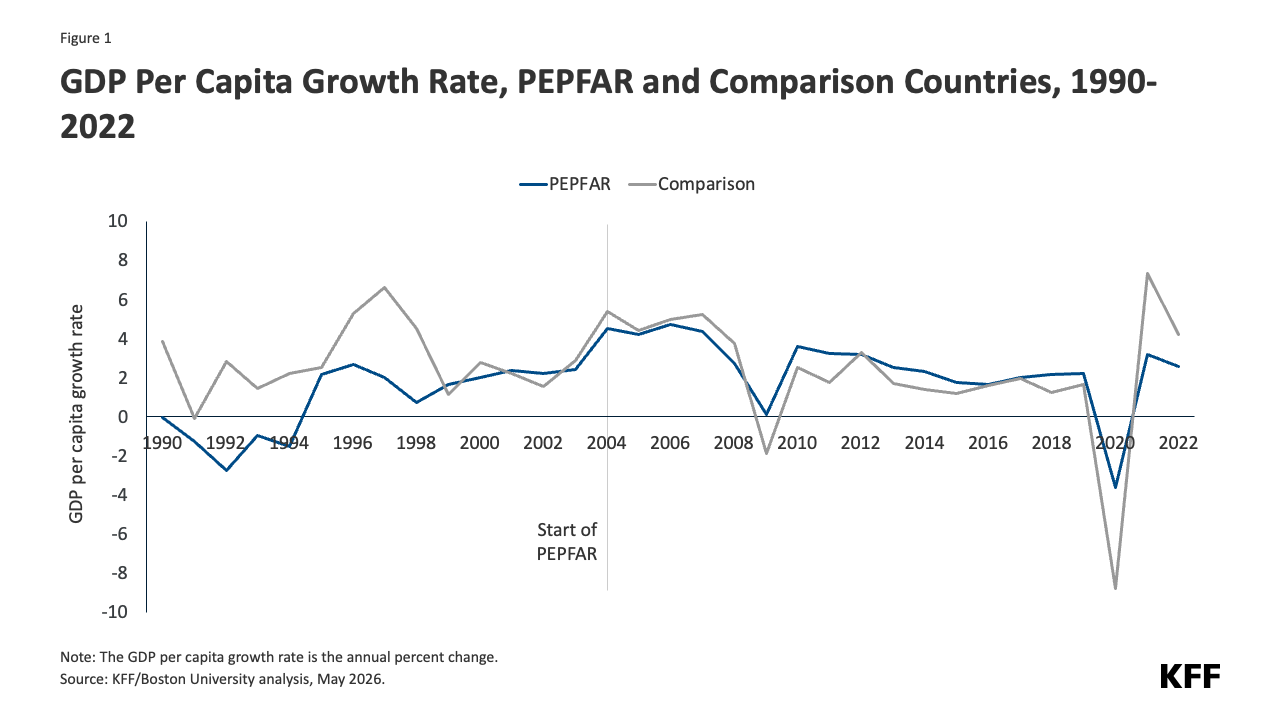
  • Prior to PEPFAR’s initiation, the GDP per capita growth rate was generally higher in comparison countries than PEPFAR countries, although there was some volatility in both.4 The rate in PEPFAR countries accelerated particularly after program’s initiation and until the 2008 global financial crisis, when it dropped in both sets of countries; however, this drop was more pronounced in comparison countries, where it was briefly negative. Similarly, during COVID-19, the GDP per capita growth rate was negative in both PEPFAR and comparison countries, but more so in comparison countries. (see Figure 1).
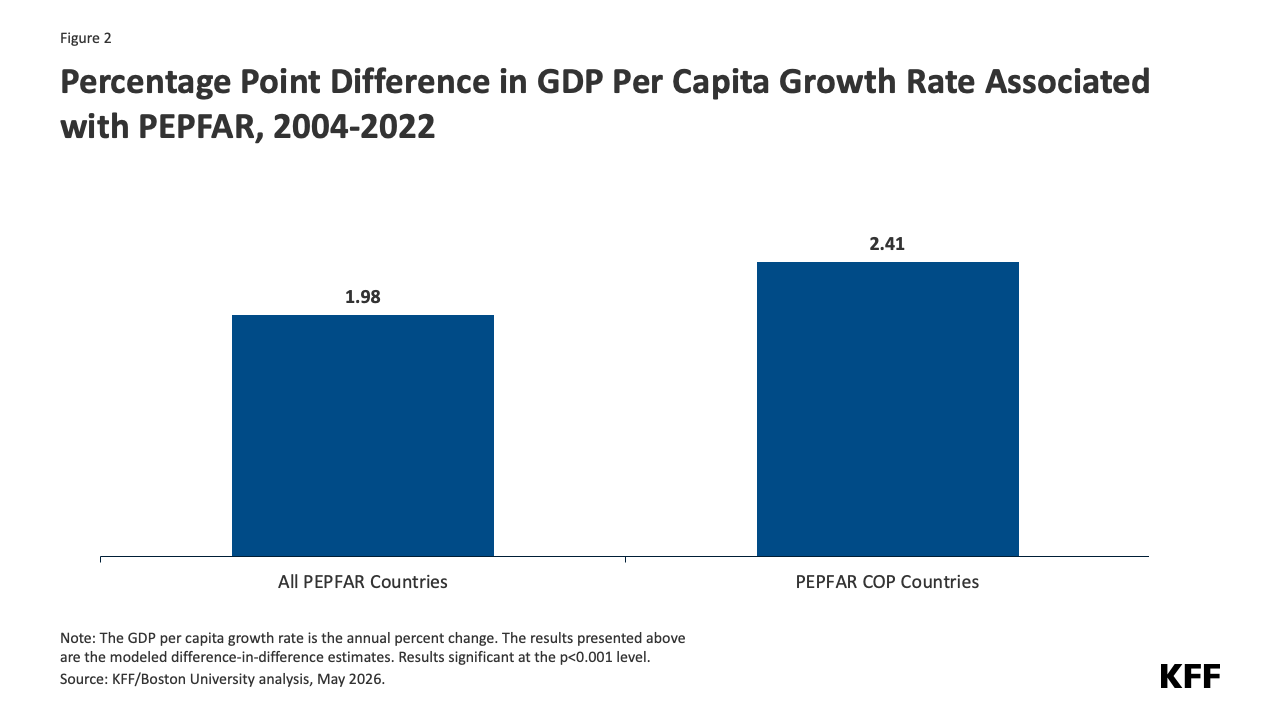
  • The difference-in-difference analysis finds that PEPFAR investments were associated with an annual GDP per capita growth rate 1.98 percentage points higher than what would have been expected without the program. While it is possible that the broad economic shocks of 2008 and 2020 affected PEPFAR and comparison countries differently, the model is designed to control for this possibility, supporting the finding that PEPFAR itself was associated with the outcome of interest (see Figure 2 and Tables 5-6).
  • These estimated effects were even larger in PEPFAR “COP” countries, those that engaged in more intensive planning and programming.5 In COP countries, PEPFAR was associated with an annual GDP per capita growth rate 2.41 percentage points higher (see Tables 5-6).
PEPFAR was also associated with significant declines in the shares of girls and boys of primary school age who were out-of-school over the period.

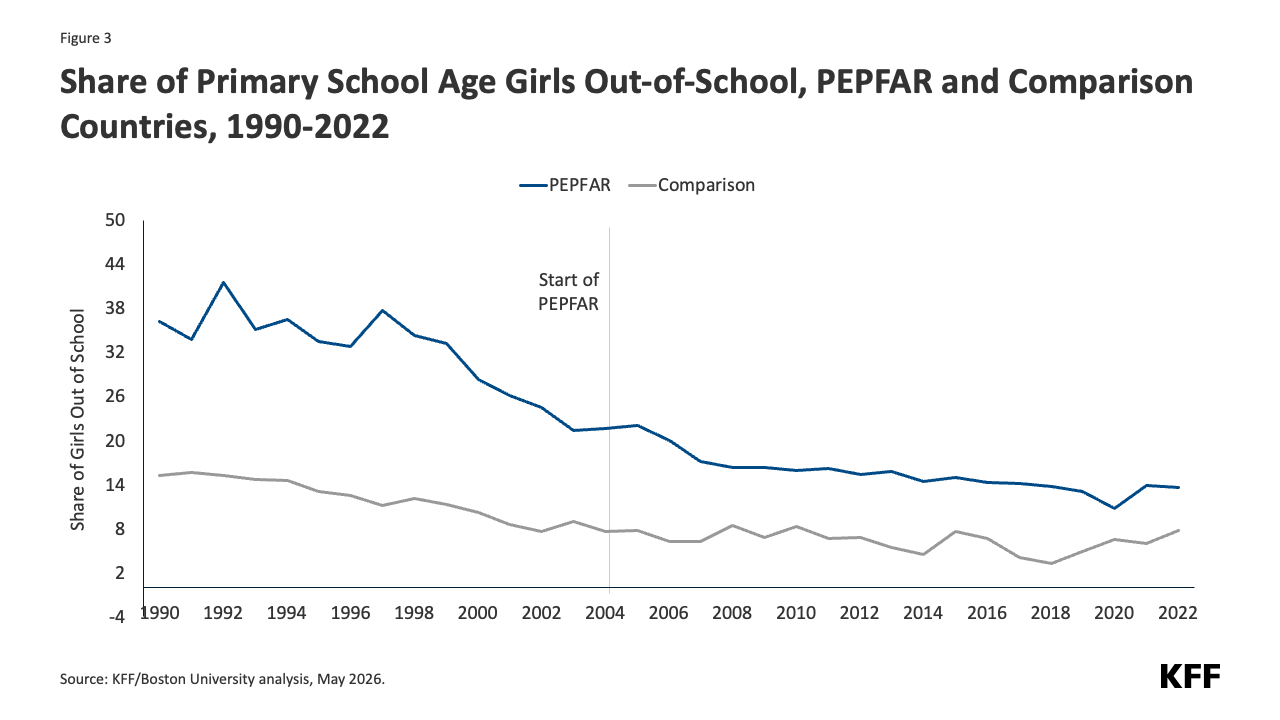
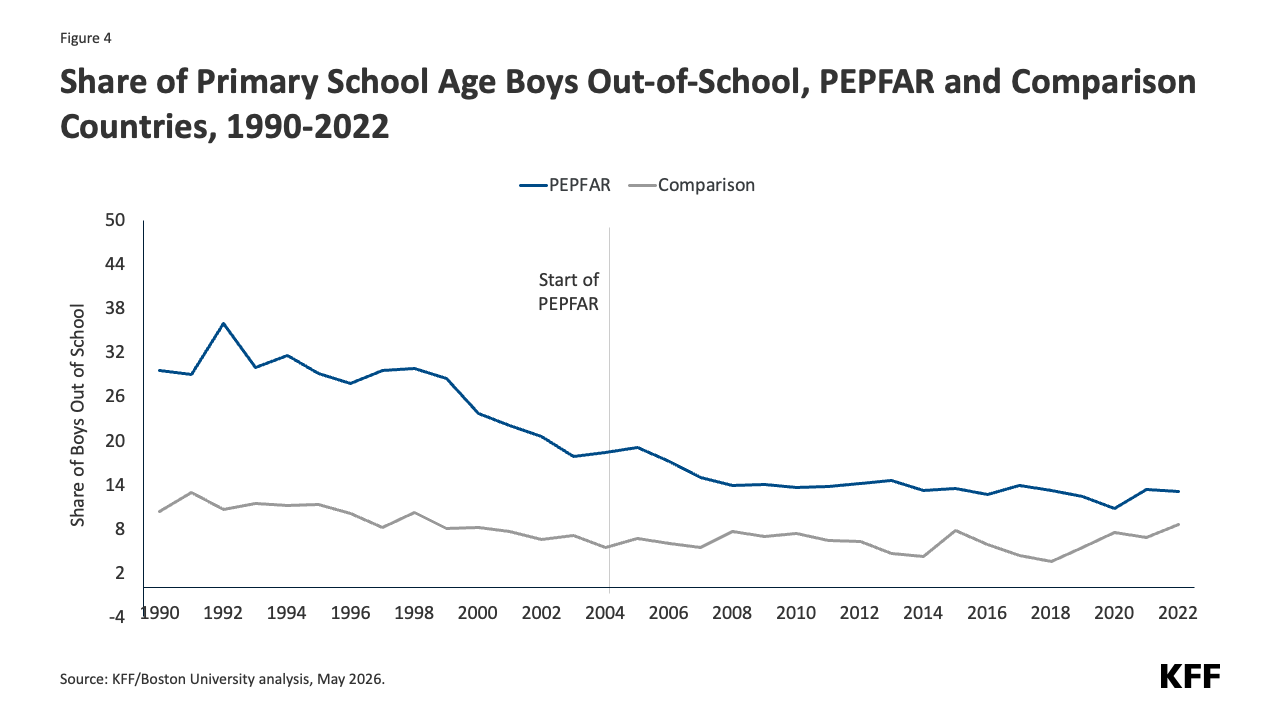
  • Before PEPFAR, the shares of girls and boys who were out-of-school were higher in PEPFAR than in comparison countries. While they had begun to drop in PEPFAR countries, the drop accelerated after the introduction of the program, moving closer to comparison countries. There was a slight uptick in both sets of countries during COVID-19, a period marked by widespread school closures. (see Figures 3-4).
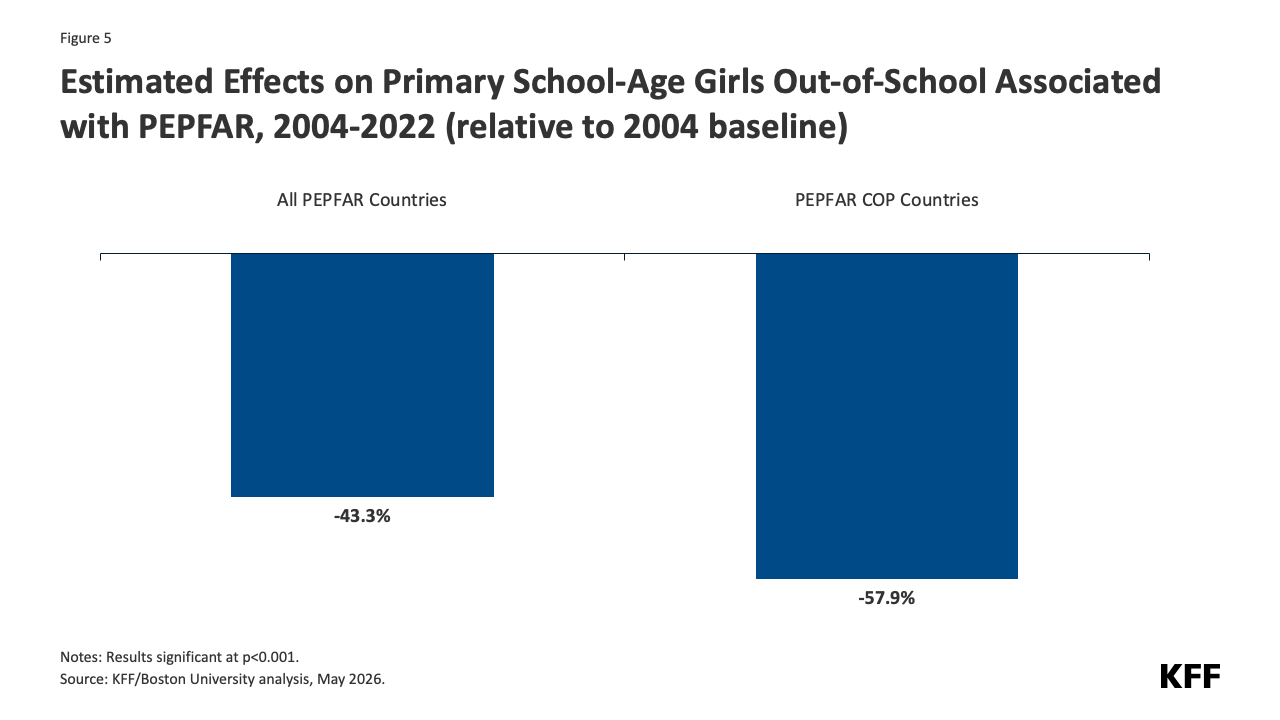
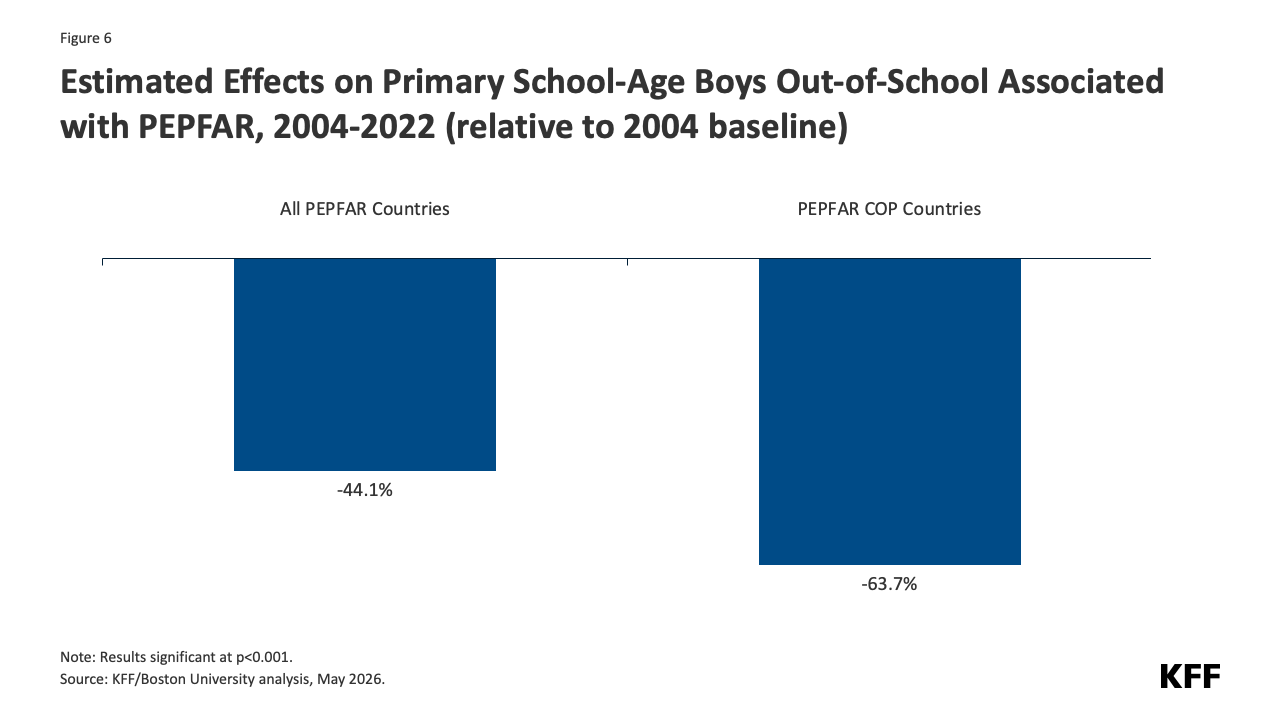
  • The analysis finds that the share of primary school-age girls who were out of school was 9.37 percentage points lower than would have been expected without PEPFAR (a 43.3% decline relative to the 2004 baseline). The percentage point decline for boys was 8.14 (a 44.1% decline (see Figures 5-6 and Tables 5-6).  
  • The estimated effects were larger in COP countries (57.9% for girls and 63.7% for boys relative to the baseline) (see Tables 5-6).

Finally, PEPFAR investments were associated with incremental improvements in most outcomes in each successive phase of the program.

  • In each successive phase of the program, corresponding to its different authorization periods, PEPFAR investments continued to be associated with improvements in most outcomes; the only exception was the GDP per capita growth rate in the most recent period. The greatest incremental improvements were in the first five years of the program, which also marked a significant influx of new funding; PEPFAR funding plateaued after that which may explain the smaller incremental gains in later years (see Table 7). 

Taken together, these findings provide continued evidence of PEPFAR’s knock-on effects beyond health alone. This is supported by numerous other studies that have found that health investments generally are correlated with educational attainment and economic growth, including, for example, by enabling children to stay in school longer and by supporting adults to join and/or remain in the labor force.These findings also suggestthat more recent changes made to the PEPFAR program by the Trump administration, including significantly scaling back funding and services with plans to further do so in the coming years, could not only have negative impacts on the HIV response, they could also dampen economic and educational gains beyond health.
Jen Kates is with KFF. William Crown, Deborah Stenoien, and Allyala Nandakumar are with Boston University.

Methods & Tables

A difference-in-difference, quasi-experimental design was used to estimate a “treatment effect” (PEPFAR), based on comparison to a control group (the counterfactual). The difference-in-difference design compares the before and after change in outcomes for the treatment group to the before and after change in outcomes for the comparison group. The outcomes of interest, their definitions and sources are listed in Table 1. Baseline variables are listed in Table 2. The panel data set of 157 low- and middle- income countries used in the prior analysis, covering 1990 to 2018, was updated to include data through 2022. COVID-related funding was not included. All values were adjusted to constant 2022 dollars. 

The PEPFAR group included 90 countries that had received PEPFAR support over the period. The comparison group included 67 low- and middle- income countries that had not received any PEPFAR support or had received minimal PEPFAR support (<$1M over the period or <$.05 per capita) between 2004 and 2022. Data on PEPFAR spending by country were obtained from the U.S. government’s https://foreignassistance.gov/ database and represent U.S. fiscal year disbursements. Data for other indicators were obtained from the World Bank’s World Development Indicator database (WDI) (https://datatopics.worldbank.org/world-development-indicators/, unless otherwise noted. Several different model specifications were explored. Each specification controlled for numerous baseline variables, compared to an unadjusted model, variables which may be expected to influence the outcomes of interest and which help make the comparison group more comparable to the PEPFAR group.

Table 3 provides the model specifications used in the updated analysis. Each model specification produced similar, statistically significant results. All models were also run with and without China and India, the two most populous countries in the world, to assess whether they were influencing the results. In both cases, PEPFAR’s impact was still significant and results were similar. The final reported results are from model specification 3. The pre-intervention period for this model started in 2002. All results were significant at the p<0.001 level. Table 4 provides the mean values for baseline outcomes and Tables 5-6 provide model results. The Table 5 difference-in-difference estimates should be interpreted as the unit change (e.g., percentage point change in the GDP per capita growth rate) in the outcome associated with PEPFAR. The Table 6 estimates should be interpreted as the percent change in the outcome, relative to the baseline, associated with PEPFAR. 

Despite the strengths of the difference-in-difference design, there are limitations to this approach. While the models adjusted for numerous baseline factors that could be correlated with the outcomes of interest, there may be other, unobservable factors not captured. Similarly, while baseline factors are also intended to adjust for selection bias, and make the PEPFAR and comparison groups more similar, there may be other ways in which comparison countries differed from PEPFAR countries (and factors which influenced which countries received PEPFAR support), which could bias the estimates. A recent published research article, based on the earlier 2004-2018 period, tested multiple model specifications and conducted sensitivity analyses. The results were similar across all models, adding to the confidence of the analytic approach used here. At the same time, there were some tests that indicated that the parallel trends assumption was not supported in all cases, warranting further analysis.6 Another recent analysis, under review for publication, conducted additional robustness tests and found consistent results.7

Table 1: Outcome Variables
VariableData Source
1. GDP per capita growth (annual %)Annual percentage growth rate of GDP per capita based on constant local currency. GDP per capita is gross domestic product divided by midyear population.
2. Children out of school, female (% of female primary school age)Percentage of female primary-school-age children who are not enrolled in primary or secondary school.
3. Children out of school, male (% of male primary school age)Percentage of male primary-school-age children who are not enrolled in primary or secondary school.
Source:  World Bank, WDI, https://datatopics.worldbank.org/world-development-indicators/
Table 2: Baseline Variables
VariableData Source
1. Gross Domestic Product (GDP) per capita (current USD)World Bank Development Indicators
2. Recipient of U.S. HIV funding prior to 2004 (dummy variable)https://foreignassistance.gov/
 
3. Total populationUnited Nations, Department of Economic and Social Affairs, Population Division
4. Life expectancy at birth (years)World Bank Development Indicators
5. Total fertility rate (births per woman)World Bank Development Indicators
6. Percent urban population (of total population)World Bank Development Indicators
7. School enrollment, secondary (% gross)World Bank Development Indicators
8. World Bank country income classificationWorld Bank
9. HIV prevalence (% of population ages 15-49)World Bank Development Indicators
To address missing values in some cases, additional data were obtained from the Global Burden of Disease Collaborative Network
10. Per capita donor spending on health (non-PEPFAR) (constant $)OECD Creditor Reporting System database
 
11. Per capita domestic health spending, government and private, PPP (current $)World Bank Development Indicators
Table 3: Model Specifications
1. Unadjusted model
2. Includes baseline variables 1-9
3. Includes baseline variables 1-11
Table 4: Baseline Mean Outcome Values, 2004
OutcomeAll PEPFAR CountriesPEPFAR COP Countries
GDP per capita growth rate (% change)4.54.1
Primary School-Age Girls Out of School (%)21.721.3
Primary School-Age Boys Out of School (%)18.519.2
Table 5: Difference-in-Difference Estimates Associated with PEPFAR, 2004-2022
(standard errors in parentheses)
OutcomeAll PEPFAR CountriesP Countries
GDP per capita growth rate (% change)1.9772.410
 (0.449)(0.653)
Primary School-Age Girls Out of School (%)-9.374-12.31
 (1.077)(1.223)
Primary School-Age Boys Out of School (%)-8.140-12.19
 (0.961)(1.089)
All results significant at p < 0.001
Table 6: Estimated Percent Change Associated with PEPFAR, 2004-2022 (Relative to 2004 Baseline)
OutcomeAll PEPFAR CountriesPEPFAR COP Countries
GDP per capita growth rate (% change)43.5%59.2%
Primary School-Age Girls Out of School (%)-43.3%-57.9%
Primary School-Age Boys Out of School (%)-44.1%-63.7%
All results significant at p < 0.001
Table 7: Estimated Incremental Percent Change Associated with PEPFAR by Time Period (Relative to 2004 Baseline)
Outcome2004-20082009-20132014-20182019-2022
GDP per capita growth rate (% change)19.3%21.6%4.7%-2.1%
Primary School-Age Girls Out of School (%)-30.9%-7.0%-4.5%-0.9%
Primary School-Age Boys Out of School (%)-30.7%-8.2%-4.3%-1.0%

Endnotes

  1. Eran Bendavid E, Bhattacharya J. The President’s Emergency Plan for AIDS Relief in Africa: An Evaluation of Outcomes. Ann Intern Med. 2009;150:688-695. Available at: https://www.acpjournals.org/doi/10.7326/0003-4819-150-10-200905190-00117?url_ver=Z39.88-2003&rfr_id=ori%3Arid%3Acrossref.org&rfr_dat=cr_pub%3Dpubmed&; Bendavid E, Holmes CB, Bhattacharya J, Miller G. HIV Development Assistance and Adult Mortality in Africa. JAMA. 2012;307(19):2060–2067. Available at: https://jamanetwork.com/journals/jama/fullarticle/1157487; IOM (Institute of Medicine). 2013. Evaluation of PEPFAR. Washington, DC: The National Academies Press. Available at: https://www.ncbi.nlm.nih.gov/books/NBK207013/; Wagner Z, Barofsky J, Sood N. PEPFAR Funding Associated With An Increase In Employment Among Males in Ten Sub-Saharan African Countries. Health Aff (Millwood). 2015;34(6):946-953. Available at: https://www.ncbi.nlm.nih.gov/pmc/articles/PMC4782769/; and Daschle T, Frist B. Building Prosperity, Stability, and Security Through Strategic Health Diplomacy: A Study of 15 Years of PEPFAR. Bipartisan Policy Center, Washington DC, 2018. Available at: https://bipartisanpolicy.org/download/?file=/wp-content/uploads/2019/03/Building-Prosperity-Stability-and-Security-Through-Strategic-Health-Diplomacy-A-Study-of-15-Years-of-PEPFAR.pdf; Chun HM, Dirlikov E, Cox MH, et al. Vital Signs: Progress Toward Eliminating HIV as a Global Public Health Threat Through Scale-Up of Antiretroviral Therapy and Health System Strengthening Supported by the U.S. President’s Emergency Plan for AIDS Relief — Worldwide, 2004–2022. MMWR Morb Mortal Wkly Rep 2023;72:317–324. Available at: https://www.cdc.gov/mmwr/volumes/72/wr/mm7212e1.htm?s_cid=mm7212e1_w#suggestedcitation; Gaumer G, Luan Y, Hariharan D, Crown W, Kates J, Jordan M, et al. “Assessing the impact of the president’s emergency plan for AIDS relief on all-cause mortality”. PLOS Glob Public Health 2024; 4(1): e0002467. Available at: https://pmc.ncbi.nlm.nih.gov/articles/PMC10796053/. ↩︎
  2. “The Future of Investment In PEPFAR: Understanding PEPFAR’s Multiple Economic, Health, And Diplomatic Impacts”, Health Affairs Blog, April 17, 2017. Available at: https://www.healthaffairs.org/content/forefront/future-investment-pepfar-understanding-pepfar-s-multiple-economic-health-and-diplomatic; Crown W, Hariharan D, Kates J, Gaumer G, Jordan M, Hurley C, et al. “Analysis of economic and educational spillover effects in PEPFAR countries.” PLoS ONE 2023; 18(12): e0289909. Available at: https://journals.plos.org/plosone/article?id=10.1371/journal.pone.0289909;  ; Gaumer G, Crown WH, Kates J, et al. “Analysis of maternal and child health spillover effects in PEPFAR countries.” BMJ Open 2023;13: e070221. Available at: https://bmjopen.bmj.com/content/13/12/e070221.long. ↩︎
  3. “The Future of Investment In PEPFAR: Understanding PEPFAR’s Multiple Economic, Health, And Diplomatic Impacts”, Health Affairs Blog, April 17, 2017. Available at: https://www.healthaffairs.org/content/forefront/future-investment-pepfar-understanding-pepfar-s-multiple-economic-health-and-diplomatic; Crown W, Hariharan D, Kates J, Gaumer G, Jordan M, Hurley C, et al. “Analysis of economic and educational spillover effects in PEPFAR countries.” PLoS ONE 2023; 18(12): e0289909. Available at: https://journals.plos.org/plosone/article?id=10.1371/journal.pone.0289909;  ; Gaumer G, Crown WH, Kates J, et al. “Analysis of maternal and child health spillover effects in PEPFAR countries.” BMJ Open 2023;13: e070221. Available at: https://bmjopen.bmj.com/content/13/12/e070221.long.
    [iii] Vogl T, Education and health in developing economies, Working Papers 1453, Princeton University, Woodrow Wilson School of Public and International Affairs, 2012; Wagner Z, Barofsky J, Sood N, “PEPFAR funding associated with an increase in employment among males in ten sub-Saharan African countries,” Health Affairs, 2015 Jun, 34(6): 946-953. Available at: https://pmc.ncbi.nlm.nih.gov/articles/PMC4782769/; Piabuo S, Tieguhong J, “Health expenditure and economic growth – a review of the literature and an analysis between the economic community for central African states (CEMAC) and selected African countries,” Health Econ Rev, 2017 Dec, 7(23); Bloom D, Kuhn M, Prettner K, Health and economic growth, 2018, IZA DP No. 11939, available at: https://www.iza.org/publications/dp/11939/health-and-economic-growth; Collin M, Weil D, The effect of increasing human capital investment on economic growth and poverty: a simulation exercise, World Bank, WPS8590, 2018, available at: https://openknowledge.worldbank.org/handle/10986/30463. Remes J, Wilson M, Ramdorai A, How investing in health has a significant economic payoff for developing economies, Brookings, July 2020, available at: https://www.brookings.edu/blog/future-development/2020/07/21/how-investing-in-health-has-a-significant-economic-payoff-for-developing-economies/; Bloom D, Khoury A, Kufenko V, Prettner K, “Spurring economic growth through human development: research results and guidance for policymakers,” Population and Development Review, 2021 Jun, 47(2): 377-409; World Bank, Human Capital Project, available at: https://www.worldbank.org/en/publication/human-capital. ↩︎
  4. This volatility appears to have been influenced by a subset of outlier countries; after removing these countries from the analysis, the results remain significant. ↩︎
  5. Historically, a subset of countries receiving PEPFAR support had been required to prepare annual Country Operational Plans (COPs) which documented annual funding levels linked to results and served as budget and tracking tools. These were prepared by country teams who worked intensively to develop these plans in concert with headquarters at the State Department. ↩︎
  6. Crown W, Hariharan D, Kates J, Gaumer G, Jordan M, Hurley C, Luan Y, Nandakumar A. (2023) “Analysis of economic and educational spillover effects in PEPFAR countries”. PLOS ONE 18(12): e0289909. https://doi.org/10.1371/journal.pone.0289909. ↩︎
  7. Crown W, Stenoien D, Reid MJA, Kumar S, Kates J, Jordan M, Nandakumar A. “The Economic Impact of Lives Saved in PEPFAR Countries”, under review, BMJ Global Health. https://doi.org/10.12688/verixiv.2057.1 ↩︎
State Health Coverage for Immigrants and Implications for Health Coverage and Care

Published: May 19, 2026

Editorial Note

This brief was updated on June 11, 2026 to include additional details on fully state-funded coverage in Washington.

As of 2024, there were 24 million noncitizen immigrants, including lawfully present and undocumented immigrants, living in the U.S. Noncitizen immigrants, particularly those who are undocumented, face significant barriers to accessing health coverage and care and are significantly more likely than citizens to be uninsured. These higher uninsured rates reflect more limited access to private coverage and eligibility restrictions for federally funded coverage options. Undocumented immigrants are not eligible for federally funded coverage options and lawfully present immigrants face eligibility restrictions for coverage. Under the 2025 reconciliation law there will be increased eligibility restrictions for many lawfully present immigrants for Medicaid and the Children’s Health Insurance Program (CHIP), subsidized Affordable Care Act (ACA) Marketplace coverage, and Medicare coverage.

Some states have taken up options in Medicaid and CHIP to expand coverage for lawfully present immigrants and/or established fully state-funded programs to fill gaps in coverage for immigrants. However, some states have recently made reductions to these programs due to budget pressures. On the other hand, a few states are considering how they can use state-funded coverage to fill the gaps in coverage that will result from the reconciliation law eligibility restrictions. This brief provides an overview of state take-up of these options and fully state-funded health coverage programs for immigrants.

As of April 2026, 15 states, including DC, provide fully state-funded coverage for income-eligible children regardless of immigration status; seven states, including DC, provide fully state-funded coverage to some income-eligible adults regardless of status; and most states have taken up options in Medicaid and CHIP to expand coverage to lawfully present immigrant children and pregnant people. Six states, including DC, have recently scaled back their state-funded coverage for adults. Two states have plans to expand state-funded coverage to fill gaps in coverage that will be created by the 2025 reconciliation law eligibility restrictions, and several other states have pending legislation to fill gaps.

Looking ahead, states may face increased challenges maintaining state-funded coverage programs, while at the same time there may be growing need for coverage due to new restrictions in federally funded coverage for lawfully present immigrants under the reconciliation law. More limited access to federally funded coverage as well as reductions in state-funded coverage programs will likely lead to increases in uninsured rates for immigrant families contributing to greater challenges accessing care and potentially worse health outcomes over the long-term. These changes could also have negative implications for the U.S. economy and workforce, where immigrant families make significant contributions.

Health Coverage for Immigrants

Lawfully present immigrants may qualify for federally funded coverage but face eligibility restrictions. For example, many must meet a five-year waiting period before qualifying for Medicaid or CHIP even if they meet other eligibility criteria. Lawfully present immigrants can purchase coverage through the ACA Marketplaces and may receive tax credits for this coverage without a waiting period. Lawfully present immigrants have been eligible for Medicare if they have the required work quarters and meet the disability or age requirements. Under the 2025 reconciliation law, eligibility for Medicaid and CHIP, subsidized Marketplace, and Medicare coverage will be limited to immigrants who are lawful permanent residents (LPRs) or green card holders, certain Cuban and Haitian entrants, and people residing in the U.S. as citizens of the Freely Associated (COFA) nations of the Marshall Islands, Micronesia, and Palau. The law also eliminates ACA Marketplace coverage for lawfully present immigrants with incomes less than 100% FPL effective January 1, 2026. States may also continue to cover lawfully residing children and pregnant immigrants under a Medicaid or CHIP option. These changes will result in some groups of lawfully present immigrants losing access to federally funded coverage, including refugees and asylees.

Undocumented immigrants are ineligible to enroll in federally funded coverage, including Medicaid or CHIP, the ACA Marketplaces, or Medicare. Medicaid payments for emergency services reimburse hospitals for emergency care they are obligated to provide to individuals who meet other Medicaid eligibility requirements (such as income), but who do not have an eligible immigration status, including undocumented immigrants as well as some lawfully present immigrants. These payments help cover costs to hospitals for providing emergency care to immigrants who remain ineligible for Medicaid but are not coverage for individuals. Emergency spending accounted for less than one percent of total Medicaid spending between fiscal years 2017 and 2023. The 2025 reconciliation law reduces the federal Medicaid matching rate provided to states for Emergency Medicaid services provided to expansion adults who would otherwise be eligible for Medicaid except for their immigration status to the regular matching rate starting October 1, 2026.

State Take-up of Optional Coverage for Lawfully Present Immigrants

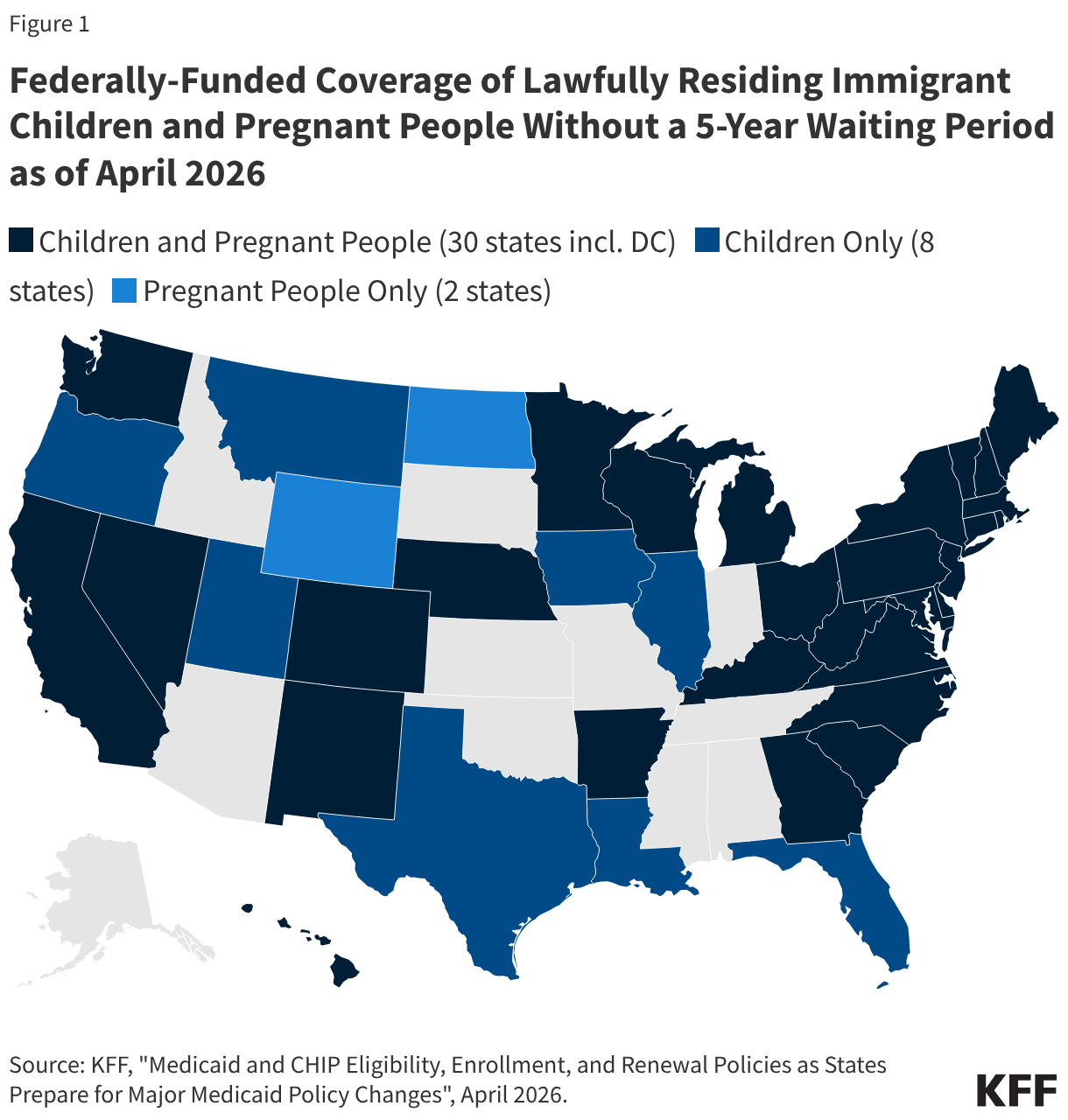
Most states have taken up options in Medicaid and CHIP to expand coverage for lawfully residing children and/or pregnant people. In general, lawfully present immigrants must have a “qualified” immigration status to be eligible for Medicaid or CHIP, and many, including most lawful permanent residents or “green card” holders, must wait five years after obtaining qualified status before they may enroll even if they meet other eligibility requirements. Some immigrants, such as those with Temporary Protected Status, are lawfully present but do not have a qualified status and are not eligible to enroll in Medicaid or CHIP regardless of their length of time in the country. As noted, under the 2025 reconciliation law, eligibility will be further restricted to lawfully present immigrants who are LPRs or green card holders, certain Cuban and Haitan entrants, and people residing in the U.S. under COFA starting October 1, 2026. States can provide coverage to lawfully residing children and pregnant people without a five-year wait under the Immigrant Children’s Health Improvement Act (ICHIA) option. As of April 2026, 38 states, including DC, have taken up this option for children and 32 states, including DC, have elected the option for pregnant people (Figure 1). States may continue to provide this coverage under the 2025 reconciliation law. North Carolina enacted a Medicaid funding bill in April 2026 that codified the 2025 reconciliation law’s immigrant eligibility changes by limiting eligibility to coverage that the state is federally required to provide, starting October 1, 2026. This would eliminate ICHIA coverage as it is optional for states to provide. However, the Governor has called for the state legislature to reinstate this coverage and some state legislators have indicated that the cut was unintentional.

Federally-Funded Coverage of Lawfully Residing Immigrant Children and Pregnant People Without a 5-Year Waiting Period as of April 2026 (Choropleth map)

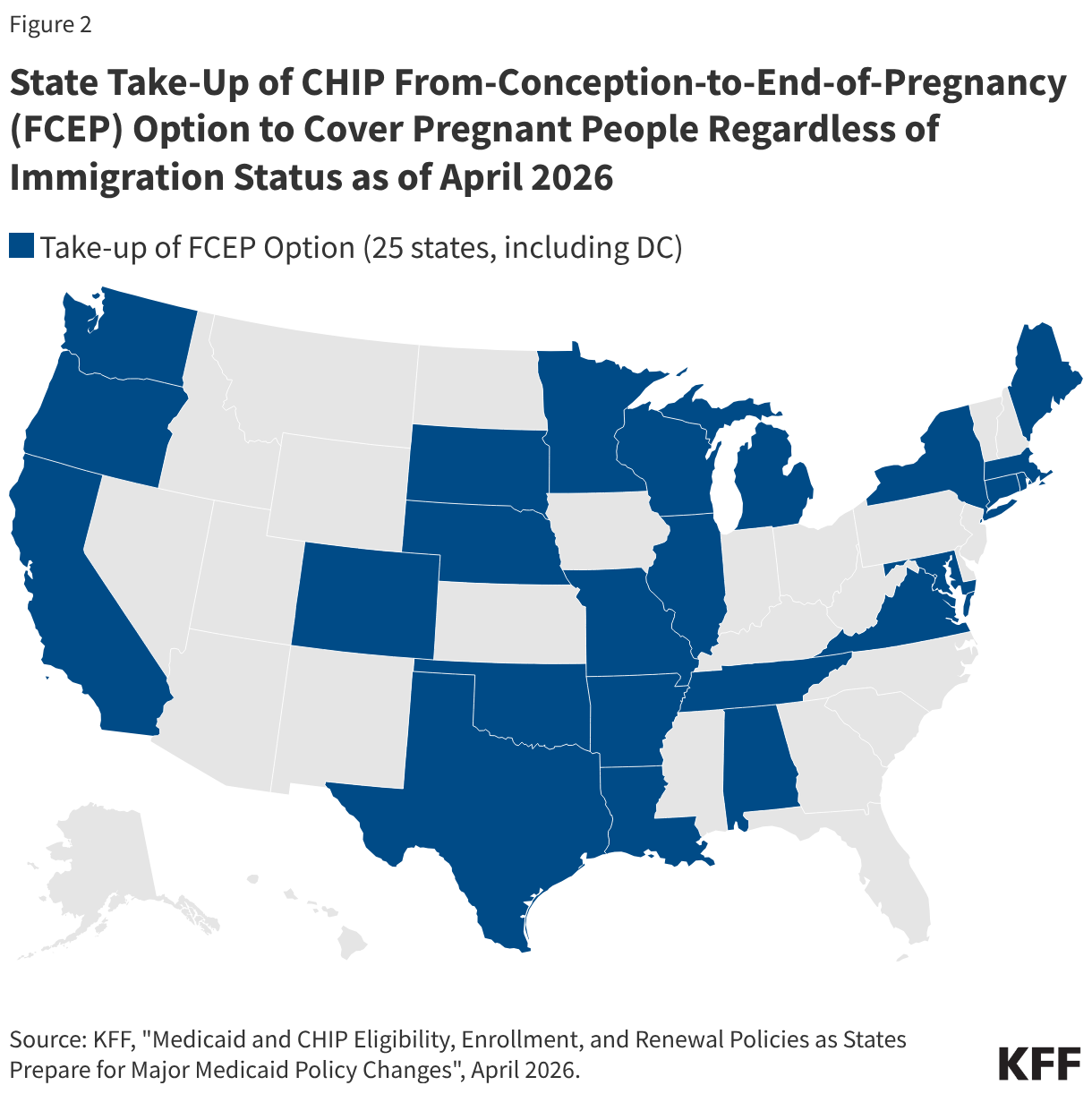
A total of 25 states, including DC, have extended coverage through the CHIP From-Conception-to-End-of-Pregnancy (FCEP) option, which provides prenatal care and pregnancy related benefits to eligible low-income children beginning from conception to end of pregnancy regardless of their parent’s citizenship or immigration status (Figure 2). While other pregnancy-related coverage in Medicaid and CHIP requires 60 days of postpartum coverage, the CHIP FCEP option does not include this coverage. However, some states that took up this option provide postpartum coverage through a CHIP health services initiative or using state-only funding. Eleven of the states that have implemented the FCEP option (California, Colorado, Connecticut, Illinois, Maine, Massachusetts, Minnesota, New York, Oregon, Rhode Island, and Washington) have used state funding or CHIP health services initiatives to extend postpartum coverage to 12 months to align with the Medicaid extension established by the American Rescue Plan Act. Maryland extends coverage for four months postpartum, and Alabama, Texas, Virginia, and DC extend coverage for 60 days postpartum using CHIP health services initiatives.

State Take-Up of CHIP From-Conception-to-End-of-Pregnancy (FCEP) Option to Cover Pregnant People Regardless of Immigration Status as of April 2026 (Choropleth map)

Fully State-Funded Coverage

Beyond state take-up of options in Medicaid and CHIP for lawfully present immigrants, some states provide fully state-funded coverage to fill gaps in coverage for immigrants. States vary in the eligibility and scope of benefits offered through these coverage programs. These programs extend coverage to lawfully present immigrants who are in the five-year waiting period for Medicaid or CHIP or do not have “qualified status” and are ineligible for federally funded coverage as well as undocumented immigrants. These programs also extend coverage to Deferred Action for Childhood Arrivals (DACA) recipients who are not considered lawfully present for purposes of eligibility for federally funded health coverage programs. While the Biden administration had published regulations to extend Marketplace coverage to DACA recipients, new regulations by the Trump administration and the 2025 reconciliation law excluded them from coverage.

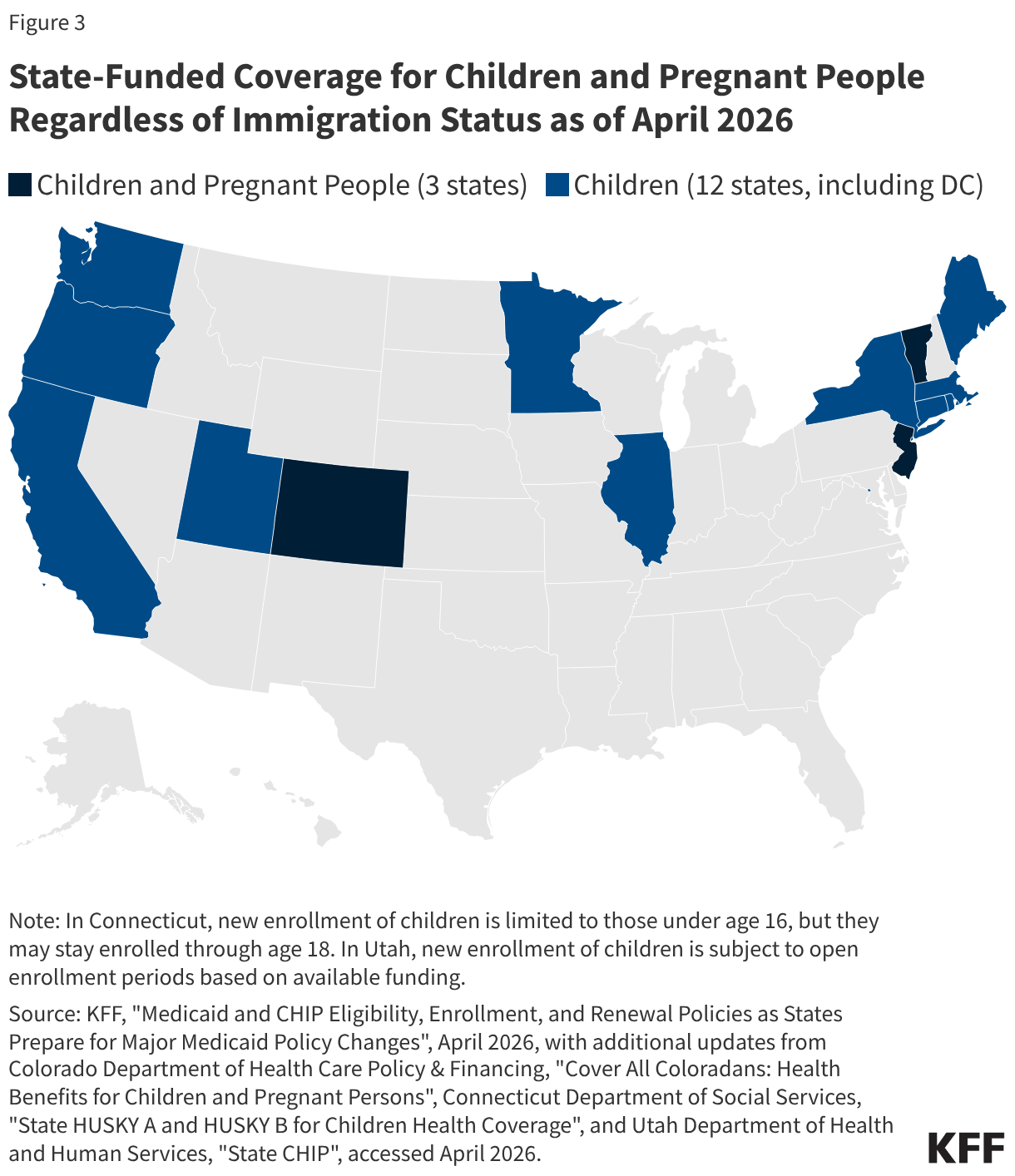
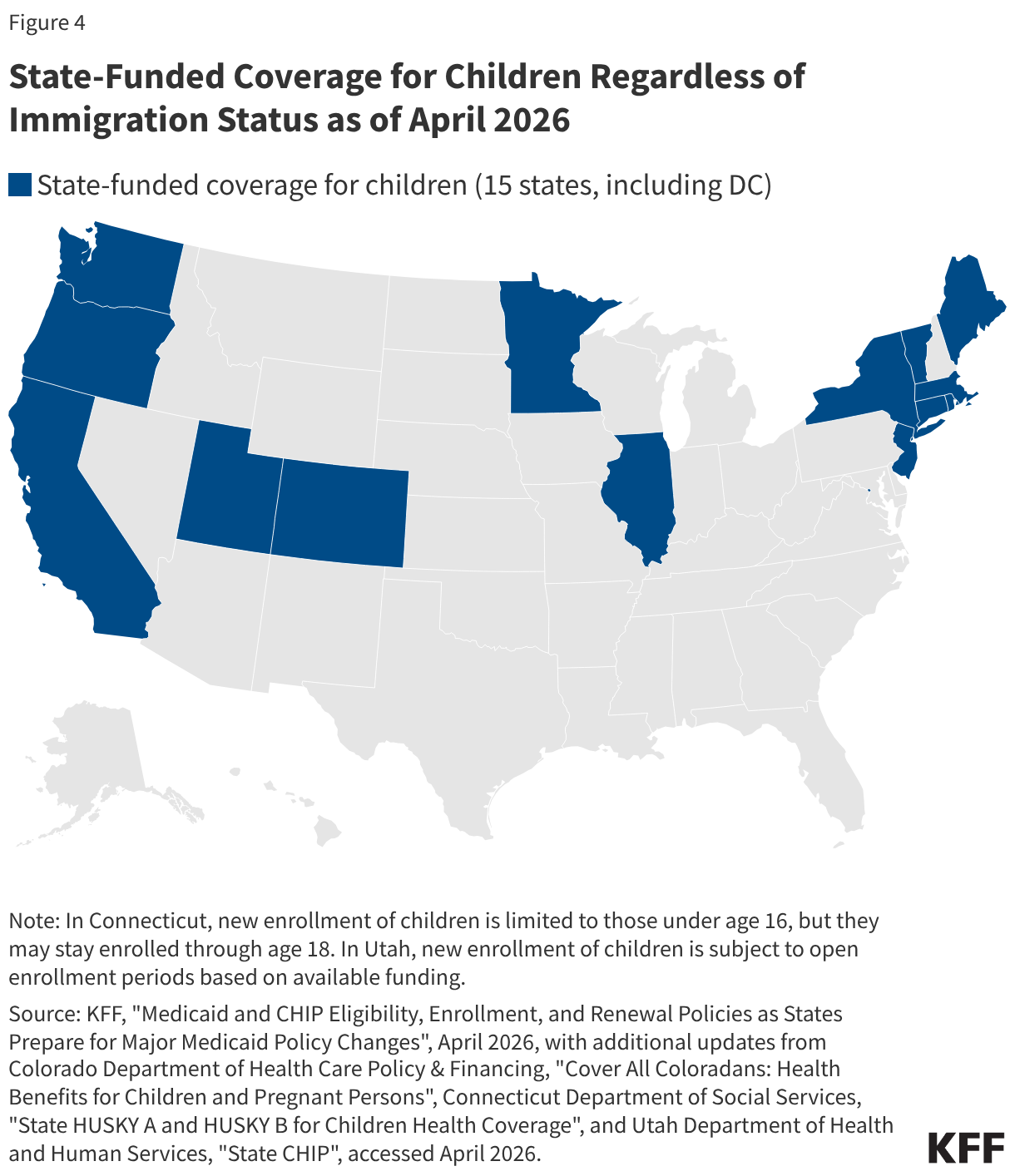
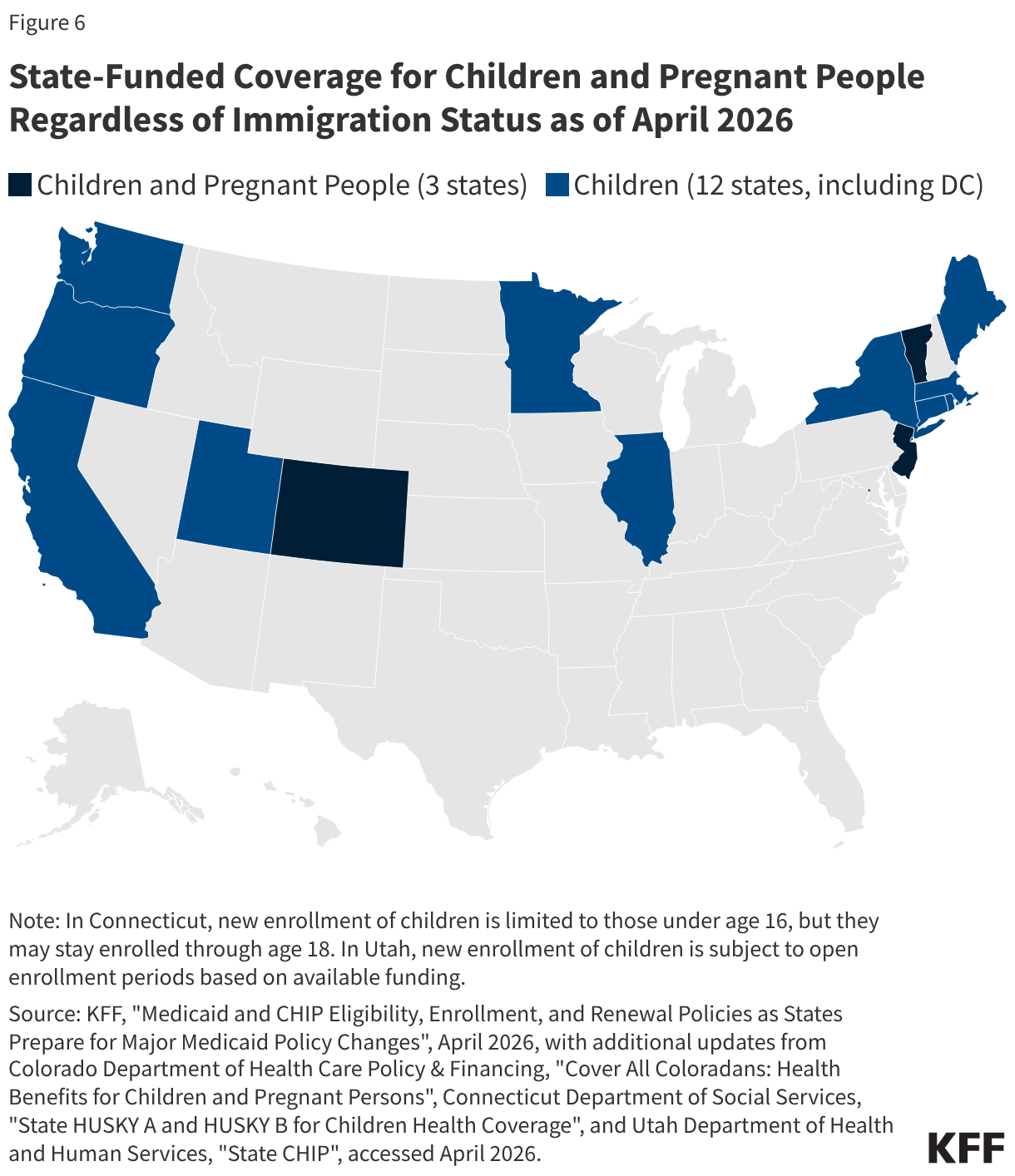
As of April 2026, 15 states, including DC, provide comprehensive state-funded coverage for children regardless of immigration status, with one state (Colorado) planning to scale back coverage due to budget pressures (Figure 3). These states include California, Colorado, Connecticut, Illinois, Maine, Massachusetts, Minnesota, New Jersey, New York, Oregon, Rhode Island, Utah, Vermont, Washington, and DC. Three of these states (Colorado, New Jersey, and Vermont) also provide state-funded coverage to income-eligible pregnant people regardless of immigration status, with Vermont extending this coverage for 12 months postpartum. Colorado plans to implement rollbacks to their state-funded coverage program for children and pregnant people, including capping enrollment and limiting certain benefits, starting January 2027 due to funding constraints.

State-Funded Coverage for Children and Pregnant People Regardless of Immigration Status as of April 2026 (Choropleth map)

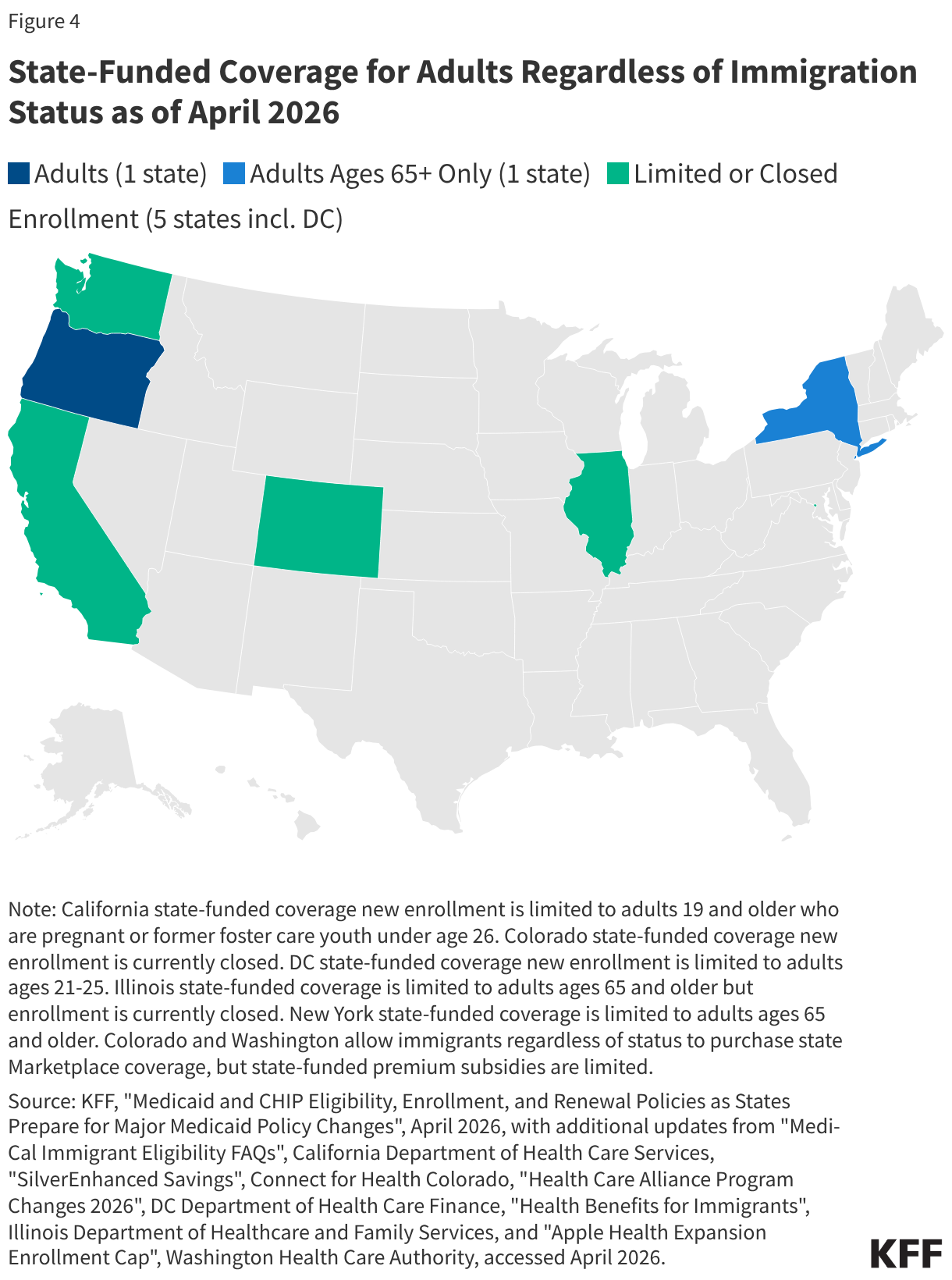
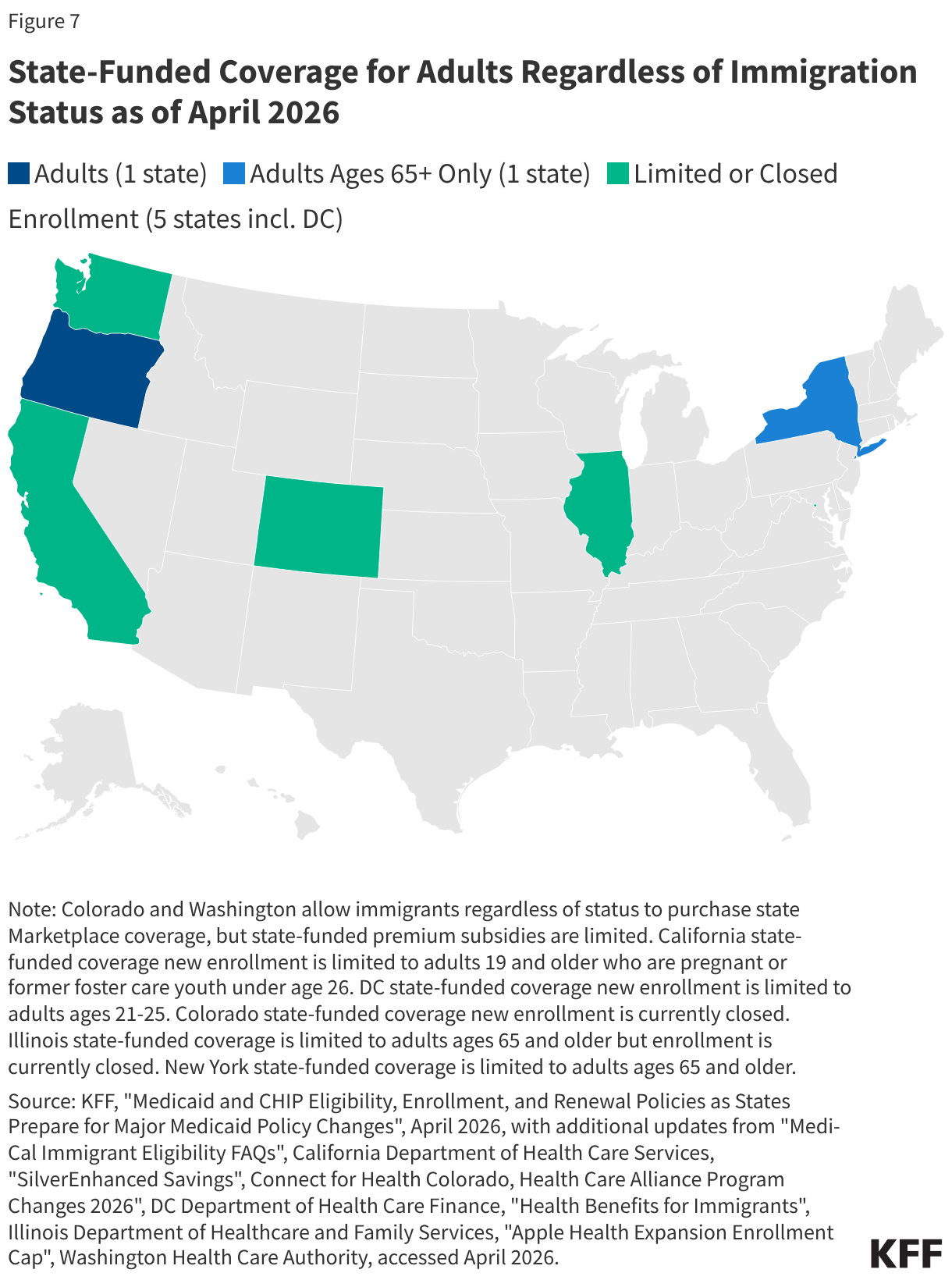
As of April 2026, seven states, including DC, have also expanded fully state-funded coverage to at least some income-eligible adults regardless of immigration status (Figure 4). These states include California, Colorado, DC, Illinois, New York, Oregon, and Washington. In some cases, coverage is limited to certain age groups, and several states have closed new enrollment. Some additional states cover some income-eligible adults who are not otherwise eligible due to immigration status using state-only funds but limit coverage to specific groups, such as lawfully present immigrants who are in the five-year waiting period for Medicaid coverage, or provide more limited benefits.

Six states, including DC, have recently eliminated or reduced or plan to scale back state-funded coverage due to budget pressures.

  • California previously extended state-funded coverage to all income-eligible adults regardless of immigration status but implemented coverage reductions for adults 19 and older who are not pregnant or former foster youth under age 26 due to funding constraints, including: closing enrollment starting January 2026, ending dental benefits starting July 2026, and charging $30 monthly premiums for adults ages 19-59 starting July 2027. The California governor’s 2026-27 budget also proposes applying Medicaid policy changes included in the 2025 reconciliation law (work requirements and more frequent six-month renewals) to adults enrolled in the state-funded coverage program.
  • Colorado allows adults regardless of immigration status to obtain Marketplace coverage through OmniSalud using a section 1332 waiver. Colorado uses state funds to provide plans with $0 premiums through SilverEnhanced Savings. The state reduced the enrollment cap for the program from 12,000 in 2025 to 6,700 people due to funding constraints. As noted above, the state also plans to cap enrollment and limit benefits for children and pregnant people beginning in January 2027 due to funding constraints.
  • DC provides health coverage to low-income adults 21 and older regardless of immigration status through its longstanding locally funded Healthcare Alliance program. However, DC closed enrollment to adults ages 26 and older and reduced income limits for adults 21 and older starting October 2025. DC plans to end coverage for all adults ages 21 and older by October 2027.
  • Illinois extended state-funded coverage to low-income individuals ages 65 and older regardless of immigration status through its Health Benefits for Immigrant Seniors (HBIS) program in December 2020 but new enrollment has been paused since 2023. Illinois previously extended coverage to low-income immigrants ages 42 to 64 regardless of immigration status through the Health Benefits for Immigrant Adults (HBIA) program in 2022, but ended HBIA coverage on July 2025 due to funding constraints.
  • Minnesota extended state-funded health coverage to income-eligible adults 18 and older regardless of immigration status in January 2025 but ended this coverage starting January 2026 due to funding constraints. 
  • Washington uses state funds to provide Marketplace coverage with premium subsidies to individuals with incomes up to 250% FPL regardless of immigration status through Cascade Care using a section 1332 waiver, but funding is limited. In July 2024, Washington extended state-funded health coverage to individuals with incomes up to 138% FPL who are not eligible for either federal Medicaid or federal advance premium tax credits, but the state closed enrollment due to funding constraints and moves current and future enrollees to a fee-for-service program.

In addition to these states, Maryland also delayed plans to allow income-eligible individuals to purchase Marketplace coverage without subsidies regardless of immigration status to 2028 due to changes in the 2025 reconciliation law that will require additional administrative resources to implement.

State-Funded Coverage for Adults Regardless of Immigration Status as of April 2026 (Choropleth map)

Two states (New Mexico and New York) are planning to provide fully state-funded coverage to lawfully present immigrants that will lose Medicaid and ACA Marketplace coverage due to eligibility restrictions in the 2025 reconciliation law. New Mexico plans to use state funds to cover lawfully present immigrants losing Medicaid and ACA Marketplace Coverage in addition to DACA recipients. The New York governor’s 2026-27 budget proposes using state funds to cover lawfully present immigrants losing Medicaid coverage. The state will also use state funds to cover income-eligible lawfully present immigrants losing federally-subsidized health coverage through the Essential Plan. Under a longstanding court ruling, New York is required to provide state-funded coverage to lawfully present immigrants who would be eligible for Medicaid if not for their immigration status. Legislation introduced in New York and several other states, including California, Illinois, and Washington, would expand state-funded health coverage for immigrants to help fill gaps created by the reconciliation law; however, it is uncertain these bills will be enacted.

Impact of State Coverage Expansions on Health Care Access and Use

While coverage expansions for immigrants increase spending, research suggests that they reduce uninsured rates, increase health care use, and improve health outcomes. Data from the KFF/New York Times 2025 Survey of Immigrants show that immigrant adults who live in states that provide more expansive coverage, including the ACA Medicaid expansion for low-income adults overall and immigrant coverage expansions, are about half as likely to be uninsured compared with those living in states with less expansive policies (11% vs. 23%). Other research shows that coverage expansions for immigrant children increase access to health care and are associated with improved health outcomes. A study found that eliminating the five-year wait for Medicaid or CHIP was associated with a decline in uninsured rates among lawfully present foreign-born children in states without state-funded health care programs. California’s 2016 expansion to low-income children regardless of immigration status was associated with a 34% decline in uninsurance rates, and the state’s expansion to all adults was associated with an increase in health coverage among immigrant adults ages 50 and older. Similarly, a study found that children who reside in states that have expanded coverage to all children regardless of immigration status were less likely to be uninsured, to forgo medical or dental care, and to go without a preventive health visit than children residing in states that have not expanded coverage. Another study found that immigrant children residing in states with more expansive health coverage policies were more likely to have uninterrupted health coverage and a usual source of primary care than those residing in states with less expansive health coverage policies. Research has also found that expanding Medicaid coverage to pregnant people regardless of immigration status is associated with higher rates of prenatal care and improved birth outcomes, while more restrictive state coverage policies were associated with reduced postpartum care utilization.

Children in Immigrant Families: Key Facts on Health Coverage and Care

Published: May 19, 2026

Introduction

One in four children aged 18 and under living in the U.S. has at least one immigrant parent. Policies undertaken by the Trump administration and Congress aimed at restricting access to health coverage and care for immigrants as well as the significant increase in immigration enforcement activities could have significant implications for the health and well-being of these children, the vast majority of whom are citizens.

This brief provides key data on socioeconomic characteristics and health coverage among children (aged 18 and under) of immigrants based on KFF analysis of 2024 American Community Survey data. It also examines potential implications of recent policies and actions on the health and well-being of children in immigrant families drawing on KFF survey data from Fall 2025.

Children in Immigrant Families

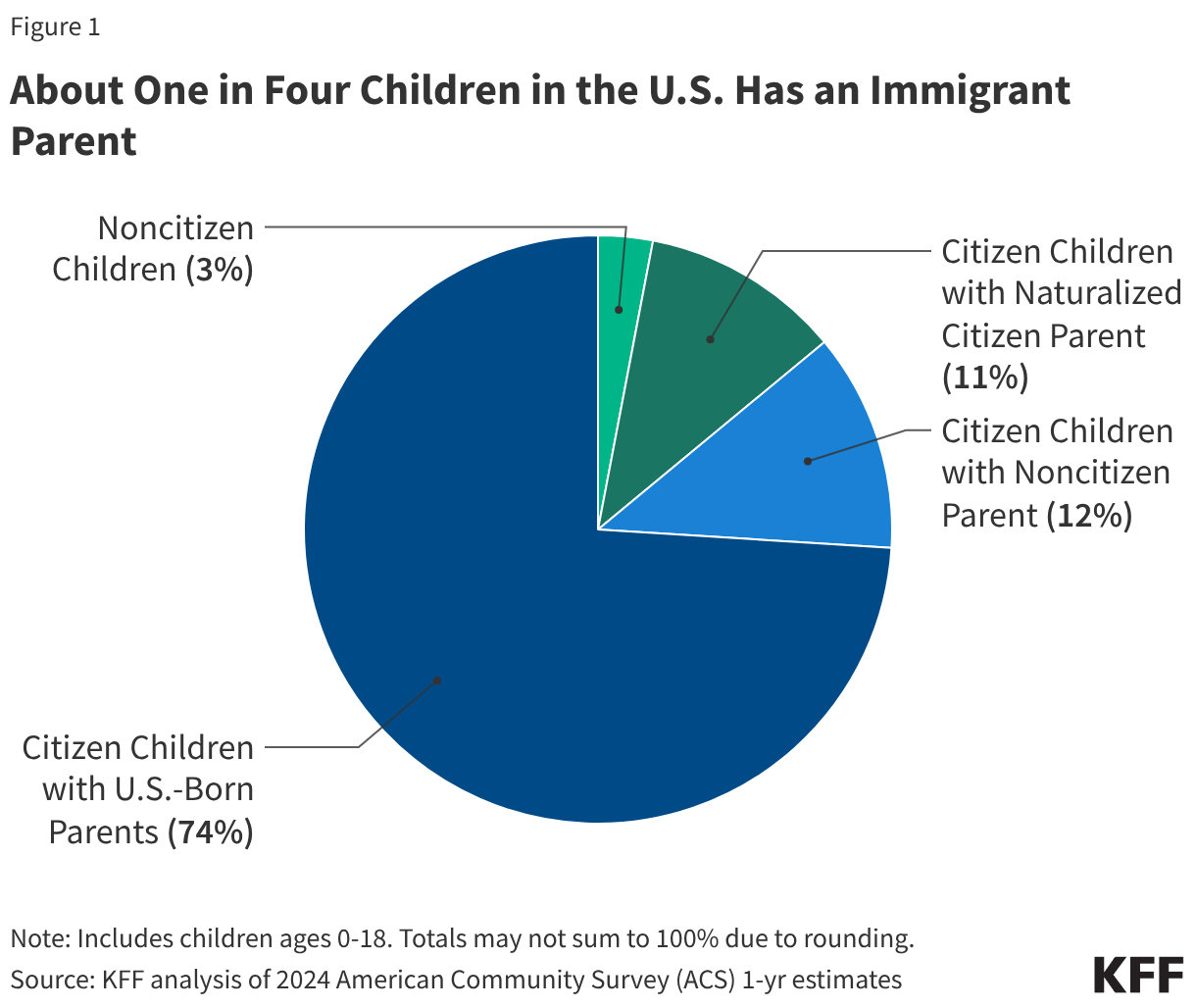
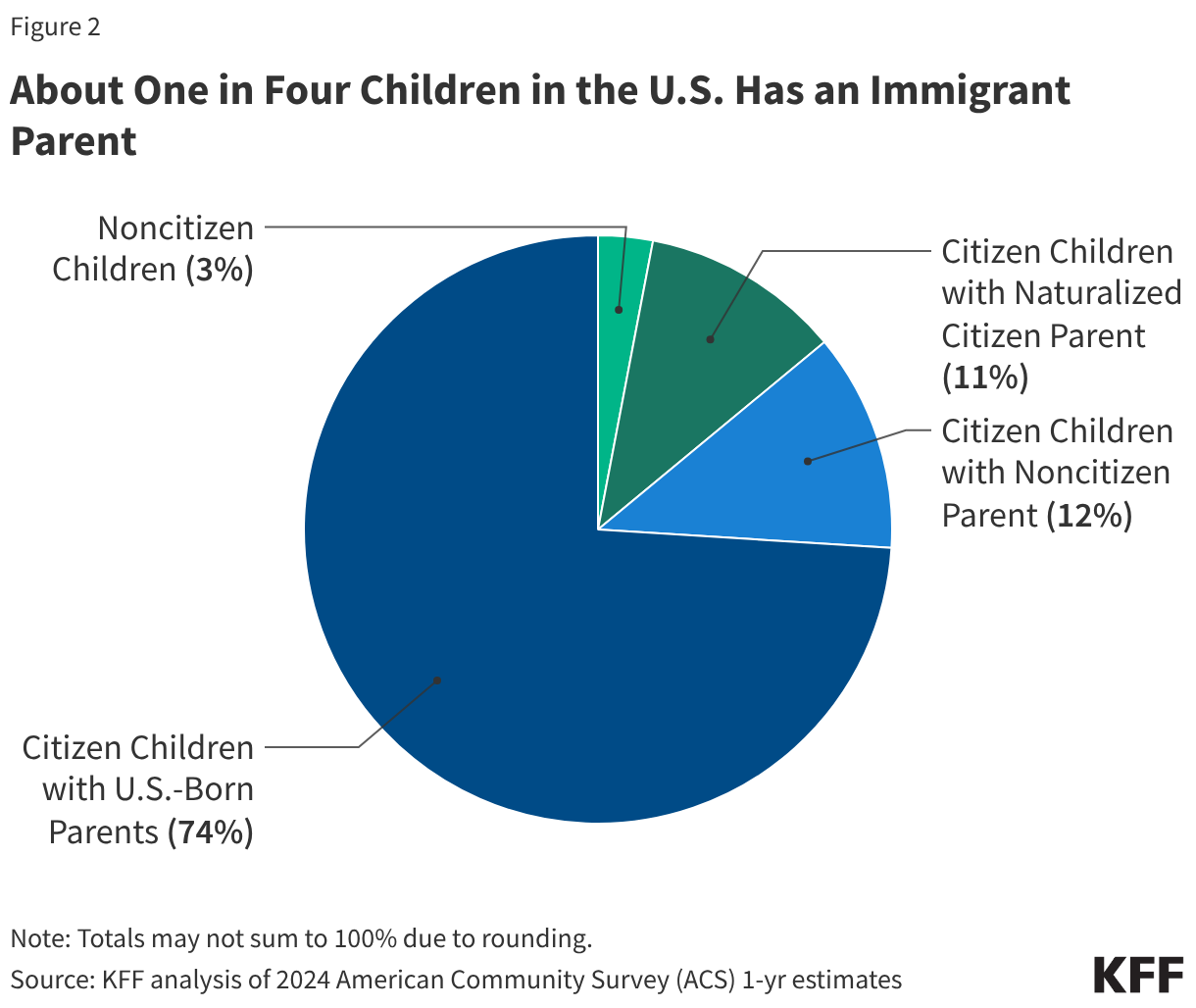
One in four children aged 18 and under in the U.S. has an immigrant parent, and the vast majority of these children are U.S. citizens. As of 2024, close to 20 million, or one in four (26%), children in the U.S. had an immigrant parent (Figure 1). This includes about one in ten (12%) who are citizen children with a noncitizen parent, a similar share (11%) who are citizen children with a naturalized citizen parent, and 3% who are noncitizen children. The share of children with an immigrant parent varies significantly by state, ranging from about 3% in West Virginia to about 45% in California.

About One in Four Children in the U.S. Has an Immigrant Parent (Pie Chart)

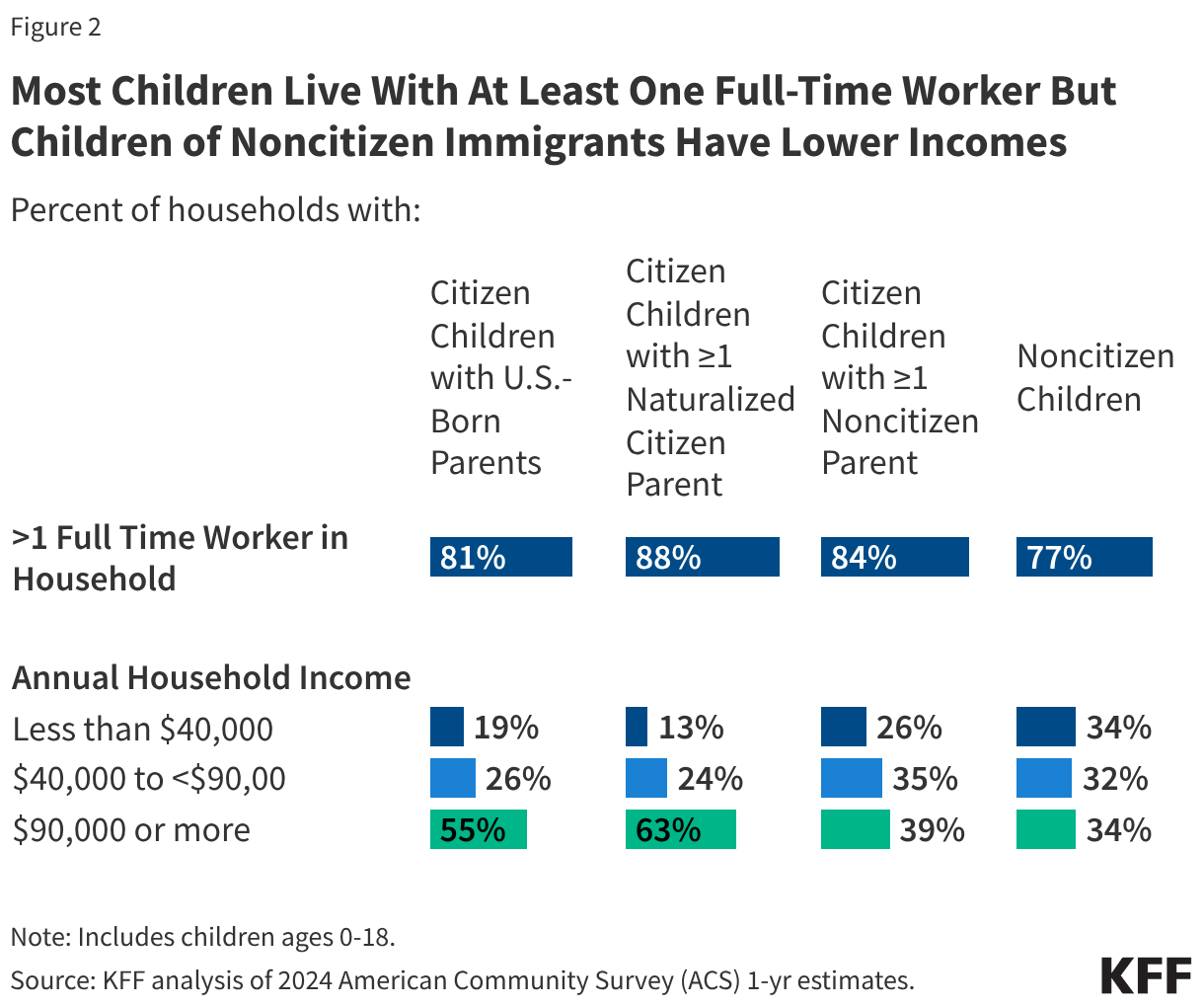
Most children of immigrants live in households with a full-time worker regardless of parental citizenship status; however, children with a noncitizen parent are more likely than children with citizen parents to live in lower income households. More than eight in ten citizen children live in a household with a full-time worker across parental citizenship statuses, and over three in four (77%) noncitizen children live in a household with a full-time worker (Figure 2). However, noncitizen children (34%) and citizen children with a noncitizen parent (26%) are more likely than those with U.S.-born parents (19%) and naturalized citizen parents (13%) to live in lower income households with annual incomes of less than $40,000. Lower household income among children of noncitizen immigrants reflects noncitizen immigrants’ disproportionate employment in lower-wage jobs in industries such as construction, agriculture, and service, which are less likely to provide employer-sponsored insurance.

Most Children Live With At Least One Full-Time Worker But Children of Noncitizen Immigrants Have Lower Incomes (Split Bars)

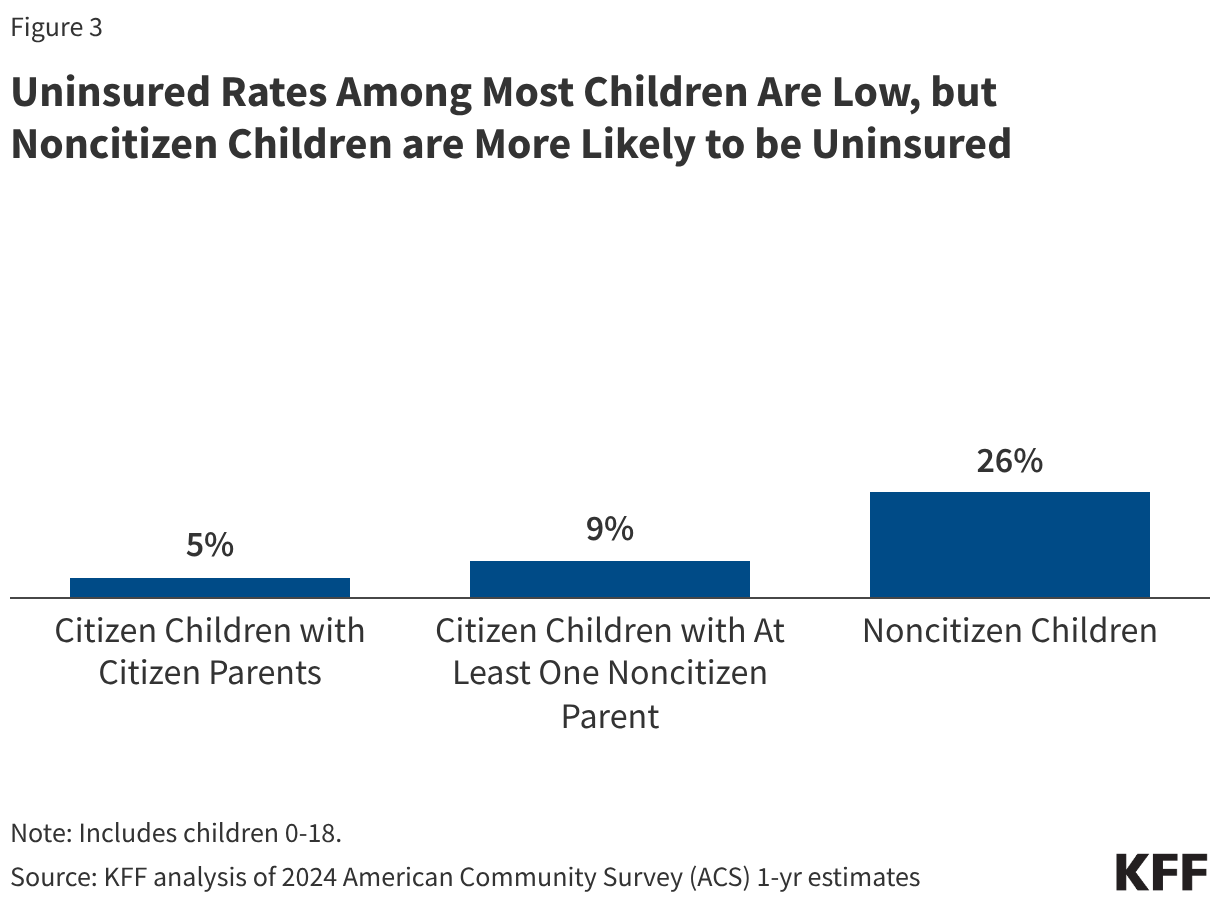
Uninsured rates among children remain relatively low, but those with a noncitizen parent or who are noncitizens are more likely to be uninsured than those with citizen parents. As of 2024, the uninsured rate was 9% among citizen children with noncitizen parent(s) and 26% among the small share of children who are noncitizens compared to 5% of citizen children with citizen parents (Figure 3). Medicaid and the Children’s Health Insurance Program (CHIP) offer broad coverage to lower-income children. However, lawfully present immigrant children may face eligibility restrictions on coverage, including a five-year waiting period, and the small number of children who are undocumented are ineligible for Medicaid, CHIP, and other federally funded coverage options. Moreover, parents may be reluctant to enroll citizen or lawfully present children in coverage even if they are eligible due to immigration-related fears or have difficulty enrolling their children due to confusion about eligibility rules or language barriers. States have an option to expand Medicaid or CHIP coverage for lawfully residing children without a five-year waiting period, which was taken up by 38 states, including DC, as of April 2026. Additionally, as of April 2026, 15 states, including DC, provide comprehensive fully state-funded coverage for lower income children regardless of immigration status with one state (Colorado) planning to scale back coverage due to budget pressures (Figure 4).

Uninsured Rates Among Most Children Are Low, but Noncitizen Children are More Likely to be Uninsured (Column Chart)
State-Funded Coverage for Children Regardless of Immigration Status as of April 2026 (Choropleth map)

Potential Implications of Recent Policies

Since taking office, the Trump administration has taken a range of actions focused on increasing immigration enforcement, restricting immigration, and limiting immigrants’ access to health care and other services. These actions include an Executive Order (EO) issued in January 2025 to end birthright citizenship, a right guaranteed under the 14th amendment of the U.S. Constitution, for the children of some noncitizen parents, including those who may be undocumented as well as lawfully present individuals on non-immigrant visas (for example, certain work visas). Implementation of the EO is blocked as of April 2026 under court order, with the Supreme Court expected to rule on it in June or July 2026. Ending birthright citizenship for the children of some immigrants would have broad implications, including limiting their access to health coverage. Moreover, the 2025 reconciliation law will further restrict lawfully present immigrants’ access to health coverage, which is expected to increase the number of uninsured. The combination of growing immigration-related fears among immigrant families, increased restrictions on coverage for lawfully present immigrants, and growing financial pressures will likely negatively impact health and health care for children in immigrant families, including U.S. citizens, and could have longer-term impacts on the U.S. workforce.

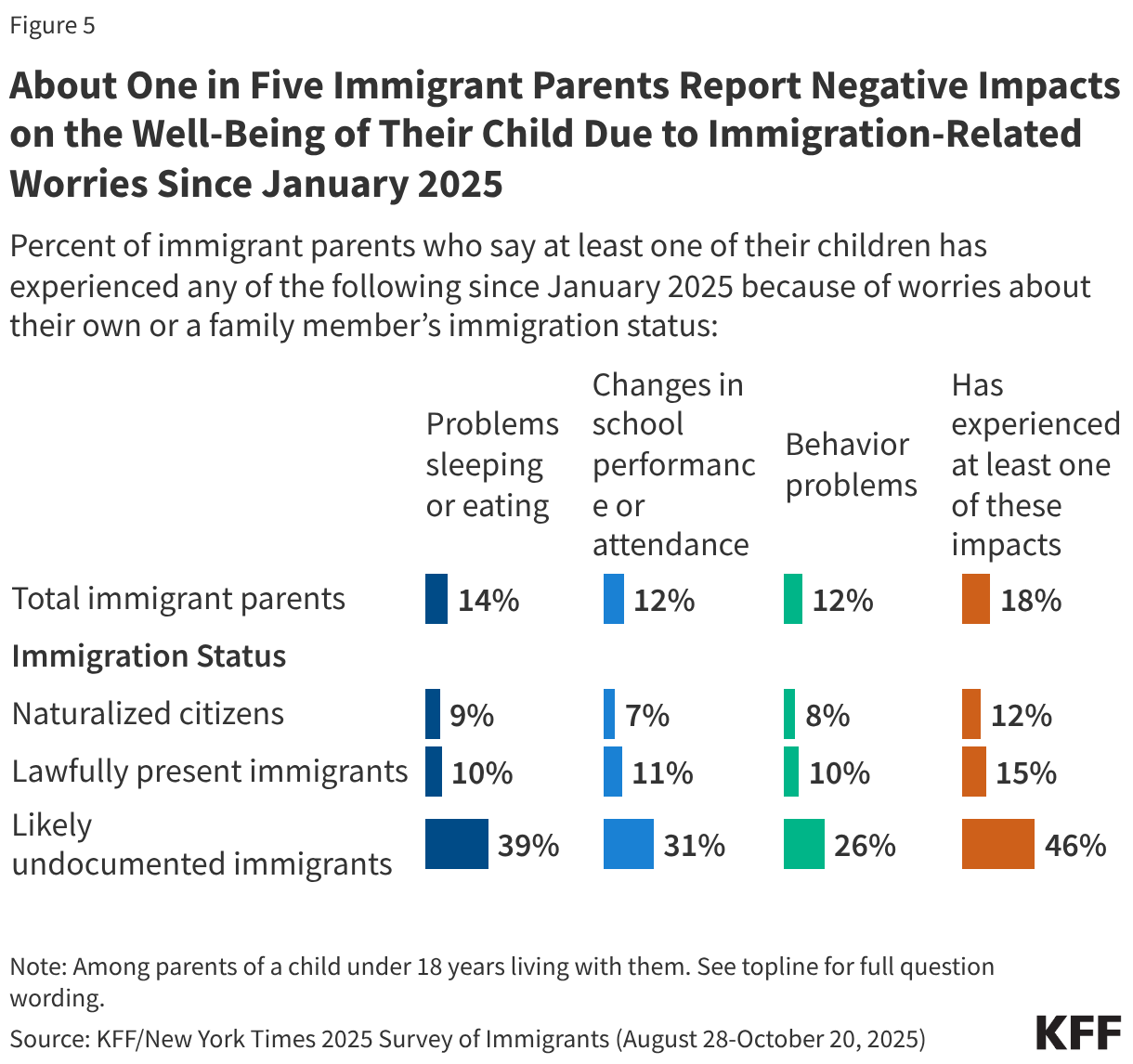
Increased immigration-related worries will likely have long-term negative impacts on children’s physical and mental health. The American Academy of Pediatrics has identified fear of parental deportation and separation as a toxic stress, which can adversely affect a child’s development, leading to lifelong negative effects on physical, mental, and behavioral health. KFF survey data from Fall 2025 show that over one in four (27%) immigrant parents say their children have expressed worries about something bad happening to someone in their family due to immigration status, with this share rising to six in ten of likely undocumented parents. These worries have negative impacts on children’s health and well-being. About one in five (18%) immigrant parents say a child has experienced problems sleeping or eating (14%), changes in school performance or attendance (12%), or behavior problems (12%) due to worries about a family member’s immigration status (Figure 5). This share rises to nearly half among parents who are likely undocumented.

About One in Five Immigrant Parents Report Negative Impacts on the Well-Being of Their Child Due to Immigration-Related Worries Since January 2025 (Split Bars)

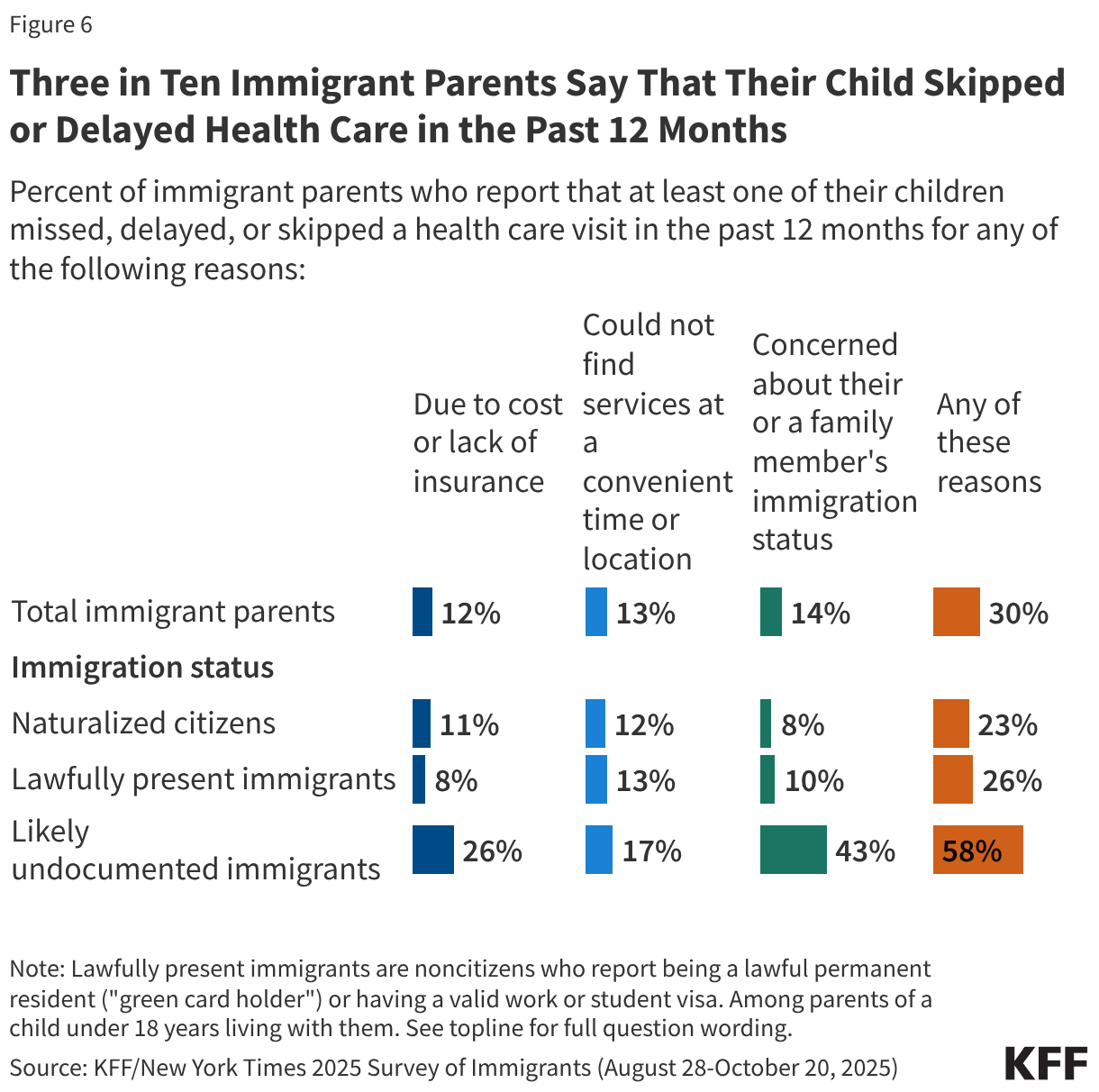
Children in immigrant families may face greater barriers to accessing health care due to increased restrictions on health coverage and immigration-related fears. The Trump administration and Congress have enacted a number of policy changes aimed at reducing access to health coverage and care for immigrants including but not limited to new restrictions on eligibility for health coverage for lawfully present immigrants under 2025 reconciliation law, proposed changes to public charge rules, sharing of noncitizen Medicaid enrollee data with immigration enforcement officials, as well as restrictions on access to community health centers and other social services. These changes are likely to result in coverage losses for immigrants, including among citizen children in immigrant families. Coverage losses among immigrant parents may lead to losses among their children as research shows that parental coverage impacts children’s access to health coverage and care. Moreover, growing immigration-related fears have made families more reluctant to access programs and services even if they are eligible. KFF survey data from Fall 2025 show that about one in ten (11%) immigrants say they stopped participating in government programs that help pay for food, housing, or health care since January 2025 due to immigration-related fears. Further, one in seven (14%) immigrant parents, rising to over four in ten (43%) of likely undocumented immigrant parents, say that their child missed, skipped, or delayed health care in the past 12 months due to immigration-related concerns (Figure 6).

Three in Ten Immigrant Parents Say That Their Child Skipped or Delayed Health Care in the Past 12 Months (Split Bars)

Beyond impacts on the health and well-being of immigrant families, the current environment may negatively impact the U.S. workforce given the significant role immigrants and their adult children play, especially in health care. Adult children of immigrants have higher educational attainment and incomes than their parents as well as the adult children of U.S.-born parent(s) and play an outsized role in the U.S. health care workforce. Based on KFF analysis of 2024 federal survey data, adult children of immigrants ages 18 and older make up about 7%, or over 1.4 million, of the total health care workforce, including 11% of physicians, surgeons, and other practitioners. Moreover, immigrants and their adult children contribute billions of dollars in federal, state, and local taxes each year and help to create jobs for U.S.-born people. Research further shows that adult children of immigrants contribute more in taxes on average than their parents or the rest of the U.S.-born population and that their fiscal contributions exceed their costs associated with health care, education, and other social services. As such, restrictions in immigration could have long-term implications for the U.S. workforce and economy.

Key Facts on Health Coverage of Immigrants

Published: May 19, 2026

Editorial Note

This brief was updated on June 12, 2026 to include additional details on fully state-funded coverage in Washington.

Summary

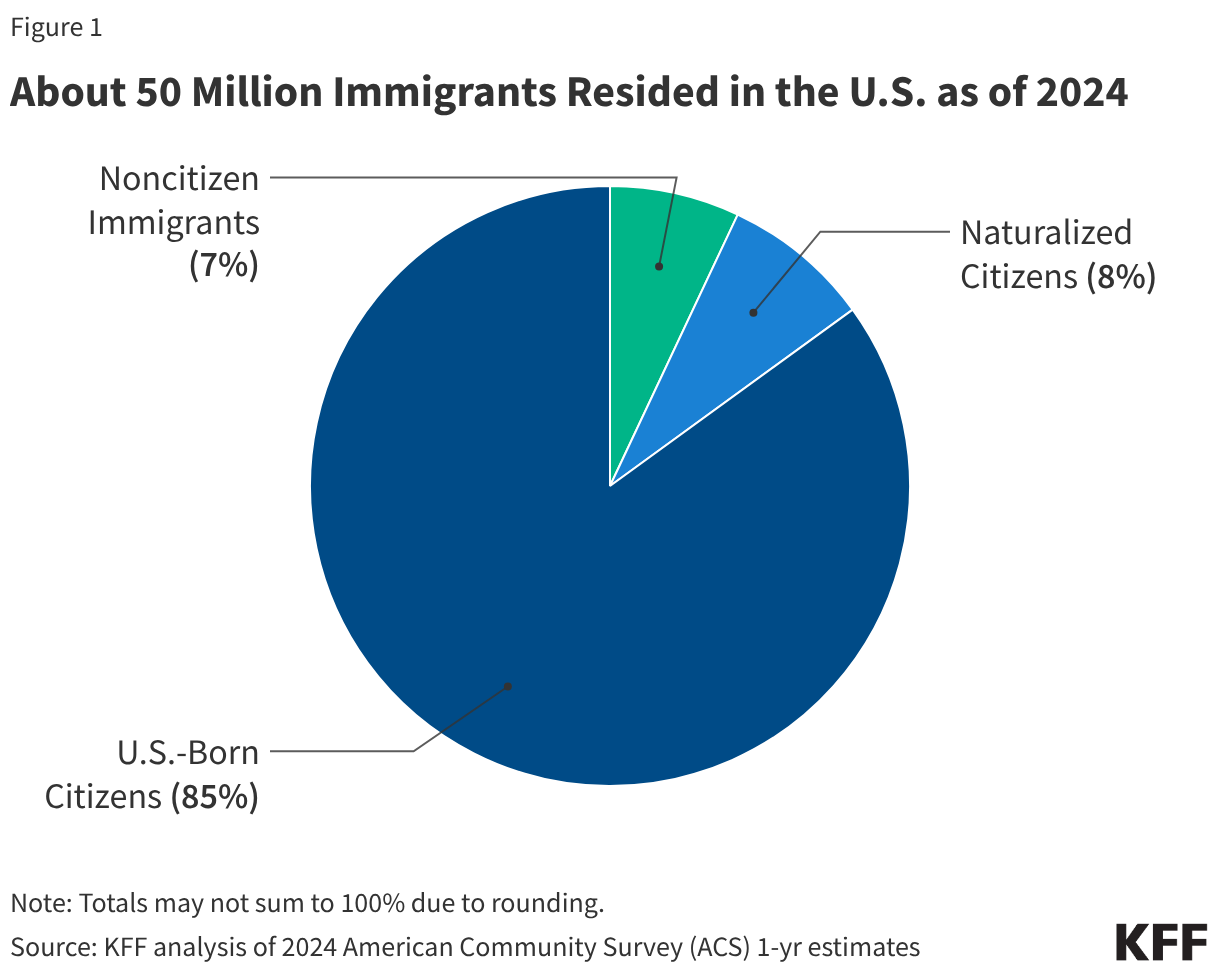
As of 2024, there were about 50 million immigrants residing in the U.S., including 24 million noncitizen immigrants and 26 million naturalized citizens, who each accounted for about 7% and 8% of the total population, respectively. Noncitizens include lawfully present and undocumented immigrants. Many individuals live in mixed immigration status families that may include lawfully present immigrants, undocumented immigrants, and/or citizens. One in four (26%) children has an immigrant parent, including over one in ten (12%) who are citizen children with at least one noncitizen parent.

This fact sheet provides an overview of health coverage for immigrants based on data from the KFF/New York Times 2025 Survey of Immigrants and discusses implications of the current policy and immigration enforcement environment for their health and health care. It shows:

  • Although the majority of uninsured people are citizens, noncitizen immigrant adults, particularly likely undocumented immigrants, are significantly more likely to report being uninsured than citizens. As of 2025, almost half (46%) of likely undocumented immigrant adults and one in five (21%) lawfully present immigrant adults reported being uninsured compared to less than one in ten naturalized citizen (7%) and U.S.-born citizen (6%) adults. These higher uninsured rates reflect a combination of more limited access to private coverage due to working in jobs less likely to offer health coverage and exclusions and limitations on eligibility for federally funded coverage options, including Medicaid, Affordable Care Act (ACA) Marketplace, and Medicare coverage.
  • Reflecting their higher uninsured rate, noncitizen immigrants are more likely than citizens to report barriers to accessing health care and skipping or postponing care. Immigrants have lower health care expenditures than their U.S.-born counterparts reflecting lower use of care due to a combination of them being younger and healthier and facing more barriers to accessing care.
  • Some states have expanded access to health coverage for immigrants through Medicaid options for lawfully residing immigrant children and pregnant people and fully state-funded programs, but some states have rolled back this coverage since 2025.
  • Recent policy changes will further restrict lawfully present immigrants’ access to health coverage, and immigrants across all statuses have become more fearful about accessing health coverage and care due to increased immigration enforcement actions under the Trump Administration.

Overview of Immigrants

Based on federal survey data, as of 2024, there were about 50 million immigrants residing in the U.S., including 24 million noncitizen immigrants and 26 million naturalized citizens, who each accounted for about 7% and 8% of the total population, respectively (Figure 1). More recent estimates show that the number of immigrants in the U.S. has since been declining, with the population declining by about 1.4 million immigrants between January 2025 and June 2025. KFF estimates for this analysis are based on the American Community Survey, the latest year of data for which is 2024, and thereby don’t reflect population changes since 2025. Estimates suggest that about half of noncitizens were lawfully present immigrants, such as lawful permanent residents (“green card” holders) and those with a valid work or student visa, while the remaining half were undocumented immigrants, who may include individuals who entered the country without authorization, individuals who entered the country lawfully and stayed after their visa or status expired, or individuals who lost their lawful status due to recent policy changes like immigrants with temporary protected status (TPS) from certain countries.1 The underlying estimates used in this analysis also include some immigrants with temporary deportation protections in the undocumented immigrant population. Many individuals live in mixed immigration status families that may include lawfully present immigrants, undocumented immigrants, and/or citizens. Close to 20 million, or one in four (26%), children living in the U.S. had an immigrant parent as of 2024, and the majority of these children were citizens (Figure 2). About 9 million, or 12%, were citizen children with at least one noncitizen parent.

About 50 Million Immigrants Resided in the U.S. as of 2024 (Pie Chart)
About One in Four Children in the U.S. Has an Immigrant Parent (Pie Chart)

Uninsured Rates by Immigration Status

The KFF/New York Times 2025 Survey of Immigrants, a nationally representative survey of immigrants, provides data on health coverage of immigrant adults and experiences accessing health care, including by immigration status.

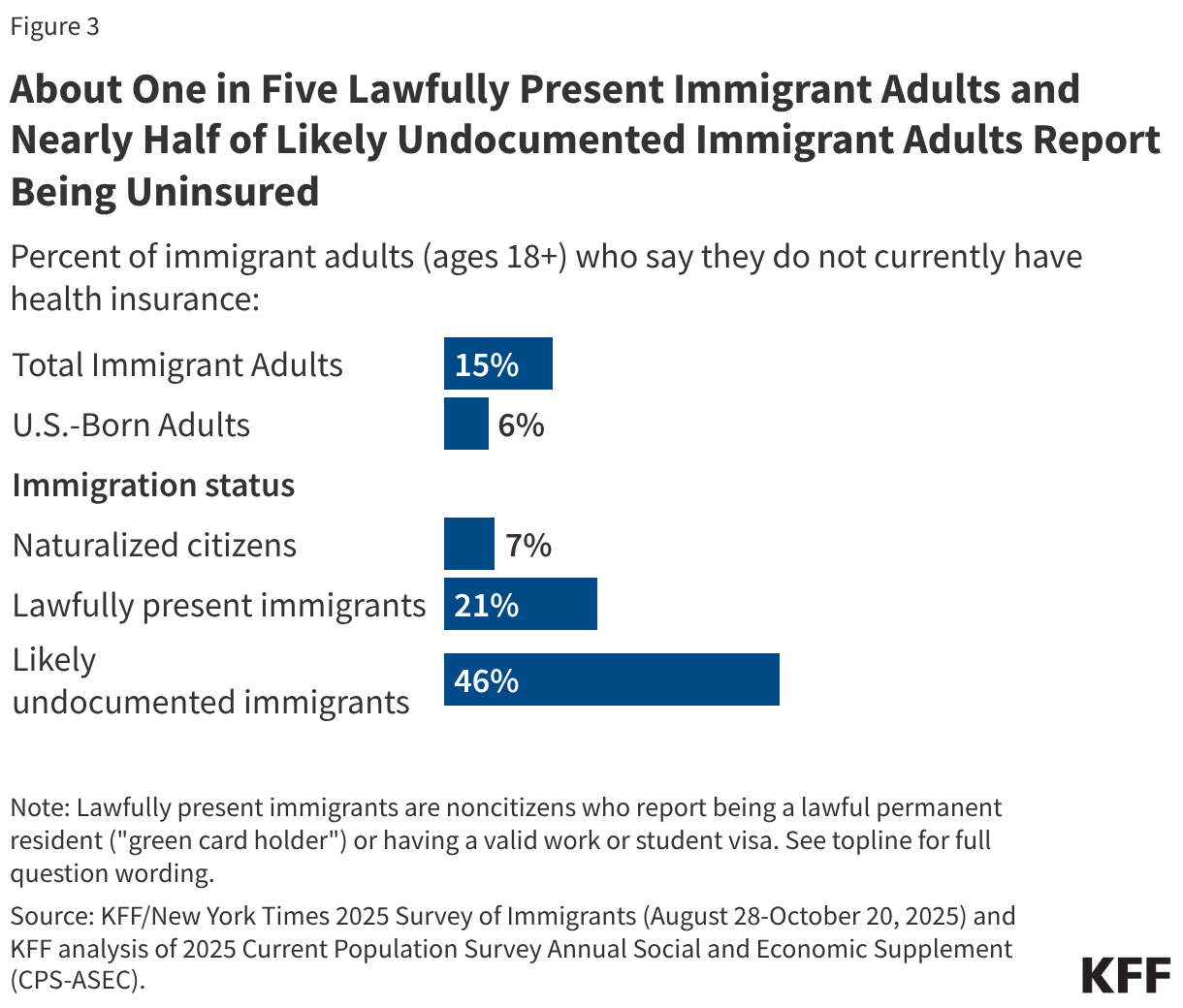
Although the majority of uninsured people are citizens, noncitizen immigrant adults, particularly likely undocumented immigrants, are significantly more likely to report being uninsured than citizens. As of 2025, almost half (46%) of likely undocumented immigrant adults and one in five (21%) lawfully present immigrant adults reported being uninsured compared to less than one in ten naturalized citizen (7%) and U.S.-born citizen (6%) adults (Figure 3).

About One in Five Lawfully Present Immigrant Adults and Nearly Half of Likely Undocumented Immigrant Adults Report Being Uninsured (Bar Chart)

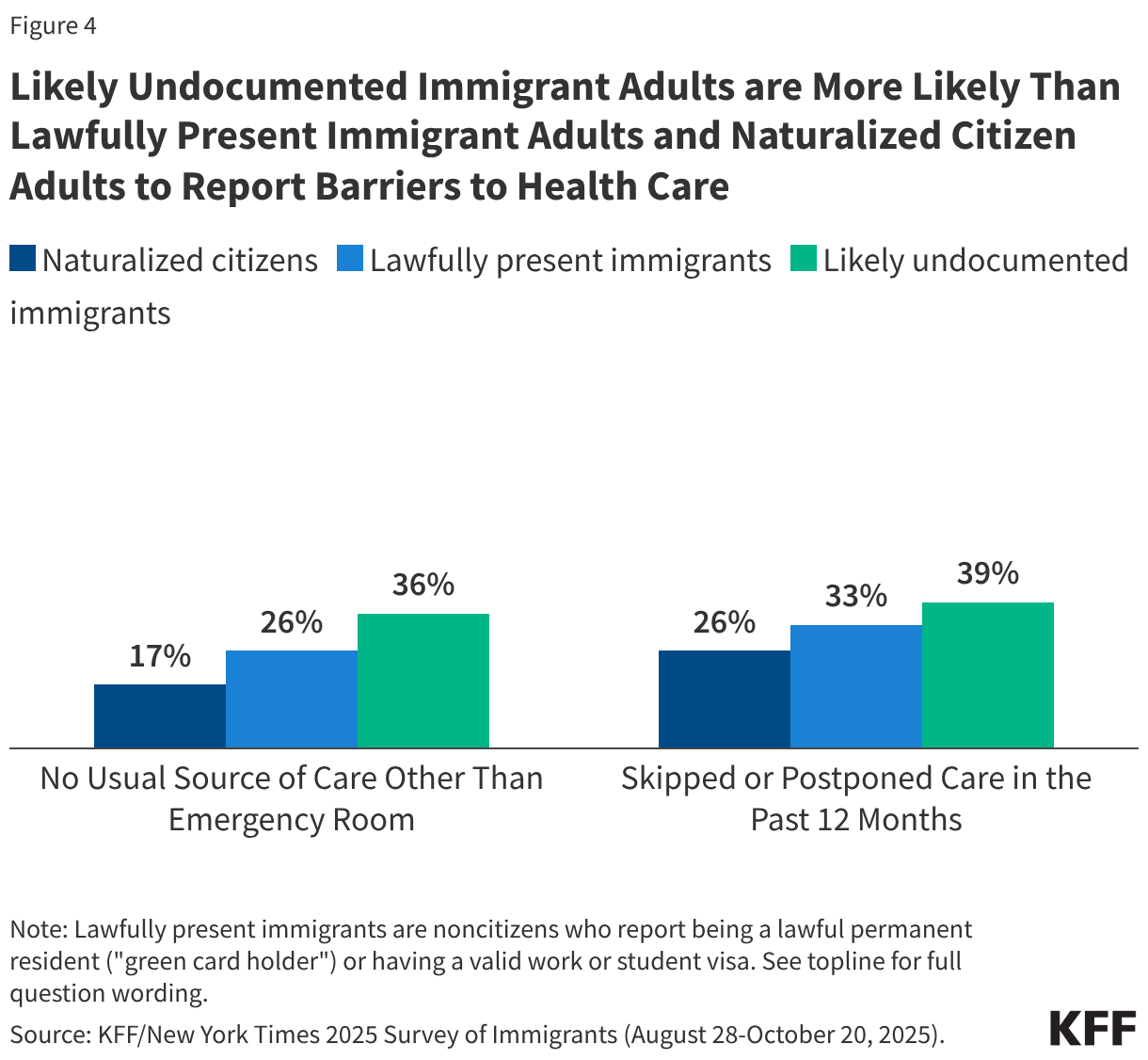
Reflecting their higher uninsured rates, noncitizen immigrants, especially those who are likely undocumented, are more likely than citizens to report barriers to accessing health care and skipping or postponing careResearch shows that having insurance makes a difference in whether and when people access needed care. Those who are uninsured often delay or go without needed care, which can lead to worse health outcomes over the long-term that may ultimately be more complex and expensive to treat. Overall, likely undocumented immigrant adults are more likely than lawfully present immigrant adults and naturalized citizen adults to report not having a usual source of care other than an emergency room and skipping or postponing care in the past 12 months (Figure 4).

Likely Undocumented Immigrant Adults are More Likely Than Lawfully Present Immigrant Adults and Naturalized Citizen Adults to Report Barriers to Health Care (Grouped column chart)

Research also shows that immigrants have lower health care use and expenditures than their U.S.-born counterparts and help to subsidize health care for U.S.-born citizens. Overall, research shows that immigrants, including lawfully present and undocumented immigrants, use less health care than U.S.-born citizens. Lower use of health care among immigrants likely reflects a combination of them being younger and healthier than their U.S.-born counterparts as well as them facing increased barriers to care including a higher uninsured rate, language access challenges, confusion, and immigration-related fears. Reflecting their lower use of health care, immigrants have lower health care expenditures than their U.S.-born counterparts. 2023 Medical Expenditure Panel Survey data show that, on average, annual per capita health care expenditures for immigrants are about 30% lower than those for U.S.-born citizens ($5,453 vs. $7,838).2 Research further finds that, because immigrants, especially undocumented immigrants, have lower health care use despite contributing billions of dollars in insurance premiums and taxes, they help subsidize the U.S. health care system and offset the costs of care incurred by U.S.-born citizens.

Access to Health Coverage Among Immigrants

Private Coverage

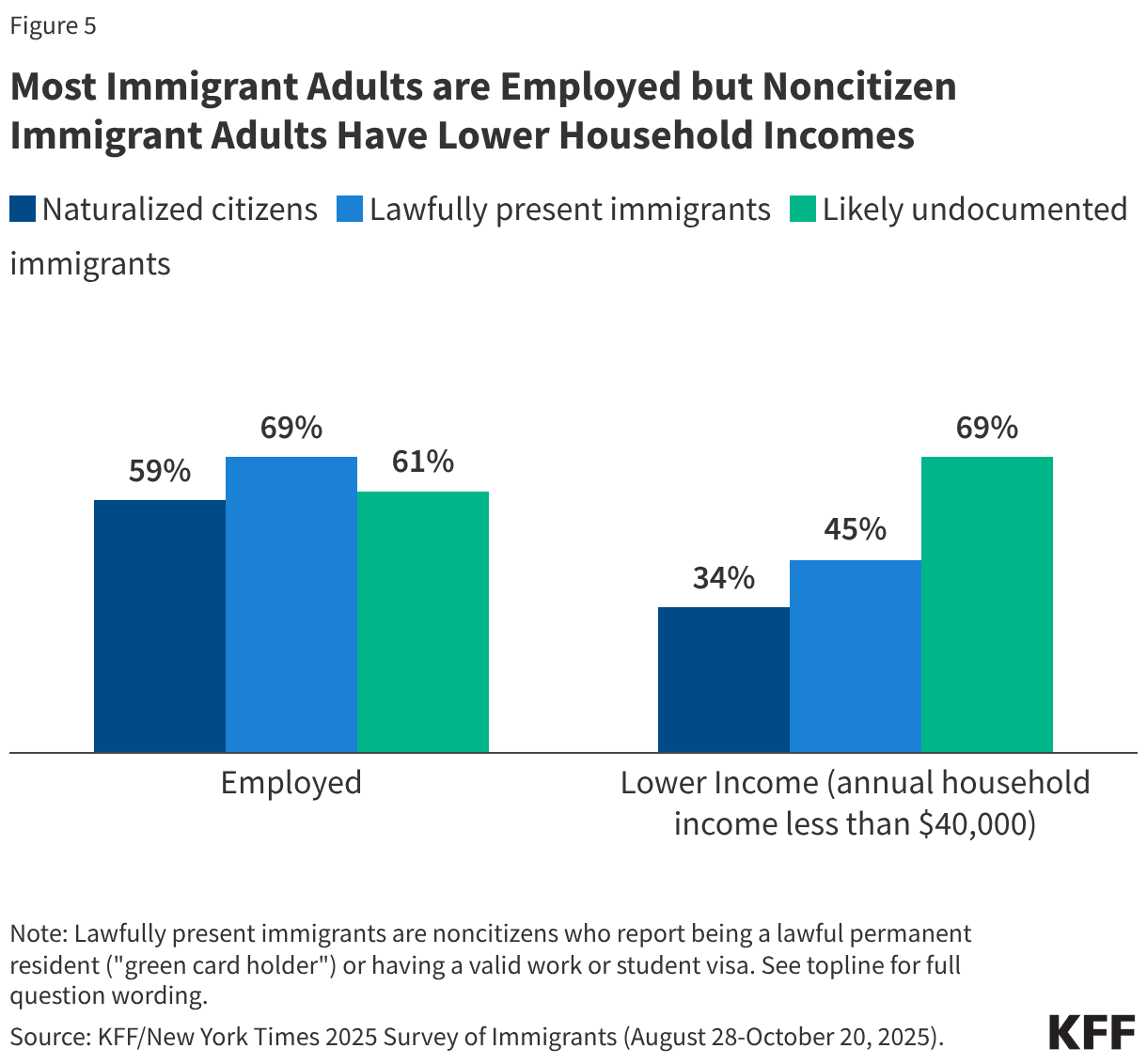
Despite high rates of employment, noncitizen immigrants have limited access to employer-sponsored coverage. Although most noncitizen immigrant adults report being employed, they are significantly more likely than citizens to report being lower income (household income less than $40,000) (Figure 5). This pattern reflects disproportionate employment of noncitizen immigrants in low-wage jobs and industries that are less likely to offer employer-sponsored coverage. Given their lower incomes, noncitizen immigrants also face challenges affording employer-sponsored coverage when it is available or through the individual market.

Most Immigrant Adults are Employed but Noncitizen Immigrant Adults Have Lower Household Incomes (Grouped column chart)

Federally Funded Coverage

Some lawfully present immigrants may qualify for Medicaid and the Children’s Health Insurance Program (CHIP) subject to eligibility restrictions. Prior to the 2025 reconciliation law, lawfully present immigrants who have a “qualified” immigration status have been eligible for Medicaid or CHIP if they meet other eligibility requirements such as income. Qualified immigrants are a subset of lawfully present immigrants and generally include lawful permanent residents, refugees, asylees, survivors of trafficking, Compact of Free Association (COFA) migrants, Cuban/Haitian entrants, members of federally recognized tribes, and some parolees (Appendix A). Many immigrants with qualified status, including most lawful permanent residents or “green card” holders, must wait five years after obtaining qualified status before they may enroll. Some immigrants with qualified status, such as refugees and asylees, as well as citizens of COFA nations, do not have to wait five years before enrolling. Some immigrants, such as those with temporary protected status, are lawfully present but do not have a qualified status and are not eligible to enroll in Medicaid or CHIP regardless of their length of time in the country (Appendix A). Once changes in the 2025 reconciliation law go into effect, fewer qualified immigrants will be eligible for Medicaid and CHIP (see below).

For children and pregnant people, states can eliminate the five-year wait and extend coverage to some lawfully present immigrants without a qualified status. As of April 2026, 38 states, including DC, have taken up this option for children and 32 states, including DC, have elected the option for pregnant individuals. A total of 25 states, including DC, have also extended coverage to pregnant people regardless of immigration status through the CHIP From-Conception-to-End-of-Pregnancy (FCEP) option. States have the option in CHIP to provide prenatal care and pregnancy related benefits to eligible low-income children beginning from conception to end of pregnancy regardless of their parent’s citizenship or immigration status. While other pregnancy-related coverage in Medicaid and CHIP requires 60 days of postpartum coverage, the CHIP FCEP option does not include this coverage. However, some states that took up this option provide postpartum coverage through a CHIP health services initiative or using state-only funding. Eleven of the states that have implemented the FCEP option (California, Colorado, Connecticut, Illinois, Maine, Massachusetts, Minnesota, New York, Oregon, Rhode Island, and Washington) have used state funding or CHIP health services initiatives to extend postpartum coverage to 12 months to align with the Medicaid extension established by the American Rescue Plan Act. Maryland extends coverage for four months postpartum, and Alabama, Texas, Virginia, and DC extend coverage for 60 days postpartum using CHIP health services initiatives.

Lawfully present immigrants can purchase coverage through the ACA Marketplace and, like citizens, may receive tax credits to help pay for premiums and cost sharing that vary on a sliding scale based on income. Generally, these tax credits are available to people with incomes starting from 100% of the federal poverty level (FPL) who are not eligible for other affordable coverage. In addition, lawfully present immigrants with incomes below 100% FPL had been eligible to receive tax credits if they were ineligible for Medicaid based on immigration status, for example due to being in the five-year waiting period for Medicaid or CHIP or because they did not have a “qualified” status. However, this coverage was eliminated effective January 1, 2026, under the 2025 reconciliation law (see below).

Individuals with Deferred Action for Childhood Arrivals (DACA) status are not considered lawfully present for purposes of health coverage eligibility and remain ineligible despite having a deferred action status, which is otherwise considered a lawfully present status. The Biden administration published regulations in 2024 that changed the definition of lawfully present to include DACA recipients for purposes of eligibility to purchase coverage through the ACA Marketplace and to receive tax credits to help pay for premiums and cost sharing, but this change faced legal challenges. The Trump administration published regulations in June 2025 that once again made DACA recipients in all states and DC ineligible for ACA Marketplace coverage. Most states terminated coverage for enrolled DACA recipients on September 30, 2025.

Lawfully present immigrants also can qualify for Medicare subject to certain restrictions. Specifically, lawfully present immigrants must have sufficient work history to qualify for premium-free Medicare Part A. If they do not have sufficient work history, they may qualify if they are lawful permanent residents and have resided in the U.S. for five years immediately prior to enrolling in Medicare, although they must pay premiums to enroll in Part A. Once changes in the 2025 reconciliation law go into effect, fewer lawfully present immigrants will be eligible for Medicare (see below).

Undocumented immigrants are not eligible to enroll in federally funded coverage including Medicaid, CHIP, or Medicare or to purchase coverage through the ACA Marketplaces. Medicaid payments for emergency services may be made to hospitals on behalf of individuals who are otherwise eligible for Medicaid but for their immigration status. These include lawfully present immigrants who are subject to a five-year waiting period for Medicaid, lawfully present immigrants who are not eligible for Medicaid, and undocumented immigrants. These payments may help cover the costs for emergency care provided to immigrants who remain ineligible for Medicaid but are not coverage for individuals. Much of Emergency Medicaid spending goes towards labor and delivery costs and Emergency Medicaid spending represented less than 1% of total Medicaid spending in fiscal year 2023.

Eligibility Restrictions for Immigrants Under the 2025 Reconciliation Law

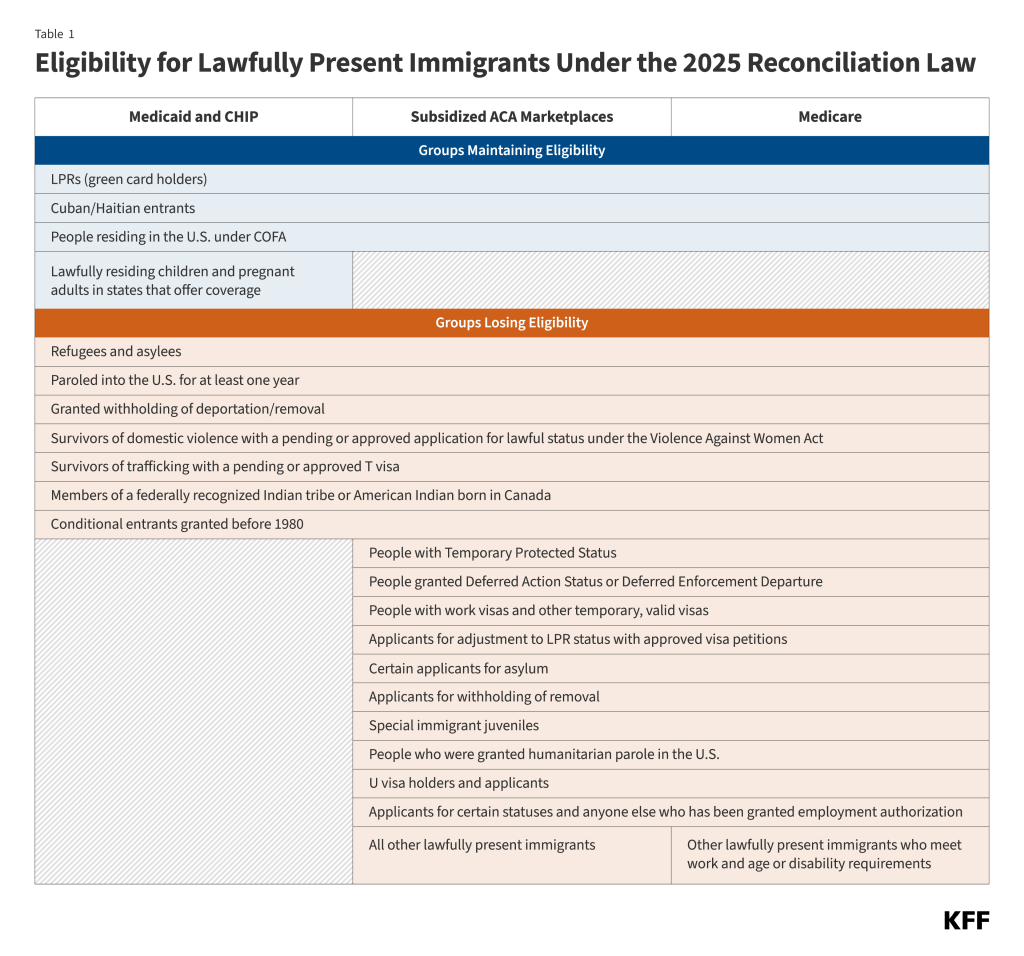
The 2025 reconciliation law will further limit the groups of lawfully present immigrants who may qualify for federally funded coverage, including Medicaid and CHIP, the ACA Marketplace, and Medicare. Specifically, effective October 1, 2026, Medicaid and CHIP eligibility will be limited to lawful permanent residents (LPRs or “green card” holders), Cuban and Haitian entrants, people residing in the U.S. under COFA, and lawfully residing children and pregnant immigrants in states that cover them under the Medicaid and/or CHIP option (Table 1). This will result in some groups of lawfully present immigrants losing eligibility, including refugees and asylees without green cards. The law also eliminates ACA Marketplace coverage for lawfully present immigrants with incomes less than 100% FPL effective January 1, 2026, and limits subsidized ACA Marketplace coverage to lawfully present immigrants who are LPRs, Cuban and Haitian entrants, and people residing in the U.S. under COFA beginning January 1, 2027. As a result, a broader group of lawfully present immigrants will lose access to subsidized Marketplace coverage, including refugees and asylees without green cards, people with TPS, and individuals on work visas, among others. Medicare eligibility also will be limited to lawfully present immigrants who are LPRs, Cuban and Haitian entrants, and people residing in the U.S. under COFA, eliminating eligibility for similar groups. Current beneficiaries subject to the new restrictions will lose coverage no later than 18 months from the enactment of the legislation (January 4, 2027).

The Congressional Budget Office (CBO) estimates that the health coverage eligibility restrictions for lawfully present immigrants in the 2025 reconciliation law will result in 1.4 million lawfully present immigrants becoming uninsured by 2034. This includes 100,000 who will lose coverage due to eligibility restrictions for Medicaid and CHIP, 1.2 million who will lose coverage due to eligibility restrictions for ACA Marketplace coverage, and another 100,000 who will lose coverage due to eligibility restrictions in Medicare by 2034. The CBO also estimates that these coverage restrictions will result in $131 billion in reduced federal spending and $4.8 billion in increased federal revenues by 2034.

State-Funded Coverage

Some states have established fully state-funded programs to provide health coverage to some groups of low-income immigrants who remain ineligible for federally funded coverage options. This coverage is sometimes limited to certain groups, such as children, and varies in scope. While some programs offer benefits similar to Medicaid coverage, these programs are separate state programs that are not part of the Medicaid program. Several states have recently scaled back their state-funded coverage due to budget pressures.

As of April 2026, 15 states, including DC, provide comprehensive state-funded coverage to children regardless of immigration status, with one state (Colorado) planning to scale back coverage due to budget pressures (Figure 6). These states include California, Colorado, Connecticut, Illinois, Maine, Massachusetts, Minnesota, New Jersey, New York, Oregon, Rhode Island, Utah, Vermont, Washington, and DC. Three of these states (Colorado, New Jersey, and Vermont) also provide state-funded coverage to income-eligible pregnant people regardless of immigration status, with Vermont extending this coverage for 12 months postpartum. Colorado plans to implement rollbacks to their state-funded coverage program for children and pregnant people, including capping enrollment and limiting certain benefits, starting January 2027 due to funding constraints.

State-Funded Coverage for Children and Pregnant People Regardless of Immigration Status as of April 2026 (Choropleth map)

As of April 2026, seven states, including DC, have also expanded fully state-funded coverage to some income-eligible adults regardless of immigration status (Figure 7). These states include California, Colorado, DC, Illinois, New York, Oregon, and Washington. In some cases, coverage is limited to certain age groups, and several states have closed new enrollment. Some additional states cover some income-eligible adults who are not otherwise eligible due to immigration status using state-only funds but limit coverage to specific groups, such as lawfully present immigrants who are in the five-year waiting period for Medicaid coverage, or provide more limited benefits.

Six states, including DC, have recently eliminated or reduced or plan to scale back state-funded coverage due to budget pressures.

  • California previously extended state-funded coverage to all income-eligible adults regardless of immigration status but implemented coverage reductions for adults 19 and older who are not pregnant or former foster youth under age 26 due to funding constraints, including: closing enrollment starting January 2026, ending dental benefits starting July 2026, and charging $30 monthly premiums for adults ages 19-59 starting July 2027. The California governor’s 2026-27 budget also proposes applying Medicaid policy changes included in the 2025 reconciliation law (work requirements and more frequent six-month renewals) to adults enrolled in the state-funded coverage program.
  • Colorado allows adults regardless of immigration status to obtain Marketplace coverage through OmniSalud using a section 1332 waiver. Colorado uses state funds to provide plans with $0 premiums through SilverEnhanced Savings. The state reduced the enrollment cap for the program from 12,000 in 2025 to 6,700 people due to funding constraints. As noted above, the state also plans to cap enrollment and limit benefits for children and pregnant people beginning in January 2027 due to funding constraints.
  • DC provides health coverage to low-income adults 21 and older regardless of immigration status through its longstanding locally funded Healthcare Alliance program. However, DC closed enrollment to adults ages 26 and older and reduced income limits for adults 21 and older starting October 2025. DC plans to end coverage for all adults ages 21 and older by October 2027.
  • Illinois extended state-funded coverage to low-income individuals ages 65 and older regardless of immigration status through its Health Benefits for Immigrant Seniors (HBIS) program in December 2020 but new enrollment has been paused since 2023. Illinois previously extended coverage to low-income immigrants ages 42 to 64 regardless of immigration status through the Health Benefits for Immigrant Adults (HBIA) program in 2022, but ended HBIA coverage on July 2025 due to funding constraints.
  • Minnesota extended state-funded health coverage to income-eligible adults 18 and older regardless of immigration status in January 2025 but ended this coverage starting January 2026 due to funding constraints. 
  • Washington uses state funds to provide Marketplace coverage with premium subsidies to individuals with incomes up to 250% FPL regardless of immigration status through Cascade Care using a section 1332 waiver, but funding is limited. In July 2024, Washington extended state-funded health coverage to individuals with incomes up to 138% FPL who are not eligible for either federal Medicaid or federal advance premium tax credits, but the state closed enrollment due to funding constraints and moves current and future enrollees to a fee-for-service program.

In addition to these states, Maryland also delayed plans to allow income-eligible individuals to purchase Marketplace coverage without subsidies regardless of immigration status to 2028 due to changes in the 2025 reconciliation law that will require additional administrative resources to implement.

State-Funded Coverage for Adults Regardless of Immigration Status as of April 2026 (Choropleth map)

Two states (New Mexico and New York) are planning to provide fully state-funded coverage to lawfully present immigrants that will lose Medicaid and ACA Marketplace coverage due to eligibility restrictions in the 2025 reconciliation law. New Mexico plans to use state funds to cover lawfully present immigrants losing Medicaid and ACA Marketplace Coverage in addition to DACA recipients. The New York governor’s 2026-27 budget proposes using state funds to cover lawfully present immigrants losing Medicaid coverage. The state will also use state funds to cover income-eligible lawfully present immigrants losing federally-subsidized health coverage through the Essential Plan. Under a longstanding court ruling, New York is required to provide state-funded coverage to lawfully present immigrants who would be eligible for Medicaid if not for their immigration status. Legislation introduced in New York and several other states, including California, Illinois, and Washington, would expand state-funded health coverage for immigrants to help fill gaps created by the reconciliation law; however, it is uncertain these bills will be enacted.

Data suggest that state coverage expansions for immigrants make a difference in their health coverage and health care access and use. The KFF/New York Times 2025 Survey of Immigrants shows that immigrant adults residing in states with more expansive coverage policies for immigrants are less likely to be uninsured compared to their counterparts living in states with less expansive coverage policies. Other research shows that coverage expansions for immigrant children increase access to health care and are associated with improved health outcomes. A study found that eliminating the five-year wait for Medicaid or CHIP was associated with a decline in uninsured rates among lawfully present foreign-born children in states without state-funded health care programs. California’s 2016 expansion to low-income children regardless of immigration status was associated with a 34% decline in uninsurance rates, and the state’s expansion to all adults was associated with an increase in health coverage among immigrant adults ages 50 and older. Similarly, a study found that children who reside in states that have expanded coverage to all children regardless of immigration status were less likely to be uninsured, to forgo medical or dental care, and to go without a preventive health visit than children residing in states that have not expanded coverage. Another study found that immigrant children residing in states with more expansive health coverage policies were more likely to have uninterrupted health coverage and a usual source of primary care than those residing in states with less expansive health coverage policies. Research has also found that expanding Medicaid coverage to pregnant people regardless of immigration status is associated with higher rates of prenatal care and improved birth outcomes, while more restrictive state coverage policies were associated with reduced postpartum care utilization.

Enrollment Barriers

Among immigrants who are eligible for coverage, many remain uninsured because of a range of enrollment barriers, including fears around immigration-status and data privacy. Trump administration immigration policy changes and increased enforcement efforts are contributing to growing fears among immigrant families and increased reluctance to access health coverage and care for themselves and/or their children. The share of immigrant adults who say they personally worry that they or a family member could be detained or deported has increased significantly in 2025 (41%) as compared to 2023 (26%). As of 2025, over one in ten (12%) immigrant adults also report avoiding applying for government assistance as compared to 8% in 2023 and 29% report skipping or postponing health care as compared to 22% in 2023. Further, about half (51%) of immigrant adults overall and about eight in ten (78%) of those who are likely undocumented say they are “somewhat” or “very” concerned about health care providers sharing information about immigration status with immigration enforcement officials, a fear that could be further exacerbated following the public notice of CMS’s new Medicaid data sharing policy with ICE.

Appendix

Appendix Table A

Lawfully Present Immigrants by Qualified Status as of April 2026

Qualified Immigrant Category

Other Lawfully Present Immigrants

Lawful permanent resident (LPR or green card holder)

Granted Withholding of Deportation or Withholding of Removal, under the immigration laws or under the Convention against Torture (CAT)

Refugee

Individual with Non-Immigrant Status, includes worker visas, student visas, U-visa, and other visas, and citizens of Micronesia, the Marshall Islands, and Palau

Asylee

Temporary Protected Status (TPS)

Cuban/Haitian entrant

Deferred Enforced Departure (DED)

Paroled into the U.S. for at least one year

Deferred Action Status

Conditional entrant granted before 1980

Lawful Temporary Resident

Granted withholding of deportation

Administrative order staying removal issued by the Department of Homeland Security

Battered noncitizen, spouse, child, or parent

Resident of American Samoa

Victims of trafficking and their spouse, child, sibling, or parent or individuals with pending application for a victim of trafficking visa

Applicants for certain statuses

Member of a federally recognized Indian tribe or American Indian born in Canada

People with certain statuses who have employment authorization

Citizens of the Marshall Islands, Micronesia, and Palau who are living in one of the U.S. states or territories (referred to as Compact of Free Association or COFA migrants)

People with certain statuses who have employment authorization

Endnotes

  1. The estimate of the total number of noncitizens in the U.S. is based on the 2024 American Community Survey (ACS) 1-year Public Use Microdata Sample (PUMS). The ACS data do not directly indicate whether an immigrant is lawfully present or not. KFF draws on the methods underlying the 2013 analysis by the State Health Access Data Assistance Center (SHADAC) and the recommendations made by Van Hook et. al. This approach uses the Survey of Income and Program Participation (SIPP) to develop a model that predicts immigration status; it then applies the model to ACS, controlling to state-level estimates of total undocumented population from Pew Research Center. For more detail on the immigration imputation used in this analysis, see Technical Appendix B↩︎
  2. KFF analysis of 2023 Medical Expenditure Panel Survey full-year consolidated data file. ↩︎

What We Know So Far About 2026 ACA Marketplace Enrollment, Premiums, and Deductibles

Published: May 19, 2026

The enhanced premium tax credits established by the American Rescue Plan in 2021 and extended through 2025 by the Inflation Reduction Act significantly expanded Affordable Care Act (ACA) Marketplace affordability, driving enrollment to record highs. When those enhancements expired at the end of 2025, premium payments rose sharply for many enrollees, particularly those with incomes above 400% FPL who had been newly eligible for subsidies under the enhanced credits.

This analysis draws on data from the Centers for Medicare & Medicaid Services (CMS) and state-based Marketplace (SBM) Open Enrollment reports, as well as KFF survey data and individual market enrollment estimates from Wakely Consulting Group, to examine early indicators of how the expiration of enhanced premium tax credits has affected effectuated enrollment levels (i.e., enrollment among people who have paid their premiums), plan selections, and out-of-pocket costs in 2026.

Key Findings

  • Based on reports to date of sign-ups and premium payments, average monthly effectuated ACA Marketplace enrollment could fall to about 17.5 million people in 2026 and could be as low as 16.5 million people, down from 22.3 million people in 2025.
  • A disproportionately large share of the drop in sign-ups (27%) is among people with incomes just above the “subsidy cliff” (between 400%-500% FPL), despite this group making up just 3% of plan selections in 2025.
  • Premium payments from enrollees increased by an average of 58% from $113 to $178 per month. This is lower than the 114% increase KFF projected if everyone had stayed in the same plan because many people bought down to higher-deductible plans and because those just past the subsidy cliff with the steepest increases dropped ACA coverage at higher rates. Additionally, the 114% increase was among people receiving a tax credit whereas the 58% increase is among all consumers, including the most number who did not receive a tax credit in 2025.
  • Average ACA Marketplace deductibles increased by 37% (or $1,027 per person) to a record high of $3,786 in 2026. This is the steepest increase in deductibles ever seen in this market and largely reflects the shift from silver plans with reduced deductibles for lower-income enrollees to bronze plans with very high deductibles.

How Many People Are Leaving the ACA Marketplace?

Plan sign-ups fell by over a million to 23.1 million people during the 2026 Open Enrollment Period, the sharpest single-year drop since the ACA Marketplaces launched. However, Open Enrollment plan selection data alone do not capture the full scope of coverage loss — they measure how many people chose a plan or were automatically renewed, not how many ultimately paid their premiums for their coverage. Effectuated enrollment (the number of people who pay premiums and maintain effective coverage) is expected to fall even further than previous years as 2026 unfolds and many enrollees are unable to afford higher premium payments without enhanced tax credits, signaling significant mid-year attrition on top of already declining sign-ups.

According to an analysis of proprietary data on January premium payments by Wakely Consulting Group, approximately 86% of January 2026 enrollees in the individual market (of which over 90% was through ACA Marketplaces in 2025) paid their first month’s premium, with considerable variation across states. State-based exchanges, many of which have their own premium subsidy programs and more robust outreach efforts, tended to retain higher shares of enrollees than federally-facilitated exchanges.

Figure 1

Accounting for unpaid premiums, mid-year attrition, and other factors, Wakely estimates that average effectuated enrollment in the individual market could decline by between 17% and 26% in 2026 compared to the number of people who had effectuated coverage in 2025.

If applied to the ACA Marketplaces (which represent the vast majority of the individual insurance market in 2025), Wakely’s estimated enrollment decline could translate to an average of about 17.5 million enrollees over the course of 2025, which would represent a potential drop of 4.8 million people from the Marketplaces relative to 2025. To arrive at this estimate, the midpoint value of the range Wakely projects for individual market enrollment to decline by (21.5%) was applied to the average effectuated enrollment in the ACA Marketplace for the first 7 months of 2025. The low and high ends of the grey region in Figure 1 represent estimated effectuated enrollment if the endpoints of the range estimate (17% and 26%, respectively) were applied, ranging from a drop of 3.8 to 5.8 million.

Several other sources of information also point to a sharp decline in ACA effectuated enrollment associated with the expiration of enhanced premium tax credits. A decline of effectuated enrollment to 17.5 million aligns closely with the Congressional Budget Office’s previous projection of a roughly 25% ACA Marketplace contraction in enrollment following the expiration of the enhanced premium tax credits. CBO had projected average monthly ACA Marketplace enrollment of 16.9 million for 2026. Federal data reported on by NOTUS indicated a similarly steep increase in cancellations and terminations due to nonpayment, with about 19 million enrollees in the weeks following Open Enrollment. 

Moreover, a KFF survey fielded in late February and early March of 2026 showed that 9% of 2025 Marketplace enrollees had become uninsured, 4% of returning ACA Marketplace enrollees had not yet paid their first month’s premiums, and that one in six (17%) returning enrollees were not confident they could afford their premiums for the entire year.

Recently published data from California, the nation’s largest state-based Marketplace, indicate that the cancellation rate among consumers who renewed coverage increased roughly six percentage points from 2025 such that nearly one in five renewing consumers actively terminated their plans before the end of March or had their coverage cancelled due to nonpayment.

Some states, like Maryland, expect that in the coming months, high premium payments will prompt even more people to either actively cancel their plans or be terminated due to nonpayment of premiums. These cancellations, whether active or passive, will drive a gap between the number of plan sign-ups and effectuated coverage.

Who Dropped ACA Marketplace Coverage?

Marketplace Consumers Just Over the "Subsidy Cliff" Made Up 3% of Sign-Ups But 27% of the Drop in ACA Marketplace Coverage From 2025 (Grouped column chart)

While there is no publicly available effectuated enrollment data broken out by income, the plan selection data indicate that a large share of the drop in ACA Marketplace coverage is among consumers above 400% of the federal poverty level (FPL), where eligibility for premium tax credits ends (“subsidy cliff”). Under the enhanced premium subsidies, people with incomes above 400% of the poverty level had their premium payments for a benchmark silver plan capped at 8.5% of income. People with incomes above 400% up to 500% FPL, who represented just 3% of 2025 sign-ups, accounted for 27% of the drop in sign-ups from 2025 to 2026. Plan sign-ups for this group fell by 44% (over 321,000 people). Those with incomes above 500% FPL accounted for an additional 21% of the difference.

Overall, consumers with incomes known to be above the subsidy cliff made up just 7% of 2025 enrollment but nearly half (48%) of the decline in plan selections from 2025 to 2026. (There are about 1 million consumers for whom household income is unknown, so the actual share of consumers who are above the subsidy cliff may be higher.)

Lower-income consumers, who continue to receive financial assistance but still saw increases in their premium payments with the expiration of the enhanced tax credits, dropped ACA Marketplace coverage at lower rates. Still, they account for a large share of the decline in sign-ups. Sign-ups for those with incomes below 150% FPL — the largest income group in the Marketplace — fell by roughly 441,000 people (a 4% drop from 2025), accounting for 37% of the decline. Those with incomes greater than 150% and up to 250% FPL accounted for 30% of the drop in ACA Marketplace coverage. Plan selections among consumers with incomes above 250% up to 400% FPL was roughly flat, as losses among the 250 to 300% FPL group were largely offset by gains among the 300 to 400% FPL group.

Declines in plan sign-ups for young adults ages 18 to 34 account for more of the decrease in ACA Marketplace plan selections than any other age group. This is in line with expectations detailed in insurer rate filings from last year, which reported that the expiration of the enhanced premium tax credits would cause younger adults, who are typically healthier, to leave the Marketplace. Sign-ups in this age group declined by 542,000, or 8%, from 6.7 million people in 2025 to 6.2 million people in 2026, comprising 46% of the total decline in ACA Marketplace sign-ups.

Most States Saw a Decrease in Marketplace Sign-Ups in 2026 (Choropleth map)

Marketplace plan selections declined in 41 states in 2026. In percentage terms, plan selections fell the most in North Carolina (22%), Ohio (20%), West Virginia (17%) and Indiana, Delaware, and Arizona (all 16%).

A smaller number of states saw stable or modestly increasing sign-ups, in some cases reflecting state-specific policy decisions that helped offset the loss of enhanced federal premium tax credits. Notably, New Mexico experienced an 18% increase in plan selections, likely due in part to the state’s supplemental financial assistance program, which temporarily backfills the entirety of the lost federal premium assistance.

Increases in Premium Payments

Figure 4

In 2026, the average monthly premium payment among consumers net of tax credits (including those who did not receive premium tax credits) rose 58% from $113 to $178 in 2025. With the expiration of enhanced premiums tax credits, KFF previously estimated that premium payments would increase by 114% on average for subsidized ACA Marketplace enrollees to keep their same plan in 2026. However, as discussed more below, many Marketplace enrollees bought down to bronze plans (with lower premiums and higher deductibles). Additionally, people with the steepest increases in premiums — those who lost eligibility for tax credits entirely — appear to have left the market at a disproportionately high rate.

At the same time, the share of people receiving premium tax credits fell from 92% in 2025 to 87% in 2026, the first decline in subsidy uptake since 2020. This is due, in part, to the loss of financial assistance eligibility for people making greater than 400% of poverty and the relatively large exodus from the market among people with incomes over this amount, who would have faced some of the largest premium increases if they had remained in the market.

Increase in Deductibles

The Share of Consumers Signing Up for Bronze and Gold Plans Reached Record Highs in 2026 (Stacked column chart)

To offset these increases in premium payments with the expiration of enhanced premium tax credits, a number of consumers switched to bronze plans, which have lower premiums but higher deductibles. The share of people selecting bronze plans increased from 30% (7.3 million people) in 2025 to 40% (9.2 million people) in 2026, while the share selecting gold plans rose from 13% (3.2 million people) to 17% (4.0 million people). Meanwhile, the share of ACA marketplace consumers selecting a silver plan fell from 57% (13.7 million people) to 43% (9.8 million people), marking a record low and the first time fewer than half of ACA consumers have selected a silver plan. 

Average Deductibles Have Surged to Record-Highs in 2026 (Line chart)

With more people signing up for bronze plans than ever before, average deductibles in the ACA Marketplaces are rising. From 2025 to 2026, the average deductible in the ACA Marketplaces has grown by over a thousand dollars per person, a 37% increase, from $2,759 to $3,786. This marks the steepest increase ever in the average Marketplace deductible since the markets launched in 2014. For context, if the distribution of plan selections across metal levels had stayed the same as in 2025, the average Marketplace deductible would have gone up just 6% (to $2,912).

A Record-Low Share of Consumers Selected Cost-Sharing Reduction Plans in 2026 (Line chart)

The lowest income Marketplace enrollees (100-250% FPL) also qualify for cost-sharing reductions (CSRs), which lower their out-of-pocket costs (deductibles, copayments, and coinsurance) when paying for health care services if they enroll in silver plans. These CSR plans are offered on a sliding scale, such that those with lower incomes receive more assistance. The average silver deductible available to a person making up to 150% of poverty is $80, compared to $5,304 for the standard silver plan. Previously, with enhanced premium tax credits, silver plans enrollees in this low-income group could get a silver plan with a $0 monthly premium payment. After the expiration of enhanced tax credits, an enrollee would now pay 4.19% of their income, or about $82 a month for a single person at 150% of poverty to keep that low-deductible silver plan.

The share of all Marketplace consumers selecting a cost-sharing reduction (CSR) plan fell to its lowest level on record in 2026 (37%). Available data suggests that people are choosing non-CSR plans despite having the income to be eligible for this financial assistance. In 2025, 66% of people in states using the federal platform who were eligible for CSRs signed up for a silver CSR plan. But in 2026, the share of eligible consumers in Healthcare.gov states who selected a CSR plan fell to 45%.

A More Complete Picture is Still to Come

All the information available so far on the demographics of people who left the ACA Marketplace and the increase in premium payments and deductibles is based on plan selections, not effectuated enrollment. Even among those who do effectuate coverage, some could lose it during the year if they cannot afford to continue their premium payments. When CMS publishes effectuated enrollment data later this year, it will include only aggregate counts — without the demographic and plan-level breakdowns available in the plan selection files. Additionally, a grace period was available for returning enrollees to have until late March to make their premium payments, and CMS effectuated enrollment data fully reflecting that grace period may not be available for another year. As a result, a complete picture of how the expiration of enhanced premium tax credits reshaped who has coverage and what kind of plan they hold may not be available for some time.

Methods

This analysis used plan selection and effectuated enrollment data from the Centers for Medicare & Medicaid Services (CMS) and state-based Marketplace (SBM) Open Enrollment reports for plan selections (sign-ups). The estimate of the potential loss in ACA effectuated enrollment (Figure 1) references the report “Who Paid, and Who Stayed? Early 2026 Enrollment Trends in the Individual Market” produced by the Wakely Consulting Group. ACA effectuated enrollment values reflect average monthly effectuated enrollment estimates over the full year for 2017-2024 and over the first seven months for 2025. Potential 2026 enrollment was estimated by applying the midpoint of Wakely Consulting Group's estimates of reduction in individual market enrollment to average 2025 Marketplace effectuated enrollment. Blue dots represent high and low estimates of effectuated enrollment. Wakely's estimate may understate enrollment decline in the Marketplaces if a higher share of off-Exchange enrollees pay their January premiums.

Changes in sign-ups by income (Figure 2) and state (Figure 3) were extracted from Open Enrollment Public Use Files. The "Other/Unknown" income category refers to the count of unique consumers with household incomes not otherwise described. This includes consumers who did not provide household income because they were not requesting financial assistance. Trends in average premium (net of tax credits) and share of consumers with advanced premium tax credits (APTC) were taken from the CMS Health Insurance Exchanges 2026 Open Enrollment Report. Average premium payment includes those who signed up both with and without APTC. Distribution of metal level (Figure 5), sourced from the Open Enrollment Period Public Use Files and data from the Office of the Assistant Secretary for Planning and Evaluation (ASPE), does not include platinum and catastrophic plans, which each had <1% of plan selections in 2026. Shares may not sum to 100% due to rounding.

Average deductible over time by plan type (Figure 6) trends the individual medical deductible in plans with combined medical and prescription drug deductibles for only plans offered in the federally facilitated Marketplace, with plan design information from the Medical Individual Market file of the QHP Landscape Files. Plans included were not adjusted for states transitioning to state-based exchanges. First, simple averages over distinct plans were calculated within each metal level (or CSR variant) and were not weighted by plan enrollment. A distinct plan was defined by having a unique state, issuer, metal level, and cost-sharing design combination. In 2014 and 2015, a distinct plan took into consideration the plan marketing name. “Expanded bronze” and “bronze” plans were combined; catastrophic and platinum plans were excluded from analysis. Second, the weighted average was calculated using plan selection data at the metal and CSR (or FPL) level from Marketplace Open Enrollment Period Public Use Files and ASPE data. Share of CSR and non-CSR variants among those selecting silver plans for 2017 and earlier were from the 2017 Open Enrollment income distribution among silver plan selections; consumers selecting a silver plan with income ≥100% to ≤150% of FPL , >150% to ≤200% of FPL , and >200% to ≤250% of FPL were assumed to have selected CSR94, CSR87, and CSR73 variants, respectively. All other years, including 2026, used plan selection, metal level, and CSR distributions from that year.

The share of CSR-eligible consumers with a CSR plan (Figure 7) was calculated from Open Enrollment Public Use Files. While the overall share of consumers with a silver CSR plan includes all states, the share of eligible consumers that signed up for a CSR plan pertains to states using the federally facilitated exchange that year, without adjustment for states transitioning to state-based exchanges.

News Release

The Average Marketplace Deductible Grew by About $1,000 Per Person in 2026, With More Enrollees Shifting to Higher-Deductible Plans as Enhanced Tax Credits Expired

Marketplace Enrollment Could Fall to About 17.5 Million in 2026

Published: May 19, 2026

The average Affordable Care Act (ACA) Marketplace deductible experienced the steepest increase in history—growing by 37% or over $1,000, from $2,759 in 2025 to $3,786 in 2026 as enhanced premium tax credits expired, according to a new KFF analysis.

After the enhanced tax credits ended, many Marketplace shoppers shifted toward lower-premium, higher-deductible plans. Between 2025 and 2026, sign-ups for bronze plans jumped from 30% to 40% of total plan selections—growing from 7.3 million to 9.2 million people. 

Meanwhile, sign-ups for silver Marketplace plans, which have higher premiums and lower cost-sharing, hit the lowest levels in the program’s history. Silver plan sign-ups fell from 57% to a record-low 43%, dropping from 13.7 million to 9.8 million people. The share of Marketplace enrollees who signed up for cost-sharing reduction (CSR) silver plans—which reduce out-of-pocket costs for deductibles, copayments, and coinsurance for lower income enrollees—also fell to the lowest level on record: 37%.

While higher deductible plans have lower premiums, they also result in bigger out-of-pocket bills for patients, straining household budgets and leading to potential medical debt and poorer access to care. Most Marketplace enrollees (67%) said they would likely cut spending on basic household needs if their annual health costs increased by $1,000, according to a KFF survey conducted last November, before the enhanced credits expired.

How Much Marketplace Enrollment Could Fall
Marketplace enrollment could ultimately decline by 21.5% or nearly five million people this year, falling from 22.3 million people in 2025 to about 17.5 million in 2026, according to KFF analysis of estimates from Wakely Consulting Group on premium payments as well as federal data.

About 23 million people signed up for Marketplace plans during the 2026 Open Enrollment Period—over a million fewer than in 2025 and the sharpest single-year drop in raw numbers since the ACA Marketplaces launched—and more enrollment declines are likely this year due to higher out-of-pocket premiums with the enhanced tax credits expired.

A significant number of Marketplace enrollees are expected to lose their coverage mid-year because they fail to make premium payments, which have increased by an average of 58% from $113 to $178. Accounting for this drop from unpaid premiums as well as mid-year attrition and other factors, Wakely estimates that average effectuated enrollment in the individual market could decline by 17% to 26% between 2025 and 2026. 

Who Dropped Marketplace Coverage and Where
Middle-income individuals represent a disproportionately larger share of those who dropped ACA Marketplace coverage during the 2026 Open Enrollment Period. When the ACA’s enhanced subsidies expired, the “subsidy cliff” reemerged, causing many middle-income people to drop their coverage because they earned too much to qualify for standard subsidies but too little to afford unsubsidized premiums.

People with incomes over this subsidy cliff (400% or more of the federal poverty level, or $62,600 for a single person in 2026) made up just 7% of 2025 Marketplace enrollment but nearly half (48%) of the decline in plan selections from 2025 to 2026.

Most states experienced major drops in ACA sign-ups. Marketplace sign-ups fell in 41 states, with the largest drops seen in North Carolina (22%), Ohio (20%), West Virginia (17%), and Indiana, Delaware, and Arizona (all 16%). Many of these states saw rapid Marketplace enrollment growth under the enhanced subsidies, suggesting that higher out-of-pocket premium contributions following their expiration may have led some Marketplace enrollees to drop their coverage.

State-based exchanges, many of which have their own supplemental premium subsidy programs and more robust outreach efforts, tended to retain higher shares of enrollees than states with federally facilitated exchanges.

The Business of Health with Chip Kahn

AI: As Much Peril As Promise?

May 19, 2026

Video

Audio

About this Episode


Episode 4, AI Series: What does AI mean for patients in bed and doctors at the bedside? Host Chip Kahn and guest Dr. Robert Wachter, Chair of the Department of Medicine at the University of California, San Francisco, discuss whether AI will produce a different kind of doctor in the future — a “clinician curator rather than a clinician-diagnostician.” The answer could define the future of medicine and the doctor-patient relationship.

The Host


Headshot photo of Chip Kahn wearing a navy blue suit with a red tie, red pendant on lapel, and glasses.

Sr. Visiting Fellow

Charles N. Kahn III is a senior visiting fellow at KFF. He is also a visiting senior fellow at the American Enterprise Institute and a nonresident senior scholar at the University of Southern California’s Schaeffer Center for Health Policy & Economics. He serves as co-chair of the international Future of Health collaborative.

Guest


Professor and Chair of the Department of Medicine at the University of California, San Francisco (UCSF)

Robert Wachter, MD is Professor and Chair of the Department of Medicine at UCSF. He is past-president of the Society of Hospital Medicine, past-chair of the American Board of Internal Medicine, and an elected member of the National Academy of Medicine. In 2004, he received the John M. Eisenberg Award, the nation’s top honor in patient safety. Modern Healthcare magazine has ranked him as one of the 50 most influential physician-executives in the U.S. more than a dozen times; he was #1 on the list in 2015. He is the author of the books “The Digital Doctor,” a New York Times bestseller, “A Giant Leap: How AI is Transforming Healthcare and What That Means for Our Future.”

Transcript


AI Usage Disclosure: This transcript was created with assistance from AI tools. It was reviewed and edited by KFF Staff.

Chip Kahn: In our first three episodes, we covered the strategic landscape, the question of whether AI represents a true paradigm shift in healthcare and a real application at the frontline with Aidoc. This conversation steps back from technology to ask what all of it means for the patient in the bed, and the physician at the bedside. Our guest is Bob Wachter. He has spent 30 years thinking about what happens at the point of care. He chairs the Department of Medicine at UCSF, coined the term “hospitalist,” and is considered the founder of the fastest growing specialty in modern medicine. His 2015 book, “The Digital Doctor” was the definitive account of medicine’s first digital wave. A story of hope, hype, and harm that resonates directly with the AI moment we’re in today. His new book, “A Giant Leap,” built on more than 100 interviews, tackles what he calls the central question in health care today. Will AI be another digital disappointment or a genuine transformation? His argument is that AI does not need to be perfect. It only needs to be better than a system already failing patients. But the book also confronts the risks that don’t make the headlines. Not just the hallucinations and bias, but the problem of deploying a technology whose fundamental weakness is broad judgment in a profession whose fundamental requirement is broad judgment. At the end of the day, this is all about the patient. But the question that will run underneath the entire conversation is whether AI is leading us towards a different kind of doctor altogether—a clinician curator rather than a clinician diagnostician. The answer could be defining for the future of medicine and the physician-patient relationship. Much will be gained and much could be lost. Bob Wachter, welcome to KFF’s Business of Health.

Bob Wachter: Thank you, Chip. It’s great to see you. Great to be here.

Chip Kahn: So great to have you here. Let’s get started.

In our conversation about AI and health care, you as well as being at UCSF and having a role there as a teacher, but you are a practitioner, too. How is it different now with the advent of AI, when you walk into a patient’s room at the hospital or when you walk into an examining room for a patient visit?

Bob Wachter: Yeah, well, it’s not true everywhere. I’ll tell you at UCSF when I’m on the wards, because I’m a hospitalist, I will now, if the patient has an extensive history, I’ll now pull out my phone and with the patient’s permission, use an AI scribe, a tool that didn’t exist three years ago, and it will document my note. And I will be looking the patient in the eye and paying full attention to them and the patients notice that. I will click a little button on my EHR and ask it to do a summarization of the patient’s past record. That’s relevant because one out of five patients has a past record longer than Moby Dick. And the idea that I’m going to be able to get through that in two minutes is a joke. It’s impossible. I may ask it to draft the discharge summary, which is very useful if the patient’s been in the hospital for a month. And in many cases, I will pull out my phone and paying attention to HIPAA, I will say to mostly a tool called Open Evidence, which, is sort of GPT for doctors, but sometimes just a GPT or Gemini. I’m an 82-year-old patient with CLL who comes in with a fever and a white count and shortness of breath and has a creatinine of 1.7. What do you think is going on? Something you could not do with any tool that you had until a few years ago. And in some ways I think about it as you know, the term we use sometimes is a curbside consult, that I’ve got a question that I could use a specialist, but I don’t need a full specialist consult where I used to hope that I’d run into my friendly infectious disease doctor in the hallway. And now I will use AI for that purpose. And I don’t think I’m that atypical. I think, you know, UCSF may be a little ahead of the curve, but because we’re in San Francisco, but I think these are kind of relatively typical uses, which is remarkable for a field that tends to be pretty sluggish in adopting these kinds of technologies. All you have to do is look at how long it took for us to adopt electronic health records to get a sense of that.

Chip Kahn: You also run a Department of Medicine with hundreds of physicians and trainees. How are you preparing the next generation to practice alongside AI? And what and how are they learning differently than you learned back when you were in medical school?

Bob Wachter: Yeah, I start out with one sort of uber point, which is I don’t think any organization as great as UCSF is in the crust and teaching and research and clinical care or any individual practitioner will be great in five years if they’re not great at implementing AI effectively. That doesn’t mean doing it blindly, that doesn’t mean stupidly, doesn’t mean being agnostic or ignorant of potential negative consequences. But I think these tools are so potentially game changing that, I start out with the point that in some ways I heard from Gianrico Farruggia, the CEO of the Mayo Clinic, when I interviewed him for the book, and I said, you have the best brand in healthcare, you must be worried about making a misstep with this. And he said to me, I think the risks of going too slow are far greater than the risk of going too fast. That’s my belief and that I’m trying to kind of inculcate that culture. Practically what that means is two or three years ago I launched a division in my department of clinical informatics and digital transformation, we call it DoC-IT to focus on the research and education. Our health system has a Chief Health AI Officer, a job we didn’t know we needed two years ago. In my department I have a head of AI for medical education who’s helping to educate people about how these tools work. We basically say we’re looking at every process that we have and asking how can AI make it better or safer or more productive? And in terms of medical education, I think in some ways that’s the trickiest question. We’re certainly training our students and residents on what tools to use, how to spot a hallucination, how to be a copilot with these tools. I think the hardest question is, are there things that we used to teach that we can take off the curriculum? And by that we’re usually talking about the knowledge of medicine. All of the time I spent learning the differential diagnosis of 100 different syndromes, or the interpretation of certain lab tests or whatever, do we take those off the curriculum? Because the AI can now do those things. And I think the answer is no for the time being because I think when an expert uses these tools, they use them in a certain way. They know the right questions to ask, they know the follow-up questions. They know when the AI gives them an answer and they say really? Are you sure about that? And then the AI says oh, you’re right, that’s the wrong answer. They also know when the AI gives them an output and says, here’s the differential diagnosis, here are the possible diagnoses, I can look at it and say number one and two, that’s pretty smart. I hadn’t thought of that. Number three. No, that’s crazy. I’m going to ignore that. If we stop training young physicians in physicianship and learning how to make a diagnosis and have judgment and diagnostic reasoning, essentially we’ll turn them back into laypeople and I think that these tools are not ready for lay people to use effectively. So that’s the hardest question. I think we’ve gained consensus on one thing to take off the curriculum. It’s something called the Krebs cycle. We all learn quite painfully in med school. This organic chemistry pathway that we never learned, we never use again. But beyond that, I think the risk of what’s called never skilling, not deskilling, but never skilling, is too high. So, we’re being very careful about taking off sort of foundational medical knowledge out of the curriculum.

Chip Kahn: I’ll come back to medical education in a bit, but before we do that, let’s go to the period pre AI. You had another book, “The Digital Doctor.” You discussed there that the issues around electronic health record dissemination, that on the one hand improved safety, but on the other hand, from everything I heard from those I worked for over the many years, caused tremendous workflow problems. And really you put a system on top of a very fragmented clinical set of encounters and then it had great expectations for it. What were the kinds of problems there? And does AI fix any of those problems?

Bob Wachter: I think it does. The book I wrote 10 years ago, “The Digital Doctor,” was really about health care going from paper to digital. And the main character in the book is the Electronic Health Record. I had high hopes for it. I’d been studying patient safety for a decade, and it just felt like if we could just computerize, get rid of doctors’ handwriting and get decision support that helps suggest the right diagnosis or the right treatment. And then the EHR came in and obviously we were late to the dance. Every other industry had computerized a decade earlier or two decades earlier. And we only did it after being essentially bribed by the federal government with the High Tech Act to pay us money to implement an EHR, which no other industry needed that. But I still thought this is going to be great and make care better and safer and improve efficiency and convenience. And it did some of those things. But also massive number of unanticipated consequences. Patients noticed their doctors weren’t looking them in the eye anymore because they were so busy filling out forms and checklists. We opened up a patient portal. The patients had access to all their information but gave them absolutely no help in interpreting any of it. So the patient would see in their portal that their magnesium is low and their EKG is abnormal and they’d say, what does that mean? And they’d have absolutely no help. And the only help we gave them was a little button at the bottom of the screen that said, click here if you want to send a message to your doctor. So patients being normal human beings, click there. And all of a sudden the doctor had 100 emails to answer after a long day in clinic. So, lots of stuff that we didn’t anticipate. I think some of the lessons are that, that these tools change the nature of the work and the workflow. And there’s a long history in technology of what’s called the productivity paradox, where we think the technology is going to magically make things better, and it doesn’t unless you actually change the system around it. And I think, particularly for a system like an EHR, which is so ubiquitous, changes every workflow, every arrangement. We also didn’t recognize that the tools weren’t very good, and that was part of the problem. But I think in some ways they’re unfairly tagged with being the entire problem. The bigger part of the problem was all of a sudden, now there was a mechanism by which the insurance companies, the quality measurers, the malpractice attorneys, could now make the doctor do something because they could look over your shoulder in real time. Doctors A, weren’t used to that, but B, what that led to is a huge amount of additional paperwork, and box checking and all that kind of stuff. At the end of “The Digital Doctor,” I have a chapter, I think it was 27, about where this goes in the future. It’s actually a very optimistic chapter embedded in a very grumpy book. And I had people say to me, like, who was your ghostwriter? And I said, no. I could see how this could work out. My mistake was believing that the EHR was the solution. And what I came to learn was that the EHR was the foundation. That we needed to digitize our information. We needed to get interoperability at least partly right so the information can move around. But it wasn’t the answer. The answer is now what are the tools and changes in process and maybe training and people. But what are the things that take all that digital information and turn it into a system that works better and is more convenient and safer and maybe lower cost? And, you know, that’s sort of the history of every other industry. You had to digitize the information before you could have Airbnb or before you could have Waymo or before you could have Netflix or any of those things didn’t flow directly, or Uber didn’t flow directly from digitization. They were things that were built on top of a digital system. So that was my hope. And really the first time, and I think it was not, there was no payoff on that hope for the first five to seven years of the EHR. Cause the EHR provided remarkably little help and decision support. The first time I used ChatGPT on November 30, 2022, a little light bulb went off and I said, this is it. This is the tool, the type of tool that if we get it right, will not only solve the problems from the EHR, but allow us to do things that we couldn’t do, allow us to scale the knowledge of specialists, allow us to look the patient in the eye again when we’re talking to them, because the AI can take our conversation and turn it into a properly formatted note, allow us to keep up with the literature, whereas I can’t possibly keep up with the latest literature because there are a thousand new articles a month. All of those things, I think AI has the capacity to do that. Whether it does it effectively is partly dependent on how good the tools are. But a lot of it now depends on us and how good we are in change management and changing our processes and our training. And in some ways the book is less about the technology and more about our system and how what happens when this technology enters our system and how do we take advantage of it.

Chip Kahn: You know, over that period when EHRs were introduced in hospitals and high tech was implemented, it was a period at the same time that there were issues around Medicare payment and just the whole bureaucracy of medical practice that I think was causing tremendous dissonance among physicians. And they looked at the EHR that you’re describing and the implementation of it as just another burden, not a workflow assistant. So you think from at least your immediate experience, that AI is going to be more of a collaborator than another burden.

Bob Wachter: I mean, it always can go off the rails and there’s a long history in medicine of getting this stuff wrong. But yeah, I think so. I think that the capabilities of these tools that we never had before, to be able to read an unstructured note, to be able to provide, you know, subspecialty level knowledge and insight and do it in plain English. I can ask a question of it in a way that I couldn’t ask any prior digital tool. Eventually those tools won’t be something I’m using on my phone, but will be embedded in my workflow in the electronic health record, will be in the back office world, will be able to sort of figure out what does the insurance company need for the payment, knows the rules of this patient’s insurance versus that patient’s insurance so that we don’t have to have 1,000 people in the billing department, can help coordinate the care of a patient with cancer, can sort of anticipate things that you’re at risk for and maybe provide guidance directly to patients so that they can do prevention better. Maybe take all the information from cameras in your home or stuff coming off your wristwatch or your ring and make some sense of it and manage it in a way that a human system can’t possibly do. I think all those things are possible. Whether we get it right enough to actually deliver on that, whether it lowers healthcare costs, which may be the dominant issue in our healthcare system. Maybe I think the early evidence on that one is actually not very positive because every side is using it to sort of create a better bill and get a better payment. And, you know, ultimately that may depend on how the decision support works, which is really complex question. For a lot of medicine, there’s no right answer. You know, here’s two therapies for a patient with cancer. One costs 20,000 bucks. One costs 200,000 bucks. The one for 200,000 bucks improves life expectancy by six months. But one out of 100 people is cured. Does the system recommend it or not? That’s not a technical question. That is an ethics value incentive question. But to the degree that the AI is going to be providing decision support that’s more robust and to some extent more determinative of what I do, a lot of the action here is going to be, who’s the wizard of Oz behind the curtain, figuring out what dial we turn to give an answer to that question. I think those are really complex questions and I think they can go in a lot of different directions depending on culture, history, payments, incentives, battles between providers and insurance companies. All those sort of things, I think are going to play out in new ways, as is the relationship between patients and providers now that patients have tools that really to some extent dissolve some of the asymmetry of knowledge that they typically had between them and providers. So a lot of things can go wrong, but I think the capacity for a lot of things to go better than they do now is there in this technology and just did not exist before we had this technology, at our fingertips.

Chip Kahn: You know, in reading your new book, “A Giant Leap,” I had this feeling that even though we have a general public that’s very risk averse or is not risk tolerant in terms of new technology, that you make an argument that AI doesn’t need to be perfect. It just needs to be better than a system that already fails or doesn’t work for patients. And even though we can say that, it is new. So the question is, what’s the tolerance level here? And, what’s your view when you say not perfect? How far can we go and have it become the new reality, and the new presence?

Bob Wachter: One of the things that, when I started writing the book, you know, my editor and my wife, who’s a very accomplished author, said, you know, you’re going to have to try to figure out, how do you write something that’s not out of date five minutes after it comes out in a field that’s moving this fast? And really pushed me to think, like, what are the big picture issues that we’re going to confront here? I think you’ve captured one of the biggest. I use Biden’s old line in the book: Don’t compare him to the Almighty. Compare me to the alternative. It may not be perfect, but it still might be a lot better than status quo. The status quo is like, try to find a primary care doctor in San Francisco. It’s nearly impossible. Try, to find a mental health professional in San Francisco. And if you do, try to find one who’s less than 300 bucks an hour, nearly impossible. That’s the status quo. You have a new diagnosis of cancer, and you’re just overwhelmed by this system that between oncologists and the infusion center and the insurance company and all, like, how do I make sense of it? That’s the status quo. I think we should try to be comparing it to that as opposed to some mythical state of perfection. But that said, it’s natural to hold technology up to a higher standard. I use the example of Waymo a lot in the book because A, I live in San Francisco, so I take a Waymo about once a week. If you told me 10 years ago that I’d be comfortable getting the backseat of a driverless car and taking a nap, I would have said, are you crazy? And yet there is incontrovertible data now that it’s safer than a car with a driver. And yet. And there’s now been over 100 million miles of Waymo without a fatality. It’s staggering. And yet, three or four months ago, you probably know this, a Waymo ran over a little cat in San Francisco. It made front page news. You know, how many Ubers have driven over cats? How many regular drivers driven over cats, you know, probably thousands. So it’s a natural tendency. What it says to me is asking people in society to make apples to apples comparisons is a big ask. It’s hard to do, and maybe the wrong ask because it’s a natural tendency to be a little more concerned, partly because the technology can scale errors very effectively. What it means, I think, is we need to start out with use cases where we get quick wins and build trust. And I think that’s happening. for example, I think it was important that UCSF start with using AI to draft a note from my chart rather than start out recommending what treatment I give for a patient with cancer. Because if the latter is wrong, we can kill somebody. And if we kill somebody, that’s going to be a front-page story and that’s the end of AI. Whereas if we start out with chart summarization, drafting a note, writing a prior auth, maybe suggesting diagnoses, but not embedding it in the electronic health record yet, but kind of doing it offline almost the way I’d use a textbook, I think that’s smart because I think you’re building up a reservoir of trust because inevitably at some point it’s going to kill somebody, it’s going to get something wrong, it’s going to kill somebody. That has to happen. And I think if we reach a point where there’s so much trust built up and we’ve made the convincing case that we’re monitoring these systems, and yes, there was a fatality, but in exactly the same situation in the old system, there would have been 10 fatalities. I think that is what you need to resist the inevitable pushback. I guess the final thing I’d say is if doctors or nurses thought their jobs would be threatened, then some of the pushback will be framed in the language of patient safety, but actually be about “I’m, worried about my job.” I think one of the happy coincidences for healthcare is, I think for the foreseeable future, I don’t think there are any nurses or doctors losing their jobs. I think that the unmet needs are so vast that even if this massively improves productivity, I don’t think it’s going to reach the stage where you can just let it run by itself and it’s taking care of patients, maybe treating your cholesterol, possibly, maybe, you know, vaccinations, possibly. But, most of medicine, I think, is still going to need a lot of doctors and a lot of nurses. Will there be job costs? Yeah, I think in the billing department, I think in the call center. But I think in terms of the clinicians who would be the ones to push back and make you scared that this might kill you. The example of radiology is the most salient here. You know, we can’t hire enough radiologists at UCSF in the center of AI, our radiologists are begging for AI to help them because their volume of scans is undoable without it. So even in the field that I think is most vulnerable to job replacement among physician fields, you know, most of our radiologists, pathologists, are saying we need the help because otherwise our job’s not doable. And certainly people in primary care are saying that. So I think there are a lot of kind of happy coincidences, but you’re absolutely right, we have to sort of create enough reservoir of trust that when something goes wrong, the answer is, yes, I know, but it’s still substantially better than the existing system.

Chip Kahn: Sort of to follow along there, your book covers, drafting notes, fielding patient questions, recommending treatments, interpreting images and guiding surgeries.

If you had to rank those, where is AI sort of most mature. Where is it hyped? And is there a gap, in terms of the reality of clinical care in any of those areas?

Bob Wachter: Well, the reality is on the what I call singles versus home runs, the reality is today at UCSF and probably in hundreds of healthcare, organizations around the country, it’s already drafting notes, it’s already creating the bill to send to the insurance company, company, it’s already contacting patients in a better way than what we had before that. It’s time for your mammogram. In many institutions, it’s doing the first read of your mammogram. Demonstrably better than systems that rely purely on radiologists, which is sort of data that’s come out in the last year or two. So I think there, not hype at all. And I think the real issue is diffusion. I think it really is ready for prime time. As you move toward, you know, surgery in more procedural fields. I think it’s helping kind of at the margin to, you know, think about AI-enabled colonoscopy better than just plain old colonoscopy in identifying precancerous lesions. Surgery, I think, is still pretty early. Some of these tools in robotic surgery can point to, you should cut here and don’t cut there. That kind of guidance, I think is potentially effective. Certainly, we’re nowhere near AI autonomous. You know, the Waymo of surgery. You know, we are many, many years away from that. Where I think there’s probably some overhype, I don’t study this, personally, but what I hear is in the drug development world, you know, AI is going to figure out the cure for cancer and the cure for Alzheimer’s. I think that’s mostly hype today. Will it sort of guide you to potentially effective compounds sooner? Maybe. But the process of drug development, testing of drugs, clinical trials, regulatory process is such that if it shaves some time off that you still have not created a cure for cancer anytime soon. I’d say the areas I worry about the most are in direct consumer-facing AI, where I don’t think it’s hyped because I think the tools are capable of things that are really pretty magical. But the studies that are coming out showing what happens when a patient uses GPT or Gemini for medical advice, it gets it wrong a lot. And it’s not really the fault of the tools because if I was using it, it would get it right a lot. It is a, kind of failure to recognize that for a layperson who does not have expert knowledge to use these tools, they don’t know the right information to put in. They don’t know how to interpret the results. And that’s not the fault of the patients, obviously. They know what they know. But it does say that the tools that we’re going to build to be patient-facing AI tools have to be different than the, than generic, chatbot that you use today. They have to act much more doctorish. First of all, they have to know enough about your past information. And so either they get embedded in the electronic health record or now you can load in a lot of your information into GPT or Claude. You’re going to have to decide if you trust those companies because they don’t operate under HIPAA. So you’d have to trust them with your data. But let’s say you do. So that’s part of the problem. They need to know that. But I think the bigger problem is patients don’t know what the right information to put in is. If I wake up with a headache, how do I frame that? And then if you said to a doctor, I have a headache, the doctor’s going to say, tell me more about it. What part of your head? Are you a headache person? Does your neck hurt? Does the bright light hurt your eyes? But the patient facing AI in the future has to act much more like that to ask those questions and not give an answer until you’ve had all those iterations. That’s what would happen when you saw your doctor. But some of the AI tools now will just say, okay, it sounds like you have a headache and take some Tylenol and turn out the lights. I think the tools built for patient-facing medical information are going to have to be a next generation. Does that mean you shouldn’t use them? I think probably they’re better than Google. They’re better than calling your cousin the veterinarian. But, you know, I probably use two of them. I probably put my information into GPT and also Gemini and see if it gives me the same answer. Sort of an AI second opinion. But I think the next generation of AI tools for patients, I think it’s being a little overhyped now because I think they’re not giving the right answer often enough to be completely trustworthy. And some patients are trusting them completely and not going to see the doctor when they really should.

Chip Kahn: And you’re describing the mitigation to some extent. But I understand that there are indications now from some research and discussions in social media that these machines are more empathetic than physicians. Clearly on the mental health side, on the behavioral health side, all kinds of stories about people telling the AI, things about their life they would never tell the psychiatrist or the psychologist they were seeking therapy from.

Do you sense that? And I guess you would almost label that as a problem right now, as much, as something that AI can cope with?

Bob Wachter: Yeah. I mean, I think there’s two different issues there. One is empathy. One is sort of the degree to which you trust the tool to handle information that you might be reluctant to tell another human.

In my book, I try to take a sort of neutral attitude about the doctor-patient relationship, which is hard for me because I feel like I learned a lot in medical school and residency. I’ve been practicing for 35 years. I feel like there’s something I’ve learned that has utility. And yet whenever I hear somebody say, well, the doctor-patient relationship is sacred, it’s like, I don’t think so. I think it adds value. I think that I don’t want a bot to tell me I have cancer. Or to tell me I need chemotherapy or need surgery. I think that there probably is a lot of utility to it. But sort of saying it’s sacred is a conversation ender that’s designed to say, we don’t need any empirical data about this. It’s carved into a stone somewhere that there must be a doctor who is the source of your medical information. It’s hard for me to not accept that, you know, it hurts my ego. I have a daughter and son-in-law who are doctors. There are a lot of reasons why I think I have a bias that the human adds real value. I think it probably is true in a lot of circumstances. But I think we have to test that empirically. And even if it’s equal, you know, patients, particularly younger patients, may prefer getting their care in a more transactional way. You know, do they want to go to the office and sit there and wait for half an hour to see the doctor for 15 minutes and have to pay a big copay? They may prefer some of the care that they can get from AI. So I think we have to approach this as an open question, one of many, many open questions here about when do patients really need to see a doctor, when do they really not see a doctor? I think what that’s going to cause us to do is dissect out not can an AI replace a primary care doctor, but what are the things that a primary care doctor does? Almost task by task. and what things can be done by this tool safely, more conveniently, probably less expensively, and what things are not like that. Now we’ve asked versions of that question before. I’m old enough to remember the day where it’s like a nurse practitioner doing this thing, are you kidding me? Or a PA? How could that work? And then we said, well, there aren’t enough primary care docs. We need some other person who’s lesser trained and probably couldn’t handle some complex problems, but is less expensive, more available. And now most of us are fine with that. It’s not without some tension there. But I think this is a version of that same kind of question. Where I think that lands is for mental health care, I think tens of millions of people are finding they are getting value from chatting with a chatbot at a cost of on average $20 a month. Try to find a psychologist or psychiatrist in San Francisco and if you do, it’s $300 an hour. And then every now and then they go off the rails and tell a kid to kill themselves. And that’s awful. And that can never happen. The regulations need to happen there, probably lawsuits need to happen there. So getting the balance right is important. But I just think going in and saying this thing is sacred or has to be a doctor, you know, as I say, I get in the back of a Waymo and I prefer it over a car with a driver. I generally do my, you know, my travel, I do using digital tools. And yet every now and then, when I was going to Vietnam a year or two ago, I needed a travel agent. My tax needs are complex enough and I can afford to see an accountant. But if I couldn’t, I’d be comfortable using a digital tool. I think there are a lot of things that we used to think that’s fundamentally a human task where the technology now has asked us, has challenged us on this. I think medicine’s going to provide that in spades. And I do think there are going to be, yes, the AI can fake empathy really well. It has no empathy, obviously. So the differentiator of I want to be dealing with an empathic thing that gives me an answer that, that feels like it knows me, and isn’t making judgments. I don’t think the humans have a slam dunk advantage over the AI the way I would have thought three years ago and the way I would have thought three years ago, because it did. There was no AI tool that could do that, that could mimic empathy. But today I think we have to have an open mind about what is the right role of each of these things. But at the end of the day, I still want to see a doctor for complex chronic issues, for things that have a high emotional valence. but that may be because I’m an old guy.

Chip Kahn: So clearly from our discussion, you’re on the augmentation side rather than the replacement side, at least from the get go. And then you’ll wait and see, dependingon what it is.

Bob Wachter: But also, I think, task by task. So, as you know, an AI company was just given permission a month or two ago in Utah to refill meds on its own without a physician looking over its shoulder. It’s a discrete set of less dangerous meds. There’s an escalation pathway. If the patient says, I’ve had a reaction to the medicine, it boots you off to a doctor. But I think that’s great. I think we gotta test that. No patient wants to see a doctor for a refill. No doctor wants to see a patient generally for a refill. So I think that it’s almost a case-by-case thing. And I think we’ve gotta be careful here. But yeah, I think to make the job of primary care doable, I think we’re going to have to say there are certain things that you can see an AI for your cholesterol management or to decide whether you need to be on Wegovy or Zepbound. I don’t see that as being something that you absolutely need a physician to do.

Chip Kahn: So, moving to the risk area, there’s a lot of discussion about hallucinations. And frankly, at least from my view, that’s a technical issue. And over time, they’ll be reduced.

Bob Wachter: It already is substantially better than it was three years ago.

Chip Kahn: But what are other risks that may be less obvious and really serious? And, in a sense, you know, what keeps you up at night in terms of those kinds of risks?

Bob Wachter: Deep fakes and security risks are probably the main things that keep me up at night. So, you know, the same deep fake, I started the book sitting with the CEO of the Mayo Clinic, which showed me a Mayo deep fake of a Mayo physician talking to a patient beautifully, empathically. And then behind this doctor walked in the real doctor, who waved to the camera awkwardly. And so the idea of using this technology to scale the expertise of a UCSF doctor, a Mayo doctor, is thrilling. You know, think about rural areas that have no access to that kind of thing. On the same hand, the exact same technology can, you could take what I’m saying to you and have me say, you shouldn’t get vaccinated against anything because they’ll kill you. So that scares the hell out of me. How we deal with misinformation and disinformation in an era where now the technology can make anybody, even the most trustworthy person, look like they’re saying anything. And it’s, completely undetectable. I don’t know how we get ourselves out of that box. The more AI is doing not just decision support, but particularly assets acting autonomously. That’s built into your pacemaker, your defibrillator, or your insulin delivery system. The idea that someone can hack into that and change the algorithm is potentially fatal. I mean, there are lots of things that, yeah, it gets more powerful. You know, we’re seeing versions of this in warfare. As it gets more powerful, it’s exciting in many ways and really scary in other ways. Those are the things that scare me the most. Hallucinations, less so, because I think it’s just gotten better and better. The tools are better and more trustworthy. I worried a lot about explainability in the early days. I think it turns out to be, to a large extent, a nothing burger, as I tell people. I can’t explain to you how Tylenol works or anesthesia works, but I know they work, and I use them. I think for physicians, explainability turns out to be less important than empirical evidence of trustworthiness. I think the thing where I do worry about explainability is researchers trying to get to the root cause of why this cancer is growing on this schema therapy do need to understand mechanisms. So I think we may need different AI for different purposes. Bias. Yeah, I worry about it a little bit, but not really any more than I worry about bias in our current system. In some ways, the bias of AI is just parroting the bias of humans. And I think probably the AI is easier to fix than the humans are. So I’d say really, security and deep fakes and misinformation are the two that keep me up the most at night.

Chip Kahn: So along those lines, even a vigilant clinician really can’t be responsible for the reliability of the AI. There’s got to be some other safety model that assures that because the physician’s not a technician, the physician’s using a tool. And if the tool as you’re describing turns out to be not trustworthy, what do we need to have in place so the physician can be confident and obviously the patient can be confident?

Bob Wachter: Yeah, I mean, we have a chicken and hen house problem, which is probably the only way we are going to do that is with AI monitoring AI. We’re going to have to have systems that not only have mechanisms to decide is this thing trustworthy enough to bring into a health system, where I’m reasonably confident that I look at a system like mine, we’ve got a very robust governance process before we turn on an AI tool. We have a lot of incentives to get it right. We don’t want to get sued. Our brand is important. We have a moral and ethical obligation to do the right thing by our patients. And that means that we’re relatively conservative about, you know, we’re only going to bring a tool in if we’re sure it works. And yet there have been a lot of cases where the AI seemed to work on day one. But over time, maybe the patient population changed, maybe the literature changed about what the right thing to do. So you have to figure out a mechanism to monitor how it’s working over time. That’s got to involve AI. And the reason I say that is, you know, I chaired our patient safety committee for a long time. We would implement all these fixes after there was a bad error. You know, how often did we go back and look a year later to see whether the fix was still working? The answer is not very often. And I think if you rely on the human system, you know, we’re going to have hundreds of AI tools doing stuff. And to say, you know, we’re going to have to have the human, the quality department is enough to go out and look at 100 charts of patients, measure how it’s doing. I think that’s not going to be feasible. So I think you’re going to have AI monitoring AI and, you know, hopefully we’ll set it up right, to be sure that it’s useful. But, you know, and this gets to the issue of how we regulate it. I think there are enough built in guardrails, you know, an AI embedded in a machine that is, a currently regulated machine, a defibrillator or respirator clearly has to be approved by a, respected, whether it’s the FDA or somebody else system that is designed to say this thing is safe and effective. And also probably some new standards for health systems to say, what are you doing as a system to be sure all of your tools are safe and effective? Because there’s just no way the FDA has the capacity to look at a thousand different tools that you might be using. So some of it is going to be, what are the standards for the scrutiny of a system, to adopt best practices to do that. I think the thing I worry about more than the tools that UCSF is deciding to bring in to use, because I think also, you know, physicians or nurses will also have some sense that the thing’s not operating correctly. Not perfect sense, and I wouldn’t completely rely on it. But the thing I worry about more is patient facing use, where a patient has no real ability to tell whether the thing is giving them correct information or crazy information. And there I think we’re going to need some regulatory framework that’s better than the patient just kind of hoping that this tool works correctly. There’s a lot of mischief that can happen there. It’s not just that the tools may be wrong, it may be that there are conflicts of interest embedded in the tool. The tool’s giving you an answer because the drug company or the device company paid some money to somebody. That’s a risk in health care organizations too, that we’re going to have to figure out how to monitor. So there are a lot of things that can go wrong here. I’m more worried on the patient facing side than I am on the health care organization facing side.

Chip Kahn: We also, when we look at AI, see systems that can do straightforward things or respond to clear questions or take data and do amazing magic. But at the same time, at least right now, before we get to some later generations, they don’t have judgment or necessarily context if they’re not given the context in the prompt. How do we deal with that? What criteria do we use in terms of using these tools when they lack that, in terms of protecting the patients in ways you just described?

Bob Wachter: Well, first of all, some of them, I think it’s probably directionally correct that we’re going to have to monitor and maybe assess and regulate these tools sort of the way we do physicians. You know, can it pass the appropriate test to demonstrate that you have both the skills and judgment to make the right calls? So, the problem is we’re not all that great at doing that for physicians either. It’s not like we have a perfect, and I say this as a former chair of the American Board of Internal Medicine, it’s not like we have a perfect system for assessing is your doctor any good. But in some ways, I think the system has to resemble that more than just a pure technological assessment of its performance in a laboratory. It’s got to be sort of more in the real world, kinds of cases and circumstances. I think the, you know, I have a chapter in the book on regulation, thought really hard about this. You know, how do we get the balance right? And I came out with the really brilliant conclusion that this is a hard problem, we’re going to have to be very creative. Meaning, I have no idea. I mean, I think this is really, this is really a tough one. And the problem on the regulation side and the assessment side is I don’t think we even have the right models to think about this. In other words, to say, oh, we have an organization that regulates stuff that we do in medicine that could hurt people, for safety and effectiveness, called the FDA. I would be fine with the FDA regulating a new tool embedded in a CAT scanner or a ventilator, but to regulate decision support tools or predictive analytics that tell me this patient has a risk of a fall or being hospitalized or developing Alzheimer’s in 10 years, I think the FDA is a square peg and a round hole problem. I don’t think it’s the right even way to begin thinking about it. And if we were a more mature society, we’d be having really hard conversation, not just in health care, but in everything about how do we get the Goldilocks problem right of, you know, we don’t want to slow this down because it’s potentially incredibly useful and because of geopolitical considerations. On the other hand, we don’t want to go too fast and get it wrong and hurt people. And we would be thinking, almost starting with a blank piece of paper, you know, what does the regulatory structure look like? How much of it happens at the level of how we regulate the doctor who’s using it, how we regulate the health system that’s bringing in, how we regulate the AI company that’s selling something directly to patients. There are so many parties here, the drug companies, all that kind of stuff. I don’t think we’re even beginning to have that conversation, which is upsetting because you know we’re going to end up in the wrong place.

Chip Kahn: Let’s turn to education. And you made the argument that there are some things you can drop off, organic chemistry or whatever it was, but that basically, the students at the medical undergraduate level still have to have the basics of understanding the science. But what happens in residency when trainees are reasoning clinically alongside an AI that reasons faster than they do? How do you make sure they actually learn to think and they learn how to collaborate with this thing?

Bob Wachter: Yeah, in point of fact, I think much of that will happen kind of organically as they use these tools and play with them. I think our job as educators is partly structural and partly, almost moral. I mean, we really are trying to inculcate the message that if you become over reliant on these tools, you will get stupider. They may make the argument that the tools are smarter than I am and therefore I’m learning from them. There’s probably some of that going on. And in the same way, it’s analogous to a lot of other fields of endeavor. It’s one thing to write a draft of your Substack on your own and then put it into Claude and say, can you help me make it better or critique this? It’s another to say, Claude, can you write this for me? And I think one probably makes you better, one probably makes you worse. And so part of this is inculcating with our trainees. You come up with the diagnosis first, say what you think is going on, and then put it into open evidence and say, what do you think? Did I miss anything?

00:45:00

Bob Wachter: Is there anything that might kill the patient that I didn’t think of? I think that’s very healthy. So that’s sort of almost moral and appealing to their own sense of trying to be as good as they can be. The second though I think is probably structural. We have now on our committees, that make a judgment about bringing AI in for various use cases, we now have someone to represent the education world. Because I think that prior to about a year ago, the group of people who did that were clinical leaders who said, well, the scribe or the AI chart summarizer, it’s good enough, we’re going to turn the switch on. And there was no one there to look at that issue through an education lens and say, yes, that’s probably fine, but for medical students, we don’t want that turned on yet. We want them writing their own note for a year or until they pass some level of competency assessment and then they can turn it on. It’s a little tricky to withhold from our trainees what we think is the state-of-the-art tools to make care better. But I think as we balance these things, you know, because there we’re not talking about deskilling, we’re talking about never skilling. And you know, to do that, some of it is going to be sort of moral imperative, but some of it is going to be sort of how we think about the tools. And it may be that we use them differentially in our trainees. And then on the other hand, there’s a lot of stuff that the tools can give to trainees that we couldn’t do before. So how can I tell if my trainee does a good job talking to a patient during a patient interview? Do I sit there and sit and watch them for 20 minutes? I don’t have the time to do that. I often would judge how they worked with the patient by how they presented the case to me. It’s like asking someone to do a piano concerto and come out and tell me how it sounded. Whereas now I can have AI listen to their conversation with a patient and critique them and give that data to me as well. So there’s the capacity to give coaching and feedback in new ways that actually will improve their performance. There’s the capacity to look at how their caseload is and say, you know, I’ve seen a ton of patients with heart failure, but you haven’t seen a patient with lupus. We need to put you through some simulated case with lupus to be sure you’re good at that. There’s all sorts of wonderful things that can happen in education, but I do worry a lot about never skilling and deskilling. And I think we have to be super intentional about that.

Chip Kahn: So along these lines, what will the physician of 2035 or 2040 look like? Will it be a clinician curator, rather than a clinician, diagnostician?

Bob Wachter: Well, I think the correct answer to anybody asking about 2040 is I have no idea. We hope we’ll be there. That’s the first point. Right, exactly. But, you know, and I have a daughter and son in law who are pulmonary fellows. So I’m, you know, I’m thinking a lot about what does this look like 20 years from now. I think there are so many moving pieces here, it’s almost impossible to project. I think the direction of trade is relatively clear that I think there will still be physicians, I think they will still have important roles. I think the level of complexity that they will be operating in will be substantially higher. Meaning the easier stuff will be taken off their plate and will be done primarily by AI. And therefore the stuff that they’re doing are the cases that are particularly complex and certainly with the assistance of AI. And what that means is they are more orchestra conductor, they’re more sort of pulling things together, pulling together the right team of people to make the right decisions and do the right things in complex patients. But you know what this looks like that far out. You know, I think your X rays will be, and your pathology slides will be read by AI, maybe with one person overseeing the whole process. I think there will be still humans in the loop for high-stakes decisions. Starting chemo, you need to go to the OR, you need to go to the ICU, but the AI probably being able to express its degree of certainty. So in some ways signaling to you that here’s what I recommend, and here’s what the AI saying. Here’s what I recommend in green because it’s sure that in the last hundred patients, this was the path where they did the best. And otherwise signaling to you, here’s what I recommend, but I’m less sure. And then it comes to you in yellow to signal to you that as a human, pay a lot of attention to this one, because I’m not sure. But you know, beyond that, I have no idea. I think it’s just going to be so hard just thinking about what the last three years have looked at. ChatGPT got rolled out on November 30, 2022. And my mind was blown that day. And what I call, or sometimes has been called AI vertigo. I’ve had moments like that about every six months where, oh my God, I can’t believe it. You know, in the early days, okay, it can pass a test, but it can’t reason. And then there were reasoning models that could explain how it came to an answer. Okay, but you know, it can’t solve a complicated case. Okay, it can. Okay, you know, at least we have empathy. Well, it’s actually at least as good, maybe better than we are in empathy. And that’s over three years. So I think it’s hazardous to try to predict anything beyond maybe five to seven years.

Chip Kahn: So considering all that, you frame the book as a story about human choices. Who is making those choices right now? And do we have the right people at the table to make the kind of choices that are implied by the discussion we’ve had over the last many minutes?

Bob Wachter: I’m worried about that because I do think there’s a lot of value judgments built into some of that, particularly as decision support gets more robust. And probably not for a while will it become agentic, meaning it’s operating on its own. Except for the very simple things of vaccine, yes or no, statin, yes or no. But as the decision support becomes more robust and we trust it more, there’s just a lot of values underlying what those recommendations are. So you’re going to want to have experienced clinicians in the room as you decide how to tweak the dials, to decide what the answers it suggests are. You may want to have some ethicists in the room as you sort of grapple with that. I’m a little worried that a lot of this is being determined by the technology companies themselves and particularly as they go direct to patients. I think democratization of care is a good thing generally. But you now have in the hands of people that are primarily running for-profit businesses, decisions about tools that are, you know, they will say are not playing doctor, but really to some extent are, to the degree the patients are trusting them with their medical data and trusting them to make help make decisions for them. So, you know, that said, I was on Google Health’s advisory board in 2007, and this is Google, you know, they can do anything. They have unlimited money and undelivered expertise. I remember Eric Schmidt coming into the room and dissolving our board. He said, this is too hard a problem for us. But there’s a long history of tech companies coming into health care saying, we know how to fix you because we fix financial technology or entertainment or travel. I think they’re smarter now. I think there are very few of the companies trying to do things in medicine that don’t have a lot of medical advisors or nurse advisors sitting at the table making those decisions. I think health care delivery organizations are less naive and less likely to fall for the hype and the PowerPoint slides. So I think in many cases we do have the right people in the room. But this is also happening in an era where the financialization of health care and the role of private equity has become bigger. I worry that these tools are going to be driven to achieve the best financial outcomes, not necessarily the best health care outcomes. So all of that is partly who’s in the room and partly what the incentive systems are and how these things get paid for. There’s a huge amount of complexity embedded in the system, and these tools fix some of it, but they don’t fix some of the fundamental problems of how we pay for health care. And are you paying for doing more stuff or billing better, or are you actually paying for better care and better health outcomes? This is not a magic bullet for those things, and in some ways it could make them worse if it gets embedded in the system in ways that have the wrong values.

Chip Kahn: You discuss that, in the book, those are the issues you raised: Cost, payment, dysfunction, inequality, we talked a bit about, treatment over prevention bias in American healthcare generally. Do you think AI can really help us and find a pathway on these issues? Or is it a tool that will help clinical care, increase understanding of disease, and the such? But at the end of the day, these problems are still going to be around and be bigger than any kind of technology.

Bob Wachter: I think I’d lean toward the latter. I mean, I think that to the degree that the system gets help by sort of getting rid of a lot of the friction, people spending hours and hours writing prior auths and sticking them in fax machines just like wild silliness. The time I spend documenting the note, as opposed to actually looking the patient in the eye and paying attention, keeping up with the literature and suggesting the best treatment for a given disease or the best workup for a given disease and the most cost effective. I think those are things that are all tractable problems that AI can deal with. I also think it would be really hazardous to bet against each of the stakeholders in the system using these tools to their maximum economic advantage. And I will put physicians on that list. I will put academic health systems like my own on that list. Insurance companies, pharma companies, the government. You know, it would violate the rules of both politics and human nature to say powerful tools that can be used to deliver an ROI to our organization, if that ROI does not make healthcare better, safer, less expensive, and more convenient, but simply makes my organization more profitable. I think it’s hazardous to bet against the organizations using AI for that purpose. It feels like that would violate everything I know about how humans and how organizations operate. So if you’re going to fix that, you’ve got to fix the payment system and the way organizations are incented. and I don’t see anything about AI that just automatically does that. So that’s upsetting. And I think we’re seeing a little bit of evidence for that now that as organizations adopt AI, it does not look like the cost of care are going down. It looks like the cost of care going up because we’re all using it to create a better bill. And to the extent that we’re being paid more for a better bill, we’re going to be paid more for a better bill. And you sort of can’t blame the organizations for doing that. That’s the incentive system they’re operating under. So, and this may be the thing that causes us to scrap the whole thing, but we’ve both been around long enough to remember where health care costs are unsustainable because they’re 13% of GDP. And obviously that was wrong because they’re 20 now. So it’s a bad idea to bet against this thing just going on and on and on, kind of on the same path. And I don’t think there’s anything about AI that naturally just makes that better.

Chip Kahn: Actually, the unsustainable word was used prior to me coming to Washington in 1979. The Nixon administration said it was unsustainable.

Bob Wachter: Obviously that was wrong because we more than sustained it.

Chip Kahn: So just to close out, you’ve predicted AI would usher in something of a golden age in health care, and maybe we’ve covered this. But to sort of conclude what has to be true for that prediction, to come to fruition.

Bob Wachter: I think the current conditions are good enough for that. I think the tools in some way, so obviously can help with some of the bureaucratic burden of just the paperwork and all that can clearly help by providing me as a generalist with subspecialty level knowledge, with a tool that’s at this moment, free. You know, it’s an advertising model. And is that a golden age? That might be a slight overstatement, but I think it clearly, without a whole lot of tweaking of the system writ large today, makes my job easier, better, makes me a little bit smarter than I was, should make care more convenient for patients, more accessible, easier to navigate the system, allow them to get answers to questions that they couldn’t get answers to before. So as long as we don’t completely screw it up, I think that improving the system for the clinicians and for patients, it’s not quite inevitable, nothing’s exactly like that, but feels like it’s almost a slam dunk. These larger system problems, the things that could go off the rails, include if it does start doing a lot of job replacement, which you could argue needs to happen if we’re going to lower health care costs, there’ll be massive pushback. And I suspect in the next few years, most of the labor actions in the United States will be about AI and jobs. If we hit 15% unemployment in the U.S. there’ll be a revolution. So there’s a lot of sort of moving parts here that you might say to make care better and safer, the AI coming in to replace certain human activities, if that starts hitting jobs, particularly in the most politically powerful parts of the health care economy, there’ll be enough pushback to slow that down in ways that might not be healthy for patients or healthy for the system, but are kind of inevitable in the political environment. So a lot of things that can go wrong here. But I think in the next few years, what I’ve seen in the trajectory of the last three years, and I look at what I can do and what patients can do, the tools they have themselves, clearly in my mind is better than what they had three or four years ago. And I don’t see any good reason that that’ll slow down over the next several years.

Chip Kahn: Bob, this was a great discussion today, and I just want to express my appreciation. I think our audience will have a better sense of what’s happening now and what the future has in store, or at least what we need to think about, when we look at AI and health care.

Bob Wachter: Great. Thank you, Chip. It was a great pleasure talking with you.


SERIES

This weekly podcast features insightful conversations between host Chip Kahn and his guests, who discuss the business of health care, connecting the dots between the health care business, policy, and patients.

The podcast’s first series on AI in health care illuminates how AI is changing health care, and features guests who are deploying this technology, managing its consequences, and designing policy around it.

Hospital Prices Have Risen Much Faster for Private Insurance Than Medicare Since 2019

Authors: Jamie Godwin and Zachary Levinson
Published: May 18, 2026

Health care costs are a top concern for the public, and there is widespread interest among lawmakers in making health care more affordable. Attention has increasingly focused on hospitals, which represent nearly one third of total health care spending and accounted for 40% of spending growth from 2022 to 2024. Hospital spending reflects both the prices paid for services and the volume and intensity of care delivered, and trends in both factors have implications for affordability and spending growth. The prices paid by private insurers are higher than Medicare rates on average—e.g., nearly double traditional Medicare rates for hospital services when averaging across studies, according to a prior KFF review—and vary across regions and across hospitals and payers within regions. These high prices affect households through higher premiums and cost sharing obligations and reduced wages for those with employer-sponsored health coverage.

There has been some discussion at both the national and state level about policies that could rein in hospital prices. One set of policies aims to do so by promoting competition and reducing consolidation in provider markets. A substantial body of evidence shows that hospital market consolidation has contributed to higher prices, with unclear effects on the quality of services provided. Another set of policies would rein in prices more directly, such as by capping the prices that providers can charge. For example, Indiana recently enacted a law that will eventually cap private insurance prices for the state’s nonprofit hospitals, and Oregon has capped hospital prices at 200 percent of traditional Medicare rates for its state employee plan since 2019.

To inform policy discussions related to hospital prices and price regulation, this brief describes the growth of prices paid by private insurers for hospital care relative to increases in Medicare payment rates from April 2019 through April 2026, using data from the Bureau of Labor Statistics (BLS) Producer Price Index (PPI). The analysis begins in 2019 to fully capture changes in prices during the pandemic. See Methods for more detail.

Hospital Prices Have Risen Much Faster for Private Insurance Than Medicare Since 2019

Private insurance prices for hospital care rose 30% from April 2019 to April 2026 compared to a 21% increase in Medicare rates (Figure 1). Put differently, private insurance prices grew 47% more quickly than Medicare rates over this 7-year period. Private insurance prices grew at a similar pace as Medicare rates from April 2019 to April 2020, but grew more quickly than Medicare rates each year from April 2020 to April 2025, before increasing less quickly than Medicare rates from April 2025 to April 2026. These patterns are broadly consistent with prior research that finds faster price growth for private insurance than Medicare over time, with some variation across time periods. Private plans pay much higher rates than Medicare for hospital services according to prior research, and this analysis suggests that the gap has increased over time.

Hospital Prices Have Risen Much Faster for Private Insurance Than Medicare Since 2019 (Line chart)

Private insurance prices for hospital care are the result of negotiations between hospitals and insurers. Increases in private prices over time can reflect changes in the cost of providing care and in the bargaining power of hospitals relative to insurers, among other factors. Hospital markets have become increasingly consolidated, with one or two health systems controlling at least 75% of the market for inpatient hospital care in the large majority of metropolitan areas (83%) in 2024, according to KFF analysis, contributing to higher prices. Large increases in labor and supply expenses during the pandemic have likely pushed providers to negotiate for higher prices (economy-wide inflation jumped in March and April 2021 before reaching a peak in June 2022). However, contracts between hospitals and insurers are only periodically renegotiated, and often last for multiple years, meaning there may be a lag before any effects of higher input costs are fully reflected in higher prices.

In contrast, traditional Medicare hospital prices are updated annually by the Centers for Medicare and Medicaid Services (CMS), primarily through the Inpatient and Outpatient Prospective Payment Systems (IPPS and OPPS). These changes are based on factors and methods described in law and regulation. Medicare IPPS and OPPS updates are based partially on estimates of increases in hospital services input costs, which are affected by overall inflation. There is some evidence that rates paid by Medicare Advantage plans for hospital services (incorporated with other private Medicare plans in the Medicare but not private insurance PPI) are generally close to rates paid by traditional Medicare. Increases in prices paid by Medicare Advantage insurers have likely been aligned with changes in traditional Medicare rates over time.

One factor that slowed Medicare growth is that the program underestimated inflation in recent periods when prospectively setting rates (e.g., inflation in 2022 was much higher than expected when hospital rates were set for that year), according to the hospital industry and others. Nonetheless, CMS has noted that its forecasts have tended to be close to actual inflation on average when looking over longer periods for the IPPS hospital market basket (see Methods for more detail).

Various other factors may have restrained Medicare price growth during the study period, such as the productivity adjustments enacted under the Affordable Care Act, which reduce the growth in traditional Medicare rates over time under the assumption that hospitals are becoming more efficient at delivering care. As another example, sequestration, which is an automatic reduction in Medicare payments required under budget rules, was temporarily suspended during the pandemic beginning in May 2020 but gradually reintroduced in April and July 2022, likely contributing to the increase and decrease in the Medicare PPI during those periods.

Methods

This brief used the Producer Price Index (PPI) to evaluate hospital prices and overall inflation over the seven year period from April 2019 to April 2026 (the most recent month available). The PPI measures prices from the perspective of producers of a good or service, such as hospitals. The PPI was used over other comparable measures like the Consumer Price Index (CPI) because it breaks out hospital price growth by payers, such as Medicare and private insurance. The PPI for private insurance excludes private Medicaid and Medicare plans. The PPI for Medicare includes both traditional Medicare and private Medicare plans, including Medicare Advantage, which accounted for 54% of the eligible Medicare population in 2025.

Hospital price growth overall (i.e., across all payers) as measured by the PPI grew much less quickly than hospital price growth as measured by the CPI during this period. Differences between the PPI and CPI reflect both conceptual and methodological differences. For example, the CPI—which measures prices from the perspective of consumers—excludes Medicare Part A, Medicaid, and certain other payers from its price measurements.

This analysis examines hospital PPI data classified by industry, in this case, the hospital industry. The PPI also produces series classified by a specific commodity, such as a product or service. This brief uses industry classifications because they provide an overall measure of hospital prices by payer, while the commodity classifications are separated into inpatient and outpatient price measures and only distinguish private insurers from other non-Medicare, non-Medicaid payers for the former.

Most of the increases in the Medicare hospital PPI occur in October and January over time. That likely reflects, at least in large part, the timing of when traditional Medicare updates inpatient and outpatient reimbursement for hospitals, respectively.

CMS noted in its FY2026 IPPS rule that its forecasts for the IPPS hospital market basket have tended to be close to actual inflation on average when looking over longer periods. This basket is used for both IPPS operating and OPPS payment updates (though it is unclear if CMS’s comment above was also including OPPS payments, which are updated on a different schedule). During the 2026 rulemaking process, CMS received comments, including from the hospital industry, recommending an increase in IPPS operating and OPPS payment rates to account for prior errors in forecasting, though CMS did not do so, citing various reasons. CMS does make certain adjustments for forecasting errors for IPPS capital payments (as it has proposed to do in FY2027), which account for a relatively small share of hospital payments.

A Look at the High Unemployment Hardship Exception to Medicaid Work Requirements Based on Unemployment Data from February 2025 to January 2026

Published: May 18, 2026

The 2025 reconciliation law will—for the first time—require adults who are enrolled in Medicaid though the Affordable Care Act (ACA) expansion, along with those in partial expansion waiver programs in Georgia and Wisconsin, to meet work requirements or qualify for an exemption as a condition of eligibility starting in January 2027 in most states.

States may adopt an optional hardship exception to Medicaid work requirements for individuals living in counties with unemployment rates at or above 8%, or at least 1.5 times the national average unemployment rate. A recent KFF survey found that most states plan to adopt this exception, which will exempt both Medicaid applicants and enrollees in counties with unemployment rates that meet the specified thresholds. However, four states, Indiana, Iowa, Missouri, and Oklahoma, do not plan to adopt the exception.

An update to a previous KFF analysis of county unemployment rates, using 12-month average unemployment rates from February 2025 through January 2026, and county-level Medicaid expansion enrollment estimates that:

  • 1.4 million expansion enrollees, or 7.5% of expansion enrollees, live in counties that meet the high unemployment threshold and may qualify for the hardship exception in the 27 states that plan to adopt the exception and in the 12 states that had not made a decision on adoption at the time of the KFF survey. 
  • Among the states that are planning to adopt or may adopt the exception, 133 counties in 22 states meet the high unemployment thresholds, representing 7% of counties in expansion states and states with partial expansion waiver programs. No counties meet the thresholds in 16 states, and DC does not meet the thresholds. 
  • Nine in ten expansion enrollees who are in counties that meet the high unemployment criteria and could be exempt from the work requirements live in five states—California, New York, Michigan, New Jersey, and Oregon.
  • Among the states that do not plan to adopt the hardship exception, two counties in Iowa and Missouri meet the high unemployment thresholds, and approximately 3,300 expansion enrollees in those counties may have qualified for the high unemployment hardship exception if the states had decided to adopt the exception. In Indiana and Oklahoma, there are no counties that meet the thresholds.

Nebraska began enforcing work requirements on May 1, 2026, the first state to implement the new requirements. Although the state indicated it would adopt the high unemployment hardship exception, no counties in the state currently meet the thresholds. 

About 1.4 Million Medicaid Expansion Enrollees Live in Counties with High Unemployment and Could Qualify for a Hardship Exception to Work Requirements (Choropleth map)

States are waiting for federal guidance on how to implement this hardship exception, including what data will be used to identify counties that meet the thresholds and what additional information states must submit. This analysis uses the most recent available county-level unemployment data from Bureau of Labor Statistics (BLS) and is consistent with the methods used to determine whether any counties qualify for the high unemployment exemption waiver from SNAP work requirements. However, the guidance, which CMS is expected to release in early June, may require a different method.

KFF’s interactive Medicaid work requirements tracker includes new county-level unemployment data by state, showing which counties meet the high unemployment thresholds and how many expansion enrollees in those counties may be exempt from work requirements.

Current and Expired PEPFAR Reporting Requirements

Published: May 15, 2026

The President’s Emergency Plan for AIDS Relief (PEPFAR) has been and continues to be subject to a range of Congressional reporting requirements. These include enduring (ongoing) requirements as well as time-bound requirements, through both PEPFAR’s authorizations as well as appropriations legislation in some years.

This document provides a list of reporting requirements identified in PEPFAR’s authorizing legislation over time as well as other key legislation. Table 1 includes current requirements and requests. Table 2 includes past requirements and requests that are no longer in effect. While this document lists most such requirements, it may not be exhaustive.1

Current PEPFAR Reporting Requirements (Table)
Expired PEPFAR Reporting Requirements (Table)
  1. There are other requirements [such as those that are not specific to PEPFAR established under the Foreign Aid Transparency and Accountability Act (FATAA) of 2016, for example, which includes more general reporting requirements; and some in appropriations legislation, along with accompanying congressional reports and explanatory statements, over the more than 20 years of PEPFAR] that are not included in this analysis. ↩︎