Tracking Implementation of the 2025 Reconciliation Law Medicaid Work Requirements

Published:

CMS Guidance and Information

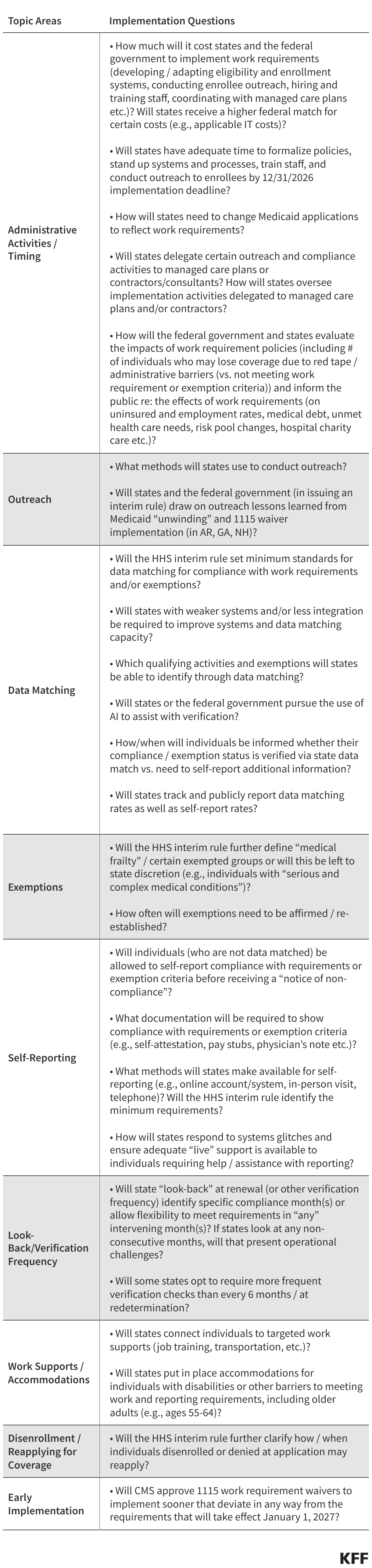
Operational and Implementation Questions

Table

Tracking Implementation of the 2025 Reconciliation Law: Medicaid Work Requirements

Published:

The 2025 reconciliation law, once called the “One Big Beautiful Bill,” signed by President Trump on July 4, 2025, conditions Medicaid eligibility for adults in the Affordable Care Act (ACA) Medicaid expansion group and enrollees in partial expansion waiver programs (Georgia and Wisconsin) on meeting work requirements starting January 1, 2027. Currently, 41 states (including DC) have expanded their Medicaid programs under the ACA to nearly all adults with income up to 138% FPL ($21,597 for an individual in 2025).

To implement Medicaid work requirements, states will need to make important policy and operational decisions, implement needed system upgrades or changes, develop new outreach and education strategies, and hire and train staff, all within a relatively short timeframe. The information tracked here can serve as a resource to understand Medicaid work requirements and state options, gauge readiness, and track implementation of the requirements, including:

  • State and national data and current state policies related to Medicaid enrollment, renewal outcomes, and application processing times that can serve as a baseline for assessing the potential readiness to implement the requirements and the impact of work requirements once implemented;
  • Federal guidance and a list of policy and operational questions that states will need to answer as they implement work requirements;
  • Updates on 1115 waivers submitted by states to implement work requirements (while waivers will no longer be needed starting January 2027, some states may pursue waivers to implement work requirements earlier than January 2027); and
  • A compilation of KFF issue briefs and other resources on Medicaid work requirements.

This resource will be updated to include guidance from the Centers for Medicare and Medicaid Services (CMS), information on state policy decisions as they are made, and new data when available.

Continue scrolling to learn more about the Medicaid work requirements in the 2025 reconciliation law.

Tracking Implementation of the 2025 Reconciliation Law Medicaid Work Requirements

Published:

KFF Resources on Medicaid Work Requirements

Work requirements overview:

Implementation of work requirements:

Research and analysis on Medicaid and work:

1115 work requirement waivers:

Work requirements implications and state experience:

Arkansas work requirement experience:

KFF Polling on Work Requirements:

Beyond the Data by KFF CEO Drew Altman:

Tracking Implementation of the 2025 Reconciliation Law Medicaid Work Requirements

Published:

The 2025 reconciliation law requires states to condition Medicaid eligibility for adults in the ACA Medicaid expansion group on meeting work requirements starting January 1, 2027; however, states have the option to implement requirements sooner through a state plan amendment (SPA) or through an approved 1115 waiver.

State Plan Amendments (SPAs)

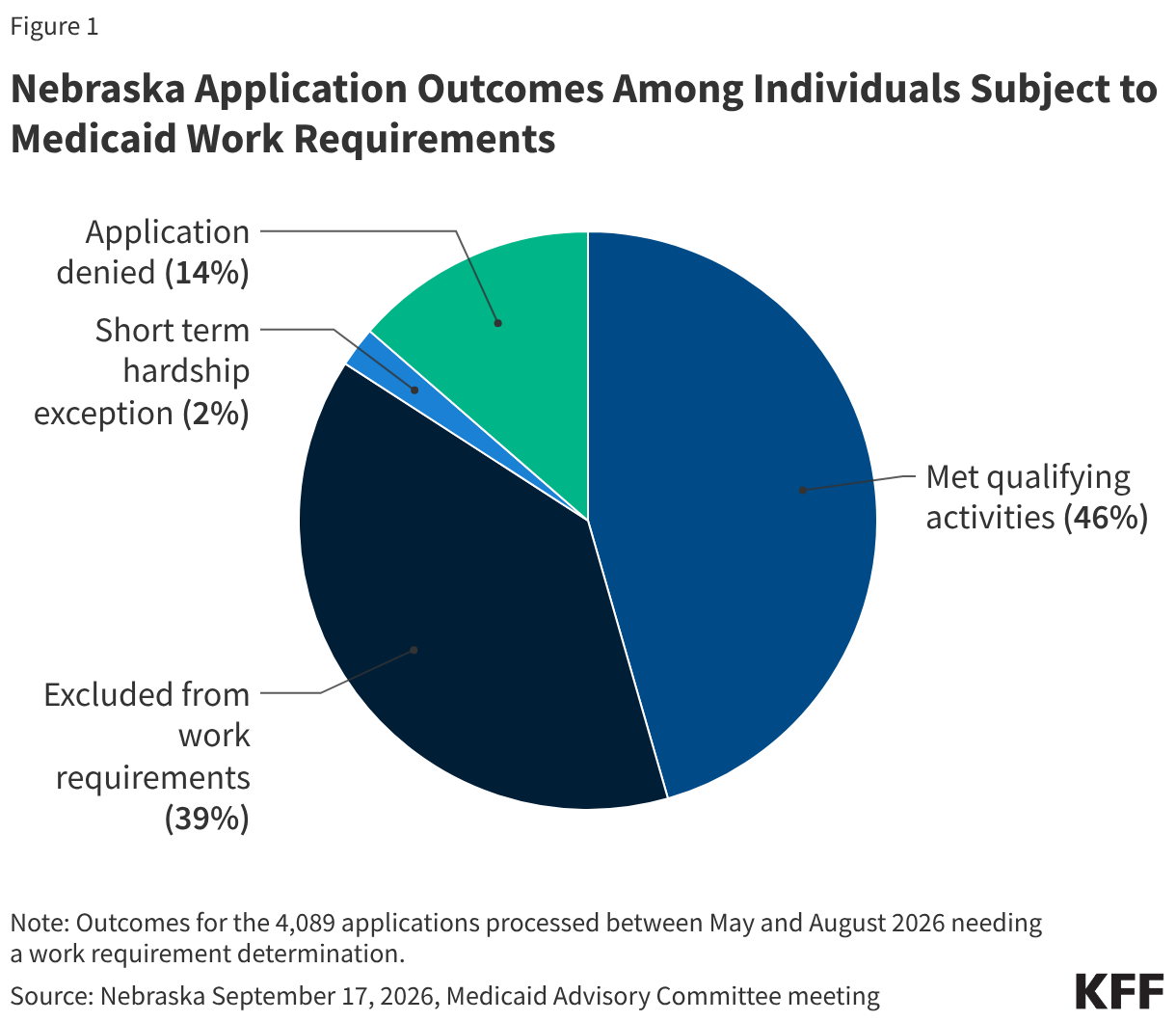
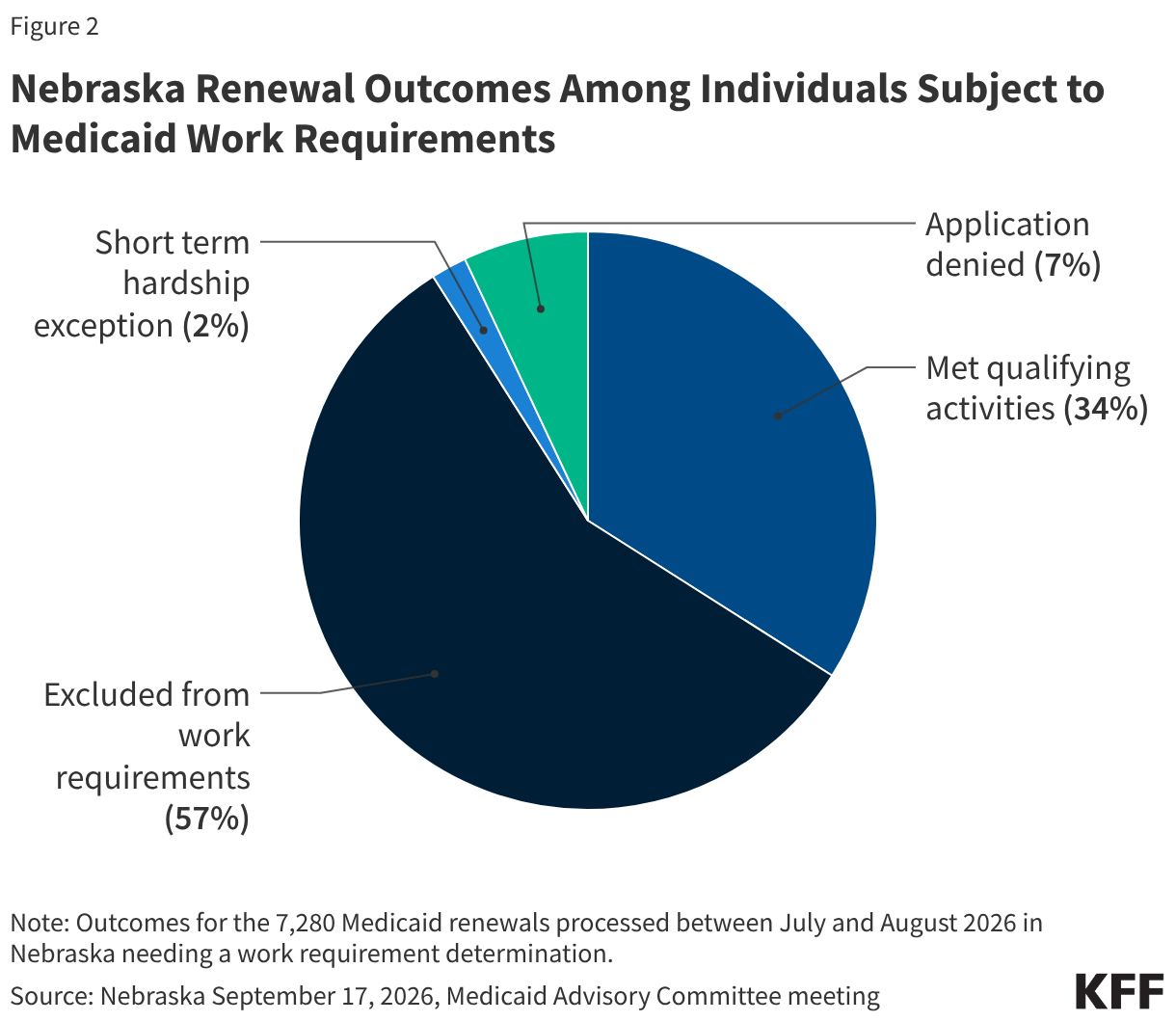
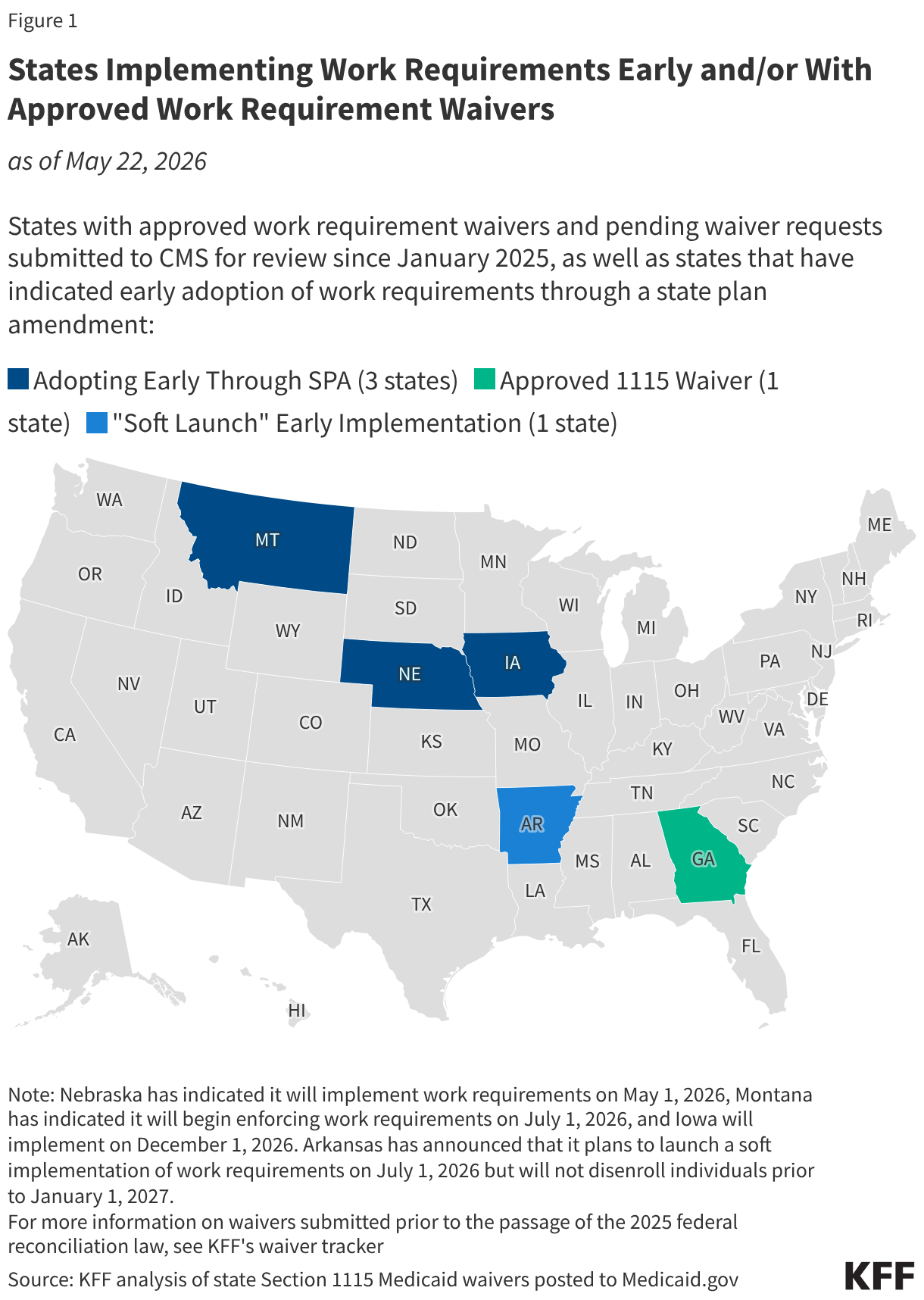
Some states may choose to implement work requirements prior to the January 1, 2027 deadline through a state plan amendment. Nebraska is the first state to have announced that it will begin enforcing federal work requirements early through a state plan amendment, starting May 1, 2026.

1115 Waivers

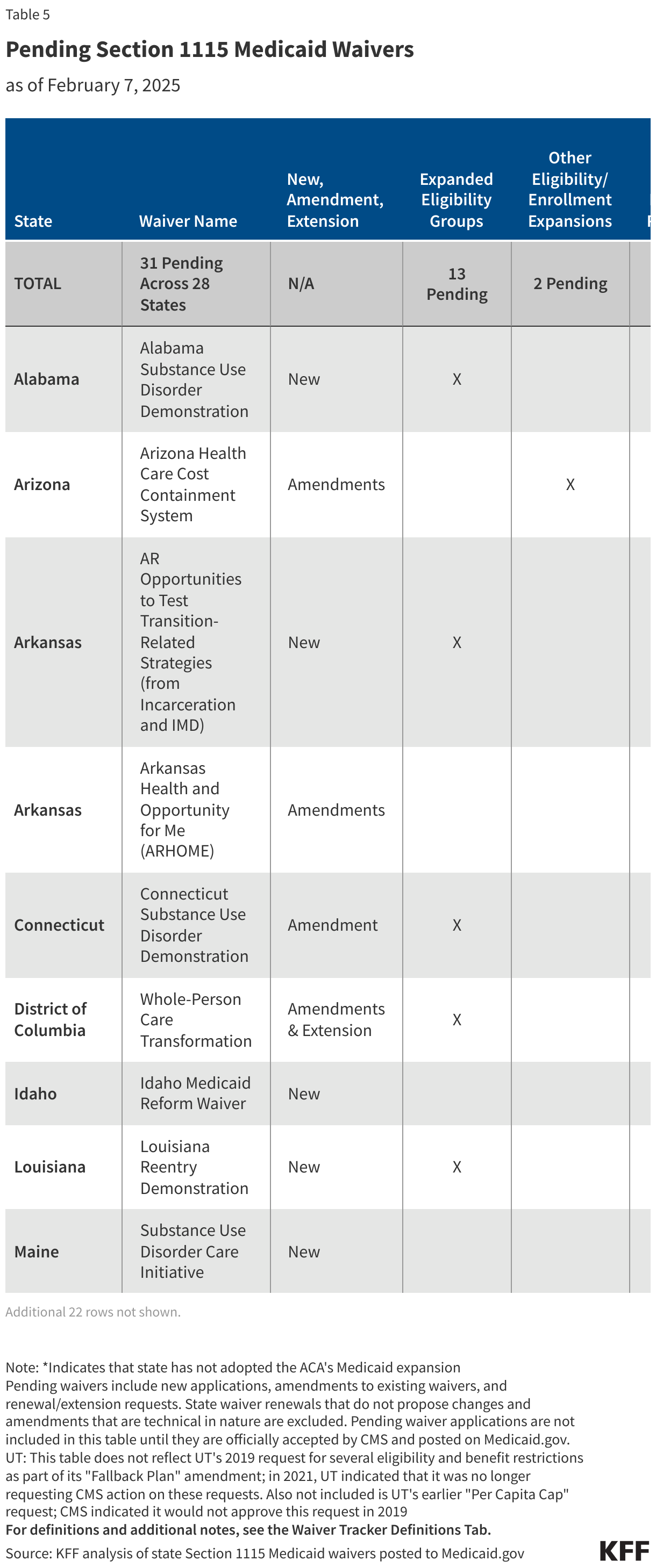
States may also choose to implement work requirements early through an 1115 waiver. Since the start of the second Trump administration, several states have submitted waivers to implement work requirements, although some states may no longer be moving forward with proposed 1115 waivers due to the passage of federal work requirements or because they plan to implement early through a state plan amendment. While states are required to fully align with federal work requirements starting January 1, 2027, it is not clear how CMS will treat pending 1115 waivers that seek to implement early and deviate from federal requirements (specified in the law) prior to this deadline.

Currently, Georgia is the only state with a Medicaid work requirement waiver in place following litigation over the Biden administration’s attempt to stop it. CMS recently approved a temporary extension for Georgia’s waiver that added new exemptions from work requirements (see the table below for more details). Georgia’s waiver is now set to expire December 31, 2026, and the state will be required to come fully into compliance with new federal requirements starting January 1, 2027.

Early Implementation and Waiver Status

The map below identifies states that have indicated they will implement work requirements early through a state plan amendment as well as approved (Georgia) and pending work requirement waivers (submitted to CMS since the start of the second Trump administration). The table below the map provides more detailed state waiver information.
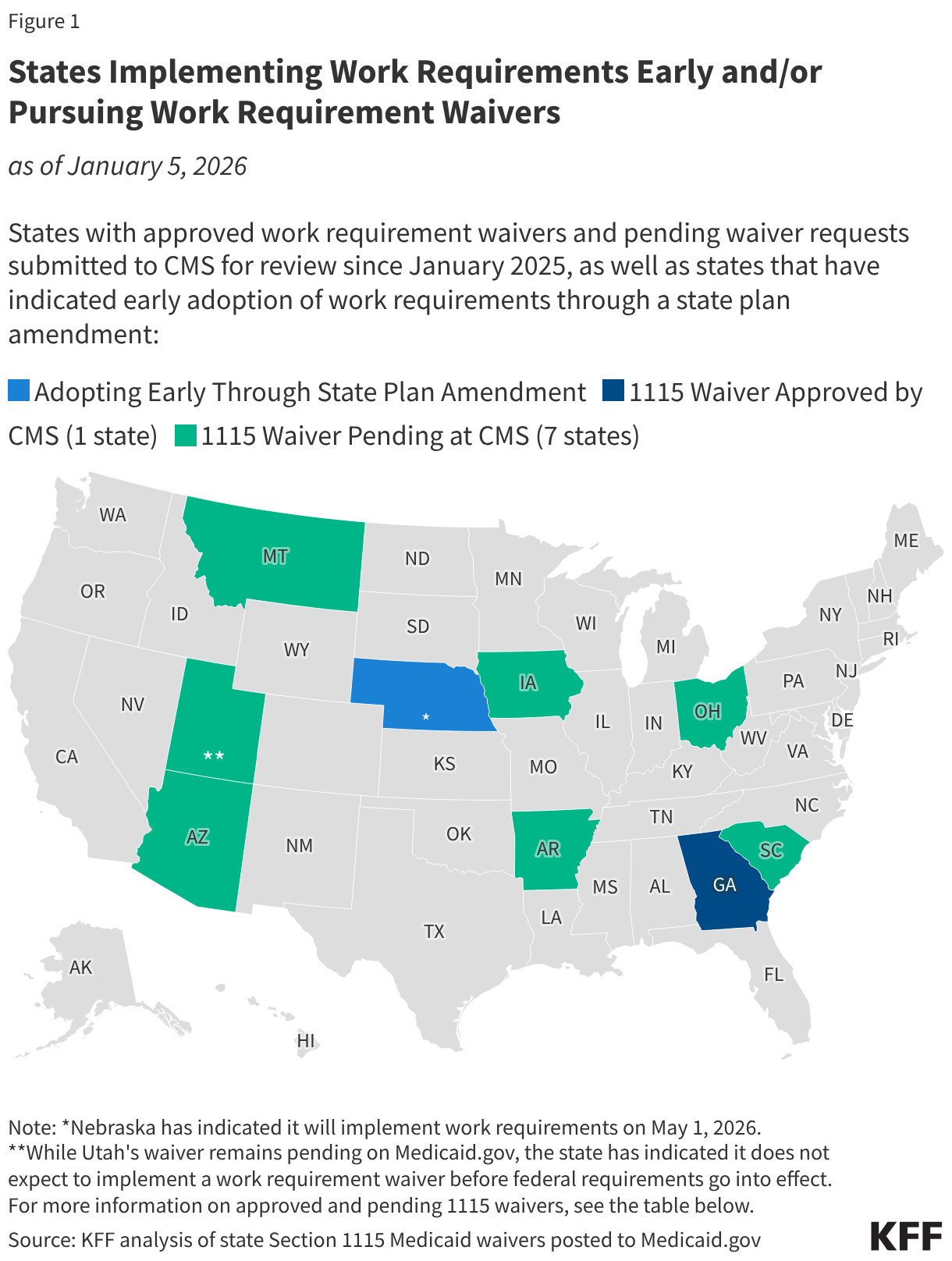
States Implementing Work Requirements Early and/or Pursuing Work Requirement Waivers (Choropleth map)
States with Work Requirement Waiver Activity (Table)

State and Federal Reproductive Rights and Abortion Litigation Tracker

Last updated on

The Supreme Court’s Dobbs ruling, overturning Roe v. Wade, returned the decision to restrict or protect abortion to states. In many states, abortion providers and advocates are challenging state abortion bans contending that the bans violate the state constitution or another state law. The state litigation tracker presents up-to-date information on the ongoing litigation challenging state abortion policy.

In addition, since the Dobbs decision, new questions have arisen regarding the intersection of federal and state authority when it impacts access to abortion and contraception. Litigation has been brought in federal court to resolve some of these questions. The federal litigation tracker presents up-to-date information on the litigation in federal courts that involves access to contraception and abortion.

Litigation Involving Reproductive Health and Rights in the Courts, as of March 12, 2026 (Table)

Medicaid Workers and Job-Based Insurance: Who Is Offered, Eligible, and Enrolled?

Published: Mar 5, 2026

Passage of the 2025 reconciliation law, also known as the “One Big, Beautiful Bill,” in July 2025 and the inclusion of new work requirements for certain Medicaid enrollees in the law focused attention on the work status of adults enrolled in the program as well as their access to job-based insurance. Most adults who will be subject to the new Medicaid work requirements are already working. These adult workers rely on Medicaid because most work in jobs that do not offer health coverage or are not eligible for the offered coverage. While employer-sponsored insurance is the main source of coverage for working-age adults in the United States, access to job-based coverage is more limited for low-wage workers, those who work in certain industries, part-time workers, and those who work at smaller firms. Many employers— small and large— report that Medicaid provides important access to health care to their employees.

New work requirements are unlikely to increase employment (as most Medicaid adults are working or face barriers to work). Given the limited offers and eligibility for job-based coverage for low-wage workers, the new requirements are also not likely to substantially reduce reliance on Medicaid as a source of coverage for those workers. However, these requirements will likely reduce Medicaid enrollment because even some enrollees who are working will be unable to verify their work status.

Using data from the 2025 Current Population Survey Annual Social and Economic Supplement (CPS ASEC), this analysis examines the availability of job-based insurance in 2024 for adult Medicaid workers ages 19 to 64 and explores the reasons why Medicaid adults who are working are not eligible for employer coverage, and if eligible, why they do not take up the offer. The analysis excludes Medicaid adults who are self-employed, are also enrolled in Medicare, receive disability-related payments from Supplemental Security Income (SSI) or Social Security Disability Insurance (SSDI) and focuses on states that have adopted the Medicaid expansion and Wisconsin, which has adopted a partial expansion. Medicaid adults enrolled through the expansion, or partial expansion in Wisconsin, will be subject to the new work requirements. Georgia is excluded from the analysis because enrollment in the Pathways to Coverage Program is too small to be captured in the data. This analysis does not attempt to identify adults who would be subject to work requirements. It covers a broader group of Medicaid enrollees, including adults with dependent children, some of whom may be exempt.

Most Medicaid adult workers work for an employer that does not offer job-based insurance or are not eligible if their employer offers coverage. For workers to enroll in job-based insurance, they need to work for an employer that offers coverage and be eligible to enroll in that coverage. Nearly two-thirds (65%) of Medicaid adult workers in expansion states and Wisconsin either work for an employer that does not offer health coverage (52%) or are not eligible for coverage that is offered by their employer (13%) (Figure 1). In contrast, about one in five (21%) adult workers who are not covered by Medicaid in the same states are not offered (16%) or eligible (5%) for coverage offered by their employer.

About a quarter (26%) of adult Medicaid workers decline coverage when they are eligible compared to 17% of adult workers not covered by Medicaid. Many adult workers who are eligible for job-based insurance do not take up the offer because the coverage is unaffordable (Appendix Table 1). For adult Medicaid workers who did not enroll in job-based coverage, Medicaid likely provides coverage that is more affordable, and in some cases, more comprehensive than the health insurance available through their employer.

About one in ten (9%) adult Medicaid workers take up coverage offered by their employer and are covered by both Medicaid and the employer plan. In these cases, Medicaid provides wrap-around coverage, covering premiums and cost sharing, as well as providing coverage for benefits not included in the employer plan.

Even when adult Medicaid workers in low-wage jobs have access to job-based insurance, the employee share of the costs can be unaffordable. Workers in firms with many lower-wage workers (where at least 35% earn $37,000 or less annually) have higher average contribution rates toward their premium for family and single coverage compared to workers at firms with fewer low-wage workers (31% vs 26% for family coverage and 19% vs 16% for single coverage). These higher contributions likely mean low-income families with job-based coverage spend a greater share of their income on health costs overall (premium contributions and out-of-pocket expenses) than those with higher incomes, which may contribute to decisions not to enroll in the offered coverage.

Most Medicaid Adults Work for an Employer That Does Not Offer Job-Based Insurance or Are Not Eligible if Their Employer Offers Coverage (Stacked column chart)

Medicaid adults who work part time are less likely to be eligible for job-based insurance than those who work full time. About one-third (32%) of adult Medicaid workers work part time, and among these part-time workers, one in five (21%) are eligible for coverage from their employer compared to 42% of those who work full time (Figure 2). Under the Affordable Care Act’s shared responsibility mandate, employers with at least 50 full-time equivalent employees are required to provide minimum essential coverage to employees, but that requirement only extends to employees who work an average of at least 30 hours per week. As a result, among firms that offer health benefits, relatively few offer benefits to part-time workers.

Medicaid Adults Who Work Part Time Are Less Likely to be Eligible For Job-Based Insurance Than Full-Time Workers (Stacked column chart)

Eligibility for job-based insurance among adult Medicaid workers varies by industry. The share of adult Medicaid workers eligible for job-based insurance varies from 56% in the mining industry to 20% in the agricultural and forestry industry (Figure 3). Medicaid adults working in educational and health services industry represent nearly a quarter (23%) of adult Medicaid workers and 41% are eligible for job-based insurance. On the other hand, about one in six (16%) adult Medicaid workers have jobs in the leisure and hospitality industry where only 22% are eligible for employer-based insurance.

Eligibility for Job-Based Insurance Among Adult Medicaid Workers Varies by Industry (Table)

Among adult Medicaid workers who are offered insurance by their employer, most are not eligible because they do not work enough hours. About one in eight (13%) adult Medicaid workers work for an employer that offers health insurance but are not eligible (Figure 1). Nearly seven in ten (69%) of these workers reported they were not eligible because they did not work enough hours per week or weeks per year to qualify (Figure 4). About one in ten (13%) Medicaid workers were not eligible because they had not worked for the employer long enough, and another 5% said they were not eligible because contract and temporary employers were not allowed in the employer’s health plan.

Among Adult Medicaid Workers Who Are Offered Insurance by Their Employer, Most Are Not Eligible Because They Do Not Work Enough Hours (Pie Chart)
Reasons for Not Taking Up Job-Based Coverage Among Adult Workers Covered By Medicaid and Those Not Covered by Medicaid (Table)

How States Verify Citizenship and Immigration Status in Medicaid

Published: Mar 4, 2026

Editorial Note

This brief was updated on March 4, 2026 to include changes related to the 2025 reconciliation law and new federal Medicaid reverification requirements.

Medicaid is the primary program providing comprehensive coverage of health and long-term care to over 81 million low-income people in the U.S. Medicaid is jointly financed by states and the federal government but administered by states within broad federal rules. In addition to meeting federal and state income and residency requirements, eligibility for coverage under Medicaid and the Children’s Health Insurance Program (CHIP) is limited to U.S. citizens and certain lawfully present immigrants. Starting October 1, 2026, the 2025 reconciliation law will further restrict lawfully present immigrant eligibility for Medicaid and CHIP. Federal Medicaid funds cannot be used to cover undocumented immigrants. Undocumented immigrants also are excluded from other federally funded health programs, including Medicare and the Affordable Care Act (ACA) Marketplaces.

On February 19, 2025, the Trump administration issued an executive order to “end taxpayer subsidization of open borders”, which includes language calling for enhanced verification systems to ensure taxpayer-funded benefits exclude unauthorized immigrants and requires federal agencies to identify sources of federal funding for undocumented immigrants. Current federal rules require states to verify an applicant’s eligible immigration status through the Department of Homeland Security (DHS) as part of the process for determining Medicaid eligibility. On August 19, 2025, the Centers for Medicaid and Medicare Services (CMS) announced a new initiative to require states to reverify whether certain individuals enrolled in Medicaid are citizens or have a satisfactory immigration status. This reverification process may increase administrative burdens for states and lead to coverage losses among eligible individuals due to administrative barriers. This brief describes federal citizenship and immigration status eligibility and eligibility verification requirements for Medicaid and the new reverification requirements.

What are Medicaid eligibility requirements for immigrants?

Federal rules limit Medicaid and Children’s Health Insurance Program (CHIP) eligibility to U.S. citizens and certain lawfully present immigrants; undocumented immigrants are not eligible for federally funded coverage. In general, in addition to meeting other eligibility requirements, lawfully present immigrants must have a “qualified non-citizen” status to be eligible for Medicaid or CHIP (Table 1), and many, including most lawful permanent residents or “green card” holders, must wait five years after obtaining qualified status before they may enroll. These immigrants may enroll in Marketplace coverage and receive subsidies during this five-year waiting period. Some immigrants with qualified status, such as asylees and refugees, do not have to wait five years to enroll in Medicaid and CHIP coverage. Some immigrants, such as those with temporary protected status, are lawfully present but do not have a qualified status and are not eligible for Medicaid and CHIP coverage even after a five-year wait. The Trump administration reversed Biden administration actions that had expanded ACA Marketplace coverage to Deferred Action for Childhood Arrivals (DACA) recipients, once again making them ineligible to purchase ACA Marketplace coverage effective August 25, 2025. States have the option to cover lawfully residing children and pregnant people in Medicaid or CHIP without the five-year waiting period otherwise known as the Immigrant Children’s Health Improvement Act (ICHIA) option. States can also provide prenatal care and pregnancy-related benefits to targeted low-income children beginning at conception through the CHIP From-Conception-to-End-of-Pregnancy (FCEP) option regardless of their parent’s citizenship or immigration status. Some states provide fully state-funded coverage to fill gaps in coverage for immigrants, including lawfully present immigrants and undocumented immigrants.

The 2025 reconciliation law will further restrict lawfully present immigrant eligibility for Medicaid and CHIP. Starting October 1, 2026, the 2025 reconciliation law will restrict immigrant Medicaid and CHIP eligibility to lawful permanent residents (LPRs) (i.e., “green card” holders), Cuban and Haitian entrants, people residing in the U.S. as citizens of the Freely Associated (COFA) nations of the Marshall Islands, Micronesia, and Palau residing in U.S. states and territories, and lawfully residing children and pregnant immigrants in states that cover them under the Medicaid or CHIP option (Table 1). States also will still have the option to extend prenatal and pregnancy-related benefits to targeted low-income children from conception through the end of pregnancy through the FCEP option. These restrictions will eliminate eligibility for many other groups of lawfully present immigrants, including refugees and asylees without a green card, among others.

Eligible Immigration Statuses for Medicaid and CHIP (Table)

Emergency Medicaid reimburses hospitals for emergency care provided to individuals ineligible for Medicaid due to their immigration status. Emergency Medicaid spending reimburses hospitals for emergency care they are obligated to provide to individuals who meet other Medicaid eligibility requirements (such as income) but do not have an eligible immigration status, including undocumented immigrants and lawfully present immigrants who remain ineligible for Medicaid or CHIP. Emergency services include those requiring immediate attention to prevent death, serious harm or disability, although states have some discretion to determine reimbursable services. Spending on Emergency Medicaid accounts for less than 1% of total Medicaid expenditures. Without Emergency Medicaid, the costs of emergency care would be shifted to hospitals that are required to treat individuals in emergency situations or fully to states. Starting October 1, 2026, in states that have expanded Medicaid under the ACA, the 2025 reconciliation law will limit federal matching payments for Emergency Medicaid for individuals who would otherwise be eligible for expansion coverage except for their immigration status to the state’s regular federal Medicaid match rate (which ranges from 50% to 77%) as opposed to the expansion match rate (which is 90% in all states).

How do states verify citizenship and immigration status to determine Medicaid eligibility?

States must verify citizenship and immigration status with the Social Security Administration (SSA) and DHS to determine eligibility for Medicaid coverage at the initial application. Applicants who are U.S. citizens must provide documentation of citizenship, or states must verify the applicant’s Social Security number with the SSA. Applicants who are not U.S. citizens must provide documentation showing that they have a qualified immigration status eligible for Medicaid coverage (Figure 1). States verify immigration status through the DHS Systematic Alien Verification for Entitlements (SAVE) system, which can provide automatic real-time verification. If the system cannot provide real-time verification, the state must request an additional review and may request additional documentation of eligible immigration status from the applicant. Applicants cannot self-attest to having an eligible immigration status without documentation for the state, with the exception of qualified immigrants exempt from the five-year wait due to a military connection. Current federal rules prohibit states from requiring applicants to disclose the immigration status of non-applicants, such as household members, which is not relevant to eligibility determination, and under statute, the SAVE system cannot be used for non-criminal immigration enforcement.

States are required to provide Medicaid benefits to applicants during a “reasonable opportunity period” of 90 days while their immigration status is being verified, if they otherwise meet all eligibility criteria. The reasonable opportunity period is allowed when the SAVE system cannot verify immigration status in real time and the state needs to conduct additional review and collect additional documentation to verify the qualified immigration status. This period gives applicants the opportunity to correct information in SAVE or submit additional documentation in support of their application. States may extend the period if they need more time to complete verification or if applicants are attempting to correct issues with documentation. States are entitled to receive federal matching funds for expenditures for Medicaid services provided to individuals during the reasonable opportunity period, regardless of whether eligibility is ultimately verified. If states determine an applicant ineligible for Medicaid coverage due to their immigration status at any point during the reasonable opportunity period, they must terminate eligibility within 30 days. This may also occur if applicants do not provide additional requested documentation or correct any discrepancies in the application. Applicants have the right to dispute the state’s decision in a fair hearing process, but states are not required to provide Medicaid benefits during this time.

In some cases, states need to reverify immigration status as part of Medicaid annual redetermination of eligibility processes. States do not need to reverify immigration status for most enrollees during the annual renewal if that status is unlikely to change (e.g., the enrollee is a lawful permanent resident). However, immigrant children and pregnant people who have been lawfully residing in the U.S. for less than five years receiving coverage through the ICHIA option must have their immigration status re-verified at renewal. If, at any point during the coverage period, the state receives information about a change in an enrollee’s immigration status that might affect ongoing eligibility, the state is required to act on that change in circumstance to review eligibility and request additional documentation from the enrollee if needed. The 2025 reconciliation law will require states to conduct eligibility redeterminations at least every 6 months for Medicaid expansion adults for renewals scheduled on or after December 31, 2026.

On August 19, 2025, CMS announced a new initiative to require states to reverify whether certain individuals enrolled in Medicaid are citizens or have a satisfactory immigration status. CMS will use Transformed Medicaid Statistical Information System (T-MSIS) enrollment data to attempt to verify enrollee citizenship and immigration status in the SAVE system and send states a sample of Medicaid enrollees whose immigration status it could not verify. States are required to reverify the status of those individuals in accordance with current federal rules, including the requirement to provide a reasonable opportunity period, and disenroll individuals who do not verify a satisfactory immigration status.

These new reverification requirements may increase administrative burdens for states and may lead to coverage lapses among eligible individuals if they are unable to complete reverification-related requests from states. Under the new requirements, states will need to reverify eligible immigration status for individuals CMS identifies in the sample shared with states, which can include immigrants as well as citizens. For several reasons, the CMS process for identifying individuals in the sample may include individuals who do not need reverification, which will increase the administrative burden on states. For example, the sample may include people in the reasonable opportunity period who do not require immediate verification or those receiving Emergency Medicaid services only who do not need a qualified immigration status. In addition, the T-MSIS data used by CMS is at least 2-3 months behind that of state enrollment data, so CMS may flag enrollees that states have since verified or already removed from Medicaid. The CMS sample may also include citizens because the SAVE system may not be able to verify citizenship in certain cases if that information is not available in the databases that SAVE has access to, such as for naturalized citizens whose citizenship information may not be up-to-date with the SSA. This could result in states reverifying citizenship status for citizens even though citizenship is not typically reverified. Some individuals may lose coverage during the reverification process even if they are still eligible if they have trouble completing the process, for example, if they miss notices or face challenges submitting required documentation.

CMS will require states to share reports on eligibility redeterminations for individuals whose citizenship or satisfactory immigration status CMS was unable to verify through its data match. CMS will require each state to report back on reverifications using a standardized template on the procedures used, the outcomes of the states’ independent verification efforts, and resulting redeterminations. CMS may publish monthly, de-identified counts of individuals for whom federal verification was unsuccessful and may issue disallowances or deferrals of federal matching funds when states claim federal matching funds for services or administrative Medicaid expenditures associated with individuals for whom they could not verify a satisfactory immigration status. The new reporting requirements will increase administrative burdens for states that are already working to meet implementation requirements tied to the 2025 reconciliation law.

A Look at the Intersection of SNAP and Medicaid as States Implement Medicaid Work Requirements

Published: Mar 4, 2026

On July 4, President Trump signed the 2025 reconciliation law that makes significant changes to the Medicaid program, including new requirements for states to implement work requirements. Starting January 1, 2027, states must condition Medicaid eligibility on meeting work requirements for individuals enrolled through the Affordable Care Act (ACA) Medicaid expansion pathway and through certain state waivers. To ease the burden on individuals, the law directs states to use available information “where possible” to verify compliance with Medicaid work activities or exemption status, without requiring additional documentation from individuals.

The Supplemental Nutrition Assistance Program (SNAP), the federal aid program addressing food insecurity among low-income households, is an important source of data that can be used to identify individuals who are in compliance with or exempt from the Medicaid work requirements. Both Medicaid and SNAP target low-income households, and many individuals receive benefits through both programs; overall, most people who receive SNAP benefits are covered by Medicaid. As a result, some states have integrated eligibility systems or otherwise share data between the two programs. In addition, SNAP has long-standing work requirements for certain “able-bodied” adults without dependents, so coordination among agencies can streamline the collection of information to verify compliance with requirements in both programs. The reconciliation law introduced changes for the population subject to work requirements in SNAP that align them more closely with the new Medicaid work requirements, but differences remain between the programs.

New Medicaid work requirements and changes to SNAP work requirements are expected to impact enrollment in both programs. The Congressional Budget Office (CBO) estimates that Medicaid work requirements will increase the number of uninsured by 5.3 million over the next ten years, and that changes in who will need to meet work requirements will reduce participation in SNAP by roughly 2.4 million people in an average month over the 2025-2034 period. The changes to SNAP work requirements to align with Medicaid mean there could be overlap in the populations projected to lose SNAP and Medicaid benefits. This brief describes the intersection between Medicaid and SNAP and discusses how information from SNAP may be leveraged by states when implementing the new Medicaid work requirements.

What are Medicaid and SNAP Work Requirements?

Beginning January 1, 2027, states must require expansion adults and enrollees in partial expansion waiver programs (Georgia and Wisconsin) to complete 80 hours of work or community service activities per month or meet exemption criteria to enroll in Medicaid and maintain coverage. At a minimum, states will be required to verify individuals’ work or exemption status when individuals apply for coverage and at eligibility renewal. The law specifies mandatory exemptions, including being in a household receiving SNAP and not exempt from SNAP work requirements. Other exemptions include parents and caretakers with children ages 13 and under, individuals who are “medically frail,” and individuals who are pregnant or postpartum, among others (Table 1). When a state is unable to verify compliance with the requirements or that an individual meets exemption criteria through data matching, it must issue a “notice of noncompliance” and deny the application or disenroll the individual from Medicaid coverage if the individual is unable to show compliance within 30 days.

SNAP has its own work requirements and exemptions, but these do not fully align with the new Medicaid work requirements and exemptions. While most adults on SNAP must meet general work requirements, individuals who are considered “able-bodied adults without dependents” (ABAWDs) must work or participate in a work program for at least 80 hours per month or participate for an assigned number of hours in workfare to receive SNAP benefits for more than three months in a 36-month period (Table 1). The reconciliation law made changes that went into effect at the end of 2025 affecting the ABAWD population subject to this 80 hour per month work requirement, including newly subjecting adults ages 55 to 64 and parents with children ages 14 and older to these requirements, as well as removing previous exemptions for veterans, people experiencing homelessness, and young adults who aged out of foster care and who are under age 24. The law also added a new exemption for American Indian and Alaska Native People and changed the criteria for optional hardship exceptions for areas facing high unemployment. These changes make the SNAP requirements more consistent with Medicaid work requirements, although differences remain. For example, unlike SNAP, Medicaid work requirements include exemptions for individuals recently released from incarceration, as well as optional short-term hardship exceptions states can adopt for individuals with inpatient or nursing facility admissions, residents of counties with a disaster declaration, and those who have traveled outside their community for medical care (Table 1).

Medicaid and SNAP Work Requirements (Table)

What do we know about the intersection between Medicaid and SNAP?

About one in five Medicaid-covered adults who will likely be subject to the new work requirements also receive SNAP benefits (Figure 1). Similar eligibility requirements, particularly in Medicaid expansion states, account for this overlap in enrollment. In the 41 states (including DC) that have expanded their Medicaid programs, the income eligibility limit for adults is 138% of the federal poverty level (FPL), which is $22,024 for an individual in 2026 or $1,835 per month. The income eligibility limit for SNAP is 130% FPL gross monthly income ($1,696 for an individual in 2026) and 100% FPL net monthly income reflecting certain deductions ($1,305 for an individual in 2026); though definitions of income and household composition rules differ somewhat between SNAP and Medicaid. This estimate of the share of adults likely subject to Medicaid work requirements who are enrolled in both programs is likely an undercount as it excludes Medicaid adults with dependent children ages 14 and older. While nearly all SNAP participants are also enrolled in Medicaid, because SNAP participation is much lower than total Medicaid enrollment, the share of Medicaid enrollees who also receive SNAP is lower. This analysis focuses on adults who would likely qualify for an exemption from Medicaid work requirements due to being in a household receiving SNAP and not exempt from SNAP work requirements. When looking at the broader population of all Medicaid adults ages 19-64, the share receiving SNAP benefits rises to one in three individuals.

One in Five Adults Likely Subject to Medicaid Work Requirements Receive SNAP (Donut Chart)

In part because of the overlap in eligibility between the two programs, many states use information from SNAP to assist with determining Medicaid eligibility. Most Medicaid programs are already facilitating coordination of enrollment processes and systems between Medicaid and SNAP. For example, 29 states affected by the new Medicaid work requirements allow individuals to apply for Medicaid and SNAP through a single online application and 24 states affected by the new Medicaid work requirements make eligibility determinations for Medicaid and SNAP through a single shared system. In addition, among states that will be subject to Medicaid work requirements, 15 enroll or renew individuals in Medicaid using SNAP income determinations, and 33 states use information from SNAP to identify and act on potential changes in eligibility between renewals, including 10 states and DC that do both, as of January 2025 (Figure 2).

Many states Use Information From SNAP to Assist with Determining Medicaid Eligibility, as of January 2025 (Choropleth map)

How can states use data from SNAP to implement Medicaid work requirements?

States can use information from SNAP to identify individuals who may be exempt from Medicaid work requirements and those who are meeting the requirements. States are required to use available data from reliable sources to “data match” the work or exemption status of individuals to lessen the administrative burden on both enrollees and Medicaid staff. Although CMS has not released formal guidance, it is anticipated that states will be required to access SNAP and TANF data for the purpose of determining compliance with work requirements. Successful automation to verify compliance with Medicaid work activities or exemption status can lower the risk of eligible people not being able to enroll in Medicaid or losing their coverage due to not submitting proof of work hours or exemption status. States can use information already collected by SNAP to identify individuals in a household receiving SNAP who are not exempt from SNAP work requirements, and who are, therefore, exempt from the Medicaid requirements. SNAP data can also be used to identify individuals who qualify for exemptions because they are medically frail, are participating in a drug or alcohol addiction program, or are American Indians or Alaska Natives. States can also use income information from SNAP to verify compliance with Medicaid work requirements. While some of this information on work and exemption status is likely available for current Medicaid enrollees, SNAP can be a source of data for applicants for whom Medicaid agencies do not have this information.

When Arkansas implemented work requirements in 2018, the state used SNAP data to verify exemptions and compliance with work hours. Of the 116,000 individuals subject to work requirements in February 2019, Arkansas was able to determine that 87% of enrollees were meeting or exempt from the work requirements through data matching (Figure 3). Most individuals whose status was verified using available data fell into four categories: those who were already working at least 80 hours per month (45%), those meeting or exempt from SNAP employment and training requirements (14%), those with a dependent child in the household (12%), and those identified as medically frail (9%). Most enrollees who were not data matched ultimately did not report any work activities in that month. Arkansas did not have integrated eligibility systems, but implemented a daily file exchange between its SNAP and Medicaid systems to update exemption and compliance information across programs without manual intervention. Although Arkansas’ work requirements differ from the new federal requirements in key ways, the experience shows how states can use SNAP data when implementing the new Medicaid work requirements. 

In Arkansas, 14% of Those Subject to Work Requirements Were Automatically Exempted Due to Their SNAP Status (Pie Chart)

Data sharing between Medicaid and SNAP will be easier in states that have integrated eligibility systems; however, these states may also face unique issues in addition to the challenges all states will likely face when making necessary system changes for both programs. Of the many systems changes needed, states have previously reported prioritizing enhancing capabilities to collect and match data from multiple agencies and external sources to reduce the burden on applicants and enrollees for documenting their work or exemption status. However, states may face different challenges based on their current Medicaid eligibility system integration with SNAP. States that do not currently link to SNAP will need to establish an interface to share data between agencies. Some states may face difficulty establishing this linkage and may require more time to put it into place. States with integrated Medicaid and SNAP eligibility systems needed to prioritize completing work requirement changes for SNAP that went into effect at the end of 2025, which may have delayed the initiation of work on the Medicaid changes. Any delays in preparing for Medicaid work requirements could potentially increase costs. In addition, as states implement complex SNAP and Medicaid eligibility and enrollment policy changes, they will also need to prepare for changes to the payment error rate measurement (PERM) program at the same time, requiring states to make decisions on how to apply scarce state resources and mitigate budgetary consequences. Beginning in 2028, the reconciliation law requires states to pay a portion of SNAP benefit costs, depending on the state’s payment error rate, and starting October 1, 2029, HHS will be required reduce federal Medicaid financial participation to states that exceed a three percent PERM eligibility error rate threshold.

Medicaid Financing: The Basics

Published: Mar 4, 2026

Introduction

Medicaid represents nearly $1 out of every $5 spent on health care in the U.S. and is the major source of financing for states to provide health coverage and long-term care for low-income residents. Medicaid is administered by states within broad federal rules and jointly funded by states and the federal government through a federal matching program with no cap. States are facing substantial Medicaid financing changes and historic reductions in federal funding following the passage of the 2025 reconciliation law, though the timing of the changes and the impacts vary by state. In addition, administrative actions related to financing and more aggressive oversight of potential fraud by health care providers, including withholding federal Medicaid operating funds, contribute to fiscal uncertainty for states. Amid federal policy changes, states are also experiencing a more tenuous fiscal climate due to slowing revenue growth and increasing spending demands. Medicaid is often central to state budget decisions as it is simultaneously a significant spending item as well as the largest source of federal revenues for states. This issue brief examines key questions about Medicaid financing and explores the impact of recent policy changes.

How does Medicaid financing work?

Medicaid financing is shared by states and the federal government with a guarantee to states for federal matching payments with no pre-set limit. The percentage of costs paid by the federal government (known as the federal medical assistance percentage or “FMAP”) varies across states, for specific services and types of enrollees, and depending on whether the costs are for medical care or program administration. Congress has enacted legislation to temporarily increase federal matching payments during economic downturns and, most recently, during the COVID-19 pandemic, because Medicaid is a counter-cyclical program. During economic downturns, more people become eligible and enroll, but states typically face declines in revenues that make it difficult to finance the state share of funding for the program.

The FMAP for services used by people eligible through traditional Medicaid, which includes individuals who are eligible as children, low-income parents, because of disability, or because of age (65+), is determined by a formula set in statute. The formula is designed so that the federal government provides a match rate of at least 50% and provides a higher match rate for states with lower average per capita income. The resulting FMAP varies by state and ranges from 50% (the FMAP “floor”) in ten states (California, Colorado, Connecticut, Maryland, Massachusetts, New Hampshire, New Jersey, New York, Washington, and Wyoming) to 77% in Mississippi for federal fiscal year (FFY) 2027 (Figure 1).

States With Lower Per Capita Incomes Have a Higher Federal Matching Rate for Medicaid (Choropleth map)

There are special match rates for the Affordable Care Act (ACA) expansion group, administration, and other services. While the traditional FMAP applies to the vast majority of Medicaid spending, there are a few exceptions that provide higher match rates for specific services or populations, such as family planning and most notably people covered under the ACA Medicaid expansion. States that have implemented the expansion receive 90% FMAP for adults covered through the ACA Medicaid expansion. Administrative costs incurred by states are usually matched by the federal government at a 50% rate, but some functions such as eligibility and enrollment systems receive higher match rates. Medicaid administrative costs are about 4% of total Medicaid spending.

Unlike in the 50 states and D.C., annual federal funding for Medicaid in the U.S. territories is subject to a statutory cap and fixed matching rate. Once a territory exhausts its capped federal funds, it no longer receives federal financial support for its Medicaid program during that fiscal year. Over time, Congress has provided increases in federal funds for the territories broadly and in response to specific emergency events. Various pieces of legislation during the pandemic significantly increased the allotments for each of the territories and also raised the FMAP rates from the statutory level of 55% to 76% for Puerto Rico and 83% for the other territories. The 2023 Consolidated Appropriations Act extended the 76% FMAP for Puerto Rico through FFY 2027 and made the 83% match rate for other territories permanent.

To participate in Medicaid and receive federal matching dollars, states must meet core federal requirementsStates must provide certain mandatory benefits (e.g., hospital, physician, and nursing home services) to core populations (e.g., low-income pregnant women, children, people with disabilities, and people ages 65 and older) without waiting lists or enrollment caps. States may also receive federal matching funds to cover “optional” services (e.g., adult dental care and home care, also known as home- and community-based services) or “optional” groups (e.g. people with income above the limits established for core populations). States also have discretion to determine how to purchase covered services (e.g., through fee-for-service or capitated managed care arrangements) and to establish provider payment methods and rates.

Both the federal government and states are responsible for promoting program integrity. Program integrity broadly refers to the proper management and function of the Medicaid program to ensure it is providing quality and efficient care while using funds–taxpayer dollars–appropriately, with minimal waste. Program integrity efforts, historically, have worked to prevent and detect fraud, waste, and abuse; to increase program transparency and accountability; and to work on corrective action plans and recover improperly used funds. Improper payments, which are often cited when discussing program integrity, are not a measure of fraud but payments that do not meet Centers for Medicare and Medicaid Services (CMS) program requirements. CMS’s Medicaid Payment Error Rate Measurement (“PERM”) program estimated the overall Medicaid improper payment rate was about 6% in 2025. Most improper payments (77% in 2025) are due to insufficient information (or missing administrative steps), not necessarily due to payments for ineligible enrollees, providers, or services (i.e. since they may have been payable if the missing information had been on the claim and/or the state had complied with requirements).

How much does Medicaid cost and how are funds spent?

Overall, Medicaid spending totaled $919 billion in FFY 2024 with the federal government paying nearly two-thirds (65% or $594 billion) and states paying over one-third (35% or $325 billion) (Figure 2). The overall share of federal spending on Medicaid depends on states’ per capita income (lower income states receive a higher match) and whether they adopted the ACA expansion (which has a 90% match).

The Federal Government Paid for Nearly Two-Thirds of Total Medicaid Spending in FFY 2024 (Donut Chart)

Capitated payments to Medicaid managed care organizations (MCOs) accounted for half of Medicaid spending in FFY 2024 (Figure 3). Managed care and health plans accounted for the largest share (53%) of Medicaid spending, with capitated payments to comprehensive MCOs accounting for 50% of Medicaid spending in FFY 2024 and other Medicaid managed care (e.g., primary care case management (PCCM) arrangements or payments to specialty plans) accounting for another 3%. Smaller shares of total Medicaid spending in FFY 2024 were for fee-for-service acute care (22%), fee-for-service long-term care (20%), Medicaid spending for Medicare premiums on behalf of enrollees who also have Medicare (3%), and disproportionate share hospital (DSH) payments (2%).

Payments to Comprehensive MCOs Account for Half of Total National Medicaid Spending (Pie Chart)

Enrollees eligible based on disability or age (65+) comprise about one in five of all Medicaid enrollees but account for over half of total spending due to higher per person costs (Figure 4). Children account for 33% of enrollees but only 15% of spending. Adult enrollees (those made eligible under the ACA Medicaid expansion, as well as low-income parents) account for 45% of all enrollees and 34% of spending. The disproportionate spending on certain eligibility groups stems from variation in spending per enrollee across the eligibility groups, reflecting differences in health care needs and utilization. Spending per enrollee for individuals eligible based on age (65+) and disability, the two groups with the highest per enrollee costs, is approximately six times higher than spending per enrollee for children, who had the lowest spending of any eligibility group. Those eligible on the basis of age or disability tend to have higher rates of chronic conditions, more complex health care needs and are more likely to utilize long-term care than other enrollees, contributing to higher spending.

People Eligible for Medicaid Based on Disability or Age (65+) Accounted for 1 in 5 Enrollees but Over Half of All Spending in 2023 (Stacked column chart)

Total spending per full-benefit enrollee ranged from a low of $4,780 in Alabama to $12,295 in D.C. in 2023 (Figure 5). Variation in spending across the states reflects considerable flexibility for states to design and administer their own programs – including what benefits are covered and how much providers are paid — and variation in the cost of living and the health and population characteristics of state residents. Within each state, there is also substantial variation in the average costs for each eligibility group and within each eligibility group, per enrollee costs may vary significantly. Overall, Medicaid spending has experienced slower cumulative growth since 2008 compared to private insurance on a per-enrollee basis.

Medicaid Spending Per Full-Benefit Enrollee Varies Across States (Choropleth map)

Medicaid spending includes payments to providers, particularly hospitals, that include base rates as well as supplemental payments. Supplemental payments generally add on to “base” payments from fee-for-service Medicaid or from Medicaid managed care organizations, both of which don’t always cover the costs of providing services.There are various types of supplemental payments (see Box 1), and their use varies by state.

Box 1: Types of Medicaid Supplemental Payments

“Disproportionate share hospital” (DSH) payments ($15 billion in FFY 2024) pay hospitals that serve a large number of Medicaid and low-income uninsured patients to offset uncompensated care costs. Federal DSH spending is capped for each state and facility but within those limits, states have considerable discretion in determining the amount of DSH payments to each DSH hospital. The ACA called for a reduction in federal DSH allotments starting in FFY 2014 based on the assumption of reduced rates of uninsurance, but the cuts have been delayed several times and have yet to go into effect. DSH payments are intended to supplement Medicaid payment rates and to help defray the costs of care provided to people without health insurance.

States may make other non-DSH supplemental payments to providers ($39 billion in FFY 20241). Upper payment limits (UPLs) are the most common, and permit states to make up the difference between Medicaid fee-for-service payments and what Medicare would pay for comparable services. As such, the maximum payment rate for UPLs is what Medicare would pay in most cases. Other types of supplemental payments include payments for graduate medical education and those authorized under various demonstration programs. Most supplemental payments are made to hospitals, but some go to mental health facilities, nursing facilities, intermediate care facilities, physicians and other practitioners. For physician and other practitioners, UPLs are set at average commercial rates, which tend to be much higher than Medicare rates.

Subject to CMS approval, states may implement “state directed payments” that require managed care plans to make certain types of payments to health care providers (estimated to be well over $100 billion each year). State directed payments are generally aimed at bolstering provider payment rates to increase access to or quality of care. Prior to passage of the 2025 reconciliation law, the total payment made through state directed payments and base MCO payments was capped at average commercial rates for hospital services, nursing facility services, and professional services at academic medical centers.

How does Medicaid relate to federal and state budgets?

Social Security, Medicare, and Medicaid are the three main entitlement programs and accounted for 41% of all federal outlays in FFY 2024 (Figure 6). Of these three programs, Medicaid is smallest in terms of federal outlays, though it covers a larger number of people than Medicare or Social Security. Overall, federal spending on domestic and global health programs and services accounted for more than one-fourth of net federal outlays in FFY 2024, including spending on Medicare (12%), Medicaid and CHIP (8%), and other health spending (6%). (The numbers in Figure 6 come from the FFY 2025 budget request. The FFY 2026 budget request did not include full data on prior years’ spending, and the FFY 2027 budget request has not been posted as of the writing of this issue brief.)

Medicaid and CHIP Accounted for 8% of Net Federal Outlays in FFY 2024 (Donut Chart)

Medicaid is often central to state fiscal decisions as it is simultaneously a significant spending item as well as the largest source of federal revenues for states due to the federal matching structure. According to data from the National Association of State Budget Officers (NASBO), in state fiscal year (SFY) 2024, Medicaid accounted for 30% of total state spending for all items in the budget (Figure 7). Medicaid accounted for only 16% of expenditures from state funds (including state general funds and other state funds), second to K-12 education (24%). On the other hand, Medicaid accounted for 57% of all expenditures from federal funds. States have an incentive to control Medicaid spending because they pay a share of Medicaid costs, though states must reduce total Medicaid spending by more than one dollar to achieve a dollar in savings due to the federal matching structure. At the same time, research shows that federal matching dollars from Medicaid spending have positive effects for state economies. A number of studies show that states that have adopted the ACA Medicaid expansion have realized budget savings, revenue gains, overall economic growth as well as observed positive effects on the finances of hospitals and other health care providers.

Medicaid is the Largest Single Source of Federal Funds for States (Stacked column chart)

States can use a variety of methods to pay for the state share of Medicaid spending. States have flexibility in determining how to finance the state (or non-federal) share of Medicaid payments, within certain limits. In addition to state general funds appropriated directly to the Medicaid program, most states also rely on funding from health care providers and local governments generated through provider taxes and donations, intergovernmental transfers (IGTs), and certified public expenditures (CPEs). KFF’s 2025 Medicaid budget survey found that general funds accounted for a median of 70% of the non-federal share in SFY 2026 enacted budgets, while provider taxes accounted for 18% and funds from local governments or other sources accounted for 6%, though there was considerable variation across states.

All states (except Alaska) have at least one provider tax in place and many states have more than three (Figure 8). Medicaid provider taxes are defined as those for which at least 85% of the tax burden falls on health care items or services or entities that provide or pay for health care items or services. Provider taxes fall on a wide range of provider types but are most common for institutional providers including hospitals (47 states), nursing facilities (45 states), and intermediate care facilities for people with intellectual or developmental disabilities (33 states). States use provider tax revenues to fund Medicaid “base” rates as well as supplemental payments (including state directed payments); to finance eligibility expansions (including the ACA Medicaid expansion); or to more generally support the Medicaid program. Smaller sources of state share funding include IGTs, CPEs, and provider donations (see Box 2).

All States but Alaska Use Provider Taxes To Help Finance the State Share of Medicaid Spending (Choropleth map)

Box 2: State Share Funding Sources Beyond Provider Taxes

Intergovernmental transfers (IGTs) are transfers of public funds between governmental entities (such as county government or state university hospital transferring funding to the state Medicaid agency). Similar to provider taxes, IGTs may be used to finance payments for providers but also finance overall Medicaid spending.

Provider donations are voluntary contributions from health care providers or related entities to the state or local government, which are only permissible if they are “bona fide” and not related to the payments the provider receives from Medicaid. (Provider donations of up to $5,000 per year for an individual provider and up to $50,000 per year for health care organizations are presumed to be bona fide.) Similar to provider taxes and IGTs, provider donations may be used to finance various types of Medicaid spending.

Certified public expenditures (CPEs) are certifications by a governmental entity (such as a county hospital or schools) that authorized funds were spent on Medicaid expenses. Unlike other types of Medicaid financing, CPE funds are not transferred from a governmental entity to the state for use as a non-federal funding source. Instead, the government entity that provides the services certifies that it has expended the dollars on Medicaid-covered services. CMS provides states with the federal share of the total amount paid by the government entity and encourages (but does not require) states to reimburse the provider for the federal share of costs

What factors affect Medicaid spending and what is the impact of recent policy changes?

Medicaid spending is driven by multiple factors, including the number and mix of enrollees, their use of health care and long-term care, and the prices of Medicaid services. High enrollment growth rates, tied first to the Great Recession, then ACA implementation, and later the pandemic-era continuous enrollment provision, were the primary drivers of total Medicaid spending growth over the last two decades (Figure 9). However, by SFY 2026, the pandemic-era federal support and policies had ended, and states were projecting flat enrollment growth but increasing total Medicaid spending growth due to several cost pressures including provider and managed care rate increases, greater enrollee health care needs, and increasing costs for long-term care, pharmacy benefits, and behavioral health services.

Line graph of percent change in Medicaid enrollment and total spending shows Medicaid enrollment is expected to flatten, growing by 0.2%, as total spending grows by 7.9% in FY 2026.

Medicaid spending is also affected by federal policy changes like those included in the 2025 reconciliation law, which made historic reductions in federal Medicaid spending. The 2025 reconciliation law, signed by President Trump on July 4, 2025, will have a significant impact on Medicaid spending and enrollment trends. Overall, the Medicaid provisions in the new law are expected to reduce federal Medicaid spending by $911 billion (or by 14%) over a decade and increase the number of uninsured people by 7.5 million, though the impacts vary by state.

Changes to Medicaid financing in the 2025 reconciliation law, in particular, are expected to reduce federal Medicaid spending by about $400 billion over a decade. Those changes include:

  • Establishing new restrictions on states’ ability to generate Medicaid provider tax revenue, including prohibiting all states from establishing new provider taxes or from increasing existing taxes; reducing existing provider taxes for states that have adopted the ACA Medicaid expansion; and changing the requirements for states to receive waivers that implement various provider taxes.
  • Revising the payment limit for state directed payments.
  • Imposing a financial penalty for states with eligibility-related improper payment error rates greater than 3%.
  • Eliminating the temporary 5% increase in a state’s traditional FMAP for two years to incentivize states to adopt the Medicaid expansion.

Beyond the changes to Medicaid financing, states will be working to implement other major changes to Medicaid, most notably work requirements for adults eligible for Medicaid through the ACA expansion.

Other federal Medicaid financing changes beyond the 2025 reconciliation law will also have implications for Medicaid spending. These include the following.

  • CMS has an enhanced focus on addressing fraud, waste, and abuse in Medicaid that differs from prior practices by: increasing the use of deferrals (which require states to prove expenditures are allowable before CMS will pay for the federal share of spending), potentially withholding federal funding when future fraud is expected as was done recently in Minnesota (rather than the historic process of identifying fraud, working with a state on a corrective action, and then retroactively denying payment for disallowed expenditures), and publishing provider-level spending data to spur analysis of potential fraud, waste, and abuse by private individuals and organizations.
  • There will be additional regulations coming to implement requirements in the 2025 reconciliation. For example, a proposed rule is under review at the Office of Management and Budget to implement new requirements governing provider taxes.
  • CMS has indicated interest in potentially changing requirements governing how states finance the state share of Medicaid, including a recent request for information about ways CMS can “improve the prevention, identification, and resolution of fraud, waste, and abuse related to non-federal share financing sources, including intergovernmental transfers.”
  • Puerto Rico’s FMAP will revert to 55% from 76% after FFY 2027 without further legislative action.

As states respond to federal Medicaid cuts and shifting state fiscal conditions, changes to benefits, provider payment rates, and eligibility could further limit Medicaid spending. Amid federal funding cuts and policy changes, states are experiencing a more tenuous fiscal climate due to slowing revenue growth and increasing spending demands. The challenging fiscal climate across many states and the magnitude of federal Medicaid cuts will make it difficult for states to absorb or offset the reductions, and states may seek to restrict Medicaid provider reimbursement rates, benefits, or eligibility in response to reduce state Medicaid spending. Even though many provisions in the reconciliation law do not take effect immediately, a few states have already implemented Medicaid spending cuts for SFY 2026 or are proposing cuts for SFY 2027.

Endnotes

  1. This includes non-DSH other supplemental payments to inpatient and outpatient hospitals as well as other providers. Total based on FFY 2024 data downloaded from CMS (Form 64) for the following service categories: Clinic Services – Sup. Payments, Critical Access Hospitals Inpatient – Sup. Payments, Critical Access Hospitals Outpatient – Sup. Payments, Inpatient Hospital – Sup. Payments, Inpatient Hospital – GME Sup. Payments, Intermediate Care Facility – Individuals with Intellectual Disabilities (ICF/IID): Supplemental Payments, Non-Emergency Medical Transportation – Sup. Payments, Nursing Facility Services – Sup. Payments, Other Practitioners Services – Sup. Payments, Outpatient Hospital Services – Sup. Payments, and Physician & Surgical Services – Sup. Payments. Total may not match other estimates of non-DSH supplemental payments due to differences in included provider types and/or types of payments. ↩︎

The Global HIV/AIDS Epidemic

Published: Mar 3, 2026

Editorial Note: Originally published in June 2001, this resource is updated as needed to reflect the latest developments.

Key Facts

  • HIV, the virus that causes AIDS (acquired immunodeficiency syndrome), is one of the world’s most serious health and development challenges. Approximately 40.8 million people are currently living with HIV, and tens of millions of people have died of AIDS-related causes since the beginning of the epidemic.
  • Many people living with HIV or at risk for HIV infection do not have access to prevention, treatment, and care, and there is still no cure.
  • In recent decades, major global efforts, PEPFAR (the President’s Emergency Plan for AIDS Relief, the U.S. government’s global HIV initiative), and the Global Fund to Fight AIDS, Tuberculosis and Malaria (Global Fund) have been mounted to address the epidemic, and despite challenges, significant progress has been made in addressing HIV. Current global health goals are to end AIDS as a public health threat by 2030.
  • PEPFAR, in particular, has helped to change the trajectory of the HIV epidemic, and the U.S. is the single largest donor to international HIV efforts in the world, including the largest donor to the Global Fund. PEPFAR has directed over $130 billion toward HIV prevention, care, and treatment efforts since launched in 2003.
  • Since the beginning of the second Trump administration, the U.S. global health response has undergone significant change, fundamentally altering the global health landscape and U.S. global HIV efforts, including through PEPFAR.

Global Response

HIV, the virus that causes AIDS (see box), has become one of the world’s most serious health and development challenges since the first cases were reported in 1981. Approximately 91.4 million people have become infected with HIV since the start of the epidemic.1 Today, there are approximately 40.8 million people currently living with HIV, and tens of millions of people have died of AIDS-related causes since the beginning of the epidemic.2 

HIV: A virus that is transmitted through certain body fluids and weakens the immune system by destroying cells that fight disease and infection, specifically CD4 cells (often called T cells). Left untreated, HIV reduces the number of CD4 cells in the body, making it more difficult for the immune system to fight off infections and other diseases. HIV can lead to the development of AIDS, “acquired immunodeficiency syndrome,” also known as Advanced HIV Disease.3

AIDS: Advanced HIV Disease (AIDS), used to be seen as an issue of late diagnosis and treatment of HIV, and while that remains a concern, AIDS is now most common in people who have received treatment (antiretroviral therapy) but have stopped.4

Over the past two decades in particular, major global efforts have been mounted to address the epidemic, and significant progress has been made. The number of people newly infected with HIV, especially children, and the number of AIDS-related deaths have declined over the years, and the number of people with HIV receiving treatment increased to 31.6 million in 2024.5

Still, remaining challenges continue to complicate HIV control efforts. Many people living with HIV or at risk for HIV infection do not have access to prevention, treatment, and care, and there is still no cure. HIV primarily affects those in their most productive years, and it not only affects the health of individuals, but also impacts households, communities, and the development and economic growth of nations. Many of the countries hardest hit by HIV also face serious challenges due to other infectious diseases, food insecurity, and additional global health and development problems.

Latest Estimates6

  • Global prevalence among adults (the percent of people ages 15-49 who are infected) has leveled since 2001 and was 0.7% in 2024, though prevalence was higher for certain groups of people, including key populations (i.e., men who have sex with men, sex workers, people who inject drugs, transgender people, and people in prisons).
  • There were 40.8 million people living with HIV in 2024, up from 32 million in 2010, the result of continuing new infections and people living longer with HIV. Of the people living with HIV in 2024, 39.4 million were adults and 1.4 million were children under age 15.
  • Although HIV testing capacity has increased over time, enabling more people to learn their HIV status, about one in eight people with HIV (13%) are still unaware they are infected.
  • While there have been significant declines in new infections since the mid-1990s, there were still about 1.3 million new infections in 2024, or about 3,500 new infections per day. The pace of decline varies by age group, sex, race, and region, and progress is unequal within and between countries.7
  • HIV remains a leading cause of death worldwide and the leading cause of death globally among women of reproductive age.8 However, AIDS-related deaths have declined, due in part to antiretroviral treatment (ART) scale-up. 630,000 people died of AIDS in 2024, a 55% decrease from 1.4 million in 2010 and a 70% decrease from the peak of 2.1 million in 2004. Among women and girls, mortality has declined by 58% since 2010.
  • Sub-Saharan Africa,9 home to approximately two-thirds of all people living with HIV globally, is the hardest hit region in the world, followed by Asia and the Pacific. Latin America, Western and Central Europe and North America, as well as Eastern Europe and Central Asia are also heavily affected.

Affected/Vulnerable Populations

  • Most HIV infections are transmitted heterosexually, although risk factors vary. In some countries, men who have sex with men, people who inject drugs, sex workers, transgender people, and prisoners are disproportionally affected by HIV.
  • Women and girls represent over half (53%) of all people living with HIV worldwide, and HIV (along with complications related to pregnancy) is the leading cause of death among women of reproductive age.10 Gender inequalities, differential access to service, and sexual violence increase women’s vulnerability to HIV, and women, especially younger women, are biologically more susceptible to HIV. In many countries in sub-Saharan Africa, HIV incidence among adolescent girls and young women ages 15-24 is more than three times that among adolescent boys and young men.
  • Young people in particular face barriers to accessing HIV and sexual and reproductive health services, including age-appropriate comprehensive sexuality education.
  • Globally, in 2024, children accounted for 1.4 million people living with HIV; among children, there were 75,000 AIDS-related deaths and 120,000 new infections, the lowest number of new infections in children since the 1980s. Since 2010, new HIV infections among children have declined by 62%, though progress has stalled in recent years.

HIV & TB

HIV has led to a resurgence of tuberculosis (TB), particularly in Africa, and TB is a leading cause of death for people with HIV worldwide.11 In 2024, approximately 6% of new TB cases occurred in people living with HIV.12 However, between 2010 and 2024, TB deaths in people living with HIV declined substantially, largely due to the scale-up of joint HIV/TB services.13 (See the KFF fact sheet on TB.)

Prevention and Treatment14

Numerous prevention interventions exist to combat HIV, and new tools such as vaccines, are currently being researched.15

  • Effective prevention strategies include behavior change programs, condoms, HIV testing, blood supply safety, harm reduction efforts for injecting drug users, and male circumcision.
  • Additionally, recent research has shown that engagement in HIV treatment not only improves individual health outcomes but also significantly reduces the risk of transmission (referred to as “treatment as prevention” or TasP). Those with undetectable viral loads (known as being virally suppressed) have effectively no risk of transmitting HIV sexually.16
  • Pre-exposure prophylaxis (PrEP) has also been shown to be an effective HIV prevention strategy in individuals at high risk for HIV infection. In 2015, the World Health Organization (WHO) recommended PrEP as a form of prevention for high-risk individuals in combination with other prevention methods.17 Further, in 2016, the U.N. Political Declaration on HIV/AIDS stated PrEP research and development should be accelerated, and in 2022, WHO released guidelines for the use of long-acting PrEP.18 Most recently, WHO released new guidelines recommending the use of a twice-a-year, long-acting injectable PrEP.19 These products signal an expansion and diversification of HIV prevention options.
  • Experts recommend that prevention be based on “knowing your epidemic” (tailoring prevention to the local context and epidemiology), using a combination of prevention strategies, bringing programs to scale, and sustaining efforts over time. Access to prevention, however, remains unequal, and there have been renewed calls for the strengthening of prevention efforts, particularly as funding cuts from donors threaten progress on prevention.20

HIV treatment includes the use of combination antiretroviral therapy (ART) to attack the virus itself, and medications to prevent and treat the many opportunistic infections that can occur when the immune system is compromised by HIV. In light of research findings, WHO released a guideline in 2015 recommending starting HIV treatment earlier in the course of illness.21 Further, research on long-acting ART is currently underway.22

  • Combination ART, first introduced in 1996, has led to dramatic reductions in morbidity and mortality, and access has increased in recent years, rising to 31.6 million people (77% of people living with HIV) in 2024.
  • The percentage of pregnant and breastfeeding women receiving ART for the prevention of mother-to-child transmission of HIV increased to 84% in 2024, up from 49% in 2010.
  • While access to ART among children has increased, treatment gaps still remain, and children are less likely than adults to receive ART; treatment coverage in children was 55% compared to 77% among adults in 2024.
  • Approximately 73% of all people living with HIV are virally suppressed, which means they are likely healthier and less likely to transmit the virus. Viral suppression varies greatly by region, key population, age, and sex.

Global Goals

International efforts to combat HIV began in the first decade of the epidemic with the creation of the WHO’s Global Programme on AIDS in 1987. Over time, new initiatives and financing mechanisms have helped increase attention to HIV and contributed to efforts to achieve global goals; these include:

  • the Joint United Nations Programme on HIV/AIDS (UNAIDS), which was formed in 1996 to serve as the U.N. system’s coordinating body and to help galvanize worldwide attention to HIV/AIDS; and
  • the Global Fund to Fight AIDS, Tuberculosis and Malaria (Global Fund), which was established in 2001 by a U.N. General Assembly Special Session (UNGASS) on HIV/AIDS as an independent, international financing institution that provides grants to countries to address HIV, TB, and malaria (see the KFF fact sheet on the Global Fund).

The contributions of affected country governments and civil society have also been critical to the response. These and other efforts work toward achieving major global HIV/AIDS goals that have been set through:

  • the Sustainable Development Goals (SDGs). Adopted in 2015, the SDGs aim to “end the AIDS epidemic,” or end AIDS as a public health threat,23 by 2030 under SDG Goal 3, which is to “ensure healthy lives and promote well-being for all at all ages.”24
  • UNAIDS targets to end the epidemic by 2030. On World AIDS Day 2014, UNAIDS set targets aimed at ending the AIDS epidemic by 2030. To achieve this, countries are working toward reaching the interim “95-95-95” targets—95% of people living with HIV knowing their HIV status; 95% of people who know their HIV positive status on treatment; and 95% of people on treatment with suppressed viral loads—by 2025.25 These targets are successors to the earlier 90-90-90 targets for 2020, which were missed.26 Based on the 2024 data and trends (the latest data available),27 87% of people living with HIV knew their status; among those who knew their status, 89% were accessing treatment; and among those accessing treatment, 94% were virally suppressed.28 Additional interim “95-95-95” targets have also been set for 2025, which place a greater emphasis on social services and reducing stigma and discrimination to address inequalities that hinder the HIV response.29

Over the past decade, world leaders reaffirmed commitments to end AIDS by 203030 and adopted a Political Declaration with global commitments and targets for 2025 to address inequalities that impede the AIDS response.31 The next Global AIDS Strategy for the period 2026-2031 is currently under development.32

Global Resources

UNAIDS estimates that $18.7 billion was available from all sources (domestic resources, donor governments, multilaterals, and foundations) to address HIV in low- and middle-income countries in 2024. Of this, donor governments provided $8.4 billion (or 44% of total available resources) (see Figure 1).33 Other governments and organizations that contribute substantially to funding the global response include:

  • hard-hit countries, which have also provided resources to address their epidemics;
  • the Global Fund, which has approved over $29 billion for HIV efforts in more than 100 countries to date;34 and
  • the private sector, including foundations and corporations, which also plays a major role (the Gates Foundation, for one, has committed more than $3 billion in HIV grants to organizations addressing the epidemic, as well as provided additional funding to the Global Fund).35

Looking ahead, UNAIDS estimates at least $21.9 billion annually will be needed to meet global targets to end AIDS as a global public health threat by 2030.36 

HIV Funding from Donor Governments, 2002-2024

U.S. Government Efforts

The U.S. has been involved in HIV efforts since the 1980s and is the single largest donor to international HIV efforts in the world, including the largest donor to the Global Fund.37 The U.S. first provided funding to address the global HIV epidemic in 1986. U.S. efforts and funding increased slowly over time through targeted initiatives to address HIV in certain countries in Africa, South Asia, and the Caribbean, but they intensified with the 2003 launch of the President’s Emergency Plan for AIDS Relief (PEPFAR), which brought significant new attention and funding to address the global HIV epidemic, as well as TB and malaria.38 Since the beginning of the second Trump administration, however, the U.S. global health response has undergone significant shifts, disruption, and retraction, fundamentally altering the global health landscape and U.S. global HIV efforts through PEPFAR in particular.

PEPFAR

Created in 2003, PEPFAR is the U.S. government’s global effort to combat HIV. PEPFAR has historically involved multiple U.S. departments, agencies, and programs, particularly USAID and CDC, although that has changed (see below for more details). The program had also been carried out in close coordination with host country governments and other organizations, including multilateral organizations such as the Global Fund and UNAIDS and non-governmental organizations, including civil society.39 U.S. bilateral HIV activities spanned more than 50 countries in Asia, West Africa, and the Western Hemisphere, with U.S. support for multilateral efforts reaching even more countries.40 (For more information, see the KFF fact sheet on PEPFAR.)

Since its creation, PEPFAR, which includes all bilateral funding for HIV as well as U.S. contributions to the Global Fund and UNAIDS, has totaled over $130 billion.41 For FY 2026, Congress appropriated $6 billion in total funding for PEPFAR, including $4.7 billion for bilateral HIV programs, $45 million for UNAIDS, and $1.25 billion for the Global Fund, matching funding levels for FY 2025.42 (For more details on historical appropriations for U.S. global HIV/AIDS efforts, see the KFF fact sheets on the U.S. Global Health Budget: Global HIV, Including PEPFAR and the U.S. Global Health Budget: The Global Fund, as well as the KFF budget tracker.)

Currently, PEPFAR faces significant change, brought on by a re-evaluation of U.S. foreign assistance, the dissolution of USAID (the main PEPFAR implementing agency), and the cancellation of most PEPFAR awards. While U.S. policymakers had been increasingly looking at when and how to transition PEPFAR services and financing to country governments, the Trump administration has sought to narrow PEPFAR’s scope and significantly accelerate this timeline. Per a new U.S. strategy, the America First Global Health Strategy, the administration is developing bilateral agreements with countries to integrate PEPFAR programming with other global health areas and is planning to scale down funding over the next few years, with country governments required to increasingly co-finance these activities. (See the KFF fact sheet on the status of PEPFAR for more information.)

Endnotes

  1. UNAIDS, Global HIV statistics 2025 fact sheet; July 2025. ↩︎
  2. UNAIDS, 2025 Global AIDS Update: AIDS, Crisis and the Power to Transform; July 2025. UNAIDS, AIDSinfo website; accessed November 2025, available at: http://aidsinfo.unaids.org/. UNAIDS, 2025 Core epidemiology slides; July 2025. ↩︎
  3. AIDS is the last and most severe stage of HIV infection, during which the immune system is so weak that people with AIDS acquire an increasing amount of severe illnesses. CDC HIV Website, https://www.cdc.gov/hiv/about/. ↩︎
  4. UNAIDS, 2025 Global AIDS Update: AIDS, Crisis and the Power to Transform; July 2025. ↩︎
  5. UNAIDS, Global HIV statistics 2025 fact sheet; July 2025. ↩︎
  6. UNAIDS, 2025 Global AIDS Update: AIDS, Crisis and the Power to Transform; July 2025. UNAIDS, AIDSinfo website; accessed November 2025, http://aidsinfo.unaids.org/. UNAIDS, 2025 Core epidemiology slides; July 2025. UNAIDS, Global HIV statistics 2025 fact sheet; July 2025; UNAIDS, UNAIDS data 2025; July 2025. ↩︎
  7. UNAIDS, 2025 Global AIDS Update: AIDS, Crisis and the Power to Transform; July 2025. ↩︎
  8. UNAIDS, Women and HIV – A spotlight on adolescent girls and young women; March 2019. UNAIDS, We’ve got the power — Women, adolescent girls and the HIV response; March 2020. ↩︎
  9. Sub-Saharan Africa constitutes as East and Southern Africa and West and Central Africa. ↩︎
  10. UNAIDS, 2025 Global AIDS Update: AIDS, Crisis and the Power to Transform; July 2025. UNAIDS, Global HIV statistics 2025 fact sheet; July 2025. UNAIDS, UNAIDS 2021-2026 Strategy; Mar. 2021. ↩︎
  11. WHO, Tuberculosis, fact sheet, https://www.who.int/news-room/fact-sheets/detail/tuberculosis. ↩︎
  12. WHO, Global Tuberculosis Report 2025; 2025. ↩︎
  13. WHO, Global Tuberculosis Report 2025; 2025. ↩︎
  14. UNAIDS, 2025 Global AIDS Update: AIDS, Crisis and the Power to Transform; July 2025. UNAIDS, AIDSinfo website; accessed July 2025, http://aidsinfo.unaids.org/. UNAIDS, 2025 Core epidemiology slides; July 2025. UNAIDS, Global HIV statistics 2025 fact sheet; July 2025; UNAIDS, UNAIDS data 2025; July 2025. ↩︎
  15. UNAIDS, Get on the Fast Track; 2016. Global HIV Prevention Working Group, Behavior Change for HIV Prevention: (Re) Considerations for the 21st Century; Aug. 2008. WHO, WHO recommends long-acting cabotegravir for HIV prevention, July 2022. WHO, WHO recommends injectable lenacapavir for HIV prevention, July 2025. ↩︎
  16. UNAIDS, UNAIDS Explainer: Undetectable = untransmittable; July 2018. ↩︎
  17. WHO, Guideline on When to Start antiretroviral Therapy and on Pre-Exposure Prophylaxis for HIV; Sept. 2015. WHO, WHO expands recommendation on oral pre-exposure prophylaxis of HIV infection (PrEP); Nov. 2015. ↩︎
  18. United Nations, Political Declaration on HIV and AIDS: On the Fast-Track to Accelerate the Fight Against HIV and to End the AIDS Epidemic by 2030; June 8, 2016. WHO, WHO recommends long-acting cabotegravir for HIV prevention, July 2022. ↩︎
  19. WHO, WHO recommends injectable lenacapavir for HIV prevention, July 2025. ↩︎
  20. UNAIDS, 2025 Global AIDS Update: AIDS, Crisis and the Power to Transform; July 2025. United Nations, Reinvigorating the AIDS response to catalyse sustainable development and United Nations reform: Report of the Secretary-General; June 2017. ↩︎
  21. UNAIDS, Get on the Fast Track; 2016. WHO, Guideline on When to Start antiretroviral Therapy and on Pre-Exposure Prophylaxis for HIV; September 2015. WHO, Press Release: NIAID START Trial confirms that immediate treatment of HIV with antiretroviral drugs (ARVs) protects the health of people living with HIV; May 28, 2015. NIAID, Starting Antiretroviral Treatment Early Improves Outcomes for HIV-Infected Individuals; May 27, 2015. ↩︎
  22. NIH, News release: Long-acting HIV treatment demonstrates efficacy in people with challenges taking daily medicine as prescribed, February 21, 2024. ↩︎
  23. UNAIDS states that endings AIDS as a public health threat requires a 90% reduction in HIV incidence and mortality by 2030, compared to 2010. UNAIDS, Fast-Track: ending the AIDS epidemic by 2030; 2014. ↩︎
  24. United Nations, Transforming our world: the 2030 Agenda for Sustainable Development; 2015. ↩︎
  25. UNAIDS, Fast-Track: ending the AIDS epidemic by 2030; 2014. ↩︎
  26. These goals and targets were reiterated in the UNAIDS 2016-2021 Strategy, which also aligns with the SDGs. UNAIDS, Fast-Track: ending the AIDS epidemic by 2030; 2014. UNAIDS, UNAIDS 2016-2021 Strategy; Aug. 2015. ↩︎
  27. UNAIDS, 2025 Global AIDS Update: AIDS, Crisis and the Power to Transform; July 2025. See also KFF Dashboard: Progress Toward Global HIV Targets in PEPFAR Countries, September 2023. ↩︎
  28. UNAIDS, Global HIV statistics 2025 fact sheet; July 2025. ↩︎
  29. UNAIDS, Press Release: UNAIDS calls on countries to step up global action and proposes bold new HIV targets for 2025; November 26, 2020. UNAIDS, “2025 AIDS Targets,” webpage, https://aidstargets2025.unaids.org/#. UNAIDS, World AIDS Day Report 2020: Prevailing Against Pandemics by Putting People at the Centre; November 2020. ↩︎
  30. The 2016 U.N. General Assembly High-Level Meeting on Ending AIDS reaffirmed commitments made in the 2001 Declaration of Commitment on HIV/AIDS and the 2006 and 2011 political declarations on HIV/AIDS. UNAIDS, Declaration of Commitment on HIV/AIDS; 2001, https://www.unaids.org/sites/default/files/sub_landing/files/aidsdeclaration_en_0.pdf. UNAIDS, 2006 Political Declaration on HIV/AIDS; 2006, https://www.unaids.org/sites/default/files/sub_landing/files/20060615_hlm_politicaldeclaration_ares60262_en_0.pdf. UNAIDS, 2011 Political Declaration on HIV/AIDS; 2011, http://www.unaids.org/en/aboutunaids/unitednationsdeclarationsandgoals/2011highlevelmeetingonaids/. United Nations, 2016 Political Declaration on HIV and AIDS; 2016, https://www.unaids.org/sites/default/files/media_asset/2016-political-declaration-HIV-AIDS_en.pdf. UNAIDS, Press Release: Bold Commitments to Action Made at the United Nations General Assembly High-Level Meeting on Ending AIDS; June 10, 2016. UNAIDS, Reinvigorating the AIDS response to catalyse sustainable development and United Nations reform; 2017. ↩︎
  31. These commitments and targets align with the more recent UNAIDS 2021-2026 Global AIDS Strategy, which is focused on reducing inequalities. UNAIDS, Global AIDS Strategy 2021-2026 – Ending Inequalities. End AIDS.; March 2021. United Nations, Political Declaration on HIV and AIDS: Ending Inequalities and Getting on Track to End AIDS by 2030; June 2021. UNAIDS, Press release: United Nations High-Level Meeting on AIDS draws to a close with a strong political declaration and bold new targets to be met by 2025; June 2021. ↩︎
  32. UNAIDS, UNAIDS launches the development of the new Global AIDS Strategy 2026-2031, February 2025. ↩︎
  33. KFF/UNAIDS, Donor Government Funding for HIV in Low- and Middle-Income Countries in 2024; July 2025. UNAIDS, 2025 Global AIDS Update: AIDS, Crisis and the Power to Transform; July 2025. ↩︎
  34. Global Fund, The Global Fund Data Explorer, accessed November 2025, https://data.theglobalfund.org. ↩︎
  35. Gates Foundation, HIV Strategy Overview, accessed November 2025, http://www.gatesfoundation.org/What-We-Do/Global-Health/HIV#OurStrategy. ↩︎
  36. According to UNAIDS, the $21.9 billion estimate is down from the previous estimate of $29.3 billion because of cost efficiencies that were achieved across the HIV response.  UNAIDS, 2025 Global AIDS Update: AIDS, Crisis and the Power to Transform; July 2025. ↩︎
  37. KFF analysis of data from the Office of Management and Budget, Agency Congressional Budget Justifications, and Congressional Appropriations Bills. KFF/UNAIDS, Donor Government Funding for HIV in Low- and Middle-Income Countries in 2024; July 2025. ↩︎
  38. U.S. Congress, P.L. 108-25, May 27, 2003. KFF analysis of data from the Office of Management and Budget, Agency Congressional Budget Justifications, and Congressional Appropriations Bills. ↩︎
  39. KFF, The U.S. Government and Global Health, Sep. 2022. CRS, PEPFAR Reauthorization: Key Policy Debates and Changes to U.S. International HIV/AIDS, Tuberculosis, Malaria and Programs and Funding; Jan. 2009. ↩︎
  40. KFF analysis of data from congressional budget justification documents; PEPFAR, “Where We Work” webpage, https://www.state.gov/where-we-work-pepfar/; PEPFAR 2024 Country Operational Plan Guidance for all PEPFAR Countries; and CDC’s “Where We Work” webpage, https://www.cdc.gov/global-hiv-tb/php/where-we-work/. ↩︎
  41. KFF analysis of data from the Office of Management and Budget, Agency Congressional Budget Justifications, and Congressional Appropriations Bills. Totals include funding for bilateral HIV and contributions to multilateral organizations (specifically, the Global Fund and UNAIDS) through regular appropriations and emergency funding for COVID-19 in FY 2021. ↩︎
  42. Totals represent funding specified by Congress in annual appropriations bills and/or identified by agencies for the Department of State, USAID, CDC, and DoD. In addition, international HIV research activities are supported by the NIH Office of AIDS Research (OAR) through its annual appropriated budget, but these amounts are not considered part of PEPFAR. See KFF’s “Breaking Down the U.S. Global Health Budget by Program Area” for additional information. ↩︎